Mr. President, 137 years ago, before the term homeland security was even coined, a group of men devoted themselves to securing the frontiers of this Nation. They protected Americans in their homes;…
Mr. President, 137 years ago, before the term homeland
security was even coined, a group of men devoted themselves to securing the frontiers of this Nation. They protected Americans in their homes; they deterred hostile invaders, and they secured the blessings of liberty for a young country. Even more remarkable, they secured these blessings for others, while they could not fully enjoy them themselves.
I am referring to the Buffalo Soldiers. These brave men instituted a tradition of professional military service for African Americans that spans the greater part of American history. African American military service is as old as our Nation. There were black soldiers during the Revolution, a unit of free black men played a pivotal role in the Battle of New Orleans, and the exploits of African Americans during the Civil War have been captured in novels and on film. However, it was not until the Army Reorganization Act of 1866 that soldiering and service to country became a realistic option for African Americans seeking to improve their quality of life. In so doing, they raised the bar of freedom, and revealed the injustice of preventing the defenders of democracy from fully participating in it.
The city of New Orleans, and the State of Louisiana have a rich history. They have given more than their fair share of sons to the service of our Nation. Much of this history is commemorated throughout the State. Yet, these great sons of New Orleans remain unacknowledged in their home. For in Louisiana's great military tradition, surely two of its greatest military contributions were the 9th Cavalry Regiment and the 25th Infantry Regiment.
These two forces, recruited and organized in New Orleans, represent half of all the units of Buffalo Soldiers. The 9th Cavalry alone constituted 10 percent of all the American cavalry. Their list of adversaries reads like a who's who of the Old West--Geronimo, Sitting Bull, Pancho Villa. In movies, when settlers encounter Apaches, the cavalry always comes to the rescue. Yet how many times were the cavalry that rode over the horizon African American? Of course, the reality is that the Buffalo Soldiers comprised some of our Nation's most capable and loyal troops. Despite suffering the worst deprivations known to any American soldiers of the period, they had the lowest desertion rates in the Army. The 9th Cavalry was awarded 10 Congressional Medals of Honor, including a native Louisianan, SGT. Emanuel Stance--a farmer from Carrol Parish.
For these reasons, I am offering legislation that would authorize the creation of a suitable memorial in New Orleans for these gallant soldiers. There is an excellent statue to the Buffalo Soldiers at Fort Leavenworth, KS. It commemorates the 10th Cavalry Regiment stationed there. However, I believe that these men deserve to be recognized in their home city.
Furthermore, it should be in a location where thousands of visitors will have the opportunity to come to appreciate the legacy of the Buffalo Soldiers. I believe that the city of New Orleans is the perfect location.
Mr. President, we have made a number of changes to this legislation after consultations with the American Battle Monuments Commission. I believe these changes should address any concerns that they have expressed. Furthermore, we have an able and dedicated organization of individuals in the State who desperately want to see this project to completion. Last year, I had the pleasure of being in New Orleans with another of this Nation's great military heroes, Senator Daniel Inouye. We addressed a group of distinguished veterans from all around the State. Among them was George Jones, President of the Greater New Orleans Chapter of the Buffalo Soldiers Association. They have been working with Eddie Dixon, the artist for the beautiful Fort Leavenworth statue, to develop an appropriate memorial in the city of New Orleans for over a decade. This bill will fulfill that noble ambition.
Mr. President, this Nation has sadly found the need to say thank you to its service men and women after the fact on more than one occasion. Unfortunately, this is another. We are fortunate to have living memories of the 9th and 10th Cavalry Regiments today. The regiments were not disbanded until the conclusion of World War II, where they served with distinction. We should take this opportunity to honor these veterans, and in so doing, honor the principles of liberty, freedom and democracy for which they fought and sacrificed. They have given so much to their Nation, we owe them this public expression of gratitude.
Mr. President, I ask unanimous consent that these remarks appear in the Record, contiguous to the introduced bill and that the bill be printed in the Record.
Mr. President, I was surprised and disappointed by the Ninth Circuit Court of Appeals' decision not to reconsider its ruling in the case of Newdow versus U.S. Congress. To remind my colleagues, in the Newdow case, a three-judge panel of the Ninth Circuit held that the reference to God in the Pledge of Allegiance was unconstitutional. The Bush administration requested that the Ninth Circuit reconsider its ruling in the case. At the end of last week, the Ninth Circuit meeting en banc refused to reconsider its ruling. The case will likely go to the Supreme Court.
When the court first made its decision in Newdow last year, I introduced a proposed constitutional amendment that simply said that references to God in the Pledge of Allegiance and on our currency did not affect an establishment of religion under the first amendment. In light of the en banc Ninth Circuit's refusal to reconsider its ruling, I am reintroducing my proposed amendment today.
Mr. President, references to God are found in every one of our founding documents from the Declaration of Independence to the Constitution, as well as in the Pledge of Allegiance. The phrase ``In God We Trust'' appears on all of our currency and on many public buildings. Every day, we begin Senate sessions with a prayer and the pledge. I firmly believe that the Framers of the Constitution and the first amendment did not want to ban all references to God from public discourse when they wrote the establishment clause. What they wanted to prevent was the establishment of an official national religion and to keep the Government from getting intimately involved in the organization of one religion over another.
These references to God are ceremonial. Certainly, they do have meaning, but individuals are free to put whatever meaning on the word they choose. Indeed, I fully respect and support the rights of people not to participate in the pledge or in ceremonial prayer and my amendment will not coerce anyone to recite the Pledge of Allegiance in public or in school.
Mr. President, I had hoped that the Ninth Circuit would reconsider its earlier holding. It has not. The Supreme Court may have the oppoortunity to hear arguments in this case. Should the Supreme Court ddcide not to hear the case or to overrule the lower court, then Congress should restore the appropriate balanced separation between church and state that I believe was the intent of the Framers.
I urge my colleagues to support this joint resolution.
I ask unanimous consent that the text of the joint resolution be printed in the Record.
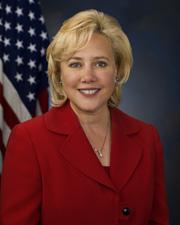 Sen. Mary L. Landrieu (D-LA)