Mr. President, these past few days we have seen an extraordinary outpouring of affection for our 40th President, Ronald Wilson Reagan. In a few short hours, he will lie in state under the Capitol…
Mr. President, these past few days we have seen an extraordinary outpouring of affection for our 40th President, Ronald Wilson Reagan. In a few short hours, he will lie in state under the Capitol dome where dignitaries from around the world and citizens from across the country will pay their respects to the man from Dixon.
In his 1982 State of the Union address, President Reagan told the Nation: We don't have to turn to our history books for heroes; they are all around us. In life, Ronald Reagan was a hero to millions. To the freedom fighters in the Soviet Union, to his fellow citizens striving toward that American dream, Ronald Reagan told the world that we are meant to be free.
He was a man of faith and deeply held convictions. Like James Madison, Ronald Reagan believed that in the creation of our Republic was the hand of God. He believed our freedoms flow not from the State but from the Almighty. Our task was and remains to awaken in the people this essential truth.
I close with a story I believe captures Ronald Reagan's remarkable character, his courage, and his vision. It was 1997. From a news report was a story of an emigre.
Walking in Arm and Hammer Park near his home, Reagan was
approached by an elderly tourist and his 12-year-old
grandson, Ukranian emigres now living near Toledo, OH. They
spoke with him for a moment and the grandfather snapped a
picture of the boy sitting with the former president. An
article about the encounter and the picture appeared first in
the Toledo Blade and then in newspapers around the country.
The other day, the grandfather recalled their meeting. We
went to the park for a picnic with our friends, he said, and
then he saw President Reagan. And we began to cheer him and
said, Mr. President, thank you for everything you did for the
Jewish people, for Soviet people, to destroy the Communist
empire. And he said, yes, that is my job.
Ronald Wilson Reagan was raised in a small town. Part of him remained a small town citizen all of his life. Not in the self conscious way one thinks of a politician stumping on the campaign trail. Ronald Reagan's small town roots informed the way he viewed the body politic--what he believed people wanted from life, from each other and from government.
As he explained, when a person grows up in a small town,
You get to know people as individuals, not as blocs or
members of special interest groups. You discover that,
despite their differences, most people have a lot in common .
. . [W]e all want freedom and liberty, peace, love and
security, a good home, and a chance to worship God in our own
way; we all want the chance to get ahead and make our
children's lives better than our own. We all want the chance
to work at a job of our own choosing and to be fairly
rewarded for it.
Ronald Reagan believed that the government should serve the people. He believed that the strength of our economy came from the creativity, ingenuity and productivity of the individual, not from the plans and schemes of government bureaucrats or intellectual elites.
This view of America's economic success guided his economic policies here at home, and, in no small way, shaped his political policies abroad.
When Ronald Reagan became President, the American economy was in a shambles. Inflation was in the double digits. Interest rates were soaring. Americans had to wait in endless lines to pump overpriced gas. Real incomes had stagnated and the American worker was demoralized. In his 1989 ``Speaking My Mind'' collection of essays and speeches, Ronald Reagan reflected that:
Here we were, a country bursting with economic promise, and
yet our political leadership had gone out of its way to
frustrate America's natural economic strength. It made no
sense. My attitude had always been--let the people flourish.
So, he set about slashing Federal income taxes and cutting burdensome regulations. It was his mission to free the American worker and unleash the American entrepreneur. When he came to office, the top marginal tax rate was 70 percent. By the time he left, it was a mere 28 percent. His sweeping tax reforms overhauled the tax code and removed 6 million taxpayers from the tax rolls.
At the same time, President Reagan gave Federal Reserve chairman Paul Volcker free reign to tighten the money supply and bring down inflation.
Together, these policies worked.
True to the President's forecast, as the economy grew, so, too, did tax revenues. Tax revenues increased faster than GDP. By 1990, the economy had grown by a third--or as the Wall Street Journal put it, ``roughly the size of Germany.'' Over the course of his presidency, the economy created 19 million jobs and the stock market hit a record high. America enjoyed the longest economic expansion up to that time.
Throughout, President Reagan was assailed for the growing deficit. In typical Washington fashion, he got the blame for adverse economic numbers, but never the credit for economic success. Contrary to his critics, however, the Federal deficit fell from 6.3 percent of GNP in fiscal year 1983 to 2.3 percent in 1988. The deficit actually shrank as a percentage of Gross National Product.
At the time, his policies were dubbed, ``Reaganomics.'' Now, they're considered common sense. President Reagan's guiding principle was simple, yet profound: government policies should grow the economy, not manage [or redistribute?] it. The impact of this idea was so great that, now, even the other side of the aisle speaks of targeted tax cuts and tax credits, and no longer openly campaigns to raise our taxes.
Indeed, President Clinton crystallized the Reagan Revolution when he declared, ``The era of big government is over.''
President Reagan believed in the dreams and dignity of the individual. As he said in his second inaugural address, ``There are no limits to growth and human progress, when men and women are free to follow their dreams.''
Ronald Reagan reminded the American people that economic liberty and human freedom are two sides of the same coin.
Some call it the Reagan Revolution. Others call it the Reagan Restoration. I prefer the latter term. The man from Dixon--lifeguard, radio announcer, actor, governor, father, adoring husband, and President of the United States--restored not only our confidence, but our fundamental understanding of the source of America's greatness: the American people.
Indeed, America was blessed to have such a President. Now he will enter the history books as one of our greatest. God bless Ronald Wilson Reagan. God bless America.
Mr. President, I ask for the yeas and nays.
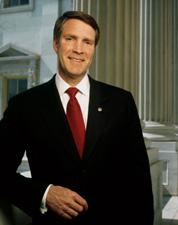 Sen. William H. Frist (R-TN)