Mr. President, every year since 1961, there has been an annual Defense authorization bill enacted. This year-- I would be happy to. Mr. President, I ask unanimous consent that the order for the…
Mr. President, every year since 1961, there has been an annual Defense authorization bill enacted. This year--
I would be happy to.
Mr. President, I ask unanimous consent that the order for the quorum call be rescinded.
Mr. President, every year since 1961 there has been an annual Defense authorization bill enacted. This year, like the previous 44 years, conferees and staff have worked extraordinarily hard and cooperated on a bi-partisan basis to get us to this point in our deliberations on this bill that means so much to our country. The fact that we are keeping up our decades-long tradition is reason enough to be proud, but what I am even prouder of is the leadership that our chairman and my friend, Senator Warner, has invested in getting us to this point.
This bill is essential to the men and women of our Armed Forces.
I am pleased that the conference report reflects Senate's longstanding commitment to a larger Army and Marine Corps. We authorized an increase of 1000 active duty marines for an authorized end strength of 180,000, 5,000 more than the administration requested. We also authorized an active duty end strength for the Army of 512,4000, 30,000 more than requested.
I am delighted that, after several years of fighting for it, we have finally been able to authorize the TRICARE health care benefit for all members of the Selected Reserve and their families for a reasonable premium that is 28 percent of the cost of the program. I am also pleased that the conference report prohibits the Department of Defense from increasing enrollment premiums for military retirees and cost shares for prescriptions filled through retail pharmacies while the GAO conducts an audit of the health care program and a Task Force completes a comprehensive assessment of the future of military health care.
The conference report also contains numerous other provisions to enhance the quality of life of our service members and their families, including: paying full replacement value for household goods lost or damaged in military moves; authorizing a total of $50 million in aid to local civilian schools, including $35 million in supplemental impact aid for schools with large numbers of military dependents, $5 million children with severe disabilities, and $10 million for schools affected by significant changes in military dependent students as a result of force structure changes, creation of new military units, and BRAC; and placing restrictions on payday loans to service members and their families.
The conference report also does not include a provision contained in the House Bill that would have provided that ``each [military] chaplain shall have the prerogative to pray according to the dictates of the chaplain's own conscience, except as may be limited by military necessity, with any such limitation being imposed in the least restrictive manner feasible.''
This is a lot more complicated issue than it seems at the surface. Military chaplains not only minister to members of their own faith group, they also minister to the needs of a diverse group of military members and their families, including those of other faith groups and those who claim no religious faith.
The military services respect the rights of military chaplains to adhere to the tenets of their respective faiths and give them virtually unrestricted discretion as to the content of their religious message when performing core ecclesiastical functions, including worship services, teaching, bible study, counseling, hearing confessions, preaching, and performing religious ceremonies. However, when performing functions at mandatory military events with multi-faith audiences, there is a longstanding military tradition of chaplains offering a prayer that demonstrates sensitivity, respect, and tolerance for all faiths present. Military chaplains are trained and expected to use good judgment when addressing pluralistic audiences at public, non- worship ceremonies, and they are never required to participate in religious activities inconsistent with their beliefs.
The Chiefs of Chaplains from each of the military services have advised us that, if enacted, the House provision would limit chaplain effectiveness and erode unit cohesion. They are concerned that commanders would no longer invite chaplains to pray at ceremonies where faith specific prayers might be offensive to members of other faiths who are required to participate. We have also heard from the National Conference on Ministry to the Armed Forces, an organization that represents the vast majority of military chaplains, and numerous other denominational and religious organizations that support military chaplaincy and respect religious freedom, who oppose the House provision.
The decision that this provision will not be included in the conference report is the right answer in light of the fact that neither the Senate nor the House has held hearings on this very important and complex issue.
Of course, we were not able to get everything we wanted in this conference. For example, I am very disappointed that we were not able to authorize federal pricing for prescriptions filled through the military's TRICARE retail pharmacy program.
Over my objections, the conferees agreed to a House provision regarding an existing settlement agreement between the Federal Government and two private parties regarding the removal of non-native animals from a national park on Santa Rosa Island, CA. This language is also strongly opposed by the two California Senators and by the Energy Committee, which has jurisdiction over this matter. This provision directs the Secretary of Interior not to take certain actions which were not the responsibility of the Secretary in the first place. Therefore, while I do not believe this conference agreement changes the legal obligations of the two private parties to this settlement, I believe this provision is unnecessary and misguided and that it should not have been included.
I am also disappointed that the conference report does not include the Akaka-Collins-Levin amendment on whistleblower protection. This amendment would have addressed gaps that have developed in the protection of federal employee whistleblowers since the enactment of the Whistleblower Protection Act of 1989.
However, the conferees did agree to a number of provisions designed to address wasteful practices and shortcomings in DoD management. These include: a provision prohibiting contractors who perform little or no work on a project from charging excessive ``pass-through'' fees to the Government; a provision prohibiting the ``parking'' of funds in a particular part of the Defense budget when the money is not really intended to be used for that purpose; a provision requiring contract oversight mechanisms for the acquisition of major computer systems, similar to the mechanisms already in place for the acquisition of major weapon systems; a provision limiting the use of cost-type contracts for the acquisition of major weapon systems; and a provision requiring that DOD hire and train government employees, in lieu of contractor employees, to perform critical acquisition functions.
I am also pleased that the conferees included a provision that would require a new comprehensive National Intelligence Estimate, NIE, on Iran. This provision also includes a requirement for the President to submit a report to Congress that would fully describe the U.S. policy on Iran.
The conference report also authorizes a responsible budget that tries to balance the need to support current military operations while continuing the modernization and transformation of our armed forces.
To support continuing operations in Iraq and the global war on terrorism, the conference report authorizes a $70
billion bridge supplemental for fiscal year 2007. Of this amount, $23 billion is devoted to ``reset'', that is, repair or replacement of Army and Marine Corps equipment, based on detailed requests provided by the services. The supplemental also includes a separate $2.1 billion account for the Joint Improvised Explosive Device Defeat Organization, JIEDDO, that is dedicated to countering improvised explosive devices.
The conferees agreed to an important provision that was sponsored by Senators McCain and Byrd, with the unanimous support of the Senate, that would require the President to request funds for operations in Iraq and Afghanistan in the regular budget beginning with the fiscal year 2008 budget that will be submitted next February. I strongly supported this provision. This administration has misled the American people far too often with respect to the war in Iraq. I am pleased that we have taken a major step in this bill to at least make our budgets more honest in the future by including the substantial costs we know we are going to incur in Iraq and Afghanistan. In fiscal year 2006, those costs reached a staggering $10 billion per month. It is irresponsible to make decisions on spending and taxation without including these costs in our budgets, and in this conference report we are putting an end to that practice.
With the respect to the F-22 multiyear procurement authority, the conferees agreed to provide authority for the Air Force to enter a multiyear contract for three years, subject to a certification by the Secretary of Defense that the savings are ``substantial'' in view of historical multiyear contracts.
The conferees also adopted Senate legislation that requires the Secretary of Defense to initiate an independent assessment of available foreign and domestic active protection systems to assess the feasibility of their near term and long term development and deployment. Active protection systems could be placed on vehicles like Bradleys, Strykers, and tanks to shoot down incoming threats including rocket propelled grenades, RPGs, and mortars. These type of weapons represent a real and growing threat to our deployed forces.
In the area of nonproliferation programs, I am disappointed that the conference report does not include a Senate provision, authored by Senator Lugar, to repeal all of the annual Cooperative Threat Reduction, CTR, certification requirements. These certifications have long outlived their usefulness and now only needlessly delay the CTR program. This conference report does include, however, a provision that would extend certain annual waiver authorities associated with destruction of Russian chemical weapons and fully funds the CTR programs at the Department of Defense at the budget request of $372.1 million.
Finally, the conferees authorized $11.7 billion for science and technology programs that will develop technologies to transform our military. This is an increase of $575 million over the budget request. This represents 2.7 percent of the DOD budget, still unfortunately falling short of the congressional and QDR goal of a 3-percent investment level.
On five other occasions, Senator Warner has led us as chairman in producing an annual defense authorization bill for the President to sign. Unfortunately, because of the 6-year term limitation imposed on committee chairmen by the Republican conference, this is the sixth and last defense authorization bill that Chairman Warner will shepherd through the process. He will have to step down as our chairman next year, but thankfully for the Nation and the Senate and for me personally, he will continue serving as a member of the Senate Armed Services Committee.
This year's process to produce a bill has been particularly difficult as people outside our conference sought to inject extraneous items into the conference. Throughout it all, Senator Warner refused to allow such matters to be added--in the face of enormous pressure.
We all know that Senator Warner has led a distinguished life of public service. He and I came to the Senate together in 1979 and we have served side by side on this committee continuously for the past 27-plus years. Defense authorization bills enacted over that entire period have always had John Warner's positive imprint on them.
Historically, our committee's chairmen--men such as Richard Russell and John Stennis and Sam Nunn--have been guided by one principle: Do what is right for our Nation and its military members. John Warner has followed in that fine tradition and we cannot thank him enough for it. It is very fitting that this bill is going to be named after my dear friend and our esteemed colleague, Senator John Warner. He is truly a man worthy of such a great honor.
I was keenly disappointed when the majority leader earlier tonight objected to this vital bill being acted upon. I'm hopeful that he will withdraw his objection before we adjourn, for the sake of the men and women in uniform and their families.
I suggest the absence of a quorum.
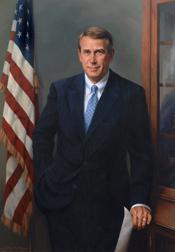 Rep. John A. Boehner (R-OH)