Mr. Speaker, I have here a letter which I wrote last month, which is addressed to United States Attorney Patrick Fitzgerald, who is currently conducting an investigation with regard to who it was who…
Mr. Speaker, I have here a letter which I wrote last month, which is addressed to United States Attorney Patrick Fitzgerald, who is currently conducting an investigation with regard to who it was who revealed the name of Valerie Wilson, who is and was an undercover operator for the Central Intelligence Agency, which I will enter at this point into the Congressional Record.
Congress of the United States,
Washington, DC, September 15, 2005.
Re request to expand investigation.
U.S. Attorney Patrick Fitzgerald,
Justice Department,
Washington, DC.
Dear United States Attorney Fitzgerald: We hereby request
that you expand your investigation regarding who in the Bush
Administration revealed to the press that Valerie Wilson, the
wife of Ambassador Joseph Wilson, was an undercover agent for
the Central Intelligence Agency (C.I.A.). We believe that
expansion should include investigating the Administration's
false and fraudulent claims in January 2003 that Iraq had
sought uranium for a nuclear weapon, which the Administration
offered as one of the key grounds to justify the war against
Iraq.
President Bush made two uranium claims, one in his State of
the Union Address to Congress and another in a report that he
submitted to Congress concerning Iraq, and National Security
Advisor Condoleezza Rice, Secretary of State Colin Powell,
and Secretary of Defense Donald Rumsfeld made three other
uranium claims. We request that you investigate whether such
claims violated two criminal statutes, 18 U.S.C., Sec. 1001
and 18 U.S.C., Sec. 371, that prohibit making false and
fraudulent statements to Congress and obstructing the
functions of Congress.
You have broad discretion to conduct this investigation.
The issues we raise are directly related to your current
investigation and clearly fall under your authority. The
desire to discredit the information provided by Ambassador
Wilson regarding the lack of evidence to support the
Administration's contention that Iraq sought uranium from
Niger is the nearly-universally accepted motive behind the
leak of Mrs. Wilson's identity. In order to fully investigate
the disclosure of an undercover CIA agent's identity, it is
clear that you should fully investigate the reasons for that
disclosure.
As we outline below, we believe that members of the
Administration may have violated laws governing
communications with Congress with respect to assertions about
Iraq's nuclear capabilities. Ambassador Wilson's efforts to
publicly contradict these assertions seem to be the reason
for the undercovering of Mrs. Wilson's identity. It is very
likely that you would encounter these assertions during the
course of your investigation, and thus their legality should
be the subject of your investigation.
The Administration's Claims about Iraq Seeking uranium were False And
Fraudulent
The uranium claims of the Administration in January 2003
that Iraq had sought uranium for a nuclear weapon were shown
to be false because, after intensive post war investigations,
the Iraq Survey Group found no evidence that Iraq had sought
the uranium. In the months prior to the war, weapons
inspectors of the United Nations (U.N.) conducted extensive
inspections in Iraq and found no evidence that Iraq had
revived its nuclear weapons program. The Administration has
never produced any legitimate actual evidence that Iraq had
sought the uranium.
The uranium claims were also fraudulent because although
some in the American intelligence community (including the
C.I.A.) may have agreed at the time with the British opinion
that Iraq had sought uranium, numerous people with the
Administration did not tell the whole truth consisting of the
contrary views held by the best informed U.S. intelligence
officials. C.I.A. Director George Tenet told the White House
in October 2002 that C.I.A. analysts believed the reporting
on the uranium claim was ``weak'' and thus the Director told
the White House that it should not make the claim. Later that
same day, the C.I.A.'s Associate Deputy Director for
Intelligence sent a fax to the White House stating that the
``evidence [on the uranium claim] is weak.'' The National
Security Council (N.S.C.) believed in January 2003 that the
nuclear case against Iraq was weak. Secretary of State Powell
was told during meetings at the C.I.A. to vet his U.N. speech
of February 5, 2003 that there were doubts about the uranium
claim and he therefore kept it out of his speech for that
reason. The U.S. government told the U.N. on February 4, 2003
that it could not confirm the uranium reports.
Furthermore, the original draft of the State of the Union
Address stated that ``we know that [Hussein] has recently
sought to buy uranium in Africa,'' but after the White House
consulted with the C.I.A., the White House changed the speech
to refer to the British view rather than the American view.
The final draft stated that the ``British government has
learned that Saddam Hussein recently sought significant
quantities of uranium from Africa.'' The parties involved
stated that they had no discussions about the credibility of
the reporting and the reason for the switch was to identify
the source for the uranium claim.
However, in response to the uproar over the op-ed article
by Ambassador Wilson, C.I.A. Director Tenet issued a
statement in which he admitted that C.I.A. officials who
reviewed the draft of the State of the Union Address
containing the remarks on the Niger-Iraqi uranium deal
``raised several concerns about the fragmentary nature of the
intelligence with [White House] National Security Council
colleagues'' and ``[s]ome of the language was changed.''
Tenet stated that ``[f]rom what we know now, Agency officials
in the end concurred that the text in the speech was
factually correct--i.e. that the British government report
said that Iraq sought uranium from Africa.''
What this tells us is that although Administration
officials, informed by the highest ranking members of our own
intelligence operation, knew that the claim of Niger uranium
going to Iraq was ``weak'' and could not be confirmed, they
were still determined to use it in the President's address to
Congress and fell back on the dubious language of the British
report. The Administration clearly sought to cover up their
own officials' doubts about Iraq's nuclear capabilities and
hide those doubts from the Congress and the U.S. public.
Motive
A motive for making such false and fraudulent uranium
claims would have been to thwart Congressional and U.N.
efforts to delay the start of the war. Pending at the time
that the Administration made its uranium claims in January
2003 was a Congressional resolution, H. Con. Res. 2,
submitted by five members of Congress on January 7, 2003,
which expressed the sense of Congress that it should repeal
its earlier war resolution to allow more time for U.N.
weapons inspectors to finish their work. On January 24, 2003,
a few days prior to the State of the Union Address, 130
members of Congress wrote to the president encouraging him to
consider any request by the U.N. for additional time for
weapons inspections. On February 5, 2003, 30 members of
Congress submitted another resolution, H.J. Res. 20, to
actually repeal the war resolution.
Had it not been for the uranium claims in the State of the
Union Address, which sought to squelch congressional concern
over the impetus for the pending war, the number of sponsors
for H.J. Res. 20 would have been far greater. The influence
of the uranium claims can be seen in the fact that 130
members of Congress signed the letter before the State of the
Union Address, but only 30 sponsored H.J. Res. 20, which was
introduced after the speech. The Administration's uranium
claims thwarted the congressional efforts to delay the start
of the war since the Administration used the claims to
allege that Iraq had a nuclear weapons program--despite
the failure of the U.N. inspectors to find such a
program--and thus falsely assert that Iraq posed an
immediate threat that needed to be nullified without
further delay.
Concerning the importance of the uranium claims, the report
Iraq On The Record, produced by the Minority Staff of the
House Committee on Government Reform, states: ``Another
significant component of the Administration's nuclear claims
was the assertion that Iraq had sought to import uranium from
Africa. As one of few new pieces of intelligence, this claim
was repeated multiple times by Administration officials as
proof that Iraq had reconstituted its nuclear weapons
program.'' A nuclear-armed Iraq was a key reason, if not the
most important reason, used by the Administration to justify
the need for a preemptive war against Iraq. Rather than allow
the U.N. inspectors to finish their inspections, the results
of which might have fueled further congressional efforts and
resolutions to stop the war, the Administration commenced the
war in March 2003.
the administration's false and fraudulent uranium claims arguably
violated criminal laws concerning communications with congress
The criminal statute, 18 U.S.C., Sec. 1001, prohibits
knowingly and willfully making false and fraudulent
statements to Congress in documents required by law. The two
uranium claims in the State of the Union Address and the
report to Congress concerning Iraq were false and fraudulent,
and are in documents that the White House submitted to
Congress. See House Document 108-1 and House Document 108-23.
The law required the president to give such reports. Article
II, Section 3 of the constitution requires presidents to give
State of the Union Addresses. Section 4 of Public Law 107-
243, which is the Congressional resolution authorizing the
war against Iraq, requires the president to give reports to
Congress relevant to the war resolution and the president
submitted said report on Iraq pursuant to that law. Thus 18
U.S.C., Sec. 1001 was evidently violated.
The criminal statute, 18 U.S.C., Sec. 371, prohibits
conspiring to defraud the United States and is applicable
since the Supreme Court in the case of Hammerschmidt v.
United States, 265 U.S. 182, 188 (1924) held that to
``conspire to defraud the United States means primarily to
cheat the government out of property or money, but it also
means to interfere with or obstruct one of its lawful
government functions by deceit, craft or trickery, or at
least by means that are dishonest.'' Senior Administration
officials arguably violated Section 371 because their uranium
claims had the effect of obstructing or interfering with the
function of Congress to reconsider its war resolution and to
allow further time for U.N. weapons inspections. If the whole
truth had been told, Congress may well have withdrawn the war
resolution or delayed the start of the war to allow further
U.N. weapons inspections, which would have shown what we now
know; that Iraq had no weapons of mass destruction and had
not sought the uranium. However, it should be noted that
Section 371 does not require proof that the conspiracy was
successful.
Additionally, the Downing Street memos should be part of
the investigation as to whether one of the several ways in
which the Administration deliberately ``fixed'' the facts and
intelligence on uranium included its switch of the language
in the State of the Union Address to justify the war. These
documents provide valuable insight into the mindset of the
Administration the summer preceding the Iraq invasion.
conclusion
The above matters are clearly related to your current
investigation. Ambassador Wilson's op-ed article focused on
the uranium claim made in the 2003 State of the Union Address
and he concluded that ``intelligence related to Iraq's
nuclear weapons program was twisted to exaggerate the Iraqi
threat.'' You are investigating whether any laws were
violated when Administration officials--in order to discredit
Wilson's claim and/or to retaliate against him--leaked to the
press the fact that his wife was a CIA agent. As set forth in
this letter, Wilson's original charge that the Administration
``twisted'' the evidence concerns matters that are just as
criminal as the Administration's attempts to discredit Wilson
and his charge by revealing the identity of Mrs. Wilson as a
CIA operative.
Justice Department officials in Washington certainly have
the same type of conflict of interest in this matter as they
did in the CIA leak case, which resulted in current your
assignment. (See 28 CFR, Sec. 45.2(a) prohibiting Department
employees from matters in which they have a conflict of
interest).
Thank you for your attention to this request. We look
forward to your response.
Sincerely,
Maurice D. Hinchey, William D. Delahunt, Bernard Sanders,
Pete Stark, George Miller, John Conyers, Jr., Richard
E. Neal, Martin Olav Sabo, Marcy Kaptur, Xavier
Becerra, Hilda L. Solis, Cynthia McKinney, Doris
Matsui, David Wu, Louise Slaughter, Charles B. Rangel,
Ed Towns, Jim McDermott, Raul M. Grijalva, Michael M.
Honda.
Albert R. Wynn, Sam Farr, Lynn C. Woolsey, Tammy Baldwin,
Chris Cannon, Jerrold Nadler, Carolyn B. Maloney, Jim
Moran, Donald M. Payne, Peter J. Visclosky, Carolyn C.
Kilpatrick, Dennis J. Kucinich, Neil Abercrombie, Jim
McGovern, Maxine Waters, Luis V. Gutierrez, Sheila
Jackson-Lee, Barbara Lee, Frank Pallone, Jr., Wm. Lacy
Clay, Jose E. Serrano.
Mr. Speaker, the purpose of this letter is to recognize, first of all, the importance of the investigation as to who it was who revealed the identity of Mrs. Wilson as an operator for the Central Intelligence Agency. Whoever did so violated Federal law, which went into effect in 1968.
That is a very important question. An even more important question is why that was done. And so in the context of this letter, I and the other 39 Members of the House who signed this letter are asking that this investigation be conducted more deeply, be conducted further into the question as to why that revelation was made.
To recount the events here, back in late 2002, the administration was making claims that Iraq possessed weapons of mass destruction. And on the basis of those claims, it was preparing a final push asking the Congress to support a war against Iraq.
Included in those weapons of mass destruction were references to uranium which allegedly had been imported from Niger in West Africa into Iraq for the purposes of constructing a nuclear weapon. The Central Intelligence Agency and other intelligence operations within the Federal Government expressed serious doubts about the accuracy of that information with regard to enriched uranium coming out of Niger into Iraq.
Nevertheless, the administration continued to press the case, telling the intelligence agencies over and over again to go back and look again, go back and look again, when the intelligence agencies found that they had no evidence, no substantial evidence whatsoever, that that uranium had been imported into Iraq from Niger.
Finally, the Central Intelligence Agency sent a retired ambassador, Ambassador Joseph Wilson, to Niger to investigate whether there was any prospect whatsoever that enriched uranium had been sent from Niger into Iraq. Mr. Wilson conducted a thorough investigation. He came back and reported to the Central Intelligence Agency that no such information was found.
The CIA informed the White House. Nevertheless, the administration continued to assert weapons of mass destruction, including the potential for the creation of a nuclear weapon. Those assertions were made directly to the Congress. It is against the law, it is against Federal law, a criminal violation of Federal law, to misinform the Congress of the United States and to intentionally mislead the Congress.
We believe that that has been done, and that if it had not been for the assertion of nuclear weapons and the belief that there were nuclear weapons being made in Iraq, that this Congress likely would not have passed the resolution authorizing the war in Iraq. If that had not taken place, that resolution had not been passed, we would not be seeing today nearly 2,000 American service men and women having been killed in Iraq; tens of thousands of others seriously wounded; hundreds, tens of thousands, perhaps as much as 100,000 Iraqis killed, many of them women and children, innocent civilians.
And so this question as to why that revelation was made is seriously important. Furthermore, we need to look into the issue of why this misinformation was given to the Congress, and that ought to be done by the Congress. This House of Representatives ought to be conducting hearings now that we know there were no weapons of mass destruction in Iraq prior to our invasion, and that whatever evidence there might have been was flimsy and weak and not anything to be based on.
Why was that done? That is a question of great seriousness presently before this House of Representatives, and it is not being addressed. The most important question of human rationality is why, why something was done? Was it as a result of a cabal that existed within the administration between powerful people who were determined to present information that would mislead the Congress in the way that they did? Because the Congress was misled, unquestionably so.
The Government of the United States is supposed to be open and transparent. Decisionmaking should be subject to powerful checks and balances. That has not been done, and it must be done. This Congress must fulfill its obligations under the Constitution to investigate these breakages of Federal law.
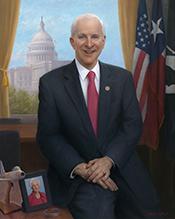 Rep. Sam Johnson (R-TX)


 +2
+2