Mr. Speaker, I thank the gentleman from Iowa for his help on this legislation, something that is near and dear to my heart. I also thank the gentleman from Missouri for his nice words. This…
Mr. Speaker, I thank the gentleman from Iowa for his help on this legislation, something that is near and dear to my heart. I also thank the gentleman from Missouri for his nice words.
This courthouse and the naming of this courthouse is very special to many people in Kentucky because Scott Reed was a special man.
H.R. 478 is a bill to designate the Federal building and United States courthouse located at 101 Barr Street in Lexington, Kentucky as the ``Scott Reed Federal Building and United States Courthouse.'' I can think of no other individual more deserving, no other public servant more worthy, and no other action more appropriate than naming the Federal courthouse in Lexington after the Honorable Scott Reed.
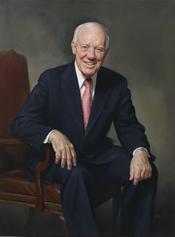
Prominent central Kentucky attorney, first Chief Justice of the Kentucky Supreme Court, and Federal judge, Scott Reed exemplifies the definition of honor and integrity.
Born in Lexington, Kentucky, on July 3, 1921, Scott Reed graduated with distinction from the University of Kentucky. While in college, he was editor-in-chief of the Kentucky Law Journal and awarded the order of the Coif, the highest academic award that can be given to a law graduate. He was also a member of the Phi Delta Phi Fraternity.
He achieved many honors at the University of Kentucky, culminating upon graduation as the recipient of the Algernon Sydney Sullivan Medallion, a prestigious award recognizing outstanding character and humanitarian service.
Prior to his time on the bench, Scott Reed was County Attorney. He was retained as counsel for the Fayette County School Board and distinguished himself as a trial lawyer of great integrity. He served from 1948 through 1956 as an associate professor at the University of Kentucky College of Law. From 1964 until 1969, he was judge of the First Division of the Fayette Circuit Court, the top trial court in Kentucky's second largest county. He then was elected to the Kentucky Court of Appeals, at that time the highest court in the Commonwealth.
As Chief Judge of the Kentucky Court of Appeals, Judge Reed oversaw the passage of a constitutional amendment that unified and modernized Kentucky's court system. As part of the modernization, the Court of Appeals became the Kentucky Supreme Court. Reed was elected by his fellow justices at that time to be the first Chief Justice of the Commonwealth of Kentucky. As Chief Justice, he oversaw the implementation of a constitutional amendment that led to Kentucky's having one of the most efficient court systems in the country. The Chief Justice of the Commonwealth holds equal rank with the Governor, the latter being the head of the Executive Branch and Chief Justice serving as the head of the Judiciary and its myriad of administrative offices throughout the State. Judge Reed was elected as a Fellow in the National College of the Judiciary in 1965 and was a voting member of the American Law Institute, a body of scholarly people who shape the laws of our Nation.
The opinions written by Scott Reed during his time on the Supreme Court of Kentucky have received national acclaim. Judge Reed was a frequent lecturer to the National College of Trial Judges and has achieved the highest honors that can be bestowed on a member of his profession.
In 1979 he was appointed by President Jimmy Carter to be U.S. district judge for the Eastern District of Kentucky. He served as a U.S. district judge until he retired in 1990, rounding out his judicial career having served on the local, State, and Federal benches. Scott Reed was named to the University of Kentucky College of Law Hall of Distinguished Alumni on April 11, 1980.
Judge Reed passed away on February 17, 1994, but his legacy will always be a part of Kentucky's rich history. He richly deserves this honor, one that is indeed long overdue.
Mr. Speaker, I thank my colleague Mr. Rogers of Kentucky for being a cosponsor of this legislation. Again, I thank my colleagues from Iowa and Missouri for their help on bringing this to the floor, and I urge its passage.