To elevate the Inspector General of the Commodity Futures Trading Commission to an Inspector General appointed pursuant to section 3 of the Inspector General Act of 1978.
Legislative Activity
Stay on top of the latest movement without scrolling through every action
Read twice and referred to the Committee on Agriculture, Nutrition, and Forestry.
October 2, 2008
View full timeline
Introduced in House
June 26, 2008
Referred to the House Committee on Oversight and Government Reform.
June 26, 2008
Referred to the Subcommittee on Government Management, Organization, and Procurement.
July 28, 2008
Mr. Towns moved to suspend the rules and pass the bill, as amended.
September 24, 2008 • 5:26 PM
Considered under suspension of the rules. (consideration: CR H9321-9323)
September 24, 2008 • 5:27 PM
DEBATE - The House proceeded with forty minutes of debate on H.R. 6406.
September 24, 2008 • 5:27 PM
Passed/agreed to in House: On motion to suspend the rules and pass the bill, as amended Agreed to by voice vote.(text: CR H9321-9322)
September 24, 2008 • 5:39 PM
On motion to suspend the rules and pass the bill, as amended Agreed to by voice vote. (text: CR H9321-9322)
September 24, 2008 • 5:39 PM
Motion to reconsider laid on the table Agreed to without objection.
September 24, 2008 • 5:39 PM
Received in the Senate.
September 25, 2008
Read twice and referred to the Committee on Agriculture, Nutrition, and Forestry.
October 2, 2008
Floor Debate
16 membersWhat members said about H.R. 6406 on the floor
 TD
TD PE
PE JL
JL TP
TP EHN+11
Floor Debate
16 membersWhat members said about H.R. 6406 on the floor
I thank my colleague for yielding. I am going to support the bill at hand because it is the only way we can implement what we just did. I want to thank my friends on the other side. I know this is a…
I thank my colleague for yielding.
I am going to support the bill at hand because it is the only way we can implement what we just did.
I want to thank my friends on the other side. I know this is a complex rule. It is unfortunate we had to go through the machinations we did to get where we are, but this was a historic vote today as we propel legislation along the great ark of our Nation's history as the world's most vibrant experiment in representative democracy.
Two hundred six years ago this month, Thomas Jefferson became the first President to take his oath in what was called the Federal City here in Washington. But through the confluence of circumstances and accident, the great compromise that birthed our Constitution and put the Nation's Capital here also produced a grotesque injustice we have so far been unable to right. Today is a time for another great compromise.
The capital of the free world doesn't provide full voting representation for residents. In fact, that has been true for too long, but today we have started the process of correcting an unhappy legacy left by the first Congresses.
I have discovered over the last 4 years that there are substantial myths surrounding the founding of Washington, DC, so I want to take a few minutes today to lay out the facts of how the city became what it is.
The idea for a Federal district arose out of an incident that took place in 1783 while the Continental Congress was in session in Philadelphia. When a crowd of Revolutionary War soldiers who had not been paid gathered to protest outside the building, the Continental Congress requested help from the Pennsylvania militia. The State refused, and the Congress was forced to adjourn and reconvene in New Jersey.
After that incident, the Framers concluded there was a need for a Federal district under solely Federal control for the protection of the Congress and for the territorial integrity of the capital. So the Framers gave Congress broad authority to create such a Federal district and broad authority to govern such a place. That is the limit of what the Framers say about a Federal district in the Constitution, that there should be one, and that it should be under congressional authority.
After ratification of the Constitution, one of the first issues to face the new Congress was where to place the Federal District. Some wanted it in New York. Others wanted it in Philadelphia. And others wanted it near George Washington's home on the Potomac.
These sectional factions fought a fierce political battle to decide the matter because they believed they were founding a great city, a new Rome. They expected this new city to have all the benefits of the great capitals of Europe. They never once talked about denying that city's inhabitants the right to vote.
Finally, Jefferson brokered a deal that allowed the city to be placed on the banks of the Potomac in exchange for Congress paying the Revolutionary War debt. New York got the debt paid, Philadelphia got the capital for 10 years. Then, as now, those political decisions were shaped by the issues of the day.
In 1790, Congress passed the Residence Act in which the right to vote was given to those residing in the new District. But while the capital was being established, those living here were permitted to continue to vote where they had before, in their States, on the Maryland side in Maryland, on the Virginia side of the District in Virginia.
The seat of government officially moved in 1800. In his final address to the Sixth Congress, less than a week after it took up residence in the new Federal District, President John Adams reminded Members, ``It is with you, gentlemen, to consider whether local powers over the District of Columbia vested by the Constitution in Congress shall be immediately exercised.'' That one statement explains the nature of the debate to follow.
Once again, the issues of the day shaped the actions of Congress. The political parties couldn't come to an agreement. Imagine that. The Federalists wanted to ensure a strong central control over the city. Anti-Federalist Republicans wanted to limit authority and distrusted all things urban.
With Jefferson and his Republicans preparing to take control of the Presidency and Congress, a pervasive atmosphere of crisis compelled the Federalists into action. If a bill was not passed before Jefferson took over, it would never pass.
Eventually, the Congress passed a stripped-down version of a bill authored by Virginia Congressman ``Light Horse Harry'' Lee. It simply stated that the laws of Virginia and Maryland then in effect, having been superseded in the District, would still apply.
We may never know why this version was passed because no records survived, but there is absolutely no evidence the Founding Fathers, who had just put their lives on the line to forge a representative government, then decided the only way to secure that government was to deny representation to some of their fellow citizens.
One historian aptly described the process as a ``rushed and improvised accommodation to political reality, necessitated by the desperate logic of lame-duck political maneuvering.'' But the inelegant compromise ultimately adopted left a decidedly undemocratic accident in its wake. District residents had no votes in Congress.
This wasn't, and is not, merely a quirk of history that affects very few people. The problem affects the very
reputation of our entire Nation. Foreign visitors I have met comment with puzzlement on the lack of voting representation in the Nation's Capital. I heard it from the mayor of Hong Kong when we were discussing his relationship with China.
Over the next few weeks and as this moves to the other body, we have to agree on this principle. So we have taken important action today.
Our very practical Founding Fathers left us a tool in the Constitution to deal with future problems. The District Clause in the Constitution, article I, section 8, clause 17, is there for a reason. Congress reaches its zenith of power in dealing with issues relating to the District.
Over the years, Congress has exercised its power to treat the District as a State when necessary, to ensure that the citizens of the city have substantially the same rights as all other Americans. Surely Members should resolve any difference of opinion they may have in favor of our authority to use that plenary power to provide residents with full voting representation.
Scholars spanning its political and legal spectrum have concluded, as I do, that Congress has authority through this legislation to provide voting representation in Congress for local residents. What was done by statute in 1790, and then undone by statute in 1800, can be redone by statute today.
This is often called the ``People's House,'' and rightly so. Article I, section 2, sets forth that ``The House of Representatives shall be composed of Members chosen every second year by the People of the several States.''
That same language, ``People of the several States,'' among the several States, is why the District of Columbia pays Federal taxes, even though it applies to people of the several States.
The sixth amendment's right to trial by jury, even though it says that it will be an impartial jury of the State and district wherein the crime shall be committed, has been applied to the District.
Prohibiting district laws which interfere with interstate commerce among the several States, Congress has applied that to the District of Columbia and the courts have upheld it.
Treat the District as a State for purposes of full faith and credit. That talks about States and the Constitution. But under the District clause, we have included the District of Columbia.
Grant people who live in the District the ability to sue people. Diversity of jurisdiction again applies to States, between citizens of different States under the Constitution, but under the District clause we have applied that by statute.
This body has taken an historic step today. I want to thank my colleagues who worked toward this, including my good friend from Pennsylvania, Mr. English, who supported this. But to continue this, we need to support the issue at hand, the bill that is currently on the floor under the PAYGO legislation.
It is kind of a jurisdictional morass, but I urge my colleagues to support it.
Mr. Speaker, I yield myself such time as I may consume. Mr. Speaker, today the House is considering legislation that, in my view, represents the first brick in a Chinese wall of tax increases.…
Mr. Speaker, I yield myself such time as I may consume.
Mr. Speaker, today the House is considering legislation that, in my view, represents the first brick in a Chinese wall of tax increases.
Generating revenue by assuming that Americans with more than $5 million in income will increase their annual withholding by one-tenth of 1 percent simply makes a mockery of PAYGO.
The majority is exploiting a statistical quirk in the way that the Joint Tax Committee does its revenue estimates, and will have accountants, not normally known for their high spirits and good humor, roaring with laughter all over the country.
Perhaps, in the aggregate, there are enough people in America making more than $5 million who will pay an extra $2,000 in estimated taxes to raise revenues as much as anticipated, but this seems more likely to be an instance where the Joint Tax Committee's scoring rules and common sense have dramatically parted ways.
If the Judiciary Committee thinks the companion bill to create a new Member from Utah and add voting rights to a Member from the District of Columbia is such a good idea, surely they could have found some program within their jurisdiction to trim by an offsetting amount. And they didn't find a user fee in their jurisdiction to increase by just a few dollars.
In fact, despite the fact the Democratic majority created a budget that includes more than $2 trillion in spending, they could not even trim $3 million from that total to pay for this rather modest initiative. To put this in perspective, the majority could have offset this bill by reducing entitlement spending by just two ten-thousandths of a percent.
By not going down that route, this bill confirms what we have all suspected: the Tax Code is going to be the ATM machine that pays for all of the new majority's fondest initiatives. The bill today may be cheap in total dollar terms, but we will not be so lucky the next time around.
In fact, Mr. Speaker, in my view, H.R. 1906 represents what will be the first of a series of bizarre revenue raisers, Rube Goldberg devices, and tax gimmicks to be trotted out to pay, first for small things, and then pay for the demands of the majority's budget, which includes the largest tax increase in American history, nearly $4 billion over 5 years.
It also demonstrates that the majority's PAYGO promise that new entitlement spending could be offset with entitlement spending cuts is hollow and cynical. If they can't even find $3 million of entitlement savings for this bill, can we expect them to pay for their new programs with anything other than a significant tax increase ultimately on the middle class?
This makes even traditional budget gimmicks, like putting routine spending into an emergency spending bill, or bypassing the budget resolution by using ``advanced appropriations'' look pristine by comparison.
The process for this bill's consideration is flawed, deeply and fundamentally. It did not go through the Committee on Ways and Means. This is another example of the new majority ignoring their own promises for regular order.
The procedure, Mr. Speaker, for considering the broader issue of expanding the House of Representatives itself is deeply flawed. The example being set today that you can split a bill into separate elements so as to limit what amendments and motions will be germane is the triumph of form over substance.
The proposal before us only adds more complexity to the Tax Code. And think about this: if you thought filling out your taxes wasn't tough enough, our friends on the other side of the aisle are raising the level of difficulty to complicate the code and increase the risk that an inadvertent error will have the IRS demanding interest on your underpayment.
At least it is better than the last version of this proposal, which generated an even more ludicrous $3 million by raising the safe harbor amount for people with incomes over $150,000 by just three one- thousandths of a percent.
Mr. Speaker, this is a flawed bill. It is a silly exercise. And I think it is appropriate that we vote it down.
I yield to the gentleman from Wisconsin.
Mr. Speaker, may I reclaim my time? And instead allow the leader on his own time to pose those sorts of questions.
I am afraid, Mr. Speaker, it is my time and I will allow the gentleman from Wisconsin to yield to the leader on the leader's time.
Mr. Speaker, I reserve the balance of my time.
General Leave
Mr. Speaker, it would be my privilege now to yield 4 minutes to the distinguished gentleman from California (Mr. Campbell).
Mr. Speaker, it is a great privilege for me to yield 5 minutes to a gentleman who brings marvelous expertise to any tax debate, who is entitled to wear a green eye shade if he chooses, the gentleman from Texas (Mr. Conaway).
First, Mr. Speaker, I would like to just briefly yield myself 15 seconds to thank the last speaker for her eloquence and her marvelous remarks and to say that I am very proud to stand with her today as one of the 22 who voted for the preceding bill. I am very proud of the fact that at a time when we are debating the needs of democracy all over the world that we have taken the time in the House to move forward to correct an anomaly in our own representation and create an opportunity for the gentlelady who has for many years so well represented the District of Columbia to have an opportunity fully and legally to vote on the floor, representing her people.
With that, Mr. Speaker, I would like to now yield 5 minutes to the gentleman from Georgia (Mr. Price).
Mr. Speaker, I yield 30 seconds to the gentleman from Georgia.
Mr. Speaker, I do have one other speaker who has appeared, and one who has made an immense contribution to the debate on the previous bill. So it is my privilege now to yield 7 minutes to the gentleman from Virginia (Mr. Tom Davis).
(Mr. TOM DAVIS of Virginia asked and was given permission to revise and extend his remarks.)
Mr. Speaker, I yield myself such time as I may consume.
Mr. Speaker, I must tell you it is a privilege to be on the floor today to play a role in having passed the last bill which our last speaker spoke about with great eloquence. It is a real privilege to be here with the gentleman from Georgia (Mr. Lewis) who certainly has had a long career of fighting for people's voting rights and civil rights. It is great to look across the floor and see former Secretary Jack Kemp, a 20-year veteran of this institution, present here today.
Mr. Speaker, as a matter of principle, I voted for the last bill, and as a strong supporter of tax simplification and fiscal responsibility, it is my privilege to vote against the bill that is before us at this moment, which is a procedural grotesque, a gimmick, a trick, a ploy, a ruse, and one that I think represents the poorest of possible tax policies.
I ask my colleagues to vote this bill down and send a clear message that we don't support this kind of chicanery on the floor of the House of Representatives.
Mr. Speaker, I yield back the balance of my time.
Mr. Speaker, on that I demand the yeas and nays.
Mr. Speaker, pursuant to House Resolution 317, I call up the bill, (H.R. 1906) to amend the Internal Revenue Code of 1986 to adjust the estimated tax payment safe harbor based on income for the…
Mr. Speaker, pursuant to House Resolution 317, I call up the bill, (H.R. 1906) to amend the Internal Revenue Code of 1986 to adjust the estimated tax payment safe harbor based on income for the preceding year in the case of individuals with adjusted gross income greater than $5 million, and ask for its immediate consideration in the House.
Mr. Speaker, I yield myself as much time as I may consume.
I rise in support of H.R. 1906. No one, but no one will pay more taxes under the bill. It merely ensures that multi-millionaires don't add to our tax gap.
The bill changes in a very minor way estimated tax payments made by wealthy individuals with incomes of more than $5 million a year. It makes a technical timing change to tax payments made by these individuals. They do not pay more taxes. H.R. 1906 is critical to the pay-as-you-go pledge of this Congress.
I am pleased to have supported H.R. 1905, the District of Columbia House Voting Rights Act of 2007. For 207 years, Washington, D.C. residents have paid Federal taxes, and for 207 years they have had not a voting representative in the United States Congress.
The right to vote is precious. It is sacred. It is the cornerstone of our democracy.
Americans sacrificed everything for this right. They were harassed, beaten, jailed and even killed for the right to vote.
Not so long ago, many of my friends, many of my colleagues lost their lives. There are many more faceless, nameless heroes who suffered and sacrificed for this basic right.
How can we preach this principle around the world and not practice it here in our Nation's Capital? It is the foundation of our democracy.
So I urge all of my colleagues to support H.R. 1906.
Mr. Speaker, I reserve the balance of my time.
Mr. Speaker, I ask unanimous consent to give Members 5 legislative days to revise and extend their remarks on the bill, H.R. 1906.
Mr. Speaker, I yield 3\1/2\ minutes to the gentleman from Indiana, Congressman Hill.
Mr. Speaker, I yield 3 minutes to the gentleman from Mississippi.
Mr. Speaker, I now yield 5 minutes to the gentlewoman from the District of Columbia (Ms. Norton).
Mr. Speaker, I yield myself such time as I may consume.
I don't understand it, Mr. Speaker, how my colleague, my friend, my brother from Georgia can come here and state in an open way that this is the most oppressive Congress. We have only been in the majority for 4 months, 4 short months, not quite 4 months. You really don't believe that.
Yes, I will yield to my friend.
Let me say to my friend from Georgia, I think it was a good and a necessary rule.
I will no longer yield.
Mr. Speaker, I reserve the balance of my time.
Mr. Speaker, this is an historic day. This is a wonderful day for the people of the District of Columbia.
I first came to Washington, Mr. Speaker, in May of 1961 to go on something called the Freedom Rides. It was impossible for blacks and whites to board a Greyhound bus or Trailways bus here in the District of Columbia, and travel together through Virginia, North Carolina, South Carolina, Georgia, Alabama, into Mississippi and to New Orleans.
I came back here in 1963 at the age of 23 with Eleanor Holmes Norton, the gentlewoman from the District of Columbia, to participate in the March on Washington. To be here and see Jack Kemp, an old friend, former colleague, on this day is a great day.
So, Mr. Speaker, I strongly support H.R. 1906. And I want to make it plain and crystal clear that no one, but no one, will pay more taxes under this bill. It changes in a very minor way estimated tax payments made by wealthy individuals. This bill does not increase their taxes. It would affect only 4,000 multimillionaires. It is only a tiny change.
Yes, I am going to say it again: I am pleased to have supported H.R. 1905. Today is the day for Washington, D.C. residents to realize the dream that so many take for granted. The 200-year wait is over. The 200-year wait is over.
Mr. Speaker, I urge all of my colleagues on both sides of the aisle to vote ``yes'' for H.R. 1906.
Mr. Speaker, I submit the following for the Record:
Rules From the 109th That Added Text of House-Passed Bills to
Underlying Bill
H. Res. 151 rule for H.R. 1268, 3/14/05, 7:30 p.m., Making
Emergency Supplemental Appropriations for FY2005--a.k.a.
Iraq/Afghanistan/Tsunami Relief.
Open: waives all points of order against consideration;
waives points of order against bill for clause 2, Rule XXI
except two sections; provides for the text of H.R. 418 as
passed the House to be added to the end of H.R. 1268.
H. Res. 783 rule for H.R. 4975, 4/26/06, 11:20 p.m.,
Lobbying Accountability & Transparency Act of 2006--ethics
reform.
Restrictive: waives all points of order against
consideration; 1 hour general debate controlled by Majority &
Minority Leaders; makes in order Rules Committee 4/21/06
print in Part A of Rules' report and self-executes its
adoption; allows only those amendments printed in Part B of
the Rules' report as specified; waives all points of order
against amendments; after final passage adds text of H.R. 513
as passed the House (527 Reform bill) to H.R. 4975; provides
for consideration of Senate bill (S. 2349) and substitutes
House passed text and calls for conference; waives all points
of order against consideration of Senate bill and against
motion to strike and insert.
H. Res. 1100 & 1099 rules for H.R. 6406 and H.R. 6111, 12/
7/06, 10:30 p.m., To modify temporarily certain rates of duty
and make other technical amendments to the trade laws, to
extend certain trade preference programs, and for other
purposes.
Closed: Consideration in the House; waives all points of
order against consideration; provides that in the engrossment
of H.R. 6111, the text of H.R. 6406 will be added at the end.
(H. Res. 1099) Provides for a motion to concur in the
Senate amendment with an amendment consisting of the text of
H.R. 6408 for a bill to amend the Internal Revenue Code of
1986 to provide that the Tax Court may review claims for
equitable innocent spouse relief and to suspend the running
on the period of limitations while such claims are pending--
vehicle for tax extenders and more . . . .
Parliamentary inquiry, Mr. Speaker. Mr. Speaker, we have just heard the majority leader say that if either 1905 or 1906 fails, then they shall both be tabled. Mr. Speaker, can you tell me, this House…
Parliamentary inquiry, Mr. Speaker.
Mr. Speaker, we have just heard the majority leader
say that if either 1905 or 1906 fails, then they shall both be tabled.
Mr. Speaker, can you tell me, this House having passed H.R. 1905, how is it possible to have a bill that has already passed the House, is no longer on the floor, no longer the business of the House, tabled with subsequent action on another bill?
Mr. Speaker, I have a further inquiry.
Mr. Speaker, can you tell me where in the House rules it provides anything that allows for the tabling of a House bill, once passed, when there has been intervening business in the meantime?
Point of order, Mr. Speaker.
Mr. Speaker, I appeal to the Chair and state that the rule under which we are operating right now is in violation of House rules because there is no provision in the House rules that states that you may table a bill after it has already been dispensed with by the House.
I am asking for a point of order.
Mr. Speaker, my point of order is that we are now operating in violation of the rules of the House because the rule that we have adopted has no rule of the House that allows for tabling of a bill once it has passed the House and intervening business has occurred.
I thank the gentleman for yielding.
I, too, want to add my congratulations and my commendation to the Delegate from the District of Columbia. As I mentioned early during the day, I think this has been a good debate and an interesting and a productive debate, and I commend her for the work that she has done on behalf of her constituents.
I also want to state for the record once again that I strongly support the enfranchisement of the citizens of the District of Columbia. However, I believe that it ought to be done in a legal and a constitutional way. I think there is a way to do that, and we have talked about that. I do not believe that the bill that has just passed the House, 1905, in fact is a constitutional bill, and I think that that will play out over a period of time.
Mr. Speaker, I want to comment about where we are right now in terms of the activity and the rules of the House of Representatives. We are further delving into Orwellian democracy. I say that because the majority party has been champions of saying one thing and then doing completely the opposite. We have been told that this would be the most open, honest and fair Congress. In fact, we weren't told it, the leadership of the other party has promised the American people that this would be the most open and honest Congress.
Mr. Speaker, I would suggest to you that this has, in many ways, been the most oppressive Congress because of the majority party's actions, most oppressive Congress ever. You say, well, how can I arrive at that conclusion? Well, the way that the rules have been used and the ways that the rules have been changed draw one, I think objectively, to that conclusion because the rules that have been changed especially on this bill, on this issue, have disenfranchised completely anybody in the minority. And you say, well, how is that? Well, the rule that was adopted and the rule under which we are acting and the rule upon which I asked the Speaker multiple parliamentary inquiries states that if either H.R. 1905 or H.R. 1906 fails, then the other bill is tabled, failed based upon recommital vote.
Now, what that means is this House has passed H.R. 1905. And normally what would occur is that that bill would be on its way to the Senate. But what we are doing now is waiting to see whether 1906 passes, and if it fails, then 1905 is tabled.
Mr. Speaker, I would suggest to you that it is impossible to construct a rule that passes the smell test or passes the principles of democracy in this House that allows this House to table a bill after it has already passed. It is unconscionable.
Many of us have served in State legislatures. We understand the process of parliamentary procedure. We understand how minorities are able to affect policy. But when a majority wants to, by the very rule, squelch the input of the minority completely, it certainly can, based upon the ruling from the chair. But it is circular logic at best. When I asked the Speaker how on Earth could that occur, the Speaker replied, Because of the rule. When I
asked, how can the rule be consistent with the rules of the House, the response from the speaker was, Because of the rule.
Mr. Speaker, this is a remarkably oppressive action on the part of this majority. I urge my colleagues on the majority side to rethink the processes that they are using to make it such that the minority party in this Chamber is no longer able to affect policy, which means that 48 to 49 percent of the citizens of this Nation are no longer allowed to have Representatives that are able to affect policy because of the rules adopted by this majority party.
It makes me very sad to draw that conclusion based upon the rule that this House has adopted today. I urge my colleagues to reconsider.
Will the gentleman yield?
Isn't it true that the rule which we are adopting is unprecedented and has never been adopted in this House?
I thank my good friend for yielding.
I don't want to belabor this, but I think it is important for the American people to understand and appreciate, and I think it is important for my good friend from Georgia to appreciate, that this rule that has been adopted is unprecedented. There has never in the history of the House of Representatives been a rule that has allowed for the tabling of a bill after it has passed the House. Ever, ever.
I urge my colleagues to look at the rules that they are adopting in order to squelch minority input.
I thank the gentleman from Georgia for yielding. I thank the gentleman from Georgia for leading this debate. Truly, you are the man to lead this debate on this great civil rights bill that the House…
I thank the gentleman from Georgia for yielding.
I thank the gentleman from Georgia for leading this debate. Truly, you are the man to lead this debate on this great civil rights bill that the House is about to give after 206 years. I thank you for coming forward to do so.
I want to praise and offer my gratitude to Democratic leaders for reconciling the important principle of fiscal responsibility, PAYGO as we call it, with the basic principle of voting rights, forsaking neither. H.R. 1906 is particularly appropriate, especially when you consider that D.C. residents have always paid taxes, notwithstanding that the 16th amendment says that only States shall pay taxes.
Mayor Adrian Fenty and Council Chair Vincent Gray yesterday led a march in the wind and the rain on Emancipation Day because 145 years ago Lincoln freed the slaves in the District of Columbia 9 months ahead of the slaves elsewhere. My grandfather, Richard Holmes, was one of those slaves. His son, Richard, entered the D.C. Fire Department in 1902. And his son, Coleman, my father, like his forefathers and like me, have never had a vote in this city.
I am particularly grateful, and I wanted this time especially to thank the 22 Republicans who voted for the bill today, preserving the great tradition of the party of Lincoln for equal rights.
The Constitution was written by men who risked everything for the principle of representation. We should be especially mindful today, perhaps, to dedicate this bill to other men who have risked everything in times of war. 80-year-old retired Wesley Brown, the first black graduate of the Naval Academy and a resident of the District of Columbia, who went to the same high school that I attended, served in three wars, and retired from the Navy as lieutenant commander, but never has had the right to vote. His remarkable life story is chronicled in the book ``Breaking the Color Barrier: The U.S. Naval Academy's First Black Midshipman and the Struggle for Racial Equality.''
Bringing the matter forward, some young men in the District of Columbia are returning from Iraq, and I leave you with a few of their words. I quote Marcus Gray, who spent a year in Iraq in the 299th Engineering Company, who said, ``My father served in the 104th Airborne in Vietnam, and I am proud to follow him by serving my country in the same manner. I could be called again this year, but being called to active duty is what every soldier in the Reserves should expect to happen.
``We also expect equal treatment, and the Army tries hard to see that all soldiers are treated equally. However, I want equal treatment at home as well. I want the same voting representation as other soldiers, and as the Iraqi people have now because of our service.''
Emory Kosh, who works in my office in the House: ``I was proud to serve my country as a volunteer soldier. However, I am not prepared to sit as an employee of the House of Representatives while every Member answers the bell except my Congresswoman.''
Mr. Speaker, I ask the House to give D.C. residents on the battlefield and in the city itself the vote they have earned over and over again. Most of those who have paid the dearest price will never see the benefit. Those in the Vietnam War, the District had more casualties than 10 States; in the Korean War, more casualties than eight States; in World War II, more casualties than four States; and in World War I, more casualties than three States.
In their name, and in good conscience, I ask that the House today finally give the residents of the District of Columbia the vote they have fought for now for 206 years.
Show 8 more
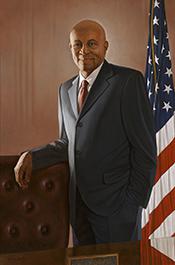
Madam Speaker, I move to suspend the rules and pass the bill (H.R. 6406) to elevate the Inspector General of the Commodity Futures Trading Commission to an Inspector General appointed pursuant to…
Madam Speaker, I move to suspend the rules and pass the bill (H.R. 6406) to elevate the Inspector General of the Commodity Futures Trading Commission to an Inspector General appointed pursuant to section 3 of the Inspector General Act of 1978, as amended.
Madam Speaker, I ask unanimous consent that all Members have 5 legislative days in which to revise and extend their remarks.
Madam Speaker, I yield myself such time as I may consume.
H.R. 6406 will elevate the Inspector General of the Commodity Futures Trading Commission to a Presidentially appointed, Senate-confirmed position. This bill strengthens the integrity of the Commodity Futures Trading Commission by giving the Inspector General more authority and independence to investigate CFTC's regulation of commodity futures and option markets.
H.R. 6406 builds upon legislation recently passed by the House to give the CFTC more authority to investigate and regulate speculations in all and future markets. In light of the current financial crisis, this bill is an important step in boosting the independence, accountability, and credibility of a key financial regulator.
Under current law, the Inspector General is hired by the chairman of the CFTC. This process may prevent the IG from conducting a thorough investigation into CFTC's programs and operations. This bill will separate the IG's oversight function from day-to-day management by the chairman and commissioners and reassure market users and the public that they are being protected from fraud, manipulation, and abusive practices related to the sale of commodity and financial futures.
Madam Speaker, this bill is a small but important step towards improving public trust in the Commodity Futures Trading Commission. I fully support its passage and urge my colleagues to do the same.
I reserve the balance of my time.
Madam Speaker, I yield 2 minutes to the gentleman from North Carolina, Congressman Etheridge.
Madam Speaker, I yield 3 minutes to the sponsor of the bill, Congressman Larson from the great State of Connecticut.
Madam Speaker, let me say, I want to first commend the gentleman from Connecticut for putting this legislation together.
This is a very timely piece of legislation; we need it today more than ever. We need to have an independent IG. We need to make certain that his hands are not tied or her hands are not tied, that they're able to go and to look, and wherever the problem is, that they're able to go without being interfered with.
So I think this is a great piece of legislation. And I'm happy to have a presidential appointment, because that's the kind of independence that's needed, as you know what's going on in this country today. I mean, let's face it. And of course we need to make certain that we have transparency. We need to make certain that people in the position are able to carry out that position without any kind of restrictions at all. So this legislation addresses that.
I think it's a good piece of legislation. I encourage my colleagues and friends to support it. And I say to the author of it and to the members who have been very involved in the Ag Committee for this, I really want to say to you, thank you for doing the right thing.
On that note, Madam Speaker, I reserve the balance of my time.
Madam Speaker, I yield back the balance of my time and urge my colleagues to support this legislation.

Mr. Speaker, I thank the gentleman from Pennsylvania for yielding. The reason we have this bill and the reason we are having this debate is because the D.C. voting bill, which just passed this House,…
Mr. Speaker, I thank the gentleman from Pennsylvania for yielding.
The reason we have this bill and the reason we are having this debate is because the D.C. voting bill, which just passed this House, costs $2.5 million. So in order to have it be neutral, there needs to be $2.5 million found.
Now, what this bill proposes to do is what I would argue is basically a tax gimmick because no one's final tax, no one's ultimate tax pay, will be changed as a result of this bill. What it, in fact, does is change how quickly some people must pay their tax. So they will have to pay it a little earlier. They won't pay any different amount over a year. They will simply pay it a little earlier. But that is what this bill does.
But what was the alternative? Well, normally you would think that if you were interested in fiscal responsibility, if you were interested in keeping budgets balanced over time, that if you are going to spend $2.5 million extra, you would save $2.5 million somewhere else. That is what people at home do. That is what everyday, average American citizens do. If they are going to spend a little more money on something, they spend a little less money on something else.
Let's talk about what you would need to have done. If the Democratic majority had wished to reduce spending, and reduce the growth in spending is all you would actually have to do, but if they had wished to reduce the growth in spending in order to offset this $2.5 million, we are talking about 0.0002 percent. That is the reduction in growth, not even a cut, but the reduction in growth of spending. That is all you would have to do to offset the $2.5 million in this bill. And then we wouldn't even be talking about taxes and tax gimmicks and all that. Point zero zero zero 2 percent.
I ask you, if you can't find 0.0002 percent to reduce growth, not even to reduce entitlement spending, but to reduce growth of entitlement spending, where and when will you ever deal with the entitlement tidal wave that we have coming? By 2037 the entitlements will eat up 100 percent of the Federal budget as we currently know it.
So you have a couple of choices. You can either reduce the growth in entitlement spending over time so we don't have that, or you can double taxes. Well, if you can't find today 0.0002 percent to reduce the growth in spending, I would have to presume, and I think people would have to presume, Mr. Speaker, that the doubling of taxes eventually is where you want to go.
Now, we already saw a budget where you have had the largest tax increase in American history included in the budget, and now we can see why. You can't even find this amount of reduction in spending.
I oppose the D.C. voting bill because I think it is not right and not constitutional. But I oppose this bill as well because if we are ever going to control this budget and we are not going to control it on the backs of the average working American person, then tinkering with the Tax Code to find $2.5 million is not the way to do it. The way to do it is to go find 0.0002 percent of the growth and reduce that amount.
Mr. Speaker, I appreciate the gentleman's yielding the time. It is interesting, and our good colleague has left, but I would wonder why we constantly talk about history from 6 years ago that…
Mr. Speaker, I appreciate the gentleman's yielding the time.
It is interesting, and our good colleague has left, but I would wonder why we constantly talk about history from 6 years ago that eliminates the conversation about 9/11, the recession that we went into, and an awful lot of things that had an impact on the financial circumstances or guesses at the financial circumstances over these intervening 10 or 12 years that seem to get lost whenever it is convenient.
What I would like to speak to, though, is the mechanics of what is happening right here. This is a PAYGO fix and is intended to ``pay for'' the additional expenses for adding an additional Representative to this body. I disagree with that. It is unconstitutional from a straight reading, but that is not our issue. How do we pay for that?
The folks back home understand the term ``PAYGO'' as if they want to pay for something, they have choices. They can borrow the money, which we have collectively done an awful lot of, or they can earn more money or they can cut spending in an area to pay for whatever the new expenditure is.
This bill takes the first route. This is simply a cash flow issue. This does not actually raise the money that the Federal Government gets to keep to pay for these additional expenses. This bill simply looks at a very unsympathetic group of taxpayers out there, folks who are blessed to make over $5 million in AGI each year, and says, we are going to borrow the money from you to pay for this.
And so our friends on the other side of the aisle have a very twisted, in my view, definition of PAYGO which involves simply borrowing money, whether it is to pay for your American Express bill off of this month's Visa or to sign up for a new Visa to pay the old Visa card. This bill doesn't pay for these added Federal expenses. It simply finances it through a borrowing from taxpayers who make more than $5 million in adjusted gross income.
So we many times come to this floor with less than straightforward conversations about what we are doing. This is one of those times. This is not a PAYGO fix. This is simply a cash
flow, borrowing the money from a certain number of taxpayers, because the bill does not raise anyone's tax. It does increase the amount of advanced payment that taxpayers have to make each year, depending on what their tax scheme is. But their ultimate tax bill is decided by the code that is in existence right now and will not be changed.
So as the other side, Mr. Speaker, brags on this bill as being their answer to the additional spending under the D.C. voting bill, it is not right. This simply borrows the money from some other group and does not pay for it.
So I would oppose this bill. It does not honor the traditional definition of PAYGO that we are all familiar with, and I would urge my colleagues to vote against it.
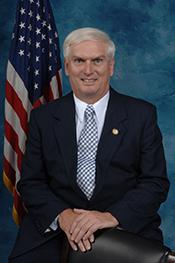
I yield myself such time as I may consume. Madam Speaker, I'm honored to be on the floor on this legislation with my good friend, Chairman Towns, who is one of our great Members on the other side.…
I yield myself such time as I may consume.
Madam Speaker, I'm honored to be on the floor on this legislation with my good friend, Chairman Towns, who is one of our great Members on the other side.
Today we take up H.R. 6406 which elevates the Inspector General of the Commodity Futures Trading Commission to an Inspector General position requiring a Presidential appointment and Senate confirmation, or, as some people refer to it, a PAS position.
On behalf of Ranking Member Davis, I do want to express one concern, and that is that this legislation does not come to the floor through regular order, and while we understand the need to move quickly to ensure that we have solid oversight from an independent source at the CFTC, this bill could have benefited from a review by the Oversight and Government Reform Committee.
Recommendation 6 of Paul Volcker's National Commission on Public Service issued in January of 2003 said, ``Congress and the President should work together to significantly reduce the number of executive branch political positions.''
The Commission noted that President Kennedy had 286 leadership positions to fill when he became President in 1960, and that by the end of the Clinton administration there were 914 principle leadership positions; and that in 2001, the new President, George W. Bush, at that time confronted a total of 3,361 offices to be filled by political appointment.
The Commission pointed to several reasons for this, mostly due to a bad Federal management structure. But regarding Inspectors General, we believe much of this stems from an assumption that the PAS process generates a more professional and independent Inspector General. To our knowledge, no one has successfully demonstrated a nexus between the PAS process and professional excellence. And our fear is that a growing lag in the PAS process will cause even larger gaps in leadership during the Presidential transitions.
With that said, however, on our side, we're inclined to support this bill given the current crisis that we face. And we know that the CFTC is a very important agency, particularly at this time. But we caution our colleagues to pay more attention to these ``elevation bills'' in the future and insist on a specific articulated need for any proposed change, and also, hopefully, full committee hearings.
Madam Speaker, I reserve the balance of my time.
Madam Speaker, I continue to reserve our time.
Madam Speaker, we continue to reserve.
Madam Speaker, I'm sorry. We didn't realize that Chairman Towns didn't have any other speakers. So I urge all Members to support the passage of H.R. 6406.
Madam Speaker, I yield back the balance of my time.
Thank you, Chairman Towns. I appreciate the opportunity to speak on behalf of this important bill that's a vital piece of our anti-speculation measures we have passed in the House this session. By…
Thank you, Chairman Towns.
I appreciate the opportunity to speak on behalf of this important bill that's a
vital piece of our anti-speculation measures we have passed in the House this session.
By elevating the Inspector General of the Commodities Futures Trading Commission to the level of a wholly independent office will provide for greater oversight in our commodities markets and, as Mr. Etheridge has said and as Mr. Peterson and the committee acknowledged, was important in terms of us letting all the sunshine we can into what is commonly referred to as the ``dark market.'' And this would provide us a great opportunity to make sure that, on behalf of the American people, that we return the sheriff to the job and bring back much-needed regulation in these areas.
I want to thank Chairman Peterson and Ranking Member Goodlatte for their leadership and Chairman Waxman and Ranking Member Tom Davis for helping with this legislation. But I must say that the genesis of this legislation comes from individuals from my home State who came to me with concerns about senior citizens having to take their entire Social Security check and put it into home heating oil. And what they had noted is that rampant speculation was driving the costs up in these markets and the laws of supply and demand have been suspended, and what was needed was an antiseptic, a way to open up and look at these markets in terms of allowing the sunshine to come in.
As my grandfather Nolan would say, ``It's a simple case of trust everyone, but cut the cards.'' And in this, not only do we have an opportunity to cut the cards, but shuffle and give a new deal to the American people. That's why this legislation is so important.
I appreciate all of the work and effort the committee has done. Certainly the surge in oil prices this summer has worsened the concerns on behalf of the American people. It's important, especially given all that has happened as we sit here, that this Congress, that this body do everything that it can to restore oversight and review and bring back to the American people the notion that this is the people's House, and we're watching what's happening on Wall Street on their behalf and empowering people with all the appropriate tools to go after those who will break the law or move outside of the law and not act on behalf of the interests of the American people.
Again, I want to thank the chairman. And I want to thank those in the committee for ushering this legislation forward.
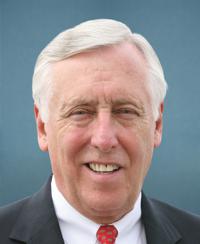
I appreciate my friend's comment. Aren't you the party that said that taxes were going to be cut up until 2010 and then because of the rules they will go back into effect? Will my friend yield? If…
I appreciate my friend's comment. Aren't you the party that said that taxes were going to be cut up until 2010 and then because of the rules they will go back into effect?
Will my friend yield?
If the gentleman will yield.
I thank the gentleman for his question. It is an important question. And the answer to that question is, absolutely. And I am glad that we have this opportunity to clear up any confusion. I want to assure the gentleman, and all Members of the House, that the District of Columbia Voting Rights Act will not violate PAYGO, period. The House just voted to approve the D.C. Voting Rights Act of 2007. We have now proceeded to consideration of H.R. 1906, which amends provisions of the Internal Revenue Code regarding estimated taxes to pay for all costs attendant within the D.C. House Voting Rights Act.
While those costs are de minimis, essentially about $1.6 million out of $27 trillion if there is no escalation in government revenues, notwithstanding that, we wanted to adhere to the PAYGO rule, as the gentleman from Indiana has stated and for which he has fought so hard and been a leader on. The rule provides that the text of H.R. 1906 will be incorporated into the D.C. Voting Rights Act when H.R. 1906 is passed; in other words, every Member who voted for the rule voted to honor PAYGO.
The Congressional Budget Office and the Budget Committee have certified that when the text of H.R. 1906 is incorporated into the bill and the bill is engrossed, the bill will comply with the PAYGO rule. The rule further provides that if either bill fails to pass, both bills will be tabled. In other words, if the bill providing the offset to ensure compliance with PAYGO is not added to the bill, the D.C. bill would be rejected.
This process guarantees that two important things will happen, first, that an unmitigated injustice, the denial of voting for the citizens of the District of Columbia, is considered on its merits and remedied; and secondly, that we abide by our commitment to PAYGO.
Again I state, the gentleman from Indiana has been an extraordinarily consistent and strong leader on behalf of that premise.
The House, in conclusion, will not send a bill that does not comply with the PAYGO rule as a result of the rule. And I commend those who voted for the rule to be consistent with our PAYGO pledge.
I thank the gentleman for his question.
You still get to the promised land.
Parliamentary Inquiry
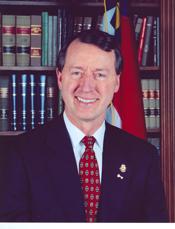
I thank the gentleman for yielding. Madam Speaker, I rise in support of H.R. 6406, Mr. Larson's bill to make the Inspector General at the CFTC a Presidential appointment, and hence more of an…
I thank the gentleman for yielding.
Madam Speaker, I rise in support of H.R. 6406, Mr. Larson's bill to make the Inspector General at the CFTC a Presidential appointment, and hence more of an independent office within the Commission.
Madam Speaker, as you know, the provisions of H.R. 6406 were originally part of the Commodity Markets Transparency and Accountability Act introduced by the Ag chairman, Chairman Peterson, and myself after Representative Larson had brought it to us. The House has already supported those provisions with 276 votes when the CMTA was first considered on July 30 of this year. Unfortunately, because of jurisdictional issues, the provisions were not a part of the version of the CMTA Act that passed the House last week. I am pleased that we are able to take this vote today to promote an independent Inspector General for the CFTC as originally intended.
We passed the CMTA to bring some more sunshine to the commodities market and over-the-counter trading of energy and agricultural commodities. This greater transparency will help establish greater confidence in the markets. An independent Inspector General will contribute further to that goal.
I applaud the gentleman from Connecticut for his perseverance in moving the bill forward. The points he has raised regarding the need for this bill have merit. Currently, the Department of the Treasury is the only financial regulator with a Presidentially-appointed Inspector General. This bill will make the CFTC the second financial regulator with this kind of independent oversight.
Given the financial turmoil that we have seen in other financial markets, the arguments for a more independent Inspector General for the CFTC also apply to other financial regulators, like the Federal Reserve Board and the SEC. Congress may want to consider requiring similar provisions for other financial regulators.
This bill is a step in the right direction to bring confidence to financial markets. I urge my colleagues to support the bill.
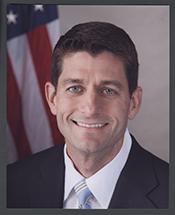
Mr. Speaker, will the gentleman yield? I thank the gentleman for yielding. I simply want to rise to say that the bill that just passed, which I actually supported because I think it was the right…
Mr. Speaker, will the gentleman yield?
I thank the gentleman for yielding.
I simply want to rise to say that the bill that just passed, which I actually supported because I think it was the right thing to do constitutionally, and just good government, it violated PAYGO for 2 hours. So what we have here is a too-cute-by-half PAYGO fix. And it is my hope that when the majority brings new bills to the floor that the bills themselves will be fixed with respect to PAYGO.
This rule tactic that is being deployed, I think, denied the minority rights to have the kinds of motions to recommit that the minority traditionally has been given.
But more importantly, this really is a violation of PAYGO. It is fixed now because it was broken just a minute ago. It is a half-hearted attempt for the majority to submit to their own rules. The PAYGO principle of pay-as-you-go ought to apply every minute, every second, every hour. If you believe in it, don't make it just apply for 2 hours and then bring it back an hour later just because you want to deny the minority an ability to have an effective motion to recommit.
I would be happy to yield to the leader.
I think the gentleman mentioned something about sunsetting taxes. If my memory serves me, having served on the Ways and Means at the time that bill was written, all tax bills which originate in the Ways and Means Committee in the House were permanent. It was the Democrat Party in the Senate that made it temporary, that put in, because of a cloture vote, put the temporary nature of the tax cuts in. The tax cuts sunset in 2012 because of the Byrd rule and because we did not have sufficient numbers of the Democrat Party at the time vote for cloture so that we could make these tax cuts permanent.
Show 3 more
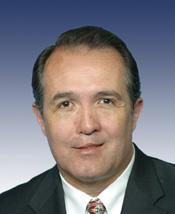
Madam Speaker, on December 8, 2006, the House considered H.R. 6406, which, among other things, authorized the permanent extension of nondiscriminatory treatment (normal trade relations) to the…
Madam Speaker, on December 8, 2006, the House considered H.R. 6406, which, among other things, authorized the permanent extension of nondiscriminatory treatment (normal trade relations) to the products of Vietnam. While I am a strong proponent of free trade and I am committed to helping broaden the United States' relationship with Vietnam, I could not, in good conscience, vote for this legislation.
I continue to hold serious concerns about Vietnam's human rights record, as well as their handling of cases regarding U.S. Armed Forces personnel missing and killed in action during the Vietnam War.
Madam Speaker, I truly believe that the overall benefits of free trade are numerous for our country and that of our trading partners. These positive aspects include a higher economic standard of living, a wider range of higher quality products at lower costs, and a migration of workers from less competitive markets to more competitive and productive markets. As a former small business owner, I am and will remain a strong advocate for free trade.
However I also believe that religious liberty and respect for human rights should be requirements for achieving the broadest possible economic success.
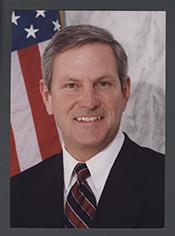
Mr. Speaker, I would like to enter into a colloquy with the distinguished majority leader. Mr. Leader, the minority side has been talking about PAYGO rules and that somehow we have violated them.…
Mr. Speaker, I would like to enter into a colloquy with the distinguished majority leader.
Mr. Leader, the minority side has been talking about PAYGO rules and that somehow we have violated them. They sound very convincing. And as you know, the fiscally conservative Blue Dog Coalition are also strong supporters of the PAYGO rule, as are all members of our Democratic Caucus. This pay-as-you-go rule was an important step in restoring fiscal discipline in Congress. The Members of the Blue Dog Coalition believe it is important that the House comply with this rule.
Can you explain how this bill complies with PAYGO and specifically, for the benefit of the Members on both sides, I ask, will the PAYGO rule that we established in January be fulfilled when the House completes action on the District of Columbia Voting Rights Act?
I will yield.
Thank you, Mr. Leader. Let me try to put it in perspective, then. If I am in southern Indiana and I am driving from New Albany to Seymour, the direct route is on I-65, but if I go to Bloomington to Seymour, it is a longer route, but I still get to Seymour.
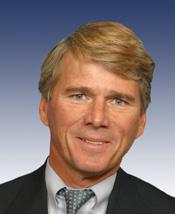
Mr. Speaker, I won't need 3 minutes. I just want to applaud the conversion of my Republican colleagues. Six years ago the Nation was breaking even on an annual basis. They came to town with a new…
Mr. Speaker, I won't need 3 minutes. I just want to applaud the conversion of my Republican colleagues.
Six years ago the Nation was breaking even on an annual basis. They came to town with a new President and in the span of 3 years added $3 trillion to the national debt, never once explaining any remorse, never once saying, we're going to turn this around.
So I am really pleased to see the conversion, and I want to applaud you for it. I just wish it had happened 6 years ago.
Bill Text
3 versions available
        [Congressional Bills 110th Congress]
[From the U.S. Government Printing Office]
[H.R. 6406 Referred in Senate (RFS)]

2d Session
H. R. 6406

_______________________________________________________________________

IN THE SENATE OF THE UNITED STATES

September 25 (legislative day, September 17), 2008

Received

October 2 (legislative day, September 17), 2008

Read twice and referred to the Committee on Agriculture, Nutrition,
and Forestry

_______________________________________________________________________

AN ACT

To elevate the Inspector General of the Commodity Futures Trading
Commission to an Inspector General appointed pursuant to section 3 of
the Inspector General Act of 1978.

Be it enacted by the Senate and House of Representatives of the
United States of America in Congress assembled,

SECTION 1. INSPECTOR GENERAL OF COMMODITY FUTURES TRADING COMMISSION.

(a) Elevation of Office.--
(1) Inclusion of cftc in definition of establishment.--
(A) Section 11(1) of the Inspector General Act of
1978 (5 U.S.C. App.) is amended by striking ``or the
Federal Cochairpersons of the Commissions established
under section 15301 of title 40, United States Code;''
and inserting ``the Federal Cochairpersons of the
Commissions established under section 15301 of title
40, United States Code; or the Chairman of the
Commodity Futures Trading Commission;''.
(B) Section 11(2) of the Inspector General Act of
1978 (5 U.S.C. App.) is amended by striking ``or the
Commissions established under section 15301 of title
40, United States Code,'' and inserting ``the
Commissions established under section 15301 of title
40, United States Code, or the Commodity Futures
Trading Commission,''.
(2) Exclusion of cftc from definition of designated federal
entity.--Section 8G(a)(2) of the Inspector General Act of 1978
(5 U.S.C. App.) is amended by striking ``the Commodity Futures
Trading Commission,''.
(b) Effective Date; Transition Rule.--
(1) Effective date.--The amendments made by this section
shall take effect 30 days after the date of enactment of this
Act.
(2) Transition rule.--An individual serving as Inspector
General of the Commodity Futures Trading Commission on the
effective date of this section pursuant to an appointment made
under section 8G of the Inspector General Act of 1978 (5 U.S.C.
App.)--
(A) may continue so serving until the President
makes an appointment under section 3(a) of such Act
consistent with the amendments made by this section;
and
(B) shall, while serving under subparagraph (A),
remain subject to the provisions of section 8G of such
Act which apply with respect

to the Commodity Futures Trading Commission.

Passed the House of Representatives September 24, 2008.

Attest:

LORRAINE C. MILLER,

Clerk.