Madam President, as to that last unanimous consent agreement, let me translate that into English. Sometimes these unanimous consent agreements get a little confusing. What we are going to try to do…
Madam President, as to that last unanimous consent agreement, let me translate that into English. Sometimes these unanimous consent agreements get a little confusing. What we are going to try to do over the remaining 3\1/2\ hours or so is to divide the time equally. The minority side has agreed to limit their Members to 10 minutes each. I have not made a similar request here, but I will at some point if Members are not understanding of the desire of everyone to be heard--or almost everyone--on this matter.
At a point in the next few minutes, I will share some remarks that will explain how this bill has arrived to the point that it has and why I think it is important we support this effort this evening.
Again, I am very grateful. I will have some comments to make about Judd Gregg, my colleague from New Hampshire. Certainly, Max Baucus, the chairman of the Finance Committee, has been an incredible ally and supporter over these last 2 weeks trying to fashion something that would give us a sense of confidence about emerging from this economic crisis. But I will reserve some comments in a few minutes about all that.
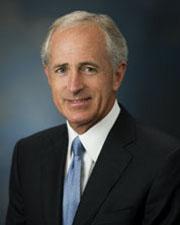
I see my colleague from Tennessee, who I would like the Record to reflect, while he is, I think, the most junior member on the minority side in the Banking Committee, his contribution should never be calibrated by the seat in which he sits in terms of seniority. I want my colleagues to know while Bob Corker has not been a longtime Member of this body, his contribution is that of a very senior Member of this body. It has been invaluable.
He is knowledgeable, thoughtful, pragmatic, and made wonderful and comprehensive suggestions to the product we have before us today. I want my colleagues to recognize that. So I thank Senator Corker of Tennessee for being a very good Senator in a moment such as this, which is a sad day, as I said earlier, but a day which we must address.
So with that, let me yield the floor for Senator Corker to make some comments.
Madam President, I thank my colleague from Tennessee. Again, I appreciate his tremendous efforts that have brought us to this moment.
Amendment No. 5685
I have an amendment at the desk and ask for its immediate consideration.
Madam President, I ask unanimous consent that the reading of the amendment be dispensed with.
Madam President, I wish to take a few minutes to describe this amendment to my colleagues at this hour. I wish to talk as well about some of my colleagues who have helped us get to this point.
There is a crisis in our country. That has been said so many times now. I hope the impact of that statement is not being lost because of the repetition of it. We need to address it swiftly and forcefully. That is why we are here today.
Normally, when you talk about bringing up a bill, there is a certain amount of joy involved in putting something together that you think is proactively going to make a difference. In this case, we are coming together around a proposal and a bill that is in response to a situation that has angered millions of Americans and angers most of us here to be in this situation but also heightens the sense of responsibility that requires us to act. Therefore, we will spend the next few hours sharing with each other, as well as with the American people, why we are in this situation, to some degree, but clearly what our response is to it and our hopes that this proposal will make the difference that many Americans expect.
If Americans doubt we are living in perilous times in our Nation's history, they need to look no further than at what is happening in the financial markets over the last few days. Clearly, this is no ordinary time, no normal economic downturn. This is a day unlike other days. This crisis, and the choice it demands, is unlike few we have ever seen before, even those who have served in this Chamber for several decades. This Chamber may not be full, but millions, in time, will hear the words we speak, and millions will feel the vote we cast around 7 p.m. this evening. In the end, once the reputations we stake, for good and ill, have long since gone to dust; once this day has turned from flesh and blood to textbook page for a child who is not yet born; one of two things will be said about us and how we acted on this heavy day. They will say the Senate did what was right, or they will say the Senate washed its hands of this problem and walked away.
If this bill could be written as starkly as that, the vote would be unanimous. But bills never are. They are full of jargon and verbiage and compromise, and as necessary as they are, they can crust over and obscure the essence of our choice. We read stories of foolish choices in our history books and from our safe distance, it is so easy to shout: Why didn't they know any better? But up close, in the flesh and blood of the moment, even on a day such as today, making the wrong choice can be supremely easy.
Nearly eight decades ago, the men who sat in these chairs--and there were only men in those days--were faced with a crisis not unlike the one we face today. They faced a recession that threatened to turn much worse. They did what was easy. They lashed out at the world and threw up huge barriers to trade. They found someone to blame--not because it was good economics but because it felt good. President Hoover signed the 13 letters of his name with six gold pens and launched a trade war. The world retaliated. Commerce shut down. And passing a bill that felt good drove us deeper and deeper into depression.
This week, on both sides of the Capitol, I could imagine how pleasant it would feel to vote no. In that respect, those who stand on the other side of this issue will have a much happier week. What a rush of affirmation they will get as they stick a finger in the eye of the bankers and the tycoons whose greed brought us to this crisis. Believe me, I can sympathize.
But after the vote has been cast for pique and for spite, what then? After the rush of righteousness fades, what then? It has been said: ``Let justice be done, though heavens fall.'' It is a noble thought, but it is much easier to say when the heavens are in no danger of falling on you. Who will they fall on? They will fall on the million or more families who can lose their homes. They will fall on the mothers and fathers telling their children that the college loan isn't coming through and struggling to explain why. They will fall on workers laid off all over this country as credit dries up and as businesses fail to make their payrolls and as they send their employees home with pink slips through no fault of their own.
We are one Nation, one economy, and one body. We can take a cut at Wall Street, but Wall Street will not feel the worst of the pain--not by a long shot. The blood will not come from them. My colleagues know who will feel the pain, who will be bled the most by this crisis: those whose economic world is made up of credit cards and mortgage payments, not hedge funds and credit default swaps. The men and women and families we represent will feel the pain of a ``no'' vote.
The world will feel the pain, too, I might add, men and women and families just like ours who don't speak our language, who are asleep on the other side of the world as I speak these words right now but who are bound to us in a web of commerce more tightly than ever before in world history. They are watching, too, I might add.
Today's Washington Post quotes a banker in Germany, a man who did nothing to cause this crisis but who will suffer from it as much as if he did. And his faith in America, even now, even today, ought to inspire each and every one of us in this Chamber.
Let me quote him for you:
All I can say is that I simply cannot imagine that the
Americans will not come up with some sort of a solution.
Anything else is outside the realm of my imagination.
Outside the realm, Madam President, of his imagination that this Senate of ours will not solve this problem, in conjunction with the work of the other body. He is speaking of a nation of doers, of fixers, of problem-solvers, of people with optimism and confidence in our future. We can be that Nation again. In fact, we must be.
Madam President, I love my job here in the Senate. I normally sit in the seat right behind me here, my father's desk. I sit it in every day, have for 28 years. I love that desk, love this Chamber, and today there is not a place I would rather be. I am sure my colleagues, each one of them, have their own stories, 100 of them, of their love of this job and of this place and what it means to be a Senator. But how can we possibly weigh those hundred jobs, if you will, against the 600,000 or more that have been lost in America just this year alone and the million more that could follow if we could save those jobs by giving up our own? How could we not? Who could come to this floor and say with a clean conscience: I will save my job but put hundreds of thousands of jobs at risk all across this great country of ours. I don't believe a single Member of this body, regardless of party, would ever make that trade. They would be willing to give up their job to save that of others.
As Edmund Burke said to his constituents centuries ago:
The legislator's ``unbiased opinion, his mature judgment,
his enlightened conscience, he ought not to sacrifice to you,
to any man, or to any set of men living. These he does not
derive from your pleasure; no, nor from your law and the
constitution. They are a trust from Providence, for the abuse
of which he is deeply answerable.''
I am answerable today, as are all of us in this Chamber, and I intend to answer correctly. I intend to answer yes, we ought to do this to get our country back on its feet again. That is the job of a Senator.
By now, it is well known how we arrived at this critical moment. Years of what Secretary Paulson himself has called bad lending practices went essentially unchecked by a regulatory system that was not on the job. These bad lending practices have been primarily in the area of mortgage lending.
As we all know, culpability for these practices exists in every link of the lending chain, from mortgage brokers to lenders to the investment banks. Certainly there are many borrowers who acted irresponsibly. They should not be excused for the consequences of their actions but neither should those whose culpability was significant and catastrophic in terms of their impact on mortgage lending and on the credit markets.
Almost 2 years ago, the Senate Banking Committee held the first congressional hearing of the new Congress on predatory lending. At that hearing, I and others of that committee, Democrats and Republicans, warned of a coming wave of foreclosures that could devastate millions of homeowners and have a devastating impact on our economy. Some, unfortunately, scoffed at those predictions. Well, no one is scoffing anymore. Financial market turmoil is affecting families and businesses all across this country, and the contagion has spread beyond the shores of our own Nation.
A paper in my State, the Connecticut Post of Bridgeport, CT, reported that, at Sacred Heart University, Julie Savino, dean of student financial assistance, is fielding calls from parents who never before sought financial aid. Laid off or without medical insurance or unable to secure a home equity line of credit, parents are suddenly on the hunt for alternative means to pay for their children's education. Some students have had to walk away from their educations all together, she points out.
Reuters News Service reported that Kansas City cabinetmaker Anthony Gallo had no debt 18 months ago. None. Now he is being forced to borrow just to make payroll.
Let me quote Mr. Gallo:
My line of credit has been cut to nothing. We are all
hurting and wondering what is going to happen. They have got
to do something to save the banks. They can't kill our
economy.
The fact is, the banking and financial system is an essential part of our Nation's economy. A halt in the flow of money threatens not only Wall Street firms--which would not bring us here today--but endangers the way of life for millions of Americans far beyond Lower Manhattan. Right now, banks are afraid and in some cases unable to lend money, money companies need to make payroll, money families need to pay medical bills, money students need to pay for college, money small businesses need to stock their shelves with inventory, money a gas station needs to supply its pumps with gas, and money investors provide to entrepreneurs to start new businesses and create new jobs. We know that money isn't moving. That is what the credit crunch means.
Very few Americans have ever heard of something called the LIBOR, which stands for the London interbank offered rate. This is a rate banks charge when they make loans to other banks. It is also the rate that is used to calculate the cost of home loans, student loans, auto loans, and small businesses. Yesterday, LIBOR jumped over 400 percent in just 1 day.
In many ways, this is the canary in the coal mine, if you will. It is a sign of the strains that are threatening the essential flow of credit to the people of our country and, indeed, the industrial world.
Another canary in the coal mine is the rate on Treasury bills. Several days ago, fearful investors rushed into safe Treasury securities, sending yields on Treasurys into negative territory for the first time in at least half a century. When people see that the money they have placed in banks and money market funds is earning negative interest, they may feel compelled to pull their money out of such financial institutions. This could result in even further erosion of the supply of money in our economy.
Our economy is on a precipice--and that is not an exaggeration, that is not hyperbole--and we must do what we can to move it back from that brink. The legislation before us and the amendment I have offered, this comprehensive amendment before the Senate today, represents an effort to do just that.
Just 10 days ago, the administration--if I may just remind my colleagues, this is the bill, I hold it in my hands, three pages long-- the administration sent to us a bill that called for $700 billion to go out without any questions asked, without any oversight, any accountability, or any taxpayer protection. Three pages. I might point out, as I said to some, a no-documentation loan for $100,000 to a subprime borrower a few years ago was four pages long. Here is a request for $700 billion that is three pages long. And my colleagues on both sides here said no to that, we are not going to do that.
As a result, over these last 2 weeks, we have put together a piece of legislation that gives us much more heightened protection about how this program would work. There are a lot of people who deserve tremendous credit, but I thank my colleagues for rejecting this offer of three pages for $700 billion in return for drafting a comprehensive bill that I believe will provide the kind of security people are looking for with a plan of this magnitude. I refused, along with my colleagues, to provide a blank check on this not just for this administration--I would do it with any administration, and my colleagues did as well. This crisis demanded we bring together Members of the House of Representatives, the Senate, Republicans and Democrats, and hammer out a better solution for the American people.
Our leader, Senator Harry Reid, the majority leader, deserves incredible credit for his determination to stick with it and not walk away and demand each and every day, when things began to fall apart, that we stay and work at it. He was joined by the minority leader, Senator McConnell, equally committed, I would point out, to the same efforts, as well as a number of others who played significant roles.
Judd Gregg of New Hampshire I have been talking about and spending a lot of time with over these last 2 weeks, working out this particular bill that we brought together, and I thank him for his efforts.
Jack Reed of Rhode Island was the principal author of the warrants in this bill, to make sure the American taxpayer comes first. If these instruments turn out to be more profitable and they actually are sold and we make our money back, the people who will get the benefit of that first are the American taxpayers, and Jack Reed demanded that.
Pat Leahy looked at the provision of this original proposal which suggested that no court of law, no agency could ever question how this $700 billion was going to be used, and the chairman of the Judiciary Committee said that passage will not last and struck it and offered new language that provides judicial protection in this bill.
I have mentioned Bob Corker already, Senator Corker of Tennessee, who was valuable over the last 2 weeks, and Mel Martinez and Chuck Hagel.
My colleague from New York, Chuck Schumer, who is knowledgeable about this subject matter and who represents the State of New York--I can't begin to describe how valuable Chuck Schumer has been in this process. From the very beginning, there hasn't been a meeting that has occurred or a discussion held where he hasn't played an invaluable role in seeing to it that we stayed with it.
Dick Durbin, the majority whip, and Bob Bennett of Utah--again, the ranking Republican on the Banking Committee historically has played a very important role on so many issues during his tenure here and again was tremendously helpful.
Max Baucus, whom I have mentioned--chairman of the Finance Committee--played a critical role as we fashioned this together.
My dear friend and colleague, Kent Conrad, the chairman of the Budget Committee, was incredible in his determination that this package be fiscally sound, that we have provisions that would guarantee our debt would be retired as part of the effort here when resources are sold and the profits are gained. So I thank my friend. He is here, in fact, on the floor. My colleague has been a tremendous help in all of this, Madam President.
I want to also mention, from the other body, Barney Frank of Massachusetts, my counterpart on the House Financial Services Committee, was, again, tireless over the last couple of weeks in this effort, and Congressman Roy Blunt, Speaker Pelosi, Representative Boehner as well, and Rahm Emanuel.
There are so many people, and I want to be careful, but clearly this was a huge effort. I wish in many ways that the American people could have been a witness to these gatherings that went on day after day. I think they would have been proud of their Congress at a time when Congress's reputation is not great. I think they would have been proud to see the effort that was being made, not where people were running to a political corner wearing a Republican or Democratic hat but coming together as Senators and Congressmen, along with those from the Treasury Department, to make a difference. All of these Members of Congress undertook the enormous and in many respects thankless but nevertheless vital task of crafting this proposal which we offer to our colleagues this afternoon--the Emergency Economic Stabilization Act of 2008.
This legislation would address, we hope, our Nation's economic emergency in three key ways: economic stabilization, taxpayer protection, and home ownership preservation.
This bill gives the Treasury Secretary the authority to respond quickly, forcibly, but responsibly to the current crisis. It authorizes him to buy a total of $700 billion in troubled assets, broken down into three separate tranches, with the final tranche subject to congressional review and approval.
Madam President, $700 billion is a staggering amount of money. We all understand and share the anger of the American people that they are being asked to commit that sum. But in a $14 trillion economy, this is the kind of financial firepower that must be brought to bear to contain the financial crisis.
Secondly, in consideration of the extraordinary burden this bill potentially places on the taxpayer, we maximize, to the extent possible, protections of the taxpayer.
The bill establishes an oversight board to review and shape the policies of the Treasury Department in carrying out this program. Unlike the original Treasury proposal, this bill subjects the actions of the Treasury Secretary to strong judicial review that would prohibit actions that are arbitrary, capricious, or otherwise unlawful. It places firm limits on executive compensation to help ensure that corporate executives whose companies receive taxpayer benefits do not walk away with golden parachutes and are not otherwise rewarded for wrongdoing.
We require taxpayers to receive warrants so that they can benefit when a company benefits from taxpayer assistance. In addition, we require that any profits generated from the sale of these assets purchased with public funds go to reducing our national debt.
We provide for extensive reports so that Members of Congress and the public at large will know how every dime of this program is being used. Within 48 hours of any transaction, the Treasury Secretary will have to report the amount, the terms, and the participants associated with that transaction. The General Accounting Office will have immediate and ongoing audit authority and report to Congress every 60 days. A special inspector general will be established to monitor and police the program's activities and its participants.
The third priority advanced by this legislation is home ownership. This is not an ancillary objective; it is inherent, in my view, to our efforts to resolve this economic crisis.
Chairman Bernanke himself has spoken forcefully on this point. Our economy will recover only when we put an end to the spiral of foreclosures that are pulling down our entire financial system. To that end, the legislation requires that all Federal agencies that own or control mortgages or mortgage-backed securities preserve home ownership. In addition, the legislation expands eligibility for the HOPE for Homeowners program, which allows lenders and borrowers to access Federal mortgage insurance in order to put homeowners on a path to security, not financial ruin.
This is not an easy vote. There will be no balloons or bunting or parades for Members at the end of this process, only the knowledge that at one of our Nation's moments of maximum economic peril we acted, not for the benefit of a particular few but for all Americans so that they and those who come after them may enjoy the full blessings of life in this great Nation of ours.
We are a nation of optimism and confidence. Americans deserve to have that restored. Our job tonight will give them a chance to do that. I urge my colleagues to support this amendment.
I yield the floor.
Madam President, I want to recognize the Senator from North Dakota.
I ask unanimous consent that the Senator from Rhode Island be recognized for 6 minutes, the Senator from Pennsylvania for 5 minutes, and then my colleague and friend from New York for 6 minutes.
Madam President, for how long would the Senator from Illinois like to be recognized?
I am in control of the time. How much time?
Madam President, I yield the Senator from Illinois 10 minutes.
I ask unanimous consent that the Senator have as much time as he would like to have.
Mr. President, I suggest the absence of a quorum.
Mr. President, I ask unanimous consent that the order for the quorum call be rescinded.
Yes, under current law and under the provisions in this bill, that authority exists.
Yes.
I thank the Senator from Vermont for his passion, eloquence, and commitment. He is never shy. This institution could use a little bit more of similar expressions of feelings for constituents. I thank him for that speech.
I see my colleague from Alabama. We are going back and forth. At that point after Senator Sessions, Senator Schumer is next in line.
Madam President, the Senator from New York is next.
I will give the Senator an additional minute.
Madam President, I yield 5 minutes to my distinguished friend and colleague from New Jersey.
Madam President, I have a unanimous consent that has been cleared on both sides. I ask unanimous consent that an additional 30 minutes be allocated for debate with respect to H.R. 1424, equally divided and controlled between the leaders or their designees, and that the debate with respect to the House message on H.R. 2095 be delayed accordingly, and that any other provisions remain in effect.
I yield 5 minutes to Senator Nelson of Florida.
Madam President, one quick thought. We are all entitled to our opinions. Pat Moynihan used to say everyone is entitled to their own opinions but not to their own facts.
As I listened to my friend from Florida, Senator Nelson, talk about the executive compensation section of this bill, I must respond.
As to this legislation, section 111, negotiated by Senator Max Baucus, myself, and others, let me be very clear. When Treasury buys assets directly, the institution shall observe standards limiting incentives allowing clawback and prohibiting golden parachutes. When the Treasury buys assets at auction, an institution that has sold more than $300 million in assets is subject to additional taxes, including a 20-percent excise tax on golden parachute payments triggered by events other than retirement. And also we eliminated the deduction for compensation above $500,000, and we prohibit golden parachutes at other certain institutions--anything but mild. It is the first time ever in the history of the Congress that we are actually going to pass legislation dealing with golden parachutes. More will be done, but this bill does take very concrete, specific actions in that regard.
Again, you are entitled to your own opinions but not your own facts.
I yield 5 minutes to Senator Kerry of Massachusetts.
I yield 1 additional minute.
Madam President, I thank my colleague from Massachusetts for an eloquent statement and a strong one.
Madam President, I yield to my distinguished friend and colleague from California 5 minutes.
If I may inquire of my good friend and colleague who has been very generous, I may ask for a little generosity in terms of time. I am running into a crunch, and I have a couple Members who may wish to speak for a couple minutes. But let me get to that point.
I yield 5 minutes to the Senator from Washington.
Mr. President, the Senator from Illinois wishes to speak. I ask for 5 minutes.
Mr. President, I yield 3 minutes to my colleague and friend from California.
I absolutely agree with the gentleman from New Jersey. The scale of this undertaking is vast, and the exposure to the taxpayer must be well managed. Therefore, I urge the Secretary to look broadly for the best expertise in assisting him in managing this program.
I would say to the distinguished chairman of the Judiciary Committee that is what we intend.
M. LEAHY. And the provision we have included in section 119 of the Senate's legislation, to ensure that this review is available, the word ``law,'' as it is used, means any State or Federal law, or common law interpreting such State and Federal laws?
Yes. The Senator from Vermont is correct. My understanding and intent is that this section would allow for review in the event any action by the Treasury Secretary was in violation of any State or Federal statute, or common law interpreting a statute.
Mr. LEAHY: I thank the Senator. It is not our intent to permit the Treasury Secretary to quash or alter any private right of action on the part of shareholders of entities from which the Secretary purchases assets, nor allow the Secretary to confer immunity from suit any participating financial institution.
I would say to the Senator from Vermont that is correct as well.
It is. That is what we intend.
Mr. LEAHY. And by agreeing with the administration's request to automatically stay on appeal injunctions issued against the Treasury Secretary for actions taken under the authority of this legislation, we have assured that existing waivers of sovereign immunity under the Tucker Act, the Contracts Dispute Act, the Little Tucker Act, the Federal Tort Claims Act, and relevant civil rights laws would apply to the Treasury Department's new responsibilities, just as these laws have applied to the Treasury Department's actions prior to the bailout measure. Is that correct?
I say to the chairman of the Judiciary Committee that is what we intend with the savings clause.
I do.
I agree with the chairman of the Judiciary Committee.
Yes, for purposes of this act, I agree that financial institution may encompass auto financing companies.
Yes, should the Treasury Secretary, after consulting with the Chairman of the Federal Reserve System, determine that purchasing auto loans is necessary to promote financial market stability and transmits such determination in writing to the Congress, then the Treasury Secretary could engage in such purchases.
I am keenly aware of these issues as Chairman of the Banking Committee, which has jurisdiction over financial aid to commerce and industry and which wrote the Chrysler Corporation Loan Guarantee Act of 1979.
This is correct. As previously stated, an auto financing company could be included in the definition of financial institution and auto debt could be included in the definition of troubled assets after the appropriate steps are taken.
Yes, I completely agree that this would include holding companies of such companies listed and other companies that the Secretary may determine are eligible for this program.
Yes, it is the intent of the committee and of the Congress that this section intends that the securities of the parent or holding company of such a subsidiary would be used in the warrant. Nothing in this language is intended to exclude holding companies of subsidiaries and warrants should be exercised to the greatest extent possible for the benefit of the taxpayer.
Yes, I agree that this is the case and that it was the original intent of the committee and of the Congress to ensure that warrants are exercised to the greatest extent for the benefit of the taxpayer, to include recovery of losses and administrative expenses along with a premium set by Treasury.
tax credit investments
Mr. President, I want to assure my colleague from Maryland that I read that language as allowing such purchases, if necessary, to maintain liquidity in this particular market. I want to commend him for bringing this important matter to my attention as soon as we received the original Treasury proposal. My staff informed Senator Cardin's staff that Treasury officials believed the proposal they sent to Congress authorized the purchase of such credits, and we concurred.
Mr. President, my colleague from Maryland has made an excellent suggestion for how Treasury ought to maintain liquidity with regard to the LIHTC. I thank him for his concern. The housing crisis in this country affects nearly everyone in some respect, including lower income individuals and families who cannot afford to buy homes and depend on the steady supply of affordable rental housing. My amendment to H.R. 1424 gives Treasury the authority, flexibility, and resources it needs to address this critical issue.
Mr. President, I agree with the Senator from Hawaii's interpretation of that provision.
I thank the leader for his question and for his leadership in helping guide us through this crisis. He is exactly right. I have been saying throughout this process that foreclosure prevention has been one of the key reasons we need to move forward with the Emergency Economic Stabilization Act.
The legislation has a number of key provisions dealing with foreclosure prevention:
First, it requires that the Secretary of the Treasury ``implement a plan that seeks to maximize assistance for homeowners'' in keeping their homes. This means Congress has rejected an ad hoc approach by the Treasury in favor of a programwide system to keep families in homes.
In the case where the Secretary owns whole loans, we expect him to modify those loans to ensure long-term affordability for American families. The legislation outlines that this should be done by a reduction in principal, a reduction in the interest rate, a refinance through the HOPE for Homeowners Program, or any equivalent method that ensures that these hard working Americans are restored to sustainable home ownership.
I want to remind my colleagues that millions of Americans were sold loans that the mortgage brokers and lenders knew or should have known the borrowers could never afford. These ``exploding'' adjustable rate mortgages, ARMs, interest-only loans, and payment-option ARMs were designed to entice borrowers with low initial payments. Yet, after a couple of years, the payments would explode, increasing by 20 percent, 30 percent, or more. This is driving delinquency and foreclosure rates to historically high levels and driving home prices down, creating the economic downturn we are now facing.
Second, all other Federal agencies that own or control mortgages, including the FDIC, the Federal Housing Finance Agency, FHFA, and the Federal Reserve Board, must also implement plans to maximize assistance to homeowners. The FDIC, under the leadership of Chairman Sheila Bair, has already started down this road with the assets it has taken from IndyMac Bank, and we expect the other agencies to work with the FDIC in developing their own programs. The FHFA, which is the conservator for Fannie Mae and Freddie Mac, now oversees hundreds of billions of dollars of mortgages and mortgage-backed securities, MBS, which they will now be obligated to aggressively modify as a result of this legislation.
Third, one of the serious complications the modern mortgage market has created is the difficulty of doing modifications for loans that have been pooled and securitized into a host of MBS. It is often difficult to get the various investors in the numerous MBS backed by a particular pool of mortgages to all agree to do a modification.
This legislation, however, mandates that the Treasury and the other Federal agencies that own or control MBS must aggressively pursue loan modifications with other investors and must consent to all requests from servicers for reasonable modifications. In fact, it is our hope that the Federal Government will gain control of sufficient percentages of these pools that their ongoing pursuit of modifications and reasonableness in their willingness to accept offers that ensure families can keep their homes will tip the balance and lead to more modifications.
Finally, this bill includes three new provisions for the HOPE for Homeowners that should expand its reach and allow us to help many more homeowners avoid foreclosure and get into affordable, stable, FHA- insured mortgages.
As I have been saying for well over a year, the epicenter of the current financial and economic crisis is the housing crisis and the heart of the housing crisis is the foreclosure crisis. I understand the need to move to stabilize the financial system as a whole--that is why I have devoted countless hours over the past weeks to negotiate this final package.
But I would not support this bill, nor ask my colleagues to do so, if I was not convinced that it adds important new tools to address the core problem--rising delinquencies and foreclosures. Obviously, this bill does not include everything I would want but it is an important step forward.
I wish comment on certain parts of the Emergency Economic Stabilization Act of 2008.
Section 132 reauthorizes the Securities and Exchange Commission to suspend Financial Accounting Standard 157 if it ``is necessary or appropriate in the public interest and is consistent with the protection of investors.'' That is a very high standard. I do not expect or encourage the Commission to take action in this regard.
Vital to the health of U.S. capital markets is financial information that is reliable. Accounting rules should produce financial data that faithfully depicts economic reality and is neutral, not favoring either the supplier or user of capital, either the buyer or seller of securities. The formulation of accounting standards is best left to the accounting experts. Congress should not be in the business of setting accounting standards.
Furthermore, it is critically important that we respect the independence of the Financial Accounting Standards Board, so that they can observe a fair and open process and arrive at the most appropriate accounting standards. Congress should not chill or override that independence and does not do so in this legislation.
With respect to mark to market, I understand concerns that have been raised. However, many experts object to the suggestion of suspending it. For example, the Council of Institutional Investors, the Center for Audit Quality, and the CFA Institute have said they ``are united in opposing any suspension of `mark to market' or `fair value' accounting.'' They stated: [Suspending fair value accounting during these challenging economic times would deprive investors of critical financial information when it is needed most. Fair value accounting with robust disclosures provides more accurate, timely, and comparable information to investors than amounts that would be reported under other alternative accounting approaches. Investors have a right to know the current value of an investment, even if the investment is falling short of past or future expectations.]
Section 133 directs the Commission to conduct a study on mark-to- market accounting. The study is to be completed within 3 months, which will necessarily limit its scope and depth. Within these limits, I will be particularly interested in the findings on the impact of such standards on the quality of financial information available to investors and on the fairness of the standard setting process.
Section 118, ``Funding,'' states that the purposes for which securities may be issued include actions authorized by this act, including the payment of administrative expenses. This would include such reasonable expenses as are incurred in the preparation of reports, such as the study mandated by section 133.
Section 3 states that the term, ``financial institution,'' ``means any institution, including, but not limited to, any bank, savings association'' or other specific types of institutions. The latitude of the definition is intended to include the parent holding companies of one of the identified types of institutions that are established and regulated under the laws of the jurisdictions set forth in the definition. Thus, for example, if a wholly owned securities subsidiary of a public-traded financial holding company sells assets to the Treasury Department, it would be subject pursuant to section 113 to providing a warrant to the Secretary to receive stock in such holding company.
With respect to section 119, I want to associate myself with the remarks of Senator Leahy on the savings clause.
Section 101 of the legislation gives broad authority for the Treasury Secretary, in consultation with other agencies, to purchase and to make and fund commitments to purchase troubled assets from eligible financial institutions on terms and conditions that he determines. This legislation does
not limit the Secretary to specific actions, such as direct purchases or reverse auctions but could include other actions, such as a more direct recapitalization of the financial system or other alternatives that the Secretary deems are in the taxpayers' best interest and that of the Nation's economy.
Section 129 requires the Federal Reserve to submit regular written reports to the Senate Banking and House Financial Services Committees whenever it uses its authority under section 13(3) of the Federal Reserve Act. The periodic updates to the reports are meant to keep the committees informed of the specific details of any loans or the aggregate details concerning programs the Federal Reserve establishes that are covered by this requirement.
Section 131 requires the Treasury to reimburse the Exchange Stabilization Fund, ESF, for any losses that result from the temporary guaranty program that they recently established. It is the intent of the Treasury that the temporary guaranty program that they recently established will not last longer than 1 year, and while the final version of the act does not mention this time-frame, it was because the Treasury Department has publicly stated that this temporary program will last no longer than 1 year, which is consistent with the intent of this legislation. Further, the act forbids the Secretary from using the ESF for the establishment of any similar fund in the future. The ESF has never been used for loans or guarantees for domestic purposes, and it is important that the money in the fund continue to be available for the ESF's stated purpose.
Section 136 provides a temporary increase in the coverage limit for nonretirement accounts in insured depository institutions. It is the intention of the legislation that this increase be temporary and this increase is not a statement of any intent for changes in the permanent deposit insurance level.
Mr. President, I ask unanimous consent that a letter from the Treasury Department be printed in the Record.
Mr. President, I first thank my colleagues for their generous comments. This has been an incredible 2 weeks. It began exactly 2 weeks ago tomorrow night when the Chairman of the Federal Reserve and the Secretary of the Treasury, in words that were as chilling as any I have heard in 28 years here, describing the condition of our economy.
We heard the words ``credit crunch.'' I was educated in high school by Jesuits, and the word ``credit,'' the derivative, comes from the Latin word ``to believe.'' What is more important to me at this moment than any financial loss that Wall Street suffers or other institutions or shareholders, as much as I am concerned about it, but the biggest loss we run the risk of is Americans believing in their country, that sense of confidence and optimism that has been at the base of our success for more than two centuries.
I say to my colleagues who are wondering whether at this moment we ought to embrace this plan to move us to the right footing, this is the moment which we must take this opportunity to get back our economy, and simultaneously, more important than anything else we achieve, to restore Americans' confidence, their optimism, and their belief that this country can provide a better day for their children and their grandchildren than the one in which they were raised.
Nothing less than that, in my view, is at stake in the vote we will take in a matter of minutes; maybe the most important vote any one of us will ever cast in this body. It will determine the future and the well being of our country. I beseech my colleagues, not as Democrats or as Republicans, but as Americans, and as Members of this remarkable institution, to cast a vote for the future believability in our economy and our country.
I urge a ``yes'' vote.
Exhibit 1
Department of the Treasury,
Washington, DC, October 1, 2008.
Hon. Christopher Dodd,
Chairman, Committee on Banking, Housing and Urban Affairs,
U.S. Senate, Washington, DC.
Dear Mr. Chairman, I am writing regarding the Emergency
Economic Stabilization Act of 2008.
It is the intention of the Department of the Treasury that
all mortgages or mortgage-related assets purchased in the
Troubled Asset Relief Program will be based on or related to
properties in the United States.
Sincerely,
Kevin I. Fromer,
Assistant Secretary for Legislative Affairs.