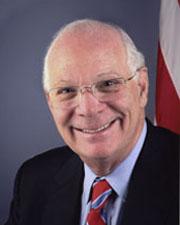
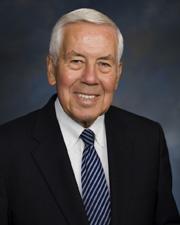
Mr. President, I am pleased today to announce the introduction of the Global Food Security Act of 2008. I would like to thank my friend Senator Casey for lending his ideas and support to this…
Mr. President, I am pleased today to announce the introduction of the Global Food Security Act of 2008. I would like to thank my friend Senator Casey for lending his ideas and support to this bipartisan effort. I also thank USAID Administrator Henrietta Fore, who took an early interest in potential legislation. Her leadership is very much appreciated. Finally, I want to thank the members of USAID's informal food security team, who advised us on problems and possible legislative solutions.
As we know, food prices started a steep climb in the fall of 2007 and continued to increase during the spring of this year. The crisis has abated somewhat, largely due to the drop in energy prices. Nonetheless, this episode demonstrated that there are significant structural challenges to attaining global food security. The system is vulnerable to periodic disruptions that both expose and exacerbate deeper problems.
We live in a world where nearly 1 billion people suffer from chronic food insecurity. When droughts occur, hurricanes hit, or other disruptions arise, transitory food insecurity can put as many as 100 million people at a time in grave danger. In fact, the World Food Program reports that 25,000 people die each day from malnutrition- related causes. Health experts advise us that a diverse and secure food supply has major health benefits, including increasing child survival, improving cognitive and physical development of children, and increasing immune system function including resistance to HIV/AIDS.
Food insecurity is a global tragedy, but it is also an opportunity for the U.S. The U.S. is the indisputable world leader in agricultural production and technology. A more focused effort on our part to join with other nations to increase yields, improve food distribution, and broaden agricultural knowledge could begin a new era in U.S. diplomacy. Such an effort could solidify relationships with nations where, up to now, we have had few positive contacts. It could improve our broader trade relations and serve as a model for similar endeavors in the areas of energy and scientific cooperation. Achieving food security for all people also would have profound implications for peace and U.S. national security. Hungry people are desperate people, and desperation often sows the seeds of conflict and extremism.
The U.S. has always stood for big ideas--from the founding of the Republic on the basis of freedom to President Kennedy's vow to put a man on the moon. One of today's big ideas should be the eradication of hunger. We can bring America's dedication to science, innovation, technology, and education together to lead an effort devoted to overcoming the obstacles to food security.
The Global Food Security Act of 2008, is a 5-year authorization that seeks to provide solutions that will have the greatest effect. First, it creates a Special Coordinator for Global Food Security and puts that person in charge of developing a food security strategy. We call on the development of that strategy to take a whole-of-government approach and to work with other international donors, the NGO community, and the private sector.
Second, the bill authorizes additional resources for agricultural productivity and rural development. U.S. foreign assistance for agriculture has declined by nearly 70 percent since the 1980s. Globally, only four percent of official development assistance from all donors is allocated for agriculture. This amounts to neglect of what should be considered one of the most vital sectors in the alleviation of poverty. Food shortages are likely to recur frequently if the U.S. and the global community fail to invest in agricultural productivity in the developing world.
World leaders must understand that over the long term, satisfying global demand for more and better food can be achieved only by increasing yields per acre. In the 1930s, my father, Marvin Lugar, produced corn yields of approximately 40 to 50 bushels per acre. Today, the Lugar farm yields about 150 bushels per acre on the same land in Marion County, IN. The Green Revolution, from 1965 to 1985, saw the introduction of high yield seeds and improved agricultural techniques that resulted in a near doubling of cereal grain production per acre over 20 years. But yields may have to be doubled or tripled again.
Increasing acreage under production will not satisfy the growth in food demand, and these steps come with serious environmental and national security costs. We need a second green revolution that will benefit developed and developing nations alike.
Recent studies have demonstrated that funds spent in agriculture can be
up to four times more beneficial to economic growth than spending in other areas. It seems, therefore, that our overall foreign aid strategy would benefit from restoring agriculture programs to their former prominence. The bill increases funding for these programs in the first year by $750 million. The increase would reach $2.5 billion in year 5. Because those who subsist on less than one dollar a day spend at least half their incomes on food, according to the International Food Policy Research Institute, the bill highlights the need to focus on those living in extreme poverty.
In thinking about how to approach agricultural productivity, we tried to draw from the experience of U.S. land grant colleges and the contributions they have made to U.S. agriculture. The bill creates a new program that would strengthen institutions of higher education in the areas of agriculture sciences, research and extension programs. Investments in human capital and institutional capacity are important to developing a robust agricultural sector.
Universities and research centers can play an important role in achieving technological advances that are appropriate to local conditions. As such, the bill calls for increasing collaborative research on the full range of biotechnological advances including genetically modified technologies.
Third, the bill improves the U.S. emergency response to food crises by creating a separate Emergency Food Assistance Fund that can make local and regional purchases of food, where appropriate. Funds can be used for emergency food and agricultural assistance. The Government Accountability Office reports that it can often take 4 to 6 months from the time a crisis occurs until U.S. food shipments arrive. Our intention is to provide USAID with the flexibility to respond to emergencies more quickly, without supplanting other food programs such as P.L. 480.
I hope that our bill will begin a productive dialogue on how our government can be a more effective partner with NGO and private actors in promoting food security. There is no good reason why nearly a billion people should be food insecure or that the world should have to endure the social upheaval and risks of conflict that this insecurity causes.
I look forward to working with colleagues to improve the U.S. and global efforts to alleviate food insecurity and advance agricultural knowledge and technology worldwide.
Mr. President, I ask unanimous consent that the text of the bill be printed in the Record.