Mr. Speaker, I rise today to recognize the 20th anniversary of the Brady Plan and in honor of former Treasury Secretary Nicholas Brady. The Brady Plan launched a new era of growth, development, and…
Mr. Speaker, I rise today to recognize the 20th anniversary of the Brady Plan and in honor of former Treasury Secretary Nicholas Brady. The Brady Plan launched a new era of growth, development, and capital market access for emerging market economies.
While Brady Bonds themselves have been largely superseded by newer instruments, the Brady Plan encouraged
many emerging market countries to adopt and pursue ambitious economic reform programs which have been instrumental in the progress achieved during the last 20 years.
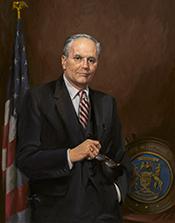
On April 25, I attended a commemorative dinner in honor of Nicholas Brady and his many accomplishments. As Secretary of the Treasury under President George H.W. Bush, Mr. Brady was instrumental in resolving Latin American debt problems.
I was honored to hear Mr. Brady speak on the current economic crisis and credit crunch, as well as present his proposal for reform. As he stated, we must have boldness, clarity, and determination today, just as they did in 1989 in order to build prosperity out of this crisis.
International economic experts who attended the dinner praised Mr. Brady's work, while also noting how important trust, integrity, and personal relationships are in formulating global policy. The same is true today.
Our actions today to solve the economic crisis cannot and should not be done in haste. The politically charged environment of Congress makes the creation of effective long-term policy extremely difficult. Consequently, Mr. Brady's remarks supported the creation of an independent commission, to find the root cause of our economic situation and to propose reforms to our financial system.
I support such a bipartisan commission. As Mr. Brady stated, ``It is vital not just that far-reaching, complex reform of the financial system be pursued prudently but in a bipartisan manner in order to gain national support. After all, the purpose is to revive public confidence in the system itself.''
I was disappointed to see the Financial Markets Commission in S. 386, the Fraud Enforcement and Recovery Act, pass the House with a makeup of six Democrats and four Republicans. That is why last week I opposed this commission while at the same time agreeing to cosponsor H.R. 2111, the Congressional Commission on Financial Accountability and Preparedness Act of 2009. H.R. 2111's commission will have two members appointed from each side of the aisle and a mutually agreed upon fifth member to chair. This is true bipartisanship and is what is needed to find the real root causes and solutions to our financial crisis.
I hope that submitting Mr. Brady's speech for the Record will spark a debate in Congress over the necessity for a bipartisan commission and how we, as a Nation, will move forward.
April 25, 2009.
20th Anniversary of the Brady Plan
(By Nicholas F. Brady)
Washington, DC.--Good evening. I'd like to thank Charles
Dallara and the IIF for organizing this gathering of old and
new friends to celebrate the 20th anniversary of the Brady
Plan. Although I've been given the honor of speaking, I'd
like to note that a great many of you here tonight share the
credit for making the Brady Plan a success. And I want to
thank you all of you who have spoken so generously.
Let's start with why the Brady Plan was called the Brady
Plan. We had been negotiating with Mexico since March 1989
under the rubric of what we called ``the new debt strategy.''
In July, while we were in Paris for the Group of Seven
Summit, we had a major breakthrough with Mexico. When
President Bush, No. 41, held the traditional end-of-summit
press conference before 1,000 reporters, one journalist asked
the president if he was going to call the new strategy the
Bush Plan. He didn't miss a beat before answering, ``No,
we're going to call it the Brady Plan. Then if it works,
we'll call it the Bush Plan.'' The audience erupted into
laughter, and the president, with his marvelous sense of
humor, repeated the line so many times in the following days
that the name stuck.
There are uncanny parallels between the situation we find
ourselves in today and the one the Bush administration
confronted a generation ago. We faced a three-pronged crisis,
including the credit markets, the real-estate market, and the
budget just as the Obama administration does now. So it may
be useful to recall the issues and challenges of the late
'80s and early '90s as we try to resolve current problems and
move into the future.
First of all there was a serious LDC debt crisis. It's easy
to forget that in 1988 our banking system was in dire straits
because the commercial banks held billions of dollars of
loans in countries whose economic prospects had ground to a
halt. Three weeks into my job as Treasury secretary, the late
Gustavo Petricioli, then Mexico's ambassador to the United
States, called for an urgent meeting at the Treasury
department to tell me that Mexico was threatening to default
on its international bank loans. Talk about reality. It
didn't take much imagination to grasp that if Mexico took
that route then a string of Latin American economies likely
would follow and that a volatile region would move from chaos
to danger.
Clearly a new approach was needed. For several years before
I got to the Treasury, people had come in with various papers
and solutions, all aimed at alleviating the debt overhang,
but none really accomplished that. In a huge stroke of good
fortune, I inherited two brilliant people at Treasury--David
Mulford and Charles Dallara--and the first thing we did was
to write a paper that came to be known as the ``Truth Serum
Paper.'' We worked days, nights, and weekends to establish a
detailed description of the problems we faced, of what the
fundamental realities were. No troublesome obstacle was
passed over. Among the indisputable points we laid out were
that new money commitments had dried up in the past 12 months
and that many banks were negotiating private sales of LDC
paper at steep discounts while maintaining their claim on the
countries that the loans were still worth 100 cents on the
dollar. There were more, and they were equally sobering.
We used these irrefutable facts as a starting point in all
subsequent meetings. Our rule was that no suggestions were
permitted to be discussed if they didn't accept the Truth
Serum. They were off the table. Goodbye. Don't waste time.
I felt that the solution to too much debt was not more debt
but less. From there, you know the rest: we persuaded the
international commercial banks--at first with great
difficulty--to write down the stated value of the loans on
their books to something close to market value in exchange
for that lesser amount of host-country bonds backed by U.S.
zero-coupon Treasuries. The Brady Plan was achieved at a
negligible cost to the U.S. government. Yet it led to the
restructuring, for example, of more than $100 billion of
foreign bank debt for Mexico, Brazil, and Argentina alone.
The plan broke the debt gridlock and opened the door for
economic growth and social development in Latin America after
the lost decade of the 1980s. And it created a new asset
class: publicly traded sovereign debt--Brady Bonds--that grew
to exceed half a trillion dollars. The process bought time,
and the bonds helped to provide funds to developing nations
in exchange for long-lasting reforms by the participating
countries.
A second initiative the Bush 41 administration had to
undertake was to reconstitute the savings and loan industry
and the real-estate market it financed--a problem not of
President Bush's making. We created the Resolution Trust
Corporation to take over some 750 insolvent savings banks,
which reintroduced vibrancy into the real-estate market. In
order to do this, we had no choice but to seek funding from
Congress and undergo the intense political criticism that
came with it. So we took the heat and moved on to solve the
problem. Leadership can be painful. The final tab for
cleaning up the S&L mess was $165 billion, including what was
spent before we arrived. While this is not trivial, it didn't
come close to estimates by businesses, politicians, and the
media, which estimated that it would cost us $500 billion.
I've been asked a number of times what reversed that era's
negative thinking--and when. My firm conclusion is that it
subsided in direct proportion to the weekly successful
results recorded by the RTC to close the bankrupt S&Ls,
gather up the real estate they held, and sell it promptly
into the market.
Third, in a major contrast to today, we set about to reign
in escalating spending by the U.S. government, which was, for
that day and age, clearly out of control. The Budget Act of
1990 established binding caps on the amount that Congress
could spend on discretionary items. It was easy to see--and
it was easy for me to recommend--that that's what the country
needed. But President Bush, who had uttered the famous words,
``No new taxes,'' in his 1988 election campaign, said to me
more than once, ``The trouble with you, Brady, is that you
never ran for sheriff.'' The record should be clear that
George Bush fully grasped the political ramifications of
designing this legislation, but he decided it was the right
thing to do for the country. And while the Budget Act
probably contributed to his reelection defeat in 1992, it was
an essential building block for the decade of economic growth
that followed.
People constantly tell me that the problems we're dealing
with today are much more complex than those we faced 20 years
ago. Maybe. Maybe not. The issues didn't feel simple to us
back then, just as I'm sure they don't feel simple to
Secretary Tim Geithner and his associates at the Treasury
now.
I won't spend a lot of time tonight trying to assign blame
for the current crisis; I've been gone from Wall Street too
long. In broad strokes I would say that when I came to Wall
Street in 1954, it was a profession, one that financed the
building of this country's industrial capacity and
infrastructure. Year by year, however, the industry's
emphasis has moved away from that purpose and toward
financial innovation for financial profit's sake. Of course,
many banks have served their clients well and their hard work
has been a positive factor. Nevertheless, the U.S. Department
of Commerce figures show that from 1980 to 1982, the
financial sector accounted for an average of 9.1 percent of
U.S. total corporate profits. By 2005 to 2007 that three-year
average had more than tripled, to 28.6 percent.
The particulars of today's collapse in judgment and common
sense have been laid out
in chapter and verse, so just I'll say briefly, first, that
the whole notion that risk can be measured by a mathematical
formula is based on the illusion of reality. Second, the
desire for the improved returns generated by high leverage
led the purveyors of this risk to push it beyond any
reasonable boundaries.
But while assigning villainy to CEOs of banks and other
institutions may be high theater, playing to our country's
justifiable anger is counterproductive. There are many good
people in the industry, people who inevitably will--and
should--be called on to work through the malfunctions in the
system. The political process should concentrate now on how
to fix the financial system and let the country's legal arm
ferret out and deal with the wrong doers.
A core issue today is that the government has yet to
adequately describe the roots of the financial crisis to its
citizens and therefore to fully pinpoint its size. It's been
my experience that you can't fix what you can't explain. This
leads one to think that the solution lies in providing
ringing clarity on how the housing market burst, how the
market excesses spread beyond housing, how these forces were
fueled and then accelerated by our outsized external
imbalances, and, with this knowledge, decide how markets can
now be stabilized.
At the same time, it's hard to see how our national leaders
have helped the country dig out of its very real problems
when they devalue each public pronouncement with the caveat:
``Remember, it's not over yet.''
Their caution reminds me of a story that was told to me by
a friend, Bob Kleberg, who was the head of the King Ranch,
the largest ranch in the United States, about a college
commencement ceremony in his hometown of Kingsville, Texas,
during the worst of the Great Depression. Bob had invited two
speakers. One was an earnest Ivy League economist and the
other was this country's most famous cowboy-philosopher, Will
Rogers. The economist, who spoke first, read a long and
languorous speech about how bad things were, leaving the
roomful of 21-year-olds wondering if there was any hope to be
had about their prospects. The conclusion of his speech was
met with nervous and polite applause, after which Will
Rogers, who was sitting in the front row, literally vaulted
up onto the stage. Facing the audience squarely he looked out
and said just six words: ``Live through it if you can.'' Then
he jumped off the stage and returned to his seat. Terse,
maybe. But they did live through it.
And we will, too. So what should we do as the crisis
abates? Here, there is real work to be done. First we should
just come out and say it: the financial system that led us to
the brink of disaster is broken.
How do we proceed?
The first step would be to reduce the number of and
simplify the U.S. regulatory authorities, which include the
Federal Reserve, the OCC, the FDIC, the OTS, the CFTC, the
SEC, and state regulators too numerous to list. The easiest
part of this process is naming them! Nowhere else in the
world is the implementation of banking authority so diffuse,
and the choices they present to the governed result in
regulatory shopping for the softest touch. Be forewarned:
each one of these organizations has a protector in Congress,
and it will take a thunderbolt from the White House and
Congress to reorganize and streamline them. Tough as it will
be, the necessity is apparent to all, both here and abroad.
The next step after marshaling the regulatory authorities
is to move on to the banking institutions themselves. Of
course we must be attendant to the fact that markets are
international and by definition interrelated and
interdependent. Yet a sense of order would dictate that we
tend to our own backyard before trying to gain consensus with
19 other countries.
As I see it, we have two choices. The first is to repair
the current system, which is made of deposit-taking
institutions on the one hand and what's known as the shadow
banking system, or non-bank financial institutions, on the
other. Under this approach, we would subject the entire group
to one large, all-seeing regulatory system. Doing so would be
enormously complicated, and the more complicated the
regulatory system the less effective the regulation. In my
opinion it is a bridge too far.
We need a stronger identity of purpose between the
regulators and the businesses subject to regulation beyond
mere adherence to the law. My own view is that in addition to
too many regulators, there is the further problem that the
regulators did not use their existing powers. They could have
halted the growth of the excessive leverage but did little. A
culture of systemic risk awareness has to be developed, with
clear guidelines to be followed regularly.
Equally important, we need a financial system that has
untouchable safety and survivability as its main stem. This
would remove debate over whether any of its parts is too big
to fail. After all, we're talking about the people's money.
Is it operationally possible to combine the mechanics of the
shadow banking system, which has emphasized gigantic leverage
under-girded by stratospherically complex mathematical
formulae, with the principle of securing the people's money?
And as tempting as it is to tinker with the present system
instead of building a new one, is it the best we can do to
prevent another crisis?
I believe that we need a simpler system centered on
deposit-based banks. Under this approach, individual accounts
in the depository banks would continue to be protected up to
$250,000 and these banks would have access to the country's
central bank. These institutions would not be allowed to
participate in markets involving inordinate leverage or
equity transactions that would risk their deposit-protecting
charter. In contrast to the current mode, when asked what
their primary purpose is, the banks' chief executives
wouldn't talk first about shareholder return. Instead they
would stand up and say: ``Our institution's primary purpose
is to repay the depositors' money. Of course this is not the
institutions' only purpose, and innovation within them as it
relates to the asset side of the balance sheet should be
encouraged as long as they keep a weather eye on leverage and
equity risks.
The highly innovative shadow banking system with its mantra
of lower transaction costs, which would continue to introduce
new concepts, would fund itself from the money markets and
other sources but without federal guarantees and access to
America's central bank. Institutions that currently straddle
the two funding markets would have to choose which type of
business to pursue. I know this would provoke the immediate
cry that the financial system would be further pinched and
credit would further shrink. My answer is that any deposit-
gathering system with a $250,000 guarantee from the U.S.
government and access to the central monetary authorities
would get all the deposits it needed to provide a vibrant
credit system.
Admittedly, ironing out the details of such a vastly
complicated system is a task of the highest order, but I
believe it is attainable. You may have noticed that the
Senate voted this week to create an independent commission to
examine the root causes of the economic collapse and provide
a blueprint for the future, and the Speaker of the House
called for an inquiry similar to the Pecora Commission held
in the early 1930s that gave rise to that generation's new
securities laws. It takes me back. My first assignment as a
new hire at Dillon Read in 1954, where I stayed for the next
35 years, was to read the volume on securities from the
Pecora findings as an explanation for why we did things the
way we did.
This country has had a long and important history of
independent commissions aimed at laying the groundwork for
solutions to national problems of huge moment. Independent is
the key word. Such commissions, which call on people with
deep knowledge of the underlying problem, have had as their
precept exposing fundamental realities. It's unfathomable why
such a suggestion has been so long in coming, except to note
that commissions terrify the powers that be, both inside and
outside the government. If properly constituted, however,
they bring together the best of the country's thinkers and
thinking, and they're often the only force that unifies the
nation. I've been dismayed to read that a number of lawmakers
who say they're for a commission nonetheless don't want it to
get in the way of acting now. That's exactly backwards. In my
view what we need is a rigorous debate and that takes time.
As the American writer and philosopher Ralph Waldo Emerson
once said, ``Counsel to which time hath not been called, time
will not ratify.''
The composition of the commission is critically important:
it can shape the whole outcome. It should have the word
``independent'' in its title. I believe its chair or chairs
should be appointed by the president and that its expert
membership should be appointed in equal numbers by the
Democratic and Republican leadership of both houses of
Congress. It is vital not just that far-reaching, complex
reform of the financial system be pursued prudently but in a
bipartisan manner in order to gain national support. After
all, the purpose is to revive public confidence in the system
itself.
In conclusion, let me thank all of you for the great warmth
of your reception. We can all agree that thanks to so many of
you in this room tonight, including Charles and David, Bill
and Pedro and Angel, that the Brady Plan worked and that it
indeed set the base for significant prosperity over the past
20 years. I believe that if we can muster similar boldness,
clarity, and determination today, we can build prosperity
from this crisis and I look forward to working with you in
this endeavor.