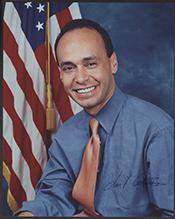
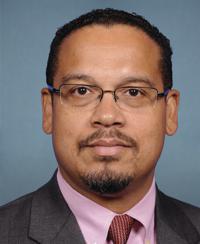
I will yield 4 minutes to the gentleman from Illinois (Mr. Gutierrez), the chairman of the Subcommittee on Financial Institutions, who's done a great deal to help small banks in this bill. I yield…
I will yield 4 minutes to the gentleman from Illinois (Mr. Gutierrez), the chairman of the Subcommittee on Financial Institutions, who's done a great deal to help small banks in this bill.
I yield the gentleman another minute.
Mr. Chairman, I would yield myself 15 seconds to say I wish we had the Consumer Financial Protection Agency already in place, because then the gentleman could get a refund on his dictionary because someone sold him a bum dictionary.
I now yield 4 minutes to the gentleman from Georgia (Mr. Scott).
I believe there is an imbalance of time, so I will reserve.
I yield 4 minutes to the gentleman from Minnesota (Mr. Ellison).
I reserve the balance of my time.
I yield to the gentlewoman from Ohio (Ms. Kilroy), who I understand wants to engage in a colloquy.
The gentlewoman is correct. She has been very diligent in trying to protect this very important type of financing. Financing companies are not depository institutions. They provide financing for the sale of that particular product in that company.
It is again inconceivable to me that somehow they would rise to the level of risk that would justify the Systemic Risk Council stepping in.
Madam Chair, I yield 3 minutes to the gentlewoman from California (Ms. Speier).
Madam Chair, I yield 3 minutes to the gentleman from Ohio (Mr. Wilson).
I yield 4 minutes to the gentleman from Texas (Mr. Al Green).
I yield the gentleman an additional minute.
I will give him a minute because they're listening in Norton.
I yield 4 minutes to the gentleman from Illinois (Mr. Foster).
Will the gentleman yield?
The gentleman stated the exact opposite of what I said. He's quoting another Member.
I said, in fact, that on 13(3) our bills are very similar. So the gentleman has just put words in my mouth that was the exact opposite of what I said. It was another Member who talked about 13(3). I talked about the similarity of our approach as you had offered it in committee and ours on 13(3).
Another Member said that, yes.
I yield 5 minutes to the gentleman from North Carolina (Mr. Watt), a leading member of the committee who has done a great deal on this bill.
I have only one speaker left.
I reserve the balance of my time.
Madam Chair, I reserve the balance of my time.
May I inquire as to the time remaining?
I yield myself such time as I may consume.
First, I have to deal with some of the misstatements that we've heard. There is nothing in here that rations credit. There isn't even anything to refute because there is nothing here they could even misinterpret, Madam Chair, about the rationing of credit. Now, some are particularly upset because we establish a Consumer Protection Agency. In the first place, as far as the banks are concerned, that entity gets no new powers; it takes powers that are already there in the bank's regulators that haven't been used very well.
If my friends on the other side want to go to the American people and say, oh, great, here's one of the differences between the parties, we think you consumers have been very adequately protected, and you don't need to improve that manner of administration, then I will take that debate to the American public.
They tell us that this is bad for small business. The Independent Community Bankers Association supports this bill.
They will be unhappy if bankruptcy is added, I understand that, but as far as the bill now stands, before we get to the bankruptcy clause of the Judiciary Committee amendment--which I'm going to vote for, but insofar as the accusation that it restricts credit, the Independent Community Bankers don't think so, just as when we did the credit card bill and the Republicans said--some of them, some of them voted for it--this is bad for small business and the National Federation of Independent Business said no.
What we say here is--and this is a big difference--we do say that we want to prevent the granting of those kinds of mortgages that get people in trouble because it's not just the individual who gets in trouble; the whole economy suffers. And we do want to ban the kind of practices in the mortgage area--so it's true, it's an expansion of government power. I will say, by the way, that was a constant debate. For much of the past, oh, 15 years, until recently, many Democrats tried to get restrictions on irresponsible subprime mortgages. The Republicans resisted them.
From 1995 to 2007, my Republican friends controlled this House; not a piece of legislation passed to stop mortgages, not a piece of legislation passed to deal with Fannie Mae and Freddie Mac. We did, in 2007, pass such legislation, but the damage had been done.
So, yeah, there is a difference. We want to expand the regulatory power to stop the kind of mortgages from being granted that were a major problem in the crisis. One Member said, Well, we would do nothing to stop the AIG crisis. No, we do many things to stop the AIG crisis. First of all, we do not allow, under the legislation we are putting forward, an entity like AIG to get so overextended by issuing credit default swaps that they can't pay off. They would be restricted because derivatives would be better regulated. They would be restricted because they would not be allowed to be so leveraged because we would give regulators the power to hold them in.
The notion that it's socialism when you have bank regulation is quite odd. We heard Members say this is socialism. There is nothing in here about the ownership of the means of production. There is nothing in here about the government taking over any ongoing institution. Yes, we have bank regulation, and that's the deal. These are people who think that regulation is socialism. We are for regulation. We do believe that the absence of regulation over the last 20 years contributed greatly to this problem.
Now, I know there are people who say, when you start regulating the innovation aspects of the economy, you get into trouble. They said it about Franklin Roosevelt and the Securities Exchange Commission, they said it about Theodore Roosevelt and antitrust. I urge people to go back and read the same old arguments.
Now, the gentleman from Texas (Mr. Neugebauer) said the Federal Reserve will decide that you are too big to fail and you will be advantaged; wrong, wrong, wrong. In the first place, the designation that an entity, a financial entity--by the way, we heard some comments about Dell and American Airlines, which are not covered under this bill. They are not financial holding companies and could not be made financial holding companies. So Dell and American Airlines are total red herrings.
What we have here is the ability of a group of the existing regulators--not the Federal Reserve--to decide that a particular institution is so big and so overleveraged that it's a danger. But they don't get designated and then carried around; coordinated with that is a restriction on what they do. They are not told you're too big to fail, go out and make more money. They are told, you are so big that if you fail because of problems, raise your capital, cut back on your activity, and if you're AIG, stop selling the credit default swaps.
There is this very real difference between the bills. Their bill is very small because it does nothing to retard the kind of activity that got us in trouble. It does not stop over-leveraging, it does not stop unregulated derivative trading, it does not stop credit default swaps without anything to back them up, it does not stop any subprime lending abuses. So yes, that's their view, and they're very clear: Leave it to the private market. We say the private market always does better with sensible regulation.
When Roosevelt and Wilson put antitrust into place, I think they did a good thing. When Franklin Roosevelt did the SEC and the Investment Company Act, those were good things. So, yes, a lack of regulation we believe did cause this great problem.
Now, we get into the bailout issue because the Judiciary Committee, frankly, copied the Republican bill by saying you should use chapter 11. The Republican bill talks about chapter 14--the equivalent of chapter 11 here. Here's what, however, the Judiciary language is subject to. It is subject to--we are talking about now the fund. Yes, somebody could be put into chapter 11, but none of the money could be spent that's in the fund. It's raised not by taxpayers, but by an assessment.
On page 399, ``The Fund shall be available to the corporation for use with respect to the dissolution of a covered financial company to cover the costs incurred by the corporation. The Fund shall not be used in any manner to benefit any officer or director of such company.''
It also then says, on page 397, here is the fund, this is the purpose of the fund, ``to facilitate and provide for the orderly and complete dissolution of any failed financial company or companies that pose a systemic threat to the financial markets or economy as determined under 1603(b).'' The language about Judiciary does not alter that in any respect. It says that the Fund can only be used for dissolution.
Now, it is true, they said, well, what about AIG when they paid off all these people? This is precisely to prevent the repetition. That was done, by the way, as Members will know, under section 13(3). It can no longer be done. We have changed section 13(3), so that should not happen again.
What they did was to say--and this was in the Bush administration-- they said, look, we don't have the discretion to pick and choose, so we are doing exactly the opposite of AIG. With AIG, it was the ruling of the Bush administration's top officials, concurred in by President Bush without any congressional input, that they had to pay off every creditor of AIG because they got the legal authority to pick and choose. They said, we can put them all into bankruptcy, we have Lehman Brothers, and the markets will end--Secretary Paulsen said--or we can pay everybody.
We give them the authority precisely to avoid that dilemma. And by the way, AIG was not being put out of business. It is not AIG. AIG was not put under dissolution; they are being kept going. That could not happen. What we say is, in the future, if you think an entity like AIG has gotten too big and owes too many people too much money, you take it over and you spend money only to wind it down and to dissolve it. If there was some notion that it could be kept going, then none of these monies could be used for it.
Let me read it again: ``To facilitate and provide for the orderly and complete dissolution of any failed financial company.'' That is a restriction on the use of the fund--it's not a taxpayer fund, but even of the other funds.
And then on page 288 it says, ``The Corporation is authorized to take the stabilization actions''--including the bankruptcy--``only if the Secretary and the Corporation determine that it is necessary for the purpose of financial stability and not for the purpose of preserving the covered financial company.'' And it then says, ``The Corporation ensures that any funds from taxpayers shall be repaid as part of the resolution process before payments are made to creditors.'' Funds will be repaid if there is a borrowing. Funds go to the taxpayer before a nickel goes to the creditors.
These are the inaccuracies that we have heard. There is no Dell or American Airlines in here. Oh, by the way, there is no permanent bailout fund either because that fund and the borrowing authority the gentleman from New Jersey talks about sunsets in 2013. The borrowing authority is sunsetted at 2013. So permanent is true if you believe that the world is ending on January 1, 2014. Now, I know the Republicans believe the world began on January 21, 2009, and all the bad things that happened never happened under Bush--they didn't fail to vote for them. They all happened in 2009.
Again, as my partner said to me, that was also the day of a terrible, terrible disease outbreak, mass Republican amnesia on January 21, 2009, when they forgot what all these--We've heard talk about job losses. Isn't it interesting that the gentleman from Texas cannot remember that a single job was lost before January 20. He talks about the job losses since the stimulus bill was passed. In fact, this recession, the worst since the Depression, began in 2007, in December; and there was enormous job loss under President Bush. Job loss has diminished recently.
So, yes, I will acknowledge that the Obama recovery from the Bush recession has been slower than we would have liked. But every sensible economist understands that the question is not whether there were any job losses at all, or whether you have affected the rate. And clearly the economic recovery plan has affected the rate. And further things will affect it further.
I yield to my friend from North Carolina.
No, I did not, and I did read the whole bill. And by the way, I also would object, there was some reference to steamroll, or not having the opportunity to read it. We have had complaints from the minority about too many markups and too many hearings and people on the staffs of both sides, and there was a magnificent group of staffers on both sides who have given the American people the best bargain they've ever gotten with the amount of work both sides have done on this. So, yeah, this has been very thoroughly vetted and discussed and debated and all the deadlines have been met.
But here's the fundamental difference: we do not have a bailout fund. We have a fund that will come from the financial institutions that can only be used, as I said, for dissolution, that will sunset in terms of borrowing authority in 2013, in terms of borrowing authority. It is used so you don't just say, okay, you're out of business; we end you tomorrow. It is to avoid what Secretary Paulsen and Ben Bernanke and George Bush told us was the dilemma of a year and half ago, all or nothing. We've got to use these funds to wind it down in an orderly way.
But here's the bigger difference: the Republican bill doesn't even try to stop the situation from arising. That's the difference. We analyzed the various things, too much leverage, unregulated derivatives, subprime loans, executive bonuses that encourage people to take too many risks. Their bill says, no, they're none of the government's business. It is true, every time you try to prevent a bad practice by regulation, you're expanding government power. That's true. An unregulated derivative market versus a regulated derivative market, that's more government power.
Restrictions on irresponsible subprime loans, that's government power. Telling an institution they can't be overleveraged, that's government power. In terms of breaking up companies, no one's breaking up Dell or American Airlines. That is fantasy. What we say is we first try to stop an institution from being so overleveraged and so big that it causes a problem. So, yes, we do say that the regulators should be able to step in if the Systemic Risk Council says so and restrain them from doing things. And, yes, the Federal Reserve is the agent, so the Federal Reserve gets more powers under the Systemic Risk Council.
We, by the way, take away more power in our bill with the Consumer Protection Agency from the Federal Reserve than any other agency. We limit section 13(3) of the Federal Reserve very severely. We do empower them as the agent of the Systemic Risk Council to do what the Republicans say you should never do: tell a company you've gotten too big and owe too much money and need to slow down. Break them up because their parts have begun to pull apart.
AIG should not have been allowed to be an insurance company and a credit default swap handler. And, yes, under the amendments we've adopted someone could have come in and said, okay guys, stay in the insurance business, but don't put us all at risk by doing all of these other things.
So that's the fundamental difference. The Republican position is, business knows best. Do not have any rules, do not prevent--and literally, nothing in their bill would retard any of the irresponsible, reckless, overleveraging that happened and led to the crisis.
And then they said, if there is a crisis, just let them go bankrupt. We say, first of all, let's try to prevent the crisis. Let's try to step in and slow it down.
And if that's socialism, I guess the antitrust laws are socialism by that definition, and the Republican equivalents of today's Republicans called Theodore Roosevelt a socialist. They turned against him. They called Franklin Roosevelt a socialist because he created the Securities and Exchange Commission. They call people socialists when they want to do regulation. The Independent Community Bankers don't think so. And the consumers of America do not believe that being protected from abuses is socialism. I look forward to tomorrow when we debate the amendments.
House of Representatives,
Committee on Ways and Means,
Washington, DC, December 2, 2009.
Hon. Barney Frank,
Chairman, Financial Services Committee, 2129 Rayburn House
Office Building, Washington, DC.
Dear Mr. Chairman: I am writing regarding H.R. 2609, the
``Federal Insurance Office Act of 2009.'' As you know, the
Committee on Ways and Means had jurisdictional and other
concerns with provisions of this bill. I note that in 2008,
we exchanged letters on similar legislation (H.R. 5840)
introduced in the 110th Congress.
Earlier today, the bill was amended during markup by your
Committee to address the concerns my staff and I have raised.
For example, the bill was amended: to preserve USTR's
authorities, including over development and coordination of
U.S. international trade policy and the administration of the
U.S. trade agreements program; to modify the types of
agreements that are covered by the bill and to provide for
their joint negotiation by USTR and the U.S. Department of
the Treasury; to require that annual reports by the Federal
Insurance Office be provided to the Committee on Ways and
Means; and to modify the standards and process for preempting
State law. I appreciate your willingness, and the willingness
of your staff, to work with me and my staff on this important
legislation.
To expedite this legislation for Floor consideration, the
Committee on Ways and Means will forgo action on this bill.
This is being done with the understanding that it does not in
any way prejudice the Committee with respect to the
appointment of conferees or its jurisdictional prerogatives
on this bill or similar legislation in the future.
I would appreciate your response to this letter, confirming
this understanding with respect to H.R. 2609, and would ask
that a copy of our exchange of letters on this matter be
included in the committee report on the bill and in the
Congressional Record during House Floor consideration of this
bill.
Once again, thank you for your work and cooperation on this
legislation.
Sincerely,
Charles B. Rangel,
Chairman.
I yield back the balance of my time.