Mr. President, I come to the floor to speak on an issue I have certainly followed for many years now in the Senate and one I am proud to have brought to some conclusion along the way, particularly…
Mr. President, I come to the floor to speak on an issue I have certainly followed for many years now in the Senate and one I am proud to have brought to some conclusion along the way, particularly last evening.
Many people look at history and see that when the Capitol was first built in the late 1700s to early 1800s, enslaved African Americans worked in all facets of its construction--carpentry, masonry, carting, rafting, roofing, plastering, glazing, painting, and sawing. But for almost 200 years, the story of these slave laborers was not told and was basically unknown, I would imagine to almost everyone who visited and worked in the Capitol every day.
In July of 2000, I sponsored a resolution to establish a special task force to recommend an appropriate recognition for the slave laborers who worked on the construction of this great building--the U.S. Capitol--our symbol of freedom in this country. My cosponsor on this effort was then Senator Spencer Abraham from Michigan, and so the resolution became known as the Abraham-Lincoln resolution back then.
The bicameral, bipartisan Slave Labor Task Force brought together historians and interested officials to work on this issue. One of those was Curtis Sykes, an educator and native of North Little Rock, AR, and an original member of Arkansas' Black History Advisory Committee. Mr. Sykes passed away before our work was complete, but he made so many important contributions to the task force before his
passing. He was then ably succeeded by Ms. Sarah Jean Davidson, founder and president of the Association for the Preservation of North Little Rock, Arkansas African American History.
I am so very grateful to these two individuals who have offered their insight and their expertise and their input to make sure that what we did here was done in a very special way in great recognition.
In 2007, the task force presented the congressional leadership with recommendations on how to best recognize the contribution of these enslaved workers. The recommendations were developed with the invaluable assistance of a working group that included the historians and curators of the Senate, House, and Office of the Architect of the Capitol, representatives from the AOC Project Management Division, and representatives from the Capitol Visitor Center.
Since then, we have been working so very hard to see that these recommendations are all realized. We have developed a history of slave laborers in the construction of the Capitol and put it online. We have ensured that the story of these slave laborers was incorporated into the CVC orientation video and Capitol tour guide training. We have seen the publication of a book on Black Americans in Congress, and we have seen the reception area of the CVC named Emancipation Hall.
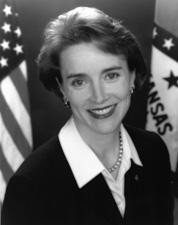
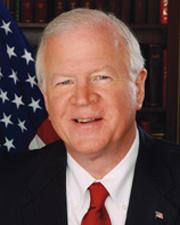
On Monday, I, along with my good friend and colleague Senator Chambliss, introduced a resolution to bring another recommendation to fruition. This resolution, which was approved by the Senate last night, authorizes a plaque to be placed in the Capitol, a plaque that identifies a very special feature of the Capitol. The original exterior wall of the Capitol was constructed between 1793 and 1807. The stones for that wall were mined by slave laborers in a sandstone quarry in Aquia Creek in Stafford County, VA.
Quarrying stone was among the most difficult and backbreaking tasks in the building business. First, the land had to be cleared, then the top of the stone chipped away to reach the parts that had not been damaged by frost or vegetation. Then the stone would be further chipped to create a small cavity, just large enough for one man to work in. The men would work in these small cavities to cut grooves and hammer in iron wedges to split the stone to free it from the larger block. To make matters worse, the quarries were located on an isolated, snake- infested island that swarmed with mosquitoes in the blazing summer and froze under snow in winter.
Much of the original Capitol no longer stands, due to the fires of war and renovations to create more space. The original East exterior wall still exists, however, and is now part of the East Front Corridor. It is one of the few places where that original slave-quarried sandstone is still in evidence. The plaque would be placed near that wall, and would bear an inscription identifying the wall as having been built of sandstone quarried by enslaved African Americans who were an important part, a vital part of the labor force that built our great U.S. Capitol.
Thanks to my Slave Labor Task Force colleague Congressman John Lewis, there will be a similar plaque on the House side of the East Front Corridor. These locations are important for another reason. They are on the route that visitors take to the Senate and House galleries. Mr. Sykes, as I mentioned earlier, the Arkansas historian with whom I worked, focused on the need to ensure that as many citizens as possible be made aware of this contribution of enslaved African Americans in the building of this great building, our Capitol. I wholeheartedly agree with Mr. Sykes. To me, education is at the heart of this effort. It would do no good to have a plaque that was hidden in a corner where no one would see it. It would do no good if we told the story of enslaved African Americans building the Capitol and no one heard it.
A critical part of recognizing the work of the slaves is to make their story visible and accessible, so that future generations know and understand the sacrifices that have been made for the many blessings that we enjoy today, that those blessings that are capsulized in the very building in which we all work, that the freedoms and the rights that we enjoy, are capsulized in a building that had tremendous input from enslaved African Americans.
I was recently in the new CVC and I hope, for those Members who have not been, they will go visit and certainly for those of our constituents who visit this great Capitol of the Nation, that they get a chance to visit the Visitors Center. I watched the faces of dozens of schoolchildren as their mouths opened up, dropped in awe at the sight of this vast and beautiful Emancipation Hall. Their eyes popped open wide as they looked through the skylight and saw this gorgeous view of the dome of the Capitol that represents who they are and the great Nation to which they belong.
They were so excited about being there, and that excitement opened their minds to the lessons that would be taught to them, there in that visitors center--like the Statue of Freedom that was designed by an Italian and sent over here and yet could not be reconstructed until the ingenuity and the dedicated focus of, yes, an enslaved African American by the name of Philip Reid could figure out how to unhook the model that the Italians had sent us, cast it, and put it piece by piece back together. No one else could figure it out.
As you walk into Emancipation Hall and you see this huge statue, the caste of the Statue of Freedom, what an unbelievable feeling it gives, not just to schoolchildren, but to any American who walks in there. How important for them to know of the ingenuity, the hard work, the labor that went into this incredible building.
Through this effort I wanted to make sure that everyone who visits the Capitol leaves knowing the story of the people who helped to build it, a true symbol of freedom, at a time when they themselves were not free.
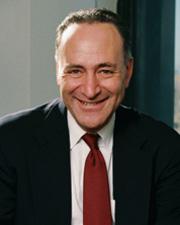
I want to close, first, by saying again a very special thanks to my friend and colleague Senator Chambliss from Georgia who has worked with us on this resolution--we were so excited and pleased to see it pass last night--as well as the chairman of the Rules Committee, Senator Schumer, and the distinguished ranking member of the committee, Senator Bennett, for also sponsoring the legislation with Senator Chambliss and myself. They were all so good to work with on this resolution. I appreciate their efforts and emphasis on something I believe is very important, not just for the Capitol but for our entire Nation.
I also want to publicly thank and recognize my good friend and former colleague Congressman John Lewis for his leadership on this project. He is an extraordinary human being. I have been grateful for the opportunity to work with him on this very important issue.
I never will forget, when I arrived in the House of Representatives as a young single woman in 1993, Congressman Lewis invited a small group of us freshmen--it was the largest freshman class since the 1940s, I believe--anyway, he invited us to come view some of his footage and film from days during the 1960s, and all of what he endured before that. It was amazing--the freedom ride, all of what he had experienced. It was a tremendous opportunity for me to get to know him better. I am grateful, again, for his extraordinary leadership.
I hope everyone, as I said, will take the opportunity to go to the CVC if they have not already and take a look and hopefully burn in each of our hearts how important it is to remember every day when we come to this unbelievable building what it stands for; hopefully relighting and rekindling our ability to unite, to work together for the great things this wonderful Nation stands for. I appreciate so much everyone working together to make this possibility a reality. I am very excited.
I thank my colleagues for their attention. I yield the floor to my good friend and colleague from Georgia.