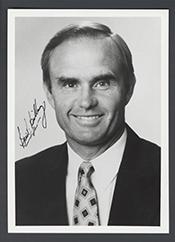
Mr. Speaker, we've had a very good session of the 112th Congress, and we got through it last night. I think all of us, regardless of how we voted, feel a certain relief that we can move on in this…
Mr. Speaker, we've had a very good session of the 112th Congress, and we got through it last night. I think all of us, regardless of how we voted, feel a certain relief that we can move on in this country and start to tackle the huge deficit we have.
This is going to be my last speech on the floor. I had the opportunity yesterday to deliver a speech that deals with what I felt were some of the problems in this country with regard to the deficit.
I quoted a lot from Thomas Jefferson, who aptly realized how troublesome and serious the amount of borrowing by this Congress and past Congresses could be to this country. He, of course, inherited a similar situation when he became President, and how he solved it, I felt, was important to put in the Record--his acute sense of urgency and how he went about solving the deficit he inherited. So I talked about that last night in my speech on the floor.
The second thing I talked about was this whole idea of Keynesian economics and that the problem we have is continuing to stimulate the economy with either QE1, QE2, QE3, and so on with this quantitative easing that Chairman Bernanke is doing and how that is ultimately hurting this country.
I also thought I would speak briefly today on some of the accomplishments that I have had over my 24 years. Some of these are very important, I think, for my district and, of course, I think, for the country.
The first one I'll mention is the Cross Florida Barge Canal. This was 86,000 acres that were tied up at the Federal Government. President Nixon wanted to do the Cross Florida Barge Canal. Ultimately, he decided against it, so this amount of land was tied up in the Federal Register. With the help of Charlie Bennett, a Congressman from Jacksonville at that time, I sponsored a bill to retake that 86,000 acres and move it back to Florida, where it was originally located. So we de-authorized the Cross Florida Barge Canal, and President Bush signed into law my bill on November 29, 1990.
The second major piece of legislation I am very proud of is the Telecommunications Act of 1996. I was a conferee with the Senate. I had many amendments involved with that, particularly with the broadcast side. It provided competition, reduced regulation, and it started this whole innovation in our telecommunication industry. And it was a great honor for me to serve and to be contributing to that great bill which created all of the new jobs in this country.
The third one was the Veterans Millennium Health Care and Benefits Act, which was signed by President Clinton on March 10, 2000. This bill was to provide extended care services for our veterans, to make improvements in health care programs at the Department of Veterans Affairs. I was chairman of the Health Subcommittee at the time, and I was able to advance this bill, and I am very proud that President Bill Clinton signed it.
The fourth bill was the Cardiac Arrest Survival Act. President Clinton signed it on February 13, 2000. It prevents as many as 50,000 unnecessary deaths each year in the United States by using what are called AEDs, which are automated external defibrillators. It allowed people to be trained to save lives, and so this act was very important. I'm glad that it was signed as my bill.
The fifth one I am very proud of that President Bush signed is dealing with asthma conditions. Self-administration of medications was prevented in schools because they had no drugs allowed, and some of the children had asthma and they needed EpiPin or they needed some albuterol, and if it wasn't available they could go into asthma attack. This bill allowed nurses in schools to provide this type of treatment.
The sixth one is the Protection of Lawful Commerce in Arms Act. It was signed by President George Bush on October 26, 2005. It basically provided civil liability action protection for companies that were manufacturing, distributing, or importing firearms or ammunition, for damages that were caused. Cities and States were suing these manufacturers, putting them out of business. They were nuisance suits, and I'm glad that President Bush signed it.
The last one I'm very happy to talk about is a bill that President Clinton
signed, H.R. 5109, which basically assisted the Veterans Health Administration to help personnel.
In closing, Mr. Speaker, I want to thank Jack Seum, my chief of staff, for his 20 years of service; Paul Flusche for his 17 years; Sherrie Porter for her 10; and Shawna Williams for her 14 years of service. They did an extraordinarily good job, and I thank them.
I recognize my long time employees.
Jack Seum, Chief of Staff, 20 years of service; Paul
Fluche, Press Secretary, 17 years of service; Sherrie Porter,
District Director, 10 years; and Shawna Williams, Staff
Caseworker, 14 years.
And I thank all of my staff for their strong efforts.
Also I want to thank Jay Pierson for his help during my tenure in Congress. He was the floor manager and did a great job. His 34 years of service was extremely impressive.
district funding requests summary
1. Establishment of an outpatient clinic for Veterans in Leesburg and Ocala, Florida.
2. Instrumental in building a Veterans' hospital facility in western Marion County, part of The Villages, with ten acres of land donated by Gary Morris, the owner of The Villages.
3. Funding for a 235-bed facility for the Veterans Administration Hospital in Gainesville.
4. Numerous funding support for the infrastructure for the beltway in Ocala and the beltway in Clay County.
5. Conversion of the Master Navy Jet Base Cecil Field into the Cecil Field Commerce Center with continuous appropriated funding made to help transition this into a commercial enterprise.
6. Further funding for the National Guard in Camp Blanding for the new Education Center as a result of the 9/11 tragedy and terrorist attack. Also helped National Guard in the relocation of the space program deposit of rocket fuel at Camp Blanding.
7. Federal funding for the building of a new prison in Sumter County and the funding for the intersection to allow transportation requirements to be met off of I75.
8. Accomplishments for Jacksonville Area:
JAX VA Cemetery: I first offered legislation (H.R. 3882) to establish a new VA cemetery in northeast Florida in 1996. There are approximately 189,000 veterans in the Jacksonville area, but there were no veterans' cemetery to provide them a permanent place of honor. It was not until 2003, with the inclusion of language from my bill (H.R. 197) into H.R. 1516, the National Cemetery Expansion Act of 2003, that a veterans' cemetery in Jacksonville was finally established.
Cecil Field: With the closure of Cecil Field, I have worked with area leaders and involved citizens in transforming Cecil into a commercial center. Since 2001, I have secured $10.5 million in appropriations funding for the former Cecil Field, now Cecil Commerce Center.
I also worked through the Military Airport Program (MAP) to upgrade the facilities at Cecil. From FY 2000 to 2003, I helped Cecil receive more than $12.5 million in MAP funding for building and hangar renovation, runway rehabilitation, and infrastructure improvements.
Florida National Guard: I have a long record of working with the Florida National Guard and its premier facility at Camp Blanding. I have secured funding and support for establishing the Rocket Motor Storage Facility, various infrastructure upgrades, and the Air National Guard Weather Readiness Training Center.
NADEP: I support the mission and workers at Jacksonville NADEP. Stearns contacted Secretary of Defense and pointed out specific examples in which NADEP personnel contributed directly to returning equipment to combat readiness.
JAX Port: I consistently join the area delegation in supporting dredging at JAX Port Authority.
more recent examples are
1. Representative Stearns introduced FAST, the ``Faster Access to Specialized Treatment Act'' (H.R. 4132), which rewrote Section 506 of the Food, Drug & Cosmetics Act to modernize the accelerated approval pathway for rare disease drugs. FAST was included in the FDA Prescription Drug User Fee Act (PDUFA), Rare Disease Bill.
2. Congressman Stearns worked with Rep. Ed Towns (D-NY) to craft H.R. 734, the Pedestrian Safety Enhacement Act of 2009 which directed the Secretary of Transportation to set a noise level sufficient to alert blind and other pedestrians of the presence of operating motor vehicles. This legislation was signed into law on January 4, 2011 as S. 841.
3. One of the high points for veterans and serving on the 24 years on the Veterans Affairs Committee was the accomplishment of getting a new cemetery in Jacksonville. The language in Representative Stearns' bill H.R. 1516 was incorporated into the National Cemetery Expansion Act of 2003, establishing a veterans' cemetery in Jacksonville. This was signed by President Bush. Representative Stearns had originally dropped H.R. 3882 and it was ten years later that this Act was accomplished and signed into law by President Bush.
4. Representative Stearns served as a member of the Air Force Congress with Sam Johnson who spent 6\1/2\ years as a POW at the Hanoi Hilton. While a member of the Air Force Caucus the Air Force Association presented to Congressman Stearns the W. Stuart Symington Award which is the highest honor presented to a civilian in the field of national security.
5. A recent bill which passed the Congress for the first time with Democrat support was H.R. * * * (James) the Concealed Weapons Permit to allow Americans to carry a concealed weapon if they have established their credentials from the state of their residency to other states.