Mr. Speaker, I rise tonight on behalf of the Financial Services Committee. Mr. Speaker, it has been my great privilege to have the responsibility to chair this committee for the last 6 years. I take…
Mr. Speaker, I rise tonight on behalf of the Financial Services Committee.
Mr. Speaker, it has been my great privilege to have the responsibility to chair this committee for the last 6 years. I take no pride on behalf of myself, but I take a lot of pride in the work that has been done on this committee.
A lot of that work, Mr. Speaker, has been bipartisan. And I believe, indeed, that the Financial Services Committee is the hardest-working, most productive committee in the United States House. We have produced more bills; we have had more bills passed on the floor; we have had more bills signed into law than any other committee.
I am especially proud of the work that we have done to create more pro-growth economic policy throughout banking and finance, and the passage of S. 2155, the Economic Growth, Regulatory Relief and Consumer Protection Act, has meant so much to helping create more capital to help save our credit unions and community banks, and to really play a part in the unparalleled economic growth that we see in our Nation today. I take great pride in that work on behalf of all our members.
I also take great pride on behalf of our Members for a piece of legislation
that modernized the foreign investment in the U.S. The bill is technically known by its acronym, FIRRMA, and it modernizes a regime that had not been modernized in quite some time.
Mr. Speaker, so many of us know we have challenges in America today with foreign interests that come in and essentially take our intellectual property, that take our technology, and regrettably China is one of the prime perpetrators of this. I have had the occasion to go to China and meet with their leadership. And I want China to rise, I want them to have economic growth, but not at the expense of the United States of America and not by violating either the letter or the spirit of the WTO, of the World Trade Organization, which we helped them enter a couple of decades ago.
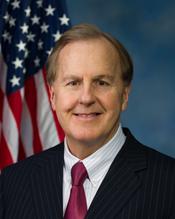
Mr. Speaker, I am proud of the work, especially, done by the gentleman from North Carolina, who is the vice chairman of our Terrorism and Illicit Finance Subcommittee. He was the House leader on this legislation and worked with the senior senator from Texas, John Cornyn, my friend, to bring this onto the President's desk that ultimately got signed into law.
This was really a revolutionary law dealing with both export controls, foreign investment in the U.S., and the gentleman from North Carolina, Mr. Pittenger, was an early leader. He saw the threat before others saw it.
I have had a number of great privileges serving as chairman, but one of the greatest privileges is serving with men and women who have vision, who have commitment, who have principle, and that certainly describes the gentleman from North Carolina.
Regrettably, he and I are both departing after this Congress, and that is a bittersweet feeling. I think we both look forward to the next opportunity that we have.
Mr. Speaker, I want to yield him some time, because it is important for us to hear from him about the significance of this legislation and how important it is. I was happy to be in the White House not too long ago to have the President extoll the virtues of this law as well.
Mr. Speaker, I will miss his company, I will miss his leadership, and there is no one that I know of who is a greater authority on terrorist finance who is serving in the U.S. Congress today than Robert Pittenger of North Carolina.
Mr. Speaker, I yield to the gentleman from North Carolina (Mr. Pittenger), my friend.
Mr. Speaker, I certainly thank the gentleman for his comments tonight.
I hope that there are a fair amount of Americans who are watching this this evening, because they need to know that they owe this gentleman, Mr. Pittenger of North Carolina, a great debt of gratitude. And indeed America is going to be a safer, more secure Nation because of his leadership.
In his three terms, Mr. Speaker, Mr. Pittenger achieved more in three terms than many Members achieve in ten terms.
Many people, unfortunately, come to the People's House to be somebody. Mr. Pittenger of North Carolina came to do something.
And, indeed, don't just take my word for it, but the President of the United States thinks this is one of the most significant pieces of legislation when it comes to dealing with the threats of those who would take our intellectual property, who would take our technology by hook or crook, or however they might do it.
So, Mr. Speaker, I want to commend Mr. Pittenger for his leadership.
I must admit, this was kind of faint on my radar screen, this issue, but among Mr. Pittenger's other endearing qualities, he is persistent. He is a very persistent individual. And I am glad he was persistent, because it became a major piece of legislation.
Part of my job as chairman and one of my great privileges is I get to take credit for a lot of other people's good work. I shouldn't, I shouldn't be accorded this. And so I get many thanks, but this was a team effort and it was led by Mr. Pittenger.
Other countries are now put on notice. We are watching. These rules, as Mr. Pittenger, the gentleman from North Carolina, has said, will be unveiled in the weeks and months to come. But a new day has dawned for those who think that they are going to take, by hook or crook, our technology.
We want our global neighbors to succeed, but, again, not to succeed at our expense. Those applications of technology and intellectual property that have any type of national defense implications, that is going to stop, and it is going to stop because of the leadership of Robert Pittenger, the gentleman from North Carolina.
It has been a great, great source of pride and joy to be associated with him. I will count him as a friend for life. I appreciate the fact that he would come and spend time here.
I have no doubt, Mr. Speaker, that his leadership is not done. His leadership may be done in this body, but his leadership in fighting global terrorism from illicit finance and global terrorist finance, that leadership is not done. In many respects, it is just starting. I look forward to continuing to follow his career and his leadership.
Mr. Speaker, we are also joined tonight by another real authority on global terrorist finance, a gentleman who has been incredibly active on the Terrorism and Illicit Finance Subcommittee of the Financial Services Committee. I have come to really appreciate his intellect, his knowledge, and his work ethic. He is clearly one of the hardest working members of the Financial Services Committee.
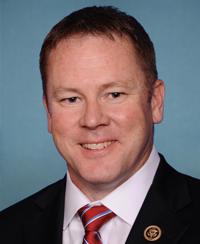
As, regrettably, the gentleman from North Carolina departs, and I am saddened by that, we are both heartened to know that the gentleman from Ohio (Mr. Davidson) will remain, and he will be one of the key leaders in the entire United States House of Representatives in combating terrorist finance. He has been such a workhorse in helping some of our economic growth measures that have helped save community banking and credit unions.
Mr. Speaker, I am happy to yield to the gentleman from Ohio (Mr. Davidson).
Mr. Speaker, well, after hearing those kind comments, I would be happy to yield the gentleman even more time. I say that tongue-in-cheek.
Mr. Speaker, I have learned that if you want kind things said about you, announce your retirement. So, I must admit, I am humbled by this experience, and I thank the kind words of the gentleman.
I must admit that it is a real mixed blessing that I get ready to leave Congress, but I take a lot of solace knowing that there is a new generation of conservative leaders who are coming to this body, who know how important faith is in the life of a great Nation, because you cannot have a free Nation that is not a virtuous Nation and a godly Nation.
I know that there is a new generation of conservative leaders who are coming up who know how important our families are, our families who care for our elderly and nurture our youth and perpetuate our values. They know how important free enterprise is, not just because it allows people to sleep at night knowing the bills are paid, but how empowering it is to finally leave the assembly line and to start your own business; how empowering it is to send that first kid to college; but, ultimately, how important it is to pursue happiness, to use your God- given talents in any way that can help you and your family prosper.
I know I take great solace to know there is a new generation of conservative leaders who know that, ultimately, liberty is an inalienable right given to us by our creator, the Almighty, and how precious it is and how few people on the face of the planet really enjoy the full fruits of liberty.
I count Mr. Davidson among those people, and I will always count him as my friend. But it makes it much easier, after 16 years, to leave this body knowing that there is a Warren Davidson in Congress and knowing that there is a Ted Budd from North Carolina who will remain in Congress as well.
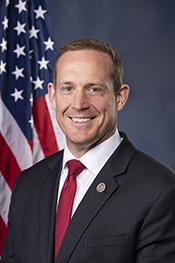
Mr. Speaker, I yield to the gentleman from North Carolina (Mr. Budd). He also has become a fast friend of mine. More importantly, I count his wife as a friend of my wife, and me as well. Not unlike Mr. Davidson, he is one of the hardest working members of our committee, and he never, never gives up.
Again, a significant portion of the economic growth packages that we have passed out of the House Financial Services Committee, two or three of them I know contain Mr. Budd's name. That is unusual for somebody who has been a freshman member of our committee, to have so many bills passed. It is a testament to the great citizens of his congressional district that they would return him to office. I hope, next time, maybe a few more will join in and make it a little less interesting. But I am also proud to call him colleague; I am proud to call him friend; and I, again, take great solace to know that this body will see his conservative leadership for quite some time.
Mr. Speaker, I thank the gentleman for his kind words, and far more importantly, I thank him for his leadership. He is truly one of the workhorses for economic growth in the United States Congress.
Again, I take great solace, as I will soon leave this august body, in knowing that somebody like Mr. Budd will be here. He has such principle, character, is a hard worker, and has success in actually getting bills done that make a difference in the lives of working people. Mr. Speaker, it is such a pleasure to serve with the gentleman from North Carolina (Mr. Budd).
Mr. Speaker, several of our Members have spoken tonight about what we call the JOBS 3.0 Act, Jumpstart Our Business Startups. Thanks to the leadership of President Trump, thanks to the leadership of Speaker Ryan, and thanks to the leadership of Chairman Kevin Brady, we have a great economy. We have, perhaps, the greatest economy in most Americans' lifetimes. Unemployment is at about a 50-year low. For the first time in a decade, we are seeing paychecks rise. We are seeing that take-home pay increase.
Small business optimism, consumer optimism, is off the charts. It is amazing what can happen with some tax reform and regulatory reform. And, yes, I take pride--not on my behalf, but on behalf of the Financial Services Committee--in what we have done to help take some of the shackles off of our community banks and our credit unions. But there is so much more work to be done.
Mr. Speaker, as you probably know, the whole idea of capital formation for our entrepreneurs, for our small businesses, traditionally, that has been a bipartisan effort. And, in fact, the very first, what we call JOBS 1.0, was signed into law by President Barack Obama. I don't quite have the quote at my fingertips, but at the time, he said something along the lines that we have to, from time to time, remove the regulatory burdens to capital formation that are preventing our entrepreneurs from accessing capital.
So the first point I would like to make, Mr. Speaker, is the economy of today is in great shape. But can we count on it for the economy of tomorrow? Particularly, Mr. Speaker, when I look at public companies, what I see is that our public companies are fewer, they are older, and they are bigger. Today, in America, we still have far too many old cars and not enough startups in our garages.
I sometimes think--and I am the father of a 16-year-old daughter, a 15-
year-old son--the companies that will drive the economy when they are in their peak earning years, they probably haven't even been founded yet. Where are the next Amazons coming from? Where are the next Googles coming from? Where are the next Apples coming from?
But what we see as recently as 2016, just a couple of years ago, is that new startups' entrepreneurial capitalism was at a 40-year low. Now, fortunately, under this administration, it is taking a turn upwards, but we have got a lot of ground to make up.
Our public companies have been cut in half, a 20-year low, as recently as 2016. Half of the number of companies are going public. And so not only is that bad for America's economy, but it is bad for the family economy because they lose out on investment opportunities.
Had you invested early in Apple, you would have made a gazillion percentage rate of return. It would have been an incredible investment opportunity. At the time, the Commonwealth of Massachusetts wouldn't even allow Apple to sell their securities because they were fearful it was too speculative.
We want to make sure that every American family has the opportunity to invest in the next Apple. But, unfortunately, what we see is a regulatory burden that is absolutely strangling a lot of these startup companies.
Over the past 2\1/2\ decades, Mr. Speaker, the U.S. share of global venture investment has steadily declined. And when we see it decline, what we also see is that regulatory restrictions on securities and investment have increased 54 percent in 10 years--in just 10 years, a 54 percent increase in regulatory restrictions on securities, and an 80 percent increase over 20 years.
We are wondering why there is so little entrepreneurial activity, and we are wondering why so few companies have gone public.
Part of what we have to do is simply modernize antiquated statutes. And so with the exceptions of Sarbanes-Oxley, and with the exception of, frankly, the first version of the JOBS Act and the second version of the JOBS Act, almost all of our other significant Federal securities laws date back to the 1930s.
Mr. Speaker, a couple of these, the Securities and Exchange Act, the Securities Act, they are foundational. But so many of these other laws that we still labor under, I mean, there was a time that the telephone was the cutting-edge technology. That is when the SEC was created, in 1934, and the telephone was the cutting-edge technology of the time.
So many of the security laws we have date back to that particular era. At that time, stock offerings were part of the daily newspaper. Well, we don't see that anymore. Pneumatic tubes and ticker tape transmitted the news of a stock sale.
If we are going to be able to fuel the economy of tomorrow, we are going to have to modernize these securities laws. And, again, traditionally, this has been a bipartisan effort.
The United States House of Representatives has passed JOBS 3.0 by a vote of 406-4. Months later, the United States Senate has done nothing on this piece of legislation. This cannot hold. This cannot be. There is no excuse for the United States Senate back there behind my shoulder to do nothing while, for example, we see more companies go public in China.
We had a discussion a little earlier, Mr. Speaker, how China, unfortunately, too often has taken our technology--our intellectual property--by hook and crook. But a lot of it is companies are choosing to confine their capital in China because they find it easier, and now we are looking at over one-third of public companies are going public in China, and we are down to 11 percent. They have an ascending curve; we have a descending curve.
In order to successfully compete with China in a global economy, we have to make it easier throughout the ecosystem of our small entrepreneurial ventures to make it easier, and so that is what the whole thrust of the JOBS 3.0 Act is all about.
Again, it is a very, very strong bipartisan measure. So often the lead Democrat in this institution, known as ranking member, the gentlewoman from California (Ms. Maxine Waters) and I don't see eye to eye on much. We see eye to eye on very little. But we are joined at the hip in wanting to see the JOBS 3.0 Act. She has been stalwart, and she has been a good negotiating partner to get this done.
So you have one of the most liberal Members of Congress and one of the most conservative Members of Congress come together to advocate for our small businesses, for our entrepreneurs, to help us compete with China in the JOBS 3.0 Act, but somehow they are still not hearing this in the United States Senate.
Please, the gentlewoman from California (Ms. Maxine Waters), gives every liberal permission to vote for the JOBS 3.0 Act. As chairman of the House Financial Services Committee and one who used to chair the conservative caucus in the House, I give every conservative permission in the United States Senate to vote for JOBS 3.0.
Please, we need a message for all Americans who care about small businesses. We want to make it easier. We want to make it easier for these businesses to get funding.
The bottom line is, Mr. Speaker, you cannot have capitalism without capital, and we want to make it easier to access this capital.
So I was very heartened by the fact that, although maybe our Senators--and I have many friends who are United States Senators. I still cannot understand why they haven't taken up a piece of legislation that came out of the House 406-4, a piece of legislation strongly supported by the administration, and a piece of legislation, again, that is going to help our small businesses and entrepreneurs. Why haven't they taken it up?
Perhaps the single most influential newspaper in America is The Wall Street Journal. It is certainly the most influential economic publication in America, and probably the world. Fortunately, their lead editorial today was to encourage the Senate to take up JOBS 3.0. In fact--I am kind of paraphrasing here because I don't have the newspaper at my fingertips--they said that Congress has done yeoman's work shepherding a compendium of bipartisan bills to access capital. They were referring to JOBS 3.0.
Again, go online. It is their lead editorial.
They said that the Senate shouldn't scuttle what could be one of Congress' better achievements. I agree. This will be one of Congress' better achievements to be able to capitalize our small businesses to make sure, again, they can access capital, they can go public, and that they are not treated like a Fortune 500 company on day one.
Mr. Speaker, many of our biotech companies that provide lifesaving pharmaceuticals, some of them don't even cash flow positive for a decade. They can't be treated with the same regulatory burden on their capital as a Fortune 500 company. If you do, again, they are going to go to China. They are not going to stay in the USA. They are going to go to China. As we continue to compete with them, we cannot allow this to happen.
So we have had such great support. I alluded to the ranking member, the gentlewoman from California (Ms. Maxine Waters). She said that this bill is ``a carefully crafted bipartisan compromise.'' Those are her words. She said that it is ``an example of Members on both sides of the aisle working together to support our Nation's small businesses and investors.''
Again, she is one of the most liberal Members of the United States House of Representatives and most likely the next chairman of the House Financial Services Committee. She said that this bill will help entrepreneurs, small businesses, investors, and our economy to thrive.
In the 6 years I have been chairman, it has kind of been rare for us to agree on the time of day, but we definitely agree that the JOBS 3.0 Act is important. It is important to America's economy not only today, but more importantly, it is important for the economy of tomorrow.
If there is one aspect of America's economy that is somewhat unique in the world, it is how we have ensured that entrepreneurial capitalism can't just survive in America, but thrive. So those seeds have to be planted today. There is so much competition worldwide, and that is why it is important that we get this done.
The U.S. Chamber of Commerce weighed in, and they said that the House amendment to S. 488--I am talking about the JOBS 3.0 bill--would remove barriers for raising capital for America's businesses. Approximately three-fourths of financing for businesses in the United States comes from capital markets, but regulations have failed to keep up with the demands of the 21st century.
The Angel Capital Association has written: ``Thank you again for your leadership in promoting American startups, capital formation, and job creation. The JOBS and Investor Confidence Act will help foster innovation and job growth.''
The Biotechnology Industry Organization, known as BIO, said: ``The JOBS and Investor Confidence Act of 2018, or JOBS Act 3.0, will significantly improve the ability of emerging biotech companies to access capital and invest in their potentially lifesaving research rather than unnecessary compliance costs that do not add value to investors.''
There is widespread support. I am almost baffled, Mr. Speaker, why the United States Senate won't take this up. Again, this is a strongly bipartisan package. It doesn't get much stronger than 406-4.
Again, our business startups have neared a 40-year low in 2016. Our IPOs, our initial public offerings that allow our working families to invest in the American economy, are half of what they were 20 years ago.
Why? The average regulatory compliance for initial public offerings has now doubled. It has doubled in the last 25 years. It costs $2.5 million to go public, with average compliance costs clocking in at $1.5 million.
Sometimes, Mr. Speaker, we have to take a look at regulations that date back to the 1930s and start to ask the question: How is that going to impact the economy of the 2030s? The answer is not too well, particularly in a global economy competing with China.
So I just want to conclude by saying that I have so many friends in the United States Senate. I respect the United States Senate. I used to be a staffer of the United States Senate. But there is no excuse why they can't do what the House did and follow our leadership and work on a strong, bipartisan basis to make sure that America just doesn't have the strongest economy of today but has the strongest economy of tomorrow.
It started with men and women, Democrats and Republicans on the House Financial Services Committee, to ensure that the economy of tomorrow, once again, will be strong for all Americans.
Mr. Speaker, I urge my colleagues and my friends in the United States Senate to follow our lead, to listen to the administration, and to pass the JOBS 3.0 Act immediately.
Mr. Speaker, I yield back the balance of my time.