Mr. Chairman, I yield myself such time as I may consume. Mr. Chairman, I rise in opposition to H.R. 3326, the World Bank Accountability Act of 2017. Last year, Democrats on the Financial Services…
Mr. Chairman, I yield myself such time as I may consume.
Mr. Chairman, I rise in opposition to H.R. 3326, the World Bank Accountability Act of 2017.
Last year, Democrats on the Financial Services Committee joined our Republican colleagues in favorably reporting H.R. 3326 out of committee to support the bill's authorization of a U.S. contribution of $3.29 billion to multilateral development efforts and to enforce the importance of U.S. leadership at the international financial institutions, but the favorable report in committee came with clear conditions for the future of the bill.
Democrats made it clear during consideration of this bill in committee that our ongoing support for the measure would depend upon changes to provisions in the bill moving forward that put critical U.S. funding at risk. But here we are today and Republicans have not made any effort at all to address our very specific concerns.
Namely, the bill would cut up to 30 percent of the U.S. contribution to the International Development Association--IDA--in any year in which the Treasury Secretary does not certify to Congress that the World Bank has adopted or is taking steps to implement two sets of reforms mandated in the bill.
IDA is the arm of the World Bank that provides grants and other assistance to the world's 77 poorest countries, which are home to more than 450 million people living in extreme poverty. Cuts to U.S. funds to IDA would punish millions of children and other vulnerable people in Africa, Latin America, and Asia, who are living in extreme poverty, who are suffering from famine, or who are emerging from conflict.
Democrats do not believe that cutting U.S. funds for, and diminishing U.S. influence at, the international financial institutions is an effective approach to reform.
To remedy this problem with the bill, Representative Moore, who is the ranking member on our committee's Subcommittee on Monetary Policy and Trade, had sought to offer an amendment on the floor to strike the provisions in the bill that would give the administration cover to cut U.S. funding from multilateral efforts aimed at alleviating global poverty. The amendment would have maintained both sets of reforms currently in the bill and directed the Secretary of the Treasury to actively promote these policy goals through advocacy and direct engagement with World Bank management as well as the World Bank's other major shareholders.
Unfortunately, the Rules Committee refused to make this amendment in
order, thus depriving the House of the opportunity to decide for itself which approach it prefers to take: reforming the World Bank by fiat with a threat to cut funding or reforming the World Bank through the exercise of U.S. influence and power at the World Bank based on the merits of the reforms themselves.
Mr. Chairman, the process by which this bill has come to the floor stands in stark contrast to our committee's long history of working together on issues relating to global economic governance.
For many years, the Financial Services Committee has worked in a bipartisan fashion to achieve a number of important reforms at the World Bank, including increased transparency, the creation of the inspection panel, more disclosure of information, and closer consultation with local communities most affected by World Bank projects.
We were able to successfully advance these policy goals through serious and direct negotiations and sustained engagement with both the Department of the Treasury and the World Bank itself, not by threatening to walk away from our commitments, but the Trump administration has consistently demonstrated troubling attitudes toward the role of the U.S. in the world.
In November of last year, in testimony before the Financial Services Committee, David Malpass, Treasury's Under Secretary for International Affairs, expressed the administration's view that globalism and multilateralism have gone substantially too far.
In December, the Trump administration refused to pledge any funds for the next replenishment of the International Fund for Agricultural Development, a small multilateral development bank that helps the poor in remote, rural areas where few donors operate. Of course, just last week, this President made ignorant, racist, and deplorable comments about Africa, where, as it happens, IDA focuses a great deal of its resources and energy.
Mr. Chairman, the more committed we are to our goals and to our ideals, the more morally obligated we are to do everything we can to advance those goals.
The legislation before us today, in its current form, fails to meet that test, so I will be opposing this legislation, and I urge my colleagues to do the same. We can, and we should, do better.
Mr. Chairman, I reserve the balance of my time.
Mr. Chairman, the gentleman from Texas really has presented rather hollow arguments that have no place in this debate. This is about our humanitarianism and about our strategic position in the world.
Mr. Chairman, I yield 3 minutes to the gentlewoman from New York (Ms. Velazquez).
Mr. Chairman, I yield an additional 30 seconds to the gentlewoman.
Mr. Chair, I yield 3 minutes to the gentleman from New York (Mr. Meeks).
Mr. Chair, I yield the gentleman from New York an additional 30 seconds.
Mr. Chair, I yield 3 minutes to the gentleman from Illinois (Mr. Foster), the senior member of the Subcommittee on Monetary Policy and Trade of the Financial Services Committee.
Mr. Chair, I yield an additional 30 seconds to the gentleman from Illinois.
Mr. Chairman, I yield 3 minutes to the gentleman from Michigan (Mr. Kildee), the vice ranking member of the Financial Services Committee.
Mr. Chairman, I yield an additional 1 minute to the gentleman from Michigan.
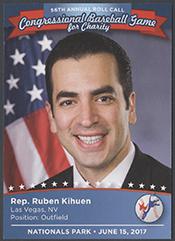
Mr. Chairman, I yield 2 minutes to the gentleman from Nevada (Mr. Kihuen), a member of the Financial Services Committee.
Mr. Chairman, I yield myself the balance of my time.
In closing, let me say that Democrats did view this legislation as an important marker of international engagement from our committee, which has not in recent times demonstrated a great deal of interest in global economic leadership. We viewed this measure as an opportunity to reinforce the importance of global economic cooperation. Given that, it seemed to us a mistake to then reject the possibility of cooperation with our own Republican colleagues. So we supported the bill for that reason as well, and I regret we couldn't come to an accommodation.
On another matter, let me also say that I won't question the sincerity of my Republican colleagues' commitment to reforming the World Bank, but
I do wonder why, if these reforms are as pressing and as urgent and as critical as they say, why did they take so long?
Chairman Hensarling has been at the helm of our committee for over 5 years, and, during that time, the Obama administration requested legislation to authorize U.S. participation in three other replenishments, including the previous IDA-17. But the committee refused to act on any of these requests, not only shirking its oversight responsibility, but also missing a number of opportunities to press for reforms which presumably were as urgent then as they are now.
In fact, in November of 2014, near the end of the 113th Congress, I wrote to Chairman Hensarling urging him to turn his attention to the three pending authorization requests before Congress adjourned. I made a number of arguments in support of the multilateral development banks, the MDBs, which apparently did not persuade the chairman.
Mr. Chairman, I include that letter in the Record.
U.S. House of Representatives,
Committee on Financial Services,
Washington, DC, November 19, 2014.
Hon. Jeb Hensarling,
Chairman, Committee on Financial Services,
Washington, DC.
Dear Chairman Hensarling: I write to urge you to turn your
attention before Congress adjourns to the Administration's
requests for authorizations for U.S. participation in the
replenishments of three concessional windows at the
multilateral development banks (MDBs)--namely, the World
Bank's International Development Association (IDA-17), the
Asian Development Fund (AsDF-11), and the African Development
Fund (AfDF-13).
As you know, these concessional facilities provide grants
and low-cost development financing to the world's poorest
countries. They support projects that combat hunger and
poverty while promoting private-sector growth and global
stability. Well-designed multilateral aid programs help
create more equitable societies and more stable democracies.
It is also crucial to U.S. interests that developing nations
continue to grow. Exports have been the most rapidly growing
share of our economy, and exports to developing countries
have been an important part of that.
America is also fighting a war on terrorism, and while the
forces that give rise to terrorism are complex, poverty and
despair provide a fertile feeding ground. Moreover, U.S.
contributions to the development banks also provide
tremendous value for the money. Every dollar we commit is
leveraged many times over by contributions from other donor
nations, as well as from the internal resources of the
institutions themselves.
Today, we have another very important, and potentially far-
reaching, reason why the U.S. should promptly meet its
commitments to the MDBs. The last few years have
unfortunately seen a weakening of the commitment to
multilateralism by the United States, which has led to
widespread doubt about U.S. leadership on global economic
governance.
In response, a number of developing countries, led by
China, have begun to act independently, with initiatives
viewed as the first serious, coordinated effort to reshape
the global financial architecture and challenge western
dominance in the world economy.
Last month, China announced an agreement with 21 other
developing countries to create a multilateral development
bank called the Asian Infrastructure Investment Bank (AIIB),
which will focus on financing infrastructure development
projects in the Asia-Pacific region. A clear rival to the
Asian Development Bank, the AIIB will be led by China, its
largest shareholder, and headquartered in Beijing.
Separately, in July, the so-called BRICS nations (Brazil,
Russia, India, China and South Africa) announced plans to
launch an international development bank of their own, which
they hope will rival the strength and influence of the World
Bank. The ``New Development Bank,'' as it is called, will be
headquartered in Shanghai and focus on infrastructure
investment throughout the developing world.
Development experts agree that global infrastructure needs
in developing countries is tremendous, and there are many who
welcome the contribution that the new development banks can
make in helping to build sustainable economic infrastructure
both in Asia and elsewhere. But these new institutions also
reflect frustration by the world's major emerging economies
with the slow pace of governance reforms at the Bretton Woods
institutions, especially the IMF. In fact, the now-stalled
agreement to realign the quota shares at the IMF, negotiated
by the Bush Administration, was a critical effort to preserve
its legitimacy and keep emerging economies firmly anchored in
the multilateral system that the U.S. helped design.
U.S. inaction in meeting its commitments to the MDBs, as
well as its refusal to ratify IMF governance reforms, is what
led, in large part, to the creation of these new institutions
that will increasingly pose a challenge to the global
financial order created by western powers after World War II.
We should be mindful that a world in which countries such as
China and Russia are acting outside of the established
international financial institutions, or other global bodies,
is one that could drift beyond our control. Moreover, it
remains to be seen what values these new rising powers will
articulate and promote in their vision of a new global
economy.
I believe this makes U.S. leadership at the multilateral
development institutions today more important than ever. They
are directed at some of the most central challenges faced by
the U.S.--strategic, economic, political and moral--and, in
many ways, they are often our most effective means for
responding to those challenges.
I strongly urge you to take prompt action to affirm U.S.
support for, and U.S. leadership at, these institutions,
which have served both U.S. interests and the global public
good for so many years.
Sincerely,
Maxine Waters,
Ranking Member.
Nevertheless, here we are, at a historic moment when U.S. credibility on the global stage is in serious question.
We have the option of choosing to lead and show the community of nations that the hateful words of the President will not be followed by misguided and enabling actions by Congress.
Today, I speak on behalf of the world's poorest countries and their people. Today, I stand with Africa, and I urge my colleagues to oppose this legislation and its misguided, cynical approach to multilateralism.
Mr. Chairman, I urge my colleagues to reject this legislation as a signal to the world that Trump doctrine is not the American doctrine or a broader sign of American unreliability and indifference.
Mr. Chairman, I would like to take a moment to tell you what is being said about us from some of these countries and around the world.
From Haiti, Trump comments saying that they were ``based on stereotypes.''
``In the spirit of the people of Haiti, we feel in the statements, if they were made, the President was either misinformed or miseducated about Haiti and its people.''
From Laurent Lamothe, the former Haitian Prime Minister: ``It shows a lack of respect,'' he says, ``and ignorance never seen before in the recent history of the U.S. by any President.''
Let's see what Jessie Duarte, Deputy Secretary General of the African National Congress, has to say. He said, ``Ours is not a s----hole country, neither is Haiti or any other country in distress.''
From the Government of El Salvador: ``We have addressed a note of protest to the Government of the United States highlighting in this document also the high value of Salvadorans.''
From Salvador Sanchez, President of El Salvador:
The statement by the President of the United States hits
the dignity of the Salvadoran people. El Salvador demands
within the framework of the principles governing relations
among states respect for the dignity of their noble and
courageous people.
Hugo Martinez, El Salvador's Foreign Minister, said:
``It's always been a foreign policy priority of our government to fight for the respect and dignity of our countrymen independent of the immigration status.
``Our countrymen are hardworking people who are always contributing to the countries where they are living and, of course, also to our country.''
And according to the State Department, Senegal also summoned the U.S. Ambassador for an explanation. And so Macky Sall, President of Senegal, said: ``I am shocked by the words of President Trump on Haiti and Africa. I reject them and condemn them vigorously. Africa and the Black race deserves the respect and consideration of all.''
And then there is John Mahama, former President of Ghana. He said: ``Africans and Haitians come from s----hole countries? Isn't Trump demonstrating that he is nothing but a racist and pursuing a policy of `Make America White Again'? I congratulate Botswana for showing the way. Our AU Presidents must respond strongly to this insult.''
I could go on and on about comments that are coming from our friends and
our allies. Some of them may be poor countries but who have had respect for us in the past and who have stood with us in times of adversity.
I absolutely know that this country has demonstrated, time and time again, that we are humanitarians, that we understand the importance of giving support to the poorest countries in this world, and they appreciate us so much. They honor us, they have respected us, and they have done everything to show that they will stand with us when they need us to do that.
And here we are at a time when we are willing to put them at risk with a piece of legislation where we have some Members on the opposite side of the aisle who think they know better than the World Bank, who think they know better than all of the Members, Democrats and Republicans, who have worked together for years in our support of the World Bank; in our support of giving support to the 77 poorest countries in the world; and giving our support to the 450 million people, many of them who are living in abject poverty, many of them who don't know where the next meal is going to come from, and many of them whose lives are at risk every day.
How can we, the richest country in the world, turn our nose up at them, talk about somehow they are not credible, talk about somehow they are all corrupt? I reject it, and I ask the Members of this Congress to vote ``no'' on this misplaced, misguided piece of legislation.
Mr. Chairman, I yield back the balance of my time.
Mr. Chairman, I rise in opposition to the amendment.
Yes, I am opposed to the amendment.
Mr. Chairman, I rise in opposition to the amendment offered by the gentleman from South Carolina (Mr. Norman).
While the amendment speaks to reducing government barriers to entrepreneurship, the real-world impact of adopting this amendment would be to enlist the World Bank in the business
of really what they are going for, diminishing labor standards.
The World Bank's prior ``doing business'' report is a prime example of why we must reject this amendment. The World Bank should be encouraging sustainable and inclusive growth, not policies that diminish workers' rights. So I would urge all Members to oppose this amendment.
Mr. Chairman, I yield 1 minute to the gentleman from Kentucky (Mr. Barr).
Mr. Chairman, I yield back the balance of my time.
Mr. Chairman, I rise in opposition to the amendment, though I do not intend to oppose it.
Mr. Chairman, this amendment, offered by the gentleman from Kentucky, Representative Barr, would make changes to section 4 of the underlying bill dealing with opposing World Bank assistance for governments that fail to enforce U.N. Security Council sanctions against North Korea.
These changes are welcome and would bring this section of the bill in line with a provision that was adopted on a bipartisan basis in the Financial Services Committee as part of our commitment in the Otto Warmbier North Korea Nuclear Sanctions Act.
Just as the bipartisan measure that was passed through our committee included a clearly defined waiver authority, the amendment offered by Representative Barr would add, in this same waiver, provisions to the underlying bill. In doing so, the amendment not only makes section 4 of the bill consistent with the approach used in
other contexts, but, more importantly, it ensures that we allow the President to waive the withholding of assistance for countries that fall short in applying sanctions on North Korea when such failure is due exclusively to a lack of capacity of the foreign government and the foreign government is taking effective steps to prevent the failure from recurring.
While I do not believe the underlying bill should become law in its current form, I do believe we should take a consistent and thoughtful approach to cutting off World Bank assistance to the poorest countries that are unable to fulfill their U.N. Security Council obligations. This amendment would address this concern.
Mr. Chairman, I thank the gentleman for giving credit to Ms. Moore for her work and her assistance with the work that was being done to deny North Korea any kind of assistance from any of our allies, as I understand it. This is not something that is done by the Republicans or the Democrats. This is truly bipartisan. We all feel the same way about North Korea, and we all feel that the sanctions should be honored. We all feel that no country, in particular those countries that we are supporting, in any way should do anything to give support to North Korea.
In saying that, let me also point out that we don't come to this floor with any kind of empty rhetoric, talking about all of those countries are corrupt and somehow all of these countries in Africa and other places that are very poor are somehow disregarding the fact that the United States is being of assistance to them. Most of them know that their lives oftentimes depend on our generosity. They love us and support us. They want to emulate us.
They get a little bit confused when we have people who charge them with being corrupt and irresponsible and noncaring and not having an appreciation for what the citizens of the United States are doing for them. That is not the kind of rhetoric that we need in order to enhance our posture or our image with our constituents and have them believe that we are saving them from these poor countries who are getting taxpayer money and don't care about them. That is not true.
I cringe when I hear that kind of rhetoric on the floor of Congress. I cringe when I hear us using our position, our influence, to send a message that somehow we don't trust, we don't believe, we don't honor, and we don't respect many of those very, very poor countries. We are talking about 77 of the poorest countries in the world.
You will see ads on television, from time to time, of nonprofit organizations that are trying to save the lives of little children who are dying from malnutrition. You see them every night, and they tell you: Send $21; send some money to this organization so we can save these children who are dying because they don't have clean drinking water, who are dying because they are victims of malaria, who are dying because they don't have any healthcare whatsoever, living practically outdoors. When we see these ads, many people are responding, joining in with their government to show our humanitarianism and helping the least of these.
I want us to take credit, but I want us be respectful. I want us not to join in calling names. I want us to say to the President of the United States: ``Don't keep doing this.'' I want to say to the Members on the opposite side of the aisle: ``You are better than this, and you don't need this for your reelection. You don't need this to send a message to your citizens that you are saving them from poor, corrupt countries.''
Mr. Chairman, I yield back the balance of my time.