Mr. Speaker, I move to suspend the rules and pass the bill (H.R. 1759) to amend title III of the Social Security Act to extend reemployment services and eligibility assessments to all claimants for…
Mr. Speaker, I move to suspend the rules and pass the bill (H.R. 1759) to amend title III of the Social Security Act to extend reemployment services and eligibility assessments to all claimants for unemployment compensation, and for other purposes, as amended.
Mr. Speaker, I ask unanimous consent that all Members have 5 legislative days to revise and extend their remarks and include extraneous material on the bill under consideration.
Mr. Speaker, I yield myself such time as I may consume.
Mr. Speaker, H.R. 1759, the BRIDGE for Workers Act, continues our committee's bipartisan work to help Americans who are receiving earned unemployment insurance benefits to get back to work faster.
Unemployment benefits are a vital lifeline for Americans who have lost their jobs, helping them keep the lights on and pay the rent while they search for work. But unemployment benefits replace less than half of a worker's paycheck, on average. Especially for lower paid workers, who may not have any savings to fall back on, the best outcome is to find a new job as quickly as possible.
When you lose your job, it can be difficult to find a new one, especially if you are older, haven't looked for a job in a long time, or have made mistakes in the past. Reemployment services give people looking for help the personal help they need to overcome those barriers.
For instance, States might provide assistance targeted to a claimant's needs, things like customized career and labor market information, help with application materials, or allowing them to practice for tough job interviews.
Last year, we passed important legislation to improve reemployment services and eligibility assessment grants, or RESEAs. Our legislation added important worker protections, gave States incentives to improve the quality of the services being provided for workers, and ensured that sufficient funding is available in every State and territory.
When I asked how RESEA grants were being used in my home State of Illinois, they told me about Tara, who struggled to find a new job after she was laid off, both because her skills weren't up to date for the current labor market and because she had a criminal record. The Illinois RESEA helped her upgrade her job skills and find a job with an employer willing to take a chance, a chance on someone who had made mistakes. She is now working and going to school to get an associate's degree in welding, so she will have better pay and benefits in the future.
The BRIDGE for Workers Act would add important and needed flexibility to allow States to serve all workers who could benefit from reemployment services, not just those who are expected to run out of benefits before finding work.
Mr. Speaker, I include in the Record a letter from the National Association of State Workforce Agencies endorsing the BRIDGE for Workers Act.
National Association of State
Workforce Agencies,
Washington, DC, March 13, 2019.
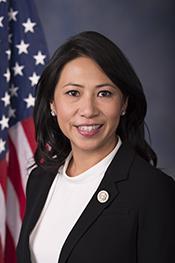
Hon. Stephanie Murphy,
House of Representatives,
Washington, DC.
Hon. Jackie Walorski,
House of Representatives,
Washington, DC.
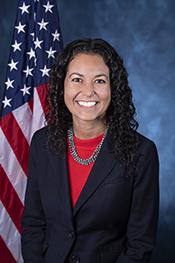
Hon. Xochitl Torres Small,
House of Representatives,
Washington, DC.
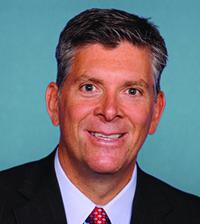
Hon. Darin LaHood,
House of Representatives,
Washington, DC.
Dear Representatives Murphy, Walorski, Torres Small and
LaHood: We are writing on behalf of the National Association
of State Workforce Agencies
(NASWA) to endorse the BRIDGE for Workers Act and express our
appreciation of your bipartisan effort to authorize the
Reemployment Services and Eligibility Assessments (RESEA)
program as part of the Bipartisan Budget Act of 2018 (P.L.
115-245).
Until the passage of the Act, RESEA had been limited to a
widely-successful pilot grant program. Today, States around
the nation now have the ability to accelerate unemployment
insurance (UI) claimants' transition back to employment
faster than non-participants, which is particularly important
in an economy desperately in need of skilled workers.
To enhance these efforts, we are pleased to see the
proposed minor statutory fix proposed in the BRIDGE for
Workers Act that reflects your intent to ensure any UI
claimant, not just those most likely to exhaust their
benefits, are eligible for RESEA services and assessments.
The current language in Section 306 of Act needs to be
modified to ensure this intent is actualized and while the
Appropriations Committee made such a modification in their FY
19 Labor-HHS Appropriations bill, a permanent fix would
provide clarity and stability for states actively focused on
helping claimants return to work expeditiously.
NASWA is the national organization representing all 50
state workforce agencies, D.C. and U.S. territories. These
agencies deliver training, employment, career, and business
services, in addition to administering the unemployment
insurance, veteran reemployment, and labor market information
programs. NASWA provides policy expertise, shares promising
state practices, and promotes state innovation and leadership
in workforce development.
Thank you for your consideration of this request.
Sincerely,
Jon Pierpont,
NASWA Board President, Executive Director, Utah Department
of Workforce Services.
Scott B. Sanders,
NASWA Executive Director.
Mr. Speaker, the BRIDGE for Workers Act will ensure that more workers who need reemployment services get them. Those individuals and workers, like Tara, will get back to work faster, in better jobs, and on a path to a better future.
Mr. Speaker, I urge my colleagues to support the BRIDGE for Workers Act, and I reserve the balance of my time.
Mr. Speaker, it is my pleasure to yield 4 minutes to the gentlewoman from Florida (Mrs. Murphy), the sponsor of the bill.
Mr. Speaker, I yield 2 minutes to the gentlewoman from California (Ms. Judy Chu).
Mr. Speaker, I yield 3 minutes to the gentlewoman from Wisconsin (Ms. Moore), a member of our subcommittee
Mr. Speaker, may I inquire as to how much time I have remaining.
Mr. Speaker, I yield 4 minutes to the gentlewoman from New Mexico (Ms. Torres Small), a cosponsor of this bill.
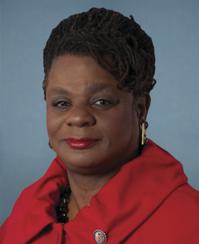
Mr. Speaker, I yield 1 minute to the gentlewoman from Alabama (Ms. Sewell).
Mr. Speaker, I yield myself the balance of my time.
Mr. Speaker, I came to this session with the simple notion of coming to do a job and to go do my work. Listening to my colleagues' representations and their articulation of experiences and what this bill really means, I am renewed, and I am delighted because it is an important bill, seriously important.
Yes, in many places the economy is good; people are able to work. But bridges connect and transport, and this bridge connects people to the opportunity to get a job, to go back to work, to be able to take care of their families, to have money so that their children can go to college or they can sustain themselves while their daughter is completing her education.
Mr. Speaker, I commend my colleagues, Mrs. Murphy and Ms. Torres Small; the ranking member of the subcommittee, Mrs. Walorski; and Mr. LaHood, my colleague from Illinois, for their ingenuity, creativity, and for the introduction of this tremendous piece of legislation.
Mr. Speaker, I urge all of my colleagues to support this legislation, and I yield back the balance of my time.
Mr. Speaker, on that I demand the yeas and nays.