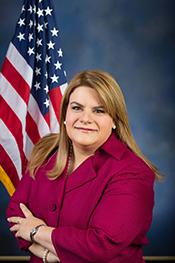
Madam Speaker, on June 4, we will celebrate 100 years since Congress passed the 19th Amendment, which correctly recognized women's right to vote. At that time, only one woman had served in Congress:…
Madam Speaker, on June 4, we will celebrate 100 years since Congress passed the 19th Amendment, which correctly recognized women's right to vote.
At that time, only one woman had served in Congress: Jeannette Rankin, in 1916, from Montana. But today, we have more women serving in this Congress than ever before, with 131.
In this proud moment for both women and our Nation's history, we also honor the suffragists who, more than a century ago, paved the way that allows women to take part in this democratic process and that also allows me to stand here as the first woman elected to represent Puerto Rico in Congress.
Because of our territorial status, Puerto Rico has been historically excluded from our national process, including the 19th Amendment ratification process.
Prior to becoming a U.S. territory in 1898, Puerto Rico was a Spanish colony, and people on the island advocated for political equality for women, beginning with a right to education. But it wasn't long after becoming a U.S. territory that Susan B. Anthony advocated for equal political and civil rights for men and women in the new possessions, including Puerto Rico.
This advance in civil rights was one of the first reasons why people on the island began to fight for the conversion of Puerto Rico as a State of the Union.
It was the leaders of the Republican party who first included women's vote as part of their platform, and they also presented legislation to achieve it. As the measure did not progress, our suffragists sought support from national organizations and the United States Congress, which introduced legislation extending women's right to vote in Puerto Rico.
Finally, in 1929, Puerto Rico's Legislature recognized the right to vote, but only for literate women; and in 1935, the right to vote was granted to all women.
These series of events led to the election of Maria Luisa Arcelay, who became the first woman in Puerto Rico to be elected to a government legislative body in 1932.
However, because Puerto Rico is an incorporated territory of the United States, despite being U.S. citizens since 1917, Puerto Ricans cannot vote for the U.S. President, and they are also denied voting representation in this Congress.
While this Congress is legislating to extend benefits to all women, I must raise my voice many times to advocate for these rights to be extended to territories like Puerto Rico that still lack, at a general level, full equality in relation to a State.
Statehood for Puerto Rico will happen. The question is when this Congress will do it.
The end of slavery, the end of segregation, and women's right to vote are just examples of civil rights that took a while to become the law of the land. Statehood for Puerto Rico will follow.
We are still fighting for equal pay, for equal work, for being able to walk safely without fear of sexual harassment, for eradicating gender violence, for having more access to where decisions are made, for having more representation in different fields, such as science, arts, sports, business, and economics.
As we rejoice and celebrate progress in equality for women, I ask my colleagues to be reminded that their job continues and much more remains to be done to achieve equality for all Americans.
That also includes the veterans of Puerto Rico, veterans that lack access to TRICARE Prime options on the island. Instead, only Active Duty servicemembers and their family members have access to TRICARE Prime, specifically TRICARE Prime Overseas.
This also affects the access by spouses and dependents to benefits as their family member serves our country.
Current law dictates that military retirees under the age of 65 in Puerto Rico and the territories are eligible only for TRICARE Standard.
That is the reason I filed H.R. 2171, which seeks to rectify this problem by making TRICARE Prime available to over 29,000 servicemembers in Puerto Rico, who have retired from the Armed Forces, and their dependents.
According to the report by the Congressional Task Force on Economic Growth in Puerto Rico, not having access to TRICARE Prime is one way in which Puerto Rico is treated differently under several Federal programs.
I urge my colleagues to support H.R. 2171.