Mr. Speaker, I ask unanimous consent that all Members may have 5 legislative days in which to revise and extend their remarks and include extraneous material on H.R. 790. Mr. Chair, I yield myself…
Mr. Speaker, I ask unanimous consent that all Members may have 5 legislative days in which to revise and extend their remarks and include extraneous material on H.R. 790.
Mr. Chair, I yield myself such time as I may consume.
Mr. Chair, I am proud to be an original cosponsor of H.R. 790, the Federal Civilian Workforce Pay Raise Fairness Act of 2019, along with my fellow colleagues of the local delegation. I pay special thanks to Chairman Connolly and Majority Leader Hoyer for their leadership on this very important piece of legislation.
H.R. 790, as amended, would authorize a 2.6 percent pay raise for Federal civilian workers for 2019, the same raise that our military servicemembers are receiving this year.
Historically, Congress has tried to ensure parity in pay increases between Federal civilian employees and military servicemembers. This bill would continue this longstanding tradition.
The bill would provide the pay raise to Federal employees in the competitive and excepted services, blue-collar workers, members of the career Senior Executive Service, and employees in the scientific and senior-level positions.
The men and women of our civil service deserve this small increase in pay because they have endured so much during the last several years. They were subjected, Mr. Chair, to repeated and unrelenting attacks on their pay and on their benefits.
They have suffered through pay freezes, hiring freezes, higher pension costs, and furloughs due to sequestration and government shutdowns.
Since 2011, Federal workers have contributed nearly $200 billion to help reduce our country's deficit and to fund other government programs. These hardworking, dedicated Federal workers include the 800,000 employees who were furloughed or forced to work without pay for 35 days during the longest shutdown in our great Nation's history.
The men and women of our civil service were held hostage to a political dispute over funding for a border wall that the President had stated over and over again would be paid for by Mexico. There is something wrong with this picture.
They include members of the Coast Guard, TSA screeners, Department of Agriculture workers who help farmers and ranchers, FAA air traffic controllers and safety inspectors, FDA food inspectors, the FBI, EPA pollution inspectors, Border Patrol agents, and Secret Service agents.
Given all the hardship Federal employees have experienced, they deserve a modest pay increase to help make up for the years of freezes and negligible increases and to help offset the cost of inflation.
The pay increase also would help the Federal Government compete against the private sector to recruit and retain highly qualified candidates to serve the American people.
Mr. Chairman, I reserve the balance of my time.
Mr. Chairman, I yield myself such time as I may consume.
Mr. Chairman, let me be clear that there are many Federal workers who are suffering and who have suffered. The message that we send to them is that we care about them, and we know that they give their blood, sweat, and tears over and over again. That is one of the messages we send.
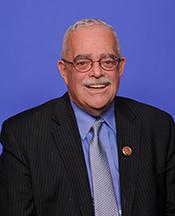
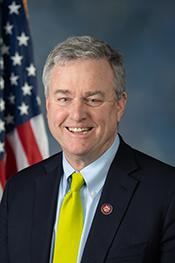
Mr. Chairman, I yield 5 minutes to the distinguished gentleman from Virginia (Mr. Connolly), the chairman of our Subcommittee on Government Operations.
Mr. Chairman, I yield an additional 1 minute to the gentleman from Virginia.
Mr. Chair, I yield 1 minute to the gentleman from Maryland (Mr. Hoyer), our distinguished majority leader.
(Mr. HOYER asked and was given permission to revise and extend his remarks.)
Mr. Chairman, I yield myself such time as I may consume.
Let me make it clear, Mr. Chairman: this is not about a border wall. This is about building people and allowing them to sustain themselves.
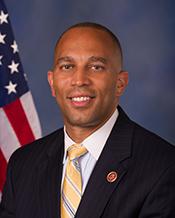
Mr. Chairman, I yield 3 minutes to the gentleman from New York (Mr. Jeffries), who is the very distinguished leader of our caucus.
I reserve the balance of my time, Mr. Chairman.
Mr. Chairman, I yield myself such time as I may consume.
Let me say this, Mr. Chairman. Yesterday we had our organizational meeting, and I made it clear that the distinguished gentleman from North Carolina has been truly a person who has worked very hard in a bipartisan way trying to come up with commonsense resolutions. So in no way do I want the gentleman to feel as if that is not being recognized, and we appreciate it.
It is just that we have a lot of employees who aren't making those very high salaries. They are the ones who are living from paycheck to paycheck.
Mr. Chairman, one of the saddest parts is when they go from paycheck to paycheck it is almost like no check because when they look at their bills, the bills are so much higher than their net pay. All we are trying to do is make sure that they keep up with the cost of living.
Mr. Chairman, I yield 2 minutes to the gentleman from Massachusetts (Mr. Lynch), who is the distinguished chairman of our Subcommittee on National Security.
Mr. Chairman, I yield the gentleman from Massachusetts an additional 1 minute.
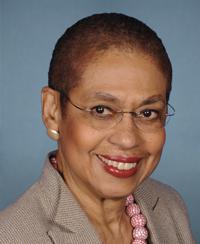
Mr. Chairman, I yield 2 minutes to the distinguished gentlewoman from the District of Columbia (Ms. Norton).
Mr. Chairman, I yield the gentlewoman from the District of Columbia an additional 1 minute.
Mr. Chairman, I yield myself such time as I may consume.
Today we are zeroing in on Federal workers whose average pay is $60,000. We are zeroing in on folks who are, in many instances, barely making it.
I don't want us to get it twisted. We have a situation where a lot of times we discuss a whole lot of other things but don't necessarily concentrate on the subject matter at hand.
Yesterday, Mr. Chairman, in our committee, we had a lady who came in and told us that her daughter died. She died because she couldn't get $333 worth of insulin a month. That happened in America.
What is my point? These dollars mean a lot to these Federal employees.
I am not going to pit our military against our civilian employees. They are all very important. I want them all to be well paid. But right now, we need to concentrate on, again, building people and making a difference in their lives.
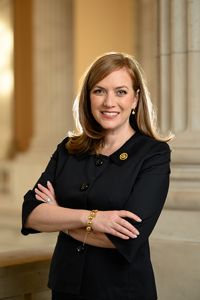
Speaking of building people, Mr. Chairman, I yield 2 minutes to the distinguished gentlewoman from Virginia (Ms. Wexton), a cosponsor of this bill.
Mr. Chair, may I inquire how much time I have remaining.
Mr. Chair, I yield myself such time as I may consume.
Mr. Chair, I insert in the Record an article from The Washington Post that reports the Federal Salary Council, the official monitor of Federal pay, found that Federal workers make an average of 30 percent less than their private-sector counterparts.
[From the Washington Post, Nov. 14, 2018]
Federal Employee Salaries Lag by Average of 31 Percent, Pay Group
Reports
(By Eric Yoder)
Federal employee salaries on average lag behind those of
the private sector by almost 31 percent, an advisory council
said Tuesday, while splitting between union and non-union
members on whether to recommend potential changes in the way
it arrives at that figure.
The average salary difference of 30.91 percent reported by
the Federal Salary Council is somewhat smaller than the 31.86
percent it reported at a special meeting it held April. The
figures of prior years were in the 34 to 35 percent range.
Those figures, based on two Labor Department surveys
covering some 250 occupations, stand in contrast to
assessments of some conservative and libertarian
organizations that have concluded that the advantage is about
the same or even greater in favor of federal employees.
The Congressional Budget Office last year essentially split
the difference. It found an average advantage for federal
workers of 3 percent, although within that average it said
there is a wide range by educational level: from a 34 percent
advantage for federal workers with a high school education or
less to a 24 percent shortfall for those with a professional
degree or doctorate.
Under a federal pay law, the ``pay gap'' as measured by the
Salary Council is to be used in setting annual raises varying
by locality for federal employees under the General Schedule,
the pay system covering most white-collar employees below the
executive levels. However, that law never has been followed
due to the potential cost of paying such large raises and
disagreements over how the figure is calculated.
In an August message to Congress, President Trump said that
following the law's formula would result in locality-based
raises in January 2019 averaging 25.7 percent plus an across-
the-board raise of 2.1 percent, at a cost of $25 billion.
``Federal agency budgets cannot sustain such increases,''
Trump's said in backing a pay freeze that he originally
proposed in a budget plan early this year.
A House-Senate conference underway on a spending bill will
decide between a freeze and a Senate provision to pay an
average 1.9 percent raise. Unless Congress passes, and Trump
signs, a bill specifying a raise, salaries will be frozen by
default. If the raise is enacted, it would vary slightly
among 44 city areas and what is called the ``rest of the
U.S.'' locality everywhere else; employees working in the
Washington-Baltimore area would stand to receive one of the
larger raises, probably around 2.3 percent.
The long-running controversy over comparing salaries flared
at Tuesday's meeting of the Salary Council, a group of
federal employee unions and compensation experts whose
decisions typically are unanimous.
A ``working group'' document produced since the April
meeting laid out a series of potential changes for
consideration by a higher-level body called the President's
Pay Agent. Those options included adding more detailed data
on salaries by occupation and level of work, taking into
account other data such as attrition rates, switching to a
``total compensation'' approach taking benefits into account,
and conducting a very detailed review only once every four or
five years--the latter two of which would require a change in
law.
Council chairman Ron Sanders, a longtime career federal
personnel official who is now a clinical professor at the
University of South Florida School of Public Affairs, argued
in favor of exploring those options. ``I think it's obvious
to all of us that the current methodology is problematic,''
he said.
``That methodology does not tell the whole story,'' Sanders
said. ``It's nice to say there's a 30 percent gap. If OMB
[the Office of Management and Budget] doesn't believe it, the
White House doesn't believe it, the Congress doesn't believe
it, what good does it do?''
He pointed to the testimony of officials of federal
agencies from several urban and rural areas not now receiving
higher city-based locality pay, who told of their
difficulties in recruiting and retaining employees despite
using special hiring authorities and incentive payments.
However, the current process doesn't support specific salary
rates for them, he said.
Two other members supported exploring the options: Katja
Bullock, associate director of presidential personnel, and
Jill Nelson, who leads an advisory committee on pay for blue-
collar federal employees.
However, members from federal unions argued against
changing the calculations and questioned whether the group
even has the authority to raise new options for
consideration. ``I don't think the methodology is broken,''
said J. David Cox Sr., president of the American Federation
of Government Employees.
``The elephant in the room is the Congress and the
president over time not funding the
pay system'' as the law intended, said Randy L. Erwin,
president of the National Federation of Federal Employees.
Anthony M. Reardon, president of the National Treasury
Employees Union, expressed concern that including the value
of federal benefits ``will be used as a justification to
reduce those benefits.''
The council adjourned without voting on whether to
recommend that the Pay Agent consider different approaches.
Afterward, Sanders said that in the annual report to that
higher-level body to be made by year's end, individual
members of the Salary Council could express their own
opinions.
Mr. Chair, it is so important that we do everything in our power to support our Federal employees, and I want to thank Mr. Connolly and Mr. Hoyer. They have given their blood and their sweat and their tears for Federal employees: constantly standing up for them, trying to make sure that they are treated fairly and given their due.
Just today, I spoke to two people who were telling me about how Federal employees at NIH basically saved their lives--saved their lives. One told me that the person who saved their life was making about $65,000. This is a doctor. Come on now. And the other said it was about, maybe, $70,000 at best.
These are people who could have been doing other things, could have been making a lot of money, but they decided to give their efforts to a greater cause.
Their names will probably never appear on the front page--or any page--of The Washington Post. They won't be on ABC News. They will not have the mansion that they could have gotten, but they have done something that will have fed their souls. They have come to the job with passion, compassion, and the desire to make things better, and they are the ones who have determined that they want to put their fingerprints on the future of generations yet unborn.
Then there are the others, like the TSA workers--you know the ones-- earning $28,000 a year and coming to work, by the way, during the shutdown when they couldn't even afford the gas to get there. What about them?
So we can make example after example after example, but one thing is for sure, and that is that they are working hard and they deserve our utmost support.
Now, if any message is going to be sent today, I pray, Mr. Chair, that that message goes to our Federal employees that we care about them and that they are not unseen, unnoticed, unappreciated, and unapplauded. No.
I hope the message goes out that we are upholding them and we realize that it is just not about them. We realize, when they don't get their raise, their family doesn't get their raise. When they don't get their raise, maybe that little girl they wanted to send to ballet lessons can't get them. We get that.
Or maybe that little vacation that they wanted to take, they can't get that. They are not trying to get to Disney World. They are just trying to get to the nearest amusement park with some tuna fish and crackers.
Come on now. And that is what this is all about. We can talk about fences all we want.
Right now, we are talking about the building of people and making their lives the best that they can be. We only have one life to live. This is no dress rehearsal, and this is that life.
I applaud the gentleman from North Carolina. I know his heart is right, but right now, I want to concentrate on those folks, the ones like people who live on my block, who get up at 5 in the morning, catch the early bus to get to Social Security and places, and trying to serve the public. I am talking about them.
Mr. Chair, I pray and I ask the Members to vote in favor of this great legislation.
I thank Mr. Connolly, Mr. Hoyer, Ms. Wexton, and all of our cosponsors, and I thank the gentleman from North Carolina (Mr. Meadows).
Mr. Chair, I yield back the balance of my time
Mr. Chairman, I move that the Committee do now rise.