I am grateful for that. Thank you, Mr. President. Thank you for holding open the floor. Mr. President, last night, President Trump announced his attempt to disassemble the National Center for…
I am grateful for that. Thank you, Mr. President. Thank you for holding open the floor.
Mr. President, last night, President Trump announced his attempt to disassemble the National Center for Atmospheric Research, or NCAR, which is based in Boulder, CO.
NCAR is the leading atmospheric research institution and a central part of our Nation's scientific infrastructure. Its research forms the backbone of weather forecasts, disaster preparedness, water planning, wildfire prevention, and aviation safety all across our country. Its work even protects American troops overseas by providing next- generation weather prediction for military operation.
NCAR scientists, engineers, and meteorologists equip emergency responders, airline pilots, farmers, local utility managers, and military planners with the tools they need to protect American lives, property, and our national security.
The President has blown all that up. But as he tries to shut down this institution, the world has not gotten any less dangerous. We can't wish away extreme drought or pause seasonal wildfires, which, as my colleagues from other Western States know, don't stop at State lines and barely have a season at all anymore because they are so present. You can't rebuild decades of scientific research and expertise once it is destroyed.
That is why, today, my colleague Senator Hickenlooper and I are offering an amendment to the appropriations package that would protect funding for NCAR. This isn't about one lab, one institution, or even one State. It is about protecting the foundation of our national research capacity, a capacity built over decades--decades--and generations of taxpayer investment and public service, capacity that once lost can't be replaced and may never be replaced.
But we know from painful experience that this attack on NCAR is just another instance of senseless destruction and political retribution, one we have all watched take place over the past year, time and again.
Colorado has been singled out by the President. The people of Colorado have found themselves the victims of political retaliation. That is why he vetoed the bill to finally finish the Arkansas Valley Conduit and deliver to 50,000 rural Coloradans access to clean drinking water. This legislation would finally fulfill Washington's promise to deliver clean drinking water to farmers and ranchers in Southeastern Colorado, a promise made over 64 years ago by John F. Kennedy. The conduit has always been a partnership between the Federal and local governments, driven by the leadership of the Southeastern Colorado Water Conservancy District.
In the face of rising costs of materials and labor, once again, Southeastern Coloradans came together and put forward an inventive solution to lower costs by changing the project's financing, with no increase to Federal spending.
The bill passed both Chambers of Congress unanimously, with the most bipartisan support anybody could have. But President Trump used his first Presidential veto of his second term to deny Coloradans what should be a basic fundamental right--the access to clean drinking water.
This retaliation campaign is why he continues to delay Colorado disaster relief and is working to cancel hundreds of millions of dollars in Federal grants for childcare, for energy, for wildlife, and for transportation funding. That is why the President is interfering in the State's ability to decide how we clean up our air and deal with the aging costly energy infrastructure that we have. That is why the President has doubled down on his attacks, not just in Colorado but in other places, on food assistance programs, and, sadly, why he moved Space Command out of Colorado to a State that had voted for him.
But these attacks are just the beginning, when it comes to this singular lawlessness and recklessness of President Trump. As soon as he returned to power, President Trump weaponized his office, punishing political opponents, rewarding loyal allies, working tirelessly not for the benefit of the American people but for those--only those--who supported him and for himself and for his family.
That is not the American way. It is not how an American President should make decisions about anything. An election is one thing, but once we hold office, we have a responsibility to represent every citizen, regardless of their politics, regardless of who they voted for.
This President has taken the opposite approach, unleashing mayhem on American citizens, based primarily on whether they live in a State that voted for him or one that didn't vote for him.
We have seen a President send a surge of ICE agents to occupy Minnesota and deploy the National Guard into one American city after another. We have all watched the videos of the chaos and fear and heartbreak these decisions have wrought.
No matter your views on our immigration problems, I don't believe any person in America should have to wonder whether masked men in unmarked cars, carrying guns, might, at any moment, snatch them from the street or break their car windows or leave them bloodied on the side of the road.
That is not the country that I grew up in. That is not the country that we want to live in. But it is happening today in American cities all over our country.
We have seen the President, without congressional authorization or even notification, send helicopters to seize a foreign dictator and the next day tout the investment opportunities that he has created by this incursion--investment opportunities, by the way, that few American companies seem excited about and which promise only to flood the international oil market at a time when oil prices are the lowest that they have been in years.
When one oil company decided to dare to tell the truth--to say what any sane executive would be thinking, what any sane observer of the market would be thinking, what anybody who understood the oil markets would say, which is that a country that has a history of expropriating property is not the first investment choice--they were quickly punished. And that should come as no surprise.
President Trump's Federal Communications Commission attempted to silence a late-night comedian because he didn't like the criticism. That, itself, would be laughable if it weren't so troubling.
For decades--for decades--the United States has stood up for the freedom of expression and freedom of the press, for the right of journalists and authors and comedians to not hide their opinions in underground newspapers and in hidden leaflets but instead to deliver it honestly and widely; to hold power to account; to undergird an important public debate that is the root of our democracy. But those same rights are under threat today here in America.
Even the Federal Reserve is not immune from efforts to control or curtail its independence. The United States boasts the largest and most dynamic economy in the world, with the deepest and most appealing and most attractive capital markets. We print the global reserve currency here in America. We are the envy and the first destination of every entrepreneur and innovator in the world. But President Trump seems eager to throw all of that away through lawsuits and investigations designed not to deliver justice but to squeeze the Federal Reserve Chair until he gives President Trump what he wants--lower interest rates.
With every action like this, President Trump is undermining the American economy and driving up costs for communities all over our State, and he is doing it in almost every way imaginable.
Not even 6 months ago, I was here on the Senate floor during the longest
government shutdown in American history, all because President Trump refused to extend tax insurance, premium tax credits, and provide reliable, affordable healthcare that the American people deserve. Now healthcare premiums are set to double, to triple, and in some cases to quadruple. That comes on top of other price pressures that families all over this country are facing, which have been caused in part by the President's trade war with the entire world.
The dollar has depreciated sharply since March as investors hedge against the effects of the President's tariffs. Hiring has stagnated, and the unemployment rate has risen. Residential electricity prices increased over 10 percent in the first 8 months of 2025. The price of beef has risen 16 percent over the last year, and coffee is up almost 20 percent. The Agriculture Department expects grocery prices, which are already out of sight, to increase even more in the coming year.
Families and small businesses all across America are struggling to afford housing and struggling to afford groceries and other basics, and the President has only made things harder.
At the same time, President Trump has worked to withdraw our country from the world--at least when it comes to diplomacy.
One of his first acts as President was to shut down the U.S. Agency for International Development, which provided things like medical supplies, lifesaving vaccines, and clean water infrastructure to the most vulnerable populations around the world.
When his trade war with China began to go badly, he quickly capitulated in exchange for a relatively paltry amount of agricultural purchases. He gave our greatest strategic competitor access to cutting- edge technology. They didn't even ask for the semiconductors.
After aiding our adversary, he has turned his attention to our allies. He is threatening to annex Greenland--a NATO country's territory--and take military action against Colombia and Mexico, which are longstanding U.S. partners. In the case of Greenland, President Trump's threats risk the unity of NATO--the most successful alliance in human history. This dangerous behavior makes clear to our adversaries and to our allies that the United States is more focused on extracting concessions from its friends than in protecting our collective security.
His continued abandonment of basic principles of international law and order will eventually reverberate against American national interests. The only question is when.
Coloradoans don't need to look abroad to understand the President's destructive impulses; they have all the evidence they need here at home. When Coloradoans open a newspaper, they might see that the Federal Government has rescinded childcare funding for themselves and for their neighbors; they might see that transportation funding that this Congress has appropriated has been canceled or that energy investments that this Congress has passed have been pulled back.
They feel like they are under attack from a Federal Government whose obligation is to protect them, to support them. This is a belief that is felt very strongly by the people of my State, and I think everybody here should understand that if it is happening to Colorado, it could happen anywhere in America, for any reason.
The Trump administration's announcement that it was dismantling NCAR was made on the evening of December 16. Over the next 2 days, my office received over 2,000 pieces of mail. By the end of the new year, we had received 500 phone calls on the same topic. We have since surpassed 4,000 letters. I know Senator Hickenlooper has had the same, especially in those first 2 days of outreach when fierce windstorms were sweeping across the Front Range of Colorado and creating an enormous wildfire risk.
Numerous citizens wrote to me as they recognized the important role that NCAR scientists play not just in Colorado but in the Nation and in the world. They identify communities that are in the greatest danger. They inform a power company's decision about where to shut off electricity to keep people safe. People in Colorado and throughout the West and I think throughout this country understand the value of NCAR, and they know that sort of essential information and those emergency services are at risk of disappearing possibly forever.
I really want to thank everybody who has written in, and I want to highlight some of the stories they took the time to share with me. I am going to read some of those letters now.
Mr. President, I ask unanimous consent that these letters be printed in the Record.
Mr. President, I will start with a constituent from Canon City.
I am writing to express my strong opposition to the
administration's recent plans to dismantle the National
Center for Atmospheric Research, NCAR. NCAR is a cornerstone
of American scientific leadership and public safety. Since
1960, it has provided the essential infrastructure, including
super computers, research, aircraft, and sophisticated
modeling that protects American lives and our economy every
single day. I urge you to push back against the move for the
following reasons: public safety. NCAR's research is vital
for predicting extreme weather events like hurricanes,
tornadoes, and wildfires. Dismantling this center puts our
emergency response capabilities at risk; aviation and
transportation: NCAR technology is used at a major hub like
Denver International Airport to manage snow and ice, and
their wind shear detection systems are crucial for aviation
safety; economic security: from agriculture to energy, the
private sector relies on NCAR's open source models to manage
risk and maintain a competitive advantage; national defense:
NCAR collaborates with the Department of Defense to develop
tools that ensure our military can operate safely in any
environment.
Stripping NCAR of its funding or breaking up its integrated
labs will leave our Nation behind in the atmospheric threats
of the 21st century. Please support the continued funding and
operation of NCAR and its headquarters at the Mesa
Laboratory.
From a constituent in Denver:
I am writing as a concerned Coloradan to urge you to stand
up for the National Center for Atmospheric Research and
oppose any plans to dismantle or significantly weaken the
institution. NCAR is not only a world-class scientific
organization; it is a major economic asset to Colorado and to
the United States. Its presence strengthens our State's
economy. It supports high-quality jobs, attracts private
investment, and reinforces America's global leadership in
science, technology, and national security. NCAR's direct
economic value to Colorado is substantial. The center employs
hundreds of highly skilled scientists, engineers, IT
professionals, and support staff, many of whom live and raise
families and pay taxes here in Colorado. These are stable,
high-paying jobs that cannot be easily replaced. They won't
be easily replaced. In addition, NCAR's operations support
local contractors, suppliers, and small businesses across the
Front Range, creating a multiplier effect that benefits the
broader regional economy. NCAR is also a powerful driver of
innovation and private-sector growth. Its research underpins
advances in aviation safety, agriculture, water management,
energy production, wildfire forecasting, and weather risk
modeling--industries that collectively represent billions of
dollars in economic activity. Private companies rely on
NCAR's development tools and data to improve efficiency,
reduce losses, and plan investments. The weakening of NCAR
would not reduce regulation or bureaucracy; it would reduce
the high-quality information that businesses need to compete.
From a national perspective, NCAR strengthens U.S. security
and resilience. Accurate weather and climate forecasting is
essential for military readiness, disaster preparedness,
infrastructure planning, and supply chain resiliency. These
capabilities help save lives and taxpayer dollars by reducing
the costs of natural disasters and improving long-term
planning. Other nations are aggressively investing in
atmosphere, science. Dismantling NCAR would cede leadership
to global competitors at a time when American technological
dominance is increasingly challenged. Finally, NCAR
represents an excellent return on taxpayer investment. Its
budget is modest relative to the economic losses it helps to
prevent and the innovation it enables. Cutting or dismantling
NCAR may appear to save money in the short term--I doubt very
much anybody really believes it--but the long-term costs to
businesses, farmers, municipalities, insurers, and emergency
responders would be far greater. Colorado has been a leader
in science, innovation, and pragmatic problem-solving, and
NCAR is a cornerstone of that legacy. I respectfully ask for
you to stand up for Colorado jobs, American competitiveness,
and fiscally responsible governance by opposing efforts to
dismantle or weaken the National Center for Atmospheric
Research. Thank you for your service to our State and for
considering the economic and strategic importance to our
State.
From Boulder:
Thank you for supporting science and specifically for
supporting NCAR. I don't need to tell you how important
NCAR's work is for the safety of our Nation. This move
against NCAR serves no valid purpose. It appears merely
punitive as are many of the moves that the Trump
administration has made against our State. I work in research
at a university. We work closely with NOAA and with NCAR. The
last shutdown was stressful to our researchers and our
institutions, but if another shutdown were to happen in order
to save institutions like NCAR from arbitrary posturing and
governance, I know that our research and community would
support that cause. Stand strong, Senator. We support you.
And here is a letter from an NCAR institutional stakeholder:
We write to express our strong support for continued--
This is from, I think, the Governors: Jared Polis, Josh
Green, Spencer Cox, Bob Ferguson, Michelle Lujan Grisham,
Gavin Newsom, and Katie Hobbs--Democrats and Republicans.
We write to express our strong support for continued
Federal funding for the National Center for Atmospheric
Research, NCAR, and to underscore its importance to States
all across the Nation.
Governors rely on NCAR's research and modeling and data
infrastructure to help protect lives, strengthen regional and
national economies, and improve preparedness for increasingly
complex environmental challenges.
NCAR's work directly informs decision making at the State
and local level, supporting emergency management,
infrastructure planning, and long-term resilience.
We agree with your administration's fiscal year 2026
National Science Foundation budget request to Congress that
NCAR is a critical national research and infrastructure
asset. As the budget request notes, NCAR is an NSF-sponsored,
federally funded research and development center that
integrates advanced observational facilities, widely used
community weather and climate models, and high-performance
computing. Together, these capabilities provide foundational
tools used by Federal Agencies, the military, State and local
governments, universities, and the private sector. For our
States, NCAR's work delivers direct and practical value.
By the way, I have not found a single person on this floor who doesn't agree with what these Governors have to say, who hasn't said that NCAR is a vital resource to their State, that their work delivers direct and practical value.
In wildfire-prone regions, NCAR research improves
understanding of fire behavior, smoke transport, and extreme
weather conditions that exacerbate fire risk, supporting more
effective mitigation and response and recovery efforts.
Governors depend on these insights to inform emergency
management decisions and to protect communities'
infrastructure and public lands. Where else are we going to
get this data and information?
NCAR's modeling and forecasting capabilities are also
essential to agriculture and to water management across the
West. Seasonal and subseasonal forecasts help producers plan
for droughts, floods, and shifting precipitation patterns,
while supporting more efficient use of scarce water
resources. These tools are increasingly important as our
States work to sustain agricultural productivity, rural
economies, and food security amid growing variability.
I can't find a single person on this floor who would disagree with what the Governors have said.
In addition, NCAR's capabilities support national defense and homeland security priorities. Accurate, timely weather and Earth system information is critical for military operations, forest protection, aviation safety, and infrastructure resilience.
NCAR's high-performance computing and data integration
capacity strengthens situational awareness and operational
readiness across air, land, and maritime domains.
The Governors continued:
Tourism and outdoor recreation, cornerstones of many of our
economies, also benefit from improved forecasting and hazard
preparedness. Reliable weather and environmental information
helps protect visitors, supports local businesses, and
reduces disruption from extreme events, reinforcing economic
stability in communities that depend on these sectors--
Which is to say, virtually every community in the American West.
We [these Governors] respectfully urge your administration
to continue supporting NCAR, consistent with your 2026 fiscal
year budget request, and to work with Congress to ensure
stable funding for its core capabilities. Continued
investment will allow NCAR to deliver high-value research and
service that strengthens public safety, economic resilience,
and preparedness all across the Nation.
Thank you for your leadership and your continued
partnership with the Nation's Governors.
These Governors sign on.
Here is Tony Busalacchi, who is the president of UCAR, University Corporation for Atmospheric Research, the operator of NCAR. Busalacchi--I apologize if I butchered that name.
NSF NCAR's research is crucial for building American
prosperity by protecting lives and properties, supporting the
economy, and strengthening national security. Any plan to
dismantle NSF NCAR would set back our Nation's ability to
predict, prepare for, and respond to severe weather and other
natural disasters.
I have an open letter here from major scientific societies--from the American Meteorological Society, the Alliance for Data Science and AI. I won't read the rest, Mr. President.
The letter says:
The United States of America needs the National Center for
Atmospheric Research. On behalf of the scientific societies
we represent, we write to express our strong support of NCAR
and the full breadth of scientific research undertaken by the
scientists at NCAR.
The benefits of NCAR to the United States and the world are
enormous. Since its inception in 1960, NCAR has made
groundbreaking advances in weather, water, and climate
science. Working with partners within the United States, as
well as across the world, NCAR scientists have provided
crucial insights on severe storms, flash floods, drought, air
quality, wildfire, climate, and weather predictions, to name
just a few key contributions.
These discoveries improve early warnings and weather
forecasts, ensure enhanced transportation safety by air, sea,
and ground, and reverse the adverse impacts of hazards.
Crucially, they save lives and make America safer!
Recently, the White House announced plans to dismantle it.
Sending various parts of NCAR to other cities will isolate
expertise and reduce the synergies and enhanced productivity
that results when people work together. NCAR is an incredible
resource, and losing it would hurt the economic health of the
Nation and the safety of its people. A better option would be
to work to maintain and strengthen NCAR, including through
enhanced cooperation with Federal science Agencies, academic
institutions, and private sector researchers.
Science improves lives and drives economic prosperity.
``Science improves lives and drives economic prosperity,'' and we used to care around here whether we were the leader among nations in that.
Scientific innovation promotes public safety, enables new
businesses, and helps us thrive in a competitive global
marketplace. The United States has long been a world leader--
I would say the world leader--
in all science, including the science of environmental
prediction. The Nation's strong support of science over the
past century is a foundation of our success. A strong NCAR
will lead to further forecast improvements that enhance our
national well-being.
We stand ready to work with the administration and leaders
in Congress to ensure that U.S. scientific preparedness,
including with respect to environmental prediction, remains
second to none.
And Colorado does as well.
Finally, from Arvada:
Thank you for defending NCAR and holding up the budget
unless full funding is included.
As you know, parts of the State are out of power right now
due to high winds and dry, warm conditions that put us at
fire risk. We need to continue to study climate and weather
to fight climate change but also to predict and respond to
weather emergencies. Shutting down NCAR will be bad for
everyone in the country.
Thank you, and please continue to fight for our State and
the environment.
I could not have said it better myself. Shutting down NCAR will be bad for everybody in the country, and that is a fact. And the people there obviously don't deserve it.
And we also need to set a standard for what we expect out of the leadership in the White House, which is that they are going to actually serve everybody in the country, whether they voted for them or not.
What is happening to Colorado today could happen to your State tomorrow.
(Mr. MORENO assumed the Chair.)
We also lost, to the President's first veto of his second term, the Arkansas Valley Conduit. That is a pipeline that I have been working on since the day I got here. It is the very first piece of legislation that I wrote. It was an effort to try to keep a promise that had been made to Colorado in 1960 by Jack Kennedy, who went out to Pueblo and said to the people there, to the farmers and ranchers--mostly Republicans then, in 1960, and still mostly Republicans today. That doesn't matter, but I just want to set the scene for what we are dealing with here, which is a group of people that have fought and fought and fought, generation after generation after generation, to supply their farming families, their ranching families with clean water that the United States, the richest country in the world, promised them many, many years ago.
And I have a constituent from Pueblo who wrote in. The letter says:
I am writing as a deeply disappointed, concerned, and
frankly angry constituent regarding President Trump's veto of
the finishing of the Arkansas Valley Conduit. This
legislation passed unanimously in both the House and the
Senate, an increasingly rare example of true bipartisan
agreement, because it addressed a fundamental responsibility
of government: providing clean, safe drinking water to
America.
Communities across Colorado's eastern plains, between
Pueblo and Lamar, have waited too long for this project to be
completed.
The AVC is not political theater. It is a public health
necessity. Using access to clean water as a bargaining chip
for punishment against a State is unacceptable.
Using access to clean water as a bargaining chip for
punishment against a State is unacceptable.
It is unacceptable.
My constituent from Pueblo writes:
The President is obligated to represent and serve all
Americans, regardless of party, State, or political
disagreements. This action falls short of that standard and
undermines trust in our democratic institution.
I could not agree with that more.
I urge you to do the right thing for the people of Colorado
by supporting and voting to override this veto. Clean
drinking water should never be held hostage to partisan
grievances or personal vendettas. Congress spoke clearly and
unanimously once. Now it must stand by that decision.
Please let me know what actions you will take to ensure
this vital project moves forward and that the needs of
Coloradoans are placed above political calculation.
Here is a letter in support of the conduit from the Otero County Commission:
Your public statements of opposition to President Trump's
veto to finish the Arkansas Valley Conduit Act are greatly
appreciated by those of us who have long supported this
project to ensure that residents in rural Southeastern
Colorado have access to a safe drinking water supply. The
challenges we face with naturally occurring contaminants in
groundwater are precisely why the Federal Safe Drinking Water
Act exists.
It is imperative that we work together to overturn this decision. We stand ready to assist you in any effort to override the veto or pursue an alternative path to enact this strongly supported legislation.
It is unanimously supported legislation. The conduit can't be viewed as a mere amenity or a frivolous investment. It is the most effective way to deliver safe drinking water to 50,000 people without creating harmful side effects that are associated with other treatment processes like reverse osmosis.
This is a public health issue, and shared investments by
Federal, State, and local governments are critical to
addressing it.
Indeed, H.R. 131 highlights the significant non-Federal investment-- 35
percent of the total cost--to say nothing of the blood, sweat, and tears that generations of South Coloradans in Southeastern Colorado have been willing to exert in this cause in their partnership with Federal Agencies to get this project built.
This is a classic case of Americans doing the work for the next generation of Americans and the generation after that--the county commissioners in Otero County who came and lived and died long before the ones that are here writing in about this right now without ever seeing their dream for clean water for their families or their communities realized in the richest country in the world. We are this close to having it done, and it was canceled out of spite.
In addition to pointing out the local share that the communities--and by the way, these are tiny farming communities. Every dollar they spend on a project like this is a hard dollar for them to spend, but they know why it is so important.
This bill--the bill that we passed unanimously, which the President vetoed--this bill adjusts the interest rate and extends the repayment period while also providing an option for economic hardship consideration, which is vital given the challenging economic conditions of our region.
The longstanding bipartisan support--
The commissioners continued--
for the Arkansas Valley Conduit speaks volumes about its
clear purpose: a safe--safe--clean drinking water supply.
Together, we must fight this attempt to stop the project and
diminish its critical importance. We respectfully ask you to
use all your tools available to overturn the decision and
ensure the enactment of H.R. 131. Thank you for your
leadership and commitment to the health and wellbeing of our
Southeastern Colorado community.
I have got one last letter that I am going to read from the Pueblo County commissioners:
Thank you for your public statements opposing President
Trump's veto to finish the Arkansas Valley Conduit Act. Your
leadership on this issue is deeply appreciated by the
communities of Southeastern Colorado who have worked for
decades to secure a safe and reliable drinking water supply.
As an elected body representing residents of Pueblo County,
we see firsthand the challenges posed by naturally occurring
groundwater contaminants. These conditions are precisely why
the Federal Safe Drinking Water Act exists and why Federal
partnership is essential. Access to clean drinking water is
not optional; it is a fundamental public health
responsibility.
It is critical that we work together to overturn this veto
or pursue an alternative path to enactment. We stand ready to
assist in any effort necessary to ensure this project moves
forward.
The Arkansas Valley Conduit should not be characterized as
discretionary or a nonessential investment. It is the most
effective and sustainable way to deliver drinking water to
approximately 50,000 people without the long-term
complications and unintended consequences associated with
other treatment methods.
H.R. 131 appropriately recognizes the significant
commitment already made at the local and at the State level
with other non-Federal partners covering approximately 35
percent of the total cost. The bill's modest adjustments to
the interest rate and repayment period, along with provisions
for economic hardship, are especially important given the
economic realities facing rural Southeast Colorado.
I can see that my colleague from Colorado has arrived at the floor, which means that I am going to have to wind up in a minute. Before I finish, I just had a few more closing remarks, and then I will turn it over to my friend.
Political decisions in America are not supposed to be made this way. I know they are sometimes in other countries. I know there are many countries around the world where there is corruption, and the way decisions are made is, might makes right, and whoever happens to get elected to a certain term--that person gets to reward their friends and punish their enemies.
I can guarantee you that every one of those places has a less successful economy than the United States of America. Our economy is based on the rule of law, not might makes right. Our economy is based on the idea that the citizens we represent and their futures are far more important than the political scorekeeping that any President or any chief executive officer should maintain.
This is not, I have to say, what the American Government is supposed to look like or what the American Government has ever looked like. Making these kinds of partisan decisions, like the one that is underlined, the cancellation of the Arkansas Valley Conduit or NCAR or the other hundreds of millions of dollars that are being taken away from poor families in Colorado who are just trying to raise their children, who are now not going to have access to food or access to schooling--which, by the way, just for political reasons, this strikes at the heart of the constitutional system that was envisioned by our Founders. That is not an exaggeration. The men who framed our founding document were raised in and were some of the greatest exponents of the scientific revolution and the fundamental shift in human thought and reason that we now call the enlightenment.
That tradition prioritized--and by the way, they weren't just politicians; many of them were scientists themselves. That tradition prioritized freedom of thought and considered debate. It held that truth was best drawn out from the contrast of opposing views and beliefs or disagreements.
The Founders understood that this philosophy could only reach its full potential within the framework of a constitutional republic. It had never existed before anywhere. They drew up the Bill of Rights, with its freedom of speech and its freedom of press, in order to protect that ability to face each other in the public square with our disagreements, and they ingrained their belief in the overwhelming power of reason to discern truth from falsehood and science from superstition in the original text of our Constitution.
In article I, section 8, they charged Congress with the responsibility to ``fix the Standards of Weights and Measures'' and provide for policies that ``promote the Progress of Science and useful Arts.''
The Founders understood how fundamental these responsibilities were to the country they hoped to create. These directives are in the very same section as the power to lay and collect taxes, to borrow money, and to declare war.
NCAR is a modern embodiment of the Founders' intent--the careful and objective collection of data to inform public policy and political debate free from restriction or censure or political punishment. And that is what is at stake today. That is why this should matter to everybody on this floor.
NCAR was founded in 1960, and it has operated over 13 Presidential administrations and 32 Congresses, Democratic and Republican alike. NCAR's work benefits Americans, as we have heard, from every State, from disaster forecasts, to aviation fog warnings, to drought predictions that guide crop planning and water management, to weather intelligence for military operations, to early detection for solar storms that threaten our electric grid and communications systems.
When it comes to NCAR, the President's effort at political retribution threatens the health and safety of communities all across the country--all across this country.
The entire implication of what the Founders were writing about in this context was that nobody has a monopoly of wisdom--least of all, a President. The Founders' greatest fear was to have a demagogue in that office unconstrained by the rule of law. And they knew how fragile all of this experiment was. They knew how easily, under the wrong direction, it could collapse.
Now we know this is not some temporary bump in the road; it is a reflection of what the Founders understood is a fundamental aspect of human nature: that there would always be somebody who would reach out to grab the kind of unconstrained power that this President has reached for.
In moments like this, what the Founders expected was that it would be up to all of us--the rest of us--to prevent exactly what they were worried about. There was no self-reinforcing mechanism. Nobody was riding to our rescue, because, as I mentioned earlier, what can happen to our State can happen to any other State. The Founders understood that the American people would know that and that they would rally to support the rule of law, they would rally to support their democracy.
What is happening today under a Republican President could happen with the wrong kind of Democratic President.
Our children and future generations have a reasonable expectation that their government should be designed to
work for them--all of them; all of them--regardless of their political leaning. We have a responsibility as legislators, as Americans, and an obligation to the Constitution, to our respective States no matter what color they are on the political map.
I urge my colleagues to reject these partisan games and to stand up for scientific integrity and the rule of law. It is what the people of Colorado and all Americans expect, and it is what they deserve.
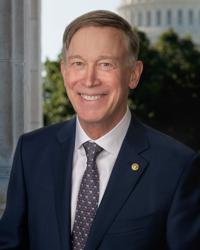
As I come to a close, I am going to read what I have to read for the amendment. I just want to say how proud I am to be here today on the floor with my colleague Senator John Hickenlooper, whom I have known for more years than I would care to actually admit to you, Mr. President.
But one of the things that I know about John is that he embodies the hope, the aspiration that our Founders had for citizen legislators. He is somebody who came to politics with a business background but, I would say in the context of the discussion we are having today, with the background of a geologist, somebody who came to the West to begin with to be able to apply his scientific imagination to the challenges that we were facing at the time and was able to then use that in business but then also in politics and who has brought that intellect and scientific commitment to the Commerce Committee, where he sits.
I think all of Colorado has been incredibly well served and the country has been incredibly well served in this debate by that scientific background. If I dare say it--I am not saying that he is exactly who Ben Franklin was envisioning, but I will say that John Hickenlooper and Ben Franklin would have gotten along extremely well had they had the chance to serve with each other.
Amendment No. 4153
With that, I ask unanimous consent to call up and make pending amendment No. 4153 to H.R. 6938 to maintain operations and capabilities at the National Center for Atmospheric Research.