Mr. Speaker, by direction of the Committee on Rules, I call up House Resolution 1095 and ask for its immediate consideration. Mr. Speaker, for the purpose of debate only, I yield the customary 30…
Mr. Speaker, by direction of the Committee on Rules, I call up House Resolution 1095 and ask for its immediate consideration.
Mr. Speaker, for the purpose of debate only, I yield the customary 30 minutes to the gentlewoman from New Mexico (Ms. Leger Fernandez), pending which I yield myself such time as I may consume. During consideration of this resolution, all time yielded is for the purpose of debate only.
General Leave
Mr. Speaker, I ask unanimous consent that all Members may have 5 legislative days in which to revise and extend their remarks.
Mr. Speaker, I yield myself such time as I may consume.
Mr. Speaker, last night the Committee on Rules met and granted a rule providing for consideration of one measure. The rule provides for consideration of H.R. 7744 under a closed rule. The rule provides 1 hour of general debate equally divided and controlled by the chair and ranking minority member on the Committee on Appropriations or their respective designees. Additionally, the rule provides for one motion to recommit.
Mr. Speaker, nearly 3 weeks ago, on February 13, my Democrat colleagues irresponsibly and vindictively shut down the Department of Homeland Security, crippling the capabilities of the very Department charged with protecting the American people.
Leading up to that moment, I brought forth a rule that allowed the House to concur in the Senate amendments to H.R. 7148, the Consolidated Appropriations Act of 2026, legislation that funded the remainder of the Federal Government through the end of the fiscal year with the exception of the Department of Homeland Security.
Despite previously agreeing to a bipartisan and bicameral approach to fund the Department of Homeland Security through the end of the fiscal year, including provisions for both funding and enhanced oversight, Democrats reversed course at the last minute and have since held this critical funding hostage, directly putting the safety and security of the American people at risk.
Mr. Speaker, I return today to give my Democrat colleagues the opportunity to reverse course on this dangerous lapse in leadership and move legislation forward that provides full funding for the personnel, training, and technology necessary to protect our homeland and keep our communities safe, secure, and resilient.
The Department of Homeland Security oversees agencies responsible for aviation security, border protection, cyber defense, disaster response, maritime security, and counterterrorism missions that directly impact the safety of millions of Americans every single day.
Simply put, a ``yes'' vote on today's rule is a vote to consider legislation that will fully fund the Department of Homeland Security, ensuring that the agencies tasked with keeping the American people safe, from counterterrorism to cybersecurity, to disaster response, are not weakened at a moment when threats are rapidly increasing.
A ``yes'' vote on today's rule is a vote to stand with the men and women on the frontlines of our national security, from coastguardsmen to GSA officers, to cyber defenders, law enforcement personnel, and emergency responders who are now working every day without pay to keep our country safe.
A ``yes'' vote on today's rule is a vote to consider legislation to end this Democrat shutdown of the Department of Homeland Security and restore the resources necessary to defend the American people.
Mr. Speaker, the need to fully fund the Department of Homeland Security becomes even clearer when we consider the serious global threats facing our country today. For nearly 50 years, the Islamic Republic of Iran, the number one state sponsor of terrorism, has called our great country the ``Great Satan'' and indoctrinated generations of its people with the chants of ``Death to America,'' making clear its commitment to our destruction.
Despite repeated attempts at diplomacy, the regime has relentlessly pursued a nuclear weapon, developed its ballistic missile program, and funded proxy terrorist organizations across the world, all while its own people suffer under corruption, repression, and economic collapse.
This past Saturday, President Donald J. Trump kept his promise, decisively authorizing Operation Epic Fury, a large-scale kinetic military operation targeting key regime military infrastructure and leadership responsible for incessant aggression and attacks against the United States and our allies.
This moment did not occur in isolation. It was the result of decades of sustained hostility by the Iranian regime toward the United States, just as the maniacal Iranian regime was reaching the nuclear weapon threshold.
To the American people, the timeline is clear.
In November 1979, Iranian students, backed by the regime, stormed the U.S. Embassy in Tehran and held hostage 66 brave Americans for 444 days as they beat them and subjected them to mock executions and other forms of torture.
In October 1993, Hezbollah, an Iranian proxy, killed 241 American military servicemembers, including 220 marines and 21 other service personnel in a truck bombing at a Marine compound in Beirut.
In June 1996, Iran-backed Hezbollah terrorists killed 19 U.S. airmen and wounded nearly 500 others in a truck bombing at a U.S. Air Force housing complex in Saudi Arabia.
Between 2003 and 2011, Iranian proxies killed at least 603 American troops in Iraq, roughly one out of every six American combat deaths in that war.
In January 2016, Iranian forces seized two U.S. Navy boats and detained 10 U.S. sailors who were held at gunpoint, forced to kneel with their hands behind their heads, and filmed for propaganda being released 15 hours later.
More recently, on October 7, 2023, Iran-backed Hamas terrorists murdered 46 Americans and kidnapped 12 Americans in addition.
Between October 2023 and November 2024, Iran and its proxies carried out more than 180 attacks on U.S. forces in the region, killing American servicemembers and wounding American service personnel.
In July 2024, an Iranian national linked to Iran's Islamic Revolutionary Guard Corps attempted to assassinate then-candidate for President, Donald J. Trump, forcing his Presidential campaign, which I remember being a part of it, to charter decoy planes to avoid the threat.
In recent weeks, Iranian representatives continued to lie and negotiate in bad faith, stalling peace talks as they prepared offensive military threats against American forces.
This pattern of aggression makes crystal clear that these are not isolated incidents. They instead represent a sustained and deliberate campaign by the Iranian regime to target the United States and undermine our national security.
This is precisely why decisive action by our Commander in Chief, President Donald J. Trump, was necessary. By destroying Iran's military capabilities, its missile capabilities, dismantling its naval strength, and ensuring that this regime can never obtain a nuclear weapon, President Trump and his administration have acted to protect the American people and defend our national interests. This level of action is only possible because of the strength of the United States military.
During his first term, President Donald J. Trump rebuilt our military to a level many thought would never be possible. Through historic investments, a renewed focus on modernization, and the restoration of military readiness, he ensured that today we possess the strongest and most capable military humanity has ever seen. It is that peace through strength, rebuilt and restored, that made decisive operations like Operation Epic Fury possible, demonstrating to our adversaries that the United States has both the capability and the resolve to act swiftly, effectively, and without hesitation to protect the citizens of our country.
Mr. Speaker, during this operation, six Americans bravely sacrificed their lives to keep our homeland safe. May we forever remember and honor their legacy of selfless service to these United States of America.
The threats facing our country today do not stop at distant battlefields. They can reach our networks, our borders, and our communities here at home.
While Iran's aggression is often discussed in terms of conflict in the Middle East, we must not forget that the regime and its proxies also pose a direct threat to the American homeland. Our Homeland Security and Intelligence agencies have warned that Iran and its affiliates maintain the capability to conduct cyberattacks against our utility services, direct espionage campaigns within our borders, and potentially inspire or direct violence within the United States, targeting critical infrastructure, financial systems, and other central networks on which millions of Americans rely.
That is why President Trump's Department of Homeland Security plays such a vital role in coordinating intelligence, strengthening cyber defenses, securing transportation systems, and protecting the American homeland from emerging threats.
Mr. Speaker, border security is homeland security. At a time when hostile regimes and terrorist networks continue to threaten the United States, we cannot ignore the risks posed by an unsecure border and inadequate vetting of individuals entering our country. Ensuring that terrorists, traffickers, and foreign operatives cannot exploit weakness in our immigration system is a fundamental responsibility of the Department of Homeland Security.
While security at our southern border has drastically improved and more than 600,000 criminal aliens have been deported under President Trump's administration, millions of unvetted, illegal immigrants who entered our country during 4 years of the porous open border under the Biden administration still remain in the United States today.
Among these illegal immigrants are members of violent transnational gangs, some of which have ties to Iranian-backed terror networks who threaten the safety of American communities. At a time of heightened global tensions and increasing threats, the presence of even one dangerous individual within our borders poses a serious risk to America.
If we look at results here at home today, we have seen real progress in safety and security under President Trump, proof that his approach works and can be trusted abroad.
Under President Trump's leadership, fentanyl deaths fell by 34 percent in 2025, as trafficking across our southern border was cut in half. Violent crime has declined nationwide, with homicides experiencing one of the largest single-year drops on record. In cities where enhanced enforcement has taken place, the results have been even more dramatic. Murders here in Washington, D.C., have dropped 60 percent. Chicago saw its lowest number of murders since 1965. Memphis saw 200 fewer murders and a 40 percent decline in shootings. New Orleans' homicide rate reached its lowest level in 50 years.
Mr. Speaker, these outcomes exemplify what strong leadership and commitment to law and order can achieve, but maintaining that progress requires a fully functional Homeland Security apparatus.
Mr. Speaker, I would like to make one thing clear for the record and for everyone who is watching today: Despite what some of my Democrat colleagues may be telling their constituents, as they fear primary challenges from the left, this debate is not about funding ICE or CBP. Those agencies were already fully funded through H.R. 1, the One Big Beautiful Bill Act, which was enacted last year.
This debate is about the rest of the Department of Homeland Security, the agencies responsible for counterterrorism, cybersecurity, disaster response, aviation security, maritime security, and other critical missions that protect the American homeland.
By refusing to fund the remainder of the Department of Homeland Security, my Democratic colleagues have left critical Homeland Security missions vulnerable at a time when threats against our country are increasing. The consequences of that decision are already being felt.
Due to the Democrats' Homeland Security shutdown, our country's cyber defenses remain weakened, leaving critical infrastructure like hospitals, water systems, and energy grids more vulnerable to attacks from adversaries like Iran.
Due to the Democrats' Homeland Security shutdown, our Coast Guard faces disruptions to essential missions, like search and rescue, port security, and drug interdiction, while servicemembers in harm's way are left without the full support and pay that they deserve.
Due to Democrats' Homeland Security shutdown, TSA officers who service airports like Hartsfield-Jackson Atlanta International Airport, as well as other airports across our country, are forced to work without pay, hurting morale, straining staffing, and increasing the risk of security gaps, delays, and disruptions in our airports.
Due to the Democrats' Homeland Security shutdown, FEMA is stretched to its limits, jeopardizing disaster response, recovery efforts, and preparedness as severe weather threatens communities across the country.
Passage of the resolution today allows the House of Representatives to consider, debate, and pass legislation that ends this Democrat shutdown and fully funds the Department of Homeland Security, ensuring that agencies charged with protecting the American people are equipped with the resources necessary to carry out their critical missions without disruption.
Mr. Speaker, protecting the American people should never be a partisan issue. Regardless of party, every Member of Congress has a responsibility to ensure the agencies tasked with defending our homeland have the resources they need to do their jobs.
It should really be that simple.
I urge all of my colleagues to vote ``yes'' on House Resolution 1095 because it allows this House of Representatives to carry out its most fundamental duties: to govern, to safeguard the American people, and to confront the serious threats facing our country today with strength, clarity, and resolve.
A ``yes'' vote today allows us to end the Democrats' Homeland Security shutdown and protects our homeland.
Mr. Speaker, I reserve the balance of my time.
Mr. Speaker, I was half hoping the gentlewoman from New Mexico was going to rise to thank us for giving her an opportunity to rectify the wrong she inflicted upon the Department of Homeland Security 3 weeks ago when they neglected to fund it, but based on her comments, it doesn't seem to be the case.
Mr. Speaker, I yield 2 minutes to the gentleman from New York (Mr. Garbarino), who is a rising star in our Conference and the distinguished chairman of the Committee on Homeland Security.
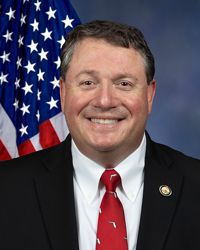
Mr. Speaker, I yield 5 minutes to the gentleman from Florida (Mr. Fine), a member of our freshman class, one of the best- educated members of our Conference, and a champion debater.
Mr. Speaker, I yield myself such time as I may consume.
Mr. Speaker, just to respond briefly, first and foremost, if the gentleman had listened to my opening remarks, as he suggested he did, he would know that we noted that we, in fact, funded CBP and ICE last year.
This is about funding the Coast Guard and TSA. This is what today's vote is about.
That is why we hear the consternation from the other side. It is because they take bad vote after bad vote after bad vote. We are giving them a chance to rectify that today.
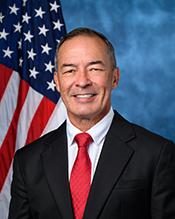
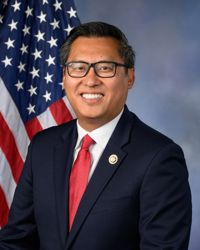
Mr. Speaker, I yield 2 minutes to the gentleman from California (Mr. Fong), a friend before we both were elected to Congress.
Mr. Speaker, I think it is disappointing that the gentleman from Maryland refers to funding our Border Patrol and funding those who keep our borders safe as poison pills. That is his prerogative, not mine.
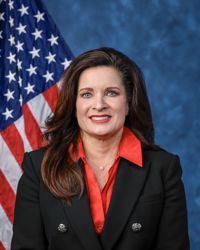
Mr. Speaker, I yield 3 minutes to the gentlewoman from South Carolina (Mrs. Biggs), a member of our freshman class, one of the highest ranking female military officers in the history of the House of Representatives, a combat veteran, and a lieutenant colonel.
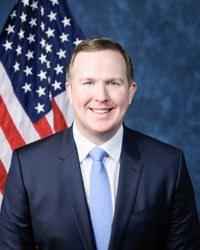
Mr. Speaker, I yield 2 minutes to the gentleman from Utah (Mr. Kennedy), a member of our freshman class who traveled earlier this year to Central America to review the threats to our national security that these transnational gangs posed.
Mr. Speaker, I yield myself the balance of my time.
Mr. Speaker, in closing, the rule I have presented today allows the House of Representatives to carry out its responsibilities and to govern in an orderly and responsible manner for the American people.
As a reminder, a ``yes'' vote on this rule enables us to consider legislation that will fully end the Democratic shutdown of the Department of Homeland Security and allows us in this body to restore funding for the agencies responsible for protecting the American people.
A ``yes'' vote on this rule ensures that the men and women serving on the front lines of our homeland security, from coastguardsmen and TSA officers to cyber defenders, law enforcement personnel, and emergency responders, have the resources and support that they need to carry out their critical missions.
A ``yes'' vote on this rule strengthens the security of the American homeland by restoring funding for the agencies responsible for counterterrorism, cybersecurity, aviation security, disaster response, and maritime security, at a time when threats to our country are increasing.
As I made clear earlier, a ``yes'' vote on this rule ensures that the rest of the Department of Homeland Security can continue its vital work, even as ICE and CBP have already been funded through H.R. 1, the One Big Beautiful Bill Act.
Finally, a ``yes'' vote on this rule allows the House to fulfill its most basic responsibility to govern and to ensure the safety of the American people is never used as a political bargaining chip.
Mr. Speaker, the consequences of leaving the Department of Homeland Security unfunded are too serious to ignore. This rule allows the House to act to restore full funding and to ensure that the agencies tasked with protecting the American people can carry out their missions without further disruption.
Mr. Speaker, I urge my colleagues to vote ``yes'' on the rule.
The material previously referred to by Ms. Leger Fernandez is as follows:
An Amendment To H. Res. 1095 Offered By Ms. Leger Fernandez of New
Mexico
Strike all after the resolving clause and insert the
following:
That immediately upon adoption of this resolution, the
House shall proceed to the consideration in the House of the
bill (H.R. 7744) making appropriations for the Department of
Homeland Security for the fiscal year ending September 30,
2026, and for other purposes. All points of order against
consideration of the bill are waived. An amendment in the
nature of a substitute consisting of the text of H.R. 7481,
as introduced, shall be considered as adopted. The bill, as
amended, shall be considered as read. All points of order
against provisions in the bill, as amended, are waived. The
previous question shall be considered as ordered on the bill,
as amended, and on any further amendment thereto, to final
passage without intervening motion except: (1) one hour of
debate equally divided and controlled by the chair and
ranking minority member of the Committee on Appropriations or
their respective designees; and (2) one motion to recommit.
Sec. 2. Clause 1(c) of rule XIX and clause 8 of rule XX
shall not apply to the consideration of H.R. 7744.
Sec. 3. The Clerk shall transmit to the Senate a message
that the House has passed H.R. 7744 no later than three
calendar days after passage.
Mr. Speaker, I yield back the balance of my time, and I move the previous question on the resolution.