Senate Floor·December 8, 2022·p. S7052-S7055
← Back to Members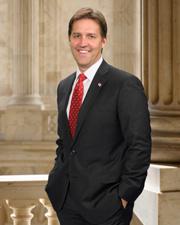
BS
Ben Sasse
RepublicanSenate
NE
Service History
118th Congress (2023-2025)Senate
NE
Jan 2023
to
Dec 2023
117th Congress (2021-2023)Senate
NE
2020 General Election
Ben Sasse: 62.74%+38.31%583,507 votes • Defeated Chris E. Janicek
2020 General Election
Ben Sasse: 62.74%+38.31%
583,507 votes • Defeated Chris E. Janicek
Ben SasseREP
Winner
583,507 votes(62.74%)
Chris E. JanicekDEM
227,191 votes(24.43%)
Preston Love Jr.W
58,411 votes(6.28%)
Gene SiadekLIB
55,115 votes(5.93%)
Other Ballot Results
Scattering
5,788 votes(0.62%)
Total votes: 930,012
Jan 2021
to
Dec 2023
116th Congress (2019-2021)Senate
NE
Jan 2019
to
Dec 2021
115th Congress (2017-2019)Senate
NE
Jan 2017
to
Dec 2019
114th Congress (2015-2017)Senate
NE
2014 General Election
Ben Sasse: 64.34%+32.85%347,636 votes • Defeated Dave Domina
2014 General Election
Ben Sasse: 64.34%+32.85%
347,636 votes • Defeated Dave Domina
Ben SasseREP
Winner
347,636 votes(64.34%)
Dave DominaDEM
170,127 votes(31.49%)
Jim JenkinsOTH
15,868 votes(2.94%)
Todd F. WatsonOTH
6,260 votes(1.16%)
Other Ballot Results
Scattering
446 votes(0.08%)
Total votes: 540,337
Jan 2015
to
Dec 2017
View Full Service History (5 terms)Show Less
5
Terms Served
5
Congresses
2
Safe Wins (>10%)
Committee Assignments
We do not have any committee assignments for this member in our current dataset. Please check back later for updates.
Recent Sponsored Bills
S.Res. 715Senate117th Congress (2021-2023)
A resolution expressing the sense of the Senate on the value of a tax agreement with Taiwan
Sponsored by Sen. Ben Sasse (R-NE)
July 21, 2022
S. 3550Senate117th Congress (2021-2023)
Ethics Reform Act
Sponsored by Sen. Ben Sasse (R-NE)
February 1, 2022
S. 3516Senate117th Congress (2021-2023)
Increase Access to COVID Testing Act
Sponsored by Sen. Ben Sasse (R-NE)
January 18, 2022
Recent Voting Record
View All Votes →Floor Statements
What Ben said on the floor, from the Congressional Record
Senate Floor·September 28, 2022·p. S5115-S5126
Tribute To Ernie Mann
Mr. President, I ask unanimous consent that the order for the quorum call be rescinded. Mr. President, the human spirit abhors tyranny. Since February, the world has witnessed examples of extraordinary courage. In Ukraine, we have watched…
Mr. President, I ask unanimous consent that the order for the quorum call be rescinded.
Mr. President, the human spirit abhors tyranny.
Since February, the world has witnessed examples of extraordinary courage. In Ukraine, we have watched ordinary men and women mount a defense of their homes and their homeland against overwhelming odds-- people never having handled firearms before who are getting training, getting arms, getting munitions, and joining together in the cause of defending their homes and their homeland. We know what it has cost them. Across the border, we have seen thousands and thousands of ordinary Russians challenge the suicidal thuggery of Vladimir Putin. We know what it has cost them too.
Today, I want to call our attention to the courage on display in a different part of the world. I want to look to Iran.
Two weeks ago yesterday, on September 13, Iran's so-called morality police arrested a young woman named Mahsa Amini. They detained her on the grounds that she was wearing her hijab improperly. She was bundled into a van, where eyewitnesses could hear the police beating her. A few hours later, she was delivered to a local hospital, where she was declared brain dead. The police shamelessly claimed that she had had a spontaneous heart attack.
Thousands upon thousands of Iranians have poured into the streets since. Protesters are calling for an end to the savagery that has made absurd arrests and vicious beatings a regular part of the rhythm of life in Tehran. They are demanding dignity for the millions and millions of people who have lost it under Tehran's maniac theocracy. This is no small thing, what they have done--the courage that is on display as they pour into the streets. Protests have erupted now in more than 80 cities and in all 31 of Iran's provinces. This is not a minor demonstration.
The mullahs are facing one of the most significant challenges to their rule since they seized it 43 years ago, in 1979. How has the regime responded? As expected--with more brutality, with more repression, and with more savagery. Human rights groups estimate that 76 people have been killed so far by the authorities.
Meanwhile, the crackdown has also included a shutting off of social media and the internet. They hope that a country and a world that can't see their thuggery won't notice it, will pretend it doesn't exist, won't know. Well, they know, and we know. The Iranians know how this regime operates. We know that these pathetic cowards have no regard for human dignity.
Who are they?
These bloodthirsty men are the goons who hang homosexuals from gallows, who protect child rapists, who deny women education. The regime is rotten to the core. The people who are suffering under it know, and we know. These men have told the world exactly who they are again and again and again.
In 2009, Iranians erupted at the grotesque human rights abuses perpetrated by then-President Mahmoud Ahmadinejad. In an election riddled with fraud, the world saw who he was again. During the Green Revolution, thousands of protesters, including key opposition leaders, were arrested and thrown in Iran's dungeon prisons. Many were tortured, and several dozen were killed. A 26-year-old woman, a student, was shot from a nearby rooftop by pro-government militia men. Her dying moments were recorded by cell phone video and were broadcast around the world.
We know who they are.
Ten years later--3 years ago, in 2019--massive nationwide protests erupted again. This time, it was following an announcement of massive, unsustainable hikes on gas prices. The protests and the violence that followed were the worst since 1979.
Hundreds of people took to the streets, and the government responded with a campaign of systemic savagery,
hoping to drive people back into their homes in order to hide the truth and to not admit to what this regime was and the ways that they failed. Protesters were shot from rooftops and helicopters by the Iranian Revolutionary Guard. Their troops opened fire on unarmed protesters who were attempting to block roadways and entrances. In one southwestern city, IRGC forces pursued several dozen, mostly young, unarmed protesters into a march outside the city and then began massacring them. Most reliable outside observers believe that about 1,500 protesters were killed.
In 2019, Tehran also conducted a near-total internet shutdown, plunging the country's 83 million people into information darkness for about 6 days. That practice, as we are seeing again right now, as we see this month, has become one more regular instrument of terror. These guys are scared of sunlight. They are scared of information. They are scared of the truth.
We know that the despots in Iran who brutalize their own people also export their terror tactics. Look at the last 2 months alone.
In July of last summer, 2021, a group of Iranian spies tried to kidnap Masih Alinejad--an Iranian-American journalist and human rights activist--at her home in New York. In July of this year, she was the target of an assassination attempt again at her home in our country.
We learned in August that a member of the IRGC had plotted to assassinate former National Security Advisor John Bolton on American soil.
Former Secretary of State Mike Pompeo and former Iran Envoy Brian Hook still require personal security details everywhere they go because Iran has put targets on their backs in our country.
It was also just last month that, inspired by the Ayatollah Khomeini's 1989 fatwa, an American man attacked and nearly killed novelist Salman Rushdie during an appearance in New York.
Then, in August, Vladimir Putin received his first shipment of Iranian drones--birds of a feather.
Inside its borders and beyond them, the regime in Tehran thinks nothing but bloody thoughts. They think no one has dignity who doesn't subscribe exactly to their theocratic views. It is long past time that American policy and the policies of our friends and allies recognize these blunt facts. We should tell the truth.
In 2009 and again in 2019, we had the opportunity to support and encourage protesters who were agitating against a regime that is their enemy and is ours, and in both cases, under administrations Democratic and Republican, we failed the test.
Last week, President Biden told the U.N. General Assembly:
Today, we stand with the brave citizens and the brave women
of Iran, who right now are demonstrating to secure their
basic rights.
It is a good start, but it is far from sufficient. It is far from the end.
Right now, America's policy toward Iran is hopelessly schizophrenic. We cannot stand on the side of Iranian protesters at the same time that we are trying to re-sign a nuclear deal with the same mullahs who would release billions of dollars back into their hands, help them shore up their power, and do nothing to prevent putting a catastrophic weapon into their genocidal hands. President Obama chased a flawed nuclear deal with Iran's terror state instead of more aggressively standing with the Iranian people. Today, the same hodgepodge of national security advisers is at it again.
Newly announced sanctions against the leaders of the Ministry of Intelligence and Security, the Army Ground Forces, and the pro- government militias are good, but we cannot stand on the side of the men and women of Iran who are in the streets at the same time we refuse to sanction the leaders who matter most. Ayatollah Khomeini and the circle of elites around him continue to escape serious consequence.
We shouldn't trick ourselves and should not delude ourselves into thinking that economic sanctions are a magic wand or that the mullahs themselves care very much about the economic pain that the people under their regime are suffering. We should not think that the mullahs care about elite opinion in Paris. We have to have a serious top-to-bottom evaluation of our Iran strategy, and a coherent policy must begin by telling the truth over and over and over again.
We cannot stand on the side of the people on the streets demanding dignity at the same time that we welcome Iran's President--someone personally responsible for show trials and mass executions and assassination attempts on our soil, in our country. We can't allow him to spout lies and propaganda on our same American soil as we did last week at the U.N. General Assembly in New York.
Now is the time for a serious, coordinated policy that admits the threat that Iran poses, not just to its people and its neighbors but also to America, and to take seriously our commitment to the rights and freedoms of all 7.8 billion people across this globe created in God's image.
We can start by helping illuminate the government-imposed blackout so that Iranians can see what their government and its blackshirts are doing--more light, more information. We can expand and intensify the sanctions regime that has pushed Iran to the brink in the past, before we lost our nerve. We can amplify the voices of the Iranian protesters and stop providing platforms to the regime's propagandists. We can make sure that the voices of the Iranian people are heard by keeping the internet on while Tehran works to put the country back into the black box of despotism.
The courage of men and women on the streets of Iran today has not gone unnoticed. They have imagined the possibility of an Iranian future no longer under the thumb of Tehran's bloodthirsty dictators. We should be able to imagine that future too and to do more to make that a reality.
The Iranian people hate Tehran's blood-soaked tyrants. This is not a regime that has the consent of the governed. The American people are on freedom's side. The administration should drop the fantasy of another nuclear deal, walk away from the table, and turn the screws on these monsters by, first, telling the truth again and again.
We ought to do everything we can to celebrate the heroism of the Iranians in the streets and to expose Tehran's human rights abuses around the watching world. And the best way to do that is by making sure that the internet stays on in Iran--more light, more truth, more information.
Senate Floor·September 15, 2022·p. S4806-S4808
Inflation
Madam President, first, I would like to associate myself with the comments of the Senator from Oklahoma and thank him for all of the work he has done on this. The Abraham Accords are really something to celebrate, something that we should…
Madam President, first, I would like to associate myself with the comments of the Senator from Oklahoma and thank him for all of the work he has done on this.
The Abraham Accords are really something to celebrate, something that we should be building on. And there is not a lot of good news right now on a whole bunch of scores, and this is worth celebrating. So commendations on your resolution.
Something we shouldn't be celebrating is inflation, and I wasn't invited, but it looks like there was one heck of a party this week at the White House.
In case folks missed it, President Biden, Majority Leader Schumer, Speaker Pelosi, and others gathered on the south lawn of the White House on Tuesday afternoon to clink champagne glasses and celebrate the so-called Inflation Reduction Act, passed along straight party lines last month. James Taylor even flew in for the festivities.
But at the same time that Washington politicians were patting themselves on the back, here is actual reality--not Orwellian rhetoric, not sort of made-up names for legislation to spend hundreds and hundreds of billions of dollars--here is actual reality: Americans are getting slapped in the face with yet another month of bad news. Core inflation grew another six-tenths of a percent just in the month of August, defying even the most pessimistic estimations and analyses heading into those reporting numbers.
Both the Dow and the S&P had their worst day since the very arrival of COVID.
Consumer prices are now up 8.3 percent for the year, but it is worse than that for median-income households in America. Grocery prices are 13 percent more expensive this middle of September than they were the last middle of September.
How do you think about what 13 percent inflation looks like? Here is the way I explained it to my kids: You know, if a year ago today, you went to the grocery store checkout line and you had $100 in your pocket and you had a cart full of groceries and you paid your $100 for the $100 of groceries, if you showed up today at the checkout line at the grocery store with the exact same cart and the exact same hundred bucks, you would then have to awkwardly and in an embarrassed way, in front of the people behind you in line, say: I have to figure out how to take $13 of stuff off this checkout line because the $100 that I had last year that bought $100 of food only buys $87 of food right now. That is what 13 percent inflation means.
Even CNN had to admit that the White House's timing was awkward, calling the event ``a bizarre split-screen moment,'' with President Biden taking a victory lap with a so-called Inflation Reduction Act while in the real world, inflation was tanking markets. That was actually what was happening on Tuesday. On air, the CNN anchor suggested it ``feels a little hard to be celebratory.'' That is a kind of awkward, timid way to tell the truth.
Lots of Americans have become used to this split-screen reality where Washington says one thing, but reality is completely different. It often feels like officials in Washington are living alternate realities and then trying to convince the American people: You don't know what you are talking about. What you are actually experiencing at the checkout line when you had to put back $13 of groceries--it is not really true. The great news is, we have wine glasses in our hands; let's clink them together.
Washington, DC, is obviously in a bubble--and not for the first time. The same folks who threw that party are the types who order lots of their food from DoorDash and therefore might actually not know what the price of eggs, milk, and meat is. They are the kind of folks who see inflation as something that happens on paper, but seeing it on paper is different than feeling it.
DC sees many problems on paper but doesn't really connect with what the American people are living. DC saw the housing crisis of 2008, 2009 as something on paper, not as reality. Why? Well, because five of the seven richest counties in America are the five suburban counties of Northern Virginia and Maryland that ring Washington, DC. Think about that. Of 3,000 counties in America, 5 of the 7 richest ones are the places that surround the city.
So in 2008, 2009, when housing was collapsing everywhere, when lots of people were going bankrupt in the country, people in this city said: I don't know what the heck you are talking about. We have massive demand. Houses sell with escalation clauses.
There are way more buyers than there are sellers, so housing prices in Washington, DC, in Northern Virginia, and in suburban Maryland went up even as the country was living that collapse.
Opioids are a crisis that a lot of people in Washington, DC, know only on paper because they don't see it around the yuppified neighborhoods of Washington, DC.
Inflation is now that kind of crisis. It is a very real thing, and yet people in this city host white wine parties to talk about how great it is passing legislation that spent hundreds of billions of dollars more, accelerating inflation, and they decided they would name it the ``Inflation Reduction Act.''
Let's review a little bit of history about what we have learned about inflation over the last 15 months.
More than a year ago, last summer, when Americans were already feeling their prices creep higher, the President dismissed long-term worries about inflation with this quote:
There's nobody suggesting there's any unchecked inflation
on the way--no serious economist.
What?
That was an incredibly bizarre, dishonest statement, and everyone knew. When it was spoken and when speechwriters wrote it, they knew that that wasn't true.
Why did they know? Well, because inflation had gone from 1.4 to 5.5 percent in the 3 months before that statement was uttered.
Larry Summers, a longtime Democratic economist across multiple administrations and who is well respected by folks in academia and in government and in both parties, was screaming at the White House not just in private but in public that this was nonsense, that they were delusional about what was happening with inflation numbers. Yet our President said that there was nobody suggesting that unchecked inflation was on the way--no serious economist.
Here is what was actually happening in White House meeting rooms at that time. Half of the Obama economic team was coming in and telling the Biden economic team: Hey, you guys are going to get caught with your pants down. That isn't true. That spin isn't reality. Inflation is big, it is bad, and it is growing.
Yet the speechwriters said: Let's have the President go out to the podium and say there is no serious economist who believes inflation is coming.
That was in July of 2021.
In February of this year, when inflation had hit 7.8 percent, our President predicted that ``inflation ought to be able to start to taper off as we go through this year.'' He had predicted in December that inflation had already peaked. Every one of these comments was detached from reality, and the people writing the speeches knew they were detached from reality.
The President is obviously not the only offender. Last October, with high prices already eating away at families' savings accounts, White House Chief of Staff Ron Klain applauded a tweet describing inflation and supply chain snarls as ``high-class problems.'' That is some white wine-drunk commentary for you. This is a middle-class American problem that families in all 50 States are suffering.
A week later, the White House Press Secretary shrugged off the same problem when asked about inflation as being ``the tragedy of the treadmill that's delayed.'' ``The tragedy of the treadmill that's delayed''--ouch.
Do these people know anyone in America who has ever had to put stuff back at the checkout line at the grocery store? Because that is what I have experienced and see at Walmart and Hy-Vee right now in Fremont,