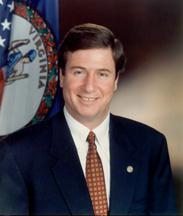
Farewell To The Senate
Mr. President, as the time for my departure from the Senate draws near, on behalf of the greatest blessings in my life, my wife Susan, and my children, Tyler, Forrest, and Brooke, I wish to thank my colleagues for their many courtesies and…
Mr. President, as the time for my departure from the Senate draws near, on behalf of the greatest blessings in my life, my wife Susan, and my children, Tyler, Forrest, and Brooke, I wish to thank my colleagues for their many courtesies and friendships forged during these past 6 years, and offer a few concluding reflections on our time here together, and the future of our Republic.
Our foremost senior statesman in Virginia, one who served with particular distinction in this body--Harry Byrd Jr.--has observed that, with the exception of the Presidencies of Abraham Lincoln and Franklin Roosevelt, no time in our Nation's history has been witness to more problems and challenges of great magnitude than these past 6 years.
When I arrived here in January 2001, America was at peace--or so we thought. And then on the bright, blue sky morning of September 11, the skies suddenly darkened with clouds of smoke from the Pentagon, and the horrific collapse of the World Trade Center Towers. And our world changed forever.
When I arrived in this body, accompanying a change of Presidential administrations, our challenges were mostly economic--or so we thought. Our prosperity was already slipping, but most forecasts were for a mild downturn in the economy. That changed on September 11 as well.
A cascade of other great challenges soon followed in rapid succession--issues foreign and domestic, challenges locally and nationally, threats manmade and disasters decreed by nature.
Through all of these unprecedented storms, it was our responsibility to make careful, prayerful decisions for the safety, security and prosperity of the people of our country.
I am particularly grateful to the people of the Commonwealth of Virginia for the opportunity to serve here--to give voice to their values and to fight for their future in this, the world's most distinguished body.
We all understand and respect the will of the people--the owners of the government--in our representative democracy that brings us here and that may, at some point, take us away.
Sometimes winds, political and otherwise, can blow the leaves off branches and break branches off trees. But a deep-rooted tree will stand and grow again in the next season.
And, if Providence accords it the right climate and nourishment, that tree will bear fruit for generations to come, and give life to other trees.
I have been honored, first as Governor and now as Senator, to be a part of important initiatives that have borne fruit for the people of Virginia and America.
As Governor, we worked across party lines to accomplish the honest change that Virginians had desired and deserved. We abolished the deceitful, lenient parole laws, brought truth to sentencing, brought violent criminals to justice, and reformed our juvenile justice laws.
Today, the crime rate is down, and thousands of good people are not victims of crime, have not lost loved ones, have not had their lives shattered, because we stood strong for truth and justice, and our reforms bore fruit.
We also brought high academic standards, accountability and new resources to Virginia's education system. We stopped skyrocketing college tuition rates.
Our education reform initiatives quickly became models for other States, and even for this body in enacting education reform legislation for the nation.
These reforms, too, are bearing fruit today. Virginia students are learning more and performing markedly better on both state and national tests. Our schools are no longer engaging in social promotion.
And with investments in higher education from the coalfields with Appalachian School of Law and School of Pharmacy, to the Institute in Danville, to southwest Virginia and Roanoke HEC's, to the Engineering School of VCU, to new leading-edge research at Virginia Tech, George Mason, Hampton and other universities we are equipping young men and women to succeed in the ever-more-competitive global marketplace.
And we replaced dependency with dignity by reforming Virginia's welfare laws. Now, 11 years later, our welfare rolls are still less than half of what they were when I became Governor. Not only has that saved the taxpayers of Virginia hundreds of millions of dollars--the far more important impact is seen in the eyes of children who watch with admiration and respect as their parents go off to productive, rewarding jobs rather than sit at home, collecting a check.
Nothing was more rewarding for me as Governor than to help ignite Virginia's economic renaissance. We sent a message to the world that Virginia was ``open for business''--we lowered taxes, reduced regulations, implemented prompt permitting, and recruited high- technology companies like IBM and Toshiba, Micron and Infineon--now Qimonda--Oracle's east coast campus, and secured billions of dollars in investment in semiconductor fabrication plants for world-class companies.
Before we recruited those companies 10 years ago, there were no computer memory chips manufactured in Virginia. Today, computer memory chips have replaced cigarettes as Virginia's No. 1 manufactured export. We're not just the ``Old Dominion'' anymore; now we're the ``Silicon Dominion!''
When I came to the Senate, my goal was to use this perspective and experience to continue and build on this work. I wanted to bring to our national policies the same emphasis on education and innovation--the same emphasis on economic opportunity--the same emphasis on protecting the safety and security of law-abiding people--the same time-tested values--that had guided my governorship.
I have been able to do that, and I am grateful to many of you for working in partnership with me on so many issues that are vitally important for the lives and safety and prosperity of our citizens.
Our time together has been full of challenge. But despite the broken branches and shattered limbs and lives of 9/11, America has stood strong like a live oak. We have relied on our roots as a freedom-loving nation. Out of these stormy times has grown a new national sense of urgency, resolve and mission. And this new spirit is bearing fruit today, and will for many years to come.
Yes, the people of America have grown impatient with the pace of this progress. It is not easy during prolonged periods of national trial to sustain an attitude of optimism and a sense of purpose. Our foes know this about democracies, and they seek to exploit it. But they will not succeed.
We Americans, of so many faiths and so many backgrounds, share this spirit above all else: We believe in the positive impact that each of us can achieve during our time here on Earth. But our opponents have no such belief. They fear human freedom, and glorify the extinguishing of human life more than the fruitful living of it. They will not succeed in this great struggle because they are only destroyers, and the world belongs to those who create.
The God who gave us life, and who presides over the affairs of all nature and all nations, endowed mankind with a powerful spirit of creation, regeneration, and renewal.
The attackers of 9/11 thought they would kill our spirit, but they only rekindled it. And, despite one of the most unsettled and challenging times in our Nation's history, look at what we have to show for it.
Our economy is displaying unprecedented strength. Unemployment is the lowest it has been in decades. Home values are significantly higher than just a few years ago, and the stock market is at a record high level. The tax burden on our people is at a 20-year low, while Federal tax revenues are at all-time highs, and inflation is under control.
There has not been a single terrorist attack on American soil since 9/11, and numerous major plots have been foiled. The al-Qaida leadership has been decimated, and instead of meeting the enemy here at home, we have taken the fight to them in Afghanistan, Pakistan, and Iraq and in locales that will never be known. Even with the world at war against a lethal enemy of radical terrorist organizations, Americans are safer today than on 9/11.
We must respectfully work with other countries in intercepting finances, creatively collaborating in counterterrorism efforts to thwart and defeat terrorist activity throughout the world.
This war on terror has many fronts. And all of us are deeply concerned about the lack of progress of the war on the Iraqi front. Although our principles and strategic goals have not changed, mistakes have been made and progress has been too slow. We cannot continue to do the same things and expect different results; we must adapt our operations and change our tactics to meet the evolving terrorist threat. And the Iraqi people and their leaders must take control of their destiny.
Let us never forget, however, that our American troops are liberators who have freed a people from a brutal dictator and regime. In so doing, they and their families have made great sacrifices not only for the freedom of Iraqis, but for the security of Americans. They more than anyone understand the consequences of failure in Iraq are far too high. Leaving Iraq as a safe haven for terrorists to launch new attacks will put America in mortal danger. Our troops should come home as soon as possible, but they should come home in victory--not defeat.
This global war on terror is still a work in progress, and much of the work is difficult. But I will leave here in coming days with satisfaction that so many of the crucial steps we took to meet the challenges of the post-9/11 world have worked, and worked well.
The Patriot Act and other new and technologically sophisticated counter-terrorism measures designed to protect our homeland are working, and working well.
Our courageous men and women in uniform, an All-Volunteer military that is the most powerful fighting force in the history of the world, is hard at work for us, and working well.
We have also worked well on the domestic front. And I take great personal
satisfaction from progress achieved on some major initiatives designed to make this a land of opportunity for all--measures that will help secure a future of expanding opportunity for our children by making America the world capital of innovation.
One area of focus for me has been preserving the Internet as a tax- free individualized opportunity zone. The Internet is the greatest invention since the Gutenberg Press for the dissemination of information and ideas, and one of America's greatest innovations for economic growth and jobs.
So far the Federal Government has taken the right approach when it comes to the Internet--by basically leaving it alone.
The American private sector is the best steward of the Internet. We just need to leave it alone and let it prosper as an engine for economic progress--and with your help, that is what we have done. But the need for action will return next year, and I hope you will extend internet tax freedom so that avaricious State and local tax commissars are blocked from imposing an average 18 percent tax on monthly Internet access bills.
We also made major progress in a realm few Americans understand, but one that will transform their lives--nanotechnology. Teaming up with my hard-working friend across the aisle, Senator Wyden, we sponsored and you approved legislation launching the National Nanotechnology Initiative. This is the single largest federally funded, multiagency scientific research initiative since the space program in the 1960s, and the revolutionary technology it yields may well rival the space program in its impact on our society and economy.
You have heard me say many times on this floor that they key to innovation is education, and that we need to educate more scientists and engineers because they are the ones who will design and develop the ground-breaking and life-changing inventions, innovations, and intellectual property of the future.
But today America is not tapping its full potential in math, science, research and innovation. Only 15 percent of those graduating from our engineering schools today are women; only about 6 percent are African- Americans, and about 6 percent are Latinos. That is simply not enough, especially when we are competing with countries that have literally six or seven times our population.
That is why I have worked with senators in both parties, Senators Alexander, Ensign, Bingaman, and others, as well as the independent- minded Senator Lieberman--for the National Innovation and PACE Acts, which will invest in wide-ranging scientific education and research, induce capable students with scholarships, provide incentives for teachers and researchers, and take other steps to keep America on the leading edge of science and technology.
That is why I have been the lead Republican cosponsor of the Partnership Access to Laboratory Science Act with Senator Menendez, which will provide science education and laboratory grants for students in rural and low-income schools.
And that is why I have led the charge for legislation to help remedy the opportunity divide at America's minority-serving institutions--the HBCUs, Hispanic-serving institutions, and tribal colleges. I am grateful for the Senate's support for this initiative and hope it will very soon become a reality.
All these initiatives I respectfully urge you all to pass and stay with them until they become law. For my part, I will continue to advocate for these incentives and this major national commitment to make sure that the U.S. is indeed the world capital of innovation.
Investing in education and innovation is vital for our global competitiveness, and so is achieving energy independence. In fact, not only is energy independence an economic necessity; it's also a national security imperative. Our dependence on Middle Eastern oil limits our foreign policy options for addressing terrorism, tyranny and related geopolitical issues.
We have made some important strides in accelerating the exploration and development of American energy supplies, including American oil, natural gas, clean coal and nuclear power. And we have made notable progress in hastening the research, development and deployment of economically viable alternative and renewable sources of energy. But here we must all agree that there is far more to be done.
The bottom line is we need more energy explored, produced, and grown in America, so that hundreds of billions of energy dollars stay in America and are reinvested in America's economy for American jobs, American competitiveness, and American national security, instead of having to worry about the whims of some dictator in the Middle East, or some other hostile part of the world.
There are so many ways that what we have done here during the last six years has made a positive impact on the opportunities facing citizens all across our country.
In Virginia, whether it is the major port expansion at Craney Island, or funding for the Advanced and Applied Polymer Processing Institute in Danville, or the effort to assure that new development opportunities at Fort Belvoir are matched by adequate transportation facilities whether it is educational research funding, or new resources for roads and mass transit, or grants to make our communities safer, or in hundreds of other ways we have been able to have a major, positive impact on people's lives all across the Commonwealth of Virginia.
We have also broken down barriers to opportunity. My very first speech on the Senate floor was on behalf of Roger Gregory's appointment as a federal judge on the esteemed Fourth Circuit Court of Appeals that sits in Richmond.
Judge Gregory had been nominated at the end of President Clinton's term, but he did not get a vote, and to become a judge he had to be re- nominated by President Bush. So my first speech was to call on my Senate colleagues to rise above partisanship, rise above process, judge Roger Gregory as a person, and give him the fairness of a vote.
You did so, and as a result, Judge Gregory is serving with distinction on the Fourth Circuit Court of Appeals, the first African American to serve on that esteemed appellate court.
For the good of our country, the Judiciary, and this Senate, I urge you--regardless of the party in power here and at the other end of Pennsylvania Avenue--to end the obstructionist practices that deny judicial nominees, or other nominees, the fairness of an up or down vote, and that deny the American people the accountability that the advice-and-consent process should afford.
Miguel Estrada was a victim of this unfair obstructionism, although a majority of Senators supported his confirmation. Let John Bolton be the last victim of these unfair, obstructionist practices.
Our Constitution provides a better way; let's follow it.
Finally, during these times of war, we are all keenly aware of the sacrifice made by the men and women serving in our Armed Forces and their families. Virginia is home to more people serving in uniform than all but a handful of states, and so when a loved one is lost, we feel the pain very directly, very personally. A grateful nation must support the families of those who have fallen in defense of our liberty. That is why I introduced a bill in the first hours of the first days of this 109th Session to increase the military death benefit from the paltry amount of $12,420 to $100,000. I thank you for passing it, and I thank the President for signing it.
At each step of the way, on this measure and so many others, I have never worked alone. Always at my side, as a partner--but even more as a gracious mentor, wise counsel, constant encourager, occasional correcter, and unwavering friend--has been our state's senior Senator, John Warner.
He has been the epitome of the Virginia gentleman, the model of an honest, hard-working Senator, and most of all, a true and loyal friend. I will leave here enriched immeasurably by this latest and best chapter in our partnership of several decades.
My friends and colleagues, as I prepare to take my leave, I am humbled and so grateful for the tremendous honor and privilege that has been accorded to me by the people of Virginia. I am also full of gratitude for the opportunity to serve with you and for the many courtesies you have extended to Susan and me along the way.
I leave with many new and enduring friendships, with some valuable lessons learned, with unrestrained optimism about the potential of America, about our nation's future, and with pride in our accomplishments together.
My friends, don't let these challenging times along our national journey divert your focus from what truly matters.
The tree of American liberty is as strong as ever. Our roots run deep to a wellspring of values as old as our Republic, indeed much older still.
Four hundred years after our Nation's beginning at Jamestown, we are still in the springtime of our life as a nation. Still planting seeds and bearing fruit. Still growing and creating. Still inspiring and innovating. Still providing light and hope for people around the world seeking to escape the chains of tyranny, and embrace the blessings of liberty.
Indeed, the sun is still rising on a bright American morning!
And if we will keep the faith, no matter the challenges or choices, generations to come will remember and think well of us, for this: We never gave up. We never backed down, and, we always stood strong for freedom.