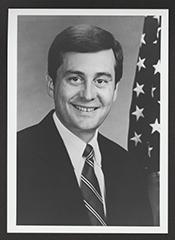
Mr. Speaker, I want to thank the gentleman from Indiana for having this Special Order. Woody Allen once observed that he was not afraid of death. He just did not want to be there when it happened, and it was a little like that on Tuesday…
Mr. Speaker, I want to thank the gentleman from Indiana for having this Special Order.
Woody Allen once observed that he was not afraid of death. He just did not want to be there when it happened, and it was a little like that on Tuesday night about 10 o'clock for some of us. We were there when it happened.
But I did want to reflect, I have been so blessed to serve in this great body for the last 12 years. I wanted to reflect a little bit about what it was like when I first ran for Congress, what it was like during those heady days, some of the highs and lows, some of the accomplishments.
The Congress itself is a living, breathing organism, and every 2 years we have an election, and in some respects every 2 years we have an entirely different Congress. A lot of the faces stay the same, but the dynamic is different. There will be different leaders. There will be different issues, and I was so fortunate and I really do mean blessed that, first of all, I had a chance to serve in the Minnesota State Legislature.
In that capacity, I served as what we would probably call here the whip. I was the floor leader, and every day it was my job to help organize the debate. I made sure that, and the years that I was in the position we were in the minority, but every year, every day I made sure that the other side was held accountable for what they said and what they did and what they proposed and how they voted. I really enjoyed that job. We had real debates in the legislature, unlike the Congress.
But it was really time for me to move on, and so I decided to run for the U.S. House of Representatives in 1994 and I was very fortunate. I picked a good year. The issues favored us. The wind was at our back.
I will never forget. It was kind of a cloudy day, and Members probably remember that as well, but it was a cloudy day when we all gathered here in Washington that fall to sign the Contract with America, and just as we went on the western steps of the U.S. Capitol Building here, just as we walked out there, the clouds parted and the sun came out. It was almost like it was a divine message that the sun was going to shine on the Republican Party that year and it did.
Most of us that day believed we were going to win, and most of us did. I came here with one of the largest freshman classes in the history of Republican Party, and I will never forget, when we came here we were the toast of the town. The Republican freshmen that year, we spent our days at orientation and looking for apartments and doing all the other things that freshmen have to do when they come here, but the evenings we were wined and dined by almost everyone.
I will also never forget one particular story. We were waiting outside the hotel, some of us, and a sweet little lady came by. I guess it is not politically correct to say a sweet little old lady, but she had kind of blue hair, and anyway, she looked at us and sort of gave a double take. Perhaps she recognized Sonny Bono, and she said, You are the Republican freshmen, aren't you? And we said, yes, and we started to introduce ourselves. Then almost with a tear in her eye, she said, you know, I have been waiting 40 years for you because it had been 40 years since the Republicans had been in the majority in this House of Representatives.
In fact, going back just a little bit before that, one of the first trips I made to Washington as a candidate for Congress, I was invited to a leadership meeting. I was star struck. Pretty soon Henry Hyde came into the meeting room. I sat in the corner, and there was a big pile of the best cookies I had ever since, and they had flasks of coffee, and so I sat in the corner and thought I am just going to watch this like a fly on the wall and drink coffee and eat these cookies. Pretty soon Henry Hyde comes bouncing in and those who remember Henry in his earlier days had quite a bounce to his step. I was in awe of Henry Hyde. I had watched him on C-SPAN. I had heard his speeches. I was a big fan of all that he had done to protect the unborn.
I am sitting in the back of the room and Dick Armey comes in, and pretty soon Newt Gingrich comes in, and I am just sitting there, my eyes are big, and I am watching all this. And then Bill Paxon walked into the room and he spotted me. He said, oh, hey, we have got Gil Gutknecht over here, he is going to win that seat back in the 1st Congressional District back in Minnesota; stand up and say a few words, Gil.
I was like a deer in the headlight for longer than I want to admit. Finally, when I gained my senses I said, you know, I was born in 1951, and when I was a child, a very small child, a baby, Republicans were in the majority in this House. I said I believe like Haley's Comet our time is coming again, and you know, I have been to auction college. One of the things they teach you in auction college is to read people's eyes. As I looked around the room at the leaders of the Republican Caucus that day, I could read their eyes. Some of them were saying, yeah, right, kid, but one of them, and I will never forget, Newt Gingrich, his eyes said, yes, we are going to be in the majority. Ultimately, Newt was right.
So we came to Washington. I think about that little lady who had been waiting 40 years for us, and I thought about her often. I hope we have not let her down too much. I think maybe in the last couple of years, maybe we did, but those were heady days, and we made enormous progress.
I remember coming down to the floor of the House with one of my colleagues, Congressman Mark Neumann from Wisconsin's 1st Congressional District, and Mark came to town with charts. He was the first person that I know that actually used charts on the Special Orders. Part of the reason he used charts is there had been a study done at the University of Wisconsin that said you are 40 percent more believable if you
use charts, and so we all started using charts. But it started I think with Mark Neumann.
He had this simple chart about what it was going to take to balance the Federal budget and it was not complicated. You have to slow the rate of the growth of spending, so that the Federal budget does not grow at a faster rate than the average family budget. Now, that is not rocket science, but you know what, we did it and it worked.
I remember in, and Ernie will remember this, too, when we locked horns with former President Clinton, and in December of 1995 we shut the government down. I remember also when it was all over, when we finally, and if I can say this, when Bob Dole capitulated and ended the government shutdown, I remember what Newt said to me. He said, you know, it was a dumb fight dumbly fought, and I think a lot of people thought that, but it was an important turning point because we sent a message not only to the President and the administration but to the American people that we were deadly serious about controlling Federal spending, the growth in Federal spending and, more importantly, allowing Americans to keep more of what they earned.
We did a lot of important things. It was not just about the Contract with America. We marched through those in the first 100 days, and I remember something that Henry Hyde said when it was all over. He said, you know, it was not a 100 days that was so tough, it was the hundred nights.
We literally were in session almost from Monday morning early, working most evenings till 8, 9, 10, 11 o'clock at night, but it was a wonderful time. We reformed the welfare system. We cut the welfare rolls in half, and we reinforced those time-tested values that I think have made America the special place that it is.
So I was so privileged to have been here as part of that, and we did make some enormous progress on so many fronts, and we literally went from a $250 billion deficit, and deficits for as far as the eye could see, to something people had even forgotten and that is by September 11, 2001, when we had a Budget Committee meeting that morning on September 11, 2001, the issue we were talking about was what are we going to do with this big surplus. We were looking at surpluses of trillions of dollars.
So it has been a very special time to be here. I really do think we lost our way a bit once we got into the surplus situation, but as I think about all of the areas where we were able to have an influence on the course of events, yes, we made a lot of mistakes. I made a lot of mistakes, but this has been a very special time in American history.
I never thought when I ran for Congress that I would vote in effect to declare war. I never thought that I would be called to vote on articles of impeachment. I did believe that we would have a chance to vote for a balanced budget agreement.
The high point perhaps, during my entire tenure here in Congress, was when the President of the United States, William Jefferson Clinton, joined us and he issued those immortal words that the era of big government is over. It may have been a bit premature because the empire has struck back in the last number of years, and as I say, we have made a lot of mistakes on the way.
I hope we have not let people down, but it has been a wonderful privilege for me to serve in this very special place. This is the people's House, and you know, sometimes when the slings and arrows of outrageous fortune, of electoral ups and downs do not necessarily break our way, it is easy for us to blame the voters, but in the end I believe that the voters have a right to be wrong, even if they are wrong, but I also believe for the most part the voters are right. I think we lost our way in the last several years, and so they began to wonder were we still the party of reform, were we still the party that battled big government or that defended big government?
Were we the party that was trying to change Washington or had Washington changed us? And my only wish for all of you and particularly the Members of the Republican Study Committee is that you return to those time-tested principles and values, because in the end that is what this is all about. Government will either reinforce time-tested principles and values or it will undermine them. When government grows, freedom declines.
And I am sorry, I should remember who said it, and now I have even forgotten the quote. But I think our founders really understood that those who would trade liberty for security will lose both and deserve neither. Those words were true 220 years ago and they are true today.
And I know that we had an interesting debate this afternoon about the rights of the unborn. If you look at what our founders said and what they wrote, even Thomas Jefferson, who was not necessarily considered a religious man in the sense that a lot of our folks who were our founders, but he was a deeply religious man. And he said that the same God who gave us life gave us freedom.
Those rights and those inalienable rights that were talked about so much in the early days of our Republic need to be talked about again. And I think it really falls upon the Republican Study Committee and the people who are here, regardless of what the numbers are, regardless of what the polls may say today, those time-tested values and principles will win out.
And I don't believe the American voters voted against our values, I don't think the voters voted against our principles. There were other cross-currents. And even if they did, we simply need to do a much better job of telling our story.
I was privileged to come to Washington with J.D. Hayworth and that freshman class, and so as I leave I will have both some sad memories about how things ended, or at least they ended for me, but I will have mostly incredibly fond memories of golden days and golden nights and ways that we made a difference.
I will close by saying this. When I go to high schools and visit with students, I tell them a couple things. First of all, I always tell them I am one of the luckiest people that they will meet that day, and I say that because every day I felt like I made a little difference in somebody's life. And it didn't necessarily make the papers. A lot of times people talk about, well, what is said in the Washington Post and did it make the CBS News and did Fox News do something about it. A lot of the things that we do every day don't make the news.
It may be a woman who calls and her daughter is stuck at a New Jersey airport and she has lost her passport, and she is frantic and she says, ``Congressman, my daughter is stuck at this airport. Can you help get her passport?'' And that is a true story. And we were able to get that young lady a passport through the State Department in a matter of about 3 hours and get her on the next plane. Now, to this day that mother thinks I am the greatest guy who ever lived. And there are a lot of other things, whether it is a veteran's benefit, to helping people plug into the right administrative issue. There all kinds of things that people in Congress do every day that don't make the news but we are making a difference in people's lives.
And I do believe in that expression that you used earlier: If you want to change the world, you have got to first change your neighborhood. And if you can't change your neighborhood, at least be a good example. And I think the responsibility of the Republican Study Committee is to be that beacon of light, but most importantly, to be a good example. Because both America and I think many Members of Congress want to follow it, and they are looking for leadership.
So thank you very much for having this little event tonight and thank you for giving me one last chance to visit with the folks here in the House Chamber. As I say, it has been a wonderful experience. I want to thank all the folks who I worked with through the years, including, and especially, Mark Newman from Wisconsin's First Congressional District for getting us started using charts. Thank you very much.