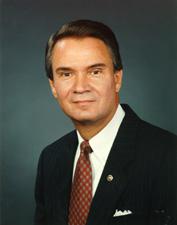
Mr. President and colleagues, the last time anyone does anything in their career or in their life, I think it is a time for a certain degree of sadness and a certain degree of nostalgic remembrance of the times past. This evening will…
Mr. President and colleagues, the last time anyone does anything in their career or in their life, I think it is a time for a certain degree of sadness and a certain degree of nostalgic remembrance of the times past. This evening will probably be my last opportunity to address this body as a Member, as a Member of the Senate, representing my great and wonderful State of Louisiana.
While some would say, well, it has to be a very difficult time to speak for the last time on the floor of the Senate, looking back at all the great memories, I look back with nothing but great pleasure over the many years I have spent in the Senate as well as in the House of Representatives.
I have been very honored to serve and be elected seven times to the other body, serving 14 years as a Member of the House, representing southwest Louisiana--it was a great and wonderful time--and then moving on to the Senate 18 years ago, representing the entire State of Louisiana.
So when you look back over those years, I think a lot of people would say: Well, it is your last speech, and it must be a very nostalgic time, and you really are sad. I am not. I am pleased. I am happy. I am overwhelmed with the opportunity that was presented to me for those 32 years in the Congress to serve the people of Louisiana in one capacity or another, both in the House, as well as in this Chamber.
Thirty-five years ago, I, with my wife, came to Washington for the very first time as a young staff person, legislative assistant, having just gotten out of law school. I worked in the Seventh Congressional District office for then-Congressman Edwin Edwards. It was a great learning period for me.
Shortly after serving as a staff person, there was a vacancy that was created, and I ran for that vacancy as a young 28-year-old member of the Bar Association in my State. I ran for Congress and had a slogan I remember back then, when I was 28, when I was running for Congress for the first time. My slogan was: ``Experience makes the difference.''
Most of the people I was running against were old enough to be my grandfather or grandparent, certainly old enough to be my parent. Yet I had the audacity to print the slogan on a bumper sticker that ``Experience makes the difference.''
Of course, it aggravated the heck out of all the people I was running against because they said: How dare someone 28 years old talk about experience making the difference; He has none.
Well, I was the only person running who ever worked in a congressional office in Washington. I was the only person who had ever run a congressional office in the district. And I was the only lawyer who was running. I told the people in that first race that we were electing someone to go to Washington and make laws, and I was the only lawyer running. Therefore, they should vote for me.
That went over fairly well for a period of time until all of my opponents realized 98 percent of the people were not lawyers, and about 100 percent of them hated lawyers. So as soon as they started articulating that different viewpoint on the function of lawyers, I started going down in the polls, and thank goodness the election was only a couple weeks later.
To make a long story short, we were elected back in 1972 and came to Washington. I came with my wife Lois and two very small children, John, Jr., and Bill Breaux. I remember we had to rent a U-Haul truck to come to Washington. I had never had an opportunity to be up here. We came up, and I will always remember this: When we left Louisiana, my two sons did not want to go. My youngest son, the night before we left, when he was saying his prayers, said: Goodbye, God. We are moving to Washington.
My oldest son, who was about 4 or 5 at the time, ran away to a neighbor's house and crawled under the house. In Louisiana, the houses are built off the ground. He ran under the house and would not come out. And we had my mom Katie, my dad Ezra, my father-in-law Lloyd, and my mother-in-law Doris who were all there watching us get into the U- Haul to go to Washington, and I had to crawl under the house and literally drag John, Jr., out from under the house and make him get into the U-Haul truck so we could move to Washington. I finally got him here.
We came to Washington. I will always remember we came here on a Saturday. I wanted to go to see the Capitol because I knew it was going to be such an impressive place. I remember that night the Marine Corps Band was playing, how they do in the springtime. They have concerts. They used to do that on the front steps. And they were having a concert. I thought they were playing the concert for me.
We were so delighted as a family to be able to see our first impressions of the U.S. Capitol, with the playing of the band on a wonderful evening. It was a great memory then, and it is still a great memory 35 years later.
In those days when I was in the House, we had an arrangement, if you will. In those days when I arrived here, Carl Albert was Speaker of the House. And then Tip O'Neill became the Democratic leader and Speaker of the House, and Bob Michel was the Republican leader. And Tip O'Neill and Bob Michel probably differed as much as any two people you could possibly know in terms of philosophy in how Government should work. Tip O'Neill was an FDR liberal Democrat from Massachusetts, and Bob Michel was from Peoria, IL, a middle America Republican. They did not agree on how Government should work necessarily from a philosophical standpoint, but they knew how to make Government work.
They spoke more in one day back then than some of the leaders later on spoke in a year because the House changed to a position where now many times leaders do not speak to each other. I would suggest that government was not any worse off when you had a Tip O'Neill and a Bob Michel traveling together, playing golf together, drinking in the evening and having a cocktail together, playing golf together, betting on sporting events together, which I know they did because they had a relationship that allowed them to find out, What do we have to do to accomplish what we both realize is best for this country? They were able to do that in a way that I thought was incredibly effective.
Hale Boggs swore me in to the House of Representatives, a truly great majority leader. I learned a great deal from him and had a great deal of respect for everything he taught me and taught so many.
That was back then. My two sons, who were crawling and saying their prayers before bed, are both 38 years of age. My oldest daughter, Beth, is 34 and is married to a wonderful person named Jeff Shepardson; and now we have three beautiful grandchildren, Anna Kate, Campbell, and C.J. Shepardson, age 2. Also, my youngest daughter, Julie, is now 28.
So after you have been here a while, you wake up one day and say where has all the time gone and how fast it went. I think about that often, but I also think about all of the wonderful things I have been privileged to witness, watch, and participate in, in those 32 years in Congress. It has been a real privilege and pleasure. I have had the honor of serving with three great Senators, including Russell Long, when he was the senior Senator from Louisiana and I was a House Member. I remember coming over to see Russell when I first got into the House of Representatives. I wanted to come and pay my respects. I had been in Congress about a week. So I came over to the Senate and walked up in the Senate office building to see Russell Long. I remember getting on the elevator and it went up to the second floor. The door opened and Senator Jim Eastland from Mississippi got on. He looked at me--and I was on the Members elevator, which shows you the audacity I had even then. He looked at me and said, ``Hey, boy, what are you doing here?'' I said, ``I am a Congressman and I am going to see Russell Long.'' He said, ``You're not a Congressman.'' I said, ``Yes, sir, I am.'' He looked at me and walked off the elevator. Those Members are so wonderful to look back on, and it is interesting to see how things have developed.
I learned a great deal from Russell Long. He taught me how to work with people. He could get more done in the evening over a bottle of bourbon than we can get done by having months and months of hearings and hours of debate because he knew how to bring people together. He had an incredibly great personality and sense of history of where he came from. And he learned from his father who also served in this body.
I also served with Bennett Johnston, a great person who could work both sides of the aisle. He became chairman of the Energy Committee and senior member of the Appropriations Committee. Bennett was outstanding. It was interesting because we never had a cross word politically. A lot of Members, I think, have natural competition between Members of the same State, particularly if they are in different parties. I have had the fortune to serve only with members of the Democratic Party in the Senate. Bennett and I had a wonderful working relationship. He would take the lead on some things, and I would try to take the lead on others. It was a wonderful relationship.
In the last several years, it has been Mary Landrieu, who I have seen develop into one of the greatest politicians and greatest leaders of our State. She comes from a great tradition, a long tradition of outstanding public servants in the State of Louisiana, particularly in the city of New Orleans. She learned from the masters, and the masters were her parents, brothers and sisters. They were all involved and they do a wonderful job in representing our State in so many different capacities.
So I have had a wonderful opportunity to serve with people from my State who have been friends and outstanding colleagues, along with all of the other folks that we have had the opportunity to serve with. I have looked at meeting people in Congress not just as colleagues who were elected to public office, but I looked at each one of them as a potential friend. I learned a long time ago that you have to understand where people come from to appreciate what they are all about. I think many times we take a position automatically that we don't like someone because of where they are from or what party they are in, without delving into their backgrounds, why they say what they say, and who helps develop those ideas.
I remember when I was in the House, I served on the Public Works Committee with Bella Abzug, who many thought was the most liberal person in the Congress. I remember Bella Abzug telling me, you know, where I come from, in my congressional district, they think I am too conservative. She
had the type of district that encouraged her and helped her and pushed her to represent the people as they wanted to be represented in the Congress of the United States. So if you understand where people come from and understand their background and who they represent, I think it helps you understand how people of different positions can be friends, because they are truly trying to represent their States the best they can. It is not just because of their politics but because of where they are from.
Let me say one other thing that I think we need to pay attention to in this body, the Senate. That is, we should not let outside forces dictate to us how we treat each other and how we work together. Many times, when Democrats have a caucus lunch on Tuesday right outside this Chamber, Republicans are having theirs separate from us at the same time. Many times, we hear people call in from the outside who are in public relations, PR men and women and pollsters, who spend an inordinate amount of time telling us how we can take actions that will show how the other side is wrong and we are right. Right across the hall, the Republicans are hearing some of the same type of public relation firms arguing to them how they can posture themselves to be able to blame the Democrats for failure.
Back in the old days, we used to do all this together. People would stand up and give their position, and the other side would give theirs and find out we are trying to accomplish the same thing, coming at it from slightly different venues and in a slightly different direction. I always feel that if you only listen to yourself, you are only going to hear an echo and you are never going to disagree. That is why it is so important to hear the other side, listen to what the other side has to say, understand what they say. You don't have to agree with them, but I think you are a better person if you understand and your position becomes stronger if you know what the other side is going to argue. It makes your position better and stronger.
But you also must realize that neither party has a monopoly on the truth. Both sides have good ideas. The real answer to this body and the House, and for democracies everywhere, is trying to take the best of what both sides can offer and blend them in a package that simply makes Government work for all of us. People back home are not so much concerned about who wins and loses as they are about whether we are getting the job done. Congress does not have to be like a Super Bowl. In the Super Bowl, you have to have one team that is going to win and one that will lose. If there is a tie, they have a playoff and go into overtime until one team wins and one team loses. There is nothing wrong with the Congress trying to find ways to reach agreement and blending the best from both sides and coming up with something so that everybody wins. Then we can argue and fight over which team won. That way, I can go back to Louisiana and tell them look what I did, and somebody from Texas or Illinois can go back to their State and say look what I did. And that is fine, because we can argue about success and not debate over failure and whose fault it was. The American people would be better served if the debate here could be a debate about how we accomplish something as opposed to why we didn't get anything done.
I leave with a great deal of appreciation for everybody who helped me, including my staff, many of whom are in the gallery. They helped me every day over and above the call of duty. I also thank the people on the floor with me, including Diana Bostic and so many of the friends we have worked with, like Lula, who was with Senator Long before, and all of the other people. This has been a joint venture, to say the least. I leave with a great deal of optimism.
I am not leaving because I am unhappy or because I am mad. I have enjoyed every single minute of it. I have to admit that some minutes I have enjoyed more than others, but by and large it has been a great and wonderful experience. I give nothing but the very best to my colleagues and wish them nothing but the very best in the future.
Thank you, Mr. President.