Thank you, Madam Speaker. I would like to echo the concerns of my colleague. We are changed, we are affected by what we see, by what we hear, by what we listen to, by what we watch. You cannot swim in a sea of violence and not be affected…
Thank you, Madam Speaker.
I would like to echo the concerns of my colleague. We are changed, we are affected by what we see, by what we hear, by what we listen to, by what we watch. You cannot swim in a sea of violence and not be affected by it. I know we have a Constitution and an amendment which guarantees freedom of speech, but you don't have a right to do what is wrong, and it is wrong that our entertainment media is placing before, particularly our impressionable young people, these unending scenes of violence in these video games.
You know the unbridled expression of when one right infringes on another, we limit that right. You do have a right of freedom of speech; but still, you can't yell ``fire, fire'' in a crowded theater if there is no fire because people could get hurt in trying to get out. That same philosophy, I think, would permit us to limit the kinds of entertainment and violence that pervade our society.
I know there are many factors as to what caused this tragedy, but certainly this could be one of them, particularly to people who don't have all of the faculties that the average of us have for contending with changes in our environment.
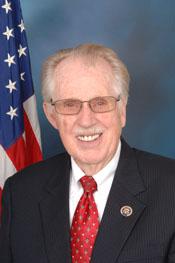
I would like also to refer back to comments that my good friend Dan Burton made that so little is known about us here. We kind of appear here, Madam Speaker, almost as if we were the products of spontaneous generation and there we are in front of the microphone and a million, a million and a half people out there are watching us. Just who are we? So I thought I would spend just a moment doing what I probably should have done 20 years ago and kind of introduce myself.
I was born in 1926. If you are doing some quick math, yes, that means I'm in my 87th year. Our family hardly knew that there was a Great Depression. We were just as poor before the Depression as we were during the Depression.
I was the first member of my immediate family to graduate from college. I wanted to be a medical missionary, and so I was studying theology and I was taking science courses so that I could go to med school. And I had a really, really good science teacher, and I took all of the courses he offered and enough more so that when I graduated from college, I not only had a degree, a major in the Bible and a minor in homiletics--that's a degree in theology--I also had a major in biology and a minor in chemistry. And I had decided not to go to medical school, and I wanted to go into the ministry; but I was 21 years old and I looked 17 and I wasn't married, and you don't have a big, immediate, bright future in the missionary looking 17 and not being married and so they advised me to occupy myself until I got older and got married.
And so I went to graduate school, and I got a master's and a doctorate and
committed myself to being a very serious basic researcher. I taught medical school for 4 years. I worked at the National Institutes of Health. I went to a lot of professional scientific meetings. I have about 50 papers in the basic scientific literature.
And then I had kind of a strange twist to my career when I went as a basic researcher to the School of Aviation Medicine at Pensacola, Florida. They had some problems that I thought I could solve. I was a farm boy. I live on a farm now; I've always lived on a farm. You kind of learn to make do. I thought I could fix some of the problems they had. That resulted in the awards of 19 military patents as a result of fixing some of those problems that they had.
That started a career of working 20 years for the military. I should mention that I returned to my basic first love and that was teaching, and I taught for another 20 years. Also, my wife and I ran a home construction business. Congressman Ben Cardin said Roscoe was green before it was cool to be green. I was building solar houses back in the late seventies and early eighties and selling them for, I remember, as much as 17 percent interest.
Then I was retired for 5 years, and I ran for Congress. I tell you, there's nothing I have done that has given me the fulfillment and the satisfaction as serving the constituents of the 6th Congressional District of Maryland. For 20 consecutive elections, 10 primaries and 10 general elections, they returned me to the Congress. I want to thank my constituents very much for that vote of confidence. That was really largely due to the fact that I had such an incredible staff that did a really good job of making me look good in spite of all of my limitations and frailties.
Most of my commitment in the Congress has been in the Armed Services Committee. You can only have one chairmanship here. And for the last dozen years or so, those chairmanships have been in Armed Services. I shared leadership of one of those subcommittees, the one that has responsibility for the Navy and the Marine Corps, with my good friend Gene Taylor from Mississippi. I was his chair for 4 years and then he was my chair when we changed leadership here in the Congress for 2 years. We are term limited on our side of the aisle, so I had to leave that subcommittee.
But while I was there, Gene and I changed the course of our Navy for the future. In the future, all of our major surface combatants will be nuclear. It didn't make any sense to us that our aircraft carriers, which are nuclear and fueled for 30 years, cannot function without their escort ships that are fueled for about 5 to 7 days. And if there are no tankers out there to refuel them, our aircraft carriers cannot function. That didn't seem to make any sense to us, and so we pushed and finally got it through. Our future Navy major surface combatants are going to be nuclear.
We also had responsibility for the Marine Corps, as I mentioned, and the IEDs and MRAPs; and I was honored to work with my friend, Gene Taylor, and we shepherded the MRAPs and its development--$47 billion. It saved a lot of lives in the most asymmetric war in the history of the world.
I thought I might spend the few moments that remain kind of looking back at those times I've come to the floor. I came here to talk about four different things in Special Orders, and I thought I might spend just a few moments talking about those things.
I probably got more calls in our office about a talk that I have given here probably four or five times. I called it ``What Made America Great.'' What I was trying to do was to go back and look at our history, to refute two big lies that are out there in our land. One of those is that our Founding Fathers were largely atheist and deist and they wanted to set up a country that was devoid of religion.
If you look at our history books, of course, that isn't true. What I did in that talk was simply go back to our Founding Fathers and look at their statements. I went back to our early Congress and looked at what they did, like buying 20,000 copies of the Bible to give out to our early constituents; like sending, paying for missionaries to go to the American Indians for 100 years. Our Congress did that.
And then I looked at our Supreme Court. Until they made that big decision about three-fourths through the history of our young country, they were devoutly supportive of religion. A case came to the Supreme Court about using the Bible in schools, and they said: Why shouldn't you use the Bible in our schools? Where else can you find so clear a definition of what is right and what is wrong?
And then I went to our schools and the ``McGuffey Reader.'' Some of our schools went back to that because we were graduating kids from college who couldn't read their own diploma. And so in desperation, they looked at, gee, what did work when our kids graduated from school and could read. The ``McGuffey Reader'' was one of those. He makes no apology. He quoted more often from the Bible than any other source.
One of our Founding Fathers was Benjamin Franklin, and some others, like Thomas Jefferson, were said to be deists. Now, what is a deist? A deist is someone who believes there is a God. They believe He created you, but He also set in motion some laws, and don't bother praying to Him because your destiny is going to be determined by how you relate to those laws.
I'm going to give a quote, not an exact quote, but pretty close to what Benjamin Franklin said, and let you decide if you think he was a deist or not. It was in Philadelphia. The Constitutional Convention was deadlocked. They might not get a Constitution. Benjamin Franklin, I believe, was the oldest member of that delegation, probably the most respected Governor of Pennsylvania.
And he rose to speak, and this is what he said:
I'm an old man. I've lived a long time. And the longer live
the more certain I am that God controls in the affairs of
men. If a sparrow cannot fall to the ground without His
notice, can a nation rise without His aid?
And then he went on to say:
I move that, henceforth, we begin each of our meetings with
prayer.
That started a precedent. I know that the 10 Commandments are coming down from the walls of the courthouse, and I know the nativity scene is disappearing from the public square. You still see it here, ``In God We Trust.'' And we begin each of our meetings here with prayer, and they do the same thing in the Senate on the other side of this building.
We've probably got more responses in our office to that talk, what made America great, and it's easy to refute those two great lies. Our Founding Fathers were Christians. They wanted to set up a Christian nation, and that First Amendment is very simple, very simple.
You know, they came here, most of our Founding Fathers came here to escape two tyrannies: the tyranny of the church and the tyranny of the crown. If you think about it, they all came from countries that had a king or an emperor, and so there was the tyranny of the crown.
If you also think about it, there was a state church. In England, it was the Episcopal Church; on the continent, it was the Roman Church. And those churches could and did oppress other religions, so they came here and they didn't want that to happen in their country.
And so they said something very simple and very straightforward, that they'd make no law respecting an establishment of religion. The state cannot establish a religion; otherwise, leave men free to worship as they please.
I have no idea how that's gotten warped into this idea that you can't be religious, that government has to be totally separated from religion.
By the way, that clause is in the Constitution. The separation of church and state, it's in the Constitution of the USSR. It's not in our Constitution.
Well, the second thing I came here to the floor to talk about when the debate was raging was the ethical embryonic stem cell procurement. Remember when George Bush came to office, there was a lot of research in stem cells, and we'd been using adult stem cells, but experts in the area--and I'm probably the only Member of Congress who has had a degree in advanced embryology, and so I knew a little bit about embryonic stem cells. And the experts all believed that there ought to be more usefulness of embryonic stem cells than
adult stem cells simply because they're totipotent; they will develop into anything and everything the body needed. An adult stem cell that's already kind of differentiated, you're somewhat limited in what you can do with it.
But to get these embryonic stem cells, they were destroying the embryo. Now, every year there's something like 40,000 embryos that are just discarded because the owners don't want them anymore and they won't pay for keeping them. They're frozen in liquid nitrogen, and so they're discarded.
And the argument was you can take one of these discarded embryos, it's going to be discarded anyhow, and you can crush it and you can get the stem cells from it. But before you do that, you look at it under the microscope, and there you see it, living tissue. Gee, that might be the next Albert Einstein.
When you're talking about them collectively, 40,000, it's easy just to say they're going to be discarded; when you're looking at that one under your microscope, a unique human being if you just give it the chance to be implanted and to grow in the womb.
But I knew that we could get cells from these early embryos and not hurt the embryo. How did I know that? How was I so sure of that? Well, you can take half the cells from an early embryo and it goes on to develop a perfectly good child, infant. How do I know that? Because the other half of those cells went on to produce another perfectly good twin.
In every case of twins that you see, identical twins that you see, half of the cells were taken from the embryo, and the other half went on--the Chairman of the President's Commission on Ethical Embryonic Stem Cells was an identical twin, and I asked him if he felt any less of a person because he was only half a person, because he's only half the embryonic cell. It's a perfectly silly question, of course. But then he said, Gee, that is a silly question, isn't it?
And I said, But that's what people are saying; if you are going to take a cell or two from an early embryo, somehow it's going to be less of a person when it develops.
I worked 5 years, nearly 6 years with the White House, with the Council of Catholic Bishops, with the right-to-life community, and we developed a bill that was passed unanimously in the Senate, and it failed on a technicality in the House. It came up on suspension. It got way more than half the votes, but not two-thirds of the vote.
So Bush gave it the effect of law because he supported it by making it an executive order. And the first executive order of this administration, the hand had hardly come off the Bible when our new President reversed that executive order. Had it become law--
And people ask me what was the greatest disappointment of my 20 years, and that was that my bill passed unanimously by the Senate couldn't have become law because it would still be because you would have to overcome a veto, and we would not have two-thirds of the votes to do that.
Well, a third thing that I came here to the floor to talk about was electromagnetic pulse. I had no idea when I first learned about this, but I called my friend Tom Clancy, because I knew that he had written a book where this was a scenario in his book, and he does really good research. So I asked him about EMP. He said, If you read my book, you know all that I know about it. Let me refer you to the smartest man hired by the U.S. Government.
That's a tall order because we hire a lot of people, but in his view, that was a Dr. Lowell Wood from Lawrence Livermore. And this was pre- cell phone days. Remember the pagers?
I paged Lowell Wood. He was supposed to be in California, Lawrence Livermore. Went up to the satellite and down, and he was within Washington and he got it, and within an hour he was sitting in my office.
Well, an electromagnetic pulse, we have only one brief experience with it in our country, and that was in 1962 in Johnston Island and the Starfish Prime, the only time we ever detonated a weapon above the atmosphere and we had no idea what would happen. It produced an electromagnetic pulse that caused a lot of disturbances in Hawaii, which was about 800 miles away.
The Soviets had a lot more experience than we. They actually developed, designed--we designed but never built them--an enhanced EMP weapon, a single, large nuclear--oh, I shouldn't say that because it doesn't have to be a large bomb because it could be a relatively small bomb that is EMP-enhanced.
A single appropriate bomb detonated 300 miles high over Nebraska or Iowa would blanket our whole country, and if the EMP radon was robust enough, it would essentially fry all of our microelectronics. The grid would be down for a year or more, and your car wouldn't run. And there have been a couple of books written on that subject. One I would recommend that's an easy read and a very well-researched book--and I commend Newt Gingrich, he brought the author to my office, and he mentioned this on the campaign trail.
Thank you, Newt.
This is Bill Forstchen's book called ``One Second After.''
I came to my office one day and there was a big book on my desk and there was a handwritten note in it. It was from a Dr. Lowrie. He was retired, a Ph.D. electrical engineer in his hospital room recovering from cardiac surgery, and he was surfing the television and he happened on C-SPAN and I was giving one of the half dozen talks that I've given on EMP, and he listened to it and got turned on and did a lot of research and wrote a book, about 700 pages.
I didn't think I could read a novel that long. It was so captivating. I read it, and it's called ``The Satan Legacy.'' The Satan was a big SS-18. It was one of the Soviet missiles with 10 nuclear warheads. And the story had one of them missing when they transferred from the Ukraine to Russia.
Now we know that several other things could also bring down the grid.
Oh, by the way, as a result of my work on EMP, we now have a permanent EMP task force in the Pentagon looking at our preparedness militarily. We have the EMP Commission, which functioned for four terms, that is 8 years. They have written classified and unclassified reports, and I would recommend that you get one of their unclassified reports.
But now there are several other things that could also bring down the grid. One of those is cyber. This is a whole new warfare that we've been in, and we hardly knew about it, but there it was raging. An appropriate cyberattack could bring down our grid.
And something that will bring down the grid--this is not an if, this is a when--and that's a giant solar storm. The only question is when will the next one come. And if we are not prepared for it--and we are not now--and if we do not prepare for it, it will bring down the grid.
And McClelland, the top person in that part of FERC, sat in my office and said that the grid would be down for a year and a half to 2 years.
That's a very long time to hold your breath. And there's another thing that could bring down the grid, and that is a terrorist attack. If you knew what the important substations were and you know which insulators to take out, it wouldn't take more than a dozen or so people with a .22 rifle.
Now why, when the grid goes down, can't you bring it back up? That's because in all of these instances, there's going to be surges of electricity that blow the major transformers. They simply won't melt down. We have a few spares, but a very inadequate number of spares. We don't make them in our country. You just order them. There's none available to order, by the way. You order one and they will build it for you. And it takes a year, year-and-a-half to 2 years to build one. And we don't build them in our country.
So I'm pleased that my efforts--which I started here on the floor talking about EMP--have resulted in a recognition that this is something we really need to deal with.
There's a fourth thing that I came to the floor to talk about, and I will spend the last few minutes of our time here together this evening talking about that, and that is energy. I have been to the floor, I think, 52 times; and most of those times I came here, I talked for a full hour. I was talking about not just energy generically, but a specific type of energy, and that is liquid fuels. Because when you're talking about energy, we really do have to separate liquid fuels from the other major carrier
of energy. It's not energy. It's the way you carry energy. That's electricity.
We shouldn't have any deficit of electricity with more nuclear power plants. Yes, they are safe. We've never lost a person operating them. With more wind machines, with more solar, with more micro-hydro, with more true geothermal, we need another word for these heat pumps that are looking not at the zero cold and trying to heat that up. It's like trying to make it colder to heat your house up in the wintertime or trying to heat up hot air to make your house cooler in the summertime.
If you're looking at 56 degrees here, that's a whole lot more efficient. We call that geothermal. We've got to have another word for that, because true geothermal is tapping into the molten core of the Earth. That, for all practical purposes, is infinite and will be there for a very, very long time. With these sources, we can produce all the electricity that we would like to produce, but that is not true of liquid fuels. They are finite.
One of the first people to recognize that--and he was for several years a pariah and then he became an icon--his name was M. King Hubbert. He gave what I think will be recognized as the most important speech of the last century. I believe that speech was the 8th day of May in 1956. And he gave that speech in San Antonio, Texas. He was an oil geologist. He gave it to a group of oil people.
As you look back in your history books, you will find that at that time we were king of oil. We produced more oil. We used more oil. We're still doing that. We're using more oil than anybody else. And we sold more oil and exported more oil than any other country in the world. And M. King Hubbert told them something that was just audacious and seemingly ridiculous. He said, Notwithstanding the fact that we are so big in oil today, in just 14 years the United States will reach its maximum oil production. And no matter what you do after that, oil production in the United States will go down.
How can he make that kind of a prediction? He made it because when he looked at an individual oil field, he saw that the exploitation of that field produced kind of a bell curve. Sometimes a little distorted bell curve, but kind of a bell curve. When you first started pumping, it really came out. And then you reached a peak and then it was harder and harder to get it out until finally it tailed off and you'd gotten all you could out of the well.
So he rationalized that if he could add up all the little fields in the United States, he could get all the little bell curves and you get one big bell curve. When he did that, it reached its maximum in 1970. And so he made that prediction in 1956. Right on schedule, in 1970, we reached our maximum oil production. And no matter what we've done since then, like building more oil wells in all the rest of the world put together, for instance, today we produce about half the oil we produced in 1956.
The second speech--and I don't know if these two men even knew each other--was given by Hyman Rickover just about a year later. It was the 14th day of May, 1957. It was a speech given in St. Paul, Minnesota. And you can pull this one up. It was lost until a few years ago. Just Google for Rickover and energy speech and it will come up. I think you will agree with me that it was probably the most insightful speech in the last century.
And in it he noted that oil is finite. He said in the 8,000--I didn't think it was that long; those are his numbers--in the 8,000-year recorded history of man, the age of oil will be but a blip. We're behaving as if it's going to be forever. He called it this ``Golden Age.'' Please, please Google for Rickover and energy speech and pull it up. I think you'll be fascinated by the speech.
One of the things he said in it was how long it lasts is important in only one regard: the longer it lasts, the more time we'll have to plan an orderly transition to other sources of energy. That's not quite what we're doing. And I'm not sure that he would agree that drill, baby, drill is an orderly transition to other sources of energy.
I have just two charts of the probably hundred-or-more charts that I've used from time to time in talking about this subject--and the subject is peak oil.
Let me show you these two charts. This is a chart that ends in 2008, and it has the oil production followed by the two major entities in the world that have the most credibility in this--the EIA, the Energy Information Administration, and the IEA, the International Energy Association, which is a creature of the OECD in Europe. And these were their two curves. You see they're leveling out up there. The headline was: ''Peak Oil: Are We There Yet?''
And I want to show you another chart. And you can not find these curves anymore. They were kind of disquieting, and they're taken down from the Web site. These are the curves put up by the IEA, International Energy Association. Here we're following the production of oil. You can go back here--way, way back for hundreds of years. Every time we needed more, we could produce more oil.
The different colors here, natural gas, liquids on top--they have that growing. That will grow. Nonconventional oil, that's from the oil shales. That's growing. That will grow. The dark red there really should be a part of the blue down here. It's just enhanced oil recovery, squeezing a little more out of the fields we're pumping from, like putting live steam down there and CO2 and so forth to force it out. This is the fields we're now pumping, and they're admitting that we're reaching peak oil, plateau here, because they have them tailing off.
Now, this chart was done in 2008, and the one below it was done in 2010. I'll come to that in just a moment.
In order to keep the total liquids going up, you notice what they've done is projected two huge fields here, that by 2030 they said a fourth of all the liquids we're getting, only a fourth of it will come from the fields we're now pumping, that three-fourths of it will come from something else. And half of the total is going to be from fields that we're not getting anything from now. That's a pretty tall order.
Then, in 2010 they did this other curve down here, and they have reversed the two on top here. And different colors. But they're the same thing. And they've included the dark red here down with the oil fields that we're now pumping. And notice this goes to 2035. Up here, by the way, they were going to peak at 112 million barrels a day. Now we're stuck at 84 million billion barrels for 5 years. They have it going up to 112. Two years later, reality is setting in. Now it goes up to only 96. And they go out 5 years further to 2035. Notice the precipitous drop-off in the fields that we're now pumping.
Now, we have some irrational exuberance, as Alan Greenspan would define it, in our country about our ability to get some additional gas and oil out of things like the Marcellus shales and the fields out in the West by horizontal drilling and fracking; and these are represented in these two curves here. I think that one can say, in analyzing history, with considerable confidence that these two wedges here will not occur. By the way it's 600,000. It sounds like a lot, doesn't it? 600,000 barrels.
We use 84 million barrels a day. In 11 or 12 days, we--the world--use a billion barrels of oil. So if we're getting 600,000 from the Bakken oil fields out in the West, that's almost literally a drop in the bucket, isn't it?
I'd just like to close, this last chance probably that I have to come and chat with you here on the floor. It's been a huge honor to represent 660,000 people in the First District of Maryland, to come here to the Congress to talk to maybe a million, a million and a half people listening to us out there. Thank you, constituents, for this honor. Thank you for listening.
I yield back the balance of my time.