To allow Medicare beneficiaries who are enrolled in fallback plans to remain in such plans for two years by requiring the same contracting cycle for fallback plans as Medicare Prescription Drug plans.
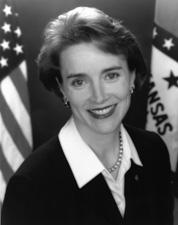 Sen. Blanche L. Lincoln (D-AR)
Legislative Activity
Stay on top of the latest movement without scrolling through every action
Senate amendment submitted
June 24, 2003
View full timeline
Senate amendment submitted
June 24, 2003
Senate amendment proposed (on the floor): Amendment SA 1002 proposed by Senator Lincoln.(consideration: CR S8390-8392, S8393-8394, S8408-8409; text: CR S8390)
June 24, 2003
Roll call votes on amendments in Senate: Motion to table amendment SA 1002 agreed to in Senate by Yea-Nay Vote. 51 - 45. Record Vote Number: 238.
June 24, 2003
Amendment SA 1002 proposed by Senator Lincoln. (consideration: CR S8390-8392, S8393-8394, S8408-8409; text: CR S8390) To allow Medicare beneficiaries who are enrolled in fallback plans to remain in such plans for two years by requiring the same contracting cycle for fallback plans as Medicare Prescription Drug plans.
June 24, 2003
Motion to table amendment SA 1002 agreed to in Senate by Yea-Nay Vote. 51 - 45. Record Vote Number: 238.
June 24, 2003
Votes
1 roll call on this amendment
Text
Proposed
PRESCRIPTION DRUG AND MEDICARE IMPROVEMENT ACT OF 2003

The ACTING PRESIDENT pro tempore. Under the previous order, the
Senate will resume consideration of S. 1, which the clerk will report.
The legislative clerk read as follows:

A bill (S. 1) to amend title XVIII of the Social Security
Act to make improvements in the medicare program, to provide
prescription drug coverage under the medicare program, and
for other purposes.

Pending:

Graham (FL) amendment No. 956, to provide that an eligible
beneficiary is not responsible for paying the applicable
percent of the monthly national average premium while the
beneficiary is in the coverage gap and to sunset the bill.
Kerry amendment No. 958, to increase the availability of
discounted prescription drugs.
Lincoln modified amendment No. 934, to ensure coverage for
syringes for the administration of insulin, and necessary
medical supplies associated with the administration of
insulin.
Lincoln amendment No. 935, to clarify the intent of
Congress regarding an exception to the initial residency
period for geriatric residency or fellowship programs.
Lincoln amendment No. 959, to establish a demonstration
project for direct access to physical therapy services under
the Medicare Program.
Baucus (for Jeffords) amendment No. 964, to include
coverage for tobacco cessation products.
Baucus (for Jeffords) amendment No. 965, to establish a
Council for Technology and Innovation.
Nelson (FL) amendment No. 938, to provide for a study and
report on the propagation of concierge care.
Nelson (FL) amendment No. 936, to provide for an extension
of the demonstration for ESRD managed care.
Baucus (for Harkin) amendment No. 967, to provide improved
payment for certain mammography services.
Baucus (for Harkin) amendment No. 968, to restore
reimbursement for total body orthotic management for
nonambulatory, severely disabled nursing home residents.
Baucus (for Dodd) amendment No. 969, to permit continuous
open enrollment and disenrollment in Medicare Prescription
Drug plans and Medicare Advantage plans until 2008.
Baucus (for Dodd) amendment No. 970, to provide 50 percent
cost sharing for a beneficiary whose income is at least 160
percent but not more than 250 percent of the poverty line
after the beneficiary has reached the initial coverage gap
and before the beneficiary has reached the annual out-of-
pocket limit.
Baucus (for Cantwell) amendment No. 942, to prohibit an
eligible entity offering a Medicare prescription drug plan, a
Medicare Advantage organization offering a Medicare Advantage
plan, and other health plans from contracting with a pharmacy
benefit manager (PBM) unless the PBM satisfies certain
requirements.
Rockefeller amendment No. 975, to make all Medicare
beneficiaries eligible for Medicare prescription
drug coverage.
Rockefeller amendment No. 976, to treat costs for covered
drugs as incurred costs without regard to whether the
individual or another person, including a State program or
other third-party coverage, has paid for such costs.
Akaka amendment No. 980, to expand assistance with coverage
for legal immigrants under the Medicaid Program and SCHIP to
include citizens of the Freely Associated States.
Akaka amendment No. 979, to ensure that current
prescription drug benefits to Medicare-eligible enrollees in
the Federal Employees Health Benefits Program will not be
diminished.
Pryor amendment No. 981, to provide equal access to
competitive global prescription medicine prices for American
purchasers.
Bingaman amendment No. 984, to carve out from payments to
Medicare+Choice and Medicare Advantage organizations amounts
attributable to disproportionate share hospital payments and
pay such amounts directly to those disproportionate share
hospitals in which their enrollees receive care.
Bingaman amendment No. 972, to provide reimbursement for
federally qualified health centers participating in medicare
managed care.
Bingaman amendment No. 973, to amend title XVIII of the
Social Security Act to provide for the authorization of
reimbursement for all Medicare Part B services furnished by
certain Indian hospitals and clinics.
Baucus (for Edwards) amendment No. 985, to strengthen
protections for consumers against misleading direct-to-
consumer drug advertising.
Baucus (for Lautenberg) amendment No. 986, to make
prescription drug coverage available beginning on July 1,
2004.
Murray amendment No. 990, to make improvements in the
Medicare Advantage benchmark determinations.
Harkin amendment No. 991, to establish a demonstration
project under the Medicaid Program to encourage the provision
of community-based services to individuals with disabilities.
Dayton amendment No. 957, to provide that prescription drug
benefits for any Member of Congress who is enrolled in a
health benefits plan under chapter 89 of title 5, United
States Code, may not exceed the level of prescription drug
benefits passed in the 1st session of the 108th Congress.
Dayton amendment No. 960, to require a streamlining of the
Medicare regulations.
Dayton amendment No. 977, to require that benefits be made
available under Part D on January 1, 2004.
Baucus (for Stabenow) amendment No. 992, to clarify that
the Medicaid statute does not prohibit a State from entering
into drug rebate agreements in order to make outpatient
prescription drugs accessible and affordable for residents of
the State who are not otherwise eligible for medical
assistance under the Medicaid Program.
Baucus (for Dorgan) amendment No. 993, to amend title XVIII
of the Social Security Act to provide for coverage of
cardiovascular screening tests under the Medicare Program.
Grassley amendment No. 974, to enhance competition for
prescription drugs by increasing the ability of the
Department of Justice and Federal Trade Commission to enforce
existing antitrust laws regarding brand name drugs and
generic drugs.
Durbin amendment No. 994, to deliver a meaningful benefit
and lower prescription drug prices.

The ACTING PRESIDENT pro tempore. The Senator from California.
Mrs. BOXER. Mr. President, I ask unanimous consent the pending
amendments be set aside.
The ACTING PRESIDENT pro tempore. Is there objection?
Hearing none, it is so ordered.

Amendment No. 1001

Mrs. BOXER. Mr. President, I send an amendment to the desk and ask
for its immediate consideration.

[[Page S8387]]

The ACTING PRESIDENT pro tempore. The clerk will report.
The legislative clerk read as follows:

The Senator from California [Mrs. Boxer], for herself and
Ms. Mikulski, proposes an amendment numbered 1001.

Mrs. BOXER. Mr. President, I ask unanimous consent that reading of
the amendment be dispensed with.
The ACTING PRESIDENT pro tempore. Without objection, it is so
ordered.
The amendment is as follows:

(Purpose: To eliminate the coverage gap)

On page 49, strike line 3 through page 50, line 2 and
insert the following:
``(2) Limits on cost-sharing.--
``(A) In general.--The coverage has cost-sharing (for costs
above the annual deductible specified in paragraph (1) and up
to the annual out-of-pocket limit under paragraph (4)) that
is equal to 50 percent or that is actuarially consistent
(using processes established under subsection (f)) with an
average expected payment of 50 percent of such costs.
``(B) Application.--Notwithstanding the succeeding
provisions of this part, the Administrator shall not apply
subsection (d)(1)(C) and paragraphs (1)(D), (2)(D), and
(3)(A)(iv) of section 1860D-19(a).

Mrs. BOXER. Mr. President, I offer this amendment in the true spirit
of making this bill work, making it a bill that isn't confusing for our
seniors, a bill that doesn't cause a hardship, as the existing bill
does, for those who are the sickest.
In this amendment I have the support not only of several colleagues
but of the AARP, which very strongly supports it. As you know, they
have been choosing their amendments very carefully. Also we are
supported by the National Committee to Preserve Social Security and
Medicare. So we have both the largest senior citizen organizations
backing this amendment.
I was proud to give the national Democratic radio address on
Saturday. I did it on this particular issue. The issue I will be
addressing through this amendment is ending the benefit shutdown that
occurs in this bill just at a point in time when seniors need their
benefit the most. I will explain it because it isn't that complicated
once you explain it.
Let me take a step back and say the best thing about the bill before
us is it starts a Medicare benefit prescription drug benefit for our
seniors. We have been talking about this for years. We have been
pushing it for years. Since Medicare was created 38 years ago, seniors
have been waiting for a prescription drug benefit. I must say, the
older I get the more I realize the revolution we have seen in medicine,
one that is now one of prevention. If one takes a high blood pressure
medicine, if one can't control it any other way, it becomes absolutely
a lifesaving benefit. If one doesn't do that or one can't afford to do
that, the chances of stroke or heart disease go up immeasurably. So the
best thing about the bill before us is that it begins something so many
of us have fought for so long.
Unfortunately, the plan is wanting. The plan needs to be improved. It
is very complicated. I have read this from a Senator on the Republican
side. I heard from a Senator on the Democratic side:

No one really understands this.

That was a reference to Senators. I have a handle on what this bill
does. I have had to work; I have had my staff work. I am fortunate to
have a good staff. I have talked to my colleagues. But if it took me so
long to figure this out, what will it do to our people.
One of the improvements we should make is this amendment I offer. I
want to explain exactly what I mean when I say a benefit shutdown. It
has been called a number of things--a coverage gap, a donut hole. But a
benefit shutdown really explains it because here is what happens. You
are going about your business. You are paying your premium. You are
getting your 50-percent benefit after you pay your deductible. And
bingo, you hit a certain point and what happens? No more benefit.
I have studied 100 different plans that offer a benefit. Ninety-nine
of them don't have any of this. One of them has this, but it is a very
rich plan and the benefit shutdown is very small. So this is the only
plan I have ever seen in existence that has this ridiculous benefit
shutdown. I don't understand why it happened, but I guess the bill was
a compromise so that is why we have it.
Let me explain what it means. I will show a couple of charts to you.
After a senior pays $275 in a deductible, they start getting 50 percent
of the cost of the drug reimbursed. So it is a 50-percent benefit, once
you have paid your deductible. By the way, every month you have at
least a $35 premium.
Now all of a sudden, you get to $4,500 worth of drugs and your
benefit shuts down and the next $1,300 you have to pay out of your own
pocket. I know the State of the Presiding Officer is not much different
from mine in the sense that our seniors are mostly low income. Many of
them are living on their Social Security checks, maybe a little more,
but since the market went down, many of them are relying on their
Social Security checks. For them to have to pay $1,300 right in the
middle of a year is absolutely outrageous. That is why AARP is
supporting my amendment. They sent out a letter on my amendment.
I ask unanimous consent to print the letter in the Record.
There being no objection, the material was ordered to be printed in
the Record, as follows:

American Association

of Retired Persons,

Washington, DC, June 19, 2003.
Hon. Barbara Boxer,
U.S. Senate,
Washington, DC.
Dear Senator Boxer: AARP supports your amendment to close
the coverage gap that exists in the drug benefit design of S.
1.
Throughout the debate over a Medicare prescription drug
benefit, AARP has voiced our members' concerns about the need
for affordable and adequate coverage. Chief among these
concerns continues to be the existence of a gap in the
benefit. We appreciate the efforts made by the Finance
Committee to close the gap and we believe the Senate should
finish the job.
AARP members find the notion of a gap in coverage to be a
major barrier to enrolling in a Medicare drug benefit. They
tell us that they are unaware of similar features in any of
the insurance products they routinely purchase. Our members
do not understand why coverage would cease at a time when
their drug expenses increase. The continued existence of this
benefit gap threatens the workability of the benefit by
jeopardizing adequate enrollment, and thus the program's
ability to spread risk. Therefore, we urge the Senate to
eliminate this coverage gap.
Thank you for your leadership on the issue. We look forward
to working with you and other members of the Senate to enact
a prescription drug benefit that will provide meaningful
relief to current and future Medicare beneficiaries.
Sincerely,
William D. Novelli.

Mrs. BOXER. I will read it. That is why they said I could mention on
the national radio address that they support my amendment--a $1,300
cost after you hit $4,500.
Let's take the case of someone who has $7,000 a year in drug costs--
and many people do. Their estimated annual premium? At least $420,
maybe a little more. Their deductible? $275. They pay 50 percent of the
cost of their medication, $2,113, until they get to $4,500. Now comes
the benefit shutdown where they have to pay 100 percent of the cost
between $4,500 and $5,812. It is actually $1,312. Then they get a good
catastrophic benefit where they pay 10 percent. Look at what the senior
is paying for this benefit: $4,239 out of a $7,000 bill.
The point is, because of this benefit shutdown and the huge penalty,
a lot of our senior citizens would get a better drug benefit if they
went to Canada and bought their drugs. This is a fact. They would be
better off if they went to Canada and bought their drugs. But we can
fix it today. We can end this benefit shutdown, and then the benefit
will be far better.
Another way to look at the benefit shutdown is to see how unfair it
is to our beneficiaries. You are paying your monthly premium every
single month; $35 is what we are suggesting. But it could go up. We
haven't reined in what they could charge you. Anyone who has dealt with
insurance companies and HMOs knows that costs go up. Even Medicare has
had to raise its costs a little bit. But by the way, because Medicare
administrative costs are so low, at 3 percent, compared to these
companies which could be as high as 25 percent, Medicare keeps the
costs down. But under this bill, you only get Medicare if you can't get
a private company. So I am telling you, we are going to have seniors
maybe facing increases in their premiums. But let's give it a shot.
Let's say it is only $35. It is $35 a month every single month. And
guess what happens in October, if you have this kind of $500-a-month
expense--just to use that as an example--you do not get that benefit
for almost 3 months out of the year.

[[Page S8388]]

What kind of plan is this? Fortunately, it is voluntary so people
have to think long and hard if it makes sense for them to do it. And I
will give credit where credit is due. For our lowest income people, it
may be a decent deal. But for your average recipient, to have to
explain why they get no benefit for 3 months puts us in a terrible
situation. It harkens back to the days when we did a catastrophic
benefit and seniors took it. Then when they realized what it was, they
were so angry, they were just throwing themselves on legislators'
automobiles to protest. I am not kidding. This happened.
I don't want to see that happen. I want to see us do a good bill, one
that is really straightforward, not confusing. So we have a real
problem for our vulnerable citizens.
The last chart I am going to show is this chart because I said I
would read to you from AARP's letter that they sent me. I hope
colleagues will listen to what they say:

AARP members find the notion of a gap in coverage to be a
major barrier to enrolling in a Medicare drug benefit. They
tell us that they are unaware of similar features in any of
the insurance products they routinely purchase. Our members
do not understand why coverage would cease at a time when
their drug expenses increase. The continued existence of this
benefit gap threatens the workability of the benefit by
jeopardizing adequate enrollment, and thus the program's
ability to spread risk. Therefore, we urge the Senate to
eliminate this coverage gap.

Mr. President, that is exactly what my amendment does. Let me go
through this one argument at a time.

AARP members find the notion of a gap in coverage to be a
major barrier to enrolling in a Medicare drug benefit.

Well, clearly, Mr. Novelli and the AARP understand the fact that you
have a barrier when you know that perhaps for 3 months, even though you
are paying your premium, you get no benefit. Again, we have studied all
the plans. Virtually no plan in America has a benefit shutdown. So
let's make this bill better.
Let's see the next thing AARP says:

They tell us that they are unaware of similar features in
any of the insurance products they routinely purchase.

Absolutely. Only in the Congress could somebody come up with this way
to save money. It is ridiculous. You are penalized if you are really
sick. You are penalized if you are really sick because if someone gets
cancer and has to buy very expensive drugs, or a family member gets
Alzheimer's and they are trying to treat the disease in a way so they
can have their loved one around longer, that is when they get hit with
a benefit shutdown. How unfair is that?

Our members do not understand why coverage would cease at a
time when their drug expenses increase. The continued
existence of this benefit gap threatens the workability of
the benefit by jeopardizing adequate enrollment, and thus the
program's ability to spread risk.

What does that mean? It means that as seniors learn what this program
is about, they may well come to the conclusion, depending on the size
of their drug bill, that they are better off making a trip to Canada.
They will save more than going through all the rigmarole--Senator
Clinton showed on a chart the rigmarole you have to be involved in, and
because the way the bill has tried to really privatize this benefit,
you are at the risk of the marketplace. The risk of the marketplace is
OK when you are buying a car; it is OK if you are buying a dishwasher.
You are at the risk of the marketplace. Yes, if it was a year when
people held back and didn't produce a new product, OK, you are
disadvantaged; OK, that is the risk. But to put seniors at the risk of
the marketplace for drugs is a very bad idea indeed.

Therefore, we urge the Senate to eliminate this coverage
gap.

This letter is signed by William Novelli, executive director and CEO
of AARP. It is a nonpartisan organization that supports this amendment
strongly. We want to close this gap. We want to stop this benefit
shutdown. Again, a very graphic way to show what happens to you is to
say that seniors will pay half of their annual drug cost from $276 to
$4,500--that is their 50 percent benefit--and then they face a $1,300
benefit shutdown, just at the time they need their medicine the most.
It makes no sense.

You know, $1,300 may not sound like a lot to some of our Senators
here. We get good pay and, by the way, we have a pharmaceutical benefit
in our health plan. It is a very good one. It is an excellent one. You
know what. It doesn't stop when you hit a certain level. Our
pharmaceutical benefit just keeps on going. It just keeps on coming, as
do pharmaceutical benefits in practically all the plans in America
today.
Just think about the administrative overhead to figure this one out.
You are going along and, all of a sudden, this red arrow kicks in:
Stop. I want to know how much it is costing us to administer this kind
of deal. You can imagine, you get a note in the mail. Your benefit
stops. You have paid $4,500. You go back and check your records. No, I
didn't, I have only paid $4,200. You call up the administrator: You
have made a mistake. Well, no, I didn't. Well, yes, you did.
How many hours will a senior who is confused and upset have to spend
on the phone? How many hours will an administrator have to spend
working on the details of this? Too long, I can tell you that.
This plan, as it is before us, if this amendment doesn't pass, pulls
the rug out from underneath the people who are going to need the help
the most. So if we are in this in order to offer a plan that people
will utilize, then let's support this amendment. It is as simple as
that.
Many seniors take medicines to manage chronic health problems. I
discussed that at the beginning. How wonderful is it that today we can
avoid horrible outcomes by taking pills that will help keep our blood
pressure down, regulate our heart rate, keep our insulin in check--I
could go on and on and on. Some of our seniors are cutting their pills
in half because they cannot afford it. How tragic would it be if, after
they think they are going to have this great benefit, they find out
they could do better going up to Canada and buying the pills because
maybe it comes out to 25 percent when all is said and done, when you
put in the benefit shutdown, the premiums cost, and the deductible. It
just may not add up. How sad it would be if, after all the hoopla we
are associating with this bill, the bill itself is inadequate.
I received a letter from a constituent in San Marcos, CA. She has an
annual prescription drug cost that will top $10,000. Well, she will be
hit with this benefit shutdown.
Another constituent from Indio, CA, told me she has made five trips
to Mexico over the last several years to purchase her prescriptions.
This senior drives all day long to Mexico in order to purchase
affordable heart medicine that she needs to survive, that she needs so
that she can wake up every day and see her grandchildren, and take a
walk, and have a quality of life. She is awaiting a benefit that will
make it easy for her to go down to her corner pharmacy and say: Here is
my card; I am ready to go. But this particular senior is going to be
shocked to find out that if she is in the category of the benefit
shutdown, it is going to cost her $1,300, plus at least $35 a month,
plus a deductible.
A retired physician from Marina del Rey told me that a pill he takes
for heart disease went up 600 percent--from $15 to $85. So for seniors
who have to take an assortment of medicine to manage chronic diseases,
the cost really starts to add up.
I have 4 million senior citizens who are part of the Medicare Program
in my State. If you take the population of Delaware, that is five
Delawares. That is how many senior citizens I have, and they deserve a
break.
Unfortunately, this bill gives them a break, a break in coverage.
Let's close that break in coverage. Let's close that gap, stop the
benefit shutdown, and let's have a bill of which we all can be proud.
Again, this benefit shutdown is unheard of if we look at all the
plans. It would not happen to you, Mr. President, if you have FEHBP. It
will not happen to your wife, your kids, or you. It does not happen to
me. I do not walk in and they say: Oh, Senator, sorry, you are in that
time of the year; gee, just for these 3 months, you do not get any
benefit at all. I guarantee you, if our plan did that, there would be
shouting at the caucus lunches: What kind of plan do we have that we
walk in, in the middle of the year, and somebody tells us we do not
have coverage? We are paying our premium.
We would not stand for it.

[[Page S8389]]

Why are we giving a plan to the seniors we represent that is far
worse than the plan we have? Because we want to give tax breaks for the
wealthy few, and so we cannot afford to do this?
This is not a costly fix. CBO is telling us it is $60 billion out of
a $400 billion bill. Let's figure out a way to pay for it. It is easy.
I can tell you right now the administrative costs in this bill range
from 15 percent to 25 percent. That is $100 billion. Why are the
administrative costs so high? The private sector is doing it, not
Medicare. Medicare has a 3-percent overhead. The private sector has a
10- to 20-percent overhead. Let's take the bill back and figure it out
and close this benefit shutdown.
I do not want to be the Senator who stands up and votes for this with
a smile on my face and then have a senior stand up and say: Senator, I
walked into my pharmacy in October. I have $500-a-month drug expenses,
and guess what, I have no benefit. I had to pay $1,300 out of my own
pocket just when I needed the drugs the most. Why are you doing this to
me? Why don't you do it to yourself?
That is what I hope they say.
I am so happy we are discussing a Medicare drug benefit, believe me.
I share the views of a lot of my colleagues that it is time we have
one, but to have this plan, the only plan in the country virtually that
has a benefit shutdown, is an embarrassment to me. We do not have it in
the Senate plan. They do not have it over in the House, I assure you of
that.
We should not have a benefit that starts and stops. What is really
frosting Senator Graham is that seniors even have to pay a premium
during this benefit shutdown. So he has an amendment--we have not voted
on it yet--that says at least for October, November, and December, do
not charge seniors a premium.
It is the same as if someone walked in a store and said: I want to
buy a TV set, here is my money; I am going to pay it off over 3 months,
here is my money. And they say, thank you very much; you are not
getting a TV set; we will deliver it in 3 months. But you advertised
it. No, you have to pay me 3 months, and then I will send you your TV
set.
In a free market economy, this is a very sick idea. This does not
make any sense. In our society, if you put money down, you pay for a
benefit, you pay for a product, you get it.
I think Bob Graham has a good idea: If you are going to do this to
seniors, then do not make them pay their premium. At least show some
regard for the person.
You are a senior; you are on several drugs; you are feeling good; the
medicine really helps you; you have signed up for the plan; you have
paid your deductible; you start getting your 50 percent benefit; and,
boom, it is over, when you reach $4,500. Your benefit shuts down.

I cannot say it enough. It is unheard of to pay a $1,300 penalty for
sickness. I cannot say it enough.
You have signed up. A few months go by, and you add the costs up in
your head trying to figure out how much your medicine is costing. You
realize you are going to hit the $4,500 benefit shutdown. Your doctor
says you need to keep taking the medicine because you are worse, and he
knows you are worried about entering the benefit shutdown. You are
going to be hit with the full cost of those drugs for that period. What
are you going to do?
You sit down and you crunch the numbers. You ask: How can I cut
costs? You may well skip your medicine; you may well cut the pills in
half; and you may well threaten your health and your life.
The benefit shutdown is wrong. It goes against everything we do in
this country. Nobody else does this. It is not that expensive to fix.
You are going to need a calculator every time you try to figure out
what you have to save. You are going to need a good accountant.
A shutdown is going to cause trouble with the administration of this
benefit. People will be calculating: Gee, Mr. Thomas has used $3,925.
Let's get him on the watchlist. Mrs. Boxer over there, she has used
$4,000. Then suddenly you are cut off. You call up and you do not
understand it. It is going to take hours to explain it to a senior
citizen.
In closing my discussion of this amendment--and I will be asking for
the yeas and nays on this amendment--the National Committee to Preserve
Social Security and Medicare and the AARP, the two biggest senior
citizen organizations in this country, endorse this amendment.
I am to again read from Mr. Novelli's letter because this says it all
in a very clear way, and I hope my presentation has demonstrated that
everything Mr. Novelli, the CEO of AARP, has stated is true:

AARP members find the notion of a gap in coverage--

That is benefit shutdown--

to be a major barrier to enrolling in a Medicare drug
benefit. They tell us that they are unaware of similar
features in any of the insurance products they routinely
purchase. Our members do not understand why coverage would
cease at a time when their drug expenses increase. The
continued existence of this benefit gap threatens the
workability of the benefit by jeopardizing adequate
enrollment and thus the program's ability to spread risk.
Therefore, we urge the Senate to eliminate this coverage gap.

Signed William Novelli, AARP.
I thank the AARP because I know they are calling colleagues and
explaining this. Just remember, do unto others as you would like them
to do unto you. Do my colleagues want to have their drug benefit
changed so that just when they need their pharmaceutical product the
most, they tell you it is not covered for you; it is not covered for
your wife; it is not covered for your husband; it is not covered for
your children? Mr. President, you do not want that. Why are we doing it
to the seniors? At least give them a break and close down this benefit
shutdown because if we do not, if we do not vote for this amendment,
people are going to be at our doors because they are not going to
understand it.
If my colleagues vote for this amendment and we fix this, we can
truly say we have made this a far better plan, a plan more like our
own, a plan more like the other 100 plans I have looked at.
I yield the floor.
I ask for the yeas and nays on the amendment.
The PRESIDING OFFICER (Mr. Graham of South Carolina). Is there a
sufficient second? At this time, there is not a sufficient second.
Mrs. BOXER. I suggest the absence of a quorum.
The PRESIDING OFFICER. The clerk will call the roll.
The assistant legislative clerk proceeded to call the roll.
Mrs. BOXER. Mr. President, I ask unanimous consent that the order for
the quorum call be rescinded.
The PRESIDING OFFICER. Without objection, it is so ordered.
Mrs. BOXER. I renew my request for the yeas and nays on the
amendment.
The PRESIDING OFFICER. Is there a sufficient second?
There appears to be a sufficient second.
The yeas and nays were ordered.
The PRESIDING OFFICER. The Senator from Montana.
Mr. BAUCUS. Mr. President, I ask that all pending amendments be
temporarily laid aside so the Senator from Arkansas can offer an
amendment.
The PRESIDING OFFICER. Without objection, it is so ordered. The
Senator from Arkansas.
Mrs. LINCOLN. I thank the ranking member of the Finance Committee, as
well as the chairman, for their diligence in this very important issue.
I say to my colleagues, I do not think we will be taking up an issue
quite as critical as this one for quite some time when we reflect both
on the economy of our country and the quality of life we want to
provide our seniors in this Nation and, more importantly, when we think
about where our Nation is going in terms of the demographics and the
number of seniors we actually have in this country, going from 41
million Americans over the age of 65 to an explosion in the next 15 to
20 years of almost 70 to 75 million Americans over the age of 65.
In looking at this prescription drug package, I hope we all will look
at it not only as an ability to provide the seniors the kind of quality
of life we want to provide them but that we also look at it as an
economic issue in terms of what it is going to cost us in this great
country to provide the kind of quality of care in the next 20 years if
we do not look at a prescription drug

[[Page S8390]]

package which is going to provide our seniors with the ability to live
their lives in a way where it will be less costly to the more expensive
areas of health care and, more importantly, they will be able to live
the final years of their life in comfort and certainly more comfortable
circumstances, hopefully at home, and have the quality of life we want
them to have.
Medicare has been a successful, stable program for millions of
seniors and individuals with disabilities for over 40 years. Medicare
has succeeded in guaranteeing hospital coverage and physician coverage
for a population which was largely uninsurable. Now we are debating
adding prescription drug coverage to the Medicare Program and we should
do it in a way that echoes that same stability in the program seniors
enjoy.

Amendment No. 1002

Mrs. LINCOLN. Mr. President, at this time I send an amendment to the
desk.
The PRESIDING OFFICER. The clerk will report.
The assistant legislative clerk read as follows:

The Senator from Arkansas [Mrs. Lincoln], for herself, Mr.
Conrad, Mr. Miller, and Mr. Carper proposes an amendment
numbered 1002.

Mrs. LINCOLN. Mr. President, I ask unanimous consent that the reading
of the amendment be dispensed with.
The PRESIDING OFFICER. Without objection, it is so ordered.
The amendment is as follows:

(Purpose: To allow medicare beneficiaries who are enrolled in fallback
plans to remain in such plans for two years by requiring the same
contracting cycle for fallback plans as Medicare Prescription Drug
plans)

On page 83, strike lines 1 through 7, and insert the
following:
``(5) Contract to be available in designated area for 2
years.--Notwithstanding paragraph (1), if the Administrator
enters into a contract with an entity with respect to an area
designated under subparagraph (B) of such paragraph for a
year, the following rules shall apply:
``(A) The contract shall be for a 2-year period.
``(B) The Secretary is not required to make the
determination under paragraph (1)(A) with respect to the
second year of the contract for the area.
``(C) During the second year of the contract, an eligible
beneficiary residing in the area may continue to receive
standard prescription drug coverage (including access to
negotiated prices for such beneficiaries pursuant to section
1860D-6(e)) under such contract or through any Medicare
Prescription Drug plan that is available in the area.
At the end of title VI, add the following:

SEC. ____. MEDICARE SECONDARY PAYOR (MSP) PROVISIONS.

(a) Technical Amendment Concerning Secretary's Authority to
Make Conditional Payment When Certain Primary Plans Do Not
Pay Promptly.--
(1) In general.--Section 1862(b)(2) (42 U.S.C. 1395y(b)(2))
is amended--
(A) in subparagraph (A)(ii), by striking ``promptly (as
determined in accordance with regulations)'';
(B) in subparagraph (B)--
(i) by redesignating clauses (i) through (iii) as clauses
(ii) through (iv), respectively; and
(ii) by inserting before clause (ii), as so redesignated,
the following new clause:
``(i) Authority to make conditional payment.--The Secretary
may make payment under this title with respect to an item or
service if a primary plan described in subparagraph (A)(ii)
has not made or cannot reasonably be expected to make payment
with respect to such item or service promptly (as determined
in accordance with regulations). Any such payment by the
Secretary shall be conditioned on reimbursement to the
appropriate Trust Fund in accordance with the succeeding
provisions of this subsection.''.
(2) Effective date.--The amendments made by paragraph (1)
shall be effective as if included in the enactment of title
III of the Medicare and Medicaid Budget Reconciliation
Amendments of 1984 (Public Law 98-369).
(b) Clarifying Amendments to Conditional Payment
Provisions.--Section 1862(b)(2) (42 U.S.C. 1395y(b)(2)) is
further amended--
(1) in subparagraph (A), in the matter following clause
(ii), by inserting the following sentence at the end: ``An
entity that engages in a business, trade, or profession shall
be deemed to have a self-insured plan if it carries its own
risk (whether by a failure to obtain insurance, or otherwise)
in whole or in part.'';
(2) in subparagraph (B)(ii), as redesignated by subsection
(a)(2)(B)--
(A) by striking the first sentence and inserting the
following: ``A primary plan, and an entity that receives
payment from a primary plan, shall reimburse the appropriate
Trust Fund for any payment made by the Secretary under this
title with respect to an item or service if it is
demonstrated that such primary plan has or had a
responsibility to make payment with respect to such item or
service. A primary plan's responsibility for such payment may
be demonstrated by a judgment, a payment conditioned upon the
recipient's compromise, waiver, or release (whether or not
there is a determination or admission of liability) of
payment for items or services included in a claim against the
primary plan or the primary plan's insured, or by other
means.''; and
(B) in the final sentence, by striking ``on the date such
notice or other information is received'' and inserting ``on
the date notice of, or information related to, a primary
plan's responsibility for such payment or other information
is received''; and
(3) in subparagraph (B)(iii), , as redesignated by
subsection (a)(2)(B), by striking the first sentence and
inserting the following: ``In order to recover payment made
under this title for an item or service, the United States
may bring an action against any or all entities that are or
were required or responsible (directly, as an insurer or
self-insurer, as a third-party administrator, as an employer
that sponsors or contributes to a group health plan, or large
group health plan, or otherwise) to make payment with respect
to the same item or service (or any portion thereof) under a
primary plan. The United States may, in accordance with
paragraph (3)(A) collect double damages against any such
entity. In addition, the United States may recover under this
clause from any entity that has received payment from a
primary plan or from the proceeds of a primary plan's payment
to any entity.''.
(c) Clerical Amendments.--Section 1862(b) (42 U.S.C.
1395y(b)) is amended--
(1) in paragraph (1)(A), by moving the indentation of
clauses (ii) through (v) 2 ems to the left; and
(2) in paragraph (3)(A), by striking ``such'' before
``paragraphs''.

Mrs. LINCOLN. I am extremely proud to offer this amendment with my
colleagues, Senators Conrad and Miller. Our amendment seeks to make the
drug benefit more predictable and reliable for seniors by allowing them
to remain for 2 years instead of 1 year in what we are calling the
fallback plan that is outlined in S. 1. As I mentioned when I began
speaking this morning, Medicare is here because over 40 years ago more
than a majority of seniors in this Nation were uninsurable. We were
finding that private industry was not finding this group of individuals
profitable enough to actually be in the marketplace and provide them a
plan. So I think it is critical, as we look at what we are trying to do
today in reforming Medicare and providing a prescription drug plan,
that we look at what history has shown us and that we are careful to
make sure the plan we provide is going to meet the needs as well as to
be fair for all seniors in this great Nation and across the
demographics of our country.
Senator Conrad and I raised this issue in the Finance Committee
several weeks ago, since our States are primarily rural and have not
historically been attractive to the private insurance industry. This
amendment we are offering today simply requires the same 2-year
contracting cycle for fallback plans as is required for the private
drug-only insurance plan.
We want to make sure the private plans that can come in for a 2-year
contract for our seniors who are out in rural areas, who are
disproportionately low income, who are less attractive in many ways for
these private entities to serve, will have the same opportunity and the
same stability other regions of the Nation will have because those
fallback plans will be there for the same amount of time as the private
insurance industry.
In the underlying bill, Senators Grassley and Baucus took a number of
steps to encourage private drug-only insurance plans to contract with
Medicare and deliver the drug benefit. They created a special
transition risk corridor in the first 2 years to encourage these plans
to participate, and they gave the administrator of CMS additional tools
to get the plans in there. If the administrator determines that at
least two plans cannot stomach accepting the minimum requirements for
accepting risks described in the bill, then the administrator can
reduce the amount of risk plans needed to assume. Alternatively, the
administrator can increase the reinsurance percentage or the subsidies
to encourage drug-only insurance plans to participate.
By doing all of these things, this bill acknowledges these plans
currently do not exist in nature, as has been the statement of our
current CMS administrator, and they must be enticed to come in and do
the job. In other words, we have basically bent over backwards in this
bill to bring private plans into this arena of Medicare prescription

[[Page S8391]]

drugs, particularly in areas where they traditionally have not come.
However, there is still no guarantee they will. That is why I am glad
Senator Grassley and Senator Baucus created a Medicare-guaranteed drug
plan, or safety net, called the fallback. If the administrator exhausts
all his options and still no two plans want to come in and deliver
drugs to our elderly, then a Medicare-guaranteed plan or a fallback
plan will deliver that drug benefit.
The only problem I have with the fallback is it is available for
seniors for only 1 year at a time. This means if private insurers
decide to test whether they want to offer the benefit in a community,
seniors lose access to the fallback plan even if the new plan is
significantly more expensive for them and/or more restrictive.
What does this mean in real life? Imagine this scenario in this
chart. We have it on a chart so it certainly makes a lot of sense.
There is an 85-year-old senior in rural Arkansas who enrolls in a
fallback plan, fallback No. 1, in 2006 because there is only one
private drug-only plan that is available in that area. Then in 2007,
another private drug-only plan B enters the region so she must leave
the fallback and enroll in one of them even if the new plans are not
better for her.

She chooses private plan A. She suddenly has a different premium, a
different cost sharing, a different formulary, and a different set of
preferred network pharmacists. She must figure out if her drugs are
going to be covered or not and where they must go to get them.
Then the next year, in 2008, private plan A leaves so she must again
leave her plan. She enrolls then in plan B and gets used to the new
premium, the new formulary. But then plan B departs in 2009. With no
plans in the area, she enrolls in a new fallback plan with a whole new
premium, a whole new formulary and pharmacy network, and it could go on
and on.
I don't usually use charts, but I feel very comfortable with this
chart because we have seen this happen before. We have seen it in rural
areas where Medicare+Choice has come in, they have enticed our seniors,
and then they have left very quickly, leaving seniors without any kind
of coverage, having to go back to the traditional Medicare product. We
know it can exist because we have seen it before.
What we want to do is to simply give seniors, particularly in rural
areas, more stability in what we are proposing in this Medicare
prescription drug plan. This is certainly a very real circumstance that
could happen as the seniors move in and out--the fact that even in the
fallback plans there is no standard design, so even when a fallback
plan leaves and comes back 2 years later, it will still be a whole new
scenario.
Both in the caring for my aging parent and my husband's aging
parents, as well as my husband's grandmother who will be 106 this
year--which is amazing in itself--providing them with more confusion is
not where we want to go. We want to make this as simple as possible. We
want to make it as easy a transition as we possibly can. Their
management of multiple diseases or chronic problems is heavy enough in
terms of the weight on their shoulders and their emotion. Providing
them every year with the unfortunate circumstances of having to find a
new formulary, find a new premium, a new pharmacist provider is
absolutely not what we are trying to do.
I plead with my colleagues, I don't want to be in such a horrible
position as this. I don't want to force my constituents in it either.
It would be confusing to me. All we are asking of our colleagues is to
give the fallback plan the same opportunity to succeed as we are giving
those private plans, to make sure it will be there in a way that
seniors will have some stability.
I hope our amendment can be adopted. It simply requires that 2-year
contract, putting it in line with the current private sector business
practices that happen in the real world. After all, that is what we are
trying to do, make sure we provide a plan that is common in the real
world. We use the analogies of plans that already exist--the FEHBP plan
that we have as Federal employees. We look at what already exists in a
traditional Medicare plan now. We want to make sure we provide as much
continuity for our seniors as we possibly can.
This amendment goes a long way to ensure more consistency and
stability for our seniors. This amendment improves seniors' choices by
providing them the option not to bounce back and forth between plans
with different benefits and premiums. It improves fairness by allowing
seniors in both drug-only and fallback plans to remain in those plans
for the same 2-year timeframe. It improves the stability of the benefit
package by reducing the year-to-year variability in premiums, in cost
sharing, in formularies, in local pharmacists.

I don't know how many questions other Members get from their seniors,
but I get a ton of them. In my State offices, seniors call all the time
for help with benefits and concerns about things that are not covered
currently under Medicare. If you have not got it already, you can well
imagine what the barrage on your staff and your offices is going to be
when these seniors find themselves, particularly in rural areas, where
they are flip-flopping back and forth from one plan to another every
year without an understanding of what that plan actually is going to
provide.
This amendment also aligns contract cycle with current business
practices. The PBMs serving the private sector typically have 3- to 5-
year contracts. Requiring the fallback plans to have a 2-year contract
better reflects the real-world practices and increases the guarantee
they will bid to serve regions where drug-only plans have failed to
come. It also continues to allow seniors to enroll in drug-only plans
even if a fallback plan is available for 2 years. Nothing prevents a
senior from enrolling in a private drug-only plan if one is available
in the region.
That goes back to one of the best arguments for this plan. That is,
if the private plans are there and are working, you do not have to
worry; the fallback plan is not even going to be there to begin with.
It is not even going to exist if there are two competing private drug-
only plans in the region. This is completely hypothetical if, in fact,
the underlying premise that the private drug-only plans are going to
reach out to every region of the country and they will be there
offering a good benefit to all of our seniors.
The problem is we have history. We know it traditionally has not
worked in our rural areas. We want to make sure our seniors get the
same consideration other seniors in this great country get. It
continues to give drug-only plans first bidding rights. Fallback plans
only come to the regions after the CMS administrator has determined
that two private drug-only plans will not be available, after he has
exhausted all of these tools, of which we have given him many in order
to entice these plans in there.
It has a very minimal scoring impact. This amendment buys a lot in
making the system more stable but costs almost nothing. It is very
reasonable in cost, and we pay for it, so there is no problem in terms
of what we are talking about doing.
I am very proud to have worked on this amendment with my colleague,
Senator Conrad, who will speak about the importance of the amendment in
making the drug benefit more predictable and reliable for seniors. I am
pleased Senator Miller has joined. Many other Senators I have visited
are anxious to know about the policy we begin in this drug package for
Medicare seniors, that we absolutely enter into what we are doing with
the knowledge that legislation we work on here we understand is not a
work of art, it is a work in progress; as we move through these
processes to improve legislation, that we will take the time to
understand small details. If we can supply the fallback the same
opportunity, then we can also make sure this bill is going to be good
for everybody.
We know as we move through the debate on this bill, as we move
through the implementation, there will be multiple changes that will
occur. It is important, as we take the time as we initially debate this
issue, that we recognize all parts of our Nation are not exactly alike,
that a one-size-fits-all is not going to fit every region of this
Nation.
Most importantly, every senior in this great country is just as
important as the other. If you are a low-income senior living in a
rural part of this Nation and have worked hard your entire

[[Page S8392]]

life and want to retire in the same area in which you grew up and where
you raised your children, you are not going to be slighted in a
prescription drug package simply because of where you live or the fact
you worked at a lower income job and may not have as much to retire on
as other seniors across this Nation.
I hope as we move forward in this amendment and in this bill, we will
recognize there are places where we can improve it. We will lead the
charge, knowing that is what our job is, that is what this great
deliberative body is for. It is to make the improvements along the way
and to push a bill forward that, in the long term, will provide a
better benefit for people across this Nation. But, most importantly, we
must recognize our Nation is diverse. That is a huge part of its
strength. Those of us who come from rural areas recognize that
sometimes our needs are met in different ways.

I encourage my colleagues to take a look at this very simple
amendment that doesn't cost much but can make up a great deal of ground
in this bill in bringing parity for all seniors across this Nation.
Mr. President, I yield the floor.
The PRESIDING OFFICER. The Senator from Massachusetts.
Mr. KENNEDY. Mr. President, I see my friend from North Dakota is
eager to address the Senate. I will just be a few minutes on this
particular amendment.

Amendment No. 1001

Mr. President, I rise to commend the Senator from California, Senator
Boxer, for her amendment. I will support this amendment for the very
sound reasons she has outlined here on the floor of the Senate.
Just going back very quickly, in 1965 we passed Medicare and we said
to our seniors: Pay into the fund, play by the rules, and your health
benefits will be attended to. Therefore, we provided the
hospitalization and the physician fees. At that time, only 3 percent of
all private companies provided any kind of prescription drug
protection.
We have made extraordinary progress in recent years with the
development of prescription drugs to tend the needs of all of our
citizens and particularly the elderly. Now prescription drugs are as
important as hospitalization and physician fees.
What this overall debate has generally been about, in terms of the
prescription drug program, is how and when are we going to pass a
prescription drug program that will be worthy of our senior citizens
and do for our senior citizens what the hospitalization program and the
physician programs, which are under Medicare, Part A and Part B, do for
our seniors.
This particular proposal we have before the Senate now has two very
important gaps. The Senator from California has pointed out one very
important gap, a failure to provide services to many of our elderly.
There is a second important gap and that is how we treat our retirees.
Senator Boxer has outlined the benefit gap that exists under this
proposal. What we are talking about is seniors are going to be spending
$1.8 trillion over the next 10 years. This bill only provides for $400
billion. It is only really about 22 percent of all that is going to be
necessary for our seniors over the period of the next 10 years.
The issue before us is, first, whether seniors will be able to get
the prescription drug program through their Medicare program. I believe
the way this bill is constructed they will be. Second, what will the
amount available to them be. Clearly, this bill is short.
What the Senator is reminding us about, with her excellent
presentation, is that if the Senate itself had the will we could be
providing the complete amount necessary to meet all the needs of our
senior citizens. I believe that is what we should do.
We have had this debate before in the Senate under the Graham-Miller
proposal last year, which I was proud to support. That would have cost
close to $600 billion over a period of 8 years. The House Democrats had
a different proposal that would have been, actually, close to $1
trillion. But it would have made all the difference and would have
attended to the needs of our elderly people.

The Senate has made a different judgment. They have decided they were
going to provide $3 trillion in tax cuts for the wealthiest
individuals, and give short shrift to our seniors with a $400 billion
proposal. That is what we have here in the Senate.
We have had opportunities, even while we were debating the tax
proposal. A number of us offered amendments and said let's just take
the reduction in the top three rates and perhaps the dividend tax
reduction and, instead of going ahead with those additional deductions,
use those resources and put them onto a prescription drug program.
We got 49 votes here in the Senate. We got 49 votes here. This body
is evenly divided, effectively, on the concept that the Senator from
California has provided. Virtually half of this Senate wants to provide
the full benefits which would be included in the Boxer amendment. That
is what I think needs to be done if we are going to provide a
meaningful benefit to seniors.
As this chart points out and as the Senator has explained, after
paying the $275 dollar deductible, for expenditures up to $4,500, we
are finding 50 percent of all the expenditures effectively are paid
for. Then we have the benefit gap in here, which is sometimes known as
the donut hole. And then we find the expenditures for our seniors up at
90 percent in the high-cost areas.
It is this area the Senator from California is addressing. I imagine
she would like, as well, to try to do something about reducing this
deductible or even the premiums as well. Her amendment certainly would
do that.
We are back to the real choice of what is important. Are we as a
Nation going to say it is more important to have a prescription drug
program worthy of its name and support the Boxer amendment? Or, are we
going to fail to do that? I, as one Senator, as long as I am in the
Senate, am going to continue to fight to be sure we provide the
resources to do for prescription drugs what we are doing for our
seniors under hospitalization and also with physician fees. I think
that is what is fair. That is what is necessary. That is what we mean
when we talk about having a good prescription drug program. That is
what is really called for if we are going to be true to our senior
citizens.
I thank the Senator for raising this issue again. It is really a
question of choices. It is a question of priorities. This Senate has
made a judgment, a decision previously that what we ought to do is
provide tax reductions of $3 trillion, and therefore there are those
who say we cannot afford to do what we should be doing for the senior
citizens of this country. I regret it. It does seem to me the
amendment, which says let's go ahead and pass the Boxer amendment and
then we will sort through the pressures we are going to have on our
budget in the future and perhaps review some of those excessive tax
reductions--it seems to me that is in the Nation's interest.
This is a question of priorities. It is a question of choice. It is a
question of value. The Senator from California has made what I think is
a compelling case about what is needed to do the job. Mr. President, 22
percent is what this downpayment is. I consider it a downpayment. As
I mentioned on all occasions, I think the downpayment is out there. I
am going to do everything I can--I am sure the Senator from California
is as well--to make sure there is not just a downpayment, but there is
going to be a continuing effort on our part to make sure the senior
citizens are going to be treated fairly.

Mrs. BOXER. Will my friend yield?
Mr. KENNEDY. I am happy to yield.
Mrs. BOXER. I want to ask a couple questions. The Senator used the
term ``donut hole.'' I used the phrase ``benefit shutdown.'' It's all
the same. But on the chart, between the yellow and the red, is a big
white space. That means that between $4,500 and $5,800 essentially
there is no benefit. This is a cost.
My friend is right. All we had to do is tighten up a little bit on
what our colleagues wanted to do for the people who earn $1 million a
year. It would not have taken that much. The cost of this, after the
$400 billion, is $60 billion. We got that from CBO, a $60 billion cost.
My question is basically this: Does he not believe, when you really
take a look at this, the administrative costs of making this work are
going to be quite large? Think about the accounting that has to go into
it, to track everybody's benefit. You have to do it

[[Page S8393]]

twice. Once between $4,500 and $5,800, and then it goes to 90 percent.
I am convinced, I say to my friend, there will be some administrative
savings here.
Also I would make the point that because this bill--I know he agrees
with me on this--relies too much on the private sector, the
administrative costs are sky high. Medicare runs a 3 percent
administrative cost. The private sector runs between 15 and 25 percent.
As a matter of fact, in the House bill they are saying it is a 25
percent cost of the entire bill.
So I say to my friend, this particular amendment is not that large a
cost when you really look at administrative costs going in.
The reason I do not offset it, I say to my friend, is because I think
our smart Senators and their smart staffs can sit down and figure out a
way to pay for this thing where you can take a lot out of
administration. I just wonder if my friend agrees that the complication
involved here is worth removing.
Mr. KENNEDY. Well, the complication is costly. We know for a fact we
spend $5,000 on health care for every man, woman, and child. We are
spending $1.4 trillion a year for every man, woman, and child in
America at the present time. That is even before we get into this.
Forty percent out of every health care dollar is nonclinical. It is
nonclinical. There is not an industry in the world that has that kind
of, effectively, overhead.
If we reduce that from 40 cents to 35 cents, it would be $70 billion
a year. If we took it down to 30 cents, which is not unreasonable, that
would be $140 billion a year. It gives you some idea of what is in the
health care system that is not really being translated into good kinds
of services. And that is a very important issue and question.
I think the Senator is right, that there is a very high
administrative cost generally in terms of our health care system, and
there are things that can be done about it. I hope we will have the
chance to address those. We have some ideas. But I must say, now the
question really has to do with the questions of priorities, about how
we are going to act. The fact is, we have the amount that is in the
budget which is only the $400 billion, and you stretch it and stretch
it, and pull it and pull it, and you get this kind of result. It isn't
the kind of result that would be there if the Senator from California
drafted the bill or if I drafted the bill, but this is where we are. I
am going to do everything I possibly can to make sure we are going to
have a complete system.
I thank the Senator.

Amendment No. 976

Mr. President, I know we are going to go to a vote at 11 o'clock. I
would like to take just a minute on the amendment we are going to be
voting on. As I understand it, it is the Rockefeller amendment that
will be directed toward the retiree issue.
One of the great strengths of Medicare is that it is for everyone.
Rich and poor alike contribute to the system. Rich and poor alike
benefit from it.
At bottom, Medicare is a commitment to every senior citizen and every
disabled American that we will not have two-class medicine in America.
When a senior citizen enters a hospital, Medicare pays the same amount
for their care whether they are a pauper and a millionaire. When a
senior citizen goes to a doctor, she has the peace of mind of knowing
that Medicare has the same obligation to pay for her treatment no
matter what her financial circumstances and the doctor has no financial
interest in rationing her care according to the contents of her bank
account.
Through the Medicaid program, we do try to provide extra help for
those who are poor. But the fact that Medicaid provides extra
assistance for the poor does not reduce Medicare's obligation to
provide equal treatment for all. Medicare always has primary payment
responsibilities for the services it covers. Medicaid is always
supplementary.
Medicaid provides critical help to the poor and the elderly, but it
does not provide the same reliable guarantees of equal treatment that
Medicare does. Under Medicaid, States have limited the number of days
of hospital care they would provide or the number of doctors' visits
they will support. States have placed arbitrary limits on the number of
prescriptions.

This legislation sets an undesirable precedent for treatment of poor
senior citizens who are eligible for both Medicare and Medicaid. For
every other benefit, these senior citizens enroll in Medicare, and
Medicaid supplements Medicare's coverage. But for this benefit, the
bill says that the poor are excluded from Medicare. The only benefits
they get are from the Medicaid program. Medicare is for all senior
citizens who paid into the program during their working years not just
some senior citizens. And it should stay that way.
This amendment rights this wrong. It says we will not take away the
Medicare that the poor have earned by a lifetime of hard work. It
deserves the support of the Members. I hope it is adopted.
The PRESIDING OFFICER. The Senator from North Dakota.

Amendment No. 1002

Mr. CONRAD. Mr. President, I rise to speak on the amendment of my
colleague from Arkansas. This is an amendment we brought up in the
Finance Committee.
Mr. SANTORUM. Mr. President, will the Senator from North Dakota yield
for a unanimous consent request?
Mr. CONRAD. I am happy to yield.
Mr. SANTORUM. Mr. President, the managers of the bill have asked we
enter a unanimous consent agreement that the time between 10:50 and 11
o'clock be equally divided on the Rockefeller amendment.
The PRESIDING OFFICER. Is there objection?
Mr. CONRAD. Mr. President, I would object to that because I don't
want to be taken off my feet when I am finishing the presentation on
our amendment. It is going to take me more than 2\1/2\ minutes, so I
object to that.
The PRESIDING OFFICER. Objection is heard.
Mr. SANTORUM. I say to the Senator, let me know, if there is maybe 8
minutes equally divided, would you have time to do that?
Mr. CONRAD. I would be happy to do that.
Mr. SANTORUM. Mr. President, I ask unanimous consent that we have 8
minutes equally divided, starting at 10:52.
The PRESIDING OFFICER. Is there objection?
Without objection, it is so ordered.
Mr. CONRAD. Mr. President, as I stated earlier on the Senate floor, I
believe the bill before us is a step in the right direction. It
provides much-needed and long-awaited prescription drug assistance to
Medicare beneficiaries across the Nation. I commend Senator Grassley
and Senator Baucus for putting this proposal together.

But while I support this effort, I also recognize its shortcomings. I
think one of the biggest weaknesses of this bill--other than the fact
that it is not the kind of full prescription drug plan that many had
hoped for because there are not sufficient dollars to support such a
plan--is the fact this underlying legislation has too much instability.
It creates confusion.
We could have a senior being in four different plans in 4 different
years. And if there is anything I think we know, it is that seniors
want certainty. They want to know what they are getting. But under this
plan, seniors could be bounced back and forth between different plans,
depending upon how many private drug-only plans enter an area. That is
the first problem. If a senior is in a fallback plan and two private
plans enter the area, they will be forced to leave a plan they may
like, and they have no choice in the matter.
The second problem is, every time they switch between drug-only and
fallback plans, their benefits could change. This chart demonstrates
that uncertainty. Premiums are uncertain. Deductibles are uncertain.
The coinsurance, coverage gap, the covered drugs, and even access to
local pharmacies with no extra charge--all of those things are subject
to change.
The third issue is this very ability isn't just a problem that could
occur when a senior goes from a drug-only plan to a so-called fallback
plan. It could also happen if seniors go from one fallback plan to
another.
When you add this all up, this is the type of situation a senior
could face, as shown on this chart. The Senator from Arkansas earlier
used this chart. It shows what could happen to a senior being in four
different plans in 4 different years, with different premiums,

[[Page S8394]]

with different copays, with different formularies--that is, different
drugs being covered--with different rules with respect to whether they
can use their local pharmacy without additional cost.
All of these are subject to change from year to year. Every one of
these--the premiums, the deductibles, the coinsurance, the coverage
gap, the drugs that are covered--is subject to change. That is not the
circumstance we want to construct for our seniors.
In one year of this benefit, only one drug-only plan enters a region.
A senior enrolls in the fallback plan to get drug coverage. In 2007,
another private plan enters, and the senior is compelled to leave the
fallback plan. Whether they like that plan or don't like it, they are
forced to leave it.
In the third year, we might see private plan A leave the program and
the senior then be put in private plan B, again with different rules,
with different copays, with different premiums, with a different
coverage gap. And then again, if private plan B left the area, they
could again be in a different fallback plan--four different plans in
four different years.
I am particularly concerned that rural seniors could face the
situation I just described. To date, private plans have not had much
interest in coming into those areas. Only 2 percent of rural counties
had two or more Medicare+Choice plans in August of 2001.
This amendment seeks to create more stability and to provide the kind
of certainty our seniors want. I hope my colleagues will look upon this
plan with favor.
I ask unanimous consent that a letter from the National Council on
the Aging endorsing this amendment be printed in the Record.
There being no objection, the material was ordered to be printed in
the Record, as follows:

The National Council

on the Aging,

Washington, DC, June 23, 2003.
Hon. Blanche Lincoln,
Dirksen Senate Office Building,
Washington, DC.
Dear Senator Lincoln: The National Council on Aging
(NCOA)--the Nation's first organization formed to represent
America's seniors and those who serve them--supports the
amendment you are offering along with Senator Conrad to
provide for a two-year contract cycle for the fallback plan
in the Senate Medicare proposal.
It is clear from the prescription drug proposal being
considered in the Senate that beneficiaries desperately need
more stability and less confusion. We are concerned that
under the structure currently proposed, vulnerable seniors
could be forced to ping-pong back and forth every year from
one plan to another--plans with potentially much different
premiums, benefit structures, and formularies. We must do
everything possible to avoid this kind of instability and
confusion, which upset far too many seniors in recent years
who enrolled in Medicare+Choice programs. This unfortunate
experience must not be repeated.
We deeply appreciate the fact that, unlike the House bill,
the Senate bill includes a failsafe mechanism to ensure that
prescription drug coverage is guaranteed for every
beneficiary choosing to participate.
Given the authority and flexibility in the Senate proposal
to negotiate with private plans to reduce their risk in an
effort to encourage their participation, we do not expect a
significant number of beneficiaries to need the fallback
plan. However, in those instances when it is necessary to
guarantee access to drug coverage, seniors should not be
disadvantaged by subjecting them to a system that could be
disruptive and disturbing.
Thank you for your efforts and leadership on behalf of
America's seniors. We urge Senators to support your
amendment, which will further enhance the stability and
fairness of the Senate Medicare proposal.
Sincerely,
James Firman,
President and CEO.

Amendment No. 976

The PRESIDING OFFICER. Under the previous order, there are 8 minutes
of debate evenly divided on the Rockefeller amendment. Who yields time?
Mr. DODD. Mr. President, I ask to be yielded 2 minutes of the 4
minutes on the Rockefeller amendment.
The PRESIDING OFFICER. Who yields time?
Mr. ROCKEFELLER. Mr. President, I yield 3 minutes to the Senator from
Connecticut.
The PRESIDING OFFICER. The Senator from Connecticut is recognized for
3 minutes.
Mr. DODD. Mr. President, I thank my distinguished friend and
colleague from West Virginia.
I hope the body will support this amendment. I have spoken about the
bill generally and expressed my optimism about it despite the serious
shortcomings I have. It is a major step in the right direction. We can
enhance that by adopting what Senator Rockefeller is offering us today:
The ability to ensure that employers will continue to offer
prescription drug coverage for their retirees.
What we don't want to do, as we move forward with this program, is to
supplant existing retiree programs. That would be a great setback for
us. The bill, as presently crafted, does not count payments made by the
retiree benefit plan that are out-of-pocket expenditures by the
individual beneficiary. This will vastly increase the amount of money
an employer will have to pay in order to act as an effective supplement
to the Medicare drug benefit, a so-called wraparound to Medicare. In
other words, this bill would actually discourage employers from playing
even that reduced role in terms of prescription drugs.
The Rockefeller amendment will address this problem so that employer
contributions are counted toward an individual's out-of-pocket costs.
We will offer an amendment ourselves that would add even a bit more.
But this is a major amendment and a critical one. It would be a great
irony indeed, as we move forward with our plan, that we end up
discouraging employers from participating, as they have, in providing
their retirees with the kind of protections they need. It would
actually cost them more. It is very important we adopt this amendment.
This is a critically important question.
Even before we got into this whole business, the benefits being
provided by employers, by nonprofits, and others have been important in
terms of enhancing a retiree's ability to pay for prescription drugs
and not have to make the choice of food on the table or prescription
drugs or to self-medicate by reducing the amount of prescription drugs
they get. No one in this place wants to be a party to actually
encouraging employers to step away from the very important part they
already play in providing these benefits for their employees and
retirees.
I thank the Senator from West Virginia. It is a very important
amendment. I strongly endorse it and hope it will be adopted.
Ms. MIKULSKI. Mr. President, I rise in support of the amendment No.
976 offered by Senator Rockefeller to protect retirees from losing
their hard won health care benefits. I also support amendment No. 998
offered by Senator Dodd to encourage employers to continue to provide
retirees with health care coverage.
I have seen how a community is devastated when a company pulls the
retiree health care plan out from under their feet. Last year, when
Senator Rockefeller and I worked on adding steel retirees to the trade
adjustment assistance health care tax credit, the writing was on the
wall for Bethlehem Steel. A once proud company, that was the backbone
of several communities in Maryland, West Virginia, New York, and
Pennsylvania had been crippled by illegal dumping of foreign steel.
Now Bethlehem Steel is no more and nearly 20,000 of their retirees
and their families in Maryland, nearly 100,000 total, are left without
the health care for which they worked their whole lives. We provided
some relief for these retirees.
But we cannot let other retirees face the fear of losing their health
care; face going bankrupt trying to afford their drugs, or face a
confusing new system.
This legislation does not privatize Medicare: it does not coerce
seniors to leave the Medicare they trust to get the drugs they need.
Yet it does rely too heavily on private insurance companies. It should
be a benefit for seniors and not a benefit for insurance companies that
have let seniors down so many times before. Yet it puts the health care
benefits of millions of seniors in jeopardy by creating an incentive
for employers to drop retiree health care coverage.
That is why I will join my colleagues in offering amendments to
strengthen the bill.
What would this amendment do?
CBO, our nonpartisan, unbiased analyst tell us that 37 percent of
seniors with employer-sponsored coverage will lose that coverage if
this bill is passed.

[[Page S8395]]

These retirees earned their retiree health care benefits. The benefit
payments made on their behalf should be counted as their contributions
toward the catastrophic cap. They earned their health care coverage. It
is a part of their benefit package as a worker and should count just as
the wages they pay for their prescription drugs count.
Why is this amendment important?
Employers want to do the right thing but are being squeezed at the
bottom line. Prescription drug costs account for about 40 percent to 60
percent of employer retiree health care costs. What does that mean for
U.S. employers? U.S. employers face competition from overseas where the
cost of health care, including prescription drugs, is subsidized by the
Government. What does this mean for U.S. retired workers? Unless this
amendment is adopted, a senior could have closer to $10,000 in drug
costs before they get the relief of the catastrophic cap. Unless this
amendment is adopted millions of seniors could lose their retiree
health care coverage.
Under some estimates, this bill would give insurance companies up to
$25 billion to provide drug benefits to seniors. Yet thousands of
employers already provide quality health care benefits to their
retirees, benefits that include prescription drugs.
Congress should use the same test as a doctor would: Do no harm.
In passing this bill, we could decimate the ability of employers to
provide health care coverage for their retirees. I think we should fix
this.
In conclusion, I urge my colleagues to stand up for American
businesses, stand up for America's workers, and stand up for America's
seniors and support this amendment.
The PRESIDING OFFICER. Who yields time?
The Senator from Pennsylvania.
Mr. SANTORUM. Mr. President, I hear often from many on the other side
of the aisle that the Republican Party is the party of big corporations
and corporate bailouts: This is a $66 billion, big corporation bailout
being offered by Members on the other side of the aisle, $66 billion to
corporate America that is already getting a huge benefit under this
bill. We are already, by providing prescription drugs to all retirees,
giving them the ability to basically back away, as has been discussed,
from providing basic prescription drugs and still add on, if they want
to add on additional benefits to the bottom line benefit. The cost
savings already in the bill to corporations are in the billions and
billions of dollars. But that is not enough. We have to give big
corporate America another $66 billion so they can provide even more
generous benefits to their retirees on top of the generous benefit we
have in this legislation.
I find it almost incomprehensible that we are arguing that at a time
when we are providing literally tens of billions of dollars--maybe even
more than that--to corporate America to help relieve some of their
retiree health care costs, now we have to add $66 billion more over the
next 10 years to corporate America.
This is a very unwise amendment. It is a very costly amendment, $66
billion. In addition, you are seeing already that corporate America is
getting out of the retiree health care business because it is very
expensive. One of the reasons we are moving forward with this
legislation is because of that. We have seen the percentage of retiree
health plans drop from 71 percent to 44 percent just in the last 15
years. This is a trend that is ongoing. One of the reasons we are
stepping in with this universal benefit is to address that issue.
To in effect provide an additional amount of money to corporations to
basically help them maintain their effort in this area is a folly. It
is a very costly proposal and should be, hopefully, defeated.
I reserve the remainder of my time.
The PRESIDING OFFICER. The Senator from West Virginia.
Mr. ROCKEFELLER. Mr. President, the argument made by the Senator from
Pennsylvania is interesting because what he is basically saying is that
it is more important that corporate America not be allowed to keep one
out of three of their people they currently sponsor, who are retirees
who worked for them and who have been getting health benefits from
them, out of the picture.
He talked about the cost to corporate America. My sort of worry is
about the cost to the U.S. Government. That is what we do if we don't
pass my amendment; we just dump everything on the U.S. Government.
So this amendment will make sure we do not jeopardize the drug
coverage of millions of retirees, one out of every three, who already
receive drug coverage from employer-sponsored plans. This amendment is
going to ensure that the contributions made on the beneficiaries'
behalf by their former employers count toward that beneficiary meeting
the catastrophic limit. That is not now the case.
Employer-sponsored retiree health benefits are the single greatest
source of coverage for retirees--the Presiding Officer understands what
I am saying--the single greatest source of retiree health benefits
available. In fact, 37 percent of all retirees who have corporate-
sponsored plans simply lose them if this does not pass.
The PRESIDING OFFICER. Time has expired.
Mr. ROCKEFELLER. I hope we will pass my amendment. It is worse for
employees. It is worse for employers. I hope my colleagues will support
the amendment.
Mr. REID. Have the yeas and nays been ordered?
The PRESIDING OFFICER. That is correct.
The Senator from Pennsylvania has 1 minute 39 seconds remaining of
the majority time.
Mr. SANTORUM. Mr. President, under the existing legislation,
employers are allowed to continue to offer benefits to their employees.
Many will. Many will change the structure of the benefit in which they
offer to wrap around the existing Medicare benefit, as they do now with
Medicare.
Their retiree insurance plans currently wrap around the existing
Medicare plan. Future retiree plans will wrap around. Giving
corporations $66 billion over the next 10 years as an incentive to give
more generous benefits is nothing but a corporate giveaway and costs
the taxpayers literally billions of dollars. It is an unwise transfer
of Government dollars, taxpayer dollars to big corporations, that
already have very generous health care plans, as well as retirement
plans. It is not focused on what we should be focusing on here, which
is the poorest of the poor.
Mr. President, I move to table the amendment and ask for the yeas and
nays.
The PRESIDING OFFICER (Mr. Enzi). Is there a sufficient second?
There is a sufficient second.
The question is on agreeing to the motion. The clerk will call the
roll.
The assistant legislative clerk called the roll.
Mr. McCONNELL. I announce that the Senator from Nebraska (Mr. Hagel)
and the Senator from Indiana (Mr. Lugar) are necessarily absent.
Mr. REID. I announce that the Senator from Delaware (Mr. Biden), the
Senator from Florida (Mr. Graham), and the Senator from Massachusetts
(Mr. Kerry) are necessarily absent.
I further announce that, if present and voting, the Senator from
Massachusetts (Mr. Kerry) would vote ``nay''.
The PRESIDING OFFICER. Are there any other Senators in the Chamber
desiring to vote?
The result was announced--yeas 52, nays 43, as follows:

[Rollcall Vote No. 233 Leg.]

YEAS--52

Alexander
Allard
Allen
Baucus
Bennett
Bond
Breaux
Brownback
Bunning
Burns
Campbell
Chafee
Chambliss
Cochran
Coleman
Collins
Cornyn
Craig
Crapo
DeWine
Dole
Domenici
Ensign
Enzi
Fitzgerald
Frist
Graham (SC)
Grassley
Gregg
Hatch
Hutchison
Inhofe
Kyl
Lott
McCain
McConnell
Miller
Murkowski
Nickles
Roberts
Santorum
Sessions
Shelby
Smith
Snowe
Specter
Stevens
Sununu
Talent
Thomas
Voinovich
Warner

NAYS--43

Akaka
Bayh
Bingaman
Boxer
Byrd
Cantwell
Carper
Clinton
Conrad
Corzine
Daschle
Dayton
Dodd
Dorgan
Durbin
Edwards
Feingold
Feinstein
Harkin
Hollings
Inouye
Jeffords
Johnson
Kennedy
Kohl
Landrieu
Lautenberg
Leahy
Levin
Lieberman

[[Page S8396]]

Lincoln
Mikulski
Murray
Nelson (FL)
Nelson (NE)
Pryor
Reed
Reid
Rockefeller
Sarbanes
Schumer
Stabenow
Wyden

NOT VOTING--5

Biden
Graham (FL)
Hagel
Kerry
Lugar
The motion was agreed to.
Mr. GRASSLEY. Mr. President, I move to reconsider the vote.
Mr. HATCH. I move to lay that motion on the table.
The motion to lay on the table was agreed to.

Amendment No. 984, as Modified

Mr. GRASSLEY. It is my understanding that the Senator from New Mexico
is ready to modify his amendment. With the modification, I accept that
amendment. We would not have a vote. I urge we proceed to the amendment
of the Senator from New Mexico for consideration of his modification.
Mr. BUNNING. Reserving the right to object, could we at least
understand what the modification is.
Mr. GRASSLEY. The Senator from New Mexico will explain that.
Mr. BINGAMAN. Mr. President, when I came to the Senate floor a few
minutes ago, we were just informed by the Republican staff that CBO
estimates the amendment we were planning to vote on would cost $5
billion. This is all brandnew information. It is erroneous information,
but I have no way to contradict what CBO is saying.
Therefore, I send an amendment to the desk to modify my amendment to
request a study by MedPAC on this issue which would come back to us
within a year. At that point, we could make a determination as to
whether we want to take the action I had originally been proposing. Let
me explain.
I ask unanimous consent that I be allowed to modify my amendment.
The PRESIDING OFFICER. Without objection, it is so ordered.
The amendment (No. 984), as modified, is as follows:

After section 404, insert the following:

SEC. 404A. MEDPAC STUDY AND REPORT REGARDING MEDICARE
DISPROPORTIONATE SHARE HOSPITAL (DSH)
ADJUSTMENT PAYMENTS.

(a) Study.--The Medicare Payment Advisory Commission
established under section 1805 of the Social Security Act (42
U.S.C. 1395b-6) (in this section referred to as ``MedPAC'')
shall conduct a study to determine, with respect to
additional payment amounts paid to subsection (d) hospitals
under section 1886(d)(5)(F) of the Social Security Act (42
U.S.C. 1395ww(d)(5)(F))--
(1) whether such payments should be made in the same manner
as payments are made with respect to graduate medical
education under title XVIII and with respect to hospitals
that serve a disproportionate share of low-income patients
under the medicaid program; and
(2) whether to add costs attributable to uncompensated care
to the formula for determining such payment amounts.
(b) Report.--Not later than 1 year after the date of
enactment of this Act, MedPAC shall submit a report to
Congress on the study conducted under subsection (a),
together with such recommendations for legislation as MedPAC
determines are appropriate.

Mr. BINGAMAN. Mr. President, the issue to which this study will give
the answer is the question of whether disproportionate share hospitals
that are the same net hospitals, that serve many of the individuals who
would not have any health insurance, should continue to receive the DSH
payments we have legislated they are entitled to, even after this
prescription drug legislation becomes law. I strongly believe they
should. My amendment was intended to ensure they receive those
payments.
I fear the system we are adopting, which will move people into
preferred provider organizations, will in fact reduce the payments to
these disproportionate share hospitals, which I don't believe is the
purpose or the intention of the Senate. That is the issue.
I urge my colleagues to support the study to give an answer as to
whether that problem exists.
Mr. GRASSLEY. As I indicated, we accept that amendment, and I would
like to have it adopted on a voice vote.
Mr. BAUCUS. Mr. President, it is unfortunate we did not get the score
on the Senator's amendment until just recently. The chairman and I have
been in constant contact. I have called several times today the CBO
Director in order to get the scores in time for amendments. The good
news is Senators have come to us so we are able to prioritize
amendments and therefore calls to CBO are on amendments that will be
sequenced so we can help them get the scores. We are trying our best to
get CBO scores. The Senators can help us and help CBO get the scores by
getting amendments to us early so we can sequence them.
On the other hand, it is very helpful if CBO can work as diligently
as possible themselves and live up to their side of the bargain and get
the scores to us. I hope we do not face this situation again where we
get the score moments before an amendment is voted on, even though CBO
knew this amendment was coming up; they had at least 24 hours' advance
notice.
The PRESIDING OFFICER. The question is on agreeing to the amendment.
The amendment (No. 984), as modified, was agreed to.
Mr. GRASSLEY. We have had so many Democrat amendments that have been
offered. We have reserved time for Republicans to fit in. It is my
understanding that Senator Smith of Oregon is prepared to offer an
amendment from our side. I ask unanimous consent that Senator Smith be
recognized.
Mr. REID. Reserving the right to object, will there be a unanimous
consent offered for sequencing votes later this afternoon?
Mr. GRASSLEY. Mr. President, in answer to the distinguished Democrat
whip, there is an effort being made at the staff level to put together
a series of votes. In further response, we are not prepared at this
point to ask unanimous consent, but we will have such a request to make
for stacking of votes and an order for votes.
Mr. REID. For the information of Senators, my understanding is that
the two leaders want to have a series of votes starting at 2:25 this
afternoon; is that right?
Mr. GRASSLEY. That is my understanding.
The PRESIDING OFFICER. The Senator from Oregon.

Amendment No. 962

Mr. SMITH. Mr. President, I ask unanimous consent that the pending
amendment be set aside and I send an amendment to the desk.
The PRESIDING OFFICER. Without objection, it is so ordered.
The clerk will report.
The legislative clerk read as follows:

The Senator from Oregon [Mr. Smith], for himself and Mr.
Bingaman, proposes an amendment numbered 962.

Mr. SMITH. Mr. President, I ask unanimous consent that the reading of
the amendment be dispensed with.
The PRESIDING OFFICER. Without objection, it is so ordered.
The amendment is as follows:

(Purpose: To provide reimbursement for Federally qualified health
centers participating in medicare managed care)

At the end of title VI, insert the following:

SEC. ____. REIMBURSEMENT FOR FEDERALLY QUALIFIED HEALTH
CENTERS PARTICIPATING IN MEDICARE MANAGED CARE.

(a) Reimbursement.--
(1) In general.--Section 1833(a)(3) (42 U.S.C. 1395l(a)(3))
is amended to read as follows:
``(3) in the case of services described in section
1832(a)(2)(D)--
``(A) except as provided in subparagraph (B), the costs
which are reasonable and related to the cost of furnishing
such services or which are based on such other tests of
reasonableness as the Secretary may prescribe in regulations,
including those authorized under section 1861(v)(1)(A), less
the amount a provider may charge as described in clause (ii)
of section 1866(a)(2)(A), but in no case may the payment for
such services (other than for items and services described in
section 1861(s)(10)(A)) exceed 80 percent of such costs; or
``(B) with respect to the services described in clause (ii)
of section 1832(a)(2)(D) that are furnished to an individual
enrolled with a MedicareAdvantage plan under part C pursuant
to a written agreement described in section 1853(j), the
amount by which--
``(i) the amount of payment that would have otherwise been
provided under subparagraph (A) (calculated as if `100
percent' were substituted for `80 percent' in such
subparagraph) for such services if the individual had not
been so enrolled; exceeds
``(ii) the amount of the payments received under such
written agreement for such services (not including any
financial incentives provided for in such agreement such as
risk pool payments, bonuses, or withholds),

less the amount the Federally qualified health center may
charge as described in section 1857(e)(3)(C);''.
(b) Continuation of MedicareAdvantage Monthly Payments.--
(1) In general.--Section 1853 (42 U.S.C. 1395w-23), as
amended by this Act, is amended by adding at the end the
following new subsection:
``(j) Payment Rule for Federally Qualified Health Center
Services.--If an individual who is enrolled with a

[[Page S8397]]

MedicareAdvantage plan under this part receives a service
from a Federally qualified health center that has a written
agreement with such plan for providing such a service
(including any agreement required under section 1857(e)(3))--
``(1) the Secretary shall pay the amount determined under
section 1833(a)(3)(B) directly to the Federally qualified
health center not less frequently than quarterly; and
``(2) the Secretary shall not reduce the amount of the
monthly payments to the MedicareAdvantage plan made under
section 1853(a) as a result of the application of paragraph
(1).''.
(2) Conforming amendments.--
(A) Paragraphs (1) and (2) of section 1851(i) (42 U.S.C.
1395w-21(i)(1)), as amended by this Act, are each amended by
inserting ``1853(j),'' after ``1853(i),''.
(B) Section 1853(c)(5) is amended by striking ``subsections
(a)(3)(C)(iii) and (i)'' and inserting ``subsections
(a)(3)(C)(iii), (i), and (j)(1)''.
(c) Additional MedicareAdvantage Contract Requirements.--
Section 1857(e) (42 U.S.C. 1395w-27(e)) is amended by adding
at the end the following new paragraph:
``(3) Agreements with federally qualified health centers.--
``(A) Payment levels and amounts.--A contract under this
part shall require the MedicareAdvantage plan to provide, in
any contract between the plan and a Federally qualified
health center, for a level and amount of payment to the
Federally qualified health center for services provided by
such health center that is not less than the level and amount
of payment that the plan would make for such services if the
services had been furnished by a provider of services that
was not a Federally qualified health center.
``(B) Cost-sharing.--Under the written agreement described
in subparagraph (A), a Federally qualified health center must
accept the MedicareAdvantage contract price plus the Federal
payment provided for in section 1833(a)(3)(B) as payment in
full for services covered by the contract, except that such a
health center may collect any amount of cost-sharing
permitted under the contract under this part, so long as the
amounts of any deductible, coinsurance, or copayment comply
with the requirements under section 1854(e).''.
(d) Safe Harbor From Antikickback Prohibition.--Section
1128B(b)(3) (42 U.S.C. 1320a-7b(b)(3)) is amended--
(1) in subparagraph (E), by striking ``and'' after the
semicolon at the end;
(2) in subparagraph (F), by striking the period at the end
and inserting ``; and''; and
(3) by adding at the end the following new subparagraph:
``(G) any remuneration between a Federally qualified health
center (or an entity controlled by such a health center) and
a MedicareAdvantage plan pursuant to the written agreement
described in section 1853(j).''.
(e) Effective Date.--The amendments made by this section
shall apply to services provided on or after January 1, 2006,
and contract years beginning on or after such date.

Mr. SMITH. Mr. President, I rise today to offer this amendment that
will protect the health care safety net and ensure access to quality
health care for low-income Medicare beneficiaries who rely on our
Nation's community health centers. I am pleased to be joined in this by
my colleague from New Mexico, Senator Bingaman, who has been a strong
advocate for the medically underserved. It is a privilege to work with
him on this amendment.
This is an issue that affects the entire country, not just my State
of Oregon. We all have community health centers. Health centers are the
family doctor to more than 13 million people, more than 5 million of
whom are uninsured, and nearly 1 million are low-income Medicare
beneficiaries.
For many of these individuals, their local health center is the only
accessible provider of preventive and primary health care services.
While the centers receive Federal Public Health Service Act grant funds
to support care for their uninsured patients, they rely on adequate
payments from both Medicaid and Medicare for care provided to
beneficiaries under both programs.
In 1990, Congress recognized the importance of protecting the
integrity of the PHSA grant funds and required that health centers
receive reasonable cost payments under the traditional Medicare Part B
Program. This action on the part of Congress helped both to ensure that
the health centers are reimbursed sufficiently for the provision of
care to beneficiaries under the traditional Medicare program, and to
protect access to health center services for the uninsured. The
amendment we are proposing today simply would extend the same
requirement to new Medicare Advantage Programs.
Specifically, the amendment would ensure that health centers are
provided with a wraparound or supplemental payment, equal to the
difference between the payments they now receive under Medicare
generally and the payments they will receive from Medicare Advantage
plans. This is not a new concept.
Under current Medicaid law, a health center is reimbursed by a
managed care organization the equivalent of what the managed care
organization pays any other provider of similar services. In turn, the
State Medicaid Program provides a wraparound or supplemental payment
for the difference between the managed care organization's payment and
the health center's reasonable cost. The absence of a wraparound
payment system in the current Medicare managed care program,
Medicare+Choice, has left many health centers struggling to provide
services to seniors under the program while trying to protect Federal
grant funds intended to support care for the uninsured.
In 2001, health centers in my home State of Oregon lost more than $55
for each patient's office visit when they were enrolled under a
Medicare managed care plan. In the same year, Oregon health centers
lost almost as much revenue as they gained from the Medicare managed
care patients. It is estimated this new percentage will grow even
larger under the new Medicare Advantage Program. In fact, if current
estimates are correct, health centers nationwide can expect to
experience an average loss of $35 per office visit under the Medicare
Advantage Program. Simply put, what this means is that without a
wraparound payment system for health care centers contracting with
Medicare Advantage plans, these centers will have no choice but to
reach deep into their Federal grant funds, money that is supposed to go
for care to the uninsured, in order to make up for the loss in Medicare
payments. This will only serve to put further strain on health centers
as well as the public safety net overall.
The President and the Congress have called upon this Nation to double
the capacity of health centers and build a stronger primary care
infrastructure for America's communities. America's health centers are
trying to meet that challenge and still meet the health care needs of
the Nation's growing uninsured.
In the last 3 years alone, health centers added more than 800,000 new
uninsured patients to their roles, raising the number of uninsured
Americans served by these centers to one in every eight Americans.
Our amendment would protect the vital mission of health centers to
provide access to care to underserved rural and inner city communities.
It would also bolster the goal of the President and the Congress to
strengthen our health care safety net.
I have a letter in support of my amendment. I ask unanimous consent
the letter be printed in the Record.
There being no objection, the material was ordered to be printed in
the Record, as follows:

Oregon Primary Care Association,

Portland, OR, June 23, 2003.
Senator Gordon Smith,
U.S. Senate, Russell Senate Office Building, Washington, DC.
Dear Senator Smith: On behalf of the 16 public and private,
not-for-profit community health centers throughout the State
of Oregon, I would like to extend our sincere gratitude for
your sponsorship of the amendment to the Medicare reform bill
which will implement ``wrap around'' payments for Federally
Qualified Health Centers serving seniors under Medicare
managed care.
As you know, Federally Qualified Health Centers (FQHCs)
serve a critical role in their communities. In Oregon alone,
more than 150,000 individuals rely on FQHCs for their primary
health care needs each year. In the many rural areas of the
state, in particular, FQHCs are often the only primary care
providers available to serve Medicare, Medicaid and uninsured
patients. The wrap around payments that you have proposed
will ensure that FQHCs are adequately reimbursed for the cost
of treating recipients of Medicare + Choice and the new
Medicare Advantage program. Without adequate reimbursement
for treating these Medicare managed care patients, FQHCs
would be unable to continue to provide comprehensive, high-
quality services to many of the seniors who rely on health
centers for their care.
Senator Smith, our state is fortunate to have your
leadership in Washington. Thank you again for your support
and sponsorship of this measure that will significantly
impact seniors and other underserved Oregonians being served
by community health centers.
Sincerely,
Craig Hostetler,
Executive Director.
Mr. SMITH. Senator Bingaman and I are convinced that this amendment

[[Page S8398]]

goes a long way toward answering the concerns of health centers about
how the Medicare Advantage Program will impact their ability to
continue to provide high-quality health care services to their
patients.
I thank my distinguished colleague from New Mexico for his efforts
and his cosponsorship of this amendment and I urge all our colleagues
to support it.
I yield the floor.
The PRESIDING OFFICER. The Senator from New Mexico.
Mr. BINGAMAN. Mr. President, I congratulate my colleague from Oregon
for his leadership on this important issue. We have all worked on a
bipartisan basis with the administration to increase our support for
community health centers. We have all begun to recognize the very vital
role they play in providing health care to many of our citizens
throughout the country.
This amendment is absolutely crucial if we are going to ensure that
the unintended effect of the legislation before us is not to drain
funds away from community health centers as more and more people decide
they want to sign up for these preferred provider organizations.
This is crucial legislation. It is very important we do this in the
case of the Medicare prescription drug area, just as we did in the case
of Medicaid.
I again compliment my colleague and I am honored to be a cosponsor of
this amendment.
I yield the floor and suggest the absence of a quorum.
The PRESIDING OFFICER. The clerk will call the roll.
The legislative clerk proceeded to call the roll.
Mr. BYRD. Mr. President, I ask unanimous consent that the order for
the quorum call be rescinded.
The PRESIDING OFFICER (Mr. Talent). Without objection, it is so
ordered.

Prewar Intelligence Investigation

Mr. BYRD. Mr. President, the news is just on the wires that six
British troops have been killed near Basra in Iraq. Every day--every
day--brings us sad tidings of American and/or Allied troops being
killed in Iraq.
How much longer--how much longer, Mr. President--are our American
fighting men and women going to have to remain in harm's way in a
foreign land? How much longer are our National guardsmen and women and
reservists going to have to be away from home?
The President announced not too long ago that major hostilities had
ended. Were we told by this administration how long our military forces
will be required to run these terrible risks that daily confront them
in this biblical land of Mesopotamia, land between the two great
rivers? I often asked the question, before the war began, What is going
to be the cost? What is the plan? What is the administration's plan?
What about the morning after the war ends?
No announcement has been made at this point that the war has ended,
only that major hostilities no longer exist. And then there were public
disagreements as to how many Americans would be needed in Iraq to bring
about a safe and secure society.
I try to put myself in the place of a father or a husband of one of
our military personnel in Iraq. I try to imagine the pain and the
suffering on the part of those who wait--who wait--at home for the
return of their loved ones.
Last fall, the White House released a national security strategy that
called for an end to the doctrines of deterrence and containment that
have been a hallmark of American foreign policy for more than half a
century.
This new national security strategy is based upon preemptive war--
something unheard of in the past experiences, practices, and policies
of our Nation--preemptive war against those who might threaten our
security.
Such a strategy of striking first against possible dangers is heavily
reliant upon interpretation of accurate and timely intelligence. If we
are going to hit first, based on perceived dangers, the perceptions had
better be accurate. If our intelligence is faulty, we may launch
preemptive wars against countries that do not pose a real threat
against us or we may overlook countries that do pose real threats to
our security, allowing us no chance to pursue diplomatic solutions to
stop a crisis before it escalates to war. In either case, lives could
be needlessly lost. In other words, we had better be certain that we
can discern the imminent threats from the false alarms.
Just 96 days ago, as of June 24, President Bush announced that he had
initiated a war to ``disarm Iraq, to free its people and to defend the
world from grave danger.'' The President told the world:

Our nation enters this conflict reluctantly--yet, our
purpose is sure. The people of the United States and our
friends and allies will not live at the mercy of an outlaw
regime that threatens the peace with weapons of mass
[destruction].

The President has since announced that major combat operations
concluded on May 1. He said:

Major combat operations in Iraq have ended. In the battle
of Iraq, the United States and our allies have prevailed.

Since then, Mr. President, the United States has been recognized by
the international community as the occupying power in Iraq. And yet we
have not found any evidence that would confirm the officially stated
reason that our country was sent to war; namely, that Iraq's weapons of
mass destruction constituted a grave threat to the United States--a
grave threat to the United States.
We have heard a lot about revisionist history from the White House of
late in answer to those who question whether there was ever a real
threat from Iraq. But it is the President who appears to me to be
intent on revising history.
There is an abundance of clear and unmistakable evidence that the
administration sought to portray Iraq as a direct, deadly, and imminent
threat to the American people. But there is a great difference between
the handpicked intelligence that was presented by the administration to
Congress and the American people when compared against what we have
actually discovered in Iraq. This Congress and the American people, who
sent us here, are entitled to an explanation from this administration.
On January 28, 2003, President Bush said in his State of the Union
Address:

The British Government has learned that Saddam Hussein
recently sought significant quantities of uranium from
Africa.

Yet, according to news reports, the CIA knew this claim was false as
early as March 2002. In addition, the International Atomic Energy
Agency has since discredited this allegation.
On February 5, Secretary of State Colin Powell told the United
Nations Security Council:

Our conservative estimate is that Iraq today has a
stockpile of between 100 and 500 tons of chemical weapons
agents. That is enough to fill 16,000 battlefield rockets.

But, the truth is, to date we have not found any of this material,
nor those thousands of rockets loaded with chemical weapons.
On February 8, President Bush told the Nation:

We have sources that tell us that Saddam Hussein recently
authorized Iraqi field commanders to use chemical weapons--
the very weapons the dictator tells us he does not have.

Well, I say to my fellow Senators, we are all relieved that such
weapons were not used, but it has not yet been explained why the Iraqi
Army did not use them. Did the Iraqi Army flee their positions before
chemical weapons could be used? If so, why were the weapons not left
behind? Or is it that the army was never issued chemical weapons?
We need answers. We need answers to these and other such questions.
On March 16, the Sunday before the war began, in an interview with
Tim Russert, Vice President Cheney said the Iraqis want ``to get rid of
Saddam Hussein and they will welcome as liberators the United States
when we come to do that.'' Vice President Cheney said the Iraqis want
``to get rid of Saddam Hussein and they will welcome as liberators the
United States when we come to do that.''
He added:

. . . the vast majority of them would turn Saddam Hussein
in in a minute if, in fact, they thought they could do so
safely.

But, today Iraqi cities remain in disorder. Our troops are under
attack as well as our allies. Our occupation government lives and works
in fortified compounds, and we are still trying to determine the fate
of the ousted murderous dictator.
On March 30, Secretary of Defense Donald Rumsfeld, during the height
of the war, said of the search for weapons of mass destruction:

[[Page S8399]]

We know where they are. They're in the area around Tikrit
and Baghdad and east, west, south, and north somewhat.

Well, Mr. President, Baghdad fell to our troops on April 9 and Tikrit
on April 14, and the intelligence about which Secretary of Defense
Rumsfeld spoke has not led us to any weapons of mass destruction.
Whether or not intelligence reports were bent, stretched, or massaged
to make Iraq look like an imminent threat to the United States, it is
clear that the administration's rhetoric played upon the well-founded
fears of the American public about future acts of terrorism. But upon
close examination, many of these statements have nothing to do with
intelligence because they are, at root, just sound bites based on
conjecture. They are designed to prey upon public fear.

The face of Osama bin Laden morphed into that of Saddam Hussein.
President Bush carefully blurred these images in his State of the Union
Address. Listen to this quote from the President's State of the Union
Address:

Imagine those 19 hijackers with other weapons and other
plans--this time armed by Saddam Hussein. It would take one
vial, one canister, one crate slipped into this country to
bring a day of horror like none we have ever known.

Judging by this speech, not only is the President confusing al-Qaida
and Iraq, but he also appears to give a vote of no confidence to our
homeland security efforts. Isn't the White House the brains behind the
Department of Homeland Security? Isn't the administration supposed to
be stopping those vials, canisters, and crates from entering our
country rather than trying to scare our fellow citizens half to death
about them?
Not only did the administration warn about more hijackers carrying
deadly chemicals, the White House even went so far as to suggest that
the time it would take for U.N. inspectors to find solid smoking gun
evidence of Saddam's illegal weapons would put the United States at
greater risk of nuclear attack from Iraq.
National Security Adviser Condoleezza Rice was quoted as saying on
September 9, 2002, by the Los Angeles Times:

We don't want the ``smoking gun'' to be a mushroom cloud.

``Threat by Iraq Grows,'' this is the headline that was in the Los
Angeles Times.
Well, talk about hype. Mushroom clouds? Where is the evidence for
this? Where is the evidence for that hype? There isn't any.
On September 26, 2002, just 2 weeks before Congress voted on the
resolution to allow the President to invade Iraq and 6 weeks before the
midterm elections, President Bush himself built the case that Iraq was
plotting to attack the United States.
After meeting with members of Congress on that date, the President
said:

The danger to our country is grave. The danger to our
country is growing. The Iraqi regime possesses biological and
chemical weapons. . . . The regime is seeking a nuclear bomb,
and with fissile material, could build one within a year.

Well, these are the President's words. He said that Saddam Hussein is
seeking a nuclear bomb. Have we found any evidence to date of this
chilling allegation? No.
But President Bush continued on that autumn day:

The dangers we face will only worsen from month to month
and from year to year. To ignore these threats is to
encourage them. And when they have fully materialized, it may
be too late to protect ourselves and our friends and our
allies. By then, the Iraqi dictator would have the means to
terrorize and dominate the region. Each passing day could be
the one on which the Iraqi regime gives anthrax or VX--nerve
gas--or some day a nuclear weapon to a terrorist ally.

Yet, 7 weeks after declaring victory in the war against Iraq, we have
seen nary a shred of evidence to support the President's claims of
grave, dangerous chemical weapons, links to al-Qaida, or nuclear
weapons.
Just days before a vote on a resolution that handed the President
unprecedented war powers, President Bush stepped up the scare tactics.
On October 7, just 4 days before the October vote in the Senate on the
war resolution, the President had this to say:

We know that Iraq and the al-Qaida terrorist network share
a common enemy--the United States of America. We know that
Iraq and al-Qaida have had high-level contacts that go back a
decade.

He continued:

We've learned that Iraq has trained al-Qaida members in
bomb-making and poisons and deadly gases. . . . Alliance with
terrorists could allow the Iraqi regime to attack America
without leaving any fingerprints.

President Bush also elaborated on claims of Iraq's nuclear program
when he said:

The evidence indicates that Iraq is reconstituting its
nuclear weapons program. Saddam Hussein has held numerous
meetings with Iraqi nuclear scientists, a group he calls his
``nuclear mujahideen''--his nuclear holy warriors. . . . If
the Iraqi regime is able to produce, buy, or steal an amount
of highly enriched uranium a little larger than a single
softball, he could have a nuclear weapon in less than a year.

Wasn't that enough to keep you awake, Senators? This is the kind of
pumped-up intelligence and outrageous rhetoric that was given to the
American people to justify a war with Iraq. This is the same kind of
hyped evidence that was given to Congress to sway its vote for war on
October 11, 2002.
We hear some voices saying, well, why should we care? After all, the
United States won the war, didn't it? Saddam Hussein is no more. Iraq
is no longer a threat. He is either dead or on the run, so what does it
matter if reality does not reveal the same grim picture that was so
carefully painted before the war. So what. So what if the menacing
characterizations that conjured up visions of mushroom clouds and
American cities threatened with deadly germs and chemicals were
overdone. So what.
Our sons and daughters who serve in uniform answered the call to
duty. They were sent to the hot sands of the Middle East to fight in a
war that has already cost the lives of 194 Americans to this moment,
thousands of innocent civilians, and unknown numbers of Iraqi soldiers.
Our troops are still at risk. Hardly a day goes by that there is not
another attack on the troops who are trying to restore order to a
country teetering on the brink of anarchy. When are they coming home?
The President told the American people we were compelled to go to war
to secure our country from a grave threat. Are we any safer today than
we were on March 18, 2003? Our Nation has been committed to rebuilding
a country ravaged by war and tyranny, and the cost of that task is
being paid for in blood and in treasure every day.
It is in the compelling national interest to examine what we were
told about the threat from Iraq. This is not revisionist history. These
words are plain English words that I have quoted. It is in the
compelling national interest to know if the intelligence was faulty. It
is in the compelling national interest to know if the intelligence was
distorted. It is in the national interest to know if the intelligence
was manipulated.
Mr. President, Congress must face this issue squarely. Congress
should begin immediately an investigation into the intelligence that
was presented to the American people about the prewar estimates of
Saddam's weapons of mass destruction and the way in which that
intelligence might have been misused. This is no time for a timid,
tippy-toe Congress. Congress has a responsibility to act in the
national interest and to protect the American people, and we must get
to the bottom of this matter.
Although some timorous steps have been taken in the past few days to
begin a review of this intelligence--I must watch my words carefully,
for I may be tempted to use the word ``investigation'' or ``inquiry''
to describe this review, and those are terms which I am told are not
supposed to be used--the proposed measures appear to fall short of what
the situation requires. We are already shading our terms about how to
describe the proposed review of intelligence: cherry-picking words to
give the American people the impression that the Government is fully in
control of the situation, and that there is no reason to ask tough
questions. This is the same problem that got us into this controversy
about slanted intelligence reports. Word games, lots and lots of word
games.
This is no game. For the first time in our history, the United States
has gone to war because of intelligence reports claiming that a country
posed a threat to our Nation. Congress should not be content to use
standard operating procedures to look into this extraordinary matter.

[[Page S8400]]

We should accept no substitute for a full, bipartisan investigation
by Congress into the issue of our prewar intelligence on the threat
from Iraq and the use of that intelligence.
The purpose of such an investigation is not to play preelection year
politics, nor is it to engage in what some might call ``revisionist
history.'' Rather, it is to get at the truth. The longer questions are
allowed to fester about what our intelligence knew about Iraq, and when
our intelligence knew it, the greater the risk that American people,
whom we are elected to serve, will lose confidence in our Government.
This looming crisis of trust is not limited to the public. Many of my
colleagues were willing to trust the administration and vote to
authorize war against Iraq. Many Members of this body trusted so much
that they gave the President sweeping authority to commence war. As
President Reagan famously said, ``Trust, but verify.'' Despite my
opposition, the Senate voted to blindly trust the President with
unprecedented--unprecedented, unprecedented--power to declare war.
Shame. While the reconstruction continues, so do the questions, and it
is time to verify.
I have served the people of West Virginia in Congress for half a
century. I have witnessed deceit and scandal, coverup and aftermath. I
have seen from both parties Presidents who once enjoyed great
popularity among the people leave office in disgrace because they
misled the American people. I say to this administration: Do not circle
the wagons. Do not discourage the seeking of truth in these matters.
The American people have questions that need to be answered about why
we went to war with Iraq. To attempt to deny the relevance of these
questions is to trivialize the people's trust and confidence.
The business of intelligence is secretive by necessity, but our
Government is open by design. We must be straight with the American
people. Congress has the obligation to investigate the use of
intelligence information by the administration in the open so that the
American people can see that those who exercise power, especially the
awesome power of preemptive war, must be held accountable. We must not
go down the road of coverup. That is the road to ruin.
Mr. President, I yield the floor.
The PRESIDING OFFICER. The Senator from Texas is recognized.
Mrs. HUTCHISON. Mr. President, I ask unanimous consent that the
pending amendments be set aside.
The PRESIDING OFFICER. Without objection, it is so ordered.

Amendment No. 1004

Mrs. HUTCHISON. Mr. President, I ask that amendment No. 1004, which
is at the desk, be called up.
The PRESIDING OFFICER. The clerk will report the amendment.
The bill clerk read as follows:

The Senator from Texas [Mrs. Hutchison] proposes an
amendment numbered 1004.

Mrs. HUTCHISON. Mr. President, I ask unanimous consent that the
reading of the amendment be dispensed with.
The PRESIDING OFFICER. Without objection, it is so ordered.
The amendment is as follows:

(Purpose: To amend title XVIII of the Social Security Act to freeze the
indirect medical education adjustment percentage under the medicare
program at 6.5 percent)

At the end of subtitle A of title IV, add the following:

SEC. ____. FREEZING INDIRECT MEDICAL EDUCATION (IME)
ADJUSTMENT PERCENTAGE AT 6.5 PERCENT.

(a) In General.--Section 1886(d)(5)(B)(ii) (42 U.S.C.
1395ww(d)(5)(B)(ii)) is amended--
(1) in subclause (VI), by striking ``and'' at the end; and
(2) by striking subclause (VII) and inserting the following
new subclauses:
``(VII) during fiscal years 2003, 2004, 2005, 2006, 2007,
and 2008, `c' is equal to 1.35; and
``(VIII) on or after October 1, 2008, `c' is equal to
1.6.''.
(b) Conforming Amendment Relating to Determination of
Standardized Amount.--Section 1886(d)(2)(C)(i) (42 U.S.C.
1395ww(d)(2)(C)(i)) is amended--
(1) by striking ``1999 or'' and inserting ``1999,''; and
(2) by inserting ``, or the Prescription Drug and Medicare
Improvement Act of 2003'' after ``2000''.

Mrs. HUTCHISON. Mr. President, today I rise, along with Senators
Kennedy, Talent, Biden, Kerry, Murray, Reed, Specter, Bond, Clinton,
Feinstein, and Durbin to offer an amendment for America's teaching
hospitals.
The teaching hospitals in our country perform a vital role in
training the doctors and nurses who conduct medical research and
provide care to the needy. But the foundation of this essential public
service is beginning to crack under the strain of Medicare reductions
and a range of other financial pressures.
As my colleagues are aware, the Balanced Budget Act of 1997 made cuts
to indirect medical education, called IME, which is an add-on for
Medicare reimbursements to teaching hospitals. The add-on was reduced
from 7.7 percent in 1997 to 6.5 percent in 1999. Further reductions
were scheduled beginning in 2000, but those cuts were delayed until
last October, and now the reimbursement rate has been dropped from 6.5
percent to 5.5 percent. That 1 percentage point means our Nation's
teaching hospitals will lose almost $800 million this year, $4.2
billion over the next 5 years.
My amendment restores the reimbursement rate to 6.5 percent in fiscal
year 2009. By putting this off until fiscal year 2009, of course, we
are avoiding any Budget Act point of order.
There are 1,100 teaching hospitals in our country where Americans
receive world-class care. Every State has at least one, so every
Senator will have affected constituents. Teaching hospitals train
nearly 100,000 doctors every year, and chances are, Mr. President, your
physician and mine were trained at teaching hospitals.
In 1983, the Federal Government recognized that teaching hospitals
cost more than their nonteaching counterparts because they incur costs
to train our health care providers of the future. They provide clinical
research in new procedures, technology, and treatments. Perhaps most
importantly, they ensure a steady stream of high-quality physicians who
are equipped to meet the health care challenges of the 21st century.
They are also a major provider of indigent care in the United States.
But education and training costs extra money.
The Government added the IME payment to encourage teaching hospitals
to invest in our future, but, unfortunately, we have chipped away from
11.6 percent in 1983 to today's rate of 5.5 percent, which is a factor
based on a hospital's resident-to-bed ratio included in Medicare
reimbursement. We cannot continue to decimate funding at these
hospitals that educate our medical students and expect quality medical
care in the 21st century.
Teaching hospitals in Texas have lost $26.8 million in reimbursements
in 2003 alone. Our State is not the hardest hit. New York lost $141
million; Pennsylvania, $78 million; and Michigan, $50 million.
One example in my State exemplifies what is happening in every
teaching hospital in our country. Methodist Hospital in Houston trains
more than 200 residents a year and works closely with Baylor College of
Medicine to effectively train physicians in radiology, cardiology, and
neurology with the newest technology. Methodist purchased an MRI
machine for $4.5 million. That MRI will not only provide preventive
medicine to help diagnose illnesses sooner, it also teaches the next
generation of health care professionals what they cannot learn in the
classroom.
This week, as we debate Medicare reform, it is imperative to reaffirm
our commitment to America's teaching hospitals as these hospitals are
in financial distress. If we do not restore funding, not only will they
suffer, so will our health care system, particularly patient care.
I ask for the support for this amendment. I ask for the yeas and
nays. I will ask for unanimous consent to stack the next two votes, but
I also ask unanimous consent the vote on my amendment be in the next
series of votes.
Mr. REID. Reserving the right to object, it is my understanding the
Senator has asked that following the Dodd vote we vote on Pryor and
Boxer.
Mrs. HUTCHISON. I was going to offer that unanimous consent.
Mr. REID. Did you ask unanimous consent on something else?
Mrs. HUTCHISON. I was going to ask unanimous consent for the Pryor
amendment and the Boxer amendment and then ask my amendment be in the
next series of votes.
Mr. REID. Mr. President, I reluctantly have to object. I personally

[[Page S8401]]

could care less, but until the two managers are here--unless you have
cleared it with the two managers.
Mrs. HUTCHISON. No, I have not.
The PRESIDING OFFICER. The objection is heard.
The Senator from Texas has requested the yeas and nays. Is there a
sufficient second? There is a sufficient second. The yeas and nays are
ordered.
Mrs. HUTCHISON. I ask unanimous consent following the vote this
afternoon in relation to the Dodd amendment No. 969, the Senate vote
consecutively in relation to the following amendments: Pryor amendment
981, Boxer amendment 1001; provided further that there be 2 minutes
equally divided between each of the votes with no amendments in order
to the amendments prior to the vote.
Mr. REID. We do not object.
Mrs. HUTCHISON. And I ask the Democratic leader work with me to be in
the next series of votes.
The PRESIDING OFFICER. Without objection, it is so ordered.
Mr. REID. I say to the distinguished Senator from Texas we will try
to do that. It seems the right thing to do.

____________________