To rescind $1,100,000,000 of the amounts appropriated for procurement and research, development, test and evaluation, and to appropriate $1,100,000,000 for fighting AIDS/HIV, tuberculosis, and malaria.
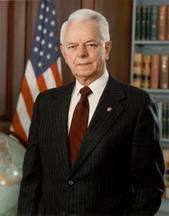 Sen. Robert C. Byrd (D-WV)
Legislative Activity
Stay on top of the latest movement without scrolling through every action
Senate amendment submitted
July 17, 2003
View full timeline
Senate amendment submitted
July 17, 2003
Senate amendment proposed (on the floor): Amendment SA 1283 proposed by Senator Byrd.(consideration: CR S9547-9557; text: CR S9548)
July 17, 2003
Roll call votes on amendments in Senate: Motion to table amendment SA 1283 agreed to in Senate by Yea-Nay Vote. 71 - 24. Record Vote Number: 288.
July 17, 2003
Amendment SA 1283 proposed by Senator Byrd. (consideration: CR S9547-9557; text: CR S9548) To rescind $1,100,000,000 of the amounts appropriated for procurement and research, development, test and evaluation, and to appropriate $1,100,000,000 for fighting AIDS/HIV, tuberculosis, and malaria.
July 17, 2003
Motion to table amendment SA 1283 agreed to in Senate by Yea-Nay Vote. 71 - 24. Record Vote Number: 288.
July 17, 2003
Votes
1 roll call on this amendment
Text
Proposed
DEPARTMENT OF DEFENSE APPROPRIATIONS ACT, 2004--Continued

Mr. STEVENS. Mr. President, we are awaiting an amendment to be
offered. I hope Senators will come and bring their amendments.
Mr. REID. Would the Senator yield?
Mr. STEVENS. I yield to the Senator from Nevada.
Mr. REID. Mr. President, I say to the distinguished comanager of the
bill, we are waiting for Senator Byrd to come and offer his two
amendments, one dealing with adding some money to the bill, the other
dealing with adding some money for AIDS, rearranging the bill, I should
say.
The Senator from Delaware is considering offering an amendment and
also the Senator from California, Mrs. Feinstein, and Senator Schumer.
I would say to those Senators or their staffs who are within the sound
of my voice that Senator Byrd is not here. I am sure we could move
forward on one of their amendments. I would recommend that they work
their way to the floor or at least call the cloakroom so we can get
them lined up to offer one of their amendments. There is really a down
time here now.
I think it would be to everyone's advantage that we move forward on
this most important bill. As has been indicated, we are going to
certainly try to finish this bill tonight. It appears we can do so. We
don't have a lot of amendments remaining.
The PRESIDING OFFICER. What is the will of the Senate?
Mr. ALEXANDER. I suggest the absence of a quorum.
The PRESIDING OFFICER. The clerk will call the roll.
The assistant legislative clerk proceeded to call the roll.
Mr. BYRD. Mr. President, I ask unanimous consent that the order for
the quorum call be rescinded.
The PRESIDING OFFICER. Without objection, it is so ordered.

Amendment No. 1283

(Purpose: To rescind $1,100,000,000 of the amounts appropriated for
procurement and research, development, test and evaluation, and to
appropriate $1,100,000,000 for fighting AIDS/HIV, tuberculosis, and
malaria)

Mr. BYRD. Mr. President, I have an amendment which I shall send to
the desk shortly.
This January, in his State of the Union Address, President Bush
announced a 5-year, $15 billion global AIDS initiative. The President
received a lot of praise for that announcement, as he should have. AIDS
is a dreadful disease which is currently inflicting an almost
unimaginable toll on the African continent, devastating entire
populations.
Sub-Saharan Africa has been far more severely affected by AIDS than
any other part of the world. According to UNAIDS--the Joint United
Nations Program on HIV/AIDS--in 2002, there were 29.4 million people
living with HIV and AIDS in sub-Saharan Africa. Africa has about 10
percent of the world's population but more than 70 percent of the
worldwide total of infected people. In fact, the infection rate among
adults is about 8.8 percent in Africa, compared with 1.2 percent
worldwide.
More than 17 million Africans have died from AIDS since its
emergence, and UNAIDS estimates that by 2020, an additional 55 million
Africans will lose their lives to the epidemic. The sheer brutality of
these statistics is hard to fathom and must tug at the hearts and souls
of all of us in this body.
AIDS' severe social and economic consequences are depriving Africa of
skilled workers and teachers while reducing life expectancy by decades
in some countries. An estimated 11 million children in Africa have been
orphaned by AIDS--having literally watched their AIDS-inflicted parents
slowly slip away before their eyes. These AIDS orphans are now facing
increased risk of malnutrition and reduced prospects for education.
AIDS is being blamed for declines in agricultural production in some
nations, and is regarded as a major contributor to the famine
threatening southern Africa. The United Nations Development Programme
Annual Report for 2003 states that, ``HIV/AIDS is a catastrophe for
economic stability and may be the world's most serious development
crisis.''
For far too long, the world has turned a blind eye to the suffering
on the African continent. Does the United States, as the wealthiest
Nation on Earth, not have a special moral responsibility to act to
alleviate some of the worldwide misery caused by AIDS? Americans have
always been generous and caring people, and I have no doubt that they
would expect their elected officials to rise to the occasion and take
the lead in ridding the world of this horrid disease, wherever it takes
root.
I am pleased by Congress' initial response to the President's call
for action to combat the AIDS crisis in Africa--with passage of the
United States Leadership Against HIV/AIDS, Tuberculosis, and Malaria
Act of 2003. And I was encouraged that our President publicly touted
the legislation's passage as a moral triumph.
However, I have seen far too many fancy White House bill signing
ceremonies and dressed-up press releases in the last 2\1/2\ years to be
entirely confident that this Administration would simply keep its
promise to fully fund this legislation. Once the cameras stop rolling
and the headlines fade away, this administration seems to have
established a troubling pattern of repeatedly making promises but
failing to deliver the dollars needed to keep them. The drastically
underfunded No Child Left Behind Act and the President's skimpy funding
requests to meet our homeland security needs are perfect examples.
Last week, as President Bush visited five African countries, he again
pledged that the United States would play a leading role in combating
AIDS. The President repeatedly promised to do all in his power to make
sure that Congress fully financed his proposed 5-year, $15 billion
program to attack the disease in the world's poorest countries. I
commend him for having gone to Africa, and for promoting greater
efforts to fight AIDS.
He should be held to his commitment to those in Africa who are
suffering from AIDS.
Clearly, an expectation has been created that the administration and
Congress will provide $3 billion toward this noble initiative in fiscal
year 2004, as language explicitly authorizing that amount for fiscal
year 2004 is spelled out in the new Global AIDS law that the President
proudly signed.
Unfortunately, despite all the recent headlines, photo-ops, and White
House promises regarding the African AIDS crisis, the simple fact
remains that the President did not put enough money behind his
promises, as he failed to include $3 billion to fight AIDS in his
fiscal year 2004 budget. That is right! He requested only $1.9 billion,
not the $3 billion that the world now expects. That is $1.1 billion
less than what he promised.
Just last Thursday, Members of this body went on record, by a vote of
78-to-18, in support of a Sense of the Congress Resolution that stated
our intent to provide full appropriations for the $15 billion AIDS
initiative touted by our President, including $3 billion in fiscal year
2004.
The lives of millions worldwide are at stake. Now is the time to
honor the financial commitment made by Congress and the President to
combat Global AIDS. My amendment to the Defense Appropriations bill
would do just that by allocating $750 million in fiscal year 2004 to
the Coordinator of United States Government Activities to Combat HIV/
AIDS Globally for the purpose of making a contribution to the Global
Fund to Fight AIDS, Tuberculosis, and Malaria and $350 million for the
Secretary of Health and Human Services for programs to combat AIDS
overseas. This amendment would be completely offset by a $1.1 billion
across-the-board cut in the amounts appropriated for the Department of
Defense under Titles III and IV of this legislation for Procurement, as
well as for Research, Development, Test and Evaluation.
The bill before the Senate includes $73,976,000,000 in procurement
spending,

[[Page S9548]]

an amount that is $1,255,000,000 above the President's request. This
bill also includes $63,565,000,000 for research and development
programs, a level that is $1,738,000,000 above the President's request.
Certainly, the Senate should be willing to reduce the current
procurement and research funding by less than eight-tenths of 1 percent
in order to fulfill the President's promise. It is his promise. He had
pledged our Nation's help with one of the most dreaded and destructive
scourges on the globe. But he is trying to shift the burden to Congress
to make up the difference in the underfunded budget request. Congress
should step up to this challenge and appropriate the money that we have
already authorized by an overwhelming vote.
My amendment would allow us to fulfill the humanitarian promise made
by our Government to fight the worst public health crisis that history
has ever known with a total $3 billion appropriation in fiscal year
2004.
This amendment would help to alleviate some of the misery endured by
millions of AIDS-inflicted families around the globe for roughly what
we spend in a single day to fund the Department of Defense.
Mr. President, AIDS is a catastrophe for millions around the globe.
What better message can we send than to reduce our behemoth military
budget ever so slightly in order to keep our national word to help
fight this dread disease. It is the right thing to do. It is the noble
thing to do. Let's do it.
Mr. BYRD. Mr. President, I send to the desk an amendment. I ask
unanimous consent that the following cosponsors be added.
The PRESIDING OFFICER. The clerk will report.
The legislative clerk read as follows:

The Senator from West Virginia [Mr. Byrd], for himself,
Mrs. Clinton, Mr. Pryor, Mr. Lautenberg, Mrs. Murray, Mr.
Corzine and Mr. Bingaman, proposes an amendment numbered
1283:
On page 120, between lines 17 and 18, insert the following:

(rescission of funds)

Sec. 8124. (a) Of the amounts appropriated under titles III
and IV of this Act, $1,100,000,000 is hereby rescinded. The
Secretary of Defense shall allocate the rescinded amount
proportionately by program, project, and activity.
(b) In addition to other amounts appropriated or otherwise
made available under this Act, funds are hereby appropriated
to the Department of Defense for fiscal year 2004 in the
total amount of $1,100,000,000.
(c) Of the amount appropriated under subsection (b), the
Secretary shall transfer $750,000,000, to remain available
until expended, to the Coordinator of United States
Government Activities to Combat HIV/AIDS Globally, for an
additional contribution to the Global Fund to Fight AIDS,
Tuberculosis and Malaria, which shall be expended at the
minimum rate necessary to make timely payment for projects
and activities.
(d) Of the amount appropriated under subsection (b), the
Secretary shall transfer $350,000,000 to the Secretary of
Health and Human Services for global HIV/AIDS programs of the
Centers for Disease Control and Prevention and the National
Institutes of Health.

Mr. BYRD. Mr. President, the cosponsors are Senators Clinton, Pryor,
Lautenberg, Murray, and Corzine. I ask they be added.
The PRESIDING OFFICER. Without objection, it is so ordered.
The PRESIDING OFFICER. The Senator from Alaska.
Mr. STEVENS. Mr. President, AIDS has been a matter of attention by
our subcommittee since 1982. It was our subcommittee that initiated the
first AIDS research with public funds that I know of in the world. That
research is still going on by the Department of Defense. We were
looking for some way to prevent the transmission of AIDS. I am sad to
say we have not been successful.
In the period just prior to our bill in the eighties, I had listened
to a lecture at the Cosmos Club where the lecturer had predicted we
would witness AIDS becoming a plague--more than an epidemic; it
actually would become a plague. That prediction has become too true,
and the President has committed $15 billion over a period of 3 years
for our contributions to the AIDS program.
We have in our budget so far total spending of $2.4 billion that is
directed to global AIDS spending. I am trying to get the total figures.
I think we have over another $2 billion in our total budget directed
toward AIDS spending.
It is true that money is going to agencies other than USAID, but in
foreign operations, there is $1.5 billion, and Labor, Health and Human
Services has $683 million.
My point is, we have an enormous amount of money in the bill before
us already for AIDS spending. I am compelled to oppose the Senator's
amendment because it transfers from defense procurement and research
and development programs to another bill, the Health and Human Services
bill and the Agency for International Development, which is in a third
bill, the State-Justice-Commerce bill, portions of money allocated by
our committee to those two other subcommittees. In effect, Senator
Byrd's amendment would transfer from the Defense Department to the
Department of Health and Human Services and the Department of State
$1.1 billion.
I have to oppose this amendment in the first place because I believe
we have already met the commitment of the President. There is no reason
I know of to accelerate that and provide more than the $3 billion. We
have already committed to--as a matter of fact, because of the request
initially, I believe we have in excess of $4 billion in this budget
available to us for AIDS already.
The fund the Senator from West Virginia would take the money from is
for the modernization of our aircraft. We are trying to modernize this
force. We need to replace aging C-130s and the aging C-46 helicopters.
We have an enormous number of vehicles and aircraft that have to be
replaced because of the damage they have suffered from activities in
Afghanistan and Iraq.
The modernization funding in this account is also for the National
Guard and Reserve. We all have some real concern over the amount of
money that is already available for those activities. Bluntly, I do not
think we can afford to take $1.1 billion out of defense and put it into
the Department of State and the Department of Health and Human
Services, or Education--wherever it goes--at this time.
We are going to lose a sizable number of the weapons systems we would
otherwise modernize or replace with this $1 billion. I call attention
particularly to the fact that despite the authorization and request of
the President, we were unable to fund the F-18 fighter the
administration seeks to procure. We are unable to fund the total amount
of F-22s. We have reduced the number of ships in the Virginia class
from seven to five. I am already mentally confused over why we have to
be so constricted, but that was the problem in the overall budget. We
already have taken $3.1 billion out of the Defense budget and spread it
through the nondefense budgets in order to meet the objections that
were raised by so many Senators to the allocations we initially
intended to make without that $3.1 billion. This would make it $4.2
billion out of Defense.
I say to my friend from West Virginia, we just cannot do that. There
is no way we can take any more money out of the funds we have set aside
to replace the aging fighters, helicopters, and the equipment that was
damaged or destroyed in Iraq and Afghanistan.
We do have a letter from Dr. O'Neill, the Director of Office of
National AIDS Policy. He says this:

By careful design, the President's 2004 budget request is
for $2 billion--

On this set-aside fund. As I said, our accounting is that set-aside
fund for global activities is $2.241 billion.
In any event, to continue Mr. O'Neill's letter, he said:

This request was based on the sound judgment that funds in
excess of this amount could not be spent effectively in this
first year. These funds will be spent in a focused manner,
increasing each year, to efficiently and effectively create
the necessary training, technology, and infrastructure base
needed to ensure delivery of appropriate medical treatment
protocols and the long-term success of this initiative.

He stated in another paragraph, and I am pulling sentences out of
this letter:

For the reasons stated above, the administration strongly
opposes any efforts to increase funding beyond the $2 billion
requested in the President's FY 2004 budget.

I ask unanimous consent that the letter be printed in the Record in
full after my statement.
The PRESIDING OFFICER. Without objection, it is so ordered.
(See exhibit 1.)
Mr. STEVENS. Prior to the President's initiative, the total for AIDS

[[Page S9549]]

was $1.2 billion. It is my judgment, because of the amount of money we
are spending in all the other agencies to increase our knowledge and
ability to deal with AIDS, that this is a proper amount of money. We
have the commitment that this money will increase as we get more and
more people trained.
We listened to the Secretary of State the other morning tell us about
the problem we have in finding people to train and help with the
medical problems of the people we are dealing with in terms of AIDS
throughout Africa in particular. I thought it was a very moving
response he gave to the questions about AIDS.
Very clearly, right now there are two issues in the amendment of the
Senator. First, I believe we have met the initial year's objective for
the President's global initiative on AIDS. I believe we have an
overwhelming amount of money in the total bills before the Congress
this year, all 13 appropriations bills, on AIDS. Further, the way the
Senator from West Virginia wants to offset this amount, in my judgment,
will bring great harm to the area of modernization of our aging
equipment and the replacement of the equipment that has been damaged
and destroyed by war.
So I am forced to say to the Senator from West Virginia that I am
compelled to make a motion to table his amendment at an appropriate
time. I certainly do not want to do that before my friend has had a
chance to make any comments he wants to make about my comments.
I ask unanimous consent that the schedule of the projection of
spending for global AIDS be printed in the Record.
There being no objection, the material was ordered to be printed in
the Record, as follows:

U.S.G. CONTRIBUTIONS TO GLOBAL HIV/AIDS SPENDING
[Dollars in millions]
--------------------------------------------------------------------------------------------------------------------------------------------------------
FY 2004         FY 2005         FY 2006         FY 2007         FY 2008     Total FY 2004-
USG appropropriations                       budget          budget          budget          budget          budget           2008
--------------------------------------------------------------------------------------------------------------------------------------------------------
Base Bilateral Spending.................................            $970            $970            $970            $970            $970          $4,850
Global Fund.............................................             200             200             200             200             200           1,000
Mother to Child Initiative \1\..........................             300             n/a             n/a             n/a             n/a             300
Emergency Plan for AIDS Relief..........................             450           1,250           1,800           2,400           2,600           8,500
TB and Malara...........................................             120             120             120             120             120             600
-----------------------------------------------------------------------------------------------
Total HIV/AIDS Spending...........................           2,040           2,540           3,090           3,690           3,890          15,250
--------------------------------------------------------------------------------------------------------------------------------------------------------
\1\ Beginning in FY2005, funding for the Mother to Child Initiative is part of the Emergency Plan.

Mr. STEVENS. It shows in 2004, $2.040 billion; in 2005, there is
$2.540 billion; in 2006, there is $3.090 billion; in 2007, $3.690
billion; in 2008, $3.890 billion. In all, the total is $15.250 billion
over the 5-year period. This is a commitment that we will keep.
I think it is wise to start this program on a sound basis. This
summary I have had prepared shows all treatment of AIDS and all of our
programs other than defense.
The last chart I want to put in the Record shows zero for defense, as
far as AIDS is concerned. In the lump sum we have for medical research,
I know there is a sum of money that continues to be spent in pursuing
the research base for a way to prevent transmission of AIDS, to develop
a vaccine for AIDS. That is not disclosed on this, so there is actually
more than this in the total amount for the bill.
I ask unanimous consent that this chart be printed in the Record.
There being no objection, the material was ordered to be printed in
the Record, as follows:

----------------------------------------------------------------------------------------------------------------
FY'04 recommendation???--
Program                           FY'03         FY'04 budget       dependent on allocation
appropriation        request
----------------------------------------------------------------------------------------------------------------
Subcommittee--Foreign Operations:
Child Survival Assistance for bilateral          591,500,000       650,000,000             685,000,000
programs.................................
Child Survival Assistance for Global Fund.       250,000,000       100,000,000             300,000,000
Other Economic Assistance.................        38,500,000        40,000,000              50,000,000
Bilateral Malaria & AIDS..................       105,000,000       105,000,000             105,000,000
State Department Global AIDS Initiative...                 0       450,000,000             450,000,000
Other.....................................         2,000,000         1,500,000               1,500,000
-----------------------------------------------------------------
Total Foreign Operations................       987,000,000     1,346,500,000           1,591,500,000
=================================================================
Subcommittee--Labor-HHS:
CDC Global AIDS program...................       142,569,000       143,763,000             142,569,000
CDC Mother to Child Transmission..........        40,000,000       150,000,000              90,000,000
CDC International Applied Prevention              11,000,000        11,000,000              11,000,000
Research.................................
NIH International Research................       252,300,000       274,700,000             274,700,000
DOL AIDS in the workplace.................        10,000,000                 0                       0
Global Fund Contribution from NIH.........       100,000,000       100,000,000             150,000,000
CDC Malaria & Tuberculosis................        15,000,000        15,000,000              15,000,000
-----------------------------------------------------------------
Total Labor-HHS.........................       570,869,000       694,463,000             683,269,000
=================================================================
Subcommittee--Defense:
DOD HIV-AIDS education w/African Armed             7,000,000                 0                       0
Forces...................................
=================================================================
Subcommittee--Agriculture:
Section 416(b) Food Aid...................        25,000,000                 0                       0
=================================================================
Total--All Subcommittees................     1,589,869,000     2,040,963,000           2,274,769,000
----------------------------------------------------------------------------------------------------------------

Mr. STEVENS. Does the Senator from West Virginia wish to make an
additional statement before I make a motion to table?
Mr. BYRD. Yes, I do, and there are other Senators who wish to speak
on this.
Has the Senator yielded the floor?
Mr. STEVENS. Yes, I have.

Exhibit 1

The White House,

Washington, July 17, 2003.
Hon. Bill Frist,
Majority Leader, U.S. Senate,
Washington, DC.
Dear Leader Frist: It is my understanding that an amendment
regarding funding for HIV/AIDS, tuberculosis and malaria may
be offered today to the Department of Defense FY2004
appropriations bill currently under consideration on the
Senate floor.
I want to reiterate the Administration's strong support for
the FY2004 budget request of $2 billion for all international
HIV/AIDS, tuberculosis and malaria activities, including $200
million for the Global Fund to Fight HIV/AIDS, TB, and
Malaria. This request is a solid first step in fulfilling the
President's commitment of providing $15 billion over the next
five years to address the HIV/AIDS pandemic in Africa, the
Caribbean and around the world.
I recently finished traveling to Africa with the President
where he saw first-hand the positive impact that current U.S.
funding is having in caring for the sick, providing treatment
for individuals living with HIV/AIDS and extending lives. He
also witnessed

[[Page S9550]]

the vast infrastructure and capacity challenges that need to
be addressed in order to scale-up many of these efforts.
It is by careful design that the President's FY2004 budget
request is for $2 billion. This request was based on the
sound judgment that funds in excess of this amount could not
be spend effectively in this first year. These funds will be
spent in a focused manner, increasing each year, to
efficiently and effectively create the necessary training,
technology, and infrastructure based needed to ensure
delivery of appropriate medical treatment protocols and the
long term success of this initiative.
These funds are vital to our efforts to combat HIV/AIDS
abroad, but must be spent in the right way, at the right
time. Similarly, efforts to increase funding to the Global
Fund to Fight AIDS, TB and Malaria are not appropriate at
this time. Currently, the United States is responsible for
over 40% of all contributions made to the Global Fund. We
have reached a critical time in the Global Fund's
development, and other nations must join the U.S. in
supporting the work of the Global Fund.
For the reasons stated above, the Administration strongly
opposes any efforts to increase funding beyond the $2 billion
requested in the President's FY2004 budget. I appreciate your
unwavering leadership on this issue and look forward to the
continued strong bipartisan support of the Senate in ensuring
the success of this lifesaving initiative.
Sincerely,
Dr. Joseph F. O'Neill,
Director, Office of National AIDS Policy.

The PRESIDING OFFICER. The Senator from West Virginia.
Mr. BYRD. Mr. President, there is ample precedent for across-the-
board cuts in the Defense bill. In fact, the language is taken out of
section 8135 of the fiscal year 2002 Defense Appropriations Act. Even
with these cuts, the procurement, research, and development accounts
remain $2 billion above the President's request and $6.7 billion above
fiscal year 2003. So the procurement, research, and development
accounts are robustly funded.
This amendment provides the funds called for in the 78-to-18 vote
last week on the State Department authorization which called for $3
billion.
I understand Senator Harkin wishes to speak. I yield the floor.
The PRESIDING OFFICER. The Senator from Iowa.
Mr. HARKIN. Mr. President, I rise in strong support of the amendment
offered by Senator Byrd. This amendment fulfills a promise we made to
the entire world to fund the global AIDS initiative. When I say ``we,''
I mean all of us--the Congress and the President of the United States.
President Bush made this promise to fund the global AIDS initiative at
$15 billion, $3 billion per year for 5 years, in his State of the Union
Address last January. I was there. I remember when he said it.
I remember after the President made that commitment, everyone--
Republicans and Democrats, House Members and Senators--all stood and
gave him a prolonged standing applause for that commitment. The
President even signed a bill authorizing this money. We passed a bill
saying, yes, we authorize it.
Recently, the President has traveled through Africa restating this
commitment, and I was quite taken by the President's words in Africa
saying we were going to meet our commitment and we would provide the $3
billion this year. Yet the President neglected to include this full
funding in his budget for this initiative. Rather than calling for $3
billion in 2004 that was promised and authorized, the President's
budget calls for a mere $1.9 billion, falling far short of the promises
he made and we made.
Yet the President is in Africa saying we are going to provide $3
billion. Basically, I think he said we have provided $3 billion. That
is what is authorized. We know around here you can authorize anything
but until the Appropriations Committee appropriates the money it is
meaningless.

Here is the President saying we came up with the $3 billion to fight
AIDS in Africa, the African leaders applaud him, thanking him for that,
and yet he only put $1.9 billion in the budget.
Millions of people experience pain and suffering caused by the AIDS
epidemic. People around the world are being robbed of healthy and
productive lives. This epidemic is ravaging families, communities, and
economies across the globe, nowhere more so than in Africa. The United
States has a responsibility to fulfill the promise we made.
The amendment offered by the Senator from West Virginia would uphold
our commitment, our promise, to fight the AIDS epidemic and our promise
to adequately fund the initiative. This amendment offered by Senator
Byrd provides the full $3 billion for 2004, the full $3 billion that
the President was taking credit for and touting in his recent trip to
Africa. This would be offset by taking the $1.1 billion from the
amounts appropriated for the Defense Department procurement and
research account. The amendment by Senator Byrd would add to the $1.9
billion the amount of $1.1 billion to bring it to the $3 billion level
promised by President Bush on his recent trip to Africa.
Let me be clear: This money is not coming out of the salaries of our
troops or the support for our troops. It is not coming out of our work
in Afghanistan. This money comes from two titles of the Defense
appropriations bill that include $1.25 billion more than the
President's budget request.
We are spending in this bill about $1 billion a day for the Armed
Forces, for defense. There is no excuse to deny the AIDS initiative
that we promised, the President promised, the President touted so
earnestly on his trip through Africa. There is no excuse to deny the
$1.1 billion more a year to bring it to the $3 billion level.
Again, sometimes I am sure people wonder about what we are doing. The
average American probably does not understand the difference between an
authorization and appropriation. What is the difference? That is where
the confusion is.
Last week the Senate overwhelmingly voted 78 to 18 in support of a
sense-of-the-Senate resolution stating that the global AIDS initiative
should be fully funded. That means we should fund it at the $3 billion
level.
Now the Senate needs to put its money where its mouth is. This is the
amendment by which we can do it. It does not detract anything from our
troops. It comes out of an account that is even $1.25 billion more than
the President's budget request.
We all just returned from a joint session of Congress and we listened
to Prime Minister Tony Blair speak. I thought it was a fine speech;
maybe even more than that. I thought it was a very good speech in all
of its aspects. But there was one aspect that pertains to what this
amendment is about. Prime Minister Blair said at one point in his
speech that we cannot--we, being the United States--walk away from our
other commitments in the world aside from national security. He
mentioned specifically the AIDS catastrophe that is happening
throughout Africa. He said we have to meet our commitments and our
responsibilities there, and he got a standing ovation for that.
It is nice to give standing ovations to the Prime Minister of Great
Britain when he says we should meet our responsibilities to meet the
AIDS crisis. It is nice to vote for a sense-of-the-Senate resolution
that says we should fully fund it. It is nice to even vote for the
authorizing bill authorizing we fully fund it.
But there is another thing that Prime Minister Blair said that I
thought was worth noting. I am paraphrasing because I don't have the
speech; I am just remembering it. He said something about our
reputation, about making sure we stood strong for what we believed in
and that we stand up to what we have committed to. If we do not, then
what is the rest of the world going to think? They will think, OK, that
is what the United States says but the only thing the United States
ever backs up is military action. I hope it does not boil down to that,
that the only thing we ever back up in terms of commitments is a
military commitment. We ought to look upon the other commitments in the
same light. Once we make the commitment and we make the promise, we
fulfill it and we keep it. This is one that compels us to give an
overwhelming vote to the amendment offered by Senator Byrd. This is the
amendment that does it.
I know there will be arguments saying we cannot take it out of
defense. As I pointed out, it comes out of an account that is $1.25
billion more than what the President even requested.
Now is the time to stand up and be counted. Now is the time to back
up our reputation for being a caring nation and for being a nation that
stands behind its word. We gave our word. The President, 2 weeks ago,
gave his word in Africa for $3 billion and yet we have

[[Page S9551]]

only come up with $1.9 billion. Now is the time to come up with the
full $3 billion.
Mr. STEVENS. Will the Senator yield?
Mr. HARKIN. I yield.
Mr. STEVENS. Does the Senator have a quote that the President would
spend $3 billion?
Mr. HARKIN. I don't have the quote but I will get it for you in a
short amount of time. The President, if I remember right, said in
Africa that we have--again, I am paraphrasing; I don't know if I have
the right word--but we have pledged $3 billion this year to fight AIDS
in Africa. He said that in Africa.
Mr. STEVENS. I would like to see that. I would be happy to see that
quote.
I don't want to interrupt the Senator.
Mr. HARKIN. I will get my staff to run it down.
I yield the floor.
The PRESIDING OFFICER. The Senator from New Mexico.
Mr. BINGAMAN. Mr. President I will speak for a very few minutes on
this same issue and indicate my strong support for the amendment
Senator Byrd has offered.
As my colleague, Senator Harkin, indicated, I strongly support this
amendment. I believe this is the obvious follow-on to the vote we had
last week where 78 Members of the Senate agreed when appropriations
bills did come to the Senate we would vote to fully appropriate the
funds that were authorized in the United States Leadership Against HIV/
AIDS, Tuberculosis and Malaria Act of 2003. That was legislation we
passed earlier this year that I strongly supported. It did provide $15
billion worth of funds. It authorized $15 billion worth of funding for
this purpose. It was a follow-on to the President's State of the Union
speech.

In the State of the Union speech, the President committed this
country to this initiative. I strongly supported it. Then, as a follow-
on to that State of the Union speech, we passed the authorizing
legislation which, as I understood it, said we will appropriate $3
billion a year for 5 years in order to fight this terrible epidemic of
infectious disease we see around the world.
From my perspective, the question is whether we consider this to be
an urgent problem. If we do consider it to be an urgent problem, then I
think the funding that was laid out in that authorization bill is the
right funding. I was surprised to hear the quotations from the letter
Dr. O'Neill has sent on behalf of the administration indicating the
administration does not want $3 billion this first year, 2004. It does
not want $3 billion the second year, 2005. And only in the later years
is the administration going to be requesting $3 billion or more in
order to make up the full $15 billion.
That would be an appropriate approach to a problem that is not
urgent. That would be an appropriate approach to a problem we can just
as well deal with 3 years from now as today. But this issue is not that
type of problem. This is an urgent problem. Accordingly, I think it is
entirely appropriate that we try to fund this AIDS initiative the way
it was designed in the authorizing legislation, the way the President
signed off on it in the authorizing legislation, and the way I thought
all of us had agreed to proceed with it.
The statistics are devastating. We have gone through those to great
lengths here, the number of teachers who are being lost because of HIV/
AIDS, the number of people who are going untreated with HIV/AIDS in
Africa because of lack of resources. The global AIDS fund is
desperately in need of additional resources. We have committed $200
million rather than the full $1 billion that was anticipated we would
commit this year.
We can, obviously, fall back on a 5-year plan and say: Look, we never
did intend to give you $3 billion the first couple of years. We are
sorry if you misunderstood us. But the truth is most Members of
Congress and I think most Members of the Senate--I certainly can speak
for myself. When I voted for the authorizing legislation, I assumed we
were going to appropriate the funds we were authorizing in that bill on
that schedule in order to get to the $15 billion. That was my
assumption.
I can understand the reluctance to take any funds out of the defense
budgets. I have supported defense budgets virtually every year since I
have been in the Senate. I intend to support the budget again this
year. But this is a very small amount. This is funding which can
readily be replaced in a supplemental. There will be a defense
supplemental down the road. We have all talked about that. Most of the
discussion in the last 2 days is how we have the defense supplemental
coming. We have already passed one this year. We will have another one
next year. This is a very appropriate place for us to identify some
funds we can use for this urgent need.
In its January 2000 report, The Global Infectious Disease Threat and
Its Implications for the United States, the CIA noted that over the
next 20 years HIV/AIDS and associated diseases in sub-Saharan Africa
would:

. . . kill up to a quarter of their populations . . . (and)
this will further impoverish the poor . . . and produce a
huge and impoverished orphan cohort unable to cope and
vulnerable to exploitation and radicalization.

The estimate predicted increased political instability and slower
democratic development as a result of AIDS.
According to the World Bank:

The illness and impending death of up to 25 percent of all
adults in some countries will have an enormous impact on
national productivity and earnings. Labor productivity is
likely to drop, the benefits of education will be lost, and
resources that would have been used for investments will be
used for health care, orphan care, and funerals. Savings
rates will decline, and the loss of human capital will affect
production and the quality of life for years to come.

More than 30 percent of teachers are HIV positive in parts of Malawi
and Uganda, 20 percent in Zambia, and 12 percent in South Africa. AIDS
is killing people at middle and upper levels of management in both
business and government; the trained personnel to replace them are not
available.
Without a workforce, there is no productivity. Without productivity,
a country's economy quickly deteriorates and the government collapses
into chaos. All too often, terrorism and fanaticism springs forth from
this chaos and begin to spread outwards from its birthplace, inflicting
damage and destruction on other countries.
HIV/AIDS, TB, and malaria are threats not just to the developing
countries whose citizens have been ravaged by these diseases, but they
are also threats to regional and international stability. AIDS, TB, and
malaria claim the lives of 15,000 Africans each and every day. Every
month that goes by in Africa, close to half a million people die from
these diseases.
AIDS has serious implications for issues of security in Africa, since
HIV infection rates in many armies is extremely high. Domestic
political stability is threatened when security forces become unable to
perform their duties due to AIDS. Peacekeeping efforts on the part of
more stable African nations are at risk as well as rates of infection
among the peacekeeping troops grow. While he was in Nigeria last week,
President Bush said:

We will not allow terrorists to threaten African peoples or
to use Africa as a base to threaten the world.

If we underfund the efforts to fight HIV/AIDS and its associated
disease, we will be allowing just that.
The HIV/AIDS, TB, and malaria pandemic in Africa is an international
emergency. While visiting Botswana last week, President Bush declared:

This is the deadliest enemy Africa has ever faced, and you
will not face this enemy alone.

Congress conveyed the same message last week in passing an amendment
that asserted its belief that nothing short of full funding for HIV/
AIDS, TB, and malaria should be appropriated. The Byrd amendment allows
us to do just that, and to do so without cutting vital services to
other international health programs. The funding to do this would
result from a .079 percent cut for all programs and activities within
Title III and Title IV. These two Titles are receiving $3 billion more
in funding than President Bush requested in his budget for fiscal year
2004. The Byrd amendment allows full funding for international HIV/
AIDS, TB, and malaria programs. It allows the promise made to be a
promise kept. I urge my colleagues to support this amendment.

[[Page S9552]]

HIV/AIDS, TB, and malaria are threats not just to the developing
countries whose citizens have been ravaged by these diseases, but they
are also threats to regional and international stability. AIDS, TB, and
malaria claim the lives of 15,000 Africans each and every day. Every
month that goes by in Africa, close to half a million people die from
these diseases.
I hope very much we can support the amendment of Senator Byrd. I hope
it will get the same 78 votes we got for the sense-of-the-Congress
resolution last week when we talked about whether we were going to
appropriate money on the same schedule and at the same level we had
authorized money in the earlier legislation this year.
I commend the Senator from West Virginia for his amendment. I will
certainly support it and I urge my colleagues to do so as well.
I yield the floor.
Mr. LAUTENBERG. Mr. President, I rise to speak in support of Senator
Byrd's amendment which I have cosponsored.
The Senate worked hard and passed the Global AIDS Initiative back in
May. At the President's request, this bipartisan authorization bill
calls for $15 billion to help fight the spread of HIV and AIDS in
Africa. The bill authorized $3 billion for this fight this year. This
money is desperately needed.
Approximately 29 million people, including 10 million people between
the ages of 15 to 24 and 3 million children under the age of 15, are
currently living with HIV/AIDS worldwide. The future spread of this
epidemic depends in large measure on whether the world will accurately
teach young people how to protect against contracting HIV and AIDS.
Yesterday, I learned something very disturbing. The White House sent
a letter to Congress asking to limit funding to $2 billion. That is $1
billion short.
I don't understand why President Bush, who has talked about his
commitment to help fight AIDS in Africa over and over again, would ask
for less money.
We must back up our promises with real action, not phony rhetoric.
Successful, proven programs for prevention, care, and treatment do
exist but they are still small in scale, with many programs starved for
resources. At least $9.2 billion is needed to mount a response to the
AIDS crisis according to UNAIDS.
Current global spending to address the crisis is far below this, at
about $1 to $2 billion.
A fair contribution by the U.S. Government to the global HIV/AIDS
response would be between $2.75 and $3 billion given our share of the
global economy, close to 30 percent. The United States is spending just
over $500 million on global HIV/AIDS this year; and now President Bush
is asking Congress to appropriate $1 billion less than it authorized
for next year.
The tragic impact of the AIDS epidemic is undeniable. One in every
three adults in Africa is living with HIV/AIDS. Across the world, each
year, 800,000 infants contract HIV before or during birth. Ninety
percent of these HIV-infected babies are in sub-Saharan Africa.
The global AIDS bill has the power to save lives through a
combination of prevention and treatment. But in order to be effective,
we must provide the necessary resources.
In a speech last week during his trip to Botswana the President
pledged that the U.S. would be a partner in the battle against a
disease that has already killed more than 17 million in sub-Saharan
Africa, and talked of his proposal to spend $15 billion over 5 years to
help the hardest-hit African and Caribbean nations battle AIDS. That
means Congress should be spending $3 billion a year. Now the
President's own person--the Director of the Office of National AIDS
Policy--is asking for $1 billion less. The message this sends to the
world is discouraging.
A failure to provide full funding is a setback that will cost lives.
I urge the Senate to support Senator Byrd's amendment.
Mr. LEAHY. Mr. President, I support this amendment of my friend, the
distinguished senior Senator from West Virginia.
A couple of months ago, at the U.S. Coast Guard Academy, the
President spent a good deal of time talking about the global AIDS
crisis, the worst public health threat in human history. I commend him
for that, and for going to Africa, which highlighted the devastation
caused by AIDS there.
President Bush has shown real leadership on AIDS, although it is
important to mention that a bipartisan group in Congress has been
pushing for stronger action on AIDS for years.
A short time after the President's Coast Guard Academy speech, we
passed the United States Leadership Against AIDS, TB and Malaria Act,
which authorized $15 billion over 5 years to combat AIDS, tuberculosis
and malaria. That was consistent with what the President proposed in
his State of the Union address back in January. It was an important
step. It showed that we are beginning to take the AIDS pandemic
seriously.
But that was an authorization bill. It did not appropriate any money.
For all intents and purposes, it was like writing the check with out
enough money in the bank.
Let me explain. The President's budget request contains only $1.9
billion of the $3 billion we authorized for AIDS for fiscal year 2004.
$1.9 billion is a good step, but we should do more. It remains to be
seen whether the promise of that authorization bill--a promise with
which I agree--will be fulfilled.
The amendment of the Senator from West Virginia is the first real
test of that.
The United States Leadership Against AIDS, TB and Malaria Act also
called for up to $1 billion for the Global Fund to fight AIDS and TB
and Malaria. Again, a promise. For fiscal year 2004, the President has
only budgeted $200 million for the Global Fund, which is one-fifth of
the amount authorized. It is also a cut of $150 million from what was
appropriated last year.
There is another problem. While the President's fiscal year 2004
budget for Foreign Operations includes approximately $1.3 billion to
combat HIV/AIDS, it robs Peter to pay Paul to pay for increases in HIV/
AIDS programs, as the President's budget would cut other essential
international health programs from 5 to 63 percent.
Child survival and maternal health programs are cut by 12 percent.
These are the programs that provide lifesaving child immunizations.
They also help to reduce the 600,000 pregnancy-related deaths each year
that could be avoided. Instead, the President's budget cuts these
programs by 12 percent.
It would cut programs to combat other infectious diseases like
measles. Measles kills 1 million children--not 100,000 or 200,000--but
1 million children a year. Again, this is something which is easily
preventable. Every one of us can just go to the doctor's office and get
our children and grandchildren immunized against measles. In many poor
nations, parents and grandparents do not have that luxury. They need
our help.
The President's budget cuts funding for programs which combat
measles, polio, SARS, ebola and other deadly diseases by 32 percent.
These are not my numbers, these are the administration's numbers.
These numbers are in the President's budget.
These cuts will hurt children the most in countries where vaccines
costing a few pennies make the difference between life and death. That
is not acceptable.
If somebody said to us, look at those five children, you can save
their lives by spending a dollar, would we do it? Of course, we would
do it.
These are not Democratic or Republican programs. I have been joined
time and again by colleagues on the other side of the aisle who support
these health programs in both the Senate and the House.
Anyone who knows anything about public health knows that building the
health infrastructure in developing countries is essential if you are
going to effectively combat AIDS. It is the same thing with child
nutrition. It is the same thing with maternal health. You don't fight
AIDS in a vacuum. It isn't an either/or proposition. People who are
malnourished, who are in poor health, who have weak immune systems, who
are at risk of other infections, are far more vulnerable to AIDS. It is
common sense.
Mr. President, we hear a lot of speeches here. We may feel good about
giving those speeches, but I do not feel

[[Page S9553]]

good about lofty rhetoric that bears little resemblance to reality,
especially when it deals with a catastrophe like AIDS. The President's
budget falls short. The allocation for Foreign Operations falls short.
We have to do something.
Senator Byrd's amendment builds on an amendment offered by Senator
Bingaman to the State Department Authorization a couple of weeks ago.
That amendment, which passed 78-18, called for full funding--$3
billion, for the first year of the President's $15 billion AIDS
initiative, even if it means exceeding the budget ceilings. This
amendment does not exceed the ceilings.
This amendment would provide full funding of the United States
Leadership Against AIDS, TB and Malaria Act. It is what we said we
would do. Senator Byrd's amendment would do it.
His amendment would provide the additional $750 million we authorized
for the Global Fund to Fight AIDS, TB and Malaria. And it would provide
$350 million for CDC and NIH programs to combat AIDS. That is what we
said we would do when we passed the AIDS authorization bill, and again
when we passed the Bingaman amendment.
If we are going to lead, and especially if we are going to ask others
to do more, we are going to have to stop playing shell games with the
foreign aid budget. We are going to have to start keeping our promises.
Leadership is good policy. Leadership means resources. Leadership is
not a press release.
Let's stop the rhetoric. Let's do what needs to be done to stop the
15,000 new HIV infections that occur each day. Then the United States
can show the promise and the moral leadership a great Nation should
show.
Mr. DASCHLE. Mr. President, Senator Byrd has once again laid before
the Senate a critical challenge. The numbers he has cited are
staggering, confirming what we all know too well: that the world has
never known a pandemic greater than the AIDS pandemic.
At the end of last year, there were nearly 43 million people living
with HIV. Since January 1, there have been at least 15,000 new HIV
infections daily, meaning that we can expect another 45 million
infections by 2010. These numbers do not begin to tell the story of the
suffering--that story I have seen in the faces of suffering mothers and
fathers, daughters and sons throughout Africa and Central Asia.
We simply must do more to stop this crisis.
Given the enormity of this challenge, I regret that I cannot vote for
Senator Byrd's amendment. The amendment would pay for this vital
increase with a rescission in other defense programs. Just as I have
objected to the President's cuts in other vital global health programs
to fund the limited AIDS funding increase in his budget, I must vote
against this important amendment.
But this will not be the last word. As soon as we can--on the Labor
appropriations bill or on the foreign operations appropriations bill--I
will work with my colleagues to provide new money for this vital fight.
New resources that will fund the promise we made earlier this year with
the global AIDS authorization. New resources that will not come out of
a bill that must fund our Armed Forces and other emerging threats. New
resources that will help us get a leg up on this deadly pandemic.
We must not--we will not--stand down in this battle.
The PRESIDING OFFICER. The Senator from Alaska.
Mr. STEVENS. Mr. President, the subject of how much money it takes to
comply with the authorization and requests on AIDS is not a matter for
the Defense bill. This is an attempt to take defense money and shift it
over to the Health and Human Services bill and the State bill in
anticipation that those bills will not meet the satisfaction of those
who want to see this money put out on $3 billion a year rather than $15
billion over 5 years.
I understand the motivation for that: to put up more money. But that
money is divided between the Labor, Health and Human Services
subcommittee on the one hand and the State-Justice-Commerce bill on the
other hand. Or perhaps some of it might go into the foreign operations
bills. I don't know. But it is not defense.
What this is doing is suggesting we take defense money that is needed
to replace the helicopters we have lost, to repair damage to the
equipment we have had damaged in Afghanistan and Iraq, and it also goes
to eliminate other items that are needed in terms of modernization.
I oppose this amendment for that reason alone right now. I am not
prepared to get into the argument about the total amount we have for
AIDS, in terms of whether or not there is a commitment for $3 billion a
year or $15 billion over 5 years. The point is, as the manager of this
bill, my task is to assure we get the money we need for defense.
It is an enormous amount, I say to those who say it is $1 billion,
that is true--$1 billion a day. We are spending approximately $1
billion a day for defense globally and that is a whale of a lot of
money. I am often reminded of Senator Dirksen saying a billion here and
a billion there and it becomes real money. There is no question about
it, this is real money.
But this is not the bill on which money is allocated for AIDS under
global AIDS. On that basis alone I ask the Senate to support my motion
to table the amendment of the Senator. Does the Senator from Nevada
wish to speak before I make that motion?
Mr. REID. I would, very briefly.
Mr. STEVENS. Yes.
The PRESIDING OFFICER. The Senator from Nevada.
Mr. REID. Mr. President, I would rather the money for this amendment
would come from someplace else. I hate to see it coming from the
Defense bill. But as the Senator from New Mexico indicated, this is a
very large bill.
My problem is, however, we have people in this administration going
around giving speeches about things that have been authorized and not
appropriated.
We had the problem with the Leave No Child Behind. The State of
Nevada is in desperate shape in education for a number of reasons, not
least of which is the obligations the State of Nevada has because of
the unfunded mandate given as a result of the Leave No Child Behind.
The State of Nevada still, as we speak, doesn't have a budget. They
should have had one months ago.
We had the same situation on homeland security. We finally passed the
11 appropriations bills. As the distinguished ranking member of the
Appropriations Committee would acknowledge, he and a number of us tried
in many different ways to have money added to take away from the burden
of State and local governments for homeland security. We couldn't get
that money. We got some money but not enough money.

Then when the President signed those 11 bills, you will remember,
even Republicans got upset because he said: I like the bill for
everything except there is not enough money for homeland security.
We did everything possible to get more money for homeland security
and we simply were not supported by the administration. Even
Republicans said that was going too far.
Education, homeland security, and now we have the President and
members of his administration going around talking about global AIDS
and what a terrible thing it is. And it is. I was in Africa with the
Senator from New Mexico and the distinguished Democratic leader last
August. On the continent of Africa, over 6,000 people are dying every
day from AIDS. Over 6,000 people every day, 7 days a week, and no
holidays.
Last week I offered an amendment on the State Department
authorization bill to get money for Mexico, a free enterprise system,
microlending to help that country pick themselves up and help so people
are not streaming across our borders because they are poverty stricken.
I got an e-mail saying, Why are you giving money to those Mexicans?
We need money at home. Why give money to those Mexicans? It was the
right thing to do, not simply because it helped the Mexican people but
because it helped us. That amendment helped us. It helped the United
States. It helped everyone in the United States. For every person who
doesn't try to come across the border illegally, and doesn't get
across, it saves this country money.
Mr. President, this AIDS money also helps us as a country. We are
better off

[[Page S9554]]

if we don't have 6,000 people dying on that continent.
As I said, I wish there was some other way to get this money. But we
have to make sure the people of America understand the difference
between authorizing and appropriating. It is easy to make speeches
saying we authorize this. But if you do not appropriate the money, it
winds up being nothing.
Today we reported out of the Energy Subcommittee the energy and water
bill. We did the best we could in that bill. But we have thousands of
projects that have been authorized and which are desperately needed in
our various States around the country. We don't have enough money to
pay for them. We have done a disservice, in many instances, by
authorizing money and then not appropriating it. The Senator from West
Virginia is not dumping money into Africa which would not help this
country. That money to fight global AIDS is going to directly help the
United States of America.
The PRESIDING OFFICER. The Senator from West Virginia.
Mr. BYRD. Mr. President, let me reiterate a few things that have
already been said. This is not an across-the-board cut on an entire
bill. The language here is taken out of section 8135 of the fiscal year
2002 Defense Appropriations Act. In other words, there is ample
precedent for the way we are providing the money. Even with these cuts,
the procurement and research and development accounts remain $2 billion
above the President's request and $6.7 billion above fiscal year 2003.
These are real budget funds. Here we have a $368 billion Defense bill.
We shouldn't hesitate to reduce it by $1.1 billion to pay for a program
as important as global AIDS. I know the administration says it doesn't
want that much money this year. The administration prefers doing the
ramped-up approach.
People understand simple math. Fifteen billion dollars over 5 years
is $3 billion a year. I think we should provide the full $3 billion.
People understand that is certainly going to be $15 billion over a 5-
year period if we do it $3 billion a year. It is easy to understand
that. But by doing the ramped-up approach, it appears that the
President is not fulfilling his commitment. I want to help him fulfill
that commitment.
I remember, as well as the distinguished Senator from Alaska does,
when we were trying to provide moneys for homeland security. We tried
to provide moneys for our firemen, our policemen, and our health
personnel. We were told by the then-Director of Homeland Security,
former Governor Tom Ridge, in a letter that they didn't need that much.
It seems that the administration doesn't need the money if some effort
is being made on this side of the aisle to provide the money that the
administration needs. They know they don't need that then and they come
back later and ask for it themselves. They say they need it then.
This is an opportunity to show the world that we mean what we say.
This is an opportunity to show the world that the President means what
he says.
Here we are quibbling over eight-tenths of 1 percent. We are fiddling
over that little measly amount of money when we could adopt the
amendment. People of the world would understand what we are saying.
They would believe the President is backing up his commitment. Why do
we quibble over a few tenths of 1 percent here?
I have made the case.
I ask unanimous consent that certain letters I have received be
printed in the Record. These are letters of support for the amendment.
They come from the Global AIDS Alliance, the Episcopal Church Office of
Government Relations located in Washington, DC, Physicians for Human
Rights, the General Board of Church and Society of the United Methodist
Church, and the Center for Health and Gender Equity.
I ask unanimous consent that these letters be printed in the Record.
There being no objection, the material was ordered to be printed in
the Record, as follows:

Global AIDS Alliance,

Washington, DC, July 16, 2003.
Senator Robert Byrd,
United States Senate,
Washington, DC.
Dear Senator Byrd: We would like to express our deepest
appreciation for the amendment you plan to offer to the
Defense Appropriations Bill, which would increase funding for
the fight against the AIDS pandemic. The attached letter from
diverse national and international groups shows clear support
for the level of increase your amendment would provide.
Your amendment reflects a realistic appraisal of the true
scale of the epidemic and of the real and serious threat to
US national security it poses. The US National Intelligence
Council has warned AIDS is poised to destabilize areas of
high US strategic interest. On July 3, the US Centers for
Disease Control warned that China, India and other parts of
Asia were threatened by what it termed an ``AIDS
catastrophe.'' Humanitarian considerations alone are enough
to justify full US support for the fight against AIDS, but
these strategic considerations show that it is only
appropriate your amendment be approved during consideration
of the Defense Appropriations Bill.
The fight against this global threat would be significantly
bolstered by your amendment. The $1.1 billion increase would
allow the US to make good on its $3 billion commitment to the
global effort against AIDS and other health threats in FY
2004. Providing $750 million of the increase to the Global
Fund to Fight AIDS, TB and Malaria makes particularly good
sense from a public health perspective. The Fund can
efficiently utilize these resources, and it can provide them
not only to Africa but also to such seriously impacted
regions as Asia and Eastern Europe. We also support providing
a portion of the increase to AIDS programs run by the
Department of Health and Human Services.
Already, twenty five million people have died from AIDS.
Around the world, more than 42 million people are infected
with the virus and few of these have access to life-saving
medicine. If we don't act now, there will be 25 million AIDS
orphans facing a bleak future by the end of the decade. Yet,
as the Director of UNAIDS, Peter Piot, recently noted,
``[T]he mismatch between need and funding continues to be one
of the biggest obstacles in the struggle to control the
epidemic.'' Your amendment would ensure the US shows full
leadership in the global effort.
Sincerely,
Dr. Paul Zeitz,
Executive Director.

The Episcopal Church,

Washington D.C., July 17, 2003.
Dear Senate: We are writing on behalf of the Episcopal
Church to urge your support for a Byrd amendment that would
increase funding to help fight the global AIDS pandemic.
Senator Byrd is expected to offer this amendment during
Senator floor consideration of the Defense Appropriations
bill. The amendment would increase AIDS funding by $1.1
billion, with $750 million of that amount to be earmarked for
a U.S. contribution to the Global Fund and the remaining $350
million to be allocated by the Department of Health and Human
Services for overseas AIDS spending. This additional $1.1
billion in spending would increase total 2004 global AIDS
spending to $3 billion a year, an amount equal to a first
year installment in President Bush's five-year, $15 billion
Emergency Global AIDS Initiative.
The global AIDS crisis is a priority for the Episcopal
Church. Our partners in the Anglican Communion, serving
Christians and their communities in 165 countries worldwide,
face the daily hardships caused by this terrible disease. In
parts of Africa, where over half of the Anglican Communion
resides, the AIDS pandemic has created more than a health
crisis: it has decimated the workforce, led to a collapse in
education systems, deepened poverty, undermined the
production of agriculture, and created millions of orphans
and vulnerable children. However, AIDS can be beaten. The
experience of a successful AIDS program in Uganda makes this
clear. Uganda implemented a national AIDS program, and in
just ten years, reduced that country's AIDS rate from 15
percent to 5 percent.
Today, we have an effective new mechanism that can build on
success stories like Uganda's. The Global Fund to Fight TB,
AIDS, and Malaria allows for a coordinated global response to
the AIDS pandemic. Global Fund grants are putting half a
million people with AIDS on life-saving drugs--a six fold
increase in the number of people in Africa receiving these
drugs. The Fund focuses on providing support for successful
programs on the ground and leveraging our allies to do their
fair share to fight AIDS. Just this week, an international
conference was convened to review to date the progress made
by the Global Fund and to address funding issues. The
European Union is now committed to raising $1 billion for the
Global Fund. U.S. leadership is clearly serving as a catalyst
in leveraging the financial support of other major donor
countries. A significant U.S. contribution would further
challenge other donors to do more to support The Fund.
The Byrd amendment would allow the Senate to fulfill the
humanitarian promise made to fight HIV/AIDS. The Byrd
amendment would be offset by a small reduction in proposed
spending by an amount less than eight-tenths of one percent.
Even then, the Senate would still provide more for
procurement than was requested in the President's budget.
We urge your support for the Byrd amendment to the Defense
Appropriations bill. Now is the time for Congress and the
President to make good on the promise to fully fund the
Global AIDS Initiative and a U.S. contribution to the Global
Fund. Your support can make a significant contribution in

[[Page S9555]]

the effort to launch this much-needed world health campaign.
Sincerely,
Maureen T. Shea,
Director of Government Relations.
Jere Myrick Skipper,
International Policy Analyst.

Physicians for Human Rights,

Boston, MA, July 17, 2003.
Hon. Robert C. Byrd,
United States Senate,
Washington, DC
Dear Senator Byrd: We thank you for your efforts to ensure
that the full $3 billion authorized for fiscal year 2004 by
the U.S. Leadership Against HIV/AIDS, Tuberculosis and
Malaria Act of 2003 is appropriated. These diseases kill 6
million people per year, or more than 16,000 per day, making
it crucial that the full level of authorized funding to
combat them is authorized. Physicians for Human Rights
therefore strongly supports your amendment to appropriate an
additional $1.1 billion for HIV/AIDS funding, including $750
million for the Global Fund to Fight AIDS, Tuberculosis and
Malaria.
We are especially pleased that your amendment includes
strong support for the Global Fund. The Fund is facing a
shortfall of up to $600-800 million for this year, and needs
an additional $3 billion through 2004. The Fund is already
proving its efficiency at quickly distributing funds based on
an innovative, country-driven process that ensures the
participation of civil society and that proposals adhere to
best scientific practices. These features, along with the
Fund's multiple accountability mechanisms, make the Fund an
excellent mechanism to deliver funds to resource-poor
countries, and it deserves the full support of the United
States.
The proposals coming into the Global Fund demonstrate that
countries have plans to spend resources, what they lack are
the resources. When President Bush was in Africa last week,
he saw both the awesome need for funding and the equally
tremendous energy and commitment of the African people to
overcome the diseases that plague their continent. The
President and the Congress must trust that given the
resources, this energy and commitment will be translated into
results. This is already happening throughout Africa--where
the resources are available.
African health professionals, who are among those in the
best position to know what their countries need and what they
can spend, are urging the United States to appropriate $3
billion this year. So are American health professionals who
have extensive experience in fighting HIV/AIDS in Africa. We
are including a letter that includes their strong support for
$3 billion in fiscal year 2004 appropriations to fight HIV/
AIDS. In a short time, it was signed by 35 African health
professionals from 13 countries and 67 American health
professionals, along with 13 health professionals from other
countries.
Again, we thank you for offering your amendment, and urge
your colleagues to support your amendment.
Sincerely,

Leonard S. Rubenstein,

Executive Director,
Physicians for Human Rights.
General Board of Church and Society of the United
Methodist Church,
Washington DC, July 17, 2003.
Senator Robert Byrd,
U.S. Senate,
Washington, DC.
Dear Senator Byrd: I am writing to extend our support to
your proposed amendment to the Defense Appropriations bill
that will increase the level of funding for HIV/AIDS, Malaria
and TB. The United Methodist Church strongly advocates for
full funding of the AIDS Initiative proposed by President
Bush in his State of the Union speech as well as the U.S.
Leadership Against AIDS, TB and Malaria Act of 2003. It is
our hope to see $3 billion for FY2004 appropriated which
would include one billion dollars for the Global Fund.
We know know that AIDS can be beaten. The experience of
Uganda makes this clear. The HIV rate in Uganda was reduced
from 15% in 1990 to approximately 5% according to UNAIDS.
Today, we also have effective mechanisms to build on the
success in Uganda because of the creation of the Global Fund
to Fight AIDS, Malaria and Tuberculosis.
The Global Fund, chaired by Health and Human Services
Secretary Tommy Thompson, is scaling up successful programs
on the ground and leveraging our allies to do their fair
share in the fight against AIDS. Grants by the Global Fund
are putting half a million people with AIDS on life-saving
drugs--a six fold increase in the number of people in Africa
receiving these drugs.
As we listen to our United Methodist brothers and sisters
particularly in Africa, it becomes quite clear that this bill
is one of the most critical pieces of legislation considered
by Congress. The full funding of this is necessary if we are
to make any significant impact in the pandemic. I thank you
for your leadership on this issue and wish you the very best
as you proceed forward with this important task.
Peace and grace,
Linda Bales, Program Director,
Louise and Hugh Moore Population Project.
Center for Health and

Gender Equity,

Takoma Park, MD, July 17, 2003.
Hon. Robert Byrd,
U.S. Senate, Hart Senate Office Building, Washington, DC.
Dear Senator Byrd: I am writing to express my strong
support, on behalf of the Center for Health and Gender Equity
(CHANGE), for your effort to increase U.S. spending for
global AIDS programs by offering an amendment to the Defense
Appropriations bill.
CHANGE, a U.S.-based international women's health and
rights organization, worked hard to develop and pass an
effective global AIDS policy to respond specifically to the
needs of women and girls in preventing HIV infection. While
we are disappointed with some of the harmful provisions--
particularly in regard to HIV prevention efforts--we feel the
bill itself is a positive advancement and support fully
funding this initiative. It is critically important for the
U.S. government to appropriate a full $3 billion to combat
global AIDS and make good on our promise to do so. Cutting
unnecessary defense spending is an appropriate way to reach
the authorized funding amount and support the essential
Global AIDS Fund, since the President has failed to request
an adequate amount in his own budget and has discouraged
Congressional appropriators from providing sufficient funds
in the foreign operations budget.
We applaud your leadership in this effort and are working
to ensure passage of your amendment on the Senate floor.
Sincerely,
Jodi L. Jacobson,
Executive Director.

Mr. BYRD. Mr. President, I also ask unanimous consent that the names
of Senators Bingaman and Cantwell be included as cosponsors.
The PRESIDING OFFICER. Without objection, it is so ordered.
Mr. BYRD. Mr. President, I yield the floor. I thank the distinguished
Senator from Alaska for his patience and for waiting until we could
finish our statements before he moves to table.
The PRESIDING OFFICER. The Senator from Hawaii.
Mr. INOUYE. Mr. President, I stand with much reluctance to speak
against the amendment proposed by the good Senator. But I would like to
commend him first for bringing this matter to our attention.
I think it should be noted that as of this moment this Nation has
spent over $15 billion primarily in research. If this was a case where
we had a vaccine or we had some drug or some medicine that could cure
global AIDS and that we were not purchasing it in a sufficient
quantity, that would be another issue. Then one could say this is an
emergency and we need more drugs or we need more vaccines. But we are
still in the process of developing this vaccine.
Experience has shown us that by merely appropriating money does not
find solutions with these problems. One must train technicians. One
must take time to do research. Men and women who are experts in this
area and who have a schedule are much more knowledgeable to tell us at
this stage whether we should be spending so much. Finally, when we
hopefully reach that moment when we can tell the world we have found
the vaccine and we have found the drugs that can do it, then we can
spend huge amounts.
We have spent over $15 billion. It is not an easy problem. To say
that it is complex would be an understatement.
If this amount suggested by my friend and mentor would cure the
problem, I think all of us here would be supporting it. But I think all
of us realize we are still at the development stage.
If you study the process followed by other development programs, you
will note that we always start small and then grow up to a point where
we can do the huge spending. But we still must develop the vaccine. We
still must develop the medicine. And just spending money is not going
to do that.
Much as I want to support my dear friends, I find that I will be
supporting my chairman in the motion to table.
The PRESIDING OFFICER. The Senator from Alaska.
Mr. STEVENS. Mr. President, I had a conversation with the Senator
from Iowa concerning the President's statement. I am informed by a call
we made to the President's Director of AIDS Policy that in a background
briefing with the press it was plainly spelled out that the President's
request for 2004 was $2 billion but that there was an absolute
commitment for $15 billion over 5 years.
I will say this. There is no question that the amount of money in
this account is higher. This is one of the things I have been trying to
say all day, that in this bill are substantial

[[Page S9556]]

amounts of money that relate to Iraq. That increase is for the
procurement of aircraft, ammunition, and specialized equipment that was
destroyed in Iraq. It is not being spent in Iraq, but it is being spent
to replenish particularly the special operations command, special
operations forces. They consumed a considerable amount of their
equipment and supplies. That extra money will be in this account. It
will be reduced $1.1 billion if this amendment is agreed to.
It would be my hope Senators would look at this as an amendment to
take money from the Defense bill to meet the AIDS obligation. We will
be back on this AIDS obligation next week, hopefully, when we get to
the Health and Human Services bill.
We had authorized $370 billion in the Defense authorization bill. We
have found here $3.69 billion, despite the fact we already took out of
this account $3.1 billion and allocated it to nondefense accounts.
I do believe we have performed literally miracles--well, my
squadron's motto in World War II was, ``We do the impossible
immediately. Miracles take slightly longer.'' So I cannot say this was
a miracle, but it sure was doing the impossible to try to find the
money to try to meet the objectives of the Defense authorization bill,
notwithstanding the fact that we have taken $3.1 billion out of it.
Mr. President, there is no question that there is no one on the floor
of this Senate who is more committed to the war on AIDS than this
Senator. I do not know how many people understand it. I believe I do
understand it in the way that it replicates cells, destroys cells. It
really is a total global plague now.
I am proud our President has made this commitment of $15 billion.
Instead of standing here and challenging the commitment on the basis we
have not provided $3 billion in the first year, we should applaud the
President for making the commitment for $15 billion. I applaud him
again today for that.
I also hope the Senate will understand we have reviewed every request
for equipment that has been made in addition to those items that were
authorized. We have allocated the money as best we can. The Senator
from Hawaii and I have had no disagreements at all on that.
I, once again, am very proud of the support of my friend. And I do
make a motion to table the amendment of the Senator from West Virginia,
and I ask unanimous consent that vote on that motion take place at a
time to be determined by the majority leader after consultation with
the minority leader.
The PRESIDING OFFICER. Is there objection?
Mr. REID. Reserving the right to object, Senator Byrd has
specifically requested, many times--and I have relayed this, I think--
at least I tried to--that he wants a vote when he completes the debate.
So we should have a vote now.
Mr. STEVENS. I understand that.
I suggest the absence of a quorum.
The PRESIDING OFFICER. The clerk will call the roll.
The assistant legislative clerk proceeded to call the roll.
Mr. HARKIN. Mr. President, I ask unanimous consent that the order for
the quorum call be rescinded.
The PRESIDING OFFICER. Without objection, it is so ordered.
The Senator from Iowa.
Mr. STEVENS. Will the Senator yield for a moment?
Mr. President, I ask unanimous consent that when the Senator finishes
his remarks, I be recognized to make a unanimous consent request.
The PRESIDING OFFICER. Is there objection?
Without objection, the Senator from Alaska will be recognized
following the conclusion of the remarks of the Senator from Iowa.
The Senator from Iowa.
Mr. HARKIN. I thank the Presiding Officer, and I thank the chairman.
Mr. President, I just want to clarify something to make the record as
clear as I can. Earlier in my remarks, I had said the President,
traveling in Africa, had stated that he wanted the full $3 billion for
the AIDS funding in Africa for this year. The chairman of the committee
had asked me about that, and I had said that I would come up with the
documentation. Well, it is sort of half of this and half of that. I
will admit now that the President did not specifically say: ``$3
billion.'' I wanted to admit that for the record.
However, the President did say--and I will quote his words exactly--
on July 12, in Abuja, Nigeria:

The people of Africa are fighting HIV/AIDS with courage.
And I'm here to say, you will not be alone in your fight. In
May, I signed a bill that authorizes $15 billion for the
global fight on AIDS. This week, a committee of the House of
Representatives took an important step to fund the first year
of the authorization bill. And the Senate is beginning to
take up debate.

And here is the key language:

The House of Representatives and the United States Senate
must fully fund this initiative, for the good of the people
on this continent of Africa. . . .

Well, to ``fully fund this initiative.'' I have a copy of the
authorizing language. The authorizing language says, specifically,
under paragraph A(2):

Authorize the appropriation of a total $15 billion for
fiscal years 2004 through 2008.
Specifically, the act authorized $3 billion to be appropriated in
fiscal year 2004 for HIV/AIDS and related programs. So, specifically,
the authorizing bill authorized $3 billion in this coming fiscal year.
The President said:

The House and the Senate must fully fund this initiative.

He may not have said $3 billion, but what he said must mean $3
billion because that is full funding of the bill for next year. It is
right, he didn't use $3 billion, but he said he wanted it fully funded.
If it is fully funded, it must be $3 billion for this next year.
Secondly, the Secretary of State, on a briefing in South Africa, was
asked a question:

The House Appropriations Committee today cut back the first
year's funding from about $3 billion to about $2 billion.

And Secretary Powell answered:

I would, of course, have preferred full funding of the
President's request to make the best use of the money that
Congress has provided for this. And I'll wait and see the
congressional action and see how this ultimately emerges from
the Congress.

So here we have the President saying he wanted it fully funded. He
says:

The House and Senate must fully fund this initiative.

That can only mean that we must come up with the $3 billion. So while
the President didn't specifically say $3 billion, that is the full
import of his words that he spoke in Africa.
I yield the floor.
The PRESIDING OFFICER. The Senator from Alaska.
Mr. STEVENS. Mr. President, I asked for and have obtained a copy of
the transcript that was made at the background briefing provided for
the President's speech in Africa. This was made by Dr. Joseph O'Neill,
the President's director for AIDS policy. He was asked this question by
the press:

Can you clarify something about the money issue? You've
talked about full funding, but no one has yet defined what
full funding is. Is it the $2 billion that the President
originally requested for next year? Or is it the $3 billion
that was in the authorization bill? Or is it something else?

Dr. O'Neill answered:

Full funding and what we are going after is $15 billion
over five years. Our request for this year, 2004, as you
know, is $1.9 billion if you exclude the tuberculosis and
malaria money.
And I want to make a very clear point on this, because it's
something where there has been continuing confusion. We have
requested and will request $15 billion over five years. Now,
in order to be effective with those dollars, we would be
foolish to think we would spend the same amount every year.
In order to do--particularly to do the treatment that is the
cornerstone of this initiative--and I can say this because
I'm a practicing physician myself, I still [see] HIV/AIDS
patients, this is a very tough thing to do--in order to do
that, we need to build a lot of infrastructure, we need to do
a lot of training, particularly of health care workers. So
for the first year, it's going to take less money to get the
job done than it will in the outyears.
So we've always been clear [on that], we've always tried to
be clear that we've always intended to ramp up these dollars
over five years for a total of $15 billion over five [years].

That is the statement on which we relied. Again, I come back to the
fact that we are talking, in this instance, about the problem of the
other bills that do handle HIV/AIDS and not this bill.
I understand the Senator from West Virginia would like to make a
statement. I ask unanimous consent that he be permitted to make the
statement before I renew the motion to table his amendment.

[[Page S9557]]

The PRESIDING OFFICER. Without objection, it is so ordered.
Mr. BYRD. Mr. President, the facts are staggering. More than 5
million people are infected with HIV/AIDS each year. That is 15,000
people infected each day, 625 people infected every hour, more than 10
people every minute--people of virtually all ages, people in every
corner of the world. Last year, more than 3 million people died from
AIDS. The longer we wait to find a cure, the longer we wait to fulfill
the pledge to the global HIV/AIDS trust fund, the longer we wait, the
greater the tragedy.
The Byrd amendment would allow the Senate to fulfill the humanitarian
promise made to fight HIV/AIDS. This amendment would help to alleviate
some of the misery endured by millions of AIDS-inflicted families
around the globe for roughly what we spend in a single day to fund the
Department of Defense.
This amendment would make good on the Government's pledge to the
world and the effort to combat the global HIV/AIDS epidemic. The
President promised $15 billion in the next 5 years. Congress has
authorized $3 billion for the next fiscal year. But the authorization
without appropriation is a will-o'-the-wisp. The President's budget
only provides $1.9 billion. This amendment would increase funding for
the global AIDS/HIV initiative by $1.1 billion to $3 billion. The
amendment would be offset by a $1.1 billion across-the-board cut in the
amounts appropriated for the Defense Department procurement as well as
for research, development, test, and evaluation. We are spending more
than $1 billion a day for defense in this bill. Surely we can afford to
spend $1 billion more in a year to combat AIDS and HIV.
I reiterate that a few days ago--last week it was, I believe--
President Bush visited five African countries. He again pledged that
the United States would play a leading role in combating AIDS. The
President repeatedly promised to do all in his power to make sure that
Congress fully financed his proposed 5-year, $15 billion program to
attack the disease in the world's poorest countries. This is the
President's chance. Why wait? He may not be around here for 5 years.
Who knows, right? The President may not be in power for 5 years. He may
not be around here 5 years. Why not help him to fulfill his commitment
today? Three billion dollars in 1 year--$3 billion--to attack this
disease.
On July 10, 2003, the Senate voted in a sense-of-the-Senate
resolution 78 to 18 to provide full appropriations for the $15 billion
AIDS initiative touted by our President, including $3 billion in fiscal
year 2004. Now is the time, Senators, to step up to the plate and honor
your commitment. Now is the time to help the President to honor his
commitment.
I urge all of my colleagues to support this amendment and to vote no
on the motion to table.
I yield the floor.
The PRESIDING OFFICER. The Senator from Alaska.
Mr. STEVENS. Mr. President, I renew my motion to table the Senator's
amendment and ask for the yeas and nays.
The PRESIDING OFFICER. Is there a sufficient second?
There appears to be.
The yeas and nays were ordered.

Unanimous Consent Agreement--Executive Calendar

Mr. STEVENS. Mr. President, I ask unanimous consent that immediately
at the conclusion of the next vote, the Senate proceed to executive
session for consideration of Calendar No. 291, Allyson Duncan, to be a
U.S. Circuit Judge for the Fourth Circuit; provided that there then be
10 minutes for debate equally divided between Senators Dole and Edwards
and, at the conclusion of that time, the Senate proceed to a vote on
the confirmation of the nomination without further intervening action
or debate; provided, further, that immediately following that vote, the
Senate proceed to a vote on the confirmation of Calendar No. 294,
Louise Flanagan, to be U.S. District Judge for the Eastern District of
North Carolina; provided that following those votes, the President be
immediately notified of the Senate's action and the Senate resume
legislative session; provided, further, that the time for voting on
each of the confirmations of these judges be limited to 10 minutes.
The PRESIDING OFFICER. Is there objection?
Mr. REID. Mr. President, will the Senator from Alaska modify his
request to allow Senator Schumer to be recognized after the votes are
completed to speak for up to 10 minutes? He has an amendment that has
been worked out and he wants to speak, and that will finalize that.
Mr. STEVENS. Yes. I so modify my unanimous consent request.
The PRESIDING OFFICER. Is there objection?
Without objection, it is so ordered.
The PRESIDING OFFICER. The question is on agreeing to the motion to
table amendment No. 1283.
The yeas and nays are ordered and the clerk will call the roll.
The assistant legislative clerk called the roll.
Mr. McCONNELL. I announce that the Senator from Texas (Mrs.
Hutchison) is necessarily absent.
Mr. REID. I announce that the Senator from Florida (Mr. Graham), the
Senator from Massachusetts (Mr. Kerry), the Senator from Connecticut
(Mr. Lieberman), and the Senator from Georgia (Mr. Miller) are
necessary absent.
I further announce that, if present and voting, the Senator from
Massachusetts (Mr. Kerry) would vote ``Yea''.
The PRESIDING OFFICER. Are there any other Senators in the Chamber
desiring to vote?
The result was announced--yeas 71, nays 24, as follows:

[Rollcall Vote No. 288 Leg.]

YEAS--71

Akaka
Alexander
Allard
Allen
Baucus
Bayh
Bennett
Biden
Bond
Breaux
Brownback
Bunning
Burns
Campbell
Carper
Chambliss
Cochran
Coleman
Collins
Conrad
Cornyn
Craig
Crapo
Daschle
DeWine
Dole
Domenici
Dorgan
Durbin
Edwards
Ensign
Enzi
Fitzgerald
Frist
Graham (SC)
Grassley
Gregg
Hagel
Hatch
Hollings
Inhofe
Inouye
Johnson
Kohl
Kyl
Landrieu
Levin
Lincoln
Lott
Lugar
McCain
McConnell
Murkowski
Nelson (FL)
Nelson (NE)
Nickles
Reed
Roberts
Rockefeller
Santorum
Sessions
Shelby
Smith
Snowe
Specter
Stevens
Sununu
Talent
Thomas
Voinovich
Warner

NAYS--24

Bingaman
Boxer
Byrd
Cantwell
Chafee
Clinton
Corzine
Dayton
Dodd
Feingold
Feinstein
Harkin
Jeffords
Kennedy
Lautenberg
Leahy
Mikulski
Murray
Pryor
Reid
Sarbanes
Schumer
Stabenow
Wyden

NOT VOTING--5

Graham (FL)
Hutchison
Kerry
Lieberman
Miller
The motion to table was agreed to.
Mr. STEVENS. I move to reconsider the vote.
Mr. LEAHY. I move to lay that motion on the table.
The motion to lay on the table was agreed to.
Mr. STEVENS. Prior to that time commencing on the nominations, I ask
unanimous consent, other than the managers' package which is being
cleared on both sides, that the only other amendments to the Defense
appropriations bill to be in order will be: Senator Byrd's amendment,
with Senator Byrd speaking for 20 minutes and 10 minutes for me;
Senator Biden's amendment, 10 minutes for Senator Biden and 5 minutes
for me; and I ask further that following disposition of those
amendments the bill be read for the third time and the Senate proceed
to vote on final passage of the bill without further intervening action
or debate.
Mr. DASCHLE. Reserving the right to object.
Mr. BIDEN. Reserving the right to object.
Mr. DASCHLE. I ask that the order be reversed; Senator Biden be
recognized first and then Senator Byrd second.
Mr. BIDEN. Mr. President, in the interest of my colleagues, there
will be an opportunity next week, and I will not propose my amendment.
The PRESIDING OFFICER. Is there an objection to the unanimous consent
request?
Mr. STEVENS. That means other than the managers' package, the only
amendment in order to this bill would

[[Page S9558]]

be Senator Byrd on a 30-minute timeframe, 20 minutes for Senator Byrd
and 10 minutes for myself; that will follow the 10 minutes of debate on
the circuit court judge and the vote on that confirmation.
I, again, renew my request for unanimous consent that following the
disposition of those amendments and the circuit judge this bill be read
for the third time and the Senate vote on final passage of the Defense
appropriations bill with no further intervening action or debate.
The PRESIDING OFFICER. Without objection, it is so ordered.

____________________