To allow continued funding of the Council on Graduate Medical Education.
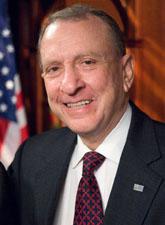 Sen. Arlen Specter (R-PA)
Legislative Activity
Stay on top of the latest movement without scrolling through every action
Senate amendment submitted
September 10, 2003
View full timeline
Senate amendment submitted
September 10, 2003
Senate amendment proposed (on the floor): Amendment SA 1640 proposed by Senator Specter to Amendment SA 1542.(consideration: CR 9/11/2003 S11321-11324; text: CR 9/11/2003 S11324)
September 10, 2003
Senate amendment agreed to: Amendment SA 1640 agreed to in Senate by Voice Vote.
September 10, 2003
Amendment SA 1640 proposed by Senator Specter to Amendment SA 1542. (consideration: CR 9/11/2003 S11321-11324; text: CR 9/11/2003 S11324) To allow continued funding of the Council on Graduate Medical Education.
September 10, 2003
Amendment SA 1640 agreed to in Senate by Voice Vote.
September 10, 2003
Text
Proposed
[[Page S11321]]

-----------------------------------------------------------------------

Senate

DEPARTMENTS OF LABOR, HEALTH AND HUMAN SERVICES, AND EDUCATION, AND
RELATED AGENCIES APPROPRIATIONS ACT, 2004--Continued

Amendments Nos. 1548, 1552, As Further Modified, 1569, 1603, As
Modified, 1612, As Modified, 1623, 1624, 1625, 1626, 1627, 1628, 1629,
1630, 1631, 1632, 1633, 1634, 1635, 1636, 1637, 1638, 1639, 1640, 1641,
1642, 1643, 1644, En Bloc

Mr. SPECTER. Mr. President, I send a series of cleared amendments to
the desk and ask unanimous consent that they be agreed to en bloc, with
the motion to reconsider laid upon the table.
The PRESIDING OFFICER. Is there objection?
Without objection, it is so ordered. The amendments are considered
and agreed to en bloc.
The amendments are as follows:

amendment no. 1548

(Purpose: To provide for the establishment of summer health career
introductory programs for middle and high school students)

At the appropriate place, insert the following:

SEC. ____. SUMMER HEALTH CAREER INTRODUCTORY PROGRAMS.

(a) Findings.--Congress finds that--
(1) the success of the health care system is dependent on
qualified personnel;
(2) hospitals and health facilities across the United
States have been deeply impacted by declines among nurses,
pharmacists, radiology and laboratory technicians, and other
workers;
(3) the health care workforce shortage is not a short term
problem and such workforce shortages can be expected for many
years; and
(4) most States are looking for ways to address such
shortages.
(b) Grants.--The Secretary of Health and Human Services,
acting through the Bureau of Health Professions of the Health
Resources and Services Administration, may award not to
exceed 5 grants for the establishment of summer health career
introductory programs for middle and high school students.
(c) Eligibility.--To be eligible to receive a grant under
subsection (b) an entity shall--
(1) be an institution of higher education (as defined in
section 101(a) of the Higher Education Act of 1965 (20 U.S.C.
1001(a)); and
(2) prepare and submit to the Secretary of Health and Human
Services an application at such time, in such manner, and
containing such information as the Secretary may require.
(d) Duration.--The term of a grant under subsection (b)
shall not exceed 4 years.
(e) Authorization of Appropriations.--There is authorized
to be appropriated to carry out this section, such sums as
may be necessary for each of fiscal years 2004 through 2007.

amendment no. 1552

On page 61, between lines 14 and 15, insert the following:
Sec. ____. In addition to any amounts otherwise
appropriated under this Act for programs and activities under
the Nurse Reinvestment Act (Public Law 107-205) and for other
nursing workforce development programs under title VIII of
the Public Health Service Act (42 U.S.C. 296 et seq.), there
are appropriated an additional $50,000,000 for such programs
and activities.

amendment no. 1569

(Purpose: To provide for a report concerning how Federal funds are
expended relating to Hansen's Disease)

At the appropriate place, insert the following:
Sec.  . Not later than May 1, 2004, the Secretary of Health
and Human Services shall submit to the appropriate committees
of Congress a report concerning the manner in which the
Department of Health and Human Services expends Federal funds
for research, patient care, and other activities relating to
Hansen's Disease. The report shall include--
(1) the amounts provided for each research project;
(2) the amounts provided to each of the 12 treatment
centers for each of research, patient care, and other
activities;
(3) the per patient expenditure of patient care funds at
each of the 12 treatment centers; and
(4) the mortality rates at each of the 12 treatment
centers.

amendment no. 1603

At the end of title III, insert the following:
Sec. 306. (a) In addition to any amounts otherwise
appropriated under this Act, there may be appropriated, out
of any money in the Treasury not otherwise appropriated--
(1) an additional $4,000,000 to carry out title III of the
Elementary and Secondary Education Act of 1965 (language
instruction);
(2) up to $1,000,000 to carry out part A of title V of the
Higher Education Act of 1965 (Hispanic-serving institutions);
(3) up to $500,000 to carry out part C of title I of the
Elementary and Secondary Education Act of 1965 (migrant
education);
(4) up to an additional $3,000,000 to carry out high school
equivalency program activities under section 418A of the
Higher Education Act of 1965 (HEP);
(5) up to an additional $500,000 to carry out college
assistance migrant program activities under section 418A of
the Higher Education Act of 1965 (CAMP);
(6) up to an additional $1,000,000 to carry out subpart 16
of part D of title V of the Elementary and Secondary
Education Act of 1965 (parental assistance and local family
information centers); and

amendment no. 1612

In the matter under the heading ``Training and Employment
Services'' under the heading ``Employment and Training
Administration'' in title I, add at the end the following:
For necessary expenses of the Workforce Investment Act of
1998, including the purchase and hire of passenger motor
vehicles, the construction, alteration, and repair of
buildings and other facilities, and the purchase of real
property for training centers as authorized by the Workforce
Investment Act of 1998, $25,000,000 may be used to carry out
activities described in section 132(a)(2)(B) of that Act
(relating to dislocated worker employment and training
activities and other activities for dislocated workers).

amendment no. 1623

(Purpose: To increase funding for activities to prevent the mother-to-
child transmission of HIV)

On page 61, between lines 14 and 15, insert the following:
Sec. ____. (a) Mother-to-Child HIV Transmission
Prevention.--In addition to any amounts otherwise made
available under this Act to carry out mother-to-child HIV
transmission prevention activities, there shall be made
available an additional $60,000,000 to carry out such
activities and $1,000,000 for non-mother-to-child activities.
(b) Reduction in Amounts.--Amounts made available under
this Act for the administrative and related expenses for
departmental management for the Department of Labor, the
Department of Health and Human Services, the Department of
Education, shall be reduced on a pro rata basis by
$61,000,000.

amendment no. 1624

At the end of title III, insert the following:
Sec.  . For activities authorized by part H of title I of
the Elementary and Secondary Education Act, there are hereby
appropriated up to $5,000,000, which may be used to carry out
such activities.

[[Page S11322]]

amendment no. 1625

(Purpose: To provide for the conduct of studies concerning the program
established under the Mammography Quality Standards Act of 1992)

At the appropriate place in title II, insert the following:

SEC. ____. STUDIES CONCERNING MAMMOGRAPHY STANDARDS.

(a) Study by GAO.--
(1) In general.--The Comptroller General of the United
States shall conduct a study of the program established under
the Mammography Quality Standards Act of 1992 (section 354 of
the Public Health Service Act (42 U.S.C. 263b)) (referred to
in this section as the ``MQSA'') to--
(A) evaluate the demonstration program regarding frequency
of inspections authorized under section 354(g) of the Public
Health Service Act (42 U.S.C. 263b(g)), including the effect
of the program on compliance with the MQSA;
(B) evaluate the factors that contributed to the closing of
the approximately 700 mammography facilities nationwide since
2001, whether those closings were due to consolidation or
were a true reduction in mammography availability, explore
the relationship between certified units and facility
capacity, and evaluate capacity issues, and determine the
effect these and other closings have had on the accessibility
of mammography services, including for underserved
populations, since the April 2002 General Accounting Office
report on access to mammography; and
(C) evaluate the role of States in acting as accreditation
bodies or certification bodies, or both, in addition to
inspection agents under the MQSA, and in acting as
accreditation bodies for facilities in other States and
determine whether and how these roles affect the system of
checks and balances within the MQSA.
(2) Report.--Not later than 16 months after the date of
enactment of this Act, the Comptroller General of the United
States shall submit to the Committee on Health, Education,
Labor, and Pensions and the Committee on Appropriations of
the Senate and the Committee on Energy and Commerce and the
Committee on Appropriations of the House of Representatives a
report on the study described in paragraph (1).
(b) Study by the Institute of Medicine.--
(1) In general.--Not later than 30 days after the date of
enactment of this Act, the Secretary of Health and Human
Services shall enter into an agreement with the Institute of
Medicine of the National Academy of Sciences for the conduct
of a study and the making of recommendations regarding the
following:
(A) Ways to improve physicians' interpretations of
mammograms, including approaches that could be taken under
the MQSA without negatively impacting access to quality
mammography.
(B) What changes could be made in the MQSA to improve
mammography quality, including additional regulatory
requirements that would improve quality, as well as the
reduction or modification of regulatory requirements that do
not contribute to quality mammography, or are no longer
necessary to ensure quality mammography. Such reduction or
modification of regulatory requirements and improvements in
the efficiency of the program are important to help eliminate
disincentives to enter or remain in the field of mammography.
(C) Ways, including incentives, to ensure that sufficient
numbers of adequately trained personnel at all levels are
recruited and retained to provide quality mammography
services.
(D)(i) How data currently collected under the MQSA could be
used to improve the quality, interpretation of, and access to
mammography.
(ii) Identification of new data points that could be
collected to aid in the monitoring and assessment of
mammography quality and access.
(E) Other approaches that would improve the quality of and
access to mammography services, including approaches to
improving provisions under the MQSA.
(F) Steps that should be taken to help make available safe
and effective new screening and diagnostic devices and tests
for breast cancer.
(2) Report.--Not later than 15 months after the date on
which the agreement is entered into under paragraph (1), the
Institute of Medicine shall complete the study described
under such subsection and submit a report to the Secretary of
Health and Human Services, the Committee on Health,
Education, Labor, and Pensions and the Committee on
Appropriations of the Senate, and the Committee on Energy and
Commerce and the Committee on Appropriations of the House of
Representatives.
(3) Funding.--Of the amounts appropriated under this title
to the Office of the Secretary of Health and Human Services
for general departmental management, $500,000 shall be made
available to carry out the study under this subsection.

amendment no. 1626

(Purpose: To provide funds for the conduct of a grant program to
strengthen local capacity on Native American reservations to screen for
and treat sexually transmitted diseases)

At the appropriate place in title II, insert the following:
Sec. ____. (a) Findings.--The Senate finds that--
(1) Native American populations have seen an alarming
increase in sexually transmitted disease prevalence in recent
years; and
(2) a screening, treatment, and education program,
administered by tribal health organizations or local health
care providers, on Native American reservations with high
rates of sexually transmitted diseases will help prevent a
corresponding increase in the prevalence of HIV.
(b) Grant Program.--From amounts appropriated under this
title for the Centers for Disease Control and Prevention,
there may be made available up to $1,000,000 to enable the
Director of the Centers for Disease Control and Prevention to
carry out competitive grant program to strengthen local
capacity on Native American reservations to screen for and
treat sexually transmitted diseases and to educate local
populations about such diseases, the consequences thereof,
and how the transmission of such diseases can be prevented.

amendment no. 1627

(Purpose: To provide funding for newborn and child screening for
heritable disorders)

On page 61, between lines 14 and 15, insert the following:
Sec. ____. In addition to any amounts otherwise
appropriated under this Act for the support of the improved
newborn and child screening for heritable disorders program
authorized under section 1109 of the Public Health Service
Act (42 U.S.C. 300b-8), there may be appropriated up to an
additional $2,000,000 to carry out such program.

amendment no. 1628

(Purpose: To provide funding for the mass layoff statistics program)

On page 18, line 14, strike ``$440,113,000'' and insert
``$445,113,000''.
On page 18, line 17, insert before the period the
following: ``, of which $5,000,000 may be used to fund the
mass layoff statistics program under section 15 of the
Wagner-Peyser Act (29 U.S.C. 49l-2)''.

amendment no. 1629

(Purpose: To increase funding for the Special Volunteers for Homeland
Security program)

At the appropriate place in title V, insert the following:
Sec. ____. In addition to any amounts otherwise
appropriated under this Act for the Special Volunteers for
Homeland Security program, there may be appropriated an
additional $5,000,000 for such program.

amendment no. 1630

(Purpose: To provide protection for nationals and residents of the
Islamic Republic of Iran who are targets of persecution)

On page 57, between lines 14 and 15, insert the following:
``(C) in subsection (b)(1)--
``(i) in subparagraph (A), by striking `and' at the end;
``(ii) in subparagraph (B), by striking the period and
inserting `; and'; and
``(iii) by adding at the end the following:
`(C) one or more categories of aliens who are or were
nationals and residents of the Islamic Republic or Iran who,
as members of a religious minority in Iran, share common
characteristics that identify them as targets of persecution
in that state on account of race, religion, nationality,
membership in a particular social group, or political
opinion.'; and''.

amendment no. 1631

(Purpose: To authorize funding for the Daniel Patrick Moynihan Global
Affairs Institute Act)

At the appropriate place, insert the following:

DANIEL PATRICK MOYNIHAN GLOBAL AFFAIRS INSTITUTE

Sec. ____. (a) Definitions.--In this section:
(1) Endowment fund.--The term ``endowment fund'' means a
fund established by the Maxwell School of Citizenship and
Public Affairs of the Syracuse University in Syracuse, New
York, for the purpose of generating income for the support of
the School and other purposes as described in subsection (d).
(2) School.--The term ``School'' means the Maxwell School
of Citizenship and Public Affairs of the Syracuse University
in Syracuse, New York.
(3) Secretary.--The term ``Secretary'' means the Secretary
of Education.
(4) University.--The term ``University'' means the Syracuse
University in Syracuse, New York.
(b) Daniel Patrick Moynihan Global Affairs Institute.--
(1) Redesignation.--To be eligible for a grant under
subsection (c), the University shall designate the global
affairs institute within the Maxwell School of Citizenship
and Public Affairs of the University as the ``Daniel Patrick
Moynihan Global Affairs Institute''.
(2) References.--Any reference in a law, map, regulation,
paper, or other record to the global affairs institute within
the Maxwell School of Citizenship and Public Affairs of the
University, shall be deemed to be a reference to the Daniel
Patrick Moynihan Global Affairs Institute.
(c) Grant for Endowment Fund.--From amounts appropriated
under subsection (f), the Secretary may award a grant to the
University for the establishment of an endowment fund to
support the Daniel Patrick Moynihan Global Affairs Institute.
(d) Duties.--Amounts received under a grant under
subsection (c), shall be used to--
(1) carry on the public and intellectual tradition of
Senator Daniel Patrick Moynihan;

[[Page S11323]]

(2) sustain all of the core activities of the School;
(3) fund the residencies of visiting scholars and
international leaders;
(4) support scholarship, training, and practice in
countries that are often the most impoverished economically,
institutionally, and civically;
(5) support partnerships with governments and other
relevant entities around the world to train government
officials both at the School and in their home countries; and
(6) expand the facilities of the School.
(e) Miscellaneous Provisions Relating to the Endowment
Fund.--
(1) Management.--The endowment fund established under
subsection (c) shall be managed in accordance with the
standard endowment policies established by the University.
(2) Use of interest and investment income.--Interest and
other investment income earned from the endowment fund may be
used to carry out the duties under subsection (d).
(3) Distribution of interest and investment income.--Funds
derived from the interest and other investment income earned
from the endowment fund shall be available for expenditure by
the University for purposes consistent with subsection (d).
(f) Authorization of Appropriations.--There is authorized
to be appropriated to carry out this section, $10,000,000 to
remain available until expended.

amendment no. 1632

(Purpose: To require the Centers for Disease Control and Prevention to
prepare a comprehensive plan to address blood safety and injection
safety in Africa under the Global AIDS Program)

On page 61, between lines 14 and 15, insert the following:
Sec. ____. Not later than 120 days after the date of
enactment of this Act, the Director of the Centers for
Disease Control and Prevention shall prepare a plan to
comprehensively address blood safety and injection safety in
Africa under the Global AIDS Program.

amendment no. 1633

(Purpose: To require the Secretary of Labor, the Secretary of Health
and Human Services, and the Secretary of Education to report to
Congress on acquisitions made by each Department of articles,
materials, or supplies manufactured outside the United States)

On page 20, line 19, strike the period at the end and
insert ``: Provided further, That of this amount, sufficient
funds shall be available for the Secretary of Labor, not
later than 60 days after the last day of the fiscal year, to
submit to Congress a report on the amount of acquisitions
made by the Department of Labor during such fiscal year of
articles, materials, or supplies that were manufactured
outside the United States. Such report shall separately
indicate the dollar value of any articles, materials, or
supplies purchased by the Department of Labor that were
manufactured outside the United States, an itemized list of
all waivers under the Buy American Act (41 U.S.C. 10a et
seq.) that were granted with respect to such articles,
materials, or supplies, and a summary of total procurement
funds spent on goods manufactured in the United States versus
funds spent on goods manufactured outside of the United
States. The Secretary of Labor shall make the report publicly
available by posting the report on an Internet website.
On page 49, line 21, strike the period and insert ``:
Provided further, That of this amount, sufficient funds shall
be available for the Secretary of Health and Human Services,
not later than 60 days after the last day of the fiscal year,
to submit to Congress a report on the amount of acquisitions
made by the Department of Health and Human Services during
such fiscal year of articles, materials, or supplies that
were manufactured outside the United States. Such report
shall separately indicate the dollar value of any articles,
materials, or supplies purchased by the Department of Health
and Human Services that were manufactured outside the United
States, an itemized list of all waivers under the Buy
American Act (41 U.S.C. 10a et seq.) that were granted with
respect to such articles, materials, or supplies, and a
summary of total procurement funds spent on goods
manufactured in the United States versus funds spent on goods
manufactured outside of the United States. The Secretary of
Health and Human Services shall make the report publicly
available by posting the report on an Internet website.''.
On page 74, line 4, strike ``Washington, D.C.'' and insert
``Washington, D.C.: Provided, That of this amount, sufficient
funds shall be available for the Secretary of Education, not
later than 60 days after the last day of the fiscal year, to
submit to Congress a report on the amount of acquisitions
made by the Department of Education during such fiscal year
of articles, materials, or supplies that were manufactured
outside the United States. Such report shall separately
indicate the dollar value of any articles, materials, or
supplies purchased by the Department of Education that were
manufactured outside the United States, an itemized list of
all waivers under the Buy American Act (41 U.S.C. 10a et
seq.) that were granted with respect to such articles,
materials, or supplies, and a summary of total procurement
funds spent on goods manufactured in the United States versus
funds spent on goods manufactured outside of the United
States. The Secretary of Education shall make the report
publicly available by posting the report on an Internet
website.''.

amendment no. 1634

(Purpose: To provide for the accurate and timely processing of medicare
claims)

On page 41, insert the following before the period on line
9: ``: Provided further, that to the extent Medicare claims
processing unit costs are projected by the Centers for
Medicare & Medicaid Services to exceed $0.87 for Part A
claims and/or $0.65 for Part B claims, up to an additional
$18,000,000 may be available for obligation for every $0.04
increase in Medicare claims processing unit costs from the
Federal Hospital Insurance and the Federal Supplementary
Medical Insurance Trust Funds. The calculation of projected
unit costs shall be derived in the same manner in which the
estimated unit costs were calculated for the Federal budget
estimate for the fiscal year.''.

amendment no. 1635

On page 61, between lines 14 and 15, insert the following:
Sec. ____. In addition to any amounts otherwise
appropriated under this Act to carry out activities under the
Child Abuse Prevention and Treatment Act (42 U.S.C. 5101 et
seq.), there are appropriated--
(1) up to an additional $143,000 may be used to carry out
activities under title I of such Act (child abuse State
grants);
(2) up to an additional $212,000 may be used to carry out
activities under title II of such Act (community-based
resource centers); and
(3) up to an additional $2,100,000 may be used for child
abuse discretionary grants under such Act.

amendment no. 1636

(Purpose: To provide additional funding to the Office of Minority
Health to conduct a demonstration project to reduce SIDS disparity
rates)

At the appropriate place in title II, insert the following:
Sec. ____. (a) Findings.--The Senate finds that--
(1) a recent Aberdeen Area Indian Health Service infant
mortality study identified protective and risk factors
associated with Sudden Infant Death Syndrome (referred to in
this section as ``SIDS'');
(2) several conclusions from the study suggest courses of
action to reduce the incidence of SIDS among Native American
and other high-incidence populations;
(3) the study noted that alcohol consumption by women of
childbearing age (especially during pregnancy), maternal and
environmental tobacco exposure during pregnancy, and
pregnancy by women under the age of 20 increase the risk for
SIDS;
(4) in 2000, for infants of African American mothers, the
SIDS death rate was 2.4 times that for non-Hispanic white
mothers;
(5) nationwide, SIDS rates for infants of Native American
mothers were 2.6 times those of non-Hispanic white mothers;
and
(6) the Office of Minority Health of the Department of
Health and Human Services has the expertise to coordinate
SIDS disparity reduction efforts across the Department of
Health and Human Services.
(b) Increase in Funding.--In addition to any amounts
otherwise appropriated in this Act to carry out activities to
reduce Sudden Infant Death Syndrome disparity rates, there
may be appropriated up to an additional $2,000,000 to enable
the Director of the Office of Minority Health of the
Department of Health and Human Services to carry out a
demonstration project, in coordination with the Administrator
of the Health Resources and Services Administration, the
Director of the National Institutes of Health, the Director
of the Indian Health Services, the Administrator of the
Center for Medicare & Medicaid Services, the Director of the
Centers for Disease Control and Prevention, and the heads of
other agencies within the Department of Health and Human
Services (as appropriate), to reduce Sudden Infant Death
Syndrome disparity rates, and to provide risk reduction
education to African American and Native American populations
in the United States, including efforts to reduce alcohol use
by pregnant women, support for smoking cessation (maternal
and secondhand) programs, and education of teenagers on the
risk factors for Sudden Infant Death Syndrome associated with
teenage pregnancy within African American and Native American
communities.
(c) Sense of the Senate.--It is the sense of the Senate
that in carrying out the demonstration project under
subsection (b), the Director of the Office of Minority Health
is encouraged to--
(1) expand upon the similar pilot program for Native
Americans that was funded by the Office of Minority Health;
and
(2) coordinate with the Administrator of the Health
Resources and Services Administration, the Director of the
Centers for Disease Control and Prevention, the Director of
the National Institutes of Health, the Director of the Indian
Health Services, the Administrator of the Center for Medicare
& Medicaid Services, and the heads of other agencies within
the Department of Health and Human Services (as appropriate)
to support activities to reduce alcohol use by pregnant
women, support smoking cessation (maternal and secondhand),
and educate teenagers on the risk factors for SIDS associated

[[Page S11324]]

with teenage pregnancy within the African American and Native
American communities.

amendment no. 1637

(Purpose: To provide funds for programs on community automatic external
defibrillators)

At the appropriate place in title II, insert the following:
Sec. ____. (a) Automatic External Defibrillators.--There
may be appropriated up to, $2,000,000 to fund programs on
community automatic external defibrillators under section 312
of the Public Health Service Act (42 U.S.C. 244).

amendment no. 1638

(Purpose: To require the Department of Labor to cease the
implementation of closing procedures for the Department of Labor
Employment and Training Administration regional office in New York
City, New York, and the Employment and Training Administration
affiliate offices in Seattle, Washington, Kansas City, Missouri, and
Denver, Colorado until September 30, 2004)

At the end of title I, insert the following:
Sec. ____. The Department of Labor may cease the
implementation of closing procedures for the Department of
Labor Employment and Training Administration regional office
in New York City, New York, and the Employment and Training
Administration affiliate offices in Seattle, Washington,
Kansas City, Missouri, and Denver, Colorado until September
30, 2004.

amendment no. 1639

(Purpose: To provide additional funding for the purchase of automatic
external defibrillators and the training of individuals in cardiac life
support in rural areas)

On page 61, between lines 14 and 15 insert the following:
Sec. ____. From the amounts appropriated under the heading
Office of the Secretary, General Departmental Management
there may be made available an additional $2,000,000 to the
Health Resources and Services Administration for the purchase
of automatic external defibrillators and the training of
individuals in cardiac life support in rural areas.

amendment no. 1640

(Purpose: To allow continued funding of the Council on Graduate Medical
Education)

On page 61, between lines 14 and 15, insert the following:
``Sec.   . Notwithstanding any other provisions of law,
funds made available under this heading may be used to
continue operating the Council on Graduate Medical Education
established by Section 301 of Public Law 102-408.

amendment no. 1641

(Purpose: To re-allocate funds within the CDC construction account and
other purposes)

On page 28, line 6, strike ``$250,000,000'' and insert
``$260,000,000'' in lieu thereof. On page 28, line 5, insert
after ``; and'' the following: ``purchase,''

amendment no. 1642

(Purpose: To provide funding for the rural emergency medical service
training and equipment assistance program)

On page 27, line 2, insert before the period the following:
``: Provided further, That up to $15,000,000 may be made
available to carry out the rural emergency medical service
training and equipment assistance program under section 330J
of the Public Health Service Act (42 U.S.C. 254c-15)''.

Amendment No. 1643

(Purpose: To provide an additional offset for increased spending)

At the appropriate place in Section 515(a):
Increase the amount by $37,455,000.

amendment no. 1644

(Purpose: To provide for the issuance of rules relating to Personal
Dust Monitor prototypes)

On page 23, between lines 15 and 16, insert the following:
Sec. ____. (a) Findings.--Congress finds that--
(1) it is projected that the Department of Labor, in
conjunction with labor, industry, and the National Institute
for Occupational Safety and Health, will be undertaking
several months of testing on Personal Dust Monitor production
prototypes; and
(2) the testing of Personal Dust Monitor prototypes is set
to begin (by late May or early June of 2004) following the
scheduled delivery of the Personal Dust Monitors in May 2004.
(b) Re-proposal of Rule.--Following the successful
demonstration of Personal Dust Monitor technology, and if the
Secretary of Labor makes a determination that Personal Dust
Monitors can be effectively applied in a regulatory scheme,
the Secretary of Labor shall re-propose a rule on respirable
coal dust which incorporates the use of Personal Dust
Monitors, and, if such rule is re-proposed, the Secretary
shall comply with the regular procedures applicable to
Federal rulemaking.

amendment to no. 1603, as modified

Mr. LIEBERMAN. Mr. President, I rise, as a cosponsor, to express my
support for the amendment offered by my distinguished colleague from
Nevada, Mr. Reid, to provide funding for a number of programs critical
to Hispanic children around the Nation. Clearly, the programs
identified in this amendment are vital to improving educational
outcomes for Hispanic students.
As a nation we have made a commitment to leave no child behind. Yet,
too often, the needs of Hispanic children are overlooked, and Hispanic
children are left behind. The U.S. Census Bureau recently indicated
that Hispanics are the largest minority group in the country. The fact
is, however, they often are among the most educationally disadvantaged
students in the country. Hispanic students are less likely to complete
high school and to enroll in or graduate from college.
The amendment before us will help to address these issues in several
ways. It includes $85 million for title III language instruction. Under
this program, State and local schools implement programs that help
limited English-proficient students learn English and keep up with
their schoolwork. The Senate mark actually cuts this program from last
year's level of $685 million. This is unacceptable. For Hispanic
serving institutions, the Senate bill provides a small but inadequate
increase above last year's level. This amendment includes $6.4 million
in urgently needed funds for HSIs, which continue to receive
significantly less Federal funding per student then other degree-
granting institutions.
My colleague's amendment also includes $4.6 million for migrant
education, which was level funded in the committee mark, and $1 million
for the College Assistance Migrant Program, which the committee cut
from last year's level. These programs help to identify migrant
students, provide health services, and provide counseling and other
assistance for migrants who have dropped out of high school. In
addition, the amendment includes $11 million for the High School
Equivalency Program, $12.8 million for Local Family Information
Centers, and $69 million for Head Start Migrant and Seasonal Programs.
I commend the Senator from Nevada for offering this amendment, and
urge my colleagues to support it. This is an investment in our Nation's
future. The academic achievement gap between Latino students and the
remaining student population is a national disgrace. I am informed that
approximately one-third of new workers are Latino. Let us work together
to invest in these youth, for the benefit of the Latino community and
for the benefit of our Nation.
Mr. BINGAMAN. Mr. President, I rise today to urge my fellow Senators
to support this very important amendment. This amendment would invest
an additional $190 million in our Nation's future, by strengthening
seven programs: The High School Equivalency Program, HEP; The College
Assistance Migrant Program, CAMP; migrant education; local family
information centers; bilingual education; Hispanic serving
institutions, HSIs; and Head Start for children of migrant workers.
If we do no pass this amendment, funding for the High School
Equivalency Program will be cut by 43 percent. This program provides
academic instruction, counseling, computer assisted teaching, career
awareness to migrant students studying for the GED, as well as
assistance with college admissions and job placement.
If this amendment is not passed, 23 program slots will be eliminated
due to the lack of funding. Currently, these 23 slots are filled by
some of the oldest and best performing projects in the HEP program,
some of which have been providing services for 30 years. As a whole, 73
percent of their students received GEDs, and no less than three of the
programs have had consecutive years of 100 percent of their students
receiving their GEDs. All of these programs are up for renewal as well
as competition for these slots with other programs.
One of the 23 programs that faces elimination is in my own State of
New Mexico at the Northern New Mexico Community College. Other States
in which programs are at risk of not being renewed due to the lack of
funding include Pennsylvania, Texas, Idaho, Mississippi, Colorado,
Florida, Oregon, Tennessee, Washington, Wisconsin and California.
A second program whose funding has been cut is the College Assistance
Migrant Program or CAMP. CAMP recruits talented migrant high school

[[Page S11325]]

graduates and GED recipients, who aspire to a postsecondary education
but lack adequate resources. CAMP assists students in their first year
of college with personal and academic counseling, mentoring, and
stipends.
Before the Federal Government created CAMP programs, there was no
record of a migrant child having completed college. Since their
inceptions, both HEP and CAMP have achieved stunning success rates. For
the projects that received 5-year grants in 1999, 72 percent of the HEP
participants have received their GEDs while over 80 percent of the CAMP
students have successfully completed their first year of college. Over
the history of the program, nearly three-quarters of all CAMP students
received baccalaureate degrees.
The existing 102 HEP and CAMP programs serve approximately 15,000
students in 25 States and Puerto Rico. Many areas of the country have
no access to the programs at all. Based on the Department of
Education's estimate, of the over 750,000 school-aged migrant children,
over the next 5 years there will be over 170,000 migrant children who
will become dropouts and eligible for HEP services. CAMP programs will
have approximately 140,000 students who will qualify for services. The
need for services far outstrips the programs' current resources.
The title I Migrant Education Program was established to provide a
compensatory education program designed to deal with the difficulties
encountered by children of migrant workers as a consequence of their
mobility. Some of these children attend three or four schools in a
single school year. They have a need for coordination of educational
services among the States and local districts where they live, often
for a short time. The MEP builds the support structures for migrant
students so that they can achieve high levels of success both in and
outside of school.
The U.S. Department of Education reports that more than 750,000
students were identified as eligible for the program in fiscal year
2001. Additional funds are needed to ensure that these children are
able to meet the challenges mandated by the No Child Left Behind Act.
This amendment will provide an additional $4,587,000 in needed funding.
The Local Family Information Centers was authorized under the No
Child Left Behind Act to provide parents of title I students, including
English language learners, with information about their children's
schools so that they can help their children to meet the high standards
we have set under NCLB. The Local Family Information Centers also help
parents to hold their local and state school officials accountable and
become more involved in their children's education. This amendment
would increase funding by $12.8 million.
This amendment would increase funding to State and local education
agencies in order to ensure that as many of the 4.6 million children
with limited English skills as possible learn English, develop high
levels of academic attainment, and meet the same challenging State
academic standards as all children.
Title III is a formula grant program that distributes funding to all
50 States based on the number of limited English proficient, LEP, and
recent immigrant students. The funds are used for developing effective
language acquisition programs; training for bilingual/ESL teachers and
regular teachers and educational personnel; parent involvement; and
providing services for recently arrived immigrant students. This
amendment would restore the $20.5 million cut in the current
legislation and increase funds by an additional $64.5 million.
Currently, 35 percent of Hispanics are under the age of 18. The
Educational Testing Service has projected the U.S. higher education
system will grow by 3.5 million additional students by 2015 and that
nearly 40 percent of these new students will be Hispanic. HSIs serve
the largest concentrations of the Nation's youngest and largest ethnic
population. HSIs, by definition, have a full-time student enrollment
that is at least 25 percent Hispanic; further, at least one-half of
their entire student enrollment is low-income. The impending emergence
of more than 100 new HSIs, mostly in California, Texas, Florida, New
Mexico, Illinois, in the next few years and the rapid growth of the
Hispanic college-age population underscore the urgency for immediate,
major, and sustained increases in title V funding.
At a time when the current labor force is reaching retirement age in
substantial numbers, Hispanics already represent one of every three new
workers joining the U.S. labor force, according to the U.S. Bureau of
Labor Statistics. By 2025, the Bureau projects that one of two new
workers joining the U.S. labor force will be Hispanic. This amendment
would provide an additional $6.4 million in assistance to these great
institutions.
Migrant and Seasonal Head Start, MSHS, programs serve nearly 32,000
migrant children and nearly 2,500 seasonal children annually, operating
in 38 States in every region of the country. Migrant and Seasonal Head
Start programs were the first Head Start programs to serve infants and
toddlers. today, two-thirds of the children in the program are infants
and toddlers.
Migrant and Seasonal Head Start was a response to the needs of
migrant families. In most States, local childcare resources are not
available when migrants come into a community, especially for infants
and toddlers. When resources are not available, parents have no choice
but to take the children to the fields where they are exposed to
pesticides, hazardous equipment, extreme heat and other health dangers.
This program is ever growing and so greater resources are needed to
provide these essential services. This amendment requests an additional
$69 million for Migrant and Seasonal Head Start.
We must do everything we can to provide every child with the best
education we can. I urge my fellow Senators to support these greatly
needed programs by providing them with the proper resources.
Mrs. CLINTON. Mr. President, I rise today in support of the Reid
Hispanic educational opportunities amendment.
My Democratic colleagues and I have held roundtables with Hispanic
leaders across the Nation and members of the Congressional Hispanic
Caucus that have allowed us to share ideas and develop an agenda that
addresses the issues that matter most to the Hispanic community.
We know how important education is to Hispanics and will continue to
ensure that it remains a top priority for the Democratic caucus.
Unfortunately, the Senate Appropriations Committee-approved bill
eliminated or significantly underfunded programs with a clear record of
improving educational opportunities for Hispanic children. Unless we
restore and expand these funds, millions of Hispanic students will be
denied the opportunity to achieve the American dream.
The fact is, Latino children are among the most educationally
disadvantaged students in our Nation. They have the highest dropout
rate in the entire country, the lowest college attendance rates, the
lowest college graduation rates, and are more likely to attend
underfunded schools in low-income areas.
Hispanic children make up 17 percent of the total school age
population in the country and recent trends indicate that the number of
Latino children attending our Nation's schools is increasing.
This amendment would help ensure that millions of Latino children get
the quality education they need and deserve. It would restore and
expand funds to programs with a proven record of improving achievement
among Latinos.
New York's schools serve a large and growing number of Latino
students and the rate of enrollment for limited English proficient
students has grown by 44 percent since 1990.
Resources provided under title III of the NCLB help school districts
in my State provide English language instruction to over 300,000
limited English proficient children and nearly 120,000 immigrant
children. Yet this appropriations bill cuts title III of the NCLB by
$20 million.
Restoring this funding will help States, local schools, and colleges
build their capacity to teach limited English proficient students
effectively.
This appropriations bill also provides inadequate funding to serve
the children of migrant and seasonal farmworkers. Often called
``children of the

[[Page S11326]]

road,'' these children face many obstacles in their lives, including
extreme poverty, geographic and cultural isolation, discrimination
based on race or ethnic status, language minority status, and, most
important, mobility.
Currently, only 664 of 1,177 eligible migrant children are being
served in migrant and seasonal Head Start centers across New York.
This amendment will take an additional 150 migrant children in New
York out of the fields where they are put at risk of exposure to
harmful toxins and pesticides and into quality head start classrooms
where they can receive the social, behavioral, and cognitive skills
they need to help prepare them for school.
As they continue on their journey through the education pipeline,
programs like the High School Equivalency Program, HEP, and College
Assistance Migrant Program, CMP, help these students beat the odds.
The HEP and CAMP programs are both very important to New York as well
as other states in the Northeast. The HEP program helps migrant
students who have dropped out of high school get their GED, and CAMP
assists migrant students in their first year of college with both
counseling and stipends.
At the State University of New York at Oneonta, Luis Gonzalez, a New
Yorker and former HEP and CAMP student will be entering as a sophomore.
Luis' experience as a migrant youth is shared by countless other
children of migrant and seasonal farm workers.
For Luis, it resulted in a pattern of repeating grades until he quit
school to work with his father in the vineyards of Western New York. A
year later, he learned about HEP and earned his GED. He then applied to
college and was admitted as a freshman to SUNY last year. As a CAMP
student, Luis received vital academic, social, and financial support
during his first year of college, the most critical year for most
first-generation college students. Luis now mentors other HEP students,
is a member of the AmeriCorps program and has maintained a cumulative
GPA of 3.04.
Securing additional resources for HEP and CAMP will help ensure the
dreams of students like Luis become reality.
Many Hispanic students like Luis choose to move on to Hispanic
serving institutions, HSIs. These schools, including New York's 12
HSIs, serve a large and growing number of Hispanic students. By
supporting these institutions we are recognizing the large contribution
they make to increasing access to higher education.
Failure to increase funding for these programs will not only hurt
individual Hispanic children. Unless we provide Latino children today
with the education they need to learn the skills necessary for a wide
range of jobs, we risk having a shortage of qualified workers in the
future.
We need a highly skilled workforce to compete in this global economy
and investing in the education and training of our Hispanic population
will help our Nation meet this challenge.
I strongly urge my colleagues to support the Hispanic educational
opportunities amendment.
Mrs. MURRAY. Mr. President, I am proud to cosponsor the Hispanic
educational opportunities amendment which will help address the
challenges facing Hispanic students from coast to coast.
I thank Senator Reid and Senator Bingaman for offering this
amendment, and today I want to highlight how this bill will help so
many people in our communities.
Just last month in Washington State, I saw once again how important
education is to our entire state and especially to the Hispanic
community.
On August 11, I had the opportunity to hold a day-long summit of
Hispanic leaders in Yakima, WA. The turnout was overwhelming.
In one room, we brought together Hispanic elected officials from
across the State, along with public and private-sector leaders, on a
host of issues.
Congressman Ciro Rodriguez, the chairman of our Congressional
Hispanic Caucus, served as a cohost, and shared his national
perspective on the issues.
We had also had international leaders, including Peruvian Consul
Miguel Velasquez and Mexican Consul Jorge Madrazo.
I am especially proud that we had more than a dozen panelists who
shared their expertise and led our discussion.
I publicly thank each of our panelists for their time not only at the
summit, but for dedicating their lives to helping the community. Many
of them had to overcome significant barriers in their own lives, and
today they are working to knock down barriers for all Hispanics. Their
participation that day was just one example of the leadership they show
every day of the year.
Mr. President, I ask unanimous consent to print the names of the
panelists in the Record.
There being no objection, the material was ordered to be printed in
the Record, as follows:

Education Panelists

Miguel Puente, CAMP Director at Heritage College,
Toppenish; Ricardo Sanchez, LEAP Director, Seattle; Armondo
Mungia, student at Eastern Washington University, Cheney; and
Elizabeth Padilla Flynn, Pasco School District.

Economic Development Panelists

Luz Bazan Gutlerrez, President & CEO, Rural Community
Development Resources, Yakima; Veronica Yzquierdo, Executive
Director, Pasco Downtown Development Association; Jesse
Farias, Employment and Security, Wapato; and Gilberto Alaniz,
State Director, Opportunities Industrialization Center.

Civil Rights Panelists

Lupe Gamboa, United Farm Workers; Roberto Maestas, El
Centro de La Raza, Seattle; Polo Aguilar, Grupo Mexico,
Yakima; and Kevin Diaz, Attorney, Columbia Legal Services.

Healthcare Panelists

Teresa Mosqueda, Sea Mar Representative, Public Health,
Seattle; Kimberley Klint, Ph.D., Director of Mason Maters;
Vickie Ybarra, Director Planning and Development, Yakima Farm
Workers Clinic; Marisela Guzman, ConneX student, Toppenish;
and Jesus Hernandez, Lead Access Coordinator/Program Manager,
Community Choice, Wenatchee.

Mrs. MURRAY. I thank each of them for their leadership, and today I
am on the Senate floor supporting this amendment to help carry out the
agenda we discussed at the summit.
I can tell you that even though we covered a host of topics,
including economic development, civil rights and healthcare, the No. 1
topic people talked about was education.
I was astounded to listen as leaders in the community, elected school
board members, and city council members told me that when they were
growing up, very few people, if any, looked at them and said: ``You
know, you can be a success. You can pass first grade.'' Or that, ``You
can go on to college, and you can become something in this country.''
If we adopt this amendment, we will tell a generation of young
students: We need you. We need you to be the next generation of
engineers. We need you to be the next generation of teachers. We need
you to be the next generation of C.E.O.s.
Today we are missing out on an entire young population, and what they
can give back to this country someday in leadership, in economics, in
paying taxes, and in being successful members of the community.
This amendment will help knock down the barriers facing Hispanic
students, and we must adopt it.
Perhaps the most disturbing thing is that the underlying Labor-HHS
bill we are debating cuts funding for critical Hispanic programs.
That is why we need this amendment to stop those cuts and provide
funding for critical services like extra help with preschool, English
language acquisition, tutoring, mentoring, and financial aid.
I want to highlight how this amendment will help in areas like
Headstart, migrant education, and language skills.
One program that I have seen bring help--and hope--to families for
decades is Head Start. This amendment will expand access to Head Start
programs for migrant and seasonal working families.
Migrant and seasonal farmworkers work hard every day so that you and
I can put affordable food on our tables. It is a good deal for us, but
most of those families earn less than $10,000 a year. Many of their
children pay a price beyond poverty.

When families don't have access to child care, they are forced to
take their children into the fields with them, exposing them to
equipment and other hazards.

[[Page S11327]]

Migrant and Seasonal Head Start programs meet the needs of these
families, keeping their children safe while preparing them for school.
Nationwide, 60 percent of children are being served by Head Start,
but for migrant children, it is just 19 percent and for children of
seasonal workers, it is just 2 percent. That is unacceptable.
This amendment will boost the funding so we give more children of
migrant and seasonal workers a place in Head Start so they can start
school ready to learn.
This amendment does more than just increase funding to serve more
children. It also makes sure that vulnerable children are not cut off
from the help they are counting on.
The President's budget request slashed funding for the High School
Equivalency Program, HEP, by 43 percent.
The appropriations bill before the Senate implements the President's
cut, with a $10 million cut to HEP. It also cuts funding for the
College Assistance Migrant Program, CAMP, by $400,000.
The funding cuts in the HEP program would eliminate the 23 oldest and
best performing projects in the program, two of which are in Washington
State.
I have met with the leaders of HEP and CAMP programs in Washington
state. They are doing critical work at Heritage College and Washington
State University HEP programs.
HEP provides education and counseling services to migrant students
who have dropped out of high school so they can pass the GED
examination.
Some of the 23 projects that could be closed down have been providing
services for 30 years.
As a whole, 73 percent of their students received GEDs, an amazing
success rate for a population of students who have already dropped out
of school.
The CAMP program is also critical. It recruits talented migrant high
school and GED graduates, who want to go on to college, but don't have
the resources. These programs introduce parents and students to campus
during the summer before their freshman year. It helps those students
in their first year of college with personal and academic counseling,
mentoring, and stipends.
Before we created CAMP programs, there was no record of a migrant
child having completed college.
Since then, nearly three-quarters of all CAMP students have graduated
with baccalaureate degrees. Without HEP and CAMP, access to college
would be out of reach for the vast majority of migrant students.
The funding levels in this bill ignore the amazing successes we have
had through HEP and CAMP.
Because migrant children move around, they don't have a local school,
a school district, or even a State that is responsible for their
education. We need to keep this safety net at the Federal level.
Currently, funding for the 102 HEP and CAMP projects can serve only
15,000 students, a small fraction of those who desperately need help.
The Department of Education has estimated there are now over 750,000
school-aged migrant children.
Since migrant children have the highest dropout rate in the Nation,
with nearly 60 percent failing to complete high school, that means that
over the next 5 years, 170,000 of these children will drop out of
school and be eligible for HEP services.
Over the next 5 years, 140,000 students will become eligible for CAMP
services.
It makes no sense for this bill to take away funding when so many
students need help.
Another area where our country cannot afford to make the cuts in this
appropriations bill is in the English Language Acquisition program.
This bill cuts the program by $20 million. That is unacceptable.
This amendment would restore that funding.
It will also increase support for limited English proficient, LEP,
students to $750 million.
The number of LEP students has almost doubled over the past decade.
It has increased at nearly eight times the rate of total student
enrollment. The teachers who are serving those students could use more
preparation to teach students with limited English proficiency.
This amendment will help provide title III dollars so that these
teachers can receive ongoing professional development.
The Reid-Bingaman amendment will help students overcome barriers at
almost every level of school.
Congress has a proud tradition of ensuring that our most
disadvantaged kids get a shot at the American dream. It is what we did
when we passed title I of the Elementary and Secondary Education Act.
It is what we did when we created Head Start. And it is what we did
when we started giving out Pell Grants.
We need to carry on that tradition today, not out of charity, but
because we recognize that these children are our bridge to a successful
future.
I urge my colleagues to vote for this amendment and give Hispanic
students in Washington State and around the country a change at the
American dream and a better life.

amendment no. 1629

Mr. McCAIN. Mr. President, I rise today with my friend from Indiana
to offer an amendment to the fiscal year 2004 Labor-HHS Appropriations
Act. I would like to thank Senator Specter and Senator Harkin for their
support for this amendment.
I usually come down to the Senate floor to criticize the amount of
unrequested spending in appropriations bills. Not often do I propose an
increase in spending for a specific program. However, today, I feel
obligated to offer an amendment to increase the level of funding for
the Special Volunteers for Homeland Security program with the
Corporation for National and Community Service. I am requesting that we
raise our level of funding by $5 million, to bring the total level of
funding to $10 million, which is what the program was funded at last
year. The administration requested a total of $15 million for this
program this year. We are simply proposing to restore one half of the
additional money the President requested. This issue is of enough
importance to the administration as it was included in their Statement
of Administrative Policy.
The amendment Senator Bayh and I propose restores important money to
the Special Volunteers for Homeland Security program, a critical
component on national service. This amendment increases the funding for
this program by $5 million to be more in line with the amount requested
in the President's 2004 Budget.
We live in a time of heightened security where terror alerts have
become an unfortunate reality. It is sobering to realize that the
chances are strong that we will face another terrorist attack in the
future. In addition to devoting considerable resources to fighting
terror at home and abroad, we need to devote significant resources to
preparing our domestic response to any future attack. We would be
failing in our responsibilities if we do not adequately prepare for the
next attack. The realities of the world in which we live today, require
us to educate and prepare the public about terrorism and disasters.
These volunteers are an extremely effective way to achieve our mission.
We need to be fully funding these programs.
For a number of years, Senator Bayh and I have been working together
to increase opportunities for service in the United States. We have
introduced legislation, the Call to Service Act, in the last two
Congresses that would increase volunteer opportunities with AmeriCorps.
We have also worked together successfully to create a short-term
enlistment program for our military. One of the fundamental aspects to
any expansion of service opportunities must be to increase the number
of volunteers in homeland security projects. Our legislation
specifically calls for more volunteers to perform homeland security
function. Service programs such as the one in this amendment provide an
important resources in preparing our Nation to respond to a range of
emergencies by providing people who can serve in important capacities
such as fighting forest fires, disaster relief, and working in hospital
emergency rooms.

I would like to share some examples of the works these volunteers do
in the various states and country. Currently, there are 17 programs
that received money during the second year of this program. The
grantees are a diverse group and are spread across the country from
Alaska to Florida. Important

[[Page S11328]]

groups such as Volunteer Florida, the American Red Cross of Greater New
York and the Housing Authority of the City of Milwaukee are all
grantees under this program.
In the first year of the program, 350 volunteers with the
Municipality of Anchorage, Alaska were able to deliver training to help
homebound seniors and help 4,500 disabled residents of Anchorage
prepare to respond to a disaster.
In Oklahoma, volunteers with the city of Tulsa developed a citywide
volunteer disaster mobilization plan. Volunteers helped to educate the
general public by distributing a family preparedness guide provided
with information how to prepare for disasters. The volunteers convened
meetings that included information on bioterrorism response by local
health departments and established safe and secure teams throughout the
community to serve as trained resources.
I could go on at length about the good things these programs
accomplish.
Increasing the Special Volunteers for Homeland Security program is
consistent with our overall need to increase opportunities for
Americans to serve their country. We need to increase spending for
funding for all volunteer programs. Internationally, increasing
programs such as the Peace Corps are important in spreading American
ideals and values. Domestically, programs such as AmeriCorps need to be
expanded to provide services and assistance to those in need. Any
expansion of AmeriCorps and domestic volunteer opportunities would be
an excellent opportunity to increase volunteer positions in the area of
homeland security.
Once again, I thank my colleagues from Pennsylvania and Iowa for
their work on this important piece of legislation. I look forward to
continuing my work with Senator Bayh and the rest of my colleagues in
the Senate to increase national service opportunities.

amendment No. 1644

Mr. BYRD. Mr. President, it was 35 years ago, at 5:30 a.m. on
November 20, 1968, that a gas and dust explosion occurred at Consul No.
9 coal mine near Farmington WV. The force of the explosion rippled
through the west side of the mine, igniting mine fires and additional
explosions, blocking exits and shutting down escape routes. Large
amounts of smoke, varying in color from black, gray, white, and yellow
exhausted from the air shafts, with major explosions shooting flames
over 100 feet into the air. After 10 days, the search and rescue
operation was halted and the air shafts were sealed to put out the
underground fires. Of the 99 miners underground at the time of the
blast, the explosion took the lives of 78 coal miners, 19 of whom are
still entombed underground.
In response, the Congress passed the most comprehensive mine health
and safety legislation to date--the 1969 Mine Act. The anguish caused
by the Farmington disaster was expressed in the statement of findings
and purpose of that legislation:

. . . the first priority and concern of all in the coal
mining industry must be the health and safety of its most
precious resource--the miner.

In addition to a comprehensive safety enforcement regime, the 1969
Mine Act mandated limits on the coal dust levels to which miners could
be exposed. The Congress' goal was to protect miners from Coal Workers'
Pneumoconiosis, or Black Lung--a disease that results from coal dust
particles accumulating in the lungs, scarring the tissue. It is a
progressive, terminal disease that is irreversible.
It is not known how many miners died from black lung disease prior to
1969, but since that time, even with the stricter standards mandated by
Congress, over 106,000 miners have been diagnosed with the disease,
with the Federal Government receiving 5,000 new claims for black lung
benefits each year.
Last March, the Mine Safety and Health Administration proposed new
rules to implement the 1969 Mine Act with regard to coal dust levels,
and the outcry in opposition to those rules was almost deafening.
Newspapers from The Courier-Journal and Lexington Herald of Kentucky,
to The Charleston Gazette of West Virginia have described these rules
as

impractical . . . ill-advised . . . [an] assault on
workers' health and safety . . . a campaign that would bring
back black lung.

Rallies have been organized in Pennsylvania and West Virginia--all in
opposition to what experts describe as a roll back in the protections
mandated by Congress in 1969 to prevent black lung.

These are seriously flawed rules that would undercut long-running
efforts to improve the working conditions of our nation's miners. Under
the proposed rules, the levels of coal mine dust permitted in the mine
environment reportedly would increase well beyond what was mandated in
the 1969 Mine Act. That is a giant leap backward in the nation's work
to protect the health of miners.
And these proposed rules constitute only one in a series of proposals
by the Mine Safety and Health Administration that are serving to erode
the trust of miners in the one agency of the Federal Government charged
with protecting their health and safety.
Last January, an air shaft explosion killed three workers at the
McElroy Mine in Cameron, WV. Later it was determined that MSHA had
failed to properly inspect that mine. One news journal reported that,
according to MSHA records, between December 2001 and January 2003, when
the McElroy mine should have had six surface inspections, it had been
inspected only once--just once.
While this administration touts a low coal mine fatality rate as
proof of MSHA's effectiveness, it ignores a series of accidents and
near-fatalities that have occurred since last year in Kentucky,
Illinois, Pennsylvania, and West Virginia. Last year's QueCreek
accident alone endangered 18 miners, and, had it swung the other way,
which it easily could have, the rate of recorded fatalities would have
increased.
This year's fatality rate continues to move higher, with 10
fatalities recorded in the last 3 months in Virginia, Kentucky,
Indiana, Alabama, Pennsylvania, and West Virginia. And now MSHA has
proposed a rule to scale back protections against black lung.
In doing so, MSHA is undermining its own credibility. Contrary to
past years, miners now view MSHA as an extension of an administration
that does not understand the dangers which coal miners must confront
every day. That is the only way to explain how MSHA can support a coal
enforcement budget that clearly does not provide MSHA with the
resources it needs to properly inspect our nation's mines. That is the
only way to explain why MSHA would propose a rule that rolls back miner
protections against black lung.
And to make matters worse, the media reports that a conflict of
interest may have existed when those rules were developed and proposed
earlier this year. The Charleston Gazette reported last May that MSHA
Secretary David Lauriski, on several occasions, petitioned MSHA to make
the same change in its rules that he is now advocating when he was
a lobbyist for Energy West. The Inspector General of the Labor
Department has already been asked to investigate this conflict of
interest.

At the very least, there is something highly questionable about how
these rules were developed and what effect they will have on the miners
of our states. The Congress has a responsibility to our nation's coal
miners to seek certain assurances from the Federal regulators before
these rules are put into place. We have a duty to our constituents to
ensure that rule changes such as these are implemented appropriately.
I had intended to offer an amendment to prevent the implementation of
the dust rules proposed by MSHA, until the Congress could be sure of
their consequences. After discussing this matter with Senator Specter,
the National Mining Association, and the United Mine Workers, I have
decided not to offer that amendment for the time being.
Instead, I will support the amendment offered by Senator Specter,
which would require the Labor Secretary to report a new rule that
incorporates the use of real-time dust monitors, assuming that those
monitors are tested successfully in the coming months.
However, it is important that the Mine Safety and Health
Administration understand that this language is

[[Page S11329]]

binding. It must issue a new rule if the personal dust monitoring
devices prove successful. And I hope that they understand that the
miners of our States and their representatives in the Congress will be
watching, and that we will continue to oppose any effort to circumvent
the 1969 Mine Act with regard to dust levels.
I urge Senators to take this opportunity to improve the credibility
of the Mine Safety and Health Administration. I urge Senators to recall
the findings of the Congress that were contained in the 1969 Mine Act:

The first priority and concern of all in the coal mining
industry must be the health and safety of its most precious
resource--the miner.

Mr. KENNEDY. It is a privilege to join Senator Byrd and Senator
Specter on this amendment to increase health and safety protections for
the Nation's coal miners.
Coal mining is difficult and dangerous work. Miners daily face the
risk of mine collapse, mine fires, and the debilitating illness called
black lung disease. Each year, over 4,000 coal miners lose time at work
because of injuries on the job. We all remember the near-tragedy last
summer at Quecreek Mine in Pennsylvania, when nine miners were trapped
underground for 3 days. Miraculously, they were rescued but many other
miners are not so fortunate.
Congress passed the Federal Mine Safety and Health Act in 1969 to
protect miners from these hazards. One of the most critical parts of
the Mine Safety Act is its requirement that mine operators reduce and
control the level of dust that miners inhale during their shifts.
Since then, we have made great progress in reducing the number of
cases of black lung, but this battle is far from over. Over 100,000
former miners and their dependents are receiving Federal benefits today
because they or their family members have had black lung. Each year,
more than 1,000 workers die from the disease--and hundreds of new cases
of black lung are reported each year.
This amendment deals with MSHA's proposed regulations on dust levels
and dust monitoring. Many of us are deeply troubled by the
administration's proposal. The proposed regulation reduces the
protections of the Mine Safety Act. It would allow coal mine operators
to raise dust levels up to four times the amount now permitted by the
act. It would also reduce the number of samples taken in mines to
measure coal dust exposure.
It makes no sense to roll back the current protections. Instead of
increasing the number of inspections and tightening the dust standard,
the administration's regulation would allow coal mines to raise the
amount of dust miners are exposed to. The new regulation directly
contradicts the recommendations of the National Institute for
Occupational Safety and Health, under which the permitted level of coal
dust would be cut in half.
Senator Byrd and Senator Specter have proposed this amendment to
require MSHA to consider incorporating the new Personal Dust Monitor
technology, once testing is completed. This amendment is supported by
both the coal mining industry and by the United Mineworkers.
These Personal Dust Monitors have been developed in conjunction with
labor and industry. They would be worn by individual miners at all
times and could measure more accurately than any existing technology
how much coal dust each miner is exposed to.
MSHA itself has acknowledged the role of Dust Monitors in miner
safety. It has extended the current rulemaking period in order to
include comments based upon Dust Monitor testing. This amendment would
go one step further, by requiring MSHA to consider reproposing the rule
to incorporate Personal Dust Monitors as part of the required
safeguards in the Nation's mines.
Incorporating these technological advances into the rules on coal
dust monitoring is a very important step. The Nation's miners risk
their lives every day to provide critical domestic sources of energy,
and we need to do all we can to protect their lives and health.
I strongly urge my colleagues to support this amendment to use all
available technologies to protect the Nation's hard-working coal
miners.
The PRESIDING OFFICER. The Senator from Iowa is recognized.

Amendment No. 1645

Mr. HARKIN. Mr. President, I ask the indulgence of the Senate for a
brief statement I am going to make.
As we all know, Senator Paul Wellstone, his wife Sheila, and his
daughter Marcia, three staff members, and two pilots perished in a
tragic plane accident nearly a year ago near Eveleth, MN. The Senate
lost an honest, passionate public servant, and we all lost a friend.
Senator Wellstone's life was a testament to his compassion and
commitment to serve the less advantaged. He was a tireless advocate for
people in need. That was never more true than when he began working
with children with Duchenne muscular dystrophy and their families.
In 2001, Senator Wellstone introduced the Muscular Dystrophy
Community Assistance, Research, and Education Amendments of 2001 to
intensify Federal investment in Duchenne and other forms of muscular
dystrophy. The MD CARE Act asked the Director of the National
Institutes of Health to create centers of excellence to conduct basic
and clinical research into Duchenne and other muscular dystrophies.
That bill was signed into law in December of 2001. About a year later,
Senator Wellstone was tragically killed.
While we cannot replace the colleague and friend who served with us
in this Chamber, we can commemorate his work on behalf of Jacob
Gunvalson and others who inspired the late Senator to see this law
enacted. In September of this year, the National Institutes of Health
will announce the first grantees of its newly created Muscular
Dystrophy Cooperative Research Centers Program.
In addition, three NIH institutes--the National Institute of
Arthritis and Musculoskeletal Diseases, the National Institute of
Neurological Disorders and Stroke, and the National Institute of Child
Health and Human Development--also set aside $1 million in the MDCRC
program as the ``Senator Paul D. Wellstone Muscular Dystrophy
Cooperative Research Centers.''
I have an amendment that would rename the NIH Muscular Dystrophy
Cooperative Research Center program in honor of the late Senator Paul
D. Wellstone of Minnesota. I will not read all of it. In part, it says
that the designation of the NIH Muscular Dystrophy Cooperative Research
Centers program shall be known and designated as the ``Senator Paul D.
Wellstone Muscular Dystrophy Cooperative Research Centers'' in honor of
Paul D. Wellstone, who was deceased on October 25, 2002. There is no
cost involved.
I send the amendment to the desk and ask for its immediate
consideration.
The PRESIDING OFFICER. The clerk will report.
The legislative clerk read as follows:

The Senator from Iowa [Mr. Harkin] proposes an amendment
numbered 1645.

Mr. HARKIN. I ask unanimous consent that further reading of the
amendment be dispensed with.
The amendment is as follows:

(Purpose: To rename the NIH Muscular Dystrophy Cooperative Research
Center (MDCRC) program in honor of the late Senator Paul D. Wellstone
of Minnesota)

Add at the appropriate place:

SECTION 1. DESIGNATION OF SENATOR PAUL D. WELLSTONE NIH MDCRC
PROGRAM

(a) Findings.--Congress finds the following:
(1) On December 18, 2001, Public Law 107-84, otherwise
known as the Muscular Dystrophy Community Assistance,
Research and Education Amendments of 2001, or the MD CARE
Act, was signed into law to provide for research and
education with respect to various forms of muscular
dystrophy, including Dechenne, Becker, limb girdle,
congenital, facioscapulohumeral, myotonic, oculopharyngeal,
distal, and EmeryDreifuss myscular dystrophies.
(2) In response to the MD CARE Act of 2001, in September
2002, NIH announced its intention to direct $22.5 million
over five years to its newly created Muscular Dystrophy
Cooperative Research Centers (MDCRC) program.
(3) Senator Paul D. Wellstone was a driving force behind
enactment of the MD CARE Act, which led to the establishment
of the MDCRC program.
(b) Designation.--The NIH Muscular Dystrophy Cooperative
Research Centers (MDCRC) program shall be known and
designated as the ``Senator Paul D. Wellstone Muscular
Dystrophy Cooperative Research Centers,'' in honor of Senator
Paul D. Wellstone who was deceased on October 25, 2002.

[[Page S11330]]

(c) References.--Any reference in a law, regulation,
document.
The PRESIDING OFFICER. The Senator from Pennsylvania.
Mr. SPECTER. Mr. President, I thank the Senator from Iowa for what he
has done. I am delighted to join him in sponsoring the amendment to
name the Muscular Dystrophy Operative Research Center after Senator
Wellstone. Senator Wellstone attended many of our appropriations
subcommittee hearings on neurological disorders and was a tireless
advocate for medical research regarding the cause of muscular
dystrophy. He was the original sponsor of the Muscular Dystrophy Care
Act of 2001. This was the first disease-specific piece of legislation
in the 107th Congress, the first major piece of health care legislation
signed by President George Bush, and the first piece of legislation to
ever address a very lethal childhood disorder.
Just a few weeks before he died, Senator Wellstone visited a little
boy named Jacob who was afflicted with muscular dystrophy. He and Jacob
made some television ads, which sadly didn't air because of Senator
Wellstone's tragic death. Senator Wellstone made a difference in the
lives of thousands of children afflicted with this deadly disease. He
leaves a legacy of unprecedented Federal commitment to muscular
dystrophy research and development. I have no doubt that someday soon
we will win the fight against muscular dystrophy because of Paul
Wellstone's work.
Mr. President, I yield to my distinguished colleague from
Pennsylvania, Senator Santorum.
The PRESIDING OFFICER. The Senator from Pennsylvania.
Mr. REID. Will the Senator withhold?
Mr. SANTORUM. I will be happy to withhold.
The PRESIDING OFFICER. Is there further debate on amendment No. 1645?
If not, the question is on agreeing to the amendment.
The amendment (No. 1645) was agreed to.
The PRESIDING OFFICER. The Senator from Pennsylvania.

Amendment No. 1623

Mr. SANTORUM. Mr. President, earlier today, I offered an amendment to
increase the amount of money in the Aid for Africa Program to the
number that met the authorization level this Senate passed just a
couple months ago. It was an additional $350 million which would be
needed to do the $2 billion in bilateral aid to which we committed,
plus the $400 million we would need to match roughly $700 million-plus
that has now been put forward by other countries for the Global Fund.
This bill is, in combination with the foreign operations bill, $350
million short for what I believe is the most important health crisis
facing the world and one I would argue is, as far as dollars spent,
going to save more lives and improve the quality of life for more
people than probably any other single dollar item we are doing in this
bill.
I believe this is the highest priority. That is why I was willing to
offer an amendment to fund this program fully and to do so with an
across-the-board cut. Having seen the success of an across-the-board
cut in a previous amendment, I have not been necessarily encouraged by
my colleagues to continue this effort.
I thank the Senator from Pennsylvania, my colleague, in sharpening
his pencil to come up with enough money to at least meet the
President's request on his program, which is an additional $61 million.
It is an amendment Senator DeWine offered earlier for mother-to-child
transmission and for nonmother-to-child transmission.
Senator DeWine has been doing some great work, along, I understand
now, with Senator Durbin, to come up with this money.
In exchange for the acceptance of that amendment by the managers, I
am going to withhold my amendment. I yield to the Senator from Ohio to
explain what his amendment does.
Mr. DeWINE. I thank my colleague from Pennsylvania. I also thank my
other colleague from Pennsylvania, the chairman of the committee, for
his good work on this bill and for his willingness to work with us on
this very important issue.
I know the hour is late, Mr. President. I am just going to take
literally 2 minutes to explain this amendment. I will offer the
amendment and then I believe the amendment will be accepted.
This amendment is very simple. What it does is it will restore the
money to this bill the President has requested this Congress to provide
for a program that literally will save tens of thousands, maybe
hundreds of thousands, of lives of innocent children. We have the
ability today to see a pregnant mother who is HIV positive and to
provide her with the care and the drugs to ensure she will not give
birth to a child who is HIV positive.
The statistics are very simple and the facts are very simple. If a
woman today is pregnant and is HIV positive, the odds are--the
percentage is about 30 percent--she will give birth to a child who is
HIV positive. In sub-Saharan Africa or in Haiti or in Guyana, there are
programs today that will reduce those odds from 30 percent down to 5 or
10 percent for as little as $3 to $4 per woman. That is not per day.
That is per woman per child. It is almost a miracle.
My colleague in the Chair and other Members of the Senate who just
came back from a trip, led by Majority Leader Bill Frist, to Africa saw
these programs in place. They work. What this extra $60 million will do
is to help ensure there will be tens of thousands of more children who
will be born HIV negative.
I thank my chairman for allowing this money to come into the bill.
I call up my amendment on behalf of Senator Santorum and Senator
Durbin, who went to bat, as he has many times in the past, for children
and those who are HIV positive and who might be HIV positive. I thank
Senator Durbin and Senator Santorum. I now call up my amendment No.
1623.
The PRESIDING OFFICER. The clerk will report.
The legislative clerk read as follows:

The Senator from Ohio [Mr. DeWine], for himself, Mr.
Santorum, and Mr. Durbin, proposes an amendment numbered 1623
to amendment No. 1542.

Mr. DeWINE. Mr. President, I ask unanimous consent that the reading
of the amendment be dispensed with.
The PRESIDING OFFICER. Without objection, it is so ordered.
The amendment is as follows:

(Purpose: To increase funding for activities to prevent the mother-to-
child transmission of HIV)

On page 61, between lines 14 and 15, insert the following:
Sec. ____. (a) Mother-to-Child HIV Transmission
Prevention.--In addition to any amounts otherwise made
available under this Act to carry out mother-to-child HIV
transmission prevention activities, there shall be made
available an additional $60,000,000 to carry out such
activities and $1,000,000 for non-mother-to-child activities.
(b) Reduction in Amounts.--Amounts made available under
this Act for the administrative and related expenses for
departmental management for the Department of Labor, the
Department of Health and Human Services, the Department of
Education, shall be reduced on a pro rata basis by
$61,000,000.

The PRESIDING OFFICER. The Senator from Pennsylvania.
Mr. SPECTER. Mr. President, I congratulate the Senator from Ohio for
his outstanding work. I congratulate my colleague from Pennsylvania for
his contribution. The Senator from Ohio only talked to me about this
amendment about 79 times during the course of the last 2 days. To say
that he was persistent would be a vast understatement.
We are prepared to accept this $61 million for the global AIDS for
the CDC, of which $60 million is for the mother-to-child transmission
prevention initiative and $1 million is for other global AIDS
activities. This offset will be made from the administrative costs of
the Departments of Labor, Health and Human Services, and Education.
During the course of the debate, we have had a great many AIDS
amendments offered, and we wish we could have accepted more of them.
But this particular one is very precisely targeted. I know the Senator
from Ohio just came back from Africa and feels very deeply about this
issue.
We are pleased to accept this amendment, with our compliments to the
Senator from Ohio, Mr. DeWine, the Senator from Pennsylvania, Mr.
Santorum, and the Senator from Illinois, Mr. Durbin.
I yield the floor.
The PRESIDING OFFICER. Is there further debate? The Senator from
Iowa.

[[Page S11331]]

Mr. HARKIN. Mr. President, I have no objection to this amendment. In
fact, I am supportive of it. I want to make it clear for the record
that the offset on this amendment is not an across-the-board cut. It
comes only from the administrative account of the--is it all the
Departments, the Departments of Labor, Health and Human Services, and
Education--or is it just from the Department of Health and Human
Services? I am a little unclear as to from what administrative account
it is taken. I want it clear for the record. I just want to get an
answer to my question as to which administrative account the offset is
taken.
Mr. DeWINE. The Senator is correct, it is not an across-the-board
cut.
Mr. HARKIN. I understand it is not an across-the-board cut. Is it
from the administrative account of all three Departments or only Health
and Human Services?
Mr. SPECTER. It is from all three.
Mr. DeWINE. I can check the exact language of the
amendment. Departments of Labor, Health and Human Services, and
Education.

Mr. HARKIN. Pardon?
Mr. DeWINE. Labor, Health and Human Services, and Education.
Mr. HARKIN. So it comes from all three accounts. Again, I just wanted
to make that clear for the record, that it is not from one account; it
is all three, and it is not an across-the-board cut.
With that, there is certainly no objection to this amendment.
The PRESIDING OFFICER. The Senator from Pennsylvania.
Mr. SPECTER. Mr. President, have we adopted the DeWine amendment?
The PRESIDING OFFICER. We have not. Is there further debate?
Mr. SPECTER. I urge its adoption.
The PRESIDING OFFICER. The question is on agreeing to amendment No.
1623.
The amendment (No. 1623) was agreed to.
The PRESIDING OFFICER. The Senator from Pennsylvania.
Mr. SPECTER. Mr. President, I now call up amendment 1542.
The PRESIDING OFFICER. The substitute is pending and one amendment is
pending to the substitute.

Amendment No. 1561 Withdrawn

Mr. SPECTER. Mr. President, I withdraw the pending amendment, DeWine.
The PRESIDING OFFICER. Is there objection? Without objection, it is
so ordered. The amendment is withdrawn. The Senator from Pennsylvania.

Amendment No. 1542

Mr. SPECTER. Mr. President, I now call up amendment No. 1542.
The PRESIDING OFFICER. The amendment is pending.
Mr. SPECTER. This amendment is to strike all after the enacting
clause and insert the following, which is the text of the amendments.
The PRESIDING OFFICER. The question is on agreeing to amendment No.
1542, as amended.
The amendment (No. 1542), as amended, was agreed to.
The PRESIDING OFFICER. The question is on the engrossment of the
amendments and third reading of the bill.
The amendments were ordered to be engrossed and the bill to be read a
third time.
The bill was read a third time.

close up foundation fellowships

Ms. LANDRIEU. Mr. President, it is almost like the change of season
around the Capitol when young people from all over the country descend
on the Capitol to learn about their Government. We all meet with groups
of these students from our State. We take photos, we answer questions.
But if you take the time to look at the badges the students and
teachers are wearing, more likely than not, they will say Close Up.
Like thousands of young people around this Nation, I got my first
real taste of our Federal Government from a trip sponsored by the Close
Up Foundation. Since 1972, more than 26,000 students from my State have
learned about their Government through the auspices of this
organization. Close Up has awarded some $3.7 million in fellowships for
students in need and their teachers to encourage the broadest base of
possible participation. Furthermore, this program was started by a
legendary member of this body, who also hailed from Louisiana--Allen
Ellender.
Moreover, there has never been a greater need than now for young
people to understand what our Democracy is all about. As we face
enormous challenges at home and abroad, the better understanding our
young people have about their Government, the brighter our future will
be.
Sadly, Mr. President, the Close Up Foundation, which has enjoyed the
support of the Senate for several decades, did not receive any
resources in this bill. They are seeking funding of $1.4 million, an
amount equal to last year's level. I would ask my friend, the Senior
Senator from Pennsylvania, and chairman of the Labor, Health and Human
Services Subcommittee, if he is aware of the precarious situation of
this program, and if he would be willing to work with me to find
additional resources during the conference process.
Mr. SPECTER. Mr. President, I thank the junior Senator from Louisiana
for bringing this important issue to the subcommittee's attention. I
believe that Close Up makes a vital contribution to civic education,
and would not want to see the program fail. I say to my friend from
Louisiana, that I will be pleased to work with her during conference to
see if we can find the necessary funding to meet Close Up's needs.
Mr. HARKIN. I thank my good friend and colleague from Louisiana for
bringing up this important issue. I know my partner in this process,
Senator Specter, worked hard to fund many priorities within a tight
allocation. I look forward to working with him on this and other
important programs in conference.

pediatric graduate medical education

Mr. DeWINE. Mr. President, I thank my colleague, Senator Specter, for
all of the work he has put into drafting and shepherding the Fiscal
Year 2004 Labor-Health and Human Services-Education appropriations
bill. His leadership and his efforts should be commended.
Last week, I offered an amendment in support of our Nation's
children's hospitals. My amendment would equalize the funding that
children's hospitals receive compared to adult hospitals. Specifically,
the amendment would provide an additional $15 million to fund the
pediatric Graduate Medical Education program at $305 million. These
monies are used by children's hospitals across the country to hire and
retain residents who are interested in pediatric research and in
becoming pediatricians.
I ask my colleague, the Senior Senator from Pennsylvania, if he
supports our Nation's children's hospitals and the Graduate Medical
Education program?
Mr. SPECTER. I thank my colleague, Senator DeWine. I strongly support
our Nation's children's hospitals and the pediatric Graduate Medical
Education program.
Mr. DeWINE. Children's hospitals train almost 30 percent of all
pediatricians and half of all pediatric specialists. They also provide
more than 40 percent of the hospital care in this country for children
needing cardiac surgery, children suffering with cancer, and children
with cerebral palsy.
Mr. HARKIN. I agree with my colleague about the valuable role of
children's hospitals in providing pediatric care and research.
Mr. DeWINE. The House included $305 million in its Fiscal Year 2004
Labor-Health and Human Services-Education bill. I have agreed to
withdraw my amendment, but I urge the senior Senator from Pennsylvania
to continue working to provide in conference the most funding possible
for the Graduate Medical Education program.
Mr. SPECTER. I will do all that I can to see to it that the GME
program is funded at the highest level possible in conference.
Mr. HARKIN. I concur with the chairman, and will strongly support the
GME program.

centers for children's environmental health and disease prevention
research

Mr. SPECTER. I am glad to join Senator Harkin in confirming our
intent that funding in the Labor-HHS appropriations bill be used in
part to continue funding 12 Centers for Children's Environmental Health
and Disease Prevention Research. These centers were established through
a joint initiative of the Environmental Protection Agency and the
National Institute of Environmental Health Sciences, and combine a new,
unique, multidisciplinary

[[Page S11332]]

approach to researching, identifying, treating, and ultimately
preventing health risks posed to children by environmental hazards in
the communities in which they live, play and attend school. As you
know, we do not earmark NIH.
I ask Senator Clinton, how much does NIEHS provide in funding for the
centers?
Mrs. CLINTON. NIEHS has provided $750,000 per center, for a total of
$9 million per year to provide for direct and overhead costs that the
centers incur. I hope that EPA will also continue to hold up its end of
the funding to continue funding 12 centers. I thank Senators Specter
and Harkin for their continued support of the centers, which are
directly in line with our shared goal of addressing environmental
factors that may cause or contribute to childhood illnesses such as
asthma, or that can interfere in the proper growth and development of
our Nation's children.
Mr. HARKIN. I am glad to join my colleagues in support of the
important work that the Centers for Children's Environmental Health and
Disease Prevention Research perform. The research and outreach that
these centers initiate is unparalleled. The centers have not only begun
important studies into the potential impact of our environment on
children's health, but have also cultivated invaluable relationships
with their surrounding communities. Continued funding for these 12
centers will allow high-quality research involving local communities in
a collaborative process to continue and result in the most effective
translation of research into methods of prevention.

national institute of general medical sciences charge to conduct basic
behavioral research

Mr. INOUYE. Will the chairman of the subcommittee yield for a
question?
Mr. SPECTER. I will be pleased to yield for a question from the
Senator from Hawaii.
Mr. INOUYE. First, I would like to compliment the chairman and the
ranking member, Senator Harkin, for their leadership in developing an
excellent bill for consideration by the Senate. As a member of the
Labor, Health and Human Services and Education Subcommittee for many
years I understand the challenge faced by the subcommittee each year in
developing a bill that adequately funds all the outstanding programs in
the jurisdiction of this subcommittee. The chairman and the ranking
member have done an admirable job and they set a fine example of
working in a bipartisan manner to meet the health, education and
workforces priorities of the Nation. I would also compliment the
dedicated staff who support this effort. We would not have such good
bills for the Nation without their counsel and hard work.
Mr. Chairman, I come to the floor today to highlight one NIH-related
matter that despite our best efforts remains largely unresolved. This
year again the Committee's report urges the National Institute of
General Medical Sciences to fund basic behavioral research. The
Committee report states the following:

Behavioral Research.--The Committee believes that NIGMS has
a scientific mandate to support basic behavioral research
because of the clear relevance of fundamental behavioral
factors to a variety of diseases and health conditions. The
Committee encourages the NIGMS to incorporate basic
behavioral research as part of its portfolio, especially in
the areas of cognition, behavioral neuroscience, behavioral
genetics, psychophysiology, methodology and evaluation, and
experimental psychology.

This is excellent language. The Committee has had similar language in
fiscal years 1999, 2000, 2001, 2002 and 2003, but little has yet been
done to implement the Committee's recommendation.
Mr. President, I ask unanimous consent that the Committee's NIGMS
report language from fiscal years 1999, 2000, 2001, 2002 and 2003 be
printed in the Record at the conclusion of our remarks.
The PRESIDING OFFICER. Without objection, it is so ordered.
(See exhibit 1.)
Mr. INOUYE. Mr. President, I also ask unanimous consent that the
NIGMS statute, which states in Public Law that one of the purposes of
NIGMS is to conduct and support behavioral research, be printed in the
Record at the conclusion of our remarks.
The PRESIDING OFFICER. Without objection it is so ordered.
(See exhibit 2.)
Mr. INOUYE. Would the chairman and ranking member join me in helping
ensure that the NIH complies with the wishes of the subcommittee on
this matter?
Mr. SPECTER. Mr. President, I thank my esteemed colleague, the
Senator from Hawaii, for bringing this matter to our attention and I
look forward to working with him and the NIH to resolve this matter.
This subcommittee has successfully doubled the NIH budget over the last
5 years. Thus this speaks to this subcommittee's commitment to all
types of scientific health research, including behavioral health.
Basic behavioral research is essential if we are to successfully
address the many public health issues plaguing our Nation. Since
September 11, 2001, the psychological and physiological effects of
terrorism and stress became real to all Americans across this great
Nation. It is imperative that we, as a nation, better understand the
psychological effects of sustained stress and the role of the
behavioral health sciences in the prevention and treatment of the
leading causes or morbidity and mortality. The leading causes of death
and chronic illness are related to high risk behaviors such as:
unintentional injuries and violence, tobacco use, alcohol and drug use,
dietary behaviors, sexual behaviors, and inactivity. I am committed to
working with you and Senator Harkin to help ensure that NIH understands
the wishes of this Subcommittee.
Mr. HARKIN. Will the Chairman yield for a comment?
Mr. SPECTER. I yield to my distinguished colleague and ranking member
of this subcommittee, the distinguished Senator from Iowa.
Mr. HARKIN. I thank the Senator. Mr. President, I echo the sentiments
of the Senator from Hawaii and the chairman of this subcommittee. The
significance of behavioral health research has never been as important
as it is now. The interrelationship between behavioral health research
and the health of the people of this Nation is clear. I stand behind
with our Chairman, the Senator from Pennsylvania, and the Senator from
Hawaii to work with NIH to address the requests of this subcommittee.

Exhibit 1

Senate Report--Labor, Health and Human Services and Education
Appropriations

national institute of general medical sciences

Fiscal year 1999 (S. Rept. 105-300)

Behavioral science research and training.--The Committee
encourages NIGMS to support basic research training as part
of its mandate to support basic research training in all
areas of health-related research.

Fiscal year 2000 (S. Rept. 106-166)

Behavioral science research and training.--The Committee is
concerned that NIGMS does not support behavioral science
research or training. As the only national institute
specifically mandated to support research not targeted to
specific diseases or disorders, there is a range of basic
behavioral research and training that NIGMS could be
supporting. The Committee urges NIGMS, in consultation with
the Office of Behavioral and Social Sciences, to behavioral
science research community and other national institutes and
offices, to identify basic behavioral science research and
training priorities and to develop a plan for implementing
those priorities. (p. 134-5)

Fiscal year 2001 (S. Rept. 106-293)

Behavioral science research and training.--The Committee is
concerned that NIGMS does not support behavioral science
research training. As the only Institute mandated to support
research not targeted to specific diseases or disorders,
there is a range of basic behavioral research and training
that NIGMS could be supporting. The Committee urges NIGMS, in
consultation with the Office of Behavioral and Social
Sciences, to develop a plan for pursuing the most promising
research topics in this area.

Fiscal year 2002 (S. Rept. 107-84)

Behavioral science research and training.--The Committee is
concerned that NIGMS does not support behavioral science
research training. As the only Institute mandated to support
research not targeted to specific diseases or disorders,
there is a range of basic behavioral research and training
that NIGMS could be supporting. The Committee urges NIGMS, in
consultation with the Office of Behavioral and Social
Sciences, to develop a plan for pursuing the most promising
research topics in this area.

Fiscal year 2003 (S. Rept. 107-216)

Behavioral science research and training.--As the NIH
institute most concerned with basic research, the NIGMS has
provided leadership in basic research on physiological and

[[Page S11333]]

biological structures and functions that may play roles in
numerous health conditions. The Committee encourages the
NIGMS to develop collaborations with other Institutes, such
as the NCI and the NIMH, and the Office of Behavioral and
Social Sciences Research to fund basic research to integrate
physiological knowledge of pre-disease pathways with
behavioral studies.

Exhibit 2

Public Law 87-838--Oct. 17, 1962

AN ACT To amend the Public Health Service Act to provide for the
establishment of an Institute of Child Health and Human Development, to
extend for three additional years the authorization for grants for the
construction of facilities for research in the sciences related to
health, and for other purposes

Be it enacted by the Senate and House of Representatives of
the United States of America in Congress assembled, That
title IV of the Public Health Service Act (42 U.S.C., ch. 6A,
subch. III) is amended by adding at the end thereof the
following new part:

``Part E--Institutes of Child Health and Human Development and of
General Medical Sciences

``establishment of institute of child health and human Development

``Sec. 441. The Surgeon General is authorized, with the
approval of the Secretary, to establish in the Public Health
Service an institute for the conduct and support of research
and training relating to maternal health, child health, and
human development, including research and training in the
special health problems and requirements of mothers and
children and in the basic sciences relating to the processes
of human growth and development, including prenatal
development.

``establishment of institute of general medical sciences

``Sec. 442. The Surgeon General is authorized, with the
approval of the Secretary, to establish in the Public Health
Service an institute for the conduct and support of research
and research training in the general or basic medical
sciences and related natural or behavioral sciences which
have significance for two or more other institutes, or are
outside the general area of responsibility of any other
institute, established under or by this Act.

``establishment of advisory councils

``Sec. 443. (a) The Surgeon General is authorized, with the
approval of the Secretary, to establish an advisory council
to advise, consult with, and make recommendations to the
Surgeon General on matters relating to the activities of the
institute established under section 441. He may also, with
such approval, establish such a council with respect to the
activities of the institute established under section 442.
``(b) The provisions relating to the composition, terms of
office of members, and reappointment of members of advisory
councils under section 432(a) shall be applicable to any
council established under this section, except that, in lieu
of the requirements in such sections that six of the members
be outstanding in the study, diagnosis, or treatment of a
disease or diseases, six of such members shall be selected
from leading medical or scientific authorities who are
outstanding in the field of research or training with respect
to which the council is being established, and except that
the Surgeon General, with the approval of the Secretary, may
include on any such council established under this section
such additional ex officio members as he deems necessary in
the light of the functions of the institute with respect to
which it is established.
``(c) Upon appointment of any such council, it shall assume
all or such part as the Surgeon General may, with the
approval of the Secretary, specify of the duties, functions,
and powers of the National Advisory Health Council relating
to the research or training projects with which such council
established under this part is concerned and such portion as
the Surgeon General may specify (with such approval) of the
duties, functions, and powers of any other advisory council
established under this Act relating to such projects.

``functions

``Sec. 444. The Surgeon General shall, through an institute
established under this part, carry out the purposes of
section 301 with respect to the conduct and support of
research which is a function of such institute, except that
the Surgeon General shall, with the approval of the
Secretary, determine the areas in which and the extent to
which he will carry out such purposes of section 301 through
such institute or an institute established by or under other
provisions of this Act, or both of them, when both such
institutes have functions with respect to the same subject
matter. The Surgeon General is also authorized to provide
training and instruction and establish and maintain
traineeships and fellowships, in the institute established
under section 441 and elsewhere in matters relating to
diagnosis, prevention, and treatment of a disease or diseases
or in other aspects of maternal health, child health, and
human development, with such stipends and allowances
(including travel and subsistence expenses) for trainees and
fellows as he deems necessary, and, in addition, provide for
such training, instruction, and traineeships and for such
fellowships through grants to public or other nonprofit
institutions.

``PRESERVATION OF EXISTING AUTHORITY

``Sec. 445. Nothing in this part shall be construed as
affecting the authority of the Secretary under section 2 of
the Act of April 9, 1912 (42 U.S.C. 192), or title V of the
Social Security Act (42 U.S.C., ch. 7, subch. V), or as
affecting the authority of the Surgeon General to utilize
institutes established under other provisions of this Act for
research or training activities relating to maternal health,
child health, and human development or to the general medical
sciences and related sciences.''
Sec. 2. Section 301(d) of the Public Health Service Act is
amended by striking out the words ``research projects''
wherever they appear therein and inserting in lieu thereof
``research or research training projects''.
Sec. 3. Title II of the Public Health Service Act is
amended by adding after section 221 the following new
section:

``Advisory Committees

``Sec. 222. (a) The Surgeon General may, without regard to
the civil service laws, and subject to the Secretary's
approval in such cases as the Secretary may prescribe, from
time to time appoint such advisory committees (in addition to
those authorized to be established under other provisions of
law), for such periods of time, as he deems desirable for the
purpose of advising him in connection with any of his
functions.
``(b) Members of any advisory committee appointed under
this section who are not regular full-time employees of the
United States shall, while attending meetings or conferences
of such committee or otherwise engaged in business of such
committee receive compensation and allowances as provided in
section 208(c) for members of national advisory councils
established under this Act.
``(c) Upon appointment of any such committee, the Surgeon
General, with the approval of the Secretary, may transfer
such of the functions of the National Advisory Health Council
relating to grants-in-aid for research or training projects
in the areas or fields with which such committee is concerned
as he determines to be appropriate.''
Sec. 4. (a) Section 704 of the Public Health Service Act is
amended by striking out ``six'' and inserting in lieu thereof
``nine''.
(b) Section 705(a) of such Act is amended by striking out
``1962'' and inserting in lieu thereof ``1965''.
Approved October 17, 1962.

Public Law 87-839--Oct. 18, 1962

AN ACT To amend the Merchant Marine Act, 1936, to develop American flag
carriers and promote the foreign commerce of the United States through
the use of mobile trade fairs.

Be it enacted by the Senate and House or Representatives of
the United States of America in Congress assembled, That
title II of the Merchant Marine Act, 1936, as amended (46
U.S.C. 1101 et seq.), is amended by adding immediately after
section 212(A) thereof (46 U.S.C. 1122a) the following new
section:
``Sec. 212. (B) (a) The Secretary of Commerce shall
encourage and promote the development and use of mobile trade
fairs which are designed to show and sell the products of
United States business and agriculture at foreign ports and
at other commercial centers throughout the world where the
operator or operators of the mobile trade fairs exclusively
use United States flag vessels and aircraft in the
transportation of their exhibits.
``(b) The Secretary of Commerce is authorized to provide to
the operator or operators of such mobile trade fairs
technical assistance and support as well as financial
assistance for the purpose of defray certain expenses
incurred abroad, when the Secretary determines that such
operations provide an economical and effective means of
promoting export sales.
``(c) There is authorized to be appropriated not to exceed
$500,000 per fiscal year for each of the three fiscal years
during the period beginning July 1, 1962, and ending June 30,
1965. In addition to such appropriated sums, the President
shall make maximum use of foreign currencies owned by or owed
to the United States to carry out the purposes of this
section.
``(d) The Secretary of Commerce shall submit annually to
the Congress a report on his activities under this Act.''
Sec. 2. Section 104(m) of the Agricultural Trade
Development and Assistance Act of 1954, as amended, is
amended by inserting immediately before ``, and (B)'' the
following: ``or section 212(B) of the Merchant Marine Act,
1936''.
Approved October 18, 1962.

funding for unaccompanied alien children

Mrs. FEINSTEIN. Mr. President, I wish to inquire of my friend, the
distinguished chairman of the Labor, HHS Appropriations Subcommittee,
about the nature of funding in this measure for the care and treatment
of unaccompanied alien children.
As my friend knows, in the Homeland Security Act of 2002, Congress
transferred responsibility for the care and treatment of unaccompanied
alien children from the former Immigration and Naturalization Service
(INS) to the Department of Health and Human Services Office of Refugee
Resettlement (ORR), effective March 1 of this year. Fiscal year 2004
will be the first full year during which ORR will be responsible for
this important function, and

[[Page S11334]]

it is critical for ORR to have adequate funding to exercise its new
responsibilities.
Mr. SPECTER. I commend my friend from California for her tireless
dedication to ensuring the protection of unaccompanied alien children.
Indeed, it was her efforts last year that brought about the transfer
of responsibility for these vulnerable children to ORR. I am pleased to
have been a supporter of those efforts.

As the Senator knows, the President requested $34.227 million for
unaccompanied alien children for fiscal year 2004. The allocation
levels the subcommittee received for fiscal year 2004 were so low, the
committee had to reduce the overall funding for ORR beneath the
President's request. Nonetheless, the committee recommended the full
$34.227 million for fiscal year 2004 for unaccompanied alien children
that the President requested.
Mrs. FEINSTEIN. I thank the Senator. It is important to note that in
making its initial request for fiscal year 2004, the administration
acknowledged that it was a preliminary estimate based on less-than-
complete information. Since the administration made its initial budget
request last January, it has become evident that ORR will need more
funds in order to fulfill its unaccompanied alien child
responsibilities.
In talking with experts who work with these children as well as with
administration officials, it has become evident that this
important program will need at least $20 million in additional funding
to order to operate effectively in fiscal year 2004.

As the Senate knows, I was prepared to offer an amendment to this
bill that would appropriate the additional $20 million for these
programs, bringing the total appropriation for unaccompanied alien
children for fiscal year 2004 to $54,227,000. This anticipated that the
additional $20 million being appropriated for these functions would be
derived from unused refugee and entrant funds from prior fiscal years.
These funds have gone unused because of the unfortunate shortfalls that
have occurred in refugee admissions during the last several fiscal
years.
In the interest of time and in deference to the delicate balance that
the committee was forced to achieve in putting together this bill, I
will not offer this amendment at this time. However, I ask the chairman
for some assurance that he will work with House conferees to secure a
minimum of $54.227 million for these functions in conference.
Mr. SPECTER. I thank my friend from California for withholding from
offering her amendment. The Senator is correct that the program would
benefit greatly from an additional $20 million, and I am dedicated to
helping secure that funding before the end of this process.
As the Senator knows, the House mark for Refugee and Entrant
Assistance was $33.797 million higher than the Senate was able to
recommend. Should the conferees reach agreement on overall ORR funding
that is closer to the Senate mark than the House mark, I will work with
my colleagues in the Senate and the House to achieve an appropriation
for unaccompanied alien children along the lines of the amendment that
you have so graciously agreed to withdraw.
Mr. HARKIN. As ranking member of the subcommittee I agree with my
friend from Pennsylvania and will work to ensure that the funding the
senior Senator of California is requesting for the Office of Refugee
Resettlement will be reflected in the final conference agreement.
Mrs. FEINSTEIN. I thank my friend from Pennsylvania, the
distinguished chairman, for that assurance. He has been an important
ally in our efforts to reform the treatment of unaccompanied alien
children. I also commend my friend from Iowa for his tireless efforts
on behalf of all children throughout his career in the Senate, and I
thank him for his support for this effort. I look forward to working
closely with both of my colleagues to ensure that adequate funding is
appropriated to carry out the mandate that Congress created in the
Homeland Security Act of 2002.

community access program

Mrs. MURRAY. Mr. President, I've come to the floor today to discuss
my disappointment that the chairman's mark zeros out funding for the
Community Access Program, a community-based program that seeks to
coordinate health care of the uninsured and underserved.
This development is especially disappointing because less than 8
months ago, the Senate overwhelmingly adopted my amendment to provide
full funding for the CAP program in the FY 2003 Omnibus Appropriations
bill.
Since early 2001, the current administration has targeted this
program for elimination. It is difficult to understand why the
President's budget eliminate a program that seeks to get care for the
uninsured at a time when the ranks of the uninsured continue to grow.
As more and more families lost their insurance coverage, programs like
CAP will become even more important.
The CAP program helps increase the capacity and effectiveness of
community health care institutions and providers who serve patients
regardless of their ability to pay.
The program supports community-based groups that coordinate care for
the uninsured. CAP has been very successful, and it enjoys broad
bipartisan support. The CAP program was authorized in October 2002 as
part of the Health Care Safety Net Authorization bill, which was
unanimously adopted by the Senate.
The purpose of the CAP program is spelled out in the Health Care
Safety Net Authorization bill. Let me read from the Committee report.
The purpose is ``to provide assistance to communities and to
consortia of health care providers, in order to develop or strengthen
an integrated health care deliver system that coordinates health
services for individuals who are uninsured and individuals who are
underinsured. And, to develop or strengthen activities related to
providing coordinated care for individuals with chronic conditions.''
I believe these are goals and objectives that we must achieve, but
eliminating CAP will make this impossible.
I understand the fiscal pressures facing Chairman Specter, and I
believe he has done the best job possible. But we are facing a major
health care crisis in this country. I know the important role CAP can
play in working to address this crisis.
Washington State has four CAP grantees. They have worked hard to
expand access to quality, comprehensive care for those who have no
health care safety net outside of the emergency room.
Washington's CAP grantees are based in Spokane, Wenatchee, Olympia
and Seattle. As I've met with our CAP grantees, they've shown me a
glimpse into the future of affordable health care.
For example, almost a year ago, I visited the Odessa Brown Children's
Clinic in Seattle. I saw a doctor, a dentist and a psychologist all in
the same room, not just treating individual body parts, but treating
the whole child in a comprehensive, compassionate way.
Today that project--known as ``Kids Get Care''--is connecting more
than 3,000 children to comprehensive health care.
These efforts are making a real difference for low-income families,
and they need more investment, not elimination.
Our CAP grantees have worked to ensure that our increased investment
in Community Health Centers reaps the greatest benefit possible.
They have worked with vulnerable populations to tear down all
barriers to care--not just economic barriers. They have used this small
investment to better served the uninsured.
We should be strengthening efforts like this--not eliminating them.
Currently, one in nine Washington residents is uninsured. With my
State's ongoing economic crisis, demand will grow for programs that
provide care for the uninsured.
We need to meet the immediate needs of families who today can only
access care in the Emergency Room.
CAP provides the seed money that gives community health care
providers the ability to serve those who have nowhere else to go.
I had considered offering an amendment to restore full funding for
CAP.
However, because of the budgetary constraints, to secure the votes
needed, I would have to cut other vital Labor, HHS and Education
programs, many of which are already taking cuts.

[[Page S11335]]

Instead, I would like to yield to the chairman of the subcommittee
for the purpose of engaging in a colloquy.
Chairman Specter, again let me stress my appreciation for your
efforts. You have been given an almost impossible task.
The bottom line is our Subcommittee allocation for LHHS is simply not
sufficient to meet the important priorities of labor, health care and
education.
I know you did the best job possible, but I am asking for your
support of CAP in conference.
When I raised this issue in the subcommittee markup, you indicated
your willingness to work to ensure that this program is funded when the
final bill emerges from conference.
Mr. SPECTER. It is true that we have not funded the Community Access
Program. That program has traditionally been funded by the House, and
let me assure you that it will be funded when we come out of
conference. As the Senator from Washington is aware, the House passed
LHHS Appropriations bill allocates a total of $104.317 million for FY
2004 for the Community Access Program.
Mr. HARKIN. I want to echo the comments of my good friend from
Pennsylvania and thank Senator Murray for bringing up this important
issue. I, too, am very concerned by the President's elimination of this
successful program. I look forward to working with Chairman Specter to
restore funding in conference.
Mrs. MURRAY. I thank the chairman and ranking member of their support
in conference, and as a conferee, I will continue to work with you to
ensure the $104.317 million in FY 2004 for the Community Access
Program.

dislocated worker amendment

Ms. CANTWELL. Mr. President, I rise to enter into a colloquy with the
distinguished chairman and ranking member of the Subcommittee on Labor,
Health and Human Services, Education. I came to the floor today to
offer an amendment to increase dislocated worker formula funds in order
to create new job training opportunities for dislocated workers.
Given the continued job losses nationwide, increasing funds to
retrain workers is critical--both for workers and for the businesses
that are hiring workers. Our national unemployment rate is now 6.1
percent, which is close to the highest it has been in 9 years. Since
the recession started in January 2001, we have lost more than three
million private sector jobs, and these job losses continue. In my
State, Boeing announced over 600 layoffs in July. In August, it
announced over 500 more. And it has plans to cut a total of 5,000 jobs
nationally by the end of the year. These funds are clearly needed to
get Americans back to work.
I am pleased that my colleagues and I have reached an agreement to
include an additional $25 million in this bill for the Dislocated
Worker formula funds. Clearly, I would have liked to secure additional
funding, but recognize that the bill includes many worthy priorities
and that funds are extremely tight. I look forward to working with the
chairman and ranking member to secure this funding increase in the
final version of the bill.
Mr. SPECTER. I thank the Senator from Washington for her comments.
And I think she makes a good point about the important role the Senate
can play in supporting the retraining of dislocated workers. The
Senator is correct that we have agreed to include an additional $25
million for the Dislocated Worker funding stream in the managers'
amendment. I will fight to keep this funding in the conference
committee bill.
Mr. HARKIN. I agree with the Senator from Washington that there is a
great need for additional funds for dislocated workers, I will work
with my colleagues to retain this increase of $25 million for
dislocated worker formula funds in the conference committee bill.

ymca and the healthy steps initiative

Mr. GREGG. Mr. President, I want to commend Mr. Specter and the
committee for increasing funding for chronic disease prevention and
control programs under the CDC. I especially want to thank him for the
report language accompanying this bill that recognizes the important
role that nonprofit organizations such as YMCAs and Jewish Community
Centers play in providing millions of American youth comprehensive
health and wellness programs designed to address risk behaviors such as
physical inactivity, unhealthy diets, and tobacco use. Because only 25
percent of public schools are offering daily physical education
programs, and it has fallen to community-based organizations like the Y
to step in and implement health promotion and health education
strategies and interventions designed to increase physical activity and
foster good nutrition among school-aged children.
I also support the committee's efforts to ensure that private
organizations like the YMCA and Jewish Community centers are eligible
to receive funding as part of the Secretary's steps to a Healthier U.S.
Initiative. It is essential that we begin to encourage after school
physical activity programs that help reduce and prevent obesity.
As President Bush recently noted during a visit to the West Lake YMCA
in Dallas to promote his Healthy Steps Initiative, ``the YMCA is an
integral part of a healthy America by encouraging our youngsters to
exercise, to have fun, to get outside, to learn to eat good foods.'' I
agree that national organizations, like the YMCA, that have a long
history of serving youth and have the ability to assist state health
and education departments in all 50 States, are perfectly positioned
for the job of helping us develop and deliver model physical activity
programs for elementary and secondary education students.
If we are going to quickly and efficiently make an impact on youth
obesity, resources need to be made available to organizations that:
have a longstanding physical presence in our communities; have
established and stable relationships with state and local health and
education agencies; and are experienced in providing health and fitness
programs to America's youth.
Mr. SPECTER. Mr. President, I thank the Senator from New Hampshire
for his support for the subcommittee's efforts in this regard. We
should all be concerned about the scourge of obesity among our Nation's
youth, and I am committed to assisting the necessary partnerships and
programs needed to reverse these devastating trends. Those efforts
should include private organizations such as the YMCA to the extent
possible and government at all levels should be working with such
groups to develop and implement after school physical activity programs
to reduce and prevent obesity. I am delighted to work with my colleague
from New Hampshire to ensure that national nonprofit organization's
like the YMCA and Jewish Community centers have an opportunity to play
a leading role in helping achieve the President's goals for a healthier
America.
Mr. HARKIN. Mr. President, I want to thank both of my distinguished
colleagues, and I want to add my concern over the growing problem that
obesity poses on the health of our Nation. Specifically the emphasis
that it has had in the lives of our youth. Together we need to seek and
work toward a solution.
Nonprofit organizations play a significant role in this battle to
keep our Nation healthy. I look forward to working with my good friend
and chairman of this subcommittee, Senator Specter, and my chairman on
the authorizing committee on which I serve, Senator Gregg.

vaccine stockpile

Mr. SPECTER. I am glad to join Senator Harkin in confirming our
intent that the Vaccines for Children program funding in the Labor-HHS
Appropriations bill be used in part to stockpile a 6-month supply of
childhood vaccines. Only a year ago, doctors had to turn families away
at the door because of national vaccine shortages for eight out of the
eleven vaccine-preventable diseases. During the vaccine shortage,
children became ill with pneumococcal meningitis and pneumonia,
diseases that could have been prevented with an adequate supply of the
pneumococcal vaccine. Fortunately, we have witnessed some significant
progress since then, which is a credit to a collaborative effort by
public health officials, vaccine manufacturers and providers. Shortages
have stopped, and childhood vaccines for eleven different diseases are
no longer being delayed.
Mr. HARKIN. During the crisis, the HELP Committee met on multiple
occasions to study this important issue. I want to thank my friend from
Pennsylvania and join him in affirming that it

[[Page S11336]]

was our intent to use funding in this bill to stockpile a 6-month
supply of childhood vaccines. Despite the efforts of the committee and
the collaborative effort by many others on this important public health
issue, I understand that my home State of Iowa, like the rest of the
Nation, only has a one-to-two month stockpile for some of the routinely
recommended childhood vaccines. Senator Reed, is it accurate to state
that these shortages, temporarily alleviated, could return at any time?
Mr. REED. Yes, unfortunately, the General Accounting Office report
confirmed that a pause in production for safety reasons could happen
again and would have a critical and devastating impact on the ability
to vaccinate children and adults. That is why I appreciated the
administration's announced commitment to provide funds in the 2004
Budget for a vaccine stockpile. Senator Clinton, how much funding does
the administration plan to provide in Fiscal Year 2004 for a stockpile?
Mrs. CLINTON. The administration plans to provide $124 million in
fiscal year 2004 so that it can store a 6-month supply of childhood
vaccines by 2006. I thank Senators Specter and Harkin for affirming the
administration's commitment to prevent further vaccine shortages by
stockpiling a 6-month supply of childhood vaccines. Senators DeWine and
Reed and I introduced the Childhood Vaccine Supply Act along with to
strengthen and support the administration's authority in these efforts
and assure that the stockpile includes adults as well as all children,
who were affected by the tetanus-diphtheria toxoid shortage last year.
Senator DeWine, is a vaccine stockpile sufficient to prevent future
shortages?
Mr. DEWINE. No. We also need an additional buffer because CDC
acknowledges that it will take until 2006 before we can have a six-
month stockpile of childhood vaccines. That is why I joined you and
Senator Reed in introducing the Childhood Vaccine Supply Act, which
would provide a notification mechanism so that CDC can work with other
manufacturers to maintain the vaccine supply when a manufacturer cannot
produce an adequate supply of vaccine. Each of the four major vaccine
producers has stated that they do not object to this sort of an advance
notice provision. We have worked amicably with Senators Frist, Gregg,
and Kennedy on both of these vaccine provisions. We have worked
amicably with Senator Frist on this issue and our vaccine provisions,
and fully expect to continue working with this bipartisan group of
Senators to accomplish the important goal of assuring safe vaccines for
all children.

mentoring

Mr. AKAKA. Mr. President, I rise to enter into a colloquy with
colleagues who share my zeal for quality mentoring programs, Senators
Allen and Ben Nelson, and the distinguished leaders on the
Appropriations Subcommittee on Labor, Health and Human Services,
Education and Related Agencies. My concern is with the adequacy of the
funding level for mentoring included in this bill today. For the two
programs focused exclusively on mentoring, the Department of
Education's Mentoring Programs grants and the Department of Health and
Human Services' Mentoring for Children of Prisoners, the bill before us
commits just $38.6 million--well short of the President's request of
$150 million. I understand that limited resources are constraining the
amounts we are able to provide for many programs, and I thank the
chairman and ranking member for the increased they included in this
bill for Mentoring Programs. But I do hope we can find some funding to
further increase the allocation for mentoring.
I'm sure we can all remember an adult who made a difference for each
of us growing up by spending time with us, encouraging us, and serving
as a positive role model. That is exactly what mentoring is: a
sustained relationship between a young person and an adult in which the
adult provides support, guidance, and assistance to the young person.
The benefits of a mentoring relationship are wide-ranging--including
gains in educational achievement, health and safety, and social and
emotional development.
We have some wonderful mentoring programs in Hawai'i, and they have
an invaluable impact on young people throughout my State. One of these
excellent examples has been the Senior Kupuna in the Preschools Project
run by the Hawaii Intergenerational Network that has achieved
meaningful results such as positive changes in classroom behavior. But
these programs need additional funding to serve more young people.
I would like to work with the distinguished chairman and ranking
member of the subcommittee to increase funding for mentoring in
Conference to a level at least equal to the House allocation of $75
million. Before I yield the floor to them, I am pleased to yield at
this time to another strong advocate of mentoring programs, the former
Governor of Virginia, Senator Allen.
Mr. ALLEN. Mr. President, I thank my colleague from Hawaii, Senator
Akaka, for his work on this important issue. I, too, strongly believe
that mentoring is effective. Unfortunately, the need for mentors is so
much greater than what is currently available. MENTOR/National
Mentoring Partnership estimates, based on the latest US Census figures
and risk factors for youth, that approximately 17.6 million young
people could benefit greatly from a high-quality formal mentoring
relationship with a caring adult. Of those young people who need
mentors, an estimated 2.5 million are fortunate to be in formal, high-
quality mentoring relationships. But that leaves more than 1.5 million
young people in need of mentors, falling into a ``mentoring gap.''
The President has requested $100 million for Mentoring Programs
grants and $50 million for Mentoring for Children of Prisoners as a
strategic first step to closing that mentoring gap, and I want to
recognize him for his leadership. Through a concentrated effort, we
will be able to match thousands of new children with caring adults.
But, that cannot happen unless we are able to increase the funding for
mentoring in this appropriations bill.
Given the tight budget times we are facing, I appreciate the increase
that the committee was able to provide for mentoring. However, I
believe that we can do better in conference. I, too, would like to work
with the chairman with the goal of matching or exceeding the House
figure of $75 million, even though it is still short of the President's
request of $150 million. I would like to conclude my remarks at this
time and yield to a fellow former governor, the Senator from Nebraska,
Ben Nelson.
Mr. NELSON. Mr. President, I begin by thanking my colleagues,
Senators Akaka and Allen, for their efforts toward ensuring that young
people in this country are able to access valuable mentoring services.
As Governor, I helped the mentoring program TeamMates of Nebraska--
which was started by former Nebraska football coach, now Congressman,
Tom Osborne--expand statewide. From your personal experience, I know
that, like any youth-development strategy, mentoring works best when
measures are taken to ensure quality and effectiveness. Programs must
carefully recruit, screen, and train prospective volunteers, and then
support them throughout the duration of the mentoring relationship.
Inadequate funding directly impacts a mentoring organization's ability
to operate a high-quality program. I strongly believe that we should
recede to the House numbers on mentoring, which would provide $75
million to help match young people across the country with mentors.
I'd like to share a quote from a Nebraska mentee, Ean Garrett. Ean is
a participant in the ProPal Plus Mentoring Program in Omaha, Nebraska,
and these are his own words:

Mentoring shows us that we don't have to live day by day,
that we live in a world full of opportunities. It teaches us
that with imagination and a lot of hard work, we can go as
far as we want. Mentoring helps us see that graduating from
high school is not an option; it is a requirement. And
mentoring helps us develop our skills so that we are
successful well-rounded people who are major contributors to
our community, our society, our country, the human race, and
the world. Thanks to ProPal Plus and my mentor, the American
dream is mine.

The chairman and ranking member have faced a lot of tough choices in
crafting this bill, and I am pleased they were able to find an increase
for mentoring. I do think Ean's words help us all understand why we
must find more. I will end there and yield time to the distinguished
chairman and ranking member.

[[Page S11337]]

Mr. SPECTER. Mr. President, I thank my colleagues from Hawai'i,
Virginia, and Nebraska for raising this very important issue. I agree
that the funding levels for Mentoring Programs and Mentoring for
Children of Prisoners should be examined carefully in Conference. We
have a great many wonderful mentoring programs throughout Pennsylvania
that could use more funding in order to continue their good work with
young people.
I applaud the three Senators in their goal that these two programs
receive the $75 million funding level proposed by the other body. I
will work with them and my colleagues in the other body to try to
achieve this goal during conference.
Mr. HARKIN. Mr. President, I echo the comments of my colleague from
Pennsylvania. It has been proven time and again that kids act out the
behaviors that are role modeled for them. That's why caring adult
mentors can truly help transform the lives of young people. A
substantial increase in federal funds for mentoring would provide a
much-needed infusion of grant funding into the mentoring community in
Iowa and across the nation. This funding is a wise investment in the
future success of young people across this country.
Mr. AKAKA. I thank the chairman and the ranking member for their
willingness to work with us on mentoring funding as this appropriations
bill moves forward. It will make a big difference in many lives around
the country.

funding for health professions training

Mr. FRIST. Mr. President, I rise to engage the distinguished chairman
and ranking member of the Labor, Health and Human Services, and
Education Appropriations Subcommittee in a colloquy.
I want to thank the chairman for the hard work he has put into
crafting the Labor-HHS bill that is currently before us. I know that he
faces many challenges in developing this important legislation every
year, and I commend him for his leadership. As the chairman knows, I am
a very strong supporter of Federal health professions training
programs. These important programs administered by the Health Resources
and Services Administration, HRSA, provide critical support to health
professions institutions, facilities, students and communities
throughout the country.
Support from these programs is particularly important to our Nation's
historically black health professions schools. HRSA's Health
Professions Training for Diversity Programs, including Minority Centers
of Excellence, Health Careers Opportunities, Scholarships for
Disadvantaged Students, and Faculty Loan Replacement, support those
institutions with a historic commitment to training minorities in the
health professions. Without support from these programs, many of our
historically black health professions schools, including Meharry
Medical College in my home State, would be unable to sustain their
mission of training minorities for clinical careers in medically
underserved areas.
The other programs that comprise the Health Professions Training
cluster are equally important to ensuring that we meet our health
professions workforce needs, particularly in the over 3,100 Federally
Designated Health Professions Shortage Areas. Primary Care Medicine and
Dentistry, Area Health Education Centers, Health Education and Training
Centers, Allied Health, and other Title VII programs all play a
critical role in our health care system. As we continue to work to
expand access to quality health care for all Americans, I believe it is
important that we support those existing Federal programs that make a
difference.
I also recognize that these programs have not yet been formally
reauthorized, and so I appreciate the chairman's continued support for
funding these items. I look forward to working with him, Chairman Gregg
and others to reauthorize these programs and to look for ways through
the reauthorization process to improve performance measures and
accountability.
I, again, thank the distinguished Senator from Pennsylvania and
express my interest in working with him and our colleagues in the House
to fully restore funding for all Health Professions Training Programs
when the Labor-HHS bill gets to conference.

Mr. SPECTER. Mr. President, I thank the distinguished majority leader
for his comments and for his leadership on these very important issues.
He has truly been a leader in this area, and he has consistently pushed
for improvements in Federal programs to eliminate health disparities.
In fact, he authored the Title VII and Title VIII Reauthorizations as
chairman of the Senate Health, Education, Labor, and Pensions
Committee's Public Health Subcommittee during the 105th Congress.
As he knows, our subcommittee has a long history of supporting HRSA's
Health Professions Training programs. Senator Harkin and I appreciate
the contributions these programs make to our provider workforce through
a variety of scholarships, loans, grants and contracts. Unfortunately,
the allocation that was provided to the subcommittee for FY04 did not
permit us to fully support these worthy initiatives. I agree with the
majority leader that a restoration of funding for all health
professions programs should be our goal in conference. I am pleased to
commit to the majority leader that I will do all I can to fully restore
funds for the four diversity programs and, at a minimum, bring funding
for the other programs to the House level.
Mr. HARKIN. Mr. President, I want to commend both my chairman, Mr.
Specter, and the majority leader for their support of the Health
Professions programs. My home State of Iowa is suffering from a severe
shortage of health professionals. In a rural State, getting well-
trained doctors, nurses, and health technicians is always a challenge.
One of the biggest obstacles facing health professionals who want to
come to rural areas is loan debt. Many of these professionals cannot
afford to work in small town America. And that is truly a shame. That
is why I am a long-standing supporter of the Health Professions
training programs. These programs help to train American workers for
good paying, steady jobs, while giving them the economic freedom to
work in medically underserved areas--many times the most rewarding
settings in which a health professional can work. I thank my colleagues
for their commitment to these programs, and I look forward to working
with Mr. Specter to try to restore this funding in conference.
Mr. REED. Mr. President, I also wish to express my appreciation to
the chairman and ranking member for their longstanding commitment to
HRSA Title VII Health Professions programs. I had planned to offer an
amendment to increase funding for these critical programs to the House
level. I will not offer this amendment with the understanding that this
will be worked out in conference. I thank the managers of the bill and
the Senate majority leader and look forward to working with them as
this bill proceeds.

comprehensive cancer account survivorship programs

Mr. REID. Mr. President, I want to commend Senators Harkin and
Specter for increasing funding for the CDC Chronic Disease
Comprehensive Cancer Account by $2.6 million in this bill, bringing the
total funding for this account to $12 million in FY 2004. Given the
tight budget constraints we are facing this year, I am particularly
appreciative of the increased funding they were able to provide for
this important program.
The Comprehensive Cancer programs support public and private
partnerships to reduce cancer incidence, morbidity, and mortality.
These efforts are especially important to the growing number of cancer
survivors and their families who are faced with a wide range of
physical and emotional health complications after they have survived
cancer. This is an especially critical issue for children.
According to the Institute of Medicine's National Cancer Policy
Board, while childhood cancer was nearly always fatal before 1970, 78
percent of patients today survive at least 5 years. While this
statistic represents a welcome trend and is a major victory against
cancer, it raises new issues that need to be addressed.
Cancer survivors, especially children, are oftentimes plagued with
neurological impairments, heart and lung problems, growth and fertility
disorders, and psychological stresses caused by treatment,
complications of the cancer, or both.

[[Page S11338]]

Over the past 3 years, 16 children in the small community of Fallon,
NV, have been diagnosed with a rare form of leukemia. Sadly, three of
these children have since lost their battle with cancer. However,
thanks to chemotherapy and other promising treatments, many of these
children have shown tremendous progress and we are hopeful that they
will make full recoveries.
While we are focused and doing everything we can to ensure that the
children in Fallon make full recoveries, we cannot stop there. We need
to have support programs to ensure that these children--and cancer
survivors around the country--receive the support and care they need
and deserve.
According to the IOM policy board, up to 60 percent of survivors do
not receive coordinated follow-up care at specialized clinics, which
are best suited for treating long-term medical and psychosocial needs.
Moreover, pediatric oncologists are trained to battle the cancers, but
few are prepared to treat the chronic medical conditions that can
follow.
A recent assessment of all the existing comprehensive cancer control
programs showed that while all States were doing something with regard
to cancer survivorship, there was no uniform, coordinated approach. The
CDC, in coordination with this country's leading cancer survivorship
organizations, have started a year long planning process to develop a
National Public Health Action Plan on Cancer Survivorship. This plan
will chart the course for the implementation of cancer survivorship
activities into State comprehensive control programs, State cancer
registries and other public health functions, which will be available
this winter for States to use.
We cannot afford to stay behind the curve on this issue, which will
surely become an even bigger problem as NIH research continues to
improve treatments. Providing increased funding to the Comprehensive
Cancer Account will not only ensure that adequate funds are available
to disseminate the new survivorship plan to all States, but also ensure
that States will have the appropriate resources to implement the plans.
Mr. HARKIN. Mr. President, I share Senator Reid's support for the
CDC's Chronic Disease Comprehensive Cancer program. As someone who has
dedicated a good deal of my career to advancing treatment and services
for people with cancer, I especially appreciate the importance of this
program. Having lost my two sisters and my brother to cancer, I
consider myself a cancer survivor and know too well the toll this
disease takes on everyone. We are under very tight budget constraints
this year, but we need to support the highest possible funding level
for comprehensive cancer in conference so we can ensure every cancer
survivor has access to the necessary and appropriate care before,
during, and after cancer touches their life.
Mr. SPECTER. Mr. President, I thank the Senator from Nevada for
raising this important issue. As he pointed out, the lack of a uniform
and comprehensive cancer survivorship plan is becoming a critical
public health issue for the millions of cancer survivors and their
families and friends. That is why I worked with my close friend Senator
Harkin to secure increased funding for this program. Like so many
public health programs, especially within the Chronic Disease Account,
there is a lot more that can and should be done. I will work with my
friend from Nevada and the conferees to secure the highest possible
funding level for comprehensive cancer programs.
Mr. REID. I thank the chair and ranking member for their support for
this effort, and I look forward to working with them to secure the
highest possible funding level for the Comprehensive Cancer Account and
the cancer survivorship programs it supports.

adequate funding for medicare contractors

Mr. HOLLINGS. Mr. President, I rise to engage in a colloquy with the
distinguished chairman and ranking member of the Labor-HHS-Education
Appropriations Subcommittee. As the Senators know, Medicare contractors
play a critical role, partnering with the Federal Government to
administer the Medicare program. This year, these contractors will
process over one billion Medicare claims; they are the primary point of
contact for beneficiaries and providers and provide the first line of
defense against Medicare fraud. They are very efficient, with
contractors' administrative costs representing less than 1 percent of
total Medicare benefits.
While the subcommittee has done its best to provide needed funding
for Medicare contractors over the years, the fact exists that CMS and
its Medicare contractors have been severely underfunded for years. The
problem has been more acute since the mid-to-late 1990s with the
enactment of new Medicare laws placing additional responsibilities with
insufficient resources to perform these new duties, e.g., HIPAA, BBA
'97, BBRA '99, BIPA 2000. Clearly funding has not kept pace with
additional work.
The pending Medicare reform legislation, S. 1, if enacted, will
exacerbate funding problems for Medicare contractors. Hundreds of
changes are made that will require more work by contractors, such as
system changes to adjust provider payments, expedited appeals processes
and new coverage requirements.
I know that the chairman and ranking member share my concern that
Medicare contractors receive adequate funding. The budget constraints
we face resulted in an insufficient 1.6 percent increase for Medicare
contractor operations, even though claims volume is expected to rise 11
percent. The Medicare Integrity Program, MIP, which provides
contractors with dedicated funding for critical fraud and abuse
detection activities, is not increased at all. Further, the money we
provide does not account for any of the new responsibilities
contractors will face if Medicare reform is enacted.
I am concerned that inadequate funding would be devastating to the
administration of Medicare and the safeguarding of the Medicare trust
fund. Those that will feel the impact most are Medicare beneficiaries
and the providers that care for them.
I am told that if funding is not increased to an adequate level, many
Medicare contractors would have to reduce staff levels and eliminate
certain beneficiary and provider outreach activities. Since claims must
be paid, the result will be decreased customer service to beneficiaries
and providers. I'm certain we'll hear from our constituents when they
are faced with busy phone lines, longer wait times for questions to be
answered, reduced provider training on how to properly submit a claim
leading to the submission and potential payment of improper claims.
I ask the Senators from Pennsylvania and Iowa to work with me to
ensure that Medicare contractors receive increased funding within the
available amounts appropriated in the bill. This is particularly
critical if Medicare reform is enacted.
Mr. HARKIN. I appreciate my friend from South Carolina's remarks and
I, too, share your concerns. I'd like to point out that the Medicare
Integrity Program has had a significant impact on reducing waste,
fraud, and abuse in Medicare. In fact, for every $1 spent fighting
fraud and abuse through MIP activities, Medicare contractors save the
government $14. I understand that MIP is now capped at $720 million
despite continuing projected increases in claims volume. Therefore
Congress must authorize an increase in this permanent funding
authority. I'd like us to work with the authorizing committee to
increase MIP funding beyond FY 2003 to ensure it meets the demands of
rising workloads and to appropriately safeguard the Medicare trust
fund.
Mr. SPECTER. I thank the distinguished Senators from South Carolina
and Iowa. The Senate Appropriations Committee approved $2,496,889,000
for Medicare operations, the full amount of the President's budget
request and an increase of $110,209,000 over the FY 2003 level. I share
your concerns that beneficiaries and providers receive the highest
level of service by adequately funding Medicare contractors. We also
must ensure that the trust fund is protected by adequately funding MIP.
I thank the Senator from South Carolina and the ranking member of the
subcommittee for raising these important issues, and I offer my
commitment to work with you both to provide

[[Page S11339]]

Medicare contractors with the resources needed to best serve
beneficiaries and providers as well as encourage this Congress to
authorize an increase in the MIP funding so that we may appropriate
those critically needed dollars.
Mrs. MURRAY. Mr. President, my amendment helps States implement the
No Child Left Behind Act by providing $80 million for high quality data
systems. I was proud to create this program as part of our
reauthorization of the Institute of Education Sciences last year
because I saw a real need to help States do this right. Requiring lots
of testing only has a benefit to our students if the results of those
tests are used to help teachers focus their teaching on weak spots and
to help superintendents, principals and policymakers direct resources
where they are needed most.
Funding these data systems with this amendment will make sure that
the testing and attendance data required by No Child Left Behind are
put to good use. Frankly, when I come down here to the Senate floor I
usually prefer to talk about students, teachers and parents--not data
systems. But it is clear to me that funding these data systems will do
a lot more than buy computers and pay programmers. When I wrote this
program I worked closely with the Harvard Civil Rights Project. They
also see the danger to students--mostly poor and minority students--if
no one is keeping track of what's happening to them.
All the new testing and accountability required in No Child Left
Behind creates a real risk that kids who are having trouble passing
those tests will drop out or be pushed out of school. The newspapers
have been filled in recent months with stories of these so-called
``pushouts''--students who are discouraged from completing school
because their test scores are low and threaten the school's ``adequate
yearly progress.''
The focus on this new phenomenon has raised serious questions about
the ``Texas Miracle'' by pointing out the large numbers of students who
are simply disappearing from our school systems. In July, the Houston
Chronicle ran an article celebrating a new system--funded through a
Federal grant--that is helping educators in Houston keep kids in
school. They are using a data system to help lower their dropout rate,
and they are definitely not the only ones who need help to do that. The
high quality, longitudinal, statewide data systems that this amendment
would help build are one of the best tools we have to keep kids in
school.
Information is a powerful tool, and only by knowing which students
are not showing up can our schools make an effort to find those
students and help them. There are a lot of challenges today to keeping
our teenagers in school, and I am not saying that data systems are the
only answer. In fact, I have introduced a whole bill focused on
literacy and counseling and school reform to address many of the issues
contributing to high dropout rates. But I know that funding these data
systems can make a difference.
Over the last few years I have secured funds to help Washington State
develop a data system that will truly support the mission of leaving no
child behind by ensuring that every child is counted. The work they
have done to develop a high-quality, statewide system is really
impressive, and I know that they and other States across our country
need this funding to make that possible.
I'd like to thank the Senators from New Hampshire and Nevada for
working with me to fund this program. You can see that this is not a
partisan issue. We need to pass this amendment and provide this funding
to give States a critical tool to implement the No Child Left Behind
Act. I hope my colleagues will join me in supporting funding for this
program.
I ask unanimous consent to have two articles printed in the Record.
There being no objection, the material was ordered to be printed in
the Record, as follows:

[From the Houston Chronicle, July 30, 2003]

Tool Tracks Potential Dropouts; Profiler Software Lets HISD Keep Tabs
on At-Risk Students

(By Zanto Peabody)

The Houston school district has a high-tech new way to keep
high school dropouts--by catching them before they leave.
With a new computer database available at every campus this
fall, teachers can keep a virtual eye on every student and
identify those at risk of leaving. For the first time,
educators can look up a student's attendance and discipline
records, immigration status, grades, and test scores at one
source and use that information to predict dropouts.
``All students will know someone is watching them, tracking
them, and is interested in their success,'' school board
member Laurie Bricker said at a news conference Wednesday.
Houston Independent School District has been developing the
PASS software--the Profiler for Academic Success of
Students--for more than three years, Chief Academic Officer
Robert Stockwell said, but recent events have underscored the
need for it
Starting with an investigation of possible dropout-
reporting fraud at Sharpstown High School and culminating
with a state audit that may lower the district's
accountability rating, HISD has come to know how badly it
handles some student data.
``The dropout issue is a key battleground for our future,''
Stockwell said. ``We must keep these students in school and
learning. Failure is not an option.''
The Sharpstown investigation showed that employee can and
have changed student records to reflect lower dropout rates.
The state investigation and one by a district task force
exposed computer records managed so badly that the district
has no way of knowing where students have gone.
In an attempt to escape Texas Education Agency sanctions,
HISD has promised to monitor students at risk of quitting.
District officials also are considering a plan to assign an
adult to each at-risk student.
Lee High School Principal Steve Amstutz said the newest
version of the PASS program will make that task easier.
During a demonstration of the program, Amstutz was able to
determine which fictional students were likely dropout
candidates--students who missed too many days recently or
whose grades dropped suddenly.
``In the past, that would have taken a small army of people
looking through obscure records,'' Amstutz said.
HISD Chief Business Officer Cathy Mincberg said the
district developed its own program, using a $1.1 million
federal grant, because no other school in the nation has such
a comprehensive way of tracking students.
____

The ``Zero Dropout'' Miracle: Alas! Alack! A Texas Tall Tale

(By Michael Winerip)

Houston, Aug. 13.--Robert Kimball, an assistant principal
at Sharpstown High School, sat smack in the middle of the
``Texas miracle.'' His poor, mostly minority high school of
1,650 students had a freshman class of 1,000 that dwindled to
fewer than 300 students by senior year. And yet--and this is
the miracle--not one dropout to report!
Nor was zero an unusual dropout rate in this school
district that both President Bush and Secretary of Education
Rod Paige have held up as the national showcase for
accountability and the model for the federal No Child Left
Behind law. Westside High here had 2,308 students and no
reported dropouts; Wheatley High 731 students, no dropouts. A
dozen of the city's poorest schools reported dropout rates
under 1 percent.
Now, Dr. Kimball has witnessed many amazing things in his
58 years. Before he was an educator, he spent 24 years in the
Army, fighting in Vietnam, rising to the rank of lieutenant
colonel and touring the world. But never had he seen an urban
high school with no dropouts. ``Impossible,'' he said.
``Someone will get pregnant, go to jail, get killed.''
Elsewhere in the nation, urban high schools report dropout
rates of 20 percent to 40 percent.
A miracle? ``A fantasy land,'' said Dr. Kimball. ``They
want the data to look wonderful and exciting. They don't tell
you how to do it; they just say, `Do it.' '' In February,
with the help of Dr. Kimball, the local television station
KHOU broke the news that Sharpstown High had falsified its
dropout data. That led to a state audit of 16 Houston
schools, which found that of 5,500 teenagers surveyed who had
left school, 3,000 should have been counted as dropouts but
were not. Last week, the state appointed a monitor to oversee
the district's data collection and downgraded 14 audited
schools to the state's lowest rating.
Not very miraculous sounding, but here is the intriguing
question: How did it get to the point that veteran principals
felt they could actually claim zero dropouts? ``You need to
understand the atmosphere in Houston,'' Dr. Kimball said.
``People are afraid. The superintendent has frequent meetings
with principals. Before they go in, the principals are
really, really scared. Panicky. They have to make their
numbers.''
Pressure? Some compare it to working under the old Soviet
system of five-year plans. In January, just before the
scandal broke, Abelardo Saavedra, deputy superintendent,
unveiled Houston's latest mandates for the new year. ``The
districtwide student attendance rate will increase from 94.6
percent to 95 percent,'' he wrote. ``The districtwide annual
dropout rate will decrease from 1.5 percent to 1.3 percent.''
Dropuots are notoriously difficult to track, particularly
at a heavily Latino school like Sharpstown, with immigrants
going back and forth to Mexico. Dr. Kimball said that

[[Page S11340]]

Sharpstown shared one truant officer with several schools.
Even so, Houston officials would not allow principals to
write that the whereabouts of a departed student were
``unknown.'' Last fall, Margaret Stroud, deputy
superintendent, sent a memorandum warning principals to
``make sure that you do not have any students coded `99,'
whereabouts unknown.'' Too many ``unknowns,'' she wrote,
could prompt a state audit--the last thing Houston leaders
wanted.
A shortage of resources to track departing students? No
``unknowns'' allowed? What to do? ``Make it up,'' Dr. Kimball
said. ``The principals who survive are the yes men.''
As for those who fail to make their numbers, it is
termination time, one of many innovations championed by Dr.
Paige as superintendent here from 1994 to 2001. He got rid of
tenure for principals and mandated that they sign one-year
contracts that allowed dismissal ``without cause'' and
without a hearing.
On the other hand, for principals who make their numbers,
it is bonus time. Principals can earn a $5,000 bonus,
district administrators up to $20,000. At Sharpstown High
alone, Dr. Kimball said, $75,000 in bonus money was issued
last year, before the fictitious numbers were exposed.
Dr. Paige's spokesman, Dan Langan, referred dropout
questions to Houston officials, but said that the secretary
was proud of the accountability system he established here,
that it got results and that principals freely signed those
contracts.
Terry Abbott, a Houston district spokesman, agreed that
both Dr. Paige and the current superintendent, Kaye
Stripling, pressured principals to make district goals.
``Secretary Paige said, and rightfully so, the public has a
right to expect us to get this job done,'' Mr. Abbott said.
The principals were not cowed, he said, declaring, ``They
thrive on it.'' Every administrator under Dr. Paige and Dr.
Stripling, Mr. Abbott said, has understood ``failure is not
an option'' and ``that failure to do our jobs can mean that
we could lose those jobs--and that's exactly the way it
should be.''
As for adequate resources for truant officers to verify
dropouts, he said individual schools decided how to use their
resources, but added, ``money is not the problem, and money
by itself won't solve the issues we deal with every day.''
To skeptics like Dr. Kimball, the parallels to No Child
Left Behind are depressing. The federal law mandates that
every child in America pass reading and math proficiency
tests by 2004--a goal many educators believe is as impossible
as zero dropouts. And like Houston's dropout program,
President Bush's education budget has been criticized as an
underfinanced mandate, proposing $12 billion this year for
Title 1, $6 billion below what the No Child Left Behind law
permits. ``This isn't about educating children,'' Dr. Kimball
said. ``It's about public relations.''
If Houston officials were interested in accountability, he
said, they would assign him to a high school to monitor the
dropout data that he has come to understand so well. Instead,
after he blew the whistle on Sharpstown High, he was
reassigned, for four months, to sit in a windowless room with
no work to do. More recently, he has been serving as the
second assistant principal at a primary school, where, he
said, he is not really needed. ``I expect when my contract is
up next January, I'll be fired,'' he said. ``That's how it
works here.''
Mr. WARNER. Mr. President, in our efforts to ensure that the United
States remains an economic and military superpower in the 21st century,
we must strive to improve the quality of math and science education in
this country.
The No Child Left Behind Act took some major steps in the right
direction towards improving math and science education at the K-12
level.
However, our work is not done. The Federal Government is not doing
enough at the higher education level to ensure that our Nation's
colleges and universities are producing graduates to meet our country's
national security needs.
This is evidenced by the fact that legislation was signed into law by
President Clinton in 2000 to allow America's employers to bring into
this country almost 200,000 highly skilled foreign workers a year
through the H-1B visa program. America's employers needed these highly
skilled workers to fill job vacancies in high tech, engineering,
science and other highly skilled positions.
Why couldn't we fill these almost 200,000 job vacancies a year with
American workers? Because this country's educational system was not
producing enough graduates with degrees in these highly skilled fields
to meet the demand.
Admittedly, not long after this legislation was signed into law,
America's economy was hit by a decline, and this decline was greatly
exacerbated with the events of September 11. But our economy is
bouncing back.
Regardless, we must not forget the lessons learned on September 11.
One of the clearest messages was that we live in a dangerous and ever-
changing world.
Our world is much more dangerous today in many aspects than it was
when I served this country with brief tours of duty in World War II and
the Korean War.
While citizens of this country sleep each night, the other half of
the world is thinking and contriving of every possible way to take the
business and the economy from the United States of America. In
addition, while we are sleeping, people all over the world are trying
to figure out how to come and take our security and our freedom away
from us.
Once there was a great ocean that protected this nation. Now, with
cyberspace, and all the other modern technologies it is simply one
world in economy, one world in national security.
Our country must continually be prepared to meet these threats.
One way we can ensure that we are prepared to meet these ever-
changing 21st century threats is to ensure that America's young minds
gain the technical expertise necessary to understand and defend against
these threats.
Now, I love Shakespeare. I love theater. I love music, and I love
political science, sociology and a lot of the liberal arts disciplines.
Majors in these disciplines are important to a well-rounded and
enlightened citizenry.

However, I also love this country, and I love freedom. Unfortunately,
today, our institutions of higher learning are not producing enough
graduates with degrees in the requisite scientific programs to meet our
country's future national security needs. If this continues, how will
we defend our Nation and defend freedom? Will we rely more heavily on
importing highly skilled workers than we have in the past?
To ensure our country's role in the future, we must look within our
borders to meet these needs.
Unfortunately, today, a look inside our borders shows that this
country is facing a dire shortage of math, science, and engineering
students. According to the National Science Foundation (NSF), the
engineering, mathematics, and science fields show declining numbers of
degrees.
Over the last 20 years, there has been a 20 percent decrease in the
number of people receiving bachelors' degrees in engineering .
Moreover, during roughly the same time, the number of students
graduating with bachelors in physics has dropped by nearly 20 percent,
and the number graduating with a bachelors in mathematics has decreased
more than 25 percent.
While the U.S. produces fewer and fewer mathematicians, scientists,
and engineers, the rest of the world is making up the difference. And,
America is importing them. We are grateful for their willingness to
come to our shores and share their exceptional talents.
America, however, must now take steps to encourage, at all levels of
our educational process, young people to undertake the training
necessary to meet our Nation's demands.
There is no doubt the course work is rigorous, particularly the long
hours in the laboratory. I learned firsthand the rigors involved in
earning an engineering degree because as a consequence of my military
service, I was privileged to receive from my great Nation GI bill
education benefits. Without these benefits, I would not have earned my
engineering degree and would not have achieved my career goals.
However, given the rigors, and given the great need for graduates
with backgrounds in scientific courses of study, it is an absolute
necessity for the Congress to help in every way to inspire and reward
America's youth to pursue scientific courses of study.
Accordingly, I have submitted an amendment to this bill to encourage
individuals to pursue programs of study in math, science, and
engineering.
The amendment is simple. It simply provides that the maximum Pell
Grant award an individual can receive will be increased by 50 percent
if he or she pursues a program of study in math, science, or
engineering.
As you know, the Pell Grant program, which is funded at about $12
billion a year, is one of the most successful and respected educational
initiatives taken by the Congress. The concept behind the Pell Grant
properly

[[Page S11341]]

recognizes the needs of young people coming from economic backgrounds
which make it difficult for them to acquire higher education.
Nevertheless, we in the Congress have an obligation when expending
taxpayer money, to do so in a manner that meets our Nation's needs. Our
Nation desperately needs more trained students in math, science, and
engineering. That is an indisputable objective.
The Pell Grant program, in my judgment, offers Congress the
opportunity to provide incentives for student recipients to pursue
curricula in math, science, and engineering.
My Pell Grant amendment is one idea, but I am certain it is not the
only idea. As a member of the Senate's Education Committee, I hope that
my chairman, Senator Gregg, will schedule hearings as part of the
reauthorization of the Higher Education Act to look into our system of
higher education and whether this country is on track to produce
graduates who meet the current and projected needs of this country.
At this time, I will not offer my amendment in order to give the
Education Committee a sufficient opportunity to address this issue.
At some time in this Congress, though, I fully intend to reintroduce
an amendment along these lines after the committee has reviewed the
issues, after I get the views of the administration, and after the wide
range of people who on a daily basis review the Pell Grant program have
an opportunity to share their views as well.
Mr. SPECTER. I ask for the yeas and nays on final passage.
The PRESIDING OFFICER. Is there a sufficient second?
There is a sufficient second.
The yeas and nays were ordered.
The PRESIDING OFFICER. The majority leader.
Mr. FRIST. Mr. President, the next vote will be the last vote of the
week. Tomorrow morning, the Senate will convene at 8:30 in order to
recognize the second anniversary of the September 11 tragedy.
Throughout tomorrow, there will be various events to honor those who
perished on that date 2 years ago. Tomorrow morning, there will be four
different moments of silence which will begin with the ringing of a
bell just outside the Chamber doors. Members are welcome to come to the
floor tomorrow morning to participate and give remarks if they choose.
We will also conduct business during tomorrow's session. However, any
rollcall votes ordered on Thursday or Friday will be scheduled to occur
on Monday. I thank all Members.
The PRESIDING OFFICER. The Senator from Pennsylvania.
Mr. SPECTER. Mr. President, I now ask unanimous consent that the
Senate insist on its amendment to H.R. 2660, request a conference with
the House of Representatives on the disagreeing votes thereon, and that
the Chair be authorized to appoint conferees on the part of the Senate.
The PRESIDING OFFICER. This is following passage of the bill.
Is there objection?
Without objection, it is so ordered.
The bill having been read the third time, the question is, Shall the
bill, as amended, pass?
The clerk will call the roll.
The legislative clerk called the roll.
Mr. McCONNELL, I announce that the Senator from New Hampshire (Mr.
Sununu) and the Senator from Oregon (Mr. Smith) are absent because of a
death in the family.
Mr. REID. I announce that the Senator from North Carolina (Mr.
Edwards), the Senator from Florida (Mr. Graham), the Senator from
Massachusetts (Mr. Kerry), and the Senator from Connecticut (Mr.
Lieberman) are necessarily absent.
I further announce that, if present and voting, the Senator from
Massachusetts (Mr. Kerry) would vote ``yea.''
The PRESIDING OFFICER. Are there any other Senators in the Chamber
desiring to vote?
The result was announced--yeas 94, nays 0, as follows:

[Rollcall Vote No. 347 Leg.]

YEAS--94

Akaka
Alexander
Allard
Allen
Baucus
Bayh
Bennett
Biden
Bingaman
Bond
Boxer
Breaux
Brownback
Bunning
Burns
Byrd
Campbell
Cantwell
Carper
Chafee
Chambliss
Clinton
Cochran
Coleman
Collins
Conrad
Cornyn
Corzine
Craig
Crapo
Daschle
Dayton
DeWine
Dodd
Dole
Domenici
Dorgan
Durbin
Ensign
Enzi
Feingold
Feinstein
Fitzgerald
Frist
Graham (SC)
Grassley
Gregg
Hagel
Harkin
Hatch
Hollings
Hutchison
Inhofe
Inouye
Jeffords
Johnson
Kennedy
Kohl
Kyl
Landrieu
Lautenberg
Leahy
Levin
Lincoln
Lott
Lugar
McCain
McConnell
Mikulski
Miller
Murkowski
Murray
Nelson (FL)
Nelson (NE)
Nickles
Pryor
Reed
Reid
Roberts
Rockefeller
Santorum
Sarbanes
Schumer
Sessions
Shelby
Snowe
Specter
Stabenow
Stevens
Talent
Thomas
Voinovich
Warner
Wyden

NOT VOTING--6

Edwards
Graham (FL)
Kerry
Lieberman
Smith
Sununu
The bill (H.R. 2660), as amended, was passed.
(The bill will be printed in a future edition of the Record.)
The PRESIDING OFFICER. Under the previous order, the Senate insists
on its amendment and requests a conference with the House on the
disagreeing votes of the two Houses.
The Presiding Officer (Mr. Coleman) appointed Mr. Specter, Mr.
Cochran, Mr. Gregg, Mr. Craig, Mrs. Hutchison, Mr. Stevens, Mr. DeWine,
Mr. Shelby, Mr. Domenici, Mr. Harkin, Mr. Hollings, Mr. Inouye, Mr.
Reid, Mr. Kohl, Mrs. Murray, Ms. Landrieu, and Mr. Byrd conferees on
the part of the Senate.
The PRESIDING OFFICER. The Senator from Kentucky.

____________________