To provide additional funds for clinical services of the Indian Health Service, with an offset.
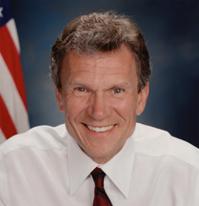 Sen. Thomas A. Daschle (D-SD)
Legislative Activity
Stay on top of the latest movement without scrolling through every action
Roll call votes on amendments in Senate: Motion to waive the Budget Act with respect to amendment SA 1734 rejected in Senate by Yea-Nay Vote. 49 - 45. Record Vote Number: 356.
September 23, 2003
View full timeline
Roll call votes on amendments in Senate: Motion to waive the Budget Act with respect to amendment SA 1734 rejected in Senate by Yea-Nay Vote. 49 - 45. Record Vote Number: 356.
September 23, 2003
Considered by Senate. (consideration: CR S11780-11781)
September 23, 2003
Point of order under the Budget Act raised in Senate with respect to amendment SA 1734.
September 23, 2003
Motion to waive the Budget Act with respect to amendment SA 1734 rejected in Senate by Yea-Nay Vote. 49 - 45. Record Vote Number: 356.
September 23, 2003
Amendment SA 1734 ruled out of order by the chair.
September 23, 2003
Considered by Senate. (consideration: CR S11731, S11734-11735; text as modified: CR S11734; text as further modified: CR S11738-11739)
September 22, 2003
Considered by Senate. (consideration: CR S11712)
September 18, 2003
Senate amendment submitted
September 17, 2003
Senate amendment proposed (on the floor): Amendment SA 1734 proposed by Senator Daschle.(consideration: CR S11629-11630; text: CR S11629)
September 17, 2003
Amendment SA 1734 proposed by Senator Daschle. (consideration: CR S11629-11630; text: CR S11629) To provide additional funds for clinical services of the Indian Health Service, with an offset.
September 17, 2003
Votes
1 roll call on this amendment
Text
Proposed
DEPARTMENT OF THE INTERIOR AND RELATED AGENCIES APPROPRIATIONS ACT,
2004--Continued

The PRESIDING OFFICER. The Senator from Tennessee.
Mr. ALEXANDER. Madam President, I ask unanimous consent to be allowed
to speak for up to 5 minutes as if in morning business.
The PRESIDING OFFICER. Without objection, it is so ordered.
(The remarks of Mr. Alexander pertaining to the introduction of S.
1628 are located in today's Record under ``Statements on Introduced
Bills and Joint Resolutions.'')
Mr. REID. Madam President, I suggest the absence of a quorum.
The PRESIDING OFFICER. The clerk will call the roll.
The legislative clerk proceeded to call the roll.
Mr. REID. Mr. President, I ask unanimous consent that the order for
the quorum call be rescinded.
The PRESIDING OFFICER (Mr. Cornyn). Without objection, it is so
ordered.
Mr. REID. Mr. President, what is the matter now before the Senate?
The PRESIDING OFFICER. H.R. 2691, the Interior appropriations bill,
is now before the Senate.
Mr. REID. Mr. President, I am going to send an amendment to the desk.
I have spoken with both leaders. I have not spoken with Senator Burns.
I have spoken through his staff to him. I have spoken, of course, to
Senator Dorgan. I am sending this amendment to the desk with the
understanding that we will not vote on it until after the caucus on
Tuesday. The reason for that is this is a very important amendment for
this side. We want to make sure we have the opportunity on Tuesday to
speak on it, all 49 members of the Democratic caucus, prior to the
vote.

Amendment No. 1731

(Purpose: To prohibit the use of funds for initiating any new
competitive sourcing studies)

Mr. REID. Mr. President, I send an amendment to the desk not only on
my behalf but on the behalf of Senators Lieberman, Landrieu, Kennedy,
and Murray.
The PRESIDING OFFICER. The clerk will report.
The assistant legislative clerk read as follows:

The Senator from Nevada [Mr. Reid], for himself, Mr.
Lieberman, Ms. Landrieu, Mr. Kennedy, and Mrs. Murray,
proposes an amendment numbered 1731:
On page 137, between lines 23 and 24, insert the following:

SEC. 3__. COMPETITIVE SOURCING STUDIES.

None of the funds made available by this Act shall be used
to initiate any competitive sourcing studies after the date
of enactment of this Act.

Mr. REID. Mr. President, this is a very short amendment, but it
affects the lives of thousands and thousands of people who work for the
Park Service. It affects the lives of every American who enjoys the
great resources of our country.
The amendment I sent to the desk will stop this administration from
moving forward to privatize our national parks, forest lands, and other
public lands. It would nip the administration's ill-conceived
privatization plan in the bud.
More specifically, this amendment prohibits the expenditure of funds
on new outsourcing studies. These are privatization studies for the
agencies funded in this bill. These agencies were created to protect
special places in nature as a legacy for future generations. They
should be managed for posterity and not managed for profit.
The House of Representatives has agreed that privatization is a bad
idea. It included this language in the Interior appropriations bill
that passed in July. The Nation's hard-working public servants who care
for our forests and parks not only collect fees and maintain parks, but
also give directions, fight wildfires, and help injured visitors.
Volunteers who love our public spaces provide tens of thousands of
hours of work for these agencies every year. Will contractors receive
volunteers? Will there be volunteers for these people who are working
for profit in our national resources, our national treasures? It is
very unlikely.
While the administration's plan has been marketed as a cost-saving
measure, just the opposite is true. Privatization will waste taxpayer
dollars. Privatization studies may cost as much as $8,000 per position
studied. This means that next year, the agencies funded in this bill
could waste as much as $26.4 million on these studies, studies for a
wrongheaded idea that is bad for our parks, forests, the people who
care for them, and the people who visit these parks.
Also, these contractors lack the knowledge of the sites that public
servants possess. They are at the sites for one reason: Not people, but
profit. I have nothing against profit motive. I think it is great
selling cars, books, shoes, clothes--virtually everything. I certainly
don't think it is a good idea to privatize our beautiful resources, our
national treasures.
At a recreation area in Nevada, a contractor designed metal courtesy
docks to be built in an area where temperatures reach up to 120 degrees
in the summer. These docks would have burned visitors in the months
when the docks were the busiest. The discarded design cost $21,000 in
taxpayer money, and instead of building five courtesy docks as
intended, the recreation area only had funding to build two docks.
Nevadans visiting our public places, Americans visiting our public
places want professionals enriching their experience by directing them
to famous sites and the best-kept secrets of our parks.
These are a few things people have written to me about on this
subject. Zephyr Cove, NV, is in the Lake Tahoe region. It surrounds
Lake Tahoe. This is not a public employee, but she says:

I'm one small voice, but I'm convinced that privatization
of our National Park System would be another step to
demolishing what little resources we have now and what we can
hope to gain in the future to hold and treasure for future
generations.

She says further:

Many of the Park Service personnel are neighbors and our
friends. They care deeply about what they do. Their pay is relatively
low for the expertise they have. They do it because they know the value
of protecting our parks, wildlife habitats, and environment.

I do not know for sure if the administration's true agenda here is to
undermine that commitment to our national parks, forests, and other
public lands. I don't know that, but that is what many feel.
An editorial in The Tennessean believes that. Editorializing recently
against this plan, the paper had this to say:

. . . privatizing the professionals on whom the parks depend
to manage resources will rid the administration of those
pesky folks who keep pointing out what harm has been done by
President Bush's reckless environmental policies.

This is an editorial that was written in The Tennessean on August 29,
2003.
We have heard not only from newspapers around the country and people
who don't work for the public entities, but we also heard from public
custodians of our treasures. I am not going to use their names here, of
course. They might somehow be harmed at work.
One public employee writes:

The depth and breadth of loyalty that is inherent to the
average [public] employee cannot be contracted out.

And he is absolutely right. The public employees my amendment would
honor share a lot in common with Members of this body, our staffs, our
police, and others who work here. They, like us, sought their jobs to
serve other people and to advance positive goals and ideals. It is that
motivation and loyalty that cannot be outsourced no matter how much
money we throw at studying it.
The privatizing concept, as set forth in The Tennessean, says it all:

. . . privatizing the professionals on whom the parks depend
to manage resources will rid the administration of those
pesky folks who keep pointing out what harm has been done by
President Bush's reckless environmental policies.

Loyalty, public service, and dedication to our public lands cannot be
outsourced. It cannot be privatized.
I hope people understand these great national parks we have. These
are treasures. These national parks are the envy of the world. Nevada
is fortunate, but we only have one national park. It is a wonderful
place, Great Basin National Park, a very new national park. It is small
by national park standards, about 80,000 acres. It has a 13,000-foot
mountain on it, Wheeler Peak. It has a glacier. It has the oldest
living thing in the world, a bristlecone pine.
These trees are over 5,000 years old. Think about that--trees that
started

[[Page S11625]]

growing before Christ came to Earth. These trees were around the same
time the pyramids came into existence. They are living things at the
Great Basin National Park.
In our park, we have the Lehman Caves. Around the turn of the last
century, a man who was a cowboy was out riding his horse and he
suddenly found himself in a deep underground cavern. The horse, as far
as I know, was not injured, but that was the beginning of a great
odyssey for people to visit this magnificent part of nature, Lehman
Caves, which is now in the Great Basin National Park.
We were fortunate enough a short time ago to be present at that
facility when they dedicated the new visitors center. It is in a remote
part of the State of Nevada, but it is a place that people from all
over the world travel to because of its uniqueness.
Great Basin is only one of our many national parks. I was in Montana
and Wyoming recently. I had the good fortune, after these many years,
to once again visit Yellowstone National Park. I was only able to spend
a couple of hours there, but it was a great experience.
I first went there shortly after my wife and I returned from law
school in Washington. We traveled from Las Vegas on one of the first
vacations we ever took. We could have gone anyplace our small budget at
that time would handle, but we drove from Las Vegas to Yellowstone. I
still look back with great awe at Old Faithful and the many other
things we were able to see, the buffalos and other animals. So when I
returned there, even though it was only for a few hours, the place I
wanted to go visit again was Old Faithful.
Old Faithful spewed a few times during the time I was there. We took
a walk through Geyser Park. We saw buffalo lying right near the
geysers. The reason these great animals come and lie down near these
spewing geysers is that, to a great extent, they keep the pests off
themselves by doing so.
Even though I was there just a short time, it was wonderful again,
after 25 years, to reflect back on my little children when they were
tiny going there and visiting that park.
This experience I had was magnified on both occasions by virtue of
the people who work there. They have nothing of which to be ashamed.
They are Government employees who have dedicated their lives not to
seeing how much money they can make but to being in the great outdoors,
being part of nature.
I can remember the woman who took us on our walk through this little
Geyser Park. She was an expert. She knew when every geyser was going to
spew forth some water. She was able to tell stories about how people
first discovered them. She is a woman who makes very little money but
is talented, as a person in her position should be.
So on the two occasions I visited Yellowstone, my experiences were so
much better as a result of the people who work there for the Federal
Government--park rangers, other park employees.
I hope this Senate will respond overwhelmingly and support this
amendment, as was done in the House.
The people who work in these parks are not Democrats. They are not
Republicans. In the true sense of the word, this should not be a
Democratic amendment. It should be an amendment that is supported by
the Senate to protect these faithful employees of the Federal
Government.

We are very fortunate in the State of Nevada to have a large presence
of the Federal Government. I say fortunate because 87 percent of the
land in the State of Nevada is owned by the Federal Government. Only 13
percent of Nevada is owned by individuals; the rest is Government land.
The Bureau of Land Management's largest assets are in the State of
Nevada.
In addition to the national forests and the park I have described, we
have large parts of the State of Nevada, as I have indicated, that are
controlled by the Bureau of Land Management. The employees who work for
the BLM are just as dedicated as those people who work in our parks.
The forest rangers are also people who work so hard for so little
return. I am convinced that if this is put out to the lowest bidder, we
are going to have parks that are visited by people who recognize that
these people are not there for any purpose other than somebody who got
the contract and is trying to make a buck, someone who has gotten
minimum-wage employees to get by with as little as possible.
We cannot let this go forward. It is a slap in the face to these
loyal, dedicated public servants. It is a slap in the face of the
American public. These Federal assets are owned by all of us, and all
of us should have a say in how these parks are run. Renting them out to
the lowest bidder is not the way to do it.
I suggest the absence of a quorum.
The PRESIDING OFFICER. The clerk will call the roll.
The assistant legislative clerk proceeded to call the roll.
Mr. REID. Madam President, I ask unanimous consent that the order for
the quorum call be rescinded.
The PRESIDING OFFICER (Ms. Collins). Without objection, it is so
ordered.
Mr. REID. I ask unanimous consent that the pending amendment be set
aside.
The PRESIDING OFFICER. Without objection, it is so ordered.

Amendment No. 1732

Mr. REID. I send an amendment to the desk.
The PRESIDING OFFICER. The clerk will report.
The assistant legislative clerk read as follows:

The Senator from Nevada [Mr. Reid] proposes an amendment
numbered 1732.

Mr. REID. Madam President, I ask unanimous consent that the reading
of the amendment be dispensed with.
The PRESIDING OFFICER. Without objection, it is so ordered.
The amendment is as follows:

(Purpose: To authorize the Secretary of the Interior to acquire certain
land located in Nye County, Nevada)

At the appropriate place, insert the following:

SEC. __. ACQUISITION OF LAND IN NYE COUNTY, NEVADA.

(a) In General.--The Secretary of the Interior may acquire
by donation all right, title, and interest in and to the
parcel of land (including improvements to the land) described
in subsection (b).
(b) Description of Land.--The land referred to in
subsection (a) is the parcel of land in Nye County, Nevada--
(1) consisting of not more than 15 acres;
(2) comprising a portion of Tract 37 located north of the
center line of Nevada State Highway 374; and
(3) located in the E\1/2\NW\1/4\, NW\1/4\NE\1/4\ sec. 22,
T. 12 S., R. 46 E., Mount Diablo Base and Meridian.
(c) Use of Land.--The parcel of land acquired under
subsection (a) shall be used by the Secretary of the Interior
for the development, operation, and maintenance of
administrative and visitor facilities for Death Valley
National Park.

Mr. REID. Madam President, I ask unanimous consent that the pending
amendment be set aside.
The PRESIDING OFFICER. Without objection, it is so ordered.

Amendment No. 1733

Mr. REID. I send an amendment to the desk.
The PRESIDING OFFICER. The clerk will report.
The assistant legislative clerk read as follows:

The Senator from Nevada [Mr. Reid] proposes an amendment
numbered 1733.

Mr. REID. Madam President, I ask unanimous consent that the reading
of the amendment be dispensed with.
The PRESIDING OFFICER. Without objection, it is so ordered.
The amendment is as follows:

(Purpose: To provide for the conveyance of land to the city of Las
Vegas, Nevada, for the construction of affordable housing for seniors)

On page 137, between lines 23 and 24, insert the following:

SEC. 3__. CONVEYANCE TO THE CITY OF LAS VEGAS, NEVADA.

Section 705(b) of the Clark County Conservation of Public
Land and Natural Resources Act of 2002 (116 Stat. 2015) is
amended by striking ``parcels of land'' and all that follows
through the period at the end and inserting the following:
``parcel of land identified as `Tract C' on the map and the
approximately 10 acres of land in Clark County, Nevada,
described as follows: in the NW\1/4\ SE\1/4\ SW\1/4\ of
section 28, T. 20 S., R. 60 E., Mount Diablo Base and
Meridian.''.

Mr. REID. Madam President, before I turn the floor over to the
distinguished Senator from West Virginia, I would simply like to say
that upon completion of the last judge vote today, that means we have
approved 151 judges during the little over 2\1/2\ years President Bush
has been President. I think we

[[Page S11626]]

are doing remarkably good work for this President as relates to judges.
The count is 151 to 3. That means there have been three judges who have
been submitted to us we have not accepted.
President Reagan did not reach 150 judges until well into the fourth
year of his first term. The first President Bush did not receive his
150th Federal judge until well into his fourth year. During President
Clinton's second term, the term just preceding this administration, he
did not appoint his 150th judge until his fourth year. So we are a year
and a half--at least a year ahead of Reagan, first President Bush, and
the second term of President Clinton.
So we have done extremely well. Senator Leahy is to be commended for
his ability to move these judges in conjunction with the distinguished
Senator from Utah, the chairman, Senator Hatch.
The PRESIDING OFFICER. The Senator from West Virginia.

IRAQ

Mr. BYRD. Madam President, I rise today to voice my concern about the
disastrous turn which the fortunes of this Nation have taken. The Bush
administration, in a scant 2\1/2\ years, has imperiled our country in
the gravest of ways, and set us up for a possible crisis of mammoth
proportions. The crisis may not occur tomorrow in these proportions, or
the next day, but it is coming.
Instead of linking arms with a world which offered its heart in
sympathy after the brutality of the terrorist attacks in September of
2001, this White House, the Bush White House, through hubris and false
bravado, has slapped away the hand of assistance. This administration
has insulted our allies and our friends with its bullying and go-it-
alone frenzy to attack the nation of Iraq.
In order to justify such an attack, it was decided somewhere in the
White House to blur the images of Saddam Hussein and Osama bin Laden.
Blurred images notwithstanding, what is becoming increasingly clear to
many Americans is that they are going to be asked to carry a heavy,
heavy load for a long, long time.
Let me be clear. We are presently engaged in not one war but two
wars: The war begun by Osama bin Laden, who attacked this Nation on the
September 11, 2001, and then there is the war begun by President George
W. Bush when he directed U.S. forces to attack Iraq on March 19, 2003.
The first war was thrust upon us. The bombing of Afghanistan was a just
retaliation against that attack. The second war, on the other hand, was
a war of our choosing. We chose it. It was an unnecessary attack upon a
sovereign nation. This President and this administration have tried
mightily to convince the people of America that attacking Iraq was
critical to protecting them, the people of this country, from
terrorism. The case that the administration makes is false, it is
flimsy, and the war, I believe, was unwise and was unnecessary and was
without ample justification.

The war against Iraq has crippled the global effort to counter
terrorism. The war in Iraq has made a peace agreement between Israel
and its adversaries harder to obtain. The obsession with Iraq has
served to downplay the resurgence of the Taliban in Afghanistan. The
focus on Saddam Hussein has diverted attention from bin Laden, who is
apparently still on the loose and threatening to attack again. The war
in Iraq has alienated our traditional allies and fractured the cohesive
alliance against terrorism which existed after 9/11. It has made the
United States appear to the world to be a bellicose invader of another
country. It has called our motives into question. It has galvanized the
worldwide terrorism movement against us. The war in Iraq has cost us
lives and treasure. Yet this President will shortly request $87 billion
more for his ill-fated adventure.
He says we will spend whatever it takes. So he says your money--it is
your money. We have heard that many times. It is your money, and he
says your money we will spend, whatever it takes.
Prudence dictates that we consider the risks. This Nation has
suffered massive job losses amounting to 93,000 in August alone and
approximately 600,000 since January of this year. Job losses of this
magnitude mean less money coming into the Treasury and more money going
out. U.S. manufacturing jobs continue to disappear overseas as
companies relocate operations on other shores. There seems to be no
end, thus far--there seems to be no end to the job hemorrhage. The
manufacturing sector has lost jobs for 37 months in a row. The weak job
market threatens to sap our strength from our domestic economy. Should
inflation begin to creep up, as some worry that it will, higher energy
costs and lower consumer confidence may slow the economy further.
Suppose another massive al-Qaida attack were to occur here at home,
killing hundreds or thousands and delivering another devastating blow
to the U.S. economy? Could we still afford to continue to send billions
of taxpayer dollars to Iraq? At best, our future economic growth is
uncertain. There are too many unknowns. Our deficit is growing. When
the $87 billion 2004 Iraq Supplemental is included, as it probably will
be, the deficit for 2004 alone is expected to total $535 billion.
That is $530 for every minute since Jesus Christ was born. That
number will only grow, if we continue to experience massive job losses
and the economy takes a turn for the worse.
We can ill afford to finance the rebuilding of Iraq alone. Yet
President Bush steadfastly resists doing what it takes to involve the
international community.
It should be obvious that we need assistance. The United States
cannot even continue to supply the troops to secure Iraq without more
help. A recent Congressional Budget Office study, which I requested,
makes it clear that maintaining the level of troops we now have in Iraq
will stretch us very thin should something happen in Korea or elsewhere
on this troubled globe. Our National Guard is being asked to stay
longer and longer in Iraq to help backfill the shortage in regular
troops. These are men and women with jobs and families and key roles to
play in their own communities. We cannot continue to utilize their
skills in Iraq without suffering the consequences at home.
Even now, as a hurricane lurks off our shores, there are worries
about shortages of emergency personnel because so many National Guard
men and women are serving in Iraq.
But the Bush administration continues to spend our treasure and our
troop strength in a single-focusd obsession with the fiasco in Iraq.
Are we to mortgage the future of our Nation to years of financing this
unwise adventure? Surely we cannot ask American families for sacrifice
indefinitely, especially when their sacrifices are made to advance a
war we do not need to fight, that we ought not to have gone overseas to
fight. We chose to attack another country.
We must come to grips with our limits. We must acknowledge risks and
reality.
Yet on last Sunday, Vice President Cheney dug his heels in at the
suggestion of rethinking our policy in Iraq. In a television interview,
Vice President Cheney said he saw no reason to ``think that the
strategy is flawed or needs to be changed.''
He went on to try to convince the American public that Iraq was ``the
geographic base'' for the perpetrators of 9/11. Think of that--a claim
that this humble Senator has never heard before, and that flies in the
face of U.S. intelligence agencies which repeatedly have said they have
found no links--none--between the 9/11 attacks and Saddam Hussein or
Iraq. We may come to rue the day when we took our eyes off bin Laden
and sapped our energies and our credibility in this quagmire in Iraq.
We chose to attack that country. Yet there seems to be no soul
searching in this White House about the consequences of this war.
While Bush's aides talk of ``generational commitment'' and the
President talks of ``sacrifice,'' I wonder if the American people fully
comprehend what they are being urged to forego. They have already
sacrificed loved ones with 158 troops killed and 856 wounded just since
President Bush declared the end of major combat on May 1. How many more
families must sacrifice? How many more families must sacrifice while we
occupy Iraq?
The President says we will do whatever it takes. Mr. Rumsfeld says we
will do whatever it takes. How many more families must sacrifice while
we occupy Iraq?

[[Page S11627]]

A generation of ``sacrifice'' may also mean a slow sapping of key
national priorities, including repairing the infrastructure which fuels
our economic engine and funding the institutions and programs which
benefit all Americans. Compare the latest request for the Iraq
supplemental with the commitment in dollars to other vital programs,
and the picture becomes more clear. President Bush is asking for $87
billion for Iraq but only $34.6 billion for Homeland Security--$29-plus
billion--which will come to the Senate soon in a bill which was marked
up today. The President wants $87 billion for Iraq but only $66.2
billion for the discretionary programs for the Department of Health and
Human Services.

The President seeks $87 billion to secure Iraq but only $52.1 billion
for the U.S. Department of Education. The President wants $87 billion
to shore up Iraq but only $29.3 billion for America's highways and road
construction.
For the State Department and foreign aid for the entire world,
President Bush sees a need for only $27.4 billion. Yet Iraq is worth
over three times that much to this White House.
Remember that $87 billion is just for 2004 alone. Does anyone really
believe it will be the last request we will receive for Iraq? No. This
is just the tip of the iceberg, in all likelihood.
The President asked America for a generation of ``sacrifice,'' but
that noble-sounding word does not reveal the true nature of what the
President demands from the American people. He asks them to supply the
fighting men and women to prosecute his war.
Yes, he asked them, the American people, to supply the fighting men
and women to prosecute his war. I am not talking about the war that
began on September 11, 2001. That was an attack upon us by al-Qaida. I
am talking about his war, the President's war in Iraq, which began in
March of this year in which he, the Commander in Chief, ordered the
attack on Iraq, a sovereign country that had not attacked us and which
did not represent an imminent threat to the security of our country.
He implores our people to sacrifice adequate health care. He asks our
people to settle for less than the best education for their children.
Think about it. He asks our people, the American people, to sacrifice
medical research that could prolong and save lives. He asks the
American people to put up with unsafe highways and dangerous bridges.
He asks them to live with substandard housing and foul water. He asks
the American people to forego better public transportation and not just
for now but for generations. And all of it for his folly in Iraq.
Most puzzling to this Senator is this President's stubborn refusal to
guard against the terror threat at home by adequately funding Homeland
Security. Is he asking us all to risk the safety of our homeland, too?
And to further insult the hard-working people of this Nation, George
Walker Bush proposes to lay this sacrifice not only on the adult
population of this great country but on their children and their
grandchildren by increasing the deficit with nary a thought to the
consequences.
Yet not a peep can be heard from this White House about paying for
some of this sacrifice of which the President speaks by foregoing a
portion of future tax cuts, tax cuts that mainly benefit those citizens
who do not need so many of the services the Government has to provide.
Our reputation around the globe, America's reputation around the
globe, has already been seriously damaged by this administration. Are
the dreams and hopes of millions of Americans to be ``sacrificed'' as
well on the altar, on the bloody altar, of Iraq?
I urge my colleagues to think long and hard about the growing
quagmire in Iraq. I urge members of the President's own party to warn
him about the quicksand he asks America to wade in. We need a long and
thorough debate about the future of our country. We need a serious
discussion about the kind of America we will leave to our children and
grandchildren. We need to renew our efforts to negotiate a peace
agreement between Israel and the Palestinians. Are we fighting a war in
Iraq when pushing the peace might better serve our cause? We must think
again about world-wide terrorism--and it comes in many forms and
shapes--and the best way to combat it. Let us not continue to simply
wage the wrong war, Mr. Bush's war in Iraq.

ANNIVERSARY OF THE SIGNING OF THE CONSTITUTION

Mr. BYRD. Mr. President, September 17 is a day of history in American
calendar. On this day in 1630, the city of Boston was founded. On
September 17, 1947, James V. Forrestal was sworn in as this Nation's
first Secretary of Defense.
On September 17, 1920, the National Football league was formed in
Canton, OH. On September 17, 1954, Ernie Banks became the first Black
baseball player to wear a Chicago Cubs uniform. He was voted ``best
player ever'' by Chicago fans when he retired in 1971. On September 17,
1984, Reggie Jackson hit his 500th career homer, seventeen years to the
day after he hit his first major league home run.
On this day in 1911, the first transcontinental airplane flight took
place between New York City and Pasadena, CA. It took pilot C.P. Rogers
82 hours to cover that distance. Just 65 years later, on September 17,
1976, the Space Shuttle was revealed to the public for the first time,
ready to take men into the heavens. Such a lot of change in such a
short period of time.
Last week, in another airplane related piece of history, the nation
sadly observed the second anniversary of the tragic events of September
11, 2001. It was a terrible, terrible day, marked by the awful, abrupt
end of too many innocent lives. September 17, 1862, was another
terrible, terrible day. On that beautiful September day, over 23,000
men were killed, wounded, or missing in action after the Battle of
Antietam, outside Sharpsburg, MD--just over the line from the eastern
panhandle of West Virginia. That battle was a turning point in the
Civil War.
But by far, one of the most important events in this Nation's history
happened on the 17th of September, 1787. On that memorable day, the
members of the Constitutional Convention signed the document that has
led this Nation safely through the shoals of history for the past 216
years, surviving even the devastation of the Civil War. It was this
document that I hold in my hand: the Constitution of the United States
of America.

That Constitution was not our first attempt at self-governance. It
followed on the heels of the Articles of Confederation, which was the
first Constitution, correcting the failures of that weak Government by
establishing a stronger central Government to manage the differences
between the States and to provide for the common good. And then, to
assuage the concerns of those citizens who feared that a strong central
Government would trample on the rights of the individual, the
Constitution was amended after ratification with the first 10
constitutional amendments, guaranteeing individual freedoms in what has
become known as the American Bill of Rights.
The Constitution of the United States has, sadly, been overlooked by
many in the public over the years. It is not a lofty piece of rhetoric
like the better known Declaration of Independence. But the Constitution
is the strongest piece of armor protecting the rights and the freedoms
of each and every citizen--your rights, your rights, your rights, yes,
your rights, and yours, and yours, and mine. It deserves to be better
known. It is, after all, our manual for governance, our handbook of
Government, the tech manual for our national operating system. And
unlike many technical manuals, it is easy to read and to understand,
even 216 years later.
This short document is blunt and straightforward. It starts with only
a preamble and then gets right to the heart. In Article I, it sets
forth the domain of the legislative branch and the qualifying
requirements for us legislators. It does the same for the executive
branch in Article II, laying out the procedure for selecting a
President and stating what his domain and powers shall be. Then the
judicial branch gets the same treatment, short and sweet, in Article
III. Article IV sets out the States' rights and duties to the central
Government and provides for the addition of new States. Article V, in a
single paragraph, lays out the procedure for amending the Constitution.
Article VI provides for the transfer of power from the Articles of
Confederation to the new Constitution and makes the Constitution and
the Federal laws the

[[Page S11628]]

supreme law--together with treaties--the supreme law of the land.
Article VII provides the procedure for ratifying the Constitution.
There it is. There it is--a new Government in only seven articles. It
takes more verbiage than that just to buy a house in these days.
The Constitution is an amazing product of compromise and balance,
created by just a handful of delegates--55--in under 4 months. Many of
the delegates' names should be familiar to most Americans, names such
as George Washington, who presided over the Constitutional Convention,
and James Madison, George Mason, Benjamin Franklin, and Alexander
Hamilton. Other famous names were not present, such as Thomas
Jefferson. He was not there. He was serving at the time as the
Ambassador to France. Then there was John Adams, who was in London as
the U.S. Ambassador. The details of the Convention of 1787 make
fascinating reading.
The Convention met in closed session, but James Madison obtained
permission to take notes on the debates. His notes, supplemented by the
outlines or drafts of other delegates, were not published until 1840--4
years after his death. They outline the evolution of the document,
showing competing alternatives and the compromises that allowed the
large and small States, and all of the other conflicting interests, to
reach agreement on a final document that all agreed could be ratified
by the States.

The body in which I speak, and to which I have been elected time and
time again by the people of West Virginia, the Senate, is the result of
one such contentious debate that almost caused the Convention to
adjourn.
I was talking with the pages just the other day, and we talked about
the Great Compromise. I talk with these pages, the Republican pages and
the Democratic pages. They change from time to time. They will be here
perhaps for half a semester or a full semester or a few days. When we
are out for a break, there will be a different group of pages. And we
talk about history. These fine pages and I were just commenting the
other day about the Great Compromise. I said, What do we mean by the
phrase the ``Great Compromise''? Well, that is what I am referring to
now.
At one point during the Convention, the Virginia plan called for the
creation of a bicameral legislature, with each House's representation
apportioned by population. This suited Virginia and other large States
well but was opposed by small States that feared joining a Union so
dominated by the larger States. The delegations from the small States
argued that their citizens would never ratify a Constitution that did
not recognize some form of State equality.
After 3 weeks of increasingly bitter debate, the delegates agreed to
what has come to be known as the Great Compromise. The result of that
compromise is the Congress that we know today--a lower House, chosen
according to population, and with the sole authority to originate
revenue bills; and an upper House, the Senate, in which each State has
an equal vote.
Other compromises were necessary for the Convention to reach
agreement, some less successful than that which led to the composition
of the Congress, some positively inspired. The delegates deliberated
over the power of the executive; they deliberated over interstate
commerce; they deliberated over the subject of slavery--these among
other topics.
A small but inspired compromise is contained in the Preamble. The
Preamble to the Articles of Confederation named the States in
geographic order from north to south. Without knowing which States
would ratify the Constitution, and in what order, the delegates in
Philadelphia were uncertain how to list the participating States.
So the answer was a graceful new opening: ``We the people of the
United States . . . do ordain and establish this Constitution . . .''
without ever mentioning the States by name.
Every citizen should be familiar with the Constitution. We should
each have a little radar system, an intuitive raising of the hairs
along the back of one's neck, when attempts are made to flout the
Constitution, either by design or out of misguided good intentions. I
fear that this radar system is not functioning as well as it should be.
When it fails, the checks and balances contained in our Constitution
begin to rust and then begin to grind to a halt. When the Congress does
not jealously guard its prerogatives against an overreaching executive,
the executive branch gains strength from power that it should not have.
The Founders of this Nation worried about creating too strong an
executive. They worried about creating a tyrant such as the one, George
III, against whom they had fought a war for freedom. So they created a
system where the people's direct representatives called the shots the
Congress writes the laws, controls the funds, and approves the nominees
for key executive posts. If all of those restraints failed, the
President was subject to impeachment and trial by Congress.
But today, in our fears about national security and our national
political system dominated by political party considerations, we face a
situation in which Congress is being pressured to act as a rubber stamp
for a strong-willed Executive. We have seen this happen with respect to
various and sundry executives some Democratic, some Republican. But in
this instance, in the aftermath of September 11, 2001, there was a
stampede to do something, anything, to avenge this vile attack on our
citizens. The Congress did not seriously debate or consider the long
term consequences of the call to action, and apparently, neither did
the White House. We rushed into war without a real declaration of war.
Instead, Congress passed a resolution giving the President sweeping
powers to take such action as he saw fit, including military action, in
that region. As a result, our military is over-extended and committed
to long-term nation-building efforts in Iraq and, to a degree, in
Afghanistan. Members of Congress are labeled ``unpatriotic'' if Members
question--even question--any request for additional funds for those
efforts.
At the same time, political party pressures were applied to pass
expensive ``temporary'' tax cuts theoretically aimed at restarting a
sluggish economy. The long-term impact on the deficit will hamstring
the Nation for years to come. Congress should know better. This Senate
should know better. Those of us who have been around for a while can
recall the tremendous effort--and compromise--needed to achieve deficit
control in the late 1980s and early 1990s. We can recall all of the
hard, hard decisions that had to be made to bring the deficit under
control. Did we really forget all of that in those few short years of
surplus? Well, if we did forget that lesson from history, I fear we are
doomed to repeat it, and we struggle to bring these even larger
deficits under control.
The time is long past for Members of Congress to reassert the
authorities granted to them in the Constitution. A citizenry familiar
with their Constitution should demand it. We are, after all, ``. . .
bound by oath or affirmation to support this Constitution . . .'' in
Article VI, if we take the time to read it that far.

In his Farewell Address, delivered to his cabinet on, fortuitously
enough, September 17, 1796, George Washington made this observation:

. . . [Y]ou have improved upon your first essay by the
adoption of a Constitution of government better calculated
than your former for an intimate union and for the
efficacious management of your common concerns. This
government, the offspring of your own choice, uninfluenced
and unawed, adopted upon full investigation and mature
deliberation, completely free in its principles, in the
distribution of its powers, uniting security with energy, and
containing within itself a provision for its own amendment,
has a just claim to your confidence and your support. Respect
for its authority, compliance with its laws, acquiescence
with its measures, are duties enjoined by the fundamental
maxims of true liberty.

Our Constitution is the foundation of our liberties, and we must be
its guardians.
I would like to close with a poem by Henry Wadsworth Longfellow,
entitled ``O Ship of State.''

Thou, too, sail on, O Ship of State!
Sail on, O Union, strong and great!
Humanity with all its fears,
With all the hopes of future years,
Is hanging breathless on thy fate!
We know what Master laid thy keel,
What Workmen wrought thy ribs of steel,
Who made each mast, and sail, and rope,
What anvils rang, what hammers beat,
In what a forge and what a heat

[[Page S11629]]

Were shaped the anchors of thy hope!
Fear not each sudden sound and shock,
'Tis of the wave and not the rock;
'Tis but the flapping of the sail,
And not a rent made by the gale!
In spite of rock and tempest's roar,
In spite of false lights on the shore,
Sail on, nor fear to breast the sea!
Our hearts, our hopes, are all with thee.
Our hearts, our hopes, our prayers, our tears,
Our faith triumphant o'er our fears,
Are all with thee, -are all with thee!

I yield the floor and suggest absence of a quorum.
The PRESIDING OFFICER. The clerk will call the roll.
The assistant legislative clerk proceeded to call the roll.
Mr. DASCHLE. Madam President, I ask unanimous consent that the order
for the quorum call be rescinded.
The PRESIDING OFFICER. Without objection, it is so ordered.

Amendment No. 1734

Mr. DASCHLE. Madam President, I ask unanimous consent that the
pending amendment be set aside, and I send an amendment to the desk.
The PRESIDING OFFICER. Without objection, it is so ordered. The clerk
will report the amendment.
The assistant legislative clerk read as follows:

The Senator from South Dakota [Mr. Daschle] proposes an
amendment numbered 1734.

Mr. DASCHLE. Madam President, I ask unanimous consent that the
reading of the amendment be dispensed with.
The PRESIDING OFFICER. Without objection, it is so ordered.
The amendment is as follows:

(Purpose: To provide additional funds for clinical services to the
Indian Health Service, with an offset)

On page 88, beginning on line 17, strike ``$2,546,524,000''
and all that follows through ``Provided'' on line 20, and
insert the following: ``$2,838,524,000, together with
payments received during the fiscal year pursuant to section
231(b) of the Public Health Service Act (42 U.S.C. 238(b))
for services furnished by the Indian Health Service, of which
$2,329,414,000 shall be available for clinical services:
Provided, That section 13031(j)(3) of the Consolidated
Omnibus Budget Reconciliation Act of 1985 (19 U.S.C.
58c(j)(3)) is amended by striking `September 30, 2003' and
inserting `September 30, 2004': Provided further''.

Mr. DASCHLE. Madam President, once again I come to the floor to bring
to the attention of the Senate the critical shortfall in funding for
the Indian Health Service. Through treaties and Federal statute, the
Federal Government has promised to provide health care to American
Indians and Alaskan Natives. Sadly, we have not even come close to
honoring this commitment.
The Indian Health Service is the only source of health care for many
Indians and is required to provide it, yet funding has never been
adequate.
The chronic underfunding has only grown worse in recent years, as
appropriations have failed to keep up with the steep rise in private
health care spending.
Last March, we offered an amendment to the budget resolution to
provide $2.9 billion to the Indian Health Service for the budget for
the fiscal year 2004. Our amendment would not have met all of the
health care needs in Indian country, not by far, but it would have
provided enough room in the budget to fund basic clinical health care
services for American Indians and Alaskan Natives.
Unfortunately, that amendment was defeated by a vote of 48 to 51, on
a party-line vote.
The Republican leadership made a counteroffer. They proposed an
amendment to increase IHS funding next year by $292 million, one-tenth
of what our amendment called for. The Senate adopted that amendment.
Since then, two important reports have been released.
In July, the U.S. Commission on Civil Rights released a report
documenting shocking health care disparities between Indians and other
Americans. In August, the U.S. Centers for Disease Control issued a
report showing that Native Americans live sicker and die younger than
other Americans as a result of inadequate health care.
Another important thing happened since the Senate voted last March to
add $292 million to the Indian Health Service's budget next year. Our
colleagues on the other side agreed in conference to kill that funding
increase. I am now offering an amendment that simply does what the
Senate is on record having supported last March.
The amendment would restore the $292 million increase for the Indian
Health Service that this Senate supported overwhelmingly last March.
The Civil Rights Commission report compared health care funding for
Native Americans to that for other groups for which the Federal
Government has direct responsibility for health care. The report
compared per capita health expenditures for 2003 by category.
This chart describes in detail the comparison, I would say in
somewhat embarrassing detail when you look at where we are. For the
general U.S. population on an annual per capita basis, about $5,000 is
spent. We spend in the VA a little more than what we spend on a
national per capita basis, $5,214. For understandable reasons, seniors
generate more expense, and the per capita cost for Medicare is $5,915.
Medicaid drops somewhat below, about $2,000 or $1,500 below what we
spend for the general population. Prisoners actually do almost as well
as Medicare beneficiaries with $3,803 for Federal prisoners and $3,879
for Medicare.
Look where we are for the Indian Health Service clinical services per
capita spending, $1,914, well below what we pay for Federal prisoners;
about half, frankly, of what it is we pay for prisoners today. This is
what the Indian population gets per capita, this is what Federal
prisoners get per capita: $3,800 to $1,900.
I have to say that I don't know what clearer message we could send
than that if we only spend per capita half for the Native American and
Alaska population than what we spend for Federal prisoners in this
country.
This funding is obviously woefully inadequate to meet the health care
needs of Native Americans who, as I already noted, have a lower life
expectancy than other Americans and a disproportionate number of
serious medical problems. Indians have the highest rates of diabetes in
the country, the highest rates of heart disease, the highest rates of
sudden infant death syndrome, the highest rates of tuberculosis. There
is also a great need for substance abuse and mental health services.
So while they have the greatest need, the greatest incidence of these
extraordinarily difficult health problems, they have one-half the
resources of what we commit to our Federal prisoners.
Native Americans are often denied care most of us take for granted,
and in many cases would even consider essential. They are often
required to endure long waits before seeing a doctor and may be unable
to obtain a referral to see a specialist. Sometimes lack of funds means
care is postponed until Indians are literally at risk of losing their
lives or their limbs. Others receive no care at all.
I will never forget talking to a man who is now a tribal leader from
the Yankton reservation. He told me he was hunting and he stepped in a
hole. This was before he was elected. He stepped in a badger hole or
one of the holes in the field as he was hunting. He broke his leg, went
to the hospital, and they said there was nothing they could do. They
told him to come back. He came back the next day. They said there was
nothing they could do. They said, we do not know when we can help you.
You may need to go somewhere else.
Well, he was in such pain that he ended up lying in bed for close to
6 months and healed without any help whatsoever.
Today he walks with a limp, he has deep scars on his leg, and he
considers himself lucky, lucky because he can walk again. That is
happening today in America, and I think that is so intolerable, so
unacceptable, so contrary to the commitment we made to Native American
people. This is rationing at its worst. Rationing of care means all too
often Indians are forced to wait until their medical condition becomes
even more serious and more difficult to treat. It is a situation none
of us would find acceptable, but this is the reality in Indian country.
Right now, the IHS service unit at Eagle Butte in South Dakota does
not have an obstetrician. The Eagle Butte service unit is funded at 44
percent of the need calculated by the Indian Health Service. The
facility has a birthing room and 22 beds, but there are only 2 to 3
doctors to staff the clinic, hospital, and emergency room.
Naturally, as a result, many children and expectant mothers do not
receive

[[Page S11630]]

the care they need and deserve. Due to budget constraints, the IHS
policy is to allow only one ultrasound per pregnancy. The visiting
obstetrician is available only every couple of weeks.
The story of Brayden Robert Thompson points out how dangerous this
situation is. On March 3, 2002, Brayden's mother was in labor with a
full-term, perfectly healthy baby. Brayden's umbilical cord was wrapped
around his neck, but without ultrasound that went undetected. The
available medical staff did not know what to do about his lowered
heartbeat, abnormal urinalysis, or the fact his mother was not feeling
well. Despite the symptoms, IHS refused to provide an ultrasound or to
send her to Pierre, which is the closest city off the reservation, to
see an obstetrician. Brayden was stillborn.

This tragic death was completely preventable, but tough choices are
being made every single day at IHS facilities throughout the country
because there simply is not enough money to provide the care every
American deserves.
I received a letter not long ago from Michelle German about her
daughter Brittany.
This is Brittany. I have the letter, and I will read portions of it.
Michelle writes:

My daughter Brittany is thirteen years old and for the last
couple of years has suffered from a skin disorder called
polymorphous light erosion/eruption, which basically means
she is allergic to UV rays (the sun). We had visited many
doctors, at the Sisseton Indian Health Service and the Coteau
des Prairie Clinic (also located in Sisseton) before being
referred to a dermatologist in Fargo. . . .The Indian Health
Service denied our request for a referral due to the lack of
funding, but I find this very ironic because I had my own
insurance. However, I was told that her condition has already
been diagnosed, it is not life threatening and that the
Indian Health Services were not going to be responsible for
any debt that my insurance would not cover. Since this had
all taken place, I had lost my job and my insurance. I find
it frustrating that we were over income to qualify for
Medicaid or the CHIPS program through the State of South
Dakota!
To make a long story a little shorter, we have been
doctoring back at the Indian Health Service and now we are
battling the pharmacy because it does not carry the
medication that has been prescribed to her by the
dermatologist. Brittany has been [on] various medications
throughout her clinic visits at the Indian Health Service
without success. The prescribed medications, that are
working, are not available through the Indian Health Pharmacy
and I have been purchasing it from our local drug store in
the amount of forty-five dollars per forty-five gram tube.
Brittany has gone through quite an ordeal because of the
question ``what is the matter with your face?'' and now it is
on her arms and legs which are beginning to scar due to the
scratching. She has been limited to being kept indoors from
the hours of 10 a.m. to 3 p.m. to prevent any outbreaks and
the itchiness that follows. This is very hard for both of us
because she is a very active teenager who enjoys playing
golf, softball and swimming. We have had to change the type
of clothing worn in the summer, the bathing soaps and
lotions; she is now required to wear sunscreen and lip screen
throughout her time outside. . . .
I could go on, . . . but I think you get the idea. I have
attached a picture of my daughter when the skin rash started
on her face for your review.

I hope this helps explain her story. We have case after case. This
may not be life-threatening. But Brittany is not able to get the help
she needs, the attention she needs, the treatment she needs, in large
measure because IHS has said in her case they do not see a life-
threatening problem.
This is not solely an Indian issue. It affects surrounding rural
community hospitals, ambulance services, and other health care
providers who work with the IHS.
The Lake Andes-Wagner ambulance district in southeastern South Dakota
is facing financial disaster, in part because they have not been
reimbursed properly by the Indian Health Service. This ambulance
service offers emergency transport for citizens of Charles Mix County
and Yankton Sioux tribal members, since the Wagner IHS hospital cannot
afford to operate its own service. If this ambulance service shuts
down, what will these residents, Indian or non-Indian, do when they
face an emergency?
Bennett County Hospital in southwestern South Dakota suffers similar
IHS reimbursement problems, as do others in the non-IHS areas
throughout rural America.
In his budget request for the next fiscal year, the President
requested only $1.9 billion for clinical services for Indians. This
represents a very small increase over what the President requested for
fiscal year 2003 and no increase over what was finally included in the
omnibus appropriations bill. We can and we must do better.
The amendment I am proposing again would increase funding for
clinical services by a mere $292 million. I would like to say that this
is the minimum amount that is necessary to provide basic health care to
the current IHS user population, but I can't say that. The minimum
amount necessary is an additional $2.9 billion, and this is one-tenth
of that amount.

Today, I am asking the Senate to live up to the commitment it made
last March, to make that extremely modest $292 million increase real by
including it in this appropriations bill. It is nowhere near enough,
and it is sorely needed to address the severe funding shortfall the
Indian Health Service faces.
The cost of the amendment is offset by revenue raised from an
extension of the customs user fee that will otherwise expire on
September 30. We all agree the extension is inevitable. This will
require only a small portion of those funds, and I can think of no
better use for the money.
Native Americans are facing a literal ``life or limb'' test before
they can access health care today. We are spending twice as much per
capita on Federal prisoners' health than on the health care for the
Indians to whom we promised full health benefits. We simply cannot
tolerate this. The problem is real. The solution is simple. We must
start giving the Indian Health Service the funds it needs to provide
Native Americans the health benefits they were promised.
Let's take this modest step toward that end.
I yield the floor and suggest the absence of a quorum.
The PRESIDING OFFICER (Mr. Alexander). The clerk will call the roll.
The legislative clerk proceeded to call the roll.
Mr. CHAMBLISS. Mr. President, I ask unanimous consent that the order
for the quorum call be rescinded.
The PRESIDING OFFICER. Without objection, it is so ordered.
Mr. CHAMBLISS. Mr. President, I ask unanimous consent to proceed as
if in morning business.
The PRESIDING OFFICER. Without objection, it is so ordered.
The Senator from Georgia.
(The remarks of Mr. Chambliss pertaining to the introduction of S.
1635 are located in today's Record under ``Statements on Introduced
Bills and Joint Resolutions.'')

____________________