To reduce the amount appropriated for reconstruction in Iraq by $600,000,000 and to increase the amount available to the Iraqi Civil Defense Corps by $50,000,000, the amount available for Afghanistan by $400,000,000, and the amount available for Liberia.
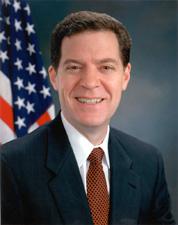 Sen. Sam Brownback (R-KS)
Legislative Activity
Stay on top of the latest movement without scrolling through every action
Senate amendment submitted
October 17, 2003
View full timeline
Senate amendment submitted
October 17, 2003
Senate amendment proposed (on the floor): Amendment SA 1885 proposed by Senator Brownback.(consideration: CR S12799-12803; text as modified: CR S12799)
October 17, 2003
Roll call votes on amendments in Senate: Motion to table amendment SA 1885 agreed to in Senate by Yea-Nay Vote. 55 - 43. Record Vote Number: 399.
October 17, 2003
Amendment SA 1885 proposed by Senator Brownback. (consideration: CR S12799-12803; text as modified: CR S12799) To reduce the amount appropriated for reconstruction in Iraq by $600,000,000 and to increase the amount available to the Iraqi Civil Defense Corps by $50,000,000, the amount available for Afghanistan by $400,000,000, and the amount available for Liberia.
October 17, 2003
Motion to table amendment SA 1885 agreed to in Senate by Yea-Nay Vote. 55 - 43. Record Vote Number: 399.
October 17, 2003
Votes
1 roll call on this amendment
Text
Proposed
EMERGENCY SUPPLEMENTAL APPROPRIATIONS FOR IRAQ AND AFGHANISTAN SECURITY
AND RECONSTRUCTION ACT, 2004

The PRESIDING OFFICER. Under the previous order, the Senate will
resume consideration of S. 1689, which the clerk will report.
The legislative clerk read as follows:

A bill (S. 1689) making emergency supplemental
appropriations for Iraq and Afghanistan security and
reconstruction for the fiscal year ending September 30, 2004,
and for other purposes.

Pending:

Byrd/Durbin amendment No. 1819, to prohibit the use of Iraq
Relief and Reconstruction Funds for low-priority activities
that should not be the responsibility of United States
taxpayers, and shift $600 million from the Iraq Relief and
Reconstruction Fund to Defense Operations and Maintenance,
Army, for significantly improving efforts to secure and
destroy conventional weapons, such as bombs, bomb materials,
small arms, rocket-propelled grenades, and shoulder-launched
missiles, in Iraq.

[[Page S12770]]

Bond/Mikulski amendment No. 1825, to provide additional VA
Medical Care Funds for the Department of Veterans Affairs.
Durbin amendment No. 1837, to ensure that a Federal
employee who takes leave without pay in order to perform
certain service as a member of the uniformed services or
member of the National Guard shall continue to receive pay in
an amount which, when taken together with the pay and
allowances such individual is receiving for such service,
will be no less than the basic pay such individual would then
be receiving if no interruption in employment had occurred.
Daschle amendment No. 1854, to achieve the most effective
means of reconstructing Iraq and to reduce the future costs
to the American taxpayer of such reconstruction by ensuring
broad-based international cooperation for this effort.
Reid (for Landrieu) amendment No. 1859, to promote the
establishment of an Iraq Reconstruction Finance Authority and
the use of Iraqi oil revenues to pay for reconstruction in
Iraq.
Boxer modified amendment No. 1843, to make retroactive the
relief of hospitalized members of the uniformed services from
the obligation to pay for food and subsistence while
hospitalized.
Reid (for Chafee/Leahy) modified amendment No. 1807, to
provide for humanitarian assistance and reconstruction in
Liberia.
Durbin amendment No. 1879, to provide funds for the
prevention, treatment, and control of, and research on HIV/
AIDS.
Corzine amendment No. 1882, to establish a National
Commission on the Development and Use of Intelligence Related
to Iraq.

Amendment No. 1837

The PRESIDING OFFICER. Under the previous order, there are now 2
minutes evenly divided prior to a vote on the Durbin amendment No.
1837.
The Senator from Alaska.
Mr. STEVENS. This amendment would require Federal agencies to pay any
difference between military pay and civilian compensation for employees
of the Federal Government who are called to active duty. We have
concerns about requiring all Federal agencies to absorb the cost of
implementing this program. The Congressional Budget Office estimates
the initial cost is $80 million this year.
We have not opposed this amendment. I offered to take it to
conference. The authors have demanded a vote. I will not oppose the
vote. I intend to work with the two authorization committees that have
jurisdiction over this matter, the Senate Armed Services and
Governmental Affairs Committees, to ensure this is the appropriate
policy to address the Guard and Reserve retention. I believe it will be
modified in conference.
The PRESIDING OFFICER. The Senator from Illinois.
Mr. DURBIN. Of the nearly 1.2 million members of the National Guard
and Reserve, 120,000, or 10 percent, are Federal employees; 14,000
Federal employees are currently mobilized and serving on active duty.
We ask with this amendment that the Federal Government treat its
employees the way State after State after State has decided to treat
them. If they are activated, we will make up the difference in their
lost pay, the difference between their pay as activated members of the
military and what they would have earned with the Federal Government.
We know we are asking the Guard and Reserve to accept greater and
longer responsibilities, with more hardship for their families. I would
like to make it clear with a record vote this morning that we want the
Federal Government to serve as an example for governments across
America to stand behind the men and women in uniform, to make up their
difference in pay, stand by their families, as they risk their lives to
serve our country.
I urge my colleagues to give this a strong, overwhelming vote so the
conference will stand behind it and this will become the law of the
land.
Mr. STEVENS. Have the yeas and nays been requested?
The PRESIDING OFFICER. The yeas and nays have not been requested.
Mr. DURBIN. Mr. President, I ask for the yeas and nays.
The PRESIDING OFFICER. Is there a sufficient second?
There appears to be a sufficient second.
The yeas and nays were ordered.
Mr. STEVENS. I call to the attention of the Senate there will be a
normal time limit on this amendment. All amendments thereafter will be
limited to 10 minutes, with 2 minutes equally divided, 1 minute each
before each amendment. I urge Senators to stay in the Chamber so we can
move on this bill as rapidly as possible.
The PRESIDING OFFICER. The question is on agreeing to the amendment.
The yeas and nays have been ordered. The clerk will call the roll.
The legislative clerk called the roll.
Mr. REID. I announce that the Senator from Connecticut (Mr.
Lieberman) is necessarily absent.
The result was announced--yeas 96, nays 3, as follows:

[Rollcall Vote No. 390 Leg.]

YEAS--96

Akaka
Alexander
Allard
Allen
Baucus
Bayh
Bennett
Biden
Bingaman
Bond
Boxer
Breaux
Brownback
Bunning
Burns
Byrd
Campbell
Cantwell
Carper
Chafee
Chambliss
Clinton
Cochran
Coleman
Collins
Conrad
Cornyn
Corzine
Craig
Crapo
Daschle
Dayton
DeWine
Dodd
Dole
Domenici
Dorgan
Durbin
Edwards
Ensign
Enzi
Feingold
Feinstein
Fitzgerald
Frist
Graham (FL)
Graham (SC)
Grassley
Gregg
Hagel
Harkin
Hatch
Hollings
Hutchison
Inouye
Jeffords
Johnson
Kennedy
Kerry
Kohl
Landrieu
Lautenberg
Leahy
Levin
Lincoln
Lott
Lugar
McCain
McConnell
Mikulski
Miller
Murkowski
Murray
Nelson (FL)
Nelson (NE)
Pryor
Reed
Reid
Roberts
Rockefeller
Santorum
Sarbanes
Schumer
Sessions
Shelby
Smith
Snowe
Specter
Stabenow
Stevens
Sununu
Talent
Thomas
Voinovich
Warner
Wyden

NAYS--3

Inhofe
Kyl
Nickles

NOT VOTING--1

Lieberman

The amendment (No. 1837) was agreed to.
Mr. STEVENS. Mr. President, I move to reconsider the vote and to lay
that motion on the table.
The motion to lay on the table was agreed to.
Mr. DURBIN. Mr. President, I ask unanimous consent that Senator
Sarbanes be added as a cosponsor of my amendment.
The PRESIDING OFFICER. Without objection, it is so ordered.

Amendment No. 1854

The PRESIDING OFFICER. Under the previous order, there are now 2
minutes evenly divided on the Daschle amendment No. 1854.
Mr. STEVENS. Mr. President, this amendment will cap future funds for
reconstruction unless the President certifies that additional funds are
``equal to or exceeded by'' an amount contributed by members of the
international community. The President may waive the requirement if he
deems it in the interest of national security. But part of this money
is money for reconstruction and development of Iraq. The amendment will
potentially impact on the momentum for reconstruction which, as we have
said, is critical to bringing our troops home as soon as possible. I
don't think you can have it both ways. I don't think you can support
the troops for military operations and oppose reconstruction efforts.
At the appropriate time I intend to move to table the amendment.
The PRESIDING OFFICER. The Senator from South Dakota.
Mr. DASCHLE. Mr. President, the essence of this amendment is really
very simple. We have to demonstrate at some point that we are not
alone, that we have help from the international community. We are going
to have committed this year $166 billion in help for Iraq. That may be
unprecedented. I don't know of another time in all of history when we
have committed that much money to one country in 1 year. What this
simply says is that from here on out, after that $166 billion is
committed, the President needs to go to the international community and
make the case and ask for help. That is all it does. It says we have to
get some additional help from the international community after we have
expended the $166 billion. But even if we don't get it, the President
can come back and certify that it is still in our national interest for
us to dedicate more of American resources to this effort.
I hope our colleagues on both sides of the aisle will support the
amendment.
The PRESIDING OFFICER. The question is on agreeing to the amendment.
Mr. STEVENS. Mr. President, I move to table the amendment, and I ask
for the yeas and nays.

[[Page S12771]]

The PRESIDING OFFICER. Is there a sufficient second?
There appears to be a sufficient second.
The question is on agreeing to the motion to table amendment No.
1854. The clerk will call the roll.
The assistant legislative clerk called the roll.
Mr. REID. I announce that the Senator from Connecticut (Mr.
Lieberman) is necessarily absent.
The result was announced--yeas 55, nays 44, as follows:

[Rollcall Vote No. 391 Leg.]

YEAS--55

Alexander
Allard
Allen
Bennett
Bingaman
Bond
Breaux
Brownback
Bunning
Burns
Campbell
Chafee
Chambliss
Cochran
Coleman
Collins
Cornyn
Craig
Crapo
DeWine
Dole
Domenici
Ensign
Enzi
Fitzgerald
Frist
Graham (SC)
Grassley
Gregg
Hagel
Hatch
Hutchison
Inhofe
Kyl
Landrieu
Lott
Lugar
McCain
McConnell
Miller
Murkowski
Nickles
Roberts
Santorum
Sessions
Shelby
Smith
Snowe
Specter
Stevens
Sununu
Talent
Thomas
Voinovich
Warner

NAYS--44

Akaka
Baucus
Bayh
Biden
Boxer
Byrd
Cantwell
Carper
Clinton
Conrad
Corzine
Daschle
Dayton
Dodd
Dorgan
Durbin
Edwards
Feingold
Feinstein
Graham (FL)
Harkin
Hollings
Inouye
Jeffords
Johnson
Kennedy
Kerry
Kohl
Lautenberg
Leahy
Levin
Lincoln
Mikulski
Murray
Nelson (FL)
Nelson (NE)
Pryor
Reed
Reid
Rockefeller
Sarbanes
Schumer
Stabenow
Wyden

NOT VOTING--1

Lieberman

The motion was agreed to.
Mr. STEVENS. Mr. President, I move to reconsider the vote, and I move
to lay that motion on the table.
The motion to lay on the table was agreed to.
The PRESIDING OFFICER. The Senate will be in order.
Mr. STEVENS. Mr. President, we have a 10-minute limit and that vote
went over again.
The next amendment is the Landrieu amendment.

Amendment No. 1859

The PRESIDING OFFICER. Under the previous order, there are now 2
minutes of debate equally divided prior to the vote on the Landrieu
amendment No. 1859.
The Senator from Alaska is recognized.
Mr. STEVENS. Mr. President, on October 14, an amendment offered by
the Senator from North Dakota was tabled by a vote of 57-39. This is a
similar amendment.
This amendment states that no further funds will be committed for
reconstruction beyond those in the underlying bill; all future
reconstruction funds must come from revenues from Iraqi oil production.
They could not spend any State Department money. They could not spend
any Defense Department money--no funds except from moneys secured
through oil production.
This is another one of those amendments that will slow down the
momentum of reconstruction in Iraq and really is another amendment that
possibly will delay the return of our troops.
I intend at the proper time to make a motion to table this amendment.
The PRESIDING OFFICER. Who seeks recognition? The Senator from
Louisiana.
Ms. LANDRIEU. I thank the Chair.
Mr. President, with all due respect to the chairman, who is doing a
good job of leading us through this bill, I say emphatically this
amendment is in line with Security Council Resolution 1483, which was
drafted in large measure by this administration when we lifted the
sanctions on Iraq. Resolution 1483 passed by the Security Council was a
U.S.-led effort.
This resolution says we should use the oil reserves in Iraq for
Iraq's reconstruction. This resolution says we should ask Iraq to be a
partner, not a begger. This resolution says we should not create a
welfare state in Iraq but we should create a strong and vibrant
democracy.
Iraq, at conservative estimates, can generate $40 billion a year, and
it could go up to $100 billion a year.
Mr. BIDEN. Mr. President, I rise in support of the Landrieu
amendment. The amendment would require the President to direct the
Coalition Provisional Authority in Iraq to establish, in consultation
with the Iraqi Governing Council or a successor entity in Iraq, an Iraq
Reconstruction Finance Authority. The authority would be required to
obtain financing for the reconstruction of Iraq's infrastructure from
three sources: First, issuing securities or other financial
instruments; second, international loans; and third, collateralizing
this debt with revenue from future sales of Iraqi oil.
This amendment does not require a single dollar of Iraqi oil revenue
to be paid to the United States to reimburse us for the substantial
costs we have already paid and will continue to pay to stabilize and
rebuild Iraq. Instead, it establishes a body in Iraq that would be
designed to use future oil receipts as collateral to fund Iraq's
reconstruction after the $20 billion in this bill is expended. That is
a critical distinction and it is why I am supporting this amendment.
Because of the huge investments that will be required to increase
Iraqi oil output beyond pre-war levels of 2.5 to 3 million barrels per
day, we should not expect that collateralizing future oil receipts will
significantly impact the huge investments that we will continue to have
to make even after we pass this bill. Iraqi oil is not the bonanza that
it was advertised to be by some in the administration prior to the war.
I would have preferred to give the President the option to set up the
Iraq Reconstruction Authority rather than requiring him to as the
amendment does, and I would have preferred giving the authority the
option to collateralize oil rather than requiring it to do so. However,
I believe that the Senator from Louisiana has written her amendment in
such a way that it meets my fundamental concern that we not be
perceived as attempting to ``steal'' Iraqi oil.
I yield the floor.
The PRESIDING OFFICER (Mr. Chaffee). The Senator's time has expired.
Ms. LANDRIEU. Senator Levin, Senator Dorgan, and Senator Stabenow
offer this amendment for the Senate's consideration.
Mr. STEVENS. Mr. President, I move to table the amendment and ask for
the yeas and nays, and I ask that the Chair instruct the clerks to
deliver to the Chair this vote at the end of 10 minutes.
The PRESIDING OFFICER. Is there a sufficient second?
There appears to be a sufficient second.
The question is on agreeing to the motion to table amendment No.
1859. The clerk will call the roll.
Mr. REID. I announce that the Senator from Connecticut (Mr.
Lieberman) is necessarily absent.
The PRESIDING OFFICER. Are there any other Senators in the Chamber
desiring to vote?
The result was announced--yeas 52, nays 47, as follows:

[Rollcall Vote No. 392 Leg.]

YEAS--52

Alexander
Allard
Bennett
Bingaman
Bond
Brownback
Bunning
Burns
Chafee
Chambliss
Cochran
Coleman
Collins
Craig
Crapo
DeWine
Dole
Domenici
Ensign
Enzi
Feingold
Fitzgerald
Frist
Graham (SC)
Grassley
Gregg
Hagel
Hatch
Hutchison
Inhofe
Kyl
Lott
Lugar
McCain
McConnell
Miller
Murkowski
Nelson (NE)
Nickles
Roberts
Santorum
Sessions
Shelby
Smith
Snowe
Specter
Stevens
Sununu
Talent
Thomas
Voinovich
Warner

NAYS--47

Akaka
Allen
Baucus
Bayh
Biden
Boxer
Breaux
Byrd
Campbell
Cantwell
Carper
Clinton
Conrad
Cornyn
Corzine
Daschle
Dayton
Dodd
Dorgan
Durbin
Edwards
Feinstein
Graham (FL)
Harkin
Hollings
Inouye
Jeffords
Johnson
Kennedy
Kerry
Kohl
Landrieu
Lautenberg
Leahy
Levin
Lincoln
Mikulski
Murray
Nelson (FL)
Pryor
Reed
Reid
Rockefeller
Sarbanes
Schumer
Stabenow
Wyden

NOT VOTING--1

Lieberman

The motion was agreed to.
Mr. STEVENS. Mr. President, I move to reconsider the vote, and I move
to lay that motion on the table.

[[Page S12772]]

The motion to lay on the table was agreed to.

Amendment No. 1843

The PRESIDING OFFICER. Under the previous order, there will now be 2
minutes of debate prior to the vote on Boxer amendment No. 1843.
The Senator from Alaska.
Mr. STEVENS. This amendment, which we offered to accept, deals with
reimbursement for the costs of services and food to military personnel
while in the hospital. We offered to accept the amendment, but the
Senator demands a vote. I have already accepted the amendment so I
would renew my request that we pass it by a voice vote.
The PRESIDING OFFICER. The Senator from California.
Mrs. BOXER. The amendment I have offered would continue the good work
of Congressman Bill Young, Senator Stevens, and Senator Graham. It
would reimburse our troops, who are injured and in hospital, for the
meals they were charged for. What we have done previously, with the
help of Senator Stevens, is prospectively say they will not be charged
for meals, but those who went into Afghanistan and Iraq are getting hit
with $200 and $300 bills. Maybe they lost a leg or an eye and when they
come out they go back to their job. One was a sheriff who got hit with
a $200 bill. This would completely remove that burden. I would ask that
there be a recorded vote.
The PRESIDING OFFICER. The yeas and nays were previously ordered.
The question is on agreeing to amendment No. 1843. The clerk will
call the roll.
The assistant legislative clerk called the roll.
Mr. REID. I announce that the Senator from Connecticut (Mr.
Lieberman) is necessarily absent.
The PRESIDING OFFICER. Are there any other Senators in the Chamber
desiring to vote?
The result was announced--yeas 99, nays 0, as follows:

[Rollcall Vote No. 393 Leg.]

YEAS--99

Akaka
Alexander
Allard
Allen
Baucus
Bayh
Bennett
Biden
Bingaman
Bond
Boxer
Breaux
Brownback
Bunning
Burns
Byrd
Campbell
Cantwell
Carper
Chafee
Chambliss
Clinton
Cochran
Coleman
Collins
Conrad
Cornyn
Corzine
Craig
Crapo
Daschle
Dayton
DeWine
Dodd
Dole
Domenici
Dorgan
Durbin
Edwards
Ensign
Enzi
Feingold
Feinstein
Fitzgerald
Frist
Graham (FL)
Graham (SC)
Grassley
Gregg
Hagel
Harkin
Hatch
Hollings
Hutchison
Inhofe
Inouye
Jeffords
Johnson
Kennedy
Kerry
Kohl
Kyl
Landrieu
Lautenberg
Leahy
Levin
Lincoln
Lott
Lugar
McCain
McConnell
Mikulski
Miller
Murkowski
Murray
Nelson (FL)
Nelson (NE)
Nickles
Pryor
Reed
Reid
Roberts
Rockefeller
Santorum
Sarbanes
Schumer
Sessions
Shelby
Smith
Snowe
Specter
Stabenow
Stevens
Sununu
Talent
Thomas
Voinovich
Warner
Wyden

NOT VOTING--1

Lieberman

The amendment (No. 1843) was agreed to.
Mrs. BOXER. Mr. President, I move to reconsider the vote.
Mrs. FEINSTEIN. I move to lay that motion on the table.
The motion to lay on the table was agreed to.

Amendment No. 1879

The PRESIDING OFFICER. Under the previous order, there are 2 minutes
equally divided prior to the vote on the Durbin amendment.
The Senator from Illinois.
Mr. DURBIN. Mr. President, this is the morning's headline in the
Washington Post: ``Global Fund Slows Aid.''
That is aid going to fight HIV, tuberculosis, and malaria. There is
not enough money to fight the global epidemic which, like no other,
threatens this Nation and every nation on Earth.
Don't take my word for it. A quote from Secretary of State Colin
Powell before the General Assembly just days ago:

AIDS is more devastating than any terrorist attack, any
conflict or any weapon of mass destruction.

We promised $3 billion in the authorization bill to fight global
AIDS. We have failed to come up with that money. The President of the
United States promised that he would pledge $15 billion over 5 years to
fight global AIDS. We have failed to come up with the money. Over 70
Members of the Senate voted, saying we will stand for $3 billion this
year even if it breaks the budget. And we failed to come up with the
money. With this amendment, $879 million will move out of the
reconstruction part of Iraq into the global AIDS fight. The House has
already cut $20.6 billion out of this bill. Certainly we can come up
with the $800 million needed to keep our word to the world.
The PRESIDING OFFICER. The Senator's time has expired.
The Senator from Mississippi.
Mr. COCHRAN. Mr. President, the Senate has already defeated a similar
amendment by a vote of 71 to 24 on July 17. This amendment would cut
funding that will help bring our troops home from the region at the
earliest possible date.
Mr. President, I ask unanimous consent that a letter dated October
16, 2003, to Chairman Stevens from Joseph O'Neill, Deputy Coordinator
and Chief Medical Officer, Office of the Global AIDS Coordinator, be
printed in the Record.
There being no objection, the material was ordered to be printed in
the Record, as follows:

U.S. Department of State,

Washington, DC, October 16, 2003.
Hon. Ted Stevens,
Chairman, Committee on Appropriations, U.S. Senate,
Washington, DC.
Dear Chairman Stevens: It is my understanding that an
amendment regarding funding for HIV/AIDS, tuberculosis and
malaria may be offered today to the Fiscal Year 2004
Supplemental Appropriations bill currently under
consideration on the Senate floor.
I want to reiterate the Administration's strong support for
the Fiscal Year 2004 budget request of $2 billion for all
international HIV/AIDS, tuberculosis and malaria activities,
including $200 million for the Global Fund to Fight HIV/AIDS,
Tuberculosis and Malaria, as part of the President's larger
commitment to spend $15 billion over the next five years
through the Emergency Plan for AIDS Relief. I also want to
highlight that it is by careful design that the President's
Fiscal Year 2004 budget request is for $2 billion.
The cornerstone of the President's Emergency Plan for AIDS
Relief is its focused approach to use $9 billion in new
funding over the next five years to bring comprehensive and
integrated HIV/AIDS prevention, care and large-scale
antiretroviral treatment to 14 countries in Africa and the
Caribbean. These countries are home to nearly 70 percent of
HIV-infected persons in Africa and the Caribbean and 50
percent of the HIV-infected persons in the world. There are
considerable challenges inherent in meeting the bold goals
the President has set for these 14 countries which must be
addressed in the early years of implementation. We believe it
is important to ramp up spending on these countries in a
focused manner, increasing the amount spent each year to
efficiently and effectively create the necessary training,
technology, and infrastructure base needed to deliver
appropriate long-term medical treatment in a sustainable and
accountable way.
Similarly, the U.S. Government's support for the Global
Fund to Fight AIDS, Tuberculosis and Malaria is strong.
Currently, the United States is responsible for 40 percent of
all contributions made to the Global Fund. We have reached a
critical time in the Global Fund's development, and other
nations must join the United States in supporting the work of
the Global Fund.
For the reasons stated above, the Administration strongly
opposes any efforts to increase funding beyond the $2 billion
requested in the President's Fiscal Year 2004 budget. I
appreciate your support on this issue and look forward to the
continued strong bipartisan support of the Senate in ensuring
the success of this lifesaving initiative.
Sincerely,
Joseph F. O'Neill, MD, MPH,
Deputy Coordinator and Chief Medical Officer, Office of the
Global AIDS Coordinator.
Mr. COCHRAN. Mr. President, the Senate should reject the amendment. I
move to table the amendment, and I ask for the yeas and nays.
The PRESIDING OFFICER. Is there a sufficient second?
There is a sufficient second. The question is on agreeing to the
motion to table amendment No. 1879, and the clerk will call the roll.
The legislative clerk called the roll.
Mr. REID. I announce that the Senator from Connecticut (Mr.
Lieberman) is necessarily absent.
The result was announced--yeas 56, nays 43, as follows:

[Rollcall Vote No. 394 Leg.]

YEAS--56

Alexander
Allard
Allen
Bennett
Biden
Bond
Breaux
Brownback
Bunning

[[Page S12773]]

Burns
Campbell
Carper
Chafee
Chambliss
Cochran
Coleman
Collins
Cornyn
Craig
Crapo
DeWine
Dole
Domenici
Ensign
Enzi
Fitzgerald
Frist
Graham (SC)
Grassley
Gregg
Hagel
Hatch
Hutchison
Inhofe
Kyl
Lott
Lugar
McCain
McConnell
Miller
Murkowski
Nelson (NE)
Nickles
Roberts
Santorum
Sessions
Shelby
Smith
Snowe
Specter
Stevens
Sununu
Talent
Thomas
Voinovich
Warner

NAYS--43

Akaka
Baucus
Bayh
Bingaman
Boxer
Byrd
Cantwell
Clinton
Conrad
Corzine
Daschle
Dayton
Dodd
Dorgan
Durbin
Edwards
Feingold
Feinstein
Graham (FL)
Harkin
Hollings
Inouye
Jeffords
Johnson
Kennedy
Kerry
Kohl
Landrieu
Lautenberg
Leahy
Levin
Lincoln
Mikulski
Murray
Nelson (FL)
Pryor
Reed
Reid
Rockefeller
Sarbanes
Schumer
Stabenow
Wyden

NOT VOTING--1

Lieberman

The motion was agreed to.
Mr. REID. I move to reconsider the vote and I move to lay that motion
on the table.
The motion to lay on the table was agreed to.
Mr. REID. I suggest the absence of a quorum.
The PRESIDING OFFICER. The clerk will call the roll.
The assistant legislative clerk proceeded to call the roll.
Mr. STEVENS. Mr. President, I ask unanimous consent that the order
for the quorum call be rescinded.
The PRESIDING OFFICER (Mr. Sununu). Is there objection?
Without objection, it is so ordered.

Amendment No. 1882

Mr. STEVENS. Mr. President, I ask the Chair to lay before the Senate
the Corzine amendment No. 1882.
The PRESIDING OFFICER. The amendment is pending.
Mr. REID. Mr. President, I could not hear.
Mr. STEVENS. Mr. President, I ask unanimous consent that on this
matter there be 20 minutes under the control of Senator Roberts, 5
minutes under the control of Senator Rockefeller, and 5--whatever time
Senator Corzine requests.
Mr. REID. I ask Senator Corzine, how much time do you desire on your
amendment? You spoke last night.
Mr. CORZINE. I would presume 10 minutes.
Mr. REID. Ten minutes.
Mr. STEVENS. And 10 minutes for Senator Corzine, and there be a vote
in relation to that amendment upon the expiration of that time, with no
amendments in order to this amendment.
The PRESIDING OFFICER. Is there objection?
Mr. REID. No objection.
Mr. STEVENS. Let's have the Chair state the understanding of the time
limitation. Can the Chair state the time limitation?
The PRESIDING OFFICER. Eighteen minutes for the Senator from Kansas,
Mr. Roberts--
Mr. STEVENS. No. That is 20 minutes, Mr. President.
The PRESIDING OFFICER. Twenty minutes for the Senator from Kansas,
Mr. Roberts; 5 minutes for the Senator from West Virginia, Mr.
Rockefeller; and 10 minutes for the Senator from New Jersey.

Mr. STEVENS. With no amendments in order. That is my unanimous
consent request.
Mr. CORZINE. Reserving the right to object, I could not hear.
Mr. REID. You have your 10 minutes.
Mr. STEVENS. It is 20 minutes for Senator Roberts, 5 minutes for
Senator Rockefeller--
The PRESIDING OFFICER. And 10 minutes for the Senator from New
Jersey.
Mr. STEVENS. Senator Rockefeller, 5 minutes. Twenty minutes for the
Senator from Kansas. Ten minutes for the Senator from New Jersey. There
are five Members sharing the 20 minutes.
Mr. CORZINE. I know we will have some Members who want to speak. I
wonder, could we increase the 10-minute agreement to 15 on my side?
Mr. STEVENS. We have no objection. We can change the Corzine
limitation to 15 minutes.
The PRESIDING OFFICER. Is there objection?
Without objection, it is so ordered.
Mr. REID. Mr. President, it is my understanding that following the
disposal of that, by vote, we would move to the Byrd-Durbin amendment
No. 1819. It is my understanding that Senator Byrd would speak no
longer than 20 minutes on that amendment. There would be no other
limitation of time. I ask my friend from Alaska if he would approve
that.
Mr. BIDEN. Reserving the right to object, did you say the Byrd
amendment?
Mr. REID. Byrd-Durbin amendment.
Mr. BIDEN. Byrd-Durbin, I am sorry. I would like some time on that
amendment.
Mr. REID. The only limitation, Mr. President, on my unanimous consent
request would be Senator Byrd speaking no longer than 20 minutes. Of
course, there would be no amendments in order, and there would be a
vote on or in relation to the amendment.
The PRESIDING OFFICER. Is there objection?
Mr. STEVENS. The limitation applies only to Senator Byrd; is that
correct?
The PRESIDING OFFICER. That is correct.
Without objection, it is so ordered.

Amendment No. 1882

The PRESIDING OFFICER. Who yields time?
The Senator from Kansas.
Mr. ROBERTS. Mr. President, I rise to express my very strong
opposition to the Corzine amendment, not in terms of intent but in
terms of substance.
Mr. President, I yield 2 minutes to a distinguished member of the
Senate Intelligence Committee, a new Member of the Senate who has had a
great deal of experience serving as a valued member of the House
Intelligence Committee, Senator Chambliss.
The PRESIDING OFFICER. The Senator from Georgia.
Mr. CHAMBLISS. Mr. President, I rise in strong opposition to this
amendment. The amendment establishes bad policy. Let me tell you why.
I had the privilege of serving on the House Intelligence Committee
for 2 years. I had the privilege of serving under Chairman Porter Goss
in the House. I served side by side with now ranking member Jane
Harman. We did an outstanding job in the House Intelligence Committee
of conducting oversight work of the intelligence community worldwide.
I have had the privilege of serving under the strong leadership of
Chairman Roberts and Vice Chairman Rockefeller in the Senate
Intelligence Committee, and, once again, they have led a terrific
effort from an oversight perspective of the intelligence community,
whether it is Iraq, whether it is North Korea, whether it is any other
issue. They have done a great job in a bipartisan way.

I have to commend all members of the Senate Intelligence Committee.
We have asked the tough questions time and time again because that is
our job. We are charged with the responsibility of conducting this
oversight.
Now to send this outside the Intelligence Committees establishes
simply bad policy and moves the intelligence community in the wrong
direction.
I was a member of the Joint Inquiry Committee that was established
last year between the House and Senate Intelligence Committees to look
at 9/11. That Joint Inquiry Committee was unable to function properly
because most of the real hard substantive issues are classified issues.
No joint committee can really do their work without having the
availability of classified information.
The Senate Intelligence Committee and the House Intelligence
Committee have the availability of that classified information at their
fingertips. That is the way the system is designed to work. That is the
way it should work. That is the way it is working. It is working
properly, and it is working in a very bipartisan way.
Whatever the intelligence failures were involved in Iraq will be
disclosed. Whatever the wrong things that were done will ultimately be
disclosed. But it has to be done within the right framework. And that
right framework is within the Intelligence Committees of the House and
the Senate.
Again, I commend the strong, bipartisan leadership of Vice Chairman
Rockefeller and Chairman Roberts.

[[Page S12774]]

They are leading us in the right way on this issue, and that is the way
it needs to continue.
So I urge my colleagues to vote against this amendment.
The PRESIDING OFFICER. The Senator from Kansas.
Mr. ROBERTS. Mr. President, I yield an additional 2 minutes to the
distinguished Senator from Mississippi, another valued member of the
Senate Intelligence Committee, Mr. Lott.
The PRESIDING OFFICER. The Senator from Mississippi.
Mr. LOTT. Mr. President, I thank the distinguished Senator from
Kansas, the chairman of the Intelligence Committee, for yielding me
this time.
Mr. President, should we just go ahead and eliminate committees in
Congress? Should we just go ahead and limit the House and the Senate?
We have a job to do. Are we going to turn everything over to so-called
independent commissions that drag their feet. It takes months to get
people appointed. They hire staff. What are we here for? Another
``independent'' commission?
We have one underway right now, headed by former Governor Kean. It is
a very good, bipartisan group of capable men and women looking at the
events prior to 9/11 but also looking at the intelligence component of
what happened there. So there is already one independent commission.
But I have never liked these commissions. I have been involved in
creating some of them. They are always an excuse to shove it off on
somebody else. It is as if we are trying to put hands over our eyes and
say, ``Oh, no, we can't do it'' or, ``Don't show me. Let's let somebody
else do the job.''
What do we have the Intelligence Committee for? Formerly I would get
briefings related to intelligence information, but I am a new member,
actively sitting on the Intelligence Committee. I have faith in this
bipartisan committee. It should be, and for the most part it is, a
nonpartisan committee.
I have faith in Pat Roberts. He is not exactly a pushover on any
issue, whether it is agriculture, defense, or intelligence. Jay
Rockefeller, the distinguished Senator from West Virginia, is very
aggressive on this issue. We are doing our job. We are having hearings,
lots of hearings. And we are going to get at the truth of the
intelligence.
Do they have what they need? Were they giving us some bad analysis of
the intelligence?
We are in that process. We are doing our job. Let's let the
Intelligence Committee do its job. We don't need another independent
commission. I trust this committee. The Senate should give us the
chance to do the job. We should not have another commission out there
spending money, hovering around and accomplishing very little.
Mr. ROBERTS. Mr. President, may I inquire of the Senator from New
Jersey if he would like to respond on his time or what his plans are? I
have several speakers. I did not want to dominate the discussion.
Mr. CORZINE. If the distinguished Senator from Kansas will recall, I
gave a presentation last night of about 30 minutes on this subject. I
will be happy to respond to different elements. I thought I would hear
what the arguments were and then make a response. If you would like to
see it all now, I would be more than happy to do some responding, but I
would like to hear the overall argument.
Mr. ROBERTS. I understand. Mr. President, I yield 2 minutes to the
distinguished chairman of the Armed Services Committee, a valued member
of the Intelligence Committee, the Senator from Virginia, Mr. Warner.
The PRESIDING OFFICER. The Senator from Virginia.
Mr. WARNER. Mr. President, I thank my distinguished chairman. I say
with all due deference to our distinguished colleague from New Jersey
that on its face there is a very serious flaw. I am opposed to the
principle of having a commission at this time examine the subject, but
on its face it reads:

There is established a National Commission on Development
and Use of Intelligence Related to Iraq.

Iraq is but one piece of a matrix of nations in that region of the
world. You cannot focus on just the narrow Iraq situation without Iran,
without looking at the other areas of the world which are being
affected by this spread of terrorism. I say to my good friend, his
intentions may well have been the best, but personally I think it is
inappropriate and ill-advised at this time to usurp in many respects
the responsibility of the Congress, certainly not in a way in which you
just look at one small area of intelligence unrelated to the broad
picture throughout that region.
Mr. ROBERTS. Mr. President, Senator Rockefeller, our distinguished
vice chairman, has been granted 5 minutes. I think from a parliamentary
standpoint, however, it is my responsibility to yield to him at this
particular time. If that is not correct, I stand to be corrected by the
Presiding Officer.
The PRESIDING OFFICER. The Senator from West Virginia controls 5
minutes.
Mr. ROBERTS. I ask the Senator from West Virginia if he may want to
make his remarks at this time.
The PRESIDING OFFICER. The Senator from West Virginia.
Mr. ROCKEFELLER. Mr. President, I thank the distinguished Senator
from Kansas.
I oppose this amendment. I oppose this amendment for a variety of
reasons. I do not oppose this amendment because of the intent of trying
to get to the bottom of all of the problems we face in the work we are
doing in the Intelligence Committee, on which I serve as vice chair.
But I oppose it because it would have the effect of undermining what we
are doing, further diluting the focus on the issue of WMD prewar
intelligence, all the rest of it.
I do not mean to imply by that that the investigation is moving at
the speed with which I would like to see it in the committee. Those
issues are being addressed between the chairman and myself and members
on each side of the aisle trying to work in a bipartisan fashion. This
is an investigation which not only has the comparison of prewar
intelligence to what we more recently discovered or may be discovering,
but it also has the whole question of wherever the trail leads, which
is a phrase the chairman of the committee has used.
There are other aspects of this, whether you use the word
dissemination of intelligence; you collect it; you analyze it, and then
it gets put over to the policy people. Then they use it in one way or
another. The use of that, whether there was any pressure brought to
bear, all of those things are areas that we are in the process of
examining right now. It is a difficult subject.
There is already another commission on this subject, the Kean-
Hamilton Commission, but that is covering something of a different
area. If another commission is set up, another group is set up to look
at prewar WMD, postwar WMD, intelligence on all of that, it just simply
duplicates what we are or will shortly be doing.
As the chairman knows and as my members know, if we do not reach the
depth and breadth of satisfaction of investigation on this, then we
will have to come back and reconsider all of this at another time. It
is my judgment that because of talks and things going on now, dynamics
which are internal and intense, we are making that kind of progress,
and the threshold of making the kind of progress we have to make to
reach a final conclusion and do a report is on the move.
This would be damaging to us. I don't say that as turf because one is
on this committee for 8 years and then one is off this committee. That
is a whole other subject for another day. But we need to focus this. We
do not need to dilute it. I understand the purpose of the amendment of
the Senator from New Jersey. I do not happen to support it.
The PRESIDING OFFICER. Who yields time?
The Senator from Kansas.
Mr. ROBERTS. May I ask how much time I have remaining?
The PRESIDING OFFICER. The Senator from Kansas has 12 minutes
remaining. The Senator from West Virginia has 1\1/2\ minutes remaining,
and the Senator from New Jersey has 15 minutes remaining.
Mr. ROBERTS. If I might inquire of the Senator from New Jersey if he
is ready to make a comment now or would he prefer to wait?
Mr. CORZINE. Mr. President, I would still like to hear the full
development

[[Page S12775]]

of the argument. I understand very clearly the comment that the
committee is in the midst of its work. I appreciate and believe very
strongly in the distinguished Senators from Kansas and West Virginia
about this process. But to my knowledge, there have not been public
hearings even on things that can be talked about in public. I am very
clear in my amendment that the Congress underscores its commitment to
and support for ongoing congressional views regarding the collection
and analysis of intelligence related to Iraq.
This is not an attempt to usurp. It is trying to bring additional
attention to a very difficult issue. As I said last night, there has
been since the last time we debated this on the floor a long litany of
weaknesses, questions about the development and use of intelligence.
It is in that vein that I will be speaking, as I did last night. I
would like to hear why it is so important only to do it in one vein
when we certainly thought it was important to look at the intelligence
operations failures.
Mr. ROBERTS. If the Senator will yield, I would like to make a
parliamentary inquiry.
The PRESIDING OFFICER. The Senator from Kansas is controlling the
floor right now.
Mr. ROBERTS. So the Senator is making a speech on my time?
The PRESIDING OFFICER. That is correct.
Mr. CORZINE. If the Senator from Kansas will yield a couple of
minutes to my side back.
Mr. ROBERTS. I would like to reclaim my time.
The PRESIDING OFFICER. The Senator from Kansas.
Mr. ROBERTS. How much time do I have?
The PRESIDING OFFICER. The Senator from Kansas has 10 minutes
remaining.
Mr. ROBERTS. I have two other requests for time: Senator Bond and
Senator Stevens.
Let me simply say, when we first considered the Iraq commission
proposal during debate on the Defense appropriations bill, the Senate
voted it down. I urge my colleagues to oppose it again today.
My opposition to this amendment is simple. I disagree with its
underlying principle that Congress somehow is incapable of thorough,
independent, and nonpartisan analysis of the prewar intelligence on
Iraq. As I address you today, the professional staff, 10 of them, of
the Senate Intelligence Committee are diligently conducting the very
review this amendment now seeks. Working together, as has been
indicated by the distinguished vice chairman, Senator Rockefeller and I
have broadly framed the mandate for the committee's review. Our efforts
have focused on the following: The quantity and quality of U.S.
intelligence concerning Iraqi WMD programs; Iraq's ties to terrorist
groups; the regime's human rights violations; and the effect of Saddam
Hussein on regional stability. Secondly, the objectivity, the
reasonableness, the independence, and accuracy of the judgments of the
intelligence community--whether those judgments were properly
disseminated to policymakers; and finally, whether inappropriate
pressure regarding politics was brought to bear on intelligence
analysts.

I can report to you that after interviewing many analysts--and I will
not get into specifics here--there has been no evidence of that as of
today.
Those are the goals of the mission of the current inquiry of the
Senate Intelligence Committee, and they mirror exactly the nine
functions called for in the independent commission as proposed by the
Senator from New Jersey. This review is well underway; in my opinion,
it is probably 85 to 90 percent done. It is being conducted in the
unique nonpartisan atmosphere of the select committee. The work our
staff has done is worthy of the Senate's praise. Over 19 volumes of
prewar intelligence, thousands of pages of text have been carefully
reviewed.
As a matter of fact, I offer an opportunity to the distinguished
Senator. I will play Bob Barker and say, come on down, come to room
219, and I will be happy to show you the national intelligence
estimate, our committee work, and the staff work. I think the Senator
would be very impressed with the work of our staff. Additional
information has been sought and provided in a manner of cooperation by
the executive branch. Numerous interviews of the intelligence community
and officials from the administration have also been conducted. Status
reports have been provided on several occasions to committee members.
In addition to these efforts, committee members have been able to
question several in the intelligence community and officials from the
administration at a series of closed hearings. The reason it is not
public is simple. At the top of every document, and regarding every
subject, it says ``top secret code word.'' That doesn't mean we will
not have public hearings or a public report. I have promised that and
so has the vice chairman.
I have also invited all Members of this body who are interested in
prewar Iraq intelligence to seek answers to their questions from the
committee. I renew that invitation to Senator Corzine. Come on down;
take a look at our committee's work. Our staff can direct you to the
information that will answer every question set forth in your
amendment. I remind the Senator that ours is not the only review of the
intelligence community's performance. The able members of the House
Intelligence Committee have conducted their review. The President's
Foreign Intelligence Advisory Board is examining the topic. The State
Department and the CIA have carefully examined the Niger uranium issue.
This list doesn't include the efforts of the 9/11 Commission, the joint
inquiry of the congressional intelligence committees, and the efforts
of the other congressional committees. All told, over 40 Members of
Congress, numerous professional staff, and countless career and
nonpolitical employees of the executive branch will have looked into
this topic. We don't need another 12 members to duplicate that effort.
When we set out on this review, I promised to follow the facts
wherever they might lead. I will do so. I remain committed to that
promise. We will report our findings and, as necessary, we will
recommend any needed improvements. Most important, we will continue our
efforts to ensure the intelligence community does provide the
policymakers with unbiased and actionable intelligence. As we approach
completion of the committee's review, I ask Members not to prejudge our
thorough, nonpartisan efforts.

At this time, would the Senator like to take his time?
How much time do I have?
The PRESIDING OFFICER. The Senator has 4\1/2\ minutes remaining.
The Senator from New Jersey is recognized.
Mr. CORZINE. Mr. President, I made a few opening remarks last night.
I want to start by saying we are all looking for the same objective;
that is, to get to the bottom of understanding the development and the
use of intelligence that was the basis on which we entered into a
conflict during which we have now lost 335 men, and literally thousands
have been injured. There is a reason to understand whether the
development and use of that intelligence was appropriately handled.
The commission I am suggesting, as I read before, underscores its
commitment to the process the distinguished Senator from Kansas
outlined. It is not to usurp; it is to make sure everyone will have the
view that it is bipartisan, that it is independent of any kind of
political process. It is to build upon what is going on in the
intelligence committees, not to usurp it.
There is no intention to undermine the credibility of the individuals
who are involved in it. I will say that 10 people, as staff, working on
and reviewing the intelligence that involves 250,000 troops, where
there has been untold loss of life, and the arguments that were made
preceding, do not match the reality of what we are finding afterwards--
whether it is in regard to aluminum tubes and centrifuges, yellow cake
from Niger, connections of al-Qaida and Iraq, claims about mobile
laboratories, missile technology, and now the Kay report which, at
least at this stage--and it is an interim report--has disputes about
almost all elements that were used as the basic topic. I think the
public has a reason to be concerned.
I have other issues when I look at how the 9/11 Commission has
actually

[[Page S12776]]

been able to operate. I don't know whether the same kind of concerns
are operating with regard to the Intelligence Committee. I know the 9/
11 Commission chairman, who is a respected New Jersey former Governor,
a person of great esteem, a Republican, is saying there is difficulty
in getting the information to be able to look at the events that led up
to 9/11. As a matter of fact, subpoenas have had to be issued to get
the records of the FAA. It strikes me when you add the difficulty the
9/11 Commission has had in getting the information--and we don't know
what has gone on in the Intelligence Committee. You look at the fact
that senior administration officials have been willing to out a CIA
agent, to discredit somebody who actually comes into the public to talk
about it. I think the public has a reason to want to have independence
in making an assessment of whether the intelligence has been used
properly and the development and the use of it have been done properly.
That is where my interest is.
I know the distinguished Senator from Kansas and the distinguished
Senator from West Virginia want to get to the bottom of this just as
much as this Senator does, as much as this body ought to want to; and
the people of America ought to have an understanding that we are not
developing intelligence for purposes of winning political arguments or
winning arguments on the floor of the Senate but to form what is the
proper policy. To me, I think we ought to do everything possible to
make sure intelligence is properly developed. That is what I have been
trying to suggest. I did it earlier in July and I am doing it again.

I believe very strongly that this is an important issue. There are a
whole series of issues about which there are questions. There are very
visible examples of challenges to the facts by people who were either
close or near to the effort. I will go ahead and say it. On Wednesday
night, there was a follow-through by an individual who was in a senior
position in the State Department, and I will quote how he felt the
intelligence was framed. ``Plenty of blame to go around,'' according to
Mr. Thielmann, who, by the way, was a senior officer in the State
Department, a 25-year veteran in the Office of Strategic Proliferation
and Military Affairs.
He said:

The main problem is senior administration officials have
what I call a ``faith-based approach to intelligence.'' They
knew what they wanted the intelligence to show. They were
really blind and deaf to any kind of countervailing
information the intelligence community would produce. I would
assign some blame to the intelligence community and most of
the blame to senior administration officials.

I just believe there are enough questions in the public's mind, and
they grow incrementally all the time, that it is time for us to have an
independent view of this matter. That in no way is undermining what is
going on in the Intelligence Committee. It builds on it. That is the
purpose. That is certainly where I come from. That is the argument I
have tried to make and I will continue to make.
Again, I have great respect for the leadership on the Intelligence
Committee. I am sure there is a good-faith willingness to try to get to
the bottom of this situation. I think this is very important.
We have other questions: North Korea, Iran, and the terrorist
networks that exist across this globe. If we cannot trust our
intelligence, then we are going to have a hard time making fundamental
decisions in this Chamber, and the American people are going to have a
hard time judging whether we made the right decisions and whether we
are working in their best interests.
I yield to my distinguished colleague from New York.
The PRESIDING OFFICER. The Senator from New York.
Mr. SCHUMER. Mr. President, I thank my colleague. I will be brief. I
rise in support of the amendment. The bottom line is, in our post-9/11
world, we have learned that intelligence is more important than ever.
To prevent terrorism, in essence, small groups of people who can do
real damage to us, depends on intelligence.
Maybe things are working fine, but maybe they are not. The amendment
of my colleague from New Jersey casts no aspersion on the job the
Intelligence Committee is doing. But it seems to me perfectly logical,
in our post-9/11 world, to get as many voices with different
perspectives as possible, especially early on because this war on
terrorism is going to be with us for decades. It makes eminent sense.
I have never served on the Intelligence Committee, and I have no
doubt that the 10 staffers on that committee who were mentioned by my
friend from Kansas and praised by my friend from West Virginia are
excellent, but they have one perspective. They have been involved day
to day in dealing with intelligence matters, and to have a new outside
commission take a look at these specific instances can only benefit the
American people.
Having some experience with this leak of the name of the CIA agent, I
am utterly amazed at what is going on here and among some--not all, not
a majority but some--in the administration, there is an idea that we
should not get at the full truth; an idea that if someone tells you
something you don't like, they are to be disparaged and, in the case of
Ms. Plame, hurt much worse than that.
The bottom line is very simple: If we are going to stay a great
power--and I hope and pray we will--we need the truth. We need to know
what is going right and we need to know what is going wrong. There is
no greater time than now.

To say that a 10-staff-member group that has been thoroughly involved
in intelligence matters cannot add much perspective is totally wrong,
but just as much, to say that a new commission of fresh blood with a
new look at the matter might come to some different conclusions than
that 10-member staff is equally totally wrong and hurts America.
This amendment of my colleague from New Jersey is not aimed to be
nasty; it is not aimed to be political; it is not aimed to be partisan.
It is aimed to find different ways to get to the truth because we all
know in the wake of 9/11 that our intelligence was not what it should
be. It probably was good enough for a preterrorism world, but it is not
good enough for a terrorism world.
I hope my colleagues will support this amendment. It is not, again,
to disparage what the committee is doing, but to say we should only
have one voice at a time when intelligence is so important, to me at
least makes no sense, and I hope my colleagues on both sides of the
aisle will support this very much needed amendment.
Mr. CORZINE. Mr. President, how much time is remaining?
The PRESIDING OFFICER. The Senator from New Jersey controls 4\1/2\
minutes.
Mr. STEVENS. Mr. President, the time used by the Senator from New
Jersey in answering the question of the Senator from Kansas was taken
out of the time of the Senator from Kansas?
The PRESIDING OFFICER. The Senator from Kansas yielded to the Senator
from New Jersey for the purpose of a question.
Mr. STEVENS. I want some time. I ask unanimous consent that 4 minutes
be added to this time.
The PRESIDING OFFICER. Is there objection?
The assistant minority leader.
Mr. REID. Mr. President, I have no problem whatsoever if the majority
gets 4 minutes, but why not add 4 minutes to this side also?
The PRESIDING OFFICER. Is there objection to the modification of the
unanimous consent request?
Mr. STEVENS. I withdraw the request.
The PRESIDING OFFICER. The request is withdrawn. Who yields time?
Mr. ROBERTS. Mr. President, I am delighted to yield 2 minutes to the
Senator from Alaska.
Mr. STEVENS. Mr. President, I am appalled by the statement of the
Senator from New York. There is no distress in this country of the
intelligence system. The distress is all political. We have had a
problem. There has been a leak. There have been leaks before. This
President relied on the same intelligence that President Clinton did
when he made the speech in 1998 saying: We are going to invade Iraq.
I don't know what is going on here that suddenly this becomes another
subject to send more people into harm's way to find out what went on in
Iraq.

Under amendments already adopted, we have two different inspectors
general, and we have the GAO going in on

[[Page S12777]]

two different amendments, and now we want to send another independent
commission into Iraq. What is going to happen when they get there? They
are going to use all the people in uniform to protect them. Last night,
four more people were killed in Iraq.
What is going on here? I don't see any reason to bring the campaign
of 2004 to this Chamber on this bill, but that is what is going on with
what has just been said by the Senator from New York. I take great
offense at that. We are investigating this matter. There is no question
we are investigating it. It is being investigated by the commission, it
is being investigated by the Department of Justice, and it is being
investigated by the CIA. To get into the political harangue I just
heard is just absolutely nonsense.
The PRESIDING OFFICER. Who yields time? The Senator from New Jersey.
Mr. CORZINE. I yield 1 minute to my friend.
The PRESIDING OFFICER. The Senator from New York.
Mr. SCHUMER. Mr. President, as aggravated as my colleague from Alaska
is with me, I am with him. This is not intended to be political. I
believe that our intelligence needs improvement. I think most
Americans--Democrat and Republican--believe that. And if every time we
say improve intelligence, look for different ways, people get accused
of being political, that is the very point I am making.
Let's debate this on the merits. Let's not call people names because
they happen to disagree that our intelligence is doing a fine job. I
don't. It may have been doing a fine job in the cold war for a cold-war
era, but the whole tectonic plates of foreign policy have changed.
Maybe it works and maybe it doesn't.
I ask my colleague to go on the streets of any city in New York or
any city in America, mine or his--in New York or Alaska--and ask the
average citizen do they think the intelligence is working fine. My
guess is they will say it needs tuning up. That is all this Senator is
trying to do, without being political.
The PRESIDING OFFICER. The Senator's time has expired. Who yields
time?
Mr. ROBERTS. Mr. President, how much time do we have remaining?
The PRESIDING OFFICER. Each side has approximately 3 minutes
remaining.
Mr. ROBERTS. I thought there was granted--
The PRESIDING OFFICER. There was no unanimous consent request for
additional time. That request was withdrawn.
Mr. CORZINE. The unanimous consent request was withdrawn, if I am not
mistaken, Mr. President.
The PRESIDING OFFICER. That is correct.
Mr. ROBERTS. Mr. President, I ask unanimous consent for an additional
2 minutes so I may conclude my remarks and also yield to the
distinguished Senator from Missouri for 2 minutes.
The PRESIDING OFFICER. Is there objection?
Mr. REID. I ask that be modified to allow 2 additional minutes to the
Senator from New Jersey.
The PRESIDING OFFICER. Is there objection to the modification?
Without objection, 2 additional minutes will be added to each side. The
Senator from Kansas.
Mr. ROBERTS. Mr. President, I ask for an additional 1 minute for the
distinguished vice chairman of the committee.
The PRESIDING OFFICER. Is there objection for an additional minute to
be added to the time controlled by the Senator from West Virginia?
Mr. CORZINE. I have no objection.
The PRESIDING OFFICER. Without objection, it is so ordered.
The Senator from West Virginia now controls 2\1/2\ minutes.
Who yields time?
Mr. ROBERTS. I would like to recognize the distinguished vice
chairman, the Senator from West Virginia.
The PRESIDING OFFICER. The Senator from West Virginia.
Mr. ROCKEFELLER. Mr. President, I tremendously regret the argument
that took place between the Senator from Alaska and the Senator from
New York, because that is exactly what we do not need around here. I
thought the Senator from Alaska, as much as I respect him, should not
be trying to cast political aspersions, and then I thought the Senator
from New York should not be saying we are not in any sense being
political, we only want the truth, and talking about weapons of mass
destruction and the intelligence, because we all agree that the
intelligence was wanting.
We all agree that it is very different from the cold war, but what is
really important that has to happen and something which only the
Intelligence Committee can do, and which has to be in continuity with
the work we are doing now, is after we finish investigating what went
wrong is to figure out what we are going to do to make it go right.
That is a whole other chapter. That is getting rid of the stovepipes
and determining whether we want a director of national intelligence.
It is an entirely different relationship now between intelligence and
warfighting. Intelligence and warfighting used to be separate. They are
now integrated. Intelligence and policy used to be separate. They are
now integrated. That is what our committee is doing, but first we need
to finish the investigation and then we get to that.
Our problem is we are doing so much investigating we cannot get to
that. It is very frustrating to me. We have not finished doing a lot of
the investigating that we need to do.
As the chairman has said, we will follow all trails to where they
lead. There is a lot of work and it is very sensitive. It is not just a
matter of creating another commission to start all over again and to do
what will probably be virtually the same work with something called a
fresh idea. The people on the Intelligence Committee, on both sides,
are smart. They are invigorated. They are determined. There is
controversy in the committee, which is good. There is no single
approach to it. There is a lot of discussion going on. That process
must continue and that is what the Intelligence Committee was created
for. We are becoming a new Intelligence Committee because we are in an
entirely different world.
The PRESIDING OFFICER. The Senator's time has expired.
Who yields time?
Mr. CORZINE. How much time remains?
The PRESIDING OFFICER. The Senator from New Jersey has 5 minutes
remaining.
Mr. CORZINE. Mr. President, I yield 2 minutes to my distinguished
colleague from Illinois and a member of the Intelligence Committee.
The PRESIDING OFFICER. The Senator from Illinois.
Mr. DURBIN. Mr. President, as a member of the Senate Intelligence
Committee, I salute the chairman and the ranking member for the fine
work they do and for the fine staff we have. As the Senator from Kansas
has said, we have 10 people who are working hard in this committee. Put
it in perspective: 10 excellent staffers, responsible for overseeing
the intelligence agencies of the Federal Government; 10 excellent
staffers who in addition to that are initiating an investigation of the
intelligence that led up to Iraq. It is totally inadequate. We are
totally understaffed. That is why Senator Corzine's amendment is so
important.
We have lost 335 American lives. Thousands have been wounded. We have
put ourselves in a position in Iraq where we will be vulnerable for
years to come, and we want to ask the hard questions with the Corzine
commission. Was our intelligence right in leading us into this war? It
is a difficult question and a painful question but it must be asked.
When Dr. Kay comes back emptyhanded, after more than 5 months of
inspections, with hundreds of inspectors, with no evidence of weapons
of mass destruction, it is a condemnation of one of two things: either
our intelligence gathering or the use of that intelligence leading to
the war. As painful as it is, we have to face that reality.
The reality is this: Next to the failure of the United States to
recognize the collapse of the Soviet Union at the end of the cold war,
this could be the most colossal intelligence failure in our history.
Can we face that reality? I think we can and we should, because
intelligence is key to America's security. Intelligence is key to
winning the war on terrorism.
What Senator Corzine has said is turn this over to an independent,
nonpartisan group to get the job done. I do

[[Page S12778]]

not think that is a reflection on the Senate Intelligence Committee.
They are doing a fine job, and I am glad to be a part of it, but for
goodness' sake, do not be afraid to get to the truth. That is what the
Corzine commission amendment is all about.
The PRESIDING OFFICER. The Senator's time has expired.
Who yields time?
The Senator from New Jersey.
Mr. CORZINE. I yield 1 minute to the Senator from New York.
The PRESIDING OFFICER. The Senator from New York is recognized.
Mrs. CLINTON. Mr. President, I echo the words of my colleagues who
support this amendment. I really do see it as a way of getting it out
of politics, of taking it away from partisanship.
I could not agree more with the argument that something went wrong.
We can pretend it did not or we can face up to the fact that it did.
This is not just about the past. It is also about the present and the
future. We face continuing threats. Those of us in this Chamber who
have that intelligence information given to us know that, and we have
to be as vigilant and well prepared as we possibly can.
I do not ever want to have to face another constituent of mine and
say, well, we missed it, we did not get it right.
Yes, we do have to go forward with new plans. But how can we build a
new intelligence system, with all due respect to the chairman and the
ranking member, both of whom I hold in the highest regard, without
having an honest and independent appraisal of what went wrong?
The PRESIDING OFFICER. The Senator's time has expired.
Who yields time?
The Senator from New Jersey.
Mr. CORZINE. Mr. President, the goal of this commission is not about
blame. This is about trying to find out what went wrong and why we had
the kind of development and use of intelligence that is so patently
inconsistent with the facts that seem to be coming out.
Most of us do not sit inside those quiet halls of the Intelligence
Committee. The public does not, but they are seeing fact after fact
refuted. They see CIA agents outed. They see people who were a part of
the intelligence community complaining. One of the ways to restore the
confidence in something that is absolutely necessary to be able to
carry out the war on terrorism, which we all believe in and want to
support, is to have confidence in our intelligence community. It is not
to undermine the Intelligence Committee.
This amendment underscores a commitment to support the ongoing
congressional reviews regarding the collection and analysis of data. It
is not to undermine it. We all have tremendous faith in the chairman
and the ranking member of the Intelligence Committee, but this is to
restore the confidence of the American people, to restore the
confidence of all of us who have to use the information to draw the
conclusions that are necessary as to whether we are going to put men
and women in harm's way.
I could not agree more with the Senator from West Virginia.
Intelligence and military operations now are absolutely intimately
linked. They are one in the same. If it is faith based, then we will
reach the wrong conclusions. I hope the Senate will support my
amendment.
The PRESIDING OFFICER. The Senator's time has expired.
Mr. ROBERTS. Mr. President, how much time remains?
The PRESIDING OFFICER. The Senator from Kansas has 5 minutes
remaining. All other time has expired.
Mr. ROBERTS. Mr. President, I yield 2 minutes to the distinguished
Senator from Missouri, a valued member of the intelligence community.
The PRESIDING OFFICER. The Senator from Missouri.
Mr. BOND. Mr. President, comments were made by the distinguished
Senator from New Jersey saying that the intelligence was faith based.
He insinuated that intelligence had been changed somehow perhaps by the
administration.
Let me first point out that this intelligence has been acted upon by
previous administrations. I quote from President Clinton, 1998:

If Saddam rejects peace and we have to use force, our
purpose is clear. We want to seriously diminish the threat
posed by Iraq's weapons of mass destruction program.

Madeline Albright, Secretary of State, February 18, 1998:

Iraq is a long way from here, but what happens there
matters a great deal here. For the risks that the leaders of
a rogue state will use nuclear, chemical or biological
weapons against us or our allies is the greatest security
threat we face.

Sandy Berger, National Security Adviser, same day:

He will use those weapons of mass destruction again, as he
has 10 times since 1983.

Having said that, I think we all agree we need better intelligence.
That is why I made the same commitment that my colleagues, Democrat and
Republican, have made to serve on the Intelligence Committee and spend
the time, without our personal staff but in intelligence hearings,
going through the testimony and looking at the documents, as is
required of the Intelligence Committee.
It is frustrating for some of us on the Intelligence Committee to
listen to speeches by people who have not taken the time to read the
classified information, and be briefed, as all Senators are entitled
to, after we have done the work. We listened to speeches that,
unfortunately, reflected a lack of information about what is going on
in Intelligence that is available. The insinuation has been made of
improper influence. The Intelligence Committee will and has examined
that.
The PRESIDING OFFICER. The time of the Senator has expired.
Mr. ROBERTS. Mr. President, I renew the invitation to my friend from
New Jersey to take a look at our committee's work. Our staff is not
understaffed. I know some people like to have more staff. They have
been working very hard. I can direct you to the information that will
answer every single one of the questions set forth in your amendment
which reflects exactly the mission of our inquiry. All told, over 40
Members of Congress, numerous professional staff, and countless career
nonpolitical employees in the executive branch have looked into this
topic which you are suggesting we have another 12 Members do the same
thing.
Washington has been overrun with independent blue ribbon commissions.
The intelligence community has been a frequent target of these
activities--Aspin, Brown, Hart, Rudman, and the Bremer Commission, the
9/11 Commission, and the list goes on and on.
We have to consider the unseen effects caused by the constant,
unrelenting reviews of the intelligence community. I do not discount
the importance of reexaminations of our past actions. We have had
oversight responsibility. If we don't know the mistakes of the past, we
are bound to repeat them.
But following September 11, we asked intelligence analysts to
aggressively pursue all available leads: Please connect every possible
dot, even when the connections may seem weak. We cannot continue to
castigate these analysts when they make reasoned judgments based on the
available information. This second-guessing erodes morale and it
discourages the thoughtful analysis we need. These people have their
lives on the line.
I urge my colleagues to oppose this amendment.
How much time do I have?
The PRESIDING OFFICER. The Senator has 1 minute remaining.
Mr. ROBERTS. I yield 1 minute to the distinguished Senator from
California, Mrs. Feinstein.
Mrs. FEINSTEIN. Mr. President, I thank the chairman of the
Intelligence Committee. Regretfully, I must oppose this amendment. As a
member of the committee, I believe we have set upon a course which is
the soundest course in terms of getting at any flaws that may exist
among the variety of intelligence agencies.
I think to establish another commission at this time is to very much
undercut the oversight commitment and mandate of the Intelligence
Committee. I believe it would be a mistake to do so at this time. There
may be a time that would come where that might be the case, but I do
not believe now is the time. We have set upon a course. The chairman is
committed to public hearings. We will be having those hearings. The
investigations are taking place.
Regretfully, I must oppose this amendment.
The PRESIDING OFFICER. All time has expired. Under the previous
order,

[[Page S12779]]

the question is on agreeing to the amendment.
Mr. STEVENS. Mr. President, I move to table the amendment.
The PRESIDING OFFICER. The Senator from Alaska moves to table the
amendment.
Mr. STEVENS. I ask for the yeas and nays.
The PRESIDING OFFICER. Is there a sufficient second?
There appears to be a sufficient second.
The question is on agreeing to the motion to table amendment No.
1882. The clerk will call the roll.
The legislative clerk called the roll.
Mr. REID. I announce that the Senator from Connecticut (Mr.
Lieberman) is necessarily absent.
The PRESIDING OFFICER. Are there any other Senators in the Chamber
desiring to vote?
The result was announced--yeas 67, nays 32, as follows:

[Rollcall Vote No. 395 Leg.]

YEAS--67

Alexander
Allard
Allen
Baucus
Bayh
Bennett
Biden
Bond
Breaux
Brownback
Bunning
Burns
Byrd
Campbell
Chafee
Chambliss
Cochran
Coleman
Collins
Cornyn
Craig
Crapo
DeWine
Dole
Domenici
Ensign
Enzi
Feinstein
Fitzgerald
Frist
Graham (FL)
Graham (SC)
Grassley
Gregg
Hagel
Hatch
Hutchison
Inhofe
Inouye
Kohl
Kyl
Lincoln
Lott
Lugar
McCain
McConnell
Mikulski
Miller
Murkowski
Nelson (NE)
Nickles
Pryor
Roberts
Rockefeller
Santorum
Sessions
Shelby
Smith
Snowe
Specter
Stevens
Sununu
Talent
Thomas
Voinovich
Warner
Wyden

NAYS--32

Akaka
Bingaman
Boxer
Cantwell
Carper
Clinton
Conrad
Corzine
Daschle
Dayton
Dodd
Dorgan
Durbin
Edwards
Feingold
Harkin
Hollings
Jeffords
Johnson
Kennedy
Kerry
Landrieu
Lautenberg
Leahy
Levin
Murray
Nelson (FL)
Reed
Reid
Sarbanes
Schumer
Stabenow

NOT VOTING--1

Lieberman

The motion was agreed to.
Mr. STEVENS. I move to reconsider the vote, and I move to lay that
motion on the table.
The motion to lay on the table was agreed to.

Amendment No. 1884 To Amendment No. 1819

Mr. BYRD. I call regular order with respect to amendment 1819, and I
send an amendment to the desk.
The PRESIDING OFFICER. The clerk will report the second-degree
amendment.
The legislative clerk read as follows:

The Senator from West Virginia [Mr. Byrd], for himself, Mr.
Durbin, Mr. Biden, Mr. Leahy, Mr. Dorgan, Ms. Mikulski, Ms.
Landrieu and Mrs. Feinstein, proposes an amendment numbered
1884 to amendment No. 1819.

Mr. BYRD. Mr. President, I ask unanimous consent that the reading of
the amendment be dispensed with.
The PRESIDING OFFICER. Without objection, it is so ordered.
The amendment is as follows:

Purpose: to reduce unnecessary spending in the Iraq Relief and
Reconstruction Fund; increase reconstruction assistance to Afghanistan;
protect our troops by increasing funding for the destruction of
conventional weapons in Iraq; provide disaster relief in Liberia; and
provide funding to repair Hurricane Isabel damage to military and Coast
Guard facilities

In the amendment, strike all after (a) in line 1 and insert
the following:
Sec. 3002. Notwithstanding section 3001 of this Act, all of
the amounts provided in section 3003 of this Act, excluding
amounts contained in subsections (j), (k), (1) and (m) of
section 3003 of this Act, are designated by the Congress as
an emergency requirement pursuant to section 502 of H. Con.
Res. 95 (108th Congress).
Sec. 3003. (a) Notwithstanding any other provision of this
Act, amounts appropriated under the heading ``Iraq Relief and
Reconstruction Fund'' shall be reduced by $1,655,000,000 and
the total amount appropriated under this heading shall be
allocated as follows:
(1) $3,243,000,000 for security and law enforcement; (2)
$1,268,000,000 for justice, public safety infrastructure, and
civil society, of which not less than $107,000,000 shall be
made available for the Iraqi Civil Defense Corps; (3)
$5,646,000,000 for the electric sector; (4) $1,850,000,000
for oil infrastructure; (5) $4,332,000,000 for water
resources and sanitation: (6) $500,000,000 for transportation
and telecommunications; (7) $240,000,000 for roads, bridges,
and construction; (8) $850,000,000 for health care; (9)
$155,000,000 for private sector development; and (10)
$245,000,000 for refugees, human rights, democracy, and
governance: Provided, That none of the funds appropriated by
this Act may be used to fund (1) traffic police buildings,
fleet, and equipment; (2) parking lots and cosmetic
improvements at airports; (3) electric sector institutional
strengthening; (4) solid waste management; (5) an Iraqi-
American Enterprise Fund; (6) wireless internet capabilities
for the Iraqi Telephone Postal Company (ITPC); (7) technical
and management training for ITPC; (8) postal information
technology architecture and systems; (9) management for Iraqi
television and radio; (10) a numbering schema and 911
initiative for ITPC; (11) new housing communities and new
government buildings; (12) a national security communications
network; (13) market-oriented specialized training; (14)
municipal public information centers; and (15) catch-up
business training: Provided further, That of the funds
appropriated by this Act, not more than $765,000,000 may be
made available for petroleum product imports, and not more
than $100,000,000 may be made available for new prison
construction.
(b) In addition to amounts made available elsewhere in this
Act, there is hereby appropriated to the Department of
Defense $363,300,000, to be used only for recovery and repair
of damage due to natural disasters including Hurricane
Isabel, to be distributed as follows:
``Operation and Maintenance, Army'', $66,600,000;
``Operation and Maintenance, Navy'', $118,400,000;
``Operation and Maintenance, Marine Corps'', $9,200,000;
``Operation and Maintenance, Air Force'', $166,900,000; and
``Other Procurement, Air Force'', $2,200,000.
(c) For an additional amount for ``Military Construction,
Army'', $65,200,000, to remain available until September 30,
2008, to be used only to repair facilities damaged by
Hurricane Isabel at Fort Monroe, Virginia: Provided, That
notwithstanding any other provision of law, such funds may be
obligated or expended to carry out military construction
projects not otherwise authorized by law.
(d) For an additional amount for ``Military Construction,
Navy'', $45,530,000, to remain available until September 30,
2008, to be used for facilities damaged beyond repair by
Hurricane Isabel, including $40,920,000 to replace the
central chilled water plant at the United States Naval
Academy, Maryland, and $4,610,000 to replace Building 3104,
Lucas Hall, at Quantico, Virginia: Provided, That
notwithstanding any other provision of law, such funds may be
obligated or expended to carry out military construction
projects not otherwise authorized by law.
(e) For an additional amount for ``Family Housing,
Operation and Maintenance, Army'', $8,151,000 to repair
family housing units damaged by Hurricane Isabel at Fort
Monroe and Fort Lee, Virginia: Provided, That notwithstanding
any other provision of law, such funds may be obligated or
expended to carry out military construction projects not
otherwise authorized by law.
(f) For an additional amount for ``Family Housing,
Operation and Maintenance, Navy and Marine Corps'',
$6,280,000 to repair family housing units damaged by
Hurricane Isabel at various locations in Virginia and North
Carolina: Provided, That notwithstanding any other provision
of law, such funds may be obligated or expended to carry out
military construction projects not otherwise authorized by
law.
(g) For an additional amount for ``Family Housing Operation
and Maintenance, Air Force'', $6,981,000 to repair family
housing units damaged by Hurricane Isabel at Langley Air
Force Base, Virginia: Provided, That notwithstanding any
other provision of law, such funds may be obligated or
expended to carry out military construction projects not
otherwise authorized by law.
(h) For an additional amount for ``Operation and
Maintenance, Navy'', $23,183,000, which may be transferred to
the Department of Homeland Security for Coast Guard
Operations.
(i) In addition to the amounts otherwise made available in
this Act, $600,000,000 shall be made available for
``Operation and Maintenance, Army''; Provided, That these
funds are available only for the purpose of securing and
destroying conventional munitions in Iraq, such as bombs,
bomb materials, small arms, rocket propelled grenades, and
shoulder-launched missiles.
(j) For an additional amount for ``United States Emergency
Fund for Complex Foreign Crises'', $150,000,000: Provided,
That not less than $200,000,000 of the funds made available
under this heading shall be made available for humanitarian
relief and reconstruction activities in Liberia: Provided
further, That funds appropriated under this heading shall be
made available for Sudan.
(k) Notwithstanding any other provision of this Act,
amounts appropriated for accelerated assistance for
Afghanistan under the heading ``Economic Support Fund'' shall
be increased by $261,000,000 and the total amount
appropriated under this heading for Afghanistan shall be
allocated as follows:
(1) not to exceed $60,000,000 should be used for activities
related to disarmament, demobilization, and reintegration of
militia combatants, including registration of such
combatants, notwithstanding section 531(e) of the Foreign
Assistance Act of 1961; (2) not to exceed $120,000,000 for
major and provincial

[[Page S12780]]

road construction and repair; (3) not to exceed $95,000,000
for schools and education; (4) not to exceed $55,000,000 for
private sector development including to repair and procure
electric power generation and distribution infrastructure;
(5) not to exceed $50,000,000 to support the Government of
Afghanistan; (6) not to exceed $2,000,000 for additional
policy experts in Afghan ministries; (7) not to exceed
$65,000,000 for elections, governance, and human rights; (8)
not to exceed $50,000,000 for projects directly involving
requirements identified by provincial reconstruction teams;
(9) not to exceed $66,000,000 for health services; (10) not
to exceed $25,000,000 for water projects; (11) not to exceed
$25,000,000 for environmental projects related to drought
relief; (12) not to exceed $25,000,000 for emergency food,
fuel, clothing and shelter materials for Afghans who are
internally displaced; and (13) not to exceed $45,000,000 for
additional activities that are specifically targeted to
advancing the social, economic, and political rights and
opportunities of women.
(l) Notwithstanding any other provision of this Act,
amounts appropriated under the heading ``International
Narcotics Control and Law Enforcement'' shall be increased by
$50,000,000.
(m) Notwithstanding any other provision of this Act,
amounts appropriated under the heading ``Foreign Military
Financing Program'' shall be increased by $75,000,000.
(n) The entire amount in:
(i) subsection (b) shall be available only to the extent
that an official budget request for that amount, that
includes designation of the entire amount of the request as
an emergency requirement as defined in H. Con. Res. 95 (108th
Congress), the concurrent resolution on the budget for fiscal
year 2004, is transmitted by the President to the Congress;
(ii) subsection (c) shall be available only to the extent
that an official budget request for that amount, that
includes designation of the entire amount of the request as
an emergency requirement as defined in H. Con. Res. 95, the
concurrent resolution on the budget for fiscal year 2004, is
transmitted by the President to the Congress;
(iii) subsection (d) shall be available only to the extent
that an official budget request for that amount, that
includes designation of the entire amount of the request as
an emergency requirement as defined in H. Con. Res. 95, the
concurrent resolution on the budget for fiscal year 2004, is
transmitted by the President to the Congress;
(iv) subsection (e) shall be available only to the extent
that an official budget request for that amount, that
includes designation of the entire amount of the request as
an emergency requirement as defined in H. Con. Res. 95, the
concurrent resolution on the budget for fiscal year 2004, is
transmitted by the President to the Congress;
(v) subsection (f) shall be available only to the extent
that an official budget request for that amount, that
includes designation of the entire amount of the request as
an emergency requirement as defined in H. Con. Res. 95, the
concurrent resolution on the budget for fiscal year 2004, is
transmitted by the President to the Congress;
(vi) subsection (g) shall be available only to the extent
that an official budget request for that amount, that
includes designation of the entire amount of the request as
an emergency requirement as defined in H. Con. Res. 95, the
concurrent resolution on the budget for fiscal year 2004, is
transmitted by the President to the Congress;
(vii) subsection (h) shall be available only to the extent
that an official budget request for that amount, that
includes designation of the entire amount of the request as
an emergency requirement as defined in H. Con. Res. 95, the
concurrent resolution on the budget for fiscal year 2004, is
transmitted by the President to the Congress;
(viii) subsection (i) shall be available only to the extent
that an official budget request for that amount, that
includes designation of the entire amount of the request as
an emergency requirement as defined in H. Con. Res. 95, the
concurrent resolution on the budget for fiscal year 2004, is
transmitted by the President to the Congress;

Mr. BYRD. Mr. President, by now it has become evident to even the
most die-hard supporter of the President's goals for the reconstruction
of Iraq that the $20.3 billion request presented to Congress contains
scores of questionable projects and programs: $95 million for basic
cosmetics at Iraq's airport; $19 million to build a wireless Internet
system for the Iraq post office; $9 million to outfit Iraq with ZIP
Codes; $54 million for a computer study for the Iraq Postal Service.
The list goes on and on and on.
In fact, the budget request for the reconstruction of Iraq is riddled
with frivolous, preposterous items. This is not just my conclusion. The
Republican-controlled House Appropriations Committee last week found a
total of $1.655 billion in questionable and unnecessary expenditures
buried deep within the President's $20.3 billion request for Iraq's
reconstruction. As a result, the Republican-controlled House
Appropriations Committee reallocated that money to other priorities. I
applaud the actions of the House Appropriations Committee.

The amendment I am proposing, and which is cosponsored by Senators
Durbin, Biden, Leahy, Dorgan, Mikulski, Landrieu, and Feinstein, would
mirror the cuts made by the House Appropriations Committee and
reallocate those funds to four areas of far more urgent priority: $600
million to secure and destroy conventional weapons in Iraq; $386
million to accelerate reconstruction activities in Afghanistan; $200
million for disaster relief for Liberia, of which $50 million is
allocated from funds in the bill; and $519 million to repair critical
military and Coast Guard facilities in the United States damaged by
Hurricane Isabel.
The projects for which the President is seeking $1.655 billion in
funding have nothing to do with protecting American troops in Iraq, and
they have nothing to do with enhanced security in Iraq.
Why does the administration need to spend $2 million on 40 garbage
trucks, at $50,000 each? Why does the administration need $20 million
for a 4-week business course at $10,000 per student? Why does a country
rich in oil reserves--the second largest in the world--need $900
million to import petroleum products?
According to the Congressional Research Service, if we purchased
those petroleum products at market prices, it would cost $704 million.
I wonder who is profiting from this sweetheart deal at the U.S.
taxpayers' expense. And that is to say nothing about the billions of
dollars being requested to upgrade the transportation, water, and
energy sectors of the Iraq economy to levels not seen in decades.
These are not funds to buy body armor for our troops or secure
munitions that may be used against them. We are talking about building
dams in the middle of the desert. There is no need more urgent than the
need to protect U.S. troops in Iraq from the vicious guerrilla warfare
that has been overshadowing their operations and causing intolerable
deaths and injuries.
Almost 200 U.S. troops have been killed in Iraq since the President
declared an end to major combat operations last May, more than half as
a result of guerrilla warfare. American soldiers have been the victims
of assassinations, mortar attacks, rocket-propelled grenades, snipers,
and road mines. These are all conventional weapons attacks.
Earlier, senior American officials estimated that as much as 650,000
tons of ammunition remained unguarded at thousands of sites used by the
Iraqi security forces. This week, the New York Times reported that
military officials now believe there may be as much as 1 million tons
of leftover weapons and ammunition scattered throughout Iraq.
Even more troubling, the Times asserted that two recent suicide
bombings in Baghdad and virtually every other attack on American
soldiers and Iraqis were carried out with weapons looted from Saddam
Hussein's arsenal.
GEN John Abizaid, commander of U.S. troops in Iraq and Afghanistan,
told the Senate Appropriations Committee last month:

[T]here is more ammunition in Iraq than any place I've ever
been in my life, and it is all not securable . . . I wish I
could tell you that we had it all under control, but we
don't.

Mr. President, we know that scores of conventional weapons sites are
not secure. We know these sites are being looted. We know these weapons
could be and are being used against our troops. Yet the administration
is asking us to believe that garbage trucks and parking garages are a
higher priority than securing these weapons sites.

The President's budget request includes only $300 million in a
catchall account that lumps munitions security in with critically
needed bulletproof vests and the rapid fielding of technological
advances. This is the same budget request that includes $697 million
for sewage improvements in Iraq, $150 million for the aforementioned
garbage trucks and landfill sites, $200 million for an America-Iraqi
Enterprise Fund, and $110 million for something called Market Oriented
Specialized Training.
Where on Earth is the administration getting its priorities? The
Defense Department needs significantly more than an unspecified web of
an already underfunded account to accelerate the

[[Page S12781]]

effort to shut down Iraq's weapons dumps.
This amendment is an attempt to restore a measure of sensibility to
this bill. This amendment would delete $600 million from some of the
most egregious provisions included in the President's request, and
would reallocate those funds for the search and destruction of
conventional weapons.
The amount of money that is being redirected to this crucial mission
is not a random figure. It is equal to the amount of money the media
has reported was requested in this bill for the--so far--futile search
for weapons of mass destruction in Iraq, and it is the sum U.S.
authorities say they could use to expedite the efforts to secure and
destroy loose conventional weapons in Iraq.
Without additional funding, and a stepped-up program, U.S. officials
estimate it could take 18 years to disarm Iraq.
Mr. President, America's soldiers in Iraq cannot wait that long. We
have already spent substantial sums of money in Iraq in an effort to
find some scrap of evidence that Saddam Hussein possessed and was
poised to use weapons of mass destruction.
In the first Iraq war supplemental last spring, Congress approved
$300 million for that purpose. For some reason, the administration has
classified the current funding request for the Iraq survey team. It is
unclear to me why this should be a classified figure. The creation of a
group to locate weapons of mass destruction is not classified. Their
mission to find weapons of mass destruction is not classified. The
funding request included in the first supplemental for Iraq was not
classified. It seems the only reason to classify that information now
is to protect this administration from further embarrassment about how
much it is spending to justify its largely discredited claims.
This administration made a momentous effort out of preparing our
troops for attack from weapons of mass destruction, and here we are
losing a life almost every day to common, generic, conventional weapons
being dug out of piles without even a simple fence. So accelerating the
effort to secure and destroy conventional weapons in Iraq is a matter
of the highest priority.
Another priority in the war against terror is to speed the
stabilization and reconstruction of Afghanistan. Contrary to assertions
by Vice President Cheney that Iraq is the central front on the war on
terror, Afghanistan, the Taliban, and most especially al-Qaida and
Osama bin Laden represent the true heart of the war on terror. And
these demons are not to be found in Iraq. Their power base is in
Afghanistan. We cannot afford to forget Afghanistan.
The President's budget request includes just $799 million for relief
and reconstruction in Afghanistan. This is not enough. The situation in
Afghanistan appears to be deteriorating as the Taliban shows signs of
reconstituting itself. The House Appropriations Committee allocated an
additional $375 million to speed up the reconstruction efforts in
Afghanistan. The Senate should do no less. So this amendment adds $386
million for Afghanistan.
We need to deal with the damage that Hurricane Isabel inflicted on
U.S. military installations and Coast Guard facilities in the United
States. As sympathetic as I am to the need for garbage trucks and
vocational training institutes and employment offices in Iraq, I am
even more concerned about the devastation Hurricane Isabel brought to a
number of our east coast military and Coast Guard facilities. The
operational facilities and family housing units alike suffered severe
damage.
Unfortunately, the military cannot tap into homeowners insurance when
a storm sweeps through. The cost of repairing the damage caused by
Hurricane Isabel comes out of operating expenses or it comes at the
expense of other needed facility improvements.
We have many glaring needs in Iraq and elsewhere that the President's
budget request fails to meet. I believe we can be far more effective
than the President by redirecting a small portion of the funds
requested for dubious programs in Iraq to programs of obvious and
immediate priority.
I urge my colleagues to endorse the reduction made by the House
Appropriations Committee and to redirect the $1.655 billion in funding
to secure and destroy conventional weapons in Iraq, to accelerate the
relief and reconstruction activities in Afghanistan, to provide
emergency relief to Liberia and Sudan, and to help the United States
military and Coast Guard recover from the devastation of Hurricane
Isabel.
I yield the floor.
The PRESIDING OFFICER. The Senator from Arizona.
Mr. McCAIN. Mr. President, I rise in opposition to the amendment. I
don't want to take too much time. The hour grows late and all of my
colleagues would like to finish up with this legislation.
Everybody knows there are two phases to the Iraqi conflict. One is
the military phase, which for all intents and purposes expired,
finished, and was completed some months ago. Now we face the most
difficult challenge; that is, the rebuilding and reconstruction of this
country which was damaged not only in the conflict--and, by the way,
surprisingly little given the brevity of the conflict and the enormous
success our military enjoyed--but mostly because of the cruel and
criminal neglect of the infrastructure and on the people of Iraq
inflicted by Saddam Hussein.
There were several mis-estimations concerning the conflict. But
perhaps the greatest mis-estimation was our failure to understand the
degree of deterioration of the goods, fundamental services, and
infrastructure of Iraq.
We all know, whether we support or oppose our effort in Iraq, that a
vital ingredient is the reconstruction. Without the people of Iraq
being provided with the fundamental services they need to conduct a
normal life, sooner or later the people of Iraq will turn against us.
They will fall prey to the propaganda of our enemies who say the United
States invaded, will not help you rebuild your country, and wants to
take your oil--one of the unfortunate aspects of the vote last night.
I don't know if every single item the administration asked for is
most necessary. I had a chance to review most of these projects. More
importantly, the Appropriations Committee, in its deliberations and
hearings, did also. We had hearings in the Armed Services Committee, of
which I am a member. This was a subject raised.

I note in the amendment of the Senator from West Virginia that no
funds could be used to build maximum security prisons, as one example.
I am sure the Senator from West Virginia knows that one of the most
terrible aspects of the postcombat phase is the tragic deaths of young
American soldiers. What if we have no place to put these people we
capture who are killing American soldiers? If we agree to the amendment
of the Senator from West Virginia, no maximum security prisons can be
built.
No communications network: One of the greatest difficulties for the
Iraqi police force--that we are trying to rebuild and actually build--
is their ability to communicate with one another.
These are security projects: Traffic police buildings, fleet, and
equipment. It seems to me that one of the fundamentals and first
priorities would be to build a capable police force. That is Ambassador
Bremer's priority. That is an Iraqi ruling council priority. Yet we
couldn't spend any money if the amendment of the Senator from West
Virginia were approved to help traffic police buildings, fleet, and
equipment.
I will not go through every one of these items on which the Senator
would like to prohibit us from spending any money. Some of them are
legitimate questions. But we have hearings. That is why we have
congressional scrutiny. That is why there will be, when this bill is
passed, a conference with the other body whose changes will be
considered as well.
Again, legitimate debate will go on for years and years. Historians
will judge, of the 77 Senators who voted in favor of authorizing the
President of the United States to go to Iraq and the 23 who voted
against it, which ones were right. History will make that judgment. But
there is no one who believes that once we are there in Iraq that we
don't have an obligation, an absolute obligation, to do what we can to
help them rebuild their country, which is a fundamental if we expect
democracy to take root in a place in the world which has never known
it.
I travel a fair amount. I believe it is part of my duties as a member
of the Armed Services Committee. Frankly, I

[[Page S12782]]

enjoy it because I find it to be the most informative way for me to be
able to understand our national security, our foreign policy, and many
other issues.
I went to the city of Basra. I wish the Senator from West Virginia
could have been with me. Since 1991, Saddam Hussein allowed that city,
the second largest city in Iraq, to deteriorate to the point where it
is a total disaster. It is a giant slum. Stagnant water is sitting
around everywhere. There is filth, disease, the threat of cholera. I
notice that the Senator from West Virginia wants to remove a Basra
water pipeline and treatment plant.
I say to the Senator from West Virginia, if he doesn't want to travel
there, I would be glad to show him pictures of the absolute criticality
of taking care of the sewage and waste that abound throughout that
city, if only from a humanitarian standpoint, to save the children who
are dying every day there because of the lack of basic sanitation.
Mr. WARNER. Will the Senator yield for a question?
Mr. McCAIN. I am glad to yield.
Mr. WARNER. Mr. President, I, too, have traveled to the region, as
has the Senator from Arizona. It was clear to me that there is a direct
correlation between the efforts to repair the infrastructure in Iraq
and, frankly, lowering what is in the minds of us every day: the danger
to the individual men and women of the Armed Forces and the coalition
forces. On every vote I cast in connection with this important measure,
I have focused and faced that soldier patroling in Iraq and said: Does
this help him or her, or not?
I wonder how the Senator from Arizona feels about this amendment in
correlation to the infrastructure and the reduction of the risk and
danger of those undertaking the military mission.
Mr. McCAIN. I thank the Senator from Virginia who I know made a trip
to Iraq as well. Again, I am sure Ambassador Bremer will kill me, but I
urge all of my colleagues. The Chair and I took a trip together. You
cannot appreciate the degree of devastation to that country inflicted
by Saddam Hussein--not by the U.S. military--until you see it. Yes, any
student of history knows that democracy cannot take hold where there
are no fundamental services that allow people to deal with issues other
than their own survival. And unless this democracy moves forward, then
the forces in opposition grow and the risk to American lives is
obvious. Parts of Iraq are still up for grabs; we are still trying to
win the hearts and minds of the people in the Sunni triangle, and to
say we will not help them build their infrastructure, in my view, would
be a serious error.

As the Senator from Virginia said, it could increase the casualties
and risks to the American men and women fighting there. I am sure that
that is not the intent of the Senator from West Virginia. So I hope we
can dispense with this amendment rapidly. I do believe that in the
upcoming weeks and months we will be examining our programs and
progress. There are numerous amendments that require auditing by the
GAO. They require reporting as to how money is expended. There are
numerous requirements included in this legislation, both in its
original form and through amendments.
The Senator from Delaware and I have added an amendment, that was
accepted, that requires GAO auditing of this money and how it is spent,
regular reporting to the Congress. I believe this money will be as
heavily scrutinized as any appropriation that the Congress has
allocated in history, and that is justified because this is a huge
amount of money. So I hope we will understand that taking these items
out of our aid to reconstruct the country of Iraq would be a serious
mistake.
The PRESIDING OFFICER. The Senator from Delaware is recognized.
Mr. BIDEN. Mr. President, let me say at the outset that I am an
original cosponsor of the Byrd amendment. I seldom have disagreements
with my friend from Arizona on these issues. But I argue that this is a
place where reasonable men and women can differ.
At the outset, I wish to be clear that I am going to support final
passage of this bill. I announced that when the President announced his
initiative. I am sorely disappointed that the President failed to tell
us how we were going to pay for this, other than adding to the debt of
my grandchildren, and we are approaching a debt of $600 billion. I
think that is a terrible abdication of responsibility. I do believe
that, notwithstanding the fact that I am not going to get what I want
out of this legislation, we have no choice. To paraphrase President
Clinton: We went in; we broke it; we paid for it; we own it; we have to
fix it.
Let's get to the reality. I voted to go in. It was the right vote,
the correct vote. I did not count on the incompetence of the
administration in handling the aftermath--their failure to anticipate
what many of us on both sides of the aisle, most think tanks, and the
State Department warned we would have to face. Nonetheless, that
doesn't absolve me of the responsibility for trying to make sure it
works.
What Senator Byrd and I and others are doing here is what is the
Congress's responsibility: we are overseeing whether the money asked
for by a President is being spent in the most appropriate way. That is
our job. I say to my friend from the State of Virginia, the chairman of
the Armed Services Committee who asked my friend from Arizona the
question about whether or not this amendment would enhance or diminish
in the minds of the average soldier over there their security.

I can tell you, having been the first Senator to go over there, that
it will enhance them. If you give them a choice of whether they agree
with Senator Byrd and me, that we should redirect the money from
garbage trucks to securing those stockpiles of weapons, I guarantee
what they will say.
Mr. McCAIN. Will the Senator yield for a question?
Mr. BIDEN. Sure.
Mr. McCAIN. I noticed the Senator was talking about how the money
would be spent in the amendment. It includes $200 million available for
relief in Liberia, and $50 million should be made available for Sudan.
What in Sudan would this money go for, I wonder.
Mr. BIDEN. I will be happy to respond to all of that in my statement.
Mr. McCAIN. While you are at it, if I may continue my question, not
to exceed $50 million to support the Government of Afghanistan. Of
course, not surprisingly, there is specific money for Fort Monroe, VA.
Mr. BIDEN. I am happy to respond.
Mr. McCAIN. My question is, Why is $50 million made available for
Sudan and $50 million to support the Government of Afghanistan, which
was not requested by the administration in any way, not scrutinized?
Congratulations; hello, Sudan; here is $50 million.
I ask my colleague, if he is concerned about how some of the money is
being spent, should he not justify how the amendment would like to have
that money spent?
Mr. BIDEN. If the Senator will allow me to continue my statement, I
will be delighted to. I was responding to the comment of the Senator
from Virginia, at the outset of my statement, as to what he thought the
average soldier on the ground in Iraq would think of this amendment. My
answer to that is, I believe because of how the money is redirected to
be spent, that portion is redirected to be spent in Iraq, most
soldiers--if you walked up to them and told them Senator Byrd and
Senator Biden had this idea that, instead of paying $35,000 per pickup
truck, we should pay $19,000; instead of building the following $499
million worth of prisons, build $199 million worth of prisons now;
instead of going out and spending thirty-some thousand dollars per unit
of housing--we don't know who is going to live in it and how it is
going to be paid for--would you rather have us do those things or go
and secure those arms depots that are now not being secured because our
administration tells us they don't have the manpower or the money to do
it?
The New York Times article that I have lays out in detail what we all
know. It says:

The compound--part factory, part warehouse, with several
reinforced bunkers sprinkled about the grounds--is rubble
now, demolished by American bombs. But missiles are
everywhere. There is a 30-foot missile with Russian markings,
still on its trolley, on a sidewalk. The propellant appears
to have been removed, but the nose cone is intact.
Two Exocet missiles--clearly labeled as such and stamped
``Aerospatiale''--lie on the

[[Page S12783]]

ground several hundred yards away. They seem to have been
rendered largely useless by the bombing, but parts may be of some
value.

The best-preserved missile, the 15-footer, appeared to be another
Exocet--

Et cetera, et cetera.
All I am saying is I believe it is totally legitimate for us to sit
here and do what we do on every appropriations bill--just as the
distinguished chairman of the committee does when the Pentagon says we
want to build a certain aircraft. You may come along and say we studied
it, we know as much as you do about it, and we don't think you should
build it.
The chairman and I have been here a long time. I have been here 31
years, and he has been here longer than that. I know as much or more
about this than Bremer. I have more experience than he does. So I am
not going to sit here and, because Bremer--and he is a great guy--says,
this is what I think, say, yes, sir, Mr. Bremer, lord high counsel, you
are right. I am not going to do that. I know as much as he knows.
I may be wrong. I used to tell the old joke about the Texan. I don't
say ``Texan'' now because people think I am talking about the
President. The old joke used to be: I don't know much about art, but I
know what I like. Well, I may be wrong, but I know what I think.
I think in terms of priorities--and I am voting for this $87 billion,
and I voted against raiding Iraqi oil, and I voted against many of the
amendments my Democratic colleagues have put forward. But the idea that
our reallocating $1.7 billion out of a total of $21 billion is somehow
going to ruin this--hey, if you want to go back and look at the record
at who is more likely right in predicting what will happen in Iraq--
Bremer, the Defense Department, Cheney, or me--I will take that bet.
These guys have an incredibly lousy track record on judging what was
going to take place after Saddam fell.
The only point I want to make is, we are not doing anything radical.
We are saying: Hey, look, don't pay 30-some thousand bucks a pickup
truck. Pay 19 like you do at home. Some of us think, and I am one of
them--clearly, no one speaks for the Senator from West Virginia ever,
so I am not pretending to speak for him. He may not wish to associate
himself with the remark I am about to make. But the fact is, I think
there is some padding in this request. I think they padded this request
because they don't want to come back to us again.
Remember, I said this on the Senate floor, and I hope I am proved to
be wrong--this is a dangerous thing to do, to make a prediction before
all the world on the floor of the Senate--but the prediction I made and
many others made, not just me, 9 months ago was this was going to cost
us billions of more dollars. Guess what. It is costing billions of more
dollars.
I was not, nor was, I suspect, my friend from Arizona, surprised the
President came along with an $87 billion request. Guess what, folks. He
is going to have to come back again, even with international support. I
think part of this was padded. Pad a little bit more of another several
billion dollars so we get through the next election and don't have to
come back. They are going to have to come back, whether it is a
Democratic President or a Republican President.
We should level with the American people. This is not done. This is
nowhere near done, and the $87 billion will not do it. Even if we don't
put an extra penny in reconstruction from this moment on, it is still
going to cost us 4 billion bucks a month to keep our troops there. So
they are going to come back for that. I don't hear anybody, I say to
the chairman of the Armed Services Committee, suggesting we are not
going to have 100,000-plus troops there a year after this.
Look, all I am saying is, this is our responsibility. Senator Byrd
and I and others have looked at this very closely. I had a bill that
was slightly different than Senator Byrd's. We have a slight
disagreement on what we would cut and wouldn't cut. It is called
compromise. I wouldn't have cut as much out of the prisons. I didn't do
it that way, and I would have put more money in other places.
The bottom line is this: There are very serious problems that warrant
our attention. Yesterday, the World Bank and the United Nations
released their assessment of Iraqi needs. They anticipate the total
cost of reconstruction through 2007 will be on the order of $56
billion. That is $35 billion above what we are about to vote on.
From where is it going to come? Based on what we were told by
Ambassador Bremer, if all goes well, Iraqi oil will generate--and I
appreciate his candor--$5 billion to $6 billion a year above and beyond
the operating expenses through the year 2005. That still leaves you $20
billion short.
I remember talking with the chairman of the Armed Services Committee
when I came back from my trip. He is an incredible gentleman, I must
say, and straight as an arrow. He said: Joe, what did you think? Is
there enough oil there? I think he will remember this.
I said: Our folks over there said, Mr. Chairman, no; oil can't pay
for this, can't get it done.
Guess what. We all acknowledge oil can't get it done.
I have joined Senator Byrd, Senator Durbin and others, not because I
oppose the underlying request, but because I think it needs to be
improved--it seems that this request was not adequately vetted by the
Office of Management and Budget.
In addition to that, as my friend from Virginia remembers, we sat in
a leadership meeting with the three leading Iraqi members of the
council from Iraq. We asked them: Did anybody vet this with you? He
will remember, they said no.
We said: You want the $21 billion for reconstruction, but would you
do it this way?
They said no.
Then they said: If you let us do it, we could do it more cheaply. And
they said: You are wasting money.
That is what they said.
Mr. WARNER. Mr. President, will the Senator yield?
Mr. BIDEN. I will not yield at this moment. I want to finish.
Mr. WARNER. I am not asking the Senator to yield the floor, but the
other part, in fairness--
Mr. BIDEN. I will be happy to yield to my friend.
Mr. WARNER. I do add the fact that I was present and I recall being
somewhat concerned, I say to my distinguished colleague, but they had
only been in office several weeks. The head of the electricity board, a
magnificent woman, very well-skilled in technical matters, and the head
of water and sewage, a gentleman--I was so impressed with them, but
they said: We have only been in office 2 or 3 weeks.
We ought to add that fact to the Senator's point. I am somewhat
concerned when you say Bremer padded. Do you have any evidence on this?
Mr. BIDEN. Yes, if my colleague will let me speak, I will be happy to
show you. I have not spoken once on this entire legislation since it
has been on the floor. The answer is yes, not padding in the sense they
think this is some nefarious scheme, but I can't fathom how you can
justify spending $34,000 for a pickup truck. We are not talking
Humvees. We are not talking armored personnel carriers. We are talking
plain old Ford pickup trucks. Where the heck do you get that? That may
not be padding in the sense--and I am not suggesting there is some
nefarious activity going on here. I am saying it is better for them to
err on the side of having this a higher number than a lower number now,
and the reason is because they know they are going to have to come
back. They know this is not going to get the job done.
As the predecessor to my friend John McCain--and I do consider him a
great friend--his predecessor, Barry Goldwater, with whom I served,
used to say: In your heart, you know I'm right, John. In your heart,
you know I'm right. This is not going to be enough. They are going to
have to come back again.
I can't understand some of the earmarks in this request. I don't deny
the good intentions, but as I said, and I know my colleagues are not
saying this, but for me not to have the right to question their
judgment on what is right for Iraq would be a little like my saying the
Armed Services Committee has no right to question the judgment of the
Joint Chiefs of Staff when they make a recommendation as to what they
need.

The point I am making here is, we are talking about essentially
redistributing, reallocating, as we do on every

[[Page S12784]]

single bill, $1.655 billion of this money to other purposes. We are not
even cutting it. We are not eliminating it. We are not building housing
in Dubuque, which we should, or Wilmington--wherever. We are just
saying we don't think a portion of what you are asking for is
appropriately allocated.
Let me tell you what we want to do. Among the items in our amendment,
we cut $100 million that is going to be used to build 3,258 housing
units. Do they need housing units in Iraq? Yes, they do. Should the
international community go along with that and help rebuild the
Government? Yes, they should. But this seems to be a disproportionately
large sum relative to the small number of units that will be built.
It is also unclear for whom these units are being built and whether
the residents are going to be paying for housing when it is built. We
just need some facts. It doesn't mean we are never going to come back
and help people with housing. While we cut $100 million from, I think,
this dubious purpose--dubious in the sense that in terms of
priorities--we have left intact $130 million for government buildings
and other construction projects, as well as $240 million for roads and
bridges.
We also cut $200 million from the American Iraqi Enterprise Fund.
Enterprise funds can be very effective in places where there is no
prior expertise or entrepreneurship. As we heard repeatedly in the
Foreign Relations Committee from witnesses of this administration for
the last year and a half, the Iraqis are very sophisticated folks. They
need capital; they don't need enterprise funds. They are good
businessmen.
This is not like going into Liberia and trying to get a business
class educated. That is what we do with enterprise funds. This is an
established, educated business class. Businessmen are not in short
supply in Iraq. The country has a strong business community, even if it
was squeezed under Saddam's rule. In fact, we might be able to learn a
thing or two about Middle Eastern commerce by working with Iraqi
businessmen, not to mention getting more value out of our assistance
fund.
That was one of the things said by the Iraqis who came to see us from
the Iraqi Governing Council. They said: Let us get in on these
contracts. Let Iraqi businessmen build some of this stuff. We will
employ more Iraqis. We will do it more cheaply. We know the business.
Again, keep in mind what we are talking about here. Out of $21
billion, we are talking about reallocating $1.655 billion of it. The
savings we think should be obtained by these and other cuts we apply to
critical programs in Iraq, Afghanistan, and Liberia.
Now I hope I can answer some of the questions my friend from Arizona
raised. First, we have redirected $600 million in savings to the Army
to accelerate securing and destruction of Iraqi's vast stockpiles of
conventional weapons.
I ask unanimous consent that an article entitled ``At Iraqi Depot,
Missiles Galore And No Guards'' by Mr. Bonner and Mr. Fisher of the New
York Times October 17, 2003, be printed in the Record.
There being no objection, the material was ordered to be printed in
the Record, as follows:

[From the New York Times, Oct. 17, 2003.]

At Iraqi Depot, Missiles Galore and No Guards

(By Raymond Bonner and Ian Fisher)

Musayyib, Iraq, Oct. 16.--It weighs more than a thousand
pounds, so carting it away could present a few logistic
problems for the average looter. But the fact remains that
there is a very nice 15-foot-long missile, in mint condition,
there for the taking, at one of Saddam Hussein's defense
factories a few miles west of here.
The missile, along with a dozen ready-to-fire 107-
millimeter antitank rounds, just a few feet away, is part of
a problem that the American military has only begun to
grapple with: as much as one million tons of ammunition is
scattered around Iraq, much of it unguarded--like the
armaments here--simply because the United States does not
have the personnel to keep watch.
On Thursday in Baghdad, an American brigadier general,
Robert L. Davis, acknowledged the scope of the problem,
saying that there are 105 large ammunition dumps as well as
scores of smaller sites, not all of them guarded regularly.
But General Davis, who is overseeing the cleanup, sought to
give assurances that the Pentagon is working as fast as
possible.
In the past three weeks alone, he said, recently deployed
private civilian contractors have destroyed more than 2.5
million pounds of ammunition, whereas American soldiers were
able to destroy only a million pounds in the last six months.
``It's a very high priority,'' General Davis told
reporters.
But on Thursday, not a single soldier or guard was to be
seen at this compound in the desert 40 miles south of
Baghdad. A few Iraqis wandered about, and vehicles drove on
the roads in the compound; one man drove off on his three-
wheeled motorcycle with a bounty of long sections of pipe.
Evidently, American soldiers were here during the war.
Their graffiti attests to that--``Saddam Free Zone,'' ``Go
Team USA #1.'' Apparently, they left before thoroughly
searching the site, or perhaps they simply lacked the time or
expertise to clean it up.
The compound--part factory, part warehouse, with several
reinforced bunkers sprinkled about the grounds--is rubble
now, demolished by American bombs. But missiles are
everywhere. There is a 30-foot missile with Russian markings,
still on its trolley, on a sidewalk. The propellant appears
to have been removed, but the nose cone is intact.
Two Exocet missiles--clearly labeled as such and stamped
``AEROSPATIALE''--lie on the ground several hundred yards
away. They seem to have been rendered largely useless by the
bombing, but parts may be of some value.
The best-preserved missile, the 15-footer, appeared to be
another Exocet, though because of the container's position
against the wall, only the cone could be seen. The writing
on the shipping tube, in French and English, was
inconclusive.
Outside in the rubble was a shoulder-fired SA-7, a Russian-
made surface-to-air missile, caked with dirt.
It is impossible to know how much has been looted from this
factory. In the desert about five miles away is the shell of
a truck. Bedouins said the truck had belonged to looters who
were captured several weeks ago by Americans.
The desert sand around where the truck was found is
littered with mounds of mortar and artillery shells. Most of
them appeared to have been defused, but a few live, small
rockets, as well as several hundred live large caliber
rounds, were found among the litter. It is not clear how the
munitions got here.
The issue of unguarded Iraqi ammunition dumps has taken on
greater urgency recently as the pace of bomb attacks against
American forces and other targets has increased. Military
officials say much of the explosives being used in the
attacks come from ammunition sites like this one, which had
once belonged to Mr. Hussein's army.
As if to underscore the threat, six rockets were fired on
Wednesday into the green zone in Baghdad, the heavily guarded
cocoon that protects senior American officials, including L.
Paul Bremer III, the top civilian administrator. No one was
hurt. It was the second such attack.
After American troops took over in Iraq, they were
confronted with an astonishing number of obvious weapons
caches: in schools and mosques, and in houses in
neighborhoods where the residents had apparently been moved
out before the war.
Sometimes those dumps exploded, killing and wounding people
and stoking Iraqis' anger against the Americans.
Soldiers are finding more dumps every day. General Davis
said that in one military zone in northern Iraq, commanders
first reported 730 weapons caches. More recently, the number
climbed to 1,089, though General Davis said all but 12 had
been destroyed.
General Davis said the military had not ignored the
problem. He said that the Pentagon had hired private
contractors, but that they had only been working about three
weeks and were still not here in full force.
``I don't think we've been slow to recognize the problem,''
he said. ``You can already see the difference in what we
could do in about a six-month period and what they can do in
a three-week period at partial mobilization.''
While he said the job of guarding the dumps was not under
his command, he said many of them were either protected by
American soldiers or at least patrolled regularly.
But he conceded that some were not. ``I don't know why we
could not guard them all,'' General Davis said.
Another military official said that 6,000 American soldiers
had been assigned to manning the dumps, but that more were
needed.
General Davis said $285 million had been allocated in the
next year to clean up the ammunition, a job that he said
would take several years.
Right now, there are 160 civilian contractors from four
private companies, with another 120 in Kuwait. In total there
will be 430 people dedicated to destroying the ammunition
when the operation is at full capacity in December, he said.

Mr. BIDEN. I would ordinarily read it, but I know a lot of my friends
want to head home, and I do not want to hold them up very much longer
in terms of keeping us late today.
No one doubts this is a critical issue, dealing with and securing
this stockpile of conventional weapons, which our military tells us on
the ground is

[[Page S12785]]

now being used in more sophisticated ways by the old Fedayeen, by the
thugs, by the old Iraqi Army, by the people attacking us. The need in
this area is enormous.
Consider these facts: The head of the central command, General
Abizaid, testified before the Senate Appropriations Committee on
September 24:

There is more ammunition in Iraq than anyplace I've ever
been in my life.

Continuing:

And it is all not securable.

He goes on to say:

I wish I could tell you that we had it all under control
but we don't.

General Abizaid estimates Saddam Hussein amassed 650,000 tons of
ammunition. That is about a third of the entire United States military
stockpile. Take all of the amassed ammunition the United States of
America has stockpiled, with our close to $400 billion military budget,
and Saddam has amassed about a third that much, and 650,000 tons is
sitting in Iraq right now.
Now, of that 650,000, only 70,000 to 80,000 tons have been secured by
the American military. Why? They do not have the manpower. CENTCOM has
estimated it will take 5 years to destroy those weapons already
confiscated.
I say to my friends, as important as housing is, that is more
important. General Abizaid, and these are his words, not mine.
According to a front-page story in USA Today of September 30:

Coalition forces had uncovered 102 large caches of small
arms throughout Iraq and hundreds of more smaller caches. A
large cache is defined as requiring at least 10 tractor-
trailer loads to remove. Of the several hundred arms caches,
50 remain unguarded, monitored only by cameras. Easy access
to arms and explosives poses the most immediate threat to
coalition troops.

That is what I meant when I said to my friend from Virginia I believe
he asked the coalition troops what they are most worried about, if they
are worried about whether Senator Byrd and I are cutting housing money
and garbage trucks and adding it to getting these arms caches, or
whether they would rather have us build the housing and the garbage
trucks.
Experts estimate there are enough guns in these stockpiles to arm
each and every one of Iraq's 25 million people. The same USA article
says: An AK-47 with ammo can be bought on the street, as we both know,
having been there, for 10 bucks.
People are walking around after going to these caches and saying, I
have a little AK-47 with all the ammo, 10 bucks will get it for you.
A story last Wednesday in the New York Times:

U.S. can't locate missiles once held in arsenal of Iraq.

They related that coalition soldiers--that is basically American
soldiers, although there are brave Poles and brave Brits, but we are
the bulk of it--have been unable to locate possibly hundreds of
shoulder-fired missiles, which as all of us who pay a lot of attention
to what is going on in Iraq know is why the Baghdad Airport is not
open.

We are going to get all this commerce going in Iraq. We have the
Secretary of Commerce over there saying invest in Iraq; it is a good
deal. The airport cannot even be open. Why? Because we cannot account
for--and this is not a criticism; it is an observation--shoulder-fired
missiles that have gone missing from these stockpiles.
In case someone thinks I am exaggerating, the coalition put the word
out on the street, we will pay 500 bucks to anybody--it is like a gun
retrieval program in Richmond or Wilmington--who brings in that
shoulder-held missile and gives it back to us. Three hundred Iraqis
have walked up to coalition soldiers with a shoulder-held missile and
said, here is a missile. Where is my 500 bucks?
These weapons can fetch as much as $5,000 on the black market. Do I
need to explain to anybody on this floor--I clearly do not--how porous
the Iraqi border is? Every day the administration is talking about
Iranians crossing the border, about al-Qaida, about terrorists. Here we
are unable to account for hundreds of shoulder-held missiles that are
selling for $5,000 on the black market.
Again, to make the point, do my colleagues think our soldiers would
rather have us be able to confiscate those missiles and not let any
more get out or spend $30,000 for a pickup truck? Given Iraq's porous
borders, this is a disaster.
Second, our amendment redirects $386 million of the $1.655 billion
from what we believe to be nonemergency spending to Afghanistan in
areas where every dollar counts. That is less money than I would like
to see devoted to Afghanistan, but it is nearly a 50 percent increase
in the funds the President requested.
We held a hearing yesterday with the administration in our Foreign
Relations Committee. They are pointing out to us they do not have the
money, I say to my friend from Arizona, to train up the ANA, the Afghan
National Army, because, as we both know, the President announced after
he came back from Tokyo the new Marshall plan for Afghanistan--not
Biden's words, not McCain's words, not Warner's words, but Bush's
words. He announced the Marshall plan for Afghanistan, God love him.
Well, guess what. The Marshall plan is the Marshall without the
general, because the money is not there.
So what is Karzai saying? We have this new plan to train up
immediately the ANA, the Afghan National Army. There is not enough
money. So we say we are going to take $386 million of this and give it
to spend in Afghanistan.
Now, why Afghanistan? Look, there are bookends around a little
country called Iran, with 40 million people, which is seeking a nuclear
weapon. It is now run by an oligarchy made up of ayatollahs who control
the military and all the security apparatus. You have a failed state on
your east and a failed state on your west. You have an incredibly
emboldened Iran. Kiss goodbye modernity--the fancy word we like to use
for modernizing the Arab world. Kiss goodbye democracy.

We cannot afford to let Afghanistan fail.
So, just as in Iraq--and my friend from Arizona and I agree we need
more forces in Iraq, not fewer. I am getting my brains kicked in for
that and he is, too, but we are right. We have General Abizaid saying
we don't need more forces. Guess what. We can't secure these depots.
Come on. If you can't secure the depots, why can't you secure them?
Because you don't have the forces.
Oh, I get it. Then you don't need the forces because you don't think
these 650,000 tons of ammunition matter. Is that what you are saying to
me?
Mr. WARNER. Will my colleague yield?
Mr. BIDEN. I will not yield. I will not yield. I am almost finished,
and you can have the floor, and I will be happy to discuss it in any
way.
To keep the continuity of the point I am trying to make here, the
same thing exists in Afghanistan. They don't have the money to do what
this administration says it wants to do. So guess what. We are trying
to help them. We are trying to help them. So we are reallocating $386
million of the $1.655 billion, out of $21 billion. We are reallocating
it where we think--we may be wrong, but we have a right to think it--to
allocate it where we think it is needed.
Where will it go in Afghanistan? Mr. President, $75 million of that
$366 million will go to the Afghan National Army, which currently pays,
I might add--do you know how much they pay? Let's everybody remember
this. I know we know it, but sometimes there are so many facts it is
easy to forget.
We are trying to get an army in Afghanistan that is made up of
Tajiks, made up of Pashtun, made up of all the ethnic groups. That is
what we are trying to do. You know, that is our objective. But right
now the war lords, who historically control them all and have armies
bigger than the national army, are paying their armies that they have
made up--they are paying them a fair amount of money. They are also the
biggest opium traders, now, in the world.
Do you know what we are paying the Afghan Army, what Karzai gets to
pay them? It is $50 a month--$50 a month. We went back and looked,
Senator Lugar and I. That is less money than we are paying the guy to
clean the latrines in the army barracks where we are training them.
Look, I am not a businessman, as is often pointed out to me by my
Republican friends. But let me tell you, if I am trying to attract from
the warlord in Herat, Ismael Kahn, some of his

[[Page S12786]]

folks to come and join the Afghan National Army, then it seems to me I
have to be able to compete in the marketplace for them. Fifty dollars?
So what do we do? We follow through. We follow through with what the
administration says it needs. We give them the money. We give them, of
this money, 75 million more dollars to train up an Afghan National
Army.
Again, why is that important? The reason that is important is, as
long as we do not have an Afghan National Army, we have to have
American forces there. I don't want American forces to stay there,
which is the administration's rationale. I agree with the rationale,
just as we are saying in Iraq, train up an indigenous force as quickly
as you can.
What are we trying to do here? What we are trying to do here is meet
the objective stated. The objective stated is train up, as fast as you
can, an army. So we give them $75 million more. We take $50 million, I
say to my friend from Arizona--and there is accountability under the
existing legislation--for more police.
The one thing everybody says in Afghanistan, which I have also
visited, is that we don't have enough police, especially outside of
Kabul. The local Governors and mayors cannot control Kandahar, cannot
control all the various cities. We already have a program for police.
We say: We are going to give you $50 million more for that program.
We also increase schools.
You say: OK, Biden, now you get the fuzzy stuff, $55 million for
schools. You just got done saying you don't want housing in Iraq, but
you take Iraqi housing money and use it for schools? Simple reason: The
Saudis and the Wahabi extremists have built 7,000 madrasahs, 7,000
hate-spewing institutions in the country of Afghanistan.
President Karzai says: Help me.
My friend, the Presiding Officer, is a very well educated guy. He
remembers why so many people in the Middle Ages sent their kids to
monasteries. It wasn't because they wanted them all to be priests. It
was because they had a roof over their heads, three square meals, and
clothes on their back. They were ready to trade for that, in their
view, to have them indoctrinated or otherwise. That is why the people
are in madrasahs.
Karzai said--listen, I spent hours with him, as many of you have--I
need more schools. How can I get you to take your kid out of that
madrasah unless I have someplace to put him? Guess what; $20,000 will
hire you a schoolteacher for a year and build you a rudimentary school
in Afghanistan.
Then we take $38 million for public health and $15 million for road
construction.
I will not go into any more detail. I apologize for taking this long,
but it is the first time I have spoken on this entire matter.
We heard testimony in the Foreign Relations Committee about one of
the major projects. I ask staff to correct me if I am wrong here, but I
believe a road project from Herat to Kabul, being built by the
international community with U.S. funds, is considered essential but
they don't have enough money to finish it. So guess what. We are
helping out. We think it is a higher priority to build that road than
it is to reestablish the swamps now in Iraq.
This is all about, as my dad, who just died, used to say:

Joey, if everything is equally important to you, nothing is
important to you.

You have to prioritize. We are prioritizing based on what Senator
Byrd, who views Iraq very differently than do I, and I know is the best
bang for the buck in United States interests.
It provides $41 million for more support for human rights, free
elections, and the day-to-day functioning of the Karzai government.
Moreover, this amendment provides funds for priorities that are
completely omitted from the Administration's request.
It provides $45 million for projects targeted to women and girls.
It gives $50 million for drought relief and other urgently-needed
water projects. It directs $25 million to help internally-displaced
people, most of whom had returned from squalid refugee camps abroad
only to find that their homes were scarcely less horrific.
Finally, our amendment also adds $200 million for Liberia.
The Administration made a glaring oversight by not including a
request for Liberia funding in its request. Our amendment corrects that
deficiency.
There is a glimmer of hope for a lasting peace in Liberia after
nearly 14 years of civil war. President Charles Taylor has been forced
out of the country, and the UN has begun to deploy a 15,000 person
peacekeeping force.
We're not part of that force, but we should be a part of the effort
to help Liberia recover from over a decade of violence and misrule.
Over the course of the war, Liberia's development has taken a quantum
leap backwards. There is no running water or electricity in the
capital.
The current generation of school-aged children in Liberia is less
literate than the preceding one.
Nearly one hundred thousand people have been forced out of their
homes and are living in make-shift camps.
Sickness and hunger have affected much of the population.
The State Department has estimated that $200 million in assistance
will be needed from the U.S. to assist Liberia over the next year. Our
amendment provides the State Department with the full amount that it
says will be needed.
I am about to conclude, believe it or not, folks. The fact is, we are
not eliminating this fund. We are not in any way fundamentally altering
what this administration is asking.
We are saying that the Congress, based on priorities, sends the wrong
message with $1.5 billion of the $20 billion. That is an oversight
responsibility of the Congress, whether it is Iraq, whether it is a
missile system, or whether it is a leave-no-child-behind proposal for
education.
I want to emphasize again that I intend to vote for this supplemental
bill, notwithstanding the fact--because I have nothing left but a
Hobson's choice here--we are not paying for it the way we should. We
are just sending it to the deficit column.
I believe we have a responsibility to scrutinize the bill before us,
decide on priorities, and to cut spending that is not the highest
priority and direct those funds to efforts which we think have been
shortchanged. That is precisely what our amendment does. It is
precisely what our Republican colleagues on the House Appropriations
Committee have done.
I will conclude by saying the reason I amended my legislation to
conform with that of my friend from West Virginia precisely is because
he is a smarter parliamentarian and legislator than anybody here. He
knows the chances of this becoming law are increased in direct
proportion to the degree to which it matches with the House. What we
have done is take the House language, which I would like to modify in
the margins--and I expect maybe Senator Byrd would even like to modify
in the margins. But as an old bad joke goes, it is close enough for
government work. What will happen is it gets us on the same page and
will not slow up, if this passes a conference, reporting out this
entire bill and the money getting to where it needs to be.
I know no one, particularly the four leading Senators on this floor,
including myself--the Senator from Alaska, the Senator from Virginia,
the Senator from West Virginia, the Senator in Arizona--I know them. I
have watched them for years and years. None of them believes we should
be a rubberstamp. I am not about to be a rubberstamp, nor are any of
them. This is our honest assessment of what we should do to make this
$21 billion go further with greater priority, more rapidly, and enhance
our chances at success in both Iraq and Afghanistan. Remember: The
President's proposal covers both Iraq and Afghanistan.
I yield the floor.
The PRESIDING OFFICER. The Senator from Arizona.
Mr. McCAIN. Mr. President, I want to be extremely brief.
We spent a long time on this amendment. There are other amendments
pending. I in no way criticize or take exception to the rights of the
Senator from Delaware, nor the Senator from West Virginia. In fact, I
wish more would exercise scrutiny in the work of the Appropriations
Committee. But I think we ought to know what this amendment is about.
It is taking $1.65 billion from the reconstruction of Iraq and putting
it to work in Fort Monroe, VA, the Sudan, Liberia--places that

[[Page S12787]]

are worthy and deserving, perhaps. The purpose of this legislation is
to provide money for the military and reconstruction of Iraq plus
Afghanistan. Tough choices have to be made on other issues.
I share the concern of the Senator from Delaware about the situation
in Afghanistan. But I don't share his open-ended desire to send money
just to the Sudan, just to Liberia, and another open-ended $75 million
for foreign military financing programs.
I think we need to stick to what we have. It has already been
examined by the Appropriations Committee. It has been examined by all
Members. I hope the motion to table will be agreed to.
Mr. BIDEN. Mr. President, will the Senator yield?
Mr. WARNER. Mr. President, I would be happy to yield and enter into a
colloquy and questions with the Senator from Delaware and to address my
good friend from Arizona.
Mr. BIDEN. I will be very brief.
Senator McCain raises an important point about the Sudan. Why are we
all of a sudden sending money to the Sudan? The answer is that this
amendment does not send funds to Sudan. I know of no one other than
Senator Howard Metzenbaum who scrutinizes legislation more precisely
than my friend from Arizona. The legislation which the committee
reported out and which we are about to vote on--$21 billion--and which
we are debating right now contains an additional $150 million for new
complex emergency funds in addition to the $100 million already in the
bill. That is what is in the legislation. If this amendment passes
there will be an additional $150 million available for complex foreign
emergencies and these funds shall be available for the Sudan. Notice I
didn't say these funds are for the Sudan--they are available to the
Sudan. The reference in the Byrd amendment will allow these funds to go
to the Sudan.
That is what the administration said they are working on: to spend
part of this complex emergency funding. They have already said as it
came out of the committee that they want to spend some of this $100
million--$250 million if our amendment passes--in the Sudan. We didn't
make this up out of whole cloth. We are giving them more money than
they are likely to want to spend on the Sudan. It is not like all a
sudden we picked out Northern Ireland, and, by the way, why don't we
help them, too. That is a generic point.
Mr. McCAIN. I think the Sudan is important. I don't think it is as
important right now, to be honest with you, as the projects the Senator
from West Virginia cuts out: Iraqi national community network, maximum
security prisons, traffic police, water pipelines, treatment plants, on
and on. These are cut out so we can send money to the Sudan.
We have taken a long time here. Our colleagues are getting restless
in their offices all over the Capitol. I don't want to continue this.
We have a difference of opinion as to this amendment and to how the
money should be spent. But to take money from Iraq and send it to Fort
Monroe, VA, which is a worthy cause, is not appropriate for the way
this bill was designed.
Mr. BIDEN. Mr. President, on that one point, there is a compromise.
It is a good one. We essentially reprioritize and stand by those
priorities.
Mr. WARNER. Mr. President, if I could direct a question to my
colleague, first, I hope in the course of this debate we have not
impugned in any way the integrity of Ambassador Bremer.
Mr. BIDEN. Just his judgement; I mean that sincerely.
Mr. WARNER. That is an important addition the Senator just made
because this is a man who uprooted himself from a difficult situation
here at home, volunteered to go over there, and, as the Senator knows,
those living conditions are not the best.
Mr. BIDEN. Absolutely.
Mr. WARNER. The point being, he is on the scene 14 hours a day. He is
working.
Mr. BIDEN. Agreed. Agreed.
Mr. WARNER. When the Senator says he has experience and he
understands things, I defer to that. I have a great deal of experience,
and he does, too. I admire him. He knows that. But my point is we
certainly have to have a degree of confidence in those who render their
best judgment on the various items.
The Senator raised the question, and I have a document here to refer
to. If I could just pose a question, the Senator pointed out the
seriousness of these vast ammunition depots. No matter how great Saddam
Hussein may have been with his military--from the debriefings, they
have no explanation why he put in every corner of Iraq these enormous
caches of ammunition. The Senator from Delaware brings out the
necessity to go in and eradicate those in various ways as quickly as
possible so they do not fall into the hands of those who are acting
against us.
The point I wish to make is, in the document and carefully buried in
the $67-plus billion for the Department of Defense is the specific item
of $300 million for initiatives for battlefield cleanup. It is in
there. You don't have to take it out of other portions. That is in
addition to $24 billion for the Department of the Army which they are
going to expend for those purposes.
Has the Senator examined in detail to know that some of the items he
is asking for, such as the cleanup of the battlefields, is already
included?
Mr. BIDEN. Mr. President, I have. I have looked in great detail. That
is not just for ammunition dumps. That is across the board.
I also point out the military said there is no explanation for why
Saddam would have these caches all over the country. I suggest we look
to history. It is for the same reason Tito had the same kind of caches
all over the former Yugoslavia. He trusted no one anywhere, and he
wanted to be certain that if he was ever deposed or moved, he would
have access to a cache sufficient to keep him in the game. That is why
it is done. Read history.

Lastly, we have looked at that. We do know there is money for
battlefield cleanup. This goes well beyond the depots. Assume that the
Senator is right, that it is sufficient; it is not sufficient to do the
whole job.
Lastly, in response to my questioning, Paul Bremer is a fine man. I
have come back praising him. However, you are entitled to question a
person's judgment--I am not questioning his motive--just as the
Secretary of Defense was entitled to question the judgment of General
Shinseki. He did not say he was not an honorable man. The day a U.S.
Senator, particularly one with 30 years of experience, can not question
the judgment of an ambassador is the day we should close up this shop.
He may be right; I think he is wrong. I am just questioning his
judgment.
I do not think these are the priorities. To state it another way,
$19.5 billion of this we are not even talking about.
I yield the floor.
Mr. STEVENS. Mr. President, there is some concern about the
individual items pledged. We are going to take care of the problem of
some of the allocations that have been listed in the report from Mr.
Bremer's office about how this money should be spent.
I ask unanimous consent Senator Bond be added as an original
cosponsor to Cantwell amendment No. 1857.
The PRESIDING OFFICER. Without objection, it is so ordered.
Mr. LEAHY. Mr. President, I am a cosponsor of this amendment, which I
strongly support.
I will be brief. Senator Byrd has already described in detail what
the amendment does.
It has only been a few weeks since the White House sent us a bill for
$87 billion for Iraq and Afghanistan. This amendment deals with the $21
billion that the President wants for reconstruction activities in these
countries. Of that amount, only $799 million--less than \1/20\th--is
for reconstruction in Afghanistan, a country where the standard of
living for most people is reminiscent of the Middle Ages.
It is also a country whose former Taliban government harbored Osama
bin Laden, and in doing so enabled al-Qaida to plan the attacks of
September 11. But for whatever reason, and despite the difficulties and
dangers that our troops and our aid workers are facing in Afghanistan,
the White House has only asked for a tiny fraction of these
supplemental funds to be provided to Afghanistan.
I have looked at what the administration wants this $21 billion for.
Much of it makes sense. But there are expenses here unlike any I have
seen before in a foreign aid bill.

[[Page S12788]]

Let me be clear. We all want to help Iraq. But we also have a duty to
protect the taxpayers' money, and this request is extravagant.
Let's look at just a few examples. These are some of the amounts we
are being asked to spend for these items, for Iraq, compared to how
much it would cost if they were purchased right here in the United
States: $33,000 pickup trucks; $6,000 satellite telephones; $400
million to build two prisons; and, studies costing tens of millions of
dollars.
What is going on here? Who is profiting from these unnecessary
expenses? We know who isn't--U.S. taxpayers.
We have never, in my 29 years here, given foreign aid on such a scale
to a country that in a few years could be the second largest oil
producing nation in the world.
Help Iraq, yes. But $20 billion? All at once? Out the door, with no
real strings attached? And for things like this?
There are communities in our own country that don't have internet
access, whose citizens can't get free computer training, that need new
garbage trucks, or police cars, or prisons. The list goes on and on.
This amendment attempts to make the best use of the funds in this
bill, by cutting $1.6 billion of the Iraq reconstruction funds and
shifting them to other needs, including for urgent humanitarian needs
in Afghanistan, Liberia and Sudan.
Frankly, I think we should cut more than $1.6 billion. From what I
have seen in the meager justification materials we got from OMB, there
is a lot of money here that is going to be spent on consultants and for
things that the Iraqis could do themselves for a fraction of the cost.
But at least this amendment would get at some of the unnecessary
things, and use the funds for things that are necessary.
Senator Byrd has spoken about the use of $600 million to locate and
destroy ammunition caches in Iraq, that are the source of weapons being
used to kill and maim our troops. It is beyond comprehension why the
Pentagon has not acted sooner to deal with this problem. This amendment
would finally address it.
But I want to speak briefly on the $386 million that would be
transferred to programs in Afghanistan, because I don't think there is
anyone here who would not agree that we need to do more to prevent the
situation in Afghanistan from unraveling. My friend from Kentucky, the
chairman of the Foreign Operations Subcommittee, Senator McConnell,
just returned from Afghanistan. I am sure he saw how urgent the needs
are.
The Karzai government is fragile, at best. Warlords continue to rule
vast areas of the country. Our troops are in a continuing fight with
al-Qaida and remnants of the Taliban, who strike from their sanctuaries
in Pakistan.
Many Afghans remain displaced, living in squalor. They have too
little to eat, not enough fuel for the winter, and many tens of
thousands remain homeless.
Women and girls continue to face great hardships. Girls schools are
being destroyed. Health care remains a dream for millions of rural
Afghans.
The crop of opium poppy is the largest in years.
The list of needs is long, but a little money can make a big
difference in Afghanistan if it is spent wisely--not for internet
access, but to build primary schools and irrigation systems.
The $386 million that would be transferred to Afghanistan in this
amendment mirrors what the House Appropriations Committee did last
week. Both Democrats and Republicans in the House agreed that these
funds were better spent in Afghanistan. For health clinics, to train
and equip the army, for anti-drug programs, for irrigation, to support
elections and governance.
The amendment also provides $45 million for programs that
specifically help women, and $25 million for Afghans who are internally
displaced and need emergency aid.
This amendment would bring the total in this bill for reconstruction
in Afghanistan, a country of 22 million impoverished people, a country
that could easily revert to a terrorist haven, to slightly over $1
billion. That compares to $20 billion for Iraq, a country of 25 million
people with a standard of living that already far exceeds what most
Afghans could dream of.
Let's inject a little common sense into this process. Both Iraq and
Afghanistan need help. Both are security issues for the United States.
I thank the Senator from West Virginia for his amendment.
Mr. STEVENS. Mr. President, I ask unanimous consent when I yield the
floor that I be permitted to yield to Senator Byrd to finish his
remarks. He has time remaining on his allocation; following his
remarks, I be recognized for the purpose of making a motion to table
the Byrd amendment. I would like to have 2 minutes for my time before
making that motion to table. I ask the two cloakrooms as a courtesy to
Senators at lunch to send out word there will be a vote on a motion to
table within 15 minutes.
I further ask that the time on that vote not be 10 minutes because
people are out of the building and they have to return. I ask this
amendment not be a 10-minute vote, that it be a regular vote.
The PRESIDING OFFICER. Is there objection?
Mr. REID. I ask my friend to modify the request. I just received a
message from the cloakroom that Senator Kennedy wishes to speak for 15
minutes.
The PRESIDING OFFICER. Is there objection to Senator Kennedy also
being allowed to speak for 15 minutes?
Mr. STEVENS. I have no problem with that. I just ask his time occur
after or before Senator Byrd's time but at his discretion.
Mr. REID. Maybe afterwards.
Mr. STEVENS. I leave that up to Senator Byrd, whether he wants to
speak before or after.
Mr. BYRD. Mr. President, in response, I think everything has been
said as far as I, personally, am concerned. I would say that a good bit
has been said about the funding for a prison. There are funds in the
bill for 26 detention facilities. It will take years to build the new
prison that is proposed by the President. I don't know how a prison
that will not be finished for years protects our troops today or
tomorrow or a year from now. I find it hard to imagine that our troops
would be protected by projects such as this.
As far as I am concerned, I am ready to yield back time.
The PRESIDING OFFICER. Is there any objection to the unanimous
consent request as modified?
Without objection, it is so ordered.
Mr. STEVENS. As I understand, there is an allocation of 15 minutes
for Senator Kennedy; is that correct?
The PRESIDING OFFICER. The Senator is correct. The Senator from West
Virginia still controls 7\1/2\ minutes.
Mr. REID. I ask unanimous consent the previous order be amended to
withdraw the time of Senator Kennedy.
The PRESIDING OFFICER. Without objection, it is so ordered.
Mr. STEVENS. Senator Byrd still has time.
The PRESIDING OFFICER. The Senator has 7\1/2\ minutes, and the
Senator from Alaska has been allocated 2 minutes prior to a motion to
table.
Mr. BYRD. I yield back the remainder of my time.
Mr. STEVENS. I merely point out, as the Washington Post editorial did
on Wednesday, rebuilding the electricity grid, fixing the water supply
system, getting oil flowing, maintaining public safety is all central
to the hopes for stability and a representative government that is the
means of getting our troops back.
I have had conversations--as a matter of fact, I just could not
answer a call from Ambassador Bremer. I have great admiration for him.
He has said there is no doubt the funds will help contribute to the
peace and stability of not only Iraq but the entire region being
stabilized. To deny them will delay the return home of our U.S. troops.
I understand there is pending an underlying amendment and second-
degree amendment. I make a motion to table the underlying amendment
which will take both amendments, if I am successful, and I ask for the
yeas and nays on that amendment.
The PRESIDING OFFICER. Is there a sufficient second?
There is a sufficient second.
The yeas and nays were ordered.
The PRESIDING OFFICER. The question is on agreeing to the motion to
table the amendment. The clerk will call the roll.

[[Page S12789]]

The legislative clerk called the roll.
Mr. McCONNELL, I announce that the Senator from New Mexico (Mr.
Domenici) is necessarily absent.
Mr. REID, I announce that the Senator from Connecticut (Mr.
Lieberman) is necessarily absent.
The PRESIDING OFFICER. Are there any other Senators in the Chamber
desiring to vote?
The result was announced--yeas 51, nays 47, as follows:

[Rollcall Vote No. 396 Leg.]

YEAS--51

Alexander
Allard
Allen
Bennett
Bond
Brownback
Bunning
Burns
Campbell
Chafee
Chambliss
Cochran
Coleman
Collins
Cornyn
Craig
Crapo
Dayton
DeWine
Dole
Ensign
Enzi
Fitzgerald
Frist
Graham (SC)
Grassley
Gregg
Hagel
Hatch
Hutchison
Inhofe
Kyl
Lugar
McCain
McConnell
Miller
Murkowski
Nickles
Roberts
Santorum
Sessions
Shelby
Smith
Snowe
Specter
Stevens
Sununu
Talent
Thomas
Voinovich
Warner

NAYS--47

Akaka
Baucus
Bayh
Biden
Bingaman
Boxer
Breaux
Byrd
Cantwell
Carper
Clinton
Conrad
Corzine
Daschle
Dodd
Dorgan
Durbin
Edwards
Feingold
Feinstein
Graham (FL)
Harkin
Hollings
Inouye
Jeffords
Johnson
Kennedy
Kerry
Kohl
Landrieu
Lautenberg
Leahy
Levin
Lincoln
Lott
Mikulski
Murray
Nelson (FL)
Nelson (NE)
Pryor
Reed
Reid
Rockefeller
Sarbanes
Schumer
Stabenow
Wyden

NOT VOTING--2

Domenici
Lieberman
The motion was agreed to.
Mr. STEVENS. I move to reconsider the vote, and I move to lay that
motion on the table.
The motion to lay on the table was agreed to.
Mr. STEVENS. Mr. President, I have a unanimous consent request to
make that will terminate the consideration of this bill if the Senate
will listen.
I ask unanimous consent that the only remaining amendments in order
be the following: Senator Byrd, regarding flexibility of money, 10
minutes equally divided; Senator Byrd, National Guard deployment, 10
minutes equally divided; Senator Byrd, amendment No. 1819 as a
substitute, 10 minutes equally divided; Senator Brownback, an amendment
on rescission of money, 20 minutes--15 minutes for him and 5 minutes
for the manager of the bill. Those will be the last votes.
We also have the Leahy amendment; the Dorgan amendment on oil; the
Boxer-Schumer amendment on shoulder-fired missiles, as modified by the
two managers; Senator Domenici wishes to speak for 5 minutes; and we
have a Bond amendment which we believe will be adopted and will not
require a vote. We have at this time four votes.
I further ask unanimous consent that upon the disposition of the
above-listed amendments and any final debate, the bill be read a third
time and the Senate proceed to vote on passage of the bill, with no
intervening action or debate. I further ask unanimous consent that when
the Senate receives from the House H.R. 3289, the House companion, that
all after the enacting clause be stricken and the text of S. 1689, as
amended, be inserted in lieu thereof; that the bill then be read for a
third time and passed, with no intervening action or debate.
I further ask unanimous consent that following passage of the bill,
the Senate insist on its amendment, request a conference with the
House, and the Chair be authorized to appoint the full Committee on
Appropriations as conferees on the part of the Senate.
The PRESIDING OFFICER. Is there objection?
Mr. LEAHY. Reserving the right to object.
Mr. WYDEN. Reserving the right to object.
The PRESIDING OFFICER. The Senator from Oregon.
Mr. WYDEN. Mr. President, I do not intend to object. I want to
clarify, based on the discussions we have been having with the
distinguished chairman of the committee, the Dorgan-Wyden amendment
involves a number of savings provisions. We are going to be working
with the chairman's staff and the staff of Senator Byrd. We think we
can find common ground on a provision that will save upward of $1
billion. I withdraw my reservation.
Mr. LEAHY. Reserving the right to object.
Mr. STEVENS. The Leahy amendment, the Dorgan amendment, the Boxer
amendment, Domenici, and the Bond amendment will be worked out with the
managers and accepted without a vote.
Mr. LEAHY. Reserving the right to object, to make sure we are clear
on this, on the Leahy amendment, am I correct, Mr. President, the yeas
and nays have already been ordered?
The PRESIDING OFFICER. Yes, they have. The Senator from Vermont is
correct.
Mr. LEAHY. We would need, am I further correct, Mr. President, a
further unanimous consent request to vitiate the yeas and nays on the
Leahy amendment?
The PRESIDING OFFICER. The Senator from Vermont is correct.
Mr. STEVENS. I thought this unanimous consent request says there are
only four votes left?
The PRESIDING OFFICER. Is there objection?
Under the unanimous consent request propounded, there will still be a
requirement to vitiate the yeas and nays on the Leahy amendment.
Is there objection to the unanimous consent request?
Mr. BOND. Reserving the right to object.
The PRESIDING OFFICER. The Senator from Missouri.
Mr. BOND. Mr. President, I was off the floor, and I am not sure
whether the chairman asked for a vote on the Bond-Mikulski amendment.
Mr. STEVENS. I have not.
Mr. BOND. We would like to have a vote on that amendment. This is an
extremely important amendment providing veterans health care. It will
be vitally important. I would like to have a recorded vote.
Mr. STEVENS. I have an objection to that. I have to withdraw the
request.
The PRESIDING OFFICER. The request is withdrawn.
Mr. STEVENS. I suggest the absence of a quorum.
The PRESIDING OFFICER. The clerk will call the roll.
The legislative clerk proceeded to call the roll.
Mr. STEVENS. Mr. President, I ask unanimous consent that the order
for the quorum call be rescinded.
The PRESIDING OFFICER (Mr. Cornyn). Without objection, it is so
ordered.
Mr. STEVENS. Mr. President, I renew my request, but I ask that all
references to votes be deleted. We have no agreement on how many votes
there will be. We believe there will be four, maybe five, maybe six.
The PRESIDING OFFICER. Without objection, it is so ordered.
Mr. STEVENS. Senator Byrd is first in line.

Amendment No. 1886

Mr. BYRD. Mr. President, I send to the desk an amendment.
The PRESIDING OFFICER. The clerk will report.
The assistant legislative clerk read as follows:

The Senator from West Virginia [Mr. Byrd] proposes an
amendment numbered 1886.

Mr. BYRD. Mr. President, I ask unanimous consent that the reading of
the amendment be dispensed with.
The PRESIDING OFFICER. Without objection, it is so ordered.
The amendment is as follows:

(Purpose: To prohibit the use of funds for the involuntary deployment
overseas in support of Operation Iraqi Freedom of members of the
National Guard and Reserves who have been involuntarily deployed for
more than six months during the preceding six years)

At the end of title I, add the following:
Sec. 316. No funds appropriated or otherwise made available
by this Act may be obligated or expended for the involuntary
deployment overseas in support of Operation Iraqi Freedom of
a member of the National Guard or Reserves if that member has
been involuntarily deployed for any period of six months or
more during the six-year period ending on the date the
involuntary deployment overseas would otherwise commence.

The PRESIDING OFFICER. The Senator from West Virginia.
Mr. BYRD. I thank the Chair.
Mr. President, the National Guard has been stretched to the breaking
point. Not since the Korean war has the United States deployed so many
members of the National Guard and the

[[Page S12790]]

Reserves. Right now, more than 160,000 members of the National Guard
and the Reserves are on active duty around the world, and more
reservists are getting ready to ship out to Iraq.
Last month, the President activated 10,000 more guardsmen for service
in Iraq and put an additional 5,000 troops on alert. More callups are
doubtlessly in the works. I have heard from many families anxious to
know when their deployed loved ones might return home. I expect that
all Senators have received similar letters and telephone calls.
All of these families expressed a deep frustration with the open-
ended, unfocused deployment of Guard and Reserve units. While the
Nation's citizen soldiers are proud to serve their country overseas,
they also have obligations at home. These part-time soldiers are full-
time doctors, firemen, policemen, and a host of other roles which are
critical to the security of American communities. We must do better to
balance their commitments at home with their deployments overseas.
The amendment before the Senate will help to relieve the strain that
is being placed on our citizen soldier. It would prohibit the
involuntary deployment of a member of the National Guard or the
Reserves to support Operation Iraqi Freedom if that member has been
deployed for a period of more than 6 months in the previous 6 years.
This amendment would put an end to the back-to-back deployments that
are causing the most strain on our reservists and their families.
The amendment is based in part upon the direction that Secretary
Rumsfeld issued on July 9, 2003, that members of the National Guard and
Reserves should not be subject to more than one long deployment every 6
years. We are engaged in a long-term occupation mission under hostile
circumstances. There are better ways to get the troops we need for this
mission than calling tens of thousands of Guard and Reserve troops away
from their homes, away from their jobs, away from their communities for
1 year at a time.
I reserve the remainder of my time.
The PRESIDING OFFICER. The Senator from Alaska.
Mr. STEVENS. There is 10 minutes equally divided. I yield our 5
minutes to Senator Bond, chairman of the National Guard caucus.
The PRESIDING OFFICER. The Senator from Missouri.
Mr. BOND. Mr. President, we have addressed this matter before. I
think all of us are concerned about the time that has been taken up
with the National Guard and Reserve being deployed overseas. This,
however, is what they signed up for. We are in a war on terrorism. The
war in Afghanistan and the war in Iraq are very important and critical
elements in that war. We believe the Defense Department has to be more
concerned about the time the Guard and Reserve are deployed. There is
no question it causes strain on the families and causes strain on
employment opportunities.
I have talked to members of the Reserves who have been stationed from
my State. They are concerned about the effect on employment. All of
these things, however, are what we need to deal with without taking a
hatchet to the effectiveness and the utility of the Guard and the
Reserves. It is not hard to assume that if one looks at the provision
that no one who has been deployed in the past 6 years could be deployed
in Operation Iraqi Freedom, that would probably have wiped out all of
the most experienced and most needed people in the Guard and Reserves.
Whatever we do, we do not want to take away from the important
missions the Guard and the Reserves play with this blanket prohibition
across the board that all of the Guard and Reserve who have gained
experience, perhaps serving in Afghanistan, perhaps serving earlier in
Iraq, perhaps serving in Bosnia or Kosovo, cannot be sent to Iraq. We
hope that if this supplemental is passed, we will be bringing troops
home sooner rather than later, particularly if we give the full $87
billion to the President. That will be undercut if this blanket
prohibition goes through. I have heard previously from the leaders, the
Guard caucus, the members of the Guard in August, and others, who do
not believe such a prohibition is worthwhile.
I yield to the Senator from Alaska.
Mr. STEVENS. Mr. President, how much time remains?
The PRESIDING OFFICER. There are 2\1/2\ minutes remaining.
Mr. STEVENS. Mr. President, I point out that Senator Byrd's amendment
would prohibit the obligation of funds to deploy to Operation Iraqi
Freedom a member of the National Guard or Reserves if that member has
been involuntarily deployed for any period of 6 months or more during
the 6-year period ending on the date the involuntary deployment
overseas would otherwise commence.
As I understand it, that would mean these people could be deployed to
Pakistan, Afghanistan, or anyplace except to Iraq, where they are
needed most.
When the Senator has completed his time, I ask that I might be
recognized to make a motion to table the amendment.
How much time remains?
The PRESIDING OFFICER. The Senator from Alaska has 1\1/2\ minutes
remaining. The Senator from West Virginia has 2 minutes 13 seconds.
Mr. STEVENS. I yield the remainder of our time to Senator Warner, but
I ask at the end to be recognized to make a motion to table the
amendment.
The PRESIDING OFFICER. The Senator from Virginia.
Mr. WARNER. Mr. President, I would simply say, briefly, the Secretary
of Defense has issued policy guidance that covers members of the
Reserve and Guard, and that guidance says they should not be subject to
more than one long deployment every 6 years. That has enabled them to
continue their civilian pursuits and their family lifestyles. Of
course, that can be waived in times of national emergency, as it is
right now. But to impose this management restriction on the President
as Commander in Chief I think would severely begin to limit, for
planning and other purposes, the utility of the Guard and Reserve.
I remember serving under Secretary of Defense Melvin Laird when the
concept of the total force was evolving, and that is that men and women
of the Guard are respected and treated with equal effectiveness as
those of the regular Active Forces. I think this would be a very
serious step backward in what I believe has been an absolutely glorious
contribution by the National Guard and the Reserve Forces for some
years now in their deployments in the war on terrorism.
The PRESIDING OFFICER. The Senator's time has expired.
Mr. BYRD. How much time do I have remaining?
The PRESIDING OFFICER. The Senator from West Virginia has 2 minutes
13 seconds remaining.
Mr. BYRD. Mr. President, we need to restore predictability in the
lives of those who serve in the National Guard and the Reserves. This
amendment would stop the back-to-back deployments that are straining
the Guard and the Reserves to the breaking point. It adopts the
approach suggested by none other than Secretary Rumsfeld. Our men and
women in the National Guard and the Reserves need relief from their
long missions in Iraq. We should not look to other units of the Guard
and Reserve for relief. We need more help, and it all boils down to
this point that we should have thought of long ago, that we need more
help from the international community. It is the administration's fault
that that help has not been sought more diligently, more timely, and
more intensely.
I yield back the remainder of my time.
The PRESIDING OFFICER. The Senator from Alaska is recognized for a
motion.
Mr. STEVENS. Mr. President, I move that the Senator's amendment be
tabled. I ask for the yeas and nays.
The PRESIDING OFFICER. Is there a sufficient second?
There appears to be a sufficient second.
Mr. STEVENS. I ask that this be the first vote in the stacked order
when we agree to a time later and ask that we temporarily set aside
this amendment so we might take up the next amendment on the list.
Mr. REID. What was that, Mr. President?
Mr. STEVENS. I asked that the amendment be set aside temporarily
after the yeas and nays have been ordered so we may have a series of

[[Page S12791]]

stacked votes later on. There is another Byrd amendment, a third Byrd
amendment, and a Brownback amendment. We wish to consider all of those
and have stacked votes after they are completed.
Mr. REID. Would the Senator yield?
Mr. STEVENS. Yes.
Mr. REID. I have spoken to the distinguished Senator from West
Virginia. He desires to have a vote right now. The Senator has made a
motion to table.
Mr. STEVENS. Well, I did make a motion to table. I apologize to the
Senator from West Virginia. I thought we had an understanding we would
go through these and have one series of votes that would be 10 minutes
apiece.
Mr. REID. That was not the agreement.
Mr. STEVENS. All right. The Senator is entitled to his vote, if there
is an objection to putting it off.
The PRESIDING OFFICER. Does the Senator wish to withdraw his motion
to table?
Mr. STEVENS. No; we will just go to the vote. The other request was
objected to.
The PRESIDING OFFICER. Objection is heard.
The question is on agreeing to the motion to table amendment No.
1886. The yeas and nays have been ordered.
The clerk will call the roll.
The assistant legislative clerk called the roll.
Mr. McCONNELL. I announce that the Senator from Tennessee (Mr.
Alexander) and the Senator from New Mexico (Mr. Domenici) are
necessarily absent.
I further announce that if present and voting the Senator from
Tennessee (Mr. Alexander) would vote ``Yes.''
Mr. REID. I announce that the Senator from Connecticut (Mr.
Lieberman) is necessarily absent.
The PRESIDING OFFICER. Are there any other Senators in the Chamber
desiring to vote?
The result was announced--yeas 82, nays 15, as follows:

[Rollcall Vote No. 397 Leg.]

YEAS--82

Allard
Allen
Baucus
Bayh
Bennett
Biden
Bingaman
Bond
Breaux
Brownback
Bunning
Burns
Campbell
Carper
Chafee
Chambliss
Clinton
Cochran
Coleman
Collins
Conrad
Cornyn
Corzine
Craig
Crapo
Daschle
DeWine
Dodd
Dole
Dorgan
Durbin
Edwards
Ensign
Enzi
Feingold
Feinstein
Fitzgerald
Frist
Graham (SC)
Grassley
Gregg
Hagel
Hatch
Hutchison
Inhofe
Johnson
Kerry
Kohl
Kyl
Landrieu
Lautenberg
Leahy
Levin
Lincoln
Lott
Lugar
McCain
McConnell
Mikulski
Miller
Murkowski
Murray
Nelson (NE)
Nickles
Reed
Reid
Roberts
Santorum
Schumer
Sessions
Shelby
Smith
Snowe
Specter
Stabenow
Stevens
Sununu
Talent
Thomas
Voinovich
Warner
Wyden

NAYS--15

Akaka
Boxer
Byrd
Cantwell
Dayton
Graham (FL)
Harkin
Hollings
Inouye
Jeffords
Kennedy
Nelson (FL)
Pryor
Rockefeller
Sarbanes

NOT VOTING--3

Alexander
Domenici
Lieberman
The motion was agreed to.
Mr. STEVENS. I move to reconsider the vote.
Mr. LOTT. I move to lay that motion on the table.
The motion to lay on the table was agreed to.

Amendment No. 1887

Mr. STEVENS. I ask unanimous consent there be 10 minutes on the
Dorgan-Wyden amendment, 4 minutes apiece for Senators Dorgan and Wyden,
and 2 minutes for myself.
The PRESIDING OFFICER. Without objection, it is so ordered.
The clerk will report the amendment.
The legislative clerk read as follows:

The Senator from North Dakota [Mr. Dorgan], for himself and
Mr. Wyden, proposes an amendment numbered 1887.

The amendment is as follows:

(Purpose: To reduce unnecessary spending for reconstruction in Iraq)

On page 25, strike lines 7 through the colon on line 18,
and insert the following:
For necessary expenses for security, rehabilitation and
reconstruction in Iraq, $18,449,000,000, to remain available
until expended, to be allocated as follows: $3,243,000,000
for security and law enforcement; $1,318,000,000 for justice,
public safety infrastructure, and civil society;
$5,560,000,000 for the electric sector; $1,900,000,000 for
oil infrastructure; $4,332,000,000 for water resources and
sanitation; $500,000,000 for transportation and
telecommunications; $370,000,000 for roads, bridges, and
construction; $793,000,000 for health care; $153,000,000 for
private sector development; and $280,000,000 for education,
refugees, human rights, democracy, and governance:

Mr. DORGAN. Mr. President, when this bill was considered by the House
Appropriations Committee there were a number of reconstruction spending
requests for Iraq they decided to delete. For example, the House
Appropriations Committee deleted $4 million for a telephone numbering
system, $9 million for ZIP Codes and a postal architecture, $10 million
to modernize the business practices of the Iraqi television and radio
industries, $312 million for unspecified transportation and
communication projects, including cosmetic improvements at airports;
$100 million to build 7 housing communities including roads, schools,
mosques, markets, clinics; $200 million to establish an American-Iraqi
Enterprise Fund; $90 million to open public information centers in
Iraq's 266 municipalities; a month-long catchup business training
course at $10,000 per pupil, which is twice as much as the Harvard
Business School would cost for an equivalent period; and $100 million
to buy 2,000 garbage trucks.
The point is that there is a long list of specifics dealing with
reconstruction in Iraq that are not urgent and are not, in fact,
emergencies. The House Appropriations Committee deleted these. When
they deleted them, they indicated these were not emergencies and were
not urgent. As a result of that, Senator Wyden and I have put together
an amendment that deletes the identical accounts from the
reconstruction part of this bill as the House cut, which comes to
$1.655 billion.
In addition, our amendment cuts $200 million from the amount the
administration is requesting to import fuel into Iraq, which the
Congressional Research Service indicates may be in excess to what is
actually needed.
I ask my colleague Senator Wyden if he could comment on that piece of
the legislation. In total, our amendment would reduce the
reconstruction piece of this legislation by $1.855 billion from the
$20.3 billion requested for Iraq reconstruction.
I yield the floor.
The PRESIDING OFFICER. The Senator from Oregon.
Mr. WYDEN. Mr. President, obviously $87 billion is an eye-popping sum
of money, and taxpayers want the Congress to turn every penny over
twice. That is what Senator Dorgan and I have done. We've gone through
every number with a sharp pencil. This amendment, without in any way
hampering the efforts to deal with the grave concerns in Iraq, could
save taxpayers $1.8 billion.
For example, in a report for Senator Bingaman and myself, the
Congressional Research Service found $200 million could be saved in
connection with the purchase of petroleum products. They have indicated
it would be significantly cheaper to buy gasoline in neighboring
countries such as Saudi Arabia and Turkey.
Without the Dorgan-Wyden amendment, in effect, the Senate would be
saying to the American taxpayers the Federal Government cannot get a
better price per gallon for gas when buying a 30-day supply of gas for
a country the size of California than you and I could get at the gas
station just down the street from the Capitol.
So we believe this is an important amendment. I have worked on these
issues with a number of colleagues, particularly Senator Collins. We
are able to get competitive bidding now on all of the contracts. The
Dorgan-Wyden amendment complements this effort.
I particularly want to thank Senator Stevens and Senator Byrd for
working closely with us to be able to save at least $1.8 billion, at
the end of this debate, in a responsible fashion, in a fashion that
will not injure our troops, that will not injure the reconstruction
effort.
This is a significant step forward for the Senate, and I urge my
colleagues to support this amendment, and thank again Senator Stevens
for working with us.

[[Page S12792]]

The PRESIDING OFFICER. The Senator from Alaska.
Mr. STEVENS. Mr. President, is all time yielded back on the other
side?
Mr. WYDEN. Yes.
Mr. STEVENS. Mr. President, we have agreed to take this to
conference. The House has deleted approximately the same amount of
money. I do not think it is precisely the same items covered but very
close. The allocations are close to what the House made. We want to do
our best to work in conference. We accept the fact the Congress is
going to reduce this bill, but I do want to make certain the urgent
needs particularly of oil production are met.
I know the Senator from Oregon and I may have a little disagreement
on that. I do not think he disagrees that all production means should
be really modernized sufficiently so we can be assured of that oil
production. That oil production is essential to Iraq taking on their
own future.
We will work in conference. Senator Dorgan will be in the conference,
so we will keep them informed of what is going on. But we are going to
take this amendment and adopt it. As I said, it is quite similar to
what the House has done, and we are going to work it out to the best of
our ability, to use this money and prioritize it in a way that meets
the needs of those people who have the job to do in Iraq.
I yield back the remainder of my time and ask for the adoption of the
amendment.
The PRESIDING OFFICER. All time is yielded back.
Without objection, the amendment is agreed to.
The amendment (No. 1887) was agreed to.
Mr. STEVENS. I move to reconsider the vote.
Mr. DORGAN. I move to lay that motion on the table.
The motion to lay on the table was agreed to.
The PRESIDING OFFICER. The Senator from Alaska.
Mr. STEVENS. Now, Mr. President, Senator Byrd has an amendment No.
1819, 10 minutes equally divided.
I ask the Senator, are you prepared to go forward now?
Mr. BYRD. Yes.
Mr. STEVENS. I thank the Senator.
The PRESIDING OFFICER. The Senator from West Virginia.

Amendment No. 1888

Mr. BYRD. Mr. President, may I say to the distinguished manager of
the bill, Mr. Stevens, I wish to go forward with the amendment
protecting the powers of the Congress, striking broad new executive
authorities.
Mr. STEVENS. Which amendment is that?
Mr. BYRD. No. 1888.
Mr. STEVENS. Very well.
Mr. BYRD. Mr. President, I send the amendment to the desk.
The PRESIDING OFFICER. The clerk will report.
The legislative clerk read as follows:

The Senator from West Virginia [Mr. Byrd], for himself, Mr.
Lautenberg, Mr. Sarbanes, Mr. Feingold, Mr. Wyden, Mr.
Jeffords, and Mr. Dayton, proposes an amendment numbered
1888.

Mr. BYRD. Mr. President, I ask unanimous consent that reading of the
amendment be waived.
The PRESIDING OFFICER. Without objection, it is so ordered.
The amendment is as follows:

(Purpose: To eliminate the flexibility given to the President to
reallocate all of the $20.3 billion Iraq Relief and Reconstruction
Funds, without approval by Congress)

On page 27, line 9, strike ``Provided further, That the
President may reallocate funds provided under this heading:''
On page 27, line 21, strike ``used for such purpose'' and
insert ``shall be available only to the extent that the funds
are made available in a subsequent appropriations act''.
On page 12, line 11, strike, ``, and in addition such funds
as necessary, not to exceed $5,000,000,000, as approved by
the House and Senate Appropriations Committees, Subcommittees
on Defense'';
On page 15, strike Section 312;

Mr. BYRD. Mr. President, I offered this amendment on behalf of
myself, Mr. Lautenberg, Mr. Sarbanes, Mr. Feingold, Mr. Wyden, Mr.
Jeffords, and Mr. Dayton.
On page 27 of the supplemental bill it reads:

Provided further, That the President may reallocate funds
provided under this heading.

Those 12 little words, disguised as legalese, mean the President can
spend $20.3 billion for the reconstruction of Iraq in any manner in
which he pleases. The fine print in the bill allows the President to
spend $20.3 billion in Iraq as he pleases.
On page 27 I believe we find this language, beginning on line 9. This
is page 27, line 9, of the bill:

Provided further, That the President may reallocate funds
provided under this heading.

The President may reallocate those funds regardless of what the rest
of this bill may say under this heading. The President may reallocate
this.
Now, if we want to make the President a king, this is the place to
start. All those who believe in a monarchy in this country, support
this against my amendment. That is what it says. Read the fine print:

Provided further, That the President may reallocate funds
provided under this heading.

What is the heading? The heading is as follows: ``Iraq Relief and
Reconstruction Fund.'' So that is the heading. And in the very first
line, it reads as follows:

For necessary expenses for security, rehabilitation and
reconstruction in Iraq, $20,304,000,000, to remain available
until expended, to be allocated as follows.

And then it goes right down the line, item after item after item
after item, and the dollar amounts. And then come over here to the fine
print. Now hear me. Look at the fine print:

Provided further, That the President may reallocate funds
provided under this heading.

Here is what it does. Here is what it does to the bill. It tears it
up. The President can just reallocate it. The heck with the bill.
Mr. SARBANES. Will the Senator yield for a question?
Mr. BYRD. Yes.
Mr. SARBANES. I say to the Senator from West Virginia, this is a very
important item. We do this provision, we set out all these numbers--
Mr. BYRD. Yes.
Mr. SARBANES. We link the numbers with particular activities, and
then, when you go over and look at the next page, and look at the fine
print, you discover the President can reallocate the funds provided
under this heading.
This is giving the President $20,304,000,000 in effect to do as he
pleases, without reference to the money figures that are set out.
We may argue about how much should be appropriated and what it should
be appropriated for, but there ought not to be any argument it is the
Congress that is to determine what the appropriations are to be and
what the money is going to go for. To simply hand over $20 billion, and
then have a clause that enables the President to use it for any of
these purposes he chooses is to completely abdicate the congressional
responsibility and the power of the purse.
Mr. BYRD. It does. The Senator has stated the situation very well.
Our forefathers disdained even a gentle master. Now here we are, we
come along, and we pass this bill with these provisions, fulfilling the
control of the power of the purse by the Congress, and then we turn
around and say: The President may reallocate these funds as he pleases.
Do we want to be like that? I am not ready to make a King George. It
is President George Bush now. I am not ready to make him King George
Bush. If that is what you want to do, this is the place to start.
So I hope Members will vote for my amendment. Congress should retain
its power of the purse. But always read the fine print. That is what
the fine print says.
Then the supplemental bill also gives the Secretary of Defense the
authority to transfer among accounts up to $5 billion of the $65.6
billion in funds for the military.
The PRESIDING OFFICER. The Senator's time has expired.
Mr. BYRD. Very well.
I hope the Senate will support my amendment.
Mr. LEAHY. Mr. President, I agree with Senator Byrd that the more
that one reads the fine print of this legislation, the worse it gets.
The budget document submitted by the Coalition Provisional Authority,
CPA, leaves one with the distinct impression that money will be spent
on specific items.
For example, $9 million will be spent on projects for ZIP Codes, $100
million will be spent on the witness protection program, $75 will be
spent on irrigation pumps. And so on and so forth.

[[Page S12793]]

But, after a little digging, one uncovers a provision on page 27 of
the supplemental appropriations bill that the Senate is now
considering. This is a provision that the administration requested. It
says ``Provided further, That the President may reallocate funds
provided under this heading.''
What does this means? It means that you can take the CPA's 53 page
budget justification and throw it in the garbage can. Its just for show
saying how much money is appropriated for any item in this bill. What
the Senate is doing is giving the President all of the money for Iraq
reconstruction, and saying ``do what ever you want with it.''
If you want to doubled the amount of money for pickup trucks and pay
$66,000 a truck instead of $33,000 a truck, go ahead.
If you want to buy even more satellite phones, go ahead. If you want
to spend more money on wireless internet, which many American
communities don't have, go ahead. If you want to slash money for
refugees or police training, go ahead. If you want to spend every
dollar to pay consultants, go ahead, because, Mr. President, it is up
to you.
It is certainly true that the President can spend the money the way
it is spelled out in the CPA's budget justification.
But, nothing, absolutely nothing, in this legislation requires the
President to even come close to meeting the amounts that are justified
to Congress.
This is not some inside-the-beltway, policy-wonk issue. This issue is
about the Constitution. This issue is about our duty as Senators.
The Constitution unequivocally gives the Congress the power of the
purse.
And this provision all but hands over the power of the purse to the
President with respect to Iraq reconstruction. It essentially says
``you decide, because we won't''.
It sets a dangerous precedent. And, we all know that once we give
away authority to the executive branch, it is almost impossible to get
that genie back in the bottle.
Moreover, this new authority is completely unnecessary.
We didn't include this provision in the previous Iraq supplemental.
The administration never complained that we did not give them enough
flexibility before. Why should we do this now? Like last time, we can
easily come up with an approach that gives the administration the
flexibility it needs, but maintains important protections to ensure the
money is accounted for.
This provision is not unlike the use of force resolution that we
passed last fall. Congress has the sole responsibility to declare war.
Instead of having a vote on that, we passed a resolution that said,
``Mr. President, you decide.''
Let's not go down that road again.
This is not some partisan issue. I would be saying the same thing if
a Democrat was in the White House.
This is about our responsibility. This is about watching out for the
taxpayers' money. This is about making sure the Senate does not become
a rubberstamp for blank checks.
We should not give this power to this administration or any other
administration. I urge my colleagues to support the Byrd amendment.
The PRESIDING OFFICER. The Senator from Alaska.
Mr. STEVENS. Mr. President, we had extended in the previous
supplemental similar discretion to the President. During the period of
great change, such as the global war on terrorism, we have done that
since from September 11, 2001. This provision in our bill does not
eliminate or reduce congressional oversight. Every transfer of these
funds above the threshold must be--notice must be given in advance to
the Appropriations Committee and the Senate Armed Services Committee.
We have done this in the past, and it is necessary for the future. We
put up the money. They come to us and tell us how they are going to
spend it. We approve it or modify it, but we have oversight, and we
continue to have oversight.
The commander of the special operations command seeks and needs
authority to prevent new terrorist cells from forming. We have enormous
needs from the combatant commander who really has the key job in Iraq
in fighting the war on terrorism that is now developing even more
intensely in Iraq after the magnificent victory of our forces. We
believe the authority is no different than what the Congress has
approved in the past.
Madam President, has all time been yielded back?
The PRESIDING OFFICER (Ms. Murkowski). The time of the Senator from
West Virginia has expired.
Mr. STEVENS. Madam President, I yield back the remainder of my time.
I move to table the amendment, and I ask for the yeas and nays.
The PRESIDING OFFICER. Is there a sufficient second?
There appears to be a sufficient second.
The question is on agreeing to the motion to table amendment No.
1888. The clerk will call the roll.
The legislative clerk called the roll.
Mr. McCONNELL, I announce that the Senator from Tennessee (Mr.
Alexander), the Senator from Mississippi (Mr. Lott), and the Senator
from New Mexico (Mr. Domenici) are necessarily absent.
I further announce that if present and voting the Senator from
Tennessee (Mr. Alexander) would vote ``yes.''
Mr. REID, I announce tha the Senator from Massachusetts (Mr. Kerry)
and the Senator from Connecticut (Mr. Lieberman) are necessarily
absent.
I further announce that, if present and voting, the Senator from
Massachusetts (Mr. Kerry) would vote ``nay.''
The PRESIDING OFFICER. Are there any other Senators in the Chamber
desiring to vote?
The result was announced--yeas 49, nays 46, as follows:

[Rollcall Vote No. 398 Leg.]

YEAS--49

Allard
Allen
Bennett
Bond
Brownback
Bunning
Burns
Campbell
Chafee
Chambliss
Cochran
Coleman
Collins
Cornyn
Craig
Crapo
DeWine
Dole
Ensign
Enzi
Fitzgerald
Frist
Graham (SC)
Grassley
Gregg
Hagel
Hatch
Hutchison
Inhofe
Kyl
Lugar
McCain
McConnell
Miller
Murkowski
Nickles
Roberts
Santorum
Sessions
Shelby
Smith
Snowe
Specter
Stevens
Sununu
Talent
Thomas
Voinovich
Warner

NAYS--46

Akaka
Baucus
Bayh
Biden
Bingaman
Boxer
Breaux
Byrd
Cantwell
Carper
Clinton
Conrad
Corzine
Daschle
Dayton
Dodd
Dorgan
Durbin
Edwards
Feingold
Feinstein
Graham (FL)
Harkin
Hollings
Inouye
Jeffords
Johnson
Kennedy
Kohl
Landrieu
Lautenberg
Leahy
Levin
Lincoln
Mikulski
Murray
Nelson (FL)
Nelson (NE)
Pryor
Reed
Reid
Rockefeller
Sarbanes
Schumer
Stabenow
Wyden

NOT VOTING--5

Alexander
Domenici
Kerry
Lieberman
Lott
The motion was agreed to.
Mr. STEVENS. Madam President, if I can have the attention of
Senators, I have three amendments we have worked out. We have one more
to work out. I ask unanimous consent that there be 1 minute for Senator
Boxer and 1 minute for Senator Schumer to explain the modification of
their amendment, which we will accept. I have a statement to make with
Senator Domenici on his amendment. Senator Brownback has his amendment.
He has agreed to limit his remarks to 8 minutes, and we have 5 minutes
if we want to use them after that.
I remind the Senate, after these amendments are handled, there will
just be one more vote. We then have to proceed to a vote on final
passage. I understand there are some Senators who wish to make a
statement before final passage.
Mr. REID. Will the Senator yield?
The Senator from Florida, Mr. Graham, was going to speak. He has now
indicated he will very briefly address the Senate and make his speech
after the passage of the bill--I assume passage. Senator Byrd is going
to speak for up to 25 minutes.
Mr. STEVENS. Before passage?
Mr. REID. Before passage. We are still working with Senator Leahy on
our side.
Mrs. BOXER. Will the Senator yield?
Mr. STEVENS. After those speeches, there still will be a vote on
final passage.

Amendments Nos. 1807, As Further Modified, 1850, As Modified, and 1860,
As Modified, En Bloc

Mr. STEVENS. Madam President, I send to the desk three amendments

[[Page S12794]]

that have been cleared by both sides: Senator Leahy's amendment No.
1807, which is on the list; Senator Clinton's amendment which is
amendment No. 1850, which is on the list; and Senator Harkin's
amendment which is amendment No. 1860. Two of them are modified. I ask
that they be modified and presented to the Senate so we may call them
up en bloc.
The PRESIDING OFFICER. Without objection, the amendments are
considered en bloc and agreed to en bloc.
The amendments were agreed to, as follows:

amendment no. 1807, as modified

(Purpose: An amendment, with offsets, to provide emergency assistance
to the people of Liberia)

On page 29, line 17, strike ``$100,000,000, to remain
available until expended'' and insert ``$200,000,000, which
shall be made available for assistance for Liberia of which
$100,000,000 shall be derived by transfer from funds
appropriated under any other heading of this Chapter''
On page 29, line 18, after ``heading'' insert ``, shall
remain available until expended, and''

(Purpose: To provide for an audit of funds appropriated under this Act
by the General Accounting Office, and for other purposes)

On page 28, line 15, before the period, insert the
following: Provided further, That funds appropriated under
this heading shall be made available to the General
Accounting Office for an audit of all funds appropriated
under this Act, including tracking the expenditure of
appropriated funds, a comparison of the amounts appropriated
under this Act to the amount actually expended, and a
determination of whether the funds appropriated in this Act
are expended as intended by Congress.

Amendment No. 1860, as Modified

(Purpose: to provide up to $13,000,000 for conflict resolution, rule of
law and democracy activities)

On page 28, line 15, insert before the period:
: Provided further, That of the funds appropriated under
this heading, up to $13,000,000 may be made available to
facilitate inter-ethnic and inter-religious dialogue,
conflict resolution activities, support rule of law programs,
and train Iraqi leaders in democratic principles.
Mr. LEAHY. Mr. President, let me take a very short time to summarize
what amendment No. 1807 does. This is a very important amendment
offered by myself and the Senator from Rhode Island.
The Chafee-Leahy amendment is supported by the Archbishop of
Monrovia. A man, who for years, stood up to the brutal regime of
Charles Taylor.
It provides $200 million to address basic needs--food, water,
shelter--of the people of Liberia. There is a humanitarian emergency in
that country, as 74% of Liberians lack access to safe drinking water,
60 percent lack access to acceptable sanitation, and 75 percent live in
poverty.
The administration's own number for Liberia is $200 million. In
testimony before the House, the top Africa official at the State
Department said the U.S. needed $200 million to address this crisis.
The amendment is extremely flexible. It allows the administration to
spend these funds virtually any way it wants, including humanitarian,
reconstruction, long-term development, or security assistance.
The amendment is fully offset. It does not add a dime to the Iraq
supplemental.
Relief groups with operations in Liberia strongly support this
amendment. Catholic Relief Services, Amnesty International and a range
of other NGOs strongly support this amendment.
Mr. President, I want to thank the cosponsors of this amendment
Senators Coleman, Biden, Lieberman, Dashle, Reid, Feingold, Reed,
Lautenberg, Landrieu, and Jeffords.
I especially want to thank the chairman of the Appropriations
Committee for working with me on this amendment. This amendment will be
adopted, and I will not insist on a rollcall vote. This is a very
important amendment and I am glad that the Senate has acted decisively
to approve it.
Mr. HARKIN. Mr. President, I thank the managers of the bill for
accepting my amendment, directing that $13 million of the relief and
reconstruction funds in the bill may be used to facilitate inter-ethnic
and inter-religious dialog, conflict resolution activities, support
rule-of-law programs and train Iraqi leaders in democratic principles.
In my view, the United States Institute of Peace is uniquely qualified
to undertake these activities.
We have been debating the President's request for $87 billion in
supplemental funds for Iraq and Afghanistan. At times, it has seemed
that we in the Senate agree on very little. But there is one goal that
I believe every Senator strongly endorses: We all want to bring our
American troops home from Afghanistan and Iraq as soon as possible.
Without so much as batting an eye, we appropriate billions for war,
billions for weapons, and billions for post-war reconstruction.
Meanwhile, it seems that we overlook one key activity--conflict
resolution and peacemaking. Conflict resolution and peacemaking must be
addressed specifically and not simply as a by-product or hoped for
outcome of rebuilding roads and repairing infrastructure.
The U.S. Government has one agency that can help to reduce conflict,
build democratic institutions, and even assist in the drafting of the
new Iraqi constitution--all prerequisites to bringing our troops home
sooner rather than later. I am talking about the United States
Institute of Peace. This institute has a proven track record of
accomplishing those prerequisites which I just mentioned.
I am going to take a few minutes to explain the origins of the United
States Institute of Peace because I am concerned that very few
Americans know about this institute and its remarkable work.
Throughout our long history, America has been proud of its strong,
well-led military. And this outstanding military leadership is no
accident. It is possible because we maintain prestigious, world-class
military academies which train some of the best and brightest minds in
America in the art and science of war.
But Americans also have a long history as a peace-loving people. Time
and again, we have brokered peace between warring nations, and we have
intervened to head off potential conflicts. The Institute of Peace
draws on this proud tradition, and today makes a vital intellectual
investment in the art and science of peacemaking.
Today's Institute of Peace is the fruit of a dream and vision that
goes back to our Nation's Founders. Benjamin Banneker, often called
``the first black American man of science,'' and physician Benjamin
Rush, a signer of the Declaration of Independence, noted and lamented
the Constitution's failure to establish a Department of Peace to
balance the Department of War. In their correspondence with Thomas
Jefferson in 1792, Banneker and Rush envisioned a ``Peace Office''
which would be on an equal footing with the Department of War and would
be charged with promoting and preserving perpetual peace in the United
States.
George Washington also supported the establishment of a Peace Office.
And his support was not just casual. He believed that such an office
should be an essential pillar of the new Nation. When he died in
1799, Washington's last will and testament bequeathed in perpetuity 50
acres in Potomac County to be used ``toward the endowment of a
university--under the auspices of the general Government.'' This
bequest was intended to make possible the proper ``Peace
Establishment'' that President Washington had written about as early as
1783.

More recently, in a 1980 report by the Matsunaga Commission strongly
recommended the establishment of the United States Academy of Peace. In
the course of more than 70 meetings and hearings all across the United
States, Senator Matsunaga of Hawaii and other Senators surveyed the
full range of threats to world peace, and explored ways to counter
those threats.
After much thoughtful debate a compromise was reached and the United
States Institute of Peace Act was passed and signed into law by
President Ronald Reagan in 1984. A board was installed and the
Institute's first meeting was held in February 1986. Since that time,
the Institute has done remarkable work in such disparate nations as
Afghanistan and Korea, Bosnia and the Philippines.
Today, at the direction of Congress, the Institute actively pursues
six interrelated activities:
Expanding society's knowledge about the changing nature and conduct
of international relations and the management of international
conflict;
Supporting policymakers in the legislative and executive branches;
Facilitating the resolution of international disputes;

[[Page S12795]]

Training international affairs professionals from the United States
and abroad in conflict prevention, management, and resolution
techniques;
Strengthening the education of emerging generations of young people
in the United States and in foreign zones of conflict;
Increasing public understanding about the nature of international
conflicts, as well as approaches to their prevention, management, and
resolution.
I also want to stress that in accord with the agency's enabling
legislation, the Institute of Peace does not advocate specific
policies, nor does it take policy positions.
In recent years, the Institute has pursued several special
initiatives that I believe are particularly noteworthy and germane to
our debate on the Iraq supplemental bill.
I especially want to highlight the Institute's work in Bosnia. After
the Dayton Accords of 1995, the Institute activated the Bosnian Inter-
religious Council, which now provides a model for reconciliation among
Bosnia's Muslim, Catholic, Serb and Jewish communities. The Institute
worked on the ground in both Bosnia and Washington addressing
contentious issues such as rule of law, peace agreements, political
restructuring, and the role of religion in conflict.
I would also cite the Institute's Special Initiative on the Muslim
World, which addresses a broad range of political, social, cultural,
and religious issues--many of which are acutely relevant in the wake of
the September 11 terrorist attacks.
At the same time, the Institute's Religion and Peacemaking Initiative
is doing excellent work enhancing the capacity of faith communities to
be forces for peace.
In another example of the Institute's work with a Muslim community,
in May 2003 the administration asked the Institute of Peace to play a
facilitating role in peace talks between the government of the Republic
of the Philippines and the Moro Islamic Liberation Front. A team from
the Institute visited the Philippines in August. And in meetings I
conducted just 2 days ago, I learned that significant progress is being
made.
In Afghanistan the institute, through its role of law program, has
participated in efforts to reconstruct the judicial system. USIP was
the originator of the concept to establish a judicial commission. The
institute is also working on the integration of new judicial system
with traditional Afghani legal practice.
The Institute stands alone among U.S. agencies in these efforts to
work with the international Muslim community. Based on the Institute's
brilliant work in other Muslim countries, I believe that it can play an
especially constructive role in Iraq. In particular, it will take a
lead role in building up Iraq's civil society, and in nurturing Iraq's
fledgling democratic institutions.
With adequate funding, the Institute wants to go to Iraq to
facilitate inter-ethnic and inter-religious dialogue among community,
political and civic-society leaders. One of the biggest threats to our
reconstruction effort in Iraq is the possibility that full-fledged
fighting could break out between religious and ethnic communities. The
Institute can play a vital role in preventing this. The Institute also
will work to establish the rule of law by supporting the constitution-
writing process and designing a framework for bringing to justice
leaders of the former dictatorial regime. So, exactly as envisioned by
our Nation's founders, the United States Institute of Peace is playing
a vital role in restoring and strengthening peace around the world--and
now, in particular, in Iraq. As I said, this is the key to bringing our
troops home soon, with their mission truly accomplished.
I am pleased that we have allocated $13 million for conflict
resolution and peacemaking in Iraq. In order to adequately fund the
Institute's work in Iraq the Institute needs only one hundredth of one
percent of the President's total request. Surely this is not too high a
price to pay for ``making peace.''
Time and again in recent years--including in Iraq--our Nation has
shown that it is brilliant at winning wars. But time and again, we have
had difficulty winning the peace. As we continue to increase funding
for the Department of Defense by tens of billions of dollars each year,
we must also be generous in our support and funding for this all-
important agency, the United States Institute of Peace.
Mr. REID. Madam President, through the Chair to the Senator from
Alaska, Senator Schumer does not wish any time.
Mr. STEVENS. Very well.
Mr. REID. I ask that that be stricken.
Mr. STEVENS. Does Senator Boxer wish her time?
Mr. REID. Yes, she does.
Mr. STEVENS. I yield to Senator Boxer.
The PRESIDING OFFICER. The Senator from California.

Amendment No. 1845, As Modified

Mrs. BOXER. Madam President, I thank Senator Stevens for helping me
on this amendment, and I thank Senator Cochran as well.
Senator Schumer and I have been very concerned about the threat of
shoulder-fired missiles to American commercial aircraft. What we have
found out is that there are a number of planes--about 900 planes--that
are also used in the civil reserve air fleet, meaning that many times
our military will ask a commercial company, such as United Airlines or
USAir, to make planes available for our armed services personnel. We
simply say in this amendment that when countermeasures are placed on
commercial aircraft, the first priority will be those planes.
To conclude, all we are saying in this amendment is when we do start
to make sure that our commercial aircraft are protected from shoulder-
fired missiles and we place those defenses on those commercial
aircraft, the first priority will be the civil air reserve fleet
because, again, that entails protecting our men and women in uniform.
I again thank everyone. Madam President, is this going into the
managers' package, I ask Senator Stevens, or do we need a separate vote
on it?
Mr. STEVENS. Madam President, I send to the desk amendment No. 1845,
as modified, the one Senator Boxer just described, and I ask for its
immediate consideration.
The PRESIDING OFFICER. The clerk will report.
The legislative clerk read as follows:

The Senator from California [Mrs. Boxer], for herself, Mr.
Schumer, and Mr. Lautenberg, proposes an amendment numbered
1845, as modified.

The amendment, as modified, is as follows:
(a) Findings.--The Senate finds that--
(1) In May 2002, the Federal Bureau of Investigation issued
a warning to law enforcement personnel to be alert to the
potential use of shoulder-fired missiles against U.S.
aircraft;
(2) In May 2002, al-Qaeda was suspected of firing a
shoulder-fired missile at U.S. military aircraft near Prince
Sultan Air Base in Saudi Arabia;
(3) In November 2002, an Israeli commercial jetliner was
fired upon by a shoulder-fired missile shortly after take-off
in Mombasa, Kenya;
(4) In August 2003, a weapons smuggler was arrested after
agreeing to sell a Russian SA-18 to an undercover FBI agent
posing as a Muslim extremist;
(5) During recent operations in Iraq, U.S. commercial
airlines--as part of the Civil Reserve Air Fleet (CRAF)--flew
nearly 2,000 flights carrying U.S. troops and supplies into
Kuwait, Saudi Arabia, the United Arab Emirates, Qatar, and
Bahrain;
(6) No U.S. commercial airliners are currently equipped
with defenses against shoulder-fired missiles.
(b) Prioritization.--
When counter measures against the threat of shoulder-fired
missiles are deployed, the Secretary of Homeland Security, in
conjunction with the Secretary of Defense and the Secretary
of Transportation, shall make it a priority to equip the
aircraft enrolled in the Civil Reserve Air Fleet.
The PRESIDING OFFICER. Is there further debate?
Mrs. BOXER. Madam President, what is the modification? I thought we
had agreed on this amendment.
Mr. STEVENS. It is the one the Senator sent to us.
Mrs. BOXER. It is the same one. Absolutely. I just ask that we do
this by voice vote and get this done.
Mr. STEVENS. That is what we seek to do.
Mrs. BOXER. Mr. President, during the recent operations in Iraq, and
as recently as this June, U.S. commercial airliners, such as Delta and
U.S. Airways, flew nearly 2,000 flights carrying

[[Page S12796]]

U.S. troops and supplies into Kuwait, Saudi Arabia, the United Arab
Emirates, Qatar, and Bahrain.
Unlike U.S. military transport aircraft, such as the C-17, none of
these commercial jets were equipped with defenses against shoulder-
fired missiles.
Yet these aircraft, known as the civil reserve air fleet, CRAF, are
contractually obligated to support Department of Defense airlift
requirements during times of emergency, when the need of airlift
exceeds the capability of military aircraft. Civil reserve air fleet
carriers must make aircraft available for the start of assigned
missions within 24 hours after callup when stages I or II are activated
and within 48 hours when stage III is activated.
These constitute our most vulnerable aircraft. They land in areas
that are highly volatile, where we know terrorists groups operate,
where we know they have shoulder-fired missiles, and where they have
attempted to use them.
The bottom line is, it is only a matter of time before terrorist
succeed in bringing down a commercial airplane with a shoulder-fired
missile. We cannot afford for our luck to run out.
The administration has presented a plan that would fail to equip any
aircraft until fiscal year 2006, at the earliest. We need to move
faster. Thousands of these weapons are in the hands of terrorists all
around the world and are easily available on the black market.
The Federal Bureau of Investigation has issued a warning to law
enforcement personnel to be alert to the potential use of shoulder-
fired missiles against U.S. aircraft given al-Qaida's demonstrated
objective to target the U.S. airline industry, its access to U.S. and
Russian made systems and its targeting of U.S.-led military forces in
Saudi Arabia. In August 2003, a weapons smuggler was arrested after
agreeing to sell a Russian SA-18 to an undercover FBI agent posing as a
Muslim extremist. At least 19 missiles have been launched against
coalition aircraft since the end of major combat operations in Iraq. In
November 2002, an Israeli jetliner was fired upon seconds after takeoff
in Mombasa, Kenya; al-Qaida is suspected. And, in May 2002, al-Qaida
was suspected of firing a shoulder-fired missile at U.S. military
aircraft near Prince Sultan Air Base in Saudi Arabia.
That is why I am pleased that the Senate has accepted my amendment to
ensure that when countermeasures are placed on commercial aircraft, the
civil reserve air fleet receives first priority. This is a commonsense
amendment that will protect our flying public and our military
personnel.
The PRESIDING OFFICER. If there is no further debate, without
objection, the amendment is agreed to.
The amendment (No. 1845), as modified, was agreed to.
Mrs. BOXER. I move to reconsider the vote.
Mr. STEVENS. I move to lay that motion on the table.
The motion to lay on the table was agreed to.
Mr. STEVENS. Madam President, I ask unanimous consent that Senators
Feinstein and Crapo be added as original cosponsors to amendment No.
1864.

Amendment No. 1864, As Modified

Mr. STEVENS. Madam President, I send amendment No. 1864, offered by
Senator Domenici and others, to the desk and ask for its immediate
consideration.
The PRESIDING OFFICER. The clerk will report.
The legislative clerk read as follows:

The Senator from Alaska [Mr. Stevens], for Mr. Domenici,
for himself, Mr. Bond, Mr. Bennett, Mr. Crapo, and Mr.
Alexander, proposes an amendment numbered 1864, as modified.

The amendment is as follows:

(Purpose: To require reports on the United States strategy for relief
and reconstruction efforts in Iraq)

Insert where appropriate in the bill:
Sec.  . (a) Initial Report on Relief and Reconstruction.--
Not later than 60 days after the date of enactment of this
Act, the President shall submit to Congress a report on the
United States strategy for activities related to post-
conflict security, humanitarian assistance, governance, and
reconstruction to be undertaken as a result of Operation
Iraqi Freedom. The report shall include information on the
following:
(1) The distribution of duties and responsibilities
regarding such activities among the agencies of the United
States Government, including the Department of State, the
United States Agency for International Development, and the
Department of Defense.
(2) A plan describing the roles and responsibilities of
foreign governments and international organizations,
including the United Nations, in carrying out such
activities.
(3) A strategy for coordinating such activities among the
United States Government, foreign governments, and
international organizations, including the United Nations.
(4) A strategy for distributing the responsibility for
paying costs associated with reconstruction activities in
Iraq among the United States Government, foreign governments,
and international organizations, including the United
Nations, and for actions to be taken by the President to
secure increased international participation in peacekeeping
and security efforts in Iraq.
(5) A comprehensive strategy for completing the
reconstruction of Iraq, estimated timelines for the
completion of significant reconstruction milestones, and
estimates for Iraqi oil production.
(b) Subsequent Reports on Relief and Reconstruction.--(1)
Not later than 60 days after the submittal of the report
required by subsection (a), and every 60 days thereafter
until all funds provided by this title are expended, the
President shall submit to Congress a report that includes
information as follows:
(A) A list of all activities undertaken related to
reconstruction in Iraq, and a corresponding list of the funds
obligated in connection with such activities, during the
preceding 60 days.
(B) A list of the significant activities related to
reconstruction in Iraq that the President anticipates
initiating during the ensuing 60-day period, including--
(i) the estimated cost of carrying out the proposed
activities; and
(ii) the source of the funds that will be used to pay such
costs.
(C) Updated strategies, objectives, and timelines if
significant changes are proposed regarding matters included
in the report required under subsection (a), or in any
previous report under this subsection.
(2) Each report under this subsection shall include
information on the following:
(A) The expenditures for, and progress made toward, the
restoration of basic services in Iraq such as water,
electricity, sewer, oil infrastructure, a national police
force, an Iraqi army, and judicial systems.
(B) The significant goals intended to be achieved by such
expenditures.
(C) The progress made toward securing increased
international participation in peacekeeping efforts and in
the economic and political reconstruction of Iraq.
(D) The progress made toward securing Iraqi borders.
(E) The progress made toward securing self-government for
the Iraqi people and the establishment of a democratically
elected government.
(F) The progress made in securing and eliminating munitions
caches, unexploded ordinance, and excess military equipment
in Iraq.
(G) The measures taken to protect United States troops
serving in Iraq.
Mr. DOMENICI. Mr. President, this amendment requires reporting on the
reconstruction of Iraq. This amendment ensures congressional oversight
for the $20.3 billion portion of the supplemental bill designated for
the reconstruction of Iraq.
As I look at what is going on in Iraq, I see tremendous progress and
good that is taking place. Unfortunately, the media have not seen fit
to report on these good things and the fact that our men and women
there are making life better for the Iraqi people.
But my amendment puts in place a way to measure that progress so as
to clearly show the American people what we are doing. It requires that
the plan for reconstruction is regularly reported so Americans can
plainly see that Iraq is moving toward independence and toward a day
when our troops will come home.
I have been fortunate enough to talk to people in Iraq with firsthand
knowledge of the situation on the ground. Based on my conversations
with these individuals, it seems to me there are a few critical
elements that must be met in order to achieve the kinds of things we
want.
For example--we need to get the electricity working. We also need to
get the water running. We need to get the oil pumping, and the police
trained. I believe improving these services is the key to a new civil
society in Iraq, and I think Mr. Bremer is working very hard to make
them happen.
My amendment gives clarity for measuring the progress that is being
made in these areas because it calls for the reporting of specific
timelines and objectives relating to that progress.
In a word, this amendment ensures accountability--accountability
through reporting requirements. And I would submit that these are
substantially detailed reporting requirements and that they are fair
requirements.

[[Page S12797]]

For example, my amendment contains provisions such as submission of a
``master plan'' for reconstruction efforts within 60 days of enactment.
Also, it requires submission of subsequent reports every 60 days
thereafter detailing how funds have been expended and how they will be
expended.
Furthermore, these reporting requirements cover many specific issues,
such as a description of expenditures and the progress made in
restoring basic services such as water, electricity, sewer and oil
infrastructure; a description of the goals to be achieved by these
expenditures; a description of the roles of foreign governments and
international organizations in the Iraq reconstruction efforts; and a
description of the progress made toward securing Iraqi democracy.
This is a very fair amendment because it respects the Constitution by
giving the executive branch primacy in the area of foreign affairs
policymaking, while at the same time giving Congress appropriate
oversight of the funds used for implementing that policy. I also think
this is a very important amendment because it satisfies the concerns of
many Senators--especially in the area of submitting a clear plan that
has guideposts for measuring progress.
It is my hope that Senators will support this amendment that will
ensure funds are spent wisely and in a way that will hasten the day
when our troops will come home.
Mr. STEVENS. I ask for consideration of the amendment.
The PRESIDING OFFICER. Without objection, the amendment is considered
and agreed to.
The amendment (No. 1864), as modified, was agreed to.
Mr. STEVENS. I move to reconsider the vote, and I move to lay that
motion on the table.
The motion to lay on the table was agreed to.

Amendment No. 1825

Mr. STEVENS. Madam President, I yield 3 minutes each to Senator Bond
and Senator Mikulski concerning amendment No. 1825.
The PRESIDING OFFICER. Without objection, the Senator from Missouri
is recognized.
Mr. BOND. Madam President, I rise to speak in support of this
amendment on behalf of my colleague, Senator Mikulski, and a number of
other colleagues. I ask unanimous consent that Senator Specter be added
as a cosponsor.
The PRESIDING OFFICER. Without objection, it is so ordered.
Mr. BOND. This amendment provides $1.3 billion in emergency funding
for VA medical care to address the medical care needs of returning
service members from Iraq and Afghanistan. I believe the $1.3 billion
in emergency funding meets the criteria under section 502 of the budget
resolution. This is consistent with the final figures approved in the
budget adopted. This meets the figures included in the original budget.
Unfortunately, the Office of Management and Budget sent us a budget
that achieved these goals by increasing fees on veterans, and neither
body has shown any enthusiasm for that.
Under section 502, an expenditure may be designated an emergency if
it meets five criteria: One, necessary, essential, or vital; two,
sudden, quickly coming into being, and not building up over time;
three, an urgent, pressing, and compelling need requiring immediate
action; four, unforeseen, unpredictable, and unanticipated; and five,
not permanent, temporary in nature. It is clear that this amendment
meets the five criteria due to the compelling, vital, and essential
needs of veterans who seek medical care services from the VA.
As I trust all of our colleagues know, the VA cannot currently keep
up with the demand of the current veteran population. Tens of thousands
of veterans have been told to wait at least 6 months. Even more
distressing is the fact that many of them have to wait up to 2 years to
see a doctor. That is unacceptable. If the VA cannot help those who are
in the system, how will they help the veterans returning from
Afghanistan and Iraq?
In the legislation before us today, we provided the funds that I
think are vitally needed to the Department of Defense to fight these
wars and reconstruction funds to ensure that the peace is secure and we
bring our troops home. I strongly support these funds, but I believe we
must ensure that when our troops do return home, the Government will be
there to treat their medical care needs. If we are willing to provide
emergency funding to fight wars, we must be willing to provide
emergency funding to meet the medical care needs to treat injuries and
wounds suffered from the war.
In other words, we would have to ensure there is a continuum of care
for our service members from basic training to deployment to discharge.
Let me illustrate the urgent and pressing needs for these emergency
funds. According to a recent VA analysis, 15,813 service members who
served in Operation Iraqi Freedom have separated from military duty as
of September 22, 2003. Among these service members, almost 2,000, or
12.4 percent, had sought VA health care during 2003. I point out that
these numbers do not include those military men and women who are
returning from Afghanistan and other parts of the world fighting the
war on terrorism.
Every day in the news we hear the unfortunate and sad news of
American soldiers killed in Iraq, but as illustrated by the VA's
analysis and scores of news reports, there are thousands of service
members who were fortunate to live but who were wounded in combat.
As reported in the October 1, 2003, edition of the USA Today: ``At
least seven times as many men and women have been wounded in battle''
as those killed in battle. As these wounded service members are
discharged from the military and confront new and challenging hardships
in piecing together a new life, most of them will depend on the VA to
meet their needs.
According to the VA, some of our returning servicemen and women are
currently being served through VA/DoD sharing agreements and others,
such as Pvt Jessica Lynch, are being discharged and turning to VA for
specialized services, services that only the VA can provide not found
in the private sector. This level of demand for VA services has not
been foreseen or anticipated.
Further, we know that the overall demand for VA medical care is not
going to lessen. We have already seen the VA medical care system being
overwhelmed by the staggering increase in demand for its medical
services. Since 1996, the VA has seen a 54 percent in growth or 2
million patients in total users of the medical care system. Further,
the VA projects that its enrollments to grow by another 2 million
patients from a current level of 7 million to 9 million in 2009.
Again, I urge my colleagues to support these emergency funds. In a
time of war with thousands of injured troops returning from battle, it
is clearly an emergency to include these funds. It is our moral
responsibility to ensure that we provide adequate resources to the VA
to meet the vital medical needs of our veterans. If these emergency
funds are not included in this bill, the VA will have enormous
difficulties in treating veterans returning from Iraq and Afghanistan
due to the current backlog of veterans waiting for medical care.
Without these funds, those waiting veterans will wait longer for
medical care and the VA will be forced to deny medical care to another
585,000 veterans. I cannot accept these outcomes. This is medical care
they have earned through risk of life and all too often at the cost of
their limbs and their long-term health.
I ask my colleagues to think about our service members who have
already returned from service, about our service members who are
currently serving, and about those who want to serve. If we do not
provide these funds, what kind of message does this send to those
currently fighting overseas and those who will be sent overseas? I hope
my colleagues agree with me that we want to tell these men and women
that we will not turn our backs on them and that we will keep our
promises to them. I urge your support on the Bond-Mikulski amendment.
The PRESIDING OFFICER. The Senator from Nevada.
Mr. REID. I am sorry to interrupt the Senator from Maryland. I ask
consent that the Senator from Vermont be recognized to speak for 1
minute following the Senator from Maryland.
The PRESIDING OFFICER. Is there objection?

[[Page S12798]]

Mr. STEVENS. No objection.
The PRESIDING OFFICER. Without objection, it is so ordered. The
Senator from Maryland is recognized for 3 minutes.
Ms. MIKULSKI. Madam President, I rise as an enthusiastic advocate of
the Bond-Mikulski VA medical care amendment. I ask unanimous consent
that Senator Debbie Stabenow be added as a cosponsor.
The PRESIDING OFFICER. Without objection, it is so ordered.
Ms. MIKULSKI. Madam President, along with Senator Bond, I urge my
colleagues to support this amendment. It provides $1.3 billion for
veterans medical care. It is necessary for three reasons: One, it will
deal with the growing long lines in which some of our veterans have to
wait in order to see a doctor or a specialist. Second, it rejects the
concept of having to pay a membership fee to get veterans medical care
if they are a category 7 or a category 8. Third, it also rejects the
ballooning copayments that were suggested by the administration.
First, in the administration's budget, the request was to charge
veterans $250 a year to be able to pay their dues. Well, Senator Bond
and I believe the veterans did pay their dues. They paid them at Iwo
Jima, Pork Chop Hill, the Mekong Delta, and now the burning sands of
the Iraqi desert. We are working on a bipartisan basis to reject these
new co-fees and these new toll charges. We need this amendment to
ensure that the VA can care for returning service members.
Under the legislation that was passed by this Congress, the law
requires the VA to provide 2 years of medical care for returning
service members. You bet we ought to do that. But if we are going to
pass the legislation, we should not only put it in the Federal law
books, we have to put it in the Federal checkbook, and that is what
Bond-Mikulski does.
The VA has already treated 2,000 returning soldiers from the war, but
this VA system, with its wonderful doctors and nurses, is strained to
the limit. There are now many who are waiting for care. There are many
who ought to get care. They should not have to pay membership fees.
Adopt Bond-Mikulski and keep the promises made to America's veterans.
The PRESIDING OFFICER. The Senator from Vermont.
Mr. JEFFORDS. Madam President, I believe that most Americans are very
aware of the human cost of the Iraq war and the significant toll it has
taken on the lives and health of many American military personnel. We
all have anguished over the casualties and rejoiced in the moments of
relief, such as the rescue of Jessica Lynch. Americans, regardless of
their views on the war, hung on every bit of news of her recovery, and
watched with fascination as she spoke her few but powerful words upon
returning home to West Virginia. We just assumed that the cost of her
health care and rehabilitation would be covered by the U.S. Government.
After all, that is only fair.
The system that is responsible for caring for wounded service members
after they are discharged is over-burdened and under-funded. The
Veterans Administration health care system has been shortchanged for
years, with health care budgets falling well short of inflation. While
the Bush administration proposed a slight increase in funding this
year, it is still not enough to keep up with inflation. Vietnam
Veterans of America has estimated that at expected appropriations
levels for this coming fiscal year, the VA health care system is $52
million short of the amount needed to implement existing VA programs
and to keep pace with inflation since 1997. Every VA hospital has been
forced to do more with less, to continuously reduce costs, year after
year, and to limit services to veterans. Long waiting lines have
developed at many VA centers, sometimes keeping veterans waiting as
much as a year for an initial appointment. Due to inadequate funding,
Secretary Principi, a strong advocate for veterans, has been forced to
deny an entire category of veterans treatment at VA hospitals.
I compliment my colleagues, Senator Bond and Senator Mikulski, for
their efforts to address this funding shortfall. As the chair and
ranking member of the subcommittee with jurisdiction over
appropriations for the Veterans Administration, they are well aware of
the urgency of the VA's needs. I am pleased to be a cosponsor of their
amendment to add $1.3 billion to this legislation specifically for VA
health care. In drafting the VA's appropriations bill for the coming
fiscal year, they identified this funding as urgently needed by the VA,
and it is imperative that this funding be provided in this bill.
Our top priority must be caring for the men and women who answered
the President's call and stepped into harm's way. They must be taken
care of. If the Federal Government has any obligation to its people, is
not its first obligation to care for the wounds of its soldiers?
Every day we hear of more Americans injured in Iraq. I cringe for
them and for their families. It is a great burden that most of them
will carry all their lives. I also fear that in the years to come, we
will learn that the harsh conditions in Iraq today have in more subtle
ways damaged the health of our troops stationed there. The burden of
studying these problems and caring for these soldiers will fall on the
VA health care system.
I, for one, cannot stand by while the VA is starved for resources.
This is the time to act. I urge all my colleagues to support the Bond-
Mikulski amendment to add $1.3 billion to care for America's veterans.
Mr. GRAHAM of Florida. Madam President, as ranking member on the
Committee on Veterans Affairs, I rise to lend my support to the Bond-
Mikulski amendment for an additional $1.3 billion for VA health care. I
think it is abundantly clear to everyone in the chamber that the VA
health care system is in dire need of additional and significant
resources.
The administration has extolled the proposed VA budget as a historic
increase, when in reality this type of increase is beyond what anyone
could expect in the current economic climate. It has been touted as an
increase of 7 to 11 percent over last year's budget, depending on who
is speaking.
When you look at the budget proposed by the administration, a
different story comes to light. Once the new copayments and fees are
stripped away, the theoretical management efficiencies discounted for
what they really are, and the accounting tricks are identified, we are
left with an appropriation that barely keeps pace with inflation.
As we shape VA's budget for the next year, we must move beyond
hopeful rhetoric and quack accounting to take an honest assessment of
the needs of veterans.
We all know--and many of us have mentioned--that more than 100,000
veterans must wait more than 6 months to see VA physicians. While VA's
committed professionals are struggling to handle the increased patient
load, they are doing it without a corresponding increase in resources.
This must be rectified.
When we debated and voted on the first war supplemental bill in
April, I secured additional health dollars for VA to care for
servicemembers returning from the Gulf. This money was simply a start,
since VA will continue to see troops coming home and seeking health
care in the coming years. If we can afford to send tens of billions of
dollars overseas to support the troops while in conflict, how can we
possibly not fully fund their care when they return home?
Veterans groups know that the VA health care system is in crisis--and
so do both the House and Senate. Congress passed a $3.1 billion
increase in the budget resolution, meeting the mark for VA health care
determined by experts in the veterans community. Yet, it has proven
difficult to secure these funds for VA.
It is important to note that there is still a $300 million deficit in
veterans health spending for next year. While the Bond-Mikulski
amendment ensures that a large portion of the money will be there for
veterans without the subjective emergency spending designation, it is
just a first step. We need to finish the job and make sure that health
care is fully funded for our veterans.
I am proud to lend my name to this amendment. Indeed, my good friend
Jay Rockefeller and I were planning on offering a similar one to the VA
spending bill. I urge all my colleagues

[[Page S12799]]

to support this amendment--we owe our servicemembers and veterans
nothing less.
The PRESIDING OFFICER. The Senator from Alaska.
Mr. STEVENS. Madam President, is amendment No. 1825 before the Senate
now?
The PRESIDING OFFICER. Yes, it is.
Mr. STEVENS. We have held this until last because of the budget
problem involved. This takes $1.3 billion from the amount that has
already been allocated to the VA/HUD Subcommittee that causes
considerable consternation as to what we are going to do with it in the
future. We all admit that is the problem. We all know there is a severe
problem for veterans to deal with medical care, and we look forward to
working with the Senators from Missouri and Maryland to work out this
problem.
To the best of my knowledge, we now have one remaining amendment to
be debated, and that is the amendment of Senator Brownback.
I ask that amendment 1825 be adopted.
The PRESIDING OFFICER. The question is on agreeing to amendment No.
1825.
The amendment (No. 1825) was agreed to.
Mr. STEVENS. Madam President, I move to reconsider the vote.
Mr. REID. I move to lay that motion on the table.
The motion to lay on the table was agreed to.
The PRESIDING OFFICER. The Senator from Alaska.
Mr. STEVENS. Could we make the inquiry as to who intends to speak
after the Brownback amendment so Members might know how long it will be
before the vote on final passage?
The PRESIDING OFFICER. The Senator from Nevada.
Mr. REID. Madam President, through you to the distinguished Senator
from Alaska, Senator Byrd wishes to speak for not to exceed 25 minutes.
Senator Graham, as I indicated, will make a very brief statement, a
matter of a couple of minutes, and then give his full statement after
passage of the bill.
Senator Leahy, we will talk to him to find out what is his desire.
Senator Dayton desires to speak after the vote.
At this stage, I ask unanimous consent Senator Byrd be recognized for
not to exceed 25 minutes. We will work on the others.
Mr. STEVENS. We have no objection to that, but I do not want to
indicate--we have not had any requests yet from this side. We will have
to determine that. But it will mean a vote on final passage will start
sometime after 4 o'clock.
I yield the floor.
The PRESIDING OFFICER. Is there objection to the request?
Without objection, it is so ordered.
The Senator from Kansas.

Amendment No. 1885, As Modified

Mr. BROWNBACK. Madam President, I call up amendment No. 1885, as
modified, and ask for its immediate consideration.
The PRESIDING OFFICER. The clerk will report.
The assistant legislative clerk read as follows:

The Senator from Kansas [Mr. Brownback] proposes an
amendment numbered 1885, as modified.

Mr. BROWNBACK. I ask unanimous consent the reading of the amendment
be dispensed with.
The PRESIDING OFFICER. Without objection, it is so ordered.
The amendment is as follows:

(Purpose: To reduce the amount appropriated for reconstruction in Iraq
by $600,000,000 and to increase the amount available to the Iraqi Civil
Defense Corps by $50,000,000, the amount available for Afghanistan by
$400,000,000, and the amount available for Liberia)

On page 38, between lines 20 and 21, insert the following
new sections:
Sec. 2313. (a) The total amount appropriated in chapter 2
of this title under the subheading ``Iraq Relief and
Reconstruction Fund'' under the heading ``OTHER BILATERAL
ECONOMIC ASSISTANCE FUNDS APPROPRIATED TO THE PRESIDENT'', is
hereby reduced by $600,000,000.
(b) Of the total amount appropriated in chapter 2 of this
title under the subheading referred to in subsection (a),
$5,186,000,000 shall be available for security, including
public safety requirements, national security, and justice,
of which not less than $126,000,000, shall be available for
the Iraqi Civil Defense Corps.
Sec. 2314. None of the funds appropriated by this Act may
be used to fund the following:
(1) Solid waste management in Iraq.
(2) WiFi capabilities for IPTC in Iraq.
(3) Housing in Iraq.
(4) Market-oriented specialized training for Iraqis.
(5) Catch-up business training for Iraqis.
(6) Development or construction of the Abu Gharaib
Memorial, or any similar memorial.
(7) The Athletes Committee in Iraq, including any
conference or memorial that addresses atrocities committed
against Iraqi athletes.
Sec. 2315. Not more than $450,000,000 of the funds
appropriated by this Act may be used to fund petroleum
product imports.
On page 28, beginning on line 18, strike ``$422,000,000''
and all that follows through ``Provided,'' on line 20 and
insert ``$822,000,000, to remain available until September
30, 2005, for accelerated assistance for Afghanistan, of
which not less than $60,000,000 shall be available for
disarmament, demobilization, and reintegration; $50,000,000
shall be available for a venture capital fund to promote
development of the private sector; $150,000,000 shall be
available for accelerated funding for the National Army of
Afghanistan; $60,000,000 shall be available for the
Government of Afghanistan to provide security and minimal
services, collect revenue, and pay salaries for military and
civilian officials; $15,000,000 shall be available for power
generation projects; $35,000,000 shall be made available for
additional activities that are specifically targeted to
advancing the social, economic, and political rights and
opportunities of women; $25,000,000 shall be made available
for emergency food, fuel, clothing and shelter materials for
Afghans who are internally displaced; and $5,000,000 shall be
available for natural resources assessments: Provided,''.
On page 29, line 17, strike ``$100,000,000'' and all that
follows through ``Provided'' beginning on line 17, and insert
``$250,000,000, to remain available until expended, of which
not less than $200,000,000 shall be made available for
humanitarian relief and reconstruction activities in Liberia:
Provided, That funds appropriated under this heading shall be
made available for Sudan: Provided further,''.

Mr. BROWNBACK. Madam President, this is a very simple,
straightforward amendment. It does some of what the House has done. I
will explain this briefly because I think most of the people are
knowledgeable of these particular issues.
What we do with this particular amendment is rescind $600 million
from nonsecurity accounts--none of the security money, all nonsecurity
grant funding--that is not immediately necessary for reconstruction. It
prohibits projects such as memorials, athletic committees, solid waste
removal, catchup business training, telephone/postal company, housing.
It would limit some of the petroleum product imports. That is where we
take the funds from.
The resulting savings would be reallocated to a couple of areas--
enhancing security efforts in Iraq, where we would put $50 million
above the President's request for the Iraq civil defense corps. It
would, too, bolster funding for reconstruction of Afghanistan. There we
put $400 million into Afghanistan. We take the funds there and
reallocate them into Afghanistan, into a series of areas that are high
priority.
I think it is important to remember we invaded and fought to remove
terrorists in Afghanistan. Afghanistan is somewhat the forgotten child.
We have not put nearly the resources forward that resource-poor country
needs. This is in line with some of the thinking and the actions the
House took.
We also put a portion of resources into the United States Emergency
Fund For Complex Foreign Crises, increasing this account to $250
million--80 percent of which, or $200 million, will go to Liberia,
earmarked for humanitarian relief and reconstruction in Liberia. I
think colleagues are well familiar with what is taking place in that
country.
So we have taken $600 million from nonsecurity accounts, key areas a
lot of people identified as areas that may be useful to fund but not
high priorities, not things into which we need to put these emergency
funds, and shifted them into Afghanistan, Liberia, and $50 million to
increase the civil defense in Iraq. This is what is going to help us
bring our troops home faster, the faster we stand up an Iraqi military
and paramilitary force.
It is pretty straightforward. This is a Brownback-Leahy amendment. It
is a bipartisan amendment a number of my colleagues are supporting. I
ask for favorable consideration.
I do ask for the yeas and nays.
The PRESIDING OFFICER. Is there a sufficient second?
The Senator has asked for the yeas and nays. Is there a sufficient
second?
There appears to be a sufficient second.

[[Page S12800]]

The yeas and nays were ordered.
Mr. STEVENS. Madam President, $600 million from Iraqi reconstruction
funds? The Senate has just acted along with the House to cut
approximately $1.6 billion. This amendment also prohibits funds
appropriated in this act from being used for solid waste management,
housing, and other items.
Some of the solid waste management involves contaminated materials,
materials with unexpended ordnance, all sorts of hazards. We have
already reduced this amount, as I said, by $1.6 billion. Any further
reduction, as far as I am concerned, would further weaken the
assistance we are trying to give the Iraqi people in order to bring our
people home.

I move to table this amendment and ask for the yeas and nays.
The PRESIDING OFFICER. The motion to table can only be made after the
sponsor's time has expired.
The Senator from Kansas.
Mr. BROWNBACK. I yield a minute to my colleague from Texas.
The PRESIDING OFFICER. The Senator from Texas.
Mrs. HUTCHISON. Madam President, I urge this amendment be adopted. I
think Senator Brownback has been very careful in what he has taken out
of the measure. It does mirror pretty much what the House did. The
lion's share of the $20 billion is going to be there. But I think
Congress has the right to prioritize, and I think these are better
priorities.
I yield the floor.
Mr. STEVENS. Do I have any time left?
The PRESIDING OFFICER. The Senator from Alaska has 4 minutes 20
seconds remaining.
Mr. STEVENS. Madam President, I merely point out we voted now on this
subject, further reductions, reconciliation moneys, six times today. We
have finally agreed to reduce by $1.6 billion, as much as the House
has. I think this would be a further redundant reduction and I urge the
motion to table.
I yield the remainder of my time.
Has the Senator yielded the remainder of his time?
Mr. BROWNBACK. Senator Leahy is a cosponsor. I wanted to offer a
minute. I just saw Senator Leahy step inside.
I do have one other comment I would like to make.
The PRESIDING OFFICER. The Senator from Kansas.
Mr. BROWNBACK. Madam President, I think these are very carefully
crafted areas we are going at. We have looked through this bill. I have
worked in this region for some period of time. So I think it is
important we consider higher priorities and we really think about what
we are doing in shifting some of these resources. It is important to
take from lower priority areas in Iraq which a lot of people
identified, and put in higher priority areas.
With that, I yield a minute to my colleague from Vermont, who is a
cosponsor of this particular amendment, if he seeks recognition.
The PRESIDING OFFICER. The Senator from Vermont.
Mr. LEAHY. Madam President, I will not add to what the Senator from
Kansas has said other than to say I do support this amendment. I think
it shows the priorities that have to be met by the United States,
priorities we sometimes overlook.
I commend the Senator for his support of this. I hope the Senate will
pass it overwhelmingly.
I yield the floor.
Mr. BROWNBACK. I yield the remainder of my time.
The PRESIDING OFFICER. The Senator from Nevada.
Mr. REID. Madam President, I suggest the absence of a quorum.
The PRESIDING OFFICER. The clerk will call the roll.
The legislative clerk proceeded to call the roll.
Mr. REID. Madam President, I ask unanimous consent the order for the
quorum call be rescinded.
The PRESIDING OFFICER. Without objection, it is so ordered.
Mr. STEVENS. Madam President, has the vote started?
The PRESIDING OFFICER. The motion to table has not yet been formally
made.
Mr. REID. Madam President, if I could direct this question to the
Senator from Alaska, does the Senator wish to table or just an up-or-
down vote?
Mr. STEVENS. I was willing to agree to go ahead with the Senator's
speech, if he wishes to do that.
Mr. REID. Madam President, the Senator from Alaska has been gracious
enough to allow the Senator from West Virginia to proceed. Under the
previous order, he is to be recognized to speak up to 25 minutes on
this bill. I ask that time begin now.
Mr. STEVENS. So there is no misunderstanding, I make the motion to
table this amendment and ask for the yeas and nays.
The PRESIDING OFFICER. Is there a sufficient second?
There appears to be a sufficient second.
The yeas and nays were ordered.
Mr. STEVENS. I ask that be set aside so the Senator may speak.
The PRESIDING OFFICER. Without objection, it is so ordered.
The Senator from West Virginia.
Mr. BYRD. Madam President, I thank the distinguished chairman of the
Appropriations Committee, Senator Stevens, and I also thank the
distinguished Democratic whip for their courtesies.
Madam President, in 1837, Danish author Hans Christian Andersen wrote
a wonderful fairytale which he titled ``The Emperor's New Clothes.'' It
may be the very first example of the power of political correctness. It
is the story of a ruler of a distant land who was so enamored of his
appearance and his clothing that he had a different suit for every hour
of the day.
One day two rogues arrived in town, claiming to be gifted weavers.
They convinced the emperor that they could weave the most wonderful
cloth, which had a magical property. The clothes were only visible to
those who were completely pure in heart and spirit.
The emperor was impressed and ordered the weavers to begin work
immediately. The rogues, who had a deep understanding of human nature,
began to feign work on empty looms.
Minister after minister went to view the new clothes and all came
back exhorting the beauty of the cloth on the looms even though none of
them could see a thing.
Finally a grand procession was planned for the emperor to display his
new finery. The emperor went to view his clothes and was shocked to see
absolutely nothing, but he pretended to admire the fabulous cloth,
inspect the clothes with awe, and, after disrobing, go through the
motions of carefully putting on a suit of the new garments.
Under a royal canopy the emperor appeared to the admiring throng of
his people--all of whom cheered and clapped because they all knew the
rogue weavers' tale and did not want to be seen as less than pure of
heart.
But, the bubble burst when an innocent child loudly exclaimed, for
the whole kingdom to hear, that the emperor had nothing on at all. He
had no clothes.
That tale seems to me very like the way this Nation was led to war.
We were told that we were threatened by weapons of mass destruction
in Iraq, but they have not been seen.
We were told that throngs of Iraqis would welcome our troops as
liberators. They have not been seen as liberators but as occupiers.
We were told that the throngs of Iraqis would welcome our troops with
flowers, but no throngs or flowers appeared.
We were led to believe that Saddam Hussein was connected to the
attack on the twin towers and the Pentagon, but no evidence to that
effect has ever been produced.
We were told in 16 words that Saddam Hussein tried to buy ``yellow
cake'' from Africa for production of nuclear weapons, but the story has
turned into empty air.
We were frightened with visions of mushroom clouds, but they turned
out to be only vapors of the mind.
We were told that major combat was over but 101--as of October 17--
Americans have died in combat since that proclamation from the deck of
an aircraft carrier by our very own emperor in his new clothes.
Our emperor says that we are not occupiers, yet we show no
inclination to relinquish the country of Iraq to its people.
Those who have dared to expose the nakedness of the administration's
policies in Iraq have been subjected to

[[Page S12801]]

scorn. Those who have noticed the elephant in the room--that is, the
fact that this war was based on falsehoods--have had our patriotism
questioned. Those who have spoken aloud the thought shared by hundreds
of thousands of military families across this country, that our troops
should return quickly and safely from the dangers half a world away,
have been accused of cowardice. We have then seen the untruths, the
dissembling, the fabrication, the misleading inferences surrounding
this rush to war in Iraq wrapped quickly in the flag.
The right to ask questions, debate, and dissent is under attack. The
drums of war are beaten ever louder in an attempt to drown out those
who speak of our predicament in stark terms.
Even in the Senate, our history and tradition of being the world's
greatest deliberative body is being snubbed. This huge spending bill--
$87 billion--has been rushed through this Chamber in just 1 month.
There were just three open hearings by the Senate Appropriations
Committee on $87 billion--$87 for every minute since Jesus Christ was
born--$87 billion without a single outside witness called to challenge
the administration's line.
Ambassador Bremer went so far as to refuse to return to the
Appropriations Committee to answer additional questions because, and I
quote: ``I don't have time. I'm completely booked, and I have to get
back to Baghdad to my duties.''
Despite this callous stiff-arm of the Senate and its duties to ask
questions in order to represent the American people, few dared to voice
their opposition to rushing this bill through these halls of Congress.
Perhaps they were intimidated by the false claims that our troops are
in immediate need of more funds.
But the time has come for the sheep-like political corrections which
has cowed Members of this Senate to come to an end.
The emperor has no clothes. This entire adventure in Iraq has been
based on propaganda and manipulation. Eighty-seven billion dollars is
too much to pay for the continuation of a war based on falsehoods.
Taking the nation to war based on misleading rhetoric and hyped
intelligence is a travesty and a tragedy. It is the most cynical of all
cynical acts. It is dangerous to manipulate the truth. It is dangerous
because once having lied, it is difficult to ever be believed again.
Having misled the American people and stampeded them to war, this
administration must now attempt to sustain a policy predicated on
falsehoods. The President asks for billions from those same citizens
who knew that they were misled about the need to go to war. We
misinformed and insulted our friends and allies and now this
administration is having more than a little trouble getting help from
the international community. It is perilous to mislead.
The single-minded obsession of this administration to now make sense
of the chaos in Iraq, and the continuing propaganda which emanates from
the White House painting Iraq as the geographical center of terrorism
is distracting our attention from Afghanistan and the 60 other
countries in the world where terrorists hide. It is sapping resources
which could be used to make us safer from terrorists on our own shores.
The body armor for our own citizens still has many, many chinks. Have
we forgotten that the most horrific terror attacks in history occurred
right here at home? Yet, this administration turns back money for
homeland security, while the President pours billions into security for
Iraq. I am powerless to understand or explain such a policy.
I have tried mightily to improve this bill. I twice tried to separate
the reconstruction money in this bill, so that those dollars could be
considered separately from the military spending. I offered an
amendment to force the administration to craft a plan to get other
nations to assist the troops and formulate a plan to get the U.N. in,
and the U.S. out, of Iraq. Twice I tried to rid the bill of expansive,
flexible authorities that turn this $87 billion into a blank check. The
American people should understand we provide more foreign aid for Iraq
in this bill, $20.3 billion, than we provide for the rest of the world.

I attempted to remove from this bill billions of dollars in wasteful
programs and divert those funds to better use, but at every turn my
efforts were thwarted by the vapid argument that we must all support
the requests of the Commander in Chief.
I cannot stand by and continue to watch our grandchildren and their
children become increasingly burdened by the billions of dollars that
fly out of the Treasury for a war and a policy based largely on
propaganda, hype, and prevarication. We are borrowing $87 billion to
finance this adventure in Iraq. The President is asking this Senator to
pay for this war with increased debt, a debt that will have to be paid
by our children and by those same troops who are currently fighting
this war.
I cannot support outlandish tax cuts that plunge our country into
potentially disastrous debt while our troops are fighting and dying--
four more died within the last 24 hours--in a war that the White House
chose to begin.
I cannot support the continuation of a policy that unwisely ties down
150,000 American troops for the foreseeable future with no end in
sight.
I cannot support a President who refuses to authorize the reasonable
change in course that would bring traditional allies to our side in
Iraq.
I cannot support the politics of zeal and ``might makes right'' that
created the new American arrogance and unilateralism that passes for
foreign policy in this administration.
I cannot support this foolish manifestation of the dangerous and
destabilizing doctrine of preemption that changes the image of America
into that of a reckless bully.
The emperor has no clothes and our former allies around the world
were the first to loudly observe it. I shall vote against this bill
because I cannot support a policy based on prevarication. I cannot
support doling out 87 billion additional of our hard-earned tax dollars
when I have so many doubts about the wisdom of its use.
I began my remarks with a fairytale. I shall close my remarks with a
horror story in the form of a quote from the book ``Nuremberg
Diaries,'' written by G.M. Gilbert, in which the author interviews
Herman Gehrig:

We got around to the subject of war again and I said that,
contrary to his attitude, I did not think that the common
people are very thankful for leaders who bring them war and
destruction.
. . . But, after all, it is the leaders of the country who
determine the policy and it is always a simple matter to drag
the people along, whether it is a democracy or a fascist
dictatorship or a Parliament or a Communist dictatorship.
There is one difference. . . . In a democracy the people
have some say in the matter through their elected
representatives, and in the United States only Congress can
declare wars.
Oh, that is all well and good, but voice or no voice, the
people can always be brought to the bidding of the leaders.
That is easy. All you have to do is tell them that they are
being attacked and denounce the pacifists for a lack of
patriotism and exposing the country to danger. It works the
same way in any country.

I yield the floor.
The PRESIDING OFFICER (Mr. Sununu). The Senator from Alaska.
Mr. STEVENS. Mr. President, the Senator's speech demonstrates the
greatness of our country in terms of freedom of speech. I could not be
more proud to stand where I am standing today to support our President
and to support our people in uniform and those who are part of this
authority trying to restore freedom and democracy in Iraq.
Sometimes I wonder how I ended up here. I have no real background
that ever gave me thought I would ever be here. But when I hear
speeches like that, I know why I am here. I believe in this President.
I believe in this military.
I voted for this intervention. The Senator from West Virginia did
not. I am urging the Senate to support this bill, $66 billion for our
men and women in uniform and $20.3 billion--they have taken $1.6
billion out--but nearly $20 billion for the operation to try to assure
there is a new government in Iraq, Iraq committed to freedom and
committed to work with the United States in trying to bring peace to
that region.
If there is a volatile part of the world, it is the Middle East. We
have been involved in strife there longer than I can remember. I
remember when President Eisenhower sent troops into

[[Page S12802]]

Lebanon. This has been a thorn in our side as long as I have been
involved in government. That is over 50 years.
Again, the Senator is entitled to his point of view. I saw those
intelligence reports. I believe there were weapons of mass destruction
being thought of and being prepared in Iraq. I believe they had
chemical weapons. I believe they were trying to buy uranium and sought
a new weapons program as they did before the Iraqis destroyed that
first program with their famous raid on Iran which was 15 years ago. I
don't understand people who say this was a falsehood. Think of the
young men and women in Iraq. They are watching this program. They get
it on C-PAN. They get it on the Internet. Think of what they are
thinking when a Senator says they are over there because of a
falsehood, because the President of the United States lied. I don't
believe he lied. I believe he told the truth.
I believe he is now on an important mission around the world. I have
never heard a President criticized so much when he was overseas as this
President has been criticized. He is on a mission to China. He is on a
mission to many places in the Pacific. I believe the Senate should vote
today in support of this bill.
Those who vote against this bill will be voting against supporting
our men and women in the field. They are still in harm's way. That is
one point on which I agree. There are too many people still being
killed in Iraq, but they are being killed because there is too much
confusion over there. There is not the ability to bring about the
control we should have. We need a civilian force from the Iraqis. We
need to stand up a new army for the Iraqis as we are trying to do in
Afghanistan. This is an important move of the United States, a move to
establish freedom in the Middle East.
We are dependent upon oil now. I wonder how many know that within 10
years we will be dependent upon Qatar for liquefied natural gas. They
have 1,000 times the amount of natural gas we have in our State of
Alaska, and we have half the natural gas in the United States. That
region of the world will be important to the United States for 50 to
100 years from now. Our future depends upon having people there who
understand freedom, who seek freedom, who seek stability through
governmental control and are willing to make agreements and keep them
and not willing to build up armaments such as Saddam Hussein did. He
was a threat not only to that part of the world, he was a threat to the
whole world. I said I believed he was a new Hitler, and he would have
been a new Hitler.
I urge the Senate to vote for this bill, to vote for it and vote to
support the men and women in uniform who have fought the war we asked
them to fight.
Mr. BYRD. Mr. President, do I have any time remaining?
The PRESIDING OFFICER. The Senator from West Virginia has 8\1/2\
minutes remaining.
Mr. BYRD. I thank the Chair.
The PRESIDING OFFICER. The Senator from West Virginia.
Mr. BYRD. May I say to the distinguished Senator from Alaska that he
holds no monopoly on the support for the troops. I was supporting
American troops before the Senator from Alaska ever came to Washington.
I have been supporting the American troops for over 50 years.
And let the Record not stand with the Senator's words, if I
interpreted them correctly, that those who vote against this bill are
voting against the troops. I defy that statement. I defy that
statement, and I hurl it back into the teeth of the Senator from
Alaska.
I support the troops. I would say that every Senator here, regardless
of how he or she votes, supports the troops. So do not throw that old
canard over here, over this way.
I am sorry that the Senator from Alaska takes that view. I thought
each of us could have our own viewpoint here without being charged with
not supporting the troops. I regret the Senator from Alaska takes this
view.
I am sure that there are a lot of the American people out there--
millions of them--for whom I speak and for whom those who vote against
this bill today speak who do not believe that this war was justified,
who do not believe in the doctrine of preemption, who do not believe
that there were weapons of mass destruction in Iraq. They have not been
found yet.
So, Mr. President, I close by congratulating those Senators who have
the courage to speak their will, to stand up for their own consciences,
and who speak for those soldiers, men and women, who are in Iraq today
who did not ask to go there but who feel that those of us who speak our
will speak for them and who do not support the doctrine of preemption.
Fie on that doctrine of preemption! Fie on it! Here we have an
America that has invaded another country that did not invade our
country, that did not attack us. That is a dangerous doctrine. Those
who vote against this bill are voting against that doctrine. So do not
be ashamed of it.
I close with the words written on a statue to Benjamin Hill that
stands in Atlanta, GA:

Who saves his country, saves himself, saves all things, and
all things saved do bless him! Who lets his country die, lets
all things die, dies himself ignobly, and all things dying
curse him!

Vote to save your country, I say to my colleagues. Vote to save your
country. I was not brought here by any Commander in Chief. No Commander
in Chief brought me here, and no Commander in Chief is going to send me
home.
My first and last stand by which I live and by which I hope to die is
this Constitution of the United States. It says I have a right, and the
men and women of this Chamber have a duty, to speak the people's will.
There are millions of people out there, millions of men and women,
there are many men and women in Iraq who believe that we who vote
against this bill today speak for them. I am not ashamed to do it. I am
proud to do it.
Yes, I voted against sending American troops into Iraq. Yes, I am one
of the 23. And if I had it to do over again, I would vote the same way
again--10 times, 10 times 100 against this doctrine, this doctrine of
preemptive strikes.
Fie on that doctrine! Fie on it!
Now, if the Senator from Alaska wishes to talk further, I will be
glad to hear him.
Mr. McCAIN addressed the Chair.
The PRESIDING OFFICER. Under the previous order, at the conclusion of
Senator Byrd's time, a vote was to take place on the motion to table
the Brownback amendment.
Mr. STEVENS. Mr. President, there is still my minute and a half left
of time.
The PRESIDING OFFICER. The time of the Senator from Alaska has
expired.
Mr. McCAIN. Mr. President, is there 2 minutes?
The PRESIDING OFFICER. The Senator from Alaska.
Mr. STEVENS. Mr. President, I thought I had a minute and a half left
on Brownback.
The PRESIDING OFFICER. The Senator from Alaska has no time remaining.
The Senator from West Virginia has 2 minutes remaining.
Mr. BYRD. Does the Senator wish for me to yield him 2 minutes?
Mr. McCAIN. I thank the Senator.
The PRESIDING OFFICER. The Senator from Arizona is recognized for 2
minutes.
Mr. McCAIN. I thank you, Mr. President.

Amendment No. 1885, As Modified

Mr. President, I want to speak on the Brownback amendment. It will be
the last signal that we send before final passage.
My colleagues should know that it diverts $450 million out of Iraq
into what are largely unspecified projects. It ignores the fact that
the reconstruction of Iraq is as vital as is the defense of Iraq and
the military portion of it.
Basically, the sponsor of the amendment has decided what is necessary
and what is not necessary to be allocated to Iraq, whether it be
housing or other programs that have been deemed necessary by the
administration, and decided that $450 million would go to Afghanistan
and to Liberia.
So the fact is, this is another micromanagement amendment, point No.
1. No. 2, it ignores the fact that the reconstruction of Iraq is
equally as vital as the military side of it.
There are some provisions that I do not particularly agree with, but
the fact is, these have been scrutinized, and I believe it would be a
terrible mistake to divert this money from the

[[Page S12803]]

projects for which they are intended. The Appropriations Committee had
hearings and discussion with the administration and with Ambassador
Bremer.
This amendment is not very much different from the Byrd-Biden
amendment which the Senate decided not to accept some time ago.
I urge a ``no'' vote on the part of my colleagues on this amendment.
The PRESIDING OFFICER. All time has expired. The question is on the
amendment.
The assistant Democratic leader.
Mr. REID. Mr. President, I have a unanimous consent request. I ask
unanimous consent that there be no speeches prior to the final passage
vote, except for a 2-minute speech by the Senator from Florida, Mr.
Graham. All other speeches would come after final passage.
The PRESIDING OFFICER. Is there objection?
Mr. STEVENS. No objection.
The PRESIDING OFFICER. Hearing none, it is so ordered.
The question is on agreeing to the motion to table Brownback
amendment No. 1885, as modified. The yeas and nays have been ordered.
The clerk will call the roll.
The assistant legislative clerk called the roll.
Mr. McCONNELL. I announce that the Senator from Tennessee (Mr.
Alexander) and the Senator from Idaho (Mr. Craig) are necessarily
absent.
I further announce that if present and voting the Senator from
Tennessee (Mr. Alexander) would vote ``yes''.
The PRESIDING OFFICER. Are there any other Senators in the Chamber
desiring to vote?
The result was announced--yeas 55, nays 43, as follows:

[Rollcall Vote No. 399 Leg.]

YEAS--55

Allard
Allen
Baucus
Bennett
Bingaman
Bond
Boxer
Breaux
Bunning
Burns
Campbell
Chambliss
Cochran
Coleman
Collins
Cornyn
Crapo
Dayton
DeWine
Dole
Domenici
Ensign
Enzi
Fitzgerald
Frist
Graham (SC)
Grassley
Gregg
Hagel
Hatch
Hollings
Inhofe
Inouye
Kyl
Landrieu
Lieberman
Lott
Lugar
McCain
McConnell
Miller
Murkowski
Nickles
Roberts
Santorum
Sessions
Shelby
Smith
Snowe
Specter
Stevens
Talent
Thomas
Voinovich
Warner

NAYS--43

Akaka
Bayh
Biden
Brownback
Byrd
Cantwell
Carper
Chafee
Clinton
Conrad
Corzine
Daschle
Dodd
Dorgan
Durbin
Edwards
Feingold
Feinstein
Graham (FL)
Harkin
Hutchison
Jeffords
Johnson
Kennedy
Kerry
Kohl
Lautenberg
Leahy
Levin
Lincoln
Mikulski
Murray
Nelson (FL)
Nelson (NE)
Pryor
Reed
Reid
Rockefeller
Sarbanes
Schumer
Stabenow
Sununu
Wyden

NOT VOTING--2

Alexander
Craig

The motion was agreed to.
Mr. STEVENS. I move to reconsider the vote, and I move to lay that
motion on the table.
The motion to lay on the table was agreed to.
Mr. STEVENS. The Senator from Florida has 2 minutes. After that 2
minutes, there will be a vote on final passage. After the vote, there
will be some speeches concerning the bill. This next vote will be the
final vote on this bill.
The PRESIDING OFFICER. Under the previous order, the Senator from
Florida will be recognized for 2 minutes.
The majority leader.
Mr. FRIST. Mr. President, just for the information of our colleagues,
on Monday we will have a vote in the afternoon around 5 or 5:30. I am
discussing with the Democratic leader what we will be doing on Monday.
We initially talked about bringing forward Healthy Forests, but I think
we will not be doing that at this juncture. We will have an
announcement later about that.
I know a lot of people will be leaving after the vote, so for their
information, we will be having one vote I know for sure on Monday
around 5 or 5:30. We will pin that down later tonight.
The PRESIDING OFFICER. The assistant minority leader.
Mr. REID. Mr. President, I have conferred with the distinguished
chairman from Alaska and he has no objection. I hope no one else does.
I ask unanimous consent that Senator Leahy be the first speaker after
the final vote.
The PRESIDING OFFICER. Without objection, it is so ordered.
The Senator from Florida.
Mr. GRAHAM of Florida. I thank the Chair.
Mr. President, it is my intention to vote no on final passage of this
legislation. I am deeply concerned about the implications of this $87
billion expenditure on domestic fiscal issues, such as the enormous
addition this will make to an already enormous deficit this fiscal year
and the effect this will have on pursuit of important priorities within
the United States of America.
My fundamental reason for voting against this is that I think we have
two choices: We can either continue to go it alone in Iraq, or we can
seriously internationalize this occupation and reconstruction. By
seriously, I mean something beyond the words of the U.N. resolution
that was passed yesterday and the reality of troops on the ground and
dollars in the Treasury for reconstruction.
I believe this $87 billion blank check appropriation removes whatever
incentive this administration may have had to negotiate seriously a
burden sharing and a decisionmaking sharing with those countries which
have the capability of providing real support in Iraq.
Because I believe the effect of the $87 billion appropriations will
be to make our troops less secure, more exposed to danger without any
exit strategy, I will vote no.
At an appropriate time after this vote, I am going to ask recognition
to give a fuller statement of my position.
The PRESIDING OFFICER. All time has expired. The question is on the
engrossment and third reading of the bill.
The bill was ordered to be engrossed for a third reading and was read
the third time.

afghan women's programs

Mrs. MURRAY. I ask the Chairman, as you know, late last night a very
important amendment regarding funding for Afghan women's programs
previously authorized by the Afghanistan Freedom Act of 2002 was
accepted in the House version of this bill. The amendment was
introduced by Congresswoman Carolyn Maloney of New York.
I know you share my concerns about the treatment of women in
Afghanistan. And as we discussed earlier today, I have agreed not to
offer my amendment, which was similar to the one accepted in the House
bill, with the understanding that you will support this issue in
conference.
Mr. STEVENS. I am aware of the House amendment. I appreciate your
interests in this area and will work with my colleagues in conference
to support funding for women's programs in Afghanistan.
Mr. BYRD. I would like to echo Chairman Stevens' remarks and thank
the Senator from Washington, Mrs. Murray, for bringing this issue
before the Senate.
Mrs. MURRAY. I thank the Chairman and Senator Byrd.

usna hurricane isabel damage

Ms. MIKULSKI. Mr. President, I have introduced an amendment to
provide for recovery of the United States Naval Academy from damage
caused by Hurricane Isabel. I appreciate Senators Cochran, Sarbanes,
and McCain cosponsoring this amendment. The four of us serve on the
U.S. Naval Academy's Board of Visitors. We share a commitment to this
outstanding institution to educate and develop America's future
military leaders.
On September 18, Hurricane Isabel struck the eastern seaboard. It was
one of the worst storms in the last 100 years. Isabel left some
Marylanders homeless and most Marylanders without electricity. From
Bowley's Quarters to Shadyside, the storm surge caused by Isabel
flooded homes and businesses. I appreciate the help that FEMA has
provided to so many of my constituents in their time of need.
The U.S. Naval Academy in Annapolis, MD was one of the places most
devastated by Hurricane Isabel. Over 8 feet of water surged through
Bancroft Hall, where the midshipmen live, as well as the kitchens and
dining hall where they eat. Classroom and laboratory facilities were
flooded, leaving them unusable.

[[Page S12804]]

I went to Annapolis to see the damage with the new Naval Academy
Superintendent, ADM Rod Rempt. Bancroft Hall still had several feet of
standing water. A few midshipmen were boating across the yard. Boats
and debris littered the fields. Labs were under water. The chiller and
electrical systems were flooded. Mold and rot was beginning to set in,
despite great efforts to contain the damage.
The U.S. Naval Academy was not shut down by a storm. Classes are
being held on a barge tied up on the Severn River. But we must get the
Naval Academy repaired and restored. As the Senior Senator from
Virginia has pointed out, the military can't turn to FEMA, they have to
turn to Congress.
I joined with Senator Warner and others in offering an amendment
which provides $500 million to address storm damage to military and
NASA facilities. I believe that amendment covers what I intended with
my amendment. The Warner amendment was accepted last night. The funds
should be sufficient to provide the Navy Operations and Maintenance and
Military Construction funding needed to make the Naval Academy whole. I
would appreciate the distinguished chairman of the Armed Services
Committee, and the former Secretary of the Navy, confirming that that
was his intent in offering his amendment. But first I would yield to
one of the Naval Academy's distinguished alumni, the Senator from
Arizona.
Mr. McCAIN. Mr. President, I share Senator Mikulski's commitment to
the U.S. Naval Academy, and I greatly appreciate her outstanding
leadership in addressing all matters that concern the health and
welfare of midshipmen, especially in this matter of the serious damage
which occurred at the Academy. I join her in seeking assurances from
the Appropriations Committee and the Department of Defense that the
funding provided by Chairman Warner's Amendment will include funding to
fully meet the needs of the Naval Academy to recover from Hurricane
Isabel. Admiral Rempt, the Superintendent of the Naval Academy, and
Mullen, the Vice Chief of Naval Operations, are still determining the
extent of the damage and its total costs caused by the hurricane.
According to ADMs Rempt and Mullen, there may be additional resources
that may be required to relocate the Chiller Plant which provides
critical heating and air conditioning and was seriously damaged by the
floods from Hurricane Isabel. I thank Senator Mikulski for her
leadership in this matter.
Mr. WARNER. Mr. President, I thank Senator Mikulski for joining with
me in offering the amendment to address the damage done by Hurricane
Isabel to military facilities, and for her help in getting that
amendment adopted. I can assure you that I intend the needs of the U.S.
Naval Academy and all other military facilities damaged by the storm to
be fully met from the funds provided by that amendment.
Ms. MIKULSKI. The House also provides funding in its bill to address
Hurricane Isabel's damage to military facilities. I would appreciate
assurances that the conferees will work to ensure that the needs of the
U.S. Naval Academy will be funded as this supplemental bill goes to
conference.
Mr. BYRD. I am fully in agreement with the Senator from Maryland on
this issue. I look forward to working in conference so that the needs
of the U.S. Naval Academy to recover from Hurricane Isabel are fully
funded.
Ms. CANTWELL. Mr. President, I rise to discuss the emergency
supplemental spending bill before us that will give our troops the
resources they need to do their jobs; hold the President more
accountable for his postwar plan; and help the Iraqi people get back on
their feet.
I believe that the Iraqi people very much deserve U.S. assistance
getting their country back on its feet. It is for this reason that I am
supporting funding in this supplemental appropriations bill for Iraqi
reconstruction.
However, I am very concerned that the administration does not have a
clear, comprehensive and convincing plan to do this.
It is for this reason that I have strongly opposed providing the Bush
administration with a blank check in the expenditure of funds in this
supplemental.
Instead, this supplemental bill includes a broad set of reports and
oversight mechanisms, including:
A permanent inspector general charged with overseeing the Coalition
Provisional Authority on its operations and financial transactions.
Audits for the use of reconstruction funds, including how they are
solicited, bid and granted.
A monthly report from the Coalition Provisional Authority on its
progress in the stated goal of replacing U.S. troops with multinational
forces and Iraqi security personnel.
A report on the administration's utilization of National Guard and
Reserves, and the impact that this has on our country's homeland
security.
A requirement for the President to submit to Congress its projected
costs for Iraqi operations through 2008 and any changes to these
projections.
Quarterly reports to Congress on the status of the hunt for weapons
of mass destruction.
These are important mechanisms that demonstrate clearly that this
funding does not come without strings attached. On the contrary, these
mechanisms will hold the administration accountable for developing a
strategy and ensure transparency in supporting Iraqi reconstruction.
We also need to be clear that the U.S. cannot do this alone. I
believe the U.S. must take the leadership role to ensure that Iraq
benefits from the legitimacy, cooperation and money that only a broad
coalition can guarantee.
That is why I supported a provision in this bill that requires the
President to report to Congress on his efforts to increase
international donations and to assess how the U.S. can best leverage
U.S. taxpayer dollars for international support and international debt
forgiveness.
The administration has had some successes in gaining international
support, notably yesterday's United Nations Security Council
resolution, which was a unanimous statement supporting multilateral
efforts to stabilize, reconstruct and support Iraq's transition towards
a sovereign democracy.
Also, the administration has taken an important step in engaging
foreign countries to commit troops, including the recent agreement from
Turkey. The administration has also shown progress in soliciting
financial contributions, including the $1.5 billion Japanese
commitment.
However, this is really just a start. Foreign troops and foreign
contributions remain terribly lower than where they need to be.
The administration needs to be committed to broadening its coalition
of support and making the Iraqi reconstruction a global challenge met
by the international community.
I believe that it is also very important that the administration
speaks with a solid, unified voice regarding its efforts and strategy
in Iraq.
It seems that every day we hear a different plan, a different
projection, a different statement on needs and demands from one of
several agencies and ``spokespeople'' that claim to speak for the
administration.
The American people need and deserve accountability and clarity--not
only on the challenges that we face, but on the solutions that we are
seeking to execute.
This clarity is particularly important for the central questions of
how long reconstruction will take, what the U.S. role will be, and,
perhaps most importantly, how long our troops will remain in harm's
way.
The uniformed men and women of our armed forces have served their
country well. Their military efforts have demonstrated historic
success, and they continue to sacrifice for our country on a daily
basis in securing and stabilizing Iraq.
Washington State is proud to be the home of thousands of troops,
sailors and airmen that have served in Iraq and Afghanistan from home
bases from such places as Fort Lewis, Fairchild Air Force Base, and
Everett Naval Station.
These men and women are meeting the call of duty superbly and we must
provide them with the equipment and support that they deserve.
We also owe a particular debt of gratitude for our National Guard and
Reserve units, which have been mobilized in historic numbers and for
sustained lengths of time--leaving their jobs

[[Page S12805]]

and families to serve their countries. In fact, in my state, the 81st
Armored Brigade--almost 4,000 citizen-soldiers--were alerted for a
possible deployment to Iraq.
Given this important sacrifice made by reservists, I am particularly
pleased that this supplemental package includes my bipartisan fair
deployment amendment.
Like many guard and reservists--including the National Guard
Association, the Reserve Officers Association, and the National
Military Families Association--I was disturbed last month by the
administration's sudden change in deployment policy.
My amendment addresses the change by requiring that deployment times
for guard and reserves begin as soon as they are activated, we ensure
that every day of service counts.
I have long said that we need to be consistent in how we calculate
the deployment times for our Guard and Reserve personnel and this will
do this by starting the clock ticking when their boots are out of the
house.
In addition, this includes resources for health care for reservists
and their families, as well as critical funding for our veterans.
First, I was a proud co-sponsor of an amendment that will extend
TRICARE coverage to reservists and their families who are not currently
covered by health insurance, and provide assistance to those reservists
who are called up to duty so that they do not have to cancel their
existing health care coverages.
Second, I also proudly cosponsored a Bond-Mikulski amendment that
will provide $1.3 billion in funding for veterans health care. This
amendment means that Washington State will receive approximately $30
million in new VA health care funding, providing care to approximately
6,000 veterans who would not receive it.
This has been an important, productive and historic debate for the
future of Iraq, the Middle East region and, most importantly, in
shaping America's role in the world.
This ultimate bill ensures that Congress will retain a major role in
overseeing the way this money is spent and I remain committed to
ensuring that we give our troops the tools they need to do their jobs;
get the international support that we need; and making sure that our
mission in Iraq is completed quickly and that our troops can come home.
Mr. PRYOR. Mr. President. I rise today to address the historic
legislation before the Senate. I refer to S. 1689, the Emergency
Supplemental Appropriations for Iraq and Afghanistan Security and
Reconstruction Act, 2004.
Let me begin with what seems to be the reaction of most Americans. I
am captivated by the sheer sum of the bill--$87 billion.
Once beyond the initial sticker shock, I began to look at the content
of this package. I was sent to the Senate by Arkansans in part to watch
over the Federal budget so I wanted to know what Americans were getting
for their hard-earned $87 billion--$87 billion that will propel our
Nation even further into debt.
I want to go on record commending the work of my colleagues on the
Appropriations Committee. They did the best that they could given the
circumstances. I think that I am a fair-minded American but this $87
billion request was dumped in Congress's lap by the President on
September 17, 2003.
Today is October 17 only 4 weeks since we have received this package.
It takes most people longer to do their taxes than we have had to
figure out an $87 billion package. And while we have heard testimony
from the top brass in the Defense Department, we have not from any
outside witnesses with views that might differ from the administration.
For instance, would it not make sense to hear from the Iraqi Governing
Council regarding this bill?
Regardless, here we are, and I have made every effort to fairly
examine this package. This is what I have found.
The $87 billion package is broken down into two titles--National
Security and International Affairs.
Title I, the National Security section of the bill, provides $66.5
billion to carry out the war in Iraq and Afghanistan. The committee
report accompanying S. 1689 says that these funds are for increased
operational tempo, military personnel costs, military construction,
procurement of equipment, increased maintenance and military health
care support.
Title II, the International Affairs section of the bill, provides $21
billion to help secure the transition to democracy in both Iraq and
Afghanistan. The committee states that these funds are for enhanced
security and reconstruction activities including border enforcement,
building a national police service in Iraq, standing up a new Iraqi
army and continued building of the Afghan National Army, reconstituted
judicial systems, rehabilitation of Iraq's oil infrastructure, and
provision of basic electricity, water and sewer services and other
critical reconstruction needs in Iraq and Afghanistan.
Let me tell you that once into the details, there is much in this
bill that is straightforward and I wholeheartedly support.
For example, under the National Security section, this bill contains
$1.2 billion for enhanced Special Pays including Family Separation
Allowance, Imminent Danger Pay, and Hostile Duty Pay. The Senate
Appropriations Committee should be commended for their decision to
support the continuation of the Family Separation Allowance and the
Imminent Danger Pay at the levels authorized for all of fiscal year
2004, rather than the Defense Department's request.
Title I contains other essential funding for personnel, operation and
maintenance, procurement, the Defense Health Program, and military
construction that one would expect to support our obligations to the
uniform services totaling around $62-$63 billion.
I support this funding. It is responsible. It is necessary and part
of our obligation to our troops.
The National Security section further provides funding for the Iraq
Freedom Fund, the Overseas Humanitarian account, the Disaster and Civic
Aid account, drug interdiction and counterdrug activities, and the
intelligence community management account. While I wish we had greater
details about these programs, I will put my trust in this
administration who believes that these funds are needed to support the
missions in Iraq and Afghanistan.
However, I can only extend so much good faith and trust--which brings
us to Title II of the bill. Title II or the International Affairs
section of the supplemental is intended to help secure the transition
to democracy in both Iraq and Afghanistan. Its price tag is $21
billion.
Some of this reconstruction request makes sense to me, such as the
$35 million to establish a U.S. diplomatic presence in Iraq and
Afghanistan and the $90 million for emergencies in the Diplomatic and
Consular Service which includes reward funds to be paid for information
leading to the capture or whereabouts of Osama bin Laden and Saddam
Hussein. It is expensive, but we have to back the work that our troops
have done and keep our commitment to the Iraqi people.
But overall I, along with many Arkansans, struggle to embrace the
administration's obtuse and costly approach to reconstruction in Iraq.
I have followed the progress of the war in Iraq keenly. I have
attended the administration's war briefings faithfully. I have gone to
the Senate Armed Services Committee hearings consistently. I have had
the benefit of firsthand accounts from Secretary Rumsfeld, Ambassador
Bremer, and General John Abizaid, to name a few.
Yet I was not prepared for the strategy, or lack thereof, of
rebuilding Iraq.
I was never told that the American people would be footing the entire
bill for Iraqi reconstruction. Therefore, I understand the reaction of
many Americans. I understand that they have questions and concerns. So
do I, and they are reasonable questions:
We must ask: One, what reconstruction efforts should the U.S. be
solely responsible for and what should the Iraqis pay for? Two, what
does Iraq need, and what does Iraq need right now?
There are many reconstruction items that this administration is
asking for that should be scrutinized so we can properly determine
whether they are truly needed to stabilize Iraq. I fully understand
that Iraq has needs, but Arkansas has needs, too.
The Senate has just had an important debate on this bill and I have
used

[[Page S12806]]

this time to be open to fresh ideas. There have been a few good
alternatives to consider and I have supported several alternatives. One
such measure was Senator Byrd's amendment that would have split U.S.
troop funding from the Iraqi reconstruction proposal and given Congress
an opportunity to sort through some of the administration's more
questionable funding requests.
I want to hold this administration accountable but I do not wish to
hold our troops hostage. By separating this money, we can ensure our
troops get the support they need while making sure we are spending
taxpayers' money in a wise and effective manner.
I also supported Senator Dorgan's amendment that would have used
Iraqi oil revenues to offset the U.S. direct grant payments.
Unfortunately, both amendments failed.
I came to Washington to protect the best interests of my constituents
and all Americans. In spite of the rhetoric that many Americans hear
every day about the partisan nature of Capitol Hill, last night a vote
was held on the Senate floor that demonstrates that my friends on both
sides of the aisle take their commitments very seriously.
In the spirit in which this Nation was founded, last night the Senate
adopted, with my support, a bipartisan agreement on Iraqi
reconstruction. I am proud to support this bipartisan agreement
sponsored by Senators Bayh, Ben Nelson, Ensign, Graham and Chambliss,
to name a few.
Under the bipartisan agreement, the proposed $20 billion grant to
rebuild Iraq will be divided into two parts: One, a $10.2 billion grant
for security efforts in Iraq; and, two, a $10 billion loan.
Importantly, the $10 billion loan will be converted into a grant if
90 percent of Iraq's preliberation debts are forgiven. I am told that
Iraq may have the largest oil reserve in the world, but is currently
captive to more than $100 billion in foreign pre-war debt owed to
countries such as Saudi Arabia, France and Russia. Even if the United
States were to provide the $10 billion up front as a grant, Iraq will
have a very difficult time recovering economically from the burden of
the $100 billion debt. This amendment encourages the international
community to forgive the debt incurred by Saddam Hussein by leveraging
our negotiations for debt relief with the incentive that the United
States will provide a $10 billion reconstruction grant--above the $10
billion already provided for in the supplemental--if the international
community forgives 90 percent of its bilateral debt.
I support this proposal. It would help the Iraqi people and it would
provide a long-term solution to rebuilding Iraq. More importantly, it
helps the United States to move forward on our own important domestic
spending, as the Iraqi debt issue will hopefully be resolved. I hope
that the administration will join in supporting this bipartisan plan.
Wars must be paid for and I intend to honor our commitments. I will
support the amended version of the $87 billion Iraq supplemental bill.
It supports our troops and it starts to address a long-term solution
for the economic viability of Iraq. I believe that this amended request
offers a better solution than what was originally offered by
administration. It is a small, but positive step toward meeting our
obligations in Iraq while protecting the American taxpayer.
Mr. VOINOVICH. Mr. President, as we continue discussion on the
supplemental spending request to support military operations and
reconstruction in Iraq and Afghanistan, I would like to take a few
minutes to again express my strong support for the funding included in
this bill.
I believe these resources are essential to our efforts to secure a
stable future for the people of Iraq. This funding is also crucial to
American soldiers serving on the ground in Iraq, providing necessary
resources to help them finish the job, and to bring them back home as
quickly as possible.
This is true not only of the military portion of the request,
totaling approximately $66 billion, but also the $20.3 billion in
funding for reconstruction in Iraq.
Some of my colleagues believe this funding for reconstruction should
be in the form of a loan. While I understand their rationale, after
carefully considering the situation and listening to the points raised
by Ambassador Bremer and our colleagues, I have concluded this funding
must be in the form of a grant. It is important for several reasons.
First, if we tell the American people we are going to loan this money
and that it is going to be paid back somewhere down the road, many of
them will be very cynical about whether or not we will get the money
back. There is no Iraqi government to agree to repay a loan. I think we
ought to level with them and say, this initial grant is a grant. If we
are asked to look at additional funding down the road, then that is a
different story. However, there is very little chance that Iraq would
be able to pay back this money in the near future.
Next, as we look to increase contributions from the international
community, I think this funding must be in the form of a grant and not
a loan. This is particularly important as we approach the Donors'
Conference in Madrid next week. We must do all that we can to make this
a shared responsibility, and if we make U.S. funds for infrastructure
projects contingent upon a loan, I do not think our friends and allies
would be willing to come to the table and support additional money for
Iraq.
This is also crucial as we call on those countries that did business
with Saddam Hussein to eliminate the debt owed to them by the former
Iraqi dictator. I would suggest to those who have made loans to the
former regime in Iraq that they step up quickly and waive those loans.
This will go a long way in helping a new, democratic Iraq move forward.
I am pleased that the Senate accepted an amendment that I introduced
on October 2, 2003, which requires the President to report to Congress
within four months regarding steps taken to increase financial
commitments from the international community. The amendment also
requires a detailed list of countries that have contributed funds, as
well as information on those countries that have eliminated debt owed
to them by the former Iraqi regime.
Further, as we encourage other countries to eliminate their debt, we
should not saddle Iraq with any more loans. Countries that chose to do
business with Saddam should, as I said, eliminate that debt as a way to
share in the task of rebuilding a democratic Iraq.
Iraq's debt is already mountainous, totaling nearly $200 billion in
debts and reparations. As Ambassador Bremer has pointed out, Iraq can
hardly service its existing debt, let alone take on more. As a matter
of fact, as one member of the Iraqi Governing Council has said, in his
opinion, those loans are morally repugnant to the Iraqi people because
they were made to a dictator who killed thousands of their brothers and
sisters and who made them live under a 35-year reign of terror.
Finally, providing assistance to Iraq at this time in the form of a
grant is the right thing to do.
As I remarked on the floor of the Senate on October 1, 2003, we now
have the chance of a lifetime to create a new paradigm of democracy in
the Middle East, and to do for this part of the world what we did for
Germany and Japan in the aftermath of World War II.
As we consider this question, it is appropriate that we look to the
lessons of history. We should look to the peace that prevailed in
Europe following World War II under the Marshall plan, when our
assistance was given as a grant, as contrasted with the events that
took place following the signing of the Treaty of Versailles.
Ambassador Bremer said it well in testimony before the Senate a few
weeks ago. He observed that after World War I, the allied forces
``celebrated their victory, mourned their dead and demanded the money
they were owed.''
He said, ``We know the results of that policy. Extremism, bred in a
swamp of despair, bankruptcy and unpayable debts, gave the world
Fascism in Italy and Nazism in Germany.''
Today we find ourselves with another historic opportunity to promote
a new era of peace, stability and democracy in Iraq and in the Middle
East. By extending support to help Iraq in the form of a grant, our
actions will demonstrate better than any rhetoric could

[[Page S12807]]

that we are genuinely interested in supporting humane reconstruction in
Iraq, as we did following World War II.
We must remember that our war on terrorism began after 9/11. Two
years ago, after it happened, I said, ``Our actions must be ongoing and
relentless, and dedicated to excising the cancer of terrorism wherever
it raises its ugly head. We owe it to the victims and their families,
especially their children and grandchildren, to make sure this never
happens again. Most of all, we owe it to the American people and the
world community to bring an end to terrorism everywhere and forever.''
There are millions of young people under the age of 20 in the Middle
East and we want them chanting, ``Freedom and Democracy!'' not Jihad
against the rest of the world.
This funding is critical as we continue that effort.
Mrs. LINCOLN. Mr. President, as debate about the supplemental
appropriation for military operations and reconstruction in Iraq and
Afghanistan comes to a close, I would like to ensure that our focus
remains on the welfare of our Nation's troops.
That is why I would like to speak on behalf of the men and women who
are serving in our Nation's Armed Forces--those currently on active
duty as well as in the National Guard and Reserves--who are serving
today in Iraq, Afghanistan, and across the globe.
Since the President declared an end to major combat operations in
Iraq 5\1/2\ months ago, 195 American troops have died in action, and
over 1,900 have been wounded.
Even if combat in Iraq is being waged at a lesser level than it was 6
months ago, it is still agonizingly clear that, in many parts of Iraq,
our troops remain in danger.
The imminent and ever-present danger of guerilla attacks is one of
the most severe threats that our soldiers in the field are facing.
Many U.S. troops have expressed concern that they are not adequately
trained for the specialized demands of peacekeeping and policing that
the reconstruction effort requires. Despite the fact that many of these
soldiers are burdened with jobs and responsibilities outside their area
of expertise, they have shown themselves to be resourceful and
resilient in taking hold of their assignments.
But, alarmingly, the dangers and difficulties that our troops face go
far beyond the threat posed by attacks from insurgents and guerillas.
There are additional threats to their safety and security that we
cannot neglect. I have grown increasingly concerned about the
conditions under which many of our troops are being forced to serve in
the Middle East.
Currently, the difficult conditions posed by a desert deployment--
including brutal temperatures of 120 degrees or even higher in the
summer months, along with high winds and sandstorms--are compounded by
shortages of quality water and food.
While the military has emphasized to these troops the need to drink
plenty of fluids and to eat properly, we have seen reports that
military field hospitals in Iraq are contending with cases of
dehydration and heat exhaustion on a fairly regular basis.
Given the nature of the desert climate, are our soldiers adequately
supplied? It has become quite clear that they are not.
Troops are limited to a ration of two 1-liter bottles of water per
day, according to numerous reports we have heard from the field.
I know of at least one mother in Arkansas who has routinely shipped
cases of bottled water to her son who is serving in Iraq. I hear
frequently from spouses or mothers who are forced to ship food, water,
or other needed supplies to their loved ones in the field, at their own
expense.
In many respects, the food supply situation is also a cause for
concern.
One news report from this summer detailed the dismay of American
troops who, while surviving on MRE rations, learned that Italian troops
serving alongside them were being fed freshly cooked pasta.
These shortages of quality water and food are causing troop morale to
flag.
On top of that, many soldiers are growing concerned, confused, and
frustrated by the length of their deployments--particularly members of
the National Guard and Reserves who are now bumping up against what
should be the end of their deployment time.
Many of these soldiers have already served longer than they had been
led to believe, causing great stress and hardship for them and for
their families.
Adding to the uncertainty and frustration, news reports from earlier
this summer indicated that the Bush administration was exploring a
cost-cutting proposal to reduce the pay of reservists and guardsmen.
The administration quickly back-pedaled from this plan in the face of
an outcry from the public, but the pay-cut proposal was the next in a
series of indignities and insults to the thousands of brave men and
women who left their jobs and families for what they were led to
believe would be a short stay in the Middle East.
On the front page of yesterday's Washington Post is a story about the
dissatisfaction of our troops in the field, based upon an informal
survey of soldiers conducted by the Stars and Stripes newspaper.
According to the survey, half of the troops questioned rated their unit
morale as ``low'' or ``very low.'' Forty percent, according to the
survey, believe that the jobs they are doing have ``little or nothing
to do'' with what they have been trained to do.
Right now, Arkansas reservists in the 39th Infantry Brigade have been
called up for rotation into Iraq beginning early next year. Nearly
3,500 Arkansas soldiers are being activated, which is the largest
deployment of troops from our State in Arkansas history. As a Senator
and as an Arkansan, I want to know that these troops are going to
receive the supplies that they need to do the job, and the pay that
they deserve for their service.
When this President ran for office 3 years ago, one of his central
promises was that he would make the needs of the uniformed military a
paramount concern.
But the record of this administration in supporting our troops and
their families suggests otherwise.
Now the President comes to Congress seeking an additional $87 billion
to sustain our engagement in Iraq and Afghanistan.
While this legislation was being crafted, I asked that the President
use his leadership to place a higher priority on the well-being and
quality of life of American troops serving in these war-torn nations.
The President has expressed his great pride in our troops, and I
share that pride. I ask that he now match that pride with a commitment
to these troops and their families.
First, the President and the Pentagon need to review the allocation
of rations, water, and supplies to our troops to ensure that they can
maintain their strength and health, as well as a modicum of comfort, in
an extremely harsh desert environment.
Third, the President should instruct military commanders to develop
greater certainty with regard to the length of combat assignments, so
that troops and their families can plan for their futures.
Finally, the President should continue working to build an
international coalition of countries to share in the burden of post-war
Iraq.
American troops have paid with their lives and American taxpayers are
paying for the reconstruction at rates that are greatly
disproportionate to the rest of the free world.
The model of international forces working together for security and
reconstruction has worked before. In fact, this model is working right
now in places like Afghanistan, where troops from Germany and Holland,
among other countries, are working alongside United States troops to
bring security and peace to that nation.
Although Afghanistan still faces a number of security challenges and
we still face a long commitment to the Afghan people, there is no doubt
that the country is much better off now than it was at this time 3
years ago. This progress is a direct result of the multinational force
working to secure and reconstruct Afghanistan today.
We should continue to seek a similar force structure for the
stabilization and reconstruction of Iraq. The United Nations Security
Council resolution that was passed today is one step in the right
direction. Even if we don't yet have concrete commitments of troops or
funding, it does help bring our allies to the table. It does give us an
opportunity to begin the process of healing

[[Page S12808]]

the rifts in the global community and perhaps to ensure a more peaceful
future. I urge the President to continue working to secure the support
of our allies and the United Nations.
At this point, it is clear that there is a great deal of work to be
done in Iraq, and that our commitment of troops in the Middle East is
going to last for several more years at the least.
This latest request for billions of dollars to support operations and
reconstruction in Iraq is the clearest suggestion from the
administration that our commitment is only going to grow more intense
in the coming months and years.
It is important to recognize that these decisions are not made in a
vacuum. We have a responsibility to ask how these funds are being
spent. We have a right to know what further resources will be needed
beyond this supplemental appropriation. And we have an obligation to
ask what effects this spending will have on our domestic priorities and
the needs of our constituents.
I have heard repeatedly from my constituents in Arkansas, who are
deeply concerned about this funding and how it is being spent. In
Arkansas, we have a tremendous need for water projects, for education
funding, for health care, for infrastructure, and for all the
necessities that federal investment can bring. My constituents ask, how
can we afford $87 billion for Iraq when we're repeatedly told that
there is no money for projects at home? Where is this money going to
come from? How is it going to be spent?
Further, I support providing a substantial portion of the funding in
this legislation designated for reconstruction projects in the form of
a loan. I do not believe my children and possibly my grandchildren
should be required to pay for this effort without at least some help
from the Iraqi people. I was pleased the Senate approved an amendment
with my support that converts $10 billion of the reconstruction funding
contained in the bill into a loan.
I also believe that to be successful in the long run, the Iraqi
people and the global community must have a vested interest in this
reconstruction effort.
When constituents from Arkansas come to ask me for help with projects
in their communities, I have to tell them in most cases that I can't
help them with funding to construct buildings, but I can help secure
money for equipment, training and programming.
The rationale behind this Federal policy is that projects are much
more likely to succeed if the participants have a vested interest. I
think the same policy holds true for Iraq.
I am voting in favor of this supplemental appropriations bill,
because I believe it is important that we support our troops and it is
important that we assist the people of Iraq with rebuilding their
country so that our men and women in uniform can finish the job and
return home to their loved ones as soon as possible.
Even though we have made some significant improvements in this bill
during consideration in the Senate, I do have some reservations. I
remain concerned that we are spending too much money on reconstruction
projects of dubious value, and too little on ensuring the safety and
security of our troops. And I am deeply, deeply concerned of the effect
of this additional spending on our burgeoning deficit--a burden that
our children and grandchildren are going to have to bear.
In the weeks and months to come, I expect the administration to make
a better effort to improve communications with Congress on the progress
we are making in Iraq. I expect the administration to keep Congress
better informed about progress in Iraq, and to present a clear plan for
the future--how this money is being spent, how it is to be paid for,
and what the results of this spending will be. I have supported
legislation that promotes greater disclosure from the administration,
and encourage the President to cooperate with Congress in good faith.
President Bush and members of his administration have told us
repeatedly that this funding is needed in order to ensure that Iraq is
stabilized and secured, and to ensure that we can bring down troop
levels and casualty levels. I, along with the people of Arkansas,
intend to hold them accountable for those goals.
Mr. CORZINE. Mr. President, after giving this matter considerable
thought, I have decided to vote for this emergency supplemental. I do
so with great reluctance, and I wanted to take a few moments to explain
how I came to this decision.
Let me begin by saying that I voted in October 2002 against the
resolution to give the President broad authority to go to war in Iraq.
At the time, I believed the administration had failed to make the case
that Iraq posed an imminent threat; had failed to develop a meaningful
international coalition with whom to share the burdens and costs of
war; had failed to prioritize the more serious risks of global
terrorists, North Korea and Iran; had failed to develop a plan for
reconstruction once the war was over, and had failed to be straight
with the American people about why we were going to war in the first
place.
Looking back at my decision, I am more convinced than ever that it
was correct. It has become increasingly clear that numerous
administration claims about the Iraqi threat were either exaggerated or
simply wrong. With little international support, America has been left
to fight the war and rebuild Iraq largely on our own. America is
shouldering 90 percent of the costs, providing 90 percent of the
troops, and tragically bearing 95 percent of the casualties on the
ground. In that context, the administration still has not put forward a
meaningful, long-term plan to rebuild Iraq and move toward its self-
governance. And, after all this time, the Bush administration still has
not developed a consistent position about the rationale for this war.
In fact, each passing day leads me to be more certain that the
development and use of intelligence pre-conflict has been misused for
political justification, not informed policy formulation. This is why I
continue to call for an independent, bipartisan commission to
investigate the development and use of intelligence related to Iraq.
Having said all that, the decision to go to war has long since
passed. And the question before the Senate today is how to move forward
from here.
Needless to say, all of us are glad that Saddam Hussein, a tyrannical
dictator, is out of power. However, notwithstanding Saddam's departure,
Iraq is now a country with very serious problems. Violence against
American soldiers, and crime generally, plagues the country. Iraq's
economy is struggling. Many Iraqis have lost jobs and are having a hard
time making ends meet. And we have made very little progress in
shifting power from American forces to Iraqis themselves.
While I opposed this war, I also am convinced that we cannot and must
not just walk away from Iraq at this point. Having invaded the country
and created a situation with such problems, we have a responsibility to
help address them. Even more fundamentally, helping Iraq get back on
its feet is very much in the interests of the United States itself.
A strong, democratic Iraq could well help stabilize the entire Middle
East region, even if this rationale is often overstated. By contrast,
an unstable Iraq would not only destabilize the region, but is likely
to further become a breeding ground for terrorists. Our own national
security could be put at risk as a result, as it was by a festering
Afghanistan.
So, I do think we need to address the problems facing Iraq in a
meaningful way. And that, inevitably, is going to cost money. I voted
for the first supplemental appropriations bill, which provided almost
$80 billion for the effort. And I recognize that we are going to have
to provide much more in future years.
At the same time, we in the Congress have a responsibility to do it
right. And I have had serious concerns about the approach recommended
by the administration.
Let me be clear: I fully support the funding requested for our
military. But, as I see it, the administration's request for
reconstruction funding was problematic in many ways.
First, the administration asked for a huge amount of money, but
failed to identify a single penny in savings to offset that cost. Every
dollar requested was a dollar to be added to the debt that our
children, and their children, will be forced to bear long into the
future. That, in my view, is fiscally irresponsible. And that is why I
was

[[Page S12809]]

pleased to join Senator Biden in cosponsoring an amendment to fully
offset the bill's cost by merely scaling back a portion of the large
new tax breaks for those with taxable incomes well over $300,000.
Unfortunately, our amendment was defeated. So this bill now will be
financed entirely by new debt. That is troubling to me.

I also am concerned about the sheer size of the administration's
request. There is no need to appropriate $87 billion today. Funds
already appropriated are sufficient to get us through the end of this
year, and perhaps well beyond that. And we could sustain operations
well into next year at a cost far below $87 billion. In my view,
Congress would be wiser to keep the Iraq operation on a short leash, to
help ensure greater accountability.
Along the same lines, I remain very concerned about the widespread
reports of abuses in the management of the reconstruction effort. Huge
contracts have been awarded to companies with close ties to
administration officials, often without any bidding, and there already
have been major cost overruns. Halliburton is the most notorious
example. But there are others. I was pleased to cosponsor an amendment
with Senator Lautenberg in an effort to address some of these abuses,
and I am pleased that another amendment, proposed by Senator Collins,
should help block future no-bid contracts. It is important that this
type of protection be included in the final conference report.
Another concern I have had about the administration's $87 billion
request is that it has not been matched by an effective or coherent
outreach to bring other countries into the reconstruction process. So
far, America has borne the overwhelming share of the costs of Iraq
operations, and there is little evidence that this will change in the
foreseeable future. While I was pleased that the U.N. approved a
resolution yesterday that seemed to signal at least some outreach to
the international community and some reciprocal accommodation, many of
our allies who voted for the resolution, including France, Germany, and
Russia, said that because the resolution did not go far enough, they
will not provide any additional resources beyond those already pledged.
As a result, American soldiers, and American taxpayers, will continue
to bear a grossly disproportionate share of the operation's ongoing
costs. That needs to change.
I believe it would be especially appropriate to ask the Iraqi people
themselves to help share in the immediate costs of reconstruction,
given that Iraq has vast oil reserves that, in the long term, will
produce a huge stream of--revenue conservatively estimated $30- to $40
billion per year. As I see it, Iraq should securitize those revenues--
borrowing today, using future oil production as collateral. That
securitization would help relieve the huge burden that the President is
imposing on American taxpayers.
Unfortunately, the administration has been unyielding in its
determination to simply hand out $20 billion in grants to Iraq, with no
strings attached. As I see it, that is not a responsible way to manage
the people's money. Nor is it an effective way to build long-term
public support for the effort in Iraq. That is why I supported the
Bayh amendment, which would turn half of the President's requested
grants into loans that could be forgiven only if most of our allies
agree to forgive debts incurred by the regime of Saddam Hussein.

Another concern of mine about the administration's request is that it
failed to include sufficient mechanisms to ensure that reconstruction
money is well spent, and well accounted for. The request asks Congress
to give the executive branch largely unfettered discretion to shift
funding approved by Congress for virtually any other purpose related to
Iraq. That is why I was pleased to support amendments by Senator Byrd
to eliminate these broad grants of authority, and to improve reporting
requirements. I also supported the proposal to establish an inspector
general to review related spending. These accountability measures must
remain in the final conference report.
Yet better reporting and monitoring of spending in Iraq still does
not address the more fundamental need for the administration to develop
a long-term plan for operations in Iraq. Some will argue that the
administration recently did submit a document to the Congress. But that
document contains few details about the number of troops that will be
needed, the cost of operations beyond this year, or the process by
which power eventually will be shifted from the Coalition Provisional
Authority to Iraqis. In my view, it is premature, at best, to
appropriate such a massive amount of money until the administration
produces a real long-term plan, and until that plan is subject to full
public debate.
Having said that, I was pleased that the Senate did approve an
amendment I drafted that will require the President to report every 90
days to the Congress about the long-term costs of Iraq operations,
including military operations and reconstruction. This requirement
would force the administration to think beyond the short-term. And it
would give Congress the ability to plan long term. I hope the provision
will be retained in the final version of the legislation.
Today I have detailed many of the problems associated with the
administration's request for Iraq. Some of those problems have been
addressed on the floor through the amendment process, and I am proud to
have been part of those efforts. Yet serious shortcomings remain, and
the bill before us remains substantially flawed.
At the end of the day, however, I have reluctantly concluded that
this flawed bill, for all its problems, is better than nothing. There
is no getting around the fact that our troops are in Iraq, and they
must be supported. Similarly, we have to accept that, even if we
shouldn't have begun this conflict, it is now our Nation's
responsibility, and it is in our Nation's interest, to ensure that Iraq
is rebuilt and emerges as a modern democratic state in the context of
its own culture. We simply can't walk away from Iraq. And it is
imperative that we demonstrate to the Iraqi people, and the
international community, that Americans across the political spectrum
are committed to this cause, and will fully support the Iraqi people as
they move toward a free Iraq.
Reluctantly, after balancing these many considerations, I will cast
my vote ``aye.''
Mr. KOHL. Mr. President, 2 weeks ago when the Appropriations
Committee marked up this $87 billion supplemental spending request from
the President, we spent an entire day attempting to improve one of the
largest supplemental requests in our history. Most of the amendments
voted on that day were defeated on party-line votes, but the issues
raised remain unresolved and continue to engage this body and the
American people. We voted to send this request to the floor without
prejudice, and it is no surprise that there has been tremendous
interest in continuing to debate the substance of the funding proposed
for Iraq, and the timing for disbursing that funding. The interest in
this bill reflects the broader concerns that persist about the
direction of our policy in Iraq.
We need to take as much time as necessary to review the
administration's plans to rebuild Iraq. By way of comparison, when
Congress approved the Marshall plan, it spent 11 days debating an
authorization bill submitted by the Truman administration before
appropriating any funds. The time, planning, and extensive oversight
that went into the Marshall plan helped ensure its success. Given the
miscalculations that have occurred during our time in Iraq, it behooves
us to be cautious and put in place mechanisms to ensure the most
vigorous oversight of the reconstruction of Iraq.
If we approve this supplemental--and I believe we will--every
provision that we have added to this measure to increase accountability
and to hold the administration to benchmarks and timetables must be
retained in conference. I voted to support Senator Byrd's amendment to
add reporting requirements for the Coalition Provisional Authority and
to mandate GAO audits of Iraqi reconstruction activities and numerous
other amendments were adopted by voice vote that strengthen our ability
to oversee the disbursement of these funds. We could have done even
more to guarantee the success of the ambitious nation building proposed
by the administration if we had adopted the Leahy-Daschle amendment to
transfer reconstruction authority from the Pentagon to the

[[Page S12810]]

Department of State. It makes sense that those with the most expertise
in this area be in charge of Iraq's reconstruction. The
administration's indecision about how to manage the reconstruction
suggests that we have not heard the last on this matter.
Americans' sense of unease about United States policy in Iraq is
compounded by the sheer size of this supplemental. I have heard from
countless constituents who are concerned that we are spending vast
resources in Iraq when we have so many pressing needs here at home. I
share their sense of irony that we are sending money to Iraq to build
roads and schools, to construct housing and health facilities, and to
spur economic development, when these same needs go unmet in our own
States. That is why I would have voted to support the Stabenow
amendment to spend $5 billion on veterans' health care, school
construction, health care and transportation needs here in the United
States. Addressing these vital needs would have helped create as many
as 95,000 jobs at a time when the numbers of unemployed who have given
up and stopped looking for work at all is climbing.
In this time of economic uncertainty, I have joined many of my
colleagues in questioning why we have not been more responsible in
paying for military operations and reconstruction costs in Iraq now,
instead of burdening future generations with the staggering cost of
this operation. That is why I voted for the Biden amendment that asked
the wealthiest 1 percent of this Nation's taxpayers to give up a small
portion of their future tax breaks to fully offset the $87 billion cost
of the supplemental before us. And that is why I would have voted for
the Dorgan amendment to require that Iraqi oil revenues be used as
collateral to pay for the reconstruction in Iraq, an amendment I
supported in the Appropriations Committee. Iraq is not a poor nation it
has the second largest oil reserves in the world--and it is only a
matter of time before the oil will begin flowing again. How can we
worry about burdening the Iraqis with debt when our own debt looms so
large? I hope that when Congress completes action on this bill, the
Bayh amendment is a part of the final version and we will have found a
way to have the Iraqis help pay for the cost of reconstruction.
We also need to do much more to gain the support of the international
community in this endeavor. The U.N. Security Council vote on Thursday
was an important step in that direction but the resolution itself
glossed over important differences with our allies. After the vote,
representatives from Russia, France, and Germany made clear that they
do not plan to lend further support issuing a joint statement saying,
``The conditions are not created for us to envisage any military
commitment and no further financial contributions beyond our present
engagement.''
I have always believed that before we commit troops abroad, we must
do so with international support and involvement. As I said when I cast
my vote to authorize the President to use force against Iraq, I did so
with the belief that ``moving to disarm Saddam Hussein--in concert with
the international community--was the President's great goal.'' And last
year, before we voted, the President vowed to seek the support of the
international community on Iraq. Working with the support of the
international community made sense when we waged war against Iraq in
1991, and it would have made sense last year.
I wish the President had taken the time to build a broader
international consensus before we went into Iraq. The price of going it
alone is being paid in many ways. We have damaged our relations with
some of our oldest allies. Our attitude in Iraq, coupled with this
administration's approach to other international efforts has done real
damage to our image in the world. While reasonable people can disagree
about whether the treaties, protocols, and conventions the United
States has opted out of over the last few years were good or bad for
our national security, the fact remains that our friends around the
world were surprised, and in some cases snubbed by our actions. At the
time we may have thought the cost of leaving them behind was small but
the bill has now arrived--and the first installment is $87 billion.
Even the ``coalition of the willing'' has come with a price. While
the United Kingdom has stuck by us admirably, many of the other
countries that the administration points to as cooperating with us in
Iraq are being compensated for their efforts. A Washington Post article
this summer pointed out that the international division headed by
Poland will face roughly $240 million in expenses, $200 million of
those will be paid by the United States. The supplemental before us
contains some $900 million for Pakistan--to pay them to police part of
their own border.

Last year, the Congress and the Nation heard all about the advantages
of unilateralism. We heard that only weak countries that could not
control their own destinies had to wait for the approval of the United
Nations or the international community. But now we are learning the
limits of our own strength. We hear stories about how our military is
stretched thin and we are asking more and more of our Reserve Forces.
The United States military strategy was to be ready for two nearly
simultaneous major military conflicts, but now it appears that our
operations in Iraq and Afghanistan are pushing the military to the
limit. I believe our Armed Forces are up to the job that lies before
them, but we did not have to ask this much of them. Better coordination
with our allies earlier this year, or even now, could do a lot to ease
the burden on our men and women in uniform.
While there has been a great deal of discussion regarding the
reconstruction dollars included in this bill, no one has disputed that
the military funding is crucial to the support of our troops in Iraq.
Our men and women in uniform need the $67 billion included in this
package to replace damaged equipment and stores of spare parts. They
need it to buy necessities like body armor and improve security around
facilities. They need it so they can move out of tents and into air
conditioned barracks. Some of my colleagues may have opposed the war
from the beginning, and others may now be doubting the value of this
military adventure, but we all agree that the troops who are over there
now need the best that we can give them to accomplish their mission
quickly and safely. In that spirit, I supported the Dodd amendment that
would have taken $322 million from Iraqi prison building and witness
protection funds on the reconstruction side of this bill and would have
used those funds to pay for sorely needed personnel equipment for our
troops.
I wish we could have considered the reconstruction funding
separately. Much of that funding is far less urgent than the military
spending in this bill. That is why I supported the Byrd amendment that
would have separated the reconstruction funds from the $67 billion in
defense funds. If we had approved that amendment, we surely would have
approved the military and security funds expeditiously and then taken
the necessary time for the administration to provide us with more
specificity on the plan for the political and economic reconstruction
of Iraq.
Mr. President, we are being asked to approve this $87 billion request
for Operation Iraqi Freedom; yet, no one can say authoritatively how
long this operation will last. We are being asked to approve $87
billion when we have no information on the extent to which the
international community will shoulder some of the burden of stabilizing
and reconstructing Iraq. And we are being asked to approve $87 billion
with no idea of how much more we will be asked to commit in taxpayer
dollars and human lives.
I plan to support this supplemental. I do so after having supported
amendments to try to improve the reconstruction package, and I do so
because we cannot delay any further the military spending so crucial to
making this mission a success. We owe our fighting men and women in the
field our full support and we owe the Iraqi people a fighting chance to
rebuild their nation. And while it may be true that these debts were
amassed through misguided policies of unilateralism, they are debts
nonetheless, and they must be paid. So I will vote for this
supplemental and urge my colleagues to do the same.
I yield the floor.
Mrs. MURRAY. Mr. President, it has been a year since the full Senate
debated military action in Iraq, and now

[[Page S12811]]

the President is asking Congress for $87 billion.
It is time to assess where things stand, to look at the reality
facing our troops, and to see if we are on the right track in Iraq.
Unfortunately, it is clear to me that today we are not where we need
to be in protecting our troops, gaining international support, or even
having a plan to win the peace.
As the daughter of a disabled World War II veteran and the
representative for hundreds of thousands of Washington State veterans
and military families, I will fight for every dollar our troops need to
protect themselves, and to complete their mission successfully, and I
am deeply troubled that the President still does not have a plan for
success in Iraq.
I have invested a lot of time examining the President's $87 billion
request.
I am taking a close look at what is needed and who will foot the
bill.
I have attended hearings and briefings where I have questioned
administration officials, from Defense Secretary Rumsfeld to Ambassador
Bremer. And I have heard a great deal from the citizens I represent in
Washington State.
Everywhere I go at home, I am approached by people who have a family
member who is now serving or a family member who is going to be called
up.
As we speak, 3,500 soldiers with the Army's 1st Stryker Brigade
Combat Team at Fort Lewis are being deployed to Iraq. About 2,100
Washington reservists are serving in Iraq today. About 300 Washington
National Guard are already serving in Iraq and another 3,300 are on
``ready alert.''
Like their families, I am very concerned about what they--and all of
our troops--will encounter overseas.
Each day in Iraq, our American soldiers face vicious attacks from
snipers, car bombs, roadside explosives, and rocket-propelled grenades.
These attacks are taking a deadly toll. We learned this morning that
four more soldiers were killed in Iraq. Our hearts and prayers go out
to their families as we continue to support all of the men and women
who are still there.
Five months ago, President Bush stood on an aircraft carrier--under a
sign that read ``Mission Accomplished''--and told us that major combat
operations had ended. Since that day, however, more than 180 American
soldiers have been killed, including four from Washington State. Their
families will never be the same. Their communities will never be the
same. They--and all of our troops--deserve our thanks and our
gratitude. But they deserve much more.
They deserve a plan that will help them complete their mission
successfully and return home safely. So far, there is no plan.
Many of the questions I asked on the Senate floor a year ago still
have not been answered, but today we must focus on the reality on the
ground.
We have about 130,000 troops in Iraq, according to the Defense
Department. They are working hard in dire circumstances, and they are
facing deadly attacks every day. There is still no plan for winning the
peace. There is still no real international support, either in troops
or treasure.
Anyone who asks a legitimate question or who talks about what is
really happening is criticized. And now the administration wants $87
billion without accountability.
The way to fix this is for the White House to ``swallow some pride,''
face reality, be accountable, and offer a credible plan. But instead of
a plan, the administration is offering a public relations campaign.
Today we have complaints about media filters and a lively policy
debate within the administration, but we still have no plan.
So as I assess where things stand in Iraq, I see no real
international support; no tolerance for important questions; no
consistent policy--even within the administration; no accountability as
to how money is spent in Iraq; no plan for success; and a PR campaign
to ``paper-over'' the failures.
With all due respect, that is not a formula that will help bring our
troops home.
We have to deal with the situation as it is and figure out how to
make it better.
Sound bites and speeches are not going to help our troops finish
their mission and come home. A credible plan, accountability, and
international support will. We do not need a PR campaign to make it
look like things are going well. We need a plan that will actually help
our troops succeed, and the American people are losing patience. That
is the context in which we are having this debate.
Now I wish to turn to the specifics of the President's $87 billion
request.
Most of it--about $65 billion--would go to military operations. I
absolutely support that. Without question, we must provide our military
men and women with the resources they need to complete their missions
in Iraq, Afghanistan, and every corner of the global war on terrorism.
About one-quarter of the $87 billion is being proposed to rebuild
Iraq. I am concerned with how the burden for Iraq's reconstruction is
being shared with the rest of the world.
The Bush administration is proposing to spend more than $20 billion
in Iraq, while the rest of the international community has currently
pledged only $3 billion--$20 billion from American taxpayers and $3
billion from the rest of the world. This is far different than the 1991
gulf war.
In 1991, the first President Bush put together a coalition of
countries to liberate Kuwait. The cost of that operation was $60
billion. Because that President had won the support of our allies and
had secured the support of NATO and the United Nations, America's
allies paid 90 percent of the cost of that war. The U.S. paid only $6
billion.
I am also troubled, both as a citizen who cares about my country and
as a Senator who will cast a vote on this bill, that Americans were
told a lot of things about Iraq before the war which have turned out to
be false.
One repeated assertion was that Iraq's vast oil reserves could pay
for its own reconstruction. In fact, the Deputy Defense Secretary Paul
Wolfowitz said:

There's a lot of money to pay for this that doesn't have to
be U.S. taxpayer money. We're dealing with a country that can
really finance its own reconstruction, and relatively soon.

Just a few months later, it is clear that the bill to reconstruct
Iraq is massive, and that bill is being handed to every American
family.
As my Republican colleague, Senator Lindsey Graham, said last night:

It's very hard for me to go home and explain how you give
$20 billion to a country that is sitting on $1 trillion worth
of oil.

The American people were told that Iraq's oil reserves would finance
its reconstruction but now we are getting stuck with the bill and I
believe the American people deserve an explanation. We all agree that
we must help Iraq and Afghanistan get back on their feet quickly, but
we should not carry the burden alone while our own schools, hospitals,
and communities are in need.
We all understand the importance of helping the Iraqi people, but it
need not come at the expense of our needs here at home. Even though the
administration says that Iraq should be able to produce $35 billion in
oil revenues in a few years, the American taxpayer is still getting
stuck with the bill.
Let's remember, there is no guarantee that President Bush will not
come back to ask U.S. taxpayers to provide even more money for Iraq's
reconstruction. The World Bank says Iraq's reconstruction will cost at
least $60 billion.
Today our families and communities are being asked to do more with
less. Americans everywhere are sacrificing to make up the difference.
American families will feel this $20 billion impact in crowded
classrooms, delayed transportation improvements, and less access to
health care. One of the reasons American taxpayers are so upset is
because we need those kinds of investments here at home. This
administration's priorities are wrong.
The people I represent want to see that level of effort and resources
put back into our own country. After all, we will only be strong abroad
if we are strong here at home.
Let's not forget no matter how much we are sacrificing at home, the
burden is always far higher on our soldiers overseas. That is why,
while they are fighting for us, we must continue to fight for them. We
have to make sure they come back to a country that has

[[Page S12812]]

jobs that can support them, health care they can count on, retirement
they can look forward to, and education and opportunity for their
children.
Before we reach for our wallets again, the American people deserve to
know how this money will help bring our troops home as soon as
possible. It is clear that our concerns and questions will not be fully
addressed before we are forced to vote on this legislation. It is also
clear that we cannot afford to fail in Iraq.
We have situations in Iraq and Afghanistan that can go either way.
Both Iraq and Afghanistan could become either havens for terrorism or
nations that can inch their way toward stability. We have to get it
right. We cannot allow Iraq or Afghanistan to descend into chaos.
We have tried to make this proposal better through amendments. I
voted to separate the military funding from the reconstruction funding.
I voted to make the entire $20 billion a loan. I voted to require a
long-term plan for the reconstruction. Unfortunately, those amendments
failed, but I am very pleased that last night, the Senate took a
positive step to improve the proposal.
The Senate passed an amendment that will ensure the burden of debt is
shared and will give the Iraqi people a greater stake in their own
reconstruction. The progress last night is a dramatic improvement over
the President's proposal and is a good reason to support the modified
funding request.
At the end of the day, we cannot afford to fail in Iraq. The reality
is that we have got 130,000 troops over there. We cannot fail to give
them what they need to protect themselves and complete their mission.
Reluctantly, I will vote for this $87 billion request because we cannot
deny our troops the resources they need even as we demand that the
administration offer a real plan.
To illustrate just how badly our troops need resources and equipment,
I want to read an email I received on Wednesday from David Willet of
Bellingham, WA, about his son Ian Willett.
David writes:

My son, Specialist Ian Willet, a 2001 graduate of Sehome
High School, was deployed to Iraq on September 5th, his 21st
birthday.
Prior to him leaving he came to me to request money in
order to help him buy combat gear he would need to take with
him to Iraq. This is gear the Army either would not issue him
or was as old and outdated as to be virtually useless. I, of
course, bought the gear that he requested.
After talking with other men who have come home or are on
their way to combat, I have become quite angry that our
government has placed our sons and daughters in combat
without the best equipment in the world. As an example, Ian
spent $50.00 his grandfather gave him for his 21st birthday
on knee pads. The Army-issue knee pads fall down around your
ankles when you run with them on.
Now I read a quarter of the combat troops in Iraq don't
have the right body armor. I am outraged that it has taken
over four years to get this ceramic body armor to our combat
troops, and that our troops would even be sent into combat
without this necessary technology. The reason front line
troops don't have this body armor? Delays in funding,
production and shipping. Small solace to family that has
their loved one killed in combat for lack of the proper vest.
Other stories in the press talk about wounded soldiers
being given bills for food they ate while in the hospital in
the U.S. recovering from combat wounds. The Bush
Administration wants us to focus on the good news coming out
of Iraq.

It is outrageous that we are sending our soldiers to Iraq without the
equipment they need, forcing their parents and grandparents to buy
things that our government should be providing.
Ian is married and has two children. His family can't wait for him to
return home, and the burden of protecting Ian should not fall on his
family. It is the job of our Government. I am voting for this amendment
so that soldiers like Ian won't have to ask their parents for the
equipment they need to protect themselves.
Even as I support this funding, I want to be very clear that this is
not over. I am going to watch this administration very closely. I am
going to watch how they spend this money; how accountable they are; how
our soldiers fare; and how much international support we get.
We will hold this administration's feet to the fire. I will continue
to be an aggressive advocate for moving us in the right direction
because there is too much at stake to just trust that the President has
learned from his failures so far.
America is a strong nation, and Americans are a determined people. In
our Nation's history, we have confronted adversity. We have dealt with
the challenges that have threatened our democracy. In each case, we had
a clear vision and a plan to get there. There were bumps in the road,
but at the times of our greatest need, America has come together with
resolve and determination. Today is no different.
The American people are ready, and we are waiting for the President
to face reality in Iraq and to give us a credible plan to win the war
and win the peace.
Mr. BAUCUS. Mr. President, I wish to address my amendment No. 1831 to
the Iraq supplemental appropriations bill.
Mr. President, today, our Nation faces three simultaneous challenges.
This amendment would address each.
First, we need to support our troops and protect our national
security. Second, we must not worsen our fiscal crisis. And third, we
must work to restore our ailing economy.
We are considering today a bill that, among other things, provides
resources to support our troops.
Now many of my colleagues have made the case, and made it well, that
our government could well have avoided the quagmire that has become
Iraq. And others of my colleagues have also made the case that the bill
before us includes spending that is not appropriate for an emergency
supplemental appropriations bill.
The merits of these disputes aside, that is not the subject of my
amendment. The bill before us includes funding that will help our
fighting men and women who valiantly serve our Nation. For that reason,
I, and I expect the vast majority of Senators, will support this bill.
But as I noted at the outset, our entanglements in Iraq and
Afghanistan are not the only challenges that face our Nation. We also
face crises of fiscal solvency. And we also face a stagnant economy.
This amendment would address these two challenges as well.
As would the amendment offered by my colleague from Delaware, Mr.
Biden, my amendment would pay for the spending in the bill before us
today. As was so ably argued by the Senator from Delaware, the two
Senators from North Dakota, and others, our Nation faces a fiscal
crisis. Even for something as important as this bill, we must now seek
to pay for what we do.
The Government's two most-authoritative estimators of our fiscal
condition, the President's Office of Management and Budget and the
Congressional Budget Office, are agreed: The year just ended set an
all-time record for budget deficits.
In its October Monthly Budget Review, CBO stated: ``The federal
government incurred a total budget deficit of about $374 billion for
fiscal year 2003, CBO estimates, more than twice the deficit recorded
in 2002.''
And OMB and CBO also agree that the deficit for the year just
started, fiscal year 2004, will again set a record. This summer, OMB
projected this year's deficit at $475 billion. CBO projected it at $480
billion. Either way, it will once more be the largest ever.
And these summer projections did not include all of the new funding
that we are debating today for the military occupation and
reconstruction of Iraq. The bill before us today would provide $87
billion in additional funding, beyond the $79 billion already approved
in this spring's supplemental appropriations bill. Of this new funding,
the administration says $50 to $60 billion will spend out in fiscal
year 2004. This would raise OMB's projection for next year's deficit to
$525 to $535 billion.
This number would be in line with private forecasts. For example, the
investment firm of Goldman Sachs projects a $525 billion deficit next
year.
Now some say that we should ignore that these are record deficits
because the numbers are smaller when compared to the size of the
economy. But these deficits are large even as a percent of the GDP.
A deficit of $535 billion this year would equal 4.7 percent of the
GDP. This would be the same percent of the economy as was the record
$290 billion deficit in 1992. It is close on the heels of

[[Page S12813]]

the 4.8 percent to 5.1 percent deficits of the mid 1980s. And it is not
far from the all-time record 6.0 percent of fiscal year 1983.
And if one excludes Social Security surpluses from the calculation,
as required by law, this year's deficit would be almost $700 billion.
Not only would this set an all-time record in dollar terms, it would
also set an all-time record as a share of the economy.
Over the years to come, both OMB and CBO continue to project
unacceptably large deficits. OMB projects deficits larger than $200
billion for as far as it projects--the next 5 years.
And CBO's August report indicates that if one simply extends expiring
tax provisions other than the bonus depreciation provision, reforms the
alternative minimum tax, and spends the expected $400 billion on a
Medicare prescription drug benefit, then the Government will still end
the next 10 years running a deficit of more than $400 billion a year.
In other words, if the Government simply stays on its current fiscal
course, CBO projects that the Government will still be running
unacceptably large deficits in 2013.
Under this realistic, indeed, conservative, scenario, over the next
10 years, the Government will run deficits totaling nearly $4 trillion.
And 10 years from now, the amount of Federal Government debt held by
the public will almost double, to nearly $8 trillion.
Again, private forecasters back up these scenarios. If anything,
their projections are more pessimistic. The investment firm of Goldman
Sachs is projecting a $5.5 trillion 10-year deficit.
Using the CBO projections adjusted as I have discussed, from 2001 to
2013, the Government will have piled up $4.6 trillion in debt held by
the public, or roughly $15,000 in debt for every man, woman, and child
in America. Every American child born in 2013 will come into this world
owing $15,000 more in taxes because of the economic decisions that the
Government is making right now.
That $4.6 trillion in new debt will come in addition to the $3.3
trillion in debt that we already owed in 2001. So that new baby born in
2013 will have a total debt burden of roughly $26,000 hanging over his
or her head.
And more and more of the Government's debt is being held by
foreigners, like China. With this greater debt, we are transferring to
overseas powers a greater ability to affect our economy.
And that level of debt means that by 2013, the Government will be
spending roughly $400 billion on interest on the debt alone. Before the
Government can choose to spend anything in 2013 on fighting terrorism
or education or national defense, it will have to spend $400 billion--
that's about 11\1/2\ percent of the total budget--that is nearly 2\1/2\
percent of the entire country's economic output--just to pay the
interest on the debt that the Government will have accumulated by then.
But that is not all. If the Government stays on its current fiscal
course and runs persistent and increasing budget deficits, it will
increase its borrowing requirements. It will increase the Government's
demand for money.
It will thus raise interest rates for mortgages, car loans, and
student loans. It will thus lower economic growth. And it will thus
lower the standard of living for millions of Americans.
Our Nation's high national debt and high deficits at the end of the
next 10 years will leave our Nation in a vulnerable fiscal condition at
exactly the wrong time, as the baby boom generation starts to retire.
We know to a near certainty the number of people who will reach the
age of 65 in 2013. Unlike the likely results of particular economic
policies, reasonable people cannot and do not disagree significantly
over how many people were born in 1948--and thus over how many will be
eligible for Social Security and Medicare in 2013. We know that we have
a substantial budgetary challenge ahead of us, finding the money to pay
for the retirement needs of the baby boom generation.
If we head into the next decade with high deficits, the Government
will have no room to accommodate those retirement needs. The current
policy will thus leave the Government with fewer choices to respond to
the growing entitlement costs of the decades to come. The current
policy will thus leave us with the grim choice of raising taxes,
cutting long-promised and much-needed benefits, or dramatically cutting
defense, education, and other core Government services.
So the first thing we need to do is to stop making things worse. We
need to bring back the rule of paying as we go.
And that is what this amendment would do. It would suspend some of
the tax cuts that Congress enacted earlier this year.
But my amendment would not do one thing that the amendment offered by
my colleague from Delaware would have done. My amendment would not
alter any of the tax cuts that Congress enacted in 2001. It would only
affect tax cuts enacted earlier this year.
My amendment makes this distinction because I--and many of my
colleagues--supported the 2001 tax cuts. We believed then and still
believe that the tax law changes enacted in 2001 were important to our
economy. And these tax cuts are still important to our Nation's
economic growth. And so my amendment would not change them. Not at all.
Instead, it would postpone some of the tax cuts enacted earlier this
year. When these tax cuts were debated, we were at war with Iraq. I
believe--and continue to believe--that it is irresponsible to enact tax
cuts during a time of war. The very fact that we are here debating an
additional $87 billion for Iraq proves that.
This amendment would postpone some of the tax cuts that are targeted
to wealthy individuals in order to pay for this $87 billion.
It would allow all of the funding in the underlying bill to go
forward. It would thus support our troops.
It would pay for the spending in the bill. It would thus keep us from
worsening our Nation's deficit crisis.
And it would pay for the spending in this bill without altering the
2001 tax cuts. It would preserve the economically beneficial effects of
that tax cut in place. It would thus help our ailing economy.
I shall not press my amendment to a vote on this bill. The votes on
this bill are now clear. But I urge my colleagues to consider the
policies that I am seeking to advance with this amendment.
Mrs. BOXER. Mr. President, just this past April, I voted for the
emergency supplemental appropriations bill authorizing $70 billion for
our military operations in Iraq. I felt that funding was necessary at
the time. But I expected that the administration would move us toward a
multilateral approach, one that would take the burden off our troops
and our taxpayers.
Now the President is asking for $87 billion more for Iraq.
While war inevitably carries great costs, both in terms of financial
losses and losses in human life, the American people and the families
of our troops should not be alone in shouldering those costs and
burdens.
We cannot afford to continue down this path without legitimate
burden-sharing. Our troops are overstretched, our financial obligations
are becoming more taxing by the day, needs at home are going unmet, and
the Federal deficit is absolutely soaring.
In Congress we have a responsibility to our constituents to debate
and decide upon the path that is best for our country. We should not
rubberstamp every proposal the administration puts forward,
particularly when lives are being lost.
The American people are not satisfied with the direction of this
country. But all that the administration has offered so far is the
status quo, another blank check for Congress to sign that offers no
plan to genuinely decrease the strain on American resources.
That is why I supported an alternative proposed by Senator Byrd. The
Byrd amendment put the needs of our troops first by authorizing 100
percent of the funding requested for military operations, and requiring
the administration to gain commitments of funding and manpower from
other nations to ease our Nation's incredible burden.
It also would have carefully reviewed the Iraq reconstruction
process.
I also supported several worthy amendments that, if passed, would
have greatly improved this bill:
The Biden amendment to pay for the cost by reducing the Bush tax cuts
for the wealthiest 1 percent of Americans;
The Dorgan amendment to pay for the reconstruction of Iraq with Iraqi
oil revenues;

[[Page S12814]]

The Dodd amendment to shift $322 million in funding for new Iraqi
prisons to protective gear for our troops;
The Stabenow amendment to provide $5 billion in funding for important
American domestic priorities such as veterans health care, education,
community health centers, and transportation. This amendment was paid
for by delaying $5 billion of Iraq's reconstruction money to 2005.
Compared to this $87 billion that will be spent abroad, we are
spending annually, $23.9 billion on veterans health care, $23.4 billion
on higher education, and $31.8 billion in total highway spending. Our
domestic priorities are going unmet.
I am pleased that my amendment to reimburse wounded soldiers for
hospital meals was successful, as well as my amendment to call
attention to the need to protect commercial aircraft from shoulder-
fired missiles.
But basically, we are left with one huge $87 billion check which will
be used to continue a policy that has led to 194 American postwar
deaths and 903 Americans wounded in action to date.
Administration officials, including Defense Secretary Donald Rumsfeld
and Deputy Defense Secretary Paul Wolfowitz, repeatedly, and perhaps
even deliberately, downplayed the cost of reconstructing Iraq. They
claimed that we would pay for this war with Iraqi oil revenues and with
support from the other nations. They told us this would be easy.
No one is suggesting that we abandon our efforts in Iraq. The Byrd
alternative responsibly addressed the situation in Iraq by proposing a
road map for success. It would have put an end to this blank check
policy and established a realistic and responsible plan for the future.
My decision to vote no on the $87 billion request and for the Byrd
amendment is a stand against the status quo and for a change in this
administration's go-it-alone, pay-it-alone strategy.
Mr. FEINGOLD. Mr. President, I do not support the administration's
policy in Iraq. After listening to the administration's hard sell,
after hearing a series of ever-shifting justifications for our policy,
after discovering that some of these justifications were of extremely
dubious credibility, after confronting the administration's reluctance
to straightforwardly acknowledge the costs and commitments entailed in
the occupation of a major Middle Eastern country, after watching the
administration alienate potential allies who could help us share this
burden--after all of this, I do not support the notion that American
taxpayers should be saddled with astronomical burdens and tremendous
debt to support this misguided approach.
I wish our policy had been different. But I must deal with the
reality before us today. The stakes are too high to do anything else.
I cannot oppose this bill. I cannot pull the rug out from under our
brave troops on the ground, who were called to serve and now find
themselves in harm's way, confronting suicide bombings and guerilla
warfare tactics. This bill contains resources that they need, and I
will cast my vote to get them those resources.
I also recognize that stability and reconstruction in Iraq are in our
national interest. For years now, I have urged my colleagues to
recognize the dangers inherent in weak and failing states around the
world. I have studied the appeal that such states hold to criminal
opportunists, including terrorists. And I know that a weak or failing
Iraq would present a threat to this country. To abruptly pull the plug
on reconstruction, to leave Iraq to the disorder that filled the vacuum
left by the fall of the Saddam Hussein regime, would make us less safe,
less secure.
So I will not vote against the final passage of this very problematic
bill.
But I want to be very clear about two points. My vote does not
suggest that I am resigned to accepting the administration's policy. I
am not, and I will continue to urge them to change it. That is my
responsibility as a Member of this body, and I will not abandon it.
My vote also does not mean that I will support future funding for the
Iraq mission if the administration fails to put that mission on a
sounder footing. Over 330 U.S. troops have lost their lives in Iraq--
and over 190 of those deaths occurred after the President declared an
end to major military operations. Many more have been seriously
injured.
The administration has tried to argue that Iraq is the central
battlefield in the war on terror. I strongly disagree with that point
of view. Iraq is at best a distraction from that war, which should be
our country's main focus. At worst, our invasion and occupation of Iraq
may well turn out to be a major setback in our efforts to combat
terror. The extremely well-respected International Institute for
Strategic Studies recently released a report indicating that ``war in
Iraq has probably inflamed radical passions among Muslims and thus
increased al-Qaida's recruiting power and morale and, at least
marginally, its operating capability.''
I remember what the Vietnam war did to this country. I remember when
good people convinced themselves that they had to keep accepting
terrible losses because of sunk costs, I remember those desperate and
destructive efforts to salvage the credibility of long-since
discredited policy. Iraq is not Vietnam, but the lessons of history
must not be forgotten. Without a better plan, without burden sharing,
without a clear strategic vision that refocuses on this country's first
foreign policy priority--he fight against the terrorists who attacked
this country on September 11, 2001, and their allies--without these
changes, withdrawing from Iraq will be the right thing to do.
I would like to comment on one of the most contentious issues that
arose during the debate on the supplemental bill--the debate about
grants versus loans. This week I was unable to support the amendment
offered by Senator Dorgan to the supplemental bill before the Senate. I
do not believe that it is in our national interest to have U.S.
authorities making decisions about how to use future Iraqi oil
revenues. On this point, the President is right. To do so would play
into the hands of those who would promote the ugliest, most distorted
images of American motives abroad, conjuring images of imperialism and
corruption, and undermining one of our greatest sources of strength
internationally--the compelling power of our principles and ideals.
But while the President is right about that point, he is wrong to
place this heavy burden almost entirely on the shoulders of American
taxpayers. I am by no means enthusiastic about financing Iraqi
reconstruction with huge grants. Iraq's reconstruction needs should be
met, to the extent possible, by Iraqis themselves. But the decisions
about the use of Iraqi oil should be Iraqi choices, not decisions made
by American occupation authorities.
That is why I was pleased to support the amendment offered by
Senators Bayh and Nelson, which converted a portion of the grants to
loans, and leverages this approach to encourage international debt
forgiveness. This amendment did not involve any U.S. decisions about
Iraq's future oil revenues, rightly leaving those decisions to the
Iraqi people.
Once again, I urge the administration to take concrete steps to build
meaningful international support and ensure real burden-sharing in the
international community. I was pleased to support the amendment offered
by Senators Byrd and Kennedy, which called on the administration to
present a concrete and detailed plan for working with the rest of the
world to bring stability to Iraq. I am disappointed that the amendment
was defeated. The best way to avoid making unfair demands on the Iraqi
and American peoples is to give our allies a meaningful role in the
country and ask that they in turn contribute to reconstructing the
country.
I am pleased that three amendments I offered to this bill were
adopted. First, I offered an amendment to establish an inspector
general for the Coalition Provisional Authority, so that there will be
one auditing body completely focused on ensuring that taxpayer dollars
are spent wisely and efficiently, and that this effort is free of
waste, fraud, and abuse. I am troubled by some of the seemingly
inexplicable requests and figures contained in the administration's
funding request--the $6,000 phones, the state-of-the-art postal system,
the new monuments, all of them in an ``emergency'' request. At the very
least, we should take concrete steps to ensure that vigorous oversight
and auditing mechanisms are in place to protect each and every taxpayer
dollar.

[[Page S12815]]

I also offered an amendment to help alleviate some of the
difficulties faced by families of military personnel deployed or
preparing to deploy for a contingency operation. My amendment allows a
spouse, son, daughter, or parent who already qualifies for benefits
under the Family and Medical Leave Act to use their benefits for issues
arising from one additional set of circumstances--the deployment of a
family member. Our military families--be they active duty, Guard, or
Reserve--are coping with tremendous strains and a great deal of
unpredictability. Longstanding childcare arrangements can be suddenly
upended; in a matter of days, legal powers may need to br transferred
to allow a spouse to maintain control of the home while his or her
partner deploys. This amendment has been endorsed by the Military
Officers Association of America, the Enlisted Association of the
National Guard of the United States, and the National Partnership for
Women and Families. I am delighted that it was adopted, and I hope it
brings some measure of relief to the families who are sacrificing so
much.
I was also pleased that two other amendments to help our Guard and
Reserve were adopted. One was an amendment offered by Senator Bill
Nelson to provide $10 million for the Family Readiness Program of the
National Guard. This program provides needed support services and
assistance for Guard families prior to, during, and after deployment.
And I was pleased to vote for an amendment offered by Senator Durbin,
which also passed, that would ensure that Federal employees who take
leave without pay in order to serve do not see a reduction in their
pay.
In addition, I thank the managers for accepting a very modest
amendment that I offered calling for the Coalition Provisional
Authority to regularly post up-to-date information in both English and
Arabic on its Web site about oil revenues, seized and frozen assets,
and how these resources are spent. Recently the Advisory Group on
Public Diplomacy for the Arab and Muslim World reported on how much
needs to be done to address the inadequacies of our current public
diplomacy efforts. Making a good-faith effort to be transparent when it
comes to what is happening to Iraqi resources is just basic good sense,
and that means making an effort to communicate in Arabic.
I believe that the amendments I have discussed are small steps in the
right direction, but I remain deeply concerned about where the
administration's policy is leading us overall. I hear the concerns of
my constituents every day--constituents who wonder when their loved
ones in the military will come home, constituents concerned about the
massive deficit, constituents who feel betrayed by the mixed messages
and shifting justifications of the administration. Voting on this bill
does not mean that Congress can set aside the issue of Iraq. In fact,
voting on this bill should make it painfully clear to all of us--we
have a great deal of work to do to get our policy on a firm footing and
we cannot afford to wait any longer.
Ms. MIKULSKI. Mr. President, 1 year ago, America was on the brink of
war. One year ago, Congress debated whether America should go it alone
to confront Saddam Hussein or get international support to bring the
world with us. Now we are finishing work on the President's request for
$87 billion for Iraq. Again we have debated whether we go it alone or
find a way to share the burden and the cost of war.
Today, I will vote in favor of the supplemental bill for Iraq and
Afghanistan because I will not fail in my commitment to support our
troops and because the Senate voted to provide loans and not just
giveaways.
Through this debate, I fought for five principles I continue to
believe are critical for the Iraq supplemental:
First, we need to support for our troops. The men and women putting
their lives at risk to serve our country deserve our support.
Second, we need international burden sharing. If the stability of
Iraq is in the world's interest, then the world should help pay for the
reconstruction.
Third, we need to give Iraq loans, not giveaways. Iraq has the
world's second-largest oil reserves and is capable of pumping out
millions of barrels a day. This oil revenue should help with the
reconstruction.
Fourth, we need accountability and responsibility with the money we
provide. We need to stop waste, cronyism contracting and profiteering.
Fifth, we need for a plan to end the occupation of Iraq. There was a
plan for war. Now we need a plan for peace.
I have used my voice and my vote in the Senate to stand up for these
principles as we considered the supplemental bill.
America's Armed Forces are made up of ordinary men and women that are
called upon to do extraordinary, difficult and dangerous things. Last
year, when we debated whether to send our troops to Iraq, I asked
whether they would be met with flowers or with land mines. Now we know.
Our troops are at risk and they need our help. Our troops need
equipment and gear, like modern body armor and replacement vehicles to
help them complete their missions as safely as possible. Military
families need financial support to make ends meet.
The men and women putting their lives at risk to serve our country
deserve our support not just with words but with deeds. That Is why I
voted for amendments to increase combat pay, to end the practice of
charging wounded soldiers for hospital meals, and to improve veterans
health care.
I believe we need international burden sharing to share the risks and
share the costs of occupying and rebuilding Iraq. We need more troops,
but not more American troops. We need more money, but not just American
money. Last year, when we debated the war, I voted to go to the United
Nations, to have international legitimacy and international burden-
sharing. If the stability of Iraq is in the world's interest, then the
world should help pay for the reconstruction. That is why I voted 12
times for amendments to promote greater burden sharing.
Wherever possible, American aid should be loans, not give-aways. Iraq
has the world's second-largest oil reserves. Iraqi oilfields are
already producing close to 2 million barrels a day. That means billions
of dollars a year in oil revenue. According to Ambassador Bremer, by
2005 Iraq will produce enough oil to take care of its basic needs and
have additional funds.
Congress already provided $75 billion for Iraq last April. It also
included $2.5 billion for Iraq relief and reconstruction. That was
grant aid. Now the President wants to give Iraq another $20 billion. A
better solution would have been to loan Iraq the money and have it
repaid from Iraq's oil.
The facts are simple: There is a loan. $87 billion is added to our
national debt. The question is whether the American taxpayer must pay
it back or whether the Iraqi people will pay some of it back with their
oil.
That is why I cosponsored amendments to provide loans rather than
grants. I am so glad the Senate voted to make $10 billion of the aid
loans. These loans would only be forgiven if the rest of the world
forgives its loans to Iraq.
We need to safeguard our troops and safeguard our money. We need
responsibility and accountability to stop waste, cronyism contracting
and profiteering. We need to use American taxpayer dollars to invest in
America. That is why I supported an amendment to require full and open
competition for contracts in Iraq. That is why I voted for an amendment
to end cronyism contracting by preventing these funds from going to a
company in which the President or Vice President or a cabinet member
has a financial interest.
The administration must lay out a plan to end the occupation of Iraq.
There was a plan for war. Now we need a plan for peace. The American
people deserve full disclosure and a real assessment of where we are
going and how long we will be there. We must not let Iraq turn into a
quagmire. We cannot just send more money and more troops with no end in
sight. The President needs to present a clear exit strategy. That is
why I voted for an amendment to require a comprehensive plan for Iraqi
reconstruction to include goals and timelines.
I worked to fulfill my principles on this bill: to support our
troops. International burden sharing; loans, not giveaways;
accountability; and the need for a plan to end the occupation of Iraq.

[[Page S12816]]

Marylanders are patriotic people, willing to do what's necessary to
defend our country and help other people when we can. But they have
children to educate, parents to support, houses to buy and retirements
to fund. It is not fair to ask them to pay for the rebuilding of Iraq
just because this administration made critical mistakes in foreign
policy.
I am going to vote for this bill because I will fulfill my commitment
to America's men and women in uniform, who are risking their lives for
the American people in Iraq and Afghanistan.
I will continue to press for an exit strategy to bring our troops
home. I will continue to fight for greater accountability. I will
continue to demand that President Bush bring in other nations to share
the burden, to share the risks by sending troops to Iraq and to share
the costs by contributing to Iraq's reconstruction.
Mr. KERRY. Mr. President, I have said many times, and I will say it
again, it is critical that we succeed in Iraq. But it is equally
important that we do the job the right way--the way that best protects
our troops on the ground, enhances our security, and shields the
American taxpayer from undue burden. President Bush's approach fails
this test.
I support our troops in Iraq--and their mission. I believe we must do
our part to reconstruct Iraq and make it a force for peace and
stability in the region. I am prepared to spend whatever it takes to
win the peace. But I want to spend that money responsibly and
effectively--pursuant to a strategy that will maximize our prospects
for success through greater internationalization and burden sharing and
provide the transparency and accountability that American taxpayers
expect and deserve when we spend their hard-earned money. I want to be
sure that the financial costs are distributed, in the spirit of shared
sacrifice, among those Americans who can best afford to pay.
Unfortunately, the President and his advisers disagree.
I cannot vote for the President's $87 billion request because his is
not the most effective way to protect American soldiers and to advance
our interests. Simple common sense tells us that we need more countries
sharing the burden and more troops on the ground providing security. We
need a fairer way to pay the bill.
I had hoped that the Administration would prepare for building the
peace in Iraq as well as it prepared for fighting the war. But that was
not the case.
Over eager to rush to war, the administration failed to plan
adequately or effectively for the peace. American forces are being
targeted daily by remnants of Saddam Hussein's Ba'athist regime, newly
arrived terrorists hoping to capitalize on anti-American sentiment, or
a combination of both. The attacks are becoming more lethal and more
sophisticated, and increasingly the attackers are going for high
profile targets associated with us or our allies. But the
administration played down or, worse yet, ignored the likelihood of
this kind of resistance when planning for the postwar period.
It low-balled the number of forces that would be needed to seize the
alleged WMD sites for which we fought the war, to protect the
infrastructure needed for reconstruction, or to contain civil unrest.
It failed to put together a meaningful military coalition to help us
meet these needs.
The administration underestimated the magnitude of the reconstruction
task and, as we now know, misrepresented the ease with which oil would
flow for rebuilding. It refused to tell the American people up front
the long-term costs of winning the peace. And it refused, until
recently, to ask the international community to join us in this very
difficult endeavor.
This administration's brazen go-it-alone policy has placed our
soldiers at unnecessary risk and our hopes for success in jeopardy. It
has turned American liberators into occupiers in the eyes of many
Iraqis. It has created a terrorist presence in Iraq where none
previously existed and made Iraq a recruiting poster for terrorists of
the future. It has undermined the legitimacy of our efforts at home,
abroad, and in Iraq. And it has left Iraqis wondering when they will
get their country back. We cannot continue on this course. The stakes
are too high--for our troops, for the Iraqi people, for the region, and
for American security.
A year ago when we were debating the use of force resolution for
Iraq, I said: ``If we do go to war with Iraq, we have an obligation to
the Iraqi people, and to other nations in the region, to help create an
Iraq that is a force for stability and openness in the region.'' That
obligation is upon us. We are now committed--as a result of our
military victory and postwar occupation to building a democratic Iraq
that is reasonably secure and economically viable. Our credibility and
our interests demand that we succeed.
Successful reconstruction of Iraq is critical to peace and stability
in the Mideast and to the security of Israel, our closest ally in that
volatile region. We cannot allow Iraq to become a failed state or let
the Ba'athists return to turn their wrath once again on innocent
Iraqis. We must not allow Iraq to be fragmented into mini-states,
warring with one another and further destabilizing the region. Nor can
Iraq be dominated by Iran or any other state in the region. Success in
Iraq is also crucial to our war on terrorism. The terrorist violence
which has emerged in the wake of our military victory in Iraq poses a
major challenge, but it is one we must meet. Iraq cannot become a
terrorist sanctuary like Afghanistan, either as a platform for al-Qaida
or Israeli-directed violence.
It is imperative that we succeed in Iraq, but to do so, we have to
tackle the challenge of rebuilding Iraq an effective way, not the Bush
administration's failed way. We need a detailed plan, including fixed
timetables and costs, for establishing civil, economic and political
security in Iraq.
We need to internationalize both the military and civilian sides of
the occupation and build a coalition that will provide tangible
assistance in terms of boots on the ground and money in the coffers for
Iraqi reconstruction. Only in this way will we reduce the risk to
American service members and alleviate some of the financial burden on
the American taxpayer for reconstruction.
We have to give the United Nations a clearly defined, central role in
the reconstruction of Iraq and in the process of establishing a new
Iraqi Government, and we must provide the necessary security so that
U.N. personnel will go back to Iraq. The United Nations is not perfect,
but it has far more experience and capacity in these areas than the
Pentagon and the Coalition Provisional Authority. The process of
reconstructing Iraq and its political system must be an international
process--not an American process. Only then will it have legitimacy in
the eyes of the Iraqi people and the world.
We have to involve Iraqis more in the process of rebuilding their
country and assure them through concrete steps that political power and
responsibility will be transferred to them as quickly as possible.
The administration, albeit belatedly, has recognized that we need
help in Iraq. The resolution adopted this week by the U.N. Security
Council is a step in the right direction. It will provide greater
international legitimacy to our efforts in Iraq. It does require that
the Iraqi Governing Council lay out by December 15 of this year a
timetable and program for the drafting of a constitution and national
elections, but this resolution does not fundamentally change the lines
of authority and responsibility for the reconstruction and governance
of Iraq. It is really more show than substance. Whether it will gain
meaningful international support for our efforts in Iraq remains to be
seen but the prospects do not look good. Already three of our allies
who voted for it--Russia, France and Germany--have indicated that they
will not provide troops or funds to support our efforts. And Pakistan,
which had been expected to provide troops once a resolution was passed,
has now declined. If he is serious about generating funds and troops
for the operation in Iraq, President Bush must see this resolution as
the beginning of a process of diplomacy--not the end.
The President is asking us to give him $87 billion for Iraq. As we
decide whether or not to vote for this package, there are some
fundamental questions each of us should be asking.
First, what is it for? Much of it some $66 billion is for our troops
on the ground. Another $20 billion is supposed

[[Page S12817]]

to be for reconstruction of basic services, such as water, sewer, and
electricity, and for training Iraqi security forces. It also includes
$82 million to protect Iraq's 36 miles of coast line, new prisons at a
cost of $50,000 per bed, a witness protection program at a cost of $1
million per family, nearly $3 million for pickup trucks at a cost of
$33,000 each, $2 million for museums and memorials, and a whopping $9
million for a state-of-the-art postal service. I could go on, but the
point is obvious: This supplemental is padded with requests that go far
beyond Iraq's emergency needs.
Second, who reaps the benefit of this $20 billion for reconstruction?
On one level, of course, it is the Iraqi people. But let's not fool
ourselves. Halliburton and other select American companies with close,
high-level connections to the Bush administration are getting the
lion's share of the contracts funded by this money. No one can object
to giving contracts to American firms, but those contracts ought to be
offered on a competitive, open bid basis. And at a minimum, these firms
should be required to seek subcontractors from outside of the United
States including Iraqi companies where feasible. Opening and
internationalizing the contracting process would provide much-needed
transparency and give others in the international community a stake in
the success of the reconstruction process.
Third, what is the plan for spending the $20 billion? We don't really
know because the administration has only given us a set of goals and
vague timetables--not a detailed plan. The President wants us to give
him $87 billion on faith. His administration has failed miserably in
anticipating the risks to our troops, planning for the peace, and
building international support for our effort. Why should we trust him
now?
Fourth, how does President Bush intend to pay for rebuilding Iraq? He
wants to saddle future generations of American taxpayers with the bill
by adding to the Federal deficit. This is fundamentally unfair. There
is a better way--the one Senator Biden and I offered when we proposed
that the tax cuts for the wealthiest Americans be repealed. At a time
when men and women in uniform are sacrificing for our interests in
Iraq, it is only fair to ask those Americans who can afford it to do
their fair share, but President Bush's refusal to accept this approach
betrays the spirit of shared sacrifice that has made our nation great.
Fifth, what is the urgency for rushing forward with such a large
proposal now? There isn't one. Ambassador Bremer, the head of the
Coalition Provisional Authority, has told us that his funds for
reconstruction will last until the end of the year. Whether or not Iraq
can absorb $20 billion over the next year is another question. The
World Bank recently estimated that Iraq could absorb only $5.2 billion
in reconstruction funds for next year. Instead of rushing to complete
this bill, the administration should be doing more of the hard work of
diplomacy to generate contributions from other countries and to
generate a more accurate assessment of what Iraq's real needs are over
the next year.
Finally, it is incumbent upon us to ask what needs at home are
underfunded? The answer is: plenty, including health care, education
and homeland security.
The President must be held accountable and he must change course.
While he may still salvage success in Iraq, the question we must ask
is: at what cost--in terms of dollars and lives? We should do this the
right way. We can win the peace in Iraq but we cannot--and should not--
do it alone. Our troops on the ground deserve a strategy that will take
the target off their backs and bring them home more quickly. The
American people deserve a strategy that decreases the bill, pays our
costs fairly, and makes America safer. We must have a new approach, one
that maximizes international cooperation and burden sharing and
minimizes the risk of failure. If the President adopts that new
approach, I will gladly support any proposal that funds it.
Mr. JEFFORDS. Mr. President, it is with great frustration that I come
here today to address the President's request for an additional $87
billion to pay for the war in Iraq and to confront the aftermath of
this conflict.
One year ago, I addressed this body, arguing against the notion that
Iraq posed an imminent threat to the United States. I feared that the
administration's single-minded obsession with Iraq would cost American
lives, poison our relations around the world, divert resources from the
real war on terror, and deal a crippling blow to critical domestic
needs. I pleaded with the administration to work with the international
community to address the Iraqi problem in a cooperative manner. I urged
my colleagues not to grant the President a blank check to launch a
reckless, unilateral, preemptive attack against Iraq.
Those words fell on deaf ears. The President got his blank check, and
we now have to deal with the consequences. While the military campaign
in Iraq was predictably swift and effective, the aftermath is a mess.
It is now obvious that there was a shameful lack of planning for
anything beyond the initial war, leaving us in a much worse position
than predicted. Our military is suffering daily losses. The Iraqi
population is increasingly restive and hostile. Terrorists are flowing
into the region, eager to take a shot at American forces and undermine
our reconstruction efforts. Longtime allies are so put off by the
administration's arrogant approach to this war that they are reluctant
to lend a hand when we, and the people of Iraq, so clearly need the
assistance.
Through it all, the administration has refused to give straight
answers to the Congress or the American people. It has misrepresented
intelligence on the threat posed by Iraq. It has dodged the issue of
how much the war and Iraq's reconstruction will cost. And it has
refused to provide Congress with a detailed plan for post-war political
and economic reconstruction.
Now the President is back before the Congress, asking for what I
believe amounts to another blank check. Our economy is in dire straits.
Our schools are woefully underfunded. Millions of Americans are seeking
work, and many have given up trying. The number of people without
health insurance is soaring. This Nation's budget deficit is spiraling
out of control, in no small part because of huge tax cuts for the
wealthiest Americans pushed through by this administration.
Nevertheless, while the President seeks to reduce funding for pressing
needs at home, he urges the Congress to quickly pass his $87 billion
request for Iraq and Afghanistan.
Just like a year ago, we are presented with incomplete plans for how
the money will be spent. We have not been provided with detailed
information on steps the administration is taking to involve the
international community in the reconstruction effort. Moreover, we are
treated to blank stares when we seek concrete answers on how much more
this occupation and reconstruction will cost and how long our men and
women will be stationed on the ground in Iraq.
Ambassador Bremer testified recently concerning the administration's
plan for rebuilding Iraq. This plan is striking in its failure to
address the most critical issues. It is silent on the size of the U.S.
troop commitment, a timetable for the return of U.S. troops, the
financial or troop contributions we might expect from other nations,
and the short-term and long-term costs associated with the U.S.
invasion of Iraq. Beyond that, the plan makes assumptions that are so
unduly optimistic that they call into question the credibility of other
key elements of the plan. For example, the plan assumes that U.S.
forces will defeat internal armed threats and deter external aggression
and subversion by the end of October. That is 2 weeks from now. Anyone
who reads a newspaper or watches TV would have difficulty believing
this will happen. This plan seems based upon the notion that merely
opening the spigot of taxpayer dollars will ultimately overcome
whatever shortcomings may exist in our policies toward Iraq.
We have it in our power to do something about this situation. This
Senate must demand answers to these critical questions. It has learned
the hard way the consequences of granting this administration a blank
check in Iraq. Enough is enough. Additional funding for Iraq should be
withheld until the administration develops and presents a
comprehensive, credible plan that details how the money will be spent,
how

[[Page S12818]]

the administration plans to broaden the international involvement in
reconstructing Iraq, how much more this operation will cost, and when
our military men and women will come home to their families. We owe at
least that much to the American people. And we owe it to our brave
forces on the ground in Iraq.
As a former officer in the U.S. Navy, I know firsthand the importance
of supporting our troops and have great respect and admiration for
their efforts. On the whole, American military personnel have done an
outstanding job of providing leadership and direction in countless
Iraqi communities in the wake of the collapse of Saddam Hussein's
regime. Our officer corps has received widespread praise for their wise
and humane conduct in a role for which they received little
preparation. I am proud of many Vermonters' unsung acts of bravery,
leadership and humanity. RADM Barry Costello of Rutland, VT, served
with distinction and played a pivotal role in Operation Iraqi Freedom
as the Commander of the U.S.S. Constellation battle group. But Vermont
has also suffered great losses. We grieve for Mark Evnin of South
Burlington, Eric Halverson of Bennington, Kyle Gilbert of Brattleboro,
and Justin Garvey of Proctor, VT. My heart goes out to their families.
They are but 4 of over 350 American troops killed since the war began.
We cannot continue to accept such losses. We need to make decisions
that will help our troops in the long run. It is our job to ensure that
scarce resources are being spent wisely, and it is our responsibility
to demand something better than the floundering postwar effort we have
seen to date. Writing a blank check for Iraq does a disservice to our
military if there is no coherent plan for securing the peace and
bringing them home.
Meanwhile, the war in Iraq has distracted the United States from the
real fight against terrorism, an issue of critical importance to
American security. We have reduced our forces in Afghanistan and lost
focus in our hunt for Osama bin Laden. As a result, the stabilization
and reconstruction of Afghanistan have suffered serious setbacks in
recent months. One could even argue that the U.S. invasion of Iraq
actually created an opening for terrorists. Osama bin Laden had long
targeted Saddam Hussein, whose secularism he loathed. There is no
evidence that Iraq under Saddam Hussein had any significant connection
with al-Qaida, even though the Bush administration has tried hard to
link the two. Ironically, in the chaos that has followed the collapse
of Baath Party rule, Iraq has now become a haven for terrorists who see
an opportunity to strike against U.S. forces.
For over 50 years, America's Presidents have led the world in
constructing a web of relationships and institutions that have
succeeded in promoting peace, stability, and respect for the rights of
each and every human being on the face of this Earth. They worked
closely with allies to meet common threats and they supported the
United Nations and other world bodies as mechanisms that fit naturally
with our goals of promoting freedom, trade and democracy around the
world.
This administration has turned its back on the work of the last 50
years. This administration has demonstrated time after time that it has
neither the patience nor the will to engage in real consultations with
allies and world bodies such as the U.N. President Bush and his
administration frequently assert that the attacks of September 11 made
the world a different place. Their response has been to abandon long-
held American policies and justify radical new approaches like the
doctrine of preemptive war. I disagree wholeheartedly with this
response. While the attacks of September 11 were a horrific, senseless
act of evil, they have not diminished the value of the international
structure that America and its allies have worked to build since the
close of World War II. The new challenges are different, but now more
than ever, they demand a strong and unified international community.
They demand more international cooperation, not less.
The United States needs its traditional allies and it needs the U.N.
It needs them to ensure that the situation in Iraq does not continue to
slide toward an American occupation and to help defray the costs and
challenges associated with rebuilding a deeply troubled nation. It
needs them to undercut assertions that the primary interest of the
United States is in controlling Iraqi oil. Moreover, America needs its
allies and the U.N. because we have too many pressing needs at home to
continue hemorrhaging money in Iraq.
Having spurned the international community on the way to war in Iraq,
the administration must be prepared to go the extra mile to enlist
international support at this hour. We must be prepared to cede
meaningful control over the political and economic rebuilding of Iraq.
And we must do more than adopt the ``join us if you want'' approach the
President set forth in his recent speech to the U.N. President Bush is
correct when he says that it is in the world's interest to join with us
in working toward the reconstruction of Iraq. Our longtime allies and
other countries around the world are equally correct, however, when
they ask for a measure of control over their efforts. While I am
encouraged that the U.N. Security Council stands ready to approve a
resolution backing American plans for reconstruction of Iraq, this may
be too little too late. Our closest allies still have deep reservations
about how we have conducted ourselves thus far in Iraq, and it remains
to be seen if any of them will contribute any significant funds or any
troops at all. Meanwhile, because of the worsening security situation,
the U.N. has been forced to withdraw nearly all of the 600 employees it
had in Iraq just a couple months ago. There must be a turn-around in
current conditions on the ground before most international relief
organizations can do any effective work in most of the country.
We are caught in a real bind. Iraq clearly needs our help. Yet the
American economy is hurting and basic domestic needs are crying out for
funding. While asking for $87 billion more for the war in Iraq, the
President's proposed budget shortchanges his No Child Left Behind
initiative by $6.2 billion. Special education will receive less than
half of what it is authorized by law to receive. The President has
proposed cutting $400 million in afterschool programs, and has
undermined efforts to make up for the shortfall in early education
funding. Pell grants now cover only 40 percent of the cost of attending
a 4-year public college, whereas in 1975 they covered approximately 84
percent of the cost. Our entire Department of Education receives only
$53 billion.
The list goes on and on, and it speaks to an administration with
misplaced priorities. While the administration seeks $87 billion for
Iraq, water quality grants have been reduced by 32 percent,
environmental enforcement staff has been cut by 6 percent, and funding
for land acquisition and conservation has been reduced by 50 percent.
The entire Department of Homeland Security is receiving less than half
of what the President seeks in this bill. Meanwhile, our borders are
porous, and first responders in our State and local governments are
starved of resources. The administration seeks $87 billion for Iraq
when there are over 1.1 million Americans who have exhausted their
unemployment benefits without finding a job and the President's
supporters in Congress have refused to extend their benefits.
Meanwhile, tax cuts weighed heavily in favor of our most wealthy
citizens are driving up the deficit and politically well-connected
firms such as Halliburton and Bechtel are reaping millions from no-bid
contracts handed out by the administration.
Just as the President must live up to his responsibilities, so must
the Congress. It has a corresponding responsibility to the American
people, and to our military forces, to demand from the administration a
credible plan for bringing U.S. involvement in Iraq to an end and for
bringing U.S. troops home. The Congress must demand that the
administration develop a plan for involving other countries in the
process. We must have a credible, detailed plan for turning over
political and military control to the Iraqis. And the Congress must
demand a credible, detailed projection of the costs associated with our
continuing presence in Iraq. Previous administration statements and
testimony on these subjects have been markedly lacking in candor.

[[Page S12819]]

This is the largest supplemental funding request in my memory.
Clearly, our military must have the funding needed to carry out its
tasks. I also realize that our own security will be damaged if
reconstruction efforts in Iraq are not successful. Yet this is the
moment for Congress to demand answers to these critical questions,
rather than simply hand the administration another blank check to
pursue its policies in Iraq. We must get our efforts on the right track
before it is too late.
I am left with no choice but to oppose this bill. Anything less does
a disservice to the men and women of our military and to the American
public.
Mr. LEVIN. Mr. President, there are very many things in the Emergency
Supplemental Appropriations for Iraq and Afghanistan Security and
Reconstruction bill with which I strongly disagree. For example, I
object to the virtually unfettered ability of administration officials
to move dollars from one classification of Iraqi relief and
reconstruction to other classifications. And I object to Ambassador
Bremer's unilateral approach to spend U.S. taxpayer's money on such
things as zip codes for Iraq, expensive business school scholarships,
and a honey pot for high-priced U.S. consultants.
Nevertheless, I will vote in favor of this bill. I do so in order to
provide $67 billion to support the American troops who are in harm's
way in Iraq and Afghanistan and elsewhere. And I do so because the
Senate wisely decided last night to provide one-half of the funding for
Iraqi reconstruction as a loan, which could become a grant only if 90
percent of Iraq's bilateral debt was forgiven. I have long maintained
that Iraqis must have a stake in the reconstruction of their own
country and Iraqis must have a say in decisions that affect their
future. The Bayh, et al., amendment gives them the investment in their
own future that is so important to them and to us.
Mr. DODD. Mr. President, 2 weeks ago the Senate began debate on
President Bush's $87 billion emergency funding request for Iraq and
Afghanistan. Since that time, many amendments have been considered by
this body. Most of them have failed largely along partisan lines. That
is unfortunate in my view. After all, we are talking about spending 87
billion American taxpayer dollars, and this during a time when so many
of our national priorities remain unaddressed. Our education system,
our health care system, and our homeland security priorities are all
drastically underfunded. More and more Americans are finding themselves
out of work. Certainly we need to continue to support our troops in
Iraq and to assist the Iraqi people to rebuild their country. But we
can't do this alone and ignore the vital domestic needs that so many
Americans are today facing.
About a month ago, I rose in this Chamber to share my thoughts about
United States policy toward Iraq. I did so shortly after President
Bush's September 7th televised address to the Nation on the same
subject. In that speech, the President was candid with the American
people about what we should expect in Iraq, namely that it is going to
be ``difficult and costly'' to rebuild that country and to bring
democracy to a people who have had no tradition of political freedom or
self-determination.
This Senator welcomed the President's honest assessment of what we
are likely to be facing in Iraq. It was a positive change from the
doublespeak and ``non-answers'' that the Congress and the American
people have been hearing from some officials in the administration
since before the outset of our military engagement in that country.
Of course, what the President told us wasn't news. The difficulty and
the cost of our involvement are painfully apparent. More than 150,000
coalition forces remain in Iraq 5 months after the President declared
the end to major hostilities. One hundred and thirty thousand of those
men and women are Americans. And every day there are reports of yet
another American service man or woman being killed.
With the approval of this $87 billion emergency supplemental, the
United States will have committed more than 150 billion of American
taxpayers' dollars in a matter of months for our missions in Iraq and
Afghanistan--the vast majority of those sums for the Iraq mission.
In light of those statistics, who could disagree with the President
that our mission in Iraq has become difficult and costly--both
monetarily and in human terms. I only question why it took our
President so long to come to that realization. In fact, it now appears
that estimates of human and monetary costs that were formerly
discounted by the Bush administration--statements made by Army General
Eric Shinseki and the President's former Chief Economic Advisor
Lawrence Lindsey--might not have been so far off the mark.
During his most recent address to the Nation, President Bush also
explained, in simple terms, United States policy objectives: destroy
terrorists, enlist the support of other nations for a free Iraq, and
help Iraqis assume responsibility. He was less clear on how he intends
to achieve those objectives, or to mitigate the myriad of costs to the
American people.
That is why many of our colleagues who have spoken on the floor have
decried the fact that at the very time we are being asked to approve
$87 billion in additional money for the military and reconstruction
costs of Iraq and Afghanistan, the administration has yet to lay out a
clear plan for how any of the objectives mentioned by the President are
to be achieved. Perhaps progress is now possible in internationalizing
the rebuilding of Iraq. I take note in particular of yesterday's
unanimous U.N. Security Council vote in support of the United States-
sponsored resolution on Iraq. However, it is important to remember that
this resolution is only the first step toward achieving a broad
international coalition with additional governments and international
organizations willing to share the burden of this difficult and costly
occupation.
Our military has done an exemplary job in winning the war. They
should be commended. But they also need help winning the peace. Our
forces are stretched thin and our troops are tired. Tragically, more
than 332 American military personnel have now died in Iraq, 1,511 have
been wounded, and 335 have sustained other injuries. One hundred and
twenty of those deaths were unrelated to hostile fire dehydration, auto
accidents, and other causes.
These deaths have prompted legitimate questions about the adequacy of
the equipment our troops have been provided for the hostile environment
being encountered. Efforts by the U.S. Army to address some of these
equipment shortcomings have not been fully funded in the pending
legislation. That is the Army's assessment--not mine.
That is why I offered an amendment on October 2, to transfer $300
million from Iraqi reconstruction funds to U.S. Army accounts for the
purchase of equipment vital to the safety of our troops or to reimburse
them for equipment they were forced to buy for themselves. In the
broader scope of things, I continue to believe that those few hundred
million dollars were a mere drop in the bucket. But this drop could
have helped protect and provide our troops with hydration and other
lifesaving equipment that they need. I was very disappointed that my
amendment failed, largely along partisan lines, because I strongly
believe that the first and most important priority of this funding bill
should be to protect our troops.
United States liberation of Iraq has not ended the suffering of the
Iraqi people. They continue to suffer, and they are frustrated as well.
While the decades of fear and brutality perpetrated by the dictatorial
regime of Saddam Hussein are now gone, uncertainty and hardship
continue despite the best efforts of U.S. Ambassador Paul Bremer and
members of the Coalition Provisional Authority. And this uncertainty
and hardship have brought resentment--resentment against U.S. forces,
resentment against the U.N. mission headquartered in Baghdad,
resentment between and within local communities.
That resentment has brought with it increasing acts of violence.
While I have not yet had an opportunity to make a first-hand
assessment of the situation in Iraq, many who have believe that
security remains the most immediate and pressing challenge confronting
the Provisional Coalition

[[Page S12820]]

Authority. It is my hope that the monies contained in this legislation
for our troops, coupled with the $5 billion allocated to assemble and
train Iraqi police and security forces will improve the security
climate so that the road is clear for the equally difficult task of
rebuilding the country. I fully support those elements of the
supplemental request.
However, I have serious questions about some of the so-called
reconstruction priorities that the administration intends to pursue
once the emergency supplemental is approved--projects that the
administration has identified as high priorities in need of immediate
funding. A number of these misplaced priorities have been mentioned
during the course of this debate. Let me remind my colleagues of some
of these:
No. 1, a $100 million witness protection program for 100 Iraqi
families--that is $1 million per family;
No. 2, two maximum security prisons at a total cost of $400 million--
$50,000 per prison bed;
No. 3, $15 million for the purchase of computers, with a price tag of
$3,000 per computer;
No. 4, $20 million for 4 weeks of business training classes at
$10,000 per student; and
No. 5, $30 million to teach English as a second language to Iraqis.
These are just a few of the questionable spending priorities embedded
in the measure before us.
I supported President Bush last year when he sought authority from
Congress to use all necessary means to secure Iraq's compliance with
U.N. resolutions. But even while doing so I was deeply concerned that
absent broad international support for preemptively removing Saddam
Hussein, the American taxpayer and our troops would be left holding the
bag when the time came to win the peace in Iraq. That concern has
proven well placed.
Indeed, I am not only troubled by the so-called emergency programs
that I just mentioned; what concerns me even more is that we all know
that Iraq is going to need more money--above and beyond this current
request. A lot more. Yet despite the recent U.N. Security Council
resolution, many doubts remain as to the administration's willingness
or ability to ensure that other governments and international
organizations will begin to share some of those future costs.
The President did not listen to those of us who cautioned him about
the implications of removing Saddam Hussein unilaterally. This debate
gives him a second chance to listen to similar concerns being
articulated about attempting to unilaterally deliver democracy to Iraq.
Without significant and meaningful help from others we risk an even
more ``costly and difficult'' engagement in Iraq than the President has
contemplated. Equally serious, the President risks losing the support
of the American people for his policy. Without that support continued
U.S. involvement will not be sustainable.
During consideration of this legislation, Members of this Congress
have taken certain steps to press the administration on the issue of
burden sharing. These were not partisan efforts because this is not a
partisan issue. It is not partisan to insist that the President not
have a blank check to pay for all of Iraq's reconstruction. It is sound
fiscal policy. Quite simply, we cannot afford to write endless checks
for this purpose.
Even before the administration's supplemental request, the
Congressional Budget Office had calculated that the annual budget
deficit would reach $480 billion--the largest in history. Over the past
3 years, 3.2 million Americans have lost their jobs--44,000 alone in
July. So there are clearly pressing needs at home that remain unmet. We
could do a lot with an additional $20 billion on the domestic side of
the Federal ledger.
We could do a lot in the area of health care: $20 billion could
provide health coverage for approximately 1.3 million Americans;
current Medicare prescription drug proposals include large gaps in
coverage; the $20 billion could be used to close those gaps; and $20
billion would provide Medicaid coverage for an additional 300,000
children, adults, senior citizens, and individuals with disabilities.
We could do a lot in addressing our Nation's education shortfalls:
$8.5 billion would fully fund No Child Left Behind; $6.15 billion would
fully fund title I programs--programs to help our poorest schools
better serve our children; $750 million would bring afterschool
programs to their fiscal year 2004 authorized levels; $29 million would
restore the Troops to Teachers Programs.
We could also do a lot in supporting important programs for our
Nation's children. Twenty billion dollars would: provide 4.4 million
more kids with childcare; enable participation of 2.8 million kids in
Head Start; fund enrollment of 26.7 million kids in afterschool
programs; or 16.6 million more kids covered by health care.
The bottom line is that we are not going to be able to do any of
those things if we continue to go it alone in Iraq. Moreover, the huge
and unprecedented amounts of national debt that we are incurring are
going to cripple our economy for the foreseeable future.
Why do we go through this silly budget exercise of declaring all
these projects an emergency? It is so that our budget rules won't
apply--so somehow it won't count. Well, Mr. President, it does count.
And I think we should agree here and now that this is real money. Other
programs, real programs, important programs, won't be funded because of
the so-called emergency projects I mentioned earlier. There are trade-
offs.
It is now clear that these trade-offs aren't going to be confronted
by the President unless the voices of the unilateralists in the Bush
administration are silenced, or at least the President stops listening
to them. The recent U.N. resolution was an important first step toward
that end. Hopefully it has taught this administration an important
lesson: that to garner international help in building democracy in--
Iraq help we desperately need--there must be compromise and respect for
other points of view.
There is nothing wrong with compromising or with sharing the costs
and responsibilities for Iraq's future. In fact, I believe that
Congress has a responsibility to see that those costs and
responsibilities will be shared. International burden sharing was a
condition of congressional support for funding U.S. peacekeeping
efforts in Bosnia and Kosovo. This very Congress included a burden
sharing requirement in the legislation passed earlier this year
authorizing U.S. participation in the Global HIV/AIDS Fund. Why should
Iraq be different? Senate adoption last night of the Bayh amendment,
which would convert a portion of the reconstruction monies to loans,
should be understood as one small step toward more equitable burden
sharing in the rebuilding of Iraq.
During consideration of this legislation we have taken some important
first steps. But these are only small steps, and much more needs to be
done if the $87 billion we are about to approve is to be effectively
used. I will reluctantly support final passage of this bill because I
believe we have an obligation to support our troops. However, I want to
make it clear, here and now, that if this President expects my future
support, he is going to have to bring together a much broader
international coalition than currently exists--one that will provide
significant financial and military support to our efforts.
The recent U.N. resolution holds out the promise that this may be
possible, but it is only a promise--it is up to the President to see it
become a reality.
We cannot and must not let this administration continue to deny what
we all know to be true; namely, that ``multilateralizing'' the
reconstruction and democratization of Iraq is the right thing to do. It
is the right thing for America. It is the right thing for Iraq. And it
is the only way to ensure that we will be able to fulfill our
responsibilities to the American people. Let us hope that the
administration will use the resources and authorities contained in this
bill to accomplish that goal.
Mr. HOLLINGS. Mr. President, I oppose this appropriation because we
refuse to pay for it. Foreseeing our venture into Iraq, in early
January I introduced a value added tax to pay for it. On this current
bill I was a strong supporter of the Biden amendment. In fact, I
negotiated the rewording to require that we forego the tax cut for the
top one percent of income tax payers and use that money to pay for this
appropriation. Led by the Republican opposition, it was voted down.

[[Page S12821]]

Ambassador Bremer testified that by next July oil from Iraq would be
flowing at the rate of three million barrels a day, a net export
revenue of $16 billion a year and a 10-year net export revenue of $160
billion. Iraq is not Afghanistan. With the second highest oil reserves
in the world Iraq is one of the richest countries and could easily pay
the bill. Again with White House opposition, the collateralization of
this $20.3 billion cost was voted down.
This bill includes many items not just to rebuild, but to build
facilities that did not exist at the time of war. While we are denying
many facilities and services for our people here in the United States,
we are going to the extreme financially to correct the mistake of
President Bush. I supported the Stabenow amendment for our facilities
and services which also was defeated by the White House.
The attempt to equate 9/11 with Saddam fails. Al-Qaida was not
operating from Iraq. Saddam was not a threat to our national security.
We had overflights in both northern and southern Iraq. We knew what was
going on. We had economic sanctions on Iraq. The resolution I voted for
had two resolution clauses: One, to enforce the United Nations
resolutions and, two, to protect the national security of the United
States. Saddam was not a threat to our national security and we all
know it. The United Nations at the time was in Iraq on a search for
weapons of mass destruction. We preempted the search with invasion. I
don't know whether it was oil or finishing the unfinished business of
Desert Storm, but be that as it may, they have not met us with
rejoicing in the streets. Saddam still exists. There is a daily killing
of our soldiers.
At this moment we are an occupation army and the enemy. While we try
to internationalize our effort, there is no question that terrorism has
been internationalized in Iraq. The borders are porous and deployment
for law and order is inadequate. I call Iraq a mistake because we have
more terrorism since our invasion rather than less. As reported in the
Financial Times: ``The London-based International Institute for
Strategic Studies said in its newly published Military Balance survey
that while the invasion of Iraq might have isolated al-Qaida from
potential state sponsors, it was also likely to have had the effect of
`swelling its ranks and galvanizing its will.' War in Iraq has probably
inflamed radical passions among Muslims and thus increased al-Qaida's
recruiting power and morale and, at least marginally, its operational
capability, the report states.''
You can't stop the killing until you have law and order. The twelfth
Roman Canon still applies: Salus popli sumprema lex--the safety of
people is the supreme law. In order to get safety, in order to get law
and order we need more troops. The administration's approach is to
regenerate the wetlands, build a sewer system, put in internet, make
the people happy and then they will stop killing us. It could happen,
but first you have to establish the people's security and we are trying
to do it on the cheap with troops.
As I have told Secretary Rumsfeld on two occasions, more than a money
supplemental we need a manpower supplemental. If our troops are sent to
secure, there are too few and if they are sent to be killed daily,
there are too many. The cheer to support the President and support the
troops by proponents of this supplemental misleads. The cheer should be
to stop the killing of our troops by supplying more manpower. My vote
supports the troops by emphasizing the need for more manpower. But more
particularly, it emphasizes the reality of our situation.
Money will not stop the daily killings, nor will a constitution by
December. With the passage of this appropriation we are not only trying
to do it on the cheap. We are telling the GI in downtown Baghdad, ``We
hope you don't get killed. And the reason we hope you don't get killed
is that we want you to hurry home to pay for it. My generation is not
going to pay for it. This Congress is not going to pay for it because
we need a tax cut to get re-elected next year.''
Mr. DASCHLE. Mr. President, I rise in strong support of the Leahy
amendment to strike wasteful funding from this supplemental and
redirect that spending for humanitarian and peacekeeping assistance to
Liberia. I commend my colleague for advancing this important amendment.
Last month, I had a moving meeting with Archbishop Frances of
Monrovia. He relayed to me stories of suffering and pain in Liberia, a
country that has been ravaged by war and brutal government. He also
relayed to me the great hope the people of Liberia place in the United
States and pleaded with us to help Liberia in this time of great need.
This amendment is an answer to the pleas from Archbishop Frances--and a
response to the hope invested in us by millions of Liberians.
Though 85 percent of Liberians are unemployed and 75 percent do not
have access to clean drinking water, there are reasons for hope in
Liberia. A new leader, Charles Gyude Bryant, has assumed the task of
shepherding the people of Liberia from war to peace, from violence and
destruction to rebuilding and reconciliation. The open violence that
has plagued the country for over a decade has been checked.
An international peacekeeping force will be necessary to ensure
outright war does not return. This amendment would help pay for an
international peacekeeping force--an African force to stabilize an
African nation.
In addition to renewed security, this amendment ensures that disaster
relief and humanitarian assistance will get to thousands of Liberian
families uprooted by years of conflict and children who have been
separated from their parents. The amendment will provide relief for
Liberians denied access to food and basic services for years.
In this supplemental appropriations package, Congress is providing
funding to our Nation's efforts to restore stability and democracy in
Afghanistan and Iraq. We do so not because we are obliged to, but
because we need to see democratic government flourish in these
countries that have been so crippled by violence and corruption.
Liberia, a country to whom we are bound by shared history, enduring
interest, and national security, needs our help as much as Afghanistan
and Iraq.
I urge my colleagues in the Senate to answer their call.
The PRESIDING OFFICER. The bill having been read the third time, the
question is, Shall the bill, as amended, pass?
Mr. BOND. I ask for the yeas and nays.
The PRESIDING OFFICER. Is there a sufficient second?
There appears to be a sufficient second.
The clerk will call the roll.
The legislative clerk called the roll.
Mr. McCONNELL. I announce that the Senator from Tennessee (Mr.
Alexander) is necessarily absent.
I further announce that if present and voting the Senator from
Tennessee (Mr. Alexander) would vote ``yes.''
The PRESIDING OFFICER. Are there any other Senators in the Chamber
desiring to vote?
The result was announced--yeas 87, nays 12, as follows:

[Rollcall Vote No. 400 Leg.]

YEAS--87

Akaka
Allard
Allen
Baucus
Bayh
Bennett
Biden
Bingaman
Bond
Breaux
Brownback
Bunning
Burns
Campbell
Cantwell
Carper
Chafee
Chambliss
Clinton
Cochran
Coleman
Collins
Conrad
Cornyn
Corzine
Craig
Crapo
Daschle
Dayton
DeWine
Dodd
Dole
Domenici
Dorgan
Durbin
Ensign
Enzi
Feingold
Feinstein
Fitzgerald
Frist
Graham (SC)
Grassley
Gregg
Hagel
Hatch
Hutchison
Inhofe
Inouye
Johnson
Kohl
Kyl
Landrieu
Levin
Lieberman
Lincoln
Lott
Lugar
McCain
McConnell
Mikulski
Miller
Murkowski
Murray
Nelson (FL)
Nelson (NE)
Nickles
Pryor
Reed
Reid
Roberts
Rockefeller
Santorum
Schumer
Sessions
Shelby
Smith
Snowe
Specter
Stabenow
Stevens
Sununu
Talent
Thomas
Voinovich
Warner
Wyden

NAYS--12

Boxer
Byrd
Edwards
Graham (FL)
Harkin
Hollings
Jeffords
Kennedy
Kerry
Lautenberg
Leahy
Sarbanes

NOT VOTING--1

Alexander

The bill (S. 1689), as amended, was passed.
(The bill will be printed in a future edition of the Record.)
The PRESIDING OFFICER. Under the previous order, the Senate will
proceed to the consideration of H.R. 3289.

[[Page S12822]]

All after the enacting clause is stricken and the text of S. 1689, as
amended, is inserted in lieu thereof. The bill is read a third time and
passed, and the motion to reconsider is laid upon the table.
Under the previous order, the Senate insists on its amendments,
requests a conference with the House on the disagreeing votes on this
measure, and the Chair is authorized to appoint conferees.
The Presiding Officer (Mr. Sununu) appointed Mr. Stevens, Mr.
Cochran, Mr. Specter, Mr. Domenici, Mr. Bond, Mr. McConnell, Mr. Burns,
Mr. Shelby, Mr. Gregg, Mr. Bennett, Mr. Campbell, Mr. Craig, Mrs.
Hutchison, Mr. DeWine, Mr. Brownback, Mr. Byrd, Mr. Inouye, Mr.
Hollings, Mr. Leahy, Mr. Harkin, Ms. Mikulski, Mr. Reid of Nevada, Mr.
Kohl, Mrs. Murray, Mr. Dorgan, Mrs. Feinstein, Mr. Durbin, Mr. Johnson,
and Ms. Landrieu conferees on the part of the Senate.
Mr. STEVENS. Mr. President, I take the opportunity to express my
appreciation to the Appropriations Committee staff for the many hours
and days they worked on this bill. Their commitment and professionalism
is critical to the bill. I have the list of the names of the majority
and minority staff who worked so hard on this bill and I ask it be
printed in the Record in recognition of their efforts.
There being no objection, the material was ordered to be printed in
the Record, as follows:

The Majority Staff

Jim Morhard, Andy Givens, Sid Ashworth, Kevin Linskey,
Katherine Hennessey, Dennis Balkham, Jill Shapiro Long,
Shannon O'Keefe, Jessica Roberts, Jennifer Chartrand, Alycia
Farrell, Menda Fife, Tom Hawkins, and Robert Henke.
Lesley Kalan, Mazie Mattson, Kraig Suiacuse, Brian Wilson,
Nicle Royal, Paul Grove, Brendan Wheeler, Dennis Ward, Sean
Knowles, Rebecca Davies, Leo Spivey, Bettilou Taylor, Lisa
Sutherland, and Christine Drager.

The Minority Staff

Terry Sauvain, Charles Kieffer, Charles Houy, Nicole
DiResta, Betsy Schmid, B.G. Wright, A. William Simpson, Lila
Helms, Kate Elrich, Chad Schulken, Tim Rieser, Mark Lippert,
and Christina Evans.
Mr. DASCHLE. Mr. President, I know the regular order is to now
recognize Senator Leahy. I ask unanimous consent that we alternate
between Republican and Democratic Senators following Senator Leahy in
speeches regarding the vote just taken.
The PRESIDING OFFICER. Without objection, it is so ordered.
Mr. DASCHLE. Mr. President, I ask unanimous consent that I be
recognized for a very short colloquy prior to the time Senator Leahy is
recognized for his remarks.
The PRESIDING OFFICER. Is there objection?
Without objection, it is so ordered.
Mr. DASCHLE. Mr. President, I discussed the appointment of the
conferees on this important legislation with Senator Stevens and the
distinguished majority leader. As I mentioned on the floor earlier, we
in the minority have been concerned about our lack of input in
conferences that are now ongoing. And that is unsatisfactory. I have
made that clear to the majority leader.
This bill enjoys bipartisan support, as we have just seen from the
vote, and provides an opportunity to begin anew. As a result, I sought
and received the assurance of the chairman of the Appropriations
Committee that the minority will be full participants in this
conference on the bill. That should be the norm when the Senate seeks
to resolve its differences with the House. This means the minority will
have the opportunity to provide input on key issues for the duration of
the conference and be kept fully apprised of all developments as we
seek to get a conference report on this legislation which will enjoy
the same broad bipartisan support as did the bill before us today.
I ask if that is in keeping with the understanding of the
distinguished manager of the bill.
Mr. STEVENS. Mr. President, the Democratic leader is correct. The
conference will meet and the minority will be full participants in the
conference.
Mr. DASCHLE. I thank the manager of the bill.
The PRESIDING OFFICER. Under the previous order, the Chair recognizes
the Senator from Vermont.
Mr. LEAHY. Mr. President, I thank the distinguished Presiding
Officer, my friend and neighbor from across the Connecticut River.
Mr. REID. Mr. President, will the Senator from Vermont, who has been
so patient, withhold so that the Senator from Pennsylvania, who is
here, can make a very important unanimous consent request?
Mr. LEAHY. Mr. President, I will withhold with the understanding that
I be recognized after my colleague speaks.
The PRESIDING OFFICER. The Senator from Pennsylvania.
Mr. SANTORUM. I thank the Senators from Nevada and Vermont for their
indulgence.

Unanimous Consent Request--H.R. 7

Mr. President, I rise to ask unanimous consent that the Senate
proceed to the immediate consideration of H.R. 7, which is the
charitable choice bill. I further ask unanimous consent that all after
the enacting clause be stricken and the Snowe amendment, which is the
amendment on the child tax credit, and the Grassley-Baucus amendment,
which is an amendment for the tax extenders, which are at the desk, be
agreed to en bloc; that the substitute amendment, which is the text of
S. 476, the Senate-passed version of the charitable choice bill, which
has the Charitable Giving Act as well as the military fairness
provisions, as amended by the Snowe-Grassley-Baucus amendment, be
agreed to; that the bill, as amended, be read a third time and passed
and the motion to reconsider be laid upon the table; further, that the
Senate insist upon its amendments and request a conference with the
House; and, lastly, that the Chair be authorized to appoint conferees
of a ratio of 3 to 2 and that any statements relating to the bill be
printed in the Record.
The PRESIDING OFFICER. Is there objection?
Mr. REID. Reserving the right to object, Mr. President, I want the
Record to be spread with the fact that this is why Senator Daschle just
entered into a colloquy with the distinguished chairman of the
Appropriations Committee. Conferences haven't worked very well in this
Congress.
We are willing to pass this bill, send it directly to the House.
There would be a simple amendment. We can do that quickly, soon. We
feel that would be the most expeditious way to handle this most
important legislation. We favor the legislation. The minority favors
this legislation.
I object.
The PRESIDING OFFICER. The objection is heard.
The Senator from Pennsylvania.
Mr. SANTORUM. Mr. President, what the Senator from Nevada has
suggested is instead of taking the normal course, which is the House
has passed a bill, the Senate has passed a bill, and for us to go to
conference to negotiate the differences, the Senator from Nevada is
suggesting we take our bill and send it back to the House where the
House would simply take it and put a bill there and send it back here,
which would be fully amendable again, and it would go back to the House
and it could go back to the Senate and we never reach a conclusion. I
suggest the way to solve this problem is to go to conference. I hope we
can do so.
The PRESIDING OFFICER. The Senator from Vermont.

PASSAGE OF S. 1689

Mr. LEAHY. Mr. President, I speak today about the Senate's vote on
the President's request for an additional $87 billion in emergency
funding for Iraq and Afghanistan, of which $65 billion is for military
operations and $21 billion is for relief and reconstruction. The lion's
share of the funds are for Iraq.
I attended the three hearings in the Appropriations Committee, when
Ambassador Bremer, Secretary of Defense Rumsfeld, General Pace, and
several other witnesses testified. Unfortunately, there was not nearly
enough time in those hearings to discuss the details of a budget
request of such enormous size and complexity. I was also disappointed
that the hearings provided a one-sided perspective, as there were no
witnesses from the U.S. Agency for International Development or the
State Department, and no witnesses from outside the government.
I also reviewed the materials provided by the Office of Management
and Budget in support of the request, which

[[Page S12823]]

are useful but devoid of detail. For example, a request for $800
million for police training in Iraq is justified with only three vague
sentences.
It is also one thing to ask for $400 million to build two new
prisons. It is another to fail to explain why on Earth it costs so
much, when the price of labor in Iraq is half what it is in the United
States. This is one of many examples--$33,000 pickup trucks that cost
$14,000 in the U.S. and $6,000 satellite phones that sell in
neighboring Jordan for $500, are others--that have been cited in the
press and in speeches by Senators.
Of course there are things that need to be done in Iraq. But some of
these costs are shocking and inexplicable.
The administration is cutting food aid for poor children in
Nicaragua; a million children die of measles each year because they
can't get the vaccine which costs pennies; a third of the world's
people live in conditions most Americans would find appalling. Yet we
are going to build wireless internet access on the Euphrates. It makes
no sense.
And then we saw in last Thursday's New York Times that although this
is a 1-year, emergency appropriation, only $6 billion, not $20 billion,
can be effectively spent in Iraq next year. Could it be that the reason
the White House wants this $20 billion now, and not a penny less, is
because they do not want to have to defend this increasingly unpopular
policy again next year before the November elections? I think the
answer is obvious.
I cast my vote against this supplemental. This decision did not come
easily. There are strong arguments pro and con. I know that I will be
among a small minority. But for me, this is a matter of principle, and
after a great deal of thought I have concluded that I can not support
this proposal. I did not support the policy that got us into war alone.
I do not support the tactics the White House has used to get this
supplemental passed. And I do not support appropriating so much money,
at one time, for an oil rich nation when the responsible thing would be
to approve a portion of the money today and to revisit this again next
year.
Before I explain how I reached this decision, I want to make three
points.
First, I want to mention the issue of support for our troops. We all
support our troops, who have endured great hardship and fought bravely.
We worry about their safety. We have spoken to the grieving families of
soldiers who have died. I and other Senators have worked to get them
better protective equipment, after we learned that some were sent into
battle in Iraq without bulletproof vests or the latest available armor
for their vehicles.
But supporting the troops is not simply a matter of spending billions
of dollars so they can remain in Iraq indefinitely, with no exit plan,
targets in a guerrilla war that is likely to drag on for years. The
President's policy that caused them to be sent there, and that will
require them to remain there, must also be a policy that each of us who
has to vote on this supplemental can support. And if we are to make
good use of the taxpayers money, there must be an effective plan to
implement that policy.
Second, it is beyond dispute that Iraq is infinitely better off
without Saddam Hussein, whose rein of terror was a disaster for the
Iraqi people and a blight on the civilized world. The Iraqi people have
a chance to build the foundations of a more open, tolerant, peaceful
and prosperous society. Whether they will succeed in that endeavor may
not be know for many years, but I credit President Bush, Secretary
Rumsfeld, our troops, and the Iraqi people themselves, for giving them
this chance.
Third, I am voting against this proposal. If, instead, I thought the
administration was being honest with the American people about its
motives and its policy in Iraq and the Middle East; if this
supplemental were designed to implement a credible plan to
internationalize our policy rather than to continue a unilateral
approach; and if this had not been a one-time only, take-it-or-leave-
it, partisan approach in which almost every amendment offered by
Democrats was defeated along party lines, my vote today might be
different.
I want to be clear. Since 1989, I have served as either chairman or
ranking member of the Foreign Operations Subcommittee. I am a strong
believer in foreign aid. Spent wisely, foreign aid is in our national
interests. I am not opposed to helping Iraq rebuild. In fact, I
supported the supplemental, passed in April, which contained billions
of dollars to rebuild Iraq and to support our military operations
there. I also voted for several amendments, which were defeated along
party lines, which I believe would have improved this supplemental in
important ways.
For example, the Byrd-Kennedy-Leahy amendment would have allowed $10
billion of the Iraq reconstruction funds to be spent immediately. The
balance of $10 billion would be withheld pending a certification by the
President that the U.N. Security Council has authorized a multinational
force under U.S. command in Iraq and a central role for the U.N. in the
political and economic development of Iraq, and a second vote by
Congress. I am convinced that if we do not truly internationalize our
policy in Iraq our troops will continue to face daily attacks, our
efforts to rebuild will be in jeopardy, and U.S. taxpayers, virtually
alone, will pay the skyrocketing costs.

The Biden amendment would have paid for the $87 billion by repealing
a tiny fraction of the President's huge tax cut for the wealthiest
Americans. I have no doubt that if the American people had been able to
vote on the Biden amendment it would have passed overwhelmingly.
The Dorgan amendment would have paid for the reconstruction with
revenues from future Iraqi oil sales. Yearly revenues from Iraqi oil
are expected to reach $100 billion in less than a decade. This
amendment, had it passed, would have lifted a portion of the staggering
financial burden of this war off the backs of American taxpayers.
I offered an amendment, with Senator Daschle, to shift responsibility
for rebuilding Iraq from the Secretary of Defense to the Secretary of
State. The Pentagon's role is fighting wars, which they do superbly. It
is not nation building. That is the role of the State Department. It is
ironic that President Bush, who ridiculed the Clinton administration
for nation building in the former Yugoslavia, is today defending the
Pentagon's role in the biggest nation-building effort in half a
century.
These are only four of the amendments that I supported, each of which
was voted down because the White House and the Republican leadership
opposed them.
Mr. President, in the weeks and days leading up to this vote, I have
been guided by several things.
First is the importance of multilateralism. There is no realistic
alternative in the 21st century to working collectively with other
nations to combat terrorism and other grave threats to our security
which extend far beyond our borders. Iraq, perhaps more than any
foreign policy adventure in recent memory, illustrates the costs we pay
for unilateralist thinking--the cost to our soldiers, to our relations
with allies and the Muslim world, to our influence with other nations
on so many critical issues, and to American taxpayers.
Second, I did not vote for the resolution that President Bush used to
justify the invasion of Iraq. I felt it gave the President sweeping
authority that the Constitution reserves for the Congress. I was also
convinced that the White House, despite its protestations to the
contrary, was determined to short circuit the U.N. inspectors and go to
war alone.
This administration's policy has been driven by lofty, unrealistic
ambitions; White House and Pentagon officials who were so convinced of
their own version of reality that they felt no need to ask questions,
not to mention listen to the answers; a presumption that other nations
would follow us simply because of who we are; and a naive assumption
that we would be embraced as liberators and that the Pentagon's chosen
exiles, unknown to most Iraqis, would be quickly enthroned in the seat
of power.
Detractors were silenced. Other nations were bullied. Members of
Congress who did not fall into line were called unpatriotic. The
administration's justification for a preemptive war, carried out not in
self defense, not in response to 9/11, and without United Nations
support, has changed from month to month, depending, it seems, on what
the White House's polls say the American people will believe.

[[Page S12824]]

And third is my concern that in the 2 years since the tragedy of
September 11th, President Bush has squandered the support of the rest
of the world and has largely failed to build an effective global
response to terrorism.
Mr. President, I am not among those who feel that everything we have
done in Iraq has been a failure. To the contrary, thanks to the heroics
of our soldiers--many hundreds of whom have paid with their lives and
limbs--the Iraqi people have a chance to build a government they can be
proud of. But the issues before us are far more complex than whether or
not we should help Iraq. We should help in ways that are right for the
Iraqi people, and right for the American people.
The question each of us must answer, for ourselves and our
constituents, is whether this $87 billion, for the purposes for which
the Administration has requested it, is the right way to do that.
Thinking back, as I have often done since President Bush launched an
essentially unilateral, preemptive war against Iraq, I believe the
President got off on the wrong foot from the moment he made that
famous, or infamous, remark ``if you are not with us, you are against
us.'' That statement was made shortly after September 11th, when the
American people were feeling the brunt of that national tragedy, and it
may have been reassuring to hear the President express his world view
in such bold terms. But I, like many Vermonters, was uneasy about what
the President said, and in retrospect I believe it represented a
fundamentally flawed approach to the threat our Nation faced then, and
will continue to face for years to come.
What the President's challenge has come to mean is that regardless of
who you are, including our oldest, closest allies, if you do not agree
with us we will ignore what you say, we will dismiss you as irrelevant,
we will punish you if we can, and we will go our own way in spite of
you. That, I believe, is a recipe for failure. It is beneath the United
States. It weakens the United States.
Not only has the White House done grave damage to our
foreign relations, it has squandered its credibility with the Congress
and the American people.

After handily defeating Saddam Hussein's army, virtually everything
this administration predicted about Iraq has turned out to be wrong.
Yet one would hardly know that from listening to senior administration
officials on television or in testimony before Congress. Rather than
give an honest assessment of the pros and cons, they have preferred to
make personal attacks against those of us who ask legitimate questions.
Since jamming through a Gulf of Tonkin-like resolution last year, top
administration officials have continually ridiculed those opposed to
the war in Iraq, calling them pro-Saddam Hussein or pro-Osama bin
Laden.
Only weeks ago, Secretary Rumsfeld accused those who were asking
questions about the deteriorating security situation in Iraq of giving
comfort to our enemies.
That is baloney. Every one of us wanted Saddam Hussein gone. But it
is the duty of each Senator to ask questions when young Americans are
dying overseas.
The administration said, over and over, that the reason we had to
invade Iraq was because of weapons of mass destruction. The Vice
President said, ``We believe he [Saddam Hussein] has, in fact,
reconstituted nuclear weapons,'' although there was apparently
virtually no evidence to support that.
But after blaming the United Nations inspectors for being duped, and
after months of searching without any interference, the administration
has yet to find any weapons of mass destruction. And now, as reported
in the press, they want to spend another $600 million to continue the
search.
Not long ago, the Secretary of State said the weapons were the
chemical weapons used against the Kurds in 1988, before the first gulf
war. The gassing of the Kurds was a horrific war crime, but as much as
I respect the Secretary, it is absurd, and contrary to everything we
were told a year ago, to use an atrocity of 15 years ago to justify a
pre-emptive war.
In fact, when Saddam Hussein used mustard gas against the Kurds, the
Reagan-Bush administration did little about it. And they continued to
sell weapons to Saddam Hussein for years after. The Secretary of State
was a member of that administration.
This Administration apparently has no idea what happened to the
weapons of mass destruction, did next to nothing to secure the sites
where it believed them to be after the fall of Saddam Hussein's regime,
and now seems to want to forget about them altogether.
This time last year, there were daily warnings about mushroom clouds.
Yet in his speech to the Nation on September 7, the President barely
mentioned the issue.
This is not, as some have suggested, a partisan issue. It is an
American issue. These are questions that get to the heart of U.S.
security and credibility. Where are these weapons? Were they destroyed?
Are they in the hands of terrorists, like the Islamic extremists who
are flooding into Iraq to attack our troops? Are they in Syria or Iran?
Was this a massive intelligence failure?
The administration's handling of this issue has severely undermined
the credibility of our intelligence and of the President's
justification for rushing into war.
The White House's other major justification for the invasion of Iraq
was to fight al-Qaida and combat international terrorism. Over and over
again, hardliners in this administration tried to make this connection.
They created a special unit in the Pentagon. They worked hard to link
Saddam Hussein with 9/11, even if the facts did not support it.
Only recently, after misleading a majority of the American people,
did the President publically concede that there is no evidence of a
link. Yet, Vice President Cheney continues to suggest there is. It
would be helpful if the Vice President would agree with the President
on this point.
Mr. President, I want as much as any person to mount an effective
campaign to deter, prevent, and combat terrorism. But what we have been
given is a partisan, ``take it or leave it,'' rushed approach costing
scores of billions of dollars that is not backed up with a credible
plan.
And by a plan I mean a detailed strategy that shows us a way to
internationalize this policy and bring our troops home within a
reasonable time.
Many in Congress, Democrats and Republicans, warned of the costs and
pitfalls of fighting a war to enforce U.N. resolutions without the
support of the U.N. Security Council, and of rebuilding Iraq without
the support of other nations. Iraq is a complex country with a long
history of ethnic and religious conflict, and it was crucial to have a
sound postwar plan and a viable exit strategy. But the administration
did not want to hear those warnings. I think my good friend Senator
Hagel spoke for many of us, when he said the administration ``did a
miserable job of planning the post-Saddam Iraq'' and ``treated many in
the Congress, most of the Congress like a nuisance.''
We also know that the White House ignored concerns expressed by some
in the administration, especially in the CIA and the State Department,
about the difficulties and dangers involved. Instead, a small,
secretive group in the Pentagon dominated postwar planning, and
miscalculated. Vice President Cheney said ``[t]here's no question [that
the people of Iraq] want to get rid of Saddam Hussein and they will
welcome as liberators the United States when we come to do that.''
Many Iraqis are grateful. But the Vice President says almost nothing
about the fact that our soldiers, who have performed so bravely, are
under constant attack or threat of attack from terrorists and remnants
of the Baathist regime. He and others in the White House don't talk
about the hundreds of Americans who have died, or the nearly 2,000
wounded. And many of these injuries are not just a broken bone or
scrapes. They are lost limbs. Lost eyesight. Lifetime disabilities.

The Secretary of Defense does not talk about the billions of dollars
in this supplemental to repair damage caused by the catastrophic
looting of government buildings, electric generating equipment,
hospitals, oil refineries, railroads, and communications
infrastructure, because the Pentagon did not plan for the war's end and
did not have enough troops in place to keep order after the fall of
Saddam's government.

[[Page S12825]]

This $87 billion request is made by the President of the party that
just a few years ago gave great speeches in support of a constitutional
amendment for a balanced budget. In fact, it was the Clinton
administration that actually had the fiscal discipline to achieve a
balanced budget, which President Bush inherited. President Bush and
Vice President Cheney say they are deficit hawks. Yet today we are on
the road to putting a $1 trillion deficit squarely on the backs of our
children and grandchildren.
This is also a President who says we cannot spend another $1 billion
in emergency funds to combat AIDS this year, a disease that kills 8,000
people every day. This Administration's AIDS initiative, which has such
promise, is starting looking like more talk than action. Others here
have recounted the statements of former chief economic adviser Lawrence
Lindsey, who estimated that it would cost between $100 billion and $200
billion to rebuild Iraq. He was right, but his analysis was disputed
again and again by administration officials who wanted to paint a much
rosier picture. For telling the truth, he was forced out of the
administration.
Former OMB Director Daniels said between $50 billion and $60 billion.
Deputy Defense Secretary Wolfowitz said ``We're dealing with a
country that can really finance its own reconstruction, and relatively
soon. The oil revenues of that country could bring between $50 and $100
billion over the course of the next two or three years.''
Andrew Natsios, Administrator of the U.S. Agency for International
Development, said that $1.7 billion was all that America's taxpayers
would have to pay. $1.7 billion. That is incredible.
These estimates were wildly off the mark. After so many
misstatements, misjudgments, and distortions, I have no idea who to
believe. This Administration has been wrong, wrong, and wrong.
As Senator Byrd has pointed out, this $87 billion brings to $194
billion the amount the United States is spending in Iraq and
Afghanistan--more than twice what the administration had led the public
to believe just a few months ago.
The 1991 gulf war, by contrast, cost $61 billion, of which the United
States paid only $7 billion. That is $7 billion spent in 1991 compared
to $194 billion today--almost 28 times higher, and this is only the
beginning.
The $20 billion that the President wants for rebuilding Iraq is more
than we are spending this year on foreign aid for the entire rest of
the world. The $87 billion is one and a half times the amount we spend
on education in the United States. It is larger than the total
economies of almost half the states of the Union.
The administration hopes that it will receive an additional $55
billion for Iraqi reconstruction from other countries and Iraqi oil
revenues over the next 2 years. But that, again, may be wildly
optimistic.
We are going to rebuild Iraq and put the Iraqis back to work. The
President says there is money for that--$87 billion. But there is no
supplemental to help the millions of Americans who have lost their jobs
here at home. There is no money to fix our broken public schools. There
is no money for health care for 44 million Americans who are without
insurance. None for affordable housing for the growing number of
Americans living in poverty.
Instead of a plan, we get more rhetoric about winning the war on
terrorism. Instead of specifics, we get abstract talk about democracy
in the Middle East--civilizations that predate ours by a thousand
years. This administration continues to support autocratic regimes in
the Middle East, Central Asia, and elsewhere, whenever it suits them.
Instead of a timetable and a detailed justification of costs, we get
simplistic and inaccurate comparisons with the Marshall plan.
The Marshall plan, as I, Senator Daschle, and others have pointed
out, bore little resemblance to what we are dealing with here. The most
specific thing the President has talked about is the pricetag: $87
billion. This is staggering. It gave many Americans sticker shock and
awe.
Their so-called ``plan'' is a July 23rd document, totaling 8 pages of
text and 19 pages of a hypothetical time line. It is not a plan of
anything. It is a vague statement of objectives, which begins by
saying, not a little presumptiously, that ``now that Saddam Hussein's
regime has been removed, the Iraqi people have the opportunity to
realize the President's vision'' for Iraq. I wonder if anyone asked the
Iraqi people about their own vision for their country.
This plan, which we did not receive until August 22--the day
Ambassador Bremer came to testify before the Appropriations Committee--
tells us only what has become obvious to everyone--the President sent
our troops into war without a postwar plan.
Is everything going badly? No. Iraq is not engulfed in flames, as
some press reports might suggest. The port has been rebuilt. Businesses
and schools are opening. Electric power and health services are
being restored. Rubble is being cleared. A new police force is being
trained. There has been progress, and I commend Ambassador Bremer,
USAID, and the many private voluntary organizations who are working
assiduously in extremely difficult and dangerous conditions.

But there is another picture that the White House prefers not to talk
about. The coordinated, deadly attacks against our troops and Iraqi
police are growing in frequency. Aid workers are facing daily threats
and acts of sabotage. Many relief organizations are evacuating their
employees, as the U.N. has done. Horrific bombings of civilian targets
are becoming routine. There is growing resentment among the Iraqi
people.
Mr. President, we are at a crossroads, not only in Iraq, but in our
relations with the rest of the world. A year ago, I listened as the
President suddenly, inexplicably, changed his focus from defeating al-
Qaida in Afghanistan to overthrowing Saddam Hussein. I listened to his
reasons, which were unconvincing given what we knew at the time, and
they are less convincing today. Like many, including some of my friends
on the other side of the aisle, I urged patience. We were ignored.
We waited for the evidence. It was distorted and manipulated.
After a brilliant military victory, the postwar strategy and the
justification for the war itself have largely evaporated. Faced with an
$87 billion down payment on what is likely to be a far more costly, far
longer United States involvement in Iraq, I have tried, through
hearings and amendments, to promote an approach which I believe could
succeed. But the White House and the Republican Majority have been
inflexible.
This has been a difficult process. I do not believe the United
States, having destroyed Iraq's government, should walk away. But
neither can I support a policy that was ill-conceived from the
beginning, has seriously eroded our influence with our allies, further
poisoned our already frayed relations with the Muslim world and
weakened the United Nations. It is a policy which cannot succeed over
the long term without a significant change of course.
I have listened to some in the majority argue that ``we have no
choice'' but to ``stay the course.'' We may have no choice but to stay
in Iraq, but we do have a choice about the course. I believe we need to
change course.
We should change course in three key ways.
First, as I and so many others have urged, we should internationalize
our policy. The amendment I sponsored with Senator Byrd and Senator
Kennedy would have helped do that, and the U.N. resolution that was
adopted yesterday is a welcome and encouraging step, for which I
commend Secretary of State Powell. But it is nothing more than an
expression of good intentions. We have no idea if it will change
anything, as this White House has steadfastly resisted meaningful input
from other nations.
Will the multinational force be anything more than a fig leaf for an
ongoing U.S. military occupation involving over 120,000 troops? Will
other nations contribute significant resources? Or will U.S. taxpayers
continue to shoulder 99 percent of the costs?
We need to know if the U.N. resolution represents the change in
policy that is long overdue, or if it is nothing more than political
cover to continue drifting along as we are today alone, with our troops
under fire and U.S. taxpayers mortgaging their children's savings.
Second, we must do a far better job of protecting the taxpayers'
money.

[[Page S12826]]

Today we should be voting to appropriate not a penny more than the
amount of funds that can be spent wisely in Iraq and Afghanistan during
the next 12 months. It should be paid for by repealing a portion of the
tax cut for the wealthiest Americans, as proposed by Senator Biden, not
by increasing the deficit. By mid-year we should hold thorough
hearings, and vote again on whether to stay the course.
Third, we should get the Secretary of Defense out of the business of
nation building and put the Secretary of State back in charge. My
amendment would have done that.
These are not radical alternatives, but the President's advisers
decided that nothing was open for discussion. It has been their latest
version of ``if you're not with us, you're against us.'' They have
treated this supplemental as a referendum on the President's policy in
Iraq, a policy which I believe is fraught with dangers for our Nation.
It is no more the right way to build the peace than the pre-emptive,
unilateral use of force was the right way to go to war.
Mr. President, I voted for every amendment that I felt would make the
best use of the taxpayer's hard earned money. I voted for every
amendment that I felt would support our troops and help them do their
jobs better, and come home safely. I support them by spending money
wisely. And I support them by voting to change course when I believe
the course we are on endangers them unnecessarily.
I yield the floor.
The PRESIDING OFFICER. The Senator from Utah is recognized.
Mr. BENNETT. Mr. President, I thank the Chair. I understood that it
would go back and forth between Republicans and Democrats.
The PRESIDING OFFICER. The Senator is correct.
Mr. BENNETT. Mr. President, I take the floor to make a few personal
observations. I don't want to revisit all of the arguments that have
been made over and over again. But I do want to make a few statements
just for the record. I want to make it very clear, speaking for
myself--and I think for other Members of the Senate, but they can speak
for themselves--that I have never challenged the patriotism, the
motives, or the rights of any Senator who has disagreed with the
President on this vote.
I have utmost respect for the senior Senator from West Virginia. I
have watched him serve for many years. I watched him serve while I was
a staff member for my father. He and my father served together in this
body for many years. I would never, under any circumstances, suggest
that I was challenging his patriotism in any way. I do think he is
profoundly wrong in the decision he has made with respect to this
war. But I recognize that he has every right to make that decision. He
has every right to defend that decision in as vigorous language as
possible, but I want to make it clear to him and to any who may have
misunderstood that under no circumstances and at no time have I ever
challenged his patriotism.

I am not sure I know of any other Senator who has ever challenged his
patriotism. I hope we will understand that as we disagree, as
vigorously as we do on this issue, we are not, in fact, engaging in
what has been called the politics of personal destruction.
I believe the Senator from West Virginia is wrong because I think his
world view is wrong with respect to where the world is and where the
President is going in the postwar world.
We all celebrated the fall of the Berlin Wall and the end of the cold
war. There were books written about it. One was entitled ``The End of
History.'' We found that history did not come to an end with the end of
the cold war, that the challenges to American lives and American
interests around the world did not disappear with the Soviet Union, and
that we have additional challenges today.
I will not suggest that the Bush administration has done everything
right. I have had my moments of disagreement with this administration,
some of them relatively serious and some of them relatively recent. But
I am behind the President in this effort because I think his overall
global view is the correct one.
The primary challenge to peace in the world right now is coming out
of the Middle East. For a variety of reasons, for a variety of historic
patterns, that part of the world is producing the principal challenge
to peace everywhere.
Europeans feel more secure than they have ever felt in their lives,
and perhaps accurately and properly so. The Soviet Union is gone. The
age-old rivalries between the Germans and the French and the other
principalities in Europe are over. They are striving to write a
European constitution and bring themselves together in a legitimate
economic way. They feel more secure after centuries of war than they
have ever felt in their lives. They are no longer the target. We are.
They are no longer the focus of those who would bring instability to
the world. We are. And we saw that happen in dramatic fashion on
September 11, 2001.
The President has said there is no connection between what happened
on September 11, 2001, and Iraq, and that is true, and the President
never claimed such a connection. But there is an overall connection in
the sense that those warriors for their cause who attacked us on
September 11, 2001, came out of an area and a culture and an attitude
that exist in the Middle East that must be addressed in the Middle
East, even if there are no direct links, even if there was no direct
funding, even if there was not a case that a law enforcement official
could make in a court of law.
We must recognize the significance of the Middle East as the source
of instability in the world and recognize those players in the Middle
East who are part of that instability. I believe Saddam Hussein was a
principal player for instability.
We can argue, appropriately, and we can go back and examine the
mistakes that were made with respect to Saddam Hussein. We can say
there are statements made prior to the attack on Iraq which, in
retrospect, turned out not to be true. I can list some of them.

No. 1, I heard in this Chamber that we were going to get body bags
coming back from Iraq by the thousands. We were told in this Chamber
that we were going to have house-to-house fighting in Baghdad, door-to-
door assaults. We were told that our troops were going to be gassed--
that from people who voted against the resolution to give the President
the authority to go forward.
It turns out all of those predictions are not true. Do I attack the
people who made those predictions as having botched it? I suggest they
read the intelligence and came to the wrong conclusion. I also
recognize that whenever this Nation or any nation goes to war, you
never know exactly what is going to happen.
This is perhaps a small example, but it has struck me, as I read the
history of the Second World War. As carefully as we planned the assault
on Normandy, as carefully as we did the disinformation to get Hitler to
think we were going to attack someplace other than we did, the
disguises, the false information that was put out, all of the rest of
the intelligence that was done, we made one very fundamental and, in
retrospect, stupid mistake. In all of the training of our troops in
advance of the Normandy invasion, we assumed that the hedgerows between
fields in France would be the same height as the hedgerows between
fields in Great Britain.
So as we trained in Great Britain, we trained with hedgerows that
were about knee height and then found ourselves in France with
hedgerows that were almost as high as a building. It completely
disrupted all of our tank assaults and plans because as a tank would
try to go up and over one of those hedgerows, it would be vulnerable to
fire from the other side. They could hit the underbelly of the tank
because its tracks were exposed and the base of the tank itself was
exposed and an artillery shell could take it out instantly.
It was improvisation on the field from a GI who used to work on a
farm who helped create what would be a version of a snowplow on the
front of a tank to drive the tank through the hedgerow. An incredible
intelligence mistake of something as simple as that, and they could
have determined that if they could have found a French farmer to talk
to.
Did this Chamber ring with accusations that President Roosevelt had
lied to the American people about our plan in Normandy? Were there
denunciations of General Marshall or General

[[Page S12827]]

Eisenhower because they made that intelligence error? Some would say
the analogy doesn't hold, and certainly there are many aspects of it
that do not, but the point I think is legitimate. The intelligence
failures that we now know occurred with respect to Iraq were not
deliberate lies. The intelligence failures that have accompanied every
American military action are the best efforts of human beings doing the
best they can under pressure and always making mistakes.
What matters is the overall world view and strategic direction, and,
as I said, I believe George W. Bush has the right strategic direction.
He recognizes that the instability in the world is coming from the
Middle East; that we must do everything we can to deal with those
characters who are responsible for that instability. And he made the
decision that one of those characters was Saddam Hussein.
I cannot believe anyone can look back on it and say that particular
decision was the wrong one. As I have said here before, one of the
first people who alerted me to Saddam Hussein and his capacity to
spread instability throughout the world was Madeleine Albright,
Secretary of State, as we met with her in S-407 and heard her outline
the description of weapons of mass destruction that were in Iraq. We
heard her boss, the President of the United States, President Clinton,
do the same thing in public fora.
Was there any reason to believe they were for any purpose trying to
mislead the American people? We might say they were wrong based on what
we now know, but they were wrong, if they were, because of the fog of
uncertainty over the intelligence reports all of us had. They made the
best judgments they could make on the basis of the best information
they had, and then they moved ahead. President Bush did exactly the
same thing.
There are those who say he has squandered our good will in the world.
Everybody loved us after September 11. There were demonstrations in the
streets in Europe, demonstrations of support, demonstrations of
sympathy. How long would those demonstrations have nourished our
position if indeed we had done nothing following September 11?
Oh, it is all right to do something as long as everybody is with you.
It is all right to do something as long as everybody agrees. Well, it
seemed to me the United Nations agreed. Fifteen to nothing strikes me
as a fairly definite vote in the Security Council for resolution 1441.
Then when the United States said, all right, resolution 1441 is not
being complied with, resolution 1441 says if it is not complied with,
there will be serious consequences--serious consequences is U.N. speak
for war--how about it, U.N.?
Oh, no, no, said members of the Security Council.
Mr. LAUTENBERG. Will the Senator yield for a question?
Mr. BENNETT. I would be happy to yield.
Mr. LAUTENBERG. Does the Senator know how much longer his remarks
will be? I ask simply because I follow the Senator and I have an
airplane to catch. It would be helpful if I could get an estimate.
Mr. BENNETT. I am glad to have the Senator tell me of his schedule
and I shall cut it as short as I possibly can, because I do not want to
disconcert the Senator in any way.
Mr. LAUTENBERG. Not at all. When I served in Normandy, I saw a lot of
things the Senator is talking about. It is very interesting.
Mr. BENNETT. No, I do not need to go on further because it has all
been said.
I will conclude.
Mistakes have been made. I think both sides can admit that and should
recognize that. People have been offended by the administration on both
sides of the aisle. I think we can recognize that and admit that.
The fundamental question to me is whether the overall direction in
which the President is trying to take the country is the right one. As
I study history and as I listen to the reports that come back from
Iraq, as I talk to the people in Utah who are serving there--we have a
higher percentage of our Armed Forces who are Reserve and Guard in Iraq
than any other State--I am convinced the President is right in his
overall direction. Whatever course corrections need to be made we can
talk about, but when all is said and done, this President has done the
right thing.
I am proud to have voted to give him the authority in the first
instance, and I am proud to be one of the 87 Senators today who have
voted to give him the continuing support he requires.
I yield the floor.
The PRESIDING OFFICER. The Senator from New Jersey.
Mr. LAUTENBERG. Mr. President, I thank the Senator from Utah for his
cooperation. I am sorry to interrupt. He did just what the order called
for and I respect that.
I have a couple of things to talk about and I will try not to be too
long. One of the things I want to talk about is the very important vote
we just had. I was one of a very small group to have voted against the
supplemental appropriations bill for Iraq. I want to make sure my vote
is clearly understood. I support taking care of our military, making
sure their conditions are as comfortable as they can be under difficult
circumstances, making sure they have the latest in weaponry, and that
they are treated fairly and they receive medical care and their health
care is the best we can offer. I was prepared to vote for that $67
billion in a flash, but that was not the only thing we voted on. We
also voted on extending $20 billion to Iraq for reconstruction.
I think it is a noble effort we are making to show we care about
other people, but we also have to care about the people here. We also
have to worry about the schools here that are crumbling, schools where
it is hard to learn. We also have to understand that when we say Leave
No Child Behind, we mean all the children, and we need more funding to
do that. That has to be paid for. We do not seem to have the funds for
that.
Thank goodness we have Social Security surpluses we can borrow from--
money we can take from the senior citizens, those who are here now and
those in the future. So we borrow money from one place and then we lend
or give that money to another place, to Iraq, to make sure they have
schools and garbage trucks. And I do not mean to diminish that. I think
it is important to show we care about those people, but we ought to be
a little more inventive in the way we do it. We ought to be able to
find the kind of support we need, true support, in the United Nations
which we scorned so much as we were preparing to go to war.
I was a supporter of the war, so I cast a vote I feel very good
about. I thought very carefully about it. I wore a uniform, as I said
before. I wore it during the ``Big War.'' I enlisted at the end of 1942
and got out in 1946. I am very attached to the military and the
responsibility they have.
Well, the vote has been cast and shortly, we will be distributing a
total of $87 billion for reconstruction aid and for the resources our
military men and women need.
Mrs. CLINTON. Mr. President, we have had a busy week as we have
considered the $87 billion request from the administration. There has
been a great deal of debate. A number of amendments and senses of the
Senate have been voted on. In the end, we were faced with the difficult
choice as to whether we would or would not support this request by the
administration.
I have the greatest respect for my colleagues who voted against this
$87 billion. I listened with great interest and attention to my friend
and colleague, Senator Leahy, as he laid out a compelling argument with
a number of points concerning the reasons why he voted against the
request for $87 billion.
I know, from having heard the brief remarks of the Senator from
Florida, that in a few minutes we will hear his usual thoughtful
exposition as to why he, too, voted against the $87 billion.
I think it is imperative we all agree that, whichever way one of us
voted, for or against this funding, all of us are united in our support
for our brave men and women who are literally risking, and all too
tragically losing, their lives on a daily basis in Iraq.
This was a very difficult vote for many of us. There are those of us,
such as myself, who voted to give the President authority. We disagree
with the way he used that authority. We have many questions, and still
most are unanswered, about the choices the President and his team have
made over the

[[Page S12828]]

last year. But the idea of giving our President authority to act in the
global war against terrorism, if necessary in his opinion, against
Saddam Hussein, was one I could support and I did so. In the last year,
however, I have been first perplexed, then surprised, then amazed, and
even outraged and always frustrated by the implementation of the
authority given the President by this Congress.
One can agree on the goal that was adopted in 1998 for regime change.
I, for one, am in the camp that believes the world is better off
without Saddam Hussein at the helm of a dangerous, tyrannical regime.
But it is not enough to say you support the goal. There are many
different obstacles and difficulties and choices on the way to
achieving that goal that have both intended and unintended
consequences.
A number of my colleagues have addressed the concerns arising out of
the use and misuse of intelligence. I, for one, have said repeatedly
the intelligence about the threat posed by Saddam Hussein had been
consistent--consistent through three administrations: the first Bush
administration, the Clinton administration, and now this
administration.
There was a consensus there had been and were continuing to be
programs devoted to the creation of weapons of mass destruction. We
certainly knew, as the world saw, that this man had no compunction
about using them.
Nevertheless, I think it is clear, and it is not just a mistake, it
is not just a wrong assessment--I think now it is clear that, for a
combination of reasons, the administration gilded the lily, engaged in
hyperbole, took whatever small nugget of intelligence that existed and
blew it up into a mountain, in order, I suppose, to make the case more
strongly and convincingly to the American people. But at what a cost?
The cost of our credibility, the cost of our national leadership, and
even more so the cost of perhaps not being able to take actions in the
future that are necessary to our well-being and our interests because
we may look like the nation or at least the administration that cried
wolf. It is a big price to pay.

Yet continually, rather than saying what I think all of us would
agree, the consensus turned out not to be right. There were some, such
as my good friend from Florida, who at the time was serving as the
chairman of the Intelligence Committee and was in a position to see all
the different interlocking facts, who said: Wait a minute. We are
heading off in the wrong direction. We are jumping on the wrong horse.
But for many of us, looking at the intelligence, being briefed
continually about what the threats were, being told by the highest
levels of our Government in public and in private that we were facing
an imminent threat, it certainly seemed like a bet on which nobody--at
least speaking for myself--wished to be on the wrong side.
I think there would be considerable understanding on the part not
just of Members of Congress but of the American public if leading
members of the administration would now come forward and say: You know,
we may have gotten overly invested in the intelligence. We may have
gotten a little ahead of the game. We may have seen more than there
was, and we perhaps said a few things and made some claims that we
can't support--whether it is uranium in Niger or links with al-Qaida by
Saddam Hussein--but the fundamental fact remains that this man posed a
threat to his neighbors. There is no doubt in anyone's mind--because we
had already seen him use it--that he would have employed weapons of
mass destruction at some future date. Although we may have gone a
little too far, we believe we made the right decision.
But you do not hear that from this administration. This
administration never makes a mistake, in their own eyes. They are never
willing to back off. They have the Vice President still going on
national television shows repeating discredited intelligence. That is
not free. That is costly. That sends a signal not just to those of us
who serve and vote in this body, not just to the American public, but
to the entire world that either there is an unwillingness to accept the
evidence and the facts or there is a commitment on an ideological basis
to a world view or a point of view that is wrong.
Time and time again, the administration has had the opportunity to
level with the American people. Unfortunately, they haven't been
willing to do that.
Among the many questions that I and others raised and the many
criticisms we lodged against the use of the authority, which I and the
majority of this body voted for, was the administration's aborting of
the United Nations process and the inspections regime in order to
launch military action.
There was never any doubt in anyone's mind with any knowledge of the
American military what the outcome would be. I, for one, knew there was
no worry whatsoever; that we have the finest equipped, trained, and
motivated military probably in the history of the world, and they would
do the mission they were assigned. So they did.

But all during the period from the voting on the authority to the end
of organized major conflict, we kept asking questions: What are the
plans once we know the military does the job it is sent to do? How many
troops will we need? How long will they be there? What will this cost
us in lives and treasure? Over and over, the answer we received from
the administration was: We are ready; we are prepared. And oftentimes
it came with an almost embarrassingly romantic view of this conflict--
that we would be met by cheering and rose petals thrown in the streets,
that we would be in and out quickly, that the oil would be flowing. It
sounded fabulous. But that is what it turned out to be, a fabulous
fantasy.
It is hard for me to really understand how this administration, led
by many--from the Vice President to the Secretary of Defense to others
who have been committed to overturning the regime of Saddam Hussein
since they made the mistake of not going to Baghdad in the first gulf
war--could be so ill prepared. How on Earth? These people have spent 10
years obsessing over Saddam Hussein and Iraq. One would think they knew
what they would do when they arrived.
They would not answer our questions, and all too often they would
punish representatives of our civilian and military leadership who did
answer the questions--most famously General Shinseki who told the truth
about the numbers of troops it would take, and the number of years it
would take, and was largely ignored or pilloried by this
administration. How could they not have been prepared? How could they
have turned their backs on the most obvious kinds of planning?
I know for a fact there were many from previous Republican
administrations who came in over and over again and said: You are going
to face a looting problem; You don't have enough troops for that; We
have to be sure we can secure not just a couple of facilities but we
need the troops to secure a number of the most important institutions--
somehow they were not hurt, to say nothing of those from former
Democratic administrations who offered the same advice.
We have the President land on the aircraft carrier, We have him
declare the end to major conflict, and here we are months later losing
on average a soldier a day, seeing the maiming and disabling of
hundreds more, being asked to spend, last spring, $70 billion in a
supplemental to sustain our military function and now being asked to
spend $87 billion, $67 billion, approximately, for our military and $20
billion for necessary functions on reconstructing Iraq.
Given the level of criticism that I and others feel about this
venture and its failure, it is hard not to see this $87 billion as
anything but a bill for failed leadership. Yet I, for one, believe this
mission in Iraq is too important for failure. If we do not stabilize
Iraq, if we do not protect our forces, if we do not clearly send a
signal to the Iraqi people who are and certainly will be better off
because of the removal of Saddam Hussein, we will not just have failed
in this mission, we will have undermined our long-term stability and we
will certainly have created a more dangerous world despite our efforts
to avoid that.
I understand very clearly the anger and frustration my constituents
and Americans across the country feel about this $87 billion. I share
it. It is really hard to vote for this money. It is hard because you
wonder what is going to actually be accomplished with it

[[Page S12829]]

given the poor track record of this administration. You wonder how you
can justify it in the face of the irresponsible fiscal policies of this
administration that has undermined our present obligations and our
long-term economic security. You wonder how you can possibly support
this request when you know you don't get the straight story out of this
administration time and time again. Yet, at the same time, it is hard
to walk away now. In fact, I don't think we can.

Yes, we have not found the weapons of mass destruction, but we are
there. No, we do not really have any links between al-Qaida and Saddam
Hussein to be proven, but we are there. We have not stabilized the
country and we have not even secured the weapon caches all over the
country, but we are there. It is just hard to accept that we are there
without an adequate plan and understanding of what it will take to be
successful.
The fact that the administration purposely left the impression that
there would be a quick victory and our troops would be home in no time
is very hard to accept for a lot of the husbands and wives and mothers
and fathers and sons and daughters of the people serving. We have all
read the story today from the interviews done by Stars and Stripes, the
newspaper of the Army, reporting in great detail about the questions
and concerns and poor morale of many of our soldiers and other forces
in Iraq.
I understand completely why people are frustrated and angry, but I
don't think we can allow our frustration and anger with the
administration to undermine our commitment to our country and our
national security.
So what is it we are called upon to do? For me, the choice as a
member of the Armed Services Committee was to support the money for our
troops, wondering, though, as I did, why so many of them still do not
have the body armor they should have to protect themselves against
Iraqi attacks and hoping they will shortly. We certainly put enough
money into the defense budget in the last 2\1/2\ years to at least
equip every one of our soldiers with adequate body armor.
I also know that we do have to work to help reconstruct Iraq. We are
the only people who can and will, in part because the administration
has alienated those who would have been our natural allies. It is
frustrating for many, but I don't think we can at this point fail to
pay this bill of $87 billion for failed leadership.
We have to put the administration on notice that this vote, 87 to 12,
was a vote for our troops, a vote for our mission. Speaking as one of
those who cast a yea vote, it was not a vote for our national
leadership. We not only can but should expect more than we have been
given.
While we confront the reality of our present situation in Iraq, we
cannot find ourselves in this position again. Many will no longer be
able to support this administration if they do not start listening,
occasionally even admitting when they make a mistake that has life-and-
death consequences, reining in their most rabid neocon ideologues when
they try to ``out'' CIA operatives or continue to claim nonexistent
links between the global war on al-Qaida and everything else that
happens in the world.
I hope the administration understands the level of frustration and
anger that is out there. It is not just Democratic frustration and
anger, it is not just partisan, it is across the board, people
wondering: Where are we going? How will we even know when we get there?
Did we take on this incredible responsibility under false pretenses?
I hope the administration will build on the vote in the United
Nations that gives us at least the opportunity of lessening the burden
and the costs by sharing it with others who should also have a stake in
a free and functioning Iraq. I hope the administration will change
course when it comes to working with the rest of the world and start
acting more like allies instead of bullies. We cannot keep on this path
and sustain the support of the American people. That is my most
important point.

I have had the great privilege of not just traveling around the
country but spending a lot of time in every State in our Nation. Now I
have the great honor of representing the most diverse place in America,
the State of New York. Americans are not only patriotic in the best
sense of the word but they are so compassionate and caring about other
people. What other country would free a people from tyranny and then
reach into their own pockets to help build schools and hospitals and
roads and fix the electric grid? Americans do not begrudge that. But
they want to feel they know where we are headed, that their Government
is leveling with them.
They also wonder and ask me, How come we are spending $5 billion to
fix the electric grid in Iraq and we have not spent any money to fix
our electric grid in the United States? We are building schools and we
have schools falling down here. We are building hospitals and we have
hospitals under all kinds of pressures here. Those are totally
legitimate questions. They will not go away.
One of the greatest issues for us to address is how we will provide
for the needs of the American people while we spend this money abroad.
Americans will stay with you, Americans will be with you and support
you, if they understand where we are headed and why it is important to
our future.
On that count, this administration is losing the confidence of the
American people even though the mission we face in Iraq is essential,
in my view, to the long-term safety and security of our country and the
leadership America should provide to the world.
This is not just about money. It is not even, tragically, about the
lives we lose and the issues we confront in trying to stabilize and
build Iraq. It is about whether this administration can repair the
trust it has lost with the American people. I hope it can because I
don't think it is in anyone's interest to have the President of the
United States and his top team viewed as having misled our Nation and
having alienated the rest of the world.
We are in for a long-term battle in the war against terrorism. I take
it very seriously. We have determined and ruthless adversaries out to
destroy our way of life, inflict violence on as many Americans as
possible. I take a back seat to no one in my resolve to root out and
destroy global terrorism. My question is, What is the right way to do
it? And how do we prepare the American people to stay the course for
what will be a long, protracted struggle?

I worry deeply that this administration is undermining both our
ability to win the global war on terrorism and the trust that is needed
to keep the American people committed.
So I cast a vote for this supplemental for our troops and for the
work that has to be done in Iraq. But I cannot endorse this
administration's plans and policies very much longer if they do not
recognize the reality of what we confront, not just in Iraq but
elsewhere in the world and here at home.
The administration has forced false choices on this Congress and our
country. It is very difficult for me, having represented New York
during the horrors of 9/11, to realize that we had the will and good
wishes and support of the rest of the world and we have dissipated
that. We desperately need it in this war against terrorism.
This may be reported as a resounding victory for the administration--
a large vote--but I do not think it was. I think this was, first of
all, a vote for our troops, a vote to continue to provide the funding
they need to protect themselves and to fulfill their mission. It was a
vote to take responsibility for what does need to be done in Iraq.
There is not, in my view, any doubt about that.
But the debate in this body, and the frustration, and even anger
across the country shows clearly that it was not a vote of confidence
in the administration's leadership. That needs to be won back by their
actions going forward. And it is essential that they attempt to do so.
We cannot fail in Iraq. We cannot fail in the war against terrorism.
Ultimately, we must not fail our own people. The American people
deserve better. I hope the administration recognizes and accepts that.
The last 2 years that I have had the privilege to serve in this body
have been very emotional ones--the attacks of 9/11; the military action
in Afghanistan; the action in Iraq; the destruction of our budget
surplus and plunging

[[Page S12830]]

our Nation into huge deficits and burgeoning national debt; the
undermining of the future, in my view, of this generation.
I come not as a partisan but as an American to say, we have to do
better. I hope this administration will do so.
Thank you, Mr. President. I yield the floor.
The PRESIDING OFFICER. The Senator from Florida.
Mr. GRAHAM of Florida. Thank you, Mr. President.
Mr. President, I rise this evening to elaborate on my vote against
the $87 billion supplemental appropriations for the occupation and
rebuilding of Iraq and Afghanistan.
This supplemental appropriation raises significant domestic issues
for the United States as well as the fundamental question of what will
be required for an honorable completion of our responsibilities in Iraq
and an expeditious exit.
The domestic issues include an enormous addition to our national
debt. This year's deficit is now estimated to surpass last year's
record-setting deficit of $455 billion. With this additional $87
billion, we are imposing another crushing burden on our children and
grandchildren while assuring that we will escape most of the cost.
The President, with our concurrence, has avoided any sacrifice by
most Americans, including the sacrifice of paying for the occupation
and reconstruction of Iraq. This is in sharp contrast with previous
occupations and reconstructions such as the Marshall plan.
The Marshall plan, from 1948 to 1952, was paid for by the generation
of Americans who were in this country through the period at the end of
the Second World War. In fact, the national debt--that debt owed to the
public--actually was lower in 1952 than it was in 1948.
But today the only Americans who are being asked to sacrifice are our
brave men and women in uniform and their families, and our children and
grandchildren who will eventually be called upon to pay this crushing
debt.
A second domestic reality is that while American roads, bridges,
schools, water and sewer lines, and electric grids are deteriorating,
there will be scant Federal funding to contribute to their
reconstruction because we are making the decision that it is more
important to rebuild Iraq. And we are making the decision to do it
alone.
In spite of my great concern about those domestic implications, I
would be prepared to vote for the $87 billion of unpaid funds in this
supplemental appropriations bill if I had been satisfied that it would
achieve the goal of an honorable and expeditious exit from Iraq.
However, it is my assessment that it will not do so. Rather, it could
well extend our Iraq occupation into a 21st century sequel to Vietnam.
It is my firmly held belief that we need to extricate ourselves from
the quagmire that our policy has created in Iraq. We need to refocus
our foreign policy on the greatest threat facing Americans at home and
U.S. interests abroad: the networks of international terrorism. We must
restart the war on terrorism, which has effectively been in abeyance
since this administration shifted our military and intelligence
resources from Afghanistan to Iraq in the spring of 2002.
As I have said previously, that shift was misguided. We have allowed
al-Qaida to regenerate. We have allowed other terrorist networks--
Hezbollah, Hamas, Palestinian Islamic Jihad--to continue their devious
plotting against us and our allies.
We still have not caught al-Qaida's and the Taliban's senior leaders,
including Osama bin Laden and Mullah Omar. We are witnessing a
resurgence of the Taliban in Afghanistan. International terrorists
operating from the sanctuary of Syria are now targeting United States
citizens. As a result, we have again been forced to endure bombings and
significant loss of life in Riyadh, Israel, the Gaza Strip, and
elsewhere.
Last October, I voted against the resolution authorizing the use of
force against Saddam Hussein's regime. I argued at the time that there
was no question that Saddam Hussein was anything other than an evil man
but, further, that he lived in a neighborhood with many evil men and
women and that we needed to remain focused on the war on terrorism in
order to deter additional attacks, such as the tragedy our Nation
suffered on September 11, 2001.
In fact, I offered an amendment to the Iraqi resolution to expand the
President's authority to use force against al-Qaida to include five
other terrorist networks that pose immediate threats to America.
In the rush to war in Iraq, the amendment failed. I am tempted to
offer that amendment again to emphasize we need to disengage from Iraq
as quickly as we can honorably do so and to restart the war on
terrorism, a war against our real enemies, not those with phantom
weapons of mass destruction.
I say: Let us take President Bush at his word, at least the words he
uttered 9 days after the tragedy of September 11, when he told a joint
session of Congress:

Our war on terror begins with al-Qaida but it does not end
there.
It will not end until every terrorist group of global reach
has been found, stopped and defeated.

In his State of the Union speech on January 29, 2002, President Bush
restated our priority:

Our Nation will continue to be steadfast and patient and
persistent in the pursuit of two great objectives.
First, we will shut down terrorist camps, disrupt terrorist
plans, and bring terrorists to justice.
And, second, we must prevent the terrorists and regimes who
seek chemical, biological or nuclear weapons from threatening
the United States and the world.

Frankly, I did not offer my amendment, although I thought it would
have provided the legal basis for the President's objectives to be
accomplished, because I knew my amendment would fail. It would fail
because a coalition from the right, which has elevated the war on Iraq
over the war on terrorism and now is attempting to confuse the
difference between these two, with a coalition from the left which
opposes any increase in President Bush's authority to use U.S. military
force. So I did not offer the amendment. But I will remain true to my
convictions, as I voted no on this supplemental appropriations bill.
I know a vote against this bill will be described as a vote against
our troops. I would say, however, the best way to support our troops is
to get other soldiers from other nations into Iraq. First, we need
troops from other nations as an addition to the presence of military
force in Iraq to increase security and, hopefully, end the shooting
gallery which we have forced our brave men and women to endure. I would
suggest an additional 50,000 troops are needed to secure the peace.
Second, we need to get additional foreign troops on the ground to
substitute for American troops so our soldiers, our men and women who
have been enduring long deployments in hot, dangerous conditions, can
begin to rotate home. These additional foreign troops should number
between 50,000 and 100,000.
Secretary Powell's efforts at the United Nations resulted yesterday
in a unanimous vote by the Security Council. But that vote was
immediately followed by firm statements from the French, the Germans,
the Pakistanis, the Russians, and others that they will not lend
additional troops or financial aid to the occupation and reconstruction
of Iraq. The fact that the Security Council passed a resolution is
commendable, but not one of the 100,000 to 150,000 foreign troops
needed to secure Iraq and relieve our troops has been provided.
Without commitments of troops and Euros and rubles and rupees, there
will be no additional protection or burden-sharing for U.S. troops who
are on the ground in Iraq.
I warn my colleagues, I have detected two clocks ticking on our
almost unilateral occupation of Iraq. The first clock is the increasing
reluctance of other countries, countries which are capable of doing so,
to participate in the occupation and rebuilding of Iraq. If the United
States had requested immediately after the war that these countries
participate and did so under respectful conditions, it is quite likely
we would have significant support on the ground in Iraq tonight.
However, almost 6 months later, as the violence and the cost of
occupation and restoration in Iraq accelerates, those nations

[[Page S12831]]

capable of sharing the burden and willing to do so have shrunk. On the
current course their number may evaporate.

The second clock has been the declining support of the American
people, as evidenced by recent polls. The decline has steepened since
the President's request for this supplemental spending bill was
announced during a televised address on Sunday, September 7, of this
year. Here are the poll numbers. When Americans were asked, do you
approve of the President's policy in Iraq, as recently as April, 75
percent of Americans answered yes. By June, that 75 percent had
declined to 67 percent. From the latest poll, which was published on
October 14, just 50 percent of Americans said they approved of the
President's policy in Iraq. Clearly, the American people are not
willing to write a blank check for rebuilding Iraq when we have so many
unmet needs here at home, when the cost of that occupation has been so
great in terms of loss of life and American dollars.
A component of this second ticking clock is the ominous state of
morale among our troops in Iraq, as found in a nonscientific survey
conducted by the military newspaper, Stars and Stripes.
This survey demonstrated that fully a third of regular Army troops
described their morale as either low or very low. Among reservists and
National Guard members, 48 percent, almost half, described their morale
as low or very low.
I ask unanimous consent to print a copy of an article from the
October 16 issue of Stars and Stripes in the Record.
There being no objection, the material was ordered to be printed in
the Record, as follows:

[From the Stars and Stripes, Oct. 16, 2003]

In Survey, Many in Iraq Call Morale Low; Leaders Say Job Is Getting
Done

(By Ward Sanderson)

What is the morale of U.S. troops in Iraq?
Answers vary. High-ranking visitors to the country,
including Department of Defense and congressional officials,
have said it is outstanding.
Some troops on the ground have begged to differ, writing to
Stars and Stripes and to others about what they call low
morale on their part and on the part of their units.
There was a correlation between such things as local
services and release dates on the one hand, and morale on the
other.
Stars and Stripes sent a team of reporters to Iraq to try
to ascertain the states of both conditions and morale. Troops
were asked about morale, among many other issues, in a 17-
point questionnaire, which was filled out and returned by
nearly 2,000 persons.
The results varied, sometimes dramatically:
Among the largest group surveyed, Army troops, the results
looked much like a bell curve. Twenty-seven percent said
their personal morale was ``high'' or ``very high.'' Thirty-
three percent said it was ``low'' or ``very low.'' The
largest percentage fell in the middle, saying it was
``average.''
Among the second largest group, reservists and National
Guard members, the differences were much starker. Only 15
percent said their own morale was ``high'' or ``very high,''
while 48 percent said it was ``low'' or ``very low.''
Among Marines, the next largest group, 44 percent said
their morale was ``high'' or ``very high,'' and only 14
percent said it was ``low'' or ``very low.''
Among airmen, the smallest of the four major groups
surveyed because fewer questionnaires were allowed to be
circulated to them, the results were also very positive.
Thirty-nine percent said their morale was ``high'' or ``very
high,'' and only 6 percent said it was ``low'' or ``very
low.''
Very few Navy servicemembers could be found to question in
Iraq.
The questionnaire findings can't be projected to all the
servicemembers in Iraq. Still, the reporting of ``lows''
among the two largest groups surveyed, Army and Reserve/
National Guard, seemed significant. The views of these
troops, at least, appeared to contrast sharply with those of
the visiting VIPs.
Respondents to the survey were not given a definition of
morale. They responded according to what they interpreted the
word to mean. Some believe morale reflects the degree of
well-being felt by the servicemember. On the other hand,
commanders say that in measuring morale, they want to know
if the servicemember is following orders and getting the
job done.
Lt. Gen. Ricardo Sanchez, the top U.S. officer in Iraq,
said that low morale isn't an issue because troops are
fulfilling the mission.
``Morale is . . . not necessarily giving them Baskin-
Robbins,'' he said in a Stars and Stripes interview.
``Sometimes it's being able to train them hard and keep them
focused in a combat environment so they can survive.
``So as its most fundamental level within our Army, taking
care of soldiers and their morale could have very few worldly
comforts. But the morale of the soldier is good. He's being
taken care of, he's accomplishing his mission, he's being
successful in the warfighting.''
Other military leaders say they are always looking at ways
to improve the morale of their troops. ``Morale begins with
caring leaders looking their soldiers in the eye,'' said Lt.
Col. Jim Cassella, a Pentagon spokesman. ``When senior
leaders visit the troops in Iraq, they relate that the troops
tell them that moral is good, a fact that's backed up by re-
enlistment and retention rates.''
(These rates have been acceptable or good for the services
overall. Figures for re-enlistments in Iraq are not available
yet, officials said. In the Stripes survey, half or more
respondents from the Army, Marines and Reserves said they
were unlikely to stay in the service. Officials say
reenlistments normally drop after conflicts.)
Cassella said that leaders visiting Iraq seek out the
opinions of troops. Some say the views expressed may be
distorted as a result of the nature of the get-togethers,
``dog and pony shows,'' in the words of combat engineer Pfc.
Roger Hunsaker.
``When congressional delegations came through,'' said one
36-year-old artillery master sergeant who asked not to be
identified, commanders ``hand-picked the soldiers who would
go. They stacked the deck.''
Others on the ground in Iraq think top leaders are right
more times than they are given credit for.
``I heard that reports/politicians were trying to say
morale was down out here,'' Petty Officer Matthew W. Early
wrote on his questionnaire at Camp Get Some in southern Iraq.
``What do people back home expect us to feel after a war? Are
we supposed to be as happy here as we are with our friends
and families back home? Hell no.
``Of course, when confronted by reporters, we're going to
voice our opinions about our situation. Unfortunately, some
people like to complain about how they live or what they
don't have. The complaint concerning morale is the voice of
the minority, not the majority.''
In the Stripes survey, troops consistently rated their
unit's morale as lower than their own. John Kay, marketing
director for the Army Research Institute, said, ``Soldiers
always rate self [personal] morale higher than unit morale.
This is nothing new.''
Troops may wish to report what they perceive as the true
morale situation without getting themselves into trouble, a
way of saying, ``I'm OK, but the unit's not.''
Some of the gap can also be the result of hearing other
troops complain, compounding the impression that unit morale
is low, even if each complainer believes his or her own
morale is better.
``Both are true,'' said Charles Moskos, a military
sociologist with Northwestern University.
The military studies morale regularly, but ``the further
you go up the chain in the officer corps, the reality of day-
to-day morale cannot register completely,'' said Lt. Col.
Daniel Smith, retired chief of research for the Center for
Defense Information. ``Whereas when you talk to the platoon
sergeants, platoon leaders and even company commanders, you
get a better sense of the true state of affairs. Do the
weapons work? Are they getting hot meals? Are they getting
enough rest? Are their leaders competent and not taking
unnecessary risks?''
Unlike some officials who have visited Iraq, Defense
Secretary Donald H. Rumsfeld, during a September stop in
Iraq, spoke not about morale per se, but about the importance
of the mission and about sacrifice.
``You're people . . . who weren't drafted, you weren't
conscripted, you searched your souls and decided that you
wanted to step forward and serve your country,'' he told the
4th Infantry Division, according to a Pentagon transcript.
Another speech to air assault soldiers of the 101st
Airborne division echoed the sentiment:
``The important thing I would also add is that every one of
you is a volunteer. You all asked to do this, and that is
impressive and it's appreciated.''

Mr. GRAHAM of Florida. At this stage we have two options in the
conflict that has engulfed us in Iraq. We can continue to carry on
unilaterally, which is the course we have taken, a course which, in my
judgment, will be continued through this $87 billion supplemental
appropriation; or, second, to the maximum degree possible, pursue a
real internationalization of the occupation and reconstruction of Iraq,
a sharing of the burden of blood and treasure and responsibility for
decisionmaking while also including a central role for Iraqis in
determining the future of their country.
Of these two options, the second, the commitment to real
internationalization, has significantly more potential to get us out of
Iraq as honorably and as expeditiously as possible. If we do not change
from our current unilateral course, we will continue to bear the
unilateral burdens alone: One soldier killed per day, 10 soldiers
maimed per day, an increasing cost of occupation. Last year the
occupation cost $1 billion a week. Under the supplemental appropriation
we have just voted, it will now

[[Page S12832]]

be $1.3 billion a week. The total cost of reconstruction, including the
funds we have just voted, through September 30 of next year will be
almost $25 billion.
This administration has avoided answering the question: How much will
we spend before we exit Iraq?
As a result, I am concerned that this $87 billion supplemental
appropriation is in essence a blank check for the President's failed
policy. It will remove a substantial portion of the pressure for real
progress in the internationalization of the occupation and
reconstruction efforts directed at Iraq. Passage of this supplemental
spending bill will remove the incentive for this administration to
negotiate.
Mr. President, the reality is that it is only through significant
international troops and money, only with significant decision sharing
by the United States with those foreign countries that our Nation has
any reasonable expectation of an honorable and expeditious exit from
Iraq.
This appropriation leads us in the opposite direction. We will do it
alone. It will increase the risk to our brave soldiers. It will
unnecessarily transfer reconstruction costs to the U.S. taxpayer, and
it will lengthen the time when the United States can honorably and
expeditiously leave Iraq.
Mr. President, I suggest the absence of a quorum.
The PRESIDING OFFICER. The clerk will call the roll.
The legislative clerk proceeded to call the roll.
Mr. FRIST. Mr. President, I ask unanimous consent that the order for
the quorum call be rescinded.
The PRESIDING OFFICER. Without objection, it is so ordered.

____________________