To provide for a 10-year extension of the assault weapons ban.
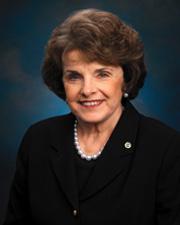 Sen. Dianne Feinstein (D-CA)
Legislative Activity
Stay on top of the latest movement without scrolling through every action
Senate amendment submitted
March 2, 2004
View full timeline
Senate amendment submitted
March 2, 2004
Senate amendment proposed (on the floor): Amendment SA 2637 proposed by Senator Feinstein.(consideration: CR S1951-1959, S1971; text: CR S1951)
March 2, 2004
Senate amendment agreed to: Amendment SA 2637 agreed to in Senate by Yea-Nay Vote. 52 - 47. Record Vote Number: 24.
March 2, 2004
Roll call votes on amendments in Senate: Amendment SA 2637 agreed to in Senate by Yea-Nay Vote. 52 - 47. Record Vote Number: 24.
March 2, 2004
Amendment SA 2637 proposed by Senator Feinstein. (consideration: CR S1951-1959, S1971; text: CR S1951) To provide for a 10-year extension of the assault weapons ban.
March 2, 2004
Amendment SA 2637 agreed to in Senate by Yea-Nay Vote. 52 - 47. Record Vote Number: 24.
March 2, 2004
Votes
1 roll call on this amendment
Text
Proposed
PROTECTION OF LAWFUL COMMERCE IN ARMS ACT

The PRESIDENT pro tempore. Under the previous order, the Senate will
resume consideration of S. 1805, which the clerk will report.
The assistant journal clerk read as follows:

A bill (S. 1805) to prohibit civil liability actions from
being brought or continued against manufacturers,
distributors, dealers or importers of firearms or ammunition
for damages resulting from the misuse of their products by
others.

Pending:

[[Page S1948]]

Hatch (for Campbell) amendment No. 2623, to amend title 18,
United States Code, to exempt qualified current and former
law enforcement officers from State laws prohibiting the
carrying of concealed handguns.
Kennedy amendment No. 2619, to expand the definition of
armor piercing ammunition and to require the Attorney General
to promulgate standards for the uniform testing of
projectiles against body armor.
Craig (for Frist/Craig) amendment No. 2625, to regulate the
sale and possession of armor piercing ammunition.
Levin amendment No. 2631, to exempt any civil action
against a person from the provisions of the bill if the gross
negligence or reckless conduct of the person proximately
caused death or injury.
Warner amendment No. 2624, to improve patient access to
health care services and provide improved medical care by
reducing the excessive burden the liability system places on
the health care delivery system.
Lautenberg amendment No. 2632, to require that certain
notifications occur whenever a query to the National Instant
Criminal Background Check System reveals that a person listed
in the Violent Gang and Terrorist Organization File is
attempting to purchase a firearm.
Lautenberg amendment No. 2633, to exempt lawsuits involving
injuries to children from the definition of qualified civil
liability action.

The PRESIDENT pro tempore. Under the previous order, the time between
9:30 a.m. and 11:15 a.m. will be equally divided between the two
leaders or their designees.
Who yields time?
The Senator from Nevada.
Mr. REID. Mr. President, Senator McCain is not in the Chamber. We are
ready to proceed on our side. I think we should do the time
proportionately, so that it will be equal, proponents and opponents of
the legislation, when going into a quorum call.
The PRESIDENT pro tempore. Is there objection? Without objection, the
time will be equally charged.
Mr. REID. I suggest the absence of a quorum.
The PRESIDENT pro tempore. The clerk will call the roll.
The assistant journal clerk proceeded to call the roll.
Mr. McCAIN. Mr. President, I ask unanimous consent that the order for
the quorum call be rescinded.
The PRESIDENT pro tempore. Without objection, it is so ordered. The
Senator is recognized.

Amendment No. 2636

Mr. McCAIN. Mr. President, I have an amendment at the desk. I ask for
its immediate consideration.
The assistant journal clerk read as follows:

The Senator from Arizona, [Mr. McCain], for himself, Mr.
Reed, Mr. DeWine, Mr. Lieberman, Mr. Chafee, Mr. Corzine, Mr.
Dodd, and Mr. Durbin, proposes an amendment numbered 2636.

Mr. McCAIN. I ask unanimous consent that the reading of the amendment
be dispensed with.
The PRESIDENT pro tempore. Without objection, it is so ordered.
(The amendment is printed in today's Record under ``Text of
Amendments.'')
Mr. McCAIN. Mr. President, as a strong defender of law-abiding
Americans' second amendments rights, today I join my colleagues,
Senators Reed, DeWine, Lieberman, Chafee, and Dodd to offer a
bipartisan compromise amendment to address what has become known as the
gun show loophole.
Currently an individual can walk into a gun show and purchase a
firearm from either a federally licensed dealer or an unlicensed
dealer. A background check is only performed on that individual if he
or she buys a gun from a licensed dealer. There is no requirement--I
repeat, no requirement--for a background check of any kind when
purchasing a firearm from an unlicensed dealer. This is a very
dangerous loophole in the law and we are doing a disservice to the
American people if we allow it to remain open.
This amendment would close this dangerous loophole in our gun safety
laws in a way that is respectful of the rights of gunshop operators,
gun show vendors, and gun show enthusiasts. It defines gun shows in a
reasonable manner to cover only public events where at least 75
firearms are offered for sale. It specifically exempts from regulation
any private sale from the home, such as yard sales or estate sales.
Additionally, it exempts sales between members of hunt clubs, an
exception that I know is important to a number of our colleagues who
represent hunting and sporting clubs that occasionally sell, trade, or
raffle firearms between club members.
The amendment would also create a new category of licensees who can
become deputized to perform background checks for unlicensed sellers at
gun shows. This licensee, who could even be a gun show employee, would
enable any unlicensed vendor to conveniently have an instant
background check performed when selling a firearm. In addition, this
amendment would allow States to graduate to an even faster instant
check once they have sufficiently automated the records necessary to
ensure that a faster check does not sacrifice accuracy.

Why do we need this amendment? Some might point to tragedies such as
Columbine, but as horrific as the massacre at Columbine was, where 11
young people needlessly lost their lives, that is not what drives the
need to close the gun show loophole. We need this amendment because
criminals and terrorists have exploited and are exploiting this very
obvious loophole in our gun safety laws. We need this amendment because
our second amendment rights do not extend to criminals who violate our
laws and terrorists who hate this country.
We need this amendment because, according to the NRA, ``hundreds of
thousands'' of unlicensed firearms sales occur at gun shows each year.
We need this amendment because ATF has identified gun shows as the
second leading source of firearms recovered from illegal gun
trafficking investigations.
We also need this amendment because my law-abiding constituents who
attend gun shows in Arizona should not have to rub shoulders with the
scum of the Earth who use this loophole to evade background checks to
buy firearms to peddle to God knows who. We need this because every one
of the 15 leading gun trafficking States in America has not taken
action to close the gun show loophole. Conversely, 11 of the 15 States
with the lowest level of interstate gun trafficking have taken action
to close the gun show loophole.
When discussing the topic of gun safety, I often hear my colleagues
say things such as, let's enforce existing law before we make new ones.
I completely agree and that is exactly what we are seeking to do today.
We are seeking to strengthen existing laws by closing an enormous,
dangerous loophole.
I offer this amendment as one who counts himself as a strong
supporter of the underlying legislation to protect the gun industry
from frivolous lawsuits. I plan to vote for the underlying bill because
it is fundamentally unfair to blame a firearms manufacturer when a
criminal misuses a gun. But it is also unfair to the American people to
knowingly leave open a gaping hole in our gun safety laws that
criminals and terrorists can and do easily exploit.
The last time the Senate considered similar legislation was in 1999,
following the school shootings at Columbine High School. Two amendments
were proposed to close the gun show loophole. One amendment received 51
votes with then-Vice President Gore casting his deciding vote. I
opposed that amendment because, frankly, I thought it defined gun shows
too broadly, covering certain private sales from the home, at yard
sales, estate sales, and between members of private hunt clubs, places
that obviously are not gun shows.
The second amendment which I supported also passed the Senate.
Unfortunately, opponents of that amendment said it weakened the Brady
law for licensed dealers and created new loopholes.
Today we offer a compromise proposal that is a reasonable,
responsible consensus. I urge this body not to let this opportunity
slip by.
Opponents of today's amendment will make several arguments. I would
like to take a few moments to address them head on. It is important to
point out that this amendment is a modification of the legislation we
introduced last fall. This amendment contains none of the vendor
notification requirements contained in that bill. The vender
notification requirements in this amendment are the same as those that
passed the Senate in 1999. Let me state that again for clarity. This
amendment does not contain the vendor notification provisions contained
in S. 1807. They are gone.

We still hear that criminals don't obtain guns from gun shows and we
will

[[Page S1949]]

hear about a survey of State and Federal inmates conducted by the
Justice Department showing that about 3 percent of prisoners obtained
their guns from gun shows. Let me make a couple of points.
First, the survey was conducted in 1997. The gun show loophole didn't
exist until December of 1993, so any criminal in prison for more than 3
years or any criminal who had a firearm for at least 3 years would not
have had a reason to exploit this loophole.
Second, let's be clear to quote ATF field agent Jeff Fulton: ``Crime
guns do originate at gun shows. That's been documented.'' In fact, the
ATF says gun shows are the second leading source of guns recovered in
illegal trafficking investigations.
Some opponents of this amendment will say that background checks take
too long for weekend gun shows. That may have been the case in 1999,
but today, thanks to the diligence of the Department of Justice, 91
percent of criminal background checks are completed within several
minutes and over 95 percent of background checks are completed within 2
hours.
For 19 out of 20 background checks, instant check has lived up to its
name. For the 1 out of 20 checks that take more than 2 hours, these
applicants are 20 times more likely to be unlawful than the rest of the
applicants. Additionally, this amendment encourages States to improve
their records, making them eligible for even faster background checks.
I point out again that 91 percent of criminal background checks are
completed within several minutes; 95 percent, within 2 hours.
Opponents say the background check requirements would put gun shows
out of business. That is not true. According to the Krause Gun/Knife
Show Calendar, the definitive source of gun show information in the
Nation, in 2003, the 17 States that have closed the gun show loophole
have hosted, on average, more gun shows than the 33 States that have
not closed the loophole.
I repeat, the 17 States that have taken action to close the gun show
loophole hosted, on average, 45 gun shows in 2003. The other 33 States,
on average, 41 gun shows.
I am a gun show supporter. Arizona is a big gun show State. This
amendment will have zero effect on legitimate gun show businesses.
This amendment has been endorsed by the International Association of
Chiefs of Police, Major Cities Chiefs of Police, the Conference Of
Mayors--the list goes on and on with those who have to deal with the
results of guns obtained illegally.
Let me say that the administration has said they want a ``clean
bill.'' The administration has supported closing the gun show loophole
but now they want a ``clean bill.'' Wink-wink, nod-nod. It is
remarkable. It is remarkable. This loophole needs to be closed. The
administration has had the position that it needs to be closed. We all
know it needs to be closed.
There were two State referendums in the 2002 election, in Colorado,
not notoriously a liberal State, and Oregon, not notoriously a
conservative State. Both of those ballot initiatives carried
overwhelmingly when taken to the people instead of the incredible
influence of the NRA over this process.
I hope my friends will stand with the police chiefs and mayors and
those who are required to enforce the law and vote for this amendment.
I reserve the remainder of my time.
The PRESIDENT pro tempore. Who yields time?
Mr. REID. Mr. President, the Senator from Rhode Island has agreed to
give 2 minutes to Senator Lautenberg, and on the time I control I will
give him 2 minutes for a total of 4 minutes.
The PRESIDENT pro tempore. The Senator from New Jersey is recognized
for 4 minutes.
Mr. LAUTENBERG. Mr. President, I thank my colleagues on both sides
who support this gun show loophole amendment.
We have just heard Senator McCain make a case to close this loophole.
There doesn't seem to be any reason on Earth that this loophole should
exist. We are talking about allowing felons, criminals generally, and
terrorists to buy guns without any identification. It is hard to
understand why something such as this can occur.
Back in 1999, I authored the original gun show loophole closure to
require that sales at gun shows require the same background checks that
licensed gun dealers are required to perform under the Brady law. The
bill passed in 1999 after Vice President Gore cast the deciding vote to
break a 50-50 vote on the measure. Unfortunately, those who want to buy
guns--who might be criminals, and again terrorists--decided to kill
this bill in conference. This loophole has continued to exist.
I am sure the American people will not be able to understand in
general what this loophole is about. Why do we want to protect the
rights of those who would evade the law to get guns? As long as this
loophole is around, our other gun laws mean virtually nothing. Does it
matter if there are background checks by licensed gun dealers if the
convicted felon can walk into a gun show and get a weapon with no
questions asked? Right now, gun shows are cash and carry for firearms.
Terrorists, criminals, and the mentally unstable can get anything they
want at a gun show from one of these unlicensed dealers. It has to
stop. For the life of me, I cannot understand why those who want to see
guns generally available under their interpretation of what the second
amendment means would resist this. It is not understandable by any
measure.
We know the people who got the guns for the Columbine massacre got a
weapon which was a measure of an assault weapon illegally from a
nonlicensed dealer.
When firearms are available to terrorists with instructions from
their headquarters in Afghanistan to go to the United States; you can
buy guns at a gun show; never tell who you are and never identify
yourself, doesn't make any sense at all.
I hope my colleagues will take a second look at this and say: OK,
this one we have got to patch up. But we do not hear that from those
who would defend this arcane and ridiculous process.
I yield the floor.
Mr. KENNEDY. Mr. President, I strongly support this bipartisan
amendment to close the gun show loophole.
Americans overwhelmingly favor responsible gun safety measures. They
want effective background checks for firearm purchases, whether the
purchases take place at a gun store, a gun show, or any other large
gathering.
The gun show loophole allows firearms to be purchased illegally at
gun shows--no questions asked. The result has been the sale of massive
numbers of firearms to terrorists, criminals, juveniles, and other
prohibited purchasers without background checks.
In 2001, Attorney General Ashcroft appeared at an oversight hearing
of the Senate Judiciary Committee. He held up an al-Qaida terrorist
manual, to make the point that terrorists were being trained on ``how
to use America's freedom as a weapon against us.''
When I questioned the Attorney General at the hearing, I held up a
different terrorist training manual entitled, ``How Can I Train Myself
for Jihad,'' which had been found in a house in Afghanistan that
November. As the manual stated:

In other countries, e.g. some states of USA . . . it is
perfectly legal for members of the public to own certain
types of firearms. If you live in such a country, obtain an
assault rifle legally . . . learn how to use it properly and
go and practice in the areas allowed for such training.

There is a long list of examples of terrorists exploiting weaknesses
and loopholes in the Nation's gun laws. In 2000, a member of the
terrorist group Hezbollah in the Middle East was convicted in Detroit
on weapons charges and conspiracy to ship weapons and ammunition to
Lebanon. He had bought many of those weapons at gun shows in Michigan.
In 1999, only a lack of cash prevented two persons from purchasing a
grenade launcher at a gun show, in a plot to blow up two large propane
tanks in suburban Sacramento.
Enough is enough. Since the atrocities of September 11, Congress has
acted with strong bipartisan support to win the war on terrorism and
protect the country from future attacks. We have improved the security
of our airports and borders. We have strengthened our defenses against
bioterrorism. We have given law enforcement new powers to investigate
and prevent terrorism.

[[Page S1950]]

Clearly, we need to strengthen our defenses against gun violence. The
best way to start is by closing the gaping loopholes in our gun laws
that allow rogue gun dealers to sell guns to criminals, terrorists, and
other prohibited purchasers. According to the ATF, gun shows are now
the second leading source of firearms confiscated in illegal gun
trafficking investigations. Gun shows accounted for nearly 31 percent
of the 84,000 guns illegally diverted during one 30-month period. Even
the strongest opponents of gun control understand the need to confront
this rampant law-breaking. Closing the gun show loophole will
strengthen the safety and security of all Americans.
This amendment will not shut down gun shows. It will not prevent gun
enthusiasts and other lawful purchasers from buying and selling guns.
Instead, it requires background checks to take place at any event
where more than 75 guns are offered for sale. These checks can be
conducted by licensed sellers or by gun show operators or their
employees who have been certified by the Justice Department. This this
certification option, background checks can be completed quickly and
accurately.
Since its enactment in 1994, the Brady law's background check system
has truly become an ``instant'' check system. According to the Attorney
General, 91 percent of background checks are completed in 3 minutes or
less. A 3-minute wait is not a significant inconvenience for a gun
purchase. And 95 percent of all background checks are completed within
2 hours. The maximum amount a buyer can be forced to wait is 3 business
days. Under this amendment, the period will be reduced to 24 hours for
States with sufficiently automated background check records.
I commend my colleagues, Senator McCain, Senator Reed, Senator
DeWine, and Senator Lieberman, for their leadership on this important
issue, and I urge all my colleagues to do now what we should have done
years ago. It is time to put the interest of law enforcement and public
safety above the interests of the gun lobby. Let's close the gun show
loophole, once and for all.
Mr. LIEBERMAN. Mr. President, I am very proud to join Senators
McCain, Reed, DeWine and our other cosponsors in proposing and
supporting this critical amendment. Too often gun legislation has
divided Members of Congress. This is a proposal that should not do
that. This is a proposal that builds on common values we all share as
Americans. As citizens of this great Republic, we all recognize that we
have rights and we have responsibilities. Among our rights is the right
to own guns. Among our responsibilities are the responsibilities to use
those guns safely and to make sure that those who are neither law-
abiding nor peaceful are permitted access to deadly force.
For several decades, our Nation has had a clear policy against
allowing convicted felons to buy guns, because we know that mixing
criminals and firearms far too often yields violent results. That same
insight has caused us to agree that it causes too great a risk to
society for a number of other groups of people to buy guns--those under
felony indictments, who are fugitives from justice, who are subject to
restraining orders and who are convicted spouse abusers.
Through the Brady law, we established what seems like an obvious
corollary to that policy a requirement that those selling guns first
determine whether someone trying to buy a firearm isn't supposed to get
one. The Brady law has been an enormous success. Since its enactment,
background checks have stopped almost one million gun sales to those
who by law aren't allowed to own guns. The majority of stopped sales
involve convicted criminals or those under felony indictment. Stopping
these nearly one million transactions has saved an untold number of our
citizens from the violence, injury or death the sale of many of these
guns would have brought.
Importantly, this life-saving legislation has brought its benefits
with the most minimal of impact on the law-abiding citizens who have
the right to buy guns. Over 90 percent of background checks are
completed immediately; 95 percent within 2 hours. In other words, the
vast, vast majority of those seeking to buy guns suffer no
inconvenience whatsoever from these virtually instant background
checks. But, again, the benefits to the rest of us, to those who have
been saved from the violence that could have resulted from just a
fraction of those nearly one million sales stopped by the Brady law--
those benefits are incalculable.
Unfortunately, the Brady law contained a loophole that has since been
exploited to allow criminals and others who aren't legally allowed to
buy guns to evade the background check requirement by buying their guns
at gun shows. The problem is that Brady applies only to Federal
Firearms Licensees, so-called FFLs--people who are in the business of
selling guns. Brady explicitly exempts from the background check
requirement anyone ``who makes occasional sales, exchanges, or
purchases of firearms for the enhancement of a personal collection or
for a hobby, or who sells all or part of his personal collection of
firearms.'' As a result, any person selling guns as a hobby or only
occasionally, whether at a gun show, flea market or elsewhere, need not
obtain a Federal license and therefore has no obligation to conduct a
background check. This means that any person wanting to avoid a
background check can go to a gun show, find out which vendors are not
FFLs, and buy a gun. This situation is dangerous not only because it
allows convicted felons and other prohibited persons to buy guns, but
also because--in contrast to FFLs--non-FFLs have no obligation to keep
records of the transaction, thereby depriving law enforcement of the
ability to trace the gun if it later turns up at a crime scene.
Now I know that some argue that there is no gun show loophole, or
that if there is one, it has little or no consequence. That's just
wrong. But don't just believe me on this--listen to a report by the
government agency charged with investigating gun trafficking. In June
2000, the Bureau of Alcohol, Tobacco and Firearms issued a report in
which they stated: ``The access to anonymous sales and large numbers of
secondhand firearms makes gun shows attractive to criminals. . . .
[G]unshows were associated with the diversion of approximately 26,000
firearms.'' The report went on to describe an ATF review of gun show
investigations, which it said:

shows that prohibited persons, such as convicted felons and
juveniles, do personally buy firearms at gun shows and gun
shows are sources of firearms that are trafficked to such
prohibited persons. The gun show review found that firearms
were diverted at and through gun shows by straw purchasers,
unregulated private sellers, and licensed dealers. Felons
were associated with selling or purchasing firearms in 46
percent of the gun show investigations. Firearms that were
illegally diverted at or through gun shows were recovered in
subsequent crimes, including homicide and robbery, in more
than a third of the gun show investigations.

Our amendment will change that. We will make sure that no one will be
able to buy a gun at a gun show without it first being determined
whether that person is a convicted felon, a spouse abuser or a member
of one of the other categories of people we all agree should not be
allowed to buy guns.
Our bill does this, though, by respecting the rights of law-abiding
gun owners and taking into account some of the concerns that were
expressed about previous efforts to close this loophole. At the outset,
let me emphasize that background checks at gun shows will be no more
burdensome than those that so successfully and efficiently have been
conducted over the past decade, with minimal intrusion on the rights of
law abiding citizens. Again, over 90 percent of checks produce
immediate answers and 95 percent yield results in under two hours. Just
as importantly, there's nothing in the experience of those states that
have already closed the gun show loophole to suggest that gun
shows will suffer as a result of closing this dangerous loophole.
According to the Americans for Gun Safety, gun shows are thriving in
the States where background checks are required. Pennsylvania, which
closed the loophole in 1995, hosts the second most gun shows of any
State in the country. And of the top 5 gun show States, three
Pennsylvania, Illinois and California--require background checks or a
firearms ID card for gun purchases.

But we understand the concerns some have expressed--that a bill
closing the

[[Page S1951]]

gun show loophole will somehow extend beyond gun shows into small
private sales from someone's home or will create a barrier so high that
gun shows won't be able to operate. We've made sure that won't happen.
First, our bill has a simple definition of a gun show--an event where
75 or more guns are offered or exhibited for sale--and we make clear
that that definition doesn't include sales from a private collection by
nonlicensed sellers out of their homes.
Second, to respond to the argument that previous proposals made it
too difficult for nonlicensed sellers to fulfill the background check
requirement, our bill makes sure that nonlicensed sellers will have
easy access to someone who can initiate background checks for them, by
creating a new class of licensee whose sole purpose will be to initiate
background checks at gun shows.
Third, we have tried to respond to those who say that a three-day
check is too long for gun shows, because those events only last a
couple of days. It is worth noting yet again that the length allowed
for the check doesn't affect the overwhelming majority of gun
purchasers, because over 90 percent of checks are completed almost
instantly. But to allay the concerns that have been expressed, we have
come up with a compromise that authorizes a State to move to a 24-hour
check for nonlicensed dealers at gun shows when the State can prove
that a 24-hour check is feasible. A State can prove that by showing
that 95 percent of the records that would disqualify people in that
State from buying guns are computerized and searchable by the NICS
system. And, because of the particular need to keep guns out of the
hands of spouse abusers, the bill specifically provides that a State
must have computerized 95 percent of its domestic violence misdemeanor
and restraining order records dating back 30 years before it is
eligible to go to a 24-hour check at gun shows.
Putting all of these provisions together, I frankly cannot understand
why reasonable people would oppose this amendment. If we all agree that
criminals, spouse abusers and the like shouldn't be able to buy guns,
why in the world aren't we doing a very simple thing and saying that
just like the person who sells at a gun store has to do a background
check, the person who sells at a gun show does too. All this bill does
is make sure that we have an effective means to implement something
upon which there has been a national consensus for decades--that
criminals and other people we all agree shouldn't own guns can't buy
them.
Now I know that there are many who argue that what we need to solve
the gun violence problem are not new laws, but the enforcement of
existing ones. I agree with part of that statement, and firmly support
efforts to crack down on those who violate our gun laws. But I believe
we must go farther than that, because we will never be able to enforce
existing laws unless we close the loopholes in them that criminals
exploit. And we all know that there is a big loophole in the provision
saying that felons and spouse abusers aren't supposed to buy guns, and
that is that criminals know that if they go to a gun show, they will be
able to avoid the background check that was set up to keep them from
getting guns.
Gun crime remains a critical public safety problem. For too long,
differences over finding a solution to that problem have unnecessarily
divided the Congress, and the American people have been left to suffer
the violent consequences. But the reality is that most of us agree on
most of the critical questions. We agree that the laws on the books
should be enforced, that the rights of law-abiding gun owners should be
protected, and that convicted felons and spouse abusers shouldn't be
able to get guns. Again, I believe law abiding citizens have every
right to own guns, but we also all share in the responsibility of
keeping our society safe and keeping guns out of the hands of those who
shouldn't have them. This amendment would write those principles into
law. I hope all of my colleagues support it.
The PRESIDENT pro tempore. The Senator from Idaho.
Mr. CRAIG. Mr. President, the Senator from California is now on the
floor to offer her amendment. So we can expedite matters, under the
unanimous consent agreement, the McCain-Reed amendment is to be set
aside for the purposes of the introduction of an amendment by the
Senator from California.
The PRESIDENT pro tempore. The Senator from California is recognized.
Mrs. FEINSTEIN. I thank the Chair.

Amendment No. 2637

Mrs. FEINSTEIN. Mr. President, I send an amendment to the desk.
The PRESIDENT pro tempore. The clerk will report.
The assistant journal clerk read as follows:

The Senator from California [Mrs. Feinstein], for herself,
Mr. Warner, Mr. Schumer, Mr. DeWine, Mr. Levin, Mr. Chafee,
Mr. Dodd, Mr. Jeffords, Mrs. Boxer, Mrs. Clinton, Mr. Reed,
Mr. Lautenberg, and Ms. Mikulski, proposes an amendment
numbered 2637.

Mrs. FEINSTEIN. Mr. President, I ask unanimous consent that reading
of the amendment be dispensed with.
The PRESIDENT pro tempore. Without objection, it is so ordered.
The amendment is as follows:

(Purpose: To provide for a 10-year extension of the assault weapons
ban)

On page 11, after line 19, add the following:

SEC. 5. ASSAULT WEAPONS BAN REAUTHORIZATION.

(a) Short Title.--This section may be cited as the
``Assault Weapons Ban Reauthorization Act of 2004''.
(b) 10-Year Extension of Assault Weapons Ban.--Section
110105 of the Public Safety and Recreational Firearms Use
Protection Act (18 U.S.C. 921 note) is amended to read as
follows:

``SEC. 110105. SUNSET PROVISION.

``This subtitle and the amendments made by this subtitle
are repealed September 13, 2014.''.

Mrs. FEINSTEIN. Mr. President, it is my understanding that I have 10
minutes to speak on the amendment. I ask the Chair to alert me when 5
minutes have passed. I will then cede time to Senator Warner for 2
minutes and to Senator Schumer for 2 minutes.
The PRESIDENT pro tempore. The Senator is recognized for 5 minutes.
Mrs. FEINSTEIN. Mr. President, this amendment is offered on behalf of
Senators Warner, Schumer, DeWine, Levin, Chafee, Dodd, Jeffords, Boxer,
Clinton, Reed, Lautenberg, and Mikulski.
This is an ad from this morning's Washington Post. It says:

Senators, if police officers sat in your seats today, do
you think they'd vote to put Uzi's and AK-47's back on the
streets?

That clearly is the question before the Senate this morning.
It is going to be a very close vote. However, that is the issue. That
will be the result, if this legislation is not reauthorized for another
10 years.
The legislation has the support of 77 percent of the American people,
and 66 percent of gun owners. It does not remove a legal gun owner from
his weapon, and it has reduced traces of assault weapons to crimes by
two-thirds in the last 10 years. I stand by those figures.
We believe the assault weapons legislation should be reauthorized. It
was enacted in 1994 for 10 years. That 10 years is up on September 13.
There is a broad coalition of organizations including every single
law enforcement organization in this country supporting it, from the
International Chiefs of Police to the Fraternal Order of Police, to
virtually every civic group supporting reauthorization of this
legislation.
I very much hope the votes are present in the Senate this morning.
Another interesting note is that on the one hand we are accused,
well, it is just cosmetic; it doesn't work. If it is just cosmetic and
it doesn't work, then why this enormous effort to prevent the bill from
being reauthorized?
Additionally, the legislation contains a written exemption by name
for 670 weapons. So no one in the United States who legally possessed
one of these assault weapons has had those assault weapons taken away.
But what we believe is the legislation which stops the manufacture and
the sale of semiautomatic assault weapons has been effective. It also
stops the domestic manufacture of clips, drums, or strips of more than
10 bullets. No hunter needs more than 10 bullets. No person for defense
needs more.
I am very hopeful this morning we will in a sense look to the law
enforcement community and sustain a vote to reauthorize the assault
weapons legislation for another 10 years.
I now yield 2 minutes of my time to the distinguished senior Senator
from Virginia, Mr. John Warner.

[[Page S1952]]

The PRESIDENT pro tempore. The Senator from Virginia is recognized.
Mr. WARNER. Mr. President, I thank our distinguished colleague from
California. I salute her leadership on this measure.
I am very hopeful we can persuade the Senate this morning to continue
this legislation.
Might I say that when first introduced, it was somewhat different
than what the President indicated he would support. At my request, the
Senator conformed her bill so it is precisely the legislative measure
to which the President of the United States has indicated he would lend
his support.
I could say many things about this bill. But in the time constraints
we have, law enforcement was the pivotal decision which switched me
from 10 years ago voting against this measure, to today not only
standing here to vote for it but joining in the leadership of the
Senator from California to get it passed. Law enforcement has shown it
has reduced the use of these weapons in crime.
My words pale in significance to the law enforcement officers from
the four corners of the Commonwealth of Virginia.
The sheriff of Amherst County, the chief of police of Blacksburg, the
chief of police of the town of Vienna, the chief of police of
Waynesboro, the acting chief of police of Fairfax County, the sheriff
of the city of Alexandria, the chief of police of Roanoke, the chief of
police of Virginia Beach, the chief of police of Chesapeake, the chief
of police of Portsmouth, the sheriff of Roanoke City, the chief of
police of Newport News, the chief of police of Winchester, the chief of
police of the city of Alexandria, the chief of police of Arlington
County, the chief of police of Staunton, the chief of police of Salem,
the sheriff of Rockingham County, and the chief of police of Norfolk--
the four corners of the Commonwealth of Virginia. These law enforcement
officers come forward to support this legislation.
I yield the floor.
The PRESIDING OFFICER (Mr. Talent). The Senator has used 2 minutes of
the time.
Mrs. FEINSTEIN. I thank the distinguished Senator from Virginia for
his leadership on this issue. We are delighted he is a major sponsor of
this bill.
Mr. President, inadvertently the name of the Senator from Illinois,
Mr. Durbin, was left off the bill as a cosponsor. I ask unanimous
consent it be added.
The PRESIDING OFFICER. Without objection, it is so ordered.
Mrs. FEINSTEIN. I yield 2 minutes of my time to the distinguished
Senator from New York, Mr. Schumer.
The PRESIDING OFFICER. Senator Schumer is recognized for 2 minutes.
Mr. SCHUMER. I, too, salute both my colleagues for their superb
leadership on this issue. This bill, the assault weapons ban, is
hanging by a thread. There is no good reason on God's green Earth why.
It has been a success in preventing crimes. It has not hurt a single
law-abiding gun owner. Yet we are here today at the eleventh hour
worrying and wondering whether this legislation will be renewed. If it
is not renewed, it is a giant step backwards, I say to my colleagues.
How can we take it in the light of 10 years of experience which shows
how successful the legislation is? The number of guns, assault weapons,
19 banned weapons, used in crimes has dramatically declined--by 300
percent. The number of individuals who have been hurt by this--hunters,
small businesspeople, homeowners who want to protect themselves by
having a gun--have not been hurt at all.
These are weapons of war. They are designed to kill a whole lot of
people quickly. They are not designed for hunting. They are not
designed for self-defense of a homeowner or a store owner. The only
reason we are here today is politics.
I plead with our President--he has said he is for the legislation
after the modification the good Senator from California made, so it is
exactly the same as the bill we have had in effect--I plead to not just
simply state once or twice he is for this. One phone call, Mr.
President, can pass this bill. Please, we need this legislation. I urge
my colleagues to reach into their consciences and pass it.
Mr. KENNEDY. Mr. President, I strongly support this bipartisan
amendment to continue the Federal ban on assault weapons. The ban is
now scheduled to expire on September 13, 2004.
The fact that this common-sense and necessary ban requires any debate
at all shows how misplaced and misguided our priorities on domestic
safety and security have become.
Even before 9/11, renewal of the assault weapons ban should have been
a no-brainer. After 9/11, to even consider letting the ban expire is
absurd.
Semi-automatic assault weapons are killing machines--nothing more,
nothing less. They are intentionally designed to maximize their killing
power by a rapid rate of fire. They are intended to be spray-fired from
the hip, so that the killer can fire many rounds in rapid succession.
Civilians have no need whatever for such military-style killing
machines. They are of no use for hunting, unless the goal is to
obliterate the duck or deer being hunted. They are unnecessary and
impractical for self-defense, and they have no recreational value.
The purpose of these weapons is to facilitate crime. By the late
1980s, assault weapons had become the weapon of choice for drug
traffickers, gangs, and other criminal organizations. Their high
firepower and ability to penetrate body armor exposed the police
officers to increased danger, and innocent bystanders were killed in
indiscriminate assault-weapon shoot-outs in the streets.
Assault weapons have been used in a series of massacres:
In 1989, in an attack at Cleveland Elementary School in Stockton, CA,
Patrick Purdy used an assault weapon to kill five small children and
wound 29 others. Purdy fired off 106 rounds in less than two minutes.
In 1993, two CIA employees were killed outside the entrance to CIA
headquarters by a Pakistani national using an AK-47 assault rifle
equipped with a 30-round magazine.
Also in 1993, eight persons were killed and six others were wounded
at a San Francisco law firm by an assailant using two assault pistols
with 50-round magazines.
That's the kind of world we'll return to if Congress allows the
current ban on assault weapons to expire.
In fact, the ban contributed to a dramatic decrease in violent crime
in the 1990s. Many of us remember the dire ``juvenile superpredator''
predictions that were in vogue before that reduction took place. In
1996, William Bennett and John Walters had written that America was a
``ticking crime bomb,'' faced with the ``youngest, biggest, and baddest
generation'' of juvenile offenders that our country had ever known.
Fortunately, these predictions were wrong. From 1993 to 2001, arrest
rates for violent juvenile crime declined by more than two-thirds.
We're still enjoying the benefits of this low crime rate today.
The decrease in crime is explained in large part by the sensible
measures that Congress took on gun safety in the early 1990s, including
the ban on assault weapons. In 1999, the National Center for Juvenile
Justice concluded that all of the increase in homicides by juveniles
between the mid-1980s and mid-1990s was firearm-related. The U.S.
Surgeon General concluded that guns were responsible for both the
epidemic in juvenile violence in the late 1980s and the decrease in
violence after 1993. ``It is now clear,'' the Surgeon General wrote,
``that the violence epidemic was caused largely by an upsurge in the
use of firearms by young people. . . . Today's youth violence is less
lethal, largely because of a decline in the use of firearms.''
After Congress passed the assault weapons ban in 1994, fewer
criminals used assault weapons to kill and commit other crimes.
According to the National Institute of Justice, requests to trace
assault weapons--one of the best indicators of gun use in crimes--
declined 20 percent in the first calendar year after the ban took
effect. In 1995 and 1996, the number of assault weapons used in crime
in Boston declined by 24 percent. In St. Louis, it declined by 29
percent.
With these proven results, why would anyone vote against
reauthorization of the current assault weapons ban?
It's no surprise that the law enforcement community strongly supports
the

[[Page S1953]]

ban. The amendment now before us is supported by: The International
Association of Chiefs of Police; the National Association of Police
Organizations; the National Organization of Black Police Officials; the
International Brotherhood of Police Officers; the Hispanic American
Police Command Officers Association; the American Probation and Parole
Association; the United States Conference of Mayors; and countless
other religious, public health, and domestic violence organizations.
Congress needs to do more than renew the ban on assault weapons now
in effect. We should make clear that the definition of assault weapons
includes ``copycat'' guns made by the gun industry with devious
cosmetic changes to evade the 1994 law. We should ban parts kits that
can be bought through the mail and used to build assault weapons. We
should regulate the transfer of ``grandfathered'' assault weapons and
facilitate their tracing. We should ban high-capacity ammunition
magazines, and prohibit juveniles from buying or possessing assault
rifles and shotguns. Senator Lautenberg has introduced a bill that
would do all of these things, and I commend him for his leadership.
What we absolutely cannot do is let the current ban on assault
weapons expire. Such a failure would drastically undermine the safety
of our streets, neighborhoods, and schools, and strengthen the hand of
terrorists and other criminals.
We know that terrorists are now exploiting the weaknesses and
loopholes in our gun laws. A terrorist training manual discovered by
American soldiers in Afghanistan in 2001 advised al Qaeda operatives to
buy assault weapons in the United States and use them against us.
Terrorists are bent on exploiting weaknesses in our gun laws. Americans
will be at much greater risk if Congress fails to renew the ban on
assault weapons.
We can't let that happen. I urge my colleagues to vote for this
essential protection against crime and terrorism.
Mr. DODD. Mr. President, I strongly support the extension of the
assault weapons ban. I want to commend Senators Feinstein and Schumer
for championing this important legislation for many years.
We need to close a number of loopholes in the current assault weapons
ban that have allowed gun manufacturers to make minor design changes to
evade the law. One gun maker in my State has skirted the ban by
replacing the prohibited flash suppressor on one of its assault weapons
with non-prohibited muzzle breaks or compensators, which ironically
reduce ``muzzle climb'' during rapid firing.
The actual functional elements of this assault weapon, however, have
remained the same. The gun still fires a high volume of bullets over a
large area. Such loopholes need to be closed, and I am pleased to co-
sponsor legislation authored by Senator Launtenberg to further
strengthen the existing assault weapons ban.
The current assault weapons ban will expire in September. There are
many powerful reasons why extending the assault weapons ban must be a
top priority for the Congress this year.
First, assault weapon bans do work. According to the Department of
Justice, the proportion of assault weapons traced to crimes has dropped
by nearly two-thirds since 1995, the first year that the Federal ban
went into effect.
Between 1988 and 1991, assault weapons accounted for nearly 8 percent
of guns used in crimes. In 1995, it plummeted to 3.6 percent. In 2002,
it dropped even further to 1.2 percent. The ban on assault weapons is
therefore clearly making a difference in reducing crime and saving
lives.
Second, assault weapons have a devastating impact on people's lives
and on the safety of their communities. These aren't hunting weapons we
are talking about. Nor are they for recreational or sporting use. We
have heard it said before that one does not need an AK-47 or an Uzi for
duck hunting.
Quite simply, assault weapons are weapons of war. They are designed
with one purpose in mind--for slaughtering human beings over a wide
area. They belong on a faraway battlefield, not on our Nation's
streets. However one feels about the Second Amendment, assault weapons
have no place in a civilized society.
If assault weapons end up in the wrong hands, the results can be
horrific. The increased firepower of these weapons has a particularly
devastating impact on its victims, who often suffer multiple gunshot
wounds and severe penetrating trauma. It often takes longer for victims
to recover from such injuries, placing significant burdens on scarce
medical resources.
Law enforcement officers are particularly vulnerable to assault
weapons fire, since they are on the front lines protecting our
communities from those gangs, drug traffickers, and even terrorist
groups who have made such firearms their weapons of choice. In the
years leading up to the enactment of the Federal ban, assault weapons
accounted for 8 percent of all guns traced to crime, although they
comprised only 1 percent of privately owned guns in America.
Even with the Federal ban in place over the last decade, assault
weapons have been implicated in the death of one in five police
officers killed in the line of duty between 1998 and 2001. It is no
coincidence then that numerous law enforcement organizations, including
groups devoted to protecting children's rights and stopping domestic
violence, support extending the ban on these deadly weapons.
In fact, it is really a matter of homeland security that these
weapons must be taken out of the hands of criminals. A May 2003
editorial in The San Antonio Express News had it right when it said
that just as it is a priority for allied officials in Iraq to get AK-
47s out of the hands of Iraqi civilians, Congress shouldn't let such
military-type weapons back on the streets of American cities by failing
to extend the assault weapons ban. If terrorists can turn a jet
aircraft into instruments to kill Americans, does anyone think they
would hesitate for even one second to use an assault weapon for the
same purposes?
In addition to police officers being vulnerable to assault weapons,
so are our children. These firearms were used to kill 5 children and
wound 29 others in a Stockton, CA, schoolyard in 1989. The AK-47 used
in this incident held a staggering 75 bullets. A TEC-9 assault weapon
was also used in the 1999 killing of a teacher, 12 students, and the
wounding of more than 20 others at Columbine High School.

Connecticut was the fourth State in the Nation to ban assault
weapons, after California, New Jersey and Hawaii. The National Rifle
Association challenged the ban in Connecticut State court and it was
upheld as constitutional in 1994. Federal courts have upheld the
constitutionality of the Federal ban on assault weapons as well.
Extending the ban for another 10 years will save lives, prevent serious
injuries and make our communities safer from the tragic consequences of
gun violence. I urge my colleagues to support this legislation.
One more point, one of the most surprising things I have learned in
this debate is that firearms, which are responsible for 29,000 deaths a
year, are specifically exempt from regulation under the Consumer
Product Safety Act.
Section 3(a)(1)(E) of the Act exempts firearms and ammunitions from
the definition of ``consumer products.'' This provision was inserted
into the Act in 1972 at the behest of the gun lobby. As a result, guns
are among the only consumer products, along with tobacco, exempt from
Federal health and safety regulations.
This fact is shocking. Even more shocking is the fact that firearms
cause more deaths a year than the 15,000 consumer products regulated
under the Act combined.
Other potentially dangerous products--from cars to lawnmowers to
household products to medicines--are regulated to protect the health of
the American public. The fact that guns are already specifically exempt
from the oversight of the Consumer Product Safety Commission is reason
enough why we cannot afford to grant the firearm industry legal
immunity.
Strangely enough, toy guns are more heavily regulated than real guns,
despite the fact that toy guns do not kill or maim. There are over 140
pages in the Code of Federal Regulations that apply to toys, but only
one paragraph devoted to guns, and that paragraph exempts guns from the
Consumer Product Safety Act.

[[Page S1954]]

Under the Act, toy guns fall under the standard for toys. At least
four types of Federal safety standards cover toys: if they have sharp
edges and points, small parts, contain hazardous materials, and are
flammable. The regulations even say that toy guns should have a bright
orange tip at the end of the barrel to distinguish them from real guns.
The lack of Federal health and safety regulations for guns has a
number of serious consequences. It means that there is no way to recall
defective firearms. Guns that are manufactured poorly and pose a
serious threat to gun owners and the public would remain in
circulation, with the government essentially unable to do anything
about it.
The lack of Federal regulation of firearms also means that there is
no way to mandate the use of safety devices. And it means that there is
no detailed data collection on deaths and injuries from guns.
Gun violence has a devastating impact on people's lives and their
communities. The fact that toy guns are regulated and real guns are not
makes little sense, and I urge the Senate to eventually rectify it.
Mrs. FEINSTEIN. How much time remains?
The PRESIDING OFFICER. The Senator from California has 1 minute 10
seconds.
Mrs. FEINSTEIN. I reserve the remainder of my time and yield the
floor.
The PRESIDING OFFICER. The Senator reserves her time and yields the
floor.
The Senator from Idaho.
Mr. CRAIG. Mr. President, under the unanimous consent request, this
amendment currently before the Senate, the Feinstein amendment, would
be set aside for the purposes of the introduction by our leader,
Senator Frist, of the DC gun ban repeal. That amendment will not be
offered today, so we are now on full debate for the balance of time
until votes start at 11:30 on the two issues before the Senate and the
balance of the whole bill.
Certainly, there are other amendments besides the assault weapons ban
introduced by the Senator from California, the gun show loophole by
Senators Reed and McCain. Also, we will have votes today, and it is
critical for Senators who want to debate on armor piercing by Kennedy
and the Frist-Craig alternative, also on conceal and carry, offered in
behalf of Senator Ben Campbell, that some have debated.
For a few moments, let me debate one general topic. The clock has
started for all of us on the 2-hour balance of time equally divided
between us on this issue.
For a moment today, I will talk about attitudes of the American
public as it relates to the second amendment in the Senate today. The
Senator from New York talked about why we are at the eleventh hour
debating the gun show loophole. We are because he and his colleagues
introduced it, obviously, believing it was a timely topic to debate at
a time when we have a very narrowly prescribed bill to deal with the
legitimacy of law-abiding citizens in the manufacture of firearms. He
has decided to add or attempt to add this to the bill. Our President
has asked for a clean bill.
Let me talk about where the American people are. Once again, we find
ourselves in a political season. And once again, we find ourselves
debating and arguing about gun ownership in America. The second
amendment is clear. Many who are strong advocates of that amendment
believe it is extremely clear.
We have heard over the last several days Senators with honest
differences of opinion take to the Senate floor and claim their vows to
represent the folks back in their home States.
Let's take a few minutes to look at some of the relevant research
from respected polling from the firm Zogby International. Zogby
recently surveyed 1,200 voters nationwide on firearms issues. As a
conservative, I don't view Zogby as a conservative pollster; some call
him middle of the road, some call him middle left. I guess what I am
saying is Zogby and his polling are largely respected by many across
the country. The Zogby International group, working with the John
Goodwin Tower Center for political science at Southern Methodist
University, looked at and decided to poll in a unique way. They said:
Let's examine the difference between the George Bush States in 2000,
the red States, and the Al Gore States, the blue States. For the
balance of my comment, think red and think blue and remember that map
we saw after the last Presidential election when the vast majority of
America was red except for a few blue strips along the west coast line
and the east coast line.
Here were the questions asked of 1,200 voters--not citizens, voters;
those who said they voted in the last election--as to the attitude of
Americans on firearms. They asked: Do you agree or disagree that
American firearm manufacturers that sell a legal product which is not
defective--meaning a quality product used for the intent of its
manufacture--should be allowed to be sued if a criminal used their
product in a crime.

What are the answers? The answers are, there were enough laws on the
books. In the Bush States, 69 percent agreed they should not be sued;
in the Gore States, 63 percent agreed they should not be sued and they
ought not be sued; military people in those States, 70 percent;
veterans, 71 percent; nonmilitary, on the average 66 percent. A very
strong majority of the American people made it very clear. The answer
came back loudly, from every demographic group opposed to these kinds
of lawsuits.
That is why we have S. 1805 before the Senate. American minds are
made up. These are junk and frivolous lawsuits. They ought not be
filed. They also said a manufacturer of a product ought to be held
liable if that product is defective, if it malfunctions, and if that
defectiveness or that malfunction might create an injury. That is
exactly what we continue to allow to happen.
Opposition in the Bush States on that issue, 74 percent; while 72
percent of the voters in the Al Gore States voiced opposition.
Interestingly, across the board those most strongly opposed to these
lawsuits against the firearms industry are current members of the
military and their family. Their opposition collectively measured at 83
percent. This is not from a conservative right-wing pollster. This is
from Zogby himself.
When certain gun organizations heard about this, they called the
Zogby polling group and asked, Are these valid? The answer from Zogby:
Yes, we ran them again. We were not so sure, and we believe they are
accurate and valid.
Which of the following two statements regarding gun control comes
closer to your own opinion? Of course, those were the figures we showed
in the first chart. There needs to be new and tougher gun law
legislation to help fight against crime. That is what we are debating
now in the Senate. That was question A: There are enough laws on the
books. What is needed is better law enforcement of current laws
regarding gun control, by a better than 2 to 1, 66 to 31.
In essence, the American people are saying no new gun laws; we have
plenty of them on the books. That is not about laws but going after
criminals. That is common sense in America, and we never want to doubt
the common sense of the average American when they are well informed
about an issue or when they just suggest that somebody is playing
politics with an issue and it really does not make any sense.

Sixty-nine percent in the Bush States; 63 percent in the Gore States;
and those numbers are extremely strong.
So what are we saying? We are saying that moderates solidly favor
better law enforcement--62 percent to 34 percent. They are saying:
Leave the gun owner alone. Gun control laws do not work.
Somehow, the American people have settled into understanding what
most people understand, with common sense: If you do not use the laws
to go after the criminal element in our country, if you try to blame
their problem on somebody else or their malfunctioning in society, and
you try to reach through and sue somebody else, the American people are
saying: No, we don't go there anymore and we won't tolerate that.
Those are the issues at hand. That is the underlying purpose for why
we are here today debating S. 1805. We think it is fundamental to the
American people to allow them to speak and say: Enough is enough; 30-
plus lawsuits by

[[Page S1955]]

municipalities or political jurisdictions, and 21 of them already
thrown out of the courts. Our courts are now full of many of these.
Hundreds of millions of dollars have been spent in defense of law-
abiding manufacturers and licensed firearms dealers. It is time we say,
no, if that third party is trying to be held unaccountable by going
after somebody else who is a law-abiding, legitimate citizen. Let's
return to old, historic, fundamental tort law. It is the individual who
is responsible for their actions, not someone else.
I think we were all taught that as a child. If we were not taught
that by our parents, then I guess I have to say shame on our parents
because that is pretty fundamental. You are responsible for your
actions. If you misact, you might be punished for it. In society, if
you misuse a gun, you ought to be punished for it instead of trying to
pass it on to somebody else who is a law-abiding citizen playing by the
rules that society has laid down and of which our Constitution so
clearly speaks.
I yield the floor.
The PRESIDING OFFICER. The Senator from Nevada.
Mr. REID. Mr. President, I yield 2 minutes to the Senator from
Delaware, Mr. Carper.
The PRESIDING OFFICER. The Senator from Delaware is recognized for 2
minutes.
Mr. CARPER. Mr. President, I thank the Senator for yielding.
Most Senators have already made up their minds on how they are going
to vote on the proposal by Senator McCain and Senator Reed on closing
the gun show loophole. A few have not. What I would like to do is
direct my comments to them.
During my first term as Governor of Delaware, I remember a meeting I
had with law enforcement officers who came to see me. They wanted to
talk with me about something called the gun show loopholes.
As they went through their explanation, I said: Do I understand
correctly, that if I happen to be a licensed gun dealer at a gun show
in my State, and let's say Senator Reed over here is an unlicensed gun
dealer at the same gun show, that I have to do an instant background
check on the folks who want to buy a weapon from me, and if they do not
pass that instant background check, they can go over and buy the same
weapon from my competitor?
They said: That's right.
For the life of me, at that time that made no sense, and for the life
of me, it still does not make any sense.
I mentioned yesterday on the floor that my dad, who is now deceased,
was a gun collector. He had rifles and shotguns, a musket or two,
pistols of all kinds. He would buy weapons from guys he would hunt
with. They had an informal hunt club. He would buy weapons from
relatives, members of our family. He might go to a yard sale in the
neighborhood where they lived in Florida and buy a weapon. He ought to
have been able to do that, and under the law, under this amendment that
is offered today, he could still do those things, were he alive.
Let me close with this: Technology is going to help us solve this
problem. Technology can be a great way to solve this problem. Instant
background checks make feasible what 10 years ago was not feasible and
the right thing to do.
I yield back my time.
The PRESIDING OFFICER. The Senator yields the floor.
Who seeks recognition?
The Senator from Rhode Island.
Mr. REED. Mr. President, I yield myself such time as I may consume
from my time.
I rise to support the McCain-Reed amendment and also the Feinstein
amendment. I am a cosponsor, obviously, of both amendments.
I wish to talk, for a moment, about the gun show loophole. It is
clear and obvious to anyone--at least I believe it is--that we should
not have two different standards at a public gun show. We should not
have a situation where you can approach one seller who is a licensed
firearms dealer and in that transaction have to undergo a background
check, and then, 5 feet away, have an unlicensed seller and be able to
purchase a weapon without any type of background check.
These are public functions. Thousands of people stream through these
gun shows. This is not a private sale where the seller and the buyer
know each other, have an association to each other, and essentially do
not need any kind of a background check. In order to prevent these gun
shows from being exploited by criminals and terrorists, there has to be
a common standard. Every transaction should be governed by a background
check at a public gun show.
We know these unlicensed dealers and these gun shows have been
exploited by criminals. I have mentioned, over the course of the last
several days of debate, numerous examples. Let me return to one.
Nigel Bostic and two accomplices were arrested for buying 239
firearms at 11 Ohio gun shows and reselling them to criminals in
Buffalo, NY.
It is a very obvious scheme. You go to a place, if you are a felon or
a criminal, that requires no background checks, that are publicly
advertised, that are easily accessible, you buy the weapons, take them
to another State that has very tough laws, and you sell them to
criminals.
One of these weapons was recovered in a homicide. It has been
reported that Bostic purchased 45 firearms at one of these sales; his
accomplices, 85 guns.
These are the examples that will continue to take place unless we
close this gun show loophole. Indeed, it is obvious to gun owners it
should be closed. More than 80 percent of gun owners surveyed indicated
they support closing the gun show loophole. President Bush repeatedly,
in the campaign of 2000, said he was for closing the gun show loophole.
The legislation that we present imposes no great burden on any
participant at a gun show. Because of the National Instant Check
System, 91 percent of these background checks are accomplished in less
than 5 minutes; 95 percent are accomplished in less than 2 hours. The
remaining checks reveal, in many cases, prohibitive purchases. That is
the purpose of the check.
I think we can do something logical that is supported by the broad
majority of Americans, including gun owners, by closing this gun show
loophole. I hope we can do it today.
But let me, before I conclude, make a general comment on the
underlying bill. We have heard the proponents of the bill talk a lot
about responsibility, that we have all been taught as children that if
we misuse a gun, we should be responsible for that.
Well, the underlying legislation is a license for irresponsibility.
The most salient example is Bull's Eye Shooter Supply gun store up in
Washington State, the source of the weapons for the snipers who were
plaguing this Washington metropolitan area.
There, the individual gun dealer apparently let weapons lay around.
He could not account for over 238 weapons. He did not inventory his
weapons. That is what I call a misuse of a weapon. People were harmed
by that misuse, but we are insulating that individual from any serious
liability because there is no Federal law--and my colleagues on the
other side are not likely to propose it--for strict control of the
security of weapons.
I am amazed about the statistics my colleague from Idaho cited about
the military support for no new weapons, et cetera. I tell you what. I
served for 12 years in the U.S. Army. If you told an Army officer there
was someone with hundreds of weapons, unsecured, lying around, subject
to being shoplifted by teenagers, they would be appalled. Because the
first thing you learn in the military is that you better secure those
weapons, you better lock them up, you better inventory them, and do all
the things you have to do, not only to protect yourself but to ensure
those weapons do not fall into the wrong hands. This legislation, if
passed, will be a license for irresponsible behavior, unconstrained by
any civil suit that could not only compensate the victims but suggest a
higher level of care. So I hope that not only we support these
amendments but look seriously at the underlying bill.

I yield the floor and retain the remainder of my time.
The PRESIDING OFFICER. The Senator from Idaho is recognized.
Mr. CRAIG. Mr. President, the gun show loophole bill now being
introduced by Senator McCain and Senator Reed is before us for full
debate at this moment. Let me talk for a few moments about this issue
and what it is

[[Page S1956]]

and what it is not, and what has been done and what has not been done.
I believe some of the language used on the floor deserves to be
clarified for the Members who might be looking in. The Senator from
Rhode Island said yesterday that a good many States have already closed
the loophole. I think he meant that 15 States have preexisting
processes. Long before you go to a gun show, if in fact you are in the
market to purchase a gun, you pick up a permit by which to purchase.
States do backgrounds and have backgrounds and do that kind of thing.
He did mention, though, North Carolina and spoke greatly about how
North Carolina had closed the loophole, and then gun shows flourished.
Well, numbers are not any different in the number of gun shows. North
Carolina requires a handgun permit to purchase a handgun. So they do a
check, a normal check, the kind you would normally do. You have to have
that going in or coming out of a gun show to acquire from any activity,
other than a one-on-one private sale. So to examine all of those
issues, none of the States have the kind of regulatory structure that
is being asked to be imposed on all gun shows in all States by the
McCain-Reed gun show amendment. Clearly, what we have is an effort to
create a blanket Federal policy across 1,000 gun shows, attended by
millions of people annually, which is legal, responsible commerce.
Well, it has also been argued that gun shows are now the venue by
which terrorists acquire firearms. It is interesting that the reason
they suggest that is because the terrorists who acquired a firearm
through a gun show, or through a straw dealer who bought a firearm at a
gun show, are arrested and in jail. Somehow the law must have worked.
It did work because if you are an illegal alien in this country, you
cannot acquire a firearm. If you are a felon, you cannot acquire a
firearm. It catches up with you if you are a law breaker.
In this instance, those they know of are three. There were three they
can talk about. Does a purchase of three make the gun show venue a wide
open market for terrorist activities? Absolutely not. It never has and
it never will.
What we know, what the statistics show from the Department of
Justice, is that the reality would suggest there are possibly a couple
of percentage points, 1.5, 2 percentage points, that we can actually
understand as it relates to firearms obtained through gun shows, used
in criminal activity.
The Bureau of Justice Statistics is, I believe, by far the most
reputable accumulator of this kind of information. They suggest that it
has been a constant, all the way through, possibly about 1 percent. So
that is the reality we deal with on this issue.
Let me put forth another scenario. This is a question they cannot
answer because they have set up a major, new tripwire for an
individual.
Let's say an individual goes to a gun show. He or she looks around
and they find a particular gun in which they are interested. It is not
being offered by a licensed Federal firearms dealer; it is being
offered by a collector or an individual who bought a table and has two
or three firearms to sell. He likes it. The dealer or the person says,
take my card.

So he takes his or her card and he goes home and talks to his spouse;
the spouse says, you have enough guns, you don't need another gun. That
conversation goes on for quite a while. Finally, they agree that maybe
for the collection, or for whatever purpose this citizen would want to
own that gun, that they will buy it. They call the fellow on the
business card. The purchase goes about.
Now, has that gun been purchased illegally? I do believe under the
Reed-McCain amendment you have set up a major new tripwire for
innocent, law-abiding citizens who, after the fact of a gun show,
purchase the gun.
It can be argued that it was outside the gun show, but the point of
contact was inside the room, inside the organized gun show.
What if 2 or 3 years later you realize that particular collector, who
you met at the gun show and visited with and you saw his particular
collection at the gun show, has that one firearm that you want to add
to your collection? Does that point of contact, therefore, require,
under Reed-McCain, a background check? I believe it is a phenomenally
gray area and a critical area for an awful lot of law-abiding citizens
who, once again, out of a desire to put up a law that doesn't work,
when you create a Federal bureaucracy, you throw them into the middle
of the bureaucracy when they in every way have been law-abiding
citizens. I believe that is a phenomenal risk to place on our citizens,
and that is exactly what we are doing--placing a risk on a citizen when
we have never before said that this was a problem.
The ATF did research a few years ago and found out that less than 2
percent--1.7 percent--of firearms involved in criminal activity came
from a gun show and they said, oh, there is a loophole. If there is a
loophole in a gun show, there is one outside of a gun show. The laws
that pertain to every citizen outside the gun show today pertain inside
the gun show as well.
Yet McCain-Reed says that is not good enough. This is a special
activity--1,000 legal activities that go on across our Nation a year,
and millions of people attend them not just to acquire a gun but to get
information, to collect, do all kinds of things you do at normal shows.
So our Federal Government is going to decide to regulate one more
activity of commerce out there in the free marketplace. Why? To set up
a charade that hasn't worked and won't work any differently than it has
outside the gun show.
Let's stay with the laws we have. Let's go after the criminal
element. Let's keep S. 1805 a clean bill so we can get it to the
President for his signature.
I yield the floor.
The PRESIDING OFFICER. Who seeks recognition?
Mr. CRAIG. Mr. President, I yield 5 minutes to the Senator from
Colorado. He has worked with us and has the concealed-carry bill we
will be voting on later today.
Mr. CAMPBELL. I thank my colleague.
Mr. President, before I make some comments on the amendment, No.
2623, which we discussed Thursday, listening to the Senator's comments
about the so-called gun show loopholes and the point of contact, I
might ask, what if a person goes to a gun show and sees something he
might like and forgets about it and months later he sees it in a
classified ad of a newspaper and buys it through the classified ad in
the paper from the man who originally had it at a gun show the year
before? Does that make the person liable who had the booth at a gun
show? I think this amendment complicates things rather than answers
things.
Mr. CRAIG. I think the Senator sees it clearly, as I see it. That has
established a very big gray area. Of course, if that weapon fell into
the hands of a criminal who misused it, and if that trace came back,
that is a field day for a lawyer inside a court saying, you bet, that
contact was made, that sale was initiated at a gun show, when the
scenario could have been just as the Senator explained it.
Mr. CAMPBELL. Mr. President, I rise to comment on amendment No. 2623
of S. 1805, the Protection of Lawful Commerce and Arms Act, which was
offered on my behalf by my colleague and friend Senator Craig from
Idaho last Thursday.
This amendment is based on a bill I worked on for a number of years.
I am pleased to say it has the broad bipartisan support of my
colleagues. In fact, it has 67 cosponsors. It enjoys the support of
numerous local law enforcement agencies, including the Fraternal Order
of Police. I am delighted to have Senators Hatch, Leahy, and Reed
joining me as original cosponsors of this amendment.
I was particularly pleased that last Thursday, a second-degree
amendment was adopted naming this bill to honor Steve Young, the
recently retired president of the 300,000-member Fraternal Order of
Police.
This amendment, which is identical to my bill which was introduced as
S. 253 and was reported out of the Judiciary Committee in March 2003,
would permit qualified former and current law enforcement officers who
are employed by or retired from a local, State, or Federal law
enforcement agency to carry concealed weapons across jurisdictions.
A ``qualified law enforcement officer'' is any individual who has
retired

[[Page S1957]]

in good standing from service of a government agency as a law
enforcement officer for a total of 15 years or more. The only exception
is if the officer was separated from duty by a duty-related injury.
Officers will be required to carry photographic identification issued
by the agency for which they are or were employed. It is an extremely
important measure.
With specific regard to retired officers, this amendment requires
them to meet annually and at their own expense the very same standards
that active officers must meet in the State where they reside. Thus,
there should be no question as to the qualifications of either active
or retired officers.
There are several important benefits to this amendment. First, the
American public will undoubtedly be safer as off-duty and retired law
enforcement officers are allowed to carry concealed weapons as they
travel across jurisdictions. If enacted into law, the basic net effect
will be thousands of additional police officers on the streets at zero
taxpayer expense. Criminals and terrorists certainly will not be happy
when this bill is passed. They would not be sure whether or not
seemingly average citizens are actually off-duty or retired law
enforcement officers who are armed, trained, and ready to deal with
whatever situation may arise. I certainly believe that this type of
knowledge should act as a major deterrent for anyone dumb enough to be
contemplating crime.
Now there may be some who question whether or not this is a States
rights issue. Let me address that for a moment. In this instance, it is
exactly the wide and vast variety of different State gun laws that make
this type of Federal legislation necessary. The result is this amazing
maze of different laws in the States and other jurisdictions which
results in a paradox for officers, and sometimes places them in extreme
jeopardy.
Congress has the authority, under the ``full faith and credit''
clause of the Constitution, to extend full faith and credit to
qualified active and retired officers who have met the criteria to
carry firearms set by one State, and make those credentials applicable
and recognized in the States and territories of the United States. My
legislation maintains the State's power to set these requirements and
determine whether or not an active or retired office is qualified to
use the firearm, and it would only allow this vary narrow group of
people to carry their firearms when traveling outside their immediate
jurisdiction.
In the most simplistic terms, it is like a driver's license. Each
State issues their own version and gives their own test, yet although
the standards may differ from State to State, all drivers can still
cross lines, as they have been recognized and certified to operate a
motor vehicle on public roadways.

Congress has the authority to preempt state and local prohibitions on
the carrying of concealed weapons and has done so in the past on the
basis of employment for other professions.
To do the same for law enforcement just makes good sense.
This amendment will also help off-duty and retired law enforcement
officers protect themselves and their families. All too often, after
they are released from prison, violent criminals seek revenge against
the law enforcement officers who helped lock them away. While at a
minimum this legislation will even out the playing field for off-duty
and retired law enforcement officers, I hope that it will go further
and actually give them an advantage. This isn't a ``firearms issue''--
it is an officer safety issue. And without a doubt, on September 11,
2001, it became a critical public safety and homeland security issue.
This important law enforcement amendment is especially meaningful to
me for a number of reasons. First of all, through 6 years of service as
a deputy sheriff with Sacramento County, CA, I was able to get first-
hand experience with the challenges facing our Nation's law enforcement
officers. While in that position, I personally patrolled the streets
and encountered some dangerous characters. I also clearly learned that
a law enforcement officer's job does not necessarily end when he or she
is off duty since you never know when you may come face-to-face with
violent criminals.
Now is the time to clearly demonstrate the Senate's strong support
for our Nation's men and women serving on the front lines of law
enforcement. Law enforcement officers are a dedicated and trained body
of men and women who are sworn to uphold the law and keep the peace.
Unlike many other professions, a police officer is rarely ``off duty.''
When there is a threat to the peace or to public safety, officers are
sworn to answer the call of duty. Officers who are traveling from one
jurisdiction to another don't leave their instincts or training behind
them, but without being able to carry their weapon, all of that
training and knowledge is basically useless.
This amendment will help officers protect themselves, their families,
and their fellow Americans by harmonizing our Nation's conceal-carry
laws for qualified off-duty and retired law enforcement officers.
More now than ever before, we all realize Homeland Security is vital
to protecting our Nation, and this amendment will enhance the ability
of our valuable law enforcement officers to do their job--to protect
and serve.
One of the problems we have now, of course, is with multiple
jurisdictions in multiple States. A good example is where I live in
southwest Colorado, a law enforcement officer who lives, say, in
Durango, only 30 miles from New Mexico, is duly authorized to carry a
weapon on or off duty in Colorado. But if he goes to New Mexico, he is
in violation if he has a concealed weapon. It seems to me we need some
kind of blanket protection for law enforcement officers when they cross
State lines.
Also, there is another factor involved in this issue, and that is we
are in a new kind of war, one in which the Geneva Convention rules of
engagement and distinguishing between an armed soldier or armed
opponent and an innocent child is simply no longer a consideration.
``Kill all Americans'' seems to be the credo of terrorists, and because
of that, American policemen, firemen, and EMTs have become frontline
warriors.
I know some question that this is a States rights issue. As I
explained, there is a patchwork, a crazy quilt of different
jurisdictions, and we need some kind of Federal recognition of that.
Congress certainly has this authority under the full faith and credit
clause of the Constitution to extend full faith and credit to qualified
and active retired officers who have met the criteria to carry firearms
set by one State and to make those credentials applicable and
recognized in all States and territories in the United States.
This legislation maintains State power to set these requirements and
to determine whether or not an active or retired officer is qualified
for continued use of a firearm. It would only allow, to a narrow group
of people, the authority to carry firearms when traveling outside their
immediate jurisdiction. I think this is very good. We have already done
this in one case by allowing airline pilots to arm, and that bill did
pass and was incorporated in H.R. 5005, which is now a public law. So
this is not the first time we have done this.
I hope my colleagues will support this amendment when it comes up for
a vote because I think it is going to be beneficial, not only to law
enforcement officers, but certainly to people who rely on law
enforcement officers who are off duty but still trained in the use of
firearms and trained in the rule of law to protect us in this new kind
of war.
The PRESIDING OFFICER. The time of the Senator has expired.
Mr. CAMPBELL. I thank the Chair.
The PRESIDING OFFICER. Who seeks recognition?
Mr. CRAIG. Mr. President, I thank my colleague from Colorado for his
excellent amendment and for his willingness to stand up and speak out
on these critical issues.
I now yield 10 minutes of my time to the Senator from Utah.
The PRESIDING OFFICER. The Senator from Utah.
Mr. HATCH. Mr. President, Senators Campbell, Leahy, Reid and I have
offered as an amendment to S. 1805 the ``Law Enforcement Officers
Safety Act of 2003'' which was favorably reported out of the Judiciary
Committee with strong bi-partisan support during last session. This
amendment, which permits qualified current and retired law enforcement
officers to carry a concealed firearm in any jurisdiction, will

[[Page S1958]]

help protect the American public, our Nation's officers, and their
families. I note that this bill has the overwhelming support of the
Fraternal Order of Police and other law enforcement associations, which
have vigorously worked in support of this measure.
The amendment allows qualified law enforcement officers and retired
officers to carry, with appropriate identification, a concealed firearm
that has been shipped or transported in interstate or foreign commerce
regardless of State or local laws. Importantly, this legislation does
not supersede any State law that permits private persons to prohibit or
restrict the possession of firearms on private property or any State
law that prohibits possession on State or local government properties,
installations, buildings, bases or parks. Additionally, this amendment
clearly defines what is meant by ``qualified law enforcement officer''
and ``qualified retired [or former] law enforcement officer'' to ensure
that those individuals permitted to carry concealed firearms are highly
trained professionals.
There are approximately 740,000 sworn law enforcement officers
currently serving in the United States. Since the first recorded police
death in 1792, there have been more than 16,300 law enforcement
officers killed in the line of duty. A total of 1,800 law enforcement
officers died in the line of duty over the last decade, an average of
180 deaths per year. In 2001 alone, there were 232 police deaths,
representing a 49 percent increase from the 156 officers who died in
2000. Roughly 5 percent of officers who die are killed while taking law
enforcement action in an off-duty capacity.
While a police officer may not remember the name and face of every
criminal he or she has locked behind bars, criminals often have long
and exacting memories. A law enforcement officer is a target in uniform
and out; active or retired; on duty or off.

Because law enforcement officers are, in reality, never ``off-duty,''
this amendment will not only provide law enforcement officers with a
legal means to protect themselves and their families when they travel
interstate, it will also enhance the security of the American public.
By enabling qualified active duty and retired law enforcement officers
to carry firearms, even when not on the clock, more trained law
enforcement officers will be on the street to enforce the law and to
respond to crises.
The idea that a police officer is never really off-duty is not some
abstract concept. Let me share a real life off-duty example. Not long
ago in Arlington, TX, Bradley Merreighn, a serial bank robber, walked
into a bank, pulled out and pointed a gun at a young woman employee of
the bank and demanded the bank's money. Unbeknownst to Merreighn, off-
duty Arlington Police Sergeant John Gonzales was standing directly
behind him with his two small children.
Merrieghn took the bank's money from the young woman and left the
bank. Sergeant Gonzales instinctively identified himself to the bank's
employees as an off-duty police officer, asked the bank employees to
watch his children and, although unarmed, followed Merrieghn as he fled
from the bank.
Sergeant Gonzales' police instincts were to try to tail Merrieghn to
prevent him from hurting someone and to assist on duty police officers
in apprehending him. Sergeant Gonzales commandeered a car outside the
bank and followed Merrieghn. During the pursuit, Sergeant Gonzales
fortunately avoided being shot and killed when Merrieghn unleashed a
torrent of gunfire in an attempt to stop Sergeant Gonzales from
following him. Ultimately, because of Sergeant Gonzales' instincts and
efforts, other police officers were able to respond and, after a
standoff, arrest Merrieghn before he harmed anyone.
The FOP has shared with Members of this body another example of the
need for this legislation. Two Maryland police officers and their
families were camping in Harpers Ferry, WV. While packing up their
campsite following a 3-day camping trip, a gunman opened fire on
another camper, wounding him in the lower leg. Two police officers
instinctively directed their families away from the scene and retrieved
their firearms.

They confronted the gunman with their weapons and ordered the gunman
to the ground. After searching the gunman, the off-duty officers
discovered that the man had several more live rounds for his shotgun in
his possession. These officers held the gunman until West Virginia
authorities could arrive. It was later discovered that the gunman had
an extensive criminal history--including a murder conviction. The
Jefferson County Sheriff's Department remarked that there was no way to
know how many lives the off-duty officers saved that day.
Although they were certainly heroes, they were also in violation of
West Virginia law because they possessed firearms. These brave
officers--who prevented a massacre that day, on their day off and
outside of their jurisdiction--were not charged, but they were in
technical violation of the law. No one can argue that allowing officers
to carry firearms off-duty and outside of their jurisdiction did not
save lives that day.
These are but a few of the many examples of law enforcement officers
acting on instinct to protect the public and thwart violent crime, even
though they are not armed and face life threatening circumstances.
We should adopt this amendment because this important piece of
legislation will provide that extra layer of protection to current and
retired law enforcement officers and their families who have ably
served our communities across the country.
I yield the floor.

Amendment No. 2637

Mr. HATCH. Mr. President, I am compelled to speak out against
continuing this assault weapons ban proposed by Senator Feinstein. An
assault weapon is a military firearm which can be fired either
automatically or semiautomatically with the flip of a switch. In other
words, a true assault weapon is a machine gun, which is a gun already
regulated by Federal law.
The firearms covered by the so-called ``assault weapons'' laws are
semiautomatic handguns, rifles, and shotguns. Some of these firearms
are made to look like a military-style weapon but are mechanically
indistinguishable from any true traditional-looking deer rifle.
According to the FBI, in 2001, nearly five times as many individuals
were murdered at the hands of criminals wielding knives than were
murdered by criminals using rifles. I might add, only a fraction of
those rifles were the semiautomatic rifles that were banned by the so-
called assault weapons ban. What I think is most interesting and
telling about this statistic is that the proportion is nearly identical
to what it was 10 years ago; that is, according to the FBI, in 1991, 3
years before the assault weapons ban passed, nearly five times as many
murders were committed with knives than rifles--exactly the same
proportion as exists today.
The so-called assault weapons ban has succeeded in only one thing:
law-abiding men and women, precisely because they abide by the law,
were stripped of some of their second amendment rights. We cannot make
the same mistake this body made 10 years ago.
The number of murders committed with different weapons has decreased
in all areas, proportionally, over the last 10 years. The suggestion
that the assault weapons ban is responsible for this decrease is as
preposterous as it is misleading. There is no more evidence that the
ban on semiautomatic weapons has had a positive impact on crime than
there is that the setting Sun is responsible for street lights turning
on.
The fact is, just as we feared 10 years ago, the only impact the ban
on semiautomatic weapons has had has been on law-abiding citizens. I
would like, therefore, to take a few minutes about how we ought to
address gun violence. Instead of banning certain firearms for merely
political reasons, we need to continue aggressively prosecuting
criminals.
Rather than focusing on crafting and enacting more laws that erode
law-abiding citizens' constitutionally protected rights, we ought to
channel our efforts towards enforcing our current laws and punishing
those who choose to abuse those rights and commit crimes with guns.
For example, President Bush has made a commitment to reduce gun crime
by getting armed criminals off the streets through his initiative,

[[Page S1959]]

Project Safe Neighborhoods. In contrast to the 10-year assault weapons
ban and its ineffectiveness in combating gun violence is the
overwhelming success of Project Safe Neighborhoods. Project Safe
Neighborhoods, announced by the President and the Attorney General in
2001, is a comprehensive strategy that brings together Federal, State,
and local agencies to reduce violent crime in our communities.
I might add that we have had a 68-percent reduction in violent crime
since that came into being. And I might also add that the only way to
keep this under control is to get tough on those who abuse the right to
have guns and who abuse the use of guns.
The President is on the right track. We do not need this particular
amendment. I hope my colleagues will not accept it.
This ought to be our approach. Not simply saying all guns of a
certain appearance are banned. We must continue to vigorously pursue
those who abuse the right to own a firearm--not stripping away law-
abiding individuals' rights to own and possess firearms. Especially
when, other than their appearance, those firearms are no different than
thousands of other firearms that are considered legitimate. In fact, in
May of last year, I held a hearing for the purpose of determining the
effectiveness of Project Safe Neighborhoods. The results are in, and
they are impressive.
The number of Federal firearms prosecutions has increased
significantly every year under Project Safe Neighborhoods.
Specifically, prosecutions have increased 68 percent in the past 3
years. In 2003, the Department of Justice filed over 10,500 Federal
firearms cases--the highest number ever recorded by the Department.
Federal offenders are being sentenced to significant jail time. In
2003, approximately 72 percent of offenders were sentenced to prison
terms greater than 3 years.
The per capita number of violent crimes involving firearms has
dropped 14 percent since the start of the Bush administration. This has
translated into an average of over 32,000 fewer gun crimes annually in
each of the first 2 years of the Bush administration.
There were nearly 130,000 fewer victims of gun crime in 2001-2002
than in 1999-2000.
The President has been and Congress should be making America's
neighborhoods safer by vigorously enforcing gun laws and preventing and
deterring gun crime. Arbitrarily taking guns away from law-abiding
citizens does not assist the President in making the neighborhoods of
America safer.

Inthe course of the debate over gun liability my colleague, Senator
Durbin, spoke of Korean-American victims in Illinois. Let me tell you
about Korean-American victims in California.
Many of the guns which current assault weapons bans are targeting--
including the Federal ban enacted in 1994--are the very guns with which
the Korean-American merchants used to defend themselves during the 1992
Los Angeles riots. For those of you who may not recall the Los Angeles
Riots, let me tell you about this tragedy. On April 29, 1992, African
Americans, upset over the verdict in the Rodney King case, took to the
streets of Korea Town in downtown Los Angeles. Although these innocent
Korean-Americans had nothing to do with the police brutality inflicted
upon Rodney King, their businesses were singled out. Calls for help
came in to 911 by the hundreds. but citizens were informed that no
assistance was available. Order had broken down. People were on their
own.
As a result of one night of violence, 55 people died, over 2,300 were
injured and one billion dollars of property damage was sustained
according to the Christian Science Monitor. Gunfire killed 35 people.
Six died in arson fires. Attackers used sticks or boards to kill two
people. Two other were stabbed to death. Six died in car accidents, two
in hit-and-runs, and one person was strangled. The violence crossed
racial and ethnic lines.
Seventy-five percent of the businesses destroyed belonged  to Korean
Americans. Those Korean-American merchants who possessed assault
weapons and used them to defend themselves, would likely have a
different story about gun control laws and how they help victims. The
Korean-American merchants would agree that when one is facing mob
violence and the police are unable to respond, one may need a gun that
shoots more than just six bullets or has a menacing appearance. A ban
on large capacity semiautomatic firearms will only harm one's ability
to defend himself and his family rather than deter crime.

While most American spend little time thinking of what the police
can do to protect them during times of domestic tranquility, there is
no guarantee that this will always be the case. Citizens, like the
police, have a right, and some would say a duty, to defend themselves
and their families against deadly threats.
The assault weapons ban is a measure entirely devoid of rational
thought. It is not based upon compelling factual data or civil
necessity, but of political strategy and the machinations of over-
reactive, quick-fix ideologues. This amendment addresses neither the
problem nor the solution, when it comes to gun crime. And because the
amendment serves only the political agenda of the few and not the
convictions and rights of the many, I strongly oppose the amendment.

Amendment No. 2636

Mr. HATCH. Mr. President, another issue I would like to talk about is
the amendment sponsored by my colleague, Senator McCain, the so-called
gun show loophole.
Based on some of the arguments I hear made by Senator McCain and his
cosponsors, it is apparent there are some misunderstandings about what
gun shows are, how they operate, and existing applicable laws.
Gun shows are large events that are open to the public. These events
attract a broad range of people. They include collectors, hunters,
target shooters, police officers, and those who serve in the Armed
Forces.
Gun shows are an opportunity for Americans--fathers and mothers and
their sons and daughters--to pass along a family tradition. Exhibitors
at these gun shows include gun dealers who are all federally licensed,
as well as gun collectors, hunting guides, target shooting clubs, and
vendors of books, clothing, hunting accessories, and so on.
What Federal laws currently apply to gun shows? Contrary to popular
opinion, there are no special exemptions for gun shows. Anyone who
engages in the business of selling firearms must be licensed,
regardless of where he or she does business.
More specifically, there is simply no such thing as an unlicensed
dealer. In fact, dealing in guns without a license is a Federal felony,
punishable by up to 5 years in prison and a substantial fine. Congress
authorized licensed firearms dealers to conduct business at gun shows
in 1986 under the Firearms Owner Protection Act.
So what happens when these dealers sell guns at gun shows? Have these
dealers applied for and received Federal firearms licenses from the
Bureau of Alcohol, Tobacco, Firearms, and Explosives? The answer is a
simple yes.
Dealers are required by Federal law to conduct a criminal background
check. They must conduct a check through the national instant check
system at gun shows just as they would have had to do in any other
location. So if we adopt this amendment, who will it affect? The answer
is not surprisingly, but unfortunately ignored by the proponents of
this amendment. The answer is it would affect law-abiding citizens who
are out to hurt no one.
It would drive out and shut down the gun collectors who buy and trade
some of their guns at gun shows. They represent a fraction of the
exhibitors at gun shows.
Remember, gun collectors are not gun dealers and may not engage in
the business of dealing firearms without a firearms license.
I would like to touch on an issue that many Utahns and I find
particularly troublesome. If we adopt this amendment, it will
effectively create gun owner registration.
I want to make sure my colleagues understand how this legislation, if
it became law, would work. Under the amendment, special firearms event
operators would have to verify the identity of all participating
vendors and have those vendors sign a ledger saying they were there
selling firearms, whether or not any of the vendors actually sold a
firearm. This requirement is

[[Page S1960]]

a modest improvement of the original bill, which, as introduced, would
have required vendors to submit to the Attorney General the names of
all vendors slated to participate in the Gun Show. Regardless of the
slight change, it is clear what the sponsors of this amendment intend.
That is, to track and register law abiding citizens who merely want to
exercise their constitutionally protected Second Amendment rights.
So suppose a private, law-abiding citizen enters a gun show hoping to
sale or trade a firearm, but that person does not make a deal and
leaves with his own firearm. This person, this private law-abiding
citizen, would be on file and in a ledger forever as a special firearms
event vendor, copies of the ledgers to be used for any future purpose.
This amendment also purports to provide for instant background
checks. Now, anyone who knows anything about the national instant
criminal check system knows that they do not turn around such inquiries
in 24 hours. In fact, currently, the national instant criminal check
system has 3 days to turn around a request for a background check.
The amendment before us provides that the wait may be reduced to 24
hours if a State applies for the privilege of improving its records.
With a 3-business-day period still allowed to check out-of-State
records, a few large States will drag down the whole scheme for all
transfers across the Nation.
Again, what is the practical effect? Gun collectors who occasionally
attend gun shows for a day or two on a weekend will be shut down
because they will not be able to have the national instant criminal
check system run the required check on a prospective buyer and make
such a transaction in that day.
There are two more important points that I think many of the Members
in this body may have overlooked. First, in November of 2001, the
Bureau of Justice Statistics released a report on imprisoned felons and
where they obtained their firearms. Fewer than 1 percent obtained the
guns they used to commit their crimes at gun shows. Of that 1 percent,
only a fraction obtained weapons through collectors.
What does this tell us? The idea that shutting down collectors at gun
shows will affect crime in any appreciable way is dramatically
overstated, if not preposterous.
Criminals are getting their guns on the street or from the
residential burglaries, but not from heavily police-attended gun shows.
Second, and I want my colleagues to hear this: Law enforcement and
Federal prosecutors continue to use gun shows to weed out corrupt gun
dealers. In fact, Federal prosecutors stress to me that passing this
amendment would serve only to drive those few who would unlawfully deal
in firearms without a license into the black market, into the back
alleyways, and into the hidden areas of our communities, making it
nearly impossible to locate and prosecute such criminals.
So not only will this amendment fail to address the true nature of
the problem, but it will punish law-abiding collectors who choose to
publicly trade their firearms.
I submit that adopting this politically driven, knee-jerk amendment,
which only injects partisanship into a bill that otherwise enjoys broad
bipartisan support, will have two effects: One, it will shut down
lawful gun collectors who attend and trade guns at gun shows; and two,
if it has any effect on crime, it will affect it negatively by driving
the few dealers who are unlawful into the black market where it is
exorbitantly more difficult for them to be located and prosecuted.
I urge my colleagues on other side of the aisle to re-examine their
analysis, put politics aside, and reject this amendment.
It will serve no purpose in pursuing our common goal of fighting
crime, but instead will only hurt innocent law-abiding citizens.
Let us not be distracted from the issue at hand.
We have legislation before us that enjoys broad bipartisan support
and that deserves our attention. That should be the focus of our
efforts, not passage of this unwise amendment.
I yield the floor.
The PRESIDING OFFICER. Who seeks recognition?
The Senator from Idaho.
Mr. CRAIG. Mr. President, I thank the chairman of the Judiciary
Committee for his comments and the work that he has done to keep the
gun laws in this Nation clean, appropriate where necessary, and
enforceable without the entrapment of law-abiding citizens. I thank him
for that work, and I yield the floor.
The PRESIDING OFFICER. Who seeks recognition? The Senator from Rhode
Island.
Mr. REED. Mr. President, I initially want to respond to some of the
comments made by the Senator from Utah. I believe he read a legislative
proposal that Senator McCain and I submitted last fall, not the
amendment that is before us today because we specifically removed from
the amendment today any requirement for the turning in of lists of
vendors at gun shows to the Attorney General of the United States. That
is not in this amendment.
There is no requirement for unlicensed sellers to execute any
paperwork. That requirement will be undertaken by a special licensee,
presumably the gun show sponsor and operator, not the unlicensed gun
dealer. Furthermore, there is no requirement to seek permission from
the Attorney General or any Federal authority to conduct a gun show. So
I think the comments of the Senator from Utah reflect not this
amendment but previous proposals. This amendment has been specifically
modified to make it as easy, as efficient, and as effective as possible
to conduct these background checks.
The Federal authorities have a 3-day period of time in which to
execute a gun show background check, but, frankly, with the National
Instant Criminal Background System, we all know the facts are clear.
Ninety-one percent of these checks are accomplished in less than 5
minutes; 95 percent in less than 2 hours. If the check is not completed
in 3 days, then the transaction goes through. That is just a backstop
in case there is information that these Federal authorities cannot
obtain.
So, frankly, the suggestion that gun shows will be put out of
business is quite wrong. Those places which have even tougher standards
than those suggested by the McCain-Reed bill still have gun shows, and
they are still highly popular and highly successful.

I thank the Senator from Idaho for his comments about North Carolina.
My comments generally talked about closing the gun show loophole. As he
points out, North Carolina requires everyone who is buying a firearm at
a gun show to have a North Carolina firearm permit, which is probably a
more demanding standard than we are suggesting in our amendment, and we
would not suggest that. That is a State prerogative. Technically, they
do not require all the background checks on licensees and unlicensees,
but they do in fact require any purchaser to have a permit. That is a
very stringent standard.
Now, there has also been some discussion today about the fact that
this is going to cause tremendous chaos because what if someone saw a
weapon at a gun show and then later called a private dealer. Well, that
is why the amendment clearly defines activities that are not part of a
gun show subject to this amendment.
The language states:

does not include an offer or exhibit of firearms for sale,
exchange, or transfer by an individual from the personal
collection of that individual, at the private residence of
that individual, if the individual is not required to be
licensed under section 923 or 932.

For example, if someone is a private collector, if they have some
guns in their home and they are selling those weapons from their home,
then they are not subject to this provision.
It is as clear as we can make it to exempt the many people who are
private collectors and the many people who, indeed, should not be
subject to this license requirement.
The PRESIDING OFFICER. The Senator's 3 minutes have expired.
The Senator from Nevada.
Mr. REID. Mr. President, I yield 2 minutes to the Senator from Rhode
Island.
The PRESIDING OFFICER. The Senator from Rhode Island is recognized
for an additional 2 minutes.
Mr. REED. Mr. President, I want to thank my colleague, Senator Reid
from Nevada, for the 2 minutes.

[[Page S1961]]

In summary, this amendment that Senator McCain and I proposed is as
sensible as I think one can ever fashion a law. When someone walks into
a gun show with thousands of individuals, hundreds of booths, it makes
no sense to the average person why one individual should require a
background check and another does not have to conduct a background
check in the sale of a firearm. It makes sense to have an even playing
field.
These are public events. It is virtually impossible for a seller at a
major gun show to know the background of all the potential purchasers.
We know these gun shows are exploited. This is not hypothetical. They
are exploited by criminals. Goodness gracious, it makes perfect sense
why they would be. It is a supermarket where a person can obtain
firearms without any background check. It is like a neon sign that
says: Come here if you are looking to get weapons and you cannot buy
them legally.
We know what happens. We also know because of the threat of
terrorists that terrorists have looked at these gun shows as possible
ways to obtain firearms. Frankly, I think the American public would
demand, as they have in the past, anything we can do that would curtail
access to dangerous weapons to terrorists.
So I hope we support closing the gun show loophole. I also hope we
support the assault weapons ban. Finally, I think we have to carefully
look at the underlying legislation as a severe encroachment on hundreds
and hundreds of years--indeed, many years--of common law tradition.
The PRESIDING OFFICER. The Senator has used his 2 minutes.
Mr. REED. I yield the floor.
Mr. REID. Mr. President, I yield 3 minutes to the Senator from New
Jersey, Mr. Lautenberg.
The PRESIDING OFFICER. The Senator from New Jersey is recognized for
3 minutes.
Mr. LAUTENBERG. Mr. President, I thank the Senator from Nevada.
This bill, which has been in place since 1994, held back on the
availability of assault weapons, those holding more than 10 rounds in
their cartridge holder.
The assault weapons ban amendment would simply extend the current ban
on these deadly weapons for another 10 years, with no other changes in
current law. It is hard to understand why we would not go ahead and
simply extend this. The President of the United States said at one
point that this ban should continue to exist. Assault weapons are
intended for one purpose and one purpose only, and that is to kill as
many people as possible in the shortest amount of time.
We should never forget that ill-fated day of April 20, 1999, in
Littleton, CO, when Eric Harris and Dylan Klebold opened fire on
teachers and fellow students at Columbine High School. They were armed
with a TEC-DC9 assault weapon. When the shooting was over, 15 people,
including the gunmen, were dead and 23 wounded. We can never forget the
picture of those youngsters hanging out the window, pleading for help,
pleading for safety, trying to protect themselves.
These assault weapons have no place in a civilized society. According
to FBI data, one in five law enforcement officers who were killed in
the line of duty between 1998 and 2001 were killed with assault
weapons.
Even terrorists have identified our gun laws as a point of
vulnerability. Found among the rubble at a terrorist training camp in
Afghanistan was a manual called ``How I Can Train Myself for Jihad.''
The manual stipulates that terrorists living in the United States
should ``obtain an assault weapon legally, preferably AK-47 or
variations.''
It also advises would-be terrorists on how they should conduct
themselves in order to avoid arousing suspicion as they amass and
transport firearms. It defies logic to understand why it is that we
have to protect those who want to have assault weapons.
I was in the Army during the war. I carried a carbine. Assault
weapons were available for those in the infantry--sometimes--so they
could kill as many of the enemy as possible. Who is the enemy here?
The PRESIDING OFFICER. The time of the Senator has expired.
Mr. REID. I am happy to yield an additional minute to the Senator.
The PRESIDING OFFICER. The Senator is recognized for an additional
minute.
Mr. LAUTENBERG. Mr. President, who would be the enemy in this case?
More law enforcement officers? More kids in a school? More people in an
office where a disgruntled employee took out his rage by pointing a
rapid-fire weapon at fellow workers?
No, this amendment makes all the sense in the world. Ban these
weapons. Don't let them continue to be available in our society--
assault weapons, weapons of war.
Why is it necessary to ensure that the rights of those who would
carry that lethal a weapon be protected? I see no sense in it, and I
hope my colleagues will take a second look. I hope those who support
the gun immunity bill will take a second look and say: You know what,
this is not a fight worth having. We don't need these weapons in our
society, and we ought to continue this ban as it is.
I would have preferred something stronger, and I think people here
know that, but let's at least continue the ban as it exists, as the
Senator from California presented it.
I thank my colleague from Nevada and yield the floor.
The PRESIDING OFFICER. Who seeks recognition? The Senator from Idaho.
Mr. CRAIG. Mr. President, would you notify me when I have used 5
minutes of my remaining time?
The PRESIDING OFFICER. The Chair will notify the Senator.
Mr. CRAIG. Mr. President, why are we on the floor today debating a
law, not debating a proposed law? We are debating this law because some
years ago, when the Congress put it in place, they said, let's sunset
it to force Congress to come back and look at it to see whether or not
it worked. Because at that time there was a concern and somebody sought
a political placebo to go home to their constituents and say, look what
I did for you to protect you and therefore the world is safer. But many
of us said, wait a moment, let's watch the law and see if it works.
Let's put a sunset in it and come back and revisit it. That is what we
are doing today.
In September of 2004, the assault weapons ban expires and the great
debate is whether we ought to extend it for another period of time or
whether we should not. The rationale to extend it is based on the fact
it worked.
If it is a good law in place, it ought to be extended. I think the
argument today is, fundamentally, did it or did it not work? That is
the business of statistics and polling and data. The Senator from
California, who offered the extension, used tracing data. I am using
data that has been put forward by the Justice Department. Let's compare
the two.
I am not saying the Senator from California's data is wrong. What she
presented to the Congress, and to the Senate, is an accurate
presentation. But let's put it into the context of how it was intended
to be used because I don't believe it was intended to be used for this
debate.
What is tracing data from BATF? This is a phrase to remember when you
are talking about tracing data: Not all crime guns are traced--period.
Not all gun traces are of crime weapons. Not all traces are of crime
weapons.

For example, if you get a search warrant and you go into a house and
you find firearms and the police department wants to know from whence
they came, you do a trace. Were they used in the commission of a crime?
No. In other words, it is an intelligence-gathering piece of
information for the law enforcement community.
In 1994, in the passage of the assault weapon ban, there was this
bubble of public interest because there was a lot of accusation out
there that semiautos and assault weapons were the common weapon of the
criminal. A lot of traces were done during that period of time. It
tapered off over time. So if you argue it worked, the law worked--it
didn't. It was simply reassessing the value of the trace at that time
and the need to trace.
Back to the same premise: Not all crime guns are traced and not all
gun traces are of crime guns. It is an information-gathering tool by
BATF.
Let's turn to this statistic. Let's turn to the 2 percent of semi-
autos used in the commission of a crime pre-1991;

[[Page S1962]]

same difference after the passage of the bill and the implementation of
the bill.
Where do my figures come from? My figures come from the Justice
Department, from extensive surveys of criminals now in prison as to how
they gained their gun, and through additional information and polling
data; a different purpose and a different educational informational
flow.
The Senator from California, BATF, mine, the Justice Department--are
they inaccurate? No. But, if you are really talking about a reason, a
basis from which to extend the current law, and you look at this and
some people stand on the floor and say, oh, you have to stop this
because this is the weapon of choice of criminals and they are using it
all the time, that simply is not true. Those facts do not bear out.
That is not a valid basis from which to argue the extension of the
semiauto ban.
The Senator from California said ``all'' law enforcement--and she
went through several. Many law enforcement groups have said: Extend it.
Why? I guess it is logical. I will tell you one that didn't, though,
the Western States Sheriffs' Association. The elected sheriffs of the
Western States of this Nation, when the Brady Center brought them a
resolution and said, here, we want you to pass this supporting the
extension of the semiauto ban, they voted on it and voted it down by a
very large margin.
Why? They looked at the statistics and saw that this bill would have
more to do with stopping law-abiding citizens from owning the gun of
their choice and very little to do with the crime element.
Let us return to the weapon that is the choice of the criminal. It is
not packing around a rifle. Somehow they are just visible on the
street. It is the handgun. It always has been the handgun. It is the
choice, tragically enough, of most of the criminal element. Sure, there
is a small percentage--less than 2 percent. Pictures have been shown
graphically about the assault weapon and what it is.
Well, what is a semiauto rifle? I went through that argument
yesterday. A semiauto rifle, semiauto shotgun, a semiauto pistol is one
that you pull shot by shot, trigger by trigger. You do not depress the
trigger and rapid-fire your entire amount of ammunition within the
weapon itself.
The PRESIDING OFFICER. If the Senator will suspend, the Senator has
used 5 minutes.
Mr. CRAIG. I thank you, Mr. President. I allot myself 2 more minutes.
The PRESIDING OFFICER. The Senator is recognized.
Mr. CRAIG. Machine guns: Fully automatic--the kind that is already
banned. You can acquire them by permit from BATF to put in your
collections, but you can't go to the street and buy them unless you buy
them illegally and you buy them in the black market. You don't buy them
at gun shows. That is the reality of what we are talking about.
Where lies the burden of proof to renew or re-up a law that has
restricted the ability of law-abiding citizens, created another
tripwire, and denied them what is a legitimate ownership right in this
country? Less than 2 percent. I believe those are fully verifiable
statistics when we are examining this. That is why the House and many
others have said, no, let's not go there. Let this law expire. It may
have been necessary at the time largely for political purposes only.
Many of us opposed it then, saying it wouldn't work and it wasn't
necessary. It didn't work and it isn't necessary. That is the reality
of what we are doing.
Let us take this law from the books. Let us make sure we go after the
criminal who misuses the gun--who uses a gun in the commission of a
crime. That is where we get law enforcement. That is how we protect
law-abiding citizens in this country and we don't thereby deny them
their constitutional right.
I yield the floor.
The PRESIDING OFFICER. Who seeks recognition?
Mr. REID. Mr. President, I have 7 minutes under my control. It is my
understanding that the Senator from Arizona wishes to speak for 2
minutes. I yield the Senator from Arizona 2 minutes.
The PRESIDING OFFICER. The Senator from Arizona is recognized for 2
minutes.
Mr. McCAIN. Mr. President, let me just for a minute put a practical
face on the issue we are talking about this morning. These are just a
few examples of the criminals who are exploiting this loophole.
Ali Boumelhem, a Lebanese national, member of the terrorist group
Hezbollah, arrested and convicted for attempting to smuggle firearms
bought from Michigan gun shows to Lebanon; Muhammad Asrar, a Pakistani
national in this country on an expired visa who admitted to buying and
selling firearms at Texas gun shows. Asrar is a suspected al-Qaida
member who obtained a pilot's license and had photos of tall buildings
in American cities and, though seemingly impoverished, purchased a
time-share for a Lear jet. And Conor Claxton, an admitted member of the
Irish Republican Army, spent over $100,000 at Florida gun shows and
through other private dealers to obtain firearms to smuggle into
Ireland.
We are talking about the ability of terrorists--the proven record of
terrorists exploiting the gun show loophole for the purpose of
obtaining weapons that could be used against the United States of
America.
This is a serious amendment and a serious issue. I want my colleagues
to understand when voting on this amendment that there have already
been cases where members of known terrorist organizations have
exploited the gun show loophole and purchased weapons with which to
eventually commit acts of terror against the United States of America.
This is not an issue that should be in any way dismissed. There are
many others.
Mr. Thomas Timms was arrested October 2003 with 147 guns and 66,000
rounds.
The PRESIDING OFFICER. The Senator's time has expired.
Mr. McCAIN. Mr. President, do I have time remaining on my time?
The PRESIDING OFFICER. The Senator has used his time.
Mr. REID. Mr. President, I yield 2 minutes to the Senator from New
Jersey. I would like to reserve the last 3 minutes for the Senator from
Rhode Island, Mr. Reed, on this matter.
The PRESIDING OFFICER. The Senator from New Jersey is recognized for
2 minutes.
Mr. LAUTENBERG. Mr. President, I don't know what we are talking about
when I listen to the speeches. I hear it said that these aren't
necessarily the guns of criminals.
By the way, I asked the question whether the two kids who killed
their classmates and others in Columbine High School, were they
criminals before they started to shoot that gun? I don't think so. The
question is, how does the gun get into their hands? It was an assault
weapon, and we ought to ban these weapons. The President of the United
States even said so.
I heard reference to the fact there were organizations that said this
ban should be removed. I want to talk about those who want to support
the ban. For instance, the Fraternal Order of Police, the world's
largest organization of sworn law enforcement officers; the
International Brotherhood of Police Officers; the Major Cities Chiefs
of Police; the International Association of Chiefs of Police; the
Hispanic American Police Command Officers Association--and the list
goes on.
Let us listen to what the people are saying. Who are we protecting?
Are we protecting the average citizen? Are we protecting the worker who
has a disgruntled fellow employee pull the trigger? I don't think so.
We ought to continue this ban.
The PRESIDING OFFICER (Mr. Enzi). Who yields time?
Mr. CRAIG. Mr. President, may I inquire how much time remains?
The PRESIDING OFFICER. Five minutes 30 seconds.
Mr. CRAIG. Mr. President, we are within a short time of beginning
three very critical votes today starting at 11:30 on three very
important items.
First, let me start with the underlying bill, S. 1805. The Statement
of Administration Policy is to keep the bill clean. Don't add all of
these other amendments to it. It is a clean, well-drafted, narrow
provision that says we are going to exempt law-abiding gun
manufacturers and dealers who play by the rules from third party suits
of those who might take a law-abiding object and turn it into a
criminal weapon; and that action should not be allowed to reach back
through the court

[[Page S1963]]

system and go after law-abiding gun manufacturers and licensed dealers.
Product liability: Don't change that law. Standard tort law: Don't
change that law. But we narrow and we define so that all of these new
creative arguments that the trial bar is trying to bring up in the 30-
plus lawsuits they have brought don't fit anymore.
It is plain and simple. We go back to old tort in this country that
says the individual is responsible for their actions. The individual is
responsible for their actions. That is the underlying premise of S.
1805.
Added to that, certainly the Senator from California will attempt to
extend the assault weapon ban.
A few moments ago I argued that there is no clear evidence, and the
Justice Department's own statistics would argue that it really doesn't
make a lot of sense.
The Senator from Arizona talked about the gun show loophole and
mentioned that it is now accessed by terrorists for their weapons of
choice. He also didn't mention that all of those terrorists were
arrested. Somehow the law worked. They were caught. They were illegal.
They may have made the point of contact and they may have lied and they
may have acquired a firearm which they could have acquired outside of a
gun show, but they were caught. They were arrested. They were
trafficking in guns. And darn it, that is illegal in this country. We
have well established that.
Do you create a whole new bureaucracy and a whole new hurdle over
which the law-abiding citizen has to jump? I don't think so. I hope
not. Or do you really create that gray area that I talked about
earlier?
What if I go to the gun show and see the gun I like, but it is a
licensed dealer, it is a collector, and months later I have his card? I
call him up and I say, I visited with you at the gun show. I have
decided to buy your weapon, the firearm. I want to add it to my
collection. I want to add it to my personal inventory.
A legal action, it is today a legal action. If the gun show loophole
bill passes, I think it is a phenomenally gray area. We set up another
tripwire for the law-abiding citizen.
The Senator from Arizona and I know how creative the trial bar is.
Let's at least argue that they discussed it and that they avoided the
background check at that time by buying it outside the gun show. The
point of contact was the gun show. The point of contact for millions of
Americans who legally buy firearms is the gun show, with 1,000 gun
shows a year, millions of people attending them. So now we overlay that
with the Federal bureaucracy.
Yes, States do shape gun shows in their own likeness, and I don't
object to that. Permits are required in some instances. Twelve States
have done so. Have they plugged a loop hole? They have required that on
all gun sales in their State, whether they are done inside of a gun
show or outside of a gun show. Is that plugging a loophole or is that
standardizing a law that fits that given State and the population of
that State? That is 12 or 15, at the most. The rest have not. We had
those kinds of requirements in the State of New York in 1911 and
Congress did not speak to it. It was not called a loophole then. It was
called a loophole only when the BATF, in their survey, said there might
be a loophole through which some might be acquiring guns. One percent,
2 percent, 20 percent--how about 1.7 percent? It was true before the
law; it is now true after the law.
Did the law work? In the case of assault weapons, it did not work. We
have denied it before, but what the Senator is going to say, let's plug
the loophole in the gun shows and then later on let's reach outside the
gun shows and do the same thing, by gosh, that is called gun control.
When the right of a free citizen to engage with his neighbor, which
they have exempted now, and they have trimmed it down a bit--and I
don't argue that--that is a new Federal law over all of our citizens. I
question the need and I question the responsible act.
I yield the floor.
The PRESIDING OFFICER. The Senator from Rhode Island.
Mr. REED. Mr. President, let me first indicate that this legislation
already includes an amendment by Senator Boxer on child safety locks,
so the bill is not clean.
The question today is, Will we add additional sensible gun safety
measures? One of them is the assault weapons ban. That is something
that is entirely appropriate, one that has been supported by vast
numbers of the American public, that we should continue.
The idea we are suddenly going to open up, once again, access to
assault weapons across this country is difficult to bear, particularly
by police officers. That is why they are so committed to this extension
of the assault weapons ban because they are the individuals who have to
face these weapons on the street.
There is another amendment which I cosponsored with Senator McCain
that will close the gun show loophole. Senator McCain pointed out quite
clearly the terrorists who have already been identified as exploiting
this loophole or attempting to exploit it. Indeed, I suspect there are
others because the nature of terrorists is that they do not go around
advertising themselves too much. The loophole is there. They know it is
there. They will exploit it to our detriment. It is our responsibility
to do everything we can to prohibit, preempt terrorists from attacking
us within the United States.
My colleague from Idaho conjured up this fear that this legislation
is creeping gun control; this amendment will interfere with private
sales. That is why the McCain-Reed amendment clearly specified that it
does not apply to the sale, exchange, or transfer by an individual from
the personal collection of that individual at the private residence of
that individual. That is a private transaction unaffected by this
legislation.
We know this loophole is being exploited. We know guns are going into
the hands of criminal elements, perhaps terrorist elements, through the
gun show, and we also know it makes no sense to anyone--forget
legislative, forget advocates, the common person--to walk into a gun
show and understand some people have to do background checks and others
do not because those weapons are equally dangerous. The potential
customers of these shows could be terrorists, could be criminals. We
have to be responsible and reasonable. That is exactly what this
amendment does.
This amendment does not create any new Federal bureaucracy. It does
not require a gun show operator to report vendors to the Attorney
General. It does not require that the Attorney General approve a gun
show. It places no administrative burden practically at all on an
unlicensed vendor.
Just remember, 5 years ago, two young men went into a high school and
killed 13 people because they were able to exploit the gun show
loophole.
The PRESIDING OFFICER. Under the previous order, the time from 11:15
a.m. to 11:25 a.m. is under the control of the Democratic leader or his
designee.
Mr. REID. Mr. President, I yield 6 minutes to the Senator from
Massachusetts, Mr. Kerry.
The PRESIDING OFFICER. The Senator from Massachusetts.
Mr. KERRY. Mr. President, the issue before the Senate today can
really be summed up in one word: Responsibility. I first started
hunting with my cousins when I was a kid, and I still enjoy hunting
today. I believe strongly in the second amendment. I believe in the
right to bear arms as it has been interpreted in our country.
But I also believe that with our rights come fundamental, commonsense
responsibilities. The right to bear arms is a right that should be
protected for law-abiding Americans who want to protect themselves and
their families.
There is, however, no right to place military-style assault weapons
into the hands of terrorists and/or criminals who wish to cause
American families harm. There is no right to have access to the weapons
of war in the streets of America. For those who want to wield those
weapons, we have a place for them. It is the U.S. military. And we
welcome them.
If we do not act today to continue the ban on these deadly weapons,
then our families in America, our police officers in America, are more
threatened than they ought to be. For 10 years, the assault weapons ban
has stopped fugitives, rapists, and murderers from purchasing weapons
such as AK-47s. And

[[Page S1964]]

for 10 years, not one honest, responsible American has had their guns
taken away because of this law.
It is interesting that a few months ago I was actually hunting in
Iowa with the sheriff and with some of his deputies. As we walked
through a field with the dogs, hunting pheasant, he pointed out a house
in back of me, a house they had raided only a few weeks earlier, where
meth and crack were being sold. On the morning when they went in to
arrest this alleged criminal, there was an assault weapon on the floor
lying beside that individual.
That sheriff and others across this country do not believe we should
be selling these weapons or allowing them to be more easily available
to criminals in our country. That is why gun owners across America
support renewing the assault weapons ban. They support also closing the
gun show loophole so that gun shows can continue uninterrupted without
being magnets for criminals and/or terrorists who try to get around the
law.
If there is a gun show loophole, a terrorist could simply go to one
State, go into the gun show, buy a gun without the kind of ground check
normal in the process, leave that gun show, travel to another State,
and engage in either criminal or terrorist activity or both.
Let's be honest about what we are facing today. The opposition to
this commonsense gun safety law is being driven by the powerful NRA
special interest leadership and by lobbyists in Washington. I don't
believe this is the voice of responsible gun owners across America.
Gun owners in America want to defend their families, and I believe
the NRA leadership is defending the indefensible. There is a gap
between America's ``Field & Stream'' gun owners and the NRA's ``Soldier
of Fortune'' leaders.
When he ran for President in 2000, President Bush promised the
American people he would work to renew the assault weapons ban. But
now, under pressure, he is walking away from that commitment, as he has
from so many other promises--from education, to the environment, to the
economy. This President says he will sign this giveaway to the gun
industry, but he is refusing to sign the assault weapons ban he told
America he would support.
I believe gun owners have a responsibility, and so does the President
of the United States--a responsibility to keep his word, a
responsibility to do what he says he will do, a responsibility to
protect Americans from danger, and to provide for the common defense.
There is a reason every major law enforcement and police group in
America supports this ban. They know no police officer should ever have
to face the prospect of being outgunned by the military-style assault
weapons. No American citizen should have to live in fear of being
gunned down by snipers, gang members, or even terrorists who wield
assault weapons.
The PRESIDING OFFICER. The Senator's time has expired.
Mr. REID. Mr. President, is there any time left on our side?
The PRESIDING OFFICER. Four minutes.
Mr. REID. Mr. President, I yield the remaining time to the Senator
from Massachusetts.
Mr. KERRY. I thank the distinguished leader.
President Bush needs to tell America's police officers why he is not
standing on their side.
Today George Bush will celebrate the anniversary of the creation of
the Department of Homeland Security, and I am glad the President joined
us in that effort. But it will take more than a big, new bureaucracy to
make America safer. Today airport screeners are being cut, air marshals
are not getting trained, fire departments only have enough radios for
about 50 percent of the firefighters, and almost two-thirds of our
firehouses are shortchanged. The COPS funds have been eliminated in
order to fund the President's tax cuts for the wealthiest few. By
taking cops off our streets with one hand, and allowing military-style
assault weapons back on them with the other, this President is
jeopardizing the safety of our communities. It is wrong to do so, to
pay for more tax breaks for billionaires and pay back more favors to a
special interest lobbying group.
Let me just say one word quickly about the overall issue of liability
itself. I am not for, and I do not think any reasonable person is for,
a gun manufacturer being held liable for a murder that takes place in
the life of America, unfortunately too often. But what we do know is
about 1.2 percent or so of gun dealers and wholesalers are responsible
for about 57 percent of the weapons that wind up in the hands of
criminals. There are many ``straw'' transactions that take place in
situations where manufacturers know who the problem dealers are.
To not have a wanton-and-reckless-conduct standard for liability is
to avoid responsibility; it is to allow people to look the other way,
as they have in the past, when we demand responsible actions in the
communities of America.
I believe American gun owners are right to act responsibly and to
live by common sense, and I am proud to stand with those gun owners
today. I hope President Bush, the NRA leadership, and other lobby
groups will reverse course and join the millions of Americans who know
gun rights and gun responsibilities are mainstream American values, and
that is what we should vote for in the Senate.
I thank the leader for the extra time.
Mr. FEINGOLD. Mr. President, I wish to speak today on the bill before
us, S. 1805, and some of the amendments relating to firearms that have
been offered to it.
Listening to the debate on this issue, the American people might get
the impression that there are just two sides to the gun debate: On one
side are those who view the right to bear arms as absolute and oppose
any proposals that could remotely be considered as restrictions on that
right. On the other side are those who view gun use as an evil in our
society that must be limited in any way possible. Sometimes the
rhetoric gets turned up so high that reasoned analysis and debate is
obscured. That is unfortunate.
I have never accepted the proposition that the gun debate is a black
and white issue, a matter of ``you're with us, or you're against us.''
Instead, I have followed what I believe is a moderate course, faithful
to the Constitution and to the realities of modern society. I believe
that the Second Amendment was not an afterthought, that it has meaning
today and must be respected. I support the right to bear arms for
lawful purposes--for hunting and sport and for self-protection.
Millions of Americans own firearms legally and we should not take
action that tells them that they are second-class citizens or that
their constitutional rights are under attack. At the same time, there
are actions we can and should take to protect public safety that do not
infringe on constitutional rights.
I supported the Brady bill requiring background checks of gun
purchasers. I have voted in favor of closing the gun show loophole that
unacceptably increases the danger that a gun will fall into the hands
of a criminal. And I support child safety locks and other measures to
make firearms less dangerous to gun owners and their families. These
are reasonable measures that do not infringe on the rights of law-
abiding citizens to own and use guns.
On the other hand, I have long opposed banning handguns, requiring
national gun registration, and restricting the rights of young adults
to own guns even if they are well trained and operating under adult
supervision. I believe that prohibiting certain types of weapons is
problematic as well. Although I voted for the ban on certain kinds of
semi-automatic weapons in 1994, I have come to believe that it is a
largely arbitrary and symbolic measure. Citizens see it as a first step
towards confiscating their firearms. I will, therefore, vote against
its reauthorization.
Finally, on the bill before us, I do not believe that granting
special liability protection to the gun industry is necessary to
protect the right to bear arms. There is no evidence that liability
lawsuits threaten the existence of the gun industry in America. I
believe it would be a mistake to impose a nationwide standard of tort
liability on this industry that is more lenient than the standard that
applies to the manufacturers or suppliers of any other product. The gun
industry, like other industries, owes a duty to consumers of reasonable
care, and juries of citizens are best able to define that standard as
they do in tort cases of every imaginable type every day in this
country.

[[Page S1965]]

Giving sweeping liability protection will cut off the rights of those
injured by negligence and set a very dangerous precedent for how
Congress treats corporate wrongdoers. I will, therefore, vote against
S. 1805.
I realize that many have very strong feelings about gun issues. But I
also believe that most Americans favor a moderate approach. That is the
approach I intend to follow. My votes will not satisfy those on the
extremes of this debate, but I believe they reflect the commonsense
views of reasonable Americans who regret that this issue has become the
subject of such overheated rhetoric.
Mr. BIDEN. Mr. President, I rise today to make plain my strong
opposition to the bill under consideration today, S. 1805, the
``Protection of Lawful Commerce in Arms Act.'' Let me state at the
outset, I support the rights of law-abiding citizens to own and
appropriately use firearms. But this bill has nothing to do with
protecting those citizens' rights. Instead, this bill is about
protecting rogue gun manufacturers that sell defective products and
rogue gun dealers who turn a blind eye to suspicious sales and thefts.
The shorthand title for the bill is accurate, the Gun Industry
Immunity Act. I won't mince words, this bill gives an entire industry a
free pass. In exchange for that free pass, hundreds of thousands of
victims across the county will confront closed doors at the courthouse.
While I recognize that the bill carves out a set of exceptions of
permissible law suits, this is cold comfort. The exceptions are
extremely narrow and do not provide reasonable opportunities for
legitimate lawsuits to proceed. I am deeply troubled by the fact that
this bill will stop pending and future civil lawsuits against the gun
industry, including those filed in the wake of the DC Sniper shootings.
As the American public well knows, prior to their killing spree, John
Muhammad and Lee Malvo allegedly obtained a Bushmaster rifle from a
store in Tacoma, Washington, the infamous Bull's Eye Shooter Supply
Shop. This rifle was one of 238 weapons that disappeared from the
store's inventory over a three year period. More than fifty of those
same ``missing'' firearms turned up in crime traces. Civil suits have
been filed against Bull's Eye alleging that the store was negligent by
failing to keep track of its weapons, and against the gun manufacturer
alleging that continuing to supply such dangerous weapons to a store
that cannot maintain accurate track is also negligent conduct. But
under today's bill, these allegations do not fit the narrow exceptions
of permissible suits. Legal experts David Boies and Lloyd N. Cutler, as
well as the Congressional Research Service, opine that these sniper
suits will be dismissed immediately if the President signs the gun
industry immunity act. In real terms this means that the snipers'
victims, including Denise Johnson, widow of the Montgomery County bus
driver Conrad Johnson, and the family of James ``Sonny'' Buchanan, who
was gunned down while mowing the lawn, will have no remedies.
Another lawsuit that will be derailed if the gun industry immunity
bill passes is a 1999 case against a gun dealer who repeatedly supplied
a so-called ``straw purchaser'' with handguns, one of which killed 9-
year old Nafis Jefferson in Philadelphia, PA. I was struck by what
Nafis' mother said when advised that her lawsuit may be dismissed. She
stated, ``Before this happened, I believed in the American dream. You
work hard, you have a family, you have a good life. This--this has
devastated me. I understand commerce, but there also has to be common
sense.''
Under the gun industry immunity bill it is quite likely that a
pending suit filed by the families of two New Jersey police officers
will be dismissed. The officers' families have sued the gun dealer who
sold the gun used to shoot them, one of twelve guns the dealer sold in
one transaction, in cash, in circumstances so suspicious that the
dealer subsequently called to alert the Bureau of Alcohol, Tobacco and
Firearms. Yet rather than having the careful consideration of the facts
by judge and jury, today, Congress will decide that Mr. McGuire's and
Mr. Lemongello's families cannot pursue any remedies in civil court.
A family in Massachusetts will also be denied a right to sue should
the Gun Industry Immunity Bill pass. Twenty-six year old Danny Guzman
was killed with a 9 mm Kahr Arms gun. The gun was one of a dozen taken
from Kahr's unsecured factory, some by the manufacturer's own employee
with a criminal record and history of drug abuse. The guns were taken
before serial numbers had been stamped on them, making them very
difficult to trace. Eventually, a young child found the gun used in Mr.
Guzman's death behind an apartment building close to the scene of the
shooting. A Massachusetts court found that the suit alleges valid
negligence and public nuisance claims against the gun manufacturer and
it is set for trial. Yet today's bill would deny Mr. Guzman's family
their day in court.
Some have characterized the lawsuits against the gun manufacturers
and dealers as ``junk'' suits that are cluttering our court houses and
bankrupting the industry and thus, justifying this extraordinary
solution of blanket civil immunity. But our local, State and Federal
judges and court personnel are no where to be found in this debate. No
letters or reports document an inundation of firearm lawsuits plugging
up the halls of justice. Furthermore, there is no evidence that our
State and Federal courts cannot efficiently and effectively manage the
pending forearm lawsuits. Indeed, the opposite is true. Look no further
than a recently issued opinion by the U.S. Court of Appeals for the
Second Circuit in which the court addressed the certified question on
whether state law created a duty to protect victims of handgun violence
from injury caused by illegal gun trafficking. This Court wrote a
careful and balanced opinion that fully addressed the issue. As a
former Chairman of the Judiciary Committee, I am well aware of the
complicated and deliberate process courts follow to develop tort law. I
am not persuaded that Congress should tread into these waters so
adeptly managed by our nation's judges and juries.
Gun manufacturers and dealers are not above the law. The gun industry
Immunity bill is a radical and unprecedented attempt to undercut common
tort law, usurp the responsibilities of judges and juries and most
importantly, deny worthy victims of their day in court. I urge my
colleagues to vote against S. 1805, and thank the distinguished Senator
from Rhode Island for his hard work fighting this bill.
Mrs. CLINTON. Mr. President, I rise to join many of my colleagues,
led by Senator Reed of Rhode Island, to express the strongest
opposition that I possibly can to the legislation before the Senate. I
want to say, Mr. President, that enough is enough.
In doing so I am proud to not only stand with many of my colleagues
but many of my fellow Americans who are on the front lines trying to
keep our communities safe, such as our chiefs of police, other law
enforcement, and mayors from around the country, as well as the tens of
thousands of victims of gun violence, including my friends Jim and
Sarah Brady.
Here in Washington, there is a lot of talk about responsibility and
accountability. Yet, this legislation does just the opposite. It does
nothing but shield irresponsible gun makers and gun sellers from
accountability.
Gun owners are asked to act responsibly and the vast majority of them
do. Gun makers and gun sellers should be held to the same standard. And
yet, the legislation before us--the gun immunity bill--says to gun
makers and gun sellers that they don't need to meet the same standards
as every as other business is required to meet, and that is to conduct
one's business in a reasonable and non-negligent manner.
No other industry has the kind of protection that the NRA is seeking
on behalf the gun industry with respect to a relatively small number of
lawsuits that have been filed or may be filed in the future. I simply
cannot understand why the Congress would give this extraordinary and
unprecedented liability protection to the gun industry.
Mr. President, we must do all we can to defeat the gun immunity bill
which, among many other things, will give legal protection to the gun
dealer--Bull's Eye Shooter Supply--who armed the D.C. area snipers and
will take away the right to sue from the victims.

[[Page S1966]]

What an injustice to the DC sniper victims and the American people.
What a real shame.
Let me be clear, Mr. President. Despite protestations and suggestions
to the contrary, this bill isn't about helping people. This bill is not
about the rights of hunters.
Not one single gun owner will be helped by this immunity legislation.
This bill is also not about jobs. This is about serving the will of the
gun industry first, and the interest of the American people a distant
second.
As noted by Mayor Bloomberg of New York City, Mayor Daley of Chicago,
Mayor Kahn of Los Angeles, and Mayor King of Gary, in an op-ed in the
New York Times opposing this bill, federal data from 2000 shows that a
little more than 1 percent of dealers account for 57 percent of all
guns recovered in criminal investigations.
Responsible gun sellers should be angry about this. They should
demand action to clean up their industry. Yet, the legislation the
Senate is considering now would say to the small group of irresponsible
gun dealers, ``don't bother running a responsible business,'' and ``you
are not responsible for your actions no matter how reckless or
negligent they may be.''
Before addressing the specifics of this legislation, let me clear up
some other misinformation about how criminals get their guns. Many
falsely believe that criminals and drug dealers steal most of their
guns and that gun dealers are not responsible in any way for the vast
majority of guns that end up being used in violent crime, that it is
the fault of criminals. This is simply not true.
In 1998, a Northwestern University study of records maintained by the
Bureau of Alcohol, Tobacco, and Firearms demonstrated that more
criminals buy their guns new than steal them. Specifically, the ATF
determined that while more than 11,000 of the weapons traced were
stolen from licensed gun dealers or residences, almost four times as
many--more than 40,000--were sold by licensed dealers. This number is
astounding.
Almost four times as many guns recovered from criminals by the ATF
were gained through licensed traffickers and not through theft.
This is an important point to note because if most guns used in
crimes in our country are not stolen but in fact are purchased,
manufacturers and sellers of guns and ammunition can greatly influence
the degree to which guns flow get in the hands of criminals.
Gun dealers hold an enormous and unparreled power over the supply of
guns in America. While most gun dealers who wield this power act
responsibly, the negligence and irresponsibility of a few bad seeds,
like the Bull's Eye Shooter Supply in Tacoma, WA, are the cause of the
problem. These bad gun dealers, the 1 percent of dealers who account
for 57 percent of all guns recovered in criminal investigations, need
to be held accountable. Yet this bill removes that accountability.
This legislation removes that accountability through section 3 of the
bill, which precludes even the bringing of civil actions against gun
manufacturers, gun dealers, distributors, sellers of ammunition, and
even trade associations in any Federal or State court.
By the way, the prohibition on commencing an action applies not just
to individuals, but to states, local governments, and, incredibly, even
the federal government.
Section 3 also states that pending civil actions ``shall be
immediately dismissed'' by the court in which the action was brought.
This bill is particularly disturbing to me because it directly and
significantly affects New Yorkers. Currently, the City of New York has
a suit pending--initially commenced by Rudy Giuliani when he served as
Mayor of New York. Given that bill proponents have argued that this
legislation is needed to protect against frivolous lawsuits, are they
suggesting that Rudy Giuliani would file such a lawsuit against the gun
industry. I don't think so.
It would be a shame if New York City's suit were to be dismissed
because New York City--under the Giuliani administration--filed suit to
try and protect the health and safety of New Yorkers by getting the gun
industry to change its practices.
Indeed, a New York federal court has already found in another case
that gun manufacturers improper sales and distribution practices
contribute to the illegal gun market in NY State, and there is ample
evidence, including a study conducted by the National Economic Research
Associates, that if gun manufacturers and sellers change their
practices and use care and act responsible in their selling practices,
many fewer guns wind up in the hands of criminals and used in
committing crimes.
And the New York Police Department--the largest and one of the finest
law enforcement agencies in the world--has had to expend enormous
resources to control gun-trafficking. I don't want their work--none of
us should want their work--to be conducted in vain by failing to hold
accountable irresponsible gun dealers.
As New York Attorney General Eliot Spitzer has said: ``The nation's
law enforcement officials struggle every day against the scourge of gun
crimes, and we look to Congress to assist us in that fight, not make
our jobs harder. By providing broad immunity to the gun industry, this
bill will endanger the very police officers who place their lives on
the line to protect all Americans.''
In addition to New York City, a small number of New Yorkers who have
been severely injured because of the negligence of others have also
commenced actions against certain gun manufactures and gun dealers. I
am not going to prejudge the merits of these cases, but the bottom line
is that they deserve their day in court. This law would deny them that
basic right.
One of these suits arose out of what has been referred to as the
``Wendy's Massacre.''
In May of 2001, two criminals armed with an allegedly illegally
acquired semi-automatic pistol went into a Wendy's restaurant, ordered
all of the employees into the basement, marched them single file into a
walk-in refrigerator, duct taped their mouths, tied them up, covered
their heads with plastic bags, and one by one, shot them execution
style in the back of the head. These workers were brutally gunned down
for a total of $2,400.
One of those injured individuals fortunate enough to have survived
the tragedy was Jaquione Johnson, who now has a suit pending against
Bryco Arms. Johnson sustained serious injuries including brain damage
and paralysis.
Jaquione contends that the defendant's distribution practices
created, contributed to, and maintained the illegal secondary gun
market through which the handgun passed until it did its deadly work.
This underground market, the complaint asserts, depended upon
defendants' irresponsible business practices, such as multiple firearms
sales and straw purchases.
The complaint further asserts that because the gun dealers could gain
significant revenue from illegal firearms sales, they failed to adopt
basic policies and practices that would greatly decrease the number of
guns reaching criminals despite the knowledge that it was reasonably
foreseeable that individuals like the plaintiff and the public at large
would be harmed.
No one in the Wendy's case is arguing that the defendant gun
manufacturer and dealer pulled the trigger that killed and maimed the
Wendy's workers. Instead, the victim is simply seeking to be
compensated for serious injuries that were caused by the negligence of
another.
If the defendants were not negligent in distributing the deadly
weapon used here, they will not be held liable by the court. However,
if the defendant gun dealers were negligent in their distribution of
the guns and that negligence helped cause the plaintiff' harm, then
they will be held accountable.
A suit like Jacquoine's, despite what others would have you believe,
is not frivolous. This is a meritorious suit that must be heard in our
courts to ensure accountability.
In fact, just a few weeks ago, on February 3, a Federal judge in New
York denied the defendant's motion to dismiss Jaquione's suit, making
clear that Jaquione claim is anything but frivolous. Yet, the NRA
believes that it, by legislative fiat, should pre-ordain the result in
Jaquione's case.
This New York case and the case commenced by the City of New York

[[Page S1967]]

under the Giuliani administration are not outliers. Gary, IN has a suit
pending and the Supreme Court of Indiana has held that city had a valid
legal claim. The Illinois Court of Appeal held similar with respect to
a case brought by the city of Chicago. The bill before us, however,
would override the decisions of these appellate State courts.
Similarly, in New Mexico, a teenager who was shot in the face has
brought suit against Bryco Arms alleging that the pistol's design was
defective and unreasonably dangerous for its failure to incorporate
safety devices like a loaded chamber indicator and a magazine
disconnect safety that would prevent a pistol from being fired with the
magazine removed.
The New Mexico Court of Appeals held that the suit stated a valid
legal claim and should go to trial. Further, the court stated,
``application of our tort law can be expected to enhance [gun]
ownership by tending to increase the safety of guns.'' This legitimate
and worthy claim would be in danger of dismissal if this bill is
passed.
There are a number of other suits just like the ones I have just
mentioned and they are before our State and Federal courts. That
Congress, rather than these courts, would make the decision by
legislative fiat to dismiss these cases, regardless of the facts and
the law, is extraordinary and unprecedented and a real shame. It should
not be countenanced.
The proponents of this legislation point to the exceptions contained
in section 4 of the bill and have argued that the exceptions are
sufficient to allow non-frivolous lawsuits to be maintained.
First of all, despite all the talk of frivolous suits, the proponents
point to not one court that has deemed any lawsuit brought in any
federal or state court against a manufacturer or gun dealer as
frivolous. The proponents of this special interest legislation cannot
point to such a decision because there is none. No frivolous lawsuits
have been filed. That assertion is simply devoid of merit.
As to the purported exceptions in the bill, they are so narrowly
crafted as to be illusory.
The first exception provides that a lawsuit can be brought by the
party ``directly harmed'' against a defendant who has been convicted of
the crime of ``knowingly'' transferring a firearm ``knowing'' that the
guns would be used to commit a crime of violence or a drug trafficking
crime.
In other words, this exception would not apply to a dealer who is
extraordinarily reckless or negligent as to how it markets or sells its
guns unless the dealer knew it was selling a gun to someone who would
commit a violent crime.
This is an extraordinarily high burden because it says that you can
only sue a dealer if the dealer engaged in a criminal act--if the
dealer is, in affect, an accomplice to a violent or drug trafficking
crime.
The second exception provides that an action may be brought ``against
a seller for negligent entrustment or negligence per se.''
``Negligent entrustment'' is defined in the bill to mean ``the
supplying of a qualified product by a seller for use by another person
when the seller knows, or should know, the person to whom the product
is supplied is likely to, and does, use the product in a manner
involving unreasonable risk of physical injury to the person or
others.''
In other words, according to the Congressional Research Service, this
exception would appear to allow a suit to be maintained against an
entity that supplied a firearm or ammunition to a person who, because
of age, mental disability, intoxication, or violent propensity, seems
likely to use the product in a dangerous manner.
That may be all well and good, but I wondered why the crafters of the
bill went to the trouble of defining ``negligent entrustment,'' when
such a cause of action is defined by state law.
Well, it's because ``negligent entrustment'' has been defined in this
legislation much more narrowly than how it has been defined by many
states under state law.
In fact, in the case brought by the victims of the DC snipers against
Bull's Eye Shooter Supply, the Washington state court held that
``negligent entrustment'' also occurs when a firearms manufacturer
sells firearms to a retail store that it ``knew or should have known .
. . was operating its store in a reckless or incompetent manner,
creating an unreasonable risk of harm.''
Indeed, one of the allegations in the complaint brought by victims of
the DC sniper against the manufacturer of the gun used by the DC
snipers was that the manufacturer knew or should have known that the
retailer--Bull's Eye--had a ``history of a large number of weapons for
which it could not account.''
The Washington state court found that if the plaintiff could prove
this, then the manufacturer ``may be liable for plaintiff's injuries
under the theory of negligent entrustment.'' The court, therefore,
denied the defendant manufacturer's motion to dismiss.
So the bottom line is that this supposed ``exception'' in the bill is
not really an exception because it dramatically narrows the State law
definition of negligent entrustment.
To make matters even worse, the exception does not cover
manufacturers; it only covers ``sellers,'' such as gun dealers. So even
if there were a broader definition of negligent entrustment in this
exception, it would still prohibit such a cause of action from ever
being brought against a manufacturer. This is one of the major
objections to the bill made by New York Attorney General Eliot Spitzer.
Lastly, as to this second exception in section 4 of the bill,
including ``negligence per se'' doesn't add much because the common law
definition of ``negligence per se'' means that a person or entity is
negligent per se, 1, if the party violated a state or federal statute;
2, if it demonstrated that the person bringing the action was the
member of the class of persons that the statute was intended to
protect, and 3, that the party's injuries suffered were the kind that
the statute was enacted to prevent.
But the bottom line is that violation of a statute is required.
That's not very much of an exception to the gun immunity's general
provision that no civil action can be brought in any federal or state
court and that all pending cases must be dismissed.
There has been much discussion about the third exception because it
was recently added to this legislation, but this exception, like the
others in the bill, is extraordinarily narrow as to be almost
meaningless.
The third exception provides that an action may be brought in which a
manufacturer or a seller of a gun violated state or federal law
concerning the sale or marketing of guns or ammunition and the
violation of the statute was the proximate cause of the harm for which
relief is sought, including, 1, any case in which the manufacturer or
seller knowingly made a false entry in, or failed to make an
appropriate entry in, any record required to be kept under federal or
state law; 2, any case in which the manufacturer or seller aided,
abetted, or conspired with any person in making any false or fictitious
oral or written statement with respect to any material factor
concerning the lawfulness of the sale; or 3, any case in which the
manufacturer or seller aided, abetted, or conspired with some to sell
or otherwise dispose of a gun or ammunition, knowing, or having
reasonable cause to believe, that the actual buyer of the gun or
ammunition was prohibited from possessing or receiving a firearm or
ammunition under subsections (g) or (n) of section 922 of title 18.
I know this section has already been discussed at some length, but I
want to underscore that two esteemed lawyers, Lloyd Cutler and David
Boies, after reviewing this language extensively and the complaint
filed by the DC sniper victims against Bull's Eye Shooter Supply,
stated that in two separate legal opinions that this suit could not be
maintained under this exception and would have to be dismissed.
The fourth exception is an action for breach of contract or warranty
in the connection with the purchase of a gun.
This exception is also of no moment, however, because as troubling
and out of the mainstream as this legislation is, one would hope that
the United States Congress would not seek to render null and void
contracts and warranty agreements entered into between the sellers and
purchasers of guns.
The fifth and final exception to the general provision requiring the
dismissal of pending cases and the prohibition on bringing any future
cases is

[[Page S1968]]

an exception for ``an action for physical injuries or property damage
resulting directly from a defect in design or manufacture of the
product, when used as intended or in a manner that is reasonably
foreseeable.''
``Reasonably foreseeable'', however, is defined to exclude any
criminal or unlawful misuse--violation of a statute, ordinance, or
regulation--of a gun or ammunition, other than possessory offenses.
What does this mean?
Contrary to what some of my colleagues have said during this floor
debate, it does not mean that all design or manufacturing defect cases
can be brought or maintained.
This is so for a number of reasons. First, the product would have to
be used as intended. If there is a defect in the gun, for example, but
an unintended use is that a child uses the gun and accidently maims or
kills himself, this legislation would prevent the child or his parents
from even filing a lawsuit against the manufacturer to seek recovery
and, equally important, from trying to hold the manufacturer
accountable so that the defect could be fixed and such injuries to
other children could be prevented.
This exception is also extraordinarily narrow in that even if there
is a design or manufacturing defect and even if someone is harmed
because of the defect, no recovery can even be sought if the gun was
used in any criminal activity or misused in any way.
I know I have taken a fair amount of time to talk about the
exceptions contained in section 4 of this bill, but I felt it important
because proponents of this legislation have constantly said ``look to
section 4,'' suggesting that these exceptions will enable legitimate
cases to be brought and/or maintained against negligent manufacturers
and gun dealers.
As I have laid out in great detail, the assertion made by the
proponents of this legislation is unequivocally--simply--not true. And
I want to make sure that the American people who are watching and
listening to this debate understand that.
I also want to take a moment to correct some other misstatements that
have been statements in support of this bill.
As noted above, one of the assertions is that there are thousands of
frivolous lawsuits--including I guess the one filed by former New York
Mayor Rudy Giuliani--that have been filed. Well, as we now know, that
statement is simply not true because not one court has deemed any case
filed to be frivolous.
In fact, a respected senior Federal judge in New York, Judge Jack
Weinstein, actually dismissed a case brought by the NAACP because he
held that the NAACP wasn't the proper plaintiff. However, in his 178-
page ruling, Judge Weinstein found that gun manufacturer's improper
sales and distribution practices contribute to the illegal gun market
in New York State. His conclusion was based on previously unavailable
data from the ATF and from the gun industry that established a
connection between the gun industry's marketing practices and access to
guns by criminals.
He also found that the data demonstrated that a ``handful of `bad
apple' retailers in the industry supply a disproportionate share of
guns used in crimes.''
Indeed, according to Robert Haas, the former Senior Vice President
for marketing and sales for defendant Smith & Wesson, the gun industry
knows that the criminal market is fueled by the industry's distribution
practices, but does nothing.
Haas has said: ``The company and the industry as a whole are fully
aware of the extent of the criminal misuse of firearms.''
``The company and the industry are also aware that the black market
in firearms is not simply the result of stolen guns but is due to the
seepage of guns into the illicit market from multiple thousands of
unsupervised federal firearms licensees. In spite of their knowledge,
however, the industry's position has consistently been to take no
independent action to insure responsible distribution practices.''
This failure to take action is particularly disturbing because the
problem can be fixed. If all gun manufacturers took reasonable measures
in distributing their guns, then there would be significantly fewer
guns in the hands of criminals.
This is consistent with Judge Weinstein's finding that the data in
the case before him showed that the handgun industry could have done
something about these dealers, including implementing obvious common
sense solutions such as data gathering and monitoring regulations, but
chose not to do so.
Another assertion by proponents of this legislation is that these
lawsuits--less than 100 of them--are bankrupting the industry. Well,
from what I can tell, the gun industry is doing anything but hurting.
That's not my view, but the view of gun manufacturers that have filed
reports with the Securities and Exchange Commission.
Manufacturer after manufacturer has reported to the SEC that it is
financially stable and that ``it is not probable and is unlikely that
litigation, including punitive damage claims, will have a material
adverse effect on the financial position of the Company.''
Another claim made is that these suits are going to cause jobs to go
overseas. Now, I would love it, and more important, the American people
would greatly appreciate it, if instead of considering this bill, the
Senate was seeking to address in a comprehensive way the more than 3
million jobs lost in the past 3 years. But the Senate has chosen not to
do so.
I have worked hard to support the development of jobs in my state and
appreciate that there are New Yorkers in my state who help to
manufacture guns at Remington Arms.
But the truth is that Remington Arms is not in financial trouble
based on this litigation. Remington Arms produces long guns primarily
and the vast majority of the victims of gun violence and crime are shot
by hand guns, not long guns, such as rifles and shotguns. Remington
Arms does not need this protection; it is financially strong. Instead,
it is the victims of gun violence that need protection from this
legislation.
In short, these suits are not about putting the gun industry out of
business. They are about responsible business practices, they are about
keeping the guns out of the wrong hands through responsible
distribution practices.
In fact, it is because of some of the lawsuits that have been filed
that some gun manufacturers have improved their marketing and
distribution practices.
In March of 2000, for example, the gun manufacturer Smith & Wesson
reached a settlement with a number of government entities, including
the State of New York.
This settlement demonstrates why the gun immunity bill will actually
make guns less safe.
As part of the agreement, Smith & Wesson agreed to change the ways it
distributes guns it manufacturers. It promised to sell only to
authorized distributors and dealers who adhere to a stringent code of
conduct and it agreed to terminate sales to any dealer who sells a
disproportionate number of guns used in crime. The settlement makes us
safer because it helps to ensure that guns won't end up in the hands of
criminals.
Smith & Wesson also agreed that their guns will be shipped with
external safety locks, that all pistols will have a chamber loaded
indicator, that new gun designs will include smart gun technology, and
that all guns must pass performance tests to ensure safety and quality.
These are reasonable agreements that all gun manufacturers should
follow. They make guns safer for everyone, especially those who own and
operate them, especially for the children of gun owners. This
settlement demonstrates the great possibilities that exist to improve
the safety of guns.
This settlement underscores how much manufacturers and dealers can do
to keep Americans safer without unduly affecting the bottom business
line.
If the bill before us becomes law, however, don't expect to see any
similar settlements in the future. If gun makers cannot be held liable,
they will have no incentive to enter into a settlement. If they cannot
be held liable, gun makers will have absolutely no financial incentive
to make their guns safer. Indeed, they will actually have a financial
disincentive to develop new safety mechanisms and distribution
practices.
As a Senator from a State with millions of law abiding gun owners, I
want

[[Page S1969]]

guns to be as safe as possible. I want new safety features and
improvements developed. And I want--we should all want--the victims who
are injured or killed because of defective guns or bad marketing and
sales practices to not have the courthouse doors slammed in their
faces.
Gun violence is a dangerous threat throughout our nation claiming the
lives of thousands of people every year across America and New York
State.
In 2001, the number of deaths in the U.S. from firearms was 29,573.
In addition, for every firearm fatality in the U.S., there are two non-
fatal firearm injuries.
A study of all direct and indirect costs of gun violence estimates
that gun violence costs the nation $100 billion a year.
In 1999, New Yorkers suffered 1,652 hospitalizations and 965 deaths
at the hands of gun violence. 291 of those deaths were individuals
below the age of 24.
In 2000, there were 1,093 deaths in New York State from firearms.
We should be talking about how we can reduce gun violence and prevent
deaths of American men, women, and children, not how to slam the
courthouse door shut to gun victims and while at the same time giving
bad gun dealers blanket immunity from irresponsibly and negligent
conduct.
Although this very bad bill is currently before the U.S. Senate, all
of my colleagues, including the bill's proponents, have an opportunity
to help make our communities safer by supporting a number of amendments
currently pending, including the amendment offered by Senators
Feinstein, Warner, and Schumer that reauthorizes the assault weapons
ban and the amendment offered by Senators McCain and Reed that seeks to
close what has been called the ``gun show loophole.''
I must say that it is astonishing to me that we even need to debate
the reauthorization of the assault weapons ban because there is no
reasonable argument that can be made against it. People do not hunt
with assault weapons. Instead, assault weapons are designed for one
purpose and for one purpose only and that is to kill people.
Extending and improving upon the assault weapons ban is essential
because assault weapons are a clear threat to law enforcement. Assault
weapons kill police officers.
One in five law enforcement officers slain in the line of duty is
killed with an assault weapon. I would hope that everyone would agree
that we need to put the interests of law enforcement officers far ahead
of the interests of the NRA. If we are to remain true to our support
for law enforcement officials, we need to extend and improve the
assault weapons ban because it is our duty to protect those who risk
their lives to protect us.
In addition, a report released yesterday by the Brady Center to
Prevent Gun Violence, ``On Target: The Impact of the 1994 Federal
Assault Weapons Act,'' demonstrates that the assault weapons ban passed
10 years ago has been working. The report shows that the assault
weapons banned by name in the Act have declined substantially, 66
percent, as a percentage of overall crime gun traces since the assault
weapons ban was enacted in 1994. The study concludes that the ban has
contributed to a substantial reduction in the use of assault weapons in
crime, despite the industry's efforts to evade the law through the sale
of copycat guns.
The assault weapons ban has been successful keeping these killing
machines off our streets but it is set to expire later this year. To
protect our law enforcement officials, to protect our safety, we cannot
let this law expire. We must reauthorize the ban on assault weapons.
We must also do all we can to close the ``gun show loophole'' because
the loophole enables those who are otherwise prohibited from purchasing
firearms under federal law to easily obtain guns.
Terrorists, criminals and other people prohibited from buying or
possessing guns seek out unlicensed sellers at gun shows because they
know that they can simply put down their money and walk away with
deadly weapons. Additionally, because these unlicensed sellers are not
well-regulated and do not keep records, criminals exploit gun shows to
sell firearms and law enforcement has difficulty tracing gun-show
firearms that turn up at crime scenes. Gun shows are now the second
leading source of firearms recovered in illegal gun trafficking
investigations.
The gun show loopholes in our laws allow individuals otherwise
prohibited from legally purchasing firearms to easily gain access to
potentially deadly weapons. Both the City and State of New York have
enacted laws regulating gun sales and the possession of guns within the
City and State. Yet, because of the gun show loophole, these laws have
been unable to stop guns from coming into New York. Expert studies by
Dr. Howard Andrews of Columbia University show almost 90 percent of
guns recovered at crime scenes in NY were purchased out state.
If our background checks on gun purchases are going to have meaning
and value, we must close the gun show loopholes and that is why I
support the McCain-Reed-DeWine-Lieberman amendment and I hope the
entire Senate will do the same.
In closing, Mr. President, I want to implore my colleagues to examine
the legislation before us that will give blanket immunity to bad gun
manufacturers and dealers and to support the amendments designed to
make our country safer.
I can't even begin to imagine what this nation will be like at the
end of this September if the assault weapons ban is not renewed, the
gun show loophole is not closed, and the gun immunity bill becomes law.
Unscrupulous and negligent gun manufacturers and dealers--both
licensed and unlicensed--will be able to sell guns of all kinds,
including assault weapons, and incredibly, no matter what happens, no
matter how many Americans will be maimed and killed, they will be
immune from liability.
I implore my colleagues to do all we can to make sure that doesn't
happen.
The PRESIDING OFFICER. There is still 1 minute remaining of the
minority's time.
Under the previous order, the time until 11:35 is under the control
of the majority leader or his designee.
Mr. CRAIG. Mr. President, I might ask the other side how they want to
deal with their 1 minute remaining prior to my closing statement.
Mr. REID. I yield it back.
Mr. CRAIG. Mr. President, I have been granted the time of the leader
to close out this debate before we start votes at 11:35.
I must tell you, I am honored by the presence of the Senator from
Massachusetts today on the floor to debate this critical issue. I am
honored we have lifted the gun debate, on a fundamentally important
bill for the average American, to Presidential politics. So let's go to
where the average American is, by a Zogby poll taken some months ago,
and this is: The red States versus the blue States, the Bush States
versus the Gore States, in 2000.
When the average American, by the Zogby International polling group--
certainly no rightwing polling group--did their work with Southern
Methodists, here is what they got. For the statement: ``There are
enough laws on the books. What is needed is better law enforcement for
current laws regarding gun control.''--69 percent in the Bush States
agreed, 63 percent in the Gore States; for the military, the veterans,
and the nonmilitary--all of them well above a majority of 50 percent.
When it comes to the underlying bill, that number jumps into the 70s.
Americans are fed up with the politics and the placebos to put a law
on the books and somehow you have made the world safer. What they want
is the cop on the beat arresting the bad guy or gal, and the courts not
summarily putting them back on the streets. And when you use a gun in
the commission of a crime, I suggest, and we suggest, and the American
people suggest, you do the time. You don't plea-bargain them back to
the streets out of a liberal court system.
That is the reality. That is what is important about this underlying
debate. I am proud we have elevated it to the stature it is today.
I yield 5 minutes of my remaining time to the Senator from Texas.
The PRESIDING OFFICER. The Senator from Texas.
Mr. CORNYN. I thank Senator Craig.
Mr. President, I want to address this bill generally but then close
my comments on the so-called gun show loophole amendment.

[[Page S1970]]

I believe there are those who benefit from the job-destroying lawsuit
lottery in this country, and there are those who seek to restrict the
rights of law-abiding citizens to use firearms for legitimate purposes.
On the job-destroying lawsuit lottery, let me just mention one
company in Texas, Maverick Arms, located in Eagle Pass, where 140
dedicated people work to assemble Mossberg and Maverick guns, high-
quality firearms for shooting sports, military, and law enforcement
communities. Maverick's ability to continue providing good jobs to the
citizens of Texas is in jeopardy. It is in jeopardy because of junk
lawsuits filed by trial lawyers, and the politicians who support their
right to terrorize a legal employer providing a legal product, as
opposed to focusing our efforts on the criminals and those who
illegally use firearms who should be punished for doing so.
I believe it is absolutely imperative that, rather than focusing on
and punishing law-abiding citizens who want nothing more than to
provide for their families by engaging in a lawful enterprise and
producing a legal product, we ought to focus our law enforcement
efforts on the criminals. Indeed, we have found through programs such
as Project Exile in Richmond, VA, and Texas Exile in my own State, we
can have a real impact by punishing the convicted felons who illegally
possess firearms and those who use firearms illegally to jeopardize our
communities and threaten our communities, and that there is absolutely
no benefit to be gained by passing additional laws, as the proponents
of these amendments would do, that limit the rights of law-abiding
citizens.
I would like to just mention in closing why I believe we do need to
expand the role of instant background checks to all commercial gun
sales, no matter where they occur. But as well-intentioned as the
amendments proposed by Senator McCain and Senator Reed and Senator
Lieberman and others are, the so-called closing the gun show loophole
bill--as well-intentioned as they are, I think it misses the mark. I
would like to work with them to try to bring the instant background
check to all commercial gun sales in this country.
The problem is this amendment, as well-intentioned as it is, will
have the effect, should there be a State attorney general who doesn't
seek a 24-hour instant background check period, that there will be a
default through a 3-day check period, which will essentially obliterate
gun show sales.
It is important to point out that, currently, everybody who is a
dealer in firearms is subject to the Federal firearms license. Indeed,
there is no such thing as an unlicensed dealer. But what this amendment
would seek to do would be to affect people who are not dealers in
firearms, but are collectors, people who engage in sales to friends and
family and others, and these are. As long as they are lawful possessors
of these firearms, I don't believe the full apparatus of the Federal
Government ought to intrude on that ability to conduct a sale that is
no threat to the people of this country.
So S. 1706, which Senator Craig and others have cosponsored, which
currently sits in the Judiciary Committee, I suggest is an appropriate
vehicle. Senator McCain and others are cosponsors of that bill. I think
it will ultimately accomplish the goal of this gun show amendment. I
cannot support that amendment as it is written now, but I look forward
to working with them to write a bill that would address the real
problem, and that is a need for instant background checks across the
board to make sure guns are not sold to common criminals, and make sure
that we do not unnecessarily interfere with the rights of law-abiding
citizens.
With that, I yield back the remaining time to the Senator from Idaho.
Mr. CRAIG. Mr. President, I thank the Senator from Texas for his
debate and leadership on these issues. He has been a statewide law
enforcement officer. He knows what laws are all about. He knows how the
public reacts to them, and he knows that laws have to be enforced.
We are minutes away from starting a very critical vote process on
three amendments before we break for lunch. We will vote on the
Feinstein, McCain, and Campbell amendments. There will be time allotted
for each one as we get to them. In the minute that remains, I will say
this has been a very positive debate. At the same time, I think there
is a common sense and a reality that stacking up gun laws on the
Federal books of the U.S. Code doesn't work, unless they are
effectively enforced on the ground and the criminal element who may
violate these laws knows there is a bite in the law; that somehow if
they use a gun in the commission of a crime, they are going to do the
time.
Everywhere that principle has been applied, crime has gone down, the
use of a gun by a criminal has gone down. There have been arguments
about keeping guns out of the hands of terrorists. They have not made
their case because every example they use was a terrorist who had been
arrested, stopped. The guns, strangely, were to be exported out of the
country by the terrorist. So they placed themselves in double jeopardy.
Now they are doing the time. Somehow, in that portion of the law it
worked well. But the vote we are going to take is over whether to
extend the law for another period of time that Congress said some years
ago they wanted to look at. Therefore, we would sunset it and
reconsider it. That is what we are doing and will do by a vote on the
extension of the assault weapons ban, the extension of a law that
hasn't worked.
All of the statistics are in. The numbers have not changed. Is the
assault weapon, or a weapon of similar appearance, misused on occasion?
Yes, it is, but by less than 2 percent in participating in a crime. Is
that a justification for, again, establishing a tripwire? The Senator
from Massachusetts said you are going to unleash AK-47s back on the
streets. Well, the law that bans them is still in place. It doesn't
fall out with the assault weapons ban going away. That and the Uzi law
are in place.
Senators will now come to the Chamber for a vote in a few moments on
these critical issues. I hope they have been engaged. The debate has
been very civil over a very important part of what we do in the Senate.
Mr. REID. Mr. President, I ask for the yeas and nays.
The PRESIDING OFFICER. Is there a sufficient second?
There is a sufficient second.
The yeas and nays were ordered.
Mr. REID. Mr. President, the first vote will be 15 minutes, and for
the second two there is an order that they be 10 minutes.
The PRESIDING OFFICER. Also, there are 2 minutes of debate equally
divided before each of the amendments. The first amendment is the
Feinstein assault weapons amendment.
Who yields time? If no one yields time, time will be charged equally.
The Senator from Rhode Island is recognized.
Mr. REED. Mr. President, I understand we are about to vote on the
Feinstein amendment. On behalf of Senator Feinstein, I urge all
colleagues to support this amendment. This amendment would continue a
ban on assault weapons that has been in place for 10 years. It has
ensured that military weapons will not be on the streets of America,
will not be used in crimes, will not be accessible to terrorists, which
will not force our police officers to confront these weapons.
I urge my colleagues to support this amendment. It is a continuation
of present law. It is not a new law. I think the American public has
come to understand this law and appreciate it and support it. I think
they would urge its adoption and its continuation. Again, I urge a
favorable vote on the Feinstein amendment.
Mr. CRAIG. Mr. President, I ask my colleagues to let the assault
weapons ban die in peace. It expires in September of 2004. Statistics
show it has not changed the method of operation of criminals in this
country. The assault weapons or the definition to which we prescribe in
the law is not a weapon of choice of the criminal on the streets of
America. It has simply set up the tripwires for law-abiding citizens
who may choose to have this type of gun in their collection. By
definition, that means that gun doesn't get misused. The stolen weapon,
the one trafficked in the black market, is the one that is misused.
That is why I believe--and many colleagues agree with me--when you
sunset a law, you do so for the purpose of reexamining it to see
whether it is worthy of staying on the books of

[[Page S1971]]

this country. It is not. It is time for it to go away. I ask my
colleagues to vote no on this amendment.
The PRESIDING OFFICER. Under the previous order, the question is on
agreeing to amendment No. 2637.
The yeas and nays are ordered and the clerk will call the roll.
The assistant journal clerk called the roll.
Mr. REID. I announce that the Senator from South Dakota (Mr. Johnson)
is necessarily absent.
The PRESIDING OFFICER. Are there any other Senators in the Chamber
desiring to vote?
The result was announced--yeas 52, nays 47, as follows:

[Rollcall Vote No. 24 Leg.]

YEAS--52

Akaka
Bayh
Biden
Bingaman
Boxer
Breaux
Byrd
Cantwell
Carper
Chafee
Clinton
Collins
Conrad
Corzine
Daschle
Dayton
DeWine
Dodd
Dorgan
Durbin
Edwards
Feinstein
Fitzgerald
Graham (FL)
Gregg
Harkin
Hollings
Inouye
Jeffords
Kennedy
Kerry
Kohl
Lautenberg
Leahy
Levin
Lieberman
Lincoln
Lugar
Mikulski
Murray
Nelson (FL)
Pryor
Reed
Rockefeller
Sarbanes
Schumer
Smith
Snowe
Stabenow
Voinovich
Warner
Wyden

NAYS--47

Alexander
Allard
Allen
Baucus
Bennett
Bond
Brownback
Bunning
Burns
Campbell
Chambliss
Cochran
Coleman
Cornyn
Craig
Crapo
Dole
Domenici
Ensign
Enzi
Feingold
Frist
Graham (SC)
Grassley
Hagel
Hatch
Hutchison
Inhofe
Kyl
Landrieu
Lott
McCain
McConnell
Miller
Murkowski
Nelson (NE)
Nickles
Reid
Roberts
Santorum
Sessions
Shelby
Specter
Stevens
Sununu
Talent
Thomas

NOT VOTING--1

Johnson

The amendment was agreed to.
Mrs. FEINSTEIN. Mr. President, I move to reconsider the vote.
Mr. SCHUMER. I move to lay that motion on the table.
The motion to lay on the table was agreed to.

Amendment No. 2636

Mr. CRAIG. Following this is the debate on the gun show loophole.
There are 2 minutes of debate and a 10-minute vote to follow. I wish my
colleagues would cease conversation so they can hear the proponent of
the amendment.
The PRESIDING OFFICER. The Senate will please come to order. Will the
Senators in the well please cease their conversations so we can
continue with the debate. We will now proceed with debate on amendment
No. 2636. Who yields time?
The Senator from Idaho.
Mr. CRAIG. Mr. President, if I could have the attention of my
colleagues, another critical vote is at hand.
To my colleagues, envision a door. If you walk through the door, the
Federal Government takes over. If you stay outside the door, the
current laws are in authority. It is called the gun show loophole. We
have an amendment here that puts a whole new tripwire in front of the
law-abiding citizen. It does not go after the criminal element. We know
less than 2 percent of guns that are used in the commission of a crime
are gotten through a gun show. Most of them are obtained in the back
streets.
Let's talk about law enforcement and the argument about terrorists
gaining their guns through gun shows. The reason they arrested the
terrorists is the current laws work. There are 1,000 gun shows for law-
abiding citizens. Let's not create a Federal bureaucracy that will
begin to govern and control what is the right of free commerce in this
country. Let the current Federal law work.
The PRESIDING OFFICER. The time of the Senator has expired. Who
yields time? The Senator from Arizona.
Mr. McCAIN. I remind my colleagues all reference to the Attorney
General has been removed from this amendment. There is no Department of
Justice oversight of the gun shows in this amendment.
Ali Boumelhem, a Lebanese national and a member of the terrorist
group Hezbollah, was arrested and convicted for attempting to smuggle
firearms he bought from Michigan gun shows to Lebanon.
Muhammed Asrar, a Pakistani national, in this country on an expired
visa, who admitted to buying and selling firearms at Texas gun shows.
Asrar is a suspected al-Qaida member who had obtained a pilot's
license, had photos of tall buildings.
Connor Claxton, an admitted member of the Irish Republican Army,
spent over $100,000 at Florida gun shows and through other private
dealers to obtain firearms to smuggle to Ireland.
They were arrested. How many were not arrested? This is the most
curious logic I have ever heard. They were arrested. Who wasn't
arrested? A loophole exists. If we are interested in the security of
this Nation, we will close it.
The PRESIDING OFFICER. The question is on agreeing to the amendment.
Mr. CRAIG. I ask for the yeas and nays.
The PRESIDING OFFICER. Is there a sufficient second? There is a
sufficient second.
The clerk will call the roll.
The assistant legislative clerk called the roll.
Mr. REID. I announce that the Senator from South Dakota (Mr. Johnson)
is necessarily absent.
The PRESIDING OFFICER. Are there any other Senators in the Chamber
desiring to vote?
The result was announced--yeas 53, nays 46, as follows:

[Rollcall Vote No. 25 Leg.]

YEAS--53

Akaka
Bayh
Biden
Bingaman
Boxer
Breaux
Byrd
Cantwell
Carper
Chafee
Clinton
Conrad
Corzine
Daschle
Dayton
DeWine
Dodd
Dorgan
Durbin
Edwards
Feingold
Feinstein
Fitzgerald
Graham (FL)
Hagel
Harkin
Hollings
Inouye
Jeffords
Kennedy
Kerry
Kohl
Landrieu
Lautenberg
Leahy
Levin
Lieberman
Lincoln
Lugar
McCain
Mikulski
Murray
Nelson (FL)
Pryor
Reed
Reid
Rockefeller
Sarbanes
Schumer
Stabenow
Voinovich
Warner
Wyden

NAYS--46

Alexander
Allard
Allen
Baucus
Bennett
Bond
Brownback
Bunning
Burns
Campbell
Chambliss
Cochran
Coleman
Collins
Cornyn
Craig
Crapo
Dole
Domenici
Ensign
Enzi
Frist
Graham (SC)
Grassley
Gregg
Hatch
Hutchison
Inhofe
Kyl
Lott
McConnell
Miller
Murkowski
Nelson (NE)
Nickles
Roberts
Santorum
Sessions
Shelby
Smith
Snowe
Specter
Stevens
Sununu
Talent
Thomas

NOT VOTING--1

Johnson

The amendment (No. 2636) was agreed to.
Mr. REED. I move to lay that motion on the table.
Mr. CRAIG. I move to reconsider the vote.
The motion to lay on the table was agreed to.

Amendment No. 2623

The PRESIDING OFFICER. The next amendment is amendment No. 2623, the
Campbell-Leahy amendment. There are 2 minutes of debate equally
divided.
The Senator from Colorado.
Mr. CAMPBELL. Mr. President, this amendment has 67 cosponsors. I am
proud to say Senator Leahy and Senator Reid of Nevada are original
cosponsors.
This is the No. 1 priority for the 300,000-member Fraternal Order of
Police, and has been endorsed by literally every major police
organization in the country, giving off-duty and retired policemen
authority to carry concealed weapons interstate with proper training.
We already have a similar law in place for airline pilots. Certainly
law enforcement is kind of the front line of new defense in the war on
terrorism as well as the work they do with traditional law enforcement.
It defies common sense that trained policemen cannot carry interstate
when we all know criminals and terrorists do outside of the law. I want
to make sure we give America's policemen the same protection.
I yield to Senator Leahy.
Mr. LEAHY. Mr. President, Senator Campbell and I have worked on this
for some time. I serve in the Judiciary Committee where it passed
nearly unanimously. Having served in law enforcement, I know what it is
like.

[[Page S1972]]

Our bipartisan amendment will establish national standards for law
enforcement officers to carry concealed firearms so that they may
respond immediately to crimes across State and other jurisdictional
lines, as well as protect themselves and their families from vindictive
criminals.
I look forward to the Senate approving our bipartisan amendment today
to make our communities safer and to better protect law enforcement
officers and their families.
Ms. CANTWELL. Mr. President, I am pleased to rise today as a
cosponsor of the amendment offered by Senators Campbell and Leahy, the
Law Enforcement Safety Act. This legislation will take sensible steps
to improve public safety by allowing trained active and retired law
enforcement officers to carry their service weapons across State lines
without needless bureaucratic hurdles.
In my State of Washington, all law enforcement officers are permitted
to carry concealed weapons, and many jurisdictions require officers to
do so. In addition, all retired officers can obtain concealed weapons
permits, and my State grants reciprocal privileges to any law
enforcement officer visiting the State. This allows officers to
continue to play a role in maintaining public safety wherever they may
be. I believe that the successful example set by officers in my State
shows that this legislation warrants the support of this body. I
believe that this is solid policy and that extending a similar policy
across the country will have beneficial public safety effects.
I fully support aspects of this bill that are stronger than the
current policy in my State: Requiring retired officers to maintain
their firearms skills, and preserving local laws barring firearms in
specific locations, like churches and schools.
Police officers are entrusted by the public with an important
responsibility. Since the events of September 11, we have placed new
burdens of our Federal, local, and State officers. We have often done
so without providing them the resources they need to do the job. This
amendment is a step to correcting that oversight by allowing the people
who are the most well-trained in how and when to use firearms to avoid
outdated restrictions on carrying and traveling with firearms.
I urge my colleagues to support this legislation, and to provide
additional support to our law enforcement officers across the country.
I look forward to working with the amendments sponsors to ensure its
adoption.
Mrs. BOXER. Mr. President, as we all know, law enforcement officers
are never ``off duty.'' They are dedicated public servants who are
sworn to protect public safety at any time and place that the peace is
threatened. They need all the help that they can get.
That is why I am so proud to cosponsor this bipartisan amendment to
allow off-duty and retired law enforcement officers to carry a firearm
if they meet the same state firearms training and qualifications as an
active officer.
Today, there is a complex patchwork of Federal, State, and local laws
that govern whether current and retired law enforcement officers can
carry concealed firearms. This patchwork approach is confusing and
ineffective. This amendment will establish a measure of uniformity and
consistency across the country.
Over 740,000 sworn law enforcement officers serve in this country. In
the last decade alone, more than 1,700 law enforcement officers have
been killed in the line of duty. That's an average of 170 deaths per
year. And, roughly 5 percent of these were killed while taking law
enforcement action in an off-duty capacity.
Even the death of one police officer is unacceptable. We can and must
do more to protect them, and that is why I support this amendment. It
will increase the ability of law enforcement officers to protect
themselves, their families, and our communities.
The PRESIDING OFFICER. The Senator from Massachusetts.
Mr. KENNEDY. Mr. President, I am under no illusion what the outcome
of this vote is going to be. But this is gun legislation run amok. This
is demonstrating that the Senate is more interested in the profits of
the gun industry than protecting the citizens.
This legislation will override every mayor's decision that has ruled
that they do not want concealable weapons in the bars and the churches
or on the playgrounds of the schools of their district. This
legislation will override every Governor's decision to protect local
citizens by prohibiting concealable weapons in bars and churches and
schoolyards across the country.
The mayors have made the decision. The States have made the decision.
Now in the Senate of the United States we say it does not make any
difference if the local community is making a judgment to protect their
local citizens; we know better in the Senate.
I don't want to hear from the other side anymore about one size fits
all. This is it. Override the States, override the local communities,
that is what this does with concealable weapons which are deadly to the
children and the people of this Nation.
The PRESIDING OFFICER. The question is on agreeing to amendment No.
2623.
Mr. CRAIG. I ask for the yeas and nays.
The PRESIDING OFFICER. Is there a sufficient second?
There is a sufficient second.
The clerk will call the roll.
The assistant bill clerk called the roll.
Mr. REID. I announce that the Senator from South Dakota (Mr. Johnson)
is necessarily absent.
The PRESIDING OFFICER. Are there any other Senators in the Chamber
desiring to vote?
The result was announced--yeas 91, nays 8, as follows:

[Rollcall Vote No. 26 Leg.]

YEAS--91

Alexander
Allard
Allen
Baucus
Bayh
Bennett
Biden
Bingaman
Bond
Boxer
Breaux
Brownback
Bunning
Burns
Byrd
Campbell
Cantwell
Carper
Chafee
Chambliss
Clinton
Cochran
Coleman
Collins
Conrad
Cornyn
Corzine
Craig
Crapo
Daschle
Dayton
DeWine
Dole
Domenici
Dorgan
Edwards
Ensign
Enzi
Feingold
Feinstein
Frist
Graham (FL)
Graham (SC)
Grassley
Gregg
Hagel
Harkin
Hatch
Hollings
Hutchison
Inhofe
Jeffords
Kerry
Kohl
Kyl
Landrieu
Leahy
Levin
Lieberman
Lincoln
Lott
Lugar
McCain
McConnell
Mikulski
Miller
Murkowski
Murray
Nelson (FL)
Nelson (NE)
Nickles
Pryor
Reed
Reid
Roberts
Rockefeller
Santorum
Schumer
Sessions
Shelby
Smith
Snowe
Specter
Stabenow
Stevens
Sununu
Talent
Thomas
Voinovich
Warner
Wyden

NAYS--8

Akaka
Dodd
Durbin
Fitzgerald
Inouye
Kennedy
Lautenberg
Sarbanes

NOT VOTING--1

Johnson

The amendment (No. 2623) was agreed to.
Mr. CRAIG. Mr. President, I move to reconsider the vote.
Mr. REED. I move to lay that motion on the table.
The motion to lay on the table was agreed to.
Mr. CRAIG. Mr. President, we will now adjourn for lunch. When we
return at 2:15, we will have under consideration the Frist-Craig
amendment on armor piercing, the Kennedy amendment on the armor-
piercing gun ban, and a Levin amendment to be tabled, and final
passage. We will reconvene at 2:15.

____________________