In the nature of a substitute.
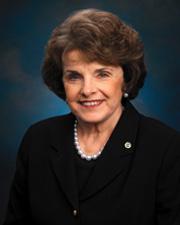 Sen. Dianne Feinstein (D-CA)
Legislative Activity
Stay on top of the latest movement without scrolling through every action
Roll call votes on amendments in Senate: Amendment SA 2858 not agreed to in Senate by Yea-Nay Vote. 49 - 50. Record Vote Number: 61.
March 25, 2004
View full timeline
Roll call votes on amendments in Senate: Amendment SA 2858 not agreed to in Senate by Yea-Nay Vote. 49 - 50. Record Vote Number: 61.
March 25, 2004
Senate amendment not agreed to: Amendment SA 2858 not agreed to in Senate by Yea-Nay Vote. 49 - 50. Record Vote Number: 61.
March 25, 2004
Senate amendment proposed (on the floor): Amendment SA 2858 proposed by Senator Feinstein.(consideration: CR S3125-3134, S3137-3151; text: CR S3125)
March 25, 2004
Amendment SA 2858 proposed by Senator Feinstein. (consideration: CR S3125-3134, S3137-3151; text: CR S3125) In the nature of a substitute.
March 25, 2004
Amendment SA 2858 not agreed to in Senate by Yea-Nay Vote. 49 - 50. Record Vote Number: 61.
March 25, 2004
Senate amendment submitted
March 12, 2004
Votes
1 roll call on this amendment
Text
Proposed
UNBORN VICTIMS OF VIOLENCE ACT OF 2004

The PRESIDING OFFICER. Under the previous order, the hour of 10:30
having arrived, the Senate will proceed to the consideration of H.R.
1997, which the clerk will report.
The assistant legislative clerk read as follows:

A bill (H.R. 1997) to amend title 18, United States Code,
and the Uniform Code of Military Justice to protect unborn
children from assault and murder, and for other purposes.

The PRESIDING OFFICER. The Senator from Ohio.
Mr. DeWINE. Madam President, I come to the floor this morning to
begin the debate on the Unborn Victims of Violence Act. I would like
first to thank our 40 cosponsors for their leadership and support on
this issue.
Let me also thank specifically Senator Lindsey Graham, who championed
this issue on the House side for a number of years before he joined us
here in the U.S. Senate. He has worked tirelessly to see to it that the
most vulnerable members of our society are, in fact, protected.
Let me also thank our lead House sponsors, Congresswoman Melissa Hart
from Pennsylvania, and my friend and colleague from the State of Ohio,
Congressman Steve Chabot. They have both been great champions of this
great cause. They worked tirelessly to help get this important bill
passed in the House of Representatives.

[[Page S3125]]

Our bill is very simple. I will take just a couple of minutes to
explain it. It is a bill about simple justice. It is a bill about doing
what is right. I was asked yesterday by one of my colleagues, Why do we
need this bill? Why is this bill on the floor?
This is what I responded yesterday and this is what I would say to my
colleagues here in the Senate this morning. Imagine a pregnant woman in
a national park or a pregnant woman on an Air Force base and she is
violently assaulted. As a result of that assault, she loses her child;
that child dies. Today, there is no Unborn Victims of Violence Act.
Today, unless that Federal park or Air Force base is located in a State
that has a similar law, a Federal prosecutor would search the Federal
statute books in vain to find anything to charge that assailant for the
death of that child, for the death of that unborn infant, the fetus.
The only thing that Federal prosecutor would be able to charge that
defendant with is the assault of the woman. The death of that child
would not be able to be charged as what we would think would be a
separate offense. Justice would not be done for that, what we would
think would be a separate offense.
This bill corrects that. This bill recognizes there are two victims.
There is the victim, the mother, who was assaulted; and there is the
victim, the unborn child, who was either injured or killed. It is that
simple.
This bill recognizes when someone attacks and harms a mother and her
unborn child that attack does in fact result in two separate victims:
the mother and her child. That is what this bill does.
I will have more to say about this bill later. I will reserve the
remainder of my time.
The PRESIDING OFFICER. The Senator from California.

Amendment No. 2858

Mrs. FEINSTEIN. Madam President, I would like to call up amendment
2858.
The PRESIDING OFFICER. The clerk will report.
The assistant legislative clerk read as follows:
The Senator from California [Mrs. Feinstein] for herself and Mr.
Lautenberg, Mr. Bingaman, Mrs. Boxer, Mr. Kennedy, and Mr. Corzine,
proposes an amendment numbered 2858.
Mrs. FEINSTEIN. I ask unanimous consent the reading of the amendment
be dispensed with.
The PRESIDING OFFICER. Without objection, it is so ordered.
The amendment is as follows:

(Purpose: Entitled the Motherhood Protection Act)

Strike all after the enacting clause and insert:

SECTION 1. SHORT TITLE.

This Act may be cited as the ``Motherhood Protection Act''.

SEC. 2. PROTECTION OF PREGNANT WOMEN.

(a) In General.--Title 18, United States Code, is amended
by inserting after chapter 90 the following:

``CHAPTER 90A--PROTECTION OF PREGNANT WOMEN

``CHAPTER 90A--PROTECTION OF PREGNANT WOMEN

``Sec.
``1841. Causing termination of pregnancy or interruption of the normal
course of pregnancy.

``Sec. 1841. Causing termination of pregnancy or interruption
of the normal course of pregnancy

``(a)(1) Any person who engages in conduct that violates
any of the provisions of law listed in subsection (b) and
thereby causes the termination of a pregnancy or the
interruption of the normal course of pregnancy, including
termination of the pregnancy other than by live birth is
guilty of a separate offense under this section.
``(2)(A) Except as otherwise provided in this paragraph,
the punishment for that separate offense is the same as the
punishment provided for that conduct under Federal law had
that injury or death occurred to the pregnant woman.
``(B) An offense under this section does not require proof
that--
``(i) the person engaging in the conduct had knowledge or
should have had knowledge that the victim of the underlying
offense was pregnant; or
``(ii) the defendant intended to cause the termination or
interruption of the normal course of pregnancy.
``(C) If the person engaging in the conduct thereby
intentionally causes or attempts to cause the termination of
or the interruption of the pregnancy, that person shall be
punished as provided under section 1111, 1112, or 1113, as
applicable, for intentionally terminating or interrupting the
pregnancy or attempting to do so, instead of the penalties
that would otherwise apply under subparagraph (A).
``(D) Notwithstanding any other provision of law, the death
penalty shall not be imposed for an offense under this
section.
``(b) The provisions referred to in subsection (a) are the
following:
``(1) Sections 36, 37, 43, 111, 112, 113, 114, 115, 229,
242, 245, 247, 248, 351, 831, 844(d), 844(f), 844(h)(1),
844(i), 924(j), 930, 1111, 1112, 1113, 1114, 1116, 1118,
1119, 1120, 1121, 1153(a), 1201(a), 1203, 1365(a), 1501,
1503, 1505, 1512, 1513, 1751, 1864, 1951, 1952(a)(1)(B),
1952(a)(2)(B), 1952(a)(3)(B), 1958, 1959, 1992, 2113, 2114,
2116, 2118, 2119, 2191, 2231, 2241(a), 2245, 2261, 2261A,
2280, 2281, 2332, 2332a, 2332b, 2340A, and 2441 of this
title.
``(2) Section 408(e) of the Controlled Substances Act of
1970 (21 U.S.C. 848(e)).
``(3) Section 202 of the Atomic Energy Act of 1954 (42
U.S.C. 2283).
``(c) Subsection (a) does not permit prosecution--
``(1) for conduct relating to an abortion for which the
consent of the pregnant woman has been obtained or for which
such consent is implied by law in a medical emergency;
``(2) for conduct relating to any medical treatment of the
pregnant woman, or matters related to the pregnancy; or
``(3) of any woman with respect to her pregnancy.''.
(b) Clerical Amendment.--The table of chapters for part 1
of title 18, United States Code, is amended by inserting
after the item relating to chapter 90 the following:

``90A. Protection of pregnant women.............................1841''.

SEC. 3. MILITARY JUSTICE SYSTEM.

(a) Protection of Pregnant Women.--Subchapter X of chapter
47 of title 10, United States Code (the Uniform Code of
Military Justice), is amended by inserting after section 919
(article 119) the following:

``Sec. 919a. Art. 119a. Causing termination of pregnancy or
interruption of normal course of pregnancy

``(a)(1) Any person subject to this chapter who engages in
conduct that violates any of the provisions of law listed in
subsection (b) and thereby causes the termination of a
pregnancy or the interruption of the normal course of
pregnancy, including termination of the pregnancy other than
by live birth, is guilty of a separate offense under this
section.
``(2)(A) Except as otherwise provided in this paragraph,
the punishment for that separate offense is the same as the
punishment for that conduct under this chapter had that
injury or death occurred to the pregnant woman.
``(B) An offense under this section does not require proof
that--
``(i) the person engaging in the conduct had knowledge or
should have had knowledge that the victim of the underlying
offense was pregnant; or
``(ii) the defendant intended to cause the termination or
interruption of the normal course of pregnancy.
``(C) If the person engaging in the conduct thereby
intentionally causes or attempts to cause the termination of
or the interruption of the pregnancy, that persons shall be
punished as provided under section 918, 919, or 880 of this
title (article 118, 119, or 80), as applicable, for
intentionally causing the termination of or interruption of
the pregnancy or attempting to do so, instead of the
penalties that would otherwise apply under subparagraph (A).
``(D) Notwithstanding any other provision of law, the death
penalty shall not be imposed for an offense under this
section.
``(b) The provisions referred to in subsection (a) are
sections 918, 919(a), 919(b)(2), 920(a), 922, 924, 926, and
928 of this title (articles 111, 118, 119(a), 119(b)(2),
120(a), 122, 124, 126, and 128).
``(c) Subsection (a) does not permit prosecution--
``(1) for conduct relating to an abortion for which the
consent of the pregnant woman has been obtained or for which
such consent is implied by law in a medical emergency;
``(2) for conduct relating to any medical treatment of the
pregnant woman or matters relating to her pregnancy; or
``(3) of any woman with respect to her pregnancy.''.
(b) Clerical amendment.--The table of sections at the
beginning of subchapter X of chapter 47 of title 10, United
States Code (the Uniform Code of Military Justice), is
amended by inserting after the item relating to section 919
the following:

``919a. Causing termination of pregnancy and termination of normal
course of pregnancy.''.

Mrs. FEINSTEIN. Madam President, I agree with virtually everything
the Senator from Ohio has said. Although there are many State laws
which do take into consideration a fetus, it is true that the Federal
laws, which would impact only those on Federal property, are silent. I
am in complete concurrence with everything the Senator has said. I have
had the privilege of working with him, so it is a delight for me to be
able to discuss and debate this issue with him.
The substitute amendment I have called up is on behalf of Senators
Bingaman, Boxer, Corzine, Kennedy and Lautenberg. I would like to make
clearer a couple of places in that amendment.

[[Page S3126]]

I ask unanimous consent to send a modification to the desk.
Mr. DeWINE. I object.
The PRESIDING OFFICER. Objection is heard.
Mrs. FEINSTEIN. I hear the objection. I am rather surprised by the
objection. It is generally common courtesy to allow a Senator to amend
his or her amendment. However, I believe our amendment is clear on its
face.
I would like to point out that since 2000, in the Senate, there has
been no hearing on this amendment and no opportunity for the Judiciary
Committee to make corrections. This amendment is on the floor as a rule
XIV.
I am very disappointed the Senator will not allow me to make a
modification. For the record, let me simply state that I was proposing
a minor change designed to further clarify what I believe to be the
clear intent and application of our amendment. The bottom line is this:
Even without the technical changes, our amendment is clear. We include
the same structure, the same crimes, and the exact same penalties as
the DeWine bill.
The only real difference between our amendment and the DeWine bill is
that we do not attempt to place into law language defining life as
beginning at conception--beginning with an embryo.
Just to clarify for the purpose of giving judges more legislative
history with which to interpret our amendment, let me be clear about
the two provisions at issue.
The first modification concerns section (c)(2) of our amendment which
reads ``For medical treatment of the woman or matters relating to the
pregnancy.'' This language simply tracks the DeWine language and the
House bill language. I believe it is quite clear what we meant by this
was to exempt medical treatment of the woman or any other medical
treatment related to the pregnancy.
The second criticism or modification was that section (c)(2) which
applies to intentional crimes against the pregnant woman is awkwardly
worded and thus vague. The intent of the section is also clear. Our
amendment and the House and the DeWine bill would punish an individual
who intentionally ends a pregnancy in accordance with the murder,
manslaughter, or intent statutes already on the books. The level of
penalty would be determined by a judge and would be based on the level
of intent. For instance, punishment under the murder statute would
require malice. Punishment under the manslaughter statute would not.
But either way the intent is clear.
I believe the only real reason to raise these issues is to try to
defeat our amendment without addressing the underlying fact that our
amendment contains the same law enforcement goals as the DeWine and the
House bill, but without injecting a debate over a woman's right to
choose into the equation.
This issue is not as simple as it seems at first glance. Everyone in
the Senate wants to accomplish the same goal--punishing those who, by
attacking or killing a pregnant woman, deprive families not only of the
mother but also of the joy to help raise the child yet to be born.
Punishing those who end a pregnancy and thus end the potential life
experience, all of the hopes and dreams embodied by that pregnancy and
the child to come, is an important advance in Federal criminal law.
But here is where it gets more complicated. The House bill before us,
the DeWine bill, now takes the position in law that life begins at
conception. This, then, involves this bill directly into a woman's
right to choose--an issue that need not be raised and should not be
raised in this debate.
Although the text of the amendment itself technically provides an
exception for abortion, experts on both sides of this issue agree the
language in the bill will clearly place into Federal law a definition
of life that will chip away at the right to choose as outlined in Roe
v. Wade. I hope to make that crystal clear as I go on.
The Philadelphia Inquirer in its editorial yesterday put it
succinctly by saying:

If passed and signed, as promised by President Bush, the
Federal law would be the first to recognize unborn children
at any stage of development as victims with legal rights
separate from those of their mothers. . . . It's so easy to
see how a Federal unborn victims law, coupled with unborn
victims laws in 29 States, will form the basis of a new legal
challenge to Roe v. Wade, the landmark case that gives women
the right to terminate certain pregnancies. If a fetus who
dies during a crime is a murder victim, then isn't
abortion murder?

That is the Philadelphia Inquirer editorial of yesterday.
That is why I offered this substitute amendment. I think when I am
finished describing the differences between our amendment and the
underlying legislation, it will become crystal clear that these two
measures accomplish the same goal in terms of criminal justice and the
same goal in terms of deterrence.
The difference between the two measures--the only difference--is our
substitute does not include a new unprecedented definition of when life
begins.
The bottom line is this: It is unnecessary to include a definition of
when life begins in this legislation, and including such language
could, and I believe will, make it much more difficult to obtain
convictions in these cases.
The substitute amendment I offer today essentially provides that if a
perpetrator of an attack on a woman commits certain violent Federal
crimes against that woman and harms or ends her pregnancy, a prosecutor
can charge the perpetrator with the underlying Federal crime first but
can also charge the perpetrator with harming or ending her pregnancy
and effectively harming or killing another potential life.
How is this different from the DeWine bill? It is not different at
all. The DeWine bill provides exactly the same provisions. A prosecutor
can charge two crimes--one for the underlying attack on the woman and
one for the termination of the pregnancy. The penalties in the DeWine
bill are identical to the penalties in our amendment.
For instance, the DeWine bill provides that if the separate offense
results in the ending of the pregnancy, the penalty is identical to the
penalty for taking an adult's life. The Feinstein substitute is the
same. The DeWine bill says the maximum penalty for ending a pregnancy
is a life sentence, and the maximum penalty for harming that pregnancy
is a 20-year sentence. The Feinstein substitute is the same.
Neither bill allows for the death penalty and neither bill applies to
conduct to which the pregnant woman has consented.
The simple truth is this: Whichever bill passes in the end, a
prosecutor will be given exactly the same ability to charge a
defendant. The crimes are the same. The penalties are the same.
Everything will be the same except a few simple words that inject the
abortion debate into this issue by clearly establishing in criminal law
for the first time in history that life begins at the moment of
conception. I contend that if this result is incorporated in law, it
will be the first step in removing a woman's right to choice,
particularly in the early months of a pregnancy before viability.
As we all know, the question of when life begins is a profound and a
deeply divisive one. So I don't believe we should be addressing that
issue here today--without a hearing since the year 2000, without expert
testimony, and without need to do so. But, more importantly than that,
this language unnecessarily turns a simple law into a controversial one
and, most importantly, this language could make it more difficult for
prosecutors to obtain a conviction for the second defense of harming or
ending a pregnancy. I will describe why later.
It is possible that some pro-choice jurors might refuse to convict
simply because the language of the law refers to an unborn ``child in
utero''--that is a quote, ``child in utero,'' that is bill language--
when the victim may have only been 1 week or even 1 day pregnant.
An embryo in this bill becomes a person for the purpose of Federal
criminal sanctions for the first time in America's history. That is the
significance of this bill. This substitute allows jurors to look at
evidence and the law and it doesn't force jurors to grapple with the
complicated and controversial issue of when life begins.
Including language defining the beginning of life is not in any way
necessary to the criminal law but, rather, it is only relevant to the
abortion debate.
Let me show you a statement that I believe reveals the clear intent
of this

[[Page S3127]]

bill. That statement is made by Samuel Casey, executive director and
CEO of the Christian Legal Society. This is the intent:

In as many areas as we can, we want to put on the books
that the embryo is a person . . . that sets the stage for a
jurist to acknowledge that human beings at any stage of
development deserve protection--even protection that would
trump a woman's interest in terminating a pregnancy.

This will be the first strike against all abortion in the United
States of America. This will draw back the veil and, I believe, makes
crystal clear what this legislation actually is. This is the key to
much of the support for this legislation: Not just adding a new
criminal law on the books, but also defining life as beginning at
conception in statute here and then in the future, wherever else and
however else possible. This is a concerted effort to insert the
definition of when life begins into the law wherever possible.
Let me give some examples of quotes that again make this very clear.
The intention of the antichoice community has been clearly revealed by
a Republican strategist by the name of Jeffrey Bell. Here is how he put
it:

Parental notification rules don't really prohibit anything.
They don't ban the act of abortion. But a cloning ban--this
is saying that something should be illegal. And if taking
[unborn] human life became illegal, that would be a
breakthrough. Since Roe, no one has been able to do that.

So this, Members of the Senate, is clearly the agenda, freezing the
law, any law, in this case criminal law, that life begins at
conception. Then, once declared legally, that law becomes the stepping-
stone to refuse embryonic stem cell research and to ban abortion. Once
the law defines human life as beginning at conception, stem cell
research could become murder, abortion becomes murder, even in the
first days of a pregnancy.
That is where this is going. Please see it. Understand it. Know it.
Everyone in this body who believes embryonic stem cell research holds a
promise for cures to Parkinson's, for cures to Alzheimer's, for cures
to juvenile diabetes, for perhaps spinal cord rupture repair, will have
to contend with a statute that has said life begins at conception. So
embryonic stem cell research may become murder and abortion in the
first trimester becomes murder. That is where this debate is taking us.
That is the reason for this bill.
The supporters of this bill will say they do not want to undermine
Roe, but that is precisely what Nebraska State senator Mike Foley said
when he proposed legislation to allow wrongful death suits involving
the termination of a pregnancy. Let me quote him. Let me pull back the
veil again:

We said specifically in our bill that we did not want to
challenge Roe v. Wade, and that would not affect abortion in
the legal sense. But philosophically, sure, these laws are a
challenge . . . If a state can put someone in jail for life
because they took the life of an unborn child, then we're
clearly saying there is something very valuable there.

Why is he saying that? He is saying that because a fetus, even at
conception, becomes a person, becomes a human being.
Professor R. Alta Charo of the University of Wisconsin further points
out how these efforts are aimed at changing the law and how the Supreme
Court might rule in future abortion cases. Charo said recently:

If you can get enough of these bricks in place, draw enough
examples from different parts of life and law where embryos
are treated as babies, then how can the Supreme Court say
they're not? This is, without question, conscious strategy.

This is a professor of law at the University of Wisconsin, pulling
the veil back further and exposing this exactly for what it is, a
``conscious strategy'' to say life begins at conception and enshrine it
in this Federal law, and then other laws, and then other laws, and then
go to the Supreme Court and Roe vs. Wade is struck down.
In a CNN interview last May, the distinguished chairman of the Senate
Judiciary Committee--and I have had the pleasure of serving on that
committee for 12 years--made the following comment:

They say it undermines abortion rights. It does undermine
it. But that's irrelevant. We're concerned here about a woman
and her child . . . The partisan arguments over abortion
should not stop at a bill that protects women and children.

If that is true, then the Senator from Utah should vote for our
amendment because our amendment does exactly the same thing, the same
penalties for the same crimes as the House bill.
When Justice Harry Blackmun wrote in 1973 the Roe decision, he said:

. . . the unborn have never been recognized in law as persons
in the whole sense . . .

Let me repeat that: ``the unborn have never been recognized in the
law as persons in the whole sense.''
What he did by saying that was actually, inadvertently provide a
roadmap for the anti-choice people and those who want to undermine Roe
and eventually to reverse it. This bill, the underlying bill, is
following that roadmap by changing a criminal law in a way which
clearly says an embryo can be an individual as a person for the
purposes of criminal prosecution.
Clearly, this is a concerted effort to codify in law the legal
recognition life begins at conception. If we allow that to happen today
in this bill or in any bill, we put the right to choose squarely at
risk. Roe v. Wade allowed States to claim a legitimate interest in
preventing abortion postviability. Many states--and we both know that--
have laws on the books with respect to the third trimester and even the
second trimester.
If the concept of viability, which means when a fetus can live
outside of the womb, gives way to a definition that provides life
begins at conception, we could soon see abortion in this country
outlawed entirely. Our amendment avoids that problem and focuses only
on the need to increase penalties for those who attack pregnant women.
There has been a lot of discussion about the tragic Laci Peterson
case in my State of California. I have had the pleasure of meeting with
Laci's mother, Sharon Rocha, a very fine woman and a woman who I can
understand is decimated by what happened to her daughter. Some in the
Senate have suggested that this tragedy is evidence of a loophole in
Federal law that needs to be closed.
However, the House bill and the DeWine bill will have no impact in
any way, shape, or form on the Laci Peterson case. The perpetrator of
that crime will be prosecuted and punished under current California law
and the perpetrators of almost all similar crimes through the country
will, in fact, be prosecuted under State laws, not a Federal law,
unless the crime takes place on Federal property.
In my State of California, the legislature amended California's
existing murder statute in 1970--that is 34 years ago--to read as
follows:

Murder is the unlawful killing of a human being, or a
fetus, with malice aforethought.

Now, if this were the case, if this were written in Federal law,
easy, I would support it in a minute because it draws a distinction, it
permits the ``double charge'' that both Senator DeWine and I agree is
necessary. But the use of the words ``or fetus'' makes a distinction
between a human being and a fetus for purposes of the application of
the homicide statute. That is important. And that is the law under
which Laci Peterson's alleged murderer is going to be prosecuted.
If you look at it, you will see it is completely adequate. The
complexity of that case, which continues today, is one that relates to
evidence and proof, not a problem with statutes or penalties. The
California statute is wholly adequate. So the bill we discuss today
would have absolutely no impact on the Laci Peterson case, none.
Now, I would like to bring to the Senate's attention a July 10 letter
from a Stanford law professor. He goes into the problems of what this
law, if passed, could actually do in the courtroom to actual
prosecutions and to juries. His name is George Fisher. He is a criminal
law expert. He is a former prosecutor. He served as an assistant DA, an
assistant attorney general. He has taught criminal law at Stanford Law
School since 1995, and he has founded Stanford's criminal prosecution
unit.
He makes three points. Let me quote him:

The Bill's apparent purpose of influencing the course of
abortion politics will discourage prosecutions under any
future Act. I do not know what motives gave rise to the
Bill's use of the expressions ``child in utero'' and ``child,
who is in utero,'' but I do know that any vaguely savvy
reader will conclude that these terms and the Bill's
definition of

[[Page S3128]]

them were intended by the Bill's authors to influence the
course of abortion politics.
If the authors of the Bill truly seek to protect unborn
life from criminal violence, they will better accomplish this
purpose by avoiding such expressions as ``child in utero.''
Better alternatives would refer to injury or death to a fetus
or damage to or termination of a pregnancy.

Dr. Fisher goes on to say:

The Bill's apparent purpose of influencing the course of
abortion politics will motivate prosecutors to exclude those
prospective jurors who otherwise would be most sympathetic to
the prosecution's case.
I predict that many or most judges will bar prosecutors and
defense counsel from questioning prospective jurors about
their views on abortion or about related matters such as
their religion, religious practices, or political
affiliations. Forced to act largely on instinct, prosecutors
may be inclined to exercise peremptory challenges against
those prospective jurors who appear to be most sympathetic to
the rights of pregnant women. This result clearly would
frustrate the Bill's stated purpose of protecting unborn life
from criminal violence.

He concludes:

The Bill's apparent purpose of influencing the course of
abortion politics offends the integrity of the criminal law.
To anyone who cares deeply about the integrity of the
criminal law, this Bill's apparent attempt to insert an
abortion broadside into the criminal code is greatly
offensive.

Now, that is a former prosecutor, a former assistant DA, assistant
AG, a professor of law at Stanford Law School--one of the great law
schools of our country--and head of the criminal prosecution unit at
Stanford Law School.
I ask unanimous consent to have the entire letter printed in the
Record following my remarks.
The PRESIDING OFFICER (Mr. Ensign). Without objection, it is so
ordered.
(See exhibit 1.)
Mrs. FEINSTEIN. Mr. President, the substitute amendment, which I have
offered, has been crafted to avoid these problems.
Our amendment, the Motherhood Protection Act, will accomplish the
same goal as the Unborn Victims of Violence Act, but will do so in a
way that does not involve us in the debate about abortion or when life
begins. In my view, there is no reason to vote against this substitute
unless the intention is to establish legally that human life, for the
purposes of Federal criminal law, begins at the moment of conception
because, ladies and gentlemen, that is exactly what this bill does.
To emphasize the point, let me again turn to the comments of Samuel
Casey, executive director and CEO of the Christian Legal Society, who
clearly states the intention behind the bill in this quote:

In as many areas as we can, we want to put on the books
that the embryo is a person. . . .That sets the stage for a
jurist to acknowledge that human beings at any stage of
development deserve protection--even protection that would
trump a woman's interest in terminating a pregnancy.

Let there be no doubt about the intent. Anyone who is pro-choice
cannot vote for this bill without the expectation that they are
creating the first legal bridge to destroy Roe v. Wade.
Now, there is a time and a place to discuss the morality and
philosophy of when life begins. This is not that time. Now is the time
to change our Federal law to punish criminals who would inflict
grievous injuries or death upon pregnant women on Federal lands. So I
urge my colleagues to support the substitute amendment.

Exhibit 1

Stanford Law School,

Stanford, CA, July 10, 2003.
Senator Dianne Feinstein,
U.S. Senate, Senate Hart Office Building, Washington, DC.
Dear Senator Feinstein: I wish to express my concern about
the current formulation of S. 1019, the Unborn Victims of
Violence Act of 2003. Although I fully endorse the Bill's
ultimate aim of protecting pregnant women from the physical
and psychological trauma of an endangered or lost pregnancy,
I believe that the Bill's current formulation will frustrate
rather than forward this goal.
I write both as a former prosecutor and as a law professor
specializing in criminal law and criminal prosecution. At the
outset of my career, I served as an assistant district
attorney in Middlesex County, Mass., and as an assistant
attorney general in the Massachusetts Attorney General's
office. I then went to Boston College Law School, where I
administered and taught in the criminal prosecution clinic. I
have been at Stanford since 1995 and a tenured professor of
law since 1999; during the next academic year, I will serve
as Academic Associate Dean. In 1996 I founded Stanford's
criminal prosecution clinic and have administered and taught
in the clinic ever since. I have also created a course in
prosecutorial ethics, which I taught at Boston College Law
School and, as a visitor, at Harvard Law School.
My background and interest in criminal prosecution prompt
me to raise three objections to this Bill. All of them focus
on the Bill's use of the expressions ``child in utero'' and
``child, who is in utero,'' and on its definition of these
terms as ``a member of the species homo sapiens, at any stage
of development, who is carried in the womb.''
First: The Bill's apparent purpose of influencing the
course of abortion politics will discourage prosecutions
under any future Act.
I do not know what motives gave rise to the Bill's use of
the expressions ``child in utero'' and ``child, who is in
utero,'' but I do know that any vaguely savvy reader will
conclude that these terms and the Bill's definition of
them were intended by the Bill's authors to influence the
course of abortion politics. It is a fair prediction that
when a pro-life President is in office, prosecutions under
this Bill will be more frequent than when a pro-choice
President is in office. That is because the public will
interpret this Bill as suggesting that abortion is a
potentially criminal act and will interpret prosecutions
under the Bill as endorsing this sentiment.
If the authors of the Bill truly seek to protect unborn
life from criminal violence, they will better accomplish this
purpose by avoiding such expressions as ``child in utero.''
Better alternatives would refer to injury or death to a fetus
or damage to or termination of a pregnancy.
Second: The Bill's apparent purpose of influencing the
course of abortion politics will motivate prosecutors to
exclude those prospective jurors who otherwise would be most
sympathetic to the prosecution's case.
If I were prosecuting a case under this Bill, I would hope
to have a jury that includes persons deeply sensitive to the
rights and interests of pregnant women. Such jurors would
regard an attack on a pregnant woman as being a twofold
crime, comprising both the injury directly inflicted on the
mother and the stark emotional and physical trauma resulting
from injury to or loss of her pregnancy.
But such jurors also will be more likely than others to
believe that pregnant women have the right to exercise
autonomy over their bodies and to choose whether to abort a
pregnancy. I predict that many or most judges will bar
prosecutors and defense counsel from questioning prospective
jurors about their views on abortion or about related matters
such as their religion, religious practices, or political
affiliations. Forced to act largely on instinct, prosecutors
may be inclined to exercise peremptory challenges against
those prospective jurors who appear to be most sympathetic to
the rights of pregnant women. This result clearly would
frustrate the Bill's stated purpose of protecting unborn life
from criminal violence.
Third: The Bill's apparent purpose of influencing the
course of abortion politics offends the integrity of the
criminal law.
To anyone who cares deeply about the integrity of the
criminal law, this Bill's apparent attempt to insert an
abortion broadside into the criminal code is greatly
offensive. The power to inflict criminal penalties is, second
only to the power to wage war, the highest trust invested in
our institutions of government. Because the power to make and
enforce criminal laws inherently carries enormous potential
for abuse, those who exercise that power must always do so
with a spirit free of any ulterior political motive. The
American Bar Association's Standards Relating to the
Administration of Criminal Justice provide that ``[i]n making
the decision to prosecute, the prosecutor should give no
weight to the personal or political advantages or
disadvantages which might be involved . . . .'' (Standard
3-3.9(d).) Not all prosecutors conduct themselves with
fidelity to this principle, but we may readily condemn
those who do not. We may likewise condemn other public
actors who abuse the sacred public trust of the criminal
sanction for political ends.
For these reasons, I object to the current formulation of
the Unborn Victims of Violence Bill. As I am confident that
an alternative version of the Bill can fully accomplish its
stated purpose of protecting unborn life from criminal
violence while avoiding each of the difficulties I have
outlined above, I strongly encourage the Senate to modify the
Bill in the ways I have suggested above or in some other
manner that avoids the freighted and frankly politicized
terms, ``child in utero'' and ``child, who is in utero.''
My thanks to you for your consideration of my views.
Sincerely,
George Fisher,
Professor of Law.

Mrs. FEINSTEIN. Mr. President, how much time have I consumed?
The PRESIDING OFFICER. The Senator has 89 minutes left.
Mrs. FEINSTEIN. I have 89 minutes remaining?
The PRESIDING OFFICER. Yes.
Mrs. FEINSTEIN. I thank the Chair.
I know the Senator from New Jersey is on the floor wishing time.
Mr. DeWINE. He can take it now.
Mrs. FEINSTEIN. Good. May I ask the Senator how much time he would
like?
Mr. LAUTENBERG. I would like to have about 10 minutes.

[[Page S3129]]

Mrs. FEINSTEIN. Mr. President, I yield 10 minutes to the Senator from
New Jersey.
The PRESIDING OFFICER. The Senator is recognized for 10 minutes.
The Senator from New Jersey.
Mr. LAUTENBERG. Mr. President, I thank my colleague from California
and also our distinguished colleague from Ohio.
I rise to express my strong opposition to the underlying bill and
support for the amendment by the Senator from California.
I have long supported legislation that combats domestic violence. I
was the author of the domestic violence gun ban because abusers should
not have access to weapons, to guns. Whether an abuser is terrorizing
his wife or his children, let's take away their means to inflict
further terror and abuse. So far, my law has prevented nearly 30,000
abusers from obtaining guns.
Because of my long-term commitment to stopping violence against women
and children, I take offense at the fact that the backers of this bill
are exploiting this issue in order to advance another anti-choice
agenda.
We see this regularly around this place. I saw it in a commerce
subcommittee meeting that was supposed to discuss science, space, and
technology. The witnesses who were at the table were there to talk
about their opposition to abortion and their experience after they
themselves had abortions. They made their decisions after an action
that they took that placed them in that position. Now they wanted to
block everybody else from having a chance to make their personal
choices.

We have to understand what underlies this issue. Yes, it is
worthwhile to protect people and those who are not yet born against
violence, but to make it a crime of this magnitude, when there is so
much else at stake in the matter of choice, decided many years ago by
the Supreme Court--supporters of this bill will tell you this
legislation protects women, protects children, and this is a bill about
punishing crime. But if you want to know what this bill is really
about, you only need listen to what a leading supporter of this bill
told CNN when asked about the legislation. I quote him:

They say it undermines abortion rights. It does . . . But
that's irrelevant.

That is the prevailing attitude of those who want to impose yet
another restriction on a woman's choice, on the protection of a woman's
health. This bill is intended, plainly and simply, to undermine Roe v.
Wade. But rather than being direct about the goal, anti-choice
advocates want to use tragedies like violence against women as a red
herring to move their agenda.
Over and over, we see this body taking up legislation that I believe
is part of an attempt to establish what I call a ``male-ogarchy'' in
our society. A male-ogarchy is a society in which men are making
decisions for and about women. Anti-choice advocates simply don't trust
women and their doctors to know what is best for their bodies and their
lives. We even encountered this male-ogarchy last year when this body
told doctors and their patients that it is Congress, rather than the
medical experts, who know best about their health. And when the so-
called partial-birth abortion bill was signed, there were all men on
the stage with the President of the United States, smiling and gloating
as they took away the right of a woman, in consultation with her doctor
and her conscience, to make a decision that, though painful, is
appropriate for her well-being.
Do we want to decide here whether or not a woman has a right to make
a decision about her choice for an abortion? Perhaps she has two,
three, four other children at home and her health is in jeopardy. We
are saying: It doesn't matter what you think, Madam. We are going to
make the decision for you.
That is why there wasn't one woman standing with the President at the
White House the day that so-called partial-birth abortion prohibition
passed the Senate, when the President signed the bill.
President Bush and his supporters in the Senate say they care about
domestic violence and protecting women. But if that is the case, how,
then, do we explain the fact that the President's budget cuts funding
for the Violence Against Women Act programs by $116 million next year?
Is that going to help women? Is that going to make life better for
them? No. It is going to make life worse. Those are living people.
Those are people who were here. Those are people for whom this male
group wants to decide, make decisions.
If Congress wants to get serious about violence against women and
children, let's do something real about it. Let's fund programs that
provide money to law enforcement to prevent domestic violence and
sexual assault. Let's fund battered women's programs and rape crisis
centers instead of cutting funding for these often lifesaving services.
Let's improve access to shelters, making it easier for abused women and
their children to flee that abuse.

If this so-called Unborn Victims of Violence Act were actually about
violent crime, then the domestic violence community would be in support
of it. But they oppose the bill. The National Network to End Domestic
Violence, the National Coalition Against Domestic Violence, and the
Family Violence Prevention Fund, all oppose this legislation.
Many backers of this bill also support giving a $1 trillion tax break
to the wealthiest among us, rather than giving it to the struggling
working families who need it to help pay for everyday goods and
services, programs such as Head Start for children who don't have a
comfortable home life that permits them to engage in the process of
learning or of expecting to learn, who often get their only nutritional
meal from the program. Three hundred thousand of those children are
denied access to these programs because we have taken away the funding
to give tax breaks to those who have been fortunate enough to live in
this country, to make a lot of money, to succeed.
I am one of those. I had a good business career, as did many here. We
don't need this kind of thing. We don't want it. We want our country to
be strong. We want the strength to be built in a harmonious society and
to lend a hand to those who don't have the ability to help themselves.
But now that can't happen. We are focused on giving tax breaks to the
wealthy and making them permanent, as we dig ourselves deeper into
debt.
Many of my colleagues who support this bill also reject expending
health insurance coverage for poor and lower middle-class children and
their families. Many who support this bill will tell you they want to
simply protect children. I find it ironic that they only want to
protect children before they are born, but they don't want to do what
they have to after they are born. I see it as hypocrisy.
I challenge supporters of this bill to get serious about protecting
women and children and pass meaningful legislation that improves the
lives of these women and children, not this undercover move to restrict
choice for women.
The PRESIDING OFFICER. Who yields time?
Mrs. FEINSTEIN. Mr. President, I reserve the remainder of my time.
The PRESIDING OFFICER. The Senator from Ohio.
Mr. DeWINE. Mr. President, I have a great deal of respect for my
colleagues from New Jersey and California. My colleague from New Jersey
knows I care about what happens after children are born. I care about
their health. I believe I have demonstrated that in the Senate. In
fact, he and I have worked on these issues together. I have worked with
my colleague from California on many issues having to do with children.
We just happen to disagree on this issue.
I have a great deal of respect for both of them. We have worked
together on a bipartisan basis on a wide range of issues. I would hope
that as we debate this bill, we would focus on the legislation. I say
that with all due respect. I don't understand--again, with all due
respect to my colleagues--what debate about the motives of people has
to do with what the facts are.
I am going to try to confine my debate to what I think are the
essential facts. I think they are fairly simple. Let me talk for a few
moments about what I believe are the essential facts.
I ask my colleagues who are listening to this debate to remember a
couple of things about the Feinstein amendment. I am going to keep
coming back to these central facts about the Feinstein amendment.

[[Page S3130]]

No. 1, the Feinstein amendment does not recognize a second victim.
Our bill does. The Feinstein amendment creates a legal fiction. It is
contorted, it twists the law in a sense--maybe a better way of saying
it is not that it twists the law; it doesn't do that, but it twists the
reality of the common sense of people when they look at this. When they
see a pregnant woman who is assaulted and her child dies, they
intuitively know there is a victim besides the mother. They know the
mother is a victim, but they also know there is a second victim.
The vast majority of the American people, if you ask them was there
another victim, will say of course there are two victims. Our bill
recognizes the second victim. The Feinstein amendment refuses to
recognize the second victim. Now we can talk about punishment and all
kinds of things, but it refuses to recognize good common sense.
This bill in front of us has nothing to do with abortion. It has
absolutely nothing to do with abortion. We have explicitly exempted
abortion in this bill. Yet opponents still try to argue this point.
Our statute could be no more clear on this point. Senator Feinstein
uses identical language to exempt abortion or any related activity in
her amendment. This bill simply doesn't affect abortion rights
whatsoever. The language could not be clearer. I invite my colleagues
to pick up the bill and look at the section. It exempts any reference
to abortion, anything a mother would do to her own child, anything a
doctor would do is exempted. It has nothing to do with abortion, not at
all. That is not what this is about.
Point No. 1, this bill recognizes a second victim; the Feinstein
amendment does not. If you believe there is a second victim, you cannot
vote for the Feinstein amendment. It denies there is a second victim.
The second point I want to make will come as a surprise, I think, to
the Members of the Senate. It will come as a surprise to you until you
pick up the Feinstein amendment and read it carefully. I invite you to
do that. Pick up the amendment and read it carefully.
First, the Feinstein amendment does not punish the criminal for
harming or injuring the baby. Let me read it. It only punishes the
criminal for ``interrupting or terminating a pregnancy.'' That is the
language, ``interrupting or terminating a pregnancy.'' But not for
injuring. So if a child is injured, not killed, the pregnancy not
terminated, the Feinstein amendment will not cover it. That, to me, is
a problem. That is a fatal fallacy, fatal problem.
Here is the language:

Any person who engages in conduct that violates any of the
provisions of law listed in subsection (b) and thereby causes
the termination of a pregnancy or the interruption of the
normal course of pregnancy, including termination of the
pregnancy other than by live birth is guilty of a separate
offense under this section.

It does not cover the injury of a fetus. That is a problem.
Let's turn to the penalty section. The penalty section is fatally
flawed. The penalty section won't work. The Justice Department has sent
a letter and, in their opinion, the penalty section provides no
penalty, under the Feinstein amendment, for the killing of the fetus.
It is vague; it is unclear at best. It defines additional crimes as the
interruption or termination of a pregnancy. When it describes the
punishment, it refers to injury or death. Whose injury or death are we
talking about here? Is it the unborn child? Whose injury?

The Feinstein amendment doesn't recognize that the interruption and
termination of the pregnancy means the injury or death of the fetus
because it won't acknowledge the fetus, of course, as a separate being.
The amendment is circular and really without meaning. Put simply,
there is no additional punishment because under this amendment there is
no additional victim. The Feinstein amendment goes out of its way not
to recognize another victim. What is the reference to? Let me read this
section and, again, this is a technical reading, but that is how you
have to read a criminal section. This is how judges have to do it. The
bottom line is--I am going to say it again and again--if you vote for
Feinstein, there will be no penalty at all for the killing of a second
victim, the child. There clearly is none for the injury of that child.
Let me read the penalty section, 2(a), under the Feinstein amendment:

Except as otherwise provided in this paragraph, the
punishment for that separate offense is the same as the
punishment provided for that conduct under Federal law had
that injury or death occurred to the pregnant woman.

What injury or death are we talking about? To whom?
The language doesn't acknowledge injury or death to the fetus. Who is
it referencing in the previous paragraph? It clearly is fatally flawed.
It is difficult for me to read this and for people to understand it.
But to get the section out, it clearly doesn't work and is fatally
flawed. So this does not recognize the death, does not recognize any
punishment. It would not provide punishment and it clearly presents a
problem.
My friend from California has said the DeWine bill would have no
effect on the Laci Peterson case. That is true; it would not.
Fortunately, California has a similar law that provides for a second
victim, the punishment for the death of that child. While it is true
the DeWine bill would have no effect on the Laci Peterson case, the
fact is if the Feinstein amendment, or a similar amendment to the
Feinstein amendment, had been approved by the California legislature at
the time their law was being considered, there would be no punishment
for the death of baby Conner Peterson. There would have been in
California no recognition for that second victim. There would have been
no recognition of the death of that second victim.
If the Feinstein amendment would have passed, or a version of it, in
California, if the California legislature would have done what Senator
Feinstein is asking us to do today in this Federal legislation, they
would not have been able to prosecute for the death of Conner
Peterson. They would not have been able to recognize that death as a
second victim death. That is the fundamental fact, and that is the
fundamental difference between the DeWine bill and the Feinstein
amendment.

We have heard a lot of talk about motives and agendas. I think we
should stop doing that, and I think we should look to the victims and
hear from the victims. There are three victims. The families of the
victims were here yesterday. When one talks with the victims, it is
clear the victims believe there are two victims. Let me talk about
several cases. They are tragic cases and are difficult to listen to,
but I think it brings home what we are really talking about.
Let me talk about the example of Airman Gregory Robbins. This is a
case about which I have talked many times on the Senate floor, but I
think is worth repeating today because it illustrates the injustice
that exists today in our Federal law.
In 1996, Airman Robbins and his family were stationed in my home
State of Ohio at Wright-Patterson Air Force Base in Dayton. At that
time, Mrs. Robbins was more than 8 months pregnant with their daughter
they named Jasmine. On September 12, 1996, in a fit of rage, Airman
Robbins wrapped his fist in a T-shirt and savagely beat his wife by
striking her repeatedly about the head and stomach. Fortunately, Mrs.
Robbins survived this violent assault, but tragically, her uterus
ruptured during the attack, expelling the baby into her abdominal
cavity, causing Jasmine's death.
Does anyone truly think Jasmine was not a victim? I think we know she
was. Not only was her mom a victim, but she was as well.
Let me give another example. In August 1999, Shiwona Pace of Little
Rock, AR, was days away from giving birth. She was understandably
thrilled about her pregnancy. Her boyfriend, Eric Bullock, however, did
not share her joy and enthusiasm. In fact, Eric wanted the baby to die.
So he hired three thugs to beat his girlfriend so badly that she lost
the unborn baby whom she named Heaven. I might add, she lost that baby
1 day shy of her predicted delivery date. Shiwona testified at a Senate
judiciary hearing we held in Washington on February 23, 2000. This is
what she said:

I begged and pleaded for the life of my unborn child, but
they showed me no mercy. In fact, one of them told me, ``Your
baby is dying tonight.'' I was choked, hit in the face with a
gun, slapped, punched, and kicked repeatedly in the stomach.
One of them even put a gun in my mouth and threatened to
shoot.

Do we really believe Shiwona was the only victim here? Do we really
think

[[Page S3131]]

we should adopt an amendment that says she was the only victim? I don't
think so. How can we suggest to Shiwona that her child was not
murdered? Should we twist the law so we don't recognize that? I don't
think we should. And Federal law, quite frankly, must recognize this
wrong for what it is. It is a wrong against two separate and distinct
victims.
Another example: I can think of no better way to tell the story of
Baby Zachariah and his mother Tracy Marciniak than by simply reading
from her testimony before the House Judiciary Subcommittee on the
Constitution which occurred on July 8, 2003. Let me read it:

I carried Zachariah in my womb for almost nine full months.
He was killed in my womb, only 5 days from his delivery
date. The first time I ever held him in my arms, he was
already dead.
There is no way that I can really tell you about the pain I
feel when I visit my son's grave site in Milwaukee, and at
other times, thinking of all that we missed together. But
that pain was greater because the man who killed Zachariah
got away with murder.
Zachariah's delivery date was to be February 13, 1992. But
on the night of February 8, my own husband brutally attacked
me at my home in Milwaukee. He held me against a couch by my
hair. He knew that I very much wanted my son. He punched me
very hard twice in the abdomen. Then he refused to call for
help, and prevented me from calling.
After about 15 minutes of my screaming in pain that I
needed help, he finally went to a bar and from there called
for help. Zachariah and I were rushed by ambulance to the
hospital, where Zachariah was delivered by emergency
Caesarean section. My son was dead. The physicians said he
had bled to death inside me because of blunt force trauma.
My own injuries were life-threatening. I nearly died. I
spent 3 weeks in the hospital. During the time I was
struggling to survive, the legal authorities came and they
spoke to my sister. They told her something that she found
incredible. They told her that in the eyes of Wisconsin law,
nobody had died on the night of February 8. Later, this
information was passed on to me. I was told in the eyes of
the law, no murder had occurred. I was devastated.
We surviving family members of unborn victims of violence
are not asking for revenge. We are begging for justice--
justice like we were brought up to believe in and trust in.
Justice means that the penalty must fit the crime, but that
is only part of it--justice also requires that the law must
recognize the true nature of a crime.

The true nature of a crime, Mr. President.

I know that some lawmakers and some groups insist there is
no such thing as an unborn victim, and that crimes like this
only have a single victim--but that is callous and that is
wrong. Please don't tell me that my son was not a real victim
of a real crime. We were both victims, but only I survived.

I will have more to say about this in a few minutes. At this point, I
yield the floor.
The PRESIDING OFFICER. The Senator from California.
Mrs. FEINSTEIN. Mr. President, may I briefly suggest the absence of a
quorum.
The PRESIDING OFFICER. The clerk will call the roll.
The legislative clerk proceeded to call the roll.
Mrs. FEINSTEIN. Mr. President, I ask unanimous consent that the order
for the quorum call be rescinded.
The PRESIDING OFFICER. Without objection, it is so ordered.
Mrs. FEINSTEIN. I thank the Chair.
Mr. President, I wish to respond to some of the concerns and
complaints of the distinguished Senator from Ohio about our substitute
amendment. Let me take on his allegation that this substitute does not
provide a punishment for harming a child. In fact, it does. It clearly
states that the interruption of the normal course of the pregnancy
relates to injury to the fetus. So there is a penalty for harm.
Secondly, he stated my amendment would not provide any penalty for
ending a pregnancy; that it was a legal fiction in that sense.
I think this is clearly a misunderstanding of the plain text of our
amendment. We explicitly create a separate offense for interrupting or
ending a pregnancy, and we explicitly state the penalty for that
offense is the same as if the crime had resulted in the injury or death
of a mother. That is explicit.
So the intent is clear. I think quibbling about whether the language
is perfect, the amendment does exactly what the underlying bill does. I
could have cleared that up with a modification, but the Senator would
not let me send a modification to the desk, which in terms of just
sheer congeniality is rather surprising because that could have been
made crystal clear to everyone.
So I firmly believe our amendment does exactly the same thing as the
DeWine amendment, but it does not do something his amendment does, and
that is create life at the point of conception. His use of the words
``child in utero'' as opposed to the California statute's use of the
words ``or fetus'' make a huge difference in the law legally. Once
again, I think that is clear.
The bottom line is we believe the intent and the crafting of this
bill is very clear. We do not create a child in utero. We try to avoid
getting to the point where life is defined.
We say that if the pregnancy is intentionally terminated and specific
damages are done to the fetus, it is punished either through
manslaughter in a second charge or murder in a second charge. I think
the language is very clear. I think it is nitpicking to say it is not.
I can change it, but I am not allowed to change it. We have the
modification, but we are not allowed to send the modification to the
desk. I believe Members can vote on this amendment and know clearly
they are assessing the same penalties for the same crimes as the
underlying bill does. The only difference is we do not decide in our
bill when life begins.
Let me read a couple of editorials and statements that have come out
in recent days. There is one editorial this morning in the Los Angeles
Times. I would like just quickly to read one paragraph:

The Senate is likely to vote today on a bill intended
largely to score points in the endless, wearying abortion
debate. The proposed Unborn Victims of Violence Act defines a
child in utero as a member of the species homo sapiens, at
any stage of development, who is carried in the womb. In
other words, the child exists at the moment of conception.
The House passed similar legislation last month. As with
nearly every aspect of the abortion debate, Americans are
deeply divided over when human life begins. However courts in
most States generally accord more rights to a fetus
considered viable outside the womb. DeWine's bill, S. 1019,
offers a sweeping declaration that ignores prevailing
scientific views and the national legal consensus. True, his
bill specifically bars prosecution for abortion, but its
effect, as DeWine intends, would be to give one side a new
legal bullet in the broader abortion wars.

That is clear. I will go on. The Los Angeles Times is not the only
editorial page that believes that. I indicated earlier this is true of
an editorial in the Philadelphia Inquirer:

It is so easy to see how a federal unborn victims law,
coupled with unborn victims' laws in 29 States, will form the
basis of a new legal challenge to Roe v. Wade, a landmark
case that gives women the right to terminate certain
pregnancies. If a fetus who dies during a crime is a murder
victim, why, then, isn't abortion murder?

From the Buffalo News:

Passage by House Republicans of a bill that treats an
attack on a pregnant woman as separate crimes against her and
her unborn child is at heart an attempt to erode abortion
rights. It's a disingenuous and misguided bill and the Senate
should make sure it goes no further.

That is the Buffalo News.
The New York Times, April 25. This is 2001.

Packaged as a crime fighting measure unrelated to abortion,
the bill is actually aimed at fulfilling a long-time goal of
the right-to-life movement. The goal is to enshrine in law
the concept of fetal rights equal to but separate and
distinct from the rights of pregnant women.

Another editorial of the New York Times:

The bill would add to the Federal Criminal Code a separate
new offense to punish individuals who injure or cause
death to a child who is in utero.

The Washington Post, October 2, 1999,

What makes this bill a bad idea is the very aspect of it
that makes it attractive to its supporters, that it treats
the fetus as a person separate from the mother though that
same mother has a constitutional right to terminate her
pregnancy. This is useful rhetorically for the pro-life
world, but it is analytically incoherent.

The Blethen, ME, newspaper:

First considered in 1999, the bill purports to create new
Federal crimes for the intentional harm or death of a fetus
or unborn child. But, no matter how much supporters deny it,
the bill's real intent is to undermine women's reproductive
choices. If the bill is passed and signed into law, it would
weaken

[[Page S3132]]

the prudent and pragmatic decision handed down in Roe v.
Wade.

In my remarks, I have tried to show that this is a concerted effort.
It need not be so. You can attach the same penalties for the same
crimes, as our substitute does, without getting into the debate of
where life begins. This bill chooses to get into the debate of where
life begins and it defines life beginning at conception. It does so in
a Federal criminal statute. It is one step in the building blocks of
statutes that will constitute the ability to demolish Roe v. Wade.
I think every Member of this body who is pro-choice should vote
against the underlying bill and for this amendment because in this
amendment, without creating the separate person at conception, we
establish the penalties for interruption or termination of a pregnancy.
Those penalties are the same--same for murder, same for manslaughter,
same for attempted murder, same for attempted manslaughter.
Again, I point out that in California what the State did 34 years ago
was essentially amend the murder statute. By amending the definition in
the Penal Code section 187, they provided a new definition of murder
which said:

Murder is the unlawful killing of a human being, or a fetus
with malice aforethought.

That is the bill under which the Laci Peterson case will be brought
to court. It is a different idea because it clearly says that it is a
fetus.
Additionally, there is information from those who wish to continue
this pursuit to make a fetus a human life, to make an embryo a human
life, that this is a concerted strategy aimed at weakening Roe v. Wade.
What we have tried to do is mimic the House bill with respect to the
penalties but connect it to the termination of a pregnancy and thereby
avoid the distinction of exactly when life begins for the purposes of
statute law, in this case criminal statute law, and therefore avoid the
problem.
I have indicated, from legal scholars, where they believe this will
undermine prosecutions in this situation because they will encourage
peremptory challenges of individuals who may have strong beliefs in
choice and, therefore, not one likely to recognize that an embryo, or a
day pregnancy, or a week pregnancy, or a month pregnancy is, in fact, a
living being subject to criminal sanctions if their rights are
violated.

It is a complicated issue. But it is a significant issue. It is an
important issue.
The more I look at it and see the strategy of the anti-choice
movement, the more I see that if you can establish a beachhead of
rights in Federal criminal law here, and another statute there, and in
a third statute somewhere else, you then begin the march to the Supreme
Court in an attack on Roe. Roe sets up a trimester system giving the
woman total rights in the first trimester, and then the State the right
in the second and third trimester to intervene in certain cases, which
has been the case in many State laws that have been passed. You now
give the Supreme Court the ability to begin to say: ``It is in law that
the embryo has certain rights'' and, therefore, forms the bulwark of
the attack on Roe.
You also do something else insidious. I think you very much intervene
in stem cell research. Stem cell research, and a good deal of the most
auspicious of that research, deals with embryonic stem cells. If you
have a law that says an embryo or a zygote is, in fact, a human life,
then it is murder if you use that embryo for stem cell research, just
as it becomes murder if that embryo is harmed or rejected in the course
of an attack on a woman. We avoid all of that.
We simply say termination of a pregnancy, and termination of a
pregnancy in the course of a criminal attack creates a second charge,
and that second charge carries with it the same penalty as the original
charge against the woman herself would carry.
That is the clear intent.
I regret that the Senator would not allow me to modify my amendment.
I can never in 12 years remember any Senator being refused the right to
modify an amendment, but perhaps we are playing by new rules these
days. I know what goes around comes around in this body. I regret that.
But I believe on its face our substitute amendment is clear, it is
definitive, it will stand the test of time, and it will prevent what we
hope to prevent, which is the first major law which decides when life
begins.
I yield the floor and reserve the remainder of my time.
The PRESIDING OFFICER (Ms. Murkowski). The Senator from Ohio.
Mr. DeWINE. Madam President, once again, I want to bring this debate
back to its essence. I am afraid so much of the debate from the other
side has been about motives--by quoting, with all due respect, the L.A.
Times about peripheral issues.
Our intent, if you want to go by intent, is very simple. Our intent
is to bring about justice for the victims of crime. Our intent is to
bring about justice for the mother and for the child--for the unborn
child as well as the mother. It is to conform with what the vast
majority of the American people believe; that is, when a pregnant woman
is assaulted and she either loses that child or that child is injured,
there are, in fact, two victims. It is as simple as that.
On the abortion issue, let us be done with this once and for all.
This bill has nothing to do with abortion. The language could not be
simpler.
Let me read to the Members of the Senate and invite anybody to read
it.

Nothing in this section shall be construed to permit the
prosecution of any person with conduct relating to abortion
for which consent of the pregnant woman or a person
authorized by law to act on her behalf has been obtained or
for which such consent is implied by law.
Two, of any person for medical treatment of the pregnant
woman or her unborn child, or of any woman with respect to
her unborn child.

It is very clear. My colleague argues that this language is going to
somehow roll back abortion rights. That is a debate for another day. It
is not a debate for today. That language in this bill is very clear.
If this language was a threat to abortion rights, then the language
in 29 other States would have been a threat. We have 29 States that
recognize fetal homicide law. The language in 16 of those States is
virtually identical to the language in this bill.
If the language in this bill was a problem for abortion rights, then
it would have been a problem with these other States.
Also, there are some States that have had this language on the books
for 30 years, and it has not been a problem for abortion rights.
That is just a bogus issue. Let us stop talking about it, and let us
talk about what the issues are.
Let me get back to the two points that I made before. I want everyone
to understand the Feinstein amendment. One is not in debate, and one my
colleague and I do debate. One I think is not in debate at all; that
is, the Feinstein amendment does not recognize a second victim. It goes
against good common sense.
Ask someone back in your home State, if a pregnant woman is assaulted
and she loses her child, how many victims are there? There are two. If
you ask the average person in your State--whether your State is Ohio,
California, wherever it is--the average person on the street is going
to say: Senator, there are two victims.
That is all we are saying with this bill. We are trying to close a
loophole so that if a pregnant woman who is hiking in a national park
or is out walking in a national park or a pregnant woman on an Air
Force Base--we are not making these stories up. This happens. Pregnant
women are attacked all the time. I saw it as a county prosecutor. You
ask any county prosecutor--yes, any police officer, anybody who is a
victims rights advocate--how often pregnant women are attacked, a
pregnant woman who is in a national park, a pregnant woman who is on
Federal property and is attacked. What we are simply saying is that it
is wrong if a national park or Federal property is in a State that does
not have a similar law to this. It is wrong for that Federal prosecutor
searching in vain the Federal statutes to find a law for which he can
charge that person with the death of a fetus, a child--whatever word
you want to use. It is wrong. That happens today. We are closing that
loophole.
When this law passes, that won't happen anymore. A Federal prosecutor
will be able to say, when law enforcement people come in and they have
that case where a woman has been violently attacked, she has been
injured but the

[[Page S3133]]

child has been killed, they will be able to charge for death of that
child. That is the right thing to do. They will be able to file two
charges, recognize two victims, and recognize that reality. That is
what this does.
Let me state the second thing about the Feinstein amendment. Look at
the amendment.
We have to go to the penalty section. This is the Feinstein
amendment.

Except as otherwise provided in this paragraph, the
punishment for that separate offense is the same as the
punishment provided for that conduct under Federal law had
that injury or death occurred to the pregnant woman.

Remember, this is a criminal law. I go back to my days as a
prosecutor: You have to construe a law strictly. When it is a criminal
law, you construe it in favor of the defendant. You give every benefit
of the doubt to the defendant. If this is vague, there is a problem for
the prosecutor. We have a problem with this one. A serious problem.
We have a letter from the Justice Department that says there is no
penalty under the Feinstein amendment. Let's look at this carefully and
see why: ``Except as otherwise provided in this paragraph, the
punishment for that separate offense is the same as that punishment
provided for that conduct under Federal law had that injury or death
occurred to the pregnant woman.''
What injury or death? The problem under the Feinstein amendment is it
does not recognize the baby or fetus. Who are we talking about? Read
this section above. It talks about ``termination of a pregnancy or the
interruption of the normal course of pregnancy.'' It does not recognize
two assaults, two injuries, two people. There is nothing for it to
reference to. With all due respect, it is not drafted right. If we pass
the Feinstein amendment, with all due respect, not only are you not
recognizing a separate victim--which we all agree on--but, worse than
that, there is no penalty for killing the unborn; there is no penalty
for injury.
I have already pointed out, and we looked at the language, why there
is no penalty at all for injury. That is clear when we look at this:
``causes the termination of a pregnancy or the interruption of the
normal course of pregnancy, including termination of the pregnancy
other than by live birth,'' et cetera.
Clearly, that is no reference to the injury. What word here has to do
with injury? Nothing. Clearly, this has nothing to do with injury. Any
child who is injured, not killed, would not be covered. And in the
paragraph below, there is no penalty at all.
If we get by that, which we cannot, but even if you get by all of
that, you have the problem of the lesser included offense. We cannot
get by that. But take one more problem, assuming you could get by that.
There is another reason the Feinstein amendment fails to create a
separate punishable offense to terminating pregnancy. All it does is
recognize attacks on an unborn child under the label of ``interruption
or termination of pregnancy,'' then tacks that label on as an element
to any one of the 68 Federal crimes specified. The result is a new
series of offenses identical to the previous 68, except for the
addition of that one element.
For example, now a criminal could face a Federal charge of assault
with the result of termination of pregnancy as well as the original
charge of assault. This is important. But because he could be charged
with both does not mean he could be convicted and punished for both.
Instead, he would be protected by a legal principle known to lawyers as
lesser included offenses. That principle protects a defendant from
being convicted in and punished for a whole series of crimes that are
all a subset of a lesser crime.
We know, for example, the crime of manslaughter and murder. We know
one defendant cannot be convicted of both charges for the death of only
one victim. If someone is guilty of murder, then he or she must have
been guilty of all the components of murder, including the components
that made him guilty of manslaughter, but that person, of course, is
not convicted of both. You cannot be convicted of both manslaughter and
murder. If a man is convicted of a felony for stealing $10,000, he is
not also found guilty of the misdemeanor of having stolen $500.

Of course, we can convict one criminal of the murder and manslaughter
of two separate people because the laws of these crimes differ on one
critical point: They have different victims. That is the difference
between our bill and Senator Feinstein's amendment. Ours does not have
that problem because we recognize two victims. Her amendment does not.
Therefore, it is fatally flawed under this principle. Therein lies
another problem.
The bottom line is the Feinstein amendment is fatally flawed. It has
no penalty section, as well as not recognizing there is a separate and
distinct victim.
The Justice Department analyzed and came to the same conclusion.
Again, it is a vague amendment. They come at it a little differently,
but here is what they say in a letter of March 24:

Additionally, by omitting any reference to the unborn child
but retaining language contained in H.R. 1997 as introduced,
the substitute appears to create an ambiguity that likely
leaves an offense, could one be found, without a
corresponding penalty. The substitute provides that
punishment for an offense prescribed by the legislation is
the same as the punishment provided under Federal law had the
``injury or deaths occurred,'' to the pregnant woman.
In H.R. 1997, the object of the ``injury or death'' was the
unborn child. However, in the substitute the injury or death
provision has no object because the only victim under the
substitute is the woman herself. Because there are currently
no penalties in federal law for the offenses of ``termination
of a pregnancy,'' or ``the interruption of the normal course
of pregnancy,'' there would be no penalty even assuming that
a successful prosecution could be brought.

They have analyzed it a little differently than I did, but they come
to the identical conclusion for the same reason. Again, it goes back to
this sentence in their letter, ``However, in the substitute, the injury
or death provision has no object because the only victim under the
substitute is the woman herself.''
That is the problem. That is what we have.
Members who come to the Senate and vote on this Feinstein amendment,
which is the key vote, need to understand three things: One, abortion
has nothing to do with this debate. We have covered that in the
language of the bill. But more important is the precedent in the States
has already been set. States have bills like this. They have not
interrupted people's rights under the Supreme Court in regard to Roe v.
Wade and all the other court decisions. It has not interrupted rights
having to do with abortion. It has nothing to do with abortion. That is
No. 1.
No. 2, the Feinstein amendment fails to recognize what everybody in
this country knows: When a woman is attacked, there are two victims.
And No. 3, the thing to remember is the Feinstein amendment carries
no penalty. So we will be saying if the Feinstein amendment is passed,
we are turning our backs on these victims. We are turning our backs on
the unborn, these kids who are, in fact, injured or killed.
I yield the floor.
Mr. TALENT addressed the Chair.
The PRESIDING OFFICER. Who yields time?
Mr. DeWINE. Madam President, I yield to my colleague.
Mr. TALENT. Two or three minutes?
Mr. DeWINE. Yes.
The PRESIDING OFFICER. The Senator from Missouri.
Mr. TALENT. Madam President, I very much appreciate the Senator
yielding and also the courtesy of the Senator from South Carolina who,
I know, was expecting to go next. For that reason, I am going to be
very brief.
I want to say a few words about what I understand us to be doing
today and the importance of it. As I understand it, what we are doing
today is conforming Federal law to the common understanding of people
around the country, and certainly in the heartland where Missouri is
and, indeed, the practice of most of the States.
If a man takes a woman across State lines--let's say she is his
girlfriend, and she has gotten pregnant, and he does not like that
fact--and he assaults her, hits her in the stomach or something, with
the intention of getting rid of the baby, and his act of violence has
the intended effect and the baby dies, what we are saying is he has
claimed

[[Page S3134]]

two victims. He has hurt mom, or maybe done worse to her, and he has
killed the baby, which is what his intention was to do.
I think all of us recognize the seriousness of that kind of offense
and acknowledge that an offense like that against a pregnant woman, and
directed at the baby, is more serious because of the status of
pregnancy and because of the existence of that child than it would
otherwise be.
So far I think we are agreed. My friend, the Senator from California,
wants to call that second offense the ``interruption'' of a pregnancy
rather than the claiming of the life of a child.
I appeal to the Senate, and to the country, through the Chair, and
ask what our understanding is, what our instinctual reaction is to that
kind of a crime.
When a woman loses a child in that kind of instance, she has not lost
a pregnancy, she has lost a child.
Earlier in our marriage, my wife had several miscarriages. She did
not think of it as losing a pregnancy. She lost children. That is why
people have memorial services sometimes--often--in cases like that.
That is why they go through a grieving process. That is why they may
get counseling.
I do not see why, with the greatest respect to the substitute
amendment and to the Senator from California, why we cannot conform
Federal law to that common understanding. I think we should.
I understand the sensitivity on the issue of abortion. I really do. I
think the Senator from Ohio and the Senator from South Carolina have
tried to structure this bill to avoid those sensitivities. It is hard
to do.
But just because--for overriding reasons of public policy that some
here adhere to very strongly--we cannot recognize the status of this
child when mom, for reasons that she thinks are justified, believes she
must end the pregnancy, it seems to me, it does not mean we cannot
accord the child the dignity of the status of a human being when the
child has been the victim of a vicious act of violence against both mom
and the child.
I thank my friend again for allowing me to intervene for a moment. I
yield the floor.
Mr. DeWINE. Madam President, I yield to the Senator from South
Carolina.
The PRESIDING OFFICER. The Senator from South Carolina.
Mr. GRAHAM of South Carolina. Madam President, I thank the Senator
for yielding. I may take a few minutes, I say to the Senator from
Kansas, to explain my relationship to this bill and why I am here
today.
No. 1, I want to thank the leadership for allowing the bill to come
to the floor. Senator Frist and Senator McConnell and our leadership
team has worked hard with Senator Daschle to get an agreement so we
could come to the floor and debate what I think is an important issue,
and to allow Senator Feinstein to have her say about how we should
craft this bill.
In July 1999, this bill was first introduced in the House. I was the
author of the bill. Before I came to Congress, I spent some time in the
Air Force. Senator DeWine has taken the cause up in the Senate since it
was first introduced. I really appreciate all that Mike has done. He
has been very sympathetic to what we are trying to do. He was leading
the charge in the Senate as this bill was being debated and voted on in
the House.
But prior to getting into politics, from 1982 to 1988, I served as a
prosecutor and a defense attorney in the U.S. Air Force domestically
and overseas. During that experience, I realized at the Federal level
there was a gap in law.
We had a case involving a pregnant woman who was beaten up, and her
child was lost, and she was almost killed. I looked into the idea of
charging the offender with the damage done to the unborn child, and
under the Uniform Code of Military Justice there was no way to do that.
So I was sensitive to it from a prosecutor's point of view early on in
my legal career.
When I got to Congress, there was an effort in some States to create
unborn victims statutes, and I associated myself with that effort
federally. A lot of pro-life people came over and were very supportive
of what we are doing. That is true. Pro-life people generally like the
idea of protecting unborn children whenever they can.
Pro-choice people are very sensitive to the fact that a woman should
decide what to do with her body in an intimate situation like a
pregnancy. I understand that debate clearly.
I am a pro-life person, so I have biased there. But having said that,
there are pro-life people who hate this bill. It surprised me, but it
is true, because in the bill, we wrote it in a way that abortion is not
covered at all. As a matter of fact, we preserve, under the current
law--under this bill--the right to have a legal abortion, and you
cannot prosecute the mother under any circumstances.
There are cases out there where mothers are being prosecuted who
abuse drugs and alcohol and do damage to their children. What I wanted
to do was to focus on what I thought we all could agree on, to a large
extent. The law in abortion and the politics of abortion really do not
play well here because we are talking about criminal activity of a
third party. I do not know why you would want to give a criminal any
more breaks than you had to if they go around beating on pregnant
women.
And people say: Well, don't they have to know if the woman is
pregnant? No. Why? The law is really common sense. If you attack a
woman of childbearing years, you do so at your own peril. If you push
somebody, you do not know if they have a severe medical condition. You
are liable for the consequences of your actions.

There are plenty of cases that say, if you attack a woman of
childbearing years, you do not have to have actual knowledge. You are
responsible for the consequences of your illegal act.
In a poll, when people were asked, if a violent, physical attack on a
pregnant woman leads to the death of her unborn child, do you think
prosecutors should be able to charge the attacker with murder for
killing the fetus, 79 percent said yes; 69 percent of pro-choice
people, in that poll, said yes.
Why would a pro-choice person support this legislation? It passed
three times in the House. The first time we had it up for a vote was
September 30, 1999, I believe. Madam President, 254 folks voted for the
bill in the House, as I recall. I assure everyone listening to my voice
today, there are not 254 pro-life people in the House. Madam President,
52 Democrats have voted for this bill.
The parties tend to split on the issue of abortion, with the
Democratic Party being more pro-choice and the Republican Party being
more pro-life. But we had Democratic support, and we had pro-choice
people supporting this idea that when it comes to criminal activity, we
are going to define the unborn in terms that make it hard on the
criminal--not hard on the mother.
You can never prosecute a woman for anything she does to her child,
no matter how much you would like to, under this bill. I did not want
to get into that debate. You can never ever prosecute anybody for
receiving medical treatment related to their pregnancy or lawful
abortion.
For over 30 years, in the State of California, two things have
coexisted: the Roe v. Wade rights of a woman and a statute that will
allow you to do what is happening in California today--prosecute a
person for doing damage to the mother and the unborn child, such as the
Laci Peterson case.
This has been a long journey. This July will be the fifth anniversary
of the time that I introduced this bill. Back in 1999, I remember
saying on the floor of the House there will be a case where a pregnant
woman is brutalized and she loses her child and it will be front-page
news.
The reason I said that then is, having been a prosecutor and a
defense attorney, I understand the following: There are a lot of good
people in this world, but there are some mean people, too. This happens
more than you would ever want to believe. The No. 1 cause of death
among pregnant women in the District of Columbia is murder. As much as
we would like to believe otherwise, pregnant women have things come
their way because of their pregnancy that shocks the conscience.
In Arkansas, there are three people sitting on death row today
because they were hired by the boyfriend, who didn't want to pay child
support, to kidnap his girlfriend, who wanted to

[[Page S3135]]

have the child, took her off to a remote area and beat her within an
inch of her life with the express purpose of killing the child. And
when she was on the floor, she begged for two things: Her own life and
her baby's life. Those people under Arkansas law were charged with two
crimes, making them eligible for the death penalty. They deserve to be.
Under this bill, you cannot get the death penalty. The reason I chose
not to include the death penalty is, I did not want to get into the
death penalty debate because people of goodwill and good reasoning may
disagree with the State imposing that punishment. The Senator from
California cares as much about pregnant women as anybody here. This is
not about who cares about women and who is trying to do this or that.
Her amendment may not be written the way she would like. I would oppose
it, if it was changed.
It happens in America more times than you would ever believe that
pregnant women are the victim of violent assault and their children get
killed or severely injured.
That concept can and does exist with the idea that a woman, early on
in the pregnancy, can choose whether to carry that child. These are two
concepts the law recognizes that exist side by side.
Why do 84 percent of the people believe a criminal should be
prosecuted twice, not once? Because it really does violate common
decency. If a woman chooses to have a baby and she loses her baby
because of a violent act, most of us, a large percentage of us, want to
whack the person who did it as hard as we can. And we don't want to get
into the debate about abortion. We want to make sure the prosecutor has
the tools to bring about the most severe and just verdict possible.
This bill excludes abortion. It excludes the death penalty for
political reasons and legal reasons. Pro-life people have criticized me
because in this bill, in their opinion, I am legalizing abortion. This
bill doesn't legalize abortion. This bill doesn't ban abortion. This
bill says: If you are a criminal and you attack a pregnant woman and
you hurt her kid, you will get the full force of the law.
What is going on in California? In 1999, when I said there will be a
woman out there who suffers brutally and loses her child and we will
all know about it because it will be front page news, I never dreamed
it would happen so quickly. I never dreamed it would be so vicious. The
authorities investigating the Laci Peterson crime have two pieces of
evidence to offer the jury: The decomposed body of the mother and the
decomposed unborn child late in the pregnancy. It is important the jury
know about both. It is important the criminal be held accountable for
both. We will debate abortion another day.

Sixteen States define life under the same legal terms I chose when we
wrote this bill. That is as to the criminal world, if the pregnancy
comes to an end and the unborn child's right to develop comes to an end
because of third-party criminal activity, we are going to hold you
legally responsible at the earliest onset of pregnancy. The Roe v. Wade
standard makes no sense. Why give a criminal a benefit of the
legitimate debate of abortion?
Thirteen States define it in stages. California, I think by law,
defines the unborn victim statute at the sixth week of pregnancy. Some
States, one or two, have the term ``viability.'' There is a sliding
scale. But the dominant way to define this in State law is the way we
have chosen to define it in this bill. This chart illustrates how the
States break out.
There is another situation I would ask you to think about. Let's say
there is a woman on death row. She is pregnant for whatever reason. How
many people would let the execution go forward knowing the woman is
pregnant? Think about that. What good would it do to allow the
execution to go forward if you knew the woman was pregnant? Would you
wait?
Here is what I suggest to you, if any State or the Federal Government
decided to impose the death penalty on a woman who was pregnant during
any stage of the pregnancy, there would be a riot in the street--among
pro-choice people, too, because what good would it do at any stage of
the pregnancy to have the State kill the kid? You are not enhancing Roe
v. Wade. You are not advancing the abortion debate. You are doing
something you don't need to do.
The definition that was used in the Innocent Child Protection Act of
2000, which I was involved in drafting, is the same definition that is
in this bill about the unborn child. It passed 417 to nothing. To me,
that makes perfect sense. Four hundred seventeen pro-life people do not
exist in the House of Representatives. But when faced with the
question, should the State wait if a woman is pregnant, even at the
earliest stages of pregnancy, 417 people said yes.
The reason I mention this to you is, when it comes time to prosecute
people who unlawfully attack a woman at the earliest stage of
pregnancy, why should they get a pass? What good have you done? It does
not change the abortion debate. Roe v. Wade rights still exist. All you
have done is allow someone to interrupt another person's life, take
something of value, and they get a pass because you are mixing concepts
that don't need to be mixed. That is why over 50 pro-choice people
voted for this bill in the House.
That is why if we ever get to final passage, we are going to have a
bipartisan coming together of pro-life and pro-choice people to say one
thing loud and clear: If you attack a woman of childbearing years where
Federal law applies, you do so at your peril, and you are going to
suffer the full consequences of your action. And the full consequences
of that action could be the loss of the child and the loss of the
mother or a combination thereof.
Why not sentence enhancement? I think there is a reason under the law
that no State has gone down this road. Sentence enhancement would say
the following: You get a stiffer penalty if the woman is pregnant, but
you don't talk about the consequences in terms of the victim's life.
That is an artificial distinction that I think denies justice.
This was a statement by Kent Willis, executive director of ACLU, and
I disagree with this statement:

That baby was not a murder victim.

He was talking about the Laci Peterson case, the son Connor. I think
Connor was a murder victim. The point I guess I am trying to make is
that when people talk about what happens to them, the law, wherever it
can, should address the full range of what really happened to them.
There is another case you don't know about because it didn't get
nearly the publicity, but it is just as real. It is a good example of
why we need this statute.
Michael Lenz and his wife were expecting their first child. She
worked in the Federal Building in Oklahoma City. She was in the
midstages of her pregnancy. She went to work early the day of the
bombing to show an ultrasound to her colleagues of their baby. That was
going on at the moment the bomb goes off. She was killed. Michael Lenz
III was killed. They had already named their little baby boy.
The father came before my committee when I was in the House to
testify for this bill. He said: I am no expert on abortion, but here is
what happened to my family. My wife was killed, and at the same moment
I lost my son, Michael Lenz III.
The reason they lost their son is not because of Roe v. Wade rights;
it was because of a third party crazy man, a criminal, who destroyed
many lives that day. When you look at the victims of the Oklahoma City
bombing case, when it came time in Federal court, you don't find a
place for Michael Lenz III. If this bill had been law, there would have
been 22 people, not 21 people, that would have been before the court. I
cannot say it any better than that.
In terms of Michael Lenz and all the other victims who testified in
support of this legislation, sentence enhancement doesn't speak to what
happened to them. From a prosecutor's point of view, it makes all the
difference in the world to have two charges facing the accused versus
one. It gives you more leverage than you could ever dream of. Ladies
and gentlemen, in cases like this, it is the right thing to do.
I yield the floor.
The PRESIDING OFFICER. The Senator from California is recognized.
Mrs. FEINSTEIN. Madam President, I yield as much time as she requires
to the Senator from California, Mrs. Boxer. She was here a moment ago.

[[Page S3136]]

Mr. DeWINE. Madam President, I inquire of the Chair, how much time
does each side have remaining?
The PRESIDING OFFICER. The Senator from Ohio has 58 minutes. The
Senator from California has 62 minutes.
Mr. DeWINE. Sixty-two?
The PRESIDING OFFICER. Right.
Mr. DeWINE. Thank you. Madam President, I yield to the Senator from
Pennsylvania 5 minutes.
Mr. SANTORUM. Madam President, I thank the Senator from Ohio. If
Senator Feinstein's speaker arrives, I will be happy to abbreviate my
remarks to accommodate the other side of the aisle.
I wanted to congratulate Senator DeWine and Senator Graham, who have
really worked hard not just on this legislation, but getting this
legislation to a point where we can have an up-or-down vote, have a
vote on the amendments, and let the Senate work its will. That is one
of the things we have not seen done in recent weeks. We have had an
opportunity here on a very important issue to have the Senate's will be
done. I also congratulate Senator Frist and Senator McConnell and the
Democratic leaders for allowing us to debate this issue. This is an
important debate.
I think Senator Graham, who I had the privilege of listening to for a
few moments, summarized it very well. The issue is, how many victims
are there? Do we recognize the loss of a child in the womb, a child who
is anticipated, is wanted, and whose life is very real to the mother
and father and the family? When that life is taken away by a third
party, do we recognize that child's existence in the law?
I don't think anyone would doubt that when a woman who has a child in
the womb is attacked and injury comes to that child, another person is
affected. If the child dies, that child is affected. There is something
that goes on to another human being. The issue here is whether we are
going to recognize that in the law. I agree with the Senator from South
Carolina that it has nothing to do with abortion. It is specifically
excluded from this legislation. So why do all of the abortion rights
activists have a problem with this legislation?
It comes down to the very issue, do we recognize the humanity of a
child in womb? How far would we go to protect this right to an
abortion? Do we go so far as to even deny the existence of a child who
is not subject to abortion? How far do we go to protect this right, the
supreme right above all, the right to an abortion, a right that can
have no restriction on it? In fact, it cannot even have a restriction
that is not at all applicable to it. So, in other words, we cannot even
talk about this, or some way, through some logic, attack the issue. We
have to deny under every circumstance that the child in the womb is a
human life. That is what this is about.
This is all about denying the humanity of the child. We just cannot
contemplate that in our laws. We cannot have any admission anywhere in
law that says what is inside the woman's womb is a child--when, of
course, we all know that is exactly what it is. But we cannot express
that legally. If we do, somehow or another, this right to abortion may
be threatened down the road. Who cares about what harm we may bring?
Who cares about what harm we may bring to a mother whose child is
injured or what harm we may bring to the family who may lose or have an
injury to a child in womb? Who cares that we cannot bring somebody who
has done violence to a child in the womb to justice? All of those
things are worth ignoring to protect this right that is not even at
stake today.
This issue, as I have said many times, is a cancer. I thought at
first it was a cancer that ate away at us in how we view the
relationship between the mother and the child, but it is worse. It is a
cancer that reaches in and infects even areas that have nothing to do
with abortion.
We need to let common sense reign in the Senate today. The common
sense is, this is a child who is loved and wanted by the mother. This
is a child who, in many cases, has been given a name, such as Conner
Peterson, and this is a child who deserves the dignity of recognition
by our society.
The PRESIDING OFFICER. The Senator has used 5 minutes.
Mr. SANTORUM. Madam President, I yield the floor.
The PRESIDING OFFICER. Who yields time?
Mr. DeWINE. I yield to the Senator from Utah.
The PRESIDING OFFICER. The Senator from Utah.
Mr. HATCH. Madam President, I appreciate my colleague from California
permitting me to go before her.
I rise today to urge my colleagues to vote in favor of the Unborn
Victims of Violence Act. The importance of this issue has been made
tragically clear by the grisly murders of Laci Peterson and her unborn
son Conner. I met with her mother again yesterday and was very
impressed with her and how she is handling this situation.
This bill will ensure Federal law appropriately protects unborn
children from assault and murder. It has passed the House of
Representatives by a strong bipartisan vote of 254 to 163. I believe
the Senate should give similar overwhelming approval.
Before I begin the substance of my remarks, I commend Senators DeWine
and Lindsey Graham for their longstanding and essential leadership on
this most important issue and for drafting the legislation that is
before us today. This issue has already been addressed in many States
across the country. In fact, in my home State of Utah, if a criminal
assaults or kills a woman who is pregnant and thereby causes death or
injury to the unborn child, the criminal faces the possibility of being
prosecuted for having taken or injured that unborn life. Twenty-eight
additional States have similar laws on the books. Sixteen of those
States recognize the unborn child as a victim throughout the entire
period of prenatal development. This is only proper and, it seems to
me, only just.
However, there is a gap in the law under existing Federal criminal
statutes. Current Federal law provides for no additional criminal
penalty when a criminal assaults or kills a woman who is pregnant and
thereby causes death or injury to that unborn child. It is time
Congress eliminates this unjustified gap in the law.
This bill bridges this existing gap, and it does so in a way that
protects the rights of the States. It creates a separate Federal
offense to kill or injure an unborn child during the commission of
certain already defined Federal crimes committed against the unborn
child's mother.

Importantly, because this bill only applies to Federal crimes, it
does not usurp jurisdiction over State law. If someone commits a crime
that violates State law, but does not violate any Federal law, then
State law will prevail, regardless of whether that State has laws that
protect unborn victims of violence.
I cannot imagine why anyone would oppose this bill.
Some have mistakenly characterized this bill as anti-abortion. It is
not, and I am not saying that because I am pro-life.
Let me take this opportunity to clarify a remark I made on May 7 of
last year. I am quoted as saying the bill undermines abortion rights,
but that this effect is irrelevant. The point I was trying to make, and
I guess I did not make it well and it has been quoted out of context
many times, is there is no conflict between the bill language and Roe
v. Wade. Some are prepared to bring the abortion issue into anything,
any time, for any reason, even when it does not fit, such as in this
case.
I do not believe this bill in any way undermines abortion rights. It
certainly does not.
The bill explicitly says the Federal Government cannot prosecute a
pregnant woman for having an abortion. In fact, the bill goes even
further. The bill does not permit prosecution against any woman with
respect to her unborn child regardless of whether the mother acted
legally or illegally. If a woman chooses not to have her baby, the bill
says she can have an abortion without Federal prosecution. That is how
far the authors of this bill have gone. But importantly, for those
women who have chosen to keep their baby, this bill says no coldblooded
murderer can take that choice away from her by killing her baby and
going unpunished.
Those who oppose this bill are, in effect, saying the murderer, not
the mother, has the choice to take the baby away from his or her mother

[[Page S3137]]

against the mother's will and against the individual's will. Since the
murderer will not be punished for this terrible offense, it exonerates
his or her actions. That is simply not right.
I understand my dear friend Senator Feinstein says this bill somehow
threatens stem cell research. It does no such thing. I have been a
supporter of embryonic stem cell research, and everyone in this body
knows it and I guess most scientists throughout the world know that. I
have been proud to stand shoulder to shoulder with Senator Feinstein,
Senator Specter, Senator Kennedy, and Senator Harkin on stem cell
research. I believe we are right on that issue. But this bill in no way
impedes stem cell research. This bill is about stopping and punishing
heinous crimes.
Why would I support Laci and Conner's law if it jeopardized that
research? The words ``stem cell research'' are nowhere in the bill.
This is a criminal law, not an abortion law.
As I have said on many occasions, it is my view life begins in a
mother's womb. What this bill does is penalize those who act to
viciously end that life in the womb or any life in the womb.
Senator Feinstein, the distinguished Senator from California,
suggested this bill somehow may result in assigning legal status to the
term ``embryo.'' But I cannot find the term ``embryo'' anywhere in the
bill. Nor for that matter can I find the term ``embryo'' in the
amendment put forth by the distinguished Senator from California, Mrs.
Feinstein.
In short, this bill does not affect abortion, embryos, or, for that
matter, stem cell research. There is no legislative intent here to
prosecute researchers working on stem cell research--none whatsoever.
I have the utmost respect for my dear friend from California, and she
knows that. We have worked together on many issues during her 12 years
on the Judiciary Committee. I admire her and appreciate working with
her on so many of these issues. I admire her judicious way in fighting
for the issues in which she believes, even when we disagree. If her
bill truly considered the same crime, I would give strong consideration
to supporting it. But it does not. It tries to do it, but it does not.
The phrase ``interrupt a pregnancy'' is overly vague and will
probably be struck down by the courts on that ground. Because of this
vagueness, the courts may well interpret the Feinstein amendment as
providing no additional penalty for a crime committed against a fetus.
Some will try to claim this weakens domestic violence laws by
averting attention to the unborn. That is simply not true. I am a
strong supporter of domestic violence laws and, along with Senator
Biden, was the main writer of those bills. I believe domestic violence
is an evil plague that needs to be stopped.
My commitment to this issue has been longstanding. As many of my
colleagues are aware, I was an original cosponsor of the Violence
Against Women Act over a decade ago, and I have tirelessly fought in
countless venues to protect the rights of women. This bill furthers
that cause.
For many years, I have worked hard on the issue of domestic violence
and violence against women, and when I stand here today before the
entire Senate and offer my support for a bill, I certainly make sure
that bill does not diminish in any way our capacity to curb domestic
violence and protect women.
The bill before us strengthens the rights of women and provides those
who fight against domestic violence with another tool in their arsenal
to go after abusers. This bill focuses attention on both a pregnant
woman and her child. Before the Government could prosecute someone for
hurting the unborn child, it would first need to prove the pregnant
woman was hurt. In other words, the Government needs to prove 1 of 68
enumerated predicate Federal crimes against the mother before it could
obtain a conviction under this provision of this bill.
Moreover, this provision empowers abused women because it gives the
Government a greater arsenal of prosecutorial tools to put the abusive
spouse behind bars for a longer period of time. Many today will talk
about the Peterson case. Suffice it to say that the public reaction to
that case underscores the widespread support for the changes that we
are making with H.R. 1997.
A news poll taken last April consisting of an almost even split of
pro-life and pro-choice individuals indicated that 84 percent--let me
repeat that, 84 percent--believed that Scott Peterson, who is currently
on trial for the murder of his wife, should be charged with two counts
of homicide for murdering his wife and unborn son.
California law permits criminals to be charged with murder for
killing an unborn child when that child has developed past the
embryonic stage. The tragic murder of an innocent unborn child is so
shocking and so disturbing that regardless of any stance on abortion,
the vast majority of all Americans strongly believe an unborn life
taken in murder should result in murder charges brought against the
perpetrator.
It is only fair and just to ask for our Federal judicial system to
incorporate this strong desire of the vast majority of the American
people on this issue.
I urge my colleagues to vote for H.R. 1997. I urge my colleagues to
vote against amendments to H.R. 1997. Do it for Laci and Conner
Peterson and for thousands of others in similar situations who have
been abused. Do it for all women who have chosen to have their baby and
are having that choice taken away from them by a cold-blooded murderer.
Most of all, do it because it is the right thing to do.
I yield the floor.
The PRESIDING OFFICER (Mr. Talent). The Senator from California.
Mrs. BOXER. Mr. President, I thank the Senator from Utah because he
promised me he would keep within the 15 minutes so that I could get the
floor at this time, and I appreciate his cooperation.
I also thank my colleague, the senior Senator from California, Mrs.
Feinstein, for her great leadership on this issue. I also have to
express a little bit of dismay that she was not able to modify her
amendment. It kind of gives one a clue that the people on the other
side have a different agenda when they say they are not going to allow
a colleague they respect and admire to send a modification to the desk.
So I thought I would want to place that on the record because we
remember. These things we will remember because it is not right to not
allow a colleague to modify an amendment that she has written. So the
next time the other side wants to do it, we will have to think a bit.
It is just sad. It is not the way the Senate should work.
Senator Feinstein has yielded me 10 minutes of her time, so if the
Chair would tell me when I have used 9 minutes, I would appreciate it.
The PRESIDING OFFICER. The Chair will so notify the Senator.
Mrs. BOXER. I am very much in favor of enhanced penalties for those
offenders, those criminals, who harm pregnant women. I think Senator
Feinstein's substitute amendment is one that does exactly that. What I
do not support are the efforts of some Members of this body who clearly
are the leaders of the anti-choice movement in the Senate. We have
heard from them seriatim. They have just come right down and spoken. I
do not support what they are trying to do, which is to undermine pro-
choice laws, particularly Roe v. Wade.

Now, one can dress up a bill to make it look like anything one wants,
but the so-called Unborn Victims of Violence Act, although they try to
dress it up as a criminal statute designed to deter violence, I think
has tremendous weakness in the way it is written and in the way it
would prosecute a violent criminal who harms a pregnant woman. It is
another effort to undermine Roe v. Wade, which as we know, has given
women in this country the right to choose, and it is a very important
right of privacy.
How do I know this is the supporters' motivation? It is easy for me
because if they wanted to create a law that says we believe that a
pregnant woman should be protected and we want to punish someone who
harms a pregnant woman, it is a pretty easy thing to just support
Senator Feinstein's amendment. It is clean; it is clear; she doubles
the penalties just as they do in their bill. She avoids the issue,
however, of a woman's right to choose, which this is not about. There
is nothing about that in this bill.
The substitute that Senator Feinstein has offered to us, which is
like

[[Page S3138]]

H.R. 1997, creates a separate offense when someone harms a pregnancy or
terminates a pregnancy while in the commission of a violent Federal
crime. That is very important to do because these crimes are heinous
and all the more heinous if a woman is pregnant. As the author of the
Violence Against Women Act in the House and working with Senator Biden
for 10 years to get it through the Senate and the House and get it
signed into law, Senator Feinstein's bill is in tune with that point
that we will not stand by and allow violence against women.
Particularly if a woman is pregnant, it makes the crime more vicious
and it doubles the penalty for such a crime. It creates the same
separate penalty for this separate crime, a maximum of 20 years for
harm and a maximum of life in the event a pregnancy is terminated. It
does not require proof that the offender had knowledge of the woman's
pregnancy.
The sole difference between the substitute that Senator Feinstein is
offering and the Unborn Victims of Violence Act is that they want to
bring in the issue of a woman's right to choose, and they want to make
this bill about a woman's right to choose.
What on Earth does this have to do with a woman's right to choose?
Nothing, not a thing. Senator Feinstein's substitute focuses on the
pregnant woman. That is the issue, the pregnant woman. So one wonders
why the other side cannot accept it. The answer is simple. Again, they
are trying to make this about abortion, not about convicting a
criminal.
I want to correct something. When I referenced the House bill, I
meant to reference the Zoe Lofgren bill--and I am not sure of that
number--not the House bill that is identical to Senator DeWine's bill.
Zoe Lofgren in the House had a similar bill to Senator Feinstein's
bill. That bill got a lot of support but not enough support.
Again, it is very simple why people over there who are anti-choice
did not support the Lofgren bill, and they do not support the Feinstein
bill, because they want to make this about abortion and they want to
undermine Roe v. Wade and a woman's right to choose.
I am a little bit shocked because the experts who have written to us
have told us that the bill that the anti-choice Senators are supporting
would make it harder to convict a criminal.
For example, Peter Rubin, visiting associate professor at Georgetown
Law Center, when he testified before the House Judiciary Committee,
said:

The phrase ``child in utero'' is ambiguous and would
actually aid an offender in avoiding prosecution.

Imagine. It seems to me the other side is so anxious to undermine Roe
and to confuse the subject and to make this bill about abortion, they
are willing to pass an ambiguous bill which would actually aid the
offender, the criminal, and would actually allow some heinous criminal
to go free.
I ask unanimous consent that Peter Rubin's letter be printed in the
Record.
There being no objection, the material was ordered to be printed in
the Record, as follows:

Georgetown University

Law Center,

Washington, DC, July 21, 1999.
Re H.R. 2436, The Proposed ``Unborn Victims of Violence Act
of 1999''--written testimony of Peter J. Rubin, Visiting
Associate Professor of Law, Georgetown University Law
Center, before the Subcommittee on the Constitution of
the House Committee on the Judiciary.

I have been asked by this subcommittee to review and
comment upon H.R. 2436, which would create a separate federal
criminal offense where criminal conduct prohibited under a
list of over sixty federal statutes, in the words of the
proposed law ``causes the death of, or bodily injury . . . to
a child, who is in utero.'' I am honored to have the
opportunity to convey my views to the subcommittee.
Where an act of violence against a pregnant woman results
in a miscarriage, that act of violence has wrought a distinct
and unique harm in addition to the harm it would have done
had the woman not been pregnant. Similarly, injury to a baby
that may result from unlawful violence perpetrated upon its
mother when it was a fetus in utero is something from which
government may properly seek to protect the woman and the
child.
Consequently, although many states adhere to the
traditional rule that the criminal law reaches only conduct
against a person already born alive, some states have enacted
laws that penalize conduct that may kill or, in some cases,
injure, a fetus in utero. One example is North Carolina's
state statute which provides that ``A person who in the
commission of a felony causes injury to a woman, knowing the
woman to be pregnant, which injury results in a miscarriage
or stillbirth by the woman is guilty of a felony that is one
class higher than the felony committed.'' (N.C. Gen. State.
Sec. 14-18.2.)
If the members of Congress conclude that causing injury in
this way during the commission of a federal crime warrants
additional punishment, it, too, could adopt such a provision.
Indeed, it seems as though this is one area on which both
sides of the debate about abortion might be able to find
common ground in supporting a properly worded statute that
might give additional protection to women and their families
from this unique class of injury.
As currently drafted, however, the proposed statute differs
from some state laws on this issue in two critical respects.
First is its use of the phrase ``child, who is in utero'' to
describe the fetus. This is not the ordinary way statutes
refer to fetuses in utero. Indeed, the proposed law appears
to be unique in its use of this formulation. The use of this
language will likely subject H.R. 2436 to legal challenge,
and will likely render the proposed law ineffective in
preventing and punishing acts that harm or kill fetuses being
carried by pregnant women.
Second is the bill's treatment of the fetus solely as a
separate victim of certain federal crimes. This approach is
different from that taken by some states that have enacted
criminal laws addressing fetal injury or death in that it
fails to focus at all on the woman who is the victim of the
violence that may injure or kill the fetus. It would be far
easier to reach common ground with an approach that takes
account of the place of the pregnant woman when acts of
violence against her lead to fetal injury or death. Indeed,
the approach taken by the current statute may lead to some
unintended results, and is not consistent with the treatment
of the fetus in the American legal tradition.
To begin with, the proposed law refers to ``a child, who is
in utero at the time the conduct takes place.'' Because it
uses these words, the proposed law would likely result more
in useless litigation about the statute's meaning than in the
prevention and punishment of conduct that results in fetal
injury or death. Its use of the phrase ``child, who is in
utero'' may give a defendant an argument that the statute is
ambiguous, and that he lacked the notice of what acts are
criminal that is required by the Due Process Clause of the
Fifth Amendment. Does it mean the statute applies only to the
injury or death of a ``child,'' that is one who is
subsequently born, but who was injured in utero? Does it
refer to a fetus past the point of viability? Does it refer
to a single-cell fertilized ova that has not yet implanted in
the uterine wall? The statute does not tell us.
Even if the law is not held inapplicable because of
unconstitutional vagueness, the Supreme Court has articulated
a doctrine known as the doctrine of ``lenity.'' Rooted in
part in separation of powers concerns, this doctrine means
that an ambiguous federal criminal statute must be construed
in the way most favorable to the defendant, lest an
individual be criminally punished for conduct that Congress
did not intend to criminalize. At best, the phrase ``child,
who is in utero'' is ambiguous here, and a defendant is
likely to be able to avoid prosecution for whatever
conduct it is that the drafters of this law intend to
criminalize.
In addition, this statute operates in a very unusual
manner. It does not just increase the penalty for unlawful
violence against a pregnant woman that results in the death
of or injury to a fetus, nor does it criminalize injuring or
killing a fetus if one has the requisite mental state and is
aware of the woman's pregnancy. Rather it includes fetuses
within the universe of persons who may be protected from
injury or death resulting from violations of other federal
criminal laws.
Many state laws address fetal injury and death only in
certain circumstances, and, reflecting the unique nature of
the developing fetus, many provide some penalty that is
different from the penalty that would have applied had the
defendant killed or injured a person who was already born.
They tend also to take account of the fetus's stage of
development. State feticide laws often do not treat even the
intentional killing of a fetus through violence perpetrated
upon the pregnant woman as murder equivalent to the murder of
a person who has been born. Some, like North Carolina,
enhance the penalty for the underlying criminal conduct.
Others treat even intentional feticide only as manslaughter.
Thus, in Mississippi, for example, the law provides that
``The wilful killing of an unborn quick child, by an injury
to the mother of such child, which would be murder if it
resulted in the death of the mother, shall be manslaughter.''
(Miss. Code. Ann. Sec. 97-3-37.)
The proposed law by contrast says that whenever causing
death or injury to a person in violation of a listed law
would subject an individual to a particular punishment, he
shall be subject to the same punishment if he causes death or
injury to a fetus. This is true regardless of the stage of
fetal development. Whatever its rhetorical force, the
proposed law would lead to some unusual, and probably
unintended, results. To give just one example, under the
Freedom of Access to Clinic Entrances Act (``FACE''), 18
U.S.C. Sec. 248,

[[Page S3139]]

one of the statues listed in H.R. 2436, if an individual who
is engaged in obstructing access to an abortion clinic knocks
a pregnant woman to the ground during a demonstration, he is
liable to imprisonment for up to one year. If he causes her
``bodily injury'' when he knocks her down, he would be
subject under FACE to a ten-year term of imprisonment. Under
the proposed law, however, if she miscarried as a result of
being knocked down, he would be subject to life imprisonment,
the same as if his action had caused the death of the woman
herself.
In addition to being far more practical, it would be fare
easier to reach common ground on this issue with adoption of
a statute similar to those state statutes, providing for
enhanced punishments that I have described. For in addition
to the practical consequences, the use of a statutory
framework, that seeks to achieve its result through treating
all fetuses at all stages of development as persons distinct
from the women who carry them unnecessarily places federal
statutory law on the path toward turning the pregnant women
into the adversary rather than the protector of this fetus
she carries. For although this law contains exceptions for
abortion, for medical treatment of the woman or the fetus and
for the woman's own conduct--exceptions that are both wise
and constitutionally required--if the fetus were truly a
``person,'' there would be no principled reason to include
such exceptions. Yet of course a law that did not contain
them would be shocking to most Americans and both obviously
and facially unconstitutional.
Finally, then, in failing to take account of the women, the
proposed statute also sets federal law apart from the
American legal and constitutional tradition with respect to
the treatment of the fetus. As the Supreme Court has,
described, ``the unborn have never been recognized in the law
as persons in the whole sense.'' At common law, the
destruction of a fetus in utero was not recognized as
homicide unless the victim was born alive. And, of course,
the Supreme Court has held that fetuses are not persons
within the meaning of the Fourteenth Amendment. This is a
position with which even as staunch an opponent of Roe v.
Wade as Justice Antonin Scalia agrees.
In addition, therefore, to the practical and political
considerations that counsel in favor of an alternative
approach, the proposed law would also unnecessarily set
federal statutory law on a conceptual collision course with
the Supreme Court's abortion decisions. Whatever one may
think of those decisions, an unnecessary conflict about them
would not contribute to the important work of healing where
possible the country's division over abortion.

Mrs. BOXER. Then you have Jon Jennings who in 1999 was the Acting
Assistant Attorney General. He submitted a letter to Representative
Henry Hyde on behalf of the Justice Department. He also wrote the law
would be hard to prosecute because of the difficulty in gathering
evidence.
I ask unanimous consent to have Jon Jennings' letter printed in the
Record.
There being no objection, the material was ordered to be printed in
the Record, as follows:

U.S. Department of Justice,

Office of Legislative Affairs,

Washington, DC, September 9, 1999.
Hon. Henry Hyde,
Chairman, Committee on the Judiciary, U.S. House of
Representatives, Washington, DC.
Dear Mr. Chairman: This letter presents the views of the
Department of Justice on H.R. 2436, the ``Unborn Victims of
Violence Act of 1999.''
Section 2 of H.R. 2436 would make it a separate federal
offense to cause ``death or bodily injury'' to ``a child in
utero'' in the course of committing any one of 68 enumerated
federal crimes. The punishment for the new crime under H.R.
2436 is the same as if the harm had been inflicted upon the
``unborn child's mother,'' except that the death penalty is
not permitted. Section 3 of H.R. 2436 would make
substantively identical amendments to the Uniform Code of
Military Justice.
The Justice Department strongly objects to H.R. 2436 as a
matter of public policy and also believes that in specific
circumstances, illustrated below, the bill may raise a
constitutional concern. The Administration has made the fight
against domestic violence and other violence against women a
top priority. The Violence Against Women Act (VAWA), which
passed with the bipartisan support of Congress in 1994, has
been a critical turning point in our national effort to
address domestic violence and sexual assault. VAWA, for the
first time, created federal domestic violence offenses with
strong penalties to hold violent offenders accountable. While
most domestic violence crimes are appropriately prosecuted at
the state and local level, the Department of Justice has
brought 179 VAWA and VAWA-related federal indictments to
date, and this number continues to grow. In addition, the
Department of Justice alone has awarded well over $700
million through VAWA grant programs since 1994, directing
critical resources to communities' efforts to respond to
domestic violence and sexual assault. These funds have
made a difference in women's lives, and in how communities
respond to violence against women. Indeed, these funds
have helped save the lives of many victims of domestic
violence.
If the Committee wants to make a difference in the lives of
women victims of violence, it should reauthorize the Violence
Against Women Act. We hope that Congress will work with us on
this common goal. H.R. 2436, however, is not an adequate
response to violence against women. Our three main objections
to H.R. 2436 are described below.
First, H.R. 2436 provides that the punishment for a
violation shall be the same as the punishment that would have
been imposed had the pregnant woman herself suffered the
injury inflicted upon her fetus. The Department agrees that
some additional punishment may be warranted for injury to
pregnant women. H.R. 2436, however, would trigger a
substantial increase in sentence as compared with the
sentence that could otherwise be imposed for injury to a
woman who is not pregnant.
Second, H.R. 2436 expressly provides that the defendant
need not know or have reason to know that the victim is
pregnant. The bill thus makes a potentially dramatic increase
in penalty turn on an element for which liability is strict.
As a consequence, for example, if a police officer uses a
slight amount of excessive force to subdue a female suspect--
without knowing or having any reason to believe that she was
pregnant--and she later miscarries, the officer could be
subject to mandatory life imprisonment without possibility of
parole, even though the maximum sentence for such use of
force on a non-pregnant woman would be 10 years. This
approach is an unwarranted departure from the ordinary rule
that punishment should correspond to culpability, as evinced
by the defendant's mental state.
Third, H.R. 2436's identification of a fetus as a separate
and distinct victim of crime is unprecedented as a matter of
federal statute. Such an approach is unnecessary for
legislation that would augment punishment of violence against
pregnant women. Additionally, such an approach is unwise to
the extent that it may be perceived as gratuitously plunging
the federal government into one of the most--if not the
most--difficult and complex issues of religious and
scientific consideration and into the midst of a variety of
State approaches to handling these issues.
Our policy concerns with H.R. 2436 are exacerbated by the
likelihood that the bill will yield little practical benefit.
Because the criminal conduct that would be addressed by H.R.
2436 is already the subject of federal law (since any assault
on an ``unborn child'' cannot occur without an assault on the
pregnant woman), H.R. 2436 would not provide for the
prosecution of any additional criminals. At the same time,
prosecutors proceeding under H.R. 2436 would be likely to
encounter difficulty collecting evidence to support their
prosecutions. For instance, the prosecutor would have to
establish that the defendant's conduct ``cause[d]'' the
injury--given the inherent risk of miscarriage and birth
defects that occur absent any human intervention, causation
may be very difficult to establish.
Finally and critically, the drafters of H.R. 2436 are
careful to recognize that abortion-related conduct is
constitutionally protected. The bill accordingly prohibits
prosecution for conduct relating to a consensual abortion or
an abortion where consent ``is implied by law in a medical
emergency.'' Without this exception, the bill would be
plainly unconstitutional. Including the exception does not,
however, remove all doubt about the bill's constitutionality.
The bill's exception for abortion-related conduct does not,
on its face, encompass situations in which consent to an
abortion may be implied by law (if, for example, the pregnant
woman is incapacitated) even though there is no medical
emergency. In this situation, the bill may unduly infringe on
constitutionally protected conduct.
For these reasons, we strongly oppose H.R. 2436. The
Administration, however, would work with Congress to develop
alternative legislation that would strengthen punishment for
intentional violence against women whom the perpetrator knows
or should know is pregnant, strengthen the criminal
provisions of VAWA, and reauthorize the grant programs
established by this historic legislation.
Thank you for this opportunity to present our views. The
Office of Management and Budget has advised us that from the
standpoint of the Administration, there is no objection to
submission of this letter. Please do not hesitate to call
upon us if we may be of further assistance.
Sincerely,
Jon P. Jennings,
Acting Assistant Attorney General.

Mrs. BOXER. Then there is a recent letter of George Fisher, a tenured
professor at Stanford, former prosecutor and expert on the criminal
justice system. He, too, believes it makes things worse in terms of
convicting a criminal.
The PRESIDING OFFICER. The Senator has now used 9 minutes of time.
Mrs. BOXER. I ask unanimous consent for 2 more minutes from my
colleague.
The PRESIDING OFFICER. Does the Senator from California yield an
additional 2 minutes?
Mrs. FEINSTEIN. I yield as much time as she may require.
Mrs. BOXER. I thank my colleague.
I ask unanimous consent the letter from George Fisher be printed in
the Record.

[[Page S3140]]

There being no objection, the material was ordered to be printed in
the Record, as follows:

Stanford Law School,

Stanford, CA, July 10, 2003.
Senator Dianne Feinstein,
U.S. Senate, Senate Hart Office Building, Washington, DC.
Dear Senator Feinstein, I wish to express my concern about
the current formulation of S. 1019, the Unborn Victims of
Violence Act of 2003. Although I fully endorse the Bill's
ultimate aim of protecting pregnant women from the physical
and psychological trauma of an endangered or lost pregnancy,
I believe that the Bill's current formulation will frustrate
rather than forward this goal.
I write both as a former persecutor and as a law professor
specializing in criminal law and criminal prosecution. At the
outset of my career, I served as an assistant district
attorney in Middlesex County, Mass., and as an assistant
attorney general in the Massachusetts Attorney General's
office. I then went to Boston College Law School, where I
administered and taught in the criminal prosecution clinic. I
have been at Stanford since 1995 and a tenured professor of
law since 1999; during the next academic year, I will serve
as Academic Associate Dean. In 1996 I founded Stanford's
criminal prosecution clinic and have administered and taught
in the clinic ever sine. I have also created a course in
prosecutorial ethics, which I taught at Boston College Law
School and, as a visitor, at Harvard Law School.
My background and interest in criminal prosecution prompt
me to raise three objections to this Bill. All of them focus
on the Bill's use of the expressions ``child in utero'' and
``child, who is in utero,'' and on its definition of these
terms as ``a member of the species homo sapiens, at any stage
of development, who is carried in the womb.''
First: The Bill's apparent purpose of influencing the
course of abortion politics will discourage prosecutions
under any future Act.
I do not know what motives gave rise to the Bill's use of
the expressions ``child in utero'' and ``child, who is in
utero,'' but I do know that any vaguely savvy reader will
conclude that these terms and the Bill's definition of
them were intended by the Bill's authors to influence the
course of abortion politics. It is a fair prediction that
when a pro-life President is in office, prosecutions under
this Bill will be more frequent than when a pro-choice
President is in office. That is because the public will
interpret this Bill as suggesting that abortion is a
potentially criminal act and will interpret prosecutions
under the Bill as endorsing this sentiment.
If the authors of the Bill truly seek to protect unborn
life from criminal violence, they will better accomplish this
purpose by avoiding such expressions as ``child in utero.''
Better alternatives would refer to injury or death to a fetus
or damage to or termination of a pregnancy.
Second: The Bill's apparent purpose of influencing the
course of abortion politics will motivate prosecutors to
exclude those prospective jurors who otherwise would be most
sympathetic to the prosecution's case.
If I were prosecuting a case under this Bill, I would hope
to have a jury that includes persons deeply sensitive to the
rights and interests of pregnant women. Such jurors would
regard an attack on a pregnant woman as being a twofold
crime, comprising both the injury directly inflicted on the
mother and the stark emotional and physical trauma resulting
from injury to or loss of her pregnancy.
But such jurors also will be more likely than others to
believe that pregnant women have the right to exercise
autonomy over their bodies and to choose whether to abort a
pregnancy. I predict that many or most judges will bar
prosecutors and defense counsel from questioning prospective
jurors about their views on abortion or about related matters
such as their religion, religious practices, or political
affiliations. Forced to act largely on instinct, prosecutors
may be inclined to exercise peremptory challenges against
those prospective jurors who appear to be most sympathetic to
the rights of pregnant women. This result clearly would
frustrate the Bill's stated purpose of protecting unborn life
from criminal violence.
Third: The Bill's apparent purpose of influencing the
course of abortion politics offends the integrity of the
criminal law.
To anyone who cares deeply about the integrity of the
criminal law, this Bill's apparent attempt to insert an
abortion broadside into the criminal code is greatly
offensive. The power to inflict criminal penalties is, second
only to the power to wage war, the highest trust invested in
our institutions of government. Because the power to make and
enforce criminal laws inherently carries enormous potential
for abuse, those who exercise that power must always do so
with a spirit free of any ulterior political motive. The
American Bar Association's Standards Relating to the
Administration of Criminal Justice provide that ``[i]n making
the decision to prosecute, the prosecutor should give no
weight to the personal or political advantages or
disadvantages which might be involved. . . .'' (Standard 3-
3.9(d).) Not all prosecutors conduct themselves with fidelity
to this principle, but we may readily condemn those who do
not. We may likewise condemn other public actors who abuse
the sacred public trust of the criminal sanction for
political ends.
For these reasons, I object to the current formulation of
the Unborn Victims of Violence Bill. As I am confident that
an alternative version of the Bill can fully accomplish its
stated purpose of protecting unborn life from criminal
violence while avoiding each of the difficulties I have
outlined above, I strongly encourage the Senate to modify the
Bill in the ways I have suggested above or in some other
manner that avoids the freighted and frankly politicized
terms, ``child in utero'' and ``child, who is in utero.''
My thanks to you for your consideration of my views.
Sincerely,
George Fisher,
Professor of Law.

Mrs. BOXER. Mr. President, according to the experts, creating a
separate offense for a child in utero would make it less likely that
someone who harms or terminates a pregnancy would be convicted of a
separate offense. So I find it stunning that, rather than back Senator
Feinstein's substitute, which is very clear--you harm a pregnant woman,
you are going to do double the time, you are going to get double the
punishment, and it avoids all question of Roe v. Wade--it shocks me my
colleagues on the other side would rather have a weaker bill, soft on
the criminal, soft on crime, in order to undermine Roe v. Wade. It is
an injection of a political agenda into the criminal justice system
which I think harms the integrity of the system.
Again, I am at a loss for words. That is hard for me to believe. But
if you look at domestic violence groups, they will tell you how they
feel about it. They say they don't support the legislation. They feel
it would actually be harmful to battered women.
Again, as someone who coauthored the Violence Against Women Act with
Senator Biden, here we have a piece of legislation that is going to be
harmful to battered women. Yet the other side will not support Senator
Feinstein's amendment, which absolutely avoids this problem.
Juley Fulcher, public policy director of the National Coalition
Against Domestic Violence, who testified before the House subcommittee
in July 2003, said in her written statement:

The bill is not designed to protect women and does not help
victims of domestic violence. Instead, the focus often will
be shifted to the impact of the crime on the unborn embryo or
fetus, once again diverting the attention of the legal system
away from domestic violence or other forms of violence
against women.

I commend to my colleagues the July 8, 2003 testimony of Juley
Fulcher before the Subcommittee on the Constitution of the House
Committee on the Judiciary.
We also have a letter from Lynn Rosenthal, the executive director of
the National Network to End Domestic Violence, and the letter of Esta
Soler, president of the Family Violence Prevention Fund. I ask
unanimous consent to have them printed in the Record.
There being no objection, the material was ordered to be printed in
the Record, as follows:

National Network to End

Domestic Violence,

Washington, DC, February 18, 2004.
Dear Member of Congress: The National Network to End
Domestic Violence (NNEDV), a social change organization
representing state domestic violence coalitions, is dedicated
to creating a social, political and economic environment
where violence against women no longer exists. We are writing
because we know that you will soon be considering the Unborn
Victims of Violence Act (UVVA). We know that this is a
difficult and emotional issue, and that you are carefully
considering your position.
After very careful consideration and study on our part, we
have concluded that the UVVA is not the appropriate remedy
for addressing violence against pregnant women. We certainly
share the concerns of the sponsors of the legislation about
tragic crimes such as the murder of Laci Peterson and other
pregnant women. We know that Congress is seeking tools and
remedies to address such violence, and appreciate your
ongoing support for the Violence Against Women Act. Our
concerns about the UVVA are mainly focused on its potential
impact on the safety and status of women who are victims of
domestic violence.
Our first concern is that the legislation could potentially
remove the focus on the women as the victim of violence. It
would be possible under the UVVA that a violent crime
specifically targeted at a woman could be prosecuted with the
fetus presented as the primary victim. Yet, it is the violent
act against the woman that is at the root of the devastating
injuries to the women and the pregnancy. In our view,
legislation and policy should be focused on recognizing
violence against women as the serious crime it is, and need
not rely on loss of a pregnancy to vigorously prosecute these
crimes.

[[Page S3141]]

Our second concern is that while the UVVA on its face seems
to protect women from prosecution of the violence causes her
to lose the pregnancy, it may lead to a slippery slope that
erodes women's rights and holds them responsible for this
loss. This slippery slope has already formed in South
Carolina and California, two states with unborn victims
legislation. For example, in Whitner v. State, the court
found that South Carolina's child endangerment statute could
be used to punish a pregnant woman who engaged in any
behavior that might endanger her fetus.
Legislation regarding violence against women must be
carefully considered in order to prevent unintended effects
from hurting the very women it is supposed to help. Battered
women cannot control the violence against them, and should
not face the possibility of prosecution simply because they
are victims of domestic violence. The landmark case of
Nicholson v. Williams, decided in the Eastern District of New
York, represents an enormous step in clarifying this
position. The federal district court in Nicholson found that
mothers' due process rights had been violated when their
children were taken away from them merely because they were
victims of abuse. That decision correctly puts the emphasis
on the abused woman, and stands for the proposition that an
abused woman should not be punished, or prosecuted, for
occurrences beyond her control.
Because of our work with battered women, we do know that
violence often occurs during pregnancy, and that pregnant
women may be both physically and psychologically more
vulnerable to such abuse. We believe that by supporting
sentencing enhancements, Congress can advance both its goals
of protecting victims of domestic violence and providing a
legal sanction for loss of pregnancy as a result of
battering. Sentencing enhancements appropriately punish the
additional injuries that such acts cause without causing the
unnecessary complications, and potentially dangerous
consequences, for the women we serve.
There are also a number of other steps Congress can take to
more effectively address the problem of violence against
women. First, Congress can fully fund the Violence against
Women Act. Unfortunately, the 2004 budget includes $16.1
million in cuts to the STOP grant program, which provides
funding to states, tribes and territories to enhance the law
enforcement response to domestic violence and sexual assault,
improve prosecution and support victim services. These cuts
will have a detrimental impact on communities all across the
country that are struggling to maintain core interventions
for victims. In addition, the Battered Women's Shelter and
Services funding was also cut in 2004, and remains at $48
million below the authorized level. Funds to battered women's
programs and rape crisis centers have also received cuts at
the local and state level over the past several years. These
losses are devastating to providers facing bruised and
bleeding women every day. Congress can work to address the
problem of violence against women by fully funding these
life-saving services.
Thank you for considering our perspective on the UVVA.
While the bill is noble in its intentions, we are concerned
that it may not fulfill its purpose of creating a legal
atmosphere in which women feel protected from violence.
Please feel free to call me if you need any additional
information. We appreciate for your commitment to ending
violence against women, and look forward to continuing to
work with you to address this most urgent social problem.
Sincerely,
Lynn Rosenthal,
Executive Director.
____

End Abuse,

Washington, DC, March 23, 2004.
Hon. Jerrold Nadler,
2334 RHOB,
Washington, DC.
Dear Representative Nadler: On behalf of the Family
Violence Prevention Fund, I am writing to express concern
about the Unborn Victims of Violence Act, H.R. 1997, passed
by the House Judiciary Committee on January 21. We are deeply
disappointed that some are promoting this bill as a way to
end domestic violence, when better and more direct measures
to stop family violence languish in Congress year after year.
Members of Congress who want to stop abuse will put their
energy into passing the prevention and intervention measures
that offer great promise to stop violence before it starts.
The murder of Laci Peterson was an unspeakable tragedy, but
many laws designed as quick fixes have caused great harm. For
example, mandatory domestic violence health reporting laws
deter women from seeking the medical help they need. We need
to stop back and consider what actually works. Our goal must
be to stop violence against all women, regardless of whether
they are pregnant.
If Congress is serious about stopping domestic violence
against pregnant women and helping women and children who are
victims, Members will quickly pass the Domestic Violence
Screening, Treatment and Prevention Act, H.R. 1267. This
essential bill would train health care providers to routinely
screen female patients for a lifetime history of abuse and
give women access to critical domestic violence services when
abuse is identified. Introduced in the House in March of 2003
by Representatives Lois Capps (D-CA) and Steven LaTourette
(R-OH), this bill has the potential to prevent tragedies by
helping victims before violence escalates.
We also urge Congress to fully fund all Violence Against
Women Act programs and support legislation that would
actually prevent domestic violence before it begins. Domestic
violence prevention legislation should include services for
children who are exposed to abuse, programs that support
young families at risk of violence, and efforts to each young
men and boys how to develop healthy, non-violent
relationships. Such legislation would do much more to stem
the tide of domestic violence than the Unborn Victims of
Violence Act.
Finally, we wish to thank you for your continued leadership
and support on this issue. As an advocate in Congress and as
one of our Founding Fathers, you truly make a difference in
the movement to end violence against women and children. If
we can be of assistance, please do not hesitate to contact
Kiersten Steward in our Washington, D.C. office at 202-682-
1212.
Sincerely,

Esta Soler,

President, Family Violence
Prevention Fund.

Mrs. BOXER. Here we have it. I am going to finish with this. We have
a bill before us Senator Feinstein has improved greatly. We have a bill
before us that, instead of concentrating on punishing the violent
criminal, concentrates instead on trying to set the stage to reverse
Roe v. Wade, which the vast majority of people in this country think is
a good law that balances the rights of the woman and the rights of the
fetus. Yet they are so interested in doing this that they have a bill
that is going to make it difficult to convict the criminal who commits
the heinous crime against the pregnant woman. It shows you how far the
other side will go.
When we reach out our hand, as we have done many times with them,
they will not take our hand. They push it away, because they are much
more interested in the political agenda of taking away a woman's right
to choose.
My heart goes out to Laci Peterson's family and to all the other
families that have experienced the tragedy of losing a loved one to a
violent crime and, on top of that, losing the joy I and Senator
Feinstein have of having grandchildren.
But we need to pass laws here that will make matters better, not make
matters worse. We need to pass laws here that are clean, that will make
the law clear and not murky. I think Senator Feinstein's substitute--
she wrote it with the Laci Peterson family in her heart. She wants to
make sure criminals who would attack a pregnant woman are brought to
justice and we don't get diverted to some other issues.
I am proud to stand with my colleague on this one. I know how hard
this is. I know how hard she has worked. I will support her substitute
very proudly, knowing it is the right thing to do, to crack down
against these heinous crimes and to protect pregnant women.
I thank her very much, and I yield the floor and reserve the
remainder of Senator Feinstein's time.
The PRESIDING OFFICER. Who yields time? The Senator from Kansas is
recognized.
Mr. BROWNBACK. Mr. President, on behalf of the Senator from Ohio, I
yield myself such time as I might consume on his side.
The PRESIDING OFFICER. Without objection, it is so ordered. The
Senator is recognized.
Mr. BROWNBACK. Mr. President, I inquire first how much time is
remaining for the Senator from Ohio.
The PRESIDING OFFICER. There are 41 minutes remaining on the
Senator's side.
Mr. BROWNBACK. Thank you, Mr. President.
I thank my colleagues for being here to participate in a difficult
debate. I have a difficult set of stories I want to tell. If any of the
individuals here in this body, or watching, are interested in talking
to the individuals involved, they are actually outside in the lobby. I
invite anybody to come out. There are grandparents, mothers of
victims--there are the women who themselves were assaulted and lost a
child. They are here. For those individuals here would care to visit
with them, they would love to have a chance to tell their story.
The question is simple: do we have one victim or two involved in
violent crimes such as these? That is the simple question. I will
present a series of case studies to my colleagues and then I will ask
my question again--colleagues, do we have here one victim, or two?

[[Page S3142]]

We start with the story of Christina and Ashley Nicole Alberts. We
have a chart which presents a heartbreaking picture. I think it needs
to be shown to better tell the story. This is a gut-wrenching picture
of Christina and Ashley Nicole Alberts (you can see them there in the
coffin). It is a difficult picture. This body needs to know what the
Unborn Victims of Violence Act is about--the victim.
I ask my colleagues to bear in mind that the Unborn Victims of
Violence Act states there are two victims--there are two victims in
this picture. The amendment we are considering right now, the Feinstein
amendment, says there is only one victim--one victim in this picture. I
simply ask my colleagues to make that determination. Is there one
victim or are there two in this picture? Here is the story.
In December 1998, Christina was nearly 9 months pregnant.
Ashley was looking forward to life with her soon-to-be-born daughter
whom she could definitely feel moving, alive and well, and growing in
her womb. When she found out she was going to have a girl, she decided
to name her Ashley Nicole.
However, this earthly life--which all of us living and breathing here
today enjoy--tragically came to a screeching halt for Christina and
Nicole on December 12, 1998. On that day, some thugs were going around
robbing homes for money. The thugs entered the house where Christina
was. Christina recognized one of them, and because she recognized one
of them, it cost her and her baby Ashley Nicole their lives.
Christina was beaten. Can you imagine someone beating a woman in the
ninth month of her pregnancy? Yet they did. I think of my own family
and my own wife if she were in that type of situation.
Christina was then forced to kneel, and she was executed--shot in the
head. Once the trigger had been pulled, releasing the bullet that
abruptly ended her life, one might think at least the physical pain
from the crime was over for Ashley Nicole. It was not. When her
mother's heart stopped, her inutero child does not die instantly.
Instead, the inutero baby dies slower. When the mother's heart stops
beating, the baby begins to suffocate for lack of oxygen. The baby can
feel. The baby is in pain. At 4 minutes, the baby begins to suffer
severe neurological damage. The process gets worse. Ashley Nicole would
have finally died 15 minutes after her mother Christina had been shot
and killed.
Look at this photo again of Christina and Ashley in the coffin. Is
there one victim? Or are there two? Who will say there is only one
victim in this coffin? Yet this substitute amendment we are considering
will say there is only one victim.
What about the family? What about Ashley Nicole's grandparents? What
happened to them after the murders? Christina and Ashley Nicole lived
in Kanawah County, West Virginia.
Her grandmother is here today.
In addition to the horrific news of their daughter and
granddaughter's murder, they were further traumatized to learn the West
Virginia murder statute does not allow the prosecution of an individual
for the murder of an unborn child.
Do you know what happened in the murder trial for Christina and
Ashley's killer? Christina's pregnancy could not even be discussed in
court. Any recent photos of Christina shown during the trial could only
show facial shots. Why? Because the court said any pictures of
Christina in which it would have been obvious she was pregnant would
have been prejudiced.
I ask my friends from West Virginia to support their constituents,
the Alberts, by opposing the Feinstein substitute and voting for
passage of unamended Unborn Victims of Violence Act.
I have another story to tell--Heather Fliegelman Sargent.
In this picture with her mother, as you can see, 20-year-old Heather
was well into her pregnancy. Heather was 8 months pregnant with her son
Jonah.
I also point out that her mother and the grandmother of Jonah are
here with us today in the lobby, if people should care to visit with
her.
Sadly, both the lives of Heather and Jonah were taken in January
2003, over a year ago. Heather was found dead with multiple stab wounds
in her home in Bangor, ME. Her husband Roscoe Sargent was tried on
one--only one--count of murder.
The Bangor Daily News reported on January 10, 2003: ``That Heather
Sargent was pregnant did not affect the charges brought against her
husband . . . No matter how advanced the pregnancy, Maine's homicide
law does not apply to unborn fetuses.''
But listen to this. Another news story on that same day, January 2,
2003, tells us that ``Police also reportedly found several dead cats at
home. Whoever killed the cats faces charges under the State's animal
welfare act, while no charges will stem from the death of the unborn
baby.''

Is it even remotely rational to charge someone with the death of
these cats and yet not charge them with the death of a viable 8-month-
old baby?
As we move to the next chart in the same case, I want to pause for a
moment and urge caution for any parents who may be watching with young
children present. They may not want to view this. It is a serious
matter, and these are real life stories that people need to hear. But,
nonetheless, they are difficult.
I would simply ask as we move to the next chart, are we looking at
one victim or two? On the left in the chart is Heather before she was
stabbed to death, and on the right is Jonah who also died in the
attack.
The grandmother of Jonah is here with us today.
I hope Senators will hear the pleas of their constituents--the family
of Heather and Jonah who are here in the Senate today watching, as I
noted. Please, in their behalf, on behalf of Heather and Jonah, oppose
this substitute that says there is only one victim.
The Feinstein substitute would increase penalties for Federal crimes
in which a pregnant woman is a victim, but it would also write into
Federal law the doctrine that such a crime has only a single victim. If
we pass this Feinstein amendment, and a mother survives such an attack,
she will be told, ``We can prosecute your attacker for assault but not
for murder--the law says nobody died.''
This cannot and should not be. On behalf of Heather and Jonah, I urge
my colleagues to oppose the Feinstein substitute and support the
underlying bill un-amended.
I have another story to tell. This picture shows the late Ashley
Lyons of Kentucky. Ashley was killed when she was 21 weeks pregnant
with her son Landon, in January of this year--just 3 months ago.
Her parents and Landon's grandparents are here today. They are in the
lobby, if anybody would care to meet with them. I have met personally
with them. They are very passionate about this case and about what took
place. If Ashley and her son Landon were with us today, they would be
planning for Landon's birth in just a little over a month. I have a
staff member who is expecting a child in a little over a month, so this
really hits home.
Rather than telling the story of Ashley and Landon myself,I would
like to read their story as it was written by the mother and
grandmother, Mrs. Carol Lyons. As I noted, Mrs. Carol Lyons is with us
here today, along with her husband Buford. It was their efforts that
helped get an unborn victims law passed in Kentucky--too late for their
daughter and grandson, but not too late for other victims.
I will read you this story which actually quotes Ashley, as written
by her mother, the grandmother of Landon. It was written February 25,
2004.
I note parenthetically that if this crime had happened on a military
base where only Federal law applies, there would be only one victim--
not two--unlike California law, which acknowledges two victims of
violence.
Ashley's mother writes:

On January 7, I was seeing my grandson, Landon, for the
first time. Landon was moving around in an ultrasound image
on the TV screen in our home in Stomping Ground, Kentucky. We
could clearly see Landon's little heart beating. We could see
his little face. Just a few hours later, Ashley and Landon
were both dead. They were found murdered--shot to death in a
local park.

Later, I found a journal that Ashley had been writing to her baby.
Right at the beginning, when she was only two months pregnant, she
wrote how she had rejected advice to get an abortion.

[[Page S3143]]

Clearly Ashley made a choice to have a child. She wrote in her
journal: ``I couldn't do that. I already loved you.''
Ashley also wrote: ``You are the child I have always dreamed about. I
know that it will be a long time before I meet you, but I can't wait to
hold you for the first time. I love you more everyday. Always, Mommy.''

Yes, the killer took two lives--each with a long, bright
future ahead. It is heartless and cruel to say that the law
must pretend this is not so, in order to preserve ``choice''
on abortion. Ashley had made her choice--and she chose life.

This, again, is her mother Carol speaking.

Our case has been widely reported in Kentucky. In response,
both houses of the legislature passed a strong fetal homicide
bill, and on January 20th, Governor Ernie Fletcher signed it
into law.
I pray that Congress, too, will soon pass the Unborn
Victims of Violence Act, which will allow a criminal to be
charged for any harm he does to an unborn child during
commission of a Federal or military crime.
Of course, laws are not retroactive, so no laws enacted now
will allow full justice to be done on Landon's behalf.
But they will ensure in the future no mother, grandmother,
or other family member will ever again be told that the law
is blind to the loss of a child who is unborn but already
living and loved.

I ask my colleagues to listen again to Ashley's words to her child
Landon--both victims, both were murdered:

You are the child I have always dreamed about. I know it
will be a long time before I meet you, but I can't wait to
hold you for the first time. I love you more every day.
Always, Mommy.

I ask my colleagues, is there one victim, or are there two? Is it one
victim or two when Ashley and Landon were murdered?
I have another case--unfortunately, there are too many of these
cases--that demonstrates why this law needs to be dealt with. Here is a
picture of Tracy Marciniak holding her son Zachariah 12 years ago. This
is a case from Wisconsin.
We all have precious baby photos. I have five children, and I love
each of them and have precious photos. This should be a happy baby
photo, but if you look closely, you will see it is not. You can see it
by the look on Tracy's case, by the coffin behind her, and by the
funeral flowers. Tracy's son Zachariah is dead and she, Tracy,
survived, and is here today. If people would like to visit with her,
she is in the lobby.
In 1992, in Wisconsin, Tracy was terribly beaten. She lived and her
son Zachariah died. I have spoken with Tracy, and I have heard how the
loss of Zachariah hurts her to this very day. Regrettably, justice was
not served. Was Tracy and Zachariah's assailant charged with the murder
of Zachariah? No. In Wisconsin, law enforcement authorities told
Tracy's family they could only charge the attacker with assault; in the
eyes of the law, no one died.
What is more, Tracy's attacker says he would not have attacked her if
he could have been charged with murder. Let me state that again: If
Tracy's attacker had known he could have been charged with murder, he
would not have attacked her.
I would like to read a portion of Tracy's July 8, 2003, testimony in
front of the House Judiciary subcommittee, where she has spoken about
this case before. This is Tracy Marciniak's statement:

I respectfully ask that the members of the subcommittee
examine the photograph that you see before you. In this
photo, I am holding the body of my son, Zachariah Nathaniel.
Often, when people see the photo for the first time, it
takes a moment for them to realize that Zachariah is not
peacefully sleeping. Zachariah was dead in this photograph.
This photo was taken at Zachariah's funeral.
I carried Zachariah in my womb for almost nine full months.
He was killed in my womb only five days from his delivery
date. The first time I ever held him in my arms, he was
already dead. This photo shows the second time I held
him--it was the last time.
There is no way I could really tell you about the pain I
feel when I visit my son's grave site in Milwaukee, and at
other times, thinking of all we missed together. But that
pain was greater because the man who killed Zachariah got
away with murder.
I know that some lawmakers in some groups insist there is
no such thing as an unborn victim, and that crimes like this
have only a single victim--but that is callous and it is
wrong. Please don't tell me that my son was not a real victim
of a real crime. We were both victims, but only I survived.
Zachariah's delivery date was to be February 13, 1992. But
on the night of February 8, my own husband brutally attacked
me in my home in Milwaukee. He held me against a couch by my
hair. He knew that I very much wanted my son. He punched me
very hard, twice, in the abdomen. Then he refused to call for
help, and prevented me from calling.
After about 15 minutes of my screaming in pain that I
needed help, he finally went to a bar and from there called
for help. I and Zachariah were rushed by ambulance to the
hospital, where Zachariah was delivered by emergency
Caesarean section. My son was dead. The physicians said he
had bled to death inside me because of blunt-force trauma.
My own injuries were life-threatening. I nearly died. I
spent three weeks in the hospital. During the time I was
struggling to survive, the legal authorities came and they
spoke to my sister. They told her something that she found
incredible. They told her that in the eyes of Wisconsin law,
nobody had died on the night of February 8.
Later this information was passed on to me. I was told that
in the eyes of the law, no murder had occurred. I was
devastated.
My life already seemed destroyed by the loss of my son. But
there was so much additional pain because the law was blind
to what had really happened. The law, which I had been raised
to believe was based on justice, was telling me that
Zachariah had not really been murdered.
Before his trial, my attacker said on a TV program that he
would never have hit me if he had thought he could be charged
with killing an unborn baby.
My family and I looked for somebody who would help us
reform the law so that no such injustice would occur in our
state in the future. We found only one group that was willing
to help, Wisconsin Right to Life. They never asked me my
opinion on abortion or on any other issue. They simply worked
with me, and other surviving family members of unborn
victims, to reform the law.
It took years. Again and again I told my story to state
lawmakers and pleaded with them, as I now plead with you, to
correct this injustice in our criminal justice system.
Finally, on June 16, 1998, Governor Tommy Thompson signed
the fetal homicide law. This means it will never again be
necessary for state authorities in Wisconsin to tell a
grieving mother, who has lost her baby, that nobody really
died. Under this law, an unborn child is recognized as a
legal crime victim, just like any other member of the human
race.
Of course, the state still has to prove anything beyond a
reasonable doubt to a jury, which is as it should be. But
when this bill was under consideration in the legislature, it
was actually shown to some of the former jury members in our
case, and they said if that had been the law at the time I
was attacked, they would have had no problem convicting my
attacker under it.

Next, I present a statement from Ms. Shiwona Pace of Arkansas. Ms.
Pace suffered a horrible tragedy. She was severely beaten by several
attackers, and as a direct result, her baby, whom she had named Heaven,
died. Fortunately, Arkansas passed an unborn victims of violence law
prior to the crime committed by Ms. Pace's assailants. Under the
Feinstein amendment, Ms. Pace's assailants would not have even
committed a crime, other than assault. Please listen to her plea to
legislators.

My name is Shiwona Pace. On August 26, 1999, I was a 23-
year-old college student in Little Rock. I was the mother of
two--my five-year-old son, and an unborn baby girl named
Heaven Lashay.
August 26 was one day before my predicted full-term
delivery date. But that night, three men brutally murdered my
unborn baby daughter. I curled up face down on the floor,
crying, begging for them to stop beating me. But they did not
stop. One shouted, ``F*** you! Your baby is dying tonight!''
They choked me, punched me, hit me in the face with a gun.
They kicked me again and again in the abdomen. After about
thirty minutes, they left me sobbing there on the floor. At
the hospital, they found that Heaven had died in my womb. She
was a perfect baby, almost seven pounds.
The assailants were arrested. They had been hired by Erik
Bullock, my former boyfriend. He paid them $400 to kill
little Heaven Lashay.
Only a month before, a new state law took effect that
recognized unborn children as crime victims. If that law had
not been enacted, Erik Bullock would have been prosecuted
only for the assault on me, but not for the death of my baby.
But thanks to the state law, Bullock was also convicted for
his role in killing my baby. The men who attacked me are also
being prosecuted for what they did to Heaven.
I tell my story now for one reason: If this same attack
occurred today within a federal jurisdiction, the men who
killed my baby would be prosecuted only for assault. That is
why I urge members of Congress to support the Unborn Victims
of Violence Act, which would recognize unborn children as
victims under 68 federal laws dealing with crimes of
violence.
I was dismayed to learn that some members of Congress
oppose this bill, and insist on adoption of a radically
different [version] that says that such crimes only have one
victim--the pregnant women.
This is not the same as what would happen under the
Feinstein amendment. They are

[[Page S3144]]

wrong. On the night of August 26, 1999, there were two
victims. I lived--but my daughter died. I lost a child, and
my son lost the baby sister he had always wanted--but little
Heaven lost her life.
It seems to me that any congressman who votes for the
``one-victim'' amendment is really saying that nobody died
that night. And that is a lie.

Then we have the well-known case of Laci and Conner Peterson in
California that has been spoken of previously. This is a statement from
Sharon Rocha, Laci Peterson's mother, and Conner Peterson's
grandmother. She has spoken out often on this issue. This is a
California case that is well known and has probably done as much to
bring this up today on this floor as anything else we have examined.
This is from Sharon Rocha's statement. I will read a portion of it:

As you know, Laci and Conner were cruelly murdered. In this
difficult time, my family is grateful that under California
law the murders of Laci and Conner can both be prosecuted.
But for the families of many other murder victims across the
country, there can be no such comfort. Federal law does not
recognize that these crimes have two victims.

So California law does recognize it.

When I became aware that Congresswoman Melissa Hart was
working on a bill to correct this problem, I contacted her to
express my support. I asked her to name it ``Laci and
Conner's Law'' in memory of my daughter and grandson. I am
grateful to Congresswoman Hart, the House leadership, and the
many congressmen, both Republicans and Democrats, who have
agreed to support this common-sense legislation. I thank
President Bush for his willingness to sign it into law.

The House of Representatives has shown their support for
this law by approving it twice thus far, but the Senate has
consistently failed to act. I call on every Senator to vote
for this bill, so that the law will do justice for families
of murder victims--families like mine. It is time for the
Senate to stand up for innocent victims like Conner.

These are real stories. They are tough stories. But they speak to the
situation in this country today. This type of crime happens all too
frequently. Unfortunately, there are more cases that we could mention.
I wanted to put a real face on this issue for my colleagues, and to
ask them this simple question when they vote on the Feinstein
substitute: How many victims are there? Is it one victim, or are there
two? That is the real decision in regard to this amendment.
I urge a vote against the Feinstein amendment.
I yield the floor and reserve the remainder of my time.
The PRESIDING OFFICER. The Senator from Kansas yields the floor.
Who yields time?
The Senator from California is recognized.
Mrs. FEINSTEIN. Mr. President, it is extraordinarily difficult to
respond to the litany of atrocities the Senator from Kansas has just
enumerated. I cannot help but wonder: What kind of animal can do this
to a woman who is 7 or 8 or 9 months pregnant? I cannot help but wonder
how our society produces men who would do this kind of thing to a
woman. I cannot help, as a mother and a grandmother, to share with
those for whom this is a life scar that will never, never heal.
And I understand it. I understand the need to want to punish, and
understand the need to want to say this child--who is so close to
birth, who would be capable of life outside of the womb at that
moment--is a victim because, in fact, that child is a victim. I
appreciate that and I understand it.
One of the reasons at the beginning of my remarks I said this bill is
so controversial is because definitions have different meanings in law.
The controversial part in the underlying bill is the definition of
``child in utero'' and ``child, who is in utero'' because the bill
language is: ``means a member of the species homo sapiens,'' in other
words, a person, ``at any stage of development''--``any stage of
development,'' not when the fetus is what they call ``quick,'' which
means it is capable of movement; not when it is viable, which means it
is capable of life outside the womb; but at ``any stage of
development.''
This is what causes the problem in the law once you set it in the
law. That is what is so distressing about this bill. Because every
Member of this Senate wants to vote yes. Every Member of this Senate
wants to say: Throw the book at that animal. Who could be so callous?
Who could be without any morality? Who could be so cruel? Who could
practice such a heinous crime? Who could punch a 9-month pregnant woman
in the stomach to the extent that it causes the killing of her unborn
child?
So I am there. I am there entirely. I am there completely. But,
again, it is complicated because the definition we are working from
gives rights at the point of conception. It does not differentiate. It
does not say the 8-month-old baby or the 7-month-old baby, who is
capable of life today, is what we are talking about. It says the
recently fertilized egg is what we are talking about. That is the
difference.
It is so hard, because you stand here and you listen and your heart
goes out, and you think of these beautiful women and their beautiful
children, and some animal comes at them, and in some cases kills them
both, in some cases kills one, and in some cases kills the other. Sure,
throw the book at him.
I will go a step further. I would give them a death penalty because
they have taken two lives, and I do believe a child at that period of
gestation is a life.
The problem is the bill language, which begins this at the point of
conception.
Now, every single case presented on this Senate floor this morning is
of a child who is viable outside of the womb. But the bill covers
children that are not children; that are a day old in the womb, that
are at conception. That is the problem we have with this bill. Because
once you give an embryo, at the point of conception, all of the legal
rights of a human being, and you have said that embryo, then, if it is
lost to humankind, is murdered, you have created the legal case to go
against Roe v. Wade in Federal law for the first time in history.
Now, California and the Laci Peterson case was mentioned a great
deal. The prosecution of Scott Peterson will be conducted under
California law, which has amended the definition of the penal code
section 187--which is first degree murder--to refer to a fetus. But
then other parts of law in California only imposes criminal liability
starting at 7 to 8 weeks of gestation. So where the California law
effectively covers exactly the situation that the Senator from Kansas
is mentioning--all of those situations--it takes into consideration the
period prior to 7 to 8 weeks of gestation.
And, in fact, many other State laws do as well.
The problem is this is a much more comprehensive definition that
doesn't make any of the distinctions that are made by many of the
States with respect to these criminal statutes. Many of them cover when
the fetus has quickened, which means the fetus or the child is capable
of movement, and many of them cover after viability.
This creates the situation where the embryo has the rights of a
person. That is the problem for many of us.
The Senator from Ohio--and I think he knows I respect him; we have
worked on so many things--says don't bring in the abortion debate. But
I can't help but bring in the abortion debate because the proponents--
not the Senator from Ohio, but other proponents--have said ``this is
part of our strategy--this is what we want to achieve.''
Then you get somebody like me and Senator Boxer and other cosponsors
who want to protect a woman's right to control her own reproductive
system, particularly in those early months, who read this bill and see
the definition and say: ``There is the ball game--here we lose big
time.''
It is like you say to me, ``gotcha,'' because I want to punish that
guy who beat that woman to death, who killed her unborn child, because
I know that child is capable of life. You know that child is capable of
life. But to give that right to a fertilized egg or an embryo is a
different thing. Your bill gives that right to a fertilized egg or an
embryo or a zygote.
Then, when I go out and I look at what people have said about the
bill, I see these statements, such as the statement of Mr. Casey:

In as many areas as we can, we want to put on the books
that the embryo is a person.

This bill puts on the books that an embryo is a person, a member of
the species Homo sapiens, in bill language. This bill establishes
exactly what the right-to-life movement wants to establish, that an
embryo is a person. That

[[Page S3145]]

sets the stage for a jurist to acknowledge that human beings at any
stage of development deserve protection. Once you have the embryo being
a human being, then that human being at any stage of development
deserves protection--meaning deserves rights under the law, which this
establishes because it makes that embryo a victim--even protection that
would trump a woman's interest in terminating a pregnancy. Think of
that, that would trump a woman's interest in terminating a pregnancy.
Now, I am one who believes there should not be abortion if the baby
is viable. I agree with Roe because it provides the woman choice in the
first 3 months of a pregnancy where there is not viability. I lived and
grew up at a time when abortion was illegal in California. I saw a good
friend commit suicide because she was pregnant and in college. I saw
women pass the plate so someone could go to Tijuana for an illegal
abortion. You would say that is not relevant to this debate--``don't
discuss it; don't bring it up in the Senate--just think about the
mothers and the babies who were killed.''
I want to do that, too. And I think about the mothers and the babies.
I want to throw the book at those guys. And the death penalty, too. I
don't have a problem with that because I believe by your actions, you
can vitiate your own right to live. That has been true for me since
1971, as well. That has been my consistent position.
But once in a statute you create a fertilized egg as a human being
with specific rights, the march to eliminate Roe v. Wade is on its way
in statute. That is what is happening with this bill. That is what I
object to. There is no reference to viability.
I have the list of what all the States do. They all do different
things. Many of them recognize it. For example, seven States impose
criminal liability starting when a fetus is quick, in other words,
capable of movement: Florida, Georgia, Mississippi, Nevada, Oklahoma,
Rhode Island, Washington. Seven States impose criminal liability
starting at the point of viability: Florida, Indiana, Massachusetts,
Missouri, Oklahoma, South Carolina, Tennessee. So there are many
differences. Different States do different things, even when they have
this law.
But what this does, what this underlying bill does, is say from the
moment of conception there is a baby and that baby is a human being and
that baby has rights.
That is a problem in the criminal law. As the Stanford law professor
pointed out, if a case comes before the court where, let's say, a woman
was assaulted and she was 3 days pregnant, and the forensics could
establish that she was 3 days pregnant, and you are voir-diring people
for a jury and you are telling them that there is a second victim, and
it is a fertilized egg that is 3 days old and there is a 20-year charge
pending or life imprisonment pending for that 3- or 5-day-old
fertilized egg, then this is what the law professor meant when he said:
``You are going to get the very people who are the most interested in
protecting the woman being reluctant to go on that jury.''
Not every case under this law is going to be post-viability, going to
be like the cases that the Senator from Kansas brought forward, where I
would say: ``Give the guy the death penalty.'' I wouldn't have a
problem with that. They did terrible things, the acts of an animal. But
that is not what this law says. That is the difference.
What we have tried to do is say: If you end a pregnancy, if you harm
a pregnancy, the same penalties would apply that apply in the House
bill and Senator DeWine's bill.
I wish this could have gone to the Judiciary. I wish it wasn't rule
XIV. I wish I had an opportunity in committee, in markup, to make these
points.
Let me go over once again, so that everybody is crystal clear on the
point of the creation of a separate offense, where a defendant violates
any of the enumerated Federal crimes, our bills are identical. On the
provision that the separate offense is punished the same as the
violation of the enumerated Federal crimes, our bill is identical. On
the provision that if the separate offense harms or ends the pregnancy,
the punishment is the same as a violation would be for the underlying
crime: murder, manslaughter, or assault, as appropriate. Our bills are
identical.
With respect to the provision of penalty for death of a fetus is a
maximum life sentence, our bills are identical. With respect to the
provision of penalty for harm to the fetus is a maximum 20-year
sentence, our bills are identical. And both bills do not impose the
death penalty. Where our bills are different--and this is important--is
the definition of when life begins.
The underlying bill defines life as beginning at conception.
(Mr. ALEXANDER assumed the Chair.)
Mrs. FEINSTEIN. Mr. President, we do not address when life begins. I
just read Justice Blackmun's opinion in Roe v. Wade. It is interesting,
because he goes back to the Stoics, the Catholic Church, to the Middle
Ages, and discusses the difference of opinion of when life begins, the
difference of opinions in science. Then he reaches his conclusion that
because these differences are so vast, the law generally does not
directly enjoin that point of when life begins.
That is the problem we have here. That is the dilemma the Senate
faces. This bill is on a fast track. This bill has passed the House.
This bill has been subject to a Rule XIV, without a hearing, from the
year 2000. You have heard the most poignant, disturbing, heartrending
stories on this floor. I respond to them like everybody else does. But
I also know if you give a fertilized egg rights in the Federal law, it
is going to have repercussions downline. If you declare in this bill
you can prove a 1-day-old fertilized egg was a victim and therefore
murdered, how do you turn around and say in another law you can proceed
with embryonic stem cell research? You have the same 1-day-old
fertilized egg. If it is murder here, is it not murder there? What are
the repercussions of doing that? They are enormous.
The other side doesn't talk about this. They talk about women who are
7 or 8 or 9 months pregnant. They talk about the most heinous and
brutal assaults. But the bill does much more. The bill says a 1-day-old
fertilized egg is a member of the species Homo sapiens. Translation: It
is a person. Translation: It is a human being.
That is the problem, and this Senate, before it passes out this bill,
should understand it and should understand there is an alternative, and
the alternative aims to impose the same penalties, but doesn't create
that victim fertilized egg, 1 day old--by nobody's stretch a human
being--possible of becoming a human being, but not a human being. I
have live cells, but they are not capable of producing life.
But once the child, the fetus in the womb, is capable of living, that
is a different story. I am the first one to admit that is a different
story. But everything in this bill, the underlying bill, goes back to
the basic definition of what is being done here, and that is that
personhood, life, is being given to a 1-day-old fertilized egg.
Now I have one child biologically, I have three stepdaughters, and I
have five grandchildren. I have seen close friends--I know the glory of
motherhood. I know the catastrophe that takes place when you lose a
child. I have had miscarriages, so I understand that. But then there is
the march to turn back the clock to when I was in college and abortion
was illegal. Then after college, when I went out into the world, I
actually sentenced women convicted of abortion in the State of
California in the State prison. I saw the terrible morbidity and the
terrible things they did illegally in back-alley abortions. At that
point, I said this is so terrible. Then Roe v. Wade passed in 1973, and
a woman could control her own reproductive system, particularly in that
first trimester. I thought to myself, we should never go back to the
way it was.
My concern about the underlying bill is it is the first bridge to
take us back to the way it was because of the definition that is in
this bill, which gives human rights to a 1-day-old fertilized egg in
utero. That is the problem for me. That is the problem for a lot of us
in the Senate. Whether it will be enough, I don't know.
I tried to perfect the bill. Remember, this was a rule XIV. We didn't
have a chance to mark it up. I tried to perfect it. Unfortunately, I
was not granted the usual privilege of being able to send a modified
amendment to the

[[Page S3146]]

desk. But the intent is clear. I have made it crystal clear in my
remarks. We will have the same penalties for the same crimes as the
underlying bill. We will avoid one thing, and that is determining when
life, for the purpose of law, actually begins.

I yield the floor. How much time do I have remaining?
The PRESIDING OFFICER. The Senator has 23 minutes 40 seconds.
Mrs. FEINSTEIN. Mr. President, I reserve the remainder of my time.
The PRESIDING OFFICER. The Senator from Ohio.
Mr. DeWINE. In a moment, I will yield to my colleague from South
Carolina.
Mr. President, before I yield to my colleague, I want to respond very
briefly to my colleague and friend from California in regard, again, to
the question of abortion. My colleague is concerned--I understand her
sincerity because she has expressed it many times on the Senate floor.
I don't doubt that sincerity at all--that somehow this bill sets a
precedent regarding abortion.
First of all, we all know statutes cannot overcome the Supreme Court
decisions, constitutional law. We should not be concerned about what
the statute will do. We particularly should not be concerned when we
know many of the States have statutes very similar to what we propose
to enact today. In fact, several of the States have had these statutes
in place for up to 30 years. They have not in any way changed or
infringed on abortion rights. Whatever one might think of abortion
rights, these have not affected them and this bill will not affect
them. To make sure of that, we put provisions in this statute, which I
have read on the floor today, which make it crystal clear they will not
in any way affect that. So we have precedent.
We have the fact that statutes cannot interfere with constitutional
law, plus we have precedent of many years of experience of State laws
not interfering with abortion rights. So there is just no reason for
anybody, when they come to the floor to vote on this, to think this is
in any way going to affect abortion rights at all.
My friend has talked about the fact that we follow what I believe 16
States have done when we begin to protect the unborn. Some States
define it differently. My colleague has cited what California and some
States do. They are defined differently. But we follow in this statute
what some others States have done.
In our proposed statute, we use this language, and I would say it is
not what my colleague, with all respect, has said. This is what the
language is:

. . . who is carried in the womb.

``Who is carried in the womb,'' that is the language, the precise
term that is used, ``carried in the womb.''
As a practical matter, since this is a criminal statute, we all know
that to prosecute under this statute, a prosecutor would have to prove
beyond a reasonable doubt, to prosecute under this law, that there was
this unborn child. They would have to prove the existence of the child.
And then they would have to prove there was death or injury to the
child beyond a reasonable doubt. They have to prove the existence,
first of all, beyond a reasonable doubt, and then they have to prove
the death or injury beyond a reasonable doubt.
It is not, with all due respect, a question of at the moment of
conception that this protection, as a practical matter, would kick in.
First, it has to be carried in the womb; second, you would have to be
able to prove the existence and then prove there was injury or prove
there was death. That is the practical application of the statute we
propose to pass.
I yield to my friend and colleague from South Carolina.
Mr. GRAHAM of South Carolina. Mr. President, how much time remains?
The PRESIDING OFFICER. Eleven minutes.
Mr. GRAHAM of South Carolina. Will the Chair notify me when I have
used 4 minutes?
The PRESIDING OFFICER. Yes.
Mr. GRAHAM of South Carolina. Mr. President, I wish to speak to how
the bill was drafted and why.
Senator DeWine articulated it well. You have to prove the pregnancy,
and we defined the pregnancy like 16 other States. That is the dominant
way of defining the child for the purpose of this statute. Thirteen
States have a different view of it. In California, I think the law is
at 6 weeks. If you can prove the child is beyond 6 weeks--not viable
but beyond 6 weeks--the law kicks in.
In 1999, when we first drafted this statute--Senator DeWine was
carrying it in the Senate, I carried it in the House, and we are
finally coming together to have a vote--it never made sense to me, if
you believe this is not about abortion--because it is not; we wrote it
so it is not--why would you give a criminal a break who destroyed a
family's life in two ways, not one?
You are not going to prosecute medical researchers under this
statute. You have to hurt the mother. This is not about medical
research. It is not about abortion. It is about criminals who attack
pregnant women.
Why would you give the criminal a break at 3 weeks? You could prove
the baby has been around for 3 weeks. The criminal just totally gets
away with it.
The Feinstein amendment--as much as I like Senator Feinstein, and she
is truly one of my favorites--nobody goes this way because this is not
the way you would want to go if you are prosecuting criminals. You do
not want to ignore the reality of what happened to this family and to
these victims. This is not about abortion. If it was abortion law, you
would not have any prosecutions except until the late terms of the
abortion. Why would you let a criminal do that? This is not about a
mother's right to choose. Under the statute, you cannot prosecute the
woman at any time. You cannot do anything about abortion rights because
the statute protects lawful abortions.

For 30-something years in California, they had the ability to
prosecute criminals who attacked pregnant women and have Roe v. Wade
rights. Look in the phonebook anyplace in California and you will find
people who will provide a lawful abortion. Look at the criminal law and
you will find a statute that allows people to be put in jail who attack
a pregnant woman and do damage to her unborn child at the 6-week
period.
My point is, when criminals attack pregnant women, don't play this
game of the abortion debate. Don't bring it over here. The reason we
voted 417 to 0 in the House was to prevent an execution of a pregnant
woman at the earliest stages of pregnancy. It does no good to kill the
chance of that child to grow to render justice to the mother.
With a vote of 417 to 0, the House adopted the same definition as
this statute because the purpose of that statute was to prevent the
State from executing a woman who we know to be pregnant at the early
stages of a pregnancy. The reason being, it does no good. It does not
advance Roe v. Wade. It just does something you do not need to do to
render justice. You do need the ability to bring two prosecutions at
the earliest stages of pregnancy to render justice for those who choose
to violently assault pregnant women. No medical researcher is going to
be harmed. We will have the stem cell debate. The Roe v. Wade rights
that exist today are not going to be eroded. They have existed in
conjunction with these statutes for years and years, and that debate
will go on for years and years. But here is what is likely to happen.
The PRESIDING OFFICER. The Senator has used 4 minutes.
Mr. GRAHAM of South Carolina. There will be, unfortunately, human
nature being what it is, another assault against a pregnant woman where
Federal jurisdiction would exist if we have this statute. It is going
to happen because people are mean, people are cruel, and they need to
be dealt with when they are mean and cruel.
The Senate enhancement option has been rejected by everybody who
looked at this because it does not render justice. It creates a legal
fiction that is not necessary and destroys the whole purpose of this
statute.
I mentioned the Arkansas case. Three teenagers were prosecuted for
beating up a pregnant woman for the purpose of making sure one of them
did not have to pay child support. They are not on death row. I
misspoke. One of them received 40 years, one received life
imprisonment. It was a capital statute, but it was not a death penalty
case. I was wrong. I apologize.
The PRESIDING OFFICER. The Senator used 5 minutes.
Mr. GRAHAM of South Carolina. Five more seconds.

[[Page S3147]]

The Laci Peterson case is a death penalty case because there are two
victims.
All we are saying is Federal law should address reality. When Michael
Lenz lost his wife in the Oklahoma City bombing incident, he also lost
his son, Michael Lenz III. All I am asking for is that justice be
rendered in cases such as that. When somebody chooses to destroy a
family--the mother and the unborn child--let them pay a severe price,
and let's debate abortion another day, another time, and not interject
it into a statute where it should not be interjected.
I yield the floor.
The PRESIDING OFFICER. The Senator from California.
Mrs. FEINSTEIN. Mr. President, could you give us the time remaining
on both sides, please?
The PRESIDING OFFICER. Yes. The Senator from California has 23
minutes remaining. The other side has 5 minutes remaining.
Mrs. FEINSTEIN. I thank the Chair. Mr. President, this is a difficult
discussion because I am very fond of both the Senators with whom I am
debating. However, I certainly do not agree with the statement the
Senator from Ohio just made with respect to the definition that is in
the bill.
I will read the definition that is in the bill. The term ``a child
who is in utero'' means:

A member of the species Homo sapiens at any stage of
development who is carried in the womb.

The one thing neither Senator DeWine nor I know is how fast the egg
gets to the womb, but I think it is pretty fast.
I just had a note passed to me by someone more erudite than I. I
think we can all put this in our lexicon.
It takes about 7 days for a fertilized egg to get to the womb, but
there is also the belief the underlying bill applies at the moment of
conception. Let us say the egg gets to the womb in 7 days. The problem
those of us on this side of the aisle have with the bill is it gives
the status of a human being to that egg as soon as it is in the womb,
and that creates for the first time in Federal criminal law a scenario
whereby if that egg is hurt, criminal assault charges, criminal
manslaughter charges, criminal murder charges can be brought because
that egg, at any stage of development--they do not use trimesters, they
do not use any way of deciding the development--at any stage of
development, that egg in utero is a member of the species Homo sapiens,
and that is where this, for criminal purposes, becomes so difficult.
That is why the letter from the professor from Stanford, who runs the
criminal prosecution unit at Stanford Law School, becomes so relevant,
because let's say I am in a jury pool and a woman has been beaten up
and she was 7 days pregnant--at that moment it is a fertilized egg--and
she lost the fertilized egg, and I was told the penalty would be an
additional 10 years in prison because she lost that egg. Well, I would
have to make a decision as to whether I want to be on that jury. So
what the professor says is this can actually work contrary to our
intent, particularly in these early cases.
He also said he suspects it is dependent on the administration as to
whether early cases will be brought to a court or not, but the point is
we cannot make that decision. We cannot say this is only going to be
used when a mother is 7 months, 8 months, or 9 months, pregnant. In the
horrific circumstances described by the Senator from Kansas, which got
all of our hearts beating faster, we cannot assume that all cases will
be of that type. The legislation clearly says for the purposes of
definition the child is defined from the point it is in the womb at any
stage of development as a child, as a person, with rights. That is the
dilemma and that is why we have tried to craft a bill that does not do
that, that says if someone harms or ends a pregnancy, they are subject
to the same penalties.
This body is going to have to decide--and it is a very hard question.
I think this is one of the most controversial bills we have had. This
is probably why this bill has been around for 5 years now. I think it
had a hearing in Judiciary in 2000. It has not had a hearing since. It
has been rule XIVed to the floor.
Again, I wanted to make some small changes--I was not permitted to do
so--by modifying my amendment. I believe, and my chief counsel
believes, this bill provides the same penalties. The one difference is
the definition is different. We use harm or end pregnancy, rather than
that the unborn child becomes a child--well, that a child in utero and
child who is in utero means a member of the species Homo sapiens, at
any stage of development, who is carried in the womb. That is the
problem and that is where for those of us who want to protect a woman's
right to choose and who read the statements that are put out by the far
right, we take them at their word that this is where they are going.

I did not make this up. This is a rather well-known statement. It
clearly says, ``In as many areas as we can, we went to put on the
books,''--this statute on the books--``that the embryo is a person . .
. ''
For me, I am also very interested in being able to see that there are
prudent regulations and Federal controls that will allow embryonic stem
cell research. Well, if it is murder of a 7-day-old fertilized egg,
then it is murder if it is used in stem cell research as well. That is
where I think this is going.
There are also statements by people who want to ban embryonic stem
cell research that also say this is the strategy. So I say, why get
into it at all? Why not just say, if someone ends or terminates a
pregnancy, the same penalties will apply. That is what we have tried to
do. That is the intent of what we are doing.
I think the votes are very close. At this point, I will yield the
floor, but I reserve the remainder of my time.
Mr. DeWINE. Mr. President, how much time is remaining?
The PRESIDING OFFICER. Five minutes.
Mr. DeWINE. And the Senator from California?
The PRESIDING OFFICER. Fifteen minutes.
Mr. DeWINE. I suggest the absence of a quorum, with the time to run
equally on both sides.
Mrs. FEINSTEIN. Equally divided.
The PRESIDING OFFICER. Without objection, it is so ordered. The clerk
will call the roll.
The assistant legislative clerk proceeded to call the roll.
Mr. DeWINE. Mr. President, I ask unanimous consent that the order for
the quorum call be rescinded.
The PRESIDING OFFICER. Without objection, it is so ordered.
Mr. DeWINE. We are getting close to the end of this debate. I think
there are just a few points about this amendment I would again like to
stress. One is this whole debate today has nothing at all to do with
abortion. I talked about that. I will not belabor the point. We have
made that clear in the language we have written. It is set down in the
precedent of States that have passed similar legislation. It has not
had anything to do with abortion.
If Members of the Senate truly believe what the vast majority of the
American people believe, and that is there are two victims, then they
have to turn down the well-intended Feinstein amendment. The Feinstein
amendment tries to provide for enhanced penalties. I believe it is
clear, from what I have spelled out a few moments ago, she has failed
to do that, that there are no enhanced penalties. Even if there were,
it is a contortion of the law and logic to deny the fact that when a
pregnant woman is violently attacked and she loses her child, for the
law to say we refuse to recognize there is a second victim, and that is
what the Feinstein amendment, unfortunately, says. The Feinstein
amendment denies the fact there is a second victim.

We have heard on the Senate floor today, time and time again, these
horrible stories that Senator Feinstein and I--our hearts go out to
these victims. Everyone's heart does. But how can we say to these
families that these children who were lost, sometimes the grandchildren
who were lost, were really not, in the eyes of the law, victims?
In the eyes of everyone else in society they are victims. Shouldn't
the law also recognize them as victims? That is what we are saying with
our bill. Unfortunately, the Feinstein amendment denies them that.
I reserve the remainder of my time.
Mr. KYL. Mr. President, I am pleased that the Senate is debating this
sensible measure, and I certainly hope that the outcome will be the
rejection

[[Page S3148]]

of the two amendments and passage of the underlying bill. Such an
outcome will lead immediately to the enactment of the Unborn Victims of
Violence Act, as the legislation has already passed the House and the
President has stated that he will sign it.
The Unborn Victims of Violence Act would recognize an unborn child as
a victim when he or she is killed or injured during the commission of a
Federal or military crime. The gist of this debate is the question of
whether there are one victim or two in such instances. Polling suggests
that upwards of 80 percent of the American people believe that there
are two victims, a view no doubt reinforced by the well-known case of
Laci and Connor Peterson. It has been noted that when definitive
evidence of foul play in that case came to light, two bodies washed up
on the shore, not one. The Unborn Victims of Violence Act would codify
that common sense observation in Federal law.
Opponents of the bill contend that the bill's ``two victims'' premise
is ``unprecedented,'' but 29 State laws--including the law in
California, where Laci and Connor Peterson were killed--relfect that
exact understanding of what merits punishment when a violent crime is
committed against a woman and her unborn child. It is the ``one
victim'' idea the Feinstein amendment would inscribe in law that would
depart form the understanding embedded in the State laws addressing
this question.
Finally, I sincerely hope that my colleagues--whatever their views on
the question of one victim versus two victims--will firmly reject the
amendment offered by the senior Senator from Washington State. I am
very proud of my record of support for victims of domestic violence,
and I believe that some of the ideas contained in the Murray amendment
merit our consideration.
But passing the amendment we are presented with today would be a
serious mistake. First, I must note that the Murray amendment was
obviously drafted in haste because it contains serious technical
flaws--not the least of which is a provision that would--as I
understand it--give an abusive family member the same rights as a
victim!
The Murray amendment would create an unpaid leave provision that is
distinct from the provisions contained in the Family Medical Leave Act,
FMLA, and State laws. This new leave provision would apply to employers
with as few as 15 employees--compared to 50 for FMLA. FMLA applies to
workers who have been employed for at least a year, but the proposed
Murray leave program has no minimum requirements for length of service.
Moreover, under this amendment, domestic violence leave could be taken
without advance notice, and without corroborating evidence beyond the
employee's own sworn statement. Given the extraordinary degree of
uncertainty such a regime could create for employers, Congress must
proceed cautiously here. To pass the Murray amendment today would be to
flout that imperative.
I strongly support the unamended version of this bill.
Mr. LEAHY. Mr. President, acts of violence against women are always
abhorrent, but they are especially disturbing when committed against
pregnant women. When a violent crime causes injury to a pregnant woman
that results in a miscarriage or other damage to the fetus, we all
share the desire to ensure that our criminal justice system responds
decisively and firmly to exact appropriate punishment. This is not an
issue on which you will find any disagreement among Members of
Congress, no matter their party affiliation or whether they are pro-
choice or anti-abortion. Protecting pregnant women and their families
from violence is a serious and compelling problem that deserves to be
elevated above political agendas and partisan politics.
Today we consider a bill that proposes a new Federal crime to punish
conduct that violates a list of over 60 existing federal crimes and
``causes the death of, or bodily injury to, a child, who is in utero.''
The terms ``a child, who is in utero'' and ``unborn child'' are defined
in this proposal to be ``a member of the species homo sapiens, at any
stage of development.'' Through this proposal, we will be forced to
revisit the divisive political debate about when human life begins and
what is meant by these terms--whether, for example, the term ``any
stage of development'' is intended to cover an unfertilized human egg
or a zygote, and how far away from viability the proposal is designed
to move the federal definition of a ``person.''
Generally, our Federal and State criminal laws only penalize conduct
that affects a person who was born alive. That does not mean we cannot
or should not go further. I support additional punishment if a violent
crime against a pregnant woman causes her to miscarry or otherwise
injures the fetus. Senator Feinstein will offer an amendment on this
point, which I support, and which I will discuss in a moment.
While no other Federal criminal statute identifies a fetus as a
distinct victim of crime, this does not mean that a fetus is left
unprotected under our criminal laws. The Justice Department pointed out
the obvious, in a letter dated September 9, 1999, to then-Chairman of
the House Judiciary Committee, Representative Hyde. That letter states
that ``[b]ecause the criminal conduct that would be addressed . . . is
already the subject of federal law (since any assault on an `unborn
child' cannot occur without an assault on the pregnant woman), [the
bill] would not provide for the prosecution of any additional
criminals.'' As Ronald Weich, a former prosecutor and former Special
Counsel to the Sentencing Commission, noted in his February 2000
testimony, defendants whose violent attacks against pregnant women
resulted in harm to a fetus have been prosecuted, and thus ``it is very
clear that criminal liability may be imposed under current federal
law.''
Moreover, the Federal Sentencing Guidelines already provide a
sentencing enhancement of two levels where the defendant knew or should
have known that the victim was a ``vulnerable victim,'' a term that is
defined as someone who is unusually vulnerable due to age, or physical
or mental condition. Guidelines Manual, Sec. 3A1.1(b)(1). This
provision has been used to cover violent crimes against pregnant women.
Mr. Weich described several cases in which a pregnant woman was treated
as a vulnerable victim, resulting in enhancements and upward departures
in the applicable guideline sentencing ranges for the defendants.
Nevertheless, if there is any question about the application of these
enhancements in violent crimes against pregnant women, we should
clarify that matter promptly.
Respectfully, it seems to me that this bill has not been crafted to
find that common ground, nor designed to provide an effective means to
prosecute or prevent violence against pregnant women.
First, this bill unnecessarily injects the abortion debate into our
national struggle against violence towards women. The Supreme Court in
Roe v. Wade held that ``the word `person', as used in the Fourteenth
Amendment, does not include the unborn.'' This bill purposely employs
terms designed to undermine a woman's right to choose by recognizing
for the first time in Federal law the legal rights of a person as
applied to the earliest stages of development of a fetus, an embryo or
an egg.
Second, the National Coalition Against Domestic Violence has warned
that a consequence of the bill is that battered women who are
financially or emotionally reliant on the batterer may be less likely
to seek appropriate medical attention if doing so could result in the
prosecution of the batterer for an offense as serious as murder. We
should pay attention to the experts about the consequences of
legislative proposals such as this one, particularly when the experts
say this bill could have devastating effects for victims of domestic
violence.
Finally, the bill ignores the problems of domestic violence, sexual
assault and other forms of violence against women; in fact, the UVVA
does not even mention the woman. In short, this bill ignores the
reality that an attack that harms a pregnancy is inherently an attack
on a woman.
The senior Senator from California will offer a substitute amendment
to S. 1019 that does what the Unborn Victims of Violence Act purports
to do without wading into the political waters of the abortion debate.
This amendment,

[[Page S3149]]

commonly referred to as the Motherhood Protection Act, creates a
separate, additional Federal criminal offense for harm to a pregnant
woman. Under this legislation, the prosecutor may (1) charge the
defendant with an offense against the woman, and (2) subsequently
charge the defendant with the separate offense of interrupting--e.g.,
causing brain damage to the child--or terminating the normal course of
her pregnancy. A defendant would face a maximum of 20 years in prison
for interrupting the pregnancy and a maximum of life imprisonment for
terminating the pregnancy. Such sentences would be in addition to any
penalties for the underlying federal crime. These terms of imprisonment
reflect the same sentences included in the UVVA.
Senator Feinstein's amendment addresses harm to a pregnant woman,
while recognizing the loss she suffers through injury to the fetus. By
excluding the language in the UVVA that defines a human to include a
fetus, the Feinstein amendment accomplishes the stated goal of the UVVA
without undermining reproductive rights or ignoring violence against
women.
The senior Senator from Washington will offer an amendment in support
of domestic violence victims, which I am proud to cosponsor. The Murray
amendment would authorize HHS grants to nonprofit agencies to help
service providers design and implement intervention programs for
children who witness domestic violence. The grants would encourage
domestic violence agencies and schools to work together to address the
needs of affected children. The amendment would also establish
entitlement standards and guidelines for employees to use emergency
leave to address domestic and sexual violence.
Unlike UVVA, these two amendments address the issue of violence
against women. If we are serious about addressing this problem and
trying to end the violence, then we should put a stop to the partisan
politics surrounding UVVA and vote for these amendments.
When it has focused on the real issue of violence against women,
Congress has taken aggressive action to address the problem of violence
against women. Congress made great strides in the fight against
domestic violence by passing the bipartisan Violence Against Women Act
as a part of the 1994 Violent Crime Control and Law Enforcement Act.
Senator Biden and Senator Hatch contributed considerable time and
leadership to achieve the enactment of VAWA, which marked a turning
point in our Nation's effort to address domestic violence and sexual
assault.
This landmark legislation created federal domestic violence offenses
with severe penalties to hold offenders accountable for their
destructive and criminal acts of violence. Since the end of 1994, the
Department of Justice has brought over 1000 VAWA and VAWA-related
indictments and awarded over one billion dollars in VAWA grants to
communities working hard to combat violence against women and to help
cure the pain and suffering that results from it.
I am proud to say that Vermont was the first State in the country to
apply for and receive funding under VAWA, and I have seen the way in
which groups such as the Vermont Network Against Domestic Violence and
Sexual Assault have worked effectively to stem violence against women
and children and to assist those who have suffered from it.
I am also pleased that the conference report on the AMBER Alert and
PROTECT Acts included Leahy-Kennedy-Biden legislation to establish a
transitional housing grant program within the Department of Justice to
provide victims of domestic violence, stalking, or sexual assault the
necessary means to escape the cycle of violence. It amends the Violence
Against Women Act of 1994 to authorize $30 million for each of fiscal
years 2004-2008 for the Attorney General to award grants to
organizations, States, units of local government, and Indian tribes.
The grants will help victims of domestic violence, stalking, or sexual
assault who need transitional housing or related assistance as a result
of fleeing their abusers, and for whom emergency shelter services or
other crisis intervention services are unavailable or insufficient.
President Bush signed the conference report into law on May 7, 2003.
We know that violence against women pervades all areas of our
country. It makes no difference if you are from a big city or a rural
town; domestic violence and other violence against women can be found
anywhere. This is a serious issue. We owe this country a serious
response, not a debate on ideological proposals that ignore effective
programs designed to help women crime victims. I urge my colleagues to
join me in supporting the Feinstein and Murray amendments, and in
voting against the Unborn Victims of Violence Act.
Mr. FEINGOLD. Mr. President, I will oppose H.R. 1997, the Unborn
Victims of Violence Act, and instead support an alternative offered by
Senator Feinstein, and I would like to take a moment to explain why.
I join with Senator DeWine and the supporters of this bill in
condemning acts of violence against women, including pregnant women.
The Unborn Victims of Violence Act would make it a Federal crime to
injure or kill a fetus during the commission of a Federal crime against
a pregnant woman. This separate offense would be punished as if injury
or death had occurred to the pregnant woman. I believe that acts of
violence against pregnant women are deplorable and should be punished
severely. Congress has taken and should continue to take steps to
protect women from violence and prosecute those who attack them. But I
am concerned that by recognizing the fetus as an entity against which a
separate crime can be committed, the Unborn Victims of Violence Act may
undermine women's reproductive rights as set forth by the Supreme Court
in Roe v. Wade.
That is why I plan to support a sound alternative, the Motherhood
Protection Act, offered by my colleague Senator Feinstein. the
Motherhood Protection Act would accomplish the same stated goal as the
Unborn Victims of Violence Act: establishing an additional, separate
Federal offense for harm to a pregnant woman. It carries the same
penalties as H.R. 1997: a maximum 20-year sentence for harm to a
pregnancy and a maximum life sentence for termination of a pregnancy.
I believe that the Feinstein substitute is the better approach
because it accomplishes the same goal that H.R. 1997 seeks to address
without delving into the controversial issue of defining when human
life begins. Regardless of our views on that highly charged question,
we can agree that violence against pregnant women is a heinous crime
and should be punished to the fullest extent of the law. That is why I
will oppose H.R. 1997 and instead support the Feinstein substitute.
I yield the floor.
The PRESIDING OFFICER. The Senator from California.
Mrs. FEINSTEIN. Mr. President, how much time does the other side have
remaining?
The PRESIDING OFFICER. They have 1 minute 58 seconds.
Mrs. FEINSTEIN. Mr. President, I agree that the debate is concluding,
and I thank the Senator from Ohio. This is a serious subject and it is
a difficult subject and it is a controversial subject. I appreciate the
manner in which the debate has been conducted, because I think it has
been conducted in the best tradition of the Senate, with the exception
of your not letting me modify my amendment. But I will only interpret
that as caused by the fact that the other side is worried and doesn't
want my amendment to get any better, so they refuse to let me modify
it.
We have two different bills here. I think we have expressed the
differences. The underlying bill does recognize the unborn at any stage
of development, as long as they are in the womb, as a human being, as a
victim and with rights.
My bill, rather than enter into where life begins, at what point in
this gestation period life actually begins enough to say this is a
person with rights--it doesn't get into that. It takes the penalties
and does a double charge and says if the predicate crime is present,
and you carry out the crime to harm or end the pregnancy, it is a
double charge so you are charged accordingly.
The hard part of this is that we all know there has been a march to
turn back Roe v. Wade. Every Member of

[[Page S3150]]

this Senate knows it. We have had vote after vote after vote. Since
1994, the pro-choice side has lost most of the votes. That is
irrevocable fact. We know the march is on.
So those of us who are pro-choice naturally are going to look at laws
to see if those laws can constitute, in addition to what they are
supposed to do, any kind of bulwark from which to attack Roe.
Because of the definition of a child in utero being, at any stage of
development, a member of the species Homo sapiens, we come to a
conclusion. We asked the question, first, why do they use that
definition? So many States have passed laws and many of them have used
different definitions, why do they select that definition?
Answer, because it accomplishes the purpose of determining that once
a fertilized egg is in the womb, it becomes a human being. That, then,
buttresses statements such as this one on the easel.
This isn't the only statement. I can give another statement by
another professor which I used in my opening remarks. It is a statement
of a Republican strategist. Professor Charo is at the University of
Wisconsin. She made the statement recently:

If you can get enough of these bricks in place, [meaning
laws] draw enough examples from different parts of life and
law where embryos are treated as babies, then how can the
Supreme Court say they are not? This is, without question, a
conscious strategy.

So if you believe it is without question a conscious strategy--and I,
based on the history of how the erosion against Roe is being waged,
piece by piece, bit by bit, law by law, action by action, I believe it
is a conscious strategy. The hard part about it for me is that you feel
this terrible empathy for women who have been the victims and who are
7, 8, 9 months pregnant. That has been every case that has been before
us today, it has reached that stage of gestation, where you know your
child can exist outside of the womb and some animal has taken the child
away from you by beating you to the point where they have killed the
child and in many of the same cases--the Senator from Kansas
illustrated today--killed the mother as well. We want to throw the book
at that perpetrator. And we do. We believe our bill is clear, and we
believe our bill will stand the test of time.
So we ask the Senate to support the substitute amendment and turn
down the underlying bill. I reserve the remainder of my time. I yield.
The PRESIDING OFFICER. The Senator from Ohio.
Mr. DeWINE. Mr. President, I will again point out for those who are
worried about some great precedent being set here in regard to abortion
that over half the States have similar laws and many of them are
absolutely identical to what we are writing. So people should not be
concerned about this.
The PRESIDING OFFICER. Who yields time?
Mrs. FEINSTEIN. I yield but I am reserving the remainder of my time.
I may have something to say in a minute or so, and I may not.
Mr. President, I suggest the absence of a quorum.
The PRESIDING OFFICER. The clerk will call the roll.
The assistant legislative clerk proceeded to call the roll.
Mrs. FEINSTEIN. Mr. President, I ask unanimous consent that the order
for the quorum call be rescinded.
The PRESIDING OFFICER. Without objection, it is so ordered.
Mrs. FEINSTEIN. Mr. President, I think I have just a short time left.
How much time do I have?
The PRESIDING OFFICER. Five minutes.
Mrs. FEINSTEIN. Mr. President, for those who might have gotten
involved in this late, I would like to use the 5 minutes to say a few
things.
The first is that this is one of the most difficult areas in which to
legislate because it is filled with so much emotion and so much
difference of opinion. It is one of those great cultural problems that
exists out there in our real world, as opposed to this world, where
human lives are very much affected.
On the one hand, you have the situation the Senator from Kansas, the
Senator from Ohio, and the Senator from South Carolina pointed out--
situations where you have women who have terrible things done to them.
It is just so hard for us to realize how that can happen, that any man
can be that callous to beat to death a woman who is 7, 8, or 9 months
pregnant; can use a knife; can cut her fetus when you know that child
is capable of life.
I understand what drives this desire. What drives the desire is to
see that there is equal punishment for the taking of that life, which I
believe is a life because it can sustain life. Its pulmonary functions
have cleared out in the last few weeks of pregnancy and those kinds of
things. But basically it is a baby, and basically it is viable. I
understand all of that.
When you get down to definitions, and when you look at the statute
itself, what concerns many of us and makes us understand we are dealing
with something much more than just what I have said is the definition
of a child in utero who is made by this bill a person, a member of the
species Homo sapiens at any stage of development as long as it is in
the womb--that could be 3 days, I am now told, from conception--you are
not only creating criminal law for the woman who can produce a child
who can live and whose life is taken away but we are creating a
sanction for an egg that is fertilized that may be 3 days old. That
sanction can be murder and carry with it the full weight of murdering
another human being. It is a very heavy sanction. You are giving rights
to that newly conceived egg of a full person.
There are many of us who say this is another way of doing this. That
is just saying if you harm or end a pregnancy, these full charges will
revert.
The reason we do it that way is because it exists all around us. The
fact that there is a reason for how this child in utero is defined and
the reason is, as I have tried to elucidate--and there are many other
cases--``In as many areas as we can, we want to put on the books that
the embryo is a person.''
Why do they want to do that? It is simple. They want to do it because
if we legislate, and the Federal crime is that if a 3-day-old egg is a
person and has rights, then abortion under this same context is murder
or manslaughter or assault. Full rights of a person are given.
I think that is a problem when you codify it in statute. This body is
then saying: Yes, we agree. Therefore, a case can be brought against
abortion of any kind at any time and also against embryonic stem-cell
research that some of us believe is the new horizon of medicine, which
is capable of finding cures for Parkinson's and Alzheimer's, and
juvenile diabetes.
The PRESIDING OFFICER. The Senator's time has expired.
Mrs. FEINSTEIN. Just to sum up, I hope Members of the Senate will
vote for the substitute amendment and against the underlying bill.
I thank the Chair. I thank the distinguished Senator from Ohio. It
has been a very interesting morning.
The PRESIDING OFFICER. The Senator from Ohio.
Mr. DeWINE. Mr. President, I thank my colleague from California. This
has been a very good debate. No one in the Senate Chamber cares more
about the victims we have been talking about than my colleague. I
salute her for her compassion. I salute her for all the great work she
does in this Chamber.
Three points: This bill has nothing to do with abortion. We shouldn't
fear it. People who are on either side of abortion should not fear this
bill. The States have already passed laws similar to this. They have
not affected abortion. That is point No. 1.
Point No. 2: The Feinstein amendment denies that there is a second
victim. If you care that there is a second victim, if you care about
justice, don't vote for the Feinstein amendment.
Point No. 3: The Feinstein amendment is drafted, unfortunately, so
there is no penalty for the killing or the injuring of the child.
That is a problem. I don't think anyone intends for that to be the
case in the sense of voting that way. If you vote for the Feinstein
amendment, you are denying that there is a second victim. You are also
denying that there will be any penalty for the killing or the injuring
of that victim. That is what a vote for the Feinstein amendment would
do. I ask my colleagues to vote no on the Feinstein amendment.
I thank the Chair. I yield the floor.
The PRESIDING OFFICER. All time has expired.

[[Page S3151]]

The question is on agreeing to the amendment.
Mr. DeWINE. Mr. President, I ask for the yeas and nays.
The PRESIDING OFFICER. Is there a sufficient second?
There is a sufficient second. The clerk will call the roll.
The legislative clerk called the roll.
Mr. REID. I announce that the Senator from Delaware (Mr. Biden) is
absent attending the funeral of his wife's grandmother.
The PRESIDING OFFICER (Mr. Crapo). Are there any other Senators in
the Chamber desiring to vote?
The result was announced--yeas 49, nays 50, as follows:

[Rollcall Vote No. 61 Leg.]

YEAS--49

Akaka
Baucus
Bayh
Bingaman
Boxer
Byrd
Cantwell
Carper
Chafee
Clinton
Collins
Conrad
Corzine
Daschle
Dayton
Dodd
Dorgan
Durbin
Edwards
Feingold
Feinstein
Graham (FL)
Harkin
Hollings
Inouye
Jeffords
Johnson
Kennedy
Kerry
Kohl
Landrieu
Lautenberg
Leahy
Levin
Lieberman
Lincoln
Mikulski
Murray
Nelson (FL)
Pryor
Reed
Reid
Rockefeller
Sarbanes
Schumer
Snowe
Specter
Stabenow
Wyden

NAYS--50

Alexander
Allard
Allen
Bennett
Bond
Breaux
Brownback
Bunning
Burns
Campbell
Chambliss
Cochran
Coleman
Cornyn
Craig
Crapo
DeWine
Dole
Domenici
Ensign
Enzi
Fitzgerald
Frist
Graham (SC)
Grassley
Gregg
Hagel
Hatch
Hutchison
Inhofe
Kyl
Lott
Lugar
McCain
McConnell
Miller
Murkowski
Nelson (NE)
Nickles
Roberts
Santorum
Sessions
Shelby
Smith
Stevens
Sununu
Talent
Thomas
Voinovich
Warner

NOT VOTING--1

Biden

The amendment (No. 2858) was rejected.
Mr. FRIST. Mr. President, I move to reconsider the vote.
Mr. BROWNBACK. I move to lay that motion on the table.
The motion to lay on the table was agreed to.

Amendment No. 2859

The PRESIDING OFFICER. The Senator from Washington.
Mrs. MURRAY. Mr. President, I have an amendment No. 2859 at the desk.
I ask for its immediate consideration.
The PRESIDING OFFICER. The clerk will report.
The legislative clerk read as follows:

The Senator from Washington [Mrs. Murray] proposes an
amendment numbered 2859.

Mrs. MURRAY. Mr. President, I ask unanimous consent that reading of
the amendment be dispensed with.
The PRESIDING OFFICER. Without objection, it is so ordered.
(The amendment is printed in today's Record under ``Text of
Amendments.'')
The PRESIDING OFFICER. There are 2 hours equally divided on the
amendment. The Senator from Washington is recognized.
Mrs. MURRAY. Mr. President, today I am offering an amendment to help
prevent violence against women and children. We have heard a lot of
talk today about punishing abusers. Now it is time to see who is
serious about preventing abuse in the first place.
As someone who has spent my entire public life talking with victims,
visiting shelters, working with advocates in law enforcement, and
funding the programs victims rely on, I am here this afternoon to offer
an amendment that will help women and children get the help they need
to be safe and, most importantly, to save their lives.
Mr. President, the amendment I am offering this afternoon is built on
what victims and experts have told me they need. That is why this
amendment has been endorsed by the National Coalition Against Domestic
Violence and the Family Violence Prevention Fund. These organizations
know what victims need, and they say the Murray amendment will really
help victims of violence.
Mr. President, I am honored to say that my amendment is named for
Paul and Sheila Wellstone, who were such champions for victims of
domestic violence. Senator Wellstone and I introduced legislation which
is today included in this amendment. Paul's desk was just behind me
here on the Senate floor. I can still see him behind me waving his arms
and making the case for people who have no voice.
This amendment is a real tribute to Paul and Sheila and the fight we
carry on for the millions of people who need a voice in the U.S.
Senate. Whenever Paul debated an issue, you could always tell who was
really standing up for families and who was just talking. The vote on
my amendment will reveal who is truly concerned about giving women and
children the tools they need to escape violent relationships, and who
is more interested in playing politics and attempting to undermine
women's constitutional rights. Any Senator who is truly concerned about
the safety of women and children will join me and give battered women
the support they need to escape violent relationships before it is too
late.
Now, I have a feeling that during this debate we are going to hear a
lot of excuses. Some Senators are going to stand up here and claim that
preventing violence against women is somehow not relevant. Senators
will stand up here with the talking points that have been prepared for
them by the Chamber of Commerce and say that protecting women from
deadly abuse is somehow bad for business.
We are going to hear a lot of excuses. But I have something stronger.
I have the actual stories of dozens of women who are being abused, who
have escaped abuse, or who have been killed by their abusers. Those are
the voices that need to be heard on the Senate floor, not talking
points from lobbyists, not the same old excuses from the very people
who are cutting Violence Against Women Act programs by $10 million. We
have had enough of that. We know where it has gotten us: 2 million
women assaulted every year.
Nearly 1 in 3 adult women are assaulted. There are 4.9 million
intimate partner rapes and physical assaults, and thousands of women
every year are killed by a spouse or a boyfriend. We know what all
those excuses have produced: Women who are beaten, raped, and murdered.
Some lobbyists and Members of Congress want to bury my amendment. You
know what. We have had to bury enough people already. Let's see who is
serious about helping to prevent violence and who is just playing
politics with the lives of battered women.

Let me read a note I received from an advocate for victims of abuse.
She writes:

I have had many many clients over the years who have come
to me after they have been fired from work because they
missed a day of work to go to court to get a civil protection
order. In some of these instances, the women had sick days,
but they were still fired. Several of these women were forced
to return to their batterers after they lost their jobs
because they lost their income and they and their children
would have been homeless if they did not return.

These are some of the women who are trapped today and who desperately
need our help. Mr. President, my amendment is especially important
because the Bush administration is cutting or freezing funding for
critical domestic violence programs. Every year, 2 million American
women are sexually assaulted, stalked, or physically assaulted--2
million women every year. You would think that the White House would
recognize the need to fund domestic violence programs, but the
President's latest budget offers more bad news to victims of violence.
Let me give you some examples. The President's budget cuts Violence
Against Women Act programs by $10 million. It cuts a Justice Department
rape prevention program by $29 million. It freezes funding for the
domestic violence hotline, and it freezes funding for grants for
battered women shelters, precisely at a time when we need increases
because evidence shows us that domestic violence increases during tough
economic times just as we are having today.
So I find it pretty ironic to be here today with a bill before the
Senate that purports to help victims of domestic violence while it
ignores all we know about preventing it. Anyone who has talked with
victims' advocates and law enforcement knows that domestic violence
prevention requires more support, not less--not less. It is clear that
we need to help victims escape violent relationships, and the Paul and
Sheila Wellstone domestic violence prevention amendment will help.
Mr. President, my amendment does several things. It gives victims of
abuse

[[Page S3152]]

access to unemployment insurance if they have been forced to leave
their job because of violence. It gives victims of violence access to
expanded emergency leave so they can go to court or to the police to
stop the abuse. It protects victims from employment and insurance
discrimination. It provides services for children who witness domestic
violence so we can end that cycle of abuse. It helps health
professionals screen for abuse and respond appropriately. It gives
victims better access to critical health services. Those are the steps
we need to take today to protect the more than 2 million women who are
sexually assaulted, stalked, or physically assaulted every single year.
Mr. President, let me say a word about the relevance of my amendment.
I expect some Senators will come here and claim that preventing
violence against women is somehow not relevant to the bill we are
debating today. To them, it never seems to be the right time. There is
always an excuse. In fact, these Senators are sending a message that
victims are not relevant until they are dead. If any Senator wants to
come down here and tell women across America that the abuse they face
is not relevant, then they will have to make that insulting claim alone
because I am going to keep fighting to get victims the help they need,
to prosecute abusers and break the cycle of violence. You tell a woman
who is being abused she doesn't deserve more help; you tell a child who
is witnessing abuse every night that my amendment is unnecessary. I am
not going to tell victims that. My amendment gives them the real help
they need.
Mr. President, victims of violence have heard a lot of excuses over
the years. Claiming that their daily abuse is not relevant to this
Senate debate is just another of the excuses that have trapped women
every year in this country. That claim is as insulting as it is false.
Just look at the recent debate in the House of Representatives on
this underlying bill. During that debate, every single anti-choice
Member who spoke referred to criminal acts of violence against women.
Violence against women is a central part of this debate. Preventing
violence against women and helping women and children who are being
abused is central to this discussion.
Opponents cannot have it both ways. They cannot claim that their bill
is needed to address the violence against women and then claim we
should not debate ways to prevent violence against women. This
amendment is clearly relevant and will truly help women and children.
Anyone who wants to claim it is not relevant will have to answer to
the victims to whom they are denying help. Either you are serious about
helping women and victims or you are playing politics and making
excuses.
Women and children who are being violently abused every day deserve
to know where their Senators stand, and Members of Congress are
certainly hearing from outside groups on this, from groups that are not
known--not known--for their advocacy on fighting domestic violence.
Yesterday, Senators received a letter from the U.S. Chamber of
Commerce urging them to oppose my amendment. Bruce Josten, the
Chamber's Executive Vice President for Government Affairs, makes the
Chamber's case rather forcefully in his letter. He writes:

It is important to note as a preliminary matter that H.R.
1997 is clearly an inappropriate vehicle for this amendment
as the issues involved are completely unrelated.

``Unrelated.'' We are dealing with a bill that claims to address the
crime of violence against women, but an amendment that would actually
prevent violence is ``unrelated,'' according to the Chamber of
Commerce.
Mr. Josten goes on to write:

The ill-designed programs promise to impose significant
costs on business, particularly small business.

So the Chamber argues that the cost of preventing further violence
against women is too high to pay. In other words, preventing domestic
violence and giving women the tools to escape from abusive
relationships is bad for the bottom line.
Let's, for a minute, examine the economics of domestic violence.
There are costs associated with allowing domestic violence to continue,
not just for women but for businesses.
In 2002, economists Amy Farmer of the University of Arkansas and Jill
Tiefenthaler of Colgate University published a report on the economic
impact of domestic violence. They examined publicly available studies
performed in the United States, including the annual National Crime
Victimization Surveys, two Physical Violence in American Families
studies, and seven studies in the national violence against women
survey.
As Ms. Farmer explained:

Each study was intended to answer different questions, so
the data sets have different strengths and weaknesses. When
we incorporated these data into a single model of domestic
violence, a different picture emerged that can be seen from
any one study.

They found that absenteeism, tardiness, and turnover rates are all
high among domestic abuse victims. Farmer's research also concludes
that domestic abuse may result in almost 7 million lost work days
annually--7 million--reduced workplace productivity, increased
insurance costs, and lower profits.
The researchers also cited a 1995 Roper report that found that 49
percent of the Fortune 100 executives surveyed believed that domestic
violence hurt their company's productivity, and 33 percent said it
lowered their profits. So this is a problem that is real, and it has
real costs for businesses.
If you go to the Corporate Alliance to End Partner Violence, you can
learn some other interesting facts about domestic violence and how it
affects the bottom line. On their site, you will find medical expenses
from domestic violence costs $3 billion to $5 billion a year.
Businesses are paying $3 billion to $5 billion a year in health care
for victims of domestic violence.

You also learn that 94 percent of corporate security directors rank
partner violence as a high security problem. They estimate that 75
percent of victims of domestic violence are harassed at work by their
abuser.
Here is a startling fact they have on their Web site: Homicide is the
No. 1 leading cause of death on the job, and 20 percent of those
murders were committed by their intimate partner at the workplace.
What should we conclude from this data? Domestic violence is bad for
business. It has real and it has painful costs on employers. So for
those Members who want to weigh this measure against its economic
merits, as the Chamber does, the facts are clear. Providing the tools
that will allow abused women to escape abusive relationships can help
offset billions of dollars in costs that domestic violence imposes on
businesses.
But I hope my colleagues will consider more than the economics as
they cast their vote. I hope my colleagues will consider the cost to
the women and children who are the victims of domestic violence--the
cost in pain, the cost in lives--and the pain and the lives we can
protect by giving women the tools they need to escape abusive
relationships.
I would like to share with my colleagues this afternoon some of the
stories of the women we are trying to help with this amendment. These
stories were shared with me by a nationally recognized advocate for
domestic violence victims.
Let me tell my colleagues a story about a woman who had worked at a
medium-sized organization for over a year as an administrative
assistant. Her husband had been beating her on and off for over 15
years of their relationship. When things escalated, she missed work due
to a severe beating. She called in to work and was honest about what
happened to her. She came in to work the next day and was told she was
fired. Her company told her they were afraid that her husband would
come to the workplace and hurt her coworkers, although that had never
happened before.
She did not qualify for job guaranteed leave under the Family and
Medical Leave Act because the company employed less than 50 employees
and, arguably, her injuries from the beating did not qualify as a
serious health condition. So it made her firing legal.
If VESSA--the act we are talking about--had been in effect, she would
have had access to job guaranteed leave or perhaps a provision
prohibiting employers from discriminating against victims of domestic
violence.

[[Page S3153]]

She applied for and was denied unemployment insurance.
This is a real woman. This is what happened to her. It could be your
next-door neighbor. It could be your daughter.
There is another woman who worked as a hospital nurse. She just left
her batterer and was concerned that he might follow her to her
workplace. She told her employer of her fears, and they fired her. She
applied for unemployment insurance. She was denied.
Another story: Abusers often contact employers themselves to get the
women they are abusing fired. One batterer called up the workplace and
told them his victim was HIV positive. He then told the employer that
the woman was a liar and was missing work so she could file a frivolous
restraining order against him. The woman took an earned sick day off
from work, but when she returned to work, she was told she was fired
because she was a victim of domestic violence. If VESSA had been in
place, that would have been illegal.

Another story: A woman was assaulted by her batterer in the parking
lot at her workplace. She was then fired for ``being in a fight.''
Let me tell you about a woman who was strangled by her batterer. Her
doctor told her to stay home from work for 5 days after being
strangled. She called in sick to work, and she was fired because she
did not have enough vacation days and she did not qualify for family
and medical leave because her employer was too small.
These are real people, Mr. President. These are our next-door
neighbors. These are women who live in our communities. These are real
stories.
Another example: One morning a woman was getting ready to go to work
and her abuser came to her home with a gun. He told her that if she
left the house, he would kill her. She was able to call the police, and
the police came to her home and arrested the batterer. She got a police
report. She called her workplace and explained why she was unable to
come to work that day. The next day she returned to work and was fired
for missing work and was denied unemployment insurance.
Let me tell you another story: One woman got a call at work from her
abuser. Her coworker overheard the conversation, and then her employer
took her aside and said since she was dealing with so much, she
couldn't possibly continue to work for him and fired her.
Here is an example of what happens when a woman tried to go to court
to get help. A woman told her employer that she was in a violent
relationship and that she would need to take a day off from work to go
to court to get a protection order.
The employer seemed supportive and agreed, so she took the day off
and went to the court. The next day when she arrived at work, her
supervisor called her into his office and she was fired for missing
work, even though she had obtained permission the day before.
These are just some of the people who desperately need our help.
These are real stories. These are real women. They need this amendment
to break out of these abusive relationships.
Let me take a minute to put this amendment in context because it is
the next logical step in the progress that we have been making in
fighting domestic violence. We have come a long way over the past few
years in dealing with domestic violence. Not long ago domestic violence
was considered a family problem. It was something people did not talk
about. That climate made it very difficult for victims to seek help. It
prevented friends or neighbors from getting involved in what was
considered someone else's business.
Today stopping domestic violence is everyone's business, thanks to
the Violence Against Women Act, which I was proud to work on and help
pass. For the first time, the Violence Against Women Act recognized
domestic violence as a violent crime and a national public health
crisis. It laid out a coordinated strategy to bring advocates,
shelters, prosecutors, and law enforcement professionals together to
fight domestic violence. I was proud to help reauthorize the Violence
Against Women Act in 2000.
Over the years, I have been proud to work with advocates from
Washington State and across the country to strengthen these violence
against women programs, to increase the funding, and to help raise
awareness. So the Violence Against Women Act was the first step and it
helped us respond to the immediate threat of abuse. Now it is time for
us to address the long-term problems that victims face. We need to
break down the economic barriers that trap these women in abusive
relationships, and we need to reach out to the children who witness
this violence, help health care professionals stop the cycle of
violence and truly protect women and children.
Let me take a few moments to walk through the parts of my amendment
and show how it will help prevent and stop abuse. My amendment gives
victims of violence access to unemployment compensation. Specifically,
it provides victims of domestic violence, dating violence, sexual
assault, or stalking with unemployment insurance if they have been
separated from their employment as a result of the violence.
Many abusers trap their victims financially, limiting their ability
to work and forcing them out of a job. I will share some statistics
that have been compiled by the National Coalition Against Domestic
Violence. Many victims of domestic violence have current or former
partners who interfere with their efforts to work by harassing them on
the job, threatening them and their children, withholding
transportation, or beating them so severely they cannot work. In
addition, more than 25 percent of domestic violence victims surveyed in
three national studies reported they lost a job due at least in part to
domestic violence.
We know that a job is often the only way for a victim to build up
resources for themselves to eventually leave a violent relationship,
but abuse and stalking can make it impossible for a victim to keep a
job. We know of cases where abusers will deliberately sabotage a
victim's ability to work, placing harassing phone calls, cutting off
their transportation, showing up at the workplace and threatening
employees. When a victim loses her job because of violence, she should
have access to unemployment insurance compensation benefits.

During this debate some may claim this is some big, onerous
expansion. I have seen the talking points from the groups that want to
kill this genuine effort to protect women from violence, and they have
it wrong. This is not some dramatic expansion. In fact, today 25 States
already provide some type of unemployment insurance assistance for
victims of domestic violence. We can offer that same protection to
victims in every State, and we have an obligation to do it.
My amendment will also protect victims by allowing them unpaid time
to get the help they need. Today a woman can use family and medical
leave to care for a sick or injured spouse, but many women cannot use
that act to go to court to stop the abuse. My amendment fixes that. We
know that taking a day off of work to go to court or to go to the
police can save a woman's life. My amendment ensures women will not be
punished for taking those steps that they need to take to protect
themselves from abuse.
Let me turn to another part of my amendment which deals with the
children who witness domestic violence. Batterers often harm children
as well as their intimate partners, and witnessing violence can have a
serious impact on young children and all children. Let me offer some
statistics about abuse and children to put this in perspective.
Between 3.3 million and 10 million American children annually witness
assaults by one parent against another. In 43 percent of households
where intimate violence occurs, at least one child under the age of 12
lives in that home. Children are caught in the crossfire of abuse, and
while we know all children are affected differently, we do know that
children who witness violence at home may display emotional and
behavioral differences as diverse as withdrawal, low self-esteem,
nightmares, or aggression against their peers, family members or
property.
We know that witnessing abuse by a child can contribute to the cycle
of violence. The Office of Juvenile Justice and Delinquency Prevention
at the U.S. Department of Justice finds that as many as 40 percent of
violent juvenile offenders come from homes where

[[Page S3154]]

there is domestic violence. In my home State of Washington, we are now
all too aware of the price children pay in cases of domestic violence.
In April of 2003, the Tacoma police chief, David Brame, shot and
killed his wife Crystal. Then he took his own life, all while their two
young children watched. The final tragic act was the last in a long
history of abusive events that often played out in front of their two
small children.
According to the police report, David Brame had been driving around
in a shopping center parking lot in Gig Harbor that day when he spotted
his wife Crystal and the couple's children as she was parking the car.
Brame shot her and then turned the gun on himself.
According to a witness, 7-year-old Haley told her:

My daddy is a policeman and he is very mean to my mommy. I
think my daddy has killed her.

Then Haley told officers she had seen her dad point a gun at her
mom's head in the past.
Detectives talked to the son, David, 5 years old, at the hospital a
few hours later as the mother was fighting for her life. They asked the
little boy, 5 years old, ``Did you see the gun?''
He answered:

Yeah. And, it shooted my mom into flat dead.

The children talked about past anger between their mother and their
father and what led to that terrible day. That is just one terrible
example of the trauma that children who live with domestic violence
have to live with. It should be our collective goal to help them
overcome it.
This is how this amendment would help children who witness domestic
violence. It establishes grants to children who have been exposed to
domestic violence such as I just described. It supports direct
counseling and advocacy, early childhood and mental health services,
legal advocacy and specialized services. It provides training for
school personnel to develop effective prevention and intervention
strategies. It helps child welfare agencies, domestic violence, and
sexual assault service providers work together to protect the children.
Finally, it supports multisystem intervention models and crisis
nurseries for children who are exposed to violence in their home.
Children who witness domestic violence have special needs. They are
not being addressed today. We have an obligation to change that.
Let me turn to the next part of my amendment, which increases health
screening so more victims can get assistance. More than one in three
women who seek care in emergency rooms for violence-related injuries
were injured by their intimate partner. Unfortunately, most victims who
seek health care leave the doctor's office without addressing the
underlying cause of their injuries. They leave that untreated, and that
is the violence they suffered. The cost of intimate partner violence
exceeds $5.8 billion every year; $4.1 billion of that is for direct
medical and mental health care services.
Health care providers can do a great deal to stem the tide of
domestic violence before it becomes life threatening. A 1999 study
published in the Journal of the American Medical Association found only
10 percent of primary care physicians routinely screen for intimate
partner abuse during new patient visits, and 9 percent routinely screen
during periodic checkups.
Emerging research shows us hospital-based domestic violence
interventions could reduce health care costs by 20 percent. My
amendment will help ensure health care providers are trained in how to
identify and serve victims of domestic violence, and provide grants to
strengthen health care systems' responses to domestic violence.
My amendment will promote public health programs that integrate
family violence assessment and intervention into basic care. It
encourages collaboration between health care providers, public health
programs, and domestic violence programs.
My amendment will lead to more effective interventions, more
coordinated systems of care, greater resources to educate health care
providers about domestic violence, and ultimately what we all want,
more women receiving help.
In December of 1999, the New England Journal of Medicine published a
major study on the risk factors for injury to women from domestic
violence. Here is what one of the researchers, Dr. Robert Muelleman,
had to say.

A lot of women who have died from domestic violence had
been seen in their local emergency rooms at least 2 years
before their deaths. In America, 2 to 4 million women are
injured each year, and 1 to 2 million of those show up in
emergency rooms. Of these, 2,000 to 3,000 a year end up as
homicides.
It's clear that medical professionals in the emergency room
can be a great help in identifying at-risk women and
directing many of them to supportive resources before it's
too late.

That is from Dr. Robert Muelleman of the University of Nebraska
Medical Center.
Let me turn to another part of my amendment, which expands the
services available to victims of abuse. My amendment gives the States
the option to use Medicaid to help victims, it ensures domestic
violence screening and treatment is covered by the Federal Employees
Health Benefit Program, and finally my amendment ensures States use
some of the maternal and child health block grant on domestic violence
screening and treatment.
Those are the main provisions of my amendment. Extending unemployment
insurance benefits for victims of abuse, offering family and medical
leave so a victim can go to court or the police station to get help,
ending insurance and employment discrimination, providing help for
those children who witness abuse, offering access to health care for
victims, and improving the way our health care providers screen for
domestic violence.

My amendment combines the protections and services victims, law
enforcement, and advocates tell us are needed, based on their real
world experiences every day on the front lines of domestic violence. We
have an opportunity today finally to make a real difference for
millions of women who are being assaulted. We can save lives and we can
eliminate all the costs domestic violence imposes on our businesses, on
our families, and on our communities. The question is whether we are
serious about helping to prevent violence against women.
The underlying bill before the Senate today focuses only on penalties
after a woman has been abused. My amendment aims to prevent that abuse
in the first place. After a woman has been killed, it is too late. We
have to stop this abuse before it ends up killing some woman. My
amendment gives women today the tools to escape deadly abuse.
Are the Senators in the Chamber serious about helping victims of
abuse? That is the question before us.
Frankly, I don't care what the lobbyists say out there. The Chamber
of Commerce has lobbyists lined up and down the hall, and they have
plenty of people making their case. But I tell you, the women whose
stories I shared with you today don't have lobbyists lined up in the
hall.
I have been to the shelters. I talked to the women who have been
beaten. I have looked in their eyes and I know the odds they are up
against. I know what I would say next time I am looking into the eyes
of the victim of abuse.
My colleagues will have to decide for themselves if they are going to
give her excuses or throw a lifeline to help her escape the violence
that may kill her. I say to my colleagues, what are you going to say to
the victims of abuse? Your vote will speak volumes.
The PRESIDING OFFICER. The Senator from Ohio.
Mr. DeWINE. Mr. President, I want to take a moment to address my
concerns about the amendment my friend and colleague from Washington,
Senator Murray, has offered to the underlying bill.
First, let me commend my colleague for her passion, for her
dedication to promoting public awareness about domestic violence, and
for her dedication to this cause. She certainly is a tireless advocate
in these efforts to help end domestic abuse. She is steadfast and
unwavering in her commitment to these issues, and I applaud her for
offering this amendment today.
But, reluctantly, I come to the floor this afternoon to oppose this
amendment. I say this not because I am opposed to all the provisions of
her amendment, but because the reality is

[[Page S3155]]

this is not the time or the place for this amendment. Her amendment
being offered to this bill, as a practical matter, does not have any
chance of becoming law. We understand how not only this body but the
other body operates. The truth is, what the agreement to this amendment
would do is stop the underlying bill. When we look at the calendar,
when we look at the reality of the other body, when we look at what is
going on in this body, the agreement to this amendment to this bill
will stop this bill. It will kill this bill.
So when Members come to the floor, I implore them to think about
this, however tempting it might be to agree to this amendment. It is a
very big amendment. It is a very complex amendment. Some of my other
colleagues in just a moment will talk about the merits of this
amendment. I am not going to get into that.
I have a long history in the House, when I was in the House and later
when I was Lieutenant Governor of Ohio, and now in the Senate, of
supporting the cause of dealing with the problem of domestic violence.
So many other Members of the Senate have done that as well. I don't say
I am the only one. Other Members have had a great record. My colleague
has a great record.
But the reality is this amendment, however well intended, cannot
become law this way. It will not become law this way, and it will have
the effect of killing this underlying bill. So, therefore, I must
oppose this amendment. This amendment would kill this bill.
We are so close to seeing the underlying bill, a bill we have worked
so hard to pass, actually go to the President.
The House has passed it. We are very close to passing it here in the
Senate and sending it on to the President for his signature. The only
thing, frankly, that now stands between this bill becoming law and
going to the President for his signature is the Murray amendment.
At this point, I will yield time to my colleague from the State of
Utah for his comments about this amendment.
The PRESIDING OFFICER. The Senator from Utah.
Mr. HATCH. Mr. President, I couldn't agree more with the comments the
distinguished Senator from Ohio just made. This is a very important
piece of legislation. It should not be killed on by this last-minute,
158-page amendment, which has not had a single hearing.
I have long been a supporter of ensuring that our Nation's laws
extend all the protections available to women who are victimized by
domestic and other violence.
Along with Senator Biden, I have taken the lead in addressing this
issue through national legislation with the passage of Violence Against
Women Act.
I commend Senator Biden for the work he has done on that. But it took
a bipartisan effort to get that through. Of course, I worked very hard
side by side with him to get that bill passed, and have stood up for it
ever since.
Because of the passage of the Violence Against Women Act, the
Department of Justice is now authorized to coordinate with Federal and
State governments, as well as international governments, on matters
concerning violence against women.
In fact, the Bush administration will allocate almost $400 million
this year alone for these worthy programs.
I note with a sense of pride that a former adviser to my Woman's
Advisory Council from Utah is now the director of the Office on
Violence Against Women in the Department of Justice. She is doing a
terrific job.
Violent crimes against women continue to be among the most under-
reported. Even so, the statistics that are reported do not convey the
feeling of fear and vulnerability millions of women across this country
must face in our streets and all too often in their own homes.
To address this problem, effective intervention in the area of
domestic violence requires coordinated efforts by police, prosecutors,
counselors, and courts. It demands a major commitment by Government at
all levels, Federal, State, and local. I am proud to help in
coordinating the response to this important issue and have been very
proud to have done so in the past. I intend to continue addressing
these concerns in the future.
I say all of this to set the backdrop for why I urge my colleagues to
vote against the Murray amendment.
Let me say at the outset I appreciate my colleague, Senator Murray,
for attempting to advance the discussion on this issue. As someone who
has been working on this matter my whole political career--and even
before I officially began my political career--I know how difficult it
is to craft effective legislation which truly makes a difference in
this area of the law. It takes countless hours of hearings, meetings
with interested and affected constituents, as well as committee markups
to ensure what is ultimately passed is well formulated and well vetted
so you accomplish the goals you set for yourself without causing
unintended consequences.
This is a complex area of law. I am sorry to say, however, this
amendment has not been adequately scrutinized. In fact, I am told no
committee has examined this proposal, leaving it with far too many
troubling provisions.
This is not a simple amendment. It is 158 pages long. Let me take a
moment to point out just a few of the more troubling provisions
contained within the Murray amendment. I am only talking about a few of
them. There are plenty more.
In this Congress we have taken on a number of civil justice reforms.
From class action to medical malpractice reform to asbestos reform,
which I am hopeful we will consider in the next week or so, we have
substantively addressed many of the more troubling aspects of civil
lawsuit abuse. This amendment, however, takes us exactly in the wrong
direction after all of that work.

For instance, section 112 allows plaintiffs to recover liquidated
damages in addition to other damages under this amendment. This is a
technical area of the law. But it is a very important area. What this
amendment does makes absolutely no sense. It doesn't have a chance in
the world of going through the whole Congress, but will in essence
destroy this very worthy and important bill.
Liquidated damage provisions are appropriate when the actual damages
are too difficult to ascertain. Accordingly, in lieu of actual damages,
parties agree upon a reasonable estimate of liquidated damages. Thus,
liquidated damages are used as a substitute for actual damages and not
as a supplement to them. Courts simply do not enforce liquidated
damages that are merely intended to serve as a penalty.
In this litigation-prone country we have right now, this would go
completely awry, and it would undermine, it seems to me, what we are
trying to do to prevent violence against women in the end.
What it seems the Murray amendment is trying to do is codify a set
formula for determining punitive damages by automatically doubling the
amount for compensatory damages with the possibility of a reduction if
good faith is shown. But if that is the intent, the bill is not drafted
properly to carry out that intent.
This glaring error is just one example of what occurs when a bill
does not undergo the scrutiny required to pass sound legislation.
It took us years to pass the Violence Against Women Act--not because
we were stupid and not because we didn't want to do it faster, but
because we had to listen to experts and make the appropriate changes
that have made it the great law it is today.
What will happen if this amendment is adopted? First of all, this
amendment isn't going to go anywhere, anyway. But if it is adopted, it
will destroy this bill. Basically it will undermine what all of us--a
vast majority in this body--are trying to do.
The one reason we created the committee system, of course, is to
correct and vet legislation rather than wasting valuable floor debate
time.
An additional provision found in the Murray amendment pertaining to
class action--section 112(g)--appears to fly in the face of the efforts
of a vast majority of Senators. It makes no effort to take into
consideration issues that trouble the majority of Senators. This
amendment codifies in the United States Code a right to bring class
actions.
I have helped lead the fight in this Congress to reform the
substantial

[[Page S3156]]

abuses that have occurred by some unscrupulous trial lawyers, personal
injury lawyers primarily, who have brought unjustified class actions in
an attempt to extort settlements from companies across this country.
That is right. Extort settlements. In fact, well over 50 of my
colleagues--truth be known, over 60 of my colleagues have joined with
me to take a stand against these abuses. In light of this clear
expression of sentiment, it makes no sense to codify in the United
States Code this class action authorization. It flies in the face of
everything we are doing around here.
Obviously, there has been no serious effort to address the legitimate
concerns of the bipartisan majority of the Senators working on the
class action issue, and we have worked on it for years. We are still
working on it. We have come a long way. We now have a supermajority of
Senators who will support class action reform as it should be
supported. But it took years for us to get there. Unlike some 158-page
amendment that has not been well thought through but brought up on the
floor suddenly. However well intentioned the efforts are, in the end,
the result will be to destroy the underlying bill that the vast
majority of us would like to pass.
I am sure Senators Grassley, Kohl, Carper, and I will work with the
distinguished Senator from Washington in good faith, if she will work
with us in good faith with regard to her concerns as exemplified in
this 158-page amendment.
Finally, let me point out another provision of the Murray amendment
that opens the door to further lawsuit abuse.
In a country that has long been known for its litigation abuse, and
we all know this is true, these ill-thought-out litigation matters are
running us into bankruptcy--ruining businesses throughout the country,
not getting money to those who deserve them, and driving a set of
unscrupulous trial lawyers who basically know better but who are more
interested in making money than they are in doing what is right.
Section 134 of this 158-page amendment itemizes what can be recovered
in a lawsuit brought under this amendment.
In addition to the ordinary recoveries already permitted in the civil
justice system, this amendment proposed by the distinguished Senator
from Washington would permit a money recovery when the plaintiff
suffers ``inconvenience,'' ``loss of enjoyment,'' and other non-
pecuniary losses. Recovery for inconvenience? Recovery for loss of
enjoyment? My gosh, what does that mean in the law? Anyone who takes
the metro during rush hour suffers from inconvenience. And, I might
add, loss of enjoyment. This type of language is absurd. It should not
even be considered by this right-thinking body.
I am just mentioning a few of the problems. I don't want to take much
longer because there is only an hour on each side in this debate. These
are just a few of the problems caused by this amendment as it relates
to civil justice judiciary issues, important issues that should not be
dealt with frivolously.
I have not touched on other problems caused by the amendment such as
the increase in taxes on small business that will inevitably follow if
it is passed, the wholesale restructuring of state unemployment
insurance rules and regulations, as well as the substantial 11th
amendment concerns raised by this poorly drafted but well-intentioned
amendment.
I understand others will come to the floor to discuss these issues so
I don't intend to repeat them now. They are important issues. This is
not an itty-bitty amendment. This is a major amendment that literally
has not had a day of hearings.
I take a backseat to no one, not anyone, in ensuring that Congress
does everything it can to provide protections, support, and resources
to combat domestic violence. But this amendment is not well written. Or
perhaps I should say, not only is it not well written, it is
overwritten in many respects.
Because of the problems replete in the Murray amendment, I cannot
vote in favor of it. I recommend Senators on both sides of the aisle
vote against this amendment. We will certainly sit down with the
distinguished Senator and look at her goals and her aims, try to help
her fashion this amendment so that it can pass the Senate in a form
that literally makes sense in the law, makes sense in reality, and
makes sense in practicality.
I yield the floor.
The PRESIDING OFFICER (Mr. Chambliss). Who yields time?
Mr. HATCH. I yield such time as he needs to the distinguished Senator
from Wyoming.
The PRESIDING OFFICER. The Senator from Wyoming.
Mr. ENZI. I rise in opposition to the amendment offered by the
Senator from Washington. This amendment is a sweeping expansion of
Federal employment law without a hearing, without committee debate,
without committee amendments, and without any potential for floor
amendments. We never legislate like that. This bill does not just have
one concept in it; it has many concepts in it. It is 158 pages. That
makes it evermore unworkable to do in the Senate. This just is not how
we legislate.
As chairman of the Subcommittee on Employment, Safety, and Training,
I am compelled to discuss the implications of such an unprecedented and
misguided expansion of current law.
Let me begin by saying I share Senator Murray's concern about
domestic violence. Domestic violence shatters families and with it the
very foundation of our society. My opposition to the amendment is not
based on a lack of concern for victims of domestic violence. A good
title does not make a good amendment. I am opposing this amendment
because it is an unprecedented expansion of workplace laws without any
consideration for the committee of jurisdiction.
This amendment greatly expands workplace laws without any hearings or
Committee consideration. The amendment creates a new set of laws
requiring businesses--including small businesses--to provide employees
with additional leave and special accommodation. However, the amendment
has not been reviewed by the Committee of jurisdiction. It creates new
workplace requirements without considering the impact of its
implementation or its relation with existing laws. The process is
flawed and irresponsible.
The amendment creates broad, vague workplace requirements that
conflict with existing law and invite litigation. It creates new rights
to leave and prohibitions against employment discrimination against
domestic violence victims that are inconsistent with current employment
laws, including the Family and Medical Leave Act (the FMLA), the
Americans with Disabilities Act, Title VII of the Civil Rights Act of
1964, and the Civil Rights Act of 1991. The nondiscrimination
provisions extend to ``perceived'' victims of domestic violence who
have never been subjected to domestic violence. The Murray amendment
defines a victim of domestic or sexual violence to include family
members of domestic or sexual violence victims. Under this definition,
abusers such as parents who molested their own children would be
protected under the Murray Amendment.
This amendment creates unprecedented Federal workplace regulation on
small business. Congress has recognized the burden of workplace
regulation on small businesses with limited resources. The FMLA exempts
businesses with fewer than 50 employees from coverage. The Murray
amendment would cover all employers with 15 or more employees.
The lack of administrative alternatives increases litigation and
burdens courts. Unlike existing federal anti-discrimination laws, the
Murray amendment allows claimants to bypass the Equal Employment
Opportunity Commission, EEOC, and file a private suit directly in
court. This undermines the efficacy of the EEOC and this amendment.
These are unlimited damages for employment discrimination caused by
someone else. Unlike existing Federal laws which cap damages for
employment discrimination, the Murray Amendment allows unlimited
compensatory damages, and punitive damages of up to 300 percent of
actual damages. Why should a victim of domestic violence discrimination
be able to recover greater damages than a victim of race or disability
discrimination?
The amendment imposes an unfunded Federal mandate on State
unemployment compensation. The Murray Amendment imposes a Federal
Mandate to cover domestic violence under

[[Page S3157]]

state unemployment compensation programs. This requires states to pay
the tab, but gives them no voice in whether or now to do so. Employers
in States that fail to comply must pay huge penalties in the form of
higher Federal Unemployment tax. Unemployment compensation is--and
should remain--a state issue.
With vague, broad language that conflicts with current employment
law, lawyers--not domestic violence victims--will be the biggest
winners under the Murray amendment.
The Senator from Washington is the ranking Member of the Subcommittee
on Employment, Safety, and Training. Many of the provisions in this
amendment fall within that subcommittee's jurisdiction. The rest of
them fall under the jurisdiction of the Senator from Utah, who chairs
the Judiciary Committee, who just spoke from that perspective.
The first time we are considering this major expansion of Federal
employment law is on the Senate floor on a bill totally unrelated to
employment and, I have to add, unamendable. There is an agreement
between the two sides there would be two amendments today, and those
amendments would not be amendable, nor would there be allowed any
intervening action. What we have is what we get. I have to say, no one
is going to want to get that.
The overly broad and vague provisions of this amendment conflict with
and undermine existing employment laws. The committee process is so
important because that is where we carefully evaluate in a much less
formal situation the impact of pending legislation and its relation
with current law.
Let me explain a little bit more how that committee process works.
Besides the hearing part where we get to bring panels of experts before
us and ask them extensive questions so we have a better understanding
of what is going on and to give them an opportunity to speak on the
provisions that are before us, we also have what we call a committee
markup.
The committee markup is where most of the work for this Chamber is
done. It is a much smaller group; it is a much more informal group.
People turn in their amendments ahead of time so that they can be
reviewed by all. Even on the day of the markup people can get together
and work on amendments to get agreement. It is fairly successful. The
amendment process usually results in a bill coming from committee with
about 80-percent agreement.
The unfortunate thing for this country is that the bill comes to the
floor, and what we usually debate is the 20 percent we do not agree on.
That is not the case on this particular item. This has not even been
discussed in committee, so the 80-percent agreement is not there. The
ability to work out issues with some flexibility is not there. I am
sure there are provisions in this bill that are written in a way that
the author probably wishes were different. I certainly wish they were
different.
The first bill I ever did in the Wyoming legislature was only a
three-sentence bill when I took it to the legislature. In committee, it
got two amendments. On the floor, it got three amendments. When it went
to the Senate side, it did not get any in committee but it got one on
the floor. What I learned through that process was that every step of
that made an important difference. It turned out to be a far better
bill because all of the opinions of all of the people serving in that
body were injected and they could see a lot more different directions
than any one member of that body.
That is how we work it here. We work it so that the 100 Senators have
an opportunity to take something as complicated as this and make
changes to it. Then the House looks at the same thing. Again, there are
a lot more opinions that get into the bill.

The committee process is so important because that is when we
carefully evaluate the impact of pending legislation and its
relationship to current law. We did not do that here. What we have here
is a 158-page proposal which is not related to the underlying bill, and
that proposal rewrites employment law without the benefit of hearings
or committee consideration. That process is flawed and irresponsible.
So, more specifically, what will this amendment do? It creates a new
Federal law that mandates employers, including small employers, to give
up to 30 days of leave to an employee to address domestic or sexual
violence. However, this proposal ignores important requirements that
Congress applied to leave taken under the Family and Medical Leave Act,
FMLA.
Let me highlight a few of the differences between FMLA and the Murray
amendment.
The Family and Medical Leave Act applies to employers with 50 or more
employees. The Murray amendment applies to employers with 15--that is
15, instead of 50--employees. Most small businesses do not have the
processes or personnel necessary to begin complying with this new leave
requirement.
In the past, Congress has recognized the burden of workplace
regulations on small businesses. However, this amendment would impose
workplace regulations on small businesses never before covered by
Federal employment laws. This amendment would undermine the small
business exemption Congress included in the Family and Medical Leave
Act.
The Family and Medical Leave Act imposes a length-of-service
requirement for employees to be eligible for leave. The Murray
amendment has no service requirement for an employee to be eligible.
Under this amendment, a worker is presumably eligible for leave on the
first day of work.
Under the Family and Medical Leave Act, employers can require a
health provider to certify the need for leave. This amendment invites
misuse and abuse because there is no third-party verification--no
third-party verification--for the leave to be required. So if a person
says they were abused, that is good enough to take time off.
The Murray amendment does not amend the Family and Medical Leave Act
itself; instead, it gives more capability to someone, under this
amendment, than they would get under the regular law. It is a backdoor
effort to expand Federal leave law at the expense of equity and
clarity.
This amendment prohibits employers from discriminating against an
individual who is ``perceived'' to be a victim--that is interesting
wording, ``perceived'' to be a victim--of domestic or sexual violence.
Individuals with absolutely no legitimate claims of domestic or sexual
violence would have a cause of action under this vague and broad
standard.
How are employers and courts to determine who a ``perceived'' victim
is? Whatever the intent of this legislation, the result will be
excessive confusion and, worse yet, excessive litigation. The amendment
defines a ``victim of domestic or sexual violence'' to include--and I
am sure the Senator from Alabama, who is on this committee that has not
had a hearing on it yet, who is on the floor, will make some comments
on this--an ``individual whose family or household member has been a
victim of domestic or sexual violence.''

Under this definition, family-member abusers--such as parents who
molested their own children--would be protected under this poorly
drafted legislation. People could get time off for bad behavior.
There is a good reason for this process we have of hearings,
committee markup, debate on the floor, with amendments, and then the
discussion between the two bodies.
The problems with the amendment extend beyond poor drafting. This
amendment is inconsistent with the remedy and enforcement provisions of
existing employment discrimination laws. Under title VII of the Civil
Rights Act of 1964, the Americans with Disabilities Act, and the Age
Discrimination in Employment Act, Congress gave the Equal Employment
Opportunity Commission the role of investigating and enforcing
complaints of employment discrimination. These existing laws require a
claimant to first file a complaint with the Equal Employment
Opportunity Commission before being able to file a private suit in
court.
The Equal Employment Opportunity Commission plays a vital role in
employment nondiscrimination laws. The Commission's mediation
activities expedite resolution of cases and reduce the backlog of
employment cases in our courts. This amendment would

[[Page S3158]]

allow victims of domestic violence discrimination to bypass the
administrative process and file suit in court. Allowing claimants to
bypass the Equal Employment Opportunity Commission undermines the
efficiency of the agency and the legislation.
This amendment disregards the remedy structure of other Federal
employment discrimination laws. Existing laws limit available damages.
For example, consequential and punitive damages for claims under title
VII of the Americans with Disabilities Act are progressive with the
size of the employer and capped at $300,000. This amendment provides
unlimited compensatory damages and punitive damages up to three times
the amount of the actual damages.
Why should a victim of domestic violence discrimination be able to
circumvent the complaint process that victims of race or disability
discrimination must follow? Why should a victim of domestic violence
discrimination be able to recover greater damages than victims of race
or disability discrimination? There is no justification for this
unequal treatment. We must guard against enacting legislation that, in
an effort to protect individuals from one type of discrimination,
creates inequities for those who have been subjected to another type of
discrimination.
I find the leave and discrimination provisions of this amendment very
troubling. I find the unemployment compensation provisions to be
misguided as well. The amendment requires States to provide
unemployment compensation benefits to individuals who are separated
from employment as a result of domestic violence. That has always been
and is a State decision. Under the amendment, that is taken away from
the States. States can decide and, in many instances, have decided.
Individuals would receive unemployment compensation if they leave
employment because of a reasonable fear of domestic violence, a desire
to relocate to avoid domestic violence, or to obtain physical or
psychological treatment.
Eligibility for unemployment compensation is and should continue to
be a State--not a Federal--decision. The terms of unemployment
compensation are decided on a State-by-State basis. States have the
authority to extend unemployment compensation to victims of domestic
violence. A number of States have already done so. This amendment
imposes a Federal mandate and higher costs on State unemployment
compensation programs. The Federal mandate will impose huge penalties
on employers in States that fail to comply. It is estimated that the
Federal unemployment tax on all employers in the State will be
increased from $56 per worker to $434 per worker. How many jobs will
that cost?

A Federal mandate to cover domestic violence under State unemployment
compensation programs requires States to pay the tab. However, we give
the States no voice in whether or how to do so. It is unfair and
irresponsible for Washington to impose this burden--and, in fact,
against the law--on already burdened State unemployment programs and
employers.
Domestic violence is a serious problem that devastates lives and
shatters families. However, we cannot allow a misguided attempt--with
no hearings--to address this problem and create new problems that will
impose unfair burdens on States and employers, particularly small
businesses.
When I am back in Wyoming, I like to hold town meetings so I can find
out what is on the minds of my constituents. At each town meeting,
there is usually someone in attendance who is quite concerned about
Government regulations. I am often told to rein big government in, keep
the rules and regulations simple and responsive, and make sure they
make sense.
This amendment takes the opposite approach. It is a classic example
of one size fits all that doesn't fit outside the beltway.
The amendment ignores the careful consideration Congress has given to
existing employment laws with vague and broad language that conflicts
with current Federal employment law. Lawyers, not domestic violence
victims, will be the big winners in this one.
I will close by sharing a letter from a survivor of domestic violence
who divorced her first husband in 1978 because of abuse and, in
addition, is an employment attorney with 23 years of experience
specializing in employment law.
I ask unanimous consent to print the letter in the Record.
There being no objection, the material was ordered to be printed in
the Record, as follows:

Overland Park, KS,

March 22, 2204.
Re Murray amendment S.A. 2859 (Domestic Violence Prevention
Act) to H.R. 1997 (Unborn Victims of Violence Act of
2004).

Senator Sam Brownback,
Hart Senate Office Building,
Washington, DC.
Dear Senator Brownback: I am writing to ask that you oppose
S.A. 2859 (Domestic Violence Prevention Act), proposed by
Senator Murray as an amendment to H.R. 1997.
I have reviewed the Murray Amendment from what I believe is
a rather unique perspective. I am a survivor of domestic
violence and divorced my first husband in 1978 because of the
abuse. I have also served on the Board of Directors for two
organizations devoted to the prevention of domestic violence
(see attached Exhibit ``A'' for more information). In
addition, I am an employment attorney with almost 23 years of
experience specializing in employment law.
As a result of my background and experiences, I am
sensitive to the victims' perspective, but also sensitive to
the employers' perspective. To say the least, the path from
victim status to survivor status is not easy, and it is
beneficial for victims to have resources available to help
them. At the same time, I am aware of the challenges faced by
employers in complying with new employment laws, especially
laws with good intent but which are poorly written and which
have not been given proper thought.
Although I very much appreciate the intent of the Murray
Amendment, I cannot support it, particularly Subtitle A
(Entitlement to Emergency Leave for Addressing Domestic and
Sexual Violence). Its intent may be laudable, but it will
have unintended consequences that could easily be avoided if
a more thoughtful approach to such a law were to be taken.
I have a number of concerns about Subtitle A of the Murray
Amendment. I have summarized my primary concerns below (with
a more detailed explanation attached as Exhibit ``B''):
1. Potential for Misuse and Manipulation. Subtitle A has
many loopholes that will allow it to be misused and
manipulated by employees and their abusers. I have identified
five different ways that Subtitle A can be easily misused or
manipulated (see Exhibit ``B''). The potential for misuse and
manipulation is directly related to the fact that an employee
merely has to sign a self-serving certification stating that
he/she is a victim of domestic violence. No verification
is required, nor are any mechanisms included in Subtitle A
to enable an employer to question the veracity of the
certification or to prevent fraud.
2. Perpetuation of Domestic Violence. One of the outcomes
of Subtitle A will be the perpetuation of domestic violence
in some situations. This can occur in two ways. First, an
abuser will be able to force a victim, under threat of
violence, to take domestic violence leave from work whenever
the abuser wants the victim to take time off from work for
reasons unrelated to the proposed law's stated purposes.
Second, a victim who is not making any effort to remove
himself/herself from a domestic violence situation can simply
take time off work after suffering abuse to ``recover'' from
injuries, even if he/she seeks no medical or other help. In
either situation, domestic violence leave will become a
method of merely ``managing'' or ``tolerating'' abuse and
threats of abuse. It will enable abuse instead of helping a
victim become a survivor.
3. Adequate Time Off From Work Already Available. I
seriously question the necessity of this law. I believe that
most employees already have adequate time off work programs
available to them in the event they need domestic violence
leave. Those time off programs include family and medical
leave under the Family and Medical Leave Act (FMLA) and its
state counterparts, leave of absence or other accommodations
under the Americans with Disabilities Act (ADA) and its state
counterparts, employers' existing vacation and sick day
policies, and employers' existing attendance policies. The
proponents of Subtitle A have not provided any data to verify
that employers' existing time off programs are inadequate.
4. Lack of Due Process for Employers. Considering that
Subtitle A requires employers to provide a new benefit to
employees, I find it appalling that employers have had no
opportunity to provide input or be heard on this proposed
law. Basic principles of fairness would seem to suggest that
employers be given due process (rather than be dictated to)
on an issue of this importance. I have no doubt that
employers could provide very useful comments and suggestions.
Subtitle A of the Murray Amendment raises many questions
that obviously have not been given much, if any, thought.
This letter is by no means to be read as including all of my
concerns about Subtitle A. I have others, but have tried to
focus on the major ones in this letter.
For the sake of sound policy for victims of domestic
violence like myself, for other employees who will have to
absorb their workload when they are absent due to domestic

[[Page S3159]]

violence issues, and for employers who will have to comply
with this proposed law, I urge you to oppose Senator Murray's
Amendment S.A. 2859. Thank you for your thoughtful
consideration of my comments.
Sincerely,
Sue Kennedy Willman.

Mr. ENZI. She writes:

Although I very much appreciate the intent of the Murray
amendment, I cannot support it.

She gives an explanation and lists four very specific reasons: One,
the potential for misuse and manipulation; two, the perpetuation of
domestic violence; three, adequate time off from work already
available; and four, the lack of due process for employers.
This is a person who has been there. This is a person who has been
abused. She did find a way out. And incidentally, in her credentials,
she has devoted most of her life to helping battered women in the
Kansas City metro area and has an astounding record of doing that and
is very concerned about us going this way.
Again, without a hearing, I am concerned, too. I urge my colleagues
to oppose this amendment, and I yield the floor.
The PRESIDING OFFICER. The Senator from Washington.
Mrs. MURRAY. Mr. President, I listened carefully to the Senators from
Ohio and Utah and Wyoming express their concerns about the amendment as
we have written it. I know the underlying bill was not marked up in
committee either, so I find that argument hard to believe.
I hear their argument. I understand they are going to defeat this
amendment. I want to move forward on the issue of domestic violence. It
is extremely important that when we are talking about the abuse of
women, that we do something to prevent it. I want to make sure we do
take a step forward.
Therefore, I ask unanimous consent to send a modified amendment to
the desk.
Mr. DeWINE. I object.
The PRESIDING OFFICER. Objection is heard.
Mrs. MURRAY. Mr. President, that is frustrating. I listened to the
Senators from the other side say they want to do something about
prevention. I hear them saying they have objection to specific
concerns. I am willing to make a modification to my amendment to move
it forward. It is fairly clear the Republican leadership simply doesn't
want to engage in a serious debate to address the cycle of violence.
That is unfortunate. We could take steps forward to change lives for
women who have been victims of abuse.
I yield 15 minutes to the Senator from Louisiana, and I ask unanimous
consent that she be listed as a cosponsor of the amendment.
The PRESIDING OFFICER. Without objection, it is so ordered.
The Senator from Louisiana is recognized for 15 minutes.
Ms. LANDRIEU. Mr. President, I come to the floor to support my
colleague from the State of Washington and her comprehensive amendment
on this important bill and discussion this afternoon. I thank her for
the extraordinary work she has done in the area of domestic violence,
not just this year but in every year she has been a Member of this
body, over a long period of time, her intense interest and advocacy for
women and for children and for families and for communities which her
effort shows today.
I have a great deal of respect for the Senator from Ohio. He and I
usually don't find ourselves on opposite sides, so it is unusual that I
would be here supporting an amendment and the Senator from Ohio, Mr.
DeWine, would be opposing it. I understand there are a few--not many--
good reasons that people could raise today against this amendment. But
I will tell you what one of the reasons is not that I have heard in
this Chamber and I have seen sent out by such groups as the U.S.
Chamber of Commerce and the U.S. Right to Life organization, two
organizations that oppose Senator Murray's amendment. They have some
legitimate arguments in this document about some of the details of the
amendment, but they also go so far as to say that one of the reasons we
should not support this amendment is because it is irrelevant to the
underlying subject.
Irrelevant? Domestic violence is irrelevant to the deaths of pregnant
women, when experts across the board, Republican and Democratic, people
who have been prosecutors before--go look at any study--will tell you
the majority of women who are killed in the latter terms of their
pregnancies are killed not by strangers, not by people who just happen
on to their house, but they are killed by the hands of their husbands
or the fathers of their children?
I have to sit here and read a vote alert from the Chamber of
Commerce, supposedly representing women who own businesses, supposedly
representing women, many of whom are business owners, who perhaps have
been victims of domestic violence, and not a word in this memo about
``so sorry that you were beaten so badly that you and your unborn
died,'' nothing. They go on to say this is an inappropriate vehicle for
this amendment because the issues involved are ``completely
unrelated.''
I hope my Chamber of Commerce in Louisiana did not approve this
document because I don't believe businesses in Louisiana think these
subjects are unrelated, since one of the recent things that just
happened in my State was a woman shows up to go to work about 2 years
ago in Jefferson Parish, gets out of her car, and in front of about 50
people, going through the revolving doors to get into her place of
business, her husband comes up to her, takes out a revolver, sticks it
in her face and blows her head off. Whether she was pregnant or not, I
can't recall. But to say that it is irrelevant to the subject that we
are debating is an insult to many people.
Let me clarify one other point. People come to this floor and act
like the Senator from Washington and the cosponsor, who was Senator
Wellstone, before his death--he did a magnificent job on this subject
the years he represented his State in the Senate. In his memory, I will
say this: He worked like a Trojan on this subject. This bill was
introduced in the 106th Congress, the 107th Congress, and the 108th
Congress. But this bill, although there has been one hearing, pushed
mostly by Democrats, has never received a markup, not in the 106th,
107th, and not in the 108th. Evidently, there is not enough Republican
leadership thought that this is an important subject to discuss.

Those of us who came to the floor today to debate this issue to try
to protect people from murder--women and, yes, their unborn children--
wonder what we have actually accomplished today because with the
underlying bill, the only way you can prosecute people is if the murder
actually occurs on Federal property.
The bill we are going to pass today is not nearly as good as the 21
or 31 statutes that are already on the books that are legitimate and
genuine efforts. When we asked to have some help for the victims of
domestic violence, who are women and their children, we get all kinds
of ``can't do it,'' ``too complicated,'' ``too expensive.'' Then I have
to read the Chamber of Commerce business alert that says the whole
subject is not relevant.
I want to read from ABCNEWS.com for the Record, ``Expectant Victim,''
April 25.

On Monday, police found the remains of 20-year-old April
Renee Greer, whose dismembered body was found in a trash can
that had washed into a farmer's field. She was 8\1/2\ months
pregnant when she was reported missing on March 8.
Experts and women's advocates are not surprised to find
that pregnant women are especially prone to violent deaths.
In many cases, pregnant women are killed by their husbands or
significant others.
``Most pregnant women are killed by people they know, like
husbands or boy friends''. . . .

Think of that. It is one thing to get attacked in a dark alley by
somebody you don't know; you are coming home later than you should be.
It is another thing to be beaten to death by someone who is supposed to
love you. It is very terrible for a child to sit there and watch their
father, in many cases, beat up their mother in front of them. It breaks
more than their spirit. It crushes their heart and destroys their life.
You would think that somebody on the other side of the aisle would
think this was significant and relevant and would want to do something
about it and put some money in this bill to do something about it. But,
no, we don't have time for it, we can't have a hearing on it, and it is
too complicated for anybody to understand.

[[Page S3160]]

I don't think this is complicated. Let me go on to read this:

``Sometimes it depends on how far along the woman is in the
pregnancy,'' she said.

This is Pat Brown, a criminal profiler and CEO of the Sexual Homicide
Exchange. I am sorry, I don't know what State.

``Sometimes it depends on how far along the woman is in the
pregnancy,'' she said. ``If it's a serial killer, they
normally go after women who may be three months pregnant and
are not showing very much. With serial killers, the women are
tiny, easy to handle, not too big--someone they can easily
overcome. They go after a `neat package,' something that is
desirable where they could get something big.
``With husbands or boyfriends, women tend to be eight
months pregnant--they're there and the baby is coming,''
Brown continued. ``They can see the woman and unborn child as
something that is in the way, keeps them from living the
lifestyle they want.''

And we come to the floor and ask for a little help for domestic or
sexual violence, maybe a little time off of work to get her situation
in order because her husband is working and he also happens to be the
one beating her. She needs 30 days to get a job. They say: No, we
cannot give you 30 days. We ask for 30 days of unpaid leave, and the
Chamber of Commerce goes wild saying they can't afford it--and they
don't have to pay for it.
We talk about increasing grants to local communities to help them
provide shelters, since we have not seen a significant increase in
shelters, but that is too complicated.
So I ask, What have we done today? Are we going to save any lives,
whether it is the life of the unborn, or whether it is the life of a
woman? No, because there is no money in this for prevention. We,
obviously, want to just prosecute people in a very small place, on
Federal land, maybe just to make a point. I came to the Senate to do
more than just make a point, and I think the Senator from Washington
came here to make more than a point. We came here to make a difference.
This afternoon, there is no difference being made and it is a shame.
In conclusion, I want to say something about the Right to Life
Association. I have worked with them on cloning. I don't support human
cloning. Some people do; I don't. I have worked with them. When they
came to my office yesterday to tell me they were sorry that they could
not support the Murray amendment because it would ``mess up the
bill''--and they need a clean bill--I would like to think they need an
effective bill. But they just need a clean bill. For what, I am not
sure. Maybe for television commercials.
I think we need an effective bill. I would like to prevent these
deaths of unborn children, of women, give prevention on the front end,
and then go ahead and prosecute people. In my State, that is what we do
because we already have a law on the books. So I am happy that
Louisiana is already there. The Right to Life Association said they
could not support help for domestic violence victims because they,
again, agreed with the Chamber of Commerce that it is not relevant.

I hope people who support the Right to Life Association might write
them an e-mail or something today and explain to them that regardless
of how you feel, whether you are pro-choice or pro-life, clearly, this
is relevant to the underlying bill.
With that, I yield the floor. I support the Murray amendment.
The PRESIDING OFFICER. The Senator from Ohio is recognized.
Mr. DeWINE. Mr. President, before I yield to my friend and colleague
from Alabama, let me say that I understand what my colleague from
Louisiana has said and what my colleague from Washington State has
said. I will reiterate what I said a few minutes ago.
The reality of the way this place works, the way the House works, is
that whatever the merits of this amendment, the passage of this
amendment will effectively mean, that the underlying bill will simply
die. The only thing to prevent the underlying bill from going to the
White House and being signed by the President of the United States is
the Murray amendment. That is what the facts are.
If the Murray amendment is attached to this bill, we can kiss this
bill goodbye. That is a fact. I yield to my colleague from Alabama.
The PRESIDING OFFICER. The Senator from Alabama is recognized.
Mr. SESSIONS. Mr. President, I thank the Senator from Ohio for his
leadership on this issue. He has taken the issue and considered it
thoughtfully and prepared a seven-page piece of legislation that I
believe, as a former prosecutor, stands the test of careful
draftsmanship and is worthy of passage. I believe we have a majority in
the Senate prepared to pass this legislation. But it is threatened by
this amendment. The Senator is correct that if this amendment passes,
this bill will not become law. So a vote for this amendment is a vote
against the underlying legislation.
I further say the amendment--the 158-page amendment--is not so
carefully drafted, has quite a number of problems, and does not deal
effectively with the issue that the Senator seeks to promote.
The day before yesterday, in my office, I met with a group of people
from one of America's great corporations, an international corporation.
I asked the human resources officer--and I asked them all--how things
were going out there and what can we do to help, what problems do they
have. The human resources officer said: The one thing causing us the
most grief is the Family Leave Act. For a lot of different reasons,
complex reasons, this act is subject to abuse. We certainly believe and
support a mother being home with a young child. We support the purposes
of the act, but there are problems with it. We would like for you to
look at it and see.
That was shared with me the other day. It was totally unrelated to
this 158-page amendment that has not undergone careful scrutiny, and I
believe goes much further and provides benefits that far exceed what is
under the current Family Leave Act, which has problems with it.
We need to, as Members, be careful what we pass, what we mandate on
private entities, and what we tell them they must do. We should do so
in a way that furthers the public policy we want to further, which is
to help families who need leave for family emergencies. We want to do
that, and the act does it in many different ways. But it is not
perfect. This amendment is even less perfect.
Let me show you a couple things we discovered in a brief reading of
the Murray amendment. It says:

The term ``victim of domestic or sexual violence'' includes
an individual whose family or household member has been a
victim of domestic or sexual violence.

Clearly, I think I can say, as a former prosecutor, that would
include the perpetrator. That would include the wrongdoer. So now is
the wrongdoer going to be able to ask for time off? The law would
mandate it, I suspect. Some say that would not happen. But I am telling
you, people use the law as it is written to further their agendas when
they want to. Maybe he had to go to court to defend himself, and he is
going to claim time off for that. I bet you his lawyer would say he is
entitled to time off.
Here is another one:

The term ``employee'' means any person employed by an
employer on a full or part-time basis, for a fixed time
period, on a temporary basis, pursuant to a detail, or as an
independent contractor.

That is not even in the current Federal Leave Act. So we have added
this statement. So the businessperson has to take care and provide
leave or suffer. I think that is a step to which we ought to give a lot
of thought before we put it into law.
Another thing that hit me in talking with this lady the day before
yesterday, and talking about problems with the act, is the difficulty
of a business in having any proof to ascertain that the person really
does need leave. Under the act, after you get one approval, say, for a
child's asthma, you never have to present proof again, or even just
make a statement that it is so and the businesses are bound by it.

A lot of businesses on a manufacturing basis try to do things well.
They have a team that produces a product. When one member of that team
unexpectedly or routinely misses, it makes it difficult for them. If
they have a legitimate excuse, OK. This says:

An employee may satisfy the certification requirement of
paragraph (1) by providing to the employer . . . a sworn
statement of the employee.

[[Page S3161]]

That automatically takes care of it--no proof of a doctor's
certificate, a lawyer's statement, or anything else. I just point that
out.
The hour is late. As a member of the Health, Education, Labor, and
Pensions Committee, as Senator Enzi said so eloquently and in detail,
these issues need to be given careful thought. Let's don't kill this
underlying bill Senator DeWine worked so hard on and has dealt with so
many Members of this body to refine language so everybody can agree to
it and it will have a majority vote.
Let's don't kill this legislation that is important to protecting
those unborn victims of violence in America by tacking on an amendment
that is not ready, that has problems with it, on which we have not had
hearings and should not be added to this bill, anyway. If it is added
to the bill, the bill will be in trouble.
I thank the Chair. I thank Senator DeWine for his leadership. I yield
the floor.
Mr. DeWINE. Mr. President, I yield time to the Senator from
Minnesota.
The PRESIDING OFFICER. The Senator from Minnesota is recognized.
Mr. COLEMAN. Mr. President, I had a chance to hear my colleague from
Ohio speak in humble terms about the work he did, the commitment he
made when he was working in Ohio at the State level and now in the
Senate regarding issues of domestic abuse and sexual violence.
I don't know if there is a stronger champion in the Senate than my
colleague from Ohio, Senator DeWine, on these issues. I know where his
heart is. I know where his passion is.
When I look at the Murray amendment, there are provisions in this
amendment I would like to support. There are principles in this
amendment on which I would like to work with her and I would like to
see happen. I believe--I know my colleague from Ohio feels the same
way, and we have to be very candid, we have to be very blunt--that the
reality is that the effect of the Murray amendment, if it were to pass,
would simply kill the underlying bill.
We have an opportunity to do something today for unborn victims of
violence. We have an opportunity to do something. Or we can do what I
see going on far too often in this Chamber, and that is to--I don't
know whether it is political gamesmanship, I don't know if it is
``gotcha'' policy, I don't know what it is, but it is not about getting
something done. We can get something done today. We can pass a clean
Unborn Victims of Violence Act. For those of us who would like to work
with my colleague from Washington on some of these important
principles, who really want to get something done, let's be honest and
let's do it in a form and manner in which we know something will
happen.
If this amendment is attached to this bill, this bill dies. Some of
the principles I may believe in and want to work on that are in the
Murray amendment will go nowhere, and we all know that.
I did not come here to play a game, to participate in endless debates
for the sake of debating, to cast votes to be measured on ``you are for
sexual violence or you are against.'' That is not what this is about. I
got elected on a belief that we could get some things done, and that is
hard in this body because it is so easy to kill a bill. It is so easy
to tack on an amendment that is so hard to vote against because we are
afraid of being accused of being against domestic violence.
I am passionate about dealing with domestic violence. I was a
prosecutor in the State of Minnesota and prosecuted some of the early
child abuse cases. I was mayor of the city of St. Paul. I thought we
did cutting edge things to deal with domestic and sexual violence. I
want to do more about domestic and sexual violence while I am here in
the Senate, but we are not going to do more about it by voting for the
Murray amendment today.
I am going to cast my vote against the Murray amendment, even though
I share a belief in some of the principles the good Senator from
Washington is trying to raise. I am going to vote against it because I
want to get something done, and the one opportunity we have today, I
say to my colleagues, to get something done is to pass out of this body
a clean Unborn Victims of Violence Act. If we pass this bill and it is
signed into law, we have provided protection on the Federal level--by
the way, it is similar to what many States do and what we do in the
State of Minnesota--for a mom and an unborn baby, such as the Laci and
Conner Peterson case. We all know many cases like that.
Again, I appreciate the principles my colleague from Washington is
attempting to raise, but I think it is time to be very blunt and very
honest. If you want to do something about that issue, this bill is not
the place to do it. It will not go forward. It will not further the
ends about which we are talking.
We have an opportunity to do something today, and that is to pass the
Unborn Victims of Violence Act. I support this bill in a clean manner.
Tomorrow I will work with my colleague from Washington and my colleague
from Ohio and do what needs to be done to further some of the very
laudable goals she desires.
Mr. President, I yield the floor.
The PRESIDING OFFICER. The Senator from Ohio.
Mr. DeWINE. Mr. President, I yield to my colleague from Oklahoma. How
much time do I have?
The PRESIDING OFFICER. Eleven minutes 50 seconds.
Mr. DeWINE. I yield to my colleague from South Carolina first.
The PRESIDING OFFICER. The Senator from South Carolina.
Mr. GRAHAM of South Carolina. Mr. President, I thank Senator DeWine
for yielding. I will be brief.
We just rejected the idea Roe v. Wade rights should be used by
criminals to avoid prosecution for their criminal activity that results
in the mother being denied to have a child. Roe v. Wade is an honest,
genuine debate that exists in this land. Eighty percent of Americans,
when polled, believe if a criminal takes the right to have a child away
from a mother, they ought to be prosecuted to the fullest extent of the
law for what has happened to that family--damage to the mother and
damage to the unborn baby.
Professor Walter Dellinger, a former adviser to President Clinton,
said:

. . . although he is a strong advocate for a woman's right to
choose abortion, he sees no major problem with fetal-homicide
laws. ``I don't think they undermine Roe v. Wade,'' he said.
``The legislatures can decide that fetuses are deserving of
protection without having to make any judgment that the
entity being protected has freestanding constitutional
rights. I just think that proposals like this ought to be
considered on their own merit.''

That is all we are asking. Senator Murray has a very long and
complicated amendment that deals with domestic violence, family leave,
and other issues. South Carolina, to its shame, for lack of a better
word, has one of the leading number of domestic violence cases against
women. Our legislature is dealing with that. We can do more here. But
this should stand on its own.
Just as we said no to Roe v. Wade being an impediment to prosecuting
a criminal who attacks a mother who chooses to have a child, we will
not let the criminal benefit from Roe v. Wade, nor should we allow an
amendment to destroy a bill whose purpose is to put people in jail who
attack pregnant women and do damage to the mother and the child.
No good purpose is served by destroying this bill, even though the
underlying problem is very real. This bill should stand on its merits.
There are more cases such as this than we would all like to admit. We
have a chance to do something about it today. Please vote against
Senator Murray's amendment.
The PRESIDING OFFICER. The Senator from Ohio.
Mr. DeWINE. Mr. President, I yield to my colleague from Oklahoma.
The PRESIDING OFFICER. The Senator from Oklahoma.
Mr. NICKLES. Mr. President, to inform my colleague from Washington,
at the appropriate time, when she concludes her statement, I plan on
making a budget point of order.
First, I compliment my colleague, Senator Graham from South Carolina,
for his leadership on this issue for years. I believe today we are
going to pass a bill that is long overdue.
I also compliment my colleague, Senator DeWine from Ohio, for his
leadership.
I complimented him in private. I have observed his very high quality
of debate. We have had some excellent debate today, and I compliment
Members

[[Page S3162]]

on all sides. I think it has been very important and we are going to
pass a good bill today, largely due to the leadership of the Senator
from Ohio, Mr. DeWine, and also Senator Graham of South Carolina. I
compliment both of our colleagues for their effort. This is an
important bill, one that deserves to be passed and sent to the
President.
I rise today to speak against the amendment of our colleague from
Washington. I have great respect for our colleague from Washington,
especially for the title of the amendment. The Wellstone Domestic
Violence Act is very well named, but when looking at the substance of
the bill I find it leaves a lot to be desired.
I happen to believe in the legislative process. This bill has not had
a hearing. I happen to be on the Finance Committee. There are two or
three things that deal with Finance Committee issues that we have not
touched. It did not go through the Labor Committee. It addresses family
leave, not the Family Medical Leave Act. It is basically a whole new
act. It is not consistent with the Family Medical Leave Act. To qualify
for the Family Medical Leave Act, we exempt employers with 50 employees
or less. This says employers of 15 or less. That does not make sense to
me.
I look at the unemployment section of it, and a lot of people are not
even aware of this--I have not heard very much debate about this--but
if a State does not comply with the unemployment dictates given by this
bill we tell the States they must have unemployment compensation for
people who are victims of abuse as defined by this. The tax to the
State goes from $56 a year to $434 a year. That is a 675-percent
increase. That is a heavy penalty on the States.
One could say, well, they give States time to amend their law. They
are given 25 days if they are in session and 180 days if they are not
in session. Oklahoma is shortly going to be out of session and we do
not go back into session for the rest of the year, so 180 days would
not be adequate. I guess there would have to be a special session. I
used to serve in the Oklahoma Legislature. Most legislatures are kind
of like Congress, they do not move that fast. If they do not move that
fast, they have a very heavy penalty increase in their unemployment
compensation taxes.
The main thing I guess I am objecting to, as I look at it, there is a
new tax credit in this bill. It is a 40-percent tax credit for a
provision that is very expensive. It applies to a lot of things. It
applies to a long definition that would qualify expenses that an
employer might incur to implement workplace safety.
I used to be an employer in the private sector, and I know all
employers are interested in safety. Almost all of those expenses
related to safety are expensed. None of them, to my knowledge, get a
tax credit. This amendment would say, for some safety provisions
employers are going to get a 40-percent tax credit.
Then I started looking at the definition. It applies to basically any
new security personnel, purchase, or installation of new security
equipment and so on. That is wide open. In this day and age of
terrorist threats, there are a lot of people who are going to be hiring
more security personnel and they are going to say: Thank you very much,
Government, because you just gave us a 40-percent tax credit.
If a company is profitable, that is worth a lot. If they are not
profitable, it is not worth much.
I asked the Joint Tax Committee to give an estimate on how much this
would cost. I just received it. I ask unanimous consent that a letter I
received from Dr. George Yin, that gives the revenue estimate, be
printed in the Record.
There being no objection, the material was ordered to be printed in
the Record, as follows:

Joint Committee on Taxation,

Washington, DC, March 23, 2004.
Hon. Don Nickles,
U.S. Senate, Committee on the Budget,
Washington, DC.
Dear Senator Nickles: This letter is in response to your
request dated March 17, 2004, for a revenue estimate for
Senate amendment 2859, which according to your request may
come up for a vote on March 24, 2004, under a unanimous
consent agreement for H.R. 1997.
In general, the amendment would establish a new general
business tax credit equal to 40 percent of the domestic and
sexual violence safety and education cost paid or incurred by
an employer during the taxable year. Any amount taken into
account for purposes of determining the credit would not be
eligible for any other credit or deduction. Under the
amendment, the types of cost that may be included for
purposes of determining the amount of the credit include,
among other things, the hiring of new security personnel and
the purchase or installation of new security equipment, the
purpose of which is to address domestic or sexual violence.
Because the hiring of all new security personnel and the
purchase or installation of all new security equipment is, in
part, for the safety of employees, we have assumed that all
such expenditures would be eligible for the tax credit.
The amendment would apply to taxable years beginning after
December 31, 2003. Estimated changes in Federal fiscal year
budget receipts are as follows:

[By fiscal years in billions of dollars]

2004...............................................................-0.6
2005...............................................................-1.3
2006...............................................................-1.5
2007...............................................................-1.7
2008...............................................................-1.8
2009...............................................................-1.8
2010...............................................................-1.9
2011...............................................................-1.9
2012...............................................................-1.9
2013...............................................................-2.0
2014...............................................................-2.0
2004-09............................................................-8.7
2004-14...........................................................-18.4

I hope this information is helpful to you. If we can be of
further assistance in this matter, please let me know.
Sincerely,
George K. Yin.
Mr. NICKLES. He says the cost of this provision in 5 years is
estimated at $8.7 billion, and over 10 years, $18.4 billion.
That is a lot of money. We are going to say companies get a 40-
percent tax credit if they do something in the realm of safety, which
one could almost drive a truck through anything and call it safety.
I am not a big fan of tax credits anyway, but that is beside the
point. This is a very expensive provision, one, in my opinion, that has
not been well thought out, one that is enormously expensive, one that
is not paid for.
A week before last, we had votes saying we should be paying for these
new spending proposals and tax cuts. Well, this is a big tax cut that
is not paid for. Frankly, it is a big loophole that is not paid for. It
also causes other little constitutional problems.
We have a Constitution that says all revenue measures have to
originate in the House. We do not have a tax bill before us. This did
not originate in the House of Representatives. I know my colleagues
very well in the House. I respect them and I know they will blue-slip
this if this amendment is passed because this would turn this into a
tax bill. So this amendment would kill this bill.
Our colleagues in the House want to pass the bill as it is. I hope
that a majority in the Senate want to pass the bill as it is.
As it is, this amendment does a couple of things. It increases
spending and it increases taxes, both of which violate the budget, both
of which I can make a budget point of order against, and at the
appropriate time I will make a budget point of order against this
amendment, certainly for the tax provision, and I will leave it at
that.
I yield the floor.

MURRAY AMENDMENT TO THE UNBORN VICTIMS OF VIOLENCE ACT

Mr. KENNEDY. Mr. President, I support Senator Murray's amendment, and
I want my colleagues to support it too. Violence against women--
especially those who are pregnant--is a tragic example of violence in
our society, and we need to do all we can to prevent it. Congress is
right to address this issue and do more to protect women. But if the
administration and Congress are serious about addressing the issue of
domestic violence, let us do it effectively, and not turn it into yet
another battleground in the debate over abortion.
As domestic violence experts and advocates make clear, the Unborn
Victims of Violence Act will do nothing to provide the protection that
battered women need to be safe. Instead of protecting women, the bill
focuses solely on the fetus and what happens after the crime.
It does nothing to prevent domestic violence, and it punishes only
one of the many possible consequences of such violence.

[[Page S3163]]

The harm to women at the hands of their abusers and attackers is not
addressed anywhere in this bill. The support and services they need to
avoid violence in their homes or escape from it are not addressed. It
offers no financial safety net for women who move away from their homes
to escape from abusers. It does not address children affected by the
abuse. It offers no health care assistance for abused women.
The real purpose of this bill is obviously not to protect and support
women who are victims of abuse. Its real purpose is to give new legal
rights to the fetus, in a blatant effort to undermine women's rights
under the Constitution and Roe v. Wade. In other words, this bill is a
threat to women, not a protection for them.
Proponents of this measure also call it the Laci Peterson Act, but
this bill would have done nothing to prevent that tragedy. Federal
criminal jurisdiction over violent crimes is very limited. The bill
would apply only to federal and military crimes. It would have no
bearing on the law of California or any other State. Today, 95 percent
of all criminal prosecutions, like the prosecution of Laci Peterson's
murderer, take place at the State or local level.
A majority of States already have laws that enable prosecutors to
file fetal homicide charges. In Massachusetts, the courts have treated
the fetus as a separate victim of crime if the developing fetus has
reached the stage of viability. That view is consistent with the
careful balance between women's rights and fetal rights established by
the Supreme Court in Roe v. Wade and reaffirmed in Planned Parenthood
v. Casey. This bill completely ignores the Supreme Court's viability
standard.
In cases where federal law or military law applies, prosecutors and
judges already have ample discretion to impose longer sentences for
flagrant crimes committed against vulnerable victims. Courts have
regularly held that the Federal Sentencing Guidelines provide for a
sentencing enhancement based on the victim's pregnancy or injury to a
fetus. The military also makes clear that the pregnancy of the victim
can lead to a harsher sentence.
The administration says it wants to prevent violence against women
and children. But that priority is not reflected in the budget. The
President's budget is cutting or starving key violence-prevention
programs.
If Congress genuinely intends to do more to prevent such tragedies,
we should be discussing ways to strengthen the Violence Against Women
Act and its funding.
Since its enactment in 1994, violence against women has been reduced
by 21 percent, so we are clearly making progress. We are on the right
track, and there's no excuse for making a u-turn.
The most urgent priority is the need for additional funds. The
services available today to victims of domestic violence come nowhere
close to meeting the obvious need. The New England Learning Center for
Women in Transition in Greenfield, MA, has to turn away ten families
from its shelter for each family it is able to serve. Life-saving
services such as hotlines and emergency shelters for battered women are
funded $48 million below the level authorized by Congress. Women across
the country are not obtaining the help they need when they face these
dangers or suffer from them. We can do far more than we are doing to
see that women do not suffer from domestic violence.
Senator Murray's amendment will do that. Unlike the underlying bill,
her proposal will genuinely help to combat the serious problem of
domestic violence in our country.
Incredible as it seems, nearly one-third of all American women report
being physically or sexually abused by their husbands or boyfriends at
some time in their lives. A shocking 25 percent to 40 percent of all
women who are battered are battered when they are pregnant. One study
found that 37 percent of all women who visited a hospital emergency
room for violence-related injuries were injured by a current or former
husband or boyfriend. According to a study published in the Journal of
the American Medical Association, murder is actually the leading cause
of death among pregnant women.
Over 3 million children are exposed to parental violence in the
United States every year. According to a report of the American
Psychological Association, a young boy who sees his father abusing his
mother is the strongest risk factor for future violent behavior by that
child.
Far from preventing such violence, the so-called Unborn Victims of
Violence Act will actually prevent victims of abuse from seeking help.
Juley Fulcher, Public Policy Director of the National Coalition Against
Domestic Violence, testified before the House Subcommittee on the
Constitution last July. She said that if a battered woman is
financially or emotionally dependent on her batterer, she is less
likely to seek medical assistance if she thinks it may result in the
criminal prosecution of her batterer.
The underlying bill contains none of these urgently needed
protections for battered women. The Murray amendment will give them the
security and support they need to leave an abusive relationship before
it's too late.
According to a GAO report in 1998, between a quarter and a half of
domestic violence victims report that they lost their job at least
partly because of domestic violence. A victim who was forced to change
her name and Social Security number in order to escape her abuser
testified before the Massachusetts Commission on Domestic Violence. She
said that when she met with the human resources officers at her
workplace to explain why she needed help, she lost her job because they
thought her abuser might attack her in the office and be a safety
threat to her co-workers too. Victims of domestic violence need job
stability. They need economic independence in order to leave their
abuser.
Without a viable source of income, victims to often have no way to
escape from their abusive relationship.
Senator Murray's amendment helps these victims by guaranteeing them
access to emergency leave to obtain medical attention, counseling or
other services without fear of losing their job. It provides
unemployment compensation. It supports the specific training for
medical providers to recognize the signs of abuse, so that frightened
women who arrive in the emergency room with tell-tale bruises will know
that help is available and will be more likely to reveal and seek the
further support they recall is available.
It will ensure that children who witness violence in the home will
receive the help they need in order to break the tragic cycle of
violence before it consumes the next generation in their families too.
We need laws that genuinely protect women in all of these ways, as
Senator Murray's amendment will do. And it does so without undermining
a woman's fundamental right to choose.
The Murray amendment provides long and overdue support to victims,
employers, public health professionals and families to combat violence
against women, and I urge my colleagues to support it.
The PRESIDING OFFICER (Mr. Cornyn). The Senator from Ohio.
Mr. DeWINE. I think we are about ready to close this out.
The PRESIDING OFFICER. The Senator from Washington.
Mrs. MURRAY. Mr. President, if my colleagues on the other side are
going to yield back, I will take a couple of minutes to wrap up. I know
my colleagues want to get to the vote and final passage, so I will take
only a few minutes to end the debate on this amendment.
I have listened carefully to the other side. They raised concerns
about the tax credit side of it, and the budget point of order. I asked
unanimous consent to send an amendment to the desk to at least move the
other parts of the bill forward without the objectionable part and they
refused. That says to me that, despite the rhetoric we have heard from
the other side, they are not very willing to do something truly about
preventing domestic violence.
I have heard my colleagues on the other side of the aisle say the
reality of this place is that if this amendment gets added that it will
kill the bill. I have been in the Senate almost 12 years and I know the
reality of this place is when Members believe in something and want to
solve a problem we can move mountains to get it done.
To the millions of women across this country who have been victims of
domestic violence, what they are going to

[[Page S3164]]

see on the Senate floor today is Senators being allowed the opportunity
to say whether they are actually going to do something to prevent
domestic violence or if Senators are only willing to deal with domestic
violence after the woman has died.
I believe we have the responsibility to do everything we can to
prevent domestic violence. I hope the bill Senators are putting forward
today never has to be used because we have prevented violence, but the
fact is they are going to prevent us today from offering an amendment
that would preclude the underlying bill from ever having to be used. I
think that is a tragedy. I think it is a tragedy for the Senate. I
think it is a tragedy for the country. I certainly think it is a
tragedy for women who face abuse every single day.
Two million women are assaulted every year. I introduced this bill
with my colleague Senator Paul Wellstone 3 years ago. We introduced it
in three consecutive Congresses and the other side has not allowed us
to bring it forward. I keep hearing that we have not had hearings on
it. Well, we would love to have hearings on it. We would love to move
forward, but it is always said that the time is never right. That is
certainly something victims of abuse hear far too often.
This bill simply allows women the time to be able to go to court to
get a court order to prevent their abuser from tracking them down and
killing them. It allows them the ability to make sure that children who
have seen domestic violence get the kind of help they need so they do
not create a cycle of violence in their lives, which we know happens
too often. It makes sure we offer health care to victims of domestic
violence. These are victims who are still alive and need help. It makes
sure our health care providers screen for domestic violence so we do
not end up with murdered victims every single day. Not relevant? The
Chamber of Commerce says this is unrelated? How can anyone look in the
eye a woman who has been abused by a batterer and tell her we are not
going to help you until you are gone, until you die? I think that is a
real tragedy. I am sorry my colleagues on the other side see it that
way. I don't.

I have heard rhetoric out here from some of my colleagues--and I do
want to commend the Senator from Ohio. He has worked on this issue. I
do want to work with you. But I find it a tragedy today that, again,
the time is not right. That is what women who are victims of domestic
violence hear every single day: The time is not right. We can't help
you today. That is what we are doing today. I find that a tragedy.
I am going to continue to work on this issue. I know my colleagues on
the other side are going to defeat it today. I know they are going to
move on. They have other issues they are going to deal with. But this
issue is critical. I have been to the shelters; I have looked the women
in the eyes; I have promised them I will not forget, and I will not.
This amendment is named after Senator Paul Wellstone. Every one of us
here know he and Sheila cared and were adamant that we provide victims
of abuse with the ability to get out of their abusive situation. I hope
my colleagues will continue to work with us and that the rhetoric we
have heard on the other side about working with us is not forgotten
when this bill is gone.
The PRESIDING OFFICER. The Senator from Ohio.
Mr. DeWINE. I commend my colleague again for her dedication to this
issue, and her passion. But the fact is, as I have said, this bill
cannot pass through this method. It will have the unintended effect of
killing the underlying bill. That is why I must come to the floor and
oppose it.
Let me yield the remainder of my time to my colleague from Oklahoma.
Mr. NICKLES. Mr. President, is all time yielded back from our
colleague from Washington?
Mrs. MURRAY. Yes.
The PRESIDING OFFICER. The Senator from Oklahoma.
Mr. NICKLES. Mr. President, this bill has a big tax provision that is
estimated to cost $18.4 billion. Therefore, a budget point of order
does lie against this amendment.
Mr. President, I yield the remainder of our time.
The PRESIDING OFFICER. All time is yielded back.
Mr. NICKLES. Mr. President, the pending amendment offered by our
colleague from Washington, Mrs. Murray, decreases revenues and if
adopted would cause an increase in the deficit in excess of the levels
permitted in the most recent budget resolution. Therefore, I raise a
point of order against the amendment pursuant to section 505 of House
current resolution on the budget for fiscal year 2004.
The PRESIDING OFFICER. The Senator from Washington.
Mrs. MURRAY. Mr. President, pursuant to section 505(b) of H. Con.
Res. 95 of the 108th Congress, I move to waive the Budget Act.
I ask for the yeas and nays.
The PRESIDING OFFICER. Is there a sufficient second? There is a
sufficient second.
The question is on agreeing to the motion. The clerk will call the
roll.
The legislative clerk called the roll.
Mr. REID. I announce that the Senator from Massachusetts (Mr. Kerry)
is necessarily absent.
I further announce that, if present and voting, the Senator from
Massachusetts (Mr. Kerry) would vote ``yea.''
The PRESIDING OFFICER. Are there any other Senators in the Chamber
desiring to vote?
The yeas and nays resulted--yeas 46, nays 53, as follows:

[Rollcall Vote No. 62 Leg.]

YEAS--46

Akaka
Baucus
Bayh
Biden
Bingaman
Boxer
Breaux
Byrd
Cantwell
Carper
Clinton
Conrad
Corzine
Daschle
Dayton
Dodd
Dorgan
Durbin
Edwards
Feinstein
Graham (FL)
Harkin
Hollings
Hutchison
Inouye
Jeffords
Johnson
Kennedy
Kohl
Landrieu
Lautenberg
Leahy
Levin
Lieberman
Lincoln
Mikulski
Murray
Nelson (FL)
Pryor
Reed
Reid
Rockefeller
Sarbanes
Schumer
Stabenow
Wyden

NAYS--53

Alexander
Allard
Allen
Bennett
Bond
Brownback
Bunning
Burns
Campbell
Chafee
Chambliss
Cochran
Coleman
Collins
Cornyn
Craig
Crapo
DeWine
Dole
Domenici
Ensign
Enzi
Feingold
Fitzgerald
Frist
Graham (SC)
Grassley
Gregg
Hagel
Hatch
Inhofe
Kyl
Lott
Lugar
McCain
McConnell
Miller
Murkowski
Nelson (NE)
Nickles
Roberts
Santorum
Sessions
Shelby
Smith
Snowe
Specter
Stevens
Sununu
Talent
Thomas
Voinovich
Warner

NOT VOTING--1

Kerry

The PRESIDING OFFICER. On this question, the yeas are 46, the nays
are 53. Three-fifths of the Senators duly chosen and sworn not having
voted in the affirmative, the motion is rejected. The point of order is
sustained and the amendment falls.
Mr. NICKLES. I move to reconsider the vote.
Mr. HATCH. I move to lay that motion on the table.
The motion to lay on the table was agreed to.

RIGHT TO CHOOSE

Ms. COLLINS. Mr. President, I rise to engage the distinguished
Senator from South Carolina, Senator Graham, in a brief colloquy in
order to make clear the intent behind the language in this bill. It is
my understanding that there is nothing in the language of this bill
that would, in any way, undermine the constitutional right of a woman
to choose to terminate a pregnancy, as expressed by the Supreme Court
in Roe v. Wade, and subsequent decisions.
I inquire of the Senator, who is one of the coauthors of the bill, if
my understanding of the intent behind the language in the bill is
correct.
Mr. GRAHAM. The Senator from Maine is correct. Nothing in the
language of this bill is intended in any way to undermine the legal
basis for abortion rights, as expressed by the Supreme Court in Roe v.
Wade, and subsequent decisions.
Based on my extensive experience as a prosecutor in the U.S. Air
Force, this legislation would, however, fill a gap in our Federal laws.
Ms. COLLINS. Mr. President, it is also my understanding that at least
27 States have statutes that criminalize the killing of a fetus or an
``unborn

[[Page S3165]]

child.'' Am I correct in understanding that there is no legal precedent
where a court has held that any of these State statues in any way
undermine abortion rights of a woman, as expressed by the Supreme Court
in Roe v. Wade, and subsequent decisions?
Mr. GRAHAM. The Senator from Maine is correct. There is no legal
precedent where a court has concluded that any of these State statutes
undermines the legal basis for abortion rights.
Ms. COLLINS. Mr. President, I have one final inquiry I would like to
make of my colleague. It is my understanding that the intent behind the
language of this bill, H.R. 1997, is that this bill, like those State
laws, not be construed to undermine the legal basis for abortion
rights.
Mr. GRAHAM. The Senator from Maine is correct.
Ms. COLLINS. I thank my colleague for making the intent in this
respect clear.
Mr. VOINOVICH. Mr. President, I rise today in strong support of the
Unborn Victims of Violence Act. I firmly believe that we need this
legislation to correct the loophole in federal law that currently does
nothing to criminalize violent acts against unborn children. Sadly, we
live in a violent world where unborn babies are the victims, intended
or otherwise, of violent acts. I find this horrifying, and believe that
all children, born or unborn, are a precious gift and responsibility.
This is something we have already recognized in Ohio. I am proud to
say that we got this done on my watch when I was Governor of Ohio. In
June 1996, I signed legislation making it a crime to injure or kill a
prenatal child who could survive on his or her own outside the mother's
womb. We passed this legislation in record time due to public outcry
over a case in Indian Hill, a suburb of Cincinnati in 1995. Joseph
Daly's wife and her unborn baby were killed in a car accident when a
drunk driver hit her car. People were outraged that action could be
brought on behalf of Mrs. Daly, but not their unborn daughter, who was
2 weeks away from being born. And people will be outraged.
Under current Federal law, an individual who commits a Federal crime
of violence and kills or injures an unborn child cannot be prosecuted
separately for those violent acts against the unborn child because
Federal criminal law does not recognize the unborn child as a crime
victim. Can you imagine? A baby that could be viable outside of its
mother's womb would not be considered a crime victim? This bill will
close that gap.
Under this bill, if an unborn child is injured or killed during the
commission of a Federal crime of violence, the assailant could be
charged with a separate offense on behalf of the unborn child. In 29
States, including Ohio, if a person commits a crime of violence against
a pregnant woman under State law and kills or injures her unborn child,
that person can be punished for the violence against both the mother
and the unborn child. But if a person commits a Federal crime of
violence against a pregnant woman and injures or kills her unborn baby,
the death or injury of the unborn child would not be punished as a
crime.
This bill extends the protections currently available in 29 States to
the unborn victims of violent acts committed in violation of Federal
law. Thus, where a Federal crime of violence has been committed and the
injury or death of an unborn child results, the perpetrator will be
held to account for the crime of violence against the unborn child.
I know some of my colleagues will want to paint this as an abortion
issue. But, it is important to note that this bill has been drafted
narrowly to apply only where the death or injury to the unborn baby
occurs as a result of an existing Federal crime. The bill expressly
excludes any death or injury to an unborn baby caused by abortion, any
medical treatment of the mother, or an act of the mother herself.
As I stated before, we live in a violent world where unborn babies
are the victims, intended or otherwise, of violent acts. And these
babies, the smallest and most helpless victims, deserve justice, too.
We must pass this legislation and take a stand against crimes committed
against women and children. I therefore ask my colleagues to support
this very important legislation.
Mr. BOND. Mr. President, I rise today to express my support for the
Unborn Victims of Violence Act.
Any pregnant woman will tell you that all she wants is for her baby
to be born healthy. A pregnant mother can take her vitamins, follow the
instructions of her doctor, and do everything in her power to deliver a
healthy baby. But, no amount of prenatal care can protect her unborn
child from the hands of a violent criminal.
This question before us is simply--when a violent crime is committed
against a pregnant woman--is there one victim or two? Pregnant women
who have been harmed by criminal violence and their families know that
there are two victims.
In a letter to the sponsors of this bill, the family of Laci and
Conner Peterson, whose lives were brutally ended, requested that the
bill before us today be referred to as ``Laci and Conner's Law in their
memory.'' The Peterson family can, better than any of us, express the
impact of this terrible loss. They wrote, ``As the family of Laci
Peterson and her unborn son, Conner, this bill is very close to our
hearts. We have not only lost our future with our daughter and sister,
but with our grandson and nephew as well.'' No one can tell the
Peterson family that there was only one victim. The Peterson family
mourns for two lives that were brutally ended. There is no question
that the criminal responsible should be accountable for the loss of
both lives.
When pregnant women suffer at the hands of violent criminals I urge
my colleagues to protect both victims under Federal law.
Mr. ALLEN. Mr. President, I rise today in support of the Unborn
Victims of Violence Act, or what many individuals refer to as ``Laci
and Conner's Law.''
We have all heard the tragic story of Laci and Conner Peterson; Laci,
8 months pregnant with her unborn son Conner, were viciously murdered
at the hands of a killer. Regrettably, Laci and Conner's story is only
one of many instances where a woman is harmed and may not only lose her
life but the life of her unborn child.
In my Commonwealth of Virginia, we had a similar tragic situation
occur in April of 2002. Ronda Robinson was maliciously gunned down in
her Lynchburg home, while her two daughters watched in terror. Like
Laci, Ronda was in her third trimester when she and her unborn child
had their lives taken.
At that time, Virginia did not have a fetal homicide law on the
books, and the Commonwealth was unable to bring a homicide charge
against the murderer for the killing of Ronda's unborn child.
Unfortunately, the situation in Virginia and many other States
remains the same. If a mother survives an assault, but loses her unborn
child, the law currently does not recognize any loss of any human life
at all.
However, I am pleased that the Virginia General Assembly has taken
steps to correct this wrong. This year, the Virginia General Assembly
overwhelmingly passed legislation that would hold an individual
accountable who, ``unlawfully, willfully, deliberately, maliciously,
and with premeditation kills the fetus of another.'' Twenty-Nine
senators or 72 percent of the senate and 77 members of the house of
delegates or 77 percent of the house supported this legislation.
While this legislation has not yet been signed into law, I am hopeful
that Virginia will follow the lead of the 29 other States that have
passed this important and meaningful legislation.
I have the same optimism for the Unborn Victims of Violence Act. We
have a chance to hear the voice of the voiceless and bring fairness to
a system that has essentially told hundreds of women and their
families, their unborn child never existed.
I have been blessed with four great gifts, my loving wife and my
three wonderful children. I have witnessed my children grow and live
healthy and happy lives. I see what my children have accomplished so
far in their lives and I am eager to see what other great
accomplishments will follow. But many individuals are unable to witness
the birth and growth of their child because of a violent criminal act.
Throughout my tenure in public service, whether it was in the
Virginia

[[Page S3166]]

House of Delegates, U.S. House of Representatives, Governor's office,
or now in the U.S. Senate, I have always tried to be tough on
criminals. I have always believed in the principle that if you commit a
crime, you should be punished.
The Unborn Victims of Violence Act closely upholds my beliefs by
making criminals accountable for their actions. Under current Federal
law, an individual who commits a Federal crime of violence and kills or
injures an unborn child cannot be prosecuted for those violent acts
against the unborn child. The Unborn Victims of Violence Act seeks to
rectify this situation and close that loophole.
Under this bill, if an unborn child is injured or killed during the
commission of an already-defined Federal crime of violence, then the
assailant could be charged with a separate offense for the second,
enhanced crime upon the unborn child.
Opponents of the Unborn Victims of Violence Act contend that this
will hamper a woman's right to choose and constitute an attack on Roe
v. Wade. This is simply false. In fact, this legislation explicitly
provides that it does not apply to any abortion to which a woman has
consented, to any act of the mother herself, legal or illegal, or to
any form of medical treatment.
In addition, opponents have brought numerous challenges against State
unborn victims laws, based on Roe and other constitutional arguments,
and all of these challenges have been rejected by State and Federal
courts.
I have always been a strong supporter of rights of the people in the
States to determine their laws so long as it does not harm interstate
commerce or our Constitution. This bill safeguards those States' laws.
This legislation does not supersede State unborn victims laws, nor does
it impose such a law in a State that does not have one on the books.
The Unborn Victims of Violence Act merely applies to an already defined
set of Federal crimes.
The bottom line is that criminals must be held accountable for their
actions. The Unborn Victims of Violence Act ensures that justice is
sought and available for the totality of the violent murderous act.
This is good, solid legislation that is tough on crime, appropriately
punishes criminals, and meets the ends of justice desired by law-
abiding citizens.
I urge my colleagues to support this bill so that we can send it to
President Bush for his signature and ensure that justice will be
served.
Mr. DODD. Mr. President, I share the outrage of every other Member in
this Senate over the heinous and violent crimes that are committed
against over 300,000 women a year. These crimes are especially horrific
when the perpetrator knows his victim and knows her to be pregnant.
Today, a significant number of States already allowed stricter
penalties for crimes of violence committed against pregnant women. At
the Federal level, I believe that it is appropriate and necessary to
conform our Federal laws to the statutes of these States.
Particularly heinous crimes ought to receive particularly harsh
penalties. And for that reason, I strongly supported the Feinstein
amendment during today's debate. Like the underlying legislation, the
Feinstein amendment would have allowed Federal prosecutors to ``double-
charge'' those individuals convicted of crimes against pregnant women,
and would have set forth severe and just punishments for those crimes.
Unfortunately, this amendment was defeated.
I also realize that punishing individuals for crimes against women,
both pregnant and not, is only one step toward reducing domestic
violence. We must do more as a society not only to punish but to
prevent domestic violence. For this reason, I strongly supported the
Murray amendment today. This amendment would have protected the
economic security of women who are victims of domestic violence by
allowing them to keep their jobs if and when they needed to take time
off to attend court and receive medical care related to an act of
domestic violence committed against them. It would have also authorized
important new initiatives for the establishment of family violence
research and education centers to develop, implement, disseminate, and
evaluate family violence prevention and early intervention services and
strategies. Again, I was disappointed when this amendment failed.
We have come a long way from the days when domestic violence was
considered a private matter. Major initiatives like the Violence
Against Women Act have offered protection for women while treating
domestic violence for what it is--crimes committed by cowards. However,
as the continued prevalence of domestic violence cases show, we have a
long way to go.
Regrettably, the underlying bill that was before us today is not
principally focused on curbing violence and punishing those individuals
found guilty of committing these heinous crimes. Rather, the
legislation was focused on advocating a cause about which its
proponents feel very deeply, but a cause that a majority of Americans
do not share--the cause of eroding and ultimately ending women's right
to choose.
I happen to support a woman's right to choose as set forth in the Roe
vs. Wade decision. And I find it regrettable and inappropriate that
legislation that ought to be focused on eroding the number of heinous
crimes committed against all women focuses instead on eroding a woman's
right to choose. For this reason, while I supported both the Feinstein
and Murray amendments, I am unable to support the underlying bill.
For those who wish to advocate a cause not related to the issue of
domestic violence, I urge them to advocate it in the open and not by
stealth. But for those who want to reduce further the number and
severity of crimes against women to continue working with people like
Senators Feinstein and Murray. Working together, I am confident we can
make a substantial difference in the lives of hundreds of thousands of
women across the country.
Mr. SMITH. Mr. President, I rise today to speak about the Unborn
Victims of Violence Act and our duty to protect the most innocent among
us.
A woman becomes a mother the moment she hears she is with child. From
that time forward, her primary concern is providing for and protecting
the new life within. Our concerns should be no different.
It is horrifying that an expectant mother could be the target of
violence--yet it happens. And when such a crime is committed, there is
not one victim, but two. Recognizing this fact in Federal law not only
fulfills our commitment to mothers and the unborn, it also serves as a
deterrent to crimes against the innocent.
Under the laws of 29 States, if a person commits a violent crime
against a pregnant woman and seriously injures or kills her unborn
child, that assailant can be punished for both the violence against the
mother and the unborn child. This is not the case in federal law. A
perpetrator who commits a violent crime under Federal jurisdiction and
kills an unborn child cannot be prosecuted for that death. This is
wrong.
Today, I am proud to join my colleagues in voting in favor of the
Unborn Victims of Violence Act. Under this legislation, an assailant
who commits a Federal crime and kills or injures an unborn child can be
charged with a separate offense on behalf of the child. Passage of this
bill sends an immediate message to criminals that they will be punished
for violence against women and their unborn children.
This legislation and the ban on partial-birth abortion enacted last
year further protect the sanctity of life. Like the ban on partial-
birth abortions, this bill is supported by the vast majority of
Americans who recognize it as a reasonable stop we can take to protect
women and children.
I look forward to President Bush signing this legislation into law.
It will show criminals that they can no longer act with impunity and it
will tell expectant parents what they already know--that their unborn
children have value, too.
Mr. DeWINE. I am prepared to yield back our time on the general
debate.
The PRESIDING OFFICER. There is still time on the underlying bill.
The minority leader.
Mr. DASCHLE. We yield back on the minority side.
The PRESIDING OFFICER. The clerk will read the bill for the third
time.

[[Page S3167]]

The bill was ordered to a third reading and was read the third time.
The PRESIDING OFFICER. The majority leader.
Mr. FRIST. Mr. President, for the information of our colleagues, the
next vote is the last vote of the week. We will begin consideration of
welfare reauthorization on Monday. There will be no rollcall votes on
Monday. Any votes ordered will be stacked on Tuesday of next week.
Mr. DOMENICI. I ask for the yeas and nays.
The PRESIDING OFFICER. Is there a sufficient second?
There is a sufficient second.
The PRESIDING OFFICER. Both sides having yielded back their time and
the bill having been read the third time, the question is, Shall the
bill pass?
The clerk will call the roll.
The legislative clerk called the roll.
Mr. McCONNELL. I announce that the Senator from New Hampshire (Mr.
Gregg) is necessarily absent.
The PRESIDING OFFICER (Mr. Coleman). Are there any other Senators in
the Chamber desiring to vote?
The result was announced--yeas 61, nays 38, as follows:

[Rollcall Vote No. 63 Leg.]

YEAS--61

Alexander
Allard
Allen
Bennett
Bingaman
Bond
Breaux
Brownback
Bunning
Burns
Campbell
Carper
Chambliss
Cochran
Coleman
Collins
Conrad
Cornyn
Craig
Crapo
Daschle
Dayton
DeWine
Dole
Domenici
Dorgan
Ensign
Enzi
Fitzgerald
Frist
Graham (SC)
Grassley
Hagel
Hatch
Hutchison
Inhofe
Kyl
Landrieu
Lott
Lugar
McCain
McConnell
Miller
Murkowski
Nelson (NE)
Nickles
Pryor
Reid (NV)
Roberts
Rockefeller
Santorum
Sessions
Shelby
Smith
Specter
Stevens
Sununu
Talent
Thomas
Voinovich
Warner

NAYS--38

Akaka
Baucus
Bayh
Biden
Boxer
Byrd
Cantwell
Chafee
Clinton
Corzine
Dodd
Durbin
Edwards
Feingold
Feinstein
Graham (FL)
Harkin
Hollings
Inouye
Jeffords
Johnson
Kennedy
Kerry
Kohl
Lautenberg
Leahy
Levin
Lieberman
Lincoln
Mikulski
Murray
Nelson (FL)
Reed (RI)
Sarbanes
Schumer
Snowe
Stabenow
Wyden

NOT VOTING--1

Gregg

The bill (H.R. 1997) was passed.
Mr. SPECTER. Mr. President, I support enhanced penalties for criminal
acts of violence against pregnant women.
My concern with the DeWine bill is that it unnecessarily seeks to
weigh in on the abortion controversy with the definition of ``unborn
child'' and ``child in utero.''
I voted for the Feinstein amendment because it accomplishes the
substantive criminal law objectives of the DeWine bill without raising
a potential issue on a possible challenge to Roe v. Wade.
When the Feinstein Amendment lost, I voted for final passage of the
DeWine Bill in order to impose appropriate double sanctions for the
murder or assault of a pregnant woman that interferes with a pregnancy.

____________________