In the nature of a substitute.
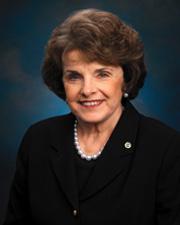 Sen. Dianne Feinstein (D-CA)
Legislative Activity
Stay on top of the latest movement without scrolling through every action
Roll call votes on amendments in Senate: Amendment SA 2858 not agreed to in Senate by Yea-Nay Vote. 49 - 50. Record Vote Number: 61.
March 25, 2004
View full timeline
Roll call votes on amendments in Senate: Amendment SA 2858 not agreed to in Senate by Yea-Nay Vote. 49 - 50. Record Vote Number: 61.
March 25, 2004
Senate amendment not agreed to: Amendment SA 2858 not agreed to in Senate by Yea-Nay Vote. 49 - 50. Record Vote Number: 61.
March 25, 2004
Senate amendment proposed (on the floor): Amendment SA 2858 proposed by Senator Feinstein.(consideration: CR S3125-3134, S3137-3151; text: CR S3125)
March 25, 2004
Amendment SA 2858 proposed by Senator Feinstein. (consideration: CR S3125-3134, S3137-3151; text: CR S3125) In the nature of a substitute.
March 25, 2004
Amendment SA 2858 not agreed to in Senate by Yea-Nay Vote. 49 - 50. Record Vote Number: 61.
March 25, 2004
Senate amendment submitted
March 12, 2004
Votes
1 roll call on this amendment
Text
Submitted
TEXT OF AMENDMENTS

SA 2856. Mr. FRIST (for Mrs. Hutchison) proposed an amendment to the
bill H.R. 254, to authorize the President of the United States to agree
to certain amendment to the Agreement between the Government of the
United States of America and the Government of the United Mexican
States concerning the establishment of a Border Environment Cooperation
Commission and a North American Development Bank, and for other
purposes; as follows:

Strike all after the enacting clause and insert the
following:

SECTION. 1. AUTHORITY TO AGREE TO CERTAIN AMENDMENTS TO THE
BORDER ENVIRONMENT COOPERATION AGREEMENT; GRANT
AUTHORITY.

(a) Amendment Authority.--Part 2 of subtitle D of title V
of Public Law 103-182 (22 U.S.C. 290m-290m-3) is amended by
adding at the end the following:

``SEC. 545. AUTHORITY TO AGREE TO CERTAIN AMENDMENTS TO THE
BORDER ENVIRONMENT COOPERATION AGREEMENT.

``The President may agree to amendments to the Cooperation
Agreement that--

[[Page S2803]]

``(1) enable the Bank to make grants and nonmarket rate
loans out of its paid-in capital resources with the approval
of its Board; and
``(2) amend the definition of `border region' to include
the area in the United States that is within 100 kilometers
of the international boundary between the United States and
Mexico, and the area in Mexico that is within 300 kilometers
of the international boundary between the United States and
Mexico.''.
(b) Grant Authority.--Part 2 of subtitle D of title V of
Public Law 103-182 (22 U.S.C. 290m-290m-3), as amended by
subsection (a), is amended by adding at the end the
following:

``SEC. 546. GRANTS OUT OF PAID-IN CAPITAL RESOURCES.

``(a) In General.--The President shall instruct the United
States Federal Government representatives on the Board of
Directors of the North American Development Bank to oppose
any proposal where grants out of the Bank's paid-in capital
resources, except for grants from paid-in capital authorized
for the community adjustment and investment program under the
Bank's charter of 1993, would--
``(1) be made to a project that is not being financed, in
part, by loans; or
``(2) account for more than 50 percent of the financing of
any individual project.
``(b) Exception.--
``(1) General Rule.--The requirements of subsection (a)
shall not apply in cases where--
``(A) the President determines there are exceptional
economic circumstances for making the grant and consults with
the Committee on Foreign Relations of the Senate and the
Committee on Financial Services of the House of
Representatives; or
``(B)(i) the grant is being made for a project that is so
small that obtaining a loan is impractical; and
``(ii) the grant does not exceed $250,000.
``(2) Limitation.--Not more than an aggregate of $5,000,000
in grants may be made under this subsection.''.
(c) Clerical Amendment.--Section 1(b) of such public law is
amended in the table of contents by inserting after the item
relating to section 544 the following:

``Sec. 545. Authority to agree to certain amendments to the Border
Environment Cooperation Agreement.
``Sec. 546. Grants out of paid-in capital resources.''.

SEC. 2. ANNUAL REPORT.

The Secretary of the Treasury shall submit annually to the
Committee on Financial Services of the House of
Representatives and the Committee on Foreign Relations of the
Senate a written report on the North American Development
Bank, which addresses the following issues:
(1) The number and description of the projects that the
North American Development Bank has approved. The description
shall include the level of market-rate loans, non-market-rate
loans, and grants used in an approved project, and a
description of whether an approved project is located within
100 kilometers of the international boundary between the
United States and Mexico or within 300 kilometers of the
international boundary between the United States and Mexico.
(2) The number and description of the approved projects in
which money has been dispersed.
(3) The number and description of the projects which have
been certified by the Border Environment Cooperation
Commission, but yet not financed by the North American
Development Bank, and the reasons that the projects have not
yet been financed.
(4) The total of the paid-in capital, callable capital, and
retained earnings of the North American Development Bank, and
the uses of such amounts.
(5) A description of any efforts and discussions between
the United States and Mexican governments to expand the type
of projects which the North American Development Bank
finances beyond environmental projects.
(6) A description of any efforts and discussions between
the United States and Mexican governments to improve the
effectiveness of the North American Development Bank.
(7) The number and description of projects authorized under
the Water Conservation Investment Fund of the North American
Development Bank.

SEC. 3. SENSE OF THE CONGRESS RELATING TO UNITED STATES
SUPPORT FOR NADBANK PROJECTS WHICH FINANCE
WATER CONSERVATION FOR TEXAS IRRIGATORS AND
AGRICULTURAL PRODUCERS IN THE LOWER RIO GRANDE
RIVER VALLEY.

(a) Findings.--The Congress finds that--
(1) Texas irrigators and agricultural producers are
suffering enormous hardships in the lower Rio Grande River
valley because of Mexico's failure to abide by the 1944 Water
Treaty entered into by the United States and Mexico;
(2) over the last 10 years, Mexico has accumulated a
1,500,000-acre fee water debt to the United States which has
resulted in a very minimal and inadequate irrigation water
supply in Texas;
(3) recent studies by Texas A&M University show that water
savings of 30 percent or more can be achieved by improvements
in irrigation system infrastructure such as canal lining and
metering;
(4) on August 20, 2002, the Board of the North American
Development Bank agreed to the creation in the Bank of a
Water Conservation Investment Fund, as required by Minute 308
to the 1944 Water Treaty, which was an agreement signed by
the United States and Mexico on June 28, 2002; and
(5) the Water Conservation Investment Fund of the North
American Development Bank stated that up to $80,000,000 would
be available for grant financing of water conservation
projects, which grant funds would be divided equally between
the United States and Mexico.
(b) Sense of the Congress.--It is the sense of the Congress
that--
(1) water conservation projects are eligible for funding
from the North American Development Bank under the Agreement
Between the Government of the United States of America and
the Government of the United Mexican States Concerning the
Establishment of a Border Environment Cooperation
Commission and a North American Development Bank; and
(2) the Board of the North American Development Bank should
support qualified water conservation projects which can
assist Texas irrigators and agricultural producers in the
lower Rio Grande River Valley.

SEC. 4. SENSE OF THE CONGRESS RELATING TO UNITED STATES
SUPPORT FOR NADBANK PROJECTS WHICH FINANCE
WATER CONSERVATION IN THE SOUTHERN CALIFORNIA
AREA.

It is the sense of the Congress that the Board of the North
American Development Bank should support--
(1) the development of qualified water conservation
projects in southern California and other eligible areas in
the 4 United States border States, including the conjunctive
use and storage of surface and ground water, delivery system
conservation, the re-regulation of reservoirs, improved
irrigation practices, wastewater reclamation, regional water
management modeling, operational and optimization studies to
improve water conservation, and cross-border water exchanges
consistent with treaties; and
(2) new water supply research and projects along the Mexico
border in southern California and other eligible areas in the
4 United States border States to desalinate ocean seawater
and brackish surface and groundwater, and dispose of or
manage the brines resulting from desalination.

SEC. 5. SENSE OF THE CONGRESS RELATING TO UNITED STATES
SUPPORT FOR NADBANK PROJECTS FOR WHICH FINANCE
WATER CONSERVATION FOR IRRIGATORS AND
AGRICULTURAL PRODUCERS IN THE SOUTHWEST UNITED
STATES.

(a) Findings.--The Congress finds as follows:
(1) Irrigators and agricultural producers are suffering
enormous hardships in the southwest United States. The border
States of California, Arizona, New Mexico, and Texas are
suffering from one of the worst droughts in history. In
Arizona, this is the second driest period in recorded history
and the worst since 1904.
(2) In spite of decades of water conservation in the
southwest United States, irrigated agriculture uses more than
60 percent of surface and ground water.
(3) The most inadequate water supplies in the United States
are in the Southwest, including the lower Colorado River
basin and the Great Plains River basins south of the Platte
River. In these areas, 70 percent of the water taken from the
stream is not returned.
(4) The amount of water being pumped out of groundwater
sources in many areas is greater than the amount being
replenished, thus depleting the groundwater supply.
(5) On August 20, 2002, the Board of the North American
Development Bank agreed to the creation in the bank of a
Water Conservation Investment Fund.
(6) The Water Conservation Investment Fund of the North
American Development Bank stated that up to $80,000,000 would
be available for grant financing of water conservation
projects, which grant funds would be divided equally between
the United States and Mexico.
(b) Sense of the Congress.--It is the sense of the Congress
that--
(1) water conservation projects are eligible for funding
from the North American Development Bank under the Agreement
Between the Government of the United States of America and
the Government of the United Mexican States Concerning the
Establishment of a Border Environment Cooperation Commission
and a North American Development Bank;
(2) the Board of the North American Development Bank should
support qualified water conservation projects that can assist
irrigators and agricultural producers; and
(3) the Board of the North American Development Bank should
take into consideration the needs of all of the border states
before approving funding for water projects, and strive to
fund water conservation projects in each of the border
states.

SEC. 6. SENSE OF THE CONGRESS REGARDING FINANCING OF
PROJECTS.

(a) In General.--It is the sense of the Congress that the
Board of the North American Development Bank should support
the financing of projects, on both sides of the international
boundary between the United States and Mexico, that address
coastal issues and the problem of pollution in both countries
having an environmental impact along the Pacific Ocean and
Gulf of Mexico shores of the United States and Mexico.
(b) Air Pollution.--It is the sense of the Congress that
the Board of the North American Development Bank should
support the

[[Page S2804]]

financing of projects, on both sides of the international
boundary between the United States and Mexico, which address
air pollution.
______

SA 2857. Mr. FRIST (for Mr. Edwards (for himself and Mrs. Dole))
proposed an amendment to the resolution S. Res. 307, honoring the
county of Cumberland, North Carolina, its municipalities and community
partners as they celebrate the 250th year of the existence of
Cumberland County; as follows:

Strike all after the resolved clause and insert the
following:
That the Senate commemorates the 250th Anniversary
Celebration of the county of Cumberland, North Carolina, its
municipalities, and other community partners.
______

SA 2858. Mrs. FEINSTEIN submitted an amendment intended to be
proposed by her to the bill H.R. 1997, to amend title 18, United States
Code, and the Uniform Code of Military Justice to protect unborn
children from assault and murder, and for other purposes; which was
ordered to lie on the table; as follows:

SECTION 1. SHORT TITLE.

This Act may be cited as the ``Motherhood Protection Act''.

SEC. 2. PROTECTION OF PREGNANT WOMEN.

(a) In General.--Title 18, United States Code, is amended
by inserting after chapter 90 the following:

``CHAPTER 90A--PROTECTION OF PREGNANT WOMEN

``CHAPTER 90A--PROTECTION OF PREGNANT WOMEN

``Sec.
``1841. Causing termination of pregnancy or interruption of the normal
course of pregnancy.

``Sec. 1841. Causing termination of pregnancy or interruption
of the normal course of pregnancy

``(a)(1) Any person who engages in conduct that violates
any of the provisions of law listed in subsection (b) and
thereby causes the termination of a pregnancy or the
interruption of the normal course of pregnancy, including
termination of the pregnancy other than by live birth is
guilty of a separate offense under this section.
``(2)(A) Except as otherwise provided in this paragraph,
the punishment for that separate offense is the same as the
punishment provided for that conduct under Federal law had
that injury or death occurred to the pregnant woman.
``(B) An offense under this section does not require proof
that--
``(i) the person engaging in the conduct had knowledge or
should have had knowledge that the victim of the underlying
offense was pregnant; or
``(ii) the defendant intended to cause the termination or
interruption of the normal course of pregnancy.
``(C) If the person engaging in the conduct thereby
intentionally causes or attempts to cause the termination of
or the interruption of the pregnancy, that person shall be
punished as provided under section 1111, 1112, or 1113, as
applicable, for intentionally terminating or interrupting the
pregnancy or attempting to do so, instead of the penalties
that would otherwise apply under subparagraph (A).
``(D) Notwithstanding any other provision of law, the death
penalty shall not be imposed for an offense under this
section.
``(b) The provisions referred to in subsection (a) are the
following:
``(1) Sections 36, 37, 43, 111, 112, 113, 114, 115, 229,
242, 245, 247, 248, 351, 831, 844(d), 844(f), 844(h)(1),
844(i), 924(j), 930, 1111, 1112, 1113, 1114, 1116, 1118,
1119, 1120, 1121, 1153(a), 1201(a), 1203, 1365(a), 1501,
1503, 1505, 1512, 1513, 1751, 1864, 1951, 1952(a)(1)(B),
1952(a)(2)(B), 1952(a)(3)(B), 1958, 1959, 1992, 2113, 2114,
2116, 2118, 2119, 2191, 2231, 2241(a), 2245, 2261, 2261A,
2280, 2281, 2332, 2332a, 2332b, 2340A, and 2441 of this
title.
``(2) Section 408(e) of the Controlled Substances Act of
1970 (21 U.S.C. 848(e)).
``(3) Section 202 of the Atomic Energy Act of 1954 (42
U.S.C. 2283).
``(c) Subsection (a) does not permit prosecution--
``(1) for conduct relating to an abortion for which the
consent of the pregnant woman has been obtained or for which
such consent is implied by law in a medical emergency;
``(2) for conduct relating to any medical treatment of the
pregnant woman, or matters related to the pregnancy; or
``(3) of any woman with respect to her pregnancy.''.
(b) Clerical Amendment.--The table of chapters for part 1
of title 18, United States Code, is amended by inserting
after the item relating to chapter 90 the following:

``90A. Protection of pregnant women.........................1841''.....

SEC. 3. MILITARY JUSTICE SYSTEM.

(a) Protection of Pregnant Women.--Subchapter X of chapter
47 of title 10, United States Code (the Uniform Code of
Military Justice), is amended by inserting after section 919
(article 119) the following:

``Sec. Sec. 919a. Art. 119a. Causing termination of pregnancy
or interruption of normal course of pregnancy

``(a)(1) Any person subject to this chapter who engages in
conduct that violates any of the provisions of law listed in
subsection (b) and thereby causes the termination of a
pregnancy or the interruption of the normal course of
pregnancy, including termination of the pregnancy other than
by live birth, is guilty of a separate offense under this
section.
``(2)(A) Except as otherwise provided in this paragraph,
the punishment for that separate offense is the same as the
punishment for that conduct under this chapter had that
injury or death occurred to the pregnant woman.
``(B) An offense under this section does not require proof
that--
``(i) the person engaging in the conduct had knowledge or
should have had knowledge that the victim of the underlying
offense was pregnant; or
``(ii) the defendant intended to cause the termination or
interruption of the normal course of pregnancy.
``(C) If the person engaging in the conduct thereby
intentionally causes or attempts to cause the termination of
or the interruption of the pregnancy, that persons shall be
punished as provided under section 918, 919, or 880 of this
title (article 118, 119, or 80), as applicable, for
intentionally causing the termination of or interruption of
the pregnancy or attempting to do so, instead of the
penalties that would otherwise apply under subparagraph (A).
``(D) Notwithstanding any other provision of law, the death
penalty shall not be imposed for an offense under this
section.
``(b) The provisions referred to in subsection (a) are
sections 918, 919(a), 919(b)(2), 920(a), 922, 924, 926, and
928 of this title (articles 111, 118, 119(a), 119(b)(2),
120(a), 122, 124, 126, and 128).
``(c) Subsection (a) does not permit prosecution--
``(1) for conduct relating to an abortion for which the
consent of the pregnant woman has been obtained or for which
such consent is implied by law in a medical emergency;
``(2) for conduct relating to any medical treatment of the
pregnant woman or matters relating to her pregnancy; or
``(3) of any woman with respect to her pregnancy.''.
(b) Clerical amendment.--The table of sections at the
beginning of subchapter X of chapter 47 of title 10, United
States Code (the Uniform Code of Military Justice), is
amended by inserting after the item relating to section 919
the following:

``919a. Causing termination of pregnancy and termination of normal
course of pregnancy.''.
______

SA 2859. Mrs. MURRAY submitted an amendment intended to be proposed
by her to the bill H.R. 1997, to amend title 18, United States Code,
and the Uniform Code of Military Justice to protect unborn children
from assault and murder, and for other purposes; which was ordered to
lie on the table; as follows:

On page 7, strike line 8 and all that follows and insert
the following:
(b) Clerical Amendment.--The table of sections at the
beginning of subchapter X of chapter 47 of title 10, United
States Code (the Uniform Code of Military Justice), is
amended by inserting after the item relating to section 919
the following:

``919a. 119a. Causing death of or bodily injury to unborn child.''.

DIVISION II--DOMESTIC VIOLENCE PREVENTION

SEC. 1. SHORT TITLE; TABLE OF CONTENTS.

(a) Short Title.--This division may be cited as the ``Paul
and Sheila Wellstone Domestic Violence Prevention Act''.
(b) Table of Contents.--The table of contents for this
division is as follows:

Sec. 1. Short title; table of contents.

TITLE I--VICTIMS' ECONOMIC SECURITY AND SAFETY

Sec. 101. Short title.
Sec. 102. Findings.
Sec. 103. Definitions.

Subtitle A--Entitlement to Emergency Leave for Addressing Domestic or
Sexual Violence

Sec. 111. Purposes.
Sec. 112. Entitlement to emergency leave for addressing domestic or
sexual violence.
Sec. 113. Existing leave usable for addressing domestic or sexual
violence.
Sec. 114. Emergency benefits.
Sec. 115. Effect on other laws and employment benefits.
Sec. 116. Conforming amendment.
Sec. 117. Effective date.

Subtitle B--Entitlement to Unemployment Compensation for Victims of
Domestic Violence, Dating Violence, Sexual Assault, or Stalking

Sec. 121. Purposes.
Sec. 122. Unemployment compensation and training provisions.

Subtitle C--Victims' Employment Sustainability

Sec. 131. Short title.
Sec. 132. Purposes.
Sec. 133. Prohibited discriminatory acts.
Sec. 134. Enforcement.
Sec. 135. Attorney's fees.

Subtitle D--Victims of Abuse Insurance Protection

Sec. 141. Short title.
Sec. 142. Definitions.
Sec. 143. Discriminatory acts prohibited.

[[Page S2805]]

Sec. 144. Insurance protocols for subjects of abuse.
Sec. 145. Reasons for adverse actions.
Sec. 146. Life insurance.
Sec. 147. Subrogation without consent prohibited.
Sec. 148. Enforcement.
Sec. 149. Effective date.

Subtitle E--Workplace Safety Program Tax Credit

Sec. 151. Credit for costs to employers of implementing workplace
safety programs.

Subtitle F--National Clearinghouse on Domestic and Sexual Violence in
the Workplace Grant

Sec. 161. National clearinghouse on domestic and sexual violence in the
workplace grant.

Subtitle G--Severability

Sec. 171. Severability.

TITLE II--CHILDREN WHO WITNESS DOMESTIC VIOLENCE

Sec. 201. Short title.
Sec. 202. Findings.
Sec. 203. Purpose.
Sec. 204. Definitions.
Sec. 205. Services for children exposed to domestic violence.
Sec. 206. Grants to combat the impact of experiencing or witnessing
domestic violence on elementary and secondary school
children.
Sec. 207. Grants for training and collaboration among child welfare
agencies, domestic violence and sexual assault service
providers, the courts and law enforcement agencies.
Sec. 208. Multisystem interventions for children who have been exposed
to domestic violence.
Sec. 209. Crisis nursery demonstration grants program.
Sec. 210. Research and data collection on the impact of domestic
violence on children.

TITLE III--DOMESTIC VIOLENCE SCREENING, TREATMENT, AND PREVENTION

Sec. 301. Short title.
Sec. 302. Findings.

Subtitle A--Research on Health and Family Violence

Sec. 311. Health research on family violence.

Subtitle B--Health Professional Education Programs

Sec. 321. Health professional education grants.

Subtitle C--Grants to Foster Public Health Responses to Domestic
Violence

Sec. 331. Grants.

Subtitle D--Provision of Services Under Federal Health Programs

Sec. 341. Optional coverage of domestic violence identification and
treatment under the medicaid program.
Sec. 342. Federal Employees Health Benefits Program.
Sec. 343. Training grants under the Maternal and Child Health Services
Block Grant.
Sec. 344. Domestic violence identification and treatment services at
community health centers.

TITLE I--VICTIMS' ECONOMIC SECURITY AND SAFETY

SEC. 101. SHORT TITLE.

This title may be cited as the ``Victims' Economic Security
and Safety Act''.

SEC. 102. FINDINGS.

Congress makes the following findings:
(1) Domestic violence crimes account for approximately 15
percent of total crime costs in the United States each year.
(2) Violence against women has been reported to be the
leading cause of physical injury to women. Such violence has
a devastating impact on women's physical and emotional health
and financial security.
(3) According to recent government surveys, from 1993
through 1998 the average annual number of violent
victimizations committed by intimate partners was 1,082,110,
87 percent of which were committed against women. Female
murder victims were substantially more likely than male
murder victims to have been killed by an intimate partner.
About \1/3\ of female murder victims, and about 4 percent of
male murder victims, were killed by an intimate partner.
(4) According to recent government estimates, approximately
987,400 rapes occur annually in the United States, 89 percent
of the rapes perpetrated against female victims.
(5) Approximately 10,200,000 people have been stalked at
some time in their lives. Four out of every 5 stalking
victims are women. Stalkers harass and terrorize their
victims by spying on the victims, standing outside their
places of work or homes, making unwanted phone calls, sending
or leaving unwanted letters or items, or vandalizing
property.
(6) Employees in the United States who have been victims of
domestic violence, dating violence, sexual assault, or
stalking too often suffer adverse consequences in the
workplace as a result of their victimization.
(7) Victims of domestic violence, dating violence, sexual
assault, and stalking are particularly vulnerable to changes
in employment, pay, and benefits as a result of their
victimizations, and are, therefore, in need of legal
protection.
(8) The prevalence of domestic violence, dating violence,
sexual assault, stalking, and other violence against women at
work is dramatic. Approximately 11 percent of all rapes occur
in the workplace. About 50,500 individuals, 83 percent of
whom are women, were raped or sexually assaulted in the
workplace each year from 1992 through 1996. Half of all
female victims of violent workplace crimes know their
attackers. Nearly 1 out of 10 violent workplace incidents are
committed by partners or spouses. Women who work for State or
local governments suffer a higher incidence of workplace
assaults, including rapes, than women who work in the private
sector.
(9) Homicide is the leading cause of death for women on the
job. Husbands, boyfriends, and ex-partners commit 15 percent
of workplace homicides against women.
(10) Studies indicate that between 35 and 56 percent of
employed battered women surveyed were harassed at work by
their abusive partners.
(11) According to a 1998 report of the General Accounting
Office, between \1/4\ and \1/2\ of domestic violence victims
surveyed in 3 studies reported that the victims lost a job
due, at least in part, to domestic violence.
(12) Women who have experienced domestic violence or dating
violence are more likely than other women to be unemployed,
to suffer from health problems that can affect employability
and job performance, to report lower personal income, and to
rely on welfare.
(13) Abusers frequently seek to control their partners by
actively interfering with their ability to work, including
preventing their partners from going to work, harassing their
partners at work, limiting the access of their partners to
cash or transportation, and sabotaging the child care
arrangements of their partners.
(14) More than \1/2\ of women receiving welfare have been
victims of domestic violence as adults and between \1/4\ and
\1/3\ reported being abused in the last year.
(15) Sexual assault, whether occurring in or out of the
workplace, can impair an employee's work performance, require
time away from work, and undermine the employee's ability to
maintain a job. Almost 50 percent of sexual assault survivors
lose their jobs or are forced to quit in the aftermath of the
assaults.
(16) More than \1/4\ of stalking victims report losing time
from work due to the stalking and 7 percent never return to
work.
(17)(A) According to the National Institute of Justice,
crime costs an estimated $450,000,000,000 annually in medical
expenses, lost earnings, social service costs, pain,
suffering, and reduced quality of life for victims, which
harms the Nation's productivity and drains the Nation's
resources.
(B) Violent crime accounts for $426,000,000,000 per year of
this amount.
(C) Rape exacts the highest costs per victim of any
criminal offense, and accounts for $127,000,000,000 per year
of the amount described in subparagraph (A).
(18) Violent crime results in wage losses equivalent to 1
percent of all United States earnings, and causes 3 percent
of the Nation's medical spending and 14 percent of the
Nation's injury-related medical spending.
(19) The Bureau of National Affairs has estimated that
domestic violence costs United States employers between
$3,000,000,000 and $5,000,000,000 annually in lost time and
productivity. Other reports have estimated that domestic
violence costs United States employers $13,000,000,000
annually.
(20) United States medical costs for domestic violence have
been estimated to be $31,000,000,000 per year.
(21) Surveys of business executives and corporate security
directors also underscore the heavy toll that workplace
violence takes on women, businesses, and interstate commerce
in the United States.
(22) Ninety-four percent of corporate security and safety
directors at companies nationwide rank domestic violence as a
high security concern.
(23) Forty-nine percent of senior executives recently
surveyed said domestic violence has a harmful effect on their
company's productivity, 47 percent said domestic violence
negatively affects attendance, and 44 percent said domestic
violence increases health care costs.
(24) Only 16 States have laws that explicitly provide
unemployment insurance to domestic violence victims in
certain circumstances, and none of the laws explicitly cover
victims of sexual assault or stalking.
(25) Only 2 States provide domestic violence victims with
leave from work to go to court, to the doctor, or to take
other steps to address the domestic violence in their lives,
and only Maine provides such leave to victims of sexual
assault and stalking.
(26) No States prohibit employment discrimination against
victims of domestic violence, sexual assault, or stalking.
New York City is the only jurisdiction with a law prohibiting
employment discrimination against actual or perceived victims
of domestic violence.
(27) Employees, including individuals participating in
welfare to work programs, may need to take time during
business hours to--
(A) obtain orders of protection;
(B) seek medical or legal assistance, counseling, or other
services; or
(C) look for housing in order to escape from domestic
violence.

[[Page S2806]]

(28) Domestic and sexual violence victims have been
subjected to discrimination by private and State employers,
including discrimination motivated by sex and stereotypical
notions about women.
(29) Existing Federal law does not explicitly--
(A) authorize victims of domestic violence, dating
violence, sexual assault, or stalking to take leave from work
to seek legal assistance and redress, counseling, or
assistance with safety planning activities;
(B) address the eligibility of victims of domestic
violence, dating violence, sexual assault, or stalking for
unemployment compensation; or
(C) prohibit employment discrimination against actual or
perceived victims of domestic violence, dating violence,
sexual assault, or stalking.

SEC. 103. DEFINITIONS.

In this title, except as otherwise expressly provided:
(1) Commerce.--The terms ``commerce'' and ``industry or
activity affecting commerce'' have the meanings given the
terms in section 101 of the Family and Medical Leave Act of
1993 (29 U.S.C. 2611).
(2) Course of conduct.--The term ``course of conduct''
means a course of repeatedly maintaining a visual or physical
proximity to a person or conveying verbal or written threats,
including threats conveyed through electronic communications,
or threats implied by conduct.
(3) Dating violence.--The term ``dating violence'' has the
meaning given the term in section 826 of the Higher Education
Amendments of 1998 (20 U.S.C. 1152).
(4) Domestic or sexual violence.--The term ``domestic or
sexual violence'' means domestic violence, dating violence,
sexual assault, or stalking.
(5) Domestic violence.--The term ``domestic violence'' has
the meaning given the term in section 826 of the Higher
Education Amendments of 1998 (20 U.S.C. 1152).
(6) Domestic violence coalition.--The term ``domestic
violence coalition'' means a nonprofit, nongovernmental
membership organization that--
(A) consists of the entities carrying out a majority of the
domestic violence programs carried out within a State;
(B) collaborates and coordinates activities with Federal,
State, and local entities to further the purposes of domestic
violence intervention and prevention; and
(C) among other activities, provides training and technical
assistance to entities carrying out domestic violence
programs within a State, territory, political subdivision, or
area under Federal authority.
(7) Electronic communications.--The term ``electronic
communications'' includes communications via telephone,
mobile phone, computer, e-mail, video recorder, fax machine,
telex, or pager.
(8) Employ; state.--The terms ``employ'' and ``State'' have
the meanings given the terms in section 3 of the Fair Labor
Standards Act of 1938 (29 U.S.C. 203).
(9) Employee.--
(A) In general.--The term ``employee'' means any person
employed by an employer. In the case of an individual
employed by a public agency, such term means an individual
employed as described in section 3(e) of the Fair Labor
Standards Act of 1938 (29 U.S.C. 203(e)).
(B) Basis.--The term includes a person employed as
described in subparagraph (A) on a full- or part-time basis,
for a fixed time period, on a temporary basis, pursuant to a
detail, as an independent contractor, or as a participant in
a work assignment as a condition of receipt of Federal or
State income-based public assistance.
(10) Employer.--The term ``employer''--
(A) means any person engaged in commerce or in any industry
or activity affecting commerce who employs 15 or more
individuals; and
(B) includes any person acting directly or indirectly in
the interest of an employer in relation to an employee, and
includes a public agency, but does not include any labor
organization (other than when acting as an employer) or
anyone acting in the capacity of officer or agent of such
labor organization.
(11) Employment benefits.--The term ``employment benefits''
means all benefits provided or made available to employees by
an employer, including group life insurance, health
insurance, disability insurance, sick leave, annual leave,
educational benefits, and pensions, regardless of whether
such benefits are provided by a practice or written policy of
an employer or through an ``employee benefit plan'', as
defined in section 3(3) of the Employee Retirement Income
Security Act of 1974 (29 U.S.C. 1002(3)).
(12) Parent; son or daughter.--The terms ``parent'' and
``son or daughter'' have the meanings given the terms in
section 101 of the Family and Medical Leave Act of 1993 (29
U.S.C. 2611).
(13) Person.--The term ``person'' has the meaning given the
term in section 3 of the Fair Labor Standards Act of 1938 (29
U.S.C. 203).
(14) Public agency.--The term ``public agency'' has the
meaning given the term in section 3 of the Fair Labor
Standards Act of 1938 (29 U.S.C. 203).
(15) Public assistance.--The term ``public assistance''
includes cash, food stamps, medical assistance, housing
assistance, and other benefits provided on the basis of
income by a public agency.
(16) Reduced leave schedule.--The term ``reduced leave
schedule'' means a leave schedule that reduces the usual
number of hours per workweek, or hours per workday, of an
employee.
(17) Repeatedly.--The term ``repeatedly'' means on 2 or
more occasions.
(18) Secretary.--The term ``Secretary'' means the Secretary
of Labor.
(19) Sexual assault.--The term ``sexual assault'' has the
meaning given the term in section 826 of the Higher Education
Amendments of 1998 (20 U.S.C. 1152).
(20) Sexual assault coalition.--The term ``sexual assault
coalition'' means a nonprofit, nongovernmental membership
organization that--
(A) consists of the entities carrying out a majority of the
sexual assault programs carried out within a State;
(B) collaborates and coordinates activities with Federal,
State, and local entities to further the purposes of sexual
assault intervention and prevention; and
(C) among other activities, provides training and technical
assistance to entities carrying out sexual assault programs
within a State, territory, political subdivision, or area
under Federal authority.
(21) Stalking.--The term ``stalking'' means engaging in a
course of conduct directed at a specific person that would
cause a reasonable person to suffer substantial emotional
distress or to fear bodily injury, sexual assault, or death
to the person, or the person's spouse, parent, or son or
daughter, or any other person who regularly resides in the
person's household, if the conduct causes the specific person
to have such distress or fear.
(22) Victim of domestic or sexual violence.--The term
``victim of domestic or sexual violence'' includes an
individual who has been a victim of domestic or sexual
violence and an individual whose family or household member
has been a victim of domestic or sexual violence.
(23) Victim services organization.--The term ``victim
services organization'' means a nonprofit, nongovernmental
organization that provides assistance to victims of domestic
or sexual violence or to advocates for such victims,
including a rape crisis center, an organization carrying out
a domestic violence program, an organization operating a
shelter or providing counseling services, or an organization
providing assistance through the legal process.

Subtitle A--Entitlement to Emergency Leave for Addressing Domestic or
Sexual Violence

SEC. 111. PURPOSES.

The purposes of this subtitle are, pursuant to the
affirmative power of Congress to enact legislation under the
portions of section 8 of article I of the Constitution
relating to providing for the general welfare and to
regulation of commerce among the several States, and under
section 5 of the 14th amendment to the Constitution--
(1) to promote the national interest in reducing domestic
violence, dating violence, sexual assault, and stalking by
enabling victims of domestic or sexual violence to maintain
the financial independence necessary to leave abusive
situations, achieve safety, and minimize the physical and
emotional injuries from domestic or sexual violence, and to
reduce the devastating economic consequences of domestic or
sexual violence to employers and employees;
(2) to promote the national interest in ensuring that
victims of domestic or sexual violence can recover from and
cope with the effects of such violence, and participate in
criminal and civil justice processes, without fear of adverse
economic consequences from their employers;
(3) to ensure that victims of domestic or sexual violence
can recover from and cope with the effects of such violence,
and participate in criminal and civil justice processes,
without fear of adverse economic consequences with respect to
public benefits;
(4) to promote the purposes of the 14th amendment by
preventing sex-based discrimination and discrimination
against victims of domestic and sexual violence in employment
leave, by addressing the failure of existing laws to protect
the employment rights of victims of domestic or sexual
violence, by protecting their civil and economic rights, and
by furthering the equal opportunity of women for economic
self-sufficiency and employment free from discrimination;
(5) to minimize the negative impact on interstate commerce
from dislocations of employees and harmful effects on
productivity, employment, health care costs, and employer
costs, caused by domestic or sexual violence, including
intentional efforts to frustrate women's ability to
participate in employment and interstate commerce; and
(6) to accomplish the purposes described in paragraphs (1)
through (5) by--
(A) entitling employed victims of domestic or sexual
violence to take leave to seek medical help, legal
assistance, counseling, safety planning, and other assistance
without penalty from their employers; and
(B) prohibiting employers from discriminating against
actual or perceived victims of domestic or sexual violence,
in a manner that accommodates the legitimate interests of
employers and protects the safety of all persons in the
workplace.

SEC. 112. ENTITLEMENT TO EMERGENCY LEAVE FOR ADDRESSING
DOMESTIC OR SEXUAL VIOLENCE.

(a) Leave Requirement.--
(1) Basis.--An employee who is a victim of domestic or
sexual violence may take leave

[[Page S2807]]

from work to address domestic or sexual violence, by--
(A) seeking medical attention for, or recovering from,
physical or psychological injuries caused by domestic or
sexual violence;
(B) obtaining services from a victim services organization;
(C) obtaining psychological or other counseling for the
employee or the employee's parent or son or daughter;
(D) participating in safety planning, temporarily or
permanently relocating, or taking other actions to increase
the safety of the employee or the employee's parent or son or
daughter from future domestic or sexual violence or ensure
economic security; or
(E) seeking legal assistance or remedies to ensure the
health and safety of the employee or the employee's parent or
son or daughter, including preparing for or participating in
any civil or criminal legal proceeding related to or derived
from domestic or sexual violence.
(2) Period.--An employee may take not more than 30 days of
leave, as described in paragraph (1), in any 12-month period.
(3) Schedule.--Leave described in paragraph (1) may be
taken intermittently or on a reduced leave schedule.
(b) Notice.--The employee shall provide the employer with
reasonable notice of the employee's intention to take the
leave, unless providing such notice is not practicable.
(c) Certification.--
(1) In general.--The employer may require the employee to
provide certification to the employer, within a reasonable
period after the employer requires the certification, that--
(A) the employee is a victim of domestic or sexual
violence; and
(B) the leave is for 1 of the purposes enumerated in
subsection (a)(1).
(2) Contents.--An employee may satisfy the certification
requirement of paragraph (1) by providing to the employer--
(A) a sworn statement of the employee;
(B) documentation from an employee, agent, or volunteer of
a victim services organization, an attorney, a member of the
clergy, or a medical or other professional, from whom the
employee has sought assistance in addressing domestic or
sexual violence and the effects of the violence;
(C) a police or court record; or
(D) other corroborating evidence.
(d) Confidentiality.--All information provided to the
employer pursuant to subsection (b) or (c), including a
statement of the employee or any other documentation, record,
or corroborating evidence, and the fact that the employee has
requested or obtained leave pursuant to this section, shall
be retained in the strictest confidence by the employer,
except to the extent that disclosure is--
(1) requested or consented to by the employee; or
(2) otherwise required by applicable Federal or State law.
(e) Employment and Benefits.--
(1) Restoration to position.--
(A) In general.--Except as provided in paragraph (2), any
employee who takes leave under this section for the intended
purpose of the leave shall be entitled, on return from
such leave--
(i) to be restored by the employer to the position of
employment held by the employee when the leave commenced; or
(ii) to be restored to an equivalent position with
equivalent employment benefits, pay, and other terms and
conditions of employment.
(B) Loss of benefits.--The taking of leave under this
section shall not result in the loss of any employment
benefit accrued prior to the date on which the leave
commenced.
(C) Limitations.--Nothing in this subsection shall be
construed to entitle any restored employee to--
(i) the accrual of any seniority or employment benefits
during any period of leave; or
(ii) any right, benefit, or position of employment other
than any right, benefit, or position to which the employee
would have been entitled had the employee not taken the
leave.
(D) Construction.--Nothing in this paragraph shall be
construed to prohibit an employer from requiring an employee
on leave under this section to report periodically to the
employer on the status and intention of the employee to
return to work.
(2) Exemption concerning certain highly compensated
employees.--
(A) Denial of restoration.--An employer may deny
restoration under paragraph (1) to any employee described in
subparagraph (B) if--
(i) such denial is necessary to prevent substantial and
grievous economic injury to the operations of the employer;
(ii) the employer notifies the employee of the intent of
the employer to deny restoration on such basis at the time
the employer determines that such injury would occur; and
(iii) in any case in which the leave has commenced, the
employee elects not to return to employment after receiving
such notice.
(B) Affected employees.--An employee referred to in
subparagraph (A) is a salaried employee who is among the
highest paid 10 percent of the employees employed by the
employer within 75 miles of the facility at which the
employee is employed.
(3) Maintenance of health benefits.--
(A) Coverage.--Except as provided in subparagraph (B),
during any period that an employee takes leave under this
section, the employer shall maintain coverage under any group
health plan (as defined in section 5000(b)(1) of the Internal
Revenue Code of 1986) for the duration of such leave at the
level and under the conditions coverage would have been
provided if the employee had continued in employment
continuously for the duration of such leave.
(B) Failure to return from leave.--The employer may recover
the premium that the employer paid for maintaining coverage
for the employee under such group health plan during any
period of leave under this section if--
(i) the employee fails to return from leave under this
section after the period of leave to which the employee is
entitled has expired; and
(ii) the employee fails to return to work for a reason
other than--

(I) the continuation, recurrence, or onset of domestic or
sexual violence, that entitles the employee to leave pursuant
to this section; or
(II) other circumstances beyond the control of the
employee.

(C) Certification.--
(i) Issuance.--An employer may require an employee who
claims that the employee is unable to return to work because
of a reason described in subclause (I) or (II) of
subparagraph (B)(ii) to provide, within a reasonable period
after making the claim, certification to the employer that
the employee is unable to return to work because of that
reason.
(ii) Contents.--An employee may satisfy the certification
requirement of clause (i) by providing to the employer--

(I) a sworn statement of the employee;
(II) documentation from an employee, agent, or volunteer of
a victim services organization, an attorney, a member of the
clergy, or a medical or other professional, from whom the
employee has sought assistance in addressing domestic or
sexual violence and the effects of that violence;
(III) a police or court record; or
(IV) other corroborating evidence.

(D) Confidentiality.--All information provided to the
employer pursuant to subparagraph (C), including a statement
of the employee or any other documentation, record, or
corroborating evidence, and the fact that the employee is not
returning to work because of a reason described in subclause
(I) or (II) of subparagraph (B)(ii) shall be retained in the
strictest confidence by the employer, except to the extent
that disclosure is--
(i) requested or consented to by the employee; or
(ii) otherwise required by applicable Federal or State law.
(f) Prohibited Acts.--
(1) Interference with rights.--
(A) Exercise of rights.--It shall be unlawful for any
employer to interfere with, restrain, or deny the exercise of
or the attempt to exercise, any right provided under this
section.
(B) Employer discrimination.--It shall be unlawful for any
employer to discharge or harass any individual, or otherwise
discriminate against any individual with respect to
compensation, terms, conditions, or privileges of employment
of the individual (including retaliation in any form or
manner) because the individual--
(i) exercised any right provided under this section; or
(ii) opposed any practice made unlawful by this section.
(C) Public agency sanctions.--It shall be unlawful for any
public agency to deny, reduce, or terminate the benefits of,
otherwise sanction, or harass any individual, or otherwise
discriminate against any individual with respect to the
amount, terms, or conditions of public assistance of the
individual (including retaliation in any form or manner)
because the individual--
(i) exercised any right provided under this section; or
(ii) opposed any practice made unlawful by this section.
(2) Interference with proceedings or inquiries.--It shall
be unlawful for any person to discharge or in any other
manner discriminate (as described in subparagraph (B) or (C)
of paragraph (1)) against any individual because such
individual--
(A) has filed any charge, or has instituted or caused to be
instituted any proceeding, under or related to this section;
(B) has given, or is about to give, any information in
connection with any inquiry or proceeding relating to any
right provided under this section; or
(C) has testified, or is about to testify, in any inquiry
or proceeding relating to any right provided under this
section.
(g) Enforcement.--
(1) Civil action by affected individuals.--
(A) Liability.--Any employer or public agency that violates
subsection (f) shall be liable to any individual affected--
(i) for damages equal to--

(I) the amount of--

(aa) any wages, salary, employment benefits, public
assistance, or other compensation denied or lost to such
individual by reason of the violation; or
(bb) in a case in which wages, salary, employment benefits,
public assistance, or other compensation has not been denied
or lost to the individual, any actual monetary losses
sustained by the individual as a direct result of the
violation;

(II) the interest on the amount described in subclause (I)
calculated at the prevailing rate; and

[[Page S2808]]

(III) an additional amount as liquidated damages equal to
the sum of the amount described in subclause (I) and the
interest described in subclause (II), except that if an
employer or public agency that has violated subsection (f)
proves to the satisfaction of the court that the act or
omission that violated subsection (f) was in good faith and
that the employer or public agency had reasonable grounds for
believing that the act or omission was not a violation of
subsection (f), such court may, in the discretion of the
court, reduce the amount of the liability to the amount and
interest determined under subclauses (I) and (II),
respectively; and

(ii) for such equitable relief as may be appropriate,
including employment, reinstatement, and promotion.
(B) Right of action.--An action to recover the damages or
equitable relief prescribed in subparagraph (A) may be
maintained against any employer or public agency in any
Federal or State court of competent jurisdiction by any 1 or
more affected individuals for and on behalf of--
(i) the individuals; or
(ii) the individuals and other individuals similarly
situated.
(C) Fees and costs.--The court in such an action shall, in
addition to any judgment awarded to the plaintiff, allow a
reasonable attorney's fee, reasonable expert witness fees,
and other costs of the action to be paid by the defendant.
(D) Limitations.--The right provided by subparagraph (B) to
bring an action by or on behalf of any affected individual
shall terminate--
(i) on the filing of a complaint by the Secretary in an
action under paragraph (4) in which restraint is sought of
any further delay in the payment of the amount described in
subparagraph (A)(i) to such individual by an employer or
public agency responsible under subparagraph (A) for the
payment; or
(ii) on the filing of a complaint by the Secretary in an
action under paragraph (2) in which a recovery is sought of
the damages described in subparagraph (A)(i) owing to an
affected individual by an employer or public agency liable
under subparagraph (A),

unless the action described in clause (i) or (ii) is
dismissed without prejudice on motion of the Secretary.
(2) Action by the secretary.--
(A) Administrative action.--The Secretary shall receive,
investigate, and attempt to resolve complaints of violations
of subsection (f) in the same manner as the Secretary
receives, investigates, and attempts to resolve complaints of
violations of sections 6 and 7 of the Fair Labor Standards
Act of 1938 (29 U.S.C. 206 and 207).
(B) Civil action.--The Secretary may bring an action in any
court of competent jurisdiction to recover the damages
described in paragraph (1)(A)(i).
(C) Sums recovered.--Any sums recovered by the Secretary
pursuant to subparagraph (B) shall be held in a special
deposit account and shall be paid, on order of the Secretary,
directly to each individual affected. Any such sums not paid
to such an individual because of inability to do so within a
period of 3 years shall be deposited into the Treasury of the
United States as miscellaneous receipts.
(3) Limitation.--
(A) In general.--Except as provided in subparagraph (B), an
action may be brought under this subsection not later than 2
years after the date of the last event constituting the
alleged violation for which the action is brought.
(B) Willful violation.--In the case of such action brought
for a willful violation of subsection (f), such action may be
brought within 3 years after the date of the last event
constituting the alleged violation for which such action is
brought.
(C) Commencement.--In determining when an action is
commenced by the Secretary under this subsection for the
purposes of this paragraph, it shall be considered to be
commenced on the date when the complaint is filed.
(4) Action for injunction by secretary.--The district
courts of the United States shall have jurisdiction, for
cause shown, in an action brought by the Secretary--
(A) to restrain violations of subsection (f), including the
restraint of any withholding of payment of wages, salary,
employment benefits, public assistance, or other
compensation, plus interest, found by the court to be due to
affected individuals; or
(B) to award such other equitable relief as may be
appropriate, including employment, reinstatement, and
promotion.
(5) Solicitor of labor.--The Solicitor of Labor may appear
for and represent the Secretary on any litigation brought
under this subsection.
(6) Employer liability under other laws.--Nothing in this
section shall be construed to limit the liability of an
employer or public agency to an individual, for harm suffered
relating to the individual's experience of domestic or sexual
violence, pursuant to any other Federal or State law,
including a law providing for a legal remedy.

SEC. 113. EXISTING LEAVE USABLE FOR ADDRESSING DOMESTIC OR
SEXUAL VIOLENCE.

An employee who is entitled to take paid or unpaid leave
(including family, medical, sick, annual, personal, or
similar leave) from employment, pursuant to State or local
law, a collective bargaining agreement, or an employment
benefits program or plan, may elect to substitute any period
of such leave for an equivalent period of leave provided
under section 112.

SEC. 114. EMERGENCY BENEFITS.

(a) In General.--A State may use funds provided to the
State under part A of title IV of the Social Security Act (42
U.S.C. 601 et seq.) to provide nonrecurrent short-term
emergency benefits to an individual for any period of leave
the individual takes pursuant to section 112.
(b) Eligibility.--In calculating the eligibility of an
individual for such emergency benefits, the State shall count
only the cash available or accessible to the individual.
(c) Timing.--
(1) Applications.--An individual seeking emergency benefits
under subsection (a) from a State shall submit an application
to the State.
(2) Benefits.--The State shall provide benefits to an
eligible applicant under paragraph (1) on an expedited basis,
and not later than 7 days after the applicant submits an
application under paragraph (1).
(d) Conforming Amendment.--Section 404 of the Social
Security Act (42 U.S.C. 604) is amended by adding at the end
the following:
``(l) Authority To Provide Emergency Benefits.--A State
that receives a grant under section 403 may use the grant to
provide nonrecurrent short-term emergency benefits, in
accordance with section 114 of the Victims' Economic Security
and Safety Act, to individuals who take leave pursuant to
section 112 of that Act, without regard to whether the
individuals receive assistance under the State program funded
under this part.''.

SEC. 115. EFFECT ON OTHER LAWS AND EMPLOYMENT BENEFITS.

(a) More Protective Laws, Agreements, Programs, and
Plans.--Nothing in this subtitle shall be construed to
supersede any provision of any Federal, State, or local law,
collective bargaining agreement, or employment benefits
program or plan that provides--
(1) greater leave benefits for victims of domestic or
sexual violence than the rights established under this
subtitle; or
(2) leave benefits for a larger population of victims of
domestic or sexual violence (as defined in such law,
agreement, program, or plan) than the victims of domestic or
sexual violence covered under this subtitle.
(b) Less Protective Laws, Agreements, Programs, and
Plans.--The rights established for victims of domestic or
sexual violence under this subtitle shall not be diminished
by any State or local law, collective bargaining agreement,
or employment benefits program or plan.

SEC. 116. CONFORMING AMENDMENT.

Section 1003(a)(1) of the Rehabilitation Act Amendments of
1986 (42 U.S.C. 2000d-7(a)(1)) is amended by inserting
``subtitle A or C of the Victims' Economic Security and
Safety Act,'' before ``or the provisions''.

SEC. 117. EFFECTIVE DATE.

This subtitle and the amendment made by this subtitle take
effect 180 days after the date of enactment of this Act.

Subtitle B--Entitlement to Unemployment Compensation for Victims of
Domestic Violence, Dating Violence, Sexual Assault, or Stalking

SEC. 121. PURPOSES.

The purposes of this subtitle are, pursuant to the
affirmative power of Congress to enact legislation under the
portions of section 8 of article I of the Constitution
relating to laying and collecting taxes, providing for the
general welfare, and regulation of commerce among the several
States and under section 5 of the 14th amendment to the
Constitution--
(1) to promote the national interest in reducing domestic
violence, dating violence, sexual assault, and stalking by
enabling victims of domestic or sexual violence to maintain
the financial independence necessary to leave abusive
situations, achieve safety, and minimize the physical and
emotional injuries from domestic or sexual violence, and to
reduce the devastating economic consequences of domestic or
sexual violence to employers and employees;
(2) to promote the national interest in ensuring that
victims of domestic or sexual violence can recover from and
cope with the effects of such victimization and participate
in the criminal and civil justice processes without fear of
adverse economic consequences;
(3) to minimize the negative impact on interstate commerce
from dislocations of employees and harmful effects on
productivity, loss of employment, health care costs, and
employer costs, caused by domestic or sexual violence
including intentional efforts to frustrate the ability of
women to participate in employment and interstate commerce;
and
(4) to accomplish the purposes described in paragraphs (1),
(2), and (3) by providing unemployment insurance to those who
are separated from their employment as a result of domestic
or sexual violence, in a manner that accommodates the
legitimate interests of employers and protects the safety of
all persons in the workplace.

SEC. 122. UNEMPLOYMENT COMPENSATION AND TRAINING PROVISIONS.

(a) Unemployment Compensation.--Section 3304 of the
Internal Revenue Code of 1986 (relating to approval of State
unemployment compensation laws) is amended--
(1) in subsection (a)--
(A) in paragraph (18), by striking ``and'' at the end;

[[Page S2809]]

(B) by redesignating paragraph (19) as paragraph (20); and
(C) by inserting after paragraph (18) the following new
paragraph:
``(19) compensation shall not be denied where an individual
is separated from employment due to circumstances resulting
from the individual's experience of domestic or sexual
violence; and''; and
(2) by adding at the end the following new subsection:
``(g) Construction.--
``(1) In general.--For purposes of subsection (a)(19), an
individual's separation from employment shall be treated as
due to circumstances resulting from the individual's
experience of domestic or sexual violence if the separation
resulted from--
``(A) the individual's reasonable fear of future domestic
or sexual violence at or en route to or from the individual's
place of employment;
``(B) the individual's wish to relocate in order to avoid
future domestic or sexual violence against the individual or
the individual's parent, son, or daughter (as such terms are
defined in section 103 of the Victims' Economic Security and
Safety Act);
``(C) the individual's need to obtain treatment to address
the physical or psychological effects of domestic or sexual
violence;
``(D) the employer's denial of the individual's request for
leave from employment to address domestic or sexual violence
and its effects on the individual or the individual's parent,
son, or daughter (as such terms are so defined), including
leave authorized by section 102 of the Family and Medical
Leave Act of 1993 or by subtitle A of the Victims' Economic
Security and Safety Act;
``(E) the employer's termination of the individual's
employment due to actions, including absences, taken by the
individual that were necessary to protect the individual or
the individual's family from domestic or sexual violence;
``(F) the employer's termination of the individual due to
circumstances resulting from the individual's being, or being
perceived to be, a victim of domestic or sexual violence; or
``(G) any other circumstance in which domestic or sexual
violence causes the individual to reasonably believe that
separation from employment is necessary for the future safety
of the individual or the individual's family.
``(2) Reasonable efforts to retain employment.--For
purposes of subsection (a)(19), if State law requires the
individual to have made reasonable efforts to retain
employment as a condition for receiving unemployment
compensation, such requirement shall be met if the
individual--
``(A) sought protection from, or assistance in responding
to, domestic or sexual violence, including calling the
police, obtaining services from a victim services
organization (as defined in section 103 of the Victims'
Economic Security and Safety Act), or seeking legal, social
work, medical, clerical, or other assistance;
``(B) sought safety, including refuge in a shelter or
temporary or permanent relocation, whether or not the
individual actually obtained such refuge or accomplished such
relocation; or
``(C) reasonably believed that options such as taking a
leave of absence, transferring jobs, or receiving an
alternative work schedule would not be sufficient to
guarantee the safety of the individual or the individual's
family.
``(3) Active search for employment.--For purposes of
subsection (a)(19), if State law requires the individual to
actively search for employment after separation from
employment as a condition for receiving unemployment
compensation--
``(A) such requirement shall be treated as met where the
individual registers for work (the individual is not
otherwise required to seek employment on a weekly basis); and
``(B) such law may not categorize an employment opportunity
as suitable work for the individual unless such employment
opportunity reasonably accommodates the individual's need to
address the physical, psychological, legal, and other effects
of domestic or sexual violence.
``(4) Provision of information to meet certain
requirements.--
``(A) In general.--In determining if an individual meets
the requirements of paragraphs (1), (2), and (3), the
unemployment agency of the State in which an individual is
requesting unemployment compensation by reason of subsection
(a)(19) may require the individual to provide certification
that the separation from employment was due to circumstances
resulting from the individual's experience of domestic or
sexual violence.
``(B) Satisfaction of certification requirement.--An
individual may satisfy the certification requirement of
subparagraph (A) by providing to the unemployment agency--
``(i) a sworn statement of the individual;
``(ii) documentation from an employee, agent, or volunteer
of a victim services organization (as defined in section 103
of the Victims' Economic Security and Safety Act), an
attorney, a member of the clergy, or a medical or other
professional, from whom the individual has sought assistance
in addressing domestic or sexual violence and the effects of
that violence;
``(iii) a police or court record; or
``(iv) other corroborating evidence.
``(C) Confidentiality.--All information provided to the
unemployment agency pursuant to this paragraph, including a
statement of an individual or any other documentation,
record, or corroborating evidence, and the fact that an
individual has applied for, inquired about, or obtained
unemployment compensation available by reason of subsection
(a)(19) shall be retained in the strictest confidence by the
individual's former or current employer and the unemployment
agency, except to the extent that disclosure is--
``(i) requested or consented to by the individual; or
``(ii) otherwise required by applicable Federal or State
law.''.
(b) Unemployment Compensation Personnel Training.--Section
303(a) of the Social Security Act (42 U.S.C. 503(a)) is
amended--
(1) by redesignating paragraphs (4) through (10) as
paragraphs (5) through (11), respectively; and
(2) by inserting after paragraph (3) the following new
paragraph:
``(4) Such methods of administration as will ensure that--
``(A) applicants for unemployment compensation and
individuals inquiring about such compensation are adequately
notified of the provisions of subsections (a)(19) and (g) of
section 3304 of the Internal Revenue Code of 1986 (relating
to the availability of unemployment compensation for victims
of domestic or sexual violence); and
``(B) claims reviewers and hearing personnel are adequately
trained in--
``(i) the nature and dynamics of domestic or sexual
violence (as defined in section 3306(v) of the Internal
Revenue Code of 1986); and
``(ii) methods of ascertaining and keeping confidential
information about possible experiences of domestic or sexual
violence (as so defined) to ensure that--

``(I) requests for unemployment compensation based on
separations stemming from such violence are reliably
screened, identified, and adjudicated; and
``(II) full confidentiality is provided for the
individual's claim and submitted evidence; and''.

(c) TANF Personnel Training.--Section 402(a) of the Social
Security Act (42 U.S.C. 602(a)) is amended by adding at the
end the following new paragraph:
``(8) Certification that the state will provide information
to victims of domestic and sexual violence.--A certification
by the chief officer of the State that the State has
established and is enforcing standards and procedures to--
``(A) ensure that applicants for assistance under the
program and individuals inquiring about such assistance are
adequately notified of--
``(i) the provisions of subsections (a)(19) and (g) of
section 3304 of the Internal Revenue Code of 1986 (relating
to the availability of unemployment compensation for victims
of domestic or sexual violence); and
``(ii) assistance made available by the State to victims of
domestic or sexual violence;
``(B) ensure that case workers and other agency personnel
responsible for administering the State program funded under
this part are adequately trained in--
``(i) the nature and dynamics of domestic or sexual
violence (as defined in section 3306(v) of the Internal
Revenue Code of 1986);
``(ii) State standards and procedures relating to the
prevention of, and assistance for individuals who experience,
domestic or sexual violence (as so defined); and
``(iii) methods of ascertaining and keeping confidential
information about possible experiences of domestic or sexual
violence (as so defined);
``(C) if a State has elected to establish and enforce
standards and procedures regarding the screening for and
identification of domestic violence pursuant to paragraph
(7), ensure that--
``(i) applicants for assistance under the program and
individuals inquiring about such assistance are adequately
notified of options available under such standards and
procedures; and
``(ii) case workers and other agency personnel responsible
for administering the State program funded under this part
are provided with adequate training regarding such standards
and procedures and options available under such standards and
procedures; and
``(D) ensure that the training required under subparagraphs
(B) and, if applicable, (C)(ii) is provided through a
training program operated by an eligible entity (as defined
in section 122(d)(2) of the Victims' Economic Security and
Safety Act).''.
(d) Domestic and Sexual Violence Training Grant Program.--
(1) Grants authorized.--The Secretary of Health and Human
Services (in this subsection referred to as the
``Secretary'') is authorized to award--
(A) a grant to a national victim services organization in
order for such organization to--
(i) develop and disseminate a model training program (and
related materials) for the training required under section
303(a)(4)(B) of the Social Security Act (42 U.S.C.
503(a)(4)(B)), as added by subsection (b), and under
subparagraphs (B) and, if applicable, (C)(ii) of section
402(a)(8) of the such Act (42 U.S.C. 602(a)(8)), as added by
subsection (c); and
(ii) provide technical assistance with respect to such
model training program; and

[[Page S2810]]

(B) grants to State, tribal, or local agencies in order for
such agencies to contract with eligible entities to provide
State, tribal, or local case workers and other State, tribal,
or local agency personnel responsible for administering the
temporary assistance to needy families program established
under part A of title IV of the Social Security Act in a
State or Indian reservation with the training required under
subparagraphs (B) and, if applicable, (C)(ii) of such section
402(a)(8).
(2) Eligible entity defined.--For purposes of paragraph
(1)(B), the term ``eligible entity'' means an entity--
(A) that is--
(i) a State or tribal domestic violence coalition or sexual
assault coalition;
(ii) a State or local victim services organization with
recognized expertise in the dynamics of domestic or sexual
violence whose primary mission is to provide services to
victims of domestic or sexual violence, such as a rape crisis
center or domestic violence program; or
(iii) an organization with demonstrated expertise in State
or county welfare laws and implementation of such laws and
experience with disseminating information on such laws and
implementation, but only if such organization will provide
the required training in partnership with an entity described
in clause (i) or (ii); and
(B) that--
(i) has demonstrated expertise in both domestic and sexual
assault, such as a joint domestic violence and sexual assault
coalition; or
(ii) will provide the required training in partnership with
an entity described in clause (i) or (ii) of subparagraph (A)
in order to comply with the dual domestic violence and sexual
assault expertise requirement under clause (i).
(3) Application.--An entity seeking a grant under this
subsection shall submit an application to the Secretary at
such time, in such form and manner, and containing such
information as the Secretary specifies.
(4) Reports.--
(A) Reports to congress.--The Secretary shall annually
submit a report to Congress on the grant program established
under this subsection.
(B) Reports available to public.--The Secretary shall
establish procedures for the dissemination to the public of
each report submitted under subparagraph (A). Such procedures
shall include the use of the Internet to disseminate such
reports.
(5) Authorization of appropriations.--
(A) Authorization.--There are authorized to be
appropriated--
(i) $1,000,000 for fiscal year 2004 to carry out the
provisions of paragraph (1)(A); and
(ii) $12,000,000 for each of fiscal years 2004 through 2006
to carry out the provisions of paragraph (1)(B).
(B) Three-year availability of grant funds.--Each recipient
of a grant under this subsection shall return to the
Secretary of Health and Human Services any unused portion of
such grant not later than 3 years after the date the grant
was awarded, together with any earnings on such unused
portion.
(C) Amounts returned.--Any amounts returned pursuant to
subparagraph (B) shall be available without further
appropriation to the Secretary of Health and Human Services
for the purpose of carrying out the provisions of paragraph
(1)(B).
(e) Definition of Domestic or Sexual Violence.--Section
3306 of the Internal Revenue Code of 1986 (relating to
definitions) is amended by adding at the end the following:
``(v) Domestic or Sexual Violence.--For purposes of this
chapter, the term `domestic or sexual violence' means
domestic violence, dating violence, sexual assault, or
stalking, as those terms are defined in section 103 of the
Victims' Economic Security and Safety Act.''.
(f) Effective Date.--
(1) Unemployment amendments.--
(A) In general.--Except as provided in subparagraph (B) and
paragraph (2), the amendments made by this section shall
apply in the case of compensation paid for weeks beginning on
or after the expiration of 180 days from the date of
enactment of this Act.
(B) Extension of effective date for state law amendment.--
(i) In general.--If the Secretary of Labor identifies a
State as requiring a change to its statutes or regulations in
order to comply with the amendments made by this section
(excluding the amendment made by subsection (c)), such
amendments shall apply in the case of compensation paid for
weeks beginning after the earlier of--

(I) the date the State changes its statutes or regulations
in order to comply with such amendments; or
(II) the end of the first session of the State legislature
which begins after the date of enactment of this Act or which
began prior to such date and remained in session for at least
25 calendar days after such date;

except that in no case shall such amendments apply before the
date that is 180 days after the date of enactment of this
Act.
(ii) Session defined.--In this subparagraph, the term
``session'' means a regular, special, budget, or other
session of a State legislature.
(2) TANF amendment.--
(A) In general.--Except as provided in subparagraph (B),
the amendment made by subsection (c) shall take effect on the
date of enactment of this Act.
(B) Extension of effective date for state law amendment.--
In the case of a State plan under part A of title IV of the
Social Security Act which the Secretary of Health and Human
Services determines requires State legislation in order for
the plan to meet the additional requirements imposed by the
amendment made by subsection (c), the State plan shall not be
regarded as failing to comply with the requirements of such
amendment on the basis of its failure to meet these
additional requirements before the first day of the first
calendar quarter beginning after the close of the first
regular session of the State legislature that begins after
the date of enactment of this Act. For purposes of the
previous sentence, in the case of a State that has a 2-year
legislative session, each year of the session is considered
to be a separate regular session of the State legislature.

Subtitle C--Victims' Employment Sustainability

SEC. 131. SHORT TITLE.

This subtitle may be cited as the ``Victims' Employment
Sustainability Act''.

SEC. 132. PURPOSES.

The purposes of this subtitle are, pursuant to the
affirmative power of Congress to enact legislation under the
portions of section 8 of article I of the Constitution
relating to providing for the general welfare and to
regulation of commerce among the several States, and under
section 5 of the 14th amendment to the Constitution--
(1) to promote the national interest in reducing domestic
violence, dating violence, sexual assault, and stalking by
enabling victims of domestic or sexual violence to maintain
the financial independence necessary to leave abusive
situations, achieve safety, and minimize the physical and
emotional injuries from domestic or sexual violence, and to
reduce the devastating economic consequences of domestic or
sexual violence to employers and employees;
(2) to promote the national interest in ensuring that
victims of domestic or sexual violence can recover from and
cope with the effects of such violence, and participate in
criminal and civil justice processes, without fear of adverse
economic consequences from their employers;
(3) to ensure that victims of domestic or sexual violence
can recover from and cope with the effects of such violence,
and participate in criminal and civil justice processes,
without fear of adverse economic consequences with respect to
public benefits;
(4) to promote the purposes of the 14th amendment by
addressing the failure of existing laws to protect the
employment rights of victims of domestic or sexual violence,
by protecting the civil and economic rights of victims of
domestic or sexual violence, and by furthering the equal
opportunity of women for economic self-sufficiency and
employment free from discrimination;
(5) to minimize the negative impact on interstate commerce
from dislocations of employees and harmful effects on
productivity, employment, health care costs, and employer
costs, caused by domestic or sexual violence, including
intentional efforts to frustrate women's ability to
participate in employment and interstate commerce; and
(6) to accomplish the purposes described in paragraphs (1)
through (5) by prohibiting employers from discriminating
against actual or perceived victims of domestic or sexual
violence, in a manner that accommodates the legitimate
interests of employers and protects the safety of all persons
in the workplace.

SEC. 133. PROHIBITED DISCRIMINATORY ACTS.

(a) In General.--An employer shall not fail to hire, refuse
to hire, discharge, or harass any individual, or otherwise
discriminate against any individual with respect to the
compensation, terms, conditions, or privileges of employment
of the individual (including retaliation in any form or
manner), and a public agency shall not deny, reduce, or
terminate the benefits of, otherwise sanction, or harass any
individual, or otherwise discriminate against any individual
with respect to the amount, terms, or conditions of public
assistance of the individual (including retaliation in any
form or manner), because--
(1) the individual involved--
(A) is or is perceived to be a victim of domestic or sexual
violence;
(B) attended, participated in, prepared for, or requested
leave to attend, participate in, or prepare for, a criminal
or civil court proceeding relating to an incident of domestic
or sexual violence of which the individual, or the son or
daughter or parent of the individual, was a victim; or
(C) requested an adjustment to a job structure, workplace
facility, or work requirement, including a transfer,
reassignment, or modified schedule, leave, a changed
telephone number or seating assignment, installation of a
lock, or implementation of a safety procedure, in response to
actual or threatened domestic or sexual violence, regardless
of whether the request was granted; or
(2) the workplace is disrupted or threatened by the action
of a person whom the individual states has committed or
threatened to commit domestic or sexual violence against the
individual, or the individual's son or daughter or parent.
(b) Definitions.--In this section:
(1) Discriminate.--The term ``discriminate'', used with
respect to the terms, conditions, or privileges of employment
or with respect to the terms or conditions of public

[[Page S2811]]

assistance, includes not making a reasonable accommodation to
the known limitations of an otherwise qualified individual--
(A) who is a victim of domestic or sexual violence;
(B) who is--
(i) an applicant or employee of the employer (including a
public agency); or
(ii) an applicant for or recipient of public assistance
from the public agency; and
(C) whose limitations resulted from circumstances relating
to being a victim of domestic or sexual violence;

unless the employer or public agency can demonstrate that the
accommodation would impose an undue hardship on the operation
of the employer or public agency.
(2) Qualified individual.--The term ``qualified
individual'' means--
(A) in the case of an applicant or employee described in
paragraph (1)(B)(i), an individual who, with or without
reasonable accommodation, can perform the essential functions
of the employment position that such individual holds or
desires; or
(B) in the case of an applicant or recipient described in
paragraph (1)(B)(ii), an individual who, with or without
reasonable accommodation, can satisfy the essential
requirements of the program providing the public assistance
that the individual receives or desires.
(3) Reasonable accommodation.--The term ``reasonable
accommodation'' may include an adjustment to a job structure,
workplace facility, or work requirement, including a
transfer, reassignment, or modified schedule, leave, a
changed telephone number or seating assignment,
installation of a lock, or implementation of a safety
procedure, in response to actual or threatened domestic or
sexual violence.
(4) Undue hardship.--
(A) In general.--The term ``undue hardship'' means an
action requiring significant difficulty or expense, when
considered in light of the factors set forth in subparagraph
(B).
(B) Factors to be considered.--In determining whether a
reasonable accommodation would impose an undue hardship on
the operation of an employer or public agency, factors to be
considered include--
(i) the nature and cost of the reasonable accommodation
needed under this section;
(ii) the overall financial resources of the facility
involved in the provision of the reasonable accommodation,
the number of persons employed at such facility, the effect
on expenses and resources, or the impact otherwise of such
accommodation on the operation of the facility;
(iii) the overall financial resources of the employer or
public agency, the overall size of the business of an
employer or public agency with respect to the number of
employees of the employer or public agency, and the number,
type, and location of the facilities of an employer or public
agency; and
(iv) the type of operation of the employer or public
agency, including the composition, structure, and functions
of the workforce of the employer or public agency, the
geographic separateness of the facility from the employer or
public agency, and the administrative or fiscal relationship
of the facility to the employer or public agency.

SEC. 134. ENFORCEMENT.

(a) Civil Action by Individuals.--
(1) Liability.--Any employer or public agency that violates
section 133 shall be liable to any individual affected for--
(A) damages equal to the amount of wages, salary,
employment benefits, public assistance, or other compensation
denied or lost to such individual by reason of the violation,
and the interest on that amount calculated at the prevailing
rate;
(B) compensatory damages, including damages for future
pecuniary losses, emotional pain, suffering, inconvenience,
mental anguish, loss of enjoyment or life, and other
nonpecuniary losses;
(C) such punitive damages, up to 3 times the amount of
actual damages sustained, as the court described in paragraph
(2) shall determine to be appropriate; and
(D) such equitable relief as may be appropriate, including
employment, reinstatement, and promotion.
(2) Right of action.--An action to recover the damages or
equitable relief prescribed in paragraph (1) may be
maintained against any employer or public agency in any
Federal or State court of competent jurisdiction by any 1 or
more individuals described in section 133.
(b) Action by Department of Justice.--The Attorney General
may bring a civil action in any Federal or State court of
competent jurisdiction to recover the damages or equitable
relief described in subsection (a)(1).

SEC. 135. ATTORNEY'S FEES.

Section 722(b) of the Revised Statutes (42 U.S.C. 1988(b))
is amended by inserting ``the Victims' Employment
Sustainability Act,'' after ``title VI of the Civil Rights
Act of 1964,''.

Subtitle D--Victims of Abuse Insurance Protection

SEC. 141. SHORT TITLE.

This subtitle may be cited as the ``Victims of Abuse
Insurance Protection Act''.

SEC. 142. DEFINITIONS.

In this subtitle:
(1) Abuse.--The term ``abuse'' means the occurrence of 1 or
more of the following acts by a current or former household
or family member, intimate partner, or caretaker:
(A) Attempting to cause or causing another person bodily
injury, physical harm, substantial emotional distress,
psychological trauma, rape, sexual assault, or involuntary
sexual intercourse.
(B) Engaging in a course of conduct or repeatedly
committing acts toward another person, including following
the person without proper authority and under circumstances
that place the person in reasonable fear of bodily injury or
physical harm.
(C) Subjecting another person to false imprisonment or
kidnapping.
(D) Attempting to cause or causing damage to property so as
to intimidate or attempt to control the behavior of another
person.
(2) Health carrier.--The term ``health carrier'' means a
person that contracts or offers to contract on a risk-
assuming basis to provide, deliver, arrange for, pay for, or
reimburse any of the cost of health care services, including
a sickness and accident insurance company, a health
maintenance organization, a nonprofit hospital and health
service corporation or any other entity providing a plan of
health insurance, health benefits or health services.
(3) Insured.--The term ``insured'' means a party named on a
policy, certificate, or health benefit plan, including an
individual, corporation, partnership, association,
unincorporated organization, or any similar entity, as the
person with legal rights to the benefits provided by the
policy, certificate, or health benefit plan. For group
insurance, such term includes a person who is a beneficiary
covered by a group policy, certificate, or health benefit
plan. For life insurance, the term refers to the person whose
life is covered under an insurance policy.
(4) Insurer.--The term ``insurer'' means any person,
reciprocal exchange, inter insurer, Lloyds insurer, fraternal
benefit society, or other legal entity engaged in the
business of insurance, including agents, brokers, adjusters,
and third-party administrators. The term also includes health
carriers, health benefit plans, and life, disability, and
property and casualty insurers.
(5) Policy.--The term ``policy'' means a contract of
insurance, certificate, indemnity, suretyship, or annuity
issued, proposed for issuance or intended for issuance by an
insurer, including endorsements or riders to an insurance
policy or contract.
(6) Subject of abuse.--The term ``subject of abuse''
means--
(A) a person against whom an act of abuse has been
directed;
(B) a person who has prior or current injuries, illnesses,
or disorders that resulted from abuse; or
(C) a person who seeks, may have sought, or had reason to
seek medical or psychological treatment for abuse,
protection, court-ordered protection, or shelter from abuse.

SEC. 143. DISCRIMINATORY ACTS PROHIBITED.

(a) In General.--No insurer may, directly or indirectly,
engage in any of the following acts or practices on the basis
that the applicant or insured, or any person employed by the
applicant or insured or with whom the applicant or insured is
known to have a relationship or association, is, has been, or
may be the subject of abuse or has incurred or may incur
abuse-related claims:
(1) Denying, refusing to issue, renew or reissue, or
canceling or otherwise terminating an insurance policy or
health benefit plan.
(2) Restricting, excluding, or limiting insurance coverage
for losses or denying a claim, except as otherwise permitted
or required by State laws relating to life insurance
beneficiaries.
(3) Adding a premium differential to any insurance policy
or health benefit plan.
(b) Prohibition on Limitation of Claims.--No insurer may,
directly or indirectly, deny or limit payment of a claim
incurred by an innocent insured as a result of abuse.
(c) Prohibition on Termination.--
(1) In general.--No insurer or health carrier may terminate
health coverage for a subject of abuse because coverage was
originally issued in the name of the abuser and the abuser
has divorced, separated from, or lost custody of the subject
of abuse or the abuser's coverage has terminated voluntarily
or involuntarily and the subject of abuse does not qualify
for an extension of coverage under part 6 of subtitle B of
title I of the Employee Retirement Income Security Act of
1974 (29 U.S.C. 1161 et seq.) or section 4980B of the
Internal Revenue Code of 1986.
(2) Payment of premiums.--Nothing in paragraph (1) shall be
construed to prohibit the insurer from requiring that the
subject of abuse pay the full premium for the subject's
coverage under the health plan if the requirements are
applied to all insured of the health carrier.
(3) Exception.--An insurer may terminate group coverage to
which this subsection applies after the continuation coverage
period required by this subsection has been in force for 18
months if it offers conversion to an equivalent individual
plan.
(4) Continuation coverage.--The continuation of health
coverage required by this subsection shall be satisfied by
any extension of coverage under part 6 of subtitle B of title
I of the Employee Retirement Income Security Act of 1974 (29
U.S.C. 1161 et seq.) or section 4980B of the Internal Revenue
Code of 1986 provided to a subject of abuse and is not
intended to be in addition to any extension of coverage
otherwise provided for under such part 6 or section 4980B.
(d) Use of Information.--
(1) Limitation.--
(A) In general.--In order to protect the safety and privacy
of subjects of abuse, no

[[Page S2812]]

person employed by or contracting with an insurer or health
benefit plan may--
(i) use, disclose, or transfer information relating to
abuse status, acts of abuse, abuse-related medical conditions
or the applicant's or insured's status as a family member,
employer, associate, or person in a relationship with a
subject of abuse for any purpose unrelated to the direct
provision of health care services unless such use,
disclosure, or transfer is required by an order of an entity
with authority to regulate insurance or an order of a court
of competent jurisdiction; or
(ii) disclose or transfer information relating to an
applicant's or insured's mailing address or telephone number
or the mailing address and telephone number of a shelter for
subjects of abuse, unless such disclosure or transfer--

(I) is required in order to provide insurance coverage; and
(II) does not have the potential to endanger the safety of
a subject of abuse.

(B) Rule of construction.--Nothing in this paragraph may be
construed to limit or preclude a subject of abuse from
obtaining the subject's own insurance records from an
insurer.
(2) Authority of subject of abuse.--A subject of abuse, at
the absolute discretion of the subject of abuse, may provide
evidence of abuse to an insurer for the limited purpose of
facilitating treatment of an abuse-related condition or
demonstrating that a condition is abuse-related. Nothing in
this paragraph shall be construed as authorizing an insurer
or health carrier to disregard such provided evidence.

SEC. 144. INSURANCE PROTOCOLS FOR SUBJECTS OF ABUSE.

Insurers shall develop and adhere to written policies
specifying procedures to be followed by employees,
contractors, producers, agents, and brokers for the purpose
of protecting the safety and privacy of a subject of abuse
and otherwise implementing this subtitle when taking an
application, investigating a claim, or taking any other
action relating to a policy or claim involving a subject of
abuse.

SEC. 145. REASONS FOR ADVERSE ACTIONS.

An insurer that takes an action that adversely affects a
subject of abuse, shall advise the subject of abuse applicant
or insured of the specific reasons for the action in writing.
For purposes of this section, reference to general
underwriting practices or guidelines shall not constitute a
specific reason.

SEC. 146. LIFE INSURANCE.

Nothing in this subtitle shall be construed to prohibit a
life insurer from declining to issue a life insurance policy
if the applicant or prospective owner of the policy is or
would be designated as a beneficiary of the policy, and if--
(1) the applicant or prospective owner of the policy lacks
an insurable interest in the insured; or
(2) the applicant or prospective owner of the policy is
known, on the basis of police or court records, to have
committed an act of abuse against the proposed insured.

SEC. 147. SUBROGATION WITHOUT CONSENT PROHIBITED.

Subrogation of claims resulting from abuse is prohibited
without the informed consent of the subject of abuse.

SEC. 148. ENFORCEMENT.

(a) Federal Trade Commission.--
(1) In general.--The Federal Trade Commission shall have
the power to examine and investigate any insurer to determine
whether such insurer has been or is engaged in any act or
practice prohibited by this subtitle.
(2) Cease and desist orders.--If the Federal Trade
Commission determines an insurer has been or is engaged in
any act or practice prohibited by this subtitle, the
Commission may take action against such insurer by the
issuance of a cease and desist order as if the insurer was in
violation of section 5 of the Federal Trade Commission Act.
Such cease and desist order may include any individual relief
warranted under the circumstances, including temporary,
preliminary, and permanent injunctive and compensatory
relief.
(b) Private Cause of Action.--
(1) In general.--An applicant or insured who believes that
the applicant or insured has been adversely affected by an
act or practice of an insurer in violation of this subtitle
may maintain an action against the insurer in a Federal or
State court of original jurisdiction.
(2) Relief.--Upon proof of such conduct by a preponderance
of the evidence in an action described in paragraph (1), the
court may award appropriate relief, including temporary,
preliminary, and permanent injunctive relief and compensatory
and punitive damages, as well as the costs of suit and
reasonable fees for the aggrieved individual's attorneys and
expert witnesses.
(3) Statutory damages.--With respect to compensatory
damages in an action described in paragraph (1), the
aggrieved individual may elect, at any time prior to the
rendering of final judgment, to recover in lieu of actual
damages, an award of statutory damages in the amount of
$5,000 for each violation.

SEC. 149. EFFECTIVE DATE.

This subtitle shall apply with respect to any action taken
on or after the date of enactment of this Act.

Subtitle E--Workplace Safety Program Tax Credit

SEC. 151. CREDIT FOR COSTS TO EMPLOYERS OF IMPLEMENTING
WORKPLACE SAFETY PROGRAMS.

(a) In General.--Subpart D of part IV of subchapter A of
chapter 1 of the Internal Revenue Code of 1986 (relating to
business related credits) is amended by adding at the end the
following:

``SEC. 45G. WORKPLACE SAFETY PROGRAM CREDIT.

``(a) In General.--For purposes of section 38, the
workplace safety program credit determined under this section
for the taxable year is, for any employer, an amount equal to
40 percent of the domestic and sexual violence safety and
education costs paid or incurred by such employer during the
taxable year.
``(b) Definitions.--For purposes of this section--
``(1) Domestic and sexual violence safety and education
cost.--
``(A) In general.--The term `domestic and sexual violence
safety and education cost' means any cost certified by the
Secretary of Labor to the Secretary as being for the purpose
of--
``(i) ensuring the safety of employees from domestic or
sexual violence,
``(ii) providing assistance to employees and the spouses
and dependents of employees with respect to domestic or
sexual violence,
``(iii) providing legal or medical services to employees
and the spouses and dependents of employees subjected to, or
at risk from, domestic or sexual violence,
``(iv) educating employees about the issue of domestic or
sexual violence, or
``(v) implementing human resource or personnel policies
initiated to protect employees from domestic or sexual
violence or to support employees who have been victims of
domestic or sexual violence.
``(B) Types of costs.--Such term includes costs certified
by the Secretary of Labor to the Secretary as being for the
purpose of--
``(i) the hiring of new security personnel in order to
address domestic or sexual violence,
``(ii) the creation of buddy systems or escort systems for
walking employees to parking lots, parked cars, subway
stations, or bus stops, in order to address domestic or
sexual violence,
``(iii) the purchase or installation of new security
equipment, including surveillance equipment, lighting
fixtures, cardkey access systems, and identification systems,
in order to address domestic or sexual violence,
``(iv) the establishment of an employee assistance line or
other employee assistance services, in order to address
domestic or sexual violence, for the use of individual
employees, including counseling or referral services
undertaken in consultation and coordination with national,
State, or local domestic violence coalitions, sexual assault
coalitions, domestic violence programs, or sexual assault
programs,
``(v) the retention of an attorney to provide legal
services to employees seeking restraining orders or other
legal recourse from domestic or sexual violence,
``(vi) the establishment of medical services addressing the
medical needs of employees who are victims of domestic or
sexual violence,
``(vii) the retention of a financial expert or an
accountant to provide financial counseling to employees
seeking to escape from domestic or sexual violence,
``(viii) the establishment of an education program for
employees, consisting of seminars or training sessions about
domestic or sexual violence undertaken in consultation and
coordination with national, State, or local domestic violence
coalitions, sexual assault coalitions, domestic violence
programs, or sexual assault programs,
``(ix) studies of the cost, impact, or extent of domestic
or sexual violence at the employer's place of business, if
such studies are made available to the public and protect the
identity of employees included in the study,
``(x) the publication of a regularly disseminated
newsletter or other regularly disseminated educational
materials about domestic or sexual violence,
``(xi) the implementation of leave policies for the purpose
of allowing or accommodating the needs of victims of domestic
or sexual violence to pursue counseling, legal assistance, or
safety planning, including leave from work to attend meetings
with attorneys, to give evidentiary statements or
depositions, and to attend hearings or trials in court,
``(xii) the implementation of flexible work policies for
the purpose of allowing or accommodating the needs of
employees who are victims of domestic or sexual violence, or
employees at risk with respect to such crimes, to avoid
assailants,
``(xiii) the implementation of transfer policies for the
purpose of allowing or accommodating the needs of employees
subjected to domestic or sexual violence to change office
locations within the company in order to avoid assailants or
to allow the transfer of an employee who has perpetrated
domestic or sexual violence in order to protect the victim,
including payment of costs for the transfer and relocation of
an employee to another city, county, State, or country for
the purpose of maintaining an employee's safety from domestic
or sexual violence, or
``(xiv) the provision of any of the services described in
clauses (iv) through (viii) to the spouses or dependents of
employees.
``(C) Notification of possible tax consequences.--In no
event shall any cost for goods or services which may be
included in the income of any employee receiving or
benefiting from such goods or services be treated as a
domestic and sexual violence

[[Page S2813]]

safety and education cost unless the employer notifies the
employee in writing of the possibility of such inclusion.
``(2) Domestic or sexual violence.--The term `domestic or
sexual violence' means domestic violence, dating violence,
sexual assault, or stalking, as those terms are defined in
section 103 of the Victims' Economic Security and Safety Act.
``(3) Domestic violence coalition; sexual assault
coalition.--The terms `domestic violence coalition' and
`sexual assault coalition' have the meanings given the terms
in section 103 of the Victims' Economic Security and Safety
Act.
``(4) Employee.--The term `employee' means a person who is
an employee, as defined in section 103(9) of the Victims'
Economic Security and Safety Act, except that the person may
be employed by any employer described in paragraph (5).
``(5) Employer.--The term `employer' means a person who is
an employer, as defined in section 103(10) of such Act,
determined without regard to the number of individuals
employed.
``(c) Coordination With Other Provisions.--No credit or
deduction shall be allowed under any other provision of this
title for any amount for which a credit is allowed under this
section.''.
(b) Treatment as General Business Credit.--
(1) In general.--Subsection (b) of section 38 of the
Internal Revenue Code of 1986 (relating to general business
credit) is amended by striking ``plus'' at the end of
paragraph (14), by striking the period at the end of
paragraph (15) and inserting ``, plus'', and by adding at the
end the following:
``(16) the workplace safety program credit determined under
section 45G.''.
(2) Transitional rule for carrybacks.--Subsection (d) of
section 39 of such Code (relating to transitional rules) is
amended by adding at the end the following:
``(11) No carryback of section 45g credit before effective
date.--No portion of the unused business credit for any
taxable year which is attributable to the workplace safety
program credit determined under section 45G may be carried
back to a taxable year beginning before January 1, 2004.''.
(3) Deduction for unused credits.--Subsection (c) of
section 196 of such Code (relating to deduction for certain
unused business credits) is amended by striking ``and'' at
the end of paragraph (9), by striking the period at the end
of paragraph (10) and inserting ``, and'', and by adding at
the end the following:
``(11) the workplace safety program credit determined under
section 45G.''.
(c) Credit Not a Defense in Legal Actions.--The allowance
of a credit under section 45G of the Internal Revenue Code of
1986 (as added by this section) shall not absolve employers
of their responsibilities under any other law and shall not
be construed as a defense to any legal action (other than
legal action by the Secretary of the Treasury under such
Code).
(d) Clerical Amendment.--The table of sections for subpart
D of part IV of subchapter A of chapter 1 of the Internal
Revenue Code of 1986 is amended by adding at the end the
following:

``Sec. 45G. Workplace safety program credit.''.

(e) Effective Date.--The amendments made by this section
shall apply to taxable years beginning after December 31,
2003.

Subtitle F--National Clearinghouse on Domestic and Sexual Violence in
the Workplace Grant

SEC. 161. NATIONAL CLEARINGHOUSE ON DOMESTIC AND SEXUAL
VIOLENCE IN THE WORKPLACE GRANT.

(a) Authority.--The Attorney General may award a grant in
accordance with this section to a private, nonprofit entity
or tribal organization that meets the requirements of
subsection (b), in order to provide for the establishment and
operation of a national clearinghouse and resource center to
provide information and assistance to employers, labor
organizations, and advocates on behalf of victims of domestic
or sexual violence, in their efforts to develop and implement
appropriate responses to assist those victims.
(b) Grantees.--Each applicant for a grant under this
section shall submit to the Attorney General an application,
which shall--
(1) demonstrate that the applicant--
(A) has a nationally recognized expertise in the area of
domestic violence, dating violence, sexual assault, and
stalking, and a record of commitment and quality responses to
reduce domestic violence, dating violence, sexual assault,
and stalking; and
(B) will provide matching funds from non-Federal sources in
an amount equal to not less than 10 percent of the total
amount of the grant awarded under this section; and
(2) include a plan to maximize, to the extent practicable,
outreach to employers (including private companies, as well
as public entities such as universities, and State and local
governments) in developing and implementing appropriate
responses to assist employees who are victims of domestic or
sexual violence.
(c) Use of Grant Amount.--A grant under this section may be
used for staff salaries, travel expenses, equipment,
printing, and other reasonable expenses necessary to
assemble, maintain, and disseminate to employers, labor
organizations, and advocates described in subsection (a),
information on and appropriate responses to domestic
violence, dating violence, sexual assault, and stalking,
including--
(1) training to promote a better understanding of
appropriate assistance to employee victims;
(2) conferences and other educational opportunities;
(3) development of protocols and model workplace policies;
(4) employer- and union-sponsored victim services and
outreach counseling; and
(5) assessments of the workplace costs of domestic
violence, dating violence, sexual assault, and stalking.
(d) Authorization of Appropriations.--There are authorized
to be appropriated to carry out this section $500,000 for
each of fiscal years 2004 through 2008.

Subtitle G--Severability

SEC. 171. SEVERABILITY.

If any provision of this title, any amendment made by this
title, or the application of such provision or amendment to
any person or circumstance is held to be unconstitutional,
the remainder of the provisions of this title, the amendments
made by this title, and the application of such provisions or
amendments to any person or circumstance shall not be
affected.

TITLE II--CHILDREN WHO WITNESS DOMESTIC VIOLENCE

SEC. 201. SHORT TITLE.

This title may be cited as the ``Children Who Witness
Domestic Violence Act''.

SEC. 202. FINDINGS.

Congress makes the following findings:
(1) Domestic violence and sexual assault occur frequently
in the United States. 1,500,000 women are raped or physically
assaulted by an intimate partner annually in the United
States, and 1 in 4 women in the United States will experience
domestic violence or sexual assault in her lifetime.
(2) At least 3,300,000 children in the United States are
exposed to parental violence every year.
(3) Child abuse and domestic violence often occur within
the same families. Because of this overlap, cross-training
for child welfare workers, courts, law enforcement,
prosecutors, and domestic violence and sexual assault victim
service providers is essential.
(4) Forty to 60 percent of men who abuse women also abuse
children.
(5) In 43 percent of households where intimate violence
occurs, at least 1 child under the age of 12 lives in the
home. Domestic violence has been shown to occur
disproportionately in homes with children under age 5.
(6) In most States, more than 50 percent of the residents
in battered women's shelters are children.
(7) As many as 500,000 children may be encountered by
police during domestic violence arrests each year.
(8) Children who live in homes where domestic violence
occurs are at a higher risk of anxiety and depression, and
exhibit more aggressive, antisocial, inhibited, and fearful
behaviors than other children.
(9) Children's experiences vary widely as the result of
their exposure to domestic violence depending on their family
situations, community environment, and the child's own
personality. Children need comprehensive services that serve
the continuum of their individual needs.
(10) Adolescents who have grown up in violent homes are at
risk for recreating the abusive relationships they have
observed. Forty percent of violent juvenile offenders come
from homes where there is domestic violence, and 50 percent
of children who come before delinquency court have been
exposed to violence in the home.
(11) Men who as children witnessed their parent's domestic
violence are twice as likely to abuse their own wives as are
sons of nonviolent parents. One-third of women who are
physically abused by a husband or boyfriend grew up in a
household where their mother was also abused.
(12) The most successful strategies for dealing with the
overlap between domestic violence and child abuse are those
that provide for the safety of both the children and the
nonabusing parent.
(13) Recent studies show that battered women parent
effectively and attend to their children's needs.
(14) In a major metropolitan area, 80 percent of surveyed
battered women with children reported that they and their
children were safe and together as a family after receiving
domestic violence advocacy services. In contrast, the rate of
substantiated cases of sexual abuse in foster care is more
than 4 times higher than the rate in the general population.

SEC. 203. PURPOSE.

The purpose of this title is to--
(1) reduce the impact of domestic violence, sexual assault,
and stalking in the lives of youth and children;
(2) provide appropriate services for children and youth
experiencing or exposed to domestic violence, sexual assault,
and stalking;
(3) develop and implement education programs to prevent
children and youth from becoming victims or perpetrators of
domestic violence, sexual assault, or stalking;
(4) encourage cross training and collaboration among child
welfare agencies, domestic violence and sexual assault
service providers, courts, law enforcement entities,

[[Page S2814]]

health care professionals, crisis nurseries, and other social
services to recognize and responsibly address domestic
violence and sexual assault and the effects of domestic
violence on children and youth;
(5) promote the safety of children and youth by increasing
the safety, autonomy, capacity, and financial security of the
nonabusing parents who are also victims of domestic violence
and sexual assault so that they may remain safely together,
thereby preventing the unnecessary and harmful removal of the
child or youth from the nonabusing parent; and
(6) ensure the effective handling of cases where domestic
violence or sexual assault and child abuse and neglect
intersect in such a way that--
(A) holds the adult perpetrator of violence accountable;
(B) assures the safety and well-being of both the child and
the child's nonabusing parent; and
(C) prevents the unnecessary and harmful removal of the
child from the nonabusing parent thereby increasing the
child's chance to heal.

SEC. 204. DEFINITIONS.

Section 320 of the Family Violence Prevention and Services
Act (42 U.S.C. 10408) is amended by adding at the end the
following:
``(7) The term `dating violence' means violence committed
by a person--
``(A) who is or has been in a social relationship of a
romantic or intimate nature with the victim; and
``(B) where the existence of such a relationship shall be
determined based on a consideration of--
``(i) the length of the relationship;
``(ii) the type of relationship; and
``(iii) the frequency of interaction between the persons
involved in the relationship.
``(8) The term `domestic violence' includes acts or threats
of violence, not including acts of self-defense, committed by
a current or former spouse of the victim, by a person with
whom the victim shares a child in common, by a person who is
cohabiting with or has cohabited with the victim, by a person
who is or has been in a continuing social relationship of a
romantic or intimate nature with the victim, by a person
similarly situated to a spouse of the victim under the
domestic or family violence laws of the jurisdiction, or by
any other person against a victim who is protected from that
person's acts under the domestic or family violence laws of
the jurisdiction.
``(9) The term `sexual assault' means any conduct
proscribed by chapter 109A of title 18, United States Code,
whether or not the conduct occurs in the special maritime and
territorial jurisdiction of the United States or in a Federal
prison and includes both assaults committed by offenders who
are strangers to the victim and assaults committed by
offenders who are known to the victim or related by blood or
marriage to the victim.
``(10) The term `stalking' means engaging in a course of
conduct directed at a specific person that would cause a
reasonable person to fear death, sexual assault, or bodily
injury to such person or a member of such person's immediate
family, when the person engaging in such conduct has
knowledge or should have knowledge that the specific person
will be placed in reasonable fear of death, sexual assault,
or bodily injury to such person or a member of such person's
immediate family and when the conduct induces fear in the
specific person of death, sexual assault, or bodily injury to
such person or a member of such person's immediate family.''.

SEC. 205. SERVICES FOR CHILDREN EXPOSED TO DOMESTIC VIOLENCE.

The Family Violence Prevention and Services Act (42 U.S.C.
10401 et seq.) is amended by adding at the end the following:

``SEC. 321. SERVICES FOR CHILDREN EXPOSED TO DOMESTIC
VIOLENCE.

``(a) Grants Authorized.--The Secretary may award
competitive grants to eligible entities to enable such
entities to conduct programs to serve children who have been
exposed to domestic violence.
``(b) Eligible Grantees.--To be eligible to receive a grant
under this section, an entity shall--
``(1) meet the requirements of section 303(a)(2)(A) or
section 303(b)(1); and
``(2) have in place, and describe in its application,
policies and procedures that--
``(A) enhance or ensure the safety and security of a
battered parent or caregiver, and as a result, the child of
the parent; and
``(B) ensure that all services are provided in a
developmentally appropriate and culturally competent manner.
``(c) Use of Funds.--
``(1) In general.--An entity that receives a grant under
this section shall use amounts provided under the grant to
design or replicate, and implement, programs and services
using domestic violence intervention models to respond to the
needs of children who are exposed to domestic violence and
whose parent or caregiver is a victim of domestic violence
and who is receiving services from such entity. Such a
program--
``(A) shall be a new program or service, or new component
of an existing program or service not currently offered by
the entity;
``(B) shall provide direct counseling and advocacy for
children who have been exposed to domestic violence;
``(C) may include early childhood and mental health
services;
``(D) may assist in legal advocacy efforts on behalf of
children with respect to issues related directly to services
the children are receiving from the program;
``(E) may include respite care, supervised visitation, and
specialized services for children; and
``(F) may use not more than 25 percent of the grant funds
to contract with others to provide additional services and
resources for children including child care, transportation,
educational support, respite care, supervised visitation, and
access to specialized services for children.
``(2) Confidentiality.--Programs developed and implemented
under paragraph (1) shall ensure the safety and
confidentiality of child and adult victims in a manner that
is consistent with applicable Federal and State laws.
``(d) Application.--To be eligible to receive a grant under
subsection (a), an entity shall prepare and submit to the
Secretary an application at such time, in such manner, and
containing such information as the Secretary may require.
``(e) Term and Amount.--
``(1) Term.--The Secretary shall make the grants under this
section for a period of not more than 3 fiscal years.
``(2) Amount.--Each grant awarded under this section shall
be in an amount of not less than $50,000 per year and not
more than $300,000 per year.
``(f) Evaluation, Monitoring, Administration, and Technical
Assistance.--Of the amount appropriated under subsection (j)
for each fiscal year, not more than 4 percent shall be used
by the Secretary for evaluation, monitoring, administrative,
and technical assistance costs under this section.
``(g) Equitable Distribution.--In awarding grants under
subsection (a), the Secretary shall ensure an equitable
geographic distribution to State, local, and tribal programs
working in throughout the United States in rural, urban, and
suburban areas.
``(h) Underserved Populations.--In awarding grants under
subsection (a), the Secretary shall--
``(1) consider the needs of underserved populations as
defined by section 2003(7) of part T of title I of the
Omnibus Crime Control and Safe Streets Act of 1968 (42 U.S.C.
3796gg-2); and
``(2) from the amounts made available under subsection (j),
award not less than 10 percent of such amounts for the
funding of tribal programs as defined in section 303(b)(1).
``(i) Annual Reports.--An entity receiving a grant under
this section shall annually submit to the Secretary a report
that describes, at a minimum--
``(1) how the funds under the grant were used;
``(2) the extent to which underserved populations were
reached;
``(3) the adequacy of staff training and agency services to
ensure that children's needs are addressed properly;
``(4) the adequacy of the physical arrangements for meeting
children's needs; and
``(5) the existence of continuing barriers the entity faces
to more fully addressing children's needs.
``(j) Authorization of Appropriations.--
``(1) In general.--There is authorized to be appropriated
to carry out this section, $15,000,000 for each of fiscal
years 2004 through 2008.
``(2) Availability.--Funds appropriated under paragraph (1)
shall remain available until expended.''.

SEC. 206. GRANTS TO COMBAT THE IMPACT OF EXPERIENCING OR
WITNESSING DOMESTIC VIOLENCE ON ELEMENTARY AND
SECONDARY SCHOOL CHILDREN.

Subpart 2 of part A of title IV of the Elementary and
Secondary Act of 1965 (20 U.S.C. 7131 et seq.) is amended by
adding at the end the following:

``SEC. 4125. GRANTS TO COMBAT THE IMPACT OF EXPERIENCING OR
WITNESSING DOMESTIC VIOLENCE ON ELEMENTARY AND
SECONDARY SCHOOL CHILDREN.

``(a) Grants Authorized.--
``(1) Authority.--The Secretary is authorized to award
grants and contracts to elementary schools and secondary
schools that work with experts to enable the elementary
schools and secondary schools--
``(A) to provide training to school administrators,
faculty, and staff, with respect to issues concerning
children experiencing domestic violence in dating
relationships and witnessing domestic violence, and the
impact of the violence described in this subparagraph on
children;
``(B) to provide educational programming to students
regarding domestic violence and the impact of experiencing or
witnessing domestic violence on children;
``(C) to provide support services for students and school
personnel for the purpose of developing and strengthening
effective prevention and intervention strategies with respect
to issues concerning children experiencing domestic violence
in dating relationships and witnessing domestic violence, and
the impact of the violence described in this subparagraph on
children; and
``(D) to develop and implement school system policies
regarding appropriate, safe responses identification and
referral procedures for students who are experiencing or
witnessing domestic violence.
``(2) Award basis.--The Secretary shall award grants and
contracts under this section--

[[Page S2815]]

``(A) on a competitive basis; and
``(B) in a manner that ensures that such grants and
contracts are equitably distributed throughout a State among
elementary schools and secondary schools located in rural,
urban, and suburban areas in the State.
``(3) Policy dissemination.--The Secretary shall
disseminate to elementary schools and secondary schools any
Department of Education policy guidance regarding the
prevention of domestic violence and the impact of
experiencing or witnessing domestic violence on children.
``(b) Uses of Funds.--Funds provided under this section may
be used for the following purposes:
``(1) To provide training for elementary school and
secondary school administrators, faculty, and staff that
addresses issues concerning elementary school and
secondary school students who experience domestic violence
in dating relationships or witness domestic violence, and
the impact of such violence on the students.
``(2) To provide education programs for elementary school
and secondary school students that are developmentally
appropriate for the students' grade levels and are designed
to meet any unique cultural and language needs of the
particular student populations.
``(3) To develop and implement elementary school and
secondary school system policies regarding appropriate, safe
responses identification and referral procedures for students
who are experiencing or witnessing domestic violence.
``(4) To provide the necessary human resources to respond
to the needs of elementary school and secondary school
students and personnel who are faced with the issue of
domestic violence, such as a resource person who is either
on-site or on-call, and who is an expert.
``(5) To provide media center materials and educational
materials to elementary schools and secondary schools that
address issues concerning children who experience domestic
violence in dating relationships and witness domestic
violence, and the impact of the violence described in this
paragraph on the children.
``(6) To conduct evaluations to assess the impact of
programs and policies assisted under this section in order to
enhance the development of the programs.
``(c) Confidentiality.--Policies, programs, training
materials, and evaluations developed and implemented under
subsection (b) shall address issues of safety and
confidentiality for the victim and the victim's family in a
manner consistent with applicable Federal and State laws.
``(d) Application.--
``(1) In general.--To be eligible to be awarded a grant or
contract under this section for any fiscal year, an
elementary school or secondary school, in consultation with
an expert, shall submit an application to the Secretary at
such time and in such manner as the Secretary shall
prescribe.
``(2) Contents.--Each application submitted under paragraph
(1) shall--
``(A) describe the need for funds provided under the grant
or contract and the plan for implementation of any of the
activities described in subsection (b);
``(B) describe how the experts shall work in consultation
and collaboration with the elementary school or secondary
school; and
``(C) provide measurable goals for and expected results
from the use of the funds provided under the grant or
contract.

SEC. 207. GRANTS FOR TRAINING AND COLLABORATION AMONG CHILD
WELFARE AGENCIES, DOMESTIC VIOLENCE AND SEXUAL
ASSAULT SERVICE PROVIDERS, THE COURTS AND LAW
ENFORCEMENT AGENCIES.

The Family Violence Prevention and Services Act (42 U.S.C.
10401 et seq.), as amended by section 205, is further amended
by adding at the end the following:

``SEC. 322. GRANTS FOR TRAINING AND COLLABORATION AMONG CHILD
WELFARE AGENCIES, DOMESTIC VIOLENCE AND SEXUAL
ASSAULT SERVICE PROVIDERS, THE COURTS, AND LAW
ENFORCEMENT AGENCIES.

``(a) Purpose.--It is the purpose of this section to--
``(1) encourage cross training and collaboration between
child welfare agencies and domestic violence and sexual
assault service providers and, where applicable, the courts
and law enforcement agencies to identify, assess, and respond
appropriately to domestic violence or sexual assault in homes
where children are present and may be exposed to the
violence, to domestic violence or sexual assault in child
protection cases, and to the needs of both child and adult
victims of domestic violence and sexual assault;
``(2) establish and implement policies, procedures, and
practices in child welfare agencies, domestic violence or
sexual assault service programs and, where applicable,
juvenile, family or other trial courts with jurisdiction over
child maltreatment and domestic violence cases (referred to
in this section as the `courts'), and law enforcement
agencies that are consistent with the principles of--
``(A) protecting children;
``(B) increasing the safety and well-being of children,
by--
``(i) tending to their immediate and longer term needs for
treatment and support;
``(ii) increasing the safety of parents of children who are
not the perpetrators of domestic violence and sexual assault
(referred to in this section as the `nonabusing parent');
``(iii) supporting the autonomy, capacity, and financial
security of the nonabusing parents of children who are also
the victims of domestic violence or sexual assault (referred
to in this section as `adult victims');
``(iv) protecting the safety, security and well being of
the child by preventing the unnecessary removal of the child
from the nonabusing parent; and
``(v) in cases where removal of the child is necessary to
protect the child's safety, taking the necessary steps to
provide appropriate services to the child and the nonabusing
parent to promote the safe and appropriately prompt
reunification of the child with the nonabusing parent;
``(C) recognizing--
``(i) the relationship between child abuse and neglect,
including child sexual abuse, and domestic violence and
sexual assault in families;
``(ii) the impact of the perpetrator's behavior on child
and adult victims of domestic violence and sexual assault;
``(iii) the dangers posed to both child and adult victims
of domestic violence and sexual assault;
``(iv) the physical, emotional, and developmental impact of
domestic violence and sexual assault on child and adult
victims;
``(v) the physical, emotional, and financial needs of adult
victims of domestic violence and sexual assault; and
``(vi) the need to hold adult perpetrators of domestic
violence and sexual assault accountable for their abusive
behaviors to provide appropriate services to reduce risks to
child and adult victims of domestic violence or sexual
assault;
``(D) in the case of training for court personnel and law
enforcement, holding adult perpetrators of domestic violence,
sexual assault, and child abuse and neglect, not the child
and adult victims of domestic violence, sexual assault, and
child abuse and neglect, accountable for stopping abusive
behaviors; and
``(3) increase cooperation and enhance linkages between
child welfare agencies, domestic violence and sexual assault
service providers, juvenile, family or other trial courts
with jurisdiction over child maltreatment and domestic
violence cases, and law enforcement agencies to protect and
more comprehensively and effectively serve both child and
adult victims of domestic violence and sexual assault, and to
engage where necessary other entities addressing the safety,
health, mental health, social service, housing and economic
needs of child and adult victims of domestic violence and
sexual assault, including community-based supports such as
schools, local health centers, community action groups, and
neighborhood coalitions.
``(b) Grant Authority.--
``(1) In general.--The Secretary shall make grants to
eligible entities to enable the entities to jointly carry out
cross training and other initiatives to promote collaboration
that seeks to carry out the purposes of this section.
``(2) Grant periods.--Grants shall be awarded under
paragraph (1) for a period of 3 years.
``(3) Eligible entities.--To be eligible to receive a grant
under this section, a grant applicant shall establish a
partnership that--
``(A) shall include--
``(i) a State child welfare agency, an Indian tribal
organization that serves as a child welfare agency, or a
local child welfare agency; and
``(ii) a domestic violence or sexual assault service
provider, such as--

``(I) a State, local, or tribal domestic violence or sexual
assault coalition; or
``(II) another private non-profit organization such as a
community-based domestic violence or sexual assault program
that is concerned with domestic violence or sexual assault
and has a documented history of effective work concerning
domestic violence or sexual assault and the impact domestic
violence or sexual assault has on children; and

``(B) may include--
``(i) a State or local juvenile, family, or other trial
court with jurisdiction over child maltreatment and domestic
violence cases; or
``(ii) a State or local law enforcement agency with
responsibility for responding to reports of domestic violence
or sexual assault or child abuse and neglect.
``(c) Uses of Funds.--An entity that receives a grant under
this section shall use the funds made available through the
grant for cross-training and collaborative efforts,
consistent with the principles described in subsection
(a)(2), including--
``(1) to educate the staff of child welfare agencies and
domestic violence and sexual assault service providers, and,
as applicable, the staff of courts and law enforcement
agencies to responsibly address domestic violence and sexual
assault (recognizing it as a serious problem that threatens
both its child and adult victims), and to understand--
``(A) domestic violence and sexual assault and their
effects on children and adults;
``(B) child abuse and neglect and its effects on children;
and
``(C) child welfare policies that affect child and adult
victims of domestic violence and sexual assault;

[[Page S2816]]

``(2) to ensure the effective handling of cases where
domestic violence or sexual assault and child abuse and
neglect intersect so as to--
``(A) assure the safety and well-being of both the child
and the nonabusing parent;
``(B) prevent the unnecessary removal of the child from the
nonabusing parent, and, when removal is necessary to protect
the child's safety;
``(C) promote the delivery of appropriate services to the
child and to the nonabusing parent; and
``(D) facilitate the safe and appropriately prompt
reunification of the child with the nonabusing parent through
the development and implementation of policies, procedures,
and programs that are consistent with the purposes of this
section;
``(3) to identify and assess, and respond appropriately to,
domestic violence or sexual assault in child protection cases
and the needs of child victims of abuse and neglect in
domestic violence or sexual assault cases;
``(4) to ensure that child welfare agencies and domestic
violence and sexual assault service providers will not be
required to share confidential information with one another
about families receiving services except as required by law
or with the informed, written consent of the adult victim
being served;
``(5) to provide appropriate resources in child abuse and
neglect cases to respond to domestic violence and sexual
assault, including developing a service plan and providing
other appropriate services and interventions that ensure the
safety of both the child and adult victims of the domestic
violence and sexual assault;
``(6) to establish and enhance linkages and collaboration
between child welfare agencies, domestic violence or sexual
assault service providers and, where applicable, State or
local juvenile, family, or other trial courts with
jurisdiction over child maltreatment and domestic violence
cases, law enforcement agencies, and other entities
addressing the safety, health, mental health, social service,
housing, and economic needs of child and adult victims of
domestic violence and sexual assault, including community-
based supports such as schools, local health centers,
community action groups, and neighborhood coalitions to--
``(i) respond effectively and comprehensively to the
varying needs of child and adult victims of domestic violence
and sexual assault to prevent child and adult victims from
having to turn to child welfare agencies for assistance;
``(ii) include linguistically and culturally appropriate
services and linkages to existing services; and
``(iii) include at least the following services where
appropriate:

``(I) Appropriate referrals to community-based domestic
violence programs and sexual assault victim service providers
with the capacities to support adult victims of domestic
violence or sexual assault who are parents of children who
have been abused or neglected or are at risk of being abused
or neglected.
``(II) Emergency shelter and transitional housing for adult
victims of domestic violence or sexual assault and their
children.
``(III) Legal assistance and advocacy for victims of
domestic violence or sexual assault including, when
appropriate, assistance in obtaining and entering orders of
protection.
``(IV) Support and training to assist parents to help their
children cope with the impact of domestic violence or sexual
assault.
``(V) Programs to help children who have been exposed to
domestic violence or sexual assault.
``(VI) Intervention and treatment for adult perpetrators of
domestic violence or sexual assault whose children are the
subjects of child protection cases to promote the safety and
well-being of the children, and appropriate coordination of
such treatment with the juvenile, family, and criminal
courts, and law enforcement agencies with which the
perpetrators are involved.
``(VII) Health, mental health, and other necessary
supportive services.
``(VIII) Assistance to obtain housing and necessary
economic supports.

``(d) Application.--To be eligible to receive a grant under
this section, the entities that are members of the applicant
partnership described in subsection (b)(3), shall jointly
submit an application to the Secretary at such time, in such
manner, and containing such information as the Secretary may
require. The application shall--
``(1) outline the specific training and other activities
that will be undertaken under the grant to promote
collaboration;
``(2) describe how the training and other activities
described in subsection (c) will help achieve the purposes of
this section;
``(3) identify the agencies and providers that will be
responsible for carrying out the initiatives for which the
entities seek the grant;
``(4) include documentation from child welfare agencies and
domestic violence and sexual assault victims service
providers, and where applicable, State or local juvenile,
family, or other trial courts with jurisdiction over child
maltreatment and domestic violence cases, and law enforcement
agencies that have been involved in the development of the
application;
``(5) describe the ongoing involvement of child welfare and
domestic violence and sexual assault victims service
providers (including a description of their roles as
subcontractors, and documentation of appropriate
compensation, if relevant) and, where applicable, courts and
law enforcement agencies, in the development of the training
policies, procedures, programs, and practices described in
subsection (c)(1); and
``(6) provide assurances that activities described in
subsection (c) will--
``(A) be provided to child welfare staff, including line
staff, supervisors, and administrators, and be provided first
to staff responsible for investigation, follow-up, screening,
intake, assessment, and provision of services; and
``(B) be conducted jointly with child welfare agency staff,
staff from community-based domestic violence programs and
sexual assault crisis centers and where applicable, courts
and law enforcement agencies;
``(C) comply with the principles described in subsection
(a)(2); and
``(D) address--
``(i) the dynamics and lethality of domestic violence and
sexual assault, the impact of domestic violence and sexual
assault on children exposed to domestic violence and sexual
assault, the impact of domestic violence and sexual assault
on adult victims, and the relationship of domestic violence
and sexual assault to child abuse and neglect;
``(ii) screening for domestic violence and sexual assault
and assessing danger to the child and adult victims of
domestic violence and sexual assault;
``(iii) applicable Federal, State, and local laws
pertaining to child abuse and neglect and domestic violence
and sexual assault;
``(iv) the safety needs of child and adult victims of child
abuse and neglect or domestic violence, or sexual assault and
appropriate interventions for the child and adult victims
that protect their the safety, including appropriate services
and treatment for children and the nonabusing parent to
prevent the unnecessary removal of children from the
nonabusing parent, and to promote prompt reunification if
removal becomes necessary of both types of victims and give
appropriate consideration to preserving the safety of family
members not responsible for the child abuse or neglect;
``(v) appropriate interventions for adult perpetrators of
domestic violence to reduce the risk of further violence
toward child and adult victims of domestic violence and
sexual assault which emphasize perpetrator accountability;
``(vi) appropriate supervision of child welfare staff
working with families in which there has been domestic
violence and sexual assault, including supervision relating
to issues involving the safety of the child and adult victims
and of the staff;
``(vii) the confidentiality needs of the child and adult
victims, consistent with laws requiring mandatory reporting
of child abuse and neglect; and
``(viii) develop child protection case plans that recognize
the need to protect the safety of the child and of the adult
victim and to hold adult perpetrators, not victims,
responsible for stopping domestic violence and sexual
assault.
``(f) Priority.--In awarding grants under this section, the
Secretary shall give priority to entities that have submitted
applications in partnership with State or local juvenile,
family, or other trial courts with jurisdiction over child
maltreatment and domestic violence cases, and law enforcement
agencies.
``(g) Reporting, and Dissemination of Information.--
``(1) Reports.--Each of the entities that are members of
the applicant partnership described in subsection (b)(3),
that receive a grant under this section shall jointly
annually prepare and submit to the Secretary a report
detailing the activities that the entities have undertaken
under the grant and such additional information as the
Secretary shall require. At a minimum, such report shall
address the nature of the cross-training and other activities
to promote collaboration among child welfare agencies,
domestic violence or sexual assault service providers, and
where applicable, State or local juvenile, family, or other
trial courts with jurisdiction over child maltreatment and
domestic violence cases and law enforcement agencies that
were undertaken with such grants and examples of enhanced
collaboration that has occurred to better protect both child
and adult victims of child abuse and domestic violence or
sexual assault.
``(2) Dissemination of information.--Not later then 9
months after the end of the grant period under this section,
the Secretary shall distribute to all State child welfare
agencies, domestic violence or sexual assault victim service
providers, and where applicable, State or local juvenile,
family, or other trial courts with jurisdiction over child
maltreatment and domestic violence cases, law enforcement
agencies, and Congress summaries that contain information
on--
``(A) the activities implemented by the recipients of the
grants; and
``(B) related initiatives undertaken by the Secretary to
promote attention by the staff of child welfare agencies,
domestic violence or sexual assault service providers and
where applicable, courts and law enforcement agencies to
domestic violence and sexual assault and their impact on both
child and adult victims.
``(h) Authorization of Appropriations.--There are
authorized to be appropriated to carry out this section,
$15,000,000 in each of fiscal years 2004 through 2006, and
$25,000,000 in each of fiscal years 2007 and 2008.''.

[[Page S2817]]

SEC. 208. MULTISYSTEM INTERVENTIONS FOR CHILDREN WHO HAVE
BEEN EXPOSED TO DOMESTIC VIOLENCE.

The Family Violence Prevention and Services Act (42 U.S.C.
10401 et seq.), as amended by section 206, is further amended
by adding at the end the following:

``SEC. 323. MULTISYSTEM INTERVENTIONS FOR CHILDREN WHO HAVE
BEEN EXPOSED TO DOMESTIC VIOLENCE.

``(a) Grants Authorized.--The Secretary may award grants to
eligible entities to enable such entities to conduct programs
to encourage the development and use of multisystem
intervention models that respond to the needs of children who
have been exposed to domestic violence.
``(b) Eligible Entities.--To be eligible to receive a grant
under this section, an entity shall--
``(1) be a nonprofit private organization;
``(2)(A) demonstrate recognized expertise in the area of
domestic violence and the impact of domestic violence on
children; or
``(B) have entered into a memorandum of understanding
regarding the intervention program to be established under
the grant and the role of the entity in the program with--
``(i) the appropriate State or tribal domestic violence
coalition; and
``(ii) entities carrying out domestic violence programs
that provide shelter or related assistance in the locality in
which the intervention program will be operated and that have
an understanding of its effects on children;
``(3)(A) demonstrate a recognized expertise in child mental
health services; or
``(B) have entered into a memorandum of understanding
regarding the intervention program to be established under
the grant with providers that have expertise in child mental
health to ensure that children of all ages have access to
appropriate mental health services; and
``(4) demonstrate a history of providing advocacy, health
care, mental health, or other crisis-related services to
children.
``(c) Use of Funds.--An entity that receives a grant under
this section shall use amounts provided under the grant to
design or replicate, and implement, multisystem intervention
models to respond to the needs of children exposed to
domestic violence. Such activities shall--
``(1)(A) involve collaborative partnerships with--
``(i) local entities carrying out domestic violence
programs that provide shelter or related assistance or have
expertise in the field of providing services to victims of
domestic violence and an understanding of its effects on
children; and
``(ii) other partners including courts, schools, social
service providers, health care providers, police, early
childhood agencies, entities carrying out Head Start programs
under the Head Start Act (42 U.S.C. 9831 et seq.), or
entities carrying out child protection, welfare, job
training, housing, battered women's service, or children's
mental health programs; and
``(B) be carried out to design and implement protocols and
systems to identify, and appropriately respond to the needs
of children who have been exposed to domestic violence and
who participate in programs administered by the partners;
``(2) establish or implement guidelines to evaluate the
needs of a child and make appropriate intervention
recommendations;
``(3) include the development or replication of a mental
health treatment model to meet the needs of children for whom
such treatment has been identified as appropriate;
``(4) establish or implement institutionalized procedures
to enhance or ensure the safety and security of a battered
parent, and as a result, the child of the parent;
``(5) provide direct counseling and advocacy for adult
victims of domestic violence and their children who have been
exposed to domestic violence;
``(6) establish or implement policies and protocols for
maintaining the confidentiality of the battered parent and
child;
``(7) provide community outreach and training to enhance
the capacity of professionals who work with children to
appropriately identify and respond to the needs of children
who have been exposed to domestic violence;
``(8) establish procedures for documenting interventions
used for each child and family;
``(9) establish plans to perform a systematic outcome
evaluation to evaluate the effectiveness of the
interventions;
``(10) ensure that all services are provided in a
culturally competent manner; and
``(11) provide remuneration to local domestic violence
services organizations who are asked to join collaborations.
``(d) Application.--To be eligible to receive a grant under
this section, an entity shall prepare and submit to the
Secretary an application at such time, in such manner, and
containing such information as the Secretary may require.
``(e) Term and Amount.--A grant awarded under this section
shall be awarded for a term of 3 years and in an amount of
not more than $500,000 for each such year.
``(f) Technical Assistance.--Not later than 90 days after
the date of enactment of this section, the Secretary shall
identify successful programs that provide multisystem and
mental health interventions to address the needs of children
who have been exposed to domestic violence. Not later than 60
days before the Secretary solicits applications for grants
under this section, the Secretary shall enter into an
agreement with 1 or more entities carrying out the identified
programs to provide technical assistance to applicants and
recipients of such grants. The Secretary may use not more
than 5 percent of the amount appropriated for a fiscal year
under subsection (g) to provide such technical assistance.
``(g) Authorization of Appropriations.--
``(1) In general.--There is authorized to be appropriated
to carry out this section, $15,000,000 for each of fiscal
years 2004 through 2008.
``(2) Availability.--Amounts appropriated under paragraph
(1) shall remain available until expended.''.

SEC. 209. CRISIS NURSERY DEMONSTRATION GRANTS PROGRAM.

The Family Violence Prevention and Services Act (42 U.S.C.
10401 et seq.), as amended by section 208, is further amended
by adding at the end the following:

``SEC. 324. CRISIS NURSERY DEMONSTRATION GRANT PROGRAMS.

``(a) Authority To Establish Demonstration Grant
Programs.--The Secretary may establish demonstration programs
under which grants are awarded to States to assist private
nonprofit and public agencies and organizations in providing
crisis nurseries for children who are abused and neglected,
are at risk of abuse and neglect, are in families
experiencing domestic violence, or are in families receiving
child protective services.
``(b) Assurances for Training in Domestic Violence.--
``(1) In general.--Private nonprofit and public agencies
and organizations who receive funds under this section shall
provide assurances to the Secretary that personnel working
with children and families in crisis nurseries receive or
have received training in domestic violence, the impact of
domestic violence on children, appropriate procedures for
maintaining the safety and security of victims of domestic
violence and their children, and appropriate procedures for
maintaining the confidentiality of both child and adult
victims of domestic violence utilizing the services of crisis
nurseries.
``(2) Training requirement.--Training required under
paragraph (1) shall be conducted in consultation with State,
local, or tribal domestic violence coalitions or other
private nonprofit organizations such as a community-based
domestic violence program that has a documented history of
serving both child and adult victims of domestic violence.
``(c) Coordination.--An applicant for a grant under this
section shall demonstrate how activities funded under this
section will be coordinated with other crisis nursery
activities funded under section 201 of the Child Abuse
Prevention and Treatment Act.
``(d) Reporting.--A recipient of a grant under this section
shall annually report on the crisis nursery activities funded
under this grant. At a minimum, such a report shall
describe--
``(1) the number of children and families served through
crisis nursery activities established under the grant;
``(2) the nature and extent of the crisis nursery
activities;
``(3) the percentage of children served by the crisis
nursery activities established under the grant who are from
families experiencing domestic violence;
``(4) the type of domestic violence training provided to
crisis nursery staff and the nature and extent of training
coordination with local domestic violence service providers;
``(5) the nature and extent of other Federal and State
funding sources used to support the services of the crisis
nursery;
``(6) the gaps between the service needs of the crisis
nursery and the current capacity of crisis nurseries to serve
children and families; and
``(7) outcome evaluation data on the effectiveness of
crisis nursery activities, if available.
``(e) Authorization of Appropriations.--There is authorized
to be appropriated to carry out this section, $15,000,000 for
each of fiscal years 2004 through 2008.''.

SEC. 210. RESEARCH AND DATA COLLECTION ON THE IMPACT OF
DOMESTIC VIOLENCE ON CHILDREN.

The Family Violence Prevention and Services Act (42 U.S.C.
10401 et seq.), as amended by section 209, is further amended
by adding at the end the following:

``SEC. 325. RESEARCH AND DATA COLLECTION ON THE IMPACT OF
DOMESTIC VIOLENCE ON CHILDREN.

``(a) Grants.--The Secretary may award competitive grants
to eligible entities to enable such entities to conduct
research and data collection activities concerning the impact
of domestic violence on children.
``(b) Eligible Entities.--To be eligible to receive a grant
under this section, an entity shall be an institution of
higher education or another nonprofit organization (such as a
research entity, hospital, or mental health institution),
with documented experience with research or data collection
concerning the impact of domestic violence on children.
``(c) Use of Funds.--An entity that receives a grant under
this section shall use amounts provided under the grant to
conduct new or expand current research or data collection--
``(1) on the prevalence of childhood exposure to domestic
violence and the effects of the exposure in child and adult
victims;
``(2) on the co-occurrence of domestic violence, and child
abuse or neglect;

[[Page S2818]]

``(3) on linkages between children's exposure to domestic
violence and violent behavior in youth and adults;
``(4) that evaluates new or existing treatments aimed at
children exposed to domestic violence;
``(5) on the prevalence of childhood exposure to domestic
violence for Native American children;
``(6) on the effects and benefits of keeping children with
their nonabusive parent and providing coordinated services to
both;
``(7) on the role of children's resilience and other
factors that help mitigate the effects of exposure to
domestic violence; and
``(8) on related matters, if the research or data
collection directly addresses the impact of domestic violence
on children.
``(d) Term and Amount.--The Secretary shall award grants
under this section for terms of 3 years and in amount of not
more than $500,000 for each such year.
``(e) Authorization of Appropriations.--There are
authorized to be appropriated to carry out this section,
$2,000,000 for each of fiscal years 2004 through 2006, and
$5,000,000 for each of fiscal years 2007 and 2008.''.

TITLE III--DOMESTIC VIOLENCE SCREENING, TREATMENT, AND PREVENTION

SEC. 301. SHORT TITLE.

This title may be cited as the ``Domestic Violence
Screening, Treatment, and Prevention Act of 2003''.

SEC. 302. FINDINGS.

Congress makes the following findings:
(1) Nearly one-third of American women (31 percent) report
being physically or sexually abused by a husband or boyfriend
at some point in their lives, and about 1200 women are
murdered every year by their intimate partner, nearly 3 each
day.
(2) 85 percent of violent victimizations are experienced by
women.
(3) 37 percent of all women who sought care in hospital
emergency rooms for violence-related injuries were injured by
a current or former spouse, boyfriend, or girlfriend.
(4) In addition to injuries sustained during violent
episodes, physical and psychological abuse are linked to a
number of adverse physical and mental health effects. Women
who have been abused are much more likely to suffer from
chronic pain, gastrointestinal disorders, diabetes,
depression, unintended pregnancies, substance abuse and
sexually transmitted infections, including HIV/AIDS.
(5) Medical services for abused women cost an estimated
$857,300,000 every year and health plans spend an average of
$1,775 more a year on abused women than on general enrollees.
(6) Each year, at least six percent of all pregnant women,
about 240,000 pregnant women, in this country are battered by
the men in their lives. This battering leads to complications
of pregnancy, including low weight gain, anemia, infections,
and first and second trimester bleeding.
(7) Pregnant and recently pregnant women are more likely to
be victims of homicide than to die of any other cause, and
evidence exists that a significant proportion of all female
homicide victims are killed by their intimate partners.
(8) Children who witness domestic violence are more likely
to exhibit behavioral and physical health problems including
depression, anxiety, and violence towards peers. They are
also more likely to attempt suicide, abuse drugs and alcohol,
run away from home, engage in teenage prostitution, and
commit sexual assault crimes.
(9) Fifty percent of men who frequently assault their wives
frequently assault their children. The U.S. Advisory Board on
Child Abuse and Neglect suggests that domestic violence may
be the single major precursor to child abuse and neglect
fatalities in this country.
(10) Currently, about 10 percent of primary care physicians
routinely screen for intimate partner abuse during new
patient visits and nine percent routinely screen during
periodic checkups.
(11) Recent clinical studies have proven the effectiveness
of a 2-minute screening for early detection of abuse of
pregnant women. Additional longitudinal studies have tested a
10-minute intervention that was proven highly effective in
increasing the safety of pregnant abused women. Comparable
research does not yet exist to support the effectiveness of
screening men.
(12) 70 to 81 percent of the patients studied reported that
they would like their healthcare providers to ask them
privately about intimate partner violence.

Subtitle A--Research on Health and Family Violence

SEC. 311. HEALTH RESEARCH ON FAMILY VIOLENCE.

Title III of the Public Health Service Act (42 U.S.C. 241
et seq.) is amended by adding at the end the following part:

``PART R--HEALTH RESEARCH ON FAMILY VIOLENCE; HEALTH PROFESSIONALS
EDUCATION

``SEC. 399AA. DEFINITION.

``In this part the term `family violence' means any act or
threatened act of violence, including any forceful detention
of an individual, that--
``(1) results or threatens to result in physical injury
and/or sexual assault; and
``(2) is committed by a person against another individual
(including an elderly individual or a child)--
``(A) to whom such person is or was related by blood or
marriage or is otherwise legally related;
``(B) with whom such person is or was lawfully residing; or
``(C) with whom such person is or has been in a social
relationship of a romantic or intimate nature.

``SEC. 399AA-1. FAMILY VIOLENCE RESEARCH CENTERS.

``(a) Establishment.--The Secretary shall provide for the
establishment of family violence research and education
centers to conduct research and disseminate information,
including professional and public education, concerning
family violence.
``(b) Linkages.--In establishing centers under subsection
(a), the Secretary shall ensure that at least--
``(1) one center is affiliated with the National Institutes
of Health;
``(2) one center is affiliated with the Agency for Health
Care Research and Quality; and
``(3) each center is linked to national, State, and local
community resources, including domestic violence state
coalitions and local shelter-based domestic violence
programs, community health centers, health care delivery
systems, and domestic and sexual assault hotlines, through
which information may be distributed.
``(c) General Duties.--Each center established under
subsection (a) may provide for the conduct of family violence
research, including--
``(1) research concerning the prevalence and
characteristics of different forms of family violence,
including child abuse, domestic violence, and elder abuse;
``(2) research concerning the effects that family violence
and childhood exposure to family violence have on health
behaviors, health conditions and the health status of
individuals, families, and populations, and the health care
utilization and costs attributable to family violence;
``(3) research on effective interventions for adults and
children exposed to family violence;
``(4) research concerning the development, implementation,
evaluation, and dissemination of appropriate curricula for
health professional training in the area of family violence;
``(5) research concerning the effectiveness of different
educational methodologies that are used to present the
curricula described in paragraph (4);
``(6) research concerning the effects of mandatory domestic
violence reporting requirements, including the effects of
such requirements on--
``(A) the prevalence and incidence of family violence;
``(B) victim and dependent safety and self-efficacy;
``(C) referral and treatment patterns; and
``(D) access to health care, legal, and advocacy services;
and
``(7) research and testing of best messages and strategies
to mobilize public action concerning the prevention of family
violence.
``(d) Grants and Contracts.--
``(1) In general.--In carrying out subsection (a), the
Secretary may make grants to and enter into contracts with
public and nonprofit private entities capable of conducting
the research funded under this section.
``(2) Application for award.--The Secretary may make an
award of a grant or contract under paragraph (1) only if an
application for the award is submitted to the Secretary and
the application is in such form, is made in such manner, and
contains such agreements, assurances, and information as the
Secretary determines to be necessary to carry out the
purposes for which the award is to be made.
``(e) Advisory Board.--
``(1) In general.--The Secretary shall establish an
advisory board to make recommendations concerning the
research agenda carried out by the research centers under
this section.
``(2) Composition.--
``(A) Appointed members.--The advisory board shall be
composed of 19 members to be appointed by the Secretary as
follows:
``(i) Twelve members shall be appointed from among
individuals who are scientific or health care experts in the
areas of elder abuse, domestic violence, child abuse, mental
health, epidemiology, social work, or health education.
``(ii) Seven members shall be appointed from among
nationally recognized experts in domestic violence, child
abuse, and elder abuse who have a documented history of
effective and respected work in their respective field, of
which--

``(I) at least one member shall be an expert in domestic
violence and dating violence;
``(II) at least one member shall be an expert in child
abuse;
``(III) at least one member shall be an expert in elder
abuse;
``(IV) at least one member shall be an expert in the impact
of family violence on children and youth; and
``(V) at least one member shall be an expert in domestic
violence against older or disabled women.

``(B) Ex officio members.--The following shall be ex-
officio members of the advisory board:
``(i) The Assistant Secretary for Health.
``(ii) The Director of the National Institutes of Health.
``(iii) The Director of the Centers for Disease Control and
Prevention.
``(iv) The Assistant Secretary for Children and Families.
``(v) The Assistant Secretary for Aging.

[[Page S2819]]

``(vi) The Administrator of the Health Resources and
Services Administration.
``(vii) The Assistant Attorney General for the Office of
Justice Programs.
``(viii) The Director of the Agency for Healthcare Research
and Quality.
``(C) Chairperson.--The members of the advisory board
appointed under subparagraph (A) shall elect a chairperson
from among such members.
``(3) Meetings.--The advisory board shall meet at the call
of the chairperson or upon the request of the Secretary, but
not less often than 2 times each year.
``(4) Duties.--In order to ensure the most effective use
and organization of Federal resources concerning family
violence, the advisory board shall provide advice and make
recommendations to Congress and the Secretary with respect to
the implementation and revision of the research agenda of the
research centers established under this section.
``(5) Subcommittees.--In carrying out its functions under
this subsection, the advisory board may establish
subcommittees, convene workshops and conferences, and collect
data. Such subcommittees may be composed of advisory board
members and nonmember consultants with expertise in the
particular area addressed by such subcommittees.
``(6) Reports.--The advisory board shall annually report to
the appropriate authorizing and appropriations committees of
Congress concerning the research agenda for the centers
established under this section and the progress made in
fulfilling that research agenda.
``(f) Authorization of Appropriations.--There are
authorized to be appropriated to carry out this section
$15,000,000 for fiscal year 2004, and such sums as may be
necessary for each of the fiscal years 2005 through 2008.''.

Subtitle B--Health Professional Education Programs

SEC. 321. HEALTH PROFESSIONAL EDUCATION GRANTS.

Part R of title III of the Public Health Service Act, as
added by section 311, is amended by adding at the end the
following:

``SEC. 399AA-2. HEALTH PROFESSIONAL EDUCATION GRANTS.

``(a) In General.--The Secretary shall award grants to
eligible entities to enable such entities to develop,
implement, evaluate, and disseminate family violence
education and training curricula, programs, and strategies.
``(b) Eligibility.--
``(1) In general.--To be eligible to receive a grant under
subsection (a), an entity-shall have a history of effective
work in the field of family violence and health care and--
``(A) be a health care entity eligible for reimbursement
under title XVIII of the Social Security Act or a local non-
profit entity with expertise in family violence, a State
coalition for domestic violence, a State coalition for sexual
assault, or a State public health agency;
``(B) demonstrate an ability to maintain the training
systems established with amounts received under the grant
after the expiration of the grant funding and provide an
assurance that such systems will be maintained if determined
to be effective; and
``(C) prepare and submit to the Secretary at such time, in
such manner, and containing such agreements, assurances, and
information as the Secretary determines to be necessary to
carry out the purposes for which the grant is to be made.
``(2) Priority.--Applicants that can demonstrate that they
represent a team of organizations and agencies working
collaboratively to strengthen the health care system response
to family violence may receive priority in funding.
``(c) Use of Funds.--An entity shall use amounts received
under a grant under this section to--
``(1) conduct evaluations of existing family violence
identification and treatment training programs; and
``(2) develop (or adapt) and implement innovative training
models or programs to identify and appropriately treat and
refer victims of family violence in health professional
schools and for practicing, health, behavioral health and
public health providers.
``(d) Authorization of Appropriations.--There are
authorized to be appropriated to carry out this section
$5,000,000 for fiscal year 2004, and such sums as may be
necessary for each of the fiscal years 2005 through 2008.''.

Subtitle C--Grants to Foster Public Health Responses to Domestic
Violence

SEC. 331. GRANTS.

Part P of title III of the Public Health Service Act (42
U.S.C. 280g et seq.) is amended by adding at the end the
following:

``SEC. 3990. GRANTS TO FOSTER PUBLIC HEALTH RESPONSES TO
DOMESTIC VIOLENCE.

``(a) Authority To Award Grants.--
``(1) In general.--The Secretary shall award grants under
this section to eligible State entities and eligible local
entities in order to strengthen the response of State and
local health care systems to domestic violence.
``(2) Definitions of eligible entities.--In this section:
``(A) Eligible state entity.--The term eligible State
entity' means a State department (or other division) of
health, a State domestic violence coalition or service-based
program, or any other nonprofit, tribal, or State entity with
a history of effective work in the field of domestic violence
and health care, that demonstrates that the applicant is
representing a team of organizations and agencies working
collaboratively to strengthen the response of the health care
system to domestic violence and that such team includes
domestic violence and health care organizations.
``(B) Eligible local entity.--The term eligible local
entity' means a nonprofit domestic violence service based
program, a local department (or other division) of health, a
local health clinic, hospital, or health system, or any other
nonprofit, tribal, or local entity with a history of
effective work in the field of domestic violence and health.
``(b) Number and Duration of Programs; Maximum Amount of
Grants.--
``(1) Number of programs.--Not more than--
``(A) 10 programs shall be conducted by eligible State
entities under a grant made under this section; or
``(B) 10 programs shall be conducted by eligible local
entities under a grant made under this section.
``(2) Duration.--A program conducted under a grant made
under this section by an eligible State entity or an eligible
local entity shall not exceed 4 years.
``(3) Maximum amount of grants.--A grant awarded under this
section shall not exceed--
``(A) $350,000 per year, in the case of a program conducted
by an eligible State entity; or
``(B) $150,000 per year, in the case of a program conducted
by an eligible local entity.
``(c) Use of Funds.--
``(1) Eligible state entities.--An eligible State entity
awarded a grant under this section shall use funds provided
under the grant to design and implement comprehensive
statewide strategies to improve the response of the health
care system to domestic violence in clinical and public
health care settings and to promote education and awareness
about domestic violence at a statewide level. Such strategies
shall be in accordance with the following:
``(A) Such strategies shall include the following:
``(i) Collaboration with State departments (or other
divisions) of health to integrate responses to domestic
violence into existing policy, practice, and education
efforts.
``(ii) Promotion of policies and funding sources that
advance domestic violence identification, training, and
protocol development and that protect the confidentiality of
patients and prohibit insurance discrimination.
``(iii) Promotion of policies and funding sources that
advance on-site access to services to address the safety,
medical, mental health, and economic needs of patients in
multiple settings either by increasing the capacity of
existing health care professionals and behavioral and public
health staff to address domestic violence issues or by
contracting with or hiring domestic violence advocates to
provide the services, or by modeling other services
appropriate to the geographic and cultural needs of a site.
``(iv) Training and follow-up technical assistance to
health care professionals and behavioral and public health
staff to screen for domestic violence, and then to
appropriately assess, treat, and refer patients who are
victims of domestic violence to domestic violence services.
``(B) Such strategies may also include the following:
``(i) Dissemination, implementation, and evaluation of
practice guidelines on domestic violence that guide the
response of health care professionals and behavioral and
public health staff to domestic violence.
``(ii) Where appropriate, development of training modules
and policies that address the overlap of child abuse,
domestic violence and elder abuse as well as childhood
exposure to domestic violence.
``(iii) Creation and implementation of public education
campaigns for patients and health care professionals and
behavioral and public health staff about domestic violence
prevention.
``(iv) Development and dissemination of education materials
to patients and health care professionals and behavioral and
public health staff.
``(v) Promotion of the inclusion of domestic violence into
medical and nursing school curriculum and integration of
domestic violence into health care accreditation and
professional licensing examinations, such as medical boards.
``(vi) Evaluation of the practice and institutionalization
of identification, intervention, and documentation of
domestic violence and promotion of the use of quality
improvement measurements.
``(2) Eligible local entities.--An eligible local entity
awarded a grant under this section shall use funds provided
under the grant to design and implement comprehensive local
strategies to improve the response of the health care system
to domestic violence in hospitals, clinics, managed care
settings, emergency medical services, and other health care
settings. Such strategies shall include the following:
``(A) Implementation, dissemination, and evaluation of
policies and procedures to guide health care professionals
and behavioral and public health staff responding to domestic
violence including identification, treatment, and
documentation of domestic violence and strategies to ensure
that health

[[Page S2820]]

information is held in a manner that protects the patient's
privacy and safety.
``(B) Training and follow-up technical assistance to health
care professionals and behavioral and public health staff to
identify domestic violence, and then to appropriately assess,
treat, and refer patients who are victims of domestic
violence to domestic violence services.
``(C) Development of on-site access to services to address
the safety, medical, mental health, and economic needs of
patients either by increasing the capacity of existing health
care professionals and behavioral and public health staff to
address domestic violence issues, by contracting with or
hiring domestic violence advocates to provide the services,
or to model other services appropriate to the geographic and
cultural needs of a site.
``(D) Development or adaptation and dissemination of
education materials for patients and health care
professionals and behavioral and public health staff.
``(E) Evaluation of practice and the institutionalization
of identification, intervention, and documentation including
quality improvement measurements such as patient satisfaction
surveys, patient record reviews, case consultation, or other
methods used to evaluate and enhance staff compliance with
protocols.
``(d) Authorization of Appropriations.--There is authorized
to be appropriated for the purpose of awarding grants under
this section $5,000,000 for each of the fiscal years 2004
through 2008.''.

Subtitle D--Provision of Services Under Federal Health Programs

SEC. 341. OPTIONAL COVERAGE OF DOMESTIC VIOLENCE
IDENTIFICATION AND TREATMENT UNDER THE MEDICAID
PROGRAM.

(a) In General.--Section 1905 of the Social Security Act
(42 U.S.C. 1396d) is amended--
(1) in subsection (a)(26), by striking ``and'' at the end;
(2) by redesignating paragraph (27) of subsection (a) as
paragraph (28); and
(3) by inserting after paragraph (26) of subsection (a) the
following new paragraph:
``(27) domestic violence identification and treatment
services (as defined in subsection (x));''; and
(4) by adding at the end the following new subsection:
``(x) The term `domestic violence identification and
treatment services' means the following services (as
specified under the State plan) furnished by an attending
health care provider (or, in the case of services described
in paragraph (3), under arrangements between the provider and
domestic violence experts) to the patient:
``(1) Routine verbal inquiries of women aged 18 years or
older for domestic violence by a provider if the provider has
not previously screened the patient or if the patient has
been screened but the patient indicates that he or she is in
a new relationship regardless of whether there are any
clinical indicators or suspicion of abuse.
``(2) Danger assessment for persons who positively identify
for domestic violence, including an immediate safety
assessment, an initial risk assessment, and follow-up risk
assessments during subsequent visits.
``(3) Treatment relating to domestic violence, including
the following:
``(A) Safety education to assist the patient in developing
a plan to promote her safety and well-being, and appropriate
follow up.
``(B) Health education which provides written and verbal
information about domestic violence, its impact on health,
options for services, and any necessary follow up.
``(C) Psycho-social and counseling services that include an
initial assessment, development of a plan of care, individual
or group counseling (as needed), and follow-up assessment,
treatment, or intervention.
``(D) Documentation of screening, assessment, treatment,
referrals, injuries, and illnesses related to domestic
violence and who perpetrated the abuse using appropriate
diagnostic codes and confidentiality (except as required by
applicable State law).
``(4) Referral and case coordination for additional
services, including services from domestic violence programs,
community agencies, and judicial and other systems.''.
(b) Effective Date.--The amendments made by this section
shall take effect on the date of the enactment of this Act
and shall apply to services furnished on or after such date.

SEC. 342. FEDERAL EMPLOYEES HEALTH BENEFITS PROGRAM.

(a) In General.--Section 8902 of title 5, United States
Code, is amended by adding at the end the following:
``(p)(1) A contract may not be made or a plan approved
which does not include coverage for domestic violence
identification and treatment services.
``(2) For purposes of this subsection, the term `domestic
violence identification and treatment services' has the
meaning given such term in section 1905(x) of the Social
Security Act.''.
(b) Effective Date.--The amendment made by subsection (a)
shall apply to contracts made, and plans approved, after the
end of the 6-month period beginning on the date of the
enactment of this Act.

SEC. 343. TRAINING GRANTS UNDER THE MATERNAL AND CHILD HEATH
SERVICES BLOCK GRANT.

(a) Preference in Certain Funding.--Section 502(b)(2) of
the Social Security Act (42 U.S.C. 702(b)(2)) is amended by
adding at the end the following new subparagraph:
``(C) Of the amounts retained for projects described in
subparagraphs (A) through (F) of section 501(a)(3), the
Secretary shall provide preference to qualified applicants
which demonstrate that the activities to be carried out with
such amounts include training of service providers in how to
identify and treat the effects of family violence, including
children who have been exposed to family violence. This
training should include--
``(i) identifying victims of family violence;
``(ii) assessing the immediate and short-term safety of the
victim, the impact of the abuse on his or her health and
assisting the victim in developing a plan to promote his
or her safety;
``(iii) examining and treating such victims within the
scope of the health professional's discipline, training, and
practice (including providing medical advice regarding the
dynamics and nature of family violence);
``(iv) maintaining complete medical records that include
documentation of the examination, treatment given, and
referrals made, and recording the location and nature of the
victim's injuries, and establishing mechanisms to promote the
privacy and confidentiality of those medical records; and
``(v) referring the victim to public and private nonprofit
entities that provide services for such victims.''.
(b) Requirement for Portion of Expenditures on Domestic
Violence Identification and Treatment.--Section 505(a)(5) of
the Social Security Act (42 U.S.C. 705(a)(5)) is amended--
(1) by striking ``and'' at the end of subparagraph (E);
(2) by striking the period at the end of subparagraph (F)
and inserting ``; and''; and
(3) by inserting after subparagraph (F) the following new
subparagraph:
``(G) the State will set aside a reasonable portion (based
upon the State's previous use of funds under this title) of
the funds provided for domestic violence identification and
treatment services (as defined in section 1902(x)).''.
(c) Reporting Data.--Section 506(a)(2) of the Social
Security Act (42 U.S.C. 706(a)(2)) is amended by inserting
after subparagraph (E) the following new subparagraph:
``(F) Information on how funds provided under this title
are used to identify and treat domestic violence.''.
(d) Separate Program for Domestic Violence Identification
and Treatment.--Title V of the Social Security Act is amended
by adding at the end the following new section:

``separate program for domestic violence screening and treatment

``Sec. 511. (a) For the purpose described in subsection
(b), the Secretary shall, for fiscal year 2004 and each
subsequent fiscal year, allot to each State which has
transmitted an application for the fiscal year under section
505(a) an amount equal to the product of--
``(1) the amount appropriated in subsection (d) for the
fiscal year; and
``(2) the percentage determined for the State under section
502(c)(1)(B)(ii).
``(b) The purpose of an allotment under subsection (a) to a
State is to enable the State to provide for domestic violence
identification and treatment, including the provision of
domestic violence identification and treatment services (as
defined in section 1905(x)), increasing the number of persons
identified, assessed, treated, and referred and including
training of health care professionals, and behavioral and
public health staff, on how to identify and respond to
victims of domestic violence.
``(c)(1) Sections 503, 507, and 508 apply to allotments
under subsection (a) to the same extent and in the same
manner as such sections apply to allotments under section
502(c).
``(2) Sections 505 and 506 apply to allotments under
subsection (a) to the extent determined by the Secretary to
be appropriate.
``(d) For the purpose of allotments under subsection (a),
there are authorized to be appropriated for each fiscal year,
beginning with fiscal year 2004, such sums as may be
necessary.''.
(e) Effective Date.--The amendments made by subsections (a)
and (b) shall apply to fiscal years beginning after the date
of the enactment of this Act and the amendment made by
subsection (c) shall apply to annual reports submitted for
such fiscal years.

SEC. 344. DOMESTIC VIOLENCE IDENTIFICATION AND TREATMENT
SERVICES AT COMMUNITY HEALTH CENTERS.

Part P of title III of the Public Health Service Act (42
U.S.C. 280g et seq.), as amended by section 331, is amended
by adding at the end the following:

``SEC. 399P. DOMESTIC VIOLENCE PREVENTION, IDENTIFICATION,
AND TREATMENT AND PREVENTION GRANTS.

``(a) Grants Authorized.--The Secretary is authorized to
award grants to eligible entities to improve the
identification and treatment of domestic violence.
``(b) Use of Funds.--Grants awarded pursuant to subsection
(a) may be used for activities such as--
``(1) the implementation, dissemination, and evaluation of
policies and procedures to guide health care and behavioral
health care professionals and other staff responding to
domestic violence;
``(2) the provision of training and follow-up technical
assistance to health care professionals and staff to identify
domestic violence, and then to appropriately assess, treat,
and refer patients who are victims of domestic violence to
domestic violence service providers; and

[[Page S2821]]

``(3) the development of on-site access to services to
address the safety, medical, mental health, and economic
needs of patients either by increasing the capacity of
existing health care professionals and staff to address these
issues or by contracting with or hiring domestic violence
advocates to provide the services, or by developing other
models appropriate to the geographic and cultural needs of a
site.
``(c) Eligible Entity.--In this section, the term `eligible
entity' shall mean a federally qualified health center as
defined in section 1861(aa)(4) of the Social Security Act (42
U.S.C. 1395x(aa)(4)).
``(d) Applications.--Each eligible entity desiring a grant
under this section shall submit an application to the
Secretary at such time, in such manner, and accompanied by
such information as the Secretary may require.
``(e) Authorization of Appropriations.--There is authorized
to be appropriated to carry out this section $5,000,000 for
each of the fiscal years 2004 through 2007.''.
Mr. FRIST. Mr. President, I would like to turn to several unanimous
consent requests.

____________________