To provide a meaningful prescription drug benefit in Medicare that is available to all beneficiaries.
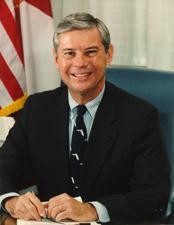 Sen. Bob Graham (D-FL)
Legislative Activity
Stay on top of the latest movement without scrolling through every action
Roll call votes on amendments in Senate: Motion to table amendment SA 294 agreed to in Senate by Yea-Nay Vote. 55 - 44. Record Vote Number: 63.
March 20, 2003
View full timeline
Roll call votes on amendments in Senate: Motion to table amendment SA 294 agreed to in Senate by Yea-Nay Vote. 55 - 44. Record Vote Number: 63.
March 20, 2003
Considered by Senate. (consideration: CR S4044, S4109-4110)
March 20, 2003
Motion to table amendment SA 294 agreed to in Senate by Yea-Nay Vote. 55 - 44. Record Vote Number: 63.
March 20, 2003
Senate amendment submitted
March 19, 2003
Senate amendment proposed (on the floor): Amendment SA 294 proposed by Senator Dorgan for Senator Graham FL.(consideration: CR S3973-3979; text: CR S3973-3974)
March 19, 2003
Amendment SA 294 proposed by Senator Dorgan for Senator Graham FL. (consideration: CR S3973-3979; text: CR S3973-3974) To provide a meaningful prescription drug benefit in Medicare that is available to all beneficiaries.
March 19, 2003
Votes
1 roll call on this amendment
Text
Proposed
CONGRESSIONAL BUDGET FOR THE U.S. GOVERNMENT FOR FISCAL YEAR 2004

The PRESIDING OFFICER. Under the previous order, the Senate will now
resume consideration of S. Con. Res. 23, which the clerk will report.
The legislative clerk read as follows:

[[Page S3914]]

A concurrent resolution (S. Con. Res. 23) setting forth the
congressional budget for the United States Government for
fiscal year 2004 and including the appropriate budgetary
levels for fiscal year 2003 and for fiscal years 2005 through
2013.

Pending:

Boxer amendment No. 272, to prevent consideration of
drilling in the Arctic National Wildlife Refuge in a fast-
track budget reconciliation bill.

The PRESIDING OFFICER. Who yields time?
The Senator from Nevada.
Mr. REID. Senator Conrad authorized Senator Boxer to control the
final 40 minutes of debate. Do we not have 40 minutes on the amendment?
The PRESIDING OFFICER. Forty-one minutes is controlled by the
sponsor.
Mr. REID. Senator Conrad has authorized me to delegate that 41
minutes to Senator Boxer for allowing other Senators to speak during
that 41 minutes.
The PRESIDING OFFICER. The Senator from California.

Amendment No. 272

Mrs. BOXER. Mr. President, at this point, I will yield to four people
in sequence: Senator Bingaman, 10 minutes; Senator Durbin, 5 minutes;
Senator Murray, 5 minutes; Senator Stabenow 5 minutes. That will be the
total of our speakers and then we will be happy to yield an equivalent
amount of time to the other side, if that will be acceptable. These
Senators would like to give their short statements and then go back to
their committees.
Mr. NICKLES. Reserving the right to object, the Senator is trying to
block in how much time?
Mrs. BOXER. Twenty-five minutes.
Mr. NICKLES. Reserving the right to object, let me consult with my
colleague from Alaska.
Mrs. BOXER. As I understand it, I control 41 minutes of time. Is that
correct? Instead of just standing here and speaking myself about this
amendment, I have suggested we allow it to go in this sequence and then
back to my colleagues on the other side, just for the sake of my
colleagues' schedule.
Mr. STEVENS. Reserving the right to object.
The PRESIDING OFFICER. The Senator from Alaska.
Mr. STEVENS. When I left the floor last evening, I yielded to my
colleague from Alaska, Senator Murkowski, and it was my understanding
the time would be charged against the bill. Instead, I understand it
has been charged against the amendment. I ask the manager of our bill
to allocate to us an equal amount of time as remains for the Senator
from California under the amendment.
Mr. NICKLES. Mr. President, I am happy to yield to my friend and
colleague from Alaska an hour on the bill so he may speak in opposition
to the amendment of the Senator from California.
Mr. STEVENS. I thank the Chair.
The PRESIDING OFFICER. The Senator has that right.
The Senator from California has the floor.
Mrs. BOXER. Mr. President, I yield 10 minutes to a real leader on
this issue, Senator Bingaman, the top Democrat on the Energy Committee.
The PRESIDING OFFICER. The Senator from New Mexico is recognized for
up to 10 minutes.
Mr. BINGAMAN. Mr. President, I very much appreciate the Senator from
California yielding me some time to speak and briefly express the point
of view that I expressed when we debated this bill last year.
As all of us know, this issue has been a perennial one. It comes back
all the time in the Senate and has now for several decades. I rise to
support the amendment of the Senator from California. The amendment
would strike the provisions from the budget resolution that essentially
pave the way for the opening of the Arctic National Wildlife Refuge to
oil and gas development.
There are various reasons, both related to national security and
related to the environment, that lead me to conclude that I do not
support going ahead with oil and gas leasing and development of the
Arctic Refuge. The most compelling reason for not opening the refuge is
that it will do very little, if anything, to further our national
energy security. Not a single drop of oil would come from the Arctic
Refuge for at least 7 years and more likely 10 or 12 years.

I urge my colleagues to vote in support of the amendment for the
following reasons:
First, drilling in the Arctic Refuge is not an answer to the problem
of energy security. This chart is familiar to any who were here during
the debate on the energy bill last year. The U.S. Geological Survey
estimates the mean economically recoverable oil on Federal lands on the
Costal Plain of the Refuge at somewhere between 3.2 and 5.2 billion
barrels and that is at prices of somewhere between $20 and $24 per
barrel, in 1996 dollars. Clearly, prices are higher today.
The Arctic Refuge would supply no more than 2 percent of America's
oil demand in any given year. This chart shows the U.S. oil consumption
in million barrels per day. The top line is the total oil demand.
Below, the green line, is domestic oil production. The small red line
is the ANWR production. Relative to our total consumption it is a small
item. It will be at least 7 years, more likely 10 to 12, before there
is actual production on the Coastal Plain if we were to vote today to
open this area for production. Peak production would not occur for 20
years or more after the initial production started.
Another chart shows the same point in a slightly different way, that
drilling in the Arctic Refuge does not address in a significant way our
reliance on imported oil. This chart contains information from the
Energy Information Administration. The green line indicates the net
imports with ANWR production and the blue line is net imports without
production from ANWR. According to our own Energy Information
Administration, which is part of this administration, they show that
production would begin in about 2012 and production from ANWR of oil,
any significant oil, would end by about 2025. Then we are right back
where we started.
So our dependence on foreign imports to meet our oil demand will
continue to grow. It will not grow as much during those years when ANWR
is in production, but it will grow a substantial amount. The Energy
Information Agency estimates that production from the Arctic Refuge
would reduce the net share of foreign oil relied on by consumers from
62 percent to 60 percent by the year 2020. As this chart shows, by 2025
we are right back to no reduction as a result of ANWR production
because ANWR production will have largely played out by that time.
Another reason I offer to my colleagues today in support of the
amendment, is that a controversy over the Arctic Refuge diverts
attention from the real opportunities we have for enhancing domestic
energy production. There are other ways we can expand production.
Senator Grassley, Senator Baucus, Senator Domenici, and I introduced
the Energy Tax Incentives Act the other day. Unlike the opening of the
Arctic Refuge, this legislation would provide near-term increases in
domestic energy production. Not only does the legislation include tax
provisions that would help us diversify our energy supply and increase
our reliance on renewable sources of energy and enhance energy
efficiency, it would also provide specific incentives for increased oil
and gas production.
Some would ask, from where is this oil and gas production going to
come? I have another chart that makes a point people do not focus on.
This is a map of the North Slope of Alaska showing the ANWR area on the
right, the 1002 area. It shows the National Petroleum Reserve Alaska,
the large tan-colored area on the map. The National Petroleum Reserve
Alaska is an area that has begun to be leased by the Department of the
Interior. Secretary Babbitt began that process when he was in office.
Secretary Norton is proceeding with that. Frankly, I support going
ahead with drilling in that area. There is a substantial likelihood of
very large energy production from that area. There is a real prospect
of increased oil and gas production from the North Slope.

Let me mention gas production. I indicated one of the reasons we
should not focus on ANWR is that it is diverting our attention from our
other opportunities to deal with our energy needs. One of those great
opportunities is to bring the gas production from the

[[Page S3915]]

North Slope of Alaska, gas that is already being produced and
reinjected into the ground, bring that gas down to the Lower 48 States.
We tried very hard in the last Congress to pass legislation to
streamline the process for getting a pipeline constructed. I strongly
support that. We need a pipeline to bring that natural gas to the Lower
48. Anyone who is dependent upon natural gas for home heating today
knows the price is high. They are going to notice it even more over the
next 2 or 3 months as they get the bills during this period of high
natural gas prices. The best opportunity we have to relieve that
pressure is building that pipeline to bring Arctic gas down to the
Lower 48. That is what we should concentrate on: develop more oil from
the National Petroleum Reserve Alaska, bring the gas already produced
on the North Slope down to the Lower 48. I hope we can do that.
I also make the point that we need to continue to emphasize
developing alternative sources of energy. That is something we will get
into in a large way when we debate a new energy bill this Congress, a
new proposed energy bill, and we can make the point again.
The solution to our long-term energy problems is not to open the
Arctic National Wildlife Refuge to drilling. It is an environmentally
sensitive area, one we have determined to keep off bounds, out of
bounds, for drilling up until now. I believe that is a sound policy.
In conclusion, there are many reasons why the Coastal Plain of the
Arctic National Wildlife Refuge is not needed and should not be drilled
for oil and gas. The environmental sensitivity of the area is clearly
well recognized by all. Opening the Refuge is not good environmental
policy. Equally important, it is far from necessary as part of our
national energy policy.
I urge my colleagues to join in opposition to the oil and gas leasing
and development of the Arctic National Wildlife Refuge and to support
this amendment by the Senator from California.
The PRESIDING OFFICER. The Senator from Illinois.
Mr. DURBIN. It is my understanding Senator Boxer has yielded me 5
minutes.
I say to my colleagues who follow this debate, take a look at this
Arctic National Wildlife Refuge. If you look at the National Academy of
Sciences' recent report, it is clear that drilling for oil in this
wildlife refuge in the far reaches of Alaska is environmentally
dangerous. There are some who write that off and say if we get more oil
out of it and create some jobs, so what. Frankly, that is
irresponsible.
We have a responsibility in this generation to leave to the next
generation the natural heritage that we were given. If we are not
forced to go to the Arctic National Wildlife Refuge for the survival of
the United States or its economy, for goodness' sake, why would we run
the risk to endanger this important National Wildlife Refuge that we
have protected for over 50 years?
Second, this is as shortsighted as it gets, to suggest the only way
to deal with energy security in the United States is for us to start
drilling in wildlife refuges, that small part of the world we set aside
to protect endangered species, topography, and environment that you
cannot find anywhere else on Earth. Now the oil companies tell us: I'm
sorry, our energy needs are so substantial, we have to start drilling
there?
I say to the young people in America: Following this debate, take a
look at the parking lots across America if you want to know what to do
about energy. Take a look at the inefficient vehicles we are driving on
the road today because this Congress and this country has not shown the
leadership to have more efficient cars and trucks in America. We can do
it. We have done it in the past. But this bill, this issue, is
consistent with what I am afraid is the wrong message to America.
The message in this bill is: We may be minutes away from a war where
thousands of American lives are at risk, we may be faced with terrible
news for families across America and death in Iraq to innocent Iraqis,
but we can still call for a tax cut for the wealthiest people in
America. The message in this amendment is: We may face the question and
challenge of energy security, but rather than to say to American
families, Do your part, buy vehicles that are more efficient, and to
Detroit, produce those vehicles--instead of that, no, we are going to
drill for oil in a wildlife refuge in Alaska. Is that what America has
come to? Is that what we are all about? Don't we expect our leaders to
summon us to show our best, to sacrifice for our Nation so we can lead
and demonstrate to future generations that we care about our natural
heritage, we care about our spirit of national sacrifice?
This is an amendment that should be defeated. The Arctic National
Wildlife Refuge should not be drilled. We should not move forward with
this exploration. And this bill calling for tax breaks for the
wealthiest people in America as we are poised to go to war is a
shameful bill. It is something we should not be considering on the
floor of the Senate at this moment in our history. This amendment, if I
understand it correctly, will not change the budget levels. This
amendment failed by only 1 vote, on a party-line vote, in committee.
But I believe we will win it now.

Let me begin by saying that the Arctic National Wildlife Refuge
provision has no place in the budget. For those who want to propose oil
and gas development in this area of the Arctic National Wildlife
Refuge, we can debate that in a more appropriate context, such as the
energy bill. This important issue should not be snuck into the budget
through a legislative back door, but should be debated in an open,
honest way through the normal legislative process.
Let me also note that the full Senate has already defeated proposals
to drill in the Arctic National Wildlife Refuge, because it is bad
policy. We should end this perennial debate once and for all, and move
to more reasonable matters that deserve the Senate's attention. There
are better, longer-term solutions to our energy crisis than drilling in
our few remaining frontier areas, including making automobiles more
fuel efficient.
The Refuge is not the answer to energy problems. The most stunning
statistic in this whole debate is that the Arctic coastal plain would
only yield 6 months' worth of oil for our country; and we wouldn't get
it for 10 years. And this is under the most optimistic assumptions.
There is no doubt that we are over-dependent on foreign oil in our
country. We need to address this issue on multiple fronts, including by
exploring alternative sources of energy, such as fuel cells, and by
promoting efficiency and thereby reducing consumption. I have talked
with coal developers who say that we may be able to use coal to isolate
hydrogen for use in fuel cells in automobiles. I have also talked with
automobiles researchers, who have told me of myriad existing
technologies to improve fuel efficiency in the transportation sector,
the largest user of oil.
So to say that the Arctic National Wildlife Refuge is the only answer
to our energy questions in completely off-base. In fact, it is not even
one of the viable answers, because it holds so little oil compared to
what we demand as a country.
The Refuge deserves protection. The 1.5 million-acre coastal plain of
the Arctic National Wildlife Refuge is a clear candidate for protection
under the Wilderness Act of 1964. That is why I am cosponsoring Senator
Lieberman's bill to designate this 1.5 million acre area as wilderness.
This swath of land is surrounded on three sides by 8 million acres of
land already designated as wilderness.
The Arctic Refuge includes boreal forests, dramatic peaks, and
tundra. If features a complete range of arctic and subarctic
ecosystems, with an extraordinary assemblage of wildlife. Polar and
grizzly bears, wolves, muskoxen, and snow geese are just a few of the
more than 200 animal species that use the coastal plain. Also the
coastal plain is the most significant on-land polar bear denning
habitat in the U.S. In addition, the 155,000 member porcupine caribou
herd has used the coastal plain as a calving area for 20,000 years or
more. There is no alternative to this sensitive habitat for the caribou
herd.
Research has documented the ecological importance of this land, and
the effects of oil and gas development there. On March 5, 2003, the
National Academy of Sciences released a new report that details the
serious, detrimental, and cumulative effects of oil

[[Page S3916]]

and gas activities on Alaska's North Slope. The report finds numerous
effects, including ``a large oil spill in marine waters [which border
the coastal plain] would likely have substantial accumulating effects
on whales and other receptors because [current cleanup efforts are
inadequate].'' This is especially significant, given that there is an
average of 423 oil spills annually on the North Slope.
The report also finds that species population decline, including
reduction of some bird species such as black brant, snow geese, eiders
and probably some shorebirds, is common in industrial areas in the
North Slope.
In an important new discovery, the report finds ``climate changes
during the past several decades on the North Slope have been unusually
rapid.'' Climate changes can change ice flow and the entire ecosystem
of this area.
The report further finds that only about 100 acres--1 percent--of the
habitat affected by gravel fill on the North Slope have been restored.
The National Academy of Sciences concluded that unless major changes
occur, it is unlikely that most disturbed habitat on the North Slope
will ever be restored. Because natural recovery in the arctic is slow,
effects of unrestored structures are likely to persist for centuries,
and will accumulate as new structures are added.
Environmental impacts of oil and gas development are real, and that
is why we need to site such activities in a careful, responsible
manner.
In conclusion, Aldo Leopold, the long-time Forest Service employee
and conservationist said it best in 1949: ``Having to squeeze the last
drop of utility out of the land has the same desperate finality as
having to chop up the furniture to keep warm.''
The Arctic Refuge is one of the last, remaining wilderness areas
awaiting protection. Let's not destroy it; let's save it. And let's end
this perennial debate once and for all. There are better, longer-term
solutions to our energy crisis than drilling in our few remaining
frontier areas, including making automobiles more fuel-efficient. And
if we want to debate energy policy, the budget resolution debate is not
the time to do it.
Out of respect for the proper legislative process, and out of respect
for the seriousness of this decision in terms of energy and environment
issues, and in terms of the impacts on the present and future
generations of this country, I urge my colleagues to vote for the Boxer
amendment.
Mrs. BOXER. Will the Senator yield his remaining time for a question?
Mr. DURBIN. Yes.
Mrs. BOXER. I wonder if the Senator had seen this chart which shows
by the year 2030 how much energy is yielded by these various factors.
This would be how much energy we would get from the Arctic Refuge
production, 2.38 billion barrels of oil. If we just put better tires on
our cars, it would result in better fuel economy, we would save more
energy.
If we just closed the SUV loophole, meaning we got those SUVs up to
the same mileage as cars, we would save 10 billion barrels. And, by the
way, if we did fuel economy, as my friend suggested, up to 35 miles per
gallon, which is very modest, look at what it would save: 18 billion
barrels. Here is what the Arctic gets us, and we destroy a region that
looks like this, instead of going this way.
Mr. DURBIN. I know my time is running out. I just want to say, when
you turn to the conservatives in Congress and say: Can't we improve the
efficiency of our vehicles? No, that's the heavy hand of Government.
Let me tell you, drilling in the Arctic National Wildlife Refuge is
the heavy hand of Government in a part of our world we should be
protecting. It is saying to oil companies, make a profit so we don't
have to ask American families and automobile manufacturers to do the
right thing for our future.
I reserve the remainder of my time.
Mrs. BOXER. Mr. President, I am going to take 1 extra minute off the
bill, if I might, to simply send to the desk a letter from Jimmy
Carter, former President Jimmy Carter. Last night it was implied by
several colleagues--I have their words actually--I will not go through
them now--that President Carter supports drilling in the Arctic
National Wildlife Refuge. Just to quote from a little bit of his
letter, he says:

We can have the untouched sublime wilderness. Or we can
have oil field development. But we cannot have both.
Opening the coastal plain for oil exploration and
development would be, despite all the much-vaunted
technological promises, severely damaging to wildlife and the
ecosystem. And it is inherently fatal to the wilderness
qualities of this matchless example of America's natural
heritage.

I ask unanimous consent that the letter be printed in the Record.
There being no objection, the material was ordered to be printed in
the Record, as follows:

The Carter Center,

Atlanta, GA, February 27, 2002.
The Honorable Senator,
U.S. Senate, Senate Office Building,
Washington, DC.
Dear Senator: Every decade or so we seem to have a great
national debate about whether or not to preserve the very
best of our natural heritage. In the 1960s it was over
building dams in the Grand Canyon, a desecration comparable
to oil drilling in Yosemite or Yellowstone.
Now, an equally significant showdown is over the fate of
the coastal plain of the Arctic National Wildlife Refuge, an
area first set aside for protection by President Dwight
Eisenhower.
Rosalynn and I have crouched on a peninsula in the Beaufort
Sea to watch the defensive circling of musk oxen that
perceived us as a threat to their young. We have sat in
profound wonder on the tundra near the Jago River as 80,000
caribou streamed around and past us in their timeless
migration from vital calving grounds on the coastal plain. We
have watched dens of wolves, large flocks of Dall Sheep, and
isolated polar bears. These phenomena of the untrammeled
earth are what lead wildlife experts to characterize the
coastal plain as America's Serengeti.
Having raveled extensively in this unique wilderness, I
feel very strongly about its incredible natural values. I
hope you will not be distracted by the argument that oil
exploration and development will have minimal impact because
the ``footprint'' of modern drilling technology will be small
amid the 1,500,000 acres of the coastal plain.
This simply is not true. While a precise measurement of the
exact acres finally to be covered by drill pads, gravel pits,
access roads, air fields and the vast spider-web of pipelines
might not exceed 2,000 acres, these acres would be spread
across a far wider expanse, covering hundreds of square
miles, connected by a network of modern transportation
routes. The impacts on the fragile tundra ecosystem, on
migratory waterfowl and on other wildlife would be much
greater than the claims of the oil drillers.
The point I want to stress to you is that, as with the
proposed dams in the Grand Canyon years ago, we face on the
Arctic coastal plain a choice about fundamentals. We can have
the untouched, sublime wilderness. Or we can have oil field
development.
But we cannot have both.
Opening of the coastal plain for oil exploration and
development would be, despite all the much-vaunted
technological promises, severely damaging to wildlife and the
ecosystem. And it is inherently fatal to the wilderness
qualities of this matchless example of America's natural
heritage.
Through compromises that began more than four decades ago
and were concluded when I signed the Alaska National Interest
Lands Conservation Act in 1980, 95% of Alaska's North Slope
has already been made available for oil exploration or
development. We should not sacrifice the last 5%--the area
scientists call the ``biological heart of the Arctic
Refuge''--for a speculative short-term fix of oil a decade
from now.
As with previous great environmental debates, this issue
has assumed gigantic symbolic stature, as some have elevated
it as the alleged ``solution'' to everything from higher gas
prices to terrorist threats.
The truth is we could drill every national park, wildlife
refuge, and coastline and still be importing more than half
our oil, remaining just as vulnerable to the price
fluctuations of the global oil market. By contrast, raising
the fuel economy of our cars and trucks would save far more
of then we import from the Persian Gulf, reduce greenhouse
gas emissions, and save billions for American consumers. To
put this in perspective, had the United States continued to
conserve oil at the same rate we did from 1976 to 1985, we
could have weaned ourselves from Middle East oil fifteen
years ago.
I urge you to pass a cleaner and safer energy plan that
enhances our security without undermining our nations' great
wilderness heritage. Please vote against cloture on any
amendment that would authorize oil drilling in any part of
the Arctic National Wildlife Refuge coastal plain.
Sincerely,
Jimmy Carter.

Mrs. BOXER. I now yield 5 minutes to Senator Patty Murray who has
also been a tremendous voice for the environment here in the Senate.
The PRESIDING OFFICER. The Senator is recognized for 5 minutes.
Mrs. MURRAY. I rise this morning to support the amendment of my
colleague from California, Senator Boxer, that will stop this backdoor
attempt to

[[Page S3917]]

drill for oil and gas in the Arctic National Wildlife Refuge.
I spoke several days ago here on the floor of the Senate at great
length about what this budget proposal would do, the budget resolution
that is before the Senate, and how reckless it is. It ignores the cost
of war, it ignores the cost of the aftermath in Iraq, and it underfunds
critical priorities here at home such as homeland security, education,
and transportation.
But I am appalled that there is something else buried in this massive
budget that needs to be removed. The budget now before the Senate
actually assumes increased spending that will result from opening ANWR
up to exploration and drilling, even though the Senate clearly rejected
that last year. Exploration and drilling in ANWR is a controversial
issue, and it should be fully debated. But the appropriate place for
that debate is on the energy bill which the Senate will consider in the
coming months.
Last year, this Senate soundly rejected efforts to open ANWR to
exploration and to drilling. This year, proponents of drilling are
using a backdoor approach to try to get support for ANWR in this budget
reconciliation. The amendment that has been offered by my colleague
from California will strike that language and leave the ANWR debate
where it belongs, as part of the upcoming debate on an energy bill.
The budget reconciliation process was enacted actually to help us
reduce our deficit. That is even more important now that our country is
back in red ink. Instead of supporting a process that helps reduce our
deficit, proponents of drilling are using it to pass something the
Senate rejected last year.

The Arctic National Wildlife Refuge is an important and unique
national treasure. It is the only conservation system in North America
that protects a complete spectrum of arctic ecosystems. It is the most
biologically productive part of the Arctic Refuge. Energy exploration
in ANWR would have a significant impact on this unique ecosystem.
I have heard the proponents of this measure argue over the years that
energy exploration has become what they call more environmentally
friendly. That may be true. But there are significant environmental
impacts for this sensitive region. The oil reserves in ANWR, in fact
the oil reserves in the entire United States, are not enough to
significantly reduce our dependence on foreign oil.
There are ways to reduce our need for foreign oil. My colleague, the
Senator from Illinois, spoke about that a moment ago. We can increase
the fuel economy of our automobiles and lightweight trucks. We can
reduce our need for foreign oil by expanding the use of domestically
produced renewable and alternative fuels. We can invest in emerging
technologies such as fuel cells and solar electric cars, and we can
increase the energy efficiency of our office buildings and homes. Those
kinds of strategies will reduce our dependence on foreign oil and
protect one of our Nation's most precious resources. That is what we
should be focusing on.
I think we should also remember the amount of oil in ANWR is too
small to significantly improve our current energy problems. The oil
exploration in ANWR will not actually start producing oil for as many
as 10 years.
Exploring and drilling for oil and gas in ANWR is not forward
thinking. It is a 19th century solution to a 21st century problem. The
Senate should soundly reject this backdoor attempt to use the budget
process to embrace drilling in the Arctic National Wildlife Refuge when
so many in the Senate oppose it. We should debate drilling in ANWR when
the Senate energy bill comes up, but we should not make a decision on
drilling in this budget resolution.
I urge my colleagues to support this very important amendment by the
Senator from California.
Mrs. BOXER. Will the Senator yield her remaining time?
Mrs. MURRAY. I yield my remaining time to the Senator from
California.
Mrs. BOXER. I say to my friend, I appreciate her raising the issue of
the safety here because in the Prudhoe Bay oil field and the Trans-
Alaska we have seen an average 423 spills annually on the North Slope
since 1996, and that is according to the Alaska Department of
Environmental Conservation. Over 1.7 million gallons of 40 different
substances, from acid to waste oil, have been spilled during routine
operations from 1996 to 2002. There were 2,958 spills, commonly diesel,
crude oil, and hydraulic oil.
My friend is right. Maybe years ago they would have been worse
spills, but the fact is there are terrible spills now.
I see that my colleague's time is up. I thank the Senator for
participating.
Mr. President, I yield 5 minutes to Senator Stabenow from Michigan.
The PRESIDING OFFICER. The Senator from Michigan is recognized for up
to 5 minutes.
Ms. STABENOW. Mr. President, first, as I begin, I know I share the
feelings of all my colleagues, as we are debating this budget
resolution and this important amendment, that our thoughts and prayers
go to the men and women who are overseas, our troops who are being
placed in harm's way. Regardless of our feelings about the policies
that have brought us to this point, we all stand united in supporting
our troops. It makes these kinds of debates even more important.
I am very proud to be a cosponsor of this amendment. I commend the
Senator from California for her steadfast leadership on this issue,
along with a number of colleagues of mine who have consistently stood
firm about protecting the Arctic National Wildlife Refuge.
I have been pleased to be a cosponsor of legislation to stop drilling
since first coming to the House in 1997. I also am proud to be the
author of the ban that we placed on drilling in the Great Lakes,
another national treasure. I view this area in Alaska as much of an
irreplaceable and fragile natural and national treasure as the Great
Lakes. I am very hopeful that today we will, one more time, stop this
particular drilling policy from moving forward.
I would like to, once again, speak about some of the same points my
colleagues have spoken of because I believe we have to keep repeating
them to make it clear what the facts are.
First of all, the Arctic National Wildlife Refuge is, in fact, one of
the wildest and most pristine places in the United States. We have an
obligation to protect this area for the future, for those who are
counting on us to be able to look beyond the immediate time period and
look to the future for our country and for our children.
I believe we also have an obligation to stop back-door approaches to
this issue. We are seeing, one more time, the drilling in the Arctic
National Wildlife Refuge being placed in a bill where it should not be.
This is a budget bill. We are focusing on the budget priorities for the
next year.
Frankly, we should be debating how much the war is going to cost, and
making sure our folks on the front line, and our first responders at
home, police and firefighters and emergency workers, have what they
need as we enter this very challenging time. Those are the kinds of
things we should be debating, not seeing a back-door approach to
drilling in the Arctic Wildlife Refuge.
Most importantly, we know that drilling in the wildlife refuge will
not result in energy independence. This is talked about all of the
time, but it needs to be repeated, that only 2 percent--if we were to
drill, we are talking about 2 percent of America's oil demand every
year; and it would take at least 10 years to begin to see this brought
on to the market.
We are talking about 2 percent rather than focusing on other areas of
energy policy that will net alternatives in terms of conservation:
alternative vehicles, alternative fuels, all of those kinds of things
we know will allow us to become energy independent sooner and more
effectively for the long run.
It is impossible for the United States to drill its way to energy
security and independence. What we need to have is a debate about the
energy policy of the country and how we are going to move forward. And
that needs to be done in the energy bill, not in the middle of the
budget resolution.
I am concerned when I hear this particular debate tied to Iraq, the
serious debate about war and the oil in Iraq. It is important to say
that gas prices are determined by global supply and demand factors, as
we all know, not by opening one area to drilling.

[[Page S3918]]

In addition, Iraq supplies a very small percentage of our U.S. energy
needs. According to the EIA, only 1.5 percent of the Nation's energy
supply comes from Iraq. Imports from Iraq were banned in 1990 in the
wake of the Persian Gulf war, and we obtained no oil from 1991 to
1995--all with no impact on the greatest economic expansion in U.S.
history. The fact is, Canada and Mexico together supply more oil to the
U.S. than the entire Persian Gulf.
So I encourage my colleagues to join with us in support of this
amendment.
The PRESIDING OFFICER. The Senator's time has expired.
Ms. STABENOW. I thank the Chair.
The PRESIDING OFFICER (Mr. Graham of South Carolina). Who yields
time?
The Senator from Montana.
Mr. BURNS. Mr. President, I, on this issue, yield as much time to
myself as I shall need. I ask unanimous consent to do that, and that
the time come off the resolution.
The PRESIDING OFFICER. Is there objection?
Without objection, it is so ordered.
Mr. BURNS. Mr. President, I don't know exactly where to begin on this
particular subject. But I would like for the American taxpayers to
understand one thing: We maintain a strategic oil reserve. It is 700
million barrels of oil that is stored in salt caves in Louisiana. It
costs us $175 million a year to maintain the Strategic Petroleum
Reserve. I just want the taxpayers to know what they are paying for.
The fact is, part of that oil was purchased by this Government and
put in there, but most of it was taken from royalties. They took the
oil instead of the money. And that was recovered on the Outer
Continental Shelf or from public lands. So it is there: 700 million
barrels of oil that costs the taxpayers $180 million a year to
maintain.
I suggest that we have a Strategic Petroleum Reserve that is not
costing the American people a thing. It is still in the ground in North
Dakota, found on public lands, where we cannot get to it. It is found
in Montana, on public lands, where we cannot get to it. That is because
of organizations that deal primarily in fear, not common sense.
Abraham Lincoln once said: God must have loved the common man because
he made so many of us. Then, when we use the same term in the phrase
``common sense,'' that sort of changes the definition a little bit.
That Strategic Petroleum Reserve is also maintained, and it is still
in the ground in ANWR. We do not know how big that reserve is. It has
been estimated to be anywhere from 5.3 billion barrels upwards. Does it
answer the question of our shortage? Does it take care of all of that?
No, it does not. We know that. But, on the other hand, it replaces all
the oil we buy that is termed ``rogue'' oil--Iraqi oil that we give
hard dollars for and that you contribute to every time you fill your
tank at a filling station.
What is that money used for? We have seen it on television every
night for the past month and a half. We know what that money is being
used for. We give it to a tyrant who uses that money to subsidize
families, to entice them to take one of their children and strap
dynamite on them and walk onto a bus and blow themselves up, and for
the development of weapons of mass destruction, chemical and biological
warfare. That is what that money has done.
And yet we sit here today trying again to ban the use of a resource
that is not only one of the major underpinnings to our economy, but
also takes away from that $180 million a year we spend to maintain that
SPR in case of an emergency. That is 90 days. It wouldn't even last 90
days. We would just go through it, bingo. It defies common sense, what
we are doing here.

As far as my State of Montana is concerned, I don't know what the
impact is. I know during the major exploration and lifting of Prudhoe
Bay and the North Slope when it opened up, probably 1,500 families in
Montana worked on the North Slope. It provided a lot of jobs. I am not
saying that their figure here on the creation of jobs is what some
would claim, but it isn't zero, I will guarantee you that. It is going
to put a lot of people to work. Maybe jobs only are important to us if
they are just in our home state. Maybe it is the welfare of the people
if it is just in our State. But the impact it has on Alaska is
terrific, on the people who live there, work there, raise their
families there, provide services there.
If you wanted to put it to a vote in Alaska, this debate wouldn't
even be taking place. The Native Alaskans; ask them, take a vote among
them, if we really believe in this 50 percent plus 1. It is their
income. This is just about all they have.
What you see of the pictures over there is a result of a 30-day
growing season. Any other time I would look with great interest at a
photograph that was being displayed last night of the caribou that was
out in the water. They had water clear up over their back going into
the sea up there. Do you know why they are standing in that water,
folks? It is not to cool off. Because they have mosquitos up there that
are big enough to turn over your dog tags and check your blood type.
That is what they are getting away from. It is a hostile environment.
What are we doing here with the new technology: I mentioned a while
ago the jobs of the families who are affected in my State. Those kinds
of jobs have moved on. New technology has taken over. We drill
differently now. We do it all differently with horizontal drilling
practices, with one little area impacted. You may see the wells. It
wouldn't be the size of the Chamber of the Senate. It may have a dozen
wells. That is the way we do it now. Technology has moved on.
I was interested in the words of my good friend, the Senator from
Michigan, and the Senator from California. And by the way, California
consumes 12 percent of all of the transportation fuels produced in this
country. Yet we cannot drill on the Outer Continental Shelf of
California. There is a moratorium on that. There is a moratorium on
Florida. They are quick to talk about the Gulf of Mexico and off the
coast of Louisiana and Alabama. We can't drill off the east coast, yet
Canada does. When you get north of the border, they drill all the way
offshore almost to Iceland. If you want to go east of the United States
and the Canadian line and the northern territories off Alaska, you have
gas and oil production all across Canada. The largest exporter of
energy to this country is Canada, both in crude and in gas.
Yet the United States is being denied our own resource in our own
country to supply the heat and the transportation fuels for our own
people and our own security. And groups would manipulate information on
ANWR to deny the American people when common sense tells you it is just
the other way. Those of us who live near and some of us on public lands
understand what the thinking is.
I will tell you this, as we talk about this total resolution. If you
want to see something happen, this President has offered a way to
stimulate the economy and to have it going when those young men and
young women come home from the gulf and they go back into the
workforce. Do you want them to come back into a sluggish economy? Is
that what we want to do here? Do we want to take a sluggish economy and
pound it down further and have no opportunities for them outside of
military life, those reservists and also those who serve in the
National Guard?

We are finding out the cost of 50 percent of our force structure and
military is at home now and not found on military bases, full-time
soldiers, sailors, marines, and airmen. This is a part of that growth
package. This is a part of a package that shows immediate return to the
American taxpayer and also gives us that security, our own home
security, if it is ever needed. What is wrong with finding out how much
oil we really have? We can't even explore, let alone lift. And we are
doing it based on thinking and facts that do not heed common sense. It
is groups, little tiny groups that propagate misinformation and do it
on an emotional ``green, fuzzy'' resolution. That you would deny people
a livelihood, deny them food, deny them the basic needs of education
and health care in the State of Alaska based on misinformation, that
can't make one feel very good.
So if we are looking for job creation, if we are looking for energy
security, if we want to do away with this little ticket of $175 million
a year just to maintain oil in salt caves, then when you get the bottom
line, the answer is

[[Page S3919]]

pretty clear--let alone the promise that this Congress made to the
State of Alaska whenever they passed the land bill there and also
created the Alaska National Wildlife Refuge.
By the way, we are breaking that word, too. That rests on the backs
of Congress. So I ask for those who live there, the Natives who were
raised there, with their traditions--I will tell you, I don't know if
you have ever seen the caribou come across there. The area is not short
of wildlife--not from the impact of Prudhoe and North Slope. All the
benefits that have gone to Alaska and to America as a result of that
tremendous resource--those tremendous reserves, in a part of the world
that is fragile, yes; all land is fragile, but it is a land we can take
care of and still use the resources it provides.
I ask my colleagues to use some common sense. Go through the same
figures I have. If you get a different number, you let me know, because
I am just a country boy; I count bushels and heads of livestock. But
when you get to the bottom line, it is a plus for America, a plus for
our security, a plus for jobs, and it is also a plus for the great
State of Alaska.
Our technology has not gotten us to the point where we can safely and
economically do in our transportation fuels, using fuel cells and
biomass, anything you want to do. That technology is not there yet,
folks. If you want to cut off the oil today, you will see how fast this
economy would crumble. But you cannot talk economy, you cannot talk
numbers, because this is an emotional debate. It is wrong. It is wrong
to do it to the State of Alaska, and it is wrong to do it to America.
I yield the floor.
The PRESIDING OFFICER. The Senator from Nevada is recognized.
Mr. REID. Mr. President, I ask that the Senator from North Dakota
yield such time as I may consume.
Mr. CONRAD. I am happy to do so.
Mr. REID. Mr. President, we are doing our best, in accordance with
the direction we have gotten from the majority leader, to move this
bill along. We are trying. I spoke to the manager of the bill this
morning, and we are trying to do that. We want to offer other
amendments. We have a couple of minutes left to speak on ANWR. We want
to offer other amendments. We were ready to vote on ANWR last night, or
this morning, or early this afternoon--anytime. We need to move this
legislation along, and we are doing the very best we can, but we have
amendments we have to offer.
I hope we have the opportunity to do that. The time is quickly
dwindling, and we are doing our best not to have many votes on the
vote-athon; but with each day that goes by, it appears there will have
to be more because people are not having the opportunity to offer
amendments.
The PRESIDING OFFICER. The Democratic leader is recognized.
Mr. DASCHLE. Mr. President, I will use my leader time for the
comments I am about to make.
The decision whether or not to allow drilling in the Arctic National
Wildlife Refuge is a defining moment for national energy and
environmental policy.
This debate reflects two divergent views of our Nation's values and
future.
We have a choice: Either we can continue building oil wells in
environmentally sensitive areas or we can reject the quick fix and
broaden our Nation's energy base while honoring our commitment to our
natural heritage.
It has become apparent that America depends too heavily on some very
undependable foreign sources of oil.
Hostilities in Iraq are just the latest chapter in decades of
instability in the Persian Gulf.
Meanwhile, production of oil in Venezuela has been brought to a near
standstill because of domestic unrest.
For the sake of our economy, for the sake of national security, and
for the sake of our environment, America must reduce its reliance on
foreign oil.
But instead of diversifying energy supply, investing in new
technologies and promoting efficiency, the Bush administration's
priority is to look for the next big domestic oil field.
Last year, the Senate rejected the Republicans' effort to authorize
drilling in the Arctic National Wildlife Refuge in comprehensive energy
legislation. Now they are back attempting to use the budget resolution
to grease a change they couldn't make in the energy bill.
No matter how clever they view this parliamentary sleight of hand,
the proponents of drilling in the Arctic Refuge cannot escape the
facts.
While endangering one of the most pristine areas in the world,
drilling in the Arctic National Wildlife Refuge would do nothing to
make our country more energy independent.
We cannot sit silently by while the administration promotes a short-
sighted strategy that mortgages one of our most precious and
irreplaceable wild spaces for a few months' supply of oil.
Gasoline prices are soaring today. Yet this proposal would add
nothing to our oil supply for 10 years.
Even then, the Arctic Refuge would supply our country with no more
than 6 months' worth of oil and would reduce our dependence on foreign
oil by just 2 percent.
This is not a serious attempt to come to grips with America's long-
term energy needs. America cannot drill its way out of this problem.
Ninety-five percent of Alaska's North Slope is already open to
drilling and exploration. Even if we drilled in the last 5 percent,
even if we drilled in the backyards of every American, we could not
satisfy our Nation's appetite for oil.
America produces just 3 percent of the world's oil; yet we consume 25
percent of that supply.
The answer to our energy challenge will not be found in the Arctic
Refuge.
The answer will be found in our willingness to encourage American
innovation and break the habit of spiraling energy consumption. We have
met this test in the past.
In the 1970s, Congress increased fuel efficiency standards and began
to encourage the development of renewable fuels.
Today, those fuel efficiency standards save our country the cost of 3
million barrels of oil every day.
That, and a wide range of clean, domestic, renewable energy
technologies would dwarf any contribution the Arctic Refuge could make
in the future.
Meanwhile, if drilling in the Arctic Refuge is authorized, our lack
of vision would come at enormous cost.
According to the administration's own Fish and Wildlife Service,
``The Arctic refuge is among the most complete, pristine, and
undisturbed ecosystems on Earth . . . a combination of habitats,
climate and geography unmatched by any other northern conservation
area.''
There is no alternative to Arctic National Wildlife Refuge once it is
despoiled. But there is an alternative to this reckless proposal:
A true national energy strategy that speaks to our core environmental
values while at the same time frees our country from the dictates and
uncertain fortunes of foreign oil producers.
Now more than ever, we should be aware of the real cost of dependence
on foreign oil.
Now more than ever, we need real answers and serious stewardship to
the energy challenges of our Nation's future.
Mr. President, I encourage my colleagues to vote to strike the
authorization to drill for oil in the Arctic National Wildlife Refuge
from the budget resolution.
I yield the floor.
The PRESIDING OFFICER. The Senator from Nevada is recognized.
Mr. REID. On behalf of Senator Conrad, I yield 10 minutes to the
Senator from New Jersey, Mr. Lautenberg.
The PRESIDING OFFICER. The Senator from New Jersey is recognized.
Mr. LAUTENBERG. Mr. President, I thank my colleague from Nevada for
yielding the time to me to talk about the Boxer amendment and talk
about the decision we could be making very shortly about the use of oil
from the Arctic National Wildlife Refuge.
Mr. President, what happens is, as these debates get going, sometimes
we hear statements that are somewhat misconstrued or mistaken. We just
heard it suggested on the floor that funds from the purchase of Iraq
oil are used to purchase bombs. Nothing could be further from the
truth. The fact is, that money is passed through the United Nations to
buy food to be distributed to the people of Iraq. There is no way that
money can be used to buy

[[Page S3920]]

bombs. It is important we keep the record straight.

I want so much to see the Boxer amendment prevail, but in order to
make the case, apparently, we have to do more than simply justify the
fact that if we did not do this, we could find other ways to conserve
oil and not have to invade this snow desert, if one has ever seen it.
It is one of the most beautiful places in the world, and the last thing
we ought to do is turn the Arctic National Wildlife Refuge into an
oilfield.
I traveled to Alaska in the aftermath of the Exxon Valdez spill in
1989. At the time, I was chairman of the Transportation Appropriations
Subcommittee, so I had jurisdiction over Coast Guard funding. I was
also a senior member of the Environment and Public Works Committee. So
I had a great deal of interest in the Valdez incident.
What I saw was shocking, stunning almost. Over 11 million gallons of
oil spilled into the Prince William Sound. I witnessed beautiful
wildlife covered in oil, many dead or dying. I saw workers from the
Department of the Interior, the fire service, and others hand wiping
oil off birds and other wildlife. It was a devastating tragedy.
The disaster left a major impression on me. I thought about my
children, my grandchildren, other people's children, and other people's
grandchildren. I never wanted to see the dismay on their faces should
they ever witness this tragedy.
To this day, 14 years later, the area remains contaminated with a
persistence that has surprised many scientists. Sadly, the optimistic
predictions of its recovery proved to be unjustified. Fully 60 percent
of the area remains contaminated. Pools of toxic oil are still being
found several feet deep.
Ecosystems, such as those in Prince William Sound and the Arctic
National Wildlife Refuge, are so fragile, they are such delicate
treasures of our Nation.
I had the privilege of visiting the Arctic National Wildlife Refuge
at the same time, and I can tell you, from personal experience, that in
addition to the damage caused by drilling and oilspills, the debris of
human intrusion, acres of rusting pipes and dilapidated structures
dishonors America's 100-year-old tradition of protecting remote wild
places.
On that visit, I flew in a single-engine plane across to a community
called Deadhorse. It is right near Prudhoe Bay. It was troubling to see
that area, the tundra littered by refuse left by the same oil companies
that now avow they will be good environmental stewards should the
Arctic Refuge be open to drilling.
Why would we risk devastating these national treasures? For what
gain?
There is a dispute as to whether it is a 6-month oil supply or more
that we will see from the Arctic Refuge, but for this short-term gain,
what is the long-term risk, the cost?
I believe the long-term damage is too great. Turning this refuge into
an oilfield will result in the loss of a national treasure we will
never be able to replace. Look at what is happening on the North Slope.
The National Research Council's new report shows that oil drilling on
the North Slope has drastically reduced the population of nesting
birds, such as the snow geese, and seismic exploration has displaced
the culturally sacred bowhead whales from their migratory path,
according to the National Research Council.

Additional drilling will only compound the stresses on these and the
200 other animal and bird species that inhabit the region.
What would the payoff be for recklessly endangering this national
treasure? We would save more oil than we could drill at the Arctic
Refuge at the height of production by requiring SUVs to meet the same
fuel economy standards as regular cars. We never hear talk about
conservation. We never hear talk about everybody pitching in on the eve
of a war to economize and use less fuel whenever we can do so.
There is simply no good reason to endanger this fragile Coastal Plain
ecosystem.
More than oil is at stake here. Thoreau wrote:

In wilderness is the preservation of the world.

America and the world need the last remaining wilderness places. The
Arctic wilderness is one of those places. It would be unconscionable to
despoil it for all time just for a bit of oil. We can find other ways.
I came across an article that tells us about the risk, a risk we are
not discussing in pure terms. This is an Internet news report from a
service called Ananova. The headline is: ``ExxonMobile damages for
Valdez spill cut to $4 billion from 5; to appeal.'' It is going to be
appealed further by the ExxonMobile company. They already paid some
damages to the Alaskans, some money for cleanup, and some money to the
State and Federal governments. But they have yet to pay a dime for
punitive damages. This is 1989. We are not talking about recent months
or even recent years. Fourteen years ago last month that tragedy took
place, and they have not paid, and they do not want to pay. They are
going back to court to say, Reduce our damages, even though the court
the first time assessed them a $9 billion punitive damage claim. They
are working their way down, and maybe they will get it down to nothing
one of these days. We ought to stop it right now where it is and not
permit this to continue. They just want to get their mitts on the money
that comes from that oil drilling, and it is without regard for the
consequences.
Mr. President, I ask unanimous consent that this article by Ananova
be printed in the Record.
There being no objection, the material was ordered to be printed in
the Record, as follows:

[From Ananova, December 8, 2002]

ExxonMobil Damages for Valdez Spill Cut to $4 Billion From 5; To Appeal

A US federal court in the state of Alaska has reduced
punitive damages awarded in the 1989 Exxon Valdez oil spill
to $4 billion from 5 billion, ExxonMobil Corp said in a
statement late on Friday.
The company, which had been hoping for a far greater
reduction in damages, said it plans to appeal against the
ruling, saying it is excessive and ``entirely inconsistent
with the law.''
ExxonMobil wanted the damages cut to no more than $40
million, a sum which would be ``only slightly less than the
largest punitive damages award ever approved by any federal
appellate court anywhere.''
A US appeals court last year sent the case back to the
Anchorage District Court with orders to reduce the award to
an amount consistent with constitutional limits.
Company officials said ExxonMobil took immediate
responsibility for the spill, cleaned it up, and voluntarily
compensated those who claimed direct damages.
It also paid $300 million immediately and voluntarily to
more than 11,000 Alaskans and businesses affected by the
spill, 2.2 billion for the cleanup of Prince William Sound,
and another 1 billion to state and federal governments.

[From Environment, April 20, 1995]

Judge Voids Portion of Exxon Fine

An Alaska state judge, Brian Shortell, ruled that Exxon
Corp., did not have to pay $9.7 million in punitive damages
to five Alaska native corporations, it was reported March 31.
The damages originally had been awarded in recompense for
land damage caused by the March 1989 Exxon Valdez oil spill.
The ruling had no effect on the $5 billion in punitive
damages that Exxon had been ordered to pay to 14,000 Alaskan
natives, fishermen and property owners. [See 1994
Environment: Exxon Fined $9.7 Million in `Valdez' Spill, 1994
Exxon Fined $5 Billion In `Valdez' Spill; Record Award to
fishermen, Natives, 1989 Largest U.S. Oil Spill Fouls Alaska
Marine Habitat; Containment Effort Delayed from Onset]
Shortell said that the corporations already had received
adequate compensation from the Trans-Alaska Pipeline
Liability Fund and a $98 million settlement with Alyeska
Pipeline Service Co.
____

[Exxon Press Release, November 7, 2001]

Exxon Valdez Appeals Ruling, Stuns Alaskans

(By Yereth Rosen)

Anchorage, Nov. 7.--Exxon Mobil Corp.'s reprieve on
Wednesday from a $5 billion punitive fine stunned and angered
Alaskans who had sued the energy giant for punitive damages
from the 1989 Valdez oil spill disaster.
The 9th Circuit Court of Appeals ruled that the fine,
ordered by a U.S. District Court jury in 1994 at the close of
a summer-long civil trial against Exxon was excessive. The
court sent the case back to the trial court for assessment of
a new fine.
One Alaska Native leader in Cordova, the town that is the
center of the Prince William Sound commercial fishing
industry, described a groundswell of anger at the ruling.
``I wouldn't want to be anyone from an oil company in this
town today, I'll tell you that,'' said Bob Henrichs, a Native
leader in Cordova.
Anyone associated with Exxon is particularly unwelcome, he
said. ``They hired a drunk who couldn't get a license to
drive a car and turned him loose with an oil tanker,'' he
said.

[[Page S3921]]

About 40,000 fishermen, Natives, property owners and others
affected by the spill sued Exxon over the disaster. Most of
the cases were consolidated and heard at the 1994 trial. Many
plaintiffs were counting on payments from the punitive
verdict to help heal various problems, including a
deteriorating fishing economy.
Now the appeals court ruling has dashed those hopes, said
Riki Ott, a Cordova fisherman, marine biologist and
environmental activist.
The ruling means that Exxon Mobil may emerge unpunished for
the spill, which continues to harm the area's environment and
people, Ott said.
``They just go on, business as usual, and try to shove all
of us under the carpet by relying on the court system, which
favors big corporations,'' she said. ``Exxon has continued to
profit off this, and we're all slowly going broke.''

Shock and Surprise

Sue Aspelund, executive director of Cordova District
Fishermen United, said she reacted to the news with ``shock
and surprise.''
The fishermen's group on Wednesday was still trying to
figure out what to do next, she said. Henrichs, president of
a 500-member tribal organization based in Cordova, said his
faith in the court system was shaken by the ruling.
I'd like those judges who made that decision to come up
here and confront our people, look us in the eye,'' he said.
One of the lead attorneys for the spill plaintiffs said he
believes the punitive award can be resurrected.
Attorney Brian O'Neill said arguments over the punitive
fine will be made again within months before U.S. District
Court Judge H. Russel Holland, who presided over the 1994
trial.
``And we'll go back and get the $5 billion. Because I think
the process was fair, I think the award was fair,'' said
O'Neill, who presented most of the plaintiffs' case at the
trial.
``The thing that I'm sad about and embarrassed about is
that it's taken us so long to get here,'' he said. ``It's
going to take another year or two longer, but we'll get
there.''
Meanwhile, Henrichs' organization, the Native Village of
Eyak, and other Native groups are pushing for stricter
regulation of the trans-Alaska pipeline. The 30-year leases
that allow the pipeline to operate on state and federal land
are up for renewal in 2004.
Ott is working on a campaign--including a possible new
lawsuit against ExxonMobil--to address chronic illnesses that
spill cleanup workers said they suffered as a result of
working without proper protections.
The 11 million gallon (50 million liter) spill, the worst
tanker disaster in U.S. waters, polluted more than 1,200
miles of shoreline and was the deadliest ever to wildlife.
It killed thousands of marine mammals and hundreds of
thousands of seabirds, forced the shutdown of fish harvests
and, government scientists say, caused lingering damage to
fish, bird and mammal populations.
The U.S. District Court jury found that reckless behavior
by Exxon and tanker captain Joseph Hazelwood had led to the
spill. That verdict paved the way for the punitive fine.
Also during the trial, the jury ordered Exxon to pay $287
million in compensation to commercial fishermen, and the
company settled some of the Native compensatory claims before
the trials's end.

Mr. LAUTENBERG. Mr. President, we will wrap up this debate in a very
short while. We have to look at the full picture. It is not simply
getting oil here or taking advantage of an opportunity to go into the
Arctic National Wildlife Refuge to search for more opportunities to
consume oil at a rate that has never been heard of. We have to step
back and take a look into the future as to what we want for our
children and their children.
I hope the Boxer amendment will get the support it deserves. I yield
the floor.
The PRESIDING OFFICER. The Senator from New Hampshire. Who yields
time?
Mr. NICKLES. Mr. President, how much time does the Senator from New
Hampshire desire?
Mr. SUNUNU. I had not calculated it. Twenty minutes.
Mr. NICKLES. I yield to the Senator from New Hampshire as much time
as he desires.
The PRESIDING OFFICER. The Senator from New Hampshire.
Mr. SUNUNU. I thank the Chair. Mr. President, I thank the chairman.
As a new Member of the Senate, I bring to this body, as do many of my
colleagues, experience having served in what we like to refer to as the
``other body,'' the House of Representatives. Prior to that service, I
worked in what we sometimes refer to as the ``real world'' in
manufacturing, having been trained as a mechanical engineer.
Engineers often try to develop solutions to problems by arguing from
first principles, and that means simply that you work from the most
basic understanding of a problem you wish to address. Once you come to
terms with the central element of that problem, you are far better able
to craft a meaningful and effective solution.
What the astute listener might ask is: What does this have to do with
the Federal budget? And to that I reply, if you really want to put
together an effective budget and a meaningful budget that will serve us
well, we need to remind ourselves exactly what this budget resolution
is for.
As we listen to much of the budget debate, one might understand or
come to assume that the budget resolution establishes funding levels
for every conceivable Federal program, every line item in the budget;
that it rewrote the Tax Code; that it modernized Medicare, all in and
of itself without even having the benefit of the President's signature.
Of course, this is not the case, even though the rhetoric we hear might
suggest otherwise.
So what is the budget resolution? It is simply a blueprint. It is a
vision the Congress puts forward of where we imagine our budget
priorities should be this year and in future years. We try to set
priorities for taxes and for spending, try to estimate what we are
going to collect into the Federal coffers, and try to set priorities
for modernizing programs like Medicare or Social Security. Above all,
it reflects a set of priorities.
For example, listening to the debate this morning, one might get the
impression it actually authorizes oil exploration in northern Alaska.
That is simply not the case. What the budget resolution as written
would do is allow the Senate Energy Committee to write legislation that
would then be debated on the Senate floor. It would still have to pass
the Senate to allow exploration or production in northern Alaska to
take place. The budget simply provides the mechanism allowing that
legislation to be written and then later brought to the floor.
Our goal in this debate should be to reflect the right set of
priorities in our country. To be sure, this is a $2 trillion budget we
are talking about. If I or any of my colleagues were writing a $2
trillion budget, I am sure someone somewhere would find something in
that $2 trillion budget they might disagree with, and I understand
that. Any Member of the Senate, any citizen of our country, can find
something in our Federal budget they are not comfortable with, that
they do not like, that they would disagree with, a program they would
change. But if we want to do the work of the American people in the
Senate, we need to put together that budget blueprint. We need to set
those priorities, and I would hope those priorities would be
consistent.
As we listen to the debate over the next few days, unfortunately we
will hear a lot that is not consistent. We will hear individuals talk
about their concern for the Federal deficit, and then they will step
forward and vote for an amendment that raises domestic spending and
increases the deficit. We will hear individuals raise concerns about
the cost of military action at this historic time. But after raising
concerns about those costs, those individuals will then step forward
and vote for amendments that raise domestic spending.
We will hear Members raise concerns about economic growth, and then
instead of stepping forward to propose or support a package that lays
the foundation for future economic growth, what will they do? They will
step forward and they will vote to raise domestic spending. There is a
pattern, to be sure.
We are in challenging and difficult times, and we have work in front
of us that will require us to make difficult choices and to set the
right priorities for our country.
Why do we need this budget in the first place? We need this budget,
as I suggested before, to enable us to get our work done. I talked
about the budget allowing the Energy Committee to come forward with
legislation crafting a comprehensive energy policy that might include
exploration in northern Alaska. The budget will also set an overall
limit on discretionary spending. This year, I think the goal put
forward in the budget resolution is approximately $784 billion. But we
need to set that goal, that cap, that target, so the other spending
committees, the

[[Page S3922]]

Appropriations Committee in particular, can then move the spending
bills forward.

This is not insignificant. Last year, we failed to pass a budget in
the Senate and we paid for it. We paid for it because as a result we
could not get the work of the country done. We ended up completing that
work, not in September, October, November, or December of last year,
but in January of this year. That is simply wrong. That is why we need
a budget. The budget lays the foundation for critical legislation, and
not just a comprehensive energy bill. If we want to modernize Medicare,
pass a prescription drug benefit for retirees in this country, we are
going to need a budget resolution. If we want to pass an economic
growth package that helps lay the foundation for job creation in
America, we are going to need a budget resolution.
The Senate may well appear chaotic under any circumstances, but
without a budget we are even more so. I do think it is important to
note the minority in this case has not offered any comprehensive
alternative to the budget. We will hear debate and criticism of the
pending resolution that is before this body, but no comprehensive
alternative. This is similar to last year when the minority, then in
the majority, failed to offer and pass a comprehensive budget. As a
result, not only were we completing last year's business this past
January, but we were unable to pass a prescription drug benefit under
Medicare and other work before the Senate was delayed. The budget
resolution is critical to being able to get our work done in Congress.
What is in the budget resolution that is before us? What are the
priorities we have laid out that have been put together by the hard
work of the chairman of the Budget Committee and the members of the
Budget Committee? Given the challenge of these times, I think it is a
very strong package. The overall spending level, $784 billion,
represents a growth in discretionary spending of a little bit less than
4.5 percent.
There is a basic principle at work, and that is we should not be
expanding the size and scope of the Federal Government. We should not
be increasing domestic spending any faster than an average family
budget is increasing.
On the defense side, we all know the challenges we face, the
priorities we need to set in defense spending. Defense spending has
increased approximately 3.8 percent. Homeland security, where we need
to make investments in new technology and new ways of identifying
threats to this country, has been increased over 25 percent in order to
help first responders--police and firefighters--around the country.
As with defense and homeland security, we have to set priorities
throughout the budget. If the Federal spending level is increasing by 4
or 4.5 percent, not every program can receive a 10 or 20 percent
increase. Priorities need to be set.
On veterans health care, we step forward to provide an increase of $1
billion in this budget; on education, a 4.5 percent increase, including
$1 billion for special education, which is an enormous unfunded Federal
mandate on cities and towns around the country. In science, space, and
technology research, the budget provides for an additional 5.5 percent
over last year. Setting priorities in important areas; that is what
putting together a good budget is all about.
This budget will allow us to modernize Medicare, to add a
prescription drug benefit to Medicare, something that is essential if
we are going to deliver on our commitment to a modernized health care
system for our retirees.
As we have heard and will continue to hear over the next couple of
days, this budget allows for an economic growth package to help get our
economy moving, to help create incentives to entrepreneurs and risk
takers across the country to create new economic opportunity and to
create new jobs.
I think it is the right set of priorities. I think it makes sense to
put together a package that focuses on economic growth. I think it is
the right thing to do to make sure we are not expanding the size and
scope of the Federal Government any faster than the average family
might be expanding its budget.
To be sure, we will hear people argue about the level of spending and
we will have amendments to increase Federal spending in a number of
areas. The fact of the matter is, we would hear those arguments and
have that debate no matter what the spending level in this budget
resolution was. If it was at $794 billion, we would have similar
amendments to increase Federal spending. If it was at $800 billion,
$810 billion, or $820 billion, we would have the same amendments to
expand the size and scope of the Federal Government, because some
legislators find it more difficult than others to set priorities and to
control the size and scope of that spending. Now more than ever we need
to set priorities.
We have heard and will continue to hear a lot of discussion in this
budget debate about the deficit. It needs to be addressed. We cannot
ignore it. In order to do the right thing regarding the deficit, we
have to understand why it is there. Why do we have a deficit?
I just talked about spending growth. Growth in spending, expansion of
the size and scope of the Federal Government, that alone is responsible
for 25 percent of the deficit we have projected for the coming fiscal
year and over the coming 10 years.
We had surpluses after a long period of expansion that began in the
early 1980s, with a sharp brief interruption in 1991. Revenues
increased year after year. We had record revenue growth because we had
strong economic growth. That enabled us to balance the budget. Coupled
with control of growth in spending, we were able to balance the budget.
Some say the surpluses then just provided incentives to ramp up the
spending level again. As we have seen over the last 5 or 6 years, the
growth in discretionary spending has been at near historic levels.
At the same time, we had unprecedented defense and homeland security
needs that had to be dealt with in the wake of September 11. With the
recent economic downturn, we have seen unemployment costs increase once
again. So new spending has been responsible for about 25 percent of the
deficit. An even larger portion, almost half of the deficit, has been
caused by the slowdown in the economy and the drop in revenues. This is
unfortunate, but we all understand we are in slow economic times.
The result has not been created by tax cuts. Despite the rhetoric,
the Tax Relief Act signed into law in 2001 was responsible for less
than 25 percent of the deficit we will see in the coming year. It was
the slowdown in the economy, cutting Federal revenues by over $150
billion over the last year, that resulted in 50 percent of the deficit
we see today. That is why it is important we include in this resolution
an allowance for an economic growth package. The economy has slowed
down.
We need to understand why it slowed down. It is not because of
inflation. It has not been because of a slowdown in consumer spending.
American consumer spending has been surprisingly robust over the last
18 months. It has not been a credit squeeze like we had in 1991. This
economic slowdown has been driven by and led by a slowdown in business
investment. Businesses are reluctant to go out and spend additional
capital on improvements to plants and equipment, on improvements of
productivity and expansion of their facilities. We know of the slowdown
in technology investment. That has led this slowdown in the economy.
If we want to do something about it--and I think we all care about
the economic growth in this country--if we want to do something, we
have to address the reason for the slowdown, to address the sharp
downturn in business investment. That is what the economic package of
the President has put forward and what this budget resolution attempts
to do.
We have other options. We could do nothing. At the end of the day, if
you watch the votes carefully, you will see that there are a number of
Members of this body who would just as soon do nothing. They do not
support an economic growth package. They will argue they do not want to
increase the deficit. That means do nothing, do not spend any
additional money, do not put together an economic growth package. I do
not think with the economy as slow as it is, the American people want
us to say we are going to do nothing to try to get job creation back on
track.
We could spend more money and there will be a series of amendments to

[[Page S3923]]

this budget resolution to do just that. Some will be offered by those
who decry the short-term deficit, or the deficit that we have had over
the last year. But they will offer amendments to spend more money and
ultimately increase the deficit. The idea that we could spend ourselves
out of a recession is ridiculous. It is absurd on its face.
We have extended unemployment insurance. That was the right thing to
do and it is an important thing to do. But in and of itself, spending
more on unemployment insurance will not rekindle economic growth. We
need to recognize that in order to create incentives for entrepreneurs
and risk takers to spur job creation, we need to look at the Tax Code.
That is where the growth package comes forward.

Is it a big package? Relatively speaking, not at all. It represents
less than 2.5 percent of our Nation's revenue collections over the next
10 years. But it is focused on making the Tax Code more fair: by
getting rid of the double taxation on dividends; by giving small
businesses incentives to invest in plants, equipment and the modest
increases I spoke of; and by tripling the amount small businesses could
expense over time. It tries to deal with the economic slowdown by
recognizing the first principles of why the economy has slowed down in
the first place.
This budget sets forward a realistic, reasonable and common-sense
limit on Federal spending. It sets priorities even within those areas
for veterans health care, special education, science and technology,
homeland security, and our national defense. It allows us to modernize
Medicare and add an important prescription drug benefit. It also sets
forward principles for an economic growth package we all know is needed
in America.
It is a strong resolution. With all due respect to the chairman of
the Budget Committee, it is probably not a perfect resolution. I served
for 6 years on the Budget Committee in the House, and I am the first to
admit there is no such thing. But it is a strong set of priorities for
America. It reflects common sense when you look at the economic
realities, the budget realities and the national security realities we
have.
America was built on a foundation that rests on individual liberty.
From that very first principle comes our country's commitment to
property rights, to free markets, and to open trade. As we conclude
this debate on the budget in the coming days, I hope our budget
resolution will reflect the importance of these ideas; that it will
include provisions necessary to strengthen our economy, but that it
will balance the needs of our Government with the rights of
individuals. These are not just fanciful ideas, but are bedrock
principles that enabled America to build the strongest economy the
world has ever known. They make us strong today and will keep us strong
tomorrow.
Although I am just beginning my service in the Senate, I hope it will
be marked by a consistent and enduring commitment to these ideas. I can
think of no better way to serve my State and my country.
I yield the floor.
Mr. INHOFE. Mr. President, I rise today to discuss America's national
security and the need for American independence from Middle Eastern
oil.
America's chronic dependence on foreign oil is a critical national
security issue. It not only affects citizens and businesses nationwide,
but also has a direct impact on our Nation's ability to fight and win
wars. As we prepare to engage in military operations in Iraq, it is
important to understand that our forces are highly dependent on foreign
oil, much of which comes directly from Iraq. In other words, we are
dependent on oil from Iraq to fight a war against Iraq.
During the 1970s energy crisis, America was 36 percent dependent on
foreign oil. Today we are 56 percent dependent, and by 2010, we are
headed for well more than 60 percent. For the military, it now takes
eight times as much oil to meet the needs of each U.S. soldier as it
did during World War II. The Department of Defense today accounts for
nearly 80 percent of all U.S. government energy use. During the 1991
Persian Gulf war, our 582,000 soldiers consumed 450,000 barrels of
petroleum products--four times the daily amount used by the 2 million
Allied soldiers that liberated Europe from the Nazis in World War II.
Since World War I, the outcome of every war has been influenced by the
control of the energy. We are talking about a serious national security
issue.
As a result of military operations in Iraq, we must prepare ourselves
for the possibility of disruptions in the flow of oil from the Middle
East. Iraq has been the fastest growing source for United States oil
imports. Shockingly, in the year 2000, $5 billion of American money
went to Iraq to buy oil. After September 11, when asked how U.S.
dependency on foreign oil relates to our national security, Deputy
Secretary of Defense Paul Wolfowitz said that U.S. dependency on
foreign oil ``is a serious strategic issue. . . . My sense is that
[our] dependency is projected to grow, not to decline. . . . it's not
only that we would, in a sense, be dependent on Iraqi oil, but the oil
as a weapon. The possibility of taking that oil off the market and
doing enormous economic damage with it is a serious problem.''
It is critical that we develop our own resources and establish our
energy independence. Energy Secretary Spencer Abraham has reviewed our
national energy policy. He has warned that unless we act now, we will
threaten our national security, damage our economic prosperity, and
harm our quality of life. Likewise, in both 1995 and 1999, the
Secretary of Commerce acknowledged, pursuant to a law directing his
assessment, that our oil deficit poses a threat to national security.
This threat has been acknowledged by both sides of the aisle.
According to Secretary Abraham, consumption of energy has risen
sharply yet production continues to decline. In a report released by
the Energy Information Administration, the Department of Energy
estimates that oil and gas reserves totaling 1,166 trillion cubic feet
are recoverable in the lower 48 states and Alaska. The oil we could
recover from three square miles of Alaska alone would allow our Nation
to replace the oil we buy from Saudi Arabia for 30 years.
The time to act is now--not for some immediate quick fix, but for the
long-term security of America in the years and decades ahead. Our lack
of an adequate long-term national energy policy is not a partisan
matter. It is a supreme national challenge that cannot be continually
ignored without posing an increasing danger to our security and our way
of life. Sadly, our Nation has failed for three decades to address this
issue properly.
The tired refrain that ANWR ``will destroy the environment'' is so
out of date and out of touch with reality when we have the technology
and the know-how to affirmatively protect the environment while meeting
an important long-term national security challenge. Additionally, I
wish it were required for everyone who is going to be voting on ANWR to
take a trip up to the North Slope of Alaska to see what we are really
talking about. It is not a pristine wilderness. We are only talking
about a very small, a minuscule part of that area up there, and we are
talking about an environment where the Eskimos, the local people, are
begging us to come in and open it up.
They have estimated that between 5.7 billion and 16 billion barrels
of recoverable oil will be found in ANWR's Coastal Plain--up to 16
billion. That equates to over $300 billion worth of American oil. The
American people want our country to comprehensively rebuild our
military, our defenses and our future security on all fronts. This was
true before September 11. It is only more true today. It is time for
the Senate to vote, for the Congress to act, and for America to move
forward towards true and lasting energy independence.
Mr. SARBANES. Mr. President, I rise in strong support of the
amendment introduced by Senator Boxer, which would strike the
provisions contained in the pending Budget Resolution that would allow
for the commencement of oil exploration and drilling in the Arctic
National Wildlife Refuge, ANWR. I am deeply concerned about the
irreparable damage these actions would have on this unique and
beautiful wilderness.
A mere 6 days ago, the Senate unanimously passed a resolution
commemorating the Centennial Anniversary of the Wildlife Refuge System,
established by President Theodore Roosevelt in 1903 with the
designation of the Pelican Island Reservation on the eastern coast of
Florida. According to last

[[Page S3924]]

week's resolution, which I cosponsored, the Senate ``reaffirms its
commitment to continued support for the National Wildlife Refuge
System, and the conservation of our Nation's rich natural heritage.''
The language contained in the pending Budget Resolution, which would
lead to the disturbance of one of the largest and most pristine
components of the Wildlife Refuge System, not only falls far short of
this reaffirmation, but explicitly breaks the commitment laid out by
President Roosevelt a century ago.
The principal mission of the Wildlife Refuge System, in President
Roosevelt's own words, is ``keeping for our children's children as a
priceless heritage, all of the delicate beauty of the lesser and burly
majesty of the mightier forms of wildlife. . . .'' Moreover, Roosevelt
declared that this mission is founded on the basic principle that
``wild beasts and birds are by right not the property merely of the
people who are alive today, but the property of unborn generations,
whose belongings we have no right to squander.'' The environmental
damage we have seen throughout the country over the past 100 years has
strengthened and reaffirmed President Roosevelt's wise foresight in
preserving certain areas of beauty and natural significance for present
and future generations.
Proponents of drilling in ANWR have claimed that oil exploration
activities on the Refuge's fragile coastal plain will result in
virtually undetectable environmental impact. However, an extensive,
congressionally mandated report released earlier this month by the
National Research Council of the National Academies of Science and
Engineering makes clear that drilling in ANWR will result in
significant damage to the region. According to the report, which
examined the cumulative effects of oil and gas exploration and
production on Alaska's North Slope over the past three decades,
``[r]oads, pads, pipelines, seismic-vehicle tracks, and transmission
lines; air, ground, and vessel traffic; drilling activities; landfills,
housing, processing facilities, and other industrial infrastructure
have compromised wild-land and scenic values over large areas. . . .''
Moreover, ``climate changes during the past several decades on the
North Slope have been unusually rapid,'' and ``noise from exploratory
drilling and marine seismic exploration'' have disrupted migratory
patterns and severely impeded reproductive rates of bowhead whales,
caribou, native birds, and other species.
In addition to the major environmental impact that would likely
affect ANWR should it be opened for oil and gas exploration, the
resulting energy supply would do little to address our growing energy
needs. Indeed, ANWR represents only five percent of Alaska's North
Slope the remaining ninety-five percent of the North Slope is currently
open to oil and gas exploration and production. According to a 1998
U.S. Geological Survey study, the total amount of oil that could be
harvested from ANWR would roughly equal the amount of oil consumed by
Americans in a 6-month period. Finally, this relatively small supply of
oil would do even less to address our immediate energy needs. A 2001
report published by the Congressional Research Service has estimated
that American consumers would not begin to benefit from oil recovered
from ANWR for at least 10 years.
If we truly want to address the challenge of our country's
overwhelming dependence on foreign oil, causing irreparable damage to
an area of exquisite beauty in exchange for a small supply of oil and
gas is not the manner in which we should proceed. It is my strongly-
held belief that we must aggressively pursue sources of renewable
energy, as well as turn our focus away from increased production, and
toward greater conservation.
Mr. President, attempts to open ANWR to oil and gas exploration are
reckless and shortsighted. I urge my colleagues to honor President
Theodore Roosevelt's vision by joining me in supporting Senator Boxer's
amendment to preserve the integrity and beauty of ANWR.
Mr. LEAHY. Mr. President, the Senate soon will have the opportunity
to support an amendment to remove the proposal to increase oil and gas
exploration in the Arctic National Wildlife Refuge from the budget
reconciliation bill. By tucking away this proposal into the energy
section of the reconciliation bill, proponents of this provision would
smother the open debate the American public deserves on such a
significant and contentious national issue.
Just last Friday, on March 14, we celebrated the 100th anniversary of
the creation of the Nation's first Federal bird reserve on Pelican
Island, the predecessor of today's refuge system. Today we are debating
whether to allow further drilling in the fragile arctic environment,
for reasons that do not add up to justify such a step.
Consider how far we have come since President Theodore Roosevelt had
the vision to set aside the 5-acre Pelican Island--a small thicket of
mangroves off the east coast of Florida--to a system that today totals
more than 95 million acres consisting of 540 national wildlife refuges,
thousands of small wetlands, and other special management areas. The
National Wildlife Refuge System hosts 35,000,000 visitors annually,
with the help of 30,000 volunteers. It is home to wildlife of almost
every variety in every State of the Union, and some part or parts of
the system are within an hour's drive of almost every major city. It
would be unwise to sanction the degradation of one of the crown jewels
of our refuge system--the Arctic National Wildlife Refuge.
The administration argues that allowing an increase in drilling in
the Arctic National Wildlife Refuge would be an integral part of
alleviating the Nation's dependence on foreign oil. In reality,
drilling in the Arctic Refuge would only provide the equivalent of what
the United States consumes in 6 months. Nor would this provision amount
to any increase in oil production for at least a decade, or truly
enhance our energy security, or lower prices for consumers, or create a
significant number of new long-term jobs.
Furthermore, 95 percent of the potential oil reserves of Alaska's
North Slope are already designated for potential leasing or open to
exploration and drilling. The last 5 percent--the Coastal Plain of the
Arctic Refuge--is the only wild stretch of the coast of Alaska's North
Slope that remains off limits.
What are the tradeoffs? According to a recent National Academy of
Sciences, NAS, report issued just last month, the impacts of current
activity already adversely impacted numerous wildlife species in the
Arctic Refuge. The NAS documented displacement to the fall migration
patterns of bowhead whales due to noise associated from seismic
exploration and cited an increased number of predators which adversely
affects the reproduction rates in migratory and resident birds, as well
as the migration pattern and reproduction rates of one of the greatest
caribou herds in North America. The NAS study concluded that expanding
oil and gas exploration into the surrounding refuge lands would result
in further degradation of soils, vegetation, and aquatic systems in
this fragile environment.
Protecting this refuge is our obligation as stewards of this land. As
President Theodore Roosevelt, the creator of the refuge system, said:
``wild beasts and birds are by right not the property merely of the
people who are alive today, but the property of unknown generations,
whose belongings we have no right to squander.'' Sanctioning these
incursions not only would damage the environment today, but it would
take away those tangible and inherent values the refuge will provide to
future generations--our children and grandchildren.
Last Thursday, March 13, the Senate unanimously approved a resolution
marking the Centennial Anniversary of the National Wildlife Refuge
System. This week, we have the opportunity to follow that symbolism
with a more tangible step in defense of our refuge system, by voting to
remove the rider on ANWR oil and gas exploration from the budget
reconciliation bill.
Ms. SNOWE. Mr. President, I rise today to support the Boxer-Chafee
amendment that has my cosponsorship along with 14 other colleagues. The
amendment strikes the reconciliation instructions to the Committee on
Energy and Natural Resources that would open up the Arctic National
Wildlife Refuge to oil and gas exploration and drilling.

[[Page S3925]]

The issue as to whether to open up a pristine and vital habitat
refuge for a finite amount of oil is a fundamental policy question that
should not have been injected into the budget process, thereby
bypassing the Senate committee process. Including the drilling receipts
and reconciliation instructions in the budget is a major policy
initiative with serious environmental ramifications.
The budget process, with its strict rules for limited debate, is not
conducive to adequate consideration of this issue. In fact, opening up
the Arctic Refuge proved to be extremely controversial in the 107th
Congress and was debated at length during the Senate's consideration of
its omnibus energy bill. On April 18, 2002, by a vote of 54 to 46, the
Senate defeated a procedural motion to invoke cloture to shut off the
debate.
Revenues from oil leases in the Arctic Refuge have been estimated to
be $1.2 billion over 10 years. I believe that the budgetary effects of
oil leases in the Refuge are incidental compared with the weight of its
policy impact. The tradeoffs just don't balance out when considering
drilling for a finite supply of oil in the biological heart of Alaska's
coastal plain.
Drilling in the Refuge is not the solution to our Nation's current
energy problems, and for years the issue has distracted us from the
real answers to energy needs. Unfortunately, over the past several
years, rather than being serious about offsetting the nation's
increasing thirst for oil by increasing the use of alternate and
renewable energy sources, we are now more dependent than ever on these
foreign oil sources. If we are to be serious about addressing our
energy needs, we should be advancing energy efficiency, energy
conservation and clean, renewable sources of power so that we can
reduce our need for fossil fuels, which is mainly responsible for air
pollution and greenhouse gases impacting climate change.
As the storm clouds gather today in the Middle East, we should be
putting our energies into becoming more fuel efficient, for instance,
by increasing corporate average fuel economy, or CAFE, standards, to
close the SUV loophole that currently allows the increasingly popular
sport utility vehicles to get only 20.7 miles per gallon while
passenger cars must meet a 27.5 mpg standard. Increasing the SUV
standard to that of passenger cars would help to eliminate the need to
import oil from the most volatile area of the globe.
In addition, based on the estimate provided by the Department of
Energy's Energy Information Administration, it would realistically take
seven to 12 years from approval to first production of oil, meaning
that not a single drop of oil would be available to go to market for 7
to 12 years. In contrast, Paul Portney, Chairman of the National
Academies' 2001 Report on CAFE standards, stated at the Joint Commerce
and Energy Committees' hearing that year that ``. . . increases to fuel
efficiency could be made in a few years.''
The fact is that, sooner or later, any oil found in ANWR will run
out--while increasing CAFE standards will continue to decrease oil
usage. It is estimated that one million barrels of oil per day would be
saved by the Feinstein-Snowe bill that closes the SUV loophole.
Improving the gasoline mileage of the Nation's new vehicles by just
three miles per gallon could take less time and could be expected to
save more oil than would ultimately be recovered over the lifetime of
the finite oil resources in ANWR. The United States Geological Service
estimates a 95 percent probability of 4.2 billion barrels of
recoverable oil, and a five percent probability of 11.8 billion barrels
of recoverable oil.
Interestingly, CAFE increases would keep more greenhouse gases,
specifically carbon dioxide--the major cause of climate change--from
going into the atmosphere because less gasoline would be used and
therefore there would be less vehicle emissions of CO2. In contrast,
the process of getting oil out of ANWR will add more greenhouse gases
and air pollution because of the oil drilling facilities and processes
required for extraction.
Drilling in the Arctic Refuge poses environmental risks by impacting
sensitive wildlife habitats. The Refuge is the summer home for
thousands of migratory birds; year-round home to muskoxen, fox, wolf
and wolverine; and its lagoons support eight species of marine mammals,
62 species of coastal fish, and seven species of freshwater fish. Of
note, the Refuge is the calving ground of the Porcupine caribou herd.
Much has been said on the Senate floor about the Central Arctic caribou
herds in the North Slope drilling area that have greatly increased
since the North Slope pipeline was installed, but these caribou have
the ability to move south, unlike the Porcupine caribou herd within the
Arctic National Wildlife Refuge that have no place to go due to the
geological features of the narrow strip of an island-like area in the
refuge between the ocean and the mountains.
Again, I would like to reiterate that including drilling receipts and
reconciliation instructions in the budget is not the right way to go as
it is a major policy initiative with serious environmental
ramifications that must be debated fully in the proper forum of
committee hearings and subsequent floor and public debates. Consider
the National Research Council's recently published report on the
effects of drilling in the North Slope of Alaska. It stated that, even
though oil companies have greatly improved practices in the Arctic,
three decades of drilling along Alaska's North Slope have produced a
steady accumulation of harmful environmental and social effects that
will probably grow as exploration expands.
Some of the problems, the report said, could last for centuries, both
because environmental damage does not heal easily in the area's harsh
climate and because it is uneconomical to remove structures or restore
damaged areas once drilling is over. I urge my colleagues to vote to
strike the language from the budget resolution so that drilling in the
Arctic National Wildlife Refuge does not begin.
The PRESIDING OFFICER. Who yields time?
Mrs. BOXER. Mr. President, I ask we take 10 minutes off our side of
the resolution.
The PRESIDING OFFICER. Without objection, it is so ordered.
Mrs. BOXER. Mr. President I will speak a couple of minutes about the
general budget, and then turn to the ANWR Alaska refuge amendment that
is pending that I hope will prevail in a vote in a few years.
I ask unanimous consent Senators Corzine and Clinton be added as
cosponsors to my ANWR amendment.
The PRESIDING OFFICER. Without objection, it is so ordered.
Mrs. BOXER. Mr. President, I will talk about this budget overall
because I listened to my colleague talk about it in a way that,
frankly, is stunning because I remember when Republicans wanted a
constitutional amendment to balance the budget. Now they are embracing
a budget that has deficits as far as the eye can see. If you like
deficits as far as the eye can see, you will love this budget and you
should vote for it because that is what you are getting.
Mr. SUNUNU. Mr. President, will the Senator yield for a question?
Mrs. BOXER. I will after I am finished, as I listened to my friend
talk for quite a few moments.
If you embrace the idea that deficits are a good thing for the
country, red ink is a good thing for this country, you will love this
budget; go ahead and vote for it and that is fine and we will talk
about it when we go home.
If you like the idea that we should ignore an enormous cost that is
staring us in the face as our beautiful men and women are standing on
the brink of war, if you think this budget should ignore those costs,
then you should vote for this budget because this is an Alice-in-
Wonderland-type of budget.
The whole country is focused on what is about to happen--but not in
this budget. I have seen comments made by friends of mine from the
other body on the other side of the aisle that said hurry up and get
this through before we have to deal with the costs of the war.
When I hear Senator Frist say let's push this through fast, that, in
my opinion, ties the knot here. The other side wants to get this done
very quickly even though it has no costs for the war. The first person
who said the war will cost between $100 billion and $200 billion was
Larry Lindsey, and as we know, he was shown the door.

[[Page S3926]]

Vote for this budget if you think we should ignore the costs of the
war. Vote for this budget if you love deficits. If you like breaking
promises to our children on No Child Left Behind, cutting afterschool
programs and the like, vote for this budget because that is what you
are doing.
The President posed for pictures with Senator Kennedy and Congressman
Miller--No Child Left Behind--and then he fails to fund it.
He is going to kick 50,000 California kids out of afterschool
programs, unless we fix it. All through the country, he is going to
kick 500,000 to 700,000 kids out of afterschool programs, including
kids in New Hampshire and all over our great Nation.
Our kids deserve more than that. If you like the fact that No Child
Left Behind is not funded fully, vote for the budget. If you want to
cut environmental enforcement, vote for the budget. If you want to fund
the highways and transit at a lower level than what we need, vote for
the budget.
Especially vote for the budget if you want to give tax breaks to
people who earn more than $1 million a year because they will get back
$87,000 a year. Definitely vote for this budget if your heart bleeds
for those folks who make more than $1 million a year because that is
the centerpiece of this budget.
I hope we can change it. We are going to try to change it. We have a
few brave souls on the other side of the aisle who agree with us. I
don't know how it will turn out. But when I hear people talk about why
our country is in so much economic trouble, it started 2 years ago. We
lost 2 million jobs because we abandoned fiscal responsibility, we
abandoned investment in job-producing investments, we abandoned the
principles that led us to the greatest economic recovery in
generations. But if you don't want to go back to those good days and
stick with these bad days, vote for this budget.
On my time that is remaining, I want to say how excited I am that we
actually may pass the Alaska wildlife amendment.
What we have here on this chart is a very simple visual of what we
will save from various scenarios on imported oil. I had, yesterday, the
percentages.
We see that while ANWR would reduce our reliance on imported oil by 2
percent, if we just did better tires on our cars, which would lead to
better fuel economy, we could save 4.3 percent of imported oil. If we
closed the SUV loophole and just had the SUVs get the same mileage as
cars, we would save 16 percent on the amount of oil we have to import.
If we increased our fuel economy by 13--to 35 miles per gallon--which
the automobile people say is absolutely possible; we would reduce our
dependence on foreign oil by 43 percent.
The alternative is this reduction of dependence on foreign oil by 2
percent. By the way, this wouldn't happen for 8 or 10 years. For
everybody who says it is going to happen sooner, that is not what the
proof is. The science tells us it will take 8 to 10 years to get it up
and running.
This is the alternative, drilling in this God-given area.
I will give the remainder of my time to Senator Conrad. We are
talking about a place that looks like this. Yes, in the winter it is
icy. Yes, in the winter there is not much--it doesn't look as beautiful
as this, but I don't look as good as I looked when I was young, so that
happens sometimes. But the bottom line is, it is a beautiful place.
Here are some other beautiful pictures. We will show you some of the
wildlife that we have, this beautiful bird which is the whimbrel--quite
beautiful. It is my chart bird, I call it. That is a beautiful example
of what we are trying to save.
I will yield the remainder of my time on the resolution to Senator
Conrad and hope my colleagues on both sides will support the amendment.
The PRESIDING OFFICER. The Senator from Oklahoma.
Mr. NICKLES. Mr. President, I am wondering, I ask my colleague and
friend from California who showed those pictures of a beautiful area
adjacent to the Brookes Range--I have been there--I wonder, Has the
Senator from California visited the 1002 area, the ANWR area?
Mrs. BOXER. I have been to Alaska and I am going back. I haven't been
to the 1002 area, but my chief environmental legislative aide took my
place on a trip that, unfortunately, I had to cancel 6 months ago, and
just said it was absolutely exquisite.
As my friend knows, we have hundreds of wildlife refuges. I have been
to a few. I haven't been to them all. But this is God's gift and
whether--
Mr. NICKLES. The answer to the question is you have not been there?
Mrs. BOXER. Yes, I stated that clearly in the debate. The last time I
was asked this question, people said these photos were----
Mr. NICKLES. Mr. President----
The PRESIDING OFFICER. The Senator from Oklahoma has the floor.
Mr. NICKLES. I would like to make a couple of comments. I am going to
speak about ANWR momentarily. My friend and colleague from New Mexico,
who happens to be chairman of the Energy Committee, wants to speak. But
many of us have been to ANWR. The picture the Senator from California
shows, the beautiful part, is of Alaska adjacent to the Brookes Range.
It is gorgeous. That is not where we are drilling, or proposing to
drill.
I will say, there are a couple of people who have been there more
than the Senator from Oklahoma and that would be Senator Murkowski and
Senator Stevens. They have been there many times. They know what the
1002 area is. They know the area we are talking about drilling. It is
not the beautiful pictures we see that some people are advertising.
People are not proposing to drill in those areas.
The area they are proposing to drill on is not nearly as pretty. It
is very barren. It looks somewhat like a frozen moonscape area, or
frozen Saharan desert, or something like that.
My point is, I see the picture of the caribou. I have seen them. I
have been to Prudhoe Bay as well. I have seen a lot of caribou. The
caribou happen to like the Prudhoe Bay area and the Alaska oil
pipeline. There are a lot of caribou in that area.
I think there is a tradition in the Senate that is being violated and
that is that we respect home State Senators, when we are talking about
parks or refuges in their States. We usually assume they know best.
I heard Senator Murkowski give an outstanding speech last night that
talked about her State and talked about how important this is to her
State and our country.
I heard Senator Stevens, with whom I have had the pleasure of working
with for the last 23 years and for whom I have great respect, and he
knows this better than anybody. He used to be Solicitor at the
Department of the Interior. He goes way back on this issue. He knows
more about Alaska than the rest of the Senate combined.
To ignore his comments, or those of the Senator, Ms. Murkowski--or
Governor Murkowski--on this issue I think is a serious mistake,
especially if people haven't been there. I encourage my colleagues, if
they have questions about this area, to go visit it. I think it would
be very educational. I think it would be very helpful, especially if we
are going to try to dictate exploration in an area smaller than a
couple of thousand acres, smaller than Dulles Airport. If we are going
to try to mandate they cannot forever drill in those areas, I think we
ought to at least go there and visit the area and know, really, what it
looks like. If we have not been, I think we ought to defer to the home
State Senators for their expertise and advice.
I yield to the chairman of the Energy Committee, Senator Domenici,
such time as he desires on the amendment.
The PRESIDING OFFICER. The Senator from New Mexico.
Mr. REID. Will the Senator from New Mexico yield just for a question?
Mr. DOMENICI. Which Senator is going to ask a question?
Mr. REID. The Senator from Nevada.
Mr. DOMENICI. Of course.
Mr. REID. Last night the Senator from New Mexico said he wanted to
speak for approximately an hour? How long, just so we can get people
ready here.
Mr. DOMENICI. The Senator knows I don't have a notebook full here. I
wanted to make sure. One thing I learned, as a Senator, from Senator
Byrd is if you want to make a speech, don't agree to the shortest
amount of time because, sure enough, you never get what you wanted to
say said. I said an hour. I probably will use an hour.
Mr. REID. Thank you very much.

[[Page S3927]]

Mr. DOMENICI. I thank the distinguished minority floor leader.
Mr. President, fellow Senators, and more importantly, fellow
Americans who might be watching, I am going to have one of my aides
turn this chart for a moment. You are going to be able to read the
print very easily. It says:

If ANWR was the size of this chart, the total footprint of
any development there would be smaller than the box below.

You see the people running the television here in the Senate have to
be very careful because if they are not, you will not even see it. ANWR
is as big as this chart. We have done it to scale, all of that blue.
Now, regardless of what is said about what you are going to do to
ANWR, let me submit to you that you are going to do it on this little
piece, I say to the chairman. Look at this. Can you see it? Maybe I can
show the chairman of the Budget Committee. Do you see that little piece
there? I don't think you can even see it, that little piece. That is
where ANWR is going to have a footprint to produce oil for America.
Can you imagine we are here arguing about whether or not we ought to
take this tiny little piece? Here it is. Let me show it to you again.
Do you see this, Mr. Chairman? I don't think you can see it from there.
That is the size of the footprint. And the whole chart is the size of
ANWR.
Now, I can guarantee you, the thousands of Americans who have been
writing to their Senators and who joined the Sierra Club to say don't
do anything in ANWR have no understanding, have never been told--as a
matter of fact, have been told to the contrary--that of this huge
wilderness, that is the amount of the footprint which will yield oil
for America's future.
I ask the Presiding Officer, are you looking at this chart?
The PRESIDING OFFICER. Yes.
Mr. DOMENICI. Do you need any assistance to see it?
The PRESIDING OFFICER. I can see it from here.
Mr. DOMENICI. You don't have to answer. As a matter of fact, I am
very hopeful that everybody can see it, because you saw beautiful polar
bears, you saw fantastic growth everybody is proud of. But can anyone
believe that little, tiny footprint is going to affect polar bears in
the ANWR wilderness? Can you believe that much property, used to drill
oil for America's future, is going to have an impact on America's
economic future?
I submit, if the issue had not already been framed, and if, as a
matter of fact, Senators had not already been convinced, if they truly
started right here on the floor--let's discuss America; let's discuss
the amount of oil we have to use each day; let's discuss our future;
and now let's take a look at ANWR. If we had not received messages in
the mail, if we had not received requests for contributions from those
who support keeping ANWR exactly like it is, and not letting us have
any of the resources that belong to America--if none of that occurred,
we were here in a closed session, all 100 Senators, and those who
wanted to say ``no drilling'' got a day, and I got an hour, they could
talk all they wanted, and I would put this chart up and say, ``Are you
kidding? You don't even want America to take a look at that?''
Now, having said that, it has been said on a number of occasions on
the floor there isn't enough oil in ANWR to amount to anything. A few
years ago, when I was sitting around and heard somebody say, ``America
doesn't need this oil,'' I said to myself, ``Who are we kidding? How
arrogant about our future are we? We don't need the oil that could be
produced from Alaska because it isn't very much oil?''
Well, I started, over the weekend, asking, How much oil is it? How
much oil is it in a way that maybe Americans would understand? And I
decided we could take a little trip. We could take a trip through
America and look at where we are producing oil today, and as we came
upon a State that was producing oil, we would decide whether we needed
that oil. After all, we are so strong and so arrogant about our
economic future that there is a lot of oil America might have we
must not need.

Guess what happened. The very first State I came upon was Texas.
Texas. As I rode across America and stopped in various States, I
stopped in Texas. And what did I find? I went to their Department of
Minerals and Resources, and I looked, and I said: Could you help me? I
am trying to find out where oil is produced in America and whether we
need it or not. And what in the world did I find? ANWR has more oil
than Texas. So I surmise we do not need the oil from Texas either. I
surmise Texas oil does not amount to that much, because, after all, for
comparison purposes, the total reserves in the State of Texas are 5.2
billion barrels. That is data for the year 2000. Let's repeat that. The
reserves in the State of Texas for the year 2000 are 5.2 billion
barrels.
According to the Energy Information Administration, upon which we as
policymakers are basing our decisions, ANWR's oil reserves would range
from a low--a low--of 5.7 billion barrels to a high of 16 billion
barrels.
Let's repeat it. The reserves in the State of Texas, because that is
where I started that sojourn--I would have ended up, had I not found
that out in Texas--we did not have to go any further--I would have gone
over to New Mexico and found their reserves, and then I would have gone
to Oklahoma. But just stopping at Texas, you find the reserves in the
State of Texas are estimated to be 5.2 billion barrels. And according
to the experts advising the policymakers, the present Congress, and
people of America, the reserves for ANWR--from that little, tiny dot--
are 5.7 billion barrels for the low estimate, and 16 billion barrels
for the high estimate.
I see the distinguished Senator from Alaska in the Chamber. That
means, I say to the Senator, if I read it right, that the reserves in
your State, just in ANWR, if one uses the most conservative estimates,
are equivalent to or more than the State of Texas. And if you use just
a middle point, a 50-percent expectancy in terms of reserve estimates,
I imagine if you do that, the yield is twice the State of Texas. Twice
the State of Texas. If you like this Senator's estimate, it will be
twice the State of Texas, it will not be the 5.2 billion barrels
because that is the lowest estimate.
Now, I would like, once and for all, whatever has been said in this
Senate--with the charts up there about us not needing this, that it is
only a speck of the world's production of oil--I would like to submit,
we need the production from the State of Texas, and we need an
equivalent to the production from the State of Texas which would come
from ANWR. America, as rich as we are, as powerful as we are, as
willing as we are to say, ``We just don't need this. We will buy it
from the world. We just don't need American oil. We don't even need as
much as Texas produces''--right--``Just forget about it; we will buy
it''--we will buy it, all right. And then, as war looms, the case for
Arctic oil gets better and better and better.
As we look at America's future, we hear people get on the floor and
say: Don't worry about producing more oil; we will just conserve more.
Well, we will have an Energy bill here on the floor about when we come
back from the April recess. I welcome Senators to come to the floor and
tell us how in the world in the future we are not going to have to
continue to import huge quantities of oil.
Now, somebody can get up and say: We only want half the automobiles
we are driving today 4 years from now and 5 years from now. That is
ridiculous. Or: We are going to use hydrogen cars. Of course, we are
going to use a few of them each year, and in 20 years we are going to
use a bunch of them. What do we do in the meantime?
They will say: Let's use electric cars. We will use them, but how
many? Everybody understands the oil consumption is not going to come
down dramatically during the next decade to 20 years. And what are we
going to be doing? We are going to be depending upon the world for that
period of time, and well beyond that, to buy it from the world.
It seems to me that a secondary issue--maybe a primary issue--we are
debating in the Senate is jobs for Americans. I regret to tell you that
for those who oppose that little tiny piece of this budget resolution
called ANWR, they are opposing the biggest job producer this whole bill
has in mind. I am more certain that if ANWR is permitted to be
developed, when the time comes that it is producing, it will produce
more jobs for America than this bill with all its tax provisions and

[[Page S3928]]

at the same time will produce oil for Americans. This is the estimate
given by the experts of the American jobs, high-paying jobs. We are not
even including in this the fact that American companies will own it.
Americans will be part of the rig operators. Americans will be
producing the pipelines.
Here is the estimate of employment that would flow from ANWR. You
could vote against all the tax relief if ANWR was coming on board next
month. That can't happen because it is a few years away. Here are the
jobs: 575,000 full-blown American jobs for American men and women and
American executives, and they have to be high paying. For any State
that would like to look: for Colorado, there is estimated employment of
8,000; New Jersey, 17,000; California, 63,000 jobs if ANWR comes on. I
suppose in the course of things, 63,000 jobs doesn't mean that much for
a big State such as California.
Incidentally, if I would have followed that little trip through
America to see where the oil was produced and I would have passed right
on by Texas, and passed right on by New Mexico, and passed right on by
Arizona and a little pinch of Nevada, and ended up in California, and
gone to their mineral extraction department and said, how much oil do
you produce? guess what I would have found. I would have found that the
production in California of crude oil for America is about equivalent
to what will be produced from ANWR when it is producing oil for
Americans. Think of that.
People look at California and say: Boy, if we didn't have that
production from California, where would we be? Isn't that interesting?
If we had ANWR on board and producing and we took our little trip
through America and ended up in Alaska and somebody would have said to
us, well, that is producing about the same as Texas and California,
let's just not produce it anymore, what do you think would happen? Do
you think anybody would vote for that? I mean, it would be such a
ridiculous proposition that we don't need it, even though it is about
the equivalent of California and about the same as Texas, that clearly
this issue to this Senator reaches the point where you can hardly
understand what we are doing on the floor of the Senate with as close a
vote as you can possibly get on this issue.
To the two or three Senators who still might have enough courage,
enough concern, enough freedom to say I am going to do what is best, I
submit that they ought to vote to keep ANWR, keep that marvelous huge
wilderness that President Eisenhower is cited as having been
instrumental in creating, keep it, and use this tiny piece here to
produce oil for generations to come.
There is an excellent review and outlook in the Wall Street Journal
this morning called ``Drilling for Votes.'' That is probably what they
assume their editorial is doing, it is drilling for votes. It outlines
the issues before us. It is rather succinct. It covers what I have just
discussed, the insignificance of the probable damage to ANWR. I have
tried to depict it in terms of jobs. It discusses that with words. They
are wordsmiths, and they have done it in a very exciting, excellent,
and forthright manner. They discuss jobs, which I just did. They also
discuss what the distinguished chairman of the Budget Committee
discussed for just a few moments as to what is the nature of this tiny
piece of geography that is part of ANWR. It is not the beautiful parts
of this that have been shown in pictures here on the floor. It is
discussed in this editorial in words as to what it is. It says:

This oil would come from a tiny piece of land that is
nowhere near the ``pristine'' mountains shown in the Sierra
Club ads. Exploration would be on Alaska's coastal plain, a
sliver of tundra that [the Secretary of the Interior] has
described aptly as ``flat, white nothingness.''

The editorial continues:

Far from pristine, it is the home of the town of Kaktovik,
with its people, cars, boats and airplane hangars. The actual
drilling footprint would be about 2,000 acres, the size of
Washington's Dulles Airport.

I ask unanimous consent that the entirety of this editorial be
printed in the Record.
There being no objection, the material was ordered to be printed in
the Record, as follows:

[From the Wall Street Journal, Mar. 19, 2003]

Drilling for Votes

If war in Iraq, sky-high oil prices and a moribund energy
bill aren't reason enough for the Senate to finally approve
drilling in the Arctic, could someone please tell us what is?
The Arctic National Wildlife Refuge is back in the
headlines, and the good news is that Senate Republicans are
very close to passing a drilling amendment. By attaching ANWR
to the Senate budget resolution, they need only 51 votes and
can avoid the filibuster threats (and Presidential
aspirations) of certain opposition Senators from the
Northeast.
The arguments for Arctic drilling haven't changed, but it's
worth running through them again. The biggest is the ANWR is
a new and important supply of oil. The site is expected to
produce 10.4 billion barrels, or 1.4 million barrels a day--
the largest single prospect for future oil production in the
country. To put this in perspective, the oil-rich states of
Texas and California each offer about one million barrels a
day. No, ANWR won't provide ``energy independence,'' but it
will give a cushion in the event of future oil-supply crises.
This oil would come from a tiny piece of land that is
nowhere near the ``pristine'' mountains shown in those Sierra
Club ads. Exploration would be on Alaska's coastal plain, a
sliver of tundra that Interior Secretary Gale Norton has
aptly described as ``flat, white nothingness.'' Far from
pristine, it is home to the town of Kaktovik, with its
people, cars, boats and airplane hangars. The actual drilling
footprint would be about 2,000 acres, the size of
Washington's Dulles Airport.
As for the environmental consequences, we'd point to the
recent National Academy of Sciences report on the cumulative
effects of drilling in the nearby North Slope. Green groups
have spun the report as evidence of eco-calamity, but anyone
who reads it knows it shows more or less the opposite.
The report, for instance, found that there had been no
major oil spills on the North Slope through operation of oil
fields, and that small spills had had no cumulative effects.
While some animals had been ``affected,'' the committee could
not list any species that were threatened. And it conceded
that drilling hadn't led to any large or long-term
declines in the much-celebrated caribou herd.
It also noted that new technology had reduced damage to the
tundra. Given the report was measuring the effects of 25-year
old equipment, and that a Senate bill would require best-
technology, we can expect even better results. And the report
acknowledged that oil development had resulted in real
improvements in schools, health care, housing and other
community services for Alaskan communities.
As good as these policy arguments are, the reality is that
drilling ultimately hinges on the environmental politics of
the Senate. Republicans have 48 sure votes. They need two
more, because Vice President Dick Cheney is standing by at
his secure, undisclosed location to break a tie. Most of the
focus is therefore on a few moderates, Arkansas Democrats
Mark Pryor and Blanche Lincoln, and Republicans Gordon Smith
and Norm Coleman.
If it's political cover these folks are looking for, they
might consider the environmental advantages that would accrue
to their home states with a yes vote. For starters, the ANWR
plan would divert $2 billion of the $2.15 billion in federal
royalties from drilling directly to the states for land and
water conservation. A gusher of new oil in Alaska would also
reduce the incentive to keep drilling in the lower 48, which
has its own environmental costs.
And if these ``moderates'' are truly on the fence, they
could give the Administration the benefit of the doubt, vote
to keep ANWR in the Senate budget resolution for now and then
fly to Alaska to see the site for themselves. At least if
they changed their mind in the final budget later in the
year, they'd really know what they were voting against.
We know it is perhaps a forlorn hope that Senators will
vote on substance over environmental symbolism. But why not?
On the economic and environmental merits, this isn't even a
close call.
Mr. DOMENICI. One remaining issue is: How do you drill for oil today,
and how did you drill for it 25 years ago or even 30 years ago, when
some of the wells were drilled in California--maybe hundreds of the
wells were drilled in California and hundreds, maybe thousands of the
wells in Texas were drilled? Has America made any strides in changing
the way we drill for oil in 15, 20, 25 years?
I can tell you, some of the most dynamic, intelligent engineers in
the world have spent years finding out how to drill holes in Mother
Earth. As a matter of fact, the expertise in drilling did not just come
over these years from people interested in drilling for oil wells. We
have had an interest in drilling for many reasons.
Would you believe that the great laboratories of America--Los Alamos,
Sandia, Livermore--have had a genuine, abiding piece of their research
directed at, how do you drill holes into Mother Earth?
One time, they were experimenting in one of the laboratories in
drilling

[[Page S3929]]

thousands of feet underground to see if they could tap into the
geothermal heat pockets. They learned all kinds of things about
drilling. Then they had to drill holes as part of the nuclear weapons
activities in the deserts of Nevada. Millions of dollars were put into,
how do you do it so you don't waste time, so you don't produce a whole
bunch of environmental degradation? Couple that with the resources of
the energy companies, which wasn't soft; it was pretty big. It was
pretty hot stuff. You put it together, and you have the most profound,
innovative ways to drill for oil you could ever imagine.
Let me just suggest, if oil is about 400 yards over there and you
found it--about four football fields away--and you don't want to touch
that ground, you can start here, where I am standing, and you can drill
over there in what is called slant drilling. It is done with such
precision today that it can take place for yards and yards and yards
from the actual point under the earth where you attempt to strike the
liquid mineral, or the natural gas. That is what will be used if you
are worried about how will you use this tiny piece, the size of Dulles,
to go into the hinterland without touching anything.
That is the answer. You will go in when it is frozen, you will do
your drilling activity, and when it starts to thaw, you get out and
wait until it freezes again, you come back and, frankly, you won't know
anything has happened--except that underground you will be moving ahead
full speed to make America have more of the oil that is ours, that we
own, that we will use for our future.
I have a little picture up here from Science Times. It was covered in
the Times. It is called ``Hunting For Oil: New Precision, Less
Pollution.''
I am sure those who have circulated millions and millions of letters
and the hundreds of TV ads saying we are going to ruin ANWR--if we take
a tiny piece of that property, the size of Dulles, which I have just
shown you on the map, and we drill, they are assuming you are going to
spoil the earth as you do when you are producing with the conventional
drilling of wells.
This is a pictorial of the chronology and the evolution of how you go
about drilling today.

Using the latest drilling techniques, oil drilling sites
like those in the Alpine Fields of Alaska's North Slope are
using cutting edge technology in the hope of reducing
environmental damage.
To reduce the damage, recent advances are lessening the
industrial impact on the fragile Arctic ecosystem.

They proceed to show you an Alpine Field, Alaska. They show you what
is happening. Let me move over here because I described it in not too
good a manner a while ago when I said the oil was 400 yards away, four
football fields. You could drill from here.
Let's look at this diagram. You see, here is the platform that might
be the size of Dulles. Here is the drilling. Here is the oil
underground. And you see, way far away, the oil is underground, and it
is going to be drilled and come up, and everything is going to be done
on this platform. The same here. Here is a giant reservoir underground.
It is many yards from where you have set out to manage and control the
destiny of the tundra. There you are with this dramatic picture of how,
just like a curved straw, you put it underground and maneuver it, and
the ``milk shake'' is way over there, and your little child wants the
milk shake, and they sit over here in their bedroom where they are
feeling ill, and they just gobble it up from way down in the kitchen,
where you don't even have to move the Mix Master that made the ice
cream for them. You don't have to take it up to the bedroom. This
describes the actual drilling that is taking place.
I told you a while ago that I was going to give you just a shirt-
sleeve example, where four football fields over there is where you
thought the oil was. I used an example that is way too small. As a
matter of fact, 4 miles--not 400 yards, but 4 miles--away is this oil
from this drill. It is not yards, not football fields, but miles. How
many? Four. Now, you tell me that those who are telling America this
will damage this tundra, damage this wilderness, are scurrying to the
American people and telling them: Did you know you can set a piece of
that aside and 4 miles away you can take oil out of the ground? Pretty
fantastic.

As a matter of fact, I am using 4, because my staff told me 4. They
have evidence from the science that it is 4. I don't see any reason it
could not be more than 4. I don't see why it cannot be 6. In fact, if
people want to know, we could go ask the experts how far away it can
be. It can be plenty far away.
So no hard feelings. Everybody makes their case. I have been here a
long time. I try to make mine. But I guarantee you, this one has me
worried. If the Senate cannot say, 1, we need oil; 2, we need American
oil; 3, if we have got American oil and we can take it out of the
ground, we ought to properly assess the risk, we ought not to just say
no. We just established we need it. It should be American, if possible.
So, third, we ought to properly assess the risk.
The risk is not properly assessed by saying it is under ANWR,
therefore no oil. That is not a risk assessment. That is an arbitrary
decision--that in one swath negates the first two propositions of
significance and reality. We need oil, and we need American oil.
It is too bad that we do hear in America--and people are fair
minded--we should not be using so much oil. I hear that. I am prepared
to confront that on the floor of the Senate because, when the energy
bill comes up, some people are going to say we are not a very good
country because, after all, we use a third of the energy of the world.
Who do we think we are? Do you know what I say? I say we need it for
our standard of living, but we don't deny it to the other people in the
world. We will help them produce more. We will help them produce clean
electricity so they can grow. But I am not prepared to say, since we
need it for our standard of living--just because we use a
disproportionate amount--abandon the oil in Alaska. What does that have
to do with it? What does that have to do with whether we are using oil?
Mr. President, the other thing I think Senators and the people of
this country ought to look at is, what is oil? It is easy to say we
don't need oil, why should we buy so much oil? But oil is our everyday
life.
Fellow Americans, do you want to live without cars? Sure, you do. Can
you? No, you cannot. I will repeat, would you like to live without
cars? Most Americans would say, of course, I love cars, I like them. If
you want to say I wish I didn't, I wish I didn't have a car, I ask you,
how would you make a living?
Equally important, where would you live? There are two freedoms that
are not covered anywhere in the sacred documents of our country that
have evolved, and they are about as American as the proverbial apple
pie. They are: The freedom to own a house anywhere one can afford it;
the yearning to have a house that is your own. We are not going to
change that until America is no longer America. The second freedom is
to own an automobile or two so you can go where you want when you want.
I respect the fact that Americans say: This is our life. But I regret
to tell my fellow Americans, without oil or if oil becomes so ungodly
high priced, both of those freedoms will be in jeopardy. There is no
question, both of those freedoms will be in jeopardy because we have
built our life around those freedoms being reasonably priced. If we
make them unreasonably priced and create anger among the American
people, and if, in fact, part of the reason the oil is so highly priced
is because you did not want to use your own oil because you did not
want to touch that little piece of property in ANWR, I surmise people
will not think you have a very good excuse. I for one would say you do
not have any excuse at all.
I want to recap--and I apologize to the Senate if I have spoken too
long and if I have made any misstatements. I do not think I have, but
if I have, I will try to correct them.
In summary, it is almost impossible to prove that ANWR will be
damaged to any noticeable degree if we produce the oil that is under
the footprint the U.S. Government would like to lease so we can
determine whether oil is there and how much. It is almost impossible to
prove damage.
I am prepared, although this debate will not go on much longer, to
take any instrument, any study, any report anybody wants to bring to
the floor to

[[Page S3930]]

the contrary and debate it. If they want to use the Academy of Sciences
study that has just reviewed the Prudhoe area, let's debate it. One may
find a few sentences in there that are cautionary, but they will find
tremendous amounts of information saying those who claim Prudhoe Bay
has been significantly damaging are in error, and it produced that
other part, Prudhoe, which passed this Senate by one vote and has
produced oil for America without which we would really be in trouble.
We can debate that issue.
This is so small in comparison to the size of this wilderness, an
area in the wilderness for which we are very grateful to whomever
structures the underground oil reserves that they put it in this part
of ANWR such that the drilling will occur in the area as I have
described it: not mountainous and beautiful and full of flowers, but
level and barren and frozen in a gigantic piece that looks like part of
New Mexico that turned white and froze.
The next is we are not strong enough to throw away this much of our
own patrimony. I do not know where I got the word except it is so
important to own your own resources that in Spanish-speaking countries,
such as Mexico, they call the oil of Mexico ``El patrimonio del estado
de Mexico,'' the patrimony of the state. That is how important oil is.
This is our patrimony. It belongs to us. For those who say we should
not drill in ANWR because somebody went there and said, We just should
not touch this wilderness, to me is absolutely ignoring the reality of
America's future.
Every other issue I can think of--new technology which will cause a
minimalization of environmental degradation, jobs in the future, and
every other issue one can think of--is on the side of the last two or
three votes deciding to get this done, not for me, but I have nine
grandchildren. I hope they can still drive a car and own a house
wherever they would like and work hard and give us ample time to make
the transition toward other technologies that will make our lives like
they are today rather than lock this up for no good reason.

I close by saying the patrimony of Americans.
I yield the floor.
The PRESIDING OFFICER. Who yields time?
The Senator from California.
Mrs. BOXER. Mr. President, I ask to take 5 minutes off the resolution
to respond to the Senator from New Mexico. I believe I might pause here
for a unanimous consent request. Mr. President, I ask Senator Nickles,
is that correct? Does the Senator wish that I wait while he propounds a
unanimous consent request?
Mr. NICKLES. If the Senator will.
Mrs. BOXER. As long as it does not come off my time. I would like to
reserve the 5 minutes off the resolution.
The PRESIDING OFFICER. The Senator from Oklahoma.
Mr. NICKLES. Mr. President, I am going to propound a couple unanimous
consent requests. I appreciate the cooperation of my colleague.
It is our intention to have a vote on the ANWR amendment at 3 o'clock
today. I know there are still some Senators, including Senator
Murkowski and Senator Stevens, who wish to speak on the ANWR amendment,
and we will accommodate their request. Also, Senator Graham from South
Carolina has an amendment. It would be my intention to send it to the
desk so that discussion and debate can occur on that amendment as well.
We will not lock in a time for a vote on that amendment, but we may
vote on that shortly after the ANWR amendment.
We are also shopping, for the information of our colleagues, for a
couple other major amendments. It was my intention, and it is still my
intention, to have a vote on the 350 amendment, the size of the growth
package, today. I would think that is a major amendment and will
require some significant debate. That possibly could happen shortly
after the ANWR vote or maybe early afternoon, maybe by 4 or 5 o'clock
and have some of that debate between now and that point on the 350
amendment. That amendment is not ready right now.
Mr. President, I ask unanimous consent that the vote in relation to
the Boxer amendment No. 272 occur at 3 o'clock today, with no
amendments in order to the language to be stricken prior to that vote.
The PRESIDING OFFICER. Is there objection?
Mr. REID. Reserving the right to object, Mr. President.
The PRESIDING OFFICER. The Senator from Nevada.
Mr. REID. Mr. President, just so everyone within the sound of my
voice understands, we tried to have the vote earlier than 3 o'clock.
The Vice President is going to be here for one reason, and I think that
is a powerful reason we are going to have the vote at 3 o'clock. I have
no objection to the vote at 3 o'clock.
The PRESIDING OFFICER. Without objection, it is so ordered.
Mr. REID. Mr. President, if I may, while the manager of the bill is
on the floor, I hope this sense of the Senate--I am happy it is their
turn to offer an amendment, and we have no control over what they
offer. But I hope, Mr. President, that we will not spend a lot of time
on this sense-of-the-Senate amendment and that we can get to another
amendment before 3 o'clock. I hope the manager will work with us so we
can have Senator Graham debate this amendment as long as he thinks
appropriate. We will respond, if necessary. I think this will pass
overwhelmingly, with the little knowledge I have of it, and I hope we
can get to other amendments.
I say to my friend, we are ready to move forward on a homeland
security amendment. We are ready, as we speak, to move forward on an
education amendment. We hope we can get to those amendments before too
long, recognizing that my friend, the manager of the bill, wants a vote
on the best kept secret around here, the $350 million amendment which
we will vote on sometime.
Mr. NICKLES. I thank my friend and colleague from Nevada. I have been
working with Senator Conrad, and it is a pleasure to work both with the
Senator from Nevada and the Senator from North Dakota. It is my hope
and desire to consider a lot of amendments, the serious amendments, the
big amendments. I encourage people to give us copies. I have heard
there is a desire to have a vote on the Hagel amendment. I have seen
some language, but I am not sure which language.
That is maybe changing the Budget Act. So we kind of need to see that
in advance. If people will give us these amendments, on both sides, we
can try to get these in queue so we can have adequate but not extended
debate, so we are not just burning time.
We know there is a limitation on debate. In years past, we have burnt
all the time and then we have a very unpleasant vote-arama. I want to
avoid that. I know the Senator from North Dakota wants to avoid that.
We will cooperate with the managers to try to make that happen.
Mr. REID. Mr. President, I ask unanimous consent to set aside the
pending amendment.
The PRESIDING OFFICER. Without objection, the pending amendment is
set aside.
The Senator from California.
Mrs. BOXER. Mr. President, parliamentary inquiry.
The PRESIDING OFFICER. The Senator from California will state her
inquiry.
Mrs. BOXER. I want to make sure I have my 5 minutes to respond to the
hour-long speech of the Senator from New Mexico.
The PRESIDING OFFICER. That unanimous consent request was granted.

amendment no. 279

Mr. NICKLES. Mr. President, I send a sense-of-the-Senate resolution
offered by the Senator from South Carolina to the desk and ask for its
consideration.
The PRESIDING OFFICER. The clerk will report.
The legislative clerk read as follows:

The Senator from Oklahoma [Mr. Nickles], for Mr. Graham of
South Carolina, proposes an amendment numbered 279.

Mr. NICKLES. Mr. President, I ask unanimous consent that the reading
of the amendment be dispensed with.
The PRESIDING OFFICER. Without objection, it is so ordered.
The amendment is as follows:

(Purpose: To express the sense of the Senate regarding the urgent need
for legislation to ensure the long term viability of the Social
Security program)

On page 79, after line 22, add the following:

SEC. 308. SOCIAL SECURITY RESTRUCTURING.

(a) Findings.--The Senate finds that--

[[Page S3931]]

(1) Social Security is the foundation of retirement income
for most Americans;
(2) preserving and strengthening the long term viability of
Social Security is a vital national priority and is essential
for the retirement security of today's working Americans,
current and future retirees, and their families;
(3) Social Security faces significant fiscal and
demographic pressures;
(4) the nonpartisan Office of the Chief Actuary at the
Social Security Administration reports that--
(A) the number of workers paying taxes to support each
Social Security beneficiary has dropped from 16.5 in 1950 to
3.3 in 2002;
(B) within a generation there will be only 2 workers to
support each retiree, which will substantially increase the
financial burden on American workers;
(C) the implementation of a Social Security ``lockbox''
would have no direct effect on the future solvency of Social
Security;
(D) without structural reform, the Social Security system,
beginning in 2018, will pay out more in benefits than it will
collect in taxes;
(E) without structural reform, the Social Security system,
by 2042, will be insolvent and unable to pay full benefits on
time;
(F) without structural reform, Social Security tax revenue
in 2042 will only cover 73 percent of promised benefits, and
will decrease to 65 percent by 2077;
(G) without structural reform, payroll taxes will have to
be raised 50 percent over the next 75 years to pay full
benefits on time, resulting in payroll tax rates of 16.9
percent by 2042 and 18.9 percent by 2077;
(H) without structural reform, Social Security's total cash
shortfall over the next 75 years is estimated to be more than
$25,000,000,000,000 in constant 2003 dollars;
(I) without structural reform, real rates of return on
Social Security contributions will continue to decline
dramatically for all workers; and
(J) absent structural reform, spending on Social Security
will increase from 4.4 percent of gross domestic product in
2003 to 7.0 percent in 2077; and
(5) the Congressional Budget Office, the General Accounting
Office, the Congressional Research Service, the Chairman of
the Federal Reserve Board, and the President's Commission to
Strengthen Social Security have all warned that failure to
enact fiscally responsible Social Security reform quickly
will result in 1 or more of the following:
(A) Higher tax rates.
(B) Lower Social Security benefit levels.
(C) Increased Federal debt.
(b) Sense of the Senate.--It is the sense of the Senate
that the President and Congress should work together at the
earliest opportunity to enact legislation to achieve a
solvent and permanently sustainable Social Security system.

Mr. NICKLES. I know I gave that amendment to my colleague from
Nevada, but I believe the Senator from South Carolina wanted me to call
up the sense-of-the-Senate amendment No. 274.
The PRESIDING OFFICER. That is correct.

Amendment No. 279, Withdrawn

Mr. NICKLES. Mr. President, I ask unanimous consent to withdraw
amendment No. 279.
The PRESIDING OFFICER. Without objection, it is so ordered.

Amendment No. 274

Mr. NICKLES. Mr. President, I send amendment No. 274 to the desk.
The PRESIDING OFFICER. The clerk will report.
The legislative clerk read as follows:

The Senator from Oklahoma [Mr. Nickles], for Mr. Graham of
South Carolina, proposes an amendment numbered 274.

Mr. NICKLES. Mr. President, I ask unanimous consent that the reading
of the amendment be dispensed with.
The PRESIDING OFFICER. Without objection, it is so ordered.
The amendment is as follows:

(Purpose: To express the sense of the Senate regarding the urgent need
for legislation to ensure the long term viability of the Social
Security program)

On page 79, after line 22, add the following:

SEC. 308. SOCIAL SECURITY RESTRUCTURING.

(a) Findings.--The Senate finds that--
(1) Social Security is the foundation of retirement income
for most Americans;
(2) preserving and strengthening the long term viability of
Social Security is a vital national priority and is essential
for the retirement security of today's working Americans,
current and future retirees, and their families;
(3) Social Security faces significant fiscal and
demographic pressures;
(4) the nonpartisan Office of the Chief Actuary at the
Social Security Administration reports that--
(A) the number of workers paying taxes to support each
Social Security beneficiary has dropped from 16.5 in 1950 to
3.3 in 2002;
(B) within a generation there will be only 2 workers to
support each retiree, which will substantially increase the
financial burden on American workers;
(C) the implementation of a Social Security ``lockbox''
would have no direct effect on the future solvency of Social
Security;
(D) without structural reform, the Social Security system,
beginning in 2018, will pay out more in benefits than it will
collect in taxes;
(E) without structural reform, the Social Security system,
by 2042, will be insolvent and unable to pay full benefits on
time;
(F) without structural reform, Social Security tax revenue
in 2042 will only cover 73 percent of promised benefits, and
will decrease to 65 percent by 2077;
(G) without structural reform, payroll taxes will have to
be raised 50 percent over the next 75 years to pay full
benefits on time, resulting in payroll tax rates of 16.9
percent by 2042 and 18.9 percent by 2077;
(H) without structural reform, Social Security's total cash
shortfall over the next 75 years is estimated to be more than
$25,000,000,000,000 in constant 2003 dollars;
(I) without structural reform, real rates of return on
Social Security contributions will continue to decline
dramatically for all workers; and
(J) absent structural reforms, spending on Social Security
will increase from 4.4 percent of gross domestic product in
2003 to 7.0 percent in 2077; and
(5) the Congressional Budget Office, the General Accounting
Office, the Congressional Research Service, the Chairman of
the Federal Reserve Board, and the President's Commission to
Strengthen Social Security have all warned that failure to
enact fiscally responsible Social Security reform quickly
will result in 1 or more of the following:
(A) Higher tax rates.
(B) Lower Social Security benefit levels.
(C) Increased Federal debt.
(b) Sense of the Senate.--It is the sense of the Senate
that--
(1) the President and Congress should work together at the
earliest opportunity to enact legislation to achieve a
solvent and permanently sustainable Social Security system;
and
(2) Social Security reform--
(A) must protect current and near retirees from any changes
to Social Security benefits;
(B) must preserve Social Security's disability and
survivors insurance programs;
(C) must not allow the government to invest directly the
Social Security trust funds in the stock market;
(D) must not raise Social Security payroll tax rates;
(E) must reduce the pressure on future taxpayers and on
other budgetary priorities;
(F) must provide competitive rates of return on Social
Security contributions; and
(G) must prepare and strengthen the safety net for
vulnerable populations.

Mr. NICKLES. Mr. President, for the information of my colleagues, we
will have a vote on the ANWR resolution at 3. We will have a vote on
the Graham of South Carolina sense-of-the-Senate amendment sometime
shortly thereafter. It is my hope and desire that we will get another
amendment in queue. I would like to see that amendment be the $350
billion limitation on the growth package. If not, we will work with our
colleagues to find another substantive amendment to consider and try to
get that in as quickly as possible.
I yield the floor.
The PRESIDING OFFICER. The Senator from Alabama.
Mr. SESSIONS. Mr. President, I ask unanimous consent that I have 7
minutes following the Senator from California. Is that consistent with
the way the manager of the bill has been operating the floor? If not, I
will withhold.
Mr. NICKLES. If the Senator will yield, that has been done. It is not
the best legislative procedure. I would like to follow a better
legislative procedure and not stack. In order to manage the floor,
Senators should be recognized at the conclusion of a speech, and if my
colleague seeks recognition, I will yield to my colleague as soon as
the Senator from California concludes her remarks.
The PRESIDING OFFICER. The Senator from California.

Amendment No. 272

Mrs. BOXER. Mr. President, the Senator from New Mexico spoke with
tremendous conviction about why he wants to drill in the Alaska
Wildlife Refuge. He said he had no hard feelings for those people who
felt differently, but he said a number of things that deserve to be
rebutted, and I am going to do that.
I certainly believe that whether one has an area that looks like
this--and my colleagues said this is not a photograph of the area that
would be drilled, but they are completely incorrect. This has been
mapped. We have exactly where this is on the back of the photograph. It
is right in the heart of the refuge. We had this picture last year,
which then-Senator Frank Murkowski said was not taken in the refuge
area. We had the head of Fish and Wildlife in Alaska phone in, irate,
and essentially

[[Page S3932]]

say, yes, this is exactly where they want to drill, where the caribou
are roaming.
So let's get that right. I am not going to stand up in front of
pictures that do not apply to make my case. That is ridiculous. I would
not do that. That is wrong. It is not a fair way to debate. I want to
debate on the merit.
I also have never, ever said in this debate--and I spoke last night,
as well as this morning--that people on the other side are doing this
because they get campaign contributions from oil and gas companies and
other economic interests. I will not do that. I have more respect than
that. But, of course, my colleague from New Mexico says the only reason
we are fighting for this is that we get contributions from a few
environmental organizations. Hogwash. I would like to line up the
campaign contributions of the environmental organizations versus the
campaign contributions of big oil and gas companies.
Let's just cut it out. The Senate should be above that. I speak from
my heart when I say there is an inconsistency with setting aside this
beautiful acreage and then saying, oh, well, now we need to drill.
I received a call this morning from former Representative John
Seiberling. Last night, his picture was held up by Senator Stevens.
Senator Stevens said there was a deal cut in 1980 to allow oil
drilling. Obviously, I was not in that meeting. The fact is I came to
the Congress in 1982, so I missed that by 2 years.
Representative Seiberling phoned us this morning. He was the chairman
of the House Subcommittee on Public Lands. He was in that picture, and
he said there was no deal to open the Alaska Wildlife Reserve to
exploration. So I want to state that for the record, just as last night
I talked about the letter from President Jimmy Carter who said he is
totally opposed to this drilling, even though he, too, was referred to
as being part of this so-called deal.
I also want to show a footprint of the New Jersey Turnpike. Now, my
colleagues are going to say: Well, Senator Boxer, what does that have
to do with anything? The fact is, this is the same size footprint that
the opposition is saying would be the footprint of the oil field that
would be allowed in this refuge.
I say to my friends, the way Senator Domenici posed it, he had a
great big chart and a little dot. Well, what goes on when you drill for
oil is not a little dot. That is so obvious; it is kind of silly. If we
even take the footprint that they talk about, the 2,000 acres, that is
the footprint the size of the New Jersey Turnpike, and I say to anyone
who has some common sense, no one would say that what happens on the
New Jersey Turnpike does not have an impact on the surrounding
community.

I also say to my friend, because he opposes me in a lot of areas--
this is my friend from New Mexico. I served on the Budget Committee for
years. I have tremendous respect for him, but we disagree. I, with just
as much fervor as he, will say to my colleagues today I want them to
look at the footprint for offshore oil drilling off the coast of
California. It will look really small if the whole coastline is taken
into account, but my people in California know it is destructive. How
do we know that? We have seen it. We have seen what happens when oil
spills. We know that no matter what technology is promised, accidents
occur. We have certainly experienced that in Alaska given what has
happened in the past from spills, and I put that in the Record before.
We know the USGS analysis says that oil in the refuge is scattered in
many different areas. It would require multiple fields across the
Coastal Plain, 250 miles of roads, 100 miles of pipeline.
The PRESIDING OFFICER (Ms. Murkowski). The time of the Senator has
expired.
Mrs. BOXER. Madam President, I ask for 3 additional minutes off the
resolution.
The PRESIDING OFFICER. Does the Senator from North Dakota yield 3
minutes?
Mrs. BOXER. I would like 3 additional minutes, if I could, off the
resolution, or I could take it off the amendment; it is immaterial.
Mr. CONRAD. We are now in a situation where we have had very extended
debate on ANWR. At some point, we have to draw it to a close.
Mrs. BOXER. I will take the time from the amendment.
Mr. CONRAD. That will be fine, if we take it from the amendment.
Mrs. BOXER. That will leave 1 minute, and I will reserve that.
I say to my friend from North Dakota, the Senator from New Mexico had
an hour speech and I believe I need to rebut it. We know from USGS we
are talking 250 miles of roads, 100 miles of pipeline, airfields,
gravel pits, power lines, waste facilities, and other structures. We
are talking about this, not coming from the side of those who believe
this pristine area ought to be left alone, but from the USGS survey.

John Seiberling says no deal was cut in 1980; Senator Stevens sees it
a different way. People can take away different meanings. But I mention
that in the Record. When we hear President Carter's name as being part
of a deal, and he writes a letter and says he does not want to see
drilling here, we ought to set the record straight.
This is a fair debate. But it ought to be based on the facts as the
people who were in the room saw it. Senator Stevens laid out how he
felt. John Seiberling phoned and left his phone number. I am sure if
Senator Stevens would like to chat with him, that would be fine with
him.
Mr. STEVENS. Who should I call?
Mrs. BOXER. I am happy to answer on your time. May I answer on your
time?
Mr. STEVENS. You mentioned my name, thank you very much.
Mrs. BOXER. I am sorry, I have 60 seconds left to rebut an hour-long
tirade by someone on the other side who said the reason we are
preserving the Arctic is because we received campaign contributions.
I print in the Record the facts, a letter from Jimmy Carter who
opposes drilling in this area. He talks about it very eloquently.
John Seiberling, then-chairman of the House Subcommittee on Public
Lands and National Parks, was in the picture that my friend from Alaska
held up last night, and has said absolutely there was no deal cut to
drill in this area. It is important we set that record straight.
I correct that. He was not in the picture, but in the meetings that
led to the picture. He was the chairman of the House Subcommittee on
Public Lands.
Lastly, I ask unanimous consent to have printed in the Record a copy
of a very important document put together by the Alaska Wilderness
League. In it there are comments of the National Research Counsel on
the cumulative environmental effects of oil and gas activities on
Alaska's North Slope. We keep hearing there is no problem, no problem
at all, but there are newspaper reports that say the local people who
live up there claim there is a problem with the caribou herds. They are
going elsewhere, away from the drilling.
There being no objection, the material was ordered to be printed in
the Record, as follows:

Comments on the National Research Council Report on the Cumulative
Environmental Effects of Oil and Gas Activities on Alaska's North Slope

Overall: The report documents significant environmental and
cultural effects that have accumulated as the result of three
decades of oil development on Alaska's North Slope.
Industrial activity has transformed what once was part of the
largest intact wilderness area in the United States into a
complex of oilfields and their interconnecting roads and
pipelines that stretches over 1,000 square miles. Many
important effects on animals and vegetation extend well
beyond the actual ``footprint'' of development. New
technologies have reduced some effects, but despite this, the
committee concluded that expansion into new areas is certain
to exacerbate existing effects and generate new ones.
While no economic assessment of the environmental costs of
oil development on the North Slope has been done, the report
estimates that the costs of removing facilities and restoring
habitat will run in the billions of dollars. No money has
been set aside for this purpose by either the oil companies
or the government. Because natural recovery in the arctic is
slow, effects caused by unrestored facilities are likely to
persist for centuries.

animals

Bowhead whale migrations have been displaced by the intense
noise of seismic exploration offshore. Spilled oil poses a
great potential threat to bowhead whales due to their
specific morphological characteristics.
The reproductive success of some bird species in the
oilfields has been reduced to the

[[Page S3933]]

point where some oil-field populations are likely maintained
only by immigration from more productive ``source'' habitats
elsewhere. An important consequence of this phenomenon is
that loss of such ``source'' habitats can threaten the
viability of a population even though most of the habitat
occupied by the species in a region remains relatively
intact. The location of important source habitat for birds or
other species is not well characterized for the North Slope.
Thus, the spread of industrial development into new areas
could result in unexpected species declines, even though
total habitat loss might be modest.
Some denning polar bears have been disturbed by industrial
activities. Though limited development offshore has taken
place to date, full scale industrial development offshore
would displace polar bears and ringed seals from their
habitats, increase mortality, and decrease their reproductive
success. Predicted climate change is likely to have
serious effects on polar bears and ringed seals that will
accumulate with those related to oil development.

Caribou

Although industrial development has not resulted in a long-
term decline in the Central Arctic Herd (the herd most
affected by current oil development), the Committee concluded
that by itself is not a sufficient measure of whether adverse
effects have occurred. Female caribou exposed to oilfield
activity and infrastructure produced fewer calves, and
following years when insect harassment was high, that effect
increased, which may have depressed herd size. The spread of
industrial activity into other areas that caribou use for
calving and relief from insects, especially to the east where
the coastal plain is narrower than elsewhere, would likely
result in reductions in reproductive success.
The Porcupine herd, which calves in the Arctic National
Wildlife Refuge, has the lowest growth capacity of the four
arctic herds and the least capacity to resist natural and
human-caused stress. Higher insect activity associated with
climate warming could counteract any benefits of reduced
surface development by increasing the frequency with which
caribou encounter infrastructure.

development ``footprint''

Development has directly affected 17,000 acres spread
across an area roughly the size of the land area of Rhode
Island. Of this, 9,000 acres are covered by gravel, excluding
TAPS, the Haul Road and facilities in NPRA. The environmental
effects of oil development are not limited to the
``footprint'' (actual area covered by a structure), but occur
at distances that vary depending on the environmental
component affected, from a few miles (animals), to much
farther (visual effects and seismic effects on whales).

climate change and new technologies

Climate change will continue to affect the usefulness of
many oilfield technologies and how they affect the
environment. For example, the length of the winter season
when seismic and other off road tundra travel is permitted,
and ice roads and pads are constructed, has been steadily
decreasing since the 1970's. The coastline of the North Slope
is presently eroding at a rate of 8 feet per year, the
fastest rate of coastline erosion in the United States, and
this will accelerate with climate change.

wilderness

Oil development has compromised wilderness values over
1,000 square miles of the North Slope. The potential for
further loss is at least as great as what has already
occurred as development expands into new areas. Roads, pads,
pipelines, seismic vehicle tracks, transmission lines, air,
ground and vessel traffic, drilling activities, and other
industrial activities and infrastructure have eroded
wilderness values over an area that is far larger than the
area of direct effects. Most analyses of wilderness effects
conducted by the government are cursory, out of date, or
both, and none has used new techniques for measuring
wilderness values, or attempted to coordinate wilderness
assessment or planning among different jurisdictions.

Economic costs of Environmental Effects

There have been no economic valuation studies of the
effects of oil development on the physical biological, or
human environment on the North Slope. As a result, the full
cost of oil development on Alaska's North Slope has not been
assessed, quantified, or incorporated into decisions that
affect use of public land. Incorporation of environmental
costs into an overall economic assessment of development
would alter projections of economically recoverable oil and
gas on public land on the North Slope. For example, the U.S.
Geological Survey periodically estimates the amount of
recoverable oil in various areas of federally owned land on
the North Slope. In doing so, the USGS generally projects the
amount of oil that is ``economically recoverable'' from these
lands given a particular price of oil and given a set of
costs associated with development and transportation. By not
fully accounting for environmental costs in its projections,
the USGS underestimates the cost of development, which in
turn inflates the amount of oil considered economically
recoverable at a given market price.

Spills

Hundreds of spills occur each year in the oilfields, but to
date they have not been large enough or frequent enough for
their effects to have accumulated. Offshore, the industry has
not demonstrated the ability to clean up more than a small
fraction of oil spilled in marine waters, especially when
broken ice is present.

Air pollution

Not enough information is available to provide a
quantitative baseline of spatial and temporal trends in air
quality over long periods across the North Slope, and little
research has been done to quantify effects. More than 70,000
tons of NO<inf>x</inf>, are emitted each year by industrial
facilities on the North Slope, along with thousands of tons
of sulfur dioxide, carbon monoxide, volatile organic
hydrocarbons, and millions of tons of carbon dioxide. Even
though air quality meets national ambient air quality
standards, it is not clear that those standards are
sufficient to protect arctic vegetation.

Lack of restoration

Only about 100 acres (1%) of the habitat affected by gravel
fill on the North Slope have been restored. The Committee
concluded that unless major changes occur, it is unlikely
that most disturbed habitat on the North Slope will ever be
restored. Because natural recovery in the arctic is slow,
effects of unrestored structures are likely to persist for
centuries, and will accumulate as new structures are added.

decision-making

Decisions about development on the North Slope have
generally been made one case at a time, in the absence of a
comprehensive plan and regulatory strategy that identifies
the scope, intensity, direction, and consequences of
industrial activities judged appropriate and desirable.
Similarly, the minimal rehabilitation of disturbed habitat
has occurred without an overall plan to identify land-use
goals, objectives to achieve them, performance criteria, or
monitoring requirements. Little consideration has been given
to how future trajectories of development would be viewed by
different groups, including North Slope residents. In
addition, as indicated above, the full cost of oil
development on Alaska's North Slope has not been assessed,
quantified, or incorporated into decisions that affect use of
public land.

winter off-road seismic exploration and ice roads

The Committee estimates that more than 32,000 miles of
seismic trails, receiver trails, and camp-move trails were
created between 1990 and 2001, an annual average of 2,900
miles each year. If current trends continue, some 30,000-line
miles will be surveyed on the North Slope over the next
decade. These trails produce a serious accumulating visual
effect and can damage vegetation and cause erosion. Data do
not exist to determine the period that the damage will
persist, but some effects are known to have lasted for
several decades. Seismic exploration is expanding westward
into the western arctic and the foothills, where the hilly
topography increases the likelihood that vehicles will damage
vegetation. The use of ice roads and pads has increased and
will continue to do so, but little information is available
on how long effects persist.

regilatory issues

The report did not evaluate the adequacy of existing
regulations. However in the course of the review, a number of
issues arose. Examples include the following.

Protecting the tundra from winter off road travel

DNR permits tundra travel for seismic camps where there is
an average of 6" of snow and 12" of frozen soil, which the
committee concluded are not based on scientific evidence. The
only published study of seismic disturbance in relation to
snow cover suggests that disturbance occurs at snow depths of
10"-28" of snow. In addition, the use of AVERAGE snowpack and
frost thickness by regulatory agencies does not take into
account differences in snow cover across different land forms
or across the slope.

Restoration

Fewer than 1% of Corps permits contain restoration
requirements, and those don't generally include specific
standards, requirements for long term monitoring, or
performance criteria. Only 6 of the 1,179 permits issued by
the Corps require the re-use of gravel. The Corps does not
have an estimate of the area affected by permits it has
issued.

Groundwater

Existing data on groundwater suggests that sub-permafrost
groundwater may meet the regulatory definition of a drinking
water source more commonly than thought. No testing of
groundwater is required prior to waste injection.

Water withdrawals

Water withdrawals from fish-bearing lakes for purposes such
as building ice roads and pads are limited to 15% of the
estimated minimum winter water volume. The committee cited
the lack of data to support this criterion, which it terms
arbitrary. For fishless lakes, there were no restrictions on
removal of water as of late 2002; all unfrozen water from
such lakes can be drained. The effects of such complete
withdrawals have not been evaluated.
Mrs. BOXER. Madam President, it is very important everyone vote. This
is a close vote. I don't think this should be in a budget resolution.
It is very obvious what the proponents of drilling want to do. They
want to get this into

[[Page S3934]]

reconciliation so those who have deep, strong feelings will not be able
to talk at length about it, to stop it. I hope we stop it today.
I reserve 1 minute for closing debate.
The PRESIDING OFFICER. The Senator from Oklahoma.
Mr. NICKLES. Madam President, previously I yielded the Senator from
Alaska 1 hour on the amendment. Is there any time remaining?
The PRESIDING OFFICER. There is 12 minutes remaining on the
amendment.
Mr. NICKLES. I yield to the Senator from Alaska not only those 12
minutes but also such time as he desires on this resolution. I also
remind him I told the Senator from Alabama that he would be recognized
for a few minutes, as well. I yield to the Senator from Alaska such
time as he desires.
The PRESIDING OFFICER. The Senator from Alaska.
Mr. STEVENS. Madam President, I am delighted to be here when my
friend from California mentions my name and someone I should call. I
assume that would be President Carter. President Carter told the House
of Representatives not to send him the 1980 bill until after the
election. And he waited until after the election, but he did sign it.
The item I read last night is from Jimmy Carter's own record, his own
words at the time he signed that bill. It is true, since that time he
has campaigned against a provision of the bill that he signed.
We have an amendment introduced now by the Senator from Connecticut
to repeal that provision. But that is the first time there has been an
amendment to repeal that provision, primarily because the people who
were here then who made the commitment to Alaska are all gone. It is
sad we have to wait until those people who make commitments to a State
that leads to a decision to withdraw over 100 million acres of Alaska
land, the one decision we got was we would be able to open up
exploration and development on the Arctic coast if we could show there
would be no irreparable harm in that area. That was shown with two
environmental impact statements.
Later I will make comments about the impact of the provision of the
Senator from California with regard to the people of California. I
spent a good period of time in California. I was raised there and went
to school there--UCLA. I tell the people of California when their price
of gasoline goes up, call Senator Boxer. Call her and ask her why she
opposes oil coming from Alaska as it used to. For over 20 years we sent
oil to California from the same area. Now she refuses to allow us to
continue to explore in the area that her two colleagues, Senator
Jackson and Senator Tsongas, in 1980, said would be open.

There are pretty flowers all over Alaska in the summertime. I can
show the Senator from California a picture of a million acres of golden
rod waving in the breeze. It is beautiful. But I can also show a
picture again of the tundra. This is what the area she had a picture of
looks like most of the time, the tundra, solid, frozen tundra, and we
do this in the wintertime. We do not spoil the flowers. We build ice
roads across the tundra and drill for oil and gas. It is completed when
it is still frozen land.
We did not disturb the caribou. As a matter of fact, here is a good
example. I am sorry the Senator from California has not seen fit to
come to Alaska and look at the area she talks about. There is the
caribou right near Port McIntyre field. That is where they come. They
do not look disturbed to me. I have been up there, and there are so
many on the runway we had to wait until they decided to leave because
they get first call on the runway.
It is time we talk facts. And the fact is, Congress pledged this area
would be available for oil and gas exploration. The 1002 area was
specifically reserved for oil and gas exploration. It is not
wilderness. The Senator from California and others insist on coming out
here and saying we want to drill in wilderness. That is not true. It
never was wilderness from the time it was withdrawn when I was in the
Department of Interior in the 1950s. We specifically allowed oil and
gas leasing under the Mineral Leasing Act to continue, although the
area was withdrawn from all other forms of entry under public land
laws.
As long as the Senator from California mentions whom I should call,
she might want to visit with the Eskimos in the Senate gallery. They
are part of 100,000 Alaska Natives in favor of drilling in this area. I
intend to spell that out in more detail later.
I don't need to call a former President. I know where President
Carter stands now, but I knew where he was when I saw him signing the
bill. He signed that bill that contained the section 1002, and he gave
us the right and approved the offer made by Senator Jackson and Senator
Tsongas to me that if we allowed the million acres to be withdrawn, we
would continue to have the right to explore in the Arctic.
I yield to my friend, and I reserve the remainder of my time. I will
talk right up to the vote and urge Members of the Senate to think about
one thing, and that is the value of the oil in our area of Alaska as
compared to the continued dependence upon foreign oil in increasing
amounts in this country.
The PRESIDING OFFICER. The Senator from Alabama.
Mr. SESSIONS. Madam President, I thank the Senator from Alaska for
his tremendous leadership on this issue. It is a very important issue
to America. I salute the Presiding Officer for her leadership on it. It
is so important.
There is no doubt about it; any activity in this area would have
minimal environmental impact. This is going to be the most closely
watched drilling ever to occur in the world, I suppose. It will be
environmentally sound in every possible way, using the newest
technology, as Senator Domenici said. It will be on land where you can
control things better. It will be a minute footprint in these millions
of acres of land. It is going to be carefully done.
While we are talking about safely drilling in Alaska, today no one I
know of is seriously opposing drilling in the Caspian Sea. No one is
opposing the drilling that goes on in Venezuela. We are drilling off
the coast of Louisiana, Alabama, and Mississippi, and in the Gulf of
Mexico right now, producing oil and gas in a much more high-risk
environment than this would ever be. So this is an unbelievable
argument to me. It goes against all logic.
This is a minute environmental impact, I suggest. But it represents,
without doubt in my mind, the greatest economic growth potential of
anything in the President's package or anything we are dealing with on
the floor right now. This is an important growth issue for America. The
reason is, we are talking about new wealth to America.
Every day, if we do not buy the oil that comes from this region, we
will be sending our money to Venezuela and Saudi Arabia and Iraq and
whatever other OPEC nation we would be sending it to--a direct sucking
sound of American wealth going to foreign nations.
We have had various studies. One said 735,000 jobs would be produced.
Another one has come in at 575,000 jobs that would be created.
I want to make one point. These are going to be critical jobs, high-
paying jobs in drilling--environmental engineers, pump manufacturing,
shipping, transportation, rail, airlines are going to be active,
steelworkers, teamsters, and that kind of thing, high-paying jobs.
Money will be paid to them out of the money that we would have
otherwise sent outside of this country for foreign oil that would not
have been paid to American workers. High paid salaries to American
workers--it will be missed by us.
So I would say this is big. I will just briefly make this point. How
big is it? If we had 575,000 jobs, and they are making higher wages, if
they are a spouse who is working, they may be paying more than the
figure I would float out, but I suggest these jobs will result in IRS
payments to Uncle Sam, Uncle Sugar, of probably $10,000 per job.
You add that up, 575,000 jobs at $10,000 to the tax man of the United
States, that turns out to $5.75 billion a year to the Treasury of the
United States. Over 10 years that is almost $50 billion.
Are we going to pay this to the ``stans,'' to Russia, Venezuela,
Mexico, Iraq, Kuwait, those countries? That is who is getting it now
and will be getting it in the future. It is really a tremendous amount.

[[Page S3935]]

This does not count the royalties that will be paid by the drilling
companies to the United States. They will be paying $10 to $20 billion
over the life of this activity.
We have also not forgotten, I hope, that the drilling here, under the
legislation as proposed, will result in the payment of $2.5 billion to
the Land and Water Conservation Fund for conservation programs in
America. I have absolutely no doubt--I know the Presiding Officer
shares this--that $2.5 billion will do more environmental good
throughout the entire United States than this 2,500-acre footprint of
drilling would cause damage in this vast ANWR region of Alaska.
I really believe this is a tremendously important economic issue for
America. It is jobs, jobs, jobs. Those of us who are wrestling with a
budget in this country that shows declining revenues, it will guarantee
increased tax revenues to the United States. We must not allow
exaggerated fears to pull us back from this important issue.
It is great to be with the Senator from Alaska, and know he knows
this issue so well. I appreciate his leadership. Yes, it is good for
Alaska, but it is good for America. We thank you.
The PRESIDING OFFICER. The Senator from North Dakota.

Amendment No. 274

Mr. CONRAD. Madam President, I know the Senator from South Carolina
has a sense-of-the-Senate amendment. Let me just say I regret that
because we have done our level best to stop the practice of offering
sense-of-the-Senate amendments on the budget resolution. We have
established a point of order against them to try to discourage sense-
of-the-Senate amendments. And we have been so far, until this moment,
successful on both sides. I just say to my colleagues, if we start down
this path, we will be right back to where we were in the past. We are
going to be right back to vote-arama. We are going to be right back to
a circumstance in which, when all time has expired, we are going to
face 30 or 40 or 50 votes and nobody is going to have a chance to
explain them. We are going to have Senators, hour after hour after
hour, marching down into the well of the Senate to cast votes on issues
they have not even had a chance to debate or had a chance to discuss.
I regret very much the sense-of-the-Senate amendment has been put in
this queue. I say to my colleagues on the other side, if we start down
this path, the same thing is going to happen over here.
Let me say, it is not the fault of the Senator from South Carolina.
He has offered an amendment in good faith. We respect that Senator. But
the point is a larger question of how we proceed on a budget
resolution. Both sides have worked very hard to prevent vote-arama.
We are right now rushing toward that result. I hope everybody thinks
very carefully now about the decisions we are making because we are
going to reap the whirlwind.
Let me just say this to my colleagues. There is an alternative. The
Senator from South Carolina has gotten in the queue. I hope we can work
out an agreement on his amendment. I understand staffs on both sides
are working on that. If we do not draw the line here, it is Katie bar
the door. And we should all understand that.
No. 2, I hope after the Senator from South Carolina has a reasonable
time to discuss his amendment, hopefully during that period our staffs
can work together and we can reach an accommodation and agreement so
the amendment of the Senator can be adopted without a vote. I urge that
course on my colleagues on the other side.
Next, that we then move to a debate on another amendment with the
ability to come back and finish off on ANWR before the vote that is now
scheduled at 3 o'clock. I just hope we all think very carefully, now,
in these minutes, before we head down this path, of where it leads. At
the same time, on both sides, we discussed trying to reach an agreement
on a set number of amendments, those to be debated and those to be in
vote-arama.
On our side we are calling a caucus to discuss that very question. I
hope the other side--I have already talked to Senator Nickles about
it--will give it close consideration as well, so we avoid this
spectacle of vote-arama. But right now colleagues should understand we
are headed for the vote-arama of all time, and it will not reflect well
on the body, and it probably will not lead to the best results.
With that, I yield the floor and, again, hope my colleagues consider
these options.
Mr. GRAHAM of South Carolina addressed the Chair.
Mr. STEVENS. Madam President, will the Senator yield for a moment?
Mr. GRAHAM of South Carolina. Absolutely.
The PRESIDING OFFICER. The Senator from Alaska.
Mr. STEVENS. Madam President, while the Senator from North Dakota is
here, I would like to see if there could be an agreement. I understand
we are going off this amendment to delete the ANWR provision in this
budget resolution for a little while. I wonder if it would be possible
if we could ask unanimous consent that we return to this amendment at 2
o'clock--the vote will be at 3--and the time between 2 and 3 o'clock be
equally divided between the two sides.
Mr. CONRAD. I would certainly be open to that. I would want the
opinion of the manager and chairman of the committee.
Mr. NICKLES. I have no objection to that. This is a very important
amendment. It is one of the reasons why I encouraged our colleagues to
bring it up. I knew it was going to take some time. I have no objection
to that.
Mr. CONRAD. We have no objection on this side.
Mr. STEVENS. I do offer that unanimous consent request. I point out,
I could speak from now until 3 o'clock, if the Senate would like to do
that, but I think it is best we go ahead as the leader requests we do.
I renew my request.
The PRESIDING OFFICER. Without objection, it is so ordered.
Who yields time?
The Senator from South Carolina.
Mr. GRAHAM of South Carolina. Madam President, I have a housekeeping
chore. I would like to submit to the clerk a modification to my
amendment and ask unanimous consent that the amendment be modified.
No modification is needed, I am told. Thank you.
Madam President, Social Security is not only hard to solve, it is
also hard to get before the Senate. So I apologize for the confusion.
I understand the concern of my colleague from North Dakota. But
having a bit of time to talk about Social Security I think is very
appropriate.
The budget resolution process is a roadmap to make sure we can
understand what we are doing as the year progresses in terms of
spending and taxes and what provisions to take up and when. I applaud
both the Senator from North Dakota and the Senator from Oklahoma for
working together to try to make this as painless on the body as
possible. But this amendment, hopefully, can be accepted in some form,
either voted on or accepted by the body.
If you are going to have a roadmap for America this year or any other
year, it is time we start putting Social Security on that roadmap.
Social Security is a system that Democrats and Republicans embrace as
being vital to the Nation. It is a system that working Americans pay
into every year. Millions of Americans receive a substantial part, if
not all, of their retirement income from Social Security, after years
of paying into the system.

This amendment is part of this roadmap for America that we are
talking about. It lays out some findings and some facts that are not
Republican spin, not Democratic spin, but come from the Social Security
trustees themselves, the people in charge of telling us, in managing
the program--``us'' being the House and the Senate--the state of
affairs with Social Security.
We are on the verge of a war. Only God knows what will happen here
shortly. But it is my belief, unless there is some major miracle, we
will be involved in hostilities with young men and women in harm's way
protecting our freedom. I know one thing every Member of the body can
agree on is that these young men and women deserve our support and our
prayers if ordered into battle. And they will get that support and
those prayers in a bipartisan way because what they are doing is very
noble, in my opinion, trying to preserve our freedom and bringing about
more stability in the Mideast.

[[Page S3936]]

We can argue about the nuances of the diplomacy and lack thereof in
some people's opinion that got us to being on the brink of war, but
once hostilities begin, I am sure everybody will come together and say
a prayer for our troops and support our President the best they can.
That same dynamic needs to exist with Social Security, because there
is a big, gaping hole in America's domestic agenda. You can talk about
the size of the tax cuts, whether we should have one, whether it should
be $750 billion or $350 billion or 30 cents or $2 trillion. Whatever
opinion you have, I respect, and I have my own about that; and that is
a point of debate.
One thing we need to understand and come together on quickly, in my
opinion, is certain facts surrounding Social Security.
In 75 years--I know that seems forever. But my predecessor, Senator
Thurmond, turned 100 a few months ago. He is going to be a first-time
grandfather. Our State's former junior Senator, now senior Senator, is
81. So in South Carolina, 75 years is not long in politics. It seems
forever, but it is not, really.
In 75 years, our trustees, the people in charge of the Social
Security trust fund, tell us we will be $25.3 trillion short of the
money necessary to pay benefits. I want to repeat that. I know there
are a lot of important votes to come on ANWR and tax cuts, and this
roadmap is about this year; and we are trying get through this day to
make sure we can get on with the business of the Senate. And that is
the way politics is, probably to a fault sometimes: getting through
this day, getting through this amendment, so we can get on with the
next event of the next day. We are in the middle of an international
crisis, and our hope is we can get through the coming days as quickly
as possible and resolve it.
Time is not on our side in solving Social Security structural
problems. You could say: Well, 75 years is a long time. But between now
and 75 years from now, for the obligations of the trust fund, and the
money to pay those obligations, there will be a $25 trillion gap. And I
ask, simply, the following question: Where does the money come from?
People want to know how much the war is going to cost--and the
occupation. The truth is, it is going to be billions of dollars over
several years. As we try to find out where the money comes from to get
us through this day and this year, I hope we will start focusing on, in
a bipartisan fashion, where does the money come from to keep Social
Security solvent?

Seventy-five years from now, if nothing changes--if all we do is run
ads against each other and belittle opportunities to fix it in a
partisan way; if the Democratic and the Republican parties stay on
track, based on the last campaign cycle, of trying to use the Social
Security issue as a way to capture power for the moment--then we are
going to allow one of the best programs in the history of the Nation
not only to become insolvent but create a financial crisis in this
country that we have not experienced, ever.
Another date I would like to point out: In 2042, which seems forever,
but it is not, a problem occurs with Social Security. Seventy-five
years from now, the unfunded liability in obligation will be $25.3
trillion. But before you get to that point in time, the next major
event, according to the trustee report released yesterday, is 2042.
What happens in 2042? In 2042, the amount of money available to pay
benefits will be such that benefits will be reduced for the average
recipient by 28 percent. I want to say that again. If we do nothing
different, if we just collect the same amount of money, and get the
same growth rates, in 2042 you are going to reduce benefits for
everybody on Social Security by 28 percent. The other option is,
according to the trustees, raise payroll taxes of the workforce in
existence then by 50 percent. These are two very dramatic and
unacceptable options, in my opinion.
Now, in 2042, I doubt if I will be here. But if the history of my
State stands the test of time, I will be here because I will turn 100
in 2055. If I can do what my predecessor has done, which I very
seriously doubt, I will have another term left. I doubt if that will
happen in my case, but somebody is going to be here in 2042 from South
Carolina and every other State represented here today.

My hope is that during my time in the Senate, I can join with my
colleagues of like mind on both sides of the aisle to make life a
little better for the American public, the taxpayer, and those who will
be doing the job we are engaged in today a little better than the
trustees tell us of what is going to happen in 2042.
I would like to recognize certain Members of this body: Senator
Gregg, Senator Breaux, and many others, Senator Moynihan, a former
Member of the Senate, who have brought ideas to the table, have worked
in a bipartisan manner, along with President Bush. I compliment
President Clinton for putting the issue of Social Security on the
table. I didn't particularly like his solution to better growth rates,
but he acknowledged that growth rates were a problem. So there is the
foundation being laid in the last couple years to do something
constructive.
I compliment everybody in this body who has been part of that
process. As a Member of the House for four terms, I tried to be a
constructive Member dealing with Social Security over there.
The temptation to achieve political power is great when the Senate
and the House are so closely divided. Every issue is looked upon as the
issue that can get you back in the majority or the issue that may cost
you the majority. My concern is that if we have that approach to
reforming and solving Social Security--I know the Senator from North
Dakota who is managing the minority side of the bill is a fine Member
who loves his country as much as I do--if we keep this partisan
atmosphere going that has existed in the past and has been bipartisan
in the demagoguery, we will run into a problem. So in 2042, I would
like us to avoid what is coming our way. The only way to do is to start
now.
Another date the Social Security trustees tell us is a very important
date is 2018. I have gone from 75 years now to 2042 to 2018. What
happens in 2018? In 2018, for the first time in the history of the
program, we will pay more in benefits than we collect in taxes. What is
going on here? There are a lot of young folks working in the Senate--
pages, interns. We are really talking about their future more than
anything else.
In 2018, we pay out more in benefits than we collect in taxes. What
is wrong with Social Security? Why is it mounting up this unfunded
obligation? Why are we beginning to pay more in benefits than we
collect in taxes? Why do we have to cut benefits in 2042, and why are
we $25 trillion short in the money to pay everybody 75 years from now?
Well, it is not a Republican or a Democratic problem in terms of
politics. It is just the way the country has changed. I was born in
1955. In 1950, a few years before I was born, there were 16.5 workers
to every retiree. According to the trustees, in 1950, there were 16.5
people working paying Social Security taxes for every retiree. Today
there are 3.3 workers to every retiree. Twenty years from now, there
are going to be two workers for every retiree. That is not a Republican
problem. It is not a Democratic caused problem. That is not because we
can't get along up here. That is because the ratios have changed. There
is no reason to believe they will go back the other way.
My father and mother are deceased now, but I think in my mother's
family there were nine members of her family, and my father had eight.
I am not married. I don't have any kids. My sister has one. I sort of
reflect what is going on in the world. I hope to help solve the problem
later down the road. If I do what Senator Thurmond has done, 23 years
from now, I would have my first child. I doubt if that will happen,
either.
But as we kind of mark these points in time and make it personal, the
problem is that the demographic changes in America have put Social
Security at risk. It is nobody's fault, but it is everyone's problem.
You cannot keep the program solvent when the ratio has gone from 16.5
workers to 1 in 1950 to 20 years from now being 2 to 1. There is just
not enough money coming into the system.
Now, when you talk about Social Security spending and what to do and
the idea that we are spending Social Security surpluses to run the
Government,

[[Page S3937]]

you get everybody upset. And they should be. I came to the House in
1995. One of the first things we tried to do was isolate Social
Security money surpluses and make sure we did not use the Social
Security dollars paid into the system to run the Government. That has
been a practice that has been going on for 30 or 40 years. Both parties
have engaged in that practice.
Every year we collect more in Social Security taxes than we pay in
benefits. That extra money is called surplus. We have borrowed that
extra cash, given the trust fund IOUs that have to be redeemed in the
future. That has allowed us to grow this Government without a direct
tax on people.
That is a bad practice. It is not good government. It is not good
business. For several years we have been able to avoid doing that in a
bipartisan way.
You remember in the last debate there was the lockbox. Let's put
everything related to Social Security in this lockbox. In my last
campaign for the Senate, I constantly heard it: If you just left Social
Security money alone and you didn't take it out to run the Government,
if you kept it in a lockbox and left it alone, most of these problems
would go away.
That is not true. As much as you would like to believe that, that is
not true. If you took every penny collected from Social Security and
you dedicated it totally to the trust fund and totally to the benefits
to be paid, you are still $25 trillion short in 75 years. It still runs
out of money in 2042. The problem is that two workers paying into the
system will not be able to support the massive number of baby boomers
coming into the system.
Having said that, I would like to work with my colleagues on both
sides of the aisle to do a better job of protecting Social Security. I
don't believe there is any party that has been in power for the last 40
years that could look the American public in the eye and say that they
have not been guilty of using the surpluses in some fashion for other
than Social Security.
In September of last year, I wrote a letter to the Social Security
Administration asking 17 questions. Here is one of the questions I
asked: Some have proposed a Social Security lockbox; would a lockbox,
by itself, extend the solvency of Social Security beyond the year
Social Security is expected to become insolvent? In a nutshell they
said, the implementation of a Social Security lockbox would not alter
this commitment and thus would have no direct effect on the future
solvency of Social Security.
Having said that, I do believe we should isolate Social Security
dollars and dedicate those dollars to the payment of Social Security
trust fund obligations. That is just good government. But please do not
tell your constituents back home that will fix this problem because it
most certainly will not.
After having heard my rendition, there is probably not much good news
you have heard yet. The good news: there is a way, in my opinion, to
make up the $25 trillion shortfall over 75 years, to change the fact
that you will have to reduce benefits by 2042 by 28 percent--that is
all the money you will have to pay benefits by then--and to even change
the dynamic of paying more out in benefits than you collect in taxes by
2018.
The good news--just like everything else in Washington, there is a
bad news/good news part of what I am about to say--is that the growth
rates for Social Security, the amount of return you get on your FICA
tax dollars or Social Security tax dollars taken out of your paycheck
for younger workers, people born in the 1980s, it is less than 2
percent. If you happen to be a minority in this country, born in the
1980s, it is less than 1 percent.
Let me say that again. This is not Lindsey Graham saying that. The
Social Security trustees have reported back to me in this letter.
I ask unanimous consent to print the letter in the Record.
There being no objection, the material was ordered to be printed in
the Record, as follows:

Social Security,

Office of the Chief Actuary,

Baltimore, MD, September 26, 2002.
Hon. Lindsey O. Graham,
House of Representatives,
Washington, DC.
Dear Mr. Graham: Thank you very much for the opportunity to
answer the questions you have posed in your letter of
September 6, 2002. The answers below are based on the
intermediate assumptions and projections presented in the
2002 Annual Social Security Trustees Report and estimates
that we have provided for a number of reform proposals over
the past several years.
Many of the questions that you raise are very complex and
the answers are subject to considerable uncertainty and even
debate. I am providing brief answers reflecting my
understanding of these issues based largely on the work done
in the Office of the Chief Actuary for the Trustees, the
Administration, and the Congress. I hope these responses will
be helpful. I look forward to working with you, and Aleix
Jarvis and Jessica Efird of your staff in the effort to
develop proposals to reform Social Security and restore long-
term solvency for the program.
(1) Based on the Social Security Administration's
projections, in what year does Social Security begin to pay
more out than it takes in?
Answer. Under the current intermediate assumptions of the
2002 Annual Report of the Social Security Board of Trustees
to the Congress, and assuming that current law is not
changed, we project that annual cash flow for the Social
Security program will remain positive through 2016 and will
turn negative for calendar year 2017 and later. Annual cash
flow is defined here as the excess of income (excluding
interest) over expenditures.
(2) Based on the Social Security Administration's
projections, in what year is Social Security expected to
become insolvent?
Answer. Under the intermediate assumptions, full benefits
would continue to be payable after 2016 and part of the way
through 2041 by augmenting current revenue from taxes with
revenue from redeeming special United States Treasury
obligations held by the Trust Funds. During 2041, the
theoretical combined Old-Age and Survivors Insurance (OASI)
and Disability Insurance (DI) Trust Funds are projected to
become exhausted and full scheduled benefits would no longer
be payable on a timely basis. This condition is referred to
as insolvency of the Trust Funds, because available tax
revenue would then be sufficient to cover only about 73
percent of the cost of scheduled benefits. In fact, the OASI
and DI Trust Funds operate separately and the projected dates
of insolvency are 2043 for the OASI Trust Fund and 2028 for
the DI Trust Fund. For simplicity of analysis, the date for
theoretical combined Trust Funds is usually considered.
(3) Assuming current growth rates remain the same would
benefits have to be reduced or taxes increased to keep Social
Security from insolvency? If so, how much?
Answer. The intermediate assumptions for the Annual
Trustees Reports reflect the Trustees, best judgment about
the continuation of current trends in demographic and
economic variables like birth rates, death rates, average
wage increases and price increases. Assuming the intermediate
assumptions of the 2002 Trustees Report are realized, Social
Security will require either a reduction in benefit levels or
an increase in revenue starting in 2041 for the combined
OASDI program (and in 2043 for the OASI program and 2028 for
the DI program). If benefits were reduced to meet the
shortfall in revenue for the combined program, the reduction
would need to be 27 percent starting with the exhaustion of
the Trust Fund in 2041 and would rise to 34 percent for 2076.
Alternatively, if additional revenue were provided beginning
in 2041, revenue equivalent to a payroll tax rate increase of
about 3.3 percent (from 12.4 percent under current law to
about 15.7 percent) would be needed for the year. The
additional revenue needed for 2042 would be equivalent to a
payroll tax rate increase of about 4.5 percent. Thereafter
the amount of additional revenue needed would gradually rise,
reaching an amount equivalent to an increase in the payroll
tax rate of about 6.4 percent for 2076. There is, of course,
a great variety of ways in which benefits could be reduced or
revenue increased for the Social Security program. Many
different combinations of provisions to reduce benefits and/
or provide increased revenue from taxes could be developed to
avoid insolvency of the OASDI Trust Funds throughout the 75-
year projection period, and beyond.
(4) If Social Security surpluses were not diverted from the
general budget, how would that affect the system? Would it
avert a future insolvency?
Answer. I assume you are referring to the fact that for
most years in which Social Security has taken in more tax
revenue than it has paid out in benefits and other expenses,
the rest of the Federal budget has operated in deficit. In
these years, the Social Security tax revenue not currently
needed for benefit payments has, by law, been invested in
securities backed by the full faith and credit of the United
States Government. In practice, this revenue has been
invested in special issue United States Treasury securities.
These securities represent a commitment to redeem these
investments, with interest at the market rate, when the
Social Security Trust Funds are in need of revenue. Such
commitments to the Social Security and Medicare Trust Funds
have always been met in the past and should be expected to be
met in the future regardless of the fiscal operations of the
rest of the Federal Government. Therefore, the trust funds
are in no way compromised in their role of maintaining
solvency as a result of being invested in special Treasury
securities. However, redemption of these Treasury securities
held

[[Page S3938]]

by the Trust Funds does require the Treasury to allocate
General Revenue for this purpose, and this allocation must be
met by increasing taxes, reducing other federal spending, or
increasing borrowing from the public.
(5) Some have proposed a Social Security ``lock box.''
Would a ``lock box'' by itself extend the solvency of Social
Security beyond the year Social Security is expected to
become insolvent?
Answer. As suggested above, the Social Security Trust Fund
investments represent commitments of the United States
Treasury that should be expected to be met when the Trust
Funds need to redeem these investments. The implementation of
a Social Security ``lock box'' would not alter this
commitment and thus would have no direct effect on the future
solvency of Social Security.
However, if the effect of a ``lock box'' were to require
that the non-Social-Security Federal budget be in balance or
surplus for the years in which Social Security makes
investments, then the amount of borrowing from the public
might be reduced. In this case the difficulty of generating
General Revenue for the redemption of Trust Fund investments
in the future would likely be diminished.
(6) How many South Carolinians do you project will be
receiving Social Security benefits when the program becomes
insolvent? How many South Carolinians currently receive
benefits?
Answer: In December of 2001, about 704 thousand South
Carolinians were receiving Social Security benefits. This
represented about 1.5 percent of all Social Security
beneficiaries at that time. If this percentage remains the
same in 2041, when the combined Social Security Trust Funds
are projected to become exhausted, we estimate that about 1.4
million South Carolinians will be receiving Social Security
benefits at that time.
(7) What is the ratio of workers per retiree when the
program began, in 1940, 1950, 1960, 1970, 1980, 1990, today,
2010, 2020, 2030, 2040?
Answer: The table below provides the historical and
projected numbers of Social Security covered workers and
beneficiaries. Ratios of covered workers to beneficiaries are
shown both where beneficiaries include all beneficiaries and
where beneficiaries are limited to retired workers. The
number of beneficiaries was extremely small in 1940, the
first year that monthly benefits were payable, because only
workers with some work in 1937 through 1939 could qualify.
This resulted in a very high ratio of covered workers to
beneficiaries at the start of the program, which required
several decades to mature.

SOCIAL SECURITY (OASDI) COVERED WORKERS, BENEFICIARIES, AND RATIOS--1940-2080
[In thousands]
----------------------------------------------------------------------------------------------------------------
Beneficiaries           Ratio of Covered Workers
---------------------------------           to--
-------------------------
Covered    Retired     Total                    All
workers    workers               Retirees  beneficiaries
----------------------------------------------------------------------------------------------------------------
1940.................................................     35,390        112        222      316.0        159.4
1950.................................................     48,280      1,771      2,930       27.3         16.5
1960.................................................     72,530      8,061     14,262        9.0          5.1
1970.................................................     93,090     13,349     25,186        7.0          3.7
1980.................................................    113,649     19,564     35,118        5.8          3.2
1990.................................................    133,672     24,841     39,470        5.4          3.4
2002.................................................    152,461     29,123     46,239        5.2          3.3
2010.................................................    165,443     34,126     52,865        4.8          3.1
2020.................................................    172,848     48,324     68,699        3.6          2.5
2030.................................................    178,131     61,740     84,070        2.9          2.1
2040.................................................    184,433     66,895     90,068        2.8          2.0
2050.................................................    189,845     69,692     94,109        2.7          2.0
2060.................................................    194,568     74,937    100,177        2.6          1.9
2070.................................................    198,687     80,635    106,723        2.5          1.9
2080.................................................    202,238     85,939    112,895        2.4          1.8
----------------------------------------------------------------------------------------------------------------
Note.--Projections are based on the intermediate assumptions of the 2002 Trustees Report.

(8) What is the sum of the total cash shortfalls that
social security is projected to experience from now through
2075, from 2025-2050, and from 2050-2075? (in constant and in
present-value dollars)?
Answer. Combining financial values over substantial periods
of time is generally done taking into account the ``time
value of money''. This is accomplished by accumulating or
discounting the separate annual values with interest to a
common date. Values combined in this way are referred to as
present values as of the date to which they are accumulated
or discounted.
In present-value dollars (discounted at the OASDI Trust
Fund interest rate to January 1, 2002) the total net OASDI
cash flow for years 2002 through 2076 is projected to be
nearly -$4.6 trillion. When the Trust Fund balances of over
$1.2 trillion at the beginning of 2002 are added to this
value, we get a financial shortfall (or unfunded obligation)
for the 75-year period of $3.3 trillion. This unfunded
obligation indicates that if an additional $3.3 trillion had
been added to the Trust Funds at the beginning of 2002, the
program would have had adequate financing to meet the
projected cost of benefits scheduled in current law over the
next 75 years. It should be noted that if the dollar amount
of this unfunded obligation is accumulated with interest to
the end of 2076, and then expressed in constant (CPI-indexed)
2002 dollars we get $33 trillion.
The present-value net cash-flow of almost -$4.6 trillion
for the p0eriod 2002 through 2076 can be separated into the
three 25-year sub-periods:+$0.4 trillion for the period 2002
through 2026, -$2.7 trillion for the period 2027 through
2051, and -$2.3 trillion for the period 2052 through 2076. If
only years of negative cash flow are included then the value
for the first 25-year sub-period is -$0.5 trillion and the
total for the 72-year period is -$5.5 trillion.
Summing constant 2002-dollar values from several different
years is equivalent to taking their present value and
assuming that the operative real interest rate is zero. This
may result in values that are difficult to interpret.
Constant-dollar values are generally used for comparing
separate values over time rather than for combining them. A
comparison of constant-dollar values for a series covering
many years is helpful in illustrating the extent of real
growth in the series over time. There is no meaningful
interpretation of the result from summing constant dollar
values from many different years.
Expressing the combined values discussed above in terms of
simple sums of constant 2002 dollars (CPI discounted dollars)
results in quite different results from present value because
much greater weight is placed on more distant future years
than would be indicated by current market interest rates.
Using this approach produces constant-dollar cash-flow sums
of +$0.1 trillion for 2002 through 2026, -$8.6 trillion for
2027 through 2051, -$15.3 trillion for 2052 through 2076, and
-$23.8 trillion for the entire 75-year period. The sum for
the first 25-year period with only negative values included
is -$1.1 trillion. The sum for the 75-year period including
only negative annual values is -$24.9 trillion.
(9) As a demographic group, do African-American males
receive the same proportional return from the retirement
portion of Social Security as other demographic groups?
Answer. Due to the nature of the Social Security program it
is difficult to look at retirement benefits in isolation. The
payroll tax rate is specified in two components, one for
retirement and survivor benefits and the other for disability
benefits. In addition, a significant portion of the benefits
payable from the retirement and survivor tax, for years
after reaching normal retirement age (NRA), is actually
attributable to the fact that many become eligible for
disability benefits before reaching retirement age.
However, there are some observations that we can make.
To understand the tradeoffs, first consider the comparison
of returns on retirement and survivors taxes for men and
women. Men tend to die younger and have higher career-average
earnings than women. These factors tend to make the return on
contributions for retired worker benefits alone lower for men
than for women. However, most men marry, and many have
spouses with lower career earnings who receive spouse or
widow benefits based on the earnings and contributions of
their husbands. This tends to raise the relative return for
contributions made by men. Finally, men have higher
disability rates than women and thus are more likely to have
a shortened career, lessening their lifetime payroll tax
contributions without materially affecting their monthly
benefit level when retirement and survivors benefits become
payable. Thus, with all these factors taken into account it
is less clear whether men get a lower return on their
retirement and survivor taxes than do women.
For African-American males the situation is even less
clear. Life expectancy for African-American males is lower
than for white males. But average career earnings are also
lower. These factors have at least partly offsetting effects.
Because African-American males have higher death rates, they
are also more likely to leave a widow beneficiary if married.
Importantly, African-American males are also more likely to
become disabled than are white males.
Some recent studies have suggested that African-American
males get a lower return from Social Security retirement
benefits. But these studies have not sorted out many of the
complicating factors mentioned above. In particular, many of
these studies consider actual case histories of individuals
who work successfully without becoming disabled up to
retirement. For such individuals, life expectancy at
retirement is clearly greater than for those who have been
disabled prior to that time, but these studies use overall
population death rates. Because African-American males are
relatively more likely to become disabled, this distortion of
overstating death rates for those who do not become disabled
is relatively large for them. This is a significant
shortcoming that causes a disproportionately large
understatement in retirement returns for African-American
males. We are working on a more complete model that we hope
will address these concerns and will inform you of our
progress in the future. But for now, the evidence on this
question appears to be inconclusive.
(10) What is the average current return on investment for
FICA tax contributions for someone born before and after
1948?
Answer. Actuarial Note Number 144 ``Internal Real Rates of
Return Under the OASDI Program for Hypothetical Workers''
authored by Orlo Nichols, Michael Clingman, and Milton Glanz
in June 2001 addressed this issue. This note provides
extensive estimates of real internal rates of return for a
wide variety of cases.
The most representative of these hypothetical cases
presented may be the married couple with a husband and a
wife, each having medium career earnings. For this case,
assuming a realistic earnings scale through the working
lifetime, the real internal rate of return was computed to be
3.50 percent for those born in 1920, declining to 2.33
percent for those born in 1943. Assuming that present-law
scheduled benefits would be payable in the future with no
change in the payroll tax rate, this real rate of return
is projected to decline gradually, reaching 2.20 percent
for those born in 1964, and then rising

[[Page S3939]]

gradually as life expectancy rises. However, the current
payroll-tax rate is projected to be inadequate to finance
scheduled benefits in the long run. Under the hypothetical
assumption that payroll tax rates would be increased as
needed to finance scheduled benefits in the future, future
real rates are return are projected to decline more
rapidly, reaching 1.95 percent for those born in 1985 and
1.63 percent for those born in 2004.
In general, real rates of return are higher for married
couples with one earner and for workers with low earnings.
Rates are generally lower for single workers and for high
earners.
(11) Have policy proposals been introduced that keep Social
Security from insolvency, allow for personal accounts, and do
not change benefits for those already receiving Social
Security benefits?
Answer. Absolutely. A number of Congressional proposals
would accomplish these goals. At a hearing before the House
Ways and Means Committee in June 1999, ten plans were
presented by Congressional sponsors. The sponsors of these
plans were, Archer/Shaw, Kolbe/Stenholm, Nadler, Moynihan/
BKerrey, Gregg/Breaux, PGramm, NSmith, Stark, MSanford, and
DeFazio. We estimated that all ten of these proposals would
restore solvency for the Social Security program for at least
the full 75-year projection period. None of these proposals
would reduce benefits for current beneficiaries, but three of
them would slow growth in benefits for current recipients by
reducing the size of the automatic cost-of-living adjustment
(COLA) either directly, or indirectly (through modifying the
CPI). Seven of these proposals provided for individual
accounts on a voluntary or mandatory basis.
Since 1999 additional proposals have been developed that
would meet these criteria, including the Armey/DeMint plan
and Models 2 and 3 of the President's Commission to
Strengthen Social Security.
(12) Have there been any proposals introduced that would
create personal accounts, avert a future insolvency of Social
Security, without reducing benefits or increasing taxes? Have
there been any proposals without personal accounts introduced
that would avert a future insolvency of Social Security
without reducing benefits or increasing taxes?
Answer. The financial shortfalls projected for the Social
Security program can only be eliminated by reducing the
growth in benefit levels from what is scheduled in current
law, or by increasing revenue to the program. In the long-
run, additional revenue can be generated by expanding the
amount of advance funding either in individual accounts or in
the Social Security Trust Funds. All of the proposals
mentioned above pursue this approach to some degree. However,
creating additional advance funding requires additional
revenue for a period of time. This additional revenue may be
generated by (1) reducing Social Security benefits paid from
the Trust Funds, (2) directly increasing the amount of
payroll tax or some other tax, or (3) providing transfers or
loans from the General Fund of the Treasury. Whether General
Revenue transfers or loans represent an indirect increase in
taxes depends on a number of complex factors many of which
are generally unknown in the context of Social Security
reform, so no definitive answer can be given.
All of the plans that we have analyzed in recent years
provide for one or more of the three measures to generate
additional revenue both to restore solvency for the Social
Security Trust Funds and to provide for additional advance
funding. This is true for plans that include individual
accounts as well as for those that do not.
Sincerely,
Stephen C. Goss,
Chief Actuary.
Mr. GRAHAM of South Carolina. They have laid out the rates of return
for people born after 1980.
As I have told you, they are less than 2 percent. Over time, they go
down because the problem, over time, gets worse. As you pay into the
system as a young worker, the obligations of the system get greater,
and there really will be no rate of return. As a matter of fact, by
2042, not only does your money not work for you, it is not enough to
pay benefits to people who are already in the system.
Here is the good news. If we could, in a bipartisan fashion, work
together, I am confident we could construct a program for younger
workers--voluntary in nature--that would allow them to take part of the
money they pay into Social Security, invest it in a different system--
equity and nonequity, depending on what they want to do--that will
dramatically outpace a 1.8 percent return.
Here is what I suggest to you as reality. If you had a business and
you wanted to sell an annuity to young people in America, and you laid
out the program of that annuity and it mirrored Social Security, nobody
in the country would invest in it simply because they can get a better
rate of return leaving it in a checking account.
Now, everything about Social Security is not total retirement. There
is a component of Social Security that pays for people who have been
disabled and injured. That aspect of the program is extremely important
also.
But to have a better business view of Social Security is necessary.
If we could achieve better growth rates--and the trustees tell us that
if you achieve better growth rates, every dollar in additional growth,
every time the fund beats that 1.8 or 1.6 rate of return, that extra
dollar allows benefits to be paid without raising taxes.
We are going to argue about the tax cut and how to stimulate the
economy. I remember in my last campaign, when I presented this idea,
the ad was that ``Lindsey Graham is going to take your Social Security
tax dollars and put them in Enron stock.'' Well, I didn't wake up one
day and think investing in Enron with Social Security was a good idea.
That is not what this program is designed to do.
There is bipartisan support for personal accounts, allowing
individual Americans the opportunity, if they choose, to invest in
plans to get better growth rates. There are visitors here from all over
the country, most likely, and I welcome them here. One thing about
being a Member of the Senate, or the House, or a Federal employee in
any fashion, is that you have the opportunity, if you choose, to invest
in the Thrift Savings Plan. It is a pretty good deal. I, as a Senator,
can invest up to about $10,000 of my salary into a thrift plan. It is a
Government-sponsored plan, administered by the private sector, where I
can choose between three or four different investment options, based on
the risk I want to take. There are stock funds, mutual funds, bond/
stock funds, Treasury notes, which I can choose based on the risk I
want to take.
All of these funds are supported by the Government in the sense that
we are going to stand behind them and not let them collapse. It is even
better than that. The Government puts in 50 cents on the dollar up to
the $10,000 I put in, and they do the same for every Federal employee.
I suggest something like that should exist for the average working
person in this country because under the current tax system, the
average American will pay more in Social Security taxes than in any
other form of tax, because this comes out of our paycheck--6.5
percent--no matter what our income is, up to a certain level.
For middle- and low-income workers struggling to get by, 6.5
percent--I think that is the correct number--comes out of your paycheck
to go into the Social Security trust fund. For younger workers, we are
taking that money from you. We are giving you no options to invest it.
We are controlling it for you, and you are going to get that 2
percent--eventually less than 1 percent--over time.
I think that is wrong for the people paying taxes. But here is the
big crime of it all: That system locks in failure for Social Security.
Some Senate, somehow, someday--if we don't do something relatively
soon--is going to be dealing with a trust fund that is $25 trillion
short of the money necessary to pay the obligation, and it is going to
be dealing with a trust fund from which somebody gets a letter one day
saying: That check you got last month will be reduced by 28 percent,
and I am sorry we don't have the money to pay you.
I don't know who will be occupying this seat then--I doubt if it will
be me--but I would like to take some of that burden off their shoulders
and off the working families and the working people in this country, in
terms of taking their money and getting a better rate of return for it.
So the hope and purpose of this amendment is to put into the record
this year, 2003, let it be said--if there is a record that stands the
test of time, let it be said that in 2003 the Senate will soon adopt
facts that I think are irrefutable, nonpartisan in nature, that lay out
the future of Social Security solvency in a very honest, dramatic, and
chilling way.
I congratulate my colleagues who are willing to accept this amendment
as part of the roadmap for the budget this year. The facts are real.
They are not going to go away unless we make things happen differently.
One thing I remember from President Clinton--and it was a good line--
is that

[[Page S3940]]

the definition of insanity is doing an event the same way and expecting
different results. So I think it is insane politically for us to keep
this system in place expecting different results to fall out of the
sky. They will not fall out of the sky.
Our freedom is about to be strengthened because some young man and
woman chose to volunteer to serve their country and risk their life for
our freedom. You can debate all you would like whether this is an
appropriate thing to do. But they have taken on that sacrifice, and
they will accept the order, if given, to go forward. That model is the
model that has kept us free for over 200 years--average, everyday
Americans who are willing to do their part, willing to risk their sons
and daughters, their own lives, to make sure the next generation can
have the blessings of liberty that we have enjoyed.
There was an interview I heard today of a family with twin sons
serving in the same Marine unit, both of them ready to go tomorrow, if
that is the day chosen. The mom and the dad were very worried but
bursting with pride about the fact that both of their sons have chosen
to serve in the Marine Corps and both of them are on the tip of the
spear. What they were trying to tell the commentator was that they are
proud of them because they are willing to serve their country and
protect their way of life. The parents mentioned the fact that their
hope is that life will be better for their kids than it was for them,
and that truly is the American dream. That is what keeps us all going,
trying to make sure that we pass on to the next generation a future
with a possibility, with hard work, to be better than the one we have
experienced.
I can say with all the confidence in the world that if we don't act
soon, and act decisively, and if we are not willing to sacrifice
politically and make some structural reforms to Social Security, we are
committing political malpractice, and the future of Social Security is
dismal and the ability to maintain the system is going to be
unbelievably costly, and you can wind up with a Social Security pension
plan and the military, and no money to do anything else. That is what
awaits us as a nation.
But I am just as confident that we will rise to the occasion, and I
cannot see how right now--it is beyond my ability as a political person
to see how all this is going to come together. I am telling you that,
based on faith, I know it will. The problems facing our troops--there
are so many scenarios that face them in the aftermath of Iraq. There
are thousands of different scenarios of ``what if that'' and ``what if
that.'' I can only tell you I have the same faith that at the end of
the day we will be successful and at the end of the day the sacrifices
will be made.
Unfortunately, some people, most likely, will lose their lives or be
injured. We are going to get through this thing at the end of the day
stronger rather than weaker. We are doing the right thing.
I have faith in our troops and in our President that the dictator,
Saddam Hussein, will be gone soon. I have faith that this body,
starting this year--I hope it is this year--will come together to
address the looming problems that face Social Security. This amendment
lays out those problems. It puts it as part of the road map for this
year's budget and, at the end, it encourages all to work together with
the President to come up with solutions to avoid raising taxes and
cutting benefits. It is a small step that will hopefully get us to the
right place one day.
I am standing on the shoulders of people who have gone before me who
have addressed problems of Social Security, such as Senator Moynihan
and other Senators in this body from both parties. I do not know how
long I will be here. Only the Good Lord and the voters know that. I can
tell my colleagues one thing for certain: While I am here--I consider
it to be an honor to be here--I want to do as many constructive
activities for my country as possible. I think one of the best things I
can do is to come up with an approach my colleagues from the other side
can buy into, which means a give and take, to put in place a plan that
begins to turn around the dynamics that are facing Social Security.
The good news is if we work together, if we start now, we can beat
this problem, we can solve this problem. The bad news is if we continue
to do what we have done for the past decade, we are going to pass on to
the next generation of political leaders and taxpayers a dismal
picture. I would argue that would be the first time in the history of
the country that political leaders passed on a country that was
diminished, not enhanced. I am confident we will not be the first ones
to make that mistake.
I reserve the remainder of my time.
The PRESIDING OFFICER (Mr. Sununu). The Senator from North Dakota.
Mr. CONRAD. Mr. President, I thank the Senator for his statement. I
will take a few moments later to respond. Hopefully, we can get an
agreement on the contents of the Senator's amendment. In the meantime,
the Senator from Washington has been patiently waiting. I yield her 10
minutes or whatever time she uses.
The PRESIDING OFFICER. The Senator from Washington.
Mrs. MURRAY. Mr. President, I will later be offering a very important
amendment on the budget resolution. It will fully fund the No Child
Left Behind Act, and I will be offering that amendment with Senators
Kennedy, Bingaman, Kerry, Mikulski, and Johnson.
Given the bipartisan support for the No Child Left Behind Act a year
ago, I am disappointed that there are still no Republicans who have
asked to cosponsor the funding that bill promised to all of our
constituents.
A budget is a statement of our priorities. In an environment where we
cannot fund everything, we have to make choices based on our values.
Even when times are challenging, certainly as they are today, it is
important that we continue to fund our children's education and to
invest in their future.
This budget that is before the Senate has a meager investment in
funding for the No Child Left Behind Act, and it fails our children and
fails their future. It actually fails the very promise that Congress
and this President made to students just a few years ago.
Leaving no child behind was a very important, noble goal, and it
passed with bipartisan support. It was an education reform bill that
was set out to say we will leave no child behind. But the Republican
budget that is now before this Senate does not even come close to
meeting the needs of our students or keeping the important promises of
that legislation.
When we passed the No Child Left Behind Act, we passed it based on
two commitments. The first was that we would hold schools accountable
for their progress--an important promise. But we also had a second
commitment that we would provide those schools with the resources to
meet those new requirements. We are certainly keeping the first part of
that bargain, but this budget suggests that my colleagues on the other
side of the aisle do not intend to keep the second part of that
promise.
We have to ask why this administration is willing to keep a
commitment to come down very hard on low-performing schools, but it is
unwilling to keep a commitment to provide the resources that our
students need to succeed. Tougher accountability without adequate
funding is not reform. Mr. President, that is politics.
I want to talk a few minutes about the ways this budget shortchanges
America's students. The budget before us could cut funds for
afterschool programs for more than 500,000 latchkey children in this
country. That is on top, by the way, of the more than 6 million
latchkey children we already are not serving.
This budget leaves 6 million of our most disadvantaged students
behind by not providing the title I funding they need.
It also falls short on funding for teacher quality, class-size
reduction, English language acquisition, safe and drug-free schools,
and rural education.
At a time when we are demanding more than ever from our students, our
teachers, and our schools, this budget does not invest in them. Some of
my colleagues may argue that this budget increases funding for
education, but let's be pretty clear. This budget before us robs Peter
to pay Paul to provide that meager increase. Even that increase falls
short.

[[Page S3941]]

Title I in this budget is underfunded by almost $6 million. This
budget assumes the elimination of 46 education programs, including, by
the way, rural education, support for small schools, and dropout
provisions.
This budget also assumes a $400 million cut in afterschool programs
despite the strong evidence that keeping children safe after school
reduces juvenile violent crime and prevents children from engaging in
risky behaviors.

This budget also freezes most of the other major No Child Left Behind
programs, including funding for teacher quality, class-size reduction,
bilingual education, and State test development. The Federal Government
is not only requiring that States put assessments in place, we are
requiring those students pass those assessments. That is where our
obligation to provide the funding promised in No Child Left Behind
comes in. Students need more tests, they need afterschool programs,
tutoring, quality teachers, and small classes to pass those tests.
Given the budget crisis that is occurring in many of our States--my
State has a $2.5 billion shortfall with which they are dealing--I think
it is unrealistic to expect the States are going to suddenly pick up
increased education funding to meet the new Federal mandates that this
body passed on to them just a few short years ago.
Setting a high bar is obviously important. We all agree with that.
But setting a high bar and failing to give our kids the resources to
succeed is simply setting them up for failure. We know what the needs
are out there. We know what works to help our children succeed, and I
am really dismayed that the level of education funding in this budget
is going to leave many of our children behind.
That is why later this afternoon I will be offering my amendment to
fully fund the commitments we made, all of us made, in the No Child
Left Behind Act. It will provide the resources that parents, teachers,
and students are asking for. It will fully fund title I at the level
that was agreed upon in the No Child Left Behind Act. It will continue
to fund the effort to hire 100,000 fully qualified teachers so we can
reduce the size of classes in early grades where our children are
struggling to learn the basics, and when they are in a class of 35 or
40 students, they simply cannot get the attention they need to assure
that when they move on in to the later grades they have the basic
skills they need to be successful.
My amendment will also put a high-quality teacher in every classroom.
Every parent knows the most important question you ask when your child
comes home from school on the first day is, Who is your teacher? Why is
that? Because they want to make sure their child has the best teacher.
We promised in the No Child Left Behind Act that we would put a high-
quality teacher in every classroom.
This budget fails to fulfill that promise. My amendment will also
allow communities to offer more afterschool programs to keep our
children safe and in a place where they can learn those high standards
that we, at the Federal level, are now requiring. It will give children
with limited English proficiency more support to succeed, and it will
fund initiatives such as rural education and dropout prevention that
this President's budget zeroes out.
We know the needs are there. We know what works to help our children
succeed. We need the will of the Members of this Senate to make it
happen.
I am out in my State, like every other Senator, and everywhere I go
students, teachers, parents, principals, and community leaders come up
to me and say: We want the No Child Left Behind Act to succeed. We want
our students to be held to high standards. We want our principals, our
teachers, and all of our administrators to be held to high standards.
But we cannot do it when you rob us of the seriously needed funds to do
it. Do not put a Federal mandate on us that is not followed through
with the resources.
The amendment I am offering will fulfill the second half of that bill
that so many Senators spoke so eloquently to a short time ago.
Two years ago, we started down a road of promising all children in
this country a quality education. We did the first part by calling for
schools to be more accountable for their progress, but now we are
seriously stumbling on the second part, providing the funding so local
schools can reach those goals that we set at the national level. I hope
we are going to do the right thing, I hope we follow through on the
promises that every single Senator in this body made to students
several years ago, and I hope my colleagues will join me in supporting
this amendment and doing the right thing for our children and our
future.
We are at a very critical time in this country. We are facing a
possible war in Iraq within hours. I think every American is feeling
the anxiety and the angst that all of my constituents are as we move
forward. Even at this time, we cannot ignore the anxiety that is
happening in our children's classrooms. We need those children to
succeed so we can have a strong country in the future. My amendment
will assure that we keep that part of the commitment that was such an
important part of No Child Left Behind.
I look forward to being able to offer this amendment at some time
later this afternoon, and I urge my colleagues to support it. I yield
the remainder of my time to the Senator from North Dakota.
The PRESIDING OFFICER. The Senator from North Dakota.
Mr. CONRAD. Mr. President, I thank the Senator from Washington for
her excellent presentation on this amendment and hope that we can
proceed with more substantive amendments as soon as possible and that
we can have a healthy debate and then vote on these matters so the body
has a chance to indicate their priorities.
I know there are other Senators wishing to discuss matters. I notice
the very able senior Senator from South Carolina is in the Chamber. How
much time is the Senator seeking?
Mr. HOLLINGS. Is it controlled time?
Mr. CONRAD. Yes, it is controlled time.
Mr. HOLLINGS. Ten minutes.
Mr. CONRAD. I yield 10 minutes to the Senator from South Carolina.
The PRESIDING OFFICER. The Senator from South Carolina on the Graham
of South Carolina amendment.
Mr. HOLLINGS. Mr. President, I have a very high regard for my
distinguished junior colleague, but anybody who puts up this particular
sense-of-the-Senate resolution relative to Social Security could not
possibly be voting for the tax cuts.
I know a majority of our Republican-controlled Budget Committee has
voted for the tax cuts. The President is for the tax cuts. Right to the
point, we are about to pass a tax cut in this budget resolution.
I want to bring into focus the sham of the so-called resolution of
the distinguished junior Senator from South Carolina because he worries
about the year 2042 hours before we are going to war and totally
disregards the law. I will propose an amendment to strike all after the
enacting clause and inserting in lieu thereof the Budget Act, section
13301.
Section 13301 was a very deliberate and discussed matter that we had
not only in the Budget Committee, but I had help on both sides of the
aisle, and we voted on it 98 to 2. It was signed into law on November
5, 1990, by President George Herbert Walker Bush. It signed into law
the Greenspan commission. With this particular Graham of South Carolina
resolution, one would think there was no President Bush commission.
President Bush's commission was chaired, I think, by one of our
distinguished former Members, the Senator from New York, Mr. Moynihan,
who is under the weather and we all pray for his speedy recovery, but
we have that commission report on what to do.
This resolution says we really are concerned about Social Security at
this particular point but, by passing this resolution, we want
everybody to disregard the fact that this day, this week, this year,
this budget, we will be spending Social Security trust funds in order
to afford a tax cut. That is all it is. It is an absolute sham. They
know it, and I know it.
Section 21 of the Greenspan commission said, put this money in a
trust off budget. If we had adhered to it, I think we would have about
a $1.3 trillion trust fund. The distinguished chairman of the Budget
Committee, Senator Nickles, said we have always taken from the general
fund in order to pay for Social Security, but that is not

[[Page S3942]]

right. I have two pages of the 2003 annual report of the Social
Security Commission, page 4 and page 5. I ask unanimous consent that
those two pages be printed in the Record.
There being no objection, the material was ordered to be printed in
the Record, as follows:

B. Trust Fund Financial Operations in 2002

The table below shows the income, expenditures, and assets
for the OASI, the DI and the combined OASDI Trust Funds in
calendar year 2002.

TABLE II.B1.--SUMMARY OF 2002 TRUST FUND FINANCIAL OPERATIONS
------------------------------------------------------------------------
Amounts (in billions)
-----------------------------------
OASI         DI         OASDI
------------------------------------------------------------------------
Assets at the end of 2001...........    $1,071.5      $141.0    $1,212.5
Total income in 2002................       539.7        87.4       627.1
-----------------------------------
Net contributions...............       455.2        77.3       532.5
Taxation of benefits............        12.9          .9        13.8
Interest........................        71.2         9.2        80.4
Transfer from General Fund of             .4  ..........          .4
the Treasury...................
Total expenditures in 2002..........       393.7        67.9       461.7
-----------------------------------
Benefit payments................       388.1        65.7       453.8
Railroad Retirement financial            3.5          .2         3.6
interchange....................
Administrative expenses.........         2.1         2.0         4.2
Net increase in assets in 2002......       146.0        19.5       165.4
Assets at the end of 2002...........     1,217.5       160.5     1,378.0
------------------------------------------------------------------------
Note: Totals do not necessarily equal the sums of rounded components.

In 2002, 85 percent of total trust fund income consisted of
net contributions, comprising taxes paid by employees,
employers and the self-employed on earnings covered by Social
Security. These taxes were paid on covered earnings up to a
specified maximum annual amount, which was $84,900 in 2002
and is increased each year automatically (to $87,000 in 2003)
as the average wage increases. The tax rates scheduled under
current law for 2002 and later are shown in table II.B2.

TABLE II.B2.--TAX RATES FOR 2002 AND LATER
------------------------------------------------------------------------
OASI             OASDI
------------------------------------------------------------------------
Tax rate for employees and employers, each        5.30     0.90     6.20
(in percent)................................
Tax rate for self-employed persons (in           10.60     1.80    12.40
percent)....................................
------------------------------------------------------------------------

Two percent of OASDI Trust Fund income came from subjecting
up to 50 percent of Social Security benefits above a certain
level to Federal personal income taxation, and 13 percent of
OASDI income came from interest earned on investment of OASDI
Trust Fund reserves. Social Security's assets are invested in
interest-bearing securities of the U.S. Government. In 2002
the combined trust fund assets earned interest at an
effective annual rate of 6.4 percent. More than 98 percent of
expenditures from the combined OASDI Trust Funds in 2002 went
to pay retirement, survivor, and disability benefits totaling
$453.8 billion. The financial interchange with the Railroad
Retirement program resulted in a payment of $3.6 billion from
the combined OASDI Trust Funds, or about 0.8 percent of total
expenditures. The administrative expenses of the Social
Security program were $4.2 billion, or about 0.9 percent of
total expenditures.
Assets of the trust funds provide a reserve to pay benefits
whenever expenditures exceed income. Assets increased by
$165.4 billion 2002 because income to each fund exceeded
expenditures, as shown in table II.B1. At the end of 2002,
the combined assets of the OASI and the DI Trust Funds were
288 percent of estimated expenditures for 2003.

Mr. HOLLINGS. We can see from the table:
Assets of the trust funds provide a reserve to pay benefits whenever
expenditures exceed income. Assets increased by $165.4 billion in 2002
because income to each fund exceeded expenditures--as shown in the
table II.B1.
Unlike what Senator Nickles says at the end of 2002, the combined
assets of the OASI and the DI Trust Funds were 288 percent of estimated
expenditures for 2003.
This resolution of Senator Graham of South Carolina is just cover for
the looting of the Social Security trust fund. As the distinguished
Presiding Officer knows, all that is needed to secure the Social
Security trust fund is quit spending it on any and every other thing
other than Social Security.
Is my time up?
Mr. CONRAD. Would the Senator like additional time?
Mr. HOLLINGS. Yes, I would like additional time, if I can have
additional time.
Mr. CONRAD. I yield an additional 10 minutes to the Senator.
Mr. HOLLINGS. The reason I would like additional time is to amend
this resolution, and insert section 13301. That is the budget law.
How can we bring into sharp focus that is the law? I have tried by
putting different penalties in, but I cannot get the Senate to pass
them. We have to quit worrying about the year 2042 and start worrying
about today and getting by. Our soldiers in the front lines are ready
to go into Iraq, and they are worried about being around this time
tomorrow, not 2042.
It is a shame for the Senate to engage in this charade at this hour.
We are looting the Social Security trust fund. We are running, this
fiscal year, according to the President, $554 billion in the red. That
is without the costs of the war, without a supplemental. We ran a
deficit last year of $428 billion. That right there is $1 trillion of
stimulus into this economy.
They should be ashamed to come here asking for tax reform under the
cover of stimulus. No one believes the relief of taxes on dividends
will stimulate the economy or the estate tax will stimulate the
economy. Those with estates and those with dividends, Bill Gates and
several other witnesses, have said that is the wrong course to take.
They know it. I know it. You know it.
I had to speak on the initial amendment of my distinguished colleague
from South Carolina for whom I have the greatest respect, but we are
not going to be able to join in these charades. We have to start paying
the bills, including paying for the war, and not engage in tax cuts.
Yesterday, I sent a Dear Colleague letter to everyone in this body
about paying for the war. It is very simple. Here we are saying: GI, we
want you to go into Iraq and we hope you do not get killed. Then we
want you to come back. The reason we want you to come back is because
my generation, this Congress, isn't going to pay for it. You are going
to have to pay for it. You are not only going to have to fight the war
but pay for it.
What do we need in this Congress right now--a tax cut so we can go to
Disney World? That is the charade going on here, a few hours before we
commit our troops to freedom in Iraq. We ought to sober up.
I am informed by the staff that we have to wait until the end of the
consideration to put up the amendment.
Everyone is on notice, I would like to strike all of the
``whereases'' because that is poppycock. We do not all have to be
worried about 2042, today, as we go into Iraq. We ought to cut out the
playing of games and get serious around here that we are running the
economy into the ground.
I yield back the remainder of my time and I ask that I be able to
call the amendment at the proper time.
The PRESIDING OFFICER. The Senator from South Carolina.
Mr. CONRAD. Mr. President, the manager has the right of recognition.
The PRESIDING OFFICER. The Senator from North Dakota.
Mr. CONRAD. I hope we have an understanding from the Chair that the
managers have the first right of recognition here or we will have a
real problem.
The PRESIDING OFFICER. The Chair recognizes the Senator's right.
Mr. CONRAD. The Senators from South Carolina, in describing the
problem, are correct. The problem with Social Security is severe. The
Social Security trust fund is currently running surpluses. But we all
know it is then going to turn to cash deficits. Those are going to
become very large cash deficits. This is like falling off the cliff.
This is the Social Security Administration's outlook for the Social
Security trust fund.
Why is that? Very simply, the baby boom generation will start to
retire. They are alive today. They are eligible for Social Security.
When they start drawing Social Security, there will be 77 million,
about double the number eligible now. When that occurs, we will have a
very serious problem on our hands.
The Senator from South Carolina who offers the amendment has
correctly described the problem, but he is not dealing with the budget
resolution before the Senate. It exacerbates the problem severely.
This chart shows the Social Security and Medicare trust funds. The
green bar is the Social Security trust fund; the red bars are the
President's tax cuts, both enacted and proposed. One can see very
clearly as the Social Security trust fund is running surpluses, the
size of the President's tax cut proposals are growing. At the very time
the Social Security trust fund turns cash negative, the cost of the
President's tax cuts explode.
The result of this is a totally unsustainable plunge into deficits
and debt. That is the fundamental problem

[[Page S3943]]

with the budget resolution before the Senate; it is the fundamental
problem with the President's budget before the Senate.
The budget before the Senate takes out of the Social Security trust
fund nearly all of the surpluses over the next 10 years. Social
Security will run surpluses over the next 10 years of $2.718 trillion.
The mark before us by the chairman takes $2.718 billion of those
surpluses and uses it for other purposes, uses it to fund tax cuts,
uses it to fund other expenditures.
The Senator from South Carolina said that is not an appropriate way
to proceed. I agree. I hope he will consider opposing the budget
resolution on that basis.
However, the Senator from South Carolina is also correct to say even
if we do not do this, even if we do not raid the Social Security trust
fund surplus, we still have a problem. This is a necessary step to stop
this raid, but it is not sufficient. It is necessary because if instead
of taking these funds and using it for other purposes we were to use
that money to pay down debt or to prepay the liability, we would be in
a less severe circumstance going forward.
The Senator from South Carolina, who offered the amendment, has
referenced a $25 trillion shortfall in Social Security; that is, if you
take each year and accumulate it over time. The net present value of
those gaps between income and outgo for Social Security is not $25
trillion. The net present value is $3.5 trillion. Yet the President is
proposing a tax cut with interest costs of $1.96 trillion, even though
we are already in deficit.
Both Senators from South Carolina have revealed the flaw in this
budget. We have record deficits now. The President proposes cutting
taxes almost $2 trillion with the interest costs included. The result
is we are taking virtually every penny--under the President's budget,
every penny of the Social Security surplus over the decade, right on
the eve of the retirement of the baby boom generation. I remind my
colleagues, what earthly sense does this make? At the very time the
cost of the Government explodes with the retirement of the baby boom
generation, the costs of the President's tax cuts explode, driving us
deep, deep into deficits and debt.
I hope this budget resolution falls on the basis that it puts us in a
circumstance of ever mounting deficits and debt right at the time the
baby boom generation retires.
If there has ever been an illogical, irrational, dangerous budget,
this is it. To me, this is it. We are about to make fateful decisions
we are going to be living with for a long time. Nobody should be under
any illusion about where this is headed. This is headed right off the
cliff.
We can either together find some way to restrain both our spending
impulses and our tax-cutting impulses or we can wage what we have waged
so far, which is a rush to deficits and debt.
It will be a sad day when we wake up from this hangover and from this
binge of tax cutting and spending that can only lead one place, and
that is to shredding of Social Security and Medicare and most of the
rest of Government as we know it.
We have worked with the Senator from South Carolina to try to reach
an agreement. I don't know if those modifications have been agreed to.
If they have, we are prepared to accept them.
I think Senator Craig is perhaps waiting to speak on this matter so I
withhold going further. Perhaps the Senator from South Carolina would
like to speak further. I yield the floor.
The PRESIDING OFFICER. The Senator from South Carolina.
Mr. GRAHAM of South Carolina. Mr. President, I compliment the
Senator. I thought that was a fairly eloquent rendition of where we
find ourselves. But I would like to add to it and respond to my good
friend, really, the senior Senator from South Carolina. If anyone has
earned that title, Senator Hollings has. He is the senior Senator from
South Carolina.
But there is a difference between what the Senator from North Dakota
and the senior Senator from South Carolina were saying that I think is
important.
The purpose in my offering this sense-of-the-Senate amendment is to
take facts that have been reported by the Social Security
Administration and make them part of this year's roadmap when we decide
what to do to get through the budget process this year and to remind
the Senate and get the Senate to focus on the short- and long-term
problems our Nation faces.
``Poppycock.'' I don't know what it means, but it is often used by my
good friend from South Carolina, the senior Senator. It sounds good.
Everything he says is intriguing to me, just by his speaking style. But
I do want to respond to the gist of what he was saying. The sham and
the fraud which I think has been going on, which has been going on for
years, is to suggest there is an easy solution. It is to suggest if you
just left Social Security alone, didn't use it for tax cuts or didn't
use it for spending, everything would be OK. My senior Senator doesn't
want to talk about 2042. I do. The reason I want to talk about 2018 and
2042 is I believe the reason I am here today is to pass on to the next
generation a country very sound and very fit. If we do not address the
problem of having two workers for every retiree, versus 16.5 when I was
born, then we are going to fail and commit political malpractice.
I think it is political malpractice to suggest that if you just let
Social Security alone, the problem will go away. Here is what the
Social Security trustees said about that solution:

The implementation of a Social Security lockbox would not
alter this commitment and thus would have no direct effect on
the future solvency of Social Security.

As to the Senator from North Dakota, he is telling us, telling me,
that now is not the time to cut taxes because of a variety of reasons,
and one would be it will put pressure on the Social Security trust fund
beyond the pressure that exists today.

People on my side would say that additional spending in the past,
when the Democrats were in control, took money out of Social Security
to put pressure on the trust fund.
The point is, the current income stream, diverted or not, is not
going to save Social Security. We are going to have a $25 trillion
shortfall in 75 years. And it does compound on itself. That is the
point. The Senator from North Dakota is right. Every day, literally,
that we ignore the problem of Social Security, it gets worse by
billions. The unfunded liability has grown dramatically as we have been
talking, and nobody is going to fix it except people such as us.
Here is why I will support the tax cut. One thing that is for sure,
there are two Senators from South Carolina and we are going to cancel
each other's vote a lot on taxes. He has his reasons and I have mine.
The reason I will vote to cut your taxes is to stimulate the economy.
Where does Social Security money come from? What is the source of
Social Security dollars? It is payroll taxes.
Well, who pays payroll taxes? People working.
How do you get a job? Somebody hires you.
How do they pay you? They make a profit.
The economy needs infusion, in my opinion. But I respect the Senator
from North Dakota tremendously because he is saying let's put no
pressure on Social Security, let's not have a tax cut. I respectfully
disagree. I believe a tax cut will help stimulate the economy, making
the economy and payroll taxes stronger, not weaker. But I respect him
tremendously because he has bought into the big picture. We disagree
about what to do today. We may disagree about spending plans tomorrow.
But the Senator from North Dakota has bought into the big picture. He
understands what faces our Nation.
As we argue about how to fix problems each year with the trust fund,
I encourage him to work with me and others to come up with an overall
solution that will hit the problem head on. This is a cancer that needs
to be treated--and not with a Band-Aid. The problem we are facing as a
Nation is we would not have enough money coming into the system, if it
was all dedicated, to come close to paying benefits. In 2042--I will
mention that date again--28 percent reduction in benefits; 2018, you
pay more benefits in taxes. Every day we talk about it, it gets worse.
Having said that, I do believe the Senator from North Dakota and
myself

[[Page S3944]]

will be able to work on a compromise that reflects accurately the facts
facing the trust fund, the problem the Nation faces, and we will
disagree about this year's budget and how to have a tax cut or not. But
I do wish to work with him in the future because I believe he has got
it. I believe he understands it.
With that, I will yield 10 minutes to my colleague, Senator Craig,
from Idaho.
The PRESIDING OFFICER. The Senator from Idaho is recognized for 10
minutes.
Mr. CRAIG. Mr. President, I first ask unanimous consent I become a
cosponsor of amendment No. 274.
The PRESIDING OFFICER. Without objection, it is so ordered.
Mr. CRAIG. Mr. President, I am pleased to join with the senior
Senator from South Carolina on a sense-of-the-Senate amendment
expressing that Congress well ought to act sooner rather than later in
strengthening our Social Security Program for the long term, for the
young men and women today who are beginning to invest in the system and
who have grown increasingly to believe it will be unreliable and not
there when they get to be of Social Security age.
Why? The statistics have been talked about this morning, but here we
are again. Year after year, trustee report after trustee report has
been played out, spoken to, shown on the floor of the Senate. Hearings
after hearings, month after month in our committee rooms, have given us
the same message. Whether it is the junior or senior Senator from South
Carolina, they both agree on the outcome. They may disagree on the
reasons, but the trustees are always reflecting the graph or the chart
that is so effectively displayed here. This comes directly from the
Social Security trustee report of 2002 that we are speaking to this
morning.
Current retirees and those approaching retirement age are going to
get their money. Why? Because Social Security in that sense is solvent.
But what we are concerned about, and why we begin to express a degree
of urgency about reform for Social Security, is that you do not reform
Social Security today for tomorrow, you reform it today for 40 years
down the road, or 50 years down the road. It is like an insurance
account. We are the board of trustees responsible for establishing and
sustaining its actuarial soundness so we do not have to dump large sums
of general fund money into it at the last minute to keep it whole.
I think all of us agree with the general understanding and the
overlook that the trustees and the studies have shown. Social Security
is solid today for our seniors. I am chairman of the Special Committee
on Aging. We have spent a lot of time looking at this issue. Some folks
take umbrage when they hear that Social Security will be broke. I don't
know of anything that would express it differently than this bright red
ink that would suggest at about 2020 it breaks beyond the black ink, or
the break-even, and it heads into deficit. That is exactly what the
junior Senator from South Carolina is talking about and what I am
talking about.

Last month, Alan Greenspan of the Federal Reserve was before our
Subcommittee on Aging. He was not there to talk about interest rates.
He was there to talk about global aging. He testified that the country
faced ``abrupt and painful'' adjustments down the road as related to
Social Security if we do not address it sooner rather than later.
He simply meant that baby boomers were going to get cut. In essence,
this is what is going to happen: I am a baby boomer. I am afraid my
grandkids are going to say to me: Grandpa, we can't afford you anymore.
We can't afford a huge bump in our taxes just to pay for your well-
being.
And I would not blame them, when we look at the kind of tax scale
that will result if you stand here and say there is nothing required
now and in the future to deal with this red ink, except leave the trust
fund alone, and that in some magical, mythical way you can take it out
of the general fund of the Treasury of the United States, and that you
don't spend it, or at least you don't borrow it back to Government to
spend on other programs until such time as it is necessary and on call
and Government can afford to pay for it.
Those are the issues at hand. That is what this resolution is about,
to push us forward and into action in the near future, to make the
kinds of adjustments that will assure my grandchildren that Social
Security is going to be there for them and that grandpa isn't going to
break them by demanding they keep Social Security whole, because he did
not have the common sense and the good judgment to deal with it in the
appropriate fashion.
I hope I do have that common sense and good judgment. Certainly, the
group that has been looking at it and the group that reports and talks
about insolvency down the road and the need to adjust are doing a great
service to this country.
Last November, Peter Fisher, the Under Secretary of Treasury for
Domestic Finance, compared the unfunded promises in Social Security and
Medicare to those of a spendthrift insurance company unable to make
good on its promises.
When I asked Alan Greenspan, well, let's compare Social Security and
Medicare and fixing it, he said: Frankly, Social Security is not that
difficult. Why? Because you have real figures and exact numbers in a
relative sense. You have demographic studies that project the number of
people who will come online, and you can make the adjustments for it.
Medicare is tied to a very dynamic health care system. It is growing
and changing, and its costs will grow and change. It is a much more
difficult task at hand, if you will, than that of us building up the
backbone to deal with Social Security.
To his credit, our President appointed the blue-ribbon panel to
explore ways of addressing this challenge. The President's bipartisan
commission to strengthen Social Security was cochaired by former
Senator Pat Moynihan, our colleague and former Finance Committee
chairman. He is an undisputed expert on Social Security, with unique
bipartisan credibility.
Now the President's bipartisan commission has come forward with three
models to strengthen Social Security. Many of us are studying those
models to determine what is the best way to reform not the politically
possible, because we are going to have to convince ourselves and the
public about reform--and that is what we are about to do, I hope--but
what is the right way to reform Social Security, to create the dynamics
30 or 40 years down the road, to assure that young people who are now
beginning to invest in it with their hard-earned tax dollars--their
withheld dollars from their payroll--to assure that it will be there
for them.

This week, the trustees have done their job, and they have done it
well. They have talked about it, and they have determined a status quo
or do-nothing plan versus a variety of others. The do-nothing plan is
what the trustees laid before us on Monday. And the do-nothing plan is
the plan represented right here, in all of the bright red ink that is
either displayed by my chart or by the chart of the Senator from North
Dakota. I think my chart is prettier, but the charts are the same.
Democrat or Republican, the figures don't lie, and we can't lie about
them.
We both agree that herein lies the problem. A dynamic economy--people
working softens it, and that is what this tax cut is about, getting
people back to work, putting money in the market, creating jobs. We are
going to have to tighten our belt a little bit on the other side. We
are going to have to quit spending at the rate we are spending while we
are stimulating the economy and putting people back to work. That helps
the bottom line and softens the deficit a little bit.
But most economists agree, if you do not give a tax cut, and you
continue to spend at the rate you are spending, you are going to have
deficits for a long time to come. You can't cut your way out of them.
You have to grow the economy and put some money back in the Treasury,
and in doing that, for the short term, you strengthen Social Security.
But this is what is true about the long term, and in the long term
are people like me at 55, 50, 57 years of age. I am 57. And in a short
time we are coming online--62, 65, 67 years of age, eligible for Social
Security, being part of that baby boom generation, that tidal wave of
people hitting the Social Security system.

[[Page S3945]]

The Senator from North Dakota talked about the doubling of the
numbers of recipients. That is what this red ink is all about. We need
to create dynamics in the system, and change it, and assure that the
right kind of investment is going in, that the right kind of energy and
multipliers are at work there, to assure that not only is the system
going to be there in the long term for me, but, most importantly, that
the system is going to be there for the young people who are investing
in it today.
I am not alone in condemning the do-nothing plan.
The PRESIDING OFFICER. The Chair wants to inform the Senator he has
used 10 minutes.
Mr. GRAHAM of South Carolina. If the Senator would like additional
time----
Mr. CRAIG. If I could have an additional 2 minutes to wrap up.
The PRESIDING OFFICER. The Senator may continue.
Mr. CRAIG. Mr. President, I thank the Senator for yielding me the
time.
Whether it is former Senator Bob Kerrey, Democrat from Nebraska,
whether it is former Senator Pat Moynihan, Democrat from New York,
whether it is Republican Larry Craig of Idaho or Republican Lindsey
Graham of South Carolina, the reality is, we all understand we must act
now, sooner rather than later, to recreate, strengthen, and ensure the
future for a Social Security system that is good for my grandkids to
put their money in, that is a sound investment that will yield for them
a reasonable supplemental income in their retirement years.
I am not alone in condemning the do-nothing plan. Our former
colleague, Senator Bob Kerrey, from Nebraska wrote a letter to another
former colleague, Senator Daniel Patrick Moynihan, from New York, on
the eve of his assuming the cochairmanship of the President's
Commission to Strengthen Social Security. He wrote:

Dear Pat, In that I have a great and abiding interest in
your success on the 2001 Social Security Commission and that
I am willing to provide free advice, I offer the following
two suggestions:
1. Start talking about the details of the most popular plan
in Washington to fix Social Security. . . . It is called the
do-nothing plan. The do-nothing plan discloses no details. .
. . Citizens who want to know the rest of the details must
look to the Social Security Trustees who will tell them this:
The do-nothing plan proposes to cut benefits 25 to 33 percent
by 2043.
2. Wealth should have a goal. . . . Our goal is to
eliminate poverty amongst eligible Social Security
beneficiaries. By the way, the do-nothing plan will increase
poverty rates.

For every year we delay strengthening Social Security, it will only
become more difficult to do.
The challenge calling out to this generation in Congress is how to
sustain Social Security beyond this generation of retirees without
overburdening our children and grandchildren with excessive taxes on
their labor or huge cuts in retirement income.
It is not too late. We can still do the right thing. We can save
Social Security by embracing the framework provided by the President's
Commission and working to strengthen it soon.
David Walker, the Comptroller at the General Accounting Office,
testified just this January before the Aging Committee that we have:

a, window of opportunity to craft a solution that will
protect Social Security benefits for the nation's current and
near-term retirees, while ensuring that the system will be
there for future generations.

We should embrace that window of opportunity for the sake of our
children and grandchildren.
As I said: Here we are again. The trustees are trying to get Congress
and the public to face the future with confidence and action. The
challenge for us is to respond.
That is why the Aging Committee has been and will be holding hearings
and briefings this year. We will continue to highlight the work of
the--nonpartisan and bipartisan--General Accounting Office, the
President's Commission to Strengthen Social Security, the Congressional
Research Service, the Congressional Budget Office, and the Social
Security trustees.
The call to action begins with understanding what the trustees have
told us again this week. The consequences of the do-nothing plan will
be devastating for today's workers and tomorrow's retirees.
That is what the study was all about. That is what the commission has
been about. That is what this amendment is all about.
I thank the Senator from South Carolina for bringing forward this
concurrent resolution, urging us forward now, to begin to act.
Hopefully, by 2004, 2005, or 2006, we will have developed the political
will to do the right thing for the Social Security system and its
future.
Mr. President, I yield the floor.
The PRESIDING OFFICER. Who yields time?
The Senator from South Carolina is recognized.
Mr. GRAHAM of South Carolina. Mr. President, if I may, to put a
couple things in perspective as we close out the discussion on the
amendment, No. 1, I have been able to reach accommodation with the
Senator from North Dakota about the language of the amendment. I am
willing to accept his changes. I think they are reasonable and helpful.
I encourage my colleagues, we can have disagreements about how to
best protect the Social Security trust fund. We can have a debate that
we should not cut taxes, that we should make sure that we do nothing in
terms of spending or tax cuts that jeopardizes the dollars coming in.
That is a legitimate, healthy debate. I believe the best way to protect
the trust fund is to create additional jobs and grow the economy so we
will have more payroll taxes coming in to shore up the trust fund.
The focus of the amendment is to clarify in this roadmap the status
of Social Security, not based on what a Republican thinks or what a
Democrat thinks. And here is the summary of that status.
No matter what happens with the current amount of money coming into
the system, if it is all protected, or some of it is bled off, if every
dollar were to be collected that is going to be paid, it is $25
trillion short to pay bills in the next 75 years. And in 2042, you
would have to cut 28 percent of the benefit package or increase taxes
by 50 percent. In 2018, you would pay more in benefits than you collect
in taxes. Why is that? The amount of money to be dedicated to this
system, if it is all left alone, is nowhere near the amount of money to
pay the benefits. It is no one's fault. It is not Senator Hollings'
fault, and it is not my fault. The problem is we went from 16.5 workers
paying into the system in 1950 to 20 years from now having two to one.
There are just not enough people paying taxes to take care of the baby
boomers.
One thing I am trying to make crystal clear is, there is no easy fix.
The demagoguery must stop now. Those who say a tax cut this year or a
spending plan next year is the problem with Social Security are missing
the boat and engaging in conduct that is going to prevent us from ever
finding a solution that works.
My belief is that you grow the economy to help Social Security. The
belief of the Senator from North Dakota is that you don't do anything
to jeopardize the trust fund this year through a tax cut. I respect
that. I just disagree.
I hope if there is a vote in any fashion on this amendment, that my
colleagues would allow the product that the Senator from North Dakota
and I have come up with to be part of the record because it is vitally
important that the Senate incorporate information from the Social
Security trustees that tells us exactly the future of Social Security
and its status so that there will be something we can agree on and we
can start working toward a solution sooner rather than later. If we
can't agree on the basis, if we can't put into the budget resolution
what the Social Security trustees are telling us about the status of
the fund in 2018 and 2042 and the structural problems, if we can't do
that because somebody wants to make a point about the tax cuts for
political advantage, how in the world are we ever going to solve this
problem?
I hope the Senate will overcome the temptation to kind of punch and
counterpunch on the debate about taxes or any other debate and put in
the record the real facts about Social Security, a record that has been
established between myself and the Senator from North Dakota. It would
be a great day, a small step forward to finally come to grips with the
problems that Social Security faces.

[[Page S3946]]

The PRESIDING OFFICER. The Senator from North Dakota.
Mr. CONRAD. Mr. President, I must say, when I hear the suggestion
that cutting taxes now won't affect Social Security in the future, that
is no economics that I understand.
Just so we all understand how it works, all the revenue of the
Federal Government goes in a pot. All the expenditures come out of that
pot. That is the way it works. When you take revenue away from that
revenue stream and you already can't pay your bills, guess what. You
can't pay your bills in an even more serious way. Any family's
economics would tell them that if you are not able to pay your bills
now and you go out and cut your income more, you have more bills you
can't pay. That is what our friends on the other side are trying to
convince people of. I don't think that is going to work.
This is the hard reality of the budget before us. There is over $2.7
trillion of Social Security surplus available in the next 10 years. I
believe we ought to take that money and either pay down debt or prepay
the liability. That would strengthen Social Security.
The other side has offered a budget that takes virtually every penny
of those Social Security surpluses and uses them to pay for tax cuts or
other expenditures. That does not help Social Security. That hurts
Social Security. That makes the shortfall more serious going forward
because we have not taken the resources, those trust fund surpluses,
and used it to either pay down debt or prepay the liability.
The other side tries to posture that one side wants to do nothing;
the other side wants to do something about economic growth. No. No, I
don't believe their program improves economic growth. Why not? Because
the tax cuts are not paid for by reducing spending. The tax cuts are
paid for by borrowing. You can't borrow your way to prosperity.
Here is the work of the macroeconomic advisers. These are people
under contract to the White House and under contract to the
Congressional Budget Office to tell us what the effect of various
fiscal policies are on economic growth. Do you know what they tell us?
If we enact the President's plan, it will actually hurt long-term
economic growth. It will hurt economic growth. Why? Because of
increased deficits and debt that put a weight on the economy. What is
that weight? When you run deficits and debt, that reduces the pool of
societal savings, that reduces the money available for investment. That
hurts economic growth. That is exactly what the folks who have analyzed
this have concluded.
Is the Senator from South Carolina seeking time?
Mr. HOLLINGS. Yes.
Mr. CONRAD. I yield 10 minutes to the Senator from South Carolina.
The PRESIDING OFFICER. The Senator from South Carolina is recognized.
Mr. HOLLINGS. Mr. President, right to the point, when the
distinguished Senator from Idaho was talking about growing out to it, I
ask unanimous consent to print page 6 of the budget resolution before
us in the Record at this particular point.
There being no objection, the material was ordered to be printed in
the Record, as follows:

Fiscal year 2012:-$327,375,000,000.
Fiscal year 2013:-$317,115,000,000.
(5) Public debt.--The appropriate levels of the public debt
are as follows:
Fiscal year 2003: $6,687,816,000,000.
Fiscal year 2004: $7,269,629,000,000.
Fiscal year 2005: $7,825,005,000,000.
Fiscal year 2006: $8,366,224,000,000.
Fiscal year 2007: $8,885,256,000,000.
Fiscal year 2008: $9,412,708,000,000.
Fiscal year 2009: $9,932,454,000,000.
Fiscal year 2010: $10,443,080,000,000.
Fiscal year 2011: $10,971,657,000,000.
Fiscal year 2012: $11,449,831,000,000.
Fiscal year 2013: $11,919,328,000,000.
(6) Debt held by the public.--The appropriate levels of the
debt held by the public are as follows:
Fiscal year 2003: $3,858,449,000,000.
Fiscal year 2004: $4,184,748,000,000.
Fiscal year 2005: $4,446,730,000,000.
Fiscal year 2006: $4,661,214,000,000.
Fiscal year 2007: $4,828,626,000,000.
Fiscal year 2008: $4,980,020,000,000.
Fiscal year 2009: $5,101,852,000,000.
Fiscal year 2010: $5,190,541,000,000.

Mr. HOLLINGS. On page 6 you will see that the appropriate levels of
the public debt are as follows: Fiscal year 2003, $6,687,816,000,000,
but for the fiscal year 2013, the public debt is $11,919,328,000,000.
So it is an increase of $5.2 trillion. Good gosh, I said ``trillion.''
I was hoping to say ``billion.'' The debt goes up, up, and away. Well,
we know what the interest cost is going to be on that. That is going to
be in excess of $600 or $700 billion a year. We just can't afford that.
Let me say to the distinguished colleague from South Carolina, again,
I was here in the 1970s. I was here in the 1980s. We didn't spend the
Social Security trust fund, but we were beginning to drain it at the
very end of the 1970s. And we appointed the Greenspan commission, and
the Greenspan commission put on a graduated increase in taxes over the
years to take care of the baby boomers in the next generation, exactly
what my colleague from South Carolina is talking about. We foresaw
that. It was supposed to build up these reserves and surpluses. That is
exactly what has occurred.
I refer, since it is already in the record, to page 4 of the annual
report of the Social Security trust fund that was issued on Monday.
It shows at the end of 2002, we had assets in the Social Security
trust of $1.378 trillion. Of course, they have been spending the money
on any and everything but Social Security. You can propose plan A, and
plan B. You can talk about 2018 and 2042 and all those other funny
little things until you are blue in the face. But unless and until you
stop spending Social Security moneys on everything but Social Security,
none of those plans is going to work--whether you privatize or not.
That is why the Congress, under the leadership of President George
Herbert Walker Bush, in November of 1990, wrote into law section 13301.
I want to put Section 13301 into the amendment to make it crystal
clear. I don't mind some of the whereases--and I understand the Senator
from North Dakota wants to try to move things along and accommodate my
colleague from South Carolina in taking a sense of the Senate. But
there is no way in the world to make that a bill because there is no
way to write it. You have to provide what the budget impact is, and
everything else like that, and have it appraised. So it remains as a
sense of the Senate at the desk. So that we can clear the air from this
particular sham, I raise a point of order under section 305 of the
Budget Act that sense-of-the-Senate resolutions are nongermane.
The PRESIDING OFFICER. A point of order is not in order at this time.
It can only be made when the time of the amendment has been used or
yielded back.
Mr. HOLLINGS. Very good. I yield the floor. I think I have made my
point. I ask the Chair, is it still a sense-of-the-Senate resolution?
What is the form?
The PRESIDING OFFICER. It is a sense-of-the-Senate amendment.
Mr. HOLLINGS. A sense-of-the-Senate amendment. Right, mine would be
the sense of the Senate. So I don't know--may I ask unanimous consent,
then, to be recognized at the end, not to make a point of order?
I ask unanimous consent that when the time expires, I may be
recognized to have considered the amendment, or voted on the amendment
that I have at the desk.
The PRESIDING OFFICER. Is there objection?
Mr. GRAHAM of South Carolina. Mr. President, reserving the right to
object, I believe an effort is being made between my office and Senator
Hollings' to work something out we can all live with. I ask him to take
that into consideration. There are negotiations going on as we speak.
Mr. HOLLINGS. Do you object?
The PRESIDING OFFICER. Does the Senator object?
Mr. GRAHAM of South Carolina. No, I do not object.
The PRESIDING OFFICER. Without objection, it is so ordered.
The Senator from South Carolina is recognized.
Mr. GRAHAM of South Carolina. Mr. President, simply put, a couple
things: My senior Senator seems to suggest we did something in the
1980s that has made Social Security sound. Social Security has
surpluses today, but every day that goes by, those surpluses are not
enough to pay the bills that are due and yet to come. Here is what the
Social Security Administration told us yesterday: There are 3.3 workers
to every retiree in 2002. Twenty years

[[Page S3947]]

from now, it goes 2 to 1. They told us yesterday that without
structural reform--I emphasize again, structural reform does not
include leaving Social Security current dollars alone. If you leave
every dollar owed to Social Security alone and do nothing else, it
still runs out of money in 2042. It is $25 trillion short in 2075. That
is not the problem. People who say that are not being forthright about
the problem.
Having said that, I join my colleague from South Carolina and the
Senator from North Dakota to try to make sure we preserve Social
Security, keep it strong and healthy until we can find a structural
reform. He has made an argument that cutting taxes reduces the family's
income. The point is that payroll taxes are the income for Social
Security. We are in a depressed economy right now.
We are trying--at least I am trying--to take some dollars and invest
them back into the families and businesses of America, to create
additional jobs, to strengthen the revenue flow, and to protect the
revenue flow of Social Security.
My friend from North Dakota doesn't believe it will work. I totally
respect him. But it is very difficult to be lectured to by some of my
friends on the other side of the aisle about needing to be good
stewards with taxpayer dollars. I came to Congress in 1994. When I came
here, there were deficits as far as the eye could see. We had not
balanced the budget in 30 years. We were able to balance the budget and
cut taxes twice. Now, because of war, recession, and other problems, we
have a debt. The debt, compared to the gross domestic product, is very
small as compared to years past. But it is still a debt, and it is a
real problem, and we need to work together to solve that debt, and we
will.
I am asking my colleagues today, whatever you think about the tax
cut, or other proposals that my party may present today or tomorrow,
please do not prevent us from having in the Record for the country to
see the true state of affairs with Social Security. My amendment
doesn't fix the problem; it identifies it. I have been able to work
with the Senator from North Dakota to put it into the Record. Today
could be a good day--a day that the Senate agrees on the outyear
problems of Social Security and begins to define it in a nonpartisan
way or today could be the same old politics, where the political moment
prevents us from talking honestly and openly about the looming problem
of Social Security.
I am hopeful this will be a different day because, if not, we have
lost the opportunity to do something constructive to fix Social
Security. I appreciate the Senator from North Dakota working with me. I
hope I can reach an agreement with my senior Senator from South
Carolina to define the problem in honest terms, without anybody putting
their spin on it, because the wording comes from the Social Security
Administration. If I fail, I deeply regret the fact that I was not able
to achieve this small first step. I am hopeful that, working together,
we can achieve this small first step. That is all I know to say.
This is a great exercise in what this country faces. I am trying to
use the Social Security trustees' report to define the problem. I don't
want the demagoguery of the moment to keep us from doing that, because
the country loses in the debate of the moment. There are honest
differences. Let's do something constructive and define the problem in
the terms given by the Social Security trustees.
I reserve the remainder of my time.
The PRESIDING OFFICER. The Senator from North Dakota is recognized.
Mr. CONRAD. Mr. President, has the Senator from South Carolina now
seen the modification suggested by the senior Senator from South
Carolina? Is the Senator from South Carolina, at this point, willing to
accept the modifications we previously discussed, as well as the
modification of the senior Senator from South Carolina?
Mr. GRAHAM of South Carolina. After having reviewed the documents, I
am willing to agree to the modifications as offered by my senior
Senator and the modification offered by the Senator from North Dakota.
I am willing to do that. I think it is a good first step.
Mr. CONRAD. I appreciate that and I think that would be a good
outcome. I will soon seek unanimous consent to accept the amendment as
modified, and then we will be able to proceed. As you know, at 2
o'clock, we have to turn our attention back to the ANWR discussion.
Mr. REID. Will the Senator yield for a question?
Mr. CONRAD. Yes, without losing my right to the floor. We are up
against the 2 o'clock time limit.
Mr. REID. I would like to get this amendment accepted.
Mr. CONRAD. Would the Senator from South Carolina, including his
modification, accept that?
Mr. HOLLINGS. That would be acceptable.

Amendment No. 274, As Modified

Mr. CONRAD. Madam President, I ask unanimous consent that we accept
the amendment of the Senator from South Carolina, as modified.
The PRESIDING OFFICER (Mrs. Dole). The Senator has a right to modify
his amendment. The amendment is so modified.
The amendment, as modified, is as follows:

On page 79, after line 22, add the following:

SEC. 308. SOCIAL SECURITY RESTRUCTURING.

(a) Findings.--The Senate finds that--
(1) Social Security is the foundation of retirement income
for most Americans;
(2) preserving and strengthening the long term viability of
Social Security is a vital national priority and is essential
for the retirement security of today's working Americans,
current and future retirees, and their families;
(3) Social Security faces significant fiscal and
demographic pressures;
(4) the nonpartisan Office of the Chief Actuary at the
Social Security Administration reports that--
(A) the number of workers paying taxes to support each
Social Security beneficiary has dropped from 16.5 in 1950 to
3.3 in 2002;
(B) within a generation there will be only 2 workers to
support each retiree, which will substantially increase the
financial burden on American workers;
(C) without structural reform, the Social Security system,
beginning in 2018, will pay out more in benefits than it will
collect in taxes;
(D) without structural reform, the Social Security trust
fund will be exhausted in 2042, and Social Security tax
revenue in 2042 will only cover 73 percent of promised
benefits, and will decrease to 65 percent by 2077;
(E) without structural reform, future Congresses may have
to raise payroll taxes 50 percent over the next 75 years to
pay full benefits on time, resulting in payroll tax rates of
as much as 16.9 percent by 2042 and 18.9 percent by 2077;
(F) without structural reform, Social Security's total cash
shortfall over the next 75 years is estimated to be more than
$25,000,000,000,000 in constant 2003 dollars or
$3,500,000,000 measured in present value terms;
(G) absent structural reforms, spending on Social Security
will increase from 4.4 percent of gross domestic product in
2003 to 7.0 percent in 2077; and
(5) the Congressional Budget Office, the General Accounting
Office, the Congressional Research Service, the Chairman of
the Federal Reserve Board, and the President's Commission to
Strengthen Social Security have all warned that failure to
enact fiscally responsible Social Security reform quickly
will result in 1 or more of the following:
(A) Higher tax rates.
(B) Lower Social Security benefit levels.
(C) Increased Federal debt or less spending on other
federal programs.
(b) Sense of the Senate.--It is the sense of the Senate
that--
(1) the President, the Congress and the American people
including seniors, workers, women, minorities, and disabled
persons should work together at the earliest opportunity to
enact legislation to achieve a solvent and permanently
sustainable Social Security system; and
(2) Social Security reform--
(A) must protect current and near retirees from any changes
to Social Security benefits;
(B) must reduce the pressure on future taxpayers and on
other budgetary priorities;
(C) must provide benefit levels that adequately reflect
individual contributions to the Social Security system.
(D) must preserve and strengthen the safety net for
vulnerable populations including the disabled and survivors.
(3) We should honor section 13301 of the Budget Enforcement
Act of 1990.

The PRESIDING OFFICER. Will the Senators yield back their time on the
amendment?
Mr. CONRAD. Yes, we are prepared to yield back.
The PRESIDING OFFICER. Time is yielded back. The question is on
agreeing to amendment No. 274, as modified.
Without objection, the amendment, as modified, is agreed to.
The amendment (No. 274), as modified, was agreed to.

[[Page S3948]]

Mr. HOLLINGS. Madam President, the agreement we had that I be
recognized now should be vitiated. It is not necessary.
The PRESIDING OFFICER. That is vitiated by this action.

Amendment No. 272

Mr. CONRAD. Parliamentary inquiry: Are we now in the circumstance
that we are back on the debate on ANWR for 1 hour preceding the vote at
3 o'clock?
The PRESIDING OFFICER. The Senator is correct. Who yields time?
Mr. CONRAD. Time is equally divided during that time?
The PRESIDING OFFICER. The Senator is correct.
Mr. CONRAD. I thank the Chair and yield the floor.
The PRESIDING OFFICER. Who yields time? The Senator from Alaska.
Mr. STEVENS. Madam President, I believe we have an hour equally
divided at this time.
The PRESIDING OFFICER. The Senator is correct.
Mr. STEVENS. Madam President, I yield such time as my colleague from
Alaska, Senator Murkowski, desires. Does she need 10 or 12 minutes?
Ms. MURKOWSKI. Ten minutes.
The PRESIDING OFFICER. The Senator from Alaska.
Ms. MURKOWSKI. I thank the Chair. Madam President, the discussion
about ANWR is more than just pictures. It is more than statistics,
numbers, and barrels of oil that might be recoverable. ANWR is about
real people, real jobs, and real opportunities, and that is what we
need to be focusing on. We do not need to get caught up in the hype of
the pretty pictures. I will be the first to tell you that my State is
absolutely drop-dead gorgeous, and I want to keep it that way. I would
not be supporting anything, and I would not be standing on the floor of
the Senate suggesting that we should do anything to despoil that.
I want to talk briefly today about three points and what ANWR means
to us in Alaska. It is jobs, it is protection of the environment, and
it is also about economic security--three commonsense, basic issues.
Let me talk quickly about the environment because it is these attacks
that I think first and foremost have kept ANWR from being developed for
the past 20-some years, all the concern of the development of oil and
gas reserves on the North Slope, on the Coastal Plain. It was intended
and identified as early as 1960 by President Eisenhower that this area
had great potential for oil exploration and drilling and should be
utilized as such.
We do care for the environment. We have shown that through
construction of our 800-mile Trans-Alaska pipeline that carries the oil
safely, bisecting the State from top to bottom. We have done a darn
good job, and the scientific studies and reports, including the
National Academy of Sciences' report that came out 2 weeks ago,
demonstrate that. We do a good job. We care for our environment in
Alaska.
The environment and development are not mutually exclusive terms. We
have demonstrated time and again that they are not mutually exclusive.
For those who will take the time to visit our oilfields up North, I
think they will be amazed at the technology, the innovation we utilize
when it comes to the extraction of our natural resources.

The good Senator from New Mexico stood in this Chamber earlier and
talked about the directional drilling and the technique that is now
available to develop our oil. I think he used the number 4 miles; that
we can snake this oil well down across a 4-mile area of terrain. He
used the analogy of a child with a straw and a milkshake and that straw
could go 4 miles. That is a pretty vivid image. Actually, the good
chairman of the Energy Committee is incorrect; we can actually go 6
miles. The technology has come so far in the 30 years since we have
been drilling on the North Slope.
We talk about the footprint. The footprint has been described in so
many ways. You can fit six of the oil development areas in the size of
Dulles Airport. It is the size of the Pinehurst golf course. The
visuals are there, but what we need to impress upon people, what we
have to impress upon people is that the footprint is practically
negligible in the context of the whole Coastal Plain and certainly in
the context of the whole of ANWR and even more certainly in the context
of the entire scope of our State.
What we are talking about, first of all, is very small. But even if
it is small, we still need to do it responsibly, and we do that through
the technology. The State of Alaska is the first to make sure the
environmental standards are met and the permitting requirements are
met. Nobody wants to rape, spoil, or ruin the land.
Madam President, I am third generation Alaskan. I am the first person
serving in Congress for the State of Alaska who was actually born in
the State. I was born in the territory. I am the last person to suggest
we should do anything that would spoil our environment, my environment,
the environment in which I choose to raise my family. My boys, my
husband, and I live for fishing, hunting, camping, and backpacking.
This is the part of Alaska we want to preserve. So let us do it right.
We know how to do it right.
I will talk a bit about the jobs. We have talked about jobs
repeatedly on this floor. Last night, we demonstrated through the
testimony and the charts that we are talking about some 575,000 jobs
across the country. We need to remember that when I talk about jobs, I
do not want people to think that Alaska is interested in opening up
ANWR just because it means jobs and opportunity for my constituents,
for the people in my State. It does. It means that, and it means more.
It means roads, hospitals, schools, and facilities. It enables people
in my State to live, but it also means jobs across America.
As I said, this means 575,000 jobs across the country. If we look at
the numbers, they are all over the board: The State of New Jersey,
178,000 jobs; the State of Pennsylvania, 27,000; the State of Ohio,
25,000; the State of Kentucky, 10,000; the State of Texas, 47,000; the
State of California, 63,000 jobs. We are talking about real jobs for
real Americans across the country.
We are considering the economic stimulus package that the President
has put forth. There is no better economic stimulus than jobs and job
opportunity. We can provide that for America through ANWR, and they are
good-paying jobs.
I made the point last night--and it is compelling--that the job
opportunities right now for Alaska are approximately 11,000 jobs within
the petroleum industry. If we were to accept this amendment, if we were
to strip ANWR from the budget resolution, what these other States would
be saying is that it is OK for us to have petroleum-based jobs in our
States but, Alaska, we do not want you to have any more. We are cutting
you off. In other words, Massachusetts could keep its 20,000 petroleum-
based jobs, New Jersey could keep its 27,000 petroleum industry jobs,
and New York could keep its 37,000 petroleum industry jobs, while
Alaskans should look for alternatives.
The impression I get as an Alaskan, looking from the inside out, is
that the lower 48 would just as soon lock us up, not allow us to have
good-paying jobs that will feed our families and allow us to live in
the State we want to live.
But, no, the jobs we should have are jobs such as carrying the bags
for the tourists who come to our State. Yes, we want tourism but we
also want real jobs, and these petroleum-based jobs are jobs that are
real for Alaskans.
It is one thing if the residents of the State of Alaska said we do
not want this and Congress was trying to shove it down their throats,
but Alaskans have said yes. We have said we will accept responsible oil
development and production in our backyard. We will take it, and we
will do it responsibly. We promise we will be responsible.
This gets to my last point, which is economic security and basically
plain old common sense. There is kind of an 800-pound gorilla sitting
in the Chamber now. We are literally at the brink of war. We do not
know what is going to happen in Iraq. We do not know if Saddam Hussein
is going to torch the oil fields. We have no idea. What we do know is
that in the past several months, we have increased our imported oil
from Iraq. We have doubled our imports from Iraq in the past couple of
months. We have sent billions of dollars to Iraq. I am not quite sure
how the paper trail goes, but I do not think it is too farfetched to
assume that we send billions of dollars to Iraq to Saddam Hussein, who
in turn sells us the oil that we place in our aircraft or our

[[Page S3949]]

air carriers and we send our men and our women over to defend no-fly
zones, to put them in harm's way, when we could be producing
domestically. If that does not keep us awake at night, I do not know
what will. It does not make sense at this point in time.
The PRESIDING OFFICER. The Senator's time has expired.
Ms. MURKOWSKI. I ask for an additional minute.
Mr. STEVENS. One additional minute.
The PRESIDING OFFICER. The Senator may continue.
Ms. MURKOWSKI. I have placed on each Member's desk a copy of Review &
Outlook from the Wall Street Journal that ran this morning. I urge each
Member to review that, because it does speak exactly to the issue I
addressed.
I conclude by reminding members of some very pertinent facts. ANWR
has more oil in it than the State of Texas. These are not made-up
facts. This is Department of Interior, USGS. This is not insignificant
quantities we are dealing with.
The PRESIDING OFFICER. The Senator has used her minute.
Ms. MURKOWSKI. I thank the Chair.
The PRESIDING OFFICER. Who yields time?
The Senator from California.
Mrs. BOXER. I yield myself 5 minutes.
I ask the Senator from Alaska, is it OK upon my completion of 5
minutes that Senator Feingold address the Senate for 5 minutes, and
then we would turn it back to the time of the Senator from Alaska? Is
that all right with the Senator?
Mr. STEVENS. Yes.
The PRESIDING OFFICER. Without objection, it is so ordered.
Mrs. BOXER. Madam President, let's be clear. Ninety-five percent of
Alaska's North Slope is open for drilling. That is a fact. We are
talking about the last 5 percent. The debate is whether that should be
opened as well.
Clearly, this is going to be a very close vote. I have great respect
for the Senators from Alaska, but I would welcome it if they wanted to
help preserve the environment in my State.
As far as jobs are concerned, there was a report done by the Joint
Economic Committee on March 14, 2002. They issued a report that said
there would be 65,000 jobs nationwide by 2020, an employment gain of
less than one-tenth of 1 percent of the U.S. workforce, and CRS--that
is the Congressional Research Service--Report No. R.S. 21030, October
1, 2001, said under the most likely scenario, full development in the
Arctic would result in 60,000 jobs.
I am not one to say 60,000 jobs are no jobs--that is a lot of jobs--
but the more than 2 million jobs we have seen go down the drain in the
last 2 years, that is a bigger debate.
I also want to make the point that for those of us in California who
defend and protect our coastline from oil companies every day of the
week, we made a choice. Yes, we know there would be jobs developed
there, but it would destroy that coastline and have the potential for
horrific accidents and problems because we have experienced those.
So I say to my friends from Alaska, I hope they will understand the
people in this country who support keeping this 5 percent of the North
Slope in its pristine environment are doing so because we think it is
good for the soul of this country, and we believe there are more jobs
to be created through other means.
The reason I have this photograph--and it was challenged not by my
colleagues from Alaska at all but by others--this is clearly in the
development area--and also by Secretary Norton, who is quoted in the
newspaper as saying the image of flat white nothingness is what one
sees the majority of the year. This is the reason I felt compelled--and
I was glad to see my colleague from Alaska say she agrees, it is
magnificent, and I wish every Member could have the chance to take a
look at this beautiful book, Arctic National Wildlife Refuge: Seasons
of Life and Land. It is a photographic journey by this incredible
photographer through all the seasons. Some of the most beautiful scenes
are in the winter. I know my colleagues cannot see this, but it shows
the birds and the snow and all the rest. It is quite beautiful.
I guess beauty is in the eye of the beholder. Maybe Secretary Norton
looks at this and comes away with another point of view, and I respect
that. I just do not happen to agree with it.
In April--I think it is April 10--there will be an exhibit opened at
the Smithsonian on the Mall which will show these photographs, and
more. So I hope people will take a chance to look at it, because it is
quite breathtaking to see.
I want to reiterate that I printed in the Record last night a letter
from the Alaska Inter-Tribal Council. They have asked me to make a
point of this letter they have written, in which they say:

We urge you to reject . . . any other proposals to
authorize oil exploration and development of the birthplace
and nursery of the Porcupine Caribou Herd, the coastal plain
and the Arctic National Wildlife Refuge.

They talk about they support the Gwich'ins to seek permanent
protection of the Arctic National Wildlife Refuge. I know the Gwich'in
people are here. I also know there are other tribal people here as
well, and I say that I have met with them many times and have been
touched and moved with their testimony. They are very proud the Alaska
Inter-Tribal Council that represents 187 tribes is with them, and they
asked me specifically to put this letter into the Record.
Let me finish by saying the U.S. Fish and Wildlife Service has a
beautiful Web site and they say on it:

The Arctic refuge is among the most complete, pristine and
undisturbed ecosystems on Earth . . . a combination of
habitats, climate and geography unmatched by any other
northern conservation area.

This is a quote from the U.S. Fish and Wildlife Service. This is very
clearly the point of view of most people, and I hope that we would
honor this God-given treasure today and vote to strip this language
from the bill and take a stand in favor of keeping this area pristine.
I look forward to the remarks of Senator Feingold.
The PRESIDING OFFICER. The Senator from Wisconsin.
Mr. FEINGOLD. Madam President, I rise today to support this amendment
which is similar to one I offered in the Budget Committee. It would
strike the reconciliation instruction to the Energy Committee contained
in the budget resolution before us.
This instruction requires the Energy Committee to produce $2.15
billion by reporting out legislation by May 1, 2003, with the
assumption that they open the coastal plain of the Arctic National
Wildlife Refuge to oil drilling.
Management of the Arctic Refuge Coastal Plain has been hotly debated
for many years. Some Senators, like myself, believe that this area
should be designated as a Federal wilderness area. Other Senators
believe that this area should be explored for its oil potential.
I support this amendment because I believe that the fate of the
coastal plain of the Arctic refuge is a question of Federal National
Wildlife Refuge management, not budgetary policy. If a Senator believes
that oil reserves which may be located under the coastal plain are
needed today, or 20 years from now, for reasons of enhancing this
country's energy security, then the fate of the refuge is a question of
energy policy, not budgetary policy.
No matter where a Senator might consider himself or herself in the
discussion over the fate of the refuge, and this issue was debated at
length during the Senate's consideration of the energy bill last year,
no Senator has said that the primary reason to change the management of
the refuge was because we just needed the revenue.
In fact, the chairman of the Budget Committee, Mr. Nickles, again
stated, when I offered my amendment in committee, that these
instructions are included in the budget resolution because Arctic
drilling is needed to stimulate the economy, create jobs, and produce
oil, not for purposes of revenue.
I know there are strongly held views on this topic, and I do not
intend here to go into all the reasons why I have concerns about the
possibility of oil drilling in the refuge. Other Senators who join in
offering this amendment will be making that case and making it
effectively.
I feel that the fate of the coastal plain of the Arctic refuge is too
important to become a number in the budget process.
I also think that, for several reasons, Senators who support drilling
in the

[[Page S3950]]

refuge should support this amendment and object to using the budget
resolution and reconciliation to achieve that goal.
As Senators know, debate on a reconciliation bill and all amendments,
debatable motions, and appeals related to it is limited to a total of
20 hours. After 20 hours, debate ends. Consideration of amendments then
may continue without any debate.
I am concerned that using a fast track procedure like reconciliation
to open the refuge exposes the Senate to criticism that we are using
the refuge revenues in part for tax cuts, or to authorize new spending
programs.
Particularly, the Senate may be accused of dispensing refuge revenues
in unrelated accounts to gain political support for refuge drilling.
Our constituents may also be concerned that we will have to spend a
great deal to implement a drilling program in the Arctic refuge because
much of the infrastructure needed to bring oil from the refuge to the
rest of the country does not exist today.
As well, I am concerned that some Senators are supporting drilling in
the refuge because they feel that it can be done in an
``environmentally safe'' way or they feel that it should be done
jointly with energy efficiency, oil savings, and alternative energy
programs to reduce our dependence upon foreign oil.
Reconciliation limits the way in which Senators who are concerned
about these issues, and who do not serve on the Energy Committee, are
able to address those issues on the floor. ``It'' cuts it off. You
cannot have a real debate about what should be done. It is simply a
budget number.
The Congressional Budget Act explicitly prohibits the offering of
nongermane amendments to a reconciliation bill. If a Senator felt that
the Energy Committee's reconciliation bill opening the refuge did not
go far enough to regulate environmental impacts associated with Arctic
drilling, or to promote alternative energy in light of Arctic drilling,
the Senator may not be able to offer amendments on the floor to improve
the bill.
Such amendments, which might improve the bill from an environmental
standpoint, might well be considered extraneous because they do not
raise revenue.
I would caution all members of the Senate who have committed to
support Arctic drilling only in certain cases, or only if certain other
legislative or regulatory actions take place, to think seriously about
whether reconciliation serves their interests and their constituents'
interests.
Finally, I oppose using reconciliation because I believe it is being
used to limit consideration of a controversial issue. The American
people have strongly held views on drilling in the refuge, and they
want to know that the Senate is working to pass legislation to manage
the area appropriately in a forthright and open process.
That will not be achieved if reconciliation instruction on the Arctic
refuge is included in the resolution before us. I urge support for my
amendment.
Mr. STEVENS. I yield myself 4 minutes.
The PRESIDING OFFICER. The Senator from Alaska.
Mr. STEVENS. Madam President, the Senator from California could not
be more in error about the amount of land on our north arctic
shoreline. It is not 95 percent open. There is the naval reserve No. 4.
That is 52 percent of the coastline closed. She knows it is closed.
Beyond that, the Senator from California comes in with a letter from
the Inter-Tribal Council of Alaska. That is a group of dissidents in
Alaska, as far as I am concerned. The 100,000-member group of Alaskans
known as the Alaska Federation of Natives--my colleague Senator
Murkowski had printed in the Record last night their Resolution 9505
absolutely supporting opening of this area to oil and gas drilling.
The main thing is, in 1985 it was drilled pursuant to a law passed in
1980 to drill a test well to see if the area could produce oil and gas.
The exact results have been classified, but we know it does have the
largest basin on the North American continent. If it is drilled, we
expect it to produce enormous amounts of oil. One estimate I have
before me is the total expected reserves for oil and gas in nongas
liquids from Alaska, not taking into account the price per barrel, is
32.5 billion to 69.36 billion barrels.
When they first told us about the discovery in the Arctic known as
Prudhoe Bay, they said the estimate was about a billion barrels. Last
year, we produced the 17 billionth barrel, and it is still producing.
As a consequence, we face a process of discrimination. We are crying to
be treated equally. In California, they have four refuges. Three of
them produce oil and gas: Hopper Mountain, Seal Beach, and Sutter. The
fourth has a producing well and did not produce until 2000.
The Senator from California says, protect the pristine wildlife
refuges. This is an enormous area. Her area is less than 100,000 acres,
and they are drilling it. It comes down to the question, How much are
you influenced by the extreme environmental movement in the United
States?
This comes down to a question of jobs. It is jobs. There are many
Alaska Native people in the gallery now. They need jobs. This is their
area. This is a chart showing how many of the wildlife refuges in the
United States have oil and gas drilling: California has 4, two northern
States have 4 each, Illinois has 4, and there are 17 in Louisiana.
Louisiana has proved you can have oil and gas drilling and compatible
protection of wildlife at the same time.
All we are seeking is to be treated equally. We have a whole series
of points that have been made in the last few days. And when I have
this debate--there have been a lot of debates here since 1980. The
commitment was finally made by two friends of mine who are now
deceased, Senator Jackson and Senator Tsongas. After they made their
pledge, I helped them to get the whole bill passed, over 100 million
acres.
There were newspaper ads: Ted Stevens, come home; you made a mistake.
If we lose today, I probably did make a mistake because I trusted the
Senate. I trusted the Senate to follow the law. I hope the time comes
when other people face the same proposition and they can rest assured.
The PRESIDING OFFICER. Who yields time?
The Senator from California.
Mrs. BOXER. Madam President, I am finding the source for the comment
I made that Senator Stevens took issue with that the 5 percent of the
North Slope was available for drilling. That comment was made by the
Interior Secretary to the Senate in the committee. That statement was
made in 1995. I am putting my hands on the exact words.
I yield 5 minutes to the Senator from Connecticut who has been a real
leader in this fight, Senator Joe Lieberman.
Mr. LIEBERMAN. Madam President, I thank my friend from California for
the steadfast and spirited advocacy she has made of this amendment.
We come in about half an hour to another moment of truth. President
Bush said earlier in the week that we were at a moment of truth with
regard to Iraq and Saddam Hussein and weapons of mass destruction. I
agreed with him. In half an hour we come to a different kind of moment
of truth in the long, ongoing battle about whether we will preserve the
magnificent natural gift we received from our Creator in the Arctic
Refuge known as the American Serengeti and inhabited by so many
magnificent species of wildlife, for a very small amount of oil.

This question, this moment of truth also raises the question about
whether we will accept a contention of the Bush administration that
somehow, by doing this, we are solving America's energy problem. With
all respect, there could not be a more ridiculous contention.
The facts are clear. If drilling occurs by the year 2020, our
dependence on foreign oil, as a result of the oil from the Arctic
Refuge, will be reduced from 62 percent to 60 percent. That is not the
road to energy independence.
Those of us on both sides of the aisle, Republicans and Democrats,
who oppose drilling in the Arctic Refuge support new domestic energy
production, including new fossil fuel energy production. In fact, it is
worth pointing out that the previous administration leased more land
for energy development than either of the preceding two. But it opposed
drilling for oil in the Arctic Refuge. Those decisions need not be
hazardous to our environment. They need not destroy precious places.
Each must be evaluated in light of the

[[Page S3951]]

specific environmental consequences of the exploration, and our most
important shared environmental treasures must be placed off limits.
The Arctic Refuge, in my opinion, is one such place. We simply would
not gain enough in oil or energy independence to justify long-term harm
to this place. The facts in that regard are clear. Setting up the
intricate infrastructure required to pump oil out of the refuge will
despoil the land and its ecosystems forever. After hundreds of pin
pricks, the refuge will be in that sense bleeding, its wildlife will be
reeling. We will never be able to get it back to where it was.
Supporters of drilling insist on numbers that grossly overestimate
the benefits and underestimate the cost. Could the drilling in the
refuge coexist with wildlife? Not by a long shot. The USGS, part of the
administration, confirmed that development of the refuge would result
in substantial environmental destruction.
Do we want to tear up this magnificent piece of America for such a
tiny reward, when harnessing American technology to improve
conservation and efficiency and developing alternative energy sources
could reap many times the benefit? To me, the answer is clear. Oil
drilling in the refuge is not a path to energy independence. It is not
a path to economic security. It is, in fact, a road to ruin,
environmental ruin of this wildlife refuge. The oil that would be
gained will come and go in almost no time. But the destruction will
last forever.
This is an unsettled time in our Nation's history. People feel
insecure about so much--about the war in Iraq, about terrorism, about
economic insecurity. It does seem to me that the decision we make today
relates to that. There have to be some places, some things, some
values, some natural treasures that do not change, that we have to
protect, particularly at this moment. This is a place from which we
gain strength, from which we gain purpose, from which we gain
tranquility. Let us not, in the pressures of the moment, let it be
destroyed forever.
I quote, finally, the words of Theodore Roosevelt, who may be
considered in his time to be an extreme environmentalist. In 1916 TR
said:

The greatest good for the greatest number applies to the
number within the womb of time, compared to which those now
alive form but an insignificant fraction. Our duty to the
whole, including the unborn generations, bids us to restrain
an unprincipled present-day minority from wasting the
heritage of these unborn generations.

The final sentence from TR, President Teddy Roosevelt:

The movement for the conservation of wildlife and the
larger movement for the conservation of all of our natural
resources are essentially democratic in spirit, purpose, and
method.

Those are timeless words which come home to us almost a century later
as we face the moment of truth for today and for tomorrow in this vote.
I urge my colleagues, please support the best of America. Vote for this
amendment.
I yield the floor.
The PRESIDING OFFICER. Who yields time?
Mr. STEVENS. I yield myself just 1 minute while the Senator from
Connecticut is here. We have 77 percent of all the wild refuges in the
United States in Alaska. We are talking about 2,000 acres out of almost
90 million acres of land.
I don't understand people who stand here and say save this pristine
part of the United States. I invite all of them--I will take them up
there right now and let them see the Arctic Slope. It is frozen tundra.
Look at this map. That shows how much of this area is withdrawn. The
Senator from California says it is 95 percent--look at it. If you go
from the coast on the Arctic coast of Alaska, it is not open. The only
part of Federal land that is really open now is 1.5 million acres that
was left open by the Jackson-Tsongas amendment. The rest of it is
closed.
I reserve the remainder of my time.
Mrs. BOXER. Parliamentary inquiry: Could you tell me how much time
remains on the Senator from Alaska's side and how much on my side?
The PRESIDING OFFICER. The Senator from California has 12 minutes 29
seconds; the Senator from Alaska has 13 \1/2\ minutes.
Mrs. BOXER. I ask the Senator, what is your preference? Senator
Chafee would like to speak, but if you would like to take some time?
Mr. STEVENS. Madam President, I was waiting for Senator Domenici. I
think Senator Chafee was waiting for time.
Mrs. BOXER. I was just asking my colleague if he preferred Senator
Domenici to go since he just spoke.
Mr. STEVENS. We will wait.
Mrs. BOXER. I yield 5 minutes for Senator Chafee. I want to say he is
a leader on this issue, and he is one of six Republicans who signed a
letter saying don't deal with this issue in the context of a budget
resolution. I look forward to hearing his 5 minutes.
The PRESIDING OFFICER. The Senator from Rhode Island.
Mr. CHAFEE. Madam President, I accepted an offer last August to go to
ANWR, to the Arctic National Wildlife Refuge. Since I have been here
for 3 years, I have heard a lot of debate about it, and I assumed I
heard a lot of exaggeration also. I wanted to go myself and so I
accepted the invitation.
I took a bush plane from Fairbanks over the Brooks Range, as you see
here. The Brooks Range is very desolate, almost devoid of any sign of
life, any sign of vegetation. It is quite a trip over the Brooks Range.
As we cleared that mountainous terrain, stretching out before the
Arctic Ocean, the Beaufort Sea, was the most gorgeous grasslands, the
last thing I expected to see that far north.
We banked around with our bush plane and you can see here where we
landed. As we banked in for a landing, scurrying through the brush was
a big, brown, cinnamon-colored beast, a grizzly bear.
We got out of our plane and immediately were covered with tremendous
amounts of mosquitoes. It was quite an experience. We pulled the nets
on our hats over our heads and set up our tents, which we can see here.
We had some chow and then that night it snowed. We came on the Brooks
Range earlier, and they had no snow on them, but the snow came that
night. Thankfully, we never saw another mosquito, so we had the great
experience of having mosquitoes but then had 2 days--3 days in order to
hike around the area. Every day we would hike for as much as 4 or 5
hours, then come in for lunch, and go out and hike for the afternoon
another 4 or 5 hours.
In August, it is just as light at 3 in the afternoon as it is at 3 in
the morning, so it is quite an experience that far up.
I will have to say, Senator Stevens, this is the most beautiful
place. I have been in 49 out of 50 States. The only one I have not been
in is Hawaii. This is the most beautiful place I have ever been.
Mr. STEVENS. The oilwells are just 25 miles away; does he know that?
Mr. CHAFEE. Yes. I will conclude in that direction. Not only did we
see the grizzly bears and one caribou--the caribou migration had gone
through, but we did see one caribou--but we saw all kinds of life:
Ground squirrels, prairie chickens--I think they call them ptarmigan.
We also saw all sorts of birds and saw also the signs of life--musk ox
droppings. We didn't see musk ox, but we saw the droppings all over the
place. So obviously they had been there. All kinds of caribou droppings
were everywhere you went.
What a surprise it was to go this far north and see such beautiful
country. It is like the plains of Wyoming or Montana. And it was a
great surprise to me.

So all the environmentalists who talk about it being the Serengeti of
America, they are right. This is unique. It is special. I urge my
colleagues to support the amendment for that reason.
On the trip, we then had an opportunity to go to Prudhoe Bay. And
what a change it is, as you go west from the 1002 area, which is where
we were camping, to Prudhoe Bay. Before we leave the 1002 area, here we
are, as shown on this picture. There I am, my wife Stephanie, the small
band of us up there braving the elements, experiencing the 1002 area.
When we went to Prudhoe Bay, it was a change in the topography. It
gets much more pockmarked with water. It is a lot different from what
we saw here in ANWR. And it seems more suitable for man's incursion and
for drilling as you get closer to Prudhoe Bay.
We landed in Prudhoe Bay. We went to the hotel, which was a
collection,

[[Page S3952]]

really, of trailers put together. And the proprietor of the hotel at
Prudhoe Bay said: Be careful. There is a grizzly bear in town. His name
is Toby. When you walk around, just be careful. You never know. You
don't want to surprise him and have him attack you. So just keep your
wits about you.
We had a great tour of Prudhoe Bay. And after we left and came back
to the States, about 2 months later, I saw, in the New York Times, a
little filler article, that Toby was getting into the inn where we were
staying and they had to put him down. So it made the New York Times,
Toby getting into the inn and having to be put down.
But the point is, there should be places for the Tobys of the world.
And then there are other places where we should drill. And, obviously,
they are incompatible. No one wanted to harm Toby, but it just came to
that.
The PRESIDING OFFICER. The Senator has used 5 minutes.
Mrs. BOXER. Madam President, I yield an additional 2 minutes to the
Senator.
The PRESIDING OFFICER. The Senator may continue.
Mr. CHAFEE. I thank the Senator.
Madam President, that is the point. There should be areas of the
world for man and drilling, and then there should be areas of the world
for the Tobys of the world. And if we are going to proceed with
drilling in ANWR, absent any effort at conservation--and many of the
Senators who are going to vote in favor of drilling in ANWR did not
vote for raising the CAFE standards that would save much more of our
resources in natural fuels--that is a bad policy and a wrong direction
to go.
The PRESIDING OFFICER. Who yields time?
Mr. STEVENS. Madam President, I yield myself 1 minute.
The PRESIDING OFFICER. The Senator from Alaska.
Mr. STEVENS. Madam President, I am delighted the Senator from Rhode
Island has gone to our State and seen it in August. I would invite him
to come up and join me right now, and go take a look at that same
place.
But what I would really like for him to do is to remember, if I had
not changed my vote in 1980, there would have been no refuge at all. It
was a wildlife range. My colleague wanted to block it entirely, and I
associated myself with Senator Jackson and Senator Tsongas and got the
job done, and got it withdrawn, so we could proceed with development.
And now the colleagues you have joined want to renege on the commitment
that was made to me as a Senator by two distinguished leaders of the
Senate, the Senator's father included.
I reserve the remainder of my time.
The PRESIDING OFFICER. Who yields time?
Mr. STEVENS. How much time remains, Madam President?
The PRESIDING OFFICER. The Senator from Alaska has 13 minutes; the
Senator from California has 6 minutes 13 seconds.
Mr. STEVENS. Madam President, I yield the Senator from New Mexico 5
minutes.
Mr. DOMENICI. Madam President, I thank the Senator from Alaska.
The PRESIDING OFFICER. The Senator from New Mexico.
Mr. DOMENICI. Madam President, fellow Senators, I come from New
Mexico. New Mexico is right next to Mexico. Mexico has oil underground,
God made. Do you know what they call it? They call it their patrimony.
It is so important that they claim it is theirs and it is their
future--not locked up under the ground--to use. It is their patrimony.
In fact, in Spanish, they say: ``El patrimonio del pais es el
petroleo.'' That is how important it is.
Now, for all of those who have been here giving speeches about making
sure we protect the ANWR wilderness, look at this picture. Look at this
picture with me. You see this big, blue picture? I am going to go
around the edges for you. Isn't that big?
Senator, do you want to take a look? That is drawn to scale. That is
ANWR. Unless you have very good glasses, very good eyes, you can't see,
from your seat, where ANWR's drilling sites will be, because it will be
that big, Senator. Can you see that little spot?
Mr. CHAFEE. Yes, I can.
Mr. DOMENICI. That is how big the development for oil for America
will be out of this wilderness.
Now, anybody who blesses this floor piously about preservation is
ignoring the reality. America cannot live without oil. I wish we could.
Alaska is America. Oil in Alaska is our patrimony, just like oil in
Mexico is the patrimony of the Republic of Mexico. To say that using
that piece of property--see it. I am not sure our TV cameras are
showing it to Americans, that is how big it is.
It is now said, that is all you need to drill for oil--to do what?--
to produce as much oil as the State of Texas produces. There are even
environmentalists who say, in their literature, it is an irrelevant
amount of oil, it is not needed.
Well, Madam President, as I crossed America, looking to find
comparisons, as soon as I got to Texas, I asked, how much oil is there?
They told me, it is almost the exact amount of billions of barrels of
reserve as is in this tiny piece of property as big as the properties
at Dulles here in Virginia.
So if this is irrelevant to America, I assume we should not have
drilled in Texas. How much oil might it produce? About the same amount
as California per year. I ask Senator Nickles, is one to say
California's production is not needed? We are so rich and arrogant
about our wealth that we can throw away this huge amount of oil? We
don't need it for America?
I believe to turn this down is not an insult to Alaska; it is not
reneging on something to Ted Stevens; it is an absolute denial to the
American people of the increased prospect of reasonably priced oil for
the future.
If you are worried about the future high prices of oil and you want
to blame someone, I say, blame the vote this afternoon. If this is
defeated, you can put it right up there along with any other country
that you assume is out to raise prices on the American consumer.
Because that vote, denying the right of Americans to produce this oil,
will just as assuredly result in the prospect of increased costs of oil
to Americans.
I wish we could stand on the floor and say: Americans, we have a
plan. We are going to dramatically reduce the number of automobiles.
The PRESIDING OFFICER. The Senator's time has expired.
Mr. DOMENICI. I ask the Senator, could I have 1 additional minute?
He said yes.
The PRESIDING OFFICER. Without objection, it is so ordered.
Mr. DOMENICI. Let me just say, I wish we had a plan that said: In the
future, we do not need all this; we do not need all these cars; we can
get by with far less. But, frankly, I believe, under any scenario, for
the next 25 to 30 years, our children, our way of life, our standard of
living, demand that we do right and that we use that tiny piece of real
estate without doing damage to this gigantic wilderness to produce
energy for our great country.
I thank Senator Stevens for yielding.
The PRESIDING OFFICER. Who yields time?
Mrs. BOXER. Madam President, parliamentary inquiry: How much time
remains on each side, please?
The PRESIDING OFFICER. The Senator from California has 6 minutes 13
seconds; the Senator from Alaska has 7 minutes 25 seconds.
Mrs. BOXER. I would like to retain my time to close debate, if it is
all right with the Senator from Alaska.
The PRESIDING OFFICER. Who yields time?
Mr. STEVENS. I yield my colleague 2 minutes, Madam President.
The PRESIDING OFFICER. The Senator from Alaska.
Ms. MURKOWSKI. Madam President, it has been suggested in the past few
minutes and last evening that instead of opening ANWR, we need to look
to conservation; we need to discuss CAFE standards; we need to look to
alternative fuels.
We need to keep ANWR in context. This is not an either/or debate.
These concepts are not mutually exclusive. We have to have increased
conservation efforts, of course. That is reasonable. But as the Senator
from New Mexico has stated, we will never be entirely free in our
reliance on oil, on petroleum products.
When you look at what we get from petroleum products, it is not just
the gasoline that goes in our vehicles. That is not the only issue. We
use it in our

[[Page S3953]]

plastics. We use it for Band-Aids, for perfume, for so many things that
you can't even imagine. We will continue to need gas. We will continue
to need oil. These are necessary for us as a society.
To suggest that we are going to conserve our way out of reliance on
petroleum is not reasonable. It is not feasible. We have to accept
both. We need the domestic energy sources that only ANWR can provide to
us. We have heard it repeated time and time again today and yesterday
and in the years throughout the debate, this is where the energy
reserves are. We can't deny that. We can't be put off or led astray by
looking at nice pictures and thinking that somehow or other in order to
preserve this area, we have to give up development.
The PRESIDING OFFICER. The Senator's 2 minutes have expired. Who
yields time?
Mr. STEVENS. How much time remains?
The PRESIDING OFFICER. The Senator from Alaska has 5 minutes 24
seconds. The Senator from California has 6 minutes 13 seconds. Who
yields time?
Mr. STEVENS. I yield 1 minute to the Senator from Oklahoma.
The PRESIDING OFFICER. The Senator from Oklahoma.
Mr. NICKLES. Madam President, momentarily we will be voting on the
Boxer amendment. I urge my colleagues to vote no. I compliment my
colleagues, Senators Stevens and Murkowski. I listened to the debate
last night and today. If people are interested in the facts, they
happen to know the facts. They live there. They have been there. A lot
of people are pointing out pristine pictures of wildlife.
That is not the 1002 area that would be drilled. I have seen that. We
can do drilling in that area in a very environmentally sensitive and
sound way. We can do it. Our country happens to need that million
barrels per day of domestic oil that can be produced. We need it. If
not, we will be buying it from Iraq. We will be buying it from the
Middle East. We will be buying it from areas that are a lot more
vulnerable than Alaska. This way we can keep the jobs in the United
States. This way we can keep production and our dollars in the United
States.
We have a tradition in the Senate that we listen to home State
Senators in areas that concern their State.
The PRESIDING OFFICER. The Senator's time has expired.
Mr. NICKLES. I yield myself an additional minute.
The PRESIDING OFFICER. Does the Senator from Alaska yield?
Mr. STEVENS. Certainly.
Mr. NICKLES. For people who live outside the State and have never
been in this area to try to dictate that we should never drill there,
without living there, and override and superimpose their will over the
two home State Senators, I find to be almost incredible. It is denying
Alaska a chance to grow. It is denying our country a chance to grow.
I urge my colleagues to listen to Senator Stevens, to listen to
Senator Murkowski, and let's allow some environmentally safe and sound
production that our country desperately needs.
I thank my colleagues from Alaska.
The PRESIDING OFFICER. Who yields time?
Mr. STEVENS. I ask the Chair to let me know when I have 1 minute
left.
The PRESIDING OFFICER. The Chair will notify the Senator.
Mr. STEVENS. Madam President, this is a diagram of the 1002 area. I
pointed out previously that in 1958 there was a well drilled just east
of Kaktovik. It is still classified as the result of overwhelming
interest by the oil industry after that to conduct seismic in this
area. This is the Marsh Creek anticline. East of that area is where
this enormous reservoir is. To the west going over to the river, where
this is the Prudhoe Bay area, that has all been very prolific. There
was a well drilled off shore in Camden Bay. There has been a series of
wells drilled offshore. The only well that has been drilled onshore was
in 1985.
This is an area, as I said, a million and a half acres that in 1980
was kept open for oil and gas exploration by the Tsongas-Jackson
amendment. The balance of this area is wilderness. This has never been
wilderness. We heard repeatedly about wilderness.
I have now been here 35 years. I have trusted the Senate quite often.
The one time I really trusted Senators was when I decided to work with
Senators Tsongas and Jackson to get this bill passed, get it done. We
thought we had a substantial concession in the fact that the Arctic
Slope would continue to be open for oil and gas exploration as it was
intended by President Eisenhower, as it was intended entirely up until
1980.
Through the period of the discussion of this matter, since 1980, I
have had a series of Senators tell me, I will be with you if you need
me. They know who they are. This is the day that I need them. This vote
is going to be very close. It represents a vote that culminates some
substantial period of my life because I started working on this area in
1956.
The PRESIDING OFFICER. The Senator has 1 minute remaining.
Mr. STEVENS. I will save it.
The PRESIDING OFFICER. The Senator from California.
Mrs. BOXER. I yield 1 minute to the Senator from New Jersey, Mr.
Lautenberg.
The PRESIDING OFFICER. The Senator from New Jersey.
Mr. LAUTENBERG. I thank the Senator from California. In a short
statement I would like to identify what has happened since 1989 when
the Exxon Valdez ran aground, since the period of time when the court
said that ExxonMobil should pay $9 billion in punitive damages for the
havoc it created in Prince William Sound. Lest we be fooled that these
environmental stewards are going to take good care of our assets, of
our natural resources, let's look at what happened.
The fine is now down $4 billion. This is since shortly after 1989.
And who is paying the tariff here? Well, the Anchorage Daily News on
August 4, 1998, reported ``Apparently Delay Pays.''
The PRESIDING OFFICER. The Senator has used 1 minute.
Mrs. BOXER. I yield an additional 1 minute.
Mr. LAUTENBERG. Exxon is earning $90,000 an hour, about $2 million a
day, or nearly $800 million a year, on the same $5 billion as long as
the case drags on. And the money stays in its coffers. They are not
even paying for it. In fact, what they are doing is making money,
interest on that money which belongs to the citizens of the country and
for the protection of our environment.
What we are looking at is a corporate behavior that should be
unacceptable under any standard and where they are using this
opportunity to cash in on delays by skillful lawyers instead of paying
their obligation as it fell upon them through the courts.
It is an outrage. We cannot trust these people to take care of this
environment of ours for our children and our grandchildren. I hope the
Boxer amendment passes.
Mrs. BOXER. Madam President, how much time do I have remaining?
The PRESIDING OFFICER. The Senator has 4 minutes 5 seconds.
Mrs. BOXER. I would like to be told when I have a minute left.
We are reaching the end of a tough debate. It is a very close vote,
no doubt about it. The Vice President, I understand, is on his way over
in case it is a tie vote. I want to pick up on something Senator
Nickles said when he kind of cast aspersions on those who live outside
of the State of Alaska and are speaking up in favor of this Arctic
Wildlife Refuge.
Let me be clear. I come from a State that has millions of acres of
wilderness, thousands and thousands of acres of beautiful Federal land.
We are very proud of it. We have forests, desert, wetlands, and the
rest, including Yosemite National Park. Let me be clear. I welcome the
support of my colleagues. I don't shun it. I welcome them to help me
preserve those acres for the people of California and the people of the
country and, indeed, the people of the world. In our State, we consider
these treasures not only to be God-given resources, but we look at them
as God-given resources that we, the people of this planet, have to
protect.
I am interested in Senator Domenici's presentation. It was well done.
He has a big chart and he has a dot on the chart. He says: Look at
this, it is a dot on this chart. Well, if you go up into space and you
look at the Earth, it looks like a little marble. Does that

[[Page S3954]]

mean we should not care about what happens on God's Earth?
So I think we are getting to the point at which we have to make a
choice. Do we want to change the policy and go into this beautiful
refuge or do we want to look at other ways to get more energy--I
underscore, much more energy?
Look, if we just close the loopholes on SUVs--by the way, I represent
a lot of soccer moms and let me tell you, they want their SUVs, and
they want to get better fuel economy from them. I live in a community
where almost every other car is big because I live in suburbia. They
want to have the option to drive those cars and not have to spend $100
every time they fill up the tank. If we were just to close that SUV
loophole, we would save, by 2030, 10 billion barrels of oil. This is
what we are talking about. That is far more than you would get out of
the Arctic. If you moved up the fuel economy just to 35 miles a
gallon--listen to this--we would be 43 percent less dependent upon
foreign oil. With ANWR, it is 2 percent.
Vote for the Boxer amendment. I reserve the remainder of my time.
The PRESIDING OFFICER. The Senator has 1 minute remaining.
The Senator from Alaska has 1 minute 2 seconds.
Mr. STEVENS. Madam President, again, I think this is the most
important vote in the history of my service in the Senate. I worked on
this with President Eisenhower. Our people were about ready to go to
war. He said in World War II that our ships, our planes, and our tanks
must have oil. That will continue on into the future. Opening this area
will not give our people oil now but will assure that we have a greater
reserve in the future.
My last comment is this. In the time I have served here, many people
have made commitments to me, and I have never broken a commitment in my
life. I make this commitment: People who vote against this today are
voting against me, and I will not forget it.
Mrs. BOXER. Madam President, this is a country of laws, not men. This
is a country that treasures its God-given gifts--from the mountains, to
the prairies, to the oceans white with foam. God bless America, my home
sweet home.
This isn't about us being here for 2 years, or 6 years, or 10 years,
or 20, or even 50. We will be gone. But we need to think about the
future. We can do more for our troops were we just to increase fuel
economy. We will save far more doing that than by drilling in a
pristine area that has wildlife that looks like this picture.
Mr. STEVENS. Regular order.
Mrs. BOXER. Madam President, I hope we will stand with the
environment and vote for the Boxer amendment.
I yield the floor.
Mr. STEVENS. Madam President, I suggest the absence of a quorum.
The PRESIDING OFFICER. The clerk will call the roll.
The legislative clerk proceeded to call the roll.
Mr. NICKLES. Madam President, I ask unanimous consent that the order
for the quorum call be rescinded.
The PRESIDING OFFICER. Without objection, it is so ordered.
Mr. NICKLES. Madam President, I ask for the yeas and nays on the
Boxer amendment.
The PRESIDING OFFICER. Is there a sufficient second?
There is a sufficient second.
The question is on agreeing to amendment No. 272. The clerk will call
the roll.
The legislative clerk called the roll.
The PRESIDING OFFICER. Are there any other Senators in the Chamber
desiring to vote?
The result was announced--yeas 52, nays 48, as follows:

[Rollcall Vote No. 59 Leg.]

YEAS--52

Baucus
Bayh
Biden
Bingaman
Boxer
Byrd
Cantwell
Carper
Chafee
Clinton
Coleman
Collins
Conrad
Corzine
Daschle
Dayton
DeWine
Dodd
Dorgan
Durbin
Edwards
Feingold
Feinstein
Fitzgerald
Graham (FL)
Harkin
Hollings
Jeffords
Johnson
Kennedy
Kerry
Kohl
Lautenberg
Leahy
Levin
Lieberman
Lincoln
McCain
Mikulski
Murray
Nelson (FL)
Nelson (NE)
Pryor
Reed
Reid
Rockefeller
Sarbanes
Schumer
Smith
Snowe
Stabenow
Wyden

NAYS--48

Akaka
Alexander
Allard
Allen
Bennett
Bond
Breaux
Brownback
Bunning
Burns
Campbell
Chambliss
Cochran
Cornyn
Craig
Crapo
Dole
Domenici
Ensign
Enzi
Frist
Graham (SC)
Grassley
Gregg
Hagel
Hatch
Hutchison
Inhofe
Inouye
Kyl
Landrieu
Lott
Lugar
McConnell
Miller
Murkowski
Nickles
Roberts
Santorum
Sessions
Shelby
Specter
Stevens
Sununu
Talent
Thomas
Voinovich
Warner
The amendment (No. 272) was agreed to.
Mrs. BOXER. I move to reconsider the vote.
Mr. DURBIN. I move to lay that motion on the table.
The motion to lay on the table was agreed to.
Mr. NICKLES. I suggest the absence of a quorum.
The PRESIDING OFFICER. The clerk will call the roll.
The legislative clerk proceeded to call the roll.
Mr. REID. Madam President, I ask unanimous consent that the order for
the quorum call be rescinded.
The PRESIDING OFFICER. Without objection, it is so ordered.
Mr. REID. Madam President, I have been authorized by the manager of
the bill to yield 20 minutes to the Senator from West Virginia, Senator
Byrd.
The PRESIDING OFFICER. The Senator from West Virginia.

america's image in the world

Mr. BYRD. Madam President, I believe in this great and beautiful
country. I have studied its roots and gloried in the wisdom of its
magnificent Constitution and its inimitable history. I have marveled at
the wisdom of its Founders and Framers. Generation after generation of
Americans has understood the lofty ideals that underlie our great
Republic. I have been inspired by the story of their sacrifice and
their strength.
But today I weep for my country. I have watched the events of recent
months with a heavy, heavy heart.
No more is the image of American one of strong, yet benevolent
peacekeeper. The image of America has changed. Around the globe, our
friends mistrust us, our word is disputed, our intentions are
questioned.
Instead of reasoning with those with whom we disagree, we demand
obedience or threaten recrimination. Instead of isolating Saddam
Hussein, we seem to have succeeded in isolating ourselves. We proclaim
a new doctrine of preemption which is understood by few but feared by
many. We say that the United States has the right to turn its firepower
on any corner of the globe which might be suspect in the war on
terrorism. We assert that right without the sanction of any
international body. As a result, the world has become a much more
dangerous place.
We flaunt our superpower status with arrogance. We treat U.N.
Security Council members like ingrates who offend our princely dignity
by lifting their heads from the carpet. Valuable alliances are split.
After war has ended, the United States will have to rebuild much more
than the country of Iraq. We will have to rebuild America's image
around the globe.
The case this administration tries to make to justify its fixation
with war is tainted by charges of falsified documents and
circumstantial evidence. We cannot convince the world of the necessity
of this war for one simple reason: This is not a war of necessity, but
a war of choice.
There is no credible information to connect Saddam Hussein to 9/11,
at least up to this point. The twin towers fell because a world-wide
terrorist group, al Qaida, with cells in over 60 nations, struck at our
wealth and our influence by turning our own planes into missiles, one
of which would likely have slammed into the dome of this beautiful
Capitol except for the brave sacrifice of some of the passengers who
were on board that plane.

The brutality seen on September 11th and in other terrorist attacks
we have witnessed around the globe are the violent and desperate
efforts by extremists to stop the daily encroachment of Western values
upon their cultures. That is what we fight. It is a force not confined
to territorial borders. It is a shadowy entity with many faces, many
names, and many addresses.

[[Page S3955]]

But, this administration has directed all of the anger, fear, and
grief which emerged from the ashes of the Twin Towers and the twisted
metal of the Pentagon towards a tangible villain, one we can see and
hate and attack. And villain he is. But he is the wrong villain. And
this is the wrong war. If we attack Saddam Hussein, we will probably
drive him from power. But the zeal of our friends to assist our global
war on terrorism may have already taken flight.
The general unease surrounding this war is not just due to ``orange
alert.'' There is a pervasive sense of rush and risk and too many
questions unanswered. How long will we be in Iraq? What will be the
cost? What is the ultimate mission? How great is the danger at home?
A pall has fallen over the Senate Chamber. We avoid our solemn duty
to debate the one topic on the minds of all Americans, even while
scores of thousands of our sons and daughters faithfully do their duty
in Iraq.
What is happening to this country--my country, your country, our
country? When did we become a nation which ignores and berates our
friends and calls them irrelevant? When did we decide to risk
undermining international order by adopting a radical and doctrinaire
approach to using our awesome military might? How can we abandon
diplomatic efforts when the turmoil in the world cries out for
diplomacy?
Why can this President not seem to see that America's true power lies
not in its will to intimidate, but in its ability to inspire?
War appears inevitable. But I continue to hope that the cloud will
lift. Perhaps Saddam will yet turn tail and run. Perhaps reason will
somehow still prevail. I along with millions, scores of millions of
Americans will pray for the safety of our troops, for the innocent
civilians--women, children, babies, old and young, crippled, deformed,
sick--in Iraq, and for the security of our homeland.

May God continue to bless the United States of America in the
troubled days ahead, and may we somehow recapture the vision which for
the present eludes us.
Madam President, I yield the floor and suggest the absence of a
quorum.
The PRESIDING OFFICER. The clerk will call the roll.
Expressions of approval or disapproval are not permitted.
The legislative clerk proceeded to call the roll.
Mr. McCAIN. Madam President, I ask unanimous consent the order for
the quorum call be rescinded.
The PRESIDING OFFICER. Without objection, it is so ordered.
Mr. McCAIN. Madam President, I ask unanimous consent to use time
under the resolution.
The PRESIDING OFFICER. Without objection, it is so ordered.
Mr. McCAIN. Madam President, I observed the comments of the
distinguished Senator from West Virginia concerning the events which
are about to transpire within the next hour or so, or days. I did not
really look forward to coming to the floor and debating the issue. It
has been debated. It has been discussed in the media. It has been
discussed at every kitchen table in America. But I felt it would be
important for me to respond to allegations concerning the United States
of America, its status in the world, and, in particular, what happens
after this conflict is over, which I do not think we have paid enough
attention to, perhaps understandably, because our first and foremost
consideration is the welfare of the young men and women we are sending
in harm's way.
But to allege that somehow the United States of America has demeaned
itself or tarnished its reputation by being involved in liberating the
people of Iraq, to me, simply is neither factual nor fair.
The United States of America has involved itself in the effort to
disarm Saddam Hussein, and now freedom for the Iraqi people, with the
same principles that motivated the United States of America in most of
the conflicts we have been involved in, most recently Kosovo and
Bosnia, and in which, in both of those cases, the United States
national security was not at risk, but what was at risk was our
advocacy and willingness to serve and sacrifice on behalf of people who
are the victims of oppression and genocide.
We did not go into Bosnia because Mr. Milosevic had weapons of mass
destruction. We did not go into Kosovo because ethnic Albanians or
others were somehow a threat to the security of the United States. We
entered into those conflicts because we could not stand by and watch
innocent men, women, and children being slaughtered, raped, and
``ethnically cleansed.'' We found a new phrase for our lexicon:
``ethnic cleansing.'' Ethnic cleansing is a phrase which has incredible
implications.
The mission our military is about to embark on is fraught with
danger, and it means the loss of brave young American lives. But I also
believe it offers the opportunity for a new day for the Iraqi people.
Madam President, there is one thing I am sure of, that we will find
the Iraqi people have been the victims of an incredible level of
brutalization, terror, murder, and every other kind of disgraceful and
distasteful oppression on the part of Saddam Hussein's regime. And
contrary to the assertion of the Senator from West Virginia, when the
people of Iraq are liberated, we will again have written another
chapter in the glorious history of the United States of America, that
we will fight for the freedom of other citizens of the world, and we
again assert the most glorious phrase, in my view, ever written in the
English language; and that is: We hold these truths to be self-evident,
that all men are created equal and endowed by their Creator with
certain inalienable rights, and among these are life, liberty, and the
pursuit of happiness.
The people of Iraq, for the first time, will be able to realize those
inalienable rights. I am proud of the United States of America. I am
proud of the leadership of the President of the United States.

It is not an easy decision to send America's young men and women into
harm's way. As I said before, some of them will not be returning. But
to somehow assert, as some do, that the people of Iraq and the Middle
East are not entitled to those same God-given rights that Americans and
people all over the country are, that they do not have those same hopes
and dreams and aspirations our own citizens do, to me, is a degree of
condescension. I might even use stronger language than that to describe
it.
So I respectfully disagree with the remarks of the Senator from West
Virginia. I believe the President of the United States has done
everything necessary and has exercised every option short of war, which
has led us to the point we are today.
I believe that, obviously, we will remove a threat to America's
national security because we will find there are still massive amounts
of weapons of mass destruction in Iraq.
Although Theodore Roosevelt is my hero and role model, I also, in
many ways, am Wilsonian in the respect that America, this great Nation
of ours, will again contribute to the freedom and liberty of an
oppressed people who otherwise never might enjoy those freedoms.
So perhaps the Senator from West Virginia is right. I do not think
so. Events will prove one of us correct in the next few days. But I
rely on history as my guide to the future, and history shows us,
unequivocally, that this Nation has stood for freedom and democracy,
even at the risk and loss of American lives, so that all might enjoy
the same privileges or have the opportunity to someday enjoy the same
privileges as we do in this noble experiment called the United States
of America.
I yield the floor.
The PRESIDING OFFICER (Mr. CRAPO).
The Senator from Washington.

Amendment No. 284

(Purpose: To fully fund the No Child Left Behind Act in 2004 and reduce
debt by reducing tax breaks for the wealthiest taxpayers)

Mrs. MURRAY. Mr. President, I send an amendment to the desk on behalf
of myself, Senators Kennedy, Harkin, Bingaman, Kerry, Mikulski,
Johnson, Sarbanes, Edwards, and Clinton.
The PRESIDING OFFICER. The clerk will report the amendment.
The legislative clerk read as follows:

The Senator from Washington [Mrs. Murray], for herself, Mr.
Kennedy, Mr. Harkin,

[[Page S3956]]

Mr. Bingaman, Mr. Kerry, Ms. Mikulski, Mr. Johnson, Mr.
Sarbanes, Mr. Edwards, and Mrs. Clinton proposes an amendment
numbered 284.

Mrs. MURRAY. Mr. President, I ask unanimous consent that further
reading of the amendment be dispensed with.
The ACTING PRESIDENT pro tempore. Without objection, it is so
ordered.
(The amendment is printed in today's Record under ``Text of
Amendments.'')
Mrs. MURRAY. Mr. President, the amendment I offer is the one I spoke
about earlier today. Clearly, we are in a very important day in the
history of this country, and really of this world, as we wait to find
out what is going to happen in Iraq. All of our thoughts and prayers
are with the young men and women who wait, as we do, to see what is
going to happen. Certainly our country is anxious and on edge, and we
all hope they are successful. We all hope this endeavor leaves us where
this country needs to be. But certainly a lot else is going on as well.
Here we are on the floor of the Senate debating a budget resolution
that has been put forward by the majority party.
I am one of those who come to the Chamber to express my serious
concern that the budget before us does not include any funds to pay for
the war in Iraq, nor does it pay for the peace we hope will ensue
afterwards. We do not know what the cost is going to be. Yet hidden
inside this budget is a major tax cut that will make it impossible for
us to be able to provide what is important for the country, whether it
is a war in Iraq or, as my constituents are worried about, a conflict
in North Korea, if one occurs there as well.
Also, in this budget we are looking at tremendous cuts to the
education of our young children. It is especially important today, as
we face the uncertain future of where we go from here, that we give
some certainty to the children in our classrooms, because now more than
ever we need to make sure they have a solid education, that they are
capable of making it through school with the skills they need so they
can help get our economy back on track and make us strong for whatever
future conflict the country may find itself in, but also so they can be
productive adults.
Not very long ago this body passed a bill called No Child Left
Behind. It was a promise from the President and all of us who worked on
it that we would put in place for the first time strong accountability
rules for the public education system. We would hold schools, teachers,
and principals accountable to make sure our students met the high
standards we were setting. But that was not all the legislation
promised. It also promised that we would fund what was necessary to
help our children reach those goals.
It promised that every classroom would have a high-quality teacher.
That is a problem in our country today where many teachers are in
classrooms where they don't have the skills they need to teach the
subjects they are required to teach. It requires in this bill that we
have a highly qualified teacher in every classroom. That doesn't just
happen. It happens because we make sure the resources are there to do
it. Without the money to make that happen, we have passed on an
unfunded mandate to the States.
We said in No Child Left Behind that children will be in an
environment where they can learn. Far too many children are in
classrooms that have 35 or 40 children in first, second, and third
grade classrooms. There is no way those children who come to class,
many of them in very difficult situations, have the ability to learn
basic math, science, English, writing skills because they don't have
the time of a teacher when there are too many kids in the classroom. We
need to make sure we help provide the resources so we don't set kids up
to test but that we actually provide the resources so they are in a
small enough classroom with a highly qualified teacher.
The budget before us does not provide funds for this. It only comes
through with half of the promise we gave to our children several years
ago that we would leave no child behind. It leaves the promise of
testing, but it does not fulfill the promise of funding.
The amendment I have sent to the desk will fully fund the No Child
Left Behind Act. It says it is a priority of our country that we will
not just pass an unfunded mandate on to States but that we will assure
that children have afterschool programs so they can get the extra
skills they need to catch up and pass the tests we are requiring them
to take. It means we will fully fund title I funding so that 6 million
of our most disadvantaged students will not be left behind. It provides
funds for English language acquisition and safe and drug free schools
and, importantly, rural education.

The Presiding Officer knows, as I do, that in many of our rural
school districts we have a difficult time attracting qualified
teachers. They often leave to go to urban or suburban schools where it
is easier to teach. We want to make sure that even if there are only 40
kids in a school building, that they get the same help and instruction
and qualified teachers so they can learn the skills they need to pass
the tests we have required of them. My amendment will make sure that we
fund the rural education programs.
If we don't do this, we are passing an unfunded mandate on to States
at a time that they cannot afford to take it. My State legislature is
facing a $2.5 billion budget deficit right now. They are struggling to
come to some difficult decisions. It is extremely unfair of us at the
Federal level to tell them, while they are struggling through these
budget decisions, that they now have a new unfunded mandate of making
sure children pass tests; otherwise, their schools are failing and not
providing the funds to make sure that happens.
Our State legislators do not have the funds to fund a Federal
mandate. If we will not follow through with the funding, we cannot keep
the first half of No Child Left Behind that says that schools have to
be held accountable. I don't want to lower the standards. I don't want
to take that accountability away. But I also do not want to pass on an
unfunded mandate to schools today when they are struggling with fewer
resources because our own State legislatures are having difficulty in
these tough economic times giving them the tools they need. I hope we
don't fail at No Child Left Behind by not providing funding but
providing the mandates.
It will be imperative for this Congress to come back and revisit this
if we don't provide the funds because I assure you every school board
member--and I was a school board member at one time--will be back here
screaming about unfunded mandates. We will end up having to take steps
backward in accountability in order to accommodate them. I don't think
that is where any Member here wants to go.
The amendment I sent to the desk will help us reach that goal by
fully funding the No Child Left Behind Act so we can keep both sides of
the promise that we made to the children and to the parents and to the
school employees and to the districts across the country that when we
said No Child Left Behind, we said accountability, but we also said
resources.
I stand here terribly conscious that Senator Wellstone no longer sits
behind me because of the tragedy that occurred right before the
election of last year. I know if Senator Wellstone were here, he would
be walking up and down this aisle yelling about the fact that we can't
educate kids on a tin cup budget.
I will tell you, the Republican budget that is before us today is a
tin cup budget. It is a budget that does not provide the resources that
our young people need in order to be able to learn, in order for
teachers to educate our children, and for them to be a success.
It would be a tremendous setback for this country in terms of
education if we don't pass this amendment and assure that our schools
are funded.
It is a difficult day for all of us to be in the Senate debating
these critical issues. We all know that hanging over us is a war that
could possibly begin at any time. Our hearts are heavy with what could
occur in the next few weeks and months. But it is also a time that we
cannot abandon our young children. They are counting on us as the
adults to make the right decisions for them and not to forget them in
this time of crisis. If we don't pass this amendment and fully fund No
Child Left Behind, it will send a message to every child that we have
forgotten them. I will not do that. I will work hard every day to make
sure we fund the important education structure and give our kids the

[[Page S3957]]

opportunity to learn and succeed. That is a commitment every one of us
should take as a tremendous responsibility.
I know there are other Senators who wish to speak on the amendment. I
will yield the floor in a few minutes.
I want to make a few more comments before I do that. I see Senator
Gregg is here as well. I know we have to debate what is full funding
and what should be our responsibility. But I think the outlines of No
Child Left Behind are fairly clear in what our commitment is to young
people. If we don't fully fund title I to give disadvantaged students
the opportunity to learn, we are requiring them to take a test and not
giving them the resources they need, coming from a disadvantaged
background, to be able to pass those tests. I think that is a pretty
sorry statement in the Senate.

The amendment I am offering has $8.9 billion in funding for Function
500, so it will fully fund the No Child Left Behind Act. As I stated
earlier, the programs that it will fully fund are title I, teacher
quality, class size, English language acquisition, afterschool centers,
and rural education. It also includes sufficient funding to restore the
President's cuts that are in the Republican budget before us for
programs such as smaller learning communities and dropout prevention
programs.
The amendment also includes $8.9 billion for deficit reduction. I
think both the education and deficit reduction funding are extremely
important right now. This is all taken from the dividend tax cut.
I know we are going to have a tax debate later on, but I have talked
to many of my constituents across the State of Washington, and when
they are given the choice of whether or not to have a tax cut that
actually doesn't benefit many of the residents of the State of
Washington or this country or the opportunity to provide a good
education for young children who are in school today, they all choose
that their money be spent on young children so they can have an
opportunity.
Bill Gates is a constituent of mine. He is a wonderful success story.
He will benefit tremendously from the tax cut in the Republican budget.
But I think he and most of my constituents agree that they would
benefit much more from a citizenry that is left behind that is educated
and capable of producing and capable of producing another Bill Gates in
the future.
If we rob our children of an education, we are also robbing ourselves
of future entrepreneurs who can be successful businessmen,
businesswomen, and be in walks of life that help create new jobs for
the future. It is very shortsighted to not fully fund No Child Left
Behind for the future of the country.
We will have other amendments, I know, during this budget debate, to
fully fund IDEA. That is an issue this Senate has taken up and talked
about many times. We actually had hoped to fully fund IDEA not that
long ago, but we were told we had to wait for reauthorization. We are
still waiting for the reauthorization bill to come over, and we still
have not fully funded IDEA.
I know Senator Kennedy is on the floor as well. He has been a staunch
proponent of fully funding education for our young children and is even
concerned about the Pell grants and their funding in this budget. We
have many students in college who are struggling to pay their tuition
and are finding themselves taking out loans of tremendous size just to
get through school, and they are graduating with thousands of dollars
in loans. It is really important that we don't leave a generation with
huge debt, trying to pay them off, if we want our economy to get back
on track.
Senator Kennedy will talk later on the importance of increasing the
Pell grant funding so that we leave fewer students with tremendous
loans in the future. I know Senator Dodd will be out here also to talk
about Head Start and day care and other issues affecting young people.
Let me conclude by saying that there are thousands of young children
in this country who are waiting anxiously to see if the U.S. Senate can
live up to the obligations of the No Child Left Behind Act that was
passed not long ago. Today, we will have an opportunity with the
amendments that I have to let the young kids know that we in this
country are ready to stand by them.
I thank the Chair and yield the floor.
The PRESIDING OFFICER (Mr. CORNYN). The Senator from Oklahoma is
recognized.
Mr. NICKLES. Mr. President, I ask unanimous consent that we vote in
relation to the Murray amendment at 5 o'clock this evening, with the
time until then equally divided. I know my colleague from Washington
spoke, but I say the time divided equally on the amendment.
The PRESIDING OFFICER. Is there objection?
Without objection, it is so ordered.
Mr. NICKLES. Mr. President, I am trying to understand the amendment.
I have not looked at it totally. The Senator's amendment would increase
funding in this education function by $8.9 billion for fiscal year
2004?
Mrs. MURRAY. The Senator is correct.
Mr. NICKLES. We have a 10-year budget. Do you increase funding in
2005 or 2006 or any of the outyears?
Mrs. MURRAY. This just sets the appropriations level for this year
and 2004.
Mr. NICKLES. You also increase taxes, or decrease the tax cut--
whichever language you want to use--by an amount of how much?
Mrs. MURRAY. The amount in the amendment reduces the tax cut by $17.8
billion.
Mr. NICKLES. Now, what percentage of an increase in the--$8.9 billion
is what percent of an increase over the money being spent this year?
Mrs. MURRAY. It is approximately an 8-percent increase.
Mr. NICKLES. My calculation is that it is closer to 40 percent.
Mrs. MURRAY. Well, I am happy to doublecheck to answer the Senator,
but I would be astounded--I believe it is an 8-percent increase over
the funding level.
Mr. NICKLES. Will the Senator yield further?
Mrs. MURRAY. Yes, absolutely.
Mr. NICKLES. Doesn't your amendment deal only with No Child Left
Behind?
Mrs. MURRAY. It ensures that we fully fund No Child Left Behind for
fiscal year 2004 and the programs within the No Child Left Behind.
Mr. NICKLES. Correct me if I am wrong, but isn't that figure $23.6
billion, and so you would increase that amount by $8.9 billion, and
isn't that closer to 40 percent?
Mrs. MURRAY. You are talking about the overall education funding. I
am talking about the No Child Left Behind Act.
Mr. NICKLES. We will have to debate that. I believe I am talking
about the No Child Left Behind. I believe you are increasing that by
about 40 percent, which is kind of hard to understand.
I yield the floor.
The PRESIDING OFFICER. The Senator from Washington.
Mrs. MURRAY. I am happy to yield to my colleague from Massachusetts.
I want to clarify that the vote that will occur at 5 o'clock will be on
the amendment that I have offered; is that correct?
Mr. NICKLES. On or in relation thereto.
Mrs. MURRAY. No amendments will be in order prior to the vote.
Mr. NICKLES. I am reserving the right to table the amendment, and no
amendment prior to that vote. We still would have the option for a
motion to table, and if a motion to table wasn't successful, to offer a
substitute amendment.
Mrs. MURRAY. I yield to the Senator from Massachusetts.
The PRESIDING OFFICER. The Senator from Massachusetts is recognized.
Mr. KENNEDY. Mr. President, the budget that is before us at this
present time is about one basic and fundamental issue, and that is the
issue of priorities, the issue of choices, how we are going to allocate
scarce resources in this country.
The fact is that the Republican budget has said we will add $1.6
trillion in additional tax breaks, most of which will go to the very
wealthy individuals in this country.
The Senator from the State of Washington says, no, let's just take
$8.9 billion of that and designate that for the No Child Left Behind
Act, and then let's take another $8.9 billion towards reducing the
deficit that we are additionally creating with the $1.6 trillion in
additional tax reductions.

[[Page S3958]]

The question is very simple: Do we want to educate the children of
this country, or do we want more tax breaks for the very wealthy? That
is the issue before the Senate.
It is going to be clouded up with a lot of other kinds of rhetoric,
but it is a choice. Do you want to educate the children, or do you want
more tax breaks? That is the issue. That is the issue.
Mr. President, I will use figures from the Department of Education.
The Department of Education--this is their document--for the year 2003,
the total figure for education is $53 billion. And now the President's
request is $53 billion. There it is. That is the Republican President's
request on No Child Left Behind--effectively flat funding. Flat
funding.
Now, we know the President of the United States worked with the
Congress--Republicans and Democrats--to enact the No Child Left Behind
Act. That added important reforms and accountability--accountability
for the children to perform, accountability of the schools to teach,
accountability for the teachers to learn and to be well-qualified,
accountability for the parents to become involved, accountability on
the local communities to have responsibilities. It also had
accountability for the Congress of the United States to fund that
program, and this administration has abandoned that accountability. It
has abandoned it. The documents from the administration's Department of
Education show that.

At this hour, the Senator from Washington is saying: We do not want
to abdicate our responsibility. Maybe the administration does, but we
do not, and the Senate will have an opportunity at 5 o'clock to
indicate whether they prefer to give additional hundreds of millions of
dollars to the wealthiest individuals, or to meet our fundamental
commitment to children and parents, 55 million of them across this
country, and make sure they have a well-qualified teacher in their
classrooms, make sure there are going to be after-school programs to
assist these children, make sure they have a sound curriculum, make
sure that the tests are going to test those children on that
curriculum, and that if a child falls behind, they are going to get the
supplementary services they need. This is all at a time when the States
are in deficit of $90 billion. A third of that money is education; 75
percent of that is for K through 12.
The children are being put through the wringers. They are being put
through the wringers in all 50 States. I will not take the time to read
from letters from teachers and superintendents of schools or school
boards, but that is the message they are sending.
We made a commitment, a promise to those children and to their
parents. The choice is very simple: Are we going to meet that
commitment in supporting the amendment of the Senator from Washington,
or are we going to give additional tax breaks to the wealthiest
individuals? It is as simple and fundamental and basic as that, Mr.
President, make no mistake about it. I hope later on we will have a
chance to do something about that.
Finally, on the President's proposal for education, if we look over
the period to the year 2010, with the requests that are being made in
the President's budget there are still 5.6 million children left
behind. There it is under this administration. I remember when the
administration wanted the title ``No Child Left Behind,'' and we talked
about that in our conference. As we talked about that, we said: Are we
really going to leave children behind, or is this going to be a
commitment? It was clear to me that Republicans and Democrats in the
conference said: This is going to be a commitment.
Unless we accept the amendment of the Senator from Washington and
unless we are going to start on a glidepath towards funding No Child
Left Behind, we are going to leave millions of children in this country
behind. Which is it, Senate of the United States: billions more for tax
breaks for wealthy individuals or investing in the children who are out
there tonight, today, this evening, studying hard, trying to make a go
of it and finding out that instead of having maybe 15, 18, 20 pupils in
a class, this year there are going to be 25 or 30 in it? And we can go
down the list. Every Member knows that.
It is a question of priorities, and the Murray amendment is as clear
as can be. I hope when the time comes, the amendment will be accepted.
I reserve the remainder of our time.
The PRESIDING OFFICER. The Senator from New Hampshire.
Mr. GREGG. Mr. President, what is the status of the time?
The PRESIDING OFFICER. The Senator from Oklahoma retains 26 minutes.
The Senator from Washington retains 10 minutes 40 seconds.
Mr. GREGG. I ask to be yielded 15 minutes.
Mr. NICKLES. I yield 15 minutes.
The PRESIDING OFFICER. The Senator is recognized.
Mr. GREGG. Mr. President, first, I always enjoy hearing the Senator
from Massachusetts and the Senator from Washington discuss education,
especially the Senator from Massachusetts. I appreciate the fact we put
microphones in the Chamber because that certainly helps me hear him as
we go forward.
I wish to start, however, with the question of the budget. I thought
I would bring along the budget on education that we passed last year
when the Democratic membership controlled the Senate. So I did, and
here it is.
You may be asking, Where is it? It did not pass. The budget on
education was not even brought to the floor last year. An epiphany has
occurred. Suddenly, they are concerned about education. Suddenly, they
are interested in education enough to debate it in this budget. But
where were they last year? Where were they? They were not on the floor
of the Senate promoting a budget to promote education. This is their
budget last year on education. A blank page.
We have to go back in history to find out what the position of the
membership of the other party is relative to the issue of funding
education in comparison with what this President has done.
This President has dramatically increased funding for education, and
if we compare his commitment to education to the prior administration's
commitment to education in the years when the prior administration
proposed education funding, we will see that in the last year of the
Clinton administration, there was $42 billion being spent on education.
This year, a proposed $66.5 billion is being spent on education by this
President.
President Bush's commitment to education has been the second largest
factor of increase in the Federal budget over the last 3 years. It has
meant real dollars going to the issue of education.
Now let's turn to the question of title I, which is the purpose of
this amendment, which is the No Child Left Behind issue. Let's look at
all the issues for a moment. Let's compare what the Democratic
leadership did when they controlled the Senate versus what we have done
under Republican control of the Senate over the last few years.
From the period 2001 to 2004, when we had Republican leadership in
the Senate, the red bars reflect increases in education funding for
title I, for IDEA, Pell grants, and total discretionary education.
Increases from the Democratic side of the aisle during this same period
were minuscule; in fact, one was even a negative in the Pell grant area
during that same period. There are dramatic increases coming from this
President.
Let's look at title I because this is the most stark, dramatic, and I
think precise chart we have to reflect what is really being done.
Since the Republicans took control of the Senate and the Congress, we
see these huge increases in funding for title I: $1 billion a year
since President Bush has been in office. Every year, $1 billion, $1
billion, $1 billion on top of the prior amounts, as compared with 1993
through 1995. In fact, if we went back further, it would be worse
coming in from the prior administration. So the commitment has been
there.
If we look at the history of title I increases, which is what this
amendment is about, and compare what President Clinton did when the
Democrats were in control to what President Bush has done since he has
been in charge, during the 1994 to 2001 period, over the 8-year period,
President Clinton proposed $2.4 billion in increases in title I
funding; in 3 years, President Bush has proposed $3.9 billion in
increases in funding.

[[Page S3959]]

It is very easy to come to the floor in a difficult fiscal time when
we are facing a war, when there are a lot of pressures on us because of
a deficit, and say you have no responsibility because you do not
produce budgets that you are willing to increase spending ad infinitum,
which is what this amendment essentially does. It is a little more
difficult, however, in a time of deficits, when we are at war, to come
forward and actually increase spending, which is exactly what President
Bush did.
I note, during this period, 1994 to 2001, we were running surpluses.
The opportunity was there to increase spending without a great deal of
choice in the area of priorities. Today it is a much tougher situation,
and the choices on priorities have been made, and President Bush is
committed to that funding.
Now I will go to one other chart, which I find absolutely startling
because I think this shows some of these amendments we are going to be
getting from the other side, especially on the issue of education, are
taking advantage of the fact that the other side does not have to
produce a budget.
Let's look back when they did, theoretically, have to produce a
budget. Of course, they did not. We could go back to their budget,
which was a blank page, but they did produce an appropriations bill,
which they never passed. In fact, they never even called it to the
floor of the Senate. It took the Republican Congress 2 weeks to pass
it. The other side had a whole year. They were not able to do it, but
we were able to do it. I will get into the numbers there, but the fact
is when they produced their budget, or their appropriations bill, what
did they have in their numbers for funding? They had $11.8 billion.
What was the authorization level? It was $16 billion. So by their own
terms, the last time they had control, the last time they had the
opportunity to do the job of governing, they underfunded the title I
account by $4 billion--by their terminology, not by mine.
How many children did they silence, to use the term of Senator
Kennedy? How many are added up in that $4 billion figure? I do not
know. Personally, I do not think that is a proper way to address it,
but if those are the terminologies one is going to use, then what is
good for the goose is good for the gander. The fact is they were $4
billion short of their own goal. So a lot of what we are hearing today
is tilting with straw dogs when it comes to the issue of how much is
being spent and who is spending what.
Let's look a little bit, though, at what this President has done--a
145 percent increase in education funding, as compared with health, as
compared with defense, a huge increase.
The argument is being made that title I has not been fully funded
because the authorization levels have not been met. That, of course,
goes to this chart. If we were to fully fund every bill that has been
authorized by this Congress--well, just by our committee--we would be
talking trillions of dollars. We all recognize that authorization level
is not the level at which we end up. We end up at an appropriated
level. And the question becomes: How do different accounts compete
within those appropriation accounts? Who is being successful, who is
not? Where are the priorities? Where are the choices being made?
The point this chart unalterably makes is that as far as this
administration is concerned, the priority is education--a billion
dollars of new funding for title I every year since this administration
has been in office--in fact, $1.5 billion one year, I think, and $1
billion for special education funding every year since this
administration has been in office, which compares rather starkly, as I
mentioned, with the Clinton years in the area of title I, where
essentially there were very little funding increases. Over 7 years, it
was $2.4 billion as compared with $3.9 billion for the Bush
administration.
The issue of whether or not this is an unfunded mandate is a total
misrepresentation relative to No Child Left Behind. The fact is the
funding that is flowing into the States to support No Child Left Behind
is flowing in before the States and the communities have an obligation
to do things under No Child Left Behind. We are actually prefunding
many, if not all, of the obligations which the States are assuming
under No Child Left Behind to the extent we ask them to do things.
For example, testing regime. In the State of New Hampshire it costs
about $300,000 to produce a test. Under No Child Left Behind, we have
asked that instead of testing three grades, they are going to have to
test three more grades, a number of more grades, actually, but they do
not have to have those tests up and running for awhile. However, we are
giving them the money today to design the tests. Not only are we giving
them money, but on the average we are giving New Hampshire at least
$500,000 to develop new tests. It only costs them $300,000 to do the
test. They are making $200,000 per test that they develop, and that is
true across the country.
It is also true of the basic funding regime relative to issues, for
example, like teachers. We heard a little talk about teachers. The
President's commitment for funding for teachers is up 35 percent over
what the prior administration did, a $726 million increase coming into
this year.
More importantly, under No Child Left Behind, we no longer put
strings behind those dollars. We say to the local school districts,
instead of having to use this new money, the 35 percent increase in
funding for education for teachers and for teacher support, instead of
having to use that money to hire more teachers, you, the principal, can
make the decision to use that money to hire more teachers, if that is
what you need, to pay your best teachers more, if that is what you
think is going to get you good teachers to stay there, to give your
teachers better education by sending them out to schools and getting
supplemental education for them, by giving them technology support. You
have the choice. You, the school district, are going to get this extra
money. Plus, you are going to get it without strings. You are going to
have flexibility as to how to use it so you can make that dollar go
further.
So to represent that the teacher side of the No Child Left Behind
bill has not only been underfunded but is not being adequately managed
is just inaccurate. The fact is, it has been funded, it has been
increased, and it is a dramatically more liberal use of the dollars at
the discretion of the local school district. I know they are going to
get more for the dollars spent.
Now I guess we are going to have time later on--I ask the Chair how
much time I have remaining?
The PRESIDING OFFICER. Two minutes.
Mr. GREGG. The record on special education is even more dramatic.
Where the Clinton administration essentially flatlined special
education for 8 years, this administration has increased it, by
historic levels, over a billion dollars a year every year--dramatic
increases for special education.
We will get into that. We will get into the issue of the Pell grants,
where the numbers are equally stark, where this administration has made
huge commitments in comparison to the time when the responsibilities
for funding education actually fell into the hands of our colleagues
across the aisle. But what we have today, unfortunately, is an attempt
to use the lack of responsibility to have to produce a budget to throw
out numbers which are irresponsible and claim that they are
responsible.
The last budget the Democrats produced on the issue of education was
a blank. That is what they brought to the floor on the issue of
education last year, whereas the President of the United States stepped
up to the plate and increased title I funding by $3.9 billion in 3
years. That is real commitment to the kids of America.
I reserve the remainder of my time.
The PRESIDING OFFICER. The Senator from Washington.
Mrs. MURRAY. Mr. President, I ask unanimous consent that Senator Dodd
be listed as a cosponsor on my amendment.
The PRESIDING OFFICER. Without objection, it is so ordered.
Mrs. MURRAY. I yield 2 minutes to the Senator from Massachusetts and
then 4 minutes to the Senator from New Mexico.
The PRESIDING OFFICER. The Senator from Massachusetts.
Mr. KENNEDY. I ask unanimous consent that the Department of
Education's fiscal year 2004 President's budget be printed in the
Record.
There being no objection, the material was ordered to be printed in
the Record, as follows:

[[Page S3960]]

DEPARTMENT OF EDUCATION FISCAL YEAR 2004 PRESIDENT'S BUDGET
[In thousands of dollars
----------------------------------------------------------------------------------------------------------------
2003                         2004       Change from
Office, account, program and     DIM        2002       President's       2003       President's       2003
activity                     appropriation     request    appropriation     request    appropriation
----------------------------------------------------------------------------------------------------------------
Contributions (DEOA, section         M            485             0              0             0              0
421)...........................
Outlays.....................     M            469            85              0             0              0
General fund receipts:
1. Perkins loan repayments......     M        (39,041)      (50,000)       (50,000)      (50,000)             0
2. CHAFL downward reestimate of      M            (27)          (27)           (27)            0             27
loan subsidies.................
------------------------------------------------------------------------
Total...................  .....       (39,068)      (50,027)       (50,027)      (50,000)            27
Outlays, Total..........  .....       (39,068)      (50,027)       (50,027)      (50,000)            27
Budget authority total,           .....    55,747,031    60,403,502     60,962,382    63,626,734      2,664,352
Education Department...........
Discretionary funds.............     D   \2\ 49,505,59  \2\ 50,309,8  \2\ 50,868,75  \2\ 55,383,2     4,514,444
8            79              9            03
Mandatory funds.................     M      6,241,433    10,093,623     10,093,623     8,243,531     (1,850,092)

Outlays total, Education          .....    46,285,284    59,379,318     59,753,542    58,864,922       (888,620)
Department.....................
Discretionary funds.............     D     41,305,647    50,039,352     50,272,152    51,170,323        898,171
Mandatory funds.................     M      4,979,637     9,339,966      9,481,390     7,694,599     (1,786,791)
----------------------------------------------------------------------------------------------------------------
\1\ Excludes funds for increased agency pension and annuitant health benefits costs, which are currently paid
from a central Office of Personnel Management fund: $23,728 thousand in fiscal year 2003 and $22,528 thousand
in fiscal year 2004.
\2\ Excludes a total of $15,011,301 thousand in advance appropriations that becomes available on October 1 of
the succeeding fiscal year.
\3\ Excludes a total of $17,255,301 thousand in advance appropriations that becomes available on October 1 of
fiscal year 2004.

Note: Appropriation totals displayed above reflect the total funds provided in the year of appropriation,
including advance appropriation amounts that do not become available until the succeeding fiscal year. The
total budget authority reflects funds that become available in the fiscal year shown, which includes new
amounts provided for that fiscal year and amounts advanced from the prior year's appropriation.

Note: This budget replaces the table prepared when the fiscal year 2004 President's Budget was transmitted to
Congress on February 3, 2003, prior to enactment of the fiscal year 2003 appropriation. The fiscal year 2003
appropriation has since been enacted and is included in this table. The fiscal year 2004 President's budget
remains the same as requested on February 3.

Mr. KENNEDY. What it shows is the appropriations for 2002, $49
billion; the President's request is $50 billion. They added $400
million. Then the appropriations went up $3 billion because of the
activity on the floor of the Senate. The next year the administration
asked for $26 million--an increase of 5/100th of one percent. Let us
look at the point my good friend, Senator Gregg, left behind. The point
he has not disputed is we have 6.2 million children who are left
behind. Let's forget what happened to the Republicans, let's forget
what happened to the Democrats, and say let's accept the Murray
amendment that will include 3 million more children. Let's not argue
about the past. Let's argue about the future.
This amendment will increase by 3 million the number of children who
will be covered. We have a chance to do that tonight. We have a chance
to do that at 5 o'clock. That is what we are asking the Senate to do,
instead of having additional tax breaks for the wealthiest individuals
in this country.
Put the children first. That is what the Murray amendment would do.
I hope my good friend from New Hampshire will join us hand in hand
together and support the Murray amendment, and we will cut in half the
number of children being left behind.
Mr. GREGG. Will the Senator from Oklahoma yield a couple of minutes
to respond?
Mr. NICKLES. I yield 4 minutes to my colleague.
Mr. GREGG. The Senator from Massachusetts argued it might have
credibility and might have legs were it not for the fact there is
presently--because of the huge amount of money the President of the
United States, George Bush, has put into this account--there is
presently unspent title I dollars representing billions.
Mr. KENNEDY. Will the Senator yield?
Mr. GREGG. Is this a question?
Mr. KENNEDY. Yes. The Senator is not surprised on that because they
always commit that money in July of the next year. You can use all the
charts you want; it is committed and it is expended in July. Everyone
understands that.
Mr. GREGG. I appreciate the Senator's question, and I am sure it was
a question, although I never really actually heard the question.
But I make the point this is 2001 money, 2 years ago; August has
already come and gone for 2001; and 2002 is fast approaching.
The fact is, we are putting so much money in the pipeline so fast
because we are prefunding this issue, as we should be, that we are not
creating an unfunded mandate. We are actually creating a situation
where many States are, for at least the moment, not making money but
seeing a significant surplus in the amount of money coming in
relationship to the amount of money they are having to spend to reach
the goals of No Child Left Behind, which, as we all know, is to give
low-income kids a better shot at the American dream by educating them
properly.
I reserve the remainder of my time.
The PRESIDING OFFICER. The Senator from New Mexico.
Mr. BINGAMAN. Mr. President, let me speak for the 4 minutes I was
allocated by the Senator from Washington to support the amendment
Senator Murray and Senator Kennedy have put forward. I compliment them
on the leadership they provide on education issues and this amendment
in particular.
I heard my colleague from New Hampshire talk about how we cannot just
increase funding ad infinitum, that what this amendment would do is
throw out numbers that are irresponsible. That was one of his phrases.
As I understand the amendment, and the reason I am cosponsoring the
amendment, this amendment proposes to fully fund the No Child Left
Behind Act. All it is saying is we made an agreement on a bipartisan
basis. The President participated in that agreement. We told the people
of our States and our school districts that we were going to provide a
certain level of support to help them implement the No Child Left
Behind Act. The budget before the Senate does not do that.
The suggestion is made that the reason it has not done that is
because there is surplus money that has come into the State and we
prefunded things and they have not been able to spend the money in the
pipeline. This is news to the school districts in my State and to the
people involved with trying to educate the children in my State. In
fact, when I go home, what I hear from people in my State is that we
have these new requirements, we need assistance, we need resources. If
you want us to train teachers' aides, which we want to do, if you want
us to raise the level of qualifications of our teachers, which we want
to do, please help. Please come through with the resources that were
committed in the No Child Left Behind Act. That is exactly what this
amendment tries to do.
The other comment I heard was we cannot fully fund every bill that is
authorized in this Congress. That is not what the Senator from
Washington and the Senator from Massachusetts are proposing. They are
saying, let's just fully fund this bill. Let's take education and
recognize that it needs to be a priority.
In this budget resolution, we have over $1.3 trillion in tax cuts.
Now, is it too much to say that $8.9 billion of additional funds should
go into education? I don't think that is an unreasonable request. I
think, clearly, the priorities of the American people would be with us,
and they would agree, let's fully fund the No Child Left Behind Act
before we start cutting taxes.
We all know we have enormous other expenses that are coming at us as
a result of the war that is imminent in Iraq. I certainly intend to
support those expenditures, but to suggest that we do not have enough
money left to pursue our education funding, to keep the promise we made
to the American people at the time the No Child Left Behind Act was
signed into law, is very unfortunate.

[[Page S3961]]

I participated with the Secretary of Education when he came to my
State and had something of a rally in Albuquerque to talk about No
Child Left Behind and what a wonderful thing it was for the State. I
supported that legislation. I supported it all the way through. I
worked with my colleagues to try to be sure it made good sense and fit
the circumstances of our State. But I did so always on the assumption
that we would then come along and provide the Federal support to the
States for local school districts to implement those improvements.
I think it is essential we do that. I think it is essential we adopt
the Murray-Kennedy amendment. I hope our colleagues will support this
amendment and keep faith with the young people of our country.
Everyone in this body gives speeches talking about how the future
lies with the children of the country. We need to do right by them and
adopt this amendment and make education a priority in this budget.
The pending budget simply sets the wrong priorities by providing over
$1.3 trillion in tax benefits to the wealthiest while cutting education
funding.
This budget abandons the promise to leave no child behind by cutting
funding for the No Child Left Behind Act--legislation repeatedly
embraced by the Administration and passed by a strong bipartisan vote
just last Congress--by $700 million.
Under this budget, Title I--the program targeted on districts and
schools with large numbers of disadvantaged students--would be
approximately $5.8 billion short compared to the levels agreed to on a
bipartisan basis in the No Child Left Behind Act. As a result, over 6
million poor children will be left behind.
In addition, over 500,000 children will lose access to after school
services under these funding levels.
The budget before us also contemplates eliminating funding for key
education programs--again enacted on a bipartisan basis last Congress.
For example, the budget contemplates eliminating funding for the
dropout prevention program, at a time when the pressure is greater than
ever to push at risk students out so they do not negatively impact
school performance.
The budget also contemplates cutting existing programs that provide
research-based strategies for schools to improve academic achievement
and reduce dropout rates. For example, the smaller communities program
provides funds to schools seeking to create personalized learning
environments that research proves will increase student academic
achievement, reduce dropout rates, and increase school safety. It is
exactly the type of reform effort that we endorsed and indeed required
in the No Child Left Behind Act. It is the type of program that we
should expand, rather than eliminate.
If we truly intend to leave no child behind, education funding--
particularly funding for the programs targeted toward the most
disadvantaged children--must be our top priority, not our last.
The funding provided in this amendment would achieve that goal by
providing funding sufficient to serve another 2 million needy children
under the Title I program. In addition, every one of the 10,000 schools
currently identified as not meeting the standards provided in the No
Child Left Behind Act will be able to implement research-based school
reform models.

We also will be able to maintain the current level of after-school
services while expanding after school programs to another 1.3 million
latchkey children.
We would be able to make substantial contributions to the quality of
instruction by providing enough funding to hire 50,000 fully qualified
teachers and provide professional development to 200,000 teachers.
Finally, we will be able to continue key programs such as the dropout
prevention program and smaller learning communities programs.
This amendment can make a real difference for our states and local
districts.
As my colleagues know, State cuts to education caused by ``the most
ominous fiscal crisis since World War II'' make Federal support ever
more crucial for local communities. States face a cumulative $80
billion budget deficit, with a dozen States cutting k-12 spending last
year and another 11 poised to do so this year.
States and communities across the Nation are being forced to cut
services due to increased demands and reduced resources. For example,
in Oregon school districts are carving weeks of instruction off the
school year. One thousand teacher positions have been lost in Oregon so
far this year. The schools in Arkansas, Louisiana, South Dakota, and
Colorado are cutting back to a four-day week to trim costs. In Alabama,
the schools are being forced to raise the class sizes, cut back
extracurricular activities, and lay off 2,000 teachers and support
staff. In Kentucky, 1,000 teacher and support positions have been cut
and their technology programs have been slashed. In Massachusetts,
dozens of school nurses have been laid off.
As a result, it is not a surprise that a bipartisan poll recently
demonstrated that a majority of Americans support increased Federal
support for education and more voters name education as their top
budget priority for next year than any other issue. Education ranks
more than 10 points higher than the next 2 highest budget priorities--
health care and terrorism/security.
I urge my colleagues to support the amendment and thank my colleagues
again for their leadership.
Mr. SARBANES. Mr. President, I express my strong support for the
amendment offered by Senators Murray and Kennedy to increase funds for
the No Child Left Behind Act by $8.9 billion, fully funding this
critical legislation. The amendment also includes $8.9 billion for
deficit reduction. Both the education and deficit reduction funding are
taken from the dividend tax cut. It is imperative that Congress sends a
strong message in support of education that is accompanied by equally
strong funding.
The budget resolution we consider today fails to provide sufficient
funding for education programs at all levels. Despite the
Administration rhetoric that places great importance on improving
educational opportunities for all Americans, President Bush's budget
underfunds a variety of programs--early childhood education, elementary
education, vocational education, and higher education--that are
especially important to families given the weak economy.
States are struggling with budget shortfalls, rising student
enrollment, and an increasing number of students with limited English
proficiency. At the same time, States are working to meet the new
requirements of the No Child Left Behind Act. I supported the No Child
Left Behind Act because I agreed with its principles--all public school
children should be able to achieve and all schools should be held
accountable when their students fail to do so. I believed the President
when he said education would be a priority. But now we face a budget
that does not make education a priority. Instead, we are asked to
support a budget that somehow finds the money to provide a tax cut for
the wealthiest individuals, but cannot do so for the education of our
Nation's children.
This budget provides only a 2 percent overall increase for education
programs, and some increases such as those for both Title I and IDEA,
are largely paid for with cuts to other valuable education programs.
Funding for the No Child Left Behind Act is cut by $700 million below
fiscal year 2003 levels. It shortchanges Title I funding by $5.8
billion below the authorized level. Title I could reach only 40 percent
of eligible low-income children at this level. This budget also cuts
funding for teacher quality programs, after school programs, and
eliminates 46 education initiatives.
The No Child Left Behind Act places a variety of new requirements on
States and local school districts, including annual standardized
testing and increased teacher certification. While we can expect our
educators to do all within their power to improve our schools, we
cannot expect this landmark legislation to be effective if they are not
given the resources to implement these programs. If this amendment
passes, over 2 million additional needy children will be served by
Title I, after school opportunities would be extended to an additional
1.3 million latchkey kids, and 50,000 new teachers could become fully
qualified.

[[Page S3962]]

I find it unconscionable that we can consider a tax cut aimed at the
wealthiest Americans while purporting to be unable to adequately fund
education programs. Now is the time to move beyond the rhetoric and
show teachers, parents and students that we are sincere in our efforts
to help them. I urge my colleagues to vote in favor of the Murray-
Kennedy amendment.
Mr. KERRY. Mr. President, I am pleased to be a cosponsor of Senator
Murray's amendment to the budget resolution that will fully fund the No
Child Left Behind Act. I regret that I will not be present for the
vote, but if I were present I would vote for the Murray amendment to
increase education funding by $8.9 billion.
Unfortunately, both the budget resolution that we are debating and
President Bush's proposed fiscal year 2004 budget do not fulfill the
funding commitment that Congress made when we passed the No Child Left
Behind Act into law. In fact, the budget resolution contains a $700
million cut in funding for the No Child Left Behind Act compared to the
fiscal year 2003 levels.
The budget resolution's title I funding leaves more than 6 million
disadvantaged children behind. There is no increase for teacher quality
funds, even though nearly 40 percent of title I children are taught by
teachers without a college degree in their primary instructional field
and our schools will need to hire 2 million new teachers over the next
decade. While 6 million latchkey children currently go without
afterschool programs, this budget cuts afterschool funding for more
than 500,000 children. And it eliminates all funding for rural
education, dropout prevention, preparing tomorrow's teachers in
technology, and smaller learning communities among other things.
We have said it time and again during debate on No Child Left Behind
and since it became law: new reforms and stronger accountability
systems are not going to work if we don't provide resources to ensure
that all children can learn to high standards. That means providing the
full authorized amount of title I funding, it means helping schools
meet the major new requirements for teacher quality that the law
imposed, and it means increasing not slashing funding for afterschool
programs. I hope all of my colleagues can support this important
amendment.
Mrs. BOXER. Mr. President, I would first like to thank Senator Murray
for this critical amendment to deliver on the promise we made to the
Nation's children by fully funding the No Child Left Behind Act.
It has been over 1 year since the approval of the No Child Left
Behind Act. But we are not fulfilling the promise made in that law and
are, in fact, leaving millions of kids behind. The Nation has made
little progress toward improving the quality of our children's
education. In fact, we have taken a huge step backward by actually
cutting funding for the education reform law that was enacted.
The Murray amendment will not only alleviate the fiscal crisis in our
schools so that they can provide a high-quality education for our
children, but it will provide funding to keep our children safe in
afterschool programs.
As the author with Senator Ensign of the bipartisan afterschool
program that President Bush signed into law as part of the No Child
Left Behind Act, I want to emphasize how important the Federal
afterschool program is to children and families across America. Dozens
of respected, independent studies tell us that afterschool programs
keep children safe, reduce crime and drug use, and improve academic
performance.
However, despite strong evidence that keeping children safe after
school can reduce juvenile crime and prevent children from engaging in
risky behaviors, the administration's budget for fiscal year 2004
slashes Federal funding for afterschool programs by 40 percent.
This unprecedented cut would result in over 81,000 children in
California and almost 600,000 children nationally being pushed out onto
the streets after school. Furthermore, by not fully funding afterschool
programs at the level that we promised in the No Child Left Behind Act,
we will be leaving over a million more children not just behind, but
home alone.
We cannot afford to neglect our commitment to our Nation's children.
The time for rhetoric has passed and now it is time to act. It is time
to fully fund afterschool programs and the entire No Child Left Behind
Act.
The PRESIDING OFFICER. Who yields time?
Mr. NICKLES. How much time remains?
The PRESIDING OFFICER. The Senator from Oklahoma has 10 minutes and
the Senator from Washington has 4 minutes.
Mr. NICKLES. I yield 4 minutes to the Senator from Tennessee.
Mr. ALEXANDER. Mr. President, I congratulate the Senator from New
Hampshire and other Senators who have been working hard on the Leave No
Child Behind legislation.
I am a new Senator and was not here when it was done. I watched it
from a distance as a former Education Secretary, to see how the Federal
Government, which contributes about $650 or so out of the $7,000 or so
we spend per student in this country on K-12 education, could make a
difference.
The principles of flexibility and accountability and the addition of
more options for parents and significant additional funding have been a
very good bipartisan start. The funding, which is the area at issue
today, has been generous.
When I look at my own State of Tennessee, for example, we can always
use a little more of the Federal dollars to help do what needs to be
done, but the amount that has come in has been very helpful. For
example, in fiscal year 2000--and this follows to a great extent what
the Senator from New Hampshire said--and then in fiscal year 2001,
President Clinton asked for $8 billion and then $8.3 billion. In fiscal
year 2000, the Congress appropriated roughly what the President
requested, and in fiscal year 2001, it appropriated $8.7 billion.
Tennessee got $137 million in fiscal year 2000 and $141 million in
fiscal year 2001 for title I funding, the largest federal program that
helps low-income children. This is the money that focuses on leaving no
child behind.
When President Bush came in, he asked for $9 billion and the Congress
appropriated over $10 billion, and the share of title I funding for
Tennessee went up to $152 million. In the budget we just finished in
January, the President asked for $11 billion, and Congress provided
$300 million more, and Tennessee's share went to $164 million. With the
newest recommendation from the President, an increase of $1 billion,
Tennessee is up to $174 million. These increases in title I funding are
moving more rapidly than other parts of the federal budget.
Could it be more? Maybe I will suggest over time we spend more. But
we need to recognize these are significant increases in spending to
fund the new programs from the Federal Government, while staying within
a reasonable budget.
In Nashville last week, I picked up an article about teachers, which
you do not see that often, that talked about how much they appreciated
the additional federal funding for ESL, English as a second language,
and how it was helping and how the new money for this year, which we
just finished appropriating a few weeks ago, is making its way into the
school system. One of the teachers said this was the first year for
major funding and it should really improve services.
So I stand here today to say that I compliment President Bush, and
this Senate, and this Congress, for what they have accomplished in the
last 2 years--significant increases in funding for title I and the IDEA
program over what was being spent when President Bush took office, even
in a time when we have a budget under stress and are considering a war.
Education funding is growing at a more rapid rate, as it should, I
believe, than virtually any other part of the budget. I am glad to see
that.
I ask unanimous consent that the article from the Tennessean be
printed in the Record, and I yield the floor.
There being no objection, the material was ordered to be printed in
the Record, as follows:

[From the Tennessean, Mar. 17, 2003]

Federal Funding Helps Defray Local Cost of ESL Programs

(By Claudette Riley)

Students with limited English skills who enter Tennessee
schools will now find classrooms that are better equipped
than ever to meet their needs.

[[Page S3963]]

This year, the state received more than $2.24 million in
federal funding to help public schools meet the needs of
students served in English as a Second Language, or ESL,
programs.
In recent years, local districts have shouldered the cost
of providing the required services, with limited help from
state funding or grants.
``This is the first year for major funding. It should
really improve services,'' said Carol Irwin, ESL coordinator
for the state Department of Education. ``It should put more
professional development in place, pay for materials and
technology, and hire more tutors and translators.''
Tennessee and other states with a steady influx of families
from other countries are benefiting from a shift in the way
federal ESL funds are allocated. National education officials
used census data to determine how much each state would
receive for this school year.
``It's made a tremendous difference. We went from a teacher
and a half to a teacher with two full-time educational
assistants,'' said Vivian McCord, director of federal
projects for Dickson County schools. ``We meet with the
children on a daily basis now, and they are given tutoring.''
Of the $2.24 million in federal funds allocated to
Tennessee this year, nearly $1.8 million went directly to
school districts, $112,000 was pulled out for administrative
costs and another 15%--or $336,000--was awarded as grants to
the school systems with the highest need.
``It's just encouraging for districts to know they'll have
some financial help,'' Irwin said. ``The districts have been
struggling to get this done.''
Based on existing numbers, the state will get $2.65 million
in federal funding for ESL during the 2003--04 school year
and nearly $3 million the next year, officials said.
``The numbers keep rising, and so we're getting more
money,'' Irwin said.
The extra money is welcome news for the state's 138 school
districts, many of which have reached deep into their own
pockets to put the ESL programs in place.
The federal funding is helping us,'' said Sayra Hughes,
coordinator of ESL for Metro schools, which received nearly
$600,000 from the new funding. ``It's just an added bonus. It
has assisted--the local funding is still there.''
The federal funding isn't expected to replace local
contributions, but school officials said it would help them
provide more staff and better services and materials.
Tennessee has 15,007 students in ESL programs, and 28.5% of
them--4,283--are in Metro schools. The district received the
largest chunk of the new federal funds.
``We're been able to purchase a lot of additional
materials,'' Hughes said. ``We were able to increase the
services provided by the tutor translators.''
Jan Lanier, chairwoman of the ESL department at Metro's
Glencliff High School, said she would like to eventually put
in a language laboratory and provide students struggling to
learn English with better research materials and bilingual
dictionaries.
``We have some, but we don't have enough for every class to
have a full set.''
While district officials say the extra federal money is
welcome, some note that it won't cover the cost of operating
ESL programs.
We did have more money this year, but it didn't come close
to covering what we spend on staff,'' said Andy Brummett,
director of Lebanon Special School District. ``The majority
of the money we spend to serve these children is local.''
The PRESIDING OFFICER. Who yields time?
The Senator from Washington.
Mrs. MURRAY. Mr. President, I ask unanimous consent to add Senator
Reed of Rhode Island as a cosponsor, and I yield him 2 minutes of my
time.
The PRESIDING OFFICER. Without objection, it is so ordered.
Mr. REED. Mr. President, the choice before us is very clear: Are we
going to devote $8.9 billion to tax cuts, most of them favoring the
very rich, or are we going to devote $8.9 billion to the children and
the schools of America? The choice is much more clear since the No
Child Left Behind Act was passed because we made significant
commitments to improve the quality of education in the United States
while imposing significant responsibilities on the schools. The schools
are expecting this money. The suggestion that there is a lot of money
in the pipeline is interesting, but I would be shocked because that
suggests the Department of Education is inept in getting money that is
there to the schools that desperately need it.
There are 10,000 identified failing schools in this country. There
are scores of children being taught by teachers without a college
degree in their primary field of instruction. All of that needs
remediation, help, and resources, but instead the budget before us
provides billions in tax cuts when our schools desperately need that
money.
It is not a question of what we did last year, it is a question of
what we will do this year. It is a question of whether we will meet the
needs of the American students and whether we will keep the promises of
the No Child Left Behind Act. We are not keeping those promises in the
budget that is presented to us by the Budget Committee. We should keep
those promises, and by doing so, we will do something I believe every
American wants more than tax cuts that favor very wealthy Americans. We
want to see every child in this country have a decent education,
succeed, contribute, and be part of this great country. That is what
the Murray amendment does.
The choice before us is clear, compelling, emphatic: Put the money
with the schools and the children, and our economy will be better, and
our schools and students will be better. We can afford it because if we
do not commit the funding to the children, it will go to tax cuts
primarily to upper income Americans.
The PRESIDING OFFICER. The time of the Senator has expired.
Mr. NICKLES. How much time remains on both sides?
The PRESIDING OFFICER. Six minutes for the Senator from Oklahoma, 2
minutes for the Senator from Washington.
Mr. NICKLES. I yield myself 3 minutes.
Mr. President, when we marked up our budget, we put in a couple of
billion dollars actually over the President's request. I mentioned to
my colleagues then: No matter what we put in, there are going to be
amendments on the floor to increase education.
I might show our colleagues--Senator Gregg did this far better than
I--education funding under this President as compared to President
Clinton has exploded. It has gone up dramatically. Title I, which
addresses the issue we have before us on No Child Left Behind--if you
look at the rate of growth we have in title I grants, it is a dramatic
increase.
The Senator from Washington has an amendment. This might even show it
better. It shows that the spending level basically in the last few
years, under this President compared to the previous President, has had
a dramatic increase. As a percentage, I might mention, it went up in
title I percentages of 10.3, 18.1, 12.9, 8.6--big increases.
The Senator from Washington has an amendment that says let's do No
Child Left Behind and let's go from $23 billion--let's add another $8.9
billion, which would be a 38.7 percent increase for 1 year. It says
$8.9 billion. It doesn't sound like much. Most of the figures we are
dealing with are over 10 years. This is 1 year. We only increased
nondefense discretionary spending by $10 billion. This is $9 billion
for education, and not all education, just part of education. I
understand there will be amendments later to deal with IDEA, and we put
in an additional $1 billion for IDEA, we put in an additional $1
billion for title I at the request of the chairman of the HELP
Committee, who was a strong leader and made an excellent presentation.

No matter what we do, no matter how high the percentage increases we
have, even if they are double digits, there are amendments that will
say let's do more. This amendment says let's do 38.7 percent more. I
think it is irresponsible, and I will urge my colleagues at an
appropriate time to support a motion to table the amendment.
The PRESIDING OFFICER. Who yields time?
The Senator from Washington.
Mrs. MURRAY. Mr. President, we are about to vote on a very important
amendment. Not very long ago, the Members of this body voted to pass a
bill called No Child Left Behind. The budget that is put forward to us
today will leave thousands of children behind if we do not fulfill the
commitment we have made.
I have listened to the arguments on the other side. I have seen the
charts and graphs. If there is one thing I have learned here in the
Senate, it is that you can have a chart or graph to show whatever you
want it to show. But what I do know is Senator Kennedy showed on the
chart behind us, 3 million more children in this country, 3 million
more children need more funding if they want to meet the obligations of
No Child Left Behind; 50,000 fully qualified teachers need to be hired;
we need to provide training for 200,000 teachers. The numbers are
really clear.

[[Page S3964]]

If you look at the Republican budget itself, their document shows 46
programs that have been eliminated in their budget: Adult education,
community technology, dropout prevention, elementary and secondary
school counseling, foreign language, physical education, rural
education, vocational education. These are programs listed in their
budget that they cut.
We can put up charts and graphs, but I can tell you one thing: The
children in our schools, the parents who take their children there, the
teachers who teach there, the community members who work in our schools
all know when we pass a bill and say we are going to test our kids at
the Federal level and we do not provide the resources to make sure
those children can learn, we pass on an unfunded mandate that is
irresponsible to our States that are struggling today.
The amendment we are about to vote on fully funds title I. It
continues the effort to hire 100,000 qualified teachers. It helps to
put high-quality teachers in the classrooms and continues to make sure
we fulfill our obligations.
Tougher accountability without adequate reform is not reform, it is
politics. We know our children need books, they need teachers, they
need the programs, and they need the Federal Government to live up to
its responsibility. That is what this amendment does.
The PRESIDING OFFICER. The time of the Senator has expired.
The Senator from Oklahoma.
Mr. NICKLES. I yield the remainder of our time to the Senator from
New Hampshire.
Mr. GREGG. There have been a lot of representations here, but we need
to go back to the fact that on our side of the aisle we had to produce
a budget--and we did, something that didn't happen last year from the
other side of the aisle relative to bringing it to the floor.
When the other side of the aisle was talking dollars, they were
willing to give up on $4 billion relative to children in title I. That
was their gap last year in their appropriating bill. For them to come
forward this year and say suddenly that gap is an unacceptable event
and inappropriate and inconsistent with everything that is right about
taking care of our children in this country is truly a bit of an
inconsistency, to be kind.
The issue of balancing this against a tax cut I find difficult. Tax
cut for the rich? Sixty percent of the people who get the dividends
cut, should we actually put it in place, are going to be senior
citizens. It is their money. It is their money.
The issue is, how do you prioritize spending? The President of the
United States has prioritized spending. He has put education right at
the top of his priorities, at a much higher level than President
Clinton put it--in fact, at a level so much higher than President
Clinton put it that it represents a factor of two or three times what
President Clinton did during his time in office.
He has done it at the same time as he has limited overall spending of
the Federal Government. The spending on education in this bill
significantly exceeds the overall spending of the Federal Government in
all accounts except possibly defense, because we are at war. That is a
hard commitment, and it translates into real dollars, $1 billion of
additional money every year since he has been President for title I,
for IDEA, over $3 billion of new money--$3.9 billion--for title I.
Those are hard dollars, real dollars, done in a responsible budgeting
way.

Mr. President, is my time up?
The PRESIDING OFFICER. Yes. All time has expired.
Mr. GREGG. Mr. President, I yield the floor.
Mr. President, I move to table the amendment and ask for the yeas and
nays.
The PRESIDING OFFICER. Is there a sufficient second?
There is a sufficient second.
The question is on agreeing to the motion to table amendment No. 284.
The clerk will call the roll.
The assistant legislative clerk called the roll.
Mr. REID. I announce that the Senator from North Carolina (Mr.
Edwards) and the Senator from Massachusetts (Mr. Kerry), are
necessarily absent. I further announce that, if present and voting, the
Senator from Massachusetts (Mr. Kerry) would vote no.
The PRESIDING OFFICER (Ms. Collins). Are there any other Senators in
the Chamber desiring to vote?
The result was announced--yeas 50, nays 48, as follows:

[Rollcall Vote No. 60 Leg.]

YEAS--50

Alexander
Allard
Allen
Bennett
Bond
Brownback
Bunning
Burns
Chafee
Chambliss
Cochran
Coleman
Cornyn
Craig
Crapo
DeWine
Dole
Domenici
Ensign
Enzi
Fitzgerald
Frist
Graham (SC)
Grassley
Gregg
Hagel
Hatch
Hutchison
Inhofe
Kyl
Lott
Lugar
McCain
McConnell
Miller
Murkowski
Nickles
Roberts
Santorum
Sessions
Shelby
Smith
Snowe
Specter
Stevens
Sununu
Talent
Thomas
Voinovich
Warner

NAYS--48

Akaka
Baucus
Bayh
Biden
Bingaman
Boxer
Breaux
Byrd
Campbell
Cantwell
Carper
Clinton
Collins
Conrad
Corzine
Daschle
Dayton
Dodd
Dorgan
Durbin
Feingold
Feinstein
Graham (FL)
Harkin
Hollings
Inouye
Jeffords
Johnson
Kennedy
Kohl
Landrieu
Lautenberg
Leahy
Levin
Lieberman
Lincoln
Mikulski
Murray
Nelson (FL)
Nelson (NE)
Pryor
Reed
Reid
Rockefeller
Sarbanes
Schumer
Stabenow
Wyden

NOT VOTING--2

Edwards
Kerry

The motion was agreed to.
Mr. NICKLES. Madam President, I move to reconsider the vote.
Mr. GREGG. I move to lay that motion on the table.
The motion to lay on the table was agreed to.
Mr. NICKLES. Madam President, I suggest the absence of a quorum.
The PRESIDING OFFICER. The clerk will call the roll.
The assistant legislative clerk proceeded to call the roll.
Mr. NICKLES. Madam President, I ask unanimous consent that the order
for the quorum call be rescinded.
The PRESIDING OFFICER. Without objection, it is so ordered.
Mr. NICKLES. Madam President, for the information of our colleagues,
this is Wednesday night. I ask the Parliamentarian, how many hours are
left on both sides?
The PRESIDING OFFICER. On the majority side, there are 10 hours 17
minutes remaining. On the minority side, there are 11 hours 42 minutes
remaining.
Mr. NICKLES. For the information of our colleagues, this is
Wednesday. We are working very aggressively to finish this bill. I have
tried to see if we could not advance a lot of the major amendments,
including the 350 amendment. I have been trying to get that up all day.
I have not been successful, but I understand we will have that up
tomorrow.
Several people have been asking about this amendment. This is the
amendment that would reduce the growth package from $725 billion to
$350 billion. I suspect we will have votes on that tomorrow. It is my
expectation tonight, for the information of my colleagues, as long as
the majority leader is willing, we will stay in until midnight tonight.
Several people said they did not want to have votes tonight, that they
have other things to do.
I have consulted with my friend and colleague from North Dakota who
has been a pleasure to work with on this resolution, and we both know
we have a lot of amendments with which we need to deal. I urge my
colleagues to work with us and not surprise us with their amendments,
show us their amendments, and we will see if we can agree to them or
work out a time agreement on them and see if we can finish this
resolution in a timely, orderly fashion, in a way we would be proud to
function. Sometimes the Senate does not do that when we handle budgets.
It would be my expectation that we would stay in at least until
midnight tonight and consider several amendments. I believe we now have
three amendments in order. Senator Kyl has an amendment dealing with
the death tax; Senator Graham of Florida has an amendment dealing with
prescription drugs; and Senators Collins and Rockefeller have an
amendment dealing with assistance to States.

[[Page S3965]]

We are willing to consider all those amendments and additional
amendments tonight. I will yield the floor. It is our expectation there
will not be any additional rollcall votes tonight, but that does not
mean the Senate will not be considering amendments.
I urge my colleagues, if they have amendments, please work with
Senator Conrad and myself to have those amendments timely considered.
The PRESIDING OFFICER. The Senator from North Dakota.
Mr. CONRAD. Madam President, let me rivet a point that the chairman
of the budget committee is making. We have three additional amendments
lined up, but we should do more amendments tonight. If we are serious
about avoiding a vote-arama at the end, where we do not have a chance
to describe amendments, we just have to vote on amendment after
amendment, the way to do that is not to do our work now.
I say to some colleagues who have said they have to make a change in
amendments, it is not convenient for them to come tonight, if we are
going to get this done, they have to put aside convenience and get over
here and offer their amendments. There is a limited amount of time
remaining to debate and discuss amendments, and people are going to
lose their opportunity--let me make that very clear on our side--to
have time to debate their amendment. They will get a vote because the
rules allow that, but they are going to lose their chance to debate and
discuss it. So this is the time, if they want to debate an amendment,
to get over here and offer the amendment.
Mr. DORGAN. If my colleague will yield for a question?
Mr. CONRAD. Be happy to yield.
Mr. DORGAN. I ask my colleague, and perhaps Senator Nickles and the
majority leader as well, I fully agree with the notion we need to move
along, address these amendments, try to get through this budget
resolution, but I also understand, as do most of my colleagues, that
the potential of military action is imminent--perhaps hours, perhaps a
day, perhaps two days, I do not know, but my expectation would be when
military action is commenced and our sons and daughters of America are
ordered to military action and in the field, almost every Senator will
want to address and discuss that issue. My hope and expectation would
be at that moment, when we see what is the most serious decision faced
by our country, that is, sending our young men and women to combat,
that we would want to leave the budget and have an ample amount of time
for every Member of the Senate to address that issue.
I inquire of my colleague and others who are managing this bill
whether that interval will be made available to Members of the Senate?
Mr. CONRAD. I respond to my colleague by saying I hope that would be
the case if we find ourselves at war, that there would be an ample
opportunity for Senators to address that. My own belief is that would
be appropriate for the Senate to do, to turn its attention to a state
of war. My own belief is it would be inappropriate for us to continue
on with business as usual when we have our sons and daughters in harm's
way.
I am very hopeful if it comes to that, during this period while we
are debating the budget, that it would be set aside for a time so there
would be a discussion in the Chamber and the Senators have a chance to
express themselves.
Several Senators addressed the Chair.
The PRESIDING OFFICER. The majority leader.
Mr. FRIST. Madam President, I have a couple of objectives. First and
foremost will be an appropriate response to military action if our
women and men are engaged in combat. There will be an appropriate
response in terms of support for our Commander in Chief, as well as the
military personnel, which will be discussed on the floor. There will be
an opportunity to do that. At this juncture, we do not know when that
will occur, if it will occur. In all likelihood, it will occur at some
juncture. I think the fact we are hearing from both sides of the aisle
that it is important to do--yet the time is uncertain--means I need to
go back to the first point the chairman and ranking member made, and
that is we have a lot of work to do; that the clock is ticking. The
clock is ticking in terms of the budget process itself, in terms of the
number of hours on both sides of the aisle. It is critically important
that Members of this body come to the floor to offer amendments, to
come up with specific language, to debate it and discuss it. That is
the reason we are going to be here for the next 6 hours to give that
opportunity to Members. We will start in the morning at an early hour
in order to fulfill our responsibilities in terms of the budget. That
is the plan.

We will finish the budget this week. It may be tomorrow or tomorrow
night. It may be Friday morning, it may be Friday afternoon, it may be
Friday night, but we will finish this budget this week.
Mr. DORGAN. Will the majority yield for one question?
Mr. FRIST. Yes.
Mr. DORGAN. Madam President, I, of course, think the response by the
majority leader is perfectly appropriate. We do want to finish this
bill. We ought to make progress and try and get it done. My only
inquiry was if there is military action and if, in fact, our soldiers
are in the field in hostile action, I agree with my colleague, Senator
Conrad, that I would not want us to be going through a vote-arama for
6, 8, 10, 12 hours with business as usual. I would very much want us,
and I think most Members of the Senate would want us, to move off what
we are doing and recognize that this Senate will want to express itself
on these issues, not to be critical but I think to be supportive,
supportive of our troops and supportive of this country's interests. We
want this to go well and we want to express ourselves on it.
I am satisfied with the majority leader's response. I wanted to say I
feel strongly, as do many others in this Chamber, about the desire to
address our support for those troops who are ordered to action, if that
is the case.
The PRESIDING OFFICER. The majority leader.
Mr. FRIST. As we talked about this morning, a resolution of support
for President Bush, and the men and women, our troops, who will be in
the field, is being developed in concert with the minority leader,
myself, and others. We are working on that language, as the Senator
well knows, as we speak.
If and when military action occurs, that will be brought to the floor
in short order, with an opportunity to express that very important
support.
The PRESIDING OFFICER. The Senator from Oklahoma.
Mr. HARKIN. Will the Senator yield?
Mr. NICKLES. I will be happy to yield to my friend for a question.
Mr. HARKIN. Let me ask a question on process. A lot of us would like
to offer amendments. This thing gets plugged up and goes on hour after
hour. If the Senator wants to be in until midnight, that is fine. I
have an amendment I would like to offer, but should I offer it at 8, 9,
10, 11, or 12? I would like some idea of where I am going to be in the
queue, but just to say come and offer amendments is not very conducive
to an orderly process. So if there is some kind of queue, will there be
time limits put on these amendments so we have some idea of when we
should come over to offer our amendments? Since we are not going to
have any votes, it would be nice to have some idea of when we could
come over and offer our amendments.

Mr. NICKLES. I will be happy to respond. Most of the amendments have
been offered on the minority side, and we are happy to consider
amendments. I have been urging people to offer amendments dealing with
the growth package. We need to find out if the growth package is going
to be zero, if it is going to be 350, if it is going to be 725. So I
would encourage those amendments. We had those amendments in committee.
We ought to have them on the floor. If we are going to have them, let
us have them.
I have also encouraged other amendments. Members can work with our
colleague, Senator Conrad, as far as trying to prioritize which
amendments might be next on the minority side. I think that would be
the likely outcome.
Colleagues on this side have been consulting me as far as who would
be next on our side, and so at that point I think we might be better
served to

[[Page S3966]]

begin considering amendments. Right now we have three amendments in the
queue. I believe Senator Kyl's amendment will not be debated too long
tonight, maybe 30 minutes.
Mr. KYL. At most.
Mr. NICKLES. Thirty minutes for his. I believe Senator Graham of
Florida is going to discuss the prescription drug amendment. That is a
pretty big amendment, a couple hundred billion dollars, I believe, and
so that may take a little longer discussion. Then I believe there is
also a resolution to be offered by Senator Rockefeller and Senator
Collins. That may take maybe an hour, maybe less than an hour. We will
be available for consideration of additional amendments. We may set
aside a lot of amendments tonight and stack those amendments that
require a rollcall vote. Maybe most of these will not require a
rollcall vote, but we are willing to stack some of these for votes for
the convenience of all Members.
Mr. SARBANES. Will the chairman yield on that very point?
Mr. NICKLES. Be happy to.
Mr. SARBANES. When does the chairman intend to vote on the amendments
that are going to be offered and considered this evening?
Mr. NICKLES. I would expect that will be tomorrow afternoon. I will
make that decision after consulting both the majority leader and the
ranking member of the Budget Committee.
Mr. SARBANES. Presumably, then, if it is tomorrow afternoon, there
would be added to the list other amendments that will be offered
tomorrow morning, is that the procedure?
Mr. NICKLES. That is correct. I say to my colleagues, for their
information, I did consult with Senator Breaux and Senator Snowe, and I
believe they are planning on offering the 350 amendment in the morning.
That is a very significant amendment, just so people will know that
will also be in the queue tomorrow morning.
Mr. DURBIN. Will the Senator yield for a question?
Mr. NICKLES. Be happy to yield.
Mr. DURBIN. I ask the Senator from Oklahoma, has anyone suggested a
time limit on the debate on each of these amendments of no more than
half an hour so more amendments can be debated? We know where we are
headed. We are going to run out of time and some of the amendments will
not even have 1 minute of debate if we are not careful.
Is it possible we could have a unanimous consent request to limit the
debate to no more than half an hour on each amendment?
Mr. NICKLES. Responding to my colleague, it depends on the amendment.
I don't know if we can agree to a half an hour agreement on an
amendment that would increase spending on prescription drugs by $200
billion. That does not fit for a 30-minute discussion. Possibly other
amendments might. So we will have to do an amendment-by-amendment
basis.
The resolution says each amendment would have up to 2 hours. I am
happy to shorten that when appropriate.
The PRESIDING OFFICER. Senator from North Dakota.
Mr. CONRAD. I wonder if, on the next three amendments, we might
arrive at a time agreement for the convenience of our colleagues. The
Senator from Arizona has been very generous. He has said we can have 30
minutes equally divided, something like that. Would that be
appropriate?
Mr. NICKLES. We are not prepared to enter into that on that amendment
yet, nor on the Graham amendment. Possibly on the Rockefeller-Collins
and possibly after Senator Collins' amendment we might agree to some of
these. But I don't think we are ready just yet.
Madam President, I yield to the Senator from Arizona for the purpose
of introduction of an amendment.
The PRESIDING OFFICER. The Senator from Arizona.

Amendment No. 288

Mr. KYL. Madam President, I have an amendment at the desk.
The PRESIDING OFFICER. The clerk will report.
The assistant legislative clerk read as follows:

The Senator from Arizona [Mr. Kyl] proposes an amendment
numbered 288.

Mr. KYL. I ask unanimous consent reading of the amendment be
dispensed with.
The PRESIDING OFFICER. Without objection, it is so ordered.
The amendment is as follows:

(Purpose: To provide financial security to family farm and small
business owners by ending the unfair practice of taxing someone at
death)

On page 3, line 9, decrease the amount by $200,000,000.
On page 3, line 10, decrease the amount by $5,200,000,000.
On page 3, line 11, decrease the amount by $10,200,000,000.
On page 3, line 12, decrease the amount by $34,600,000,000.
On page 3, line 13, decrease the amount by $31,600,000,000.
On page 3, line 14, decrease the amount by $34,100,000,000.
On page 3, line 15, decrease the amount by $36,600,000,000.
On page 3, line 16, decrease the amount by $31,100,000,000.
On page 3, line 17, decrease the amount by $33,700,000,000.
On page 3, line 18, decrease the amount by $58,100,000,000.
On page 3, line 19, decrease the amount by $63,900,000,000.
On page 3, line 23, decrease the amount by $200,000,000.
On page 4, line 1, decrease the amount by $5,200,000,000.
On page 4, line 2, decrease the amount by $10,200,000,000.
On page 4, line 3, decrease the amount by $34,600,000,000.
On page 4, line 4, decrease the amount by $31,600,000,000.
On page 4, line 5, decrease the amount by $34,100,000,000.
On page 4, line 6, decrease the amount by $36,600,000,000.
On page 4, line 7, decrease the amount by $31,100,000,000.
On page 4, line 8, decrease the amount by $33,700,000,000.
On page 4, line 9, decrease the amount by $58,100,000,000.
On page 4, line 10, decrease the amount by $63,900,000,000.
On page 41, line 22, decrease the amount by $85,000,000.
On page 41, line 23, decrease the amount by $85,000,000.
On page 42, line 2, decrease the amount by $4,692,000,000.
On page 42, line 3, decrease the amount by $4,692,000,000.
On page 42, line 6, decrease the amount by $9,406,000,000.
On page 42, line 7, decrease the amount by $9,406,000,000.
On page 42, line 10, decrease the amount by
$33,617,000,000.
On page 42, line 11, decrease the amount by
$33,617,000,000.
On page 42, line 14, decrease the amount by
$30,324,000,000.
On page 42, line 15, decrease the amount by
$30,324,000,000.
On page 42, line 18, decrease the amount by
$32,408,000,000.
On page 42, line 19, decrease the amount by
$32,408,000,000.
On page 42, line 22, decrease the amount by
$35,018,000,000.
On page 42, line 23, decrease the amount by
$35,018,000,000.
On page 43, line 2, decreased the amount by
$28,750,000,000.
On page 43, line 3, decreased the amount by
$28,750,000,000.
On page 43, line 6, decreased the amount by $2,515,000,000.
On page 43, line 7, decreased the amount by $2,515,000,000.
On page 43, line 10, decreased the amount by $336,000,000.
On page 43, line 11, decreased the amount by $336,000,000.
On page 43, line 14, decreased the amount by $347,000,000.
On page 43, line 15, decreased the amount by $347,000,000.

Mr. KYL. In the spirit of the day, I was going to take 30 minutes. I
will take exactly half that time, 15 minutes, and perhaps later we can
agree to a time limitation. We certainly should not need a great deal
of time on this amendment.
This amendment is very simple. It simply moves forward 1 year the
time for repeal of the estate tax or what is known as the death tax. As
my colleagues know, we repealed the death tax permanently in the year
effective January 1, 2010. This amendment moves that to January 1,
2009.
The reason for this is we can establish the proposition with this
amendment that we do need to permanently repeal the estate tax. The
budget that has been crafted by Senator Nickles and his committee has
accounted for 3 years of permanent repeal. So that is already accounted
for in this budget. This amendment would bring that forward 1 more
year, so we would have a total of 4 years of repeal of the estate tax
accounted for in our budget.
We would still have to accomplish this, of course, by amendment or
legislation. We cannot do it as part of the budget itself. This would
create the opportunity for us to do that. That is the reason for my
amendment.
Now, there are a lot of reasons we decided to repeal the estate tax,
and I

[[Page S3967]]

don't think we need to repeat all of those tonight. The majority of
this body supports repeal of the estate tax. We have passed repeal of
the estate tax. There were good reasons for doing so, primarily because
it is an unfair tax.
In addition to that, it hurts small business. If you have a business
of, say, 25 employees and you have to sell your assets, your equipment,
in order to pay your estate taxes, not only have you had to disband
your business but you have also put 25 people out of work.
At this time in our economy where we are concerned about joblessness,
where we want to create more jobs, not see more jobs disappear, knowing
the estate tax is going to be permanently repealed even sooner than we
anticipated will help businesses stay alive to provide the jobs and the
economic growth we need.
We know by far and away the vast majority of the jobs in this country
are created by small business.
There were a number of sponsors of our original repeal. I anticipate
we will have a number of sponsors of this amendment.
I ask unanimous consent Senator Sessions be added as an original
cosponsor of my amendment.
The PRESIDING OFFICER. Without objection, it is so ordered.
Mr. KYL. Rather than restating all the arguments for repeal, since we
have already voted to do that, I will bring my colleagues up to date on
some current research about what the American people believe about the
estate tax.
A poll was conducted early this year between January 16 and 21. It
was a poll of about three times as many people as are ordinarily
interviewed. Over 2,500 registered voters were interviewed for this
survey by a research company. Its findings ought to be of significant
interest to my colleagues.
The bottom line is with respect to the estate tax. The conclusion of
the poll is that the American people simply oppose, on principle, the
concept of anyone being taxed on the death of their parents or their
spouse.
I thought I would share just four specific results from this survey.
When it comes to stimulating the economy, the poll confirmed that
Americans overwhelmingly believe tax relief is more effective than
increases in Government spending. This goes to the general proposition
that is being debated between those who believe we should spend more to
help our economy and those who believe we should provide tax relief.
The question was, Which is better for the Federal Government to
stimulate the economy, increase economic growth, and create new jobs?
And they were given two choices. One was the tax cut option, and the
other was the spending option. Fully 68 percent chose the tax cut
option, whereas only 20 percent said increased Government spending was
the best for economic growth and the creation of new jobs.
Two of the subgroups are particularly fascinating. Among Democrats
surveyed, the ratio in favor of tax cuts over increased spending is a
healthy 2 to 1, 57 percent to 28 percent. I do not have it broken down
by State, but among Democrats, if it is 2 to 1, I daresay among
Republicans it is even more than that.
Among those with incomes below $30,000, 65 percent back the tax cut
approach to improving the economy, while only 19 percent prefer
increased Government spending. This is a significant finding in the
survey.
If there is going to be a tax cut, the question is, Should everyone
get something back or should we wait until we have a budget surplus? In
other words, what of this argument that will be contributing to the
deficit?
When given a choice of three options, even with the debate about the
ballooning deficit, just one in four Americans, 24 percent, believe
there should be no tax cuts for anyone until we have a budget surplus.
Let me restate that. Only 24 percent of Americans believe it is
improper to cut taxes while we have a deficit.
For those who believe the majority of Americans do not want to cut
taxes until we are in a surplus situation, this survey demonstrates
that is incorrect. Only 24 percent of Americans believe that.
To the third point, tax fairness. This is where we get into the death
tax repeal specifically, but it relates to other taxes, too. As a
general proposition, one expects people tend to favor taxes on someone
else and to oppose taxes that affect them directly. And that is, as a
general proposition, true. But what this survey of over 2,500 Americans
just a couple of months ago confirms is that there is a very strong
consensus that there are a couple of taxes that are absolutely unfair
and it does not make any difference what demographic category you are
in. Whether you are rich or poor, the overwhelming majority believes
there are two taxes that are absolutely unfair, and there is an
overwhelming consensus they should be repealed.
What are those two taxes? These are the two at the top of the list to
the question, What tax do you think is completely unfair or completely
fair? The two taxes people would repeal with the biggest majority are
the Social Security benefit tax and the death tax.
Remember the tax that was imposed in the early Clinton years to
actually tax Social Security benefits? That is very unpopular. Five
percent of the people think it is completely fair; 62 percent think it
is completely unfair.
With the death tax, 7 percent think it is completely fair and 62
percent also think that tax is completely unfair. Sixty-two percent of
all Americans think it is completely unfair to have a death tax, and
only 7 percent think it is completely fair.
All other taxes--marriage penalty tax, long distance phone tax,
savings account tax, all the way down to stock dividends, payroll
income tax, property tax, gas tax, sales tax, right down the list, and
they get increasingly popular. The marriage penalty, 60 percent of
Americans think that is completely unfair. We are doing away with that
in the tax package we will present as part of the budget. Long distance
phone tax, 38 percent of the people think that is unfair. Capital gains
tax, 23 percent think it is unfair. Stock dividend, more think it is
completely unfair than completely fair, 23 to 21, the payroll tax, and
so on. You finally get down to an alcohol and beer tax. That is pretty
unpopular. Only 8 percent think that is a bad deal; 57 percent think it
is fine. It is pretty much the same number for the cigarette tax.

The bottom line is in this very recent extraordinarily large survey
what we find is the two taxes the American people would repeal first
and foremost are the tax on Social Security benefits and the estate
tax. Fully 62 percent of the American people believe that tax to be
completely unfair.
With regard to the death tax in particular, you would think that this
would be a tax that rich people would really like to get rid of and
poor people would like to keep. After all, by its very nature, if you
have a business or family farm or have some wealth to pass on to your
heirs, repealing this tax would benefit you more than someone who has
absolutely nothing. What does the survey show?
Fully 65 percent of those with incomes below $30,000 believe the
death tax is completely unfair. By comparison, a very interesting
statistic, only 59 percent of individuals with incomes above $60,000
label the death tax unfair.
Ironically, more people at the lower end of the economic spectrum
view this tax as completely unfair than when you get to be higher in
the economic spectrum. The fact is, another poll, a Gallup poll,
demonstrated the same phenomenon. Even though most people understood
that repeal of the death tax would not benefit them personally, an
overwhelming majority still favored repeal of the death tax. Why?
Because they understand it is unfair.
One of the great things about this country and the American people is
they have an innate sense of fairness. Even if something doesn't
benefit them directly, they understand if it is wrong they are willing
to support its repeal.
There are some other interesting survey results in terms of arguments
against the death tax. I thought some of these were fun, and then I
will close this out. If you ask certain questions about the death tax,
for example, if you remind people that the highest rate of taxation for
the death tax is 50 percent, then 79 percent of the people agree that
is unfair and the tax should be repealed.
When you remind people that the inheritance tax represents double and
triple taxation, again 79 percent believe it should be repealed.

[[Page S3968]]

With some of the arguments that are actual statements of fact with
respect to the inheritance or estate tax, when reminded of that, the
American people are even more strongly in support of its repeal than if
they are not reminded of that. Also, when you remind people that the
tax is unfair because it singles out those who save and invest, for no
reason other than the fact that they became successful and then died--
of course, the exact thing we try to teach people, save your money,
invest it, try to pass it along to your kids. It is the American dream
to make the next generation better off than your generation; if you
live the American dream, you get punished. If you are broke, you don't
get punished. Of course the American people, when reminded of that, are
even stronger in favor of repeal.
The bottom line is every subgroup and fully 58 percent of the
electorate as a whole, including, as I said, a majority of every
subgroup, would vote for a candidate who advocates repeal of the death
tax. Only 32 percent would vote for the candidate who supported
maintaining the death tax.
The bottom line of all this research is it seems to me we would not
be keeping faith with the American people unless we are willing to move
forward the date that the death tax is repealed.
In the interim period of time, we are reducing the rate and we are
also increasing the amount of income that is exempted from the
inheritance tax. Both are good. But it seems to me, given this fact,
that it is not too much to ask my colleagues to accelerate by 1 year
the date that the tax is actually repealed. There will be some who say
we cannot afford an immediate repeal today. To that I say, if that is
your view, fine. That is not what we are doing here. I would prefer to
do that.
I think we can compromise and agree that moving the repeal date
forward 1 year is both something that is affordable and something that
should be done.
This amendment is very straightforward. That is the long and short of
it. I think I pointed out the American people would support this. I
hope since the Senate has already gone on record by repealing the
estate tax in the year 2010, that we would not be bashful about moving
that forward by 1 year, to 2009.
I guess my question to the body when we finally bring this to a vote
is, Did you mean it when you said we should repeal the estate tax? If
so, let's move that repeal date forward by 1 year.
Mr. CONRAD. Mr. President, might I ask the author of this amendment
what the cost is?
Mr. KYL. Mr. President, I will try to get the exact number here in
just a moment. I am informed that the estimated cost is $46 billion.
Mr. CONRAD. It is $46 billion?
Mr. KYL. Correct.
Mr. CONRAD. Mr. President, I say to my colleague--
Mr. KYL. Might I add one more thing, that, in our amendment, is
accounted for within the budget because the money is taken from another
account so it is not added on to the expense of the budget.
Mr. CONRAD. That was going to be my next question, if I could, to the
Senator. What is the way the Senator pays for this $46 billion?
Mr. KYL. Mr. President, I tell my colleague the function in the
budget is No. 920. That is the source of the funding for this
amendment.
Mr. CONRAD. Could the Senator tell us what constitutes 920?
Mr. KYL. That is a general fund for Finance Committee action at some
specified date in the future.
Mr. CONRAD. I would say to my colleagues and the Senator from
Arizona, it strikes me as ill-timed to come before the body and ask for
another $46 billion when we are already deep in debt. We now know we
are going to be facing deficits this year of $500 billion; the deficits
as defined by law of over $300 billion every year for the next 10
years. We are going to be taking virtually every penny of the Social
Security surplus under the chairman's mark. Now the Senator offers $46
billion, which he funds by reducing function 920. Function 920, of
course, is a general governmental function, which is a popular place to
reduce around here.
I say to my colleagues, it seems to me that a wiser course than full
repeal, which costs, combined with this amendment, $207 billion over
the period of this budget, when we are already running deficits under
the chairman's mark of $1.7 trillion, that a wiser course would be,
instead of waiting until 2009 to have an elimination of the estate tax,
to have people waiting all of that time between now and then and having
an exemption of $1 million currently, instead of that, we could go to a
$3 million exemption per person, $6 million per couple, have it take
effect now, and only cost $33 billion for the whole thing, a fraction
of the cost of complete repeal. We would continue to have a functioning
estate tax but fundamentally reform it: Change it, don't end it. Change
it to say an individual would have $3 million completely sheltered; a
family would have $6 million completely sheltered. With planning, they
could do substantially more than that and have that effective now, have
that effective in the first part of the budget year that we are
discussing. That would have a cost of $33 billion instead of the cost
of permanent repeal of $207 billion, especially given the fact we are
already in deep deficit.
At some point I hope colleagues will begin to consider alternatives,
to reform the estate tax, to change it, to make it more fair, and to
fundamentally buttress the economic security of the country by not
compounding these record deficits we already have.
Mr. DORGAN. Will the Senator yield for a question?
Mr. CONRAD. I am happy to yield to my colleague for a question.
The PRESIDING OFFICER (Mr. Alexander). The Senator from North Dakota.
Mr. DORGAN. I say to my colleague, Senator Conrad, I am unfamiliar
with this notion of a tax on death. My colleague from Arizona spoke at
length about the death tax.
I am wondering, would it not be true that should a Member of the
Senate, perhaps a married Member of the Senate, die, God forbid, in the
coming week or so, that the spouse of that Member of the Senate would
inherit, would have all of their property immediately with the spousal
exemption, so that death would incur no tax, there would be no tax?
So if there is a death in which there is no tax--which is the case
with respect to the spouses, a 100-percent exemption--and all the
property goes to the spouse, with no tax consequence, then exactly what
is the death tax the Senator from Arizona is referring to? Is it, in
fact, the tax on inherited wealth that exists in our law?
And if it is on inherited wealth, of course, that is a different
discussion which we should have. But if it is the death tax--which is a
term that was created by pollsters to evoke a certain response--is it
not the case that there is not a tax on death, that many deaths in this
country means the estate is probated, and all of the assets of that
estate go immediately to the spouse, with no tax under any
circumstances? Is that not the case?
Mr. CONRAD. That is the case. In fact, there is no death tax in
America. That is a good rhetorical line, but there is no tax at death
in America. Only 2 percent of estates currently are taxed, and they are
taxed because they have amounts of value in the estate of over $1
million.
Now, under current law, in 2009, only three-tenths of 1 percent of
estates will be subject to tax. That would mean 99.7 percent of estates
would not be taxed.
I might say, under the proposal I am suggesting tonight, we could go
to that level next year. Why wait to have estate tax reform? Why not go
to a $3 million exemption per person, $6 million per couple, and not
wait until 2009?
Mr. NICKLES. Will the Senator yield for a question?
Mr. CONRAD. I want to complete my thought and complete my exchange
with my colleague. Then I will be happy to yield.
The thing that strikes me is we have gotten off on a debate here that
really is detached from reality. It is detached from reality because
the cost of full repeal in the next 10 years is $207 billion. How is
that going to be financed? It is going to be financed by borrowing the
money. It is going to be financed by taking it out of the Social
Security trust fund surpluses. That is how it is going to be financed.
Now, does that make any sense? I would say no. I would say to borrow

[[Page S3969]]

the money to give a big tax cut to the wealthiest Americans really does
not make a whole lot of sense.
Does that mean the current estate tax ought to be retained? No, it
should not. It ought to be reformed, not repealed. It ought to be
altered, as I suggest, so that a couple could exempt $6 million
dollars. That costs a fraction of repeal and would give immediate
relief.
I am happy to yield to my colleague.
Mr. DORGAN. If the Senator will yield further for a question, is it
not the case that the majority last year passed a tax plan that had the
following rather comical circumstance: It said we will sequentially
increase the exemption on the estate tax to the point where in 2010 it
is repealed, but in the year 2011 it actually comes back again?

And if that is the case--I believe it is--I think historians will
look back at this and say, well, who on Earth could have thought of
that? Well, they thought of it, all right. That is what they put in the
tax bill.
Now, if that is the case, isn't it also the case that the amendment
being offered today says let's make it even more farcical: Let's decide
we will increase the exemption up until 2009, and we will have a 2-year
repeal of the estate tax, to have it come back in 2011?
We laughed a little last year about estate planning. There are going
to be a lot of people on life support in 2009 because they have to wait
until 2010 to die to get the total exemption, total repeal that was
offered by the majority party.
Now they are going to offer a 2-year window for death, apparently,
and then the estate tax comes back in 2011. It is the most Byzantine,
preposterous amount of nonsense. You would not put 10 people in a room
with a six-pack of beer and come out with a worse result than they came
out with last year on this estate tax issue.
But to get back on the final point, it was passed as a repeal of the
death tax when, in fact, there is no tax on death. There is a tax on
inherited wealth.
I ask my colleague, isn't the remaining question for this Senate, do
we want to have some basic taxation on the largest estates--on the
largest estates--of $1 billion, $10 billion, $20 billion, many of which
have never been subjected to any kind of a tax because they were built
with inside buildup and built with growth appreciation and have never
been subjected to tax?
Is the final argument, final debate, and final question, do we want
to retain at least some basis of an estate tax for the very largest
estates?
Mr. CONRAD. It would seem to me really almost self-evident that the
wiser course here would be immediate reform of the estate tax. Let's go
to $3 million for an individual, $6 million for a couple. It would cost
$33 billion over the next decade, but that is a fraction of the over
$200 billion it would cost to fully repeal it.
My colleague is quite correct, in estates of over $10 million, fully
56 percent of the value of those estates has never been taxed. This is
according to a study by Poterba and Weisbenner, that finds that is as a
result of unrealized capital gains and as a result of buildup of
property values never subjected to tax at all.
So the question is, what is going to be the way we share the tax
burden in this country? What is the most fair and equitable way to do
that?
I would suggest completely eliminating the estate tax for very
wealthy individuals, which is of necessity going to force others--
middle-class people, lower-middle-class people--to pay more in order to
foot the bill, is not fair. It is not equitable.
It would really make more sense to fundamentally change the estate
tax, to give a much larger exemption than we currently have. Currently,
it is $1 million. Instead, we should raise that to $3 million for an
individual, $6 million for a couple, and do it immediately. It costs a
fraction of repealing it all. We would still have wealthy individuals
in this country who would have an opportunity to contribute and not
shift that tax burden onto middle-income taxpayers.

Mr. NICKLES. Will the Senator yield?
Mr. CONRAD. I am happy to yield to my colleague.
Mr. NICKLES. I thank my friend and colleague.
I heard your proposal that would increase the exemption. I did not
hear you address rates. Would you leave the rates at the present 50-
percent rate for estates that would be taxed?
Mr. CONRAD. What I just described, I say to the Senator, I don't know
if you had a chance to hear.
Mr. NICKLES. I will be happy to look at it.
Mr. CONRAD. It is to have a reform of estate tax. Instead of the $1
million exemption currently, to go to $3 million for an individual, $6
million for a couple. In this calculation, it costs $33 billion. I
don't----
Mr. NICKLES. What is the tax rate?
Mr. CONRAD. I was going to get to that.
I think this is at the 50-percent rate. I would certainly be open to
an adjustment of that rate as well in order to try to arrive at a
conclusion that was equitable and that is not as costly as full repeal.
Mr. NICKLES. I thank the Senator.
Mr. REID. Will the Senator from North Dakota yield for a question?
Mr. CONRAD. I am happy to yield.
Mr. REID. I have been sitting here listening to this debate. Under
the proposal offered by the distinguished Senator from Arizona, it is
my understanding that Warren Buffet, who is worth $38 billion, I was
told----
Mr. CONRAD. How much?
Mr. REID. Worth $38 billion.
Mr. CONRAD. That is real money.
Mr. REID. If he passed away, under this amendment offered by my
friend from Arizona, he would pay no estate taxes.
Mr. CONRAD. That is correct. He would pay no estate tax.
Mr. REID. What would happen to his accumulated wealth?
Mr. CONRAD. Well, it would go as directed under his will. I am not
privy to what distributions he has determined to make.
Mr. REID. Will the Senator from North Dakota yield for another
question?
Mr. CONRAD. I am happy to yield.
Mr. REID. I wanted to confirm that the Senator from North Dakota has
listened to Warren Buffett, Bill Gates, Sr., and George Soros. I have
heard those three people state that they think it is ridiculous,
senseless to have them pay no estate tax. Have you heard these three
very wealthy men say this?
Mr. CONRAD. I have. In fact, I have heard all three of those
gentlemen and other wealthy individuals--George Soros, of course, who
is a multibillionaire; Mr. Buffett, a multibillionaire; Mr. Gates, Sr.,
I don't think he himself is a multibillionaire, although he is
obviously a very wealthy individual--say they believe it is un-American
not to have an estate tax; that an estate tax was put in place first of
all to raise revenue during a war, interestingly enough. That is how we
initially got the estate tax, was to help pay for a war.
Here we are on the brink of another war, and instead of figuring out
how to pay for it, we are trying to figure out how to have trillions of
dollars of additional tax cuts going primarily to the wealthiest among
us. It really is kind of baffling. We are asking young men and women to
be prepared to sacrifice everything, and we are prepared to sacrifice
nothing, apparently.
There are many wealthy individuals who believe the estate tax ought
to be modified. I would strongly support that. I don't think a million-
dollar exemption anymore is realistic or very relevant in light of the
economy today. I believe it ought to be dramatically increased. I think
we ought to go to $3 million for an individual, $6 million for a
couple, and we ought to do it now. I would also be open to a reduction
in rates. I think 50 percent is too high. But repealing it all is
unaffordable, it is unfair, and it is fundamentally a long-term
mistake. Why? Because I think it will lead to the concentration of
wealth in the hands of fewer and fewer people.
If you look back to the establishment of the estate tax, one of the
foremost advocates was a Republican President, Theodore Roosevelt.
Theodore Roosevelt said it is a profound social mistake to allow wealth
to accumulate in the hands of a handful of people who, by inheritance,
become enormously powerful; that our society is a society based on
merit and a society based on what an individual achieves, not what they
inherit; and that if we want to become like Europe and have inherited
wealth assume a greater and greater

[[Page S3970]]

role in society, then eliminate the estate tax, because in very short
order you will have enormous wealth and power accumulate in the hands
of a few.
Mr. REID. Will the Senator yield for a question?
Mr. CONRAD. I am happy to yield.
Mr. REID. In my previous question to the Senator from North Dakota, I
talked about three very successful men, all of whom are senior
citizens. I want to relate to the Senator from North Dakota that about
2 months ago I had dinner in Las Vegas with a man I had never met
before. His name is Pierre Omidyar. Pierre is the founder of eBay. As a
young man, he had this idea and on his computer developed eBay which is
now a fantastically significant part of our economy. It is his. He, in
spite of the stock market dropping, is worth $3 or $4 billion. He is 34
years old.
The whole purpose of his dinner with me, just the two of us, was to
explain to me how he hoped I would work as hard as I could to make sure
the estate tax is not repealed. Here is a man who is happily married,
has two little children, and is one of the wealthiest men in America.
He is not an old man; he is a very young man. And he believes, as does
the Senator from North Dakota, that acquired wealth in large amounts is
not good for America.

I don't think I have given this story to the Senator from North
Dakota, have I?
Mr. CONRAD. No.
Mr. REID. But if we have these very successful people talking about
why they believe it is bad--I have been present when Mr. Gates, Mr.
Buffett, and Mr. Soros all talked about their belief that by a roll of
the dice, a roulette wheel, they were born in America. They said they
could have their entrepreneur genius--those are words I am using, not
theirs--and if they were born anyplace but in the United States, it
wouldn't amount to much. They believe as a result of their having been
born in America, they owe that to America.
The Senator has heard those statements, has he not?
Mr. CONRAD. I have.
Mr. REID. Would the Senator agree that those three older men and the
young man have a concept of what the Senator from North Dakota is
saying: Change the estate tax, raise it if it is appropriate. I believe
it is appropriate. Would the Senator agree that we have tried to do
that? We have asked unanimous consent. We have offered amendments that
have been defeated. I want the Senator from North Dakota to see if he
agrees with me. I think people want the political issue more than they
want to change the estate tax. Would the Senator agree with that?
Mr. CONRAD. I hope that is not the case. We have an opportunity now
to resolve the estate tax for a long time. If we would reform it
without repealing it, we would do something that is important and
valuable. At $1 million, the estate tax is biting at much too low a
level. Most of us in this Chamber would certainly degree with that
statement. The economy has changed. The world has changed. We have not
made a significant enough adjustment in the estate tax. We have not
modernized the estate tax in a way that makes any sense.
One million, it has been raised to that, but that has not kept pace
with what has happened in the real world. As a result, it is putting
too much pressure on small farmers and small business people. We could
do something right now. We could raise that exemption to $3 million for
an individual and $6 million for a couple. With planning, it could be
substantially more than that. That would shield the vast majority of
small businesses, the vast majority of individuals. At the same time,
we would not have the extraordinary cost associated with repeal.
We have to have current events inform our decisions. The hard reality
is, we are in record deficit. We have deficits as far as the eye can
see. And the situation is going to get worse when the baby boomers
retire. From where is the money going to come? If you repeal the estate
tax, that burden is going to have to shift somewhere else. It is going
to raise taxes on middle-income people. That is where most of the taxes
are paid. I don't think that is the appropriate outcome.
I do think we ought to reform it. We ought to raise this. I would
even be open to what the chairman of the committee has referenced as
the tax rate itself, which at 50 percent seems unreasonably high as
well. Perhaps in the time remaining here we might get together and come
up with something that would really be a contribution to the country
and a valuable change.
The PRESIDING OFFICER. The Senator from North Dakota.
Mr. DORGAN. Mr. President, as I understand it, the Senator from
Arizona had offered an amendment. We had discussed, prior to his
offering the amendment, that Senator Graham, I, and Senator Stabenow
would offer an amendment on prescription drugs. I would ask the manager
about the circumstances. Do we need to set aside the amendment that is
now pending in order to offer the amendment on prescription drugs for
Senator Graham, myself, and Senator Stabenow?
Mr. NICKLES. The Senator is correct. We need to set it aside. I think
a couple of us want to speak on the amendment that is pending before we
set it aside.
I think the debate has been on the one side for the last 25 minutes.
Mr. DORGAN. I understand. We were told that the presentation of that
was going to be 5 minutes, and we were going to move to that amendment.
That has not quite happened. I wonder when we might expect to move to
this amendment.
Mr. NICKLES. Mr. President, I encourage my colleagues to go through
the Chair for parliamentary procedure. I didn't make that point, but I
think it is important.
The PRESIDING OFFICER. Who yields time?
Mr. NICKLES. If the Senator is finished with his inquiry, I yield to
the Senator from Alabama 10 minutes. Would that be sufficient?
Mr. SESSIONS. That would be sufficient.
The PRESIDING OFFICER. The Senator from Alabama is recognized.
Mr. SESSIONS. Mr. President, I send a modification to the desk on
behalf of Senator Kyl, which he failed to file earlier.
The PRESIDING OFFICER. Is there objection to the modification?
Mr. CONRAD. Mr. President, is the Senator proceeding on a modified
amendment?
Mr. SESSIONS. My understanding is that it has been agreed to
previously.
Mr. CONRAD. There has been no request to modify the amendment.
Mr. SESSIONS. I withdraw that request at this time.
The PRESIDING OFFICER. The Senator from Alabama has the floor.
Mr. SESSIONS. Mr. President, there is a death tax. I had in my office
2 days ago Professor Harold Apolinsky, from the University of Alabama.
He is indeed a brilliant professor. He has dedicated his life to the
elimination of the death tax. He says it is an immoral tax. He feels so
strongly about it that he has given an incredible amount of his time
and effort and resources into seeking its elimination.
I recall just how much of an impact it can have. A lady I know told
me the story of her grandfather. President Reagan had been in office in
1981, and they passed an amendment that changed the death tax a little
bit.
Do you know what it was then when they changed it? The rate was 70
percent on estates over $175,000. Four Members in this body voted to
keep it at that rate. They reduced it to 55 percent. Big deal.
They were home for Christmas and the family was gathered. He had
cancer and he was dying, fading fast. She told the story that every
morning he asked what day it was. He died at 10 a.m. on January 1, the
day the law took effect--his last great act for his family to protect a
little bit more of the farm that he had built up over all those years.
I believe we are in agreement on the modification now; is that
correct?
Mr. CONRAD. Mr. President----
The PRESIDING OFFICER. The Senator from Alabama has the floor.

Amendment No. 288, As Modified

Mr. SESSIONS. Mr. President, I reoffer the modification on behalf of
Senator Kyl. I think maybe we have an understanding now.
The PRESIDING OFFICER. Is there objection to the modification?
Mr. CONRAD. Reserving the right to object, and we will not object, we
are happy to have the amendment modified

[[Page S3971]]

so that Senator Kyl's actual intention is embodied in the amendment. We
are happy to allow that modification to be made.
The PRESIDING OFFICER. The amendment will be so modified.
The amendment, as modified, is as follows:
On page 3, line 9, increase the amount by $115,000,000.
On page 3, line 10, increase the amount by $508,000,000.
On page 3, line 11, increase the amount by $595,000,000.
On page 3, line 12, increase the amount by $783,000,000.
On page 3, line 13, increase the amount by $1,076,000,000.
On page 3, line 14, decrease the amount by $3,909,000,000.
On page 3, line 15, decrease the amount by $12,218,000,000.
On page 3, line 16, decrease the amount by $28,750,000,000.
On page 3, line 17, decrease the amount by $2,515,000,000.
On page 3, line 18, decrease the amount by $336,000,000.
On page 3, line 19, decrease the amount by $347,000,000.
On page 3, line 23, increase the amount by $115,000,000.
On page 4, line 1, increase the amount by $508,000,000.
On page 4, line 2, increase the amount by $595,000,000.
On page 4, line 3, increase the amount by $783,000,000.
On page 4, line 4, increase the amount by $1,076,000,000.
On page 4, line 5, decrease the amount by $3,909,000,000.
On page 4, line 6, decrease the amount by $12,218,000,000.
On page 4, line 7, decrease the amount by $28,750,000,000.
On page 4, line 8, decrease the amount by $2,515,000,000.
On page 4, line 9, decrease the amount by $336,000,000.
On page 4, line 10, decrease the amount by $347,000,000.
On page 4, line 14, increase the amount by $115,000,000.
On page 4, line 15, increase the amount by $508,000,000.
On page 4, line 16, increase the amount by $595,000,000.
On page 4, line 17, increase the amount by $783,000,000.
On page 4, line 18, increase the amount by $1,076,000,000.
On page 4, line 19, decrease the amount by $3,909,000,000.
On page 4, line 20, decrease the amount by $12,218,000,000.
On page 4, line 21, decrease the amount by $28,750,000,000.
On page 4, line 22, decrease the amount by $2,515,000,000.
On page 4, line 23, decrease the amount by $336,000,000.
On page 4, line 24, decrease the amount by $347,000,000.
On page 5, line 4, increase the amount by $115,000,000.
On page 5, line 5, increase the amount by $508,000,000.
On page 5, line 6, increase the amount by $595,000,000.
On page 5, line 7, increase the amount by $783,000,000.
On page 5, line 8, increase the amount by $1,076,000,000.
On page 5, line 9, decrease the amount by $3,909,000,000.
On page 5, line 10, decrease the amount by $12,218,000,000.
On page 5, line 11, decrease the amount by $28,750,000,000.
On page 5, line 12, decrease the amount by $2,515,000,000.
On page 5, line 13, decrease the amount by $336,000,000.
On page 5, line 14, decrease the amount by $347,000,000.
On page 41, line 22, increase the amount by $115,000,000.
On page 41, line 23, increase the amount by $115,000,000.
On page 42, line 2, increase the amount by $508,000,000.
On page 42, line 3, increase the amount by $508,000,000.
On page 42, line 6, increase the amount by $595,000,000.
On page 42, line 7, increase the amount by $595,000,000.
On page 42, line 10, increase the amount by $783,000,000.
On page 42, line 11, increase the amount by $783,000,000.
On page 42, line 14, increase the amount by $1,076,000,000.
On page 42, line 15, increase the amount by $1,076,000,000.
On page 42, line 18, decrease the amount by $3,909,000,000.
On page 42, line 19, decrease the amount by $3,909,000,000.
On page 42, line 22, decrease the amount by
$12,218,000,000.
On page 42, line 23, decrease the amount by
$12,218,000,000.
On page 43, line 2, decrease the amount by $28,750,000,000.
On page 43, line 3, decrease the amount by $28,750,000,000.
On page 43, line 6, decrease the amount by $2,515,000,000.
On page 43, line 7, decrease the amount by $2,515,000,000.
On page 43, line 10, decrease the amount by $336,000,000.
On page 43, line 11, decrease the amount by $336,000,000.
On page 43, line 14, decrease the amount by $347,000,000.
On page 43, line 15, decrease the amount by $347,000,000.
Mr. SESSIONS. Mr. President, this is a big deal in real life. We are
talking about taking half of somebody's accumulated estate. That is a
lot. It does happen when people die, and there are professionals out
there who do this business, and they try to manipulate and avoid and
delay, and sometimes they are successful, sometimes they are not. I
want to talk about it in a little bit different vein tonight.
I want to talk about what I think is a major problem in America. I
know Senator Conrad is concerned about it. It is a collapse of smaller
businesses and a trend toward larger and larger consolidation of
business.
I know an individual in Alabama--I met him at a town hall meeting. He
and his father spoke to me. They told me they are paying $5,000 a month
for life insurance on their father's life. They own three motels. They
would like to expand motels. That $5,000 a month would probably help
them buy a fourth motel. But they have to pay it for no other reason
than if something happens to their father, they would have to pay an
estate tax, and it would come out of their small business and they
would lose it.
Remember, this little chain of three motels is competing against
Ramada, Holiday Inn, Marriott, and they are getting savaged every
generation by a 50-percent tax on what the value of that family's
estate is. That tax is not paid by the broadly held corporations, the
international corporations. They never pay this tax. Think about it. It
is a tax that falls on small businesses and individuals. It does not
fall on big businesses.
I know an individual who owns several thousand acres of land. He is
very fortunate and very generous with ball teams and schools and
charitable organizations and is a wonderful person. Some might say he
is wealthy. But the big paper companies own millions of acres of land.
They don't ever pay a death tax. He is competing, really, with them.
I know International Paper owns 2 million acres of land. They are
never impacted by the death tax.
Ask yourself, why is it that banks in towns all over America are
closing? In Mobile, AL, we had four local banks. They are all gone
today. One or two came back, but all of them were sold out to the big
ones. Why? Because the people who owned them got up in years and they
were facing a confiscatory tax on what they had accumulated. They
didn't have the cash to pay it. Everything they owned was in the bank,
the business they built up. They had to get out and get liquid and
create a situation in which they could avoid some taxes, perhaps, and
have the cash to pay the tax because if they had to sell off the
business all at once to pay the tax, it would collapse.
I am saying, with absolute confidence, this death tax is a driving
force behind the collapse of small businesses. Think about funeral
homes. I know the occupant of the chair, who is from Tennessee, knows
that the people running those funeral homes are usually good business
people. As the population grew and more people came to the end of their
life, they have done well in their business, but they are then facing
the death tax. Maybe they have stock or bought some property, and they
may have a home that has appreciated in value. All of a sudden they are
looking at a big hit.
Now funeral homes are being brought up by chains--broadly held
corporations now have these funeral homes. They will never pay the
death tax. It will never impact them.
How do you with a $3 million company compete with Holiday Inn? We
want to encourage $50 million companies, $100 million companies, and
$200 million companies to compete against billion-dollar companies. We
are chopping them off.
A vision I have is that you go out in the woods and there is a little
pine tree trying to grow and compete with the taller trees. But just as
it breaks in and gets sunlight, somebody comes in and chops the top off
and takes half of it. It will never be able to compete.
We are putting them at a disadvantage. It cannot be overcome. I
believe

[[Page S3972]]

it is unhealthy. If we care about small business, about encouraging
innovation and competition and growth in America, we need to think
about this. So I think there are a lot of reasons we ought to consider
the elimination of this tax. It is certainly an unfair tax. People have
paid their taxes, and then at the time of their death, they are taxed
again in a way that savages the ability of a business to remain
competitive.

I note that the taxes are only a percent or two of the income to this
Government. It is not critical to our revenue.
The PRESIDING OFFICER. The Senator has used his 10 minutes.
Mr. SESSIONS. We voted to eliminate the death tax once before. It is
time to complete the job. I support the amendment.
The PRESIDING OFFICER. The Senator from Oklahoma.
Mr. NICKLES. Mr. President, I know there are colleagues who want to
offer the prescription drug amendment. I will make a few comments on
elimination of the death tax.
A couple of people said there is no tax on death. I disagree. I can
say that from experience. My father died, and there was a significant
death tax. His death was a taxable event. If he had not died, there
would not have been a taxable event. To say there is no death tax--
maybe it is something the pollsters came up with--is something about
which I totally disagree.
Under current law, if you die, if your estate is above a certain
amount, your survivors will have to pay a tax. I call that a death tax.
It can be called an inheritance tax, an estate tax, whatever one wants
to call it.
We did pass an exemption in 1981 that exempted surviving spouses from
the death tax. I was one of the principal sponsors of that legislation
in 1981. I worked to put that in the big bill. That was one of the big
tax bills. I was a freshman Senator and I really wanted to put that in
the bill because I learned the hard way.
My father passed away. My mother had five kids, and she inherited a
business. The Government came in and said: We want about half of the
business. We negotiated, struggled, and agonized. I say we, I was a
child. My mother struggled for years over what the size of this company
was, how much of it the Government was entitled to--were they entitled
to half of it, a third of it. Eventually, something was settled but she
had to pay the Government. I guess I did, too. Survivors who wanted to
keep the business had to pay a lot of tax. Why? Because my father died.
So if somebody says there is not a death tax, I disagree.
They say: We exempt spouses. That does not make any difference. If
you want to pass your business on to your son, the Government says: We
want half.
Somebody said it only applies to 1 percent or 2 percent of the
estates. What tax rate is right? Fifty percent? I appreciate the fact
that my colleague from North Dakota said the rate is too high. It is
too high. Why would we tax estates, a death tax, in excess of the
personal tax rate? The maximum personal tax rate hopefully will soon be
35 percent. The maximum corporate rate is 35 percent. Why should a
taxable event caused by death be as much as 50 percent?
Frankly, if we do not extend the law, it could go back to 55 and 60
percent. In present law, the maximum is 50 percent. But if the 2001 law
expires--if we go back before we made the changes in 2001, then the
maximum tax rate returns to 55 percent, and on a taxable estate between
$10 million and $17 million, there is an additional 5 percent
surcharge. It will go back to 60 percent.
I hear some colleagues say: We should exempt not just $1 million, but
maybe $2 million or $3 million, maybe twice that amount for spouses.
But above that, we still would have a rate of 50 percent. That is way
too high. Why is that? Why in the world if somebody passes away should
the Government take half? If somebody builds a business and let's say
they build up the business, and maybe they are employing thousands of
people, should the Government come in and take half? Whoever inherited
the business has to sell it and pay taxes. The Government wins and the
employees lose--they lose their jobs.

What about George Soros? He is a billionaire. Or Mr. Buffett? My
guess is--I do not know--my guess is they have foundations, they have
great tax accountants, and they were able to set up foundations that do
not pay tax, period.
They do not pay tax on their earnings. They are tax exempt, and they
do not pay death taxes. They built up these enormous foundations.
Great, I am proud of them.
There are a whole lot of people who own family farms and businesses
that they are trying to grow and expand, and they are not big enough to
hire attorneys and have foundations, and they are liable for a death
tax. That hangs as a heavy cloud over a lot of businesses that decide
not to grow because they know if they grow, the Government is going to
get half.
We did work in 2001 to bring that down. We gradually brought it down
to, I think, 45 percent. It goes to zero in the year 2010, and then
presumably if we do not pass a bill to change it, by 2011, it will pop
back up to 55, maybe even as much as 60 percent.
Senator Kyl says let's expand that zero bracket. The resolution
before us presumes--presumes--that Congress will extend the provisions
in the 2001 tax bill, so it would extend the repeal of the death tax
for the year not only 2010, but also 2011 and 2012. Senator Kyl's
amendment says it should be for the year 2009. That will be 4 years
with a zero tax on the taxable event of death.
If somebody says they pay no tax, they do not understand Senator
Kyl's amendment. They do not understand the law we passed. Senator
Kyl's amendment and the present law says a taxable event is moved from
death to the sale of the property. What does the sale of the property
mean? It means capital gains. What is the tax rate on capital gains? It
is 20 percent.
Also in that provision we passed in 2001, it says we eliminate or
stop the step-up in basis over a certain amount. What does that mean?
It means if George Soros has a net worth of $38 billion and he passed
away, if he has not paid capital gains on that net worth and there is
no step-up in basis and the initial investment was much less than that,
then he would be taxed at 20 percent on that incremental value.
Maybe if he had initial investment of, let's say, $18 billion--I
doubt it would be that much; maybe a lot less--he would pay 20 percent
on the incremental difference between the carry-over basis and what it
was at the time of sale. If somebody in his company did not sell the
business, there would not be a tax.
I like to think of this more in the vernacular of a small business.
If a small business wants to pass it on to their kids and the kids do
not sell the business, they do not pay a tax. But when and if they do
sell, they pay a tax. There would be capital gains on a carried-over
basis.
It is interesting, the people who have scored some of these
amendments, Joint Tax, sort of forgot to account the offsetting
additional income that would be generated from the sale of operations,
the capital gains that would be measured.

The law we passed in 2001 says: Let's change the taxable event from
death to when the property is sold. If someone receives property as a
result of someone's death and they sell it, then they pay capital
gains. If they do not sell it, then there is no capital gains. The
taxable event would no longer be death; it would be when the property
is sold. It makes eminent good sense.
There are other ways of doing this, but the present law in taxing
estates and taxing inherited property or taxing a business or a farm or
a ranch just makes no sense whatsoever. The big boys are able to figure
out ways to get around it through fancy accountants and foundations,
and they do not pay the tax. A lot of middle-income people and smaller
businesses pay a lot of tax. It really does inhibit their growth.
I compliment my colleague from Arizona for his amendment. I am
intrigued by the interest of my colleagues from North Dakota and Nevada
in maybe trying to do something. I think we can do something, and we
have the opportunity to do it. It will not be done in this bill. We did
not put in a reconciliation instruction dealing with this provision,
but it is something we can deal with and this Congress ought to deal
with. There is some money on the table

[[Page S3973]]

to make that available. We should have a tax rate on a taxable estate
or inherited property in the neighborhood of 20 percent. You might
generate some money.
Right now this tax is counterproductive in so many ways. I will give
one example. Our business did not grow because we were thinking at that
time that the Government would take so much, so why would anybody
expand if the Government is going to come in and take it? And how could
you pass property on from one generation to another generation to
another generation if the Government wanted to come in and take half
every time? It just does not work. It is very difficult for a privately
held business, if they want to pass it on from the second and third
generation, to do so if the Government is going to take half. That
business may be more than $3 million. That business may be $20 million.
It may be $100 million. Think of some great companies that might be
privately held. If the owners pass away, should the Government take
half? I do not think so. I would hope not.
I am intrigued by the ideas that different colleagues have.
I encourage an open dialogue. I think my colleague from Arizona is to
be complimented for his work in this field. I am intrigued and
encouraged by some of the debate I am hearing. I would love to see us
come up with a bipartisan, permanent resolution on how to address the
estate tax. The present law is not satisfactory. It needs to be
amended. It needs to be addressed, and I would love to see this
Congress this year pass something we could all be proud of that would
be a significant and positive reform for businesses and individuals all
across the country.
Mr. REID. Will the Senator yield for a question?
Mr. NICKLES. I would be happy to yield.
Mr. REID. Would the Senator, the manager of the bill for the
majority, on the next amendment which will be offered, which will be
prescription drugs, allow a time of 40 minutes on each side?
The PRESIDING OFFICER. The Senator from Oklahoma.
Mr. NICKLES. I cannot agree to a 40 minute time limit----
Mr. REID. I withdraw the request.
Mr. NICKLES. On an amendment that deals with $200 billion. That would
be so many billion dollars per minute. That might be a little
expensive. I will be happy to work with my colleagues.
If no other Senators wish to speak on the underlying amendment, I ask
unanimous consent to set aside the pending amendment so an amendment
offered by the Senator from North Dakota and the Senator from Florida
can be offered at this point.
The PRESIDING OFFICER. Is there objection?
Without objection, it is so ordered.
The Senator from North Dakota.

Amendment No. 294

Mr. DORGAN. Mr. President, I send an amendment to the desk on behalf
of myself, Senator Graham of Florida, and Senator Stabenow, and ask for
its immediate consideration.
The PRESIDING OFFICER. The clerk will report.
The assistant legislative clerk read as follows:

The Senator from North Dakota [Mr. Dorgan], for himself,
Mr. Graham of Florida, and Ms. Stabenow, proposes an
amendment numbered 294.

Mr. DORGAN. Mr. President, I ask unanimous consent that the reading
of the amendment be dispensed with.
The PRESIDING OFFICER. Without objection, it is so ordered.
The amendment is as follows:

(Purpose: To provide a meaningful prescription drug benefit in Medicare
that is available to all beneficiaries)

On page 3, line 9, increase the amount by $7,580,000.
On page 3, line 10, increase the amount by $23,341,000,000.
On page 3, line 11, increase the amount by $26,169,000,000.
On page 3, line 12, increase the amount by $29,003,000,000.
On page 3, line 13, increase the amount by $32,406,000,000.
On page 3, line 14, increase the amount by $35,710,000,000.
On page 3, line 15, increase the amount by $39,465,000,000.
On page 3, line 16, increase the amount by $43,508,000,000.
On page 3, line 17, increase the amount by $47,687,000,000.
On page 3, line 18, increase the amount by $52.440,000,000.
On page 3, line 19, increase the amount by $58,514,000,000.
On page 3, line 23, increase the amount by $7,589,000,000.
On page 4, line 1, increase the amount by $23,341,000,000.
On page 4, line 2, increase the amount by $26,169,000,000.
On page 4, line 3, increase the amount by $29,003,000,000.
On page 4, line 4, increase the amount by $32,406,000,000.
On page 4, line 5, increase the amount by $35,710,000,000.
On page 4, line 6, increase the amount by $39,465,000,000.
On page 4, line 7, increase the amount by $43,508,000,000.
On page 4, line 8, increase the amount by $47,687,000,000.
On page 4, line 9, increase the amount by $52,440,000,000.
On page 4, line 10, increase the amount by $53,514,000,000.
On page 4, line 14, decrease the amount by $56,000,000.
On page 4, line 15, decrease the amount by $6,750,000,000.
On page 4, line 16, decrease the amount by $12,607,000,000.
On page 4, line 17, decrease the amount by $2,089,000,000.
On page 4, line 18, increase the amount by $11,134,000,000.
On page 4, line 19, increase the amount by $13,388,000,000.
On page 4, line 20, increase the amount by $18,051,000,000.
On page 4, line 21, increase the amount by $23,189,000,000.
On page 4, line 22, increase the amount by $28,020,000,000.
On page 4, line 23, increase the amount by $33,135,000,000.
On page 4, line 24, increase the amount by $39,338,000,000.
On page 5, line 4, decrease the amount by $56,000,000.
On page 5, line 5, decrease the amount by $6,750,000,000.
On page 5, line 6, decrease the amount by $12,607,000,000.
On page 5, line 7, decrease the amount by $2,089,000,000.
On page 5, line 8, increase the amount by $11,134,000,000.
On page 5, line 9, increase the amount by $13,388,000,000.
On page 5, line 10, increase the amount by $18,051,000,000.
On page 5, line 11, increase the amount by $23,189,000,000.
On page 5, line 12, increase the amount by $28,020,000,000.
On page 5, line 13, increase the amount by $33,135,000,000.
On page 5, line 14, increase the amount by $39,338,000,000.
On page 5, line 17, increase the amount by $7,645,000,000.
On page 5, line 18, increase the amount by $30,091,000,000.
On page 5, line 19, increase the amount by $38,776,000,000.
On page 5, line 20, increase the amount by $31,092,000,000.
On page 5, line 21, increase the amount by $21,272,000,000.
On page 5, line 22, increase the amount by $22,322,000,000.
On page 5, line 23, increase the amount by $21,414,000,000.
On page 5, line 24, increase the amount by $20,319,000,000.
On page 5, line 25, increase the amount by $19,667,000,000.
On page 6, line 1, increase the amount by $19,305,000,000.
On page 6, line 2, increase the amount by $19,176,000,000.
On page 6, line 5, decrease the amount by $7,645,000,000.
On page 6, line 6, decrease the amount by $37,737,000,000.
On page 6, line 7, decrease the amount by $76,513,000,000.
On page 6, line 8, decrease the amount by $107,604,000,000.
On page 6, line 9, decrease the amount by $128,877,000,000.
On page 6, line 10, decrease the amount by
$151,199,000,000.
On page 6, line 11, decrease the amount by
$172,612,000,000.
On page 6, line 12, decrease the amount by
$192,931,000,000.
On page 6, line 13, decrease the amount by
$212,599,000,000.
On page 6, line 14, decrease the amount by
$231,903,000,000.
On page 6, line 15, decrease the amount by
$251,080,000,000.
On page 6, line 18, decrease the amount by $7,645,000,000.
On page 6, line 19, decrease the amount by $37,737,000,000.
On page 6, line 20, decrease the amount by $76,513,000,000.
On page 6, line 21, decrease the amount by
$107,604,000,000.
On page 6, line 22, decrease the amount by
$128,877,000,000.
On page 6, line 23, decrease the amount by
$151,199,000,000.
On page 6, line 24, decrease the amount by
$172,612,000,000.
On page 6, line 25, decrease the amount by
$192,931,000,000.
On page 7, line 1, decrease the amount by $212,599,000,000.
On page 7, line 2, decrease the amount by $231,903,000,000.
On page 7, line 3, decrease the amount by $251,080,000,000.

[[Page S3974]]

On page 29, line 6, decrease the amount by $6,000,000,000.
On page 29, line 7, decrease the amount by $6,000,000,000.
On page 29, line 10, decrease the amount by
$10,000,000,000.
On page 29, line 11, decrease the amount by
$10,000,000,000.
On page 29, line 14, increase the amount by $2,498,000,000.
On page 29, line 15, increase the amount by $2,498,000,000.
On page 29, line 18, increase the amount by
$17,195,000,000.
On page 29, line 19, increase the amount by
$17,195,000,000.
On page 29, line 22, increase the amount by
$20,630,000,000.
On page 29, line 23, increase the amount by
$20,630,000,000.
On page 30, line 2, increase the amount by $26,482,000,000.
On page 30, line 3, increase the amount by $26,482,000,000.
On page 30, line 6, increase the amount by $32,751,000,000.
On page 30, line 7, increase the amount by $32,751,000,000.
On page 30, line 10, increase the amount by
$38,644,000,000.
On page 30, line 11, increase the amount by
$38,644,000,000.
On page 30, line 14, increase the amount by
$44,787,000,000.
On page 30, line 15, increase the amount by
$44,787,000,000.
On page 30, line 18, increase the amount by
$52,013,000,000.
On page 30, line 19, increase the amount by
$52,013,000,000.
On page 40, line 2, decrease the amount by $56,000,000.
On page 40, line 3, decrease the amount by $56,000,000.
On page 40, line 6, decrease the amount by $750,000,000.
On page 40, line 7, decrease the amount by $750,000,000.
On page 40, line 10, decrease the amount by $2,607,000,000.
On page 40, line 11, decrease the amount by $2,607,000,000.
On page 40, line 14, decrease the amount by $4,587,000,000.
On page 40, line 15, decrease the amount by $4,587,000,000.
On page 40, line 18, decrease the amount by $6,061,000,000.
On page 40, line 19, decrease the amount by $6,061,000,000.
On page 40, line 22, decrease the amount by $7,242,000,000.
On page 40, line 23, decrease the amount by $7,242,000,000.
On page 41, line 2, decrease the amount by $8,431,000,000.
On page 41, line 3, decrease the amount by $8,431,000,000.
On page 41, line 6, decrease the amount by $9,562,000,000.
On page 41, line 7, decrease the amount by $9,562,000,000.
On page 41, line 10, decrease the amount by
$10,624,000,000.
On page 41, line 11, decrease the amount by
$10,624,000,000.
On page 41, line 14, decrease the amount by
$11,652,000,000.
On page 41, line 15, decrease the amount by
$11,652,000,000.
On page 41, line 18, decrease the amount by
$12,675,000,000.
On page 41, line 19, decrease the amount by
$12,675,000,000.
On page 61, line 12, insert ``on an equal basis with
respect to benefit level regardless of whether such
beneficiaries remain in the traditional medicare fee-for-
service program under parts A and B of such title or enroll
in a private plan under the medicare program'' after
``prescription drugs''.
On page 61, line 19, strike $400,000,000,000 and insert
$619,000,000,000.

Mr. DORGAN. Mr. President, I will describe the general direction of
this amendment. I will be followed by my colleague, Senator Graham of
Florida, who will talk in greater specifics about the particular
approach dealing with a prescription drug benefit in Medicare.
Following that, my colleague from Michigan will also speak.
This amendment would increase the amount of money available to put a
prescription drug benefit in the Medicare Program. I think we are long
past the point where the question is whether we should put a
prescription drug benefit in the Medicare Program. The question is no
longer whether. I think almost all Members of the Congress agree we
ought to do that. The question is how. How do we do it? What kind of a
prescription drug benefit do we put in the Medicare Program?
Senior citizens are 12 percent of the population in our country, yet
they consume one-third of all prescription drugs. That is important to
understand. As people grow older, they have more health challenges.
They are able to access these miracle drugs, the new miracle drugs that
extend life in so many areas, but miracle drugs produce no miracles if
one cannot afford them.
At an age in life when people reach retirement and have diminished
income, they discover that they cannot afford to buy the miracle drugs
they need, the drugs their doctor prescribes, for someone who may have
heart disease, diabetes, and several other maladies. We hear senior
citizens say over and over again that they go to the grocery store with
a pharmacy in the back, and they have to go to the pharmacy first to
find out how much they are going to have left for food because they
cannot afford all of their medicine and food.
If we had created Medicare last year, there is no question that we
would have included in that Medicare Program a prescription drug
benefit. Instead, Congress created it in the 1960s. Most of us were not
here then. So there was no prescription drug benefit put in the
Medicare Program because most of the lifesaving drugs that are now
available were not then in existence. They are now, and senior citizens
are living longer and better lives. Part of it is because we have these
prescription drugs that can extend life.
So the question is, How do we now modify the Medicare Program to add
a benefit for prescription drugs, to help so many senior citizens who
simply cannot afford them?
I had a hearing in Dickinson, ND, one evening on the issue of
prescription drugs in Medicare. An oncologist told me about his cancer
patient, a woman on Medicare who had a mastectomy because of breast
cancer. He prescribed a prescription drug for her. He said: You need to
take this prescription drug in order to reduce the chances of
recurrence of this breast cancer. She said: What will it cost? He told
her the cost of the drugs. She said: Doctor, I cannot possibly buy that
prescription drug. I have no money. I will just take my chances.
We do not have to do that. Our amendment is very simple. The
underlying budget proposed $400 billion for a Medicare prescription
drug plan. We propose that the portion of the tax cut in this budget
amendment dealing with the tax cut for dividends be used instead of
cutting taxes for dividends in the following manner: That $219 billion
be provided in this amendment in order to increase above the $400
billion, so we would have then $619 billion for a prescription drug
plan in the Medicare Program. The additional $251 billion in savings
generated by this amendment would be used to reduce the Federal budget
deficit.

We are doing two things: Making more money available so a decent
prescription drug plan can be offered, and my colleague from Florida
will more adequately describe exactly what kind of a program can be
offered for that, and then in addition, reducing the Federal budget
deficit.
I will make a couple of additional points. Our amendment also
establishes a very important principle for a Medicare prescription drug
benefit. Medicare beneficiaries who choose to remain in traditional
fee-for-service Medicare should receive the same level of benefit for
prescription drugs as do others. The President has proposed something
that says we will provide a prescription drug benefit but we will do it
only if someone leaves their fee-for-service type of care and goes to
an HMO. That is not fair. That is not the right thing to do. Senior
citizens ought to be able to go to the doctor of their choice and get
the health care they need from the doctor they have always been seeing
for their problems. Yet that will not be the case under the President's
proposal.
So we say let's increase the amount of money so we can have a
reasonable and a good prescription drug benefit in the Medicare
Program. Let's do that at the same time we reduce the Federal budget
deficit with the other money that we save from this tax change, and
let's also establish the principle, as we do in this amendment, that
all Medicare beneficiaries ought to have the availability of this
prescription drug benefit, even if they choose to stay in a fee-for-
service program. That is a very important issue.
Let me make one final point. As is always the case when we debate the
budget in the Senate, we are confronted with a series of choices,
difficult choices sometimes but nonetheless choices. We can make a
decision about that. We can decide that it is far more important, as
some have done in the Senate, to exempt dividends from taxation than it
is to have a good prescription drug benefit in the Medicare

[[Page S3975]]

Program. I do not happen to share that choice. I think that is a
terrible choice. That is a horrible choice to make in terms of
priorities. So with this amendment we make a different choice. We
believe that this is one of those circumstances that demands and
certainly deserves the attention of the Senate. I think every Senator
is on record as saying we ought to do something about this issue of
prescription drugs in Medicare, but we have had difficulty trying to
find the right approach.
We have all kinds of different plans. What we propose with this
amendment is to have sufficient money, $619 billion, to put together a
plan of which we can be proud, to put together a plan that works, one
that really helps senior citizens and one that does not force them all
into managed care or HMO organizations as a price for them to be able
to access prescription drugs that they need to continue to lead a good
life. That is all this amendment is about. It is a simple choice. It is
a lot of money, but it is a simple choice. Let's choose the right
thing. Let's choose to do what all of us have said we want to do, and
that is to put a good prescription drug plan in the Medicare Program.
My colleague, Senator Graham from Florida, is going to describe in
more detail exactly what that program could look like and how that
program would work for senior citizens. I am very pleased to have
worked with him, as well as the Senator from Michigan, on this
amendment.
I yield the floor.
The PRESIDING OFFICER (Mr. Coleman). Who yields time?
Mr. GRAHAM of Florida. I yield myself such time as I may consume.
The PRESIDING OFFICER. Without objection, it is so ordered. The
Senator from Florida.
Mr. GRAHAM of Florida. Mr. President, I offer this amendment with my
colleagues from North Dakota and Michigan so that when we come to
debate the specifics of a prescription drug benefit for Medicare, we
will be able to provide a real benefit, a real benefit with no
gimmicks, no gaps, no hidden ``gotchas.''

Last year, 52 Senators voted for a plan that provides all Medicare
beneficiaries with an affordable, comprehensive, and universal drug
benefit delivered through Medicare. The proposal offered last year
received 52 votes and was very direct. It provided that seniors would
pay a $25 per month voluntary premium. This program is not mandatory;
seniors will decide for themselves whether they want to participate.
There would be no deductible. Seniors would pay no more than a $10
copayment for generic medications and $40 for medically necessary
brand-name medications. After $4,000 was paid by the senior out of
pocket, Medicare would pay the remaining expenses under a catastrophic
position. Special consideration was provided for the lowest income non-
Medicaid elderly by picking up all, or a portion of, their monthly
premiums and copayments.
The plan we offered last year that received 52 votes, with the
inflation and with the change in the demographics of the elderly
population, would cost, over the next 10 years, $619 billion. The
budget resolution which is before the Senate today would limit the
expenditure for a prescription drug benefit to no more than $400
billion. Removed from the $400 billion would be the cost of any other
changes to the Medicare system.
Our colleagues on the Budget Committee have adopted the $400 billion
from the President's framework for adding a prescription drug benefit
to Medicare. It is unclear precisely what we would be buying with $400
billion, but let's talk about what we know of some of the principles of
the President's prescription drug plan.
He would provide, for those Medicare beneficiaries in the traditional
fee-for-service program, that there would be coverage of prescription
drugs for the lowest income--the question mark as to what that
demarcation would be. They would receive up to $600 a year for their
prescription drug benefits. I point out to the Presiding Officer and my
colleagues, the average Medicare beneficiary last year paid $2,100 for
their prescription drugs.
Other than the lowest income, there would be no ongoing benefit and
there would be a catastrophic benefit at a yet to be specified level.
That is what 89 percent of the Medicare beneficiaries--those who have
elected to stay in the traditional fee-for-service Medicare--would have
available.
Mr. President, 11 percent of the 40 million Medicare beneficiaries
are in some form of managed care. Under the President's plan, they
would receive a prescription drug benefit, maybe one very similar to
the one that 52 Senators voted for last year. We do not have the
details to have a clear understanding of what that 11 percent would
receive.
The only way you can fit an affordable, comprehensive, universal
prescription drug benefit is by not making it universal, not covering
seniors who are in the traditional Medicare Program unless they either
have very low incomes or very high drug costs. For instance, if the
catastrophic level were to be set at $5,000, less than 3 percent of the
Medicare beneficiaries would spend that much and therefore be eligible
to participate in the catastrophic provisions of the President's plan.
The President's proposal buys a drug benefit for $400 billion by
providing a benefit--even that is undefined--only for those seniors who
will enroll in some form of managed care. This has been referred to as
a plan to herd seniors into managed care because their needs for a
prescription drug benefit are so desperate. No one can argue a benefit
like the one proposed by President Bush meets the goals of an
affordable, universal, comprehensive drug benefit which is what
America's seniors need.

The most fundamental reform we can make in the Medicare Program is to
offer to all Medicare beneficiaries, including the 89 percent who have
elected to enroll in the traditional fee-for-service Medicare, all
beneficiaries--those as well as the 11 percent who have currently
elected to participate in a managed care program--a universal,
comprehensive, affordable prescription drug benefit. Why is this so
important? In my opinion, it is so important because it is the
fundamental reform which Medicare must make.
Medicare is a program of the 1960s. It is appropriately described as
a sickness program. If you are ill enough to require a physician's
attention or, even more, require hospitalization, Medicare will pay a
substantial proportion of your costs. What Medicare will not pay is the
cost to keep you out of the doctor's office and out of the hospital.
Why? Because almost every preventive care program has as one of its key
elements the use of prescription drugs. These are the modern miracles
of medicine. They are almost always required if we are to be able to
manage a condition before it becomes critical.
Thus, to have a Medicare Program which makes that fundamental reform
from a sickness system to a system that promotes the highest level of
health, it must have a prescription drug benefit. Certainly some
seniors under the President's proposal will have no choice but to move
from their current preference for traditional fee-for-service, where
they have the maximum number of choices, into a managed care system,
where their choices can be severely restricted.
As my colleague from North Dakota has already said, this debate is
about priorities. Is the statement the Senate wants to make that we
give greater importance to an oversized tax cut than we do to a real,
affordable, comprehensive, and universal drug benefit for all seniors?
I think the answer is clear.
In addition to providing adequate funding for a prescription drug
benefit, this amendment will also provide $177 billion over the next 10
years for deficit reduction, which would, in fact, become $251 billion
for deficit reduction by including the interest cost which we will have
to pay for $177 billion over the next 10 years. This is a needed remedy
for the rapidly increasing deficits that we have experienced, almost as
urgent as the needed benefit of prescription drugs for older Americans.
We are suggesting these two elements, a $219 billion addition to the
Medicare account in order to be able to fund an affordable,
comprehensive, and universal prescription drug benefit, and $177
billion for deficit reductions--we are suggesting it be paid by a
reduction in the provision for tax reductions of $396 billion. That
number was not just chosen by accident. That is the amount

[[Page S3976]]

the President has proposed for his dividend tax cut, making dividends
no longer taxable.
I believe the dividend tax cut should be reduced, first because it
will do very little to stimulate our sluggish economy, and specifically
because it will do very little to benefit America's seniors. I heard
earlier today the argument made in support of the elimination of
taxation of dividends, that it was a critical matter for America's
seniors. Most American seniors will not benefit at all, and the average
tax reduction for America's seniors, by eliminating the taxation on
dividends, is estimated to be $118 per year.
Contrast that minimal savings for seniors with the savings that
seniors will secure through a comprehensive, universal, and affordable
prescription drug benefit.
I urge my colleagues to support this amendment. This amendment will
not only affect our seniors and our ability to provide them with a
reasonable prescription drug benefit, it will also provide Congress the
direction required to assure responsible spending of the taxpayers'
money. This is a goal, not just for seniors, it is a goal which all
Americans deserve.
Mr. REID. Mr. President, on behalf of Senator Conrad, I yield one-
half hour to the Senator from Michigan, Ms. Stabenow.
The PRESIDING OFFICER. Without objection, it is so ordered.
The Senator from Michigan.
Ms. STABENOW. Mr. President, I first commend my friend and colleague
from Florida for his ongoing leadership on the issue of Medicare
prescription drug coverage. I am very hopeful we will be able to put
into place the bill he has described so eloquently that would greatly
benefit all older Americans and the disabled. It is my pleasure to join
with him and with my distinguished colleague from North Dakota, Mr.
Dorgan, as well, who has also been an outspoken leader both on Medicare
prescription drugs and also on issues relating to containing costs,
opening the borders to Canada, and other issues that would lower
prices.
It is my pleasure to join with both of them in what I believe to be
one of the most important, if not the most important, amendment we will
be addressing to the budget resolution.
As my colleagues have said, the budget resolution is about American
priorities and values. We lay out for the year and then project for 10
years what our most important priorities are, just as a family does in
their own budget. We on this side of the aisle have argued that, of
course, safety and security is critical. Education and the opportunity
for young people and adults to have skills and be able to be successful
in our society is critically important. Also, health care, the ability
to have health care for your family, and the ability for every senior
and every disabled person to know that, in fact, Medicare will be
strong and will be there for them when they retire when they are
eligible, and that it will reflect the way health care is provided
today is also important.
We all know today prescription drug coverage is the primary way to
provide health care, both for prevention, to be able to stop disease,
and be able to monitor and keep us from having to have an operation or
be in the hospital. Outpatient prescription drugs are a critical part
of the way health care is provided today.
Medicare, which is a great American success story, simply needs to be
updated in order to cover prescription drugs. That is what this
amendment does. It says that as a value for our families and a priority
for Americans, we choose to set aside dollars for a comprehensive,
affordable prescription drug benefit for all seniors. We want to do
that through Medicare, through strengthening, protecting, and
preserving Medicare. It also says when we have to make choices, if we
have to choose--as we always have to do in our own budget, in the
Federal budget--between another tax cut for those earning millions of
dollars a year, or putting dollars in the pockets of our seniors to
help pay for their prescription drugs, their medicine, we choose
prescription drug coverage for our seniors. We also choose paying down
the debt to protect Social Security and Medicare for the future.
This amendment does two very important things: It guarantees that we
will have enough resources to do a comprehensive Medicare prescription
drug benefit. It also says the debt that is being accumulated by this
country is absolutely unacceptable, and we need to be putting money
aside to pay down that debt in order to make sure we can keep interest
rates low to spur the economy so our families can buy homes and cars
and send their children to college and not experience double-digit
interest rates. We need to keep that debt down. That also allows us to
protect Social Security and Medicare funds for the future for the trust
funds. That priority, and a prescription drug coverage priority, is
absolutely essential.
We also say something else that is very important. We need to make
sure that traditional Medicare that has been there is there regardless
of where you live. My great State is a huge State geographically, 9
million people plus. We need to make sure the seniors in Detroit or
Marquette or Ironwood or Three Rivers or Benton Harbor or my home in
Lansing all have the same ability and the same dependability in terms
of Medicare prescription drugs. They will know the premiums are the
same, their cost, their ability to choose their own doctor, their
ability to choose their own medicines, to go to their own local
pharmacy--that should be available regardless of where you live.
One of my great concerns is we have seen, unfortunately, more and
more talk about reforming Medicare, which I believe is a code word for
privatizing Medicare. All we are seeing leads us to believe that the
administration wants to privatize Medicare and require seniors, if they
are going to get real health care coverage that includes prescription
drugs, to go into private insurance systems; to go into an HMO or
another kind of system.
The administration has indicated, if they stay in traditional
Medicare where the overwhelming majority of seniors are, they are
willing to offer a discount card that the GAO tells us would be about
$3.31 savings on a prescription. That is not very much if you are
someone who is paying $100 or $150 or $200 for a simple 30-day
prescription.

Then they have said: If you accumulate thousands of dollars--we don't
know exactly what the number would be, but have catastrophic needs--you
would be able to get some kind of help. We don't know at what point
they would designate that, but if you want to get real help with
prescription drugs, if you want to be covered for prescription drugs,
then you would have to go to the private sector to be covered.
That is absolutely unacceptable. Seniors of this country have already
chosen between Medicare and going into the private sector. We have that
now. We have traditional Medicare and we have something called
Medicare+Choice that is a private sector HMO approach. It is your
choice as a senior.
In fact, my mother chose to go into an HMO herself in Michigan, and
had a good experience, but the Medicare beneficiaries were dropped from
that HMO because they decided not to cover them anymore. And that has
happened to over 41,000 people just in Michigan.
What we have seen is that when seniors are being given a choice
between traditional Medicare and the HMO system, they have already
chosen: They have chosen Medicare, traditional Medicare. But for the
small percent who chose to go into the private sector, they found it
was not dependable. For my own mother, who chose to do that, she found
she could not count on it. It was not ultimately available to her. And
now, in Michigan, only 2 percent of people who are on Medicare can even
qualify, can even find a private insurer that will cover them, and they
all are in the eastern part of our State. So if you live in Lansing or
Flint or Saginaw or Grand Rapids or on up in Traverse City or on up in
the upper peninsula, you don't even have that choice because there is
nothing available.
So what we have said in this amendment is that seniors need to know
the prescription drug benefit that everybody is talking about should
not just be available if you choose a private insurance policy, private
insurance model through Medicare; you should have the right to have a
choice of traditional Medicare and have the very same prescription drug
coverage.
That is what this amendment says. If we want to offer seniors choice,
then

[[Page S3977]]

we need to make sure we offer them a real choice: the choice of
Medicare as they know it, Medicare as they have been able to depend
upon, as well as the other private sector models that have been
proposed by the President and our colleagues.
This amendment, I believe, is exactly what the seniors of America are
asking us to do: simply update Medicare, strengthen the system they
count on, and make sure they have affordable prescription drug
coverage. I strongly support this amendment. I am proud to be
cosponsoring this amendment with my colleagues. The dual goal of having
Medicare prescription drug coverage and a major payment on the debt is
very important.
When we look at who the beneficiaries of Medicare are--our seniors--
the majority of them are women. So I speak as one of the women of the
Senate to say that the women of this country are counting on Medicare
as well as Social Security. This is very real for the older women of
our country. They are counting on us to fulfill the real promise of
Medicare.
Mr. President, our seniors, as well as everyone who is involved with
prescription drugs, are counting on us to do one other thing. I wish to
speak to that for a moment. It relates to another amendment I will be
offering later on in this debate that needs to be coupled with this
amendment, and that is the question of lowering the price of
prescription drugs.

We need to update Medicare to cover prescriptions. But at the same
time, we need to lower the price through more competition, so that we
can afford that coverage and be able to make it available to as many
people as possible.
Along with my colleagues, Senator Dorgan and Senator Schumer, I am
going to be offering an amendment the purpose of which is to reduce
prescription drug prices for everyone, with the passage of legislation
similar to S. 812, which passed overwhelmingly by the Senate last
summer, a bill that contained provisions relating to generic drug
reform, reimportation of prescription drugs from Canada--in other
words, opening the border to Canada for our citizens--and State
authority with respect to Medicaid drug rebate agreements. What that
means is supporting our States that are being creative in finding ways
to use their authority to lower the prices of prescription drugs for
their citizens.
This amendment would take the approximately $7.4 billion minimal of
savings through the generic drug reform we passed last summer coupled
with any savings--and as yet they have not been able to calculate the
savings--that we know would be there from opening the border to Canada,
and dropping prices in half. But we would take those dollars and put it
into a fund that is already in the budget resolution--a $50 billion
fund for the uninsured--and we would add those budget savings to that
fund for programs that help individuals and small businesses obtain
health insurance.
We know the majority of those without insurance--in fact, we are told
that 75 percent of the people who do not have health insurance are
working, and they are working for small businesses. So this issue of
lowering prices is very important for all businesses, but I would say
particularly small businesses, that have seen their premiums--at least
in Michigan, we know, according to Michigan Blue Cross and Blue Shield,
that premiums for small businesses have doubled, at least, in the last
5 years. And we know, when we look behind those prices, as well as the
prices for the Big Three automakers, and for other major employers,
that the major reason the price of health care is going up is because
of the explosion in the price of prescription drugs. The average retail
prescription drug increase for brand names is three times the rate of
inflation--three times the rate of inflation. So we have seen an
explosion.
By the way, this relates back to Medicare coverage because a majority
of those who are uninsured who are paying those prices are our senior
citizens. In fact, the people who pay the highest prices in the world
today are Americans, predominantly our seniors, who do not have
insurance and walk into the local pharmacy and need to buy their
medicine. So there is an important partnership here of both Medicare
prescription drug coverage and lowering prices for everyone.
Last year, on a bipartisan vote, I was very proud of this body, my
colleagues on both sides of the aisle, who joined together to, first of
all, tighten up the rules and eliminate loopholes in relation to
unadvertised brands, what we call generic drugs, that are supposed to
be available when a patent runs out on a brand name. The formulas are
supposed to be available so they can be manufactured at a much cheaper
price, oftentimes 50 percent, sometimes as much as 70 percent less. We
know by having more use of unadvertised brands, and they being more
available on the market, we can drop insurance rates, we can drop
prescription drug prices for our seniors and for everyone.
We also know if we simply open the border to Canada--I find this
whole issue so amazing because we trade with Canada on everything
except prescription drugs. In fact, in my great State of Michigan,
right now we are seeing truckloads of trash coming in from Canada that
we are told we cannot stop from going into Michigan landfills because
we have open trade laws. So we can't stop the trash, but we can't bring
in prescription drugs that would help our seniors and help our families
be able to lower their costs, by bringing in American-made, American-
subsidized prescriptions, that are sold in Canada at reduced prices.
That was the second part of what we did last summer, to pass a bill
that opened the border. And we know that by doing that, licensed
pharmacists could develop business relationships. Whether it is a
pharmacist at the hospital, a pharmacist at the local pharmacy, a
pharmacist working with health clinics or at a university, they could
bring these back and make prescription drugs available. We ought to be
doing that. It is very perplexing and frustrating that that is not
happening.
In fact, to add insult to injury, the FDA has just informed us in the
last week based on pressure from the pharmaceutical industry that not
only are they not going to open the border, but they are going to begin
enforcing the law against those who help our seniors. Whether it is an
insurance company paying for reimbursement, whether it is others
helping our seniors to go across the border to get their prescriptions
at a lower price, working through a Canadian doctor and pharmacy, the
FDA now says they will clamp down on that rather than working with us
to open the borders in a safe way. This is the second part of how we
lower prices.
The third way we lower prices is by supporting States that have been
working to use their group purchasing power to negotiate with the
pharmaceutical companies that do business with them on Medicaid, to
negotiate with them to provide rebates and discounts for the uninsured
in their State. A number of States have done that, and they have all
been challenged, unfortunately, by the pharmaceutical industry. We want
to make it clear that States have the ability on behalf of their
citizens to advocate and to negotiate lower prices. That is the second
amendment we will be offering.
Again, we will be offering an amendment that says we will reduce
prescription drug prices. We will save dollars for the Federal
Government, and then those dollars will be redirected into a fund and
put aside to support small businesses to provide health care coverage
for their employees.
The budget resolution is about priorities. We all know that. It is
about values. It is about who we are as Americans. When I talk with
people in Michigan, there is not a higher priority now than health
care: Families struggling with the cost of medicine; seniors not having
access to prescription drug coverage; businesses trying to figure out
how to pay the bill; employees being told their pay will be frozen so
their employer can pay the health care costs; those who are losing
their jobs finding themselves in a situation where they are losing
their health care. We even know that our reservists and members of the
National Guard currently serving us in the gulf may find themselves not
having health insurance for themselves and their families.
This is an issue that touches each and every one of us. Every year we
talk about it. Every session we talk about it. It is complicated. It
involves setting priorities on funding. Too much of the time, we set it
aside to go on to something else. I hope we will not do that

[[Page S3978]]

this time, that we will make it clear, through this budget, that
Medicare prescription drug coverage, that health care for small
businesses and their employees, that lowering the prices of
prescription drugs will be a top American priority. We can say, we will
wait until next year, we will wait until the next budget resolution,
but we can't say, we will wait until next year to get sick, to get
cancer, or that a family will wait until next year until grandma or
grandpa need a nursing home or their children get sick.
Health care for American families is an urgent matter. It is an
urgent matter for everyone. It needs to be an urgent matter for all of
us here in the Senate.
I urge my colleagues to support the amendment on Medicare
prescription drug coverage, and I urge my colleagues as well to join
with us in the amendment to reduce the price of prescription drugs and
support our small businesses that are struggling to provide health care
for their employees.
I yield back.
The PRESIDING OFFICER. Who yields time?
The Senator from Utah.
Mr. BENNETT. Mr. President, acting as the leader, I yield myself 7
minutes, with the understanding that following me, the Senator from
Iowa will be recognized.
The PRESIDING OFFICER. Without objection, it is so ordered.
Mr. BENNETT. Mr. President, I have listened to the debate and wanted
to make a few observations. I understand the Senator from Iowa is
prepared to perhaps be a little more erudite than I. But I have heard
personal references, and I must come share a few personal references,
not specifically on this amendment but on the subject of Medicare.
The statement has been made that Medicare is a great success story.
Medicare is a disaster. Everybody who deals with it understands that
except the Congress. We have to understand that Medicare, in order to
work properly, is going to have to be overhauled from top to bottom as
quickly as possible. Taking the assumption that the present Medicare
system is working well and all we need to do is add a little here and
add a little there will further compound the disaster.
Let me give two examples that I hope will help illustrate this. The
first is a town meeting where a woman came to me and said: Can you do
something to fix Medicare?
I said: Well, tell me what the problem is.
She said: I am a professional woman. I am a college graduate. I think
I am fairly intelligent. I handle my mother's affairs. My mother is in
her eighties. She is on Medicare. I have finally figured out how to
deal with Medicare. I throw away everything unopened, and at the end of
the month I call the Salt Lake clinic and say: How much do I owe you
for my mother? Trying to wade through the paperwork is so daunting, I
can't even begin to understand anything they send to me. The assumption
that my 85-year-old mother would be able to handle any of it is absurd.
I tried. I struggled. I got the manuals. Finally, I discovered the way
to deal with Medicare is to throw away everything unopened and once a
month call the Salt Lake clinic and say: How much do I owe you for my
mother?
This is a family and a circumstance where money is not a problem.
Simply coping with the paperwork is overwhelming.
Second example: I have a daughter of whom I am enormously proud. She
graduated with her master's degree from George Washington University
after her bachelor's at Boston University. She got a job in a nursing
home. She is a speech therapist. She is also a very enthusiastic young
lady. She called me after about 4 days on the job.
Dad, she said--exploding over the telephone--you are a Senator. You
have to fix Medicare.
I said: Now calm down. Tell me what your problem is.
She said: Medicare is a disaster. Medicare is terrible. Let me tell
you my experiences.
And she began describing some of the problems she had in giving
proper care to the people in this nursing home and always being told,
no, you can't do that until you check to see whether or not Medicare
will cover it.
She said: I thought that would be a fairly simple thing to find out.
So I go down the hall and say: Will Medicare cover this procedure? It
takes days to get an answer to that question.
Then she said: Dad, do you know who the highest paid person in this
facility is--with a salary higher than the administrator, higher salary
than the doctors, higher salary than the nurses, higher salary than any
of the health professionals? It is the woman who understands
Medicare. She gets paid more than anybody here because that skill is in
greater demand and shorter supply than professional medical skills.

She called me back sometime later and said:

I have had patients die while we waited to get an answer as
to whether or not Medicare would cover it. Their family said,
``Don't touch my grandmother; don't do anything until we find
out whether Medicare would cover it.''

It was so arcane and difficult to work through all of the paperwork
and come up with the answer--well, maybe they would have died anyway;
they were old and in a nursing home. People die in nursing homes. But
this was a very traumatic experience for my daughter, who was convinced
that the kind of therapy she was trained to provide, she was prepared
to provide, which could have extended the life of that particular
patient.
So as we get carried away with the rhetoric around here about what we
have to protect and not protect about Medicare, let us begin to
understand the truth about Medicare. Medicare is the best Blue Cross/
Blue Shield fee-for-service indemnity plan of the 1960s--frozen in
time. We don't practice medicine the way medicine was practiced in the
1960s when Medicare was created. We don't even come close anymore.
Yes, we need a prescription drug benefit because prescription drugs
do things now that they had nothing to do with in the 1960s. But
instead of pasting it on to the existing circumstance and creating a
new set of forms and eligibilities and more demand for that highest
paid person in the nursing home, let us as a Congress face the fact
that we need to start from a clean sheet of paper, all over again, with
all of the money we are putting into it--which is sizable--and say
let's create a whole new system. This budget doesn't do that, but this
amendment that is being offered will make things worse in that regard.
I only hope that somewhere along the line we can begin to face the
fact that Medicare is 40 years old, whereas the practice of medicine is
changing so constantly that we could say it is only 40 months old.
Let's start with a clean sheet of paper. Let's not try this Band-Aid
approach. Let's not just put this here, and put that there, and tell
our constituents we are giving them something when, in fact, we are
perpetuating an existing problem and ultimately making it worse.
The PRESIDING OFFICER. The Senator from Iowa is recognized.
Mr. GRASSLEY. Mr. President, I yield myself such time as I might
consume. For the benefit of the people who are waiting to speak, I
don't think I will take long on this subject.
I rise because I want to urge my colleagues to vote against the
Dorgan amendment when the vote comes up tomorrow. I don't see anything
wrong with the issue of Medicare being discussed because it is one of
two or three of the most important issues this Congress will deal with.
So it is very appropriate to have Medicare very much at the top of the
agenda. It is very appropriate to have prescription drugs for seniors,
as a part of strengthening and improving Medicare, be very high on the
agenda. And it is very high on the agenda.
It is just a question, as it relates to the Dorgan amendment, of
whether or not crafting a Medicare prescription drug program ought to
be an issue on the budget, or whether you ought to let the will of
Congress work and do that through the Senate Finance Committee.
We know Medicare is going to be a very important issue this year, not
only because it has been very much an issue in the last election, but
because the Senate majority leader has a long-time interest in Medicare
and prescription drugs. He told me, as Chairman of

[[Page S3979]]

the Senate Finance Committee, that he would like to have the Senate
Finance Committee put it very high on its agenda and have legislation
prepared early for this summer's debate.
The Senate Finance Committee is going to meet that deadline. I hope
Senator Frist will be able to keep his own calendar and bring it up at
that particular time. What we are talking about on this issue is
whether or not the $400 billion for prescription drugs in the budget
resolution is enough and whether or not an extension beyond that $400
billion is needed at this particular time.
I am here to say it is not needed at this particular time for two
reasons. One, I think I can show that $400 billion is an ample amount
of money to present to the Senate a good prescription drug program; and
two, taking money away from tax relief for working men and women, which
this amendment does, to spend on Medicare is the wrong thing to do for
the long-term benefit of Medicare. Because as the trustees of the
Medicare and Social Security Program pointed out in their annual
report, you see Medicare in a little worse situation this year than
last year because there is less payroll tax coming in because the
economy is not doing quite as well as it should be. If we want to
preserve the long-term viability of the Medicare trust fund, obviously,
the best thing we can do is create jobs. That is what the growth
package, the jobs package, that we are going to be working on this
spring--tax reduction for working men and women--is all about--the
creation of jobs, to have the economy grow, so more payroll taxes will
be coming into the Medicare fund.
Let me explain to my colleagues why we should vote this amendment
down. I start with the premise that it is long past time for Congress
to strengthen and improve the Medicare Program, and the No. 1 way in
which we can improve and strengthen Medicare is the enactment of a
prescription drug benefit for our Nation's seniors.
We all know that adding prescription drug coverage to the Medicare
Program is an expensive endeavor. Given the rapidly rising costs of
Medicare and the present challenge we have just to meet our current
obligations in the program, adding prescription drug coverage must be
done carefully and responsibly. You don't do it by just pulling a
figure out of the air, reducing the tax relief package, and putting it
over here in the Medicare trust fund.
As I have said, the Medicare trustees reported last year that the
program already faces substantial challenges in the not-too-distant
future. The Medicare trust fund will begin to run cash deficits in 2013
that grow larger and larger until the fund is bankrupt in the year
2026.
While we are working on adding a drug benefit to Medicare,
prescription drug spending has grown an average of almost 15 percent
annually from 1995 to the year 2000. And the Congressional Budget
Office predicts that Medicare beneficiaries will spend about $1.8
trillion on prescription drugs over the 10-year budget window.
Now, is the $400 billion in the budget resolution before us enough to
spend on improving Medicare and adding a prescription drug benefit?
Well, first of all, we have to recognize that Congress has come a long
way in how much it has allocated to a Medicare drug benefit. For
example, in fiscal year 2001, the budget resolution had $40 billion
over 5 years for a drug benefit. This budget, as I have said, proposes
$400 billion over 10 years and is yet $100 billion more than we had in
the last budget resolution, which was for fiscal year 2002, and had
$300 billion for prescription drugs over the 10 years.
I say to people on the other side of the aisle that we had a lot of
support in arguing for a $300 billion budget figure for prescription
drugs in that fiscal year 2002 budget. Many of my friends on the other
side of the aisle spoke in favor of that proposal on the Senate floor.
These Senators believed then that $300 billion would provide a good
drug benefit for seniors and be affordable for taxpayers. Now we are
proposing $400 billion for Medicare and for a drug benefit. This amount
is certainly adequate for developing a good Medicare drug benefit for
our Nation's seniors.
I urge my colleagues to support the $400 billion in funding for
Medicare and vote against amendments such as the Dorgan amendment to
dramatically increase the cost of that drug benefit.
I ask those very same Senators on the other side of the aisle who may
want to support their colleague that if they thought 2 years ago $300
billion was a good figure and they helped us get that passed, then they
would think that $400 billion is adequate as we start down this road, a
road that is going to lead us to the successful passage of a drug
benefit program for seniors.
As for a comparable prescription drug benefit, one of the directions
that the Dorgan amendment would give the Committee on Finance--a
requirement that traditional Medicare and whatever enhancement of
Medicare we develop for seniors which would give them the right to
choose between more than one benefit plan would have comparable
prescription drug benefits--I want my colleagues on the other side of
the aisle to know I will work with other members of the Finance
Committee to make sure Medicare beneficiaries in traditional Medicare
have a good prescription drug benefit, as well as those who may choose
to go to a new, enhanced plan.
This amendment wants to tie the hands of the members of the Senate
Finance Committee. The budget bill is not the place to craft a Medicare
prescription drug benefit. That is the jurisdiction of the Senate
Finance Committee. The committee will have its opportunity to function
under my chairmanship, at the direction of Senator Frist, our majority
leader, who said he did not want to make the mistake of last year when
then-majority leader Senator Daschle brought the issue right to the
floor, bypassing the committee.
We can in this body develop bipartisanship not on the floor of the
Senate but in the committees of the Senate. That is no more true than
in the Senate Finance Committee which has such a reputation for
bipartisanship.
I urge my colleagues to defeat this amendment and let the Finance
Committee do its work.
I yield the floor.
The PRESIDING OFFICER. Who yields time? Who yields to the Senator?
Mr. CONRAD. Mr. President, how much how much time is the Senator
seeking?
Mr. ROCKEFELLER. There will be, I say to the Senator from North
Dakota, three Senators speaking on behalf of the amendment. Forty-five
minutes would be an outside number.
Mr. CONRAD. How much time would the Senator from West Virginia like?
Mr. ROCKEFELLER. Eight, nine minutes.
Mr. CONRAD. I yield 10 minutes to the Senator from West Virginia.
Mr. REID. Mr. President, I ask, through the Chair, the Senator from
Maine, it is my understanding she has permission from the manager of
the bill to have the pending amendment set aside to offer this
amendment.
Ms. COLLINS. The Senator is correct.
Mr. REID. I should think that is what should be done now. Does the
Democratic manager agree with that?
Mr. CONRAD. That will be the appropriate action to take at this
point, if the Senator from Maine will make that request.
The PRESIDING OFFICER. The Senator from Maine.
Ms. COLLINS. Mr. President, the Senator from West Virginia, on behalf
of the Senator from Maine, the Senator from Oregon, the Senator from
Nebraska, and several cosponsors, is sending an amendment to the desk
to ask for its consideration. I ask that the pending amendment be set
aside.
The PRESIDING OFFICER. Without objection, it is so ordered. The
Senator from West Virginia.

Amendment No. 275

Mr. ROCKEFELLER. Mr. President, I call up amendment No. 275 which is
already at the desk.
The PRESIDING OFFICER. The clerk will report.
The legislative clerk read as follows:

The Senator from West Virginia [Mr. Rockefeller], for
himself, Ms. Collins, Mr. Nelson of Nebraska, Mr. Smith, Mr.
Schumer, Mr. Edwards, Mrs. Clinton, Mrs. Hutchison, Mr.
Bingaman, Mr. Corzine, Ms. Mikulski, Mr. Kohl, Mr. Kerry, Mr.
Sarbanes, Mrs. Murray, Ms. Cantwell, Mr. DeWine, and Mr.
Coleman, proposes an amendment numbered 275.

[[Page S3980]]

Mr. ROCKEFELLER. Mr. President, I ask unanimous consent that the
reading of the amendment be dispensed with.
The PRESIDING OFFICER. Without objection, it is so ordered.
The amendment is as follows:

(Purpose: To express the sense of the Senate concerning
State fiscal relief)
At the appropriate place, insert the following:

SEC. __. SENSE OF THE SENATE CONCERNING STATE FISCAL RELIEF.

(a) Findings.--The Senate makes the following findings:
(1) States are experiencing the most severe fiscal crisis
since World War II.
(2) States are instituting severe cuts to a variety of
vital programs such as health care, child care, education,
and other essential services.
(3) According to the Kaiser Commission on Medicaid and
the Uninsured, 49 States already have taken actions or plan
to cut medicaid before or during the current fiscal year
2003. Medicaid budget proposals in many States would
eliminate or curtail health benefits for eligible families
and substantially reduce or freeze provider reimbursement
rates.
(4) In 2002, at least 13 States reported decreased State
investments in their child care assistance programs.
(5) According to a forthcoming analysis of 22 States, at
least 1,700,000 people are now at risk of losing their health
care coverage under cuts that have already been implemented
or proposed.
(6) Fiscal relief would help avoid adding even more
Americans to the ranks of the uninsured while preserving the
safety net when it is most needed during an economic
downturn.
(7) Curtailing the States' need to cut spending and
increase taxes is essential for true economic growth.
(b) Sense of the Senate.--It is the Sense of the Senate
that the functional totals in this resolution assume that any
legislation enacted to provide economic growth for the United
States should include not less than $30,000,000,000 for State
fiscal relief over the next 18 months (of which at least half
should be provided through a temporary increase in the
Federal medical assistance percentage (FMAP)).

Mr. ROCKEFELLER. Mr. President, I ask unanimous consent that the
following Senators be added as cosponsors. Cosponsors already are
myself, Ms. Collins, Mr. Nelson of Nebraska, Mr. Smith, Mr. Schumer,
Mr. Edwards, and Mrs. Clinton. I ask unanimous consent to add Mrs.
Hutchison, Mr. Bingaman, Mr. Corzine, Ms. Mikulski, Mr. Kohl, Mr.
Kerry, Mr. Sarbanes, Mrs. Murray, Ms. Cantwell, Mr. DeWine, and the
distinguished Presiding Officer, Mr. Coleman, as cosponsors.
The PRESIDING OFFICER. Without objection, it is so ordered.
Mr. ROCKEFELLER. Mr. President, I will not talk long, although this
is an extraordinarily important subject particularly affecting the
stimulus package and affecting a lot of people in all of our States.
The sense-of-the-Senate amendment which we put before the Senate
now--and it is that, a sense of the Senate--we did the same thing this
past July in the form of an amendment, and it received some 75 votes.
It was very bipartisan. But this is a sense of the Senate. It is not an
amendment per se.
What we are wanting to do is to add no less than $30 billion over the
next 12 months for the State stimulus relief package that should be
included in any stimulus package. In fact, I would argue it makes no
sense to do this without including the amendment which will then find
its way to the Finance Committee where we will work with it.
It is interesting, in fact, that there are many who say the primary
problem for our economy at this particular point is not the impending
war with Iraq, but is, in fact, the plight of our State governments and
our Federal Government--the deficits and debt, in the case of the
Federal Government, and the deficits, in the case of the States. We
have to address the State budget shortfalls in order for any growth
package to be at all meaningful. It is not as colorful and does not
have as much pizzazz, but it affects incredible numbers of people.
States obviously have to balance their budgets. Senator Nelson from
Nebraska will be speaking shortly. He was a Governor, as was I. Nearly
every State, if not every State, faces deficits. They are likely to
grow in the upcoming year. The deficits are now $70 billion to $85
billion projected for 2004. This is on top of the $50 billion in
deficits that the States already have for 2003.
This constitutes a real crisis for them. They cannot print money, and
they cannot do what we can do in the Senate: simply go into deficit and
go on. They have to take action to close the deficit. Herein is the
problem that affects the stimulus package, States, and people.
They have to cut programs or they have to increase revenues--neither
important--but one of the difficulties and responsibilities of being a
Governor is that you have to make those decisions--either raise
revenues, cut programs, or you do both, which is why Governors often
are not terribly popular at the end of 8 years.
It is about $1 out of every $8 of expenditures in the budget that
these deficits represent. So it is a very large amount of money. Some
38 States, three out of four States, either cut spending in 2002, are
projecting to cut spending in 2003, or do both. That is, raise revenues
and cut spending.
One cannot talk about stimulating the States' economies without
talking about Medicaid. Medicaid and Medicare--Medicare which we have
just been discussing--between those two programs, which are both
located in the same Government agency, it is a substantially greater
amount of money than resides in the Department of Defense. People have
to understand this, it is an enormous amount of money in Medicaid and
Medicare.
Families USA, which is well respected, recently did a study on the
economic impact of Medicaid. I am not talking yet about people. This is
the economic impact of Medicaid. One of their key findings was that in
the year 2001, which was the last year their research could cover,
States spent almost $98 billion on Medicaid. But that was not the whole
point. The point was that the Medicaid amount that they spent generated
a threefold increase in the economic impact on the 50 States to the
tune of $279 billion.
I submit that is called fiscal stimulus of a large magnitude, because
it gets into goods and services, increased business activities, and I
do not think I have to go on. I am very happy to say that West Virginia
was among the 10 States with the highest rate of return for every
dollar spent on Medicaid. So for the State that this Senator
represents, it was very meaningful.
This amendment specifies that no less than one-half of the amount;
that is, $30 billion, allotted for State fiscal relief must be devoted
to a temporary increase in the Federal medical assistance percentage,
or FMAP. That is what we voted on in July of last year. That is what
passed 75 to 24--tremendously bipartisan.
This is a similar structure to the legislation that Senator Collins,
Senator Nelson of Nebraska, and I introduced recently involving $20
billion. It was a temporary increase in the Federal Medicaid matching
rate, as well as increasing funding for the Social Security block
grant.
As I indicated, the legislation is very bipartisan. It puts money
into Medicaid, but it also puts money into the Social Security block
grant, which, quite frankly, is very good because in the Finance
Committee we have been discussing welfare reform. We all know there is
a shortage of childcare. Governors have the discretion to take that
money and spend it on local projects or on childcare or however they
might wish. Obviously, there are restrictions.
This is strongly supported by providers and by--well, I will not go
into that, but it is strongly supported. It did get 75 votes, and the
National Governors Association wants this more than anything else the
Congress can provide, with the exception of homeland security. This
will then go on to the Finance Committee.
The stimulus that Medicaid provides to the States--aside from the
stimulus, there are now 1,700,000 people who will lose their Medicaid
if we do nothing about this problem, if we do not increase FMAP, the
Medicaid match matter. There is nothing they can do about it. They will
simply have to cut more people. I say to my colleagues, they should
know that States have already cut a million people off of Medicaid.
Up until this point, if we do nothing they will then cut
an additional 1.7 million people off Medicaid. When one does that, one
understands that there are about 47 million people on Medicaid in this
country and they are people

[[Page S3981]]

who are vulnerable. It is the second largest item in most States'
budgets. It is always, therefore, a target for cuts. It cannot be
otherwise, and Governors have to do that.

What I need to say more than anything, and more poignantly hopefully,
is that Medicaid is an extraordinary safety net which was set up years
ago for our most vulnerable Americans, which includes not only our low-
income children and working families but also our disabled and our
elderly.
This strikes me as an extraordinarily reasonable amendment. Some may
argue that the Federal Government is already spending too much on
Medicaid and the States need to do a better job, and I would come back
vociferously and say that the States are doing a superb job. In fact,
they have done as well or better than the private sector on this matter
indeed, as Medicare only spends 2 to 3 percent for overhead costs in
the administration of the program, in spite of all the fraud and abuse
charges that are thrown at it.
Costs are rising in Medicaid because of prescription drugs and long-
term care costs. Those are the two fastest growing items in health
care. They both reside in Medicaid at this point. Medicaid has
prescription drugs. Medicare does not. And so people seek it out.
In conclusion, this is a sense-of-the-Senate amendment. No less than
$30 billion of State fiscal relief should be included in anything which
we call a fiscal stimulus or an economic growth package. This is the
most important action we could take, and I urge my colleagues to
support the amendment.
I yield whatever time she may consume to the distinguished Senator
from Maine, Ms. Collins.
The PRESIDING OFFICER. The Senator from Maine.
Ms. COLLINS. Mr. President, I thank my colleague from West Virginia
for his comments. It has been such a pleasure to work with him. He is
an eloquent and compassionate advocate for health care for low-income
families. I am delighted to be his partner in this regard.
I also acknowledge the hard work of Mr. Nelson, the Senator from
Nebraska, and Senator Gordon Smith of Oregon. The four of us have
worked very hard on this initiative for over a year. We are also
delighted to have the Presiding Officer's critical support in this
initiative.
States from Maine to Nebraska, from West Virginia to Oregon, are
facing the most serious budget shortfalls in 50 years. The bipartisan
amendment that we are offering tonight takes the first step toward
providing States with a measure of much needed fiscal relief.
Regardless of the size of the tax cut, we believe it is imperative
that the economic growth package include a significant amount for State
fiscal relief. Therefore, our amendment expresses the sense of the
Senate that at least $30 billion of the economic growth package be
targeted to State fiscal relief over the next 18 months to help our
States cope with an aggregate budget shortfall that is nearly four
times that size.
This bipartisan amendment has been drafted in a way that is both
budget and deficit neutral, and I stress that for the information of my
colleagues. It neither increases nor decreases the amount provided for
reconciliation in the budget resolution. Therefore, our amendment does
not add to the deficit. It does not change the spending caps that are
included in this resolution.
The attacks of September 11 on our Nation, coupled with the
subsequent recession and resulting unemployment, have placed tremendous
and unanticipated strains on Government services and resources. At the
same time, the States, which are after all our partners in providing
health care, education, and other essential services, are facing a
dramatic and unexpected decline in Government revenues at precisely the
time when the demand for Government services is the greatest because of
the lagging economy.
State budgets are under siege. The combination of increasing demands
for services and resources, coupled with the dramatic drop in revenues,
is causing a fiscal crisis for States from coast to coast.
The State of Maine, for example, faces a budget shortfall over the
next 2 years of approximately $1.2 billion. Let me put that in
perspective. The entire budget for Maine is only $5.3 billion, which
means it faces a shortfall of more than 20 percent. To put the plight
of Maine into perspective, I point out if the Federal Government were
facing a 20-percent shortfall, it would have to close a $440 billion
budget gap, and it would have to do so under its Constitution without
borrowing a single dime. That is the dilemma facing our States.
The States have to balance their budgets. They cannot print more
money. They cannot borrow more money. They have to balance their
budgets. States have been using rainy day funds, delaying capital
projects, cutting spending, increasing taxes. They are doing whatever
they can to balance their budgets.
According to a February report by the National Conference on State
Legislatures, States have been forced to cut a number of critical
programs, ranging from education to corrections. Mr. President, 29
States have imposed across-the-board budget cuts, and at least 24
States are considering tax increases to help close those budget gaps.
Moreover, at a time when the number of people without health
insurance is climbing, 49 States have either already taken action to
cut their Medicaid Program, or are planning to do so. Medicaid provides
medical care for 44 million low-income people nationwide, including
218,000 individuals in my home State. States are cutting benefits,
increasing copays, restricting eligibility, or removing poor families
from the rolls because of soaring costs and plunging revenues. As a
consequence, the National Governors Association estimates as many as 2
million low-income individuals across this country will lose their
health care coverage as a result of the loss of Medicaid coverage.
Let me be clear, I am not saying Congress should bail out the States.
I am not saying States should not have to make hard choices. I am not
saying States should not cut their budgets, that they should not
balance their budgets. The States do need to tighten their belts during
these austere fiscal times, but the nature and the severity of the
fiscal crisis facing our States has convinced me we simply must help.
The consequences are too dire, otherwise, and too many very low-income
individuals will suffer if we do not step in and help.
That is why I joined in this effort to provide for a temporary
increase in the February Medicaid matching rate as well as some
flexible funds that go to every State. Specifically, our amendment,
which has strong bipartisan support, provides $30 billion to the
States, at least half of which would have to be provided through a
temporary increase in the Medicaid matching rate.
Our amendment is strongly supported by a host of health care patient
and consumer advocacy groups, including the American Hospital
Association, the American Health Care Association, the Visiting Nurses
Associations of America, the American Dental Association, Families USA,
the Child Welfare League of America, the Alzheimer's Association, the
National Alliance for the Mentally Ill, the Children's Defense Fund,
the Consortium for Citizens with Disabilities, and many
other critically important organizations.

The support our proposal has received underscores how important it is
we act now to provide assistance to the States at a time when many are
looking toward further cuts in their health care programs to help
balance their budgets.
We have focused particularly on Medicaid because of our concern about
the impact on low-income families in America. But there is another
reason it makes sense to target this assistance to the Medicaid
Program; that is, Medicaid is the fastest growing component of State
budgets.
While State revenues are stagnant or declining in most States,
Medicaid costs are increasing at a rate of more than 13 percent a year.
My home State of Maine is one of many States that has been forced to
consider cuts in its Medicaid Program to compensate for its budget
shortfalls.
Legislation enacted as a consequence of our amendment, I stress
again, will not free States from making very painful and difficult
choices in crafting their budgets for the year. But it will help
prevent the most harmful cuts, those that would affect the families who
can least afford them, those who

[[Page S3982]]

are already under strain as we see the number of uninsured continue to
climb to 41 million Americans without insurance.
To Maine, our amendment could mean as much as $190 million over the
next 18 months for health care and social services that would help our
most needy citizens. In other words, this is about helping those who
are most vulnerable in our society. In addition, our proposal makes
sound economic sense. Putting money into the hands of the States is a
good way to stimulate economic growth.
After all, if we cut taxes in Washington only to have taxes increased
in State capitals across this country, we will wipe out the good that
we do by cutting taxes. We know if we get money into the hands of the
States, they will put it directly into the economy, and that is just
the kind of stimulus our economy needs.
Congress is most effective when it stands arm in arm, not toe to toe,
with our partners, the States. Our States face a crisis of vast and
still-expanding dimensions. We need to help. This amendment is a
critical step forward in doing just that. I hope we will have another
very strong bipartisan vote for our proposal so that we can ensure any
fiscal relief is included in any economic growth package that we
consider later this year.
I am happy to yield to my colleague from West Virginia.
Mr. ROCKEFELLER. I ask the Senator from Maine, in the summary before
the vote tomorrow, opponents will no doubt ask what is our source of
funding. That is a fair question to ask, and it has a very easy answer,
in this case in a sense-of-the-Senate amendment.
Would the Senator from Maine be willing to clear up for our
colleagues how we will pay for this?
Ms. COLLINS. The Senator from West Virginia raises an excellent
question. Again, I stress that what our direction to the Finance
Committee would say, when you report an economic growth package, fiscal
relief up to at least $30 billion should be part of that package.
So our sense-of-the-Senate amendment does not increase the deficit.
It does not increase the overall spending in this resolution. It does
not increase the budget caps that are in this resolution. All it says
is, when an economic growth package is reported by the Finance
Committee, it should include the $30 billion in State fiscal relief.
So this proposal is budget neutral and it is deficit neutral. It does
not have the impact that might cause some people otherwise to oppose
it.
Mr. ROCKEFELLER. I thank the Senator and ask if she would further
yield?
Ms. COLLINS. I am happy to yield to my friend.
Mr. ROCKEFELLER. It would be natural, in the nature of this body, for
people to come and say--the Senator referred to this in her remarks--
you are talking about making available $30 billion to the States; we
have enough problems of our own at the Federal Government level. I
pointed out in my remarks the recession we are in right now is more a
matter, not of war that we are in, but the State situation and the
Federal Government situation.
So people would say just let the States go ahead and pay for this. If
they have to make cuts, they have to make cuts. It is their fault they
are in this kind of situation.
I was wondering how the Senator would reply to that.
Ms. COLLINS. Mr. President, I would respond to that concern in two
ways. First of all, the dramatic decline in revenues is not the fault
of State governments. It is a product of the lagging economy we are in,
and the lingering effects of the attacks on our Nation of September 11.
The States have been prudent, have taken appropriate steps, but when
you have 49 States, every single State but Wyoming, struggling to close
budget gaps, it is clear it is not the result of profligate spending by
one or two particular States but, rather, reflects our declining
economy or our lagging economy.
What we have here is a confluence of the impact of September 11 and a
recession with declining revenues that have caused these budget gaps in
49 States.
A second point is, despite our best efforts, the States are still
going to have to make some very painful and difficult choices. In the
State of Maine, we are facing a budget gap of over $1 billion. Under
our proposal, Maine would get a much welcomed $190 million. There is
still a long ways to go.
Our proposal will certainly help the States avoid some of the most
harmful cuts, particularly in health care, which is our greatest
concern, but it certainly does not mean States are let off the hook in
any way.
Mr. ROCKEFELLER. If the Senator will further yield, she leads
directly to the question I wanted to ask her. That is, that there are
many who have not worked in the bowels of State government, so to
speak, who think Medicaid is sort of a gift from the Federal Government
to the States. They do not understand that there is a very complex
formula wherein all the States have to contribute, the formula is based
upon their prosperity, and things of that sort.
So the concept that this is somehow the Federal Government turning
over money to the States and there is no cost to them doesn't make any
sense, does it?
Ms. COLLINS. The Senator is absolutely correct. Medicaid is a
partnership between the Federal Government and our partners, the
States, to provide health care to low-income families, the very poor
individuals, to those who need it most. Medicaid is the fastest growing
component in State budgets. So States certainly are contributing to
this program. It has been a successful partnership. We are suggesting a
temporary increase over the next 18 months. I hope we will grant that.
I have several letters which I am going to have printed in the
Record, which talk about protecting the States' ability to provide and
deliver this health care, and points out, again, that these are health
care services to the most vulnerable Americans we serve.
I ask unanimous consent that a letter from the National Association
for Home Care and Hospice be printed in the Record.
There being no objection, the material was ordered to be printed in
the Record, as follows:

Homecare & Hospice,

January 22, 2003.
Hon. Bob Graham,
U.S. Senate, Hart Senate Office Building, Washington, DC.
Dear Senator Graham: On behalf of the National Association
for Home Care & Hospice (NAHC), the nation's largest
association representing home care and hospice providers,
caregivers and the patients they serve, I am writing to
commend you on the introduction of S. 138, the ``State Budget
Relief Act of 2003.''
As you are well aware, the current economic downturn has
resulted in drastically lower state tax revenues. Moreover,
the number of uninsured continues to grow as more and more
people are forced from the labor market. This has resulted in
states being forced to cut their Medicaid budgets at the
exact time that there is a growing need for services.
Your legislation, by temporarily increasing the Federal
Medical Assistance Percentage (FMAP) as a way to direct
additional federal funding to state Medicaid programs, will
protect states' health care delivery systems and ensure the
continuation of health services for the most vulnerable of
our population. Without this assistance, many communities
will find themselves with providers that are understaffed,
have crumbling infrastructures, lack current medical
technology, or have reduced or eliminated certain services.
NAHC believes that home health and hospice services remain
one of the remedies to the widespread concern over growing
health care costs. In recent years, state Medicaid programs
have increased their utilization of home and community-based
long-term care services in lieu of institutional care through
the use of waivers. In fact, the Centers for Medicare and
Medicaid Services (CMS) recently reported that Medicaid
spending growth levels for home care services more than
doubled between 2000 and 2001--from 8,6 percent to 17.3
percent. Some of this trend reflects the growing desire to
implement the Supreme Court's Olmstead decision to provide
disabled individuals care in the least restrictive setting
possible and the Administration's goals as set forth in its
``New Freedom Initiative.'' This desirable trend is at risk
of falling victim to the widespread cuts to the Medicaid
program that states are being forced to implement due to
budget shortfalls.
Once again, thank you for your leadership on this issue.
Let me know if there is anything my staff or I can do to
ensure the passage of this important legislation.
Sincerely,
Val J. Halamandaris,
President.
Mr. ROCKEFELLER. I thank the Senator from Maine.

[[Page S3983]]

Mr. SMITH. Mr. President, I rise today in support of this sense of
the Senate amendment to provide funding for State fiscal relief.
States are suffering their worst fiscal crisis in over half a
century.
Forty one million Americans live, work, and go to school without
health insurance, and that number grows every single day.
I have been a strong supporter of State fiscal relief since the
economy began to slow several years ago. Since then, the situation has
only gotten worse. This is the third consecutive year of nationwide
budget problems for the States.
According to the Kaiser Family Foundation, 49 States and the District
of Columbia have taken Medicaid cost-containment action this fiscal
year; additional cuts are expected next year as States struggle to fill
budget shortfalls of billions of dollars.
States are reducing or freezing provider payments, establishing or
strengthening prescription drug cost controls, reducing benefits,
increasing co-payments for Medicaid beneficiaries, and most
significantly, States are increasing restrictions on eligibility for
Medicaid.
What does this mean? Let me be clear: it means that the number of
uninsured Americans will continue to grow.
According to the CDC, Medicaid and SCHIP provided coverage for 2
million children and 1 million adults who lost their health coverage
last year. In addition to those who did qualify for these programs,
many more did not; they joined the ranks of the uninsured. In 2001, 1.4
million people became uninsured, and this number is likely to be even
higher for 2002 and 2003.
While we need to strengthen our economy in the long run, it is
imperative that we address the immediate economic problems,
particularly the state fiscal crisis. State fiscal relief is one of the
most effective policies the Congress could and should enact as part of
the economic stimulus/growth package.
There is no question that States will spend any additional Federal
funds they receive quickly, putting money directly into the economy
rather than curtailing economic activity. As many economists have
noted, we need to increase demand in the economy--but State budget
actions to balance their budgets right now are reducing demand
significantly.
This is precisely the wrong medicine at the wrong time for our
economy.
Last year, 75 Senators voted to provide State fiscal relief by
boosting FMAP payments to States, but in the end, the legislation was
not signed into law and State fiscal relief--needed now more than last
year--has still not been delivered.
The magnitude of the State fiscal crisis is growing steadily worse.
Oregon alone is facing a budget deficit of at least $1 billion in the
upcoming fiscal year. Already, one in four Medicaid recipients in
Oregon is experiencing service cuts, and more reductions are on the
way. Districts in my State have the shortest school year of any schools
in the country. Some teachers in my State have even agreed to work for
free in order to keep the schools open! And things are so bad for
Oregon schools that recently the Doonesbury comic strip dedicated a
whole week of comics to the sad state of Oregon school funding.
This proposal would bring almost $331 million to Oregon over the next
18 months, which would go a long way to maintain the fragile health
care safety net for vulnerable Oregonians. Bipartisan support for our
FMAP proposal has grown steadily. It is supported by groups
representing the States, the elderly, the disabled, children, and
Oregon's governor Kulongoski, among many, many others. It has support
because it is a sound proposal. It provides temporary assistance to
States in a very timely and efficient manner.
Several weeks ago, I was in Oregon for a series of town hall meetings
with my colleague Ron Wyden. At every stop, we spoke to people who were
being affected by the first round of budget cuts. I can tell you, as we
listened to these good people tell their stories, there wasn't a dry
eye in the house.
The pain is real. We have to do something and we have to do it now,
and I urge my colleagues to support this fiscal relief amendment to the
budget.
The PRESIDING OFFICER. Who yields time? Does the Senator from West
Virginia yield time?
Mr. ROCKEFELLER. How much time, might I ask the Senator, does he
require?
Mr. NELSON of Nebraska. I estimate 5 minutes.
Mr. ROCKEFELLER. The Senator is welcome to that.
Mr. NELSON of Nebraska. Mr. President, it is a pleasure to join with
my colleague from the State of Maine. We have been working for a long
time to bring about help for the States in the area of Medicaid and in
the area of welfare reform and social services.
Our amendment makes it clear that the Senate recognizes the
partnership between the Federal Government and the States, and is
committed to helping the States see their way out of their dire budget
situation.
How bad is this budget shortfall? The States are currently
experiencing the worst fiscal crisis since World War II. States have
accumulated $26 billion in deficits this year on top of $50 billion in
deficits from last year. Even greater gaps, reaching upwards of $70 to
$85 billion in deficits, are projected for the next fiscal year. It is,
in fact, a crisis.
But the budget crisis is more than just numbers and dollars. This is
about real people. And the people of our States have been hit hard by
the tough economic times. Nearly every State is required to have a
balanced budget, even during a recession. The rainy day funds have run
dry and funding for programs as critical as Medicaid have been cut to
the bone. The only option left for many States is to cut critical
programs even further or raise taxes.
Just last year, Nebraska reduced the number of low-income working
families that were eligible for assistance with childcare. More than
2,000 Nebraska families have lost childcare assistance as a result of
this change. Those hardest hit are families that have managed to stay
off welfare for more than 2 years. These families who have slowly but
steadily made progress to self-sufficiency may soon find themselves
struggling to pay their childcare bills and returning to the welfare
rolls. Childcare assistance is integral to any effort to move families
from welfare to work and to keeping low-income parents employed. State
fiscal relief will protect the progress we have made in welfare reform
over the past decade from being undone.
Many of the other cuts are being considered in the areas of
education, health care, social services, and corrections.
My office recently received a call from Sharon Walters of Omaha, NE.
The message she relayed is a good illustration of how these proposed
cuts are affecting real people. She wanted to make sure I know the
importance of my efforts to provide State fiscal relief. She represents
Bethphage, an organization that provides community-based services for
people with disabilities. She was worried because much of their funding
comes from Medicaid. Because of so many proposed cuts to the Medicaid
program, Bethphage and other programs like theirs, may soon be forced
to limit the good work they do if State budgets do not see some relief
soon.
State fiscal relief is not only needed to protect education, health
care, Medicaid and other social service programs, it is needed to
stimulate our economy.
In discussing various jobs and growth proposals with my colleagues
this year, I have repeatedly asked them to ``Show me the Stimulus'' and
demonstrate how proposed tax cuts or spending will get our economy back
on track.
Although economists differ on the stimulative effect of the varying
tax cut proposals, I think there is little question that providing
States with fiscal relief would be a boost to the economy. In fact,
State fiscal relief may provide more ``bang for the buck'' than many of
the other stimulus proposals being discussed. According to a recent
study done by Mark Zandi at economy.com every dollar spent in State
fiscal relief will create $1.24 in demand the following year.
At a time when we are trying to get the economy back on track, it
would be irresponsible for the Senate to turn its back on this
nationwide crisis and do nothing.
It doesn't make much sense to cut taxes in Washington while States
are

[[Page S3984]]

forced to raise them in Lincoln, Des Moines, Topeka, Pierre, Saint
Paul, or wherever and other State capitals throughout the United
States. State fiscal relief is a commonsense approach to getting our
economy back on track. As well, it is the right thing to do. Not only
will State fiscal relief shield the people of our States from some of
the tough economic times, to some extent, it will also stimulate our
economy and return individuals and States alike to financial security.
Again, I thank my colleagues--Senators Collins and Rockefeller--for
their work on this important effort and urge my colleagues to join us
in supporting this amendment.
The PRESIDING OFFICER. The Senator's time has expired.
Mr. NELSON of Nebraska. I thank my colleagues and thank the Presiding
Officer for this time.
The PRESIDING OFFICER. The Democratic whip.
Mr. REID. Mr. President, on behalf of Senator Conrad, I yield to the
distinguished Senator from Maryland 20 minutes.
Mr. SARBANES. At most.
The PRESIDING OFFICER. The Senator from Maryland.
Mr. SARBANES. Mr. President, I intend to speak to an amendment which
will be offered tomorrow. I take this approach because I am joined in
sponsoring this amendment by Senator Jeffords, Senator Mikulski, and
Senator Bob Graham of Florida. And they will, presumably, be able to
address the amendment as well on that occasion.
The amendment that we will offer will boost Federal funding for the
Clean Water and Safe Drinking Water State Revolving Funds from the
level that is recommended in the budget resolution, which is $2.2
billion, to $5.2 billion; $3.2 billion of this for the Clean Water
State Revolving Fund and $2 billion for the Safe Drinking Water State
Revolving Fund.
Regrettably, the President's budget for fiscal 2004 and the budget
resolution severely shortchange the funds needed by State and local
governments to upgrade their aging wastewater and drinking water
infrastructure.
The President's budget provides only $1.7 billion for both State
Revolving Funds, equally split. The budget resolution recommends a
somewhat higher figure, a little over $2 billion for both funds, but
that is still far short of what is needed.
Despite progress over the last three decades, EPA reports that more
than 40 percent of our Nation's lakes, rivers, and streams are still
too impaired for fishing or swimming. Discharges from aging and failing
sewage systems, urban storm water, and other sources continue to pose
serious threats to our Nation's waters, endangering public health and
both the fishing and recreational industries.
Of course, as we all realize, population growth and development are
placing additional stress on the Nation's water infrastructure and our
ability to make sustainable gains in water quality.
Across the Nation, our wastewater and drinking water systems are
aging. And, in some cases, systems currently in use were built more
than a century ago and have outlived their useful life.
For many communities, current treatment is not sufficient to meet
water quality goals. Recent EPA modeling indicates that municipal
wastewater treatment facilities in my own State will have to reduce
nitrogen discharges by nearly 75 percent to restore the Chesapeake Bay
and its tributaries to health.
In April of 2000, the Water Infrastructure Network, a broad coalition
of locally elected officials, drinking water and wastewater service
providers, State environmental and health administrators, engineers,
and environmentalists released a report, ``Clean and Safe Water for the
21st Century.'' This report documented a $23 billion a year shortfall
in funding needed to meet national environmental and public health
priorities in the Clean Water Act and in the Safe Drinking Water Act.
And all of the studies have substantiated this gap. For example, in May
of 2002--less than a year ago--the Congressional Budget Office released
a report showing very large gaps for clean water needs and drinking
water needs over the next 20 years.
The need for additional investment in wastewater and drinking water
infrastructure is clearly documented. But States, localities, and
private sources cannot meet the funding gap alone. Local communities
already pay almost 90 percent of the total cost, or about $60 billion a
year, to build, operate, and maintain their drinking water and
wastewater systems.

But as Administrator Whitman recently pointed out:

The magnitude of the challenge America faces is clearly
beyond the ability of any one entity to address.

States are currently facing the worst fiscal crisis in 50 years and
cannot afford to make new investments in clean water and drinking water
infrastructure.
Clearly, water pollution is an interstate problem that requires, in
part, a Federal response. In our own case, in Maryland, water flows
into the Chesapeake Bay from six States. Other States need to make
investments as well in order to clean up the watershed. It is vital
that the Federal Government maintain a strong partnership with States
and local governments in order to address this major environmental
challenge.
The increases provided for in this amendment are the first step
necessary to deal with this pressing problem. It represents an
investment in the health of Americans and a clean environment, and is,
I believe, an investment that will pay substantial dividends.
Wastewater treatment plants not only prevent billions of tons of
pollutants from reaching our rivers, lakes, streams, and coasts, they
also help prevent waterborne diseases and make waters safe for swimming
and fishing. In fact, the Water Infrastructure Network says that clean
water supports $50 billion a year in the water-based recreation
industry, at least $300 billion a year in coastal tourism, $45 billion
annually in commercial fishing and shellfishing, and hundreds of
billions of dollars a year in basic manufacturing that relies on clean
water.
According to the Water Infrastructure Network, clean rivers, lakes,
and coastlines attract investment in local communities and increase
land values on or near the water, and that, in turn, creates jobs, adds
to the tax base, and improves revenues for local, State, and Federal
governments. Some 54,000 community drinking-water systems provide
drinking water to more than 250 million Americans. By keeping water
supplies free of contaminants that cause disease, these water systems
reduce sickness and related health care costs. They reduce absenteeism
in the workforce. And they, obviously, add to our quality of life.
Investment in the infrastructure we are talking about here--sewer and
water improvements--would also create substantial numbers of jobs
through construction. It would provide an impetus to our economy at a
time when it needs an impetus.
There is strong support for increased investment in infrastructure.
Colleagues on both sides of the aisle have taken a lead on this issue
over the years.
The case for the amendment is compelling. Maintaining clean, safe
water remains one of our leading national challenges. This budget
resolution should not and need not come at the expense of human health
or a clean environment. I strongly urge my colleagues, when the
amendment is presented, to support it and to begin to address this
large funding gap that looms into the future with respect to this very
important aspect of our domestic agenda. This is both good
environmental policy and good economic policy. Support for this
amendment will offer an opportunity to continue to make progress on
clean water and safe drinking water. I commend the amendment to my
colleagues when it is brought before them at the appropriate time.
Mr. President, I have a number of letters from organizations in
support of the amendment. I ask unanimous consent to print them in the
Record.
There being no objection, the material was ordered to be printed in
the Record, as follows:

National Association of Counties,

Washington, DC, March 19, 2003.
Subject: Support for the Jeffords/Sarbanes/Mikulski/Graham
SFR amendment.

Dear Senator: The National Association of Counties (NACO)
supports the Jeffords/Sarbanes/Mikulski/Graham amendment to
boost funding for the Clean Water and Safe

[[Page S3985]]

Drinking Water State Revolving Funds (SRF) from the Fiscal
2003 enacted level of $2.19 billion to $5.2 billion.
Despite progress over the past 30 years, the Environmental
Protection Agency reports that more than 40 percent of our
nation's lakes, rivers, and streams are still too impaired to
be utilized for their intended use. And, discharges from
aging and failing sewage systems, urban storm water and other
sources continue to pose serious threats to our nation's
waters. Population growth and development only place more
stress on the nation's water infrastructure and its ability
to maintain current standards.
On September 30, 2002, the EPA released a Clean Water and
Drinking Water Infrastructure Gap Analysis. This report
discovered a $535 billion gap between current spending and
projected water and wastewater infrastructure needs over the
next 20 years if additional investments are not made.
It is vital that the Federal government work with the state
and local governments to prevent this massive projected
funding gap and share the burden of maintaining and improving
the nation's water infrastructure. An increase in funding for
the Clean Water SRF to $2 billion in fiscal year 2004 is the
first step necessary to meet these funding requirements.
Additionally, each billion dollars invested in water
infrastructure creates an estimated 40,000 jobs. So this
amendment is both pro-environmental policy and pro-economic
policy. Thank you for offering this timely and important
amendment.
Sincerely,
Larry Naake,
Executive Director.

____
National League of Cities,

Washington, DC, March 19, 2003.
Hon. Paul Sarbanes,
U.S. Senate,
Washington, DC.
Dear Senator Sarbanes: On behalf of the National League of
Cities and the 18,000 cities and towns across the nation we
represent, we would like to express our support for your
efforts, along with those of Senators Mikulski, Graham and
Jeffords, to increase funding for the Clean Water and
Drinking Water State Revolving Funds.
As you know, our cities and towns are facing a $23 billion
funding gap annually to repair and replace aging
infrastructure for these critical, but unseen, services,
despite annual local expenditures of more than $60 billion
for wastewater and drinking water. We also agree that
investments in our water and wastewater infrastructure can
serve as a job creation component of an economic stimulus
initiative.
We applaud and appreciate your efforts and offer any
assistance we can to help you attain your objective.
Sincerely,
Don Borut,
Executive Director.

____
Association of

Metropolitan Water Agencies,

Washington, DC, March 19, 2003.
Hon. Paul S. Sarbanes,
U.S. Senate,
Washington, DC.
Dear Senator Sarbanes: On behalf of the nation's largest
public water suppliers, thank you for your efforts to
increase funding for the drinking water and clean water state
revolving funds (SRFs) to $5.2 billion in fiscal year 2004.
If this increase is appropriated, the benefits will be safer
water supplies, cleaner rivers and streams, and a stronger
economy.
The Association of Metropolitan Water Agencies represents
the nation's largest publicly owned drinking water providers.
ANWA's members serve safe drinking water to more than 110
million Americans.
Sources including the Water Infrastructure Network, EPA,
GAO and the CBO confirm that water systems face multi-
billion-dollar gaps in funding, as water facilities,
particularly underground distribution systems, reach the end
of their useful lives. According to WIN, the gap between what
utilities currently invest and what they will need to invest
over the next 20 years is $23 billion per year. Water systems
themselves pay the majority of infrastructure costs, but
federal help is needed, especially for metropolitan systems.
Twenty-one States provided no assistance to systems serving
100,000 or more people between 1996-2002. Thirteen more
States provided assistance to only one or two of these
systems. Only a substantial boost in funding will provide the
opportunity to better help our nation's largest public water
systems.
Thank you for supporting drinking water and wastewater
infrastructure funding.
Sincerely,
Diane VanDe Hei,
Executive Director.

____
Water Environment Federation,

March 19, 2003.
Hon. Paul Sarbanes (D-MD),
Washington, DC.
Dear Senator Sarbanes: It is our understanding that you and
other Senators plan to offer an amendment during
consideration of the FY 2004 Budget Resolution that would
substantially increase funds available for the Clean Water
and Safe Drinking Water state revolving funds (SRFs). The
Water Environment Federation, an organization whose members
are directly involved in the implementation of clean water
programs, strongly supports this amendment.
The need for increased investment in water infrastructure
is well documented. In September 2002, the Environmental
Protection Agency released a Clean Water and Safe Drinking
Water Infrastructure Gap Analysis which found that there will
be a $535 billion gap between current spending and projected
needs for water and wastewater infrastructure over the next
20 years if additional investments are not made. In May 2002,
the Congressional Budget Office released a report that
estimated a spending gap for drinking water between $132
billion and $388 billion over 20 years and the spending gap
for drinking water needs at between $70 billion and $362
billion over 20 years.
WEF, founded in 1928, is a not-for-profit technical and
educational organization with members from varied disciplines
who work toward the WEF vision of preservation and
enhancement of the global water environment. The WEF network
includes more than 100,000 water quality professionals from
79 Member Associations in 32 countries.
Sincerely,

Tim Williams,

Managing Director,
Government and Public Affairs.
____

Association of

Metropolitan Sewerage Agencies,

Washington, DC, March 19, 2003.
Hon. Paul Sarbanes,
U.S. Senate, Hart Senate Office Building, Washington, DC.

Hon. Jim Jeffords,
U.S. Senate, Dirksen Senate Office Building, Washington, DC.

Hon. Barbara Mikulski,
U.S. Senate, Hart Senate Office Building, Washington, DC.

Hon. Bob Graham,
U.S. Senate, Hart Senate Office Building, Washington, DC.
Dear Senators: On behalf of the nearly 300 publicly owned
wastewater treatment agency members who provide treatment to
a majority of Americans, the Association of Metropolitan
Sewerage Agencies (AMSA) offers its support for your
amendment to the Fiscal 2004 Budget Resolution. Your
amendment would boost funding for the Clean Water State
Revolving Fund (CWSRF) from its current funding level of
$1.35 billion to $3.5 billion in fiscal year 2004, an
increase which AMSA believes would mark an important first
step toward developing a long-term, sustainable solution for
the wastewater infrastructure funding gap.
As your March 14 Dear Colleague letter aptly states, ``It
is vital that the Federal government maintain a strong
partnership with states and local governments in averting
this massive projected funding gap and share in the burden of
maintaining and improving the nation's water
infrastructure,'' Your amendment demonstrates that water
quality remains a high priority for the 108th Congress and
helps bring the significant goal of overcoming the clean
water funding gap within reach.
AMSA's overarching goal is to ensure America's clean water
progress. Once again, we thank you for your support of the
nation's publicly owned treatment works and for your help in
meeting this critical national objective. AMSA looks forward
to working with you on a long-term, sustainable funding
solution for the nation's core wastewater infrastructure. If
you have any questions, please contact me at 202/833-2672.
Sincerely,
Ken Kirk,
Executive Director.
____

Association of

California Water Agencies

Washington, DC, March 19, 2003.
Hon. Paul Sarbanes,
U.S. Senate, Hart Senate Office Building, Washington, DC.

Hon. Jim Jeffords,
U.S. Senate, Dirksen Senate Office Building, Washington, DC.

Hon. Barbara Mikulski,
U.S. Senate, Hart Senate Office Building, Washington, DC.

Hon. Bob Graham,
U.S. Senate Hart Senate Office Building,
Washington, DC.
Dear Senators: The Association of California Water Agencies
(ACWA) strongly supports your proposed amendment to the
fiscal year 2004 Budget Resolution to increase funding for
the Clean Water and Safe Drinking Water State Revolving Funds
(SRFs).
Throughout the United States, these programs provide
indispensable resources to rural areas and municipalities
alike for projects that enable compliance with drinking water
standards, protection of waterways, sanitation, environmental
preservation and more. The SRFs are the backbone of our water
infrastruce, and with increasingly severe demands on water
supplies, the Funds

[[Page S3986]]

will become more important in the years ahead.
Last year the U.S. Environmental Protection Agency
acknowledged a multi-billion dollar need for reinvestment in
our water infrastructure, and this ``funding gap'' is the
ongoing subject of bipartisan legislation.
ACWA represents 440 public water agencies in California
collectively responsible for more than 90 percent of the
water delivered for residential and agricultural use.
Thank you for your efforts to increase funding for water
infrastructure in the 2004 budget, and we look forward to
working with you to advance this worthwhile goal.
Sincerely,
David L. Reynolds,
Director of Federal Relations.
____

American Society of

Civil Engineers,

Washington, DC, March 19, 2003.
Hon. Paul Sarbanes,
Hart Building,
Washington, DC.
Dear Senator Sarbanes: I am writing on behalf of the
130,000 members of the American Society of Civil Engineers
(ASCE) to support passage of your amendment to increase
funding for the Clean Water Act and Safe Drinking Water Act
State Revolving Loan Fund (SRF) programs for fiscal year
2004.
Two years ago ASCE released its 2001 Report Card for
America's Infrastructure. At that time, we found that the
nation's aging wastewater and drinking-water systems received
an overall grade of D. These systems are quintessential
examples of aged systems that need to be updated. For
example, some sewer systems are 100 years old. Many older
drinking-water systems are structurally obsolete.
The annual funding shortfall of $11 billion for drinking-
water and $12 billion for wastewater only accounts for
improvements to the current system and do not even take into
consideration the demands of a growing population.
The amendment that you propose would help make an important
down payment on the necessary investment in our long-
neglected water systems.
If ASCE can be of any assistance in this important
endeavor, please do not hesitate to contact Brian Pallasch at
202-326-5140 or Michael Charles at 202-326-5126.
Sincerely yours,
Thomas L. Jackson, P.E.,
President.
____

Construction Management

Association of America,

McLean, VA, March 19, 2003.
Hon. James M. Jeffords,
U.S. Senate,
Washington, DC.

Hon. Barbara A. Mikulski,
U.S. Senate,
Washington, DC.

Hon. Paul S. Sarbanes,
U.S. Senate,
Washington, DC.

Hon. Bob Graham,
U.S. Senate,
Washington, DC.
Dear Senators Jeffords, Mikulski, Sarbanes, and Graham: I
am writing on behalf of the more than 2,000 members of the
Construction Management Association of America (CMAA) to
express our strong support for the proposed amendment you
plan to offer today during consideration of the FY 2004
Budget Resolution, which would increase funding for the Clean
Water and Safe Drinking Water State Revolving Funds (SRF)
from the Fiscal 2003 enacted level of $2.2 billion to $5.2
billion.
CMAA is an industry association of firms and professionals
who provide program and construction management services to
owners in the planning, design and construction of capital
projects of all types. CMAA's mission is to ``promote
professionalism and excellence in the management of the
construction process.''
As you are well aware, America's water infrastructure
systems are aging, deteriorating and demanding attention.
Reports show that municipal sewer systems overflow some
40,000 times annually. In addition, approximately 42 million
Americans are served by old sewer systems that don't even
separate storm water from waste. The need for improvement is
clear, and growing.
According to a 2001 report published by The Water
Infrastructure Network (WIN), of which CMAA is a member,
wastewater systems faced a daunting capital investment
shortfall of approximately $12 billion each year over the
next two decades. A similar report by the Congressional
Budget Office (CBO) concluded in 2002 that ``costs to
construct, operate, and maintain the nation's water
infrastructure can be expected to rise significantly in the
future.'' The CBO conservatively estimated that the needs
would be $13 billion annually for wasterwater systems over
the next 20 years.
An increase in funding for the Clean Water SRF to $3.2
billion and for the Safe Drinking Water SRF to $2 billion in
fiscal year 2004, as proposed in your amendment, would help
address this massive water infrastructure funding gap.
Once again, CMAA offers its strongest support for this
important amendment and commends you for your leadership in
helping to address our nation's water infrastructure funding
gap. Should you have any questions or comments, please do not
hesitate to contact Elizabeth Aronson, our Director of
Government Affairs, at 703/216-3248.
Thank you for the opportunity to comment on this important
matter.
Sincerely,
Bruce D'Agostino,
Executive Director.
____

The Associated General

Contractors of America,

Alexandria, VA, March 18, 2003.
Hon. Paul Sarbanes,
U.S. Senate,
Washington, DC.
Dear Senator Sarbanes: As you consider the Fiscal Year 2004
Budget Resolution, the Associated General Contractors of
America (AGC) urges you to support the Jeffords-Sarbanes-
Mikulski-Graham amendment to boost funding for the Clean and
Safe Drinking Water State Revolving Funds. The amendment
would increase funding from the Fiscal Year 2003 enacted
level of $2.19 billion to $5.2 billion.
AGC is proud of the role the construction industry has
played in improving water quality. However, the needs facing
our nation's wastewater and drinking water systems are
tremendous. The EPA reports that more than 40 percent of our
nation's lakes, rivers, and streams are still too impaired
for fishing or swimming. Discharges from aging and failing
sewage systems, urban storm water and other sources continue
to pose serious threats to our nation's waters, endangering
not only public health, but also fishing and recreation
industries. Population growth and development have placed
additional stress on the nation's water infrastructure and
its ability to sustain the water quality gains realized since
the inception of the Clean Water Act. Today, maintaining
clean, safe water remains one of our greatest national and
global challenges.
In May 2002, the Congressional Budget Office released a
report that estimated the spending gap for clean water needs
between $132 billion and $388 billion over 20 years and the
spending gap for drinking water needs at between $70 billion
and $362 billion over 20 years. In September 2002, the EPA
released the Clean Water and Drinking Water Infrastructure
Gap Analysis which found that there will be a $535 billion
gap between current spending and projected needs for water
and wastewater infrastructure (combined) over the next 20
years if additional investments are not made. When the
analysis was released Administrator Whitman pointed out, ``.
. .the magnitude of the challenge America faces is clearly
beyond the ability of any one entity to address.''
The funding included in this amendment will improve our
water systems, the environment, and also create tens of
thousands of jobs. Please support the Jeffords-Sarbanes-
Mikulski-Graham amendment.
Sincerely,
Stephen E. Sandherr,
Chief Executive Officer.

Mr. NICKLES. Will the Senator yield for a brief question?
Mr. SARBANES. I am happy to yield.
Mr. NICKLES. I missed the opening part of his comments. Can the
Senator tell me how much money is involved and over what period of
time?
Mr. SARBANES. The amendment has another $3 billion for these
purposes, both for the Clean Water and the Safe Drinking Water State
Revolving Funds. These are the moneys that go into the State Revolving
Funds. Then, of course, they have to be matched by the States and often
the localities. So the amount of money is leveraged significantly
beyond what the Federal contribution would be.
Mr. NICKLES. So there would be a total of $3 billion over the 10-year
period of time.
Mr. SARBANES. Another $3 billion, that is right.
Mr. NICKLES. I thank my friend. Am I correct it would be offset,
reducing the tax reductions that are in the proposal?
Mr. SARBANES. The bill has room in it for $726 billion worth of tax
cuts. Obviously, this raises the question of priorities. Is it more
important to give these particular tax cuts, which, of course, I
believe strongly are heavily weighted towards the wealthy, as opposed
to making some investment in programs of this sort? We have to connect
the two. I am willing to look at doing reasonable tax cuts, but I think
what is in the resolution, as the chairman knows from my statements in
committee, is far too excessive. If it were up to me, I would reduce
that amount. I would use a limited portion of it to fund some of these
priority programs. I would use the remainder of it to hold down the
deficit so we are not projecting such large deficits out into the
future.
The PRESIDING OFFICER. The Senator from Oklahoma.
Mr. NICKLES. Mr. President, I thank my colleague for offering his
amendment. We will consider the amendment tomorrow. We have already had
three or four amendments that are in the queue tomorrow. I understand
there

[[Page S3987]]

will be others. We have asked other Senators to come forward tonight to
offer their amendments. The Senator from Maryland is doing that and
explained it. I appreciate his explanation of the amendment. I am sure
we will try to get that in the queue. I know Senator Crapo has an
interest on this issue as well.
It is 8:45, and we have requested colleagues if they had amendments
to bring those to the floor. I am concerned about having a vote-arama
or having so many people saying: Wait a minute, I didn't have a chance
to offer my amendment.
We have been saying all along that we would be in session very late
tonight to receive amendments. We will be in session very late tomorrow
tonight to dispose of amendments. I would like to see if we can't work
out some amendments, accept some amendments, voice vote some
amendments, and work toward completing this bill and avoid the crash at
the end, the vote-arama where we have votes on amendments without
having the slightest idea what is in them. We have done that in the
past. That is not a good way to legislate. I would like to avoid that
if possible.
I thank my colleague from Maryland for coming late tonight and
offering the amendment. I wish more Senators would have. I look forward
to working with him tomorrow.
The PRESIDING OFFICER. Who yields time?
Mr. REID. Mr. President, I suggest the absence of a quorum and ask
unanimous consent that the time be charged equally.
The PRESIDING OFFICER. Without objection, it is so ordered.
The clerk will call the roll.
The assistant legislative clerk proceeded to call the roll.
Mr. NICKLES. Mr. President, I ask unanimous consent that the order
for the quorum call be rescinded.
The PRESIDING OFFICER. Without objection, it is so ordered.
Mr. NICKLES. Mr. President, I ask unanimous consent that at 4 p.m. on
Thursday, the Senate proceed to a series of votes in relation to the
following amendments: Kyl amendment No. 288; Dorgan amendment No. 294;
Rockefeller-Collins amendment No. 275. I further ask unanimous consent
that no second-degree amendments be in order to any of the preceding
amendments prior to the vote, and that there be 2 minutes for debate
equally divided prior to each vote.
Mr. REID. Mr. President, I ask if the Senator will modify his
unanimous consent request that there be 10 minutes between the second
and third votes.
Mr. NICKLES. Mr. President, I ask unanimous consent to limit the time
on the last two amendments to 10 minutes.
The PRESIDING OFFICER. Without objection, it is so ordered.

____________________