To increase the penalties for violations by television and radio broadcasters of the prohibitions against transmission of obscene, indecent, and profane language.
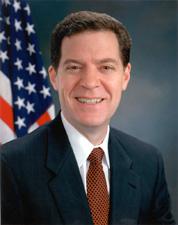 Sen. Sam Brownback (R-KS)
Legislative Activity
Stay on top of the latest movement without scrolling through every action
Senate amendment agreed to: Amendment SA 3235 agreed to in Senate by Unanimous Consent.
June 22, 2004
View full timeline
Senate amendment agreed to: Amendment SA 3235 agreed to in Senate by Unanimous Consent.
June 22, 2004
Considered by Senate. (consideration: CR S7120, S7130)
June 22, 2004
Amendment SA 3235 agreed to in Senate by Unanimous Consent.
June 22, 2004
Considered by Senate. (consideration: CR S7062)
June 21, 2004
Considered by Senate. (consideration: CR S7030)
June 18, 2004
Senate amendment proposed (on the floor): Amendment SA 3235 proposed by Senator Brownback.(consideration: CR 6/18/2004 S6980-6981; text: CR 6/18/2004 S6980)
June 17, 2004
Amendment SA 3235 proposed by Senator Brownback. (consideration: CR 6/18/2004 S6980-6981; text: CR 6/18/2004 S6980) To increase the penalties for violations by television and radio broadcasters of the prohibitions against transmission of obscene, indecent, and profane language.
June 17, 2004
Senate amendment submitted
May 20, 2004
Amendments
4 amendmentsOffered to this amendment
Amendments
4 amendmentsOffered to this amendment
No matches
To protect children from violent programming.
Amendment SA 3466 agreed to in Senate by Unanimous Consent. · Sponsored by Ernest F. Hollings · Amends S.Amdt. 3235
To increase FCC?s authority to fine for indecent broadcasts and prevent further relaxation of the media ownership rules in order to stem the rise of indecent programming.
Amendment SA 3465 agreed to in Senate by Unanimous Consent. · Sponsored by Byron L. Dorgan · Amends S.Amdt. 3235
To increase the penalties for violations by television and radio broadcasters of the prohibitions against transmission of obscene, indecent, and profane language.
Amendment SA 3464 agreed to in Senate by Yea-Nay Vote. 99 - 1. Record Vote Number: 134. · Sponsored by Sam Brownback · Amends S.Amdt. 3235
To provide for consideration of additional factors in indecency penalties.
Amendment SA 3457 as modified agreed to in Senate by Unanimous Consent. (text as modified: CR S7127-7128) · Sponsored by Conrad R. Burns · Amends S.Amdt. 3235
Text
Submitted
TEXT OF AMENDMENTS

SA 3225. Mr. DURBIN submitted an amendment intended to be proposed by
him to the bill S. 2400, to authorize appropriations for fiscal year
2005 for military activities of the Department of Defense, for military
construction, and for defense activities of the Department of Energy,
to prescribe personnel strengths for such fiscal year for the Armed
Services, and for other purposes; which was ordered to lie on the
table, as follows:

On page 147, after line 21, insert the following:

SEC. 717. REPORTING OF SERIOUS ADVERSE HEALTH EXPERIENCES.

(a) In General.--The Secretary of Defense may not permit a
dietary supplement containing a stimulant to be sold on a
military installation unless the manufacturer of such dietary
supplement submits any report of a serious adverse health
experience associated with such dietary supplement to the
Secretary of Health and Human Services, who shall make such
reports available to the Surgeon Generals of the Armed
Forces.
(b) Effect of Section.--Notwithstanding section 201(ff)(2)
of the Federal Food, Drug, and Cosmetic Act (21 U.S.C.
321(ff)(2)) and paragraph (3) of subsection (c), this section
does not apply to a dietary supplement containing caffeine
that is intended to be consumed in liquid form.
(c) Definitions.--In this section--
(1) The term ``dietary supplement'' has the same meaning
given the term in section 201(ff) of the Federal Food, Drug,
and Cosmetic Act (21 U.S.C. 321(ff)).
(2) The term ``serious adverse health experience'' means an
adverse event that is associated with the use of a dietary
supplement in a human, without regard to whether the event is
known to be causally related to the dietary supplement,
that--
(A) results in--
(i) death;
(ii) a life-threatening condition;
(iii) inpatient hospitalization or prolongation of
hospitalization;
(iv) a persistent or significant disability or incapacity;
or
(v) a congenital anomaly, birth defect, or other effect
regarding pregnancy, including premature labor or low birth
weight; or
(B) requires medical or surgical intervention to prevent 1
of the outcomes described in clauses (i) through (v) in
subparagraph (A).
(3) The term ``stimulant'' means a dietary ingredient that
has a stimulant effect on the cardiovascular system or the
central nervous system of a human by any means, including--
(A) speeding metabolism;
(B) increasing heart rate;
(C) constricting blood vessels; or
(D) causing the body to release adrenaline.
______

SA 3226. Mr. CRAPO proposed an amendment to amendment SA 3170
proposed by Mr. Graham of South Carolina to the bill S. 2400, to
authorize appropriations for fiscal year 2005 for military activities
of the Department of Defense, for military construction, and for
defense activities of the Department of Energy, to prescribe personnel
strengths for such fiscal year for the Armed Services, and for other
purposes; as follows:

Strike all after the first word of the matter proposed to
be inserted and insert the following:

3119. TREATMENT OF WASTE MATERIAL.

(a) Availability of Funds for Treatment.--Of the amount
authorized to be appropriated by section 3102(a)(1) for
environmental management for defense site acceleration
completion, $350,000,000 shall be available for the following
purposes at the sites referred to in subsection (b):
(1) The safe management of tanks or tank farms used to
store waste from reprocessing activities.
(2) The on-site treatment and storage of wastes from
reprocessing activities and related waste.
(3) The consolidation of tank waste.
(4) The emptying and cleaning of storage tanks.
(5) Actions under section 3116.
(b) Sites.--The sites referred to in this subsection are as
follows:
(1) The Idaho National Engineering and Environmental
Laboratory, Idaho.
(2) The Savannah River Site, Aiken, South Carolina.
(3) The Hanford Site, Richland, Washington.
(c) This section shall become effective 1 day after
enactment.
______

SA 3227. Mr. GRAHAM of South Carolina submitted an amendment intended
to be proposed by him to the bill S. 2400, to authorize appropriations
for fiscal year 2005 for military activities of the Department of
Defense, for military construction, and for defense activities of the
Department of Energy, to prescribe personnel strengths for such fiscal
year for the Armed Services, and for other purposes; which was ordered
to lie on the table, as follows:

On page 280, after line 22, insert the following:

SEC. 1068. RECEIPT OF PAY BY RESERVES FROM CIVILIAN EMPLOYERS
WHILE ON ACTIVE DUTY IN CONNECTION WITH A
CONTINGENCY OPERATION.

Section 209 of title 18, United States Code, is amended by
adding at the end the following new subsection:
``(h) This section does not prohibit a member of the
reserve components of the armed forces on active duty
pursuant to a call or order to active duty under a provision
of law referred to in section 101(a)(13) of title 10 from
receiving from any person that employed such member before
the call or order to active duty any payment of any part of
the salary or wages that such person would have paid the
member if the member's employment had not been interrupted by
such call or order to active duty.''.
______

SA 3228. Mr. GRAHAM of South Carolina submitted an amendment intended
to be proposed by him to the

[[Page S6012]]

bill S. 2400, to authorize appropriations for fiscal year 2005 for
military activities of the Department of Defense, for military
construction, and for defense activities of the Department of Energy,
to prescribe personnel strengths for such fiscal year for the Armed
Services, and for other purposes; which was ordered to lie on the
table, as follows:

At the end of subtitle B of title II, add the following:

SEC. 217. INFRASTRUCTURE SYSTEM SECURITY ENGINEERING
DEVELOPMENT FOR THE NAVY.

(a) Increase in Amount for Research, Development, Test, and
Evaluation, Navy.--The amount authorized to be appropriated
by section 201(2) for research, development, test, and
evaluation, Navy, is hereby increased by $3,000,000.
(b) Availability of Amount for Infrastructure System
Security Engineering Development.--Of the amount authorized
to be appropriated by section 201(2) for research,
development, test, and evaluation, Navy, as increased by
subsection (a), $3,000,000 shall be available for
infrastructure system security engineering development.
(c) Offset.--(1) The amount authorized to be appropriated
by section 101(5) for other procurement, Army, is hereby
reduced by $1,000,000, with the amount of the reduction to be
allocated to Buffalo Landmine Vehicles.
(2) The amount authorized to be appropriated by section
102(b) for procurement for the Marine Corps is hereby reduced
by $500,000, with the amount of the reduction to be allocated
to Combat Casualty Care.
(3) The amount authorized to be appropriated by section
201(1) for research, development, test, and evaluation, Army,
is hereby reduced by $1,000,000, with the amount of the
reduction to the allocated to Active Coating Technology.
(4) The amount authorized to be appropriated by section
201(4) for research, development, test, and evaluation,
Defense-wide activities, is hereby reduced by $500,000, with
the amount of the reduction to be allocated to Radiation Hard
Complimentary Metal Oxide Semi-Conductors.
______

SA 3229. Mr. McCAIN submitted an amendment intended to be proposed by
him to the bill S. 2400, to authorize appropriations for fiscal year
2005 for military activities of the Department of Defense, for military
construction, and for defense activities of the Department of Energy,
to prescribe personnel strengths for such fiscal year for the Armed
Services, and for other purposes; which was ordered to lie on the
table; as follows:

On page 60, after line 23, insert the following:

SEC. 403. EXCLUSION OF SERVICE ACADEMY PERMANENT AND CAREER
PROFESSORS FROM A LIMITATION ON CERTAIN OFFICER
GRADE STRENGTHS.

Section 523(b) of title 10, United States Code, is amended
by adding at the end the following new paragraph:
``(8) Up to 50 permanent professors of each of the United
States Military Academy and the United States Air Force
Academy, and up to 50 professors of the United States Naval
Academy who are career military professors (as defined in
regulations prescribed by the Secretary of the Navy).''.
______

SA 3230. Ms. COLLINS submitted an amendment intended to be proposed
by her to the bill S. 2400, to authorize appropriations for fiscal year
2005 for military activities of the Department of Defense, for military
construction, and for defense activities of the Department of Energy,
to prescribe personnel strengths for such fiscal year for the Armed
Services, and for other purposes; which was ordered to lie on the
table; as follows:

At the end of subtitle B of title III, add the following:

SEC. 313. ENERGY SAVINGS PERFORMANCE CONTRACTS.

(a) Contracts Authorized.--The Secretary of Defense may
enter into an energy savings performance contract under this
section for the sole purpose of achieving energy savings and
benefits ancillary to that purpose. The Secretary may incur
obligations under the contract to finance energy conservation
measures so long as guaranteed savings exceed the debt
service requirements.
(b) Terms and Conditions.--
(1) Contract period.--Notwithstanding any other provision
of law, an energy savings performance contract may be for a
period of up to 25 years beginning on the date on which the
first payment is made by the Secretary pursuant to the
contract. The contract need not include funding of
cancellation charges (if any) before cancellation, if--
(A) the contract was awarded in a competitive manner, using
procedures and methods established under this section;
(B) the Secretary determines that funds are available and
adequate for payment of the costs of the contract for the
first fiscal year;
(C) the contract is governed by part 17.1 of the Federal
Acquisition Regulation; and
(D) if the contract contains a clause setting forth a
cancellation ceiling in excess $10,000,000, the Secretary
provides notice to Congress of the proposed contract and the
proposed cancellation ceiling at least 30 days before the
award of the contract.
(2) Costs and savings.--An energy savings performance
contract shall require the contractor to incur the costs of
implementing energy savings measures, including at least the
cost (if any) incurred in making energy audits, acquiring and
installing equipment, and training personnel, in exchange for
a share of any energy savings directly resulting from
implementation of such measures during the term of the
contract.
(3) Other terms and conditions.--An energy savings
performance contract shall require an annual energy audit and
specify the terms and conditions of any Government payments
and performance guarantees. Any such performance guarantee
shall provide that either the Government or the contractor is
responsible for maintenance and repair services for any
energy related equipment, including computer software
systems.
(c) Limitation on Annual Contract Payments.--Aggregate
annual payments by the Secretary to a contractor for energy,
operations, and maintenance under an energy savings
performance contract may not exceed the amount that the
Department of Defense would have paid for energy, operations,
and maintenance in the absence of the contract (as estimated
through the procedures developed pursuant to this section)
during term of the contract. The contract shall provide for a
guarantee of savings to the Department, and shall establish
payment schedules reflecting such guarantee, taking into
account any capital costs under the contract.
(d) Rulemaking.--Not later than 90 days after the date of
the enactment of this Act, the Secretary, with the
concurrence of the Federal Acquisition Regulatory Council,
shall issue final rules to establish the procedures and
methods for use by the Department of Defense to select,
monitor, and terminate energy savings performance contracts
in accordance with laws governing Federal procurement that
will achieve the intent of this section in a cost-effective
manner. In developing such procedures and methods, the
Secretary, with the concurrence of the Federal Acquisition
Regulatory Council, shall determine which existing
regulations are inconsistent with the intent of this section
and shall formulate substitute regulations consistent with
laws governing Federal procurement.
(e) Implementation Procedures and Methods.--The procedures
and methods established by rule under subsection (d) shall--
(1) provide for the calculation of energy savings based on
sound engineering and financial practices;
(2) allow the Secretary to request statements of
qualifications, which shall, at a minimum, include prior
experience and capabilities of contractors to perform the
proposed types of energy savings services and financial and
performance information from firms engaged in providing
energy savings services;
(3) allow the Secretary to presume that a contractor meets
the requirements of paragraph (2) if the contractor either--
(A) has carried out contracts with a value of at least
$1,000,000,000 with the Federal Government over the previous
10 years; or
(B) is listed by a Federal agency pursuant to section
801(b)(2) of the National Energy Policy Act (42 U.S.C.
8287(b)(2));
(4) allow the Secretary to, from the statements received,
designate and prepare a list, with an update at least
annually, of those firms that are qualified to provide energy
savings services;
(5) allow the Secretary to select firms from such list to
conduct discussions concerning a particular proposed energy
savings project, including requesting a technical and price
proposal from such selected firms for such project;
(6) allow the Secretary to select from such firms the most
qualified firm to provide energy savings services based on
technical and price proposals and any other relevant
information;
(7) allow the Secretary to permit receipt of unsolicited
proposals for energy savings performance contracting services
from a firm that the Department of Defense has determined is
qualified to provide such services under the procedures
established pursuant to subsection (d) and require facility
managers to place a notice in the Commerce Business Daily
announcing they have received such a proposal and invite
other similarly qualified firms to submit competing
proposals;
(8) allow the Secretary to enter into an energy savings
performance contract with a firm qualified under paragraph
(7), consistent with the procedures and methods established
pursuant to subsection (d); and
(9) allow a firm not designated as qualified to provide
energy savings services under paragraph (4) to request a
review of such decision to be conducted in accordance with
procedures, substantially equivalent to procedures
established under section 759(f) of title 40, United States
Code, to be developed by the board of contract appeals of the
General Services Administration.
(f) Transition Rule for Certain Energy Savings Performance
Contracts.--In the case of any energy savings performance
contract entered into by the Secretary, or the Secretary of
Energy, before October 1, 2003, for services to be provided
at Department of Defense facilities, the Secretary may issue

[[Page S6013]]

additional task orders pursuant to such contract and may make
whatever contract modifications the parties to such contract
agree are necessary to conform to the provisions of this
section.
(g) Pilot Program for Nonbuilding Applications.--
(1) In general.--The Secretary may carry out a pilot
program to enter into up to 10 energy savings performance
contracts for the purpose of achieving energy savings,
secondary savings, and benefits incidental to those purposes,
in nonbuilding applications.
(2) Selection.--The Secretary shall select the contract
projects to demonstrate the applicability and benefits of
energy savings performance contracting to a range of non-
building applications.
(3) Report.--Not later than three years after the date of
the enactment of this Act, the Secretary shall submit to
Congress a report on the progress and results of the pilot
program. The report shall include a description of projects
undertaken; the energy and cost savings, secondary savings
and other benefits that resulted from such projects; and
recommendations on whether the pilot program should be
extended, expanded, or authorized.
(h) Definitions.--In this section:
(1) Energy savings.--The term ``energy savings'' means a
reduction in the cost of energy, from a base cost established
through a methodology set forth in the energy savings
performance contract, utilized in an existing federally owned
building or buildings or other federally owned facilities as
a result of--
(A) the lease or purchase of operating equipment,
improvements, altered operation and maintenance, increased
capacity or payload, or technical services; or
(B) the increased efficient use of existing energy sources
by cogeneration or heat recovery, excluding any cogeneration
process for other than a federally owned building or
buildings or other federally owned facilities.
(2) Energy savings performance contract.--The term ``energy
savings performance contract'' means a contract that provides
for the performance of services for the design, acquisition,
installation, testing, operation, and, where appropriate,
maintenance and repair of an identified energy conservation
measure or series of measures at one or more locations. Such
contracts--
(A) may provide for appropriate software licensing
agreements; and
(B) shall, with respect to an agency facility that is a
public building, as defined in section 13(l) of the Public
Buildings Act of 1959 (40 U.S.C. 612(l)), be in compliance
with the prospectus requirements and procedures of section 7
of the Public Buildings Accountability Act of 1959 (40 U.S.C.
606).
(3) Nonbuilding application.--The term ``nonbuilding
application'' means--
(A) any class of vehicles, devices, or equipment that is
transportable under its own power by land, sea, or air that
consumes energy from any fuel source for the purpose of such
transportability, or to maintain a controlled environment
within such vehicle, device, or equipment; or
(B) any Federally owned equipment used to generate
electricity or transport water.
(4) Secondary savings.--The term ``secondary savings''
means additional energy or cost savings that are a direct
consequence of the energy savings that result from the energy
efficiency improvements that were financed and implemented
pursuant to the energy savings performance contract. Such
secondary savings may include energy and cost savings that
result from a reduction in the need for fuel delivery and
logistical support, personnel cost savings and environmental
benefits. In the case of electric generation equipment,
secondary savings may include the benefits of increased
efficiency in the production of electricity, including
revenue received by the Federal Government from the sale of
electricity so produced.
(5) Secretary.--The term ``Secretary'' means the Secretary
of Defense.
______

SA 3231. Mr. GRAHAM of Florida (for himself and Mr. Nelson of
Florida) submitted an amendment intended to be proposed by him to the
bill S. 2400, to authorize appropriations for fiscal year 2005 for
military activities of the Department of Defense, for military
construction, and for defense activities of the Department of Energy,
to prescribe personnel strengths for such fiscal year for the Armed
Services, and for other purposes; which was ordered to lie on the
table, as follows:

At end of subtitle B of title III, add the following:

SEC. 313. ROTARY WING NIGHT VISION GOGGLE TRAINING.

(a) Increase in Amounts for Procurement, Navy.--(1) The
amount authorized to be appropriated by section 102(a)(1) for
aircraft procurement, Navy, is hereby increased by
$3,850,000.
(2) The amount authorized to be appropriated by section
102(a)(4) for other procurement, Navy, is hereby increased by
$150,000.
(b) Availability of Amounts for Rotary Wing Night Vision
Goggle Training.--(1) Of the amount authorized to be
appropriated by section 102(a)(1) for aircraft procurement,
Navy, as increased by subsection (a)(1), $3,850,000 shall be
available for the development of rotary wing night vision
goggle (NVG) training.
(2) Of the amount authorized to be appropriated by section
102(a)(4) for other procurement, Navy, as increased by
subsection (a)(2), $150,000 shall be available for the
development of rotary wing night vision goggle training.
(c) Offset.--Of the amount authorized to be appropriated by
section 201(4) for research, development, test, and
evaluation, Defense-wide activities, the amount available in
Program Element PE 0305199D8Z for horizontal fusion is hereby
reduced by $4,000,000.
______

SA 3232. Mr. BROWNBACK submitted an amendment intended to be proposed
by him to the bill S. 2400, to authorize appropriations for fiscal year
2005 for military activities of the Department of Defense, for military
construction, and for defense activities of the Department of Energy,
to prescribe personnel strengths for such fiscal year for the Armed
Services, and for other purposes; which was ordered to lie on the
table, as follows:

On page 280, after line 22, insert the following:

SEC. 1068. SENSE OF CONGRESS ON CONTRIBUTIONS OF AFRICAN
AMERICANS TO THE ARMED FORCES.

(a) Findings.--Congress makes the following findings:
(1) From the inception of our Nation, many African
Americans have given their lives in service to this country
in order that Americans could enjoy freedom and prosperity.
(2) Nowhere is this sacrifice more apparent than in the
history of the Armed Forces of the United States, and in the
current fight against the threat of terrorism within the
United States and abroad.
(3) It is important to recognize the extraordinary
contributions of African American soldiers enlisted in the
Armed Forces during the era of segregation, when these brave
soldiers fought valiantly to ensure freedom and democracy for
Americans that they were not, in many instances, able to
enjoy.
(4) In September 1945, Secretary of War Robert P. Patterson
appointed a board of 3 general officers, which became known
as the Gillem Board, to investigate the policy of the United
States Army with respect to African Americans and to prepare
a new policy that would provide for the efficient use of
African Americans in the Army.
(5) The April 1946 Gillem Board report, titled
``Utilization of Negro Manpower in the Postwar Army Policy,''
concluded that the future policy of the Army should be to
``eliminate, at the earliest practicable moment, any special
consideration based on race.''
(6) On October 29, 1947, the President's Committee on Civil
Rights issued a landmark report titled ``To Secure These
Rights'', which condemned segregation, in particular
segregation in the Armed Forces. The report recommended
legislation and administrative action ``to end immediately
all discrimination and segregation based on race, color,
creed or national origin in . . . all branches of the Armed
Services.''
(7) On July 26, 1948, President Truman signed Executive
Order 9981, which stated that ``there shall be equality of
treatment and opportunity for all persons in the armed
services without regard to race, color, religion, or national
origin.'' The order also established the President's
Committee on Equality of Treatment and Opportunity in the
Armed Services, which included two African American members
among its initial members.
(8) On April 1, 1949, Secretary of Defense Louis Johnson
issued a directive to the Secretaries of the Army, Navy, and
Air Force that stated that it was the policy of the
Department of Defense that there should be equality of
treatment and opportunity for all in the armed services, and
that ``qualified Negro personnel shall be assigned to fill
any type of position . . . without regard to race.''
(9) On May 11, 1949, Secretary of Defense Louis Johnson
approved the integration plans of the Air Force, but rejected
those of the Army and the Navy.
(10) On June 7, 1949, Secretary of Defense Louis Johnson
accepted a revised Navy integration plan.
(11) On March 13, 1950, the Army agreed to abolish its 10
percent recruitment quota for African Americans.
(12) On March 18, 1951, The Department of Defense announced
that all basic training within the United States had been
integrated.
(13) In October 1953, the Army announced that 95 percent of
African American soldiers in the Army were serving in
integrated units.
(b) Sense of Congress.--It is the sense of Congress--
(1) to apologize for the racial segregation that was
enforced by the United States Government upon African
American soldiers who defended the United States prior to the
desegregation of the Armed Forces;
(2) that the United States has been richly blessed by the
contributions and sacrifices of African Americans;
(3) that the African Americans who served in the Armed
Forces of the United States were heroes who were willing to
see beyond their own oppression and envision a future society
that would be fully inclusive of all citizens, regardless of
their race; and
(4) because of the sacrifices of these heroes, our Nation
has prospered and grown into a symbol of freedom emulated by
countries around the world.

[[Page S6014]]

(c) Claims Not Authorized.--This section shall not be
construed to authorize any claim against the United States
and shall not be construed as a settlement of any claim
against the United States.
______

SA 3233. Mr. LOTT (for himself and Mr. Graham of South Carolina)
submitted an amendment intended to be proposed by him to the bill S.
2400, to authorize appropriations for fiscal year 2005 for military
activities of the Department of Defense, for military construction, and
for defense activities of the Department of Energy, to prescribe
personnel strengths for such fiscal year for the Armed Services, and
for other purposes; which was ordered to lie on the table, as follows:

On page 35, between lines 6 and 7, insert the following:

SEC. 232. SENSE OF THE SENATE REGARDING FUNDING OF THE
ADVANCED SHIPBUILDING ENTERPRISE UNDER THE
NATIONAL SHIPBUILDING RESEARCH PROGRAM OF THE
NAVY.

(a) Findings.--Congress makes the following findings:
(1) The budget for fiscal year 2005, as submitted to
Congress by the President, provides $10,300,000 for the
Advanced Shipbuilding Enterprise under the National
Shipbuilding Research Program of the Navy.
(2) The Advanced Shipbuilding Enterprise is an innovative
program to encourage greater efficiency in the national
technology and industrial base.
(3) The leaders of the United States shipbuilding industry
have embraced the Advanced Shipbuilding Enterprise as a
method for exploring and collaborating on innovation in
shipbuilding and ship repair that collectively benefits all
components of the industry.
(b) Sense of the Senate.--It is the sense of the Senate--
(1) that the Senate--
(A) strongly supports the innovative Advanced Shipbuilding
Enterprise under the National Shipbuilding Research Program
as an enterprise between the Navy and industry that has
yielded new processes and techniques that reduce the cost of
building and repairing ships in the United States; and
(B) is concerned that the future-years defense program of
the Department of Defense that was submitted to Congress for
fiscal year 2005 does not reflect any funding for the
Advanced Shipbuilding Enterprise after fiscal year 2005; and
(2) that the Secretary of Defense should continue to
provide in the future-years defense program for funding the
Advanced Shipbuilding Enterprise at a sustaining level in
order to support additional research to further reduce the
cost of designing, building, and repairing ships.
______

SA 3234. Mr. NELSON of Florida (for himself, Mrs. Dole, Mr. Corzine,
Mr. Nelson of Nebraska, Mr. Leahy, Mrs. Murray, and Mr. Graham of
Florida) submitted an amendment intended to be proposed by him to the
bill S. 2400, to authorize appropriations for fiscal year 2005 for
military activities of the Department of Defense, for military
construction, and for defense activities of the Department of Energy,
to prescribe personnel strengths for such fiscal year for the Armed
Services, and for other purposes; which was ordered to lie on the
table, as follows:

At the end of subtitle B of title III, add the following:

SEC. 313. FAMILY READINESS PROGRAM OF THE NATIONAL GUARD.

(a) Amount for Program.--The amount authorized to be
appropriated by section 301(1) for operation and maintenance
for the Army is hereby increased by $10,000,000 for the
Family Readiness Program of the National Guard.
(b) Offset.--The amount authorized to be appropriated by
section 301(1) for operation and maintenance for the Army is
hereby reduced by $10,000,000 due to excessive unobligated
balances.
______

SA 3235. Mr. BROWNBACK submitted an amendment intended to be proposed
by him to the bill S. 2400, to authorize appropriations for fiscal year
2005 for military activities of the Department of Defense, for military
construction, and for defense activities of the Department of Energy,
to prescribe personnel strengths for such fiscal year for the Armed
Services, and for other purposes; which was ordered to lie on the
table, as follows:

On page 280, after line 22, insert the following:

SEC. __. BROADCAST DECENCY ENFORCEMENT ACT OF 2004.

(a) Short Title.--This section may be cited as the
``Broadcast Decency Enforcement Act of 2004''.
(b) Increase in Penalties for Obscene, Indecent, and
Profane Broadcasts.--Section 503(b)(2) of the Communications
Act of 1934 (47 U.S.C. 503(b)(2)) is amended--
(1) by redesignating subparagraphs (C) and (D) as
subparagraphs (D) and (E), respectively;
(2) by inserting after subparagraph (B) the following new
subparagraph:
``(C) Notwithstanding subparagraph (A), if the violator
is--
``(i)(I) a broadcast station licensee or permittee; or
``(II) an applicant for any broadcast license, permit,
certificate, or other instrument or authorization issued by
the Commission; and
``(ii) determined by the Commission under paragraph (1) to
have broadcast obscene, indecent, or profane language, the
amount of any forfeiture penalty determined under this
subsection shall not exceed $275,000 for each violation or
each day of a continuing violation, except that the amount
assessed for any continuing violation shall not exceed a
total of $3,000,000 for any single act or failure to act.'';
and
(3) in subparagraph (D), as redesignated by paragraph (1),
by striking ``subparagraph (A) or (B)'' and inserting
``subparagraph (A), (B), or (C)''.
______

SA 3236. Mr. TALENT submitted an amendment intended to be proposed by
him to the bill S. 2400, to authorize appropriations for fiscal year
2005 for military activities of the Department of Defense, for military
construction, and for defense activities of the Department of Energy,
to prescribe personnel strengths for such fiscal year for the Armed
Services, and for other purposes; which was ordered to lie on the
table, as follows:

On page 131, between lines 17 and 18, insert the following:

SEC. 653. ACCEPTANCE OF FREQUENT TRAVELER MILES, CREDITS, AND
TICKETS TO FACILITATE THE AIR OR SURFACE TRAVEL
OF CERTAIN MEMBERS OF THE ARMED FORCES AND
THEIR FAMILIES.

Section 2608 of title 10, United States Code, is amended--
(1) by redesignating subsections (g) through (k) as
subsections (h) through (l), respectively; and
(2) by inserting after subsection (f) the following new
subsection:
``(g) Operation Hero Miles.--(1) The Secretary of Defense
may use the authority of subsection (a) to accept the
donation of frequent traveler miles, credits, and tickets for
air or surface transportation issued by any air carrier or
surface carrier that serves the public and that consents to
such donation, and under such terms and conditions as the air
or surface carrier may specify. The Secretary shall designate
a single office in the Department of Defense to carry out
this subsection, including the establishment of such rules
and procedures as may be necessary to facilitate the
acceptance of such frequent traveler miles, credits, and
tickets.
``(2) Frequent traveler miles, credits, and tickets
accepted under this subsection shall be used only in
accordance with the rules established by the air carrier or
surface carrier that is the source of the miles, credits, or
tickets and shall be used only for the following purposes:
``(A) To facilitate the travel of a member of the armed
forces who--
``(i) is deployed on active duty outside the United States
away from the permanent duty station of the member in support
of a contingency operation; and
``(ii) is granted, during such deployment, rest and
recuperative leave, emergency leave, convalescent leave, or
another form of leave authorized for the member.
``(B) In the case of a member of the armed forces
recuperating from an injury or illness incurred or aggravated
in the line of duty during such deployment, to facilitate the
travel of family members of the member to be reunited with
the member.
``(3) For the use of miles, credits, or tickets under
paragraph (2)(B) by family members of a member of the armed
forces, the Secretary may, as the Secretary determines
appropriate, limit--
``(A) eligibility to family members who, by reason of
affinity, degree of consanguinity, or otherwise, are
sufficiently close in relationship to the member of the armed
forces to justify the travel assistance;
``(B) the number of family members who may travel; and
``(C) the number of trips that family members may take.
``(4) Notwithstanding paragraph (2), the Secretary of
Defense may, in an exceptional case, authorize a person not
described in subparagraph (B) of that paragraph to use
frequent traveler miles, credits, or a ticket accepted under
this subsection to visit a member of the armed forces
described in such subparagraph if that person has a notably
close relationship with the member. The frequent traveler
miles, credits, or ticket may be used by such person only in
accordance with such conditions and restrictions as the
Secretary determines appropriate and the rules established by
the air carrier or surface carrier that is the source of the
miles, credits, or ticket.
``(5) The Secretary of Defense shall encourage air carriers
and surface carriers to participate in, and to facilitate
through minimization of restrictions and otherwise, the
donation, acceptance, and use of frequent traveler miles,
credits, and tickets under this section.

[[Page S6015]]

``(6) The Secretary of Defense may enter into an agreement
with a nonprofit organization to use the services of the
organization--
``(A) to promote the donation of frequent traveler miles,
credits, and tickets under paragraph (1), except that amounts
appropriated to the Department of Defense may not be expended
for this purpose; and
``(B) to assist in administering the collection,
distribution, and use of donated frequent traveler miles,
credits, and tickets.
``(7) Members of the armed forces, family members, and
other persons who receive air or surface transportation using
frequent traveler miles, credits, or tickets donated under
this subsection are deemed to recognize no income from such
use. Donors of frequent traveler miles, credits, or tickets
under this subsection are deemed to obtain no tax benefit
from such donation.
``(8) In this subsection, the term `family member' has the
meaning given that term in section 411h(b)(1) of title 37.''.
______

SA 3237. Mr. CAMPBELL submitted an amendment intended to be proposed
by him to the bill S. 2400, to authorize appropriations for fiscal year
2005 for military activities of the Department of Defense, for military
construction, and for defense activities of the Department of Energy,
to prescribe personnel strengths for such fiscal year for the Armed
Services, and for other purposes; which was ordered to lie on the
table; as follows:

On page 86, between lines 9 and 10, insert the following:

SEC. 543. REQUIREMENTS FOR AWARD OF COMBAT INFANTRYMAN BADGE
AND COMBAT MEDICAL BADGE WITH RESPECT TO
SERVICE IN KOREA AFTER JULY 28, 1953.

(a) Standardization of Requirements With Other Geographic
Areas.--(1) Chapter 357 of title 10, United States Code, is
amended by adding at the end the following new section:

``Sec. 3757. Korea defense service: Combat Infantryman Badge;
Combat Medical Badge

``The Secretary of the Army shall provide that, with
respect to service in the Republic of Korea after July 28,
1953, eligibility of a member of the Army for the Combat
Infantryman Badge or the Combat Medical Badge shall be met
under criteria and eligibility requirements that, as nearly
as practicable, are identical to those applicable, at the
time of such service in the Republic of Korea, to service
elsewhere without regard to specific location or special
circumstances. In particular, such eligibility shall be
established--
``(1) without any requirement for service by the member in
an area designated as a `hostile fire area' (or by any
similar designation) or that the member have been authorized
hostile fire pay;
``(2) without any requirement for a minimum number of
instances (in excess of one) in which the member was engaged
with the enemy in active ground combat involving an exchange
of small arms fire; and
``(3) without any requirement for personal recommendation
or approval by commanders in the member's chain of command
other than is generally applicable for service at locations
outside the Republic of Korea.''.
(2) The table of sections at the beginning of such chapter
is amended by adding at the end the following new item:

``3757. Korea defense service: Combat Infantryman Badge; Combat Medical
Badge.''.

(b) Applicability to Service Before Date of Enactment.--The
Secretary of the Army shall establish procedures to provide
for the implementation of section 3757 of title 10, United
States Code, as added by subsection (a), with respect to
service in the Republic of Korea during the period between
July 28, 1953, and the date of the enactment of this Act.
Such procedures shall include a requirement for submission of
an application for award of a badge under that section with
respect to service before the date of the enactment of this
Act and the furnishing of such information as the Secretary
may specify.
______

SA 3238. Mr. GRAHAM of South Carolina submitted an amendment intended
to be proposed by him to the bill S. 2400, to authorize appropriations
for fiscal year 2005 for military activities of the Department of
Defense, for military construction, and for defense activities of the
Department of Energy, to prescribe personnel strengths for such fiscal
year for the Armed Services, and for other purposes; which was ordered
to lie on the table; as follows:

On page 221, between the matter following line 17 and line
18, insert the following:

SEC. 915. AUTHORITIES OF THE JUDGE ADVOCATES GENERAL.

(a) Department of the Army.--(1) Section 3019(b) of title
10, United States Code, is amended by striking ``The General
Counsel'' and inserting ``Subject to sections 806 and 3037 of
this title, the General Counsel''.
(2)(A) Section 3037 of such title is amended to read as
follows:

``Sec. 3037. Judge Advocate General, Assistant Judge Advocate
General: appointment; duties

``(a) Position of Judge Advocate General.--There is a Judge
Advocate General in the Army, who is appointed by the
President, by and with the advice and consent of the Senate,
from officers of the Judge Advocate General's Corps. The term
of office is four years, but may be sooner terminated or
extended by the President. The Judge Advocate General, while
so serving, has the grade of lieutenant general.
``(b) Appointment.--The Judge Advocate General of the Army
shall be appointed from those officers who at the time of
appointment are members of the bar of a Federal court or the
highest court of a State or Territory, and who have had at
least eight years of experience in legal duties as
commissioned officers.
``(c) Duties.--The Judge Advocate General, in addition to
other duties prescribed by law--
``(1) is the legal adviser of the Secretary of the Army,
the Chief of Staff of the Army, and the Army Staff, and of
all officers and agencies of the Department of the Army;
``(2) shall direct and supervise the members of the Judge
Advocate General's Corps and civilian attorneys employed by
the Department of the Army (other than those assigned or
detailed to the Office of the General Counsel of the Army) in
the performance of their duties;
``(3) shall direct and supervise the performance of duties
under chapter 47 of this title (the Uniform Code of Military
Justice) by any member of the Army;
``(4) shall receive, revise, and have recorded the
proceedings of courts of inquiry and military commissions;
and
``(5) shall perform such other legal duties as may be
directed by the Secretary of the Army.
``(d) Position of Assistant Judge Advocate General.--(1)
There is an Assistant Judge Advocate General in the Army, who
is appointed by the President, by and with the advice and
consent of the Senate, from officers of the Army who have the
qualifications prescribed in subsection (b) for the Judge
Advocate General. The term of office of the Assistant Judge
Advocate General is four years, but may be sooner terminated
or extended by the President. An officer appointed as
Assistant Judge Advocate General who holds a lower regular
grade shall be appointed in the regular grade of major
general.
``(2) When there is a vacancy in the office of the Judge
Advocate General, or during the absence or disability of the
Judge Advocate General, the Assistant Judge Advocate General
shall perform the duties of the Judge Advocate General until
a successor is appointed or the absence or disability ceases.
``(3) When paragraph (2) cannot be complied with because of
the absence or disability of the Assistant Judge Advocate
General, the heads of the major divisions of the Office of
the Judge Advocate General, in the order directed by the
Secretary of the Army, shall perform the duties of the Judge
Advocate General, unless otherwise directed by the President.
``(e) Appointments Recommended by Selection Boards.--Under
regulations prescribed by the Secretary of Defense, the
Secretary of the Army, in selecting an officer for
recommendation to the President under subsection (a) for
appointment as the Judge Advocate General or under subsection
(d) for appointment as the Assistant Judge Advocate General,
shall ensure that the officer selected is recommended by a
board of officers that, insofar as practicable, is subject to
the procedures applicable to selection boards convened under
chapter 36 of this title.''.
(B) The item relating to such section in the table of
sections at the beginning of chapter 305 of such title is
amended to read as follows:

``3037. Judge Advocate General, Assistant Judge Advocate General:
appointment; duties.''.

(b) Department of the Navy.--(1) Section 5019(b) of title
10, United States Code, is amended by striking ``The General
Counsel'' and inserting ``Subject to sections 806 and 5148 of
this title, the General Counsel''.
(2) Section 5148 of such title is amended--
(A) in subsection (b), by striking the fourth sentence and
inserting the following: ``The Judge Advocate General, while
so serving, has the grade of vice admiral or lieutenant
general, as appropriate.''; and
(B) in subsection (d)--
(i) by redesignating paragraphs (2), (3), and (4) as
paragraphs (3), (4), and (5), respectively; and
(ii) by inserting after paragraph (1) the following new
paragraph (2):
``(2) direct and supervise the members of the Judge
Advocate General's Corps in the performance of their
duties;''.
(c) Department of the Air Force.--(1) Section 8019(b) of
title 10, United States Code, is amended by striking ``The
General Counsel'' and inserting ``Subject to sections 806 and
8037 of this title, the General Counsel''.
(2) Section 8037 of such title is amended--
(A) in subsection (a), by striking the third sentence and
inserting the following: ``The Judge Advocate General, while
so serving, has the grade of lieutenant general.''; and
(B) in subsection (c)--
(i) by striking ``General shall,'' in the matter preceding
paragraph (1) and inserting ``General,'';
(ii) by redesignating paragraphs (1) and (2) as paragraphs
(4) and (5), respectively, and, in each such paragraph, by
inserting ``shall'' before the first word; and
(iii) by inserting after paragraph (1) the following new
paragraphs:

[[Page S6016]]

``(1) is the legal adviser of the Secretary of the Air
Force, the Chief of Staff of the Air Force, and the Air
Staff, and of all officers and agencies of the Department of
the Air Force;
``(2) shall direct and supervise the members of the Air
Force designated as judge advocates and civilian attorneys
employed by the Department of the Air Force (other than those
assigned or detailed to the Office of the General Counsel of
the Air Force) in the performance of their duties;
``(3) shall direct and supervise the performance of duties
under chapter 47 of this title (the Uniform Code of Military
Justice) by any member of the Air Force;''.

____________________