To limit the obligation and expenditure of funds for the Ground-based Midcourse Defense program pending the submission of a report on operational test and evaluation.
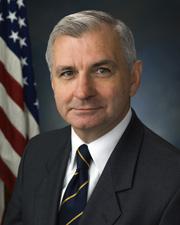 Sen. Jack Reed (D-RI)
Legislative Activity
Stay on top of the latest movement without scrolling through every action
Senate amendment not agreed to: Amendment SA 3353 not agreed to in Senate by Yea-Nay Vote. 45 - 53. Record Vote Number: 139.
June 23, 2004
View full timeline
Senate amendment not agreed to: Amendment SA 3353 not agreed to in Senate by Yea-Nay Vote. 45 - 53. Record Vote Number: 139.
June 23, 2004
Roll call votes on amendments in Senate: Amendment SA 3353 not agreed to in Senate by Yea-Nay Vote. 45 - 53. Record Vote Number: 139.
June 23, 2004
Considered by Senate. (consideration: CR S7204, S7210-7213, S7225)
June 23, 2004
Amendment SA 3353 not agreed to in Senate by Yea-Nay Vote. 45 - 53. Record Vote Number: 139.
June 23, 2004
Considered by Senate. (consideration: CR S7120)
June 22, 2004
Considered by Senate. (consideration: CR S7062)
June 21, 2004
Senate amendment proposed (on the floor): Amendment SA 3353 proposed by Senator Reed.(consideration: CR S7037, S7038-7040, S7041-7042; text: CR S7037)
June 18, 2004
Amendment SA 3353 proposed by Senator Reed. (consideration: CR S7037, S7038-7040, S7041-7042; text: CR S7037) To limit the obligation and expenditure of funds for the Ground-based Midcourse Defense program pending the submission of a report on operational test and evaluation.
June 18, 2004
Senate amendment submitted
June 7, 2004
Votes
1 roll call on this amendment
Text
Proposed
NATIONAL DEFENSE AUTHORIZATION ACT FOR FISCAL YEAR 2005

The PRESIDENT pro tempore. Under the previous order, the Senate will
resume consideration of S. 2400, which the clerk will report.
The legislative clerk read as follows:

A bill (S. 2400) to authorize appropriations for fiscal
year 2005 for military activities for the Department of
Defense, for military construction, and for defense
activities of the Department of Energy, to prescribe
personnel strengths for such fiscal year for the Armed
Services, so forth and for other purposes.

Pending:

Bond modified amendment No. 3384, to include certain former
nuclear weapons program workers in the Special Exposure
Cohort under the Energy Employees Occupational Illness
compensation Program and to provide for the disposal of
certain excess Department of Defense stocks for funds for
that purpose.
Brownback amendment No. 3235, to increase the penalties for
violations by television and radio broadcasters of the
prohibitions against transmission of obscene, indecent, and
profane language.
Burns amendment No. 3457 (to amendment No. 3235), to
provide for additional factors in indecency penalties issued
by the Federal Communications Commission.

Mr. REID. Mr. President, on behalf of the two managers, I am
reporting today that we will have two amendments by the Senator from
Illinois that will be offered, two amendments by the Senator from New
Jersey will be offered, an amendment by the Senator from Rhode Island
will be offered, and I will offer an amendment. That is the schedule
for today's session.
Of course, as the majority indicated, there will not be any votes. If
the managers require votes, and these are not accepted, these votes
will be stacked for Monday night in addition to amendments offered
Monday that were announced at an earlier time.
The PRESIDENT pro tempore. The Senator from Illinois.

Amendment No. 3196

Mr. DURBIN. I call up amendment No. 3196.
The PRESIDENT pro tempore. The pending amendment will be set aside.
The clerk will report the amendment.
The legislative clerk read as follows:

The Senator from Illinois [Mr. Durbin], for himself, Ms.
Mikulski, Ms. Landrieu, Mrs. Murray, Mr. Dayton, Mr. Corzine,
and Mr. Biden, proposes an amendment numbered 3196.

Mr. DURBIN. Mr. President, I ask unanimous consent that the reading
of the amendment be dispensed with.
The PRESIDING OFFICER. Without objection, it is so ordered.
The amendment is as follows:

(Purpose: To ensure that a Federal employee who takes leave without pay
in order to perform service as a member of the uniformed services or
member of the National Guard shall continue to receive pay in an amount
which, when taken together with the pay and allowances such individual
is receiving for such service, will be no less than the basic pay such
individual would then be receiving if no interruption in employment had
occurred)

At the appropriate place, insert the following:

[[Page S7031]]

SEC. __. NONREDUCTION IN PAY WHILE FEDERAL EMPLOYEE IS
PERFORMING ACTIVE SERVICE IN THE UNIFORMED
SERVICES OR NATIONAL GUARD.

(a) Short Title.--This section may be cited as the
``Reservists Pay Security Act of 2004''.
(b) In General.--Subchapter IV of chapter 55 of title 5,
United States Code, is amended by adding at the end the
following:

``Sec. 5538. Nonreduction in pay while serving in the
uniformed services or National Guard

``(a) An employee who is absent from a position of
employment with the Federal Government in order to perform
active duty in the uniformed services pursuant to a call or
order to active duty under a provision of law referred to in
section 101(a)(13)(B) of title 10 shall be entitled, while
serving on active duty, to receive, for each pay period
described in subsection (b), an amount equal to the amount by
which--
``(1) the amount of basic pay which would otherwise have
been payable to such employee for such pay period if such
employee's civilian employment with the Government had not
been interrupted by that service, exceeds (if at all)
``(2) the amount of pay and allowances which (as determined
under subsection (d))--
``(A) is payable to such employee for that service; and
``(B) is allocable to such pay period.
``(b)(1) Amounts under this section shall be payable with
respect to each pay period (which would otherwise apply if
the employee's civilian employment had not been
interrupted)--
``(A) during which such employee is entitled to
reemployment rights under chapter 43 of title 38 with respect
to the position from which such employee is absent (as
referred to in subsection (a)); and
``(B) for which such employee does not otherwise receive
basic pay (including by taking any annual, military, or other
paid leave) to which such employee is entitled by virtue of
such employee's civilian employment with the Government.
``(2) For purposes of this section, the period during which
an employee is entitled to reemployment rights under chapter
43 of title 38--
``(A) shall be determined disregarding the provisions of
section 4312(d) of title 38; and
``(B) shall include any period of time specified in section
4312(e) of title 38 within which an employee may report or
apply for employment or reemployment following completion of
service on active duty to which called or ordered as
described in subsection (a).
``(c) Any amount payable under this section to an employee
shall be paid--
``(1) by such employee's employing agency;
``(2) from the appropriation or fund which would be used to
pay the employee if such employee were in a pay status; and
``(3) to the extent practicable, at the same time and in
the same manner as would basic pay if such employee's
civilian employment had not been interrupted.
``(d) The Office of Personnel Management shall, in
consultation with Secretary of Defense, prescribe any
regulations necessary to carry out the preceding provisions
of this section.
``(e)(1) The head of each agency referred to in section
2302(a)(2)(C)(ii) shall, in consultation with the Office,
prescribe procedures to ensure that the rights under this
section apply to the employees of such agency.
``(2) The Administrator of the Federal Aviation
Administration shall, in consultation with the Office,
prescribe procedures to ensure that the rights under this
section apply to the employees of that agency.
``(f) For purposes of this section--
``(1) the terms `employee', `Federal Government', and
`uniformed services' have the same respective meanings as
given them in section 4303 of title 38;
``(2) the term `employing agency', as used with respect to
an employee entitled to any payments under this section,
means the agency or other entity of the Government (including
an agency referred to in section 2302(a)(2)(C)(ii)) with
respect to which such employee has reemployment rights under
chapter 43 of title 38; and
``(3) the term `basic pay' includes any amount payable
under section 5304.''.
(c) Clerical Amendment.--The table of sections for chapter
55 of title 5, United States Code, is amended by inserting
after the item relating to section 5537 the following:

``5538. Nonreduction in pay while serving in the uniformed services or
National Guard.''.

(d) Effective Date.--
(1) In general.--The amendments made by this section shall
apply with respect to pay periods (as described in section
5538(b) of title 5, United States Code, as amended by this
section) beginning on or after the date of enactment of this
Act.
(2) Conditional retroactive application.--
(A) In general.--The amendments made by this section shall
apply with respect to pay periods (as described in section
5538(b) of title 5, United States Code, as amended by this
section) beginning on or after October 11, 2002 through the
date of enactment of this Act, subject to the availability of
appropriations.
(B) Authorization of appropriations.--There are authorized
to be appropriated $100,000,000 for purposes of subparagraph
(A).

Mr. DURBIN. This amendment is being offered by myself, Senators
Mikulski, Landrieu, Sarbanes, Corzine, Murray, Dayton, and Biden. This
is an amendment that will be a familiar amendment to many Members of
the Senate. It is an amendment I offered before on an appropriations
bill and was adopted with an overwhelming vote in the Senate.
Unfortunately, it was stripped out of the bill in conference.
This amendment to the Defense authorization bill addresses the
financial burden facing many of the men and women who serve in the
military Reserve and National Guard and are forced to take unpaid leave
from their Federal jobs when called to active duty. I offered this
amendment to the fiscal year 2004 supplemental. It passed by a margin
of 96 to 3 before it was removed in conference. The vote recognized the
reality that since the end of the cold war, employment of our Reserve
forces has shifted profoundly, from being primarily an expansion force
to augment active forces during a major war to the situation today,
where the Department of Defense admits that no significant operation
can be undertaken by the United States of America without Guard and
Reserve components.
Think of how often we, as individuals, both elected and unelected,
have come forward to congratulate employers who stand behind their
employees when activated. We salute them. We say it is a great show of
citizenship that when an employee of a company is activated in a Guard
or Reserve capacity that the company makes up the difference in their
paycheck; continues their health insurance; of course, promises them a
job when they return. We salute all these great employers.
This amendment addresses an employer that has turned out to be a
deadbeat when it comes to Guard and Reserve. That employer happens to
be the Federal Government. Yes, that is right, the United States
Federal Government is an employer which does not offer Guard and
Reserve activated employees the same benefits being offered by State
governments, local governments, and private companies.
One might ask, How many Federal employees are in the Guard and
Reserve? Today, there are about 1.2 million members in the National
Guard and Reserve. Of that number, 10 percent, 120,000, are Federal
employees. More than 43,000 Federal employees have been activated since
9/11. That is more than one-third of those Federal employees who are
members of the Guard and Reserve have actually been activated.
Currently, more than 15,000 Federal employees remain activated with
Guard and Reserve. They are dedicated. They are loyal. They are serving
their country. They have chosen not only to work for our Federal
Government but also to volunteer for the Guard and Reserve. But they do
it at a price.

While these individuals receive pay for the time they are on active
duty, the salary gap many times between military pay and their
Government pay and allowances can be considerable.
A Department of Defense survey of 35,000 reservists, including
Federal employees, found that 41 percent of all reservists suffer lost
income during mobilization and deployment. Of the 41 percent reporting
a loss, approximately 70 percent said their annual income was reduced
by almost $4,000. Approximately 7 percent, however, reported an annual
loss ranging from $37,000 to $50,000.
So imagine this scenario: Someone works for the Department of
Transportation of the United States of America. They have signed up for
the Army Reserves. They have a job that pays $60,000 a year, being a
Federal employee. Now they have been activated and they are being paid
$30,000 a year. What about that salary gap?
A lot of State governments and local governments and private
companies say: We will make up the difference. We will stand with you.
You are serving your country. You are risking your life. We will stand
by you--but not the Federal Government. Many companies, State and local
governments--companies such as Ford, IBM, Verizon, Safeway; and the
State of California, Los Angeles County, Austin, TX--recognize the
burden and voluntarily pay the difference between Active-Duty military
salary and civilian salary for reservists. Typically, these employers

[[Page S7032]]

cover their reservists anywhere from 90 days on, with possible
extensions of up to 18 months.
In my State of Illinois, Boeing Aerospace, State Farm Insurance,
Sears, Roebuck & Company, the State of Illinois, the city of Chicago,
and many other Illinois companies and local governments and
institutions, cover the pay differential for Reserve and Guard members.
The State of Alaska has passed legislation, which Governor Murkowski
signed into law, that allows the government to make up the difference
in pay and continue some or all health benefits for State employees
called to active duty in the Reserves and National Guard. The authority
would be discretionary, triggered by an order of the Governor. The
bill's effective date is retroactive to September 11, 2001.
In addition to Illinois and Alaska, similar legislation has been
enacted in at least 21 other States, including the Commonwealth of
Virginia. I know the Senator, who is chairman of this committee, is
particularly proud that his State stands behind State employees who
have been activated for the Guard and Reserves and makes up the
difference in salary.
But what an embarrassment it is for us to stand on the floor of the
Senate and say the Federal Government does not do the same thing. That
is right: The Government of the United States does not offer the same
benefits offered by Illinois, Alaska, Virginia, and many other States
across the Nation. These States have gone above and beyond the
requirements of law in many circumstances. They stand behind these
people. In fact, when you look at the private sector, hundreds of
companies provide full salary differential for at least 90 days when
the Guard and Reserves are activated.
The Federal Government is the Nation's largest employer. We, in
Washington, are the first to stand up and salute our troops, as we
should. But instead of just saluting, why don't we give these troops a
helping hand? For goodness' sake, these Federal employees--activated
time and time again, causing great hardship to their family--deserve
the same consideration as those employees of State and local
governments and private companies.
My amendment will help alleviate some of the financial burdens faced
by these Federal employees who have been mobilized. Federal employees,
without hesitation, take time off their jobs, away from their families,
to serve our Nation.

On October 11, 2002, I voted against the resolution to give the
President authority to go forward with this war. That decision was a
tough one. The decision was made by this Congress to go forward anyway.
What has happened since? We have found a war that we hoped would be
short in duration has become much longer. We now have some 135,000 to
140,000 troops in the field in Iraq. We hope they will come home soon,
but there is no end in sight. Many of my activated Guard and Reserve
units have been extended. They are over there for extended periods of
time, causing great hardship, really assaulting the morale of many of
these units. Yet they continue to serve, and they continue to risk
their lives. Some have been mobilized for more than a year. Many have
had their tours involuntarily extended. Some are subject to stop-loss
orders.
Given the increased commitment of Reserve components--the longer
tours, particularly in Iraq and Afghanistan--and concerns over
recruiting and retention, this legislation is timely and a vote of
support for each and every Federal employee who is also a citizen
soldier. We have to provide our reservist employees with financial
support so they can leave their civilian lives to serve our country
without the added burden of worry about whether their loved ones back
home can make a monthly mortgage payment or provide new shoes for the
kids. They are doing so much for us, we can do no less for them.
Let me also say, this is an authorization, and it is an authorization
with a retroactive date back to October 11, 2002, when the Senate
initially enacted my reservist pay security bill. The amendment
provides for the authorization of $100 million to cover retroactive
payments from October 11, 2002, through the date of enactment. Of
course, this $100 million is subject to appropriation.
Prospectively, the funds come from discretionary funds for each
agency, so that as Federal employees in each agency are activated into
Guard and Reserve units, serving and risking their lives overseas, the
agencies will understand they are going to stand by these employees
while these employees are standing by our country.
I believe this is a reasonable amendment. I think it is one that the
Senate has embraced with an overwhelming bipartisan rollcall vote of 96
to 3. It belongs in this authorization bill so we can say to Federal
employees: We respect you no less than all of the others who are
serving in the Guard and Reserves. We believe you should be given a
helping hand to keep your family together as you volunteer to serve
this country.
Mr. President, at this point I would ask that this amendment be set
aside and I be given an opportunity to call up another amendment which
I have pending at the desk.
The PRESIDENT pro tempore. Without objection, it is so ordered.
Mr. DURBIN. Mr. President, I call up amendment No. 3225.
Mr. WARNER. Mr. President, I wonder if we could----
The PRESIDENT pro tempore. Is there objection?
Mr. WARNER. Mr. President, reserving the right to object, could we
first discuss this amendment a minute?
Mr. DURBIN. Yes, I would be happy to discuss it. In fact, I did not
know the Senator wanted to, but I am anxious to.
The PRESIDENT pro tempore. The Senator from Virginia.
Mr. WARNER. Mr. President, the concern I personally have had--and I
think shared by some of our colleagues--is almost less from a fiscal
standpoint and more from the fact that when you put a unit together and
you bring into that, say, Regular Army unit a guardsman and reservist--
the Senator well understands that young people exchange with each other
their own pay and background and one thing and another--and suddenly,
you have two sergeants, equally competent to operate that tank or
artillery piece or Humvee, whatever the case may be, and one is getting
this bump up in pay from, again, the Federal Government as opposed to
the State and the other is not, it causes a friction. This is the main
concern I have. I just wonder to what extent my colleague has thought
through that issue.

Mr. DURBIN. Mr. President, I thank the chairman of the committee, and
also for his leadership on this bill.
Retired MG Bob McIntosh of the Reserve Officers Association has
testified on this same issue. He said he does not believe that people
in the military sit around comparing pay stubs. But if they did, I am
afraid the Senator's argument would lead us to conclude that we have to
stop State and local governments from providing additional pay because
that, too, is a differential being provided out of the largess and
charity--charity is not the right word; it is really a payment that is
made because of a sense of obligation to the family involved. But it is
a payment that is made.
In my State of Illinois and your State of Virginia and in the State
of Alaska, you have the decision that, when your State employee is
activated, the State is going to send them the pay differential. So you
will have two sergeants: one in Virginia who might be receiving this
pay differential, and one from the Federal Government who does not.
So in my way of thinking, we should be encouraging all of these
employers to stand by their people. We are more dependent on the Guard
and Reserves now than ever in our history. We want to have good
recruitment, good retention. I think if we have more employers standing
behind those men and women, it is going to help us keep and attract the
very best.
Mr. WARNER. Well, I see that argument very clearly. Of course, you
know the Army proudly has this motto: ``We are one,'' which means every
soldier can do a variety of things, and whether you are a guard or
reservist, you are respected now just as much as that career person.
Do you have that list of 22 States? I think we have it over here on
our side. I would like to look at that.

[[Page S7033]]

Mr. DURBIN. I would be happy to show you.
Mr. WARNER. Do most of those States do both their National Guard as
well as their Reserves or do they just do their Guard?
Mr. DURBIN. I say to the Senator, I am not certain as I stand here. I
do not want to mislead him, so I will check into that. But I think they
do cover the Guard, and I will find out specifically whether they cover
the Reserves as well.
Mr. WARNER. Fine.
Mr. President, I am going to ask that a quorum call be put in while I
have an opportunity to take some of the facts which the Senator
delivered in his very comprehensive opening statement and check them
out.
As I am doing that, would you prefer to go on to your other
amendment?
Mr. DURBIN. Yes.
Mr. WARNER. Fine.
The PRESIDING OFFICER (Mr. Chafee). Without objection, the pending
amendment is set aside so the Senator may offer another amendment.

Amendment No. 3225

Mr. DURBIN. Mr. President, I call up amendment No. 3225.
The PRESIDING OFFICER. The clerk will report.
The legislative clerk read as follows:

The Senator from Illinois [Mr. Durbin] proposes an
amendment numbered 3225.

Mr. DURBIN. Mr. President, I ask unanimous consent that reading of
the amendment be dispensed with.
The PRESIDING OFFICER. Without objection, it is so ordered.
The amendment is as follows:

(Purpose: To require certain dietary supplement manufacturers to report
certain serious adverse events)

On page 147, after line 21, insert the following:

SEC. 717. REPORTING OF SERIOUS ADVERSE HEALTH EXPERIENCES.

(a) In General.--The Secretary of Defense may not permit a
dietary supplement containing a stimulant to be sold on a
military installation unless the manufacturer of such dietary
supplement submits any report of a serious adverse health
experience associated with such dietary supplement to the
Secretary of Health and Human Services, who shall make such
reports available to the Surgeon Generals of the Armed
Forces.
(b) Effect of Section.--Notwithstanding section 201(ff)(2)
of the Federal Food, Drug, and Cosmetic Act (21 U.S.C.
321(ff)(2)) and paragraph (3) of subsection (c), this section
does not apply to a dietary supplement containing caffeine
that is intended to be consumed in liquid form.
(c) Definitions.--In this section--
(1) The term ``dietary supplement'' has the same meaning
given the term in section 201(ff) of the Federal Food, Drug,
and Cosmetic Act (21 U.S.C. 321(ff)).
(2) The term ``serious adverse health experience'' means an
adverse event that is associated with the use of a dietary
supplement in a human, without regard to whether the event is
known to be causally related to the dietary supplement,
that--
(A) results in--
(i) death;
(ii) a life-threatening condition;
(iii) inpatient hospitalization or prolongation of
hospitalization;
(iv) a persistent or significant disability or incapacity;
or
(v) a congenital anomaly, birth defect, or other effect
regarding pregnancy, including premature labor or low birth
weight; or
(B) requires medical or surgical intervention to prevent 1
of the outcomes described in clauses (i) through (v) in
subparagraph (A).
(3) The term ``stimulant'' means a dietary ingredient that
has a stimulant effect on the cardiovascular system or the
central nervous system of a human by any means, including--
(A) speeding metabolism;
(B) increasing heart rate;
(C) constricting blood vessels; or
(D) causing the body to release adrenaline.

Mr. DURBIN. Mr. President, I offer this amendment to the bill because
of a serious health danger which exists in America and one that has
been demonstrated clearly on military bases.
Military personnel are under unusual pressure to be physically fit.
The conditions under which they work and train are often harsh and
demanding, making physical strength and endurance essential. The
pressure makes dietary supplements particularly attractive to members
of our armed services, especially products marketed for weight loss and
performance enhancement.
A 1999 study by the U.S. Army Research Institute for Environmental
Medicine found that 85 percent of the more than 2,200 male soldiers
surveyed reported using dietary supplements. A military study conducted
by the Department of the Navy found that overall 73 percent of
personnel reported a history of supplement use, with the numbers as
high as 89 percent among marines. When broken down by supplement
category, the survey by the Department of the Navy showed that 26
percent of marines took supplements containing stimulants.
Most dietary supplements are safe and provide health benefits to
those who take them. This morning I took my vitamins. I don't know if
it will make me live longer. I hope it will. I don't think it did me
any harm. Millions of Americans take vitamins and minerals every
morning believing it is good for them. They are probably right. Medical
science proves that.
Within the category of dietary supplements, however, are not just
vitamins and minerals but other combinations of chemicals, some
naturally occurring, which are not as benign as the vitamins and
minerals we take in the morning. There are some supplements,
specifically those containing stimulants, which are often marketed for
energy promotion, performance enhancement, and weight loss. We know
they can cause harm.
Between 1997 and 2001, 30 Active-Duty personnel in America's Armed
Forces died after taking dietary supplements containing ephedra. That
was a supplement marketed across the United States with names such as
Metabolife for weight loss and energy. Eventually that substance was
banned by the Federal Government, by my State of Illinois, and others.
It had already been banned by the U.S. military, the nation of Canada,
banned for use in athletics on the professional level, and by the NCAA,
but it has been banned now by the FDA.
A list of adverse events related to dietary supplements released by
the Navy includes health events such as death, rapid heart rate,
shortness of breath, severe chest pain, and becoming increasingly
delusional. These are members of the Armed Forces who are going to base
exchanges and buying dietary supplements which are dangerous. They look
at what is printed on the bottle. They think they are safe. They buy
them with sometimes disastrous results.
Unfortunately, most of the time adverse events such as those I
described are not even known to the Food and Drug Administration or to
the public because the companies that make the products don't report
these bad results. If you walk into a drugstore today, anyplace in
America, and you go to the prescription counter with your prescription
from the doctor and you get the pills, here is what you know about the
pills you are holding. They have been clinically tested for safety so
that you can be reasonably sure that if you ingest them you will not
die, and that they are likely to achieve the result they are supposed
to achieve.
Secondly, if something goes wrong with one of those pills, if you
take it and get sick and notify the company, they are bound by law to
notify the Food and Drug Administration. If something happens, the Food
and Drug Administration says: We may have to remove this from the
market to make sure it is still safe. That is the law that applies to
prescription drugs.

Now go to the over-the-counter drugs where you don't need a
prescription. Have they been tested? The component parts of virtually
all over-the-counter drugs have gone through the same testing to make
sure they are safe and effective.
Now move over to the section of the drugstore that has the vitamins,
minerals, and dietary supplements. None of those rules apply. There has
been no testing of that dietary supplement which says it is going to
give you energy or help you lose weight, no testing whatsoever.
Let me take that back. The testing is taking place as you buy it. You
are the test case, as the consumer. You are ingesting this compound to
see what happens. But safety testing of the dietary supplement is not
required. What happens if they are dangerous, like ephedra? What if
they cause people to have a stroke, heart attack, high blood pressure,
or death? Does the company that makes the dietary supplement have any
obligation to notify the Government that the product is dangerous?
Absolutely not, no requirement whatsoever. That adverse event reporting
for prescription drugs does not apply to dietary supplements.

[[Page S7034]]

My amendment would require manufacturers of dietary supplements that
sell supplements containing stimulants on military installations to
turn over to the FDA serious adverse event reports relating to their
products. These would include adverse events such as death, life-
threatening condition, hospitalization, persistent disability or
incapacity, or birth defects. We made a specific exemption in this
amendment for supplement beverages containing caffeine, such as tea and
sports drinks.
The Office of the Inspector General at the Department of Health and
Human Services estimated in 2001 that less than 1 percent of all
adverse events associated with dietary supplements are reported to the
FDA. The Institute of Medicine issued a report last month recommending
that adverse event reporting become mandatory for dietary supplement
manufacturers.
They asserted that:

While spontaneous adverse event reports have recognized
limitations, they have considerable strength as potential
warning signals of problems requiring attention, making
monitoring by the FDA worthwhile.

The Institute of Medicine recommended that Congress amend the 1994
supplement law, DSHEA, and require manufacturers of supplements to
report to the FDA in a timely manner any serious adverse event
associated with their products.
The men and women in uniform serving this country face enough danger
in the field. They should not have to worry about the so-called health
products being sold on military bases with the approval of the Federal
Government that may, in fact, be dangerous to their health. This is the
minimum we should require of companies selling dietary supplements on
military bases, that they be forced to notify the FDA if the product
they are selling to our soldiers, sailors, airmen, marines, and members
of the Coast Guard are, in fact, dangerous and cause serious adverse
health events such as death and stroke.
In closing, let me tell you what the dietary supplement industry is
doing to lobby against this amendment. This is an outrage. This
multibillion-dollar industry that sells dietary supplement products all
across America without testing them to make sure they are safe and
without reporting to the Federal Government when they become lethal and
kill people opposes my amendment which would require that they notify
the FDA when people face stroke and adverse events, death and serious
health consequences.
This is what they are saying on their e-mail to their customers: The
Durbin bill will hold dietary supplements to a higher level of scrutiny
than prescription drugs, over-the-counter drugs, and food additives.
They are wrong. Supplements face none of the up-front scrutiny that
prescription drugs, over-the-counter drugs and food additives face, nor
are they required to report adverse events as prescription drugs are.
The standard we are establishing is the same standard. They should
live by the same standard. We lost 30 American soldiers to these
dietary supplements, which were lethal. At this point in time, as a
minimum, we should require these companies to report to the FDA, when
their products are killing people. If they will not report, they should
not be allowed to sell their product on military bases. The military
banned ephedra when they found out it was killing our soldiers.
We should not test-market dietary supplements on our soldiers. That
is what my amendment will do. I hope the Senate will adopt it and that
we will show concern for the military and their families and protect
them as we should protect every American consumer.
At this point, I ask unanimous consent that my amendment be set
aside. I ask for the yeas and nays on my amendment.
Mr. WARNER. Mr. President, reserving the right to object, regarding
the second amendment we are currently on, I would like to reserve the
right to have an amendment in the second degree. I want to make that
clear. We will lay this aside, and one of our colleagues, who is as
active in this field as the Senator is, wishes to address a certain
aspect of this amendment.
For the time being, this amendment will be laid aside until,
hopefully, some time Monday when our colleague will have time.
Mr. REID. Senator Durbin was only asking for the yeas and nays.
The PRESIDING OFFICER. Is there a sufficient second? There is a
sufficient second.
The yeas and nays were ordered.
Mr. WARNER. Mr. President, regarding the first amendment, during the
course of the colloquy with the Senator from New Jersey, if he would
like to speak with me, I have some thoughts on that.
Mr. DURBIN. I thank the Senator.
I yield the floor.
The PRESIDING OFFICER. The Senator from New Jersey is recognized.

Amendment No. 3291

Mr. LAUTENBERG. Mr. President, I call up amendment No. 3291.
The PRESIDING OFFICER. Without objection, the pending amendment is
laid aside.
The clerk will report.
The assistant legislative clerk read as follows:

The Senator from New Jersey [Mr. Lautenberg] proposes an
amendment numbered 3291.

Mr. LAUTENBERG. Mr. President, I ask unanimous consent that further
reading of the amendment be dispensed with.
The PRESIDING OFFICER. Without objection, it is so ordered.
Mr. LAUTENBERG. Mr. President, I rise to offer a fairly
straightforward amendment to this bill. The amendment will change the
flawed policy that currently prevents media access to the arrival of
deceased military personnel from overseas. I include access by the
families as well.
On the eve of the Iraq invasion, the Department of Defense issued the
following bizarre directive:

There will be no arrival ceremonies for, or media coverage
of, deceased military personnel returning to or departing
from Ramstein (Germany) Airbase or Dover (Delaware) base.

With this order, the administration effectively blocked images of
flag-draped coffins from appearing in the media coverage of this war.
It is very hard to understand that decision. I and my colleague from
New Jersey, Senator Corzine, went to Arlington Cemetery this week to
honor the funeral and burial of one of four New Jersey guardsmen who
were killed last week. I was struck by the ceremony. I have seen such
ceremonies before, but in Arlington it has a special significance.
Thousands of our comrades in arms from different wars are at rest
there. But in the formal ceremony, it was particularly noteworthy that
the flag was handled by the honor guard in such a way that every fold,
every edge was perfectly handled by this obviously well-trained honor
guard. When the final recipient among the guard was handed the flag,
folded in triangular form, he took it, almost reverently, and carried
it over to the mother of this young man who was killed. What a touching
moment.
Even though there were no direct photographs, it is permanently
etched in the minds of those who viewed this ceremony. The symbolism of
the American flag covering the coffins of those killed doing their duty
has been televised as never before, and journalists are embedded in
tanks with combat units. But by the order of the Pentagon, the solemn
homecoming of the dead--a time-honored tradition--was forbidden to be
photographed or to appear on a television screen. Perhaps--just
perhaps--the American people might believe that the reports on the
deaths of our soldiers are somehow exaggerated, and this time-honored
respect for giving one's life in battle for his country--an honor by
having a flag draped over that coffin--was going to be ended. In seeing
these coffins, the American public would make it impossible not to
share the sorrow of the families who received them. You didn't have to
know who was in that coffin, or the family, to know there was another
American hero being returned to his country.
Seeing the returning coffins prompted a national sense of shared pain
and sacrifice and despair. But during this war, the administration has
chosen to fence itself in and ban cameras not only from the central
military morgue at Dover Air Force Base but also make it difficult for
the press to access the Walter Reed Army Medical Center here in
Washington.

[[Page S7035]]

I visited Walter Reed this week with Senator Corzine after we left
Arlington Cemetery. We felt it was appropriate to visit with those who
were wounded and being treated at Walter Reed from the same contingent,
from the Guard company that was attacked so ferociously. We talked to
the soldiers who were there with their families. When you see the pain
and suffering of those people, you realize how brave and courageous
they had been.
I talked to one man, who is now sightless, looking blankly into
space. His wife was sitting there with him. He thanked us for visiting.
He said he would never again see his 20-month-old daughter. But that
would not prevent him from holding her in his arms. He was anxious to
get back home to do that. He wanted to return to his fatherly status.
He talked of his faith and loyalty to his country. That is a message
that ought to go out across America. Why should the press be deprived
from an orderly visit, prearranged, to talk to a young man like
that, to see the incredible spirit that accompanied this man's faith.

As a result of the current policy at the Pentagon, the over 830
service men and women who died in Iraq passed through a politically
imposed void hiding the truth. Even during the Afghanistan war, flag-
draped coffins were filmed, and during the Kosovo conflict, President
Bill Clinton was on the tarmac to receive U.S. dead.
In 1983, one of the most revered people in American history,
President Reagan, personally and publicly received the bodies of 241
marines who were killed by terrorists in Beirut, Lebanon.
I believe the current Pentagon directive is an attempt to manipulate
public opinion or make this war pass something that is called the
``Dover test,'' as the Pentagon itself has coined it.
The Dover test dictates that the Pentagon should suppress images of
coffins returning from overseas in order to prevent the American people
from seeing the real sacrifices that are being made.
The current policy has nothing to do with the privacy of the deceased
or their families, as the administration claims. Rather, this policy
has everything to do with keeping the country from facing the realities
of war, shielding Americans from the high price our young service
people are paying.
My amendment is straightforward. It simply instructs the Department
of Defense to work out a protocol so that the media can respectfully
cover the return to the United States of these heroes who died serving
their country.
The amendment specifically states that the new protocol must preserve
the dignity of the occasion and protect the privacy of the families. I
agree with that statement. The amendment requires the Pentagon to
report to Congress on the new protocol within 60 days of enactment of
this bill.
The American people deserve to know and see the truth about the cost
of the war in Iraq. My amendment will bring an end to this shroud of
secrecy cloaking the hard, difficult truth about the war and the
sacrifices of our soldiers.
Our soldiers are fighting for democracy, fighting for a free press in
Iraq. Yet our Government is censoring the press here. It is not right
and is out of line with American values.
My amendment is supported by leading media associations, including
the American Society of Newspaper Editors, and in my view, we should
embrace a free press in this country and not fear it. There are heroes
who have made the ultimate sacrifice in this war for our country. Let's
not censor the honor they earn when they return to our shores.
I urge my colleagues to support my amendment. I yield the floor.
The PRESIDING OFFICER. The Senator from Virginia.
Mr. WARNER. Mr. President, I always enjoy debating my good friend
from New Jersey. I have fond memories of a recent trip we took to the
60th anniversary of D-day when he told me some of his own personal
experiences as a young soldier in the closing moments of World War II,
serving with our forces in Germany. He is a modest man and does not
talk about it much, but he is one of the few remaining veterans of
World War II in the Senate.
I wonder if the Senator might go back to that reference in his
statement about the Beirut bombing. Mr. President, would the Senator
from New Jersey repeat that because it invoked a memory I have? Did he
not talk about how President Reagan went down--I wonder if he will,
once again, recite that very important chapter of history.
Mr. LAUTENBERG. Yes. I did say President Reagan made a point of
welcoming the bodies back to this country, 241 of those marines who
died in Beirut, and I pointed to the fact that this President, to whom
we just said goodbye and who was revered by so many in this country,
felt in his heart that it was something he should do. It is so contrary
to what is happening now. It does not make sense to me.
Mr. WARNER. Mr. President, if my dear friend will indulge me my own
recollection, when that tragic incident happened in Beirut, Senator
Tower was the leader of the Republican side of our committee, and I was
sort of one of the junior members. I remember he came into my office
and said: We are leaving for Beirut in 2 hours. If you have time to
pack a bag, pack it; otherwise, just bring a toothbrush.
We went over there and saw the tragedy that had befallen our marines.
I will never forget it. When we came back on the plane, we talked a
little bit, and President Reagan did receive the benefit of our trip.
He was deeply moved by that incident.
I cannot recall exactly the days thereafter when we were working with
bringing the remains home, but I let it be known to the President that
maybe this would be an opportunity to send a strong message of his deep
bereavement for the losses and the resolve that he had to challenge
those who brought this about and bring to accountability those who
perpetrated that crime. We suggested he go down, and sure enough he did
go.
I was privileged he asked if I would come down with him. It was a day
I will never forget. It was a cold and rainy day. Because of the number
of caskets, it was on the outside largely. I recall the schedule, as
all Presidential schedules are detailed, and I had a little copy in my
pocket.
He went down to speak to some of the families. It was just
magnificent the way this President stood in that cold rain and spoke to
them. He turned to me and he said: You know, we should stay and speak
to every single family member. He did that. We found the time to go
down very orderly and speak to every single family member.
The commanding officer of Camp Lejeune was MG Al Gray. Gray is an
extraordinary man. He came up through the ranks in the Marine Corps to
become a general. He knew the name--I don't recall he even used any
notes--of everyone there, and he stood side by side with the President.
I was just a few feet to one side going through and talked to the
President. If a wife or a loved one wanted to hug the President, the
President hugged them. It was remarkable. It was one of the most
extraordinary moments in my long career of working with the men and
women of the Armed Forces and a series of Presidents over the many
years.

I am glad the Senator from New Jersey brought that up because that
attack, in a sense, caught this Nation by surprise. We were ill-
equipped. I don't know that the Senator from New Jersey would have any
reason to remember this, but the guards around the barracks could not
even have live ammo in their weapons to try and deter an attack. We
were relying on host country security and the like. But that is an
incident which I commend the Senator again for bringing up, but we
could not, in my judgment, replicate that today because of the
regrettable constancy of bringing back our beloved lost ones in the
present conflicts, be they Afghanistan or Iraq.

Amendment No. 3458 To Amendment No. 3291

Mr. WARNER. Mr. President, it is for that reason that I send to the
desk a second-degree amendment and ask for its immediate consideration.
The PRESIDING OFFICER. The clerk will report.
The assistant legislative clerk read as follows:

The Senator from Virginia [Mr. Warner] proposes an
amendment numbered 3458 to amendment No. 3291.

Mr. WARNER. Mr. President, I ask unanimous consent that the reading
of the amendment be dispensed with.
The PRESIDING OFFICER. Without objection, it is so ordered.

[[Page S7036]]

The amendment is as follows:

(Purpose: To propose a substitute expressing the sense of Congress on
media coverage of the return to the United States of the remains of
deceased members of the Armed Forces from overseas)

Strike the matter proposed to be inserted, and insert the
following:

SEC. 364. MEDIA COVERAGE OF THE RETURN TO THE UNITED STATES
OF THE REMAINS OF DECEASED MEMBERS OF THE ARMED
FORCES FROM OVERSEAS.

(a) Findings.--Congress makes the following findings:
(1) The Department of Defense, since 1991, has relied on
a policy of no media coverage of the transfers of the remains
of members Ramstein Air Force Base, Germany, nor at Dover Air
Force Base, Delaware, and the Port Mortuary Facility at Dover
Air Force Base, nor at interim stops en route to the point of
final destination in the transfer of the remains.
(2) The principal focus and purpose of the policy is to
protect the wishes and the privacy of families of deceased
members of the Armed Forces during their time of great loss
and grief and to give families and friends of the dead the
privilege to decide whether to allow media coverage at the
member's duty or home station, at the interment site, or at
or in connection with funeral and memorial services.
(3) In a 1991 legal challenge to the Department of
Defense policy, as applied during Operation Desert Storm, the
policy was upheld by the United States District Court for the
District of Columbia, and on appeal, by the United States
Court of Appeals for the District of Columbia in the case of
JB Pictures, Inc. v. Department of Defense and Donald B.
Rice, Secretary of the Air Force on the basis that denying
the media the right to view the return of remains at Dover
Air Force Base does not violate the first amendment
guarantees of freedom of speech and of the press.
(4) The United States Court of Appeals for the District
of Columbia in that case cited the following two key
Government interests that are served by the Department of
Defense policy:
(A) Reducing the hardship on the families and friends of
the war dead, who may feel obligated to travel great
distances to attend arrival ceremonies at Dover Air Force
Base if such ceremonies were held.
(B) Protecting the privacy of families and friends of the
dead, who may not want media coverage of the unloading of
caskets at Dover Air Force Base.
(5) The Court also noted, in that case, that the bereaved
may be upset at the public display of the caskets of their
loved ones and that the policy gives the family the right to
grant or deny access to the media at memorial or funeral
services at the home base and that the policy is consistent
in its concern for families.
(b) Sense of Congress.--It is the sense of Congress that
the Department of Defense policy regarding no media coverage
of the transfer of the remains of deceased members of the
Armed Forces appropriately protects the privacy of the
members' families and friends of and is consistent with
United States constitutional guarantees of freedom of speech
and freedom of the press.

Mr. WARNER. I share in many ways the objectives of my good friend and
colleague from New Jersey. As I said, I respect his own service in the
military where both he and I have been along with the loved ones of
those who have given their lives in situations, and I am sure both of
us, in the course of our long public careers, have attended many
funerals with those loved ones.
This substitute is carefully thought through and I hope the Senator
will take a look at it. I would like to read it.

The Department of Defense, since 1991, has relied on a
policy of no media coverage of the transfers of the remains
of members to Ramstein Air Force Base, Germany, nor at Dover
Air Force Base, Delaware, and the Port Mortuary Facility at
Dover Air Force Base, nor at interim stops en route to the
point of final destination in the transfer of the remains.

Now, that final point is basically where the families of the deceased
are located. Continuing:

The principal focus and purpose of the policy is to protect
the wishes and the privacy of families of deceased members of
the Armed Forces during their time of great loss and grief
and to give families and friends of the dead the privilege to
decide whether to allow media coverage at the member's duty
or home station--

That refers to the final destination of the transfer of the remains--

at the interment site, or at or in connection with funeral or
memorial services.

Those could be elsewhere selected by the family.

In a 1991 legal challenge to the Department of Defense
policy, as applied during Operation Desert Storm, the policy
was upheld by the United States District Court for the
District of Columbia, and on appeal, by the United States
Court of Appeals for the District of Columbia in the case of
JB Pictures, Inc. v. Department of Defense and Donald B.
Rice, Secretary of the Air Force [86 Fed. 3rd 236, 1996] on
the basis that denying the media the right to view the return
of remains at Dover Air Force Base does not violate the first
amendment guarantees of freedom of speech and of the press.
The United States Court of Appeals for the District of
Columbia in that case cited the following two key Government
interests that are served by the Department of Defense
policy:
Reducing the hardship on the families and friends of the
war dead, who may feel obligated to travel great distances to
attend arrival ceremonies at Dover Air Force Base if such
ceremonies were held.
Protecting the privacy of families and friends of the dead,
who may not want media coverage of the unloading of caskets
at Dover Air Force Base.

Especially when their loved one may be among them.

The Court also noted, in that case, that the bereaved may
be upset at the public displays of the caskets of their loved
ones and that the policy gives the family the right to grant
or deny access to the media at memorial or funeral services
at the home base and that the policy is consistent in its
concern for families.
It is the sense of Congress that the Department of Defense
policy regarding no media coverage of the transfer of the
remains of deceased members of the Armed Forces appropriately
protects the privacy of the members' families and friends and
is consistent with United States constitutional guarantees of
freedom of speech and freedom of the press--

As determined by the Federal courts. I would like the Senator's views
on that approach.
Mr. LAUTENBERG. I thank my colleague and friend from Virginia. We
have shared many experiences. One of them is reaching a particular age
when memories go back a long, long time.
The recall that the Senator from Virginia just delivered to us about
President Reagan's sensitivity and the part that my friend was able to
play, viewing all of that and trying to expedite things, it is a
wonderful recall as to what happened with a very sensitive President.
I traveled to Beirut--and that was my freshman year in 1983--and I
was there between the killing of the 241 and the killing of 8 more that
the Senator recalls a few weeks later. It was a disastrous scene and
left an impression that one can never forget of these young people in
their sleep taken from us. I never recall hearing one family saying too
much exposure resulted from that. I did not hear anybody ever say to
the public, my son, in an unidentified casket, should not be honored in
a generic way with his comrades who also are fallen in pursuit of an
American objective.
As the Senator was recalling his views and offering this amendment, I
looked at some information we have, a New York Times/CBS poll from
September 2003 that found 62 percent of Americans said the public
should be allowed to see pictures of the military Honor Guard receiving
the coffins of these soldiers killed in Iraq as they return to the
United States. There were 27 percent who said no.
In response to our good friend's concerns about whether families
might be inconvenienced if they are called to Dover, DE, or perhaps
embarrassed somehow or another, they do not have to go. That is not
what my amendment says. It says that media should not be prohibited
from going there and taking a picture and saying here is a picture of
unknown heroes.
We walked in Normandy together just a week ago, and I saw lots of
crosses and Stars of David. I looked at some of the stones and saw a
lot of them had a New Jersey home when they left, but I looked at one
stone and it just gave me such a shock because it said on this stone,
here lies a valued comrade known but to God.
The unknown soldier of a family who lost a brother, a son, a father
will never know what happened to them, but they were respected in that
piece of turf with their colleagues who had fallen.
I get very emotional when I think about the days that I enlisted in
the Army. I was 18. My father was on his deathbed, 42 years old. My
mother was about to become a 36-year-old widow, and what it meant to me
to join with all of my other comrades to try to do something. The
promise I had from the Army was they would give me until my father's
death so I would know that I would be home with my mother.
I went, and although I did not serve in active combat, lots of people
I know

[[Page S7037]]

died. We were attacked by German bombs constantly. Those days meant so
much. Then there were the opportunities that were given to us: a
college education, an opportunity to serve our country even more
forthrightly.
So when I look at veterans and visit the hospital, I see a fellow who
has one limb remaining, a prosthetic on his arm, prosthetics on his
legs, learning to walk that way, I say, by God, what a price we paid.
How dare we not honor them in the most obvious ways.
I hope I can have a talk with my friend and colleague from Virginia--
not to cover this issue with anything but a determination to say if
someone has died for their country and we take that flag and put it on
that casket, they have received the honor of their country, every one
of the 280 million citizens we have here. When that flag is placed
there it says your country loves you and they are terribly saddened by
what happened to you. I believe that practice should be made obvious to
the public. It is not the display of the coffin I am looking for; it is
a display of our honoring this individual. It is the way to do that.
I hope the good Senator's second-degree amendment can stand alone.
Let this first amendment be considered. It is just to say we are not
going to hide anything. The public is going to know that in that box
lies a young man or a young woman who gave his or her life in pursuit
of the country's interests.
Mr. WARNER. Mr. President, there are rare moments in the life of the
Senate. I have enjoyed our colloquy. The Senator has raised one of the
most important issues that will be considered on this bill. Despite all
the billions and billions of dollars, some $420 billion involved in
this bill, this is a matter of principle of the greatest concern to
every single Member. Therefore, I am going to ask that this amendment
be laid aside so the Senator and I can resume this debate on Monday and
let each one of our colleagues have the benefit of our thoughts and
have the opportunity to do some careful study of the different
proposals, the one you have submitted and the one I have submitted.
May I suggest, however, with regard to yours, there may be one
technical thing you might wish to reflect on, and that is the use of
the word ``killed.'' You limit it to the people who have been killed
overseas. There are some who lost their lives overseas other than in
situations that would be characterized as ``killed.'' I would broaden
that definition, if I were you, to include those who for other reasons
might have lost their lives but who deserve, no less, the recognition
which my distinguished colleague from New Jersey wishes to accord them.
Mr. LAUTENBERG. Toward the end of my amendment I use the term
``died.'' That is an appropriate correction. I would certainly accept
that.
Mr. WARNER. Fine. I think you do refer to that. But to make it clear,
you might wish to broaden it.
Mr. President, at this time--unless there is further debate from my
distinguished colleague?
Mr. LAUTENBERG. I wonder if the Senator from Virginia would confirm
at this point that we will vote on this amendment whether it carries
the second degree or it does not?
Mr. WARNER. At this point in time I would like to leave it in the
status it is in, assuring you that you have my personal assurance,
because of my personal respect for you and the contents of this
amendment and its importance, that it will be treated with eminent
fairness. No procedural mechanisms will be utilized in any way to
deprive the Senator of an opportunity for his debate to be heard and
considered.
I thank my friend. I would only conclude: One of the great values in
making a trip with a fellow Senator--no matter how long you have served
with them and visited with them, there are some things about their life
which are fascinating. I hope someday you tell the story about how you
were in the Army over there, and both you and I were communicators, and
at times in our careers we used to climb up the poles to get the wires
that transmitted the signals and orders to those at the front. While
you were on top of the pole, a Buzz Bomb--I wonder if even a few
realize that weapon was employed by Hitler in the final months of the
war, which is a very lethal and dangerous weapon. But that is for
another day. The Chamber should hear that story.

Mr. LAUTENBERG. In those days the Germans would knock down the wires
and I would put them up, they would knock them down, I would put them
up, but somehow we survived.
Mr. WARNER. But to be on top of that pole and to get down in safety
from the Buzz Bomb--that was a trip.
I yield the floor.
Mr. LAUTENBERG. I yield the floor.
The PRESIDING OFFICER. The Senator from Rhode Island.

Amendment No. 3353

Mr. REED. I call up amendment No. 3353.
The PRESIDING OFFICER. Without objection the pending amendment is
laid aside. The clerk will report.
Mr. REID. Mr. President, I am wondering if my friend from Rhode
Island would yield? He would get the floor as soon as Senator Dayton
takes a minute to introduce a bill as in morning business. Will the
Senator allow us to do that? We promised him some time yesterday.
Mr. REED. I have no objections. I understand Senator Sessions also--
--
Mr. REID. But you already have your amendment pending here. Has it
been reported?
Mr. REED. It is being reported right now.
The PRESIDING OFFICER. The clerk will report.
The assistant legislative clerk read as follows:

The Senator from Rhode Island [Mr. Reed], proposes an
amendment numbered 3353.

The amendment is as follows:

(Purpose: To limit the obligation and expenditure of funds for the
Ground-based Midcourse Defense program pending the submission of a
report on operational test and evaluation)

On page 33, after line 25, insert the following:

SEC. 224. LIMITATION ON OBLIGATION AND EXPENDITURE OF FUNDS
FOR GROUND-BASED MIDCOURSE DEFENSE PROGRAM
PENDING SUBMISSION OF OPERATIONAL TEST REPORT.

Of the amount authorized to be appropriated for fiscal year
2005 by section 201(4) for research, development, test, and
evaluation, Defense-wide, and available for the Missile
Defense Agency for Ground-based Midcourse interceptors, and
long-lead items for such interceptors, $550,500,000 may not
be obligated or expended until the occurrence of each of the
following:
(1) The Director of Operational Test and Evaluation has
approved, in writing, the adequacy of the plans (including
the projected level of funding) for operational test and
evaluation to be conducted in connection with the Ground-
based Midcourse Defense program in accordance with section
2399(b)(1) of title 10, United States Code.
(2) Initial operational test and evaluation of the program
is completed in accordance with section 2399(a)(1) of such
title.
(3) The Director of Operational Test and Evaluation has
submitted to the Secretary of Defense and the congressional
defense committees a report stating whether the test and
evaluation performed were adequate and whether the results of
the test and evaluation confirm that the Ground-based
Midcourse Defense system is effective and suitable for
combat, in accordance with section 2399(b)(3) of such title.
(4) The congressional defense committees have received the
report under paragraph (3).

Mr. REID. I ask unanimous consent the Senator from Minnesota be
recognized and be able to speak as in morning business for 5 minutes,
and the Senator from Rhode Island then regain the floor to discuss his
amendment.
Mr. WARNER. No objection, Mr. President.
Mr. REED. Thank you.
The PRESIDING OFFICER. Without objection, it is so ordered.

Unshackle Seniors Act

Mr. DAYTON. I thank the Senator from Rhode Island for making that
arrangement. I thank the Senator from Rhode Island for giving me that
opportunity and also the distinguished chairman of the Armed Services
Committee for allowing this as well.
I will be introducing my Unshackle Seniors Act, which will allow
seniors and others who are on Medicare to purchase their Medicare
discount cards as they choose and to cancel their participation with
full refunds and other returns whenever the cards are changed in their
coverage or their discounts.
As you know, last year Congress passed a prescription drug coverage
plan that was far different from the Senate-passed version which I
supported. I voted against the final conference report after voting for
the Senate bill. I did so for several reasons, but one was the
excessive delay until the actual program would begin, which
necessitated these drug discount cards

[[Page S7038]]

being made available until the program begins in January of 2006, which
is over 2 years after the bill's passage. Until then, seniors are going
to be able to sign up for only one, just one drug discount card and
only one for that entire year, even though the care plan providers can
change the coverage and the amount of the discount they are choosing.
What kind of deal is that, where seniors are stuck with one card for
the entire year, but the plan can be changed at the discretion of the
provider, yet seniors can't change theirs accordingly? My bill would
unshackle seniors from that restriction and would allow them to
purchase as many drug discount cards as they choose and also grant them
a full refund whenever the card providers change the coverage or the
discount, thereby unshackling seniors from this ridiculous restriction
that works to the benefit of providers rather than the patients.
Mr. President, I yield the floor.
The PRESIDING OFFICER. The Senator from Rhode Island.

Amendment No. 3353

Mr. REED. Mr. President, I understand my amendment has been reported
and we are on the amendment now. Let me endeavor to explain the
amendment and do it as quickly as possible.
The amendment I support today would provide a condition on the
acquisition of interceptors 21 through 30 of the national missile
defense. The condition would be that the operational testing would be
completed--or initiated, at least--prior to the acquisition of these
missiles.
In a sense, it embraces two issues. The first issue is the unwise
acquisition of another 10 missiles beyond the 20 that already have been
designed for this initial rudimentary deployment of the national
missile defense system. That issue is one. The second issue, again, is
the issue of making sure we have realistic operational testing.
Yesterday we engaged in a very vigorous debate. I believe the debate
was productive. My legislation, as amended by that of Chairman Warner,
would require realistic testing. In fact, it set a date of October 1,
2005, to complete such testing. But I do believe it is important to
once again look at this issue of testing, particularly in the context
of the acquisition of these additional missile systems.
Initially, when the administration talked about the rudimentary
deployment of a national missile defense system, they conceived of a
system with 20 interceptors. Suddenly, this year, they have moved
forward and added an additional 10 interceptors, interceptors 21
through 30. More than that, they requested an additional long lead time
funding for interceptors 31 through 40.
That is an unwise use of very scarce resources at a time when we are
trying to expand the size of the Army, when we are trying to do so many
things that are putting huge pressure on the bottom line of the
Department of Defense. It is unwise. We are talking about an extremely
premature acquisition of missiles before we have ``proved out'' the
system.
I was struck yesterday when Senator Allard submitted a letter from
Thomas Christie, Director of the Office of Director, Operational Test
and Evaluation at the Pentagon. Dr. Christie said:

The Ground-based Midcourse Defense (GMD) element is
currently at a maturity level that requires continued
developmental testing with oversight assistance from
operational test personnel. Conducting realistic operational
testing in the near-term for the GMD element would be
premature and not beneficial to the program.

We have the chief testing official in the Department of Defense
saying this system is so immature that we cannot even do operational
tests. Yet in this proposal, the administration is asking to go ahead
and buy additional interceptors that have not yet been adequately
proven and adequately tested. Once again, it is a misuse of very scarce
resources.
I have no qualm today with acquiring the 20 interceptors initially
planned for the system. But to go beyond that is a mistake in terms of
using scarce resources for, basically, unproven interceptors.
It is useful to review the situation of this midcourse ground system
and where we are in terms of the system. First, as I mentioned
yesterday, one of the key elements is a DSP satellite system that will
monitor the initial launch of a missile. That is from a cold war legacy
system. It is reliable; it is limited. You simply identify the lift-off
of the aggression missile.
The second part of the system is the Aegis ships which have been
pressed into service. They were originally designed simply to track and
to defend against cruise missiles and aircraft. Now they have been
given this extra task of trying to monitor the target as it rises out
of the North Korean peninsula headed toward--we hope never but at least
hypothetically--the United States.
A third element is the Cobra Dane radar, another system of 1970
vintage, designed not for missile defense but for looking at Russian
missiles and their missile rangers. It is not even capable, most people
concede, of tracking effectively a missile bound for Hawaii. It has
been upgraded but still it is not the X-band radar, the big powerful
radar originally designed for the system.
Then there is the interceptors element which is the subject of this
amendment. Originally, as I indicated, the plan was to have 20. Now the
administration is talking about 40. The interceptors have not been
tested together with the new ``kill'' vehicle. In fact, the new kill
vehicle, the warhead that sits on top, has not even been flight tested.
As a result, we are rushing into this deployment. In fact, the whole
system has not been tested. So bits and pieces have been tested. It is
premature to go ahead now and ramp up production of these missiles.

If it turns out there is a systematic flaw in the missiles, and they
have been acquired and deployed, if they have not been worked on in the
silo, they will have to be removed from the silo and transported. It is
very expensive.
I beg the obvious question. If we have not tested the system
adequately, if we are planning for years now to have a 20-interceptor
structure of our missiles, why are we rushing ahead now and buying
additional missiles? My amendment says, at least before we get to this
point of buying the additional missiles, we should be in the area of
planning and carrying out realistic operational testing.
Yesterday, again, we had a very good debate. We were able to make
some progress. But I point out again, the amendment proposed by Senator
Warner, and adopted to change my language, moves the responsibility
from the Office of Director of Operational Test and Evaluation of the
Pentagon to the Secretary of Defense. It takes away that objective
independent voice, which is the traditional way in which we evaluate
any weapon system, not just the missile defense system.
I hope by the time we get around to making these acquisitions,
acquiring interceptors 21 through 30 and 21 through 40, that we would
not have the specialized testing regime under the Secretary of Defense,
and that we would be back in a situation where we are doing operational
testing the way it was designed and carried out.
That is the essence of my amendment. It would not in any way inhibit
the deployment of the system. It would not in any way try to shrink the
number below 20, which has been the plan for years. It would not
decrease funding for missile defense. If this operational testing
regime was in place, then these 21 through 30 interceptors could be
acquired. It is really designed to first highlight and underscore the
fact that we are rushing ahead, not just in terms of deployment but in
actually building out this system way beyond what has been proven by
testing; and, second, also, to emphasize the need for a thorough
testing not beyond, frankly, what was required in yesterday's
amendment.
Although I think yesterday's amendment was a good step forward,
operational realistic testing by October 1 of 2005 is a very laudable
goal. I hope we can follow through and carry it out.
Ultimately, we want to get the whole system back into the situation
of practically every other major defense program; that is, before
deploying the system, build the system, go to production, and that you
have actually done operational testing, independent operational
testing, supervised, conducted, monitored by Dr. Christie and his
colleagues in the Defense Department Office of Director of Operational
Testing and Evaluation.

[[Page S7039]]

One other point I make, in the discussion yesterday, there was some
mention of how this system was going to protect us from threats around
the world, including threats from Iran. This system is exclusively
designed to protect from a missile launch from North Korea. It will
provide no protection from a missile launch from any other point on the
globe, as far as I can tell. It is not a comprehensive system defending
the United States. It is a limited system focused on North Korea.

One can fairly ask, if North Korea is such a dangerous threat that
requires this very hasty emergency deployment of a missile system, why
are we withdrawing troops from North Korea, ground forces that could
complement our diplomacy? We are we not taking aggressive diplomatic
steps to try and disarm North Korea when they have made it clear they
have nuclear material. They very well may have fashioned multiple
nuclear weapons in the last year while we have been trying to negotiate
but doing so unsuccessfully.
Again, this raises the whole question of how do you deal with these
threats through this very expensive, very limited missile defense
system or through other means complementing the development of the
system. I argue, of course, that we have to be much more aggressive
diplomatically with the North Korean situation; that we have to do it
from a position of strength. That position is not enhanced when we take
out troops.
I also suggest if we did that, we would have the time to develop this
system properly, to declare it deployed--not now, but when we have had
a test of the entire system, of all the elements, so that we know this
system will work and it will work effectively.
An interesting final point I make is that in the discussion yesterday
about operational testing, there was an example given about the Patriot
system, which is the PAC-3 system. That is a complicated missile
system, hit-to-kill technology, the same basic technology that will be
employed in this national missile defense system.
We talk about this midcourse system. It did extremely well in all its
developmental tests, and then it had operational tests. They had four
consecutive operational test failures; that is the PAC-3.
Now, certainly we do not want a situation where the first operational
test is the acquisition of an incoming missile from a hostile power,
and we don't know if we are going to have the PAC-3 record of four
failures in a row or we are going to do much better. I think that,
essentially, is where we are today.
So my amendment, in summary, which will be disposed of next week,
would condition the acquisition of interceptors 21 through 30--the new
requirement that sprung up this year, after years of looking at 20--it
would condition it on having operational testing according to the
standard procedures that are in place in the Department of Defense.
With that, I yield the floor.
The PRESIDING OFFICER (Mrs. Dole). The Senator from Alabama.
Mr. SESSIONS. Madam President, I rise in opposition to the Reed
amendment, but I would note that Senator Reed has certainly done a lot
of work on this issue. Yesterday, Senator Warner proposed a second-
degree amendment that incorporated a number of the concerns the Senator
had about missile defense. This amendment today would cover much of the
same ground that was considered in the amendment offered by Senator
Reed yesterday. That amendment was adopted by the Senate and modified,
as I noted, by Senator Warner.
The amendment today uses the same approach to testing as the
amendment yesterday, but it has the additional disadvantage of imposing
a very significant cost to the Missile Defense Program and to our
ability to defend the Nation from long-range missile attack. It would
prohibit expenditure of fiscal year 2005 funds for ground-based
interceptors until initial operational test and evaluation is
completed. And that has a technical and important legal definition.
I remind my colleagues, the Warner second-degree amendment, adopted
yesterday, requires the Secretary of Defense to establish criteria for
realistic testing of ballistic missile defense systems and to conduct a
test consistent with those criteria in 2005. The Senate approved this
approach, rather than the Reed approach, which would require
operational tests and evaluation of each configuration of the BMD
system.
Indeed, the Senator's amendment today is much more demanding because
unlike the one yesterday, it would restrict the ability to acquire
additional missile defense interceptors until such testing is
completed.

During the debate yesterday, we noted that the Department of Defense
Director of Operational Test and Evaluation believes that operational
test and evaluation for ground-based midcourse missile defense
elements--the kind of testing the Senator is proposing--is premature
and not helpful to that effort. We note the need for flexibility to
incorporate developmental goals into missile defense testing so that
the missile defense system can continue to evolve and improve over
time. These developmental goals are precluded, by law, from operational
test and evaluation.
We noted that the Warner amendment provides the flexibility to
include developmental goals and avoids the cost delay involved in
significant replanning of the test program. All these arguments are
relative to the amendment before us today as well.
So I note again that the Warner amendment, adopted by the Senate
yesterday, requires a test be conducted in 2005, consistent with the
Secretary's criteria for realistic testing. Yet the Reed amendment
before us would prohibit the Department from using funds for additional
interceptors in 2005, until the approach to testing rejected by the
Senate yesterday is not only adopted but completed. So the Senate has
spoken on this issue.
Further, the amendment we are considering, if adopted, would do
serious harm to the Nation's ability to defend itself from long-range
missile threats. While we have no defense today against long-range
ballistic missile attack, we are on track to field a missile defense
test bed that will provide an early, limited capability to defend
against long-range missiles later this year.
Our goal is to have five missiles in place in September that have the
capability of knocking down attacking missiles whether they come from
any place on the globe, protecting the entire United States by placing
them in this geographically perfect spot in Alaska that allows us to
protect the whole country.
I think most people need to remember that. People made fun of this.
They said it could not be done, a system like this would not work. But
it is going to be deployed in September. What this amendment would do
is stop the assembly of additional missiles that are now ongoing, block
the assembly line that really needs to continue for at least a year,
maybe two. I think that is the biggest problem we have with it.
The kind of testing and evaluation and development we are doing
today, through a spiral development type concept, is to move forward,
to get this system up. As Senator Reed's chart showed, we have ships at
sea. We have early radar warning systems. We have communications
systems.
We have to have command systems as well as the missile and its
technical capability to hit an incoming missile. The tests so far have
proven that the existing capabilities of the guidance systems that we
have enable an American antiballistic missile to knock down an incoming
missile with remarkable certainty. It is a remarkable scientific
achievement. Someone said recently, it is equivalent almost to putting
a man on the Moon.
It has been done. We are there. We do not need to slow this down. But
there is no doubt in my mind that as we go forward additional tests
will be conducted, that additional scientific and technological
advancements will be brought on line. We will continue to improve this
system as we go forward with it.

We have had a lot of debate on national missile defense. I know
people have different ideas about how it ought to be developed. We have
put some real faith in General Kadish and his team at National Missile
Defense. I think they have proven worthy of the faith we have put in
them. We gave them flexibility. We did not try to micromanage what they
were going to do. We challenged them to produce a system that

[[Page S7040]]

could be deployed this year. We gave them the ability to develop and
move forward in a way they thought best. If they believed changes
needed to be implemented differently from what they thought when they
first started, we gave them flexibility to do that. They are coming
forward in a great way.
I am proud of what General Kadish has accomplished and what Admiral
Ellis has stated and his confidence in this system. I believe we have
been very fortunate to have top-flight people in charge of this
program. If not, we would not be nearly as far along as we are. I do
not think we ought to constrict them with this amendment.
I respect the Senator's goals. I know he has studied it carefully. He
believes this would help. But at this point I think it would do more
harm than good, and I oppose the amendment.
Mr. REED. Madam President, will the Senator yield for a question?
Mr. SESSIONS. I am delighted to yield.
Mr. REED. I want to understand and make sure that I am accurate. In
reference to the system being deployed this September in Alaska, my
understanding, which I stated, is that it would only provide coverage
for essentially the North Korean threat. And then I heard you say the
system--it might be in the future--but the system would cover all
threats. My sense is that this system that will be deployed would cover
North Korea.
Mr. SESSIONS. I believe it would cover at least a good bit of the
United States against a Middle Eastern threat, and it could be
effective against other threats. But, obviously, the main threat at
this point--the ultimate goal is to provide a system that can protect
us from all threats.
Mr. REED. I understand, as the system is eventually designed to be.
But, if you will indulge me, I also understand that other radars have
to be put in place beyond Cobra Dane, beyond the Aegis systems that
they have not yet put in place. There are other elements that have to
be in place for a more comprehensive system.

The other point on which I raise a question is the simple fact
reflected in Mr. Christie's letter. This isn't a question of logic as
much as technology. He seems to be saying the system is so premature or
has a lack of maturity such that you can't do operational testing. I
must say, I find it difficult, then, to say we can't do operational
testing but we are going to put it in operation. That is the situation
we face in September. But that is more of a comment than a question.
I thank the Senator for his kindness.
Mr. SESSIONS. I know the Senator has studied this carefully, and I
respect him for that. We have made a commitment to go forward and
deploy. We have done a good deal of testing to date. We are going to
need to test the whole system. The Senator is right. We may find that
some difficulties exist that need to be dealt with. We may find that
some things work better than we thought. But until we get the system in
the ground, I don't think we can do the kind of realistic testing that
we need, testing the command center, the advanced radar, the
communications systems, and all of that. I am committed to this spiral
development system in which we don't straitjacket ourselves but
continue to develop as we test. I think your amendment would limit the
development and go back to the more traditional firm testing, step by
step. I respect your view on it, but I think we should go the other
way.
I suggest the absence of a quorum.
The PRESIDING OFFICER. The clerk will call the roll.
The legislative clerk proceeded to call the roll.
Mr. REID. Madam President, I ask unanimous consent that the order for
the quorum call be rescinded.
The PRESIDING OFFICER. Without objection, it is so ordered.

Amendment No. 3297, As Modified

Mr. REID. Madam President, I ask unanimous consent that the pending
amendment be laid aside and that we now call up amendment No. 3297, as
modified, which is at the desk.
The PRESIDING OFFICER. Without objection, it is so ordered.
The clerk will report.
The legislative clerk read as follows:

The Senator from Nevada [Mr. Reid] proposes an amendment
numbered 3297, as modified.

Mr. REID. Mr. President, I ask unanimous consent that further reading
of the amendment be dispensed with.
The PRESIDING OFFICER. Without objection, it is so ordered.
The amendment is as follows:

(Purpose: To repeal the phase-in of concurrent payment of retired pay
and veterans' disability compensation for veterans with a service-
connected disability rated as 100 percent)

At the end of subtitle D of title VI, add the following:

SEC. 642. REPEAL OF PHASE-IN OF CONCURRENT RECEIPT OF RETIRED
PAY AND VETERANS' DISABILITY COMPENSATION FOR
VETERANS WITH SERVICE-CONNECTED DISABILITIES
RATED AS 100 PERCENT.

Section 1414 of title 10, United States Code, is amended--
(1) in subsection (a)(1)--
(A) by inserting after the first sentence the following new
sentence: ``During the period beginning on January 1, 2004,
and ending on December 31, 2004, payment of retired pay to
such a qualified retiree described in subsection (c)(1)(B) is
subject to subsection (c).''; and
(B) in the last sentence, by inserting ``(other than a
qualified retiree covered by the preceding sentence)'' after
``such a qualified retiree''; and
(2) in subsection (c)--
(A) in paragraph (1)--
(i) in subparagraph (A), by inserting ``(other than a
retiree described by subparagraph (B))'' after ``the
retiree'';
(ii) by redesignating subparagraphs (B) through (F) as
subparagraphs (C) through (G), respectively; and
(iii) by inserting after subparagraph (A) the following new
subparagraph (B):
``(B) For a month for which the retiree receives veterans'
disability compensation for a disability rated as 100
percent, $750.'';
(B) by redesignating paragraph (11) as paragraph (12); and
(C) by inserting after paragraph (10) the following new
paragraph (11):
``(11) Inapplicability to veterans with disabilities rated
as 100 percent after calendar year 2004.--This subsection
shall not apply to a qualified retiree described by paragraph
(1)(B) after calendar year 2004.''.

Mr. REID. Mr. President, it seems that every year at this time I come
to the floor to offer an amendment on behalf of America's disabled
veterans. It is something that I have become accustomed to and
something that the veterans expect of me.
The amendment I offer today, and have for many years, deals with
concurrent receipt, a subject first brought to my attention many years
ago by a disabled veteran. This is also called the veterans tax.
A disabled veteran told me in Nevada many years ago that he wasn't
allowed to receive both his retirement pay and disability compensation
at the same time. I thought he misunderstood what the law was all
about. His retirement pay was being offset dollar for dollar by the
amount of disability compensation he received. He said it was a
restriction found in U.S. law. I assumed he was wrong because it seemed
so unfair.

He was right. It was a law that had been in effect for more than 100
years. The law was on the books and hundreds of thousands of disabled
veterans were having their retirement pay wiped out. No other disabled
Federal retiree was being subjected to this tax; only those who retired
from the U.S. military.
So with the help of my colleagues, especially Senators Warner and
Levin, and at a later time Senator McCain, we have been chipping away
at this unfair restriction for a number of years. With their help, we
have made some progress, I think considerable progress.
At first, it was a tiny bit, and it became bigger and bigger, until
last year we took a major step forward. We had been looking for full
concurrent receipt, but last year we ended up with a compromise
agreement that ends the restriction on current receipt for combat-
disabled retirees and those retirees who have a service-connected
disability rated at least 50 percent.
Had we had this law changed 20, 30, or 40 years ago, many more people
would have been able to apply for it. Sadly, each day of every year
more than 1,000 World War II veterans die. Even though we have almost
30,000 people still eligible for these benefits, many who should have
received them are now gone. So our step last year was an important step
forward, but it was far from perfect.
Many tens of thousands of disabled veterans are still not covered
under last year's agreement, and even those who are covered have to
wait a full 10 years before their offset in retirement pay is
completely eliminated. That is a long time to wait, particularly for
the severely disabled and especially for veterans of the Korean
conflict and

[[Page S7041]]

World War II because the average age of those individuals is 83 for a
World War II veteran and over 70 for a Korean war veteran.
My amendment that I offer today does a simple thing. It eliminates
the 10-year phase-in period for the most severely disabled; that is,
those who are rated 100-percent disabled. As I indicated, there are
about 30,000 of those 100-percent disabled veterans. Their average age
is 59 years old, which takes into consideration the conflicts in
Vietnam, the Persian Gulf war, and many other battles we have fought
over the years.
Most of these thousands of veterans are disabled from their military
service, and they cannot work anymore. Rarely do we find someone 100-
percent disabled who can work, but there are some. Typically, these
cases include conditions that run the whole spectrum. Some are medical
concerns. Some are as a result of actual injuries received. Remember,
these are service-connected disabilities. There are some with chronic
illnesses who have been diagnosed during active duty and the disease
progression prevented a second career.
Madam President, 100 percent is the highest disability rating given
by the Department of Veterans Affairs, and it is always associated with
decreased life expectancy. So a 10-year phase-in for these veterans to
receive full disability and retirement payment will not be realized by
many of them. Many will simply not live long enough to reap the
benefits of full concurrent receipt.
Let me give an example about the harsh financial impact caused by
this long phase-in period. One disabled veteran from Nevada who served
24 years in the Air Force wrote to me recently. She is 100-percent
disabled. Under last year's 10-year implementation scheme, she still
forfeits $1,571 of earned retired pay every month. Since retiring from
the Air Force in 1991, she has forfeited $275,000 of retired pay. If we
keep the 10-year phase-in period as is, she will forfeit an additional
$80,000. For a person unable to work because of a service-connected
disability, every dollar counts and this offset becomes punitive.
This amendment that is now before the Senate pays the most severely
disabled now at a fraction of the cost of last year's concurrent
receipt bill. We do not create a new benefit. We simply want to pay
those most severely disabled now, instead of waiting until they are
dead and, therefore, not able to receive it.
This is a compromise. I want every disabled American veteran not to
have to give up any part of their pay. This is a compromise. We are not
expanding the law in the sense that we are going to include people
rated differently than 50 percent, but we are going to allow these
people, the 100-percent disabled, to get their money now. I think they
deserve this. I think it is so unfair we do not do it.
This is a matter that will be voted on. If the committee decides not
to accept it, we will vote on this issue. I feel confident that it will
be very difficult for people to return home and look a 100-percent
disabled veteran in the face and say: We couldn't afford to pay you
now. Wait a while.
I cannot ask for the yeas and nays, but I will at the appropriate
time. I suggest the absence of a quorum.
The PRESIDING OFFICER. The clerk will call the roll.
The legislative clerk proceeded to call the roll.
Mr. REID. Madam President, I ask unanimous consent that the order for
the quorum call be dispensed with.
The PRESIDING OFFICER. Without objection, it is so ordered.

Amendment No. 3196

Mr. REID. Madam President, I ask that my amendment be set aside and
we return to amendment No. 3196.
The PRESIDING OFFICER. Without objection, it is so ordered.
Mr. REID. Madam President, there is no further debate on this
amendment. I, therefore, ask that we vitiate the yeas and nays. The
amendment has been reported. This is the Durbin amendment that has been
debated this morning.
The PRESIDING OFFICER. The question is on agreeing to amendment No.
3196.
The amendment (No. 3196) was agreed to.
Mr. REID. I move to reconsider the vote, and I move to lay that
motion on the table.
The motion to lay on the table was agreed to.
Mr. REID. I suggest the absence of a quorum.
The PRESIDING OFFICER. The clerk will call the roll.
The legislative clerk proceeded to call the roll.
Mr. ALLARD. Madam President, I ask unanimous consent the order for
the quorum call be rescinded.
The PRESIDING OFFICER. Without objection, it is so ordered.

Amendment NO. 3353

Mr. ALLARD. I rise in strong opposition to Reed amendment No. 3353,
which fences the funds for ground-based midcourse interceptors pending
completion of initial operational test and evaluation.
In effect we have already had that debate, and I find it perplexing
that here we are, having that same issue introduced again in the form
of another Reed amendment on the floor of the Senate. I think we
adequately addressed it yesterday when we had a Reed amendment at that
particular time where he put in some requirements for operational
testing, and we second-degreed that with the Warner amendment where we
talked about modifying that in a way so that we maintain flexibility
with the Secretary of the Department of Defense, yet had some
accountability.
There was a policy set forward where we could move forward with the
missile defense issue and still show the accountability we needed. We
had that vote and the Warner amendment was adopted as a second-degree
amendment on the Reed amendment. We resolved that issue. But here again
we are talking about the same issue.
I certainly don't quarrel with the need to conduct operational
realistic testing. We recognized that yesterday. Everyone supports
that, so much so that this body voted, as I said, strongly. They didn't
just vote for it, they strongly voted in favor of the Warner amendment
yesterday, which requires such a test to be conducted next year so we
can get that behind us and move on. We address it in terms of realistic
testing instead of operational testing, which would be much more
restrictive.
But this amendment would cause serious harm to the effort to defend
our Nation from missile attack. It is a delay in our moving forward. In
fact, it would disrupt the production lines to a point where it may
even put the total program in severe jeopardy. By fencing these funds,
the amendment would prevent obligation or expenditure of fiscal year
2005 funds for the next ground-based midcourse missile interceptors
until completion of initial operational test and evaluation.
I know some Senators have maintained this is not a cut to the
program. To plan, conduct, and assess a formal operational test--just
one test--would take the Missile Defense Agency and the Director of
Operational Test and Evaluation a year or more.
The fact is, the fiscal year 2005 funds requested could not be
executed in fiscal year 2005. That is the problem. In effect, this is a
deep cut to a very important effort.
This reduction would cause serious disruption in the effort to
acquire additional interceptors. The contractors making the
interceptors would have to interrupt their efforts. Subcontractors
would be lost. Key personnel would be lost. Valuable manufacturing
experience and processes would also be lost.
Requalifying, then, these subcontractors and retraining workers and
relearning the manufacturing process takes time and money. The
projections are it would delay the program up to 2\1/2\ years and cost
taxpayers more than $250 million extra.
Ironically, the loss of expertise and experienced personnel, and the
effort to retrain and requalify, inevitably involves increased
technical risk, exactly the opposite result which I know Senator Reed
hopes to achieve.
Let me make several key points. First of all, the GMD effort is
threat driven. North Korean ballistic missiles already pose a serious
threat to the United States. The justification for the additional 10
interceptor missiles is to defend the country. It is clear for all
those who want to look at the evidence. Delay will leave us critically
short of assets to defend ourselves.

Second, the Commander of U.S. Strategic Command has expressed concern

[[Page S7042]]

with efforts to reduce the number of GMD interceptors. He supports the
early exploitation of the operational capabilities inherent in the BMD
test bed and believes the GMD element provides him with a useful
military capability and enhances deterrence.
Third, the Director of Operational Test and Evaluation, the
Department's chief tester, as I like to refer to him, wrote in a letter
to me that operational testing for a GMD element is premature and would
not be helpful to the program. I have introduced that letter into the
Record in previous debates. This is in direct contradiction to the
direction of this amendment.
The Director, Mr. Christie, has testified that he supports the BMD
test program and how it is being conducted, that the testing of the
ground-based midcourse element is appropriate, and that he provides
operational assessments on a continuing basis.
Fourth, this amendment offers no real benefit to the GMD test
program. It is characteristic of a spiral development program such as
the ballistic missile defense development effort to incorporate both
developmental goals and operational goals and testing. The GMD testing
already incorporates operational goals in each of its tests and, as I
noted, the Director of OT&E already provides operational assessments
based on this testing.
I believe this amendment provides no benefit, absolutely no benefit
to the GMD effort and, in fact, will do significant harm to our
national defense.
I urge my colleagues to oppose this Reed amendment.
I yield the floor.
Mr. WARNER. Mr. President, I thank our colleague. That leaves the
Reed amendment for further discussion on Monday. Am I correct on that?
Mr. ALLARD. That should do it, yes.
Mr. WARNER. Thank you.
Speaking with the distinguished Democratic whip, I believe we are
closing in on the final matters on this bill. One end I am going to try
to tie down, then it would be my intention, subject to leadership
concurrence, to close out today's activities on the bill and go into a
period for morning business; is that correct?

Mr. REID. Madam President, that is true. We already have people lined
up for Monday for amendments. We have Senators Dayton, Byrd, Bingaman,
Levin, and we have a number of people on Tuesday. We are about to
finish this piece of legislation.
Mr. WARNER. If I may say, Madam President, I feel we are mutually
reaching the goal established by Senator Reid and the majority leader
and the distinguished Democratic leader. I think we are getting
excellent cooperation from all Senators, and we will be able to
conclude this matter.
Mr. REID. We have a couple of votes--maybe as many as three votes--on
Monday, if necessary, but we will have to see what happens on Tuesday.
There could even be more than that on Tuesday. I have heard the
possibility that we could have maybe six or seven amendments on
Tuesday. If we are fortunate, we will be able to finish the bill
sometime late that night.
Mr. WARNER. I again appreciate the Senator's assistance. We, frankly,
have no more amendments on our side that I know of. Possibly one. I
appreciate the cooperation which the other side has given to this
matter.
I suggest the absence of a quorum.
The PRESIDING OFFICER (Mr. Sununu). The clerk will call the roll.
The legislative clerk proceeded to call the roll.
Mr. WARNER. Mr. President, I ask unanimous consent that the order for
the quorum call be rescinded.
The PRESIDING OFFICER. Without objection, it is so ordered.

Amendment No. 3297

Mr. WARNER. Mr. President, I see the distinguished Democratic whip on
the floor. He has a pending amendment. We are prepared to accept it on
this side.
The PRESIDING OFFICER. The Senator from Nevada.
Mr. REID. Mr. President, it is amendment No. 3297.
The PRESIDING OFFICER. The question is on agreeing to the amendment,
as modified.
The amendment (No. 3297) was agreed to.
Mr. REID. I move to reconsider the vote.
Mr. WARNER. I move to lay that motion on the table.
The motion to lay on the table was agreed to.
The PRESIDING OFFICER. The Senator from Virginia.
Mr. WARNER. Mr. President, may I add, in the many years I have worked
with the distinguished leader from Nevada, this is an issue which he
has singlehandedly, in so many instances, taken the role to care for
veterans, particularly those who carry the wounds of war or the wounds
that have been incurred in the course of their service to the country.
I say to the Senator, this is a further chapter in that long and
distinguished history of your personal intervention on their behalf,
and I commend you, sir.
The PRESIDING OFFICER. The Senator from Nevada.
Mr. REID. Mr. President, the Senator was off the floor when I gave my
statement. Senator Sessions was covering the floor. But I was quite
effusive in my praise of the chairman and the ranking member. These
years we have worked on this issue have been tough years. There have
been monetary concerns on what we have to do for the military.
Had it not been for the breaking of new ground by the chairman and
ranking member--this law has been in effect for more than 100 years--
even though I was the person who was advocating this, but for the
understanding of the two people we hold out as being our experts in the
area of taking care of our military, it would not have been done.
I am so grateful for the help of Senator Levin and Senator Warner.
The veterans around the country know that. They know I was the guy out
yelling and screaming. But they know the two individuals who made sure
we got something done every year--the first year I introduced this, it
was not a shutout. The first year we got a little bit. The second year
we got more. We have continued to the point where we now are at 50
percent. Those people who are 100-percent disabled will start receiving
their money the minute the President signs this most important bill.
I appreciate the comments of the gentleman from Virginia, because
certainly he is that. But, also, I want to pat him on the back because
he certainly deserves it.
The PRESIDING OFFICER. The Senator from Virginia.
Mr. WARNER. Mr. President, I say to the Senator, I appreciate your
sentiments. Thank you very much. And further I sayeth not, except I
want to add, we have had a good day on this bill. We have adopted
several amendments. We have laid down others that will be completed on
Monday and Tuesday. Again, I thank all colleagues for their
cooperation, particularly the leadership.
Mr. BIDEN. Mr. President, in a few months, the administration will
announce that a national missile defense has been fielded in Alaska.
Nobody in this body will be fooled by that announcement. We know smoke
and mirrors when we see them, and that is what the so-called
``rudimentary'' missile defense will be.
The Bush campaign will say that he kept his promise to defend America
against an attack by intercontinental ballistic missiles, but they
won't admit that it doesn't work. And they won't mention the price,
both in dollars and in the diversion of high-level attention from the
truly pressing threats to our national security.
For those reasons, it is absolutely vital that we approve the
amendment offered by Senator Reed of Rhode Island. No complex weapons
system should be deployed with as little evidence as we have today that
the system could ever succeed in wartime. It is astounding that the
President's desire to field a system by this October takes precedence
over the need to ensure that the system will work. The administration's
pursuit of missile defense has been anything but smooth.
First, it put on hold the program inherited from President Clinton.
Then it decided on a defense remarkably similar to that one, but with a
requirement that a so-called ``Alaska test bed'' be made operational by
October 2004. After a test failed in December 2002, the administration
actually reduced the number of intercept tests to be conducted before
deployment, in order not to delay the deployment date. It

[[Page S7043]]

has not conducted a single intercept test since then, let alone one
using the intended booster, the actual kill vehicle, the planned radar,
the space-based infrared satellite that would be vital to the success
of this system, or anything approaching a realistic test geometry or
target set.
Very little, if any, of this will be accomplished before the
administration claims its schedule-driven success. General Kadish has
already said that the next test might be delayed until the fall.
Mr. Thomas Christie, Director of the Pentagon's Office of Operational
Test and Evaluation, wrote in his most recent annual report:

Delays in production and testing of the two booster designs
have put tremendous pressure on the test schedule immediately
prior to fielding. At this point, it is not clear what
mission capability will be demonstrated prior to initial
defensive operations.

In February, the General Accounting Office wrote:

No component of the system to be fielded by September 2004
has been flight-tested in its deployed configuration.
Significant uncertainties surround the capability to be
fielded by September.

Two months ago before the Senate Armed Services Committee, Mr.
Christie agreed with Senator Reed's statement that:

At this time, we cannot be sure that the actual system
would work against a real North Korean missile threat.

The Union of Concerned Scientists has noted that, given the limited
capabilities of the Cobra Dane radar in Alaska and the SPY-1 radar on a
ship in the Pacific Ocean, this system would leave Hawaii essentially
undefended. In fairness, there is a precedent for the administration's
approach. It is a very old and famous precedent. You can find it in
Chapter 1 of Don Quixote by Miguel de Cervantes.
Don Quixote checks out his old helmet, which he has been restoring:

In order to see if it was strong and fit to stand a cut, he
drew his sword and gave it a couple of slashes, the first of
which undid in an instant what had taken him a week to do.
The ease with which he had knocked it to pieces disconcerted
him somewhat, and to guard against that danger he set to work
again, fixing bars of iron on the inside until he was
satisfied with its strength . . .

So far, so good. This is what we do whenever an interceptor fails to
hit its target in a flight test. My guess is that this is what the
Missile Defense Agency did after the December 2002 test.
But note what Don Quixote does next:

. . . and then, not caring to try any more experiments with
it, he passed it and adopted it as a helmet of the most
perfect construction.

Does that sound familiar? The Missile Defense Agency did about the
same thing: they decided to do fewer intercept tests, rather than more,
and to defer nearly all of those tests until well after this missile
defense ``helmet'' is fielded. So let's give the Pentagon credit where
credit is due: they are downright literary. I do wonder, though,
whether they ever got beyond Chapter 1. If they had read Chapter 11 of
Don Quixote, they would have discovered that his helmet was demolished
in its first encounter with an enemy. That is why Don Quixote ended up
putting a barber's washbowl on his head.
There is a clear lesson here, and it is a lesson that Cervantes
understood fully 400 years ago. Testing is not a one-time exercise.
After you make your corrections to the system, you have to test
again. and the reason for testing is so as not to field a system that
will fail.

The administration will say that it is employing ``spiral
development,'' under which weapons are deployed in an initial
configuration that is then improved through regular upgrades. That
concept assumes, however, that the initial configuration is at least
workable. In missile defense, it is not clear that we have even made it
to the barber's washbowl.
To declare that a system protects the American people when none of
its real components has been tested realistically is really to deceive
the American people. The decision to decrease near-term testing in
order to maintain a deployment date weeks before the next election
demonstrates neither realism nor wisdom.
The administration's fixation on missile defense has also blinded it
to the opportunity costs of its pursuit of that goal. As Richard Clarke
later reported, the administration was so focused on missile defense
and the ABM Treaty in 2001 that it paid too little attention to the
growing threat of al Qaeda terrorism.
It also put on hold, throughout 2001, our important nonproliferation
programs in the former Soviet Union, which help to keep Russian
weapons, materials, and technology out of the hands of rogue states or
terrorists.
In the wake of September 11, when the administration was given a
choice of spending $1.3 billion on missile defense or on countering
terrorism, it still opted to spend the funds on missile defense. The
difficult situation in which we find ourselves today regarding North
Korea may be yet another result of the administration's missile defense
fixation.
The administration inherited a mixed, but hopeful, situation from
President Clinton: North Korea's spent nuclear reactor fuel, except for
enough to make one or two nuclear weapons, which had been illegally
reprocessed in the 1980s, was being safely canned and stored under U.S.
and IAEA observation. American access to a suspect underground site had
created an inspection precedent that might be enlarged upon in other
agreements. Negotiations were proceeding on a deal to end North Korea's
long-range missile sales. And while North Korea was engaged in an
illegal uranium enrichment program, that was apparently still at an
experimental stage.
But the administration refused to build on President Clinton's work.
It delayed any engagement with North Korea throughout 2001, insulting
South Korea's President and undercutting our own Secretary of State in
the process.
There were persistent rumors that administration officials viewed
missile defense, rather than negotiations, as the real answer to any
North Korean threat. The North Korean threat was, in turn, a widely
cited justification for pursuing a national missile defense and
withdrawing from the ABM Treaty.
So here we are in 2004, and what do we have? The North Korean missile
threat is still uncertain, since there have been no further flight
tests of long-range North Korean missiles. But if North Korea ever does
field an ICBM, there is a much better chance now that it will carry a
nuclear weapon. Four years ago, we guessed that North Korea had one or
two nuclear weapons; now we reportedly think they have at least eight,
with perhaps more on the way.
Has this administration's policy made us safer? It doesn't look that
way to me. What has happened, however, is that the stakes in missile
defense have gotten higher. If faulty missile defense were to let a
North Korean missile through with a high explosive warhead, or even a
chemical weapons warhead, that would be one thing. But if a missile
gets through with a nuclear weapon, then say goodbye to Honolulu or
Seattle or San Diego.
That gets back to the matter of realistic testing. it is one thing to
have ``spiral development'' of a new bomb, or even a new airplane. The
loss of life in the ``learning by doing'' phase will be tragic, but
limited.
It is quite another thing to tell the American people to put their
trust in a ``rudimentary'' missile defense that could well permit the
destruction of whole American cities. The Reed amendment won't stop
missile defense. All it does is redress the balance, a little, between
feckless deployment and desperately needed testing.
Whether we like our missile defense program or not, we should all
vote in favor of testing it. If we need a missile defense, then we need
one that does more than raise a ``Mission Accomplished'' banner in
Alaska. It is time to stop acting like Don Quixote and start heeding
the wisdom of Cervantes.
I urge my colleagues to vote for the Reed amendment.

____________________