In the nature of a substitute.
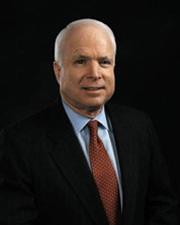 Sen. John McCain (R-AZ)
Legislative Activity
Stay on top of the latest movement without scrolling through every action
Senate amendment agreed to: Amendment SA 3461 agreed to in Senate by Yea-Nay. 54 - 46. Record Vote Number: 135.
June 22, 2004
View full timeline
Senate amendment agreed to: Amendment SA 3461 agreed to in Senate by Yea-Nay. 54 - 46. Record Vote Number: 135.
June 22, 2004
Roll call votes on amendments in Senate: Amendment SA 3461 agreed to in Senate by Yea-Nay. 54 - 46. Record Vote Number: 135.
June 22, 2004
Considered by Senate. (consideration: CR S7120, S7131-7132, S7133-7134)
June 22, 2004
Amendment SA 3461 agreed to in Senate by Yea-Nay. 54 - 46. Record Vote Number: 135.
June 22, 2004
Senate amendment submitted
June 21, 2004
Senate amendment proposed (on the floor): Amendment SA 3461 proposed by Senator Warner for Senator McCain to Amendment SA 3197 to language proposed to be stricken by amendment no. SA 3197.(consideration: CR S7071-7077; text: CR S7071-7072)
June 21, 2004
Amendment SA 3461 proposed by Senator Warner for Senator McCain to Amendment SA 3197 to language proposed to be stricken by amendment no. SA 3197. (consideration: CR S7071-7077; text: CR S7071-7072) In the nature of a substitute.
June 21, 2004
Votes
1 roll call on this amendment
Text
Proposed
NATIONAL DEFENSE AUTHORIZATION ACT FOR FISCAL YEAR 2005

The PRESIDENT pro tempore. Under the previous order, the Senate will
resume consideration of S. 2400, which the clerk will report.
The legislative clerk read as follows:

A bill (S. 2400) to authorize appropriations for fiscal
year 2005 for military activities for the Department of
Defense for military construction, and for defense activities
of the Department of Energy, to prescribe personnel strengths
for such fiscal year for the Armed Services, and for other
purposes.

Pending:

Brownback amendment No. 3235, to increase the penalties for
violations by television and radio broadcasters of the
prohibitions against transmission of obscene, indecent, and
profane language.
Burns amendment No. 3457 (to amendment No. 3235), to
provide for additional factors in indecency penalties issued
by the Federal Communications Commission.
Durbin amendment No. 3225, to require certain dietary
supplement manufacturers to report certain serious adverse
events.
Lautenberg amendment No. 3291, to require a protocol on
media coverage of the return to the United States of the
remains of members of the Armed Forces who are killed
overseas.
Warner amendment No. 3458 (to amendment No. 3291), to
propose a substitute expressing the sense of Congress on
media coverage of the return to the United States of the
remains of deceased members of the Armed Forces from
overseas.
Reed amendment No. 3353, to limit the obligation and
expenditure of funds for the Ground-Based Midcourse Defense
Program pending the submission of a report on operational
test and evaluation.

Mr. REID. Mr. President, the reason we have considered these side by
side on a number of occasions is the person offering the amendment
initially wants a vote on his amendment. The second degree usually
wipes out that amendment, which causes that person to reoffer the
amendment, which they have a right to do. It has been discovered in the
past that we are much better off considering them side by side right
off the bat rather than doing the parliamentary skirmishing. Of course,
as I said to the distinguished Chair, if there is an overwhelming vote
on the second degree, a lot of times the Senator who offers the first
degree doesn't want to do that. That is what we will have to see.
Mr. WARNER. Mr. President, I concur in the observation of our
distinguished colleague. All I am saying is we should look at each one
individually rather than establishing a policy at this point--certainly
with regard to this bill because, as the distinguished majority leader
said, the Senate has devoted extensive time to this piece of
legislation. It is very important. I am optimistic that we can meet the
schedule for completion tomorrow night. I hope that optimism is shared
on the other side.
At this time, the bill is open to amendment. The managers await the
arrival of the first Senator.
Mr. REID. Mr. President, the first Senator we have indicated to speak
on an amendment will be here at 2 o'clock. Senator Dayton will be here
on the Buy America amendment. Senator Levin has a missile defense
amendment with which the distinguished Chair is familiar. He will be
here also to offer that amendment shortly. We probably won't have too
many other amendments offered today, but we will see. We have placed
calls, as you know. We have lined up for today Senators Levin, Dayton,
Byrd, and Bingaman. But we now understand that Senator Bingaman may not
want to offer his amendment, Senator Byrd

[[Page S7063]]

may not want to offer his, and Senator Dayton's is with the condition,
of course, which we have talked about. Senator Levin will be here. I
assume Senator Levin's amendment will take probably an hour between
both sides. He usually doesn't talk very long.
We are in a position to move forward.
Mr. WARNER. Mr. President, I hope we can perhaps reach the Byrd
amendment today. It is an important amendment. I have shared many
debates with my good and valued friend from West Virginia, and we are
prepared. I cannot join him in support, but we will have a good, strong
debate on it. It will be, I believe, a historic debate to initiate
today.
Mr. REID. Mr. President, I spoke earlier today with Senator Byrd. He
said he would make a decision tonight as to whether he is going to
offer the amendment.
Mr. WARNER. Mr. President, I will be available tonight should the
senior Senator from West Virginia desire to take up that debate
tonight.
The PRESIDENT pro tempore. The Senator from North Dakota.
Mr. DORGAN. Mr. President, I want to mention in the context of the
discussion which has been held between the Senator from Virginia and
the Senator from Nevada that I believe the second-degree amendment
which I had intended to offer to Senator Brownback's second-degree
amendment will be in order. I have been working throughout the weekend.
The question with the Parliamentarian was whether it would be relevant.
I believe we have now revised that amendment so it will be relevant.
My understanding is Senator Brownback has offered an amendment on
indecency to this Defense authorization bill which came out of the
Commerce Committee with respect to broadcasting. Senator Burns of
Montana offered a second degree to Senator Brownback's amendment.
I would not offer an amendment that would be extraneous to the
Defense authorization bill except that the amendment Senator Brownback
offered came out of Commerce Committee on a matter that addressed a
related issue--that is, the concentration of broadcast ownership--which
I, Senator Lott, Senator Snowe, and others added in the Commerce
Committee. Senator Brownback offered an amendment on the floor of the
Senate excluding that provision. I understand why. I am not being
critical of him at all. But I would want to add that back using a
second-degree slot as soon as we can find a way in which Senator Burns'
second-degree slot will be resolved.
I say to the Senator from Virginia: I am here and ready any time to
offer that amendment. It would not be my intention to hold up the
Defense authorization bill. In fact, I wouldn't be offering this
amendment were it not for the fact that Senator Brownback's amendment
on indecency was offered to the Defense bill when it came out of the
Commerce Committee containing the amendment on broadcast ownership
which I had previously offered with Senator Lott.
I wanted to make the Senator from Virginia aware that the second
degree I will offer, along with Senator Snowe and some others, is
certainly available, and I would want to find an opportunity to offer
that amendment.
Mr. REID. Mr. President, through the Chair to the distinguished
Senator from North Dakota, on this side we have been very careful about
extraneous amendments being offered. There are a lot of things we would
like to talk about. There is minimum wage, just to name one and which
we feel is long overdue. There are a lot of amendments regarding
Medicare we could offer on this legislation--prescription drugs. But
because this is an important Defense bill, we have chosen not to offer
any extraneous amendments. We have been very thorough in stacking
amendments that would be offered on this side.
Speaking personally, that is why I am somewhat disappointed that an
amendment dealing with broadcast indecency would be offered on this
bill because there is no question it will hold up things. The Senator
from North Dakota has led the effort in the Senate, and that effort has
been successful. A limitation on what the administration did was passed
by a wide margin. This just opens the door.
Senator Dorgan would be legislatively irresponsible if he didn't
offer his amendment sometime during the pendency of this Brownback
amendment. I am in support of the Senator from North Dakota in offering
this amendment.

I want to underscore and underline that it is too bad this broadcast
indecency amendment was offered on this bill because it is going to
take a little bit of time.
Mr. WARNER. Mr. President, we are where we are. In the mortal words
of someone smarter than I, we have to deal with the cards which have
been dealt.
I have a suggestion. We are trying to work out how we could protect
the parliamentary situation as it now exists with regard to the Burns
second degree such that we could proceed now with the debate on the
amendment of the distinguished Senator from North Dakota and at least
have the debate in place in the hopes that perhaps we could resolve
this dilemma as the day goes on.
Mr. REID. Mr. President, I want it made clear that the reason I said
this is we have worked very hard to move this bill along. This is an
important bill. We started off with about 300 amendments. Those
amendments were defense oriented with rare exception. The majority
leader has worked hard and filed a cloture motion. That was withdrawn,
and rightfully so. But now we have this measure being offered on the
other side of the aisle.
I want the Record to be very clear that the extraneous matters on
this important Defense bill have not come from this side of the aisle.
Mr. WARNER. Mr. President, I so note that observation.
May I inquire of the Senator from North Dakota: Is the parliamentary
situation on his amendment now clear?
Mr. DORGAN. Mr. President, in response, my amendment would be a
second-degree amendment offered to Senator Brownback, but that second-
degree slot, I believe at this moment, is filled by an amendment
previously offered by Senator Burns. I don't quite know how to resolve
that, but at some point Senator Burns' second-degree amendment will be
resolved, that second-degree slot will be open, and I will offer an
amendment similar to that which we did in the Commerce Committee.
Mr. WARNER. I presume the Burns matter would require a recorded vote,
so at this point in time I don't know whether the Senator is willing to
use this available time to explain his amendment, although it will not
be a pending matter before the Senate.
We will try to resolve the underlying parliamentary situation with
regard to both amendments, the underlying amendment and the Burns
second-degree amendment, so the Senator will have his opportunity.
Mr. DORGAN. Mr. President, let me take a moment to consult with some
staff on our side with respect to the parliamentary situation.
Let me say again, so the Senator from Virginia is clear, and I think
he is, this Defense authorization bill needs to get completed with some
dispatch. I sympathize with the challenge he and the Senator from
Michigan have had trying to move it along. It is not my intent in any
way to delay that.
I feel obligated, as I think do others in the Senate, that when
Senator Brownback offered an extraneous amendment, that amendment which
previously included broadcast ownership limitation issues dealing with
the FCC rules, to add that back to the indecency language.
I will consult with our side in a moment and perhaps I can make some
comments about it, and if others wish to make comments, we would find a
way to vote as soon as the Burns second-degree amendment is disposed
of. Let me do some consultation and perhaps I can speak.
Mr. WARNER. That is a reasonable request, and I suggest the absence
of a quorum.
The PRESIDING OFFICER. The clerk will call the roll.
The legislative clerk proceeded to call the roll.
Mr. REID. Mr. President, I ask unanimous consent that the order for
the quorum call be rescinded.
The PRESIDING OFFICER (Mr. Roberts). Without objection, it is so
ordered.
Mr. WARNER. Mr. President, together with the Senator from Nevada,

[[Page S7064]]

the Senator from Virginia, in consultation with leadership, presents to
the Senate this UC: I ask unanimous consent that at 5:30 today the
Senate proceed to a vote in relation to the Warner amendment No. 3458
which is to be drafted as a first degree; to be followed immediately by
a vote in relation to the Lautenberg amendment No. 3291; provided that
no second degrees be in order to the amendments prior to those votes.

Amendment No. 3291, As Modified

Mr. REID. Mr. President, I ask unanimous consent that the
distinguished chairman allow me to send a modification for Senator
Lautenberg to the desk prior to this consent being approved.
Mr. WARNER. No objection.
The PRESIDING OFFICER. Without objection, it is so ordered. The
modification will be made.
The amendment (No. 3291), as modified, is as follows:

At the end of subtitle G of title III, add the following:

SEC. 364. PROTOCOL ON MEDIA COVERAGE OF RETURN TO UNITED
STATES OF REMAINS OF MEMBERS OF THE ARMED
FORCES WHO DIE OVERSEAS.

(a) Protocol Required.--(1) Not later than 60 days after
the date of the enactment of this Act, the Secretary of
Defense shall develop a protocol that permits media coverage
of the return to the United States of the coffins containing
the remains of members of the Armed Forces who die overseas.
(2) The protocol shall ensure the preservation of the
dignity of the occasion of the return to the United States of
members of the Armed Forces who die overseas.
(3) The protocol shall ensure the preservation of the
confidentiality of the identity of each member of the Armed
Forces whose remains are returning to the United States.
(b) Report.--Not later than 90 days after the date of the
enactment of this Act, the Secretary shall submit to Congress
a copy of the protocol developed under subsection (a).

Mr. REID. Mr. President, there is no objection to the consent request
by the Senator from Virginia.
The PRESIDING OFFICER. Without objection, it is so ordered.
Mr. WARNER. Mr. President, the leadership is working with the
managers to see what we can do to resolve the question of one of the
amendments which is pending before the Senate with regard to matters
relating to the Commerce Committee. We see the Senator from North
Dakota prepared to speak to his amendment. As soon as we can work out
the parliamentary situation, we will proceed to that point.
The PRESIDING OFFICER. The Senator from Nevada.
Mr. REID. Mr. President, we have been given a consent agreement
drafted by the staff that is now being vetted with the majority. We
should be in a position to approve that shortly which would allow us to
handle the underlying Brownback amendment, the Burns amendment, and the
Dorgan amendment, which we will offer on a future occasion not too long
from now. That should resolve this totally. In the meantime, I think it
would be appropriate if the Senator from North Dakota spoke about his
amendment.
Mr. WARNER. It would be a valuable use of the time if we were to do
so. We encourage that.
The PRESIDING OFFICER. The Senator from North Dakota.
Mr. DORGAN. Mr. President, let me say again this amendment is not
related to the subject of the Defense authorization. The only reason I
offer it is because the amendment offered by Senator Brownback, which
itself is not related to Defense authorization, was offered last
Friday. I indicated when he offered that amendment, which I support,
that I would second-degree it, because we second-degreed it in the
Commerce Committee, and we merged two issues: indecency and the issue
of broadcast ownership rules and regulations.
When my colleague from Kansas offers an indecency amendment to the
Defense authorization bill, I don't have much choice except to offer
the amendment we offered to it in the Commerce Committee. If this bill
is stripped of all extraneous amendments, I will understand that and I
will not complain. But if this bill is going to proceed with amendments
of the type that came from the Commerce Committee, then I insist it
also include the issue of broadcast ownership rules and regulations
that were adopted by the Federal Communications Commission.
Let me describe what all this is about with respect to broadcast
ownership. The Federal Communications Commission did a rulemaking on
the issue of broadcast ownership. They had somewhere around three-
quarters of a million Americans, unprecedented numbers of Americans,
write and e-mail and send concerns and expressions of their interest to
the Federal Communications Commission. Almost all of them said to the
FCC: Don't change the rules and regulations with respect to broadcast
ownership of properties in a way that injures the public interest.
It didn't matter to the FCC. They went ahead and changed the rules.
The way the FCC constructed it, the rules say: It is all right if in
your community--let's say you live in one of the biggest cities in
America--one company owns three television stations, eight radio
stations, the cable company, and the dominant newspaper. That is fine.
Well, it is not fine with me--it is not fine with, by far, the
majority of the American people--to see fewer and fewer Americans, no
more than a handful, who are going to have control over what the rest
of the American people see, hear, and read.
Let me say again what the FCC allowed. In the biggest cities of the
country, one company can come in and buy up eight radio stations, three
television stations, the cable company, and the dominant newspaper--in
many cases, the only newspaper. Why is this of concern? Well, it is of
concern to me because we license the use of the airwaves. They don't
belong to broadcasters or radio stations or television stations. They
belong to the people. The airwaves belong to the American people. We
license their use to certain companies in exchange for certain
obligations.
One of those obligations that has never and will never be old
fashioned is localism. That is not an old-fashioned requirement for
broadcasters. So the question is, how do you develop or how do you
maintain or how do you have localism in broadcast properties when one
company owns, in this case, 1,200 radio stations. Yes, that is the
case. One company owns 1,200 radio stations.
We did hearings about all these subjects. Let me tell you about
something called voice tracking. This is antithetical to localism.
Voice tracking is a process by which a company that owns a lot of radio
stations will have someone in a basement in Baltimore, MD broadcasting.
And he is broadcasting over, for example, a station in Salt Lake City,
UT, saying: It is a beautiful morning here in Salt Lake City. The sun
is shining over the mountains. What a great day to wake up in our city.

The problem is, that guy was broadcasting from Baltimore. He was
using the Internet to find out that the sun is shining in Salt Lake
City. It is called voice tracking. It is fooling the consumers into
believing that announcer is there. It has nothing to do with localism
or responsibilities of localism.
There is another approach used by television stations. It is called
central casting. It is trying to make you believe the news team is from
your city when, in fact, it is not. Central casting, voice tracking,
these are mechanisms by which the large concentrations of broadcasters
are trying to convince people there is localism to their broadcasts.
Some of us believe very strongly that this is moving in the wrong
direction. I am not opposed to big because something is big. Good for
the folks who are successful. If somebody has two radio stations and
buys two more, good for them. If they have eight and buy eight more,
good for them. If they have 50 and buy 50 more, I am not going to come
here and complain about that. But 1,200 radio stations in the hands of
one company? Or television broadcasting stations being gobbled up
together under one big ownership group? Is that good for our country,
especially in an area where, in most cases, you have monopolies or near
monopolies and now this FCC rule says, in addition to all of that, with
respect to broadcasting properties, we are going to get rid of that
pernicious rule that allows cross ownership of broadcast properties
with the newspaper?
At the hearing in the Commerce Committee, I held up a letter that was
sent out all across the country by an investment banking company. They
said: Get ready, because the FCC is fixing to change its rule, and when
they

[[Page S7065]]

do, your newspapers can buy up a bunch of broadcast properties. And so
they are already.
The FCC rule, fortunately for us, has not yet gone into effect
because it was stayed by a Federal court. This issue is now in the
Federal court. So there is a stay order. It may well be lifted soon
when the Federal court makes its judgment. But that begs for the
Congress to make its own judgment to overturn and rescind the FCC
rules.
Senator Lott, Senator Snowe, myself, and others brought this issue to
the Senate floor with something called a veto of an administrative
rule. It is called the Congressional Accountability Act in which we
have the opportunity to veto a rule by a Federal Agency. It has only
been used once. We offered that. And by a very significant margin, we
won. So the expression of the Senate already has been to say: We don't
support the FCC rule. We believe it should be rescinded. And using the
Congressional Accountability Act, the Senate, on a bipartisan vote,
said: We don't want these rules to go into effect, FCC, start over and
do it right. Well, that Senate vote went to the House of
Representatives and it is now sitting at the desk in the House of
Representatives 10 votes short. They need 218 votes. They have a letter
with 208 signatures on it and they are 10 short and they cannot move.

The Speaker of the House and the administration very much oppose
this. They have stymied it in the House of Representatives. My feeling
is that the only opportunity we have in a circumstance such as this is
to offer an amendment on a bill, such as the Brownback bill--and,
incidentally, we are faithful to our determination to move this. We
offered the same amendment in the Commerce Committee when Senator
Brownback brought up his legislation. We prevailed there.
I support the Brownback legislation and the second-degree amendment
that Senator Burns intends to offer to it as well. I hope the Senate
will, once again, support my second-degree amendment once the amendment
by Senator Burns is disposed of.
We had testimony before the Senate Commerce Committee, and I don't
remember the fellow's name. He testified two or three times. He owns a
pretty big broadcasting company in one of the States south of here. He
explained the problem with the growth and concentration in
broadcasting. He said: I own a good television station, but I cannot
tell the folks from Hollywood or New York what I want to show in my
viewing area because if they are sending out a program I think is
something I don't want to show, I don't have the opportunity to say we
will not show that. I will lose my network affiliate status if I do
that. I don't have the capability to make any kind of local decision
about this.
Look, I happen to think broadcasting, whether it is radio or
television, has some of the most breathtaking, wonderful, remarkable
programming; some of it is extraordinary. I also think there are
programs that are shabby, trashy, and disgusting. You have both sides
of it. I don't know, maybe somebody adds to their cultural interests by
tuning in on HDTV and seeing someone eating maggots from a bowl in a
contest. I don't know. I would expect that very few find much interest
in that. I guess it does achieve some ratings from time to time.
But when you have concentrations of broadcast properties, as has been
the case, dramatic increases in just the hands of a few people deciding
what the rest of the American people are going to see, read, and hear,
I think it ought to be of great concern to the Congress. The FCC rule
caved in almost instantly to the big economic interests here.
I know those who own newspapers are upset with the position I take.
Those who own broadcast properties are upset with the position I take.
But the fact is, this is about the public interest, and the public
interest is best served when we decide localism is not old-fashioned. I
don't object to some big companies. But I object to circumstances when
the big companies are given the green light by the FCC to own almost
everything in a community with respect to communications--radio
station, television stations, the cable company.
Whatever happened to the market system? The market system is where
you have robust competition, broad-based economic ownership. I don't
see much of that market system in broadcasting these days. All you see
are the gobbling up by big interests.

It is interesting, we now have a 35-percent ownership cap on national
viewing by the major television networks, in terms of the number of
stations they can own, which has now, as a result of last year's
omnibus bill, gone to 39 percent. It used to be 25 percent.
In fact, in 1996, when we had a bill on the floor called the
Telecommunications Act, we had a prohibition on owning television
stations beyond 25 percent of the national audience. That new bill took
35 percent. I came to the Senate floor in 1996 and offered an amendment
to take it back to 25 percent--the national ownership cap--with respect
to one company. It is interesting, we debated that about 4 o'clock in
the afternoon and then we had a vote. It turns out I won the vote.
Senator Dole, with a pretty substantial opposition on the floor of the
Senate when he wanted to be, was on the other side. So we had a vote on
broadcast ownership limitation and I won, I think by three or four
votes. I thought that was extraordinary, to win a vote like that. Then
I believe Senator D'Amato, as the vote was coming to an end, changed
his vote to be on my side, the prevailing side.
I knew something was wrong, but I didn't know what until 4 hours
later. What had intervened 4 hours later was dinner. Apparently, there
was some epiphany over dinner for four or five Senators, who came back,
and there was a motion to reconsider; these Senators who had had some
glorious meal, which apparently infused them with a different wisdom,
changed their vote and it turned out I had won only for 4 hours. That
happens around here. You can win big and long but sometimes not
permanently. That was the case in 1996.
I express that to say this is not a new issue with me. I have been
concerned about this concentration of broadcast ownership for a long
while. What the FCC has done is compounded the problem. Not only are we
saying ``Katey bar the door,'' whatever you want to buy, buy it, but we
will add to the mix the newspapers. While you are buying each other up
and playing these monopoly games, throw in the newspapers as well. We
don't care very much. That is the message from the FCC.
Fortunately, the Senate has sent a different message. We already
voted on this subject and expressed our interest that the rules crafted
by the Federal Communications Commission are completely out of sync
with reality and ought to be rescinded. That was a big vote in the
Senate. There was no reconsideration. We had to come back and lose that
one. Senator Lott and myself and others spoke in support of overturning
those rules. That is stuck in the House because the Speaker will not
allow a vote on it. We are going to have to find a way, in whatever
expression we can, to advance this issue.
Because Senator Brownback brought to the floor a bill that used to
include this amendment when it came out of the Commerce Committee, but
is not what he offered on the floor, I am required to offer this
amendment to the Brownback amendment. I will offer it in the second
degree.
My understanding is, while there is already a second-degree in the
form of Senator Burns' amendment, when I offer this at the end of my
presentation, the second-degree I will offer will be able to be
disposed of when the amendment of Senator Burns is disposed.
I support the Brownback amendment and the Burns amendment. If anybody
can understand all that, they are perhaps better than I am. I say to
the Senator from Virginia, I would like us to finish this Defense
authorization bill and deal with these issues. I encourage the Senator
to accept all three of these amendments and take them to conference.

If I might get the attention of the Senator from Nevada, Senator
Reid, I think we will need a unanimous consent request prior to my
formally offering a second-degree amendment, since there is already a
second-degree amendment in the slot. But having already spoken on this,
I don't need to speak further. Perhaps Senators Snowe, or Lott, or
others wish to speak in favor of the amendment. I will rely on the
Senator from Virginia and

[[Page S7066]]

the Senator from Nevada to offer my amendment at the appropriate time
when the consent is agreed to, and then mine would be disposed of
following Senator Burns' second-degree amendment.
Mr. WARNER. Mr. President, I think the Senator's understanding
coincides with that of myself and the distinguished Senator from
Nevada. In due course, several parties who have an active interest in
not only the parliamentary situation but the substance are soon to
arrive in the Senate. We have to wait a bit.
Mr. DORGAN. There are some interests, of course, outside of the
Chamber that would not want this amendment to the Brownback bill. I
want to make sure we have an understanding that I get the opportunity
to do this. Otherwise, I have a much longer statement that I would be
prepared to make. My preference would be to leave it at this and to
simply get this pending as soon as possible.
Mr. WARNER. Mr. President, we understand. A Senator asked for a few
minutes of morning business and then I would be prepared to engage with
Senator Bingaman on his amendment, if that is agreeable.
Mr. REID. Mr. President, will the Senator from Virginia yield?
Mr. WARNER. Yes.
Mr. REID. The Senator from New Mexico is here to offer his amendment.
The Senator from Minnesota, Mr. Dayton, is on his way to offer his
amendment. We also have the missile defense amendment to offer, and he
indicated he would be happy to do that today. So we have a lot to do.

I was looking at my BlackBerry, which is giving this information,
which is the reason we are here today:
Four U.S. servicemembers were killed Monday, shot repeatedly in the
head during an ambush while they were on patrol in the Sunni Muslim
stronghold of Ramadi. On Sunday, two servicemen were killed and 11
injured in an ambush on the road to the airport.
That is what this is all about today.
We ought to move this bill along, not only as quickly as we can, but
with as much quality as we can. This is an important piece of
legislation. We certainly understand that in 2 days, six Americans were
killed in Iraq. We only know of 11 wounded, but I am sure a lot more
than that were wounded. Each person in the Senate understands the
importance of this legislation. We are reminded of that every day when
we see news such as this.
Mr. WARNER. Mr. President, I thank my colleague for bringing up that
point. I, too, am concerned, as is every Member of this body, about the
daily, weekly loss of life and limb by our brave men and women in the
Armed Forces. As the Senator says, this is their bill. That is what it
is. It is their bill, whether they are privates or generals or
admirals.
Might we accommodate the Senator from Ohio?
The PRESIDING OFFICER (Mr. Chambliss). The distinguished Senator from
Ohio is recognized.
Mr. DeWINE. I thank the Chair, and I thank my colleague from
Virginia.

Update on Darfur

Mr. DeWINE. Mr. President, several weeks ago, I came to the floor to
talk about the crisis in Darfur, Sudan, where it is estimated at least
30,000 people have already been killed and 1 million people--maybe even
2 million--have lost their homes, have been driven from their homes in
a government-led campaign of ethnic cleansing. To get a better idea or
another way of looking at this, it is estimated that in this
government-led campaign of ethnic cleansing, 341 villages have been
completely destroyed, and 99 villages have been partially destroyed. It
is also estimated these villages are, on average, made up of 4,000 or
5,000 people to a village. I think my colleagues can understand the
gravity of this crisis.
Many of these individuals are now homeless. Those who have not been
killed have fled, and many of them are in refugee camps. The looming
crisis is absolutely unbelievable. This is clearly the world's greatest
crisis today.
The Government of Sudan announced this past weekend it intends to
disarm the militia responsible for these atrocities and present them to
justice. We can only hope and pray what the Government of Sudan says is
now correct. The Government of Sudan has made similar statements in the
past that have turned out not to be true. The Government of Sudan has
made similar statements in the past. For example, it is OK for refugees
to return to Darfur, all at the same time their very own government
planes were locating villages for the militias to attack. In addition,
there are still 1 to 2 million people still in need of humanitarian
assistance.

We do not need promises from the Government of Sudan. What we do
need, though, is action. That is why I am back on the floor today to
outline what we need to see accomplished in Darfur.
First, we need to see that the Government of Sudan is allowing
unfettered access to humanitarian aid. This means granting visas and
travel permits in a timely manner, not just to U.S. Government
agencies, but to all of the groups trying to help deal with the
humanitarian crisis that exists today in Darfur.
If one truck or one pallet of supplies is unreasonably delayed, the
Government of Sudan must be held accountable. The Government of Sudan
must know the world is watching and that we will not accept anything
short of their full cooperation.
Second, the recent decision to disarm the militias needs to be
accompanied by a plan to prosecute those guilty of ethnic cleansing and
genocide. The ranks of the government and military branches in Sudan
need to be searched, and those guilty of participating in the ethnic
cleansing need to be prosecuted. Competent tribunals need to be
established and justice served in Darfur. An unjust peace will provide
no peace for Darfur.
Third, the Government of Sudan must prove they have a long-term plan
to ensure that these atrocities simply will not continue. That is why
it is essential we dedicate the resources necessary to ensure a robust
African Union monitoring mission in Darfur. The Darfur region is the
size of Texas and, therefore, a handful of monitors simply will not be
enough to ensure that the killing and violence has stopped. We must be
committed to this in the long haul and the Government of Sudan must be
as well.
Until such time as the Government of Sudan accomplishes all of these
things, we should not relieve any of the pressure we have put on them,
and neither should the international community. The pressure is
beginning to work, but it must continue. Therefore, I believe the
United Nations Security Council must pass a resolution authorizing
peacekeepers for Darfur. If the Government of Sudan is serious about
ending this conflict, then they have no reason to object to U.N. troops
monitoring the cease-fire and ensuring that the humanitarian aid flows.
If the Government of Sudan objects to peacekeepers, we will know their
promises were not serious. This is a litmus test and the world will be
watching.
We also should expect the U.S. Department of State to move forward in
naming names of militia members and Sudanese Government officials
involved in the killings and atrocities. We must do everything in our
power to ensure that the guilty are punished. For the women who are
raped and then branded, for the children who were slaughtered, and for
the 30,000 who were killed because of the color of their skin, we must
ensure that justice is served.
I closed my speech last time talking about time and about how our
window of opportunity was closing. Nothing has changed. We still face
the worst humanitarian crisis in the world, and 2 million people are
counting on us. If we are serious after the horrible tragedy a decade
ago of Rwanda, if we are serious that we will never again allow
genocide to go unpunished, if we are serious that we will not allow
this to happen again, we cannot lose our focus. The Government of Sudan
must know we are still watching, that we will continue to watch, and
that nothing short of complete compliance will deter us from helping
the people of Darfur.
I thank the Chair and yield the floor.
The PRESIDING OFFICER. The Senator from Michigan.
Mr. LEVIN. Mr. President, it is very important to keep in focus what
Senator DeWine spoke about. There has been much too little focus by all
of us on this subject. The leadership of Senator DeWine in reminding us
of what is going on is critically important, and I thank the Senator
for it.

[[Page S7067]]

For close to two decades, the nation of Sudan has been ravaged by a
civil war that has claimed over 2 million lives. This civil war, which
is the longest running conflict in Africa, shows few signs of abating
as many efforts to negotiate peace agreements or cease-fires have
failed. What is particularly troubling is the fact that this conflict
has shifted and spread to the Darfur region in Western Sudan.
Historically, this civil war has pitted Northern Sudan, which is
largely Muslim, against those in the south who are predominately
Christian or animist. The conflict is not only religious in nature;
while setting those who would force a program of Islamization upon the
entire nation against unwitting supplicants, this conflict also draws
upon disputes over oil, water rights, and the future shape and form
that Sudan will take as a nation.
Given the nature of this conflict, the recent announcement by the
Government of Sudan that it would disarm the Janjaweed--militias
supported by the government of Khartoum--is a welcome sign. The ethnic
cleansing undertaken by the Janjaweed has claimed tens of thousands of
lives and has created over a million internally displaced persons as
well as hundreds of thousands of refugees who have fled across the
border to Chad.
Furthermore, the United Nations has noted that the conflict in the
Darfur has claimed over 30,00 lives. according the International Crisis
Group, as many as 350,000 more lives will be claimed in the next 9
months if conditions do not improve. It is imperative for the
international community to take clear and decisive steps to halt the
violence and to provide humanitarian aid to refugees and displaced
persons.
The Government of Sudan has a long history of denying aid to those in
need. Their tactics have been developed through decades of practice and
have included refusing to allow U.N. chartered planes with relief goods
to land in Sudan as well as instituting delays for trucks carrying
relief items. Camps that serve as home to over a million Internally
Displaced Persons are in woeful condition, and only exacerbate the
spread of disease and illness. It is imperative that medical supplies
and foodstuffs become available immediately. Further delays only mean
that more lives will be lost. Just as there cannot be a delay in the
distribution of aid, the international community must take steps to
provide the needed funds for this aid. The United Nations initially
appealed for over $170 million in aid for Darfur and Chad. Only $50
million, the bulk of which has been provided by the U.S., has been
provided while the amount of funds needed has increased to $250
million.
Food and medical aid can save lives immediately, yet steps must be
taken to ensure that a lasting a sustainable peace can be reached. To
that end, rebels must be disarmed. Given that these rebels operate with
the approval and support of the Sudanese Government and military, this
is an undertaking that can occur immediately if the political will to
do so can be mustered. Disarming the rebels is a good step, but it is
not sufficient. The rebel groups cannot be subsumed into the military
and police forces. All those involved in the perpetration and support
of ethnic cleansing must be prosecuted so that justice can be
administered.
None of this will occur without the leadership of the international
community. Thus far, for two decades, the world had done too little to
address this threat. The United States and the United Nations must take
steps to ensure that the international community is empowered to
effectively and efficiently ensure that a peace resolution is reached
and that it is implemented immediately.
Unfortunately, the cry of ``never again'' has been used all too
frequently when lamenting the propagation of conscious, deliberative,
and genocidal actions. It is imperative that decisive action is taken
to help bring peace to Sudan.
The PRESIDING OFFICER. The majority leader.
Mr. FRIST. I thank the Chair.
(The remarks of Mr. Frist and Mr. Wyden pertaining to the
introduction of S. 2551 are located in today's Record under
``Statements on Introduced Bills and Joint Resolutions.'')
The PRESIDING OFFICER. The Senator from Virginia.
Mr. WARNER. Mr. President, we are awaiting, and there is diligence on
the other side in every respect, either the amendment of Senator Dayton
or the amendment from Senator Bingaman. We have given them our second
degrees in each case, which are now being studied. Until such time as
one of the managers on the other side or these Senators appear, I
suggest the absence of a quorum.
The PRESIDING OFFICER. The clerk will call the roll.
The assistant legislative clerk proceeded to call the roll.
Mr. BINGAMAN. Mr. President, I ask unanimous consent the order for
the quorum call be rescinded.
The PRESIDING OFFICER. Without objection, it is so ordered.

Amendment No. 2459

Mr. BINGAMAN. Mr. President, I send an amendment to the desk and ask
for its immediate consideration.
The PRESIDING OFFICER. Without objection, the pending amendment is
laid aside.
The clerk will report the amendment.
The assistant legislative clerk read as follows:

The Senator from New Mexico [Mr. Bingaman] proposes an
amendment numbered 3459.

Mr. BINGAMAN. I ask unanimous consent the reading of the amendment be
dispensed with.
The PRESIDING OFFICER. Without objection, it is so ordered.
The amendment is as follows:

(Purpose: To require reports on the detainment of foreign nationals by
the Department of Defense and on Department of Defense investigations
of allegations of violations of the Geneva Convention)

At the end of subtitle C of title X, add the following:

SEC. 1022. REPORTS ON MATTERS RELATING TO DETAINMENT OF
PRISONERS BY THE DEPARTMENT OF DEFENSE.

(a) Reports Required.--Not later than 90 days after the
date of the enactment of this Act, and every six months
thereafter, the Secretary of Defense shall submit to the
appropriate committees of Congress a report on the population
of persons held by the Department of Defense for more than 30
days and on the facilities in which such persons are held.
(b) Report Elements.--Each report under subsection (a)
shall include the following:
(1) General information on the foreign national detainees
in the custody of the Department for more than 30 days during
the 6-month period ending on the date of such report,
including the following:
(A) The total number of such detainees in the custody of
the Department at any time during such period.
(B) The countries in which such detainees were detained,
and the number of detainees detained in each such country.
(C) The total number of detainees in the custody of the
Department as of the date of such report.
(D) The total number of detainees released from the custody
of the Department during such period.
(E) The nationalities of the detainees covered by
subparagraph (A), including the number of detainees of each
such nationality.
(F) The number of detainees covered by subparagraph (A)
that were transferred to the jurisdiction of another country
during such period.
(2) For each foreign national detained by the Department of
Defense during the six-month period ending on the date of
such report the following:
(A) The name.
(B) The nationality.
(C) The place at which taken into custody.
(D) The circumstances of being taken into custody.
(E) The place of detention.
(F) The current length of detention or, if released, the
duration of detention at the time of release.
(G) A categorization as a military detainee or civilian
detainee.
(H) The intentions of the United States Government on such
detainee, including whether or not the United States will--
(i) continue to hold such detainee with justification;
(ii) repatriate such detainee; or
(iii) charge such detainee with a crime.
(I) The history, if any, of transfers of such detainee
among detention facilities, including whether or not such
detainee been detained at other facilities and, if so, at
which facilities and in what locations.
(3) Information on the detention facilities and practices
of the Department for the six-month period ending on the date
of such report, including for each facility of the Department
at which detainees were detained by the Department during
such period the following:
(A) The name of such facility.
(B) The location of such facility.
(C) The number of detainees detained at such facility over
the course of such period and as of the end of such period.
(D) The capacity of such facility.
(E) The number of military personnel assigned to such
facility over the course of such period and as of the end of
such period.

[[Page S7068]]

(F) The number of other employees of the United States
Government assigned to such facility over the course of such
period and as of the end of such period.
(G) The number of contractor personnel assigned to such
facility over the course of such period and as of the end of
such period.
(c) Form of Report.--Each report under subsection (a) shall
be submitted in unclassified form, but may include a
classified annex.
(d) Appropriate Committees of Congress Defined.--In this
section, the term ``appropriate committees of Congress''
means--
(1) the Committee on Armed Services and the Select
Committee on Intelligence of the Senate; and
(2) the Committee on Armed Services and the Permanent
Select Committee on Intelligence of the House of
Representatives.

Mr. BINGAMAN. Mr. President, this is a very straightforward amendment
that would require the Department of Defense to provide to the
appropriate committees of the Congress--that is the Armed Services
Committee Senator Warner chairs here in the Senate, the Armed Services
Committee in the House, and the two Intelligence Committees of both the
House and Senate--a report related to those prisoners they are
detaining and that they have had in detention for at least 30 days.
Some could characterize this as the anti-ghost-prisoner amendment.
This is an effort to be sure Congress has the basic information it
needs to exercise oversight of the Pentagon, of the Department of
Defense, with regard to detainees anywhere in the world. The effect of
the amendment would be to require that the report advise the committees
on who these people are, what is their nationality, where are they
being detained--in which facility, that is--and whether the Department
of Defense intends to keep them, has justification for intending to
keep them in detention, intends to repatriate them to their home
country, or intends to charge them with some crime and prosecute them.
Those are the obvious choices. If there are others my colleagues could
suggest, I would be glad to add those to the language of the amendment.
The idea is the committees of the Congress with jurisdiction in this
area should have some knowledge about the extent of the detentions we
are engaged in, our Department of Defense is engaged in. The amendment
as I have drafted it calls for this report to be made every 6 months so
the Congress could exercise a meaningful oversight.
You could say, What has prompted this kind of amendment? There are a
lot of accounts in recent days in the news that have prompted it. I
think many people have probably noticed some of these news accounts.
There was an article in the Financial Times on Saturday. ``Guantanamo
Prisoners Wrongly Held'' is the headline. Then the body of the article
says:

The U.S. released more than two dozen prisoners from
Guantanamo Bay earlier this year after Pentagon lawyers
determined that some had been detained wrongly for as long as
2 years.

It goes on in another paragraph of the same article:

But the Financial Times has learned that in January the
Pentagon sent a team of lawyers to Guantanamo to examine
whether there was sufficient evidence to justify some of the
detentions.

Then it goes on and says:

The Pentagon team's recommendation that in several cases
there was insufficient evidence to justify their imprisonment
alarmed the White House because of the need to persuade the
Supreme Court of the legality of the detentions.

That is one article which obviously raised concerns. Frankly, what
raised concerns, at least for me, was the various articles recounting
the statements by the Secretary of Defense to the effect that he had
directed the appropriate information as to at least one prisoner and
perhaps several be withheld from the Red Cross. It is required to be
given to the Red Cross under the Geneva Conventions. He had ordered
that it not be given to the Red Cross at the request of the head of the
CIA. This is the so-called ghost prisoner phenomenon we have been
reading about in recent days.
About 10 months ago I offered an amendment here on the Senate floor
to try to require a report from the Pentagon, and from the Department
of Defense, on that category of prisoners whom the administration has
designated as enemy combatants.
Unfortunately, that amendment failed. Many of my colleagues voted
against it.
Senator Stevens made a representation on the Senate floor that the
Intelligence Committee has access to information about enemy
combatants, including the names of who is being detained. It says the
Red Cross is fully engaged in this information.
I tried, frankly, over a period of several weeks to find out if that
was the case. My first information was the Senate Intelligence
Committee did not have that information. I am now informed they do have
the information but that it is classified in such a way that only the
chairman and the ranking member of the Intelligence Committee have
access to it.
I believe as Members of Congress who have responsibility of oversight
of the executive branch it is appropriate that at least the appropriate
committees get the same basic information about these detainees that we
are required under the Geneva Conventions to give to the Red Cross. I
don't know why information should be provided to the Red Cross that the
Congress itself shouldn't be entitled to.
I hope my colleagues will agree both that we should provide the
information to the Red Cross as the Geneva Conventions commit us to
provide since we are signatories to the Geneva Conventions, and second,
that Congress should be entitled to the same basic information.
I have asked in my amendment which I have sent to the desk for some
additional information--information that the Red Cross is not entitled
to under the Geneva Conventions.
The main thing I have asked for, frankly, with regard to the
detainees is the Secretary of Defense advise the appropriate committees
of the Congress as to what the intention of our Government is with
regard to these individuals. Do we intend to maintain them in
detention? Do we have justification to do so? Do we intend to
repatriate them to another country? Or do we intend to charge them with
a crime?
It seems to me that is an appropriate request for us to be making.
I have been embarrassed--as I believe many in the Congress have
been--at the revelations about treatment of prisoners. I have also been
surprised at the revelations about the extent of the detentions we are
engaged in, particularly in Iraq but also in Afghanistan, and the
number of people we seem to have in custody.
I think it is entirely appropriate that the Congress try to exercise
some type of oversight on an ongoing basis to ensure that basic human
rights are respected, and that the standards we have committed to in
the Geneva Conventions are, in fact, being adhered to.
I think this is a very straightforward request. It does nothing but
require a report every 6 months.
I know my colleague and former chairman, Senator Warner, has had some
concerns about the particular aspects of this amendment and has come up
with an alternative which he would like to offer and put before the
Senate as well as a second-degree amendment.
I would be happy to engage in some serious discussion about the
particular provisions of my amendment as well as the second-degree
amendment Senator Warner has indicated he desires to offer. But, as I
say, I think the basic bottom-line position I am taking is there is no
reason Congress should be denied information which we are otherwise
providing to the Red Cross.

There is certainly no problem if the Department of Defense believes
this information needs to be held confidentially in classified form. My
amendment provides for that. It is their determination. If they think
this has to be classified, they can classify it. They can put portions
of this report in a classified annex. But to say Congress should not
get the information at all I think is not an appropriate response.
For that reason, I hope my amendment will be agreed to.
I yield the floor.
The PRESIDING OFFICER. The Senator from Virginia.

Amendment No. 3460 to Amendment No. 3459

Mr. WARNER. Mr. President, I send an amendment to the desk.
The PRESIDING OFFICER. The clerk will report.
The assistant legislative clerk read as follows:

The Senator from Virginia [Mr. Warner] proposes an
amendment numbered 3460 to amendment number 3459.

[[Page S7069]]

Mr. WARNER. Mr. President, I ask unanimous consent that reading of
the amendment be dispensed with.
The PRESIDING OFFICER. Without objection, it is so ordered.
The amendment is as follows:

In lieu of the matter proposed to be inserted, insert the
following:

SEC. 1022. REPORTS ON MATTERS RELATING TO DETAINMENT OF
PRISONERS BY THE DEPARTMENT OF DEFENSE.

(a) Reports Required.--Not later than 90 days after the
date of the enactment of this Act, and every six months
thereafter, the Secretary of Defense shall submit to the
appropriate committees of Congress a report on the population
of detainees held by the Department of Defense and on the
facilities in which such detainees are held. The report may
be submitted in classified form.
(b) Report Elements.--Each report under subsection (a)
shall include the following:
(1) General information on the foreign national detainees
in the custody of the Department during the six-month period
ending on the date of such report, including the following:
(A) The total number of detainees in the custody of the
Department as of the date of such report.
(B) The countries in which such detainees were detained,
and the number of detainees detained in each such country.
(C) The total number of detainees released from the custody
of the Department during such period.
(D) The nationalities of the detainees covered by
subparagraph (A), including the number of detainees of each
such nationality.
(E) The number of detainees covered by subparagraph (A)
that were transferred to the jurisdiction of another country
during such period, and the identity of each such country.
(2) Information on the detention facilities and practices
of the Department for the six-month period ending on the date
of such report, including for each facility of the Department
at which detainees were detained by the Department during
such period the following:
(A) The name of such facility.
(B) The location of such facility.
(C) The number of detainees detained at such facility over
the course of such period and as of the end of such period.
(D) The capacity of such facility.
(E) The number of military personnel assigned to such
facility over the course of such period and as of the end of
such period.
(F) The number of other employees of the United States
Government assigned to such facility over the course of such
period and as of the end of such period.
(G) The number of contractor personnel assigned to such
facility over the course of such period and as of the end of
such period.
(c) Appropriate Committees of Congress Defined.--In this
section, the term ``appropriate committees of Congress''
means--
(1) the Committee on Armed Services and the Select
Committee on Intelligence of the Senate; and
(2) the Committee on Armed Services and the Permanent
Select Committee on Intelligence of the House of
Representatives.

Mr. WARNER. Mr. President, let me first say I think our colleague has
brought to the attention of the Senate through his amendment a very
important subject. It is my hope and expectation that we can eventually
have a meeting of the minds. I don't take great joy in putting a
second-degree amendment up on important subjects such as this, but I
felt it imperative so we can frame for our membership what I perceive
as a very conscientious presentation by the Senator of a set of goals
in which I concur with two-thirds of the Senator's objectives. But
where I ask there be a reservation, those reservations are of such
severity that I am compelled to put in the second-degree amendment.
I would like to walk through the amendment which the distinguished
Senator put forth page by page.
The first section says:

Reports on matters relating to detainment of prisoners by
the Department of Defense.

Ordinarily, a report is something we are happy to grant a colleague.
But in this instance, I will point out where my concerns are. First:

Reports required. Not later than 90 days after date of
enactment of this Act, and every six months thereafter, the
Secretary of Defense shall submit to the appropriate
committees of the Congress a report on the population of
detainees held by the Department of Defense and on the
facilities in which detainees are held.

That is, have been held more than 30 days.
My understanding was originally it didn't have that, and 30 days to
me is reasonable. The Senator also added that the report can be
submitted now in classified form. Again, that is a very essential
improvement.
But we then continue:

(b) Report Elements. Each report under subsection (a) shall
include the following:
(1) General information on the foreign national detainees
in the custody of the Department during the six-month period
ending on the date of such report, including the following:
(A) The total number of detainees in the custody of the
Department . . .

I think that is an important fact, and I simply say ``as of the date
of such report.'' I think that should be something which would be
acceptable to the Senator.
Section (B) we leave standing.

The countries in which such detainees were detained, and
the number of detainees detained in each country.

That is acceptable.
Section (C) we take out simply because we modified (A) to state as of
date of such report, and I think (C) is cared for by modifying (A) with
date of such report.
Then we drop down:

The total number of detainees released from the custody of
the Department during such period.

We accept that fully.

(D) The nationality of the detainees covered by
subparagraph (A), including the number of detainees of each
such nationality.

That, too, seems to us to be fine.
Then section (F)--no objection there. That says, ``The number of
detainees covered by subparagraph (A) that were transferred from
jurisdiction of another country,'' so you can track them.
The Senator modified the original amendment. I am working from the
original to show to date how much we have had meeting of the minds.
The Senator took out section (G). I will not trouble to talk about
it.
We take out subsection (2). That is subsection (2) of the first
paragraph of the amendment, report elements under (b).
As drafted, we delete for each foreign national detained by the
Department of Defense during the 6-month period ending on the date of
such report: No. 1, the name of the individual; No. 2, his or her
nationality; the place at which they were taken into custody; the
circumstances of being taken into custody; the place of detention; the
current length of detention, or at least the duration of detention at
the time of release. And on it goes.

Here is the problem. That bit of information, even though it were
classified, were it ever to leak out--and regrettably, we know things
of this nature will happen from time to time--it would be devastating
because the enemy would know a great deal about custody and what we are
trying to do with those individuals.
It seems to me there is far greater benefit to an enemy in such
engagements as we must take prisoners than it would be of benefit to
the legislative body to monitor that prisoners are properly being cared
for. For example, the Durbin amendment we had the other day goes to
potential abuses. That has been accepted. It is a major step forward to
codify prohibitions against abuse of prisoners. We are all troubled by
that.
To have in the custody of the Congress this type of information, even
though it is locked up in S-407, or wherever it may be, potentially
there is a document that could do great harm to our ability to conduct
military operations during which we obtained detainees.
Then there is the following paragraph:

(3) Information of the detention facilities and practices
of the Department for the six-month period ending the date of
such report, including for each facility of the Department at
which detainees were detained. . . .

That is fine.

(A) The name of such facility.
(B) The location of such facility.

We have no objection to that. In fact, the entire next page of the
amendment, we accept. We come to the conclusion of the amendment and no
further objections. It simply is to the creation of a document that
would have such detailed information that is not essential to the
Congress in our oversight of these detention facilities and the
practice of detention, and if that document would ever get out, it
would be a devastating blow to the intelligence system, to giving the
information to the enemy, who we have among their presumably lost and
missing persons, and the like.
I urge my colleagues, this is something we should scrutinize
carefully. I have framed it in such a way that colleagues will have to
decide whether it

[[Page S7070]]

is a second-degree amendment that prevails or the underlying amendment
that prevails.
Therein, with the exception of one other mention just this morning,
the committee staff, the majority and the minority, were briefed on
this document. It roughly looks to be 30 pages of unclassified material
entitled ``Department of Defense proposed''--just being proposed at the
moment--``administrative review of the detention of enemy combatants at
Guantanamo Bay, Cuba.''
This is one of our facilities. The Secretary of Defense has
established administrative review procedures to determine annually if
enemy combatants detained by the Department of Defense at the U.S.
Naval Base at Guantanamo Bay should be released, transferred, or
continue to be detained, and so forth.
Much of it parallels what the Senator has in mind. I am confident
after this morning's briefing the Congress will make several edits. I
encourage the distinguished ranking member to engage our colleague,
Senator Bingaman, a former member of our committee, to look at it also
and see how we can improve and strengthen this. So this will soon be in
effect.
The PRESIDING OFFICER. The Senator from New Mexico.
Mr. BINGAMAN. Would my colleague yield for a question?
Mr. WARNER. I yield.
Mr. BINGAMAN. I appreciate the cooperative approach my colleague has
taken. I greatly respect his judgment on many of these matters.
First, on the issue of whether revealing the name and identity of
these people is a major security threat, we have obligated ourselves
under the Geneva Convention to do exactly that with regard to
information we are going to turn over to the Red Cross for every
prisoner of war we take into custody.
The specific language in part V of the Geneva Conventions talks with
respect to each prisoner of war:

. . . the information shall include, in so far as available
to the Information Bureau, in respect of each prisoner of
war, his surname, first names, rank, army, regimental,
personal or serial number, place and full date of birth,
indication of the Power on which he depends, first name of
the father and maiden name of the mother, name and address of
the person to be informed and the address to which
correspondence for the prisoner may be sent.

That is what the Geneva Conventions requires.
Could we explore the possibility of just saying that the appropriate
committees of the Congress should be entitled to the same information
that we have committed ourselves to provide to the Red Cross with
regard to all detainees?
Mr. WARNER. Mr. President, that is a very good question. I will take
a few minutes to answer. It deserves a very considered answer.
I have thought this through. It is interesting, coincidentally over
the weekend I dealt with the Department of Defense. I did not have a
chance to brief my distinguished ranking member yet on the question of
the Red Cross's participation in our situations, both in the
Afghanistan detention facilities and the Iraqi detention facilities. I
am speaking for myself.
I am very concerned about those problems over there. Our committee
had several hearings on it. The issue comes up, as it should. It came
up in the Judiciary Committee the other day, about the role of the Red
Cross. I have learned a great deal about that role in a short period of
time.
I had some familiarity when I was Secretary of the Navy and during
the Vietnam conflict. The Secretary of Defense was at that time--I have
served under three of them--Secretaries Melvin Laird and Jim
Schlesinger. They were very conscientious about working with the Red
Cross.
The Red Cross has done a remarkable job in this very difficult area,
going into these prisons, monitoring them, and going back to the
government host of the prisons and making corrections and trying, in
some instances, to benefit the incarceration detainees in terms of
their individual personal status.
The success of that program has been dependent on the absolute
sanctity of that material and the fact that the observations of the Red
Cross have not gotten into the public domain. We are working with the
Department of Defense now, such that the Senate can be given the
benefit of the Red Cross inspections in our facilities in Afghanistan
and in Iraq. It will be my recommendation to the committee that we will
have it in a classified briefing. But we are not, hopefully, going to
retain any of those documents in the Senate.
Were that material to get out in some manner, we are told by the Red
Cross, it would seriously limit their ability to do this magnificent
work they do all over the world. If some nations--and only in a
classified forum can I give those names--but some nations that now
allow the Red Cross in to get information and to hopefully provide
corrections to prisoners' treatment, if that had gotten out, that is
the last time the Red Cross would get into that country to examine
those prisons.
So we come down to the very basic fundamental issue about those
detainees, whether they are in the United States or wherever they are
in the world in these prisons, the Red Cross is helping in many
instances. But they say if the information they write up and send back
to the host country of the prisons gets into the public domain, forget
it; they will be precluded from going on. So we would face a similar
situation.
It is very difficult for me, one who has been privileged to be in
this body now my 26th year, to just say I am concerned that some
material in classified form in the possession of the Senate could get
out. But, regrettably, whether it got out from under the Senate or got
out from another source and that source would then blame the Congress
for leaking it--I don't know, we have all been through the leak
scenario--it leads to a never-never land in this Government of ours.

But I urge that we consider this very detailed information which our
colleague is seeking. The amendment in the second degree, which I am
perfectly willing to withdraw to the extent we can come to a resolution
and make it your first-degree amendment and no second--I believe we
have to observe the practices with regard to this detailed information
you are seeking.
Mr. LEVIN. I wonder if the Senator will yield.
The PRESIDING OFFICER. The Senator from Michigan.
Mr. LEVIN. This is really a question for the sponsor of the
amendment. I say to the Senator, I understand what you have just
suggested is that the information which we provide to the Red Cross be
shared with Congress, not that the information which the Red Cross
gives to us be shared with the Congress; is that correct?
Mr. BINGAMAN. Mr. President, in answer to the question, that is
exactly right. It is not my suggestion that the Red Cross reports on
conditions in prisons or anything else be provided to us. All I am
saying is if our Department of Defense turns over information to the
Red Cross--as it is required to do under the Geneva Conventions--we
ought to have access to that.
Mr. WARNER. Fine.
Mr. BINGAMAN. Even in classified form, Congress ought to be able to
know as much as the Red Cross knows about who we are detaining in our
facilities.
Mr. WARNER. Mr. President, I do not disagree in how you frame the
issue, but I maintain my stance. Let me parse it very carefully. I say
to the Senator, you are saying that what we give the Red Cross--not
what the Red Cross comes back and tells us we are doing right or
wrong--what we give to the Red Cross can be shared with Congress?
Mr. LEVIN. That is the question by the Senator from New Mexico. It
seems to me that makes good sense.
Mr. WARNER. Here is where I respectfully differ. If the information
we give to the Red Cross were to leak out, then other nations that are
similarly following that practice will see this is now in the public
domain and say: We are stopping, Red Cross, because we see it has
gotten into the public domain of another country. Therefore, we don't
want that to happen.
Mr. LEVIN. If the Senator would yield--and I guess I have the floor,
but, in any event, this information the Senator from New Mexico is
talking about is information we have which the executive branch has.
Now, I believe the fear the Senator from Virginia just expressed is not
that the Red Cross would leak it--because they do not----

[[Page S7071]]

Mr. WARNER. No.
Mr. LEVIN. They have proven they do not leak the information. They
perform--I agree with the good chairman--a very valuable service as to
what they do. But what it seems to me the chairman is saying is there
is less confidence the legislative branch will protect the
classification of this material than the executive branch will protect
it. I do not think we can accept a premise that we are more likely to
leak classified information here in the Congress than the executive
branch is likely to leak it. As a matter of fact, recent history----

Mr. WARNER. Mr. President, I say to the Senator, I concede your
point. You need not deliberate further. Fault lies on both sides, both
branches of Government. All I am saying is--and I am informed by those
who have greater knowledge about the procedures of the Red Cross than
I; and I don't know whether it comes out of the executive branch or the
Congress--further distribution of this information beyond one branch of
Government to another branch of Government does increase the likelihood
that somehow it gets out. And it will deal the Red Cross a very serious
blow, I am told.
Mr. LEVIN. I wonder if the Senator from Virginia would consider this
possibility as we explore ways of bridging the differences; and I, like
our good friend, Senator Bingaman, very much appreciate, as always, the
chairman's willingness to look for common ground. It seems to me the
one sensitive area the executive branch has and that is in this
amendment has to do with the name of the person.
For instance, it seems to me, if there is a number which is assigned
to every prisoner--which I understand is true for every prisoner of
war, every enemy combatant, or every civilian, for that matter, who is
held in detention--it seems to me, if the number is given rather than
the name, the rest of this information is very appropriate and will
help in the oversight process.
The failure, it seems to me, to make clear to the world that we are
going to abide by international conventions and that we are going to
make sure our people are treated properly by our treating other people
properly, that failure has cost us greatly. The purpose of the Bingaman
amendment is clearly to get us back on track in terms of what our
responsibilities are by giving Congress the ability to perform our
oversight responsibility.
We do not have that ability now. We do not have this information.
Without this information, we cannot perform the essential oversight
which has been missing here, and I believe if it had been in place
early enough perhaps it would have persuaded the administration to get
back on course earlier than it has been persuaded.
But my specific question to the chairman would be--and I have not
consulted with the sponsor of the amendment; I don't know whether he
would be in an accepting mood--but if the number of the prisoner or the
civilian who is being detained were substituted for the name, would
that have the same problem?
Mr. WARNER. Mr. President, in other words, rather than the
individual's name, that his number is No. 224--whatever it is? I would
have to defer until I go to the heart of the experts. All I know is
that the name--if we are detaining certain individuals and the enemy
does not know whom we have captured, and they, therefore, have to
shelve some of their plans, knowing that the persons who are missing
from their roster, if they were to talk about the plans, they would
make the plans less valuable to the enemy--I mean, I am just working
through the obvious scenarios here.
Now, whether a number would suffice, I would like to go back to those
who are dealing with this on a daily basis.
Mr. LEVIN. When the chairman does that I would perhaps propose that
one other consideration be looked at, and that is, I understand we are
obligated to provide the names to the Red Cross now, and those names go
back to the families in order that the families can find their loved
one, if that loved one is alive, or that brother, or father, or
whoever. Now, I may be wrong in that, but it seems to me the purpose of
the----

Mr. WARNER. Mr. President, it is interesting, over the weekend I had
the opportunity, I say to my distinguished colleague, to visit the
Department of Defense, and I was greatly impressed with an individual,
who was a Member of the U.S. House of Representatives a decade or so
ago, who is in charge of it. I will seek to have him come over right
away and provide both sides with the expert to propound these
questions. They are good questions. Let's see what we can do to work
this thing out.
Mr. LEVIN. I thank the chairman. I believe we ought to try to work
this out. This is really moving in an essential direction for our
Nation and our troops. I commend the Senator from New Mexico for his
leadership and thank the chairman. I think maybe we ought to lay this
amendment aside temporarily. I do not know if----
Mr. REID. Mr. President, if the two managers will yield?
The PRESIDING OFFICER. The Senator from Nevada.
Mr. REID. Mr. President, Senator Dayton is here to offer his
amendment. He is going to take about 20 minutes. It is my understanding
Senator McCain or someone on his behalf will second degree this
amendment. Following that, Senator Harkin is here ready to offer a
second-degree amendment to the Durbin amendment. That will be offered
on behalf of Senators Harkin and Hatch, dealing with supplements.
Mr. WARNER. Yes. Mr. President, I think all that can be accommodated,
so I join in the request at this time to lay aside the pending
amendment in the second degree and the underlying amendment by our
distinguished colleague from New Mexico and to then let the other
Senators seeking recognition have the floor.
The PRESIDING OFFICER. The Senator from Minnesota.

Amendment No. 3197

Mr. DAYTON. Mr. President, I thank the distinguished chairman of the
committee and others for setting aside their amendments, and I call up
amendment No. 3197.
The PRESIDING OFFICER. The clerk will report.
The assistant legislative clerk read as follows:

The Senator from Minnesota [Mr. Dayton], for himself and
Mr. Feingold, proposes an amendment numbered 3197.

Mr. DAYTON. Mr. President, I ask unanimous consent that reading of
the amendment be dispensed with.
The PRESIDING OFFICER. Without objection, it is so ordered.
The amendment is as follows:

(Purpose: To strike sections 842 and 843)

Beginning on page 172, strike line 11 and all that follows
through page 176, line 21.

Mr. DAYTON. Mr. President, my amendment strikes two sections of the
bill, sections 842 and 843, which relate to ``Buy America'' and the
Berry amendment, which are features that have been in existing law for
quite a number of years to strengthen our national defense and our
national economy.
This bill authorizes $422 billion for national defense programs for
fiscal year 2005, a sum that doesn't even include the funding for
ongoing operations in Iraq and Afghanistan. If you include those
additional amounts, our national defense spending for the next fiscal
year will be almost $500 billion.
Mr. WARNER. Mr. President, will the Senator yield for the purpose of
allowing me to put a second-degree amendment at the desk so our
colleagues can then begin to examine both as this very important debate
is underway?
Mr. DAYTON. I yield to the chairman.

Amendment No. 3461 To Amendment No. 3197

Mr. WARNER. Mr. President, I send to the desk, on behalf of Senator
McCain, an amendment in the second degree.
The PRESIDING OFFICER. The clerk will report.
The assistant legislative clerk read as follows:

The Senator from Virginia [Mr. Warner], for Mr. McCain, for
himself and Mr. Warner, proposes an amendment numbered 3461
to amendment No. 3197.

Mr. WARNER. Mr. President, I ask unanimous consent that reading of
the amendment be dispensed with.
The PRESIDING OFFICER. Without objection, it is so ordered.
The amendment is as follows:

(Purpose: To perfect the matter proposed to be stricken)

In lieu of the matter proposed to be stricken, insert the
following:

[[Page S7072]]

SEC. 842. WAIVER AUTHORITY FOR DOMESTIC SOURCE OR CONTENT
REQUIREMENTS.

(a) Authority.--Subchapter V of chapter 148 of title 10,
United States Code, is amended by adding at the end the
following new section:

``Sec. 2539c. Waiver of domestic source or content
requirements

``(a) Authority.--Except as provided in subsection (f), the
Secretary of Defense may waive the application of any
domestic source requirement or domestic content requirement
referred to in subsection (b) and thereby authorize the
procurement of items that are grown, reprocessed, reused,
produced, or manufactured--
``(1) in a foreign country that has a Declaration of
Principles with the United States;
``(2) in a foreign country that has a Declaration of
Principles with the United States substantially from
components and materials grown, reprocessed, reused,
produced, or manufactured in the United States or any foreign
country that has a Declaration of Principles with the United
States; or
``(3) in the United States substantially from components
and materials grown, reprocessed, reused, produced, or
manufactured in the United States or any foreign country that
has a Declaration of Principles with the United States.
``(b) Covered Requirements.--For purposes of this section:
``(1) A domestic source requirement is any requirement
under law that the Department of Defense satisfy its
requirements for an item by procuring an item that is grown,
reprocessed, reused, produced, or manufactured in the United
States or by a manufacturer that is a part of the national
technology and industrial base (as defined in section 2500(1)
of this title).
``(2) A domestic content requirement is any requirement
under law that the Department of Defense satisfy its
requirements for an item by procuring an item produced or
manufactured partly or wholly from components and materials
grown, reprocessed, reused, produced, or manufactured in the
United States.
``(c) Applicability.--The authority of the Secretary to
waive the application of a domestic source or content
requirements under subsection (a) applies to the procurement
of items for which the Secretary of Defense determines that--
``(1) application of the requirement would impede the
reciprocal procurement of defense items under a Declaration
of Principles with the United States; and
``(2) such country does not discriminate against defense
items produced in the United States to a greater degree than
the United States discriminates against defense items
produced in that country.
``(d) Limitation on Delegation.--The authority of the
Secretary to waive the application of domestic source or
content requirements under subsection (a) may not be
delegated to any officer or employee other than the Under
Secretary of Defense for Acquisition, Technology and
Logistics.
``(e) Consultations.--The Secretary may grant a waiver of
the application of a domestic source or content requirement
under subsection (a) only after consultation with the United
States Trade Representative, the Secretary of Commerce, and
the Secretary of State.
``(f) Laws Not Waivable.--The Secretary of Defense may not
exercise the authority under subsection (a) to waive any
domestic source or content requirement contained in any of
the following laws:
``(1) The Small Business Act (15 U.S.C. 631 et seq.).
``(2) The Javits-Wagner-O'Day Act (41 U.S.C. 46 et seq.).
``(3) Sections 7309 and 7310 of this title.
``(4) Section 2533a of this title.
``(g) Relationship to Other Waiver Authority.--The
authority under subsection (a) to waive a domestic source
requirement or domestic content requirement is in addition to
any other authority to waive such requirement.
``(h) Construction With Respect to Later Enacted Laws.--
This section may not be construed as being inapplicable to a
domestic source requirement or domestic content requirement
that is set forth in a law enacted after the enactment of
this section solely on the basis of the later enactment.
``(i) Declaration of Principles.--(1) In this section, the
term `Declaration of Principles' means a written
understanding (including any Statement of Principles) between
the Department of Defense and its counterpart in a foreign
country signifying a cooperative relationship between the
Department and its counterpart to standardize or make
interoperable defense equipment used by the armed forces and
the armed forces of the foreign country across a broad
spectrum of defense activities, including--
``(A) harmonization of military requirements and
acquisition processes;
``(B) security of supply;
``(C) export procedures;
``(D) security of information;
``(E) ownership and corporate governance;
``(F) research and development;
``(G) flow of technical information; and
``(H) defense trade.
``(2) A Declaration of Principles is underpinned by a
memorandum of understanding or other agreement providing for
the reciprocal procurement of defense items between the
United States and the foreign country concerned without
unfair discrimination in accordance with section 2531 of this
title.''.
(b) Clerical Amendment.--The table of sections at the
beginning of such subchapter is amended by inserting after
the item relating to section 2539b the following new item:

``2539c. Waiver of domestic source or content requirements.''.

SEC. 843. CONSISTENCY WITH UNITED STATES OBLIGATIONS UNDER
TRADE AGREEMENTS.

No provision of this Act or any amendment made by this Act
shall apply to a procurement by or for the Department of
Defense to the extent that the Secretary of Defense, in
consultation with the Secretary of Commerce, the United
States Trade Representative, and the Secretary of State,
determines that it is inconsistent with United States
obligations under a trade agreement.

Mr. WARNER. I thank my colleague for his courtesy. We now undertake a
very important debate on this subject.
The PRESIDING OFFICER. The Senator from Minnesota.
Mr. DAYTON. Mr. President, we are going to spend, in the next fiscal
year, some $500 billion. That is a half trillion dollars, a huge amount
of the taxpayers' money; in fact, about one-fourth of all the money the
Federal Government will spend for everything next year, including
Social Security, Medicare, health care, and education.
The purpose of these expenditures is to strengthen our national
security for now and the future. The six priorities that were approved
by the Senate Armed Services Committee, of which I am proudly a member,
along with the Presiding Officer and others, reported in the bill
before us unanimously by the committee, include such measures as
combating terrorism and winning the global war against terrorism,
supporting our military operations in Iraq and Afghanistan, to
sustaining the readiness of our Armed Forces to conduct the full range
of military operations against all current and anticipated threats.
It goes on to state: Another object is modernizing and transforming
our Armed Forces to successfully counter future threats. So we need to
spend this money on the immediate needs and missions of our military
and support the phenomenal job they have been doing on our behalf
around the globe, but we also need to try to anticipate the future.
That is difficult, but it is also important. It requires us to look at
the big picture, at the global picture, and into the years and even, if
possible, the decades that lie ahead. It means we don't want to do
something now that is expedient or briefly beneficial that will have
negative consequences for us in the future.
Ideally, we want policies that strengthen our country now and in the
future. That has been the compelling reason for the so-called ``Buy
American'' requirements of the Department of Defense, the military
branches, and all other Federal agencies for the past 70 years.
``Buy America'' came out of the depths of the Great Depression. Buy
America to strengthen America is really what it should be called. Buy
America to strengthen America--that was the reason, the purpose, and it
has been the result for seven decades. However, the law has always
provided for exceptions, exceptions that essentially give, as they
should, the full authority to the Secretary of Defense to waive
domestic purchase requirements whenever necessary to provide our Armed
Forces with equipment, weapons, clothing, food, or anything else that
is not available in the United States, that could not be produced or
provided in this country when it is needed, that lacks the quality or
features or advantages, or that is not priced competitively with non-
U.S.-made products.
So the law has essentially said: Try to buy American, but if you
can't or you shouldn't, then don't. It has worked for almost 70 years,
through 11 different administrations--six Democratic, five Republican--
until last year this administration and this Senate shredded that bill.
That shredding was reduced to a few slices by the strong opposition of
the House conferees, led by the House Armed Services Committee
chairman.
We in this body are exceedingly fortunate to have the chairman of the
Senate Armed Services, who is unparalleled as a leader and public
servant. Last July, I traveled to Iraq with the distinguished chairman
of the Armed Services Committee, the senior Senator from Virginia, Mr.
Warner. We went through the country with 115-degree temperatures.
I struggled to keep

[[Page S7073]]

up with him as he charged fearlessly into every perilous situation. He
is in every respect--leading that committee, here on the floor, or out
in the field around the world--one of the most outstanding leaders and
pubic servants I have ever met anywhere in my walk of life.

I also greatly admire my colleague and friend, the senior Senator
from Arizona, Mr. McCain, whose military experience and expertise and
whose devotion to his country and his service to it are all remarkable.
However, on that occasion last year regarding ``Buy America,'' I
thanked our Founding Fathers for the wisdom of bicameralism. And I must
respectfully but strongly again disagree this year with the Senate
bill's provisions that would effectively destroy ``Buy America'' by its
exceptions to it.
If we pass the legislation that is before us now with the language in
it, the second degree to my amendment that has been put down today, we
might as well eliminate the entire ``Buy America'' statute as it
applies to the Department of Defense and the armed services and others
that are funded by this bill because that will be the result if this
current Senate language if we pass it.
I challenge those in the Bush administration and those in the Senate
and those lobbying for the big multinational corporations and for the
foreign governments they represent, who truly believe that we will be
better off without any ``Buy America'' requirements, or certainly, in
the case of the paid lobbyists, who know that they and their clients
will be better off without them, and those who believe that for
whatever reason, they should just say so and put the repeal before us
in black and white and have us vote on that rather than just creating
more exceptions and more loopholes that give more foreign countries and
the corporations that operate in them more and more of the money from
this bill in the products that they buy and the jobs for which they
pay, because under this language that exists in the bill now, those tax
dollars, those products, those jobs will go to people in other
countries but not to Americans.
There will be no more ``Buy America'' to strengthen America. It will
be buy abroad, because of what? Because it is cheaper? Because it is
better? Because it doesn't matter?
Let's have that debate in the Senate. Is it cheaper to buy overseas?
After counting all the costs of not only the product prices but also
the wages that are gained or lost, the taxes paid by those wage earners
in this country or somewhere else, the unemployment costs in this
country, the welfare cost, the food stamp cost, not to mention the
human cost of people who lose their jobs, is it better to buy these
products overseas? Better for whom? Who gains, who loses, when American
dollars are spent abroad to buy foreign goods made by foreign workers
instead of American goods made by American workers? Does it matter?
Evidently not to this President or to this Pentagon leadership. But it
sure matters to the American people, who will lose their jobs or won't
get new jobs or better jobs. Do they have a say in where their tax
dollars are spent? Does it matter to this Senate that there are now
2\1/2\ million fewer manufacturing jobs in this country than there were
when President Bush took office? Yes, 2\1/2\ million manufacturing jobs
have been lost in this country in the last 3\1/2\ years, despite the
so-called recovery and recent job gains in some other sectors of our
economy. There are still 2\1/2\ million less manufacturing jobs today
than there were in January 2001.

Many of those American jobs have been sent overseas and were replaced
in other countries by low-wage jobs. Importing all those foreign-
manufactured products has now produced a U.S. trade deficit that last
month was $48.2 billion. That is another all-time worst trade deficit--
$48.2 billion for a single month, and it will probably be broken again
next month or soon thereafter. Over the next year, if that continues,
it will produce an annual trade deficit of $578 billion--almost $100
billion more than last year's record trade deficit.
We are told we cannot do anything about this massive bleeding of jobs
and wages, capital investments, profits, and tax payments out of our
country. We are told we should not even try; it is free trade,
globalization, and it is good for America. Is 2.5 million lost
manufacturing jobs good for America? Over $100 billion in lost wages
and benefits every year is good for America? Over $30 billion of lost
tax revenues each year for Federal, State, local governments, and
school districts is good for America? Our Federal budget deficits, our
State and local government deficits, U.S. trade deficit, national debt
increasing, all of which are going higher and higher--is that all good
for America? Jobs and wages, production of goods and services, capital
investment by businesses, allowing people--as consumers buy goods and
services, producing tax revenues, individual and corporate, they are
the lifeblood of any economy. They are its vitality. Corporate profits,
stock prices, dividends, and capital gains are all vitally important as
well, but they are not enough.
This country's economic vitality is bleeding away. Our economic
strength is weakening. Our economic strength is essential to our
military strength. Our economic security is essential to our national
security. This legislation, this authorization to spend $500 billion on
our national security, had better strengthen, not weaken, our economic
security as well.
I am aware of the letter to the chairman from a group calling itself
the National Defense Industrial Association. It claims to represent
over 1,300 member companies and purports to be the ``voice of the
industrial base.'' Who are these companies? Whose industrial base are
they speaking for? Many are companies that have moved their production
overseas, that are making better profits from paying low wages to
foreigners instead of good wages to Americans. We cannot stop them from
doing so. But why should we reward them with American tax dollars going
to support their foreign production? They can certainly continue that
foreign production, and they will. But if they want these U.S. military
contracts, they should fill them with American workers, not with
foreigners.
They should make those products or provide those services in American
communities, not foreign cities. They should pay taxes from those
profits to our school districts and local governments, not someone
else's. These are American tax dollars that are paying for our national
defense, not from their corporate profits from foreign operations--
profits on which they will pay taxes to foreign governments, not our
own.

Someone has to look out for the best interests of this country, and
it sure is not the National Defense Industrial Association. Maybe that
is not their responsibility. But the best interests of this country are
our responsibility here in the Senate. So they should not tell us or
try to make us or the American people believe their interests are
America's interests. In their letter, they claim it would negatively
impact the ability of the U.S. industrial base to compete in the
international marketplace and would therefore negatively impact the
Warfighter, and the bill's amendment gutting ``Buy American'' will
represent important steps in the Department of Defense's transformation
plans and send positive signs to our allies that the United States is
supportive of existing trade agreements. I am deeply offended that
American companies, most of which are headed by American citizens,
would try to hide their financial self-interests behind pretenses like
these. They want defense contracts they can fulfill with their existing
foreign operations that provide them with greater profits. They don't
want to have to shift that production back to the U.S. and employ
fellow American citizens. They want only what is good for themselves,
not what is best for America's military strength or our Nation's
economic vitality.
In some cases, as the letter discloses, they coddle foreign
governments that want to buy American military hardware and then want
us to buy the same amount of their foreign-made military products from
their countries. We signed, evidently--somebody in the Department of
Defense signed these agreements. There are countries where our trade
deficits last year totalled over $120 billion for all goods and
services. But in this one sector of military goods and services, where
we run a trade surplus, we agree to give up our surplus by buying more
foreign products, some of which, of course, are made in those countries
by--surprise--

[[Page S7074]]

some of the companies in the National Defense Industrial Association.
Those companies win both ways, but the rest of America loses.
These memoranda of understanding are not free trade; they are
certainly not fair trade. They are dumb trade. It is amazing to me that
somebody would sign them. It is like something out of the movie ``Dumb
and Dumber,'' where I give you $20. You are going to give me $10 back,
but you say, wait a minute, I am losing my $10. You have a
responsibility to make up for my $10 with your $10. So we do that. We
agree to that in this memorandum. We are going to match their $10 with
ours and even up that part of the deal and leave the $20 that goes to
them--leave it out and let it go. That is dumb trade.
We spend more on our defense products, goods, and services than the
next 10 countries in the world combined. They need our markets; we
don't need theirs. They are cutting back on their military production,
so they want these agreements to prop up their industries and provide
jobs for their workers at our expense. They are smart enough to look
for it, and we are dumb enough to give it to them. It is also dangerous
trade. This month's Jane's Intelligence Review, a widely regarded
international publication, reports that ``Europe Considers Ending
Chinese Arms Embargo.'' The Chinese premier was in some European Union
countries last month and he concluded, saying, ``I have great
confidence that there will be a solution to this problem.''
I ask unanimous consent that this article be printed in the Record
following my remarks.
The PRESIDING OFFICER. Without objection, it is so ordered.
(See exhibit 1.)
Mr. DAYTON. It reads:

On the European side, the attractions of tapping China's
defense market are significant: China is the world's largest
importer of defense equipment ($3.6 billion worth in 2002),
and . . . France and Germany in particular are pushing to
lift the arms embargo; France because the government is under
pressure from its defense industry to resume arms sales; and
Germany because it wants to maintain its currently good and
close relationship with Beijing.
Opponents to lifting the ban include, most vociferously,
the USA. . . .
Richard Fisher, from the Jamestown Foundation, told [Janes
Intelligence Review]: ``The real impact of a deep and wide
EU-PLA [People's Liberation Army]--

The army of China, the People's Republic of China--

military alliance will fall on the USA, in terms of
accelerating a military-technical arms race that will burden
U.S. taxpayers and place ever greater pressure on the U.S.
political/military alliance system in Asia.''

Who are these countries protecting or helping in this language I want
to strike out of this bill that have these offsetting reciprocal
agreements with the United States? They include Belgium, Denmark,
Germany, Netherlands, Portugal, Spain, Switzerland--all European Union
countries. Others that are also exempt by other features include
France, Italy, and Luxembourg--all European Union countries.
We are going to contribute to their building up their defense
industries, and then they are going to turn around, most likely, soon
and sell those products, that technology, those military advantages to
a country in opposition to our foreign policy and against our own
military interests, against our own national security interests.
That is just one example of how this kind of expediency and also the
corporate pressures that drive some of it are a danger to our national
security and to our future economic strength.
In conclusion, for the last 70 years, ``Buy America'' has worked for
America, and it has helped Americans work in America to build a strong
national defense, to build a strong national economy, and to build a
strong American industrial base until this administration arrived. The
Bush administration believes evidently we can have a strong national
defense and a strong national economy without a strong American
industrial base, without Americans making American products in American
communities. They are so indifferent to that need that at a time when
the United States has lost over 2.5 million manufacturing jobs held by
2.5 million American workers in the last 3\1/2\ years, they support
this bill and its language to send more American taxpayers' dollars to
pay for foreign products made by foreign workers.
Maybe those who do not care about other Americans' jobs should offer
to give up their own job. Practice what they preach and find out for
themselves what unemployment is really like. But it is our
responsibility, exercising our collective wisdom, to act in the best
interests of the United States of America.
I know my colleagues share that desire. We may have our honest
differences and disagreements, but I beseech my colleagues in this
instance to review this measure and this language and consider the
consequences of it for our military strength, for our economic
strength, as well as for the jobs of Americans and the quality of
products and the security of products provided to the men and women
serving courageously around the globe.
I yield the floor.

Exhibit 1

[From Jane's Intelligence Review, June 1, 2004]

Europe Considers Ending Chinese Arms Embargo

(By John Hill)

Chinese Premier Wen Jiabao began his first official visit
to Europe on 5 May with the issue of lifting the European
Union's (EU) ban on the sale of weapons systems to China high
on his agenda.
Beijing had hoped that a decision to end the ban would be
made at the meeting of EU foreign ministers on 26 April, but
at the annual Asia Europe Meeting (ASEM) held in Dublin a
week earlier, Irish Minister for Foreign Affairs Brian Cowen,
said that a change in the issue was unlikely during Ireland's
EU presidency. Undaunted, in Brussels on 5 May, Wen said: ``I
have great confidence that there will be a solution to this
problem.''
For months now it has appeared that the arms embargo, which
was imposed following the Tiananmen Square violence in 1989,
would be scrapped, and Beijing certainly has many powerful
European friends working on its behalf. Javier Solana, the
EU's High Representative for Foreign Policy, as well as
representatives from both France and Germany have in recent
months assured the Chinese publicly that they think the time
has come to resume arms sales.
On the European side, the attractions of tapping China's
defence market are significant: China is the world's largest
importer of defence equipment (US$3.6bn-worth in 2002), and
currently Russia is the main beneficiary. According to Jean-
Pierre Cabestan of the French National Centre for Scientific
Research, France and Germany in particular are pushing to
lift the arms embargo: France because the government is under
pressure from its defence industry to resume arms sales; and
Germany because it wants to maintain its currently good and
close relationship with Beijing. Both the European Aeronautic
Defence and Space Company (EADS) and the French electronics
company Thales told JIR that although they do not currently
export military equipment to China, they are monitoring the
situation.
Opponents to lifting the ban include, most vociferously,
the USA. In January, Richard Boucher, spokeswoman for the US
Department of State, said: ``Our statutes and regulations
prohibit sales of defence items to China. We believe that
others should maintain their current arms embargoes as
well. We believe that the US and European prohibitions on
arms sales are complementary, were imposed for the same
reasons, specifically serious human rights abuses, and
that those reasons remain valid today.'' The UK is
remaining circumspect; although obviously its defence
industry would like to sell to the Chinese market, the
government is reportedly upholding the US line on the
issue.
There is debate over the consequences that lifting the ban
would have. Professor Shen Dingli, an expert in International
Relations at Shanghai's Fudan University, told JIR: ``[Ending
the embargo] won't be significant, as China has its own arms
research, development and manufacturing capability, and can
access Russia's military aircraft and ship technology.
Reportedly, soon China will acquire its own manufacturing
capability of more modern military aircraft, and by that
time, China will export its own technology.''
However, the USA remains worried that the end of the
embargo could spark an arms race. US China analyst Richard
Fisher, from the Jamestown Foundation, told JIR: ``The real
impact of a deep and wide EU-PLA [People's Liberation Army]
military alliance will fall on the USA, in terms of
accelerating a military-technical arms race that will burden
US taxpayers and place ever greater pressure on the US
political/military alliance system in Asia.'' Fisher argued
that if the ban was lifted, the French would be ``first out
of the gate'' with submarine and satellite technology. He
added that the competition would also spur on the Russians,
who ``are now openly talking about selling advanced SSK
[submarine] co-production rights to the PLA to trump the
EU''.

sales under the ban

The EU embargo is somewhat vague on what is covered, and as
a result has been interpreted differently by EU member
states. The EU declaration on China, the European Council
document issued in the wake of the Tiananmen Square violence,
called only for

[[Page S7075]]

an `interruption' of military co-operation and an embargo on
trade in arms with China. The French and the UK governments
have in the interviewing years produced their own
interpretations of the extent of the embargo's reach.
In 1995, the British government made explicit that its
interpretation of what was banned included: lethal weapons
such as machine guns, large calibre weapons, bombs,
torpedoes, rockets and missiles; specially designed
components of the above, and ammunition; military aircraft
and helicopters, vessels of war, armoured fighting vehicles
and other such weapons platforms; any equipment which is
likely to be used for internal repression.
Under the ban, the UK has exported significant military
components, but not entire systems, to China. Most
controversially, a license was granted to Rolls-Royce for the
export of between 80 and 90 Spey aero-engines for the JH-7
fighter-bomber in 2001, although a license would not be
granted (by the UK government's definition of the ban) for a
whole military aircraft incorporating such engines. Other
major UK sales have involved Racal (now part of Thales),
which in 1996 sold airborne early warning radars; and Surrey
Satellite Technology (SSTL).
The most recent UK government annual report on strategic
export controls, covering 2002, details 177 export licenses
for China worth K50m (US$89m), including components for
frigates, general military aircraft components, technology
for military aero-engines and technology for military
aircraft head-up displays. A spokesman for the UK Foreign
Office told JIR that there was a very rigorous process for
the licensing of the export of weapons components that was
equal to that for whole systems.
Other European countries have also sold equipment to the
PLA. In 1997, the French pronounced that co-operation with
the Chinese would be increased to include ``co-operation in
the technical, technological and infrastructure fields''.
They added: ``This technological and industrial co-operation
will be conducted within the framework of our European and
international commitments.'' Among the items licensed for
export were French diesel engines for Chinese 054-class
frigates and German-licensed diesel engines for Song-class
submarines.
Such `reinterpretations' have led to accusations that the
Europeans have been `weaselling' around their embargo. For
example, Fisher said London's `reinterpretation' enabled the
UK to sell engines, radar, military electronics and small
satellite technology to China. ``Now British technology is
helping China to shoot at US Navy ships, to find them at sea,
and potentially to blind the US Navy's first line of defence
in space,'' he wrote in the Washington Times in 2001.
However, the USA is not without its own gray areas in
controlling arms exports to China. In 2001, Senator Jon Kyl
told the Senate that US regulations had allowed the export to
China of $15bn of ``strategically sensitive'' materials
during the 1990s, including equipment that could be used for
manufacturing missile and nuclear weapons components. In
1998, Harold Johnson of the General Accounting Office told
the US Congress Joint Economic Committee that between 1990
and 1996 US sources provided 6.5 per cent of the $5.3bn-worth
of foreign military items delivered to China, compared to the
EU's 2.3 per cent.
The embargo is unlikely to prevent China from making its
own technological advances and there are arguments that
engagement rather than isolation can better serve
international security. Sir Martin Sweeting, chief executive
of Surrey Satellite Technology (SSTL), told JIR: ``China [and
other countries] will develop their own space capability
irrespective of outside assistance. Refusing to work with
them will not prevent them--they have access to all the
components we use and are capable people. Rather than relying
on an isolation policy that creates an illusory impression of
maintaining a capability lead, is it not more advantageous to
work with China in a carefully controlled manner so that we
are aware of their developments and consequential
implications for their capability and further development?''
He added: ``[While] virtually all satellites have military
`implications' to whatever country, none of the satellites
sold by SSTL to China have significant military utility.'' He
thought that lifting the ban could speed up the export
licensing process, a development that ``would be welcomed by
SSTL''.

lifting the embargo

The debate on lifting the arms embargo essentially revolves
around two issues. The first is that such an embargo is
extremely unusual--the only other states subject to such
treatment are Sudan, Myanmar and Zimbabwe. In the context of
the EU's developing and deepening relationship with Beijing,
banning arms sales to China, which is regarded as a
responsible and important member of the international
community, appears incongruous. The Chinese position is that
the ban is an inappropriate holdover from the Cold War.
However, another issue involves continuing concerns about
China's human rights record. The ban is of course seen as a
way of influencing China, but the underlying problem is more
likely to be US pressure to maintain the ban, ostensibly on
human rights grounds.
Nicolas Kerleroux, a spokesman for the European Council,
stressed that in the end, the decision to continue the
embargo was made by the EU. He added that the process that
would have to be gone through to lift the embargo is not
entirely clear, and would only become clearer closer to the
time of any possible change.
Any decision to lift the embargo would need the unanimous
agreement of all EU member states. The process itself could
take place at the European Council, a meeting of EU heads of
state or the monthly meeting of foreign ministers. The
statement of the Irish Minister of Foreign Affairs that no
change would be made during the Irish presidency of the EU
has no official status, but is simply a personal assessment
of the situation, according to Kerleroux.

He added that the question is a complex one and must be
addressed in an ``orderly fashion'', which means that it will
take time. Asked if any states were particularly against the
change, he told JIR: ``No one has said `never'.'' He pointed
out that when EU leaders tasked their ministers to re-examine
the issues in December 2003, ``no one opposed'' the request.

The PRESIDING OFFICER. The Senator from Virginia.
Mr. WARNER. Mr. President, before I get into the substantive debate
in rebuttal to my distinguished colleague--and I say distinguished. We
are very proud of his participation on our committee. Indeed, I
remember vividly our trip together to Iraq. That was his first trip. It
was helpful for all of us. I thank him for his remarks about the old
Senator from Virginia. It is kind of nice to hear those after being on
this bill now our 15th day. But we are making progress.
First, I think inadvertently--and I say to my friend inadvertently--
he made reference in his opening statement that the language of the
authorization bill for this year changes the status of the Barry
amendment. Did the Senator make mention of that?
Mr. DAYTON. Mr. President, I meant to say that it changes the overall
law and which the Barry amendment is part of this general reference to
``Buy America.''
Mr. WARNER. I wonder if I might bring to the Senator's attention--the
bill is at the desk--if he would look at page 175 of the bill. He will
see section (f), ``Laws Not Waivable'':

The Secretary of Defense may not exercise the authority
under subsection (a) to waive any domestic source or content
requirement contained in the following laws. . . .

No. 4 is the Barry amendment. We do not touch it. I assure the
Senator, section 2533 A(a) of title X is the Barry amendment, and that
remains untouched.
Mr. DAYTON. Mr. President, the chairman is correct in that regard.
Mr. WARNER. The Senator is doing his best, and I have lived with
these things for so many years.
The other is interesting. No. 1, we do not waive the Small Business
Act, 15 U.S.C. 631, which sets aside 23 percent of the dollar volume of
all defense contracts must go to small business.
The Javits-Wagner, No. 2, is all products manufactured by the blind
and the handicapped. We do not touch that.
No. 3, section 7309, shipbuilding, we do not touch that.
And No. 4 is the Barry amendment, and that covers textile, food, and
speciality medicine.
I draw my colleague's attention to those points. He might wish to
review it himself and make amendments to his opening statement.
Mr. President, I say to my colleague again, it is fascinating in a
sense. He goes on about what we put into this bill, which I think in a
very modest way strengthens America's position, in my judgment. For
example, his bill goes after one Department, the Department of Defense;
am I not correct?
I say to my distinguished colleague, the Department of Defense is
among the few Departments of our Government with contracts generating a
surplus. The area in which the Senator from Minnesota wants to go to
preserve jobs is in other Departments and agencies of the Federal
Government. Let me point this out.
We had $63 billion in defense sales in the last year--$63 billion--to
nations all over the world. We bought only $5 billion of weapons from
other nations. Those nations that sell us the $5 billion are basically
the ones that are participating largely in the $63 billion. So there is
a mutual trade there. We are selling them, by and large, far more than
we are buying from them, and if you were successful, you would begin to
bring down significantly the $63 billion, and that translates into
hundreds of thousands of jobs in America would be lost because we are
saying to those

[[Page S7076]]

countries: We are not buying anything from you anymore. And they will
say: If that is the case, we have had it, we are not going to buy from
you, and down goes our $63 billion surplus.
Mr. DAYTON. Will the Senator yield for a question?
Mr. WARNER. Yes.
Mr. DAYTON. Does the Senator say we should apply that same principle
to all of our trade agreements and require that the $478 billion we
spent last year in deficits, we should require those countries buy the
equivalent in U.S.-made products?
Mr. WARNER. Mr. President, I am not going to tread beyond the
Department of Defense. Our bill goes strictly to the Department of
Defense. If there are other areas in which my distinguished colleague
and those who are aligned with him want to go, then other Senators who
have the oversight responsibilities for their respective departments
are the ones who will have to respond. So I am going to stick to DOD.

We have the largest, as far as I know--maybe in agriculture there may
be some segments which are somewhat equally or larger in significance.
At the end of my remarks, I ask unanimous consent to have printed in
the Record the letters that we have received from a number of nations
respecting the pending matter that the distinguished colleague from
Minnesota has put before the Senate.
The PRESIDING OFFICER. Without objection, it is so ordered.
(See exhibit 1.)
Mr. WARNER. I start off with the Ambassador of the Netherlands:

Dear Senator, Mindful of the long-standing strong
relationship between the United States and the Netherlands, I
would like to express support for several very important
amendments to the Defense Authorization Bill 2005 that were
agreed this week . . .

And he then refers to those sections. Then we have the ambassador
from the Embassy of Sweden:

As you are aware, Sweden is a significant supplier and
partner to the United States in several defense technology
areas such as anti-tank weapons systems and naval composite
technology. With almost 50 percent U.S. content, the Swedish
fighter aircraft Gripen is another example of close Swedish-
American cooperation. This extensive cooperation is to the
benefit of our respective defence industries.

I am only reading just a fraction of these letters. Another one from
Mr. David Manning, the Ambassador from the British Embassy in
Washington:

I am writing to express the strong support of the United
Kingdom for three amendments to the Senate Armed Services
Committee mark up of the 2005 Defense Authorization Bill.

Those are the provisions, Mr. President, that my distinguished
colleague seeks to strike. He goes on, ``These amendments are contained
in section,'' so and so. He then goes on:

As you know, the UK and US armed services have a
relationship of unparalleled closeness, as our forces fight
side by side in Iraq and elsewhere. . . . I therefore hope
you will be able to support these amendments . . .

And eventually get them into law.
The Canadian Embassy sent a similar letter. We have a similar letter
from the Danish Ambassador. We also have a letter from the Aerospace
Industries Association of America. They state:

The future of U.S. aerospace is in the global marketplace.
Our industry exports 40 percent of the products it
manufactures in the United States and books the largest
export surplus of any sector of our economy.

I say to the Senator from Minnesota, he is facing a serious issue if
he prevails. We have a similar statement from the Government Electronic
Industries Alliance. We have the National Defense Industrial
Association, Strength Through Industry & Technology:

Dear Mr. Chairman:
NDIA has had a long and productive association with you and
the committee. I look forward to discussing these issues . .
.

They support the bill, and I could go on, but this is a sample.
I will say in recognition of the issues that the Senator raises, in
the second-degree amendment we pair down the list of 21 nations to the
7 that we believe absolutely have to be kept intact and not subjected
to the strike that the Senator has in hand. The obvious ones are the
United States, Australia, the Netherlands, Italy, Sweden, Canada, and
Norway. So I think some advancement has been made in terms of limiting
the number of nations that have to deal with this, but at this point in
time I say to my colleagues that I think the second-degree amendment
from the Senator from Virginia embraces the position that is the most
important one that we should take versus the distinguished colleague
from Minnesota.
I wonder if I might put in a quorum call for a brief few minutes when
I have to absent myself from the floor. Does the Senator from Iowa wish
to speak to this issue?
Mr. HARKIN. No. If the chairman would yield, it is this Senator's
intention to call for the regular order, which would bring up the
Durbin amendment, and I have a second degree to the Durbin amendment.
Then I will speak on that. I assume right after I finish, Senator Hatch
will speak on it.
Mr. WARNER. I say to my colleague, I think we can accommodate him
because this important debate brought by the Senator from Minnesota, to
which I have made a reply, will be laid aside because other Senators,
hopefully, on both sides of the aisle, will come to support the
amendment in the second degree by the Senator from Virginia.
I am anxious to hear from the Senator from Minnesota. Did he want to
reply to some of my comments?
Mr. DAYTON. If the Senator will yield for one last question.
Mr. WARNER. Yes, I will yield.
Mr. DAYTON. Then we can conclude this discussion so the Senator can
leave the floor. I am glad to see the second degree would reduce the
number of countries exempted to seven. I ask if the Senator and Senator
McCain would consider language in the amendment that would prohibit the
consequences that I just outlined of the sale of goods and military
products to China, that there be language in this amendment that would
preclude these countries that are getting these benefits from, then in
turn providing those gains to countries that are outside of our own
military and foreign policy.
Mr. WARNER. I thank my colleague. I would be happy to consider that
if he wishes to bring that forth to change the documents that are
presently before the Senate; that is, the underlying and second-degree
amendments. So perhaps at this time we could lay aside this package
with the understanding that we will bring it up again today for further
debate and in the interim we can consider the measures that the
distinguished Senator wishes to address.
Mr. DAYTON. I agree with that.

Exhibit 1

The Ambassador, Embassy of the Kingdom of the
Netherlands,
Washington, May 17, 2004.
Dear Senator: Mindful of the long standing and strong
relationship between the United States and the Netherlands I
would like to express support for several very important
amendments to the Defense Authorization Bill 2005 that were
agreed this week in the discussions in the Senate Armed
Services Committee.
I refer specifically to the proposals in Title VIII--
Acquisition Policy, Acquisition Management and Related
Matters, Subtitle D--Industrial Base Matters (Sections 841,
842 and 843).
I consider the Section with regard to a ``Commission on the
Future of the National Technology and Industrial Base'' as a
highly constructive proposal. Specifically the balanced
tasking of the Committee seems to inherently guarantee
certain success. Taking into account the increasingly
important subject of interoperability, specifically relevant
in the present day environment, I also value the amendment
concerning the ``Conforming standard for waiver of domestic
source or content requirements'' as an important building
block for a fertile environment for defense trade of which
the warfighter of today and of tomorrow will be able to
benefit. Also the section that deals with the ``Consistency
with United States obligations under trade agreements'' is
seen as a positive and relevant assurance for other
countries.
Although not directly related to the above referenced
proposals allow me to share with you the idea that in our
perception, part of the discussion which is seen by some as
the danger posed by foreign dependency can be satisfied by
bilateral Security of Supply agreements which can be
negotiated as more detailed arrangements under a Declaration
of Principles or a reciprocal defense procurement MOU.
In conclusion I would like to assure you of my broad
support for the proposals which I mentioned above.
____

Embassy of Sweden,

Washington, May 27, 2004.
Hon. John McCain,
U.S. Senate,
Washington, DC.
Dear Senator: As you are well aware, Sweden is a
significant supplier and partner

[[Page S7077]]

to the United States in several defense technology areas such
as anti-tank weapon systems and naval composite technology.
With almost 50 percent U.S. content, the Swedish figher
aircraft Gripen is another example of close Swedish-American
cooperation. This extensive cooperation is to the benefit of
our respective defence industries.
Mindful of this long-standing and strong relationship
between the United States and Sweden, I would like to express
support for several important provisions in the 2004 Defence
Authorizations Bill.
The provisions contained in Section 841, 842, and 843 of
the proposals for title VIII on Acquisition Policy set a
common standard of waiver of domestic source and content
requirements. They also call for a Commission on the future
of the national technology and industrial base.
I would like to assure you of my country's strong support
for these provisions when they come before the Senate.
Sincerely,

Jan Eliasson,

Ambassador of Sweden to the
United States.
____

British Embassy,

Washington, 17 May 2004.
Hon. John McCain,
Washington, DC.
Dear Senator: I am writing to express the strong support of
the United Kingdom for three amendments to the Senate Armed
Services Committee mark up of the 2005 Defence Authorizations
Bill. These amendments are contained in Sections 841, 842,
and 843 of the proposals for Title VIII on Acquisition
Policy. They set a common standard of waiver of domestic
source and content requirements. They also call for a
Commission on the future of the national technology and
industrial base.
As you know, the UK and US armed services have a
relationship of unparalleled closeness, as our forces fight
side by side in Iraq and elsewhere. If approved, the measures
proposed under Title VIII would be an important step forward
towards improving interoperability across the full range of
our mutual defence cooperation.
I therefore hope you will be able to support these
amendments when they come before the Senate later this week.
Best wishes. Yours sincerely,
David Manning.
____

Canadian Embassy,

Washington, DC, June 16, 2004.
Hon. John Warner,
Chairman, Armed Services Committee,
U.S. Senate, Washington, DC.
Dear Chairman Warner: I am writing to convey the views of
the Government of Canada with respect to the Ronald W. Reagan
National Defense Authorization bill (S. 2400) under
consideration by the United States Senate.
I want to draw particular attention to Amendment 3311 put
forward by Senator Christopher Dodd (D-CT) that would cause
the Secretary of Defense to impose a new scheme of U.S.
offsets on foreign suppliers. We strongly believe that
Senator Dodd's language would undermine existing trade
agreements and defense cooperation relationships, notably
with U.S. allies whose defense industries are often closely
integrated with American suppliers and partners. Furthermore,
such a provision would hurt manufacturers and workers in the
United States, since they are the overwhelming beneficiaries
of U.S. defense exports. These exports have grown
dramatically in recent years, thanks to the willingness of
U.S. companies to provide for local economic development
through offset agreements. This amendment would have the
effect of disrupting this export trade in which the United
States has come to assume a dominant place. In terms of
employment alone, a Department of Commerce report published
in July 2003 illustrates the point that offsets have a net
beneficial impact on U.S. jobs. Looking at offsets spanning
the years 1993-2000, the Department of Commerce found that
offsets maintained an average of 41,666 jobs per year while
costing only 9,688 in lower tier supplier bases, leaving a
net benefit of 31,978 U.S. jobs.
The Governor of Canada supports the Senate bill's original
language (sections 841, 842 and 843) with respect to
complying with existing trade agreements, protecting the
Secretary of Defense's authority to issue waivers for
Memorandum of Understanding countries and the proposed
establishment of a Commission on the Future of the National
Technology and Industrial Base. Regrettably, Amendment 3197
offered by Senator Mark Dayton (D-MN) would, in our view,
send the wrong message to U.S. allies by deleting language
that would encourage and support international defense trade
cooperation that would ultimately benefit U.S. taxpayers and
American troops.
Under your leadership, the Senate Armed Services Committee
has adopted a constructive approach to the defense
authorization process characterized by openness to U.S.
allies, a commitment to liberalized defense trade and export
control reform. We encourage you to stay true to this course
which has been so beneficial to cooperative defense and U.S.
prosperity.
We thank you for taking our concerns into consideration.
Your sincerely,
Bertin Cote,
Charge d' Affaires, a.i.
____

Danish Embassy,

Washington, DC, May 18, 2004.
Hon. John Warner,
Chairman, Committee on Armed Services,
U.S. Senate, Washington, DC.
Dear Senator Warner: Let me first express our gratitude for
your efforts and leadership last year to limit to a minimum
the ``Buy American'' language in the National Defense
Authorization Act for fiscal year 2004.
I write to you again in the context of the renewed pressure
in Congress to restrict cooperation with foreign defense
industry companies, including those from countries that have
offset policies or related arrangements. As of now, it is
difficult to fully assess the scope of the proposals,
including if it would affect the U.S.-Danish trade, but this
new development is at any rate worrisome.
As of the strongest and most ardent allies of the U.S., it
would be very difficult to understand and explain if Denmark
were to face new restrictions in the industrial cooperation
with the U.S. Especially in light of our participation in
Iraq since the beginning of the military operations and the
continues presence of 500 Danish troops--one of the largest
contingents in both absolute numbers and certainly in
proportion of population.
I therefore strongly hope that the language will not be
part of the final act and would like to express my
government's strong support for your continued efforts to
secure the mutual beneficial international cooperation
between the U.S. and its partners in the defense area.
Sincerely,
Ulrik Federspiel,
Danish ambassador to the U.S.

Mr. WARNER. I ask unanimous consent that this package be laid side.
The PRESIDING OFFICER. Without objection, it is so ordered.
Mr. WARNER. I suggest the absence of a quorum.
The PRESIDING OFFICER. The clerk will call the roll.
The legislative clerk proceeded to call the roll.
Mr. LEVIN. Mr. President, I ask unanimous consent that the order for
the quorum call be rescinded.
The PRESIDING OFFICER. Without objection, it is so ordered.
Mr. LEVIN. I ask that so the Senator from Iowa can proceed with the
amendment.
The PRESIDING OFFICER. The Senator from Iowa.

Amendment No. 3225

Mr. HARKIN. Mr. President, I ask for the regular order.
The PRESIDING OFFICER. With respect to which amendment?
Mr. HARKIN. No. 3225.
The PRESIDING OFFICER. The amendment is now pending.

Amendment No. 3462 To Amendment No. 3225

Mr. HARKIN. Mr. President, I have a second-degree amendment. I send
it to the desk on behalf of myself and Mr. Hatch. It is a second-degree
amendment to amendment No. 3225.
The PRESIDING OFFICER. The clerk will report.
The legislative clerk read as follows:

The Senator from Iowa [Mr. Harkin], for himself and Mr.
Hatch, proposes an amendment numbered 3462 to amendment No.
3225.

Mr. HARKIN. I ask unanimous consent that the reading of the amendment
be dispensed with.
The PRESIDING OFFICER. Without objection, it is so ordered.
The amendment is as follows:

(Purpose: To express the sense of the Senate concerning legislation
requiring reports of serious adverse events related to dietary
supplements and over-the-counter drugs)

In lieu of the matter proposed to be inserted, insert the
following:

SEC. 717. SENSE OF THE SENATE CONCERNING SERIOUS ADVERSE
EVENT REPORTS.

(a) Definition.--In this section, the term ``dietary
supplement'' has the same meaning given the term in section
201(ff) of the Federal Food, Drug, and Cosmetic Act (21
U.S.C. 321(ff)).
(b) Sense of the Senate.--It is the sense of the Senate
that--
(1) the Food and Drug Administration should make it a
priority to fully and effectively implement the Dietary
Supplement Health and Education Act of 1994 (Public Law 103-
417, 21 U.S.C. 321 note), including taking appropriate
enforcement action against unsafe dietary supplements;
(2) not more than 180 days after the date of enactment of
this section, the Department of Health and Human Services
should develop a plan for mandatory reporting of serious
adverse events occurring as the result of the ingestion of
any dietary supplement or over-the-counter drug and provide
that plan for review and consideration by Congress; and
(3) adequate resources should be made available for the
effective oversight of dietary supplements and for sound
scientific research on dietary supplements.

Mr. HARKIN. Mr. President, I wish to speak to the pending amendment
by my colleague from Illinois, Senator Durbin, and then to outline what
this second-degree amendment does.

[[Page S7078]]

I have to say I feel somewhat uneasy about this because I so rarely
find myself in disagreement with my friend from Illinois. He and I see
eye to eye on many issues. On this, while I believe we have some of the
same objectives, we disagree on the appropriate approach.
I wanted to set the context for my remarks in somewhat broader terms.
For well over a decade, I have spoken out about the need to
fundamentally reorient health care in America, reorient it toward
prevention and wellness and self-care.
When it comes to helping people stay healthy in the first place, we
have very little in the way of help or incentives or information. In
fact, I have long said we do not have a health care system here in
America, we have a sick care system. It is costing us dearly both in
terms of health care costs and premature deaths.
This is not to say we have not made any progress in the recent past.
In the last decade, we have taken some steps toward fixing this major
flaw. We have expanded coverage of cancer screenings, we have increased
childhood immunization rates, we have expanded prenatal care, and we
have more aggressively gone after the promotion of tobacco to children.
Another step we took in the last decade toward keeping people healthy
in the first place is the passage of the Dietary Supplement Health and
Education Act of 1994, otherwise known by its acronym DSHEA.
Over 158 million Americans take dietary supplements to maintain and
improve their health, this Senator included, from vitamin C to calcium
to glucosamine to beta carotene to ginko biloba. There is a full range
of health supplements that are part of the daily lives of people all
over this country. Consumer expenditures on these products reached a
reported $17.1 billion in 2000, double the amount spent just 6 years
earlier.
According to a recent report by the Food and Drug Administration, the
use of dietary supplements is likely to grow, due to factors such as
the aging of the baby boom generation, increased interest in self-
sufficiency, and advances in science that are uncovering new
relationships between diet and disease.
In response to efforts by the Food and Drug Administration to
inappropriately cut off consumers' access to vitamins, minerals, and
supplements, in 1994 the House and Senate unanimously approved the
Dietary Supplement Health and Education Act, DSHEA. Both Senator Hatch
and I were pleased to have played a role in crafting this important
legislation and getting it through the Congress. This law balanced
continued consumer access to vitamins, minerals, and other dietary
supplements. It has also resulted in nearly $100 million in new
rigorous scientific research on the benefits and risks of supplements.
DSHEA provides a number of important consumer protections. First, it
requires that claims made on supplement labels, packaging, and
accompanying material be, and I quote here from the law, ``truthful,
nonmisleading and substantiated.''
Let me repeat that. The law, DSHEA, requires that anything put on
labels, packaging, and accompanying material be ``truthful,
nonmisleading and substantiated.''
In addition, the act prohibits manufacturers from making claims that
products are intended to diagnose, treat, cure, or prevent disease.
DSHEA also provides for good manufacturing practice standards setting
requirements for potency, cleanliness, and the stability of products.
That is in the law.
The FDA was supposed to publish regulations on these good
manufacturing practices after the bill was passed in 1994.
Finally, after 10 years of pushing and prodding by Senator Hatch,
others, and me, the FDA has finally, this year, proposed good
manufacturing practices regulations. They expect to have final
regulations out by the end of this year. It took them 10 years, but I
point out that the law requires it.
DSHEA also requires that manufacturers submit adequate information as
to the safety of any new ingredients contained in dietary supplements
before those products can be sold.
Again, I want to repeat that for the Record because when I listened
to Senator Durbin last week, you would think someone could put a
dietary supplement out there without ever having anything reviewed or
looked at or reported to FDA. The law requires that manufacturers
submit adequate information as to the safety of any new ingredients
contained in dietary supplements before they can be sold.
I might point out that the FDA has rejected over half of the
proposals to market new dietary ingredients using existing authority.
To listen to my good friend from Illinois, you would think everyone
could put anything they want out there. That is absolutely not true.
DSHEA also provided the Federal Government a number of avenues for
the removal of unsafe dietary supplements from the marketplace. If the
Secretary of Health and Human Services determines that a product poses
an unreasonable risk when taken as directed, the product can be removed
from the market. The Secretary utilized this authority earlier in the
year to remove products containing ephedra from the market.
DSHEA gives the Secretary yet another tool to protect the public from
unsafe supplements. If the Secretary determines that a product poses an
imminent hazard to the public health, he can remove the product from
sale.
Finally, in order to promote expanded scientific research on the
benefits and health effects of dietary supplements, DSHEA mandated the
establishment of the Office of Dietary Supplements within the National
Institutes of Health. This has resulted in roughly $100 million in new
scientific research that is crucial to expanding reliable information
to the American people.
Unfortunately, despite some recent improvements, the history of
implementation of DSHEA by FDA has been lax.
I want to point out here that I serve on the HELP Committee. That is
the committee that gives approval to nominees to be FDA Commissioners.
Since DSHEA was passed, I have asked every FDA Commissioner for the
record, both under the previous administration and under this
administration, whether DSHEA gives the FDA enough authority to remove
from the shelves harmful products for public consumption. Everyone who
has come before us has said, yes, that DSHEA gives them all the
authority they need to remove harmful products from the shelf.

The problem is the FDA has failed to use all of the tools we provided
DSHEA. They have failed to carefully review substantiation of claims.
For 10 years they failed to put in place good manufacturing practice
standards. It has failed to aggressively remove from the market the
illegal street drug knockoffs and other products that are in clear
violation of DSHEA requirements.
I recently met with the FDA Commissioner and told him about some of
the things I have seen in some of the gasoline stations that have these
stores attached to them where they have knockoff items which are
clearly harmful to people, and yet the FDA is not removing them.
Part of the problem has been resources. The FDA needs adequate
resources to implement and enforce DSHEA. Congress last responded by
regularly providing funds over the last several years beyond those
requested in the Presidents' budgets--both the previous President and
this President--reaching $9.7 million in fiscal year 2003. This is to
provide oversight of dietary supplements.
Last year, the Senate adopted an amendment that Senator Hatch,
Senator Durbin, and I proposed to increase funding for implementation
and enforcement of DSHEA--to increase it by 17.5 percent. It required
FDA to spend no less than $11.4 million for this purpose, $1 million
more than requested by the administration. This was a substantial and
necessary increase. In fact, I would like to see even more devoted to
this purpose.
In fact, S. 1538, legislation Senator Hatch and I introduced earlier
this session would increase FDA funding to $20 million next year,
rising to $65 million per year within 5 years. We will continue to work
to gain adoption of this more aggressive approach.
That is sort of the background. What I wanted to point out in my
remarks is that we passed DSHEA to give people

[[Page S7079]]

access to vitamins, minerals, and supplements to keep them healthy in
the first place.
We provided in the law all that was necessary for the FDA to take
harmful products off the shelf. We provided in the law that any claims
have to be truthful, not misleading, and substance indicated. We
provided that any new ingredients put into these dietary supplements
must be approved by FDA.
I did not hear Mr. Durbin, the Senator from Illinois, mention any of
that in his comments last week.
I want to point out that there are more than adequate safeguards in
DSHEA to keep the public safe and informed about dietary supplements,
minerals, and vitamins.
Turning to the direct subject of the amendment of the Senator from
Illinois, I support what I think is the basic essence of the Senator's
amendment--getting good and timely information about safety concerns
with anything that Americans consume or use--whether that be drugs over
the counter, medical devices, foods, or dietary supplements.
In any of that area, if there are safety concerns, yes, we need good
and timely information.
In fact, as I said, Senator Hatch and I have fought to increase the
resources that FDA dedicate to implementing an effective adverse events
reporting system. Today, we spend about $1.5 million a year for the
monitoring of serious adverse events associated with ingesting dietary
supplements.
Again, I agree with the Senator from Illinois that a mandatory
adverse events reporting system for dietary supplements and over-the-
counter drugs is something we should consider. However, the issue has
to be dealt with in a more comprehensive fashion to be effective and
efficient. We need to make sure we have a reporting system that will
provide timely, accurate, and useful information. Senator Durbin's
amendment in its current form is too limited and does not ensure that
we will have a workable system. Therefore, while I support the creation
of a mandatory national adverse events reporting system that is broader
in scope to protect the American people, I cannot support Senator
Durbin's amendment.
First, serious adverse health events resulting from consumption of a
dietary supplement is a national issue. Any reporting system for such
events needs to be national, not just pertaining to Army bases. And it
should apply to all supplements, not just those containing caffeine.
As a matter of fairness and protection of the public health, it
should apply to over-the-counter drugs as well.
My colleague from Illinois said on Friday in describing his amendment
that over-the-counter drugmakers are required to report serious adverse
events associated with their products. I am sorry, that is simply not
the case for the vast majority of these over-the-counter drugs. This
leads to a number of inconsistencies. I will point out one example that
will result from this omission in Senator Durbin's amendment.

Under his proposed amendment, one could buy a product whose brand
name is No-Doz or similar over-the-counter products with a substantial
amount of caffeine, yet be blocked from buying a dietary supplement
that contained just a fraction of that stimulant. That simply does not
make sense. If we are going to require reporting for dietary
supplements, the same should be required of over-the-counter
medication.
Under Senator Durbin's amendment, on an Army base you could buy No-
Doz, which is packed with caffeine, but could not buy a dietary
supplement that might have a third, a half or a tenth as much caffeine
in it. It makes no sense.
Senator Durbin's amendment also excludes drinks that contain
stimulants. Again, you could buy Red Bull--this is another brand name
product, Red Bull--chock full of caffeine. There is no reporting
requirement. But one could not purchase a supplement which had much
less caffeine in it. This does not make sense.
Second, while I support a broader system, as I have said, the Defense
authorization bill is not the place to work out the details of such an
important public health matter. As our experience with mandatory
adverse events reporting for drugs and medical devices has shown,
implementing a mandatory system involves significant practical,
technical, and legal issues that must be carefully worked out.
Third, there are serious shortcomings in the existing adverse event
reporting system that need to be reformed before, or at least in tandem
with, a mandatory reporting scheme. One need look no further than a
recent report by the GAO.
Before we have a mandatory reporting scheme, let's look at the
adverse event reporting system. Let's fix it. It is broken. Let's fix
that before we have a mandatory scheme that relies upon an adverse
reporting system that is totally inadequate. I may have more to say
later regarding the GAO study.
These are serious shortcomings that clearly need to be addressed
regarding a dietary supplement adverse event reporting system to
effectively protect public health.
While I agree with much of what the Senator from Illinois is aiming
to do, his approach is not something we should be approving. Therefore,
Senator Hatch and I are offering a more comprehensive approach to Mr.
Durbin's amendment.
Our amendment says three things. First, the FDA should make it a
priority to fully and effectively implement the Dietary Supplement
Health and Education Act of 1994, including taking appropriate
enforcement action against unsafe dietary supplements. They have the
authority to do that. It is in the law. Every FDA Commissioner has said
they have that authority.
Secondly, our amendment says within 180 days of enactment of this
provision, the Department of Health and Human Services should develop a
plan for mandatory reporting of serious adverse events occurring as a
result of the ingestion of any dietary supplement or over-the-counter
drug and provide that plan for review and consideration by Congress.
That is the logical way to proceed.

Third, our amendment says adequate resources should be made available
for the effective oversight of dietary supplements and for sound
scientific research on dietary supplements. This is a more important
response. It deals with the real and broader issues at hand.
I look forward to working with my colleagues, including the Senator
from Illinois, Mr. Durbin, to assure that consumers continue to benefit
from healthful dietary supplements and we have a strong quality
assurance system that includes good manufacturing practice standards
and an improved serious adverse event reporting system.
I hope our colleagues will join in supporting our amendment which
will permit people to have access to vitamins, minerals, and
supplements which will tighten up the adverse event reporting system
and which will also get adequate resources to the FDA to provide the
adequate oversight of dietary supplements.
I see my good friend from Utah, one of the great leaders on this
issue. Regarding enactment of DSHEA, I am proud to be a cosponsor with
him, working to make sure all of our people get vitamins, minerals, and
supplements to keep them healthy.
The PRESIDING OFFICER (Mr. Allard). The Senator from Utah.
Mr. HATCH. I thank my colleague for his statement about this matter.
We worked very hard on the Dietary Supplement Health and Education Act
back in 1994. It has served this country very well. There are now
almost 150 million Americans who, daily, take dietary supplements much
to the betterment of their health.
Amendment No. 3225 offered by our colleague from Illinois, Mr.
Durbin, is a solution in search of a problem. It is neither wise nor
necessary. The Harkin-Hatch substitute should be approved in the
alternative.
The Durbin amendment is yet again another attack on dietary
supplements and it should be rejected.
Instead, I ask colleagues to vote in favor of the second-degree
amendment Senator Harkin and I have drafted, an amendment which will
put us firmly on record in favor of enforcing the law we passed--not
once but twice--by unanimous consent.
This law gives FDA all the enforcement tools it needs to act against
problem supplements, a fact that has been confirmed by the FDA
Commissioner in

[[Page S7080]]

the Clinton administration, Dr. Jane Henney, by the first FDA
Commissioner in the Bush administration, Dr. Mark McClellan, and by
today's head of the FDA, Dr. Lester Crawford.
The law I reference, the Dietary Supplement Health and Education Act,
provides all the tools we need to ensure consumer access to safe
dietary supplements and information about their benefits and potential
problems.
But for that consumer protection to be a reality, the law must be
implemented through regulation and enforced in the courts, and Congress
must provide the resources for the agency to do its job.
There is no question that FDA has been slow to act on problem
supplements. But it is coming around and is doing a much more vigorous
job, taking many more enforcement actions against illegally marketed
products in recent months. By the way, they did not have this power
before the DSHEA.
I believe this new emphasis on enforcement, albeit under our
prodding, is due to both the leadership of Dr. McClellan, who has
committed to me and Senator Harkin that he would compel the agency to
implement DSHEA more vigorously, and to our colleagues, Chairman Bob
Bennett, before him Chairman Cochran, and Ranking Minority Member Herb
Kohl, who have acted to put more funding in the hands of the FDA to
enforce the dietary supplement law.
By and large, dietary supplements--vitamins, minerals, herbs and
amino acids--are used safely by hundreds of millions of Americans each
year in order to help them lead healthy lifestyles. Critics of the
industry point to the very few supplements that raise safety or
labeling concerns, concerns that I firmly believe the law is adequate
to address.
I hope it comes as no surprise to Senators that Senator Harkin and I
have been as critical as Senator Durbin about the agency's lack of
action in enforcing against problem supplements.
We have pressed FDA to remove from the market products which are
harming young athletes, products such as androstenedione or ``andro.''
Earlier this year, under the leadership of Dr. McClellan and HHS
Secretary Tommy Thompson, andro was removed from the market. I was
there. I was there at the announcement. I was one who backed that. It
can no longer masquerade as a dietary supplement.

We have also been concerned about ephedra. I have said for a number
of years that if the agency believes this product is unsafe, it should
remove it from the market under the abundant authority we provided in
DSHEA, the Dietary Supplement Health and Education Act. This includes
seizure, fines, and injunctive relief against misbranded or adulterated
dietary supplements. Again, although belatedly, the agency has acted
against ephedra products, although there is litigation over this
because there is some body of evidence that indicates properly used
ephedra can be beneficial in weight reduction and perhaps in other
areas as well. But we backed whatever the FDA did, we, the authors of
the dietary supplement act.
As my colleagues are aware, I am one of the original authors of the
Dietary Supplement Health and Education Act of 1994. I would like to
take a few minutes to talk about the history of DSHEA, which will shed
some light on why the Harkin-Hatch language is preferable to the Durbin
amendment. This may be helpful for some of our colleagues who were not
here when President Clinton signed DSHEA into law. It may also help
reassure those who voted for the measure that it is working.
At the outset, it is important for Senators to realize the Dietary
Supplement Health and Education Act established a rational, regulatory
framework that provides the Food and Drug Administration with the tools
it needs to assure the safety of products consumed by the American
public, and to provide consumers with access to safe products and
information about those products.
Indeed, the DSHEA law allows the more than 150 million Americans who
regularly consume dietary supplements to have access to products in
order to achieve the health benefits they desire. DSHEA enables
Americans to buy relatively inexpensive dietary supplements, including
vitamins and minerals, which may achieve a wide array of health
improvements.
The passage of the Dietary Supplement Health and Education Act
followed decades of Food and Drug Administration antipathy toward
dietary supplement products. This animosity, well documented by
hearings in the Labor and Human Resources Committee and by the
committee's 1993 report, and the lack of clear regulatory structure for
supplements, was the basis for our Senate votes.
That is also why a majority of the Senate--two-thirds of our
membership--cosponsored the bill. That also helps explain why the bill
passed without one dissenting vote in the Senate.
As I believe Senator Harkin has noted, there is a great need to set
the record straight. Dietary supplements are regulated by the Food and
Drug Administration. In fact, the FDA has had this authority for a
century. What we did in 1994 was to clarify and strengthen FDA's
authority. Thus, media reports that supplements are ``unregulated'' are
patently false.
The basic structure of DSHEA allows all products marketed as dietary
supplements at the time the bill was enacted to continue to be marketed
as dietary supplements unless they are determined to be unsafe or
otherwise violate prohibitions in the Federal Food, Drug, and Cosmetic
Act with respect to labeling, purity, and manufacturing.

This so-called grandfather provision was enacted into law. In
addition, for new dietary ingredients, those not marketed in the United
States before the law was enacted, manufacturers must provide evidence
of safety to the FDA 75 days in advance of marketing. Again, new
dietary ingredients must also comply with the Food, Drug, and Cosmetic
Act requirements for safety, purity, and labeling.
Responsible companies have followed the rules. Over 150 times they
have notified the FDA, as the law requires. About half of those were
rejected because there were safety concerns or because the products
were not appropriately marketed as dietary supplements.
The Dietary Supplement Health and Education Act works. The law
specifically prohibits supplements that present ``significant or
unreasonable risk of illness or injury under . . . conditions of use
recommended or suggested in labeling.'' A supplement not meeting that
requirement is deemed adulterated, and, thus, illegal. This requirement
does not require the agency to prove harm to anyone, rather, to make a
determination that a significant or unreasonable risk of illness or
injury is present.
In addition, the law prohibits any poisonous or deleterious
substances in dietary supplements. A supplement is illegal if it is
``unfit for food,'' a very broad authority which allows the agency to
act against a product that is not fit for human consumption, and an
authority that was not there before DSHEA.
Under DSHEA, a dietary supplement cannot claim that it will diagnose,
cure, mitigate, treat, or prevent a disease. Any labeling to that
effect immediately makes the product subject to regulation as a drug
and, thus, illegally marketed as a supplement.
Under DSHEA, the labeling for a product must be truthful and
informative. If the labeling is ``false or misleading'' in any way, the
product is misbranded, and, thus, illegal.
Senators should be aware there are substantial sanctions for
violations of these requirements, sanctions that did not exist before.
Violations subject the product to recall, seizure, condemnation, and
destruction. Persons committing the violations could be subject to both
injunction and criminal prosecution. So the Dietary Supplement Health
and Education Act has teeth, teeth that were not there before.
The hallmark of DSHEA is the balance between allowing for beneficial
dietary supplements while at the same time maintaining regulatory
authority for FDA to remove any supplements that are detrimental to
health. Any objective analysis of the law must conclude that it has
produced public health benefits of enormous dimensions.
The growth in the dietary supplement market since enactment of DSHEA
is astounding. Today, there are hundreds of thousands of safe, well-
labeled products on the market offering consumers who want to maintain
or

[[Page S7081]]

improve their health a panoply of options. Many of these products are
manufactured in my own home State of Utah.
There also is much greater information available to consumers about
these products as a result of DSHEA. Indeed, the provisions of the law
clarifying what information could be provided with a supplement are
nothing but consumer friendly. Before the law, it was FDA's official
position that it was illegal for a store owner to distribute a Centers
for Disease Control, or CDC, publication touting the benefits of folic
acid use for pregnant mothers.

That is interesting because CDC knew that if mothers would take 400
micrograms of folic acid--I think it is micrograms or milligrams of
folic acid--that would help to prevent neurotube defects. Even though
they knew that, FDA would not allow that claim to be made, and about
1,250 children a year were born with spina bifida as a result that
could have been avoided. We have come a long way since then.
Congress wisely recognized that had to change, and public health
authorities believe hundreds of babies have been born without spina
bifida because of the now wide use of folic acid--something we knew 11
years before DSHEA of which the FDA was aware but would not allow
pregnant women to understand.
Now, are there problems with DSHEA? If there are problems, I believe
they lie largely in the fact it has not been enforced vigorously. We
certainly have given FDA the power to enforce the law. Both Senator
Harkin and I have complained that up until recently they had not been
enforcing the law, almost sitting aside waiting for something to occur
that was out of the ordinary. I have to say, since Dr. McClellan took
over, and now Dr. Crawford, I believe the law is being enforced, and we
have seen some very strong evidence of that.
As many of our colleagues, I have been frustrated with the agency's
slowness in implementing certain provisions. For example, the law
authorized FDA to develop good manufacturing practice guidelines, or
GMPs, specific to supplements. The agency failed to act on this
provision until 1999--5 years later--only submitting a proposal to the
Office of Management and Budget in the last month of the Clinton
administration. Delays and rewrites occurred for 2 years. Finally, the
proposal was published earlier this year--almost 10 years after we gave
them the power to do this.
Why are GMPs, good manufacturing practices, so important? They are
the standards FDA inspects against to make sure the products are
manufactured with purity and sanitation, to make sure they are properly
labeled. So these are very important rules to have on the books, and
this delay has been very troubling, especially to us as authors of the
bill giving them the authority to do this.

But that has changed, as I cited earlier, noting the FDA's actions
against androstenedione and ephedra, among other products. We have a
carefully crafted safety standard in the law, a standard that was
agreed to by then-Chairmen Kennedy, Dingell, and Waxman. When the FDA
took action against ephedra-containing products earlier this year, it
was the first time in the 10-year history of the law that the safety
standard was invoked, even though we have been pushing to have it
invoked. It is hard to maintain a law is not working if its powers are
not used. I am heartened that the FDA acted to remove andro from the
market earlier this year, thus helping to protect young athletes from
its numerous adverse health effects, but it should not have taken that
long for the agency to act.
We do have tools within the law that give the FDA the authority to
act against problem supplements, as I have outlined.
I might add that to assure Chairman Dingell, we also gave the FDA a
very broad safety authority, a tool so broad that I was reluctant to
provide it to the FDA given the agency's animosity against supplements.
That authority, the ability of the Department of Health and Human
Services to declare a product an ``imminent hazard'' and remove it from
the market, no questions asked, has never been invoked either. Some
have alleged it has not been invoked because it is ill-defined. On the
contrary, it was deliberately crafted to be defined by HHS to meet any
safety concerns the agency may raise. So here is another powerful tool
the agency can use against a product if it has safety concerns.
Finally, with regard to the safety profile of so-called stimulants, I
am aware this is a special concern of Senator Durbin and Senator
Kennedy. Under the law, as it currently exists, as we enacted it, a
dietary supplement--be it what Senator Durbin considers to be a
stimulant or any other product--must be safe. If it is not, the FDA can
immediately act against it under the law. It is hard to segregate one
type of product or define it, an inherent problem in trying to tailor
the law to address stimulants only. Should we include caffeine?
Everybody knows that is a stimulant. What about colas? What about
chocolate? Why shouldn't they be included? What about over-the-counter
stimulant products? Generally, there are no requirements for adverse
events reporting for them either. Why the differentiation?
In 2002, estimates are that 182 persons died from taking
acetaminophen as directed. Yet this is a broadly sold drug, over-the-
counter drug. Why should there not be AER requirements for such over-
the-counter products as well, or maybe that is where we are headed with
this type of an amendment.
Perhaps we should look at the very notion that an AER system would
prevent death or injury. AERs tell us that 55 men died in the first few
months Viagra was marketed. What was the response? The FDA did not move
to pull the product from the market. Instead it moved to include
warnings for those men who may have been at risk due to cardiac
disease, which is what you would expect. Believe it or not, Congress
didn't have to take any action. It is the same situation here.
It is important for our colleagues to understand this background
about the law as it is useful for evaluating the Durbin amendment,
which I hope our colleagues on the Senate floor will vote down. I hope
it will help my colleagues understand why voting in favor of the Durbin
amendment at this time is very premature.
This amendment would amend the DOD reauthorization bill to prohibit
military installations from selling stimulant-containing dietary
supplements unless the manufacturer agrees to mandatory reporting of
any serious adverse events to the FDA related to the use of the
product. It may surprise some to know that I am not opposed to better
reporting of adverse events connected with supplements; nor, for that
matter, am I opposed to better reporting of adverse events for over-
the-counter drugs which many erroneously believe are generally subject
to adverse event reporting or AERs, as this debate calls them. Indeed,
Senator Harkin and I have been working to improve adverse event
reporting for dietary supplements and over-the-counter drugs. Funding
has been included in a number of appropriations laws to give FDA
resources for adverse event reporting for supplements. If there is a
serious problem with an aspirin, a vitamin, an herb, or a cold remedy,
should not our policy be the same, that authorities are alerted to that
serious problem?
But the Durbin amendment is not the way to go about this. First, it
is an extraneous amendment to the Department of Defense bill,
especially at a time when our Nation is at war. This is the wrong time
and the wrong place for this discussion. I wonder if the families of
our service members are bewildered watching us spend so much time
talking about what products they can buy at the commissary, especially
when the DOD already has the authority to limit any sales. If there is
an issue with a dietary supplement or supplements--and in this case, I
do not believe there is--it should not be considered only in the
context of military installations but, rather, as a matter of overall
food and drug policy. Indeed, it is inconsistent with standing food and
drug law to establish a policy governing a regulated product sold
throughout the Nation and apply that policy only to certain facilities
such as military installations.
Surveys have shown that 70 to 90 percent of soldiers are users of
dietary supplements. Military personnel and their families, as all
other Americans, benefit from the protective effects of

[[Page S7082]]

supplements and from their positive health benefits. What is the
rationale for singling them out for different treatment? I find this
particularly peculiar given that the Department of Defense has the
ability to decide what is marketed on military bases. In fact, DOD
removed ephedra from commissaries long before the FDA banned the
product for general use.
If the Department of Defense perceives a problem with these
supplements, it can preclude their sale to the military, as the DOD has
already done with regard to ephedra. But beyond that, I am not aware of
any reported problem relating to the sale of ``stimulant'' dietary
supplements on military bases and, thus, see no reason to place the
restrictions contained in the Durbin amendment.
Second, in a similar vein, in view of the FDA's too-long,
ridiculously long lag time in coming to grips with the regulation of
ephedra, which I can only assume gave rise to this amendment, I
recognize that the Durbin amendment has a certain curbside appeal. I
urge my colleagues to look beyond that. As a matter of food and drug
law, there is no basis for separating one type of dietary supplement
from another. I maintain that if there are serious adverse events
associated with any legally sold dietary supplement, then there should
be a better reporting system so FDA can take appropriate action. I
remain ready and willing to work with any or all of my colleagues to
create such an adverse event reporting system.

Third, as a matter of food and drug law, it does not make sense to
have what amount to interparty agreements between a manufacturer and a
defense installation for an FDA-regulated product to be marketed. We
have a long history of tradition in this country, grounded in the
Federal Food, Drug, and Cosmetic Act, that policies governing FDA-
regulated products are national in nature, applying across points of
sale, across manufacturers, and across the various States.
Let us say for the sake of argument that a certain dietary supplement
is found to cause respiratory problems. Should the FDA only become
aware of the problems when the product has been sold in a commissary?
As a matter of public health, wouldn't we want to know if that is the
case wherever the product is sold and in whatever store and in whatever
State so appropriate public health safety measures can be considered?
Fourth, the timing of this amendment is premature. It has not been
studied by the committee of jurisdiction, nor has the Food and Drug
Administration, the administering agency, taken a position. Surely they
should have a hand in the development of any such policy, as I believe
should Senator Harkin and I as the prime Senate authors of the 1994 law
governing regulation of supplements.
I am deeply troubled that the Senate HELP Committee, which has
jurisdiction over the Federal Food, Drug, and Cosmetic Act, has not
even been able to consider this proposal. Since this is such an
important matter, I believe it must be considered by the committee of
jurisdiction before it is considered by the full Senate. That is the
way we usually operate in these very serious Food, Drug, and Cosmetic
Act and food supplement areas.
I have learned after many years in the Senate that the most
successful legislative proposals are those that are properly considered
and debated by and within the committees of jurisdiction. I would like
to see consultation with the HELP Committee, with the Food and Drug
Administration, and other scientific organizations, with appropriate
input from the dietary supplement industry before any proposal is voted
upon by the full Senate. That would be the fair and reasonable way to
go about this, not just some off-the-cuff amendment that specializes in
a particular area--in this case the military commissaries--that has no
real backing to it other than that some people think it might be
helpful.
The final reason this amendment is unnecessary is the FDA is already
investigating products the Senator from Illinois terms ``stimulants.''
The FDA is well aware of issues associated with products Senator Durbin
refers to as stimulants, although there is no such category in food and
drug law. FDA is looking closely at products such as ephedra, which it
recently banned, and ephedra substitutes such as citrus aurantium or
bitter orange. FDA and the National Institutes of Health are studying
the safety of citrus aurantium. The proposed amendment singles out
supplements that contain stimulants, including those that contain
caffeine.

As a point of fact, some military personnel are encouraged to use
stimulants. Pilots use them on long flights. I submit that many service
members use more caffeine through coffee, tea, and soft drinks such as
Coca-Cola, Pepsi, Mountain Dew, and Dr. Pepper than they do in dietary
supplements. For all of the concerns of the distinguished Senator from
Illinois, I am not aware of many adverse reports that would come from
their use, nor am I aware of real serious adverse reports that would
come through the use of basic dietary supplements. But if they do, then
the FDA should consider those. And they would be important. At least we
would have a system that works. I could see groups in this society
ginning up adverse event reports for no other reason than to damage
some manufacturer. We want to prevent that. That is another reason why
we want to look this over.
I got an e-mail from a service member's father this morning about his
son who is currently serving in Baghdad. His division commanders have
now banned the consumption of Red Bull, the highly-caffeinated energy
drink, after reports of several soldiers collapsing and perhaps dying
while patrolling in 120-degree heat after consuming this drink.
This shows the defects in the Durbin amendment--since it would not
even address high levels of caffeine use--and the fact the system
works, since military leaders are taking action to preclude unwise use
of this product or any other product, for that matter.
As many in this body are aware, Senator Durbin has a companion bill,
S. 722, which proposes one way to set up an AER system for supplements.
The Durbin bill, as with the present Durbin amendment, is very
troubling.
One huge concern I have with this bill is it could lead to premarket
approval of so-called ``stimulants.'' For this body to impose a
premarket approval system on dietary supplements would be a blunder of
vast proportions.
If my colleagues contemplate the matter, they will quickly realize it
would not be practical for manufacturers to seek marketing approval of
dietary supplements, most of which cannot be patented. How would a
company underwrite the high costs of FDA approval, costs which can run
into hundreds of millions of dollars in the case of pharmaceutical
products?
The answer is simple: Companies cannot sustain this cost and
consumers will lose their ability to choose the dietary supplement
products they will purchase. If the Members of the Senate and Congress
want hundreds of thousands of letters and phone calls to come from the
users of dietary supplements, if that is what it takes, we will
accommodate them because the people out there know these products are
helpful to them. They know they are more healthy because of them. They
do not want the Senate telling them what to do. They would, I think,
prefer the FDA to determine what is and what is not efficacious, only
after there has been serious compliance with the Dietary Supplement
Health and Education Act which gives FDA the authority to do some of
the things that can be done to protect the public.
A premarket approval requirement would be the death knell for the
dietary supplement industry. That is one reason why we fought through
the Dietary Supplement Health and Education Act. We fought it through
because we knew it would kill this very important industry that 150
million people benefit from every day. Beyond that, there is no need
for preapproval of dietary supplement products.
Indeed, the grandfather provision in the law was suggested by House
Democrats, who no doubt recognized the majority of supplement products
on the market pose no safety concerns. That, coupled with strong
enforcement authority for the FDA, gives consumers assurance that they
are taking safe products.
Back to the amendment at hand.
It is obvious to me the target of this amendment is FDA regulation of
certain stimulant-containing dietary supplements, not the health and
readiness

[[Page S7083]]

of our Armed Forces. Let me emphasize that the DOD reauthorization bill
is the wrong vehicle to amend the Dietary Supplement Health and
Education Act. This amendment will not--I repeat, will not--ensure the
health and readiness of the members of the Armed Forces.
For these reasons, I urge my colleagues to vote against the Durbin
amendment. The Hatch-Harkin amendment is a much better alternative. It
states the sense of the Congress that the FDA should make it a top
priority to fully and effectively implement the Dietary Supplement
Health and Education Act, including taking appropriate enforcement
action against unsafe supplements.
Our amendment urges the Department of Health and Human Services to
work with outside scientific organizations and the industry, as
appropriate, to develop a proposal for better adverse event reporting
both for dietary supplements and for OTC products for the Congress to
consider.
Finally, our amendment restates the obvious: that adequate resources
must be made available for the effective oversight of dietary
supplements and sound, scientific research about their benefits and/or
problems.
On April 19, just 2 short months ago, Dr. Crawford, currently running
FDA, outlined a science-based plan for dietary supplement enforcement.
He said:

FDA is absolutely committed to protecting consumers from
misleading claims and unsafe products.

He noted that in the past 6 months, the agency had inspected 180
domestic supplement manufacturers, sent 119 warning letters to
distributors, refused entry to 1,171 foreign shipments of supplements,
and seized or supervised voluntary destruction of almost $18 million
worth of mislabeled or adulterated products.
``We will continue to aggressively enforce the DSHEA against unsafe
and mislabeled products,'' the Acting FDA Commissioner said. Congress
should support him in that effort, and this amendment does not
constitute that type of support. That is the aim of the Hatch-Harkin
amendment, and I ask our colleagues to join with us in supporting this
measure.
Millions of Americans enjoy the daily benefits of dietary
supplements. Among them are military families. Let's not act
precipitously. Let's not upset an agency that is finally starting to do
its job and enforce the law we gave them 8 years ago giving them the
powers to do the job. Let us adopt the Hatch-Harkin amendment and
guarantee American consumers have continued access to the safe,
beneficial products they want.
I am proud of DSHEA. DSHEA has given FDA the authority it never had
before. There is no excuse for FDA not to do the job. Since Dr.
McClellan took over at FDA and now Dr. Crawford, they are doing the
job. It took us almost 10 years to push them to do that, and now all of
a sudden, they are doing a great job in this regard, and I do not want
to undermine what they are doing. There is plenty of authority within
the DSHEA law for them to do the job and do it right.
Mr. President, I yield the floor.
The PRESIDING OFFICER. The Senator from Illinois.

Amendment No. 3463 To Amendment No. 3225

Mr. DURBIN. Mr. President, I send an amendment to the desk.
The PRESIDING OFFICER. The clerk will report.
The assistant legislative clerk read as follows:

The Senator from Illinois [Mr. Durbin] proposes an
amendment numbered 3463 to amendment No. 3225.

Mr. DURBIN. Mr. President, I ask unanimous consent that further
reading of the amendment be dispensed with.
The PRESIDING OFFICER. Without objection, it is so ordered.
The amendment is as follows:

(Purpose: To require certain dietary supplement manufacturers to report
certain serious adverse events)

At the end of the amendment, insert the following:
(d) This section becomes effective upon enactment.

Mr. REID. Mr. President, I suggest the absence of a quorum.
The PRESIDING OFFICER. The clerk will call the roll.
The assistant legislative clerk proceeded to call the roll.
Mr. DURBIN. Mr. President, I ask unanimous consent that the order for
the quorum call be rescinded.
The PRESIDING OFFICER. Without objection, it is so ordered.
Mr. DURBIN. Mr. President, for the edification of my colleagues, we
are working on a procedural agreement on how to address these
amendments in a timely fashion. I hope we can reach that agreement, and
I think we will soon. In the meantime, I will speak to the merits of
the issue. Senators Harkin and Hatch have offered an amendment relative
to dietary supplements to the bill before us, the DOD authorization
bill.
People are asking, Why would you have a debate over dietary
supplements on this bill? Sadly, the fact is dietary supplements have
been such a danger to our Armed Forces that between 1997 and 2001, 30
Active-Duty personnel in the U.S. military have died after taking
ephedra, a dietary supplement marketed for weight loss and energy and
was eventually banned by all branches of the armed services, and
ultimately by the FDA.
In fact, the danger of ephedra-containing dietary supplements was
first noted by our Armed Forces when they looked at the prevalence of
their usage and the dangerous outcomes from these supplements. Before
the FDA took this product off the market in America, the U.S. military
took it off the market on all of our military bases and warned our
soldiers. U.S. Armed Forces Commander, COL Jerald Cross said:

The bottom line is that dietary supplements are not a safe
choice for soldiers or their families.

To argue that the issue of dietary supplements has no place in the
Department of Defense authorization bill ignores the obvious. Soldiers
serving America have died taking dietary supplements that were sold on
military bases. As a result of those deaths and serious outcomes of
more than 30 soldiers, the military banned dietary supplements, and
particularly those containing ephedra. Now they are watchful of many
others.
Recently published in one of the military publications was an article
on performance-related supplements, it detailed the product, claim, and
fact, so that members of the Armed Forces know the danger of dietary
supplements. To suggest that this issue doesn't belong on this DOD bill
is wrong. It is an issue which may not rise to the moment of fighting a
war in Iraq or a war on terrorism, but it is a life-and-death issue
which has claimed the lives of 30 unsuspecting, innocent, patriotic
Americans serving in our Armed Forces.
Before us today is an alternative being offered by Senators Harkin
and Hatch. Both of them were involved in the early days in the creation
of the bill that regulates dietary supplements in America. It is worth
a minute or 2 to describe to those following the debate what this is
about. The decision was made in 1994 to create a category of compounds
being sold and call them dietary supplements. We originally had, of
course, prescription drugs, over-the-counter drugs, and foods; and in
1994 the decision was made to create this new category of dietary
supplements. Within that category falls a lot of benign and safe
products that many of us take every day. I took my vitamin this
morning. I asked Senator Harkin, and he took his, too. That is good.
Maybe it is good for me, maybe it is not. I think it might be good for
me to take it and so do millions of other Americans.
The obvious question is, when you go beyond the multivitamins, the
vitamin C, fish oil, flax oil--when you go beyond these into new
compounds called dietary supplements that are sold with the stated
purpose of helping you to have more energy, to lose weight, then you
have moved beyond the simple compounds in vitamins and minerals and
into new combinations which, frankly, fall into the category of dietary
supplements.

So how are these supplements tested? There is one thing Senators
Hatch and Harkin have not mentioned, which should be on the record.
Dietary supplements, before they are sold to Americans, are not tested.
There is no requirement in the law for dietary supplements to be
tested. So when these products come to the shelves of our local vitamin
and mineral nutrition store, or the local drugstore, and you walk in
and read the label and think you would like to have more energy, so

[[Page S7084]]

you will take this dietary supplement, understand this: You are a test
case. You are testing this product. You are going to decide from your
physical reaction whether this product is safe, whether, in fact, it
should be sold in America.
Secondly, what if it is not? What if the dietary supplement, created
by some company here or overseas, is not safe? What if you take an
ephedra product, as a 16-year-old high school student did a few miles
from my home--he bought it at a gas station over the counter and washed
it down with Mountain Dew because he wanted more energy for his high
school football game. He took the product and started feeling poorly
and died the next day of a heart attack--a healthy 16-year-old boy--
from an ephedra product.
Ask yourself, if his family contacted the company that sold the
product and said, what--he bought Yellow Jackets, which is the name of
the ephedra product. If they notify the company, what does Senator
Hatch's law require the company to do with that information? A 16-year-
old boy died from that Yellow Jacket. The answer is, there is nothing,
no requirement--none whatsoever--to report a death or heart attack or
stroke from a dietary supplement. That is what DSHEA--the Dietary
Supplement Health Education Act--is all about. There is no testing in
advance to make sure the supplement is safe, no testing to make sure it
actually gives you more energy, even if it claims it does on the label,
and no requirement of the company making the supplement to notify the
Government that people are getting sick and dying from taking the
product.
How many Americans know that? How many Americans know that when you
walk into that drugstore and grab that bottle of Metabolife, one of the
biggest sellers of dietary supplements, that this product, a stimulant
that could be dangerous for some people, has never ever been tested? No
clinical testing whatsoever. How many people know that the claims that
this product, Metabolife, gives you more energy have never been
verified? They just state that on the label.
Consumer beware. How many people knew that Metabolife, which sold
millions of dollars' worth to consumers all across America, caused
significant adverse events when it was combined with ephedra? About 4
years ago, they went to Metabolife and asked: How many people have
reported having taken your product and had bad results?
Metabolife said: None, zero.
Then do you know what happened? Lawsuits and investigations showed
they lied, they deceived the Government. They had over 16,500 adverse
events of Metabolife with ephedra reported. They never told the
Government, but because of lawsuits, they were forced to disclose them.
Some of them were extremely serious. More than 100 people had died from
these ephedra-related products, and there was no requirement under
DSHEA whatsoever for that company to report to the Government that, in
fact, people had died as a result of taking it.
My amendment says, if you want to sell a dietary supplement
containing a stimulant on a military base, you have to report to the
Food and Drug Administration if there is a serious adverse health event
from the product you are selling. If someone has a stroke, is
hospitalized, faces some serious injury, or dies, you have to report
it.
Now, is that too much to ask? Is that so radical that this industry
is now flooding e-mails across America about this terrible Durbin
amendment?
This is what they say about it: The Durbin amendment holds dietary
supplements to a higher level of scrutiny than prescription drugs,
over-the-counter drugs, and food additives. Partially true. Certainly a
higher level than food additives. I do not think people who sell
cinnamon, vanilla extract, or salt and pepper should be required to
send in adverse event reports to the Food and Drug Administration, but
I do believe if someone is selling Metabolife with ephedra or its
latest replacement drug, this citrus aurantium, bitter orange, and
people die as a result of it, yes, I think it ought to be reported. I
would think if someone is buying dietary supplements, at the very
minimum they would want that company to report to the Government that
someone is dying from their products.
Now we have my colleagues from Iowa and Utah tell us this is an
outrageous request, that it goes too far, that what we are asking for
in this amendment is entirely unnecessary. At one point, they have
called for a study that the Food and Drug Administration would engage
in to determine whether these so-called adverse event reports should
take place, not just for dietary supplements but for over-the-counter
drugs.
There is nothing wrong with a study. In fact, a study is such a good
idea that it has already been done, and it was released this year. Who
asked for this study on dietary supplements? The Food and Drug
Administration. Whom did they turn to ask for it? The Institute of
Medicine.
I do not think this Institute has any ax to grind. These are
professionals and they were asked to take a look at the dietary
supplement regulatory structure.
Do my colleagues know what they found on page 13.5? Here is the
recommendation from the Institute of Medicine: Congress should amend
DSHEA to require that a manufacturer and distributor report to the FDA
in a timely manner any serious adverse event associated with use of its
marketed product of which the manufacturer or distributor is aware.
That is exactly what my amendment calls for when it comes to sales on
military bases.
The Senator from Utah has said, Why are we not taking this up in a
larger context? Why are we not discussing this for all dietary
supplements for all Americans? I am for it. Let us hold the hearings.
I have already held three hearings in the Government Affairs
Committee on dietary supplements. As a result of the first hearing, we
started sending letters to Secretary Tommy Thompson of Health and Human
Services, and after over a year of deliberation the Food and Drug
Administration joined my State of Illinois and others, the nation of
Canada, military bases, as well as major sports organizations, and
called for the banning of ephedra. They said that dietary supplement
was too dangerous.
Well, we held our hearings. I am certainly open to holding more, but
we have a good starting point. It appears everybody agrees and
understands the premise that if one is going to sell a product in
America, that is supposedly designed to make people healthier, then, at
the very minimum, when that product causes a bad health result, a
serious adverse health result, it should be required to be reported so
we can gather that information. If we find that 5, 10, 15, 20, 100, or
1,000 people are getting sick from this dietary supplement, for
goodness' sake, would we not want to take it off the shelf? Do we not
owe that to the American consumers?
Some argue, like the industry: Leave us alone. Let us sell whatever
we want. Let us make whatever health claims we want. We should not have
to test our products. We should not have to even have standards when it
comes to what is included in those products.
I say to Senator Hatch, it has been 10 years since he enacted DSHEA
and he knows, as I do, that the Food and Drug Administration has yet to
promulgate good manufacturing practices for that industry. Do my
colleagues know what that means? Ten years after Senator Hatch and
Senator Harkin worked on this law, it means that even the things that
are represented on the labels of these dietary supplements are not
necessarily true. There is no requirement to list the purity of the
ingredients. There is no requirement in terms of standards and contents
of these ingredients. Here we are 10 years after this law was enacted
and it is the Wild West. It is a product and an industry with, frankly,
little or no regulation.
They put one provision in there which is supposed to give us some
comfort, and cold comfort it is. The Food and Drug Administration,
which, in the opinion of some has lots of resources and lots of time to
spend on this thing, can decide that a product for sale in America is
dangerous, investigate it, and remove it. The burden is not on the
producer, the manufacturer; the burden is on the Government to prove it
is dangerous.
So how often do my colleagues think the Food and Drug Administration
can comb through the shelves of these nutrition and drug stores and
come up

[[Page S7085]]

with the new combinations and test them to find out that they are safe?
That is an impossible responsibility to shift to the Food and Drug
Administration. As a result of that----
Mr. HATCH. Will the Senator yield for a question?
Mr. DURBIN. I would be happy to yield for a question.
Mr. HATCH. I have been enjoying listening to the distinguished
Senator. Let me ask this: Would the Senator be willing to resolve this
problem by working with Senator Harkin and me to come up with a broad-
based law that handles the adverse events reporting matter? Because my
objection is that this is a helter-skelter approach to doing it, that
will not solve the problems that the distinguished Senator thinks
exist. I would be willing to work with the Senator rather than do this
in this fashion on this particular bill, because I am not against
adverse event reporting.
I am against premarket approval, which is what the Senator seems to
be arguing for, which would price vitamins, minerals, and other
products off the charts so that the average person, the 150 million
people who use them for their health benefit, including, I am sure, the
distinguished Senator and myself, would not be able to afford them.
I think it is going to take some very careful workmanship, working
with the HELP Committee and with other Senators and Members of the
House, to do an appropriate adverse events reporting enactment or
statute that makes sense rather than do this on an ad hoc basis without
defining how it is done, defining what adverse event reporting is, how
they report, what they report on, and what is meaningful. I would be
more than happy to work with my friend. I am sure I can speak for
Senator Harkin as well. Our goal is not to allow companies that are not
doing appropriate dietary supplements to be in business. If the Senator
would withdraw his amendment, I am willing to work very carefully with
him in good faith and work hard to try to resolve this problem, because
I think the Senator also would--and I would ask him if he would know
this as well--know that there are people in this world who do not like
anybody and there could be a lot of phony adverse event reporting.
The Senator uses the term ``serious.'' I am not against having
serious adverse event reporting but what the Senator is asking for here
is not definitive. It would not be accurate. It could be interpreted to
place severe burdens on the whole dietary supplement industry, which
has been a very health-promoting industry over the years and which is
one of the great industries of our country.
Those who are the top people in the industry want the industry to be
totally honest in its approach toward everything that is manufactured
as a dietary supplement. Certainly I do and certainly Senator Harkin
does, and I acknowledge that the distinguished Senator from Illinois
does.
I would be happy to work with the Senator. I do not think this is the
way to do it. In fact, I know it is not the way to do it. All we are
going to do is get in big arguments without getting anything done.
Mr. DURBIN. I thank the Senator from Utah. In response to his
inquiry, the answer is a very strong affirmative. The answer is, yes, I
would like to work with the Senator from Utah and the Senator from
Iowa.
Mr. HATCH. Then why do you not withdraw the amendment.
Mr. DURBIN. Let me make a suggestion to the Senator from Utah, if I
may. First, a serious adverse health event is specifically defined in
my amendment to include death, life-threatening conditions, inpatient
hospitalizations, disability, and incapacity. So it is very serious.
Mr. HATCH. Those are broad categories.
Mr. DURBIN. I think death is a very narrow category. You stop
breathing. If that occurs, I think perhaps your dietary supplement
needs to be looked at.
Mr. HATCH. Is the Senator aware the pharmaceutical industry is
willing to keep going because of the hoped-for benefits in the dietary
supplement industry? There are 100,000 people a year who die from
toxicity. Even in the cases the distinguished Senator has quoted, there
is a real question whether the deaths occurred from dietary supplements
or from other factors. I think it is very difficult. Naturally people
want to blame it on dietary supplements, but we have had 100 years or
more--actually centuries of dietary supplements without deaths. All of
a sudden, every time somebody dies they blame it on a dietary
supplement.
We are a far cry from defining what it means to report adverse
events. I would be willing to work with the Senator. I believe we could
come up with something that really would work, that would be accepted
by the industry and accepted by the FDA, and would give the FDA even
more teeth than it has perhaps now, although we gave them plenty in
DSHEA. I went over that in my remarks on the Senate floor, but I would
be happy to do that.
Mr. DURBIN. Let me say to the Senator from Utah, let me make a
suggestion if I might. My bill to amend DSHEA has three component parts
to it. One of them was to ban steroids sold as dietary supplements. I
know the Senator agrees with that position.
Mr. HATCH. I do.
Mr. DURBIN. Because he and Senator Biden have introduced a bill to
accomplish the same goal. I would like to suggest to the Senator from
Utah that we work together to add the adverse reporting requirement
into that bill.
Mr. HATCH. If the Senator will withdraw his amendment, I will commit
to do exactly that. What I do not want is a Dietary Supplement Health
and Education Act adulterated with helter-skelter amendments that do
not apply across the board. Frankly, I think the amendment of the
distinguished Senator is in that nature, even though I know it is well
meaning and sincere. But I am saying if you work together, we will do
that.
Mr. DURBIN. My good friend and colleague from Utah is an
extraordinarily busy man with responsibility on the Senate Judiciary
Committee and responsibility of chairing that important committee. It
was important for me to get his attention and the attention of all
those in this industry, and now we are in dialog and I would like to
suggest to the Senator from Utah the following: If he will agree to
work with me and others to amend the bill he has introduced with
Senator Biden on the steroids used as a dietary supplement to include
adverse event reporting, which at least meets the goals we have talked
about here, I would be more than happy to work with him, and I will be
prepared to withdraw my amendment.
Mr. HATCH. You will withdraw the amendment if I am willing to do
that?
Mr. DURBIN. If I have your assurance that we can work on this.
Mr. HATCH. As long as the industry is being consulted and is not just
being pushed around. If the industry is consulted.
Mr. DURBIN. Oh, absolutely.
Mr. HATCH. I believe responsible people in the industry--and most all
of them are--if they are consulted, I believe they can help us in this
area. I believe we can do the consuming public a great service in
coming up with an efficient, workable, well-thought-out adverse event
reporting system that FDA would appreciate as well. Yes, I am willing
to work with the distinguished Senator, and I am willing to work--I
can't speak for Senator Biden, but I believe he would be willing to
work to add that to the ban on steroid use.
Mr. DURBIN. I say to the Senator, if I might through the Chair, I
would like to set as a goal doing it this year.
Mr. HATCH. If we could get our leadership to do that on both sides, I
would like nothing better than to pass that Hatch-Biden bill. I would
like nothing better than for us to come up with an appropriate way of
handling adverse event reporting that really makes sense, that helps
the industry and yet makes sense for the consuming public as well, and
to FDA. But it would have to have consultation with the industry as
well.
Mr. DURBIN. I agree with the Senator. I would tell you endorsers of
my amendment, the American Medical Association, American Dietetic
Association, the American Osteopathic Association, the Center for
Science and the Public Interest, the American Society for Clinical
Pharmacology--I want them to be in on this conversation, too.
Mr. HATCH. No problem.
Mr. DURBIN. Let's bring them all together. With that understanding, I
am

[[Page S7086]]

prepared to withdraw our amendments which we have pending.
Mr. HATCH. We will withdraw ours if the Senator withdraws his.

Amendments Nos. 3463, 3462, and 3225 Withdrawn

Mr. DURBIN. I ask unanimous consent to withdraw my perfecting
amendment and, after the substitute is withdrawn, to withdraw my
underlying amendment.
Mr. HATCH. Under these circumstances I ask unanimous consent to
withdraw my substitute amendment as part of that unanimous consent
agreement, and you will withdraw the underlying amendment?
Mr. DURBIN. That is correct.
The PRESIDING OFFICER. Without objection, the underlying amendment
and the two amendments thereto are withdrawn.
Mr. HATCH. All three amendments.
The PRESIDING OFFICER. The Democratic whip?
Mr. REID. Mr. President, people wonder if debate helps. It does. This
is a perfect example of how. This debate has helped resolve a very
contentious issue. I congratulate Senators Hatch and Durbin for their
work.
I ask unanimous consent that there be 2 minutes equally divided prior
to the vote with respect to the Warner amendment this evening.
The PRESIDING OFFICER (Mr. Cornyn). Without objection, it is so
ordered.
Mr. REID. I ask also there be 2 minutes prior to the Lautenberg vote
we are going to have this evening.
The PRESIDING OFFICER. Without objection, it is so ordered.
Mr. REID. Mr. President, at this time the Senator from Wisconsin----
Mr. HATCH. Will the Senator yield for just a minute?
Mr. REID. I am happy to.
Mr. HATCH. I would like to thank my colleague from Illinois for his
willingness to withdraw his amendments. I want to work very closely
with him in resolving these problems we have been discussing on the
Senate floor. I am grateful to do that, and I think it is important.
Mr. REID. The Senator from Wisconsin has been waiting very patiently
all afternoon. He has an important amendment. He can finish the debate
prior to 5:30 today when our vote starts. The majority will have to
make a decision on what they want to do with his amendment.
I ask the pending amendment be set aside and the Senator from
Wisconsin be recognized to offer his amendment.
The PRESIDING OFFICER. Is there objection?
Without objection, it is so ordered.
The Senator from Wisconsin.

Amendment No. 3288, As Modified

Mr. FEINGOLD. I thank the Senator from Nevada for his help making it
possible to bring up this amendment.
I call up amendment No. 3288 and ask for unanimous consent to modify
my amendment.
The PRESIDING OFFICER. Without objection, it is so ordered.
Mr. FEINGOLD. I send those modifications to the desk.
The PRESIDING OFFICER. The clerk will report.
The assistant legislative clerk read as follows:

The Senator from Wisconsin [Mr. Feingold], for himself, Mr.
Byrd, Mr. Leahy, Mr. Dodd and Mr. Wyden, proposes an
amendment numbered 3288, as modified.

Mr. FEINGOLD. I ask unanimous consent the reading of the amendment be
dispensed with.
The PRESIDING OFFICER. Without objection, it is so ordered.
The amendment is as follows:

(Purpose: To rename and modify the authorities relating to the
Inspector General of the Coalition Provisional Authority)

At the end of subtitle F of title X, add the following:

SEC. 1055. REDESIGNATION AND MODIFICATION OF AUTHORITIES
RELATING TO INSPECTOR GENERAL OF THE COALITION
PROVISIONAL AUTHORITY.

(a) Redesignation.--(1) Subsections (b) and (c)(1) of
section 3001 of the Emergency Supplemental Appropriations Act
for Defense and Reconstruction of Iraq and Afghanistan, 2004
(Public Law 108-106; 117 Stat. 1234; 5 U.S.C. App. 3 section
8G note) are each amended by striking ``Office of the
Inspector General of the Coalition Provisional Authority''
and inserting ``Office of the Special Inspector General for
Iraq Reconstruction''.
(2) Subsection (c)(1) of such section is further amended by
striking ``Inspector General of the Coalition Provisional
Authority'' and inserting ``Special Inspector General for
Iraq Reconstruction (in this section referred to as the
`Inspector General')''.
(3)(A) The heading of such section is amended to read as
follows:

``SEC. 3001. SPECIAL INSPECTOR GENERAL FOR IRAQ
RECONSTRUCTION.''.

(B) The heading of title III of such Act is amended to read
as follows:

``TITLE III--SPECIAL INSPECTOR GENERAL FOR IRAQ RECONSTRUCTION''.

(b) Continuation in Office.--The individual serving as the
Inspector General of the Coalition Provisional Authority as
of the date of the enactment of this Act may continue to
serve in that position after that date without reappointment
under paragraph (1) of section 3001(c) of the Emergency
Supplemental Appropriations Act for Defense and
Reconstruction of Iraq and Afghanistan, 2004, but remaining
subject to removal as specified in paragraph (4) of that
section.
(c) Purposes.--Subsection (a) of such section is amended--
(1) in paragraph (1), by striking ``of the Coalition
Provisional Authority (CPA)'' and inserting ``funded with
amounts appropriated or otherwise made available to the Iraq
Relief and Reconstruction Fund'';
(2) in paragraph (2)(B), by striking ``fraud'' and
inserting ``waste, fraud,''; and
(3) in paragraph (3), by striking ``the head of the
Coalition Provisional Authority'' and inserting ``the
Secretary of State and the Secretary of Defense''.
(d) Responsibilities of Assistant Inspector General for
Auditing.--Subsection (d)(1) of such section is amended by
striking ``of the Coalition Provisional Authority'' and
inserting ``supported by the Iraq Relief and Reconstruction
Fund''.
(e) Supervision.--Such section is further amended--
(1) in subsection (e)(1), by striking ``the head of the
Coalition Provisional Authority'' and inserting ``the
Secretary of State and the Secretary of Defense'';
(2) in subsection (h)--
(A) in paragraphs (4)(B) and (5), by striking ``head of the
Coalition Provisional Authority'' and inserting ``Secretary
of State''; and
(B) in paragraph (5), by striking ``at the central and
field locations of the Coalition Provisional Authority'' and
inserting ``at appropriate locations of the Department of
State in Iraq'';
(3) in subsection (j)--
(A) in paragraph (1), by striking ``the head of the
Coalition Provisional Authority'' and inserting ``the
Secretary of State and the Secretary of Defense''; and
(B) in paragraph (2)--
(i) in subparagraph (A)--

(I) by striking ``the head of the Coalition Provisional
Authority'' the first place it appears and inserting ``the
Secretary of State or the Secretary of Defense''; and
(II) by striking ``the head of the Coalition Provisional
Authority considers'' the second place it appears and
inserting ``the Secretary of State or the Secretary of
Defense, as the case may be, consider''; and

(ii) in subparagraph (B), by striking ``the head of the
Coalition Provisional Authority considers'' and inserting
``the Secretary of State or the Secretary of Defense, as the
case may be, consider''; and
(4) in subsection (k), by striking ``the head of the
Coalition Provisional Authority shall'' each place it appears
and inserting ``the Secretary of State and the Secretary of
Defense shall jointly''.
(f) Duties.--Subsection (f)(1) of such section is amended
by striking ``appropriated funds by the Coalition Provisional
Authority in Iraq'' and inserting ``amounts appropriated or
otherwise made available to the Iraq Relief and
Reconstruction Fund''.
(g) Coordination With Inspector General of Department of
State.--Subsection (f) of such section is further amended
striking paragraphs (4) and (5) and inserting the following
new paragraph (4):
``(4) In carrying out the duties, responsibilities, and
authorities of the Inspector General under this section, the
Inspector General shall coordinate with, and receive the
cooperation of, each of the following:
``(A) The Inspector General of the Department of Defense.
``(B) The Inspector General of the United States Agency for
International Development.
``(C) The Inspector General of the Department of State.''.
(h) Powers and Authorities.--Subsection (g) of such section
is amended by inserting before the period the following: ``,
including the authorities under subsection (e) of such
section''.
(i) Reports.--Subsection (i) of such section is amended--
(1) in paragraph (1)--
(A) in the first sentence, by striking ``and every calendar
quarter thereafter,'' and all that follows through ``the
Coalition Provisional Authority'' and inserting ``again on
July 30, 2004, and every calendar quarter thereafter, the
Inspector General shall submit to the appropriate committees
of Congress a report summarizing the activities of the
Inspector General and the programs and operations funded with
amounts appropriated or otherwise made available to the Iraq
Relief and Reconstruction Fund'';
(B) in subparagraph (B), by striking ``the Coalition
Provisional Authority'' and inserting ``the Department of
Defense, the Department of State, and the United States
Agency for International Development, as applicable,'';
(C) in subparagraph (E), by striking ``appropriated funds''
and inserting ``such amounts''; and

[[Page S7087]]

(D) in subparagraph (F), by striking ``the Coalition
Provisional Authority'' and inserting ``the contracting
department or agency'';
(2) in paragraph (2), by striking ``by the Coalition
Provisional Authority'' and inserting ``by any department or
agency of the United States Government that involves the use
of amounts appropriated or otherwise made available to the
Iraq Relief and Reconstruction Fund'';
(3) in paragraph (3), by striking ``June 30, 2004'' and
inserting ``July 30, 2004''; and
(4) in paragraph (4), by striking ``the Coalition
Provisional Authority'' and inserting ``the Department of
State and of the Department of Defense''.
(j) Termination.--Subsection (o) of such section is amended
to read as follows:
``(o) Termination.--The Office of the Inspector General
shall terminate on the date that is 10 months after the date,
as determined by the Secretary of State, on which 80 percent
of the amounts appropriated or otherwise made available to
the Iraq Relief and Reconstruction Fund by chapter 2 of title
II of this Act have been obligated.''.

Mr. FEINGOLD. I ask unanimous consent Senators Byrd, Leahy, Dodd, and
Wyden be added as cosponsors of the amendment.
The PRESIDING OFFICER. Without objection, it is so ordered.
Mr. FEINGOLD. Mr. President, last year I offered an amendment to the
supplemental bill for Iraq and Afghanistan that established an
inspector general for the Coalition Provisional Authority so that there
would be one auditing body completely focused on ensuring taxpayer
dollars are spent wisely and efficiently, and that this effort is free
of waste, fraud, and abuse.
Today the CPA, as we all know, is phasing out, but the reconstruction
effort has only just begun. According to the Congressional Research
Service, as of May 18, only $4.2 billion of the $18.4 billion Congress
appropriated for reconstruction in November had even been obligated.
This amendment would ensure that the inspector general's office can
continue its important work even after June 30 rather than being
compelled to start wrapping up and shutting down while so much
important work remains to be done.
It renames the Office of the CPA IG, changing it to Special Inspector
General for Iraq Reconstruction. The amendment establishes that this
inspector general shall continue operating until the lion's share of
the money Congress has appropriated to date for the Iraq relief and
reconstruction fund has been obligated.
American taxpayers have been asked to shoulder a tremendous burden
when it comes to the reconstruction of Iraq. Over 20 billion taxpayer
dollars have been appropriated for the Iraq relief and reconstruction
fund. That is more than the entire fiscal year 2004 Foreign Operations
annual appropriation. It is more than the entire fiscal year 2004
Foreign Operations annual appropriation. This is a tremendous sum to
devote to one country.
We all agreed last year that it required an entity on the ground,
exclusively focused on this effort, to ensure adequate funding and
oversight. We agreed that we need a qualified, independent watchdog
with all the powers and the authorities that accrue to inspectors
general under the Inspector General Act of 1978. We agreed that
business as usual whereby individual agency IGs attempt to oversee this
mammoth effort in addition to everything else the agency does is simply
not appropriate in this case. There is nothing ordinary about the
nature of the U.S. taxpayer investment in Iraq. Ordinary measures will
not suffice.

This amendment modifies the legislation creating this IG to ensure
that it does not disappear along with the CPA, but instead continues to
operate until the amount of reconstruction spending in Iraq more
closely resembles other large bilateral foreign assistance programs,
which are overseen by existing agency inspectors general. Specifically,
it phases out the special IG after 80 percent of the Iraq Relief and
Reconstruction Fund appropriated to date is obligated. If that fund
grows substantially in the next calendar, then Congress can consider
the wisdom of adjusting this mandate accordingly.
Let there be no confusion--this inspector general is only tasked with
overseeing how U.S. taxpayer dollars are spent. It does not have a
mandate to oversee Iraqi resources. That is not what this is about. So
there is nothing at all in continuing this operation that is
inconsistent with the transfer of sovereignty on June 30.
Because the Department of Defense has responsibility for what is
happening to some reconstruction dollars and the Department of State
will have responsibility going forward, it makes good sense to have a
focused IG on the ground who is able to see the entire picture at
once--not being completely required to just focus on the State
Department position or just focus on the Department of Defense portion.
This amendment is in no way hostile to the reconstruction effort. This
amendment is about trying to get it right.

Suggesting that a special inspector general's office continues to be
in order in Iraq is hardly revolutionary. As I have mentioned, the
reconstruction budget for Iraq is bigger than the entire FY04 Foreign
Operations Appropriations bill. Yet five different inspectors general--
at USAID, at the State Department, at the Defense Department, at the
Treasury, and at the Export-Import Bank--are charged with overseeing
portions of that account. in fact, currently some 41 Federal
establishments and designated Federal entities with annual budgets less
than $21 billion have their own, independent, statutorily mandated
inspector general, from the Railroad Retirement Board to the
Smithsonian Institution. We ask for focused accountability when
taxpayer dollars are a stake in these situations. We must demand the
same in Iraq.
Obviously, when you are talking about $20 billion just for this Iraq
situation, we have to do the same thing. We must demand the same in
Iraq.
To date, the inspector general for the Coalition Provisional
Authority has made important progress, and has a some 30 active
investigations and 19 audits underway. A whistleblower hotline
established by the inspector general has received hundreds of calls.
This is clearly not the time to pull the plug on his important effort.
I urge my colleagues to support this amendment. This is the critical
point: to oppose this amendment is to vote for less oversight of the
reconstruction effort in Iraq than we have today. It is a step backward
if we don't. We cannot abdicate our oversight responsibility. The
stakes are far too high for that.
I yield the floor.
The PRESIDING OFFICER. The Senator from Virginia.
Mr. WARNER. Mr. President, there is a Senator who has concerns about
the amendment now pending offered by the Senator from Wisconsin.
Frankly, I find a lot of appeal in this amendment. I am not able to
indicate to the Senator how we will deal with this on this side until I
have had an opportunity to consult with that particular Senator.
I suggest this be laid aside with the full understanding that it can
be brought up again--maybe this evening or possibly tomorrow morning
for such further comments as our side may have.
Mr. FEINGOLD. Mr. President, I appreciate the Senator's remarks and
openness on the amendment. I certainly understand that he needs to
consult with the chairman of the Appropriations Committee. I am eager
to hear what possible concerns there may be.
I ask, once we come back to this, that the yeas and nays be ordered
for purposes of a vote at some point.
Mr. WARNER. That is the Senator's prerogative.
The PRESIDING OFFICER. Is there a sufficient second?
There is a sufficient second.
The yeas and nays were ordered.
Mr. LEVIN. Mr. President, I wonder if I might ask the Senator from
Wisconsin a question before the amendment is laid aside.
As I understand it, under the Senator's amendment, the CPA's
inspector general which now exists will go out of existence on June 30
without the kind of careful oversight which the inspector general
provides unless language is provided which continues that kind of
careful oversight, which is the purpose of the Senator's amendment. Is
that my understanding?
Mr. FEINGOLD. Mr. President, the Senator from Michigan is correct. It
would be very unfortunate given the important auditing work that is
already underway. It is essential that we act and act quickly to allow
those entities to continue in a renamed form.
Mr. LEVIN. Mr. President, I think this is a very vital amendment.
As I understand it, what the Senator from Virginia is saying is there
is opposition that he knows of, or there is not.

[[Page S7088]]

Mr. WARNER. I will not characterize it as opposition, but a Senator
on this side has indicated to me that he wishes to address this
amendment before I as manager can speak for the committee. Actually,
this is a matter now before our committee. Out of respect for him, I
just ask it be laid aside.
Mr. LEVIN. I have no problem with laying that aside.
I have one other additional question so that our record can be clear.
Perhaps this has already been stated. As I understand it, under the
current state of the law, the situation that the State Department has
determined is that when the CPA goes out of existence on the 30th, the
inspector general goes out of existence with them. As I understand it,
the State Department would like to take the $65 million in appropriated
funds remaining in the CPA inspector general's account and apply it to
some other purpose in that kind of oversight.
Is that the understanding of the Senator?
Mr. FEINGOLD. I am concerned. What the State Department proposes to
do here is, instead of continuing the independent inspector general who
would have the ability to report both to the Defense Department and the
State Department--what the State Department partly wants to do is
simply subsume this function within its normal inspector general and
reinventing the wheel, which is not what we should be doing at this
point. But I do believe the Senator has characterized correctly what we
have been told the State Department would prefer to do here.
Mr. LEVIN. It is also my understanding that the CPA inspector general
has about 40 auditors and investigators in Iraq--that the State
Department apparently does not have plans to establish an inspector
general's office of any size in Iraq. Is that understanding correct as
far as the Senator knows?
Mr. FEINGOLD. I do know that the State Department certainly doesn't
have people on the ground. It is definitely the case that the inspector
general for the CPA has people on the ground--substantial staff
working--I believe 80 people.
Let me check that.
Mr. LEVIN. Mr. President, we have provided in the supplemental bill
which was enacted last year $18 billion in a special fund for the
reconstruction of Iraq, and created an inspector general, giving that
inspector general responsibility for auditing the expenditure of these
funds. We appropriated money for that inspector general's
activities. It seems to me the Senator from Wisconsin, as he so
frequently does, put his finger on a very important accountability
issue to make sure the taxpayers' funds are properly spent.

This is a huge expenditure of American taxpayers' funds. We have to
find a way--and I think the Senator from Wisconsin has identified the
path--that we can continue this function in a way to protect the
taxpayers' funds.
I congratulate the Senator for this amendment, and I ask to be added
as a cosponsor.
The PRESIDING OFFICER. Without objection, it is so ordered.
Mr. FEINGOLD. I thank the Senator from Michigan.
I misspoke when I said 80 staff members. There are 60 staff members
at this point, including 20 auditors and investigators in Iraq.
The point the Senator from Michigan has already made is that the
State Department itself indicates they would have to start from ground
zero and staff up for this. We have excellent people already conducting
a number of audits, and they are on the ground. It would not make sense
to do it.
I am delighted the distinguished Senator from Michigan is a
cosponsor. I look forward to further debate.
Mr. LEVIN. I have no objection to the amendment being laid aside for
the purpose the chairman has indicated. That is perfectly fine.
Mr. WARNER. I thank my colleague.
Now, after the votes now scheduled to start momentarily, it would be
our hope--I hope we share this--that you could bring up this very
important amendment you have on missile defense and that it could be
debated immediately following this vote. Debate might not be concluded
tonight, but at least we can cover a significant portion of it. Am I
correct?
Mr. LEVIN. The amendment does relate to homeland security needs to
fissile material security and to missile defense all in one amendment.
I am happy to begin the debate tonight, but I do not want to complete
the debate tonight given the fact the vote is tomorrow.
Mr. WARNER. The Senator made that clear. So we begin debate right
after that for such period of time as the Members involved debate--of
course you, the presenter, I would be in opposition, and I am planning
to have one or two others from my side in opposition--and that could
consume, would the Senator estimate, maybe an hour, an hour and 20
minutes?

Mr. LEVIN. Depending on how many people are on the other side of the
issue, it could be that long.
Mr. WARNER. I thank the Senator.
I am wondering, I will inquire whether or not we could go ahead and
start the votes and use that time productively.
Mr. President, I now understand that is not feasible because Members
are travelling to the Senate from considerable distances.
Mr. LEVIN. In addition, I believe one of the sponsors of the
amendment may be on his way here and perhaps could use the few minutes
that have been allocated.
Mr. WARNER. I suggest the absence of a quorum.
The PRESIDING OFFICER. The clerk will call the roll.
The legislative clerk proceeded to call the roll.
Mr. LAUTENBERG. Mr. President, I ask unanimous consent that the order
for the quorum call be rescinded.
The PRESIDING OFFICER. Without objection, it is so ordered.
There are now 2 minutes of debate evenly divided.
Mr. LAUTENBERG. Mr. President, we are going to have a couple of
amendments voted on very shortly. Our good friend, the distinguished
chairman of the Armed Services Committee, and I have had a private
colloquy. He has been very fair in his review of the amendment I
originally proposed. He has a different amendment, and he will speak to
his amendment.
I would like to amend my amendment. I am going to ask unanimous
consent if it is possible to make a modest amendment to the amendment I
already have at the desk.
Mr. WARNER. I say to my good friend, it is exactly 1\1/2\ minutes
before the votes are scheduled. I have to object at this time. This
would be an amendment in the first degree. Under the rules, it is not
permissible without unanimous consent.
The PRESIDING OFFICER. The objection is heard.
Mr. LAUTENBERG. I hear my colleague and respect his ability to make a
decision.
The PRESIDING OFFICER. The time for the Senator is expired.
Mr. LAUTENBERG. Thank you very much.
The PRESIDING OFFICER. The Senator from Virginia.

Amendment No. 3458

Mr. WARNER. Mr. President, I will divide such time as I have. I
believe it is 2 minutes. I will take 1 minute and give the Senator a
minute.
We had a very good debate. It involves an extremely sensitive
subject, the handling of the remains of those who die or perish one way
or another in these theaters of conflict as they are brought to the
United States.
The amendment in the second degree is drawn to preserve the most
important priority, and that is the privacy of the families. It is,
therefore, my position that the better course of action for the Senate
is to go with the amendment in the second degree which is before all
parties tonight and not open this matter to great scrutiny by the
press, as does the underlying amendment in the first degree.
I yield the floor.
Mr. BIDEN. Mr. President, I rise to explain why I cannot support
either the Warner or the Lautenberg amendment regarding the return of
the remains of military personnel to Dover Air Force Base.
The Warner amendment was an endorsement of the current policy, which
prohibits any news coverage. The Lautenberg amendment would allow for
news coverage in all cases. I do not believe either approach is
correct.

[[Page S7089]]

In terms of the Warner amendment, I do not agree with the current
policy. It denies the sacrifice made by the brave men and women of our
military. Anonymous photographs of flag draped coffins tell a real
story about honor, courage, and sacrifice. The current Defense
Department policy suppresses that story.
However, when those coffins are individually and respectfully taken
from the transport plane to the mortuary, then the families should
decide. At the point that caskets are being transported to the mortuary
or when they are beginning their journey to their final resting place,
each fallen hero is honored individually. In some cases, family members
may be present. In most cases, they are not. Either way, the honor
being paid to their loved one is for them to share or not. Some
families may wish to honor their loved one by having the press present
and others may find that same press coverage intrusive. It should be
their decision. The families should have a clear veto authority and a
clear ability to agree to press coverage of their loved one's transport
at and within Dover Air Force Base. Unfortunately, the Lautenberg
amendment does not clearly provide that authority.
For me, it is simple. We must not turn away from honoring our war
heroes, but we must also recognize that each sailor, soldier, airmen,
and marine is somebody's son, daughter, husband, wife, brother, or
sister. When they die in the service of this Nation, they have made the
ultimate sacrifice and it is the family that must bear the ultimate
loss. The least we can do is let the family decide how much of that
experience they wish to share.
The PRESIDING OFFICER. All time has expired.
The question is on agreeing to the amendment.
Mr. LAUTENBERG. Mr. President, I suggest the absence of a quorum.
The PRESIDING OFFICER. The clerk will call the roll.
The legislative clerk proceeded to call the roll.
Mr. WARNER. Mr. President, I ask unanimous consent that the order for
the quorum call be rescinded.
The PRESIDING OFFICER. Without objection, it is so ordered.
Mr. WARNER. Mr. President, I ask for the yeas and nays, to inform our
colleagues of the need for a record vote.
The PRESIDING OFFICER. Is there a sufficient second?
There appears to be a sufficient second.
The yeas and nays were ordered.
Mr. WARNER. I thank the Chair. Mr. President, that is on the second-
degree as well as the first-degree amendment?
The PRESIDING OFFICER. It is on the amendment of the Senator from
Virginia only.
Mr. WARNER. I thank the Chair.
Mr. LAUTENBERG. I have a question, Mr. President, for my colleague.
The question is, Was it going to be a second-degree amendment or were
these going to be independent, first-degree amendments?
Mr. WARNER. Let's go to the unanimous consent agreement. The Chair
advised the Senate with regard to the unanimous consent agreement that
was put in early this afternoon.
Mr. President, am I not correct that the vote is now scheduled for
5:30 on the second-degree amendment, and the yeas and nays have been
ordered?
The PRESIDING OFFICER. The unanimous consent agreement provided that
the amendment of the Senator from Virginia would be redrafted as a
first-degree amendment.
Mr. WARNER. The Chair is correct. I accept the ruling. And the yeas
and nays have been ordered; am I not correct?
The PRESIDING OFFICER. Yes, they have.
The question is on agreeing to amendment No. 3458, as modified. The
yeas and nays have been ordered. The clerk will call the roll.
Mr. McCONNELL. I announce that the Senator from Tennessee (Mr.
Alexander), the Senator from Utah (Mr. Bennett), the Senator from
Montana (Mr. Burns), the Senator from Illinois (Mr. Fitzgerald), the
Senator from Oklahoma (Mr. Inhofe), and the Senator from Wyoming (Mr.
Thomas) are necessarily absent.
I further announce that if present and voting the Senator from
Tennessee (Mr. Alexander) and the Senator from Oklahoma (Mr. Inhofe)
would each vote ``yea.''
Mr. REID. I announce that the Senator from New York (Mrs. Clinton),
the Senator from Connecticut (Mr. Dodd), the Senator from Massachusetts
(Mr. Kerry), and the Senator from Georgia (Mr. Miller) are necessarily
absent.
The PRESIDING OFFICER (Mr. Ensign). Are there any other Senators in
the Chamber desiring to vote?
The result was announced--yeas 52, nays 38, as follows:

[Rollcall Vote No. 131 Leg.]

YEAS--52

Allard
Allen
Bayh
Bingaman
Bond
Breaux
Brownback
Bunning
Campbell
Chafee
Chambliss
Cochran
Coleman
Collins
Cornyn
Craig
Crapo
DeWine
Dole
Domenici
Ensign
Enzi
Frist
Graham (SC)
Grassley
Gregg
Hagel
Hatch
Hutchison
Kyl
Landrieu
Levin
Lincoln
Lott
Lugar
McCain
McConnell
Murkowski
Nelson (NE)
Nickles
Pryor
Roberts
Santorum
Sessions
Shelby
Snowe
Specter
Stevens
Sununu
Talent
Voinovich
Warner

NAYS--38

Akaka
Baucus
Biden
Boxer
Byrd
Cantwell
Carper
Conrad
Corzine
Daschle
Dayton
Dorgan
Durbin
Edwards
Feingold
Feinstein
Graham (FL)
Harkin
Hollings
Inouye
Jeffords
Johnson
Kennedy
Kohl
Lautenberg
Leahy
Lieberman
Mikulski
Murray
Nelson (FL)
Reed
Reid
Rockefeller
Sarbanes
Schumer
Smith
Stabenow
Wyden

NOT VOTING--10

Alexander
Bennett
Burns
Clinton
Dodd
Fitzgerald
Inhofe
Kerry
Miller
Thomas
The amendment (No. 3458) was agreed to.
Mr. WARNER. I move to reconsider the vote, and I move to lay that
motion on the table.
The motion to lay on the table was agreed to.

Amendment No. 3291, As Modified

Mr. WARNER. Mr. President, I understand each Senator has 2 minutes;
am I correct?
The PRESIDING OFFICER. Each Senator has 1 minute.
Mr. WARNER. Mr. President, we have decided with the vote on the
Warner amendment that we are going to leave it to the families to
decide what they want to do when the bodies arrive at their final
resting place. That has been the policy since 1991, through the gulf
war and through operations of our two conflicts in Afghanistan and
Iraq. I urge that it remain that way and not open up, as the Lautenberg
amendment directs, the Secretary of Defense shall develop a protocol
that permits the media to attend the bodies as they arrive in the
United States.
I yield the floor.
The PRESIDING OFFICER. The Senator from New Jersey.
Mr. LAUTENBERG. Mr. President, what we have just seen is a vote on
the constitutionality question which ought not be the primary point.
The question is whether the American people can see pictures of those
flag-draped coffins in tribute to those who gave their lives in service
to their country.
President Reagan, in 1993, understood it clearly. He publicly
received the bodies of 241 marines who were killed, and there were
photographs galore. And during the Afghanistan war, during this
administration, flag-draped coffins were filmed. And during the Kosovo
conflict, President Clinton was on the tarmac to receive those dead.
But this requirement, this directive requiring strict censorship issued
just as the Iraq war began prevents the American people from seeing the
truth about what is happening.
I urge my colleagues to face their constituents back home and tell
them it was not appropriate for the media to photograph coffins, flags
on top, in tribute in Dover, DE. It is an outrage to permit that to
continue.
The PRESIDING OFFICER. The question is on agreeing to amendment No.
3291, as modified.
Mr. LAUTENBERG. I ask for the yeas and nays.
The PRESIDING OFFICER. Is there a sufficient second?
There appears to be a sufficient second.

[[Page S7090]]

The clerk will call the roll.
The assistant legislative clerk called the roll.
Mr. McCONNELL. I announce that the Senator from Tennessee (Mr.
Alexander), the Senator from Utah (Mr. Bennett), the Senator from
Oklahoma (Mr. Inhofe) and the Senator from Wyoming (Mr. Thomas) are
necessarily absent.
I further announce that if present and voting the Senator from
Tennessee (Mr. Alexander) and the Senator from Oklahoma (Mr. Inhofe)
would each vote ``nay.''
Mr. REID. I announce that the Senator from New York (Mrs. Clinton),
the Senator from Connecticut (Mr. Dodd), and the Senator from
Massachusetts (Mr. Kerry) are necessarily absent.
The PRESIDING OFFICER. Are there any other Senators in the Chamber
desiring to vote?
The result was announced--yeas 39, nays 54, as follows:
The result was announced--yeas 39, nays 54, as follows:

[Rollcall Vote No. 132 Leg.]

YEAS--39

Akaka
Baucus
Bingaman
Boxer
Byrd
Cantwell
Conrad
Corzine
Daschle
Dayton
Dorgan
Durbin
Edwards
Feingold
Feinstein
Fitzgerald
Graham (FL)
Harkin
Hollings
Inouye
Jeffords
Johnson
Kennedy
Kohl
Lautenberg
Leahy
Lieberman
McCain
Mikulski
Murray
Nelson (FL)
Reed
Reid
Rockefeller
Sarbanes
Schumer
Snowe
Stabenow
Wyden

NAYS--54

Allard
Allen
Bayh
Biden
Bond
Breaux
Brownback
Bunning
Burns
Campbell
Carper
Chafee
Chambliss
Cochran
Coleman
Collins
Cornyn
Craig
Crapo
DeWine
Dole
Domenici
Ensign
Enzi
Frist
Graham (SC)
Grassley
Gregg
Hagel
Hatch
Hutchison
Kyl
Landrieu
Levin
Lincoln
Lott
Lugar
McConnell
Miller
Murkowski
Nelson (NE)
Nickles
Pryor
Roberts
Santorum
Sessions
Shelby
Smith
Specter
Stevens
Sununu
Talent
Voinovich
Warner

NOT VOTING--7

Alexander
Bennett
Clinton
Dodd
Inhofe
Kerry
Thomas
Mr. WARNER. Mr. President, I move to reconsider the vote.
Mr. LEVIN. I move to lay that motion on the table.
The motion to lay on the table was agreed to.
Mr. WARNER. Mr. President, I think the distinguished ranking member
is about to bring up his amendment.
Mr. LEVIN. Mr. President, I suggest the absence of a quorum.
The PRESIDING OFFICER. The clerk will call the roll.
The legislative clerk proceeded to call the roll.
Mr. LEVIN. Mr. President, I ask unanimous consent that the order for
the quorum call be rescinded.
The PRESIDING OFFICER. Without objection, it is so ordered.
Mr. LEVIN. Mr. President, I ask unanimous consent the Senator from
Louisiana be recognized to call up her amendment, that she be
recognized for 5 minutes, and then her amendment be laid aside and I be
recognized to offer an amendment.
The PRESIDING OFFICER. Without objection, it is so ordered.
The Senator from Louisiana is recognized.

Amendment No. 3315

(Purpose: To amend title 10, United States Code, to increase the
minimum Survivor Benefit Plan basic annuity for surviving spouses age
62 and older, to provide for a one-year open season under that plan,
and for other purposes)

Ms. LANDRIEU. I appreciate the cooperation of the chairman and
ranking member. I know we are working toward finishing this very
important bill. I appreciate them giving me the opportunity to call up
this amendment because it is a very important amendment among a list of
very important issues we are debating.
The amendment number is 3315, and I ask it be called up.
The PRESIDING OFFICER. The clerk will report the amendment.
The assistant legislative clerk read as follows:

The Senator from Louisiana [Ms. Landrieu] proposes an
amendment numbered 3315.

Ms. LANDRIEU. Mr. President, I ask unanimous consent that the reading
of the amendment be dispensed with.
The PRESIDING OFFICER. Without objection, it is so ordered.
(The amendment is printed in today's Record under ``Text of
Amendments.'')
Ms. LANDRIEU. Mr. President, the focus and purpose of this amendment
is very simple, it is easy to understand, and it is quite clear. In the
5 minutes I have, I will try to lay out that purpose, its cost, and the
reasons it is very important for this Senate to act affirmatively on
this amendment.
My amendment will fix and make clear that the Survivor Benefit Plan
offered in 1972 to our men and women in uniform, of which they pay more
than 80 percent of this benefit for themselves, so it is modestly
subsidized by the taxpayer, my amendment will make it clear that the
survivors of our veterans--in most cases they are women but, obviously,
not in every case--at the age of 62 will be able to retain what they
thought they signed up for, which is 55 percent of the benefit, instead
of what is occurring today, which is cutting that benefit down to 33
percent.
There are all sorts of reasons people will hold out as to why this is
happening, but it is clear it needs to be fixed. It is also clear there
is plenty of money in this bill to fix it. We are going to spend over
$400 billion this year on the Defense bill. This amendment will only
cost about $400 million a year to fix. Somewhere in this bill of
hundreds of billions of dollars, I am certain we can find the $400
million to live up to a promise made to our military men and women and
to give them the benefit of which actually they are paying 80 percent.
This is not a taxpayer giveaway; this is honoring a commitment made
when we set up a program. The men and women who serve in the military
not only are brave and courageous, they are also usually concerned
about setting up the appropriate death benefits for their spouses and
their children.
We have a system that will allow retirees to get 55 percent of their
pay. The argument against this is that when this program was started by
some in the Pentagon, they say it was never publicized that service
members would get 55 percent, so why are people complaining today about
getting 35 percent.
I ask unanimous consent to have printed in the Record a document
related to the Survivor Benefit Plan which I believe the chairman and
ranking member have read. It is important to the hundreds of
organizations that support this amendment.
There being no objection, the material was ordered to be printed in
the Record, as follows:

[From Section VIII--Monthly Cost and Amount of Survivor Annuity]

Spouse only (no eligible children). Cost of coverage is
2\1/2\ percent of the first $300, plus 10 percent of any
designated retired pay in excess of $300. If coverage is
elected for a dependent child acquired subsequent to
retirement, cost of coverage will be increased. The increase
in cost is effective the first day of the month following
eligibility of such child. (See c below.)
Spouse and eligible children. The cost of coverage will be
2\1/2\ percent of the first $300 of the base amount plus 10
percent of the remainder plus a slight additional charge for
children's coverage that will vary depending on your age,
your wife's age, and the age of your youngest child. The
additional charge should generally be about one-half of one
percent of the amount of retired pay designated.
If your spouse becomes ineligible through divorce,
annulment or death, no cost is due for any month in which
there is no beneficiary. If you remarry, the cost will be
reinstated the first anniversary of the date of remarriage,
unless child is born of that marriage prior to the first
anniversary date.
Eligible children only (no spouse). The cost of coverage
will very depending on your age and the age of your youngest
child but should generally be about 3 percent of the amount
of retired pay designated.
Cost reduction--children. When all children cease to be
eligible for an annuity, the additional cost for child
coverage shall stop. The reduction in cost is effective the
first day of the month following that in which the last child
ceases to be eligible for an annuity.
Natural interest person. Cost of coverage is 10 percent of
full retired pay, plus an additional 5 percent of full
retired pay for each full 5 years that your age exceeds that
of the natural interest person. The total cost may not exceed
40 percent of retired pay.
Annuity--Spouse and/or eligible children. Full coverage
provides an annuity of 55 percent of retired pay. Reduced
coverage provides an annuity of 55 percent of reduced amount
elected.

[[Page S7091]]

Annuity--Natural interest person. The annuity payable is 55
percent of retired pay remaining after cost of coverage has
been subtracted.

Ms. LANDRIEU. The front page of this contract says that for the
spouses and/or eligible children, full coverage provides an annuity of
55 percent of retired pay.
This is the contract that service personnel sign, in plain English.
Full coverage provides an annuity of 55 percent of retired pay.
What is happening now--after people signed up for this, paid into the
program, and had some confidence their spouses would receive 55 percent
of their retirement--is they are told they can only get 35 percent
because we do not have enough money to live up to the terms of this
contract.
Right now a sergeant first class, in retirement, would be making
about $771 per month--not a huge sum, by any means. Compare that amount
of money to the contribution of this American: 20 years of his life
putting his life on the line, putting the uniform on every day, for 20
years. The grand sum for him is $771 a month.
We have money for every tax cut and drive businesses offshore, we can
give tax cuts to everybody but we cannot find enough money for the
spouse, who has moved every 2 years for 20 years. It is tough to hold
down a job when you are moving, no matter how smart you are, no matter
how high your grades were in school, or how hard you work. It is hard
to keep up a career while moving to a different community, with
children most of the time, every 2 years. We want to tell this spouse
she is now only entitled to $491 a month, down to $5,000 a year.
Families are filing for bankruptcy.
Let me share some stories of the hardships spouses face because of
the widow tax.
Marion Charles is age 78. Marion's husband Ed died in 2002. Her
husband was a Navy diver in WWII. He retired in 1966, as a crew member
on one of America's first nuclear subs. Mrs. Charles had no idea her
first pension payment would be reduced to 35 percent. Her husband
joined SBP when it began. She said:

I was so shocked, I almost fell out of the chair and
wondered why God hadn't taken me, too, when he took Ed.

She was left with $21,000 in bills. She said:

Neither my husband nor I realized there would be an
offset--no one ever told us. I find myself under a lot of
stress getting over his death and trying to do something with
the large bills facing me.

Mrs. Charles nearly lost her home and almost declared bankruptcy.
Miriam Joy Parker is from Huntsville, AL. Her husband served for 32
years. She followed her husband across the world for those 32 years.
Mrs. Parker had to tighten her budget to live on the 55 percent pension
she received before she turned 62. At age 62, the widow tax cut her
annual income by nearly $10,000. She cannot live on the 35 percent rate
and Social Security. She has had to begin working in her sixties. She
never knew there was an offset.
Betty Wells is from Ocala, FL. The widow tax has cost Ms. Wells
$8,400 a year. At age 67, she took a job to make ends meet.
Diane Worth is from Phoenix, AZ. The widow tax cut her annual income
by $2,400. She may have to sell her home. The offset has cost her
nearly $10,000.
My amendment corrects this grave injustice.
A spouse of a lieutenant colonel would see their pension cut from
$1,595 a month, under our new rules, to $1,015 a month, for a grand
total of $12,180 a year, after 20 years of service keeping the hearth
going when their spouse was putting on that uniform and protecting us.
I think we can do better. That is what my amendment does, and about
15 Senators on both sides of the aisle agree. They are joining me,
including Senator Daschle, Senator Reid, and others. I am joined by
Senator Snowe, who is the lead sponsor of this amendment on the other
side.
Mr. President, I ask unanimous consent that a piece in the Washington
Times entitled ``Survivor Benefit Plan needs reform'' be printed in the
Record.
There being no objection, the material was ordered to be printed in
the Record, as follows:

[From the Washington Times, Feb. 23, 2004]

Survivor Benefit Plan Needs Reform

(By John Fales)

Dear Sgt. Shaft: The Fleet Reserve Association (FRA) is
urging all 66 members of the House and Senate budget
committees to include funding in the 2005 budget resolution
for legislation (S. 1916 and H.R. 3673) that eliminates the
drastic reduction in Survivor Benefit Plan (SBP) annuities
that now adversely impacts survivors of military personnel
who are 62 and older.
The current program provides 55 percent of SBP covered
retired pay for younger spouses--however, the amount
decreases to 35 percent of retired pay when survivors become
eligible for Social Security. Many retirees and their spouses
were not fully aware of this reduction when they enrolled in
the program in the early 1970s. As a result, many believe
they were betrayed by having been asked to sign an
irrevocable contract to pay lifetime SBP premiums.
Sen. Mary L. Landrieu, Louisiana Democrat, introduced the
Military Survivor Benefits Improvement Act of 2003 (S. 1916),
which would eliminate the SBP offset over a 10-year period.
Companion legislation (H.R. 3673) to do the same was
introduced by Rep. Jeff Miller, Florida Republican, in the
House.
The Fleet Reserve Association, the oldest and largest
organization dedicated to enhancing pay and benefits for
enlisted member of the U.S. Navy, Marine Corps and Coast
Guard, was instrumental in the enactment of the military SBP
program in 1972, which was designed to improve the Retired
Servicemembers Family Protection Plan. Participants were
responsible for paying 60 percent of the costs, while the
government was to subsidize the remaining 40 percent.
But today's SBP program looks nothing like its FRA
predecessor, and its intended value has been greatly
diminished by the Social Security offset as well as decreased
contributions from the federal government.
Today, military retirees pay for more than 80 percent of
SBP costs, while the government picks up only about 19
percent of the costs. By way of comparison, the federal
government subsidizes its civilian survivor benefit plans--
Federal Employees Retirement System and Civil Service
Retirement System--at 33 percent and 48 percent,
respectively.
Probably the greatest disparity between the two plans is
beneficiaries in the federal civilian programs do not
experience the same offset incurred by military SBP
beneficiaries when they reach the age of 62. It is
unconscionable that the men and women of our armed forces and
their families continue to sacrifice at a time when they are
in their greatest need.
FRA is grateful to Rep. Miller and Mrs. Landrieu for
their leadership in campaigning to restore equity and
credibility to this vital program. FRA is again
referencing the need for SBP reform in its testimony
before Congress this year.
We urge those who wish to help reform this unfair and
ebilitating law to visit the association's Action Center at

http://www.fra.org/action/index.html
, click on ``Urge Your
Elected Official to Support funding for SBP Reform
Legislation'' and send a prewritten e-mail to their
congressional representatives.

Joe Barnes,

National Executive Secretary,
Fleet Reserve Association.
Dear Joe: I echo your praise and support of S. 1916 and
H.R. 3673. I also commend Mrs. Landrieu and Mr. Miller for
spearheading this vital legislation.
Dear Sgt Shaft: I agree totally that the SBP program is a
huge injustice for widows of military retired persons. I had
10 years of active duty plus 14 years in the Reserves,
retiring as an O-6. It has been a long time since I have seen
a write-up of the actual SBP provisions, so I do not
understand how it affects me and my wife. Where can I find a
good description?
From the synopses I have seen so far, we would have been
better off to take the dollars and put them toward an annuity
policy instead of wasting them on the SBP program.
Harry J. Wander,
COL, AUS, Retired.
Dear Henry: For starters, I suggest that you visit a few of
the military organization Web sites, such as the Military
Officers Association of America at
www.moaa.org
, the Non
Commissioned Officers Association,
www.ncoaus
a/org, or the
Fleet Reserve Association at
www.fra.org
.
Dear Sgt Shaft: Isn't it funny: If Congress wants a pay
raise, it's processed with no problems. For those of us ``who
paid the price'' for our country (to keep Congress intact),
there's always some delay.
Michael G.
Virginia.
Dear Michael: The Defense Finance and Accounting Service
(DFAS) has announced that computer reprogramming has
progressed faster than expected and they have made concurrent
disability payments (CDP) to about 150,000 eligible retirees
on Feb. 1. Those whose CDP will be delayed another month or
two include those who divide their retired pay with a former
spouse, medical disability retirees who will have their
offset only partially eliminated by the new law change, and a
few other special situations.
DFAS officials believe that they will be able to provide
payment for all these retirees no later than the April 1
paycheck.

[[Page S7092]]

Just like concurrent receipt, the widow tax hurts veterans but not
Federal employees. A veteran with 20 years of service to the Nation and
a disability could not collect both retirement pay and disability pay.
However, Federal workers eligible for retirement and job-related
disability can collect both. Our Federal workforce is filled with
talented and dedicated people. However, it is an injustice that the men
and women who put their lives on the line for our Nation's defense are
treated as second-class citizens.
Federal civilian spouses don't face the widow tax. They have no
offset. Under the civil service retirement system--CSRS--which was the
pre-1984 retirement system, surviving spouses receive 55 percent of the
deceased spouse's retirement benefits.
Under the current retirement system--the Federal Employees Retirement
System of FERS--surviving spouses receive 50 percent of the retirement
benefits.
Neither has an offset at any age. Widows under FERS collect 50
percent of their spouse's pensions and they collect Social Security. No
Senator's spouse faces an offset. No Senate staffer's spouse faces an
offset. I don't think our veterans deserves less, yet under SBP,
widowers and widows must offset their pension with Social Security.
Military retirees pay more than Federal civilians and receive less.
Not only do military widows receive less than their civilian
counterparts, but they pay higher premiums, too. A military retiree
will pay an average of $41,000 in premiums. A civilian, under FERS,
will pay an average of $32,000 in premiums. It almost seems like a
twisted joke: Join the service--pay more and receive less.
The Landrieu-Snowe amendment, a bipartisan amendment, has also been
endorsed by the Military Coalition, and simply aims to restore equity
and fairness to our military retirees and spouses. It eliminates the
widow tax.
Over 950,000 million retirees are enrolled in SBP. The widow tax
waits for them as a ``thank you'' for 20-plus years of service. Mr.
President, 250,000 widows are currently receiving SBP benefits. The
widow tax has been imposed on them--220,000 of them. Forty percent of
retirees refuse to enroll in SBP because of the offset. The Landrieu-
Snowe amendment repeals the widow tax by 2008. It gives our surviving
spouses the benefits they deserve and parity with other Federal
retirees.
As we prepare to celebrate Independence Day, it is hard to imagine
Congress ever created the widow tax to negatively impact the families
of those who served to guarantee our freedom. Let's join the House in
fixing the Survivor Benefits Program. The wars in Afghanistan and Iraq
will create hundreds of thousands of new veterans, and more young men
and women will be needed to serve. Let's remember George Washington's
words:

The willingness with which our young people are likely to
serve in any war [is] directly proportional to how they
perceive the Veterans of earlier wars were treated and
appreciated by their nation.

Let's fix this injustice to honor our veterans and ensure we can
recruit to defend our Nation in the future.
Mr. President, I understand the chairman is going to provide us with
a vote tomorrow. But that explains the amendment and what we are
attempting to do. I would like to lay it aside until tomorrow at a time
to be determined.
The PRESIDING OFFICER. Under the unanimous consent agreement, the
amendment is already set aside.
Mr. WARNER. I thank the Senator. We shall address this amendment
tomorrow.
I suggest the absence of a quorum.
The PRESIDING OFFICER. The clerk will call the roll.
The assistant legislative clerk proceeded to call the roll.
Mr. WARNER. Madam President, I ask unanimous consent the order for
the quorum call be rescinded.
The PRESIDING OFFICER (Ms. Murkowski). Without objection, it is so
ordered.
Mr. WARNER. Madam President, the managers of the bill, in
consultation with the leaders on both sides, would now like to propose
a unanimous consent request.
I ask unanimous consent that all remaining amendments in order to the
Defense authorization bill be offered no later than 6:30 p.m. on
Tuesday, June 22; provided further that in the final 10 minutes prior
to that time the chairman and ranking member be recognized in order to
offer en bloc any further amendments from the filed list; further, I
ask unanimous consent that when the Senate resumes consideration of the
Defense authorization bill on Tuesday, there be an additional 60
minutes of debate.
Perhaps the Chair would like to rule on paragraph 1 now.
The PRESIDING OFFICER. Without objection, it is so ordered.
Mr. WARNER. Now to the second part. I ask unanimous consent that when
the Senate resumes consideration of the Defense authorization bill on
Tuesday, there be an additional 60 minutes of debate equally divided in
the usual form in relation to the Levin missile defense amendment. I
further ask consent that following the debate, the Senate proceed to a
vote in relation to the Levin amendment, with no second degrees in
order to the amendment prior to the vote; provided further that
following the vote the Senate resume consideration of Brownback
amendment No. 3235 and that the Burns second-degree amendment then be
agreed to. I further ask that Senator Brownback or his designee be
recognized in order to offer a further second degree and that the
Senate then proceed immediately to a vote in relation to the Brownback
amendment. I further ask consent that following that vote, Senator
Dorgan or his designee be recognized to offer a further second-degree
amendment on media ownership, and immediately on the reporting of the
amendment, the amendment be agreed to, to be followed by Senator
Hollings or his designee to offer a children's programming amendment,
and then immediately upon the reporting of the amendment the amendment
be agreed to.
Finally, I ask consent that the Brownback underlying amendment be
agreed to as amended.
The PRESIDING OFFICER. Is there objection?
Mr. REID. Madam President, I ask the distinguished chairman, amend
his unanimous consent request to state that Senator Hollings or his
designee is to offer a second-degree amendment relating to children's
programming.
Mr. WARNER. No objection. I further amend it.
Mr. REID. I further ask following the last word in the proposed
unanimous consent agreement, the word ``amended,'' there be added to
that, ``with no intervening action or debate.''
Mr. WARNER. No objection.
The PRESIDING OFFICER. Without objection, it is so ordered.
Mr. WARNER. I thank the Presiding Officer.
Now, Mr. President, I understand Senator Levin will be recognized for
the purpose of laying down his amendment. Shortly after his
presentation, the distinguished Senator from Arizona will be recognized
to present his proposal. The Senator from Virginia will reserve his
comments on this very important amendment until tomorrow.

Amendment No. 3338

Mr. LEVIN. Madam President, I will reserve most of my comments until
tomorrow as well because I understand under the unanimous consent
agreement we have just adopted there will be an hour equally divided.
Madam President, this amendment will take $515 million of the $1.7
billion which is provided in this bill for interceptors, $515 million
of the $3.2 billion which is provided in this bill for national missile
defense, take that $515 million and put it into some of the most
critically needed requirements that we have in this country, which is
to address the threat of terrorism against this country.
Last week, my dear friend, the chairman, pointed out in his debate on
the Boxer amendment that this Congress, in a conference report last
year, approved 20 ground-based interceptors, and we did that for a 20-
test-bed site.
In other words, what the chairman pointed out was accurate. Last year
we decided there would be a test bed in Alaska and there would be 20
interceptors in that test bed.
Lo and behold, the budget request comes in this year for 40
interceptors, in a 40-silo test bed. Ten of those were removed in the
committee. The issue we have to face as a Senate is whether

[[Page S7093]]

we want to add missiles 21 through 30 at the cost of $515 million--it
was not identified last year for the test bed, not having been
operationally tested, not needed for testing--or whether we are going
to take that $515 million and address this money to desperately needed
measures to go after the fissile material which is throughout this
world and to try to secure it; to try to come up with technologies
which can address the threat of explosive devices at a distance. We
cannot identify explosive devices at a distance. So we face car bombers
and we face other kinds of destruction such as the USS Cole because we
cannot identify explosive devices from a distance.
Most of our ports are not yet secure. Most of the containers coming
into this country are still not being identified, still not being
looked at to see whether there may be material in there, either
biological, chemical, or nuclear material. We still have massive
insecurities in this country relative to the real, immediate threats
that we face.
We have to take some resources. It seems to me the logical place to
take it is where we have not had operational testing of missiles that
are part of a missile defense system, which are now being produced at
much higher than initial low-rate production, despite a law which says
you may not go beyond initial low-rate production into full-rate
production without operational testing. That is the law. Yet what we
have said is, so far we are going to take this $515 million, and we are
going to put this in missiles 21 through 30.
I want to emphasize to my friends, the debate over the first 20
missiles in that test bed is over in this Senate for now. The Boxer
amendment was defeated. So there are going to be 20 missiles put into
20 silos. They are going to be deployed. They are going to be produced
despite the fact that we have not had independent testing, operational
testing, real world testing of these missiles. That debate took place
on this floor last week. That is not the subject of my amendment.
My amendment has nothing to do with missiles 1 through 20. It has
nothing to do with the 20-silo test bed in Alaska. It has everything to
do with whether we go beyond that 20-silo test bed to missiles 21
through 30, decide to produce those missiles despite the fact that we
have not had independent operational testing. My amendment would say
no. No. We know what the real, most immediate threats are to this
country. There may be a North Korean missile threat. For folks who
believe that cannot be deterred and whether we can produce a missile
that can knock down a North Korean missile, it is worth doing, fine. If
that is the belief of a majority of this body, fine. North Korea cannot
be deterred and we can produce missiles which can knock down a North
Korean missile, so be it, if that is the decision of this body.
That is not my amendment. My amendment says hold off producing 21
through 30. Don't commit in this bill to produce 10 more missiles at a
cost of $515 million. And this is just for the advanced procurement.
Don't commit to that when you have not had the operational testing,
when last year we said we were going to have a 20-silo test bed, when
we have such major unmet needs in terms of the real, immediate, short-
term threats against this country.
We had the CIA, not too long ago, that made an assessment as to what
the greatest threats were against this country.
I want to read the CIA assessment as to where those greatest threats
were.

In December 2001 . . . the CIA released an unclassified
document entitled ``Foreign Missile Developments and the
Ballistic Missile Threat Through 2005.''

This is what it said:

The Intelligence Community judges that U.S. territory is
more likely to be attacked with WMD using nonmissile means,
primarily because such means: are less expensive than
developing and producing ICBMs; can be covertly developed and
deployed; the source of the weapon could be masked in an
attempt to evade retaliation; probably would be more reliable
than ICBMs that have not completed rigorous testing and
validation programs; probably would be much more accurate
than emerging ICBMs over the next 15 years; probably would be
more effective for disseminating biological warfare agents
than a ballistic missile; [and] would avoid missile defenses.

Those are the kinds of choices we should face as a Senate.
We have, in the eyes of many, a potential North Korean threat.
We have a test bed which is going to proceed. Whether a majority of
us decided we are going to proceed without that independent operational
testing, so be it. That is a done deal. That is going to happen.
Now the question is, Do we go into the next 10 missiles, produced in
this budget, paid for in the long leap for the next 10--21 through 30--
at a cost of $515 million despite the assessment of the CIA that the
greatest threat we face is weapons of mass destruction using nonmissile
means and all the reasons for which that is true which they laid out?
Less expensive, covertly developed unlike missiles, source of the
weapon can be masked in order to evade retaliation.
When we get hit by a terrorist, we can't always identify where that
terrorist comes from or whether there was a state actor behind it. When
a missile is fired at us, we know from where that missile comes. Any
state that sends a missile our way knows it it is going to be destroyed
in return. That is not true with a terrorist attack.
According to the CIA, nonmissile means are more effective for
disseminating biological warfare agents than a ballistic missile and
would avoid missile defense. Despite the fact there is much greater
likelihood we would be attacked with nonmissile means, here is the
situation we are in right now.
According to the head of the U.N.'s International Maritime
Organization, fewer than 6 percent of the world's seaports and ships
meet rules aimed at preventing terrorism attacks. Six percent of the
world's seaports and ships now meet the rules that have been adopted to
prevent terrorist attacks.
We have millions of cargo containers that enter this country's ports
uninspected. I have one of the biggest ports in my home State of
Michigan, by the way. But we have ports on the coast. We have ports on
the Great Lakes with millions of containers coming in uninspected. We
cannot identify suicide bomber strikes because we cannot identify
explosives at a distance. We have to put money into technology in order
to do that.
These are the most current, the most imminent, the most immediate,
the most likely ways this Nation is going to be attacked. We have to
put resources there.

My amendment would transfer some of those extra 10 missiles that were
not projected last year. Last year we were told we had a test bed with
20 silos. This year we are asking for these 10--originally 20--extra
missiles to be produced. We simply have greater priorities and greater
threats.
Let me spend a couple more minutes tonight, and I will expand on this
in the morning. Senator Feinstein, Senator Domenici, and others
proposed that we develop at the DOE an enhanced nuclear security
program to accelerate the pace of securing and eliminating nuclear
weapons and materials all over the world.
This is what the Secretary of Energy, Secretary Abraham, announced at
the International Atomic Energy Agency at the end of May. The Secretary
of Energy said the Department of Energy would begin such a new program
called the Global Threat Reduction Initiative, and that this initiative
would ensure that nuclear and radiological material and equipment did
not ``fall into the hands of those with evil intentions.'' How would we
do that? In his words, we would secure, relocate, and dispose of these
materials and equipment.
This is an expansion of the idea of Nunn-Lugar. But this is based on
the belief, which has been stated by so many outside independent
groups, that fissile material in the hands of terrorists would be the
greatest threat that this Nation could face.
Senator Abraham in making this announcement said, ``It has become
clear that an even more comprehensive and urgently focused effort is
needed to respond to emergency and evolving threats,'' and that the
United States plans to devote $450 million to this effort.
We have an announcement by the Secretary of Energy that we are going
to have an effort aimed at reducing the greatest single threat in the
eyes of most people to this Nation and to others, which is the fissile
material would fall into the hands of terrorists to produce either a
nuclear weapon or a dirty bomb. That is the greatest single

[[Page S7094]]

threat--$450 million the Secretary of Energy says the United States is
going to devote to this effort. Yet there is nothing in this budget, no
funding for this President.
This is perhaps the greatest of all the terrorist threats. It is
real. The fissile material is out there. Yet this new initiative
announced by the administration has no funding. Instead, we have
funding for missiles--21 through 30--for a test bed that was only
supposed to have 21 missiles to begin with, and the additional 10
missiles are not tested by an independent testing agency.
We are not even sure they would work against a threat which may or
may not occur. North Korea has never tested a missile which could reach
the United States. The last test they had was 6 years ago.
So we have to weigh the threat. We have to make a decision as a
Senate as to whether we are going to put some resources into addressing
the most real threats, the most real terrorist threats, or whether we
are going to put money into advanced procurement for the next 10
missiles--missiles 21 through 30--for a 20-bed test site.
That is the kind of decision we are forced to make. We have resources
that have to be allocated. We can't just say, well, we are going to
face a missile threat some day, so we are going to need an extra 10
missiles even though they haven't been independently tested. So we are
going to put $515 million into that advanced procurement when we have
ports that are facing huge numbers of containers which have not been
inspected, and when we have fissile material around the world which has
not been secured.
That is the choice which this amendment will offer to the Senate
tomorrow. I reserve the remainder of my argument for the morning.
I ask that the amendment which I filed at the desk, No. 3338, be
called up. I failed to do that when I started. I also ask unanimous
consent that Senators Jack Reed, Landrieu, and Feingold be added as
cosponsors to that amendment.
The PRESIDING OFFICER. Without objection, it is so ordered.
The clerk will report.
The assistant legislative clerk read as follows:

The Senator from Michigan [Mr. Levin], for himself, Mr.
Reed, Ms. Landrieu, and Mr. Feingold, proposes an amendment
numbered 3338.

Mr. LEVIN. Madam President, I ask unanimous consent that reading of
the amendment be dispensed with.
The PRESIDING OFFICER. Without objection, it is so ordered.
The amendment is as follows:

(Purpose: To reallocate funds for Ground-based Midcourse interceptors
to homeland defense and combatting terrorism)

At the end of subtitle E of title X, add the following:

SEC. 1044. REALLOCATION OF FUNDS FOR GROUND-BASED MIDCOURSE
DEFENSE PROGRAM INTERCEPTORS TO HOMELAND
DEFENSE AND COMBATING TERRORISM.

(a) Reduction.--Notwithstanding any other provision of this
Act, the total amount authorized to be appropriated by
section 201(4) for research, development, test, and
evaluation, Defense-wide activities, is hereby reduced by
$515,500,000, with the amount of the reduction to be
allocated to amounts available for the Missile Defense Agency
for Ground-based Midcourse interceptors.
(b) Allocation of Increase.--In addition to amounts
otherwise authorized to be appropriated in this Act--
(1) the amount authorized to be appropriated by section
3101(a)(2) for the National Nuclear Security Administration
for defense nuclear nonproliferation activities is hereby
increased by $210,800,000, with the amount of the increase to
be allocated to the Global Threat Reduction Initiative;
(2) the amount authorized to be appropriated by section
201(3) for research, development, test, and evaluation for
the Air Force is hereby increased by $50,000,000, with the
amount of the increase to be allocated to North American
Aerospace Defense (NORAD) for low-altitude threat detection
and response technology;
(3) the amount authorized to be appropriated by section
301(4) for operation and maintenance for the Air Force is
hereby increased by $13,300,000, with the amount of the
increase to be allocated to Northern Command consequence
management networks to facilitate military support to civil
authorities;
(4) the amount authorized to be appropriated by this Act is
increased by $130,000,000 for domestic installations
Antiterrorism/Force Protection and Antiterrorism/Force
Protection exercises and training identified by Northern
Command, with authorizations of appropriations to be
increased so that--
(A) the amount authorized to be appropriated by section
301(1) for operation and maintenance for the Army is
increased by $19,000,000;
(B) the amount authorized to be appropriated by section
301(6) for operation and maintenance for the Army Reserve is
increased by $15,000,000; and
(C) the amount authorized to be appropriated by section
301(10) for operation and maintenance for the Army National
Guard is increased by $96,000,000;
(5) the amount authorized to be appropriated by section
201(4) for research, development, test, and evaluation,
Defense-wide activities, is hereby increased by $15,000,000,
with the amount of the increase to be allocated to the
Combating Terrorism Technology Support Working Group for
programs to detect explosives at stand-off distances, blast
mitigation, and information security; and
(6) the amount authorized to be appropriated by section
3101(a)(2) for the National Nuclear Security Administration
for defense nuclear nonproliferation activities is hereby
increased by $30,000,000, with the amount of the increase to
be allocated to the megaports program;
(7) the amount authorized to be appropriated by section
201(4) for research, development, test, and evaluation,
Defense-wide activities, is hereby increased by $15,000,000,
with the amount of the increase to be allocated to the
Defense Threat Reduction Agency for Weapons of Mass
Destruction Defeat Technologies-Radiation/Nuclear Detection;
(8) the amount authorized to be appropriated by section
3101(a)(2) for the National Nuclear Security Administration
for defense nuclear nonproliferation activities is hereby
increased by $20,000,000, with the amount of the increase to
be allocated to basic research on radiation and other
standoff detection devices, and for stand-off explosive
detection;
(9) the amount authorized to be appropriated by section
201(4) for research, development, test, and evaluation,
Defense-wide activities, is hereby increased by $10,000,000,
with the amount of the increase to be allocated to the
Chemical-Biological Defense Program for Chemical Agent
Standoff Detection; and
(10) the amount authorized to be appropriated by section
301(2) for operation and maintenance for the Navy is hereby
increased by $21,400,000, with the amount of the increase to
be allocated to Chemical/Biological Detection Equipment for
Explosive Ordnance Disposal detachments and chemical-
biological protective equipment for Navy and Marine Corps
aircrews.

DEFENDING AGAINST URGENT TERRORIST THREATS

Mr. BIDEN. Madam President, Senator Levin's amendment will shift
funds from extra, untested interceptor missiles to programs that will
detect and stop the most urgent threat facing our country: the risk
posed by terrorists with weapons of mass destruction.
Not only is that the most urgent threat, it is also a much more
likely threat than the possibility that a rogue state, such as North
Korea, will lob a missile at the United States and risk being
annihalated by us.
Who will send a missile with a return address and face sure
destruction? Not a nation-state. Terrorist groups, with no return
address, from no state against which the United States could retaliate,
are not deterred by our massive nuclear arsenal.
Many experts believe that terrorists would be capable of creating a
nuclear weapon if they took possession of fissile material. Even the
simpler gun-type design, the type of bomb exploded at Hiroshima, could
kill up to a million people if detonated in a large city.
Two years ago, I asked the heads of our nuclear laboratories to show
us how terrorists could build an atomic weapon with parts available on
the open market--other than the fissile material.
A month later, they returned to the Senate and showed us the weapon
they had made, minus the fissile material. I cannot go into details,
but all of us knew instantly that this was within the capabilities of a
sophisticated terrorist group. You don't have to be a great power to
cause great damage--if you have the fissile material.
Terrorists are also known to be interested in radiological material
for a so-called dirty bomb, also known as a radiological dispersion
device. An attack with a dirty bomb would not cause many fatalities,
but it could render large areas uninhabitable and cause long-term
economic and psychological damage. These weapons could be smuggled in a
suitcase, or in a shipping container entering one of our ports.
Clearly, then, the threat of terrorist weapons of mass destruction is
urgent.

[[Page S7095]]

But where is the sense of urgency in responding to this threat?
We have a bill before us today that proposes to spend $10 billion on
missile defense--against the less likely threat.
The amendment by my colleague, Senator Levin, redresses the balance
by taking just 5 percent of that amount--$515 million that is
essentially unnecessary at this time to buy 10 more untested
interceptors for the administration's scarecrow ground-based missile
defense system--and applying it instead to urgent, unfunded homeland
security needs.
Senator Levin's amendment will take the money saved and apply it to
detecting, intercepting, and stopping the use of weapons or mass
destruction by terrorists. It also shifts funds to programs to keep
fissile material out of the hands of terrorists.
Just a few weeks ago, the Senate passed amendment to this bill
sponsored by our colleague, Senator Pete Domenici.
I cosponsored the amendment, which authorizes a program to accelerate
U.S. efforts to remove, secure, store, or blend down fissile and
radiological material.
Senator Domenici's amendment complements the Global Threat Reduction
Initative that the Secretary of Energy announced on May 26, to
repatriate Russian and American highly enriched uranium or HEU, from
research reactors around the world, to repatriate the spend fuel, and
to convert those reactors to use low enriched uranium instead. Too
often, HEU provided by the Soviet Union or the United States sits at
poorly guarded research facilities that are a dangerous temptation to
thieves or terrorists.
The Global Threat Reduction Initiative reportedly will cost $450
million. Senator Levin's amendment provides $211 million or it.
In addition, the Levin amendment will provide funds for nuclear
weapons detectors at major seaports; technology to detect chemical,
biological, and radiological materials at a distance; and technology to
detect and stop low-flying aircraft, such as crop-dusters, that
terrorists might use to disperse weapons of mass destruction across a
wide area.
The Levin amendment will help address the most urgent threats to our
Nation, but it will not delete funds for the 20 untested interceptor
missiles that the administration plans to field in October.
It will simply prevent the Defense Department from spending more
money on 10 additional missiles before we know if the first 20 even
work.
That is a sensible approach and one that is consistent with ``fly
before you buy'' laws that require operational testing prior to full-
rate production, as well as with recommendations of the General
Accounting Office.
We need to set our funding priorities to respond to the most urgent
threats we face. The Levin amendment is a step in the right direction,
and I urge my colleagues to support it.
The PRESIDING OFFICER. The Senator from Virginia is recognized.
Mr. WARNER. Madam President, I simply ask my colleague, Is there some
thought that he is going to amend this amendment?
Mr. LEVIN. I think it would be easier to not modify it. That is not
my plan at the moment. I don't think it will be in the morning. But I
would not even seek to modify it in a way which changes its character,
nor would I ask for the right to do so.
Mr. WARNER. I thank my colleague.
Madam President, our distinguished colleague from Arizona has waited
a very long time. Consequently, I am going to yield the manager's slot
here to my good friend who will do an able job.
Mr. LEVIN. If the Senator from Arizona will yield for one inquiry, I
have to leave the floor for a couple of moments.
Is it the Senator's understanding that after Senator Kyl has
completed there are no more speakers? After Senator Kyl has completed
this statement, there are no more speakers?

Mr. WARNER. That is correct.
Before the Senator leaves, perhaps to acquaint our colleagues about
what we hope to achieve tomorrow morning, I hope we could include the
Dayton amendment and address it in the morning. Could the Senator
consider that?
Mr. LEVIN. The current unanimous consent provides after an hour
debate on my amendment we would vote on my amendment with no
intervening first-degree or second-degree amendments.
Mr. WARNER. A lot of those will be voice votes.
Mr. LEVIN. Where does the Senator want to include this?
Mr. WARNER. Right after the Brownback.
Mr. LEVIN. I have to check. Offhand, I don't know of a reason, but I
have to see if there is a reason I don't know of.
Mr. WARNER. Could I leave that as a pending request?
Mr. LEVIN. I will do my best to clear that.
Mr. WARNER. Senator McCain wishes to be active in that.
Mr. LEVIN. I don't think there is an issue on this side in terms of
voting in the morning, but Senator McCain wanted to speak on that.
Mr. WARNER. We will allow him time tomorrow morning to speak.
The PRESIDING OFFICER. The Senator from Arizona.
Mr. KYL. Madam President, I appreciate the chairman of the committee
yielding time for me to respond to the amendment of our colleague, the
Senator from Michigan. I will respond directly to some of the last
points the Senator made as I get further into my remarks.
I begin by simply describing first of all the essence of this
amendment and why it must be opposed. It would cut $515.5 million from
the Missile Defense Program. That is over $\1/2\ billion. It adds that
funding to a variety of other programs, all of which are adequately
funded. We have added funding to some of them, and in some cases we
could not even spend the money that would be allocated. I will get into
those matters later.
Let me begin by discussing the harm that would be done to the Missile
Defense Program--which we have all committed to pursuing under the
Clinton administration--as a result of the adoption of the Levin
amendment.
Specifically, as he described it, the amendment cuts funding for
additional ground-based interceptors. These are missiles that go into
the ground, primarily into the State of the Presiding Officer. This is
the heart of our ground-based missile defense system.
The missile defense opponents contend we are spending too much money
on a system that has not yet been proven to work, and they further
claim that deployment is premature because, as the Senator from
Michigan argued, operationally realistic testing has not been
completed, and the administration, he contends, is not complying with
U.S. acquisition laws that require such operational testing and
evaluation.
We are complying with the law. There is no question about that. It
appears that the objective critics want to achieve in demanding the
missile defense system be operationally tested before deployment is
actually to halt the program altogether. I will explain why.
The bottom line is we need the interceptors that would be eliminated
as a result of eliminating this spending. We need them to do the very
tests our critics are demanding be done. In other words, it is a Catch-
22: You have to do operational testing, but we are not going to give
you the money to get the missiles to do the testing. That makes no
sense.

Moreover, by adding these missiles to the first 20 that will be
purchased, we have an additional capability to actually defend
ourselves. I know that is troublesome to some, that we would actually
be able to defend ourselves in the event that a nation accidentally
launched a missile defense at us--and there are at least three or four
countries today that could do that--or, God forbid, a country
deliberately launched a missile defense at us.
So these missiles not only are available for testing but also would
actually be able to defend the country for the first time since Ronald
Reagan in 1983 announced our intention to work on a missile defense
system. At that time, he said it could take decades, but I don't think
he anticipated that we would research it to death; in other words, that
we would be willing to spend more and more and more money but never, as
they say in the military, bend metal; in other words, never actually
produce the product that would

[[Page S7096]]

achieve the end result--in this case, a missile to defend ourselves.
Now, let me get to this question about operational testing because
that is the essence of the amendment of the Senator from Michigan. The
previous Director of Operational Test and Evaluation, Phillip Coyle,
was quite critical of the National Missile Defense Program in the late
1990s because the NMD tests, in his opinion, lacked realism, not
conducted under operational testing.
In fact, that was true. These tests are always launched from--the
target is launched from Vandenberg Air Force Base in California toward
the Pacific Ocean and the interceptor from the Reagan test site in the
Pacific. I might add, I visited that test site last January. It is an
incredible facility. They do their very best to replicate what might
happen in a real world war. They are very good. But, they acknowledge,
they are notified in advance that there is going to be an offensive
missile launched, and, of course, they are quite prepared to launch the
missile to intercept it. Naturally, they use the same geometrics. One
cannot argue that this test range exactly replicates the exact
circumstances under which an attack might come. That is quite obvious.
These tests that have been performed, and the most recent ones have
been quite successful and confirm that all of the component parts work
and it is possible to intercept a missile with a missile. Therefore,
these developmental tests are very important to getting the program to
the point where we can operationally test. Obviously, we do not want to
deploy and test for the first time, so we go through this phase.
But there comes a time when we have to get the conditions more like
they would actually be. We know that the best place to place missiles
in the ground to defend against a probable attack is in the home State
of the Presiding Officer--Alaska--simply because of its proximity to
the locations where an offensive missile might come from and the
geometrics of how we would intercept, which direction it would come
from, and how we best intercept it.
It is a tad cold in the State of Alaska. In fact, the snow can get
kind of high and ice can form over the top of the silos. Obviously, one
thing we have to know how to do in the middle of the winter is to make
sure we can blow the top off that silo and fire the missile up so it
can intercept the offensive missile coming at us. That is just one
example, but it makes the point that you do need to test in an
operational situation, and that, of course, is precisely why we need to
buy these additional missiles.
The Missile Defense Agency determined that we needed more realistic
tests. It initiated an effort to develop and field an extensive missile
defense test bed that would allow for operationally realistic testing.
As the elements of test bed are put into place, they are tested. All of
this is sequential. It is an ongoing process. Both the Director of
Operational Test and Evaluation and the Commander of STRATCOM recognize
the test bed will grow and mature over time as the elements of it are
developed, fielded, and tested. This is the very essence of what spiral
development is all about.
I have to discuss spiral development just briefly. This is the
concept that we are able to evaluate and modify systems as we go along,
as technology improves. The technology here is improving so rapidly and
the potential enemies' technology so rapidly that it is never possible
to wait until we know exactly what the enemy is going to throw at us
and then begin work on a system that we can defeat it with. You have to
be working right alongside what the enemy is doing and developing your
program as you go along, adding the technology as it develops.

I might add, it is not the only program we do this with. The F-16 is
a great fighter plane. It is trained at Luke Air Force Base in Arizona.
I do not even recall which number of the F-16 we are on now. We started
with the A model, and then the B model, and then the C model, and the
E, and on and on, and each model improves the airplane. The F-16 flown
today is a totally different airplane than the one designed over 20
years ago. As we develop new technology, we add that to the system.
Thus, the same with the missile defense system. You cannot wait until
you can develop the perfect system and then begin building it and
deploying it. By the time you did that, you would already be way behind
the progress your potential enemy is making. So it is very natural,
then, to allow this spiral development, especially in a program such as
missile defense.
Where are we now? This fall we will field an initial operational
missile defense capability at Fort Greeley, AK, and Vandenberg Air
Force Base which will include just 20 interceptors. That is all. By the
time this system is ready for operational alert, the Missile Defense
Agency will have tested the operational configuration of the
interceptor, the command, the control, the battle management and
communications systems, as well as the interoperability and the
performance of the needed sensors. Operational Test and Evaluation
personnel from the Office of the Director of Operational Test and
Evaluation have been fully engaged in the testing, along with the
warfighters who will operate the system. So this is not just
contractors going out there and seeing if they can make the system
work. We are beyond that. That was done earlier. We are now at the
stage of interoperability where Operational Test and Evaluation
personnel and actual combat operators will be engaged in the testing.
So what is the alleged problem here? What Missile Defense wanted to
do is stop the administration from acquiring the 20 interceptors it
needs to complement the first 20 that, as has been noted, have been
funded. Specifically, the request for fiscal year 2005 makes a
downpayment on additional ground-based interceptors, interceptors Nos.
21 through 40. I would note, however, that the Senate Armed Services
Committee-passed Defense authorization bill already cut long-lead
procurement funding for interceptors Nos. 31 through 40. So we have
already delayed the second 10 of this next 20 and made it more
expensive, undoubtedly, to acquire by the action we have taken here.
So it is not as if we have not evaluated this and tried to figure out
if we could save some money in the acquisition of these additional
interceptors. We have done that. The Armed Services Committee did it,
and it should be applauded for doing it.
What would this downpayment on this next 20--of which already the
lead time has been cut by half, so we are now talking 10--what would it
provide?
The first thing it would provide is additional test articles
necessary, in the view of the Department of Defense, to conduct planned
future integrated flight tests. So it is not as if we have already
bought everything we need to conduct our testing.

Secondly, it would provide an expanded interceptor inventory to
address the estimated growth in foreign ballistic missile threats from
adversaries, such as North Korea and, perhaps, Iran.
Three, it would maintain a more steady industrial-base production
line for the interceptors and the kill vehicles in case an expanded
inventory is determined necessary.
And, four, it would provide ground site preparation activities for
interceptors 21 through 30.
These things take time. It has been a couple of years since the
people have been at work in the State of Alaska preparing these sites
to accept the missiles that will be put in the silos, to put the radar
and the other equipment up that is necessary to make this whole system
work.
The additional cuts or restrictions that have been proposed here
would cripple the effective deployment of the initial test bed system.
That system, as I said, is absolutely essential if we are to conduct
the more realistic testing everyone is calling for.
What does the head of Operational Test and Evaluation today say about
this program? The Director, Thomas Christie, recently testified at a
Senate Armed Services Committee hearing on missile defense, as the
distinguished ranking member knows. Here is what he said:

. . . I think the issue we're talking about here is the
building of missiles that will be put into silos that are
part of the test bed, and we will have to have this test bed
in order to do some of the testing that will become more
realistic engagements, geometries, for example, than we've
been able to do before. And some of these attributes of this
test bed are in response to criticism that

[[Page S7097]]

came from my office and my predecessor in previous
administrations. . . .

In other words, making the point earlier that: Well, we have not
gotten realistic enough in our testing yet. We are trying to respond to
that. Yet this amendment would cut the funding for the missiles that
are precisely necessary to do that.
The purchase of additional ground-based interceptors, which the
critics of the system would like to prevent, will provide a rotatable
pool of operational and test assets, and this, in turn, will allow the
United States to field the most current interceptor improvements.
Now, the missile defense is a capabilities-based development program.
The system under development is a spiral development program, as I
described. There is, at this present time, no mature operational
capability against which traditional or formal operational test and
evaluation can be completed.
This is a key point General Kadish has made over and over. This is
not like building another Navy destroyer or another Air Force fighter
jet where we already have generations of previous such weapons and all
we are doing is now developing the most recent technology. There is no
missile defense. I know some Americans may not realize this, but if a
missile were fired at us today, we could not stop it. We do not have a
ballistic missile defense system--not one missile. So we are doing this
for the first time. That is why we want to do it in this spiral
development mode I have been describing.
Moreover, fielding a system before operational test and evaluation is
not unprecedented. It has been done before in other cases where there
was no similar capability as I have just described and also where an
urgent need existed.

Let me give you some examples. One that is most recent, probably, is
the Joint Surveillance and Target Attack Radar System aircraft. It is
called JSTARS. It played an important role in the 1991 Persian Gulf war
by providing warning to our forces on the ground when the Iraqi
military was on the move.
Now, JSTARS was not an operational system. We did not have any of
these aircraft at the time. It was in preproduction. We were just
beginning to build the aircraft. We had not even begun the operational
test and evaluation. Yet we realized we were in a war in which we
needed to know where the enemy was going. I know something about this
particular system because parts of it actually were produced by a
company in my own State. Our military said: We have a system here. It
has not gone through preproduction operational test and evaluation, but
we might be able to get it configured and put together quickly enough
to bring it over to the gulf and do you some good. And they did, and it
did. It was invaluable. It had not gone through all this testing, but
we were in an emergency situation, and it did its job. It did very
well.
Other examples include the Predator and the Global Hawk unmanned
aerial vehicles. Both have been very valuable assets in the war on
terrorism. Yet they were deployed--into areas that we cannot discuss--
before there had been any operational test and evaluation. These were
almost brandnew ideas. In fact, each vehicle was, in effect, a
prototype. Yet our commanders figured out: We need some surveillance.
Do you have anything that can help us out here? And sure enough, the
contractor said: We do, but they're not ready to go. They haven't gone
through all the testing.
The commanders in the field said: Bring them over. We need them. And
they have done a terrific job.
A third example is the Patriot missile battery. This is an anti-
aircraft missile battery. We found ourselves in the middle of the
Persian Gulf war, and the Iraqis were firing scud missiles at us. There
was no defense against scud missiles. Commanders said: Is there
anything we can do?
The answer came: Well, we have these Patriot missiles. They are
designed to shoot down aircraft. Maybe we can configure some radar to
operate with the system and do some other things and possibly shoot
down some of these scud missiles.
Literally, as they were bringing them across from America to Saudi
Arabia and Kuwait, they were putting in fixes in the Patriot anti-
aircraft system. You know the rest of the story. We began shooting down
scud missiles with this system.
It wasn't perfect. It was not designed for this. We were constantly
upgrading it. But I think estimates finally concluded we shot down
maybe about a third--I have forgotten the exact number--of the Iraqi
Scuds being fired against us. We needed it in an emergency. Nobody
could have predicted necessarily that we needed that system at that
time. You can't wait until you know that you have the threat sometimes.
That is the same thing with missile defense.
I sometimes wonder if my colleagues would allow us to use one of
these test missiles against--let's just say North Korea accidentally
launched a missile at Alaska. Would they say, Sorry, this has not been
operationally tested and evaluated? It hasn't gone through all the
checks and balances, therefore, you can't use it?
No, of course not. We would use it to defend ourselves. So let's
don't get into this argument that somehow you have to check all of
these boxes in some certain order before you can even put the missile
in the ground, A, to test it, and, B--God forbid if we had to--to use
it. There is nothing wrong, there is nothing illegal about this. It has
been done before. In fact, it has been proven necessary before.
I said it is in accord with acquisition laws. The Director of the
Operational Test and Evaluation Program, Mr. Christie, has already
testified that the program is, and this is a direct quote, ``living
within the law.''
The Missile Defense Agency has not sought nor has it received any
waiver for any acquisition statutes here. The missile defense authority
is conducting tests that are increasingly operationally realistic,
appropriate to the maturity of a system that is still under
development. So there is nothing wrong with what is being done. But
what has been set up is a catch-22. You can't deploy until you test,
but the catch-22 is, you can't test without deploying.
Well, we are going to deploy, and hopefully we will buy enough
missiles so we have the capability of doing the tests the way they need
to be done.
I made the point that it would be nonsensical to argue this theory of
operational testing being required to be completed before you could
actually deploy a system and noted that no one would deny us the right
to use such a system in self-defense if we had to do that. It is, in
fact, true that there are countries that have this capability today. It
is also true that maybe this isn't today the threat that is most likely
to occur, but we know--without getting into a lot of detail--there are
countries that have had systems for some time. We are not certain
necessarily of the safety and reliability of those systems, the ability
for those systems to not be accidentally launched or for somebody else
to intentionally launch them notwithstanding the custody and the state
in which they are located. If there were such an accident, we would
need to have the capability against it.
We face that threat today because, as I said, there are countries in
this world that have operational systems that can reach the United
States. Some of them are not friendly to the United States either. I
repeat, today we have no defense against a ballistic missile attack.
That is why President Bush, when he came into office, decided to pursue
this spiral development, this notion that we will try to get the best
we can out there as quickly as we can.
That will serve three purposes. First, it will enable us to defend
ourselves if we had to as quickly as possible. And he set this fall as
the target date for that deployment. In fact, we are going to be able
to meet that date. I hope the Presiding Officer is able to be in her
State because she and the other Senator from the great State of Alaska
have been indefatigable in their efforts to make sure the program goes
forward. We will actually be able to defend ourselves if there were an
accidental or, as I said, an intentional launch against us.

Secondly, it enables us to do this operational testing under
realistic conditions.
And there is a third point. This is very important. It is a
deterrent. We want other countries to do what Muammar Qadhafi did. We
want these

[[Page S7098]]

other countries to say: It is costing us a lot of money to try to
develop this nuclear program. At the end of the day, the United States
is probably going to be able to beat us. We might as well not go
through the cost and the effort to try to develop it. Deterrence.
Let me read what very recently, just before the Reagan funeral,
Genadi Garasimov, spokesman for the former Soviet leader Mikhail
Gorbachev, had to say:

I see President Reagan as a grave digger of the Soviet
Union and the spade that he used to prepare this grave was
SDI, the Strategic Defense Initiative, so-called Star Wars.
The trick was that the Soviet leadership believed that this
SDI defense is possible and then, because it is possible,
that also we must catch up with the Americans. And this was
an invitation to the arms race and the Soviet economy could
not really afford it. In this way Reagan really contributed
to the demise of the Soviet Union.

It worked. President Reagan was not bluffing. He meant to deploy this
system. At Reykjavik, when Gorbachev said: We can make this arms deal
we have been talking about, if you will do one more thing. If you will
stop development of your SDI program, we have a deal.
President Reagan thought about it overnight, came back the next
morning and said: I am sorry. The United States is going to proceed
with missile defense.
Gorbachev knew at that moment it was over. They could not compete
with us, and it wasn't obviously worth the effort to try to do so
because they knew the technology of the United States could produce a
defense against the only real weapon that the Soviet Union had that
could defeat us, and that was the ballistic missile.
The point of telling the story is that we need to let others like
Muammar Qadhafi understand the fact that we are not bluffing. We mean
it. We are going to deploy the system and it is going to work and
defeat them and they might as well not go through all the time and
effort and expense to develop offensive missiles to try to reach the
United States because it won't work. We are going to be able to shoot
them down. So don't bother to do it.
This is a nonproliferation or antiproliferation program. By moving
forward in a robust way with the expenditure of this money and letting
them know that we mean business, that we are not bluffing, I believe we
will deter countries from continuing the development of their programs
or putting more money into their programs. We don't need to get into
all of the countries that we might be talking about today. Some are
perhaps, if not allies, at least not enemies of the United States
today. Others are potential enemies.
The point is, we don't want to encourage anyone to believe that we
are not serious about moving forward with this program. With all due
respect, this amendment would send that signal. We have cut the money
for the long lead funding on the third tranche of missiles. This would
say: Let's just totally eliminate the funding, a half a billion
dollars, for these 10 missiles. It begins to send the message that we
are going to research forever but build never. That is a message we
cannot afford to send.
What we are doing is consistent with the 1999 Missile Defense Act
which declared, and I quote, that ``it is the policy of the United
States to deploy as soon as is technologically possible an effective
national missile defense system capable of defending the territory of
the United States against limited ballistic missile attack.''
That is the law. That is what we need to do. If we have the
technology to do it, it would be more than negligent; it would be
criminal for our government not to do so. If you have the ability to do
it, it is the moral thing to do as well.
As Ronald Reagan said many times: I would much rather be able to
defeat an enemy missile than to have to rely upon a nuclear deterrent
and mutually destroy each other.
It is unthinkable in today's world that we would have to do that when
we have the technological option of missile defense. Given the nature
of the threat posed, given our technological capability at this point
and each year our increasing ability to improve, this is the only
responsible course of action.
We have already defeated, in effect, this same amendment before, the
Reid amendment, based on the same argument about operational testing.
But it only fenced the funding for these missiles. The Levin amendment
virtually eliminates the funding and would spend it on other things.
I suggest if we were willing to reject the Reid amendment, which
merely fenced the funding, it would logically follow that we would even
more likely reject the Levin amendment, which does away with all of the
funding. What he has done is to distinguish from the Reid amendment by
taking this half billion dollars and spreading it around to some other
programs. That is the essential difference. I will turn to that next.
His argument is that we need to look at priorities, and that right now
it might be easier for some terrorists to bring a weapon of mass
destruction into this country than to launch it on a ballistic missile.
In the first place, that is wrong. There are countries today that
have the perfect capability of launching a ballistic missile with a
nuclear warhead at the United States, and we have no defense against it
whatsoever. So the argument is incorrect.
Now, it is true that a terrorist organization may want to do it in a
different way. But if it could get hold of a missile, I suggest it
would do it. Take the case of Pakistan, which is a very great ally of
the U.S. today but a country with ballistic missiles. I hope that
country will always have control over those missiles and have a leader
of the quality of President Musharraf. But what would happen if it
didn't? Terrorists can do things in lots of different ways, that is
true, and that is a point the Senator from Michigan made. My
subcommittee on terrorism technology held hearings on container
security, and it is true that we don't have perfect security at our
ports and we need to spend more money and we need to do better at
looking at the different ways in which terrorism can strike the United
States. That is all very true. The question is whether our priorities
are right.
The Defense bill we are debating on the Senate floor tonight spends
approximately $420 billion for next year. The Senator from Michigan
would almost make it seem as if the only thing we are doing is spending
money on missile defense, and that we have to get off of that priority
because there are other higher priorities. How much are we spending on
that? It is $10 billion. Out of a $420 billion Defense bill, we are
spending $10.2 billion on missile defense, and only a half billion of
that is on the program we are talking about.
So it is hardly a matter of taking all our defense money and putting
it on a program that we should not be spending it on. Out of $420
billion, we are spending a half billion dollars on what the Senator
from Michigan would strike. What are the higher priorities? The Senator
says homeland security. Indeed, if you add the money in this bill and
the other homeland security money on homeland security that is being
authorized for this next year, it is more than $47 billion. That is 15
percent over last year and 130 percent over fiscal year 2002.
If you want to make the argument that as a matter of priority we
should be spending more on homeland security than these 10 missiles,
well, we are. It is $47 billion-plus versus a half billion dollars. I
will repeat it. It is more than $47 billion versus the half
billion dollars that the Senator from Michigan would strike from this
program.

So I don't think we need to worry about priorities. In fact, I think
the money that would be taken from the Missile Defense Program, and
could literally cripple it, is already covered; that is to say, each of
the programs to which the funding is added are already covered. We have
already increased spending on 6 of the 10 programs to which the money
would go. The bill has already added to the President's requested
levels only the following programs: cruise missile defense, $80
million; blast mitigation R&D, $10 million added; radiation and nuclear
detection, $5 million; modeling and simulation efforts to increase
capability of fielded chemical-biological standoff detection systems,
adding $2 million; nonproliferation verification R&D, $25 million;
aircrew masks, a half-million-dollar procurement in the chem-bio
defense program.
In all of the other programs and funding areas addressed in the Levin

[[Page S7099]]

amendment, the committee provided the requested level of funding. So
what the administration requested, the committee gave them. So they
added to the request in six, and in all of the others they are getting
exactly what they had requested. In one area, the NORTHCOM military
assistance to civil authorities, NORTHCOM indicates that it has no
responsibility in the area.
For two potential adds, the execution of additional funding would be
problematic. They probably could not spend the money. One is the Global
Threat Reduction Initiative. It is a new NNSA nonproliferation
initiative that was announced in May. They expect to fund it out of
existing funds from the $87 million in fiscal 2005. An additional $211
million, as proposed in this amendment, would not be executable in
fiscal 2005. They could not spend it.
On radiation detection and training in megaports, additional funds
cannot be executed until agreements are negotiated with other nations.
NNSA doesn't expect that these agreements could be in place in time to
use additional funds in fiscal 2005.
The Department of Defense already has the flexibility with the funds
requested within the budget to meet the high-priorities needs:
antiterrorism/force protection training and exercises for the National
Guard. These activities are funded through operation and maintenance,
and the Department can already align the requested O&M funds to meet
their needs.
The bottom line is that the additional funding taken away from
missile defense is not needed. The arguments for taking it away have
already been rejected by the Senate in the Reed amendment. This is just
another attempt to research missile defense to death and never build
it.
I encourage my colleagues to follow the good instinct that they
followed with respect to the Reed amendment and reject this notion that
we should not have more than the 20 missiles; that we don't need the
additional 10 we are talking about here for operational testing because
we do need to test against realistic conditions, and that is why we
need to obtain the missiles and put them in these silos, and also
because they just might be needed.
For once, it would be nice for us to say that on our watch the
missile defense that was announced 20 years ago has actually become a
reality. It is not a perfect system yet by any means, and that is the
whole point of this particular program--to begin the development and
deployment and spiral that technology as it continues to evolve. That
is a great idea. It is a great protection for the American people. Why
would we not want to do it?

With respect to the prioritization argument, I have already made it
clear what we are spending on this. I didn't calculate the fraction,
but it is a minor fraction of what we are spending on homeland security
and on defense generally.
I urge my colleagues, as with the Reed amendment, to reject the
argument behind this amendment; reject the Levin amendment and support
the committee, which worked very hard to put together a product of
which I think the Senate can be proud, that the administration will
support, that we can get passed in conference committee and sent to the
President for his signature, so we can move forward this year and, for
the first time, this fall actually have the beginnings of a missile
defense system for the people of this country. They deserve no less. It
is our obligation to see to it that it comes to pass.
That is the conclusion of my remarks. I don't know if the Senator
from Michigan wants to make further remarks at this time. I am going to
want to proffer a unanimous consent request.
At this time, I yield to the Senator from Michigan.
Mr. LEVIN. Madam President, I will be very brief, given the hour.
First, as to our friend's comment that this amendment suggests that we
never build, only research, this amendment doesn't touch the 20
missiles slated to go into those silos in Alaska. It is my
understanding, by the way, that those missiles in the Alaskan silos are
not going to be launched as part of a test. I wonder if the Senator
from Arizona would disagree with that. He talked about the necessity of
those missiles being placed in silos in Alaska in order that they be
realistically tested. I am wondering if the Senator from Arizona would
agree that the DOD has determined, due to safety considerations, that
no tests are currently planned to launch interceptors from the
operational missile fields; is that his understanding also?
Mr. KYL. Madam President--
Mr. LEVIN. To launch. There is no decision currently made.
Mr. KYL. Madam President, I have not checked to see what the current
plan is with respect to the timing of the tests and with respect to the
missiles that are included within the program, which I think the
Senator is talking about, which are the first 20 missiles.
Mr. LEVIN. That is correct. It is my understanding there are no tests
planned to launch interceptors from those missile fields. If there is
any change in that, I think we will find out tomorrow morning.
This amendment does not touch those 20 missiles. I want to reiterate
that point. It does not touch the money. It does not cut the missiles.
Those missiles will be there. They are not going to be launched from
there.
Nonetheless, they are going to be there. How that leads to realistic
testing beats me, but nonetheless that debate is passed.
What has not passed is the most unmet emergency threat to the United
States. This is according to the Russia task force of the Secretary of
Energy advisory:

The most unmet national security threat to the United
States today is that the danger of weapons of mass
destruction or weapons usable material in Russia could be
stolen and sold to terrorists or hostile nation states and
used against American troops abroad or citizens at home.

That task force was cochaired by Senator Baker, our former colleague,
and a former White House counsel, Lloyd Cutler. The Baker-Cutler task
force also concluded that the limited mandate and funding falls short
for what is required to address adequately the threat.
Looking at those nonproliferation programs in the Department of
Energy, that task force concluded that the funding falls short of what
is required to address adequately the threat.
Then we have the Department of Energy making an announcement that it
has become clear, the Secretary of Energy said, that even more
comprehensive and urgently focused effort is needed to respond to
emerging and evolving threats, referring here to the Russian fissile
material, saying the Global Threat Reduction Initiative announced by
Secretary Abraham at the International Atomic Energy Agency at the end
of May would ensure that nuclear and radiological material and
equipment did not ``fall into the hands of those with evil intentions''
by ``securing, relocating, or disposing of these materials or
equipment.'' There is supposed to be $450 million that would go into
this effort. There is nothing, or virtually nothing, in the 2005 budget
to address that threat.
The Senator from Arizona is correct that we have given the
administration what they asked for in their budget request. Despite the
words saying this is a major threat to this country, they have asked
for nothing. We should correct that deficiency and address the most
serious threat we face in terms of terrorism by using some of the money
for these extra 10 missiles--not the first 20 but the extra 10 that are
now being requested--in order to address the most real, the most
dangerous threat we face.
Madam President, I yield the floor. I do not know if that unanimous
consent request relates to this matter or not.
Mr. KYL. Let me first correct one thing I had said earlier. There
were two Reed amendments, both of which were based on the same
proposition with respect to operational testing. One regarding fencing
we have not yet voted on, and the other one was rejected. To that
extent I misspoke.
Secondly, before I propound the unanimous consent requests, let me
make clear to the Senator from Michigan, I am not yet aware of plans,
as I answered my colleague. I think the Director of the Ballistic
Missile Defense Organization is working on the plans. So I do not think
any of us are yet aware of what plans there may be with respect to
testing of these missiles. I do not think the plan is completed.

Mr. LEVIN. In terms of launching interceptors from that test bed in
Alaska, that would be a stunning change in

[[Page S7100]]

terms of the safety of the people of Alaska. I am sure if that plan has
been made, there is a plan to launch missiles from that test site as
part of a test, not in response to some accidental launch--and I could
not agree more with the Senator from Arizona, if we had missiles in the
ground and if we saw a launch come at us, we would use them in the hope
that they might work. I have no doubt about that. I would hope they
would work. It would be useful to take the time, expend the energy and
the money to make sure they work.
Nevertheless, I have no doubt if we thought they would work 1 in 10,
1 in 1,000, or 1 in 2, we would try.
Mr. KYL. Madam President, I knew if we stood here long enough, the
Senator from Michigan and I would find something on which to agree.
Mr. LEVIN. We agree on many things, and that would surely be one of
them. I think we would also agree that it would be nice if we could
expect they would work. I think the Senator from Arizona would agree
with that. The greater likelihood they would work, the greater good it
is for our Nation.
Mr. KYL. Madam President, of course that is true. I would like to
propound some unanimous consent requests on behalf of the leader, if
there is no other Senator wishing to speak to this matter.

____________________