To tighten oversight of energy markets.
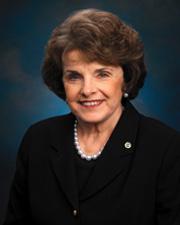 Sen. Dianne Feinstein (D-CA)
Legislative Activity
Stay on top of the latest movement without scrolling through every action
Roll call votes on amendments in Senate: Motion to table amendment SA 876 agreed to in Senate by Yea-Nay Vote. 55 - 44. Record Vote Number: 218.
June 11, 2003
View full timeline
Roll call votes on amendments in Senate: Motion to table amendment SA 876 agreed to in Senate by Yea-Nay Vote. 55 - 44. Record Vote Number: 218.
June 11, 2003
Considered by Senate. (consideration: CR S7656-7658, S7668-7675, S7679-7682; text as modified: CR S7670-7673)
June 11, 2003
Motion to table amendment SA 876 agreed to in Senate by Yea-Nay Vote. 55 - 44. Record Vote Number: 218.
June 11, 2003
Senate amendment submitted
June 10, 2003
Senate amendment proposed (on the floor): Amendment SA 876 proposed by Senator Feinstein.(consideration: CR S7590-7594)
June 10, 2003
Amendment SA 876 proposed by Senator Feinstein. (consideration: CR S7590-7594) To tighten oversight of energy markets.
June 10, 2003
Votes
1 roll call on this amendment
Amendments
1 amendmentOffered to this amendment
Amendments
1 amendmentOffered to this amendment
Text
Modified
ENERGY POLICY ACT OF 2003--Continued

The PRESIDING OFFICER. The Senator from New Mexico.
Mr. DOMENICI. Madam President, as a manager of the bill, our side is
awaiting communication from the executive branch by way of explanation
of the Feinstein amendment. That should be arriving shortly. When it
arrives, we will be ready on our side for the conclusion of any
discussion. So it should not be too long--probably after lunch--before
we are ready on our side for a vote on the Feinstein amendment.
For those who are wondering, that is what is happening. There is no
need to be in the Chamber on that amendment until that event occurs. I
am certain nothing will happen on the Energy bill until that time
because there is no concurrence that anything can happen. In other
words, we cannot do anything because the Feinstein amendment cannot be
set aside for any other amendments.
The PRESIDING OFFICER. The Senator from Nevada.
Mr. REID. Madam President, I say to my friend from New Mexico, I am
very appreciative of the statement he just made because I am going to
do as he just did during this lull of time: Go get my hair cut.
Mr. DOMENICI. We hope it will be here shortly. I noted the presence a
short time ago of the chairman of the Agriculture Committee, which has
primary jurisdiction on the Feinstein amendment. He, too, was wondering
what was happening. I want he and his staff to know that is exactly
what is happening. It should not be too much longer until we then
proceed in due course for a vote.
The PRESIDING OFFICER. The Senator from New Jersey.
Mr. LAUTENBERG. Madam President, I ask unanimous consent to speak as
in morning business.
The PRESIDING OFFICER. Without objection, it is so ordered.
(The remarks of Mr. Lautenberg are printed in today's Record under
``Morning Business.'')
The PRESIDING OFFICER. The Senator from Alabama.

Amendment No. 876

Mr. SHELBY. Madam President, I rise today to encourage my colleagues
to oppose the amendment of the senior Senator from California, Mrs.
Feinstein.
First, I address the second-degree amendment the senior Senator from
Nevada, Senator Reid, is offering. I encourage my colleagues to oppose
this second-degree amendment, also. The Reid second-degree amendment
would exempt derivative contracts on precious metals from the new
regulatory scheme the Feinstein amendment creates. We are told the
Feinstein amendment is necessary to avoid the manipulation of markets
for commodities that are in limited supply like oil or metals.
Underpinning the Feinstein amendment is the belief the Enron debacle
and the California energy crisis occurred because there was
insufficient regulation and wrongdoers were able to accomplish massive
frauds and manipulation. The Feinstein amendment is intended to close
the alleged regulatory loophole for off-exchange transactions for
exempt commodities.
Assume, only for argument's sake, that Senator Feinstein is correct.
Assume the regulatory regime established only 2\1/2\ years ago is
insufficient and that we must close a so-called regulatory loophole. If
you believe this and support the Feinstein amendment, you must
necessarily oppose the Reid second-degree amendment, which will carve a
vast number of derivative contracts out of the regulatory scheme the
Feinstein amendment creates.
I don't believe we can have it both ways. What is necessary for the
energy markets is necessary for the metals markets. I encourage my
colleagues to oppose both the Reid second-degree amendment and the
Feinstein amendment as unnecessary, redundant, and potentially
destabilizing to our financial markets. I encourage my colleagues who
feel compelled to support the Feinstein amendment to not support the
Reid amendment, which is at direct cross-purposes to the underlying
amendment.
Less than 3 years ago, in December 2000, Congress enacted the
Commodity Futures Modernization Act of 2000, which was landmark
legislation that provided legal certainty regarding the regulatory
status of derivatives. Passage of the modernization act was the result
of many months of analysis of the role that derivatives play in the
marketplace and the consequences of increased regulation. In fact,
because the modernization act addressed derivative products pertaining
to commodities and financial products, both the Agriculture Committee
and Banking Committee held numerous hearings to help Members and the
public better understand the role the various derivative financial
instruments and contracts played in our economy and what regulatory
landscape, if any, is appropriate.
Now, only 3 years after enactment of the modernization act, Senator
Feinstein's amendment proposes fundamental changes to the law. I
believe

[[Page S7669]]

this amendment could create many regulatory problems, including
creating jurisdictional confusion between the Federal Energy Regulatory
Commission, FERC, and the Commodity Futures Trading Commission, CFTC,
imposing problematic capital requirements on facilities trading
derivatives, and impugning the legal certainty of OTC derivatives put
in place in 2000.
I am concerned this body does not have full appreciation of these
consequences and potential unintended consequences that will likely
follow if we were to adopt the Feinstein amendment.
I also believe it is premature to adopt this amendment because we
have simply not had enough time to review the results of the
modernization act. We have not received any reports from the CFTC
detailing shortfalls in the regulatory authority conferred by the
modernization act or recommendations requesting broader authority over
derivatives. In fact, the CFTC had brought several major cases
involving market manipulation since the passage of the modernization
act. Congress should have more than a 2-year record before it decides
to make rash but fundamental changes to legislation that was the
product of so much deliberation a short time ago.
Proponents of the Feinstein amendment argue that the collapse of
Enron and the disruption of the California energy market are prime
examples of the need for greater regulation of derivatives. This
assertion is simply not true. Enron collapsed as a result of deceptive
accounting practices involving special purpose entities and poor
corporate governance practices that permitted abusive business
practices. Congress addressed such abuses in last year's Sarbanes-Oxley
Act. More importantly, Enron's derivative business was in operation
prior to enactment of the Modernization Act and was one of the business
lines that retained value for sale after the collapse when most others
didn't.

Further, FERC, the Federal Energy Regulatory Commission, recently
concluded a year-long review of potential manipulation of electric and
natural gas prices in the Western markets. Although FERC did find
market manipulation, it also concluded:

Significant supply shortfalls and a fatally flawed market
design were the root causes of the California market
meltdown.

In short, it was lack of energy supplies and poor State regulations
that caused the disruption. I fear that the adoption of the Feinstein
amendment could lead to uninformed and premature changes to the
carefully considered provisions of the Modernization Act.
I believe the Feinstein amendment proposes unnecessary regulatory
measures and significantly undermines the legal certainty achieved in
the Modernization Act. Therefore, I strongly urge my colleagues to vote
against the Feinstein amendment.
The President's Working Group on Financial Markets, which is
comprised of the Secretary of the Treasury, the Chairman of the Federal
Reserve Board, the Chairman of the Securities and Exchange Commission,
and the Chairman of the CFTC, will be sending a letter today expressing
its concerns with this amendment and urging Congress to carefully
consider the potential unintended consequences of the amendment before
acting. I intend to submit this letter for the Record when I receive
it. I anticipate this letter will raise the same concerns that were
raised in the working group's letter last year.
I yield the floor.
The PRESIDING OFFICER. The Senator from New Hampshire.
Mr. SUNUNU. Madam President, I rise to join my colleague, Senator
Shelby, my committee chairman on the Banking Committee as well, in
opposing the Feinstein amendment. This amendment was debated at length
about a year ago during the previous Senate Energy bill debate. At that
time, Senator Phil Gramm raised a number of issues, a number of
concerns with the legislation. He said a great many wise and
commonsense things. One of the perspectives that he pointed out that
stuck with me was noting that, in raising concerns about failures,
companies that had gone bankrupt such as Long Term Capital Management,
or perhaps closer to home for the Senator from California, the
bankruptcy of Orange County, CA, that involved to a certain extent
derivatives and then called for regulation--we were, in effect, blaming
the instrument itself, blaming the derivative, which is a little bit
like blaming a thermometer for a warm day. That is not the right
approach for legislation and I think it will lead us to bad conclusions
in trying to structure legislation that will strengthen financial
markets.
As the Senator from Alabama indicated, at the root is our concern
that we not pass legislation that has unintended consequences, not pass
legislation that is counterproductive, and rather than strengthen the
markets or increase confidence in markets, actually has the opposite
effect.
This legislation would give a great deal of new power to FERC, which
is a concern to me because that would be power given over to the FERC
not just to regulate but really to arbitrate, to refer claims to
different regulatory authorities. On its face, I ask whether FERC has
the expertise or the knowledge in all of these sophisticated markets to
make such decisions. It is, perhaps, a power best not given to FERC.
But it is also a power, in referring and making these decisions as to
which regulatory body a particular claim or complaint would go, that
would have the effect of creating uncertainty, uncertainty as to which
organization had regulatory oversight.
The Commodity Futures Trading Commission and FERC already coordinate
their enforcement with respect to the energy markets. The CFTC has
subpoena power. I think, as a number of other speakers indicated, in
the year 2000 there was a Commodity Futures Modernization Act that was
passed that was a good piece of legislation. A lot of work went into
that. It drew from recommendations made by the President's working
group. In particular, it strengthened the CFTC's hand in regulation in
a number of areas.
I certainly do not think offering an amendment at this time on this
particular bill is the appropriate way to modify that legislation, the
Commodity Futures Modernization Act, that was a product of extended
negotiations. The piece of legislation such as being offered by the
Senator from California ought to go through the regular committee
process. We ought to have hearings on it and certainly we ought to have
an opportunity to debate it in the key area of the Banking Committee
and Agriculture Committee jurisdictions.
Of particular interest as well is the fact that this amendment is
opposed by a number of organizations, a number of the regulators
themselves who are most concerned with stability and confidence in the
markets--by the Fed, by the SEC, and by the CFTC. Even though this bill
gives additional powers to the CFTC, they still oppose it. It is not
often in Washington you have someone opposing an effort to give them
more power and more jurisdiction, but these very organizations are
worried every day about safety and soundness, about regulatory clarity,
about ensuring a greater degree of stability and solvency in the
marketplace. Why would they oppose this effort, to give more regulatory
power to them or to their sister organizations?

I believe it is in part because of their concern that this might have
unintended consequences, that this, unfortunately, might add
uncertainty to the markets, that this might stifle transactions that so
often act to reduce the risk in the marketplace.
Particularly telling is the fact that an amendment is being offered
to strike the coverage of various metals from this provision.
Obviously, someone recognizes that this might not be good, might not be
healthy for a particular area of our economy, of the derivatives
exchanges, and therefore wants to protect them from the uncertainty and
the instability I have described.
Unintended consequences, we have to be so careful about exactly in an
example such as this. These derivative markets are so complicated so
the potential to have unintended consequences is effectively magnified
by our collective lack of knowledge. There are some Senators who know
more than others about these markets. The Senator from California has
spent more time than others debating and discussing these issues. But
any time we venture into

[[Page S7670]]

an area of such complexity we enhance the risk that a piece of
legislation will have unintended consequences.
I certainly do not fault the intentions or question the intentions or
the motives in offering the legislation. We share the goals of ensuring
that we have good regulatory agencies with appropriate enforcement
powers, but we also should be careful that we not disturb a market
which I believe functions extremely efficiently. As complex as it is,
and as large as it is--I have seen estimates of the size of the global
derivatives market as high as $75 trillion--as large as that market is,
it works very effectively.
These are not products that are sold on any exchanges and there is a
reason for that. The principal reason is that they are unique. They are
unique to the organizations that seek them out. The vast majority of
these organizations seek out a particular swap or derivative
transaction in order to reduce the risk they are exposed to at any
given day. That is why these instruments were developed and exist in
such great numbers in the first place. Companies, institutions,
financial service companies, banks--they seek out these derivatives to
reduce their exposure to risk. When they are able to do that, they
ensure greater stability, they ensure greater certainty for their
investors, and it has the effect of, obviously, making our markets
stronger. And helping our economy to grow.

We have exercised great caution before stepping forward and trying to
substitute some kind of new regulatory regime when a market is
functioning this effectively and arguably enforcing its own level of
discipline in the way that it functions. What kind of discipline is
that? If I am going to engage in an interest rate swap, or some other
derivative transaction with a financial institution, rest assured that
I as an investor or as a counter-party to that transaction am going to
want to know a great deal about the solvency, the exposure to other
risks, exposure to interest rate changes, and exposure to different
portions of our economy with which that institution I am engaging with
in a transaction is dealing.
There is a level of inspection and a level of due diligence that
takes place in this marketplace every single day, which I might argue
is more detailed and more thorough and more consistent than any
government regulatory agency could ever provide.
I believe we should oppose this amendment because it hasn't gone
through the regular order because it attempts to impose a level of
regulation that might well be counterproductive, that might increase
the level of uncertainty in certain areas where jurisdiction is
concerned, and that springs from a concern that somehow the derivatives
themselves--the instruments themselves--are to blame rather than
managers who have made some very bad decisions.
Derivatives didn't cause the energy crisis in California. Derivatives
didn't cause the collapse of Enron. Managers making bad decisions did.
In some cases, managers engaging in fraudulent behavior did. Certainly
the Commodity Futures Trading Commission has the power to go after
cases where fraud or price manipulation are concerned. They are
completely empowered to do just that.
I encourage my colleagues to vote against the amendment, and I yield
the floor.
The PRESIDING OFFICER. The Senator from California is recognized.
Mrs. FEINSTEIN. Madam President, I would like to use this time to
respond to some of the comments that have been made.
It is really a misconception to think this is an amendment against
derivatives. This isn't an amendment against derivatives. I have never
said derivatives caused the western energy crisis. What I said was that
there is a loophole in the law: Where all other finite commodities,
except for energy and metals, have certain regulations with respect to
transparency, these particular finite commodities do not; and that
certain traders use this loophole to practice, if you will, a kind of
fraud in their trading. The fraud was to artificially find ways to
boost their products. I wish to respond to that.
Let's go into one of the ways they proceeded to do this--through what
is called a round trip or a wash trade. Yesterday on the floor, Senator
Fitzgerald and I, as well, very clearly pointed out what a wash trade
is: I sell you a finite commodity, and you sell that same commodity
back to me. On our balance sheets, we both carry a sale. Yet nothing
ever changes hands. What we are saying is that this should be an
illegal practice. What we are saying is that, at the very least, it
ought to have transparency to it. We ought to be required to keep a
record, to have an audit trail, and to have anti-fraud and anti-
manipulation oversight of these practices by the Commodity Futures
Trading Commission.
What we more fundamentally say is that a great deal of this was done
in the western energy crisis through electronic trading.
Madam President, I understand I have the right to modify the
amendment. Is that not correct?
The PRESIDING OFFICER. That is correct.

Amendment No. 876, As Modified

Mrs. FEINSTEIN. Madam President, I would like to send a modified
amendment to the desk. That modified amendment contains an additional
cosponsor, Senator Kennedy. The modified amendment makes two changes to
the amendment which I submitted before. The first change is to be
absolutely crystal clear that this does not affect financial
derivatives. I said that in my comments yesterday. I say it again
today. To make it crystal clear, because some are concerned, and say,
``Oh, well, this will upset the financial derivatives marketplace,''
this is not the intent. It would only apply to finite commodities.
Right upfront, we are clearly saying that this title shall not apply
to financial derivatives trading.
The other change to this amendment simply takes Senator Reid's
amendment to exclude metals and adds this to this bill.
If I may, I send that amendment, as a modified, to the desk at this
time.
The PRESIDING OFFICER. The Senator has that right. The amendment is
so modified.
Mrs. FEINSTEIN. I thank the Chair.
The amendment (No. 876), as modified, is as follows:

At the end, add the following:

TITLE____--ENERGY MARKET OVERSIGHT

SEC. ____01. NO EFFECT ON FINANCIAL DERIVATIVES.

This title shall not apply to financial derivatives
trading.

SEC. ____02. JURISDICTION OF THE FEDERAL ENERGY REGULATORY
COMMISSION OVER ENERGY TRADING MARKETS.

Section 402 of the Department of Energy Organization Act
(42 U.S.C. 7172) is amended by adding at the end the
following:
``(i) Jurisdiction.--
``(1) Referral.--
``(A) In general.--To the extent that the Commission
determines that any contract involving energy delivery that
comes before the Commission is not under the jurisdiction of
the Commission, the Commission shall refer the contract to
the appropriate Federal agency.
``(B) No effect on authority.--The authority of the
Commission or any Federal agency shall not be limited or
otherwise affected based on whether the Commission has or has
not referred a contract described in subparagraph (A).
``(2) Meetings.--A designee of the Commission shall meet
quarterly with a designee of the Commodity Futures Trading
Commission, the Securities Exchange Commission, the Federal
Trade Commission, the Department of Justice, the Department
of the Treasury, and the Federal Reserve Board to discuss--
``(A) conditions and events in energy trading markets; and
``(B) any changes in Federal law (including regulations)
that may be appropriate to regulate energy trading markets.
``(3) Liaison.--The Commission shall, in cooperation with
the Commodity Futures Trading Commission, maintain a liaison
between the Commission and the Commodity Futures Trading
Commission.''.

SEC. ____02. INVESTIGATIONS BY THE FEDERAL ENERGY REGULATORY
COMMISSION UNDER THE NATURAL GAS ACT AND
FEDERAL POWER ACT.

(a) Investigations Under the Natural Gas Act.--Section
14(c) of the Natural Gas Act (15 U.S.C. 717m(c)) is amended--
(1) by striking ``(c) For the purpose of'' and inserting
the following:
``(c) Taking of Evidence.--
``(1) In general.--For the purpose of'';
(2) by striking ``Such attendance'' and inserting the
following:
``(2) No geographic limitation.--The attendance'';
(3) by striking ``Witnesses summoned'' and inserting the
following:
``(3) Expenses.--Any witness summoned''; and
(4) by adding at the end the following:
``(4) Authorities.--The exercise of the authorities of the
Commission under this subsection shall not be subject to the
consent of the Office of Management and Budget.''.

[[Page S7671]]

(b) Investigations Under the Federal Power Act.--Section
307(b) of the Federal Power Act (16 U.S.C. 825f(b)) is
amended--
(1) by striking ``(b) For the purpose of'' and inserting
the following:
``(b) Taking of Evidence.--
``(1) In general.--For the purpose of'';
(2) by striking ``Such attendance'' and inserting the
following:
``(2) No geographic limitation.--The attendance'';
(3) by striking ``Witnesses summoned'' and inserting the
following:
``(3) Expenses.--Any witness summoned''; and
(4) by adding at the end the following:
``(4) Authorities.--The exercise of the authorities of the
Commission under this subsection shall not be subject to the
consent of the Office of Management and Budget.''.

SEC. ____04. CONSULTING SERVICES.

Title IV of the Department of Energy Organization Act (42
U.S.C. 7171 et seq.) is amended by adding at the end the
following:

``SEC. 408. CONSULTING SERVICES.

``(a) In General.--The Chairman may contract for the
services of consultants to assist the Commission in carrying
out any responsibilities of the Commission under this Act,
the Federal Power Act (16 U.S.C. 791a et seq.), or the
Natural Gas Act (15 U.S.C. 717 et seq.).
``(b) Applicable Law.--In contracting for consultant
services under subsection (a), if the Chairman determines
that the contract is in the public interest, the Chairman, in
entering into a contract, shall not be subject to--
``(1) section 5, 253, 253a, or 253b of title 41, United
States Code; or
``(2) any law (including a regulation) relating to
conflicts of interest.''.

SEC. ____04. LEGAL CERTAINTY FOR TRANSACTIONS IN EXEMPT
COMMODITIES.

Section 2 of the Commodity Exchange Act (7 U.S.C. 2) is
amended by striking subsections (g) and (h) and inserting the
following:
``(g) Off-Exchange Transactions in Exempt Commodities.--
``(1) Definitions.--In this subsection:
``(A) Covered entity.--The term `covered entity' means--
``(i) an electronic trading facility; and
``(ii) a dealer market.
``(B) Dealer market.--
``(i) In general.--The term `dealer market' has the meaning
given the term by the Commission.
``(ii) Inclusions.--The term `dealer market' includes each
bilateral or multilateral agreement, contract, or transaction
determined by the Commission, regardless of the means of
execution of the agreement, contract, or transaction.
``(2) Exemption for transactions not on trading
facilities.--Except as provided in paragraph (4), nothing in
this Act shall apply to an agreement, contract, or
transaction in an exempt commodity that--
``(A) is entered into solely between persons that are
eligible contract participants at the time the persons enter
into the agreement, contract, or transaction; and
``(B) is not entered into on a trading facility.
``(3) Exemption for transactions on covered entities.--
Except as provided in paragraphs (4), (5), and (7), nothing
in this Act shall apply to an agreement, contract, or
transaction in an exempt commodity that is--
``(A) entered into on a principal-to-principal basis solely
between persons that are eligible contract participants at
the time at which the persons enter into the agreement,
contract, or transaction; and
``(B) executed or traded on a covered entity.
``(4) Regulatory and oversight requirements.--
``(A) In general.--An agreement, contract, or transaction
described in paragraph (2) or (3) (and the covered entity on
which the agreement, contract, or transaction is executed)
shall be subject to--
``(i) sections 5b, 12(e)(2)(B), and 22(a)(4);
``(ii) the provisions relating to manipulation and
misleading transactions under sections 4b, 4c(a), 4c(b), 4o,
6(c), 6(d), 6c, 6d, 8a, and 9(a)(2); and
``(iii) the provisions relating to fraud and misleading
transactions under sections 4b, 4c(a), 4c(b), 4o, and 8a.
``(B) Transactions exempted by commission action.--
Notwithstanding any exemption by the Commission under section
4(c), an agreement, contract, or transaction described in
paragraph (2) or (3) shall be subject to the authorities in
clauses (i), (ii), and (iii) of subparagraph (A).
``(5) Covered entities.--An agreement, contract, or
transaction described in paragraph (3) and the covered entity
on which the agreement, contract, or transaction is executed,
shall be subject to (to the extent the Commission determines
appropriate)--
``(A) section 5a, to the extent provided in section 5a(g))
and 5d;
``(B) consistent with section 4i, a requirement that books
and records relating to the business of the covered entity on
which the agreement, contract, or transaction is executed be
made available to representatives of the Commission and the
Department of Justice for inspection for a period of at least
5 years after the date of each transaction, including--
``(i) information relating to data entry and transaction
details sufficient to enable the Commission to reconstruct
trading activity on the covered entity; and
``(ii) the name and address of each participant on the
covered entity authorized to enter into transactions; and
``(C) in the case of a transaction or covered entity
performing a significant price discovery function for
transactions in the cash market for the underlying commodity,
subject to paragraph (6), the requirements (to the extent the
Commission determines appropriate by regulation) that--
``(i) information on trading volume, settlement price, open
interest, and opening and closing ranges be made available to
the public on a daily basis;
``(ii) notice be provided to the Commission in such form as
the Commission may require;
``(iii) reports be filed with the Commission (such as large
trader position reports); and
``(iv) consistent with section 4i, books and records be
maintained relating to each transaction in such form as the
Commission may require for a period of at least 5 years after
the date of the transaction.
``(6) Proprietary information.--In carrying out paragraph
(5)(C), the Commission shall not--
``(A) require the real-time publication of proprietary
information;
``(B) prohibit the commercial sale or licensing of real-
time proprietary information; and
``(C) publicly disclose information regarding market
positions, business transactions, trade secrets, or names of
customers, except as provided in section 8.
``(7) Notification, disclosures, and other requirements for
covered entities.--A covered entity subject to the exemption
under paragraph (3) shall (to the extent the Commission
determines appropriate)--
``(A) notify the Commission of the intention of the covered
entity to operate as a covered entity subject to the
exemption under paragraph (3), which notice shall include--
``(i) the name and address of the covered entity and a
person designated to receive communications from the
Commission;
``(ii) the commodity categories that the covered entity
intends to list or otherwise make available for trading on
the covered entity in reliance on the exemption under
paragraph (3);
``(iii) certifications that--

``(I) no executive officer or member of the governing board
of, or any holder of a 10 percent or greater equity interest
in, the covered entity is a person described in any of
subparagraphs (A) through (H) of section 8a(2);
``(II) the covered entity will comply with the conditions
for exemption under this subsection; and
``(III) the covered entity will notify the Commission of
any material change in the information previously provided by
the covered entity to the Commission under this paragraph;
and

``(iv) the identity of any derivatives clearing
organization to which the covered entity transmits or intends
to transmit transaction data for the purpose of facilitating
the clearance and settlement of transactions conducted on the
covered entity subject to the exemption under paragraph (3);
``(B)(i) provide the Commission with access to the trading
protocols of the covered entity and electronic access to the
covered entity with respect to transactions conducted in
reliance on the exemption under paragraph (3); and
``(ii) on special call by the Commission, provide to the
Commission, in a form and manner and within the period
specified in the special call, such information relating to
the business of the covered entity as a covered entity exempt
under paragraph (3), including information relating to data
entry and transaction details with respect to transactions
entered into in reliance on the exemption under paragraph
(3), as the Commission may determine appropriate--
``(I) to enforce the provisions specified in paragraph (4);
``(II) to evaluate a systemic market event; or
``(III) to obtain information requested by a Federal
financial regulatory authority to enable the authority to
fulfill the regulatory or supervisory responsibilities of the
authority;
``(C)(i) on receipt of any subpoena issued by or on behalf
of the Commission to any foreign person that the Commission
believes is conducting or has conducted transactions in
reliance on the exemption under paragraph (3) on or through
the covered entity relating to the transactions, promptly
notify the foreign person of, and transmit to the foreign
person, the subpoena in a manner that is reasonable under the
circumstances, or as specified by the Commission; and
``(ii) if the Commission has reason to believe that a
person has not timely complied with a subpoena issued by or
on behalf of the Commission under clause (i), and the
Commission in writing directs that a covered entity relying
on the exemption under paragraph (3) deny or limit further
transactions by the person, deny that person further trading
access to the covered entity or, as applicable, limit that
access of the person to the covered entity for liquidation
trading only;
``(D) comply with the requirements of this subsection
applicable to the covered entity and require that each
participant, as a condition of trading on the covered entity
in reliance on the exemption under paragraph (3), agree to
comply with all applicable law;

[[Page S7672]]

``(E) certify to the Commission that the covered entity has
a reasonable basis for believing that participants authorized
to conduct transactions on the covered entity in reliance on
the exemption under paragraph (3) are eligible contract
participants;
``(F) maintain sufficient capital, commensurate with the
risk associated with transactions; and
``(G) not represent to any person that the covered entity
is registered with, or designated, recognized, licensed, or
approved by the Commission.
``(8) Hearing.--A person named in a subpoena referred to in
paragraph (7)(C) that believes the person is or may be
adversely affected or aggrieved by action taken by the
Commission under this subsection, shall have the opportunity
for a prompt hearing after the Commission acts under
procedures that the Commission shall establish by rule,
regulation, or order.
``(9) Private regulatory organizations.--
``(A) Delegation of functions under core principles.--A
covered entity may comply with any core principle under
subparagraph (B) that is applicable to the covered entity
through delegation of any relevant function to--
``(i) a registered futures association under section 17; or
``(ii) another registered entity.
``(B) Core principles.--The Commission may establish core
principles requiring a covered entity to monitor trading to--
``(i) prevent fraud and manipulation;
``(ii) prevent price distortion and disruptions of the
delivery or cash settlement process;
``(iii) ensure that the covered entity has adequate
financial, operational, and managerial resources to discharge
the responsibilities of the covered entity; and
``(iv) ensure that all reporting, recordkeeping, notice,
and registration requirements under this subsection are
discharged in a timely manner.
``(C) Responsibility.--A covered entity that delegates a
function under subparagraph (A) shall remain responsible for
carrying out the function.
``(D) Noncompliance.--If a covered entity that delegates a
function under subparagraph (A) becomes aware that a
delegated function is not being performed as required under
this Act, the covered entity shall promptly take action to
address the noncompliance.
``(E) Violation of core principles.--
``(i) In general.--If the Commission determines, on the
basis of substantial evidence, that a covered entity is
violating any applicable core principle specified in
subparagraph (B), the Commission shall--

``(I) notify the covered entity in writing of the
determination; and
``(II) afford the covered entity an opportunity to make
appropriate changes to bring the covered entity into
compliance with the core principles.

``(ii) Failure to make changes.--If, not later than 30 days
after receiving a notification under clause (i)(I), a covered
entity fails to make changes that, as determined by the
Commission, are necessary to comply with the core principles,
the Commission may take further action in accordance with
this Act.
``(F) Reservation of emergency authority.--Nothing in this
paragraph limits or affects the emergency powers of the
Commission provided under section 8a(9).
``(10) Metals.--Notwithstanding any other provision of this
subsection, an agreement, contract, or transaction in
metals--
``(A) shall not be subject to this subsection (as amended
by section ____05 of the Energy Policy Act of 2003); and
``(B) shall be subject to this subsection and subsection
(h) (as those subsections existed on the day before the date
of enactment of the Energy Policy Act of 2003).
``(11) No effect on other authority.--This subsection shall
not affect the authority of the Federal Energy Regulatory
Commission under the Federal Power Act (16 U.S.C. 791a et
seq.) or the Natural Gas Act (15 U.S.C 717 et seq.).''.

SEC. ____06. PROHIBITION OF FRAUDULENT TRANSACTIONS.

Section 4b of the Commodity Exchange Act (7 U.S.C. 6b) is
amended by striking subsection (a) and inserting the
following:
``(a) Prohibition.--It shall be unlawful for any person,
directly or indirectly, in or in connection with any account,
or any offer to enter into, the entry into, or the
confirmation of the execution of, any agreement, contract, or
transaction subject to this Act--
``(1) to cheat or defraud or attempt to cheat or defraud
any person (but this paragraph does not impose on parties to
transactions executed on or subject to the rules of
designated contract markets or registered derivative
transaction execution facilities a legal duty to provide
counterparties or any other market participants with any
material market information);
``(2) willfully to make or cause to be made to any person
any false report or statement, or willfully to enter or cause
to be entered for any person any false record (but this
paragraph does not impose on parties to transactions executed
on or subject to the rules of designated contract markets or
registered derivative transaction execution facilities a
legal duty to provide counterparties or any other market
participants with any material market information);
``(3) willfully to deceive or attempt to deceive any person
by any means whatsoever (but this paragraph does not impose
on parties to transactions executed on or subject to the
rules of designated contract markets or registered derivative
transaction execution facilities a legal duty to provide
counterparties or any other market participants with any
material market information); or
``(4) except as permitted in written rules of a board of
trade designated as a contract market or derivatives
transaction execution facility on which the agreement,
contract, or transaction is traded and executed--
``(A) to bucket an order;
``(B) to fill an order by offset against 1 or more orders
of another person; or
``(C) willfully and knowingly, for or on behalf of any
other person and without the prior consent of the person, to
become--
``(i) the buyer with respect to any selling order of the
person; or
``(ii) the seller with respect to any buying order of the
person.''.

SEC. ____07. FERC LIAISON.

Section 2(a)(9) of the Commodity Exchange Act (7 U.S.C.
2(a)(9)) is amended by adding at the end the following:
``(C) Liaison with federal energy regulatory commission.--
The Commission shall, in cooperation with the Federal Energy
Regulatory Commission, maintain a liaison between the
Commission and the Federal Energy Regulatory Commission.''.

SEC. ____08. CRIMINAL AND CIVIL PENALTIES.

(a) Enforcement Powers of Commission.--Section 6(c) of the
Commodity Exchange Act (7 U.S.C. 9, 15) is amended in
paragraph (3) of the tenth sentence--
(1) by inserting ``(A)'' after ``assess such person''; and
(2) by inserting after ``each such violation'' the
following: ``, or (B) in any case of manipulation of, or
attempt to manipulate, the price of any commodity, a civil
penalty of not more than the greater of $1,000,000 or triple
the monetary gain to such person for each such violation,''.
(b) Manipulations and Other Violations.--Section 6(d) of
the Commodity Exchange Act (7 U.S.C. 13b) is amended in the
first sentence--
(1) by striking ``paragraph (a) or (b) of section 9 of this
Act'' and inserting ``subsection (a), (b), or (f) of section
9''; and
(2) by striking ``said paragraph 9(a) or 9(b)'' and
inserting ``subsection (a), (b), or (f) of section 9''.
(c) Nonenforcement of Rules of Government or Other
Violations.--Section 6b of the Commodity Exchange Act (7
U.S.C. 13a) is amended--
(1) in the first sentence--
(A) by inserting ``section 2(g)(9),'' after ``sections 5
through 5c,''; and
(B) by inserting before the period at the end the
following: ``, or, in any case of manipulation of, or an
attempt to manipulate, the price of any commodity, a civil
penalty of not more than $1,000,000 for each such
violation''; and
(2) in the second sentence, by inserting before the period
at the end the following: ``, except that if the failure or
refusal to obey or comply with the order involved any offense
under section 9(f), the registered entity, director, officer,
agent, or employee shall be guilty of a felony and, on
conviction, shall be subject to penalties under section
9(f)''.
(d) Action To Enjoin or Restrain Violations.--Section 6c(d)
of the Commodity Exchange Act (7 U.S.C. 13a-1(d)) is amended
by striking ``(d)'' and all that follows through the end of
paragraph (1) and inserting the following:
``(d) Civil Penalties.--In any action brought under this
section, the Commission may seek and the court shall have
jurisdiction to impose, on a proper showing, on any person
found in the action to have committed any violation--
``(1) a civil penalty in the amount of not more than the
greater of $100,000 or triple the monetary gain to the person
for each violation; or
``(2) in any case of manipulation of, or an attempt to
manipulate, the price of any commodity, a civil penalty in
the amount of not more than the greater of $1,000,000 or
triple the monetary gain to the person for each violation.''.
(e) Violations Generally.--Section 9 of the Commodity
Exchange Act (7 U.S.C. 13) is amended--
(1) by redesignating subsection (f) as subsection (e); and
(2) by adding at the end the following:
``(f) Price Manipulation.--It shall be a felony punishable
by a fine of not more than $1,000,000 for each violation or
imprisonment for not more than 10 years, or both, together
with the costs of prosecution, for any person--
``(1) to manipulate or attempt to manipulate the price of
any commodity in interstate commerce, or for future delivery
on or subject to the rules of any registered entity;
``(2) to corner or attempt to corner any such commodity;
``(3) knowingly to deliver or cause to be delivered (for
transmission through the mails or interstate commerce by
telegraph, telephone, wireless, or other means of
communication) false or misleading or knowingly inaccurate
reports concerning market information or conditions that
affect or tend to affect the price of any commodity in
interstate commerce; or
``(4) knowingly to violate section 4 or 4b, any of
subsections (a) through (e) of subsection 4c, or section 4h,
4o(1), or 19.''.

[[Page S7673]]

SEC. ____09. CONFORMING AMENDMENTS.

(a) Section 2 of the Commodity Exchange Act (7 U.S.C. 2) is
amended--
(1) in subsection (d)(1), by striking ``section 5b'' and
inserting ``section 5a(g), 5b,'';
(2) in subsection (e)--
(A) in paragraph (1), by striking ``, 2(g), or 2(h)(3)'';
and
(B) in paragraph (3), by striking ``2(h)(5)'' and inserting
``2(g)(7)'';
(3) by redesignating subsection (i) as subsection (h); and
(4) in subsection (h) (as redesignated by subparagraph
(C))--
(A) in paragraph (1)--
(i) by striking ``No provision'' and inserting ``In
general.--Subject to subsection (g), no provision''; and
(ii) in subparagraph (A)--

(I) by striking ``section 2(c), 2(d), 2(e), 2(f), or 2(g)
of this Act'' and inserting ``subsection (c), (d), (e), or
(f)''; and
(II) by striking ``section 2(h)'' and inserting
``subsection (g)''; and

(B) in paragraph (2), by striking ``No provision'' and
inserting ``In general.--Subject to subsection (g), no
provision''.
(b) Section 4i of the Commodity Exchange Act (7 U.S.C. 6i)
is amended in the first sentence by inserting ``, or pursuant
to an exemption under section 4(c)'' after ``transaction
execution facility''.
(c) Section 8a(9) of the Commodity Exchange Act (7 U.S.C.
12a(9)) is amended--
(1) by inserting ``or covered entity under section 2(g)''
after ``direct the contract market'';
(2) by striking ``on any futures contract''; and
(3) by inserting ``or covered entity under section 2(g)''
after ``given by a contract market''.

Mrs. FEINSTEIN. Madam President, once again, what we are seeking to
do is close a loophole that was created in 2000 when this Congress
passed the Commodity Futures Modernization Act. That act exempted just
energy and metals. It was not the intention actually to do that. The
Senate part of that bill did not exempt them. What happened was Enron
went to the House and Enron secured an exemption of energy and metals
in the House. That exemption was handled in the conference, and the
Senate language was not in the bill.
The exemption was effectively created. The loophole was created. We
are just trying to eliminate that loophole. We are not attacking
derivatives. All we are saying is: If you do this kind of trading, you
must keep a record just as anybody else does. You must be transparent.
You must have an audit trail, and you are subject to any fraud or
manipulation oversight by the Commodity Futures Trading Commission.
This is where it gets a little complicated. If I sell energy to you
and you deliver, then that is covered by the Federal Energy Regulatory
Commission. If I sell energy to you and you sell it to a third person
or entity that sells it to a fourth entity that sells it to a fifth
entity and then it goes into the field, those interim trades are not
covered.
That is what we seek to cover because that is where the games exist.
It is a rather subtle point, but it is also an important point.
I heard people say that this will stifle the market. I will tell you
what has been happening out there. Without transparency and without
record keeping stifles the market.
When Mr. Fortney was arrested last week for creating schemes such as
Ricochet, Death Star, and Get Shorty, you don't think that stifles the
market when you have other traders pleading guilty to fraud and wire
fraud?
Does that not stifle the market? And does that not give the average
consumer the belief that they cannot trust this marketplace as being
fair and transparent? I believe it does. More fundamentally, I believe
the rules that govern the marketplace should be rules to protect the
average consumer, not the big boys; they can take care of themselves.
But the average consumer has to have confidence in the marketplace that
it is fair and that it is transparent.
I would like to correct the idea that this amendment has not gone
through regular order. I moved this amendment last year to the Energy
bill. Senator Gramm of Texas, who, incidentally, subsequently went to
work for EnronOnline in its new life with UBS Warburg--which is fine--
argued against my amendment. We tried to settle our differences. It
took quite some time. We could not settle our differences on this
amendment, and we did have a vote.
Another reason for the vote is there were people who believed this
had not had enough committee hearing. So we had a vote, and I think we
got 48 votes. The amendment went to the Agriculture Committee. The
Agriculture Committee held hearings. The staff of both sides reviewed
the legislation. Senator Harkin, who was chairman, and Senator Lugar,
who was ranking member, are both cosponsors of this amendment.
The problem is, the end of the session came without a markup, so this
is really the opportunity we have to place this amendment into some
form of law, and so we take this opportunity.
I also wish to say that the President's working group in 1999, in
their report--this was before the Commodity Futures Modernization Act
of 2000--very specifically said, on page 2 of their report, that:

An exclusion from the CEA [Commodities Exchange Act] for
electronic trading systems for derivatives, provided that the
systems limit participation to sophisticated counterparties
trading for their own accounts and are not used to trade
contracts that involve non-financial commodities with finite
supplies. . . .

In other words, they are saying that commodities with finite supplies
should be included in the bill, but they are recommending that those
that do not have finite supplies, such as financials derivatives, not
be included in the bill. Now, apparently, they are changing their
position. But I want to make very clear that was the position of the
``Over-the-Counter Derivatives Markets and the Commodity Exchange Act,
Report of The President's Working Group on Financial Markets'' dated
November 1999. And the Senate version of the Commodity Futures
Modernization Act actually did just what this working group stated.
Again, to refute the allegation that I am in some way blaming
derivatives for the western energy crisis--I am not--I am blaming this
loophole which allows all this secret trading, which we have seen
result in fraudulent schemes, to try to close that loophole. And the
way to close it is to bring the light of day to it. That is what we are
trying to do.
I pointed out yesterday, because some people said, well, we need to
study this more, that it has been studied more and that the ``Final
Report On Price Manipulation In Western Markets, Fact-Finding
Investigation Of Potential Manipulation Of Electric And Natural Gas
Prices,'' which was prepared by the staff of the Federal Energy
Regulatory Commission, and dated March 2003, says the following as one
of their recommendations:

Recommend that Congress consider giving direct authority to
a Federal agency to ensure that electronic trading platforms
for wholesale sales of electric energy and natural gas in
interstate commerce are monitored--

That is what we do--

and provide market information that is necessary for price
discovery in competitive energy markets.

That is exactly what this does, as recommended by this report of the
Federal Energy Regulatory Commission.
With the modification I made, metals will have the same level of
oversight as exists under current law today.
Now, let me go back again to 2000. I mentioned the change that was
made to accommodate Enron lobbying to the Commodity Futures
Modernization Act. It also did not take long for EnronOnline and others
in the energy sector to take advantage of this new freedom by trading
energy derivatives absent any transparency or regulatory oversight.
Thus, after the 2000 legislation--and really right away--EnronOnline
began to trade energy derivatives bilaterally without being subject to
proper regulatory oversight.
It should not surprise anyone that without this transparency, prices
soared. In 2000, if Enron's derivatives business had been a stand-alone
company, it would have been the 256th largest company in America. That
year, Enron claimed it made more money from its derivatives business--
$7.23 billion--than Tyson Foods made from selling chicken. That is
according to author Robert Bryce, who wrote a book on Enron called
``Pipe Dreams.''
EnronOnline rapidly became the biggest platform for electronic energy
trading. But unlike regulated exchanges, such as the New York
Mercantile Exchange, the Chicago Mercantile Exchange, the Chicago Board
of Trade, EnronOnline was not registered

[[Page S7674]]

with the CFTC, the Commodity Futures Trading Commission, so it set its
own standards. And that is the problem. Traders and others in the
energy sector came to rely on EnronOnline for pricing information. Yet
the company's control over this information, and its ability to
manipulate it, was large.
As this same author, Robert Bryce, describes--and let me quote--

Enron didn't just own the casino. On any given deal, Enron
could be the house, the dealer, the oddsmaker, and the guy
across the table you're trying to beat in diesel fuel
futures, gas futures, or the California electricity market.

The Electric Power Supply Association, EPSA, has sent a letter to all
Senators asking them to oppose our oversight amendment. This should not
be strange to anybody because its members are exactly the same
companies that are being investigated and have been investigated by
FERC for wrongdoing in the western energy crisis. It is AES
Corporation; it is BP Energy; it is Duke Energy; it is Mirant Energy;
it is Reliant Energy; it is UBS Warburg, which purchased Enron's
trading unit; and it is Williams Energy. Now, with others, they are all
members of EPSA, not companies that Westerners trust very much these
days in light of what we have been through.
Now, I want to just document some of this.
Let me quickly run through these again because, again, a lot of these
round-trip trades were done on the Internet.
Other schemes were carried out on the Internet. Let's just go through
this. Duke Energy disclosed that $1.1 billion worth of trades were
round trip since 1999. Roughly two-thirds of these were done on the
Intercontinental Exchange, which is an online trading platform owned by
the banks, again, where there is no transparency, no net capital
requirements, and no recordkeeping whatsoever. Now, this also meant
that thousands of subscribers would have seen false price signals.
Why would they see false price signals? That is because of the nature
of a wash or round-trip trade. Again, a wash or round-trip trade would
be that I am going to sell you energy at a certain price and you are
going to sell me energy at a certain price, but no energy ever changes
hands; yet we both post sales. That is what a wash trade or a round-
trip trade is.
A class action suit accused the El Paso Corporation of engaging in
dozens of round-trip energy trades that artificially bolstered its
revenues and trading volumes over the last 2 years.
CMS Energy admitted conducting wash energy trades that artificially
inflated its revenue by more than $4.4 billion. These round-trip trades
accounted for 80 percent of their trade in 2001. So 80 percent of this
company's trades in 2001--in the heart of the energy crisis--were not
trades at all. No energy ever traded hands. They just boosted their
sales--artificially.
This is another facet of artificially filing false reports: reporting
fictitious natural gas transactions to an industry publication. You can
read it for yourself. The overwhelming figure in this is, if you look
at what was done with energy and you look at California, where one year
the total cost of energy was $7 billion and the next year it was $28
billion, which is a 400 percent increase, there is no way that could be
legitimate. There is no way the energy need of a State could increase
400 percent in 1 year. Demand didn't increase 400 percent.
So without this type of legislation, there really is insufficient
authority to investigate and prevent fraud and price manipulations
since parties making the trade are not required to keep a record. What
we would require them to do is keep a record. Therefore, the Commodity
Futures Trading Commission, in the event of many of these interim
trades, and the FERC, where energy is directly delivered as a product
of a trade, has the ability to do the investigation based on records.
If you don't keep records, it is very hard to prove that.
I would like to repeat that this amendment does not ban trades. This
amendment does not affect financial derivatives. This amendment would
only require oversight and transparency for those energy trades that
are now taking place within this loophole, and it would provide
oversight, as recommended in the FERC report.
We are very proud to have the support of the National Rural Electric
Cooperative Association, the Derivative Study Center, the American
Public Gas Association, American Public Power Association, California
Municipal Utilities Association, Southern California Public Power
Authority, Transmission Excess Policy Study Group, U.S. Public Interest
Research Group, Consumers Union, Consumers Federation of America,
Calpine, Southern California Edison, Pacific Gas and Electric, and FERC
Chairman Patrick Wood.
Again, this amendment is not going to do anything to change what
happened in California and the West. But it does provide the necessary
authority for the CFTC and the FERC to help protect against another
energy crisis.
I might say I am very suspicious of people who want to do trading in
the dark. I am very suspicious when they say, oh, we are so
sophisticated you cannot possibly know how this is done and you are
going to stifle trade, because they don't want to keep a record of that
trade, they don't want transparency, they don't want to keep an audit
on trade, and they don't want any Government agency assuring there
isn't fraud or manipulation. I am doubly suspicious of them,
particularly because of the fraud and manipulation we now know took
place.
So, please, don't tell me I am not sophisticated enough to
understand. I understand plenty. I understand, when the price goes from
$7 billion to $28 billion in a very short period of time, that you have
to begin to look. I understand now that these arrests are occurring and
the manipulations of Ricochet and Death Star and Get Shorty and wash
trades are all becoming well known. I understand. The point is it is
wrong. The point is, you cannot prove it is wrong if there are no
records of those trades.
So what we are saying is these trades can go on, but you keep
records. We give the CFTC the responsibility to set net capital
requirements commensurate with risk. That is good oversight for the
public and that is good oversight for anybody who is going to invest,
because when net capital is not available and the house begins to
collapse, as it did with Enron, the company goes bankrupt.
I think I have made my case. We have gone over this. I sent this
legislation to the head of Goldman Sachs. They run an electronic
exchange. I said, please, if you have problems with it, let me know. I
did not hear. We have vetted it and talked over the past year and a
half, 2 years, with virtually anyone who wanted to come in and talk
with us about it.
Mr. President, I am absolutely determined and I am going to come back
and back and back until this loophole is closed. Nobody can tell me I
am not sophisticated enough to know that sunshine and records and
transparency are critical to the effective functioning of a free
marketplace, because I believe that just as much as I believe in the
Pledge of Allegiance--and I do believe in the Pledge of Allegiance.
When you allow hiding and you allow these trades to take place
surreptitiously, that is when there are problems.
I am afraid I have said this over and over again, but we went through
it and we saw it. We read the 3,000 pages California has sent to the
FERC. This is another intrigue. Can you imagine that no State has the
right today to present evidence to the FERC of fraud or manipulation?
California had to go to the Supreme Court to get that right, and then
when we got that right, we were told it had to be in in 100 days.
California submitted 3,000 pages within the 100 days, and it is loaded
with examples of fraud and manipulation.
We know there is fraud, we know there is manipulation, and we know
that was present in the western energy crisis, and all we are trying to
do is bring light of day to one loophole that was in the Commodity
Futures Modernization Act because a major offender lobbied for it in
the laws. It was not in the Senate bill. The Senate bill originally
covered this, but they lobbied in the House. It was taken out in
conference, and the loophole was created.
If the past 3 years have not been evidence enough, if the arrests are
not evidence enough, if we do not want a transparent marketplace, if we
want people to be able to do this trading--

[[Page S7675]]

and we can tell you the language of some of these trades; if they knew
they were being recorded, I do not think they would do it in the way
they did it--if we want to allow those procedures to continue to
happen, that is what a motion to table and a tabling vote will do.
I am very hopeful and I am asking my colleagues to vote nay on the
motion to table and vote yea on the modified amendment which is now at
the desk.
I thank the Chair, and I yield the floor. Mr. President, I suggest
the absence of a quorum.
The PRESIDING OFFICER (Mr. Hagel). The clerk will call the roll.
The legislative clerk proceeded to call the roll.
Mr. REID. Mr. President, I ask unanimous consent that the order for
the quorum call be rescinded.
The PRESIDING OFFICER. Without objection, it is so ordered.

Amendment No. 877, Withdrawn

Mr. REID. Mr. President, I ask that the Reid amendment be withdrawn.
The PRESIDING OFFICER. The Senator has that right. The amendment is
withdrawn.
Mr. REID. I suggest the absence of a quorum.
The PRESIDING OFFICER. The clerk will call the roll.
The legislative clerk proceeded to call the roll.
Mr. COCHRAN. Mr. President, I ask unanimous consent that the order
for the quorum call be rescinded.
The PRESIDING OFFICER. Without objection, it is so ordered.
Mr. COCHRAN. Mr. President, the Senate is considering the amendment
offered by the distinguished Senator from California, Mrs. Feinstein,
to the Energy bill now before the Senate. This amendment seeks to
transfer, in effect, regulatory authority from the body that now has
that authority, the Commodity Futures Trading Commission, to the
Federal Energy Regulatory Commission.
There are several good reasons why the Senate should not adopt this
amendment and force that transfer of regulatory authority. First, the
Federal Energy Regulatory Commission has special responsibilities but
this will give them new and different responsibilities where there is
no experience, there is no body of law or regulatory decisionmaking on
which to base the assumption that this kind of regulation or this
regulation carried out by this Commission would be of any better
character or type than that which would be exercised by the Commodity
Futures Trading Commission.
The Commodity Futures Trading Commission has been operating for some
time now and has actually shown that it is capable of taking action to
prevent abuses and illegal activities that can occur in these trading
markets and in the energy trading area as well.
The Feinstein amendment would give the Federal Energy Regulatory
Commission authority over areas that are currently regulated by the
Commodity Futures Trading Commission and would require, in addition,
regulation of energy derivatives. These are complex instruments. They
are used to transfer risks among traders and they are important tools
in the energy markets today.
Congress considered in the past, when it took up the Commodity
Futures Modernization Act of 2000 several years ago, regulating these
instruments. But it decided not to do so. The Federal Energy Regulatory
Commission has no current responsibility in regulating derivatives.
It seems to me that when you look to see who has been carrying out
duties now complained about by some Senator, you can find that the
Commodity Futures Trading Commission has a record of taking legal
action against companies such as Enron, El Paso, and others regarding
energy market problems. The Commodity Futures Trading Commission has
recovered millions of dollars in fines from these companies, and it has
several ongoing investigations in this area, and more charges are
possible.
To transfer now the regulatory authority to a different commission
and purport to take away the authority from the Commodity Futures
Trading Commission is going to create disruption in ongoing
investigations and actions that are taken to discipline this market and
make it more predictable and trustworthy.
The Senator from California has suggested that the amendment she has
offered is needed to prevent wash trades. These are trades that are
fictitious. A company will buy a commodity and then sell it creating
the impression that this is a legitimate trade. It establishes a price.
It establishes volume. But it is fictitious trading. It shouldn't have
that effect but it does.
The Commodity Futures Trading Commission has taken action to
discourage that activity and to punish that activity. It has specific
authority to do that under the Commodity Exchange Act. The Commodity
Futures Trading Commission has brought several actions under that
authority in the last several years. Its authority to take this kind of
action has been upheld by two decisions from U.S. appeals courts.
Just this year, the Commodity Futures Trading Commission has
recovered tens of millions of dollars from merchant energy traders for
so-called wash trades and false trades.
Another claim that is made in support of the amendment of the Senator
from California is that because the exempt commercial markets are not
regulated under the Commodity Exchange Act that they have no regulatory
oversight. That is just not true. Those markets are required by statute
today to have electronic audit trails. They are required by statute to
keep records for 5 years. They are required to be subject to the
Commodity Futures Trading Commission's antifraud and antimanipulation
authorities. They are subject to special call examinations by the
Commodity Futures Trading Commission. To suggest there are no
regulatory requirements on those exempt commercial markets is just not
true.
It is also claimed that the Feinstein amendment would impose capital
requirements on exempt commercial markets. It would require capital
requirements. That doesn't necessarily solve anything. Capital
requirements aren't imposed now on the Chicago Mercantile Exchange, or
the New York Mercantile Exchange, or the Chicago Board of Trade. They
are not viewed as necessary. Those markets have been functioning
without capital requirements. To now impose them on exempt commercial
markets is inappropriate and unnecessary.
Capital requirements or other exempt commercial markets would be
difficult to establish. They would change on a regular basis--weekly
probably--because of new contracts being offered, and change financial
positions of participants. Capital requirements would impose
significant costs and there are no identifiable benefits.
The amendment would also impose large trader reporting on exempt
commercial markets. Large trader reporting works on retail futures
exchanges with standardized contracts but would not work on exempt
commercial markets. They don't have the same type of standardization.
Large trader reporting on exempt commercial markets could actually lead
to misleading information being provided to the public. Large trader
reporting is used for market surveillance in retail futures markets.

The Commodity Futures Trading Commission's statutory authority for
exempt commercial markets is after the fact, antifraud and
antimanipulation enforcement, and is inconsistent with a large trader
reporting scheme.
In closing, the Senate has to take into account the fact that the
leading figures in our Government who are responsible for enforcement
and managing the departments that understand financial markets and the
impact they have on our economy and on our place in the world economy
are urging that the Senate not adopt the Feinstein amendment.
This is a letter which was put on every Senator's desk in the last
several minutes signed by John W. Snow, Secretary of the Department of
the Treasury, Alan Greenspan, Chairman of the Board of Governors of the
Federal Reserve System, William H. Donaldson, Chairman, U.S. Securities
and Exchange Commission, and James E. Newsome, Chairman of the
Commodity Futures Trading Commission.
With the permission of the Chair, I will read the letter.
It is addressed to Senator Crapo of Idaho and Senator Miller of
Georgia.

[[Page S7676]]

Thank you for your letter of June 10, 2003, requesting the
views of the President's Working Group on Financial Markets
[PWG] on proposed Amendment No. 876--

That is the Feinstein amendment--

to S. 14, the pending energy bill.
As this amendment is similar to a proposed amendment on
which you sought the views of the PWG last year, we reassert
the positions expressed in the PWG's response dated September
18, 2002, a copy of which is enclosed. The proposed amendment
could have significant unintended consequences for an
extremely important risk management market--serving
businesses, financial institutions, and investors throughout
the U.S. economy. For that reason, we believe that adoption
of this amendment is ill-advised.
We would also point out that, since we wrote that letter
last year, various federal agencies have initiated actions
against wrongdoing in the energy markets. As you note, the
CFTC has brought formal actions against Enron, Dynegy, and El
Paso for market manipulation, wash (or roundtrip) trades,
false reporting of prices, and operation of illegal markets.
The Securities and Exchange Commission, the Federal Energy
Regulatory Commission, and the Department of Justice have
also initiated formal actions in the energy sector. Some of
these actions have already resulted in substantial monetary
penalties and other sanctions. These initial actions alone
make clear that wrongdoing in the energy markets are fully
subject to the existing enforcement authority of federal
regulators.
The Commodity Futures Modernization Act of 2000 brought
important legal certainty to the risk management marketplace.
Businesses, financial institutions, and investors throughout
the economy rely upon derivatives to protect themselves from
market volatility triggered by unexpected economic events.
This ability to manage risks makes the economy more resilient
and its importance cannot be underestimated. In our judgment,
the ability of private counterpart surveillance to
effectively regulate these markets can be undermined by
inappropriate extensions of government regulation.

It is clear from the letter that the Senate has received no response
to inquiries from Senator Crapo and Senator Miller clearly explaining
the dangers in adopting the Feinstein amendment.
At the appropriate time it will be our intention to move to table the
Feinstein amendment and ask for the yeas and nays at that time. I hope
Senators will carefully review the information we now have available on
each Senator's desk and vote to table the Feinstein amendment.
Madam President, I suggest the absence of a quorum.
The PRESIDING OFFICER (Mrs. Dole). The clerk will call the roll.
The legislative clerk proceeded to call the roll.
Mr. FRIST. Madam President, I ask unanimous consent that the order
for the quorum call be rescinded.
The PRESIDING OFFICER. Without objection, it is so ordered.
Mr. FRIST. Madam President, I ask unanimous consent that the vote in
relation to the Feinstein amendment No. 876 occur at 3:15 today, with
no amendments in order to the amendment prior to the vote.
The PRESIDING OFFICER. Is there objection?
Mr. REID. Madam President, it is my understanding that would be a
motion to table.
Mr. FRIST. That is correct.
The PRESIDING OFFICER. Is there objection?
Without objection, it is so ordered.

____________________