To require the Administrator of the FAA to conduct a study of safety standards at foreign repair stations.
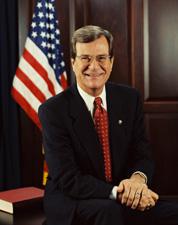 Sen. Trent Lott (R-MS)
Legislative Activity
Stay on top of the latest movement without scrolling through every action
Senate amendment submitted
June 12, 2003
View full timeline
Senate amendment submitted
June 12, 2003
Senate amendment proposed (on the floor): Amendment SA 914 proposed by Senator Lott to Amendment SA 905.(consideration: CR S7807-7810, S7819-7820; text: CR S7807)
June 12, 2003
Roll call votes on amendments in Senate: Amendment SA 914 not agreed to in Senate by Yea-Nay Vote. 42 - 52. Record Vote Number: 224.
June 12, 2003
Senate amendment not agreed to: Amendment SA 914 not agreed to in Senate by Yea-Nay Vote. 42 - 52. Record Vote Number: 224.
June 12, 2003
Amendment SA 914 proposed by Senator Lott to Amendment SA 905. (consideration: CR S7807-7810, S7819-7820; text: CR S7807) To require the Administrator of the FAA to conduct a study of safety standards at foreign repair stations.
June 12, 2003
Amendment SA 914 not agreed to in Senate by Yea-Nay Vote. 42 - 52. Record Vote Number: 224.
June 12, 2003
Votes
1 roll call on this amendment
Text
Proposed
AVIATION INVESTMENT AND REVITALIZATION VISION ACT

The PRESIDING OFFICER. Under the previous order, the time of 12:15
having arrived, the Senate will proceed to consideration of S. 824,
which the clerk will report by title.
The bill clerk read as follows:

A bill (S. 824) to reauthorize the Federal Aviation
Administration, and for other purposes.

The Senate proceeded to consider the bill (S. 824) to reauthorize the
Federal Aviation Administration, and for other purposes, which had been
reported from the Committee on Commerce, Science, and Transportation,
with an amendment to strike all after the enacting clause and inserting
in lieu thereof the following:
[Strike the part shown in black brackets and insert the part shown in
italic.]

S. 824

Be it enacted by the Senate and House of Representatives of
the United States of America in Congress assembled,

[SECTION 1. SHORT TITLE; AMENDMENT OF TITLE 49.

[(a) Short Title.--This Act may be cited as the ``Aviation
Investment and Revitalization Vision Act''.
[(b) Amendment of Title 49.--Except as otherwise expressly
provided, whenever in this Act an amendment or repeal is
expressed in terms of an amendment to, or a repeal of, a
section or other provision, the reference shall be considered
to be made to a section or other provision of title 49,
United States Code.

[SEC. 2. TABLE OF CONTENTS.

[The table of contents for this Act is as follows:

[Sec. 1. Short title; amendment of title 49.
[Sec. 2. Table of contents.

[TITLE I--REAUTHORIZATIONS; FAA MANAGEMENT

[Sec. 101. Airport improvement program.
[Sec. 102. Airway facilities improvement program.
[Sec. 103. FAA operations.
[Sec. 104. Research, engineering, and development.
[Sec. 105. Other programs.
[Sec. 106. Reorganization of the Air Traffic Services Subcommittee.
[Sec. 107. Clarification of responsibilities of chief operating
officer.

[TITLE II--AIRPORT DEVELOPMENT

[Sec. 201. National capacity projects.
[Sec. 202. Categorical exclusions.
[Sec. 203. Alternatives analysis.
[Sec. 204. Increase in apportionment for, and flexibility of, noise
compatibility planning programs.
[Sec. 205. Secretary of Transportation to identify airport congestion-
relief projects and forecast airport operations annually.
[Sec. 206. Design-build contracting.
[Sec. 207. Special rule for airport in Illinois.
[Sec. 208. Elimination of duplicative requirements.
[Sec. 209. Streamlining the passenger facility fee program.
[Sec. 210. Quarterly status reports.
[Sec. 211. Noise disclosure requirements.
[Sec. 212. Prohibition on requiring airports to provide rent-free space
for FAA or TSA.
[Sec. 213. Special rules for fiscal year 2004.

[TITLE III--AIRLINE SERVICE DEVELOPMENT

[Sec. 301. Delay reduction meetings.
[Sec. 302. Reauthorization of essential air service program.
[Sec. 303. Small community air service development pilot program.
[Sec. 304. DOT study of competition and access problems at large and
medium hub airports.
[Sec. 305. Competition disclosure requirement for large and medium hub
airports.
[Title IV--Aviation Security
[Sec. 401. Study of effectiveness of transportation security system.
[Sec. 402. Aviation security capital fund.
[Sec. 403. Technical amendments related to security-related airport
development.
[Title V--Miscellaneous
[Sec. 501. Extension of war risk insurance authority.
[Sec. 502. Cost-sharing of air traffic modernization projects.
[Sec. 503. Counterfeit or fraudulently represented parts violations.
[Sec. 504. Clarifications to procurement authority.

[TITLE I--REAUTHORIZATIONS; FAA MANAGEMENT

[SEC. 101. AIRPORT IMPROVEMENT PROGRAM.

[(a) Authorization of Appropriations.--Section 48103 is
amended--
[(1) by inserting ``(a) In General.--'' before ``The'';
[(2) by striking ``and'' in paragraph (4);
[(3) by striking ``2003.'' in paragraph (5) and inserting
``2003;'';
[(4) by inserting after paragraph (5) the following:

[[Page S7758]]

[``(6) $3,400,000,000 for fiscal year 2004;
[``(7) $3,500,000,000 for fiscal year 2005; and
[``(8) $3,600,000,000 for fiscal year 2006.''; and
[(5) by adding at the end the following:
[``(b) Administrative Expenses.--From the amounts
authorized by paragraphs (6) through (8) of subsection (a),
there shall be available for administrative expenses relating
to the airport improvement program, passenger facility fee
approval and oversight, national airport system planning,
airport standards development and enforcement, airport
certification, airport-related environmental activities
(including legal service), to remain available until
expended--
[``(1) for fiscal year 2004, $69,737,000;
[``(2) for fiscal year 2005, $71,816,000; and
[``(3) for fiscal year 2006, $74,048,000.''.
[(b) Obligational Authority.--Section 47104(c) is amended
by striking ``2003,'' and inserting ``2006,''.

[SEC. 102. AIRWAY FACILITIES IMPROVEMENT PROGRAM.

[Section 48101(a) is amended by adding at the end the
following:
[``(6) $2,916,000,000 for fiscal year 2004.
[``(7) $2,971,000,000 for fiscal year 2005.
[``(8) $3,030,000,000 for fiscal year 2006.''.

[SEC. 103. FAA OPERATIONS.

[Section 106(k)(1) is amended--
[(1) by striking ``and'' in subparagraph (C);
[(2) by striking ``2003.'' in subparagraph (D) and
inserting ``2003;''; and
[(3) by adding at the end the following:
[``(E) $7,591,000,000 for fiscal year 2004;
[``(F) $7,732,000,000 for fiscal year 2005; and
[``(G) $7,889,000,000 for fiscal year 2006.''.

[SEC. 104. RESEARCH, ENGINEERING AND DEVELOPMENT.

[Section 48102 is amended--
[(1) by striking paragraphs (1) through (8) of subsection
(a) and inserting:
[``(1) For fiscal year 2004, $289,000,000.
[``(2) For fiscal year 2005, $204,000,000.
[``(3) For fiscal year 2006, $317,000,000.''; and
[(2) by redesignating subsection (h) as subsection (g).

[SEC. 105. OTHER PROGRAMS.

[Section 106 of the Wendell H. Ford Aviation Investment and
Reform Act for the 21st Century is amended--
[(1) by striking ``2003'' in subsection (a)(1)(A) and
subsection (c)(2) and inserting ``2006''; and
[(2) by striking ``2003,'' in subsection (a)(2) and
inserting ``2006,''.

[SEC. 106. REORGANIZATION OF THE AIR TRAFFIC SERVICES
SUBCOMMITTEE.

[(a) In General.--Section 106 is amended--
[(1) by redesignating subsections (q) and (r) as
subsections (r) and (s), respectively; and
[(2) by inserting after subsection (p) the following:
[``(q) Air Traffic Management Committee.--
[``(1) Establishment.--The Secretary of Transportation
shall establish an advisory committee which shall be known as
the Air Traffic Services Committee (in this subsection
referred to as the `Committee').
[``(2) Membership.--
[``(A) Composition and appointment.--The Committee shall be
composed of--
[``(i) the Administrator of the Federal Aviation
Administration, who shall serve as chair; and
[``(ii) 4 members, to be appointed by the Secretary, after
consultation with the Committee on Transportation and
Infrastructure of the House of Representatives, and the
Committee on Commerce, Science, and Transportation of the
Senate.
[``(B) No federal officer or employee.--No member appointed
under subparagraph (A)(ii) may serve as an officer or
employee of the United States Government while serving as a
member of the Committee.
[``(C) Eligibility.--Members appointed under subparagraph
(A)(ii) shall--
[``(i) have a fiduciary responsibility to represent the
public interest;
[``(ii) be citizens of the United States; and
[``(iii) be appointed without regard to political
affiliation and solely on the basis of their professional
experience and expertise in one or more of the following
areas:

[``(I) Management of large service organizations.
[``(II) Customer service.
[``(III) Management of large procurements.
[``(IV) Information and communications technology.
[``(V) Organizational development.
[``(VI) Labor relations.

At least one of such members should have a background in
managing large organizations successfully. In the aggregate,
such members should collectively bring to bear expertise in
all of the areas described in subclauses (I) through (VI).
[``(D) Prohibitions on members of committee.--No member
appointed under subparagraph (A)(ii) may--
[``(i) have a pecuniary interest in, or own stock in or
bonds of, an aviation or aeronautical enterprise, except an
interest in a diversified mutual fund or an interest that is
exempt from the application of section 208 of title 18;
[``(ii) engage in another business related to aviation or
aeronautics; or
[``(iii) be a member of any organization that engages, as a
substantial part of its activities, in activities to
influence aviation-related legislation.
[``(E) Claims against members.--
[``(i) In general.--A member appointed under subparagraph
(A)(ii) shall have no personal liability under Federal law
with respect to any claim arising out of or resulting from an
act or omission by such member within the scope of service as
a member of the Air Traffic Services Committee.
[``(ii) Effect on other law.--This subparagraph shall not
be construed--

[``(I) to affect any other immunity or protection that may
be available to a member of the Committee under applicable
law with respect to such transactions;
[``(II) to affect any other right or remedy against the
United States under applicable law; or
[``(III) to limit or alter in any way the immunities that
are available under applicable law for Federal officers and
employees.

[``(F) Ethical considerations.--
[``(i) Financial disclosure.--During the entire period that
an individual appointed under subparagraph (A)(ii) is a
member of the Committee, such individual shall be treated as
serving as an officer or employee referred to in section
101(f) of the Ethics in Government Act of 1978 for purposes
of title I of such Act; except that section 101(d) of such
Act shall apply without regard to the number of days of
service in the position.
[``(ii) Restrictions on post-employment.--For purposes of
section 207(c) of title 18, an individual appointed under
subparagraph (A)(ii) shall be treated as an employee referred
to in section 207(c)(2)(A)(i) of such title during the entire
period the individual is a member of the Committee; except
that subsections (c)(2)(B) and (f) of section 207 of such
title shall not apply.
[``(G) Terms for air traffic services committee members.--A
member appointed under subparagraph (A)(ii) shall be
appointed for a term of 5 years.
[``(H) Reappointment.--An individual may not be appointed
under subparagraph (A)(ii) to more than two 5-year terms.
[``(I) Vacancy.--Any vacancy on the Committee shall be
filled in the same manner as the original appointment. Any
member appointed to fill a vacancy occurring before the
expiration of the term for which the member's predecessor was
appointed shall be appointed for the remainder of that term.
[``(J) Continuation in office.--A member whose term expires
shall continue to serve until the date on which the member's
successor takes office.
[``(K) Removal.--Any member appointed under subparagraph
(A)(ii) may be removed for cause by the Secretary.
[``(3) General responsibilities.--
[``(A) Oversight.--The Committee shall oversee the
administration, management, conduct, direction, and
supervision of the air traffic control system.
[``(B) Confidentiality.--The Committee shall ensure that
appropriate confidentiality is maintained in the exercise of
its duties.
[``(4) Specific responsibilities.--The Committee shall have
the following specific responsibilities:
[``(A) Strategic plans.--To review, approve, and monitor
the strategic plan for the air traffic control system,
including the establishment of--
[``(i) a mission and objectives;
[``(ii) standards of performance relative to such mission
and objectives, including safety, efficiency, and
productivity; and
[``(iii) annual and long-range strategic plans.
[``(B) Modernization and improvement.--To review and
approve--
[``(i) methods to accelerate air traffic control
modernization and improvements in aviation safety related to
air traffic control; and
[``(ii) procurements of air traffic control equipment in
excess of $100,000,000.
[``(C) Operational plans.--To review the operational
functions of the air traffic control system, including--
[``(i) plans for modernization of the air traffic control
system;
[``(ii) plans for increasing productivity or implementing
cost-saving measures; and
[``(iii) plans for training and education.
[``(D) Management.--To--
[``(i) review and approve the Administrator's appointment
of a Chief Operating Officer under section 106(s);
[``(ii) review the Administrator's selection, evaluation,
and compensation of senior executives of the Administration
who have program management responsibility over significant
functions of the air traffic control system;
[``(iii) review and approve the Administrator's plans for
any major reorganization of the Administration that would
impact on the management of the air traffic control system;
[``(iv) review and approve the Administrator's cost
accounting and financial management structure and
technologies to help ensure efficient and cost-effective air
traffic control operation; and
[``(v) review the performance and compensation of managers
responsible for major acquisition projects, including the
ability of the managers to meet schedule and budget targets.
[``(E) Budget.--To--
[``(i) review and approve the budget request of the
Administration related to the air traffic control system
prepared by the Administrator;
[``(ii) submit such budget request to the Secretary; and
[``(iii) ensure that the budget request supports the annual
and long-range strategic plans.
[``(5) Congressional review of pre-omb budget request.--The
Secretary shall submit the budget request referred to in
paragraph (4)(E)(ii) for any fiscal year to the

[[Page S7759]]

President who shall transmit such request, without revision,
to the Committees on Transportation and Infrastructure and
Appropriations of the House of Representatives and the
Committees on Commerce, Science, and Transportation and
Appropriations of the Senate, together with the President's
annual budget request for the Federal Aviation Administration
for such fiscal year.
[``(6) Committee personnel matters.--
[``(A) Compensation of members.--Each member of the
Committee, other than the chair and vice chair, shall be
compensated at a rate of $25,000 per year.
[``(B) Staff.--The chairperson of the Committee may appoint
and terminate any personnel that may be necessary to enable
the Committee to perform its duties.
[``(C) Procurement of temporary and intermittent
services.--The chairperson of the Committee may procure
temporary and intermittent services under section 3109(b) of
title 5, United States Code.
[``(7) Administrative matters.--
[``(A) Powers of chair.--Except as otherwise provided by a
majority vote of the Committee, the powers of the chairperson
shall include--
[``(i) establishing subcommittees;
[``(ii) setting meeting places and times;
[``(iii) establishing meeting agendas; and
[``(iv) developing rules for the conduct of business.
[``(B) Meetings.--The Committee shall meet at least
quarterly and at such other times as the chairperson
determines appropriate.
[``(C) Quorum.--Three members of the Committee shall
constitute a quorum. A majority of members present and voting
shall be required for the Committee to take action.
[``(D) Application of subsection (p) provisions.--The
following provisions of subsection (p) apply to the Committee
to the same extent as they apply to the Management Advisory
Council:
[``(i) Paragraph (4)(C) (relating to access to documents
and staff).
[``(ii) Paragraph (5) (relating to nonapplication of
Federal Advisory Committee Act).
[``(iii) Paragraph (6)(G) (relating to travel and per
diem).
[``(iv) Paragraph (6)(H) (relating to detail of personnel).
[``(8) Reports.--
[``(A) Annual.--The Committee shall each year report with
respect to the conduct of its responsibilities under this
title to the Administrator, the Management Advisory Council,
the Committee on Transportation and Infrastructure of the
House of Representatives, and the Committee on Commerce,
Science, and Transportation of the Senate.
[``(B) Comptroller general's report.--Not later than April
30, 2003, the Comptroller General of the United States shall
transmit to the Committee on Transportation and
Infrastructure of the House of Representatives and the
Committee on Commerce, Science, and Transportation of the
Senate a report on the success of the Committee in improving
the performance of the air traffic control system.''.
[(b) Conforming Amendments.--
[(1) Subsection (p) of section 106 is amended--
[(A) by striking ``18'' in paragraph (2) and inserting
``13'';
[(B) by inserting ``and'' after the semicolon in
subparagraph (C) of paragraph (2);
[(C) by striking ``Transportation; and'' in subparagraph
(D) of paragraph (2) and inserting ``Transportation.'';
[(D) by striking subparagraph (E) of paragraph (2);
[(E) by striking paragraph (3) and inserting the following:
[``(3) No federal officer or employee.--No member appointed
under paragraph (2)(C) may serve as an officer or employee of
the United States Government while serving as a member of the
Council.'';
[(F) by striking subparagraphs (C), (D), (H), and (I) of
paragraph (6) and redesignating subparagraphs (E), (F), (G),
(J), (K), and (L) as subparagraphs (C), (D), (E), (F), (G),
and (H), respectively; and
[(G) by striking paragraphs (7) and (8).
[(2) Section 106(s) (as redesignated by subsection (a) of
this section) is amended--
[(A) by striking ``Air Traffic Services Subcommittee of the
Aviation Management Advisory Council.'' and inserting ``Air
Traffic Services Committee.'' in paragraphs (1)(A) and
(2)(A); and
[(B) by striking ``Air Traffic Services Subcommittee of the
Aviation Management Advisory Council,'' and inserting ``Air
Traffic Services Committee,'' in paragraph (3).
[(3) Section 106 is amended by adding at the end the
following:
[``(t) Air Traffic Control System Defined.--In this
section, the term `air traffic control system' has the
meaning such term has under section 40102(a).''.
[(c) Transition from Air Traffic Service Subcommittee to
Air Traffic Service Committee.--
[(1) Termination of management advisory council
membership.--Effective on the day after the date of enactment
of this Act, any member of the Management Advisory Council
appointed under section 106(p)(2)(E) of title 49, United
States Code, (as such section was in effect on the day before
such date of enactment) who is a member of the Council on
such date of enactment shall cease to be a member of the
Council.
[(2) Commencement of membership on Air Traffic Services
Committee.--Effective on the day after the date of enactment
of this Act, any member of the Management Advisory Council
whose membership is terminated by paragraph (1) shall become
a member of the Air Traffic Services Committee as provided by
section 106(q)(2)(G) of title 49, United States Code, to
serve for the remainder of the term to which that member was
appointed to the Council.

[SEC. 107. CLARIFICATION OF RESPONSIBILITIES OF CHIEF
OPERATING OFFICER.

[Section 106(s) (as redesignated by section 106(a)(1) of
this Act) is amended--
[(1) by striking ``Transportation and Congress'' in
paragraph (4) and inserting ``Transportation, the Committee
on Transportation and Infrastructure of the House of
Representatives, and the Committee on Commerce, Science, and
Transportation of the Senate,'';
[(2) by striking ``develop a strategic plan of the
Administration for the air traffic control system, including
the establishment of--''
in paragraph (5)(A) and inserting ``implement the strategic
plan of the Administration for the air traffic control system
in order to further--'';
[(3) by striking ``To review the operational functions of
the Administration,'' in paragraph (5)(B) and inserting ``To
oversee the day-to-day operational functions of the
Administration for air traffic control,'';
[(4) by striking ``system prepared by the Administrator;''
in paragraph (5)(C)(i) and inserting ``system;'';
[(5) by striking ``Administrator and the Secretary of
Transportation;'' in paragraph (5)(C)(ii) and inserting
``Administrator;''; and
[(6) by striking paragraph (5)(C)(iii) and inserting the
following:
[``(iii) ensure that the budget request supports the
agency's annual and long-range strategic plans for air
traffic control services.''.

[TITLE II--AIRPORT DEVELOPMENT

[SEC. 201. NATIONAL CAPACITY PROJECTS.

[(a) In General.--Part B of subtitle VII is amended by
adding at the end the following:

[``CHAPTER 477. NATIONAL CAPACITY PROJECTS

[``47701. Capacity enhancement
[``47702. Designation of national capacity projects
[``47703. Expedited coordinated environmental review process; project
coordinators and environment impact teams.
[``47704. Compatible land use initiative for national capacity projects
[``47705. Air traffic procedures at national capacity projects
[``47706. Pilot program for environmental review at national capacity
projects
[``47707. Definitions

[``Sec. 47701. Capacity enhancement

[``(a) In General.--Within 30 days after the date of
enactment of the Aviation Investment and Revitalization
Vision Act, the Secretary of Transportation shall identify
those airports among the 31 airports covered by the Federal
Aviation Administration's Airport Capacity Benchmark Report
2001 with delays that significantly affect the national air
transportation system.
[``(b) Task Force; Capacity Enhancement Study.--
[``(1) In general.--The Secretary shall direct any airport
identified by the Secretary under subsection (a) that is not
engaged in a runway expansion process and has not initiated a
capacity enhancement study (or similar capacity assessment)
since 1996--
[``(A) to establish a delay reduction task force to study
means of increasing capacity at the airport, including air
traffic, airline scheduling, and airfield expansion
alternatives; or
[``(B) to conduct a capacity enhancement study.
[``(2) Scope.--The scope of the study shall be determined
by the airport and the Federal Aviation Administration, and
where appropriate shall consider regional capacity solutions.
[``(3) Recommendations submitted to secretary.--
[``(A) Task force.--A task force established under this
subsection shall submit a report containing its findings and
conclusions, together with any recommendations for capacity
enhancement at the airport, to the Secretary within 9 months
after the task force is established.
[``(B) CES.--A capacity enhancement study conducted under
this subsection shall be submitted, together with its
findings and conclusions, to the Secretary as soon as the
study is completed.
[``(c) Runway Expansion and Reconfiguration.--If the report
or study submitted under subsection (b)(3) includes a
recommendation for the construction or reconfiguration of
runways at the airport, then the Secretary and the airport
shall complete the planning and environmental review process
within 5 years after report or study is submitted to the
Secretary. The Secretary may extend the 5-year deadline under
this subsection for up to 1 year if the Secretary determines
that such an extension is necessary and in the public
interest. The Secretary shall notify the Senate Committee on
Commerce, Science, and Transportation, and to the House of
Representatives Committee on Transportation and
Infrastructure of any such extension.
[``(d) Airports That Decline To Undertake Expansion
Projects.--

[[Page S7760]]

[``(1) In general.--If an airport at which the construction
or reconfiguration of runways is recommended does not take
action to initiate a planning and environmental assessment
process for the construction or reconfiguration of those
runways within 30 days after the date on which the report or
study is submitted to the Secretary, then--
[``(A) the airport shall be ineligible for planning and
other expansion funds under subchapter I of chapter 471,
notwithstanding any provision of that subchapter to the
contrary;
[``(B) no passenger facility fee may be approved at that
airport during the 5-year period beginning 30 days after the
date on which the report or study is submitted to the
Secretary, for--
[``(i) projects that, but for subparagraph (A), could have
been funded under chapter 471; or
[``(ii) any project other than on-airport airfield-side
capacity or safety-related projects.
[``(2) Safety-related and environmental projects
excepted.--Paragraph (1) does not apply to the use of funds
for safety-related, security, or environment projects.
[``(e) Airports That Take Action.--The Secretary shall take
all actions possible to expedite funding and provide options
for funding to any airport undertaking runway construction or
reconfiguration projects in response to recommendations by
its task force.

[``Sec. 47702. Designation of national capacity projects

[``(a) In General.--In response to a petition from an
airport sponsor, or in the case of an airport on the list of
airports covered by the Federal Aviation Administration's
Airport Capacity Benchmarks study, the Secretary of
Transportation may designate an airport development project
as a national capacity project if the Secretary determines
that the project to be designated will significantly enhance
the capacity of the national air transportation system.
[``(b) Designation To Remain in Effect for 5 Years.--The
designation of a project as a national capacity project under
paragraph (1) shall remain in effect for 5 years. The
Secretary may extend the 5-year period for up to 2 additional
years upon request if the Secretary finds that substantial
progress is being made toward completion of the project.

[``Sec. 47703. Expedited coordinated environmental review
process; project coordinators and environment impact teams.

[``(a) In General.--The Secretary of Transportation shall
implement an expedited coordinated environmental review
process for national capacity projects that--
[``(1) provides for better coordination among the Federal,
regional, State, and local agencies concerned with the
preparation of environmental impact statements or
environmental assessments under the National Environmental
Policy Act of 1969 (42 U.S.C. 4321 et seq.);
[``(2) provides for an expedited and coordinated process in
the conduct of environmental reviews that ensures that, where
appropriate, the reviews are done concurrently and not
consecutively; and
[``(3) provides for a date certain for completing all
environmental reviews.
[``(b) High Priority for Airport Environmental Reviews.--
Each department and agency of the United States Government
with jurisdiction over environmental reviews shall accord any
such review involving a national capacity project the highest
possible priority and conduct the review expeditiously. If
the Secretary finds that any such department or agency is not
complying with the requirements of this subsection, the
Secretary shall notify the Senate Committee on Commerce,
Science, and Transportation, and to the House of
Representatives Committee on Transportation and
Infrastructure immediately.
[``(c) Project Coordinators; EIS Teams.--
[``(1) Designation.--For each project designated by the
Secretary as a national capacity project under subsection (a)
for which an environmental impact statement or environmental
assessment must be filed, the Secretary shall--
[``(A) designate a project coordinator within the
Department of Transportation; and
[``(B) establish an environmental impact team within the
Department.
[``(2) Function.--The project coordinator and the
environmental impact team shall--
[``(A) coordinate the activities of all Federal, State, and
local agencies involved in the project;
[``(B) to the extent possible, working with Federal, State
and local officials, reduce and eliminate duplicative and
overlapping Federal, State, and local permit requirements;
[``(C) to the extent possible, eliminate duplicate Federal,
State, and local environmental review procedures; and
[``(D) provide direction for compliance with all applicable
Federal, State, and local environmental requirements for the
project.

[``Sec. 47704. Compatible land use initiative for national
capacity projects

[``(a) In General.--The Secretary of Transportation may
make grants under chapter 471 to States and units of local
government for land use compatibility plans directly related
to national capacity projects for the purposes of making the
use of land areas around the airport compatible with aircraft
operations if the land use plan or project meets the
requirements of this section.
[``(b) Conditions.--A land use plan or project meets the
requirements of this section if it--
[``(1) is sponsored by the public agency that has the
authority to plan and adopt land use control measures,
including zoning, in the planning area in and around the
airport and that agency provides written assurances to the
Secretary that it will work with the affected airport to
identify and adopt such measures; eddie
[``(2) does not duplicate, and is not inconsistent with, an
airport noise compatibility program prepared by an airport
owner or operator under chapter 475 or with other planning
carried out by the airport.
[``(3) is subject to an agreement between the public agency
sponsor and the airport owner or operator that the
development of the land use compatibility plan will be done
cooperatively;
[``(4) is consistent with the airport operation and
planning, including the use of any noise exposure contours on
which the land use compatibility planning or project is
based; and
[``(5) has been approved jointly by the airport owner or
operator and the public agency sponsor.
[``(c) Assurances from Sponsors.-- The Secretary may
require the airport sponsor, public agency, or other entity
to which a grant may be awarded under this section to provide
such additional assurances, progress reports, and other
information as the Secretary determines to be necessary to
carry out this section.

[``Sec. 47705. Air traffic procedures at national capacity
projects

[``(a) In General.--The Secretary of Transportation may
consider prescribing flight procedures to avoid or minimize
potentially significant adverse noise impacts of the project
during the environmental planning process for a national
capacity project that involves the construction of new
runways or the reconfiguration of existing runways. If the
Secretary determines that noise mitigation flight procedures
are consistent with safe and efficient use of the navigable
airspace, then, at the request of the airport sponsor, the
Administrator may, in a manner consistent with applicable
Federal law, commit to prescribing such procedures in any
record of decision approving the project.
[``(b) Modification.--Notwithstanding any commitment by the
Secretary under subsection (a), the Secretary may initiate
changes to such procedures if necessary to maintain safety
and efficiency in light of new information or changed
circumstances.

[``Sec. 47706. Pilot program for environmental review at
national capacity projects

[``(a) In General.--The Secretary of Transportation shall
initiate a 5-year pilot program funded by airport sponsors--
[``(1) to hire additional fulltime-equivalent environmental
specialists and attorneys, or
[``(2) to obtain the services of such specialists and
attorneys from outside the United States Government, to
assist in the provision of an appropriate nationwide level of
staffing for planning and environmental review of runway
development projects for national capacity projects at the
Federal Aviation Administration.
[``(b) Eligible Participants.--Participation in the pilot
program shall be available, on a voluntary basis, to airports
with an annual passenger enplanement of not less than 3
million passengers. The Secretary shall specify the minimum
contribution necessary to qualify for participation in the
pilot program, which shall be not less than the amount
necessary to compensate the Department of Transportation for
the expense of a fulltime equivalent environmental specialist
and attorney qualified at the GS-14 equivalent level.
[``(c) Retention of Revenues.--The salaries and expenses
account of the Federal Aviation Administration shall retain
as an offsetting collection such sums as may be necessary
from such proceeds for the costs of developing and
implementing the program required by subsection (a). Such
offsetting collections shall be available for obligation
subject to the terms and conditions of the receiving
appropriations account, and shall be deposited in such
accounts on a quarterly basis. Such offsetting collections
are authorized to remain available until expended for such
purpose.

[``Sec. 47707. Definitions

[``In this chapter:
[``(1) National capacity project.--The term `national
capacity project' means a project designated by the Secretary
under section 44702.
[``(2) Other terms.--The definitions in section 47102 apply
to any terms used in this chapter that are defined in that
section.''.
[(b) Additional Staff Authorized.--The Secretary of
Transportation is authorized to hire additional environmental
specialists and attorneys needed to process environmental
impact statements in connection with airport construction
projects and to serve as project coordinators and
environmental impact team members under section 47703 of
title 49, United States Code.
[(c) Clerical Amendment.--The analysis for subtitle VII is
amended by inserting after the item relating to section 475
the following:

[``477. National capacity projects.......................47701''.

[SEC. 202. CATEGORICAL EXCLUSIONS.

[Not later than 30 days after the date of enactment of this
Act, the Secretary of

[[Page S7761]]

Transportation shall report to the Senate Committee on
Commerce, Science, and Transportation on the categorical
exclusions currently recognized and provide a list of
proposed additional categorical exclusions from the
requirement that an environmental assessment or an
environmental impact statement be prepared under the National
Environmental Policy Act of 1969 (42 U.S.C. 4321 et seq.) for
projects at airports. In determining the list of additional
proposed categorical exclusions, the Secretary shall include
such other projects as the Secretary determines should be
categorically excluded in order to ensure that Department of
Transportation environmental staff resources are not diverted
to lower priority tasks and are available to expedite the
environmental reviews of airport capacity enhancement
projects at congested airports.

[SEC. 203. ALTERNATIVES ANALYSIS.

[(a) Notice Requirement.--Not later than 30 days after the
date on which the Secretary of Transportation identifies an
airport capacity enhancement project at a congested airport
under section 47171(c) of title 49, United States Code, the
Secretary shall publish a notice in the Federal Register
requesting comments on whether reasonable alternatives exist
to the project.
[(b) Certain Reasonable Alternatives Defined.--For purposes
of this section, an alternative shall be considered
reasonable if--
[(1) the alternative does not create an unreasonable burden
on interstate commerce, the national aviation system, or the
navigable airspace;
[(2) the alternative is not inconsistent with maintaining
the safe and efficient use of the navigable airspace;
[(3) the alternative does not conflict with a law or
regulation of the United States;
[(4) the alternative would result in at least the same
reduction in congestion at the airport or in the national
aviation system as the proposed project; and
[(5) in any case in which the alternative is a proposed
construction project at an airport other than a congested
airport, firm commitments to provide such alternate airport
capacity exists, and the Secretary determines that such
alternate airport capacity will be available no later than 4
years after the date of the Secretary's determination under
this section.
[(c) Comment Period.--The Secretary shall provide a period
of 60 days for comments on a project identified by the
Secretary under this section after the date of publication of
notice with respect to the project.
[(d) Determination of Existence of Reasonable
Alternatives.--Not later than 90 days after the last day of a
comment period established under subsection (c) for a
project, the Secretary shall determine whether reasonable
alternatives exist to the project. The determination shall be
binding on all persons, including Federal and State agencies,
acting under or applying Federal laws when considering the
availability of alternatives to the project.
[(e) Limitation on Applicability.--This section does not
apply to--
[(1) any alternatives analysis required under the National
Environmental Policy Act of 1969 (42 U.S.C. 4321 et. seq.);
or
[(2) a project at an airport if the airport sponsor
requests, in writing, to the Secretary that this section not
apply to the project.

[SEC. 204. INCREASE IN APPORTIONMENT FOR, AND FLEXIBILITY OF,
NOISE COMPATIBILITY PLANNING PROGRAMS.

[Section 47117(e)(1)(A) is amended--
[(1) by striking the first sentence and inserting: ``At
least 35 percent for grants for airport noise compatibility
planning under section 47505(a)(2) for a national capacity
project, for carrying out noise compatibility programs under
section 47504(c) of this title, and for noise mitigation
projects approved in an environmental record of decision for
an airport development project designated as a national
capacity project under section 47702.''; and
[(2) by striking ``or not such 34 percent requirement'' in
the second sentence and inserting ``the funding level
required by the preceding sentence''.

[SEC. 205. SECRETARY OF TRANSPORTATION TO IDENTIFY AIRPORT
CONGESTION-RELIEF PROJECTS AND FORECAST AIRPORT
OPERATIONS ANNUALLY.

[(a) Identification of Projects.--
[(1) In general.--Within 90 days after the date of
enactment of this Act, the Secretary of Transportation shall
provide--
[(A) a list of planned air traffic and airport-capacity
projects at congested Airport Capacity Benchmark airports the
completion of which will substantially relieve congestion at
those airports; and
[(B) a list of options for expanding capacity at the 8
airports on the list at which the most severe delays are
occurring, to the Senate Committee on Commerce, Science, and
Transportation, and to the House of Representatives Committee
on Transportation and Infrastructure. The Secretary shall
provide updated lists to those Committees 2 years after the
date of enactment of this Act.
[(2) Delisting of projects.--The Secretary shall remove a
project from the list provided to the Committees under
paragraph (1) upon the request, in writing, of an airport
operator if the operator states in the request that
construction of the project will not be completed within 10
years from the date of the request.

[SEC. 206. DESIGN-BUILD CONTRACTING.

[(a) In General.--Subchapter I of chapter 471 is amended by
adding at the end the following:

[``Sec.  47138. Design-build contracting

[``(a) In General.--The Administrator may approve an
application of an airport sponsor under this section to
authorize the airport sponsor to award a design-build
contract using a selection process permitted under applicable
State or local law if--
[``(1) the Administrator approves the application using
criteria established by the Administrator;
[``(2) the design-build contract is in a form that is
approved by the Administrator;
[``(3) the Administrator is satisfied that the contract
will be executed pursuant to competitive procedures and
contains a schematic design adequate for the Administrator to
approve the grant;
[``(4) use of a design-build contract will be cost
effective and expedite the project;
[``(5) the Administrator is satisfied that there will be no
conflict of interest; and
[``(6) the Administrator is satisfied that the selection
process will be as open, fair, and objective as the
competitive bid system and that at least three or more bids
will be submitted for each project under the selection
process.
[``(b) Reimbursement of Costs.--The Administrator may
reimburse an airport sponsor for design and construction
costs incurred before a grant is made pursuant to this
section if the project is approved by the Administrator in
advance and is carried out in accordance with all
administrative and statutory requirements that would have
been applicable under this chapter 471, if the project were
carried out after a grant agreement had been executed.
[``(c) Design-Build Contract Defined.--In this section, the
term `design-build contract' means an agreement that provides
for both design and construction of a project by a
contractor.''.
[(b) Conforming Amendment.--The chapter analysis for
chapter 471 is amended by inserting after the item relating
to section 47137 the following:

[``47138. Design-build contracting.''.

[SEC. 207. SPECIAL RULE FOR AIRPORT IN ILLINOIS.

[(a) In General.--Nothing in this title shall be construed
to preclude the application of any provision of this Act to
the State of Illinois or any other sponsor of a new airport
proposed to be constructed in the State of Illinois.
[(b) Authority of the Governor.--Nothing in this title
shall be construed to preempt the authority of the Governor
of the State of Illinois as of August 1, 2001, to approve or
disapprove airport development projects.

[SEC. 208. ELIMINATION OF DUPLICATIVE REQUIREMENTS.

[(a) In General.--Section 47106(c)(1) is amended--
[(1) by inserting ``and'' after ``project;'' in
subparagraph (A)(ii);
[(2) by striking subparagraph (B); and
[(3) by redesignating subparagraph (C) as subparagraph (B).
[(b) Conforming Amendments.--Section 47106(c) of such title
is amended--
[(1) by striking paragraph (4);
[(2) by redesignating paragraph (5) as paragraph (4); and
[(3) by striking ``(1)(C)'' in paragraph (4), as
redesignated, and inserting ``(1)(B)''.

[SEC. 209. STREAMLINING THE PASSENGER FACILITY FEE PROGRAM.

[Section 40117 is amended--
[(1) by striking from ``finds--'' in paragraph (4) of
subsection (b) through the end of that paragraph and
inserting ``finds that the project cannot be paid for from
funds reasonably expected to be available for the programs
referred to in section 48103.'';
[(2) by adding at the end of subsection (c)(2) the
following:
[``(E) The agency will include in its application or notice
submitted under subsection (1) copies of all certifications
of agreement or disagreement received under subparagraph (D).
[``(F) For the purpose of this section, an eligible agency
providing notice and consultation to an air carrier and
foreign air carrier is deemed to have satisfied this
requirement if it limits such notices and consultations to
air carriers and foreign air carriers that have a significant
business interest on the airport. In developing regulations
to implement this provision, the Secretary shall consider a
significant business interest to be defined as an air carrier
or foreign air carrier that has no less than 1.0 percent of
boardings at the airport in the prior calendar year, except
that no air carrier or foreign air carrier may be considered
excluded under this section if it has at least 25,000
boardings at the airport in the prior calendar year, or if it
operates scheduled service, without regard to such percentage
requirements.'';
[(3) by redesignating paragraph (3) of subsection (c) as
paragraph (4) and inserting after paragraph (2) the
following:
[``(3) Before submitting an application, the eligible
agency must provide reasonable notice and an opportunity for
public comment. The Secretary shall prescribe regulations
that define reasonable notice and provide for at least--
[``(A) a requirement that the eligible agency provide
public notice of intent to collect a passenger facility fee
so as to inform those interested persons and agencies who may
be affected, including--

[[Page S7762]]

[``(i) publication in local newspapers of general
circulation;
[``(ii) publication in other local media; and
[``(iii) posting the notice on the agency's website;
[``(B) a requirement for submission of public comments no
sooner than 30 days after publishing of the notice and not
later than 45 days after publication; and
[``(C) a requirement that the agency include in its
application or notice submitted under paragraph (1) copies of
all comments received under subparagraph (B).'';
[(4) by striking ``shall'' in the first sentence of
paragraph (4), as redesignated, of subsection (c) and
inserting ``may''; and
[(5) by adding at the end the following:
[``(l) Pilot Program for Passenger Facility Fee
Authorizations at Small Airports.--
[``(1) There is established a pilot program for the
Secretary to test alternative procedures for authorizing
small airports to impose passenger facility fees. An eligible
agency may impose a passenger facility fee at a non-hub
airport (as defined in section 47102 of this title) that it
controls for use on eligible airport-related projects at that
airport, in accordance with the provisions of this
subsection. These procedures shall be in lieu of the
procedures otherwise specified in this section.
[``(2) The eligible agency must provide reasonable notice
and an opportunity for consultation to air carriers and
foreign air carriers in accordance with subsection (c)(2),
and must provide reasonable notice and opportunity for public
comment in accordance with subsection (c)(3).
[``(3) The eligible agency must submit to the Secretary a
notice of intention to impose a passenger facility fee, which
notice shall include--
[``(A) information that the Secretary may require by
regulation on each project for which authority to impose a
passenger facility charge is sought;
[``(B) the amount of revenue from passenger facility
charges that is proposed to be collected for each project;
and
[``(C) the level of the passenger facility charge that is
proposed.
[``(4) The Secretary shall acknowledge receipt of the
notice and indicate any objection to the imposition of a
passenger facility fee for any project identified in the
notice within 30 days after receipt of the eligible agency's
notice.
[``(5) Unless the Secretary objects within 30 days after
receipt of the eligible agency's notice, the eligible agency
is authorized to impose a passenger facility fee in
accordance with the terms of its notice.
[``(6) Not later than 180 days after the date of enactment
of this subsection, the Secretary shall propose such
regulations as may be necessary to carry out this subsection.
[``(7) The authority granted under this subsection shall
expire three years after the issuance of the regulation
required by paragraph (6).
[``(8) An acknowledgement issued under paragraph (4) shall
not be considered an order of the Secretary issued under
section 46110 of this title.''.

[SEC. 210. QUARTERLY STATUS REPORTS.

[Beginning with the second calendar quarter ending after
the date of enactment of this Act, the Secretary of
Transportation shall provide quarterly status reports to the
Senate Committee on Commerce, Science, and Transportation and
the House of Representatives Committee on Transportation and
Infrastructure on the status of construction of each major
runway project undertaken at the largest 40 commercial
airports in terms of annual enplanements.

[SEC. 211. NOISE DISCLOSURE REQUIREMENTS.

[(a) Definitions.--Section 47501 is amended by adding at
the end--
[``(3) `Federal agency' means any department, agency,
corporation, or other establishment or instrumentality of the
executive branch of the Federal Government, and includes the
Federal National Mortgage Association and the Federal Home
Loan Mortgage Corporation.
[``(4) `Federal entity for lending regulation' means the
Board of Governors of the Federal Reserve System, the Federal
Deposit Insurance Corporation, the Comptroller of the
Currency, the Office of Thrift Supervision, the National
Credit Union Administration, and the Farm Credit
Administration, and with respect to a particular regulated
lending institution means the entity primarily responsible
for the supervision of the institution.
[``(5) `Federal agency lender' means a Federal agency that
makes direct loans secured by improved real estate or a
mobile home, to the extent such agency acts in such capacity.
[``(6) `residential real estate' means real estate upon
which a residential dwelling is located.
[``(7) `noise exposure map' means a noise exposure map that
complies with section 47503 of this title and part 150 of
title 14, Code of Federal Regulations.
[``(8) `regulated lending institution' means any bank,
savings and loan association, credit union, farm credit bank,
Federal land bank association, production credit association,
or similar institution subject to the supervision of a
Federal entity for lending regulation.''.
[(b) Noise Exposure Maps.--Section 47503(b) is amended to
read as follows:
[``(b) Revised Maps.--If, in an area surrounding an
airport, a change in the operation of the airport would
establish a substantial new noncompatible use, or would
significantly reduce noise over existing noncompatible uses,
beyond the forecast year, the airport operator shall submit a
revised noise exposure map to the Secretary showing the new
noncompatible use or noise reduction.''.
[(c) Notification of Noise Exposure.--Chapter 457 is
amended by adding at the end the following:

[``Sec. 47511. Notification of noise exposure

[``(a) Noise Exposure Map.--An airport operator shall make
available to lending institutions, upon request, the most
recent noise exposure map submitted under section 47503 of
this title.
[``(b) List of Airports.--The Secretary shall maintain a
list of airports for which the airport operators have
submitted a noise exposure map under section 47503 of this
title.
[``(c) Regulated Lending Institutions.--Each Federal entity
for lending regulation (after consultation and coordination
with the Federal Financial Institutions Examination Council)
shall direct by regulation that a regulated lending
institution may not make, increase, extend or renew any loan
secured by residential real estate or a mobile home that is
located or to be located in the vicinity of an airport on the
Secretary's list described in subsection (b), unless the loan
applicant's purchase agreement for the residential real
estate or mobile home provides notice to the purchaser (or
satisfactory assurances are provided that the seller has
provided written notice to the purchaser prior to the
purchaser's signing of the purchase agreement) that the
property is within the area of the noise contours on a noise
exposure map submitted under section 47503 of this chapter.
The notice to the purchaser shall be acknowledged by the
purchaser's signing of the purchase agreement or other
notification document and the regulated lending institution
shall retain a record of the receipt of the notice by the
purchaser.
[``(d) Federal Agency Lenders.--Each Federal agency lender
shall by regulation require notification in the manner
provided in subsection (c) with respect to any loan that is
made by the Federal agency lender and secured by residential
real estate or a mobile home located or to be located in the
vicinity of an airport on the Secretary's list described in
subsection (b).
[``(e) Contents of Notice.--The notice required under this
section shall disclose--
[``(1) that the property is located within the noise
contours depicted on the most recent noise exposure map
submitted by the airport operator according to section 47503
of this chapter, and is subject to aircraft noise exposure;
and
[``(2) the name and telephone number of the airport where
the purchaser may obtain more information on the aircraft
noise exposure.''.

[SEC. 212. PROHIBITION ON REQUIRING AIRPORTS TO PROVIDE RENT-
FREE SPACE FOR FAA OR TSA.

[(a) In General.--Chapter 401 is amended by adding at the
end the following:

[``Sec.  40129. Prohibition on rent-free space requirements
for FAA or TSA

[``(a) In General.--Neither the Secretary of Transportation
nor the Secretary of Homeland Security may require airport
sponsors to provide building construction, maintenance,
utilities and expenses, or space in airport sponsor-owned
buildings to the Federal Aviation Administration or the
Transportation Security Administration without cost for
services relating to air traffic control, air navigation,
aviation security, or weather reporting.
[``(b) Negotiated Agreements.--Subsection (a) does not
prohibit--
[``(1) the negotiation of agreements between either
Secretary and an airport sponsor to provide building
construction, maintenance, utilities and expenses, or space
in airport sponsor-owned buildings to the Federal Aviation
Administration or the Transportation Security Administration
without cost or at below-market rates; or
[``(2) either Secretary from requiring airport sponsors to
provide land without cost to the Federal Aviation
Administration for air traffic control facilities or space
without cost to the Transportation Security Administration
for necessary security checkpoints.''.
[(b) Conforming Amendment.--The chapter analysis for
chapter 401 is amended by adding at the end the following:

[``40129. Prohibition on rent-free space requirements for FAA or
TSA.''.

[SEC. 213. SPECIAL RULES FOR FISCAL YEAR 2004.

[(a) Apportionment to certain airports with declining
boardings.--
[(1) In general.--For fiscal year 2004, the Secretary of
Transportation may apportion funds under section 47114 of
title 49, United States Code, to the sponsor of an airport
described in paragraph (2) in an amount equal to the amount
apportioned to that airport under that section for fiscal
year 2002, notwithstanding any provision of section 47114 to
the contrary.
[(2) Airports to which paragraph (1) applies.--Paragraph
(1) applies to any airport determined by the Secretary to
have had--
[(A) less than one-half of 1 percent of the total United
States passenger boardings (as defined in section 47102(10)
of title 49, United States Code) for the calendar year used
for

[[Page S7763]]

determining apportionments under section 47114 for fiscal
year 2004;
[(B) less than 10,000 passenger boardings in calendar year
2002; and
[(C) 10,000 or more passenger boardings in calendar year
2000.
[(b) Temporary Increase in Government Share of AIP Project
Costs at Certain Airports.--Notwithstanding section
47109(a)(3) of title 49, United States Code, the Government's
share of allowable project costs for a grant made in fiscal
year 2004 under chapter 471 of that title to an airport
described in that section shall be 95 percent.

[TITLE III--AIRLINE SERVICE DEVELOPMENT

[SEC. 301. DELAY REDUCTION MEETINGS.

[(a) In General.--Subchapter I of chapter 417 is amended by
adding at the end the following new section:

[``Sec. 41723. Delay reduction actions

[``(a) Delay Reduction Meetings.--
[``(1) Scheduling reduction meetings.--The Secretary of
Transportation may request that air carriers meet with the
Administrator of the Federal Aviation Administration to
discuss flight reductions at severely congested airports to
reduce overscheduling and flight delays during hours of peak
operation if--
[``(A) the Administrator of the Federal Aviation
Administration determines that it is necessary to convene
such a meeting; and
[``(B) the Secretary determines that the meeting is
necessary to meet a serious transportation need or achieve an
important public benefit.
[``(2) Meeting conditions.--Any meeting under paragraph
(1)--
[``(A) shall be chaired by the Administrator;
[``(B) shall be open to all scheduled air carriers; and
[``(C) shall be limited to discussions involving the
airports and time periods described in the Administrator's
determination.
[``(3) Flight reduction targets.--Before any such meeting
is held, the Administrator shall establish flight reduction
targets for the meeting and notify the attending air carriers
of those targets not less than 48 hours before the meeting.
[``(4) Delay reduction offers.--An air carrier attending
the meeting shall make any delay reduction offer to the
Administrator rather than to another carrier.
[``(5) Transcript.--The Administrator shall ensure that a
transcript of the meeting is kept and made available to the
public not later than 3 business days after the conclusion of
the meeting.
[``(b) Stormy Weather Agreements Limited Exemption.--
[``(1) In general.--The Secretary may establish a program
to authorize by order discussions and agreements between 2 or
more air carriers for the purpose of reducing flight delays
during periods of inclement weather.
[``(2) Requirements.--An authorization issued under
paragraph (1)--
[``(A) may only be issued by the Secretary after a
determination by the Federal Aviation Administration that
inclement weather is likely to adversely and directly affect
capacity at an airport for a period of at least 3 hours;
[``(B) shall apply only to discussions and agreements
concerning flights directly affected by the inclement
weather; and
[``(C) shall remain in effect for a period of 24 hours.
[``(3) Procedure.--The Secretary shall establish procedures
within 30 days after such date of enactment for--
[``(A) filing requests for an authorization under paragraph
(1);
[``(B) participation under paragraph (5) by representatives
of the Department of Transportation in any meetings or
discussions held pursuant to such an order; and
[``(C) the determination by the Federal Aviation
Administration about the impact of inclement weather.
[``(4) Copy of participation request filed with
secretary.--Before an air carrier may request an order under
paragraph (1), it shall file a request with the Secretary, in
such form and manner as the Secretary may prescribe, to
participate in the program established under paragraph (1).
[``(5) DOT Participation.--The Secretary shall ensure that
the Department is represented at any meetings authorized
under this subsection.
[``(c) Exemption Authorized.--When the Secretary finds that
it is required by the public interest, the Secretary, as part
of an order issued under subsection (b)(1), shall exempt a
person affected by the order from the antitrust laws to the
extent necessary to allow the person to proceed with the
activities approved in the order.
[``(d) Antitrust Laws Defined.--In this section, the term
`antitrust laws' has the meaning given that term in the first
section of the Clayton Act (15 U.S.C. 12).
[``(e) Sunset.--The authority of the Secretary to issue an
order under subsection (b)(1) of this section expires at the
end of the 2-year period that begins 45 days after the date
of enactment of the Aviation Investment and Revitalization
Vision Act. The Secretary may extend the 2-year Period for an
additional 2 years if the Secretary determines that such an
extension is necessary and in the public interest. The
Secretary shall notify the Senate Committee on Commerce,
Science, and Transportation, and to the House of
Representatives Committee on Transportation and
Infrastructure of any such extension.''.
[(b) Conforming Amendment.--The chapter analysis for
chapter 417 is amended by inserting after the item relating
to section 41722 the following new item:

[``41723. Delay reduction actions.''.

[SEC. 302. REAUTHORIZATION OF ESSENTIAL AIR SERVICE PROGRAM.

[There are authorized to be appropriated to the Secretary
of Transportation to carry out the essential air service
program under subchapter II of chapter 417 of title 49,
United States Code, $113,000,000 for each of the fiscal years
2004, 2005, and 2006.

[SEC. 303. SMALL COMMUNITY AIR SERVICE DEVELOPMENT PILOT
PROGRAM.

[(a) 3-year Extension.--Section 41743(e)(2) of title 49,
United States Code, is amended--
[(1) by striking ``There is'' and inserting ``There are'';
[(2) by striking ``2001 and'' and inserting ``2001,''; and
[(3) by striking ``2003'' and inserting ``2003, and
$27,500,000 for the 3 fiscal year period beginning with
fiscal year 2004.''.
[(b) Additional Communities.--Section 41743(c)(4) of such
title is amended by striking ``program.'' and
inserting``program each year. No community, consortia of
communities, or combination thereof may participate in the
program twice.''.

[SEC. 304. DOT STUDY OF COMPETITION AND ACCESS PROBLEMS AT
LARGE AND MEDIUM HUB AIRPORTS.

[(a) In General.--The Secretary of Transportation shall
study competition and airline access problems at hub airports
(as defined in section 41731(a)(3)) of title 49, United
States Code, and medium hub airports (as defined in section
41714(h)(9) of that title). In the study, the Secretary shall
examine, among other matters--
[(1) gate usage and availability; and
[(2) the effects of the pricing of gates and other
facilities on competition and access.
[(b) Report.--The Secretary shall transmit a report of the
Secretary's findings and conclusions together with any
recommendations, including legislative recommendations, the
Secretary may have for improving competition and airline
access at such airports to the Senate Committee on Commerce,
Science, and Transportation and the House of Representatives
Committee on Transportation and Infrastructure within 6
months after the date of enactment of this Act.

[SEC. 305. COMPETITION DISCLOSURE REQUIREMENT FOR LARGE AND
MEDIUM HUB AIRPORTS.

[Section 47107 is amended by adding at the end the
following:
[``(q) Competition Disclosure Requirement.--
[``(1) In general.--The Secretary of Transportation may
approve an application under this subchapter for an airport
development project grant for a hub airport or a medium hub
airport only if the Secretary receives assurances that the
airport sponsor will provide the information required by
paragraph (2) at such time and in such form as the Secretary
may require.
[``(2) Competitive access.--If an airport denies an
application by an air carrier to receive access to gates or
other facilities at that airport in order to provide service
to the airport or to expand service at the airport, then,
within 30 days after denying the request, the airport sponsor
shall--
[``(A) notify the Secretary of the denial; and
[``(B) transmit a report to the Secretary that--
[``(i) describes the request;
[``(ii) explains the reasons for the denial; and
[``(iii) provides a time frame within which, if any, the
airport will be able to accommodate the request.
[``(3) Definitions.--In this subsection:
[``(A) Hub airport.--The term `hub airport' has the meaning
given that term by section 41731(a)(3).
[``(B) Medium hub airport.--The term `medium hub airport'
has the meaning given that term by section 41714(h)(9).''.

[TITLE IV--AVIATION SECURITY

[SEC. 401. STUDY OF EFFECTIVENESS OF TRANSPORTATION SECURITY
SYSTEM.

[(a) In General.--The Secretary of Homeland Security shall
study the effectiveness of the aviation security system,
including the air marshal program, hardening of cockpit
doors, and security screening of passengers, checked baggage,
and cargo.
[(b) Report.--The Secretary shall transmit a report of the
Secretary's findings and conclusions together with any
recommendations, including legislative recommendations, the
Secretary may have for improving the effectiveness of
aviation security to the Senate Committee on Commerce,
Science, and Transportation and the House of Representatives
Committee on Transportation and Infrastructure within 6
months after the date of enactment of this Act. In the report
the Secretary shall also describe any redeployment of
Transportation Security Administration resources based on
those findings and conclusions. The Secretary may submit the
report to the Committees in classified and redacted form.

[SEC. 402. AVIATION SECURITY CAPITAL FUND.

[(a) In General.--There is established within the
Department of Transportation a fund to be known as the
Aviation Security Capital Fund. There are appropriated to the
Fund to $500,000,000 for each of the fiscal years 2004
through 2007, such amounts to be

[[Page S7764]]

derived from fees received under section 44940 of title 49,
United States Code. Amounts in the fund shall be allocated in
such a manner that--
[(1) 40 percent shall be made available for hub airports;
[(2) 20 percent shall be made available for medium hub
airports;
[(3) 15 percent shall be made available for small hub
airports and non-hub airports; and
[(4) 25 percent may be distributed at the Secretary's
discretion.
[(b) Purpose.--Amounts in the Fund shall be available to
the Secretary of Transportation, after consultation with the
Under Secretary of Homeland Security for Border and
Transportation Security to provide financial assistance to
airport sponsors to defray capital investment in
transportation security at airport facilities in accordance
with the provisions of this section. The program shall be
administered in concert with the airport improvement program
under chapter 417 of title 49, United States Code.
[(c) Apportionment.--Amounts made available under
subsection (a)(1), (a)(2), or (a)(3) shall be apportioned
among the airports in each category in accordance with a
formula based on the ratio that passenger emplanements at
each airport in the category bears to the total passenger
emplanements at all airports in the that category.
[(d) Matching Requirements.--
[(1) In general.--Not less than the following percentage of
the costs of any project funded under this section shall be
derived from non-Federal sources:
[(A) For hub airports and medium hub airports, 25 percent.
[(B) For airports other than hub airports and medium hub
airports, 10 percent.
[(2) Use of bond proceeds.--In determining the amount of
non-Federal sources of funds, the proceeds of State and local
bond issues shall not be considered to be derived, directly
or indirectly, from Federal sources without regard to the
Federal income tax treatment of interest and principal of
such bonds.
[(e) Letters of Intent.--The Secretary of Transportation,
or his delegate, may execute letters of intent to commit
funding to airport sponsors from the Fund.
[(f) Conforming Amendment.--Section 44940(a)(1) of title
49, United States Code, is amended by adding at the end the
following:
[``(H) The costs of security-related capital improvements
at airports.''.
[(g) Definitions.--Any term used in this section that is
defined or used in chapter 417 of title 49 United States Code
has the meaning given that term in that chapter.

[SEC. 403. TECHNICAL AMENDMENTS RELATED TO SECURITY-RELATED
AIRPORT DEVELOPMENT.

[(a) Definition of Airport Development.--Section
47102(3)(B) is amended--
[(1) by inserting ``and'' after the semicolon in clause
(viii);
[(2) by striking ``circular; and'' in clause (ix) and
inserting ``circular.''; and
[(3) by striking clause (x).
[(b) Improvement of Facilities and Equipment.--Section
301(a) of the Federal Aviation Reauthorization Act of 1996
(49 U.S.C. 44901 note) is amended by striking ``travel.'' and
inserting ``travel if the improvements or equipment will be
owned and operated by the airport.''.

[TITLE V--MISCELLANEOUS

[SEC. 501. EXTENSION OF WAR RISK INSURANCE AUTHORITY.

[(a) Extension of Policies.--Section 44302(f)(1) is amended
by striking ``2003,'' each place it appears and inserting
``2006,''.
[(b) Extension of Liability Limitation.--Section 44303(b)
is amended by striking ``2003,'' and inserting ``2006,''.
[(c) Extension of Authority.--Section 44310 is amended by
striking ``2003.'' and inserting ``2006.''.

[SEC. 502. COST-SHARING OF AIR TRAFFIC MODERNIZATION
PROJECTS.

[(a) In General.--Chapter 445 is amended by adding at the
end the following:

[``Sec.  44517. Program to permit cost-sharing of air traffic
modernization projects

[``(a) In General.--Subject to the requirements of this
section, the Secretary may carry out a program under which
the Secretary may make grants to project sponsors for not
more than 10 eligible projects per fiscal year for the
purpose of improving aviation safety and enhancing mobility
of the Nation's air transportation system by encouraging non-
Federal investment in critical air traffic control facilities
and equipment.
[``(b) Federal Share.--The Federal share of the cost of an
eligible project carried out under the program shall not
exceed 33 percent. The non-Federal share of the cost of an
eligible project shall be provided from non-Federal sources,
including revenues collected pursuant to section 40117 of
this title.
[``(c) Limitation on Grant Amounts.--No eligible project
may receive more than $5,000,000 in Federal funds under the
program.
[``(d) Funding.--The Secretary shall use amounts
appropriated under section 48101(a) of this title to carry
out this program.
[``(e) Definitions.--In this section:
[``(1) Eligible project.--The term `eligible project' means
a project relating to the Nation's air traffic control system
that is certified or approved by the Administrator and that
promotes safety, efficiency, or mobility. Such projects may
include--
[``(A) airport-specific air traffic facilities and
equipment, including local area augmentation systems,
instrument landing systems, weather and wind shear detection
equipment, lighting improvements, and control towers;
[``(B) automation tools to effect improvements in airport
capacity, including passive final approach spacing tools and
traffic management advisory equipment; and
[``(C) facilities and equipment that enhance airspace
control procedures, including consolidation of terminal radar
control facilities and equipment, or assist in en route
surveillance, including oceanic and offshore flight tracking.
[``(2) Project sponsor.--The term `project sponsor' means
any major user of the National Airspace System, as determined
by the Secretary, including a public-use airport or a joint
venture between a public-use airport and one or more air
carriers.
[``(f) Transfers of Equipment.--Notwithstanding any other
provision of law, and upon agreement by the Administrator of
the Federal Aviation Administration, project sponsors may
transfer, without consideration, to the Federal Aviation
Administration, facilities, equipment, or automation tools,
the purchase of which was assisted by a grant made under this
section, if such facilities, equipment or tools meet Federal
Aviation Administration operation and maintenance criteria.
[``(g) Guidelines.--The Administrator shall issue advisory
guidelines on the implementation of the program, which shall
not be subject to administrative rulemaking requirements
under subchapter II of chapter 5 of title 5.''.
[(b) Conforming Amendment.--The chapter analyses for
chapter 445 is amended by adding at the end the following:

[``44517. Program to permit cost-sharing of air traffic modernization
projects.''.

[SEC. 503. COUNTERFEIT OR FRAUDULENTLY REPRESENTED PARTS
VIOLATIONS.

[Section 44726(a)(1) is amended --
[(1) by striking ``or'' after the semicolon in subparagraph
(A);
[(2) by redesignating subparagraph (B) as subparagraph (D);
[(3) by inserting after subparagraph (A) the following:
[``(B) who knowingly, and with intent to defraud, carried
out or facilitated an activity punishable under a law
described in subparagraph (A);
[``(C) whose certificate is revoked under subsection (b) of
this section; or''; and
[(4) by striking ``convicted of such a violation.'' in
subparagraph (D), as redesignated, and inserting ``described
in subparagraph (A), (B) or (C).''.

[SEC. 504. CLARIFICATIONS TO PROCUREMENT AUTHORITY.

[(a) Update and Clarification of Authority.--
[(1) Section 40110(c) is amended to read as follows:
[``(c) Duties and Powers.--When carrying out subsection (a)
of this section, the Administrator of the Federal Aviation
Administration may--
[``(1) notwithstanding section 1341(a)(1) of title 31,
lease an interest in property for not more than 20 years;
[``(2) consider the reasonable probable future use of the
underlying land in making an award for a condemnation of an
interest in airspace; and
[``(3) dispose of property under subsection (a)(2) of this
section, except for airport and airway property and technical
equipment used for the special purposes of the
Administration, only under sections 121, 123, and 126 and
chapter 5 of title 40.''.
[(2) Section 40110(d)(1) is amended by striking
``implement, not later than January 1, 1996,'' and inserting
``implement''.
[(b) Clarification.--Section 106(f)(2)(A)(ii) is amended by
striking ``property'' and inserting ``property, services,''.]

SECTION 1. SHORT TITLE; AMENDMENT OF TITLE 49.

(a) Short Title.--This Act may be cited as the ``Aviation
Investment and Revitalization Vision Act''.
(b) Amendment of Title 49.--Except as otherwise expressly
provided, whenever in this Act an amendment or repeal is
expressed in terms of an amendment to, or a repeal of, a
section or other provision, the reference shall be considered
to be made to a section or other provision of title 49,
United States Code.

SEC. 2. TABLE OF CONTENTS.

The table of contents for this Act is as follows:

Sec. 1. Short title; amendment of title 49.
Sec. 2. Table of contents.

TITLE I--REAUTHORIZATIONS; FAA MANAGEMENT

Sec. 101. Airport improvement program.
Sec. 102. Airway facilities improvement program.
Sec. 103. FAA operations.
Sec. 104. Research, engineering, and development.
Sec. 105. Other programs.
Sec. 106. Reorganization of the Air Traffic Services Subcommittee.
Sec. 107. Clarification of responsibilities of chief operating officer.

TITLE II--AIRPORT DEVELOPMENT

Sec. 201. National capacity projects.
Sec. 202. Categorical exclusions.
Sec. 203. Alternatives analysis.
Sec. 204. Increase in apportionment for, and flexibility of, noise
compatibility planning programs.
Sec. 205. Secretary of Transportation to identify airport congestion-
relief projects and forecast airport operations annually.
Sec. 206. Design-build contracting.

[[Page S7765]]

Sec. 207. Special rule for airport in Illinois.
Sec. 208. Elimination of duplicative requirements.
Sec. 209. Streamlining the passenger facility fee program.
Sec. 210. Quarterly status reports.
Sec. 211. Noise disclosure requirements.
Sec. 212. Prohibition on requiring airports to provide rent-free space
for FAA or TSA.
Sec. 213. Special rules for fiscal year 2004.
Sec. 214. Agreements for operation of airport facilities.
Sec. 215. Public agencies.
Sec. 216. Flexible funding for nonprimary airport apportionments.

TITLE III--AIRLINE SERVICE DEVELOPMENT

Subtitle A--Program Enhancements

Sec. 301. Delay reduction meetings.
Sec. 302. Small community air service development pilot program.
Sec. 303. DOT study of competition and access problems at large and
medium hub airports.
Sec. 304. Competition disclosure requirement for large and medium hub
airports.

Subtitle B--Small Community and Rural Air Service Revitalization

Sec. 351. Reauthorization of essential air service program.
Sec. 352. Incentive program.
Sec. 353. Pilot programs.
Sec. 354. EAS program authority changes.

TITLE IV--AVIATION SECURITY

Sec. 401. Study of effectiveness of transportation security system.
Sec. 402. Aviation security capital fund.
Sec. 403. Technical amendments related to security-related airport
development.
Sec. 404. Armed forces charters.

TITLE V--MISCELLANEOUS

Sec. 501. Extension of war risk insurance authority.
Sec. 502. Cost-sharing of air traffic modernization projects.
Sec. 503. Counterfeit or fraudulently represented parts violations.
Sec. 504. Clarifications to procurement authority.
Sec. 505. Judicial review.
Sec. 506. Civil penalties.
Sec. 507. Miscellaneous amendments.
Sec. 508. Low-emission airport vehicles and infrastructure.
Sec. 509. Low-emission airport vehicles and ground support equipment.
Sec. 510. Pacific emergency diversion airport.
Sec. 511. Gulf of Mexico aviation service improvements.
Sec. 512. Air traffic control collegiate training initiative.
Sec. 513. Increase in certain slots.
Sec. 514. Air transportation oversight system plan.
Sec. 515. National small community air service development ombudsman.
Sec. 516. National commission on small community air service.
Sec. 517. Training certification for cabin crew.
Sec. 518. Aircraft manufacturer insurance.
Sec. 519. Ground-based precision navigational aids.
Sec. 520. Standby power efficiency program.

TITLE VI--SECOND CENTURY OF FLIGHT

Sec. 601. Findings.

Subtitle A--The Office of Aerospace and Aviation Liaison

Sec. 621. Office of Aerospace and Aviation Liaison.
Sec. 622. National Air Traffic Management System Development Office.
Sec. 623. Report on certain market developments and government
policies.

Subtitle B--Technical Programs

Sec. 641. Aerospace and Aviation Safety workforce initiative.
Sec. 642. Scholarships for service.

Subtitle C--FAA Research, Engineering, and Development

Sec. 661. Research program to improve airfield pavements.
Sec. 662. Ensuring appropriate standards for airfield pavements.
Sec. 663. Assessment of wake turbulence research and development
program.
Sec. 664. Cabin air quality research program.
Sec. 665. International role of the FAA.
Sec. 666. FAA report on other nations' safety and technological
advancements.
Sec. 667. Development of analytical tools and certification methods.
Sec. 668. Pilot program to provide incentives for development of new
technologies.
Sec. 669. FAA center for excellence for applied research and training
in the use of advanced materials in transport aircraft.
Sec. 670. FAA certification of design organizations.
Sec. 671. Report on long term environmental improvements.

TITLE I--REAUTHORIZATIONS; FAA MANAGEMENT

SEC. 101. AIRPORT IMPROVEMENT PROGRAM.

(a) Authorization of Appropriations.--Section 48103 is
amended--
(1) by inserting ``(a) In General.--'' before ``The'';
(2) by striking ``and'' in paragraph (4);
(3) by striking ``2003.'' in paragraph (5) and inserting
``2003;'';
(4) by inserting after paragraph (5) the following:
``(6) $3,400,000,000 for fiscal year 2004;
``(7) $3,500,000,000 for fiscal year 2005; and
``(8) $3,600,000,000 for fiscal year 2006.''; and
(5) by adding at the end the following:
``(b) Administrative Expenses.--From the amounts authorized
by paragraphs (6) through (8) of subsection (a), there shall
be available for administrative expenses relating to the
airport improvement program, passenger facility fee approval
and oversight, national airport system planning, airport
standards development and enforcement, airport certification,
airport-related environmental activities (including legal
service), to remain available until expended--
``(1) for fiscal year 2004, $69,737,000;
``(2) for fiscal year 2005, $71,816,000; and
``(3) for fiscal year 2006, $74,048,000.''.
(b) Obligational Authority.--Section 47104(c) is amended by
striking ``2003,'' and inserting ``2006,''.

SEC. 102. AIRWAY FACILITIES IMPROVEMENT PROGRAM.

(a) In General.--Section 48101(a) is amended by adding at
the end the following:
``(6) $2,916,000,000 for fiscal year 2004.
``(7) $2,971,000,000 for fiscal year 2005.
``(8) $3,030,000,000 for fiscal year 2006.''.
(b) Biannual Reports.--Beginning 180 days after the date of
enactment of Act, the Administrator of the Federal Aviation
Administration shall transmit a report to the Senate
Committee on Commerce, Science, and Transportation and the
House of Representatives Committee on Transportation and
Infrastructure every 6 months that describes--
(1) the 10 largest programs funded under section 48101(a)
of title 49, United States Code;
(2) any changes in the budget for such programs;
(3) the program schedule; and
(4) technical risks associated with the programs.

SEC. 103. FAA OPERATIONS.

(a) In General.--Section 106(k)(1) is amended--
(1) by striking ``and'' in subparagraph (C);
(2) by striking ``2003.'' in subparagraph (D) and inserting
``2003;''; and
(3) by adding at the end the following:
``(E) $7,591,000,000 for fiscal year 2004;
``(F) $7,732,000,000 for fiscal year 2005; and
``(G) $7,889,000,000 for fiscal year 2006.''.
(b) Annual Report.--Beginning with the submission of the
Budget of the United States to the Congress for fiscal year
2004, the Administrator of the Federal Aviation
Administration shall transmit a report to the Senate
Committee on Commerce, Science, and Transportation and the
House of Representatives Committee on Transportation and
Infrastructure that describes the overall air traffic
controller staffing plan, including strategies to address
anticipated retirement and replacement of air traffic
controllers.

SEC. 104. RESEARCH, ENGINEERING, AND DEVELOPMENT.

(a) Amounts Authorized.--Section 48102(a) is amended--
(1) by striking ``and'' at the end of paragraph (7);
(2) by striking the period at the end of paragraph (8) and
inserting a semicolon; and
(3) by adding at the end the following:
``(9) for fiscal year 2004, $289,000,000, including--
``(A) $200,000,000 to improve aviation safety, including
icing, crashworthiness, and aging aircraft;
``(B) $18,000,000 to improve the efficiency of the air
traffic control system;
``(C) $27,000,000 to reduce the environmental impact of
aviation;
``(D) $16,000,000 to improve the efficiency of mission
support; and
``(E) $28,000,000 to improve the durability and
maintainability of advanced material structures in transport
airframe structures;
``(10) for fiscal year 2005, $304,000,000, including--
``(A) $211,000,000 to improve aviation safety;
``(B) $19,000,000 to improve the efficiency of the air
traffic control system;
``(C) $28,000,000 to reduce the environmental impact of
aviation;
``(D) $17,000,000 to improve the efficiency of mission
support; and
``(E) $29,000,000 to improve the durability and
maintainability of advanced material structures in transport
airframe structures; and
``(11) for fiscal year 2006, $317,000,000, including--
``(A) $220,000,000 to improve aviation safety;
``(B) $20,000,000 to improve the efficiency of the air
traffic control system;
``(C) $29,000,000 to reduce the environmental impact of
aviation;
``(D) $18,000,000 to improve the efficiency of mission
support; and
``(E) $30,000,000 to improve the durability and
maintainability of advanced material structures in transport
airframe structures.''.

SEC. 105. OTHER PROGRAMS.

Section 106 of the Wendell H. Ford Aviation Investment and
Reform Act for the 21st Century is amended--
(1) by striking ``2003'' in subsection (a)(1)(A) and
subsection (c)(2) and inserting ``2006''; and
(2) by striking ``2003,'' in subsection (a)(2) and
inserting ``2006,''.

SEC. 106. REORGANIZATION OF THE AIR TRAFFIC SERVICES
SUBCOMMITTEE.

(a) In General.--Section 106 is amended--
(1) by redesignating subsections (q) and (r) as subsections
(r) and (s), respectively; and
(2) by inserting after subsection (p) the following:
``(q) Air Traffic Management Committee.--
``(1) Establishment.--The Secretary of Transportation shall
establish an advisory committee which shall be known as the
Air Traffic Services Committee (in this subsection referred
to as the `Committee').
``(2) Membership.--
``(A) Composition and appointment.--The Committee shall be
composed of--

[[Page S7766]]

``(i) the Administrator of the Federal Aviation
Administration, who shall serve as chair; and
``(ii) 4 members, to be appointed by the Secretary, after
consultation with the Committee on Transportation and
Infrastructure of the House of Representatives, and the
Committee on Commerce, Science, and Transportation of the
Senate.
``(B) No federal officer or employee.--No member appointed
under subparagraph (A)(ii) may serve as an officer or
employee of the United States Government while serving as a
member of the Committee.
``(C) Eligibility.--Members appointed under subparagraph
(A)(ii) shall--
``(i) have a fiduciary responsibility to represent the
public interest;
``(ii) be citizens of the United States; and
``(iii) be appointed without regard to political
affiliation and solely on the basis of their professional
experience and expertise in one or more of the following
areas:

``(I) Management of large service organizations.
``(II) Customer service.
``(III) Management of large procurements.
``(IV) Information and communications technology.
``(V) Organizational development.
``(VI) Labor relations.

At least one of such members should have a background in
managing large organizations successfully. In the aggregate,
such members should collectively bring to bear expertise in
all of the areas described in subclauses (I) through (VI).
``(D) Prohibitions on members of committee.--No member
appointed under subparagraph (A)(ii) may--
``(i) have a pecuniary interest in, or own stock in or
bonds of, an aviation or aeronautical enterprise, except an
interest in a diversified mutual fund or an interest that is
exempt from the application of section 208 of title 18;
``(ii) engage in another business related to aviation or
aeronautics; or
``(iii) be a member of any organization that engages, as a
substantial part of its activities, in activities to
influence aviation-related legislation.
``(E) Claims against members.--
``(i) In general.--A member appointed under subparagraph
(A)(ii) shall have no personal liability under Federal law
with respect to any claim arising out of or resulting from an
act or omission by such member within the scope of service as
a member of the Air Traffic Services Committee.
``(ii) Effect on other law.--This subparagraph shall not be
construed--

``(I) to affect any other immunity or protection that may
be available to a member of the Committee under applicable
law with respect to such transactions;
``(II) to affect any other right or remedy against the
United States under applicable law; or
``(III) to limit or alter in any way the immunities that
are available under applicable law for Federal officers and
employees.

``(F) Ethical considerations.--
``(i) Financial disclosure.--During the entire period that
an individual appointed under subparagraph (A)(ii) is a
member of the Committee, such individual shall be treated as
serving as an officer or employee referred to in section
101(f) of the Ethics in Government Act of 1978 for purposes
of title I of such Act; except that section 101(d) of such
Act shall apply without regard to the number of days of
service in the position.
``(ii) Restrictions on post-employment.--For purposes of
section 207(c) of title 18, an individual appointed under
subparagraph (A)(ii) shall be treated as an employee referred
to in section 207(c)(2)(A)(i) of such title during the entire
period the individual is a member of the Committee; except
that subsections (c)(2)(B) and (f) of section 207 of such
title shall not apply.
``(G) Terms for air traffic services committee members.--A
member appointed under subparagraph (A)(ii) shall be
appointed for a term of 5 years.
``(H) Reappointment.--An individual may not be appointed
under subparagraph (A)(ii) to more than two 5-year terms.
``(I) Vacancy.--Any vacancy on the Committee shall be
filled in the same manner as the original appointment. Any
member appointed to fill a vacancy occurring before the
expiration of the term for which the member's predecessor was
appointed shall be appointed for the remainder of that term.
``(J) Continuation in office.--A member whose term expires
shall continue to serve until the date on which the member's
successor takes office.
``(K) Removal.--Any member appointed under subparagraph
(A)(ii) may be removed for cause by the Secretary.
``(3) General responsibilities.--
``(A) Oversight.--The Committee shall oversee the
administration, management, conduct, direction, and
supervision of the air traffic control system.
``(B) Confidentiality.--The Committee shall ensure that
appropriate confidentiality is maintained in the exercise of
its duties.
``(4) Specific responsibilities.--The Committee shall have
the following specific responsibilities:
``(A) Strategic plans.--To review, approve, and monitor the
strategic plan for the air traffic control system, including
the establishment of--
``(i) a mission and objectives;
``(ii) standards of performance relative to such mission
and objectives, including safety, efficiency, and
productivity; and
``(iii) annual and long-range strategic plans.
``(B) Modernization and improvement.--To review and
approve--
``(i) methods to accelerate air traffic control
modernization and improvements in aviation safety related to
air traffic control; and
``(ii) procurements of air traffic control equipment in
excess of $100,000,000.
``(C) Operational plans.--To review the operational
functions of the air traffic control system, including--
``(i) plans for modernization of the air traffic control
system;
``(ii) plans for increasing productivity or implementing
cost-saving measures; and
``(iii) plans for training and education.
``(D) Management.--To--
``(i) review and approve the Administrator's appointment of
a Chief Operating Officer under section 106(s);
``(ii) review the Administrator's selection, evaluation,
and compensation of senior executives of the Administration
who have program management responsibility over significant
functions of the air traffic control system;
``(iii) review and approve the Administrator's plans for
any major reorganization of the Administration that would
impact on the management of the air traffic control system;
``(iv) review and approve the Administrator's cost
accounting and financial management structure and
technologies to help ensure efficient and cost-effective air
traffic control operation; and
``(v) review the performance and compensation of managers
responsible for major acquisition projects, including the
ability of the managers to meet schedule and budget targets.
``(E) Budget.--To--
``(i) review and approve the budget request of the
Administration related to the air traffic control system
prepared by the Administrator;
``(ii) submit such budget request to the Secretary; and
``(iii) ensure that the budget request supports the annual
and long-range strategic plans.
``(5) Congressional review of pre-omb budget request.--The
Secretary shall submit the budget request referred to in
paragraph (4)(E)(ii) for any fiscal year to the President who
shall transmit such request, without revision, to the
Committees on Transportation and Infrastructure and
Appropriations of the House of Representatives and the
Committees on Commerce, Science, and Transportation and
Appropriations of the Senate, together with the President's
annual budget request for the Federal Aviation Administration
for such fiscal year.
``(6) Committee personnel matters.--
``(A) Compensation of members.--Each member of the
Committee, other than the chair and vice chair, shall be
compensated at a rate of $25,000 per year.
``(B) Staff.--The chairperson of the Committee may appoint
and terminate any personnel that may be necessary to enable
the Committee to perform its duties.
``(C) Procurement of temporary and intermittent services.--
The chairperson of the Committee may procure temporary and
intermittent services under section 3109(b) of title 5,
United States Code.
``(7) Administrative matters.--
``(A) Powers of chair.--Except as otherwise provided by a
majority vote of the Committee, the powers of the chairperson
shall include--
``(i) establishing subcommittees;
``(ii) setting meeting places and times;
``(iii) establishing meeting agendas; and
``(iv) developing rules for the conduct of business.
``(B) Meetings.--The Committee shall meet at least
quarterly and at such other times as the chairperson
determines appropriate.
``(C) Quorum.--Three members of the Committee shall
constitute a quorum. A majority of members present and voting
shall be required for the Committee to take action.
``(D) Application of subsection (p) provisions.--The
following provisions of subsection (p) apply to the Committee
to the same extent as they apply to the Management Advisory
Council:
``(i) Paragraph (4)(C) (relating to access to documents and
staff).
``(ii) Paragraph (5) (relating to nonapplication of Federal
Advisory Committee Act).
``(iii) Paragraph (6)(G) (relating to travel and per diem).
``(iv) Paragraph (6)(H) (relating to detail of personnel).
``(8) Annual report.--The Committee shall each year report
with respect to the conduct of its responsibilities under
this title to the Administrator, the Management Advisory
Council, the Committee on Transportation and Infrastructure
of the House of Representatives, and the Committee on
Commerce, Science, and Transportation of the Senate.''.
(b) Conforming Amendments.--
(1) Subsection (p) of section 106 is amended--
(A) by striking ``18'' in paragraph (2) and inserting
``13'';
(B) by inserting ``and'' after the semicolon in
subparagraph (C) of paragraph (2);
(C) by striking ``Transportation; and'' in subparagraph (D)
of paragraph (2) and inserting ``Transportation.'';
(D) by striking subparagraph (E) of paragraph (2);
(E) by striking paragraph (3) and inserting the following:
``(3) No federal officer or employee.--No member appointed
under paragraph (2)(C) may serve as an officer or employee of
the United States Government while serving as a member of the
Council.'';
(F) by striking subparagraphs (C), (D), (H), and (I) of
paragraph (6) and redesignating subparagraphs (E), (F), (G),
(J), (K), and (L) as subparagraphs (C), (D), (E), (F), (G),
and (H), respectively; and
(G) by striking paragraphs (7) and (8).
(2) Section 106(s) (as redesignated by subsection (a) of
this section) is amended--
(A) by striking ``Air Traffic Services Subcommittee of the
Aviation Management Advisory

[[Page S7767]]

Council.'' and inserting ``Air Traffic Services Committee.''
in paragraphs (1)(A) and (2)(A); and
(B) by striking ``Air Traffic Services Subcommittee of the
Aviation Management Advisory Council,'' and inserting ``Air
Traffic Services Committee,'' in paragraph (3).
(3) Section 106 is amended by adding at the end the
following:
``(t) Air Traffic Control System Defined.--In this section,
the term `air traffic control system' has the meaning such
term has under section 40102(a).''.
(c) Transition From Air Traffic Service Subcommittee to Air
Traffic Service Committee.--
(1) Termination of management advisory council
membership.--Effective on the day after the date of enactment
of this Act, any member of the Management Advisory Council
appointed under section 106(p)(2)(E) of title 49, United
States Code, (as such section was in effect on the day before
such date of enactment) who is a member of the Council on
such date of enactment shall cease to be a member of the
Council.
(2) Commencement of membership on air traffic services
committee.--Effective on the day after the date of enactment
of this Act, any member of the Management Advisory Council
whose membership is terminated by paragraph (1) shall become
a member of the Air Traffic Services Committee as provided by
section 106(q)(2)(G) of title 49, United States Code, to
serve for the remainder of the term to which that member was
appointed to the Council.

SEC. 107. CLARIFICATION OF RESPONSIBILITIES OF CHIEF
OPERATING OFFICER.

Section 106(s) (as redesignated by section 106(a)(1) of
this Act) is amended--
(1) by striking ``Transportation and Congress'' in
paragraph (4) and inserting ``Transportation, the Committee
on Transportation and Infrastructure of the House of
Representatives, and the Committee on Commerce, Science, and
Transportation of the Senate,'';
(2) by striking ``develop a strategic plan of the
Administration for the air traffic control system, including
the establishment of--'' in paragraph (5)(A) and inserting
``implement the strategic plan of the Administration for the
air traffic control system in order to further--'';
(3) by striking ``To review the operational functions of
the Administration,'' in paragraph (5)(B) and inserting ``To
oversee the day-to-day operational functions of the
Administration for air traffic control,'';
(4) by striking ``system prepared by the Administrator;''
in paragraph (5)(C)(i) and inserting ``system;'';
(5) by striking ``Administrator and the Secretary of
Transportation;'' in paragraph (5)(C)(ii) and inserting
``Administrator;''; and
(6) by striking paragraph (5)(C)(iii) and inserting the
following:
``(iii) ensure that the budget request supports the
agency's annual and long-range strategic plans for air
traffic control services.''.

TITLE II--AIRPORT DEVELOPMENT

SEC. 201. NATIONAL CAPACITY PROJECTS.

(a) In General.--Part B of subtitle VII is amended by
adding at the end the following:

``CHAPTER 477. NATIONAL CAPACITY PROJECTS

``47701. Capacity enhancement.
``47702. Designation of national capacity projects.
``47703. Expedited coordinated environmental review process; project
coordinators and environment impact teams.
``47704. Compatible land use initiative for national capacity projects.
``47705. Air traffic procedures at national capacity projects.
``47706. Pilot program for environmental review at national capacity
projects.
``47707. Definitions.

``Sec. 47701. Capacity enhancement

``(a) In General.--Within 30 days after the date of
enactment of the Aviation Investment and Revitalization
Vision Act, the Secretary of Transportation shall identify
those airports among the 31 airports covered by the Federal
Aviation Administration's Airport Capacity Benchmark Report
2001 with delays that significantly affect the national air
transportation system.
``(b) Task Force; Capacity Enhancement Study.--
``(1) In general.--The Secretary shall direct any airport
identified by the Secretary under subsection (a) that is not
engaged in a runway expansion process and has not initiated a
capacity enhancement study (or similar capacity assessment)
since 1996--
``(A) to establish a delay reduction task force to study
means of increasing capacity at the airport, including air
traffic, airline scheduling, and airfield expansion
alternatives; or
``(B) to conduct a capacity enhancement study.
``(2) Scope.--The scope of the study shall be determined by
the airport and the Federal Aviation Administration, and
where appropriate shall consider regional capacity solutions.
``(3) Recommendations submitted to secretary.--
``(A) Task force.--A task force established under this
subsection shall submit a report containing its findings and
conclusions, together with any recommendations for capacity
enhancement at the airport, to the Secretary within 9 months
after the task force is established.
``(B) CES.--A capacity enhancement study conducted under
this subsection shall be submitted, together with its
findings and conclusions, to the Secretary as soon as the
study is completed.
``(c) Runway Expansion and Reconfiguration.--If the report
or study submitted under subsection (b)(3) includes a
recommendation for the construction or reconfiguration of
runways at the airport, then the Secretary and the airport
shall complete the planning and environmental review process
within 5 years after report or study is submitted to the
Secretary. The Secretary may extend the 5-year deadline under
this subsection for up to 1 year if the Secretary determines
that such an extension is necessary and in the public
interest. The Secretary shall notify the Senate Committee on
Commerce, Science, and Transportation, and to the House of
Representatives Committee on Transportation and
Infrastructure of any such extension.
``(d) Airports That Decline To Undertake Expansion
Projects.--
``(1) In general.--If an airport at which the construction
or reconfiguration of runways is recommended does not take
action to initiate a planning and environmental assessment
process for the construction or reconfiguration of those
runways within 30 days after the date on which the report or
study is submitted to the Secretary, then--
``(A) the airport shall be ineligible for planning and
other expansion funds under subchapter I of chapter 471,
notwithstanding any provision of that subchapter to the
contrary; and
``(B) no passenger facility fee may be approved at that
airport during the 5-year period beginning 30 days after the
date on which the report or study is submitted to the
Secretary, for--
``(i) projects that, but for subparagraph (A), could have
been funded under chapter 471; or
``(ii) any project other than on-airport airfield-side
capacity or safety-related projects.
``(2) Safety-related and environmental projects excepted.--
Paragraph (1) does not apply to the use of funds for safety-
related, security, or environment projects.
``(e) Airports That Take Action.--The Secretary shall take
all actions possible to expedite funding and provide options
for funding to any airport undertaking runway construction or
reconfiguration projects in response to recommendations by
its task force.

``Sec. 47702. Designation of national capacity projects

``(a) In General.--In response to a petition from an
airport sponsor, or in the case of an airport on the list of
airports covered by the Federal Aviation Administration's
Airport Capacity Benchmarks study, the Secretary of
Transportation may designate an airport development project
as a national capacity project if the Secretary determines
that the project to be designated will significantly enhance
the capacity of the national air transportation system.
``(b) Designation To Remain in Effect for 5 Years.--The
designation of a project as a national capacity project under
paragraph (1) shall remain in effect for 5 years. The
Secretary may extend the 5-year period for up to 2 additional
years upon request if the Secretary finds that substantial
progress is being made toward completion of the project.

``Sec. 47703. Expedited coordinated environmental review
process; project coordinators and environment impact teams

``(a) In General.--The Secretary of Transportation shall
implement an expedited coordinated environmental review
process for national capacity projects that--
``(1) provides for better coordination among the Federal,
regional, State, and local agencies concerned with the
preparation of environmental impact statements or
environmental assessments under the National Environmental
Policy Act of 1969 (42 U.S.C. 4321 et seq.);
``(2) provides for an expedited and coordinated process in
the conduct of environmental reviews that ensures that, where
appropriate, the reviews are done concurrently and not
consecutively; and
``(3) provides for a date certain for completing all
environmental reviews.
``(b) High Priority for Airport Environmental Reviews.--
Each department and agency of the United States Government
with jurisdiction over environmental reviews shall accord any
such review involving a national capacity project the highest
possible priority and conduct the review expeditiously. If
the Secretary finds that any such department or agency is not
complying with the requirements of this subsection, the
Secretary shall notify the Senate Committee on Commerce,
Science, and Transportation, and to the House of
Representatives Committee on Transportation and
Infrastructure immediately.
``(c) Project Coordinators; EIS Teams.--
``(1) Designation.--For each project designated by the
Secretary as a national capacity project under subsection (a)
for which an environmental impact statement or environmental
assessment must be filed, the Secretary shall--
``(A) designate a project coordinator within the Department
of Transportation; and
``(B) establish an environmental impact team within the
Department.
``(2) Function.--The project coordinator and the
environmental impact team shall--
``(A) coordinate the activities of all Federal, State, and
local agencies involved in the project;
``(B) to the extent possible, working with Federal, State
and local officials, reduce and eliminate duplicative and
overlapping Federal, State, and local permit requirements;
``(C) to the extent possible, eliminate duplicate Federal,
State, and local environmental review procedures; and
``(D) provide direction for compliance with all applicable
Federal, State, and local environmental requirements for the
project.

``Sec. 47704. Compatible land use initiative for national
capacity projects

``(a) In General.--The Secretary of Transportation may make
grants under chapter 471 to States and units of local
government for land

[[Page S7768]]

use compatibility plans directly related to national capacity
projects for the purposes of making the use of land areas
around the airport compatible with aircraft operations if the
land use plan or project meets the requirements of this
section.
``(b) Conditions.--A land use plan or project meets the
requirements of this section if it--
``(1) is sponsored by the public agency that has the
authority to plan and adopt land use control measures,
including zoning, in the planning area in and around the
airport and that agency provides written assurances to the
Secretary that it will work with the affected airport to
identify and adopt such measures;
``(2) does not duplicate, and is not inconsistent with, an
airport noise compatibility program prepared by an airport
owner or operator under chapter 475 or with other planning
carried out by the airport;
``(3) is subject to an agreement between the public agency
sponsor and the airport owner or operator that the
development of the land use compatibility plan will be done
cooperatively;
``(4) is consistent with the airport operation and
planning, including the use of any noise exposure contours on
which the land use compatibility planning or project is
based; and
``(5) has been approved jointly by the airport owner or
operator and the public agency sponsor.
``(c) Assurances From Sponsors.--The Secretary may require
the airport sponsor, public agency, or other entity to which
a grant may be awarded under this section to provide such
additional assurances, progress reports, and other
information as the Secretary determines to be necessary to
carry out this section.

``Sec. 47705. Air traffic procedures at national capacity
projects

``(a) In General.--The Secretary of Transportation may
consider prescribing flight procedures to avoid or minimize
potentially significant adverse noise impacts of the project
during the environmental planning process for a national
capacity project that involves the construction of new
runways or the reconfiguration of existing runways. If the
Secretary determines that noise mitigation flight procedures
are consistent with safe and efficient use of the navigable
airspace, then, at the request of the airport sponsor, the
Administrator may, in a manner consistent with applicable
Federal law, commit to prescribing such procedures in any
record of decision approving the project.
``(b) Modification.--Notwithstanding any commitment by the
Secretary under subsection (a), the Secretary may initiate
changes to such procedures if necessary to maintain safety
and efficiency in light of new information or changed
circumstances.

``Sec. 47706. Pilot program for environmental review at
national capacity projects

``(a) In General.--The Secretary of Transportation shall
initiate a 5-year pilot program funded by airport sponsors--
``(1) to hire additional fulltime-equivalent environmental
specialists and attorneys, or
``(2) to obtain the services of such specialists and
attorneys from outside the United States Government, to
assist in the provision of an appropriate nationwide level of
staffing for planning and environmental review of runway
development projects for national capacity projects at the
Federal Aviation Administration.
``(b) Eligible Participants.--Participation in the pilot
program shall be available, on a voluntary basis, to airports
with an annual passenger enplanement of not less than 3
million passengers. The Secretary shall specify the minimum
contribution necessary to qualify for participation in the
pilot program, which shall be not less than the amount
necessary to compensate the Department of Transportation for
the expense of a fulltime equivalent environmental specialist
and attorney qualified at the GS-14 equivalent level.
``(c) Retention of Revenues.--The salaries and expenses
account of the Federal Aviation Administration shall retain
as an offsetting collection such sums as may be necessary
from such proceeds for the costs of developing and
implementing the program required by subsection (a). Such
offsetting collections shall be available for obligation
subject to the terms and conditions of the receiving
appropriations account, and shall be deposited in such
accounts on a quarterly basis. Such offsetting collections
are authorized to remain available until expended for such
purpose.

``Sec. 47707. Definitions

``In this chapter:
``(1) National capacity project.--The term `national
capacity project' means a project designated by the Secretary
under section 44702.
``(2) Other terms.--The definitions in section 47102 apply
to any terms used in this chapter that are defined in that
section.''.
(b) Additional Staff Authorized.--The Secretary of
Transportation is authorized to hire additional environmental
specialists and attorneys needed to process environmental
impact statements in connection with airport construction
projects and to serve as project coordinators and
environmental impact team members under section 47703 of
title 49, United States Code.
(c) Clerical Amendment.--The analysis for subtitle VII is
amended by inserting after the item relating to section 475
the following:

``477. National capacity projects........................47701''.

SEC. 202. CATEGORICAL EXCLUSIONS.

Not later than 30 days after the date of enactment of this
Act, the Secretary of Transportation shall report to the
Senate Committee on Commerce, Science, and Transportation on
the categorical exclusions currently recognized and provide a
list of proposed additional categorical exclusions from the
requirement that an environmental assessment or an
environmental impact statement be prepared under the National
Environmental Policy Act of 1969 (42 U.S.C. 4321 et seq.) for
projects at airports. In determining the list of additional
proposed categorical exclusions, the Secretary shall include
such other projects as the Secretary determines should be
categorically excluded in order to ensure that Department of
Transportation environmental staff resources are not diverted
to lower priority tasks and are available to expedite the
environmental reviews of airport capacity enhancement
projects at congested airports.

SEC. 203. ALTERNATIVES ANALYSIS.

(a) Notice Requirement.--Not later than 30 days after the
date on which the Secretary of Transportation identifies an
airport capacity enhancement project at a congested airport
under section 47171(c) of title 49, United States Code, the
Secretary shall publish a notice in the Federal Register
requesting comments on whether reasonable alternatives exist
to the project.
(b) Certain Reasonable Alternatives Defined.--For purposes
of this section, an alternative shall be considered
reasonable if--
(1) the alternative does not create an unreasonable burden
on interstate commerce, the national aviation system, or the
navigable airspace;
(2) the alternative is not inconsistent with maintaining
the safe and efficient use of the navigable airspace;
(3) the alternative does not conflict with a law or
regulation of the United States;
(4) the alternative would result in at least the same
reduction in congestion at the airport or in the national
aviation system as the proposed project; and
(5) in any case in which the alternative is a proposed
construction project at an airport other than a congested
airport, firm commitments to provide such alternate airport
capacity exists, and the Secretary determines that such
alternate airport capacity will be available no later than 4
years after the date of the Secretary's determination under
this section.
(c) Comment Period.--The Secretary shall provide a period
of 60 days for comments on a project identified by the
Secretary under this section after the date of publication of
notice with respect to the project.
(d) Determination of Existence of Reasonable
Alternatives.--Not later than 90 days after the last day of a
comment period established under subsection (c) for a
project, the Secretary shall determine whether reasonable
alternatives exist to the project. The determination shall be
binding on all persons, including Federal and State agencies,
acting under or applying Federal laws when considering the
availability of alternatives to the project.
(e) Limitation on Applicability.--This section does not
apply to--
(1) any alternatives analysis required under the National
Environmental Policy Act of 1969 (42 U.S.C. 4321 et seq.); or
(2) a project at an airport if the airport sponsor
requests, in writing, to the Secretary that this section not
apply to the project.

SEC. 204. INCREASE IN APPORTIONMENT FOR, AND FLEXIBILITY OF,
NOISE COMPATIBILITY PLANNING PROGRAMS.

Section 47117(e)(1)(A) is amended--
(1) by striking the first sentence and inserting: ``At
least 35 percent for grants for airport noise compatibility
planning under section 47505(a)(2) for a national capacity
project, for carrying out noise compatibility programs under
section 47504(c) of this title, and for noise mitigation
projects approved in an environmental record of decision for
an airport development project designated as a national
capacity project under section 47702.''; and
(2) by striking ``or not such 34 percent requirement'' in
the second sentence and inserting ``the funding level
required by the preceding sentence''.

SEC. 205. SECRETARY OF TRANSPORTATION TO IDENTIFY AIRPORT
CONGESTION-RELIEF PROJECTS AND FORECAST AIRPORT
OPERATIONS ANNUALLY.

(a) Identification of Projects.--
(1) In general.--Within 90 days after the date of enactment
of this Act, the Secretary of Transportation shall provide--
(A) a list of planned air traffic and airport-capacity
projects at congested Airport Capacity Benchmark airports the
completion of which will substantially relieve congestion at
those airports; and
(B) a list of options for expanding capacity at the 8
airports on the list at which the most severe delays are
occurring, to the Senate Committee on Commerce, Science, and
Transportation, and to the House of Representatives Committee
on Transportation and Infrastructure. The Secretary shall
provide updated lists to those Committees 2 years after the
date of enactment of this Act.
(2) Delisting of projects.--The Secretary shall remove a
project from the list provided to the Committees under
paragraph (1) upon the request, in writing, of an airport
operator if the operator states in the request that
construction of the project will not be completed within 10
years from the date of the request.

SEC. 206. DESIGN-BUILD CONTRACTING.

(a) In General.--Subchapter I of chapter 471 is amended by
adding at the end the following:

``Sec. 47138. Design-build contracting

``(a) In General.--The Administrator may approve an
application of an airport sponsor under this section to
authorize the airport sponsor to award a design-build
contract using a selection process permitted under applicable
State or local law if--
``(1) the Administrator approves the application using
criteria established by the Administrator;
``(2) the design-build contract is in a form that is
approved by the Administrator;
``(3) the Administrator is satisfied that the contract will
be executed pursuant to competitive procedures and contains a
schematic design

[[Page S7769]]

adequate for the Administrator to approve the grant;
``(4) use of a design-build contract will be cost effective
and expedite the project;
``(5) the Administrator is satisfied that there will be no
conflict of interest; and
``(6) the Administrator is satisfied that the selection
process will be as open, fair, and objective as the
competitive bid system and that at least three or more bids
will be submitted for each project under the selection
process.
``(b) Reimbursement of Costs.--The Administrator may
reimburse an airport sponsor for design and construction
costs incurred before a grant is made pursuant to this
section if the project is approved by the Administrator in
advance and is carried out in accordance with all
administrative and statutory requirements that would have
been applicable under this chapter 471, if the project were
carried out after a grant agreement had been executed.
``(c) Design-Build Contract Defined.--In this section, the
term `design-build contract' means an agreement that provides
for both design and construction of a project by a
contractor.''.
(b) Conforming Amendment.--The chapter analysis for chapter
471 is amended by inserting after the item relating to
section 47137 the following:

``47138. Design-build contracting.''.

SEC. 207. SPECIAL RULE FOR AIRPORT IN ILLINOIS.

(a) In General.--Nothing in this title shall be construed
to preclude the application of any provision of this Act to
the State of Illinois or any other sponsor of a new airport
proposed to be constructed in the State of Illinois.
(b) Authority of the Governor.--Nothing in this title shall
be construed to preempt the authority of the Governor of the
State of Illinois as of August 1, 2001, to approve or
disapprove airport development projects.

SEC. 208. ELIMINATION OF DUPLICATIVE REQUIREMENTS.

(a) In General.--Section 47106(c)(1) is amended--
(1) by inserting ``and'' after ``project;'' in subparagraph
(A)(ii);
(2) by striking subparagraph (B); and
(3) by redesignating subparagraph (C) as subparagraph (B).
(b) Conforming Amendments.--Section 47106(c) of such title
is amended--
(1) by striking paragraph (4);
(2) by redesignating paragraph (5) as paragraph (4); and
(3) by striking ``(1)(C)'' in paragraph (4), as
redesignated, and inserting ``(1)(B)''.

SEC. 209. STREAMLINING THE PASSENGER FACILITY FEE PROGRAM.

Section 40117 is amended--
(1) by striking from ``finds--'' in paragraph (4) of
subsection (b) through the end of that paragraph and
inserting ``finds that the project cannot be paid for from
funds reasonably expected to be available for the programs
referred to in section 48103.'';
(2) by adding at the end of subsection (c)(2) the
following:
``(E) The agency will include in its application or notice
submitted under subsection (1) copies of all certifications
of agreement or disagreement received under subparagraph (D).
``(F) For the purpose of this section, an eligible agency
providing notice and consultation to an air carrier and
foreign air carrier is deemed to have satisfied this
requirement if it limits such notices and consultations to
air carriers and foreign air carriers that have a significant
business interest on the airport. In developing regulations
to implement this provision, the Secretary shall consider a
significant business interest to be defined as an air carrier
or foreign air carrier that has no less than 1.0 percent of
boardings at the airport in the prior calendar year, except
that no air carrier or foreign air carrier may be considered
excluded under this section if it has at least 25,000
boardings at the airport in the prior calendar year, or if it
operates scheduled service, without regard to such percentage
requirements.'';
(3) by redesignating paragraph (3) of subsection (c) as
paragraph (4) and inserting after paragraph (2) the
following:
``(3) Before submitting an application, the eligible agency
must provide reasonable notice and an opportunity for public
comment. The Secretary shall prescribe regulations that
define reasonable notice and provide for at least--
``(A) a requirement that the eligible agency provide public
notice of intent to collect a passenger facility fee so as to
inform those interested persons and agencies who may be
affected, including--
``(i) publication in local newspapers of general
circulation;
``(ii) publication in other local media; and
``(iii) posting the notice on the agency's website;
``(B) a requirement for submission of public comments no
sooner than 30 days after publishing of the notice and not
later than 45 days after publication; and
``(C) a requirement that the agency include in its
application or notice submitted under paragraph (1) copies of
all comments received under subparagraph (B).'';
(4) by striking ``shall'' in the first sentence of
paragraph (4), as redesignated, of subsection (c) and
inserting ``may''; and
(5) by adding at the end the following:
``(l) Pilot Program for Passenger Facility Fee
Authorizations at Small Airports.--
``(1) There is established a pilot program for the
Secretary to test alternative procedures for authorizing
small airports to impose passenger facility fees. An eligible
agency may impose a passenger facility fee at a non-hub
airport (as defined in section 47102 of this title) that it
controls for use on eligible airport-related projects at that
airport, in accordance with the provisions of this
subsection. These procedures shall be in lieu of the
procedures otherwise specified in this section.
``(2) The eligible agency must provide reasonable notice
and an opportunity for consultation to air carriers and
foreign air carriers in accordance with subsection (c)(2),
and must provide reasonable notice and opportunity for public
comment in accordance with subsection (c)(3).
``(3) The eligible agency must submit to the Secretary a
notice of intention to impose a passenger facility fee, which
notice shall include--
``(A) information that the Secretary may require by
regulation on each project for which authority to impose a
passenger facility charge is sought;
``(B) the amount of revenue from passenger facility charges
that is proposed to be collected for each project; and
``(C) the level of the passenger facility charge that is
proposed.
``(4) The Secretary shall acknowledge receipt of the notice
and indicate any objection to the imposition of a passenger
facility fee for any project identified in the notice within
30 days after receipt of the eligible agency's notice.
``(5) Unless the Secretary objects within 30 days after
receipt of the eligible agency's notice, the eligible agency
is authorized to impose a passenger facility fee in
accordance with the terms of its notice.
``(6) Not later than 180 days after the date of enactment
of this subsection, the Secretary shall propose such
regulations as may be necessary to carry out this subsection.
``(7) The authority granted under this subsection shall
expire three years after the issuance of the regulation
required by paragraph (6).
``(8) An acknowledgement issued under paragraph (4) shall
not be considered an order of the Secretary issued under
section 46110 of this title.''.

SEC. 210. QUARTERLY STATUS REPORTS.

Beginning with the second calendar quarter ending after the
date of enactment of this Act, the Secretary of
Transportation shall provide quarterly status reports to the
Senate Committee on Commerce, Science, and Transportation and
the House of Representatives Committee on Transportation and
Infrastructure on the status of construction of each major
runway project undertaken at the largest 40 commercial
airports in terms of annual enplanements.

SEC. 211. NOISE DISCLOSURE REQUIREMENTS.

(a) Definitions.--Section 47501 is amended by adding at the
end--
``(3) `Federal agency' means any department, agency,
corporation, or other establishment or instrumentality of the
executive branch of the Federal Government, and includes the
Federal National Mortgage Association and the Federal Home
Loan Mortgage Corporation.
``(4) `Federal entity for lending regulation' means the
Board of Governors of the Federal Reserve System, the Federal
Deposit Insurance Corporation, the Comptroller of the
Currency, the Office of Thrift Supervision, the National
Credit Union Administration, and the Farm Credit
Administration, and with respect to a particular regulated
lending institution means the entity primarily responsible
for the supervision of the institution.
``(5) `Federal agency lender' means a Federal agency that
makes direct loans secured by improved real estate or a
mobile home, to the extent such agency acts in such capacity.
``(6) `residential real estate' means real estate upon
which a residential dwelling is located.
``(7) `noise exposure map' means a noise exposure map that
complies with section 47503 of this title and part 150 of
title 14, Code of Federal Regulations.
``(8) `regulated lending institution' means any bank,
savings and loan association, credit union, farm credit bank,
Federal land bank association, production credit association,
or similar institution subject to the supervision of a
Federal entity for lending regulation.''.
(b) Noise Exposure Maps.--Section 47503(b) is amended to
read as follows:
``(b) Revised Maps.--If, in an area surrounding an airport,
a change in the operation of the airport would establish a
substantial new noncompatible use, or would significantly
reduce noise over existing noncompatible uses, beyond the
forecast year, the airport operator shall submit a revised
noise exposure map to the Secretary showing the new
noncompatible use or noise reduction.''.
(c) Notification of Noise Exposure.--Chapter 457 is amended
by adding at the end the following:

``Sec. 47511. Notification of noise exposure

``(a) Noise Exposure Map.--An airport operator shall make
available to lending institutions, upon request, the most
recent noise exposure map submitted under section 47503 of
this title.
``(b) List of Airports.--The Secretary shall maintain a
list of airports for which the airport operators have
submitted a noise exposure map under section 47503 of this
title.
``(c) Regulated Lending Institutions.--Each Federal entity
for lending regulation (after consultation and coordination
with the Federal Financial Institutions Examination Council)
shall direct by regulation that a regulated lending
institution may not make, increase, extend or renew any loan
secured by residential real estate or a mobile home that is
located or to be located in the vicinity of an airport on the
Secretary's list described in subsection (b), unless the loan
applicant's purchase agreement for the residential real
estate or mobile home provides notice to the purchaser (or
satisfactory assurances are provided that the seller has
provided written notice to the purchaser prior to the
purchaser's signing of the purchase agreement) that the
property is within

[[Page S7770]]

the area of the noise contours on a noise exposure map
submitted under section 47503 of this chapter. The notice to
the purchaser shall be acknowledged by the purchaser's
signing of the purchase agreement or other notification
document and the regulated lending institution shall retain a
record of the receipt of the notice by the purchaser.
``(d) Federal Agency Lenders.--Each Federal agency lender
shall by regulation require notification in the manner
provided in subsection (c) with respect to any loan that is
made by the Federal agency lender and secured by residential
real estate or a mobile home located or to be located in the
vicinity of an airport on the Secretary's list described in
subsection (b).
``(e) Contents of Notice.--The notice required under this
section shall disclose--
``(1) that the property is located within the noise
contours depicted on the most recent noise exposure map
submitted by the airport operator according to section 47503
of this chapter, and is subject to aircraft noise exposure;
and
``(2) the name and telephone number of the airport where
the purchaser may obtain more information on the aircraft
noise exposure.''.

SEC. 212. PROHIBITION ON REQUIRING AIRPORTS TO PROVIDE RENT-
FREE SPACE FOR FAA OR TSA.

(a) In General.--Chapter 401 is amended by adding at the
end the following:

``Sec. 40129. Prohibition on rent-free space requirements for
FAA or TSA

``(a) In General.--Neither the Secretary of Transportation
nor the Secretary of Homeland Security may require airport
sponsors to provide building construction, maintenance,
utilities and expenses, or space in airport sponsor-owned
buildings to the Federal Aviation Administration or the
Transportation Security Administration without cost for
services relating to air traffic control, air navigation,
aviation security, or weather reporting.
``(b) Negotiated Agreements.--Subsection (a) does not
prohibit--
``(1) the negotiation of agreements between either
Secretary and an airport sponsor to provide building
construction, maintenance, utilities and expenses, or space
in airport sponsor-owned buildings to the Federal Aviation
Administration or the Transportation Security Administration
without cost or at below-market rates; or
``(2) either Secretary from requiring airport sponsors to
provide land without cost to the Federal Aviation
Administration for air traffic control facilities or space
without cost to the Transportation Security Administration
for necessary security checkpoints.''.
(b) Conforming Amendment.--The chapter analysis for chapter
401 is amended by adding at the end the following:

``40129. Prohibition on rent-free space requirements for FAA or TSA.''.

SEC. 213. SPECIAL RULES FOR FISCAL YEAR 2004.

(a) Apportionment to Certain Airports With Declining
Boardings.--
(1) In general.--For fiscal year 2004, the Secretary of
Transportation may apportion funds under section 47114 of
title 49, United States Code, to the sponsor of an airport
described in paragraph (2) in an amount equal to the amount
apportioned to that airport under that section for fiscal
year 2002, notwithstanding any provision of section 47114 to
the contrary.
(2) Airports to which paragraph (1) applies.--Paragraph (1)
applies to any airport determined by the Secretary to have
had--
(A) less than 0.05 percent of the total United States
passenger boardings (as defined in section 47102(10) of title
49, United States Code) for the calendar year used for
determining apportionments under section 47114 for fiscal
year 2004;
(B) less than 10,000 passenger boardings in calendar year
2002; and
(C) 10,000 or more passenger boardings in calendar year
2000.
(b) Temporary Increase in Government Share of Certain AIP
Project Costs.--Notwithstanding section 47109(a) of title 49,
United States Code, the Government's share of allowable
project costs for a grant made in fiscal year 2004 under
chapter 471 of that title for a project described in
paragraph (2) or (3) of that section shall be 95 percent.

SEC. 214. AGREEMENTS FOR OPERATION OF AIRPORT FACILITIES.

Section 47124 is amended--
(1) by inserting ``a qualified entity or'' after ``with''
in subsection (a);
(2) by inserting ``entity or '' after ``allow the'' in
subsection (a);
(3) by inserting ``entity or'' before ``State'' the last
place it appears in subsection (a);
(4) by striking ``contract,'' in subsection (b)(2) and
inserting ``contract with a qualified entity, or'';
(5) by striking ``the State'' each place it appears in
subsection (b)(2) and inserting ``the entity or State'';
(6) by striking ``pilot'' in the caption of subsection
(b)(3);
(7) by striking ``pilot'' in subsection (b)(3)(A);
(8) by striking ``pilot'' in subsection (b)(3)(D);
(9) by striking ``$6,000,000 per fiscal year'' in
subsection (b)(3)(E) and inserting ``$6,500,000 for fiscal
2004, $7,000,000 for fiscal year 2005, and $7,500,000 for
fiscal year 2006''; and
(10) by striking ``$1,100,000.'' in subsection (b)(4)(C)
and inserting ``$1,500,000.''.

SEC. 215. PUBLIC AGENCIES.

Section 47102(15) is amended--
(1) by striking ``or'' after the semicolon in subparagraph
(B);
(2) by redesignating subparagraph (C) as subparagraph (D);
and
(3) by inserting after subparagraph (B) the following:
``(C) the Department of the Interior with respect to an
airport owned by the Department that is required to be
maintained for commercial aviation safety at a remote
location; or''.

SEC. 216. FLEXIBLE FUNDING FOR NONPRIMARY AIRPORT
APPORTIONMENTS.

(a) In General.--Section 47117(c)(2) is amended to read as
follows:
``(2) Waiver.--A sponsor of an airport may make an
agreement with the Secretary of Transportation waiving the
sponsor's claim to any part of the amount apportioned for the
airport under sections 47114(c) and 47114(d)(2)(A) of this
title if the Secretary agrees to make the waived amount
available for a grant for another public-use airport in the
same State or geographical area as the airport, as determined
by the Secretary.''.
(b) Conforming Amendments.--
(1) Section 47108(a) is amended by inserting ``or section
47114(d)(2)(A)'' after ``under section 47114(c)''.
(2) Section 47110 is amended--
(A) by inserting ``or section 47114(d)(2)(A)'' in
subsection (b)(2)(C) after ``of section 47114(c)'';
(B) by inserting ``or section 47114(d)(2)(A)'' in
subsection (g) after ``of section 47114(c)'';
(C) by striking ``of project.'' in subsection (g) and
inserting ``of the project.''; and
(D) by adding at the end the following:
``(h) Nonprimary Airports.--The Secretary may decide that
the costs of revenue producing aeronautical support
facilities, including fuel farms and hangars, are allowable
for an airport development project at a nonprimary airport
and for which the Government's share is paid only with funds
apportioned to a sponsor under section 47114(d)(2)(A), if the
Secretary determines that the sponsor has made adequate
provision for financing airside needs of the airport.''.
(3) Section 47119(b) is amended by--
(A) striking ``or'' after the semicolon in paragraph (3);
(B) striking ``1970.'' in paragraph (4) and inserting
``1970; or''; and
(C) adding at the end the following:
``(5) to a sponsor of a nonprimary airport referred to in
subparagraph (A) or (B) paragraph (2), any part of amounts
apportioned to the sponsor for the fiscal year under section
47114(d)(3)(A) of this title for project costs allowable
under section 47110(d) of this title.''.
(c) Apportionment for All-Cargo Airports.--Section
47114(c)(2)(A) is amended by striking ``3'' and inserting
``3.5''.
(d) Considerations for Cargo Operations.--Section 47115(d)
is amended--
(1) by striking ``and'' at the end of paragraph (5);
(2) by striking the period at the end of paragraph (6) and
inserting ``; and''; and
(3) by adding at the end the following new paragraph:
``(7) the ability of the project to foster United States
competitiveness in securing global air cargo activity at a
United States airport.''.

TITLE III--AIRLINE SERVICE DEVELOPMENT

Subtitle A--Program Enhancements

SEC. 301. DELAY REDUCTION MEETINGS.

(a) In General.--Subchapter I of chapter 417 is amended by
adding at the end the following new section:

``Sec. 41723. Delay reduction actions

``(a) Delay Reduction Meetings.--
``(1) Scheduling reduction meetings.--The Secretary of
Transportation may request that air carriers meet with the
Administrator of the Federal Aviation Administration to
discuss flight reductions at severely congested airports to
reduce overscheduling and flight delays during hours of peak
operation if--
``(A) the Administrator of the Federal Aviation
Administration determines that it is necessary to convene
such a meeting; and
``(B) the Secretary determines that the meeting is
necessary to meet a serious transportation need or achieve an
important public benefit.
``(2) Meeting conditions.--Any meeting under paragraph
(1)--
``(A) shall be chaired by the Administrator;
``(B) shall be open to all scheduled air carriers; and
``(C) shall be limited to discussions involving the
airports and time periods described in the Administrator's
determination.
``(3) Flight reduction targets.--Before any such meeting is
held, the Administrator shall establish flight reduction
targets for the meeting and notify the attending air carriers
of those targets not less than 48 hours before the meeting.
``(4) Delay reduction offers.--An air carrier attending the
meeting shall make any delay reduction offer to the
Administrator rather than to another carrier.
``(5) Transcript.--The Administrator shall ensure that a
transcript of the meeting is kept and made available to the
public not later than 3 business days after the conclusion of
the meeting.
``(b) Stormy Weather Agreements Limited Exemption.--
``(1) In general.--The Secretary may establish a program to
authorize by order discussions and agreements between 2 or
more air carriers for the purpose of reducing flight delays
during periods of inclement weather.
``(2) Requirements.--An authorization issued under
paragraph (1)--
``(A) may only be issued by the Secretary after a
determination by the Federal Aviation Administration that
inclement weather is likely to adversely and directly affect
capacity at an airport for a period of at least 3 hours;
``(B) shall apply only to discussions and agreements
concerning flights directly affected by the inclement
weather; and
``(C) shall remain in effect for a period of 24 hours.
``(3) Procedure.--The Secretary shall establish procedures
within 30 days after such date of enactment for--

[[Page S7771]]

``(A) filing requests for an authorization under paragraph
(1);
``(B) participation under paragraph (5) by representatives
of the Department of Transportation in any meetings or
discussions held pursuant to such an order; and
``(C) the determination by the Federal Aviation
Administration about the impact of inclement weather.
``(4) Copy of participation request filed with secretary.--
Before an air carrier may request an order under paragraph
(1), it shall file a request with the Secretary, in such form
and manner as the Secretary may prescribe, to participate in
the program established under paragraph (1).
``(5) DOT participation.--The Secretary shall ensure that
the Department is represented at any meetings authorized
under this subsection.
``(c) Exemption Authorized.--When the Secretary finds that
it is required by the public interest, the Secretary, as part
of an order issued under subsection (b)(1), shall exempt a
person affected by the order from the antitrust laws to the
extent necessary to allow the person to proceed with the
activities approved in the order.
``(d) Antitrust Laws Defined.--In this section, the term
`antitrust laws' has the meaning given that term in the first
section of the Clayton Act (15 U.S.C. 12).
``(e) Sunset.--The authority of the Secretary to issue an
order under subsection (b)(1) of this section expires at the
end of the 2-year period that begins 45 days after the date
of enactment of the Aviation Investment and Revitalization
Vision Act. The Secretary may extend the 2-year Period for an
additional 2 years if the Secretary determines that such an
extension is necessary and in the public interest. The
Secretary shall notify the Senate Committee on Commerce,
Science, and Transportation, and to the House of
Representatives Committee on Transportation and
Infrastructure of any such extension.''.
(b) Conforming Amendment.--The chapter analysis for chapter
417 is amended by inserting after the item relating to
section 41722 the following new item:

``41723. Delay reduction actions.''.

SEC. 302. SMALL COMMUNITY AIR SERVICE DEVELOPMENT PILOT
PROGRAM.

(a) 3-Year Extension.--Section 41743(e)(2) is amended--
(1) by striking ``There is'' and inserting ``There are'';
(2) by striking ``2001 and'' and inserting ``2001,''; and
(3) by striking ``2003'' and inserting ``2003, and
$27,500,000 for each of fiscal years 2004, 2005, and 2006''.
(b) Additional Communities.--Section 41743(c)(4) of such
title is amended by striking ``program.'' and
inserting``program each year. No community, consortia of
communities, or combination thereof may participate in the
program twice.''.

SEC. 303. DOT STUDY OF COMPETITION AND ACCESS PROBLEMS AT
LARGE AND MEDIUM HUB AIRPORTS.

(a) In General.--The Secretary of Transportation shall
study competition and airline access problems at hub airports
(as defined in section 41731(a)(3)) of title 49, United
States Code, and medium hub airports (as defined in section
41714(h)(9) of that title). In the study, the Secretary shall
examine, among other matters--
(1) gate usage and availability; and
(2) the effects of the pricing of gates and other
facilities on competition and access.
(b) Report.--The Secretary shall transmit a report of the
Secretary's findings and conclusions together with any
recommendations, including legislative recommendations, the
Secretary may have for improving competition and airline
access at such airports to the Senate Committee on Commerce,
Science, and Transportation and the House of Representatives
Committee on Transportation and Infrastructure within 6
months after the date of enactment of this Act.

SEC. 304. COMPETITION DISCLOSURE REQUIREMENT FOR LARGE AND
MEDIUM HUB AIRPORTS.

Section 47107 is amended by adding at the end the
following:
``(q) Competition Disclosure Requirement.--
``(1) In general.--The Secretary of Transportation may
approve an application under this subchapter for an airport
development project grant for a hub airport or a medium hub
airport only if the Secretary receives assurances that the
airport sponsor will provide the information required by
paragraph (2) at such time and in such form as the Secretary
may require.
``(2) Competitive access.--If an airport denies an
application by an air carrier to receive access to gates or
other facilities at that airport in order to provide service
to the airport or to expand service at the airport, then,
within 30 days after denying the request, the airport sponsor
shall--
``(A) notify the Secretary of the denial; and
``(B) transmit a report to the Secretary that--
``(i) describes the request;
``(ii) explains the reasons for the denial; and
``(iii) provides a time frame within which, if any, the
airport will be able to accommodate the request.
``(3) Definitions.--In this subsection:
``(A) Hub airport.--The term `hub airport' has the meaning
given that term by section 41731(a)(3).
``(B) Medium hub airport.--The term `medium hub airport'
has the meaning given that term by section 41714(h)(9).''.

Subtitle B--Small Community and Rural Air Service Revitalization

SEC. 351. REAUTHORIZATION OF ESSENTIAL AIR SERVICE PROGRAM.

Section 41742(a) of title 49, United States Code, is
amended to read as follows:
``(a) In General.--There are authorized to be appropriated
to the Secretary of Transportation to carry out the essential
air service under this subchapter, $113,000,000 for each of
fiscal years 2004 through 2007, $50,000,000 of which for each
such year shall be derived from amounts received by the
Federal Aviation Administration credited to the account
established under section 45303 of this title or otherwise
provided to the Administration.''.

SEC. 352. INCENTIVE PROGRAM.

(a) In General.--Chapter 417 of title 49, United States
Code, is amended by adding at the end the following:

``SUBCHAPTER IV--MARKETING INCENTIVE PROGRAM

``Sec. 41781. Purpose.
``Sec. 41782. Marketing program.
``Sec. 41783. State marketing assistance.
``Sec. 41784. Definitions.
``Sec. 41785. Authorization of appropriations.

``Sec. 41781. Purposes

``The purposes of this subchapter are--
``(1) to enable essential air service communities to
increase boardings and the level of passenger usage of
airport facilities at an eligible place by providing
technical, financial, and other marketing assistance to such
communities and to States;
``(2) to reduce subsidy costs under subchapter II of this
chapter as a consequence of such increased usage; and
``(3) to provide such communities with opportunities to
obtain, retain, and improve transportation services.

``Sec. 41782. Marketing program

``(a) In General.--The Secretary of Transportation shall
establish a marketing incentive program for eligible
essential air service communities receiving assistance under
subchapter II under which the airport sponsor in such a
community may receive a grant of not more than $50,000 to
develop and implement a marketing plan to increase passenger
boardings and the level of passenger usage of its airport
facilities.
``(b) Matching Requirement; Success Bonuses--
``(1) In general.--Except as provided in paragraphs (2) and
(3), not less than 25 percent of the publicly financed costs
associated with the marketing plan shall come from non-
Federal sources. For purposes of this paragraph--
``(A) the non-Federal portion of the publicly financed
costs may be derived from contributions in kind; and
``(B) State or local matching contributions may not be
derived, directly or indirectly, from Federal funds, but the
use by a state or local government of proceeds from the sale
of bonds to provide the matching contribution is not
considered to be a contribution derived directly or
indirectly from Federal funds, without regard to the Federal
income tax treatment of interest paid on those bonds or the
Federal income tax treatment of those bonds.
``(2) Bonus for 25-percent increase in usage.--Except as
provided in paragraph (3), if, after any 12-month period
during which a marketing plan has been in effect, the
Secretary determines that the marketing plan has increased
average monthly boardings, or the level of passenger usage,
at the airport facilities at the eligible place, by 25
percent or more, then only 10 percent of the publicly
financed costs associated with the marketing plan shall be
required to come from non-Federal sources for the following
12-month period.
``(3) Bonus for 50-percent increase in usage.--If, after
any 12-month period during which a marketing plan has been in
effect, the Secretary determines that the marketing plan has
increased average monthly boardings, or the level of
passenger usage, at the airport facilities at the eligible
place, by 50 percent or more, then no portion of the publicly
financed costs associated with the marketing plan shall be
required to come from non-Federal sources for the following
12-month period.

``Sec. 41783. State marketing assistance

``The Secretary of Transportation may provide up to $50,000
in technical assistance to any State within which an eligible
essential air service community is located for the purpose of
assisting the State and such communities to develop methods
to increase boardings in such communities. At least 10
percent of the costs of the activity with which the
assistance is associated shall come from non-Federal sources,
including contributions in kind.

``Sec. 41784. Definitions

``In this subchapter:
``(1) Eligible place.--The term `eligible place' has the
meaning given that term in section 41731(a)(1).
``(2) Eligible essential air service community.--The term
`eligible essential air service community' means an eligible
place that--
``(A) submits an application to the Secretary in such form,
at such time, and containing such information as the
Secretary may require, including a detailed marketing plan,
or specifications for the development of such a plan, to
increase average boardings, or the level of passenger usage,
at its airport facilities; and
``(B) provides assurances, satisfactory to the Secretary,
that it is able to meet the non-Federal funding requirements
of section 41782(b)(1).
``(3) Passenger boardings.--The term `passenger boardings'
has the meaning given that term by section 47102(10).
``(4) Sponsor.--The term `sponsor' has the meaning given
that term in section 47102(19).

``Sec. 41785. Authorization of appropriations

``There are authorized to be appropriated to the Secretary
of Transportation $12,000,000 for

[[Page S7772]]

each of fiscal years 2004 through 2007, not more than
$200,000 per year of which may be used for administrative
costs.''.
(b) Conforming Amendment.--The chapter analysis for chapter
417 of such title is amended by inserting after the item
relating to section 41767 the following:

``SUBCHAPTER IV--MARKETING INCENTIVE PROGRAM

``41781. Purpose.
``41782. Marketing program.
``41783. State marketing assistance.
``41784. Definitions.
``41785. Authorization of appropriations.''.

SEC. 353. PILOT PROGRAMS.

(a) In General.--Subchapter II of chapter 417 of title 49,
United States Code, is amended by adding at the end the
following:

``Sec. 41745. Other pilot programs

``(a) In General.--If the entire amount authorized to be
appropriated to the Secretary of Transportation by section
41785 is appropriated for fiscal years 2004 through 2007, the
Secretary of Transportation shall establish pilot programs
that meet the requirements of this section for improving
service to communities receiving essential air service
assistance under this subchapter or consortia of such
communities.
``(b) Programs Authorized.--
``(1) Community flexibility.--The Secretary shall establish
a pilot program for not more than 10 communities or consortia
of communities under which the airport sponsor of an airport
serving the community or consortium may elect to forego any
essential air service assistance under preceding sections of
this subchapter for a 10-year period in exchange for a grant
from the Secretary equal in value to twice the annual
essential air service assistance received for the most
recently ended calendar year. Under the program, and
notwithstanding any provision of law to the contrary, the
Secretary shall make a grant to each participating sponsor
for use by the recipient for any project that--
``(A) is eligible for assistance under chapter 471;
``(B) is located on the airport property; or
``(C) will improve airport facilities in a way that would
make such facilities more usable for general aviation.
``(2) Equipment changes.--
``(A) In general.--The Secretary shall establish a pilot
program for not more than 10 communities or consortia of
communities under which, upon receiving a petition from the
sponsor of the airport serving the community or consortium,
the Secretary shall authorize and request the essential air
service provider for that community or consortium to use
smaller equipment to provide the service and to consider
increasing the frequency of service using such smaller
equipment. Before granting any such petition, the Secretary
shall determine that passenger safety would not be
compromised by the use of such smaller equipment.
``(B) Alternative services.--For any 3 aiport sponsors
participating in the program established under subparagraph
(A), the Secretary may establish a pilot program under
which--
``(i) the Secretary provides 100 percent Federal funding
for reasonable levels of alternative transportation services
from the eligible place to the nearest hub airport or small
hub airport;
``(ii) the Secretary will authorize the sponsor to use its
essential air service subsidy funds provided under preceding
sections of this subchapter for any airport-related project
that would improve airport facilities; and
``(iii) the sponsor may make an irrevocable election to
terminate its participation in the pilot program established
under this paragraph after 1 year.
``(3) Cost-sharing.--The Secretary shall establish a pilot
program under which the sponsors of airports serving a
community or consortium of communities share the cost of
providing air transportation service greater than the basic
essential air service provided under this subchapter.
``(4) EAS local participation program.--
``(A) In general.--The Secretary of Transportation shall
establish a pilot program under which designated essential
air service communities located in proximity to hub airports
are required to assume 10 percent of their essential air
service subsidy costs for a 3-year period.
``(B) Designation of communities.--
``(i) In general.--The Secretary may not designate any
community under this paragraph unless it is located within
100 miles by road of a hub airport and is not located in a
noncontiguous State. In making the designation, the Secretary
may take into consideration the total traveltime between a
community and the nearest hub airport, taking into account
terrain, traffic, weather, road conditions, and other
relevant factors.
``(ii) One community per state.--The Secretary may not
designate--

``(I) more than 1 community per State under this paragraph;
or
``(II) a community in a State in which another community
that is eligible to participate in the essential air service
program has elected not to participate in the essential air
service program.

``(C) Appeal of designation.--A community may appeal its
designation under this section. The Secretary may withdraw
the designation of a community under this paragraph based
on--
``(i) the airport sponsor's ability to pay; or
``(ii) the relative lack of financial resources in a
community, based on a comparison of the median income of the
community with other communities in the State.
``(D) Non-federal share.--
``(i) Non-federal amounts.--For purposes of this section,
the non-Federal portion of the essential air service subsidy
may be derived from contributions in kind, or through
reduction in the amount of the essential air service subsidy
through reduction of air carrier costs, increased ridership,
pre-purchase of tickets, or other means. The Secretary shall
provide assistance to designated communities in identifying
potential means of reducing the amount of the subsidy without
adversely affecting air transportation service to the
community.
``(ii) Application with other matching requirements.--This
section shall apply to the Federal share of essential air
service provided this subchapter, after the application of
any other non-Federal share matching requirements imposed by
law.
``(E) Eligibility for other programs not affected.--Nothing
in this paragraph affects the eligibility of a community or
consortium of communities, an airport sponsor, or any other
person to participate in any program authorized by this
subchapter. A community designated under this paragraph may
participate in any program (including pilot programs)
authorized by this subchapter for which it is otherwise
eligible--
``(i) without regard to any limitation on the number of
communities that may participate in that program; and
``(ii) without reducing the number of other communities
that may participate in that program.
``(F) Secretary to report to congress on impact.--The
Secretary shall transmit a report to the Senate Committee on
Commerce, Science, and Transportation and the House of
Representatives Committee on Transportation and
Infrastructure on--
``(i) the economic condition of communities designated
under this paragraph before their designation;
``(ii) the impact of designation under this paragraph on
such communities at the end of each of the 3 years following
their designation; and
``(iii) the impact of designation on air traffic patterns
affecting air transportation to and from communities
designated under this paragraph.
``(c) Code-Sharing.--Under the pilot program established
under subsection (a), the Secretary is authorized to require
air carriers providing service to participating communities
and major air carriers (as defined in section 41716(a)(2))
serving large hub airports (as defined in section
41731(a)(3)) to participate in multiple code-share
arrangements consistent with normal industry practice
whenever and wherever the Secretary determines that such
multiple code-sharing arrangements would improve air
transportation services. The Secretary may not require air
carriers to participate in such arrangements under this
subsection for more than 10 such communities.
``(d) Track Service.--The Secretary shall require essential
air service providers to track changes in service, including
on-time arrivals and departures.
``(e) Administrative Provisions.--In order to participate
in a pilot program established under this section, the
airport sponsor for a community or consortium of communities
shall submit an application to the Secretary in such form, at
such time, and containing such information as the Secretary
may require.''.
(b) Conforming Amendment.--The chapter analysis for chapter
417 of such title is amended by inserting after the item
relating to section 41744 the following:

``41745. Other pilot programs.''.

SEC. 354. EAS PROGRAM AUTHORITY CHANGES.

(a) Rate Renegotiation.--If the Secretary of Transportation
determines that essential air service providers are
experiencing significantly increased costs of providing
service under subchapter II of chapter 417 of title 49,
United States Code, the Secretary of Transportation may
increase the rates of compensation payable under that
subchapter within 30 days after the date of enactment of this
Act without regard to any agreements or requirements relating
to the renegotiation of contracts. For purposes of this
subsection, the term ``significantly increased costs'' means
an average monthly cost increase of 10 percent or more.
(b) Returned Funds.--Notwithstanding any provision of law
to the contrary, any funds made available under subchapter II
of chapter 417 of title 49, United States Code, that are
returned to the Secretary by an airport sponsor because of
decreased subsidy needs for essential air service under that
subchapter shall remain available to the Secretary and may be
used by the Secretary under that subchapter to increase the
frequency of flights at that airport.
(c) Small Community Air Service Development Pilot
Program.--Section 41743(h) of such title is amended by
striking ``an airport'' and inserting ``each airport''.

TITLE IV--AVIATION SECURITY

SEC. 401. STUDY OF EFFECTIVENESS OF TRANSPORTATION SECURITY
SYSTEM.

(a) In General.--The Secretary of Homeland Security shall
study the effectiveness of the aviation security system,
including the air marshal program, hardening of cockpit
doors, and security screening of passengers, checked baggage,
and cargo.
(b) Report.--The Secretary shall transmit a report of the
Secretary's findings and conclusions together with any
recommendations, including legislative recommendations, the
Secretary may have for improving the effectiveness of
aviation security to the Senate Committee on Commerce,
Science, and Transportation and the House of Representatives
Committee on Transportation and Infrastructure within 6
months after the date of enactment of this Act. In the report
the Secretary shall also describe any redeployment of
Transportation Security Administration resources based on
those findings and conclusions. The Secretary may submit the
report to the Committees in classified and redacted form.

SEC. 402. AVIATION SECURITY CAPITAL FUND.

(a) In General.--There is established within the Department
of Transportation a fund to be

[[Page S7773]]

known as the Aviation Security Capital Fund. The first
$500,000,000 derived from fees received under section
44940(a)(1) of title 49, United States Code, in each of
fiscal years 2004, 2005, and 2006 shall be available to the
Fund. The Under Secretary of Homeland Security for Border and
Transportation Security shall impose the fee authorized by
section 44940(a)(1) of such title so as to collect at least
$500,000,000 in each of fiscal years 2004, 2005, and 2006 for
deposit into the fund. Amounts in the fund shall be allocated
in such a manner that--
(1) 40 percent shall be made available for hub airports;
(2) 20 percent shall be made available for medium hub
airports;
(3) 15 percent shall be made available for small hub
airports and non-hub airports; and
(4) 25 percent shall be distributed by the Secretary on the
basis of aviation security risks.
(b) Purpose.--Amounts in the Fund shall be available to the
Secretary of Transportation, after consultation with the
Under Secretary of Homeland Security for Border and
Transportation Security to provide financial assistance to
airport sponsors to defray capital investment in
transportation security at airport facilities in accordance
with the provisions of this section. The program shall be
administered in concert with the airport improvement program
under chapter 417 of title 49, United States Code.
(c) Apportionment.--Amounts made available under subsection
(a)(1), (a)(2), or (a)(3) shall be apportioned among the
airports in each category in accordance with a formula based
on the ratio that passenger emplanements at each airport in
the category bears to the total passenger emplanements at all
airports in the that category.
(d) Matching Requirements.--
(1) In general.--Not less than the following percentage of
the costs of any project funded under this section shall be
derived from non-Federal sources:
(A) For hub airports and medium hub airports, 25 percent.
(B) For airports other than hub airports and medium hub
airports, 10 percent.
(2) Use of bond proceeds.--In determining the amount of
non-Federal sources of funds, the proceeds of State and local
bond issues shall not be considered to be derived, directly
or indirectly, from Federal sources without regard to the
Federal income tax treatment of interest and principal of
such bonds.
(e) Letters of Intent.--The Secretary of Transportation, or
his delegate, may execute letters of intent to commit funding
to airport sponsors from the Fund.
(f) Conforming Amendments.--
(1) Use of passenger fee funds.--Section 44940(a)(1) is
amended by adding at the end the following:
``(H) The costs of security-related capital improvements at
airports.''.
(2) Limitation on collection.--Section 44940(d)(4) is
amended by striking ``Act.'' and inserting ``Act or in
section 402(a) of the Aviation Investment and Revitalization
Vision Act.''.
(g) Definitions.--Any term used in this section that is
defined or used in chapter 417 of title 49 United States Code
has the meaning given that term in that chapter.

SEC. 403. TECHNICAL AMENDMENTS RELATED TO SECURITY-RELATED
AIRPORT DEVELOPMENT.

(a) Definition of Airport Development.--Section 47102(3)(B)
is amended--
(1) by inserting ``and'' after the semicolon in clause
(viii);
(2) by striking ``circular; and'' in clause (ix) and
inserting ``circular.''; and
(3) by striking clause (x).
(b) Improvement of Facilities and Equipment.--Section
301(a) of the Federal Aviation Reauthorization Act of 1996
(49 U.S.C. 44901 note) is amended by striking ``travel.'' and
inserting ``travel if the improvements or equipment will be
owned and operated by the airport.''.

SEC. 404. ARMED FORCES CHARTERS.

Section 132 of the Aviation and Transportation Security Act
(49 U.S.C. 44903 note) is amended by adding at the end the
following:
``(c) Exemption for Armed Forces Charters.--
``(1) In general.--Subsections (a) and (b) of this section,
and chapter 449 of title 49, United States Code, do not apply
to passengers and property carried by aircraft when employed
to provide charter transportation to members of the armed
forces.
``(2) In general.--The Secretary of Defense, in
consultation with the Secretary of Homeland Security and the
Secretary of Transportation, shall establish security
procedures relating to the operation of aircraft when
employed to provide charter transportation to members of the
armed forces to or from an airport described in section
44903(c) of title 49, United States Code.
``(3) Armed forces defined.--In this subsection, the term
`armed forces' has the meaning given that term by section
101(a)(4) of title 10, United States Code.''.

TITLE V--MISCELLANEOUS

SEC. 501. EXTENSION OF WAR RISK INSURANCE AUTHORITY.

(a) Extension of Policies.--Section 44302(f)(1) is amended
by striking ``2004,'' each place it appears and inserting
``2006,''.
(b) Extension of Liability Limitation.--Section 44303(b) is
amended by striking ``2004,'' and inserting ``2006,''.
(c) Extension of Authority.--Section 44310 is amended by
striking ``2004.'' and inserting ``2006.''.

SEC. 502. COST-SHARING OF AIR TRAFFIC MODERNIZATION PROJECTS.

(a) In General.--Chapter 445 is amended by adding at the
end the following:

``Sec. 44517. Program to permit cost-sharing of air traffic
modernization projects

``(a) In General.--Subject to the requirements of this
section, the Secretary may carry out a program under which
the Secretary may make grants to project sponsors for not
more than 10 eligible projects per fiscal year for the
purpose of improving aviation safety and enhancing mobility
of the Nation's air transportation system by encouraging non-
Federal investment in critical air traffic control facilities
and equipment.
``(b) Federal Share.--The Federal share of the cost of an
eligible project carried out under the program shall not
exceed 33 percent. The non-Federal share of the cost of an
eligible project shall be provided from non-Federal sources,
including revenues collected pursuant to section 40117 of
this title.
``(c) Limitation on Grant Amounts.--No eligible project may
receive more than $5,000,000 in Federal funds under the
program.
``(d) Funding.--The Secretary shall use amounts
appropriated under section 48101(a) of this title to carry
out this program.
``(e) Definitions.--In this section:
``(1) Eligible project.--The term `eligible project' means
a project relating to the Nation's air traffic control system
that is certified or approved by the Administrator and that
promotes safety, efficiency, or mobility. Such projects may
include--
``(A) airport-specific air traffic facilities and
equipment, including local area augmentation systems,
instrument landing systems, weather and wind shear detection
equipment, lighting improvements, and control towers;
``(B) automation tools to effect improvements in airport
capacity, including passive final approach spacing tools and
traffic management advisory equipment; and
``(C) facilities and equipment that enhance airspace
control procedures, including consolidation of terminal radar
control facilities and equipment, or assist in en route
surveillance, including oceanic and offshore flight tracking.
``(2) Project sponsor.--The term `project sponsor' means
any major user of the National Airspace System, as determined
by the Secretary, including a public-use airport or a joint
venture between a public-use airport and one or more air
carriers.
``(f) Transfers of Equipment.--Notwithstanding any other
provision of law, and upon agreement by the Administrator of
the Federal Aviation Administration, project sponsors may
transfer, without consideration, to the Federal Aviation
Administration, facilities, equipment, or automation tools,
the purchase of which was assisted by a grant made under this
section, if such facilities, equipment or tools meet Federal
Aviation Administration operation and maintenance criteria.
``(g) Guidelines.--The Administrator shall issue advisory
guidelines on the implementation of the program, which shall
not be subject to administrative rulemaking requirements
under subchapter II of chapter 5 of title 5.''.
(b) Conforming Amendment.--The chapter analyses for chapter
445 is amended by adding at the end the following:

``44517. Program to permit cost-sharing of air traffic modernization
projects.''.

SEC. 503. COUNTERFEIT OR FRAUDULENTLY REPRESENTED PARTS
VIOLATIONS.

Section 44726(a)(1) is amended--
(1) by striking ``or'' after the semicolon in subparagraph
(A);
(2) by redesignating subparagraph (B) as subparagraph (D);
(3) by inserting after subparagraph (A) the following:
``(B) who knowingly, and with intent to defraud, carried
out or facilitated an activity punishable under a law
described in subparagraph (A);
``(C) whose certificate is revoked under subsection (b) of
this section; or''; and
(4) by striking ``convicted of such a violation.'' in
subparagraph (D), as redesignated, and inserting ``described
in subparagraph (A), (B) or (C).''.

SEC. 504. CLARIFICATIONS TO PROCUREMENT AUTHORITY.

(a) Update and Clarification of Authority.--
(1) Section 40110(c) is amended to read as follows:
``(c) Duties and Powers.--When carrying out subsection (a)
of this section, the Administrator of the Federal Aviation
Administration may--
``(1) notwithstanding section 1341(a)(1) of title 31, lease
an interest in property for not more than 20 years;
``(2) consider the reasonable probable future use of the
underlying land in making an award for a condemnation of an
interest in airspace; and
``(3) dispose of property under subsection (a)(2) of this
section, except for airport and airway property and technical
equipment used for the special purposes of the
Administration, only under sections 121, 123, and 126 and
chapter 5 of title 40.''.
(2) Section 40110(d)(1) is amended by striking ``implement,
not later than January 1, 1996,'' and inserting
``implement''.
(b) Clarification.--Section 106(f)(2)(A)(ii) is amended by
striking ``property'' and inserting ``property, services,''.

SEC. 505. JUDICIAL REVIEW.

Section 46110(c) is amended by adding at the end the
following: ``Except as otherwise provided in this subtitle,
judicial review of an order issued, in whole or in part,
pursuant to this part, part B of this subtitle , or
subsection (l) or (s) of section 114 of this title, shall be
in accordance with the provisions of this section.''.

SEC. 506. CIVIL PENALTIES.

(a) Increase in Maximum Civil Penalty.--Section 46301(a) is
amended--
(1) by striking ``$1,000'' in paragraph (1) and inserting
``$25,000'';
(2) by striking ``or'' the last time it appears in
paragraph (1)(A);

[[Page S7774]]

(3) by striking ``section )'' in paragraph (1)(A), and
inserting ``section), or section 47133'';
(4) by striking paragraphs (2), (3), (6), and (7) and
redesignating paragraphs (4), (5), and (8) as paragraphs (2),
(3), and (4), respectively; and
(5) by striking ``paragraphs (1) and (2)'' in paragraph
(4), as redesignated, and inserting ``paragraph (1)''.
(b) Increase in Limit on Administrative Authority and Civil
Penalty.--Section 46301(d) is amended--
(1) by striking ``$50,000;'' in paragraph (4)(A) by
inserting ``$50,000, if the violation occurred before the
date of enactment of the Aviation Authorization Act of 2003,
or $1,000,000, if the violation occurred on or after that
date;''; and
(2) by striking ``$50,000.'' in paragraph (8) and inserting
``$50,000, if the violation occurred before the date of
enactment of the Aviation Authorization Act of 2003, or
$1,000,000, if the violation occurred on or after that
date.''.

SEC. 507. MISCELLANEOUS AMENDMENTS.

(a) Amounts Subject to Apportionment Under Chapter 471.--
(1) In general.--Section 47102 is amended--
(A) by striking paragraph (6) and inserting the following:
``(6) `amount newly made available' means the amount newly
made available under section 48103 of this title as an
authorization for grant obligations for a fiscal year, as
that amount may be limited in that year by a provision in an
appropriations Act, but as determined without regard to grant
obligation recoveries made in that year or amounts covered by
section 47107(f).''; and
(B) by redesignating paragraphs (7) through (20) as
paragraphs (8) through (21), and inserting after paragraph
(6) the following:
``(7) `amount subject to apportionment' means the amount
newly made available, less the amount made available for the
fiscal year for administrative expenses under section
48105.''.
(2) Conforming Amendments.--
(A) Section 41742(b) is amended by striking
``Notwithstanding section 47114(g) of this title, any'' and
inserting ``Any''.
(B) Section 47104(b) is amended to read as follows:
``(b) Incurring Obligations.--The Secretary may incur
obligations to make grants from the amount subject to
apportionment as soon as the apportionments required by
sections 47114(c) and (d)(2) of this title have been
issued.''.
(C) Section 47107(f)(3) is amended by striking ``made
available to the Secretary under section 48103 of this title
and'' and inserting ``subject to apportionment, and is''.
(D) Section 47114 is amended--
(i) by striking subsection (a);
(ii) by striking ``apportionment for that fiscal year'' in
subsection (b) and inserting ``apportionment'';
(iii) by striking ``total amount made available under
section 48103'' in subsections (c)(2)(C), (d)(3), and (e)(4)
and inserting ``amount subject to apportionment'';
(iv) by striking ``each fiscal year'' in subsection
(c)(2)(A); and
(v) by striking ``for each fiscal year'' in subsection
(d)(2).
(E) Subsection 47116(b) is amended by striking ``amounts
are made available under section 48103 of this title'' and
inserting ``an amount is subject to apportionment''.
(F) Section 47117 is amended--
(i) by striking ``amounts are made available under section
48103 of this title.'' in subsection (a) and inserting ``an
amount is subject to apportionment.'';
(ii) by striking ``a sufficient amount is made available
under section 48103.'' in subsection (f)(2)(A) and inserting
``there is a sufficient amount subject to apportionment.'';
(iii) in subsection (f)(2)(B), by inserting ``in'' before
``the succeeding'';
(iv) by striking ``Newly available'' in the caption of
subsection (f)(3) and inserting ``Restored'';
(v) by striking ``newly available under section 48103 of
this title,'' in subsection (f)(3)(A) and inserting ``subject
to apportionment,'';
(vi) by striking ``made available under section 48103 for
such obligations for such fiscal year.'' in subsection (f)(4)
and inserting ``subject to apportionment.''; and
(vii) by striking ``enacted after September 3, 1982,'' in
subsection (g).
(b) Recovered Funds.--Section 47117 is amended by adding at
the end the following:
``(g) Crediting of Recovered Funds.--For the purpose of
determining compliance with a limitation on the amount of
grant obligations that may be incurred in a fiscal year
imposed by an appropriations Act, an amount that is recovered
by canceling or reducing a grant obligation--
``(1) shall be treated as a negative obligation that is to
be netted against the gross obligation limitation, and
``(2) may permit the gross limitation to be exceeded by an
equal amount.''.
(c) Airport Safety Data Collection.--Section 47130 is
amended to read as follows:

``Sec. 47130. Airport safety data collection

``Notwithstanding any other provision of law, the
Administrator of the Federal Aviation Administration may
award a contract, using sole source or limited source
authority, or enter into a cooperative agreement with, or
provide a grant from amounts made available under section
48103 to, a private company or entity for the collection of
airport safety data. If a grant is provided, the United
States Government's share of the cost of the data collection
shall be 100 percent.''.
(d) Statute of Limitations.--Section 47107(l)(5)(A) is
amended by inserting ``or any other governmental entity''
after ``sponsor''.
(e) Audit Certification.--Section 47107(m) is amended--
(1) by striking ``promulgate regulations that'' in
paragraph (1) and inserting ``include a provision in the
compliance supplement provisions to'';
(2) by striking ``and opinion of the review'' in paragraph
(1); and
(3) by striking paragraph (3).
(f) Noise Exposure Maps.--Section 47503(a) is amended by
striking ``1985,'' and inserting ``a forecast year that is at
least 5 years in the future,''.
(g) Clarification of Applicability of PFCs to Military
Charters.--Section 40117(e)(2) is amended--
(1) by striking ``and'' after the semicolon in subparagraph
(D);
(2) by striking ``passengers.'' in subparagraph (E) and
inserting ``passengers; and''; and
(3) by adding at the end the following:
``(F) enplaning at an airport if the passenger did not pay
for the air transportation which resulted in such enplanement
due to charter arrangements and payment by the United States
Department of Defense.''.

SEC. 508. LOW-EMISSION AIRPORT VEHICLES AND INFRASTRUCTURE.

(a) Purpose.--The purpose of this section is to permit the
use of funds made available under subchapter 471 to encourage
commercial service airports in air quality nonattainment and
maintenance areas to undertake projects for gate
electrification, acquisition or conversion of airport
vehicles and airport-owned ground support equipment to
acquire low-emission technology, low-emission technology fuel
systems, and other related air quality projects on a
voluntary basis to improve air quality and more aggressively
address the constraints that emissions can impose on future
aviation growth. Use of those funds is conditioned on
airports receiving credits for emissions reductions that can
be used to mitigate the air quality effects of future airport
development. Making these projects eligible for funding in
addition to those projects that are already eligible under
section 47102(3)(F) is intended to support those projects
that, at the time of execution, may not be required by the
Clean Air Act (42 U.S.C. 7501 et seq.), but may be needed in
the future.
(b) Activities Added to Definition of ``Airport
Development''.--Section 47102(3) is amended by adding at the
end the following:
``(K) work necessary to construct or modify airport
facilities to provide low-emission fuel systems, gate
electrification, and other related air quality improvements
at a commercial service airport, if the airport is located in
an air quality nonattainment or maintenance area (as defined
in sections 171(2) and 175(A) of the Clean Air Act (42 U.S.C.
7501(2), 7505a) and if such project will result in an airport
receiving appropriate emission credits, as described in
section 47139 of this title. The Secretary, in consultation
with the Administrator of the Environmental Protection
Agency, shall issue guidance describing eligible low-emission
modifications and improvements and stating how airport
sponsors will demonstrate benefits.
``(L) a project for the acquisition or conversion of
vehicles and ground support equipment, owned by a commercial
service airport, to low-emission technology, if the airport
is located in an air quality nonattainment or maintenance
area (as defined in sections 171(2) and 175(A) of the Clean
Air Act (42 U.S.C. 7501(2), 7505a) and if such project will
result in an airport receiving appropriate emission credits
as described in section 47139 of this title. The Secretary,
in consultation with the Administrator of the Environmental
Protection Agency, shall issue guidance describing eligible
low-emission vehicle technology and stating how airport
sponsors will demonstrate benefits. For airport-owned
vehicles and equipment, the acquisition of which are not
otherwise eligible for assistance under this subchapter, the
incremental cost of equipping such vehicles or equipment with
low-emission technology shall be treated as eligible for
assistance.''.
(c) Low-emission Technology Defined.--Section 47102 is
amended by redesignating paragraphs (10) through (20), as
paragraphs (11) through (21) respectively, and inserting
after paragraph (9) the following:
``(11) `low-emission technology' means technology for new
vehicles and equipment whose emission performance is the best
achievable under emission standards established by the
Environmental Protection Agency and that relies exclusively
on alternative fuels that are substantially non-petroleum
based, as defined by the Department of Energy, but not
excluding hybrid systems.''.
(d) Emissions Credits.--
(1) In general.--Subchapter I of chapter 471, as amended by
section 206 of this Act, is further amended by adding at the
end the following:

``Sec. 47139. Emission credits for air quality projects

``(a) In General.--The Secretary and the Administrator of
the Environmental Protection Agency shall jointly agree on
how to assure that airport sponsors receive appropriate
emission credits for projects described in sections
40117(a)(3)(G), 47102(3)(K), or 47102(3)(L) of this title.
The agreement must, at a minimum, include provisions to
ensure that--
``(1) the credits will be consistent with the Clean Air Act
(42 U.S.C. 7402 et seq.);
``(2) credits generated by the emissions reductions in
criteria pollutants are kept by the airport sponsor and may
be used for purposes of any current or future general
conformity determination or as offsets under the New Source
Review program;
``(3) there is national consistency in the way credits are
calculated and are provided to airports;
``(4) credits are provided to airport sponsors in a timely
manner; and

[[Page S7775]]

``(5) there is a method by which the Secretary can be
assured that, for any specific project for which funding is
being requested, the appropriate credits will be granted.
``(b) Assurance of Receipt of Credits.--
``(1) In general.--As a condition for making a grant for a
project described in section 47102(3)(K), 47102(3)(L), or
47140 of this title, or as a condition for granting approval
to collect or use a passenger facility fee for a project
described in sections 40117(a)(3)(G), 47102(3)(K),
47102(3)(L), or 47140 of this title, the Secretary must
receive assurance from the State in which the project is
located, or from the Administrator of the Environmental
Protection Agency where there is a Federal Implementation
Plan, that the airport sponsor will receive appropriate
emission credits in accordance with the conditions of this
subsection.
``(2) Credits for certain existing projects.--The Secretary
and the Administrator of the Environmental Protection Agency
shall jointly agree on how to provide emission credits to
projects previously approved under section 47136 of this
title during fiscal years 2001 through 2003, under terms
consistent with this section.''.
(2) Conforming amendment.--The chapter analysis for chapter
471 is amended by inserting after the item relating to
section 47138 the following:

``47139. Emission credits for air quality projects.''.

(e) Airport Ground Support Equipment Emissions Retrofit
Pilot Program.--
(1) In general.--Subchapter I of chapter 471 is further
amended by adding at the end the following:

``Sec. 47140. Airport ground support equipment emissions
retrofit pilot program

``(a) In General.--The Secretary of Transportation shall
carry out a pilot program at not more than 10 commercial
service airports under which the sponsors of such airports
may use an amount subject to apportionment to retrofit
existing eligible airport ground support equipment which
burns conventional fuels to achieve lower emissions utilizing
emission control technologies certified or verified by the
Environmental Protection Agency.
``(b) Location in Air Quality Nonattainment or Maintenance
Areas.--A commercial service airport shall be eligible for
participation in the pilot program only if the airport is
located in an air quality nonattainment or maintenance area
(as defined in sections 171(2) and 175(A) of the Clean Air
Act (42 U.S.C. 7501(2), 7505a)).
``(c) Selection Criteria.--In selecting applicants for
participation in the pilot program, the Secretary shall give
priority consideration to applicants that will achieve the
greatest air quality benefits measured by the amount of
emissions reduced per dollar of funds expended under the
pilot program.
``(d) Maximum Amount.--Not more than $500,000 may be
expended under the pilot program at any single commercial
service airport.
``(e) Guidelines.--The Secretary, in consultation with the
Administrator of the Environmental Protection Agency, shall
establish guidelines regarding the types of retrofit projects
eligible under this pilot program by considering remaining
equipment useful life, amounts of emission reduction in
relation to the cost of projects, and other factors necessary
to carry out this section. The Secretary may give priority to
ground support equipment owned by the airport and used for
airport purposes.
``(f) Eligible Equipment Defined.--For purposes of this
section, the term `eligible equipment' means ground service
or maintenance equipment that--
``(1) is located at the airport;
``(2) used to support aeronautical and related activities
on the airport; and
``(3) will remain in operation at the airport.''.
(2) Conforming amendment.--The chapter analysis for chapter
471 is further amended by inserting after the item relating
to section 47139 the following:

``47140. Airport ground support equipment emissions retrofit pilot
program.''.

SEC. 509. LOW-EMISSION AIRPORT VEHICLES AND GROUND SUPPORT
EQUIPMENT.

Section 40117(a)(3) is amended by inserting at the end the
following:
``(G) A project for the acquisition or conversion of ground
support equipment or airport-owned vehicles used at a
commercial service airport with, or to, low-emission
technology or cleaner burning conventional fuels, or the
retrofitting of such equipment or vehicles that are powered
by a diesel or gasoline engine with emission control
technologies certified or verified by the Environmental
Protection Agency to reduce emissions, if the airport is
located in an air quality nonattainment or maintenance area
(as defined in sections 171(2) and 175(A) of the Clean Air
Act (42 U.S.C. 7501(2), 7505a), and if such project will
result in an airport receiving appropriate emission credits
as described in section 47139 of this title. The Secretary,
in consultation with the Administrator of the Environmental
Protection Agency, shall issue guidance for eligible projects
and for how benefits must be demonstrated. The eligible cost
is limited to the incremental amount that exceeds the cost of
acquiring other vehicles or equipment that are not low-
emission and would be used for the same purpose, or to the
cost of low-emission retrofitting. For purposes of this
paragraph, the term ``ground support equipment'' means
service and maintenance equipment used at an airport to
support aeronautical operations and related activities.''.

SEC. 510. PACIFIC EMERGENCY DIVERSION AIRPORT.

(a) In General.--The Secretary of Transportation shall
enter into a memorandum of understanding with the Secretaries
of Defense, the Interior, and Homeland Security to facilitate
the sale of aircraft fuel on Midway Island, so that the
revenue from the fuel sales can be used to operate Midway
Island Airport in accordance with Federal Aviation
Administration airport standards. The memorandum shall also
address the long term potential for promoting tourism as a
means of generating revenue to operate the airport.
(b) Navigational Aids.--The Administrator of the Federal
Aviation Administration may support and be responsible for
maintaining all aviation-related navigational aids at Midway
Island Airport.

SEC. 511. GULF OF MEXICO AVIATION SERVICE IMPROVEMENTS.

(a) In General.--The Secretary of Transportation may
develop and carry out a program designed to expand and
improve the safety, efficiency, and security of--
(1) air traffic control services provided to aviation in
the Gulf of Mexico area; and
(2) aviation-related navigational, low altitude
communications and surveillance, and weather services in that
area.
(b) Authorization of Appropriations.--There are authorized
to be appropriated to the Secretary of Transportation such
sums as may be necessary to carry out this section for the 4
fiscal year period beginning with fiscal year 2004.

SEC. 512. AIR TRAFFIC CONTROL COLLEGIATE TRAINING INITIATIVE.

The Secretary of Transportation may use, from funds
available to the Secretary and not otherwise obligated or
expended, such sums as may be necessary to carry out and
expand the Air Traffic Control Collegiate Training
Initiative.

SEC. 513. INCREASE IN CERTAIN SLOTS.

(a) In General.--Section 41714(d)(1)(C) is amended by
striking ``2'' and inserting ``3''.
(b) Beyond-Perimeter Exemptions.--Section 41718(a) of title
49, United States Code, is amended by striking ``12'' and
inserting ``24''.

SEC. 514. AIR TRANSPORTATION OVERSIGHT SYSTEM PLAN.

(a) In General.--Within 90 days after the date of enactment
of this Act, the Administrator of the Federal Aviation
Administration shall transmit to the Senate Committee on
Commerce, Science, and Transportation and the House of
Representatives Committee on Transportation and
Infrastructure an action plan, with an implementation
schedule--
(1) to provide adequate oversight of repair stations (known
as Part 145 repair stations) and ensure that Administration-
approved repair stations outside the United States are
subject to the same level of oversight and quality control as
those located in the United States; and
(2) for addressing problems with the Air Transportation
Oversight System that have been identified in reports by the
Comptroller General and the Inspector General of the
Department of Transportation.
(b) Plan Requirements.--The plan transmitted by the
Administrator under subsection (a)(2) shall set forth the
action the Administration will take under the plan--
(1) to develop specific, clear, and meaningful inspection
checklists for the use of Administration aviation safety
inspectors and analysts;
(2) to provide adequate training to Administration aviation
safety inspectors in system safety concepts, risk analysis,
and auditing;
(3) to ensure that aviation safety inspectors with the
necessary qualifications and experience are physically
located where they can satisfy the most important needs;
(4) to establish strong national leadership for the Air
Transportation Oversight System and to ensure that the System
is implemented consistently across Administration field
offices; and
(5) to extend the Air Transportation Oversight System
beyond the 10 largest air carriers, so it governs oversight
of smaller air carriers as well.

SEC. 515. NATIONAL SMALL COMMUNITY AIR SERVICE DEVELOPMENT
OMBUDSMAN.

(a) In General.--Subchapter II of chapter 417, as amended
by section 353 of this Act, is amended by adding at the end
the following:

``Sec. 41746. National Small Community Air Service
Development Ombudsman

``(a) Establishment.--There is established in the
Department of Transportation the position of National Small
Community Air Service Ombudsman (in this section referred to
as the `Ombudsman'). The Secretary of Transportation shall
appoint the Ombudsman. The Ombudsman shall report to the
Secretary.
``(b) Purpose.--The Ombudsman, in consultation with
officials from small communities in the United States, State
aviation agencies, and State and local economic development
agencies, shall develop strategies for retaining and
enhancing the air service provided to small communities in
the United States.
``(c) Outreach.--The Ombudsman shall solicit and receive
comments from small communities regarding strategies for
retaining and enhancing air service, and shall act as a
liaison between the communities and Federal agencies for the
purpose of developing such strategies.''
(b) Conforming Amendment.--The chapter analysis for chapter
417 is amended by inserting after the item relating to
section 47145 the following:

``47146. National small community air service development ombudsman.''.

SEC. 516. NATIONAL COMMISSION ON SMALL COMMUNITY AIR SERVICE.

(a) Establishment.--There is established a commission to be
known as the ``National Commission on Small Community Air
Service'' (in this section referred to as the
``Commission'').
(b) Membership.--
(1) Composition.--The Commission shall be composed of 9
members of whom--

[[Page S7776]]

(A) 3 members shall be appointed by the Secretary;
(B) 2 members shall be appointed by the Majority Leader of
the Senate;
(C) 1 member shall be appointed by the Minority Leader of
the Senate;
(D) 2 members shall be appointed by the Speaker of the
House of Representatives; and
(E) 1 member shall be appointed by the Minority Leader of
the House of Representatives.
(2) Qualifications.--Of the members appointed by the
Secretary under paragraph (1)(A)--
(A) 1 member shall be a representative of a regional
airline;
(B) 1 member shall be a representative of an FAA-designated
small-hub airport; and
(C) 1 member shall be a representative of a State aviation
agency.
(3) Terms.--Members shall be appointed for the life of the
Commission.
(4) Vacancies.--A vacancy in the Commission shall be filled
in the manner in which the original appointment was made.
(5) Travel expenses.--Members shall serve without pay but
shall receive travel expenses, including per diem in lieu of
subsistence, in accordance with subchapter I of chapter 57 of
title 5, United States Code.
(c) Chairperson.--The member appointed by the Secretary
under subsection (b)(2)(B) shall serve as the Chairperson of
the Commission (in this section referred to as the
``Chairperson'').
(d) Duties.--
(1) Study.--The Commission shall undertake a study of--
(A) the challenges faced by small communities in the United
States with respect to retaining and enhancing their
scheduled commercial air service; and
(B) whether the existing Federal programs charged with
helping small communities are adequate for them to retain and
enhance their existing air service.
(2) Essential air service communities.--In conducting the
study, the Commission shall pay particular attention to the
state of scheduled commercial air service in communities
currently served by the Essential Air Service program.
(e) Recommendations.--Based on the results of the study
under subsection (d), the Commission shall make such
recommendations as it considers necessary to--
(1) improve the state of scheduled commercial air service
at small communities in the United States, especially
communities described in subsection (d)(2); and
(2) improve the ability of small communities to retain and
enhance their existing air service.
(f) Report.--Not later than 6 months after the date on
which initial appointments of members to the Commission are
completed, the Commission shall transmit to the President and
Congress a report on the activities of the Commission,
including recommendations made by the Commission under
subsection (e).
(g) Commission Panels.--The Chairperson shall establish
such panels consisting of members of the Commission as the
Chairperson determines appropriate to carry out the functions
of the Commission.
(h) Commission Personnel Matters.--
(1) Staff.--The Commission may appoint and fix the pay of
such personnel as it considers appropriate.
(2) Staff of federal agencies.--Upon request of the
Chairperson, the head of any department or agency of the
United States may detail, on a reimbursable basis, any of the
personnel of that department or agency to the Commission to
assist it in carrying out its duties under this section.
(3) Other staff and support.--Upon the request of the
Commission, or a panel of the Commission, the Secretary shall
provide the Commission or panel with professional and
administrative staff and other support, on a reimbursable
basis, to assist the Commission or panel in carrying out its
responsibilities.
(i) Obtaining Official Data.--The Commission may secure
directly from any department or agency of the United States
information (other than information required by any statute
of the United States to be kept confidential by such
department or agency) necessary for the Commission to carry
out its duties under this section. Upon request of the
Chairperson, the head of that department or agency shall
furnish such nonconfidential information to the Commission.
(j) Termination.--The Commission shall terminate on the
30th day following the date of transmittal of the report
under subsection (f).
(k) Applicability of the Federal Advisory Committee Act.--
The Federal Advisory Committee Act (5 U.S.C. App.) shall not
apply to the Commission.

SEC. 517. TRAINING CERTIFICATION FOR CABIN CREW.

Section 44935 is amended by adding at the end the
following:
``(g) Training Standards for Cabin Crew.--
``(1) In general.--The Administrator shall establish
standards for cabin crew training, consistent with the
Homeland Security Act of 2002, and the issuance of
certification. The Administrator shall require cabin crew
members to complete a cabin crew training courses approved by
the Federal Aviation Administration and the Transportation
Security Administration.
``(2) Certification.--
``(A) In general.--The Administrator shall provide for the
issuance of an appropriate certificate to each individual who
successfully completes such a course.
``(B) Contents.--The cabin crew certificate shall--
``(i) be numbered and recorded by the Administrator of the
Federal Aviation Administration;
``(ii) contain the name, address, and description of the
individual to whom the certificate is issued; and
``(iii) contain the name of the current air carrier
employer of the certificate holder;
``(iv) contain terms the Administrator determines are
necessary to ensure safety in air commerce, including terms
that the certificate shall remain valid unless the
Administrator suspends or revokes the certificate; and
``(v) designate the type and model of aircraft on which the
certificate holder cabin crew member has successfully
completed all Federal Aviation Administration and
Transportation Security Administration required training in
order to be assigned duties on board such type and model of
aircraft.
``(3) Cabin crew defined.--In this subsection, the term
`cabin crew' means individuals working in an aircraft cabin
on board a transport category aircraft with 20 or more
seats.''.

SEC. 518. AIRCRAFT MANUFACTURER INSURANCE.

(a) In General.--Section 44302(f) is amended by adding at
the end the following:
``(3) Aircraft manufacturers.--The Secretary may offer to
provide war and terrorism insurance to aircraft manufacturers
for loss or damage arising from the operation of an American
or foreign-flag aircraft, in excess of $50,000,000 in the
aggregate or in excess of such other amounts of available
primary insurance, on such terms and conditions as the
Secretary may prescribe.''.
(b) Conforming Amendments.--
(1) Definition of aircraft manufacturer.--Section 44301 is
amended by adding at the end the following:
``(3) `aircraft manufacturer' means any company or other
business entity the majority ownership and control of which
is by United States citizens that manufactures aircraft or
aircraft engines.''.
(2) Coverage.--Section 44304(a) is amended by adding at the
end the following:
``(6) war and terrorism losses or damages of an aircraft
manufacturer arising from the operation of an American or
foreign-flag aircraft.''.

SEC. 519. GROUND-BASED PRECISION NAVIGATIONAL AIDS.

(a) In General.--The Secretary of Transportation may
establish a program for the installation, operation, and
maintenance of ground-based precision navigational aids for
terrain-challenged airports. The program shall include
provision for--
(1) preventative and corrective maintenance for the life of
each system of such aids; and
(2) requisite staffing and resources for the Federal
Aviation Administration's efficient maintenance of the
program.
(b) Authorization of Appropriations.--There are authorized
to be appropriated to the Secretary of Transportation to
carry out the program established under subsection (a) such
sums as may be necessary.

SEC. 520. STANDBY POWER EFFICIENCY PROGRAM.

(a) Establishment.--The Secretary of Transportation, in
cooperation with the Secretary of Energy and, where
applicable, the Secretary of Defense, may establish a program
to improve the efficiency, cost-effectiveness, and
environmental performance of standby power systems at Federal
Aviation Administration sites, including the implementation
of fuel cell technology.
(b) Authorization of Appropriations.--There are authorized
to be appropriated to the Secretary of Transportation such
sums as may be necessary for each of fiscal years 2004
through 2008 to carry out the provisions of this section.

TITLE VI--SECOND CENTURY OF FLIGHT

SEC. 601. FINDINGS.

The Congress finds the following:
(1) Since 1990, the United States has lost more than
600,000 aerospace jobs.
(2) Over the last year, approximately 100,000 airline
workers and aerospace workers have lost their jobs as a
result of the terrorist attacks in the United States on
September 11, 2001, and the slowdown in the world economy.
(3) The United States has revolutionized the way people
travel, developing new technologies and aircraft to move
people more efficiently and more safely.
(4) Past Federal investment in aeronautics research and
development have benefited the economy and national security
of the United States and the quality of life of its citizens.
(5) The total impact of civil aviation on the United States
economy exceeds $900 billion annually--9 percent of the gross
national product--and 11 million jobs in the national
workforce. Civil aviation products and services generate a
significant surplus for United States trade accounts, and
amount to significant numbers of America's highly skilled,
technologically qualified work force.
(6) Aerospace technologies, products and services underpin
the advanced capabilities of our men and women in uniform and
those charged with homeland security.
(7) Future growth in civil aviation increasingly will be
constrained by concerns related to aviation system safety and
security, aviation system capabilities, aircraft noise,
emissions, and fuel consumption.
(8) The United States is in danger of losing its aerospace
leadership to international competitors aided by persistent
government intervention. Many governments take their funding
beyond basic technology development, choosing to fund product
development and often bring the product to market, even if
the products are not fully commercially viable. Moreover,
international competitors have recognized the importance of
noise, emission, fuel consumption, and constraints of the
aviation system and have established aggressive agendas for
addressing each of these concerns.
(9) Efforts by the European Union, through a variety of
means, will challenge the United States' leadership position
in aerospace. A recent report outlined the European Union's
goal of becoming the world's leader in aviation and
aeronautics by the end of 2020, utilizing better coordination
among research programs, planning, and funding to accomplish
this goal.

[[Page S7777]]

(10) Revitalization and coordination of the United States'
efforts to maintain its leadership in aviation and
aeronautics are critical and must begin now.
(11) A recent report by the Commission on the Future of the
United States Aerospace Industry outlined the scope of the
problems confronting the aerospace and aviation industries in
the United States and found that--
(A) Aerospace will be at the core of America's leadership
and strength throughout the 21st century;
(B) Aerospace will play an integral role in our economy,
our security, and our mobility; and
(C) global leadership in aerospace is a national
imperative.
(12) Despite the downturn in the global economy, Federal
Aviation Administration projections indicate that upwards of
1 billion people will fly annually by 2013. Efforts must
begin now to prepare for future growth in the number of
airline passengers.
(13) The United States must increase its investment in
research and development to revitalize the aviation and
aerospace industries, to create jobs, and to provide
educational assistance and training to prepare workers in
those industries for the future.
(14) Current and projected levels of Federal investment in
aeronautics research and development are not sufficient to
address concerns related to the growth of aviation.

Subtitle A--The Office of Aerospace and Aviation Liaison

SEC. 621. OFFICE OF AEROSPACE AND AVIATION LIAISON.

(a) Establishment.--There is established within the
Department of Transportation an Office of Aerospace and
Aviation Liaison.
(b) Function.--The Office shall--
(1) coordinate aviation and aeronautics research programs
to achieve the goal of more effective and directed programs
that will result in applicable research;
(2) coordinate goals and priorities and coordinate research
activities within the Federal Government with United States
aviation and aeronautical firms;
(3) coordinate the development and utilization of new
technologies to ensure that when available, they may be used
to their fullest potential in aircraft and in the air traffic
control system;
(4) facilitate the transfer of technology from research
programs such as the National Aeronautics and Space
Administration program established under section 681 and the
Department of Defense Advanced Research Projects Agency
program to Federal agencies with operational responsibilities
and to the private sector;
(5) review activities relating to noise, emissions, fuel
consumption, and safety conducted by Federal agencies,
including the Federal Aviation Administration, the National
Aeronautics and Space Administration, the Department of
Commerce, and the Department of Defense;
(6) review aircraft operating procedures intended to reduce
noise and emissions, identify and coordinate research efforts
on aircraft noise and emissions reduction, and ensure that
aircraft noise and emissions reduction regulatory measures
are coordinated; and
(7) work with the National Air Traffic Management System
Development Office to coordinate research needs and
applications for the next generation air traffic management
system.
(c) Public-Private Participation.--In carrying out its
functions under this section, the Office shall consult with,
and ensure participation by, the private sector (including
representatives of general aviation, commercial aviation, and
the space industry), members of the public, and other
interested parties.
(d) Reporting Requirements.--
(1) Initial status report.--Not later than 90 days after
the date of enactment of this Act, the Secretary of
Transportation shall submit a report to the Senate Committee
on Commerce, Science, and Transportation and the House of
Representatives Committee on Transportation and
Infrastructure on the status of the establishment of the
Office of Aerospace and Aviation Liaison, including the name
of the program manager, the list of staff from each
participating department or agency, names of the national
team participants, and the schedule for future actions.
(2) Plan.--The Office shall submit to the Senate Committee
on Commerce, Science, and Transportation and the House of
Representatives Committee on Science a plan for implementing
paragraphs (1) and (2) of subsection (b) and a proposed
budget for implementing the plan.
(3) Annual report.--The Office shall submit to the Senate
Committee on Commerce, Science, and Transportation, the House
of Representatives Committee on Transportation and
Infrastructure, and the House of Representatives Committee on
Science an annual report that--
(A) contains a unified budget that combines the budgets of
each program coordinated by the Office; and
(B) describes the coordination activities of the Office
during the preceding year.
(e) Authorization of Appropriations.--There are authorized
to be appropriated to the Secretary of Transportation
$2,000,000 for fiscal years 2004 and 2005 to carry out this
section, such sums to remain available until expended.

SEC. 622. NATIONAL AIR TRAFFIC MANAGEMENT SYSTEM DEVELOPMENT
OFFICE.

(a) Establishment.--There is established within the Federal
Aviation Administration a National Air Traffic Management
System Development Office, the head of which shall report
directly to the Administrator.
(b) Development of Next Generation Air Traffic Management
System.--
(1) In general.--The Office shall develop a next generation
air traffic management system plan for the United States that
will--
(A) transform the national airspace system to meet air
transportation mobility, efficiency, and capacity needs
beyond those currently included in the Federal Aviation
Administration's operational evolution plan;
(B) result in a national airspace system that can safely
and efficiently accommodate the needs of all users;
(C) build upon current air traffic management and
infrastructure initiatives;
(D) improve the security, safety, quality, and
affordability of aviation services;
(E) utilize a system-of-systems, multi-agency approach to
leverage investments in civil aviation, homeland security,
and national security;
(F) develop a highly integrated, secure architecture to
enable common situational awareness for all appropriate
system users; and
(G) ensure seamless global operations for system users, to
the maximum extent possible.
(2) Multi-agency and stakeholder involvement.--In
developing the system, the Office shall--
(A) include staff from the Federal Aviation Administration,
the National Aeronautics and Space Administration, the
Department of Homeland Security, the Department of Defense,
the Department of Commerce, and other Federal agencies and
departments determined by the Secretary of Transportation to
have an important interest in, or responsibility for, other
aspects of the system; and
(B) consult with, and ensure participation by, the private
sector (including representatives of general aviation,
commercial aviation, and the space industry), members of the
public, and other interested parties.
(3) Development criteria and requirements.--In developing
the next generation air traffic management system plan under
paragraph (1), the Office shall--
(A) develop system performance requirements;
(B) select an operational concept to meet system
performance requirements for all system users;
(C) ensure integration of civil and military system
requirements, balancing safety, security, and efficiency, in
order to leverage Federal funding;
(D) utilize modeling, simulation, and analytical tools to
quantify and validate system performance and benefits;
(E) develop a transition plan, including necessary
regulatory aspects, that ensures operational achievability
for system operators;
(F) develop transition requirements for ongoing
modernization programs, if necessary;
(G) develop a schedule for aircraft equipment
implementation and appropriate benefits and incentives to
make that schedule achievable; and
(H) assess, as part of its function within the Office of
Aeronautical and Aviation Liaison, the technical readiness of
appropriate research technological advances for integration
of such research and advances into the plan.
(c) Authorization of Appropriations.--There are authorized
to be appropriated to the Administrator of the Federal
Aviation Administration $300,000,000 for the period beginning
with fiscal year 2004 and ending with fiscal year 2010 to
carry out this section.

SEC. 623. REPORT ON CERTAIN MARKET DEVELOPMENTS AND
GOVERNMENT POLICIES.

Within 6 months after the date of enactment of this Act,
the Department of Transportation's Office of Aerospace and
Aviation liaison, in cooperation with appropriate Federal
agencies, shall submit to the Senate Committee on Commerce,
Science, and Transportation, the House of Representatives
Committee on Science, and the House of Representatives
Committee on Transportation and Infrastructure a report about
market developments and government policies influencing the
competitiveness of the United States jet transport aircraft
industry that--
(1) describes the structural characteristics of the United
States and the European Union jet transport industries, and
the markets for these industries;
(2) examines the global market factors affecting the jet
transport industries in the United States and the European
Union, such as passenger and freight airline purchasing
patterns, the rise of low-cost carriers and point-to-point
service, the evolution of new market niches, and direct and
indirect operating cost trends;
(3) reviews government regulations in the United States and
the European Union that have altered the competitive
landscape for jet transport aircraft, such as airline
deregulation, certification and safety regulations, noise and
emissions regulations, government research and development
programs, advances in air traffic control and other
infrastructure issues, corporate and air travel tax issues,
and industry consolidation strategies;
(4) analyzes how changes in the global market and
government regulations have affected the competitive position
of the United States aerospace and aviation industry vis-a-
vis the European Union aerospace and aviation industry; and
(5) describes any other significant developments that
affect the market for jet transport aircraft.

Subtitle B--Technical Programs

SEC. 641. AEROSPACE AND AVIATION SAFETY WORKFORCE INITIATIVE.

(a) In General.--The Administrator of the National
Aeronautics and Space Administration and the Administrator of
the Federal Aviation Administration shall establish a joint
program of competitive, merit-based grants for eligible
applicants to increase the number of students studying toward
and completing technical training programs, certificate
programs, and associate's, bachelor's, master's, or doctorate
degrees in fields related to aerospace and aviation safety.

[[Page S7778]]

(b) Increased Participation Goal.--In selecting projects
under this paragraph, the Director shall consider means of
increasing the number of students studying toward and
completing technical training and apprenticeship programs,
certificate programs, and associate's or bachelor's degrees
in fields related to aerospace and aviation safety who are
individuals identified in section 33 or 34 of the Science and
Engineering Equal Opportunities Act (42 U.S.C. 1885a or
1885b).
(c) Supportable Projects.--The types of projects the
Administrators may consider under this paragraph include
those that promote high quality--
(1) interdisciplinary teaching;
(2) undergraduate-conducted research;
(3) mentor relationships for students;
(4) graduate programs;
(5) bridge programs that enable students at community
colleges to matriculate directly into baccalaureate aerospace
and aviation safety related programs;
(6) internships, including mentoring programs, carried out
in partnership with the aerospace and aviation industry;
(7) technical training and apprenticeship that prepares
students for careers in aerospace manufacturing or
operations; and
(8) innovative uses of digital technologies, particularly
at institutions of higher education that serve high numbers
or percentages of economically disadvantaged students.
(d) Grantee Requirements.--In developing grant requirements
under this section, the Administrators shall consider means,
developed in concert with applicants, of increasing the
number of students studying toward and completing technical
training and apprenticeship programs, certificate programs,
and associate's or bachelor's degrees in fields related to
aerospace and aviation safety.
(e) Definitions.--In this section:
(1) Eligible applicant defined.--The term ``eligible
applicant'' means--
(A) an institution of higher education;
(B) a consortium of institutions of higher education; or
(C) a partnership between--
(i) an institution of higher education or a consortium of
such institutions; and
(ii) a nonprofit organization, a State or local government,
or a private company, with demonstrated experience and
effectiveness in aerospace education.
(2) Institution of higher education.--The term
``institution of higher education'' has the meaning given
that term by subsection (a) of section 101 of the Higher
Education Act of 1965 (20 U.S.C. 1001(a)), and includes an
institution described in subsection (b) of that section.
(f) Authorization of Appropriations.--
(1) NASA.--There are authorized to be appropriated to the
Administrator of the National Aeronautics and Space
Administration such sums as may be necessary for fiscal year
2004 to carry out this section.
(2) FAA.--There are authorized to be appropriated to the
Administrator of the Federal Aviation Administration such
sums as may be necessary for fiscal year 2004 to carry out
this section.
(g) Report, Budget, and Plan.--Within 180 days after the
date of enactment of this Act, the Administrators jointly
shall submit to the Senate Committee on Commerce, Science,
and Transportation and the House of Representatives Committee
on Transportation and Infrastructure a report setting forth--
(1) recommendations as to whether the program authorized by
this section should be extended for multiple years;
(2) a budget for such a multi-year program; and
(3) a plan for conducting such a program.

SEC. 642. SCHOLARSHIPS FOR SERVICE.

(a) In General.--The Administrator of the National
Aeronautics and Space Administration and the Administrator of
the Federal Aviation Administration shall develop a joint
student loan program for fulltime students enrolled in an
undergraduate or post-graduate program leading to an advanced
degree in an aerospace-related or aviation safety-related
field of endeavor.
(b) Internships.--The Administrators may provide temporary
internships to such students.
(c) Authorization of Appropriations.--
(1) NASA.--There are authorized to be appropriated to the
Administrator of the National Aeronautics and Space
Administration such sums as may be necessary for fiscal year
2004 to carry out this section.
(2) FAA.--There are authorized to be appropriated to the
Administrator of the Federal Aviation Administration such
sums as may be necessary for fiscal year 2004 to carry out
this section.
(g) Report, Budget, and Plan.--Within 180 days after the
date of enactment of this Act, the Administrators jointly
shall submit to the Senate Committee on Commerce, Science,
and Transportation and the House of Representatives Committee
on Transportation and Infrastructure a report setting forth--
(1) recommendations as to whether the program authorized by
this section should be extended for multiple years;
(2) a budget for such a multi-year program; and
(3) a plan for conducting such a program.

Subtitle C--FAA Research, Engineering, and Development

SEC. 661. RESEARCH PROGRAM TO IMPROVE AIRFIELD PAVEMENTS.

The Administrator of the Federal Aviation Administration
shall continue the program to consider awards to nonprofit
concrete and asphalt pavement research foundations to improve
the design, construction, rehabilitation, and repair of rigid
concrete airfield pavements to aid in the development of
safer, more cost-effective, and more durable airfield
pavements. The Administrator may use grants or cooperative
agreements in carrying out this section. Nothing in this
section requires the Administrator to prioritize an airfield
pavement research program above safety, security, Flight 21,
environment, or energy research programs.

SEC. 662. ENSURING APPROPRIATE STANDARDS FOR AIRFIELD
PAVEMENTS.

(a) In General.--The Administrator of the Federal Aviation
Administration shall review and determine whether the Federal
Aviation Administration's standards used to determine the
appropriate thickness for asphalt and concrete airfield
pavements are in accordance with the Federal Aviation
Administration's standard 20-year-life requirement using the
most up-to-date available information on the life of airfield
pavements. If the Administrator determines that such
standards are not in accordance with that requirement, the
Administrator shall make appropriate adjustments to the
Federal Aviation Administration's standards for airfield
pavements.
(b) Report.--Within 1 year after the date of enactment of
this Act, the Administrator shall report the results of the
review conducted under subsection (a) and the adjustments, if
any, made on the basis of that review to the Senate Committee
on Commerce, Science, and Transportation and the House of
Representatives Committee on Transportation and
Infrastructure.

SEC. 663. ASSESSMENT OF WAKE TURBULENCE RESEARCH AND
DEVELOPMENT PROGRAM.

(a) Assessment.--The Administrator of the Federal Aviation
Administration shall enter into an arrangement with the
National Research Council for an assessment of the Federal
Aviation Administration's proposed wake turbulence research
and development program. The assessment shall include--
(1) an evaluation of the research and development goals and
objectives of the program;
(2) a listing of any additional research and development
objectives that should be included in the program;
(3) any modifications that will be necessary for the
program to achieve the program's goals and objectives on
schedule and within the proposed level of resources; and
(4) an evaluation of the roles, if any, that should be
played by other Federal agencies, such as the National
Aeronautics and Space Administration and the National Oceanic
and Atmospheric Administration, in wake turbulence research
and development, and how those efforts could be coordinated.
(b) Report.--A report containing the results of the
assessment shall be provided to the Committee on Science of
the House of Representatives and to the Committee on
Commerce, Science, and Transportation of the Senate not later
than 1 year after the date of enactment of this Act.
(c) Authorization of Appropriations.--There are authorized
to be appropriated to the Administrator of the Federal
Aviation Administration $500,000 for fiscal year 2004 to
carry out this section.

SEC. 664. CABIN AIR QUALITY RESEARCH PROGRAM.

In accordance with the recommendation of the National
Academy of Sciences in its report entitled ``The Airliner
Cabin Environment and the Health of Passengers and Crew'',
the Federal Aviation Administration shall establish a
research program to address questions about improving cabin
air quality of aircraft, including methods to limit airborne
diseases.

SEC. 665. INTERNATIONAL ROLE OF THE FAA.

Section 40101(d) is amended by adding at the end the
following:
``(8) Exercising leadership with the Administrator's
foreign counterparts, in the International Civil Aviation
Organization and its subsidiary organizations, and other
international organizations and fora, and with the private
sector to promote and achieve global improvements in the
safety, efficiency, and environmental effect of air
travel.''.

SEC. 666. FAA REPORT ON OTHER NATIONS' SAFETY AND
TECHNOLOGICAL ADVANCEMENTS.

The Administrator of the Federal Aviation Administration
shall review aviation and aeronautical safety, and research
funding and technological actions in other countries. The
Administrator shall submit a report to the Committee on
Science of the House of Representatives and to the Committee
on Commerce, Science, and Transportation of the Senate,
together with any recommendations as to how such activities
might be utilized in the United States.

SEC. 667. DEVELOPMENT OF ANALYTICAL TOOLS AND CERTIFICATION
METHODS.

The Federal Aviation Administration shall conduct research
to promote the development of analytical tools to improve
existing certification methods and to reduce the overall
costs for the certification of new products.

SEC. 668. PILOT PROGRAM TO PROVIDE INCENTIVES FOR DEVELOPMENT
OF NEW TECHNOLOGIES.

(a) In General.--The Administrator of the Federal Aviation
Administration may conduct a limited pilot program to provide
operating incentives to users of the airspace for the
deployment of new technologies, including technologies to
facilitate expedited flight routing and sequencing of take-
offs and landings.
(b) Authorization of Appropriations.--There are authorized
to be appropriated to the Administrator $500,000 for fiscal
year 2004.

SEC. 669. FAA CENTER FOR EXCELLENCE FOR APPLIED RESEARCH AND
TRAINING IN THE USE OF ADVANCED MATERIALS IN
TRANSPORT AIRCRAFT.

(a) In General.--The Administrator of the Federal Aviation
Administration shall develop a Center for Excellence focused
on applied research and training on the durability and
maintainability of advanced materials in transport

[[Page S7779]]

airframe structures, including the use of polymeric
composites in large transport aircraft. The Center shall--
(1) promote and facilitate collaboration among academia,
the Federal Aviation Administration's Transportation
Division, and the commercial aircraft industry, including
manufacturers, commercial air carriers, and suppliers; and
(2) establish goals set to advance technology, improve
engineering practices, and facilitate continuing education in
relevant areas of study.
(b) Authorization of Appropriations.--There are authorized
to be appropriated to the Administrator $500,000 for fiscal
year 2004 to carry out this section.

SEC. 670. FAA CERTIFICATION OF DESIGN ORGANIZATIONS.

(a) General Authority To Issue Certificates.--Section
44702(a) is amended by inserting ``design organization
certificates,'' after ``airman certificates,''.
(b) Design Organization Certificates.--
(1) In general.--Section 44704 is amended--
(A) by striking the section heading and inserting the
following:

``Sec. 44704. Design organization certificates, type
certificates, production certificates, and airworthiness
certificates'' ;
(B) by redesignating subsections (a) through (d) as
subsections (b) through (e);
(C) by inserting before subsection (b) the following:
``(a) Design Organization Certificates.--
``(1) Plan.--Within 3 years after the date of enactment of
the Aviation Investment and Revitalization Vision Act, the
Administrator of the Federal Aviation Administration shall
submit a plan to the Senate Committee on Commerce, Science,
and Transportation and the House of Representatives Committee
on Transportation and Infrastructure for the development and
oversight of a system for certification of design
organizations under paragraph (2) that ensures that the
system meets the highest standards of safety.
``(2) Implementation of plan.--Within 5 years after the
date of enactment of the Aviation Investment and
Revitalization Vision Act, the Administrator of the Federal
Aviation Administration may commence the issuance of design
organization certificates under paragraph (3) to authorize
design organizations to certify compliance with the
requirements and minimum standards prescribed under section
44701(a) for the type certification of aircraft, aircraft
engines, propellers, or appliances.
``(3) Issuance of certificates.--On receiving an
application for a design organization certificate, the
Administrator shall examine and rate the design organization
in accordance with the regulations prescribed by the
Administrator to determine that the design organization has
adequate engineering, design, and testing capabilities,
standards, and safeguards to ensure that the product being
certificated is properly designed and manufactured, performs
properly, and meets the regulations and minimum standards
prescribed under that section. The Administrator shall
include in a design organization certificate terms required
in the interest of safety.
``(4) No effect on power of revocation.--Nothing in this
subsection affects the authority of the Secretary of
Transportation to revoke a certificate.'';
(D) by striking subsection (b), as redesignated, and
inserting the following:
``(b) Type Certificates.--
``(1) In general.--The Administrator may issue a type
certificate for an aircraft, aircraft engine, or propeller,
or for an appliance specified under paragraph (2)(A) of this
subsection--
``(A) when the Administrator finds that the aircraft,
aircraft engine, or propeller, or appliance is properly
designed and manufactured, performs properly, and meets the
regulations and minimum standards prescribed under section
44701(a) of this title; or
``(B) based on a certification of compliance made by a
design organization certificated under subsection (a).
``(2) Investigation and hearing.--On receiving an
application for a type certificate, the Administrator shall
investigate the application and may conduct a hearing. The
Administrator shall make, or require the applicant to make,
tests the Administrator considers necessary in the interest
of safety.''.
(c) Reinspection and Reexamination.--Section 44709(a) is
amended by inserting ``design organization, production
certificate holder,'' after ``appliance,''.
(d) Prohibitions.--Section 44711(a)(7) is amended by
striking ``agency'' and inserting ``agency, design
organization certificate, ''.
(e) Conforming Amendments.--
(1) Chapter analysis.--The chapter analysis for chapter 447
is amended by striking the item relating to section 44704 and
inserting the following:

``44704. Design organization certificates, type certificates,
production certificates, and airworthiness
certificates.''.

(2) Cross reference.--Section 44715(a)(3) is amended by
striking ``44704(a)'' and inserting ``44704(b)''.

SEC. 671. REPORT ON LONG TERM ENVIRONMENTAL IMPROVEMENTS.

(a) In General.--The Administrator of the Federal Aviation
Administration, in consultation with the Administrator of the
National Aeronautics and Space Administration and the head of
the Department of Transportation's Office of Aerospace and
Aviation Liaison, shall conduct a study of ways to reduce
aircraft noise and emissions and to increase aircraft fuel
efficiency. The study shall--
(1) explore new operational procedures for aircraft to
achieve those goals;
(2) identify both near term and long term options to
achieve those goals;
(3) identify infrastructure changes that would contribute
to attainment of those goals;
(4) identify emerging technologies that might contribute to
attainment of those goals;
(5) develop a research plan for application of such
emerging technologies, including new combuster and engine
design concepts and methodologies for designing high bypass
ratio turbofan engines so as to minimize the effects on
climate change per unit of production of thrust and flight
speed; and
(6) develop an implementation plan for exploiting such
emerging technologies to attain those goals.
(b) Report.--The Administrator shall transmit a report on
the study to the Senate Committee on Commerce, Science, and
Transportation and the House of Representatives Committee on
Transportation and Infrastructure within 1 year after the
date of enactment of this Act.
(c) Authorization of Appropriations.--There are authorized
to be appropriated to the Administrator of the Federal
Aviation Administration $500,000 for fiscal year 2004 to
carry out this section.
The PRESIDING OFFICER. The Senator from Mississippi.
Mr. LOTT. Mr. President, I believe Senator McCain will arrive
momentarily to manage this legislation.
I suggest the absence of a quorum.
The PRESIDING OFFICER. The clerk will call the roll.
The bill clerk proceeded to call the roll.
Mr. McCAIN. Mr. President, I ask unanimous consent that the order for
the quorum call be rescinded.
The PRESIDING OFFICER. Without objection, it is so ordered.
Mr. McCAIN. May I ask what the pending Senate business is?
The PRESIDING OFFICER. S. 824.
Mr. McCAIN. Mr. President, I thank my colleagues, Senator Hollings,
Senator Lott, and Senator Rockefeller, for their hard work on this very
important legislation. Senator Lott and Senator Rockefeller held
extensive hearings in the Aviation Subcommittee. They have come up with
a product that has addressed many of the concerns and very important
issues associated with aviation. I believe what they have done is a
very agreeable product.
I note that our friends on the other side of the Capitol have
completed their work on this bill, so if we could complete this
legislation and go quickly to conference, I think we could have this
done pretty quickly.
I am pleased the Senate is now considering S. 824, the Aviation
Investment and Revitalization Vision Act, AIR-V. This legislation was
introduced by Senators Lott Hollings, Rockefeller, and myself on April
8, 2003, and approved by the Senate Commerce Committee on May 1, 2003.
I don't think that anyone could have predicted 100 years ago, when
the Wright Brothers first flew their Wright Flyer over Kitty Hawk, NC,
that air travel would become such a significant part of our Nation's
economy. Aviation has evolved from the first controlled flight that
traveled about 120 feet, to a system that has reached more than 550
million enplanements annually. Air travel has revolutionized the world.
We are becoming a global culture for which air travel has contributed
significantly. The United States has played a critical role in the
explosion in air travel, with nearly two-thirds of world aviation
travelers taking off or landing on U.S. soil.
Mr. President, 4 years ago, the Congress approved the Aviation
Investment Reform Act for the 21st Century, known as AIR-21. That
reauthorization measure provided for far reaching changes to our
Federal aviation policies, coupled with significant investment in
aviation. We increased airport spending by significant amounts and
greatly improved our aviation system. At the same time, a great deal
has happened in aviation during the past few years. The airlines have
gone through several cycles of good and bad times.
The tragic events of September 11, 2001, forced a major restructuring
of aviation transportation security. As a result of September 11 and
other economic factors, Congress has twice voted to provide the airline
industry aid totaling $8 billion in cash and the potential for $11
billion in other benefits. We have taken unprecedented actions to help
ensure the continued viability of the airlines. I recognize that
intervening events have been the cause of many of the industry's
problems, which is why I was a strong supporter of these initiatives.
However, I do believe that the industry must being to

[[Page S7780]]

solve its own problems and not come back to Congress when confronted
with new challenges.
It is time for Congress to now focus its efforts on the Federal
Aviation Administration. We must continue to ensure the safety and
efficiency of our aviation system. We must address the continued
modernization of our air traffic control system. We must continue our
oversight of the FAA so that it continues to move towards more
efficient operation. We must continue the expansion of our
infrastructure. And, we must continue to strive to promote the security
of our traveling public.
I believe the legislation before us, S. 824, the Aviation Investment
and Revitalization Vision Act, AIR-Vision, meets these objectives. This
bill would reauthorize FAA programs for 3 years and continue the
investments in the aviation system that began under AIR 21.
Specifically, it would authorize funding for FAA Operations at $7.6
billion for fiscal year 2004; $7.7 billion for fiscal year 2005; and
$7.9 billion for fiscal year 2006, and it would authorize funding for
the Airport Improvement Program at $3.4 billion in fiscal year 2004;
$3.5 billion in fiscal year 2005; and $3.6 billion in fiscal year 2006.
The bill also authorizes $2.9 billion in fiscal year 2004; $2.97
billion in fiscal year 2005; and $3 billion in fiscal year 2006 for the
Airway Facilities Improvement Program and requires a report on major
FAA modernization programs.

The funding levels in this bill do not require any new or increased
taxes or user fees. The taxes currently paid by air travelers and
others into the Aviation Trust Fund are in place through fiscal year
2007 and are sufficient to pay for this bill.
We also must ensure that the FAA manages its resources wisely. The
bill includes provisions, first proposed by former FAA Administrator
Garvey and endorsed by the current Administrator, to improve FAA
management. The FAA's management of its programs, especially its
modernization efforts, continue to be of particular interest to
Congress. I note that the FAA has finally hired its first Chief
Operating Officer, Russ Chew, three and one-half years after the office
was authorized. This bill would provide additional clarification of the
FAA's Chief Operating Officers' responsibilities for managing the FAA's
air traffic control system.
The bill would create a process to enhance airport capacity at
certain large hub airports that significantly add to delays in the
national aviation system by ensuring that these airports' needs are
continually reviewed. It also attempts to streamline the environmental
review process by coordinating the reviews by different agencies. This
is important as this process is sometimes used to unnecessarily delay
airport expansion.
The bill makes several improvements and reforms to services to small
communities and the essential air service program by continuing
programs created in AIR-21 to incentivize communities to take a greater
ownership role in their service. It also allows the communities
flexibility to opt out of the program in return for payment or to look
at alternate services for the community.
The bill extends the small community air service development pilot
program, established in AIR-21, until 2006, and provides funding of
$27.5 million per year during the 3 year extension. It also clarifies
that 40 communities per year may participate in the program and that no
community may participate twice. This program has been well-received
for the innovative ideas that have sprung from it regarding the
provision of and payment for air service to small communities, and we
believe it is important for the program to continue in the near term.
Regarding competition, the bill instructs the Secretary of
Transportation to study competition and airline access problems at hub
airports. Specially, the Department of Transportation is to look at
gate usage and availability, and the effects of pricing of gates and
other facilities on competition and access. Within 6 months, the
Secretary's findings, conclusions, and recommendations are to be
submitted to the Senate Committee on Commerce, Science and
Transportation and the House of Representatives Committee on
Transportation and Infrastructure.

In addition, the bill requires that airports which deny applications
by an air carrier for access to gates or other facilities submit to the
Secretary notification of the denial and a report explaining the
reasons for the denial and a time line, if any, for when the request
will be accommodated.
For security, the bill establishes the Aviation Security Capital Fund
which is financed with $500 million annually in security service fees
which are already collected by the Transportation Security
Administration. The fund will be administered by the TSA and the TSA
will make grants to airports to assist with capital security costs. The
fund will allocate 40 percent to hub airports; 20 percent to medium hub
airports; 15 percent to small hub airports; and 25 percent is to be
distributed at the Secretary's discretion to address security risks. At
the same time, the bill protects the AIP funding from continued raids
on what was created for capital improvement funding, but which in
recent years has been used for security funding.
The bill also directs the Secretary of the Department of Homeland
Security to study the effectiveness of the aviation security system.
Within 6 months, the Secretary's findings, conclusions, and
recommendations are to be submitted to the Senate Committee on
Commerce, Science, and Transportation and the House of Representatives
Committee on Transportation and Infrastructure. The Secretary is
directed to redeploy the department's resources based on the results of
the study.
For aviation modernization, the bill establishes a new Office of
Aerospace and Aviation Liaison within the DOT. This office will be
charged with coordinating aviation and aeronautics research programs,
activities, goals, and priorities within the Federal Government. Areas
of responsibility include air traffic control, technology transfer from
government programs to private sector, noise, emissions, fuel
consumption, and safety. This office will work with the FAA and the
National Aeronautics and Space Administration to ensure that aviation
and aerospace research is coordinated and funds are well spent.
This bill also establishes a National Air Traffic Management System
Development Office within the FAA with the mission of developing a next
generation air traffic management system plan for the United States.
This plan is required to focus on transforming the national airspace
system to meet air transportation mobility, efficiency, and capacity
needs beyond those currently included in the FAA's Operational
Evolution Plan in an effort to build on existing capabilities while
improving the security, safety, quality, and affordability of the
system.
Finally, we have developed a manager's amendment which has been
agreed to by myself and Senator Lott, Hollings, and Rockefeller. It
includes a number of technical changes and improvements recommended by
the executive agencies affected by this bill. It also includes some
substantive changes to the bill, including: extending whistle blower
protections to the employees of contractors doing business with the
FAA; requiring that the GAO periodically report to Congress on the
economic state of the airline industry and on airline executives'
compensation; clarifying that the war risk insurance provision only
applies to U.S. air carriers; moving the new security capital fund from
the FAA to the TSA; and removing the provision adding additional
``outside the perimeter'' slots at Reagan National Airport.
I yield to my colleague from South Carolina and perhaps the Senator
from Mississippi.
I say to my colleagues, if they are prepared to bring forward an
amendment, we would like to consider that quickly and move forward with
the amending process as it would be our intention to try to finish this
legislation this evening.
I yield the floor.
The PRESIDING OFFICER. The Senator from South Carolina.
Mr. HOLLINGS. Mr. President, I rise today in support of legislation
that will reauthorize the programs of the Federal Aviation
Administration for the next 3 years, S. 824, the Aviation Investment
and Revitalization Vision Act, AIR-V. I would like to thank Chairman
McCain, Senator Lott and Senator Rockefeller for their hard

[[Page S7781]]

work in helping to craft this bipartisan bill that seeks to address the
needs of the Nation's air transportation system.
The troubled state of the aviation industry has made FAA
reauthorization a high priority of the 108th Congress. From the start,
the Senate Commerce Committee pursued an ambitious schedule, and held
several hearings on this matter in the first few months of the year.
Our focus on this matter permitted all involved parties to express
their concerns about the aviation system in the United States, and
helped us develop a constructive approach to improve the work of the
FAA as we move into an unclear future. We have crafted a strong bill
that focuses properly on safety, security, efficiency and environmental
friendliness in the realm of aviation.
AIR-V is a good starting point, but we have a long way to go make
certain that the FAA's budget adequately supports the agency's ability
to oversee an increasingly complex system to ensure safe flying. Recent
reports have pointed to the FAA's laxity on plane maintenance as
airlines have increasingly farmed out repair work to trim more
expensive in-house operations over the past decade. The Department of
Transportation Inspector General found that major air carriers paid
contractors $2.9 billion for maintenance in 2001, which was 80 percent
more than in 1996. While maintenance responsibility has shifted, the
FAA's policies have not, and the DOT IG is currently conducting an
audit of repair stations and the FAA's oversight of them. We must take
steps to provide FAA needed funding to improve outdated oversight,
monitor gaps in overseas repair service, and update training methods
which have not changed significantly in almost 50 years. It is vital
that we adequately fund to FAA's budget to ensure the safest aviation
system possible.
The impact of the aviation industry on our Nation is clear. Prior to
September 11, 2001, the total impact of civil aviation on the national
economy exceeded $900 billion and 11 million jobs, representing 9
percent of the U.S. gross domestic product. Since that time, the
airline industry has faced consecutive years of record multibillion
dollar losses while our national economy continues to struggle. This
has made reauthorization of the FAA that much more critical, and I
believe AIR-V strikes the proper balance among key FAA programs to
advance our Nation's air transportation system.
After September 11, 2001, Congress created the Transportation
Security Administration, which has taken charge of a massive
restructuring of transportation security, which has led to a greater
confidence in the traveling public. Even with the vast downturn in
aviation traffic over the past couple of years, the FAA's Aerospace
Forecast anticipates that enplanements in the U.S. are expected to
increase over the next 10 years by roughly 50 percent, with as many as
1 billion passenger boardings expected annually by 2013.
Knowing of the expected growth in airline traffic, we must press our
efforts to make system-wide improvements that will allow the U.S.
aviation industry to flourish in the coming years and beyond. Air-V
promotes airport development with increased funding for the Airport
Improvement Program, and additional support for vital components of the
National Airspace System through the designation of certain essential
undertakings as ``national capacity'' projects. When the Bush
Administration's FAA reauthorization proposal was unveiled it was
criticized by Aviation Week for not providing enough long-term support
for AIP at a time when the FAA is in a tight budget situation and the
Nation's airports are looking for increased funding to pursue needed
projects to improve their facilities. AIR-V also takes steps to resolve
the bleeding of hundred of millions of dollars from AIP for security
purposes and seeks to expedite the installation of EDS machines at
airports across the country while diverting none of the AIP funds away
from important infrastructure projects through the creation of an
Aviation Security Capital Fund to be financed with $500 million
annually in security service fees to allow TSA to make grants to
airports to assist with capital security costs.

I have had increasing concerns that the European Community will
continue its bold efforts to surpass the American aerospace industry in
the coming years. We must recognized the importance of the FAA's
Research, Engineering and Development program in maintaining our
position as the worldwide leader in the aviation and aerospace
industries. AIR-V will significantly increase funding for the R,E&D
program with the understanding that long term planning will be needed
to keep up with the rapidly changing dynamic of this industry. The EC
has already introduced a ``2020 plan'' aimed at surpassing America--
FAA, NASA and our aerospace industry--as the world's aerospace leaders
within the next two decades. We must respond to this challenge with an
emphasis on technology, and public-private cooperation that will ensure
our advantage over the EC by strengthening our R,E&D programs and U.S.
education and interest in aerospace.
I am pleased that key components of S. 788, the Second Century of
Flight Act, legislation I introduced along with Senators Brownback,
Rockefeller, Inouye, Cantwell, and Kerry have been included in this
reauthorization effort. Among the most important steps that the bill
take to promote FAA, R,E&D is the creation of a national office to
coordinate aviation and aerospace research activities within the U.S.
Government tasked with coordinating programs and developing goals to
facilitate the nation's R,E&D technologies, and a national office to
focus on a next generation air traffic management system. Of equal
importance is the establishment of a new educational program to train
the next generation of aeronautics engineers and mechanics. According
to the Commission Report on Aerospace, more than a quarter of the U.S.
science, engineering and manufacturing workforce will be eligible to
retire in the next 5 years. This workforce initiative is aimed at
increasing participation of U.S. students in fields related to
aerospace and aviation safety through the use of grants and
scholarships for service to ensure the growth of interest in the United
States and increase the talent pool of American students.
To ensure that the U.S. continues to have the safest aviation system
possible we must also make improvements to the FAA's Facilities and
Equipment program which contains financing for the purchase,
installation and construction of equipment and facilities required to
maintain the NAS. Through this bill we should boost the F&E program so
that it will be a better complement to the improved AIP program in
preparation for increased passenger levels. However, we must consider
ways to make further advances to this program to ensure our ability to
provide crucial enhancements to the safety of our aviation system.
AIR-V will have an enormous impact on the future of our entire air
transportation system, and makes a strong statement about the direction
that we want our air transportation system to go. Please support this
effort and work with us to help the FAA take real steps forward and
maintain our strength in aviation for the future.
I yield to our distinguished leader who really held the hearings and
led for this particular measure.
The PRESIDING OFFICER. The Senator from Mississippi.
Mr. LOTT. I thank the distinguished Senator from South Carolina for
those comments. He and Senator McCain certainly have been very
interested in this important issue. A couple of hearings we had on this
legislation were in the full committee because of the importance of the
issues involved.
I also particularly thank Senator Rockefeller, who is the ranking
member on the Aviation Subcommittee, for his work and his cooperation
on this legislation. This is truly bipartisan legislation: Senator
McCain, Senator Hollings, Senator Rockefeller and I all have worked on
it. Where we have had problems we have been able to work out most of
them. I think we have a really good product.
I want to say at the beginning we are hoping to move this legislation
through rapidly. Hopefully we could even complete it today. We have a
few issues that have not been resolved yet. Two or three of them may
require votes. We ask our colleagues to come to the floor, let's have a
debate and, if we have to, we will have a vote. There are not that many
amendments that I think would actually require a vote.

[[Page S7782]]

I also want to emphasize the importance of this legislation. Because
we have moved it fast, and because we have been able to get an
agreement worked out to bring it to the floor, and because we may be
able to handle it in a brief period of time, it should not diminish at
all the importance of passing this legislation. Transportation in
America is unique. If we are going to have a strong economy, we have to
have good transportation systems--not just roads and bridges, which are
very important, and not just a good railroad system, freight and
passenger, and not just good ports and harbors, but we also need a
strong aviation system in America.
We all know the industry has been having difficult times for a
variety of reasons. In some cases it was bad management decisions.
Obviously all of them have been affected by high fuel costs. There have
been some difficult management-labor decisions. But also probably no
other industry was as dramatically and directly affected by 9/11 as the
aviation industry. Aircraft were involved on that infamous day, used as
weapons of destruction, as missiles--both in New York and, of course,
one plane that hit the Pentagon and the one that went down in
Pennsylvania. We saw the industry basically shut down that day--for
days. We are still having fallout, the ramifications of that day and
those decisions in terms of access to airports, including Washington
Reagan National. General aviation is still dealing with the problems as
a result.
There is no question the industry has had difficulties and some of
those difficulties have been related to 9/11. Government decisions were
made that needed to be made. We had to deal with security
considerations on our airplanes and at our airports. So a lot of costs
have been put on the industry that have caused them additional
problems.
We have taken action immediately after 9/11, of course, to provide
some assistance to the aviation industry. We did it again in the
supplemental appropriations this year. But this is the third step and
in some respects maybe the most important step in helping the airline
industry, helping aviation get back to where they can see blue skies
and begin to make profits and provide the kind of service the American
people are entitled to.
I do think it is important we get this bill done, that we get into
conference and see if we can come to a reasonable and relatively quick
agreement with the House. That will allow this bill to be completed
before we get into the time-consuming and very important TEA-21
extension, and the appropriations process.
This bill's title is Aviation Investment and Revitalization Vision
Act--AIR-V. Our intent is to go all the way from stabilizing the
industry, giving them dependability and reliability of what they can
expect from FAA, from the Airport Improvement Program, to all the
different programs that are involved in aviation including service to
small communities. I think we do have the fundamental provisions we
need to make sure that happens. We will ensure the Airport Improvement
Program will continue uninterrupted for the next 3 years. We also are
going to make sure the funds that go into Airport Improvement Programs
are actually used for their original purpose, and that is to improve
our airports, the runways, the terminals, and the services our
constituents need and deserve.
On that note, this legislation also no longer allows AIP funds to be
used for security mandates. Up to this point approximately $500 million
has been skimmed off the top of the AIP fund to pay for security
mandates that the Federal government placed on our local airports. The
Transportation Security Administration--TSA--predicts that an
additional $500 million will be needed to complete these capital
improvements that have been deemed necessary for security purposes.
This bill proposes that these unfunded mandates be paid for by
directing the passenger security fee into a separate fund to cover
these costs. The first $500 million of these fees that is collected
will be directed to this fund.
This legislation also looks at excessiveness at TSA. It will require
TSA to do a study to look at the efficiency of their employees and then
redeploy them as necessary based on the results of the study. I am
pleased that TSA is already reassessing their workforce. While it is
not the goal of this Congress to have less than adequate security at
any airport, it is important for TSA to recognize the areas in which
they have gold-plated security.
In another effort to help the industry, this legislation also makes
permanent a provision already in the annual appropriations bill that
requires TSA to pay fair market value for the space they occupy at
airports. The bill also keep AIP funding at the fiscal year 2003 level
for FY04, but changes the match requirement from 10 percent to 5
percent for that 1 year. AIP funding will then be increased by $100
million for the out years. This is very important to local communities
that are hard pressed to make that local match, because their funds
have been depleted due to these unfunded mandates. AIR-V also maintains
the budget firewalls that were put in place during the debate over Air-
21. These firewalls require that the trust fund continues to be spent
down.
Of particular importance to my home state of Mississippi is language
in this legislation that continues the authorization of the Small
Community Pilot Program. This provision will allow 40 new communities
to be eligible to receive one-time money each year. This is a good
program that requires innovative thinking on the part of airports and
their local communities.
Another important issue to rural States such as mine and Senator
Rockefeller's is the Essential Air Service Program. The two of us
introduced legislation that works to improve this program, while not
implementing the drastic change the administration has pushed. In
short, it provides incentive to the local communities to get involved
in determining the quality and type of air service their community
receives. We have included that legislation in this bill.
Transportation infrastructure spending is important, and it is one of
my top priorities. I want to continue the Republican congressional
majority's commitment to transportation infrastructure. Our Nation's
growing economy demands attention to this issue. Passage of this bill
will be a step in that direction.
I say again, in Senator McCain's presence, I appreciate his attention
to this and his interest and his desire to move forward. Without his
tenacity we would not be here now. I believe we have a good bill that
we can complete in short order.
I am glad to yield the floor at this time.
The PRESIDING OFFICER. The Senator from Arizona.
Mr. McCAIN. I thank the Senator from Mississippi for his kind
comments.
Mr. President, we are awaiting the appearance of Senator Lautenberg,
who has an amendment we will be considering shortly. Until then, I
remind my colleagues we would like to move forward with amendments.
I understand that Senator Cochran may have an amendment, and several
others. But I don't think there are many. We could go ahead and move
forward as quickly as possible with the legislation.
Pending their arrival, I suggest the absence of a quorum.
The PRESIDING OFFICER. The clerk will call the roll.
The bill clerk proceeded to call the roll.
Mr. McCAIN. Mr. President, I ask unanimous consent that the order for
the quorum call be rescinded.
The PRESIDING OFFICER. Without objection, it is so ordered.

Amendment No. 889

Mr. McCAIN. Mr. President, I send an amendment to the desk.
The PRESIDING OFFICER. The clerk will report.
The senior assistant bill clerk read as follows:

The Senator from Arizona [Mr. McCain] proposes an amendment
numbered 889.

Mr. McCAIN. Mr. President, I ask unanimous consent that reading of
the amendment be dispensed with.
The PRESIDING OFFICER. Without objection, it is so ordered.
(The amendment is printed in today's Record under ``Text of
Amendments.'')
Mr. McCAIN. Mr. President, this is a managers' amendment which we
have developed working with Senators Lott, Hollings, and Rockefeller.
It includes a number of technical changes

[[Page S7783]]

and improvements recommended by the executive agencies affected by the
bill. It also includes some substantive changes, including
whistleblower protections for the employees of contractors doing
business with the FAA; requiring the GAO to periodically report to
Congress on the economic state of the airline industry; airline
executives' compensation; clarifying that the war risk insurance
provision only applies to U.S. air carriers; moving the new security
capital fund from FAA to TSA; and removing a provision--I emphasize
``removing''--a provision that was added in the markup concerning
outside-the-perimeter slots at Reagan National Airport.
Mr. HOLLINGS. Mr. President, these particular modifications have been
checked through by both the chairman and ranking member of our Aviation
Subcommittee. Let the Record show that the distinguished Senator from
West Virginia, Senator Rockefeller, our ranking member, is at an
important Finance Committee markup at the moment with respect to
prescription drugs and Medicare. I have checked it through with him,
and it has been checked through on this side. We ask for support of the
amendment.
The PRESIDING OFFICER. Is there further debate? If not, without
objection, the amendment is agreed to.
The amendment (No. 889) was agreed to.
The PRESIDING OFFICER. The Senator from North Dakota.
Mr. DORGAN. Mr. President, I wanted to alert my colleagues that I
intend to offer an amendment to this bill this afternoon. I have talked
to several people about it. I will not take a lot of time. I don't
intend to delay the bill at all. But there is an important piece of
policy in this legislation.
Before I explain it, I should congratulate my colleagues, Senator
McCain, chairman of the full committee, and Senator Hollings, ranking
member, for their work on this bill. It is really important for us to
complete this legislation. Hopefully, perhaps we can complete it today,
in fact.
On page 145, there is an aviation security capital fund of $500
million. I think that is an important fund which it establishes in the
Department of Transportation. I think that is perhaps transferred in
the managers' amendment in fact to homeland security.
This capital fund provides funds for the security needs at airports
around the country, and for investment in the construction and
infrastructure for security purposes.
All of us know in the shadow of 9/11 and the terrorist attacks that
occurred in our country that security, especially aviation security, is
critically important.
This provision, as important as it is, however, has a local match
requirement. My great concern is that this money will not be invested
in aviation security because many communities and States around the
country simply won't have the capability of coming up with the local
match. That is why we put money in legislation previously. In the tax
bill that passed the Congress, we included a substantial amount of
money to try to help State and local governments, many of which are
flat on their backs financially. They are having trouble funding their
own needs.
I think having a security capital fund is very important. But having
that fund available only if there is matching money available for it
locally will mean that much of it will not be spent, much of it will
not be invested, and much of it will not contribute anything to this
country's security.
What I propose to do on this occasion, because it deals with
security, which is a national issue, and because the State and local
governments are in a pretty precarious fiscal position, is eliminate
the local match so we could expect that this money would be invested.
The construction and the infrastructure that will be completed with
this money will contribute, in fact, to aviation security in this
country.
I have visited with my colleague, the Senator from Mississippi. I
think he has some persuasive reasons for not eliminating the local
match. But, on the other hand, I think there is a persuasive argument
that the only way we will see this money truly invested in airports
around the country is if we eliminate the local match.
Perhaps I should offer this amendment now and have it pending. I have
to chair a luncheon in a few minutes and will have to leave the floor.
If it is all right with the chairman and ranking member, I will offer
the amendment. We will have it pending.

Amendment No. 890

Mr. DORGAN. Mr. President, I send an amendment to the desk.
The PRESIDING OFFICER. The clerk will report.
The senior assistant bill clerk read as follows:

The Senator from North Dakota [Mr. Dorgan] proposes an
amendment numbered 890.

Mr. McCAIN. Mr. President, I ask unanimous consent that reading of
the amendment be dispensed with.
The PRESIDING OFFICER. Without objection, it is so ordered.
The amendment is as follows:

(Purpose: To delete the matching requirement for airport security
related capital investment grants)

On page 146, beginning with line 20, strike through line 8
on page 147.
Mr. McCAIN. Mr. President, I understand the Senator from North Dakota
has to leave at this time. We will be glad to discuss this amendment at
his convenience, hopefully later this afternoon, and perhaps we can get
something worked out on it.
Mr. DORGAN. Mr. President, I have explained my amendment already.
What I would like to do is work with my colleagues, Senator McCain,
Senator Lott, Senator Hollings, and others. I think this is an
important amendment. I am not suggesting this be a precedent forever,
for all time. At this moment, in this place, for this reason, I believe
if we want to invest $500 million in aviation security in this country,
it is likely the only way that will be invested is to eliminate the
State and local match. I think there are good reasons to do that. So if
I can work with my colleagues in the next several hours, I hope we can
make some progress on this amendment.
I do want to make one final point. It is not my intention in any way
to hold up this bill. I do not expect this would be a lengthy debate,
in any event. I would agree to a short time agreement. But my hope is
perhaps we could support this by a voice vote at some point.
I yield the floor.
The PRESIDING OFFICER. The Senator from Nevada.
Mr. REID. Mr. President, Senator Lautenberg is in the Chamber to
offer an extremely important amendment. He will be ready to do that in
a matter of a few minutes.
In the meantime, Mr. President, I ask unanimous consent that the
pending amendment be set aside.
The PRESIDING OFFICER. Without objection, it is so ordered.

Amendment No. 891

Mr. REID. Mr. President, I send an amendment to the desk.
The PRESIDING OFFICER. The clerk will report.
The senior assistant bill clerk read as follows:

The Senator from Nevada [Mr. Reid] proposes an amendment
numbered 891.

Mr. REID. Mr. President, I ask unanimous consent that reading of the
amendment be dispensed with.
The PRESIDING OFFICER. Without objection, it is so ordered.
The amendment is as follows:

(Purpose: To clarify the apportionment of funds from the Aviation
Security Capital Fund)

On page 146, line 17, insert ``origination and
destination'' before ``emplanements''.
On page 146, line 19, insert ``origination and
destination'' before ``emplanements''.

Mr. REID. Mr. President, the events of September 11, 2001, have been
catastrophic on the aviation and travel industry. And that is an
understatement. I strongly supported the formation of the
Transportation Security Administration because I believed then and
believe now it is critical that the public has confidence in the safety
and security of our airports and airlines.
This enhanced security will save jobs, protect Americans' ability to
travel freely and safely, and boost business for the travel and tourism
industries.
The need for capital security costs, such as explosives detection and
screeners, should be based on real need. Unfortunately, the formula in
this bill that allocates grants in the aviation security fund to assist
with capital security costs is not based on real needs. It does not
accurately account for the number of passengers who must be

[[Page S7784]]

carefully screened as they enter airport terminals at their point of
origin. That is where delays occur and additional security equipment is
always badly needed.
My amendment corrects the language in section 402 of this bill that
allocates funding for capital security costs based on ``emplanements.''
This is wrong.
My amendment would change the formula for allocating funding in the
aviation security fund from ``emplanements'' to ``origination and
destination emplanements.''
My amendment allocates resources to airports that are screening the
largest number of passengers and not at airports where passengers
simply connect to another flight. As an example: Someone flies from New
York to Chicago and they have a connection to go to Des Moines, IA.
They don't leave the airport. The problem in Las Vegas is people come
to Las Vegas. They go downtown or to the strip and then they come back
and have to get back through all the screening. That is where the need
should be, for people who enter and leave the airport not simply the
fact that people land at the airport.
My amendment would allocate resources, as I said, to airports that
are screening the largest number of passengers, and not at airports
where passengers simply connect to another flight.
At large hub airports many passengers simply change flights. They
don't enter and leave the terminal where security is most needed. These
passengers have already been screened.
This is especially important in Las Vegas but it is a bigger issue.
It is important that we prevent another terrorist attack on our
airlines. Terrorists will search for the weakest link in our security
and try to exploit it.
Capital security resources must be allocated fairly and equitably and
correctly. Las Vegas McCarran Airport has the second largest number of
origination and destination passengers in the entire Nation, second
only to LAX. This means that McCarran processes more people through TSA
security checkpoints than every other airport, except Los Angeles.
Under the present formula, other airports would get far more security
resources even though they screen fewer passengers. McCarran clearly
needs more resources than many hub airports where a great number of
passengers emplane but do not need to be screened.
Nothing could be worse for the Nation than allocating its precious
security resources in the wrong manner. We need additional security at
origination and destination airports--and we need it now--where
passengers are actually screened. We do not want resources allocated
where they are unnecessary, especially at a time when Congress is
asking TSA to get its costs under control.

Mr. President, I ask unanimous consent that Senator Ensign be added
as a cosponsor of this amendment with the Senator now speaking.
The PRESIDING OFFICER. Without objection, it is so ordered.
Mr. REID. I urge my colleagues to support this amendment for the
safety of the flying public and the health of our economy. We need to
put our security resources in the right place. Let's keep the skies
safe.
Now, Mr. President, I have spoken----
Mr. McCAIN. Will the Senator yield for a question?
Mr. REID. I am happy to yield.
Mr. McCAIN. It is my understanding, from talking with you and your
colleague, that at McCarran Airport--for example, on a Sunday--a 3-hour
delay is a routine kind of experience. That is a normal experience
rather than an exception, which is remarkably different from almost
every other airport in America. Is that true?
Mr. REID. That is absolutely right. It is based upon the formula I
have just given.
I say to the managers of this bill--the chairman of the Commerce
Committee and the ranking member of the Commerce Committee--I have
spoken to their staffs, I have spoken to them, as has Senator Ensign.
We have been given an assurance by these two fine men and their staffs
that this is something the conference will look at as soon as the bill
leaves this body. The staff will start reviewing this.
They have a concern now that they may not have adequate figures to
justify what Senator Ensign and I are saying. We want them to have
adequate numbers so that what we are saying is valid.
We want, as I have indicated in my statement, there to be a fair
allocation of resources. We believe, as the Senator from Arizona has
indicated, that Las Vegas is a very unique place. It is not like
Chicago O'Hare. It is not like the airports in New York. It is similar
to what we have in Phoenix. Phoenix has a problem similar to us. I
believe Phoenix would benefit from the formula I am suggesting.
But I have been given an assurance, as I have indicated, by the two
managers of this very important committee, that they will do what they
can in conference to allocate the resources fairly.
The language I have in this amendment may not be perfect. There may
be some need to look at other issues to have a fair apportionment of
these resources.
So based upon the assurances I have been given by the two managers of
this bill, I will withdraw this amendment, on behalf of Senators Reid
and Ensign, and look to the good offices of these two gentlemen to make
sure that, for our country, there is a fair allocation of resources.
The PRESIDING OFFICER. The Senator from Arizona.
Mr. McCAIN. Before the Senator from Nevada leaves the Chamber, I
would like to ask him another question.
So that my colleagues will understand this problem--and it is a
serious one--if I fly from here to the Atlanta Airport, or the Dallas/
Fort Worth Airport, which I will do tomorrow, and then change airplanes
but stay within the terminal, not having to go through security again,
and then I go on to the Phoenix, AZ, airport, that, for the purposes
of the present formula, would be counted as the same as someone who
enters an airport, flies and lands at another airport, leaves that
airport, and then later on has to reenter the airport to leave that
area.

In other words, what we are saying is, we have a formula now where
someone who remains within the airport and does not have to go through
security is basically counted the same as a person who does have to go
through security.
Mr. REID. That is right.
Mr. McCAIN. So that, obviously, is an incredible burden if you have
to put every passenger through security where a large majority of them,
particularly at hub airports, do not have to send passengers through
security. Is that basically the problem we are trying to confront here?
Mr. REID. The Senator is absolutely right. We have places, such as at
McCarran Airport, where, if we had additional help, we could move
people into the airport more quickly but we simply don't have the TSA
people to do that. We have some of our hub airports where, as the
Senator has indicated, they have people standing around looking at each
other because they are not having people coming in and out of the
airport like we have at McCarran.
Mr. McCAIN. I say to the Senator, I think your concern is legitimate.
I think the formula needs to be changed. We will work on it.
First, we will get a letter over to communications with TSA and tell
them we need to look at this formula again. I have been told they are
already doing that, but I want to assure the Senator from Nevada, we
will try to do everything in our power to address this clear inequity
that exists in the formula as we go to conference.
I thank the Senator.
Mr. REID. If I could say one additional thing before I sit down. I do
not have the opportunity very often to talk about the good work of the
committee but, as far as this Senator is concerned, some of the best
work of this committee is to allow flights from National Airport to Las
Vegas, to Phoenix, to Salt Lake. I would suggest that the Senator from
Arizona--and I am sure he will check with his staff--I think he might
find a better flight than going from Dallas to Phoenix.
Mr. McCAIN. I thank the Senator from Nevada. But I have done many
foolish things in my life--many. One of those that ranks up in the top
10 is when I was being accused by the local newspaper for attempting to
seek some

[[Page S7785]]

relief from the perimeter rule in hopes that I might then have the
convenience of flying direct from Reagan National Airport to Phoenix. I
swore I would never fly direct from Reagan National Airport. Many years
have gone by, and I had hoped that people's memories had grown dim on
that, but now I will probably have to go another 5 years since the
Senator has raised that.
Mr. REID. Well, the statute of limitations has run.
Mr. McCAIN. I thank my colleague.
Mr. HOLLINGS. Mr. President, the Senator from Nevada is correct. The
money is for security, and a security check is what we are trying to
fund, finance. It just hasn't been vetted at FAA. It is very logical to
this particular Senator that the Senator from Nevada is correct, and I
will make every effort in the conference to change the particular
formula or rather embellish the word emplanement, so as to get
destinations and takeoffs considered as going just through the security
and the money be allocated thereof.
So I assure the Senator from Nevada that I will support it in every
way I can.
I suggest the absence of a quorum.
The ACTING PRESIDENT pro tempore. The clerk will call the roll.
The senior assistant bill clerk proceeded to call the roll.

Amendment No. 890

Mr. LOTT. Mr. President, I ask unanimous consent that the order for
the quorum call be rescinded.
The ACTING PRESIDENT pro tempore. Without objection, it is so
ordered.
Mr. LOTT. Mr. President, while discussions are taking place on other
issues or amendments, I wanted to go back and comment briefly on the
statement by Senator Dorgan and his amendment.
First of all, I appreciate his membership on the committee and his
interest in this aviation hearing. Most of the time we agree on how we
can be helpful to the aviation industry. I appreciated the fact that he
said he thought it was important we have this revolving fund for TSA
security. There are those who are going to speak against that fund
later today.
The appropriators feel as if the fund is not a positive thing, that
it is taking funds from their bottom line. My concern is, if we have
these fees collected for airport security and there is no specification
that it go into that area, then it may be spread all over the place. If
you go into port security, Coast Guard, or any number of programs--
which may be very important and may be needed--if fees are collected
for a purpose, they should not be spread out into other areas. It is
like the highway trust fund. You collect gasoline taxes for highways,
and to let it be spent for airports or ports--that is not the intended
purpose and what people think they are paying for.
This fund is not intended in any way to get into the appropriators'
job. They have a tough job. I know my colleague from Mississippi and
Senator Stevens will work hard to help our homeland security. We will
continue to work to see if we can come up with some compromise
agreement that will accommodate all concerned. Our goal is to just make
sure we have these fees that are collected for airport security and
security for the TSA used for that purpose.

With regard to the local share, I have a State that, obviously, is
not a wealthy State. We have a limited number of airports. Several of
them are relatively small. So any kind of cost share is not easy for
them, plus the airline industry will tell you very quickly that in a
lot of airports--particularly the bigger ones--any kind of a local cost
share, the airlines will wind up having to pick up the cost because
airports cannot get money from the local government. So they will say,
all right, we have to get it from the airlines and they will pass it on
to the airlines. That is a legitimate concern. It is really not fair.
I know it is not easy for the local airports sometimes to get a
match. But we are talking about a small match here. Even if we can have
the match 10 percent, it would still have the principle that the local
governments are doing their share. Airports and airline service is a
very important part of the economy in these smaller towns. It creates
jobs, helps attract industry, and it is a big plus. Yet the cities or
counties, even the big cities--Detroit, Chicago, New York--get
tremendous benefits from their international airports, but they don't
want to participate or pay any of the costs. Of course not. The trend
in America is just let the Federal Government do it. Let the Federal
Government do it all. Let the Federal Government pay for all of the
airport costs, pay for all the housing costs, pay for all of the
farming costs--just let the Federal Government do it. That is why we
are going to have a $500 billion deficit this year, and probably the
same next year, and it may come down some in 2005, but it is still
going to be really ugly. Let Uncle Sam do it.
All I am saying is, let the local communities do a little bit,
participate some, help a little in the cost of this huge benefit. I
promote local airports in my State, such as Tupelo, Meridian, Golden
Triangle, Biloxi, Pine Belt, and others. We have small airports that
mean a lot. For them to help a little bit looks to me like a good idea.
So I realize maybe that is not the way to do things around here. I am
arguing on principle and some degree of responsibility for everybody to
pay a little bit. Why should the Federal Government always have to pay
the first and the last dollar?
We will work with Senator Dorgan, a very valuable member of the
committee. I understand his concerns in these smaller communities. But
the problem is not really the smaller communities; it is actually the
bigger airports that will be inclined to pass them along to the
airlines. I realize they have plenty of burdens of their own.
I wanted to respond and make it clear why I feel that some small
amount of local participation is a responsible thing to do. It makes
good, common sense. We may have a way to work it out. I wanted to get
that on the record before we got too far away from Senator Dorgan's
remarks.
I suggest the absence of a quorum.
The ACTING PRESIDENT pro tempore. The clerk will call the roll.
Mr. McCAIN. Mr. President, I ask unanimous consent that the order for
the quorum call be rescinded.
The ACTING PRESIDENT pro tempore. Without objection, it is so
ordered.

Amendment No. 892

Mr. McCAIN. Mr. President, I send an amendment to the desk.
The ACTING PRESIDENT pro tempore. The pending amendments are set
aside and the clerk will report.
The legislative clerk read as follows:

The Senator from Arizona [Mr. McCain] proposes an amendment
numbered 892.

(Purpose: To express the sense of the Senate with respect to air fares
provided to members of the Armed Forces)

At the appropriate place, insert the following:

SEC.   . AIR FARES FOR MEMBERS OF ARMED FORCES.

It is the sense of the Senate that each United States air
carrier should--
(1) make every effort to allow active duty members of the
armed forces to purchase tickets, on a space-available basis,
for the lowest fares offered for the flights desired, without
regard to advance purchase requirements and other
restrictions; and
(2) offer flexible terms that allow members of the armed
forces on active duty to purchase, modify, or cancel tickets
without time restrictions, fees, or penalties.

Mr. McCAIN. Mr. President, this is a sense-of-the-Senate amendment.
Frankly, I would like to see it in law, but I am not sure whether it
would be constitutional and in keeping with existing law.
Basically, it says that the airlines should do whatever they can to
make sure that members of the Armed Forces can get the lowest fare even
if they are late; that they will offer them the lowest fare available;
and that when there are cancellations or other reasons they have to
change their travel plans, the airlines will show the flexibility that
will afford them the lowest possible cost for their airfare.
We have a lot of transience amongst the men and women in the military
and their families, not just being transferred from one place to
another but, generally speaking, they are not based where they grew up
and where their families or friends are located.
There are a lot of men and women in the military who make use of the
airlines and many times on short notice. We are simply urging the
airlines to show the kind of patriotism that is necessary to provide
these very low income Americans the ability to move from one place to
another.

[[Page S7786]]

I might add, this amendment was offered by Senator Kay Bailey
Hutchison on the DOD authorization bill as well. I hope the airlines
will react positively to this sense-of-the-Senate resolution. I yield
the floor.
The ACTING PRESIDENT pro tempore. The Senator from South Carolina.
Mr. HOLLINGS. Mr. President, I thank the distinguished chairman and
Senator Kay Bailey Hutchison for this initiative. It is well deserved.
Whether or not it can be worked out--as the Senator indicates, we hope
it can be. It has been cleared on our side, and I urge its adoption.
The ACTING PRESIDENT pro tempore. Is there further debate on the
amendment?
If not, the question is on agreeing to amendment No. 892.
The amendment (No. 892) was agreed to.
Mr. McCAIN. Mr. President, I suggest the absence of a quorum.
The ACTING PRESIDENT pro tempore. The clerk will call the roll.
The legislative clerk proceeded to call the roll.
Mr. LAUTENBERG. Mr. President, I ask unanimous consent that the order
for the quorum call be rescinded.
The ACTING PRESIDENT pro tempore. Without objection, it is so
ordered.

Amendment No. 893

Mr. LAUTENBERG. Mr. President, I commend the chairman and the ranking
member of the Commerce Committee for moving this reauthorization
forward. It is critical. The FAA is an essential part of our travel and
aviation system. I encourage its consideration promptly.

A principal issue these days in aviation is security. How do we best
protect those who are flying and those who are working in the
airplanes, the cockpit crew, the cabin crew? How do we best protect all
of those people? Well, we review the passenger lists. We review the
baggage. We look at what anybody brings aboard. One of the things that
does not always get the attention it deserves is what happens with the
FAA. What kind of people are they? Are they up to snuff in their
training? Have we a reservoir, a reserve, of people who are trained and
ready to take over when we are looking forward to a fairly large
retirement possibility for those people who came in after some of the
labor problems were resolved?
I send an amendment to the desk to make certain that FAA is going to
be able to maintain its integrity, and I ask for its immediate
consideration.
The ACTING PRESIDENT pro tempore. Without objection, the pending
amendments are set aside.
The clerk will report.
The legislative clerk read as follows:

The Senator from New Jersey [Mr. Lautenberg] proposes an
amendment numbered 893.

Mr. LAUTENBERG. Mr. President, I ask unanimous consent that the
reading of the amendment be dispensed with.
The ACTING PRESIDENT pro tempore. Without objection, it is so
ordered.
The amendment is as follows:

(Purpose: To prohibit the Secretary of Transportation from transferring
certain air traffic control functions to non-governmental entities)

On page 193, after line 23, insert the following:

SEC. 624. TRANSFER OF CERTAIN AIR TRAFFIC CONTROL FUNCTIONS
PROHIBITED.

(a) In General.--The Secretary of Transportation may not
authorize the transfer to a private entity or to a public
entity other than the United States Government of--
(1) the air traffic separation and control functions
operated by the Federal Aviation Administration on the date
of enactment of this Act; or
(2) the maintenance of certifiable systems and other
functions related to certification of national airspace
systems and services operated by the Federal Aviation
Administration on the date of enactment of this Act or flight
service station personnel.
(b) Contract Tower Program.--Subsection (a)(1) shall not
apply to a Federal Aviation Administration air traffic
control tower operated under the control tower program as of
the date of enactment of this Act.
On page 69, after the item relating to section 623, insert
the following:

Sec. 624. Transfer of certain air traffic control functions prohibited.
Mr. LAUTENBERG. I rise to offer a critical safety and security
amendment to this FAA bill. My amendment would ensure that the air
traffic control system and its personnel remain a government function.
There is an attempt underway right now in the executive branch to
open up air traffic control to private contractors. I believe we in the
Congress must put a stop to this. There are some areas where it makes
sense to contract work out to private entities, but air traffic control
is not one of them. The safety of our skies should not be put in the
hands of the lowest bidder. We should not be looking to buy security on
the cheap.
I believe those who operate and maintain our air traffic control
system are almost like a wing of the military. They keep us safe. They
police our skies.
On September 11, 2001, we had a tragic day for all Americans. In my
State of New Jersey, nearly 700 people lost their lives. As my
colleagues know, Transportation Secretary Norman Mineta ordered all
aircraft in the U.S. airspace grounded that day. They wanted those
airplanes safely out of the sky. It was a massive undertaking.
I have a visual of 9/11 at 12:30 p.m. The assault took place around
the 9 hour. This is a picture of the traffic, each one of these
denoting an airplane, that was in the sky at 12:30. Many planes had
already landed, but there were still thousands in the air, as we can
see. The bulk of this traffic was in the East, as it was still early
morning on the west coast. My home State of New Jersey is all but
covered in air traffic in this picture.
In the next visual, we will see what the skies looked like roughly an
hour later, at 1:45. We see some reduction in the cluster, but there
are still hundreds, if not thousands, of airplanes in the sky. Planes
are being rapidly grounded in the Northeast, and they are headed to the
points in the Midwest to try to land safely, to take care of their
passengers.
We have the next picture, which is only half an hour later, and look
at this. Look at how empty the space, on a relative basis, is compared
to where it was. The first one, this is now 3 to 3\1/2\ hours after the
terrible assault on our buildings and our people took place. There is a
cluster. We cannot even see the ground. But the air traffic controllers
went to work, the system went to work, and now at 2:15, an hour and
three-quarters later, they have cleared the skies, which is not an
insignificant job.
We did not have one accident that day. We had the attacks with the
aircraft on the towers, but all other aircraft that were in the sky
that day got to the ground safely. People were able to call their
families and say: Do not worry about me. I was flying. I am here. I am
safe. I am well. I will be home tonight. I will be home this weekend.
To the children: Daddy is alive and well, and we will be there.
We can see a massive number of planes were landing in that last half
hour. Meanwhile, we can see the clusters of airplanes circling major
airports, waiting for clearance to land, making sure the separations
were maintained. The airports were at Dallas, Fort Worth, Atlanta,
Kansas City, Denver, Indianapolis, Cincinnati, Minneapolis-St. Paul.
That was the extent of the impact of this attack and the need to
disperse the airplanes in the sky. And out west, Phoenix, Salt Lake
City, Las Vegas, NV, Los Angeles, San Francisco, all of these planes
landed safely in an amazingly short amount of time.

Let's look at the picture at 3:45. The sky almost looks clear, and
thank goodness. Those were tense moments for everybody, for those who
saw the smoke coming out of the Trade Center buildings and noted the
absence of these two giant towers that were built, this testimonial to
man, gone.
We did what we had to in the rest of the country to make sure those
planes got on the ground safely. There were still some government
planes in the air. We can see the military aircraft in the blue--they
are a little hard to discern--as they patrolled the near empty skies.
On September 11, those who operated our Federal air traffic system
demonstrated great heroism and dedication. Air traffic controllers
across the Nation performed heroically as they guided thousands of
aircraft out of the sky.
I wish to point out a bit of a technicality. They think of the air
traffic control group sometimes as just the

[[Page S7787]]

people in the tower who have the microphones at that moment, but we
have specialists who keep this equipment going, and it is a complicated
network. We have those flight service people who are on the ground
giving advice, watching the separation, making sure that the system is
in an orderly condition. It is a package. It is one part of it. It is
very obvious that we in this body need lots of people around to make
the system work, such as our staff people who are very good. We could
not take part of them and have them working for one entity while we
worked for another. It would not make sense, especially if there is a
moment of need when the owner of the company says we are cutting back
on some of the company benefits. It does not work. This is a unified
system.

In my home State, from the tower of Newark International Airport, the
air traffic controllers looking out the window could see the World
Trade Center on fire as they worked to return tens of thousands of
Americans to the ground safely. Like many public servants on that day,
they were heroes, along with the police and firefighters and other
emergency personnel. These public employees gave 110 percent of their
ability to secure the safety of the American people.
In the aftermath of these tragic events, our people demanded one
thing in particular of their government. They wanted government
personnel, not private contracting firms, to perform security screening
of baggage at our Nation's airports. If the American people demanded
that baggage screeners become Federal employees at substantially
increased salaries, this was an enormous cost burden we picked up. We
took it out of the hands of the private sector, away from the airlines,
to say: You were not buying security appropriately; you were not
spending the money needed to keep the people interested, trained, and
functioning.
Why in the world, if we wanted the baggage screeners to become
Federal employees, would we contract out air traffic control to the
lowest bidder? It does not make sense. One bag getting through at the
wrong time could be a terrible tragedy. But one airplane in the wrong
place at the wrong time would dwarf many of the opportunities others
have to attack an airplane with a piece of baggage.
The safety and security of the American people should not be the
responsibility of the lowest bidder. It is a core responsibility of our
Government. To be able to muster the forces we need for our military
endeavors, we have to know the people in the towers and their support
system are always on the job, that they are reliable, that there is no
dispute between a company or corporate headquarters and the need of the
people.
That is why it is so shocking the FAA is being asked to take steps to
privatize air traffic control in this country. It makes no sense,
especially after September 11. It is the opposite of what the public
wants.
Mr. LOTT. Will the Senator yield?
Mr. LAUTENBERG. I yield.
Mr. LOTT. My questions and my comments are related to your subject.
First of all, I appreciate Senator Lautenburg and what he is doing
here. I understand his point. I indicated to him on the committee we
would work with him and see if we could come up with compromise
language that we could agree to. Unfortunately, we could not get that
done. However, the Senator knows I have tried to act in good faith. I
know he has, too. I appreciate that.
My concern is, I, like you, have concern about privatizing the air
traffic controllers themselves. I also have sympathy for the flight
weather service people because, in effect, in some areas I am familiar
with, they are the air traffic controllers. But the amendment, as I
understand it, and I think the Senator admitted, goes beyond demanding
the tower or demanding the actual person looking at the screen and the
flight weather service, it does expand to the other employees who are
employed in the area--the service people, the repairmen, and perhaps
even further than that.

My question is, is that a fact? Would your amendment expand beyond
the professional air traffic controller or even the FWS employee and
other employees? Could you perhaps specify some of the areas that might
be covered, just for the edification of myself and the other Senators.
Mr. LAUTENBERG. The Senator from Mississippi is a sincere advocate of
safety in our skies and has been very supportive of introductions of
technology. The Senator has had a long period of service as chairman of
the Subcommittee on Aviation. There is mutual respect.
We are including all parts of the FAA, of the controller system,
systems specialists, and the safety inspectors. As I tried to
demonstrate, it is a whole unit. One thing and is quite apparent. Very
often when you have an organization the size of FAA, when functions are
parceled out, very often the segment you have taken out--look at
railroads where you have different unions that control different parts.
If one of those unions has a disagreement with the management or with
the operations of the company, they go out and can tie the whole thing
up.
Keeping this team together--the nurses in the operating room, the
orderlies, all those people, beside the doctor and the guy now who is
the person developing the equipment that in many cases now is doing the
surgery--is all one thing. Would you think of splitting off parts of
that and saying one part ought to be here, one part ought to be there?
I think not. We include them all. We say this is one integrated system.
I come out of the technology business--of course, it was 20 years
ago--but there are certain buttons you have to push to connect
everything. You have to make sure the equipment is working properly. If
one asks the distinguished Senator from Alaska, Senator Stevens--and I
take this from recall so I am not giving his statement--he talked about
the value of the flight service people in the State of Alaska and
remote places. The Senator from Mississippi said it himself; very often
they turn into controllers.
It is our intention to keep this package together. If we want to talk
about it at another time in the future, certainly I would like to do
so.
Mr. LOTT. If the Senator will continue to yield, we will continue to
work on this. I know Senator McCain will have something to say about it
later. Regardless of how it works here, we will continue to work
together.
I want to make note of the fact for the record that Secretary Mineta
has determined that air traffic control is a core function of the FAA
and as such the administration would not consider outsourcing beyond
the current contract tower program. I note that is a program that is in
place, the contract towers, and it has broad general support. Twenty-
five percent of all takeoffs and landings, mainly general aviation in
the United States, occur at these traffic towers. There is an example
of how contracting out has been done and is working.
We will continue to work with the Senator. While I have some sympathy
with what the Senator is trying to do as the amendment presently
exists, it is too broad and I would have to oppose it.
I thank the Senator for yielding.
Mr. LAUTENBERG. We are leaving out the contract tower program. We do
not touch that at all. Those are special situations, smaller airports
where more is demanded from the operation than can be given as part of
the FAA. We have no problem with those.
The amendment we offer now is smaller in scope than my original bill.
It covers only air traffic control, separation functions, system
specialists, and flight service station controllers.
There is a world far larger than that, that could be included which
we have not included.
The administration has already changed the designation of air traffic
control from ``inherently governmental'' to ``commercial.'' It is more
than a technical change. It opens the door to privatizing the air
traffic control system.
We currently have the best air traffic control system in the world,
with 15,000 dedicated Federal air traffic controllers who guide home
safely more than 2 million passengers a day. They are expert
professionals who perform under pressure every day to keep our skies
safe.
Air traffic controllers play a major role in homeland security. When
President Bush gave his State of the Union speech this year, it was the
flight service station air traffic controllers who

[[Page S7788]]

sent alerts to pilots around here to avoid the expanded no-fly zone
around Washington. We wanted to keep the President safe. We wanted the
security to be maintained. It takes a certain skill and dedication and
experience to make sure it gets done, that it gets done in a timely
fashion.
When the Space Shuttle Columbia tragically exploded in the skies over
Texas, it was the air traffic controllers who directed the aircraft
away from the falling debris field.
These men and women perform a critical function. Our security ought
not be up for bid. Some claim privatization will save money, but we
have to take a look at other countries' experiments with air traffic
control privatization. When you do, you see financial messes and safety
hazards. Australia, Canada, and Great Britain have all privatized
systems that are now in crisis. Costs have gone up and safety has gone
down. Since Great Britain adopted privatization, near misses have
increased. That means near misses in the sky. When I told someone this,
he said, You mean people missed more flights? I said, No, no, airplanes
missing one another. Near misses have increased by 50 percent, and
delays have increased by 20 percent. The British government has already
had to bail out the privatized air traffic control company twice.
Look at this quote from a Member of the British Parliament.

The privatization of the UK's air traffic control system
was a grave mistake, and one that the United States can still
avoid making. British Air Traffic Controllers are among the
best in the world, and they fought tooth and nail to keep ATC
in the public sector. They insisted that the sale of the
National Air Traffic Services--NATS--would lead to a collapse
in morale, the unwise introduction of inadequate and
unreliable equipment, and an increasing danger of
catastrophic accidents. The Government did not listen and
went ahead. They were wrong and the air traffic controllers
were right.

This is from Gwyneth Dunwoody, a British MP in the House of Commons.
Why should we jeopardize the public's safety in the skies? We have
the best system in the world now. Why should we risk making it more
dangerous and costly. We should not repeat the mistake other countries
have already made.
I want to make clear to my colleagues my amendment does not affect
the expansion of the contract tower program. That is one that is
contracted out away from the FAA, typically in smaller communities, and
that service seems to function very well. It has been in place a long
time. That program, which affects the small visual-flight-rules
airports, can be expanded to any of the 4,000 airports that are
eligible. My amendment only affects FAA towers.

Our luggage is important, important enough to be screened by trained
Federal workers. But once you are up in the sky, it seems the
administration believes your safety should be in the hands of the
lowest bidder. It makes no sense.
My amendment declares air traffic control functions to be
``inherently governmental'' and therefore it means they ought to stay
with the Government and they are therefore not eligible for
outsourcing.
I want to point out the Member of the British Parliament, Gwyneth
Dunwoody, the MP, is the equivalent of our distinguished Senator McCain
in this body. So we have a considered opinion from someone who has the
responsibility and has been through it.
I urge my colleagues to support safety and security in our skies by
voting for the amendment, keeping the FAA as a body in the hands of the
Government.
I yield the floor.
The ACTING PRESIDENT pro tempore. The Senator from Arizona.
Mr. McCAIN. Mr. President, I oppose this amendment and I think we
ought to understand this amendment does more than tie FAA's hands with
respect to air traffic control management. It would prevent a host of
broader measures as well. Certain FAA responsibilities are best
fulfilled by contract, using a combination of Government and private
services, as is the case today.
Congress gave the FAA unique procurement authority for exactly this
reason and the amendment would compromise that authority. For example,
the FAA's air traffic control systems are increasingly composed of
commercial components and software that build upon privately developed
computer programs. If this amendment passes, the FAA's costs to
maintain and install its systems would most likely increase
significantly as the FAA tries to acquire needed data rights to
maintain the equipment or forgoes the advantages of using commercial
products.
Furthermore, the FAA would pay ever-escalating training costs to
provide its workforce with the changing skills needed to maintain
multiple systems.
The amendment prevents the FAA's ability to reduce its operating
costs by contracting out certain operations--such as providing weather
information to pilots. Congress has been very critical of the FAA's
continually increasing operating costs. This amendment would take a
very important tool for controlling costs away from the FAA.
The FAA is currently conducting a competition to evaluate the
performance of its 61 flight service stations, which provide needed
services, such as weather briefings, to general aviation pilots. The
FAA expects that the competition will identify innovations and lead to
greater value for America's pilots at a lower cost to the taxpayer. The
bottom line is that the legislation would stop this study--a study that
encourages the FAA.
Finally, this amendment prevents the FAA from expanding the existing
contract tower program. This program allows smaller airports to
continue to have air traffic control where an FAA tower might not be
fully justified.
The Transportation Department's Inspector General has examined this
program. He found that contract towers are just as safe and effective
as FAA towers and on average cost $800 thousand a year less. This
amendment would prohibit any other existing towers from becoming
contract towers.
FAA continues to operate about 71 towers that are similar in traffic
and complexity to towers currently in the contract program. For
example, in Virginia, the tower at Manassas Regional Airport, which has
general aviation only, is FAA-operated but the tower at
Charlottesville-Albemarle Airport, which has frequent commercial
service, is a contract tower. Converting these towers could save the
FAA about $57 million dollars per year in operating costs and free up
900 controllers that could be used in more complex facilities and help
meeting the pending wave of controller retirements.
The Administration is adamantly opposed to this amendment or any
other provisions that would reduce the FAA's flexibility and ability to
control costs. In a letter to the House, Secretary Mineta indicated
that he will recommend a veto of any bill that contained provisions
similar to this amendment.
We will hear today a lot of discussion about how admirably the air
traffic controllers performed on September 11, and it is true. It is
absolutely true. They did a magnificent job. It is also true that the
air traffic controllers in Canada worked extremely well with their
partners, the counterparts in the U.S., and they are not government
employees. They are privatized air control providers.
All of us appreciate the enormous contributions and terrific jobs
that our air traffic controllers did, and do. The question is, Will the
administration be able to have the flexibility necessary to do such
things as contract towers that operate without the complexities and
difficulties that are associated with major air traffic control
centers?
I ask unanimous consent that a letter dated June 12 from the Office
of Management and Budget, Statement of Administration Policy, be
printed in the Record.
There being no objection, the material was ordered to be printed in
the Record, as follows:

Executive Office of the President, Office of Management
and Budget,
Washington, DC, June 12, 2003.

Statement of Administration Policy

s. 824--aviation investment and revitalization vision act

The Administration strongly supports Senate passage of S.
824. Like the Administration's proposal, S. 824 would
authorize federal aviation programs without increasing taxes
or fees on an industry that has been severely impacted since
the attacks on September 11th. The bill contains important
environmental provisions including voluntary

[[Page S7789]]

air quality initiatives; environmental streamlining elements
for safety and airport capacity projects, and a more flexible
use of the Airport Improvement Program (AIP) noise setaside.
The bill also adopts structural changes to the Federal
Aviation Administration (FAA) that were included in the
Administration's bill, as well as important clarifications in
the area of judicial review of both airport environmental and
agency acquisition decisions.
The Administration will work with Congress to ensure, in
the version of the bill presented to the President, that: (1)
spending during the authorization period conforms to the
amounts requested by the Administration; (2) environmental
streamlining provisions include safety projects and are
optimized to promote their intended goals; (3) the Aviation
War Risk Insurance program remains focused on aircraft used
to support U.S. military and foreign policy objectives; (4)
responsibility for transportation security expenditures is
consolidated in the Department of Homeland Security and fees
collected for security activities are not diverted to
purposes other than the provision of direct security
services; (5) the appointment of members and the operation of
any committees or commissions created by the bill are
consistent with the appointments clause of the Constitution
and the President's constitutional authority to supervise the
unitary executive branch and make recommendations to
Congress; (6) any provision for airline collaboration or
coordinated capacity reduction preserves competition to the
maximum extent possible; (7) maximum flexibility is provided
in the use of AIP funds for security costs, noise set-aside
and emissions research and mitigation; (8) provisions
regarding the use of space by the FAA at airports do not
impose costs which preclude the continued provision of
essential services by FAA; and (9) mandates which might
interfere with the FAA's ability to optimize its organization
or research programs are minimized.
The Administration is aware that an amendment may be
offered to S. 824 that would inappropriately prohibit the
conversion of any FAA facilities or function from the Federal
Government to the private sector. Such restrictions are
unnecessary and would hinder the FAA's ability to manage the
air traffic control system. If such an amendment were
included in the final legislation presented to the President,
his senior advisors would recommend that he veto the bill.

pay-as-you-go-scoring

The Budget Enforcement Act's Pay-As-You-Go requirements and
discretionary spending caps expired on September 30, 2002.
The Administration supports the extension of these budget
enforcement mechanisms in a manner that ensures fiscal
discipline and is consistent with the President's Budget. OMB
scoring of the bill is under development.

Mr. McCAIN. Mr. President, I will not bother with the entire letter
except to say that the administration strongly supports passage of the
bill. It talks about all the good things which will happen as a result
of the bill, most of which we have already covered. I am sure we will
cover it again. But it also says the administration is aware that an
amendment may be offered to S. 824 that would inappropriately prohibit
conversion of any FAA facilities or functions from the Federal
Government to the private sector. They say that such restrictions are
unnecessary and would hinder the FAA's ability to manage the air
traffic control system; and, if such an amendment were included in the
final legislation presented to the President, his senior advisers would
recommend that he veto the bill.
I very much dislike having all the work that has been done on this
legislation for literally months be negated by one amendment. Although
it may be emotionally an important issue, I would hate to see that
provision destroy all the hard work and important programs that are
included in this bill.
I don't know what the plans are for the other side. We would
obviously like to have a vote on the Lautenberg amendment. I think
there are negotiations going on and conversations concerning that. In
the meantime, I note the presence of the Senator from Texas.
I yield the floor.
The PRESIDING OFFICER. The Senator from Texas.
Mrs. HUTCHISON. Mr. President, I thank the Senator from Arizona. I
also thank the Senator from South Carolina for making sure that we have
an FAA reauthorization bill on the floor in a timely manner.
There has been so much impact on the aviation industry over the last
2 years that I think we have had to refocus our efforts from capacity
issues which we were trying to address before 9/11 to now security
issues. Certainly, the parts of the bill that deal with capacity are
still here. I think it is warranted that we look ahead. The aviation
industry is going to come back, and we need to make sure we have the
expedited environmental procedures for building new runways and help
communities be able to meet the needs of increased demand when that
occurs. If we can do that before a crisis, it will help us allow
airports to grow in an environmentally positive way. In a way, that can
be handled by the community effectively.
I think this bill is a good bill. I have worked on it as the former
chairman of the Aviation Subcommittee and now as a member of the
Aviation Subcommittee. I think it is very important that we look at the
major issues of security.
I commend the committee for keeping the Security Trust Fund, which I
think is so important. People pay a ticket tax for security. I want to
make sure this ticket tax goes for security purposes. That is what this
bill does. If we start having a shoestring for the Transportation
Security Agency, they are going to start cutting corners, and we are
not going to have an airtight system that a number of us want to
ensure. We have a safer aviation system today than we had on 9/10 in
2001. We want to make sure it stays that way. We should not let our
guard down. The kind of enemies there are today are looking for
vulnerabilities, and we are not going to allow them to have that.

I think that is why this reauthorization discusses and handles the
security issues, the capacity issues, and the issues of air traffic
control and safety all in a way that I think is quite positive.
I appreciate the chairman of the committee and the ranking member
working to get this bill out. It came out of our Commerce Committee,
and I look forward to supporting it.
Thank you, Mr. President. I yield the floor.
The PRESIDING OFFICER. The Senator from New Jersey.
Mr. LAUTENBERG. Mr. President, I listened carefully to comments made
by our leader, the distinguished colleague from Arizona. I want to say
that there are places where the contract tower process can be used.
There are some 4,000 airports across the country where the contract
tower program might apply. I have no objection to those smaller
airports converting to that system. But we are grandfathering those
that are presently FAA controlled to continue in that vein to make sure
that the system is intact, and that the integrity of the functioning is
as planned. If there is a point in time at some future date when we
want to look at this, I am more than willing to discuss it. But I want
to know exactly what the implications are to the total system, and not
simply look at this as a financial gain because in the long run, the
financial gains are ephemeral. We saw it in the British experience. We
saw it in the Canadian experience.
The Senator from Arizona talked about how nobly the controllers from
Canada performed on 9/11. Yes, we give them credit for that. But still
in all, their system falls into higher costs all the time, and it is in
financial despair, if I can use the terminology. We believe we take
care of the issues concerned.
I think we would like to see what our colleagues have to say about
that. In due time, I hope we will bring it to a vote.
I yield the floor.
Mrs. CLINTON. Mr. President, I thank my colleague from New Jersey for
offering this amendment, which I am proud to cosponsor. This amendment
will bar the use of funds to privatize the functions of the air traffic
control system in the United States, which will ensure that air traffic
control will remain a Government function under the control of the
Federal Aviation Administration.
I believe that there are few functions of Government more inherent to
our responsibility than guaranteeing the safety and security of
consumers of transportation in our country. Since September 11, 2001,
we have worked to increase the Federal role in improving air security.
Air traffic control is essential to our Nation's security and it is
vital that we keep air traffic control within the Government's function
in order to ensure a safe aviation system on a day-to-day basis. It is
also vital in the case of a terrorist attack. This was

[[Page S7790]]

demonstrated vividly on September 11, when central Government control
of air traffic proved essential in quickly clearing our skies and
possibly preventing further casualties.
Furthermore, it is clear that the intention of those who oppose this
amendment is to open the door for privatization of air traffic control.
This would be a disaster. An extensive Columbia University study that
looked at air traffic control privatization in other countries found
that there are no operational or economic advantages to privatizing air
traffic control. In fact, there is some evidence that suggests
privatization can lead to an increase in incidents, as fewer
controllers are used in an attempt to cut costs. For example,
privatization in Canada has led to an operational irregularity rate
twice ours despite the fact that their air system is 7 percent the size
of ours. Privatization may also increase costs. The British Government
has twice had to bail out its privatized system for $131 million, about
two-thirds of what they originally sold it for.
I urge all of my colleagues to support this amendment in order to
ensure the continued safety of our aviation system. Let us focus on how
to improve our air traffic control system without compromising safety.
The PRESIDING OFFICER. The Senator from Mississippi.
Mr. COCHRAN. Mr. President, I ask unanimous consent the pending
amendment be set aside so I may offer an amendment to the bill.
The PRESIDING OFFICER. Is there objection?
Mr. McCAIN. Mr. President, if my friend from Mississippi would not
mind, the Senator from Wyoming has a brief statement counter to the
Lautenberg amendment.
So that we can be agreeable, I ask unanimous consent that immediately
following the Senator from Wyoming, we set aside the Lautenberg
amendment for the purpose of the Senator from Mississippi proposing an
amendment.
The PRESIDING OFFICER. Without objection, it is so ordered.
Mr. COCHRAN. I thank the Chair.
The PRESIDING OFFICER. The Senator from Wyoming.
Mr. THOMAS. I thank the President, and I thank the Senator from
Mississippi. I will not take long. In fact, I just came from a markup
in health care. I was very much interested in the discussion that was
going on here. We are all involved, of course, in one way or another in
air traffic control. I am a former private pilot and have experienced a
great deal over the years. I don't fly anymore because I don't get
enough opportunity to be safe. Nevertheless, I have listened.
First of all, I am very much interested in doing all we can in
government to modernize and make it as efficient as can be. That is
what the administration seeks to do in various kinds of activities,
taking a look at those to see if there is something that can be done
governmentally. If they can do it just as well or better in the private
sector, there ought to be some competition for that. I believe that. I
believe that very strongly.
I am always sort of surprised at the efforts made to keep the
government from doing that. If they study it and come up with the right
answer, I think that is a good idea, instead of saying we ought not to
be doing any of those things.
I am an advocate of trying to have competition to see how we can do
the best thing.
Currently, the FAA is reviewing the jobs done by the flight services
staff to determine if these jobs could indeed be done better by the
private sector.
I think most everyone knows that President Bush and his Secretary
have no intention of having private competition for the air traffic
controllers.
What we are talking about here is the flight service function, which
is quite different. Currently provided for in general aviation, of
course, is that pilots currently review it to see if flight service
functions could be modernized by allowing the private sector to provide
some of these services.
So it seems to me that is reasonable. And to come in with an
amendment that says you cannot take a look at doing something better is
a surprise to me.
The commercial airlines rely on the private sector for weather and
all kinds of things. There is really no reason to think that is
something that is done better by Government people than it is by
private sector people. Who is flying the airplane, for example? That is
where the real test comes.
So it seems to me we ought not to adopt this kind of an amendment.
Remember, this is a current A-76 study that is underway. It is a study,
and we ought to give that an opportunity to happen.
The FAA has categorized air traffic controllers as noninherently
governmental. They have shielded the air traffic controllers from the
A-76 study.
Mr. LAUTENBERG. Will the Senator from Wyoming yield for a question?
The ACTING PRESIDENT pro tempore. The Senator from New Jersey.
Mr. LAUTENBERG. Mr. President, I asked if the Senator from Wyoming
would yield for a question.
Mr. THOMAS. Sure. Yes.
Mr. LAUTENBERG. I ask if the Senator from Wyoming is aware of the
fact that some $20 million has already been spent on a survey or a
study of this process?
Mr. THOMAS. I am not aware of that. Are you aware of the outcome?
Mr. LAUTENBERG. No.
Mr. THOMAS. No.
Mr. LAUTENBERG. The outcome is one we see that says perhaps we ought
to put the security of the FAA out to the cheapest bidder. I am aware
that is where it comes out. And can the distinguished Senator from
Wyoming explain why it is we took this very comfortable, privately
managed sector of our aviation system, the baggage screeners, and
brought them into Government at three times the wage they were working?
There are 33,000 or 28,000 of those people.
Mr. THOMAS. May I answer the question, please?
I do know why that is, and I would think you do, too.
We decided it right here. I voted against it. I voted for having the
private sector continue. That is why it was done, because it is a
political thing, and you know it and I know it.
Mr. LAUTENBERG. I am delighted--I always enjoy the comments of my
friend from Wyoming. We talk the same language in New Jersey.
But to say it was a political decision, then it sounds relatively
meritoriousless. But I hear people say things are better with the folks
working for Government. Of course, we have started to lay off a lot of
baggage screeners already. And so, to me, the chances of baggage
screening being of the same danger as changing the system that now----
Mr. THOMAS. Is there a question?
Mr. LAUTENBERG. Mr. President, I am sorry. Forgive me. I did not mean
to use the time of the Senator from Wyoming. I was just trying to
respond to his answer.
Mr. THOMAS. I understand, and you will probably have an opportunity
to do that. Let me respond to what you are saying.
You talk about how much better it is. I think if you had spent that
many billions of dollars doing it on the other side, it perhaps would
have been better as well.
So I urge Senators to not accept this amendment and to let us
continue to have a study of what might better be done rather than
saying, flatly, we cannot even take a look at a possible modernization.
I yield the floor.
The PRESIDING OFFICER (Mr. Alexander). The Senator from Mississippi.

Amendment No. 898

Mr. COCHRAN. Mr. President, under the unanimous consent agreement
propounded by the distinguished Senator from Arizona, I ask unanimous
consent that the pending amendments be set aside, and I send an
amendment to the desk and ask it be reported. The amendment is at the
desk.
Mr. REID. Reserving the right to object, Mr. President, I missed the
unanimous consent request. What is it? What is the request?
Mr. COCHRAN. The request is that the pending amendments be set aside
and that I may be permitted to offer an amendment to the bill.
Mr. REID. I would agree to that if we have a time set for a vote on
the Lautenberg amendment. Other than that, because I don't want his
amendment to----
Mr. McCAIN addressed the Chair.

[[Page S7791]]

The PRESIDING OFFICER. The Senator from Arizona.
Mr. McCAIN. When would the Senator like to have that vote?
Mr. REID. We would like to have it as soon as possible.
Mr. McCAIN. Mr. President, I ask unanimous consent that pending the
discussion of the Cochran amendment, we move then to a vote.
Mr. REID. Well, I know we have two of our most senior Members here
involved in this debate, Senator Cochran and Senator Byrd, and they
usually do not talk for 5 minutes.
Mr. COCHRAN. Mr. President, if the Senator will yield, I do not
intend to talk long. I do hope we can permit Senator Byrd to make a
statement on this amendment. I do not know how much time he would need
for that purpose.
Mr. BYRD. Five minutes.
Mr. McCAIN. The Senator says 5 minutes.
Mr. President, I say, we are prepared to accept the amendment by
Senator Cochran.
Mr. REID. No objection.
The PRESIDING OFFICER. Without objection, it is so ordered.
The clerk will report.
The legislative clerk read as follows:

The Senator from Mississippi [Mr. Cochran] for himself and
Mr. Byrd, proposes an amendment numbered 898.

Mr. COCHRAN. Mr. President, I ask unanimous consent that reading of
the amendment be dispensed with.
The PRESIDING OFFICER. Without objection, it is so ordered.
The amendment is as follows:

(Purpose: To provide authorization for an Aviation Security Capital
Fund)

On page 145, beginning with line 8, strike all down through
and including line 24 on page 147, and insert the following:

``SEC. 402. AVIATION SECURITY CAPITAL FUND.

``(a) In General.--There may be established within the
Department of Homeland Security a fund to be known as the
Aviation Security Capital Fund. There are authorized to be
appropriated to the Fund up to $500,000,000 for each of the
fiscal years 2004 through 2007, such amounts to be derived
from fees received under section 44940 of title 49, United
States Code. Amounts in the fund shall be allocated in such a
manner that--
``(1) 40 percent shall be made available for hub airports;
``(2) 20 percent shall be made available for medium hub
airports;
``(3) 15 percent shall be made available for small hub
airports and non-hub airports; and
``(4) 25 percent may be distributed at the Secretary's
discretion.
``(b) Purpose.--Amounts in the Fund shall be available to
the Secretary of Homeland security to provide financial
assistance to airport sponsors to defray capital investment
in transportation security at airport facilities in
accordance with the provisions of this section. The program
shall be administered in concert with the airport improvement
program under chapter 417 of title 49, United States Code.
``(c) Apportionment.--Amounts made available under
subsection (a)(1), (a)(2), or (a)(3) shall be apportioned
among the airports in each category in accordance with a
formula based on the ratio that passenger enplanements at
each airport in the category bears to the total passenger
enplanements at all airports in that category.
``(d) Matching Requirements.--
``(1) In general.--Not less than the following percentage
of the costs of any project funded under this section shall
be derived from non-Federal sources:
``(A) For hub airports and medium hub airports, 25 percent.
``(B) For airports other than hub airports and medium hub
airports, 10 percent.
``(2) Use of bond proceeds.--In determining the amount of
non-Federal sources of funds, the proceeds of State and local
bond issues shall not be considered to be derived, directly
or indirectly, from Federal sources without regard to the
Federal income tax treatment of interest and principal of
such bonds.
``(e) Letters of Intent.--The Secretary of Homeland
Security, or his delegate, may execute letters of intent to
commit funding to airport sponsors from the Fund.
``(f) Conforming Amendment.--Section 44940(a)(1) of title
49, United States Code, is amended by adding at the end the
following:
`(H) The costs of security-related capital improvements at
airports.'.
``(g) Definitions.--Any term used in this section that is
defined or used in chapter 417 of title 49 United States Code
has the meaning given that term in that chapter.''.

Mr. COCHRAN. Mr. President, I also note that Senator Byrd is a
cosponsor of the amendment. I appreciate very much hearing the
assurance of the Senator from Arizona that this amendment will be
accepted, so I am not going to talk long. I do not want to talk our way
out of getting this amendment accepted, but I do briefly want to say
what it does, and then I will be happy to yield to Senator Byrd for
whatever comments he would like to make.
This amendment seeks to amend section 402 of the bill. Section 402
creates a new entitlement program, in effect, and it is a capital fund
program that would permit the Transportation Security Administration to
use up to $500 million--the first $500 million collected each year from
the emplanement fee; $2.50 per passenger that is now collected under
current law--and transfer those funds to the Department of
Transportation for administration of this capital fund.
The Department of Transportation could then allocate those funds to
airports for security improvements. There are provisions in the
amendment about how much hub airports would be entitled to--40 percent;
20 percent to medium hub airports, and the like. But the problem with
it is the CBO says that, unlike the arrangement under current law,
where the Transportation Security Administration spends these funds for
airport screeners and other activities under the jurisdiction of the
Transportation Security Administration, it would no longer be able to
have those activities offset by the funds that are collected from the
passengers, which means we would have to appropriate additional money
each year to pay for those purposes that are now being paid for out of
the emplanement fund that is designated and earmarked for that purpose
now.
So what we are doing is saying, it is OK to set up this new capital
fund, and it is OK to authorize the Transportation Security Agency to
collect the money and make it available, but we need to make that
subject to appropriations. That is the point because we are going to
divert money from the Department of Homeland Security for this new
purpose, and we have a letter from Secretary Ridge explaining that. I
ask unanimous consent that a copy of his letter dated June 11 to me be
printed in the Record.
There being no objection, the material was ordered to be printed in
the Record, as follows:
U.S. Department of Homeland Security, Office of the
Secretary,
June 11, 2003.
Hon. Thad Cochran,
Chairman, Subcommittee on Homeland Security, Committee on
Appropriations, U.S. Senate, Washington, DC.
Dear Mr. Chairman: The Administration appreciates the
continued support of Congress for improvements in the
security of the Nation's civil aviation system and supports
Senate passage of S. 824, the Aviation Investment and
Revitalization Vision Act (Air-V). However, the
Administration opposes a provision in S. 824 that would
divert fees collected for security activities for purposes
other than the provision of direct security services.
With the Homeland Security Act of 2002, Congress identified
the Department of Homeland Security (DHS) as the focal point
of the federal government's homeland security efforts, with
the mission of preventing terrorist attacks and reducing the
nation's vulnerability to terrorism. While the Department
welcomes and appreciates the assistance of other agencies in
improving security, any diversion of security fees, such as
that proposed in S. 824, would directly undermine the
Department's ability to fulfill its mission. Air-V would
establish an Aviation Security Capital Fund that is both
outside the control of the Department and funded by diverting
$500 million per year of passenger and air carrier security
fees collected by the Transportation Security Administration
(TSA). This would diminish the Department's funding capacity.
As you know, the direct annual costs of operating the
aviation security system are not fully offset by these fees,
and diverting fee revenue for other purposes clearly weakens
the intended financing structure of TSA set forth in the
Aviation and Transportation Security Act. Diversion of the
fees into a fund outside of DHS undermines the ability of the
Administration to apply these resources to the most pressing
security needs.
The Administration looks forward to working with Congress
to ensure that the version of the bill presented to the
President eliminates this objectionable provision.
The Office of Management and Budget has advised that there
is no objection, from the standpoint of the Administration's
program, to the submission of these views for the
consideration of the Congress.
Sincerely,
Tom Ridge.

Mr. COCHRAN. Mr. President, I am hopeful we can go forward. I
appreciate very much the assurance of the Senator from Arizona that the
amendment will be included in the bill.
I yield the floor.
The PRESIDING OFFICER. The Senator from West Virginia is recognized.
Mr. BYRD. Mr. President, I am pleased to join my friend and the

[[Page S7792]]

Chairman of the Homeland Security Appropriations Subcommittee, Senator
Cochran, in offering this amendment today. At the same time, I deeply
regret the fact that we are being forced to have to come to this floor
and offer this amendment.
S. 824 contains a brand new $500 million entitlement program. This
legislation would earmark $500 million of existing aviation security
fees for grants to airports for construction.
The Transportation Security Administration was created by the
Congress in response to the attacks of September 11. It was a failure
of our airport screening procedures that allowed 19 men to board
domestic airliners with weapons and turn four planes into instruments
of death and destruction. With the creation of the Department of
Homeland Security, the TSA was transferred from the Department of
Transportation to the new Homeland Security Department. The
Appropriations Subcommittee on Homeland Security, which is so ably
chaired by the senior Senator from Mississippi, is charged with funding
the TSA--one of many agencies now in the Department of Homeland
Security.
The President's Fiscal Year 2004 budget request for the TSA assumes
that $2 billion and $70 million in aviation security fees will go to
the TSA to meet its security requirements. These fees are used to fund
the thousands of screeners at our airports, for purchasing security
equipment such as explosives detection equipment, and for the Federal
Air Marshals program, all of which help secure our airports and the
millions of travelers who use them. The provision in this bill that
Senator Cochran and I are seeking to modify would take $500 million of
those fees that the President has requested for the TSA and instead
earmark the $500 million for a new entitlement program for airport
construction grants.
This new mandatory program purports to ``solve'' an airport security
construction problem. However, the provision actually creates a
homeland security problem. The provision will create a $500 million
hole in the TSA budget--a hole that the Homeland Security Subcommittee
will be unable to fill without creating other holes in our homeland
security budget.
How should we fill that $500 million hole? Should we take Border
Patrol agents off our Southwest border? Should we cut port security
programs? Should we further slow down the Coast Guard's modernization
program? Should we reduce the numbers of inspectors at our ports of
entry on our borders and increase the waiting time for agricultural
produce to enter the U.S. from Mexico and Canada? Should we cut grants
to our States and cities to equip and train first responders? These are
the very real choices we on the Homeland Security Appropriations
Subcommittee will have to face if the provision in this bill is
permitted to pass.
I sympathize with the dilemma facing the members of the Commerce
Committee. They are attempting to relieve the security construction
burden facing our Nation's airports. I support these airport security
programs and have provided funds in the past to begin to meet these
airport security needs. However, the President did not request one dime
for airport security construction in his budget, not one dime. So if
this provision became law, we would need to cut $500 million from
homeland security priorities requested by the President.
Our amendment is a simple one. Instead of creating a new entitlement
program, instead of creating a colossal new $500 million earmark,
instead of putting airport construction grants at the front of the
line, ahead of border security, port security or first responder
grants, this amendment would simply turn this new $500 million program
into an authorization. It would allow the Senate to use the
appropriations process to make careful choices among the competing
homeland security priorities.
I urge my colleagues to join us on this amendment and strike this
ill-advised provision.
I yield the floor.
The PRESIDING OFFICER. The Senator from Arizona is recognized.
Mr. McCAIN. Mr. President, we are ready to accept the amendment on
this side.
Mr. HOLLINGS. It has been cleared on this side.
The PRESIDING OFFICER. If there is no further debate, the question is
on agreeing to the amendment.
The amendment (No. 898) was agreed to.
Mr. McCAIN. Mr. President, I move to reconsider the vote.
Mr. REID. I move to lay that motion on the table.
The motion to lay on the table was agreed to.
Mr. BYRD. If the Senator will yield briefly, I thank the Senator from
Arizona and the comanager on this side of the aisle for their accepting
the amendment. I think it is a real service.
Mr. McCAIN. Mr. President, I understand it is the agreement of the
Senator from Nevada that we will have a vote at 2:30 on the pending
amendment.
Mr. REID. Yes.
Mr. McCAIN. Could I have a small modification, a technical amendment?
Mr. REID. Yes.

Amendment No. 889, as modified

Mr. McCAIN. Mr. President, I have a modification of amendment No. 889
at the desk. It is a technical correction concerning the sale of
airline tickets that was inadvertently included in the managers'
package.
The PRESIDING OFFICER. Without objection, the amendment is so
modified.
The modification is as follows:

On page 10, strike lines 11 through 18

Mr. McCAIN. Mr. President, I ask unanimous consent that the vote in
relation to the Lautenberg amendment No. 893 occur at 2:30 today, with
no amendments in order to the amendment prior to the vote; further,
that the remaining time until 2:30 be equally divided in the usual
form.
Mr. REID. No objection.
The PRESIDING OFFICER. Without objection, it is so ordered.
Mr. McCAIN. Mr. President, I wish to mention to my colleagues that we
are moving along on the amendments on this side. I know there is an
amendment by the Senator from Oklahoma, Mr. Inhofe, which I hope we can
consider rather quickly. It is a very interesting amendment on raising
the age from 60 to 65. There are several amendments by Senator Burns.
I say to my friend on this side that I think we can probably agree to
at least a majority of them. I know of no other amendments that would
be pending on this side. If there are, we hope that during the vote
that takes place at 2:30 we can get pending amendments at least brought
to our attention so we can schedule them. I still believe there is a
very good opportunity to finish this legislation tonight.
Mr. President, I suggest the absence of a quorum.
The PRESIDING OFFICER. The clerk will call the roll.
The assistant legislative clerk proceeded to call the roll.
Mr. REID. Mr. President, I ask unanimous consent that the order for
the quorum call be rescinded.
The PRESIDING OFFICER. Without objection, it is so ordered.

Amendment No. 891, Withdrawn

Mr. REID. Mr. President, I ask that my amendment No. 891 which I
offered earlier today be withdrawn.
The PRESIDING OFFICER. Without objection, it is so ordered.
Mr. REID. I suggest the absence of a quorum.
The PRESIDING OFFICER. The clerk will call the roll.
The assistant legislative clerk proceeded to call the roll.
Mr. REID. Mr. President, I ask unanimous consent that the order for
the quorum call be rescinded.
The PRESIDING OFFICER. Without objection, it is so ordered.
Mr. REID. I ask for the yeas and nays on the Lautenberg amendment.
The PRESIDING OFFICER. Is there a sufficient second?
There appears to be a sufficient second.
The question is on agreeing to amendment No. 893.
The clerk will call the roll.
The assistant legislative clerk called the roll.
Mr. Reid. I announce that the Senator from North Carolina (Mr.
Edwards), the Senator from Vermont (Mr. Jeffords), and the Senator from
Connecticut (Mr. Lieberman), are necessarily absent.
The PRESIDING OFFICER. Are there any other Senators in the Chamber
desiring to vote?

[[Page S7793]]

The result was announced --- yeas 56, nays 41, as follows:

[Rollcall Vote No. 222 Leg.]

YEAS --- 56

Akaka
Baucus
Bayh
Biden
Bingaman
Bond
Boxer
Breaux
Byrd
Cantwell
Carper
Chafee
Clinton
Conrad
Corzine
Daschle
Dayton
DeWine
Dodd
Domenici
Dorgan
Durbin
Feingold
Feinstein
Fitzgerald
Graham (FL)
Gregg
Harkin
Hollings
Inhofe
Inouye
Johnson
Kennedy
Kerry
Kohl
Landrieu
Lautenberg
Leahy
Levin
Lincoln
Mikulski
Murkowski
Murray
Nelson (FL)
Nelson (NE)
Pryor
Reed
Reid
Rockefeller
Sarbanes
Schumer
Specter
Stabenow
Talent
Voinovich
Wyden

NAYS--41

Alexander
Allard
Allen
Bennett
Brownback
Bunning
Burns
Campbell
Chambliss
Cochran
Coleman
Collins
Cornyn
Craig
Crapo
Dole
Ensign
Enzi
Frist
Graham (SC)
Grassley
Hagel
Hatch
Hutchison
Kyl
Lott
Lugar
McCain
McConnell
Miller
Nickles
Roberts
Santorum
Sessions
Shelby
Smith
Snowe
Stevens
Sununu
Thomas
Warner

NOT VOTING--3

Edwards
Jeffords
Lieberman
The amendment (No. 893) was agreed to.
Mr. REID. Mr. President, I move to reconsider the vote.
Mr. LAUTENBERG. I move to lay that motion on the table.
The motion to lay on the table was agreed to.
The PRESIDING OFFICER. The Senator from Nevada.
Mr. REID. If I may have the attention of the managers of the bill.
The PRESIDING OFFICER. The Senate will be in order.
Mr. REID. One of the important amendments on this bill is the Inhofe
amendment that has been discussed at some length, on both sides, off
the floor. But both have agreed that the Inhofe amendment will be
handled in 40 minutes, equally divided.
I ask unanimous consent that the Inhofe amendment be the next in
order and that the time for the amendment be 40 minutes.
Mr. McCAIN. Equally divided.
Mr. REID. And no second-degree amendments be in order prior to the
vote, on or in relation to the amendment.
The PRESIDING OFFICER. Is there objection?
Mr. McCAIN. Forty minutes equally divided.
Mr. REID. Yes.
The PRESIDING OFFICER. Without objection, it is so ordered.
The Senator from Arizona.
Mr. McCAIN. Mr. President, before we move to the Inhofe amendment, I
wish to state for the benefit of my colleagues, we have a Dorgan
amendment which is being worked on. We have a Bunning amendment which
is being worked on.
I believe a Burns amendment is being worked on as well. I think we
are close to completion of work on the amendments. If our colleagues
have additional amendments, we would certainly like to see them during
this 40 minutes of debate on the Inhofe amendment.
I yield the floor.
The PRESIDING OFFICER. The Senator from Oklahoma.

Amendment No. 986

Mr. INHOFE. Mr. President, I send an amendment to the desk.
The PRESIDING OFFICER. The clerk will report.
The assistant legislative clerk read as follows:

The Senator from Oklahoma [Mr. Inhofe], for himself, Mr.
Kyl, Mr. Thomas, Mr. Brownback, Mr. Grassley, and Mr. Enzi,
proposes an amendment numbered 986.

Mr. INHOFE. Mr. President, I ask unanimous consent that reading of
the amendment be dispensed with.
The PRESIDING OFFICER. Without objection, it is so ordered.
The amendment is as follows:

(Purpose: To establish age limitations for airmen)

At the end of title V, add the following new section:

SECTION 521. AGE LIMITATIONS.

(a) General.--Notwithstanding any other provision of law,
beginning on the date that is 30 days after the date of
enactment of this Act--
(1) section 121.383(c) of title 14, Code of Federal
Regulations, shall not apply;
(2) no certificate holder may use the services of any
person as a pilot on an airplane engaged in operations under
part 121 of title 14, Code of Federal Regulations, if that
person is 65 years of age or older; and
(3) no person may serve as a pilot on an airplane engaged
in operations under part 121 of title 14, Code of Federal
Regulations, if that person is 65 years of age or older.
(b) Effective Date.--
(1) In general.--Except as provided in paragraph (2), the
provisions of this section shall take effect on the date that
is 30 days after the date of enactment of this Act.
(2) Interim limitation.--During the period that begins on
the date that is 30 days after the date of enactment of this
Act and ending on the date that is one year after such date--
(A) subsection (a)(2) shall be applied by substituting
``64'' for ``65''; and
(B) subsection (a)(3) shall be applied by substituting
``64'' for ``65''.
(c) Certificate Holder.--For purposes of this section, the
term ``certificate holder'' means a holder of a certificate
to operate as an air carrier or commercial operator issued by
the Federal Aviation Administration.
(d) Reservation of Safety Authority.--Nothing in this
section is intended to change the authority of the Federal
Aviation Administration to take steps to ensure the safety of
air transportation operations involving a pilot who is 60
years of age or older.

Mr. INHOFE. Mr. President, first of all, I would like to say this is
a noncontroversial amendment which everyone is for.
That is not true. But it is a very old subject. I say that in two
ways.
It is a subject that has been around for a long time and one that
needs to be addressed one way or another.
Second, I am offering an amendment that passed out of the Commerce
Committee last year. It does one very simple thing. Currently, the age
limit for a commercial pilot is age 60. That was established some 40
years ago. The life expectancy since that time has increased by about
12 years. There is no medical reason that anyone has ever put forward
why a pilot should have to stop flying at age 60. Quite frankly, I know
pilots who are too old to fly at age 50. I am an exception. I am age
68, and I am a better pilot than I was 40 years ago. But age is
arbitrary. There are no two people alike.
For that reason, age 60 being an arbitrary number and having been
around for some 40 years, my preference would be not to have any age
limit at all. Frankly, I think we should have very strong, stringent
medical requirements. That is in the law today. And we should have very
strong proficiency requirements. That is in the law today. So long as a
person is able to do that, that person should be able to continue. But,
realistically, I believe people are going to say, well, that could lead
up to very old ages--even my age. They do not want that to happen.
So we are putting an arbitrary age limit of 65 so we can at least
look at it for a period of time. There have been a lot of studies.
Johns Hopkins University School of Hygiene did a study as to what age
someone would not have the proficiency in flying an airplane. They came
back and said age has absolutely nothing to do with it. There are other
predictors that are much more important. In fact, some studies have
shown that airline pilots exceed population norms for physical health
and mental ability. I believe that is true because they are required to
take physicals on a regular basis.
I am a commercially rated pilot. I have been for some 40 years. I can
tell you from personal experience in my particular case. Some of you in
this Chamber will remember this. I had an experience just a couple of
years ago with a single-engine airplane where the front end of the
airplane came off in flight. Normally, with that situation you are
through. However, drawing upon experience, I was able to determine
where the new stalling speed was, which was three times what the
stalling speed normally would be for that aircraft, and come back and
made somewhat of a crash landing, I guess, only because I didn't have
any gears down there. But, nonetheless, quite frankly, I wonder if I
would have been able to do that before.
At this time, I would like to yield the floor so I can see what type
of opposition is here today.
I would like to tell you that everyone is for it. Quite frankly,
ALPA, the Airline Pilots Association, is not for it. There is a very
good reason. It is not a safety reason. It is not an age reason. It is
a monetary reason. I have a great deal of respect for younger pilots
who are commercial pilots working for the

[[Page S7794]]

airlines. By getting rid of older pilots, that leaves more upward
mobility. That is true. I think that is one of the reasons they are
opposed to it. In fact, I think that is the only reason they are
opposed to it. Many of the airlines are for it, and some are against
it. Some of them are in opposition to my amendment as an economic
issue. As a pilot becomes older, he is paid more money. Consequently,
the payrolls in an ailing industry would go up. I am sensitive to that.
I have weighed that carefully and have determined this is the best
thing.
With that, I yield the floor.
The PRESIDING OFFICER. Who yields time?
Mr. DORGAN. Mr. President, let me take such time as I may consume on
our side.
The PRESIDING OFFICER. The Senator from North Dakota.
Mr. DORGAN. I intend to oppose the amendment. In many ways, I regret
opposing my friend from Oklahoma. He is quite a remarkable pilot. I
have had the opportunity to ride with him. I believe he flew around the
world in a single-engine airplane at one point.
Mr. INHOFE. It was actually a twin-engine plane.
Mr. DORGAN. Nonetheless, he is a pilot who has flown around the
world. He knows a bit about flying.
I learned to fly at one point in my life. I know something about the
wonders of it. I know something about the time the instructor steps out
of the plane and says: It is your turn. Take it up alone. That is one
of the moments in your life you will always remember.
The issue here is about an age limit for commercial pilots. I don't
stand here as an expert on this subject. I don't expect there is an
expert in the Senate on this subject. The question of the age rule is a
question that the FAA has dealt with, and they have dealt with it
repeatedly.
The history of this rule goes back many years. It is a rule that has
been around for a long while. It was established by the FAA as a matter
of safety. I know this rule has actually been considered by the Senate
previously as well.
At one point during its consideration in the Senate, it was
considered and proposed that we had a shortage of pilots, and,
therefore, we should remove this age restriction and increase it some.
Of course, now we have exactly the opposite. We have many pilots who
are furloughed and laid off and would like to come to work. That is not
the issue. The issue is one of safety.
I think the FAA has always erred on the side of safety. I expect that
all of us want them to err on the side of safety.
My judgment about this is that the decision about age requirements
for commercial pilots ought to be left to the regulatory agency, the
FAA. They are the experts in this area. We are not. They know more
about this subject than we do.
I just feel uncomfortable substituting our judgment, with an
arbitrary number, for the judgment of the FAA.
Let me say I am sure the Senator from Oklahoma would agree, the FAA
has the opportunity and the discretion and the ability right now this
afternoon to make that age change, if they wish to do that. The FAA has
the authority under law, as I understand it, to change the rule as they
see fit. They have continuously, however, kept the 60-year age rule
because they want to maintain the highest degree of safety in air
transportation.
There have been a number of studies dealing with this issue. In 1979,
Congress mandated a study conducted under the auspices of the NIH. In
1990, the House Committee on Public Works asked the Office of
Technology Assessment to examine the medical aspects of the Federal
requirement that airline pilots retire at age 60 and to assess the
state of the art medical risk assessment. There have been a number of
these studies.
I chose not to go into the conclusions of all the studies except to
say that the FAA, in reviewing the body of information in those
studies, decided that they believed the 60-year age retirement rule was
appropriate.
Again, in April 2000, the FAA reaffirmed its position and decision to
maintain the 60-year retirement age. That decision was appealed to the
courts actually in 2001, and the Seventh Circuit Court of Appeals
upheld the FAA's decision.
Once again, I say I am not an expert. I would expect, perhaps, the
Senator from Oklahoma would make the same statement. The question of
safety and the question of the proper retirement age given medical
circumstances with respect to commercial flight and the commercial
license that one needs to fly is a decision that is enormously
complicated. It is a decision that has been studied and restudied by
the FAA folks whose job it is to provide the assurance of safety. I
frankly am comfortable with whatever decision they make.
If they were to decide this afternoon, look, we have studied this
from six more angles and here is what we have concluded, and it came up
with a different number, that would be fine with me. But I must say, I
am not comfortable with the Senate arbitrarily deciding there is a
number that we know better than the FAA which represents the risk
assessment with respect to this mandatory retirement age. For that
reason, I regret I have to oppose the amendment.
Again, let me finish by saying this is not a new subject and not a
new debate. We may not know much more about it than we did the last
time we debated it, but I believed then and believe now it is
appropriate to allow the Federal Aviation Administration--the
regulatory agency that has the experts and has the charge to make these
decisions--to make this judgment.
Again, it is my contention, if they decided this afternoon to
increase that mandatory retirement age, that would be fine with me. And
they have that capability under current law to do so, but they have not
because they believe it not advisable. I think the Senate would be well
advised to listen to the FAA on this subject.
I yield the floor and reserve the remainder of my time.
The PRESIDING OFFICER (Mr. Crapo). The Senator from Oklahoma.
Mr. INHOFE. Mr. President, first of all, I have a great deal of
respect for the Senator from North Dakota, and some of the things he
says certainly do make sense. I would have to say this, though. There
is not a bureaucracy out there that, now and then, does not have to be
prodded a little bit because it is the very nature of a bureaucracy not
to change. They do not want to change.
Not long ago, I had a bill, on which I believe the Senator from North
Dakota supported me, called the emergency revocation bill. It took 3
years before we got the votes to pass it. It was something that should
have been done, I believe, by the FAA; and I think most of them would
agree. Many of them in the field have told me since then that it was
something they should have done. They are very busy, they have their
hands full, and probably the furthest thing from their minds is making
a change.
When it gets down to age, when you talk about 60, age 60, when this
rule was put in, is the same as age 72 today. Everything that is tied
to an index--whether it is retirement, Social Security--they all have
increased in age, except this one issue.
As far as safety is concerned, I do not think the FAA would tell you
the arbitrary age of 60 or 65 is going to relate to safety. But what
they relate to safety is the medical and proficiency requirements,
which are very stringent. And the older you get, I suggested to my
friend from North Dakota, the more stringent they become, because I
have had to live through this myself.
On the argument that there is not a shortage of pilots, now we are
going through a temporary phase. I think, as everyone in this Chamber
knows, we are going through a rebuilding process of our military, and
the supply and demand of pilots is something that is going to change. I
just hope that does not influence a person into making that decision on
a vote.
I say to the Senator, he is right, safety is the big issue. But we
can show--and have testimony, a lot of which I have already talked
about--that safety is not related to age; it is related to medical
conditions and proficiency.
With that, I yield the floor to see if there are those who want to be
heard. If not, I will yield back the remainder of my time.
The PRESIDING OFFICER. The Senator from Arizona.
Mr. McCAIN. Mr. President, I have been on the Commerce Committee for
quite a few years, not nearly as long as my friend from South Carolina,
but

[[Page S7795]]

long enough to know that this issue has been around for a long time.
When it was first presented to me, it was presented to my office by a
group of pilots who were nearing the age of 60. And they said: Gee, we
are in great shape. We fly planes that have two pilots in the cockpit.
We would be willing to take three or four physicals every year if
necessary. We all know people are living longer. We know that fewer and
fewer people smoke. We have rigorous physicals.
I said: Gee, it makes good sense to me. And as I grow older, it makes
even more sense to me, I might add to my friend from Oklahoma.
But here is the problem. The airlines do not want it because they do
not want to pay senior pilots the amount of money they have to pay
them, and so they want to get rid of them at age 60 and bring in lower
salaried pilots. And, of course, then, incredibly, the younger members
of ALPA, the Airline Pilots Association, want the old geezers gone so
they can move up more rapidly. It is really kind of an incredible
scenario, when you think about it.
We all know that people live longer and are healthier longer. And the
Senator from Oklahoma probably knows when this rule went into effect. I
am not sure.
Mr. INHOFE. Forty years ago.
Mr. McCAIN. Forty years ago. The demographics have changed, and
everything else has changed. It argues for at least allowing pilots to
fly longer.
By the way, I might say, also--again, maybe I have a little senior's
bias here--more experienced pilots are better pilots. And if they are
in good health, and there are two of them in almost every commercial
airliner, why in the world are we opposed to allowing them to fly
longer? Southwest Airlines supports the efforts. SWAPA and other
organizations and individuals allow pilots to fly commercial jet
aircraft beyond age 60. JetBlue supports it. The low-cost airlines all
support it. The most expensive airlines, the more established ones--
most of them are rotating in and out of bankruptcy because of their
outstanding management practices--are opposed to it.
So this is really a no-brainer, Mr. President. We should allow these
pilots to serve longer and fly longer and be able to realize an income
that comes from serving these airlines and the American public for a
long time.
Having said that, we will probably lose because right now, ALPA, the
Airline Pilots Association, and the executives and lobbyists for the
major airlines are on the phone saying: Don't do this. This could be
really dangerous.
It is hard for me to believe that someone 61 years old, who passed a
physical, who is flying with another qualified pilot, plus, in many
cases, a flight engineer, is in any way a danger. Not only that, in
case there is some kind of emergency, that pilot is probably better
qualified to handle that emergency by virtue of that pilot's experience
than a much younger individual would be.
So I will clearly be supporting the amendment of the Senator from
Oklahoma. I appreciate his courage in bringing up this issue. Maybe
someday we will be able to allow these young men and women to serve
past age 60 if they are physically and mentally qualified to do so.
I yield the floor.
The PRESIDING OFFICER. Who yields time?
The Senator from Oklahoma.
Mr. INHOFE. Mr. President, first of all, I thank the Senator from
Arizona. I would suggest that this is exactly like the bill that came
out of the Commerce Committee last year or the year before, the 107th
Congress. I really believe it is time for us to do this. I know where
the pressures are against it.
If there is no one else on the other side who wants to be heard, I
will yield back.
Yes.
The PRESIDING OFFICER. The Senator from North Dakota.
Mr. DORGAN. Mr. President, let me make one final point.
It is not quite so simple to say it is ALPA, the airlines. The fact
is, the Federal Aviation Administration, the FAA, has the authority
today to make a decision about increasing this retirement age. It has
chosen not to, I assume because the experts there have taken a look at
the OTA study, the accident rates, and whole series of things.
I agree, people are living longer, better lives. I have an 81-year-
old uncle who runs in the Senior Olympics. He runs the 400 and the 800
at age 81. People are living longer. I understand all that.
The issue is, what the proper age is for retirement of commercial
airline pilots is not a function of the Senate, making a judgment on
the floor of the Senate. In my judgment, it is a function of people who
know, the medical experts at the FAA, looking through the data and
making a considered judgment on behalf of the American people of what
constitutes their best safety.
So that is the basis of this position. It is not, in my judgment,
about ALPA or the airlines, it is just saying, look, whatever the
judgment is, let it be, but let's have the experts make it. That is my
whole point.
I yield the floor.
The PRESIDING OFFICER. The Senator from Oklahoma.
Mr. INHOFE. Mr. President, I think we have responded to everything
the Senator from North Dakota has said. I would only say that there are
a lot of forces out there against it. But every argument that is
against it, that is a legitimate argument, is an economic argument.
I believe everyone in this Chamber has to understand that what was
being age 60, 40 years ago, is not the same as being age 60 today. And
everything else, every other schedule we have written into law, has
changed more than this amount during that 40-year period.
Mr. HOLLINGS. Mr. President, I yield as much time as the Senator from
Mississippi wants from the time remaining.
Mr. LOTT. Mr. President, how much time remains?
The PRESIDING OFFICER. There are 12 minutes 55 seconds remaining.
Mr. LOTT. I don't believe I will need the entire time. I will take a
few minutes to say that, in this case, I do feel the need to oppose
this amendment by Senator Inhofe. Our Commerce Committee has discussed
this issue several times in the past and at various times we have gone
different ways on it. In this case, I think you need to look at how we
got where we are.
The Federal Aviation Administration has the responsibility that is
mandated to ensure aviation safety. In 1959, they concluded, after
concerns developed of potential detrimental effects of aging and the
risk of acute and incapacitating medical conditions, that commercial
pilots need to be required to retire at age 60. Today I believe there
is sufficient evidence to keep that rule. There is not enough evidence
to reverse that. There is a case here where I believe most of the
airlines, although not all, support keeping it at 60. There is no
question that the representatives of the pilots prefer to keep it at
60. So you have an agreement.
Also, I do feel as if, particularly in the aviation area, there is a
need right now to have some opportunity for retirement at 60, to bring
in newer, young pilots or, as a matter of fact, to decide they don't
need all those pilots. This is a unique time in the aftermath of 9/11,
where at this time I am inclined not to think we should raise the age
to 65, whereas sometime down the road I might be so inclined.
I do worry about age discrimination. As I get older, I worry about it
more than I used to. I think in this case, with medical science and the
acknowledgement of the current situation in the industry, we should
keep it at 60.
I don't like to be on the other side of my good friend, the Senator
from Oklahoma, but I think, all things considered, we should stick with
what the rule has been.
Mr. INHOFE. Mr. President, the three arguments used by the
distinguished Senator from Mississippi are, first, economic. The
pilots' union is opposed to it. I said that in my opening statement.
There is a justified reason for that. If I were a young pilot and a
member of the union, I might feel the same way because they want more
upward mobility. As far as the airlines are concerned, yes, they are
going to have to pay a little more. The average older pilots have
greater salaries and benefits. These are economic reasons.
I think we should consider these reasons but I don't want anybody
voting on this and believing in their heart that they are doing it for
safety or because of the supply and demand of pilots. We all know that
will change; we

[[Page S7796]]

know that with the restructuring of our military.
As I said, if it is a good age--first, it should not be an age at
all. It ought to be based on medical tests and proficiency tests. If 40
years ago 60 was a good age, 65 would be better now.
We will have a chance to look at this. I think there are a lot of
people who would like to see a realistic approach to this. I think we
used the same thing for 40 years and certainly it is justified to raise
that at this time.
I yield the floor.
Mr. DORGAN. Will the Senator yield for a question?
Mr. INHOFE. Yes.
Mr. DORGAN. The Senator talked about a proficiency test. We would not
have difficulty if the FAA could find a device that is appropriate to
deal with that. I think they have evaluated that for a long period of
time and have not been able to come to that conclusion. I don't think
even those of us who would agree with your amendment believe there is a
magic number here. I am not qualified to set the number.
I am not suggesting that it is ever appropriate to increase the age
limit. I would prefer someone with the capabilities of the FAA to
evaluate the medical histories to be able to do that.
Mr. INHOFE. In terms of proficiency tests, I am a flight instructor.
I test people, and I think everybody doing that takes into
consideration age, and they are more stringent with them as they get
older.
Again, a person could be more proficient at age 70 than at age 40.
This happens to some people. That is why age should not be the
determining factor; proficiency and health should be. Certainly,
economic factors should not.
I yield the floor.
The PRESIDING OFFICER. Who yields time?
Mr. HOLLINGS. Are they prepared to yield back their time?
Mr. INHOFE. I yield back my time.
Mr. HOLLINGS. We yield back our time on this side.
The PRESIDING OFFICER. If all time is yielded back, the question is
on agreeing to the amendment.
Mr. LOTT. Mr. President, I ask for the yeas and nays.
The PRESIDING OFFICER. Is there a sufficient second?
There is a sufficient second. The clerk will call the roll.
The legislative clerk called the roll.
Mr. REID I announce that the Senator from North Carolina (Mr.
Edwards), the Senator from Vermont (Mr. Jeffords), the Senator from
Massachusetts (Mr. Kerry), and the Senator from Connecticut (Mr.
Lieberman) are necessarily absent.
I further announce that, if present and voting, the Senator from MA
(Mr. Kerry) would vote ``nay''.
The PRESIDING OFFICER (Mr. Smith). Are there any other Senators in
the Chamber desiring to vote?
The result was announced--yeas 44, nays 52, as follows:

[Rollcall Vote No. 223 Leg.]

YEAS--44

Allard
Allen
Bennett
Bond
Breaux
Brownback
Bunning
Burns
Campbell
Chafee
Collins
Cornyn
Craig
Crapo
DeWine
Domenici
Ensign
Enzi
Feingold
Fitzgerald
Frist
Graham (SC)
Grassley
Hatch
Hutchison
Inhofe
Kyl
Lugar
McCain
McConnell
Murkowski
Nelson (FL)
Nickles
Roberts
Santorum
Schumer
Sessions
Smith
Specter
Stevens
Sununu
Thomas
Voinovich
Warner

NAYS--52

Akaka
Alexander
Baucus
Bayh
Biden
Bingaman
Boxer
Byrd
Cantwell
Carper
Chambliss
Clinton
Cochran
Coleman
Conrad
Corzine
Daschle
Dayton
Dodd
Dole
Dorgan
Durbin
Feinstein
Graham (FL)
Gregg
Hagel
Harkin
Hollings
Inouye
Johnson
Kennedy
Kohl
Landrieu
Lautenberg
Leahy
Levin
Lincoln
Lott
Mikulski
Miller
Murray
Nelson (NE)
Pryor
Reed
Reid
Rockefeller
Sarbanes
Shelby
Snowe
Stabenow
Talent
Wyden

NOT VOTING--4

Edwards
Jeffords
Kerry
Lieberman
The amendment (No. 896) was rejected.
Mr. McCAIN. Mr. President, we have four Members here who have pending
amendments which are going to be accepted. All four Members want to
have their amendment proposed and discussed. I ask unanimous consent
Senator Bingaman be recognized for his amendment, and Senator Bunning,
Senator Dorgan, and Senator Inhofe, in that order. I know all will
speak briefly.
Mr. LOTT. Reserving the right to object, I want to clarify there were
no time agreements included, just the order that they would discuss the
amendments briefly.
The PRESIDING OFFICER. Without objection, it is so ordered.

Amendment No. 906

Mr. BINGAMAN. Mr. President, I send an amendment to the desk and ask
for its immediate consideration.
The PRESIDING OFFICER. The clerk will report.
The assistant legislative clerk read as follows.

The Senator from New Mexico [Mr. Bingaman], for himself,
and Mr. Inhofe, Ms. Snowe, Mr. Jeffords, Ms. Collins, Mr.
Specter, Mr. Harkin, Mrs. Clinton, Mr. Schumer, Mr. Pryor,
Mr. Nelson of Nebraska, Mrs. Lincoln, and Mr. Grassley,
proposes amendment No. 906.

Mr. BINGAMAN. I ask unanimous consent the reading of the amendment be
dispensed with.
The PRESIDING OFFICER. Without objection, it is so ordered.
The amendment is as follows:

(Purpose: To preserve the essential air service program)

Beginning on page 138, line 15, strike all through page
142, line 11.

Mr. BINGAMAN. Mr. President, I rise today to speak briefly about the
Bingaman-Inhofe amendment to preserve the Essential Air Service
Program. Our amendment is cosponsored by Senators Snowe, Jeffords,
Collins, Specter, Harkin, Clinton, Schumer, Pryor, Ben Nelson, Lincoln,
and Grassley. I thank them for their support.
I first want to compliment Commerce Committee Chariman McCain,
Aviation Subcomittee Chairman Lott, and Ranking Members Hollings and
Rockefeller for their good work on this bill to reauthorize FAA. The
bill the Senate is now considering, S. 824, will do much to assure the
safety and security of the traveling public.
I am also pleased S. 824 includes a number of provisions that will
help improve commercial air service in rural areas, including a
reauthorization of the Small Community Air Service Development Pilot
Program.
However, we do take issue with one provision in this bill that would
for the first time impose new costs on some communities that
participate in the EAS program.
As the bill now stands, some communities would be required to pay to
continue to receive scheduled air service I believe this arbitrary
proposal could eliminate scheduled air service from many rural
communities. Yesterday, the House of Representatives voted to eliminate
all mandatory cost sharing language from the FAA reauthorization bill.
I hope the Senate will do the same.
Congress established the Essential Air Service Program in 1978 to
ensure that communities that had commercial air service before airline
deregulation could continue to receive scheduled service. Without EAS,
many rural communities would have no commercial air service at all.
All across America, small communities face ever-increasing hurdles to
promoting their economic growth and development. Today, many rural
areas lack access to interstate or even four-lane highways, railroads
or broadband telecommunications. Business development in rural areas
frequently hinges on the availability of scheduled air service. For
small communities, commercial air service provides a critical link to
the national and international transportation system.
A recent study from the Department of Agriculture, titled ``How
Important is Airport Access for Rural Businesses'' underscores the
importance of commercial air service to rural communities. In a survey
of rural businesses, access to airport facilities and air service was
frequently cited as one of the top problems for businesses in most
rural counties. Air facilities, services, and fares were also found to
be important to tourist-related and service businesses in rural areas.
Not surprisingly, airport access was one of the least cited concerns of
manufacturers in large- and medium-sized cities.

[[Page S7797]]

The Essential Air Service Program currently ensures commercial air
service to over 100 communities in thirty-four states. EAS supports an
additional 33 communities in Alaska. Because of increasing costs and
the current financial turndown in the aviation industry, particularly
among commuter airlines, about 28 additional communities have been
forced into the EAS program since the terrorist attacks in 2001.
Congress already limits the eligibility of the EAS program to
communities more than 70 miles from a major airport. In addition, the
amount of the subsidy must be less than $200 per passenger for
communities less than 210 miles from a major airport. These
requirements serve to limit the cost to the government of the EAS
program. In fact, in the past two years, about a dozen airports,
including one in New Mexico, have been eliminated from EAS because the
cost per passenger has exceeded the limit. We feel the additional
requirements imposed in this bill are not appropriate and could force a
number of communities to lose their commercial air service.

In my State of New Mexico, five cities currently rely on EAS for
their commercial air service. The communities are Clovis, Hobbs,
Carlsbad, Alamogordo and my hometown of Silver City. In each case
commercial service is provided to Albuquerque, the State's largest city
and business center.
I hope that all Senators recognize the vast distances between
communities in my State. If you drive, Hobbs is 320 miles from
Albuquerque, Carlsbad is 283 miles, Silver City 233, Clovis 216, and
Alamogordo 210 miles. None of these cities are on interstate highways,
so the driving times to Albuquerque can be 4, 5, and even 6 hours.
Commercial air service is the only practical way to make the trip for
business people or community leaders going to Albuquerque or to the
nearby state capital in Santa Fe. Though so called ``hub'' airports may
be located a hundred miles away in another state, it is just not
practical to drive the long distance to another airport in order to fly
to Albuquerque. However, that's exactly what is likely to happen if the
Congress imposes new costs on our communities to maintain their
commercial air service.
As I understand it, under the proposal in this bill communities in 16
states could be affected by the mandatory cost-sharing requirements in
the Senate bill. These States are, Alabama, Arkansas, Colorado,
Georgia, Iowa, Kansas, Maine, Mississippi, New Hampshire, New Mexico,
New York, Oklahoma, Pennsylvania, Tennessee, Texas, and Vermont.
The House-reported bill--H.R. 2115--also requires some rural
communities to pay or lose their commercial air service. We believe
this ill-conceived proposal could not come at a worse time for small
communities already facing depressed economies and declining tax
revenues.
The Governor of my state of New Mexico, Bill Richardson, said in a
letter to me supporting this amendment: The cost sharing provision has
the potential to affect the economic welfare of small communities in
over 35 states---particularly those in New Mexico.
I also have a letter of support from the New Mexico State Aviation
Director, Mike Rice, who said this: This significant additional
financial burden would have profound negative impacts on both current
sir service and economic development efforts in several of our cities.
Changes to current EAS funding could very well jeopardize existing air
service in our state.
Mayor Donald Carroll of Alamogordo, writes that it is improbable that
funding will be available to locally subsidize air service. He also
notes that the city is actively working with the commercial carrier,
Rio Grande Air, to increase enplanements.
The National Association of Development Organizations says:

During these challenging economic times, Congress should be
working to improve and enhance air service to rural and
underserved communities, instead of adding new requirements
that would further isolate hundreds of our nation's smaller
communities.

I'm not entirely sure that the proposal to charge the communities to
continue their air service has been thoroughly thought out.
The chairman's report on this bill from the Commerce Committee
indicates that the Secretary will select 10 EAS communities to pay for
their air service. However, the way I read the reported bill, only a
one city in each of 8 states would be required to pay. Now, the
chairman has offered an amendment that ups that total to 16 states with
about 27 communities that could be impacted.

At the same time, the bill isn't clear on what exactly is a ``hub''
airport. As I understand it, the FAA compiles one set of data on annual
enplanements, but the Department of Transportation currently uses a
different set of data from the department's Bureau of Transportation
Statistics to determine eligibility for EAS. These data produce a
different list of ``hub'' airports, which could change which airports
would be required to pay, simply because of the source of the data the
government chooses to use. Finally, new cities are coming into the EAS
program, so that additional states could have cities that would be
required to pay for their air service.
Just one last point on the impacts of this proposal. I think we
should make clear this isn't about saving the Government a lot of
money. We estimate the payments from the communities would amount to
less than $2 million a year out of a $113 million annual program.
Advocates of this proposal may claim they've made it as easy as
possible for the communities to provide the mandatory 10 percent match.
I just don't believe these alternatives will be all that effective. I
understand, none of the five EAS cities in New Mexico currently charge
the commercial carrier any fees to land at the airport. In this way,
our cities are already contributing to the cost of their commercial air
service.
I think we all appreciate the current concerns about the aviation
industry and the EAS program. Ridership levels to rural cities are
down. Meanwhile operating costs continue to increase, resulting in
ticket prices that fewer people can afford. There are too many commuter
aircraft flying at less than half capacity. Clearly, some improvements
are needed.
But what are some better options? Well, I think senators need only
look in this same bill for the answer. In my view the bill already
includes a number of excellent improvements in the EAS program that I
believe will significantly enhance commercial air service in rural
communities.
For example, section 352 of the bill authorizes a new Marketing
Incentive Program to increase ridership, reduce the Federal subsidies,
and improve service. Section 353 provides for a number of pilot
programs to help communities improve their commercial air service. One
option is to allow communities to receive service with a smaller
airplane. In my State, Alamogordo has decided to try service with a
nine-passenger plane. In addition, communities may opt to convert their
EAS service to alternative transportation, which might include bus or
vans. I think these ideas represent a better approach to improving
commercial air service in rural areas. I support these proposals and
want to thank the chairman and ranking member for including them.
The choice here is clear: If we do not preserve the Essential Air
Service Program today, we could well see the end of all commercial air
service in rural areas. The EAS program provides vital resources that
help link rural communities to the national and global aviation system.
Our amendment will help ensure affordable, reliable, and safe air
service remains available in rural America.
The House of Representatives has already voted to eliminate the
mandatory cost sharing language from the FAA reauthorization bill. I
hope all Senators will vote for this amendment.
I ask unanimous consent that a listing of the communities that could
be affected and a letter of support for the amendment by the Governor
of New Mexico, a letter of support for the amendment from the Director
of the New Mexico Aviation Division of the New Mexico Department of
Transportation, a letter from the Mayor of Alamogordo, NM, and a letter
from the National Association of Development Organizations, all in
support of this amendment, be printed in the Record.
There being no objection, the material was ordered to be printed in
the Record, as follows:

[[Page S7798]]

TABLE I--100 MILES FROM A SMALL OR HUB AIRPORT
----------------------------------------------------------------------------------------------------------------
State                          EAS city          Distance to small hub   Distance to hub airport
----------------------------------------------------------------------------------------------------------------
Alabama..............................  Muscle Shoals..........  Huntsville, AL 69 miles  Nashville, TN 122
miles.
Arkansas.............................  Hot Springs............  Little Rock 53 miles...  Memphis 197 miles.

Harrison...............  Fayetteville, AR 77      Tulsa 183 miles.
miles.
Jonesboro..............  .......................  Memphis 79 miles.
Colorado.............................  Pueblo.................  Colorado Springs 43      Denver 125 miles.
miles.
Georgia..............................  Athens.................  .......................  Atlanta 80 miles.
Iowa.................................  Fort Dodge.............  Des Moines 94 miles....  Minneapolis 208 miles.
Burlington.............  Moline, IL. 73 miles...  St. Louis 186.
Kansas...............................  Salina.................  Wichita 93 miles.......  Kansas City 182 miles.
Maine................................  Augusta................  Portland, ME 68 miles..  Manchester 153, Boston
172 miles.
Rockland...............  Portland, ME 80 miles..  Manchester 176, Boston
183 miles.
Mississippi..........................  Laurel.................  Gulfport-Biloxi 85       New Orleans 137 miles.
miles.
New Hampshire........................  Lebanon................  .......................  Manchester 76 miles.
New Mexico...........................  Hobbs..................  Midland/Odessa 88 miles  Albuquerque 320.
Alamogordo.............  .......................  El Paso 91 miles.
New York.............................  Saranac Lake...........  Burlington 63 miles....  Boston 266 miles.
Watertown..............  Syracuse 65 miles......  Buffalo 190 miles.
Jamestown..............  .......................  Buffalo 76 miles.
Plattsburgh............  Burlington 30 miles....  *
Oklahoma.............................  Ponca City.............  Wichita, KS 81 miles...  Oklahoma City 102
miles.
Enid...................  .......................  Oklahoma City 84 miles.
Pennsylvania.........................  Johnstown..............  .......................  Pittsburgh 82 miles.
Oil City...............  .......................  Pittsburgh 86 miles.
Bradford...............  .......................  Buffalo NY 79 miles.
Tennessee............................  Jackson................  .......................  Memphis 85 miles.
Texas................................  Victoria...............  Corpus Christi 94 miles  San Antonio 122 miles.
Vermont..............................  Rutland................  Burlington 69 miles....  Manchester 125, Boston
Albany 90..............   159 miles.
----------------------------------------------------------------------------------------------------------------
Hub classification based on TBTS's 2001 ``Airport Activity Statistics of Certificated Air Carriers: Summary
Tables,'' instead of FAA's enplanement activity data. BTS's data don't include commuter, intrastate, and
foreign flag carriers.
Hub airports have at least 0.25% of enplanements, small hubs have at least 0.05% but less than 0.25% (49 USC
41731).
*TBD.

State of New Mexico,

Office of the Governor,

Santa Fe, NM, May 22, 2003.
Hon. Jeff Bingaman,
U.S. Senator, Hart Senate Office Building, Washington, DC.
Dear Senator Bingaman: I am writing regarding S. 824, the
Aviation Investment and Revitalization Vision Act that
reauthorizes the Federal Aviation Administration. Although
several aspects of this reauthorization bill are to be
commended, I am opposed to one specific provision, which
calls for a 10 percent cost-sharing requirement for selected
Essential Air Service (EAS) communities. This provision has
the potential to affect the economic welfare of small
communities in over 35 states--particularly those in New
Mexico.
During my tenure in Congress I understood the importance,
which the EAS program played within our small communities by
preserving the scheduled air service and ensuring that these
communities would retain a link to the national air
transportation system. As Governor, I recognize the economic
benefits associated with this program, which is integral to
the economic development of our small rural communities.
The language calling for the Secretary to arbitrarily
select 10 EAS communities that are within 100 miles of a hub
airport and requiring them to pay a 10 percent cost share for
a three year period is not only unfair but unpractical given
the current economic conditions in states and within the
airline industry. It is my hope that you will work with your
colleagues in the Senate to amend this language, which only
serves to impose new costs on EAS communities.
Last March, I announced the formation of a task force to
improve and increase intrastate air service, and air cargo
activity in New Mexico. Air service to and within New Mexico
is vital to strengthening our economy and those of our
communities. Your leadership and support for the EAS program
as well as the Small Community Air Service Development
Program will go along way to improving and increasing air
service in New Mexico.
Sincerely,
Bill Richardson,
Governor.
____

New Mexico Aviation Division,

Santa Fe, NM, May 8, 2003.
Reessential air service rule changes.
Senator Jeff Bingaman,
Hart Senate Office Building,
Washington, DC.
Dear Senator Bingaman: I am writing to express my
opposition to proposed Essential Air Service (EAS) rule
changes (Section 353) of Senate Bill 824, the FAA
Reauthorization legislation. While this bill does have many
favorable aspects, Section 353 contains major program funding
changes. As written, affected EAS pilot program communities
would be required to assume ten percent (10%) of their
subsidy costs for a three year period. This could very easily
cost a community $80,000--$90,000 per year! If approved, this
significant additional financial burden would have profound
negative impacts on both current air service and economic
development efforts in several of our cities (Alamogordo and
Hobbs) that would be affected. Any changes to current EAS
funding could very well jeopardize existing air service in
our state.
The timing of this change could not have come at a worst
time for us. Just recently, Governor Bill Richardson
established a high level task force (three Cabinet
Secretaries) to determine ways to improve intra-state air
service for New Mexicans. I am concerned that the basic
foundation of the EAS program, as we know it, could be
further weakened by these types of rule changes, and in turn
defeat our Governor's initiative.
I am well aware of the need to adjust the current EAS
program but firmly believe that both the states and
communities participating in the program should have an input
to the reconstruction process.
I am respectfully requesting your assistance in removing
the EAS Local Program cost sharing provisions from Senate
Bill 824.
Sincerely,

John D. ``Mike'' Rice,

Director,
New Mexico Aviation Division.
____

City of Alamogordo,

Alamogordo, NM, May 15, 2003.
Re essential air service rule changes.

Senator Jeff Bingaman,
Hart Senate Office,
Washington, DC.
Dear Senator Bingaman: On behalf of the City of Alamogordo,
I am writing to express my concerns and opposition to the
proposed Essential Air Service (EAS) rule changes (Section
353) of Senate Bill 824, the FAA Reauthorization Legislation.
Although this bill has many favorable aspects, the program
funding changes are not an alternative for the City of
Alamogordo and the surrounding communities the airport
serves. In pertinent part, Section 353(4)(A) would require
the City of Alamogordo to assume ten percent (10%) of the
subsidy cost or approximately Eight-Five Thousand Dollars
($85,000) annually for the next three (3) years.
This change could not have come at a more inappropriate
time for the City. With City revenues declining from a
depressed economy, and capital desperately needed to repair
Alamogordo's water problems, it is improbable funding will be
available to locally subsidize air service. The airport
relies solely on City revenue to operate since eighty-eight
percent (88%) of Otero County land is Federally and Tribally
owned and generates no revenue for the City. However, we have
taken measures which we believe will ultimately permit air
service in Alamogordo to be a stand alone enterprise. As you
know, Alamogordo was the first EAS community nationwide to
request smaller commercial aircraft in an effort to stabilize
federal subsidy and ticket costs. Additionally, our air
carrier, Rio Grande Air, reduced fares by sixty percent (60%)
last month in an effort to increase enplanements at the
airport. We have noted a marked increase in ridership since
implementation of this low fare. If the EAS rule changes are
passed as proposed, the City of Alamogordo may be forced to
discontinue commercial air service and thus, sacrifice all
Airport Improvement Program (AIP) entitlement/grant funds.
Otero County is below the State average for median income.
The County has no passenger train service and is not located
near a freeway making the airport and air service a vital
link to the national transportation system.
I am respectfully requesting your assistance in removing
the EAS local program cost sharing provisions from Senate
Bill 824.
Sincerely,
Donald Carroll,
Mayor of Alamogordo.

[[Page S7799]]

____
National Association of

Development Organizations,

Washington, DC, June 12, 2003.
Hon. Jeff Bingaman,
U.S. Senate, Senate Hart Office Building, Washington, DC.
Dear Senator Bingaman: On behalf of the National
Association of Development Organizations (NADO), I am writing
to express our strong support for your amendment to preserve
rural air service as part of the FAA reauthorization bill (S.
824).
The national transportation network functions properly when
it helps form vital social and economic connections. This is
especially true in small metropolitan and rural America where
distance and a scattered population make these connections
even more important. The national aviation system is
essential not only for linking people to jobs, health care
and family in a way that enhances their quality of life, but
also for contributing to regional economic growth and
development by linking business to customers, goods to
markets and tourists to destinations.
Within the transportation system, the aviation network
plays an enormous role in transporting goods and people. In
2001, 542 million people flew domestically and another 52
million flew internationally on US carriers, according to the
US Department of Transportation. Unfortunately, since the
deregulation of the aviation industry in the late 1970s the
availability of affordable and reliable air service in most
rural and small metropolitan areas has dramatically declined.
During these challenging economic times, Congress should be
working to improve and enhance air service to rural and
underserved communities, instead of adding new requirements
that would further isolate hundreds of our nation's smaller
communities. While the Essential Air Service (EAS) program is
small by Washington standards, we believe it offers vital
resources for linking rural communities to the national and
global aviation systems. By adopting your amendment, the US
Senate would be reinforcing its support of maintaining
affordable, reliable and safe air service to rural America.
Thank you for your leadership on this important issue.
Sincerely,
Aliceann Wohlbruck,
Executive Director.

Mr. PRYOR. Mr. President, I rise today in support of the Bingaman-
Inhofe amendment to strike language requiring certain communities
enrolled in the Essential Air Service to provide a local cost-share.
We are asking our towns and communities, our local governments,
hardest hit by difficult economic times to suddenly find thousands of
dollars in their already overstretched budgets to replace a significant
source of Federal funding, for a critical economic function.
In this time of economic uncertainty, rural communities are
struggling to maintain their daily ways of life. With an added burden
placed upon them, survival and the opportunity for further rural
development will be nearly impossible.
Local airports and the commercial air service they provide are
extremely important to small towns, and a strong component of a State's
economy. By enacting a cost-share provision, we run the risk of losing
these airports, and cutting off a vital economic lifeline to rural
America.
In my State, airports in Jonesboro, Hot Springs, and Harrison provide
affordable and reliable service to over 10,000 customers a year. The
EAS funding they receive is a sound investment in our State's
transportation network. Cost share provisions, however, could put those
airports out of business.
We are already putting enough strain on our small towns and local
governments. We do not need to add to that by eliminating a vital
source of funding for a vital function. This amendment would prevent
that from happening, and I urge my colleagues to support it.
Mr. BINGAMAN. I urge the adoption of the amendment.
The PRESIDING OFFICER. Is there further debate on the amendment? If
not, the question is on agreeing to the amendment.
The amendment (No. 906) was agreed to.

Amendment No. 903

The PRESIDING OFFICER. Under the previous order, the Senator from
Kentucky is recognized.
Mr. BUNNING. Mr. President, I rise today, along with Senator Boxer,
to offer the Arming Cargo Pilots Against Terrorism Act as an amendment
to this bill. This amendment closes a loophole to better protect our
homeland against terrorists. As a result of the airplane hijackings on
September 11, 2001, Congress took the appropriate action to prevent the
use of airliners being used as missiles. Last year, large majorities of
the Senate and House of Representatives voted to arm both cargo and
passenger pilots who voluntarily went for stringent training as part of
a program of homeland security which was in the Homeland Security bill.
Arming these pilots served to protect the pilots and crew, passengers,
and those on the ground from ever being victims of another airline
hijacking. It was the right thing to do.
However, during conference of the Homeland Security bill, the cargo
pilots were yanked out of the bill. This amendment will return them and
close the loophole created when they were left out last year.
This provision enjoys broad support and has already passed the Senate
as part of the Air Cargo Security Act earlier this year.
Obviously, I would not be offering it had not the bill gotten tied up
in conference and we need another vehicle to get it back to the House,
so that is the reason we are offering it on this bill.
Not too many people realize that cargo space is usually not secured
as well as passenger space. There are no air marshals, there are no
passengers to help protect against terrorists, and there are sometimes
invasions of privacy on these planes. In fact, someone from North
Dakota actually broke the security and entered an aircraft. Thank God
she was found out before the aircraft took off.
We would like this to be added to this bill so we can get it back to
the House and a new conference. The whole area of cargo aircraft is not
secured by the TSA and many other people who secure passenger terminals
or commercial flights. I hope we can agree and get this bill over to
the House.
I hope the rest of my colleagues here in the Senate will support this
amendment.
Mr. President, I ask for a voice vote.
Mr. McCAIN. Will the Senator yield for a question? Isn't it the case
the Senator has added language that indicates that nonlethal weapons--
--
Mr. BUNNING. Nonlethal weapons, and totally voluntary.
Mr. McCAIN. I support the amendment.
Mr. BUNNING. They are called Tasers.
Mr. BOXER. Mr. President, this amendment is to close a loophole in
the Federal Flight Deck Officer program.
Last year, in response to the September 11 attacks, I worked along
with our former colleague Senator Bob Smith to pass the Arming Pilots
Against Terrorism and Cabin Defense Act, which allowed passenger and
cargo pilots who volunteer and receive special training to have guns in
the cockpit as a last line of defense.
The bill passed the Senate 87-6 as an amendment to the Homeland
Security bill.
Unfortunately, during the Homeland Security conference, cargo pilots
were left out of the program.
This amendment will close this dangerous loophole in the law and add
an important new layer to our homeland security by allowing cargo
pilots to participate in the Federal Flight Deck Officer program.
With less security than passenger aircraft, cargo planes are tempting
targets for terrorists. These planes do not have strengthened cockpit
doors, Federal Air Marshals, trained cabin crew, or alert passengers on
board.
Cargo planes are usually more vulnerable on the tarmac than passenger
aircraft. Most cargo planes are parked in remote areas with relatively
easy access; many operate at airfields that do not have the same level
of security as passenger airports.
Late last year in Fargo, ND, a mentally unbalanced woman walked
across a runway, boarded a cargo aircraft, entered the cockpit, and
asked the crew to fly her to California.
Just think what a terrorist could do. A terrorist could hijack a
cargo plane and fly it into a building, nuclear power plant, or other
target on the ground.
Cargo pilots must be given a last line of defense to keep terrorists
from gaining control of their aircraft.
We need to close this gap in our homeland security.
The PRESIDING OFFICER. The clerk will report the amendment.
The legislative clerk read as follows:

[[Page S7800]]

The Senator from Kentucky [Mr. Bunning] for himself and
Mrs. Boxer, proposes an amendment numbered 903.

The amendment is as follows.

(Purpose: To amend title 49, United States Code, to allow the arming of
pilots of cargo aircraft)

At the appropriate place insert the following new section:

SEC. __. ARMING CARGO PILOTS AGAINST TERRORISM.

(a) Short Title.--This section may be cited as the ``Arming
Cargo Pilots Against Terrorism Act''.
(b) Findings.--Congress makes the following findings:
(1) During the 107th Congress, both the Senate and the
House of Representatives overwhelmingly passed measures that
would have armed pilots of cargo aircraft.
(2) Cargo aircraft do not have Federal air marshals,
trained cabin crew, or determined passengers to subdue
terrorists.
(3) Cockpit doors on cargo aircraft, if present at all,
largely do not meet the security standards required for
commercial passenger aircraft.
(4) Cargo aircraft vary in size and many are larger and
carry larger amounts of fuel than the aircraft hijacked on
September 11, 2001.
(5) Aircraft cargo frequently contains hazardous material
and can contain deadly biological and chemical agents and
quantities of agents that cause communicable diseases.
(6) Approximately 12,000 of the nation's 90,000 commercial
pilots serve as pilots and flight engineers on cargo
aircraft.
(7) There are approximately 2,000 cargo flights per day in
the United States, many of which are loaded with fuel for
outbound international travel or are inbound from foreign
airports not secured by the Transportation Security
Administration.
(8) Aircraft transporting cargo pose a serious risk as
potential terrorist targets that could be used as weapons of
mass destruction.
(9) Pilots of cargo aircraft deserve the same ability to
protect themselves and the aircraft they pilot as other
commercial airline pilots.
(10) Permitting pilots of cargo aircraft to carry firearms
creates an important last line of defense against a terrorist
effort to commandeer a cargo aircraft.
(c) Sense of Congress.--It is the sense of Congress that
members of a flight deck crew of a cargo aircraft should be
armed with a firearm and taser to defend the cargo aircraft
against an attack by terrorists that could result in the use
of the aircraft as a weapon of mass destruction or for other
terrorist purposes.
(d) Arming Cargo Pilots Against Terrorism.--Section 44921
of title 49, United States Code, is amended--
(1) in subsection (a), by striking ``passenger'' each place
that it appears; and
(2) in subsection (k)--
(A) in paragraph (2)--
(i) by striking ``or,'' and all that follows; and
(ii) by inserting ``or any other flight deck crew
member.''; and
(B) by adding at the end the following new paragraph:
``(3) All-cargo air transportation.--For the purposes of
this section, the term air transportation includes all-cargo
air transportation.''.
(e) Time for Implementation.--The training of pilots as
Federal flight deck officers required in the amendments made
by subsection (d) shall begin as soon as practicable and no
later than 90 days after the date of enactment of this Act.
(f) Effect on Other Laws.--The requirements of subsection
(e) shall have no effect on the deadlines for implementation
contained in section 44921 of title 49, United States Code,
as in effect on the day before the date of enactment of this
Act.

The PRESIDING OFFICER. Is there further debate on the amendment? If
not, the question is on agreeing to the amendment.
The amendment (No. 903) was agreed to.
Mr. McCAIN. Mr. President, I move to reconsider the vote.
Mr. LOTT. I move to lay that motion on the table.
The motion to lay on the table was agreed to.
The PRESIDING OFFICER. The Senator from North Dakota.
Mr. DORGAN. Is my amendment the amendment pending before the Senate?
The PRESIDING OFFICER. It is not pending but it is in order.
Mr. DORGAN. Mr. President, I ask it be considered at this point.
The PRESIDING OFFICER. The Senator is correct, the amendment is now
pending.

Amendment No. 890

Mr. DORGAN. Mr. President, I visited with my colleagues Senator Lott
and Senator McCain on this amendment. I believe they are prepared to
accept it. This deals with the creation of an aviation security capital
fund. Many of us know both revenues and passenger boardings are down in
airports. We have gone through a pretty difficult time. The creation of
this aviation security capital fund is very important in order for
these funds to be invested in what that will make aviation safer and
deal with the security issues we intend to have dealt with with this
fund.
I think it appropriate at this point to waive the local match, State
and local match, which I believe in most cases cannot be raised because
of the circumstances I mentioned earlier.
I believe accepting this amendment will give us the assurance that
this investment in security will be made across this country. It will
be a wise investment. I think it ought not be borne by the carriers at
this point, nor the local airports that can least afford it.
I appreciate very much the fact this will now be accepted by the
Senate. I want to especially say thanks to the Senator from
Mississippi. We have talked about this, I suppose, 10 times in recent
days. He is a tireless advocate for what makes sense for our aviation
system in this country. Of course, he is chairing the subcommittee here
in the Senate on those issues.
I thank him for his cooperation in allowing us to move forward with
this amendment at this stage.
The PRESIDING OFFICER. The Senator from Mississippi.
Mr. LOTT. Has Senator Dorgan completed his remarks?
Mr. DORGAN. I have.
Mr. LOTT. I think the order was for Senator Inhofe to be next, but
since he is not here, I ask unanimous consent I be permitted to speak
at this time, despite the previous agreement.
The PRESIDING OFFICER. Without objection, it is so ordered.
Mr. LOTT. Mr. President, certainly I always enjoy working with
Senator Dorgan on these issues. I think he has a legitimate point.
He does note that we need a fund to make sure these security fees go
for the purpose they were intended. But he does think, at least in this
instance because of the security aspect, we should waive the local
requirement.
It should also be noted that, in fact, local communities,
particularly with bigger airports, are probably not going to get or
could not get a cost share, and, even if they did in some ways, it
would be passed on to the airlines, therefore undermining a lot of what
we are trying to do now.
We are trying to get the priorities set where the people who are
getting certain parts of the security should be the ones who pay for
it, and we shouldn't always try to find a way to pass it off to the
airlines. Sometimes it is a Federal responsibility. In other instances,
other people--I think also local governments--should have some part of
this pie. But we agreed for a variety of reasons to accept Senator
Dorgan's amendment.
But I want colleagues to know and the American people to know the
Bingaman amendment does the same thing but in a different category. I
think, in fact, it is even worse. In the essential air service area,
where special help goes to small airports and a lot of rural airports--
that affects airports in West Virginia, North Dakota, and probably in
my State of Mississippi--with this additional Federal assistance to
keep airports functioning, there would be some small local match. The
administration recommended, by the way, that we eliminate the EAS
problem; or, if we had EAS, you have the local match required for all
of the airports.
The language in the bill specifies that there would be 10 airports
where we would have this local match to see how it would work, and if
it would work.
We now are agreeing to accept the Bingaman amendment because right
now, I think out of concern for local communities and trying to have
this essential air service, the amendment would probably pass.
But I want to say, again, I think for us to set the precedent and
require not even a dollar from local communities when they are getting
additional security, particularly where they are getting essential air
service which is vital to their communities and which is important from
an economic standpoint for the local cities and counties to put up no
money--and in the case of the Dorgan amendment--at least in the bigger
airports, it could create definite problems in terms of costs being
passed on to the airlines. In this case, it is

[[Page S7801]]

just a question of these local communities not wanting to have to share
at all.
I think we should continue to look at some small amount--10 percent
or 5 percent, some amount of local share.
But for now, we will accept it. We will continue to work on these
issues. It is important for us to get this important legislation
completed so that the airlines, the airports, general aviation, and the
American people will know what they can count on in terms of the
Federal Aviation Administration and their programs over the next 3
years. I thank my colleagues for allowing me to interject my remarks at
this point.
I believe Senator Inhofe is next in order to speak.
I yield the floor, unless Senator Dorgan would like me to yield to
him. Does he want to get action on his amendment?
Mr. DORGAN. Mr. President, let me ask the Senator to yield for a
moment.
I think there is great merit in local matching, by and large, because
you need local support. We ought not just create pools of money here in
the Congress to send out around the country unless there is evidence of
local support.
The Senator from Mississippi made the point, and I think it is an
important point.
First, I ask unanimous consent that a letter from the American
Association of Airport Executives, and a letter from the Air Transport
Association be printed in the Record.
There being no objection, the material was ordered to be printed in
the Record, as follows:

Hon. Byron L. Dorgan,
U.S. Senate,
Washington, DC.
Dear Senator Dorgan: We are writing to express our support
for an amendment that you may offer to the S. 824, the
Aviation Investment and Revitalization Vision Act, that will
help airports in North Dakota and throughout the country pay
for their increased capital security costs.
As you know, S. 824 includes would establish an aviation
security capital fund to pay for installation of Explosive
Detection Systems (EDS) and other capital security costs at
airports. Specifically, the bill calls for $500 million every
year between 2004 and 2007 to pay for the security capital
costs. The funds would be derived from revenue generated by
the $2.50 passenger security fee.
Airports Council International-North America and The
American Association of Airport Executives strongly support
the creation of an aviation security capital fund. Without a
separate source of funds to pay for capacity security
projects, airports will be forced to continue divert their
Airport Improvement Program funds, which they traditionally
use for much-needed safety and capacity projects.
The Senate proposal calls for large- and medium-hub
airports to pay a 25 percent match, and smaller airports to
pay a 10 percent match. While we are grateful that S. 824
would create the aviation security capital fund, we strongly
support your proposal to eliminate the matching requirement.
Installing explosive detection machines is a federal national
security mandate, and we think the federal government should
reimburse airports for those and other new security costs.
Airports like others in the aviation industry have been
struggling since September 11. It would be difficult for
airports to cover the proposed match at a time when their
revenues and passenger boarding are down, and their costs
have skyrocketed due to a host of unfunded federal security
mandates. Again, we strongly believe that airports should not
be forced to divert critical safety and capacity funds to pay
for security.
Moreover, airports are reluctant to pass additional costs
on to airport users including airlines that are facing their
own financial challenges. Since September 11, airports around
the country have been taking numerous steps to reduce costs
in an effort to pass those savings on to the airlines.
Eliminating the matching requirement is just one more way
that airports can help their partners in the aviation
industry.
Thank for your leadership on this and other aviation
issues.
Sincerely,
David Z. Plavin,
President, ACI-NA.
Charles Barclay,
President, AAAE.
____

Hon. Byron Dorgan,
U.S. Senate,
Washington, DC.
Dear Senator Dorgan: On behalf of ATA member airlines, I am
writing in support of your efforts to remove the ``local
match'' requirement in the Security Capital Fund found in the
Senate FAA reauthorization bill. Your amendment will ensure
that airport security projects will not be subject to an
unworkable funding scheme.
As you are aware, the Aviation and Transportation Security
Act of 2001 imposed sweeping security mandates on the
airlines and airports, many of which were unfunded. Today, in
this constrained, unsettled financial environment, our
members continue to incur substantial costs to meet these
mandates. While the airlines have been and will continue to
fully support efforts by the U.S. Government, particularly
the Transportation Security Administration, to assume primary
responsibility for aviation security, the airlines simply
cannot continue to absorb additional costs. Sufficient
federal funding for mandated airport security projects, such
as installation of Explosive Detection Systems and additional
law enforcement personnel makes common sense and is
absolutely critical.
If, as is provided in the current bill, local airports must
provide 25% matching funds at large and medium hub airports
and 10% matching at smaller airports, the airports (also
experiencing declining reserves) will have no option other
than to pass through these costs to the airlines. On top of
existing security costs, airlines will see significant
increases in airport rates and charges, as well as other
airport costs, to fund these mandatory contributions.
Although the airlines, of course, support security
enhancements, the industry can ill afford hundreds of
millions of dollars in additional unfunded mandates as the
aviation system struggles to survive economically.
Thank you for your efforts on this critical issue. I look
forward to working with you as we work to maintain a viable,
safe, and efficient air transportation system.
Sincerely,
James C. May.

Mr. DORGAN. Mr. President, the American Association of Airport
Executives and the Air Transport Association, and others, have told us
it is unlikely we would see the security investment--after all, this is
national security--we would not see the security investment in airport
improvement and safety with this money if we did not waive the local
match.
I continue to believe we ought to make this habit forming. The value
expressed by the Senator from Mississippi is on the mark in many cases.
I appreciate very much the ability to work this out and be able to move
this amendment. If appropriate, I think it has been agreed to by both
sides. I ask if we can have the amendment considered at this point.
The PRESIDING OFFICER. Is there further debate? Without objection,
the amendment was agreed to.
The amendment (No. 890) was agreed to.
The PRESIDING OFFICER. The Senator from Oklahoma is recognized.

Amendments Nos. 894 and 895 En Bloc

Mr. INHOFE. Mr. President, I have two technical amendments. They have
been agreed to.
The PRESIDING OFFICER. The clerk will report.
The assistant legislative clerk read as follows:

The Senator from Oklahoma [Mr. Inhofe] proposes amendments
numbered 894 and 895 en bloc.

Mr. INHOFE. Mr. President, I ask unanimous consent that reading of
the amendments be dispensed with.
The PRESIDING OFFICER. Without objection, it is so ordered.
The amendments en bloc are as follows:

(Purpose: To amend the provisions dealing with security measures for
general aviation and air charters)

At the end of title IV, add the following:

SEC. 405. GENERAL AVIATION AND AIR CHARTERS.

Section 132(a) of the Aviation and Transportation Security
Act (49 U.S.C. 44944 note) is amended by striking ``12,500
pounds or more'' and inserting ``more than 12,500 pounds''.

(Purpose: To establish reporting requirements with respect to the Air
Defense Identification Zone)

At the end of title IV, add the following:

SEC. 405. AIR DEFENSE IDENTIFICATION ZONE.

(a) In General.--If the Administrator of the Federal
Aviation Administration establishes an Air Defense
Identification Zone (in this section referred as an
``ADIZ''), the Administrator shall, not later than 60 days
after the date of establishing the ADIZ, transmit to the
Committee on Transportation and Infrastructure of the House
of Representatives and the Committee on Commerce, Science,
and Transportation of the Senate, a report containing an
explanation of the need for the ADIZ. The Administrator shall
provide the Committees an updated report every 60 days until
the establishment of the ADIZ is rescinded. The reports and
updates shall be transmitted in classified form.
(b) Existing ADIZ.--If an ADIZ is in effect on the date of
enactment of this Act, the Administrator shall transmit an
initial report under subsection (a) to the Committee on
Transportation and Infrastructure of the House of
Representatives and the Committee on Commerce, Science, and
Transportation of the Senate not later than 30 days after the
date of enactment of this Act.
(c) Reporting Requirements.--If a report required under
subsection (a) or (b) indicates

[[Page S7802]]

that the ADIZ is to be continued, the Administrator shall
outline changes in procedures and requirements to improve
operational efficiency and minimize the operational impacts
of the ADIZ on pilots and air traffic controllers.
(d) Definition.--In this section, the terms ``Air Defense
Identification Zone'' and ``ADIZ'' mean a zone established by
the Administrator with respect to airspace under 18,000 feet
in approximately a 15 to 38 mile radius around Washington,
District of Columbia, for which security measures are
extended beyond the existing 15-mile-no-fly zone around
Washington and in which general aviation aircraft are
required to adhere to certain procedures issued by the
Administrator.

Mr. LOTT. Mr. President, we have considered these amendments and we
find no problem with them at this point. They have been cleared on both
sides.
The PRESIDING OFFICER. Is there further debate on amendments? If not,
without objection, the amendments are agreed to en bloc.
The amendments (Nos. 894 and 895) were agreed to.

Amendment No. 908

Mr. HOLLINGS. Mr. President, the distinguished chairman, Senator
McCain, and myself have four amendments that we will send to the desk
in due time. One is a Wyden amendment which is a privacy study of the
CAPP Program, Computer Assisted Passenger Prescreening.
I send it to the desk.
The PRESIDING OFFICER. The clerk will report.
The assistant legislative clerk read as follows:

The Senator from South Carolina [Mr. Hollings], for Mr.
Wyden, proposes an amendment numbered 908.

Mr. HOLLINGS. Mr. President, I ask unanimous consent that reading of
the amendment be dispensed with.
The PRESIDING OFFICER. Without objection, it is so ordered.
The amendment is as follows:

(Purpose: To require the Secretary of Homeland Security to report to
the Congress in writing on the impact of the Computer Assisted
Passenger Prescreening System, proposed to be implemented by the
Transportation Security Administration, on the privacy and civil
liberties of United States citizens)

At the appropriate place, insert the following:

SEC.  . REPORT ON PASSENGER PRESCREENING PROGRAM.

(a) In General.--Within 90 days after the date of enactment
of this Act, the Secretary of Homeland Security, after
consultation with the Attorney General, shall submit a report
in writing to the Senate Committee on Commerce, Science, and
Transportation and the House of Representatives Committee on
Transportation and Infrastructure on the potential impact of
the Transportation Security Administration's proposed
Computer Assisted Passenger Prescreening system, commonly
known as CAPPS II, on the privacy and civil liberties of
United States Citizens.
(b) Specific Issues To Be Addressed.--The report shall
address the following:
(1) Whether and for what period of time data gathered on
individual travelers will be retained, who will have access
to such data, and who will make decisions concerning access
to such data.
(2) How the Transportation Security Administration will
treat the scores assigned to individual travelers to measure
the likelihood they may pose a security threat, including how
long such scores will be retained and whether and under what
circumstances they may be shared with other governmental,
non-governmental, or commercial entities.
(3) The role airlines and outside vendors or contractors
will have in implementing and operating the system, and to
what extent will they have access, or the means to obtain
access, to data, scores, or other information generated by
the system.
(4) The safeguards that will be implemented to ensure that
data, scores, or other information generated by the system
will be used only as officially intended.
(5) The procedures that will be implemented to mitigate the
effect of any errors, and what procedural recourse will be
available to passengers who believe the system has wrongly
barred them from taking flights.
(6) The oversight procedures that will be implemented to
ensure that, on an ongoing basis, privacy and civil liberties
issues will continue to be considered and addressed with high
priority as the system is installed, operated and updated.
Mr. LOTT. Mr. President, are we going to dispose of that amendment
now?
Mr. HOLLINGS. Yes, we are going to go ahead and vote on it.
Mr. LOTT. It has been cleared. It may save some time if we could go
ahead and agree to it.
The PRESIDING OFFICER. Without objection, the amendment is agreed to.
The amendment (No. 908) was agreed to.

Amendment No. 909

Mr. HOLLINGS. Mr. President, I also have another amendment by the
distinguished Senator from Florida, Mr. Nelson, which deals with the
background checks of new pilots on the smaller planes.
Mr. LOTT. Has this been approved on both sides?
Mr. HOLLINGS. Yes, it has been approved.
I send the amendment to the desk.
The PRESIDING OFFICER. The clerk will report.
The assistant legislative clerk read as follows:

The Senator from South Carolina [Mr. Hollings], for Mr.
Nelson of Florida, proposes an amendment numbered 909.

Mr. HOLLINGS. Mr. President, I ask unanimous consent that reading of
the amendment be dispensed with.
The PRESIDING OFFICER. Without objection, it is so ordered.
The amendment is as follows:

(Purpose: To modify requirements regarding training to operate
aircraft)

At the appropriate place, insert the following:

SEC.   . MODIFICATION OF REQUIREMENTS REGARDING TRAINING TO
OPERATE AIRCRAFT.

(a) In General.--Section 44939 of title 49, United States
Code, is amended to read as follows:

``Sec. 44939. Training to operate certain aircraft

`'(a) In General.--
``(1) Waiting period.--A person subject to regulation under
this part may provide training in the United States in the
operation of an aircraft to an individual who is an alien (as
defined in section 101(a)(3) of the Immigration and
Nationality Act (8 U.S.C. 1101(a)(3))) or to any other
individual specified by the Under Secretary of Homeland
Security for Border and Transportation Security only if--
``(A) that person has notified the Under Secretary that the
individual has requested such training and furnished the
Under Secretary with that individual's identification in such
form as the Under Secretary may require; and
``(B) the Under Secretary has not directed, within 30 days
after being notified under subparagraph (A), that person not
to provide the requested training because the Under Secretary
has determined that the individual presents a risk to
aviation security or national security.
``(2) Notification-only individuals.--
``(A) In general.--The requirements of paragraph (1) shall
not apply to an alien individual who holds a visa issued
under title I of the Immigration and Nationality Act (8
U.S.C. 1101 et seq.) and who--
``(i) has earned a Federal Aviation Administration type
rating in an aircraft or has undergone type-specific
training, or
``(ii) holds a current pilot's license or foreign
equivalent commercial pilot's license that permits the person
to fly an aircraft with a maximum certificated takeoff weight
of more than 12,500 pounds as defined by the International
Civil Aviation organization in Annex 1 to the Convention on
International Civil Aviation,

if the person providing the training has notified the Under
Secretary that the individual has requested such training and
furnished the Under Secretary with that individual's visa
information.
``(B) Exception.--Subparagraph (A) does not apply to an
alien individual whose airman's certificate has been
suspended or revoked under procedures established by the
Under Secretary.
``(3) Expedited processing.--the waiting period under
paragraph (1) shall be expedited for an individual who--
``(A) has previously undergone a background records check
by the Foreign Terrorist Tracking Task Force;
``(B) is employed by a foreign air carrier certified under
part 129 of title 49, Code of Federal Regulations, that has a
TSA 1546 approved security program and who is undergoing
recurrent flight training;
``(C) is a foreign military pilot endorsed by the United
States Department of Defense for flight training; or
``(D) who has unescorted access to a secured area of an
airport designated under section 44936(a)(1)(A)(ii).
``(4) Investigation authority.--In order to determine
whether an individual requesting training described in
paragraph (1) presents a risk to aviation security or
national security the Under Secretary is authorized to use
the employment investigation authority provided by section
44936(a)(1)(A) for individuals applying for a position in
which the individual has unescorted access to a secured area
of an airport designated under section 449369(a)(1)(A)(ii).
``(5) Fee.--
``(A) In general.--The Under Secretary may assess a fee for
an investigation under this section, which may not exceed
$100 per individual (exclusive of the cost of transmitting
fingerprints collected at overseas facilities) during fiscal
years 2003 and 2004. For fiscal years 2005 and thereafter,
the Under Secretary may adjust the maximum amount of

[[Page S7803]]

the fee to reflect the costs of such an investigation.
``(B) Offset.--Notwithstanding section 3302 of title 31,
United States Code, any fee collected under this section--
``(i) shall be credited to the amount in the Treasury from
which the expenses were incurred and shall be available to
the Under Secretary for those expenses; and
``(ii) shall remain available until expended.
``(b) Interruption of Training.--If the Under Secretary,
more than 30 days after receiving notification under
subsection (a)(1)(A) from a person providing training
described in subsection (a)(1) or at any time after receiving
notice from such a person under subsection (a)(2)(A),
determines that an individual receiving such training
presents a risk to aviation or national security, the Under
Secretary shall immediately notify the person providing
the training of the determination and that person shall
immediately terminate the training.
``(c) Covered Training.--For purposes of subsection (a),
the term `training'--
``(1) includes in-flight training, training in a simulator,
and any other form or aspect of training; but
``(2) does not include classroom instruction (also known as
ground school training), which may be provided during the 30-
day period described in subsection (a)(1)(B).
``(d) Interagency Cooperation.--The Attorney General, the
Director of Central Intelligence, and the Administrator of
the Federal Aviation Administration shall cooperate with the
Under Secretary in implementing this section.
``(e) Security Awareness Training for Employees.--The Under
Secretary shall require flight schools to conduct a security
awareness program for flight school employees, and for
certified instructors who provide instruction for the flight
school but who are not employees thereof, to increase their
awareness of suspicious circumstances and activities of
individuals enrolling in or attending flight school.''.
(b) Procedures.--
(1) In general.--Not later than 60 days after the date of
enactment of this Act, the Under Secretary of Homeland
Security for Border and Transportation Security shall
promulgate an interim final rule to implement section 44939
of title 49, United States Code, as amended by subsection
(a).
(2) Use of overseas facilities.--In order to implement
section 44939 of title 49, United States Code, as amended by
subsection (a), United States Code, as amended by subsection
(a), United States Embassies and Consulates that possess
appropriate fingerprint collection equipment and personnel
certified to capture fingerprints shall provide fingerprint
services to aliens covered by that section if the Under
Secretary requires fingerprints in the administration of that
section, and shall transmit the fingerprints to the Under
Secretary or other agency designated by the Under Secretary.
The Attorney General and the Secretary of State shall
cooperate with the Under Secretary in carrying out this
paragraph.
(3) Use of united states facilities.--If the Under
Secretary requires fingerprinting in the administration of
section 44939 of title 49, United States Code, the Under
Secretary may designate locations within the United States
that will provide fingerprinting services to individuals
covered by that section.
(c) Effective Date.--The amendment made by subsection (a)
takes effect on the effective date of the interim final rule
required by subsection (b)(1).
(d) Report.--Not later than 1 year after the date of
enactment of this Act, the Secretary of Homeland Security
shall submit to the Senate Committee on Commerce, Science,
and Transportation and the House of Representatives Committee
on Transportation and Infrastructure a report on the
effectiveness of the activities carried out under section
44939 of title 49, United States Code, in reducing risks to
aviation security and national security.
Mr. NELSON of Florida. Mr. President, I rise to offer an amendment
that will close a serious loophole regarding foreign flight student
training that was created in the Aviation Security Act of 2001. This
amendment has passed the Senate twice on other bills since I first
introduced it in the 107th Congress.
This amendment is another important step toward fully protecting the
United States and all Americans from terrorists who intend to use our
aviation system to commit future attacks.
We must continue to be vigilant in protecting our Nation. This
amendment addresses a deep concern regarding foreign citizens coming to
the United States to receive pilot training on all sizes of aircraft.
This concern clearly is shared by the administration. In fact, the
Department of Homeland Security, DHS, released an advisory on May 1,
2003 titled ``The Continuing Threat to Aviation'' citing that al-Qaida
operatives may ``attempt to use charter or general aviation aircraft to
conduct future attacks because of their availability, less stringent
protective measures, and destructive potential.'' The advisory
continued on to say that ``[c]harter aircraft also may be attractive
because terrorists may only need an established line of credit to gain
access to an aircraft and because some agencies allow the use of
customer pilots.'' Finally, and of greatest concern, the DHS warns that
``[r]eliable information . . . indicated al-Qaida might use experienced
non-Arab pilots to rent three to four light aircraft under the guise of
flying lessons.'' This threat to our national security is real and
cannot be understated. I ask unanimous consent that the Department of
Homeland Security advisory be printed in the Record.
There being no objection, the material was ordered to be printed in
the Record, as follows:

Department of Homeland Security Advisory 03-019--Security Information
for General Aviation Pilots/Airports

This advisory was produced by the Department of Homeland
Security based on information and analysis from the Terrorist
Threat Integration Center received during the last 24 hours.

the continuing threat to aviation

Al-Qaida has long considered attacking U.S. Homeland
targets using light aircraft. Recent reliable reporting
indicates that al-Qaida was in the late stages of planning an
aerial suicide attack against the U.S. Consulate in Karachi.
Operatives were planning to pack a small fixed-wing aircraft
or helicopter with explosives and crash it into the
consulate. This plot and a similar plot last year to fly a
small explosive-laden aircraft into a U.S. warship in the
Persian Gulf demonstrate al-Qaida's continued fixation with
using explosive-laden small aircraft in attacks. General
aviation aircraft that were loaded with explosives to enhance
their destructive potential would make them the equivalent of
a medium-sized truck bomb.
Al-Qaida may attempt to use charter or general aviation
aircraft to conduct future attacks because of their
availability, less stringent protective measures, and
destructive potential. The group has a fair sized pilot cadre
and the use of small aircraft requires far less skill and
training than some larger aircraft.
Charter aircraft also may be attractive because terrorists
may only need an established line of credit to gain access to
an aircraft and because some agencies allow the use of
customer pilots. Security procedures typically are not as
rigorous as those for commercial airlines and terrorists
would not have to control a large number of passengers.
Reliable information obtained last year indicated al-Qaida
might use experienced non-Arab pilots to rent three or four
light aircraft under the guise of flying lessons.
In consideration of the above information, the Department
of Homeland Security asks members of the General Aviation
community to report all unusual and suspicious activities. If
your observe persons, aircraft, and operations that do not
fit the customary pattern at your airport, you should
immediately advise law enforcement authorities.
Your immediate action is requested for these items:
Secure unattended aircraft to prevent unauthorized use.
Verify the identification of crew and passengers prior to
departure.
Verify that baggage and cargo are known to the persons on
board.
Where identification systems are in place, ensure employees
wear proper identification and challenge persons not doing
so.
Increased vigilance should be directed toward the
following:
Unknown pilots and/or clients for aircraft or helicopter
rentals or charters.
Unknown service/delivery personnel.
Aircraft with unusual or unauthorized modifications.
Persons loitering in the vicinity of aircraft or air
operations areas.
Persons who appear to be under stress or the control of
other persons.
Persons whose identification appears altered or
inconsistent.
Persons loading unusual or unauthorized payload onto
aircraft.
NOTE: All charter operators subjected to the 12-5 rule,
Standard Security Program and the Private Charter Security
Program, are reminded to ensure compliance with these
security requirements.
Persons should immediately report such activity to local
law enforcement and the TSA General Aviation Hotline at 866-
GASECUR (866-427-3287).

Mr. NELSON of Florida. Unfortunately, we all have seen what can
happen when people come to our country with the specific intent to do
us great harm. It has become painfully clear that many of the September
11 hijackers learned to fly the planes they used as deadly weapons at
flight schools here in the United States, some in my home State of
Florida.
Section 113 of the Aviation and Transportation Security Act, which
was enacted in the 107th Congress, requires background checks of all
foreign flight school applicants seeking training to operate aircraft
weighing 12,500 pounds or more. While this provision should help
prevent September 11 style

[[Page S7804]]

attacks by U.S. trained pilots using hijacked jets in the future, it
does nothing to prevent different types of potential attacks against
our domestic security. To rectify this problem, I introduced S. 236
together with Senators Corzine, Enzi, Feinstein, and Thomas earlier
this year.
Small aircraft can be used by terrorists to attack nuclear
facilities, carry explosives, or deliver biological or chemical agents.
For example, if a crop duster filled with a combination of fertilizers
and explosives were crashed into a filled sporting event stadium
thousands of people could be seriously injured or killed. We cannot
allow this to happen. We need to ensure that we are not training
terrorists to perform these activities. We cannot allow critical
warnings to go unheeded.
This bill will close an important loophole and answer these critical
warnings by extending the background check requirement to all foreign
applicants to U.S. flight schools, regardless of the size aircraft they
seek to learn to fly. It also transfers the entire security background
check program from the Department of Justice to the Department of
Homeland Security, specifically to the Transportation Security
Administration. It is my expectation that the Transportation Security
Administration, which provided excellent advice in the fine tuning of
this legislation, will apply a stringent level of background screening
to all foreign nationals who seek flight training here in the United
States. We cannot allow anyone to slip through the cracks. We cannot
aid anyone who intends to do harm to Americans and to our Nation.
I yield the floor.
Mr. HOLLINGS. Mr. President, I urge adoption of the amendment.
The PRESIDING OFFICER. Without objection, the amendment is agreed to.
The amendment (No. 909) was agreed to.

Amendment No. 910

Mr. HOLLINGS. Mr. President, on behalf of the distinguished Senator
from Vermont, Mr. Jeffords, this amendment takes care of the EAS
eligibility up in Vermont.
This has been checked through.
I send the amendment to the desk.
The PRESIDING OFFICER. The clerk will report.
The assistant legislative clerk read as follows:

The Senator from South Carolina [Mr. Hollings], for Mr.
Jeffords, proposes an amendment numbered 910.

Mr. HOLLINGS. Mr. President, I ask unanimous consent that reading of
the amendment be dispensed with.
The PRESIDING OFFICER. Without objection, it is so ordered.
The amendment is as follows:

(Purpose: To provide a 1 year extension of essential air service to an
airport whose eligibility was terminated due to the impact of decreased
air travel)

At the appropriate place, insert the following:

SEC.   . 1-YEAR EXTENSION OF EAS ELIGIBILITY FOR COMMUNITIES
TERMINATED IN 2003 DUE TO DECREASED AIR TRAVEL.

Notwithstanding the rate of subsidy limitation in section
332 of the Department of Transportation and Related Agencies
Appropriations Act, 2000, the Secretary of Transportation may
not terminate an essential air service subsidy provided under
chapter 417 of title 49, United States Code, before the end
of calendar year 2004 for air service to a community--
(1) whose calendar year ridership for 2000 was sufficient
to keep the per passenger subsidy below that limitation; and
(2) that has received notice that its subsidy will be
terminated during calendar year 2003 because decreased
ridership has caused the subsidy to exceed that limitation.

Mr. HOLLINGS. Mr. President, let me check with my distinguished
colleague from Mississippi. This is a Jeffords amendment.
Mr. LOTT. Mr. President, I wanted to make sure I understood what this
amendment is. I had not had a chance to look at it. It is not specific
to a particular airport or a particular State.
Mr. HOLLINGS. That is correct.
Mr. LOTT. It does change the formula on how these funds will be
spent. Is that correct?
Mr. HOLLINGS. Eligibility; that is right.
Mr. LOTT. We have no objection.
The PRESIDING OFFICER. Is there further debate on the amendment? If
not, without objection, the amendment is agreed to.
The amendment (No. 910) was agreed to.

Amendment No. 911

Mr. HOLLINGS. Mr. President, on behalf of the Senator from Indiana,
Mr. Bayh, I send an amendment to the desk.
The PRESIDING OFFICER. The clerk will report.
The assistant legislative clerk read as follows:

The Senator from South Carolina [Mr. Hollings], for Mr.
Bayh and Mr. Lugar, proposes an amendment numbered 911.

Mr. HOLLINGS. Mr. President, I ask unanimous consent that reading of
the amendment be dispensed with.
The PRESIDING OFFICER. Without objection, it is so ordered.
The amendment is as follows:

(Purpose: To expand aviation capacity and alleviate congestion in the
greater Chicago metropolitan area)

At the end of title II, add the following:

SEC. 217. GARY/CHICAGO AIRPORT FUNDING.

The Administrator of the Federal Aviation Administration
shall, for purposes of chapter 471 of title 49, United States
Code, give priority consideration to a letter of intent
application for funding submitted by the City of Gary,
Indiana, or the State of Indiana, for the extension of the
main runway at the Gary/Chicago Airport. The letter of intent
application shall be considered upon completion of the
environmental impact statement and benefit cost analysis in
accordance with Federal Aviation Administration requirements.
The Administrator shall consider the letter of intent
application not later than 90 days after receiving it from
the applicant.
Mr. HOLLINGS. Mr. President, does the Senator from Arizona approve of
the amendment?
Mr. McCAIN. Yes.
The PRESIDING OFFICER. Is there further debate on the amendment?
Without objection, the amendment is agreed to.
The amendment (No. 911) was agreed to.

Amendment No. 912

Mr. HOLLINGS. Mr. President, on behalf of the Senator from
Connecticut, Mr. Dodd, I send an amendment to the desk on the study of
the shuttle services at Reagan National Airport. It merely requires a
study with respect to housing of gates used by the shuttle services,
and as to whether or not that is feasible.
The PRESIDING OFFICER. The clerk will report.
The legislative clerk read as follows:

The Senator from South Carolina [Mr. Hollings], for Mr.
Dodd, proposes an amendment numbered 912.

Mr. HOLLINGS. Mr. President, I ask unanimous consent that reading of
the amendment be dispensed with.
The PRESIDING OFFICER. Without objection, it is so ordered.
The amendment is as follows:

(Purpose: To require a study on the housing of the gates used by
shuttle services within the same terminal at Ronald Reagan Washington
National Airport)

At the appropriate place insert the following:

SEC--. LOCATION OF SHUTTLE SERVICE AT RONALD REAGAN
WASHINGTON NATIONAL AIRPORT.

The Airports Authority (as defined in section 49103(1)) of
title 49, United States Code) shall in conjunction with the
Department of Transportation conduct a study on the
feasibility of housing the gates used by all air carriers
providing shuttle service from Ronald Reagan Washington
National Airport in the same terminal.
Mr. HOLLINGS. Mr. President, if there is no further debate----
Mr. McCAIN. Mr. President, it is my understanding the Dodd amendment
studies the situation at National Airport where there is some distance
between both airlines that conduct shuttles along the east coast.
Mr. HOLLINGS. Right.
Mr. McCAIN. I can see why Senator Dodd might want that looked at as
he grows older, shuttling himself back and forth from one end of Reagan
National Airport to the other, which is a bit of a trial. And I
certainly am in support, having undergone that unique experience.
Mr. HOLLINGS. Particularly becoming a recent father, he is wearing
down.
Mr. McCAIN. That is right. Having to carry a small child with him has
become a bit of a burden. So on behalf of Senator Dodd, and all of us
who are aging, I ask that this amendment, which asks the airlines to
take a look at the possibility of making these shuttles closer
together, be adopted. I think it is appropriate and I support the
amendment.
The PRESIDING OFFICER. Is there further debate on the amendment?
If there is no further debate, without objection, the amendment is
agreed to.

[[Page S7805]]

The amendment (No. 912) was agreed to.
Mr. McCAIN. I move to reconsider the vote.
Mr. HOLLINGS. I move to lay that motion on the table.
The motion to lay on the table was agreed to.
Mr. McCAIN. Mr. President, it is my understanding we have a number of
additional amendments which have been agreed to but have not been
presented at this time. If the staffs of the Members who have these
amendments we have discussed and have agreed to--one is a Nelson
amendment. That has already been accepted. One is a Feinstein
amendment. We are in agreement with it, but it has not been formally
offered. One is a Specter amendment that we are considering now, a
Burns amendment concerning general aviation, a Murkowski amendment
concerning decision on a tower. We would like to consider those
amendments as soon as possible, if the sponsors of those amendments
would come here, while we are preparing to debate a Specter amendment
at this time.
Mr. President, I suggest the absence of a quorum.
The PRESIDING OFFICER. The clerk will call the roll.
The legislative clerk proceeded to call the roll.
Mr. THOMAS. Mr. President, I ask unanimous consent that the order for
the quorum call be rescinded.
The PRESIDING OFFICER. Without objection, it is so ordered.

Amendment No. 913

Mr. THOMAS. Mr. President, I have an amendment I send to the desk.
The PRESIDING OFFICER. The clerk will report.
The senior assistant bill clerk read as follows:

The Senator from Wyoming [Mr. Thomas] proposes an amendment
numbered 913.

Mr. THOMAS. Mr. President, I ask unanimous consent that reading of
the amendment be dispensed with.
The PRESIDING OFFICER. Without objection, it is so ordered.
The amendment is as follows:

(Purpose: To permit Jackson Hole Airport to adopt certain noise
reduction measures)

At the end of title V, add the following new section:

SEC. 521. EXEMPTION FOR JACKSON HOLE AIRPORT.

(a) In General.--Notwithstanding chapter 475 of title 49,
United States Code, or any other provision of law, if the
Board of the Jackson Hole Airport in Wyoming and the
Secretary of the Interior agree that Stage 3 aircraft
technology represents a prudent and feasible technological
advance which, if implemented at the Jackson Hole Airport,
will result in a reduction in noise at Grand Teton National
Park--
(1) the Jackson Hole Airport may impose restrictions on, or
prohibit, the operation of Stage 2 aircraft weighing less
than 75,000 pounds, with reasonable exemptions for public
health and safety;
(2) the notice, study, and comment provisions of subchapter
II of chapter 475 of title 49, United States Code, and part
161 of title 14, Code of Federal Regulations, shall not apply
to the imposition of the restrictions;
(3) the imposition of the restrictions shall not affect the
Airport's eligibility to receive a grant under title 49,
United States Code; and
(4) the restrictions shall not be deemed to be
unreasonable, discriminatory, a violation of the assurances
required by section 47107(a) of title 49, United States Code,
or an undue burden on interstate commerce.
(b) Definitions.--In this section, the terms ``Stage 2
aircraft'' and ``Stage 3 aircraft'' have the same meaning as
those terms have in chapter 475 of title 49, United States
Code.

Mr. THOMAS. Mr. President, this is a very short, simple amendment.
What it deals with is Teton National Park. I think it is probably the
only park in the country that has in it a commercial airport.
Some years ago, the airport and the park agreed they could limit
noise in the park. They had done so with commercial airlines, but they
have not been able to do so with private jets. This would give them
that authority.
It has been approved by the Park Service, by the Interior Department,
and we would like very much to have the authority for them to be able
to deal with the noncommercial jets and the noise they create in Teton
National Park.
The PRESIDING OFFICER. The Senator from Arizona.
Mr. McCAIN. Mr. President, I thank Senator Thomas for his sponsorship
of this amendment. One of the greatest problems we have today in
America is aircraft noise over national parks. We have been fighting it
in the Grand Canyon, trying to balance the needs of commercial
aircraft--not only those taking off and arriving but air tours--and
that of preserving the incredible park experience.
I thank Senator Thomas for his effort to try to bring about the
restoration of that marvelous experience in one of our Nation's crown
jewels.
I support the amendment.
Mr. HOLLINGS. Mr. President, the Department of the Interior and the
Park Service approved the amendment. We also support its adoption.
The PRESIDING OFFICER. Is there further debate on the amendment?
The question is on agreeing to the amendment.
The amendment (No. 913) was agreed to.
Mr. McCAIN. I move to reconsider the vote.
Mr. LOTT. I move to lay that motion on the table.
The motion to lay on the table was agreed to.
The PRESIDING OFFICER. The Senator from Pennsylvania is recognized.

Amendment No. 915

Mr. SPECTER. Mr. President, I send an amendment to the desk.
The PRESIDING OFFICER. The clerk will report.
The senior assistant bill clerk read as follows:

The Senator from Pennsylvania [Mr. Specter] proposes an
amendment numbered 915.

Mr. SPECTER. Mr. President, I ask unanimous consent that further
reading of the amendment be dispensed with.
The PRESIDING OFFICER. Without objection, it is so ordered.
The amendment is as follows:
At the end of Title V, add the following new section:
(g) Measurement of Highway Mileage for Purposes of
Determining Eligibilty for Essential Air Service Subsidies.--
(1) Determination of eligibility.--Subchapter II of Chapter
417 of title 49, United States Code, (as amended by
subsection (f) of this bill) is further amended by adding at
the end the following new section:

``Sec. 41746. Distance requirement applicable to eligibility
for essential air service subsidies

``(a) In General.--The Secretary shall not provide
assistance under this subchapter with respect to a place in
the 48 continguous States that--
``(1) is less than 70 highway miles from the nearest hub-
airport; or
``(2) requires a rate of subsidy per passenger in excess of
$200, unless such place is greater than 210 highway miles
from the nearest hub airport.
``(b) Determination of Mileage.--For purposes of Lancaster,
Pennsylvania, the highway mileage between a place and the
nearest hub airport is the highway mileage of the most
commonly used route between the place and the hub airport. In
identifying such route, the Secretary shall--
``(1) promulgate by regulation a standard for calculating
the mileage between Lancaster, Pennsylvania and a hub
airport, and
``(2) identify the most commonly used route for a community
by--
``(A) consulting with the Governor of a State or the
Governor's designee; and
``(B) considering the certification of the Governor of a
State or the Governor's designee as to the most commonly used
route.''.
``(b) Conforming Amendment.--The analysis for subchapter II
of chapter 417 of title 49, United States Code, (as amended
by subsection (f) of this bill) is further amended by
inserting after the item relating to section 41745 the
following new item:

``41746. Distance requirement applicable to eligibility for essential
air service subsidies.''.
(h) Repeal.--The following provisions of law are repealed:
``(1) Section 332 of the Department of Transportation and
Related Agencies Appropriations Act, 2000 (49 U.S.C. 41731
note).
(2) Section 205 of the Wendell H. Ford Aviation Investment
and Reform Act for the 21st Century (49 U.S.C. 41731 note).
(3) Section 334 of the Department of Transportation and
Related Agencies Appropriations Act, 1999 (section 101(g) of
division A of the Omnibus Consolidated and Emergency
Supplemental Appropriations Act, 1999) (Public Law 105-277;
112 Stat. 2681--471).
(i) Secretarial Review.--
(1) Request for review.--Any community with respect to
which the Secretary has, between September 30, 1993, and the
date of the enactment of this Act, eliminated subsidies or
terminated subsidy eligibility under section 332 of the
Department of Transportation and Related Agencies
Appropriations Act, 2000 (49 U.S.C. 41731 note), Section 205
of the Wendell H. Ford Aviation Investment and Reform Act for
the 21st Century (49 U.S.C. 41731 note), or any prior law of
similar effect, may request the Secretary to review such
action.
(2) Eligibility determination.--Not later than 60 days
after receiving a request under subsection (i), the Secretary
shall--
(A) determine whether the community would have been subject
to such elimination

[[Page S7806]]

of subsidies or termination of eligibility under the distance
requirement enacted by the amendment made by subsection (g)
of this bill to subchapter II of chapter 417 of title 49,
United States Code; and
(B) issue a final order with respect to the eligibility of
such community for essential air service subsidies under
subchapter II of chapter 417 of title 49, United States Code,
as amended by this Act.

Mr. SPECTER. Mr. President, this amendment is an accommodation and
compromise worked out after discussion with the chairman of the
committee and the chairman of the subcommittee. I have already filed
amendment No. 904, which is part of the record. This amendment goes to
the issue of providing essential air services to Lancaster,
Pennsylvania. The existing law provides that essential air services
shall be provided if there is a distance of 70 miles or more to the hub
of a major airport.
Lancaster is 66 miles from the Philadelphia International Airport, if
you travel along Route 30, which is the old Lincoln Highway, where
there is a traffic light every other block with the most extraordinary
congestion. Nobody who travels from Lancaster to the Philadelphia
Airport takes congested Route 30. The commonly used route is to take
222 to the turnpike and then to the Schuylkill Expressway, and that is
a distance of some 80 miles. So the route that any rational person
would use would be the 80-mile route, not the 66-mile route.
We have worked with the Department of Transportation for several
years in trying to work out this arrangement, but they have refused to
listen to reason. The City of Lancaster took an expensive appeal to the
Court of Appeals for the Third Circuit, and the Court felt bound to
honor the discretion of the Secretary of Transportation, even though
the discretion was very unwisely used. The Court found itself
constrained to let the Secretary determine it.
The amendment I had intended to offer, which has been denominated as
904, provides that the determination of the appropriate mileage would
be determined by the Governor or by the Metropolitan Planning
Organization. A concern was expressed as to that--to have the State
make a determination as to what would be done with the Federal
expenditure of funds. Well, that is not all the time, but I am not
going to belabor that argument because we have an accommodation.
Mr. LOTT. Will the Senator yield to me at this point?
Mr. SPECTER. Yes.
Mr. LOTT. I note that I have looked at this situation and I am going
to support what this amendment is trying to do. I think, in this case,
this area he is referring to has been disadvantaged. We do not want to
and do not intend to start down the line of making an exception here
and there. This is a case where, clearly, you have been disadvantaged
by the way it has been interpreted.
I appreciate the Senator being willing to work out a fair solution.
Mr. McCAIN. Mr. President, I thank the Senator from Pennsylvania. I
did have the opportunity to meet with a group of his fellow citizens
from Lancaster. They made a very compelling case on the burden they
bear. I think this is a fair and equitable solution. I thank the
Senator.
The PRESIDING OFFICER. The Senator from Pennsylvania is recognized.
Mr. SPECTER. Mr. President, to complete the discussion here regarding
giving these essential air services to Lancaster, they had one small
airline that serviced Lancaster. They withdrew because, in the absence
of a modest subsidy, they could not serve Lancaster anymore. In an era
when we are helping airlines with loan guarantees and bailouts and so
many other provisions, this is really minimal.
This amendment, as provided, will take care of Lancaster. If I may
say for the record--if I may have the attention of the Senator from
Mississippi, the chairman of the subcommittee, who will be principal
conferee--this provision will be fought for in conference. In the
House, the matter has been handled by Congressman Joe Pitts, a very
able Congressman who represents the area including Lancaster. I am sure
Congressman Pitts will be amenable to this amendment, which gives
further assurance and protection to Lancaster, Pennsylvania. So it is
in the context of this assurance of our tough position in conference,
which ought to prevail, that I have agreed to this accommodation.
I thank the Senator from Mississippi and I thank the Senator from
Arizona for working out this issue. I yield the floor.
The PRESIDING OFFICER. Is there further debate on the amendment?
Mr. HOLLINGS. I thank the Senator from South Carolina for supporting
the amendment.
Mr. SPECTER. Mr. President, I associate myself with the last remarks
of Senator Hollings. Like the Senator from South Carolina, I thank the
Senator from South Carolina.
The PRESIDING OFFICER. The question is on agreeing to the amendment.
The amendment (No. 915) was agreed to.
Mr. REID. Mr. President, our cloakroom has indicated that Senators
have had an all-day-long notice that we are trying to complete this
bill today. Statements have been made on the floor by the managers many
times to that effect.
On the Democratic side, the only amendments we know of that people
wish to offer are by Senators Feinstein, Inouye, Hollings, and Senator
Rockefeller has an amendment. Other than those, we don't know of any
other amendments on our side.
On the other side, I have been told there is a Burns amendment, a
Murkowski amendment, and a Stevens amendment. Other than that, I don't
know of any other amendments.
My point is, within a relatively short period of time, we will ask
unanimous consent that these be the only amendments in order. If people
are out there with amendments, they should come forward in the next
couple of minutes.
Mr. McCAIN. Mr. President, in about 10 minutes, if that is OK--that
will give plenty of time for people who have additional amendments--I
will propose that we have a unanimous consent that no further
amendments be in order.
I yield the floor.
Mr. SPECTER. Mr. President, I supplement what the Senator from Nevada
said. I have already given notice that I have another amendment. If I
may inquire of the manager, the Senator from Arizona. I am prepared to
proceed at this time with the amendment.
If I may have the attention of the Senator from Arizona, is it
agreeable that I may call up my amendment?
Mr. McCAIN. Yes.

Amendment No. 905

Mr. SPECTER. Mr. President, I call up amendment No. 905, which has
been filed.
The PRESIDING OFFICER. The clerk will report.
The senior assistant bill clerk read as follows:

The Senator from Pennsylvania [Mr. Specter], for himself,
Mrs. Boxer, Mr. Durbin, Mr. Dayton, proposes an amendment
numbered 905.

Mr. SPECTER. I ask unanimous consent that further reading of the
amendment be dispensed with.
The PRESIDING OFFICER. Without objection, it is so ordered.
The amendment is as follows:

(Purpose: To provide safety and security with respect to aviation
repair stations)

At the end of title IV, add the following:

SEC. 405. FOREIGN REPAIR STATION SAFETY AND SECURITY.

(a) Definitions.--In this section:
(1) Administrator.--The term ``Administrator'' means the
Administrator of the Federal Aviation Administration.
(2) Domestic repair station.--The term ``domestic repair
station'' means a repair station or shop that--
(A) is described in section 44707(2) of title 49, United
States Code; and
(B) is located in the United States.
(3) Foreign repair station.--The term ``foreign repair
station'' means a repair station or shop that--
(A) is described in section 44707(2) of title 49, United
States Code; and
(B) is located outside of the United States.
(4) Under secretary.--The term ``Under Secretary'' means
the Under Secretary for Border and Transportation Security of
the Department of Homeland Security.
(b) Applicability of Standards.--Within 180 days after the
date of enactment of this Act, the Administrator shall issue
regulations to ensure that foreign repair stations meet the
same level of safety required of domestic repair stations.
(c) Specific Standards.--In carrying out subsection (b),
the Administrator shall, at a minimum, specifically ensure
that foreign repair stations, as a condition of being
certified to work on United States registered aircraft--

[[Page S7807]]

(1) institute a program of drug and alcohol testing of its
employees working on United States registered aircraft and
that such a program provides an equivalent level of safety
achieved by the drug and alcohol testing requirements that
workers are subject to at domestic repair stations;
(2) agree to be subject to the same type and level of
inspection by the Federal Aviation Administration as domestic
repair stations and that such inspections occur without prior
notice to the country in which the station is located; and
(3) follow the security procedures established under
subsection (d).
(d) Security Audits.--
(1) In general.--To ensure the security of maintenance and
repair work conducted on United States aircraft and
components at foreign repair stations, the Under Secretary,
in consultation with the Administrator, shall complete a
security review and audit of foreign repair stations
certified by the Administrator under part 145 of title 14,
Code of Federal Regulations. The review shall be completed
not later than 180 days after the date on which the Under
Secretary issues regulations under paragraph (6).
(2) Addressing security concerns.--The Under Secretary
shall require a foreign repair station to address the
security issues and vulnerabilities identified in a security
audit conducted under paragraph (1) within 90 days of
providing notice to the repair station of the security issues
and vulnerabilities identified.
(3) Suspensions and revocations of certificates.--
(A) Failure to carry out effective security measures.--If
the Under Secretary determines as a result of a security
audit that a foreign repair station does not maintain and
carry out effective security measures or if a foreign repair
station does not address the security issues and
vulnerabilities as required under subsection (d)(2), the
Under Secretary shall notify the Administrator of the
determination. Upon receipt of the determination, the
Administrator shall suspend the certification of the repair
station until such time as the Under Secretary determines
that the repair station maintains and carries out effective
security measures and has addressed the security issues
identified in the audit, and transmits the determination to
the Administrator.
(B) Immediate security risk.--If the Under Secretary
determines that a foreign repair station poses an immediate
security risk, the Under Secretary shall notify the
Administrator of the determination. Upon receipt of the
determination, the Administrator shall revoke the
certification of the repair station.
(4) Failure to meet audit deadline.--If the security audits
required by paragraph (1) are not completed on or before the
date that is 180 days after the date on which the Under
Secretary issues regulations under paragraph (6), the
Administrator may not certify, or renew the certification of,
any foreign repair station until such audits are completed.
(5) Priority for audits.--In conducting the audits
described in paragraph (1), the Under Secretary and the
Administrator shall give priority to foreign repair stations
located in countries identified by the United States
Government as posing the most significant security risks.
(6) Regulations.--Not later than 180 days after the date of
enactment of this section, the Under Secretary, in
consultation with the Administrator, shall issue final
regulations to ensure the security of foreign and domestic
repair stations. If final regulations are not issued within
180 days of the date of enactment of this Act, the
Administrator may not certify, or renew the certification of,
any foreign repair station until such regulations have been
issued.

Mr. SPECTER. Mr. President, I am offering this amendment on behalf of
myself and Senators Boxer, Durbin, and Dayton. Senator Inhofe had
indicated some support, but I think he has a little different approach,
so I am going to proceed with it on this basis.
The amendment provides for foreign aircraft repair stations to be
subject to the same provisions as domestic air stations.
What we have at the present time is a very different set of standards
for foreign repair stations than are in effect for domestic stations.
In foreign stations, for example, there need not be drug and alcohol
testing. In foreign stations, there are not the kinds of requirements
and regulations as to the maintenance for safety, and there are no
requirements as to security.
I realize this kind of an amendment may result in some higher costs,
however, I believe these costs are warranted in the interest of the
traveling public so there is an adequate assurance of safety. If you do
not have the kinds of requirements that are in effect by the FAA in the
United States, then we do not have the maintenance of the same kind of
safety standards.
With respect to foreign competition, I think it is a fair requirement
to say that you are not requiring ``Buy American,'' but you are saying
that the people in the United States who provide these services ought
to have the same sort of security standards, the same sort of
maintenance standards, and the same sort of drug testing or alcohol
testing as in foreign standards. So this goes beyond the idea of
protectionism. These requirements that are in effect in the United
States are to provide for the safety of the traveling public. If it
costs X dollars to provide for the safety of the traveling public, then
I think that is what we ought to do, and that is the gravamen and the
thrust behind this amendment.
I yield the floor.
The PRESIDING OFFICER. The Senator from Mississippi.

Amendment No. 914 To Amendment No. 905

(Purpose: To require the Administrator of the FAA to conduct a study of
safety standards at foreign repair stations)

Mr. LOTT. Mr. President, I send a second-degree amendment to the desk
and ask it be read in its entirety.
The PRESIDING OFFICER. The clerk will report the amendment.
The assistant legislative clerk read as follows:

The Senator from Mississippi [Mr. Lott] proposes an
amendment numbered 914 to amendment No. 905:

At the end of the amendment add the following:
(  ) Study.--Notwithstanding the preceding provisions of
this section--
(1) the Administrator shall conduct a study of the need to
establish a program to ensure that foreign repair stations
meet the conditions and standards described in subsection
(c);
(2) report the results of that study, together with the
Administrator's recommendations and conclusions, to the
Congress within 180 days after the date of enactment of this
Act; and
(3) the Administrator shall not issue regulations under
subsection (h).

The PRESIDING OFFICER. The Senator from Mississippi.
Mr. LOTT. Mr. President, let me explain why I offered this amendment.
Senator Specter raises some very legitimate concerns, and we need to
know what the situation is with regard to safety standards and the
conditions of the workers in these foreign repair stations.
First, I was not aware of this amendment or the committee was not
aware of this amendment until about an hour ago. We have not had a
chance to find out more about what the ramifications are, the need for
it, or what we need to do. We have had no hearings on this matter.
There is no question we need to make sure these foreign repair
stations for airlines are good ones and the workers at these stations
meet certain qualifications. They are doing good work basically.
I am offering this amendment on behalf of Senator Inhofe who has some
experience in this area, has been to some of these foreign repair
stations and has some concerns. Being a pilot himself, having served on
the committee of jurisdiction in the House, this is something we would
like to know his feelings about and make sure of what the situation is
today.
He thought, though, we needed to look into it and understand what is
happening. For instance, we may, by doing this, be imposing more
requirements on these foreign repair stations that do not need certain
laws or regulations in the various countries. We may be taking actions
that would drive up costs. We may be taking actions that would have a
dramatic impact on our own domestic airlines, which, by the way, some
of the most profitable routes are overseas routes. This is a reason
Northwest was Northwest Orient. There is no question American, Delta--
the big airlines--do have very important overseas routes.
I would like to know if they think they are getting good service.
What problems and what costs are going to be the result of this action?
That is what I say to Senator Specter. It is a legitimate concern. We
may need to do something more in this area, but I would like to know
what the ramifications are before we actually put this requirement in
place.
This amendment, as I understand it and as it has been read, says the
Administrator has to have a study of the need to establish this program
to ensure that foreign repair stations meet the conditions of standards
described in other sections of the law, that they report the results of
that study, together with the Administrator's recommendations and
conclusions, to the Congress within a specified period of time. This is
not just an open-ended generic thing. That would also give us

[[Page S7808]]

time on the committee to ask questions of all those impacted by the
requirement.
I think this is a good solution to a problem we should not ignore,
but before we act we need to know what the impact is going to be.
I yield the floor.
Mr. DURBIN. Mr. President, I strongly support the Specter amendment
to S. 824, the Aviation Investment and Revitalization Vision Act, that
would address safety and security issues at foreign aircraft repair
stations working on U.S. aircraft.
For a number of years, I have been working with the AFL-CIO's
Transportation Trades Department and its mechanic unions)--the
International Association of Machinists, the Transport Workers Union,
and the International Brotherhood of Teamsters--to close the safety
loopholes that many foreign stations present.
I would like to submit for the Record a letter I received from these
unions expressing their continued opposition to unsafe foreign
stations.
I would also like to submit for the Record a letter recently sent
from the AFL-CIO and its Transportation Trades Department to the
Administration highlighting their concerns about the security at
foreign stations.
As these letters clearly demonstrate, we have legitimate concerns
with regard to the current rules governing certification and oversight
of foreign stations. For these reasons, I am cosponsoring the Specter
amendment and urge my colleagues to support it as well.
I ask unanimous consent that the aforementioned letters, dated April
10, 2003, and May 22, 2003, be printed in the Record.
There being no objection, the material was ordered to be printed in
the Record, as follows:

American Federation of Labor and Congress of Industrial
Organizations,
Washington, DC, April 10, 2003.
Hon. Norman Y. Mineta,
Secretary of Transportation, Washington, DC.

Hon. Marion Blakey,
Administrator, Federal Aviation Administration, Washington,
DC.

Hon. James M. Loy,
Under Secretary for Security, Transportation Security
Administration, Arlington, VA.
Dear Secretary Mineta, Administrator Blakey and Admiral
Loy: On behalf of the 13 million members of the AFL-CIO and
the Transportation Trades Department, AFL-CIO (TTD) we urge
you to take immediate action to temporarily revoke the
certification of certain foreign-based aircraft repair
stations until such time as thorough security audits are
conducted by responsible agencies and rules are put in place
to ensure that these stations do not pose an imminent
national and aviation security risk. As you know, there are
currently over 600 foreign aircraft repair stations,
certified under 14 CFR Part 145 (Subpart C), that are
permitted to work on U.S. registered aircraft. Because of the
unique combination of national security and economic
conditions that currently exist in the aviation industry, as
outlined below, we believe that the Department of
Transportation (DOT), the Federal Aviation Administration
(FAA), and the Transportation Security Administration (TSA)
are required to act upon this petition in the interest of
aviation safety.
It is well known that this nation continues to be the
target of terrorist intentions both domestically and abroad.
In fact, the U.S. State Department and other government
agencies have frequently warned about threats occurring
outside the U.S. but directed at U.S. citizens and interests.
We are concerned that certified foreign aircraft repair
stations that are eligible to work on U.S. aircraft, could
provide terrorists with an opportunity to jeopardize U.S.
aviation safety without having to physically enter this
country. At a time of heightened alert around the globe, our
government must do everything possible to protect against
terrorist agents infiltrating foreign repair stations and
sabotaging air operations headed back to the United States.
While there is no publicly known evidence that terrorists
have pursued this agenda, it makes little sense for the Bush
Administration to leave it to chance. In fact, the DOT's
Inspector General recently announced that as part of a larger
audit of air carriers' use of aircraft repair stations, it
found security vulnerabilities at stations located at
commercial and general-aviation airports and off airport
property. While the IG recommended that the TSA conduct risk-
based security assessments as a first-step in determining the
actions needed to address repair station security, we would
maintain that until the security ``fitness'' of foreign
stations can be assured, their FAR 145 rights to work on U.S.
aircraft should be suspended.
The security risks posed by foreign stations is compounded
by the unprecedented financial distress faced by the
commercial aviation industry. Two major carriers have
declared bankruptcy, others have announced severe workforce
and service cuts, and virtually every airline has been forced
to institute dramatic cost cuts to satisfy lenders and to
keep flying. In this environment, U.S. carrier will
undoubtedly pursue, over the strong objections of the
International Association Machinists and Aerospace Workers,
the Transport Workers Union and the International Brotherhood
of Teamsters, the outsourcing of major overhaul and other
repair work to lower cost, potentially substandard third
party contractors including those based overseas. A real life
illustration of these concerns are the management rights
secured by Northwest Airlines in its 2001 collective
bargaining agreement with its mechanics union under which the
airline can contract out almost 40 percent of repair and
overhaul work to outside contractors around the globe. In
fact, Northwest Airlines already relies on a Singapore-based
repair operation for significant overhaul work on its DC-10
aircraft and the carrier could use the freedoms it secured in
its 2001 collective bargaining agreement for mechanics to
ship significantly more of that work abroad. And with the lax
FAA oversight and surveillance of unknown security procedures
at many foreign stations, the potential for terrorist
security breaches grows as these stations see more work from
the U.S.
It is interesting that in the pursuit of aviation security
the FAA and the TSA recently issued rules that require the
FAA to revoke the airman certificate, which includes a Part
65 mechanic certification, of any individual who the TSA
determines poses a threat to aviation security. But from a
practical standpoint these rules will only affect mechanics
at domestic stations since only domestic stations, and not
foreign stations, are required to have FAA-certified
employees on premise. Furthermore, there are a number of
oversight activities that occur at domestic facilities, both
formally and informally, that simply do not occur at foreign
facilities.
Indeed, the AFL-CIO, TTD and its mechanics union affiliates
have long been concerned that foreign aircraft repair
stations can receive FAA certification and then work on U.S.-
registered aircraft without meeting the same safety and
security standards imposed on domestic facilities and their
employees. In addition to regulatory differences, we know
that the oversight of foreign stations pales in comparison to
the surveillance performed on domestic stations, especially
those managed within major air carrier operations. For
example, FAA inspectors, represented by the Professional
Airways Systems Specialists (PASS), do not have the same type
of access to foreign stations as they do with domestic
facilities. This reality is complicated by the fact that
insufficient FAA inspector staffing levels do not allow for
proper oversight of stations located outside the U.S. Given
this situation, it is troubling that the effective date for
modifications to Part 145 was recently and inexplicably
postponed at the request of industry trade groups and that
such postponement was granted without giving the public any
notice or opportunity to comment.
For these reasons we urge the DOT, the FAA, and the TSA to
issue an emergency order to temporarily prevent certain
foreign stations certified under 14 CFR Part 145 from working
on U.S. aircraft or components. The FAA should use these
temporary revocations to conduct thorough security audits of
foreign stations and to promulgate rules that impose security
procedures at these facilities. In particular, the FAA should
focus on ensuring that mechanics and other workers who come
into contact with U.S. aircraft or components do not pose
a security risk and that other precautions are taken to
ensure the integrity of the aircraft maintenance work
performed. We would suggest that Joint Aviation Authority
members and certain countries that have current Bilateral
Aviation Safety Agreements with the U.S. may already meet
many of the security standards needed and would not need
to have their FAR 145 rights suspended while rules are
being drafted.
As you know, the Secretary of Transportation is charged
with the responsibility of ``assigning and maintaining safety
as the highest priority in air commerce.'' 49 U.S.C.
Sec. 40101(a)(1). Furthermore, when the Administrator is of
the ``opinion that an emergency related to safety in air
commerce requires immediate action, the Administrator, on the
initiative of the Administrator or on complaint, may
prescribe regulations and issue orders immediately to meet
the emergency . . .'' 49 U.S.C. Sec. 46105(c). We would
maintain that a unique confluence of factors described above
create a situation that necessitates federal government
action in the public interest and to maintain aviation
safety.
Thank you for your immediate attention to this matter and
we look forward to your response.
Sincerely,
Richard L. Trumka,
Secretary-Treasurer, AFL-CIO.
Sonny Hall,
President, Transportation Trades Department, AFL-CIO.
____

Transportation Trades

Department, AFL-CIO,

Washington, DC, May 22, 2003.
Hon. Richard J. Durbin,
U.S. Senate, Dirksen Senate Office Building, Washington, DC.
Dear Senator Durbin: On behalf of the Transportation Trades
Department, AFL-

[[Page S7809]]

CIO (TTD) and its aircraft mechanics unions, we write to ask
for your assistance in protecting the safety and security of
our aviation system and the jobs of thousands of aircraft
mechanics due to deficient federal government policy and
efforts by the major airlines to cut costs through
outsourcing of maintenance and heavy overhaul work to
foreign-based repair stations.
As an original cosponsor of the Aircraft Repair Station
Safety Act (S. 1089) in the 105th Congress, legislation
strongly supported by AFL-CIO unions, we know that you are
well aware of this problem and we appreciate your leadership
in protecting aviation safety and U.S. jobs. As we have
discussed with you over many years, the Federal Aviation
Administration (FAA), pursuant to 14 CFR Part 145 (Subpart
C), allows foreign stations to receive certification to work
on U.S. aircraft even though these stations do not have to
meet the same standards as those located in this country.
While AFL-CIO mechanics unions have long argued that this
situation threatens mechanics' jobs and the safety of the
flying public, the current drive by air carriers to ship work
overseas, combined with unique security concerns at these
stations, has exacerbated this problem and your help is
urgently needed to address this issue.
We know that U.S. carriers will pursue, over the strong
objections of the International Association of Machinists and
Aerospace Workers, the Transport Workers Union and the
International Brotherhood of Teamsters, outsourcing of major
overhaul and other repair work to lower cost and potentially
substandard third party contractors based overseas. In fact,
Northwest Airlines, secured the right in its 2001 collective
bargaining agreement with its non-mechanics union (AMFA) to
contract out almost 40 percent of repair and overhaul work to
outside contractors in Singapore and around the globe. While
the mechanics at Northwest are not members of our unions, we
are deeply concerned that the carrier will continue to
exploit these harmful contract concessions to the detriment
of all the nation's professional aircraft mechanics, the vast
majority of which are our members. Mechanics at other
airlines will face increasing pressure to adopt the dangerous
practices of Northwest-AMFA that permit almost four out of 10
jobs to be shipped to foreign contractors. Unless Congress
steps in aggressively, aviation safety and security will
suffer and the jobs of thousands of workers will be at risk.
For these reasons, we urge you to work with us to address
this issue as part of the FAA Reauthorization bill that will
be considered by the full Senate in the coming weeks.
Together, we can protect the flying public and in the process
ensure the future of America's highly skilled and
professional aircraft mechanics. Thank you for your attention
to this matter.
Sincerely,
Robert Roach,
General Vice President, International Association of
Machinists and Aerospace Workers.
Sonny Hall,
International President, Transport Workers Union.
Don Treichler,
Director, Airline Division, International Brotherhood of
Teamsters.
Edward Wytkind,
Executive Director, Transportation Trades Dept., AFL-CIO.
The PRESIDING OFFICER. The Senator from Pennsylvania.
Mr. SPECTER. Mr. President, the second-degree amendment proposed by
the Senator from Mississippi is an improvement over where the record
stands at the present time, however, I think it does not go far enough.
When he states that he does not know the consequences of my amendment,
I would disagree with him.
The amendment provides that there will be standards on the level of
inspection, which are of the same type as now promulgated by the
Federal Aviation Administration. So if you have that level of
inspection, which they have now, there is no question as to its not
being onerous, or at least if it is onerous, it is onerous now,
however, it is the same.
We should have drug and alcohol testing as a very minimal requirement
so we know specifically what is involved there. We know people who are
drug addicts or who are unduly influenced by alcohol to be carrying on
these inspections.
When it comes to the third factor, security, the amendment I have
proposed calls for ensuring the security of maintenance and repair work
conducted on U.S. aircraft and components at foreign repair stations by
the Under Secretary in consultation with the Administrator.
Those security arrangements are going to be determined by the
Department of Transportation. We certainly can rely on them. I think
the issue has been joined. I think we understand what is involved.
I ask for the yeas and nays on the pending amendment.
The PRESIDING OFFICER. Is there a sufficient second?
There appears to be a sufficient second.
The yeas and nays were ordered.
The PRESIDING OFFICER. The Senator from Arizona.
Mr. McCAIN. Mr. President, I ask that the vote be delayed until such
time--
Mr. REID. Will the Senator yield without losing his right to the
floor? The two leaders want these votes to be stacked. They are in a
very important Finance Committee meeting which is going on now. I ask
this be set aside for a later time.
The PRESIDING OFFICER. Without objection, it is so ordered.
Mr. REID. Mr. President, I also note that Senator Boxer wishes to
speak on this amendment for up to 10 minutes.
Mr. McCAIN. Mr. President, I ask unanimous consent that we withhold
the vote until such time as the two leaders decide on a time, which I
do not think will be very long. We have a couple of other amendments
which are pending that we could dispose of, I would imagine, within the
next 10 or 15 minutes.
Also, I ask unanimous consent that no further amendments be
considered at this time.
The PRESIDING OFFICER. Without objection, it is so ordered.
Mr. McCAIN. The pending amendments on our side are a Stevens
amendment, a Burns amendment, and a Santorum amendment.
Mr. REID. Mr. President, we want to have a list just as quickly as my
friend from Arizona. We do need to have floor staff look at the subject
matter of these amendments because we do not know what they could be.
We can take the 10 minutes the Senator from Arizona suggested--the only
addition I know we have is an amendment by Senator Kohl--and have our
staffs look at these amendments while Senator Boxer is speaking for up
to 10 minutes.
Following that, I think we would be in a position to look at the
amendments and order the closure of the amendment process.
Mr. McCAIN. I ask unanimous consent that Senator Hagel be added as a
cosponsor of amendment No. 906.
The PRESIDING OFFICER. Without objection, it is so ordered.
Mr. REID. Mr. President, as part of the agreement, it is my
understanding that the Senator from California will be recognized for
up to 10 minutes. Is that right?
The PRESIDING OFFICER. No agreement has been propounded.
Mr. REID. Did not the Senator from Arizona ask unanimous consent that
the vote be put over until later and that request was propounded at
that time? I thought the agreement was that the Senator from California
would speak on the amendment that was just set aside for a vote for 10
minutes. I ask the Senator from California, would that be appropriate?
Mrs. BOXER. I am sorry. I was concentrating on my remarks.
Mr. REID. Is 10 minutes sufficient time for the Senator?
Mrs. BOXER. Yes.
The PRESIDING OFFICER. Without objection, it is so ordered.
Mr. SPECTER. I ask unanimous consent that Senator Santorum be added
as an original cosponsor on the Lancaster amendment.
The PRESIDING OFFICER. Without objection, it is so ordered.
The PRESIDING OFFICER. The Senator from California.
Mrs. BOXER. Mr. President, I understand Senator Lott has second-
degreed Senator Specter's amendment, of which I am a proud cosponsor,
with a study. Something can be studied and studied but, frankly, this
would gut what we are trying to do in our amendment. I do not mind a
study, but I think the time for studying this has passed.
I want to show my colleagues an important op-ed that appeared in the
USA Today on June 9: ``Evidence Points to FAA's Laxity on Plane
Maintenance.''
It specifically cites the overseas gaps that are happening. There are
629 foreign repair stations certified by the FAA to service U.S.
aircraft. They point out that they may not be strictly

[[Page S7810]]

monitored because of their distance from U.S.-based airline operations,
increasing the potential risk for error.
That is an opinion of an expert on safety, Michael Barr, director of
the University of Southern California's aviation safety program.
I think all of us want to see safety. One obvious place is making
sure that we cut down on the number of aircraft that are overhauled
abroad. That is why I think Senator Specter's amendment is so
important, for the safety and security of the flying public. We all
have worked very hard in the Commerce Committee to improve our aviation
security, and I do believe our system is more secure than it was.
We have much more to do. My colleagues have heard me speak about the
importance of the missile defense system, against shoulder-fired
missiles, and there will be a lot more on that subject. But while we
are improving our security at our airports in this country and rooting
out potential threats among employees in the United States, meaning
employees who work for the airlines, there are no security regulations
or standards for foreign repair stations that work on U.S. aircraft.

I know the Senate is rushing to get through with this very important
bill, but there is a huge gap in our aviation security. There is a huge
safety concern that I have that Senator Specter's amendment will
remedy. It is important to remember that foreign repair stations work
on planes that not only fly internationally but planes that serve
domestic routes as well.
There is a huge gap in our aviation security, and foreign repair
stations do not have the same standards. Senator Lott wishes to study
this matter, and I am glad he wishes to study it, but we all know that
the underlying amendment is the one that would bring about the changes.
The underlying amendment would require foreign repair stations to meet
the same safety standards required at domestic repair stations.
Specifically, under the Specter amendment, foreign repair stations
would have to institute a drug and alcohol testing program of its
employees if they want to work on American aircraft.
I say to my friends in the Senate, the people at these foreign
stations are not even tested for drugs and alcohol, but American
workers are required to have drug and alcohol tests.
There is no drug and alcohol testing program of employees on these
foreign repair stations. We demand it in our own country. Our employees
go through it and we do not have it at these foreign repair stations.
We want these foreign repair stations to agree to FAA inspections.
In addition, the Under Secretary of Homeland Security must complete a
security review and audit of all foreign repair stations. The foreign
repair stations must address security issues identified by the Homeland
Security Department within 90 days, and if they do not prove to the FAA
and to the Homeland Security Department that they are not meeting our
heightened security needs, FAA must revoke the certification of that
repair station.
After all of the work that has been undertaken to improve our
aviation security, and I must say on both sides of the aisle we have
seen this work, we must not allow this loophole to continue. We do not
know who is working on our planes at foreign repair stations, and I
would hate to be a Senator who voted to study the issue but not to move
quickly to solve the problem if, God forbid, there is an accident
because some employee in a foreign repair station was either inebriated
or high on drugs or perhaps even was terrorist connected.
We owe the American people safe and secure skies, and I think the
Specter amendment is critical to preventing terrorism and unnecessary
accidents. My colleagues want a study? Then they are saying they do not
think this is a problem.
Evidence points to FAA's laxity on plane maintenance, and if we do
not adopt Senator Specter's amendment, I think we are making a big
mistake. These planes not only fly internationally but nationally.
I have a parliamentary inquiry. Are we going to vote on Senator
Lott's second degree at a time certain?
Mr. REID. No.
The PRESIDING OFFICER (Mr. CORNYN). The yeas and nays have been
ordered on that amendment but no time has yet been set for that vote.
Mrs. BOXER. Another question. If that fails, will we then be voting
on the Specter amendment? And have the yeas and nays been ordered on
that?
The PRESIDING OFFICER. That would be the normal course of business,
but the yeas and nays have not yet been ordered on the Specter
amendment.
Mrs. BOXER. I ask for the yeas and nays.
The PRESIDING OFFICER. It is not in order at this time.
Mr. HOLLINGS. I ask unanimous consent.
The PRESIDING OFFICER. Is there objection?
Mr. LOTT. Parliamentary inquiry. This is a request to have the yeas
and nays on the second-degree amendment?
Mr. HOLLINGS. You already got that. This is on the Specter amendment,
the yeas and nays on the Specter amendment.
The PRESIDING OFFICER. Is there a sufficient second?
There is a sufficient second.
The yeas and nays were ordered.
Mr. REID. We are waiting for the unanimous consent request to be
typed. I hope during that period of time we will have six or seven more
people calling for amendments.
The PRESIDING OFFICER. The Senator from Montana.
Mr. McCAIN. I ask unanimous consent to set aside the pending
amendment so Senator Burns can be recognized for his two amendments.
The PRESIDING OFFICER. Without objection, it is so ordered.

Amendment No. 900, as Modified

Mr. BURNS. Mr. President, I thank the chairman of the committee and
the chairman of the subcommittee and the ranking member. I submitted
two amendments. One has to do with general aviation and reimbursement
to organizations that suffered losses due to September 11. We took care
of the airlines and a lot of service industries in and around airports,
but we forgot and left out one very important part of the American
aviation scene, very important to my State of Montana, those people
involved in general aviation, in other words, the charter business, as
they were impacted, too, and received no reimbursement in any way to
recover the damages or the losses they may have incurred.
We have talked about this. I ask the amendment which is at the desk
to be considered. It has been amended and worked on by both sides of
the aisle. There is agreement on this amendment.
The PRESIDING OFFICER. The clerk will report.
The bill clerk read as follows:

The Senator from Montana [Mr. Burns] proposes an amendment
numbered 900, as modified.

Mr. BURNS. Mr. President, I ask unanimous consent that the reading of
the amendment be dispensed with.
The PRESIDING OFFICER. Without objection, it is so ordered.
The amendment is as follows:

(Purpose: To provide grants to reimburse general aviation entities for
the security costs incurred and revenue foregone as a result of
terrorism and the military action against Iraq)

At the appropriate place, insert the following:

SEC. ------. REIMBURSEMENT FOR LOSSES INCURRED BY GENERAL
AVIATION ENTITIES.

(a) In General.--The Secretary of Transportation may make
grants to reimburse the following general aviation entities
for economic losses as a result of the restrictions imposed
by the Federal Government following the terrorist attacks on
the United States that occurred on September 11, 2001:
(1) General aviation entities that operate at Ronald Reagan
Washington National Airport.
(2) Airports that are located within 15 miles of Ronald
Reagan Washington National Airport and were operating under
security restrictions on the date of enactment of this Act
and general aviation entities operating at those airports.
(5) Any other general aviation entity that is prevented
from doing business or operating by an action of the Federal
Government prohibiting access to airspace by that entity.
(b) Documentation.--Reimbursement under this section shall
be made in accordance with sworn financial statements or
other appropriate data submitted by each general aviation
entity demonstrating the costs incurred and revenue foregone
to the satisfaction of the Secretary.

[[Page S7811]]

(c) General Aviation Entity Defined.--In this section, the
term ``general aviation entity'' means any person (other than
a scheduled air carrier or foreign air carrier, as such terms
are defined in section 40102 of title 49, United States Code)
that--
(1) operates nonmilitary aircraft under part 91 of title
14, Code of Federal Regulations, for the purpose of
conducting its primary business;
(3) provides services necessary for nonmilitary operations
under such part 91; or
(4) operates an airport, other than a primary airport (as
such terms are defined in such section 40102), that--
(A) is listed in the national plan of integrated airport
systems developed by the Federal Aviation Administration
under section 47103 of such title; or
(B) is normally open to the public, is located within the
confines of enhanced class B airspace (as defined by the
Federal Aviation Administration in Notice to Airmen FDC 1/
0618), and was closed as a result of an order issued by the
Federal Aviation Administration in the period beginning
September 11, 2001, and ending January 1, 2002, and remained
closed as a result of that order on January 1, 2002.

Such term includes fixed based operators, persons engaged in
nonscheduled air taxi service or aircraft rental.
(d) Authorization of Appropriations.--There is authorized
to be appropriated to carry out this section $100,000,000.
Such sums shall remain available until expended.

Mr. BURNS. It has been worked on by both sides and I ask for its
adoption.
The PRESIDING OFFICER. If there is no further debate, the question is
on agreeing to the amendment numbered 900, as modified.
The amendment (No. 900), as modified, was agreed to.
Mr. McCAIN. I move to reconsider the vote.
Mr. BURNS. I move to lay that motion on the table.
The motion to lay on the table was agreed to.

Amendment No. 899

Mr. BURNS. The second amendment I have has to do with recommendations
concerning air travel agents who have been part of a report requested
of the Transportation Department. This is only language that requires
the Department of Transportation to recommend the changes they see as a
result of this report. I ask it be considered at this time.
The PRESIDING OFFICER. The clerk will report.
The assistant legislative clerk read as follows:

The Senator from Montana [Mr. Burns] proposes an amendment
numbered 899.

Mr. BURNS. Mr. President, I ask unanimous consent that the reading of
the amendment be dispensed with.
The PRESIDING OFFICER. Without objection, it is so ordered.
The amendment is as follows:

(Purpose: To require the Secretary of Transportation to transmit to
Congress a report on any actions that should be taken with respect to
recommendations made by the National Commission to Ensure Consumer
Information and Choice in the Airline Industry on travel agents)

At the appropriate place, insert the following:

SEC.  . RECOMMENDATIONS CONCERNING TRAVEL AGENTS.

(a) Report.--Not later than 6 months after the date of
enactment of this Act, the Secretary of Transportation shall
transmit to Congress a report on any actions that should be
taken with respect to recommendations made by the National
Commission to Ensure Consumer Information and Choice in the
Airline Industry on--
(1) the travel agent arbiter program; and
(2) the special box on tickets for agents to include their
service fee charges.
(b) Consultation.--In preparing this report, the Secretary
shall consult with representatives from the airline and
travel agent industry.

Mr. BURNS. I ask the amendment be agreed to.
The PRESIDING OFFICER. Is there no further debate on the amendment?
Mr. BURNS. By the way, it has been cleared by both sides.
The PRESIDING OFFICER. The question is on agreeing to the amendment
numbered 899.
The amendment (No. 899) was agreed to.
Mr. BURNS. I move to reconsider the vote.
Mr. REID. I move to lay that motion on the table.
The motion to lay on the table was agreed to.
Mr. BURNS. I appreciate the leadership on both sides of the aisle for
consideration of the amendments.
I yield the floor.
Mr. STEVENS. Mr. President, sorry to interrupt. I call attention to
the Senate that Special Operations is hosting a reception for Members
of the Senate and staff tonight from 5:30 to 7:30 in room 106 of the
Dirksen Building. General Holland would be honored if Members could
stop by. My Defense Subcommittee visited General Holland and saw many
of the things that are going to be on display in 106 Dirksen. There
will be members of the armed services who worked with the unified
commands, Marines, Army, Navy, Air Force. Individual members of the
service who actually participated in Afghanistan and Iraq are there to
explain to Members of the Senate and staff some of the engagements they
were involved in.
I think every Member and members of the staff would find it very
interesting. I hope they will stop by.

Amendment No. 916

Mr. HOLLINGS. Mr. President, I send an amendment to the desk that has
been cleared which I ask the clerk to report.
It is a cap on the staffing level of the Transportation Security
Administration.
The PRESIDING OFFICER. The clerk will report.
The assistant legislative clerk read as follows:

The Senator from South Carolina [Mr. Hollings] proposes an
amendment numbered 916.

The amendment is as follows:

(Purpose: To remove the staffing level limitation imposed on the
Transportation Security Administration)

At the appropriate place, insert the following:

SEC.  . REMOVAL OF CAP ON TSA STAFFING LEVEL.

The matter appearing under the heading ``Aviation
Security'' in the appropriations for the Transportation
Security Administration in the Transportation and Related
Agencies Appropriate Act, 2003 (Public Law 108-7; 117 Stat.
386) is amended by striking the fifth proviso.

The PRESIDING OFFICER. The question is on agreeing to the amendment
numbered 916.
The amendment (No. 916) was agreed to.

Amendment No. 917

Mr. HOLLINGS. On behalf of the distinguished Senator, Senator
Feinstein, I send an amendment to the desk and ask it be reported. This
has to do with air quality on new aircraft.
The PRESIDING OFFICER. The clerk will report.
The assistant legislative clerk read as follows:

The Senator from South Carolina [Mr. Hollings] for Mrs.
Feinstein, proposes an amendment numbered 917.

Mr. HOLLINGS. Mr. President, I ask unanimous consent that the reading
of the amendment be dispensed with.
The PRESIDING OFFICER. Without objection, it is so ordered.
The amendment is as follows:

(Purpose: To provide for air quality in aircraft cabins)

Strike section 664 and insert the following:

SEC. 664. AIR QUALITY IN AIRCRAFT CABINS.

(a) In General.--The Administrator of the Federal Aviation
Administration shall undertake the studies and analysis
called for in the report of the National Research Council
entitled ``The Airliner Cabin Environment and the Health of
Passengers and Crew''.
(b) Required Activities.--In carrying out this section, the
Administrator, at a minimum, shall--
(1) conduct surveillance to monitor ozone in the cabin on a
representative number of flights and aircraft to determine
compliance with existing Federal Aviation Regulations for
ozone;
(2) collect pesticide exposure data to determine exposures
of passengers and crew;
(3) analyze samples of residue from aircraft ventilation
ducts and filters after air quality incidents to identify the
contaminants to which passengers and crew were exposed;
(4) analyze and study cabin air pressure and altitude; and
(5) establish an air quality incident reporting system.
(c) Report.--Not later than 30 months after the date of
enactment of this Act, the Administrator shall transmit to
Congress a report on the findings of the Administrator under
this section.
Mrs. FEINSTEIN. Mr. President, I rise today to introduce an amendment
to improve the air quality on commercial aircraft.
In 1986, in response to a National Research Council Report, the FAA
took several actions to improve aircraft cabin air quality on flights,
including banning smoking on nearly all domestic flights. However, over
15 years later, many cabin air quality issues remain and new health
questions have been raised by passengers and crew.
More recently, the National Research Council released a study of the
air quality on commercial airline flights

[[Page S7812]]

that was funded by the Federal Aviation Administration. The National
Research Council found that:
There is no operational standard for the ventilation of an aircraft
cabin, but that such an operation standard should be established to
ensure that passenger aircraft are properly ventilated;
Passengers have been exposed to airborne contaminants while onboard
aircraft, and that such contaminants can originate outside and inside
the aircraft, and within the aircraft's environmental control system
itself;
The environmental control system on a passenger aircraft can become
contaminated with engine oils, hydraulic fluids, or deicing fluids and
those fluid contaminants can enter the passenger cabin through the air
supply system;
Contaminants in the air of a passenger aircraft may be responsible
for acute and chronic health effects in crew and passengers;
Reduced partial oxygen levels in aircraft air may adversely affect
health-compromised passengers, particularly those with cardiopulmonary
disease;
Aircraft passengers may be exposed to ozone during flight, and
studies suggest that ozone concentrations on some flights can exceed
the Federal Aviation Administration and Environmental Protection Agency
ozone levels;
Air that contains elevated ozone concentrations is associated with
airway irritation, decreased lung function, exacerbation of asthma, and
impairments of the immune system;
Since carbon monoxide is an indicator of mechanical fluids
contaminating the air supply, the FAA should require aircraft to
install monitors and establish procedures for responding to elevated
levels of carbon monoxide; and

The FAA should establish a passenger aircraft air quality and health
surveillance program to determine compliance with existing FAA
regulations and document health effects and complaints so that data is
collected in a way that allows analysis of the relationship between
health effects and aircraft air quality.
The amendment I rise to introduce today addresses several findings on
cabin air quality. It incorporates the original House language plus two
additional provisions.
The House language is as follows:

(a) In General.--The Administrator of the Federal Aviation
Administration shall undertake the studies and analysis
called for in the report of the National Research Council
entitled ``The Airliner Cabin Environment and the Health of
Passengers and Crew.''
(b) Required Activities.--In carrying out this section, the
Administrator, at a minimum, shall--
(1) conduct surveillance to monitor ozone in the cabin on a
representative number of flights and aircraft to determine
compliance with existing Federal Aviation Regulations for
ozone;
(2) collect pesticide exposure data to determine exposures
of passengers and crew; and
(3) analyze samples of residue from aircraft ventilation
ducts and filters after air quality incidents to identify the
contaminants to which passengers and crew were exposed.
(c) Report.--Not later than 30 months after the date of
enactment of this Act, the Administrator shall transmit to
Congress a report on the findings of the Administrator under
this section.

My amendment builds on the above language by adding the following two
provisions:
Authorizes an FAA study to analyze cabin air pressure and altitude;
and
Requires the FAA to establish an air quality incident reporting
system.
Poor air quality in flight cabins poses a health risk for the flying
public and crew members who spend most of their working hours onboard
commercial aircraft. Passengers should feel confident that they are not
endangering their health when they fly, and airline industry workers
should not feel their health is threatened as they earn a living. I
hope you will join me in supporting this legislation. And finally I
want to thank Senator McCain and Senator Hollings for allowing me to
introduce this amendment.
Mr. HOLLINGS. This has to do with air quality of new equipment that
has been cleared.
I urge its adoption.
The PRESIDING OFFICER. The question is on agreeing to the amendment
of the Senator from California.
The amendment (No. 917) was agreed to.

Amendment No. 918

Mr. HOLLINGS. On behalf of the distinguished Senator from West
Virginia, Senator Rockefeller, I send an amendment to the desk and ask
the clerk to report. It has to do with the small carrier sharing and
the war supplemental.
The PRESIDING OFFICER. The clerk will report.
The assistant legislative clerk read as follows:

The Senator from South Carolina [Mr. Hollings], for Mr.
Rockefeller, proposes an amendment numbered 918.

Mr. HOLLINGS. Mr. President, I ask unanimous consent that the reading
of the amendment be dispensed with.
The PRESIDING OFFICER. Without objection, it is so ordered.
The amendment is as follows:

(Purpose: To require air carriers that received a refund of passenger
security fees under title IV of the Emergency Wartime Supplemental
Appropriations Act, 2003, to pass-through to their code-share partners
that portion of the refund attributable to such fees collected and paid
by those partners)

At the appropriate place, insert the following:

SEC.   . PASS-THROUGH OF REFUNDED PASSENGER SECURITY FEES TO
CODE-SHARE PARTNERS.

(a) In General.--Within 30 days after the date of enactment
of this Act, each United States flag air carrier that
received a payment made under the second proviso of first
appropriation in title IV of the Emergency Wartime
Supplemental Appropriations Act, 2003 (Pub. L. 108-011; 117
Stat. 604) shall transfer to each air carrier with which it
had a code-share arrangement during the period covered by the
passenger security fees remitted under that proviso an amount
equal to that portion of the remittance under the proviso
that was attributable to passenger security fees paid or
collected by that code-share air carrier and taken into
account in determining the amount of the payment to the
United States flag air carrier.
(b) DOT Inspector General Oversight.--The Inspector General
of the Department of Transportation shall review the
compliance of United States flag air carriers with subsection
(a), including determinations of amounts, determinations of
eligibility of code-share air carriers, and transfers of
funds to such air carriers under subsection (a).
(c) Certification.--The chief executive officer of each
United States flag air carrier to which subsection (a)
applies shall certify to the Under Secretary of Homeland
Security for Border and Transportation Security, under
penalty of perjury, the air carrier's compliance with sub-
section (a).

The PRESIDING OFFICER. If there is no further debate, the question is
on agreeing to the amendment.
The amendment (No. 918) was agreed to.

Amendment No. 919

Mr. HOLLINGS. Mr. President, on behalf of the Senator from Hawaii,
Senator Inouye, and the Senator from Ohio, Senator Voinovich, I send an
amendment to the desk and ask it be reported. It has to do with credit
cards, when one of the carriers is in default and the other carrier has
to pick up or honor the tickets. Since there is a peculiar situation,
this is taking care of that situation. It has been cleared on both
sides.
The PRESIDING OFFICER. The clerk will report.
The assistant legislative clerk read as follows:

The Senator from South Carolina [Mr. Hollings] for Mr.
Inouye and Mr. Voinovich, proposes an amendment numbered 919.

(Purpose: To clarify the criteria for air carriers to honor tickets for
suspended service)

At the end of subtitle A of title III, insert the
following:

SEC. 305. AIR CARRIERS REQUIRED TO HONOR TICKETS FOR
SUSPENDED SERVICE.

(a) In General.--Section 145(a) of the Aviation and
Transportation Security Act of 2001 (49 U.S.C. 40101 note) is
amended by adding at the end the following: ``The Secretary
of Transportation shall give favorable consideration to
waiving the terms and conditions established by this section,
including those set forth in the guidance provided by the
Department in notices, dated August 8, 2002, November 14,
2002, and January 23, 2003, in cases where remaining carriers
operate additional flights to accommodate passengers whose
service was suspended, interrupted, or discontinued under
circumstances described in the preceding sentence over routes
located in isolated areas that are unusually dependent on air
transportation.''.
(b) Extension.--Section 145(c) of such Act (49 U.S.C. 40101
note) is amended by striking ``more than'' and all that
follows through ``after'' and inserting ``more than 36 months
after''.

The PRESIDING OFFICER. If there is no further debate on the
amendment, the question is on agreeing to the amendment.
The amendment (No. 919) was agreed to.
Mr. McCAIN. Mr. President, Senator Stevens is here to offer an
amendment.

[[Page S7813]]

First, before that, I ask unanimous consent that following the
disposition of the previously mentioned amendments, which we will
mention in a minute, the bill be read for the third time, and further,
the Senate then proceed to the consideration of H.R. 2115, the House
companion bill; provided further that all after the enacting clause be
stricken and the text of S. 824, as amended, be inserted in lieu
thereof; further, that the bill then be read the third time and the
Senate proceed to a vote on passage of the bill, with no intervening
action or debate. Finally, I ask unanimous consent that following that
vote the Senate then insist on its amendment, request a conference with
the House, and that the Chair be authorized to appoint conferees on the
part of the Senate with a ratio of 5 to 4. I ask unanimous consent that
following the vote, S. 824 be placed back on the calendar.
The PRESIDING OFFICER. Is there objection?
Without objection, it is so ordered.
Mr. McCAIN. It is my understanding the only amendments also remaining
are an amendment by Senator Stevens, an amendment by Senator Santorum,
a Finance Committee amendment, and an amendment by Senator Murkowski.
Mr. REID. And Senator Harkin?
Mr. McCAIN. An amendment by Senator Harkin.
I ask unanimous consent that no amendments be considered other than
those I just described.
The PRESIDING OFFICER. Is there objection?
Mr. REID. Reserving the right to object, the subject matter of the
amendments has been discussed on both sides so there are no surprises
as to the subject matter of the amendments.
The PRESIDING OFFICER. Without objection, it is so ordered.
The Senator from Alaska.

Amendment No. 920

(Purpose: To codify the requirement that United States air carriers be
effectively controlled by United States citizens)

Mr. STEVENS. I send an amendment to the desk and ask for its
immediate consideration.
The PRESIDING OFFICER. The clerk will report.
The assistant legislative clerk read as follows:

The Senator from Alaska [Mr. Stevens] proposes an amendment
numbered 920:
At the end of title V, insert the following:

SEC. 521. AIR CARRIER CITIZENSHIP.

Section 40102(a)(15)(C) of title 49, United States Code is
amended by inserting ``which is under the actual control of
citizens of the United States,'' before ``and in which''.

Mr. STEVENS. Mr. President, my amendment codifies the existing
requirement that U.S. air carriers be effectively controlled by U.S.
citizens. It will ensure reciprocity with countries in the European
Union which codified a comparable requirement.
The United States has enforced an effective control standard for
decades.
DOT's Inspector General recently identified seven factors that DOT
has relied on to determine whether an airline is effectively controlled
by foreign entities.
The I.G. identified ``significant contracts'' as one of the key
factors in this process.
A DOT administrative law judge is currently considering whether this
should be applied to a situation where 7 year guaranteed cost-plus
contracts that provide virtually all of a carrier's business are
significant contracts leading to foreign control.
Ironically, in this same proceeding one carrier has argued that the
effective control test should not apply at all because it has not been
codified.
My amendment will codify the existing standard. It leaves the
interpretation of effective control up to DOT, but the department can
draw from its decades of precedents to reach these conclusions. It is
critical that DOT closely examine the effective control of this
transaction.
If the present arrangement is allowed to stand, DOT will set a
precedent which allows foreign governments to compete with U.S.
companies for business which, by statute, is reserved to U.S. carriers.
Mr. McCAIN. I would like to highlight some changes that Senator
Stevens made to this amendment in response to concerns expressed by the
Department of Transportation.
Senator Stevens changed the term ``effective control'' in his
amendment to ``actual control'' to more accurately represent the test
that DOT uses in these types of reviews.
In addition, Senator Stevens removed the limitation of ``at all
times'' regarding the actual control test it conform with current DOT
practices.
DOT has represented to me that these changes accurately reflect the
current state of law regarding citizenship and assures me that this
amendment will not in any way affect their determination of what
constitutes a citizen of the United States.
I would not have agreed to this amendment without these changes and
an understanding that this is simply a reflection of current law. The
terms that I have agreed to will not be altered in conference.
The PRESIDING OFFICER. The question is on agreeing to the amendment.
The amendment (No. 920) was agreed to.
Mr. STEVENS. Mr. President, I move to reconsider the vote.
Mr. LOTT. I move to lay that motion on the table.
The motion to lay on the table was agreed to.

Amendment No. 907

The PRESIDING OFFICER. The Senator from Alaska.
Ms. MURKOWSKI. Mr. President, I send an amendment to the desk and ask
for its immediate consideration.
The PRESIDING OFFICER. The clerk will report.
The assistant legislative clerk read as follows:

The Senator from Alaska [Ms. Murkowski] proposes an
amendment numbered 907.

Ms. MURKOWSKI. I ask unanimous consent that reading of the amendment
be dispensed with.
The PRESIDING OFFICER. Without objection, it is so ordered.
The amendment is as follows:

(Purpose: To require the FAA to complete a study and report regarding
the feasibility of consolidating the Anchorage Terminal Radar Approach
Control and the Anchorage Air Route Traffic Control Center)

At the end of title II, add the following:

SEC. 217. ANCHORAGE AIR TRAFFIC CONTROL.

(a) In General.--Not later than September 30, 2004, the
Administrator of the Federal Aviation Administration shall
complete a study and transmit a report to the appropriate
committees regarding the feasibility of consolidating the
Anchorage Terminal Radar Approach Control and the Anchorage
Air Route Traffic Control Center at the existing Anchorage
Air Route Traffic Control Center facility.
(b) Appropriate Committees.--In this section, the term
``appropriate committees'' means the Committee on Commerce,
Science, and Transportation of the Senate and the Committee
on Transportation and Infrastructure of the House of
Representatives.

Ms. MURKOWSKI. Mr. President, the amendment I have sent to the desk
gives the Federal Aviation Administration a year to complete the study
of the consolidation of the Anchorage Terminal Approach Control,
TRACON, with the Anchorage Air Route Traffic Control Center at the
center's existing facility.
The current physical location will be facing significant demands this
decade. In order to expand TRACON's current control room, it needs to
be housed in a larger facility. What we are asking is a year to give
the FAA ample time to complete this study while the Ted Stevens
International Airport is undergoing expansion.
I urge the adoption of the amendment.
The PRESIDING OFFICER. Is there further debate on the amendment?
If not, the question is on agreeing to the amendment.
The amendment (No. 907) was agreed to.
The PRESIDING OFFICER. The Senator from Arizona.
Mr. McCAIN. Mr. President, as far as I can see, we are waiting for
Senator Santorum, who has a pending amendment, according to the
unanimous consent agreement. Then there will be a Finance Committee
amendment after the disposition of that amendment.
I suggest the absence of a quorum.
The PRESIDING OFFICER. The clerk will call the roll.
The senior assistant bill clerk proceeded to call the roll.
Mr. McCAIN. Mr. President, I ask unanimous consent that the order for
the quorum call be rescinded.
The PRESIDING OFFICER. Without objection, it is so ordered.
Mr. McCAIN. Mr. President, I ask unanimous consent that the Santorum

[[Page S7814]]

amendment be withheld at this time. That will leave us with the Harkin
amendment, to my understanding.
The PRESIDING OFFICER. Is there objection?
Without objection, it is so ordered.
Mr. McCAIN. Mr. President, I suggest the absence of a quorum.
The PRESIDING OFFICER. The clerk will call the roll.
The senior assistant bill clerk proceeded to call the roll.
Mr. HOLLINGS. Mr. President, I ask unanimous consent that the order
for the quorum call be rescinded.
The PRESIDING OFFICER. Without objection, it is so ordered.

Amendment No. 921

Mr. HOLLINGS. Mr. President, on behalf of the distinguished Senator
from Iowa, Mr. Harkin, I send the amendment to the desk and ask it be
reported.
The assistant legislative clerk read as follows:

The Senator from South Carolina [Mr. Hollings], for Mr.
Harkin, for himself, Mr. Inhofe, and Mr. Grassley, proposes
an amendment numbered 921.

Mr. HOLLINGS. I ask unanimous consent that reading of the amendment
be dispensed with.
The PRESIDING OFFICER. Without objection, it is so ordered.
The amendment is as follows:

(Purpose: To impose a civil penalty for the closure of an airport
without sufficient notice)

At the end of title II, insert the following:

SEC. 217. CIVIL PENALTY FOR CLOSURE OF AN AIRPORT WITHOUT
PROVIDING SUFFICIENT NOTICE.

(a) In General.--Chapter 463 is amended by adding at the
end the following:

``SEC. 46319. CLOSURE OF AN AIRPORT WITHOUT PROVIDING
SUFFICIENT NOTICE.

``(a) Prohibition.--A public agency (as defined in section
47102) may not close an airport listed in the national plan
of integrated airport systems under section 47103 without
providing written notice to the Administrator of the Federal
Aviation Administration at least 30 days before the date of
the closure.
``(b) Publication of Notice.--The Administrator shall
publish each notice received under subsection (a) in the
Federal Register.
``(c) Civil Penalty.--A public agency violating subsection
(a) shall be liable for a civil penalty of $10,000 for each
day that the airport remains closed without having given the
notice required by this section.''.
(b) Conforming Amendment.--The analysis for chapter 463 is
amended by adding at the end the following:

``46319. Closure of an airport without providing sufficient note.''.

Mr. HOLLINGS. Mr. President, this has to do with the notice, the 60-
day notice of the closing of an airport. It has been cleared on both
sides. I think.
Mr. HARKIN. Mr. President, I offer an amendment with Senators Inhofe
and Grassley that simply requires that an airport on the National Plan
of Integrated Airport Systems, (NPIAS), cannot be closed down without
giving the FAA 30 days' notice.
That list includes over 3,000 airports including all commercial
airports and many of the airports only used by general aviation, that
is nonscheduled private aircraft so important to the efficient
operation of businesses across our nation.
Chicago's Meigs Field was included in this integrated system of
airports until it was dug up in the middle of the night with no notice
on March 30, leaving a number of airplanes trapped at the unusable
facility. The city government made a unilateral decision to shut down
the airport by bulldozing the landing strips, runaway, and taxiways.
That action by the city was dangerous and at least one aircraft
carrying State employees had to be turned away from the airport since
notification that the airport was now closed had not been provided in
advance.
I do not dispute that it is within the purview of a local government
or other operator evaluate the infrastructure needs of an area and move
to close an airport. But, I do believe that they need to give
reasonable notice of that intention. I would also note that almost
every airport on the NPIAS system has received FAA funding for
facilities and equipment.
This provision is not retroactive and would not affect the city of
Chicago for the closure of Meigs Field.
I urge adoption of the amendment.
The PRESIDING OFFICER. Is there further debate on the amendment?
If not, the question is on agreeing to the amendment.
The amendment (No. 921) was agreed to.

Amendment No. 922

The PRESIDING OFFICER. The Senator from Arizona.
Mr. McCAIN. Mr. President, I propose an amendment on behalf of Mr.
Grassley and Mr. Baucus and others. I ask for its immediate
consideration. I send the amendment to the desk.
The senior assistant bill clerk read as follows:

The Senator from Arizona [Mr. McCain], for Mr. Grassley,
for himself and Mr. Baucus, proposes an amendment numbered
922.

Mr. REID. I ask unanimous consent that reading of the amendment be
dispensed with.
The PRESIDING OFFICER. Without objection, it is so ordered.
The amendment is as follows:

(Purpose: To extend the Airport and Airway Trust Fund expenditure
authority)

On page 209, after line 13, add the following:

TITLE VII--EXTENSION OF AIRPORT AND AIRWAY TRUST FUND EXPENDITURE
AUTHORITY

SEC. 701. EXTENSION OF EXPENDITURE AUTHORITY.

(a) In General.--Paragraph (1) of section 9502(d) of the
Internal Revenue Code of 1986 (relating to expenditures from
Airport and Airway Trust Fund) is amended--
(1) by striking ``October 1, 2003'' and inserting ``October
1, 2006'', and
(2) by inserting before the semicolon at the end of
subparagraph (A) the following: ``or the Aviation Investment
and Revitalization Vision Act''.
(b) Conforming Amendment.--Paragraph (2) of section 9502(f)
of the Internal Revenue Code of 1986 is amended by striking
``October 1, 2003'' and inserting ``October 1, 2006''.

Mr. McCAIN. This is an amendment on behalf of the Finance Committee
to make sure all authorizations here are in line with the jurisdiction
and proper authorization responsibilities of the Finance Committee. I
urge its adoption.
Mr. President, I urge adoption of the amendment.
The PRESIDING OFFICER. The question is on agreeing to the amendment.
The amendment (No. 922) was agreed to.

REAGAN NATIONAL AIRPORT

Mr. ALLEN. Mr. President, I rise today to speak to an issue of great
importance to the people of the Commonwealth of Virginia, the
operations at two airports important to all Senators, and to the issue
of local control.
I support the managers' amendment and the legislation before the
Senate today. This is an important bill. I was very concerned when this
bill passed the Senate Commerce Committee with an amendment that
increased the number of flights at Reagan National Airport by 12. Those
flights were designated to fly beyond the so-called ``perimeter''--a
rule that restricts the length of flights at Reagan National to a
maximum 1,250 miles.
Through the managers' amendment today, the language increasing
flights at Reagan National has been dropped. I appreciate the chairman
of the Commerce Committee's willingness to work with me to see that
this provision was not included in the final bill on the Senate floor.
I have several very serious concerns about congress increasing the
number of flights beyond the perimeter at National Airport, all of
which were detailed in a letter I submitted to the majority leader on
May 9, 2003.
There is a critical principle at stake here that cannot be overlooked
by the Senate. The right of the people of Virginia to decide what is
best for their communities without unwarranted Federal intrusion is at
stake here. The responsibility for operating the airports at Reagan
National and Dulles is up to the local and regional airport authority,
not Congress. Yet each time this body considers FAA reauthorization, we
must revisit attempts at Federal intrusion on an issue of local
control. There is an extremely delicate balance between how Reagan
National is designed to operate in conjunction with the international
hub at Dulles Airport. Congressional intervention, even in the form of
a few more flights, disrupts that balance and creates a slippery slope
that undermines this region's ability to determine for itself what is
in our own best interests.
I believe that a permanent solution to this continual Federal
intrusion into local affairs needs to be found. The Senate and House of
Representatives should strengthen the mandate we have already given to
the local airport

[[Page S7815]]

authority to make decisions on whether to increase flights at Reagan
National or not, especially with respect to flying beyond the
perimeter.
Mr. HOLLINGS. Will the Senator yield?
Mr. ALLEN. I would be glad to yield to the Senator from South
Carolina.
Mr. HOLLINGS. I thank the Senator. As you know, I voted against this
amendment when it came before the Senate Commerce Committee. I agree
with the Senator from Virginia that we should not change the slot rules
at National whatsoever. It is foolhardy and is bad aviation policy. We
should not change the rules just because of politics. They have served
the local community well, enabling the expansion of Dulles while
protecting those that live near the airport. Short hauls leave from
National, and long hauls from Dulles. We may not like to drive all the
way out to Dulles, but we built, with Federal airport grant moneys,
that highway dedicated to access to Dulles. We used the law to plan for
growth. We should not change it now at the behest of some. I yield back
to the Senator from Virginia.
Mr. ALLEN. I thank the Senator from South Carolina.
Mr. ROCKEFELLER. Will the Senator yield time?
Mr. ALLEN. I yield time to the Senator from West Virginia.
Mr. ROCKEFELLER. I thank the Senator. Mr. President, I also rise in
support of the managers' amendment, and particularly for dropping the
provision on adding long-haul flights at National Airport. The current
aviation system, as it has evolved, is an intricately connected web of
hubs, spokes, and direct flights. Some airlines thrive on the hub and
spoke network, and some derive the ability to operate by flying
directly between communities. However, I want to make clear a point on
why it is so important that we maintain this balance between National
Airport and Dulles Airport that was maintained by Congress in 1987,
when we leased the facilities to the Metropolitan Washington Airports
Authority. The slot rules have been in place since 1968 and should not
be changed now.
When the Interstate Highway System was developed in the 1950s, many
communities located in the path of the new interstates suddenly
prospered by being directly connected to the rest of the Nation.
Communities that were once sound economic entities, but were left miles
from any access to the interstate system suffered, shuttered their
doors and many times just barely survived. The same is true in the
aviation system. Not every community in this country can maintain an
airport. Not every community can enjoy the economic benefits of a hub.
But hub economics dictate that feed from small- and medium-sized
communities is necessary for them to survive.
National Airport is an important asset for those, like my
constituents in West Virginia, who are trying to reach the capital
region. Obviously, however, it can never become an international hub.
The airport has only one runway and no ability to expand. National
Airport serves a good and valuable purpose. My greatest concern is that
by changing National Airport, Congress will hurt this area's ability to
serve small- and medium-sized communities on the east coast, including
my home State, West Virginia. The slot rule and perimeter rule were put
in place at National Airport to maintain its important function while
at the same time allowing the DC area to create a major international
hub serving both Europe and South America. I would look forward to
working with the chairman of the Senate Commerce Committee, the ranking
member Senator Hollings and Senators Allen and Warner to find a
permanent solution to this issue. I yield back to the Senator from
Virginia.
Mr. ALLEN. I thank the Senator from West Virginia and appreciate his
support.
Mr. WARNER. Will the Senator yield?
Mr. ALLEN. I yield to the senior Senator from Virginia.
Mr. WARNER. I thank the Senator. Let me just say that I associate
myself with the remarks of Senator Allen. Three years ago, during
debate over this same bill, I stood on the floor of the Senate and
fought this battle. I hope that we are not doing this again a few years
down the road. I understand that despite the best efforts of
counterparts in the House, Congressmen Wolf, Davis, Moran and Delegate
Norton, the House of Representatives has unfortunately approved an FAA
reauthorization bill that would increase flights at Reagan National by
12 slots beyond the perimeter and 8 slots within the perimeter. I thank
my colleague from Virginia and join him in agreeing to work with the
Commerce Committee chairman and ranking member to see that this issue
is resolved once and for all at Reagan National Airport. I yield back
to my friend from Virginia.
Mr. ALLEN. I appreciate the Senator's comments. In sum, let me just
say that this issue is very important to the people of the Commonwealth
of Virginia. We have a long and proud tradition of protecting our
interests and our ability to govern our own actions. I fought those
battles every step of the way in my public life--from my service in the
Virginia House of Delegates until now. It is my responsibility as an
elected official of the Commonwealth of Virginia to adhere to
principles, fight for the will of Virginia, and protect the sovereignty
of our people and their rights. I yield back the remainder of my time.
Ms. CANTWELL. Mr. President, I rise this afternoon to strongly
support the Aviation Investment and Revitalization Vision Act.
I want to first applaud the tremendous leadership on this bill from
my chairman on the Commerce Committee, Senator McCain, and Senator
Hollings, the ranking member.
This legislation reaffirms our Government's critical commitment to a
safe, efficient, and state-of-the-art airline system for the 21st
century--a commitment that is crucially important to my home State.
The Seattle-Tacoma International Airport is the principal airport for
the Northwest region, making it the Nation's 16th largest passenger
airport, with over 26.5 million passengers annually on almost 40
different airlines going in and out of the Seattle-Tacoma airport.
Washington State is also the home to the ninth largest airline in the
country, Alaska Airlines, which employs over 10,000 people and is one
of the few airlines in the country actually posting growth rates over
the last few years. In addition, Alaska is nationally recognized for
its leadership to incorporate technology into its business model.
As the proud home of Boeing's commercial aviation division,
Washington State leads the Nation in large civil aircraft
manufacturing.
With Boeing and hundreds of smaller businesses in aerospace and
aviation, we have over 75,000 workers designing and manufacturing the
present and future of U.S. aircraft industry.
Obviously, a solid, well functioning, state-of-the-art national air
traffic system and a strong domestic aircraft manufacturing capability
are critical to my State and our Nation.
I am proud to say that this bipartisan legislation takes tremendous
steps towards this goal in several ways.
First, this bill increases funding for airport infrastructure
investments that will help our Nation's airports make the improvements,
upgrades and expansions necessary to meet our Nation's airline demands
in the 21st century.
The bill also increases the funding that will be used to upgrade the
FAA air traffic control system, to ensure that our traffic controllers
are given the resources they need to continue getting planes where they
need to go--in the safest and most efficient manner.
In addition, this bill addresses a critical resource need facing our
Nation's airports since 9/11 increased security updates. The
legislation not only provides $500 million in funding for security
enhancements, but it ensures that this funding is not taken from the
airport trust fund money that is already committed to make important
structural upgrades and airport improvements.
Last, in what I think is one of the most important contributions of
this bill, the legislation includes a dramatic expansion in our
Nation's commitment to aviation research and safety.
Mr. President, a renewed commitment to research and development in
the aerospace industry is absolutely necessary--and we need it now.

[[Page S7816]]

The Final Report of the Commission on the Future of the United States
Aerospace Industry argued that current Federal aerospace R&D is
``insufficient and unfocused'' and recommended in the Federal
Government significantly increase its investment in aerospace research
to foster an efficient, secure, and safe aerospace transportation
system.
We must clearly recognize that if we are not willing to make the
commitments to retain leadership in this realm, our allies on the other
side of the Atlantic certainly are willing to take our place--in fact,
this effort has become European policy.
Indeed, the European Commission has declared in its ``STAR-21''
report that it is willing to explore ``all available means'' to ensure
the competitiveness of the European aerospace sector--including Airbus.
This support to the European aerospace sector comes in the form of
substantial research and development, but also in direct product
development grants, concessionary financing, and other direct
subsidies.
While we have chosen, as a matter of Government policy, not to pursue
such direct subsidies or provide assistance for product development, we
have been able to help the research and development effort through a
variety of research programs that both of your agencies have pursued.
It is time for the United States to reinforce our Nation's place as a
leader in the aerospace sector--an industry is an absolutely crucial
component of our domestic industrial base.
For this reason, I am very proud that this bill includes provisions
originally introduced by Senator Hollings, that would establish an
Office of Aerospace and Aviation Liaison in the Department of
Transportation that will draw upon staff from FAA, NASA, DHS, DOD, DOC,
and other appropriate agencies to coordinate Federal research programs,
as well as establish goals and priorities for research.
Such an office will be well equipped to meet the challenge of the
Aerospace Commission and bring direction and coordination to our
Federal support for long-term research and innovation.
In addition, this bill authorizes almost $3 billion over the next 3
years for FAA and NASA research priorities. This is a dramatic
expansion of the research agenda, almost five times more than
previously authorized funding--previous authorization was approximately
$600 million over 3 years.
As part of these research provisions, I am particularly proud to have
worked with the committee to include funding and authority for future
work on the durability and maintainability of advanced materials, such
as composites.
These next generation materials have been called the aluminum of the
future. Indeed, given their strength, durability, lightweight and
unique properties, composites are currently used in most major defense
aircraft.
Composites not only make for stronger, safer materials but also
lighter and more efficient aircraft.
Already, the Boeing Company has increased its use of composites in
the production of the 777 and Airbus is also using composites in its
planes. Additionally, Boeing has plans for even greater use in the
production of the next generation of commercial airplanes.
In addition to authorizing funds for general research in advanced
materials, this legislation would direct the FAA Administrator to
establish a ``Center for Excellence'' that would harness the great
engineering research in materials science at path-breaking institutions
like the University of Washington, which has taken great strides in
pursuing work on how to advance the maintainability and durability of
advanced materials and composites in large civilian aircraft.
While we know that these materials hold tremendous potential, we need
to be absolutely sure that they are safe and that we have the
technologies and processes necessary to maintain the materials and
ensure their durability.
Such a center, which I have drafted in partnership with the
University of Washington's Department of Engineering, would address
these issues by facilitating close, working collaboration among
industry, the FAA's Transportation Division, and academic institutions,
to ensure that research matches the practical manufacturing needs.
This center will advance efforts to capitalize on the potential of
this field.
In closing, Mr. President, as a government, we need to step up to the
plate to ensure that our aerospace industry remains competitive and
capable of leading the world toward the future for aerospace.
This bill takes an important step in affirming our Nation's
leadership in the areas of safety, research, infrastructure, and
security, and I am proud to support it.
Mrs. BOXER. Mr. President, I rise today in support of the FAA
Authorization Act. However, I must express my serious concerns that two
sections in the bill on streamlining, sections 47701 and 47703, may be
interpreted in a manner that the committee never intended. The purpose
of these sections is to cure delays that have occurred because of
interagency wrangling and bureaucratic disputes. These sections call
for the relevant agencies to undertake concurrent planning and
environmental reviews for critical airport projects in order to ensure
that the projects move forward expeditiously. They are not designed to
circumvent NEPA and should be so used.
Ms. SNOWE. Mr. President, I rise today in support of the Senate's
Federal Aviation Administration, FAA, reauthorization bill, S. 824, the
Aviation Investment and Revitalization Vision Act. Further, I share
Senate Commerce Committee Chairman McCain's and Ranking Member
Hollings' goal of enacting this legislation before the end of this
fiscal year. If airports are going to plan for the future, Congress
must avoid being forced into passing a series of stopgap measures that
make such planning difficult.
This legislation addresses the most critical component of FAA
reauthorization--how to finance the operation and development of the
nearly 3,500 airports eligible for Federal assistance. S. 824
authorizes a total of $10.5 billion over 3 years for the Airport
Improvement Program, AIP, a critical program that funds airport safety
and capacity projects, among other programs. Additionally, this bill
authorizes $23.2 billion for FAA operations through fiscal year 2006.
At the same time we address the overall aviation funding challenges,
I am pleased that this bill takes on the individual issues that go to
the heart of securing commercial aviation against another terrorist
attack. Installing Explosives Detection System, EDS, machines into
airports is a necessity that we must grapple with and is part of a
broader debate on the appropriate level of AIP funding that should go
towards security-related projects. During fiscal year 2002, airports
used over $561 million, or 17 percent of all of AIP funds, for security
projects--this compared with an annual average of less than 2 percent
through fiscal year 2001. As such, it is encouraging that S. 824
creates an annual $500 million Aviation Security Capital Fund to help
airports cope with post-9/11 security requirements like EDS
installation. Funding for this capital fund would come out of the
security fees currently levied by the Transportation Security
Administration, TSA, and not AIP grant funding.
S. 824 would also extend the Government's authority to issue war-risk
insurance through fiscal year 2006, which would save the airlines more
than $800 million annually. The recently enacted fiscal year 2003 Iraq
supplemental bill authorized a 1-year extension of the program--through
the end of fiscal year 2004--but by extending it through 2006, we can
provide a small measure of financial stability to the airlines and not
have to keep coming back every 6 months to revisit the issue.
To try to improve FAA management, S. 824 establishes a committee of
outside experts to oversee the operation and modernization of the air
traffic control system--which has tripled in cost to an estimated $7.6
billion since 1996. This bill also contains provisions designed to
expedite the process for construction of airport capacity and safety
projects, by allowing DOT to designate certain airport expansion
proposals as National Capacity Projects, which would receive dedicated
resources and expedited procedures for environmental reviews. This
provision is intended to address the fact that, as the General
Accounting Office, GAO, has reported, it takes anywhere between 10 and
14 years for new

[[Page S7817]]

runways to be built--and this has an adverse effect on efforts to
increase the aviation system's capacity.
As we consider this bill, I want to turn to the issue of small
community air service. As we work to address the larger aviation
issues, we cannot forget the challenges that small communities in
Maine, and throughout the Nation, face in attracting and retaining air
service. I have always believed that adequate, reliable air service in
our Nation's rural areas is not simply a luxury or a convenience. It is
an imperative. And quite frankly, I have serious concerns about the
impact deregulation of the airline industry has had on small- and
medium-sized cities in rural areas, like Maine. The fact is, since
deregulation, many of these communities, in Maine and elsewhere, have
experienced a decrease in flights and size of aircraft while seeing an
increase in fares. More than 300 have lost air service altogether.

Many air carriers are experiencing an unprecedented financial crisis,
and the first routes on the chopping block will be those to small- and
medium-sized communities. This will only increase demand for the two
existing Federal forms of assistance, Essential Air Service and the
Small Community Air Service Grant Program.
Given the challenge faced by small communities in retaining their
existing air service, I was pleased that, during our May 1 markup, the
Commerce Committee unanimously accepted two amendments I authored to
address this issue. The first amendment would create a new Small
Community Air Service Ombudsman within DOT. The ombudsman's mission
would be to work with carriers and communities to develop air service.
This provision is intended to give small communities a seat at the
table as DOT crafts national air transportation policy.
The second amendment approved by the committee creates a National
Commission on Small Community Air Service. The 9-member commission
would report back to Congress after 2 years to describe the problems
faced by small communities with regard to access to commercial air
service and suggest legislative solutions. I believe that, given the
complexity of the issue, having all of the stakeholders sit down and
consider what can and can't be done will be extremely helpful as
Congress exercises its aviation oversight authority.
I also wanted to address the Essential Air Service, EAS, provisions
in the bill. EAS provides subsidized air service to 125 small
communities in the country--including 4 in Maine--that would otherwise
be cut off from the Nation's air transportation network. As approved by
the committee, S. 824 reauthorized and flat-funds the program for 3
years, and includes certain changes to the program, which are
drastically scaled back from what the administration proposed earlier
this year for EAS ``reform.'' The administration had called for EAS
towns to provide up to 25 percent matching contributions to keep their
air service. The committee bill creates a number of new programs to
help EAS communities grow their ridership, including a marketing
incentive program that would financially reward EAS towns for achieving
ridership goals. With regard to local cost-sharing--the centerpiece of
the administration's EAS proposal--the Commerce bill would create a
pilot program to allow for a 10 percent annual community match at no
more than 10 airports within 100 miles of a large airport.
While the cost-sharing provisions in the committee bill are much less
strict than the administration proposal, and could only be applied to
an EAS community under certain specific conditions, I remain concerned
about the concept of requiring EAS towns--some of which are cash
strapped and economically depressed--from kicking in hundreds of
thousands of dollars annually to keep their air service. For example,
if Augusta or Rockland, ME, were to be chosen for the cost-sharing
pilot program, they would have to come up with over $120,000 annually
to retain their air service.
As such, I strongly supported Senator Bingaman's amendments to strike
the cost-sharing section from the bill and am pleased that it has been
approved. The EAS program is not perfect, and Congress certainly need
to do all we can to keep subsidy levels as low as possible. I look
forward to working with members of the Commerce Committee and the
Senate on the issue, but I believe that requiring cost sharing in
today's aviation environment is clearly a wrong headed approach.
In short, when considering this legislation, I believe that we need
do all we can to help small communities maintain their access to the
national transportation system during these difficult times.
Mr. President, in conclusion, I am hopeful that my colleagues will
join me in taking this step toward strengthening and improving Federal
aviation policy today. S. 824 enhances the Federal investment in our
Nation's aviation system, and the funding in the bill is critical to
the development of America's airports, big and small. Furthermore,
quick passage of this 3-year legislation is key to allow airports to
plan for the future. As such, I am pleased to support it.
Mr. ROCKEFELLER. Mr. President, I am pleased to join my friend and
colleague, the Senator from Arizona, to bring before you S. 824, the
Aviation Investment and Revitalization Vision Act, which reauthorizes
the Federal Aviation Administration (FAA) and its programs for the next
3 years.
The reauthorization of the FAA is a vitally important piece of
legislation that the Senate must pass this year. It is the first real
economic stimulus bill that the Senate has considered this year.
I cannot emphasize the importance of a vibrant and strong aviation
industry. It is critical to our Nation's long-term economic growth. It
is also vitally important to the economic future of countless small and
local communities that are linked to the rest of the nation and world
through aviation.
The significance of aviation to our economy cannot be overstated.
Over 10 million people are employed directly in the aviation industry.
For every job in the aviation industry, 15 related jobs are produced.
The aviation industry accounts for over $800 billion of our gross
domestic product.
The growth of the modern aviation system has created vast economic
efficiencies such as just in time delivery, allowed the air cargo
industry to grow exponentially, and has opened up the world to millions
of Americans.
Just as the aviation industry is a catalyst of growth for the
national economy, airports are a catalyst of growth for their local
communities. Airports create over $500 billion in economic activity and
directly employ 1.9 million people. Almost 2 million people and 38,000
tons of cargo pass through our nation's airports each day. In my State
of West Virginia, aviation represents $3.4 billion of the State's gross
domestic product and directly and indirectly employs over 51,000
people.
Aviation also links our Nation's small and rural citizens and
communities to the national and world marketplace. My home State of
West Virginia has been able to attract firms from Asia and Europe
because of reliable access to their West Virginia investments.
Without access to an integrated air transportation network, small
communities can not attract the investment necessary to grow or allow
home grown businesses to expand. A modern and adequately funded network
is fundamental to making sure that all Americans can participate in the
economy.
No question exists that since the tragedy of September 11, aviation
in this country has been permanently changed.
When the Senate debated the last FAA reauthorization bill, capacity
and competition issues were at the forefront of that debate. We have
seen a decrease in the demand for air travel, hundreds of thousand of
aerospace and aviation employees have lost their jobs and the economic
pain has rippled through the economy. We will not have an economic
recovery in this country until we have a recovery in the aviation
industry.
Even though these issues seem less important today, they will again
become serious challenges for the industry. In the drive to expand our
aviation infrastructure to meet future needs, the resources for
aviation security will also have to increase. More passenger and cargo
will add strains to aviation security.
Now is the time to make the investments in air traffic modernization
and airport development and research. Aviation security must be ready
to

[[Page S7818]]

handle the future growth that will occur. We must also continue to
develop new aviation security processes and technologies to meet future
challenges.

The legislation before us builds upon our commitment to improving the
aviation infrastructure of the nation that started with the landmark
Aviation Investment and Reform Act for the 21st Century. I believe that
this legislation meets the challenges facing the FAA and the aviation
industry in the years ahead.
This bill focuses on improving our nation's aviation safety and
security, airport and air service development, and aeronautical
research. While my distinguished colleague has provided an excellent
overview of the bill, I would like to highlight some areas of the bill
that I believe are particularly important.
In this bill, we have created a stable stream of funding for security
upgrades at our Nation's airports. Not only will these funds allow
airports to improve security they will allow airports to improve the
efficiency of these security measures.
In addition, the legislation provides for increases in funding for
airport safety and capacity projects, which are a true economic
stimulus.
I am very proud that the bill expands upon our commitment to making
sure small and rural communities have access to air transportation
services.
Finally, we have authorized a significant increase in aeronautical
and aviation research in order to preserve America's leadership in
these industries.
No higher goal exists than the safety and security of the Nation's
airports and airspace. Over the past 18 months, we have worked every
day to improve security in our airports and on our airplanes. However,
until this bill, we have fallen short on providing funding to make sure
our Nation's airports have the resources available to make the required
improvements.
Airports estimate that they have $3 billion in unmet security
infrastructure needs. The administration's Homeland Security proposal
did not include any provisions to address this huge need. Airports have
been forced to tap their expansion and development funds to pay for
security. It makes no sense to raid funds for safety improvements for
security improvements. The security of our Nation is a Federal
responsibility and the Federal Government must pay for it.
One of the most important provisions in this bill is the creation of
a $500 million fund, financed by security fees established by the
Aviation and Transportation Security Act to assist airports with
capital security costs. This new fund will also stop the diversion of
airport development funds meant for safety and capacity enhancements.
We will be able to pay for new security requirements while
simultaneously improving safety and expanding capacity.
Even in these difficult budgetary times, we were able to modestly
increase the Airport Improvement Program funding, which will provide
the economy a real stimulus through direct and indirect job creation.
Airport development is economic development as airports are economic
development for their local communities. It is estimated that U.S.
Airports are responsible for nearly $507 billion each year in total
economic activity nationwide. Investment in airport infrastructure is a
real economic stimulus that creates both immediate jobs and long-term
economic development.
In order to facilitate airport development, I am pleased that this
bill includes much of the text of the legislation that Senator
Hutchison and I worked on last Congress to streamline and expedite the
airport development process. This country needs to expand its airport
infrastructure. Without a substantial increase in this area, aviation
delays would increase resulting in billions of dollars of costs to the
economy.
Today, we also meet the challenge of making sure our small and rural
communities have access to the nation's air transportation network. I
am very concerned that air carriers have abandoned small and rural
markets disproportionately when reducing their service levels. We
cannot let these communities go without adequate and affordable air
service--their future depends upon it.
I am enormously pleased that the bill extends and expands the Small
Community Air Service Development Program, which I fought for in AIR
21. One hundred forty communities applied for 40 available grants under
this initiative. This program has assisted these 40 communities,
including Charleston, WV, in attracting new air service. This program
has proven an innovative and flexible tool for communities to address
air service needs. Under our legislation, another 120 communities will
be able to participate.
Many of our most isolated and vulnerable communities whose only
service is through the Essential Air Service Program have indicated
that they would like to develop innovative and flexible programs
similar to those communities who received Small Community Air Service
Development grants to improve the quality of their air service.
It is for this reason that I, along with Senator Lott, developed the
Small Community and Rural Air Service Revitalization Act of 2003, which
has been included in this legislation. The legislation reauthorizes the
Essential Air Service (EAS) program and creates a series of new
innovative pilot programs for EAS communities to participate in to
stimulate passenger demand for air service in their communities.
Under the bill, communities are given the option on continuing their
EAS as is or they may apply to participate in new incentive programs to
help them develop new and innovative solutions to increasing local
demand for air service. The EAS Marketing and Community Flexibility
Programs would provide communities new resources and tools to implement
locally developed plans to improve their air service. By providing
communities the ability to design their own service proposals, a
community has the ability to develop a plan that meets its locally
determined needs, improves air service choices, and gives the community
a greater stake in the EAS program.
Small and rural communities are the first to bear the brunt of bad
economic times and the last to see the benefits of good times. The
general economic downturn and the dire straits of the aviation industry
have placed exceptional burdens on air service to our most isolated
communities. The Federal Government must provide additional resources
and tools for small communities to help themselves attract adequate air
service. The Federal Government must make sure that our most vulnerable
towns and cities are linked to the rest of the nation. This legislation
authorizes the tools and resources necessary to attract air service,
related economic development, and most importantly expand their
connections to the national and global economy.
This bill meets the challenges facing our aviation system--increasing
security, expanding airport safety and capacity, and making sure our
smallest communities have access to the network. We can all be proud of
this bill.
Finally, I would like to again thank Senator McCain, Senator Lott,
and Senator Hollings for all their hard work and commitment to
developing and securing passage of this legislation.
Mr. McCAIN. Mr. President, I understand we are waiting for the
possibility of one other amendment. Other than that, we will be
prepared, at the discretion of the leaders, to vote on the second-
degree amendment to the Specter amendment, and then we would be
prepared to go to final passage.
In anticipation of that, I would like to thank all who have been
involved with this legislation, and specifically my dear friend from
South Carolina. He and I have worked side by side for many years on
many issues that have come before the Commerce Committee. I thank him
for his usual extreme courtesy, consideration, and efficiency.
I thank the staff on both sides for their excellent work.
Also, I thank Senators Lott and Rockefeller who really did the hard
labor in bringing this legislation to the floor of the Senate. Senator
Rockefeller and Senator Lott worked assiduously during numerous
hearings with a full appreciation and understanding of the impact this
legislation has on the United States of America. I thank all of them.
Again, I thank our loyal staff for all the great work they have done.

[[Page S7819]]

I look forward to swift passage of this legislation.
I yield the floor.
Mr. HOLLINGS. Mr. President, let me also thank the distinguished
chairman of our committee who has led the fight on the floor today. He
did a most efficient job.
With respect to, of course, Senator Lott and Senator Rockefeller of
the Subcommittee on Aviation of the Commerce Committee, they are the
ones who did the lion's share of the work with the hearings and
preparing us so that we could handle this with expedition today.
I thank staff on both sides.
Let me add this for my good friend, the Senator from Mississippi. I
happen to favor the Specter amendment for the simple reason that I
cannot understand the Federal Aviation Administration requiring rules
of safety for repair facilities in the United States but not requiring
those same rules of safety for repair facilities by the U.S.
contractors for U.S. aircraft. I just can't get that separation in my
mind. I have listened closely. I hate to not come down on the side of
the Senator from Mississippi because he has been our chairman and has
led the way all day here.
I say that publicly because, on the Democratic side of the aisle,
there could be those who would favor language and the admonition of the
Senator from Mississippi in the perfecting amendment.
Senator Boxer has spoken in behalf of Senator Specter's amendment. I
happen to favor it. Usually we note at the desk the disposition on this
side. I don't want to mislead.
I suggest the absence of a quorum.
The PRESIDING OFFICER. The clerk will call the roll.
The senior assistant bill clerk proceeded to call the roll.
Mr. McCAIN. Mr. President, I ask unanimous consent that the order for
the quorum call be rescinded.
The PRESIDING OFFICER. Without objection, it is so ordered.
Mr. McCAIN. Mr. President, I ask unanimous consent, with the
agreement of both sides, that Senator Stevens be recognized to offer
one final amendment.
The PRESIDING OFFICER. Without objection, it is so ordered.
The Senator from Alaska.

Amendment No. 923

Mr. STEVENS. Mr. President, I send an amendment to the desk.
The PRESIDING OFFICER. The clerk will report the amendment.
The legislative clerk read as follows:

The Senator from Alaska [Mr. Stevens] proposes an amendment
numbered 923.

Mr. STEVENS. Mr. President, I ask unanimous consent that reading of
the amendment be dispensed with.
The PRESIDING OFFICER. Without objection, it is so ordered.
The amendment is as follows:

(Purpose: To amend section 41703 of title 49, United States Code, to
support the United States presence in the global air cargo industry)

At the end of title V, add the following new section:

SEC. 521. UNITED STATES PRESENCE IN GLOBAL AIR CARGO
INDUSTRY.

Section 41703 is amended by adding at the end the following
new subsection:
``(e) Cargo in Alaska.--
``(1) In general.--For the purposes of subsection (c),
eligible cargo taken on or off any aircraft at a place in
Alaska in the course of transportation of that cargo by any
combination of 2 or more air carriers or foreign air carriers
in either direction between a place in the United States and
a place outside the United States shall not be deemed to have
broken its international journey in, be taken on in, or be
destined for Alaska.
``(2) Eligible cargo.--For purposes of paragraph (1), the
term `eligible cargo' means cargo transported between Alaska
and any other place in the United States on a foreign air
carrier (having been transported from, or thereafter being
transported to, a place outside the United States on a
different air carrier or foreign air carrier) that is
carried--
``(A) under the code of a U.S. air carrier providing air
transportation to Alaska;
``(B) on an air carrier way bill of U.S. air carrier
providing air transportation to Alaska; or
``(C) under a term arrangement or block space agreement
with an air carrier.''.
(D) under the code of a U.S. air carrier for purposes of
transportation within the U.S.
Mr. STEVENS. Mr. President, this amendment deals with protecting
existing jobs and creating new jobs on the ground in Alaska in
connection with the airport I am honored to have named after me.
Mr. President, as I say, this amendment is about jobs--protecting
existing jobs and creating new jobs on the ground in Alaska.
Anchorage is the top-ranked cargo airport in North America: 600 wide
body cargo carriers per week; 19 airlines providing all-cargo main deck
freighter service through Anchorage; 9 hours by air from 95 percent of
the industrialized world; 3000 miles from Tokyo; 3000 miles from New
York city; 4000 miles from London; 4000 miles from Frankfurt; 4400
miles from Hong Kong.
Foreign airlines provide much of this international cargo lift to and
from the U.S. through Anchorage. Federal law allows these planes to
land in Alaska, creating an enormous number of jobs on the ground.
But Federal law, as currently interpreted, does not allow U.S.
carriers to use excess capacity on their foreign partners to move
international cargo from Anchorage to the lower 48. The foreign carrier
must make the full trip by itself. It is prohibited from transferring
cargo to or from a U.S. carrier flying the international leg of the
journey.
Anchorage is under attack from foreign cargo hubs seeking to exploit
this weakness. Cities such as Tashkent, Kharbarovsk, and Anadyr in Asia
and Calgary and Vancouver in Canada are aggressively pursuing the cargo
carriers that Anchorage now serves.
We are losing U.S. jobs to foreign countries because of it.
This amendment will reverse that decline.
American carriers, both cargo carriers and passenger carriers, which
accept cargo will make use of this amendment in various ways:
relocation of sort and transfer operations from Asia back to the United
States; enhanced service to U.S., Asian, and European cities; increased
opportunities for integrated logistics products sold by U.S. companies;
more opportunities to strengthen U.S. carriers through international
partnering.
This requires a narrow modification of title 49.
My amendment does not create more flights by foreign carriers. It
does not reduce the number of flights flown by U.S. carriers. All cargo
moving under this authority must be shipped on a U.S. codeshare or
similar arrangement, such as a U.S. waybill.
It preserves and creates American jobs in the increasingly important
global air cargo sector.
The PRESIDING OFFICER. Is there further debate on the amendment? If
not, the question is on agreeing to amendment No. 923.
The amendment (No. 923) was agreed to.
Mr. REID. I move to reconsider the vote.
Mr. HOLLINGS. I move to lay that motion on the table.
The motion to lay on the table was agreed to.
Mr. McCAIN. Mr. President, I ask unanimous consent that with regard
to the amendment that was proposed on behalf of Senators Inouye and
Voinovich, that Senator Voinovich's name be deleted from that
amendment.
The PRESIDING OFFICER. Without objection, it is so ordered.
Mr. McCAIN. Mr. President, I ask unanimous consent that the vote on
the Lott second-degree amendment take place at 5:45, immediately
followed by either a voice vote or recorded vote on the underlying
Specter amendment, followed by final passage.
The PRESIDING OFFICER. Is there objection?
Without objection, it is so ordered.
Mr. REID. I suggest the absence of a quorum.
The PRESIDING OFFICER. The clerk will call the roll.
The legislative clerk proceeded to call the roll.
Mr. REID. Mr. President, I ask unanimous consent that the order for
the quorum call be rescinded.
The PRESIDING OFFICER. Without objection, it is so ordered.

Vote on Amendment No. 914

Mr. REID. Mr. President, have the yeas and nays been ordered on the
Lott amendment?
The PRESIDING OFFICER. They have.
Mr. REID. I thank the Chair.
The PRESIDING OFFICER. The question is on agreeing to the amendment
of the Senator from Mississippi.

[[Page S7820]]

The yeas and nays have been ordered and the clerk will call the roll.
The legislative clerk called the roll.
Mr. REID. I announce that the Senator from West Virginia (Mr. Byrd),
the Senator from North Carolina (Mr. Edwards), the Senator from Florida
(Mr. Graham), the Senator from Vermont (Mr. Jeffords), the Senator from
Massachusetts (Mr. Kerry) and the Senator from Connecticut (Mr.
Lieberman) are necessarily absent.
I further announce that, if present and voting, the Senator from
Massachusetts (Mr. Kerry) would vote ``nay''.
The PRESIDING OFFICE (Mr. Chambliss). Are there any other Senators in
the Chamber desiring to vote?
The result was announced--yeas 42, nays 52, as follows:

[Rollcall Vote No. 224 Leg.]

YEAS--42

Alexander
Allard
Allen
Bennett
Bond
Brownback
Bunning
Burns
Chafee
Chambliss
Cochran
Cornyn
Craig
Crapo
DeWine
Ensign
Enzi
Fitzgerald
Frist
Graham (SC)
Grassley
Gregg
Hagel
Hatch
Inhofe
Kyl
Lott
Lugar
McCain
McConnell
Miller
Murkowski
Nickles
Roberts
Shelby
Smith
Stevens
Sununu
Talent
Thomas
Voinovich
Warner

NAYS--52

Akaka
Baucus
Bayh
Biden
Bingaman
Boxer
Breaux
Campbell
Cantwell
Carper
Clinton
Coleman
Collins
Conrad
Corzine
Daschle
Dayton
Dodd
Dole
Domenici
Dorgan
Durbin
Feingold
Feinstein
Harkin
Hollings
Hutchison
Inouye
Johnson
Kennedy
Kohl
Landrieu
Lautenberg
Leahy
Levin
Lincoln
Mikulski
Murray
Nelson (FL)
Nelson (NE)
Pryor
Reed
Reid
Rockefeller
Santorum
Sarbanes
Schumer
Sessions
Snowe
Specter
Stabenow
Wyden

NOT VOTING--6

Byrd
Edwards
Graham (FL)
Jeffords
Kerry
Lieberman
The Amendment (No. 914) was rejected.
Mr. McCAIN. Mr. President, I ask unanimous consent to vitiate the
yeas and nays on the Specter amendment.
The PRESIDING OFFICER (Mr. Chambliss). Without objection, it is so
ordered.
The question is on agreeing to the amendment numbered 905.
The amendment (No. 905) was agreed to.
The PRESIDING OFFICER. The question is on agreeing to the committee
substitute, as amended.
The committee substitute, as amended, was agreed to.
The bill was ordered to be engrossed for a third reading and was read
the third time.
The PRESIDING OFFICER. Under the previous order, the clerk will
report the House companion bill.
The bill clerk read as follows:

A bill (H.R. 2115) to amend Title 49, United States Code,
to reauthorize programs for the Federal Aviation
Administration, and for other purposes.

The PRESIDING OFFICER. Under the previous order, the text of the
Senate measure is inserted in lieu of the House language and the bill
is read the third time.
The PRESIDING OFFICER. The majority leader.
Mr. FRIST. Mr. President, the next vote, final passage of the FAA
reauthorization, will be the last vote of the evening. We will have a
vote tomorrow morning at 10 a.m.
After that 10 a.m. we will not have further votes until Tuesday. No
votes on Monday. We will be going to Medicare prescription drugs on
Monday. We will come in early afternoon on Monday for opening
statements. We will have no votes on Monday. I believe that is pretty
much it for the schedule.
Later tonight, after talking to the Democratic leader, if there is
any change in the schedule, we will let people know. The next vote is
the last of the evening and we will vote at 10 a.m. tomorrow morning.
Mr. HOLLINGS. I ask for the yeas and nays on final passage.
The PRESIDING OFFICER. Is there a sufficient second?
There is a sufficient second.
The bill having been read the third time, the question is, Shall the
bill pass?
The clerk will call the roll.
The legislative clerk called the roll.
Mr. REID. I announce that the Senator from West Virginia (Mr. Byrd),
the Senator from North Carolina (Mr. Edwards), the Senator from Florida
(Mr. Graham), the Senator from Vermont (Mr. Jeffords), the Senator from
Massachusetts (Mr. Kerry), and the Senator from Connecticut (Mr.
Lieberman) are necessarily absent.
I further announce that, if present and voting, the Senator from
Massachusetts (Mr. Kerry) would vote ``yea''.
The PRESIDING OFFICER. Are there any other Senators in the Chamber
desiring to vote?
The result was announced--yeas 94, nays 0, as follows:

[Rollcall Vote No. 225 Leg.]

YEAS--94

Akaka
Alexander
Allard
Allen
Baucus
Bayh
Bennett
Biden
Bingaman
Bond
Boxer
Breaux
Brownback
Bunning
Burns
Campbell
Cantwell
Carper
Chafee
Chambliss
Clinton
Cochran
Coleman
Collins
Conrad
Cornyn
Corzine
Craig
Crapo
Daschle
Dayton
DeWine
Dodd
Dole
Domenici
Dorgan
Durbin
Ensign
Enzi
Feingold
Feinstein
Fitzgerald
Frist
Graham (SC)
Grassley
Gregg
Hagel
Harkin
Hatch
Hollings
Hutchison
Inhofe
Inouye
Johnson
Kennedy
Kohl
Kyl
Landrieu
Lautenberg
Leahy
Levin
Lincoln
Lott
Lugar
McCain
McConnell
Mikulski
Miller
Murkowski
Murray
Nelson (FL)
Nelson (NE)
Nickles
Pryor
Reed
Reid
Roberts
Rockefeller
Santorum
Sarbanes
Schumer
Sessions
Shelby
Smith
Snowe
Specter
Stabenow
Stevens
Sununu
Talent
Thomas
Voinovich
Warner
Wyden

NOT VOTING--6

Byrd
Edwards
Graham (FL)
Jeffords
Kerry
Lieberman
The bill (H.R. 2115), as amended, was passed.
(The bill will be printed in a future edition of the Record.)
Ms. COLLINS. Mr. President, I move to reconsider the vote, and I move
to lay that motion on the table.
The motion to lay on the table was agreed to.
The PRESIDING OFFICER. Under the previous order, the Senate insists
on its amendments and requests a conference with the House.
The Presiding Officer (Mr. Chambliss) appointed Mr. McCain, Mr.
Stevens, Mr. Burns, Mr. Lott, Mrs. Hutchison, Mr. Hollings, Mr. Inouye,
Mr. Rockefeller, and Mr. Breaux conferees on the part of the Senate.

____________________