To ensure that any savings associated with legislation that provides the Secretary of Health and Human Services with the authority to participate in the negotiation of contracts with manufacturers of covered part D drugs to achieve the best possible prices for such drugs under part D of title XVIII of the Social Security Act, that requires the Secretary to negotiate contracts with manufacturers of such drugs for each fallback prescription drug plan, and that requires the Secretary to participate in the negotiation for a contract for any such drug upon the request of a prescription drug plan or an MA-PD plan, is reserved for reducing expenditures under such part.
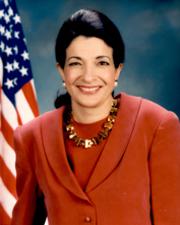 Sen. Olympia J. Snowe (R-ME)
Legislative Activity
Stay on top of the latest movement without scrolling through every action
Senate amendment not agreed to: Amendment SA 214 not agreed to in Senate by Yea-Nay Vote. 49 - 50. Record Vote Number: 60.
March 17, 2005
View full timeline
Senate amendment not agreed to: Amendment SA 214 not agreed to in Senate by Yea-Nay Vote. 49 - 50. Record Vote Number: 60.
March 17, 2005
Roll call votes on amendments in Senate: Amendment SA 214 not agreed to in Senate by Yea-Nay Vote. 49 - 50. Record Vote Number: 60.
March 17, 2005
Considered by Senate. (consideration: CR S2875, S2921, S2953-2954)
March 17, 2005
Amendment SA 214 not agreed to in Senate by Yea-Nay Vote. 49 - 50. Record Vote Number: 60.
March 17, 2005
Senate amendment submitted
March 16, 2005
Senate amendment proposed (on the floor): Amendment SA 214 proposed by Senator Snowe.(consideration: CR S2821-2825; text: CR S2821)
March 16, 2005
Amendment SA 214 proposed by Senator Snowe. (consideration: CR S2821-2825; text: CR S2821) To ensure that any savings associated with legislation that provides the Secretary of Health and Human Services with the authority to participate in the negotiation of contracts with manufacturers of covered part D drugs to achieve the best possible prices for such drugs under part D of title XVIII of the Social Security Act, that requires the Secretary to negotiate contracts with manufacturers of such drugs for each fallback prescription drug plan, and that requires the Secretary to participate in the negotiation for a contract for any such drug upon the request of a prescription drug plan or an MA-PD plan, is reserved for reducing expenditures under such part.
March 16, 2005
Votes
1 roll call on this amendment
Text
Proposed
CONGRESSIONAL BUDGET FOR THE UNITED STATES GOVERNMENT FOR THE FISCAL
YEAR 2006

The ACTING PRESIDENT pro tempore. Under the previous order, the
Senate will resume consideration of S. Con. Res. 18, which the clerk
will report.
The legislative clerk read as follows:

A concurrent resolution (S. Con. Res. 18) setting forth the
congressional budget for the United States Government for the
fiscal year 2006 and including the appropriate budgetary
levels for fiscal years 2005 and 2007 through 2010.

Pending:

Byrd Amendment No. 158, to provide adequate funding of $1.4
billion in fiscal year 2006 to preserve a national intercity
passenger rail system.
Cantwell Amendment No. 168, to strike section 201(a)(4)
relative to the Arctic National Wildlife Refuge.
Akaka Amendment No. 149, to increase veterans medical care
by $2.8 billion in 2006.
Ensign Amendment No. 171, to increase veterans medical care
by $410,000,000 in fiscal year 2006.

The ACTING PRESIDENT pro tempore. Under the previous order, the
Senator from California, Mrs. Feinstein, is recognized for up to 20
minutes.
Mrs. FEINSTEIN. I thank the Chair.
Mr. President, as we all know, this budget cuts a score of critical
domestic programs: food for women and infants; community development
block grants for cities, which cities use for vital purposes; and
health and education programs for children. That is just a few. It cuts
Medicaid by $15 billion over 5 years. It zeros out reimbursements to
States and counties of the cost of incarcerating criminal aliens. It is
an unfunded mandate in that regard. Yet this budget contains $41.3
million for nuclear weapons initiatives including $8.5 million for a
nuclear program that scientists say is impossible to achieve.

[[Page S2760]]

The seriousness of the issue and the clear intent of this
administration to renew funding this year for this nuclear initiative
that was zeroed out by the Congress last year compel me to come to the
floor today.
President Bush's fiscal year 2006 budget calls for $8.5 million,
including $4 million for the Department of Energy and $4.5 million for
the Department of Defense, for the research and development of a
nuclear bunker buster, a 100-kiloton weapon called the robust earth
nuclear penetrator. The purpose of the research is to determine whether
a missile casing on a 100-kiloton warhead can survive a thrust into the
earth and take out a hardened and deeply buried military target without
spewing millions of cubic feet of radioactive debris into the
atmosphere. Scientists know that the laws of physics will not allow
that to happen.
It includes $25 million to lower the Nevada test site time-to-test
readiness from the current 24 to 36 months to 18 months. This sends a
clear signal of an urgent move to begin underground nuclear testing as
soon as possible. This is despite the fact that our country has had a
moratorium on nuclear testing since 1992. We have had it for more than
13 years.
It also contains $7.8 million for a so-called modern pit facility.
This is a facility to build 450 new pits. These are the nuclear
triggers for nuclear weapons, the shells in which the fissile material
is contained and detonated. This is 450 new pits a year, some of which
would be designed for new nuclear weapons.
Currently the United States has approximately 15,000 warheads. Under
the Moscow Treaty, the United States is to decrease its strategic
nuclear force to 1,700 to 2,200 by 2012. To maintain a 2,200-warhead
force at replacement level--and this is important--we would only need
to build 50 pits a year, not 450 which is called for in this budget. So
why build a new facility unless there are plans underway to develop a
new generation of nuclear weapons?
Perhaps because the explosion and use of nuclear weapons took place
at the end of World War II, we forget what it is like. I hope people
will look at this and see what it is like. This is Hiroshima. This is
at the end of World War II. This is a 15-kiloton nuclear weapon, not a
100-kiloton nuclear weapon. This is incomprehensible to me. This is
what the Enola Gay dropped on Hiroshima. It cleared bare 4 square
miles. It killed immediately 90,000 people. It caused hundreds of
thousands of people to die of radiation sickness. Again, why fund this
program?
Congress made a strong statement last year. We took out the
appropriations for these new nuclear weapons. This defunding was made
possible by the leadership of Representative David Hobson, the chairman
of the House Appropriations Energy Committee, who was successful, with
our support, in eliminating $27.5 million in funding for this 100-
kiloton nuclear bunker buster and $9 million for the advanced weapons
concepts initiative. This is a fallacious concept of creating low yield
tactical nuclear weapons, under 5 kilotons, to use on a battlefield no
less. Who would ever want to send their sons and daughters to any war
where the battlefield had nuclear weapons? It also eliminated funding
to lower the time-to-test readiness at the Nevada test site to 18
months and limited funding for the Modern Pit Facility to $7 million.
Congress spoke last year. We said: We will not approve appropriations
for this program. And yet once again those appropriations have crept
into this budget.
I will take a few minutes to make that evident to Members of the
Senate. Last year was a consequential victory for those of us who
believe very deeply--and I might say passionately--that the United
States will not be safer because of this program and that the United
States sends the wrong signal to the rest of the world by reopening the
nuclear door and beginning the testing and development of a new
generation of nuclear weapons.
This year, our message is clear: Don't reopen this nuclear door.
Those of us who are appropriators will once again try to remove this
funding from the budget.
I am so disappointed to learn that the administration has requested
funding again this year for a 100-kiloton nuclear bunker buster, to
lower the time-to-test readiness at the Nevada test site to 18 months,
and to fund a modern plutonium pit facility that could produce 450 new
plutonium pits a year when only 50 are needed.
There should be no doubt that this is the Secretary of Defense's
program. He is determined to get it funded. It is that Secretary who
requested the Secretary of Energy to place $4 million in the energy
budget and $4.5 million in the defense budget. This is very clever. In
this way Secretary Rumsfeld hopes to get it done in the defense budget,
if he can't through energy appropriations.
I ask that the Senate know that the development of a 100-kiloton
robust nuclear earth penetrator is simply not possible without spewing
millions of tons of radioactive material and killing large numbers of
people.
Secondly, the development of new nuclear weapons will only undermine
our antiproliferation efforts and will make our Nation less safe, not
more safe.
And thirdly, as a nation, we are sending the wrong message, a message
that will only encourage nuclear proliferation by others. In fact, it
already has.
The bottom line: There is simply no such thing as a clean or usable
100-kiloton nuclear bunker buster that could destroy a hardened and
deeply buried military target without spewing radiation.
Consider this: A 1-kiloton nuclear weapon, detonated 25 to 50 feet
underground, would dig a crater the size of Ground Zero in New York and
eject 1 million cubic feet of radioactive debris into the air. Given
the insurmountable physics problems associated with burrowing a warhead
deep into the earth, you would need a weapon with more than 100
kilotons of yield to destroy an underground target at a depth of 1,000
feet. Yet the maximum feasible depth a bunker buster can penetrate is
about 35 feet. At that depth, a 100-kiloton bunker buster would scatter
100 million cubic feet of radioactive debris into the atmosphere.
There is no known missile casing that can survive a 1,000-foot thrust
into the earth to avoid overwhelming and catastrophic consequences.
That is not me saying this, that is science saying this.
Let me give you the words of the head of the National Nuclear
Security Administration, if you don't trust me. At the March 2, 2005,
House Armed Services Strategic Forces Subcommittee, Congresswoman Ellen
Tauscher asked Ambassador Linton Brooks the following question:

I just want to know, is there any way a [robust nuclear
earth penetrator] of any size that we would drop will not
produce a huge amount of radioactive debris?

The answer, according to the Ambassador:

No, there is not.

When Congresswoman Tauscher asked him how deep he thought a bunker
buster could go, using modern scientific concepts--in other words, here
we get to the missile casing--he said:

. . . a couple of tens of meters maybe. I mean certainly--I
really must apologize for my lack of precision, if we in the
administration have suggested that it was possible to have a
bomb that penetrated far enough to trap all fallout. I don't
believe that--I don't believe the laws of physics will ever
let that be true.

So here we have the administration saying what we who have opposed
this program from the start have said. The laws of physics will never
allow the development of a ``clean'' 100-kiloton robust nuclear earth
penetrator.
Again, simply stated, there is no casing that will withstand a 1,000-
foot thrust into the earth--the depth at which a spewing of
radioactivity might be contained. Such an admission begs the question:
Why are we even spending a dime on this research? Or as Secretary
Rumsfeld said to me in a Defense Appropriations Subcommittee hearing
with a shrug, ``Oh, this is just a study.''
Do I believe that answer? Absolutely not. This has never been about a
study. It has been about the intent of the administration to develop
new nuclear weapons, and I have followed this for a long time now.
This year, this budget funds $8.5 million. In fiscal year 2007, it
increases to $17.5 million, including $14 million for the Department of
Energy and $3.5 million for the Pentagon.
While the administration is silent this year on how much it plans to

[[Page S2761]]

spend on the program in future years, last year they let it all out.
Last year's budget request called for spending $485 million on a 100-
kiloton nuclear bunker buster over 5 years, which scientists say is
impossible to devise. The laws of physics won't allow it, unless you
are going to prepare one that is going to spew tons of radioactivity.
Let me, for a moment, mention the policies underlying this
initiative. These policies began in 2002 with the document called the
Nuclear Posture Review. That document places nuclear weapons as part of
the strategic triad for the first time in our history, therefore,
blurring the distinction between conventional and nuclear weapons--a
very bad policy decision.
Then take National Security Directive 17, which came out later that
year, which indicated for the first time in America's history that we
would engage in a first use of nuclear weapons--a historic statement.
We have never had a no-first-use policy, but we have never said that we
would countenance a first use of nuclear weapons. And in National
Security Directive 17 we do just that. We say we would engage in a
first use of nuclear weapons--again, that is a historic statement--to
respond to a chemical or biological attack against certain nations. The
Nuclear Posture Review named seven nations against whom we would
countenance a nuclear attack. One of those nations legally is a nuclear
nation. This is ridiculous and foolish policy, and it jeopardizes the
future of all Americans. But what it does also is it encourages other
nations to develop their own nuclear weapons, thereby putting American
lives and our national security at risk. That is why the North Koreans
are moving ahead. They see what we are going to do. They see that we
have said we would enter into a first use of nuclear weapons. North
Korea is one of the seven nations named. That is what is happening in
Iran now. Iran is one of the seven nations named. Other countries are
now looking at advanced weapons concepts, based on the fact that we
have moved in this direction.

The next nuclear nonproliferation review conference is in May, and it
will allow parties to the treaty to measure progress in implementing
their obligation and to discuss additional steps to meet the treaty's
objectives.
In public statements--this is the hypocrisy--the administration
recognizes the importance of the NPT. Last week, President Bush stated
that the NPT ``represents a key legal barrier to nuclear weapons
proliferation and makes a critical contribution to international
security,'' and that ``the United States is firmly committed to its
obligations under the treaty.''
If we are indeed serious about strengthening our nonproliferation
efforts and increasing international nuclear security, we should lead
in reducing nuclear arsenals; we should lead in preventing nuclear
proliferation; and we should know that a production of a 100-kiloton
nuclear bunker buster is sheer hypocrisy on our part.
Make no mistake, the rest of the world is watching us and paying
close attention to what we do. I believe the United States can take
several actions to make better use of our resources and demonstrate our
commitment to keeping the world's most dangerous weapons out of the
hands of the most dangerous people. We have to strengthen the Nuclear
Non-Proliferation Treaty at this May 2005 review conference.
This includes supporting tougher inspections to monitor compliance,
more effective controls on sensitive technologies, accelerated programs
to safeguard and eliminate nuclear weapon usable materials, and
agreement that no state may withdraw from the treaty and escape
responsibility for prior violations of the treaty.
We should expand and accelerate Nunn-Lugar threat reduction programs.
I hear Senator after Senator saying they support the Nunn-Lugar
program. We should provide the necessary resources to improve security
and take the rest of the Soviet era nuclear chemical and biological
weapons arsenal and infrastructure out of circulation.
Third, we should strengthen the ability of the DOE's global threat
reduction initiative to secure and remove nuclear weapons usable
material from vulnerable sites around the world.
Last year, Senator Domenici and I sponsored an amendment to the 2005
National Defense Authorization Act, which authorized the Secretary of
Energy to lead an accelerated, comprehensive worldwide effort to
secure, remove, and eliminate the threat by these materials.
Finally, we should improve--this has to do with the bunker buster--
our intelligence capabilities in relation to underground targets and
expand conventional options to put them at risk. Every underground
target has entry and exit, has air vents, presents a way to take them
out with conventional weapons. That is what we should be doing instead
of exploring, doing research and development of a 100-kiloton nuclear
bunker buster, which science says cannot be done without the spewing of
millions of tons radiation. History repeats itself.
I yield the floor and suggest the absence of a quorum and ask
unanimous consent that the time be equally divided.
The ACTING PRESIDENT pro tempore. Without objection, it is so
ordered.
The clerk will call the roll.
Mr. WYDEN. Mr. President, I ask unanimous consent that the order for
the quorum call be rescinded.
The ACTING PRESIDENT pro tempore. Without objection, it is so
ordered.
Mr. WYDEN. I ask unanimous consent to speak for--may I have up to 10
minutes? I don't think I will go that long.
Mr. CONRAD. Mr. President, this is out of the amendment time, and
there is 45 minutes on our side. We have many speakers. Can the Senator
go for 7 minutes?
Mr. WYDEN. That would be gracious. I will try to do that.
Mr. CONRAD. If Senator Specter has not appeared by then, we can
provide more time.
Mr. WYDEN. I thank my colleague.
The ACTING PRESIDENT pro tempore. The Senator from Oregon is
recognized.
Mr. WYDEN. Mr. President, those who advocate drilling in the Arctic
claim that the drilling is needed to reduce our Nation's dependence on
foreign oil. But what is included in the Senate budget resolution
doesn't increase U.S. energy security. To the contrary, it is a license
to export Alaskan oil outside the United States. With the inflated
revenue projections of $2.5 billion from drilling in the Arctic
included in the budget, the Federal Government will be forced to sell
the oil to the highest bidder to even come close to reaching that
amount.
Under the Senate budget, if the highest price is in South America,
oil from that wildlife refuge would have to go to South America. If the
highest price is in the Far East, Arctic oil would have to go to the
Far East. If the highest price is in the Middle East, Arctic oil would
have to go to the Middle East.
With the weak dollar, it would be a virtual certainty that the
highest price for Arctic oil would be outside our country. It would not
reduce our dependence on foreign oil one drop to export Arctic oil
overseas, but that is exactly what could happen under the Senate budget
resolution.
Now, last Congress, the House, in passing its Energy bill, recognized
that drilling in the Arctic wildlife refuge won't help our Nation's
energy security if the oil from that drilling is exported overseas. The
House-passed Energy bill explicitly prohibited the export of oil from
the Arctic wildlife refuge. But the Senate budget resolution fails to
include an export prohibition. In fact, it invites exports by assuming
revenues that can only be met by requiring the oil to be sold to the
highest bidder, at a time when the dollar is weak.
If the goal is energy security, then including the Arctic drilling in
the budget resolution in this fashion is the wrong way to go about it.
We can get more energy security, and we can get it sooner than from
Arctic oil drilling under the Senate budget resolution.
Last week, the President renewed his push for drilling in the Arctic
by arguing it would produce nearly 10 million barrels per day. But the
President acknowledged that that amount of oil would not be produced
until 2025. We can get that much energy security and more, and we can
get it now instead of waiting until 2025. We can get that added energy
security by changing the current policies on exports of oil and

[[Page S2762]]

petroleum and providing the right incentives for producers to develop
the billions of barrels of recoverable oil that are in U.S. reserves
but are not being developed today.
Right now our country is exporting about 1 million barrels a day of
petroleum products. That happens every single day. We could in effect
get 1 million barrels a day more oil for our country, 10 percent more
energy security, and we could get it right now by ending those exports.
By comparison, the administration's Energy Information Administration
says the amount of oil that the President says would be produced in the
Arctic would only reduce our Nation's dependence by 3 percent, from 68
percent to 65 percent dependence on foreign oil. I seriously doubt the
OPEC cartel will stop its anticompetitive practices because of a tiny
increase in Arctic production 20 years from now that even the Energy
Administration says would reduce our dependence on foreign oil by 3
percent. Our country can get more than three times that amount of
increased energy security and we can get it now rather than 2025 by
stopping exports of U.S.-produced petroleum products, and under the
unrestricted export language of the Senate budget resolution we could
end up with no additional energy security--no additional energy
security, absolutely not. We can do much better than a 3-percent
increase in energy security. We can do better than the 10-percent
increase in security our country would get from eliminating exports. In
fact, our country could produce an additional 40 billion barrels of
oil, enough to replace all of our country's imports of oil for the next
10 years, and we could get that additional oil from existing reserves
that could be produced in our country if the right incentives were
provided.
If we want to get serious about energy security, we can start today.
We should eliminate the budget resolution's license to export Arctic
oil out of our country. We should replace the budget's Arctic oil
export license with policies that provide real energy security for our
Nation.
Mr. President, I suggest the absence of a quorum.
The ACTING PRESIDENT pro tempore. The clerk will call the roll.
The journal clerk proceeded to call the roll.
Mr. REID. Mr. President, I ask unanimous consent that the order for
the quorum call be rescinded.
The ACTING PRESIDENT pro tempore. Without objection, it is so
ordered.
Mr. REID. I note the absence of a quorum with the condition that the
time be charged equally against both sides.
The ACTING PRESIDENT pro tempore. Is there objection?
Without objection, it is so ordered.
The clerk will call the roll.
The journal clerk proceeded to call the roll.
Mr. SPECTER. Mr. President, I ask unanimous consent that the order
for the quorum call be rescinded.
The ACTING PRESIDENT pro tempore. Without objection, it is so
ordered.
Under the previous order, the Senator from Pennsylvania, Mr. Specter,
is recognized to offer an amendment relative to NIH on which there will
be 45 minutes of debate equally divided in the usual form.
Mr. SPECTER. I thank the Chair.

Amendment No. 173

I send an amendment to the desk and ask for its immediate
consideration.
The ACTING PRESIDENT pro tempore. The clerk will report.
The journal clerk read as follows:

The Senator from Pennsylvania [Mr. Specter], for himself
and Mr. Harkin, proposes an amendment numbered 173.

Mr. SPECTER. I ask unanimous consent that the reading of the
amendment be dispensed with.
The ACTING PRESIDENT pro tempore. Without objection, it is so
ordered.
The amendment is as follows:

(Purpose: Increase discretionary health and education funding by
$2,000,000,000)

On page 17, line 16, increase the amount by $500,000,000.
On page 17, line 17, increase the amount by $500,000,000.
On page 18, line 16, increase the amount by $1,500,000,000.
On page 18, line 17, increase the amount by $1,500,000,000.
On page 26, line 14, decrease the amount by $2,000,000,000.
On page 26, line 15, decrease the amount by $2,000,000,000.
Mr. SPECTER. Mr. President, at the outset I submit a statement for
the record and ask that it be included in its entirety at the
conclusion of my remarks.
The ACTING PRESIDENT pro tempore. Without objection, it is so
ordered.
(See exhibit 1.)
Mr. SPECTER. In order to summarize, since we have a relatively
limited period of time, this amendment provides for increasing funding
for the Department of Education by $500 million, which would bring it
up to level funding, and an addition of $1.5 billion for the National
Institutes of Health, and the offset would be across the board from
Function 920. This reduction would not cut any programs but simply
reduce administrative expenses, travel, and consulting services by .237
percent, which is minuscule in the overall scheme of things, I admit,
very minor compared to the importance of having additional funding in
education and additional funding in the National Institutes of Health.
NIH has made remarkable advances on an enormous list of very major
diseases and they are worth itemizing because each one of these strikes
thousands of Americans. They include:
Autism, stroke, obesity, Alzheimer's, Parkinson's, spinal muscular
atrophy, scleroderma, ALS, muscular dystrophy, diabetes, osteoporosis,
cancers, including breast, cervical and ovarian, lymphoma, multiple
myeloma, prostate, pancreatic, colon, head and neck, brain, lung,
pediatric renal disorders, multiple sclerosis, deafness and other
communication disorders, glaucoma, macular degeneration, sickle cell
anemia, heart disease, spinal cord injury, sudden infant death
syndrome, arthritis, schizophrenia and other mental disorders,
polycystic kidney disease, hepatitis, Cooley's anemia, primary immune
deficiency disorders, and the list goes on and on.
As I read them off to itemize them, they are abstractions to people
who suffer from these ailments. To families of people who suffer these
ailments, they are catastrophic. Take someone who has autism, take
someone who has Alzheimer's, this disrupts the family, these ailments
are overwhelming. The National Institutes of Health has had increases
in this budget on a commitment by this body to double NIH, and we have
increased the funding very substantially. But last year and the year
before and this year, the funding well has not proceeded as it should.
When you talk about a budget of $28 billion for the National Institutes
of Health, when you have an overall budget of approximately $2.67
trillion, $28 billion is totally insufficient.
If there is not an increase in funding for the National Institutes of
Health, there will be 402 less grants awarded next year than last year.
The increase of less than $200 million does not begin to approximate
the replacement rate for chemical, biomedical research which is 3.5
percent. We have $1.7 billion which is being applied by NIH to
bioterrorism. With all due respect, that ought to come out of homeland
security, bioterrorism. It is coming out of the NIH budget because it
is a medical issue. If there is not additional funding, these are some
of the points of impact on the National Institutes of Health:
They will be unable to test safety of new behavioral treatments for
autism; unable to initiate phase 3 to determine the relationship
between infection and cardiovascular disease; unable to expand research
on early identification preventing procurement impairment of newborns;
delay by 1 year more research with industry to develop vaccines for
hepatitis C infections; delay the evaluation of promising vaccines in a
variety of contexts. It will delay programs for developing computer
models for responding to infectious disease outbreaks such as avian
flu, as well as bioterrorism attacks--here again these are
abstractions, but to the people they hit, they are catastrophic--unable
to expand the development of methamphetamine addiction; unable
to initiate multicellular studies of aquaimmune hepatitis, and the list
goes on and on.

The subject of adequacy of NIH research is one which I thought was of
enormous importance before I was

[[Page S2763]]

elected to the Senate in 1980, and my initial assignment on
Appropriations took me to the Subcommittee on Health and Human
Services. I have always been an advocate for increasing NIH funding.
Then when I took over the chairmanship of the subcommittee in 1995, in
a position to establish priorities, the Senate voted to double NIH
funding, but then in the first year following defeated an effort to add
$1 billion. Senator Harkin and I have formed a partnership on a
bipartisan basis, and he has had the gavel when the Democrats took over
for 17 months in 2001 and when we have had a transfer of the gavel, it
has been seamless, he and I and this partnership of established
priorities within our subcommittee even when this body did not grant
increases to NIH. We have found the money by establishing priorities.
But the fact is that opportunity is gone. It is gone because there have
been decreases in the other facets of the budget.
The Department of Labor budget has been cut by 3\1/2\ percent this
year. I don't know how we are going to fund the necessary programs for
worker safety. The education budget, believe it or not, has been cut by
almost 1 percent, by some $500 million. I will come to that in a moment
on the aspect of this amendment which seeks to raise education funding
by $500 million. But it is not possible anymore to juggle the books. We
cannot juggle the books and find money and priorities to add an
additional $1.5 billion to the National Institutes of Health.
My interest in medical research occurred long before I developed a
current problem, which has been publicized, with Hodgkin's, and I am
glad to say that there is a cure for the particular problem I had. But
in many forms of cancer there is no cure. President Nixon declared war
on cancer in 1972. Here we are 33 years later, the wealthiest country
in the world, the greatest talent in the world on research, and we
spend $2.6 trillion. We spend it in many directions which are
challenged by many people in our society, but we allocate $28 billion
to NIH. And it is totally, totally, totally insufficient, and for
families where they suffer from Alzheimer's or heart disease or the
long list of maladies I recited, it is simply unacceptable. I know the
distinguished chairman of the Budget Committee has enormous problems. I
compliment him on taking on what is probably the toughest job in the
Senate, to try to find a way to make allocations on the budget.
But among the priorities, I will say that the expression is
frequently used, ``none is higher.'' Well, that means it could be tied
with a lot of others. But I would say health is highest. If you don't
have your health, you can't do anything else. I could give an extended
dissertation on that particular proposition because it has struck home
to me. Not to overly personalize the matter, but when you go through
the regimen for Hodgkin's, they fill your body full of poisons to fight
the poisons which are in your body. It is quite a war of the worlds as
it battles through you. It underscores the importance of health. For
the people who were suffering from the long list I recited, it is the
beginning and end of every day.
We ought to win the war on cancer. In the particular institute of a
very distinguished doctor, John Glick, who is my oncologist, they had
plans for a 57 percent increase in their funding. That was reduced to
42 percent. And that was eliminated. That is symbolic of what is going
on across America. That reduction in funding means a lot of pain, a lot
of suffering, and a lot of deaths. We have the capacity to do something
about it. This $1.5 billion is a modest step.
Now on to education. The President's budget came over with a .9-
percent decrease in education funding. It is a little hard for me to
understand, given the importance of education. The Governors meet, the
industrialists meet, and they decry the inadequacy of education in
America. While the Federal Government provides a relatively small
percentage of funding, we do have the leadership position.
Just last week, the Senate passed, 99 to 0, the reauthorization of
the Perkins Vocational and Technical Education Program, which is a $2
billion program. But on the Education Department budget, this program
is zeroed out. It was $2 billion, and we voted for it 99 to nothing. We
looked good when we had the authorization vote, but when it comes to
putting our money where our mouth is, we are AWOL, we are gone, we are
not there.
There is an enormous number of educational programs which have been
cut out totally. The GEAR UP program, which has been funded by my
subcommittee over the last 6 years, which takes seventh graders and
gives them mentoring and puts them on the right course through high
school, an enormously important program not only for education but for
crime control, where there is really the stark alternative of becoming
a juvenile delinquent or becoming an educated America--it is gone.
The list is too long to read.
I ask unanimous consent the full text of these programs which are
being cut be printed in the Record.
There being no objection, the material was ordered to be printed in
the Record, as follows:

EDUCATION DEPARTMENT FY 2006 DISCRETIONARY BUDGET, TERMINATIONS
[Dollars in thousands]
----------------------------------------------------------------------------------------------------------------
2004           2005          2006
Program                                 appropriation  appropriation    request
----------------------------------------------------------------------------------------------------------------
NCLB
Foundations for Learning...........................................             0            992             0
Close Up Fellowships...............................................         1,481          1.469             0
Excellence in Economic Education...................................         1,491          1,488             0
Women's Educational Equity.........................................         2,962          2,956             0
School Dropout Prevention..........................................         4,971          4,930             0
Mental Health Integration in Schools...............................             0          4,960             0
Community Technology Centers.......................................         9,941          4,960             0
Exchanges with Historic Whaling and Trading Partners...............         8,450          8,630             0
Javits Gifted and Talented.........................................        11,111         11,022             0
Ready to Teach.....................................................        14,321         14,291             0
School Leadership..................................................        12,346         14,880             0
Foreign Language Assistance........................................        16,546         17,856             0
National Writing Project...........................................        17,894         20,336             0
Star Schools.......................................................        20,362         20,832             0
Civic Education....................................................        28,642         29,405             0
SDFS Alcohol Abuse Reduction.......................................        29,823         32,736             0
Elementary School Counseling.......................................        33,799         34,720             0
Arts in Education..................................................        35,071         35,633             0
Parental Information and Resource Centers..........................        41,975         41,886             0
Smaller Learning Communities.......................................       173,967         94,476             0
Comprehensive School Reform........................................       233,614        205,344             0
Even Start.........................................................       246,910        225,095             0
Safe and Drug-Free Schools State Grants............................       440,908        437,381             0
Educational Technology State Grants................................       691,841        496,000             0
------------------------------------------
Total, NCLB....................................................     2,078,426      1,762,278             0
Other K-12
Tech-Prep Demonstration............................................         4,939          4,900             0
Occupational and Employment Information............................         9,382          9,307             0
Vocational Education National Programs.............................        11,852         11,757             0
Tech-Prep State Grants.............................................       106,665        105,812             0
Vocational Education State Grants..................................     1,195,008      1,194,331             0
------------------------------------------
Total, Other K-12..............................................     1,327,846      1,326,107             0
Postsecondary
B.J. Stupak Olympic Scholarships...................................           988            980             0

[[Page S2764]]

Interest Subsidy Grants............................................         1,988          1,488             0
Underground Railroad Program.......................................         2,222          2,204             0
Thurgood Marshall Legal Educational Opportunity Program............             0          2,976             0
Demonstration Projects for Students Disabilities...................         6,913          6,944             0
Byrd Honors Scholarships...........................................        40,758         40,672             0
Leveraging Educational Assistance Partnership......................        66,172         65,643             0
Federal Perkins Loans Cancellations................................        66,665         66,132             0
Teacher Quality Enhancement........................................        88,888         68,337             0
TRIO Talent Search.................................................       144,230        144,887             0
GEAR UP............................................................       298,230        306,488             0
TRIO Upward Bound..................................................       312,451        312,556             0
------------------------------------------
Total, Postsecondary...........................................     1,029,505      1,019,307             0
All Other ED
VR Migrant and Seasonal Farmworkers................................         2,321          2,302             0
VR Recreational Programs...........................................         2,564          2,543             0
Literacy Programs for Prisoners....................................         4,971          4,960             0
VR Projects With Industry..........................................        21,799         21,625             0
State Grants for Incarcerated Youth Offenders......................        19,882         21,824             0
VR Supported Employment State Grants...............................        37,680         37,379             0
Regional Educational Laboratories..................................        66,665         66,131             0
------------------------------------------
Total, Other ED................................................       155,882        156,764             0
------------------------------------------
Total (48 Terminations)........................................     4,591,659      4,264,456             0
----------------------------------------------------------------------------------------------------------------

Exhibit 1

Amendment To Increase Function 550: Health

Mr. President, I have sought recognition today to offer a
$1.5 billion amendment to increase the health function and
$500 million to increase the education function in this
resolution. The amendment would add to the funding already
included in the resolution for the National Institutes of
Health and the Department of Education. The amendment is
offset by an across-the-board reduction in Function 920. This
reduction would not cut programs, but simply reduce
administrative expenses, travel, and consulting services by
0.237 percent.
This amendment would provide NIH with a $1.5 billion
increase over the President's budget. While this sounds like
a tremendous increase, in reality it provides only 5.6
percent more than the previous year and provides a slight
increase over biomedical research inflation.
As chairman of the Appropriations Subcommittee for Labor,
Health and Human Services, Education and Related Agencies, I
have said many times that the National Institutes of Health
is the crown jewel of the Federal Government--perhaps the
only jewel of the Federal Government. When I came to the
Senate in 1981, NIH spending totaled $3.6 billion. The FY
2003 omnibus appropriations bill contained $27.2 billion for
the NIH which completed the doubling begun in FY 1998. The
successes realized by this investment in NIH have spawned
revolutionary advances in our knowledge and treatment for
diseases such as cancer, Alzheimer's disease, Parkinson's
disease, mental illnesses, diabetes, osteoporosis, heart
disease, ALS and many others. It is clear that Congress'
commitment to the NIH is paying off. Now it is crucial that
increased funding be continued in order to translate these
advances into additional treatments and cures. Our investment
has resulted in new generations of AIDS drugs which are
reducing the presence of the AIDS virus in HIV infected
persons to nearly undetectable levels. Death rates from
cancer have begun a steady decline. With the sequencing of
the human genome, we will begin, over the next few years, to
reap the benefits in many fields of research. And if
scientists are correct, stem cell research could result in a
veritable fountain of youth by replacing diseased or damaged
cells. I anxiously await the results of all of these avenues
of remarkable research. This is the time to seize the
scientific opportunities that lie before us.
On May 21, 1997, the Senate passed a Sense of the Senate
resolution stating that funding for the NIH should be doubled
over 5 years. Regrettably, even though the resolution was
passed by an overwhelming vote of 98 to nothing, the Budget
Resolution contained a $100 million reduction for health
programs. That prompted Senator Harkin and myself to offer an
amendment to the budget resolution to add $1.1 billion to
carry out the expressed sense of the Senate to increase NIH
funding. Unfortunately, our amendment was tabled by a vote of
63-37. We were extremely disappointed that, while the Senate
had expressed its druthers on a resolution, it was simply
unwilling to put up the actual dollars to accomplish this
vital goal.
The following year, Senator Harkin and I again introduced
an amendment to the Budget Resolution which called for a $2
billion increase for the NIH. While we gained more support on
this vote than in the previous year, our amendment was again
tabled by a vote of 57-41. Not to be deterred, Senator Harkin
and I again went to work with our subcommittee and we were
able to add an additional $2 billion to the NIH account for
fiscal year 1999.
In fiscal year 2000, Senator Harkin and I offered another
amendment to the Budget Resolution to add $1.4 billion to the
health accounts, over and above the $600 million increase
which had already been provided by the Budget Committee.
Despite this amendment's defeat by a vote of 47-52, we were
able to provide a $2.3 billion increase for NIH in the fiscal
year 2000 appropriation's bill.
In fiscal year 2001, Senator Harkin and I again offered an
amendment to the Budget Resolution to increase funding for
health programs by $1.6 billion. This amendment passed by a
vote of 55-45. This victory brought the NIH increase to $2.7
billion for fiscal year 2001. However, after late night
conference negotiations with the House, the funding for
NIH was cut by $200 million below that amount.
In fiscal year 2002, the budget resolution once again fell
short of the amount necessary to achieve the NIH doubling.
Senator Harkin and I, along with nine other Senators offered
an amendment to add an additional $700 million to the
resolution to achieve our goal. The vote was 96-4. The Senate
Labor-HHS Subcommittee reported a bill recommending $23.7
billion, an increase of $3.4 billion over the previous year's
funding. But during conference negotiations with the House,
we once again fell short by $410 million. That meant that in
order to stay on a path to double NIH, we would need to
provide an increase of $3.7 billion in the fiscal year 2003.
The fiscal year 2003 omnibus appropriations bill contained
the additional $3.7 billion, which achieved the doubling
effort. In FY 2004, I and Senator Harkin offered an amendment
to add an additional $2.8 billion to the budget resolution to
ensure that the momentum achieved by the doubling could be
maintained and translated into cures. The vote was 96-1.
Unfortunately, the amendment was dropped in conference. We
worked hard to find enough funding for a $1 billion increase
in FY 2004. We fought long and hard to make the doubling of
funding a reality, but until treatments and cures are found
for the many maladies that continue to plague our society, we
must continue our fight.
In FY 2005, once again, Senator Harkin, Senator Collins and
I offered an amendment to add $2 billion to discretionary
health spending, including NIH. The amendment passed 72-24.
However, the subcommittee's allocation did not reflect this
increase. The final conference agreement contained an
increase of $800 million over the FY 2004 funding level.
I, like millions of Americans, have benefited tremendously
from the investment we have made in the National Institutes
of Health and the amendment that we offer today will continue
to carry forward the important research work of the world's
premier medical research facility.
My amendment also intends to ensure that discretionary
funding for the Department of Education is not cut below the
amount provided by Congress last year. The resolution
currently assumes a cut of $500 million below the FY 2005
appropriation. My amendment would add $500 million to
Function 500 in order to prevent such a reduction.
Many members have pointed out that the budget for the
Department of Education has been increased significantly over
the past several years. In fact, funding has been raised from
$24.7 billion in FY 1995 to $56.6 billion last year, an
increase of 129 percent. My subcommittee has taken the lead
in providing increases for Title I grants for Disadvantaged
Students, Special Education and Pell grants. President Bush
has made increases in these important programs a priority,
which is why funding for Title I grants is up 45 percent
since No Child Left Behind was passed in 2001, funding for
Special Education is up 67 percent since FY 2001 and Pell
grants are up 41 percent from the level when President
Clinton was in office.
However, I am concerned that the budget resolution will
force my subcommittee to make very difficult choices and cut
one education program for another. For example, the budget
proposes to eliminate $1.3 billion in funding for the Perkins
Vocational and

[[Page S2765]]

Technical Education program, $306.5 million for the GEAR UP
program and $467 million for certain TRIO activities in order
to fund a high school reform initiative. Yet, the Senate
voted on Friday 99-0 to reauthorize the Perkins program,
sending a powerful message to my subcommittee about the
importance of this program.
I believe that education is a capital investment. As
District Attorney in Philadelphia, I have seen what happens
when the right investments aren't made and kids turn to the
streets without safe and productive learning environments. My
amendment seeks to help States, colleges, teachers and
families ensure that a quality education is available for
all.
Mr. SPECTER. Mr. President, how much time remains of my 22.5 minutes?
The ACTING PRESIDENT pro tempore. The Senator has 8.5 minutes.
Who seeks time? The Senator from North Dakota.
Mr. CONRAD. Mr. President, we are now on the third day of the budget
resolution.
I inquire of the desk, how much time do we have remaining?
The ACTING PRESIDENT pro tempore. On the Specter amendment, there is
22.5 minutes in opposition.
Mr. CONRAD. Could the Chair inform me how much time is left on the
resolution?
The ACTING PRESIDENT pro tempore. The majority has 11 hours 4
minutes, the minority has 9 hours 23 minutes.
Mr. CONRAD. Mr. President, I want to alert my colleagues that the
time is rapidly vanishing. We want to use this time we have efficiently
and effectively. We don't want to have dead time here on the floor. We
want Senators on both sides to have every opportunity to offer their
amendments, so it is critically important that Senators take the
opportunity that is available to them and come to discuss the
amendments that are in front of us and discuss the amendments they may
want to offer so this time is effectively used.
I know we are going to get into the situation where Senators are
going to come to us and say: Can't we have some time? There is not
going to be any time very shortly, and then we will go into vote-arama,
in which there will be very limited time. I wanted to alert my
colleagues.
Mr. GREGG. Will the Senator yield for a question?
Mr. CONRAD. I am happy to yield for a question.
Mr. GREGG. I believe the Senator from Wyoming was going to speak in
opposition to the amendment of the Senator from Pennsylvania. He was
going to talk about that. Did the Senator from North Dakota wish to go
forward off the resolution? Is that the Senator's plan?
Mr. CONRAD. That was my plan, take time off the resolution.
The ACTING PRESIDENT pro tempore. That is how the time is being
charged.
Mr. CONRAD. Mr. President, we have seen a dramatic deterioration in
the budget situation since 2000. One can see what has happened. Back in
2000, we actually had a budget surplus. Then, despite the President's
assurances that his fiscal policy would not lead to an expansion of
deficits and debt, that is exactly what we have seen. In fact, we are
now at record deficit levels, the biggest deficits we have ever had.
It is not just with respect to deficits that we have a problem. We
are also seeing exploding debt. I remember so well, back in 2001, the
Congressional Budget Office produced this chart of possible outcomes
for the deficit. They said this was the range of possible outcomes.
They adopted, in their forecast, a midrange. That was adopted by the
President as well. They said, based on that scenario, that we would see
$5.6 trillion of surpluses over the next 10 years, so many of my
Republican colleagues assured me: Don't worry, we will get even more
money because of the tax cuts. I remember being told repeatedly: You
are going to get more money because of the tax cuts.
We didn't get more money. Here is what actually happened. This was
the range of possible outcomes, according to the Congressional Budget
Office. Now we can look back and see what actually happened. What
actually happened was the deficits were far worse, they were below the
bottom of their range of projected outcomes. All of that talk about how
the tax cuts would generate more revenue just proved to be wrong.
The Comptroller General of the United States, the head of the General
Accounting Office, warns us now that the fiscal outlook is worse than
claimed. He says:

The simple truth is that our Nation's financial condition
is much worse than advertised.

The Comptroller General has it exactly right. Our fiscal condition,
our financial condition is much worse than advertised. Why? Because
when the President says to us he is going to reduce the deficit, he is
going to cut it in half over the next 5 years, the only way he gets
there is he just leaves out things.
What does he leave out? First of all, he leaves out of his budget any
war costs past September 30 of this year. We have money for this year
in a supplemental. Some of that will be spent next year as well. But
that is $82 billion. The Congressional Budget Office says we ought to
be budgeting $383 billion for residual war costs--Afghanistan, Iraq,
the war on terror--but it is not in the President's budget.
Mr. SPECTER. Will the Senator from North Dakota yield for a question?
Mr. CONRAD. I certainly would.
Mr. SPECTER. This is a procedural question, not a substantive
question. I thank the Senator from North Dakota.
On the scheduling of business, I have to chair an Appropriations
subcommittee hearing on Health and Human Services at 10:30. We
scheduled this amendment at 9:30. I wonder if I could prevail upon the
Senator from North Dakota to permit Senator Enzi to respond to my
arguments so that I can finish, conclude, and then ask unanimous
consent, if that is agreeable, that you be recognized to continue your
presentation?
Mr. CONRAD. I am happy to accommodate the Senator in that way. I
understand, as I am hearing it, the Senator has another obligation, and
he would like to finish his argument, and he would like to be able to
respond.
Mr. SPECTER. I do.
Mr. CONRAD. Maybe we could work out some timing on this so we do
not--maybe we could have a mini unanimous consent agreement so we can
share this time in a way that does not force up the rest of our
schedule here?
Mr. SPECTER. I thank the Senator from North Dakota. I think we can do
that. I have 8 minutes remaining. There is 22 minutes in opposition. My
speculation is that neither of us will use all of our time. I do not
want to make a commitment to the other side on that, then, in advance,
but probably no later than 10:20, 10:25, we can return to the Senator
from North Dakota for his presentation, taking time off the bill.
Mr. President, I ask unanimous consent we follow that procedure.
The ACTING PRESIDENT pro tempore. Is there objection? Without
objection, it is so ordered.
Mr. SPECTER. I thank the Senator from North Dakota and the Senator
from Wyoming.
Mr. ENZI. Mr. President, I also thank the Senator from North Dakota
and the Senator from Pennsylvania for making this arrangement so the
flow of debate on this particular amendment can stay intact.
I do rise in opposition to the amendment of Senator Specter to
increase discretionary spending by $2 billion. One of my favorite
things--and I am sure everybody else's in this Chamber--is to give away
money. You really don't get much opposition when you give away money.
Unfortunately, we are in a situation where we do not have real money to
give away--although, if we pass certain things, it turns into real
money, and the deficit increases. We are making a very concentrated
effort this year to hold down the deficit--not eliminate the deficit,
but to hold it down. You have to do that a little bit at a time.
This concept is very similar to family budgeting. There are a lot of
things a family would like to spend their money on, that they really
feel they ought to spend their money on, but there is just not enough
money to go around.
That is the case for virtually every amendment in this budget, there
is a huge desire to be able to do some very specific things we know
will make a difference. We have been doing that for a lot of years.
That is part of the reason we are in the problem we are in right now.

[[Page S2766]]

This amendment increases discretionary funding for Function 500,
which would include additional funding for education and job training--
my favorite area--and Function 550, which would include additional
funding for health--my second favorite area. That comes under the
jurisdiction of my committee, the Health, Education, Labor, and
Pensions Committee. It is a huge bite of the apple.
I am asked every once in awhile: How did that committee wind up with
that much jurisdiction? I said it started out as just the Labor
Committee, and then it picked up all the things that had to do with
labor negotiations, the benefits that were negotiated, which include
health benefits, job training, and pensions--Health, Education, Labor,
and Pensions.
We have since then made it a four-part equal stool so we can have a
comprehensive review of these things. We have been doing that, and we
have been making some tremendous headway.
My colleague from Pennsylvania has indicated that the additional $1.5
billion in funding for Function 550, included in his amendment, would
be allocated to the National Institutes of Health. While I strongly
support the basic biomedical research and other important activities at
this agency, I agree with Chairman Gregg that now is not the time to
specifically determine the amount of funding for NIH. That can be
difficult. That can be done as part of the appropriations process, and
Senator Specter is certainly in charge of the major determinations
after Chairman Cochran makes the allocation. This is not the time for
specifically determining that, although we get the impression that very
specific determinations are made as part of the budget process.
That is partly the fault of the President. The President sends us a
billion-page paper that shows how he would spend the money if he were
spending the money. He doesn't have the authority to spend the money.
He doesn't spend $1 of the money. This body and the one at the other
end of the building have to do all of the appropriations, and we have
set up a process for doing it. This part of the process is not to go
through the President's items in detail but to establish some caps on
spending. How much are we willing to increase the deficit? That is what
we are debating and deciding. Can we show restraint and fiscal
responsibility so that over a period of time we reduce the amount that
we are increasing the deficit? Can we reduce the rate of spending? We
are not talking about huge cuts. We are talking about reducing the
amount of increase, in most cases.
As you get into the specific details of the President's guidelines,
you will find things that are very distressing because some of the
places he chose to make increases might not be places we would. Some of
the places he chose to make decreases might not be places we would.
While the President might have a real desire to decrease a certain
program, Congress might disagree--maybe because it is a pet program of
ours. We have that authority, and we can override any of the baseline
indicators the President has sent to us, and we do in a lot of
instances.
I again want to remind people that this is setting the overall cap
and, of course, giving some suggestions on how to do it.
As chairman of the HELP committee, I look forward to modernizing NIH
through the reauthorization process later this year. I am excited to
build on the great work of Dr. Zerhouni, the Director of NIH. We will
be considering management reforms, including the NIH Roadmap, which
will improve overall efficiency. This is particularly important given
that the President has recently fulfilled his commitment to doubling
the funding for the NIH. That is a monumental thing. We have doubled
funding of NIH over the last several years. I applaud the President for
improving scientific research, and I look forward to working with him
and others to ensure that NIH has appropriate funding to fulfill its
mission.
I commend the NIH for their process of peer review to see what
research has the most potential to result in solutions to illnesses. I
also commend the process NIH uses to give priorities to some very
isolated diseases so that those get research, too. They do a marvelous
job of allocating what they get. We confer with them regularly to see
how they are doing, how quickly they can expand, and how easy it would
be for them to include extra money. Like any Government agency or
business, the more money they have, the more results they can get. The
difficulty, again, is taking a look at the overall picture to see what
we can do.
As chairman of the Health, Education, Labor, and Pensions Committee
and a member of the Budget Committee, I am committed to ensuring that
there is appropriate funding for all agencies within the Department of
Health and Human Services while still keeping in mind the current
budget deficit.

As we all know, the President's budget is a target, and the actual
appropriations amount for NIH and other agencies at the Department of
Health and Human Services will be more fully discussed after we have
reauthorized the program.
Any time we reauthorize a program, there is a need to examine that
program carefully and decide what legislative constraints exist that
keep people from doing their job in the most efficient way possible. We
need to look at the things NIH has discovered since the last
reauthorization and decide what programs have been completed and can
now be eliminated--this type of reauthorization leads to more
efficiency and more cost effective solutions.
We want more cures. We have an agency that has the kind of direction
and the capability to do more. As chairman of the authorizing committee
that has jurisdiction over this agency, I look forward to working
closely with Senator Specter and other appropriators to determine the
agency's appropriate allocation of funding later this year. I strongly
support the mission of NIH to pursue fundamental knowledge about nature
and living systems and the application of that knowledge to extend
healthy life and reduce the burdens of illness and disability.
That is one of the reasons that a couple of weeks ago we passed the
genetics nondiscrimination legislation--to make sure people have more
access to blood tests without any negative effects as a result of
things learned from blood tests and the Genome Project. I was pleased
that passed the Senate unanimously, which also shows the concern for
doing the right thing with health.
We are making amazing progress, and I look forward to modernizing the
process we use to achieve that progress through the reauthorization
process later this year.
This amendment also assumes a $500 million increase in the Education
Department to fund that Department at the 2005 level. I understand that
some of my colleagues are concerned about the administration's proposed
cuts to higher education programs such as TRIO, GEAR UP, and vocational
education. Again, I want to point out the President's basic structure
for arriving at a cap number. We are going to be working on this cap
number. We are not going to be approving or disapproving the way the
President got to those numbers. And, quite frankly, for the 8 years I
have been in the Senate, there have been suggested changes by both
Presidents that would affect TRIO, GEAR UP, and vocational education.
Every time, the Senate has made sure those things did not happen.
We are interested in vocational education. For example, last week we
passed the Perkins reauthorization for career and technical education.
That was a commitment 99 to 0 by this body that we want to have career
and vocational education at the high school level, and it is absolutely
essential that we have that.
One of the things we are concerned about is the number of dropouts in
high school. We want to reduce that. The amount that the Federal
Government contributes to solving that problem is very small. In fact,
mostly what we do is increase paperwork and tests that require
additional time out of the classroom. That is not the best way to
strengthen education for our kids.
We are looking for ways to decrease the dropout rate. I am pretty
sure, if we eliminate career and technical education, we are going to
increase the dropout rate.
But we have a plan within the committee authorization to be able to
do the things we need to do in education, working them into a logical,
staged

[[Page S2767]]

mechanism so we can continue to provide and increase the number of
things that are being done in education.
This year, the HELP Committee is scheduled to reauthorize the Higher
Education Act. The budget resolution contains a $5 billion reserve fund
for new higher education spending. I want to review all of these
programs in the context of the higher education reauthorization. We
need to make sure there is a good map for getting from here to there
which reduces the dropout rate and the wasted senior year and
eliminates the amount of remedial education kids have to do once they
go to college. Twenty-eight percent of the kids have to take a remedial
reading or math class when they get to college. That takes time and
that takes money when it is done at the college level. Yet we have some
wasted senior years. We want to move that back in the process. We think
we have that capability in what we are already allowed to do. We looked
carefully at the budget. It is not easy, but it is possible to do.
I thank the chairman of the committee for working with us so that we
have some flexibility within our area so we can achieve what we need to
do.
Finally, I would like to point out that if the Specter amendment is
agreed to, it will be the first amendment to the 2006 budget resolution
to be offset by using Function 920, which is currently an unfunded
administrative account.
I urge my colleagues to vote no on the Specter amendment.
I yield the floor and reserve the remainder of my time.
Mr. ENSIGN. Mr. President, I rise today to discuss the amendment that
has been offered by Senators Specter and Harkin that would increase
funding for the Individuals with Disabilities Education Act by $500
million.
While I support bolstering special education by $500 million, I
cannot support reducing defense and veterans spending at a time of war.
In my time in the Senate, I have worked with my colleagues to almost
double funding for IDEA. That increase has been echoed in my home state
of Nevada, where the Federal investment in IDEA has almost doubled
since 2001.
I recognize that we have a long way to go toward reaching the Federal
Government's promise of funding 40 percent of the excess costs to
educate, but we have made great strides toward that goal. The Federal
Government now funds about 20 percent of the excess costs States and
school districts face when educating children in special education
programs.
We have an obligation to create the best education system for our
children and their children--to do that we must eliminate waste and
focus spending on programs that directly benefit our children. This
budget accomplishes that goal. This budget, as did the President's
budget, contains a $500 million increase for IDEA funding. While this
is not the $1 billion increase many of us would like to see, it is a
significant increase over last year's funding. During this time of
large deficits and war in Iraq, it is necessary to temper funding
increases. This includes funding for education.
This budget provides generous funding for the Appropriations
Committee to work with. It is then the appropriators' job to determine
which programs receive cuts or increases in funding. I look forward to
working with my colleagues on the Appropriations Committee to ensure
that IDEA receives the increase in funding it needs to stay on track
and meet the Federal Government's 40-percent promise.
Mr. DOMENICI. Mr. President, I don't need any time to discuss the
matter. I need a unanimous consent request. I wonder if the Senator
will yield to me to do that.
Mr. SPECTER. I yield.
Mr. DOMENICI. This has to do with a time allotment on our side for
the debate. We have 45 minutes on our side on debate with reference to
the exploration in Alaska.
I ask unanimous consent that 45 minutes be distributed as follows to
Senators on our side to speak on the Cantwell amendment up to 5 minutes
each: Senator Allen, Senator Talent, Senator Thune, Senator Murkowski,
Senator Inouye, who would have up to 10 minutes--he is the only
exception--and Senator Stevens and Senator Domenici. That would be 45
minutes. Some might use less and give it to other Senators.
I wanted the Republican Senators to know they are all in line at some
point during the debate, with 45 minutes of our time for them.
I thank the chairman. I appreciate it.
The ACTING PRESIDENT pro tempore. Is there objection? Without
objection, it is so ordered.
Who yields time?
Mr. GREGG. Mr. President, what is the time situation?
The ACTING PRESIDENT pro tempore. On the Specter amendment, the
Senator from Pennsylvania has 7 minutes 23 seconds. The Senator from
New Hampshire has 7 minutes 30 seconds.
Mr. GREGG. Mr. President, let me speak, and then the Senator from
Pennsylvania can wrap up.
Mr. SPECTER. Mr. President, I should be able to conclude and save
some of that 7 minutes.
Mr. GREGG. Mr. President, I appreciate the Senator from Pennsylvania
bringing this amendment forward. I know of his deep commitment to NIH
and education, and as chairman of the Appropriations subcommittee which
has jurisdiction over both of these accounts on the discretionary side,
it is challenging, to say the least. He has the second largest
appropriating account in the Senate after defense, but he probably has
the job with the most demands on it well beyond defense, and he has
attempted to balance those demands very effectively. However, in this
instance, I believe we should stay with the basic numbers we have put
forward in this budget.
It is critical if we are going to have fiscal discipline around here
to have a top-line discretionary number which we have agreed to--843--
and that we not within the budget process try to redirect funds within
that number in a way that either negatively impacts other accounts or
positively impacts accounts. That would be a unilateral activity of the
Senator from Pennsylvania when he starts marking up the bill.
The 920 account, if it is used here, will have the practical effect
of an across-the-board cut on all other accounts in the Government that
are discretionary so that it creates a pressure that will be difficult
to handle if it is put forward in this way.

On the specific issue of funding, we all recognize NIH is a premier
institution and has done an extraordinary job, but we have to recognize
this Congress has been extraordinarily generous over the last few years
with NIH. Beginning at the beginning of the Bush administration, there
was a decision to double the funding of NIH, and that is exactly what
happened. It has grown at rates of 13 and 14 percent annually
compounded. It has gone from $13 billion to a $27 billion account and
$28 billion account in the last 5 years, a huge expansion in the
commitment to research in the area of health care.
There are some concerns with whether we should not take a brief
breathing period and make sure dollars are being used efficiently. The
President has proposed an increase for NIH but not as much as maybe NIH
believed it would like, but certainly in the context of the dramatic
increase in funding over the last few years it is appropriate.
In the education accounts, this President has committed huge
increases in education. The numbers are staggering, quite honestly. It
is the commitment the administration has made relative to the prior
administration. In the area, for example, of the overall discretionary
budget, the Department of Education has gone up 33 percent since the
Clinton years. In the area of No Child Left Behind, it has gone up 46
percent, title I has gone up 52 percent, IDEA has gone up 75 percent.
The way the President structured the budget was to say let's take a
look at the miscellaneous educational programs that are targeted that
have a small impact and see whether those priorities, in comparison
with the big programs in which the Federal Government has a major role,
such as No Child Left Behind, special education, Pell grants, and title
I, the President decides to put more money into those programs rather
than to the specific targeted programs.
Obviously, it will be up to the Senator from Pennsylvania, working
with his committee and working with Senator Enzi, chairman of the
Education Committee, to make decisions as to how that should shake out.
But in this

[[Page S2768]]

budget the President has proposed significant increases in the core
educational programs. In special education he is up $450 million; in
title I, he is up $1 billion; and in No Child Left Behind, up $1
billion; in Pell, which is not reflected appropriately, in my opinion,
in this budget, or has not been discussed appropriately, he is up half
a billion. We have specifically raised the cap--hopefully, it will end
up there, but we have no control over how the allocations occur--to
give Senator Specter's subcommittee an additional half billion
specifically for Pell. So the grants can go from $4,150 and give it
authority to allow the Pell grants to be restructured so you can get a
$5,100 Pell grant under the new structure which is being proposed under
this bill should Senator Enzi's committee decide that is how they want
to proceed.
In addition, we have set aside $5.5 billion in the budget in a
reserve fund specifically to fund a new Higher Education Act, the
purpose of which is to dramatically expand the Pell grants and take
them up to $5,100 for those who go to school 4 years and dramatically
expand borrowing for students through the Guaranteed Student Loan
Program.
Education is strong in this budget and I hope we will stay within the
terms of this budget rather than expanding beyond that.
I recognize the problems the Senator from Pennsylvania has are
difficult, probably the most difficult of any of the Appropriations
subcommittees, and I understand why he brought this amendment forward.
I presume I have used all my time.
The PRESIDING OFFICER. One minute two seconds remains.
Mr. SPECTER. I disagree strongly with my distinguished colleague from
New Hampshire. When he says we shouldn't redirect the funds, that is
the purpose of this process. That is what the budget resolution is all
about.
I say, in evaluating the funding for the National Institutes of
Health and educational funding, as chairman of the subcommittee which
has the appropriations responsibility, and having had a decade of
experience there and 24 years experience on the subcommittee, that I am
in a position to make an evaluation that may be preferable to the
evaluation of the Budget Committee. But that is what this resolution is
about. That is the purpose of Senators offering amendments.
When the Senator from New Hampshire talks about the funding which the
President has increased in the past, I point out that a good bit of
that has come from the Congress. And when you are looking at a budget
for education in excess of $54 billion, if you figure the inflation
cut, that is about $1.5 billion, and besides that, the level of funding
is not even present. We have more than $500 million left from last
year, an aggregate in education of $2 billion. Considering education is
a major capital asset in this country, that is not an appropriate
allocation of resources in the opinion of this Senator.
I think to add $500 million to the education budget is modest. When
you talk about the Pell grants, that is a complicated matter, but it
does not help the tremendous number of programs that have been cut.
If I might have a brief discussion with the distinguished Senator
from Wyoming on a couple of points which were made, when he says there
is no cut in NIH, I respectfully disagree. When you have biomedical
research up 3.5 percent on $28 billion, what you have is a cut of $980
million, almost $1 billion. There was a modest increase, $145 million,
so NIH is short in real dollars by $835 million. So I say it is not a
matter of no increase, it is a matter of a cut.
The one question I have to ask my distinguished colleague is, on the
Perkins vocational grants, he pointed out that it was a 99-to-0 vote.
He voted for it as did I. And I agree totally with what the Senator
from Wyoming has said, that it is ``absolutely essential'' to have
career and vocational training, and if you don't there will be an
``increase in the dropout rate.'' But the budget which has been
submitted by the education department of my subcommittee zeros out the
Perkins grant.
How can we reconcile the importance of the Perkins educational grant
and eliminate the funding?
Mr. ENZI. Mr. President, again I say what we are looking at when we
see the President's proposal is their suggestions for how we get to the
budget cap number they talk about.
The House and the Senate agree and have made a decision--I am pretty
sure the House voted on it--that is going to be an essential part of
education. So as we have done in the past, we will take money from
other areas and shift it into vocational training. The President's
proposal was to take that money from vocational education and put it
into the high school No Child Left Behind Program. Those numbers are
even in the President's budget, but we have chosen that there are other
ways we can do high school improvement other than taking away this
vocational money and putting it into the high school No Child Left
Behind Program.
What we are doing is flexing even within what the President said and
taking the money they were going to take from the vocational education
and put in some increased testing and accountability and moving them
back into vocation.
Mr. SPECTER. Mr. President, the Senator from Wyoming does the best he
can with his argument, but the difficulty is that when the
subcommittee's budget has been cut from $143.5 billion to $141.3
billion, we don't have room to make reallocations. We just do not have
the room.
If you take a look at a 3-percent inflation rate, that would be about
another $4 billion. So what we are left with is a $6 billion shortfall.
This is just illustrative of the Perkins programs which is a very
important program. I agree with the Senator from Wyoming, it is a very
important program, but one of many very important programs which are
being eliminated.
That is why I say to my colleagues I have come here modestly asking
for $500 million for education, and very modestly in asking for $1.5
million for the National Institutes of Health so we can win the war on
sickness.
I ask unanimous consent Senator Harkin be added as a cosponsor to
this amendment. Senator Harkin has other commitments, but had he been
here he would have offered superb arguments at decibel levels
substantially higher than that which has taken place here today.
If the Senator from Wyoming is prepared to yield back his remaining
time, I am prepared to do the same and that would conclude the
presentation on this amendment.
Mr. ENZI. I yield back our time.
Mr. SPECTER. I ask for the yeas and nays on the amendment.
The PRESIDING OFFICER. All time is yielded.
Is there a sufficient second?
There is not a sufficient second.
Could the Senator restate his request for the yeas and nays?
Is there a sufficient second?
There is a sufficient second.
The yeas and nays were ordered.
The PRESIDING OFFICER. Under the previous order, the Senator from
North Dakota is to be recognized.
The Senator from Washington.

Amendment No. 168

Ms. CANTWELL. I ask unanimous consent we move to the Cantwell
amendment regarding ANWR and use up that time and recognize the Senator
from North Dakota when he returns.
The PRESIDING OFFICER. Without objection, it is so ordered.
Under the previous order, there will now be 90 minutes for debate
equally divided in the usual form in relation to amendment No. 168.
The Senator from Washington.
Ms. CANTWELL. Mr. President, I have submitted to the desk the
amendment to strike the language out of the budget that would recognize
revenue from drilling in the Arctic National Wildlife Refuge. We
started this discussion last night with colleagues on both sides of the
aisle to talk about why America should not be focusing on drilling in a
wildlife refuge, turn down the recognition of this revenue, and focus
instead on an energy policy that will put America in better stead, get
us off our dependency on foreign oil, reduce pollution, and focus on
the technology that will truly make us energy independent.
Many have discussed or seen the Arctic National Wildlife Refuge. To
remind my colleagues, we established this refuge because we believed in
protecting the wildlife that existed there--the porcupine caribou herd,
the polar bears, grizzly bears, wolves, sheep, falcons, migratory birds
as shown in this

[[Page S2769]]

picture. We wanted to fulfill our international fish and wildlife
treaty obligations. Also, we wanted to provide an opportunity for
continued subsistence for local residents and we wanted to ensure water
quality and necessary water quantity within the refuge.
These pictures from the refuge show a delicate coastline area in the
northern parts of our country. The purpose of designating and
protecting the wildlife refuge was because of its unique nature. One of
the Episcopalian bishops from Alaska who was here yesterday spoke about
the refuge as actual sacred ground and the fact that the preservation
of it means so much to many Alaskans as it does to many people
throughout America.
But we are here today on what I call a budget end run to recognize
revenue in the budget as a way to try and open drilling in ANWR, to
open drilling in this pristine wildlife area.
Now, why, if you want to support drilling in Alaska in the Arctic
National Wildlife Refuge, do you want to try to do it on the budget? My
point is, it starts a precedent for opening other areas by simply
putting money in the budget. Why not expedite timber sales by simply
recognizing revenues in the budget? Why not open drilling on the
coastal regions of the country by recognizing revenues in the budget?
Why not open drilling in Yellowstone National Park by recognizing
revenues in the budget? It is a bad precedent.
It is a bad precedent for America because if you look at the
President's potential U.S. oil and gas plan for America, you can see
that the administration has oil plans for all over the country: up in
the Northwest in the State of Washington, which I represent; and
neighboring States, Oregon and California; along the eastern seaboard;
in Florida, significant areas; up in the Great Lakes region. These are
all the potential areas that the administration has designated as
opportunities for oil drilling.
Do we want to stick in the budget revenue recognizing oil production
in these areas and simply subvert the normal process that would allow
us to debate and consider whether we should have these oil sources
recognized?
This particular Senator agrees with some of the editorials around the
country when it says this sets a bad precedent. In fact, there are many
newspapers, particularly from coastal regions such as mine that are
concerned. Let's go to the St. Petersburg newspaper. It said: So why
should Floridians be concerned about the caribou? Obviously, there are
no caribou in Florida. But the caribou being driven out of their icy
habitat by oil rigs, because of this, for Florida, ``means there, by
the grace of Congress, go we.''
That is what the St. Petersburg newspaper is trying to say. If you
decide to drill in Alaska and recognize in the budget this revenue,
what will stop them from doing this in other parts of the country?
Another Florida newspaper said:

The costs and risks of drilling in the Alaskan refuge
outweigh the benefits. [And] opposition to the drilling off
Florida's coast would be compromised.

So this is not only this Senator saying this, these are people from
across the country who are concerned about this process of sticking
money in the budget as a way to achieve the goals of opening the Arctic
National Wildlife Refuge.
Well, I can tell you, I think opening the Arctic National Wildlife
Refuge to oil drilling is the wrong direction for America. It is the
wrong direction for America for many reasons. As I said, we have a
pristine wildlife area we want to protect. If someone thinks it can
coexist, if somehow drilling for oil in this region and the wildlife
refuge can coexist, I would like them to think about this.
In the Prudhoe Bay area, we have averaged 500 oil spills a year. From
1972 to 1986, the Alaska Department of Environmental Conservation
reported 23,000 spills of oil and hazardous materials on the Northern
Slope. Annual emissions from air pollutants on the Northern Slope
include at least 4,000 tons of hydrocarbons, more than 6,000 tons of
methane gas, 6,000 to 27,000 tons of nitrogen oxide.
If that is not enough, the U.S. Fish and Wildlife studies have
reported that the snowfields around Prudhoe Bay have high
concentrations of heavy metals such as zinc, lead, and copper. For some
of those chemicals, the nitrogen oxide level is as much as in
Washington, DC. And we are talking about just an area in Alaska.
If you think drilling in the Arctic Wildlife Refuge can coexist with
the refuge, I would also like to suggest we take a look at the even
newer Alaskan oilfields which have significant problems with
environmental management.
In February 2000, one oil company was sentenced to pay $15.5 million
in criminal fines and to implement new environmental management
programs, and to serve 5 years probation for failure to report illegal
dumping of hazardous materials in certain oil wells. They also paid an
additional $6.5 million in civil penalties, while its contractor pled
guilty to 15 counts of violating the Oil Pollution Act of 1990 and paid
a $3 million fine.
A 2003 study of by National Academy of Sciences, which studied the
cumulative effects of current drilling on the Northern Slope of Alaska,
documented significant environmental and cultural effects that have
accumulated after three decades of oil development on Alaska's Northern
Slope.
So I think it is very foolish to say oil development and a wildlife
refuge can coexist, not when we are talking about clean water, not when
we are talking about preserving a wildlife habitat, not when we are
talking about continuing to preserve what has been called a very unique
area of our country.
But there is something I think the Senate needs to understand as we
take this vote. This is a good proposal for Alaska, and I don't fault
my colleagues for trying to propose this particular proposal. I would
much rather, as I said last night, work with my colleagues on a natural
gas proposal and provide the resources necessary to build a pipeline
and access a significant source of natural gas supply that would help
us in America getting off our dependence of oil in general and develop
a much cleaner supply for Americans. But there is nothing in this
language that guarantees the oil produced in the Arctic Wildlife Refuge
would even stay in the United States. The oil companies are free to
export that oil. So for those who say somehow this is going to affect
gas prices--and, believe me, we will not see this oil for 10 years, and
it is only a 6-month supply, and it will have a minimal impact on
markets--it certainly has no guarantee to have an impact on price or
supply in the rest of the U.S. market because the oil drilled in the
refuge can be exported.
I also question whether the estimates of money in the budget
resolution are even valid, whether the numbers are even correct. That
is because current law requires that there be a 90-10 split between
revenues that go to Alaska and the Federal Government. This budget
resolution supposedly recognizes a 50-50 split, which I do not
understand how one gets to that conclusion, because it is not current
law. In any case, that split means Alaska residents would get $717 per
person per year. So I get why it is a great deal for Alaskans. But it
is not a great deal for Americans.
Americans need to move ahead and produce a variety of sources of
energy supply. I am going to talk about that in a few minutes, but I
want to recognize some of my colleagues who also want to speak.
What we need to recognize is that drilling in the refuge only
increases America's reliance on fossil fuel, and that, according to
another newspaper editorial in our country, is being recognized by
Americans all over. They know that would increase America's reliance on
fossil fuels and do little to limit our dependence on imported oil.
That is what the other side would like to say the debate is about,
improving our independence. What we should do instead is invest in new
technologies and change our strategy. We do not need to open a wildlife
refuge and continue to depend on something that we know has a very high
chance of polluting the environment and harming the wildlife, but get
on to investing in the technology that will diversify our energy supply
and give us a secure future.
Mr. President, how much time is remaining?
The PRESIDING OFFICER. The Senator has 28 minutes.
Ms. CANTWELL. Mr. President, I would like to yield to the Senator
from Massachusetts for 10 minutes.

[[Page S2770]]

The PRESIDING OFFICER. The Senator from Massachusetts is recognized
for 10 minutes.
Mr. KERRY. Mr. President, I thank Senator Cantwell for her
leadership.
I regret we are here at this time on the budget talking about a major
legislative issue, a major energy policy issue which is being
approached through the backdoor. This is the equivalent of the
``nuclear option'' that is being talked about with respect to judges.
This is a ``nuclear option'' on the Arctic National Wildlife Refuge.
You cannot drill, you cannot have oil exploration and preserve a
refuge, nor even a wilderness. The oil companies themselves have said
that. They have made it crystal clear. ConocoPhillips pulled out the
other day and said they do not want to drill in Alaska. BP does not
want to drill in Alaska. And these companies have had the courage to
admit publicly that wilderness and drilling simply do not coexist. But
because the votes do not exist to do this through the proper channels
of the Senate, there is a new process being put in place to do this on
the budget.
It is symptomatic of what is happening in the Congress. The Ethics
Committee in the House is importuning to change the rules for
Congressman Tom DeLay. Now they are talking about changing the rules
for how to get judges. They do not like the rules; change them.
This does not belong in the budget. It belongs in a debate on the
energy policy of the United States. But even on the merits, every
single argument that has been made about the Arctic Wildlife Refuge
fails to withstand scrutiny. We have heard that drilling in the refuge
can be done in an environmentally friendly manner. But even the
administration's own reports, the National Academy of Sciences, and
others, all show that is not true.
We have heard that drilling in the refuge will reduce our dependence
on foreign oil. We have heard that drilling in the refuge is going to
bring gas prices down at the pump. We have even heard that drilling in
the refuge belongs in the national budget because of the revenues from
the lease sales. We have heard it is the only available location to
look for new oil, notwithstanding that the largest unexplored and as
yet unexploited area of oil for the United States is in the offshore
gulf, deepwater drilling. We have heard the oil industry is eager to do
this even though oil industry executives tell you otherwise in private,
and several major companies in public have pulled out of the effort.
We say here that less than 1 percent will be affected and only 2,000
acres is going to be the footprint. Yet there is nothing containing
that 2,000 acres into one contiguous area.
The fact is, that 1.5 million acres will be opened and you could have
20 different sites or 40 different sites of individual drilling. The
maps show the roads, the gravel pits, the gravel roads, and other needs
of airport, and so forth, to service those particular areas.
I would think most of my colleagues would understand that by
definition wilderness and an industrial zone do not coincide. By
definition they cannot occupy the same space.
In 1960, the Eisenhower administration first recognized the
extraordinary wilderness value of the area and it was established to
provide a unique wildlife landscape. Building a massive oilfield, no
matter how you describe this imprint--we do not have time,
unfortunately, to go into great detail, but every description of how
this would actually be done defies the notion that this is going to be
contained to an area the size of Dulles Airport.
Oil companies want you to think whatever oil may be found in the
refuge is in one compact area. But if you go look at the North Slope
oilfields west of the Arctic Refuge, that development sprawls over an
extraordinarily large area. It stretches across the Coastal Plain.
According to the U.S. Geological Survey, potential oil under the
Coastal Plain is not concentrated in one large reservoir but it is
spread across the Coastal Plain in many small deposits. To produce oil
from this vast area requires a network of pipelines. Roads will be
built. And that will change the habitat of the entire Coastal Plain.
Now, I acknowledge there is new technology. I know we have made
progress with respect to horizontal drilling. We all understand that.
And it is more efficient. And, yes, it is less harmful than we have
been in the past. But the advantages are extraordinarily exaggerated,
particularly with respect to what will happen to the imprint in the
Arctic Wildlife Refuge. Even new technology such as directional
drilling does irrevocable damage. Permanent gravel roads, busy airports
are still used for access to production wells that are scattered across
more than a million acres of coastal plain. And the entire complex,
according to the analyses made by independent groups, will produce more
pollution than the city of Washington itself.
No matter how well done, oil development has significant and lasting
impacts on the environment. The industry itself has said this. British
Petroleum has said:

We can't develop fields and keep wilderness.

And if the facts and the frank admission of an oil company are not
enough, colleagues ought to read the National Academy of Sciences
study. They should read the Department of Interior study and others who
have all come to the same conclusion.
In addition, let me point out that every onshore oilfield today on
Alaska's North Slope has permanent gravel roads, every single one, even
the original Alpine field promoted to this day as a roadless
development. I read Secretary Horton's article in the New York Times on
the weekend talking about roadless development. It isn't roadless. It
has a road connecting its drill sites from the time it began pumping
crude oil in the year 2000. In December of 2004, a new road into the
National Petroleum Reserve-Alaska, and others, connected the initial
oilfield pump to 33 miles of Alpine roads, and BLM predicted 122 more
miles are going to be needed for the next phase of Alpine expansion.
Even today this promotion of ``roadless'' is fictitious. It is not
going to happen. The roadless concept has not been abandoned. This is
what the Bureau of Land Management says:

The roadless concept has not been abandoned. Roadless
development never meant no roads, only that the construction
of permanent roads would be minimized.

How many times do the American people have to listen to clear skies
that aren't clear, healthy forests that are not healthy, and now
roadless rules that are not roadless? The fact is, this is going to be
destructive. It changes wilderness forever.
What about dependence? We hear this is going to change America's
dependence on oil in the world. Go talk to anybody on Wall Street who
deals with oil. Go talk to any of the people who trade oil prices,
crude barrels. The fact is that this is not going to have any impact.
Ten years from now at the peak year, you may change the percentage of
American dependency from 62 to 60 percent.
The United States only has 3 percent of the world's oil reserves.
Nothing we could do in Alaska will affect the long-term security of the
United States. The only thing that will do that is to recognize we need
to move to alternative, renewable, different forms of fuel. The effort
of the Senate should not be to destroy a wilderness area. The effort of
the Senate ought to be to accelerate that research and development in
America. Because with 3 percent of the oil reserves of the world in our
hands, including Alaska, you can't drill your way out of America's
predicament, you have to invent your way out of it. And that is not
what this bill seeks to do. It is a drilling solution. It is a drilling
solution with extraordinarily negative consequences.
The fact is, the price of oil will not drop. The price of energy will
not drop. The price of gasoline will not drop. And one of the reasons
why is that China, with its 1.2 billion people, and India, with its 1.-
plus billion people, are all increasing their cars on the roads,
increasing their development. That is raising the demand curve to a
point that nothing the United States does is going to accelerate our
production of oil sufficiently to have an impact.
May I have an additional 2 minutes?
The PRESIDING OFFICER. The time of the Senator has expired.
Ms. CANTWELL. I yield the Senator an additional 1 minute.
The PRESIDING OFFICER. The Senator is recognized.
Mr. KERRY. We should not take the energy policy of the United States
and

[[Page S2771]]

dump it into a tiny debate on the budget for a backdoor effort to find
50 votes-plus in order to do what has traditionally been done according
to the rules of the Senate. This is an abuse of power. It is also an
abuse of common sense. It will result in a policy that is against the
will of the vast majority of the American people. Once again, special
interest effort is defeating the desires of the American people to
preserve wilderness and preserve something we have preserved to this
date for future generations.
The PRESIDING OFFICER. Who yields time?
Mr. GREGG. Mr. President, I yield myself time off of the resolution.
The representation by the Senator from Massachusetts that somehow
this is outside the rules to proceed within the rules is a very unique
view of the rules. We are using the rules of the Senate. That is what
they are. Reconciliation is a rule of the Senate set up under the
Budget Act. It has been used before for purposes exactly like this on
numerous occasions.
The fact is, all this rule of the Senate does is allow a majority of
the Senate to take a position and pass a piece of legislation, support
that position.
Is there something wrong with majority rules? I don't think so. The
reason the Budget Act was written in this way was to allow certain
unique issues to be passed with a majority vote. That is all that is
being asked for here.
Mr. KERRY. Will the Senator yield for a question?
Mr. GREGG. No, I will not yield.
The point, of course, is this: If you have 51 votes for your
position, you win. Fifty-one votes to say there should not be drilling,
that there should not be exploration, that this small postage stamp of
land in this vast area of land should not be looked at for the purposes
of giving us some independence in the area of energy, addressing our
energy needs as a nation--if you have 51 votes to say that, you win.
If, on the other hand, the Senators from Alaska, who feel that in
good conscience they had a commitment from the Senate for many years
that they would be allowed to pursue this initiative and that they can
do it in an environmentally sound way, have 51 votes for their
position, they win. That is the way the rules of the Senate are set up.
So it is totally inappropriate for a Senator to come to this floor
and represent that this is some sort of unethical act, as was implied
by the Senator from Massachusetts. We are using the rules of the Senate
as they are set up to be used, and that happens to be the rule of the
Senate.
I yield the floor.
The PRESIDING OFFICER. Who yields time?
The Senator from Alaska is recognized.
Ms. MURKOWSKI. Mr. President, at this time I yield 5 minutes to the
Senator from Virginia.
The PRESIDING OFFICER. The Senator from Virginia is recognized.
Mr. ALLEN. Mr. President, in listening to the debate, I will tell you
what people in the real world care about and that is not process. What
people care about, when you see them in the hallways, or anywhere
across our country, they care about these high gasoline prices they are
having to pay. I agree with the Senator from Washington, to some
degree, that we do need to embrace a national energy policy that
utilizes the advances of technology. We need more electricity being
produced by clean coal technology, propulsion by fuel cell vehicles,
and also we need to look at nuclear as a part of the mix, as opposed to
natural gas for electricity base-load generation.
Rather than talk about process, let's talk about reality. The Senator
from Massachusetts is talking about process that no one in the real
world cares about. But what I understand is my own experience. I have
been to the North Slope, Prudhoe Bay in late November. It was like the
dark side of the moon. I also studied this over the years and have seen
that Prudhoe Bay has development. I think it is a magnificent
engineering feat. In the summer, it is full of mosquitoes, and at other
times there are herds of animals that have to be fairly hardy animals
to live up there.

So the argument ends up being, gosh, if there is a pipeline, there
will be a gravel road. All of what happened in Prudhoe Bay has not had
an adverse impact on the animals up there, or the mosquitoes, and if
there is a gravel road in an area the size of Dulles Airport in a
refuge the size of South Carolina, a few gravel roads won't have much
impact. I know the occupant of the Chair, who is from South Carolina,
knows that doesn't stop deer in his State. It certainly doesn't stop
any other animals.
The reality is we have high gas prices, gasoline, and natural gas. It
is affecting our travel and people in their homes. There are three
reasons this amendment needs to stay and we get this revenue from this
production. No. 1, security. We are overly dependent upon foreign
sources of energy. We are being jerked around and sitting here reading
e-mails to see what OPEC is going to do. Are they going to increase
production by a few hundred thousand barrels? What impact will that
have? Yes, other countries, such as India and China, are taking coal
and taking energy, such as oil.
But the point is we should be less dependent and reliant for our own
security on OPEC and Venezuela and all these different countries,
primarily in the Middle East, for our own security. We are presently
58-percent dependent upon foreign oil. It is going to go up to 68
percent in the next 15 years. That is the estimate.
Second, this is for jobs. Jobs will be created. Hundreds of thousands
of jobs in everything from manufacturing, mining, trade, services,
construction, and others. It is going to have an impact mostly on
Alaska, but also across the country. That is good for our country as
well.
Talking about this being Yellowstone, I would not open up exploration
at Yellowstone. Nobody is suggesting that. The west coast of Florida,
the people there, if they want to have a reasonable distance from oil
production that doesn't draw the line all the way to Mississippi and
Louisiana, respect the will of the people of the west coast of Florida.
If the people of Charleston, SC, don't want drilling off the coast of
South Carolina, we ought to respect those people.
In Alaska, having been chairman of the Republican Senatorial
Committee, looking at poll after poll last year, it is amazing how
uniform the support is among the people of Alaska--Democrats,
Republicans, Indians, Eskimos, and even in the sub-categorized
liberals; liberals in Alaska are in favor of this pipeline. They
understand it can be done in an environmentally sound way. It means
jobs, revenues. And for us outside of Alaska, the lower 48, and Hawaii,
this means energy security.
Finally, in addition to security and jobs, there is competitiveness.
This country needs to have a reliable, affordable source of energy,
whether that is oil or natural gas. Many fertilizer and chemical
manufacturers, paper, plastic--even in Danville, VA, where they
manufacture tires at a Goodyear plant, they are concerned about the
skyrocketing costs of natural gas. Natural gas is available in other
countries around the world at a more affordable price. They are
competing to get Airbus airplane tires. They got the contract, but
obviously tires can be made in Southeast Asia, or elsewhere in the
world.
It is important for our competitiveness that we have a more stable
and affordable energy supply. So I ask you all, my colleagues, to do
what is right for the security of this country and jobs for Americans
and, most important, for the competitiveness of our country. Support
what the Budget Committee has done. Let's use those resources on the
North Slope of Alaska for American job security and competitiveness and
do what is right by the people in the real world, who would like to see
us act, as opposed to worrying about what people in OPEC say about our
gas prices.
The PRESIDING OFFICER. The Senator from North Dakota is recognized.
Mr. CONRAD. Mr. President, I yield 5 minutes off the resolution to
the Senator from Massachusetts so he may be able to answer the
questions that were put to him.
Mr. KERRY. I thank the Senator from North Dakota. I would like to
take 1 minute to say something about what we heard, because the Senator
from Virginia tried to minimize the impact of what would happen out
there. Let me read what happened from the Clean Air Act Violations in
2004:

[[Page S2772]]

The Alaska Department of Environmental Conservation imposed
an $80,000 civil penalty on ConocoPhillips for Clean Air Act
violations in the Alpine oil field. In addition, over 2.3
million gallons of drilling muds--toxic, manmade fluids
pumped into wells--disappeared into the Colville River in
1998. The following year, 24,654 gallons of hazardous
drilling fluids spilled at the Colville River pipeline
crossing.

Oil industry activities for the Alpine fields caused 170 spills,
totaling 36,000 gallons of hazardous substances by 2004, and that is
according to the Alaska Department of Environmental Conservation.
So this is not without harm. I stand by what I said about this being
a violation of the rules, going outside the rules. I ask the Senator
from North Dakota this, as he is a budget expert, respected by
everybody in the Senate on the subject of the budget. The
reconciliation process was put into place not to permit legislation for
something that has been voted on as a matter of energy policy for years
but for deficit reduction. This is not deficit reduction. I ask the
Senator from North Dakota if that is not correct, that under the budget
reconciliation rules, reconciliation is for the purpose of deficit
reduction?
Mr. CONRAD. Mr. President, I would say, in answer to my colleague, my
own belief is whatever one's views on opening the Alaska national
wildlife refuge for exploration, whatever one's views are, my own
belief is this is an inappropriate way to reach that policy conclusion.
The Senator is correct. Reconciliation is a process outside normal
rules of the Senate. Reconciliation takes away from every Senator their
most fundamental right, and that is the right to unlimited debate, the
right to have an amendment, and the right as a member of the minority
to resist the passage of legislation.
Reconciliation is a fast-track procedure that was put in place to try
to address what was then record budget deficits. It was an attempt to
provide a special protected procedure, not for the purpose of making
policy changes that were incidental to the budget process but that were
central to the budget process.
I do not think there is much question that this is a policy change
being put in reconciliation that is incidental to the budget process.
It is an attempt to change legislative policy that is far beyond an
attempt to effect budget policy. For that reason, I personally believe,
whatever one's views on ANWR, that this is an abuse of the process.
Mr. KERRY. I thank the distinguished Senator. If I could also ask him
one further question, according to the expectations of drilling, the
time it will take and when revenues would flow to the United States,
there will be no revenue that will flow from this legislation that will
reduce the deficit; is that correct?
Mr. CONRAD. I do not have before me the anticipated flow of revenue.
But, really, that is not so important as the fundamental underlying
question: Is this an attempt to do something by way of a policy change
that is merely incidental to the budget process? I think one would have
to answer: Clearly it is. That makes it an abuse of the process.
Reconciliation, again, for my colleagues, was designed to be used for
deficit reduction. This cannot be seen, seriously, as a deficit
reduction plan.
Mr. KERRY. I thank the Senator. This is not a deficit reduction plan.
That is the fundamental choice here.
For those colleagues who are wavering about this, who wonder about
it, this is a precedent. Some people around here may take these
precedents casually and the moment may seem very opportune. What goes
around comes around. Someday these folks over here may be in the
minority and they will want the rules played by properly. That is
really what is at stake, not just the issue of the Arctic Wildlife
Refuge but how the Senate is living up to its own standards and its own
rules.
I thank the Chair.
The PRESIDING OFFICER. The Senator from Alaska.
MS. MURKOWSKI. Mr. President, I yield 10 minutes from our side to the
Senator from Hawaii.
The PRESIDING OFFICER. The Senator from Hawaii is recognized for 10
minutes.
Mr. INOUYE. Mr. President, during the past several weeks, my office
and I have received hundreds of letters, telephone calls, e-mails, most
of them condemning drilling in the Arctic National Wildlife Refuge.
Some were threatening. Some were very sensitive. I would like to take
this opportunity to respond to these letters and telegrams and e-mails.
I do this with mixed feelings because I am well aware that the
majority of my colleagues on the Democratic side are not with me and
that I may be one of the very few on our side. But I have taken this
position for many years. This is not the first time. So I think I have
a few things I would like to share with you.
Last night, I watched a television ad put out by people who are not
for the drilling. If one looked at it objectively, you got the
impression that the drilling would be done in all of Alaska. It showed
pristine scenes of wildlife, of plants. You could not help but feel, my
God, are we going to destroy all of this?
How large is ANWR? As the Senator from Virginia stated, it is about
the size of the State of South Carolina. The area that will be set
aside for this drilling would be about 2,000 acres--2,000 acres out of
19 million acres.
Put another way, if ANWR were the size of a page of the Washington
Post, and you put something on it about a square quarter inch, that
would be about the size of the drilling footprint of ANWR.
We are not devastating the State of Alaska. We are not devastating
ANWR.
This debate has gone on for a long time. Many of the debates centered
around the statements of an Indian tribe, the Gwich'in. The Gwich'in
village at one time offered their lands for lease to drill and develop
oil. They had no conditions to it. They said just go ahead and drill on
our land, we would like to have that done. But when the test drills
were made and they found that there was no oil or gas, then, suddenly,
the Gwich'ins found themselves in opposition.

There are 230 Indian tribes and tribal villages in the State of
Alaska--230. One tribe is against it, the Gwich'in tribe. For the past
15 years I was chairman of the Indian Affairs Committee. My mandate
from my colleagues was that we should listen to the Indians. Mr.
President, 229 tribes said yes, we want it. One tribe said no.
The Gwich'ins have cousins on the Canadian side, and the Canadian
side Gwich'in land is being drilled at the same time, and they seem to
be happy.
The question comes up, how many barrels will ANWR produce? The U.S.
Geological Survey suggests that ANWR holds between 5.7 billion and 16
billion barrels of oil, an average of about 10 billion barrels. The
site will produce an additional 876,000 to 1.6 million barrels a day.
This makes it the single greatest prospect for future oil production in
the United States. It will produce over 36 million gallons of much
needed gasoline, jet and diesel fuel and heating oil. To put this in
perspective, while ANWR can produce 1.6 million barrels a day, Texas
and California each offer about 1 million daily.
Development of ANWR alone will reduce U.S. dependence on foreign
sources by 4 percent. Some would say: 4 percent, that's not much. Tell
that to the driver who has to go to the pump today and pay that extra
price. Four percent makes a big difference.
But equally as important, I have heard many of my colleagues suggest
that the war in Iraq is a war on oil. If they believe so, why don't we
produce our own oil so we don't have to fight for it?
I close by sharing with you something that happened many years ago
when the Trans-Alaska Pipeline was being debated. It was a long time
ago, and most of the Members of the Senate were not here at that time.
Dire predictions were made. Environmentalists came forward and said:
You are going to destroy Alaska. The caribou herd will be demolished
and diminished. They will become extinct.
Those are the words that we heard. At the time the Congress
authorized the Trans-Alaska Pipeline, there were 5,000 caribou. Today,
there are 32,000 caribou. Instead of diminishing the herd, the pipeline
apparently has helped them. But this is not a debate on the pipeline,
it is a debate on ANWR.
I hope my colleagues will give this opportunity to the people of
Alaska. When 229 out of 230 tribes tell me they want it, I am ready to
respond, sir.

[[Page S2773]]

Thank you very much.
The PRESIDING OFFICER. Who yields time?
Ms. MURKOWSKI. Mr. President, I yield 5 minutes to the Senator from
South Dakota.
The PRESIDING OFFICER. The Senator from South Dakota is recognized
for 5 minutes.
Mr. THUNE. Mr. President, I thank the Senator for yielding.
How high do gas prices have to get? How over a barrel does OPEC have
to get us before we realize what the American people realized a long
time ago that we have an energy crisis in America today? We have gas
prices that continue to soar. We have supply problems because we rely
on the geopolitics of the Middle East.
Earlier this month, I was glad to join Energy Secretary Sam Bodman,
Interior Secretary Gale Norton, and four of my colleagues, including
the Senator from Alaska, Ms. Murkowski, on a trip up to the Arctic
Wildlife National Refuge. It is a big place.
Alaska is 386,000 square miles. My home State of South Dakota is
77,000 square miles. We think we have a lot of wide open space in South
Dakota. But you could put seven of my States of South Dakota into the
State of Alaska.
If you look at Alaska in its totality and look at what we are talking
about in terms of the exploration and possible production in ANWR, it
is 19.6 million acres on the wilderness area, ANWR area. Eight million
acres of that is wilderness. The area we are talking about for
development and exploration is 1.53 million acres.
Furthermore, the area that would be used under the legislation limits
it to 2,000 acres.
That is the equivalent in South Dakota terms of about three sections
of farmland in an area that is 19.6 million acres in a State that is
586,000 square miles, where we could put seven of the State of South
Dakota.

We had the opportunity when I was up there to look at technology. It
is remarkable what has transformed over the last 30 or 40 years. You
probably can't see it on the map, but Prudhoe Bay technology is 1970s
vintage technology compared to 1980s vintage technology. We went to a
site called the Alpine site, which is the millennium technology. The
changes that have taken place are dramatic, and the way it has evolved
minimizes the impact and the footprint that is left. In fact, at the
Alpine site, there were 97 acres, which included the runway where they
land the planes to provide their supplies and the lake they get their
water from. They are generating 120,000 barrels of oil a day on 97
acres. Why? Because the technology allows them to go underground, to
drill horizontally, and to drill directionally. It minimizes the impact
above the ground.
We saw where they use ice roads for exploration to get back and
forth. In the winter, the roads disappear. Below the frozen tundra is
the single largest and most promising onshore oil reserve in America--
somewhere between 6 billion and 16 billion barrels of oil. The average
of that would be 10 billion barrels.
How much is that? A million barrels a day that we could add to our
production in this country. That is 5 percent of what we use--20
million barrels a day in the United States. We get 10 million barrels a
day today from outside the United States.
This would lessen our dependence on foreign sources of energy.
Put another way, it could power the State of South Dakota for 499
years.
We are talking about a significant resource that we need because
America is facing an energy crisis.
Gas is over $2 a gallon. A barrel of oil is near record highs. Make
no mistake about it, America's energy crisis is an economic crisis that
impacts every American. This country needs energy legislation which
fosters more oil production and increases the alternatives, such as
renewable fuels and ethanol that we produce in my home State of South
Dakota.
I hope we can get a comprehensive energy bill that increases the use
of ethanol in this country. Right now, we do about 3.5 billion gallons
a year in ethanol, but we use 120 billion gallons a year of gasoline in
this country. It has to come from somewhere.
Right now, we are paying all the money to the folks in the Middle
East who have gotten us over a barrel. We need to change that. We need
to reduce our dependence on politically unstable foreign sources of
oil.
Specifically, the United States imports about 3 million barrels of
oil a day from the Persian Gulf. The estimated daily domestic supply
from ANWR would reduce that number by half.
Passing this legislation will reduce America's dependence on foreign
sources of oil, strengthening our economic security, strengthening our
energy security, and strengthening our national security.
When I was in the House, we passed an energy policy, but it got stuck
in the Senate.
We have an opportunity to finally finish the job that the American
people sent us here to do and to reduce our dependence on foreign
sources of oil.
Listen to the people of Alaska. Mr. President, 57 out of 60 members
of the Alaska State Legislature support this. You just heard the
Senator from Hawaii talk about most of the tribes in Alaska support
this. The congressional delegation, the Governor, the people's
representatives here in Washington and in Alaska believe this is
important to the future of that State.
It is important for the economy of this country and to the people who
are having to pay the price at the pump because we fail and refuse to
do something that is so important--to tap the vast reserves that exist
right here in America rather than relying on the Middle East for our
energy supply.
I hope my colleagues here today will join with me and with those in
the past who have supported this and vote for this so that we can begin
the process of lessening our dependence on foreign sources of energy.
I yield the floor.
Mr. CONRAD. Mr. President, I yield an additional 10 minutes off the
resolution under the control of the Senator from Washington.
The PRESIDING OFFICER. The Senator from Washington is recognized.
Ms. CANTWELL. Mr. President, I would like to yield 5 minutes to the
Senator from California.
The PRESIDING OFFICER. The Senator from California is recognized for
5 minutes.
Mrs. BOXER. Mr. President, I thank Senator Cantwell for her wonderful
leadership on this issue.
I sit here and I am listening to this debate which we have been
involved in so many times. Now I know why Christie Todd Whitman wrote
her book ``It Is My Party, Too.''
When you look at who set aside the Arctic National Wildlife Refuge,
it was a Republican President. Here the biggest forces for opening
drilling are coming from the Republican Party, fervor about how this is
going to solve our energy problems when everyone admits if we get oil
out of their at all it is not going to be for another 10 years, and the
economically recoverable oil is 6 months, maybe. So the zealotry that
we hear shows the changes in the Republican Party. That is a fact of
life.
Now, let's see what President Eisenhower's Secretary of Interior,
Fred Seaton, said about this area. He said this was ``one of the most
magnificent wildlife areas in North America . . . a wilderness
experience not duplicated elsewhere.'' Senator George Allen called it
the dark side of the Moon. So who is right--President Eisenhower or
Senator Allen? Let's take a look at some of the photographs because we
need to see this dark side of the Moon.
The first thing we see is the porcupine caribou herd, the mother and
the little calf. Quite beautiful. It does not look much like the dark
side of the Moon to me. The U.S. Geological Survey Biological Resource
Division found the porcupine caribou herd may be particularly sensitive
to oil development.
Let's look at the effects on the caribou and other animals, including
bears. This is my favorite, a polar bear photograph taken by a
wonderful photographer who spent 18 months in the wildlife refuge. It
does not look much like the dark side of the Moon to me. And polar
bears are particularly sensitive to oil development because they den in
the winter--exactly the time the oil companies want to drill.
Millions of migratory birds--over 130 species--journey to our States,
so our States will be impacted. To me, this is a God-given environment.
With all the talk about faith-based politics, if you do believe, as I
do, that these are gifts, then we have to be careful in what we are
doing here today.

[[Page S2774]]

My friend from Alaska says we are going to do this very sensitively.
They were very sensitive at the Exxon Valdez. They were very sensitive
in Santa Barbara when we had the unbelievable oil spill that led to,
actually, the very first Earth Day because it was so devastating to see
what happens. We know that the economic activity that comes from oil
drilling is going to have an impact. So anyone who tells you anything
else simply is thinking in a wishful fashion. We are alive today, we
see what happens with the spills. Let's be careful what we are doing.
If this is something that will make us energy independent, that is one
thing. But the fact is, it won't.
Let's look at some of the scenes because there was talk about how
barren this area is. We will look at some of the landscapes because it
is important to look at this and decide for ourselves if it is worth
risking this for 6 months' worth of oil.
This is along Marsh Creek in the coastal plain, in the very area they
say is completely barren. One of my colleagues said it only looks that
way for a few weeks. Well, it certainly looks that way at a point in
time. When I sent my environmental legislative assistant up to that
area, she was overcome. I went to Alaska. It is true there are other
magnificent areas of Alaska, but this is one of those beautiful areas.
Here is the issue. The oil companies are backing out. They do not
want to be involved in this controversial area. Many have already
backed out. BP, ConocoPhillips, and ChevronTexaco have pulled out
because they know what they are walking into here, and they don't want
to drill. It may be that even if we get the vote, no one will drill
there. We are not sure of that. Why is this happening? I say it is
happening because if they could open this area, they can open any area.
Don't take my word for it; you can take the Bush administration's word
for it. That is what they have said in essence. They admit it.

The PRESIDING OFFICER. The Senator's time has expired.
Mr. CONRAD. I alert my colleagues of the time situation. I gave 10
minutes off the resolution to Senator Cantwell to control to even up
the two sides. Here is the problem: I only have 3 minutes left on the
resolution before the 1 o'clock vote. I would be happy to give the
Senator from California 1 of those 3 minutes.
Mrs. BOXER. Here is the point. This area was set aside by a
Republican President who found it to be most pristine. We understand
there are certain times in this Senate when we do something as radical
as this, which is to open up a wildlife refuge, we may want to have a
few more votes. That is kind of the rules of the Senate. They are doing
a backdoor, so they may get 51 votes here, and with 51 votes they open
this--for what, maybe 6 months' worth of oil. If we close the SUV
loopholes, if we said over time they should get the same mileage as
cars, we would have seven ANWR fields over 40 or 50 years.
We do not need to do this. If you believe this is God-given land,
let's protect it. At the end of the day, that is our job. I hope we get
the votes. If we do not get them today, this will be a big issue out in
the country. I hope the oil companies will continue to walk away from
this because clearly it is very controversial to go into this pristine
area.
I yield the floor.
Mr. LOTT. I have an inquiry.
The Senator from Washington has 5 minutes she was going to use. I was
under the impression that the Senator from Washington had 5 minutes.
The PRESIDING OFFICER. That is correct.
Mr. LOTT. If she is willing to wait, I ask unanimous consent I be
yielded 10 minutes off the underlying resolution.
Mr. CONRAD. Reserving the right to object, let me make certain I
understand the request. The problem we have, I say to the Senator, all
of the time has been allocated. Maybe there is some additional time you
have on your side. We have locked in a 1 o'clock vote, and if you add
the time for the veterans amendment and the ANWR amendment, there is 2
minutes remaining before 1 o'clock to come off the resolution.
Mr. LOTT. If I could, I understand there is a substantial amount of
time on the underlying resolution. I was hoping to speak not just on
ANWR but also on NIH and Amtrak. I thought it should come off the
underlying resolution, not just Amtrak, and I have been sitting here
for almost an hour. I thought, with the flow back and forth between
supporters and opponents of the amendment, that it would be appropriate
I be allowed to speak at this time.
Mr. GREGG. Mr. President, how much time do we have on the resolution
on our side before we get to the 1 o'clock vote?
The PRESIDING OFFICER. There is 24 minutes 53 seconds. There is 4
minutes of unpromised time on the resolution before 1 o'clock.
Mr. GREGG. And we have coming up 45 minutes on the two veterans
amendments.
The PRESIDING OFFICER. That is correct.
Mr. STEVENS. Will the Senator yield?
The Senator from Washington has already taken 10 minutes off the
resolution on this amendment.
Mr. CONRAD. If I might, I gave time off the resolution on our side,
but I was very careful to check with the timekeeper that there was time
that would not impinge on the 1 o'clock vote. That is the problem we
have.
Mr. STEVENS. But it still unbalances this time. I ask unanimous
consent I have 10 minutes, equal to the Senator from Washington, off
the resolution.
Mr. LOTT. Mr. President, I believe it was my request that is pending.
Let me make a couple of observations. First, whenever Senator Stevens
wishes to speak, I will defer to him. Second, since we only have 4\1/2\
minutes of time, I would be willing to take just 4\1/2\ minutes to
speak only on ANWR and come back on the other issues at another time.
I amend my request to ask that I be allowed to take this 4\1/2\
minutes if it is off the resolution so I can address this issue.
The PRESIDING OFFICER. Without objection, it is so ordered.
Mr. STEVENS. I have a pending request, also.
The PRESIDING OFFICER. The Senator from Mississippi has a request,
and the request is to be recognized for 4\1/2\ minutes. Does anyone
object?
Mr. CONRAD. Off the resolution. And that uses all the time until 1
o'clock.
The PRESIDING OFFICER. That is my understanding.
Mr. CONRAD. I do not object.
Mr. LOTT. Parliamentary inquiry. Could I inquire, has Senator
Stevens' time already been identified before this 1 o'clock vote?
The PRESIDING OFFICER. He has made the request.
Mr. LOTT. Has not been----
The PRESIDING OFFICER. He has made the request. The Senator has been
recognized for 5 minutes on the ANWR amendment. But as the Chair
understands it, the Senator from Alaska is asking to speak for 10
minutes before 1 o'clock and the time be taken off the underlying
resolution.
Mr. GREGG. Mr. President, as a way to resolve this, I ask unanimous
consent that Senator Stevens be given 10 minutes off the resolution and
that the vote occur at 1:10.
The PRESIDING OFFICER. Is there objection?
Mr. CONRAD. Mr. President, reserving the right to object, and I will
not object, let me say to my colleagues, that is the last agreement I
will enter into because we are rapidly running out of time on the
resolution. We have spent a great deal of time on this matter.
Certainly in recognition of Senator Stevens' long service, and his
intense interest on this issue, we will agree to that one moving back
of the vote.
The PRESIDING OFFICER. It is the Chair's understanding we will
proceed as follows: that the Senator from Mississippi will speak for 4
minutes, that the Senator from Alaska will be given 10 minutes, and the
vote will be at 1:10, and the Senator from Washington has 5 minutes to
be taken off the underlying resolution yet to be used. Is that correct?
Ms. CANTWELL. Mr. President, then how much time remains on the ANWR
debate for both sides?
The PRESIDING OFFICER. There is 17 minutes 4 seconds for the
minority; 24 minutes 53 seconds for the majority.
Ms. CANTWELL. Thank you.
The PRESIDING OFFICER. Without objection, it is so ordered.
The Senator from Mississippi.

[[Page S2775]]

Mr. LOTT. Mr. President, I am glad I could assist the Chair in
clarifying the time at this point. This is a very important issue. It
is time, I agree, we should get it resolved. I think it should be
resolved with a majority vote. We can argue over the rules as long as
we like. But to me, this is a critical issue. It symbolizes what we are
going to do about the future in the energy area.
I do not have some beautiful picture I am going to show today. If I
were going to show one, I would show one of my four grandchildren. Are
we going to have energy production in our country or not? Are we going
to continue to put various areas off limits where we cannot have more
production? There are some people, I guess, in this institution who
think we can conserve ourselves into an energy policy.
We need to produce more oil, more natural gas, more coal with clean
coal technology, hydropower, all of it, and have conservation and
alternative fuels. And we should produce this oil in Alaska, or natural
gas, or whatever it is up there.
When I came to the Senate, I spent some time talking to the
experienced hands around here, and I asked about how you deal with
different issues. One of the things I was taught by my predecessors
here in this institution is you pay attention to the Senators from
their State when it is an issue involving their State.
This is an issue that is supported by the two Senators from Alaska,
supported by an overwhelming number of people in that State. It is
supported by the Native Americans in that State. This is the right
thing to do from their standpoint. I do not understand why Senators
from Massachusetts and Washington and Maine are trying to dictate what
should happen in this area in production that we need as a country. I
am absolutely floored by all of this.

I think it is time we consider what is for the good of the overall
country and get over all these dire threats of doom of what we might do
if we have exploration in this very limited area. And, ladies and
gentlemen, it is about jobs. It is about revenue. Why do you think most
of the unions are supporting this? They were in my office today saying:
We are for this, because they understand it would involve jobs. They
understand it would involve more revenue coming into the Federal
Treasury. They understand it is about energy independence.
When are we going to learn? The price of a barrel of oil is $54 a
barrel. Gasoline is somewhere close to $2 a gallon, in some areas as
much as, I think, $2.16 a gallon. Venezuela made it clear recently they
would like to cut us off completely. We are dependent on a very
volatile area of the world for our oil supply. Probably about 60
percent of our energy needs is supplied by foreign oil.
Even in this remote area of Alaska we are saying we cannot produce
more oil and gas. Who is going to lose if we do not have energy
sources? We are going to have it in my State. We are going to produce
our own oil and natural gas and coal. We are going to have excess
power. By the way, if they are willing to pay for it, we will be glad
to wheel it up to Pennsylvania and Massachusetts and Connecticut. We
will share.
But I will tell you, if we do not have oil and gas and coal to run
our powerplants, the electricity is going off. It is time we get
serious about this issue. We should vote down this amendment.
I commend Senator Judd Gregg and the Budget Committee for taking this
action. I think we should do this if for no other reason than because
of support for the Senators, particularly Senator Stevens, who has
spent a career trying to do the right thing for Alaska. Who has done
more for conservation and environmental issues in Alaska than Senator
Ted Stevens? Nobody. He has made every possible plea for this. So I
hope we will do it. It is the right thing to do. We should do it in his
honor.
I thank my colleagues for giving me this opportunity to vent a little
bit. I am amazed at the irresponsibility of this Congress and the
previous Congress and the American people to a degree in the energy
field. We want it, but we do not want to do anything to produce it. So
I hope maybe this will be a sign today, when we vote to defeat this
amendment, that we are finally getting serious about more energy
production in this country.
I yield the floor.
The PRESIDING OFFICER. The Senator from Washington.
Ms. CANTWELL. Mr. President, if I could take a few moments to point
out that this Senator certainly wants America to move forward with the
development of new energy supply. In fact, I am saying the whole debate
should be about supply and not recognizing revenue in the budget for an
ill-conceived project in a wildlife refuge.
We can get as much supply or more by doing the Alaska natural gas
pipeline. That natural gas supply would save 6 billion barrels over 10
years; use of off-the-shelf renewables and energy efficiency
technologies, 4.9 billion barrels in the next 10 years; increasing use
of ethanol in our gasoline, 5.1 billion barrels over 10 years;
improving tire inflation and automobile maintenance--you don't have to
come up with a new place to drill--5.4 billion barrels; increasing
automobile fuel efficiency standards, 10 billion barrels. So we
certainly are about supply; we are just for a cleaner supply.
Why are we for a cleaner supply? Because if you look at it, and you
compare the various proposals I have outlined with drilling in the
Arctic Refuge, you get increased pollution from refuge drilling,
increased CO<inf>2</inf> levels, you impact Federal lands, and I don't
believe you are going to have any immediate impact on our country's
energy resources. These other actions I have outlined actually decrease
pollution levels. Those are the actions we should be taking, not refuge
drilling.
Now, a lot has been said about gasoline and gasoline prices. We ought
to be investigating why gasoline prices are so high, not accepting that
we are going to have to be more dependent on foreign oil. In fact, a
recent attorneys general office statement stated that gasoline
producers marked up prices 152 percent between January and March of
2003. In the first 3 months of 2003, average gasoline prices increased
57 cents in California alone.
A trade industry magazine talked about the peculiar incidence of
exporting distillate. That is taking our supply and exporting it. What
does that do? It decreases the supply in the United States, and it
increases the spot market prices at refineries. There is nothing in the
budget resolution that guarantees we are going to lower gasoline
prices. And there is nothing in the language of the budget resolution
that guarantees any supply recovered from the Arctic Refuge will even
stay in the United States.
I wish my colleagues would embrace these facts and guarantee that if
we are doing to go into a wildlife refuge and drill for oil, at least
we should require that we keep whatever oil we produce in the United
States for our domestic use. But I doubt they will guarantee that. So
now we are talking about drilling in a wildlife area. In doing so, we
will increase pollution and not get our country off our foreign oil
dependence and certainly not lower gasoline prices any time in the near
term.
Mr. President, I yield 5 minutes to the Senator from Wisconsin.
The PRESIDING OFFICER. The Senator from Wisconsin is recognized for 5
minutes.
Mr. FEINGOLD. Mr. President, I rise today to express my strong
support for the Cantwell amendment to strike the reconciliation
instruction to the Energy Committee that allows for drilling in the
Arctic National Wildlife Refuge. I first thank Senator Cantwell for her
tremendous leadership on environmental issues in general and especially
her strong leadership on this very important environmental issue.
The other side can say what they want as many times as they want. The
fact is, this provision is an abuse of the reconciliation process. Yes,
it is. The Senator from New Hampshire may be right that it is
technically not a violation of the rules of the Senate, but it is an
abuse of the process. It is what you do when you get frustrated. You
can't win under the normal rules, 60 votes, the way we have debated
this issue year after year. You get frustrated and you say: Here is
what we will do. We will use a revenue assumption in the budget so we
only have to have 51 votes.
We should be debating this issue when we take up the Energy bill
rather

[[Page S2776]]

than engaging in a backdoor maneuver on the budget resolution. I feel
strongly, as a Senator who has always worked on a bipartisan basis year
after year on the budget and the budget rules, that this one is over
the line.
This fact is clearly evidenced by the speculative nature of the
revenue assumptions from drilling in the Wildlife Refuge. A February
21, 2005 New York Times article about the refuge quotes a Bush adviser
as saying that ``even if you gave the oil companies the refuge for
free, they wouldn't want to drill there.'' He continued: ``No oil
company really cares about [the Arctic refuge.]''
British Petroleum, ConocoPhillips, and ChevronTexaco have all pulled
out of the pro-drilling Arctic Power lobbying group. BP abandoned a
test well right next to the Arctic Refuge because of a lack of
production. ChevronTexaco has moved its executives from Alaska to
Houston. A Halliburton official said that ``enthusiasm of government
officials about ANWR exceeds that of the industry'' and that ``evidence
about ANWR is not promising.''
CBO concedes it did not address the oil industry's lack of interest
in drilling in the Arctic Wildlife Refuge in its projections. So these
projections don't add up. Authorizing drilling in the Arctic Wildlife
Refuge through the budget process is simply the latest in a series of
abuses of Senate procedures, and I believe the American people know it.
This is a backdoor scheme for drilling because the drilling
proponents don't have enough votes to deal with this issue in the
Energy bill. The public doesn't want it; major oil companies don't
appear to want it; and it does not belong in the budget resolution.
The proposed transfer of revenues from drilling in the Arctic Refuge
to fund popular conservation programs is, on its face, also an
accounting gimmick. The President's budget zeroed out the State
recreation grant program of the land and water conservation fund and
reduced Federal lands acquisition dollars to its lowest funding level
in 10 years. To further erode our environmental protections by drilling
in this pristine wildlife refuge to generate public revenues for these
important conservation programs underscores the administration's
insincerity in claiming to support conservation.
Even if you think we should drill in the Arctic Refuge, this is not
the time or place for this debate. If we can contort the budget process
to authorize drilling in a wildlife refuge, why couldn't we use the
budget process to allow drilling off the coasts of Florida or
California or the Carolinas or the Great Lakes? When you abuse the
budget process in this way, it invites even greater mischief down the
line and undermines the very purpose for which these procedures were
established.
We should not abuse the budget and the budget reconciliation process,
as one of our colleagues put it years ago, ``in order to be immune from
unlimited debate.''
Allowing oil drilling in the Wildlife Refuge which many of us believe
should be protected as pristine wilderness is too important an issue to
be handled in this way. We should have this debate in the open during
an energy debate, not a debate on the budget resolution.
Therefore, I will vote for the Cantwell amendment and I urge my
colleagues to do the same.
Mr. LEAHY. Mr. President, I rise today to express my strong support
for Senator Cantwell's amendment to the budget resolution protecting
the coastal plain of the Arctic National Wildlife Refuge. Senator
Cantwell's amendment aims to strike a controversial provision that
effectively paves the way to allowing oil and gas exploration in one of
our Nation's most pristine and unique wild places. This is a common-
sense amendment, which upholds the will of the American people in
preserving this remote area. I urge my colleagues to join me in
supporting it.
There is a strong consensus among all of us here, on both sides of
the aisle that decisive steps need to be taken by this Congress to
secure our Nation's future energy needs. We know that energy demand is
rising not only in our own country but around the world, especially in
nations such as India and China. We also know that there are grave
national security implications for remaining reliant on foreign oil.
And we know first-hand from our constituents, many of whom are
struggling to heat their homes this winter, that the price of oil
remains disturbingly high.
Drilling proponents want us to believe that resource exploration in
the Arctic Refuge will be a one-stop solution to these critical energy
challenges and that by doing so we will be closer to securing our
future energy needs. This insinuation is flat wrong.
Even drilling proponents concede that any recoverable oil that the
coastal plain would yield would not reach world markets for at least
another 7-12 years. This will do absolutely nothing to help my
constituents who have sticker shock at the gas pump or are seeing
record home heating prices today. Even during peak production, expected
around 2025, the amount of oil from the Arctic Refuge would reduce
American imports by only around three percent according to the Energy
Information Agency.
On numerous occasions I have come to the Senate floor urging my
colleagues to adopt real solutions to our Nation's pressing energy
challenges. We should be increasing the nation's fuel economy
standards, which have remained unchanged for over 10 years. We should
also be making a stronger commitment to the development of renewable
energy and energy conservation technologies by offering tax incentives
to both producers and consumers. It is mind-boggling to me that
drilling proponents have provided so little leadership in forwarding
these policy solutions. Instead they continue to offer the American
people a false choice between environmental protection and energy
security.
In another bold move, the administration has tried to sugarcoat oil
development in the Arctic Refuge by massively inflating the projected
revenues from anticipated lease sales there. The administration claims
that lease sales will generate $2.5 billion in revenue in 2007. To get
to that amount, leases would have to sell for between $4,000 and $6,000
per acre. In comparison, leases on the North Slope of Alaska have
averaged only $50 per acre over the last 20 years. When I questioned
Interior Secretary Norton about this discrepancy she could not explain
how the administration got to its $2.5 billion estimate. What Secretary
Norton and the administration don't want to acknowledge is that these
revenues are disturbingly inflated. They also don't want to acknowledge
that oil companies have lost interest in drilling in the refuge. Only
one company is still a member of the lobbying group pushing for this
provision in the budget resolution. The fact is that there are other
places the oil companies prefer--places where it is cheaper to drill
and where the environmental impacts are far less.
So why are we here today? Opening the refuge will do nothing to help
reduce gas prices. It will do nothing to make us less dependent on
foreign oil. Most oil companies are not asking for it. I can certainly
tell you that Vermonters do not want to see this special place
developed. In Vermont, we cherish the natural resources of our state.
We cherish the special resources of this country--Yellowstone, Acadia,
the Grand Canyon. I would put the Arctic Refuge on the same level as
these national treasures.
Let me make clear though. I do not oppose energy development in this
country. But not here, not in the Arctic Refuge. It's time to put this
issue behind us and devote our time to working together on a
sustainable, reliable energy supply for the future.
Mr. REID. Mr. President, I rise today in support of the Cantwell
amendment to strike the language in the budget resolution that would
allow oil drilling in the Arctic National Wildlife Refuge.
The decision whether or not to allow drilling in the Arctic National
Wildlife Refuge is a defining moment for national energy and
environmental policy.
This debate reflects two divergent views of our Nation's values and
future.
We have a choice: either we can continue building oil wells in
environmentally sensitive areas, or we can broaden our Nation's energy
base while honoring our commitment to our natural heritage.
Instead of diversifying our energy supply, investing in new energy
technologies and promoting energy efficiency, the Bush administration's
priority is to look for the next domestic oil field.

[[Page S2777]]

No matter how clever they view this backdoor scheme to insert this
proposal into the budget, the proponents of drilling in the Arctic
Refuge cannot escape the facts.
The Arctic Refuge is home to an unparalleled diversity of wildlife
including 130 species of birds, caribou, polar bears, musk oxen,
grizzly bears, and wolves.
Estimates show there may be only 6 months' worth of oil, and it would
not be available for 10 years.
The three largest oil companies in Alaska have stated they are not
interested in drilling in the Arctic Refuge.
This proposal will do nothing to reduce the price of gas at the pump
and will do nothing to make our country more energy independent.
This issue is too important to the public and to future generations
to be snuck through in the budget bill. It should be brought to a vote
on its own merits.
Supporters of oil drilling will not stop at the Arctic Refuge. The
White House and its allies continue to push to drill in the Arctic
Refuge because they believe it will create momentum to drill in other
environmentally sensitive areas in the Rocky Mountains and off the
coasts of California and Florida.
Ninety-five percent of Alaska's North Slope is already open to
drilling and exploration. The last 5 percent--the Arctic Refuge--is the
only wild stretch of Alaska's North Slope that remains off limits.
America produces just 3 percent of the world's oil, yet we consume 25
percent of that supply.
The answer to our energy challenge will not be found in the Arctic
Refuge. It will be found in our willingness to encourage American
innovation and break the habit of spiraling energy consumption.
We have met this test in the past. In the 1970s, Congress increased
fuel efficiency standards and began to encourage the development of
renewable fuels.
Today, those fuel efficiency standards save our country the cost of
three million barrels of oil every day, and renewable energy
technologies produce the equivalent of the oil we currently import from
Iraq daily.
I believe we have a moral responsibility to save wild places such as
the Arctic Refuge for future generations. Our national park, wildlife
refuge, and wilderness systems are a living legacy for all Americans,
present and future, and are widely envied and emulated around the
world. The Arctic Refuge is one of the greatest treasures. It should be
protected.
I urge my colleagues to vote for the Cantwell amendment to strike the
language to allow drilling in the Arctic National Wildlife Refuge.
Ms. STABENOW. Mr. President, I rise to speak in support of the
Cantwell amendment.
First, as a member of the Senate Budget Committee, I strongly believe
that the Arctic Refuge language does not belong in the budget bill and
I am deeply concerned about the precedent this sets. The Arctic Refuge
provision in the budget resolution provides special reconciliation
protection to a major piece of environmental legislation. This is wrong
and an abuse of the budget process. Reconciliation was designed to help
Congress pass a large package of measures to reduce the deficit, not to
be used to resolve one major policy issue.
If this provision is allowed to stand, those who advocate drilling in
Alaska could pass a bill opening up Arctic Refuge and we would not be
able to offer amendments to increase our use of renewable fuels unless
we got 60 votes. This is unfair and would not allow for a full debate
on energy and environmental policy like we had in last Congress.
Now let's talk about the facts when it comes to drilling in the
Arctic refuge.
First, the Arctic Refuge would provide a 6-month supply of oil--which
would not be available for 10 years. This is not a political argument
but one based on nonpartisan scientific analysis of this issue.
According to the 1998 U.S. Geological Survey study, there is estimated
to be 3.2-5.2 billion barrels of economically recoverable oil in the
Arctic Refuge. This is equivalent to the amount of oil the U.S.
consumes in about 6 months. According to the nonpartisan Congressional
Research Service, production from the Arctic refuge would not even come
on line for 10 years or more.
The Arctic Refuge would not affect current oil or gasoline prices.
The price of oil is a world price and is largely determined by the
international market. Given the U.S. share of the global market, the
amount of oil available from Arctic Refuge production would not
significantly impact global oil prices, or U.S. oil or gasoline prices.
Ninety-five percent of Alaska's North Slope is already open to oil
and gas drilling. Ninety-five percent of the potential oil reserves of
Alaska's North Slope are already designated for potential leasing or
open to exploration and drilling.
The last 5 percent--the coastal plain of the Arctic Refuge--is the
only wild stretch of the coast of Alaska's North Slope that remains
off-limits. Established by President Dwight Eisenhower in 1960, the
Arctic Refuge remains the only conservation area in North America that
protects a complete range of arctic and sub-arctic landscapes.
The Arctic Refuge would not reduce U.S. dependence on foreign oil.
According to the Energy Information Administration, EIA, the
independent analytical agency within the Department of Energy, drilling
in the Arctic Refuge is projected to reduce the amount of foreign oil
consumed by the U.S. in 2020 from 62 to 60 percent--only a 2 percent
decrease! Drilling in the Arctic Refuge will not make a dent on our
dependence on foreign oil.
One of the arguments I have heard from across the aisle is that
drilling in Arctic Refuge would create jobs. My home State of Michigan
currently has the second highest unemployment rate in the country.
There is nothing more that I would like to see on the Senate floor than
a bill to create jobs and I would vote wholeheartedly for such a
proposal. But that's not what we have before us now.
We are not debating a well-funded highway bill that would create
jobs. Last year's Senate bill would have created over 830,000 jobs
across this country--99,000 jobs in Michigan alone--but it died in
conference because of the Bush administration's opposition.
We are not debating the rising cost of health care and how it's
hurting our manufacturers. In 2003, General Motors, the largest private
purchaser of health care in the world, spent more covering 1.2 million
individuals than it did on steel.
We are not debating how to stop Chinese currency manipulation which
unfairly taxes our U.S. goods overseas, and is forcing our American
manufacturers to close their doors.
We are not even debating the construction of the Alaska natural gas
pipeline which would create more than 400,000 new jobs and provide a
huge opportunity for our steel industry.
Instead we are debating drilling in one of the most environmentally
pristine areas in the world just for a 6 month supply of oil. This
isn't an energy solution and it certainly isn't a jobs solution. I urge
my colleagues to support the Cantwell amendment.
Mr. SPECTER. Mr. President, I have sought recognition to outline my
reasoning for my vote today against the Cantwell amendment to remove
the assumption of Arctic National Wildlife Refuge, ANWR, oil and gas
exploration lease revenues from the fiscal year 2006 budget resolution.
I have looked at this issue very closely. I have read a great deal of
information, met with many concerned groups, and listened to arguments
on both sides. And I have come to my own conclusions.
First, I believe exploration will have a minimal impact on the
environment. The plans include drilling on a footprint the size of the
Philadelphia Airport. It can be done safely by limiting the acreage
eligible for exploration, combined with today's technology to mitigate
environmental impacts of exploration in the area. Such technological
advances include: The extended reach of multi-directional drilling,
which can decrease ``footprints'', reduce waste, and increase the
amount of product recovered; high resolution imaging that produces more
precise well locations and consequently reduces the number of wells
needed to access reserves; and the use of ice roads and winter season
drilling techniques to maximize the season and reduce the amount of
time to bring the reserves to market, while recognizing the needs of
wildlife.

[[Page S2778]]

While there could be a network of pipelines, I have visited ANWR and
looked at it personally. I saw caribou near the existing pipeline near
ANWR. The environment in Alaska can be protected consistent with our
laws and values.
Second, ANWR exploration can be part of our overall effort at oil
independence. We should be doing a lot more, and I have led the fight
on conservation measures. While debating energy policy during the 107th
and l08th Congresses, I supported significant increases in renewable
energy, generated from wind, the sun, biomass, water and geothermal
sources. I have also supported expanding tax credits for clean coal
technologies, and I led efforts to mandate a reduction of U.S. oil
consumption by one million barrels per day by 2013.
It is only through concerted efforts to reduce projected U.S. oil
consumption and to utilize domestic energy resources that our Nation
will be able to become energy independent. If we do not take the steps
I have outlined, our dependence on OPEC will grow. While fighting for
these energy policies, I have pressed for the U.S. to sue OPEC under
antitrust laws. I have urged the current and former administrations to
take OPEC to the U.S. Federal courts for conspiracy to limit oil
production and raise prices. This cartel has manipulated the oil
markets in violation of U.S. and international law, and it should be
pursued.
We must take action to address the rising costs of home heating oil,
diesel fuel, gas at the pump, and our long-range national security
needs. I believe that ANWR oil and natural gas reserves can and should
play a role in this effort. I look forward to working with my
colleagues in the Senate to ensure that any such action only proceed in
the most environmentally safe manner.
Ms. COLLINS. Mr. President, I rise today to express my opposition to
drilling in the Arctic National Wildlife Refuge.
A sound energy policy is critical to our Nation's security. The
United States is currently 57.8 percent dependent on foreign oil. By
2025, this number is expected to rise to 68 percent. At that time, more
than 66 percent of our imports will come from OPEC nations, a prospect
that causes great concern.
In light of these statistics, what course should the United States
take? Should we open ANWR, using up what well may be the last major
U.S. reserve of oil or should we pursue alternative approaches that
will encourage conservation and the development of alternative
technologies?
Instead of rushing to deplete our last major oil reserves, I believe
we should develop energy efficiency and alternative technologies. Doing
so will not only make more of an immediate difference than drilling in
the Arctic, but also will ensure we leave our children with ample
energy supplies and a broader array of energy options.
President Teddy Roosevelt once stated: ``I recognize the right and
duty of this generation to develop and use our natural resources, but I
do not recognize the right to waste them, or to rob by wasteful use,
the generations that come after us.'' That is sound counsel.
Americans have a right to develop our energy resources, but not to
waste them. We could do far more to reduce our reliance on foreign oil
by increasing the efficiency of our automobiles, which would save one
million barrels of oil a day. Drilling in the Arctic National Wildlife
Refuge today would be akin to wasting resources that should rightfully
be there for future generations. We must embrace an ethic of
stewardship of our most treasured national resources.
According to one scientist who testified before the Senate Government
Affairs Committee several years ago, the United States could cut
reliance on foreign oil by more than 50 percent by increasing energy
efficiency by 2.2 percent per year. This is a much greater benefit than
drilling in ANWR would provide, and the benefits could start almost
immediately. The United States has a tremendous record of increasing
energy efficiency when we put our minds to it: Following the 1979 OPEC
energy shock, the United States increased its energy efficiency by 3.2
percent per year for several years. With today's improvements in
technology, 2.2 percent is attainable.
America needs to both increase fuel supplies and decrease demand, but
in our effort to meet current energy needs we should not use up our
last major reserves. If we increase energy efficiency and further
develop alternative energy sources, we will reduce our reliance on
foreign oil, save consumers money, increase our economic
competitiveness and military effectiveness, and protect the
environment.
In his parting words from the Oval Office, President Dwight
Eisenhower--who first set aside the Arctic National Wildlife Refuge--
told the Nation: ``As we peer into society's future, we . . . must
avoid the impulse to live only for today, plundering for our own ease
and convenience, the precious resources of tomorrow.''
I call upon my colleagues to leave intact the Arctic National
Wildlife Refuge. Let us instead develop a balanced energy policy that
protects our environment, improves efficiency, and develops our
renewable resources.
Mrs. FEINSTEIN. Mr. President, I rise today as a cosponsor of Senator
Cantwell's amendment to strike the reconciliation instructions in the
budget resolution to allow for the opening of the Arctic Refuge.
I am strongly opposed to opening the Alaskan wilderness to drilling
for oil. Stated simply we cannot drill our way out of this problem.
While I agree that we are too dependent on foreign oil, and need to
reduce that dependence, drilling for oil in the Arctic National
Wildlife Refuge is simply not the answer.
Reducing oil consumption is the answer and raising our corporate
average fuel economy--or CAFE--standards is the superior route to
energy security.
The bottom line is that, according to estimates from the United
States Geological Survey, the Arctic Refuge would likely yield less
than 10 billion barrels of economically recoverable oil--less than a
million barrels of oil per day at peak production, or less than 4
percent of the country's projected daily needs and the oil would not
flow for at least 10 years.
In contrast, simply raising average fuel economy standards for sport
utility vehicles could save us more than a million barrels per day by
2020. The savings would come sooner than oil from ANWR, and unlike oil
from ANWR, the savings would not run out. Raising the standards for all
vehicles would reduce even further the amount of oil used in the United
States.
The United States contains only 2 percent of the world's oil reserves
and only 4 percent of the world population. And yet Americans consume
25 percent of the oil produced worldwide. Almost two-thirds of that oil
goes to fuel the Nation's transportation sector.
Given our current level of consumption in relation to our domestic
reserves, it is clear that modest increases in domestic production--as
from ANWR--will not solve our energy problems. Reducing consumption is
the key to increasing America's energy security.
Drilling in ANWR would not save consumers money because drilling
would not decrease the quantity consumed and would not affect the world
price of oil.
So, unlike increasing CAFE standards, drilling in ANWR would not
significantly increase our energy security, would not fight climate
change, and would not save consumers money.
The Arctic National Wildlife Refuge is a crown jewel of the National
Wildlife Refuge system. It is the only conservation unit in the U.S.
encompassing a complete range of arctic ecosystems and serves as
critical habitat for caribou, muskox, snow geese, polar bears and other
species.
The coastal plain, which proponents of drilling paint as small and
relatively insignificant, is the ecological heart of the refuge and the
center of wildlife activity.
Developing the coastal plain would threaten the refuge's abundant
wildlife. The approximately 130,000 caribou of the porcupine herd rely
on the coastal plain as a calving area. One hundred thirty-five species
of migratory birds use the coastal plain during the summer.
The coastal plain provides critical habitat for many of the refuge's
species.
Drilling would also threaten the traditional livelihoods of the
Gwich'in people dependent upon the porcupine caribou for subsistence.
Proponents of drilling would have us risk all of this damage for a
small

[[Page S2779]]

amount of oil that would not even begin to flow for 10 years and would
barely reduce our dependence on foreign oil.
In short, the refuge's coastal plain is too precious, and contains
too little oil, for us to allow drilling to take place.
Increasing fuel efficiency is the better solution.
Future generations will thank us for our foresight in protecting the
coastal plain and its wildlife. They will thank us for finding other
avenues to increased energy security.
I urge my colleagues to support Senator Cantwell's amendment.
Mr. KOHL. Mr. President, today is a sad day for the environmental
movement in this country. The Senate has taken the first step toward
opening up the vulnerable Arctic National Wildlife Refuge by using an
arcane budget maneuver that will protect this provision from a Senate
filibuster. Supporters of drilling in the Arctic, knowing they could
not defeat a filibuster, have shoehorned a provision into the budget
process that goes against the spirit, if not the letter of the rules.
This is a shame and sets a precedent that will certainly come to haunt
this Chamber.
I oppose drilling for oil and gas in ANWR because of the irreparable
damage that would be done to its fragile ecosystem that is inhabited by
45 species of land and marine mammals. I do not believe short-term
economic considerations should take precedence over permanent damage to
the environment. We only have to look at ANWR's neighbor in Alaska to
see what environment cost drilling would have to this pristine
landscape. At Prudhoe Bay, home to one of the world's largest
industrial complexes, 43,000 tons of nitrogen oxides pollute the air
each year. Hundreds of spills involving tens of thousands of gallons of
crude oil and other petroleum products occur annually. Decades-old
diesel spill sites still show little re-growth of vegetation. Why would
this be different for ANWR if oil companies are allowed to drill there?
Along with the grave environmental impact drilling would cause ANWR
the amount of useable oil is not sufficient to make a significant
impact on oil prices. U.S. consumption of oil exceeds 18 million
barrels per day, an amount higher than the yearly consumption for all
of Europe, all of Africa, or all the States of the former Soviet Union.
Based on the United States Geological Survey and Energy Information
Agency, there are roughly 10.3 billion barrels of oil in all of ANWR's
19 million acres. Of this amount, only 2.6 billion barrels are
``economically recoverable,'' the equivalent of a 6-month supply of
oil. In addition, the cost of the infrastructure necessary to transport
the oil to the lower 48 States makes this a money losing endeavor for
the United States.
Supporters of drilling would have us believe that this oil will
improve the energy security of the United States, but this is not
accurate. The oil companies that will drill in ANWR have no commitment
to sell this oil in the U.S. In fact, the oil that comes out of Alaska
will be sold on the world market to the highest bidder. No one who
supports drilling requires that the oil that comes out of our soil stay
in our country. We should not be surprised then when oil from Alaska
ends up in China, Korea, and Japan instead of Wisconsin.
I think it is clear that drilling in ANWR will not provide enough
domestic oil supply to minimize the control that OPEC has on the
petroleum market. Insulating ourselves from the world prices of oil
will not come from increasing domestic production. We cannot drill
ourselves out of our oil dependency, there is simply not enough oil
within our borders. Instead, the U.S. can reduce its vulnerability to
oil price shocks by decreasing its demand for oil altogether. The way
to ease the impact of high oil prices on consumers is to give consumers
tools to reduce their demand for oil. Cleary this debate should be
about alternative energy sources, such as ethanol or hybrid vehicle
technology, and not wasting our time with an oil reserve were the costs
outweigh the benefits.
Mr. LAUTENBERG. Mr. President, I rise in support of the Cantwell
amendment to protect America's National Arctic Wildlife Refuge.
I traveled to Alaska in the aftermath of the Exxon Valdez spill in
1989. What I saw there was terrible. More than 11 million gallons of
oil had spewed into the Prince William Sound. I saw animals covered in
oil, many of them dead. I saw workers wiping oil off of birds and other
wildlife. It was a devastating tragedy, and it made a big impression on
me.
I thought about my children and grandchildren. I felt that they
deserve to inherit the earth in its beautiful natural State not ravaged
at the hands of man.
In 1990, Exxon released a video claiming that long-term effects of
the massive oil spill were minor. That's what Exxon said in 1990. But
today, 16 years after the disaster, nature tells a different story.
Today, large portions of the Prince William Sound remain contaminated.
Several Alaskan families visited my office last year to tell their
story. One old fisherman said, ``My grandson will never get to fish for
herring. We've been fishing for herring for three generations in my
family. But since the spill, there is no more herring.''
Even today, pools of toxic oil can be found just below the surface
and sometimes on top the ground. In my office, I have a sample that the
Alaskan families left with me when they traveled all the way to
Washington to ask for our help. They found rocks drenched in oil just a
few inches beneath the surface of the ground.
Some might say nothing on such a scale could ever occur in the Arctic
Refuge because the oil would be transported by pipeline, not tanker.
But nothing built by humans is perfect or accident-proof. And even
under a best-case scenario, drilling for oil could ruin the Arctic
Refuge.
I had the privilege of visiting the Arctic Refuge a few years ago. It
is a remarkable place where more than 100 species of birds breed.
Caribou migrate 1600 miles to reach the Refuge, where they give birth
to their calves.
Proponents of drilling in the refuge say it will have a negligible
effect, barely noticeable in that vast expanse. I have seen the oil
drilling complexes on the North Slope and I would hardly call them
negligible.
The fact is the exploration for oil in the Arctic Refuge has already
marred its pristine beauty. I visited there, I saw the debris of human
intrusion, acres of rusting pipes and dilapidated structures. As my
plane flew across Deadhorse, near Prudhoe Bay, I saw the tundra
littered with refuse, oil rigs and other abandoned equipment.
This was left behind by the same oil companies that now promise they
will be good stewards of the Arctic Refuge. Why would we risk
devastating this national treasure? For what gain? Even under the most
optimistic projections, the U.S. Geological Survey says the Arctic
Refuge could provide about a million barrels of oil a day for 20 years.
Compared to our total energy needs, this is not even a drop in the
bucket it is a drop in the barrel.
There is a better way.
Simply by closing the loophole that exempts large SUVs from our fuel
efficiency standards, we can save as much oil as the oil companies
could possibly produce in the Arctic Refuge.
Mr. President, when President Eisenhower designated this special
place as a Wildlife Refuge, our nation made a promise to future
generations. We promised that some places on earth would always remain
unspoiled by the hand of man.
Let's not break that promise. Let's not sell our children's
birthright for a few barrels of oil.
Instead, let's develop a real energy strategy for the 21st Century--a
strategy that uses oil more efficiently, and employs American know-how
to harness new sources of energy.
Mr. President, the American people know what is at stake. My office
has received 15,000 messages this week urging the Senate not to despoil
the Arctic Refuge.
I will vote for the Cantwell amendment, and I urge all my colleagues
to do likewise.
Mr. BUNNING. Mr. President, I rise in opposition to the amendment to
strip ANWR from the budget resolution. I am pleased that ANWR is in the
budget this year. As a matter of fact, I returned from ANWR just last
week. After visiting it, I am even more confident in my support for
drilling there.
I went with a group of Senators, Secretary Norton, and Secretary
Bodman

[[Page S2780]]

to ANWR to see firsthand what all the talk was about. We met with
environmentalists and villagers on the border of ANWR and talked to
them about the United States' desperate need for more domestic energy
sources. There were a few residents who expressed opposition, but they
were in the minority. The majority of the people living near ANWR--more
than 75 percent--support drilling in ANWR.
I know that there are some in the Senate who are desperate to stop us
from opening ANWR. The facts about ANWR, however, are not on their
side. Some of these facts I think need to be repeated, especially for
those Senators who are new to the debate.
ANWR itself is roughly the size of South Carolina. It's absolutely
enormous. It's 19.6 million acres or 30,000 square miles. But, when we
talk about drilling in ANWR, we're talking about clean drilling in an
area of less than 2,000 acres--that's 0.001 percent of the total
acreage of ANWR. It's smaller than many airports.
To say that drilling in this limited portion of ANWR threatens the
entire environment of the refuge is farfetched and just plain wrong.
During my trip, I visited the sites at Alpine and Prudhoe Bay. There is
now no doubt in my mind that we can develop ANWR in a safe and
effective manner.
Drilling will only be a small footprint in ANWR that can be carried
out in an environmentally sound manner. State of the art techniques
will lessen the environmental impact. The old stereotypes of dirty oil
drilling just don't apply anymore. In fact, if we do start drilling in
ANWR, the drilling operations would be conducted under the most
comprehensive environmental regulations in the world.
We all want to do what we can to protect the environment.
But it's just not credible to say that looking for oil in this small,
limited part of ANWR is a dangerous threat to the entire region. I also
think that many environmentalists fail to see that if we do not begin
oil production in ANWR, foreign oil companies will take up the slack
and drill in places such as the Middle East where environmental
regulations are much less restrictive than ours. Opening ANWR could
actually be more environmentally sound than the alternative.
We consume over 20 million barrels of oil a day and our consumption
is expected to increase to 28 million barrels a day over the next 20
years. Yet, we haven't built an oil refinery in the last 25 years. We
must increase our energy supplies to keep up with the demand of our
growing economy.
ANWR is the most promising domestic source of oil that we have. If
the Senate passes ANWR, it will make a huge difference for our domestic
consumption. There are 10 to 30 billion barrels of oil recoverable in
ANWR. Just to put this in perspective, that's enough to fuel all of
Kentucky's oil needs for at least 79 years.
ANWR would boost Alaska's oil production. And with the new Alaska
pipeline, we could get it quickly to the rest of the United States. It
would provide the United States with nearly 1 million barrels a day or
4.5 percent of today's consumption for the next 30 years.
Drilling in ANWR would also take a tremendous strike toward ensuring
our national security. We currently import more than 55 percent of the
oil we use. The price of oil has remained at over $50 a barrel. OPEC
estimates that within 2 years the price of oil could jump to $80 a
barrel. These high prices mean we are just throwing money needlessly at
other countries.
If we open ANWR for drilling, that would mean we would not be sending
over $800 billion to areas like the Middle East for our oil. Instead,
we could be investing that money on American soil. Being dependent on
oil imports from other regions of the world, puts America's energy and
economic security at risk.
ANWR offers the realistic opportunity to produce enough oil to
replace the volume we currently import from Saudi Arabia or Iraq for
the next 25 years.
If the choice comes down to avoiding our domestic oil resources
because of dated and irrational environmental concerns versus drilling
in ANWR to lessen the chance that we will have to rely on undemocratic
regimes in the Middle East for our oil, then there's no choice at all.
And ANWR would provide more than just oil to meet our energy needs.
The region also has a vast amount of natural gas. We don't have enough
natural gas supply in this country to meet our demand. Natural gas
prices keep going up and up. In the area where drilling would take
place, there is up to 10.9 trillion cubic feet of natural gas.
Right now, they are circular pumping the natural gas back into the
reserves in Alaska.
Instead of pumping ANWR's natural gas back into the earth, we should
use this for our energy needs. Opening ANWR up for drilling won't
change our dependence on foreign sources of energy overnight. No single
source can totally end our dependence on foreign energy.
But opening ANWR and boosting production will definitely be a huge
step toward America becoming self sufficient for our own energy needs
and strengthening our national security.
I urge my colleagues to vote no on this amendment and to support the
energy independence which ANWR offers.
Mr. AKAKA. Mr. President, I rise today in support of Alaska's
indigenous peoples, the Alaska natives. I will oppose the Cantwell
amendment. My position is based on my experiences in Alaska when I
visited the village of Kaktovik in 1995 and spoke to the Inupiat
peoples who greatly desire this opportunity for economic self-
determination. My position is not new--I have remained firm in the
position for the last 10 years. In developing this position I have met
with individuals and organizations who have advocated on both sides of
this issue.
For me, this vote is not a vote just about preservation of the
environment versus development. It is a vote about the self-
determination of an indigenous people and their homeland. The Inupiat,
who live within the boundaries of the coastal plain, are a people with
strong cultural values, and are deeply in touch with their environment
and everything that lives there. It is the Inupiat who have been the
caretakers of the Arctic region for thousands of years.
To some of my colleagues, the debate about ANWR is about energy. To
others, it is about the environment. To me, ANWR is really about
whether or not the indigenous people who are directly impacted have a
voice about the use of their lands. The Inupiat know every mile, every
curve in the landscape of the coastal plain, and every animal that must
survive there, for their own survival depends on this. They have the
greatest incentive of anyone to preserve their environment, including
the plants and animals that live on the coastal plain, in order to
maintain their way of life.
They too depend on the caribou and they have participated in the
protection of the caribou while monitoring and working with the oil
industry at Prudhoe Bay. Their experience has demonstrated that a
careful balance is possible, and that preservation and development are
not mutually exclusive. My colleagues, I do not live on the coastal
plain. For that reason, I trust the wisdom and knowledge of those who
have lived and cared for the land there for many, many generations.
I will vote to provide the Inupiat with the opportunity to provide
for themselves and their future generations. They have spoken and have
been steadfast in their position for many, many years. I am confident
that they will protect their homeland and utilize its resources with
the native values that have served them well since time began. Their
position is supported by the Alaska Federation of Natives, which
represents 110,000 Alaska natives, and the native village of Kaktovic.
This has not been an easy decision for me given the fact that this is
one of the few times that I am not voting with the majority of my
colleagues in my party. As much as I would like to vote with my
colleagues, I must remain true to myself and my values. For me, this is
an issue about economic self-determination. This is an issue about
allowing those who have lived on the coastal plain and cared for the
coastal plain for many, many generations, to do what they believe is
right with their lands.
The PRESIDING OFFICER. The Senator from Alaska.
Mr. STEVENS. Mr. President, I don't know what all the fight is about.
If the

[[Page S2781]]

comments are true, that they think no one will bid, why do they oppose
this? I am interested in the Senator from Wisconsin and his great
defense of wildlife refuges. This area we are talking about is not
within a wildlife refuge. It is not wilderness. But in his State, he
has three pipelines running through wildlife refuges. Wisconsin has
stood aside for all that they want.
And as a matter of fact, the Senator from Washington, Ms. Cantwell,
said that only Alaskans benefit from oil development. This happens to
be oil development on Federal land. It is not true that only Alaskans
benefit from development of our State. We happen to have a unique State
in that we share the income we get from royalties on oil and natural
gas that came from Prudhoe Bay where the State owns the land.
Incidentally, I want to tell my friend, the former Presidential
candidate, Mr. Kerry, I take umbrage at his comment that I am guilty of
unethical conduct because I am supporting the budget resolution
reported by the Budget Committee. That smacks very much of something
that is a subject of personal privilege, and I shall consider that
later. Maybe Senator Kerry would like to come explain why he has
singled me out for unethical conduct. But beyond that, I must express
my amazement that my colleague from Washington has offered this
amendment.
In 1980, the former Senator from Washington and my good friend, Henry
``Scoop'' Jackson wrote a letter discussing the importance of ANWR and
this 1.5 million acres. He said ANWR was:

. . . crucial to the nation's attempt to achieve energy
independence. One-third of our known petroleum reserves are
in Alaska, along with an even greater proportion of our
potential reserves. Actions such as preventing even the
exploration of the Arctic Wildlife Range . . . is an ostrich-
like approach that ill serves our nation in this time of
energy crisis.

That is the former Senator from Washington. Not only does ANWR serve
our important national security interests, it serves the economic
interests of the State of Washington. As a matter of fact, Washington
gets a great deal more out of Alaska's oil development than anyone. The
economic health of the Puget Sound is tied directly to Alaska, as is
illustrated by a report commissioned by the Tacoma-Pierce County and
Greater Seattle Chambers of Commerce. Of particular importance is the
oil production from the North Slope. Washington's refining industry
purchases almost its entire crude stock from Alaska.
The report states that:

Direct impact from the refining of Alaska crude oil within
the Puget Sound region includes 1,990 jobs and $144.5 million
in labor earnings. In 2003, oil refineries in the Puget Sound
imported $2.8 billion worth of crude oil from Alaska.

Alaska oil provided 90 percent of the region's oil refinery needs.
Oil development is a major contributor to the health of Washington's
economy. As oil wealth in the State of Alaska increases, so does demand
for Puget Sound goods and services. That is why the chambers of
commerce of Washington State support ANWR. They understand that with
Prudhoe Bay declining--today it only produces about 950 thousand
barrels a day; it used to produce 2.1 million barrels a day--additional
oil resources must be developed to ensure the continued economic
viability of the Puget Sound region. The Puget Sound region has the
luxury of purchasing our oil. Otherwise it would be purchasing oil from
distant foreign shores.

The development of Prudhoe Bay has contributed more than $1.6 billion
to the Washington economy. And ANWR alone is estimated to create over
12,000 new jobs in Washington State alone, in addition to the revenues
it will generate. None of these benefits will take place if the
Senator's amendment is allowed to pass. Not only are decreasing oil
output and declining revenues affecting the health of Washington, its
major businesses are feeling the heat, particularly the aviation
industry.
The rise in fuel prices is greatly impacting Washington's aviation
industry. Our airline industry has lost over $25 billion in the last 3
years. Sustained high jet fuel costs of $1.50 per gallon, which is
almost three times that of 1999, continues to hamper the health of this
critical industry. Every dollar per barrel the cost of oil rises costs
the airline industry an additional $2 million per month. High energy
prices also prevent job creation in the transportation sector. The Air
Transport Association estimates that for every dollar increase in the
price of fuel, they could fund almost 5,300 airline jobs. That should
be worrisome to a person who represents the area of the aerospace
industry of this country and wants to deny us access to this oil.
Let me speak about access to this oil. Washington consumes 17.6
million gallons of petroleum per day, including 7.3 million gallons of
gasoline and $2.5 million for jet fuel. It produces no oil at all. Were
it not for oil from my State, the Puget Sound region would be
destitute.
Now, some people argue we should not develop ANWR because it would
devastate the traditional lifestyle of Alaska's Natives. I think they
do a disservice to the Alaskan Native people. They talk about the
Gwich'ins. Let me be sure that everybody understands that the
Gwich'ins, which the Democrats parade around this town, are from the
South Slope. They are not in the North Slope. They have no traditional
role in the North Slope. The only thing they share with the North Slope
is the fact that the porcupine caribou herd, which comes from Canada up
to the North Slope, goes through their area on up to the North Slope,
and that is where they calve. But not every year. Some years they don't
go. Why? Because their relatives in Canada kill too many.
The Gwich'ins hunt caribou in Canada and they can serve it
commercially. For them, it is a sports animal versus a subsistence
animal on our side. They have benefitted from oil production. They have
provided revenues for schools, clean water, sanitation, electrical
power, health clinics, roads, and Natives.
I don't think most people understand that because of the situation in
terms of the Alaska Land Claims Settlement Act, when one region gets
money from natural resources, it must share with the other 11 regions.
The 7(i) concept is the most unique concept in America. That is why all
of the Natives in Alaska have an interest in ANWR.
If the Natives of the North Slope get money--and they will--from this
development, they must share that with the other 11 regions. I have
worked closely with them to enact the strictest environmental standards
on the planet, dealing with the developments on the North Slope.
People don't realize that the petroleum industry has been able to
coexist with wildlife in the Arctic, and it really has the support of
the Natives who live in that area. Thirty-three percent of unemployed
Alaskans are Natives. Twenty percent of Alaskan Natives have incomes
below the poverty line. Development of ANWR holds the potential to
improve their situation. That is why they are in this city now trying
to tell Members that they want ANWR developed.
We have been accused of trying to use strange procedures. I don't
think it is strange. We had the same provision in last year and they
were able to take it out. They knew they had the votes last year and
they were not screaming like they are now. This year, things have
changed. There has been an election.
Mr. GREGG. Will the Senator yield for a quick point?
Mr. STEVENS. Yes.
Mr. GREGG. Mr. President, I ask unanimous consent to have printed in
the Record a list of the times the reconciliation process has been used
for actions very similar to this, many of which were in periods when
the Democrats controlled this Senate.
There being no objection, the material was ordered to be printed in
the Record, as follows:

Sample of ``Policies'' Enacted in Reconciliation Bills

(Not an exhaustive list)

OMNIBUS BUDGET RECONCILIATION ACT OF 1982

Froze dairy price supports
Reduced COLAs for food stamps
Required home buyers to pay a lump-sum premium for FHA
mortgage Insurance

CONSOLIDATED OMNIBUS BUDGET RECONCILIATION ACT OF 1985

Raised offshore drilling revenues
Increased PBGC premium rate
Made Medicare HI tax mandatory for State and local
government workers

OMNIBUS BUDGET RECONCILIATION ACT OF 1986

Required sale of government's share of Conrail

[[Page S2782]]

OMNIBUS BUDGET RECONCILIATION ACT OF 1987

Required sale of federally-held loans for rural
electrification, telephone bank, and water projects
Reduced agriculture subsidies and price support programs

OMNIBUS BUDGET RECONCILIATION ACT OF 1989

Raised the SS wage base
Increased broadcasting and nuclear regulating fees
Limited Medicare hospital and physician reimbursement rates
Reduced spending on farm programs and subsidies
Tightened student loan program to deal with defaults

OMNIBUS BUDGET RECONCILIATION ACT OF 1990

Raised income taxes
Raised gasoline taxes
Extended unemployment insurance tax
Reduced spending on veterans' compensation and pension
benefits

OMNIBUS BUDGET RECONCILIATION ACT OF 1993

Mandated auctioning of FCC licenses for spectrum
Reduced AFDC match rates
Delayed military COLAs by several months

PERSONAL RESPONSIBILITY, WORK OPPORTUNITY, AND MEDICAID RESTRUCTURING
ACT OF 1996

Overhauled welfare (did welfare reform)
Restructured supplemental security income
Put in place new procedures to establish paternity and
enforce child support orders
Restricted benefits for legal and illegal immigrants

BALANCED BUDGET ACT OF 1997

Set discretionary caps
Established Paygo rules
Raised the debt limit
Significantly altered Medicare--expanded choice, created
MSAs, changed payment rates, changed Medicare reimbursements
to hospitals, reduced payments for physician services
Gave more flexibility to Medicaid to put enrollees in
managed care
Created state children's health insurance (SCHIP)
Further reformed welfare
Veterans cost savings
Education cost savings
Spectrum sales
Petroleum reserve--allowed foreign governments to lease
unused space in Louisiana salt caves that stored the
Strategic Petroleum Reserve

Mr. STEVENS. Mr. President, I am winding down. We have sent this item
to the President to ask why we don't follow the usual procedures.
President Clinton vetoed it on the request of the people on that side.
We passed this in the Senate twice.
The trouble is, for 24 years we have tried to carry out commitments
made by Senators Tsongas and Jackson that this area would be explored.
For 24 years, there have been devices used by the other side to prevent
it. But they forget even Congressman Mo Udall stated that nothing stops
a future Congress from allowing exploration for these uses if they are
of sufficient national importance. The question is whether they are of
sufficient national importance.
Those who voted for this amendment will tell you they are voting
against ANWR, but they won't tell you what they are for. Where are they
going to get the oil? A vote for this amendment is a vote for the
status quo.
The PRESIDING OFFICER. The Senator has used 10 minutes.
Mr. STEVENS. I will use a couple more minutes off of our allotted
time.
My friend Ronald Reagan used to say that ``status quo is Latin for
'the mess we are in.' '' A vote for this amendment closes our domestic
resources to production. It is a vote for continuing our current policy
of importing more than 60 percent of our Nation's oil. It is a vote for
outsourcing more than 1.3 million American jobs a year. A vote for this
amendment is a vote for increasing home heating bills and
transportation costs. It is a vote to diminish our national security by
relying on rogue nations, nations with unstable regimes.
I don't think there is a Senator in this Congress who would offer a
bill that exports 1.3 million American jobs every year, will cost $200
billion annually by 2025, and leaves our national security vulnerable
to the whims of unfriendly foreign regimes. That is what this does.
A vote for this amendment is not just a vote against ANWR; it is a
vote for closing our Nation's single greatest prospect for future oil
development and backing out of the promise made to Alaskans in 1980--
and all Americans--when Senators Jackson and Tsongas created section
1002 of the Alaska National Interest Lands Conservation Act.
A vote for this amendment is a vote against the people of Washington
State, who rely almost completely on Alaska for their oil for their
industrial base and energy consumption.
Above all, a vote for this amendment is against Alaska Natives who
overwhelmingly support development in ANWR because they know they can
balance stewardship and conservation with the development. Alaska
Natives would use a portion of the revenues to finance schools, water
systems, and health clinics while pursuing their way of life.
Again, every Alaska Native will share in the money that is received
by the North Slope people. They all share because of the bill this
Congress wrote, the Alaskan Native Land Claim Settlement Act.
I thank the Chair.
The PRESIDING OFFICER. Who yields time?
Ms. CANTWELL. Mr. President, information was provided by the
President's own economist and energy supply analysts who were asked
recently about whether refuge drilling was going to have any impact on
oil prices. Even the President's own economist at the Energy
Information Administration found that opening ANWR will have negligible
impact on prices.
I ask unanimous consent that a copy of the resolution by the National
Congress of American Indians be printed in the Record.
There being no objection, the material was ordered to be printed in
the Record, as follows:

Resolution #SD-02-108

Supporting the Subsistence Lifeways of Alaska Tribes,
Gwich'in, Inupiat, Tlingit, Athabaskan, and Saint Lawrence
Island Native Peoples, and of Related Indigenous Peoples in
Canada and Russia, and Opposing Efforts by Multinational
Economic and Political Interests that Would Endanger These
Lifeways
Whereas, we, the members of the National Congress of
American Indians of the United States, invoking the divine
blessing of the Creator upon our efforts and purposes, in
order to preserve for ourselves and our descendants the
inherent sovereign rights of our Indian nations, rights
secured under Indian treaties and agreements with the United
States, and all other rights and benefits to which we are
entitled under the laws and Constitution of the United
States, to enlighten the public toward a better understanding
of the Indian people and their way of life, to preserve
Indian cultural values, and otherwise promote the health,
safety and welfare of the Indian people, do hereby establish
and submit the following resolution; and
Whereas, the National Congress of American Indians (NCAI)
was established in 1944 and is the oldest and largest
national organization of American Indian and Alaska Native
tribal governments; and
Whereas, the subsistence traditions of Alaska Native
peoples and other related indigenous peoples vary
considerably among regions and cultures but are tied together
by the common strands of their importance for indigenous
cultural survival, and their vulnerability to attack from
outside parties that lack respect for these subsistence
traditions and would destroy or endanger these traditions in
pursuit of their multinational economic or political
objectives; and
Whereas, like the Yupik people of the Akiak Native
Community and the Yukon-Kuskokwim Delta of Southwest Alaska,
the Gwich'in Athabaskan people of Eastern Alaska and Canada's
Yukon Territory, the Athabaskan nations throughout Alaska,
the Inupiat people of northern and western Alaska, the Saint
Lawrence Island Natives of the Bering Sea, the Siberian Yupik
Familial Relatives of Saint Lawrence Islanders who live on
the Russian side of the Bering Sea, and other Indigenous
peoples of Eastern Siberia, all depend on the perpetuation
of their various subsistence traditions across the
generations for the very survival of their indigenous
cultures; and
Whereas, legal barriers and ecologically destructive
practices imposed by multinational economic and political
interests can and have disrupted indigenous hunting
traditions in places around the world, and even where these
disruptive actions may have ultimately proven temporary in
nature, they have interfered with the perpetuation of
indigenous subsistence traditions across the generations,
thereby threatening the very survival of indigenous cultures;
and
Whereas, the cultural survival of the Gwich'in is so tied
to the survival and continuation of the migratory cycle of
the Porcupine Caribou Herd of Canada and Alaska that the
Gwich'in are known as the ``People of the Caribou''; and
Whereas, the Inupiaq people have likewise been referred to
as the ``People of the Whale'' because of their profound
cultural relationship with the bowhead whale, which provides
the foundation of their subsistence diet, and serves as a
central organizing factor for a culture that is largely
structured around whaling crew affiliations and associated
familial relationships; and
Whereas, the Saint Lawrence Island natives are likewise
dependent upon whaling

[[Page S2783]]

for their cultural survival, and the Native peoples of
eastern Siberia, have only recently begun the difficult task
of trying to reclaim and reinvigorate subsistence whaling
traditions suppressed under decades of Soviet rule; and
Whereas, the people of Southeastern Alaska are likewise
dependent on herring for their subsistence lifeways; and
Whereas, all Alaska Natives are dependent on the river ways
for their traditional lifeways related to the Salmon; and
Whereas, all of these subsistence traditions are currently
threatened by multinational political and economic interests
that place them at risk; and
Whereas, the cultural survival of the Gwich'in people is
threatened by multinational oil companies and pro-industry
officials in the highest ranks of the United States
government forces that would callously place the survival of
the Porcupine Caribou Herd at risk, by gambling that oil
exploration and development on the Herd's calving grounds in
the Arctic National Wildlife Refuge of Alaska would not have
the devastating effects on the herd that many biologists and
people with indigenous knowledge of the Caribou believe such
actions would; and
Whereas, the cultural survival of the Inupiat people, the
Saint Lawrence Island Natives, and the indigenous peoples of
Eastern Siberia are likewise threatened by recent development
before the International Whaling Commission, where Japan
succeeded in blocking the allocation of whaling quotas for
Alaska Natives and indigenous Siberians, beginning in 2003,
and did so solely out of a desire to retaliate against the
United States for its opposition to the resumption of a
commercial whaling industry in Japan, as well as offshore
exploration and drilling, and
Whereas, it is morally wrong and a violation of basic human
rights for multinational corporations and national
governments to place the survival of indigenous cultures at
risk, especially to pursue excess wealth or international
political advantage, and it is important that the NCAI oppose
these assaults on indigenous lifeways that are currently
being perpetuated in the international arena.
Now therefore be it resolved, that the NCAI does hereby
oppose the efforts of multinational oil companies and certain
high ranking federal officials to open the public lands of
the Arctic Refuge to 1002 area to oil exploration and
development in complete disregard of the risks such action
would create for the cultural survival of the Gwich'in People
of Alaska and Canada, and calls upon the government of the
United States to reject any and all proposals that might
create such risks, excluding any interest in the 92,000 acres
of Kaktovik Inupiat Corporation (KIC) privately held land;
and
Be it further resolved, that the NCAI similarly opposes the
efforts of commercial fishing interests which adversely
affect the subsistence salmon and herring customary and
traditional fishing rights of all tribes of Alaska, and
Be it further resolved, that the NCAI similarly opposes the
efforts of the government of Japan and Japanese commercial
whaling interests to play international power politics by
shutting down indigenous whaling in Alaska and Siberia at the
expense of indigenous cultures that must be allowed to
survive and perpetuate their way of life, and that NCAI calls
upon the governments of the United States, Russia, and Japan
to take appropriate steps to end this callous and abusive
mistreatment of indigenous cultures on both sides of the
Bering Sea border; and
Be it finally resolved, that this resolution shall be the
policy of NCAI until it is withdrawn or modified by
subsequent resolution.

Ms. CANTWELL. We have heard a lot about tribes in Alaska. I want to
point out to my colleagues that the National Congress of American
Indians, an organization representing more than 500 tribes across the
country, have previously opposed drilling in the wildlife refuge, and
that certainly is what we are talking about--a debate of national
significance.
I point out that many people in Puget Sound and across the country do
believe this isn't going to do anything to meet our country's energy
needs. This newspaper article says:

Drilling in the refuge would increase America's reliance on
fossil fuels and do little to limit our dependence on
imported oil.

Mr. President, I yield 6 minutes to the Senator from Connecticut, who
has been so outspoken and important to this debate. I thank him for his
leadership on this issue.
The PRESIDING OFFICER. The Senator is recognized for 6 minutes.
Mr. LIEBERMAN. Mr. President, I thank the Senator for her principled
leadership on this fight.
Mr. LIEBERMAN. Mr. President, I come to this debate with some long
history here, as other Members of the Senate have as well. This was one
of the reasons I ran for the Senate. I was troubled by the plans to
drill for oil in the Arctic refuge. It was an issue in my 1988
campaign. I have been battling this ever since.
Why does it matter so much to me? Sure, it relates to our national
energy policy. Does it develop enough oil to really matter to price or
availability? No. Can we drill our way out of energy dependence on
foreign oil? No. We have to think and innovate and entrepreneurize our
way out of it.
This all begins, for me, with the beginning--with the Bible and the
instructions God gave to Adam and Eve that they should both work and
guard the Garden of Eden, which is to say that they should develop and
cultivate it but also protect it, because we are here for a short time.
The Psalms tell us that the Earth is the Lord's and the fullness
thereof. You have a responsibility to protect the beauty of nature that
has been given to us for the generations that will follow us--to work
and to guard.
Let me come to the North Slope.
We come to this day with a judgment having been made. Ninety-five
percent of the North Slope in this part of Alaska is open for
exploration, oil exploration and potential drilling. We drew a line.
Our predecessors drew a line: This 5 percent should be preserved as a
wildlife refuge; if you will, a small piece of Eden, preserved in this
magnificent State.
Now we are going to break that line, we are going to destroy that
remaining part and have an inevitable negative consequence, both on the
wilderness, the wildlife there, and also on the native people who
depend on it and of whose heritage it is part.
We can go back and forth about which side the native people are on.
I ask unanimous consent to have printed in the Record a letter from
Robert Thompson, Kaktovik Arctic Adventurers, containing a petition
drive, which has secured 57 signatures from the people in Kaktovik,
likely a majority of the voting adults there--it sounds like Dicksville
Notch, doesn't it?--who support Senator Cantwell's proposal.
There being no objection, the material was ordered to be printed in
the Record, as follows:

Kaktovik Arctic Adventures,

Kaktovik, AK, Mar. 14, 2005.
To the Senators of the United States: I am writing in
regards to concerns relating to preserving the culture of my
people, the inupiat, and the culture of my friends, the
gwich`in.
There is an area that is being considered for oil and gas
exploitation, the 1002 area of the arctic national wildlife
refuge, for years there has been a perception that the
inupiat of the north slope were all in favor of this. Perhaps
previously this was so as it seemed the oil infrastructure
was far away and people benefited from it. This is changing
rather dramatically. A recent petition drive in Kaktovik,
which is still in progress, has secured 57 signatures, that
is likely a majority of the voting adults in Kaktovik.
Such a small amount considering the larger population of
the U.S. However if this drive were to have taken place a
month ago it is doubtful that there would have been more then
ten sign. We have had many events happen in the Bush
administration that make people realize that we don't really
count for much in their plan.
The ocean is aggressively being leased. On Feb. 22, Gov.
Murkowski clearly stated the state's position on developing
state near shore, off-shore areas. He implied that if the
residents were told that restrictions to drilling during
whale migrations were offered we wouldn't mind. He did not
consult with us. Our concerns go way beyond that. Oil spilled
in the arctic ocean can not be cleaned up to any standard
that is acceptable to us.
Federal offshore areas are being offered to oil companies
also. This is the area that is central to our culture, our
whaling culture. People are realizing that the 1002 area
being sold is the last 5% of our lands. Big oil has access to
95% of the north slope. Leases are happening at a very fast
pace. If the 1002 area is leased, big oil will have almost
100% of the north slope to exploit. Why is almost 100% of the
north slope being sold to the oil companies? And why can't we
save the last 5%? The people should know there is an area
that is 23,500,000 acres, the national petroleum reserve that
has huge quantities of oil, that in addition to known
reserves that are readily available.
I am honored to be part of this movement to save our land,
our ocean and our culture. When a person realizes that those
signing this petition did so with the full realization that
in doing so they would possibly be losing a large amount of
money, it is magnified to an honorable action, it is people
standing with their people for the good of all. I am not in a
corporation here so my involvement is not the same. The
signors are doing it for the preservation of our culture for
future generations. I hope that you senators will give full
consideration to this event. We are attempting to use the
democratic process to save our culture.
Before this it could be said and often was, that we wanted
all that oil money. You are now facing a group of people who
are saying that no amount of money is worth exchanging our
culture for. However this goes, future

[[Page S2784]]

generations of inupiat can look back and say, those people
who signed tried to do the right thing. Somehow, I feel that
it will be important to them to know that someone cared.
In closing I would like to thank our friends in Hawaii for
their efforts to help us save our culture. I have visited
there and have heard people talk about the large corporations
that had adverse effects on their culture and their stated
desire to help us prevent that from happening to us.
Your many efforts are sincerely appreciated.
mahalo,
Robert Thompson.
____

Kaktovik's people don't want development on ANWR. Petition
has a large number of voting adults opposing opening of the
Refuge for oil development.
No doubt the oil industry has become commonplace for the
Inupiaqs of the Slope. A tolerant culture of the oil industry
has long been acclaimed as a righteous society of the North
Slope as a result of the oil boom over the past 30 years. No
taking into consideration the impacts in regards to the
traditional, subsistence & social lifestyle of the Inupiaq &
the corruption of the subsistence lands that we use. People
of the Slope have accepted the oil industry indoctrination's
by allowing them to sponsor our vi1lage events & celebrations
designed to foster this for revenue propaganda without
willing to ask or examine if this is a desirable outcome for
the Inupiaq. Oblivious to the oil industry's subtle invasion
& eradication of our subsistence hunting lands, as well as
our traditional & cultural practices.
Perhaps it was a good idea in the beginning to use the
revenues of the oil industry for the economy of the North
Slope. But the oil & revenues have declined & the ``for
profit firms'' & those that have become dependent on the oil
revenue are now going after the last 5% of the land that is
not open to drilling. This beautiful Arctic ecosystem that
has sustained & provided the Inupiaqs in many ways could
possibly be replaced with an oil industrialized city. Which
is now realized that this is precious to them in terms of
their subsistence ways. No one wants to see oil rigs when
they are out hunting or camping like some of the other areas
across the Slope have seen, which has impacted their
subsistence ways & social structure.
The people are realizing that ANWR may only bring temporary
employment & revenue, for there may be no oil found in ANWR.
Which will leave for our future generation the further
despoilment of the land & subsistence lifestyle of the
Inupiaq, if ANWR is opened up for oil development. Some no
longer agree with the Government, the ``for profit firms'',
or anyone's idea of trading the subsistence lands that the
Inupiaq depend on for any amount of oil or revenue. We feel
that it's not worth all in the long run for the future of
generations of the Inupiaq. Our investment is in keeping the
last remaining 5% of our land intact for our future
generation to continue our subsistence & traditional way of
life.
Because hunting and the relationship to the land are of
profound cultural and spiritual importance to the Inuit of
the North Slope. The meaning of life for most Inupiaq is
still found in land and our subsistence lifestyle. Hunting
off the land provides a link to the past and a cultural
identity. It is valued for its contribution to independence,
self-esteem, respect from others, psychological well-being,
and healthy lifestyle. ``Going out on the land'' is a means
of spiritual renewal and a method of re-establishing the
ancient connection to the land that has sustained Inupiaq for
thousands of years. A sense of personal pride and fulfillment
is gained from providing food from the land for family and
sharing with others in accordance with age-old tradition.
With the increasing threat of offshore development, which a
majority of Inupiaq whalers across the Slope oppose. Many are
beginning to realize that opening of the Arctic Refuge will
set a precedent to offshore development. The drilling
proponents have said as recently as February 22 that the
network of industrial base camps in the Arctic Refuge will
provide the jumping off point to develop a ring of oil rigs
just north of the Refuge off shore in the Beaufort Sea. In
fact Governor Murkowski mentioned there is a good possibility
that offshore will develop in the future but mentions the
interest off the oil companies is to wait for the
determination of ANWR by Congress. Offshore leases have been
offered in the past by the State of Alaska, in which no oil
companies bid. It is more profitable & less hazardous to have
the ground to lay the infrastructure down permanently then go
offshore from there. The Inupiaq people have had so much of
their traditional lands & subsistence lifestyle divested; now
even the whaling culture is at stake.
A petition being circulated has nearly half of the voting
adults in Kaktovik opposing opening the Arctic National
Wildlife Refuge to oil development. In fact we are still
collecting signatures & we are only short a few signatures to
make more than half of Kaktovik's voting adults that oppose
oil development. We haven't seen other Kaktovik residents
that are away from the village at this point. Many across the
Slope are beginning to feel the land of ANWR is essential to
the longevity of our subsistence livelihood & our traditional
ways. For oil development will directly affect all those
across the Slope, not only the residents of Kaktovik, but
others as well. For the precedent it will set for offshore
development. The message in the past has been that the
Inupiaq want ANWR opened for oil development, which has been
spoken mainly by the ``for profit corporations'' which are
paid interests of Arctic power. The Regional Corporation have
signed exploration and option agreements with oil companies,
and these regional corporations have begun to appear to be
politically aligned with their oil corporate partners. And
often has been the voice in Arctic for oil development.
A protest was held against Arctic Power paid group (Gail
Norton, Lisa Murkowski & other senators) on their visit to
Kaktovik on March 6th. But we did not get much media coverage
opposing ANWR development despite the fact that the media had
accompanied the Senators. For another thing the coverage they
let out is very misleading & let's not forget these reporters
came up to Alaska with Arctic Power. Sean Hannity presented a
series of misleading claims to advance the Bush
administration's efforts to permit oil drilling in Alaska's
Arctic National Wildlife Refuge.
The caribou herd is not our main concern, we know it is
thriving. It's the land that will be overcome by oil rigs &
restricting our subsistence lifestyle & the impacts of our
social structure that we Inupiaq are worried about. And the
impacts in the Arctic ecosystem as a result of the worsening
global warming problem, as more fossil fuels are burned are a
concern for us. As well as the health concerns of the future
as pollution gets worse. We don't even care the amount of oil
if there is any. We don't want any more of the oil industries
impacts inflicted upon us as a whole. Especially for our
future generation. The public didn't get much notice about
Arctic Power & the Senators visit to Kaktovik to begin with.
And due to the fact that they came early on a Sunday morning,
not many residents attended the meeting. Yet on their visit
to Barrow Alaska, they did not even meet with the public.
They only met with the for profit corporation entities that
support oil development such as the ASRC representatives.--
Mary Margaret Brower, Kaktovik, Alaska.
____

Petition

The following residents of Kaktovik, are opposed to oil
development in the 1002 area of the Arctic National Wildlife
Refuge: (SIGNED BY 50 PEOPLE).

Mr. LIEBERMAN. Let me come to the process. While I am on the Bible, I
was taught as a kid those famous words:

Justice, justice shalt thou seek.

Why the double mention of justice? Because, I was told, you have to
pursue what you believe is justice in a just way.
We have different ideas of what justice is, what a good result is
here. But I want to speak to the method, and that is to do this as part
of a budget resolution, which clearly is an end run around the existing
rules, an end run around the healthy fair fight we have been having for
a lot of years about whether oil drilling should be allowed in the
Arctic Refuge and the 60-vote requirement that has stopped that from
happening.
That is why the filibuster is there. People talk about the ``nuclear
option'' with regard to judicial nominations. We have been looking over
in this direction. The nuclear weapons have been fired from over here.
This is the nuclear option. It sets a precedent. It allows anything
that generates revenues, whether incidental or at the heart of the
purpose, to be attached to the budget resolution and only require 51
votes.
Just listen to the advocates, my dear colleagues and respected
friends, proponents of the drilling in the Arctic Refuge. They are not
talking about generation of revenue as its main purpose. They are
talking about the provision of oil, provision of jobs, energy
independence. We can debate that. But the revenues obtained here are
incidental, and our rules make clear that when that is so, this kind of
provision should not be on this budget resolution.
It does set a precedent, where anything else, where the generation of
revenues is merely incidental, whether on environmental matters or
anything else, and something that has not been able to obtain the
supermajority 60 will be able to be adopted by 51, when put on a budget
resolution.
Incidentally, one effect of this budget process in Congress is the
budget process has broken down. We do not pass a budget resolution
anymore. If we start putting what I believe respectfully are extraneous
amendments, substantive battles on to the budget resolution, it is
going to be harder and harder to follow the orderly budget process that
the law and our rules provide.

[[Page S2785]]

So for reasons of substance and reasons of procedure, I ask my
colleagues to support the Cantwell amendment.
I yield the floor.
The PRESIDING OFFICER. Who yields time?
Ms. MURKOWSKI. Mr. President, I yield 3 minutes to my colleague from
Idaho.
The PRESIDING OFFICER. The Senator from Idaho is recognized for 3
minutes.
Mr. CRAIG. Mr. President, let me thank the Senator from Alaska for
those few moments to speak to what I believe and many of us believe to
be a phenomenally important issue for the Senate to be addressing. Let
me try to set the record straight.
I believe it is now the noon hour, in the middle of the day. The Sun
is up. The lights are on in this Chamber of the Senate. We are in the
middle of a workweek. And somebody says this is not the place or the
time to debate this issue? It is not midnight. It is not in a smoke-
filled room. The lights are not turned down. C-SPAN is on and the
American public is watching and you darned well bet this is the right
place and the right time to debate a critical issue for the American
people. So don't suffer the illusion or play the rhetorical game that
says, ``ain't never happened before.''
The chairman of the Budget Committee has just submitted a long list
of times when the other side used the budget resolution to produce
major public policy. So it is the right time, the right place, the
middle of the workweek; and we are doing the job of the American
people, to debate this very critical and important issue.
I am always amazed when someone takes the coastal plain of Alaska,
where today it might be 60 below and the wind may be 40 miles an hour,
and calls it an Eden. That is not my vision of Eden. I am not
suggesting it is not a rare place--it is. It is unique to the world,
and we recognize that, and all of the environmental safeguards are in
place. If we are allowed to go there and find oil and bring it to the
lower 48, there will not be any damage to the environment. That is a
fact for anybody who has been there.
Let us adjust the vision of Eden just a little bit. I don't think we
are allowed to interpret it every way every day.
My last thought is quite simply somebody said--I believe the Senator
from Washington just said--it will not bring down the price of oil. It
probably will not. What it might do is stop the price of oil from going
up. I just paid $2.11 a gallon for regular gas in the District of
Columbia. I drive a very efficient small car. It still costs me $25 to
fuel it. I have the good fortune of having a pretty-good-paying job,
but there are a lot of Americans who do not. Just keeping the price of
oil down, not letting it go up, would be a major victory for energy
policy in this country. And it would fill the refinery at Anacordis
that is now operating at 50-percent capacity. It would provide the jobs
in the State of Washington that the Senator from Alaska spoke to. That
is the reality of what we are talking about today--getting our country
back into the business of producing energy for every American, whether
they have high-paying or low-paying jobs. We live on our energy and it
is time we put our country back into full production. I strongly
support the resolution.
The PRESIDING OFFICER. Who yields time?
Ms. MURKOWSKI. Mr. President, how much time is remaining on our side?
The PRESIDING OFFICER. There remains 19 minutes 50 seconds.
Ms. MURKOWSKI. I ask the Chair to let me know when I have used 9
minutes.
The PRESIDING OFFICER (Mr. Craig). The Senator will be notified.
Ms. MURKOWSKI. Mr. President, it is important that we do attempt to
set the record straight. It is interesting to listen to the back and
forth that goes on across the aisle. If Alaska were not my home, if I
were not born and raised there, if I had not had an opportunity to know
and understand all parts of my incredibly beautiful and diverse State,
I would think that they were talking about another place, another world
that I was not familiar with. So I feel compelled as an Alaskan to
stand before you and talk about the reality of ANWR, the reality of the
world that exists up North.
The Senator from Massachusetts made a statement. I apologize if it is
not exactly as he stated it, but the inference was that wilderness
can't exist with industry, and that is why we should not move forward
with opening ANWR to exploration.
The area we are talking about exploring is not in a protected
wilderness area. It is in an area that has been designated
``reserved,'' if you will, because of its vast potential oil and gas
reserves. It has been recognized by the Congress, by the executive
branch, for its potential. It is not in wilderness status. It is not in
wilderness status like the 8 million acres directly below the 1002
coastal area. It is not in wilderness status like some 58 million acres
of wilderness that are currently in the State of Alaska. The 1002 area
is not wilderness.
Therefore, don't mix it in up. Don't make that suggestion.
Others have said we are talking about exploring and drilling in a
wildlife refuge. As my colleague from Alaska mentioned to the Senator
from Wisconsin, in his State of Wisconsin there are pipelines going
through three separate wildlife refuges. There are currently nearly 400
producing wells in the national wildlife refuges nationwide.
The National Audubon Society has received $25 million in royalties
from oil development in its sanctuary in Louisiana. It has been
receiving this money for decades.
There is nothing unusual nor improper about allowing careful
development in a refuge.
We are using 21st century technology. I haven't seen this wildlife
refuge which the National Audubon Society has in Louisiana, but I am
certain they are making sure, if they are developing it, that they are
doing it in concert, in balance with the environment. That is exactly
what we will be doing if we are given permission to go forward in ANWR.
How can I tell you we will do that? Because we have been doing it up
North for 30 years. We have been refining the technology, the Arctic
engineering and technology that goes with extraction of a resource in a
pretty harsh environment. Yet, as harsh as it is in the wintertime, it
is a very fragile environment during those summer months. Alaskans
appreciate our climate and our geography. We figured that we have to do
it right or we could cause harm to the environment.
When we talk about the roadless areas we have available for
exploration, we mean it. We do mean that we are going to put down an
ice road that will disappear when the summer comes. In fact, we are so
rigid on it, we don't even lay the ice road for the following year in
the same area just so there is no impact to that tundra, no impact to
that area.
I take great offense to the preliminary implication that some of my
colleagues have made that, somehow or other, the North Slope is some
industrial wasteland. They made the comment that the air and the skies
were like the pollution in Washington, DC. Let me tell you, as an
Alaskan, I am outright offended at that kind of a comment.
You come up North, you look at the air, and you breathe the air, if
it is not too cold. The fact is, we have put environmental safeguards
and standards on our industry unlike any other place in the world. I
have seen what we have done in the lower 48. Quite honestly, I can
understand why some of my colleagues are concerned about industry in
Alaska, because they have seen it in their States. They have seen what
they can do. But we have said no. We have learned from your mistakes.
We are going to make sure that when you have a vehicle, you put a
diaper under that vehicle. It sounds crazy, but we are not going to
accept any kinds of spills. We are not going to accept any kind of
environmental degradation. We have controls over it. We are going to
make sure we do it right.
When they talk about the spills--I mentioned yesterday on the floor
that we have spills. We require in the State of Alaska that everything
you drop on the ground is reported. Do you know what is mostly
reported? It is the seawater, the saltwater that is used to inject.
Whether it is a spill of saltwater, whether it is a spill of chemicals,
or a gallon of oil, hydraulic oils, you have to report it. You report
it, and you clean it up.

[[Page S2786]]

When I took these colleagues North with me 2 weeks ago, they were
amazed at the environmental culture within the industry. It is not
necessarily because the industry has said we should do it; it is
because we in Alaska care, and we are going to make sure you are going
to do it right. If you are not going to do it right in our State, you
are not welcome to do business. It is more expensive to do business in
Alaska because we are a long way away, which sometimes makes it
difficult. Part of it is we demand that you do it better.
Where does that put us? We are a nation reliant on oil. We are 58
percent reliant on foreign sources of oil. Oil just hit 56 bucks a
barrel, and we are 58 percent reliant on foreign sources.
We have an opportunity to make a difference in this country.
I have had some of the opposition suggest there is not really that
much there. Let us take the median. Let us just assume for purposes of
discussion here today that we are able to get a million barrels of oil
a day. At the height of the Prudhoe fields, we were at 2 million
barrels a day through our pipeline. We were providing 20 percent of
America's domestic needs.
What is a million barrels? Aside from the fact that you get a million
barrels 365 days a year, what is it? It is enough fuel to run the State
of Maryland for 100 years. It can fuel every car in every home in
Washington State for 68 years. It is enough fuel to replace all of our
imports from Saudi Arabia for 25 years--25 years. It is enough fuel to
double all of the oil taken out of Texas for the past 75 years. It is
enough oil to save America from writing a $54 million check to OPEC
every day at the current prices. Fifty-four million dollars is what we
are writing to OPEC today. Actually, I think that number goes up
because the price of oil has now bumped up to $56 a barrel.
The fact is, it is not just about increased domestic production. We
need to have balanced our energy policy. We know we can't drill our way
out of it. We know we can't conserve our way out of it. We know we have
to work on balance, promote conservation, efficiency, developing
alternatives, but it has to also include more domestic production to
reduce our dependency on OPEC and other unstable regimes.
We have to do more.
I used the phrase yesterday: We have to think globally and act
locally. Let us not export our issues overseas. Let us not be reliant
on Russia, Columbia, Africa, or Venezuela. We need to recognize,
though, if we park every single car in America today and say that is
it, we are going to take a step, we are not going to be so reliant on
oil, the fact is we would still need oil, whether it is for Band-Aids,
CDs, or heart replacement valves. We use oil every day in our world. We
need to do what we can at the domestic level to meet our energy needs
to the fullest extent possible. ANWR offers us that opportunity.
Please give us in Alaska the chance to show you how we will continue
to do it right for years to come.
I yield the floor.
The PRESIDING OFFICER. Who yields time?
Ms. MURKOWSKI. Mr. President, I yield 10 minutes to the Senator from
New Mexico.
The PRESIDING OFFICER. The Senator controls 8 minutes.
Ms. MURKOWSKI. I yield the remainder of the time to the Senator from
New Mexico.
The PRESIDING OFFICER. The Senate from New Mexico.
Mr. DOMENICI. Mr. President, how much time is on the other side?
The PRESIDING OFFICER. The other side has 5 minutes.
Mr. DOMENICI. Thank you, Mr. President.
(Ms. MURKOWSKI assumed the Chair.)
Mr. DOMENICI. Madam President, let me say to Senator Stevens that it
has been a pleasure working with him on this issue.
Some people have asked: Why don't we listen to the people of Alaska?
It is their livelihood. They live there. I had the pleasure of going up
there and talking with them. I can tell the Senate without any doubt
that the overwhelming majority--maybe 70 to 75 percent--of Alaskans
wants this to be developed. I think that means, at a minimum, they have
seen some development, they have seen the benefits of it, and they have
assured themselves that it can be done in such a way that it will not
harm the environment which they so much cherish and in which they live.
They don't want it to be destroyed.
Now, I want to talk about some comparables. Many ask--not that there
is a direct relationship--why don't we do more in renewables? I want to
talk about what 1 million barrels of oil a day means compared to a
renewable source of energy such as wind production. For those that say
we ought to do more in renewables like wind, to make sure we do things
in an environmentally sound way, here is the evidence. One million
barrels of oil a day is the equivalent to 24,000 megawatts of
powerplant production per day. That equals 24 powerplants, which in
turn equals 92,500 windmills. The anticipated production from ANWR
would be the equivalent of 5,781 square miles of windmills, the
combined size of the States of Rhode Island and Connecticut. And 70
percent of the surface of the State of Massachusetts would be covered
with windmills in order to equal 1 million barrels a day in electric
generating capacity.
I want to talk about a couple of things. First, how important this
production is and that we proceed with it. The United States of America
is in a state of crisis. Some people wonder whether this is serious.
Indeed, it is. We do not know what to do and how to get out of our need
for oil and oil products for American's daily lives, for our economic
well-being, and for our transportation needs. I don't have an answer to
that. We will all work hard to try to change that, but it will take
many decades to change.
Some say we ought to conserve more and they say we should conserve
instead of producing this oil. I can only say we need to do everything.
We are in such a crisis we have to conserve and we have to produce
where we can, because right now the United States of America is
absolutely vulnerable to the fact that we import oil from a dangerous
and fragile world.
What happens if oil is denied America by unfriendly foreign
countries? Would you believe that this big superpower called America
will be brought to her knees? We talk about our future security. We
will not be a world power if somebody decides to deny us oil. I regret
to say we are there now--not 10 years from now, today. And it will only
get worse.
Alaska, of course, is a State in our great Union. This is not a
foreign country. It is part of the United States. And we have by far
the most promising site for onshore oil in the United States in this
1.5 million acres in the State of Alaska. You can call it what you
want, but it says in the law that this 1002 area is open for
exploration if Congress wants to so vote. That is what we are talking
about here. We are not here to destroy anything. We are here to vote on
the proposition that Congress originally set this 1.5 million acres
aside for--to go and look for oil. The laws says Congress will make the
decision. We are making the decision here today. Do we want to do that
or not?
Let's talk about the United States and what a predicament we are in.
The American reserves of oil, the entire reserves in all of our States,
is 21.9 billion barrels. That is terrible. We are the 11th in the world
for oil reserves. According to the estimate arrived at by the United
States Geological Survey, the area at issue contains 10 billion barrels
of oil. The USGS did a similar estimate for Prudhoe Bay but they
underestimated it by 30 percent. But let's just use their numbers,
which I call low: 10 billion barrels. With the oil estimated from ANWR,
America's total reserves would be over 30 billion barrels of oil. That
means this particular part of America contains one-third of the total
reserves of oil of the United States of America.
Imagine saying we don't need it. Opponents want us to do something
else instead.
Senator Everett Dirksen used to say about dollars, a billion dollars
here and a billion dollars there and pretty soon it adds up. I can say
to Senators and those listening, as far as America's energy future, a
million barrels here and a million barrels there really adds up. And
pretty soon it is terribly important to America's future. That is the
first point.

[[Page S2787]]

No one knows how to get off this dependence. We have to find ways to
minimize the damage while we conserve, change our ways and go to
hydrogen cars, but none of that will happen for a long time.
In the meantime, we send all our money overseas, to foreign
countries. The distinguished junior Senator from Alaska was talking
about how many dollars a day we send out. On a yearly basis this 1
million barrels adds $18.6 billion to the merchandise trade deficit;
that is, the trade deficit between us and the world. What we pay for
foreign oil is almost 26 percent of the trade deficit. But it is not
important, say some, that we increase our reserves by 10 billion
barrels, which is adding one-third to our reserves for the future.
My second point has to do with the fact that some say this is not the
right way to do it, that we should not be using a budget resolution. I
said last night it happens to be that this Senator knows a little bit
about budget resolutions. I know a little bit about reconciliation.
The PRESIDING OFFICER. The time of the Senator has expired.
Mr. DOMENICI. I ask for 1 minute off the resolution.
The PRESIDING OFFICER. Without objection, it is so ordered.
Mr. DOMENICI. And I want to make sure our Senator, the senior
Senator, speaks in wrap-up.
I close by saying there is no doubt in my mind that America must do
something. This is an opportunity to do something very significant. We
are not going to damage anything.
This is a picture of a production well. All of that is done off of
ice roads. When we are finished, we take it away and you see the little
speck is what remains, the end product of an exploratory well. You can
go there and prove up the reserves and leave that speck in a 1.5-
million-acre piece of America.
I yield the floor.
The PRESIDING OFFICER. The Senator from Alaska.
Mr. STEVENS. I ask for 2 minutes off the resolution.
The PRESIDING OFFICER. Without objection, it is so ordered.
Mr. STEVENS. For the information of Senator Kerry, British Petroleum
is currently investing over $500 million annually in Alaska and is
drilling now over 100 new wells.
I hope my colleagues consider this amendment. What I really want to
ask, finally, is to vote no. I have been fighting now for 24 years to
get Congress to keep its word. In a fight such as this, the Senator
really learns and realizes who his true friends are. I know those who
vote against this amendment are doing so because it is the right thing
to do for the country. But I count you among those of us from the World
War II generation who understood that oil is ammunition and understand
what it means to keep a promise. And I shall not forget it.
I yield the floor.
The PRESIDING OFFICER. The Senator from Washington.
Ms. CANTWELL. How much time remains?
The PRESIDING OFFICER. There are 5 minutes remaining. The Republican
side has no time remaining.
Ms. CANTWELL. As we close debate on the Cantwell amendment, which I
hope my colleagues will support, I feel we have had a hearty discussion
this morning about what America should do as it relates to the Arctic
Wildlife Refuge but, more importantly, what we should also do about
planning for America's future.
I point out that today a Gallup poll was released that shows where
the American people are. We may be very divided in the Senate, but the
American public is consistent in its concern about and interest in
conservation. In fact, Americans by a 2-to-1 margin say the United
States should emphasize greater consumer conservation over existing
energy supplies, rather than production of oil, gas, coal, or other
supplies.
Now, that is what the American public wants. That is certainly what
people in the State of Washington want. That is certainly what the
people in Puget Sound want. I say that because I think they are like
many Americans in that they want to reduce CO<inf>2</inf> emissions.
They want to do something about global warming. They want to do
something about diversifying our nation's energy supply. We have great
companies in my state that are adding to the Washington economy, and
they want to diversify into various energy technologies that will help
us in the future.
So, no, the majority of Washingtonians do not want to see drilling in
the Arctic National Wildlife Refuge. They want to see it protected. In
fact, it is the one thing I think they feel most strongly about; that
is, they want to lead the way on a new energy economy and show that we
can have higher CAFE standards, produce alternative fuels, make a dent
in our gasoline use by blending it with ethanol, and get energy
conservation plans moving.
But when it comes to gasoline prices, I think they are like every
other American, they are darn concerned about the high gasoline prices
in America and wonder why they are so high when four refineries are
located in the State of Washington. And for a market that was
manipulated on electricity prices, and with very little help from the
other side of the aisle in getting those market manipulation contracts
voided, the Puget Sound economy remains concerned about why the price
of gasoline, which is a commodity that is refined so close to home, is
the highest price in the country.
Now, there is nothing in the budget resolution language that says
that oil produced in the Arctic National Wildlife Refuge will stay in
the United States. That is right, no guarantee at all. The oil will be
exported to other countries. So as the President's economist has said,
it will have negligible impact on the price of gasoline. To open up a
wildlife refuge for a minimal amount of oil, that even the President's
economist says will have a negligible effect on price and supply, is an
ill-advised plan.
My colleagues have already talked about the pollution and the
environmental problems caused by drilling. But I want to point out,
America does have a different future. I will work with my colleagues
from Alaska on a proposal that is three times the job creation for us
and for Alaska--the Alaska natural gas pipeline.
America was smart enough, in the 1970s, to get off our dependence on
home heating oil because we decided as a country we could not continue
to be held hostage by Middle East oil policy. We had a 35-percent
reduction in home heating oil use. It is time to do the same with
gasoline, but not by producing more oil, but by changing and focusing
on developing alternatives.
We can focus on building a pipeline to capture Alaska's natural gas;
it is the equivalent of 6 billion barrels of oil. We can focus on
efficiency and renewables. We can focus on ethanol. We can focus on
improvements in efficiency of transportation, of tires, and increasing
the fuel efficiency of our cars, which some of the speakers on the
other side, I should note, do not support a higher automobile fuel
efficiency standard. That would be a great way, by reducing the need
for 10 billion barrels of oil over the next 10 years, of saving and
getting us off of our overdependence.
A young woman who came in to see us yesterday presented us with a
tire gauge, and she showed us that if Americans had the right level of
inflation in their car's tires it could save over 200,000 barrels of
oil a day.
So we have a choice. We have a choice about whether we are going to
continue down this road of a fossil-fuel economy to the degree that we
are going to say it is even worth it, it is even worth it to go into a
wildlife refuge to find oil, or we are going to move our country
forward on a new energy plan.

I encourage my colleagues to support the Cantwell amendment and
strike this language from the budget resolution.
The PRESIDING OFFICER. All time has expired.
Ms. CANTWELL. Madam President, I ask unanimous consent that Senator
Snowe be added as a cosponsor of the amendment.
The PRESIDING OFFICER. Without objection, it is so ordered.
Ms. CANTWELL. Madam President, I ask for the yeas and nays.
The PRESIDING OFFICER. Is there a sufficient second?
There appears to be a sufficient second.
The yeas and nays were ordered.

Amendments Nos. 171 and 149

The PRESIDING OFFICER. There will now be 35 minutes of debate on the

[[Page S2788]]

veterans amendments No. 171 by Senator Ensign and No. 149 by Senator
Akaka.
Who yields time?
The Senator from Hawaii.
Mr. AKAKA. Madam President, I ask unanimous consent for 10 minutes of
time to make this statement about my amendment.
The PRESIDING OFFICER. Without objection, it is so ordered.
Mr. AKAKA. Madam President, the budget resolution fails veterans. It
is that simple. I am pleased to stand with my colleagues who joined me
in offering this veterans health care amendment to add $2.85 billion
for VA health care.
Let me say that I agree with the President on the overall amount
needed for VA health care. But we differ in where to get the funding.
And I must say, I enjoy working with my friend, the chairman of the
committee, Senator Craig, and we both feel this committee needs more
funding than it has. We are offering different amendments to try to
reach that funding.
The President asks veterans to shoulder the burden with a higher
copay for medications and a new user fee for middle-income veterans. I
disagree. I am pleased that the Budget Committee summary rejected the
President's proposals. As my colleagues pointed out last night,
unfortunately, funds have not yet been included to compensate.
How did we arrive at this amount of $2.8 billion? The answer is that
it comes directly from the administration's own estimates. VA needs
$1.4 billion just to cover inflation. The level in the budget
resolution before us does not even come close to covering that amount.
And VA requires funding to absorb new patient workload. The budget
resolution before us doesn't contain funding for this.
We also need to reverse the President's decision to cutoff enrollment
to middle-income veterans. To date, 200,000 veterans have been turned
away--10 percent of whom live in Nevada, Louisiana, and Texas.
Our amendment provides the money to make the system truly accessible.
It is just wrong to differentiate between veterans entitled to care. It
is dangerous to say that some veterans deserve more than other
veterans. This sends the message that serving during peacetime is not
as important as going to war, or being drafted to serve is not as noble
as volunteering to serve. Everyone who has served in our Armed Forces
has contributed to our national security and to protecting the
principles on which our Nation is founded. Needless to say, the budget
resolution before us does not maintain open access for all veterans.
The other side of the aisle has offered an amendment, as well. In
doing so, we at least are hearing for the first time an acknowledgment
that the President's budget and the budget resolution before us do not
go far enough. Unfortunately, neither do the amendments that are being
offered.
The amendment on the other side adds $410 million for VA care. This
is simply not enough to avoid the drug copay increase and the user fee
for middle-income veterans. And it is not enough to avoid the
President's cuts to nursing home beds. And the Ensign amendment will
not help the 21,000 veterans who were turned away for care in Nevada,
Louisiana, and Texas. All told, the Ensign amendment is nearly $2.5
billion short of what is needed.
The amendment on the other side can be considered a gesture. And
since the Ensign amendment takes the money from global health accounts,
it is a gesture that will likely hurt worldwide AIDS programs and other
humanitarian assistance.
The President saw the value in this global health account and chose
to increase spending for it. The Ensign amendment cuts funding for this
account. Instead my amendment closes corporate tax loopholes rather
than cutting funding for needed programs.
I would also like to say a word about the record when it comes to
veterans funding. The Bush administration and my colleagues in the
majority have stated that veterans funding has increased 47 percent
during this President's tenure.
While funding has increased, it has been based on the efforts by
Congress in supporting amendments such as the one I am offering. The
simple fact is that the administration has requested less than half of
the new funding made available to veterans during its tenure. Congress,
by approving amendments to increase VA funding, has added another 39
percent of funding. Even with a 47 percent increase since FY 2001, this
is an average annual increase of less than 10 percent to accommodate
high medical care inflation and high annual growth in patients. It is a
fact that per patient resources have increased by about 13 percent
while the number of patients has increased by 25 percent since FY 2001.
That means that the growth in the number of patients is almost twice
the amount of growth in resources. These facts underscore the need to
support my amendment.
We have an opportunity to fund the veterans health care system--to
protect veterans from waiting times for appointments, from harsh new
fees, and from cuts in long-term care. Let us go more than half-way to
meet veterans' needs. Let us do the right thing. I ask all of my
colleagues to join me in voting to provide the funds necessary to care
for our veterans.
The PRESIDING OFFICER. The Senator from Idaho.
Mr. CRAIG. Will the Chair notify me when I have consumed 10 minutes
of time?
The PRESIDING OFFICER. I will.
Mr. CRAIG. Madam President, we are on the floor today debating a very
important portion of the budget resolution for the Senate. That is the
moneys that will fund the Veterans' Administration and serve the
millions of America's veterans who are in need of this service and new
veterans coming in out of the Iraq/Afghanistan wars.
All of us who serve on that committee and examine the needs of our
veterans recognize the importance of new dollars and the importance of
sustaining what we have been able to do effectively over the last 4 or
5 years, to tremendously increase the quality of health care coming
from the Veterans' Administration and increase enrollment.
The question is, when you look at the Murray amendment versus the
Ensign amendment, how much is enough? How much is enough to sustain the
work and the quality of work that goes on and to accept the incoming
veterans who are truly needy of and deserving of the services provided
by the Veterans' Administration?
Let me show a couple of charts that are fundamentally important and
that many fail to recognize. Because the Senator from Hawaii is
absolutely right: In 4 years we have increased spending in the
Veterans' Administration by 43 percent. During that time enrollment has
gone up from 4.9 million to about 7.7 million from October 1, 2000. And
the quality of health care has gone right along up. Now the veterans
health care facilities are rated as some of the finest in the Nation,
ranking with the quality delivered from some of the top private health
care facilities.
Here are the numbers: Medical care, 2001, $21.07 billion; 2005,
$29.64 billion, a phenomenal increase, not millions, not hundreds of
millions, but billions of dollars that the American taxpayer has
committed to the quality care of veterans.
Let's look at the other portion of the veterans budget called
discretionary spending. We have not been absent from that either.
During the Bush years, 2001-2005, $25.7 billion up to $37.1 billion,
again, billions of dollars. What was happening during the Clinton
years? In two of those years, 1998 and 1999, the Clinton administration
said: Let's cut veterans. Congress said no. Bush said no. We said no.
We plused up what our President offered us. This President's budget is
an increase. But we don't like the level of increase or how he has
arrived at the increase. So we are changing those numbers
substantially.
But the bottom line still remains, how much is enough to sustain this
quality, to assure the door remains open, to assure that our veterans
are served effectively? Do we throw money at it or, in a tight budget
environment, do we constrain ourselves a little bit? Do we shape the
issues? And in so doing, do we sustain levels of increase?
Here is what has happened in the last 4 years. Those are the
numbers--a 43-percent increase. Probably no other area of the Federal
Government has gone up that much outside of defense,

[[Page S2789]]

and it hasn't, to my knowledge, gone up that much. But it does show a
clear recognition on the part of Congress as to the importance of
veterans to all of us.
If I may, for a few moments, I will break down the reality of what we
are doing because we recognize, as certainly the Senators from Hawaii
and Washington, that there are needs out there and that those needs
must be met. We recognized in the President's budget that there were
items we simply would not advance--copays, a nonstarter. I was willing
to look at fees for sevens and eights in certain categories with higher
incomes. But collectively Congress says, at least on this side of the
Rotunda, no to that also. I accept that.

Here is what I recognize and here is what the Ensign amendment does.
The President pluses up the budget by $751 million. The chairman's mark
pluses it up again by $40 million. The Ensign-Craig-Vitter-Hutchison
amendment pluses it up another $410 million, a net increase without
reconciliation instructions. And that is very important. While that may
be inside language for those of us who work the budget, it is very
important to know that those are real dollars hitting the ground, not
compromised, new money to the Veterans' Administration. Total it all
up, between the President, the chairman's mark, and the Ensign
amendment, and you have $1.201 billion, a 3.7-percent increase in a
tight budget year.
I must say, this is one chairman of what I believe is an important
committee who says that is responsible. That is the right thing to do.
And we don't raise taxes to do it. We go inside Government spending and
find the resources. And we have offset them appropriately in an account
that last year increased 12 percent.
The irony is in the fact that in attempting to undo the President's
proposal to charge additional fees on higher income vets, the Murray
amendment charges another type of fee on veterans--and all Americans,
for that matter--in the form of higher taxes. The Ensign-Craig
amendment goes elsewhere inside current levels of spending. It does not
do that. Yes, veterans do pay taxes. They are out there, hard-working
Americans like nearly everyone else. And if you raise taxes, you raise
it on them, too. I don't dispute the worthiness of the argument. I do
dispute the resources involved and whether they are actually necessary
in a very tight budget year when we are struggling to keep this economy
alive, rewarding that economy that more money stays out there in it
that stimulates job growth. And it has and it has proven that it is
working because those numbers keep coming up in America as more
Americans go back to work.
We ought not penalize that sector of our economy while we are truly
trying to help a sector of our economy that is less fortunate and, most
importantly, that has served this country well.
The men and women in uniform of our services, who stood in harm's
way, we recognize their service but we also recognize there are limits
within the budget. In those limits, we will have to say there are
certain things we will do and certain things we cannot do. That is the
choice, and it is a tough choice that we as Senators are asked to make
when we shape budgets. But it is a necessary and a responsible choice.
So we have said no to the enrollment fees, no to the copays.
We have also said no to something else very near and dear to the
heart of the Senator from Washington, the Senator from Hawaii, and me,
and that is State homes. Those beds, 20,000 across the Nation, with 285
in my State, are a cooperative relationship between the State and
Federal Government in assuring that the truly needy of our veterans
have a place to go--in their final years, in many instances. The
administration had asked to drop that per diem. We said no to that and
ensured the stability and the strength of those homes, at a time when
States' budgets are tight--certainly in many instances tighter than
ours. So I believe that was the right and responsible thing to do.
Last week, we heard extensively from all of the service
organizations. What were their greatest frustrations? The fees, copays,
and the homes. What have we done? We have taken all three of those
major frustrations away because we listened to the service
organizations. We heard them during that series of bicameral hearings,
held both in the House and Senate.
Let me go back to my original statement. The question remains,
whether you are looking at the amendment of the Senator from Washington
or the amendment of the Senator from Nevada, how much is enough? Is a
1.201 plus-up, with no reconciliation instructions, enough? Does it
sustain this quality of health care? Yes, it does. Or do we go further
by asking the American people to pay higher taxes for more money that
is questionably necessary? We could throw a lot more money at the
Veterans' Administration, and we might get greater results. But we
would be going beyond what I think is necessary and appropriate today,
and I think most of my colleagues agree with me.
So we sustain the work we have done. I ask my colleagues in the
Senate to support the Ensign amendment, support the work of the
committee, sustain the vibrancy of the veterans health care system, and
to vote down the Murray amendment.
I reserve the remainder of my time.
The PRESIDING OFFICER. The Senator from Washington is recognized.
Mrs. MURRAY. Mr. President, I yield 6 minutes to the Senator from
Illinois.
Mr. OBAMA. Mr. President, I rise to discuss an issue on which I hope
we can find common ground. Today, we have thousands of brave men and
women risking their lives for us halfway around the world. At home, we
have millions more who were equally courageous in defending our freedom
during generations past. When it comes to honoring these soldiers and
these veterans, there is never any shortage of words and praise from
leaders of both parties, and there should not be.
I commend the previous speaker, the outstanding Senator from Idaho,
who is also chairman of the Veterans Committee, for his deep concern
and regard for our veterans. But I have to contest some of the
statements that were made because, unfortunately, based on our
analysis, this budget has a very real and unacceptable shortage of
funding for the benefits and health care that our heroes have earned.

Make no mistake, these are not just complaints coming from
Washington; these are complaints we are hearing from veterans all
across the country--in Illinois, Washington, Hawaii, and Idaho.
Senator Ensign's amendment increases the veterans health care budget
by $410 million. That is a modest improvement and to be commended,
compared to the original budget offered by the President. Yet, these
dollars, I should point out, come directly out of important
international programs that fund child health care, global AIDS
assistance, disaster, famine assistance, and more. We can have a
further discussion as to whether it is wise for us to rob Peter to pay
Paul. But even if we go ahead and take this money from these vital
programs and place it into veterans, it is still $2.5 billion short of
sufficiently funding veterans health care services.
That is why I am joining my colleagues on the Veterans' Affairs
Committee, ranking member Akaka and Senator Murray, to support an
amendment to increase funding for veterans health care by $2.85
billion.
Today, the state of care for America's veterans is not worthy of
their service to this country. There are roughly 480,000 compensation
and pension claims still unprocessed. This budget provides for 113 new
employees to help deal with this backlog.
There are thousands of veterans who cannot afford to get the health
care they need, and I am glad to see the Ensign amendment eliminates
the copayments. But the budget in front of us still tells veterans who
make as little as $30,000 a year they are too wealthy to enroll in the
VA health care system.
There are VA hospitals on the brink of closing down around the
country. But this budget cuts $351 million in funding for veterans
nursing homes and eliminates more than $100 million in State grants
that are desperately needed by VA facilities. When the troops who are
fighting bravely in Iraq and Afghanistan return home as veterans, what
kind of care will they find? Already we know that soldiers are coming
home with post traumatic stress disorder, with traumatic brain injury
that could lead to epilepsy, and with conditions that may result in
over

[[Page S2790]]

100,000 soldiers requiring mental health treatment when they come home.
If we cannot care for the veterans who are already here, how will we
take care of the veterans who will be returning in a few years?
I urge my colleagues to join me in sending veterans the right
message. Our amendment will provide funds for VA staff so veterans who
are waiting to file disability claims are not waiting months to have
their case heard. It will provide adequate funding so that veterans of
all incomes can access the VA system, as was promised.
When it comes to America's veterans, it is not only our patriotic
duty to care, it is also our moral duty. When our troops return from
battle, we should welcome them with the promise of opportunity, not the
threat of poverty.
Senator Ensign's amendment is a modest improvement over the
President's original budget. But as Senator Akaka has already stated,
it still leaves the veterans short. It is time to reassess our
priorities. A budget is more than a series of numbers on a page; it is
the embodiment of our values. The President and everyone in this
Chamber never hesitate to praise the service of our veterans and
acknowledge the debt we owe them for their service, and I commend my
colleagues and the President for that. But this budget does not reflect
that praise or repay that debt. Neither does the budget resolution on
the floor today.

Mr. CRAIG. Mr. President, I ask what time remains on both sides?
The PRESIDING OFFICER. The majority has 7 minutes. The minority has
4\1/2\ minutes.
The Senator from Washington is recognized.
Mrs. MURRAY. Mr. President, I commend my colleagues from Hawaii and
Illinois for standing up for veterans in this country and for their
passion for their States and the people they represent.
We are here this afternoon because veterans throughout our country
are waiting for the health care they have been promised, and it is our
responsibility to make sure it is delivered. They are facing
understaffed and overcrowded VA hospitals. They are dealing with
paperwork and redtape, and they are not getting the service we promised
them when we sent them to fight for all of us.
Every day the system is getting more and more crowded and the waiting
lists are growing longer, and this body has to do something about it. I
have heard several claims from the other side, and I want to take a few
minutes to refute a few of them.
They claim we are going to be raising taxes. I remind you there will
be $65 billion in this budget for tax cuts when our amendment passes. I
believe we have a responsibility in this country to make sure we keep
the promise to our veterans, and that is why I believe our amendment is
responsible in its funding mechanisms.
Second, we have heard our opponents say that veterans funding has
gone up by 43 percent, so veterans do not need another dime. I remind
my colleagues that the number of veterans in VA care has gone up by 88
percent at the same time that medical inflation has gone up 92 percent.
Inflation is rising, the cost of care is rising, and the number of
veterans is rising. Forty-three percent is commendable, but it does not
meet the promise we made to our servicemen when we sent them overseas
that we would care for them when they returned.
Another claim we have heard over and over again is that the VA is
sitting on $500 million. That does not stand with this Senator. I
believe the VA officials here in Washington, DC, have a responsibility
to get those funds out to our veterans across this country. They are in
waiting lines. We do see clinics that are not opening or are closing.
Our veterans need the services and the VA should not be withholding
that money and it should go out there.
We have also heard from our opponents that veterans funding has
increased by $900 million. That is simply not true. We had printed in
the Record last night the true cost, which is $80 million, far less
than the $900 million we have heard on this floor.
Let me just say I know veterans organizations across this country--
VFW, AMVETS, Paralyzed Veterans of America, Disabled Veterans of
America, American Legion, Vietnam Veterans--many other veterans
organizations are watching us. They know there is a difference between
the amendments offered on the Republican side and Democratic side. On
the Republican side they are offering an additional $410 million; on
our side, $2.85 billion--the difference between serving 68,000
additional veterans and 475,000 veterans; the difference between
telling veterans, some of them, that they will be in waiting lines or
will not get their service, and the ability for us to serve all of
them.
Let me end my time today on this amendment by reminding all Senators
what George Washington said back in 1789. I think it holds true today
more than ever.
The willingness with which our young people are likely to serve in
any war, no matter how justified, shall be directly proportional as to
how they perceive the veterans of earlier wars were treated and
appreciated by their country.
These words hold true today. Voting for our amendment on our side
will assure that we show these veterans that we appreciate and support
their service. It will send a message to the next generation of young
men and women we are asking to serve that we keep the promise.
I appreciate the Senator from Idaho, the chairman of the Veterans'
Affairs Committee, for offering his amendment. But I say the veterans
will know which amendment will make a difference in the lives of
veterans across this country and I urge my colleagues to support the
Akaka-Murray amendment.
Mr. JEFFORDS. Mr. President, I rise today to express my support for
the Akaka amendment #149 to add desperately needed funds to this budget
for veterans health care. I am pleased to be a cosponsor of this
amendment.
The spending level in this budget for veterans health care defies
logic. We are 2 years into a war. Yet this budget fails to provide
adequate resources for those who have served this country so valiantly.
American servicemembers are wounded in Iraq each day. Thanks to new
advances in battlefield medicine, more wounded soldiers than ever
before live to return home. But in a greater percentage of cases, they
come home with horrific wounds, both visible and invisible. The
Department of Defense should be commended for keeping wounded soldiers
in its medical system for longer periods of time and for shouldering a
greater share of the costs. However, the long-term costs of health care
and rehabilitation still fall heaviest on the Veterans Administration.
This budget responds to those needs by underfunding the VA by almost
$16 billion over the next 5 years. This is simply not acceptable!
Over the past year, unprecedented numbers of National Guard and
Reserve troops have been mobilized. When these Guard members and
Reservists come off active duty, they are entitled to 2 years of access
to the VA health care system. In my home State of Vermont, over 1400
National Guard members have been called to active duty. While I am
incredibly proud of the White River Junction VA Hospital, which has
done award-winning work in their field, even they cannot be expected to
handle this new influx of veterans without additional funding. We owe
it to both the veterans and the VA employees to provide them with the
funding and services they require. The Akaka amendment would provide an
additional $2.85 billion to the VA for just this mission.
A significant number of Iraq veterans have complex and long-term care
issues. Improved body armor has saved many lives, but among the
wounded, we now see a higher percentage of lost limbs and head
injuries. These traumatic injuries have a significant emotional
component to their care. It has been estimated that as many as one-
third of all returning service members have some type of mental health
needs. VA hospitals are working hard to ensure these needs are met
immediately, before they develop into more serious manifestations such
as post traumatic stress disorder. It has become increasingly clear
that we need a better understanding of the emotional and mental health
aspects of both the war and traumatic injury. I believe that we must
increase VA research on mental health and post-traumatic stress
disorder, research that is critical to both

[[Page S2791]]

the Department of Defense and veterans health care. The National Center
on Post Traumatic Stress Disorder is doing excellent work along these
lines, but a great deal remains to be done. We must pass the Akaka
amendment if we hope to do better on this score.
The Budget Committee thankfully removed two provisions from the
President's budget that have caused a great deal of concern among
veterans. The President proposed to charge some veterans a $250 fee
just to enroll in the VA health care system. The President also put
forward an increase in the co-pay for prescription drugs from $7 to
$15. I am pleased that the Budget Committee saw the error in both of
these provisions, and cut them out of its budget.
Mr. President, it is critical that we pass the Akaka amendment. This
should not be a partisan vote. Support for our troops is not a partisan
matter. Taking care of their health care needs should not be a partisan
issue either. If we cannot come together on this fundamental issue of
fairness, what can we agree on? For the sake of our veterans, and in
honor of their service, I urge all my colleagues to support the Akaka
amendment. We owe our veterans this, and more.
Ms. MIKULSKI. Mr. President, I rise in strong support of the Akaka
amendment to increase funding for VA medical care.
When America is at war, there should be no greater priority than to
sustain our brave men and women in uniform. And just as we owe a debt
of gratitude to those brave men and women that are fighting to keep us
safe in Iraq and Afghanistan and the far corners of the world, we owe
that same debt to the veterans who served before them. We need to get
behind our troops and our veterans, and use this budget to support
them. Our veterans need to know that America is behind them, and behind
their families, 100 percent.
As the former ranking member on the VA-HUD Appropriations
Subcommittee, I fought to add more than $1 billion to last year's
Presidential budget to make sure our veterans had the health care and
benefits that they earned. Yet as Yogi Berra would say, we have deja vu
all over again with this year's budget resolution.
Once again the White House has sent us a budget that does not keep
the promises we made to our veterans.
At a time when private insurance is failing and the cost of
prescription drugs is skyrocketing, the VA's 2006 budget request puts
new toll charges and means tests on our veterans. It fails to fully
cover the costs of medical inflation, and it cuts back on services for
vulnerable veterans. And it fails to do enough to expand care for
veterans returning from the Middle East--especially those with special
mental health or prosthetics needs.
Specifically, the budget proposes four things. First, the budget
proposes to keep the VA closed to Priority 8 veterans. These are
veterans who are not disabled as a result of their service, whom the VA
considers to be higher income.
Second, the budget proposes a new $250 enrollment fee for middle-
income veterans in Priority Groups 7 and 8. Third, the budget proposes
to increase prescription drug copayments from $7 to $15 for these same
veterans. These two measures have been twice rejected by Congress, yet
the administration included them yet again in the 2006 budget.
Finally, the budget proposes to slash long-term care availability for
veterans in Priority Groups 4 through 8 who are not ``catastrophically
disabled.'' What does this mean? That means that VA won't provide long-
term institutional care for many veterans, even some who are below the
poverty line or have serious medical conditions that are not service-
connected. The VA budget shifts the cost of paying for long-term care
to Medicaid, Medicare, and private insurance, leaving some of the most
vulnerable veterans without a safety net.

More than 2 years ago, the VA health care system stopped accepting
new Priority 8 veterans. Manufacturing is fading and private health
insurance is failing. And many of those affected are Priority 8
veterans. Many corporations involved in manufacturing had defined
benefits plans that included health plans with guaranteed retiree
coverage. For these veterans, VA healthcare is their last safety net,
until they turn 65 and are eligible for Medicare.
Many of my colleagues have heard me talk about the plight of veterans
who worked for the former Bethlehem Steel Corporation--in Maryland
there are nore than 10,000 Bethlehem Steel retirees alone. Their
situation sums up the needs that too many of our Nation's veterans
face.
Many former Bethlehem steelworkers are Vietnam veterans. They came
back from serving their country at war, and they continued to fight for
America's national and economic security by working in our steel mills.
But now, many have lost their health insurance because of Bethlehem
Steel's bankruptcy. They are not eligible for Medicare yet. Under this
budget, many will be turned away from VA--the safety net they counted
on will not be there because VA will continue to shut out Priority 8
veterans.
Bethlehem Steel's veterans, and other veterans who worked in
manufacturing or for other businesses that don't offer health
insurance, fought for their country and now they will have to fend for
themselves on the open market for health insurance. I am deeply
concerned that this policy and many other potholes in VA's budget leave
our veterans paying toll charges, standing in lines, or without any
health care at all.
In the last 5 years, the VA-HUD subcommittee has provided large
increases for medical care--$1.3 billion in 2001, $1 billion in 2002,
$2.4 billion in 2003, $3 billion in 2004, and $1.2 billion in 2005. We
did this to honor our commitment to our veterans, to give them the
health care and benefits they have earned on the battlefield. We did it
because our veterans didn't stand in waiting lines when they were
called up or they volunteered to serve our country. So they shouldn't
have to stand in line to see a doctor, and they shouldn't have to face
toll charges to get the health care that is owned to them.
Mr. President, I urge my colleagues to support our veterans in this
budget by supporting the Akaka amendment.
Mr. SALAZAR. Mr. President, I rise in support of amendment No. 149 by
Senators Akaka and Murray and to praise them for their years of work on
veterans issues.
This is a needed amendment because the budget resolution, as written,
will break our promises to America's veterans.
The budget resolution closely tracks an administration request that
will do little to meet growing costs and will force the VA to continue
to ration care.
I am angry that thousands of veterans are being turned away from the
VA. This represents a fundamental breach of trust with our fighting men
and women. Since January 2003 when the VA announced suspension of
enrollment of new Priority 8 veterans, 192,000 veterans across the
country and 2,000 Colorado veterans have sought VA care and been turned
away. The administration's new budget hopes to kick 1.1 million more
so-called low-priority veterans out of the system next year with
draconian cuts in service and increased fees.
The administration's budget also would kick thousands of veterans out
of nursing homes. It would limit the VA's per diem reimbursement to
State VA nursing homes to priority ones, twos, and threes. These
heartless cuts could kick 80 percent of State nursing home residents
out onto the street. Last week, I met with the administrator of a State
nursing home in Walsenburg, CO. She told me that these cuts would force
her to kick out 93 of her 100 residents. State administrators tell me
that these cuts could force the entire system to go under. These are
our most vulnerable veterans, who often have no place else to go.
Another problem is waiting periods. Administrative backlogs at the VA
have been reduced, but there are still 321,000 veterans waiting for
disability and pension claims to be processed. At the VA clinic in
Grand Junction, there is a 400-person waiting list. That is a 4 to 5-
month wait. Just last week I asked Secretary Nicholson to explain to me
why numerous Coloradans are waiting months to get their GI bill
benefits, forcing them to miss tuition deadlines. This budget agreement
will do little to cut these administrative backlogs.

[[Page S2792]]

Senator Akaka's amendment would go a long way to restoring needed
funding and I urge my colleagues to support it.
Mr. BYRD. Mr. President, this budget comes to Congress from the White
House at a time when our country is fighting two wars. In Iraq and in
Afghanistan, the young men and women of our Armed Forces are on the
front lines, risking life and limb in service to our country.
These troops follow in a proud tradition that stretches back for
generations. The troops who now serve in Baghdad or Kabul may well have
fathers who served in Saigon or the Mekong Delta. The fathers of these
fathers may have fought at Okinawa or Normandy, and their fathers might
well have served in the second battle of the Marne. But no matter where
these troops were sent to defend our country, no matter when they
served our country, they have all earned the title, veteran.
Veterans have sacrificed for this country, but the budget proposed by
the Bush Administration, and the budget resolution being debated on the
floor of the Senate, forces more sacrifice upon our veterans. This
budget short-changes veterans health care by billions. This budget
would force many veterans to pay $250 dollar annual enrollment fees.
This budget would require veterans to pay more for prescription
medicines.
In fact, this budget is intended to drive so-called ``low priority
veterans'' out of the VA health care system. The Department of Veterans
Affairs budget documents foresee a 16 percent reduction in the number
of ``low priority veterans'' that can receive care in VA hospitals.
What a shameful phrase that is: ``low priority veteran.'' There were
no ``low priority soldiers'' during the Tet offensive. There were no
``low priority sailors'' at the battle of Midway. There were no ``low
priority Marines'' at the battle of Fallujah.
But when these same soldiers, sailors, and Marines go to the VA
hospital to get the health care they earned through serving our country
in times of war, the Bush Administration is trying to give some of them
the brush-off: ``Go somewhere else,'' this budget says to hundreds of
thousands of veterans. ``Your health care is a low priority for the
U.S. Government.''
It is no wonder that the Disabled American Veterans call the Bush
budget proposal ``one of the most tight-fisted, miserly budgets for
veterans programs in recent memory.''
I stand shoulder-to-shoulder with our nation's leading veterans
service organizations, as I have always stood with them, in calling for
Congress to correct the President's ill-considered budget proposal that
under funds veterans health care and raises fees for millions of so-
called ``low priority veterans.''
During markup of the budget resolution in the Budget Committee, I
voted for an amendment offered by Senator Murray to increase spending
on veterans health care by $2.85 billion in the next fiscal year. This
amendment would have provided the funds necessary to reverse the
administration's policy on cutting access to VA health care by certain
veterans. It is shameful that this amendment fell victim to a party
line vote. Providing adequate funds to support our veterans should
never be a partisan issue.
Mr. President, I am proud to once again support an amendment to add
$2.85 billion to the veterans health care budget. I commend Senator
Akaka and Senator Murray for bringing this important amendment to the
floor of the Senate. I stand with the veterans of West Virginia and the
49 other States of the Union in supporting these funds that are owed to
those who have served our country in times of war, and I urge my
colleagues to support this important amendment.
The PRESIDING OFFICER. The Senator from Idaho.
Mr. CRAIG. Mr. President, I have 7 minutes remaining?
The PRESIDING OFFICER. That is correct.
Mr. CRAIG. Let me again thank all who participated in this debate.
There are differences as to how we approach providing for our veterans.
You see those differences embodied in part in the two amendments that
are before us, either the Murray amendment or the Ensign amendment. I
think it is important, though, that we do, for the record, correct or
at least add information to some of the statements. My colleague from
Illinois is concerned, as we all are, about PTSD. The Ensign-Craig
amendment would provide an additional $100 million that can be devoted
to, of course, mental illness. It is of great concern to us as our
veterans come home from Iraq, Afghanistan, possibly whole in body but
not whole in mind. That is recognized both by the President, by the
Veterans' Administration, and by all of us, and we plus up that budget
substantially to do so.
Another area that has not been mentioned that is critically necessary
for rural veterans who find themselves in an emergency environment and
need to gain access to emergency rooms of the hospital and the
community and not a veterans facility--we have $43 million in the
budget to ensure that veterans who seek emergency care in nonveteran
facilities are treated exactly the same as they would be as if they
were in veterans facilities.
Let's do the numbers. The Senator from Washington says the
President's numbers only include $80 million. That $80 million is
general revenue and the balance is in collections and that is real
money and that is there all the time and that is in the budget and that
is $751 million. You have to do all the math, all the time. That is
what we are doing here to make sure the numbers are accurate.
So you take the $751 million in the President's request, general fund
revenue and collections, and you take the chairman's mark of $40
million, and you take the Craig-Enzi amendment or Enzi-Craig amendment
of $410 million and add it up and it is a 1.201 increase, health care,
3.7 percent increase over last year. It is not a tax increase.
I always find the rhetoric interesting. My colleague from Washington
says there are $70 billion worth of tax cuts in this proposal. They are
not tax cuts. If you don't enact it, it is a tax increase. Those cuts
are already in place. This is the assurance of the continuum of those
tax cuts. Take them out, it is a tax increase. It is a matter of
semantics. It is also a matter of fact. What is being offered by the
Senator from Washington, as she pluses up the veterans budget, is
gained by tax increases.
Let me put it this way: Taxes that would be asked to be paid by
working men and women, America's workforce, America's veterans. They
are not paying them now. They would pay them then. My suggestion is
that is a tax increase.
Let me close with a couple of more analyses. We are mighty proud of
what our President and what we have done over the last 4 years for the
veterans of America and for the quality of health care and service
delivery of the Veterans' Administration. Here it is, a 43-percent
increase. We have gone from $48.8 billion in 2001 to $69.8 billion in
2005, and we are now plusing that up into the $70-plus billion range,
$71 billion. That is total spending.
Let's look at health care for a moment. There are substantial
increases there. We increased health care when veterans were asking for
it. They went from over 4 million vets into the services in 2001 to now
almost 8 million vets, and we have an increase from $21 billion in 2001
to $29.6 billion. In doing so, America now says the veterans health
care service is one of the finest health care delivery services in the
country.
The test for Senators ought to be: Do we damage it? No, we do not. Do
we assure those coming out of Iraq and Afghanistan with the true needs
of the services provided have access? Yes, we do. No question about
that.
The President assured it. He approached it a different way. We assure
it by approaching it from within the Federal budget instead of raising
taxes to accomplish that.
I believe the Enzi-Craig-Vitter-Hutchison amendment does exactly what
most Senators would want to ask of us in relation to the care for our
veterans. It is a responsible approach. It is clearly a defensible
approach. We believe that we have approached it in the right manner to
solve the problems and retain the consistency of quality, of
improvement and access to the veterans health care system.
I believe all time has expired.
I yield the remainder of my time.
The PRESIDING OFFICER. The Senator yields the remainder of his time.
The Senator from New Hampshire.

[[Page S2793]]

Mr. GREGG. Mr. President, I ask unanimous consent that prior to the
vote which is about to occur on the amendment by Senator Byrd, there be
1 minute on both sides.
The PRESIDING OFFICER. Without objection, it is so ordered.
Mr. GREGG. I also ask that be applied to the next vote, which will be
on ANWR.
The PRESIDING OFFICER. Without objection, it is so ordered.
The Senator from Mississippi.

Amendment No. 158

Mr. LOTT. Mr. President, I rise in opposition to the Amtrak amendment
and would use the 1-minute time I believe was just allocated. Is that
appropriate parliamentary procedure at this point?
The PRESIDING OFFICER. The Senator is correct.
Mr. LOTT. Mr. President, I have a long history of being supportive of
Amtrak. I was chairman of the Surface Transportation Subcommittee when
we passed the last reauthorization. I have the honor of serving there
again this year. I am committed to trying to find a way to get a
reauthorization and get a reliable stream of funds for Amtrak so its
future can be certain and so this does not have to depend just on
annual appropriations.
We are going to get that done. This puts the cart before the horse,
before we get a reauthorization. We are going to designate more money
for it.
To make matters worse, the $1.2 billion, while it is significant,
will just continue the drip, drip, drip of funds for Amtrak but yet not
enough for them to do what they need to do in track improvements and
capital improvements.
I believe this is the wrong place to do this amendment.
Last but not least, it does it by raising unspecified taxes.
While I support the intent of the Senator from West Virginia and I
support Amtrak and I am determined to get this job done, we shouldn't
do it in this way at this point.
I yield the floor.
Mr. OBAMA. Mr. President, I rise today to urge my colleagues to
support the Byrd amendment to restore funding to Amtrak--a critical
mode of transportation in Illinois.
I want to emphasize that there are serious inefficiencies with Amtrak
operations. I do not support the restoration of Amtrak funding because
I believe in a return to the status quo. I do believe, however, that
the elimination of all funding, as the President has proposed, and as
this budget resolution reflects, will lead Amtrak not to reform but to
ruin.
A strong national rail system is not just a convenience for
travelers. It also serves other important national objectives, such as
ensuring multiple travel options in the event of regional or national
emergency, reducing our heavy dependence on foreign oil, and improving
air quality. In recent years, Amtrak has increased the number of trains
it operates and has achieved a record level of ridership, with more
than 25 million passengers using Amtrak last year.
In Illinois alone, more than 3 million people use one or many of the
50 daily Illinois trains, including business leaders traveling to and
from smaller cities and towns; tourists who visit Illinois attractions,
and students who attend world-class Illinois colleges and universities.
Responding to calls for reform, Amtrak's leadership has streamlined
its operating costs, engaged in ongoing discussions to evaluate current
policies and increase efficiency, and created a strategic plan for
future improvements. The proposed cuts in Federal funds would cripple
Amtrak beyond repair.
We cannot--and should not--allow that to occur. I urge my colleagues
to support the Byrd amendment and restore Federal funding for Amtrak to
this year's budget.
Mr. JEFFORDS. Mr. President, I stand today to speak in support of
Senator Byrd's amendment to restore funding for Amtrak. The amendment
would increase funding for Amtrak by $200 million over last year's
level of $1.2 billion.
Starving Amtrak into bankruptcy may appear to be the quick and easy
solution to the bleak picture that some have imposed upon this
fundamental element of America's transportation system. Nonetheless I
remain convinced that the simplest and most effective answer lies with
the amendment before us. I join my esteemed colleague Senator Byrd to
insist that we fully fund rail travel in this country and guarantee
Amtrak the opportunity to secure its future in the 21st century.
In just over three decades, Amtrak has grown to encompass a passenger
rail network that connects 46 States, including my home State of
Vermont. Through the years Amtrak has stood resilient in the face of
financial peril and today it carries 24 million passengers annually and
employs 22,000 Americans.
Amtrak serves a diverse ridership that depends on the continued
existence of safe and reliable transportation. Amtrak shuttles
commuters to their jobs, brings college students home for the holidays,
and increases mobility for the elderly and the disabled. In urban
areas, passenger rail relieves traffic on overcrowded highways. In
rural States like Vermont, passenger rail ensures access to
metropolitan centers and provides public transportation to regions
where it might otherwise be too costly or unavailable.
As fuel prices remain unstable and our Nation's highways and airports
suffer ever-increasing congestion and delays, Amtrak offers an
invaluable alternative upon which Americans have come to rely.
I think one of my Vermont constituents expressed this sentiment best
in a letter I recently received. Colby Crehan of Burlington, Vermont
wrote of her Amtrak trip across the United States: ``I was able to
travel safely and comfortably on a train while seeing the beautiful
landscape that covers so much of this country. Amtrak introduced me to
the rest of America in a way that a car or plane trip could never do.
These trips confirmed my feeling that train travel is the safest, most
convenient and relaxing way to travel perhaps you can share my story.''
Our choice today is clear. We can forfeit our prior investments and
the investments of State and local governments back home, or we can
uphold our responsibility to ensure that passenger rail remains an
integral part of our Nation's transportation system. The future of
passenger rail in this country belongs in the hands of Congress, not in
the bankruptcy courts. I urge my colleagues to vote in favor of this
amendment.
Mr. BIDEN. Mr. President, I am pleased to join Senator Byrd and my
other colleagues to offer this amendment, to repair a major flaw in the
budget resolution.
I was shocked when the President sent his budget here earlier this
year, without a dime for intercity passenger rail. Not a dime. Not one
red cent.
How could they possibly refuse to fund our passenger rail system,
that carries 25 million passengers a year? What are they thinking?
Where will those 25 million travelers go? Back onto our overcrowded
highways? Should they take a place in the security lines in our
airports?
We know what they are thinking, Mr. President. We have been told, in
many public statements by the administration, that they intend to
blackmail us in the Congress into accepting a plan to breakup Amtrak,
in exchange for the funds the system needs to keep running.
Instead of fixing that problem, this resolution repeats the blackmail
threat: breakup the system, or no funds.
No passenger rail system in the world operates without support.
Almost no passenger rails system in the world operates on the low level
of support inflicted on Amtrak over the years.
We have starved the system of one of its most basic needs: capital.
From the day we created it over 30 years ago, Amtrak has been put in
the impossible position of trying to increase its ridership, to
increase its own revenues, while we have refused to provide it with the
resources needed to do the job.
Railroading is a classic capital-intensive industry. The huge costs
for the right of way itself, which Amtrak owns all along the Northeast
corridor, the costs of maintaining the locomotives and passenger cars--
those are the costs that virtually every other advanced industrial
economy in the world undertakes today.

[[Page S2794]]

They don't do it out of nostalgia for the golden age of rail. They
don't do it because they lack other kinds of transportation. They do it
because modern economies need a full mix of transportation options, a
balanced system. They do it because it takes pressure off highways and
airports, because passenger rail is clean and safe.
Here on the Senate floor, we are told: Don't worry, we aren't
serious. We didn't mean it when we refused to put a dime in this budget
for passenger rail.
But the adminstration put it differently in its budget. They actually
propose zeroing out Amtrak with the goal of causing a bankruptcy,
which, and I quote, ``would likely lead to the elimination of
inefficient operations and reorganization of the railroad through
bankrupcty proceedures.''
That is their idea of reform. That is their idea of how to make
transportation policy: Let a bankruptcy judge figure it out.
They are creating a crisis, and using the threat of bankruptcy to
force changes on the system.
What is their plan? What do they propose?
First, they want to push more costs off onto the States. That is a
theme we are seeing throughout the budget. It looks like saving money,
but it simply shifts costs. Ask our mayors, ask our Governors what they
think of the Federal Government shifting costs onto them. That is not a
plan that will work.
They also want to break Amtrak up into capital and operating units.
They tried something like that in Great Britain, and they regret it.
Then they want to let other companies come in and bid to run operations
on the most profitable lines. That is a formula for breaking up the
system, encouraging cherry-picking, tearing up contracts with the
unions, and leaving passengers stranded.
That is not reforming a national passenger rail system; that is
breaking up the system we have.
This is no way to accomplish reform.
Right now Amtrak has a growing ridership, for good reasons. With
security concerns and hassles, with the cost-cutting and crowding, air
travel is less attractive. Our highways are already congested.
Amtrak has earned that new ridership, with its new fleet of high-
speed Acela trains, with a commitment to maintaining and upgrading
equipment. A lot of that work goes on in my State of Delaware, at our
shops at Wilmington and at Bear.
But by starving the system of the capital it needs, we have put it
into crisis. Without more investment, it cannot attract riders. Without
more passengers, it cannot earn more money. The way out of the impasse
is to make the investment in the passenger rail system our Nation
needs.

Amtrak has a 5-year capital plan that could attract more passengers,
and earn them more operating revenues, but they have not received the
funding they need to make that plan work.
Starved of the capital they need to succeed, then blamed for not
making money, now Amtrak is facing blackmail and bankruptcy under this
budget.
Senator Byrd, who is our leader on this amendment, knows the history
of Amtrak's funding problems. His amendment is not extravagant; in
fact, it is less than we should be giving Amtrak as it struggles to
improve. I am sure Senator Byrd feels the same way. But the $1.4
billion this amendment would provide would remove the threat of
bankruptcy and keep the system running.
It is the only responsible anwer to an irresponsible budget.
While I am speaking Mr. President, there is one other aspect of
passenger rail I want to mention: security. In the aftermath of the
tragic events of September 11, over 3 years ago, I came to the floor
with an amendent to the $15 billion airline bailout and security
spending bill. That amendment would have begun the process of raising
security on our rails, just as we recognized the need to increase
security on our airlines.
In deference to the emergency in the airline industry, I withdrew
that amendment. In the years since, I have tried, with the help of
Senators McCain, Hollings, Carper, Schumer, Clinton, and others, to
move legislation to upgrade rail security.
Over 3 years later, in the face of explicit warnings and evidence
that terrorists are targetting passenger rail here in our country, a
year after the tragic bombings in Madrid, we have done virtually
nothing about Amtrak's security needs.
It should be a scandal that this Congress and this administration
have not even authorized, much less spent a dime for, a plan to secure
our rail system.
More people pass through Penn Station in New York City than through
La Guardia and JFK airports combined.
Union Station, just two blocks from here, is the busiest site in
Washington, DC, with 25 million people passing through.
Amtrak is expected to patrol those sites with its own meager forces.
In Penn Station, only six to eight security guards patrol on weekdays.
And they have the weekends off.
Whatever you think of passenger rail, it is unconscionable to propose
no money--zero, nothing--to increase the security of the 25 million
Americans who ride Amtrak every year.
This amendment by itself will not take care of those security needs,
but it will address the basic needs of passenger rail in our country. I
urge my colleagues to support it.
The PRESIDING OFFICER. Who yields time? The Senator from West
Virginia.
Mr. BYRD. Mr. President, for fiscal year 2006, the President's budget
seeks the complete elimination of direct subsidies for Amtrak. The
budget resolution presumes enactment of the budget proposals for
transportation which would result in bankruptcy for Amtrak. My
amendment, which has cosponsors on both sides of the aisle, would
increase Amtrak funding by $1.05 billion in fiscal year 2006.
If Senators really desire all Amtrak services to come to an immediate
and grinding halt for lack of a Federal subsidy in 2006, they will vote
against the amendment. Across the Northeast corridor, the busiest urban
transportation corridor in the Nation, elimination of Amtrak's premier
service would be a transportation disaster. Elimination of Amtrak
service would have disastrous results in both rural and urban America.
The elimination of an Amtrak subsidy is not a recipe for a
streamlined railroad; it is not a recipe for a more efficient railroad.
It is a recipe for a dead railroad--a dead railroad, dead, dead, dead
railroad.
I urge Senators to vote for my amendment.
I thank the Chair.
The PRESIDING OFFICER. The question is now on agreeing to the Byrd
amendment No. 158.
Mrs. MURRAY. Mr. President, I ask for the yeas and nays.
The PRESIDING OFFICER. Is there a sufficient second? There is a
sufficient second.
The clerk will call the roll.
The assistant journal clerk called the roll.
Mr. DURBIN. I announce that the Senator from Arkansas (Mr. Pryor) and
the Senator from Rhode Island (Mr. Reed) are necessarily absent.
The PRESIDING OFFICER. Are there any other Senators in the Chamber
desiring to vote?
The result was announced--yeas 46, nays 52, as follows:

[Rollcall Vote No. 51 Leg.]

YEAS--46

Akaka
Baucus
Bayh
Biden
Bingaman
Boxer
Byrd
Cantwell
Carper
Chafee
Clinton
Collins
Conrad
Corzine
Dayton
Dodd
Dorgan
Durbin
Feingold
Feinstein
Harkin
Inouye
Jeffords
Johnson
Kennedy
Kerry
Kohl
Landrieu
Lautenberg
Leahy
Levin
Lieberman
Lincoln
Mikulski
Murray
Nelson (NE)
Obama
Reid
Rockefeller
Salazar
Sarbanes
Schumer
Snowe
Specter
Stabenow
Wyden

NAYS--52

Alexander
Allard
Allen
Bennett
Bond
Brownback
Bunning
Burns
Burr
Chambliss
Coburn
Cochran
Coleman
Cornyn
Craig
Crapo
DeMint
DeWine
Dole
Domenici
Ensign
Enzi
Frist
Graham
Grassley
Gregg
Hagel
Hatch
Hutchison
Inhofe
Isakson
Kyl
Lott

[[Page S2795]]

Lugar
Martinez
McCain
McConnell
Murkowski
Nelson (FL)
Roberts
Santorum
Sessions
Shelby
Smith
Stevens
Sununu
Talent
Thomas
Thune
Vitter
Voinovich
Warner

NOT VOTING--2

Pryor
Reed
The amendment (No. 158) was rejected.

Amendment No. 168

The PRESIDING OFFICER. There will now be 2 minutes of debate equally
divided on the Cantwell amendment No. 168.
The Senator from Alaska.
Ms. MURKOWSKI. Mr. President, I urge my colleagues to vote against
the Cantwell amendment. We have an opportunity today to open a very
tiny portion of Alaska's coastal plain to exploration and opportunity.
This is an opportunity for us to focus on energy security, economic
security, and environmental security. The price of oil just bumped up
to 56 bucks a barrel this morning. What we are talking about in terms
of the security for domestic reserves is on average a million barrels
of oil per day.
The other side has said it doesn't mean much. Let me tell you what it
means. It is enough fuel to run the State of Maryland for 100 years. It
is enough fuel for every car and every home in Washington State for 68
years. It is enough fuel to replace all of our imports from Saudi
Arabia for 25 years. It is enough fuel to double all of the oil taken
out of east Texas in the past 75 years. This needs to be part of an
overall energy plan.
I urge the Senate to oppose this amendment.
The PRESIDING OFFICER. The Senator from Washington.
Ms. CANTWELL. Mr. President, I urge Members to support the Cantwell
amendment. It is clear what our options are today. We can continue this
proposal to try to drill in the Arctic Wildlife Refuge, even though
Congress previously has said let's not do that and let's preserve the
wildlife. We know that the amount of oil generated, according to the
President's own economic advisers, will have a negligible impact on oil
prices. Maybe that is because there is no guarantee that the revenue
collected from this or the oil from the Arctic Wildlife Refuge will be
kept in America. This oil will be exported, part of international
markets, and do nothing to help us get our overdependence on oil off
this track and on to the right track.
I urge my colleagues to turn this argument down and to start on an
energy future that is about renewables, about conservation, about new
energy technologies.
Our legacy on this floor is not going to be a pipeline in Alaska but
preserving a wildlife area and getting on with an energy future that
America wants and needs.
The PRESIDENT pro tempore. The question is on agreeing to amendment
No. 168.
The yeas and nays have been ordered.
The clerk will call the roll.
The legislative clerk called the roll.
The result was announced--yeas 49, nays 51, as follows:

[Rollcall Vote No. 52 Leg.]

YEAS--49

Baucus
Bayh
Biden
Bingaman
Boxer
Byrd
Cantwell
Carper
Chafee
Clinton
Coleman
Collins
Conrad
Corzine
Dayton
DeWine
Dodd
Dorgan
Durbin
Feingold
Feinstein
Harkin
Jeffords
Johnson
Kennedy
Kerry
Kohl
Lautenberg
Leahy
Levin
Lieberman
Lincoln
McCain
Mikulski
Murray
Nelson (FL)
Nelson (NE)
Obama
Pryor
Reed
Reid
Rockefeller
Salazar
Sarbanes
Schumer
Smith
Snowe
Stabenow
Wyden

NAYS--51

Akaka
Alexander
Allard
Allen
Bennett
Bond
Brownback
Bunning
Burns
Burr
Chambliss
Coburn
Cochran
Cornyn
Craig
Crapo
DeMint
Dole
Domenici
Ensign
Enzi
Frist
Graham
Grassley
Gregg
Hagel
Hatch
Hutchison
Inhofe
Inouye
Isakson
Kyl
Landrieu
Lott
Lugar
Martinez
McConnell
Murkowski
Roberts
Santorum
Sessions
Shelby
Specter
Stevens
Sununu
Talent
Thomas
Thune
Vitter
Voinovich
Warner
The amendment (No. 168) was rejected.
Mr. McCONNELL. Mr. President, I move to reconsider the vote.
Mr. BENNETT. I move to lay that motion on the table.
The motion to lay on the table was agreed to.
The PRESIDENT pro tempore. The Senator from North Dakota is
recognized.
Mr. CONRAD. May we have order in the Chamber.
The PRESIDING OFFICER (Mr. Isakson). The Senate will come to order.
The Senator from North Dakota.
Mr. CONRAD. Mr. President, parliamentary inquiry.
The PRESIDING OFFICER. The Senator will state it.
Mr. CONRAD. Is it the understanding of the Chair that all time has
been used or yielded back on both sides on the three pending
amendments; that is, the Akaka veterans amendment, the Ensign veterans
amendment, and the Specter amendment on NIH?
The PRESIDING OFFICER. It is the Chair's understanding that is
correct.
Mr. CONRAD. That is very helpful to us. I yield the floor. I think
the chairman has a unanimous consent request.
The PRESIDING OFFICER. The Senator from New Hampshire.
Mr. GREGG. Mr. President, it is now our plan to move to what is known
in the vernacular as the pay-go amendment, which Senator Feingold is
going to offer. We are going to spend an hour and a half on it.
I ask unanimous consent this amendment be in order for an hour and a
half with the time equally divided.
The PRESIDING OFFICER. Without objection, it is so ordered.
The Senator from Wisconsin.

Amendment No. 186

Mr. FEINGOLD. Mr. President, I send an amendment to the desk.
The PRESIDING OFFICER. The clerk will report.
The legislative clerk read as follows:

The Senator from Wisconsin [Mr. Feingold], for himself, Mr.
Chafee, Mr. Salazar, Ms. Collins, Mr. Conrad, Ms. Snowe, Mr.
Lieberman, Mr. Voinovich, Ms. Cantwell, Mr. Obama, Mrs.
Feinstein, and Mr. Harkin, proposes an amendment numbered
186.

Mr. FEINGOLD. I ask unanimous consent the reading of the amendment be
dispensed with.
The PRESIDING OFFICER. Without objection, it is so ordered.
The amendment is as follows:

(Purpose: To fully reinstate the pay-as-you-go requirement)

On page 57, after line 2, insert the following:

SEC. 408. PAY-AS-YOU-GO POINT OF ORDER IN THE SENATE.

(a) Pay-as-you-go Point of Order in the Senate.--
(1) In general.--For purposes of Senate enforcement, it
shall not be in order in the Senate to consider any direct
spending or revenue legislation that would increase the on-
budget deficit or cause an on-budget deficit for any one of
the three applicable time periods as measured in paragraphs
(5) and (6).
(2) Applicable time periods.--For purposes of this
subsection, the term ``applicable time period'' means any 1
of the 3 following periods:
(A) The first year covered by the most recently adopted
concurrent resolution on the budget.
(B) The period of the first 5 fiscal years covered by the
most recently adopted concurrent resolution on the budget.
(C) The period of the 5 fiscal years following the first 5
fiscal years covered in the most recently adopted concurrent
resolution on the budget.
(3) Direct-spending legislation.--For purposes of this
subsection and except as provided in paragraph (4), the term
``direct-spending legislation'' means any bill, joint
resolution, amendment, motion, or conference report that
affects direct spending as that term is defined by, and
interpreted for purposes of, the Balanced Budget and
Emergency Deficit Control Act of 1985.
(4) Exclusion.--For purposes of this subsection, the terms
``direct-spending legislation'' and ``revenue legislation''
do not include--
(A) any concurrent resolution on the budget; or
(B) any provision of legislation that affects the full
funding of, and continuation of, the deposit insurance
guarantee commitment in effect on the date of enactment of
the Budget Enforcement Act of 1990.
(5) Baseline.--Estimates prepared pursuant to this section
shall--
(A) use the baseline surplus or deficit used for the most
recently adopted concurrent resolution on the budget; and
(B) be calculated under the requirements of subsections (b)
through (d) of section 257 of the Balanced Budget and
Emergency Deficit Control Act of 1985 for fiscal years beyond
those covered by that concurrent resolution on the budget.
(6) Prior surplus.--If direct spending or revenue
legislation increases the on-budget

[[Page S2796]]

deficit or causes an on-budget deficit when taken
individually, it must also increase the on-budget deficit or
cause an on-budget deficit when taken together with all
direct spending and revenue legislation enacted since the
beginning of the calendar year not accounted for in the
baseline under paragraph (5)(A), except that direct spending
or revenue effects resulting in net deficit reduction enacted
pursuant to reconciliation instructions since the beginning
of that same calendar year shall not be available.
(b) Waiver.--This section may be waived or suspended in the
Senate only by the affirmative vote of three-fifths of the
Members, duly chosen and sworn.
(c) Appeals.--Appeals in the Senate from the decisions of
the Chair relating to any provision of this section shall be
limited to 1 hour, to be equally divided between, and
controlled by, the appellant and the manager of the bill or
joint resolution, as the case may be. An affirmative vote of
three-fifths of the Members of the Senate, duly chosen and
sworn, shall be required to sustain an appeal of the ruling
of the Chair on a point of order raised under this section.
(d) Determination of Budget Levels.--For purposes of this
section, the levels of new budget authority, outlays, and
revenues for a fiscal year shall be determined on the basis
of estimates made by the Committee on the Budget of the
Senate.
(e) Sunset.--This section shall expire on September 30,
2010.

Mr. FEINGOLD. Mr. President, I am pleased to offer this amendment
with the Senator from Rhode Island, Mr. Chafee, and a bipartisan group
of other Senators. Our amendment is the same amendment we offered last
year and that this body passed with bipartisan support. It would simply
reinstate the pay-as-you-go rule that had been such an effective
restraint on the fiscal appetites of both Congress and the White House.
Over the past 4 years, we have seen a dramatic deterioration in the
Government's ability to perform one of its most fundamental jobs, and
that is balancing the Nation's fiscal books.
We are all familiar with the history. In January of 2001, the
Congressional Budget Office projected that in the 10 years thereafter,
the Government would run a unified budget surplus of more than $5
trillion. Little more than 4 years later, we are now staring at almost
a mirror image of that very positive 10-year projection, except that
instead of healthy surpluses under any reasonable set of assumptions,
we are now facing immense deficits and a backbreaking debt.
This has to stop. We have to stop running deficits because they cause
the Government to use the surpluses of the Social Security trust fund
for other Government purposes rather than to pay down the debt and help
our Nation prepare for the coming retirement of the baby boom
generation. We have to stop running deficits because every dollar we
add to the Federal debt is another dollar we are forcing our children
to pay back in higher taxes or fewer Government benefits.
When the Government and this generation choose to spend on current
consumption and then to accumulate debt for our children's generation
to pay, it does nothing less than rob our children of their own
choices. We make our choices to spend on our wants, but we saddle our
children and our grandchildren with the debts that they have to pay
from tax dollars, their tax dollars, and their hard work.
We all know that is not right. That is why I am offering this
bipartisan amendment to fully reinstate the pay-go rule. We need a
strong budget process. We need to exert fiscal discipline.
Mr. President, you remember when the pay-go rule was in effect, tough
fiscal discipline governed the budget process. Under the current
approach, it is pretty much the opposite, it is the other way around.
What happens now is the annual budget resolution determines how much
fiscal discipline we are willing to impose on ourselves. This just
hasn't worked. When Congress decides it would be nice to create a new
entitlement or enact new tax cuts and then adjust its budget rules to
permit those policies, we are really inviting a disastrous result, and
that is just what we have seen happen.
As an example, if somebody wants to lose weight, you set the total
number of calories you are allowed to consume first, and then you try
to make the meals fit under that cap--not the other way around. Imagine
if you tried to lose weight by deciding what you want to eat first and
then setting a calorie limit to accommodate your various cravings. If
you want to eat cake, fine, you just dial up that calorie intake limit
and you are all set. If you want a couple of extra beers, that is fine,
too, under this kind of system; you just raise the calorie limit
accordingly.
It may taste pretty good at the time, but you will probably end up
gaining weight, just like this Nation is racking up debt because this
ill-advised diet is exactly how the current mutated version of pay-go
works, and we have seen the results--the debt we are leaving our
children and our grandchildren has been putting on massive amounts of
weight. This amendment would simply return us to the rule by which
Congress played for the decade of the 1990s, and that was instrumental
in balancing the Federal budget.
Let's remember, that was not an era where one side had control of all
the Government or the other side did. For most of the nineties, most of
this time, we had a Democrat President and Republican control of both
Houses, and we all agreed and we all worked together on the principle
that the pay-go rules were helping us move toward the goal--in fact,
the achievement--of having a balanced budget by the year 2000, by the
time President Bush took office.
Many of us here lived under that rule, and we know just how effective
it was. If this budget does nothing else, it should reinstate the
classic, the old pay-go rule. If we do that, maybe we can begin to turn
these annual budgets around and stop racking up these deficits and
adding to the already enormous Federal debt.
I urge my colleagues to support this commonsense, time-tested fiscal
discipline.
I reserve the remainder of my time.
The PRESIDING OFFICER. Who yields time? The Senator from Arizona.
Mr. KYL. Mr. President, I ask the Presiding Officer to let me know
when I have spoken for 5 minutes. I would appreciate that.
This amendment should be opposed primarily because there is a big
difference between requiring offsets for spending increases and
requiring offsets for tax cuts. They have dramatically different
effects on economic growth. The goal here should be a strong private
sector economy.
Let's go back to basic principles. Money does not belong to the
Government, so we should not be concerned about how much a particular
policy ``costs'' the Government. Money belongs to the people and when
allowed to work in the private sector economy it can become a powerful
engine for economic growth and job creation and a better standard of
living and productivity for all Americans. And one more thing: it could
really help the Federal Government because the more wealth that is
produced, the more that is taxed, and the more revenues go to the
Federal Government as taxes. So a growing, vibrant economy not only
helps us all as individuals and families, it helps the Federal
Government, too, because there is more economic growth and revenue and
wealth to tax.
The key here is to keep economic growth going strong. We are also
concerned about the size of the deficit, and that is why we have the
so-called pay-go rule for spending. If we are going to raise spending
in one area, what the budget says, and correctly so, in another area is
we need to reduce it someplace else because we need to net it out at an
even amount. We don't want to go above the spending level in the budget
that the President and the Budget Committee have set. That makes sense.
But with respect to tax cuts, what is the purpose of a tax cut? The
purpose of a tax cut is to ensure that we can continue to sustain
economic growth, to create jobs, basically to provide more capital to
be invested into businesses which can hire more people, can produce
more goods, which can create more revenue. And again, what happens with
that growing economy--revenue increases to the Treasury.
The purpose of the tax cut is to keep all of that going.
Suppose you had a pay-go rule that said you have to ``pay'' for tax
cuts by giving the Federal Government an equivalent amount of money
that you are reducing as a result of the tax cuts; in other words, that
somehow the money belongs to the Federal Government, and if you are
going to let people keep more of their own money somehow that has to be
made up to the Federal Government.
That makes no sense at all. That is basically robbing Peter to pay
Paul by

[[Page S2797]]

taking money out of one pocket and putting it into another pocket--
basically saying if we reduce taxes in the private sector in order to
stimulate economic growth, somehow we have to go back in that private
sector and pull an equivalent amount of money out to give it to the
Federal Government to make up the difference. It makes no sense at all.
All you have do in that case is reduce the amount of money in the
private sector, producing revenue by reducing the amount that goes to
the Federal Government in revenues. This has been demonstrated. As a
matter of fact, since the tax cut of 2003, if you judge the year from
2003 to 2004 in the same period, we saw an increase in revenues to the
Treasury from taxes of 10.5 percent compared to the same time in 2003.
The aftertax revenues to the Government were more than before we cut
the tax rates.
How could that be? In economic theory--we know this to be true--take
the case of capital gains taxes. Since both dividends and capital gains
tax reductions are presumed to be included in this budget cut, we know
that when the tax rates on capital gains were high, people didn't sell
their assets. They didn't turn them over because they would have to pay
a big tax. As soon as we reduced the tax rate on capital gains, it had
an unlocking effect in the economy, and then people were willing to
sell their assets because they did not have to pay nearly as much taxes
on the gains.
Conversely, it is also true that the higher the rate, the less
economic activity.
There was a direct relationship between reducing the taxes and
increased revenue to the Treasury. The Nobel Prize economist, Dr.
Edward Prescot, who teaches at Arizona State University, got his Nobel
Prize for pointing out the same being true with respect to individual
income tax rates. It is not true that the higher the income tax rate,
the more revenue you bring in.
Suppose you had a 100-percent tax rate on your income. How many
people would work? You are working the entire amount of time for the
Federal Government. The highest possible income tax rate produces the
least possible income tax revenue.
Instead, what you need is a rate at which people would feel they can
continue to work and make enough money for themselves so it is
worthwhile to continue to work. But at a certain point, you are taxing
that next dollar earned at a point at which people will no longer work.
That is what has happened to the European economy. Their higher tax
rates over there have resulted in less work, less productivity, less
income to their treasury as a result of their taxes.
Pay-go works perfectly fine for the increases in spending that need
to be offset, but it doesn't work at all--in fact, it is
counterproductive--with respect to reductions in taxes, which is what
we are trying to preserve by the budget by the reconciliation
construction.
I reserve the remainder of the time on this side.
The PRESIDING OFFICER. The Senator from Wisconsin.
Mr. FEINGOLD. Mr. President, I yield 2 minutes to the Senator from
Colorado who cosponsored this amendment.
The PRESIDING OFFICER. The Senator from Colorado is recognized for 2
minutes.
Mr. SALAZAR. Mr. President, I rise in support of the classic pay-go
amendment and commend my colleagues, especially Senator Feingold for
his leadership on this issue.
We took the first step in opening one of the country's most pristine
areas for potential development. I would have preferred to have given
my daughters Melinda and Andrea that choice to make in the future.
Let me put it plainly. I do not want to let my daughters down again.
When we pass budgets with enormous deficits, that is the same as taxing
our children and our grandchildren. They will be taxed to pay for our
spending. They will be taxed to pay for our unwillingness to say that
enough is enough.
Our kids and grandkids don't get to vote for the Senators and
Congressmen who are imposing these future taxes on them. That is
taxation without representation, and that is something the leaders of
our War for Independence had some thought about.
It is wrong and it is un-American to impose taxes on our children and
our grandchildren to pay for the spending spree of the Federal
Government. It is long past time to restore to Congress the same
commonsense budgetary approach that every family in America has to live
by. That approach is simple. If you can't pay for it, don't spend it.
I yield the floor.
Mr. FEINGOLD. Mr. President, I thank the Senator from Colorado who
made an important connection between the last vote on the Alaska refuge
and this amendment.
On the Alaska amendment, one side became frustrated, so they decided
to change the rules. We are going to decide that instead of having 60
votes for a normal procedure on an energy bill, we will go with 51
votes using the budget process, which I think is inappropriate. They
won. Now we see a different attempt to deal with the rules.
We had rules on paying in the 1990s that worked, and worked very
well. Both parties came together. We balanced the budget.
When the rules get in the way, apparently, they do not want to have
any rules, any procedure, any discipline when it comes to either
mandatory spending or tax cuts. They want to make sure they achieve
their objective, regardless of rules.
That is a serious problem. It is a serious problem for this
institution, it is a serious problem for this country, and as the
Senator from Colorado said so eloquently, it is going to be a serious
problem for our kids and grandchildren who will be bound by the kind of
decision we make about the Arctic Refuge and having to acquire this
huge debt which this Congress is refusing to address.
This Congress is, frankly, becoming openly hostile to the principle
of fiscal discipline--openly hostile.
I thank the Senator from Colorado very much for his remarks.
I yield 5 minutes to the Senator from North Dakota and thank him for
his great leadership on these issues.
The PRESIDING OFFICER. The Senator from North Dakota is recognized.
Mr. CONRAD. Mr. President, I thank the Senator from Wisconsin. He has
been the leader on pay-go and budget discipline that says no spending
and no tax cuts. You can have them, but you have to pay for them. There
is a novel idea around here. You have to pay for them.
Our colleague from Arizona indicated this concept--that if you cut
taxes, you get more money. The only problem with that concept is it
doesn't work in the real world. It is a wonderful idea. I wish it were
true. But it isn't true.
Here is what happens with revenues as a percent of our national
income. In 2000, we were getting 20.9 percent of gross domestic product
in Federal revenue. We passed a series of tax cuts, and what happened
to revenue? It plunged to the lowest since 1959.
That is what happened when we cut taxes. We got less revenue. The
revenue side of the equation simply dropped out. That is why the
deficits have exploded.
I can remember so well back in 2001 when the Congressional Budget
Office told us the range of possible outcomes on the deficits was
expressed by this chart, which I call the fan chart. This was what
would happen on the low end of their forecast, and this is what would
happen on the high end. They chose the midrange, as did the President,
which told them we were going to get $5.6 trillion of surpluses over
the period.

When I said to my Republican colleagues, let's not be so sure of
that, let's not bet the farm on that, they assured me: Kent, you are
being much too conservative. Don't you understand with the tax cuts we
are putting in place we will get much more revenue? We are not going to
be at the midpoint of the range, we will be above the midpoint of the
range.
We can go back now and look at what actually happened. Here is what
actually happened. We are not at the bottom of the range, we are below
the bottom. Here is what happened in reality: we are way below the
bottom.
All these tax cuts, what did they lead to? They led to less revenue,
and coupled with the increases in spending for defense and homeland
security as a result of September 11, the deficits exploded.

[[Page S2798]]

Here is what has happened: our Republican colleagues, who used to be
fiscally conservative, have now become borrow-and-spend advocates. They
have no intention of doing anything about these budget deficits except
add to them. Here is what that policy has achieved: record budget
deficits.
The question of pay-go, which is the budget discipline we had back in
the 1980s and 1990s that helped us turn record deficits at that time
into record surpluses, pay-go is a budget discipline that has worked,
and the budget discipline that was in effect then is the budget
discipline being offered by the Senator from Wisconsin now.
This is the Federal Reserve Chairman on the question of restoring
real pay-go. Congressman Spratt on the House side asked:

Is it still your position that if we renew the paygo rule
it should apply to both; that if we have tax cuts including
the renewal of the expiring tax cuts in 2010, that these
should be fully offset?

Chairman Greenspan:

It is still my position. That we have some form of paygo
system, which is agreed upon by the Congress, in my judgment,
is the overriding consideration here, because, as you point
out, it's been quite effective in actually stemming budget
inefficiencies and expansion during a period that it was law.

Federal Reserve Chairman Greenspan:

All I'm saying is that my general view is I would like to
see the tax burden as low as possible. And in that context, I
would like to see tax cuts continue. But, as I indicated
earlier, that has got to be, in my judgment, in the context
of a paygo resolution.

When further asked, the Chairman made clear a pay-go approach that
applies to both spending and to taxes.
The pay-go ledger in the Senate GOP budget allows massive deficit
increases. It allows a $33 billion increase from 2006 to 2010. It
allows almost a $260 billion increase in deficits in the period 2011 to
2015.
Finally and in conclusion, the Republican budget before the Senate is
advertised as cutting the deficit in half over the next 5 years. But
the Republicans' own budget document shows something quite different
from their assertions.
On page 5 of the Republican budget document they provide their
forecast of how the debt will increase every year for the next 5 years.
Here is what it shows: A $669 billion increase in the debt this year, a
$636 billion next year, $624 billion the year after that, $622 billion
in the fourth year, and $611 billion in the fifth year.
Those are the Republican estimates of the increase in debt if we pass
their budget. That is a $3 trillion increase in the debt of the United
States if this budget is passed. There is nothing in there that is
going to protect us from massive increases of deficit and debt.
The opportunity to be fiscally disciplined is the opportunity offered
in the amendment of the Senator from Wisconsin. I urge my colleagues to
support it.
Mr. KYL. Mr. President, I yield 10 minutes to the chairman of the
Finance Committee, the Senator from Iowa.
Mr. GRASSLEY. I rise in opposition to the Feingold amendment. I do
that with a realization that there is a great need for deficit
reduction. Who can find fault with the objectives of Senator Feingold's
amendment? Those objectives are good.
I am going to demonstrate that his proposal is not realistic. It also
ignores the reality of the tax relief of the current law. It unwisely
ignores a bipartisan will to maintain current tax relief for millions
of taxpayers. Without maintaining existing tax policy, if we would just
let that expire, we would have the biggest tax increase in the history
of the country without Congress acting. It seems to me if we are going
to have the biggest tax increase in the history of the country,
Congress ought to make the decision to do it.
I will talk about how the Senate Finance Committee approaches tax
policy. We have used pay-go on taxes, but we do it outside of the
budget. Two kinds of tax relief bills have come out of the Finance
Committee in the last 4 years. One set of bills contained widely
applicable tax relief. Those bills, if you take them together, and they
were done under reconciliation, were bipartisan. I emphasize that
because everyone around the country thinks everything around here is
partisan. But these tax cuts were bipartisan and they were net tax cuts
for virtually every American taxpayer. Those bills enacted in 2001 and
2003 did not contain offsets.
The secondary category of bills our committee works on would cover
all other bills coming as part of our committee business. Those bills
dealt with specific categories of tax relief. I will give some
examples: A charitable giving tax bill, the bill to deal with exports
in manufacturing, a bill to deal with the Armed Forces tax relief for
our folks in Iraq putting their lives on the line--there are many other
examples of tax relief fully offset by our committee.
In a few rare cases, such as the energy tax relief, for example,
bills were partially offset. Now, this pattern is applicable during my
chairmanship of this committee, and it is fair for me to say there was
a similar pattern occurring when my Democratic colleague and
counterpart, Senator Baucus, was chairman of the Senate Finance
Committee.
By and large, then, the Senate Finance Committee, when dealing with
tax policy, has produced revenue-neutral bills. The exceptions occurred
when there was bipartisan support for widely applicable tax relief. And
I emphasize the word ``bipartisan.''
By the way, had we not responded with that bipartisan tax relief,
there would have been no widespread economic stimulus that resulted. In
other words, the economic depression that set in with the NASDAQ losing
half of its value in the year 2000, and then with the September 11
attack on New York City and the resulting downturn in the economy, we
would not have had in place an economic stimulus to bring back economic
growth to where we are now.
Chairman Greenspan said tax relief was responsible for the economic
turnaround.
Also, we had the most recent Nobel economic prize winner tell us that
our tax relief in 2001 and 2003 was not as big as it should have been
to get the maximum economic stimulus. But we have had an economic
turnaround justifying, without question, those tax relief packages.
So let me be clear. With tax policy outside the budget, the Finance
Committee has, in effect, operated on a pay-go basis. The exceptions
were built into the budget, and those exceptions had bipartisan
support.
I would like to challenge any of the critics of this budget to show
the same record on the spending side. No, it seems like others want to
spend. And all of these amendments that are being offered are adding up
to positive proof that the same people who are against tax relief do
not want to reduce the deficit. What they want to do is spend more
money.
If I could ever find from the other side how high taxes had to be,
how high they had to be to satisfy their appetite to spend money, I
might go that high, if I knew I never had to go any higher. But I
cannot ever get any consensus about that. So the only conclusion you
come to: taxes can never be high enough.
The other point is, I might be willing to vote for some increase in
taxes if every dollar increase in taxes resulted in a lower deficit,
went to the bottom line to lower the deficit. But, no, every time we
raise $1 of taxes around here, it is a license to spend $1.10, $1.20,
and sometimes more. So we need out of the other side the same concerns
about spending.
The Feingold amendment is not realistic about current tax relief.
Senator Feingold's amendment would undo the tax policy resources in the
budget. Let me explain why. The budget's tax cut number covers expiring
tax relief. It extends all widely applicable tax relief. It includes it
all. The number covers dividends and capital gains. It also covers,
through the year 2010, provisions the critics say they support: tuition
deduction, low-income savers credit, small business expensing. The
number also covers for 1-year provisions critics say they support:
business extenders such as R&D, sales tax deductions, the alternative
minimum tax hold harmless.
The number includes offsets that will get us $20 to $30 billion. So
we are talking about $70 billion net. I repeat, that is $70 billion
net. It covers a gross tax cut of $90 to $100 billion. That number
covers all of the items that folks, particularly on the other side of
the aisle, say they are for.

[[Page S2799]]

Now, critics cannot say they are for these items and not provide room
in this budget for those tax cuts. You cannot have it both ways. So a
vote for the Feingold amendment is a vote against expiring tax relief
that a lot of these folks say we ought to pass.
Realistically, there is probably around $30 billion in offsets.
Realistically, there is about $100 billion in costs. That is a
realistic position. For instance, we have heard a lot about the
alternative minimum tax. ``When are you going to do something about
it?'' is a question from the other side. The cost of a 1-year hold
harmless on the alternative minimum tax is $30 billion. That is $30
billion for AMT for 1 year alone. So don't tell people back home you
are for AMT relief if you vote for the Feingold amendment.
Let's go through some of these other expiring tax relief provisions.
Deduction for State and local sales tax: It is covered in the number in
the budget. It is important for States such as Nevada, Washington,
Florida, and South Dakota.
Mr. President, could I have more time?
Mr. KYL. Mr. President, I yield the chairman of the Finance Committee
another 5 minutes, if that is sufficient.
The PRESIDING OFFICER. The Senator is recognized.
Mr. GRASSLEY. Thank you.
Mr. President, we have a savers credit, an incentive for low-income
savers. It is covered in the budget number. Deduction for college
tuition: It is covered in the budget number. Extension of research and
development tax credit--it is important to lots of States--it is
covered in the budget number. Extension of wind and alternative energy
tax credit: It is covered in the budget. I know that is important to a
lot of people, a lot of people who are critics of this budget.
So you cannot have it both ways. If you exclude room in the budget
for tax relief, you cannot say you support that same tax relief. The
two positions are not in sync. The budget resolution provides room for
tax relief. So a vote for the Feingold amendment is a vote against
expiring tax relief. You cannot have it both ways. Either you are for a
budget that has a realistic plan to maintain current tax relief--and
this budget has that realistic plan--or you are for the Feingold
amendment, which means you are not serious--not serious--about
maintaining current tax relief levels.
Now, the Feingold amendment is also a stealth tax increase. The
premise of the Feingold amendment is that tax relief should be treated
less favorably--less favorably--than spending. How can that be, you
might ask? Well, here is the answer. Entitlement spending such as
Social Security and Medicare and discretionary spending can grow under
the Feingold notion of pay-go. Contrariwise, much of the current law of
tax relief expires, and in some cases tax relief, such as the AMT hold
harmless, runs out after year's end. That is 9 million tax filers,
mostly middle-income families, who are hit by the Feingold regime.
There is no comparable hit on the spending side. See the bias for tax
increases automatically, and no bias against spending increases.
Entitlement spending would continue to grow without limit under the
Feingold amendment. So the Feingold amendment backstops runaway
entitlement spending. Taxpayers are left out. Taxpayers are out in the
cold under the Feingold regime. A vote for the Feingold amendment is a
vote against status quo tax relief and a vote for status quo spending.
That does not sound like evenhanded fiscal discipline to me.
So I urge a vote against the Feingold amendment because it is
defective on these several points. And most importantly for me, as the
chairman of the Senate Finance Committee, it ignores the Finance
Committee's prudence under both Democratic chairmanship and Republican
chairmanship. It ignores the reality of current tax relief which is
expiring. It contains a stealth tax increase on at least 9 million
taxpayers who are going to be caught up in the alternative minimum tax.
It creates a double standard by treating a dollar of out-of-control
spending more favorably than a dollar of current tax relief.
I yield the floor.
The PRESIDING OFFICER. The Senator from Wisconsin.
Mr. FEINGOLD. Mr. President, I appreciate my colleagues engaging in a
debate on this amendment. But I have to say, how did something that
both of these Senators, the Senator from Arizona and the Senator from
Iowa, supported vigorously in the 1990s suddenly become a Feingold
regime? These are the pay-go rules of the 1990s. This is not some new
scheme or new approach. These are exactly the rules we had before that
both parties worked together on and used to balance the budget.
Both Senators suggest that this is going to prevent tax cuts. I ask
them: How in the world, then, did we have the 1997 tax cut bill? If
this regime, as they call it, prevents tax cuts, how did that happen?
These rules were in place at that time.
These rules don't prevent tax cuts. These rules just say, either you
pay for them or you get 60 votes. Last year there were a number of
middle class tax cuts I supported. They received something like over 90
votes. We didn't prevent those tax cuts. They simply met a standard
that was easily met of 60 votes.
The Senator from Iowa has mischaracterized this amendment grossly
when he says it doesn't affect spending. It is my amendment that puts
some rules back on mandatory spending. It is my amendment that covers
mandatory spending. The reason why we had a $400-billion unfunded
Medicare bill last year is because the current rules were in place
rather than the amendment I have offered. This relates to spending as
well as taxes.
The entire argument that somehow this isn't evenhanded, that it only
applies to taxes and not to spending is absolutely false. That might be
why we have four or five Republican cosponsors because they would never
support something that favors spending over tax cuts.
It is very troubling when we have a debate and the debate is not
about what is actually before us. What is before us is rules that have
worked before, rules that relate to spending and taxes and merely
require us to be responsible.
I now very happily yield 15 minutes to my cosponsor, Senator
Voinovich.
The PRESIDING OFFICER. The Senator is recognized.
Mr. VOINOVICH. Mr. President, I rise in support of the Voinovich-
Feingold amendment to restore integrity to our current pay-go process.
These are not ordinary times and it is not a time for business as
usual. The United States is the largest debtor Nation in the world, and
our trade deficit is the worst it has ever been. The U.S. dollar is
weak, and too much of our debt is in the hands of other nations.
Just 2 weeks ago it was rumored that the Japanese central bank was
pulling their money out of dollars which sent a shiver of panic in the
markets. Alan Greenspan and David Walker have served as modern-day Paul
Reveres alerting us to the need to do something now before it is too
late.
I recommend to my colleagues the pamphlet issued by the GAO entitled
``21st Century Challenges, Reexamining the Base of the Federal
Government.'' It is well worth reading.
This is the beginning of my second term in the Senate. One of the
reasons Ohio sent me back here is because they know I am committed to
doing something about balancing the budget and paying down debt,
fundamental, sound Republican principles to which I have been committed
throughout my career.
At this stage in my life, I am more worried than ever about the
legacy that our country will leave our children and grandchildren. God
has blessed my wife Janet and me with three living children and six
grandchildren. My daughter Betsy is expecting her third child. What
kind of world will they live in?
One thing I know is that it will be more competitive than ever
before, and they will have to work harder and be smarter to maintain
the standard of living to which Americans have become accustomed.
I am sure you are asking: What does this have to do with pay-go? It
has everything to do with pay-go because pay-go is a tool which
Congress can use to enforce fiscal responsibility. Without fiscal
responsibility, without responsible stewardship of the public's money,
the gathering storm clouds of deficit and debt will darken more.
That is why I encourage my colleagues to do the right thing and
support the amendment offered by Senator

[[Page S2800]]

Feingold and me to restore integrity to the current pay-go process.
According to CBO estimates, the national debt increased by $600 billion
between 2003 and 2004 and will increase by at least the same amount
before October 2005. This is a $1.2 trillion increase in Federal debt
in just 2 years.
Raising the debt limit has become an annual ritual. This chart shows
where we are. It is interesting that some of the charts I have seen
from some of my colleagues on my side of the aisle, all they show is
that over the next 5 years we are going to bring the deficit down. But
they never talk about the fact that our national debt is escalating up
like a rocket. We are in trouble. Where is it going to end?
I am in favor of controlling spending. My votes in the Senate reflect
that. This is a very tight budget when it comes to spending, and I
support that. In fact, I commend Senator Gregg for producing the most
fiscally responsible and honest budget resolution I have seen in 7
years in the Senate. I would like to point out, with all due fairness
to my colleague from Wisconsin, that the fact is, in that budget are
provisions that were in the Truth in Budgeting Act that Senator
Feingold and I introduced a week ago: Three-year discretionary spending
caps; a new 60-vote point of order against legislation that would cost
more than $5 billion in any 10-year period between 2015 and 2055; a 60-
vote point of order against unfunded mandates--I particularly
appreciate this provision because I worked very hard to get unfunded
mandate relief passed when I was Governor of Ohio and active in the
National Governors Association--a 60-vote point of order against
legislating exceeding appropriations spending limits; a $23.4 billion
cap on advance appropriations; limits on the use of emergency
designations. All of these provisions were in the Voinovich-Feingold
Truth in Budgeting Act. So we have those in the budget.

I only wish the budget resolution also forced us to make equally
difficult choices about tax policy. None of us like to take tough votes
on programs we believe in, but most of us are willing to cast the
difficult vote if that is what it takes to get Federal spending under
control.
I say to my colleagues, how can I or any of us stick to this tough
budget that we have and at the same time say to people who are
complaining: Senator, you are saying you want to do something about the
deficit, but at the same time you voted to extend tax reductions. How
do you justify these two positions?
I was interested to hear the chairman of the Finance Committee
indicate that we are going to deal with AMT. I would like to remind my
colleagues that that is not in the budget. AMT will be on the floor of
the Senate before the end of this year. And the allegation that the
Feingold-Voinovich amendment is going to prevent us doing anything
about AMT is poppycock. What it will require is that a budget point of
order would be made against it. We would debate it, and if there are 60
votes to waive the point of order, that would go into effect.
Another issue that I know is going to be on the floor of the Senate
where we are going to have to borrow money is in dealing with Medicare
reimbursement. We all know that today Medicare reimbursement, if we
don't do anything, will be reduced by 5 percent. None of us want that
to happen. Again, that will be brought to the floor of the Senate.
This amendment does not prevent that from happening. It says: Pay for
it or, in the alternative, debate it on the floor and get 60 votes.
Last but not least, this budget sets out $50 billion for the war in
Iraq and Afghanistan, doing things in Afghanistan. In my opinion, if
you are realistic, it is not going to be enough money. We don't still
know what the cost of this war is going to be to the American people.
One other aspect I have to point out is that this is against a
backdrop in which most experts agree that by 2030, spending for Social
Security, Medicare, and Medicaid alone will consume 18 percent of our
GDP, about the same amount of money we are spending today for all
operations of Government combined. That is why folks should read David
Walker's pamphlet. It lays it out for us.
What does pay-go do? Pay-go forces us to stop and think before
proposing legislation or amendments that will increase the deficit.
Pay-go demonstrates the Senate is serious about reducing the deficit.
Pay-go will provide a chance to stop and more carefully consider all
alternatives before increasing spending or cutting taxes. Pay-go
ensures that programs that will impose additional debt on our children
and grandchildren must gain an overwhelming level of support.
Some of my colleagues wanted to ensure increased spending now or cut
taxes now and hope that somehow the economy will save us or Congress
will simply fix the problem. This would be a major mistake. Depending
on the economy to save us from the impact of fiscal irresponsibility is
like hoping that a hurricane misses your house.
Over the past 10 years, we have gone from having deficits to having
surpluses and back to having deficits.
This is what has happened on this chart. During this period of time,
we were running surpluses. We came here and then in 2003 we started to
come down. Here is where we are now. The predictions are that they
could go that way or that way.
I think all of us who are conservative would have to say that we have
to prepare for this hurricane that may hit us and not take the rosy
picture that everything is going to be all right; just keep reducing
taxes, everything is going to be fine. We are going to grow our way out
of this problem. I remember that during the 1980s when we saw the
deficit climb substantially, which required in 1991 and 1993 the fact
that we had to raise taxes. Borrowing money to run the Government is
the equivalent of a future tax increase for the American people.
I urge my colleagues to look at this from a fairness point of view,
to eliminate from the budget resolution the $70 billion that we have
put in there to extend some of the taxes that are now in place. Let's
pay for them. Alan Greenspan, David Walker, and Pete Peterson have all
said the reduction on capital gains, on dividends, has helped the
economy. But they all say pay for it. If you cannot pay for it, let's
debate it on the floor of the Senate, as we did last year when we
debated whether we were going to continue the marriage penalty relief,
the lower marginal rates, the refundable child tax credit. But why
sneak it into the budget resolution where we are only going to need 51
votes to get the job done? I think it is not fair.
I appeal to the common sense of my colleagues in the Senate. Here is
where we are. We are putting this money in our budget resolution,
instructions to the Finance Committee, to say $70 billion, and you can
extend these tax reductions. At the same time we are doing that, we are
telling the American people that we are going to have a flat-funded
budget.
My feeling is, let's just clean it out of there. Take these
extensions that everyone thinks are wonderful for the country and let's
debate them. See if we can get 60 votes. If they are so good, they will
get 60 votes. If they are not, we will pay for them. I just don't
understand how we can continue to go this way. I think we are living in
a dream world. This deficit continues to grow. We are the highest
debtor Nation in the world. Our trade deficit is one of the worst we
have ever seen. Unless we start to understand the seriousness of the
situation we have, we are in deep trouble.
Mr. President, I think we all care about our families. We have to
think about our legacy. I am 68 years old and I am running out of time.
I think this country is running out of time. It is up to our generation
to leave a better legacy than what it appears we are going to be
leaving. There has to be some Republican who says: George, I agree with
you. Let's do it.
If they vote for this amendment, they are simply saying we are not
going to put the money in the budget resolution to give the
instructions to the Finance Committee to go ahead and extend taxes up
to $70 billion. What it will say is, Hey, guys, we are not going to do
that. If we want to extend these, let's bring them up and debate them
and let's either pay for them or waive the budget resolution and do it
that way.
Thank you, Mr. President.
Mrs. FEINSTEIN. Mr. President, I rise today to join my colleague from

[[Page S2801]]

Wisconsin, Senator Feingold, in supporting a real pay-as-you-go system
in the fiscal year 2006 budget.
This amendment is about restoring fiscal common sense to the budget.
It would require 60 votes for tax cuts and mandatory spending increases
that increase the deficit.
The current budget proposes a flawed paygo rule that expires in 2008,
even though this is supposed to be a 5-year budget. It also includes
exemptions and holes that effectively amount to a ``pay-if-you'd-like''
approach, not a bonafide paygo system.
What we're proposing are sensible and responsible guidelines that
will reduce the record red ink that we've accumulated in the past 5
years.
The Federal budget outlines not only revenue and spending, but more
critically how the Federal Government ranks its programmatic
priorities. This budget resolution reveals only a glimpse of the long-
term fiscal outlook without telling Americans the hard truth about how
tax cuts and spending run amok in Washington.
For example, the budget ignores large expenses such as the costs of
military operations in Iraq and Afghanistan beyond September 2006, and
long-term relief from the alternative minimum tax, which could affect
41 million taxpayers in 2013, if Congress does not act. These are
imminent expenses that we would be remiss to omit from the budget. Yet
the President excludes the costs from his budget blueprint.
And I haven't even mentioned the upwards of $5 trillion in
transitional costs over the next 20 years for the President's Social
Security plan.
With regard specifically to paygo in the Budget Committee markup, one
of my colleagues noted that a paygo rule that applies only to spending
is akin to trying to keep a boat afloat by plugging one hole when, in
fact, there are two holes in the boat. And this is precisely the case.
That is precisely the fiction that this Budget Resolution promotes.
If made permanent, the tax cuts of 2001 and 2003 will cost the
Federal Government $11 trillion over the next 75 years. That's more
than three times the shortfall of Social Security over that period. But
the President's budget doesn't apply paygo rules to these tax cuts.
Studies show that 25 percent of these tax cuts went to the wealthiest
Americans, those with the top 1 percent annual income. According to the
Congressional Budget Office, 74 percent of our budget deficits since
2001 have been caused by decreased revenues. Only 26 percent is due to
increased spending.
We ought to be honest with ourselves about this fact. In my view, a
paygo system that ignores revenues is not a paygo system at all.
If the Senate is sincere about restoring fiscal discipline, then we
ought to establish rules that say, ``If your legislation is going to
cost money, you've got to pay for it, or get 60 votes.''
I believe that this amendment poses a crucial question to this body:
Do we recognize that decreased revenues increase the deficit? I, for
one, will not turn a blind eye to the real budget picture.
If we are to balance the budget--as we did during the Clinton
administration--we should not do so solely through draconian cuts in
critical programs. This budget cuts back on programs for working
Americans and local governments that cannot run budget deficits as the
Federal Government can.
I do not believe that fiscal responsibility necessarily requires us
to shift the financial burden to our towns, cities and States as this
budget does through cuts to Medicaid and the Community Development
Block Grants, to name just two. As a former mayor, I know the value of
these programs in California and throughout the United States.
Tax cuts for the wealthiest Americans should not take precedence over
the needs of law enforcement, our children, the elderly, and veterans.
If my colleagues agree, then I ask that they join me in supporting this
amendment.
It is time to get our fiscal house in order, and to do so, we ought
to reinstate a true paygo rule.
Ms. SNOWE. Mr. President, I rise today to speak in support of the
amendment offered by my colleagues Senator Smith and Senator Bingaman
to strike the reconciliation instructions to the Finance Committee and
replace them with a reserve fund for the Bipartisan Commission on
Medicaid to undertake a comprehensive review of the Medicaid program
and make recommendations to Congress within 1 year.
The Medicaid program provides essential medical services to low-
income and uninsured children and their families, pregnant women,
senior citizens, individuals with disabilities, and others. Last year,
nearly 55 million Americans were enrolled in Medicaid, including more
than 300,000 in Maine where one in five people now receive health care
services through MaineCare, my State's Medicaid program.
Individuals who rely upon Medicaid-funded health services have no
other option. Without Medicaid, they would join the ever growing ranks
of the uninsured in this country, which now numbers an all-time high of
more than 45 million Americans who lacked health coverage at some point
last year. These two groups represent a total of 100 million Americans
who would have no health insurance, were it not for Medicaid coverage
which reaches just over half of them. And to the extent that the
Federal Government reduces its support for Medicaid funding, the
numbers of uninsured Americans will rise even more rapidly.
Medicaid is a critical part of our Nation's health care system. It
provides health coverage for people in the doctor's office, rather than
the emergency rooms, where care is more expensive. It also plays a
crucial role in preventing health care costs for the uninsured from
being shifted to the private sector, which in turn increases hospitals'
costs.
The economic downturn which state economies experienced several years
ago, and from which many States are only now emerging, has continued to
leave many families jobless and without health insurance, forcing them
to turn to Medicaid. This has put an enormous strain on the states
already strapped with budget scarcities. Many States reduced Medicaid
benefits last year and even more restricted Medicaid eligibility in an
effort to satisfy their budgetary obligations.
As the Senate considers the budget resolution for fiscal year 2006, I
believe that we must take a balanced approach that is fiscally
responsible yet reflects our long-standing commitments to provide
health care for many of the low-income and uninsured through the
Medicaid program. Decisions on Medicaid funding involve issues of
fairness and balance, and it is our responsibility to balance these
concerns on both the spending and revenue sides of the ledger.
I believe in fiscal responsibility, and I believe that reducing the
deficit is critical for our Nation's fiscal health. We should not pass
down a legacy of debt to our children. At the same time, we should do
no less than to meet our obligations to our uninsured children and
their families, senior citizens, and individuals with disabilities.
My home State of Maine is a relatively poor state which relies
heavily on Medicaid matching funds. Maine's Federal match is roughly 65
percent, compared to the national average of about 57 percent. This
means that for every dollar in State funds spent on Medicaid, the State
receives nearly $2 in Federal matching funds. Of the $7.7 billion spent
on health care in Maine in 2004, $2 billion--26 percent--came from the
MaineCare program. Of the $2 billion in Medicaid spending, nearly two-
thirds, or $1.4 billion, came from Federal Medicaid dollars.
Maine has suffered disproportionately from a loss of manufacturing
jobs--and the health insurance coverage that goes with them. Medicaid
has helped cover those uninsured, allowing our overall rate of
uninsurance in Maine to stay even or improve for those with income
below 200 percent of the poverty level.
Medicaid is also an essential program for providing health services
to children and other vulnerable populations Children are nearly half--
44 percent--of Maine's Medicaid clients yet they require less than one
quarter of the funding, clearly a very cost-effective use of our health
care dollars. Children need access to health care to do well in school,
and to do well in life, and Medicaid plays a key role in narrowing the
``achievement gap.'' Children who are

[[Page S2802]]

in pain, or sick, are not able to pay attention and learn, and those
with untreated illnesses can develop long-term disabilities, such as
hearing impairments, that require expensive special education and make
it harder for them to do well in school.
It is crucial that we continue to provide sufficient Federal funding
for Medicaid, a program which has worked extremely well since it began
providing care for some of our most vulnerable populations 40 years
ago. That's why I believe we must proceed cautiously before making
significant changes that could damage the program.
As we debate the budget resolution and consider the instructions for
spending cuts that the Finance Committee would be required to produce--
with Medicaid squarely in its sights--we must recognize that the
Federal Government cannot simply abandon its responsibility to help
states provide health care to our most vulnerable citizens. Finding
workable solutions on the financial sustainability of Medicaid will
take time, expertise, and bipartisan consensus and are more
appropriately the province of a bipartisan medicaid commission than a
budget debate.
I urge my colleagues to support this amendment.
The PRESIDING OFFICER. The Senator from Arizona is recognized.
Mr. KYL. Mr. President, how much time do both sides have?
The PRESIDING OFFICER. The majority has 24 minutes 40 seconds. The
Senator from Wisconsin has 14 minutes 20 seconds.
Mr. KYL. Mr. President, I yield 15 minutes to the Senator from
Mississippi.
The PRESIDING OFFICER. The Senator from Mississippi is recognized.
Mr. LOTT. Mr. President, we have had this debate before. Here we go
again. I think it is an important debate and we need to think very
carefully about it. I certainly agree with Senator Feingold and Senator
Voinovich that Congress has been spending money recklessly over the
past few years. We need to restore fiscal discipline. Unfortunately,
this amendment does very little to address that problem.
I cannot help but remember that during the late nineties and the
early part of this century, we had a balanced budget for 4 years. We
actually had surpluses. How did that happen? There was some fiscal
responsibility. We forced President Clinton to join us in a balanced
budget amendment in 1997. But we also cut taxes in a way that
encouraged growth in the economy. We grew bigger.
That is one thing you need to think about. The economy is showing
growth. It was pretty fragile last year, but it continues to show
positive signs in terms of production, and unemployment is at 5.4
percent. It should be headed the other way. More people are being
hired. There are positives in the economy. I talked to the experts
about how did that happen. Part of it happened because we did tax cuts
where we let people keep more of their money instead of bringing it to
this city and wasting it. We encouraged growth in the economy. We
encouraged family tax relief, families with children, research and
development, we cut taxes on dividends. We took some actions that made
a huge difference. That is how we had balanced budgets and surpluses.
But then, for a variety of reasons, we started spending more and more
again. A variety of things happened. First, we got used to having
surpluses, so we started spending money, whether we should or should
not. We made commitments on Medicare and Medicaid that we should have
made, and then the economy started going down. Then, we had 9/11 and we
have had all the extra spending for the defense of our country, our
military actions in Afghanistan and Iraq, and we spent a lot of money
on homeland security. We wasted a lot of it, in my opinion. But we are
doing a better job and we are doing some things that had to be done. We
are going to continue to have to spend money to try to make America
safe against terrorists.
But the combination of overspending in the beginning of the century,
a falling economy in 2000 and 2001, and 9/11, has led us to the
deficits we now have. One of the interesting things to me about this is
that the focus is on, by the way, you cannot let people keep more of
their money unless you cut spending or raise taxes. The focus should be
on how we control spending. Year after year, this administration,
previous administrations, and we have spent more and more and more. I
will be glad when we get to the point where you cannot raise spending
for Amtrak or NIH or anything else that you don't offset in some way.
We need fiscal responsibility, but this is not the way to get it, in my
opinion.
On the floor this week, there have been amendments offered on the
budget--mostly by Democrats, with the complicity of some Republicans
occasionally--to add $50 billion more in spending--just so far. By the
time the smoke clears this week, there will be amendments that would
add probably $200 billion or who knows how much more than what the
President budgeted, which is a significant budget; $843 billion is not
chicken feed. Then you add entitlements on top of that. So we have a
problem.
Here is the real kicker. If we pass this amendment, this is really a
tax increase. If we don't have the ability to extend some of these tax
cuts that we already passed, we committed to the people--if you ask the
experts what would happen if we didn't extend these tax cuts in these
critical areas of capital gains and dividends, they would say: We are
not worried about that. We have factored that into our economic
thinking. You are going to do that.
Well, could we get 60 votes for it? Are we going to do that? Can we
be assured we are going to get that accomplished? This would lead to
tax increases of $70 billion on working Americans and families with
children. That is why I cannot support it. You might say, well, I can
go down the list and say one after the other to my colleagues on both
sides, Do you think we ought to do something about the AMT tax relief
problem, the fact that 9 million Americans are being forced into higher
tax brackets because of the AMT that we got into years ago?
Do my colleagues think we should not address that? Why, the Senator
from Ohio would say, we are going to have to do that; why, absolutely
we are going to do that, and we should do that.
Does this mean we should not have money for the tax extenders for
such things as R&D tax credit, the work opportunity tax credit which
helps business employ millions of Americans who might not be employed
otherwise? Oh, no, everybody says, no, I am for that.
Does this mean my colleagues do not want dollars for small business
expensing, which is really a tax increase on small businesses? They are
the ones where the jobs are really being created. That is where the
real entrepreneurial spirit is. But most people say: No, no, I want to
encourage small business, so I would want to extend that.
What about capital gains and dividends? Well, I guess some people in
the Senate might say: I do not want to do that; that is the middle
income or upper income people. Tell that to the millions of Americans
now who do receive dividends, and they are not wealthy Americans,
either.
So if we do not extend these, the result is going to be we are going
to have a tax increase on millions of these working Americans. It would
have a devastating effect on the economic growth that we are
encouraging. There would be fewer jobs and even more dependency on the
Government.
I have watched it over the years in my own State. Year after year we
were one of the poorest States in the Nation. We thought we could spend
our way out of poverty. We were not in debt because we had a
constitutional amendment that said we could not do it. So we kept
trying to spread money out to people, saying that if we keep supporting
everybody--one-quarter of the entire population in my State is on
Medicaid. Finally, a few years ago, we said: Wait, we are not going to
be able to spend our way out of being the poorest State in the Nation.
We are going to have to take some aggressive action to have better
quality education, better infrastructure. We are going to have to go
out there and create jobs, solicit jobs. We are going to have to have
tax reform. We are going to have to cut taxes.
What has happened? We are creating jobs. We are not the poorest State
in the Nation anymore. We are glad to give that title to another State,
maybe South Dakota, West Virginia, or Arkansas. They can fight over
that title.

[[Page S2803]]

We do not want it. We finally got up off our knees and said: We are
tired of being poor. We want to grow the economy. We want our people to
have an opportunity to get a good education, have jobs, and create
jobs.
That is why we have Nissan, Textron, International Harvester, and
FedEx in my State. Northrop Grumman has two different new plants in my
State to build unmanned aerial vehicles. That is why Lockheed Martin,
Boeing, and Eurocopter, and now the newest steel mill in America is in
Mississippi, because we quit trying to spend our way out of poverty. We
started trying to figure out ways to attract people and create jobs and
allow people to make more money, have a decent paying job, and keep
more of their own money. Yes, we cut taxes, and we started growing.
Hallelujah. We also had tort reform to get these frivolous class action
lawsuits under control.
So that is why I think this is totally wrongheaded, goes absolutely
in the wrong direction. I hope my colleagues will not fall into this
trap. The Finance Committee would have to come up with at least $30
billion probably in revenue raisers over the next 5 years to cover
dealing with these tax provisions. We would not really be getting
anything for it in return.

Chairman Grassley tells us that if we had to come up with this $30
billion, it would basically max us out because that is the bare minimum
we need to prevent a tax increase on Americans without looking at what
we need to have some growth in the economy and help working families in
America.
This is a responsible budget that we have come up with. We should not
put this provision in it. Let me understand this. We want to discourage
tax cuts on working people being able to keep their money, and instead
we want to force tax increases and spending cuts? I like the spending
cuts idea. That is the only part I really heard that I like, but we
need to think about what we are doing.
Finally, maybe we can begin to top out this spending orgy that we
have been involved in and begin to come down. By the way, everybody on
the floor, we are all screaming and hollering: Oh, my goodness, you do
not mean agriculture, do you? Oh, wait, you are talking about some of
our beloved education programs? No, we did not mean that. You do not
have money for Amtrak, you do not have enough money for shipbuilding,
you do not have enough money for highways?
Everybody ought to have to ante up a little bit. The problem is not
tax cuts and tax relief for working Americans and families with
children; the problem is we cannot control our insatiable appetite for
spending.
By the way, I acknowledge that I am guilty. I have been a
participant. I tried to get more of my fair share in Mississippi
because for 135 years we did not get our fair share. Why did we not get
it? Because we did not stand up and ask for it. We did not play on the
national team.
This is not the way to go. Senator Gregg has provided leadership and
courage. I have been speaking against things today and over the last 2
weeks. I support Amtrak. I am from an agriculture State. I want more
highway money anyhow, anywhere, any way I can get it, but at some point
we have to ask, how much is enough?
There is an amendment to add money for NIH. I have been a part of the
Republican commitment over the past few years to double the spending
for NIH, and we have done it. Now we are being told that is not enough,
we need $2 billion. We need to sober up, and this resolution will help
us do it. It is not going to be easy. We are going to have withdrawal
pains, but we need to stop spending. We need to try to find some way to
help reduce this deficit by encouraging growth in the economy.
I urge my colleagues, vote against this so-called pay-go provision,
and let us go with this resolution the way it was written. I hope this
time we can get a conference report, too, because if we do not, we are
doomed around here. If we cannot do these little tiny cuts, some
minimum reforms, wait until we really have to deal with the big
choices. They are coming. They are coming down the road, and it is a
Mack truck. Unfortunately, the roads are not in very good shape. I hope
it does not fall into a pothole or a bridge before it gets here.
We need to pass a highway bill. As much as I would like for that
highway bill to be $318 billion, $350 billion--we cannot come up with
enough highway money to suit me--I am going to vote for some restraint.
If it is over $184 billion and it is not paid for in an appropriate
way, I will vote to sustain a veto. We have to all do this. We talk
about it.
The Senator from North Dakota knows we need to do this. He wants to
do it. We have to have some help. We have to have some ``followership''
and courage. Now is the time to do it. This amendment is not the way to
do it.
I thank my colleagues.
I reserve the remainder of my time.
The PRESIDING OFFICER. The Senator from Wisconsin.
Mr. FEINGOLD. Mr. President, I am going to yield to a couple of
colleagues, but first I will say that the Senator from Mississippi
indicates we need to sober up on the issue. I suggest that anybody who
believes this is a responsible budget needs to sober up. In the 12
years I have been here, this is the most obviously outrageous and
irresponsible budget I have ever seen. The notion that this is a tough
budget that seriously addresses our deficit in the coming years is,
frankly, absurd. The Senator from North Dakota has done a wonderful job
of making that point.
I will turn to my Republican colleagues who support this amendment
and think it makes sense. I yield first 2 minutes to the Senator from
Ohio and then 5 minutes to the Senator from Rhode Island, who has been
one of the true stalwarts on this issue and, frankly, the lead author,
and has been with us all the way on the issue of pay-go.
The PRESIDING OFFICER (Mr. Martinez). The Senator from Ohio.
Mr. VOINOVICH. Mr. President, I will correct the impression that my
good friend, the Senator from Mississippi, shared with us. The fact is
that this amendment would subject tax continuation to the same 60-vote
point of order we have for spending. In other words, why should we not
subject continuing tax reductions, two of which are not going to even
be up until 2008, to a lesser vote than we do when we are talking about
spending more money than what the budget provides?
Let us apply the same standard to tax extensions that we do to trying
to spend more money on the Senate floor. It is not a tax increase. It
absolutely is not. All it does is say that 51 votes can extend it. All
we are saying is this: If we want to do that, then subject it to the
same test that all of us are going to have to adhere to when someone
tries to spend more money than what the budget provides. Fair is fair.
The PRESIDING OFFICER. The Senator from Wisconsin.
Mr. FEINGOLD. I yield to the Senator from Rhode Island.
The PRESIDING OFFICER. The Senator from Rhode Island is recognized
for up to 5 minutes.
Mr. CHAFEE. Mr. President, I rise today as a proud cosponsor of the
amendment offered by the Senator from Wisconsin. I support this
amendment because of my grave concern about our budget deficit. We in
Congress have an obligation to put and keep this Nation's fiscal house
in order. By passing this tough pay-go amendment, we can send a signal
that we do not intend to shirk this duty.
I think all of the Members of the Senate know what this amendment
does. It simply imposes a budget rule that requires any new tax cuts or
entitlement spending to be offset. If no offset exists for new tax cuts
or entitlement spending, then 60 Senators will need to vote to override
the rule. In short, this amendment forces Congress to make the tough
budget choices. There is no doubt that we would all like to provide the
American people with more tax cuts. Many would also like to provide
better and more efficient entitlement programs. Under the current
budget rules, we are not forced to make many, if any, difficult
decisions about our priorities. If we want more entitlement spending or
tax cuts, we simply provide for them in the budget. That is no way to
ensure fiscal discipline. I wonder what effect a true pay-go rule would
have had on our debate regarding the new Medicare prescription drug
benefit. Would Congress have thought the new benefit was so important
that we were willing to re-prioritize and actually pay for it?
I have listened to distinguished Senators argue against this
amendment because the economy is showing improvement. But, the fact
that aspects

[[Page S2804]]

of the economy are improving does not mean that our Federal budget is
in good shape. Forsaking measures that require budget discipline is the
wrong policy. With all due respect, it is the type of thinking that got
us into the current problem in the first place.
In 1990, Congress, which at that time included many of the same
Senators here today, realized that Federal spending was out of control.
Congressional will to control spending was not enough to put us on the
path to fiscal responsibility. So, as part of the Omnibus Budget
Reconciliation Act of 1990 Congress enacted some tough budget
measures--including pay-go. Pay-go was extended in 1993 and again in
1997. Senators realized then that pay-go was a good idea and it was
actually working.
We went from deficits and red ink ``as far as the eye can see'' in
1990 to an actual $236 billion budget surplus in 2000. It is at this
point that Congress thought the need for budget discipline had ended.
So, when pay-go expired in 2002, it was not extended. This has led us
to the point where we find ourselves today. In 2004, the Federal
deficit was $412 billion. In 5 short years, we have gone from a $236
billion surplus to a $412 billion deficit.
Pay-go is not perfect. Congress has found, and will continue to find
if it is included in this budget, ways to get around it. But, despite
its flaws, it does have a proven track record. It tests policies of
both parties in the same way--pay for your priorities, or find 60
Senators willing to override the rule. This is the way it should be. At
a time when our budget is awash in red ink it only makes sense to bring
discipline and accountability back to the budget process. If new tax
cuts or entitlement spending is so important, shouldn't we be able to
find a way to address the costs? Including pay-go in the budget made
sense in the 1990's, when the stock market was at historic highs and
unemployment at historic lows, and, it makes sense today.
The PRESIDING OFFICER. Who yields time? The Senator from North
Dakota.
Mr. CONRAD. Mr. President, we should follow the advice of the
chairman of the Budget Committee on the matter before us. The chairman
of the Budget Committee in a floor debate on June 5 of 2002 said this:

The second budget discipline, which is pay-go, essentially
says if you are going to add a new entitlement program or you
are going to cut taxes during a period, especially of
deficits, you must offset that event so that it becomes a
budget neutral event.

He went on to say:

. . . if we do not do this, if we do not put back in place
caps and pay-go mechanisms, we will have no budget discipline
in this Congress and as a result we will dramatically
aggravate the deficit which, of course, impacts a lot of
important issues but especially impacts Social Security.

That is the chairman of the Senate Budget Committee in 2002, saying
pay-go ought to apply to both spending and to taxes. He was right then.
And it is the right position now. Pay-go should apply to both spending
and taxes. That is what the amendment of the Senator from Wisconsin
does. It deserves our support.
I want to say a word about the remarks of the Senator from
Mississippi, who said it is time to get serious, it is time to get
tough on deficits. He is right. But he is badly mistaken if he thinks
this budget does anything about deficits. The only thing this budget
does about deficits is to make them worse.
This budget before us increases the deficit by $130 billion in excess
of what would happen if we did nothing. If we just put this economy on
autopilot, we would reduce the deficit by $130 billion compared to this
budget.
I see my colleague is holding up a chart over there that shows the
deficit going down. But what he ought to do is take a look at their own
budget document on page 5 where it reveals how much the debt increases
if this budget passes. This is not my estimate. This is their estimate.
It says the debt is going to increase by over $600 billion each and
every year of this budget resolution.
This is not a budget that does anything about reducing the increases
in the debt, except to extend budgets that explode the debt.
They can put up all the fancy charts they want. This one shows the
deficit being cut in half. The problem with it is it just leaves out
things. The only reason they get to a reduction in the deficit under
this plan is they just exclude things we all know are going to cost
money.
I heard the Senator from Mississippi say we ought to do something
about the alternative minimum tax. Indeed, we should. There is not a
dime in this budget to do it--not a dime.
Under pay-go, you can have any tax cut you want. You can have any
additional spending you want--if you pay for it or you get a
supermajority vote. Paying for things, that is a new idea around here.
Our Republican friends have adopted the policy of borrow and spend,
borrow and spend, borrow and spend. They don't want to raise the
revenue to cover their spending and they don't want to cut their
spending to match the revenue they will support. Instead, they just
want to put it on the charge card, run up the debt, shove it off on our
kids and wait for the roof to cave in.
That is a mistake. Pay-go is restoring the budget disciplines that
worked well in the past. We ought to adopt the amendment of the Senator
from Wisconsin.
I thank the Chair and yield my time to the Senator from Wisconsin.
The PRESIDING OFFICER. Who yields time? The Senator from Texas.
Mr. CORNYN. Mr. President, I yield myself 5 minutes.
The PRESIDING OFFICER. Without objection, the Senator from Texas is
recognized.
Mr. CORNYN. Mr. President, I want to speak briefly against this
amendment. Really, what we are looking at is a tax increase unless this
budget resolution passes. In other words, what they are saying is we
are either going to have to find further cuts--and, of course, our
friends on the other side of the aisle continue to oppose reductions in
the rate of increase of entitlement spending like Medicaid or
Medicare--but at the same time they say, in essence, you have to pay
for these tax cuts. What they mean by that is you have to raise taxes
to do so.
While I hate deficits as much as the next person, this budget
actually works to reduce the Federal deficit by half, over the next 5
years.
We are taking a constructive approach to reduction of the deficit.
But let me point out that over the last 21 months since the last tax
cut, we have seen 3 million new jobs in this country. Frankly, what our
opponents are proposing is something that would raise taxes on the
average American worker and kill the job creation engine that put
America back to work.
Finally, in the short time we have, I want to speak briefly in
support of an amendment that Senator Hutchison and Senator Gregg and
others offered yesterday that would increase the number of Border
Patrol agents to 1,000 per year for each of the next 5 years. Unlike
some other amendments, this one is actually budget neutral because we
find offsetting cuts to pay for it. Our security in this country ought
to be and ought to remain our highest priority.
The fact is, our borders are uncontrolled and porous. While we know
our Border Patrol agents do their job in a highly professional way with
what they have, the fact is, they are underequipped and outmanned. The
fact is, our 2,000-mile southwestern border is open game for anyone who
wants to try to come across, notwithstanding the good work that is
being done. We have a lot more to do, but we are not there yet. We need
the Border Patrol agents and the equipment to get it done.
The fact is, these porous borders not only admit people who want to
come to the United States and work, people for whom I have a great deal
of compassion and sympathy, and we need to find a way to deal with that
in a realistic way--and we will--but it also allows entry into this
country of people who want to come here to kill us.
Deputy Homeland Security Secretary Admiral James Loy said it is no
secret that al-Qaida and other enemies of this country are going to try
to take advantage of our porous borders, our lack of personnel and
equipment to protect our borders, to try to infiltrate this country and
commit another heinous attack on civilians as we experienced on 9/11.
It is absolutely critical that the Federal Government live up to its
responsibility and not foist upon State governments that happen to have
large

[[Page S2805]]

borders, such as Texas, Arizona, New Mexico, and California--it is
absolutely essential that the Federal Government live up to its
responsibility.
Only by adequately funding Border Patrol personnel, and only by
continuing to deal with the porous nature of our borders can we be
assured that we are doing everything humanly possible to protect
America and to keep us safe.
I yield the remainder of my time to the manager.
The PRESIDING OFFICER. Who yields time?
The Senator from Arizona.
Mr. KYL. Mr. President, let me make a couple of comments, and then I
think the other side will want to close the debate. I will reserve just
a couple of minutes, if anyone else would like to speak on our side.
I think there is an important point that needs to be made. When we
talk about pay-go, outside the Senate people might wonder what in the
heck that means. On the spending side, when we increase spending, that
means we also have to find a way to offset that. We have to find a
revenue source or we have to cut spending somewhere else. So the net is
the same. Just like in your household budget, you are going to spend
money in one area, and you have to reduce the spending in another area
so you can get back to even. That makes a lot of sense. But paying on
the tax cut side is totally different.
Who pays to make up the lost revenue to the Federal Government?
Taxpayers. So it is real easy for Senators to say, well, the taxpayers
have to pay more money. But that is not right. It is their money. It is
not ours. The Federal Government doesn't own any of that money.
When we make a deliberate decision to reduce taxes, our point is to
let people keep more of their own money. It is not to have some new
rule come in here and say, but however much you let people keep, you
have to take from them some other way because the Government needs all
of that money.
We are talking about the budget deficit. According to the
Congressional Budget Office, which is the entity that does the scoring
around here, under the assumptions of this budget, the green line is
the deficit. You see it going from 2005, 3.2 percent of our gross
domestic product, down to 2.8, 2.2, and 1.8. In less than 5 years, we
cut the budget deficit in half. Those are under the assumptions that
include the tax cuts that we passed in 2001 and 2003. We are going to
reduce the deficit with the tax cuts in place.
What our colleagues on the other side are saying is, No, we have to
let those tax cuts expire, creating the biggest tax increase in the
history of this country because otherwise it won't be fair to the
Federal Government. My concern is that we be fair to the taxpayers of
this country. This budget assumes the tax cuts we want to continue, and
that is the right way for us to budget. That is what the budget
assumes, that is why we should adopt the budget, and that is why we
should reject the amendment that has been offered by the Senator from
Wisconsin.
I reserve the remainder of the time.
The PRESIDING OFFICER. Who yields time? If no one yields time, the
time will be charged to both sides.
Mr. KYL. Mr. President, let me respond to two other issues that have
been raised by the proponents of the Feingold amendment. One was that
these are the same rules we had back in the 1990s. The fact is, though,
they didn't work the same way. In the 1990s, Congress passed spending
increases, and we also passed some tax cuts. The result of that under
the rule was we were supposed to sequester or to spread those spending
increases and tax cuts out over the remainder of the budget at the end
of the year. But it turned out that at the end of each year we passed a
bill that said forget about it, and the President signed that into law.
The fact is, while the rule was in place, we violated that rule. We
cannot say this is the same rule we have had forever.
Second, my colleagues, particularly the chairman of the Finance
Committee, made the point that there are a lot of things people on both
sides of the aisle would like to accomplish this year that they will
not be able to do if the Feingold amendment is agreed to.
We are not going to be able to do the leasehold improvement
depreciation, by the way, which is a great idea. The Senator from North
Dakota sponsored the bill, S. 621, to make the 15-year life for
qualified leasehold improvements permanent. I cosponsored that bill.
We are not going to be able to accomplish that, if this pay-go rule
is adopted.
There are other things we wouldn't be able to do, such as the R&D tax
cut. The cost of that is $7 billion over 5 years. In fact, to extend
the R&D tax credit for 1 year, just through 2006, is almost $7 billion.
There are simply not enough loopholes to close or revenue to generate
in order to pay for that.
The small business spending, so-called section 179 spending, allows
small businesses to elect to deduct all or part of the cost of certain
qualifying property in the year that it is placed in service instead of
over a specified recovery period. This immediate extension has been
critical to supporting economic growth and job creation by small
businesses. They will not be able to do it.
By the way, the cost of that is over $10 billion over 5 years.
The AMT relief we talked about before, there is enough within the
budget to do some relief on AMT if we want to do it. Most of us would
like to do that. We wouldn't be able to do it under the pay-go rule.
The State sales tax deduction that the chairman of the Finance
Committee mentioned, the line deduction for college tuition costs, the
welfare-to-work and work opportunity tax credit--if you want to do
those things this year, you have to vote against the Feingold pay-go
amendment because we wouldn't be able to do that.
Not only is it important to keep the economic growth going by
ensuring that we don't suffer the worst tax increase in the history of
this country, if we are going to continue some of these tax policies
that all of us would like to see extended, we are not going to be able
to do it if we adopt the Feingold amendment.
I encourage my colleagues to appreciate that every one of us wants to
ensure that we have the smallest deficit possible. Under this budget
and under the President's budget, we are going to cut the deficit in
half within 5 years. The chart I showed a moment ago demonstrates that.
Those are the budget figures. Those are not made up. Those are the CBO
numbers.

As a result, if we stay on this path, we are going to achieve deficit
reduction. Part of the reason for that is because we assume the tax
cuts are permanent. We assume they will continue to generate job
creation, economic growth, more wealth in this country which, when
taxed even at the lower rates than currently exist, produces more
revenue.
I hope my colleagues will not get into this notion that somehow all
of the money belongs to the Government and if we are ever going to give
it back to the people, we have to have 60 votes to do that instead of a
mere majority vote. The reason we let people keep more of their money
in the way of tax cuts is because we understand not only is that the
right thing to do, but it is the most important thing for the economy.
We cannot have a rule around here that you can never have a tax cut,
you always have to make the money up some other way, so you never can
change the amount of taxes paid by the American public. We have put in
place a rule that would be grossly unfair as well as unwise in terms of
economic recovery and, as I said, unwise in wanting more revenue to be
collected by the Federal Government because a smaller economy produces
less revenue to be taxed.
I urge my colleagues to vote against the Feingold amendment.
I yield back any time that remains on this side.
Mr. FEINGOLD. First, let me ask Senator Carper of Delaware be added
as the 13th sponsor of this amendment.
The PRESIDING OFFICER. Without objection, it is so ordered.
Mr. FEINGOLD. Mr. President, it is false as speaker after speaker
claims this pay-as-you-go rule prevents tax cuts. It is an absolute red
herring. That is not what it does.
It says, if we are going to do additional tax cuts, either pay for
it--and you do not have to pay for it through tax increases, you can
pay for it with tax increases or spending cuts--or get 60 votes to
allow it.

[[Page S2806]]

How can speaker after speaker come out and say this requirement of 60
votes to go beyond the budget is preventing a tax cut? That is not the
fact of what has happened.
In 1997, under these very rules, significant tax cuts were enacted.
I correct the Senator from Arizona regarding his statement that the
rule was different then. That is untrue. He was talking about the
statute. This is the rule. It does not have sequestering. That is
simply inaccurate.
Last year, when the question was, Do we continue the middle-class tax
cuts, we voted on it, and I think it got 90 votes for the middle-class
tax cuts, well over 30 votes over the 60-vote requirement. How can
someone say a rule of 60 votes for tax cuts somehow prevents tax cuts.
The Senator from Mississippi talks about the need to deal with the
alternative minimum tax. He is absolutely right. The Senator from North
Dakota has pointed out that is critical for middle-income families. How
many votes do you think that would get? Do you think it would be close?
Do you think you would get 50 or 55 votes? That would get 90 or 100
votes.
There is no barrier whatever in this pay-go rule to tax cuts as long
as you get enough votes or, better yet, if you pay for it.
What has happened in the leadership on the other side is they have
become openly hostile to fiscal discipline; openly hostile to balancing
the budget; openly hostile to anything that gets in the way of tax cuts
regardless of what the consequences are for our budget and our economy.
That is a sad moment. To paraphrase an old song, ``where have all the
deficit hawks gone.''
I yield the floor.
The PRESIDING OFFICER. The Senator from New Hampshire.
Mr. GREGG. I suggest the absence of a quorum.
The PRESIDING OFFICER. The clerk will call the roll.
The legislative clerk proceeded to call the roll.
Mr. GREGG. Mr. President, I ask unanimous consent that the order for
the quorum call be rescinded.
The PRESIDING OFFICER. Without objection, it is so ordered.
Mr. GREGG. Mr. President, it is now our plan to vote on four items in
the following sequence: The first will be Senator Feingold's amendment
on pay-go; the second will be Senator Ensign's amendment on veterans;
the third will be Senators Murray and Akaka on veterans; and the fourth
will be Senator Specter on NIH education. I ask unanimous consent that
the time will run during the pendency of those votes.
Mr. President, I ask unanimous consent that the yeas and nays be
deemed to have been ordered on all four amendments.
The PRESIDING OFFICER. The yeas and nays have been previously ordered
on the Specter amendment.
Is there objection to ordering the yeas and nays on all three en
bloc?
Without objection, it is so ordered.
Is there a sufficient second?
There appears to be a sufficient second.
The yeas and nays were ordered.
Mr. CONRAD. Mr. President, reserving the right to object, and I shall
not object, I just want to make sure we have a couple of refinements to
this. If we could; one, give people 2 minutes equally divided to
describe their amendment before the vote; second, that after the first
vote, the subsequent votes be 10-minute votes. And can we send a very
clear signal to our colleagues. Some colleagues have been missing
votes. We have to ask people to stay in the Chamber. Cast your vote.
Make sure you do not miss a vote. Let's try to get these votes off
quickly.
We have had a couple of votes that took 28 minutes. That just slows
down the process for everybody. We should make our colleagues
understand that at this moment we have 150 amendments that have been
noticed to the leaders--150 between the two sides. At three votes an
hour, that would be 50 hours of straight voting.
Now, if we want to subject ourselves and our colleagues to that, we
will just stay on the current course. If, instead, we want to bring
some discipline and some order, then we have to agree to a series of
short time limits on votes.
What we would like to do is try to conclude work on the budget
resolution by some reasonable hour tomorrow night, like maybe 10
o'clock tomorrow night. That could be done, but it is only going to
happen if people cooperate. It is only going to happen if we show some
discipline.
I urge my colleagues, if you sent a notice that you have an
amendment, please, if there are amendments that are on a similar topic,
join with others. Let's try to remove a substantial number of these
amendments so that we can conclude at some reasonable time.
Mr. GREGG. Mr. President, let me enthusiastically second the fine
comments of the Senator from North Dakota.
The PRESIDING OFFICER. The majority leader is recognized.
Mr. FRIST. Mr. President, on the floor right now we have the
Republican leader, the Democratic leader, and the managers of the bill.
What we have said is absolutely critical. We have the opportunity--but
it is going to be very difficult and challenging to do--to complete
this bill at a reasonable hour tomorrow night. But it is going to take
the absolute discipline and cooperation of our colleagues.
Right now what that means is the next vote is going to be a 15-minute
vote, but thereafter in this series of votes they will be 10 minutes,
and we will be cutting the votes off. Therefore, stay in the Chamber.
With that, we are going to be able to finish this bill at a reasonable
time tomorrow night. Each time--even after 25 minutes we have been
cutting off the votes--people complain, saying: You shouldn't be
cutting off the votes.
The message being sent from the leadership of both sides of the aisle
and the managers is: We are going to adhere strictly to these time
limits.
Mr. REID. Reserving the right to object, Mr. President, I ask
unanimous consent that the request by my friend from New Hampshire be
modified that there be no second-degree amendments in order regarding
the Feingold amendment and that all votes be 10 minutes after the first
one.
The PRESIDING OFFICER. Does the Senator so modify his request?
Mr. GREGG. Yes.
The PRESIDING OFFICER. Is there objection?
Without objection, it is so ordered.

Vote on Amendment No. 186

The PRESIDING OFFICER. The question is on agreeing to amendment No.
186 offered by the Senator from Wisconsin. The yeas and nays have been
ordered. The clerk will call the roll.
The legislative clerk called the roll.
The result was announced--yeas 50, nays 50, as follows:

[Rollcall Vote No. 53 Leg.]

YEAS--50

Akaka
Baucus
Bayh
Biden
Bingaman
Boxer
Byrd
Cantwell
Carper
Chafee
Clinton
Collins
Conrad
Corzine
Dayton
Dodd
Dorgan
Durbin
Feingold
Feinstein
Harkin
Inouye
Jeffords
Johnson
Kennedy
Kerry
Kohl
Landrieu
Lautenberg
Leahy
Levin
Lieberman
Lincoln
McCain
Mikulski
Murray
Nelson (FL)
Nelson (NE)
Obama
Pryor
Reed
Reid
Rockefeller
Salazar
Sarbanes
Schumer
Snowe
Stabenow
Voinovich
Wyden

NAYS--50

Alexander
Allard
Allen
Bennett
Bond
Brownback
Bunning
Burns
Burr
Chambliss
Coburn
Cochran
Coleman
Cornyn
Craig
Crapo
DeMint
DeWine
Dole
Domenici
Ensign
Enzi
Frist
Graham
Grassley
Gregg
Hagel
Hatch
Hutchison
Inhofe
Isakson
Kyl
Lott
Lugar
Martinez
McConnell
Murkowski
Roberts
Santorum
Sessions
Shelby
Smith
Specter
Stevens
Sununu
Talent
Thomas
Thune
Vitter
Warner
The amendment (No. 186) was rejected.
Mr. GREGG. Mr. President, I move to reconsider the vote.
Mr. ENSIGN. I move to lay that motion on the table.
The motion to lay on the table was agreed to.

Amendment No. 171

The PRESIDING OFFICER. Under the previous order, there is 2 minutes
of debate on the Ensign amendment.
The Senator from Nevada is recognized for 1 minute.
Mr. ENSIGN. Mr. President, very simply, the amendment I have offered

[[Page S2807]]

for myself, Senator Craig, Senator Vitter, and Senator Hutchison
increases the spending for veterans medical care by $410 million.
The President had increased $751 million over last year's spending
for veterans medical care, Chairman Gregg put in an additional $40
million, and we put in an additional $410 million, which in total is a
$1.2 billion increase for veterans medical care. We did it without
raising taxes. We did it with no new copays for the vets, and we did
not increase the deficit.
The Murray amendment increases taxes to provide for our veterans. We
did it in a fiscally responsible way. We provide for our veterans. As
my colleagues can see, the last several years we have dramatically
increased spending for veterans and veterans medical care because we
should do it. It is the right thing to do to make sure we take care of
those who have sacrificed for you and me and for our freedom.
I urge a ``yes'' vote on this amendment.
The PRESIDING OFFICER. Who yields time?
The Senator from Washington.
Mrs. MURRAY. Mr. President, Senator Ensign's amendment is a nice
gesture, but we all know that a wink and a nod is not going to make the
waiting lines go away for the 700,000 veterans who are serving us
honorably today. We all know about the understaffed and overcrowded VA
hospitals. We know about the paperwork. We know about the redtape. We
know our veterans are waiting for prescription drug coverage. They are
waiting for posttraumatic stress syndrome treatment. That is for the
veterans who have already served.
On top of that, we have new veterans coming home today, and it is our
responsibility to make sure we do more than a gesture. That is what the
Akaka-Murray amendment is that we will vote on after this amendment. I
urge the adoption of the Murray-Akaka amendment. That would be the real
vote to say whether we care for our veterans.
The PRESIDING OFFICER. The question is on agreeing to amendment No.
171.
The yeas and nays have been previously ordered.
This is a 10-minute vote.
The clerk will call the roll.
The assistant legislative clerk called the roll.
The result was announced--yeas 96, nays 4, as follows:

[Rollcall Vote No. 54 Leg.]

YEAS--96

Akaka
Alexander
Allard
Allen
Baucus
Bayh
Bennett
Biden
Bingaman
Bond
Boxer
Brownback
Bunning
Burns
Burr
Byrd
Cantwell
Carper
Chambliss
Clinton
Coburn
Cochran
Collins
Conrad
Cornyn
Corzine
Craig
Crapo
Dayton
DeMint
DeWine
Dodd
Dole
Domenici
Dorgan
Durbin
Ensign
Enzi
Feingold
Feinstein
Frist
Graham
Grassley
Gregg
Hagel
Harkin
Hatch
Hutchison
Inhofe
Inouye
Isakson
Jeffords
Johnson
Kennedy
Kerry
Kohl
Kyl
Landrieu
Lautenberg
Leahy
Levin
Lieberman
Lincoln
Lott
Martinez
McCain
McConnell
Mikulski
Murkowski
Murray
Nelson (FL)
Nelson (NE)
Obama
Pryor
Reed
Reid
Roberts
Rockefeller
Salazar
Santorum
Sarbanes
Schumer
Sessions
Shelby
Smith
Snowe
Specter
Stabenow
Stevens
Sununu
Talent
Thomas
Thune
Vitter
Warner
Wyden

NAYS--4

Chafee
Coleman
Lugar
Voinovich
The amendment (No. 171) was agreed to.
Mr. CRAIG. Mr. President, I move to reconsider the vote.
Mr. CHAMBLISS. I move to lay that motion on the table.
The motion to lay on the table was agreed to.

Amendment No. 149

The PRESIDING OFFICER. There are 2 minutes equally divided on the
Akaka-Murray amendment.
The Senator from Washington.
Mrs. MURRAY. Mr. President, the Senate is now going to consider the
real amendment on whether we are going to help our veterans. The
amendment we just passed was a token amount of money to help our
veterans--laudable but nowhere near what we need. The amendment we are
now considering will provide the funding so the 700,000 veterans who
are waiting will get the services they need.
Why do we need this? Because the number of veterans receiving
veterans care has gone up 88 percent. Medical inflation has gone up 92
percent. We made a commitment to those who serve us that we will be
there to serve them. That is our responsibility.
Across this country, veterans are calling to see if we keep our
promise to America's veterans to fund health care now. That is what
this amendment will do. It is our responsibility. It implies we will
keep the promise we made when we asked young people to serve us
overseas, that we will be there when they come home. It is the
responsibility of this body, and I urge its adoption.
The PRESIDING OFFICER. The Senator from Idaho.
Mr. CRAIG. Mr. President, fellow Senators, you just voted to increase
the veterans budget by $1.2 billion. A 3.7-percent increase over last
year's spending meets all the service requirements, meets incoming new
veterans out of Iraq, serves the needs of America's veterans. The
amendment you are now being asked to vote on is nearly a $3 billion
increase, and a major tax increase to offset it.
If you want to raise taxes, if you want to go way beyond what is
necessary to keep the quality of veterans health care alive, you should
vote for this. But I hope you would not only serve your veterans but
would be fiscally responsible and wouldn't raise taxes on America's
working men and women, especially America's working veterans.
We ought not have to tax them to serve them in their health care. But
that is what the Akaka-Murray amendment does.
I ask for a ``no'' vote on this amendment.
The PRESIDING OFFICER. The question is on agreeing to the amendment.
The yeas and nays have been ordered. The clerk will call the roll.
The legislative clerk called the roll.
The result was announced--yeas 47, nays 53, as follows:

[Rollcall Vote No. 55 Leg.]

YEAS--47

Akaka
Baucus
Bayh
Biden
Bingaman
Boxer
Byrd
Cantwell
Carper
Chafee
Clinton
Coleman
Conrad
Corzine
Dayton
Dodd
Dorgan
Durbin
Feingold
Feinstein
Harkin
Inouye
Jeffords
Johnson
Kennedy
Kerry
Kohl
Landrieu
Lautenberg
Leahy
Levin
Lieberman
Lincoln
Mikulski
Murray
Nelson (FL)
Nelson (NE)
Obama
Pryor
Reed
Reid
Rockefeller
Salazar
Sarbanes
Schumer
Stabenow
Wyden

NAYS--53

Alexander
Allard
Allen
Bennett
Bond
Brownback
Bunning
Burns
Burr
Chambliss
Coburn
Cochran
Collins
Cornyn
Craig
Crapo
DeMint
DeWine
Dole
Domenici
Ensign
Enzi
Frist
Graham
Grassley
Gregg
Hagel
Hatch
Hutchison
Inhofe
Isakson
Kyl
Lott
Lugar
Martinez
McCain
McConnell
Murkowski
Roberts
Santorum
Sessions
Shelby
Smith
Snowe
Specter
Stevens
Sununu
Talent
Thomas
Thune
Vitter
Voinovich
Warner
The amendment (No. 149) was rejected.
Mr. CRAIG. I move to reconsider the vote and I move to lay that
motion on the table.
The motion to lay on the table was agreed to.
The PRESIDING OFFICER. There is now 2 minutes of debate equally
divided on the Specter amendment.
Mr. GREGG. Mr. President, I ask unanimous consent that we suspend
that process for a second so I may make a request for a unanimous
consent.
The PRESIDING OFFICER. Without objection, it is so ordered.
Mr. GREGG. Mr. President, at the conclusion of the Specter amendment,
which is about to be voted on, we are going to proceed with a series of
amendments and debate. We will begin a debate for an hour, hopefully,
around 5:10, 5:15 on a Medicaid amendment by Senator Smith. That will
be followed by debate from 6:15 to 7 o'clock on the Carper amendment
dealing with reconciliation, followed by debate from 7

[[Page S2808]]

to 7:30 on a Wyden amendment on bargaining, followed by debate from
7:30 to 7:45 on a Harkin amendment on education, followed by debate
from 7:45 to 8:05 on a Hutchison-Ensign amendment on Border Patrol,
followed by debate from 8:05 to 8:20 on a Landrieu amendment on----
Mr. CONRAD. National Guard.
Mr. GREGG. National Guard, followed by debate from 8:20 to 8:35 on a
Santorum amendment on HIV, followed by debate from 8:35 to 8:50 on a
Voinovich sense of the Senate on budgeting, and followed by debate from
8:50 to 9 o'clock on a Dorgan amendment on----
Mr. CONRAD. Dorgan amendment on runaway plants.
Mr. GREGG. Dorgan amendment on runaway plants.
Mr. WYDEN. Will the Senator yield?
Mr. GREGG. For?
Mr. WYDEN. For a question.
Mr. GREGG. Mr. President, I ask unanimous consent that be the order
of the amendments.
The PRESIDING OFFICER. Is there objection?
Mr. WYDEN. Reserving the right to object.
Mr. GREGG. Yes.
Mr. WYDEN. I just heard in the cloakroom the amendment that I am
involved in is the Snowe-Wyden amendment dealing with bargaining power
with respect to holding down the cost of prescription drugs.
Mr. GREGG. That is the amendment we are presuming the Senator is
going to be offering.
Mr. WYDEN. If it would be clear so colleagues understand that my
colleague from Maine is the lead author of this amendment and I am her
partner on our side. It will be the Snowe-Wyden amendment.
Mr. GREGG. All right. I will identify that from 7 to 7:30 the Snowe-
Wyden amendment on bargaining relative to Medicare will be in order.
The PRESIDING OFFICER. Is there objection to the Senator's request?
Without objection, it is so ordered.
Mr. GREGG. At the end of this time, we will determine whether we are
going to vote on these amendments tonight. I certainly hope we will.
The PRESIDING OFFICER. The Senator from North Dakota.
Mr. CONRAD. Mr. President, might I suggest one other refinement, that
we agree on no second-degree amendments. That is the agreement we
already made between us. Maybe that would give people some comfort.
Mr. GREGG. I think we have to see amendments first, but I presume
there are going to be no second-degree amendments.
Mr. CONRAD. I think one thing we could say to people is, to make
clear what we are trying to do between us, the managers. We are
operating in some ways on faith here, faith of trust between us.

Mr. GREGG. There will be no second-degree amendments. We may have a
side by side.
Mr. CONRAD. If we have a situation that requires a side by side, then
the chairman and I will work it out so we get a side by side.
Mr. GREGG. Right.
Mr. CONRAD. All right.
Mr. REID. Has the unanimous consent been agreed to?
The PRESIDING OFFICER. The minority leader.
Mr. REID. Has the unanimous consent request been approved by the
Chair?
The PRESIDING OFFICER. It has been approved by the Chair.
Who yields time?
The Senator from Pennsylvania is recognized.

Amendment No. 173

Mr. SPECTER. Mr. President, I ask unanimous consent to add Senators
Lincoln, Talent, and Cantwell as cosponsors of my amendment.
The PRESIDING OFFICER. Without objection, it is so ordered.
Mr. SPECTER. Mr. President, this amendment provides for an additional
$1.5 billion for the National Institutes of Health. Unless this funding
is provided, more than 400 applications will have to be rejected.
In 1972, President Nixon declared war on cancer, and we still have
not made sufficient progress. In a budget of $2.6 trillion, $28 billion
for NIH is not enough.
The amendment also adds $500 million to education which would bring
education up to level funding from last year. The Subcommittee for
Labor, Health, Human Services, and Education has taken a reduction of
$2.2 billion. When you figure in inflation, it adds up to a cut of
about $6, $7 billion.
Virtually everybody in this Chamber, if not everybody, comes to the
subcommittee with special requests for programs and for funding on
matters relating to safety, worker safety, health, and education. This
is minimal.
The PRESIDING OFFICER. The Senator's time has expired.
Mr. SPECTER. I ask for your support.
The PRESIDING OFFICER. Who yields time?
The Senator from Wyoming.
Mr. ENZI. Mr. President, I ask Senators to oppose this amendment. It
is something we would all like to do, of course, but we are in a budget
crunch and need to make some small decisions on restraining the rate of
growth. This is one of those places where we need to start. It is
always nice to give away money, but $1.5 billion on a fund where we met
our obligation to double it is not appropriate at this time.
On the education front, we have taken a look at all of the funding
that is needed. Of course, there are a lot of things we would like to
do. I appreciate the Senator from New Hampshire allowing us a $5
billion reserve for higher education reauthorization as well as some
obligations in the budget process.
This amendment uses a little different process than the rest of them.
It is the first amendment we have had that balances out of account 920,
which means there is no money in 920. It takes money from every other
account and puts it in 920 so it can be used for this. So it would
actually be stealing from every other priority you might have in the
budget. I ask that Members vote against it.

The PRESIDING OFFICER. The question is on agreeing to amendment No.
173.
The yeas and nays have been ordered.
The clerk will call the roll.
The result was announced--yeas 63, nays 37, as follows:

[Rollcall Vote No. 56 Leg.]

YEAS--63

Akaka
Allen
Baucus
Bayh
Bennett
Biden
Bingaman
Boxer
Byrd
Cantwell
Carper
Chafee
Clinton
Coleman
Collins
Conrad
Corzine
Crapo
Dayton
DeWine
Dodd
Dole
Dorgan
Durbin
Feingold
Feinstein
Harkin
Hatch
Hutchison
Inouye
Jeffords
Johnson
Kennedy
Kerry
Kohl
Landrieu
Lautenberg
Leahy
Levin
Lieberman
Lincoln
Lugar
Mikulski
Murray
Nelson (FL)
Nelson (NE)
Obama
Pryor
Reed
Reid
Rockefeller
Salazar
Santorum
Sarbanes
Schumer
Shelby
Snowe
Specter
Stabenow
Stevens
Talent
Thune
Wyden

NAYS--37

Alexander
Allard
Bond
Brownback
Bunning
Burns
Burr
Chambliss
Coburn
Cochran
Cornyn
Craig
DeMint
Domenici
Ensign
Enzi
Frist
Graham
Grassley
Gregg
Hagel
Inhofe
Isakson
Kyl
Lott
Martinez
McCain
McConnell
Murkowski
Roberts
Sessions
Smith
Sununu
Thomas
Vitter
Voinovich
Warner
The amendment (No. 173) was agreed to.

Amendment No. 204

The PRESIDING OFFICER. Under the previous order, there will be a
period of debate equally divided until 6:15 p.m. on the Smith
amendment.
Who yields time?
The Senator from North Dakota.
Mr. CONRAD. We are in a quorum call?
The PRESIDING OFFICER. No, we are not in a quorum call.
Mr. CONRAD. Mr. President, if I could just alert colleagues, if we
could hear from Senator Lieberman's office and Senator Clinton's office
about their being able to discuss their amendments tonight, that would
help us reach a conclusion on tonight's activities.
I ask Senator Gregg if it would not be wise for us to alert
colleagues with respect to votes tonight before we start on this hour
of discussion?
Mr. GREGG. Should we go through the list?
Mr. CONRAD. Well, I think people know who is on the list. I have just
asked Senator Lieberman's and Senator Clinton's office to get in touch

[[Page S2809]]

with us if they are able to proceed tonight, which I think they are.
With respect to votes, if we could alert colleagues as to that, I think
that would be useful before this discussion starts.
Mr. GREGG. Certainly. It is our expectation that we will run through
these amendments this evening and have very vigorous debate on all of
them, hopefully add a couple of other amendments, Senator Lieberman and
Senator Clinton, and on our side hopefully Senator Vitter and Senator
Allen will speak on their amendments. As a result, we will not have any
further votes this evening, but my colleagues can expect that we will
have a large number of votes tomorrow and plan to be here for awhile
voting.
The PRESIDING OFFICER. The Senator from Oregon.
Mr. SMITH. Mr. President, it is not easy for me to come to the Senate
floor and propose an amendment that I know makes life difficult for my
budget chairman. It is not easy for me to oppose the President of the
United States, Secretary Leavitt, Dr. McClellan, or all those in the
administration who are grappling with a budgetary tsunami approaching
our country related to entitlements. I am brought here as a matter of
conviction, conscience, passion, on a matter that I hold as a
principle, that in good times and bad, the people we do not abandon or
put at risk are those who are most needy in our society.
Twelve years ago, I first won public office as an Oregon State
senator. By chance, I was given a seat on the Senate Health Care and
Bioethics Committee. I went into that role knowing little about
medicine and its many intricacies, knowing it only as a consumer and as
a businessman trying to meet a payroll. I came to that committee at a
time when Oregon was leading the country in many ways as a medical
reformer, a pioneer.
Oregonians are used to blazing new trails, and the Oregon trail, in
the spirit of my State, led to the creation of the Oregon health plan.
The basis of that was to take the Medicaid resources, plus State
revenues which we raised, to provide for the needy, the disabled, the
chronically ill, the children of working but uninsured, preventive
health medicine, and the most medical care available for the dollars
available.
In the course of my service on that committee, I came to know quite a
bit about Medicaid and about the plan that Oregon was developing. It
has been with some consternation that I have watched, during the recent
recession, Medicaid budgets all over this country pushed to extremes,
and for that reason I was one of the Republicans on the Finance
Committee last Congress to precondition my vote for tax relief with
relief to the States to help try to find a bandaid so that we do not
take the most vulnerable of our citizens, push them out of nursing
homes, deny them the basic vaccines of preventive medicine, take the
chronically ill and particularly the mentally ill whose lives are often
imperiled at their own hands, and put them in a position where their
only recourse is the emergency rooms of our hospitals, where the care
might be well meaning but the outcome is least effective, and the costs
incurred then are shifted on to the plans of private employers, further
making it difficult to expand health care and provide for the
uninsured. So we grow the uninsured population at the expense of the
private sector.

I speak to this from personal experience--trying to meet a payroll
that provides health care that is growing at unsustainable rates.
Now comes along a proposal in this budget from men I care for and
admire, for whom I have deep personal affection, and I understand that
Medicaid is a $300 billion annual bill. I understand that in the course
of the next decade it is going to double. I also understand some States
game the system. I understand wealthy people transfer their assets to
their kids so they can get $60,000 in Medicaid in a nursing home at our
expense. I understand there are all kinds of abuses. I am committed to
Medicaid reform. But what I am not prepared to do is to put the budget
ahead of the policy, and that is what is going to happen if this budget
contains this provision.
I already mentioned 60,000 Oregonians--Medicaid recipients under the
Oregon health plan--already lost their coverage last year. Who are
they? They are the most vulnerable Oregonians, with a few exceptions of
those who defraud the system. They are people who have no other
recourse. So when it comes to saying to this Senator, let us just close
our eyes, hold our nose, and vote for this budget, it will be okay,
there will be an agreement with the Governors, I have talked to the
Governors. There is less unity on this issue among them than there is
among us. Most of them do not know where they are going to go, except
to push people into the ranks of the uninsured. What that means is
private insurers, employers, will continue to withdraw health care
coverage from employees. About 3 percent a year do that. And the
Medicaid rolls will grow by 3 or 3.5 percent.

I have to say again publicly, I know President Bush's heart. I know
Governor Leavitt. I know Dr. McClellan. These are good men. I know they
do not mean ill to these people. But I have no assurance that ill will
not occur to these people.
Some say we are just slowing the rate of growth. I agree. We will get
the reform. But I would rather do this right than do this fast. I
believe, given that we have not had a serious Medicaid commission since
its creation in 1965, that we ought to have one so that the policy
determines the budget. I don't know whether the proposed $14 billion
cut is too large or too small. Maybe it is too small. But I don't know
that. And I don't know where the $14 billion came from. But I know what
it is going to mean: Another 60,000 Oregonians maybe losing health
care, pressuring private plans, overwhelming emergency rooms.
I would rather let the policy determine the budget. I pled with my
leader, whom I want to sustain, to create this commission, but take
this number out of reconciliation. Put in there a number that puts
pressure on the commission to do its job before our next budget cycle
so we in the Finance Committee can respond quickly to the ideas that
they agree upon and we can get working on this, making reforms that
everyone can agree with. But I can't in good conscience vote aye and
watch what happens, because I have seen what happens.
I plead with my colleagues, Republican and Democrat alike, to do this
right and not just fast. We can do it right. We can help to mitigate
this entitlement tsunami, and we can weed out the waste, the fraud, the
abuse, the gaming of Medicaid. But we can do it with an eye to those
who it is designed to serve. They are the elderly in nursing homes;
they are the children of the working uninsured; they are the
chronically ill, those too poor to deal with cancer, HIV/AIDS. They are
the disabled.
I think if we are going to say Medicaid is off the table--I didn't do
that. They said Medicaid is off the table; no touching it. That is
fine. Social Security is all in the fight here. So let's go to the only
thing that is left, and that is the most vulnerable Americans. I am
simply saying: Not so fast and not in a way that will do real human
damage to people who cannot fend for themselves.
What do I do with this commission? The commission consists of the
following: It will establish a panel of 23 members: One member
appointed by the President; two House Members, current or former,
appointed by the Speaker and minority leader; two Senators, current or
former, appointed by the majority leader and minority leader; two
Governors, designated by the NGA; two legislators designated by NCSL;
two State Medicaid directors designated by NASMD; two local elected
officials appointed by NACo; two consumer advocates appointed by
congressional leadership; four providers appointed by congressional
leadership; two program experts appointed by the Comptroller General.
They will have, hopefully in this budget cycle with other budgetary
pressures that are already on Medicaid, all the impetus in the world to
fix this program. But to include these people.
I ask unanimous consent to have printed a list I have of over 130
organizations that support the Smith-Bingaman amendment that are
scratching their heads about what this means in human terms if we do
not do this right.
There being no objection, the material was ordered to be printed in
the Record, as follows:

[[Page S2810]]

March 14, 2005.
Senator Gordon Smith,
U.S. Senate,
Washington, DC.
Senator Jeff Bingaman,
U.S. Senate,
Washington, DC.
Dear Senators Smith and Bingaman: We, the undersigned
organizations, strongly endorse the Smith-Bingaman amendment
to the Senate fiscal year 2006 Budget Resolution, which would
strike all Medicaid cuts. The elimination of such cuts is
essential for the health care of Medicaid enrollees, the
providers who serve them, and state and local units of
governments.
We understand that the Senators' amendment will include the
creation of a bipartisan commission in lieu of all cuts to
consider the future efficient and effective operation of the
Medicaid program. Medicaid is the essential source of health
access for 53 million of our nation's most vulnerable
citizens, and any changes to the program should be driven by
policy and not by arbitrary cuts.
Sincerely,
AFL-CIO, AIDS Action, AIDS Alliance for Children, Youth &
Families, Alliance for Children and Families, Alliance for
Retired Americans, Alzheimer's Association, American Academy
of Child and Adolescent Psychiatry, American Academy of
Family Physicians, American Academy of HIV Medicine, American
Academy of Pediatric Dentistry, American Academy of
Pediatrics, American Association for Geriatric Psychiatry,
American Association of Colleges of Pharmacy, American
Association of Homes and Services for the Aging, American
Association of People with Disabilities.
American Association on Mental Retardation, American
College of Obstetricians and Gynecologists, American Congress
of Community Supports and Employment Services (ACCSES),
American Counseling Association, American Dental Association,
American Dental Education Association, American Dental
Hygienists' Association, American Federation of State, County
and Municipal Employees, American Federation of Teachers,
American Group Psychotherapy Association, American Medical
Student Association, American Network of Community Options
and Resources, American Nurses Association, American
Podiatric Medical Association, American Psychiatric
Association.
American Psychological Association, American Public Health
Association, American Society of Transplant Surgeons,
Association for Community Affiliated Plans, Association of
Academic Physiatrists, Association of Asian Pacific Community
Health Organizations, Association of Jewish Aging Services of
North America, Association of Jewish Family and Children's
Agencies, Association of Maternal & Child Health Programs,
Association of University Centers on Disabilities, Asthma and
Allergy Foundation of America, Bazelon Center for Mental
Health Law, Catholic Charities USA, Catholic Health
Association of the United States, Center for Law and Social
Policy.
Center for Medicare Advocacy, Inc., Center on Budget and
Policy Priorities, CHAMP (Community HIV/AIDS Mobilization
Project), Children & Adults with Attention-Deficit/
Hyperactivity Disorder (CHADD), Children's Cause for Cancer
Advocacy, Children's Defense Fund, Children's Dental Health
Project, Coalition on Human Needs, Council for Health and
Human Service Ministries, United Church of Christ, Council of
Women's and Infants' Specialty Hospitals, Disability Service
Providers of America (DSPA), Easter Seals, Eating Disorders
Coalition for Research, Policy & Action, Epilepsy Foundation,
Families USA, Family Voices.
Gay Men's Health Crisis, Generations United, HIV Medicine
Association, Housing Works Inc., Human Rights Campaign,
Institute for Reproductive Health Access, International
Association of Jewish Vocational Services, Jewish Council
for Public Affairs, Kids Project, Lutheran Services in
America, March of Dimes, Medicaid Health Plans of America,
Medicare Rights Center, National Academy of Elder Law
Attorneys, National Alliance for the Mentally Ill,
National Alliance of State and Territorial AIDS Directors.
National Association for Children's Behavioral Health,
National Association for Home Care & Hospice, National
Association for the Advancement of Orthotics and Prosthetics,
National Association of Community Health Centers, National
Association of County Behavioral Health and Developmental
Disability Directors, National Association of Mental Health
Planning and Advisory Councils, National Association of
People with AIDS (NAPWA-US), National Association of
Protection and Advocacy Systems, National Association of
School Psychologists, National Association of Social Workers,
National Citizens' Coalition for Nursing Home Reform,
National Committee to Preserve Social Security and Medicare,
National Council of La Raza, National Council on Independent
Living, National Council on the Aging.
National Education Association, National Family Planning
and Reproductive Health Association, National Head Start
Association, National Health Council, National Health Law
Program, National Immigration Law Center, National Indian
Health Board, National Medical Association, National Mental
Health Association, National Partnership for Women &
Families, National Puerto Rican Coalition, National Respite
Coalition, National Senior Citizens Law Center, National
Women's Law Center Paper, Allied-Industrial, Chemical &
Energy Workers International Union (PACE).
Parents' Action for Children, Pediatrix Medical Group,
Presbyterian Church (U.S.A.) Washington Office, Project
Inform, Racial and Ethnic Health Disparities Coalition
(REHDC), Renal Leadership Council, RESULTS, Service Employees
International Union, Special Care Dentistry, The AIDS
Institute, The Alan Guttmacher Institute, The Arc of the
United States, The Children's Partnership, The National
Hemophilia Foundation, The Sexuality Information and
Education Council of the United States.
Tourette Syndrome Association, U.S. Public Interest
Research Group (U.S. PIRG), Union for Reform Judaism,
Unitarian Universalist Association of Congregations, United
Auto Workers (UAW), International Union, United Cerebral
Palsy, United Jewish Communities, United States Psychiatric
Rehabilitation Association, United Steelworkers of America,
US Conference of Mayors, USAction, Voice for Adoption, Voice
of the Retarded, Voices for America's Children, Volunteers of
America, Welfare Law Center.
Mr. SMITH. They will come up with long-term goals. They will
determine the populations that should be served and which ones should
not. There will be financial sustainability in their work product,
interaction with Medicare and the safety net providers. How about the
dual eligibles? I don't have the answer to those things. That is why
this amendment is so important. They will talk about quality of care
and any other matter of importance to this program.
I heard from my friend, Mike Leavitt, that HHS currently deals with
over 2,000 waiver requests from the States every year--2,000. Those
probably represent 2,000 really good ideas. If they are out there,
let's put them down, weed them out, take the best, leave the rest, and
come up with a program that learns from the laboratory of all the
States, from all these waivers; find the efficiencies, get the
technologies in there, determine the populations to be served. But
let's do it right; let's not do it fast. Let's let the policy drive the
budget.
When we look at all the spending we do around here, and a tough
budget we already are voting over and over on--and I am determined to
support my leadership on this budget--I am determined that we not leave
out these most vulnerable Americans or do it in a way that in any way
discounts their vulnerability and the inevitable cost shifts to the
private sector that is already overburdened.
I have said it enough. I will be quiet, now, with this plea: Please
vote for this amendment, the Smith-Bingaman amendment. It may well be a
matter of life and death for thousands of Americans.
I am pleased to be joined on the floor, not just by my cosponsor, but
also by the Senator from Minnesota, Mr. Coleman, and yield to him such
time as he needs.
I ask him to yield then to Senator Bingaman.
Mr. COLEMAN. Mr. President, first, I am pleased to rise in support of
the amendment offered by my colleague from Oregon, Senator Smith, as
well as Senator Bingaman. I appreciate the challenges faced by the
Budget Committee. Finances are tight. Tough decisions have to be made.
We understand that.
My dad is a carpenter. He builds with his hands. He is very good at
it. I think in this case I am not so good and I think greatness skipped
a generation. But my dad builds with his hands. Early on he tried to
teach me: Measure twice before we cut once.
Medicaid is the Nation's single largest payer of children's health
services. Medicaid accounts, on average, for nearly 50 percent of the
patient care revenue in children's hospitals. One out of every four
children in the United States relies upon Medicaid for health coverage.
It is an essential partner in providing high quality care to all
children.
Before we start restructuring or talk about cutting growth--which is
what my colleagues who support the chairman's mark will say, that we
are just cutting growth--I suggest that we measure twice and cut once.
Medicaid is a safety net program that is intended, as my colleague
from Oregon talked about, to protect vulnerable children as well as
adults struggling with severe chronic illness and disabilities and
mental illness. I suggest we need to measure twice and cut once.
Minnesota's Medicaid Program is the largest health care program,
providing

[[Page S2811]]

coverage for a monthly average of 464,000 low-income seniors, children,
families, and people with disabilities. Families, children, and
pregnant women make up the largest group, 69 percent, but only capped
at 22 percent of expenditures. The majority of expenditures, more than
78 percent, are for people who are elderly or have a disability.
As I said, let us measure twice and cut once. What we are proposing
is simply a commonsense approach to carefully consider an action of
this magnitude before we are committed to it. With the commission, we
stand a much better chance of doing the right thing, in the right way,
with broad support.
Let us sit down at the table with all the stakeholders and together
decide how to make Medicaid better.
We pride ourselves on being the world's greatest deliberative body.
Yet today we are faced with the proposal that will substantially change
and provide funding limitations impacting, as my colleague from Oregon
said, the most vulnerable of Americans, the most vulnerable among us,
and we are doing it without the kind of rigorous examination that this
body should demand, should cry out for.
This amendment simply provides that kind of rigorous, vigorous
examination--a years's worth--saying step back for 1 year, then put
together a process that allows us to do the examination, deliberation,
allow the commission to hold public hearings, conduct examination,
issue its report and recommendations to the President and to the
Congress and the public.
Let us do Medicaid reform. We need to do it. We need to get rid of
the gaming. We need to get rid of those who are abusing the system. We
need to cut the waste and the fraud, but let us do it in a way which
ensures that any changes to Medicaid provide sustainability, promote
access to health care, and doesn't hurt those who need the program the
most.
Let us look before we leap. We need to look at Medicaid to be sure we
are on solid ground.
I appreciate the tough challenges the Budget Committee is facing. I
have deep respect for Chairman Gregg. He has a great heart. He wants
the program to work. The chairman's mark is substantially better from
where we began with this proposal.
Again, let us do the kind of review that needs to be done.
I urge my colleagues to vote for this amendment and establish a
Medicaid commission to study this proposal before we act.
I urge my colleagues to support this thoughtful amendment.
I yield to my colleague who is a coauthor of the amendment, Senator
Bingaman.
The PRESIDING OFFICER. The Senator from New Mexico is recognized.

Amendment No. 204

Mr. BINGAMAN. Mr. President, I thank my colleague for yielding. I
send the amendment to the desk.
The PRESIDING OFFICER. The clerk will report.
The assistant legislative clerk read as follows:

The Senator from New Mexico [Mr. Bingaman], for Mr. Smith
himself, Mr. Bingaman, Mr. Coleman, Mr. Baucus, Mr. DeWine,
Ms. Snowe, and Mr. Chafee, proposes an amendment numbered
204.

Mr. BINGAMAN. Mr. President, I ask unanimous consent that reading of
the amendment be dispensed with.
The PRESIDING OFFICER. Without objection, it is so ordered.
The amendment is as follows:

(Purpose: To create a reserve fund for the establishment of a
Bipartisan Medicaid Commission to consider and recommend appropriate
reforms to the Medicaid program, and to strike Medicaid cuts to protect
states and vulnerable populations)

On page 4, line 7, increase the amount by $1,784,000,000.
On page 4, line 8, increase the amount by $2,479,000,000.
On page 4, line 9, increase the amount by $3,252,000,000.
On page 4, line 10, increase the amount by $3,589,000,000.
On page 4, line 11, increase the amount by $3,932,000,000.
On page 4, line 16, increase the amount by $1,784,000,000.
On page 4, line 17, increase the amount by $2,479,000,000.
On page 4, line 18, increase the amount by $3,252,000,000.
On page 4, line 19, increase the amount by $3,589,000,000.
On page 4, line 20, increase the amount by $3,932,000,000.
On page 18, line 16, increase the amount by $1,784,000,000.
On page 18, line 17, increase the amount by $1,784,000,000.
On page 18, line 20, increase the amount by $2,479,000,000.
On page 18, line 21, increase the amount by $2,479,000,000.
On page 18, line 24, increase the amount by $3,252,000,000.
On page 18, line 25, increase the amount by $3,252,000,000.
On page 19, line 3, increase the amount by $3,589,000,000.
On page 19, line 4, increase the amount by $3,589,000,000.
On page 19, line 7, increase the amount by $3,932,000,000.
On page 19, line 8, increase the amount by $3,932,000,000.
On page 29, strike beginning with line 23 and all that
follows through page 30, line 3.
On page 40, after line 8 insert the following:

SEC.  . RESERVE FUND FOR THE BIPARTISAN MEDICAID COMMISSION

In the Senate, the Chairman of the Committee on the Budget
shall revise the aggregates, functional totals, allocations,
levels in section 404 of this resolution, and other
appropriate levels and limits for fiscal year 2006 and for
the period of fiscal years 2006 through 2010 by up to
$1,500,000 in new budget authority for 2006 and the amounts
of outlays flowing therefrom for an appropriations bill,
amendment, or conference report that provides funding for
legislation reported by the Senate Finance Committee
authorizing and creating a 23 member, bipartisan Commission
that--
(1) is charged with
(A) reviewing and making recommendations within one year
with respect to the long-term goals, populations served,
financial sustainability, interaction with Medicare and
safety-net providers, quality of care provided, and such
other matters relating to the effective operation of the
Medicaid program as the Commission deems appropriate.

Mr. BINGAMAN. Mr. President, this amendment is being proposed by
Senator Smith and myself, Senator Coleman, Senator Baucus, and other
cosponsors who are listed on the amendment.
I wanted to start by commending my colleague from Oregon for his
leadership on this very important issue. He has made the exact, right
points. I will be brief in my comments because other Senators are here
wishing to speak as well. I want to give them an opportunity to do so.
Medicaid is the most important program that pays for health care
coverage in my State today. There are over 400,000 people in the State
of New Mexico who receive health care because of the Medicaid Program.
As he pointed out, these are the people who are most in need of that
care, who are least able to cover their own health care costs.
There are 53 million of our Nation's most vulnerable children,
disabled, and elderly citizens that rely on Medicaid for their well-
being and livelihood. And there are 45 million Americans without health
insurance coverage.
The President offered a budget proposal that added $140 billion for
health care spending. Even with the proposed reductions in Medicaid
spending, he was proposing a net increase of $80 billion for health
care.
In contrast, the budget before us provides no spending for the
uninsured and a cut in Medicaid of $15 billion over 5 years. This is
important because the administration only got a scored savings of $7.6
billion in Medicaid. So, it is $140 billion short of the President's
proposal on the uninsured and the cut for Medicaid is scored at twice
the level of the President's budget, according to CBO.
This budget is seeking to reduce the deficit, but sadly at the
expense of the uninsured and our Nation's most vulnerable children,
elderly, and disabled citizens that rely on the Medicaid program.
As a result, I am pleased to be here today with my colleague Senator
Smith in support of the bipartisan Smith-Bingaman-Coleman-Baucus
amendment to strike the Medicaid cuts and to replace it with a
bipartisan Medicaid Commission.
Senator Smith and I strongly believe that Medicaid needs reform and
improvement. For years, Medicaid has been neglected. Democrats are
often trying to push for universal coverage and neglect fixing issues
with Medicaid. Meanwhile, Republicans have proposed block granting the
Medicaid program without addressing reform. Just 2 years ago, that
proposal was defeated on the Senate floor.
Sadly, we are here again with a proposal to cut Medicaid, but no
thoughts

[[Page S2812]]

about how to reform and improve the Medicaid program. We are imposing
cuts on Medicaid at twice the level the President proposed, as scored
by CBO, with little more guidance than rhetoric about cutting ``waste
and fraud in the system.''
According to the Budget Committee staff document, ``at least 34
States are estimated to be receiving up to $6 billion a year in Federal
Medicaid dollars inappropriately.''
Which States? I think we all deserve to know who they are and what
they are doing before voting to cut funding to them. In the Senate
Finance Committee, a bipartisan group of Senators asked the Secretary
for that list and we still do not have it.
However, anybody that asks is being assured not to worry because
their State is not the problem. How can we cut $15 billion to the
States without it seriously impacting any State or any of the 53
million people served by Medicaid? Even the best circus elephant or
donkey cannot pull off such a feat.
To get scored savings, the Finance Committee will be forced to make
major cuts in funding to the States. Let me emphasize, no State is
protected.
Also, while some of the proposals have so little detail that we have
no idea about the impact on individual States, we do know the budget
assumes saving $1.5 billion by dropping the matching rate for targeted
case management in Medicaid from the current matching rate to 50
percent Federal and 50 percent State. Again, there is nothing about
reform here. It is simply about cutting Federal funding to States. And,
in this case, we do know which States, and they are the poorest States
in this country.
It may come as somewhat of a shock to some in the Senate, but the
cuts would fall disproportionately on the 28 States of Mississippi,
Montana, Arkansas, West Virginia, New Mexico, Utah, Idaho, Louisiana,
Alabama, South Carolina, Kentucky, Oklahoma, Arizona, North Dakota,
South Dakota, Tennessee, Iowa, North Carolina, Indiana, Maine,
Missouri, Oregon, Texas, Georgia, Kansas, Ohio, Nebraska, and Florida.
President Bush carried 26 of the 28 States and those States have 43
Republican Senators and 13 Democratic Senators.
Simple mathematics tells us that will not fly in the Senate. So, two
of the largest proposals for savings truly have nothing to do with
Medicaid reform and one does not have enough details to allow CBO to
provide scored savings and the other has enough detail that we know it
will never be enacted.
So, what we have here are proposed Medicaid budget cuts in search of
a policy.
It is with that in mind that Senator Smith and I come to the floor
today to actually attempt to reform and improve the Medicaid program in
a systematic way. Our proposal is to strike the arbitrary cuts in the
budget before us and replace them with the establishment of a
bipartisan medicaid commission.
Why a Commission? Just like Social Security, just like the 9/11
Commission which examined the intelligence system, and just like
Medicare, we believe that Medicaid deserves a comprehensive and
thorough examination of what is working and what is not by all
stakeholders--federal officials, state and local government officials,
providers, consumer representatives, and experts.
Medicaid is a very complicated program. In fact, it is not one
program. It is really four programs.
First, it is a program that provides health insurance for 25 million
low-income children.
Second, it provides a safety net of coverage to 14 million adults,
primarily low-income working families that play by the rules and work
but do not have access to or cannot afford health insurance.
Third, 42 percent of Medicaid spending is actually for what are known
as ``dual eligibles,'' which are over 7 million elderly and disabled
citizens that have both Medicare and Medicaid coverage. Therefore,
Medicaid fills the holes in both Medicare and private insurance by
providing acute and long-term care services that neither Medicare or
the private sector is able or willing to cover.
And fourth, Medicaid serves as a critical payment system for our
Nation's safety net, including payments to disproportionate share
hospitals for indigent care or to community health centers and other
safety net providers. Without that funding, many of these critical
community services would end.
Medicaid is a critically important health care safety net of four
different programs that provides services to over 50 million of our
Nation's most vulnerable children, pregnant women, the elderly, and
people with disabilities.
In New Mexico, Medicaid is, in fact, the single largest payor for
health care. All told, Medicaid covers the health care costs of more
than 300,000 New Mexicans--nearly one-quarter of our State's
population.
It is why I believe firmly we need to make sure that we do whatever
we do right rather than quick. Medicaid is the back-stop to Medicare,
the back-stop to private insurance, and the major funding source for
our Nation's safety net providers. Medicaid is, as Health Affairs has
called it, ``the glue that holds our Nation's health care system
together.'' Therefore, we must make sure reform is done right and
systematically, rather than quickly and without being thought through.
I would like to take a few moments to emphasize the importance of
Medicaid to our Nation's children. Again, over 25 million children
receive health care services through Medicaid. This includes an
estimated 42 percent of our Nation's black children and 36 percent of
our Nation's Hispanic children.
Children covered by Medicaid are far less likely than uninsured
children to lack a usual source of medical care or have an unmet
medical, dental, or prescription drug need.
During the last presidential election, the President recognized that
9 million children lacked health care coverage and made a proposal that
he called ``Cover The Kids.''
In his own words:

We'll keep our commitment to America's children by helping
them get a healthy start in life. I'll work with governors
and community leaders and religious leaders to make sure
every eligible child is enrolled in our government's low-
income health insurance program. We will not allow a lack of
attention, or information, to stand between millions of
children and the health care they need.

The President put that proposal into his budget, but I do not see it
in this budget. We should not be going backwards on children's health,
but we will in this budget unless this amendment we offer today passed.
We should take time and ``first do not harm'' to our Nation's health
care safety net. We have tried to enact reform quickly before and it
has created many problems. For example, in the Balanced Budget Act of
1997, Congress cut funding for disproportionate share hospitals and
Medicare physician payments in rather indiscriminate ways. As a result,
the Congress has come back in 1999, 2000, 2001, and 2003 to make what
are known as ``provider give-backs.''
The cumulative pages of legislation to correct the Medicare and
Medicaid changes from 1997 now far exceed the original legislation, the
problems continue and, in some cases, even grow. In fact, we have a
crisis with Medicare physician payments that everybody acknowledges
will now cost billions and billions of dollars to correct.
Unfortunately, these ``fixes'' are not reflected in this budget, but
we all know that the Congress will have to address the problem. I fear
the budget, as currently proposed, will create more problems that need
fixing rather than correcting the current problems.
Therefore, Senator Smith and I call for a process by which we can
enact reforms to Medicaid but do it correctly, rationally, and in a
bipartisan fashion. For example, we should ensure that people have more
access to home- and community-based care in Medicaid. Doing so would
provide care in more cost-effective and appropriate settings for many
Medicaid patients.
However, despite a lot of rhetoric about how this is one of the
reasons Medicaid needs reform, the budget proposal before us does not
address this problem.
There are those that believe Medicaid is ``flawed and inefficient''
and that costs are spiraling out of control so the program needs
overhaul. On the other hand, there are those who believe there is
absolutely nothing wrong with Medicaid. I firmly believe neither point
of view is correct.

[[Page S2813]]

First, Medicaid is far from broken. The cost per person in Medicaid
rose just 4.5 percent from 2000 to 2004. That compares to just over 7
percent in Medicare and 12.6 percent in monthly premiums for employer-
sponsored insurance. If that is the comparison, Medicaid seems to be
about the most efficient health care program around, even more so than
Medicare.
The overall cost of Medicaid is going up largely, not because the
program is inefficient, but because more and more people find
themselves depending on this safety net program for their health care
during a recession. While nearly 5 million people lost employer
coverage between 2000 and 2003, Medicaid added nearly 6 million to its
program. Costs rose in Medicaid precisely because it is working--and
working well--as our Nation's safety net health program.
Consequently, Medicaid now provides care to 53 million low-income
Americans, including nearly one-quarter of all New Mexicans.
On the other hand, it is also not true that Medicaid is not in need
of improvement. The administration is rightly concerned about certain
State efforts to ``maximize Medicaid revenues'' via ``enhanced
payments'' to certain institutional providers. Secretary Leavitt, in a
speech to the World Health Care Congress on February 1, 2005, referred
to State efforts to maximize Federal funding as ``the Seven Harmful
Habits of Highly Desperate States.'' As a result, he called for ``an
uncomfortable, but necessary, conversation with our funding partners,
the States.''
I would agree. However, Medicaid cuts driven by a budget
reconciliation process is not a dialogue or conversation. It is a one-
way mechanism for the Federal Government to impose budget cuts on the
States. The administration's budget calls for $60 billion in cuts to
Medicaid over 10 years, including $34-40 billion that would directly
harm States.
Where is the conversation in that? In fact, I believe the States
would have quite a lot to say to the Federal Government in such a
conversation. While I do not speak for the National Governors'
Association, the National Conference of State Legislatures, or the
National Association of Counties, some of their grievances are rather
obvious and I share them.
For one, these cuts are merely a cost-shift to State and local
governments that simply force State Medicaid programs to enact cuts in
coverage to our Nation's most vulnerable populations or require tax
increases to make up for the loss of Federal funding. It is pretty
simple. If the Federal Government cuts $15 billion out of Medicaid, New
Mexico will likely lose over $100 million in Federal funding for
Medicaid. Either some of our State's most vulnerable citizens will lose
coverage or benefits, or taxpayers will be asked to pay more.
Governor Richardson is a pretty impressive guy, but he cannot
magically produce the $100 million that the Federal Government would
cut to our State under this budget proposal.
Second, as figures from the Kaiser Family Foundation indicate, 42
percent of the costs in Medicaid are a result of services delivered to
Medicare beneficiaries. These dual eligibles are also a major driver of
health costs in Medicare and this is a prime example of where the
Federal Government pushes costs on to Medicaid. Instead, better
coordination between Medicare and Medicaid could improve both programs
and delivery of care to ``dual eligibles.'' States have been calling
for better coordination for years to no avail.
Third, for all the rhetoric about being concerned about what States
are doing in drawing down Federal funding, we should acknowledge that
the Federal Government passes the buck on to States in other ways. For
example, in the Medicare prescription drug bill that was passed by the
Congress in 2003, the Federal Government imposed what is referred to as
a ``clawback'' mechanism which forces the states to help pay for the
federally-passed Medicare prescription drug benefit. Although States
were expected to derive a financial windfall from the prescription drug
bill, they are now finding that it will cost them millions of dollars
more annually through what is referred to as the ``clawback provision''
than if the bill had never passed.
Furthermore, CBO estimated that States had $5.8 billion in added
enrollment of dual eligibles in Medicaid due to what they refer to as a
``woodworking'' effect on dual eligibles trying to sign up for the low-
income drug benefit discovering they are also eligible for Medicaid
benefits. CBO further estimated that States had $3.1 billion in new
administrative and other costs added by the prescription drug
legislation.
States have no ability to ``have a conversation'' with the Federal
Government about the imposition of such costs on them, but they should
and will have that ability in our bipartisan commission on Medicaid.
Furthermore, due to a recent rebenchmarking done by the Department of
Commerce's Bureau of Economic Affairs with respect to the calculation
of per capita income in the States and the application of that data by
the Centers for Medicare and Medicaid Services, or CMS, the Medicaid
Federal Medical Assistance Percentage, or FMAP, many States, including
New Mexico, will see a rather dramatic decline in their Federal
Medicaid matching percentage. In fact, due to the rebenchmarking and
other factors, 29 States will lose Medicaid funding in 2006 by an
amount of in excess of $800 million. Again, this occurred with no
dialogue or conversation.
I agree with Secretary Leavitt that there should be a conversation
among all the stakeholders about the future of Medicaid and about what
are the fair division of responsibilities between the Federal
Government, States, local governments, providers, and the over 50
million people served by Medicaid. It is for this reason that the
bipartisan commission on Medicaid includes all of those stakeholders at
the table to have a full discussion and debate about the future of
Medicaid.
It is our intent that the recommendations would not only be focused
on spending inefficiencies but about improving health care delivery to
our Nation's most vulnerable citizens. However, they are not mutually
exclusive. In fact, both can and should be done.
Before closing, I thank Senator Smith for his leadership on this
issue and the over 100 organizations--State and local governments,
providers, and consumer groups that have endorsed this amendment. We
have the attention and support of all these groups to come to the table
to make Medicaid more efficient and effective in the delivery of care
to our Nation's most vulnerable citizens. We should not pass up that
opportunity.
The policy needs to drive the budget.
As Senator Smith said, and as Senator Coleman said, we cannot just
take a figure out of the air and say we are going to cut Medicaid
because we need to make up some money in the budget in order to get to
the number that we predetermined we ought to get to. That kind of
arbitrary cut in Medicaid, when we are doing nothing to constrain the
growth of Medicare, when we are doing nothing to constrain the growth
of spending in a lot of other areas, would be irresponsible. Exactly as
Senator Smith pointed out, it is important that we do this right, that
we do this fast.
This first chart I wanted to point to shows the States in red which
are going to suffer these cuts. There is $4 billion proposed for cuts
in these States that are depicted in red on this map. It turns out that
most of those are the States that supported the President's reelection
in large numbers.
We have a couple of other charts which I very briefly would like to
point out. One is a chart that points out that Medicaid is not the
great inefficient program that everyone is pointing to. Medicaid has
grown 4.5 percent per year the last few years. Medicare has grown over
7 percent. The private sector health care expenses have grown over 12
percent. There is enormous growth in Medicaid because more and more
people are depending on Medicaid. That is the simple point.
This last chart points out that 42 percent of the cost of Medicaid is
because of the ``dual eligibles.'' These are people who are covered by
Medicare, but Medicaid is having to pick up a substantial portion.
We need to understand these programs better before we begin cutting
them. The Senator from Oregon has provided a real service to us in the
Senate by focusing attention on this.
I hope my colleagues will support this amendment.

[[Page S2814]]

I yield the floor.
Mr. SMITH. Mr. President, I yield time to the Senator from New
Jersey.
The PRESIDING OFFICER. The Senator from New Jersey.
Mr. CORZINE. Mr. President, I appreciate the leadership that Senators
Smith and Bingaman are showing with regard to Medicaid.
I rise today to speak in support of the pending bipartisan amendment
offered by Senators Smith and Bingaman to eliminate the $15 billion in
cuts to the Medicaid program mandated under this resolution. Instead of
letting the budget process drive Medicaid reform, this amendment
directs the creation of a bipartisan Medicaid commission to investigate
and consider possible improvements to the Medicaid program. In other
words, this amendment would ensure that policy drives Medicaid reform,
not the arbitrary and unjustified cuts in this resolution.
Last week Senators Wyden, Murray, Johnson and I offered a successful
amendment during markup of this resolution. The sense of the Senate we
offered, which was agreed to unanimously by the Budget Committee and is
a part of this resolution, states that the Finance Committee shall not
achieve any savings under reconciliation that would cap Federal
Medicaid spending, shift Medicaid costs to the States or providers, or
undermine the Federal guarantee of Medicaid health insurance.
It simply is not possible to cut $15 billion from the Medicaid
program without violating this agreement. Cutting $15 billion from
Medicaid means taking $15 billion directly from the States. It means
that States will be left with the tough choices of decreasing
reimbursements to providers, eliminating services like prescription
drugs and specialized services for the mentally retarded for families
and elderly who rely on Medicaid now for these services, or raising
taxes to preserve these services.
These cuts come at a time in which States are already struggling with
the escalating costs of the Medicaid program. In 1985, 8 percent of
State budgets went to Medicaid. Today, on average, 22 percent of
States' budgets are spent on Medicaid. In New Jersey, fourteen percent
of the State budget is spent on Medicaid. States are having to make
tough choices about whether to cut critical health services for their
most vulnerable or reducing funding for education programs.
What this resolution says to States and the 53 million children,
pregnant women, elderly, and disabled who would be uninsured without
Medicaid coverage is that they are simply going to have tough
decisions. We are in tough budget times so you are going to have to
choose between cutting health care or education.
I would like to share with my colleagues a couple of charts that
demonstrate the tough choices that Chairman Gregg and the President are
asking us to make. This first chart compares the $15 billion in
Medicaid cuts that the Chairman has assumed to balance the budget along
with the $204 billion cost of making the President's tax cuts for
millionaires permanent. These are the tough choices--preserving access
to health care for millions of poor Americans or handing out hundreds
of millions in taxes to the wealthiest in our country--which this
budget poses. Frankly, I don't think this is a tough choice. It is an
easy one. We must preserve access to health care for our Nation's most
vulnerable and we must maintain our Federal obligation to the States to
pay our fair share for these services.
I would like to point out that States are also facing massive costs
as they work to transition their Medicaid beneficiaries who are dually
eligible for Medicare into the new Medicare prescription drug benefit.
States like New Jersey that have State pharmacy assistance programs for
non-Medicaid eligible seniors will also have to bear significant new
costs to ensure that these programs coordinate with the new Medicare
drug benefit.
Not only are States going to have to bear enormous costs of
transitioning these beneficiaries, but if they choose to provide more
generous benefits than offered under the Medicare law they will have to
finance those benefits with State dollars. My State of New Jersey,
which plans to wraparound the Medicare benefit to ensure that those on
Medicaid have access to the prescription drugs they need, has estimated
that the State will spend an additional $92 million in 2005 and 2006 to
pay for these costs.
Now, under this resolution, New Jersey would lose $90 million a year
in Federal Medicaid funding. How much more money is the Federal
Government going to demand from the States? It is outrageous and unfair
and it is an abdication of our Federal responsibility to force these
costs on the States.
I asked my State to tell me what kind of impact that a $90 million
loss in Federal funding would have on New Jersey's Medicaid program.
The Medicaid director in my State gave me two options: the State will
either have to eliminate health insurance for more than 20,000 low-
income children and pregnant women who are considered ``optional''
beneficiaries because they earn just above 133 percent of the poverty
level, which is $20,000 for a family of four. Or the State could
eliminate so called ``optional'' services, including dental care,
pediatric and optometric care, hearing aid services, optical
appliances, psychological services, hospice care, and medical day care
for individuals with Alzheimer's and dementia. And of course, there is
a third option--increasing taxes to maintain these services.
We simply can't address the underlying problem of escalating health
care costs, which are driving up the costs of the Medicaid program, by
asking States to cough up more money or by forcing them to eliminate
critical services. We need meaningful, long-term solutions that will
control health care costs across the board for Medicaid, as well as for
Medicare and private insurance.
We need to change the fact that nationally 42 percent of Medicaid
expenditures are spent on Medicare beneficiaries. This is because
Medicare does not provide long-term care. So when we talk about a
Medicaid crisis, what we really should talk about is the crisis in
long-term care in this country. We are an aging population. As my
generation retires, we will demand more long-term care services. Yet we
have no long-term care system in this country. As it currently stands,
the Medicaid program is our long-term care program.
The Smith-Bingaman amendment directs the creation of a bipartisan
Medicaid commission to investigate these issues and to develop
recommendations on how to decrease costs in the Medicaid program
without burdening States or cutting services. A commission comprised of
members of congress, governors, State Medicaid directors, and
beneficiary advocates is necessary to develop real policies to
strengthen Medicaid. It simply does not make sense to pull a number out
of thin air like this resolution does. Policy should drive the
numbers--not the other way around.
I urge all of my colleagues to adopt the sensible approach proposed
by Senators Smith and Bingaman.
I don't understand how we can have a process of Medicaid reform
driven by budgets without thinking through where that is going to come
from. We heard our other colleague talk about where the burden of those
cuts will fall.
I specifically asked what would happen if the proportionate deduction
of cuts in New Jersey were to occur, which would be by the Senate's
version about $90 million to the State, and the gross-up would be $180
million.
We are talking about Alzheimer's daycare for seniors. We are talking
about hospice care. We are talking about basic dental, chiropractic
care, hearing aids, and optical for our seniors.
It is impossible to understand how we want to take this hard cut
without knowing the direction we are going to take.
The PRESIDING OFFICER. The time of the opponents has expired.
Mr. CORZINE. Mr. President, I ask my colleagues to support the
intelligent and responsible approach that Senators Smith and Bingaman
proposed.
The PRESIDING OFFICER. The Senator from Tennessee.
Mr. ALEXANDER. Mr. President, I will discuss for a few minutes this
amendment and the Medicaid Program in our country.
I am glad I had a chance to hear the Senator from Oregon and the
Senators

[[Page S2815]]

from Minnesota, New Jersey, and New Mexico. Their amendment would
direct the Finance Committee to reduce the growth of Medicaid spending
by $14 billion over the next 5 years.
Before I say anything else, let me point out there is no cut--no cut,
no cut--of any kind. Medicaid spending over the next 5 years will go up
41 percent if left alone. The Budget Committee recommends it go up 39
percent instead of 41 percent. Where I come from, that is no cut; that
is a 39-percent increase in the amount of money.
The amendment also has a very good idea, which is to enact a
commission to take a broad look at the Medicaid Program and report back
to Congress in 1 year with its recommendations, which means in another
year we might get around to doing something about it.
The Senator from Oregon talked about the tsunami coming. He is
exactly right. He is talking about the tsunami in mandatory spending we
have all been talking about and how important it is to get spending
under control. If I may respectfully say, I believe his position could
be fairly characterized as saying we heard the tsunami is coming; let's
wait around a year or two before we get off the beach and appoint a
commission to study. My position is appoint the commission, but the
prudent thing is to move to higher ground while we study all of this.
And we can move to higher ground.
What I want to say in the next few minutes is that in order to
restrain the growth of Medicaid spending from 41 percent over the next
5 years to 39 percent over the next 5 years, which is $14 billion out
of $1.12 trillion, we know exactly what to do to do it and we should
move to higher ground and get going with this before we are drowned by
this tsunami of mandatory spending Social Security and Medicaid and
Medicare that will make it impossible to fund preschool education, to
fund kindergarten through 12th grade, to fund our research
laboratories, our research and health, and maintain the greatest
research universities in the world. That is the choice we will have to
make.
We heard chilling evidence--there is no other way to talk about it--
chilling evidence in the Budget Committee this year from the most
nonpartisan observers, the Comptroller of the Currency, for example,
about the tsunami, as the Senator from Oregon discussed, and what it is
going to do.
This chart shows all this red in Social Security, Medicare, and
Medicaid spending as a percentage of gross domestic product today in
the neighborhood of 7 or 8 percent. This is the amount of our gross
product, everything we produce in the United States, that we spend on
the total Federal Government--a little less than 20 percent. Here is
where Medicare, Medicaid, and Social Security are headed. In other
words, we will go down the road, 2030, and it is not so long away, and
we will be spending 20 percent of everything we produce in the United
States just on health care. We are not spending that much today on the
whole Federal Government.
What the proposers of this amendment are saying is, we see this, we
see it is coming, let's stay on the beach another year or two and not
do one single, solitary thing about it except appoint a commission to
talk about something every Governor in States worries about. We have
committees in this Congress that have studied this for years. We know
some things to do. We know how to take a few steps to higher ground.

Let me put a little perspective on this, if I may, for a moment. I
ask to be told when I have 10 minutes remaining.
The PRESIDING OFFICER. The Senator has 20 minutes 46 seconds.
Mr. ALEXANDER. Let me make another point with another chart. This has
to do with State government. I have a State perspective. Someone said,
Alexander is still acting as though he were a Governor, and I hope he
can get over that. I hope I never get over it because I think it is a
contribution I can make from the point of view of a Governor.
What I struggled with as Governor was how to keep Medicaid growth
under control, to create centers of excellence, and pay good teachers
more for teaching well, and have low taxes. It was a fight every year.
The red is the State spending in Medicaid. People here get Medicare and
Medicaid confused, but Medicaid is a program, as earlier said, that
helps many of our low-income Americans. It is administered by the State
government, but it is funded, about 60 percent or so, by the Federal
Government and run by the State government. The eligibility
requirements are basically set up in Washington, and then you go down
if you are the Governor and you have to run it according to what some
Congressman decides you need to do. And then as you are running it and
you make some decisions, the Federal courts come in and limit what you
do. So you have eligibility requirements saying the caseload is going
up 40 percent over 5 years. That is what the Governors are dealing
with. And the CPI, the Consumer Price Index, for health care is three
times that of the normal CPI and Governors are left sitting there with
Federal eligibility requirements, rising health care costs, and courts
not allowing them to make decisions, so they are stuck. I know that
because I was a stuck Governor all during that time.
Let me point out what we are trying to say to do today. This is the
amount of money we are going to spend on Medicaid from the Federal
Government in the next 5 years, $1.11 trillion. This is the reduction
in the growth of spending we are suggesting, $13.9 billion. We are
suggesting instead of going up 41 percent, go up 39 percent.
That can be done. There are a few steps we know to do today to move
to higher ground so we can do that while we are doing a full-fledged
study of Medicare. But we cannot do it by repeating a litany of waste,
fraud, and abuse, and better efficiency and flexibility. That will not
cut it. We are going to have to change some laws here so Governors have
more flexibility and so Federal courts do not interfere as much with
the decisions that elected officials are supposed to make.
Let me make a few suggestions. I can suggest four or five steps we
can take now and we can move to higher ground now that would help save
this $14 billion so that States could serve people well while we are
continuing to constrain the growth of Medicaid spending. These reforms
would save money for both States and the Federal Government. They would
be voluntary, giving the States flexibility, and they would not cut one
person off Medicaid insurance options.

Here are the things we can do. These are a few of the most obvious
things to do. We ought to be able to do them in 60 days. One, let
Medicaid buy prescription drugs the same way Medicare does. That would
save money, several billion a year in the first year, but it would
require a change in our Federal law. Allow States to crack down on
Medicaid spend-out abuses when wealthier individuals give away their
money with the expectation that Medicaid will cover their health care
costs if they become ill. We will have to change the law to permit that
to be done.
Allow Governors to require copayments of benefits for optional
Medicaid population. We require some people to be covered from here.
States may add to that. When they do, they should have some
flexibility.
No. 4, allow States to have flexibility to allow mothers and children
in optional programs to enroll in what we call the SCHIP Program, a
health insurance program.
Finally, make it easier for States to provide home and community-
based care for beneficiaries who prefer it to more costly nursing home
care.
We have a 2-year Congress here. We are here every week, about. We are
here most weeks. We have lots of committees that have been studying
this issue for a long time. We can adopt a budget in March and we can
have a Finance Committee hearing and pass a law some time this year and
we can restrain the growth of Medicaid spending by $14 billion and give
Governors and States a chance to restrain the growth of spending and
get budgets under control. That would save money here and it would save
money in the States for preschool education and universities and other
programs that Governors prefer.
There is another thing we need to do. We need to pass the legislation
Senator Pryor and I and Senator Cornyn and Senator Nelson and others
have introduced and Representative Cooper in the House has introduced
that would make it easier for Governors to run

[[Page S2816]]

Medicaid and harder for courts and plaintiffs' lawyers to do it. We
should put term limits on the outdated consent decrees that keep
Governors like the Democratic Governor of Tennessee from doing what he
was elected to do. He was elected to restrain the growth of Medicaid
spending.

When I left the Governor's office, health care spending was 16 cents
out of every State tax dollar, and education spending was 51 cents out
of every tax dollar. Today, because of the growth of Medicaid spending
in Tennessee, education is 40 cents out of every tax dollar, and health
care is 26 cents out of every tax dollar, and going up.
We will not have great colleges and universities if we do not start
today to restrain the growth of Medicaid spending. So I would
respectfully suggest that a commission could be of some help. A
commission could be of some help if we were serious about it, which I
know its proposers are, but we are not going to be able to just move
around the fringes. We are going to have to have a completely different
view of health care in America. Then we are going to have to transform
Medicare. Then we are going to have to transform Medicaid. And along
the way, we are going to have to do what is a relatively easy thing to
do compared to the other two, fix Social Security.
Together, those unfunded liabilities, that mandatory spending is
going to grow. This red on the chart is going to grow to make this a
noncompetitive United States of America and drown our States in debt.
I suggest that it is correct that the tsunami is coming. I suggest
that this budget that Chairman Gregg has worked on makes only modest
steps in fiscal discipline. Yes, it reduces our deficit if we stay on
this path. By the time President Bush goes out of office, our annual
deficit will only be half as much as it is this year. But our debt
still goes up every year. Senator Conrad has made that point time after
time after time.
This is the only proposal in this budget to restrain the most
difficult part of spending growth, which is mandatory spending. This
budget overall spends $2.6 trillion for next year, $100 billion more
than last year. That whole $100 billion is mandatory spending.
So we are suggesting: Let Medicaid grow at 39 percent instead of 41
percent. See the tsunami coming. Appoint a commission to study it. But
do the prudent thing. Take a few steps to higher ground that are
perfectly obvious while we are studying it. We can easily do that this
year.
I urge that we reject the amendment and that we support the budget
which takes a modest but important step toward controlling the biggest
challenge we have budgetarily in Washington, DC, and that is
controlling mandatory spending.
I see the chairman of the Finance Committee in the Chamber. I wonder
if he would like to speak.
Mr. GRASSLEY. Ten minutes, please.
Mr. ALEXANDER. Mr. President, how much time remains?
The PRESIDING OFFICER. Eleven minutes 20 seconds.
Mr. ALEXANDER. Mr. President, I yield 10 minutes to the Senator from
Iowa.
The PRESIDING OFFICER. The Senator from Iowa.
Mr. GRASSLEY. I probably will not use the full 10 minutes.
Mr. President, I have the utmost respect for the Senator from Oregon
and the Senator from New Mexico. They are both members of the committee
I chair. They are contributing members, very serious members of the
Committee on Finance.
They are people who care deeply about providing health care coverage
for our most vulnerable citizens.
I have listened with interest as my friend from Oregon talked with
great passion about providing mental health services for these fragile
individuals receiving public health services.
I share the commitment of the Senator from Oregon and the Senator
from New Mexico to providing the necessary care to individuals with
disabilities, our senior citizens, and mothers and their children.
And yet, knowing all this, I also have a concern that if their
amendment passes, we will fail to enact meaningful improvements to the
Medicaid system. If we fail to do that, we could ultimately end up
hurting the very same individuals for whom we show so much concern.
I understand that the key feature of the Smith-Bingaman amendment
would create a bipartisan Medicaid commission. I have said for a while
there needs to be a common language associated with Medicaid reform.
Republicans and Democrats alike do not agree even on what the word
``reform'' means when it is applied to Medicaid. Some believe it means
curtailing costs. Others believe it means expanding coverage. A
Medicaid commission could help bring us together in developing common
themes and ideas of needed reforms.

However, the need to make some critical changes to Medicaid
that would capture savings over the next few years and the
creation of this commission are not mutually exclusive. We
could have both.

If we simply let the program function in the way that it has been
over the next few years, States will continue to be squeezed and will
have no choice but to begin curtailing services for the elderly and the
disabled. To some extent that has been happening in some States.
Everyone needs to realize when a State makes a decision to not serve
Medicaid people and to save State dollars, that saves money at the
Federal level, but that is not the wisest way to do this. The Federal
Government should not be saving money because the States cannot do the
things they need to do. What we need to do is give the States more
leeway on serving their people in that particular State without
assuming that we here in Washington have all the answers.
Quite frankly, we would be better off working together to see what
could be saved, and save State dollars in an intelligent, rational way,
and, at the same time, save Federal dollars in an intelligent, rational
way, rather than making States do it in a crisis environment, which
ends up saving us money at the Federal level. That is why it is
necessary that we work together with the States to save this money. But
you can also set up a commission that would make long-term suggestions
on the change.
Now, I know that curtailing services for this class of people helped
by Medicaid is not a scenario that Senators Smith and Bingaman want to
see unfold.
First, the Medicaid drug payment system is in significant need of
reform. The average wholesale price system clearly overpays for drugs.
Just as we took the average wholesale price out of Medicare in the
Medicare bill 2 years ago, it seems to me we can and must change this
payment system in Medicaid.
AWP, average wholesale price, is a flawed system, and we all know it.
AWP is more known today as ``Ain't What's Paid,'' instead of what it
really meant to say, ``Average Wholesale Price.''
Capturing savings by making this commonsense improvement is not
inconsistent with a commission. While there is much that we can learn
from a commission, we do not need a commission to tell us that the
average wholesale price system of paying for drugs is flawed.
A recent General Accounting Office study showed that the best price
system is also significantly flawed. If States are not getting the best
price, it costs both the Federal Government and the State governments.
There is another Medicaid problem that we know about, and that is a
proposal to crack down on the schemes that are currently legal whereby
seniors divest themselves of their assets in order to qualify for
Medicaid.
Mr. President, there is a virtual cottage industry that instructs
seniors on how to give away their homes, properties, cars, and other
assets in order for them to qualify for Medicaid. Surely, no one would
agree this is in the best interest of the Medicaid Program, and surely
you don't need a commission to tell us this.
The President has rightly put on the table new regulations that will
govern asset transfers that allow a senior to go on Medicaid for long-
term care. This commonsense proposal, as well, is not one that we need
a commission to make and could ultimately save dollars so States can
continue to spend the money on those who cannot afford care, as opposed
to spending money on

[[Page S2817]]

people who can afford care. This would be serving the elderly and the
persons with disabilities who are very low income.
While the change the President is suggesting is simple, we must, in
addition, continue to discuss the proper role of Medicaid and long-term
care. The commission Senators Smith and Bingaman are proposing would be
very useful in that context. However, we should not let the perfect be
the enemy of the good. There are things we can do this year to make
improvements in the Medicaid Program, and we should do that.
We should eliminate wasteful practices and we should help States get
the flexibility they need to better manage their programs, saving both
Federal and State dollars.
We know Medicaid's share of State budgets is growing at an
unsustainable rate. Medicaid spending is growing so fast that it is
beginning to rival education as a cost in some States.
If we take no action this year, we will continue to put States in the
position of having to choose between supporting education and providing
services to vulnerable populations.
I am going to continue to work with Secretary Leavitt. He has been
working with a bipartisan group of Governors to identify areas of
agreement for making changes in Medicaid.
I will commit the Finance Committee to a bipartisan process, where we
keep in mind principles that guide us in producing better Medicaid. The
Finance Committee will look at proposals that produce shared savings
for the Federal Government and our State funding partners. The Finance
Committee will look at proposals that emphasize State flexibility
through voluntary options for States. The Finance Committee will do
this while making a commitment not to eliminate coverage for Medicaid
beneficiaries.
But I cannot be more adamant that doing nothing has negative
consequences. If we don't eliminate wasteful practices, if we don't
provide States the necessary flexibility--and that is something the
Governors are asking for--and if we don't provide States relief, they
are simply going to do what they have to do: cut people off the rolls
in order to balance their budgets.
Doing nothing is far worse for Medicaid beneficiaries than a
rational, reasoned approach to protecting and strengthening the
program.
While I appreciate the intent of my colleagues, I must oppose the
Smith-Bingaman amendment, and I urge my colleagues to oppose it as
well.
The PRESIDING OFFICER. The Senator from Tennessee is recognized.
Mr. ALEXANDER. Mr. President, how much time remains?
The PRESIDING OFFICER. There is 1 minute 14 seconds.
Mr. ALEXANDER. I thank the Senator for his commitment to work in a
bipartisan way to create legislation that would give the States the
flexibility they need to help people on the Medicaid Program and to
restrain its growth and do it in a way that saves money for States and
the Federal Government, that gives more flexibility, and then avoids
cutting people off Medicaid.
I will sum up in this way. There is talk about fiscal discipline,
about reducing the deficit. This is the only significant opportunity we
have in this whole budget debate to reduce the growth of mandatory
spending. What we are suggesting is, instead of letting it go up 41
percent, we let it go up 39 percent over 5 years. I suggest if we
cannot do that, we cannot do anything this year, and we should not go
home and say we are interested in fiscal discipline.
I don't believe there is anybody in this Chamber who is more of a
defender of States than I am, but I believe that between March and
October, we can take a few relatively minor steps, make a minor
adjustment in the growth of spending, and give States important new
flexibility.
I thank the Chair.
The PRESIDING OFFICER. The Senator from New Hampshire.
Mr. GREGG. Mr. President, I ask unanimous consent that we amend the
pending order of amendments being considered and add to the list
Senator Lieberman, from 9 to 9:30, on a homeland security amendment;
Senator Vitter, from 9:30 to 9:45, on a port security amendment; and
that at 9:45, Senator Brownback be recognized for up to 15 minutes for
debate purposes.
The PRESIDING OFFICER. Without objection, it is so ordered.
Mr. GREGG. Mr. President, I appreciate Senator Carper being here, as
his time is starting for a discussion on his amendment. The time on
these amendments is going to run. If the Members don't show up, the
time is still going to run. That will be their opportunity to put their
amendment down and make their point. After Senator Carper, I will note
that Senators Snowe and Wyden will come on at 7 o'clock and then
Senator Harkin at 7:30, Senator Ensign and Hutchison are at 7:45,
Senator Landrieu is at 8:05, Senator Santorum at 8:20, Senator
Voinovich is at 8:35, Senator Dorgan is at 8:50. And we mentioned
Senators Lieberman and Vitter.
The PRESIDING OFFICER. There will now be a period of debate, equally
divided, until 7 p.m. on the Carper amendment.
The Senator from Delaware is recognized.

Amendment No. 207

(Purpose: To provide for full consideration of tax cuts in
the Senate under regular order)

Mr. CARPER. Mr. President, I have an amendment at the desk and I ask
for its immediate consideration.
The PRESIDING OFFICER. The clerk will report.
The assistant legislative clerk read as follows:

The Senator from Delaware [Mr. Carper] proposes an
amendment numbered 207:
Strike paragraph (b) of Section 201.

Mr. CARPER. Mr. President, the amendment I offer this evening is
actually a fairly simple one. It strikes the section of the budget
resolution that gives reconciliation protection to some $70 billion in
tax cuts. The amendment doesn't prohibit those cuts. It simply says if
we are going to cut our taxes by another $70 billion, we either need to
come up with a way to pay for that or to sort of offset that with the
Treasury or we need to be able to produce 60 votes here in the Senate.
At a time when deficits are already high, I, for one, believe we
should not make it any easier to dig the hole deeper.
Sometimes I like to quote a former Chancellor of the Exchequer, a
British fellow, who used to say this, talking about the theory of
holes:

The theory of holes is when you find yourself in a hole,
stop digging.

The amendment we offer here tonight is based in part on that theory
of holes made famous by the Chancellor of the Exchequer. Faced with the
kinds of deficits that we do face when we are cutting domestic
programs, reconciliation should not be used for tax cuts that dig the
deficit hole even deeper. Our Nation should be getting its fiscal house
in order, not undermining the foundation of that house.
If proponents of additional tax cuts wish to cut taxes further, they
should pay for them. They should offset them, in my view. We already
have that requirement on the spending side of the Federal ledger. I
believe we need to apply the same principle to the tax side. Now, the
Senate voted on Senator Feingold's and Senator Voinovich's amendment to
reinstate pay-go requirements that require Congress to find offsets to
pay for any new tax cuts or spending on any entitlement programs. My
amendment takes the area of this budget resolution where we are
actually spending more money--and that is $70 billion in tax cuts--and
applies the pay-go standard.
As demonstrated by my vote on the Feingold-Voinovich amendment, I
favor applying pay-go standards universally, both on the spending side
and on the tax side. My views are pretty basic. I think when we are
faced with budget deficits that are in the area of $400 billion again
this year, if I or anybody else wants to raise spending, in effect
making the deficit larger, I would have to come up with an offset for
it.
If I can, I have to muster 60 votes for that offset. Similarly, in an
era of $400 billion deficits, if I want to cut taxes, as well
intentioned as that might be, but if doing so simply raises the budget
deficit, I should be able to offer that amendment. My amendment says
that anyone seeking to do so would have to muster 60 votes to cut taxes
in a way that raises the budget deficit even further.

[[Page S2818]]

The reconciliation process is a fast-track procedure that was
designed to facilitate the passage of deficit reduction legislation in
the Congress. The process was intended to protect hard-to-pass deficit
reduction legislation from a filibuster and to ensure that such
legislation could pass with 51 votes rather than 60 votes in the
Senate. In recent years, however, Congress has used these special
procedural protections to make it easier to cut taxes, to increase
deficits, and to increase our Nation's debt.
Tax cuts enacted in reconciliation bills in 2001 and again in 2003
cost the Treasury nearly $2 trillion over 10 years. The current tax
reconciliation instruction would make it easier to pass an additional
$70 billion in tax cuts without requiring that they be offset or paid
for. This is the very opposite of the way these fast-track procedures
were intended to be used, and the consequences for our fiscal situation
have been mounting deficits and mounting debt.
When President Bush took office some 4 years ago, the Congressional
Budget Office projected surpluses of $5.6 trillion over the next decade
and that virtually all publicly held debt would be paid off by 2008.
However, if we adopt the policies in this budget resolution, including
these tax cuts, debt in 2008 will total $5.7 trillion based on CBO's
estimate of this budget proposal. In a span of 4 years, we have really
moved from a CBO projection of surpluses of $5.6 trillion over the next
decade that would have enabled us to have paid off publicly held debt
by 2008 to where we see ourselves in a situation where CBO says, no,
forget that; rather, our debt in 2008 will be in $5.7 trillion--not
paid off, it will have grown to $5.7 trillion.
This is not about being against tax cuts but about making the
decision that at a time of unprecedented Federal budget deficits, if we
are going to cut taxes further, those cuts ought to be offset.
Reconciliation evolved during the last period of large deficits to
help Congress take the difficult steps necessary to balance the budget.
It worked then and it can work again if we use these procedures to
reduce deficits, not to make them larger.
My first tour of duty to Congress was at the beginning of 1983 as a
Member of the House of Representatives. I had a lot to learn then. I
still do. Among the things I needed to learn in 1983 was how the budget
process worked because I did not understand it very well. I had been
the treasurer of the State of Delaware for 6 years before that, and I
was familiar with the budget process in my State, one that was similar
to budget processes in many other States. In the State government in
Delaware, the Governor proposes a budget sometime in the early part of
a calendar year for a fiscal year that starts on July 1. There are
hearings on the Governor's proposal. The legislature debates the
Governor's proposal both for an operating budget and for a
capital budget. Sometime before July 1, the legislature usually adopts
an operating budget and a capital budget. We go out. We run the State.
We use those budgets that have been adopted.

When I got here, I found out it was not that way at all. Sometime in
the early part of the calendar year, the President proposes a budget
that now kicks in around the beginning of the new fiscal year, around
October 1. There are hearings before the Budget Committees in the House
and the Senate on the President's budget proposal.
The next step is for the Congress to adopt a budget resolution, which
is not a real specific budget; it is sort of a skeleton or a framework
for the budget--roughly, we are going to spend our money in these
areas, we are going to raise our money from these areas, and in the end
hopefully it will all balance.
After we have adopted a budget resolution, we come back and put the
meat on the bones, the meat being the 13 appropriations bills we have
traditionally enacted that provide the real detail of the budget
resolution.
At the end of the budget process, usually sometime in September,
ideally, we do some cleanup in order to make sure that we are going to
hit our balanced budget target or deficit reduction target. At the end
of the process, we pass a reconciliation.
When the Budget Act was adopted in the mid-1970s, the notion was that
budget reconciliation would be used to help make sure we made the tough
decisions to cut spending or to raise revenues in order to balance our
budget or to get us closer to a balanced budget. So keep in mind the
initial idea, the reason we had reconciliation, was to ensure that the
Congress made the tough decisions to reduce budget deficits--in fact,
to try to balance our budget.
One of the great ironies today, is budget reconciliation has come to
be used in an entirely different way. It is not used to help us make
the tough decisions to reduce deficits, but, sadly, it is being used to
make the deficits larger.
My point of view is this: Things are worth paying for whether they
are veterans benefits, defense programs, education, or transportation.
If they are worth having, we ought to pay for them. If we are not
willing to raise the taxes to pay for them, we simply should not have
as many or any of those programs in this country.
At the very least, I believe if we are going to allow a Member of the
Senate to stand up and say, I want to raise spending on my favorite
program, and we know that doing so makes the deficit bigger, there
ought to be an offset. If they cannot come up with the offset to pay
for that spending increase, they ought to be able to muster 60 votes to
do so. I believe the same should apply if this Senator or any other
Senator wants to come in and cut taxes, however well intentioned that
might be. If doing so simply raises the deficit, we ought to have the
right to offer that proposal, but if it is going to raise the deficit,
we ought to also have to muster 60 votes just like we would on the
spending side. So that is my amendment.
Will the Chair inform me as to how much time I have remaining?
The PRESIDING OFFICER. The Senator has 10 minutes remaining.
Mr. CARPER. I reserve the remainder of my time.
The PRESIDING OFFICER. The Senator from Colorado.
Mr. ALLARD. I yield to the Senator from Iowa.
The PRESIDING OFFICER. The Senator from Iowa.
Mr. GRASSLEY. I yield myself such time as I might consume.
Mr. President, some on the other side on several different occasions
have trotted out several multiple arguments against the tax relief
reconciliation instructions to the Finance Committee that I chair. Now,
I am not going to get into any debate over whether budget
reconciliation can, in fact, be used for tax legislation because there
has been plenty of precedent established over the years in the Senate,
whether the Senate has been controlled by Republicans or controlled by
Democrats.
As an aside, though, I find it intriguing to consider the views of
some on the other side feeling so strongly, as they have indicated,
that partisan tax increases such as the 1993 tax hike legislation
should enjoy expedited reconciliation process, and somehow our using
that this year is wrong. They care not a whit about raising $1 trillion
in taxes as was done in the 1993 tax bill on a party-line vote under
the process that is called reconciliation, but talk about bipartisan
tax relief in reconciliation and somehow they get very irate. It seems
to be a big double standard, so I come to the floor not to debate these
points. Rather, I want to tell you why we should have a reconciled tax
relief package.

Let's look back just to the last Congress as a precedent. In that
Congress, late in an election year, we passed a couple of tax relief
proposals that were allegedly supported on both sides of the aisle.
With an election facing them, many on the other side reluctantly
supported extension of the family tax relief proposals. Keep in mind
that conference vehicle was opened a year earlier--a year earlier. You
would think something that passed just before the election should have
been considered over the course of a year, but it was not. You would
think it would be simple, by how it finally passed, but there were
obstacles put in the path of it all the time.
We were not as lucky when we took up the FSC/ETI legislation. That
bill was drawn up in a bipartisan way by Senator Baucus and this
Senator. The bill came out of the Finance Committee with only two
dissenting votes,

[[Page S2819]]

and those dissenting votes were Republican votes. Despite the
bipartisan support, it actually took two cloture votes and the threat
of a third cloture vote to break a Democrat filibuster on a tax relief
bill Democrats claimed to support.
I have a chart behind me that represents goalposts on a football
field. Tax relief bills have a way of becoming political footballs. We
brought up the FSC/ETI legislation on March 3, 2004, and did not
complete it until May 11, more than 2 months later, the same year. That
is over 2 months to do a tax relief bill that had unanimous support
from Democrats on my committee. Members, sometimes for partisan
reasons, sometimes for other reasons, decide to filibuster by amendment
or other tactics.
Now referring to another bill, referring to the charitable tax relief
bill that we call the CARE Act, let me point out that we were unable to
go to conference because of Democratic leadership objections over the
years 2003 and 2004. Also, do not forget that we were unable to get
energy tax relief because of a filibustered conference report.
So what happens? Reconciliation creates an opportunity for certainty.
Reconciliation, obviously, is not my first choice. Reconciliation
prevents must-do tax legislation from becoming political footballs, as
you see the goalposts move from time to time. In this case, I had hoped
that those who say they want to address issues such as alternative
minimum tax hold harmless would not filibuster. If you say you care
about expiring provisions that are going to expire this year, such as
the college tuition deduction, you should care about reconciliation--if
you want to get that done. It will be tough enough to address expiring
tax relief provisions. There is demand for revenue of about $90 to $100
billion in this budget, and tax relief numbers of $70 billion. That
means I have to find offsets for about a fourth of that, of $20 billion
to $30 billion over 5 years, just to keep taxpayers where they are now.
Not more tax relief--stopping existing tax policy from ending and
having automatic increases in taxes. That will be tough enough without
political football tactics of filibusters by amendment or otherwise, as
we saw over the course of last year, that I am just using for an
example.
But it is a lesson to be learned--to have a process in place where
people who say they are for tax relief cannot say they are for tax
relief and then stall the process forever and ever. Necessarily, I have
to have a reconciliation option in this Finance Committee playbook. I
appreciate the Budget Committee's efforts of providing that option. I
urge my colleagues to retain that option. Otherwise you are not being
realistic when you tell the folks back home that you support extending
these tax relief provisions.
In other words, I would like to have us avoid the environment where
people can say they are for something but then stall for 2 months to
finally get it done, moving the football goalposts down the field. What
reconciliation does is it gives us an opportunity to get done what
people say they want done.
There are a lot of tax provisions that have to be worked on this year
that have almost unanimous support. People can say they are for them
but put roadblocks in the way, or move the goalposts to keep them from
happening. Reconciliation is going to protect us from that sort of
activity.
I yield the floor and reserve the remainder of my time.
The PRESIDING OFFICER. Who yields time?
Mr. CARPER. Mr. President, I would like to make a comment, and then I
will yield time to Senator Conrad.
For 8 years immediately before coming to the Senate I was privileged
to serve as Governor of my State. During those 8 years we cut taxes 7
years out of 8. However, for 8 years in a row we also balanced our
budget.
Tonight, as we gather here, we face a budget deficit for the year
probably in the range of $400 billion again. We came off a budget
deficit for last year of over $400 billion. Our Nation's trade deficit
this year is expected to exceed $600 billion.
I say to my friends, that kind of lifestyle is not sustainable. We
are not going to enjoy the standard of living that we do today if we
continue down this path of spending ever more money as a country than
we raise, and forever buying more from abroad than people buy from us--
not by just a little bit but by a lot.
Our trade deficit for the month of January was, as I recall, about
$60 billion. We can go back only as recently as 1990, and I think our
trade deficit for the whole year was about $30 billion.
We are on a dangerous path. For us to continue willy-nilly along the
same course is playing with fire. Again, the principle that is part of
this, that really underlies this amendment, is if you have a big budget
deficit and you want to cut taxes further, and it has the effect of
raising the budget deficit, you can do that. But when you have a budget
deficit of over $400 billion and as far ahead as we can see there is
more red ink, we ought to make it a little more difficult to cut taxes
and, frankly, we ought to make it more difficult to raise spending.
I yield to my friend from North Dakota, Senator Conrad, for however
much time he wishes to consume.
Mr. CONRAD. How much time is remaining on this side?
The PRESIDING OFFICER. Just under 8 minutes.
Mr. CONRAD. Would the Chair advise me after I have consumed 5
minutes?
The PRESIDING OFFICER. Certainly.
Mr. CONRAD. Mr. President, the more I listen to this debate about the
budget, the more I feel as though I am in some time warp, or some sort
of surreal out-of-body experience because the other side talks about
the need for more tax cuts and more spending. They never talk about the
fiscal condition of the country at this moment. They never talk about
where it is all headed.
This is the circumstance we face tonight as we meet. This looks back
to 1980. The green line is the revenue line, and the red line is the
expenditure line of the Federal Government. The last time our
Republican friends were in control back in the 1980s, we can see the
expenditure line is way above the revenue line as a result of the
massive deficits.
Then a Democrat took office, and the spending line came down
steadily. The revenue line went up, and the result was we balanced the
budget, we stopped using Social Security money for other purposes.
Then we got another Republican administration, and the revenue line
collapsed, the spending line moved up, and the deficits again opened up
dramatically. That is a fact. That is undeniable. That is what
happened.
Our Republican friends are plenty ready to spend the money, but they
do not want to raise the taxes to cover their spending, and they don't
want to cut their spending to match their revenue. The result is
deficits as far as the eye can see.
Here is what has happened since our Republican friends took over. The
deficits have gone through the roof. It is not only the deficits, but
the debt as well. The debt was $3.3 trillion--publicly held debt--and
now it is headed for $9.4 trillion.
Our Republican friends come with a budget that they say is fiscally
responsible, but their own numbers give lie to the rhetoric. If you
look at their own budget document on page 5 where they estimate how
much they are going to increase the debt each and every year of this
budget, here is what it shows. They are going to increase the debt $669
billion this year, $636 billion next year, $624 billion the next year,
$612 billion the next year, and $611 billion the fifth year. They say
they are cutting the deficits in half, but the debt goes up every year
by over $600 billion, according to their own estimates.
The Senator from Delaware comes with an amendment that says you
shouldn't have special protection to further reduce the revenue base.
You shouldn't have special protection that says we take the revenue
base that has already collapsed and reduce it further with special
protections from the traditional way of doing business in the Senate.
Instead, if somebody wants to have more tax cuts, they should pay for
them. There is an old-fashioned idea--pay for it. That is what the
Senator from Delaware is saying. You can have more tax cuts, but pay
for them, either reduce the spending to pay for them, or increase
revenue somewhere else to pay for it, but don't tack it onto the debt.
Don't add it to the deficit.

[[Page S2820]]

Don't shove this onto our kids. Don't add this onto the already
burgeoning Federal debt. It is a conservative idea. It says let us pay
for what we do around here.
I thank the Senator for his comments.
The PRESIDING OFFICER. Who yields time?
The Senator from Colorado.
Mr. ALLARD. Mr. President, I happen to think we need to take care of
those taxes where they are expiring. If we don't deal with them, the
rates are going to go up. We have a number of tax provisions that are
within the 5-year window of the budget resolution that is before us.
Three of them are what we refer to as economic growth, taxes we
reduced, investment and job creation incentive, and taxes we reduced.
I think one of the most effective taxes in stimulating the economy is
reduction of capital gains. It is set to expire within this 5-year
window.
If you look as far back as the Kennedy administration, he reduced
capital gains to create more income during his administration so he
could spend on other programs. Because you cut taxes doesn't mean it is
going to reflect a decrease in revenue to the Federal Government. We
have seen that happen from time to time. It happened during the Reagan
administration. It helped pay for defense spending. We have seen it in
my State of Colorado.
Right now, we happen to have in my State of Colorado a modified
national tax where we build off of the Federal tax bottom line form.
One time we didn't, and we reduced capital gains in the State of
Colorado and, lo and behold, revenues increased to the State of
Colorado.
We have seen this happen now under the Bush administration with the
tax incentives we put in place, which included a 15-percent tax rate on
capital gains income, and included a 150-percent tax rate on dividend
income, and increased 100 percent the deduction for small business
expenses. Having done that, here is what we have seen happen.
February's nonfarm payroll growth exceeded analysts' expectations and
was broad-based. We saw nonfarm payroll increase 262,000 in February,
above the 225,000 median analysts' estimates, according to Bloomberg.
It was the largest nonfarm payroll gain since October of 2004 and only
the second gain of over 200,000 since last May. We saw 121 consecutive
months of job gains, and have added more than 3 million new jobs to the
payroll. The unemployment rate declined to 5.4 percent from 5.6 percent
a year ago. Now it is below the 1980s peak of 10.8 percent, the 1990
peak of 7.8 percent, and the 2000 year peak of 6.3 percent, according
to OECD, which is an international organization that looked at the
unemployment rate in the United States and compares it to other
countries. According to its rating, the unemployment rate in the U.S.
is low again in comparison to our major trading partners.
The United States has 5.5 percent, France's unemployment rate is 9.6
percent, 4.1 percent higher than in this country, Germany is 9.8
percent, the Euro area is 18.9 percent.
We look at all these figures, and I don't see how anybody can deny
the fact that those taxes where we reduced them for the purpose of
driving the economy didn't work. It did work. It created more revenue
for the Federal Government.
We can tax things to the point where you get very little revenue to
the Government. I think we have been through an era where spending and
taxing both have been on the higher side. When that happens, you
decrease production, and the result is you have less revenue. Just
raising taxes doesn't mean you automatically are going to get more
revenue to the Federal Government. On the other hand, because you cut
taxes doesn't necessarily mean you are going to get less revenue to the
Federal Government. It depends on where your tax rate is.
We have seen time and time again where we took a tax such as capital
gains, we reduced it in the Kennedy era, we reduced it in the Reagan
era, we reduced it in local States, and we have seen the effects by the
adjustments within the States. We have seen it happen recently with the
budget tax incentive and, lo and behold, revenues increased to the
Federal Government.
That is why Members such as myself feel it is important that we keep
in the reconciliation process the opportunity to begin to extend these
taxes. Obviously, they are not going to be extended permanently. I
prefer to extend them permanently. Obviously, that is not going to be
possible around here. I am willing to go ahead and extend them again
further on a temporary basis and deal with them later.
If you are going to stimulate the economy, I think you have to turn
to the small business sector. That is the real engine that drives this
economy. It is the small business sector. That is where innovation
occurs. That is where individuals can own their own business and be
motivated to produce. We see that time and time again in this country.
I have seen it in my State of Colorado.

I am a small businessman myself, having had a veterinary practice. I
understand the vital role small business will play in economies of
cities throughout this country. We had a 100 percent deduction for
small business on expensing. That had a phenomenal impact on revenues
to the Federal Government in a positive way. It is one of the taxes
that increased revenue to the Federal Government. We saw such a
dramatic drop in the unemployment rate.
It is important we not do away with the goose that laid the golden
egg. We need to look at what has worked historically and we need to
continue that policy. If we do that, we will continue to see our
economy grow.
The President is on the right track. This budget is on the right
track to, at the very least, extend out those taxes.
There are some Members that would have liked to have seen more in the
reconciliation bill. The $70.2 billion that is in here that they are
talking about is a bare minimum as far as I am concerned. I wish we had
a lot more. I think we could have done more to further stimulate the
economy.
It is not the government that creates new jobs, it is the small
business people out here that are working. They are the ones who really
create jobs. It is the free enterprise system in this country that
creates jobs. When you create jobs, you can hold down government
expenses and you can generate more revenue to the Federal Government.
There are other expiring tax provisions that the Finance Committee
can look at. They are not what I would classify necessarily as economic
growth. They do not stimulate economic growth when you reduce them
necessarily, but they help to contribute to the environment that helps
our economy grow. I look at some of these that will expire within this
window and I hate to turn my back on them, because they are popular,
many of them, among the American people. Relief from individual
alternative minimum tax; the research and experimentation tax credit;
the deduction for teachers' classroom expenses; deduction for qualified
education expenses; deduction of State and local sales taxes; cutting
the welfare-to-work tax credit, work opportunity tax credit, credit for
electricity produced from wind, biomass, and landfill gasses, tax
credit for hybrid fuel cell vehicles; the first-time home buyer credit;
and expensing of brownfields for mediation. Just a few of those taxes
that will be expiring within the 5-year window that is provided for in
this budget.
My view is if these are worthy programs, we are much better off to
reduce taxes in a way that stimulates those programs to grow than to
say we will spend Federal dollars and promote these programs and
subsidize these businesses. That is the wrong way. We are better off to
keep a competitive environment by reducing taxes on some of these
programs that are vitally important.
I firmly believe the President is on the right track. I firmly
believe the tax cuts we have put in place since the President was first
elected to office are working, and it would be very disappointing to me
and I think it would be a wrong track to somehow or other turn our back
on those tax incentives that have proved to do so much for improving
the economy in this country and improving revenue not only to the
Federal Government but the State governments. The figures are looking
better among State and local governments.
I for one am going to stand and say, look, we need to have those
provisions

[[Page S2821]]

in the budget because we want to continue to see economic growth so
that we can continue to have a strong and competitive economy. If we
just turn loose the free enterprise system, the American people will
generate the revenue that we need to sustain our economy. We just need
to give them the incentive to produce. We do that, we have done that in
the past, and we need to extend these out. It is very important.
I yield the floor.
The PRESIDING OFFICER. Who yields time?
The Senator from Delaware.
Mr. CARPER. How much time remains?
The PRESIDING OFFICER. Three minutes.
Mr. CARPER. My friend from Colorado has reflected on the fiscal
behavior of his State and I reflected earlier on the fiscal policies of
my own State of Delaware. We like to cut taxes from time to time in my
State. We also understand that at the end of the day we need to balance
the amount of money that is coming in with the amount of money we are
spending.
There was a time when Delaware did not do such a good job of reaching
that kind of balance. We were best in the country at spending more than
we anticipated and writing in less than we estimated. In fact, we were
the best in the country in that and ended with the worst credit rating
in the country in 1977.
Whether it is Delaware, Colorado, or actually a country, we cannot
forever live beyond our means. It is one thing to run budget deficits,
which are a very small percentage of our gross domestic product, maybe
for a short period of time. It is another matter when we run budget
deficits which are a significant portion of our gross domestic product.
When we look forward to the future, we do not see those deficits
getting any smaller unless we assume we will not spend any money on
Iraq or unless we assume we will not spend any money on Afghanistan and
unless we assume things like we are not going to fix the alternative
minimum tax.
We ought to fix the alternative minimum tax. I would like to extend
the R&D tax credit. There are other provisions of the Tax Code I would
like to extend as well. I am sure most of us would.
The point I am trying to make is this: If we elect to do those
things, they have the effect of making our budget deficits larger and
to increase our need to borrow money, then we ought to provide for an
offset. We ought to provide for an offset by reducing the growth in
spending in other portions of the budget or we need to collect more
taxes, do a better job of collecting the taxes that are owed but not
collected. We need to close some tax loopholes if there are things that
are abusive that are part of our Tax Code in order to come up with the
offset.
We cannot sustain this forever. As a nation, we cannot continue going
around the world and borrowing ever larger sums of money to fund our
national debt. We certainly cannot continue to buy so much more from
other places around the world. This month alone $60 billion more we
will buy from the rest of the world than we will sell. It is not
sustainable. We need to instill a bit of old-fashioned common sense and
fiscal discipline.
I started earlier talking about the Chancellor of the Exchequer
theory of holes; my friends, we need to stop digging.
The PRESIDING OFFICER. The Senator from North Dakota.
Mr. CONRAD. Mr. President, could we be updated on the time situation.
The PRESIDING OFFICER. Earlier the Senator from Colorado yielded his
time so there is no time on either side.
Mr. CONRAD. So the next amendment up would be Senator Wyden; is that
correct?
The PRESIDING OFFICER. The Senator is correct.
Mr. CONRAD. From 7 to 7:30 is the Snowe-Wyden amendment. We will put
in a quorum call so they can prepare to offer their amendment.
I suggest the absence of a quorum.
The PRESIDING OFFICER. The clerk will call the roll.
The legislative clerk proceeded to call the roll.
Mr. ALLARD. Mr. President, I ask unanimous consent that the order for
the quorum call be rescinded.
The PRESIDING OFFICER (Mr. DeMint). Without objection, it is so
ordered.
Mr. ALLARD. Mr. President, we will recognize Senator Snowe, and we
will recognize her on the Democrats' time.
The PRESIDING OFFICER. Without objection, it is so ordered.
The Senator from Maine.

Amendment No. 214

Ms. SNOWE. Mr. President, I send an amendment to the desk and ask for
its immediate consideration.
The PRESIDING OFFICER. The clerk will report.
The legislative clerk read as follows:

The Senator from Maine [Ms. Snowe], for herself, Mr. Wyden,
Mr. Feingold, Mr. McCain, and Mrs. Feinstein, proposes an
amendment numbered 214.

Ms. SNOWE. Mr. President, I ask unanimous consent that reading of the
amendment be dispensed with.
The PRESIDING OFFICER. Without objection, it is so ordered.
The amendment is as follows:

(Purpose: To ensure that any savings associated with legislation that
provides the Secretary of Health and Human Services with the authority
to participate in the negotiation of contracts with manufacturers of
covered part D drugs to achieve the best possible prices for such drugs
under part D of title XVIII of the Social Security Act, that requires
the Secretary to negotiate contracts with manufacturers of such drugs
for each fallback prescription drug plan, and that requires the
Secretary to participate in the negotiation for a contract for any such
drug upon the request of a prescription drug plan or an MA-PD plan, is
reserved for reducing expenditures under such part)

On page 40, after line 8, insert the following:

SEC. 1. RESERVE FUND FOR REDUCING EXPENDITURES UNDER MEDICARE
PART D.

The Chairman of the Senate Committee on the Budget may
revise the aggregates, allocations, functional totals, and
other appropriate levels and limits in this resolution upon
enactment of legislation that provides the Secretary of
Health and Human Services with the authority to participate
in the negotiation of contracts with manufacturers of covered
part D drugs to achieve the best possible prices for such
drugs under part D of title XVIII of the Social Security Act,
that requires the Secretary to negotiate contracts with
manufacturers of such drugs for each fallback prescription
drug plan, and that requires the Secretary to participate in
the negotiation for a contract for any such drug upon the
request of a prescription drug plan or an MA-PD plan, by the
amount of savings in that legislation, to ensure that those
savings are reserved for reducing expenditures under such
part.

Ms. SNOWE. Mr. President, I rise today, along with my good friend and
colleague, Senator Wyden, to offer this amendment, and on behalf, as
well, of Mr. Feingold, Mr. McCain, and Mrs. Feinstein. The amendment
would repeal the prohibition that we now have and was included in the
Medicare Modernization Act that passed last year that would have
prevented the Secretary of Health and Human Services from negotiating
prescription drug prices.
I think, as we all know, prescription drugs are an indispensable part
of modern medicine today. Drug coverage was not originally part of the
Medicare Program. We deemed it, rightfully so, to be part of the new
Medicare Program for the future.
As we all well know, not only do pharmaceuticals play a critical
role, but also we have seen the dramatic rise in prescription drug
prices as well. In fact, starting within weeks of passage of the
Medicare Modernization Act, we saw a vastly increased cost estimate for
the prescription drug benefit. Mr. President, $534 billion from the
administration was the reestimate. In fact, we cannot even get the
Congressional Budget Office to give us a net cost of this benefit,
which seems to be not only escalating but also changing from time to
time since the passage of this legislation. And I think we can expect
that to be the case in the future.
So it is no surprise that the annual growth in the cost of the
benefit will far outpace inflation. As this chart indicates, we see an
upward trajectory of

[[Page S2822]]

drug prices that is two and three times the rate of inflation.
My good friend, Senator Wyden, and I received a report from the
Government Accountability Office, and the news was not good, as this
chart illustrates, when you see drug prices going up two and three
times the rate of inflation, especially so that this rate increased
during the time of consideration of the Medicare Modernization Act. So
you can see the major difference in the price changes that is two or
three times over the rate of CPI.
It is actually even worse than what this graph would indicate. Those
with fixed incomes, for example, have seen the long-term effects of the
price increases that seniors are experiencing all across America,
certainly in my State of Maine. A senior with $250 in monthly drug
costs, in 1999, would need to spend $298 to purchase those same
prescription drugs in 2003--not newer, not better drugs, but the same
products.
But this is the trend. This trend indicates that purchasing power is
eroding, and beneficiaries are not going to realize the full value, the
full benefit, and the full promise of the act that passed that included
this new Part D benefit.
Now, Senator Wyden and I have introduced legislation repeatedly on
the very question as to how we can maximize the value of this
prescription drug benefit. It is in the interest of seniors. It is in
the interest of taxpayers. It is certainly in the interest of good
public policy.
One of the best tools we can give the Secretary of Health and Human
Services is the ability to negotiate prescription drug prices. There
was a prohibition in the Medicare Modernization Act, regrettably. There
should not have been a prohibition. We should have been able to give
the Secretary of Health and Human Services the same authority and
prerogative that is utilized at the Veterans' Administration, that is
utilized by the Department of Defense, very effectively, very
successfully.
So why is it that the Secretary of Health and Human Services cannot
have that same prerogative and the ability to control prices on
prescription drugs, something that is utilized all across America, most
certainly by seniors? It can make the difference between life and
death, the progression of a disease that ultimately could result in
more costly illnesses.
So that is what this is all about: whether we are prepared to give
the Secretary of Health and Human Services the authority to negotiate
prescription drug prices.
That is what our amendment does. It allows the Secretary to have that
authority. It is permissive authority, but on the other hand, there
will be two instances when it would be required. I think it would be in
the interest of all of us to understand that this will be an
improvement on the legislation that passed that provided the
prescription drug benefit. One, as you know, there is a fallback
provision in the legislation that passed. In areas of the country where
there may not be competitive plans, we want to make sure those seniors,
regardless of where they live in America--urban or rural areas--if
there is a fallback plan, we want to make sure they get the best
prices, competitive pricing.
That is why it would require the Secretary, in our amendment, to
negotiate prices in those instances, so that they don't become victims
of high prices because there is a lack of competitive plans to be
offered in that particular area of the country.
The second instance would be, if providers would request assistance
because the manufacturers are not negotiating in good faith. Again,
that is another instance which we think would be desirable in the
interest of good public policy to ensure that the Government is
negotiating the very best prices because, ultimately, it is going to be
the taxpayers. It will drive up the cost of the prescription drug plan
that went from $400 billion up to $534 billion, and we don't have any
idea how high it is going to go. CBO is not even prepared to estimate
it at this time.
I cannot imagine why there would not be a willingness on the part of
the Senate to embrace this approach and give the negotiating power to
the Secretary of Health and Human Services. In fact, former Secretary
Thompson indicated that he wished he had had that authority. At his
press conference, during the time of his resignation as Secretary, he
indicated:

I would like to have had the opportunity to negotiate.

That is a very powerful statement coming from the former Secretary.
He well understood that the vital ingredient for controlling the cost
of prescription drugs was to have this negotiating power in order to
ensure that we could maximize this legislation, this benefit on behalf
of seniors, most certainly, and also on behalf of taxpayers. We have
seen the annual increased projections of about 8.5 percent and the cost
of the Part D benefit. I don't think any of us are under any illusion
that if we, the Federal Government, don't have this ability to use and
exercise this prerogative at key moments in time, we will lose and
devalue this benefit for seniors because their purchasing power will
erode quickly over time.
With that, I would like to yield to my colleague, Senator Wyden of
Oregon. I appreciate his leadership on this issue and working to make
sure we have the very best initiative that would, hopefully, draw a
majority of support in the Senate.
The PRESIDING OFFICER. The Senator from Oregon is recognized.
Mr. WYDEN. Parliamentary inquiry: I need to speak with the Senator
from Colorado and the Senator from North Dakota. I haven't had a chance
to speak. Senator Snowe has done a superb job. In 3 or 4 minutes, I
could sum up any additional comments. I know other colleagues want to
speak and Senator Stabenow wants to speak. Could we work out something
where we would have a few more minutes?
Mr. ALLARD. Before we work out that agreement, I would like to be
able to give those Members in opposition an opportunity to speak. We
had this time pretty well set between 7 and 7:30. The time was running
when we were waiting. I would like to call on them and see how our time
runs. That might be possible.
Mr. WYDEN. I think that is very fair. After Senator Grassley is done,
maybe we can work it out where I can have 4 minutes and Senator
Stabenow can have 4 minutes.
Mr. ALLARD. We will see how the time goes. I will yield to Senator
Grassley first.
The PRESIDING OFFICER. The Senator from Iowa.
Mr. GRASSLEY. I would like to be notified when half of the time on
this side is used. I want to reserve time for Senator Hatch. Will the
Chair inform me?
The PRESIDING OFFICER. The Chair will do so.
Mr. GRASSLEY. Mr. President, the amendment by the Senator from Maine
and the Senator from Oregon about the noninterference clause will not
result in savings, and it is going to undermine a drug benefit that is
not even up and running yet. I don't know how you can propose changes
in legislation that effectively doesn't get started until January 1,
2006. How do you know things are not going to work until you have had
some experience with it?
I have urged everybody to hold off on changing anything in the
prescription drug bill until you actually see it functioning. It seems
to me to be very difficult to work on a piece of legislation like this
and try to change it before it has been operational.
First and foremost, let me be clear about something again. The
Medication Modernization Act does not prohibit negotiations with drug
companies. That could not be further from the truth. In fact, it
requires the Medicare plans to negotiate with drugmakers for better
prices. These negotiations are at the heart of the new Medicare drug
benefit plan.
The absurd claim that the Government will not be negotiating with
drugmakers comes from a noninterference clause in the Medicare law.
This noninterference clause does not prohibit Medicare from negotiating
with drugmakers. It prohibits otherwise the CMS from interfering with
those negotiations that are provided for.
Let me be clear, the noninterference clause is at the heart of the
bill's structure for delivering prescription drug coverage. This clause
ensures those savings will result from market competition, rather than
through price fixing by the Center for Medicaid Services bureaucracy.

[[Page S2823]]

Here is what is so funny about what we are discussing today. The same
noninterference clause language that we have in the law right now was
in the Daschle-Kennedy-Rockefeller bill and the Gephardt-Dingell-Stark
bill in 2000. The Daschle bill was in 2002; the Gephardt bill was in
the year 2000.
I want to read for you what this says:

In administering the prescription drug benefit program
established under this part, the Secretary may not (1)
require a particular formulary or institute a price structure
for benefits; (2) interfere in any way with the negotiations
between private entities and drug manufacturers, and
wholesalers; or (3) otherwise interfere with the competitive
nature of providing a prescription drug benefit through
private entities.

Now, where did that language come from? It comes from the bill
introduced by Senator Daschle and cosponsored by 33 Democrats,
including Senator Kerry. They all thought their approach, which was
incorporated in our legislation passed in 2003, and has now been dubbed
by opponents of it, including the sponsors of this amendment, as
``preventing Medicare from negotiating,'' was a fine approach when it
was suggested from the other side of the aisle.
In fact, at the time, this is what Senator Daschle had to say.

Our plan gives seniors the bargaining power that comes with
numbers. . . . Our plan mirrors the best practices used in
the private sector. For beneficiaries in traditional
Medicare, prescription drug coverage would be delivered by
private entities that negotiate prices with drug
manufacturers. This is the same mechanism used by private
insurers.

Just for the record, opponents now also have claimed that Republicans
insisted on including the so-called ban in the Medicare Modernization
Act that somehow we ``pushed through.'' I remind these people--and they
are here right now--that the whole concept was developed by Democrats.
The Congressional Budget Office has concluded that the market-based
approach in the new Medicare law will result in better, higher
prescription drug cost management for Medicare than any other approach
considered by Congress. That is the green eyeshade people in the
Congressional Budget Office.
The PRESIDING OFFICER. The Senator is at 6 minutes.
Mr. ALLARD. Mr. President, I believe we have two speakers on this
side who want 4 minutes apiece. I ask unanimous consent that we have 8
minutes on this side extended out and that we give Senator Grassley
another 4 minutes to wrap up his speech, and then another 4 minutes on
the time of Senator Hatch, if we might. There have been some
cancellations, and we can take it off the time later on.
The PRESIDING OFFICER. Is there objection?
Without objection, it is so ordered.
Mr. GRASSLEY. Okay. I quoted the Congressional Budget Office. Here is
what the Congressional Budget Office said about eliminating the
noninterference clause in a letter just last year:

The Secretary would not be able to negotiate prices that
further reduce Federal spending to a significant degree.

The letter went on to say:

CBO estimates that substantial savings will be obtained by
the private plans.

That is the way we wrote this bill and what the Senator is trying to
change.
Now, we also have an analysis from the Chief Actuary for the Medicare
Program. The Chief Actuary is required by law to provide independent
actuarial analysis on Medicare issues. The Chief Actuary's report
states the view that the Medicare prescription drug plans will achieve
average cost reductions of 15 percent initially, and that these cost
reductions will rise to 25 percent over 5 years.
The Chief Actuary has concluded that he does not ``believe that the
current administration or future ones would be willing and able to
impose price concessions that significantly exceed those that can be
achieved in a competitive market.''
In fact, more astonishing, the Chief Actuary points out that if
Medicare establishes drug price levels, it will reduce competition, not
increase it. Their report states:

Establishment of drug price levels for Medicare by the
Federal Government would eliminate the largest factor that
prescription drug plans could otherwise use to compete
against each other.

Further, their report points out that the past experience in the
Medicare Program does not give one much, if any, confidence that
Medicare will do a good job in setting prices. Far from it. As
confirmed by the Actuary's report, prior to the enactment of the
prescription drug bill, drugs in Part B ``were reimbursed at rates
that, in many instances, were substantially greater than prevailing
price levels.'' So Medicare does not have a very good track record when
it comes to price negotiations.
So let me be clear: Direct Government negotiations is not the answer.
The Government does not negotiate drug prices. The Government sets
prices, and it does not do a very good job at that.
The bill's entire approach is to give seniors the best deal through
vigorous market competition, not price controls. Again, a quote from
Senator Daschle when he outlined the principles of his Medicare
prescription drug benefit:

Fifth, we should take a lesson from the best private
insurance companies: Cost-savings should be achieved through
competition, not regulation or price controls.

Even The Washington Post editorial page wrote on February 17, 2004:

Governments are notoriously bad at setting prices, and the
U.S. Government is notoriously bad at setting prices in the
medical realm.

The Congressional Budget Office said that such a proposal ``could
generate no savings or even increase Federal costs.''
So we did not rely on Government price-fixing but instead created a
new drug benefit that relies on strong market competition, an approach
relied upon by the MEND Act as introduced by Senator Daschle and
cosponsored by 33 Democrats.
The new Medicare drug benefit creates consumer choices among
competing, at-risk private plans. The Medicare plans will leverage the
buying power of millions of beneficiaries to lower drug prices. I urge
my colleagues to oppose efforts to repeal the noninterference clause
and oppose efforts to get the Government involved in setting drug
prices. It is a prescription for higher costs and undermining the
competitive market in the Medicare bill that will result in lower drug
costs. Let us not interfere with that with some sort of attempt to
strike the so-called noninterference clause.
I yield the floor.
The PRESIDING OFFICER. The Senator from Oregon.
Mr. WYDEN. Mr. President, every time one turns around, the costs of
the prescription drug program go up and up. The bipartisan Snowe-Wyden
proposal is the only proposal that is being offered in the Senate to
take steps to protect taxpayers and seniors. This does not undermine
anything. Nothing is going to change other than the Snowe-Wyden
legislation provides an additional tool in order to hold down the costs
and protect taxpayers.
Without this proposal, Medicare is going to be like a fellow standing
in line at the Price Club buying toilet paper one roll at a time.
Nobody in America shops that way. If one is buying a car or buying
anything at a store, they try to get the best value. That is what this
legislation is all about. In fact, the only areas where anything is
required is when the private sector says an additional boost in
bargaining power is necessary or in the case of what are called the
fallback plans which are so important in the rural areas where there
are no restraints at all in terms of what can be charged.
Given the mounting concern about the cost of this program, where it
has gone up almost every couple of months since it was signed, I would
think that the other side, the opponents of the Snowe-Wyden
legislation, would say: All right, we are going to oppose Snowe-Wyden,
and here is our proposal. The fact is, the other side seems to say the
status quo is just fine. The status quo with the costs going into the
stratosphere is something that apparently they are not too upset about.
Senator Snowe and I see it differently. We believe it is important to
provide an additional tool, the kind of tool that is used in the
private sector, and we think it will be meaningful.
Ultimately, this vote is a vote about whose side the Senate is on. If
my colleagues vote for this bipartisan legislation, they stand with
taxpayers and seniors who would like this additional tool so that
marketplace forces can be

[[Page S2824]]

used to hold down costs. If my colleagues vote against this, in effect
they are voting for the status quo because, I would just emphasize,
there is no other proposal being offered by the opponents. They seem to
say everything is fine.
We do not. We think there is a bipartisan approach that makes sense.
It is the approach that is used every single day in the private sector
of this country. It uses marketplace forces to get the best possible
deal, and ultimately what the Snowe-Wyden proposal is all about is
whether common sense is going to prevail.
I hope my colleagues will support it. Several additional colleagues--
Senators Leahy, Cantwell, and Kohl--would like to serve as cosponsors.
I particularly want to thank Senator Conrad for his patience as this
has been developed and gone through various iterations. I note my
friend Senator Hatch, who has great expertise in this area as well,
wants to speak.
I wrap up by thanking Senator Snowe. We have been at this for 4
years. Both of us support this legislation. This is an important effort
to try to get it right. When we started, nobody expected that the costs
would escalate the way they have. This is likely to be the only vote
the Senate gets to cast this year on prescription drug cost
containment. I hope my colleagues will not pass up the opportunity to
take a bipartisan step in the right direction, the direction of making
this program work at a critical time when seniors are going to start
signing up for the benefit that starts next year.
I yield the floor.
The PRESIDING OFFICER. Who seeks time?
The Senator from Michigan.
Ms. STABENOW. Mr. President, I appreciate my colleagues allowing
additional time for me to speak. I thank my friends who have introduced
this amendment, which I am so pleased to be cosponsoring, Senators
Snowe and Wyden, for their ongoing leadership. I very much appreciate
their leadership and eloquence in talking about this issue.
I find it interesting in this debate that Senator Daschle is used in
quotes from the other side, from the distinguished chairman of the
Finance Committee. The reality is that was a different proposal. That
was a Medicare prescription drug benefit very different than what we
ended up passing.
What is most important is that the former Secretary of Health and
Human Services, Tommy Thompson, said as he left office that he would
have liked to have had the opportunity to negotiate lower prices. If
that was in the bill, why, when he left, did he say he wished he had
the ability to negotiate lower prices? I am sure it is because the
former Secretary knows what every smart buyer knows, that in the
marketplace, the more you buy of anything, the better deal you get.
That is what we are talking about.
Right now, today, the only entity in the country that cannot
negotiate for lower group prices is Medicare. What sense does that make
when we are talking about precious dollars going to seniors and the
disabled to buy medicine in this country. What sense does that make?
States, Fortune 500 companies, large pharmacy chains, the Veterans
Administration--they can all use bargaining clout to obtain lower drug
prices for the patients they represent. In fact, the Veterans
Administration has had great success in negotiating lower prices; in
some cases, as much as 65 percent.
I am told, and I have seen studies that show, if we gave the same
bargaining authority to Medicare that the VA has, you could actually
close the gap in the prescription drug benefit. There is enough savings
that you could close the gap so that everyone would be receiving
prescription drugs without what has been commonly called the donut
hole.
These are huge savings. As a member of the Budget Committee, I have
watched the numbers go up for the Medicare bill. We thought it was $400
billion. Now CBO says $593 billion and counting over the next 10 years.
We have to do something, provide the tools for Health and Human
Services to be able to negotiate, to be able to lower those prices.
Right now we have a situation where that is not allowed. It makes
absolutely no sense.
When I talk to people at home and they ask me, Why in the world
Medicare is prohibited from using their full force to be able to
negotiate, I say it is crazy. This makes absolutely no sense, unless
you are one of those folks who does not want them negotiating, in terms
of the prices.
So I urge the adoption of this amendment and thank my colleagues
again for doing an outstanding job in putting it together. I urge the
Snowe-Wyden amendment giving the Secretary of Health and Human Services
the authority to negotiate drug prices on behalf of seniors and the
people of our country with disabilities be agreed to. It would be
wonderful to see a very strong bipartisan vote in favor of this very
important amendment.
The PRESIDING OFFICER. Who yields time?
The Senator from Utah.
Mr. HATCH. Mr. President, how much time do I have?
The PRESIDING OFFICER. The Senator has 9 minutes and 43 seconds.
Mr. HATCH. For a minute there I was so out of it tonight when you
were talking, I thought it was about the ``Snow-White'' amendment
instead of Snowe-Wyden. It took me a little while to catch on here. I
just couldn't resist that.
I have to say, I sat through all these meetings and I never once
heard Secretary Thompson say that he wanted this authority. In any
event, let me just speak about the Snowe-Wyden amendment, which they
are trying to make into the ``Snow-White'' amendment, it seems to me.
In my opinion, this amendment guts one of the most important
provisions of the Medicare Modernization Act of 2003.
Supporters of this amendment imply, wrongly in my opinion, that the
price charged to beneficiaries is not subject to negotiation. That
could not be further from the truth. The truth is, Medicare
prescription drug plans will be negotiating with drug makers. These
negotiations are the very heart of the new Medicare drug benefit. We do
not want to open the door to Government price controls for prescription
drugs.
The noninterference clause in the Medicare Modernization Act does not
prohibit Medicare from negotiating with drug makers. It prohibits CMS
from interfering in those negotiations. That is a far cry from some of
the earlier statements that have been made on this floor regarding this
provision.
I happen to care a great deal for the two sponsors of this amendment.
I have worked very closely with them throughout their tenure and my
tenure in the Senate. But they are simply wrong on this amendment.
Let me be clear, the non-interference clause is at the heart of the
law's structure for delivering prescription drug benefits. This clause
ensures those savings will result from market competition, rather than
through price fixing by the CMS bureaucracy. That is what was behind
this. Let's not distort these provisions.
What is ironic about what the other side is saying is that the same
non-interference clause was in the Daschle-Kennedy-Rockefeller bill and
the Gephardt-Dingell-Stark bills in the year 2000, as has been
explained by our distinguished chairman of the Finance Committee.
In administering the prescription drug benefit program established
under this part, the Secretary may not--No. 1, require a particular
formulary or institute a price structure for benefits; No. 2, interfere
in any way with negotiations between private entities and drug
manufacturers, or wholesalers; or No. 3, otherwise interfere with the
competitive nature of providing a prescription drug benefit through
private entities.
What is the source of that language? It is from S. 2541, the Medicare
Expansion for Needed Drugs, or MEND, Act, introduced in 2000. Think
about it, some of the very people who are criticizing this provision in
the Medicare Modernization Act tonight supported this language in 2000.
I must remind my colleagues that former Senator Daschle once said:

Our plan gives seniors the bargaining power that comes with
numbers. . . . Our plan mirrors the best practices used in
the private sector. For beneficiaries in traditional
Medicare, prescription drug coverage would be delivered by
private entities that negotiate prices with drug
manufacturers. This is the same mechanism used by private
insurers.

[[Page S2825]]

Think about that. I think those who advance these arguments that you
cannot have competitive work with regard to drug pricing are wrong and
ought to quit playing politics with a bill that is so important for
senior citizens all over this country.
Those who suggest this non-interference language will drive up the
cost of implementing the law simply do not have the facts or the
legislation on their side.
This is what the CBO said about eliminating the non-interference
clause in a letter last year:

[T]he Secretary would not be able to negotiate prices that
further reduce federal spending to a significant degree.

I do not ever recall, and I sat through all of the meetings, day
after day, hour after hour--I do never recall Secretary Thompson asking
for that authority.
The CBO in that letter went on to say:

CBO esimates that substantial savings will be obtained by
the private plans.

Now, let us be clear: Direct Government negotiation is not the
answer. The Government does not negotiate drug prices. That would be
price control, and it would inevitably cause prices to rise as
companies would not be able to do business in this country as they have
in the past.
The Medicare Modernization Act's entire approach is to get Medicare
beneficiaries the best deal through vigorous market competition, not
price controls.
Let me conclude by saying that this amendment is not something that
is in the best interest of our Medicare beneficiaries. Medicare
beneficiaries do not want or need the Government to determine the cost
of their drugs. Price fixing will lead to higher costs and does that
help or hurt beneficiaries? I think everyone in this body knows the
answer to that question but let me be clear--voting in favor of this
amendment is not in the best interest of beneficiaries because they are
going to have to pay more money for their prescriptions. Voting for
this amendment will take away choice in prescription drug coverage--if
this amendment passes, drug prices will not be dictated by the free
market, they will be dictated by the Federal Government. I urge my
colleagues to vote no on the Snowe-Wyden amendment.
Frankly, let me just make that point one more time: The Medicare
Modernization Act does not prohibit Medicare from negotiating with
drugmakers.
It prohibits CMS from interfering in those negotiations. That is a
fact.
I urge my colleagues to vote no on the Snowe-Wyden amendment.
I appreciate my colleagues' desire to straighten out some of these
matters, but the fact of matter is they are wrong on this issue and we
should vote this amendment down.
Mr. ALLARD. Mr. President, I yield 2 minutes to the Senator from
Maine.
The PRESIDING OFFICER. The Senator from Maine.
Mrs. SNOWE. Mr. President, I thank the Senator. I want to make some
closing comments on behalf of myself and Senator Wyden because it is
important to reiterate several facts about this approach.
First of all, the point is the Medicare Modernization Act included a
direct prohibition against the Secretary's authority to negotiate, an
authority that is already utilized by the Veterans Administration and
the Department of Defense. That is a fact.
The second fact is those soaring costs with respect to the Part D
program as we know it. Within a month after the enactment, we had a
restatement from the administration of $534 billion. The CBO isn't even
prepared to give a net cost of that legislation. We only expect that
the price is going to go up, up.
As Senator Wyden indicated, the only tool we have to negotiate prices
to keep those prices low, particularly in situations, for example,
where the Congressional Budget Office indicated to us in a report that
with sole-source drugs, where there are drugs that have no competition,
we will realize savings. That is a responsibility we have to seniors
and to the taxpayers with respect to this program.
Finally, it is indicated that Secretary Thompson made this comment.
He said, ``I would like to have the opportunity to negotiate.''
He was asked a question in his final press conference as Secretary of
Health and Human Services. The question was, ``You listed the drug
benefit as one of your proudest achievements. Was there anything you
really pushed for in that bill that didn't get in or that you would
like to see Medicare tackle in the future?''
Note the fact that the question didn't even suggest negotiations. But
his answer was, ``I would like to have had the opportunity to
negotiate.''
And for good reason, because the Secretary understood that the price
of this program and the price of the benefit was only going to go in
one direction, and that is up.
It defies logic that we would not allow the Secretary to have the
ability to negotiate the very best prices in certain instances and in
other instances which the Secretary deems worthwhile.
A final point: In a recent poll, 80 percent of the American people
believe the Secretary should have the ability to negotiate on their
behalf.
In the final analysis, this is the amendment that is going to save
money--save money in the drug program, save money to the taxpayer, save
money to the seniors.
It is hard for me to believe anyone would ultimately reject it.
I again thank Senator Wyden for all of his support and leadership
over the last few years to make this happen.
Mr. McCAIN. Mr. President, I am pleased to lend my strong support for
the amendment by Senators Snowe and Wyden.
Less than 2 years ago, Congress passed a massive expansion of our
Nation's entitlement system, the Medicare Modernization Act, MMA, which
added costly prescription drug coverage to the Medicare Program. At
that time, we were told that the new benefit would cost an estimated
$400 billion over 10 years a figure many of us believed to be far lower
than the actual cost. Today, the same package is estimated to cost
between $534 billion to $1.2 trillion over the next 10 years. Those
costs can only be expected to grow further.
To add insult to injury, language was added to MMA which explicitly
prohibited the Secretary of Health and Human Services from engaging in
negotiations directly with drug companies. This language was included
deliberately, even though other departments in the Federal Government
and State governors, under the Medicaid Program, have similar
authorities. Prohibiting the Secretary of Health and Human Services
from engaging in such negotiations is an offense against the American
taxpayer.
Earlier this year, I joined Senators Snowe and Wyden in introducing
legislation which would amend the MMA and allow the Secretary to
negotiate lower drug prices. The amendment we are debating now calls
for those savings to be used for debt reduction a worthy goal given the
massive burden we added to future generations through the passage of
MMA.
I voted against the passage of MMA because I believe we can no longer
afford to flagrantly spend taxpayer dollars and saddle future
generations with the enormous burden of these programs, the cost of
which is spiraling out of control. With the passage of that package, we
missed a great opportunity to enact reforms that would have helped to
ensure the Medicare program's financial solvency. Congress has an
obligation to remedy that mistake and the Snowe/Wyden amendment is a
good first step.
I strongly urge my colleagues to supporting this important amendment.
Mr. ALLARD. Mr. President, I ask unanimous consent that we give time
limits from 7:45 to 8 p.m. for Harkin on his education amendment; from
8 to 8:20 for Ensign-Hutchison on border security; 8:20 to 8:35 for
Landrieu on National Guard; 8:35 to 8:50 for Bunning on the AIDS budget
process; and, after that time, we are expecting that maybe we are going
to have some speakers drop out and we can ask for additional time as we
need it.
The PRESIDING OFFICER. Is there objection? Without objection, it is
so ordered.
The Senator from Iowa.

Amendment No. 172

Mr. HARKIN. Mr. President, I send an amendment to the desk.
The PRESIDING OFFICER. The clerk will report.
The assistant legislative clerk read as follows:

The Senator from Iowa [Mr. Harkin], for himself, and Mr.
Kennedy, Mr. Levin, Mr.

[[Page S2826]]

Kohl, Mr. Dodd, Mr. Durbin, and Mrs. Murray, proposes an
amendment numbered 172.
Mr. HARKIN. Mr. President, I ask unanimous consent that reading of
the amendment be dispensed with.
The PRESIDING OFFICER. Without objection, it is so ordered.
The amendment is as follows:

(Purpose: To restore the Perkins Vocational Education program and
provide for deficit reduction paid for through the elimination of the
phase out of the personal exemption limitation and itemized deduction
limitation for high income taxpayers now scheduled to start in 2006)

On page 3, line 10, increase the amount by $1,400,000,000.
On page 3, line 11, increase the amount by $2,800,000,000.
On page 3, line 12, increase the amount by $4,600,000,000.
On page 3, line 13, increase the amount by $6,500,000,000.
On page 3, line 14, increase the amount by $8,500,000,000.
On page 3, line 19, increase the amount by $1,400,000,000.
On page 3, line 20, increase the amount by $2,800,000,000.
On page 3, line 21, increase the amount by $4,600,000,000.
On page 4, line 1, increase the amount by $6,500,000,000.
On page 4, line 2, increase the amount by $8,500,000,000.
On page 4, line 7, increase the amount by $1,380,000,000.
On page 4, line 8, increase the amount by $1,430,000,000.
On page 4, line 9, increase the amount by $1,490,000,000.
On page 4, line 10, increase the amount by $1,550,000,000.
On page 4, line 11, increase the amount by $1,610,000,000.
On page 4, line 16, increase the amount by $40,000,000.
On page 4, line 17, increase the amount by $1,040,000,000.
On page 4, line 18, increase the amount by $1,350,000,000.
On page 4, line 19, increase the amount by $1,480,000,000.
On page 4, line 20, increase the amount by $1,540,000,000.
On page 4, line 24, increase the amount by $1,360,000,000.
On page 4, line 25, increase the amount by $1,760,000,000.
On page 5, line 1, increase the amount by $3,250,000,000.
On page 5, line 2, increase the amount by $5,020,000,000.
On page 5, line 3, increase the amount by $6,960,000,000.
On page 5, line 7, decrease the amount by $1,360,000,000.
On page 5, line 8, decrease the amount by $3,120,000,000.
On page 5, line 9, decrease the amount by $6,370,000,000.
On page 5, line 10, decrease the amount by $11,390,000,000.
On page 5, line 11, decrease the amount by $18,350,000,000.
On page 5, line 15, decrease the amount by $1,360,000,000.
On page 5, line 16, decrease the amount by $3,120,000,000.
On page 5, line 17, decrease the amount by $6,370,000,000.
On page 5, line 18, decrease the amount by $11,390,000,000.
On page 5, line 19, decrease the amount by $18,350,000,000.
On page 17, line 16, increase the amount by $1,380,000,000.
On page 17, line 17, increase the amount by $40,000,000.
On page 17, line 20, increase the amount by $1,430,000,000.
On page 17, line 21, increase the amount by $1,040,000,000.
On page 17, line 24, increase the amount by $1,490,000,000.
On page 17, line 25, increase the amount by $1,350,000,000.
On page 18, line 3, increase the amount by $1,550,000,000.
On page 18, line 4, increase the amount by $1,480,000,000.
On page 18, line 7, increase the amount by $1,610,000,000.
On page 18, line 8, increase the amount by $1,540,000,000.
On page 30, line 16, decrease the amount by $1,400,000,000.
On page 30, line 17, decrease the amount by
$23,800,000,000.
On page 48, line 6, increase the amount by $1,380,000,000.
On page 48, line 7, increase the amount by $40,000,000.
On page 48, line 9, increase the amount by $1,430,000,000.
On page 48, line 12, increase the amount by $1,490,000,000.

Mr. HARKIN. Mr. President, I understand I have 7\1/2\ minutes. I
yield myself 5 minutes.
The budget resolution for 2006, which we are now considering,
essentially calls for the elimination of funding for an enormously
effective and popular education program called the Perkins Vocational
and Technical Education Act, which we all know as Voc Ed, vocational
education. This amendment restores the funding to Perkins vocational
education and also reduces the deficit by billions of dollars in the
future.
The costs of these needed steps, restoring vocational education and
reducing the deficit, are offset by rescinding two new tax cuts for the
wealthy, tax cuts which have not even gone into effect yet, the so-
called PEP and Pease phase-out provisions.
The budget resolution currently calls, under the President's
proposal, for eliminating funding for vocational education while
allowing these two new tax cuts, which will cost $23 billion in the
coming 5 years and $146 billion in 10 years that follow, with 97
percent of the benefits going to those earning at least $200,000 a
year.
That is what this chart shows. The distribution of tax benefits under
the phase-out of PEP and Pease, 54 percent go to people making over $1
million when it is fully phased in. Another 43 percent go to those
making $200,000 to $1 million a year--97 percent of all the benefits of
these tax provisions which hasn't even gone into effect yet. It goes
into effect next year unless we do something about it. Ninety-seven
percent goes to people making over $200,000 a year.
We have choices. To govern is to choose. We have a choice. We
recently restored the Vocational Education Act, the Perkins Act, on a
bipartisan vote of 99-0.
We know that vocational education makes possible a broad range of
technical education programs and vocational programs for millions of
young people and adults. Vocational education combines classroom
instruction, hands-on lab work, on-the-job training, and it is a true
lifeline for students at risk of dropping out of school.
In Iowa alone, elimination of the Perkins Vocational Education
Program would directly impact 93,000 high school students and more than
337,000 community college students. The impact nationwide would be a
disaster for millions of students.
The only way that we can be assured of saving vocational education,
the Perkins Program, is by adding more overall funding to the education
budget for that purpose. That is it. That is the only way it can be
assured. And that is what my amendment accomplishes.
But, moreover, my amendment reduces the deficit as well. By
rescinding these two tax cuts which haven't taken effect yet--they take
effect next year--and after they would fully be in effect, we then
begin to save $146 billion over the next 10 years.
When the phase out of PEP and Pease, as they are called, were passed
in 2001, the phase-out--I guess the case could be made that they were
affordable. Thanks to the budget surpluses that President Bush
inherited from President Clinton, we were looking at a cumulative
surplus of over $5 trillion over the coming decade, enough to eliminate
the national debt and then some. That was then and this is now. Now we
are looking at projected deficits in excess of $200 billion a year for
as far as the eye can see--annual deficits in excess of $500 billion a
year, a decade from now, if we keep on this way.
It makes good sense to eliminate these two proposed tax cuts. We are
not rescinding anything that has gone into effect. They start next
year. There is no reason they should start next year.
Let us have some common sense here. This amendment says we will fully
restore vocational education and we will reduce the deficit. And the
people who are making over $200,000 a year I don't think really need
this tax cut. People making over $1 million a year don't need it. But I
will tell you who does need it--kids who need vocational education in
the United States. And, the American people need to avoid an added $146
billion deficit explosion that will occur in the decade after these tax
provisions take effect in 2010. That is who needs this.

I reserve the remainder of my time.
The PRESIDING OFFICER. Who yields time?
Mr. GREGG. How much time does the Senator from Iowa have?
The PRESIDING OFFICER. The Senator from Iowa has 1 minute 54 seconds
and the Senator from New Hampshire has 7\1/2\ minutes.
Mr. GREGG. Mr. President, this amendment is like a lot of other
amendments that are being brought

[[Page S2827]]

forth. It is well-intentioned. I don't deny that. But its practical
implication is that it significantly raises spending and significantly
raises taxes and it does not necessarily accomplish the goals which the
Senator from Iowa wishes to accomplish.
The Senator from Iowa states he wishes to allocate more money to
vocational education. The budget does not do that. The budget has
virtually no impact on that other than to set a top-line number which
in this case is $843 billion, which is divided between the Defense
Department and the nondiscretionary defense spending of the Federal
Government. The nondefense discretionary number is approximately $444
billion. Within that are a lot of accounts, one of which is vocational
education. How that money flows is not controlled by the budget. The
budget has no legislative, statutory effect on those accounts other
than to set a top-line number and then allow the committees of
jurisdiction to make the decision as to how that money will be spent.
In fact, the history has been that although the Budget Committee
makes suggestions as to how money should be spent, and it actually has
a number of different functions, those functions do not correspond to
the various appropriating committees of the Senate and the
Appropriations Committee, and the authorizing committees tend to
generally ignore the suggestions of the Budget Committee relative to
specific programs. If they did not ignore us, I would be much more
specific, but I have learned it is a pointless exercise to try to tell
appropriators or authorizers what to do relative to specific programs.
We give the Appropriations Committee a top-line number and we say to
the authorizing committees they have to reconcile or you have this much
money available under the mandatory accounts. But beyond that, we do
not have a whole lot of impact on how they spend that money other than
to say this is how much you have.
So it is the Appropriations Committee that makes that decision. The
Senator from Iowa actually has a unique role relative to education
because he has been both the chairman and he is now the ranking member
of the subcommittee on Appropriations. I am sure he takes the position,
as I am sure his ranking member has, because he has already offered an
amendment that has been adopted, that there is not enough education
money that is going to be allocated to his subcommittee for him to do
everything he wants to do or for the subcommittee to do everything they
want to do. I serve on that subcommittee. But that is our role around
here. The priorities should be set by us, the different chairmen of the
different appropriating committees and the ranking members, and we
should move forward from there.
We should not, however, in my opinion, do a general raising of
spending and a general raising of taxes which is what this does.
Rather, we should live within the proposed levels of spending.
In the area of education, it should be pointed out this
administration has sent up their ideas and, yes, in their ideas they
suggest vocational education should be adjusted in the way it is
funding. But this administration has a unique position over education.
They have dramatically increased funding for education over the last 4
years. They increased it over the Clinton years by something like 40
percent. They have chosen as an administration, and I think it is
probably the right choice, to pick certain elements of Federal activity
and to fund those elements aggressively and recognize the Federal
Government cannot be all things to all people, but it does have
responsibility in specific areas and it should pursue those
responsibilities aggressively. That is what they have done. They have
increased funding for special education by somewhere around 60 percent;
increased funding for title I by 45 percent. They have increased
funding for No Child Left Behind by 46 percent. They have increased
funding for the Pell grants, and I don't remember the exact figure, but
it is a double-digit increase. Those are the accounts they have decided
to focus on.
This bill assumes they will continue that effort, but that is not
necessarily what will happen. The Appropriations subcommittee of which
the Senator from Iowa is ranking member will have the opportunity to do
what they wish. They can put the extra money into title I, they can put
the extra money into special education, they can put the extra money in
No Child Left Behind, or they can put more money in the Pell grants or
into the program they decide is appropriate and that they think is a
priority.

This budget itself has significantly focused on education. We set a
reserve for higher education with $35.5 billion made available to the
Education Committee to allow them to put in place a new and more
aggressive higher education bill.
We have proposed in this bill an additional almost half a billion
over what the President requested as the top line--in other words,
instead of having a top line of $843 billion, we have a top line of
$843.5 billion and the reason is because we expect that extra $500
million to be put into the Pell grants for next year and raise those
grants from $4,050 to $4,150.
In addition, we suggested in this bill a proposal to the Education
Committee--I hope they will follow it; they don't have to--which would
allow them to increase Pell grants up to $5,100, a massive increase in
Pell grants for students who go to school over 4 years either to a
community college and vocational college and then move on to
traditional college. Huge commitments which we have suggested can be
accomplished under this budget.
The budget is aggressive in the context of a fiscally restrained
effort in the area of education. This administration's record on
education has been strong and vibrant over the last 4 years, uniquely
so compared to the Clinton administration before and the budget itself,
and I have to reinforce this point, does not address line items. So
when you offer a bill, an amendment like this, all you are doing is
spending more and taxing more. You are not necessarily in any way
adjusting the budget.
I yield the floor.
The PRESIDING OFFICER. The Senator from Iowa.
Mr. HARKIN. Mr. President, I respectfully answer my friend from New
Hampshire, first talking about priorities. This is priorities, all
right. You want a tax provision that goes into effect, starts phasing
in next year that 97 percent of the benefits go to people making over
$200,000 a year; or do you want to fund vocational exercise? It is as
simple as that. Who gets these tax breaks? When fully phased in, those
with over $1 million income, you get $20,000 a year, and if you are
under $75,000, you get a big fat zero.
It is about priorities. My friend from New Hampshire said something
about raising taxes. All we are saying is a tax that has been in effect
for 15 years will continue and will not be phased out. We are not
raising anyone's taxes at all.
Third, I point out this is the first budget in 10 years that has a
reduction in education. My friend from New Hampshire says, well, we can
make the decision in Appropriations about what we want to do. It is
like this. This is what my friend from New Hampshire has presented. It
is like a puzzle as this chart shows. We have Pell grants, we have
afterschool, we have title I, special education, bilingual, impact aid,
all in this box. We have the money for that. He says, well, if you want
to put voc in, put it in, but if you put it in, take a piece out.
Would the Senator from New Hampshire tell us which of these to cut?
Ed tech or TRIO are all left out, but this is the box we are in.
The Senator from New Hampshire says, well, you can put it back in.
But that means we have to take out special education or title I. The
only way to do it, I say, is to enlarge the box. And that is what we do
with this amendment.
The PRESIDING OFFICER. The next 20 minutes is devoted to the
amendment of the Senator from Texas.
The Senator from Texas is recognized.

Amendment No. 218

Mrs. HUTCHISON. Mr. President, I send an amendment to the desk and
ask for its immediate consideration.
The PRESIDING OFFICER. The clerk will report.
The assistant legislative clerk read as follows:

The Senator from Texas [Mrs. Hutchison], for herself, Mr.
Ensign, Mr. Domenici, Mr. Cornyn, Mr. Kyl, Mr. McCain, and
Mrs. Feinstein, proposes an amendment numbered 218.

[[Page S2828]]

Mrs. HUTCHISON. Mr. President, I ask unanimous consent that reading
of the amendment be dispensed with.
The PRESIDING OFFICER. Without objection, it is so ordered.
The amendment is as follows:

(Purpose: To fully fund the level of Border Patrol Agents authorized by
National Intelligence Reform Act of 2004 and as recommended by the 9/11
Commission)

On page 23, line 16, increase the amount by $352,400,000.
On page 23, line 17, increase the amount by $317,000,000.
On page 23, line 21, increase the amount by $35,400,000.
On page 9, line 15, decrease the amount by $352,400,000.
On page 9, line 16, decrease the amount by $317,000,000.
On page 9, line 20, decrease the amount by $35,400,000.

Mrs. HUTCHISON. Mr. President, this is an amendment cosponsored by
myself and Senator Ensign. Senator Ensign has done so much work in this
area on the intelligence reform bill, assuring there would be 2,000
authorized Border Patrol agents. We also have as cosponsors Senators
Domenici, Cornyn, McCain, Kyl, and Feinstein. Mr. President, I would
like to be notified at the end of 10 minutes, after which I will yield
the rest of the time to the Senator from Nevada.
Earlier this month, FBI Director Mueller told Congress that people
from countries with ties to al-Qaida are crossing into the United
States through our porous border with Mexico.
Deputy Secretary of Homeland Security James Loy recently said that
intelligence reports suggest al-Qaida is considering using the
Southwest border to infiltrate into the United States, either with
falsified documents or by crossing the border in other illegal ways.
We have today 11,000 Border Patrol agents for the borders between
Mexico, the United States, and Canada, as well as in the Border Patrol
centers that are throughout our country. It is clearly not enough.
Mr. President, 97 percent of illegal intruders are filtering through
the Southwest border. But they do not stay in the South. They go
throughout our country.
The Border Patrol does an amazing job. We applaud their work. But we
need to give them more help. Recent stories and intelligence reports
show that terrorists are planning to use our border, and it should be a
wakeup call.
Since 2001, 1,300 agents have been added to the force. But we have
6,900 miles of border with Canada and Mexico. My State of Texas alone
has over 1,200 miles of border with Mexico. In most places there are no
fences. In Texas, the Rio Grande River can sometimes be waded across or
is completely dry.
We are seeing an increase of 137 percent in immigrants who are from
countries other than Mexico. These immigrants, which are called OTMs,
``other than Mexicans,'' are coming into our country in the largest
numbers we have ever seen. But due to a lack of resources, they are
often caught and released, or they are not caught at all.
Recognizing our serious border vulnerability, Congress passed the
intelligence reform bill last year and authorized an increase of 10,000
Border Patrol agents over 5 years. It included provisions to add 8,000
detention beds and 800 additional interior investigators.
Unfortunately, the budget before us only allocated enough to cover 210
agents, 143 investigators, and 1,920 beds for detention.
The Commissioner of U.S. Customs and Border Protection recently said:

We do not have enough agents; we don't have enough
technology to give us the security we need.

Let me give you some examples of recent happenings.
In Detroit, Mahmoud Youssef Kourani was indicted in the Eastern
District of Michigan on one count of conspiracy to provide material
support to Hezbollah. Kourani was already in custody for entering the
country illegally through Mexico and was involved in fundraising
activities on behalf of Hezbollah.
The two groups of Arab males were discovered by patrol guards from
Willcox, AZ. One field agent said:

These guys didn't speak Spanish, and they were speaking to
each other in Arabic. It's ridiculous that we don't take this
more seriously. We're told not to say a thing to the media.

This is a field agent for the Border Patrol.
Last July, in Burlington, VT, police raided an international
syndicate that forced Asian women to work as sex slaves. The women told
investigators they had been smuggled from Asia to Mexico, entering the
United States through Arizona, Texas, and other States. They ended up
in Vermont.
Take the example of the capture of terrorist suspect Jose Padilla.
The Justice Department says Padilla and an accomplice planned to enter
the United States through Mexico to blow up apartment buildings in
major cities such as New York.
Or the case of suspected al-Qaida sleeper agent Mohammed Junaid
Babar, who told investigators of a scheme to smuggle terrorists across
the Mexican border. He is tied to a terror plot to carry out bombings
and assassinations in London.
Further stories indicate there are real concerns about terrorists
entering our country through the southern border.
Along the Mexican border there have been stories of suspicious items
picked up by local residents, including Muslim prayer rugs and
notebooks written in both Arabic and Spanish. These items came from
OTMs and a subcategory called special interest aliens, who are illegals
coming from terrorist-sponsoring countries.
Intelligence reports suggesting that 25 Chechen terrorism suspects
have illegally entered the United States from Mexico have refocused
attention on a porous border from which many believe the next major
attack on Americans could come.
Patrol agents told one Arizona newspaper that 77 males ``of Middle
Eastern descent'' were apprehended in June of last year in 2 separate
incidents. All were trekking through the mountains and are believed to
have been part of a larger group of illegal immigrants. Many were
released pending immigration hearings.
Also last July, an Egyptian man United States authorities described
as one of their most wanted smugglers of humans was arrested on charges
of operating a ring that illegally brought people from Egypt and other
Middle Eastern countries to the United States. The indictment says
Abdallah and his associates would direct people seeking to reach
the United States to travel to one of several Latin American countries,
and from there to Guatemala. They would then be transported to America
through Mexico in return for payments of thousands of dollars in
smuggling fees.

The amendment we are offering tonight will add $315 million to the
President's request for the Border Patrol. This will provide for the
training and equipping of 2,000 agents. This would be the full amount
authorized and will have a dramatic impact on the security-related
problems we have on the border.
In order to maintain a fiscally responsible bill, and not increase
the top cap of discretionary spending, we are offsetting this increase
with an equal reduction in the international affairs section of the
budget because protecting our borders from foreign threats is an
international affair.
Today, with my colleagues Senators Ensign, Domenici, Cornyn, McCain,
Kyl, and Feinstein, I am calling on Congress to do more than add 210
Border Patrol agents that are in the underlying budget. We are asking
for the full contingent authorized of 2,000. This is still not enough.
And I hope we will be able to come back next year and get up to the
full 2,000 again.
But the warning flag has gone up. We must heed the warnings we have
been given. Every incident I mentioned is a call to the United States
to make sure that our borders with Mexico are secure. We need more
Border Patrol agents and more detention facilities to make our borders
secure.
The people of our country deserve this security, and our amendment
will take one step in the right direction. I hope my colleagues will
work with me to pass this in the budget and then later in the
Appropriations bill. We must do everything to heed the warning call we
have gotten.
Mr. President, I yield the rest of our time to the Senator from
Nevada, who has also worked very hard on this amendment. I appreciate
very much his cosponsoring this amendment with me today.

[[Page S2829]]

The PRESIDING OFFICER. The Senator from Nevada is recognized.
Mr. ENSIGN. Mr. President, I thank the senior Senator from Texas for
all the work she has done to strengthen our borders. Living in a border
State, she understands the difficult issues of protecting our borders.
Since 9/11, protecting our borders has taken on a completely different
meaning and has only increased the importance of what our amendment is
attempting to do.
Mr. President, I rise to call for the Senate to stand by its
commitment to increase border security by adding 2,000 new Border
Patrol agents.
In the decade before 9/11, al-Qaida studied how to exploit gaps and
weaknesses in the border entry systems of the United States and other
countries.
This week, intelligence officials confirmed that the terrorist,
Zarqawi, plans to infiltrate America through our porous borders and
carry out attacks on soft targets--whether it is while we are taking
our family to a movie theater, our friends to a restaurant, or our kids
to school. Additionally, a yearlong investigation recently concluded
after authorities captured 18 people in an alleged plot to smuggle
grenade launchers, shoulder-fired missiles, and other Russian military
weapons into this country.
Let's face it, the dual threat of the illegal border crossing of
people who wish to kill us and the weapons they need to do it on a
large scale is very real.
We are not dealing with rational actors. We are not dealing with
people who respect life or freedom. We must continue to be diligent in
our fight to defeat terror and to protect our homeland.
The amendment we are offering ties directly to one of the important
9/11 Commission Report recommendations prohibiting terrorist travel to
our country.
Pre-9/11, INS had only 9,800 Border Patrol agents. With the
priorities of the agency concentrated on immigration and narcotics, no
major counterterrorism effort was underway.
More than 3 years after the devastating terrorist attacks, the men
and women who serve at the border's front line of defense are
overwhelmed.
Statistics show that with current personnel levels, our agents only
catch about one-third of the estimated 3 million people who cross the
border illegally each year. It only took 19 to change the course of
this country.
We must commit resources to block terrorists who attempt to enter our
country. Last year, I sponsored an amendment to the National
Intelligence Reform Act that authorized 2,000 new agents to patrol our
borders each year for the next 5 years.
Unfortunately, the President's budget this year only provides funding
for 210 agents. This amendment allows Congress to fulfill its
commitment by providing the additional $352.4 million needed to fully
fund 2,000 Border Patrol agents, and it does it without raising taxes.
It does it with an offset to what is called ``function 150,'' or the
international relations function.
Doubling the number of Border Patrol agents from pre-9/11 levels will
allow increased protection on both our southern and our often neglected
northern border, helping to thwart al-Qaida and prevent these
terrorists from circumventing our security.
The Commission found that many of the 19 9/11 hijackers, including
known operatives, could have been watch-listed and were vulnerable to
detection by border authorities. However, without adequate staff and
coordinated efforts, the evildoers were allowed unhampered entry.
The world has changed dramatically since 9/11, when terrorists used
our open and trusting society against us.
We cannot allow a repeat of that tragedy. This amendment will help
give those who guard our frontiers the tools they need to ensure the
safety of the citizens of the United States of America.
Mr. President, I yield the floor and reserve the remainder of our
time.
Mrs. HUTCHISON. Mr. President, how much time remains?
The PRESIDING OFFICER. There is 4\1/2\ minutes.
Mrs. HUTCHISON. Mr. President, I ask unanimous consent that Senator
Craig be listed as a cosponsor of our amendment.
The PRESIDING OFFICER. Without objection, it is so ordered.
Mrs. HUTCHISON. Mr. President, I thank the Senator from Nevada. This
is a team effort. I appreciate so much his working with me on this. Our
border Senators have been trying to increase border patrol for years.
When I first came to Congress, we doubled our Border Patrol agents
from 3,000 to 6,000. We were a country that was porous, both on the
borders of Canada and Mexico. But, clearly, we have had more and more
influx of illegal aliens that have become a burden in many parts of our
country, and now we have a security threat from people who do not live
on our borders but are using our borders as a conduit to come into our
country. The examples that Senator Ensign and I have just mentioned,
where we are finding Muslim prayer rugs and instructions in Arabic on
how to cross the border of the Rio Grande River, are just wake-up calls
that we cannot avoid. So we are, hopefully, going to have the support
of Congress to add a full 2,000 Border Patrol agents.
But as important as it is to catch these people, we also need to be
able to detain them. Today, many times, because we have no detention
facilities, we will say to the people: You must promise to come back in
60 days for your hearing on illegally entering this country.
Well, guess how many come back. Ten percent come back for their
hearing. What happened to the other 90 percent? We are finding them in
places such as Vermont, New York, and Detroit, MI. That is what
happened to them.
Mr. President, it would be irresponsible not to take this threat
seriously. We need these Border Patrol agents. We need the detention
facilities. We need to keep these people incarcerated to find out why
they are trying to enter our country illegally. Every country has the
right as a sovereign nation to protect their borders. It is our
responsibility to do it.
I hope my colleagues will help us pass this amendment and do the
right thing for homeland security. This is a priority, and it must be a
priority accepted in this budget.
I yield back the remainder of my time.

Amendment No. 219

The PRESIDING OFFICER. The next amendment is the amendment of the
Senator from Louisiana.
Ms. LANDRIEU. Mr. President, I send my amendment to the desk and ask
for its immediate consideration.
The PRESIDING OFFICER. The clerk will report.
The assistant legislative clerk read as follows:

The Senator from Louisiana [Mrs. Landrieu] proposes an
amendment numbered 219.

Ms. LANDRIEU. Mr. President, I ask unanimous consent that further
reading of the amendment be dispensed with.
The PRESIDING OFFICER. Without objection, it is so ordered.
The amendment is as follows:

(Purpose: To establish a reserve fund in the event that legislation is
passed to provide a 50 percent tax credit to employers that continue to
pay the salaries of Guard and Reserve employees who have been called to
active duty)

On page 40, after line 8 insert the following:

SEC. __. DEFICIT NEUTRAL RESERVE FUND FOR PATRIOTIC EMPLOYERS
OF NATIONAL GUARDSMEN AND RESERVISTS.

In the Senate, if a bill or joint resolution, or if an
amendment is offered thereto, or if a conference report is
submitted thereon, that provides a 50 percent tax credit to
employers for compensation paid to employees who are on
active duty status as members of the Guard or Reserve in
order to make up the difference between the employee's
civilian pay and military pay and/or for compensation paid to
a worker hired to replace an active duty Guard or Reserve
employee, the chairman of the Committee on the Budget shall
adjust the revenue aggregates and other appropriate
aggregates, levels, and limits in this resolution to reflect
such legislation, to the extent that such legislation would
not increase the deficit for fiscal year 2006 and for the
period of fiscal years 2006 through 2010.

Ms. LANDRIEU. Mr. President, I come to the floor to lay down an
amendment to provide a place in this budget for the men and women who
are placing their lives on the line for us.
A couple of months ago, before we went on our break in December and
January, I had the great privilege, actually, of holding this body in a
filibuster for 3 days. It was not something

[[Page S2830]]

that was planned, but it was something that evolved after I found out
that the last huge FSC-ETI bill that we passed in the Senate managed to
find tax relief, tax cuts, special tax considerations for seemingly
everyone in America except for the men and women in uniform fighting
for us.
I know people listening tonight will really not believe what I am
saying is true. But they can go to Web sites on this budget to look at
the record, or talk to their Guard and National Reserve to see that
what I am saying is actually true.
We have passed trillions and trillions of dollars in tax cuts since
2001. It would be one thing if we were taking money out of the budget
to do that, but we are actually borrowing money to give tax cuts. We
are not just taking money that is just sitting there sort of waiting
for us to decide how to use it and then giving it to tax cuts based on
some reason about who would need it the most. We are borrowing money,
charging it to our children and our grandchildren, and then giving tax
cuts to people who arguably do not need it.
Many Democrats have come to the Senate floor and tried to make that
case over and over again, and I hope that some of this is getting
through.
But whether they are a Democrat, Republican, or Independent, or
whether they were for the war in Iraq; whether they think the troops
should stay there or come home; or whether they believe there were
weapons of mass destruction and we went in for the right reasons or
there were not and we went in for the wrong reasons, I think
universally in America people believe, no matter what their political
persuasion, that if we are going to continue to give tax cuts the first
people who should get them are the people who are fighting to protect
us.
But in this budget, on page 21, proposed by the President of the
United States, in small print, which I am sorry cannot be picked up by
the camera, it says:

The Committee-reported resolution assumes on-budget
revenues are reduced by $70.2 billion over five years.

The resolution instructs the Senate Finance Committee to basically
give out $70 billion in taxes. So if this budget passes the way it is
now, $70 billion is going to have to be given out in taxes, in addition
to the $2 trillion we have already passed--these numbers are just mind-
boggling; it is impossible for me to describe how much money that is.
But this President is intent basically on emptying the Treasury for tax
cuts. So I have argued that is not what we should do.
I believe we should balance the budget. I was one of 50 Senators
today who voted on the only amendment that actually would have gotten
us there, which was the pay-go amendment. We lost by one vote. So I am
not going to make that argument tonight again.
I believe that if we are going to give $70 billion in tax cuts, which
is what this budget instructs us to do, please, Mr. President, could we
please give a tax cut to the men and women in uniform? They are the
ones who have left their homes in Louisiana, North Dakota, Tennessee,
all over the country, and gone to the front lines to fight for us.
The sad thing about this is that 40 percent of those men and women
who go from the Guard and Reserve take a pay cut to fight for us. It is
inconceivable to me that this administration, or anybody in the Senate,
would stand here tonight and argue for a budget that gives $70 billion
in additional tax cuts to people who may or may not need them and yet
at the same time ask our soldiers to go to the front line and take a
pay cut.
When we come to the floor and go to the Finance Committee and beg and
plead on their behalf, could they give them a few pennies, could they
give them a few dollars, we are told over and over again, I am sorry,
we cannot afford it.
The last ``military tax relief'' the Congress passed was a $1.2
billion bill. I wish I could show how tiny that is. I mean, $1.2
billion is a lot of money, but relative to what we are giving out to
everybody else in tax cuts, it is so small. When we did that bill, I
went to them and said: Look, can we do better? Our men and women need
this tax break. Their employers are trying to keep their paychecks
whole. If we give a tax cut to their employers who are voluntarily
continuing to pay their active duty Guard and Reserve employees'
salaries, perhaps they could at least keep their paycheck. We are not
talking about extra money; we are just talking about letting them get
their paycheck that they got when they were firemen, policemen, an
architect, a doctor, or a lawyer. Let them keep that paycheck.
This is not even really for the soldiers, because these guys and gals
are making the sacrifice. This is to keep their wives, their spouses,
and their children in their homes, in their automobiles, getting them
to the doctor.
For some reason--I do not know why--this Senate, particularly the
Republican leadership, refuses to give a tax credit to the Guard and
Reserve. So the last time a bill came through, I asked: Could you
please attach this amendment to it?
Sorry, Senator Landrieu, we cannot afford it. We cannot possibly give
the Guard and Reserve a tax cut. Do you not understand, we do not have
any money.
I do not know what they are talking about, because this budget is
going to give another $70 billion in tax cuts. So please do not even
argue with me on the point. I am not going to listen. There is $70
billion given away in this budget again, and I am going to ask for the
$1.2 billion out of $70 billion--pennies, pennies--for the Guard and
Reserve.
Let me tell you how this affects Guard and Reserve families. This is
a letter from Kansas, the State of Senators Brownback and Roberts:

After 9/11 [my husband] was activated . . . His pay was
significantly decreased, his health care was in jeopardy, and
I was pregnant. Here was my family, making so many sacrifices
for our country and our country wasn't taking care of us at
all. How could this be happening?

The PRESIDING OFFICER. The Senator from Louisiana has consumed her
time.
Ms. LANDRIEU. I ask for 2 additional minutes.
The PRESIDING OFFICER. Without objection, it is so ordered.
Ms. LANDRIEU. Continuing:

Luckily, our country may not have been taking care of us
under the circumstances, but [my husband's company] was.
[They] sent us a check to make up the difference in pay for
my husband's entire activation. They deserve to be recognized
as a great supporter of our military by receiving this tax
credit.

This tax credit would go to businesses that are doing the patriotic
thing, helping the Guard and Reserve on the front line, keeping them
and their families out of bankruptcy, not having to mortgage their
house, not having to give up the car while they are fighting for us.
This tax credit is going to benefit the thousands of Guard and Reserve
in Louisiana and thousands of Guard and Reserve in our country. It is
unconscionable that the Senate Finance Committee, or this budget, would
contemplate yet more tax cuts for everybody in America and leave out
the men and women in uniform.
What is worse about it is every picture we are in is taken with men
and women in uniform, with that flag flying, but when it comes to
putting them in the budget--we can put them in our campaign pictures,
all right, but we cannot put them in the budget.
That is what my amendment does. We are going to vote on it tomorrow.
It does not add one penny. It just says to the Finance Committee, go
ahead and give away $70 billion again, but the first $1.2 billion is
going to be given to the men and women in uniform. They deserve it.
Shame on us if we do not put them in.
So we are not going to vote on this tonight, but for the Guard and
Reserve in my State, for the Guard and Reserve in New Hampshire, for
the Guard and Reserve in South Carolina, North Dakota, and South
Dakota, I hope we will get 100 percent of the Senators to vote on this.
If anybody wants to debate it, I will stay here all night and debate it
as long as anybody wants, but I think my time has been limited.
The PRESIDING OFFICER. The Senator from New Hampshire.
Mr. GREGG. Mr. President, I have a unanimous consent request to get
an order for some more proposed amendments. Tomorrow morning, we are
going to convene at 9. Beginning at 9, we have four Members of the
Senate who are going to be recognized. We are going to return to the
Smith Medicaid amendment for 60 minutes, then we

[[Page S2831]]

will go to the Sarbanes CDBG amendment for 15 minutes, then to the
Coleman CDBG amendment for 15 minutes, then Senator Cochran will be
recognized for 10 minutes. After that, there are a series of
individuals whose amendment time we are confirming but not necessarily
the order in which those amendments will come. Those individuals are
Senator Kennedy on education for 15 minutes; Senators Baucus and
Conrad, agriculture, for 30 minutes; Senator Biden, COPS Program, for
15 minutes; Senator Feinstein, the SCAAP Program, for 15 minutes;
Senator Byrd, the Highway Program, for 15 minutes; Senator Snowe, the
SBA domestic program, for 15 minutes; Senator Clinton, Prevention First
Program, for 15 minutes; Senator Lautenberg, the debt limit amendment,
for 10 minutes; Senator Conrad and I will reserve 15 minutes each, for
a total of 30 minutes between us.
The PRESIDING OFFICER. Is there objection?
Without objection, it is so ordered.
Mr. GREGG. Mr. President, I now yield back the remainder of my time
on this resolution, after the expiration of tonight's debate and after
the expiration of the agreement which was just reached.
Mr. CONRAD. Mr. President, I will retain all of my time.
That was a joke. It would be a real interesting day tomorrow,
wouldn't it?
I just think we should make clear that at the end of this evening we
will be yielding back on both sides all of our time with the exception
of the time we have laid out in this agreement. Is that correct?
Mr. GREGG. Can we do it right now?
Mr. CONRAD. Yes.
Mr. GREGG. We both yield back all of our time, as proposed.
The PRESIDING OFFICER. So ordered.
Mr. CONRAD. If I could briefly describe to my colleagues the
negotiation we have had this evening? I know there will be colleagues
who will come tomorrow who will be disappointed. Senator Gregg and I
apologize to them in advance. Here is the circumstance that we
confront. We have over 70 amendments still pending, not counting the
20-some amendments we have in the queue. If we just do the math, that
is 90 amendments. We can do three amendments an hour. That would be 30
hours of steady voting. If we start at 1 o'clock tomorrow and we have
to go 30 hours, do the math.
What Senator Gregg and I have tried to do is to at least begin the
process at 1 o'clock tomorrow afternoon or thereabouts. Again, for
colleagues who are disappointed, I apologize. I know Senator Gregg
feels the same way. We would like to have every colleague get all of
the time they desire. It is just not possible and reach conclusion.
One other thing I should say to my colleagues, for those who think,
couldn't we just go over into Friday morning? We have a number of
colleagues who, because of funerals, because of health conditions,
cannot be here Friday morning. That means if we do not finish tomorrow
night, we are going to be here Friday night. I do not think anybody who
has been through this process doesn't understand if we are here Friday
night we are going to be here Saturday.
To colleagues who are disappointed, I am sorry, but we have done our
level best to give people some amount of time to offer their
amendments. I think we have done it in as fair and as equitable a way
as is possible.
Mr. GREGG. Mr. President, I do not wish to take time off of Senator
Salazar's time, but I want to affirm what the Senator from North Dakota
has said. I also want to thank the ranking member of the Senate
committee and the Democratic leader and, of course, the Republican
leader for working very hard to bring about this understanding as to
how we are going to proceed on the budget. I think it is the fairest
way to proceed, and it does allow the Members to get many of the core
issues up and debated. That has been the key here, to make sure the
high-visibility issues and the issues that are critical get up and get
debated, in the context of the fact that we know these vote-athons take
a huge amount of time.
Right now, if we start voting on the present number of amendments we
have pending, we will have to vote for 30 straight hours. Obviously, we
hope that will not happen, but that is a distinct possibility, that a
large percentage of that time will have to be consumed in votes. So we
need to get started fairly early tomorrow. That is the purpose of this
agreement, so that we can get out of here very late, probably, or very
early Friday morning.
I yield the floor.
The PRESIDING OFFICER. The Senator from Colorado.

Amendment No. 215

Mr. SALAZAR. Mr. President, I call up amendment No. 215, which I
filed earlier this evening.
The PRESIDING OFFICER. The clerk will report.
The legislative clerk read as follows:

The Senator from Colorado [Mr. Salazar] proposes an
amendment numbered 215.

Mr. SALAZAR. I ask unanimous consent the reading of the amendment be
dispensed with.
The PRESIDING OFFICER. Without objection, it is so ordered.
The amendment is as follows:

(Purpose: To provide additional funding for rural education, rural
health access, and rural health outreach programs)

On page 9, line 15, decrease the amount by $65,000,000.
On page 9, line 16, decrease the amount by $14,000,000.
On page 9, line 20, decrease the amount by $36,000,000.
On page 9, line 24, decrease the amount by $12,000,000.
On page 10, line 3, decrease the amount by $3,000,000.
On page 17, line 16, increase the amount by $29,000,000.
On page 17, line 17, increase the amount by $1,000,000.
On page 17, line 21, increase the amount by $17,000,000.
On page 17, line 25, increase the amount by $9,000,000.
On page 18, line 4, increase the amount by $2,000,000.
On page 18, line 16, increase the amount by $36,000,000.
On page 18, line 17, increase the amount by $13,000,000.
On page 18, line 21, increase the amount by $19,000,000.
On page 18, line 25, increase the amount by $3,000,000.
On page 19, line 4, increase the amount by $1,000,000.
Mr. SALAZAR. Mr. President, I rise tonight at this late date to talk
about forgotten America, the rural parts of our United States, and to
address the issues of education and health care in rural America.
Let me say I want to extend my appreciation and thanks to Senator
Conrad and Senator Collins for their work on these issues in the past.
I look forward to having their support as we move forward with these
amendments.
My amendment will increase funding for the Rural Education
Achievement Program, a program that came about through bipartisan
efforts that recognize that our rural schools need our help. REAP
provides supplemental funding for rural school districts which face
significant challenges.
Let me just say that as we look at the issue of education in rural
communities and we look at the issue of health care in rural
communities, we have to understand that there is a part of the United
States of America that has been forgotten, frankly, under both
Republican and Democratic administrations. Across the country, some
3,000 counties continue to wither on the vine, where the people who
live in those counties, who are mostly agriculturally dependent, do not
have the infrastructure or the capacity to address the real needs that
are affecting them every day. Those include the issues of education and
the issues of health care.
I come from what is one of the poorest counties in America, the
County of Conejos. That county has been the poorest county in the
United States for a number of different years, so I know firsthand the
kinds of challenges that are faced by communities like those
communities in Conejos County. Across rural America, no matter where
you go, no matter what State you are in, you are going to find these
kinds of counties.
The two areas we address here with the amendment are education and
health care. First of all, with respect to rural education, a few facts
about our rural school districts. Our school districts in rural America
account for about one-half of the school districts in our Nation. Rural
school districts tend to be the poorest in the Nation. They average
less than 40 percent of the per pupil spending in our urban school
districts. Rural school districts have less

[[Page S2832]]

access to technology, computers, and the Internet than their urban
counterparts and, thus, are at risk of being left behind in our global
economy.
Rural school districts tend to have higher dropout rates than their
urban counterparts. Rural schoolteachers tend to make an average of 15
percent less than urban schoolteachers. Despite decreased pay, rural
schoolteachers teach more subjects than their urban counterparts, and
rural school districts face significant problems with teacher retention
and face serious problems in meeting the Federal Government's
definition of ``highly qualified'' under the No Child Left Behind Act.
Those of us who have traveled throughout this country, who have been
in many of these rural school districts, know that educational
opportunity being brought about for the students in rural schools is
very different from that in urban schools. We know that in rural
schools they do not have the teachers or the kinds of facilities--the
computer technology, the swimming pools, the other parts of the
physical facilities--that you find in the wealthier urban settings. So
this amendment is a simple statement about the investment needed to
help us have the kind of educational opportunity for the children of
America who live in the rural parts of our country that have become the
forgotten America.
My amendment also addresses the issue of rural health care, restoring
funding for the Rural Health Outreach Program, and increases funding
for the State Offices of Rural Health Program. These are two programs
that are helping us address the health care issues that are faced in
rural America. These programs enable the communities to partner with
universities, with private practitioners, with hospitals and medical
providers to make sure we address rural health care in the way that it
is lacking in rural communities.
Let me say a word about the circumstance relating to rural health
care. In Colorado, in many of my counties, there is only one nurse
practitioner for the entire county. On the western part of our State,
in Grand Junction, CO, veterans wait up to 5 months in order to see a
doctor.
In Colorado, 756,000 of our citizens are uninsured, and a good
majority of them live in rural areas. When they get sick, they either
cannot afford to see a doctor or there is a shortage of physicians for
them to see. Rural Coloradians tend to have more health care problems
so that the lack of health care is life threatening.
We know health care access in our rural communities is in crisis. A
few facts bear this out. Forty-five million Americans have no health
insurance at all, but 10.2 million of those 45 million Americans live
in rural America; 10.2 million of those 45 million Americans live in
rural America.
Americans living in rural communities face some of the greatest
challenges in obtaining and keeping health insurance.
There are many communities across my State--and I am sure across
America--where families in rural communities simply cannot get health
insurance, and when they get health insurance they have to pay anywhere
from $1,000 to $2,000 a month just to keep that health insurance.
Rural residents are more likely to be covered by Medicaid than their
urban counterparts. Residents in rural communities have less access to
medical services because there is such a critical shortage of doctors
in rural communities across our country.
My amendment will restore some of that funding so that our
communities in forgotten America can continue to develop innovative
programs to increase access to healthcare.
Let me conclude by saying this is a simple step to help us put the
spotlight on the problems that are faced by rural America today. This
is not a Republican or a Democratic issue. This is an issue where
Democrats and Republicans should stand up and say that we value
education in our rural communities and in our rural schools, that we
understand the major problems of healthcare that are faced in our rural
communities, and that we will stand up to make sure that we are
addressing those issues of healthcare in rural America.
I ask unanimous consent that Senator Conrad be added as a cosponsor.
The PRESIDING OFFICER. Without objection, it is so ordered.
Mr. SALAZAR. I yield the floor.
Mr. CONRAD. Mr. President, can you advise us of the time remaining on
this amendment?
The PRESIDING OFFICER. There is 37 seconds in favor of the amendment,
7\1/2\ in opposition.
Mr. CONRAD. I ask my colleague if I could have 1 minute of his time
on this amendment.
Mr. GREGG. You can have all of it.
Mr. CONRAD. That is very kind. I will take just a minute.
I thank Senator Salazar for offering this amendment. This amendment
is important to rural States such as mine. This amendment makes a real
difference in States such as North Dakota and Colorado in rural
education and in funding for rural healthcare outreach.
Senator Salazar has proposed an offset to take some of the very
significant increase in international affairs and redirect it to rural
America. Rural America is hurting in many parts of this Nation.
Right at the heart of the need for revitalization is education and
healthcare. Those are two of the areas that have been targeted by
Senator Salazar's amendment.
This is a very modest amount of money, but it sends a big signal. I
hope my colleagues can find it possible to support this amendment.
I thank Senator Salazar for his leadership.
At this moment, I would like to call up Senator Dorgan's amendment
No. 210 so that it is formally noticed and in the queue. We don't need
to say any more about it. It will be part of the voting sequence
tomorrow, and Senator Dorgan will have a chance to describe his
amendment. Somebody will have a chance to say something on the other
side.
Mr. GREGG. Mr. President, I believe Senator Lieberman will be next. I
think he is probably on his way. We are running a little ahead of
schedule.
I suggest the absence of a quorum.
The PRESIDING OFFICER. The clerk will call the roll.
The legislative clerk proceeded to call the roll.
Mr. CONRAD. Mr. President, I ask unanimous consent that the order for
the quorum call be rescinded.
The PRESIDING OFFICER (Mr. Ensign). Without objection, it is so
ordered.

Amendment No. 210

Mr. CONRAD. Mr. President, apparently Senator Dorgan's amendment No.
210 was not reported so we ask to call it up.
The PRESIDING OFFICER. The clerk will report.
The legislative clerk read as follows:

The Senator from North Dakota [Mr. Conrad], for Mr. Dorgan,
for himself, Ms. Mikulski, Mr. Feingold, Mr. Levin, Mr.
Kennedy, and Mr. Leahy, proposes an amendment numbered 210.

Mr. CONRAD. I ask unanimous consent that the reading of the amendment
be dispensed with.
The PRESIDING OFFICER. Without objection, it is so ordered.
The amendment is as follows:

(Purpose: To repeal the tax subsidy for certain domestic companies
which move manufacturing operations and American jobs offshore and to
use the resulting revenues to reduce Federal deficits and debt by $3.2
billion over 5 years)

On page 3, line 10, increase the amount by $500,000,000.
On page 3, line 11, increase the amount by $600,000,000.
On page 3, line 12, increase the amount by $700,000,000.
On page 3, line 13, increase the amount by $700,000,000.
On page 3, line 14, increase the amount by $700,000,000.
On page 3, line 19, increase the amount by $500,000,000.
On page 3, line 20, increase the amount by $600,000,000.
On page 3, line 21, increase the amount by $700,000,000.
On page 4, line 1, increase the amount by $700,000,000.
On page 4, line 2, increase the amount by $700,000,000.
On page 4, line 24, increase the amount by $500,000,000.
On page 4, line 25, increase the amount by $600,000,000.
On page 5, line 1, increase the amount by $700,000,000.
On page 5, line 2, increase the amount by $700,000,000.
On page 5, line 3, increase the amount by $700,000,000.
On page 5, line 7, decrease the amount by $500,000,000.

[[Page S2833]]

On page 5, line 8, decrease the amount by $1,100,000,000.
On page 5, line 9, decrease the amount by $1,800,000,000.
On page 5, line 10, decrease the amount by $2,500,000,000.
On page 5, line 11, decrease the amount by $3,200,000,000.
On page 5, line 15, decrease the amount by $500,000,000.
On page 5, line 16, decrease the amount by $1,100,000,000.
On page 5, line 17, decrease the amount by $1,800,000,000.
On page 5, line 18, decrease the amount by $2,500,000,000.
On page 5, line 19, decrease the amount by $3,200,000,000.
On page 30, line 16, decrease the amount by $500,000,000.
On page 30, line 17, decrease the amount by $3,200,000,000.

Mr. CONRAD. We now have that amendment in the queue and that is what
we wanted to accomplish.
I suggest the absence of a quorum.
The PRESIDING OFFICER. The clerk will call the roll.
The legislative clerk proceeded to call the roll.
Ms. COLLINS. Mr. President, I ask unanimous consent that the order
for the quorum call be rescinded.
The PRESIDING OFFICER. Without objection, it is so ordered.

Amendment No. 220

Ms. COLLINS. Mr. President, on behalf of the Senator from
Connecticut, Mr. Lieberman, and myself, I send an amendment to the desk
and ask for its immediate consideration.
The PRESIDING OFFICER. The clerk will report.
The legislative clerk read as follows:

The Senator from Maine [Ms. Collins], for Mr. Lieberman,
for himself and Ms. Collins, proposes an amendment numbered
220.

Ms. COLLINS. I ask unanimous consent the reading of the amendment be
dispensed with.
The PRESIDING OFFICER. Without objection, it is so ordered.
The amendment is as follows:

(Purpose: To protect the American people from terrorist attacks by
restoring $565 million in cuts to vital first responder programs in the
Department of Homeland Security, including the State Homeland Security
Grant program, by providing $150 million for port security grants and
by providing $140 million to allow for 1000 new border patrol agents)

On page 16 line 15, increase the amount by $715,000,000.
On page 16 line 16, increase the amount by $102,000,000.
On page 16 line 20, increase the amount by $254,000,000.
On page 16 line 24, increase the amount by $220,000,000.
On page 17 line 3, increase the amount by $139,000,000.
On page 23 line 16, increase the amount by $140,000,000.
On page 23 line 17, increase the amount by $112,000,000.
On page 23 line 21, increase the amount by $14,000,000.
On page 23 line 25, increase the amount by $14,000,000.
On page 26 line 14, decrease the amount by $855,000,000.
Ms. COLLINS. Mr. President, I am pleased to join my friend and
colleague from Connecticut in offering an amendment to restore funding
for the Department of Homeland Security's first responder programs to
increase security at our country's borders and to better secure our
Nation's seaports.
The administration's budget, unfortunately, would impose severe
reductions in grant funding for our first responders, those who are on
the front lines in the war on terrorism.
Our amendment restores funding by adding a total of $855 million for
Homeland Security funding. This includes $565 million for State
Homeland Security programs that support our first responders, $150
million for port security grants, and $140 million to hire 1,000
additional Border Patrol agents.
Our amendment does not provide excessive funding. In fact, it is
modest in scope. It would simply restore funding to last year's levels
for Homeland Security grant programs such as State Homeland Security
grants, the Fire Grant Program, and the Law Enforcement Terrorism
Prevention Program.
The amendment will ensure at least the same amount of funding for our
Nation's ports as last year, and it takes a modest first step toward
increasing the number of border patrol agents as authorized by the
Collins-Lieberman Intelligence Reform Act. I note that bill authorized
the hiring of 2,000 additional Border Patrol agents. Our amendment
authorizes the hiring of only 1,000 additional agents. I note that
other Senators this evening, including the soon to be Presiding
Officer, have also expressed the support for increasing the number of
Border Patrol agents.
This amendment is also offset by reductions in the allowances
account, so it will not increase the deficit.
It is a responsible amendment. As we set priorities through this
budget resolution, we are faced with many worthy and competing needs
and programs. But surely along with national defense improving the
security of our homeland must be a priority, and that means providing
adequate assistance to those who are on the front lines: Our
firefighters, police officers, emergency medical personnel, State and
local law enforcement, and emergency managers.
Former Secretary of Homeland Security Tom Ridge perhaps put it best
when he said that Homeland Security starts with hometown security.
Improving our preparedness is an investment that we must make to
strengthen our ability to prevent, detect, and respond if required to
terrorist attacks. After all, if the worst happens and we are subject
to another attack from terrorists, our citizens are not going to dial
the Washington, DC area code. They are going to pick up their phones
and dial 9-1-1.
We should always remember who is first on the scene when disaster
strikes. We have an obligation to help our first responders be
prepared--as well prepared as we can be--because that strengthens the
preparedness of our Nation.
Again, this is a modest amendment. There have been other proposals to
increase Homeland Security grant funding by billions of dollars.
I recognize we have to strike a balance, that we are operating in an
environment of severe budget constraints. That is why Senator Lieberman
and I have joined forces to propose what truly is a modest amendment,
to simply restore funding to last year's levels.
I think it is the least we can do. I do expect the Senator from
Connecticut to be here shortly. I reserve the remainder of our time.
Thank you, Mr. President.
The PRESIDING OFFICER. Who yields time?
Mr. CONRAD. I suggest the absence of a quorum.
The PRESIDING OFFICER. The clerk will call the roll.
The legislative clerk proceeded to call the roll.
Mr. GREGG. Mr. President, I ask unanimous consent that the order for
the quorum call be rescinded.
The PRESIDING OFFICER. Without objection, it is so ordered.
Mr. GREGG. Mr. President, I ask unanimous consent that under the
prior agreement which was entered into by myself and Senator Conrad the
time be used in its usual form.
The PRESIDING OFFICER. Without objection, it is so ordered.
Mr. GREGG. Mr. President, I suggest the absence of a quorum.
The PRESIDING OFFICER. The clerk will call the roll.
The legislative clerk proceeded to call the roll.
Mr. LIEBERMAN. Mr. President, I ask unanimous consent that the order
for the quorum call be rescinded.
The PRESIDING OFFICER. Without objection, it is so ordered.

Amendment No. 220

Mr. LIEBERMAN. Mr. President, I am honored to rise to speak on behalf
of the amendment my distinguished colleague and friend Senator Collins
of Maine has offered to this budget resolution. This amendment will
make sure adequate funding is provided for key programs at the
Department of Homeland Security.
I am very grateful to Senator Collins, who is the chair of the newly
named Committee on Homeland Security and Governmental Affairs. I am
privileged to serve as the ranking Democrat on that committee. I am
very glad to join with Senator Collins in offering this amendment
because it continues the statement that when it comes to security,
whether in the world through the Armed Services Committee or here at
home through the Homeland Security Committee, we ought to act in a
bipartisan, nonpartisan fashion.
This is genuinely a bipartisan amendment. This amendment and the
increases it provides would be paid for by reducing administrative
expenses and would not increase the deficit. It would

[[Page S2834]]

provide an additional $855 million that we believe is vitally needed to
prepare our first responders, to secure our ports, and to strengthen
our borders.
Our intelligence and security experts tell us the threat of terrorist
attack here at home is one we are going to have to live with for some
time to come. The Director of the Central Intelligence Agency, Porter
Goss, recently said ``it may only be a matter of time'' before
terrorists strike again within the United States with weapons of mass
destruction. And new intelligence informs us that the Jordanian
terrorist Abu Musab al-Zarqawi, now affiliated with Osama bin Laden,
leading a group of terrorists in Iraq, may have conferred with bin
Laden about attacks within the United States at nonobvious targets
spread throughout this country of ours.
The fact is, we remain vulnerable. We are safer, as the 9/11
Commission said in its report last year, than we were on 9/11, but we
are still not yet fully safe.
In a recent letter to the Senate Budget Committee, looking at what I
took to be the needs of our country with regard to homeland security, I
recommended an additional $8.4 billion in homeland security spending
governmentwide, with $4.2 billion going to first responders.
In the current context, that is a large number, but I truly believe
every dollar would have been well spent and would have improved and
increased our sense of security from terrorism here at home.
The fact is, we have the best military in the world, in the history
of the world, as we have seen in Afghanistan and Iraq in recent years.
One of the reasons we do, in addition to the extraordinary commitment,
skill, and bravery of our personnel, is we have been willing to invest
money to provide that first-rate defense.
The same is true here at home. We will not become secure on the
cheap. I understand that the $8.4 billion I proposed in my letter to
the Budget Committee is not going to find majority support here on the
Senate floor. But surely we can agree not to go backwards. Although the
administration has recommended increases, some of them targeted to
homeland security programs, in its fiscal year 2006 budget, those
increases are very modest and very few. And, unfortunately, the
proposed budget would actually cut key Department of Homeland Security
first responder programs by 32 percent.
It has been said before, but it cannot be said often enough, that our
first responders are on the front lines of the war on terror here at
home. In fact, they are more than our first responders. They can be
hundreds of thousands of additional first preventers. We must give them
what they need to do their jobs effectively for us. That means dollars
to help train and equip State and local police, firefighters, and
emergency medical technicians to be first responders, preventers, and
to help detect or disrupt terrorist activity before an attack, and
dollars to ensure that should an attack occur, these men and women who
serve us will have the training and the equipment they need to respond,
to save lives, to localize the damage.
State and localities across our country are using a lot of their own
money and taking a lot of initiative on their own to prepare to defend
against terrorist attack. But they cannot do it alone, nor should they
have to. Therefore, the amendment Senator Collins and I are proposing
this evening would provide $565 million to restore the administration's
proposed cuts to Homeland Security Department first responder programs,
to get us back to where we have been.
That would include State homeland security grants, firefighter
grants, and emergency management planning grants. Maintaining these
programs at their current levels is the least we can do given the
enormous demands on our first responders in our municipalities and
States.
Mr. President, the Council on Foreign Relations Task Force, headed by
our former colleague, Senator Warren Rudman, as an example of one
standard of expenditures possibly necessary here, called for nearly
$100 billion over 5 years just to prepare first responders. A recent
survey by the National Governors Association found that communications
interoperability is the top homeland security priority for many States.
That is as it says. How can we make sure that in a moment of crisis
those first responders from different agencies and different
jurisdictions can, in fact, communicate with one another? Only a few
States have achieved that interoperability because it is so expensive.
Just last week, New York's Center for Catastrophe Preparedness and
Response reported that emergency medical services personnel generally
lack not only proper equipment but also proper training.
Without more support, our first responders simply will not be able to
provide the help we need if terror strikes.
Second, in our amendment, Senator Collins and I also provide for $150
million in dedicated funding for port security. The budget resolution
provides none--no funds--in this area. It is hard to overstate the
importance of our ports to our economy and transportation network.
Ninety-five percent of all our trade flows through our ports, and a
potential terrorist attack at one of them would cause economic havoc
for our country. In fact, the U.S. Coast Guard has estimated it will
cost more than $7 billion to effectively secure America's ports.
Unfortunately, this budget does not guarantee any spending for port
security. Rather, it combines a large array of homeland security
needs--including port security--into a catch-all fund for
infrastructure protection. This fund is too small to cover all
infrastructure protection needs. Therefore, the amendment that Senator
Collins and I introduce tonight would guarantee that port security gets
at least the fiscal year 2005 level of $150 million.
Finally, border security. The 9/11 Commission bill passed by Congress
and signed by the President at the end of last year authorized 2,000
new Border Patrol agents for this year. The President's budget funds
only 210 new agents. These new hires, as I see them, would basically
replace agents who were moved from the southern border to beef up
staffing at the northern border.
Our amendment would provide $140 million for border security. That
would allow the Department of Homeland Security to hire 1,000 new
agents in the coming fiscal year, which I am confident--and Senator
Collins is, too--would be enough to make a noticeable difference in our
border defenses.
Mr. President, bottom line: This is a modest proposal. In large part,
it is a status quo proposal, keeping us at least where we have been and
not moving backward. The experts have told us that we need to invest
billions more than we are. We are still learning of new vulnerabilities
all the time. We cannot afford to retreat in our efforts, when we know
there is still a great distance to go before our first responders are
well prepared and other gaps at our borders and ports are closed.
That is the intention of this bipartisan amendment. I urge my
colleagues to support it. I thank the Chair and I thank Senator Collins
for her leadership once again in proposing this amendment. I am proud
to stand with her on this, as I have on so many other matters.
I yield the floor.
Mr. GREGG. Mr. President, what is the time situation on this
amendment?
The PRESIDING OFFICER. There is no time agreement on this amendment.
Mr. GREGG. I thought we had a half hour from 9 o'clock to 9:30.
The PRESIDING OFFICER. That was not formally locked in.
Mr. GREGG. Assuming we had a half hour, how much time would be
remaining?
The PRESIDING OFFICER. There would be 12 minutes left.
Mr. GREGG. So I would have 12 minutes, theoretically?
The PRESIDING OFFICER. Yes, 12 minutes is left in the total half
hour. The Senator would control that entire 12 minutes.
Mr. GREGG. I notice that the Senator from Louisiana has an amendment.
I think the Senators offering the amendment have completed their
statements.
Ms. COLLINS. We are ready to rebut anything that might be said in
opposition. But if there were no one speaking in opposition, I would be
happy to conclude my remarks.
Mr. GREGG. I thank the Senator. I will give her the opportunity to
rebut briefly. I will speak briefly in opposition, so that we can move
to the Senator from Louisiana.

[[Page S2835]]

Mr. President, this amendment is well-intentioned. Obviously, first
responders and the homeland security issues are major issues for us as
a nation. We have done a significant amount in this area and, of
course, there is a supplemental bouncing around the hallways that has a
significant amount of increase for a number of homeland security
initiatives.
Earlier this evening, we did an amendment offered by the Senator in
the chair and the Senator from Texas, which would add 2,000 border
agents. This adds 1,000 border agents. I am not sure when we stop
adding border agents tonight. I am thinking maybe there should be a
budget point of order that you can only add up to, say, 10,000 or
20,000 border agents in any one given evening.
But as a practical matter, it seems to me that we are getting a
little carried away with the border agent additions--even in the
context of making political statements.
The amendment itself takes the money out of the 920 fund. I think it
is important that people understand that the 920 fund--when you
authorize funds out of the 920 fund, you are saying essentially there
will be an across-the-board cut in all other accounts of the Federal
Government.
This amendment, which has approximately $800 million in it--or
something like that--would mean that since it is a discretionary
number, half of that would be assessed against the Department of
Defense, which would mean you would be cutting DOD by $100 million,
education by around $20 million, health care by about $140 million,
$150 million. You would be cutting environmental protection by probably
$100 million--and so on and so on because it is an across-the-board
cut. It has to come from these other accounts on the discretionary side
of the ledger. In fact, the education cut would be bigger, much bigger.
Obviously, we have to make choices, and this amendment has decided
that homeland security and adding another 1,000 agents on top of the
2,000 already proposed is a priority. But I think it is important that
people understand that this is not a situation where the money grows on
trees. It comes from taxpayers, and we are trying to limit the amount
of money that taxpayers have to spend. Therefore, choices have to be
made.
This amendment essentially requires that other accounts of the
Federal Government, which have some priority also, such as defense,
education, health care, and environmental protection, will be reduced
were this amendment to actually be carried to its natural fruition,
which I hope it will not be. That being the case, I will reserve my
time and, hopefully, we can move on to the Senator from Louisiana.
Does the Senator from Maine wish to comment?
The PRESIDING OFFICER. The Senator from Maine.
Ms. COLLINS. Mr. President, if I could just make a couple of comments
in response to the Senator from New Hampshire. I will be very quick
because I know the Senator from Louisiana has been waiting.
It will be up to the Appropriations Committee to decide how to
allocate the cuts that we are proposing in the allowances account. It
would not necessarily cut across the board equally. In fact, almost
certainly it would not, because the Appropriations Committee will set
priorities.
The second point that I want to make has to do with the number of
border agents proposed in our amendment. I think that it demonstrates
how modest the amendment is that the Senator from Connecticut and I
have offered. After all, even though our legislation, the intelligence
reform bill, authorized 2,000 additional Border Patrol agents, because
we recognized the constraints of the budget we have proposed only going
halfway toward that goal, and that is why we chose to authorize just
1,000 additional border agents. It is in recognition of the budget
constraints under which we are operating.
So I think the distinguished chairman of the Budget Committee
actually helps make the point of how reasonable our approach is, that
we chose to go for a more modest number than the previous amendment
that was debated this evening.
Furthermore, I point out that that amendment, to the best of my
knowledge, was not accepted this evening. It is still a pending
amendment.
So this is about setting priorities, and surely we can provide
funding just equal to last year's--we are not even proposing an
inflation increase--to ensure that we continue to strengthen the
preparedness of this Nation.
The PRESIDING OFFICER. The Senator from Louisiana.

Amendment No. 223

Mr. VITTER. I call up amendment No. 223 which is at the desk.
The PRESIDING OFFICER. The clerk which report.
The legislative clerk read as follows:

The Senator from Louisiana [Mr. Vitter] proposes an
amendment numbered 223.

Mr. VITTER. Mr. President, I ask unanimous consent that the reading
of the amendment be dispensed with.
The PRESIDING OFFICER. Without objection, it is so ordered.
The amendment is as follows:

(Purpose: To express the sense of the Senate that Congress should
provide dedicated funding for port security enhancements)

On page 63, strike line 24, after the second period insert
the following: ``In dealing with homeland security assistance
grants that relate to port security, Congress should (1)
allocate port security grants under a separate, dedicated
program intended specifically for port security enhancements,
rather than as part of a combined program for many different
infrastructure programs that could lead to reduced funding
for port security, (2) devise a method to enable the
Secretary of Homeland Security to both distribute port
security grants to the Nation's port facilities more quickly
and efficiently and give ports the financial resources needed
to comply with congressional mandates, and (3) allocate
sufficient funding for port security to enable port
authorities to comply with mandated security improvements,
ensure the protection of our Nation's maritime
transportation, commerce system, and cruise passengers,
strive to achieve funds consistent with the needs estimated
by the United States Coast Guard, and recognize the unique
threats for which port authorities must prepare.''.

Mr. VITTER. Mr. President, this amendment addresses the very
important issue of port security which was spoken about a few minutes
ago by another Senator. I am very concerned that the President's budget
submission does not fully advance port security because it would merge
the present support security grant program with other homeland security
infrastructure programs. This amendment would address this issue.
Ports are vital to our Nation and our economy. There are 361 public
ports in the U.S. handling over 95 percent of our overseas trade. That
accounts for 2 billion tons, $800 billion of domestic and international
freight annually. Ports and their maritime industry partners currently
make up 27 percent of the GDP, and within the next 15 years many
predict the amount of cargo that U.S. ports will handle will double. At
that rate, our port facilities would account for as much as one-third
of our GDP.
Of course, ports do not only handle imports and exports but also 7
million cruise ship passengers and 113 million passengers on ferries
every year. Ports play a vitally important role in the war on terror.
Many of our ports are vital to the deployment of our troops, and all of
our ports are needed for sustainment cargo. The ports themselves supply
4 million jobs.
In my home State of Louisiana they are particularly important. They
are a vital part of our way of life and our economy. We have 5 of the
15 busiest single ports in the Nation. As a Nation, 50 percent of our
agricultural products go through our ports.
For all of these reasons, ports are an enormous target for the bad
guys, for the terrorists. Therefore, we have been focusing, with good
reason, on port security.
The problem is, the President's current budget submission would merge
a current and very important port security grant program into other
infrastructure programs. I think that would lose tremendous focus in
the effort to beef up our port security and get the job done at our
Nation's ports. My amendment would address that by doing several
things.
First and most importantly, it would state the sense of the Senate
that port security grants should not be combined with those other
infrastructure programs. Again, we would lose focus by merging port
security with all of those other programs.
Secondly, my amendment would say that Congress should determine a

[[Page S2836]]

method to enable the Department of Homeland Security to more
efficiently and more quickly deliver port security grants to our
Nation's ports.
Third, the amendment states that Congress should state funding levels
that would strive to get the full job done as estimated by the experts,
the U.S. Coast Guard. The Coast Guard says that at least $7 billion is
needed to make enhancements to our ports, although some experts say
that might be as high as $16 billion.
So I encourage all Senators to support this amendment and help ensure
that this important port security grant program is not merged and
subsumed into a more general program.
I reserve any remaining time which I have, which I would like to use
to talk about another amendment in a minute.
The PRESIDING OFFICER. The Senator has 4 minutes remaining.

Amendment No. 224

Mr. VITTER. At this point I call up amendment No. 224, at the desk.
The PRESIDING OFFICER. The clerk will report.
The legislative clerk read as follows:

The Senator from Louisiana (Mr. Vitter) proposes an
amendment numbered 224.

Mr. VITTER. I ask unanimous consent the reading of the amendment be
dispensed with.
The PRESIDING OFFICER. Without objection, it is so ordered.
The amendment is as follows:

(Purpose: To restore funding for Corps of Engineers environmental
programs to fiscal year 2005 levels, and to offset that increase
through reductions in general Government spending)

On page 12, line 15, increase the amount by $130,000,000.
On page 12, line 16, increase the amount by $91,000,000.
On page 12, line 19, increase the amount by $130,000,000.
On page 12, line 20, increase the amount by $130,000,000.
On page 12, line 23, increase the amount by $130,000,000.
On page 12, line 24, increase the amount by $130,000,000.
On page 13, line 2, increase the amount by $130,000,000.
On page 13, line 3, increase the amount by $130,000,000.
On page 13, line 6, increase the amount by $130,000,000.
On page 13, line 7, increase the amount by $130,000,000.
On page 24, line 16, decrease the amount by $130,000,000.
On page 24, line 17, decrease the amount by $97,500,000.
On page 24, line 20, decrease the amount by $130,000,000.
On page 24, line 21, decrease the amount by $130,000,000.
On page 24, line 24, decrease the amount by $130,000,000.
On page 24, line 25, decrease the amount by $130,000,000.
On page 25, line 3, decrease the amount by $130,000,000.
On page 25, line 4, decrease the amount by $130,000,000.
On page 25, line 7, decrease the amount by $130,000,000.
On page 25, line 8, decrease the amount by $130,000,000.

Mr. VITTER. Mr. President, this separate amendment numbered 224 is
another vitally important part of the budget, which is the budget for
the U.S. Army Corps of Engineers. This amendment would increase funding
of the Corps of Engineers to nearly last year's levels. Unfortunately,
the President has proposed a significant, $130 billion cut from last
year's levels. This would simply stay steady from last year's levels,
using full offsets so that it would not change the overall top-line
number of the budget.
The Corps of Engineers' mission is vitally important to the country
in two areas in particular--first, for a lot of environmental purposes.
This certainly affects Louisiana. In Louisiana, this Corps funding is
critically important as we literally fight for our life in the fight
against coastal erosion.
As noted by the President himself, over the past 75 years more than 1
million acres of Louisiana coastal plain have been lost into the Gulf
of Mexico. Another third of a million could be lost by 2050.
This is such a crisis that we lose a football field of land, which is
a fair amount of land, every 38 minutes. That clock does not stop. It
is 24 hours a day, 7 days a week, 52 weeks a year.
This, of course, is just related to Louisiana. There are other
vitally important environmental projects that the Corps is focused on
outside of Louisiana, such as the Florida Everglades, upper
Mississippi, and many other important projects.
The second area for which the Corps is vitally important is water
projects that build and maintain waterways around the country. That
goes directly to the maritime sector of our economy and our national
economy and economic growth. The Corps builds and maintains and
operates 8,000 water projects across the country. Every year it dredges
900 harbors, operates 275 locks and dams, 75 hydropower facilities, and
it manages 4,300 recreation areas. All of this is very important to our
country, our way of life and our economy. An enormous part of the
economy is maintained by that important work of the Corps.
That is why I believe cutting the Corps' budget in real dollar
amounts, by $130 million, is not the way to go. It would hurt our
economy. It would hurt economic growth. So my amendment would simply
propose to restore the Corps of Engineers' funding to last year's
level--no more, what was actually appropriated last year.
It is important to note that my amendment contains a full offset and
that would be a decrease in funding from the General Government
account. This would be a 0.7 percent reduction in that account, an
account which has been increased 8 percent, double the rate of
inflation from last year.
I think this is the right thing to do. I urge all my fellow Senators
to support this amendment.
I yield back my time.
The PRESIDING OFFICER. The time of the Senator has expired.

Amendment No. 197, As Modified

Mr. ALLEN. Mr. President, I will be sending an amendment to the desk
and will ask for its immediate consideration. But while a final
modification is being made, I will speak on the amendment. Once its
been modified, I will ask to call up for consideration.
The amendment I am offering to the budget resolution this evening
would provide additional funding for the Aeronautics Program at NASA.
There has been much talk over the last 3 days about how Congress's
budget is a representation of our Nation's priorities. If that is the
case, I believe the priorities in this budget proposal are far out of
place regarding our Nation's commitment to aeronautics research and
development.
Aeronautics is a very vital and important science to our country. It
provides vital innovations and breakthroughs in military and commercial
aviation. Our Nation, from the beginning of flight, from the Wright
brothers until very recently, has been unrivaled in military aviation
power because of the research and development we have undertaken in the
field of aeronautics.
My colleague from Virginia, Senator John Warner, and Senator DeWine
of Ohio are joining me in offering this amendment, which will restore
vitally needed funds for the NASA Aeronautics Program.
The administration's 2006 budget proposes to cut over $700 million
out of NASA's aeronautics budget over the next 5 years--$700 million
over the next 5 years. That will reduce the effective levels of NASA's
aeronautics investment to about half of the level that it is today.
Today's level is about half the level that the funding, adjusted for
inflation, was just a decade ago. So a decade ago there was an amount,
that has been cut in half, and this proposal is to cut it in half
again, which, in effect, means we have a quarter of the budget in
research and development in aeronautics that we had just 10 years ago.

In fact, the fiscal year 2006 budget calls for eliminating NASA's
entire Vehicle Systems Program, the very initiative that over the last
5 decades has provided major technology advances that have been used on
every major civilian and military aircraft over that period of time.
The Vehicle Systems Program is a vitally important aspect of NASA,
aeronautics, and our country.
I am a competitive person. I think this country needs to be a leader
in innovation and technology, whether that is nanotechnology, which is
a key technology for the future in a variety of areas from life
sciences to medical sciences to energy to microelectronics.
Another key area for our country's competitiveness and our security
in the future is aeronautics. The share of the United States of global
commercial aviation sales has been declining for

[[Page S2837]]

the better part of the last three decades, dropping from 90 percent of
market share in 1940 to just over 45 percent last year. In fact, last
year was the first time the United States was not first in sales of
commercial aircraft.
Despite this decline in market share, U.S. commercial aviation is one
of the few areas of U.S. manufacturing where we actually have a
positive balance of trade. The administration's proposal is
shortsighted, and the kind of ``penny wise, pound foolish'' idea that
will hinder the United States's economic growth and eliminate any
chance that our commercial aviation industry will be able to regain
market share against our global competitors.
Make no mistake, the European Airbus consortium has a specific,
targeted, and funded effort to achieve overwhelming dominance of the
commercial aviation market by the year 2020.
My amendment sends a message. The message is that as this year's
budget process plays out, this Senator and my colleagues as well as
colleagues from many parts of our country are going to fight the
proposed unwise, harmful cuts to aeronautics research and development.
I do not think Americans like losing in aeronautics. Our goal is not
only to stop these cuts but also to build a national consensus towards
investing even more in aeronautics at NASA.
Mr. President, I ask unanimous consent to have additional information
printed in the Record on why aeronautics research is important to our
Nation.
There being no objection, the material was ordered to be printed in
the Record, as follows:

The Importance of Aeronautics

1. Aeronautics is important to the safety of the nation's
flying public because:
Air traffic will nearly double in the next decade and will
triple in 20 years.
If you calculate out today's accident rate to the number of
flights we will have 20 years from now, we will have a major
accident once per week, an unacceptable rate.
Our interstate highway and railroad systems, which are
already less safe than flying, are also already exceeding
capacity and require a huge investment in infrastructure to
meet anticipated demand.
2. Aeronautics is important to our national defense
because:
Every military aircraft design the U.S. military currently
flies incorporates advanced technologies that were developed
at NASA Research Centers.
NASA engineers have developed military innovations such as
shaping for stealth; multi-axis thrust vectoring exhaust
nozzles integrated with aircraft flight-control systems; fly-
by-wire flight control technologies; high-strength and high-
stiffness fiber composite structures; and tilt-wing
rotorcraft technology.
Losing experienced NASA aeronautics engineers and
discouraging young engineers from entering this field only
harms our national expertise in cutting edge aviation
systems.
3. Aeronautics is important to our economy because:
The U.S. aerospace and aviation industry employed 2 million
workers in 2001. These workers earn incomes that are 35%
higher that the average income in the U.S.
The U.S. is losing serious market share in aviation to
Europe; U.S. market share has dropped from 70 to 50 percent
in just a decade. The Europeans' ``Aeronautics Vision for
2020'' plans include them gaining irreversible dominance in
civil aviation manufacturing.
Many aerospace and aviation industry segments have lost
jobs since 1996, and the manufacturing sector of this
industry has lost 67,000 jobs since 1998 alone.
The aviation industry has the largest positive balance of
trade of all U.S. industries ($33 billion in 1999).
Mr. ALLEN. Mr. President, this amendment would provide a relatively
modest increase to the NASA program that has been proposed to be
drastically cut in this budget. The Vehicle Systems Program conducts
research on the feasibility of hypersonic flight. Hypersonic fight is
speed beyond Mach 5, and also research on the development of zero
emissions aircraft. The National Institute of Aeronautics is expected
to release a report finding the need for increased aeronautics
investment and specifically on greater focus on NASA's vehicle systems
programs.
The amendment I will be offering would meet these recommendations
over the next 5 years.
As I stated, the increases are relatively modest. For fiscal 2006,
the amendment calls for an additional $207 million for the Vehicle
Systems Program. This additional funding would be offset by reduction
in funding for administrative services across all accounts.
I urge my colleagues to consider the importance of aeronautics
research, not only for the jobs and the commercial importance for our
country but also for our continued national security. Aeronautics is
important, because if you look at the R&D and the advancements that
will be coming in aeronautics compared to what is going on with our
European competitors, our aeronautics engineers are generally older. If
we are going to have the next generation of young people involved in
aeronautics engineering, we need to have this commitment to R&D.
Moreover, it is essential that our men and women in the Armed Forces
have the best aircraft. We currently have air superiority. The reason
that we have it is because of the R&D over the past 5 decades. For this
country to continue to protect the freedom that we enjoy here on the
floor of the Senate and in this Congress we must be able to project our
power into areas where precision, stealth, and speed are required. To
continue being able to do that, aeronautics R&D is absolutely
essential.
I request that my colleagues to support this amendment.

Amendment No. 197, As Modified

Mr. ALLEN. Mr. President, I send the amendment to the desk with a
modification.
The PRESIDING OFFICER. The clerk will report.
The legislative clerk read as follows:

The Senator from Virginia [Mr. Allen], for himself, Mr. Warner, and
Mr. DeWine, proposes an amendment numbered 197, as modified.

Mr. ALLEN. Mr. President, I ask unanimous consent that reading of the
amendment be dispensed with.
The PRESIDING OFFICER. Without objection, it is so ordered.
The amendment is as follows:

(Purpose: To increase, with an offset, by $1,582,700,000 over fiscal
years 2006 through 2010 funding for Transportation (budget function
400) with the amount of the increase intended to be allocated to the
Vehicle Systems account of the National Aeronautics and Space
Administration for subsonic and hypersonic aeronautics research)

On page 15, line 15, increase the amount by $207,700,000.
On page 15, line 16, increase the amount by $207,700,000.
On page 15, line 19, increase the amount by $313,200,000.
On page 15, line 20, increase the amount by $313,200,000.
On page 15, line 23, increase the amount by $321,900,000.
On page 15, line 24, increase the amount by $321,900,000.
On page 16, line 2, increase the amount by $355,100,000.
On page 16, line 3, increase the amount by $355,100,000.
On page 16, line 6, increase the amount by $384,800,000.
On page 16, line 7, increase the amount by $384,800,000.
On page 26, line 14, decrease the amount by $207,700,000.
On page 26, line 15, decrease the amount by $207,700,000.
On page 26, line 17, decrease the amount by $313,200,000.
On page 26, line 18, decrease the amount by $313,200,000.
On page 26, line 20, decrease the amount by $321,900,000.
On page 26, line 21, decrease the amount by $321,900,000.
On page 26, line 23, decrease the amount by $355,100,000.
On page 26, line 24, decrease the amount by $355,100,000.
On page 21, line 1, decrease the amount by $384,800,000.
On page 21, line 2, decrease the amount by $384,800,000.

Mr. ALLEN. Thank you, Mr. President.
I ask for the yeas and nays on this amendment.
The PRESIDING OFFICER. Is there a sufficient second?
There is a sufficient second.
The yeas and nays were ordered.
Mr. ALLEN. I yield the floor.

Agriculture Mandatory Spending

Mr. CHAMBLISS. Mr. President, I rise today to discuss the budget
resolution and its impact on Agriculture Committee mandatory spending
programs. Would the distinguished chairman of the Budget Committee
engage in a colloquy with me on this subject?
Mr. GREGG. I would be pleased to enter into such a colloquy.
Mr. CHAMBLISS. As I understand it, the budget resolution before us
today assumes a total reduction in Agriculture Committee mandatory
spending programs of $5.4 billion over the

[[Page S2838]]

five-year period covering fiscal years 2006 through 2010. I further
understand that $2.8 billion of this total is to be achieved by the
Agriculture Committee by changing laws governing mandatory spending
programs within its jurisdiction through the budget reconciliation
process. Assuming the Agriculture Committee complies with its
reconciliation instruction, this leaves an additional $2.6 billion in
assumed, but un-reconciled, mandatory spending reductions in
Agriculture Committee programs. My understanding is that the additional
$2.6 billion in assumed reductions will not impact such programs if the
Agriculture Committee chooses not to achieve them. Is my understanding
correct?
Mr. GREGG. Yes, your understanding is correct. If the Agriculture
Committee complies with its reconciliation instruction, the budget
resolution contains no budget enforcement mechanism to achieve the
additional $2.6 billion in assumed mandatory spending reductions.
Mr. CHAMBLISS. I would like to explore this a little further because
it is an important point. It is possible that subsequent to the
completion of the budget reconciliation process, the Agriculture
Committee may wish to move legislation that affects programs within its
jurisdiction. My understanding is that no budget points of order will
lie against such an Agriculture Committee bill as long as it is
spending neutral. Is my understanding correct?
Mr. GREGG. Yes, you are correct.
Mr. CHAMBLISS. This clarification is helpful. Unfortunately, there is
a lot of confusion on this point. Yesterday, all Senators were sent a
letter that among other things suggested that the budget resolution's
assumed additional, but un-reconciled, reductions in Agriculture
Committee mandatory spending would generally allow a budget point of
order to be raised against Agriculture Committee bills subsequent to
the completion of the budget reconciliation process. Have you had an
opportunity to read this letter?
Mr. GREGG. I have and the letter is very definitely incorrect on this
point.
Mr. CHAMBLISS. While I would prefer to not alter any programs under
the Agriculture Committee's jurisdiction this year to achieve mandatory
spending reductions, our committee has been willing in the past to
contribute its fair share to help restrain mandatory spending in
previous efforts to reduce the budget deficit. I believe our committee
will be willing to do that again this year. In my view, a $2.8 billion
reduction over five years in Agriculture Committee mandatory programs
is a reasonable contribution given the President's proposal to reduce
overall mandatory spending by $61.6 billion. Unfortunately, the House
budget resolution instructs the House Agriculture Committee to achieve
$5.3 billion in mandatory spending reductions. I strongly request that
you keep the Agriculture Committee's reconciliation instruction in the
final budget resolution conference report from rising above the
Senate's $2.8 billion figure during conference with the House.
I thank the Chairman.
Mr. GREGG. I will do my best to maintain the Senate position in
conference with the House.
Mr. VOINOVICH. Mr. President, the Senate is once again working late
hours to enact a budget resolution totaling more than $2 trillion and
setting major policy guidelines through the reconciliation process. So
begins our annual budget process.
From now until September 30, Congress will conduct dozens of hearings
and hold countless meetings, while Members of both Houses deliver
innumerable speeches and spend long hours of debate over every subtle
nuance of the Federal budget process.
Over the next 8 months, Congress will consider a budget resolution, a
budget reconciliation package, and as many as 13 separate
appropriations bills--the latter only if we do not combine those
appropriations bills into one massive spending bill, as has been the
practice in recent years.
By the time Congress adjourns--hopefully in early October but more
likely in mid November--a majority of votes taken in the Senate will
relate to the budget process.
Indeed, as my colleague, the distinguished chairman of the Budget
Committee, Senator Domenici, has pointed out, 73 percent of the
Senate's votes in 1996 were budget related, 65 percent in 1997, and 51
percent in 1998. It is no wonder each year it is quite common for the
same subject to be voted upon three or four times during the course of
the entire budget process. It is a heck of a way to run a railroad, but
what is really unbelievable is this whole process is repeated each
year.
I say enough is enough. It is time to bring rationality to our
Nation's budget process.
It is a fact that Congress spends too large a portion of its time
debating and voting on items related to the Federal budget. Meanwhile,
most other congressional functions are not given proper attention. CBO
reports that last year Congress appropriated over $170 billion for 167
programs whose authorizations had expired. This is not the fault of the
appropriators. No one expects them to not fund veterans health care or
other critical programs due to an expired authorization. It is the
fault of a process that simply does not leave us enough time to
adequately review and reauthorize important Government programs.
We need to reestablish our priorities so we may effectively do the
work of the people, make sure that the Federal Government is running at
peak efficiency and deliver value, which is quality service for the
least amount of money.
I believe we have an excellent opportunity to do that this year.
One of the first bills I cosponsored when I became a Senator was a
measure introduced by Senator Pete Domenici that would establish a 2-
year budget--just like we have in about 20 States, including the State
of Ohio. I believe enactment of this bill would have provided an
important tool in the efficient use of Federal funds while
strengthening Congress's proper oversight role. Unfortunately, we were
unable to pass that legislation and the issue has lain idle over the
past several years. Now is the time to take it up again.
Because Congress produces annual budgets, Congress does not spend
nearly as much time as it should on oversight of the various Federal
departments and agencies due to the time and energy consumed by the
budget resolution, budget reconciliation, and appropriations process.
Not only is this a problem for Congress, but each executive branch
agency and department must spend a significant amount of its time on
each annual budget cycle.
Again, as my colleague, Senator Domenici pointed out in 2000, the
executive branch spends 1 year putting together a Federal budget, 1
year explaining that Federal budget before Congress, and 1 year
implementing the budget eventually passed by Congress.
Even the most diligent Cabinet Secretary cannot keep track of all the
oversight he or she is supposed to accomplish if they are trapped in
this endless budget cycle.
A biennial budget will help Congress and the executive branch avoid
this lengthy process. Since each particular Congress lasts only 2
years, a biennial budget would allow us to consider a 2-year funding
proposal during 1 year, while reserving the second year for Government
oversight.
As chairman of the Subcommittee on Oversight of Government Management
and Restructuring in the Governmental Affairs Committee, I have noted
that even though the General Accounting Office conducts numerous
reports documenting Government inefficiencies that need to be
corrected, most GAO reports sit on the shelf because there is no time
to conduct detailed hearings.
When oversight hearings are held, nearly everyone in the executive
branch knows--from career bureaucrats to Cabinet Secretaries--that they
need only weather the immediate storm when they are asked to come to
the Hill to testify.
That is because once they answer the criticisms that have been
leveled in these GAO reports, and explain how they are going to improve
the situation, it is over; the worst has passed. Rarely do they have to
worry about followup hearings to make sure they have implemented the
proper remedies because they know Congress just will not have the time
to conduct future hearings.
A 2 year budget cycle gives Congress time to do that legislative
oversight and makes it harder for agencies to avoid giving answers.

[[Page S2839]]

Two-year budgeting also gives Congress and agencies time to plan for
the future instead of always reacting to the past. Federal agencies are
required to have 5-year strategic plans but they need longer term
budgets to match their funding to their planning.
For my colleagues who are tired of the seemingly endless budget and
appropriations cycles and are frustrated at the inability to devote
enough time to the oversight duties of their committees, I urge them to
join in cosponsoring this legislation. I also urge my House colleagues
to review the merits of the biennial budget process and act upon
legislation as expeditiously as possible for the good of America.
The point I am making is this. It is time for this Congress to adopt
a 2-year budget cycle instead of the one we have had for too many
years. It will help us do a better job in terms of budgeting; it will
allow Congress and the agencies time to plan more effectively and
certainly get us to do the oversight that is so badly needed by this
Congress.
I sincerely wish we were about to vote on a biennial budgeting bill
instead of merely a sense-of-the-Senate-resolution. Nevertheless, we
can at least send a message to our colleagues telling them the Senate
does not intend to let this issue simply fade away. I urge my
colleagues to vote yes on this resolution. I ask that the text of my
amendment No. 175 be printed in the Record.
There being no objection, the material was ordered to be printed in
the Record, as follows:

(Purpose: To express the sense of the Senate that Congress should enact
a biennial budget for the Federal Government)

On page 65, after line 25, insert the following:

SEC. ___. SENSE OF THE SENATE SUPPORTING BIENNIAL BUDGETING.

It is the sense of the Senate that Congress should enact a
biennial budget for the Federal Government.

Mr. CORZINE. Mr. President, the process of developing a budget each
year provides an opportunity to take stock of our priorities as a
nation.
The President outlines his priorities through his budget, but it is
the Congress, with its control of the purse strings, that is ultimately
charged with the responsibility of fashioning and enacting legislation.
Regrettably, the priorities reflected in this budget resolution--
which mirror those in the administration's budget proposal--are wrong
for America and certainly wrong for the people of New Jersey.
In New Jersey, we are particularly sensitive to the choices made by
this administration and its allies in Congress, since we provide the
greatest contribution of taxes paid relative to what we get back from
the Federal Government. Our return on the Federal dollar has fallen
from 70 cents to a meager 57 cents under the Bush administration. This
budget will only further increase the strain on New Jersey's citizens,
especially our most vulnerable: our children, our disabled, and our
seniors.
According to the resolution before us, this administration and this
congressional leadership's priorities include underfunding No Child
Left Behind by an astounding $12 billion next year, which means that
53,152 students in New Jersey will not be served by the title I program
and 32,822 fewer kids in New Jersey will have a safe place to go after
school. I am disappointed that this body on Monday rejected an
opportunity to restore some of this funding.
According to this resolution, Republican leadership's priorities
include cutting $15 billion from the Medicaid Program over the next 5
years. If these cuts take effect, New Jersey would lose $90 million a
year in Federal Medicaid funding.
I asked my State to tell me what they would do if they lost this
funding. They told me there are two options: The State will either have
to eliminate health insurance for more than 20,000 low-income children
and pregnant women who are considered ``optional'' beneficiaries
because they earn just above 133 percent of the poverty level, which is
$20,000 for a family of four; or, the State could eliminate
``optional'' services, including dental care, hearing aid services,
psychological services, and medical daycare for individuals with
Alzheimer's and dementia.
The Republican leadership's priorities include cutting Amtrak's
entire operating subsidy. I doubt the 82,000 commuters who ride New
Jersey Transit trains every day would agree with this policy choice,
since their trains operate along Amtrak's Northeast corridor rail.
Neither, I know, would the literally millions who rely on Amtrak to
travel interstate.
Let's not forget cuts for our veterans and first responders and
weakened investment in community development. The list goes on and on.
All in all, under President Bush's budget, my home State of New
Jersey stands to lose nearly $300 million next year, adjusted for
inflation, according to the Center on Budget and Policy Priorities and
that is before you even estimate his implied cuts to Medicaid. If
Congress fails to act, cuts under our budget could be of a similar
magnitude.
These cuts do not come as part of some shared sacrifice driven by
tough fiscal times, as some would have us believe. Most of these
program cuts are only a drop in the bucket compared to the cost of
President Bush's tax cuts for the most fortunate.
In all, the Bush administration has reduced Federal revenues to their
lowest level as a share of the economy since the 1950s. As a
consequence, we no longer have the resources to deal with the Nation's
priorities--that is why they want to cut funding for veterans and
education and health care and community development.
Next year, people with incomes greater than $1 million will receive
$32 billion from President Bush's tax breaks. Compare this $32 billion
cost to the $220 million that the President has proposed cutting from
the Low Income Heating Assistance Program, which helps low-income
families and seniors pay their heating and cooling bills. We would
literally be throwing people out in the cold--405,000 of them, to be
precise, or more than 7,000 in New Jersey--to pay for less than 1
percent of President Bush's tax breaks for millionaires.
This choice simply does not reflect our Nation's fundamental values.
I don't think it reflects the values of even those benefiting most from
it. Nor does it address the real needs of working families in New
Jersey and across America.
That reality includes rising health care costs that are driving
families into bankruptcy like never before and preventing businesses
from creating jobs. It includes growing wage disparity and a labor
market that's stayed weaker for longer coming out of a recession than
any other time on record.
According to the Tax Policy Center of the Urban Institute and the
Brookings Institution, more than 70 percent of the benefits of the
President's tax breaks enacted in 2001 and 2003 go to the 20 percent of
taxpayers with the highest incomes. More than 25 percent of the taxcut
benefits go to the top 1 percent.
I believe that America stays strong by investing in its people and
its communities, not by abandoning them.
Let's remember the context. Since President Bush took office, the
Federal budget deficit has deteriorated every year. This year, we are
expected to be $427 billion in the hole.
In light of this record, President Bush and his Congressional allies'
recent claims of fiscal responsibility simply are not credible. This
budget makes those claims even less credible by achieving much of its
purported ``cost savings'' by passing the buck to State and local
governments.
Lowering the numbers here in Washington is not the same thing as
fiscal discipline if this is simply an exercise in shifting cost
burdens to states and communities. That is hardly a plus for the
American people and certainly not for New Jersey.
Our States are already stretched too thin. In New Jersey, we have a
budget shortfall of $4-$5 billion and annual property tax increases of
7 percent. Much of the reality for States in budget and tax policy has
been the result of cost burdens and unfunded mandates passed down from
this administration and its allies in Congress.
We have heard claims from the other side that their tax cuts for the
most fortunate are somehow responsible for providing a boost to our
economy. But as any serious minded economist not on the Republican
payroll will tell you, the real story of our modest growth has

[[Page S2840]]

been the longest sustained monetary expansion on record by the Federal
Reserve.
Claims that the tax cuts are responsible for significant economic
growth are reminiscent of a rooster taking credit for the Sun coming
up.
The more noticeable result of the tax cuts has been an explosion in
our Nation's debt, starting with the $1.8 trillion cost over 10 years
of making the cuts permanent. If we continue along the path set by this
administration, by 2015, each family's share of the national debt will
be $73,563. This is simply unacceptable.
As we develop this year's budget, I hope we take a long, hard look at
the priorities our Nation has followed under this president. Because,
in my view, those priorities need major changes.
As I said earlier, it is the job of the President to reflect his
priorities, but it is the role of Congress to reflect the priorities of
America, of our families, and of our workers.
I hope we will not fail them.
Mr. THOMAS. Mr. President, as I listen to the arguments coming from
the other side this week, I think it is important that we clear up a
few misconceptions. A couple of common themes are being emphasized with
which I fundamentally disagree.
First of all, it is being alleged that the Federal Government is
``cutting'' spending. In fact, we are not ``cutting'' anything. Defense
spending under this budget would rise by 4.3 percent over last year.
Other discretionary spending would also rise.
Mandatory spending will similarly increase--in some cases
substantially. Medicare, for example, is slated to rise by 12.7
percent. So to say we are ``decreasing'' funding is just not true. The
savings to which we refer result from slowing projected increases in
spending. We should not assume that just because we go from one year to
the next we should automatically be increasing all of our current
obligations.
Secondly, it is alleged that we are ``cutting'' programs. In fact,
what we are talking about here are overall budget numbers. Nothing
about this resolution allocates specific dollars to specific programs.
While it is true that the President's budget has made recommendations
to cease Federal funding of certain programs, allocation of the final
budget number is the job of the appropriators. In addition, the
majority of the programs about which I have heard complaint are areas
properly left to State authority and are not within the powers
enumerated to the Federal Government. For example, of course education
is a priority. But specifics of education and available programs are
not within the purview of the Federal Government. They are properly
left to the States. That said, under this President and this Congress,
overall investment in elementary and secondary education exceeds $500
billion annually, surpassing spending on national defense and exceeding
per-pupil education spending of every other country except Switzerland.
Finally, we are hearing a lot of rhetoric about ``tax cuts for the
rich.'' I would first point out that many of these ``rich'' are small
business owners who are trying to make capital investments and meet
payroll. Secondly, we must all remember that money belongs first to
those who earn it, and taxes are the share an individual's earnings
that is paid to support the Government. The money isn't ours first. It
is theirs. Limiting Government to its essential purposes and allowing
people to keep more of their own money is something we all should
strive to accomplish. The burden of government has grown entirely too
large and way beyond what our Founders intended.
These same people who rail about deficit increases ``resulting from
tax cuts for the rich'' are not advocating fiscal restraint on the
spending side. To the contrary, they consistently argue for bigger and
bigger increases in Federal spending and more and more entitlement
programs funded by the Federal Government. During last year's budget
debate, many of these same Senators voted for $400 billion in
additional spending.
If we are to be serious about reducing the deficit, we cannot
continue to spend at the current pace. Our largest entitlement
programs--Medicare, Medicaid, and Social Security--are already in deep
financial trouble going forward into the near future. At some point, we
have to hold the line.
Mr. ENZI. I want to begin by complimenting Chairman Gregg, Senator
Conrad, and our leadership for bringing the budget resolution to the
floor. Last week the Budget Committee reported out the resolution on a
party line vote, after a full day of debating and voting on amendments.
I am encouraged by the pace at which we are moving forward. It was only
5 weeks ago that President Bush sent his proposal to the Hill for
Congress to review.
Last year we passed a budget out of the committee and on the Senate
floor but were unable to reach an agreement on a Conference Report.
That was unfortunate for a lot of reasons. The Budget Resolution sets a
blueprint that Congress is supposed to follow for the year. It
establishes spending guidelines, and procedural hurdles for the floor
when we fail to live by these guidelines. Chairman Gregg and Senator
Conrad have worked tirelessly to get us where we are today. I commend
them for that, and hope that this pace will continue so we can have a
budget resolution conference report voted on quickly.
The budget process forces Congress to contemplate our legislative and
spending priorities each year. However, I'd like to remind everybody
we're not debating appropriations today. My colleagues from the other
side of the aisle will try to make this budget debate about proposed
cuts to individual programs and pet projects, but we're not cutting any
individual programs today. Let me say that again, we're not cutting any
individual programs today. We are not making the decisions this week as
to which individual programs will be funded. We are setting overall
funding levels that will hold our colleagues' spending in check down
the road.
However, despite this fact, we are going to hear amendment after
amendment that proposes to increase funding for one program or another
by increasing taxes.
For example, an amendment that proposes to increase funding under
function 750 for COPS grants by eliminating tax relief for working
Americans does not guarantee that funding will actually find its way
into those grant accounts. That decision will be made by the
appropriators and the Senate during the debate on appropriations. That
means much of the rhetoric we will hear throughout the debate is
political, not practical. Right now, we can only decide the amount of
money, not where it will end up.
Setting the overall funding level for fiscal year 2006 is especially
challenging, because I think most of us agree that deficit reduction
must be a top priority. When I read the administration's budget request
they presented in February, I saw that President Bush proposed the
first budget since Ronald Reagan that cut non-security discretionary
spending.
I have a long track record in support of deficit reduction, and I am
committed to helping President Bush and Chairman Gregg achieve this
goal. As we know from marking up the resolution last week, the
committee-reported resolution contains instructions that would require
authorizing committees to reduce mandatory spending. Many of these cuts
will come from programs that I oversee in my role as chairman of the
HELP Committee.
I am committed to reviewing and strengthening programs under HELP's
jurisdiction to ensure they are cost effective, not duplicative, and
that accountability is required. Because Federal dollars are limited,
we need to focus our resources on opportunities where programs will
make a difference, and where results can be measured.
One main priority for the committee this year is reauthorization of
the Higher Education Act. The committee-reported resolution and the
President's budget both propose spending cuts, while also making room
for new initiatives. Critics of the President may claim that we are
unreasonably cutting education spending. However, in addition to
required savings, the resolution also contains a $5 billion reserve
fund for new initiatives. My colleagues who have worked on education
policy understand that there are reforms to lending programs we can
work toward that shouldn't be contentious. I want to work with all of
my colleagues, particularly those on the other side of the

[[Page S2841]]

aisle, to craft a bipartisan reauthorization bill that enhances access
to higher education for poor and middle class families. Higher ed
reauthorization should be a bipartisan bill, like it has been
historically.

The resolution also proposes deficit reduction from savings
associated with changes to the Pension Benefit Guaranty Corporation.
Right now the PBGC has a deficit of $23 billion. The Committee-reported
Resolution incorporates a $5.3 billion reduction of that deficit over 5
years. Only a small part of this can be accomplished through
reconciliation. The HELP Committee will collaborate with the Finance
Committee to reach this goal in the context of comprehensive pension
reform. Chairman Grassley and I are committed to restoring the
financial stability of the defined benefit system. The solvency of the
PBGC is a critical component of these reforms.
I am pleased the resolution again identifies tax relief as a top
priority this year. The resolution includes reconciliation instructions
that will allow $70 billion of tax cuts through the reconciliation
process. I hope this will enable the Finance Committee and our
leadership to keep in place the tax relief that has produced 21
consecutive months of job creation and produced more than 3 million new
jobs. These progrowth tax policies have jumpstarted American business,
and yielded continued increases in technology, infrastructure and
equipment investments. We need to keep the trend going. The committee-
reported resolution allows the Finance Committee to extend key
provisions like the reduction in tax rates on capital gains and
dividends, the increase in expensing for small business under Section
179 and the ability of individuals in states without income taxes to
deduct their local and state sales tax from their Federal income tax
liability. I want to thank Chairman Grassley for his leadership at the
Finance Committee these past 4 years.
The resolution also demonstrates a commitment to energy development
in Wyoming and in the entire United States. It is the first step
towards developing a comprehensive energy policy in the 109th Congress.
The energy reserve fund and the reconciliation instructions for an
energy tax incentives package will lay the footwork for a policy that
will help our Nation meet its energy needs in a fiscally responsible
manner. Specifically, I would like to reinforce my support for
recognizing the importance of developing lean coal technologies,
something that is vital for the economy of Wyoming. I look forward to
working so that these technologies receive the funding necessary to
become viable.
I again want to thank Chairman Gregg and his staff for their hard
work on this resolution. They have all worked tirelessly, through many
weekends, to get us here today. I yield the floor.
Mr. GREGG. Mr. President, we are now at the end of the day. It has
been a long day, especially for staff. We appreciate their effort and
their courtesy.
I note that there are now pending approximately 25 amendments to this
resolution. There are still approximately 70 or so amendments that we
have been told may be offered. Tomorrow, when we begin voting, which
will occur, it appears, around 1:20, we have to vote those 25
amendments, and that in and of itself would take 8 hours. If any
percentage of the ones that are still pending have to be voted, you can
presume a significant additional amount of time. So we could be here
quite late tomorrow night, and our colleagues should be aware of that
as they move into tomorrow.
It also should be noted that almost all the amendments that have been
offered today--there have been one or two exceptions, or maybe three or
four exceptions--have essentially attempted to increase spending. Some
have offset that spending increase with reductions in accounts which
actually exist. A couple of the amendments, such as one of the
amendments on Border Patrol, takes the money that it spends on Border
Patrol and moves it over from other accounts in international affairs.
Most of the amendments spend additional funds by raising taxes or by
doing what is known as the 920 account, which amounts to an across-the-
board cut, for all intents and purposes, of other accounts within the
Government.
It is going to be interesting to see when we have completed this
budget process whether there really is a willingness to fiscal
discipline within the Congress, especially within the Senate which is
controlled by a party that alleges itself to be fiscally disciplined.
We are going to determine that sometime very late tomorrow night or
early Friday morning. But clearly the issue is in question.

____________________