To authorize appropriate action if the negotiations with the People's Republic of China regarding China's undervalued currency are not successful.
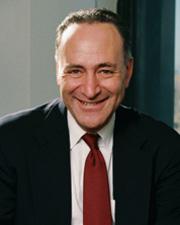 Sen. Charles E. Schumer (D-NY)
Legislative Activity
Stay on top of the latest movement without scrolling through every action
Senate amendment submitted
April 6, 2005
View full timeline
Senate amendment submitted
April 6, 2005
Roll call votes on amendments in Senate: Motion to table amendment SA 309 rejected in Senate by Yea-Nay Vote. 33 - 67. Record Vote Number: 86.
April 6, 2005
Senate amendment proposed (on the floor): Amendment SA 309 proposed by Senator Schumer.
April 6, 2005
Amendment SA 309 proposed by Senator Schumer. (consideration: CR S3243, S3249-3253; text: CR S3243) To authorize appropriate action if the negotiations with the People's Republic of China regarding China's undervalued currency are not successful.
April 6, 2005
Motion to table amendment SA 309 rejected in Senate by Yea-Nay Vote. 33 - 67. Record Vote Number: 86.
April 6, 2005
Votes
1 roll call on this amendment
Text
Submitted
SA 309. Mr. SCHUMER (for himself, Mr. Graham, Mr. Bayh, Mr. Bunning,
Mr. Dodd, Mrs. Dole, Mr. Feingold, Ms. Stabenow, Mr. Kohl, Mr. Reid,
Mr. Durbin, Mr. DeWine, Mr. Burr, Mr. Johnson, and Ms. Mikulski)
proposed an amendment to the bill S. 600, to authorize appropriations
for the Department of State and international broadcasting activities
for fiscal years 2006 and 2007, for the Peace Corps for fiscal years
2006 and 2007, for foreign assistance programs for fiscal years 2006
and 2007, and for other purposes; as follows:

On page 277, after line 8, add the following:

TITLE XXIX--CURRENCY VALUATION

SEC. 2901. NEGOTIATIONS REGARDING CURRENCY VALUATION.

(a) Findings.--Congress makes the following findings:
(1) The currency of the People's Republic of China, known
as the yuan or renminbi, is artificially pegged at a level
significantly below its market value. Economists estimate the
yuan to be undervalued by between 15 percent and 40 percent
or an average of 27.5 percent.
(2) The undervaluation of the yuan provides the People's
Republic of China with a significant trade advantage by
making exports less expensive for foreign consumers and by
making foreign products more expensive for Chinese consumers.
The effective result is a significant subsidization of
China's exports and a virtual tariff on foreign imports.
(3) The Government of the People's Republic of China has
intervened in the foreign exchange markets to hold the value
of the yuan within an artificial trading range. China's
foreign reserves are estimated to be over $609,900,000,000 as
of January 12, 2005, and have increased by over
$206,700,000,000 in the last 12 months.
(4) China's undervalued currency, China's trade advantage
from that undervaluation, and the Chinese Government's
intervention in the value of its currency violates the spirit
and letter of the world trading system of which the People's
Republic of China is now a member.
(5) The Government of the People's Republic of China has
failed to promptly address concerns or to provide a
definitive timetable for resolution of these concerns raised
by the United States and the international community
regarding the value of its currency.
(6) Article XXI of the GATT 1994 (as defined in section
2(1)(B) of the Uruguay Round Agreements Act (19 U.S.C.
3501(1)(B))) allows a member of the World Trade Organization
to take any action which it considers necessary for the
protection of its essential security interests. Protecting
the United States manufacturing sector is essential to the
interests of the United States.
(b) Negotiations and Certification Regarding the Currency
Valuation Policy of the People's Republic of China.--
(1) In general.--Notwithstanding the provisions of title I
of Public Law 106-286 (19 U.S.C. 2431 note), on and after the
date that is 180 days after the date of enactment of this
Act, unless a certification described in paragraph (2) has
been made to Congress, in addition to any other duty, there
shall be imposed a rate of duty of 27.5 percent ad valorem on
any article that is the growth, product, or manufacture of
the People's Republic of China, imported directly or
indirectly into the United States.
(2) Certification.--The certification described in this
paragraph means a certification by the President to Congress
that the People's Republic of China is no longer acquiring
foreign exchange reserves to prevent the appreciation of the
rate of exchange between its currency and the United States
dollar for purposes of gaining an unfair competitive
advantage in international trade. The certification shall
also include a determination that the currency of the
People's Republic of China has undergone a substantial upward
revaluation placing it at or near its fair market value.
(3) Alternative certification.--If the President certifies
to Congress 180 days after the date of enactment of this Act
that the People's Republic of China has made a good faith
effort to revalue its currency upward placing it at or near
its fair market value, the President may delay the imposition
of the tariffs described in paragraph (1) for an additional
180 days. If at the end of the 180-day period the President
determines that China has developed and started actual
implementation of a plan to revalue its currency, the
President may delay imposition of the tariffs for an
additional 12 months, so that the People's Republic of China
shall have time to implement the plan.
(4) Negotiations.--Beginning on the date of enactment of
this Act, the Secretary of the Treasury, in consultation with
the United States Trade Representative, shall begin
negotiations with the People's Republic of China to ensure
that the People's Republic of China adopts a process that
leads to a substantial upward currency revaluation within 180
days after the date of enactment of this Act. Because various
Asian governments have also been acquiring substantial
foreign exchange reserves in an effort to prevent
appreciation of their currencies for purposes of gaining an
unfair competitive advantage in international trade, and
because the People's Republic of China has concerns about the
value of those currencies, the Secretary shall also seek to
convene a multilateral summit to discuss exchange rates with
representatives of various Asian governments and other
interested parties, including representatives of other G-7
nations.
______