To prescribe the binding oath or affirmation of renunciation and allegiance required to be naturalized as a citizen of the United States, to encourage and support the efforts of prospective citizens of the United States to become citizens, and for other purposes.
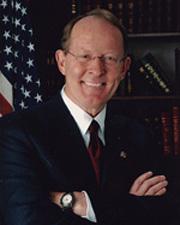 Sen. Lamar Alexander (R-TN)
Legislative Activity
Stay on top of the latest movement without scrolling through every action
Senate amendment agreed to: Amendment SA 3193 as modified agreed to in Senate by Yea-Nay Vote. 91 - 1. Record Vote Number: 85.(text as modified: CR S2717-2718)
April 3, 2006
View full timeline
Senate amendment agreed to: Amendment SA 3193 as modified agreed to in Senate by Yea-Nay Vote. 91 - 1. Record Vote Number: 85.(text as modified: CR S2717-2718)
April 3, 2006
Roll call votes on amendments in Senate: Amendment SA 3193 as modified agreed to in Senate by Yea-Nay Vote. 91 - 1. Record Vote Number: 85.(text as modified: CR S2717-2718)
April 3, 2006
Considered by Senate. (consideration: CR S2699, S2717-2719)
April 3, 2006
Amendment SA 3193 as modified agreed to in Senate by Yea-Nay Vote. 91 - 1. Record Vote Number: 85. (text as modified: CR S2717-2718)
April 3, 2006
Considered by Senate. (consideration: CR S2681)
March 31, 2006
Senate amendment submitted
March 30, 2006
Senate amendment proposed (on the floor): Amendment SA 3193 proposed by Senator Alexander to Amendment SA 3192.(consideration: CR S2590)
March 30, 2006
Amendment SA 3193 proposed by Senator Alexander to Amendment SA 3192. (consideration: CR S2590) To prescribe the binding oath or affirmation of renunciation and allegiance required to be naturalized as a citizen of the United States, to encourage and support the efforts of prospective citizens of the United States to become citizens, and for other purposes.
March 30, 2006
Votes
1 roll call on this amendment
Text
Modified
SECURING AMERICA'S BORDERS ACT

The PRESIDENT pro tempore. Under the previous order, the Senate will
resume consideration of S. 2454, which the clerk will report.
The assistant legislative clerk read as follows:

A bill (S. 2454) to amend the Immigration and Nationality
Act to provide for comprehensive reform, and for other
purposes.

Pending:

Specter/Leahy amendment No. 3192, in the nature of a
substitute.
Kyl/Cornyn amendment No. 3206 (to amendment No. 3192), to
make certain aliens ineligible for conditional nonimmigrant
work authorization and status.
Cornyn amendment No. 3207 (to amendment No. 3206), to
establish an enactment date.
Bingaman amendment No. 3210 (to amendment No. 3192), to
provide financial aid to local law enforcement officials
along the Nation's borders.
Alexander amendment No. 3193 (to amendment No. 3192), to
prescribe the binding oath or affirmation of renunciation and
allegiance required to be naturalized as a citizen of the
United States, to encourage and support the efforts of
prospective citizens of the United States to become citizens.
Isakson amendment No. 3215 (to amendment No. 3192), to
demonstrate respect for legal immigration by prohibiting the
implementation of a new alien guest worker program until the
Secretary of Homeland Security certifies to the President and
the Congress that the borders of the United States are
reasonably sealed and secured.

The PRESIDENT pro tempore. Under the previous order, the time until
5:30

[[Page S2700]]

p.m. shall be equally divided between the Senator from Pennsylvania,
Mr. Specter, and the Senator from Vermont, Mr. Leahy, or their
designees.
The Senator from Pennsylvania is recognized.
Mr. SPECTER. Mr. President, I am advised that consent has been worked
out so that at 5:30 today, the Senate will proceed to a vote in
relation to the Bingaman amendment No. 3210, to be followed by a vote
in relation to the Alexander amendment No. 3193; provided further that
no second degrees be in order to either amendment prior to those votes;
and further that there be 2 minutes equally divided for debate prior to
each vote.
The PRESIDENT pro tempore. Is that a unanimous consent request? That
has not been agreed to.
Is there objection? Without objection, it is so ordered.
Mr. SPECTER. Mr. President, I had yielded to the Democratic leader
expecting to have an opportunity to comment before the quorum call was
put in order which I was unable to terminate. Now that I have the
floor, I would like to report to my colleagues that we had a very
productive hearing this morning on issues relating to immigration
judicial review. The original draft of the chairman's mark had provided
for cases to be consolidated in the Federal circuit. Since there was
considerable controversy about that, it was decided that we ought to
have a hearing.
We had five judges in today: the chief judge of the Federal circuit,
the chief judge of the Second Circuit, a judge from the Ninth Circuit,
a former chief judge of the Second Circuit, and a fifth judge from the
U.S. District Court for the District of Arizona.
We heard a number of opinions on the desirability of having
consolidation but perhaps an alternative to being in the Federal
circuit. We are now considering those matters. We will be discussing
them with other members of the committee. It may be that we will choose
to revise the chairman's mark to provide that the cases will be evened
out among the various circuits.
With the Ninth Circuit and the Second Circuit now having a
disproportionate number, the suggestion was made by Judge Newman,
former chief judge of the Court of Appeals for the Second Circuit, that
there be a court created, perhaps to sit in Washington, although not
indispensably so, where the judges would be selected from circuit
judges and selected by the chief justice to maintain that judges review
these matters as generalists as opposed to specialists. We will
consider that.
We heard discussion about the chairman's mark on increasing the
number of active judges on the Board of Immigration Appeal so that the
full 23 would sit and the provision that they sit in panels so that
they write opinions, not just a one-sentence decision, which is now the
case and which puts a considerable burden on the courts of appeal. We
also discussed the possibility of having greater independence of the
immigration judges and the members of the Board of Immigration Appeal.
In due course, we will be drafting a revised title and will be
submitting that for consideration by the full body.
That is a very brief statement of the hearing that we held today.
Again, I urge our colleagues who have amendments--Senator Leahy joins
me in that request--to come to the floor and debate them. We have a big
job ahead of us to complete action on this bill before the end of the
week.
I yield the floor.
The PRESIDENT pro tempore. The Senator from Massachusetts is
recognized.
Mr. KENNEDY. Mr. President, I yield myself 20 minutes from my
colleague and friend, Senator Leahy.
Mr. DORGAN. Will the Senator yield for a unanimous-consent request?
Mr. KENNEDY. Yes.
Mr. DORGAN. Mr. President, I ask unanimous consent that I--and I know
the time is being divided--be recognized as the next Democratic speaker
following Senator Kennedy's presentation, intermingled with Republican
speakers as well.
The PRESIDENT pro tempore. The Senator wishes to follow Senator
Kennedy?
Mr. DORGAN. I wish to follow the next Republican speaker.
The PRESIDENT pro tempore. Without objection, it is so ordered.
Mr. KENNEDY. Mr. President, immigration is the story of American
history. From the earliest days of our Nation, generation upon
generation of immigrants have come to be part of a land that offers
freedom and opportunity to those willing to do their part. Immigrants
built our great cities. They cultivated our rich farmlands. They built
the railroads and highways that bind America from sea to shining sea.
They erected houses of worship to practice their faiths. They fought
under America's colors in our wars. In fact, 60,000 immigrants are
fighting in the U.S. Armed Forces in Iraq and Afghanistan today.
Immigrants worked hard so that their children could embrace the ever-
widening possibilities in our land. And over the centuries, immigrants
came to America from every part of the globe and made the American
dream. They created a Nation that is the envy of the world.
That is our history. But it is also our present and our future.
We heard the moving immigration story anew here in the Senate just
last week as Senator Domenici eloquently described his family's
immigrant roots. He told how his parents came from Italy with nothing.
His father earned his citizenship through his service in the U.S. Army
in the First World War. His mother remained an undocumented immigrant
until much later in life. In fact, she was arrested by the immigration
authorities many years after coming to America, but she was able to
gain legal status, remain in the country and later become a citizen.
The Domenicis worked hard, learned English, built a successful grocery
business, and their children went on to have successful professional
careers. And, as we know, one became a distinguished and respected
United States Senator.
Last week, we also heard from Senator Martinez of Florida of his
family's flight from Cuba to begin new lives in America. Young Mel
Martinez was 15 years old when his family escaped from Cuba to seek a
new life of freedom. Like millions before him, his family worked hard,
learned English, and earned their success in Florida. And today, Mel
Martinez not only was a Cabinet Secretary in the administration but was
elected by the people of Florida to serve as their United States
Senator.
There are some in the Senate who seem to believe that immigrants are
just criminals. In fact, the Frist bill that's before the Senate
declares that all undocumented immigrants are criminals. The Frist bill
would have declared Senator Domenici's mother to be a criminal and the
Kyl amendment would disqualify her from earning American citizenship.
The facts tell a different story. Immigrants--including undocumented
immigrants--continue to strengthen the fabric of America in thousands
of different ways. As David Brooks observed in his column last week in
the New York Times, Hispanic Americans and Hispanic immigrants in
particular are less likely to divorce. Husbands and wives stay together
and raise their children. Even though they may have less money than
other Americans, they spend almost twice as much on music for their
children, they spend more on gifts and family get-togethers, and they
are more likely to support their elderly parents.
The path of progress that we witnessed with the Martinez and Domenici
families is familiar even today. By the second generation, most
immigrant families have reached the middle class and they pay more than
enough taxes to make up for the costs of their parents' generation. By
the third generation, 90 percent of the grandchildren of Hispanic
immigrants speak English fluently, and 50 percent of them marry non-
Hispanics. These patterns of assimilation are identical to those that
characterized the children and grandchildren of Southern and Eastern
European immigrants who came to the United States 100 years ago, and to
the assimilation of German and Irish immigrants who came here 50 years
before that.
In many ways, our economy is more dependent on immigration than ever
before. The arrival of new and young immigrant workers helps explain
why America's economy grows faster than most of the aging European
nations. According to the Aspen Institute, immigration will be the only
source of growth in the prime age labor force in

[[Page S2701]]

America in the next two decades. So America's choice really is between
immigration and economic stagnation.
However, even though immigration brings many benefits, there is no
doubt that our current system is broken and fails to protect us and
meet our Nation's needs. Our borders are out of control at a time of
heightened concern about terrorism. Millions cross our borders and
remain illegally, creating an underground society that is subject to
abuse and that harms American wages and working conditions. Millions
more enter through our airports and seaports as visitors but remain
long after their visas expire. They come and remain because they wish
to work and contribute, and our employers continue to offer them jobs.
As a result, more than 11 million undocumented immigrants are living
and working in America today.
Many in Congress suggest that the answer is simply more enforcement.
Just build more fences and hire more patrols and it will solve the
problem.
But we have tried that before and failed. We have spent more than $20
billion over the past decade to build fences and triple our border
patrols, but illegal immigration went up, not down. In the 1980s, the
rate of illegal immigration was 40,000 people a year. Today, it is more
than half a million. And the probability that a border crosser will be
apprehend has plummeted from 20 percent a decade ago to just 5 percent
today.
An enforcement-only approach to solving our immigration problems may
make a good campaign slogan. But in reality it is a failed strategy
that threatens our security and threatens American wages.
That's why Senator McCain and I have proposed a comprehensive, common
sense plan to make a real difference.
An effective immigration strategy must have three parts.
First, we must enhance and modernize our immigration enforcement
capabilities, both at our borders and at worksites. To accomplish this,
our bill enhances our capacity to monitor immigration flows and stop
illegal entry. To do this, it doubles the number of Border Patrol
agents over the next 5 years. And it builds roads, fences, and vehicle
barriers in specific high-flow areas; adds significant new technology
at the border to create a robust ``virtual fence''; develops new land
and water surveillance plans; authorizes new permanent highway
checkpoints near the border; and expands the exit-entry security system
to all land borders and airports.
Our bill increases our capacity to crack down on criminal syndicates
that smuggle immigrants into the country and place them at great risk.
To aid in this mission, it creates new Federal penalties for
constructing border tunnels; new criminal penalties for evading or
refusing to obey commands of immigration officers; and new criminal
penalties for financial transactions related to money laundering or
smuggling. And it creates new fraud-proof biometric immigration
documents; increases access to anti-fraud detection resources; and
improves coordination among Federal, State, local, and tribal efforts
to combat alien smuggling.
Our bill increases cooperation with Mexico to strengthen migration
control at Mexico's southern border to deter migration from Central
America through Mexico and into the United States. And it requires
cooperation with other governments in the region to deter international
gang activity.
And our bill would reduce the job magnet in America by creating a
universal electronic eligibility verification system which will allow
employers to tell which individuals are authorized to work in the
United States. It will substantially increase penalties against
employers who fail to comply with eligibility verification rules and
add 5,000 new enforcement agents to back up these provisions.
Second, we must address the presence of the 11 million undocumented
workers who are here now.
It is clear that we are not going to send them back. Many have
American citizen children and even grandchildren, and deporting them
would rip families apart. The massive roundup of 11 million people
would create havoc in our communities and cost $240 billion. It would
require 200,000 buses in a convoy that would stretch from Alaska to San
Diego.
These families want to continue working and contributing to our
communities, and we should give them that opportunity not by offering
an amnesty, but by allowing them to earn the right to remain.
So under our plan, to earn their legal status and eventually apply
for citizenship, they must pay a $2000 fine, work for six years, pay
their taxes, learn English and civics, pass rigorous criminal and
security background checks, and get in the back of the line behind
those who have been waiting patiently to qualify for green cards.
Unfortunately, yesterday on television Senator Frist mischaracterized
our commonsense proposal. He called it an amnesty, when in fact nothing
is forgiven, nothing is pardoned. Undocumented workers must earn the
privilege of legal status and a path to American citizenship.
And he said that our plan allows undocumented immigrants to jump to
the front of the line, when our bill says plainly in black and white
that they must wait in the back.
We should conduct this debate based on fact, not fiction--thoughtful
policy and not bumper sticker slogans.
Earned legalization should not be available to criminal aliens and
others who would undermine U.S. security, but we must not be fooled by
the amendment offered last week by Senators Kyl and Cornyn. Our bill
already excludes from earned legalization criminal aliens and any
immigrant representing a security risk to the United States. The Kyl-
Cornyn amendment would also exclude literally millions of undocumented
immigrants already living and working in this country because they
previously failed to depart following an order to do so. Our analysis
of DHS and INS statistics suggests that fully 95 percent of immigrants
affected by the Kyl-Cornyn amendment would not be criminal aliens, but
rather exactly the hardworking immigrants and families this program is
designed to bring out of the shadows.
The third and final element of a successful immigration strategy is
to address future immigration. We must provide a path to earned
legalization for those already here. But we must also address the
continuing needs of our employers for workers and the reality that
people will continue to come here to improve their lives and contribute
to America.
In the past, we have largely ignored these realities. We have turned
our heads as people have come here to work and required them to remain
in an underground economy.
The head-in-the-sand policy cannot be allowed to continue. It is
harmful to these workers who are subject to abuse by employers. It is
harmful to employers who never know if their workers may be sent home
tomorrow, and most of all it is harmful to American workers whose wages
are cut because employers can get away with hiring undocumented workers
at lower pay.
Therefore, the plan that Senator McCain and I propose and that was
adopted by the Judiciary Committee provides a strong and effective
guest worker program for the future. It is far better for American
workers if future immigrants come here legally with rights to fair
wages and working conditions, rather than having to compete with
illegal workers who are paid substandard wages. Isn't it better if an
employer must pay an immigrant carpenter a standard wage like American
workers than a substandard wage that drives down wages for everyone
else? That is what our guest worker program would do.
It is estimated that the American economy demands about 400,000 new
low-skilled immigrants each year, but our current immigration system
grants only 5,000 visas to these workers. That is why we have more than
11 million undocumented workers today. There simply are not enough
visas to go around.
To meet future needs, our guest worker program takes the commonsense
step of starting with a 400,000 annual quota and allows the quota to be
adjusted up or down in future years based on the needs of the economy.
Taking this realistic step would free up our enforcement efforts to
focus not on those who yearn to breathe free--they should be welcomed
as guest workers who contribute to America. We should concentrate our
enforcement resources on those who would

[[Page S2702]]

truly harm us--the criminals, the drug smugglers, and especially the
terrorists. That should be the priority for our time, and that is the
priority of the McCain-Kennedy legislation.
Enhanced enforcement, earned legalization for those who are here, and
a realistic guest worker program for the future--that is a plan for
success, and the American people know it. It is a plan that Time
magazine reports is supported by more than three-quarters of the
American people, and they support it because they know our three-part
plan increases our security, respects our values, and strengthens our
progress. In fact, poll after poll finds that between two-thirds and
three-quarters of all Americans favor a new program to allow temporary
visas for future essential workers, and an even higher proportion favor
allowing undocumented immigrants into the United States to earn
citizenship if they learn English, have a job, and pay taxes.
In contrast, in a Time magazine poll conducted last week, just one in
four Americans favor making illegal immigration a crime and preventing
anyone entering the country illegally from remaining in the country and
working here. The American people want real comprehensive reform, not
just more immigration enforcement.
All three of these changes are necessary if we are to address the
root causes of undocumented immigration and break the cycle of
illegality which now corrodes our immigration system. All three of
these changes are necessary if we are to ensure that immigrant families
today, as in the past, continue to live the American dream and
contribute to our prosperity, our security, and our values. All three
of these changes are necessary if we are to be true to our heritage as
a nation of immigrants.
Mr. President, I suggest the absence of a quorum.
The PRESIDING OFFICER (Mr. Sununu). The clerk will call the roll.
The assistant legislative clerk proceeded to call the roll.
Mr. DORGAN. Mr. President, I ask unanimous consent that the order for
the quorum call be rescinded.
The PRESIDING OFFICER. Without objection, it is so ordered.
Mr. DORGAN. Mr. President, I believe we are going back and forth, but
since there is no one on the other side of the aisle seeking to claim
time, let me claim time on our side. I ask unanimous consent to speak
for up to 25 minutes against our time.
The PRESIDING OFFICER. Without objection, it is so ordered.
Mr. DORGAN. Mr. President, at a time when our country sees so much of
the outsourcing of good jobs and now the proposal to continue importing
cheap labor, I think it is a strange set of circumstances that has a
proposal on the floor of the Senate saying let's deal with immigration
and the immigration problem in this country by adding to the
immigration bill a so-called guest worker program that would allow
400,000 additional people who now live outside our country to come into
our country's labor force. They would do that with an escalator of
potential 20 percent more than the 400,000 each year or, over 6 years,
if they use the maximum, another 4.7 million immigrant workers into
this country.
Open the newspaper these days and take a look at the news:
outsourcing of American jobs; good American jobs that pay well, with
benefits, retirement, and health care, going to China, Indonesia, Sri
Lanka, Bangladesh--outsourcing American jobs. In addition to
outsourcing good American jobs, we are also insourcing, importing cheap
labor.
We now have 11 million immigrants in this country who are here
illegally. This Chamber is full of talk these days about immigrants
because we are on an immigration bill and will be until the end of this
week. The question is, Where is the talk about American workers as we
discuss the issue of immigrants and immigration reform? Where is the
description of the plight of the American worker? Who is here
describing the circumstances faced by American workers? There are many
here speaking for immigrants, and I don't ever want to diminish the
dignity or the worth of the immigrants who have come here over the life
of this country and helped us build something very unusual on the face
of this Earth.
This country is a country made up of immigrants. I think everyone who
stands on this floor would likely describe their great-grandparents or
their grandparents or great-great-grandparents who came here from
somewhere--mine from Norway, for example, and Sweden. But what we have
built on this Earth is a country that is unique and unusual. It is a
country that has created a standard of living which is almost
unparalleled in the world: good jobs that pay well, the creation of a
middle class, an expanded middle class where people had good incomes
and those good incomes allowed them to increase their standard of
living.
Now we see a different kind of circumstance in our country. We see
the largest corporations that have become the preeminent economic
entities, very large corporations that have described a different set
of circumstances for themselves. What they like to do is produce
somewhere else--send their jobs to China, for example--and then send
the product back to this country to sell and then send their income
through a Grand Cayman Island bank so they don't have to pay taxes.
They ship the jobs overseas, ship the products here, and run the money
through the Cayman Islands.
In addition to all of that--and there is plenty of evidence that is
going on wholesale; 3 million jobs lost to that sort of activity just
in the last several years--in addition to that, at the same time these
jobs are moving overseas and hurting the middle class in this country
and shrinking opportunities for the people at the lowest rung of the
economic ladder, we have people trying to get into this country.
Why? Our country is an attraction to them because this is a place
they want to come to get a job and make some money. In much of the
world, they pay various substandard wages--different economies, less
developed countries, undeveloped countries--and so this country has
become a magnet for people who want to come here.
I have described the circumstance some years ago when I was on a
helicopter that ran out of gas somewhere between Honduras, Nicaragua,
and El Salvador, up in the mountains in the jungles. After we ran out
of power, after the fuel tank was empty, we landed, and the compesinos
came to our helicopter to see who came through. I, through an
interpreter, talked with some of them.
I talked with a woman who had three children. After describing who we
were and asking about her life, I said: What is it you would like to do
with your life?
She said: Oh, I would like to come to America; I would like to come
to the United States.
Why would you like to do that, I asked?
Because that is where opportunity is, she said. Get a job, make some
money, have opportunities for me and my children.
That is not unusual. It wasn't unusual to hear that in Nicaragua or
El Salvador, and it wouldn't be unusual to hear that in most parts of
the world. If we had no immigration laws at all and we said tomorrow to
any one else of this world's population of roughly 6.3 billion who want
to come here: Come on along, you are welcome in this country. Come and
stay. Come and grab a job, if you like--why don't we do that? Why do we
have immigration laws? Why do we have quotas of the number of people we
can allow in each year--and we do allow people in--why do we have those
numbers? Simply because we can't absorb a massive inflow of immigration
from around the world willing to work at substandard wages. We can't
absorb that. The social services that are required to attend to it, the
jobs they take, we can't do that. So we have a process called
immigration by which people legally come into this country.

People have come to this country illegally. It is estimated we now
have 11 million people here illegally. I heard an actor--well, actually
he is not much of an actor--but I heard this fellow on television
yesterday on CBS, I believe it was, and he was doing his commentary
about immigration. This is a fellow who has been wrong about most
things, so it didn't surprise me what he said about immigration. He
said: No one should call this illegal immigration.

[[Page S2703]]

Well, I am sorry, but if people come here illegally, it is illegal
immigration. We have 11 million people here illegally.
In addition, 1.1 million people tried to come across our southern
border last year, but were stopped--1.1 million were stopped at our
southern border trying to come into this country. In addition to that,
somewhere between 400,000 and 700,000 people we estimate came into this
country across the southern border illegally last year. Finally, above
that number, 175,000 immigrated from Mexico last year legally. That is
in addition to the other quotas from the other countries. So the fact
is, we have a very significant number who come into this country, and
many of them come in illegally.
So my colleagues bring an immigration bill to the floor and the
President describes the need for an immigration bill, as well as the
President of Mexico. What they say is: We can't arrest and detain and
deport 11 million people. I understand that. I am not sure I know the
solution to all of this, but I understand there is not going to be a
sweep in this country to detain or deport or arrest 11 million people
who are here illegally. We will have discussions about that portion of
the bill and we will have amendments about that portion of the
legislation. We will also have amendments about employer sanctions.
I was here when the previous immigration bill was passed. The
presumption was that if you make it illegal for employers to hire
illegal aliens then, in that circumstance, they will have to pay a
significant fine--the employer will--and they won't be hiring them. If
the job is not the magnet to come here, it will shut down immigration
at the border. That was all nonsense. It didn't work. I think last year
three immigration cases were brought by this administration against
employers who hired illegal immigrants. There has been no enforcement
at all. So we are going to have discussions and amendments about that
portion of the legislation.
Let me talk about the other piece, if I might, and that other piece
is a guest worker program attached to this, saying, In addition to all
of the other things that will be done in this legislation, including
making legal 11 million people who came here illegally or giving them
legal status, we have an addition called a guest worker program. The
guest worker program is the proposition that 400,000 additional workers
will be allowed in. These are people who are now living outside of our
country. They will be allowed into our country with a 20-percent
escalator per year and, by the way, at the end of 6 the escalator works
and they let these folks come in years, if, we will have 4.6 million
additional guest workers who have come into this program in the 6-year
period--4.6 million.
Why are people saying this is necessary? They are saying it is
necessary because Americans won't take these jobs. We can't find
Americans who will take these jobs. Well, why do you suppose that might
be the case, if it is the case? I dispute that, but let's assume it is
the case. One of the reasons is those jobs don't pay enough. Since the
big businesses don't want to raise salaries at the bottom, they say the
solution to not having to raise salaries is to bring in immigrant
workers who will work for less. Let's not worry about the Americans. If
we can't find Americans to take the jobs at the minimum wage and, by
the way, this Congress has decided for 8 years it will not increase the
minimum wage--those folks, the working poor and others who work at the
bottom of the economic ladder, have not had an increase in the minimum
wage in 8 years. So the U.S. Chamber of Commerce, big business, and
others say, What we need to do is to have a separate and additional
guest worker program. In addition to the 11 million people, we need to
have a guest worker program that could reach 4.6 million people in the
next 6 years.
Let me respond to this question of jobs that Americans won't do. This
is what the research says. Construction jobs: 86 percent of the workers
are American workers and other legal workers. Food preparation: 12
percent are illegal immigrants; 88 percent of the food preparation
workers are American workers and other legal workers. Manufacturing: 91
percent American workers. Transport: 93 percent. These are the jobs
that corporations and others say Americans won't take and, therefore,
they have to bring in immigrant labor, new guest workers, 4.6 million
additional people.
While we are doing that, let's take a look at this issue of change in
income for the American people. This happens to measure 1979 to 2003.
You can see the top 1 percent of the American income earners are doing
very well--lots of extra income, massive growth in their income. The
bottom fifth: almost no growth in 25 years. In fact, some studies show
they have actually lost ground. This shows that they have been stagnant
for 25 years. So at the same time we have people saying, We need to
bring in more immigrant workers to take these low-income jobs, we have
people at the lower end of the economic scale in this country--and we
have the middle-income workers as well--struggling, trying to figure
out, What do they do next? How do they find a good job?

About 30 years ago, the largest corporation in this country was
General Motors. General Motors paid well, had good benefits, good
retirement, good health care. Most people not only got good pay when
they went to work there, they worked there for a lifetime. Now, the
largest corporation is Wal-Mart--Wal-Mart. In the first year of
employment, turnover I understand is about 70 to 80 percent. Wal-Mart
pays very low wages. I believe the average income at Wal-Mart is
$18,000 a year, and they pay very little benefits. Very few have health
care. I think a third to just over a third have health care benefits,
and those who do pay substantially more than is the employee's share in
most other companies. That is what we have come to. So the middle-
income workers are looking for a replacement for those jobs that have
been shipped overseas.
I have spoken at length about the issue of outsourcing of jobs, and I
won't do that today, but whether it is Huffy bicycles or Little Red
Wagon Radio Flyer, Fig Newton cookies, Fruit of the Loom, or Levis or
Tony Lama boots--I could go on forever--these are jobs Americans used
to have, good jobs that paid well, almost always jobs with benefits--
gone, gone to China for somebody who will earn 33 cents an hour,
probably working in Shenzhen, China, 12 to 14 hours a day, 7 days a
week, to produce the product and ship it back to Wal-Mart, Kmart, and
Sears to be sold to the American public, and then have the same
companies run their income through the Cayman Islands to avoid paying
taxes. That is interesting but not very good for this country, and
exactly the wrong strategy for the long-term economic health of
America.
Employment rates for individuals lacking a high school diploma, you
will see that nearly one-half of U.S.-born workers without a high
school diploma are without a job. Immigrant workers, on the other hand,
many of whom come here without a high school diploma, find work in high
numbers. I have a picture of some immigrant workers that was given to
me recently. These, by the way, were workers who came in by a
contractor who hired them to help do work after Hurricane Katrina,
undocumented workers who came into this country, and--by the way, at
the hearing I held on this, one of the people who testified was a
fellow who ran a Louisiana construction firm. His firm was hired by a
Halliburton subcontractor to do electrical repair work in Louisiana
after Hurricane Katrina. But the Halliburton subcontractor changed its
mind, and they hired a good number of people to come in who were
undocumented workers and who didn't have adequate training to do
electrical work at this particular base. It is the sort of thing that
is going on all the time, and I think it is hurting this country.
So the question is for this Congress, Who is going to talk about
American workers? I know the subject is about immigration, but it has a
profound impact on American workers. So who is going to come here today
to talk about American workers?
We are told that the corporate strategy here is that they can't find
additional American workers without paying higher wages and they don't
want to pay higher wages because they want to keep costs down, so they
are going to import additional workers. They are now called guest
workers. By the way, these are nonagricultural, these guest workers.
This is in addition to H-2A and H-2B workers, agricultural and
nonagricultural, who will still exist

[[Page S2704]]

under law. I haven't even described the people coming in under those
two provisions. Yet we have people saying we must have this additional
guest worker program.
I understand people listening and those who feel very strongly that
we have to have this immigration bill, including the guest workers, who
will say: What you are talking about is anti-immigrant. That couldn't
be further from the truth. I indicated that I think immigrants
contribute a great deal to this country. Most of us come as a result of
some immigration back a generation or several generations in our
family. But the question is: What are we going to do to fix this issue,
and what are we going to do to balance the immigration legislation and
the proposal for guest workers against the needs of American workers? I
think what is going on here is going to pull the rug out from under
American workers. I don't understand this at all.
Let me put up a chart that shows the average wages--perhaps I should
show you the New York Times story of March 17, a couple of weeks ago,
about a businesswoman in New York. Sister Ping is her nickname. She was
sentenced to 35 years for running one of New York City's most lucrative
immigrant smuggling rings and for financing the infamous Voyage of
Golden Venture, the rusty freighter that ran aground with 300 starving
immigrants in its hold. Sister Ping said she would be happier in prison
in the United States than free in her rural village in China.
Let me describe what persuades Sister Ping and others to attempt to
bring low-wage income earners to this country. A typical unskilled
labor wage in Russia is 51 cents an hour. In Nicaragua, 37 cents an
hour. In China, 33 cents an hour; in Bangladesh, 33 cents an hour; in
India, 11 cents an hour; and in Haiti, 30 cents an hour. We are
suggesting that we are short of workers here. We want another 400,000
plus 20 percent every year for 6 years, or 4.7 million additional
workers because we don't have enough workers in this country.
What we don't have is enough courage and enough common sense to,
first, increase the minimum wage and second, to tell those who are
trying to employ immigrant labor at below standard wages, which they
have done for years now, that you have to pay a decent wage at the
bottom to get people to work, and that includes Americans. That
includes our country's workers. If this Congress has some common sense,
we don't need guest workers. That is the other side of this immigration
debate, the extra guest workers. We don't need them. What we need
employers to do is to pay a decent wage. What we need the Congress to
do is to increase the minimum wage.

We need to understand that American workers have worth. They want
jobs. What is happening to them is good jobs are being exported
overseas for these kinds of wages overseas, and then low-income jobs in
this country are now going to be filled and have been filled by
immigrant labor. So we are importing low-wage workers for jobs here and
exporting high-wage, good jobs for jobs there. I am telling you I think
that is a strategy to injure this country's economy. It is a strategy
to hurt low-income American workers. It has been going on for some
while now. But this memorializes it in an immigration bill.
I don't understand at all why this is being seriously proposed. In
fact, the President's proposal would have no limit. I talked about the
400,000 plus a 20-percent escalator per year for so-called guest
workers who now live outside of our country who will be told to come on
in legally. The Congress has a 400,000-person plus a 20-percent
escalator which, as I indicated, would relate to about 4.7 million
workers over 6 years. But the fact is, the President's proposal has no
limit at all; the sky is the limit. I am telling you, this is a U.S.
Chamber-big business strategy. It is probably good for them. It allows
them to import cheap labor. It probably keeps their costs low. But I
will tell you what else it does: It pulls the rug out from American
workers in a way that is very unfair.
Having said all of that, it is not my intention to suggest that we
don't have to deal with immigration issues. We do. I understand that.
It is not my intention to suggest that anybody can round up or should
even seriously consider rounding up 11 million people and deporting
them. That is not going to happen. I was in the Congress when the
Simpson-Mazzoli bill was passed dealing with immigration. It was going
to fix immigration. Immigration problems have become much worse.
This proposal, the Simpson-Mazzoli proposal, was described as a
proposal that would say that the attraction--the magnet--for immigrants
coming into this country is a job. Take away the job, you take away the
attraction or the magnet. How do you take away the job? You tell
employers in this country, if you hire people who are here illegally,
you are going to pay a real price for it. You are going to be slapped
with a big fine. You are going to have a big problem.

Guess what--they didn't even get hit with a feather duster. Not a
thing. As I said, last year there were three enforcement cases against
American businesses that hired illegal labor. I just heard of one the
other day in our part of the country. An employer from one of the big
cities up near our area hired some illegal immigrants to come in and do
a construction project. They were caught. The question was, for the
local State's attorney, the question for the attorney general's office
and others, is anything going to happen? No, nothing is going to
happen. No action is going to be taken. It has been that way for years.
The result is that the so-called Simpson-Mazzoli bill meant nothing.
My colleagues say now we are going to really enforce things at the
border. If we have a guest worker provision, somehow we will not have
additional people coming across the border because we will allow about
4.7 million of them in illegally in addition to the 11 million who are
here. I don't understand why they believe allowing 450,000-plus a year,
or 4.7 million in 6 years, potentially--how that is going to stop
others who want to come in. We have an inexhaustible number of people
working around the world at dirt-cheap wages. We have an inexhaustible
appetite in this country, for businesses, apparently, to hire people at
substandard wages. So how is it you are going to plug this border? I
don't see it in this bill.
We are told we don't really plug the border. What you really do is
invite up to 4.7 million additional people in, and therefore that cuts
the appetite for people to come in. It is total nonsense. That is not
going to do it at all. It just isn't. All it is going to do is
undermine American workers at the bottom of the economic ladder. That
is what it does. I don't understand why this issue is brought to the
floor of the Senate with guest workers.
I mentioned the other day a story about FDR. Let me close with that.
Franklin Delano Roosevelt's funeral was being held. Before his
funeral, his body lay in State here in the Capitol Building, and there
were long lines to view the casket of Franklin Delano Roosevelt. The
journalists were trying to get color pieces for their stories. A
journalist walked up to a man who was holding his cap in his hands, a
working man. He had been standing for some long while in line to file
past the casket of Franklin Delano Roosevelt.
The journalist asked him: Did you know President Roosevelt?
The working guy said: No, but President Roosevelt knew me.
The question is, Who knows American workers now? Yes, President
Roosevelt did know American workers. He is the person who got us the
Fair Labor Standards Act. He stood up for American workers. Who knows
American workers now? Is there any discussion about American workers as
we talk about immigration on the floor of the Senate, a subject that
will have such a profound impact on jobs in this country? Is there any
discussion about American workers? I don't hear it, regrettably.

Amendment No. 3223 to Amendment No. 3192

Mr. DORGAN. I am also today going to offer an amendment numbered
3223, which I believe is at the desk. I ask unanimous consent that the
pending amendment be set aside.
The PRESIDING OFFICER (Mr. Burns). Without objection, it is so
ordered.
Mr. DORGAN. I ask that we call up amendment No. 3223.
The PRESIDING OFFICER. The clerk will report.
The bill clerk read as follows:

[[Page S2705]]

The Senator from North Dakota [Mr. Dorgan], for himself,
Ms. Snowe, Mr. Schumer, Mr. Burns, and Mr. Jeffords, proposes
an amendment numbered 3223 to amendment No. 3192.

Mr. DORGAN. I ask unanimous consent that the reading of the amendment
be dispensed with.
The PRESIDING OFFICER. Without objection, it is so ordered.
The amendment is as follows:

(Purpose: To allow United States citizens under 18 years of age to
travel to Canada without a passport, to develop a system to enable
United States citizens to take 24-hour excursions to Canada without a
passport, and to limit the cost of passport cards or similar
alternatives to passports to $20)

At the appropriate place, insert the following:

SEC. __. TRAVEL TO CANADA.

(a) Short Title.--This section may be cited as the ``Common
Sense Cross-Border Travel and Security Act of 2006''.
(b) Travel to Canada Without Passport.--Section 7209(b) of
the Intelligence Reform and Terrorism Prevention Act of 2004
(Public Law 108-458) is amended--
(1) in paragraph (1)--
(A) by striking ``The Secretary'' and inserting the
following:
``(A) In general.--The Secretary'';
(B) by striking ``This plan'' and inserting the following:
``(B) Day passes.--The plan developed under this paragraph
shall include a system that would enable United States
citizens to travel to Canada for a 24-hour period without a
passport by completing an application for a `day pass' at any
port of entry along the land border between the United States
and Canada, and certifying that there was not sufficient time
to apply for a passport before the excursion. The traveler
shall not be charged a fee to acquire or use the day pass.
``(C) Implementation.--The plan developed under this
paragraph''; and
(2) by adding at the end the following:
``(3) Minors.--United States citizens who are less than 18
years of age, when accompanied by a parent or guardian, shall
not be required to present a passport when returning to the
United States from Canada at any port of entry along the land
border.''.
(c) Limit on Fees for Travel Documents.--Notwithstanding
any other provision of law or cost recovery requirement
established by the Office of Management and Budget, the
Secretary and the Secretary of State may not charge a fee in
an amount greater than $20 for any passport card or similar
document other than a passport that is created to satisfy the
requirements of the Intelligence Reform and Terrorism
Prevention Act of 2004 (Public Law 108-458).
(d) Acceptance of Passport Cards and Day Passes by
Canada.--The Secretary of State, in consultation with the
Secretary, shall negotiate with the Government of Canada to
ensure that passport cards and day passes issued by the
Government of the United States for travel to Canada are
accepted for such purpose by the Government of Canada.

Mr. DORGAN. Mr. President, this amendment is cosponsored by Senator
Snowe, Schumer, Burns, and Jeffords. I will just briefly describe the
amendment that I hope we will consider this week. It deals with cross-
border traffic between the United States and Canada and the issue of
the card that is being considered by the State Department in lieu of a
passport that would be required for United States-Canada cross-border
traffic.
The amendment is quite simple. It would provide, for children under
18--that is, 17 and under--who are accompanied by parents moving cross-
border, they would not need one of these new cross-border cards. It
would provide that there be an opportunity for the State Department to
offer 3-day passes for those who are simply on a 1-day cross-border
trip and would also provide that these new cards which would be
required in lieu of passports cost no more than $20.
As you know, it takes over $90 to purchase a passport. That is not an
inconsiderable sum. It takes some while to get a passport. If you have
a family of four or five going up to Winnipeg or Regina, the northern
part of our State--we have a 4000-plus mile border--for a family of
four or five going to see a relative, if we have a passport
requirement, that is pretty dramatic. We have always been able to use
our driver's license, and the Department of Homeland Security says that
is going to be replaced by a passport. We complained about that. They
said: All right, what we will require is a passport card. We don't know
the specifics of that card, but what we want to make sure of is that
card not be prohibitive for families. I don't have any problem with
requiring a standardized card, but I don't believe it should cost more
than $20. I don't believe it should be required for children under 17
traveling with their parents. There also ought to be exceptional
circumstances, with proper identification, for those who make day
trips.
As I said, I am joined in this amendment by many of my colleagues
from the border States, including Senator Snowe from Maine, Senator
Schumer from New York, Senator Burns from Montana, and Senator Jeffords
from Vermont. I hope we can have some discussion and debate and hope in
the conduct of the debate on this immigration bill that we may include
that.
I yield the floor.
The PRESIDING OFFICER. The Senator from Georgia.
Mr. CHAMBLISS. Mr. President, I sat here with interest, listening to
the Senator from North Dakota. I think we agree on an awful lot. I may
not agree with everything he said, but he made some very salient points
with respect to the earlier laws we have passed on this issue of
immigration and the amnesty--that is what it amounted to--that was
given to certain folks who were included in the previous immigration
bill the Senator addressed. He is exactly right. It didn't work back
then. While there are provisions in this bill, some of which I may
agree with--they may be good--there are certain other points in this
which simply are not very good pieces of legislation
I would like to take a moment to speak on the amnesties that exist in
the immigration bill passed by the Judiciary Committee that is now
under discussion on the floor. Some in the Senate like to call it
something else--earned adjustment or earned citizenship--to try to
distinguish it from what Congress has done in the past. However, I
believe that the legislation adopted by the Judiciary Committee is so
similar to the 1986 Immigration Reform and Control Act passed by
Congress, which everyone agrees is amnesty, that in fairness, what the
Senate is being asked to consider today should likewise be called
amnesty.
One reason why I am opposed to amnesty, or earned legalization, is
because the last time Congress addressed what to do about the illegal
population in our country, a similar approach was agreed upon, and it
did not work. In the 1986 Immigration Reform and Control Act, increased
enforcement, both at the border and in the interior of the U.S., and
especially with regards to employer sanctions was mandated to eliminate
the jobs magnet for so many illegal immigrants. In addition, the theory
was that our increased border security would stem the tide of illegal
immigrants coming into the country.
Coupled with this enforcement was an amnesty offered to illegal
aliens who met specified requirements in order to bring them out of the
shadows and allow them to acquire legal status. There were actually two
amnesties included in the Immigration Reform and Control Act of 1986--
the Legally Authorized Workers--LAW--program and the Special
Agricultural Worker Program--SAW.
Similarly in the bill put forth by the Judiciary Committee, there are
mandates for increased border security and interior enforcement as well
as a strong emphasis on employer sanctions. Coupled with this also
exists two amnesties: one for the estimated 11 million illegal aliens
currently in the U.S. and another for illegal aliens working in
agriculture.
The 1986 SAW Program required that illegal aliens work a certain
number of hours in agriculture in order to obtain a temporary legal
status. Then 1 to 2 years after obtaining a temporary legal status,
those agricultural workers were given permanent residency status. Now,
every Senator I have seen come to the floor has called this 1986 SAW
program an amnesty, yet many maintain that the current Judiciary
Committee proposal is not an amnesty.
However, the current agricultural program in the Judiciary Committee
bill is constructed in much the same way: Illegal aliens who worked 150
hours in agriculture in the 2-year period ending on December 31, 2005,
can obtain a temporary legal status, here called a blue card. Then by
working 100 hours per year in agriculture for 5 years or by working 150
hours per year in agriculture for 3 years, that illegal alien will be
given permanent resident status. So the only difference between a
program that is unanimously agreed upon to be amnesty and one that is
argued not to be is the requirement that

[[Page S2706]]

the illegal aliens work in agriculture for 100 to 150 hours per year.
The waiting time instead of 1 to 2 years is now 3 or 5, but that is it.
The rest is the same.
These illegal aliens are not required to work in any other industry
or for any greater amount of time than 100 hours per year or 150 hours
per year. Not only that but they do not have to wait in line behind
everyone outside the country trying to legally enter the U.S. in order
to get their permanent resident status. Not only is this unfair, but it
is a repeat of the 1986 approach, which is widely recognized as
seriously flawed.
We should not repeat the mistakes we made before. I am not the only
one who feels this way. I recently attended a naturalization ceremony
in Atlanta, GA, and was moved to see a room full of people from all
over the world raise their right hand and take an oath of allegiance to
the U.S. It was clearly a proud day for these people and their loved
ones. They had gone through the legal process and truly earned their
citizenship. I was surprised at the number of new citizens who came up
to me after the ceremony and asked me to reject the amnesty the Senate
is now being asked to consider. These folks told me they felt it
demeans the efforts they made to obey the law and wait in line to
become a U.S. citizen. They realize what a valuable accomplishment they
made.
The people I saw at that naturalization ceremony truly earned their
citizenship. It does not seem fair to me to call the process those
newly naturalized citizens followed ``earned citizenship'' and also to
call what the Judiciary Committee is asking the Senate to consider
``earned citizenship.'' There is a fundamental difference between the
two and that should be recognized in the rhetoric of the Senate.
Another problem I have with the agricultural amnesty endorsed by the
Judiciary Committee is that it does not seem to remedy the problem with
fraud that was prevalent with the 1986 SAW program. Under the 1986 SAW
program, illegal farm workers who did at least 90 days of farm work
during a 12-month period could earn a legal status.
The illegal immigrants had to present evidence that they did at least
90 days of farm work, such as pay stubs or a letter from an employer or
even fellow workers. Because it was assumed that many unauthorized farm
workers were employed by labor contractors who did not keep accurate
records, after a farm worker presented evidence that he had done
qualifying farm work, the burden of proof shifted to the Government to
disprove the claimed work.
The Government was not prepared for the flood of SAW applicants and
had little expertise on typical harvesting seasons. Therefore an
applicant who told a story like ``I climbed a ladder to pick
strawberries'' had that application denied while those who said ``I
picked tomatoes for 92 days'' in an area with a picking season of only
70 days, was able to adjust.
Careful analysis of a sample of SAW applications in California, where
most applications were filed, suggests that most applicants had not
done the qualifying farmwork, but over 90 percent were nonetheless
approved.
The propensity for fraud is not remedied in the Judiciary Committee's
bill and compounds bad policy with the ability for unscrupulous actors
to take advantage of it.
I think the most important lesson to learn from the 1986 SAW program
is that providing illegal immigrants who work on the farms in this
country does not benefit the agricultural workforce for long. History
shows that the vast majority of illegal workers who gain a legal status
leave agriculture within a 5-year period. This means that under the
Judiciary Committee's proposed agricultural amnesty, those who
questionably performed agricultural work in the past will work at least
100 or 150 hours in agriculture per year for the next 3 to 5 years. But
after that, particularly in light of the changes made to the H-2A
program, I expect us to be in the same situation in agriculture that we
are in today.
It is worth noting that the Immigration Reform and Control Act of
1986 created a Commission on Agricultural Workers--an 11 member bi-
partisan panel comprised of growers, union representatives, academics,
civil servants, and clergy--and tasked it with examining the impact the
amnesty for Special Agricultural Workers had on the domestic farm labor
supply, working conditions, and wages.
Six years after the Immigration Reform and Control Act was passed,
the Commission found that the same problems in the agricultural
industry persist: the living and working conditions of farm workers had
not improved; wages remained stagnant; increasing numbers of new
illegal aliens are arriving to compete for the same small number of
jobs, thus reducing the work hours available to each worker and
contributing to lower annual earnings; and virtually all workers who
hold seasonal agricultural jobs are unemployed at some point during the
year.
I think the experience of the SAW program should serve as a lesson to
the Senate as we grapple with how to handle our current illegal
population. I believe the amnesty approach endorsed by the Judiciary
Committee is far too similar to the SAW Program in 1986 and will likely
have the same result. That is why I have introduced an amendment that
will take away the amnesty from the agricultural portion of the
Judiciary Committee bill.
My amendment will allow illegal aliens to get blue cards in the same
way that the Judiciary Committee prescribed. However, it requires that
at the end of a 2-year period, those blue card workers must return to
their home countries and enter the U.S. in a legal manner.
This 2-year period provides sufficient time for agricultural
employers to organize their workforce so that they can send workers
home in an orderly manner and not have a complete work stoppage. These
workers can then enter the U.S. on a legal temporary worker program
just like anybody else in the world.
They can stay here for a specified period of time and then when that
time is up they will have to return to their homeland.
We know from past experience that agricultural workers do not stay in
their agricultural jobs for long, especially when they gain a legal
status and have the option to work in less back-breaking occupations.
Therefore, the focus on agricultural immigration should be on the H-2A
program. This is the program that regardless of what the Senate does
with amnesty, will be relied upon by our agricultural employers across
the country in the near future.
My amendment provides for a reasonable and responsible transition to
the H-2A program, and I believe is an approach that will not repeat the
mistakes of the past and is more in line with the way the vast majority
of Americans believe we should deal with our large illegal population.
I send my amendment to the desk, and I will have more to say about
that amendment in the future as we continue the debate on this bill.
I suggest the absence of a quorum.
The PRESIDING OFFICER. The clerk will call the roll.
The assistant legislative bill clerk proceeded to call the roll.
Mr. KENNEDY. Mr. President, I ask unanimous consent that the order
for the quorum call be rescinded.
The PRESIDING OFFICER. Without objection, it is so ordered.
Mr. KENNEDY. Mr. President, there is a time allocation. How much time
remains under the time of Senator Leahy?
The PRESIDING OFFICER. There is 48 minutes 55 seconds remaining.
Mr. KENNEDY. I yield myself 12 minutes.
The PRESIDING OFFICER. Without objection, it is so ordered.
Mr. KENNEDY. Mr. President, I have probably 15 pages of names of
different groups that support and now embrace the McCain-Kennedy
legislation, now called our border security legislation. There are 430
different groups that have supported this legislation representing the
faith community.
This chart is entitled ``Evangelical Support Comprehensive
Immigration Reform.''

We support comprehensive immigration reform, based on the
biblical mandates, our Christian faith and values, and our
commitment to civil and human rights.

These are 41 national, local, and individual evangelical leaders and
groups. This is reflected also in other religious groups that have
supported it, including a number of groups representing

[[Page S2707]]

labor, business communities, men and women of faith who are supporting
the comprehensive approach.
I will review very quickly, once again, the kind of worker
protections we have put in this legislation. One of the principal
reasons the church leaders have been so supportive is because they have
followed and witnessed this program for so many years.
In the 1950s we had the Bracero Program which was a program that saw
enormous human abuses of workers who were basically brought in here,
doing sweat labor, without any rights at all, and then shipped back,
for the most part, to Mexico. There was an extraordinary exploitation
of individuals. That ended in the early 1960s. I was in the Senate when
that program ended.
We still have enormous tensions between the workers and the farmers,
particularly in California and a number of other Western States. We
also have seen it on the east coast as a number of migrant workers have
come up from Florida, through Georgia, through the Carolinas, even
ended up coming into New York State and my own State in the form of
apple pickers and other fruit pickers. They have followed the seasons.
But primarily this issue about agricultural workers has been focused,
as has been spoken to eloquently by the Senator from California, Mrs.
Feinstein. She has played an indispensable role, along with Senator
Craig, who has been a longtime sponsor of what we call the AgJOBS bill.
We have votes on that legislation. A bipartisan majority of the members
supported that legislation. That particular legislation has been
altered to a very small extent and incorporated in the broader
legislation. It is one of the important reasons to commend this
legislation.
As I have mentioned in an earlier statement, we have a comprehensive
approach toward our immigration challenge that we are facing in this
country, but there is a very important AgJOBS issue. We had not
addressed it in the McCain-Kennedy legislation because it appears to
have a separate constituency, but we were able to get that incorporated
through the leadership of Senator Feinstein. It strengthened our
package.
I mention, first of all, the protections that have been put in the
agriculture comprehensive. Anyone who has followed the relationship
between the farmers and the workers would understand it has been an
extraordinarily strained relationship, to say the least. Caesar Chavez
was the great leader of the farm workers. I had the opportunity to
know, respect, and hold him in high regard. He was the leader for the
farm workers for a great number of years. He is regarded almost as a
saint among the farm workers.
There was enormous tension during a prolonged period of time, and in
recent years there has been an accommodation between the two groups.
Both of the groups--the farmers and agricultural workers--got together
and made a proposal. This obviously has enormous implications. From my
point of view, it has enormous implications because of what it will do.
It will mean that men and women who work in that extraordinarily
challenging and difficult agricultural area, which is back-breaking
work, will be treated with the dignity and respect they deserve. And,
second, it provides assurance to the farmers of a definite labor
supply. Third, it gives the assurance that States such as California,
the leading agricultural State, is going to have dependability and
reliability in terms of the work force. That is going to mean better
service to the consumers of agricultural products all across this
country.
It is enormously valuable and very worthwhile and one of the
compelling reasons for this legislation. Included in this legislation
are very important protections that are not in there under the current
H-2A program. Some people have talked about what is happening in
agribusiness today in the H-2A program, and too much of that is true,
but that will be altered and changed under the agricultural worker
compromise.

There are specific provisions; again, in order to be eligible for
this program individuals are going to have to demonstrate, they must
already have a work record of more than 2 years. They will be able to
work over a period of 3 years in the business after that period of
time, 3 to 5 years, and after that, they can get on a glidepath toward
citizenship. So total time for them would be a total of 10 to 12 years
in order to earn the opportunity to be a citizen. That means they will
have to pay the penalties, they will have to demonstrate they paid
their taxes, that they have had no trouble with the law, and they have
complied with the other provisions of the legislation. So there are
very important protections.
If there were no other reasons for the support for this legislation,
that particular provision, the AgJOBS legislation, is overwhelming in
its importance and consequence in advancing the cause of justice for
agricultural workers and also the assurance to farmers of a dependable
and reliable workforce.
It has been stated a number of times by some Members perhaps who are
not as familiar with the legislation as they might be, about the kind
of protections that exist in the underlying legislation with regard to
the guest worker program and how it would work. First of all, there has
to be an advertisement in the United States to try and recruit American
workers first. There has to be a certification of the effort under
penalty of violating the law. They have to advertise to recruit
American workers first. It is only after they have been unable to
recruit American workers that they will be able to recruit workers,
primarily in Mexico, but there is an allocation of workers, depending
on the workforce in terms of other countries, and in limited numbers
for other countries in Central America. There are even provisions in
terms of the Asian nations. Those will be worked out through the
embassies and through the department.
When this individual comes to the United States as a guest worker,
they will have a tamper-proof identification card. The employer will
know that individual has had his criminal record reviewed, that the
person is found to be the individual as portrayed, and where there is
employment that will be available to that individual in the United
States. There are provisions included in the legislation that they are
going to be covered by the prevailing wage, they will be covered by the
Davis-Bacon provisions, they will be protected if they are going to
work as what they call ``service contract'' employees, and their wages
will be protected in those areas, as well.
Instead of having what we have at the present time--an undocumented
alien worker recruited by an employer who can say: Look, you will work
for me for $1, and if you do not like it I will turn you over to the
immigration authority--this individual will be able to have the card
and existing protections for wages which will have the corresponding
effect. It will mean that all the wages are going to at least be
enhanced because we will no longer have the downward drive in wages
with the undocumented. And if that individual is feeling exploited in
some way or being denied that or lied to, that individual will be able
to take that same card and go to another job. That individual has to
find that job within a period of time, some 45 days. In other words, we
have drafted this legislation to take into account the exploitation
which has existed in the past.
Under this particular provision, we will be avoiding that kind of
exploitation. Under this provision we will be guaranteeing the
protection of wages for that worker and permitting those who are
undocumented to be able to acquire a card, as well.
Regarding the enforcement against employers who are interested in
exploiting those workers, we have the mechanism to make sure those
individuals are held accountable and prosecuted, which has never been
done previously. It is important.
Our leader is here, and I will withhold my comments. I yield the
floor.
The PRESIDING OFFICER. The Chair notifies the Senator from
Massachusetts the time is expired.
The Senator from Nevada.
Mr. REID. Mr. President, what is the parliamentary status of the
Senate?
The PRESIDING OFFICER. The time until 5:30 is equally divided. Your
side has 36 minutes 19 seconds and the other side has 70 minutes 47
seconds.
At 4 o'clock the Senator from Maryland will be recognized to offer
her amendment.
Mr. REID. Last summer, the Governors of Arizona and New Mexico
declared states of emergency at their

[[Page S2708]]

southern borders. I don't think anyone in this Chamber would disagree
there is a crisis on our borders. There are, as indicated by the
Governors of the two States of Arizona and New Mexico, an emergency.
We would all agree we should do something about this. We all agree we
need to gain control of the chaos and restore order.
As do many Members of the Senate, I believe the approach endorsed by
a bipartisan majority of the Judiciary Committee represents the best
way to address our border crisis. It combines tough, effective
enforcement with smart reforms to the immigration laws. It strengthens
our borders, cracks down on employers who hire illegally, and brings
undocumented immigrants out of the shadows of America.
It also requires these same people who are now living in the shadows
to learn English, to have jobs, pay taxes, make sure they are not in
trouble with the law. And even if they do that, they still go to the
back of the line.
I strongly believe in tough and effective enforcement of our
immigration laws. I also believe you cannot enforce laws that are
unenforceable. Our current laws are unenforceable. I was at the borders
just a few days ago, the California-Mexico border. It was very close to
the Arizona border. There is chaos.
When I came into the port at San Ysidro, I had a tour of the
facility, and just from a few hours' work the Border Patrol agents
showed me what they had found that day. There was a little compact car.
Somebody had scooped out the back of the car and built a canvas
apparatus there. It was a small area, much smaller than the trunk of a
car. It was very small. It was as though they had built a canvas
basket, and five people had piled on top of one another and were hidden
under that.
Another thing they showed us that happened just that day, within a
matter of hours: in a truck, which was ostensibly a contracting truck--
in fact, it was not--they had had a storage compartment hidden under
cement bags with people in it.
The narcotics they find are, of course, another situation. We are
talking about cargo being human beings. They showed me, as I have said,
in a matter of hours, how difficult it is to stop people from coming. A
million people come over that border every day. It is hard to
comprehend. There are 24 lanes of traffic coming one way from Mexico
into the United States--24 lanes of traffic.
The easy thing for all of us to say is: Get tougher, throw more money
and more Border Patrol agents at the problem, and it will get better.
That is not the answer. It seems appealing, but it is simply not true.
As I said, I support the strong enforcement measures included in the
bipartisan Judiciary Committee bill, which are, by the way, close to
identical to those included in the border security bill offered by the
majority leader. I strongly believe we need to have additional Border
Patrol agents. We have to modernize our computer system. We have to do
many other things, most of which are included in this bill, to secure
our border and enforce our immigration laws with respect to employers.
But I also believe that enforcement alone will not fix our broken
immigration system. To those who say we should secure our borders first
and then consider ways to reform our immigration laws, I say the only
way to secure our borders is to reform our immigration laws. If we want
to create laws that are enforceable, first we have to make them
realistic.
There is widespread support for the approach the Judiciary Committee
has established, including the support of most labor unions, the vast
majority of businesses, religious groups, and immigrant community
leaders.
Months ago, I held an event at the Las Vegas Chamber of Commerce
building. I was stunned by the people appearing at that forum I held,
but it did illustrate the broad support comprehensive immigration
reform has from different sectors of the Las Vegas community. I think
this is the same all over the country.
In addition to representatives of the Chamber of Commerce, there were
people there from the Nevada Restaurant Association, the Culinary
Union, which is a union of some 60,000 people in Las Vegas which prides
itself in giving people who do the dirty work--people who park the
cars, who do the janitorial work, make the beds--they pride themselves
in these being good jobs, high-paying jobs. They have 60,000 union
members.
In addition to that, we had representatives from hotels, including
the MGM/Mirage Corporation, which, by the way, has the largest hotel in
the world, the MGM Hotel, with 5,005 rooms in that one facility alone.
We also had the bishop of the Catholic Diocese of Las Vegas. They were
all there standing with me to confirm their support for realistic
immigration reforms, the kinds we are now discussing in the Senate.
D. Taylor, the leader of the Culinary Union, the one I just spoke
about, local 226, said at the time it had to be an important issue to
get representatives of the Culinary Union and the Chamber of Commerce
in the same room talking about the same subject.
Less than 2 weeks ago, I attended a similar event held at the
Mandalay Bay Hotel/Convention Center in Las Vegas, where leaders of the
Culinary Union and MGM/Mirage representatives stood together again with
dozens of immigrants who are hotel workers to highlight the importance
of immigrants to the Las Vegas economy. The representative of the
Chamber of Commerce was an immigrant.
In the State of Nevada, the Culinary Union has been a strong
supporter of the reforms we have in this legislation before the Senate.
The Culinary Union, like all other unions in this country, understands
that when there are people working illegally in our economy, it
undercuts the wages and working conditions of everyone else.
The Las Vegas business community has been supportive of our efforts
here in Washington to reform our immigration laws. That is an
understatement. They depend on the hard work of immigrants in our
community to get the work done. In Las Vegas, we have a very low
unemployment level. It is estimated that Las Vegas will add almost
50,000 new hotel rooms, requiring 100,000 new workers.
Mr. President, the Culinary Union, like other unions in this country,
as I said, understands the importance of people working legally. If we
have illegal workers in our economy, it undercuts the wages of everyone
else.
As I indicated, in Las Vegas, where we have very low unemployment, we
expect to add in the next 5 or 6 years another approximately 50,000 new
hotel rooms, requiring 100,000 new workers there alone. Nevada's
restaurant industry is expecting an almost 4-percent gain in jobs this
year alone.
I know that businesses I have been working with on this issue comply
with their duties under the law and do everything they can to ensure
that the workers they hire are legal. But they acknowledge we need
legal immigrants to keep the economy expanding. I have worked closely
with many of the resorts in Las Vegas, the Nevada Hotel and Lodging
Association, the Nevada Restaurant Association, and others, and they
will all tell you that reform of our laws is essential to our expanding
economy.
Immigrants help create more jobs for American workers. They help
expand our economy and provide labor for new businesses that will also
employ Americans. Immigrant consumers spend money that keeps American
businesses going. Immigrants employed at companies that also employ
Americans help to make sure that American jobs stay in America more
than being outsourced to other countries where there is cheaper labor.
It was probably 15, 18 years ago that a book was written by a
journalist whom I have the greatest respect for. He has been the editor
of US News & World Report. He has had many high-level jobs in the
journalism field. But he wrote a book called ``More Like Us.'' This was
at the height of the Japanese economy, some saying taking over the
world. People were saying then in America, we have to be more like the
Japanese if we are going to succeed economically. James Fallows is the
man about whom I just spoke who wrote this book. And he said, no, that
is not true. We need to be more like us. We need to continue doing what
America does best. One of the things America does that is far better
than Japan and most any other country is we are a nation of immigrants.

[[Page S2709]]

These immigrants, James Fallows has pointed out in this book, come to
this Nation in limited numbers, and when they come here, they are
striving to achieve.
We saw, all of us who are Members of the Senate, with the people
coming here from Southeast Asia, from Vietnam, and other nations that
were torn by war--the so-called boat people--we saw the kids graduating
from high school who were the valedictorians, the salutatorians, the
people who were doing so well in high school, and then were going into
college with these grades that were better than anyone else. These were
the kids from Southeast Asia who were here to prove to their parents
and their family that they could succeed in America.
They even considered at UCLA, one time--I read this in an article in
a weekly magazine--limiting the number of Asian students who could go
to UCLA because people get in that school simply on the merits and
Asians were, some thought at the time, getting more than their fair
share of spots. It is because immigrants do well. And James Fallows
pointed that out. We see it today more than at any other time.
For example, UNLV's Center for Business and Economic Research
published a report in 2003, concluding that non-native Hispanic
immigrants helped drive the Las Vegas economy, generating $15.5 billion
in spending, contributing $829 million in State and local taxes and
helping to create more than 200,000 jobs.
Finally, I want to talk about the support of the religious community
for the reforms in this legislation we are discussing today. As I
mentioned, one of the people who joined me last fall to emphasize his
support for comprehensive immigration reform was the bishop of the
Diocese of Las Vegas, Bishop Pepe. He and others in the religious
community are supporting this effort because they know that reforming
our immigration laws is the right thing to do. It is the American thing
to do. It is the moral thing to do.
We have U.S. citizens and permanent residents who are separated from
their family members for years, sometimes decades, because of long
processing backlogs and legal limits on family immigration. That is why
one of the things we need to do in this legislation--and we are doing
it--is to make sure Immigration and Naturalization and the Border
Patrol have the resources they need so people do not have to wait in
line. Even after becoming qualified to become a citizen, in Las Vegas
you have to wait for years, sometimes up to 5 or 6 years, for the
papers to be processed because they are so understaffed.
We have 11 million people living in the shadows of our society. Many
of these immigrants have been here for years, have children and spouses
who are U.S. citizens or permanent residents. They pay taxes. They own
property and are active, valuable members of our community. Virtually
all of them came here to work. Our immigration laws, in many instances,
force them to go into hiding. They live in fear every day that they
will be deported and separated from their families and communities,
separated from their children who are American citizens.
For those people who are already here, I believe we have to provide
an opportunity for those who work hard, pay taxes, play by the rules,
commit no crimes, learn English, and contribute to our economic growth,
to earn the right to stay here--to earn the right to stay here.
We should encourage people to work here, and under the legislation
that is pending before this body, there is a time when they have to go
back to the country from which they came. Many people want to do this,
and used to do this before we made it so dangerous for them to go back
and forth across the border.
But for people who decide they want to stay here, they should not be
allowed to jump to the front of the line but should be allowed to earn
their legal status here, I repeat, if they pay fines and penalties,
work steadily for years, learn English, and pass the necessary
background checks.
As Americans, I do not think we want to forcibly uproot so many
people who have put down their roots in communities for the same reason
our parents and grandparents came: to make better lives for themselves
and their families. We need to continue, as James Fallows said, to be
``more like us,'' what has made America great.
I suggest the absence of a quorum.
The PRESIDING OFFICER. The clerk will call the roll.
The legislative clerk proceeded to call the roll.
Ms. MIKULSKI. Mr. President, I ask unanimous consent that the order
for the quorum call be rescinded.
The PRESIDING OFFICER. Without objection, it is so ordered.

Amendment No. 3217 To Amendment No. 3192

Ms. MIKULSKI. Mr. President, I ask unanimous consent that the pending
amendment be set aside.
The PRESIDING OFFICER. Without objection, it is so ordered.
Ms. MIKULSKI. Mr. President, I call up amendment No. 3217 and ask for
its immediate consideration.
The PRESIDING OFFICER. The clerk will report.
The legislative clerk read as follows:

The Senator from Maryland [Ms. Mikulski] for herself and
Mr. Warner, proposes an amendment numbered 3217.

Ms. MIKULSKI. Mr. President, I ask unanimous consent that reading of
the amendment be dispensed with.
The PRESIDING OFFICER. Without objection, it is so ordered.
The amendment is as follows:

(Purpose: To extend the termination date for the exemption of returning
workers from the numerical limitations for temporary workers)

On page 174, between lines 15 and 16, insert the following:

SEC. 2__. EXTENSION OF RETURNING WORKER EXEMPTION.

Section 402(b)(1) of the Save Our Small and Seasonal
Businesses Act of 2005 (title IV of division B of Public Law
109-13; 8 U.S.C. 1184 note) is amended by striking ``2006''
and inserting ``2009''.

Ms. MIKULSKI. Mr. President, I do rise, along with my very
distinguished colleague from Virginia, Senator John Warner--we are
bipartisan cosponsors--to offer an amendment that is much needed by
small and seasonal businesses across the Nation.
Our amendment is needed.
We believe that it is supported by the Judiciary Committee. But most
of all, the American people will agree that this amendment is much
needed.
This is a bipartisan amendment. What does it do? First, it protects
our borders by rewarding immigrants and employers who play by the
rules, workers who come here on a seasonal basis but return to their
families when they are finished with their job and go back home. These
workers honor their legal commitment to come to work under legally
supervised jobs and then they return home. No. 2, it does protect
American workers by requiring that all employers recruit American
workers before they hire these immigrants, and it makes sure that small
business will be able to pay their U.S. workers 12 months out of the
year. No. 3, it protects American jobs by keeping small and seasonal
business open for business. It guarantees the labor supply that small
businesses need during peak seasons is available, when they can't find
Americans to take their jobs.
So No. 1, it protects our borders by allowing only those in this
country who intend to go back home. It supports legal immigration. It
is consistent with supporting a legal framework; it only allows workers
to come into this country if they have played by the rules. And you can
only come in if you can prove you are going to work for a good-guy
American employer who has tried to recruit American workers. Also it
does not raise the cap on seasonal workers. My amendment would allow
employers to hire the workers who have played by the rules and returned
home after the work is done, it allows these workers to be hired for
another 3 years and not count against the annual cap of 66,000. It does
not raise the annual cap of 66,000.
My amendment provides a helping hand to business by letting them
apply for workers they have already trained and know will come back
again year after year but return home year after year. It only applies
to those who have already successfully participated in the H-2B visa
program. They have received a visa and returned home to their families
after their employment with a U.S. company.

[[Page S2710]]

This is not a new H-2B. It is essentially a 3-year exemption to allow
those who have come back in and returned home to come back again, most
often to the same employer like employers in my State of Maryland who
work in the seafood industry. The H-2B program has kept small and
seasonal business doors open when they face seasonal worker shortages
that many coastal and resort States have been dealing with over years.
Small businesses across this country count on the H-2B program to
keep their business afloat. When they cannot find local American
workers to fill their seasonal needs, they then turn to the H-2B.
Without being able to get the seasonal workers they need, these
businesses would often go under. These businesses do try to hire
American workers. Under the law, they must try to hire American
workers. They would love to hire American workers. They have to
demonstrate that they vigorously tried to recruit Americans. They have
to advertise, give American workers a chance to apply. Their businesses
have to prove to the Department of Labor that there are no Americans
available for this work. Only then are they allowed to fill their
vacancies with seasonal workers.
The workers these businesses bring in participate in the H-2B year
after year, often working at the same companies--that has been the
experience of the Maryland seafood industry about which I will talk
later. Yet they cannot and do not stay in the United States. They
return to their home countries and to their families. Then what
happens? The U.S. employer must go through the whole process again the
next year to get them back. It means an employer again has to prove
they can't get U.S. workers and that they are willing to pay the
prevailing wage for that industry.
Yet, this is not just a Maryland issue. It is not even a coastal
issue, though we coastal Senators are hit pretty big time. But it is an
issue that affects everyone--ski resorts out West and in the Northeast,
quarries in Colorado, shrimpers in Texas and Louisiana, landscapers
whose businesses are the busiest in spring and summer. Why is it
important to Maryland? Being able to hire seasonal workers for our crab
industry has been a way of life down on the eastern shore for more than
100 years. We have a lot of summer seasonal businesses in Maryland, on
the eastern shore, in Ocean City and working on the Chesapeake Bay.
Many of our businesses use the program year after year. First they hire
all of the American workers they can, but they need additional help to
meet seasonal demands. Without this help, they would be forced to limit
services, lay off permanent U.S. workers or even worse close their
doors.
Let me give a couple of examples. One is a business called J. M.
Clayton. What they do is a way of life. It was started over 100 years
ago. It is now run by the great-grandson of the founder J. M. Clayton.
They work the waters of the Chesapeake Bay. They supply crabs,
crabmeat, and other seafood to restaurants and markets and wholesalers
all over this country. It is the oldest working crab processing plant
in the world. By employing 65 H-2B workers, they can retain 30 full-
time American workers all year long.
It is not just the seafood companies that have a long history. It is
also the S.E.W. Friel cannery which began its business over 100 years
ago. It is the last corn cannery left out of 300 on the shore. Ten
years ago they couldn't find local workers. They turned to the H-2B.
Since then, many workers come each season and then go home year after
year. They have helped this country maintain its American workforce and
paved the way for local workers to return to the cannery. There are now
190 seasonal workers, but there are 75 people working in the cannery
full time, and an additional 70 farmers and additional suppliers.

This summer I went over to the shore, after we had a successful
victory last year giving this legislation a temporary exemption, to
meet with the Latino women. When I met with these women, I asked them:
Why do you come and what does this program mean to you? They told me
that by coming year after year--they know it is hard work--they can
provide for their families. They know that when they come in April,
they will be here until late September when our crab pots are put away
and we pack up for another year. During the summer, they can earn
money. They earn more money in one summer here than they can earn in 5
years in Mexico. And the money they take back year after year has
enabled them to build a home, often dig wells in their own native
village, even pool some of their money to build a community center.
They come often as a family and often as a village to say: Are we going
to the shore? We know Clayton. We know Phillips. They know where they
are going to live. There are buses that take them to church every
Sunday. They know where they are going to shop. They have access to
translators. And in some places, they are actually being trained by the
seafood industry to learn English so they can move up to some other
positions.
Then they take this money, anywhere from 15, 20, $30,000--mostly 20--
and they go back to primarily Mexico. They go back where their husbands
and children have been waiting. It is what often keeps the family
going. What they earn will pay to build that school, build those homes,
clean up that village and is putting the men to work so the men have
jobs, the men have dignity. They are not crossing the border illegally.
They are building a life in their village. They want to be Mexican
citizens, but they know they are here to help. First it is one sister
and then the following sister who come to the Eastern Shore for a few
months a year to make money so they can take care of their families and
communities back home.
This is why this program works. The people who come are part of a
family, part of a community in Mexico. They want to build a life in
Mexico, but they can do it by helping us here.
Some might ask: Why do we need this extension? The chairman has
included a temporary guest worker program in his bill. We need to make
sure we do not forget the needs of small and seasonal businesses in
this immigrant debate. I welcome the guest worker program that is
before the Senate. Once the program is up and running, it will help the
H-2B program. But right now we need to make sure there is no
interruption so that companies can meet their hiring needs when
American workers don't apply for these jobs, when the cap has already
been reached. The first half of the cap of 33,000 was reached less than
3 months after employers could begin applying.
What we want to do, again, is protect our borders, look out for
American jobs. And for those who want to come to this country and
return home, follow the rules and follow the law, this amendment will
provide the opportunity to do so. My amendment does all of this. Each
Member of the Senate who has heard from their constituents will know
what I am talking about. This will extend the H-2B waiver for 3 years.
It is a sound amendment. This is why it is strongly bipartisan. I
urge at the appropriate time that the Senate adopt it.
I yield the floor.
The PRESIDING OFFICER (Mr. Burr). The Senator from Virginia.
Mr. WARNER. Mr. President, I wish to start my participation here by
congratulating my distinguished colleague from Maryland and her senior
Senator, Mr. Sarbanes. It has been a great pleasure to work with both
of them on this program through the years. I wonder if I might ask the
principal sponsor of this amendment, Senator Mikulski, a question.
In this turbulent era of immigration and the search for solutions,
this program could be described as a model program, one that has worked
as it was intended, one that serves the small business community as it
was intended, and welcomes within our borders these individuals, as my
colleague says, largely from south of the border, Mexico, in a way that
doesn't conjure up any fear or suspicion or any resentment in the
communities when they come to do their work.
Would my colleague concur in my observation that this is a model
program?
Ms. MIKULSKI. My good friend and cosponsor from Virginia is
absolutely right. This is a model program. It does not stir up
resentment because of three reasons. No. 1, it does protect our
borders. No. 2, the local communities are enthusiastic about it because
it has kept businesses open on our mutual

[[Page S2711]]

eastern shore, the Chesapeake Bay, that have been running for over 100
years. The ladies go back home and then return again under appropriate
legal authority.
It is a model program. If all immigration policy worked this well, we
wouldn't be in such turbulent times.
Mr. WARNER. A further point of colloquy: Last time you and I joined
with Senator Sarbanes and others, Senator Allen on my side of the
aisle, and just in the nick of time, we were able to get through that
extension. It received a modest amount of publicity
I read the articles and trade interests. But I cannot recall anyone
contacting my office who was out right opposed to the program. Does the
Senator know of anyone who has stood up and said it has taken away work
and any of that sort of confusion and criticism we are experiencing
today in the larger measures of the immigration problems?
Ms. MIKULSKI. Mr. President, I say to the Senator from Virginia, when
I was contacted, people didn't understand the program. When I clarified
for them that this was not an amnesty program, that this was a guest
worker program--and guest was the way they were treated; and like a
guest, they went home when they were supposed to--and that it actually
kept American jobs in this country, particularly the doors of business
open, like the J.M. Clayton Company, they were relieved to hear about
it. They were glad we had a Government program on immigration that
actually worked. They saluted the ladies for their hard work and said:
We are glad they obeyed the law, and all turbulence was settled.
Mr. WARNER. Mr. President, I am delighted that my colleague had
experiences similar to mine.
I bring up one single aspect. I happen to be one who really enjoys
crabmeat. I know that when so many of our crab houses came to us, they
explained that if we lose what little market we have today, we are
gone, because Venezuela has entered the market--I even saw crabmeat in
the market this week, and I have been constantly studying it ever since
I have been involved in this issue. But all of the crabmeat is coming
from way beyond our shores. That is understandable now because the bay,
which is the principal source of our crabmeat, is not quite ready for
the harvesting. I would hate to see the famous blue crab disappear from
our tables. It was about to disappear had we not gotten this program
through last time; am I not correct on that?
Ms. MIKULSKI. The Senator is right. We have to fight for our market
share because the competition is abroad and, quite frankly, they don't
meet the quality standard. This program is not only for the crabs, but
just think, for the people who are actually picking the crabs, they are
putting people to work--the canning company, marketing, sales, the
trucking industry, watermen, the people who run the marinas. This
covers so many jobs on the Eastern Shore. This handful of seasonal
workers helps leverage hundreds and hundreds of jobs on our shore.
We could talk to Senator Stevens of Alaska. They have a business that
harvests salmon roe, and their principal market is to the Japanese. The
Japanese have to come in to inspect that roe to see if it can be
exported. Nineteen Japanese come in every year under this program and
then return home, primarily as inspectors. Because those 19 come,
Alaska has a booming industry in exporting salmon roe. That is how this
program works. Just a handful of guest workers leverages all this.
Mr. President, I support Amendment No. 3217, the Save Our Small and
Seasonal Businesses Act of 2006, which would ensure that certain
employers would continue to legally obtain the seasonal workers they
desperately need. I am pleased to work with Senator Mikulski as a
cosponsor on the amendment, and I am joined by Senator Allen.
Late in 2005, the Senate voted overwhelmingly, 94 to 6, to include
our Save Our Small and Seasonal Businesses Act of 2005 as an amendment
to the defense supplemental bill. This legislation, which was
eventually signed into law by President Bush, helped to temporarily
solve a serious problem facing small businesses, especially seafood
operations in Virginia, as well as others across the Nation.
For each of the 2 years prior to our measure being signed into law,
the statutory cap on H-2B visas was reached soon after the fiscal years
began. In 2004, the cap was reached on March 20, and in 2005 the cap
was reached on January 3.
As a result, many businesses, mostly summer employers, were unable to
obtain the temporary workers they needed because the cap was filled
prior to the day they could even apply for the visas. Consequently,
these businesses sustained significant economic losses.
The fix that Congress provided in 2005 exempted from the 66,000
statutory cap workers who had worked under the H-2B visa program in
prior years and who had adhered to the rules by returning to their home
country when their visas expired. However, this legislation was only
for 2 years.
As a result, on October 1, 2006, when the law expires, these
employers and workers will face the same problem unless we adopt the
amendment before us today.
In order to avoid this problem, our amendment simply extends the
successful H-2B visa exemption to ensure the program will not revert to
its troubled, original form while work continues on a permanent
solution. This will allow our small and seasonal companies an
opportunity to remain open for business until a new permanent fix
within comprehensive immigration reform can be passed into law and
fully implemented. Without these modifications, these employers will
struggle to find the necessary employees to keep their businesses
running.
Before I close, I want to be clear about the purpose of this
amendment. There has been much said about Senator Specter's amendment
and what it will or will not do. Regardless, his amendment will create
a new H-2C temporary worker visa. In the long run, this new work visa
will help ease the pressure on the H-2B visa program that exists today.
However, it is now April, and the current H-2B exemption expires in
October, only a few months from now. Even if Congress were to pass an
immigration bill and have it signed into law before then, it will take
many, many months if not years before any new visa programs can be
ready to accept applications. This is an uncertainty that small
businesses cannot afford.
Many employers across America, such as seafood processors,
landscapers, resorts, pool companies, carnivals, and timber companies,
rely upon the H-2B program. The seafood industry in Virginia, in
particular, is dependent on this program to keep their business
running. This industry has been built on decades of earned respect for
their incomparable products. They represent traditions that have been
in place for hundreds of years. These traditions have proven more
successful than attempts to modernize or automate the process. Without
access to the H-2B visa program, this traditional respect across the
world will be lost, never to be regained.
The current system in place since 2005 has allowed these small and
seasonal businesses opportunity to hire a legal workforce to supplement
and maintain the full-time domestic workers they already employ. If we
want these employers to stay in business, the current H-2B exemption
must be extended until a permanent solution or a new visa program can
be implemented. I strongly support this amendment, and I hope my
colleagues in the Senate will join 5 with me to help these small and
seasonal businesses by passing this legislation as quickly as possible.
The PRESIDING OFFICER. The Senator from Maryland is recognized.
Ms. MIKULSKI. Mr. President, I yield to Senator Sarbanes, an original
cosponsor of the bill.
The PRESIDING OFFICER. There is 6\1/2\ minutes remaining on the
minority side.
The senior Senator from Maryland is recognized.
Mr. SARBANES. Mr. President, I rise in very strong support of the
amendment offered by my colleague, Senator Mikulski, and I commend her
once again for undertaking this initiative. In fact, as indicated in
the colloquy with Senator Warner, this amendment is met with general
approbation, and I believe it is a tribute to my colleague that she
worked out a very skillful legislative solution to a difficult problem.

[[Page S2712]]

This is a very measured and sensible solution to a real problem
confronting small businesses struggling to find enough employees to
operate during seasonal spikes in their workload. Many small businesses
in Maryland and, indeed, around the country have seasonal increases in
work. They often need a large number of workers for a portion of the
year but do not retain these workers throughout the year. Therefore,
temporary workers become essential to the vitality of these businesses.
In Maryland, the seasonal issue affects numerous industries,
including, first and foremost, the seafood industry but also the
hospitality, pool and construction industries. Seafood processors, for
example, are busy in the summer and early fall but have little or no
work in the winter. All of these businesses start out by trying to hire
college students and local residents as extra workers to cover this
need, but they often find themselves shortstaffed. That has been the
standard experience, and this program is designed to address that--the
temporary employees come from abroad to work for a few months and then
return home.
As an essential part of this program, the H-2B program, this
amendment my colleague offers today would simply extend for 3 years one
of the very successful modifications to the H-2B program that was
adopted by the Senate by a vote of 94 to 6 a year ago this month. Those
modifications left the H-2B framework intact. They provided a fair and
equitable means of distributing a scarce number of visas.
It is important--and I wish to underscore this to my colleagues--to
note that employers must demonstrate that they have tried and failed to
find available, qualified U.S. citizens to fill seasonal jobs before
they can file an H-2B application.
The amendment approved last year, which is carried forward by this
extension, had three important aspects:
First, it ensured that summer employers were not disadvantaged by
allowing no more than 33,000--or no more than half--of the 66,000 H-
2B--visas to be allocated in the first half of the year.
Second, temporary workers who have lawfully participated in the H-2B
program in the previous 3 years were exempted from the annual numerical
cap.
Third, the modification required the employer to pay a fraud
prevention and detection fee and increased sanctions for fraud.
Senator Mikulski is seeking to carry these provisions forward. These
visas are really for people who respect our laws and who work hard to
provide services that benefit our economy and then return home to their
families at the end of the season. All of that is an essential part of
the program.
This extension is a necessary adjustment for small and seasonal
businesses that rely on temporary workers. We must recognize that the
success of one small business impacts another. It has a ripple effect
through the economy and helps to maintain the vitality not only of our
State's economy but of the Nation's economy.
Mr. President, as we debate the larger issues involved in immigration
reform, I urge my colleagues to support this amendment. I again commend
my colleague, Senator Mikulski, for coming forward with this amendment
to address an important issue on which the Senate has already indicated
its approval in past considerations. This is a very important amendment
for our small businesses that require temporary seasonal workers. This
is a very skillful legislative solution to a problem. I commend my
colleague for bringing it forth, and I urge its adoption.
I yield the floor.
The PRESIDING OFFICER. The Senator from Maryland is recognized.
Ms. MIKULSKI. Mr. President, I wish to take a minute or two.
The PRESIDING OFFICER. The Senator has 1 minute remaining.
Ms. MIKULSKI. I note that Senator Alexander is here.
Mr. ALEXANDER. How many minutes would the Senator like--2 or 3
minutes?
Ms. MIKULSKI. Mr. President, is the Senator from Tennessee going to
speak on this issue?
Mr. ALEXANDER. Not on this but on another matter. If the Senator
needs more than a minute, I am glad to yield some of our time to the
Senator.
Ms. MIKULSKI. I wish 3 minutes.
Mr. ALEXANDER. I yield 3 minutes to Senator Mikulski.
The PRESIDING OFFICER. Without objection, the Senator from Maryland
is recognized for 3 minutes.
Ms. MIKULSKI. Mr. President, I wish to add as cosponsors Senators
Warner, Gregg, Allen, Sarbanes, Sununu, Thomas, Stevens, Reed of Rhode
Island, Levin, Snowe, Jeffords, Thune, Collins, Kennedy, and Leahy.
Mr. President, I don't know if there will be any more who wish to
speak on the minority side. Every now and then, we conform in a
bipartisan amendment. I think the amendment speaks of its merits. It
meets a need for our jobs in this country. It solves a problem in a
practical way. It doesn't exacerbate any of the dark side of
immigration. I hope at the appropriate time my colleagues will adopt
this amendment.
I congratulate the chairman of the Judiciary Committee, Senator
Specter, and the committee for the excellent bill they brought out.
This in no way dilutes, diverts, or detours any aspect of their bill.
Three cheers to the Senate for having an immigration bill that is in no
way as punitive and tart and prickly as the House bill.
I think the Senate will proceed in a rational way. We need to protect
our borders, protect American jobs. I believe there are sensible
solutions for doing it.
I yield the floor.
The PRESIDING OFFICER. The Senator from Alabama is recognized.
Mr. SESSIONS. Mr. President, I wonder if the Senator will answer a
question. We put in this bill--and Senator Mikulski offered a sense of
this amendment last year and it won--to extend for 1 year these
provisions. I thought in the bill that came out of committee we were
dealing with it when we added 400,000 per year--more than doubling the
number who would come in to work--who could be covered, I think, by
this category. My question is, has the Senator been able to ascertain
whether this would be in addition to the 400,000 who would be approved
under the Judiciary Committee mark?
Ms. MIKULSKI. First of all, the answer is that this amendment will be
the bridge until the Judiciary Committee legislation is actually up and
running. The H-2B employers will use the H-2C visas you all created
once the program is up and running. But it will not be up and running
for October of this year, if, in fact, we get a bill. We don't know if
we will get a bill. If we do get a bill--you know how sluggish that
bureaucracy is in writing rules and regulations--this is a safety net.
Mr. SESSIONS. In effect, it would not continue as an addition on top
of the expanded immigration provisions in the committee mark?
Ms. MIKULSKI. The Mikulski-Warner framework goes away when this bill
is put into effect.
Mr. SESSIONS. I thank the Senator.
The PRESIDING OFFICER. Who yields time? The Senator from Tennessee.
Mr. ALEXANDER. Mr. President, I believe Senator Kyl and Senator
Cornyn are coming to the Chamber to talk. I believe they have just
arrived. I defer to Senator Cornyn and to Senator Kyl. We will be
voting tonight on an amendment about helping prospective citizens
become Americans, those who are legally here. I would like to talk a
few minutes about that before 5:30 p.m.
Mr. LEAHY. Will the Senator yield for a parliamentary inquiry?
Mr. ALEXANDER. Yes.
The PRESIDING OFFICER. The Senator will state his parliamentary
inquiry.
Mr. LEAHY. Mr. President, what is the parliamentary situation?
The PRESIDING OFFICER. There is 60 minutes remaining on the majority
side for debate prior to two votes under the previous order at 5:30
p.m.
Mr. LEAHY. Mr. President, I ask unanimous consent--as far as I am
floor manager on this side and a cosponsor of this amendment--that I
may proceed for 3 minutes with the additional time not taken from the
majority side.
Mr. ALEXANDER. Mr. President, we are happy to yield to the
distinguished Senator from Vermont 3 of our minutes so he can make his
remarks.
Mr. LEAHY. If the Senator will do that, that will work.

[[Page S2713]]

Mr. ALEXANDER. If it is all right with the Senator from Texas.
Mr. CORNYN. Mr. President, I certainly don't begrudge the Senator
from Vermont the time. I just hope it won't cut into our time and that
we will add time to both sides so it will be even, if I understood the
request.
Mr. ALEXANDER. We have all the time remaining between now and 5:30
p.m.
The PRESIDING OFFICER. The majority controls 59 minutes.
Mr. CORNYN. I have no objection.
The PRESIDING OFFICER. The Senator from Vermont.
Mr. LEAHY. Mr. President, I thank my friends from Tennessee and Texas
for their courtesy.
I commend the Senator from Maryland. I enthusiastically--
enthusiastically--cosponsor this amendment. It is going to bring relief
to employers by easing the shortfall of seasonal workers. I know it is
desperately needed in Vermont.
Last May we passed, and the President signed into law, assistance for
small and seasonal businesses by enacting a special exemption. The
amendment passed last May, offered by Senator Mikulski, cosponsored by
myself, Senator Jeffords, and others, created an exemption to the cap
for seasonal workers.
The Vermont ski, hotel, and conference industries rely on hiring
foreign workers when they cannot find Americans to fill seasonal jobs.
Over the past several years, the demand for these workers across the
country has far exceeded the caps and has led to a severe shortage of
workers which threatened the hospitality industry which is such an
important part of Vermont's economy.
Senator Mikulski's amendment will simply extend the sunset date and
give businesses in Vermont, Maryland, and other States the resources
they need to compete and succeed. We need this relief in Vermont. The
broad range of bipartisan support for this amendment shows how badly it
is needed.
I thank the Senator for her persistent efforts. I thank my good
friends on the other side of the aisle for the courtesy they showed a
late arrival.
I yield the floor.
The PRESIDING OFFICER. The Senator from Tennessee.
Mr. ALEXANDER. Mr. President, the majority has the remaining time
until 5:30, at which time there will be two votes, one on Senator
Bingaman's amendment and one on the Alexander amendment.
The PRESIDING OFFICER. The Senator is correct.
Mr. ALEXANDER. I ask unanimous consent that Senator Cornyn be allowed
the next 15 minutes, followed by Senator Kyl, after which I be allowed
up to 15 minutes.
The PRESIDING OFFICER. Without objection, it is so ordered.
The Senator from Texas.
Mr. CORNYN. Mr. President, I was on the floor last Friday describing
what I believed to be a remarkable resemblance between the provisions
that deal with the 12 million individuals who are currently in the
United States in violation of our immigration laws and the amnesty that
was granted in 1986 which was supposed to be the amnesty to end all
amnesties. In other words, if we would just agree that the 3 million or
so people who entered our country without legal authorization would be
given amnesty, we would then have worksite verification and sanctions
against employers who hired people in violation of the law, and this
problem would go away.
As I pointed out then, the amnesty that was granted in 1986--everyone
now acknowledges it was an amnesty. And the second thing I think
everyone will nearly universally acknowledge is that amnesty was a
complete and total failure. I, for one--and I believe there are others
in this body--want to make sure we don't make the same mistake twice,
and when we ask the American people to have confidence in us, in what
we are trying to do to solve a very real problem, they don't take the
attitude ``fool me once, shame on you; fool me twice, shame on me.''
They don't want to believe, nor should they be asked to believe, that
we are engaged in a sleight of hand or a trick.
So I believe it is very important that our colleagues focus not only
on the amnesty of 1986, but to compare it with the proposal in the
committee product which bears remarkable resemblance.
One of the areas where it does not resemble the 1986 amnesty is that
the 1986 amnesty would bar felons and people who have committed at
least three misdemeanors. As Senator Kyl and I pointed out by way of
our amendment, we seek to add that requirement back in so that felons
and people who committed at least three misdemeanors would not be given
an amnesty under the committee proposal.
But in this bill--this enormously complex and important bill--details
matter. Another example is I reviewed the committee bill over the
weekend, and I have some concern that the bill text does not reflect
how the bill is actually being described by its proponents.
For example, section 602 of the bill states that illegal aliens must
comply with the employment requirements. Yet there are no specific
requirements for them to meet. Future temporary workers must be
continuously employed, but no such requirement exists for illegal
aliens. The alien could potentially be employed for one day and still
end up qualifying for a green card and then put on a path to
citizenship.
I urge my colleagues to look very carefully at this bill and to study
it because here we found at least two examples of where the bill does
not meet the description offered by its proponents; and, No. 2, that
those who say that what this bill does for those who are currently here
in violation of our immigration laws is not an amnesty, we find that it
bears remarkable resemblance to what everyone acknowledged to be an
amnesty in 1986 and what everyone pretty much universally acknowledges
was a complete and total failure.
Illegal immigration has had a dramatic effect on many aspects of our
society. It affects our schools, hospitals, and prisons. Dr. Donald
Huddle, a Rice University economics professor, published a systematic
analysis of those costs as of 1996 and concluded the estimated net cost
to the American taxpayer was about $20 billion each year.
The population in our country that has stayed here in violation of
our immigration laws has doubled since that study was done. So the
financial impact picked up not by the Federal Government but by local
school districts and local hospital districts and State and other local
governments may be as high as $40 billion to $50 billion.
Last week, we heard a lot of debate about whether immigration reform
needs to address the 12 million aliens already here who have come here
or stayed here in violation of our laws and to create a new visa
category that would allow future workers to enter our country legally.
As I said then, and I will say again now, I support comprehensive
immigration reform and I believe our national security requires us to
know who is in our country and what their intentions are once here. But
I fear that a critical distinction in the debate is being glossed over,
and that is whether work visas should be truly temporary or whether we
should allow all migrant workers to remain here permanently.
First, let me say that there is obviously an important role for
permanent immigrants, and I support legal immigration. I noted, as so
many others have, that we are a nation of immigrants, and we are the
better for it. I support, for example, moderate increases in legal
permanent immigration, but I don't support a so-called temporary worker
program which is neither temporary nor is it a worker program, but it
is rather an alternative path to legal permanent residency and
citizenship.
More than 23 million immigrants have been issued green cards since
1973, an average of about three-quarters of a million new green card
holders each year. But there is also a role for temporary workers in
addition to those people who want to immigrate here permanently. I feel
strongly that we ought to distinguish between legal immigration,
illegal immigration, and we ought to distinguish between people who
want to come here temporarily and work but not give up their identity
or their citizenship with their country of origin and those who want to
be Americans.

For those who are permanently going to be immigrating to the United
States, I sincerely want all of them to become Americans, and I joined
in cosponsoring the amendment with the

[[Page S2714]]

Senator from Tennessee to help them do that, so they can be
assimilated, they can learn English, they can gain access to the kind
of education that will allow them to become not only legal immigrants,
but to become permanently assimilated into our society and productive
citizens. I think we owe that to them and we owe that to ourselves.
But there is also a role for those who want to come here for a time
and work and then return to their country of origin, people who have no
intention of giving up their ties with their country or their culture
or their family but who want to come and work for a time and then
return with the savings and skills they acquired working in the United
States.
We have heard a lot of discussion about that from sectors in the
economy saying they depend on the workers who come from other countries
but that they could work with a temporary worker program to satisfy
those needs.
There are some who criticize saying that a true temporary worker
program is futile and unworkable. They argue that temporary workers
will never leave and so we must allow all of them to remain here
permanently.
I strongly reject what I would interpret as an open borders argument.
First, I think it is ridiculous for anyone to argue that the United
States neither has the ability nor the will to enforce its immigration
laws. Should we not put any limit on how long a visitor can stay in the
United States, how long a student can remain in the United States? That
argument is a disservice to the hundreds of millions of tourists,
executives, workers, and students who do comply with our immigration
laws.
The United States admits 500 million visitors a year, and only a
fraction of a percentage makes the affirmative decision to violate our
laws and to stay here.
I also believe that effective worksite enforcement will allow workers
to work during the term of their visa but then to return once their
visa expires. The 1986 amnesty promised that illegal workers would not
be able to find work, but here we are today with 5 percent of our
workforce using false documents. I will, therefore, not support any
reform proposal unless I am confident that illegal workers will not be
able to find employment in the United States but for legal channels.
If we actually believe we cannot enforce the law, if temporary
doesn't mean temporary, if there is no distinction between legal and
illegal, we are essentially raising a white flag and saying we will not
enforce our own laws. I cannot imagine this great institution taking
that position either affirmatively, expressly, or tacitly.
I also reject the argument that a true temporary worker visa is
inconsistent with the natural migration patterns of workers. The
American Lawyers Association states that before 1986, the average
length of stay in the United States was only 1.7 years. Since 1986, the
amnesty that was created in that year, the length of stay has increased
to 3.5 years, up from 1.7 The bottom line is most workers do not want
to stay for 6 years, much less permanently.

Douglas Massey, a professor at the University of Pennsylvania, argues
that the 1986 amnesty:

Succeeded in transforming a seasonal flow of temporary
workers into a more permanent population of settled legal
immigrants.

He wrote that, prior to 1986:

Most immigrants sought to work abroad temporarily in order
to mitigate and manage risks and acquire capital for a
specific goal or purpose. By sending one family member abroad
for a limited period of foreign labor, households could
diversify their sources of income and accumulate savings from
the United States earnings. In both cases, the fundamental
objective was to return to their country of origin--in this
case, he says: ``Mexico.''

He argues--and I agree--that the 1986 amnesty actually resulted in a
decrease in circular migration.
The committee amendment on the floor would do exactly the same thing.
It would destroy the incentive for circular migration and the benefits
that would accrue--not just to the United States but to the country of
origin, to whence the immigrant would return with the savings and
skills they have acquired here.
In a survey by the Pew Hispanic Center of Mexicans Abroad, they
support the argument that migrant workers would participate in a true
temporary worker program. Indeed, 71 percent of those surveyed, which
were 5,000 applicants for the matriculator consular card in the United
States, 71 percent said they would participate in a temporary worker
program, even if they knew that at the end of the period of their
visas, they would have to return to their country of origin.
Finally, our country is enjoying a strong period of economic growth.
The economy created almost a quarter of a million jobs in February and
has created 2.1 million jobs over the past 12 months--almost 5 million
new jobs since August 2003. The unemployment rate is 4.8 percent, lower
than the average of the 1970s, the 1980s, and the 1990s. We may not
always enjoy a strong economy, and a true temporary worker program
allows our visa policy to adapt to the peaks and valleys of our
economic needs.
I supported Senator Kyl's amendment in the committee that would limit
the number of temporary worker visas if unemployment reaches certain
levels. But that amendment means nothing if all workers are on green
cards or on a path to legal permanent residency or citizenship.
Everyone, it seems, describes their proposal as a guest worker or
temporary worker program. But not all temporary worker programs--or at
least those sold under the guise of a temporary worker program--are, in
fact, temporary. It is important, both to our economy and to American
native-born workers who compete with this new workforce, that we
modulate and moderate the flow of workers into our country at a time
when our economy can sustain them and not take jobs away from people
who are born here or who are legal immigrants. It is also critical that
we recognize the importance of the restoration of these circular
migration patterns which, in fact, benefit countries such as Mexico and
in Central America because they are literally being hollowed out:
People permanently leaving those countries, making it difficult for
them to generate jobs and grow their economy, so that people can stay
home if they wish and not have to leave their family and their culture
and their country in order to come to the United States to sustain
themselves and their families.
My point is our colleagues and those in the news media and the
American people listening should listen carefully to not only what
people call their different sort of worker programs or visas but
actually how they function, and insist that if colleagues are going to
call a guest worker program a temporary worker program, that it is, in
fact, temporary; and that if it is a guest program, that it not be
someone who is going to permanently move in with us. Guests, in fact,
ultimately are supposed to return and not stay.
I realize time is short for this portion of the debate, but I did
want to make those points. I know there are other colleagues on the
floor who wish to speak, and I will return and make additional comments
on other aspects of this bill at a later time.
I yield the floor.
Mr. ALEXANDER. Mr. President, the Senator from Arizona, who has the
next 15 minutes, has generously agreed to allow the Senator from
Alabama to have up to 3 minutes. I ask unanimous consent that the
agreement be modified so the Senator from Alabama has 3 minutes,
Senator Kyl has 15 minutes, and then I have 15 minutes after Senator
Kyl.
The PRESIDING OFFICER. Without objection, it is so ordered.
Mr. SESSIONS. Mr. President, we had a very fine hearing this morning.
I think five Federal judges, and the Department of Justice represented,
and a professor, to deal with a problem in our immigration system.
Senator Cornyn has rightly said a bill is a bill is a bill, but what
does it say? In Chairman Specter's mark, he dealt with a crisis in
appeals in immigration. During the course of our committee markup, an
amendment was offered that said that wasn't good and whatever, and we
struck that reform. So the bill that would be the Judiciary markup bill
on the floor does not have any action whatsoever to deal with this
problem.

Since 2001, we have had a 601-percent increase in appeals, Bureau of
Appeals, immigration appeals cases. Six times they have increased since
the year 2000.

[[Page S2715]]

It now takes, on average, 27 months for one of those cases to be
handled because of the backlog.
Judge Bea of the Ninth Circuit Court of Appeals, who has one of the
biggest backlogs in that circuit, said this this morning:

Second, as petitioners and attorneys see appeals piling up
in the circuit courts, they realize their appeals will be
delayed. During the period of delay, events may change the
alien's chances of staying in the country. Those changes may
be personal, such as a marriage to a U.S. citizen or the
birth of a child, or any number of other conditions that
might affect their removability. Or those changes may be
political, such as change in country conditions in the
alien's home country, or legislative and administrative, such
as immigration reform in the country, giving the alien new
hopes to remain here. Even if the appeal lacks all merit, the
backlog of cases in the circuit court provides an incentive
to appeal by almost guaranteeing a delay in deportation, now
on an average of 27 months.

What I would say to my colleagues is, If we are going to do
something--and we should--we have to confront the problem of those who
are here illegally and handle that in a humane and fair and decent way.
But if the promise at the same time is we are going to fix the system
that is broken today--Senator Harry Reid said he was down on the border
and he said it was chaos and the laws are unenforceable. These are some
of the examples of it. Senator Specter had language in to fix it. The
language was stripped out. There is nothing in this bill before us that
would deal with this problem. It is an example of some of the gaping
holes that remain in this legislation.
I yield the floor.
The PRESIDING OFFICER. Under the previous order, the Senator from
Arizona is recognized.
Mr. KYL. Mr. President, Senator Cornyn and I have introduced
legislation that is comprehensive in nature, and I wish to briefly
describe some of the key provisions of that legislation because I
believe we will have an opportunity to vote on it as an amendment to
the pending bill at some point during our procedure.
In significant part, the bill before us embodies many of the
provisions of our legislation that deal with border security. I want to
emphasize at the beginning that almost all of us agree the first step
we have to take in dealing with comprehensive immigration reform is
securing the border. It is going to take time to get that done. It is
going to take money and it is going to take will. The provisions of our
bill provide a significant sum of money for more Border Patrol agents,
more fencing--it is not a wall, but it does provide some additional
fencing--and it provides for high technology to help with the border
security, including unmanned aerial vehicles, sensors, cameras, and
things of that sort.
It also requires that the Department of Homeland Security acquire
more detention spaces so that people who come here from countries other
than Mexico and, therefore, can't just be returned to the border, will
actually be detained pending their removal to their own country. Today,
if you are an illegal immigrant from China, for example, we can't take
you down to the border with Mexico and drop you off there; we have to
send you back to China. This costs a lot of money. It takes a long
time. In fact, the Chinese Government is very slow to take Chinese
citizens back. There are now some 39,000 Chinese citizens whom we
apprehended who came here illegally, but who have not been returned to
China. We don't have the detention space for all of them, so they are
released on their own recognizance. Do you have any idea how many of
them show up when it is time for them to go? The smart ones don't show
up, obviously. So we need more detention space, and that is part of our
legislation. The key point is that we provide the funding and the
authorization necessary to get a handle on controlling the border and
to deal with the apprehensions that occur as a result of that.
The next thing we do is to provide for more internal enforcement, and
for all of the different parts of the Department of Homeland Security
that have a responsibility for enforcing the law in the interior.
Today, an illegal immigrant knows if you get about 60 miles north of
the border, you are literally home free in your new home because we
don't have the law enforcement officials to do anything about it. That
is especially difficult at the employment site. As you know, we have
laws against hiring illegal immigrants, but they are not enforced. I
think there were something like three actions brought last year against
however many million employers we have in this country. The bottom line
is we need an enforcement mechanism to ensure that whoever is entitled
to be employed here, the employer can verify their eligibility, that it
is easy to do, and that it is foolproof.

So another part of our legislation is to provide a mechanism whereby
it is the Government, not the employer, that decides who is eligible to
be employed. Anybody with forged documents today can walk in to an
employer and be hired, and the employer can't look behind those
documents and see whether it is a forgery. That burden should be on the
Government, particularly since the simplest way to verify eligibility
is with a good Social Security number, which our bill provides for. The
Social Security database today is, frankly, a mess. It needs to be
cleaned up. It can be cleaned up so you don't have 10 different people
all using the same phony number. In fact, we have over 100,000 people
today using the number 000-00-0000. It doesn't take a real bright
person to figure out there is something wrong with that situation.
So the database can be cleaned up and then the employer can simply by
law--and this is what the Cornyn-Kyl bill requires--type in the number
that has been given to the respective employee and determine
electronically whether that is a valid number. If the electronic
message comes back that it is not a valid number, then don't hire the
person or you are going to be in big trouble under our bill. But if it
comes back and says it is a valid number, then you only have one thing
to do, and that is match the number with the individual standing before
you. That can be done by a couple of mechanisms: with a driver's
license, and--depending upon what gets written into the bill--with the
date of birth and place-of-birth verification information as well. So
you are verifying the employee's eligibility under the law and that the
individual applying for the job is the person with that number. Those
are key components to the legislation we have introduced.
We also think it is important to do two other key things. We should
provide for work requirements in the future, with a temporary worker
program. Let us forget for a moment the illegal immigrants who are
already here. What the Cornyn-Kyl bill says is we are going to create a
new temporary program for unskilled labor such as we have for skilled
labor today. Today if you are a computer company and you need some more
software designers and you can't get any from American universities,
you can apply under a special American program for temporary workers to
come from China or India or wherever they may come from. But they are
only here for a temporary period of time. When you need those workers,
you can apply for the visas, but when there are no jobs for those kinds
of temporary workers, then visas are not issued. So it depends upon
whether there is a job available that you can't find an American to do.
We should do no more than that with regard to unskilled laborers
because they present more potential problems in our society if times go
bad and they don't have a job. So for unskilled, less educated workers,
we need the same kind of temporary status, not permanent status. If,
for example, in the construction industry--and I have a statistic here
which I will cite in a moment--but we have a lot of illegal immigrants
working in construction today. In my State of Arizona, we can't find
enough people to build homes, there is such a housing boom right now.
Under our program, we would be issuing more temporary work visas for
people to come in and help us build homes. But I also know there have
been many times when I have lived in Arizona that a good American
citizen with good carpentry skills can't find a job. There are no jobs
to be had. The housing market has fallen through the floor because we
are in a recession and people are looking for work and they can't find
it. In that situation it doesn't make sense to issue more temporary
work visas for foreign workers, foreign construction workers In that
case you wouldn't issue those permits

[[Page S2716]]

because there is no job here. Under the notion that you should have a
willing worker and willing employer, clearly if you don't have a job,
you don't want to be issuing work permits.

Our program is designed to be flexible enough to issue permits when
you need the workers and not to issue the visas when you don't need the
workers.
Contrast it with the bill that is before us. There is no such
flexibility. The number of visas is set, and it doesn't matter whether
there is a job for the individual. People can still come into the
country, and they are entitled to stay here forever, permanently. They
are even put on a path to citizenship, even if there is no job here for
them. That is not right. Our bill, as distinguished from that, is for
temporary periods of time only.
Then, finally we deal with the illegal immigrants who are here
already who could, by the way, join up for that temporary worker
program. We don't penalize them to prevent them from doing that. All of
the bills or proposals I have looked at, including the Cornyn-Kyl
proposal, provide that on an effective date, the illegal immigrants who
are here go check in someplace. There are different places where they
can check in, but the bottom line is they turn in their bad documents
and get a new document that would enable them to stay in the United
States for a period of time. In our bill it is 5 years. The President
has proposed a total of 3 plus 3, 6 years. The Kennedy and McCain bill
that is part of the bill before us has another period of time. But all
of them have them check in and get a temporary visa. Here, that is good
for a period of time. You get to travel back and forth during that
period of time with no restriction. That is fine. We allow the person
to stay here for up to 5 years.
We do one other thing. There is a background check that is also
provided in every bill. Under the bill that is before us, the
background check is not followed up. That is to say, if you are a
criminal, it doesn't matter. You can still participate in the program.
Under the Cornyn-Kyl program, you would not be able to participate in
the program if you are a criminal. We have an amendment pending that
would make that the case for the bill that is on the Senate floor as
well, so people who are so-called absconders--they have violated the
judge's order to leave the country or who have committed a felony or
three misdemeanors--would not be entitled to participate in the
program.
In any event, under the Cornyn-Kyl bill you are allowed to stay in
the country up to 5 years. You can return to your home country at any
time and start participating in the temporary worker program. If you
stay here for the full 5 years, you also have to be working. But, if
you want to go home, for example, to Mexico and get a laser visa, which
is what would be required, that is a matter of days, less than a week.
If you have a job with an American employer, you take with you a
certificate of employment. So you leave the United States, you go to a
consular office in Mexico, obtain your laser visa, and then present
that at the border to come back into the United States and resume your
work. The whole thing should take no more than a week, probably less
than that.
There are those who say: Why would people voluntarily participate in
this program? I think it is fairly evident. We provide incentives for
people to participate in it. The sooner you leave the United States and
get your laser visa so that you can come in and work temporarily, the
longer you could work in the temporary work program. We provide visas
for up 2 years at a time. You can have a total of 6 years' worth of
temporary work in the United States. So the sooner you start that
process, obviously, the sooner you can start working under the
temporary worker program.
What is hard about that? In addition, you would be able to take with
you, after you have finished your temporary worker status, the money
that has accumulated in a savings account that is paid through a system
which is parallel to the Social Security system today. You pay into the
system, it is like your own personal account, and you take that money
with you when you voluntarily depart the United States when your
temporary visa expires--or before that if you want to. So there are
incentives for people to comply with the law.
Finally, there is this question of why people would report to be
deported? I make it crystal clear that in our bill there is no
deportation. I don't know what legislation they are talking about. I am
not even sure there is any such thing in the House bill. In any event,
the Cornyn-Kyl bill has no provision for deportation. It doesn't
require people to report to be deported--nothing of the kind. It is the
same kind of check-in that is present in all the other bills. You check
in, you get your temporary document that enables you to stay in the
country, and, again, it is for up to 5 years.
There is a Pew Hispanic research poll of Mexican immigrants here, who
are illegal, who say that if they had an opportunity to continue to
work here for up to 5 years--7 percent say they would then be willing
to return home.

I think it is a myth to say that someone who came here simply to work
and earn money for their family, let's say from Mexico or El Salvador
or whatever country you want to make it, that they would be unwilling
to return home under the relatively generous provisions that we have
established in our legislation.
There are disincentives to stay beyond the time and there are
incentives to leave within that period of time. You are entitled to
become a temporary worker and, therefore, it seems to me, we are
ascribing a pretty bad motive to people who would not voluntarily
return to their home. In fact, to the extent that people say these are
hard-working folks who just came here to work and make money, I am
willing to accept that and therefore I think you don't all of a sudden
change your mind after you get here and say: But I am not leaving no
matter what you make the law to be.
If these folks are otherwise law-abiding folks, I think they would
want to comply with the law as we have set it out.
The bottom line is, the Cornyn-Kyl bill provides a way for temporary
workers to work in the United States. It provides a way for people who
came here illegally to become legal, to stay here for up to 5 years, if
they want, to continue to participate in the worker program after that,
and, finally, if they decide they want to become legal permanent
residents and therefore citizens of the United States, there is nothing
that prohibits them from applying to do that as well. They would do it
in the same way as you apply for it today. They wouldn't be given any
advantage, nor would they be given any disadvantage under the Cornyn-
Kyl legislation.
Might I inquire, under the unanimous consent agreement there is 15
minutes for my time. How much time do I have?
The PRESIDING OFFICER. The Senator from Arizona has 1 minute
remaining.
Mr. KYL. Then I will be happy to summarize. The bottom line is we are
going to have the opportunity to vote on several different alternative
proposals. The Cornyn-Kyl proposal is one we will be able to vote for.
I believe it provides a reasonable alternative to the proposal on the
floor. It treats people humanely and fairly but doesn't provide that
people stay here permanently when there is no job for them, and
certainly in our history we know there have been times when our economy
is not as good as it is now, and there will not be a job for everyone.
Temporary work status, treating people humanely and fairly, providing
for enforcement at the workplace, and, importantly, enforcement at the
border, we think that is a good proposition. I hope when the time comes
for us to consider our alternatives, my colleagues will give that a
good opportunity, will discuss it thoroughly, and agree it is a good
alternative to be discussing.
Mr. ALEXANDER. Mr. President, I ask unanimous consent the agreement
be modified to permit the Senator from Alaska to speak for 3 minutes
before my 15 minutes.
The PRESIDING OFFICER. Without objection, it is so ordered.
The Senator from Alaska.

amendment no. 3217 to amendment no. 3192

Mr. STEVENS. Mr. President, I join Senator Mikulski in cosponsoring
her amendment because it is of great importance to the State of Alaska.
Seasonal workers are vital to our Nation's economy. Without the
services

[[Page S2717]]

these workers provide, many of our businesses would cease to operate.
These visas are particularly important to the seafood and hospitality
industries.
Currently, the United States caps H-2B visas at 66,000 per year. Last
year, Congress adopted the ``Save Our Small Businesses Act,'' which
allocates the seasonal visas more equitably between the winter and
summer months. It also exempts certain returning Seasonal Workers from
the cap, making more visas available to new workers.
Prior to the act's adoption, the H-2B visa cap was often met during
the winter months, well before the summer season, resulting in a lack
of available visas for much needed summer workers in the seafood and
hospitality industry.
Alaska's salmon industry is especially vulnerable when there are not
enough temporary seasonal visas for the summer months.
Salmon roe is a product that must be overseen by Japanese
``Supervisor Technicians'' who grade the salmon roe prior to sale to
Japanese consumers. Due to the particular grading and processing
demands of the roe, without the technicians and the special
certification, the Japanese will not buy the Alaskan roe.
In some cases the value of the roe is greater than the flesh of the
fish, so you can imagine how important it is to the salmon industry to
get these technicians and certifications each year.
Senator Mikulski's amendment simply extends to 2009 the ``Save Our
Small Businesses Act.'' Securing a reasonable number of visas for
seasonal industries is absolutely necessary.
I urge the Senate to vote in favor of this amendment.

Amendment No. 3193, as Modified, to Amendment No. 3192

Mr. ALEXANDER. Mr. President, I ask for the regular order with
respect to amendment No. 3193, the amendment we will be voting on later
this afternoon.
The PRESIDING OFFICER. The amendment is now pending.
Mr. ALEXANDER. I have a modification of my amendment which I send to
the desk.
The PRESIDING OFFICER. Is there objection to the modification?
Without objection, it is so ordered.
The amendment (No. 3193), as modified, is as follows:

At the appropriate place, insert the following:

SECTION 644. STRENGTHENING AMERICAN CITIZENSHIP.

(a) Short Title.--This section may be cited as the
``Strengthening American Citizenship Act of 2006''.
(b) Definition.--In this section, the term ``Oath of
Allegiance'' means the binding oath (or affirmation) of
allegiance required to be naturalized as a citizen of the
United States, as prescribed in section 337(e) of the
Immigration and Nationality Act, as added by subsection
(h)(1)(B).
(c) English Fluency.--
(1) Education grants.--
(A) Establishment.--The Chief of the Office of Citizenship
of the Department (referred to in this paragraph as the
``Chief'') shall establish a grant program to provide grants
in an amount not to exceed $500 to assist legal residents of
the United States who declare an intent to apply for
citizenship in the United States to meet the requirements
under section 312 of the Immigration and Nationality Act (8
U.S.C. 1423).
(B) Use of funds.--Grant funds awarded under this paragraph
shall be paid directly to an accredited institution of higher
education or other qualified educational institution (as
determined by the Chief) for tuition, fees, books, and other
educational resources required by a course on the English
language in which the legal resident is enrolled.
(C) Application.--A legal resident desiring a grant under
this paragraph shall submit an application to the Chief at
such time, in such manner, and accompanied by such
information as the Chief may reasonably require.
(D) Priority.--If insufficient funds are available to award
grants to all qualified applicants, the Chief shall give
priority based on the financial need of the applicants.
(E) Notice.--The Secretary, upon relevant registration of a
legal resident with the Department, shall notify such legal
resident of the availability of grants under this paragraph
for legal residents who declare an intent to apply for United
States citizenship.
(F) Definition.--For purposes of this subsection only, the
term ``legal resident'' means a lawful permanent resident or
a lawfully admitted alien who, in order to adjust status to
that of a lawful permanent resident, must demonstrate a
knowledge of the English language or satisfactory pursuit of
a course of study to aquire such knowledge of the English
langage.
(2) Faster citizenship for english fluency.--Section 316 (8
U.S.C. 1427) is amended by adding at the end the following:
``(g) A lawful permanent resident of the United States who
demonstrates English fluency, in accordance with regulations
prescribed by the Secretary of Homeland Security, in
consultation with the Secretary of State, will satisfy the
residency requirement under subsection (a) upon the
completion of 4 years of continuous legal residency in the
United States.''.
(3) Savings provision.--Nothing in this subsection shall be
construed to--
(A) modify the English language requirements for
naturalization under section 312(a)(1) of the Immigration and
Nationality Act (8 U.S.C. 1423(a)(1)); or
(B) influence the naturalization test redesign process of
the Office of Citizenship (except for the requirement under
subsection (h)(2)).
(d) American Citizenship Grant Program.--
(1) In general.--The Secretary shall establish a
competitive grant program to provide financial assistance
for--
(A) efforts by entities (including veterans and patriotic
organizations) certified by the Office of Citizenship to
promote the patriotic integration of prospective citizens
into the American way of life by providing civics, history,
and English as a second language courses, with a specific
emphasis on attachment to principles of the Constitution of
the United States, the heroes of American history (including
military heroes), and the meaning of the Oath of Allegiance;
and
(B) other activities approved by the Secretary to promote
the patriotic integration of prospective citizens and the
implementation of the Immigration and Nationality Act (8
U.S.C. 1101 et seq.), including grants--
(i) to promote an understanding of the form of government
and history of the United States; and
(ii) to promote an attachment to the principles of the
Constitution of the United States and the well being and
happiness of the people of the United States.
(2) Acceptance of gifts.--The Secretary may accept and use
gifts from the United States Citizenship Foundation, if the
foundation is established under subsection (e), for grants
under this subsection.
(3) Authorization of appropriations.--There are authorized
to be appropriated such sums as may be necessary to carry out
this subsection.
(e) Funding for the Office of Citizenship.--
(1) Authorization.--The Secretary, acting through the
Director of the Bureau of Citizenship and Immigration
Services, is authorized to establish the United States
Citizenship Foundation (referred to in this subsection as the
``Foundation''), an organization duly incorporated in the
District of Columbia, exclusively for charitable and
educational purposes to support the functions of the Office
of Citizenship.
(2) Dedicated funding.--
(A) In general.--Not less than 1.5 percent of the funds
made available to the Bureau of Citizenship and Immigration
Services from fees shall be dedicated to the functions of the
Office of Citizenship, which shall include the patriotic
integration of prospective citizens into--
(i) American common values and traditions, including an
understanding of American history and the principles of the
Constitution of the United States; and
(ii) civic traditions of the United States, including the
Pledge of Allegiance, respect for the flag of the United
States, and voting in public elections.
(B) Sense of congress.--It is the sense of Congress that
dedicating increased funds to the Office of Citizenship
should not result in an increase in fees charged by the
Bureau of Citizenship and Immigration Services.
(3) Gifts.--
(A) To foundation.--The Foundation may solicit, accept, and
make gifts of money and other property in accordance with
section 501(c)(3) of the Internal Revenue Code of 1986.
(B) From foundation.--The Office of Citizenship may accept
gifts from the Foundation to support the functions of the
Office.
(4) Authorization of appropriations.--There are authorized
to be appropriated such sums as may be necessary to carry out
the mission of the Office of Citizenship, including the
functions described in paragraph (2)(A).
(f) Restriction on Use of Funds.--No funds appropriated to
carry out a program under this subsection (d) or (e) may be
used to organize individuals for the purpose of political
activism or advocacy.
(g) Reporting Requirement.--
(1) In general.--The Chief of the Office of Citizenship
shall submit an annual report to the Committee on Health,
Education, Labor, and Pensions of the Senate, the Committee
on the Judiciary of the Senate, the Committee on Education
and the Workforce of the House of Representatives, and the
Committee on the Judiciary of the House of Representatives.
(2) Contents.--The report submitted under paragraph (1)
shall include--
(A) a list of the entities that have received funds from
the Office of Citizenship during the reporting period under
this section and the amount of funding received by each such
entity;
(B) an evaluation of the extent to which grants received
under this section successfully promoted an understanding
of--
(i) the English language; and
(ii) American history and government, including the heroes
of American history, the meaning of the Oath of Allegiance,
and an

[[Page S2718]]

attachment to the principles of the Constitution of the
United States; and
(C) information about the number of legal residents who
were able to achieve the knowledge described under paragraph
(2) as a result of the grants provided under this section.
(h) Oath or Affirmation of Renunciation and Allegiance.--
(1) Revision of oath.--Section 337 (8 U.S.C. 1448) is
amended--
(A) in subsection (a), by striking ``under section 310(b)
an oath'' and all that follows through ``personal moral
code.'' and inserting ``under section 310(b), the oath (or
affirmation) of allegiance prescribed in subsection (e).'';
and
(B) by adding at the end the following:
``(e)(1) Subject to paragraphs (2) and (3), the oath (or
affirmation) of allegiance prescribed in this subsection is
as follows: `I take this oath solemnly, freely, and without
any mental reservation. I absolutely and entirely renounce
all allegiance to any foreign state or power of which I have
been a subject or citizen. My fidelity and allegiance from
this day forward are to the United States of America. I will
bear true faith and allegiance to the Constitution and laws
of the United States, and will support and defend them
against all enemies, foreign and domestic. I will bear arms,
or perform noncombatant military or civilian service, on
behalf of the United States when required by law. This I do
solemnly swear, so help me God.'.
``(2) If a person, by reason of religious training and
belief (or individual interpretation thereof) or for other
reasons of good conscience, cannot take the oath prescribed
in paragraph (1)--
``(A) with the term `oath' included, the term `affirmation'
shall be substituted for the term `oath'; and
``(B) with the phrase `so help me God' included, the phrase
`so help me God' shall be omitted.
``(3) If a person shows by clear and convincing evidence to
the satisfaction of the Attorney General that such person, by
reason of religious training and belief, cannot take the oath
prescribed in paragraph (1)--
``(A) because such person is opposed to the bearing of arms
in the Armed Forces of the United States, the words `bear
arms, or' shall be omitted; and
``(B) because such person is opposed to any type of service
in the Armed Forces of the United States, the words `bear
arms, or' and `noncombatant military or' shall be omitted.
``(4) As used in this subsection, the term `religious
training and belief'--
``(A) means a belief of an individual in relation to a
Supreme Being involving duties superior to those arising from
any human relation; and
``(B) does not include essentially political, sociological,
or philosophical views or a merely personal moral code.
``(5) Any reference in this title to `oath' or `oath of
allegiance' under this section shall be deemed to refer to
the oath (or affirmation) of allegiance prescribed under this
subsection.''.
(2) History and government test.--The Secretary shall
incorporate a knowledge and understanding of the meaning of
the Oath of Allegiance into the history and government test
given to applicants for citizenship.
(3) Notice to foreign embassies.--Upon the naturalization
of a new citizen, the Secretary, in cooperation with the
Secretary of State, shall notify the embassy of the country
of which the new citizen was a citizen or subject that such
citizen has--
(A) renounced allegiance to that foreign country; and
(B) sworn allegiance to the United States.
(4) Effective date.--The amendments made by paragraph (1)
shall take effect on the date that is 6 months after the date
of enactment of this Act.
(i) Establishment of New Citizens Award Program.--
(1) Establishment.--There is established a new citizens
award program to recognize citizens who--
(A) have made an outstanding contribution to the United
States; and
(B) were naturalized during the 10-year period ending on
the date of such recognition.
(2) Presentation authorized.--
(A) In general.--The President is authorized to present a
medal, in recognition of outstanding contributions to the
United States, to citizens described in paragraph (1).
(B) Maximum number of awards.--Not more than 10 citizens
may receive a medal under this subsection in any calendar
year.
(3) Design and striking.--The Secretary of the Treasury
shall strike a medal with suitable emblems, devices, and
inscriptions, to be determined by the President.
(4) National medals.--The medals struck pursuant to this
subsection are national medals for purposes of chapter 51 of
title 31, United States Code.
(j) Naturalization Ceremonies.--
(1) In general.--The Secretary, in consultation with the
Director of the National Park Service, the Archivist of the
United States, and other appropriate Federal officials, shall
develop and implement a strategy to enhance the public
awareness of naturalization ceremonies.
(2) Venues.--In developing the strategy under this
subsection, the Secretary shall consider the use of
outstanding and historic locations as venues for select
naturalization ceremonies.
(3) Reporting requirement.--The Secretary shall submit an
annual report to Congress that includes--
(A) the content of the strategy developed under this
subsection; and
(B) the progress made towards the implementation of such
strategy.

Mr. ALEXANDER. Mr. President, this afternoon at 5:30 we will be
casting two votes: one on Senator Bingaman's amendment which has to do
with border security, the second is a different kind of amendment. It
is an amendment about what I call the rest of the immigration story,
helping prospective citizens become Americans.
I know border security is extremely important. We are starting with
that because the principle of the rule of law is at stake. I know it is
extremely important for us to create a temporary legal status, as has
been discussed this afternoon by Senators Cornyn and Kyl and Sessions,
for students we welcome here to study and workers we welcome here to
work. We are going to be talking today and this week about that.
But I submit the most important thing we will be discussing this
week, and the most important part of any story on immigration, has to
do with a different principle, and that is the three words right up
here above the Presiding Officer's chair, ``E Pluribus Unum,'' one from
many, the motto of our country, the greatest achievement of the United
States of America.
We have taken all this magnificent diversity from all over the world
and we have turned it into one nation, a nation with a common heritage,
a common history, a common language--something no other country in the
world has been able to do nearly as well.
This amendment is about redoubling our efforts to help prospective
citizens who are here legally to become Americans. The amendment
reflects the work of several Senators in this Chamber. Senators Cornyn
and Isakson and Cochran and Santorum and I, earlier, along with Senator
McConnell and Senator Frist, had offered legislation we called the
Strengthening American Citizenship Act, which I will describe in a
minute.
In the last two Congresses, Senator Schumer and I introduced
legislation that would take the oath of allegiance that a half million
to a million new citizens take every year and put it into the law, give
it the same sort of status extended to other important national
symbols, such as the Star-Spangled Banner, our national anthem. Several
of us here--Senator Reid, Senator Kennedy, Senator Byrd, and Senator
Burns--have been working to try to put the teaching of American history
back in its rightful place in our schools so our children can grow up
learning what it means to be American.
This is about helping prospective citizens become Americans. Becoming
American is no small thing. We don't think about becoming French, or
becoming English, or becoming Japanese, or becoming German because in
most countries in the world you become a citizen, if you can at all,
based upon your race, your ancestry, your background.
We are just the opposite here. You cannot become a citizen of the
United States based upon your race, your ancestry, or your background.
In fact, you only may become a citizen of the United States if you move
here from another country by going through a series of steps, which
includes pledging allegiance to the founding documents that embody the
principles that unite us as Americans. We are united by ideals.
This debate this week is a good debate because it brings up many of
those principles and ideals that unite us, and it is typical of most of
our debates on this floor. Those ideals often conflict. We have the
idea of a nation of immigrants conflicting with the rule of law here.
That is why we are having a difficult time figuring out what to do
about the 10 million or 11 million people who are here illegally.
We have to weigh the facts as we talk about how many temporary
workers we want, and that we have the principle of laissez faire in our
character. We have a free enterprise system. We want people to work. We
want to attract them here. As a part of that principle of laissez
faire, we have in the bill that Senator Specter reported two important
provisions that make it easier for some of the brightest people outside
of our country to come to our country and help create a higher standard
of living for us.
We have some very outdated and nonsensical provisions in our
immigration

[[Page S2719]]

laws. If Werner von Braun showed up wanting to come to a university
today, or a Werner von Braun of this generation, he would have to swear
he was going to go home. We wouldn't want him to go home. We want the
brightest people here in our universities and in our research
institutes so they can help us create better jobs and a higher standard
of living here. Otherwise, those jobs go to India, to China, and other
parts of the world.
We have many principles at stake. Here is exactly what the amendment
does we will be voting on this afternoon after Senator Bingaman's
amendment. First, it would help legal immigrants who are embarked on a
path toward citizenship to learn our common language--English--our
history, and our way of Government by these provisions.
One, providing them with a $500 grant for an English course. There
are a great many people here who want to learn English. I think it is a
myth that those people who come to this country don't want to learn
English. For older people who come here, it is harder. But in 2004,
1.142 million individuals participated in English literacy programs
designed to help improve English language for immigrants. Seventy-one
percent of those participants are Hispanics. Twenty-eight percent of
all English literacy adult education programs reported having waiting
lists. Thirty-five percent of those reported lists of 50 or more people
on the waiting lists. We have a lot of people here who want to learn
our common language, and we should want them to learn our common
language. It is important to unite us as a country to do that.
Second, we would allow those who become fluent in English--not just
basic in English but fluent and proficient in English--to apply for
citizenship 1 year early; that is, after 4 years instead of 5. That is
a major change. In order to become a citizen, one must be here 5 years
under the present rules. One should have good character and pass a test
about our Constitution and principles. None of that changes. Today, one
must learn English--a basic level of understanding.

In addition to helping people learn English with grants which may be
used in any accredited educational institution, why not give those who
become proficient in English the incentive of becoming a citizen in 4
years? That is what this amendment would do. It would provide grants to
organizations to offer courses in American history and civics so that
new citizens could learn the principles that unite us as a country. It
authorizes a new foundation to assist in these efforts. This is an area
ripe for public-private opportunity. I think there are a great many
people--many of whom may be immigrants themselves--who would want to
contribute to a new foundation that would help new citizens learn more
about our country.
We codify the oath of allegiance which new citizens swear when they
are naturalized. This is a remarkable law. One-half million to a
million new Americans this year will take the oath. They renounce where
they come from, and they pledge allegiance to where they are coming. Of
course, we are all proud of where we came from, but we are prouder
still to be Americans. This provision puts this into law. It is
essentially the same oath George Washington himself took in 1778 at
Valley Forge and administered to his own officers. It is the same oath
that millions upon millions of new citizens of this country have taken
for 200 years. This would dignify it and make it a part of our law.
In addition, this amendment asks the Department of Homeland Security
to work with the National Archives, the National Park Service, and
others to carry out a strategy to highlight the ceremonies in which
immigrants become American citizens.
I have been to many of those ceremonies. There is not a more moving
experience anywhere in America--and these events happen virtually every
day in some Federal courthouse, where 30, 45, or 70 prospective
citizens will arrive in the courthouse. The judge will say something
about our country and what this means, and then these men and women
from all across the country, neatly dressed, many of them with tears in
their eyes, raise their hands, having been here 5 years, shown good
character, learned English, and passed the test about our Constitution
and they renounce allegiance to where they have come from and they
pledge allegiance to this country. Those ceremonies will be
highlighted.
Finally, it establishes an award to recognize the contributions of
outstanding new American citizens.
I would suspect that this new award would one day, perhaps very
quickly, become as important as the Presidential Medal of Freedom
because it will not be hard to find outstanding contributions by new
immigrants to our country.
I see the Senator from New Mexico on the floor. He and I have heard
it often said that of the 100 Americans who have won the Nobel Prize in
physics, 60 are immigrants or the children of immigrants. Each of us
knows of such a list, and for the President to be able to identify up
to 10 such immigrants who have made great contributions to our country
and to recognize them every year will make a difference.
How much will this cost? It won't cost the taxpayers a penny because
these grants to help people learn English, which is the major cost,
will be paid for by the visa fees that are paid each year.
This is an important amendment. I believe it is the most important
subject we have before us: helping prospective citizens learn English,
giving them an incentive to become a citizen in 4 years instead of 5,
as they become proficient in English, providing grants to encourage the
teaching of American history and civics, creating a new foundation to
assist in that, codifying the oath of allegiance, highlighting the
ceremonies in which citizens become new Americans, and then allowing
the President to designate a handful of new Americans every year who
contributed so much to our country.
During these next few weeks, we should enact legislation to secure
our borders. Then we should create a legal status for workers and
students. We welcome them to increase our standard of living, as well
as export our values. But we should not complete our work on a
comprehensive immigration law without remembering why we have placed
that three-word motto above the Presiding Officer's Chair, without
remembering that our unity did not come without a lot of effort,
without noticing lessons from overseas in France and Great Britain that
remind us it is more important today than ever to help prospective
citizens become Americans.
I notice the Senator from New Mexico on the floor. The majority has
all the time remaining, if the Senator from Pennsylvania wants to
discuss it. I would be glad to yield some of that time to the Senator
from New Mexico if wants to discuss his amendment.
Mr. SPECTER. Mr. President, we are about to vote on two amendments at
5:30. I believe both of these are good amendments. Senator Alexander
has proposed an amendment which will facilitate immigrants learning
English. I think that is a very sound approach. Senator Bingaman has
promoted an amendment which would enhance border control and funding. I
believe both are good amendments.
I yield the floor for additional comment--I see Senator Bingaman
rising--and give him an opportunity to speak. We are going to be voting
in another 3 or 4 minutes.
The PRESIDING OFFICER. The Senator from New Mexico.
Mr. BINGAMAN. Mr. President, I thank my colleagues for their
courtesy. When the time comes, I will call up my amendment No. 3210. I
gather there is a modification of that amendment at the desk. I ask
unanimous consent that it be modified, if that is appropriate at this
time.
The PRESIDING OFFICER. It is appropriate at this time.
Mr. BINGAMAN. I ask unanimous consent that the amendment be modified.
The PRESIDING OFFICER. Is there objection to the modification?
Without objection, it is so modified.
The amendment (No. 3210), as modified, is as follows:

At the appropriate place, insert the following:

TITLE __--BORDER LAW ENFORCEMENT RELIEF ACT

SEC. _01. SHORT TITLE.

This title may be cited as the ``Border Law Enforcement
Relief Act of 2006''

[[Page S2720]]

SEC. _02. FINDINGS.

Congress finds the following:
(1) It is the obligation of the Federal Government of the
United States to adequately secure the Nation's borders and
prevent the flow of undocumented persons and illegal drugs
into the United States.
(2) Despite the fact that the United States Border Patrol
apprehends over 1,000,000 people each year trying to
illegally enter the United States, according to the
Congressional Research Service, the net growth in the number
of unauthorized aliens has increased by approximately 500,000
each year. The Southwest border accounts for approximately 94
percent of all migrant apprehensions each year. Currently,
there are an estimated 11,000,000 unauthorized aliens in the
United States.
(3) The border region is also a major corridor for the
shipment of drugs. According to the El Paso Intelligence
Center, 65 percent of the narcotics that are sold in the
markets of the United States enter the country through the
Southwest Border.
(4) Border communities continue to incur significant costs
due to the lack of adequate border security. A 2001 study by
the United States-Mexico Border Counties Coalition found that
law enforcement and criminal justice expenses associated with
illegal immigration exceed $89,000,000 annually for the
Southwest border counties.
(5) In August 2005, the States of New Mexico and Arizona
declared states of emergency in order to provide local law
enforcement immediate assistance in addressing criminal
activity along the Southwest border.
(6) While the Federal Government provides States and
localities assistance in covering costs related to the
detention of certain criminal aliens and the prosecution of
Federal drug cases, local law enforcement along the border
are provided no assistance in covering such expenses and must
use their limited resources to combat drug trafficking, human
smuggling, kidnappings, the destruction of private property,
and other border-related crimes.
(7) The United States shares 5,525 miles of border with
Canada and 1,989 miles with Mexico. Many of the local law
enforcement agencies located along the border are small,
rural departments charged with patrolling large areas of
land. Counties along the Southwest United States-Mexico
border are some of the poorest in the country and lack the
financial resources to cover the additional costs associated
with illegal immigration, drug trafficking, and other border-
related crimes.
(8) Federal assistance is required to help local law
enforcement operating along the border address the unique
challenges that arise as a result of their proximity to an
international border and the lack of overall border security
in the region

SEC. _03. BORDER RELIEF GRANT PROGRAM.

(a) Grants Authorized.--
(1) In general.--The Secretary is authorized to award
grants, subject to the availability of appropriations to an
eligible law enforcement agency to provide assistance to such
agency to address--
(A) criminal activity that occurs in the jurisdiction of
such agency by virtue of such agency's proximity to the
United States border; and
(B) the impact of any lack of security along the United
States border.
(2) Duration.--Grants may be awarded under this subsection
during fiscal years 2007 through 2011.
(3) Competitive basis.--The Secretary shall award grants
under this subsection on a competitive basis, except that the
Secretary shall give priority to applications from any
eligible law enforcement agency serving a community--
(A) with a population of less than 50,000; and
(B) located no more than 100 miles from a United States
border with--
(i) Canada; or
(ii) Mexico.
(b) Use of Funds.--Grants awarded pursuant to subsection
(a) may only be used to provide additional resources for an
eligible law enforcement agency to address criminal activity
occurring along any such border, including--
(1) to obtain equipment;
(2) to hire additional personnel;
(3) to upgrade and maintain law enforcement technology;
(4) to cover operational costs, including overtime and
transportation costs; and
(5) such other resources as are available to assist that
agency.
(c) Application.--
(1) In general.--Each eligible law enforcement agency
seeking a grant under this section shall submit an
application to the Secretary at such time, in such manner,
and accompanied by such information as the Secretary may
reasonably require.
(2) Contents.--Each application submitted pursuant to
paragraph (1) shall--
(A) describe the activities for which assistance under this
section is sought; and
(B) provide such additional assurances as the Secretary
determines to be essential to ensure compliance with the
requirements of this section.
(d) Definitions.--For the purposes of this section:
(1) Eligible law enforcement agency.--The term ``eligible
law enforcement agency'' means a tribal, State, or local law
enforcement agency--
(A) located in a county no more than 100 miles from a
United States border with--
(i) Canada; or
(ii) Mexico; or
(B) located in a county more than 100 miles from any such
border, but where such county has been certified by the
Secretary as a High Impact Area.
(2) High impact area.--The term ``High Impact Area'' means
any county designated by the Secretary as such, taking into
consideration--
(A) whether local law enforcement agencies in that county
have the resources to protect the lives, property, safety, or
welfare of the residents of that county;
(B) the relationship between any lack of security along the
United States border and the rise, if any, of criminal
activity in that county; and
(C) any other unique challenges that local law enforcement
face due to a lack of security along the United States
border.
(3) Secretary.--The term ``Secretary'' means the Secretary
of the Department of Homeland Security.
(e) Authorization of Appropriations.--
(1) In general.--There are authorized to be appropriated
$50,000,000 for each of fiscal years 2007 through 2011 to
carry out the provisions of this section.
(2) Division of authorized funds.--Of the amounts
authorized under paragraph (1)--
(A) \2/3\ shall be set aside for eligible law enforcement
agencies located in the 6 States with the largest number of
undocumented alien apprehensions; and
(B) \1/3\ shall be set aside for areas designated as a High
Impact Area under subsection (d).
(f) Supplement Not Supplant.--Amounts appropriated for
grants under this section shall be used to supplement and not
supplant other State and local public funds obligated for the
purposes provided under this title.

SEC. _04. ENFORCEMENT OF FEDERAL IMMIGRATION LAW.

Nothing in this title shall be construed to authorize State
or local law enforcement agencies or their officers to
exercise Federal immigration law enforcement authority.

Mr. BINGAMAN. Mr. President, this amendment establishes a competitive
grant program in the Department of Homeland Security to help local law
enforcement that is situated along our borders.
We see the situation in my State of New Mexico all the time--and have
for many years--where local law enforcement agencies very much need
assistance in combating border-related criminal activity. That is the
smuggling of drugs into the country, the stealing of automobiles, a
variety of criminal activity that occurs by virtue of the Federal
Government's inability to properly secure our international borders.
This is a responsibility that should not be dumped on local law
enforcement.
The amendment I am offering, along with Senators Domenici and Kyl,
would provide for a $50-million-a-year grant program to local law
enforcement to assist them with this very substantial burden they have
and that should be the responsibility of the Federal Government.
I will speak, I gather, for another 60 seconds on this amendment once
we get to it, but at this point I see the time for voting is about upon
us. Therefore, I yield the floor.
Mr. SPECTER. Mr. President, we are scheduled to vote in 3 minutes. We
have a good many amendments which have been filed so far. We are going
to be looking to start the debate early tomorrow morning. I urge my
colleagues who have amendments and who would like to debate them
early--a good time to find time to debate is on Tuesday morning, which
is a lot better than Thursday afternoon. I urge our colleagues to come
forward and state their willingness to debate.
As I stated earlier, we are going to be holding the votes to 15
minutes plus the 5-minute grace period. We are going to be cutting them
off at 20 minutes. We are going to establish that pattern on this bill,
with the majority leader's authorization. We know the practice on some
occasions has been to have the votes run 30 minutes or 35 minutes, a
long time, which eats into the floor time. We have a big job ahead of
us on this bill this week. I urge my colleagues to come within the 20-
minute timeframe.
I ask unanimous consent that the second vote be a 10-minute vote.
The PRESIDING OFFICER. Is there objection?
Without objection, it is so ordered.
Mr. KYL. Mr. President, I ask unanimous consent that Senator Allen be
added as a cosponsor to amendment No. 3206.
The PRESIDING OFFICER. Without objection, it is so ordered.
The PRESIDING OFFICER. All time has expired.

[[Page S2721]]

Amendment No. 3210, as Modified

The pending amendment is the Bingaman amendment. Two minutes is
equally divided.
Mr. BINGAMAN. Mr. President, I gather my amendment has been modified.
I call up amendment No. 3210, as modified.
The PRESIDING OFFICER. The amendment is pending.
Mr. BINGAMAN. Mr. President, this amendment, as I stated a few
minutes ago, is an amendment to provide additional resources to local
law enforcement agencies along our borders, both with Mexico and with
Canada. The truth is, because of the increased activity there, because
of the inability, the failure of the Federal Government to properly
enforce our border and secure our borders, local law enforcement
agencies, sheriffs, and city police agencies have a very substantial
additional responsibility to deal with criminal activity. This
amendment tries to help them with that by setting up a grant program.
It is $50 million a year, which is probably not adequate, but it is a
substantial improvement over what we currently have.
I yield the floor.
The PRESIDING OFFICER. The Senator from Pennsylvania.
Mr. SPECTER. Mr. President, this is a good amendment. I urge
agreement of this amendment.
Mr. LEAHY. Mr. President, I commend the Senator from New Mexico on
his amendment. It improves the bill being considered by the Senate. The
Bingaman amendment enhances our efforts to be tough and smart in
immigration reform by providing State and local law enforcement
agencies with additional assistance.
The Judiciary Committee sent a bill approved by a bipartisan vote of
12-6 to the Senate. It is a bill that is strong on enforcement. It is
stronger than the bill introduced by the senior Senator from Tennessee,
who started from the same place as the committee bill but did not
include some of the enforcement measures added by amendment during
Committee consideration and neglected some of the bipartisan
improvements that we made. For example, the Frist bill does not include
a provision added by the Committee at the urging of Senator Feinstein
to make tunneling under our borders a federal crime. The committee bill
adds new criminal penalties for evading immigration officers and the
committee bill includes a Feinstein amendment to add 12,000 new border
patrol agents, at 2,400 each year for the next 5 years.
The committee bill is enforcement ``plus.'' It starts with strong
enforcement provisions and border security to be sure, but it is also
comprehensive and balanced. It confronts the problem of 12 million
undocumented immigrants who live in the shadows. It values work. It
respects human dignity. It includes guest worker provisions supported
by business and labor. It includes a way to pay fines and earn
citizenship that has the support of religious and leading Hispanic
organizations.
I continue to work with Chairman Specter in a bipartisan way to enact
the committee bill. Our bill provides a realistic and reasonable system
for immigration. Our bill protects America's borders, strengthens
enforcement and remains true to American values.
The committee bill wisely dropped controversial provisions that would
have exposed those who provide humanitarian relief, medical care,
shelter, counseling and other basic services that help undocumented
aliens to possible prosecution under felony alien smuggling provisions
of the criminal law. I thank so many in the relief and religious
communities for speaking out on this matter. Those criminal provisions
should be focused on the smugglers, and under the committee bill, that
is what we did.
The Committee also voted down a measure that would have criminalized
mere presence in an undocumented status in the United States. Illegal
status is currently a civil offense with very serious consequences,
including deportation, but criminalizing that status was punitive and
wrong. It would have led to further harsh consequences and trapped
people in permanent underclass status. These criminalization measures,
which were included in the House-passed bill supported by congressional
Republicans and are reflected in the Frist bill, have understandable
sparked nationwide protests. They are viewed by many as anti-immigrant
and inconsistent with American values and history. The committee bill,
while tough on enforcement and on the smugglers, is smarter and fairer.
The Bingaman amendment adds to our product. It is a constructive
amendment. I hope that it will be supported by all Senators, whether
Republican, Democratic or Independent. Border law enforcement agencies
deserve our support as they are confronted with border-related criminal
activity. I thank the Senator for including both the northern and
southern borders in his concerns and within the coverage of his
amendment.
The amendment recognizes the failures of the Federal Government over
the last few years and its failure to provide adequate security along
our borders. As the Senator from New Mexico has said, when such
failures impose costs on local communities, the Federal Government
should help.
The peaceful demonstrations around the country over the last few
weeks call on the Congress to recognize the human dignity of all and to
do the right thing, in keeping with longstanding American values. We
need a comprehensive solution to a national problem. We need a fair,
realistic and reasonable system that includes both tough enforcement
and immigration reform provisions. All Senators should be able to agree
with these principles.
I was glad to hear that President Bush was speaking recently about
the need for a path to citizenship and the need for a comprehensive
bill. Of course, as we proceed through their sixth year in office, the
Bush-Cheney administration has still not sent a legislative proposal to
the Congress on these matters. Instead of waiting, we have done the
hard work and are writing a tough, smart, comprehensive bill.
The PRESIDING OFFICER. All time has expired.
The question is on agreeing to the amendment of the Senator from New
Mexico.
Mr. SPECTER. Mr. President, I ask for the yeas and nays.
The PRESIDING OFFICER. Is there a sufficient second?
There is a sufficient second.
The clerk will call the roll.
The legislative clerk called the roll.
Mr. McCONNELL. The following Senators were necessarily absent. The
Senator from South Carolina (Mr. Graham), the Senator from Arizona (Mr.
McCain), the Senator from Pennsylvania (Mr. Santorum), and the Senator
from Ohio (Mr. Voinovich).
Mr. DURBIN. I announce that the Senator from Delaware (Mr. Biden),
the Senator from New York (Mrs. Clinton), the Senator from Florida (Mr.
Nelson), the Senator from West Virginia (Mr. Rockefeller), the Senator
from Colorado (Mr. Salazar), and the Senator from Oregon (Mr. Wyden)
are necessarily absent.
I further announce that, if present and voting, the Senator from
Delaware (Mr. Biden) and the Senator from Colorado (Mr. Salazar) would
each vote ``yea.''
The PRESIDING OFFICER. Are there any other Senators in the Chamber
desiring to vote?
The result was announced--yeas 84, nays 6, as follows:

[Rollcall Vote No. 84 Leg.]

YEAS--84

Akaka
Alexander
Allard
Allen
Baucus
Bayh
Bennett
Bingaman
Bond
Boxer
Brownback
Burns
Burr
Byrd
Cantwell
Carper
Chafee
Chambliss
Cochran
Coleman
Collins
Conrad
Cornyn
Craig
Crapo
Dayton
DeMint
DeWine
Dodd
Dole
Domenici
Dorgan
Durbin
Ensign
Enzi
Feingold
Feinstein
Frist
Grassley
Hagel
Harkin
Hatch
Hutchison
Inouye
Isakson
Jeffords
Johnson
Kennedy
Kerry
Kohl
Kyl
Landrieu
Lautenberg
Leahy
Levin
Lieberman
Lincoln
Lott
Lugar
Martinez
McConnell
Menendez
Mikulski
Murkowski
Murray
Nelson (NE)
Obama
Pryor
Reed
Reid
Roberts
Sarbanes
Schumer
Sessions
Shelby
Smith
Snowe
Specter
Stabenow
Stevens
Sununu
Talent
Thune
Warner

NAYS--6

Bunning
Coburn
Gregg
Inhofe
Thomas
Vitter

[[Page S2722]]

NOT VOTING--10

Biden
Clinton
Graham
McCain
Nelson (FL)
Rockefeller
Salazar
Santorum
Voinovich
Wyden
The amendment (No. 3210), as modified, was agreed to.
Mr. SPECTER. I move to reconsider the vote, and I move to lay that
motion on the table.
The motion to lay on the table was agreed to.

Amendment No. 3193, as Modified

The PRESIDING OFFICER. Under the previous order, there is 2 minutes
evenly divided on the Alexander amendment.
The Senator from Pennsylvania.
Mr. SPECTER. Mr. President, the last vote was more than 26 minutes.
This is the first vote of the week. I say again, we are going to hold
the votes to 15 and 5.
We are now prepared to move ahead to Senator Alexander's amendment.
The PRESIDING OFFICER. The Senator is correct.
The Senator from Tennessee is recognized for 1 minute on his
amendment.
Mr. ALEXANDER. Mr. President, this is an amendment about the motto
above the Presiding Officer's desk. It helps legal immigrants who are
embarked on a path toward citizenship to learn our common language,
English, to learn our history and our way of government, by providing
them with grants. It allows legal residents to earn their citizenship
in 4 years instead of 5 if they become fluent in English. It provides
grants to organizations to offer courses in American history and
civics, sets up a foundation to assist with that, codifies the oath of
allegiance that immigrants take and dignifies the ceremonies in which
immigrants become American citizens, and establishes an award to
recognize the contributions of outstanding new American citizens.
The amendment reflects the work of a number of Senators. Senator
Schumer and I have worked on the oath. Senator Byrd, Senator Reid,
Senator Burns, and I have worked on American history. Senators Cornyn
and Cochran and others have cosponsored the Strengthening American
Citizenship Act.
Mr. President, I ask unanimous consent that Senator Inhofe be added
as a cosponsor of the amendment, along with Senators Frist, McConnell,
Isakson, Cochran, Santorum, and McCain.
The PRESIDING OFFICER. Without objection, it is so ordered.
Mr. ALEXANDER. Mr. President, I ask for the yeas and nays.
The PRESIDING OFFICER. Is there a sufficient second? There appears to
be a sufficient second.
The yeas and nays were ordered.
The PRESIDING OFFICER. The Senator from Pennsylvania.
Mr. SPECTER. Mr. President, this is a good amendment, and I urge my
colleagues to support it.
Before yielding back the remainder of the manager's 2 minutes, may I
say that the majority leader has stated that we will go into session
tomorrow morning at 9:45. We will be on the bill immediately. Whoever
has an amendment, I suggest he contact me or my staff. We have a large
staff in the Chamber ready to talk about amendments, to accept them
where possible, and to set time limits to debate them where we cannot
accept them.
I yield back the remainder of the 2 minutes.
The PRESIDING OFFICER. The question is on agreeing to amendment No.
3193, as amended.
The yeas and nays have been ordered. The clerk will call the roll.
The assistant legislative clerk called the roll.
Mr. McCONNELL. The following Senators were necessarily absent. The
Senator from Arizona (Mr. McCain), the Senator from Pennsylvania (Mr.
Santorum), and the Senator from Ohio (Mr. Voinovich).
Mr. DURBIN. I announce that the Senator from Delaware (Mr. Biden),
the Senator from Florida (Mr. Nelson), the Senator from West Virginia
(Mr. Rockefeller), the Senator from Colorado (Mr. Salazar), and the
Senator from Oregon (Mr. Wyden) are necessarily absent.
I further announce that, if present and voting, the Senator from
Colorado (Mr. Salazar) would vote ``yea.''
The PRESIDING OFFICER (Mr. Thune). Are there any other Senators in
the Chamber desiring to vote?
The result was announced--yeas 91, nays 1, as follows:

[Rollcall Vote No. 85 Leg.]

YEAS--91

Akaka
Alexander
Allard
Allen
Baucus
Bayh
Bennett
Bingaman
Bond
Boxer
Brownback
Bunning
Burns
Burr
Byrd
Cantwell
Carper
Chafee
Chambliss
Clinton
Coburn
Cochran
Coleman
Collins
Conrad
Cornyn
Craig
Crapo
Dayton
DeMint
DeWine
Dodd
Dole
Domenici
Dorgan
Durbin
Ensign
Enzi
Feingold
Feinstein
Frist
Graham
Grassley
Gregg
Hagel
Harkin
Hatch
Hutchison
Inhofe
Inouye
Isakson
Jeffords
Johnson
Kennedy
Kerry
Kohl
Kyl
Landrieu
Lautenberg
Leahy
Levin
Lieberman
Lincoln
Lott
Lugar
Martinez
McConnell
Menendez
Mikulski
Murkowski
Murray
Nelson (NE)
Obama
Pryor
Reed
Reid
Roberts
Sarbanes
Schumer
Sessions
Shelby
Smith
Snowe
Specter
Stabenow
Stevens
Sununu
Talent
Thune
Vitter
Warner

NAYS--1

Thomas

NOT VOTING--8

Biden
McCain
Nelson (FL)
Rockefeller
Salazar
Santorum
Voinovich
Wyden
The amendment (No. 3193), as modified, was agreed to
Mr. LEVIN. Mr. President, I move to reconsider the vote, and I move
to lay that motion on the table.
The motion to lay on the table was agreed to.
Mr. LEVIN. Mr. President, I suggest the absence of a quorum.
The PRESIDING OFFICER. The clerk will call the roll.
The assistant legislative clerk proceeded to call the roll.
Mr. OBAMA. Mr. President, I ask unanimous consent that the order for
the quorum call be rescinded.
The PRESIDING OFFICER. Without objection, it is so ordered.
Mr. OBAMA. Mr. President, I come to the floor today to enter the
debate on comprehensive immigration reform. It is a debate that will
touch on the basic questions of morality, the law, and what it means to
be an American.
I know that this debate evokes strong passions on all sides. The
recent peaceful but passionate protests that we saw all across the
country--500,000 in Los Angeles and 100,000 in my hometown of Chicago--
are a testament to this fact, as are the concerns of millions of
Americans about the security of our borders.
But I believe we can work together to pass immigration reform in a
way that unites the people in this country, not in a way that divides
us by playing on our worst instincts and fears.
Like millions of Americans, the immigrant story is also my story. My
father came here from Kenya, and I represent a State where vibrant
immigrant communities ranging from Mexican to Polish to Irish enrich
our cities and neighborhoods. So I understand the allure of freedom and
opportunity that fuels the dream of a life in the United States. But I
also understand the need to fix a broken system.
When Congress last addressed this issue comprehensively in 1986,
there were approximately 4 million illegal immigrants living in the
United States. That number had grown substantially when Congress again
addressed the issue in 1996. Today, it is estimated that there are more
than 11 million undocumented aliens living in our country.
The American people are a welcoming and generous people. But those
who enter our country illegally, and those who employ them, disrespect
the rule of law. And because we live in an age where terrorists are
challenging our borders, we simply cannot allow people to pour into the
United States undetected, undocumented, and unchecked. Americans are
right to demand better border security and better enforcement of the
immigration laws.
The bill the Judiciary Committee has passed would clearly strengthen
enforcement. I will repeat that, because those arguing against the
Judiciary Committee bill contrast that bill with a strong enforcement
bill. The bill the Judiciary Committee passed clearly strengthens
enforcement. To begin with, the agencies charged with border

[[Page S2723]]

security would receive new technology, new facilities, and more people
to stop, process, and deport illegal immigrants.

But while security might start at our borders, it doesn't end there.
Millions of undocumented immigrants live and work here without our
knowing their identity or their background. We need to strike a
workable bargain with them. They have to acknowledge that breaking our
immigration laws was wrong. They must pay a penalty, and abide by all
of our laws going forward. They must earn the right to stay over a 6-
year period, and then they must wait another 5 years as legal permanent
residents before they become citizens.
But in exchange for accepting those penalties, we must allow
undocumented immigrants to come out of the shadows and step on a path
toward full participation in our society. In fact, I will not support
any bill that does not provide this earned path to citizenship for the
undocumented population--not just for humanitarian reasons; not just
because these people, having broken the law, did so for the best of
motives, to try and provide a better life for their children and their
grandchildren; but also because this is the only practical way we can
get a handle on the population that is within our borders right now.
To keep from having to go through this difficult process again in the
future, we must also replace the flow of undocumented immigrants coming
to work here with a new flow of guestworkers. Illegal immigration is
bad for illegal immigrants and bad for the workers against whom they
compete.
Replacing the flood of illegals with a regulated stream of legal
immigrants who enter the United States after background checks and who
are provided labor rights would enhance our security, raise wages, and
improve working conditions for all Americans.
But I fully appreciate that we cannot create a new guestworker
program without making it as close to impossible as we can for illegal
workers to find employment. We do not need new guestworkers plus future
undocumented immigrants. We need guestworkers instead of undocumented
immigrants.
Toward that end, American employers need to take responsibility. Too
often illegal immigrants are lured here with a promise of a job, only
to receive unconscionably low wages. In the interest of cheap labor,
unscrupulous employers look the other way when employees provide
fraudulent U.S. citizenship documents. Some actually call and place
orders for undocumented workers because they don't want to pay minimum
wages to American workers in surrounding communities. These acts hurt
both American workers and immigrants whose sole aim is to work hard and
get ahead. That is why we need a simple, foolproof, and mandatory
mechanism for all employers to check the legal status of new hires.
Such a mechanism is in the Judiciary Committee bill.
And before any guestworker is hired, the job must be made available
to Americans at a decent wage with benefits. Employers then need to
show that there are no Americans to take these jobs. I am not willing
to take it on faith that there are jobs that Americans will not take.
There has to be a showing. If this guestworker program is to succeed,
it must be properly calibrated to make certain that these are jobs that
cannot be filled by Americans, or that the guestworkers provide
particular skills we can't find in this country.
I know that dealing with the undocumented population is difficult,
for practical and political reasons. But we simply cannot claim to have
dealt with the problems of illegal immigration if we ignore the illegal
resident population or pretend they will leave voluntarily. Some of the
proposed ideas in Congress provide a temporary legal status and call
for deportation, but fail to answer how the government would deport 11
million people. I don't know how it would be done. I don't know how we
would line up all the buses and trains and airplanes and send 11
million people back to their countries of origin. I don't know why it
is that we expect they would voluntarily leave after having taken the
risk of coming to this country without proper documentation.
I don't know many police officers across the country who would go
along with the bill that came out of the House, a bill that would, if
enacted, charge undocumented immigrants with felonies, and arrest
priests who are providing meals to hungry immigrants, or people who are
running shelters for women who have been subject to domestic abuse. I
cannot imagine that we would be serious about making illegal immigrants
into felons, and going after those who would aid such persons.
That approach is not serious. That is symbolism, that is demagoguery.
It is important that if we are going to deal with this problem, we deal
with it in a practical, commonsense way. If temporary legal status is
granted but the policy says these immigrants are never good enough to
become Americans, then the policy that makes little sense.
I believe successful, comprehensive immigration reform can be
achieved by building on the work of the Judiciary Committee. The
Judiciary Committee bill combines some of the strongest elements of
Senator Hagel's border security proposals with the realistic workplace
and earned-citizenship program proposed by Senators McCain and Kennedy.
Mr. President, I will come to the floor over the next week to offer
some amendments of my own, and to support amendments my colleagues will
offer. I will also come to the floor to argue against amendments that
contradict our tradition as a nation of immigrants and as a nation of
laws.
As FDR reminded the Nation at the 50th anniversary of the dedication
of the Statue of Liberty, those who landed at Ellis Island ``were the
men and women who had the supreme courage to strike out for themselves,
to abandon language and relatives, to start at the bottom without
influence, without money, and without knowledge of life in a very young
civilization.''

It behooves us to remember that not every single immigrant who came
into the United States through Ellis Island had proper documentation.
Not every one of our grandparents or great-grandparents would have
necessarily qualified for legal immigration. But they came here in
search of a dream, in search of hope. Americans understand that, and
they are willing to give an opportunity to those who are already here,
as long as we get serious about making sure that our borders actually
mean something.
Today's immigrants seek to follow in the same tradition of
immigration that has built this country. We do ourselves and them a
disservice if we do not recognize the contributions of these
individuals. And we fail to protect our Nation if we do not regain
control over our immigration system immediately.
Mr. President, I yield the floor and suggest the absence of a quorum.
The PRESIDING OFFICER. The clerk will call the roll.
The assistant legislative clerk proceeded to call the roll.
Mr. SESSIONS. Mr. President, I ask unanimous consent that the order
for the quorum call be rescinded.
The PRESIDING OFFICER. Without objection, it is so ordered.
Mr. SESSIONS. Mr. President, we have been talking about the
immigration challenge that is facing this country. It is one that needs
to be faced and dealt with, and I believe it is possible for us to
achieve comprehensive reform. Unfortunately, the legislation before us
today will not do the job. It will not be consistent with what I have
heard from my Alabama voters or with what we have been telling our
voters all over the country that we would do in immigration
legislation.
Let me make a couple of points about this issue.
There are two aspects, I guess one can say. One aspect is what to do
about those people who are here illegally and how should they be
treated, which ones should be allowed to stay and which ones should not
be allowed to stay and under what conditions.
Those are all very important matters for us to discuss in some depth
and, frankly, we have not done that, not in any effective way. We
passed that portion of the immigration bill last Monday after about 3
hours of debate, at 6 o'clock, and the bill was on the floor the next
day or Wednesday, and what we actually passed out of committee was
printed Wednesday night. So there was very little serious discussion
about the bill.
It is a tremendous problem. We are dealing with 1.1 million people
entering

[[Page S2724]]

the country illegally being arrested each year by our Border Patrol
agency--1.1 million. This is huge. We have a system, I heard the
Democratic leader say earlier today, that is lawless and it is chaos.
If we are going to deal comprehensively with the human situation we are
facing, ought we not also deal with the challenges of the legal system
and try to make our borders a lawful place instead of chaos?
First, I want to say, we can do this. It is not that difficult. We
simply have to take down the ``come on in'' sign that is there, that
``come on in illegally and sooner or later we are going to make you
legal'' sign. We need to create enforcement on the border and create
good enforcement at the workplace, and then we can reach that tipping
point where people find that it is better to get that biometric card
and come to the right border crossing and go there and present it and
go right in. And you can go right back home when you want to go home.
It would work. It can be made to work.
Let me tell you the challenges that are in existence and why I think
we haven't met those challenges. We have 1.1 million arrests. I think
it is possible that if we get serious and send that clear message to
the world that you have to come lawfully, we might see a lot fewer
people attempt to come illegally. As a matter of fact, I am confident
of that.
Another problem we have is those who are ``other than Mexicans.'' It
has been referred to now consistently as the catch-and-release policy.
This is the deal: If you apprehend someone who is a Mexican, they can
easily be taken back across the border, maybe that day or within a day
or two. But what if someone is caught coming across the border from
Brazil or the islands or China or someplace like that? It is a much
more difficult problem. We have not done a good job of confronting it,
and what has happened is, those people have been arrested at the border
and many times they just turn themselves in to the agents. They take
them 100 or so miles further inside the border, and they are released
on bail and they are asked to come back to this hearing to explain why
they are here illegally. Well, they don't come back. In fact, in one
district, in one area, 95 percent of the people released after being
caught didn't show up for their hearing.
Does that not make a mockery of the law? And they are not even
putting their names into the National Crime Information Center--they
haven't been. They say they are, but still only a small number are
getting in the system so that if they are apprehended somewhere else in
the country, they will be picked up. If you skip on a DUI charge, they
put your name in the NCIC, and if you are stopped in Maryland or
Virginia or New York or California, you will get a hit that you are
wanted for a DUI somewhere. We are not doing that. That indicates a
lack of interest in seeing that the law works. So that has to be fixed.
They say they are going to fix it, but it hasn't been fixed.
In the appellate process--we had a hearing this morning--and Senator
Specter had language in the bill that is before us today that would
take a good step toward fixing the problem with appeals. In the
committee, however, somebody offered an amendment to take it out, and
it was taken out. This is the problem: In 4 years, there has been a
600-percent increase in the number of appeals in immigration cases. As
a result, we have created a large backlog. This backlog has resulted in
the unbelievable situation by which it takes 27 months now to get a
decision. So we have a 600-percent increase and 27 months before you
get an appeal decision out of the courts. Some of that is getting the
transcript ready; some of that has been delays in the court system. So
we had a proposal to fix that. It obviously has to be fixed if we are
going to transition from a chaotic system to a lawful system. Wouldn't
everybody agree with that? But that was taken out.
We are going to have to have jails and we are going to have to have
increased Border Patrol agents and we are going to have to have
increased barriers. This is so simple as to be without dispute, it
seems to me. Good fences make good neighbors. Good fences make good
neighbors, they say. When you have large numbers of people, in the
millions, coming across--many of them coming across a specific area--a
fence can make a huge difference. It made a huge difference in San
Diego. I don't think anybody has breached that fence. Both sides of the
fence now are growing and prospering terrifically. The property values
have gone up, crime and violence and smuggling have all gone down, and
it is so much better there. Nobody would want to take that fence down.
So I don't understand this idea in opposition to the fencing or any
barriers whatsoever. It is something you can't talk about. The reason
that is so is because people want to make those who believe fencing and
barriers are legitimate are against any immigration. They want you to
say that there shouldn't be any immigration. But the amendment I have
offered that would deal with expanding fences similar to what the House
of Representatives passed by a large vote would increase substantially
the number of legal entry points. I am not trying to keep people from
coming lawfully or to put up a barrier that says: America doesn't allow
immigration anymore. That is not what we are doing. We are trying to
tilt it from an unlawful to a lawful system.
Another thing that is very important is our local law enforcement
officers. We have 600,000--750,000 State and local law enforcement
officers in America. They have basically been told they should not
contribute to the effort to deal with those who are here illegally. If
they capture someone who is speeding or DUI or committing some other
minor offense and they find out they are here illegally, nobody wants
to come and get them and won't authorize the officers or encourage them
even to participate and help. I do not believe we should mandate State
and local officers to do anything they don't desire to do. They have
plenty of choices to make in how they apply their resources. But if an
officer is out doing his daily duties and he apprehends someone who is
in this country illegally, why shouldn't the Federal Government come
and get them? Why shouldn't they be thanked for it?
The opposition to that indicates to me--and the nature of it and the
kind of resistance and pushback we are getting for that--indicates to
me that there are a large number of people who say they want law
enforcement in America but really don't. They don't have the will to
see this thing through and make sure the system works.
Finally, let me tell you, it is very easy indeed for this Nation to
get control of the workplace. This can be done and can be done very
easily. American corporations obey the law, in general. There are some
who don't, but most of them obey the law. What they have been told is
they can't ask for people's identification today, they can't ask to
find out whether they are legal or illegal, or they will be sued for
some sort of civil rights violation, and they quit doing it. In fact,
they are not required to do it, apparently, because they have never
been punished for that.

In 2004, we had only four companies that were assessed a fine for
hiring illegal workers in this country. Only four. Isn't that amazing?
It indicates that there has been zero enforcement, zero will to make
sure there is a lawful process occurring at the workplace.
What we need is clear language in our legislation and a clear
commitment by this administration and the Department of Justice to take
the law that we pass that clarifies all of this confusion that is out
there and make sure there is a clear message to our businesses and, if
they violate the law, to prosecute them or fine them. That can be done,
and as soon as it starts being done, other businesses will clean up
their act. They will not do it. You are not going to have to prosecute
every company that is today hiring illegal workers because as soon as
they know that it is not acceptable, that they will be prosecuted for
it and fined for it, they will quit. That matter can be ended.
T.J. Bonner, the head of the Border Patrol employees group, says you
need two things to make this system work, and he believes it absolutely
can work. One is increased enforcement at the border, and two is to
eliminate what he called the ``magnet of the job.'' It is the job
magnet that draws people across the border. Both of those can be
eliminated very easily.

[[Page S2725]]

So what do we have in our bill, the bill that is on the floor today?
We have legislation that will place each one of the 11 million people
here, virtually every one of them, on a direct path to citizenship.
They say: Well, it is not automatic; they have to earn their way. They
are supposed to work. How many hours? Well, 150 days. How much work do
you have to do each day? Well, 1 hour. So you work 150 hours a year,
and that qualifies you as a working person. But either way, that is
what people come here for, to work. So what kind of earning is that?
That is the benefit. That is why people come. That is the magnet.
So they say that because they work, they earned the right to gain
their complete citizenship by violating the American law, by coming
here illegally, and then they are rewarded with every benefit this
Nation can give them. They are rewarded with every social benefit,
every welfare benefit, every medical care benefit, every legal
benefit--even citizenship--rewarding them for coming in ahead of the
line, ahead of those who stayed and waited their turn.
So my point about that is this: Let's keep focusing on that. Let's
figure out what the right thing to do is for these people. I am just
saying that those who come illegally should not get every single
benefit that those who come legally do.
It is a myth that somehow a person here who is not a citizen is
somehow mistreated and not appropriately treated. I had the great
honor--and I have the great honor--to know Professor Harald Rohlig at
the college I attended. He is in his eighties. He came here from
Germany right after World War II. He is a great organ master. He has
performed and recorded the entire work of Bach. He is one of the most
delightful people I have ever had the pleasure to know, and a decent
person. His wife died, and before that, she had decided she didn't want
to become a citizen. But he decided--he always wanted to be a citizen.
He wanted to be a citizen. He was in his eighties. Now, here he was,
the head of the music department, recorded the entire works of Bach,
and had done so many other wonderful things and was loved throughout
the whole area, but he wasn't a citizen. He came in legally and was
qualified and he, in his eighties, decided to become a citizen. The
point of that story is you can be a great participant in America and
have many wonderful things available to you, even if you are not a
citizen.
My next point is this: We are moving toward one of the most historic
and generous proimmigration pieces of legislation this Nation has ever
had. As we study the numbers, assuming that those who qualify are only
11 million to 12 million, we are looking at the numbers that come in
legally on top of that--on top of the ones who come now, we are going
to have 400,000 per year. And they are supposedly guest workers. So we
are told there are 400,000 guest workers, but they come in for 3 years
with the automatic ability to apply for another 3 years. It is my
understanding that if an employer desires an alien to get a green card,
the employer can apply on behalf of the alien almost as soon as the
alien begins work. And for the first time we have made it so that the
guest workers, after 4 years, can apply for a green card themselves.
So within 4 years, anybody who comes in under this 400,000 per year,
they will be allowed to get a green card, and a green card, of course,
is an automatic step toward citizenship. It is just a matter of time
after that--additionally, being able to speak English and not having
been convicted of a felony or a serious crime--a felony.
We need to make sure. When we go through this tremendous move to
regularize, it is what we calculate to be 30 million people in the next
10 years. Counting the ones who are not here now, counting the ones who
are coming in, plus the 10 or 12 million who are here, we are talking
about 30 million people. Are we certain? Will anyone come on this floor
to explain and say with confidence: ``Jeff, after we do all that, don't
worry about illegal immigration, we have the border system under
control now; we are not going to have any''? I don't think they can. I
don't think they will. Because it is not secure under the legislation
that is before us.
Second, many of the things in the legislation that are good, that
call for increased Border Patrol officers or increased detention space,
are not funded. We have not appropriated the money. When this
legislation passes, which gives legal status to millions, we have no
guarantee that any Congress will ever fund border control and security
adequately. They have not yet. We have had that opportunity since
1986--20 years--and we haven't done it. I believe the American people
have a right to be concerned about the bait and switch. It is like Lucy
holding the football for Charlie Brown: Fool me once, shame on you;
fool me twice, shame on me.
In 1986, I think that is basically what happened. We did the amnesty.
We didn't mind calling it amnesty then. We acknowledged it was amnesty.
This bill does exactly the same thing we did in 1986 in all significant
and important respects, but they didn't get the enforcement at the
border. Now, instead of 3 million people as we had in 1986, here
illegally, we have 11 million.
By the way, I would note that in 1986, they estimated this would be 1
million to 1.5 million people claiming amnesty. When they opened it up
and let people qualify, 3 million qualified, twice the number that was
expected.
Some think we have 20 million people in our country illegally, and we
could see quite a large number there move up.
I would say to my colleagues, we do not need to move forward with
this legislation. A few tinkering amendments is not going to do the
trick. What we need to do is decide what we are going to do about the
people who are here, how we are going to handle them in a fair and just
way that is consistent with our law. Second, we need to assure the
American people in a confident and effective way that our borders will
be fixed; we will have the computers, the aerial vehicles, the fencing,
the barriers, the ability to deport people who do not live on our
borders--so-called ``other than Mexicans,'' OTMs--to China and Brazil
and Ecuador and Haiti and El Salvador, that we are going to deal with
those criminal gangs which are here.
Once we can do that with confidence, I think maybe we can reach an
agreement and accord. It is within our grasp to do so. But I have not
sensed the will to see it done.
We hear a lot of talk. I urge my colleagues, my citizens, to listen
to the remarks that are made on the floor by those who want to justify
how we have allowed this system to get out of control. Listen carefully
to their promises to fix it. If you examine them carefully, I think you
will find that they are not substantial enough and we are going to end
up, again, as we did in 1986, getting the legalization without getting
the enforcement.
I hope a lot of talk will continue in the days ahead. We will have a
lot of debate on amendments on the floor, and as we move forward, I
hope we get to the point where a bill could be passed such that we
could go home to our constituents and with integrity say we have done
something worthwhile--we have improved the situation.
Mr. President, I yield the floor. I suggest the absence of a quorum.
The PRESIDING OFFICER. The clerk will call the roll.
The legislative clerk proceeded to call the roll.
Mr. FRIST. Mr. President, I ask unanimous consent that the order for
the quorum call be rescinded.
The PRESIDING OFFICER. Without objection, it is so ordered.

____________________