To strike a provision relating to medical isotope production.
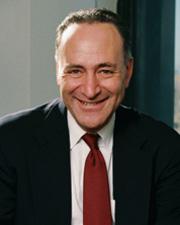 Sen. Charles E. Schumer (D-NY)
Legislative Activity
Stay on top of the latest movement without scrolling through every action
Senate amendment agreed to: Amendment SA 810 agreed to in Senate by Yea-Nay Vote. 52 - 46. Record Vote Number: 154.
June 23, 2005
View full timeline
Senate amendment agreed to: Amendment SA 810 agreed to in Senate by Yea-Nay Vote. 52 - 46. Record Vote Number: 154.
June 23, 2005
Roll call votes on amendments in Senate: Amendment SA 810 agreed to in Senate by Yea-Nay Vote. 52 - 46. Record Vote Number: 154.
June 23, 2005
Senate amendment proposed (on the floor): Amendment SA 810 proposed by Senator Schumer.
June 23, 2005
Amendment SA 810 proposed by Senator Schumer. (consideration: CR S7236-7244, S7247-7249; text: CR S7240) To strike a provision relating to medical isotope production.
June 23, 2005
Amendment SA 810 agreed to in Senate by Yea-Nay Vote. 52 - 46. Record Vote Number: 154.
June 23, 2005
Senate amendment submitted
June 21, 2005
Votes
1 roll call on this amendment
Text
Proposed
ENERGY POLICY ACT OF 2005

The ACTING PRESIDENT pro tempore. Under the previous order, the
Senate will resume consideration of H.R. 6 which the clerk will report.
The assistant legislative clerk read as follows:

A bill (H.R. 6) to ensure jobs for our future with secure,
affordable and reliable energy.

Pending:

Wyden-Dorgan amendment No. 792, to provide for the
suspension of Strategic Petroleum Reserve acquisitions.
Reid (for Lautenberg) amendment No. 839, to require any
Federal agency that publishes a science-based climate change
document that was significantly altered at White House
request to make an unaltered final draft of the document
publicly available for comparison
Schumer amendment No. 811, to provide for a national tire
fuel efficiency program.

The ACTING PRESIDENT pro tempore. Under the previous order, the time
until 10 a.m. shall be equally divided between the Senator from New
Mexico, Mr. Domenici, and the Senator from New Mexico, Mr. Bingaman, or
their designees.
The Senator from Massachusetts.
Mr. KENNEDY. Mr. President, I understand we have 30 minutes; is that
correct?
The ACTING PRESIDENT pro tempore. The Senator is correct.
Mr. KENNEDY. First, I thank my friend and the ranking member, Senator
Leahy, for permitting me to go first so we can attend in an appropriate
way the Armed Services Committee and Secretary Rumsfeld. It is typical
courtesy on his part.
I yield myself 9 minutes.
The ACTING PRESIDENT pro tempore. The Senator is recognized.

supreme court vacancy

Mr. KENNEDY. Mr. President, as we all know, a major debate may soon
be underway in the Senate and the country if there is a vacancy on the
Supreme Court. It is clear that the Bush administration is well along
in choosing its nominee for the vacancy, and the Senate must be well-
prepared as well.

[[Page S7205]]

The initial major question is whether, for the highest judicial
position in the land, President Bush will choose consultation and
consensus or confrontation and conflict. I urge the President not to
cede this important constitutional responsibility to a narrow faction
of his own party--and to groups so extreme they have called for the
impeachment of six of the current nine Justices because those Justices
refuse to make the law in accord with the groups' wishes.
In the landmark May 23rd agreement, the bipartisan group of 14
Senators spoke clearly for this body on two vital points. First, we
intend to remain the world's greatest deliberative body, where the
rules, not raw power, prevail, and where the rights of the minority are
respected--not silenced. Second, the agreement sent a strong reminder
to the President that the Constitution requires him to obtain both the
advice and consent of the Senate before appointing judges, and that we
expect him to do so in good faith.
When the Framers of the Constitution adopted our system of checks and
balances 218 years ago, they focused intently on the process for
selecting judges. They wanted judges to be independent, so they gave
them lifetime positions and prohibited any reduction in their
compensation.
Initially, they were so concerned that Presidents might abuse the
power to select judges that they gave the Senate the sole power to
appoint Federal judges. But some delegates argued for a Presidential
role, and they debated the issue at length.
Benjamin Franklin, always ready with new ideas, pointed to the
Scottish system, where the lawyers themselves selected the judges.
Invariably, he said, the best and smartest candidates were selected as
judges, because the other lawyers wanted to remove their toughest
competitor and divide his business among themselves.
In fact, in three separate votes in July 1787, the Framers refused to
give the Executive any role in judicial selection, because they did not
believe the President could be trusted with that responsibility. They
again placed the entire appointment power in the Senate.
Later, as the Constitutional Convention was ending in September, they
agreed to a compromise, based on the procedure that Massachusetts had
used successfully for over a century. To get the best possible judges,
the President and the Senate would have to agree on appointments to the
Federal courts. The President was powerless to appoint judges without
considering the Senate's advice and obtaining its consent.
For over two centuries that system has worked well. At the Supreme
Court level, Presidents have nominated 154 Justices. Most of them were
confirmed by the Senate, but some 20 percent were not. Some could not
get Senate consent because the Senate did not feel they were qualified
for the job, some because they were selected for reasons of politics or
ideology with which the Senate did not agree, and some because they
were perceived as being too close to the President to be independent.
A few of us who have been here in the Senate for all of the
confirmations of the current nine Justices know that most of them were
consensus choices. Seven of them--including all six whom the right-wing
wants to impeach--were confirmed with such strong bipartisan support
that no more than nine Senators voted against them, and, of those, four
received unanimous Senate support.
We learned many things from past debates. One of the most important
is that there are large reservoirs of excellent potential nominees
among the many capable judges and lawyers in the United States, and
that, if they are chosen for the High Court, they will receive
overwhelming support in the country and in the Senate. Presidents who
have listened to the Senate's advice and selected such candidates have
had no problem obtaining Senate consent. President Bush can do that,
too. If he takes our bipartisan advice, he will have no trouble
obtaining our bipartisan consent.
Presidents who have had the most trouble with the confirmation
process are those who listened to erroneous advice about the process.
As recently as this week, a Member of this body argued in print that:

Senate practice and even the Constitution contemplate
deference to the President and a presumption in favor of
confirmation.

That's not what the Constitution says. Since the days of George
Washington--whose nomination of a Justice was denied consent by the
Senate of that day, there has been no ``presumption in favor of
confirmation'' of lifetime judicial appointees. In general, many of us
do give some deference to a President's nominees to the executive
branch, since they are not lifetime appointments. But even there, if
the President overreaches, we act to fulfill our constitutional
responsibility.
Three times in my experience, Presidents have pushed the Senate too
far on Supreme Court nominations, and the Senate has said ``no.'' Each
time, the White House argued for Senate deference and the Senate, each
time with bipartisan support, refused to defer. Two of those rejections
were consecutive nominations for the same vacancy, with members of the
President's own party providing the majority for rejection each time.
In the second of those two, the selection was so plainly an arrogant
affront to the Senate, that the best argument the proponents could make
was that mediocrity deserved representation, too, on the High Court, a
proposition the Senate soundly rejected.
Clearly, Senators should not support a nominee just because a
President of their party proposed the nomination. The Framers relied on
each of us to make independent and individual judgments about the
President's nominees. We do not fulfill our constitutional trust if we
merely ``placate-the-President.'' I have seen repeated examples of
Senatorial courage when numerous members of the President's party--even
members of his leadership team--have refused to go along with plainly
inappropriate Presidential selections.
We should do exactly what the Framers intended us to do--be joint and
co-equal defenders of the rule of law and the fairness and quality and
independence of the Federal courts. We must listen to their voices now,
summoning us across the centuries, to uphold that basic ideal, with
full devotion to our role in the checks and balances that have served
the Nation so well. We fail them if we march in lockstep with the White
House.
As past experience shows, nominees selected for their devotion to a
particular ideological agenda are likely to have the most difficulty
being confirmed, because that kind of choice rarely achieves a
consensus. History shows plainly that the better course is to search
for the highest quality candidates who have demonstrated their respect
for the rule of law. They respect core constitutional principles,
especially those that define the rights of each citizen. They have
demonstrated their commitment to finding the law, not making the law.
They respect stare decisis, the deference to well-accepted past
decisions that have kept the Nation strong by reconciling traditional
principles with new needs and challenges. They show respect for the
basic structure of Government, especially for Congress when it acts
within its established powers. They have demonstrated the ability to
subordinate their own ideological and result-oriented preferences to
the rule of law.
Especially at the Supreme Court level, the choices should not be
partisan choices based on today's partisan issues. The Justice we may
select this year could well be providing justice to our children and
grandchildren for decades to come. It is more important that the
nominee have a strong dedication to principles of justice than a strong
position on controversial issues of the day.
It is a disservice to the Court to attempt to install ideological
activists bent on making sudden and drastic shifts in the Court's
careful, gradual jurisprudence. The Supreme Court is at its worst when
it splits into extreme, contentious sides, and reaches extreme results
that make much of the Nation cringe and leave only the ideological
activists satisfied.
Like sausage and legislation, the confirmation or rejection of a
Supreme Court nomination is not always something pleasant to watch or
be part of. The course is set by the President. If the President
submits an ``in your face'' nomination to flaunt his power, it takes
time and effort and sweat and tears before the truth about the
candidate is fully discovered and explained to the public and voted on.

[[Page S7206]]

We are fortunate to have had a dress rehearsal for the process.
Before the White House decided to threaten the Senate with the nuclear
option, few Americans had any idea what was happening here and how
important it was. It took some time, but eventually the public
understood the seriousness of the threat to break the rules in order to
change the rules, so that for the first time in Senate history, a bare
majority of the Senate could impose a gag rule on every other Senator
and enable the President to exercise absolute power over the courts
without meaningful review by the Senate. Fortunately, the Senate
stepped back from that brink, and the Senators who reached that
bipartisan agreement to make it possible deserve great credit.
Those who want the Senate to be a rubber stamp for a White House
nominee to the Supreme Court will undoubtedly try to rush us through
our duty. But if we are to do our job for the American people in good
faith, the process of considering a Supreme Court nominee cannot be
rushed. It will take time to obtain the necessary information and
documents, and to review and understand them. It will take time to
gather witnesses and prepare for hearings. If the nomination is not a
consensus nomination, the hearings will be intensive and extensive. If
the nominee is evasive, there will be longer hearings and follow-up
questions, which will also take time to analyze. Only when all the
information is available and fairly considered, can the nomination go
forward.
If President Bush resists his fringe constituencies, and seeks the
advice of the Senate as he should, the nomination process can have a
happy ending. I hope our colleagues across the aisle will urge the
President to respect the May 23rd bipartisan agreement and its
memorandum of understanding, and take to heart its serious request that
he consult with Senators from both parties before proposing a Supreme
Court nominee.
We already have in place a process for doing so. In selecting
district judge nominees in our States, the White House sends us the
list of persons being considered seriously, and asks for our comments
on each, as well as our suggestions for additional names to consider.
When they have narrowed down the list, they share the short list with
us, so that we can give our final advice as to which ones are best and
which ones would raise problems. Almost always, our advice is
considered and respected. As a result, most District Judges go through
the confirmation process quietly and expeditiously, and obtain the
consent of the Senate.
Article II, Section 2, Clause 2, of the Constitution clearly says,
``with the advice and consent of the Senate,'' not the advice of anyone
else, just 100 of us here in the Senate, who speak for all the American
people. It doesn't take much to get our consent. All the President has
to do is seek out his preferred non-ideological choices, ask us about
them, and listen to our answers.
I reserve the remainder of my time.
The ACTING PRESIDENT pro tempore. The Senator from Vermont.
Mr. LEAHY. Mr. President, I appreciate the strong, eloquent statement
of the Senator from Massachusetts. He is a former chairman of this
committee, the Judiciary Committee. Of course, he is not only a former
chairman but, as one of the three most senior Members of the Senate, is
well aware of what has been our practice.
I think we may also hear from the senior Senator from Delaware, Mr.
Biden, who is another former chairman.
Let me speak in my capacity also as a former chairman of the
Judiciary Committee.
It is now almost 1 month since the bipartisan agreement was forged to
avert an unnecessary ``nuclear'' showdown in the Senate. Democratic
Senators who signed the Memorandum of Understanding on Judicial
Nominations that averted the nuclear option have fulfilled their
commitments with respect to invoking cloture on several controversial
nominees. Sadly, with Republicans voting party-line on almost every one
of these nominees, they have been confirmed. Meanwhile, as the
Democratic leader had offered months ago, the Senate considered and
voted upon two Sixth Circuit nominees and an additional DC Circuit
nominee.
What has yet to take place, however, is the kind of meaningful
consultation that Republican and Democratic Senators explicitly called
for in that memorandum. They ``encouraged the Executive branch of
government to consult with members of the Senate, both Democratic and
Republican, prior to submitting a judicial nomination to the Senate for
consideration.'' They called for a ``return to the early practices of
our government'' that reduced conflict and led to consensus. We have
not yet noticed an abundance of consultation. And unfortunately, White
House officials have declared that the President has no interest in and
feels no obligation to assist in implementing this feature of the
memorandum.
Since the White House will not acknowledge the record, I thought it
worth noting that 214 of this President's judicial nominations have
already been confirmed by the Senate. That includes 41 circuit court
nominees, an almost 80-percent confirmation rate of his many divisive
circuit court nominees. These figures are all well ahead of the rates
during President Clinton's administration. At a similar point in the
last administration, only 180 nominees had been confirmed, including
only 31 circuit court nominees, which amounted to barely 74 percent of
President Clinton's circuit court nominees.
With all the recent talk from Republicans about the principle of
every nominee being entitled to an up-or-down vote, it is striking that
such a standard was not considered at all while Republicans pocket
filibustered more than 60 of President Clinton's judicial nominees. As
I demonstrated during the time I served as chairman and since then,
President Bush's nominees have been treated far more fairly than were
President Clinton's nominees.
I have spoken over the last 4\1/2\ years, most recently in the last
few weeks, about the benefits to all if the President were to consult
with Members of the Senate from both sides of the aisle on important
judicial nominations. I return today to emphasize, again, the
significance of meaningful consultation on these nominations. It bears
repeating given what is at stake for the Senate, the judiciary and the
American people.
In a few more days the U.S. Supreme Court will complete its term.
Last year the Chief Justice noted publicly that at the age of 80, one
thinks about retirement. I get to see the Chief Justice from time to
time in connection with his work for the Judicial Conference and the
Smithsonian Institution. Sometimes we see each other in Vermont or en
route there, and I am struck every time by his commitment to service.
He is waging his personal battle against ill health with his
characteristic resolve. I know that the Chief will retire when he
decides that he should, and not before. He has earned that right after
serving on the Supreme Court for more than 30 years, the last 19 as the
Chief Justice. I have great respect and affection for him, and he is in
our prayers.

In light of the age and health of our Supreme Court Justices,
speculation has accelerated about the potential for a Supreme Court
vacancy this summer. In advance of any such vacancy, I have called upon
the President to follow the constructive and successful examples set by
previous Presidents of both parties who engaged in meaningful
consultation with Members of the Senate before selecting nominees. This
decision is too important to all Americans to be unnecessarily
embroiled in partisan politics.
I have said repeatedly that should a Supreme Court vacancy arise, I
stand ready to work with President Bush to help him select a nominee to
the Supreme Court who can unite Americans. I have urged consultation
and cooperation for 4 years and have reached out to the President,
again, over these last few weeks. I hope that if a vacancy does arise
the President will finally turn away from his past practices, consult
with us and work with us. This is the way to unite instead of divide
the Nation, and this is the way to honor the Constitution's ``advise
and consent'' directive, and this is the way to preserve the
independence of our federal judiciary, which is the envy of the rest of
the world.
Some Presidents, including most recently President Clinton, found
that

[[Page S7207]]

consultation with the Senate in advance of a nomination was highly
beneficial in helping lay the foundation for successful nominations.
President Reagan, on the other hand, disregarded the advice offered by
Senate Democratic leaders and chose a controversial, divisive nominee
who was ultimately rejected by the full Senate.
In his recent book, ``Square Peg,'' Senator Hatch recounts how in
1993, as the ranking minority member of the Senate Judiciary Committee,
he advised President Clinton about possible Supreme Court nominees. In
his book, Senator Hatch wrote that he warned President Clinton away
from a nominee whose confirmation he believed ``would not be easy.''
Senator Hatch goes on to describe how he suggested the names of Stephen
Breyer and Ruth Bader Ginsburg, both of whom were eventually nominated
and confirmed ``with relative ease.'' Indeed, 96 Senators voted in
favor of Justice Ginsburg's confirmation, and only three Senators voted
against; Justice Breyer received 87 affirmative votes, and only nine
Senators voted against. Nor are these recent examples the only evidence
of effective and meaningful consultation with the Senate over our
history.
The Constitution provides that the President ``shall nominate, and by
and with the Advice and Consent of the Senate, shall appoint'' judges
and explicitly the members of the only court established by the
Constitution itself, the Supreme Court. For advice to be meaningful, it
needs to be informed. Despite his public commitment at a news
conference three weeks ago specifically regarding the Supreme Court,
the President has not even begun the process of consulting with
Democratic Senators. I wrote to the President, again, last month,
urging consultation and even making suggestions on how he might wish to
proceed.
Bipartisan consultation would not only make any Supreme Court
selection a better one, it would also reassure the Senate and the
American people that the process of selecting a Supreme Court justice
has not become politicized.
The bipartisan group of 14 Senators who joined together to avert the
``nuclear option'' included the following in their agreement:

We believe that, under Article II, Section 2, of the United
States Constitution, the word ``Advice'' speaks to
consultation between the Senate and the President with regard
to the use of the President's power to make nominations. We
encourage the Executive branch of government to consult with
members of the Senate, both Democratic and Republican, prior
to submitting a judicial nomination to the Senate for
consideration.
Such a return to the early practices of our government may
well serve to reduce the rancor that unfortunately
accompanies the advice and consent process in the Senate.
We firmly believe this agreement is consistent with the
traditions of the United States Senate that we as Senators
seek to uphold.

I agree. Bipartisan consultation is consistent with the traditions of
the Senate and would return us to practices that have served the
country well. Our fellow Senators have history and the well-being of
the Nation on their side in urging greater consultation on judicial
nominations. They are right.
What is troubling are the recent reports that the White House plan
does not include meaningful consultation at all, but instead plans a
political-style campaign and some sort of preemptive contact to allow
them to pretend they consulted, without anything akin to the kind of
meaningful consultation that this important matter deserves. Partisan
activists supporting the White House boasted last week about a war
chest of upwards of $20 million to be used to crush any opposition to
the White House's selection. That sounds awfully like preparations for
all out partisan political warfare. If the White House intends to
follow that type of plan, it would be most unfortunate, unwise and
counterproductive.
Though the landscape ahead is sown with the potential for controversy
and contention should a vacancy arise on the Supreme Court,
confrontation is unnecessary. Consensus should be our mutual goal. I
would hope that the President's objective will not follow the path he
has taken with so many divisive circuit court nominees and send the
Senate a Supreme Court nominee so polarizing that confirmation is eked
out in the narrowest of margins. This would come at a steep and
gratuitous price that the entire Nation would have to pay in needless
division. It would serve the country better to choose a qualified
consensus candidate who can be broadly supported by the American people
and by the Senate.
The process begins with the President. He is the only participant in
the process who can nominate candidates to fill Supreme Court
vacancies. If there is a vacancy, the decisions made in the White House
will determine whether the nominee chosen will unite the Nation or will
divide the Nation. The power to avoid destructive political warfare
over a Supreme Court vacancy is in the hands of the President. No one
in the Senate is spoiling for a fight. Only one person will decide
whether there will be a divisive or a unifying process and nomination.
If consensus is accepted as a worthy goal, bipartisan consultation will
help achieve it. I believe that is what the American people want, and I
know that is what they deserve.
If the President chooses a Supreme Court nominee because of that
nominee's ideology or record of activism in the hopes that he or she
will deliver political victories, the President will have done so
knowing that he is starting a confirmation confrontation. The Supreme
Court should not be a wing of the Republican Party, nor should it be an
arm of the Democratic Party. If the right-wing activists who were
disappointed that the nuclear option was averted convince the President
to choose a divisive nominee, they will not prevail without a difficult
struggle that will embroil the Senate and the country. And if they do,
what will they have wrought? The American people will be the losers:
The legitimacy of the judiciary will have suffered a damaging blow from
which it may not soon recover. Such a contest would itself confirm that
the Supreme Court is just another setting for partisan contests and
partisan outcomes. People will perceive the federal courts as places in
which ``the fix is in.''
Our Constitution establishes an independent federal judiciary to be a
bulwark of individual liberty against incursions or expansions of power
by the political branches. That independence is what makes our
judiciary the model for others around the world. That independence is
at grave risk when a President tries to pack the courts with activists
from either side of the political spectrum. Even if successful, such an
effort would lead to decisionmaking based on politics and would forever
diminish public confidence in our justice system.
The American people will cheer if the President chooses someone who
unifies the Nation. This is not the time and a vacancy on this Supreme
Court is not the setting in which to accentuate the political and
ideological division within our country. In our lifetimes, there has
never been a greater need for a unifying pick for the Supreme Court. At
a time when too many partisans seem fixated on devising strategies to
force the Senate to confirm the most extreme candidates with the least
number of votes possible, Democratic Senators are urging cooperation
and consultation to bring the country together. There is no more
important opportunity than this to lead the Nation in a direction of
cooperation and unity.
The independence of the federal judiciary is critical to our American
concept of justice for all. We all want Justices who exhibit the kind
of fidelity to the law that we all respect. We want them to have a
strong commitment to our shared constitutional values of individual
liberties and equal protection. We expect them to have had a
demonstrated record of commitment to equal rights. There are many
conservatives who can readily meet these criteria and who are not rigid
ideologues.
This is a difficult time for our country, and we face many
challenges. Providing adequate health care for all Americans, improving
the economic prospects of Americans, defending against threats, the
proliferation of nuclear weapons, the continuing upheaval that afflicts
our soldiers in Iraq--all these are fundamental matters on which we
need to improve. It is my hope that we can work together on many issues
important to the American people, including maintaining a fair and
independent judiciary. I am confident that a smooth nomination and
confirmation process can be developed on a bipartisan basis if we work

[[Page S7208]]

together. The American people we represent and serve are entitled to no
less.
The PRESIDING OFFICER (Mr. Sununu). The Senator from New York.
Mr. SCHUMER. How much time remains?
The PRESIDING OFFICER. The minority side controls 10 minutes.
Mr. SCHUMER. I ask unanimous consent that others who wish to add
statements to the record on this subject be allowed to do so.
The PRESIDING OFFICER. Without objection, it is so ordered.
Mr. SCHUMER. Mr. President, I thank my colleague from Vermont, our
leader on the Judiciary Committee, for, as usual, being right on point
with eloquence and with no malice.
As many know, there is a real possibility that a vacancy on the
Supreme Court will be announced shortly. The Supreme Court should
finish its term either Monday or Thursday, depending on the caseload.
There is one question American people are asking about the Supreme
Court; that is, how, if and when a vacancy occurs--and we all pray, of
course, for Chief Justice Rehnquist's health, but if and when a vacancy
occurs--how do we avoid the divisiveness that has plagued this body,
this town, and this country about Court nominees over the last several
years?
The answer is simple. It can be described in one word: consultation.
The ball is in the President's court. If the President chooses to do
what he has done on court of appeals nominees--not consult, just choose
someone, oftentimes way out of the mainstream, and say take it or leave
it--the odds are very high there will be a battle royal over that
nomination. If, on the other hand, the President follows the path of
what so many other Presidents before him have done--consults with the
Senate, with the Congress, both Republicans and Democrats, and takes
their advice to heart--we can have a smooth, amiable, easy Supreme
Court nomination.
Again, the ball is in the President's court. Consultation is part of
the constitutional process, advise and consent. The Founding Fathers
did not use words lightly. The relatively short document of our
Constitution is amazing for its brilliance and its brevity. When they
decide to put a word in like ``advise,'' lots of thought has gone in
before it. ``Advise'' means seek the advice of the Senate. It does not
say in the Constitution, seek the advice of your party or seek the
advice of people who agree with you. The intention, it is quite clear,
is to seek a breadth of advice.
That is why, today, a letter signed by 44 of the 45 members of the
Democrat caucus, asking the President to consult with us, will be sent.
The 45th member, Senator Byrd, agrees with the thrust and the concept
of our letter but felt so strongly about the issue he is sending his
own letter, which I am sure will be in his own wonderful style and make
the point well.
The need for advice, the need for consultation, was made clear when
the group of 14--seven Democrats and seven Republicans--got together.
In their agreement, they wrote:

We believe that, under Article II, Section 2, of the United
States Constitution, the word ``advice,'' speaks to
consultation between the Senate and the President with regard
to the use of the President's power to make nominations. We
encourage the Executive branch of government to consult with
members of the Senate, both Democratic and Republican, prior
to submitting a judicial nomination to the Senate for
consideration.

This is a moderate, bipartisan group. They tend to be some of the
more conservative Democrats and some of the more liberal Republicans.
It is certainly mainstream. Will the President heed their advice and
seek the advice of the Senate? If he seeks advice, will it be real? To
simply call someone in for a meeting and say, what do you think, and
then go about things as if the meeting did not happen is not advice.
Real advice means talking about specific nominees in private, saying:
What do you think of this name or that name, this person or that
person? That is, indeed, what President Clinton did as he consulted
Senator Hatch, hardly his ideological soul mate, and many others.
Senator Hatch told President Clinton some proposed nominees might be
out of the mainstream and garner opposition, at least from the other
side of the aisle. But some, even though Senator Hatch clearly did not
agree with their politics, were in the mainstream and would get through
the Senate with relatively little acrimony. President Clinton took
Senator Hatch's advice and the nominations were smooth.
That is not the only time advice has been sought. In 1869, President
Grant appointed Edward Stanton to the Supreme Court in response to a
petition from a majority of the Senate and the House. In 1932,
President Hoover presented Senator William Borah, the influential
chairman of the Foreign Relations Committee, with a list of candidates
he was considering to replace Justice Oliver Wendell Holmes. Borah
persuaded Hoover to move the name of the eventual nominee, Benjamin
Cardozo, from the bottom of the list to the top, and Cordozo was
speedily and unanimously confirmed.

There are many instances of Presidents seeking the advice in terms of
the advice and consent of the Senate. When the President has done it on
judicial nominees here, it has worked. Frankly, the President and the
White House have consulted with me about nominations to the district
courts in New York and the Second Circuit Court of Appeals. They have
actually bounced names off of me and said: What do you think of this
one? What do you think of that? As a result, every vacancy is filled
quickly with little acrimony and with broad consensus.
Most of the nominees I have supported in my area do not agree with me
philosophically. But they are part of the mainstream, and I was
willing, able and, in many cases, happy to support them. So it can be
done and should be done.
There is all too much divisiveness in Washington. On the issue of the
courts, it is our sincere belief on this side of the aisle that the
President's refusal to consult and willingness to nominate some who are
so far out of the mainstream that they cannot be regarded as
interpreters of law rather than makers of law. That is the main reason
we stand at this point of great acrimony in terms of judicial
nominations. All of that can be undone by some sincere consultation.
President Bush, when he ran for office and got into office, said he
wanted to change the tone and climate in Washington; he wanted to bring
people together. That was a noble sentiment, a wonderful sentiment. He
can, despite the acrimony that has occurred on judicial nominations and
so much else over the last few years, almost like with a magic wand,
undo much of it by seeking real consultation should there be a vacancy
on the Supreme Court.
On behalf--I believe I can say this without any hesitation--of all 44
of my colleagues on this side of the aisle, we plead, we pray, with the
President to engage in real consultation, to heed the advise and
consent of the Constitution, and to come up with a Supreme Court
Justice, should a vacancy occur shortly, that we all--from the most
conservative to the most liberal Member of this body--can be proud to
support.
I yield the floor.
The PRESIDING OFFICER. The minority time is expired.
The Senator from New Mexico.
Mr. DOMENICI. I suggest the absence of a quorum.
The PRESIDING OFFICER. The clerk will call the roll.
The assistant legislative clerk proceeded to call the roll.
Mr. ISAKSON. Mr. President, I ask unanimous consent that the order
for the quorum call be rescinded.
The PRESIDING OFFICER. Without objection, it is so ordered.
Who yields time?
Mr. DOMENICI. How much time does the Senator want?
Mr. ISAKSON. Three minutes.
The PRESIDING OFFICER. The Senator from Georgia is recognized for 3
minutes.
Mr. ISAKSON. Mr. President, I thank the Senator from New Mexico for
yielding the time.
(The remarks of Mr. Isakson are printed in today's Record under
``Morning Business.'')
The PRESIDING OFFICER. The Senator from New Mexico.
Mr. DOMENICI. Mr. President, I yield myself as much time as I may
use.
Mr. President, fellow Senators, shortly the Senate is going to vote.
We are going to have a cloture vote to decide whether we should bring
closure to

[[Page S7209]]

what I think has been an excellent 2 weeks of debate about a new
American policy, a policy which is directed at trying to make our
energy supply for the future more secure for our domestic growth and
for our national security.
We have been waiting a long time for this day. If the Senate, indeed,
at its pleasure, grants cloture, which I hope we will, it means we will
bring to a conclusion in short order a long debate and fulfill a
longstanding need for an American energy policy that is encapsulated in
this bill, which was produced by the Energy and Natural Resources
Committee over weeks of hearings and day after day of debate, with
voting, and finally concluding that the bill that is before us is the
right thing to do.
Since then, the Senate has exercised its right to offer amendments
and discuss them. Some amendments were adopted to change, alter what
the committee recommended. But in essence, fellow Senators, we have a
rare opportunity today, in a reasonable period of time--not with
acrimony but with debate--to pass this legislation. That is, in a
sense, consistent with the best of the Senate: having amendments openly
debated, many of them; views, some in accord with the bill, some in
opposition to the bill here on the floor, as witnessed by those who pay
attention to what goes on in the Senate.
So I say, as one who has been a participant for a few years, this is
an effort to bring this matter to a vote in the Senate so we can bring
this legislation to the House of Representatives. Our Constitution
requires that both Houses agree on the legislation. Some do not
understand that our Constitution is rather conservative when it comes
to passing legislation. You do not just have your vote in the Senate;
the House has theirs. Then you have to go to conference and agree on
the same text in both Houses, which is done by a committee called a
conference committee.

That will occur only when we have voted out a bill. We will vote out
a bill only when we have completed debate under our rules. We probably
will not conclude debate for a long time unless cloture is imposed.
I believe on a domestic bill, cloture should not be invoked
arbitrarily or in advance of a reasonable amount of time. People should
be permitted to talk, to amend. But, fellow Senators, we have been at
this on the floor for enough time. And when you consider the prior
efforts, I believe the American people are wondering why we cannot get
something done. Why more time? The purpose for this activity called
cloture is to say we have had enough time. With cloture invoked, sooner
rather than later, the bill will be voted ``yes'' or ``no'' by the
Senate.
So we seek that. That is the privilege of saying to the Senate, we
are going to vote ``yes'' or ``no'' soon rather than later. The way we
can do that is by voting ``aye'' on the cloture vote.
I note the presence of Senator Bingaman. I have additional time.
Would the Senator care to address the issue of cloture today?
The PRESIDING OFFICER. The Senator from New Mexico.
Mr. BINGAMAN. Mr. President, I appreciate my colleague's comments and
his willingness to let me speak for a few minutes.
I join him in urging that we go ahead and invoke cloture on the bill.
I do believe we have had a good debate on the Senate floor. We have had
a good opportunity for amendments to be offered. The process has been
open. I have supported some amendments that have been offered to the
bill; I have opposed others. I note my colleague has done the same. I
believe each Senator has done the same. That is exactly how the Senate
is intended to operate.
Obviously, there are Senators who still have amendments they would
like to offer. Some of those amendments will be germane after the
cloture vote occurs even if cloture is invoked. Those amendments can be
considered by the Senate and disposed of at that time. That is
appropriate.
But I understand the scheduling problems the majority leader has and
the Democratic leader has as well. They believe they need to move to
other legislation early next week, or even as early as tomorrow.
Therefore, they would like to go ahead and conclude work on this bill.
This bill is not coming to the Senate sort of ab initio, as they
teach you in law school. It has come here after we had a substantial
debate on these very same issues two Congresses ago, and again last
Congress. As the Senator from New Mexico pointed out, we had a very
thorough and open process in the committee. This process we have had on
the floor has been a thorough and open process as well.
I believe the bill that came out of committee was a good product. It
was a substantial improvement over current law. And I said that. I
believe it has been further improved as we have been working here on
the Senate floor in considering amendments to the bill, so I do not
doubt it could be improved even more. Some of the amendments which
Members may still want to offer may well improve it more, and I may be
a strong supporter of those. But clearly this has been a process that I
think has given everyone an opportunity to participate and offer
amendments. It has been a process that has led to a good product which
we can take to conference with the House of Representatives. As I say,
there will be additional opportunities, even if cloture is invoked, for
us to further improve this bill with germane amendments.
So I will support cloture. I know each Senator can make his or her
own mind up about that vote, but I believe the chairman of our
committee has worked diligently to get us to this point. I have tried
to work with him in that process. I think the majority leader and the
Democratic leader are very focused on trying to get conclusion on this
legislation. I support their efforts.
I yield the floor.
Mr. DOMENICI. I suggest the absence of a quorum.
The PRESIDING OFFICER (Ms. Murkowski). The clerk will call the roll.
The legislative clerk proceeded to call the roll.
Mr. DOMENICI. Madam President, I ask unanimous consent that the order
for the quorum call be rescinded.
The PRESIDING OFFICER. Without objection, it is so ordered.
Mr. DOMENICI. I ask for the regular order.

Cloture Motion

The PRESIDING OFFICER. Under the previous order, the clerk will
report the motion to invoke cloture.
The legislative clerk read as follows:

Cloture Motion

We the undersigned Senators, in accordance with the
provisions of rule XXII of the Standing Rules of the Senate,
do hereby move to bring to a close debate on H.R. 6, a bill
to ensure jobs for our future with secure, affordable, and
reliable energy.
Bill Frist, Pete Domenici, Lamar Alexander, Kay Bailey
Hutchison, Jim DeMint, Michael Enzi, Ted Stevens, Larry
Craig, Craig Thomas, Mike Crapo, Conrad Burns, David
Vitter, Richard Burr, Kit Bond, Wayne Allard, Jim
Inhofe, Lisa Murkowski, George Voinovich.

The PRESIDING OFFICER. By unanimous consent, the mandatory quorum
call has been waived.
The question is, Is it the sense of the Senate that debate on H.R. 6,
as amended, the Energy Policy Act of 2005, shall be brought to a close?
The yeas and nays are mandatory under the rule.
The clerk will call the roll.
The legislative clerk called the roll.
Mr. McCONNELL. The following Senator was necessarily absent: the
Senator from Minnesota (Mr. Coleman).
Further, if present and voting, the Senator from Minnesota (Mr.
Coleman) would have voted ``yea.''
Mr. DURBIN. I announce that the Senator from North Dakota (Mr.
Conrad, the Senator from Minnesota (Mr. Dayton), and the Senator from
North Dakota (Mr. Dorgan) are necessarily absent.
The PRESIDING OFFICER. Are there any other Senators in the Chamber
desiring to vote?
The yeas and nays resulted--yeas 92, nays 4, as follows:

[Rollcall Vote No. 152 Leg.]

YEAS--92

Akaka
Alexander
Allard
Allen
Baucus
Bayh
Bennett
Biden
Bingaman
Bond
Boxer
Brownback
Bunning
Burns
Burr
Byrd
Cantwell
Carper
Chafee
Chambliss
Clinton
Coburn
Cochran
Collins
Cornyn
Craig
Crapo
DeMint
DeWine
Dodd
Dole
Domenici
Ensign
Enzi
Feingold
Feinstein

[[Page S7210]]

Frist
Graham
Grassley
Gregg
Hagel
Harkin
Hatch
Hutchison
Inhofe
Inouye
Isakson
Jeffords
Johnson
Kennedy
Kerry
Kohl
Kyl
Landrieu
Leahy
Levin
Lieberman
Lincoln
Lott
Lugar
Martinez
McConnell
Mikulski
Murkowski
Murray
Nelson (FL)
Nelson (NE)
Obama
Pryor
Reed
Reid
Roberts
Rockefeller
Salazar
Santorum
Sarbanes
Schumer
Sessions
Shelby
Smith
Snowe
Specter
Stabenow
Stevens
Sununu
Talent
Thomas
Thune
Vitter
Voinovich
Warner
Wyden

NAYS--4

Corzine
Durbin
Lautenberg
McCain

NOT VOTING--4

Coleman
Conrad
Dayton
Dorgan
The PRESIDING OFFICER. On this vote, the yeas are 92, the nays are 4.
Three-fifths of the Senators duly chosen and sworn having voted in the
affirmative, the motion is agreed to.
Mr. DOMENICI. Madam President, I suggest the absence of a quorum.
The PRESIDING OFFICER. The clerk will call the roll.
The legislative clerk proceeded to call the roll.
Mr. DOMENICI. Madam President, I ask unanimous consent that the order
for the quorum call be rescinded.
The PRESIDING OFFICER. Without objection, it is so ordered.
Mr. LAUTENBERG. Madam President, parliamentary inquiry.
The PRESIDING OFFICER. The Senator will state his inquiry.

Amendment No. 839

Mr. LAUTENBERG. Madam President, I have an amendment, Amendment No.
839, related to altering scientific documents. Would that amendment be
germane postcloture?
The PRESIDING OFFICER. It would not be germane postcloture.
Mr. LAUTENBERG. I thank the Chair.
The PRESIDING OFFICER. The Senator from New Mexico.
Mr. DOMENICI. Regular order, Madam President.
The PRESIDING OFFICER. Is the Senator making a point of order against
the amendment?
Mr. DOMENICI. I make a point of order that the amendment is not
germane.
The PRESIDING OFFICER. The point of order is sustained. The amendment
falls.

Amendment No. 891

(Purpose: To modify the section relating to the coastal impact
assistance program)

Mr. DOMENICI. Madam President, I call up amendment No. 891 and ask
for its immediate consideration.
The PRESIDING OFFICER. Without objection, the pending amendments are
set aside. The clerk will report.
The legislative clerk read as follows:

The Senator from New Mexico [Mr. Domenici], for himself,
Mr. Bingaman, Ms. Landrieu, Mr. Vitter, and Mr. Lott,
proposes an amendment numbered 891.

Mr. DOMENICI. Madam President, I ask unanimous consent that the
reading of the amendment be dispensed with.
The PRESIDING OFFICER. Without objection, it is so ordered.
(The amendment is printed in today's Record under ``Text of
Amendments.'')
The PRESIDING OFFICER. The Senator from Louisiana.
Ms. LANDRIEU. Madam President, I am pleased to be a cosponsor of this
amendment, along with the Senator from Louisiana, Mr. Vitter, and many
other Senators. We feel very strongly about this particular amendment.
I first thank the chairman of the committee and the ranking member
for the excellent work they have done to move this Energy bill forward
to this point. It has been a very difficult, tedious, and time-
consuming task that has required a lot of patience and a lot of
compromises to get a bill of this nature in this climate to this point.
We appreciate their patience and their skill.
This is an amendment both leaders have been working on for many
weeks. Amendment No. 891 would basically direct a portion of revenues
to six States in the United States that have production off their
shores, Louisiana being the prime State that produces so much of that
energy resource for our Nation, but in addition, obviously Texas,
Mississippi, to some degree Alabama, there is some production off the
coast of California today--not much but some--and even the State of the
Presiding officer, the State of Alaska, that contributes so much to the
Nation's energy reserves, has some production off the coast.
Because of this tremendous contribution we have made these many
years, let me say willingly and very ably, so many small, medium, and
large companies have worked to perfect the technology. They have
invented the tools, established the procedures, and have been pioneers
in this industry. Many of the tools and technology invented for the
environmentally responsible extraction of these minerals--not just in
the United States but around the world--have actually been invented and
developed in Louisiana. We are extremely proud of the contribution we
have made.
In addition to this technological contribution we have made, we have
contributed over $150 billion to the Federal Treasury since this began.
I see my colleague from Louisiana on the floor ready to speak in a
few moments, but I would like to make a couple of other comments.
The wetlands in Louisiana are not Louisiana's wetlands, they are
America's wetlands. They are host to some of the largest commercial
shipping in the world. There are seven ports that comprise the ports of
south Louisiana and, if combined, it is the largest port system in the
world.
We have leveed the Mississippi River for the benefit of the Nation,
not just for Louisiana's benefit. Realize, there were people living in
Louisiana before the United States was a country. So we have been doing
this a very long time. Controlling and taming this river, while it has
been a great benefit to the Nation, has come at great cost to the State
that holds this mouth of the great Mississippi River.

What do I mean by that? Because we channeled this river, again for
the benefit of the Nation so we can ship grain out of Kansas and can
ship goods throughout this world--north, south, east, and west--and
serve as the vibrant global port that we are, the river has ceased to
overflow its banks. So this great delta, the seventh largest in the
world, is rapidly sinking. If we do not get some infusion of revenue
through this mechanism and others that we are seeking, we will lose
these wetlands. It will not be Louisiana's loss, it will be America's
loss.
In addition to the commerce we support for our Nation, we also serve
as a great migratory flyway for all the many bird species in North
America. If they do not have a place to land when they come up from
South America and Mexico--that is the place they land, that is the
place they nest, that is the first land that is available to them off
the water, and that is the marshland we are losing.
In addition, this delta, besides the commerce, besides the
environmental benefits for birds and other wildlife, is the fisheries,
the nursery for the Gulf of Mexico. More than 40 to 50 percent,
estimated by scientists, of all the fisheries in the Gulf of Mexico
have some part of their life cycle spent in this great expanse of
wetlands.
I have been so pleased to have Senator Domenici and Senator
Bingaman--both Senators from New Mexico--come down to Louisiana to fly
over our marsh and see it. You cannot get there any other way. You
cannot drive to our coast as you can to the coast in Florida or to the
beaches in Mississippi where many of us spent many of our years growing
up. There are actually only two beaches, and they are each only about 5
miles long. There are no highways. The only way you can get there is by
pirogue, motor boat, skiff, helicopter, or air boat in the marsh. So
not many people have seen these wetlands. I have pictures to show any
colleague who would like to see them.
It is a magnificent stretch of land. The Everglades can fit inside
it. It is three times the size of the Everglades in Florida. It is a
huge expanse we are losing. If we do not capture these revenues in some
annual, reliable amount to help the State of Louisiana put the
resources into saving this wetlands, it will be, indeed, a great loss
to America.
In addition to what this wetlands contributes to the United States,
it is not only all the above I have described, but it also drains water
from two-thirds of the United States. Without the ability to drain this
water out, we would have flooding all the way up the Missouri. As you
know, because of the

[[Page S7211]]

geography of our Nation, that water has to leave those areas or
businesses and communities will flood.
We think we are making such--we don't think, we know we are making
such a great contribution to this Nation in so many ways. We think this
amendment is quite reasonable. There is money available for this
purpose. It will be shared with these producing States.
From Louisiana's perspective, this money would be used primarily and
almost exclusively for the restoration of America's wetlands so that
these wetlands will be there for our children and our grandchildren.
It is with great pride I helped to lead this effort, along with my
colleague from Louisiana and many cosponsors. That number continues to
grow. We have substantial support because of the leadership of Senator
Domenici and Senator Bingaman.
Again, Louisiana has contributed so much. We simply ask an investment
back to preserve this wetlands, which is America's, and to recognize
the contribution our State makes to the energy independence of this
Nation and to the future economic viability of this Nation.
I want to recognize my colleague from Louisiana, Senator Vitter.
The PRESIDING OFFICER. The Senator from Louisiana.
Mr. VITTER. Madam President, I rise in strong support of amendment
No. 891 as well. I am proud to join my Louisiana colleague, Mary
Landrieu, in doing so.
I want to make five important points why this amendment is clearly
the right thing to do.
First, as Senator Landrieu said, this amendment has very broad, very
deep, and very bipartisan support. I thank her for her leadership, as
well as so many others who have come together and worked very hard to
craft a responsible amendment to move this issue forward in a concrete
way.
Senator Domenici, the chairman of the committee, has led in an
extraordinary way on this issue and is the primary author of this
amendment. We thank him. Senator Bingaman, the ranking member of the
committee, has led on this amendment as well and is a cosponsor and
supportive of it. We thank him. Senator Landrieu and I, of course, as
well as Senators Lott and Cochran, Sessions, and others are all coming
together, very broad based, in a bipartisan way to support this effort.
That is point No. 1.
Point No. 2 is this is an utterly fair and just thing to do. In this
overall debate about an energy bill, we are constantly looking for ways
to secure our energy future, to increase our energy independence, to
lessen our dependence on foreign sources, which is so troublesome,
particularly in a post-9/11 world.
While in that debate, it is important to remember that there are a
few States that have been leading that effort and have been doing their
part all along, particularly these five coastal producing States--
Louisiana, Texas, Mississippi, Alabama, Alaska, and California to a
much lesser extent. So in this energy debate, it is certainly important
to remember that some of us have been pulling our weight and far more
than our weight every step of the way. Yet up until this moment, we
have gotten virtually nothing for it.
While oil and gas and other mineral production on public lands
onshore gives significant royalties to the host State--usually about 50
percent--that same sort of oil and gas production offshore gives
virtually nothing to the host State, less than 1 percent.
That is utterly unfair and this amendment is a small initial step to
correct that. As Senator Landrieu said, these coastal areas have
produced $150 billion or more of Federal revenue, virtually no State
revenue. This amendment would correct that injustice in a very small
way by capturing a truly tiny percentage of that overall production and
royalty figure for the host States.
Point No. 3 is that the host States, the coastal producing States,
need this revenue to address problems directly related to this oil and
gas production and our contribution to the Nation's energy security. In
my home State of Louisiana, we have an absolute crisis going on. It is
called coastal erosion. The easiest way I can summarize it is as
follows: Close your eyes and try to picture a piece of land the size of
a football field. That piece of land disappears from Louisiana, drifts
out into the Gulf, lost forever, every 38 minutes. That is around the
clock, 24 hours a day, 7 days a week, 52 weeks a year. The clock never
stops. It goes on and on.
That loss is directly related to this oil and gas activity. So we
have been contributing to the Nation's energy security, but the only
thing we have gotten directly for it is these monumental problems which
this revenue will help address.
Point No. 4 is that this amendment does not open any new areas to
drilling. It does not provide incentives to open any new areas.
Personally, I would like to do that. I think more of America needs to
contribute to our energy security. I think we need to look in other
areas. But clearly that is very politically controversial and this
amendment does not attempt to do that in any way. So States that are
not in the business, that do not want to be in the business, have
nothing to fear from this amendment.
Point No. 5 has to do with the budget. All of us, led by Senator
Domenici, a former budget chairman, have worked extremely hard so that
this does not bust the budget in any way. We have bent over backward to
fashion this amendment so it is within all the budget numbers.
A budget point of order may nevertheless be raised and I expect it to
be raised. I want to explain what that is because it is not busting the
numbers built into the budget. There is a reserve fund or a contingency
fund within the budget that was part of the budget and part of the
Budget Act specifically associated with the Energy bill. This amendment
is well within the numbers of that fund and therefore does not go
beyond the numbers of the budget. However, in the Budget Act, the
chairman of the Budget Committee has the role of having to sign off on
the use of that contingency fund. The chairman may not do that. He may
therefore raise a budget point of order, and that is his right, and I
respect his right and what he views as his obligation, but I want to
make the point very clearly that is a technical point of order which is
fundamentally different from an amendment which busts the budget
numbers, which goes beyond the numbers built into the budget.
We have worked extremely hard with the budget chairman's staff, I
might add, hand in glove with them, to make sure this amendment falls
within all of the numbers of the budget and is well below that
contingency fund number specifically for the Energy bill. So if that
budget point of order is raised, it is valid, but it is, in a sense, a
technicality because our amendment does not go beyond the numbers built
into the budget and the Budget Act.
Mr. GREGG. Will the Senator yield on that point?
Mr. VITTER. I would be happy to yield.
Mr. GREGG. Is it the position of the Senator from Louisiana,
therefore, that when a discretionary program is taken and turned into a
direct spending entitlement program, that that is a technical point?
Mr. VITTER. No. The point which I just made was that this amendment
is well within all of the numbers laid out in the Budget Act. That was
the point I was trying to make.
Mr. GREGG. Madam President, would the Senator yield for a question?
Mr. VITTER. I will be happy to.
Mr. GREGG. It appears to be the Senator's position that since this
budget point of order involves taking a discretionary program and
making it an entitlement program that that is a technical point.
Mr. VITTER. That is not my----
Mr. GREGG. My position is that is not technical.
Mr. VITTER. If I could clarify and respond to the question, that is
not my position at all. My position, which I think I laid out pretty
clearly, is this amendment is well within all of the numbers within the
budget. It does not bust those numbers. It does not go beyond those
budget numbers. That is what I said, that is what I meant, and I
believe to the extent the Senator did not argue the point, it is
confirmed.
Mr. GREGG. Madam President, would the Senator from Louisiana yield
for a question?
Mr. VITTER. I will be happy to.
The PRESIDING OFFICER. The Senator from New Hampshire.

[[Page S7212]]

Mr. GREGG. The Senator from Louisiana appears to want to have it both
ways, that the chairman of the Budget Committee has a right to make
this point of order because the chairman of the Budget Committee is
given that authority by the Senate in order to protect the integrity of
the budget process, and when the chairman of the Budget Committee rises
and asks a question which is the basis of his point of order, which is
that this amendment takes a discretionary program and turns it into an
entitlement program, and asks the Senator from Louisiana does he deem
that to be a technical point, the Senator from Louisiana says, no, that
is not my argument. My argument is something else.
Well, I would simply say to the Senator from Louisiana, he cannot
have it both ways. He cannot say to the budget chairman he has the
authority to do this and then say to the budget chairman, when he asks
the Senator whether it is a technical point when the budget chairman
elicits why he is doing it, that it is not a technical point.
It is a very unusual position to take, that moving a discretionary
program to an entitlement program is a technical point, and that is the
gravamen of the argument of the Senator from Louisiana.
Mr. VITTER. Reclaiming my time, I think I have laid out my position
very clearly. This is a broad-based, bipartisan amendment. This is a
fair amendment, particularly considering everything that these coastal
producing States have given the country in terms of our energy
security. Unfortunately, we are a very small number of States that have
contributed in that way. This is designed to address a very real crisis
in Louisiana and other coastal States. By the way, that is not some
parochial problem. That is a national problem, as my colleague, the
senior Senator from Louisiana, has outlined. It threatens national oil
and gas infrastructure. It threatens national maritime commerce and
ports. It threatens nationally significant fisheries.
Fourth, we are not opening new areas with this amendment. We are not
providing incentives to open new areas with this amendment.
Fifth and finally, we are within all the numbers within the budget.
I thank the chairman of the committee. I thank Senator Bingaman and
others. I thank my colleague, Senator Landrieu, for her leadership on
this issue.
I yield back my time.
The PRESIDING OFFICER. The Senator from New Mexico.
Mr. BINGAMAN. Madam President, I rise in support of this amendment. I
am a cosponsor of this amendment. It would dedicate funding for coastal
impact assistance to States that currently produce oil and gas from the
Federal OCS adjacent to State waters.
I have visited the coastal area near Louisiana with Senator Landrieu.
I know of the very serious concerns which many in that State have about
the loss of coastal wetlands caused by a variety of factors, including
some activities related to the oil and gas development that has
occurred there. Senator Landrieu has been a tireless advocate for her
State on this issue and I know her colleague has as well.
It is important for my colleagues to know what the amendment does not
do. The amendment does not modify any moratorium on OCS leasing. It
does not provide an incentive for States to start production. It does
not provide for a State opt-in or opt-out for resource assessment or
leasing activities. What the amendment does is establish a coastal
impact assistance program and provide a stream of revenues for coastal
impact assistance to States that already have OCS production off their
coast.
Under the amendment, funding would be made available to address the
loss of coastal wetlands as well as for other projects and activities
for the conservation, protection, and restoration of coastal areas,
mitigation of damage for fish and wildlife and other natural resources,
and implementation of federally approved marine coastal and
conservation management plans.
In addition, up to a fixed percentage of the funding could be used
for mitigation of the impact of OCS activities through funding of
infrastructure projects. In other words, the amendment allows funding
of certain infrastructure projects and public services, but the amount
of funds that can be expended for those purposes is capped.
Before concluding, let me clarify one significant point. I support
the amendment because it does provide dedicated funds from the Treasury
for coastal impact assistance. The amendment does not provide a
percentage of revenues or future revenues or otherwise call for
revenuesharing from the Outer Continental Shelf. I have stated
repeatedly my opposition to that idea. It is my view that the oil and
gas resources in the OCS belong to the entire Nation, and the revenue-
sharing arrangement, which was earlier discussed but is not part of
this amendment, would run contrary to that principle.
In closing, I reiterate my support for this amendment. I hope my
colleagues will join me in voting aye for the amendment and waiving the
Budget Act, if necessary.
I yield the floor.
Ms. LANDRIEU. I suggest the absence of a quorum.
The PRESIDING OFFICER. The clerk will call the roll.
Mr. GREGG. I object.
The PRESIDING OFFICER. The Senator may not object to a quorum call.
The clerk will call the roll.
The assistant legislative clerk proceeded to call the roll.
Mr. GREGG. Madam President, I ask unanimous consent that the order
for the quorum call be rescinded.
The PRESIDING OFFICER. Without objection, it is so ordered.
Mr. GREGG. Madam President, I do not sense that the manager of the
bill is on the floor, but I would be interested in knowing whether the
Senators from Louisiana wish to enter into a time agreement so we can
move to a vote on this point of order.
The PRESIDING OFFICER. The Senator from New Mexico.
Mr. BINGAMAN. Madam President, it is my understanding there are other
Members who have asked to be given a chance to speak, some in
opposition to the amendment, perhaps some additional in favor. So we
are not able to go to a vote at this point.
The PRESIDING OFFICER. The Senator from New Hampshire.
Mr. GREGG. Did the Senator from Louisiana wish to respond to my time
agreement? I was going to speak.
Ms. LANDRIEU. No. I am sorry. I am wondering if we could have some
additional time. Did the Senator want to speak for a certain amount of
time?
Mr. GREGG. I understand there is an objection. I believe I have the--
do I have the floor?
The PRESIDING OFFICER. The Senator from New Hampshire has the floor.
Mr. GREGG. It is my understanding from the Democratic leader on the
bill that there is an objection to any time agreement at this point so
there is no point in even entering a discussion on that matter, I
guess.
Madam President, I rise to address this issue as chairman of the
Budget Committee. I begin with this rather unfortunate characterization
that a budget point of order is a technical event around here.
Budget points of order are not technical events. In my humble
opinion, they are rather important. I guess that is because I am
chairman of the Budget Committee. We pass a budget and we say as a
Congress and as a party specifically, because nobody on the other side
of the aisle participated in passing the budget, that we are going to
discipline our house, we are going to be fiscally responsible. In fact,
the budget we passed was extremely disciplined. It limited nondefense
discretionary spending to a zero increase over the next 3 years. For
the first time in 7 years, it attempted to address entitlement spending
because we see that as probably the most significant threat to our
fiscal integrity as a nation.
It had very aggressive language in the area of enforcement. Certain
accounts were set up, such as the reserve account which has been
referred to, in order to make sure that dollars were spent
appropriately and not whimsically or outside the purposes of the
budget.
That budget passed. It was voted on. It passed by a couple of votes
but with no Democratic support. However, it was the first budget to
pass this Congress in 2 years and only the second time in 4 years did
we actually get a budget out of the Congress. I think it is important
that we look to the budget

[[Page S7213]]

for leadership, or at least for guideposts as to how we are going to
function around here. To represent that points of order made under the
budget might be technical is, to say the least, inconsistent with the
purposes of the budget and the points of order under the budget.
There are a lot of points that have been raised in presenting this
case. There have been substantive points and then there have been
arguments that it is not outside the budget and therefore should be
paid for.
Let me speak initially to the substantive points. I do respect the
comments of the senior Senator from Louisiana, when she quite
forthrightly stated that the problem that is being caused in Louisiana,
relative to loss of frontage and land, is a function of the levying
situation--which benefits the Nation. I do not deny that. I read the
book ``Rising Tide'' and was amazed at the impact of that flood and
know that the levee situation addresses that as well as commerce.
But here is the essential problem. I have reviewed this, briefly. I
haven't reviewed it in depth, but I asked my people who are expert in
this area, especially those who work in NOAA or have worked in NOAA,
what causes this erosion. I agree with the Senator from Louisiana, the
senior Senator, that the erosion is essentially being caused by the
levees.
It is not a function of drilling offshore, and therefore there is no
nexus here. Between drilling offshore and the need to restore, the
conservation issues around the land that is being lost, there is no
nexus. A scientific nexus does not exist. The issues are really
independent of each other. How you fund the restoration of those shore
lands is the issue at hand. But what I think is important is that, from
a substantive policy debate purpose, the problem is not being caused by
energy production, and the amendment, as proposed, has no relationship
to energy production, and this is an Energy bill. In other words, this
amendment does not create new production. This amendment does not
create new renewables, and it does not create conservation.
This amendment conserves land, but the land that is being lost is not
necessarily being impacted by energy production, or at least there is
no scientific evidence to that effect that I can glean. It hasn't been
presented, and I think the senior Senator from Louisiana made the case
better than I could make it on that point. So there is not a
relationship between what this amendment wants to gather money for and
the Energy bill.
Second, I think it is important to note that this amendment uniquely
benefits five States at the expense of the General Treasury. It
essentially says those five States have a unique conservation issue
which the General Treasury has an obligation to support over other
States which have conservation issues.
There may be other places that have conservation issues which are
probably directly related to the production of energy. I suspect West
Virginia has some very serious conservation issues dealing with the
production of coal. There is a pretty good nexus. But this amendment
doesn't say we use general revenues, that we use the General Treasury
to support that effort. No, it says five States have gathered together
to take money out of the General Treasury for the purposes of
addressing what they see as their conservation needs, which have no
nexus of any significance that can be proven to the energy production.
Granted, those States do produce a lot of energy and that energy is a
benefit to this country and I appreciate the fact that they do that.
But New Hampshire produces more energy than we consume--a significant
amount more than we consume--because we built a nuclear plant. I will
tell you that produced some conservation issues. But we are not seeking
a special fund, for which the taxpayers will have to pay, in order to
take care of that issue that will be uniquely tied to New Hampshire.
Ms. LANDRIEU. Will the Senator yield?
Mr. GREGG. After I finish my comments, I will be happy to yield for a
question.
The more appropriate approach here, if this is what the game plan is,
is probably to fund something such as--use these moneys, if you are
going to take money out of the General Treasury and set up an
entitlement program for a few States--is to say that program should be
for more than a few States. It should be for all the States that have
impact from conservation. But I don't think we should be doing even
that because I don't think we should be creating new entitlement
programs, which is the gravamen of this case, creating a new
entitlement program.
Louisiana already benefits rather uniquely--and I think this point
should be made, and folks should focus on it a bit--from a variety of
different funds which are generated by energy, which help them in the
area, theoretically, of conservation. They get 100 percent of the
royalties for the first 3 miles of drilling. Last year that was over
$800 million. I think they get 27 percent of the rights for the next 3
miles, and last year that was about $38 million. What we are talking
about are royalties beyond those areas, in Federal water--not State
water; Federal taxpayers, Federal water.
Louisiana is already receiving a fair amount of money through the
present royalty process. In addition, due to the creativity--I suspect
the senior Senator from Louisiana was involved in this, and I know the
prior Senator from Louisiana was involved in this--through their
creativity, when Dingell-Johnson was reauthorized, they managed to get
a dedicated stream of money for conservation land, and they are the
only State in the country that has this; the only State that has a
dedicated stream of money.

I congratulate them for their creativity, but I don't think they
should get another dedicated stream of money. They already did it once.
Why should they get it twice? Every time you start a lawnmower in this
country, whether you start it in Louisiana or whether you start it in
upstate New York or Montana or Washington or Oregon, every time you
pull that cord and it doesn't start and you pull it again and you
finally get it started, you are sending money to Louisiana.
Every time somebody in New Hampshire gets on a snowmobile, you are
sending money to Louisiana. A lot of people don't get on snowmobiles in
Louisiana, but in New Hampshire they do. But we are sending our dollars
to Louisiana every time we take out a snowmobile. It is a dedicated
stream. I think last year it was $767 million they received out of that
fund, unique to Louisiana. I guess they thought it was such a good idea
they would come back again: Let's get another dedicated stream of
money. What the heck, if it worked once, why not try it twice?
The problem they have, of course, is that this time there is a budget
point of order against it. So they have to convince 60 people that
Louisiana should get this unique treatment, after Louisiana already
gets 100 percent of the royalties from the 3-mile area, which is over
$800 million; 27 percent of the royalties from 3 to 6 miles, which is
about $38 million; and $71 million from Dingell-Johnson, which no other
State gets in that dedicated stream.
Then they put it forward for a program which has no relationship to
energy production. Interestingly enough, if you read the amendment, it
appears that not only does it have no relationship to energy production
but that the money could actually be spent on just about anything. It
could probably go into the General Treasury of Louisiana. It basically
will become a revenue-sharing event. It doesn't have to go to
conservation. On page 14 it says:

Mitigation of impacts of Outer Continental Shelf activities
through the funding of onshore infrastructure projects and
public service needs.

``Public service needs'' is a term that means you can fund anything.
You could fund the fact that fishermen are not having a good year
fishing or that the casino didn't have a good year of gambling or
maybe, as we have seen occasionally in the past, that you wanted to
build a Hooters in order to hold the shoreline in place. ``Public
service needs'' is a pretty broad term, and I know there are some very
creative people who, when they see language such as that, see Federal
revenue sharing. Give me the dollars, I am going to spend it on
whatever.
So this amendment not only does not have a nexus to energy, it
doesn't even

[[Page S7214]]

necessarily have a nexus to conservation with that language in there.
So it has some serious problems.
Those are a few of the substantive probleMs. There are obviously
more. Just the issue of fairness is probably the biggest one.
But the bigger issue, of course, is the attack on the General
Treasury. The representation that this is a technical event when you
create an entitlement, to me, affronts the sensibility of fiscal
responsibility. The creation of entitlements around here has become a
game. What happens is the Appropriations Committee, of which I am a
Member--and I honor my service there and appreciate my chance to serve
on it--has given up massive amounts of spending responsibility to the
entitlement side. Why? Because every time they create an entitlement to
do something which is a discretionary program, it frees up money to
spend on some other discretionary program. So it is a very attractive
event, quite honestly, to create an entitlement for a discretionary
program because that gives an appropriator freedom to spend the money
that has just been freed up--again.
That is how you end up driving up Federal spending. Because suddenly
you have taken money, for which there was going to have to be some
prioritization because the Appropriations Committee would have had to
say: If we spend ``X'' million here, we can't spend ``X'' million over
there because we can't have it because we are subject to a budget cap.
You take that money and put it over on the entitlement side so that
money can be spent again.
That is why this is such an outrage as an approach, creating an
entitlement. There is no way that, as budget chairman, in good
conscience, I can allow this type of activity to go forward without
being at least noticed--without at least putting up the red flag and
saying: Hey, folks, this is highway robbery. This is a attempt to raid
the Treasury, to stick it to the taxpayers twice.
That is why I raised the point of order. I will probably lose it
because there is a log rolling exercise going on around here that is
significant. But it doesn't mean I should not raise it; That is my job.
That is what I am here for, I guess--temporarily, anyway.

So that is the essence of the problem. Substantively, this is not an
energy issue. The State of Louisiana already has many revenue streams,
including, ironically, unique revenue streams which they have been
successful in the past in gaining. This would be an additional revenue
stream which would be inappropriate to limit to five States because
conservation is not a unique problem for Louisiana, and there are other
States that actually have higher equity arguments relative to impacts
from energy directly related to where the conservation dollars are
going.
I am sure there are significant conservation issues in Louisiana
relative to energy production, but the loss of this frontage doesn't
appear to be one of them. And creating an entitlement where there was a
discretionary program is just bad fiscal policy.
So that is the reason I will be making a point of order at the proper
time. I am perfectly happy to go to that vote as soon as the parties
wish to do so. I yield the floor.
The PRESIDING OFFICER. The Senator from Louisiana.
Mr. VITTER. Madam President, I wanted to briefly respond to each of
the major points that the distinguished chairman of the Budget
Committee has made because I believe, quite honestly and sincerely, he
is misinformed about each of these points.
No. 1, the idea that there is no causal linkage between the problem,
at least in Louisiana we are trying to address, and offshore oil and
gas production: Nothing could be further from the truth. I am glad the
distinguished Senator has read ``Rising Tide.'' But I suggest he needs
to read a lot more and maybe come to Louisiana.
There are, of course, several causes that have all worked to create
this coastal erosion problem, but one of the biggest has been all of
the oil and gas service activity which comes off the swampy coast of
Louisiana. All of that 50 years of activity has created channelization
of our marshes. That has directly led to the intrusion of saltwater
into the marshland, the loss of vegetation, which is the glue that
holds it together, and this coastal erosion.
There is an absolute identifiable, scientifically proven, causal
connection between offshore oil and gas activity and this coastal
erosion problem. It is not speculative. It has been scientifically
proven. Are there other contributing factors? Of course. Is levying of
the Mississippi a significant factor? Of course. But there is a direct
causal connection.

Point No. 2, the chairman has suggested there is no relation between
this money and energy production. Again, nothing could be further from
the truth. The amendment specifically states these States share in this
fund in direct proportion to their Outer Continental Shelf energy
production. The way to calculate how much each State gets is according
to what activity, in meeting the Nation's energy needs, goes on off our
coast. There is a direct connection between the calculation of the
money and this activity. Again, a direct connection in terms of what
money the States get directly dependent on what OCS oil and gas
activity exists.
Point No. 3 causes me the most angst being from Louisiana, the notion
that there is no justice to this amendment, or that this is somehow a
rip-off to the advantage of Louisiana and other coastal States. Nothing
could be further from the truth. We have worked 50 years to produce
energy in this country. We are one of the only States in this country
to have done this. The other States are also represented in this
amendment. Yet we have gotten hardly anything for it and truly hardly
anything for it in terms of direct revenue to the State.
States that have onshore mineral production or onshore oil and gas
production on public land get a 50-percent royalty share. A State such
as Louisiana that has this production offshore in the OCS gets less
than 1 percent. Yes, there is a justice issue, but the justice issue is
weighted in our favor.
I note two things, in particular, the distinguished Senator from New
Hampshire mentioned. He talked about other conservation needs. What
about the conservation needs brought about by coal activity in West
Virginia? The chairman should note West Virginia gets a 50-percent
royalty share that directly relates to that activity. Put us on par
with West Virginia. We will take that; we will take 50 percent. The
fact is this is a pittance compared to that.
Is there a justice problem? You bet there is. West Virginia produces
coal, and that is great for the country, and they get a 50 percent
royalty share. We produce oil and gas, and that is great for the
country, and we get less than 1 percent. This is a justice issue, and
all the justice arguments are in our favor.
The Senator also mentioned that Louisiana has a windfall because 3
miles off our coast is State waters. That is true. But the
distinguished Senator from New Hampshire should note that for Texas,
that seaward boundary is 9 miles. For Florida, that seaward boundary is
9 miles. Yet because of historical accidents and idiosyncracies, it is
only 3 miles for Louisiana and Mississippi and Alabama. Everywhere else
it is 9 miles or more. For Louisiana, Mississippi, Alabama, it is a
third of that, about 3 miles.
You bet there is a justice issue. But, again, the injustice for 50
years and more has been against us. We are trying to correct that in a
truly modest way with this amendment.
Fourth and finally is the budget point. I reiterate and am very
specific and very clear: This amendment is wholly within the numbers
built into that budget. As the chairman knows, built into the budget is
a fund specifically dedicated to the Energy bill. This amendment is
well within those numbers.
There are lots of things in the Energy bill that are mandatory
spending. There are lots of tax provisions. There are lots of other
provisions that basically can amount to mandatory spending. This is the
same as that. There are lots of other things that are not subject to
future decisions or future appropriation or other decisions. This is
tantamount to that, and it is within the numbers built into the budget
for the Energy bill. We have bent over backwards, worked very hard, to
make sure that was the case.
I yield time to the senior Senator from Louisiana, Ms. Landrieu.

[[Page S7215]]

The PRESIDING OFFICER. There is no time.
The Senator from Louisiana.
Ms. LANDRIEU. I ask unanimous consent to speak for 5 minutes since we
have no timeline.
The PRESIDING OFFICER (Mr. Ensign). Without objection, it is so
ordered.
Ms. LANDRIEU. Mr. President, I appreciate so much the support we have
on this amendment from both sides of the aisle. A great deal of thought
has gone into this amendment. My colleague from Louisiana answered
every single one of the objections raised against this amendment by the
Senator from New Hampshire. I add just a few words.
First of all, the Senator has done a very good job as budget
chairman. I have enjoyed working with the Senator on many issues,
including the education reform issue and trying to move toward a
balanced budget. I share his goals in so many ways.
He, of course, is a great advocate for his State, although he is
somewhat critical of an act that we fondly, and in a very appreciative
way, refer to as the Breaux Act in Louisiana. We take that in Louisiana
as a great compliment when a Representative, a Senator or a
Congressman, can use their committees to do something that is so
warranted and so worthy and so necessary for a State. Senator Breaux
served so ably in this Senate for many years. We refer to that act as
the Breaux Act.
The Senator is correct, we get a relatively substantial amount of
money, $50 million a year. It started out at $20 to $25 million and has
gone up to $50 million. However, that is a drop in the bucket
considering the money that Louisiana has generated for this Nation and
for the Senator's general fund. There has been $155 billion generated
since 1953. Last year alone, $5 billion came off the coast of
Louisiana. That would not be possible without our State agreeing to lay
the pipeline, drive the pipe, allow the trucks to come down our two-
lane roads that go underwater even when it rains. Forget the storm and
hurricanes. Five billion dollars last year.
If any State has contributed to the Federal Treasury anywhere near
that amount with their resources, please, I would like to know. No
other State, except the State of Wyoming, contributes more to energy
independence than the State of Louisiana. Wyoming gets prize 1 and we
get prize 2. I am speaking about all sources--nuclear, hydro,
geothermal, wood, wind, waste, solar, oil, natural gas, and coal. All
of it. The States of Wyoming, Louisiana, West Virginia, Alaska, New
Mexico, Kentucky, Oklahoma, Montana, North Dakota, Colorado, and Utah,
generate more energy in their State than they consume, more energy than
their industries need, and we export it out. And we are happy to do it
because we actually believe in our State what we say in the Senate,
that we want to be energy independent.
These States are at the top of the chart for usage: California, New
York, Ohio. There are others.
People say every State contributes what it can. Some produce sweet
potatoes, some produce Irish potatoes, some States have beaches, some
States have mountains. I understand that argument. That is what makes
our Nation great. We all contribute to this great whole. But Louisiana
contributes more than its share and it has since 1940.
Are we asking anybody else to do that? No. Are we trying to move
moratoria? No. We are saying for the money we contribute--we understand
the OCS does not belong to us; we do not claim it does--we are saying
for the money we contribute, could we please have six-tenths of a
percent. If it means an entitlement, let me say to the Senator, the
people in Louisiana are entitled. They are entitled to the money we
helped contribute to the general fund. I don't take that as an insult,
I take it as a compliment to the people of my State. We are entitled to
some small amount of money we are asking for. We are willing to share
it with the States that did not produce nearly the amount we produce,
but we are happy to do that. In fact, the Presiding Officer may
remember we have had bills to try to share the money with everyone. No
matter what we try, we can share with everyone, but it is never quite
enough, never quite right.
We have it right this time because we probably have over 60
supporters of this amendment to give Louisiana and these coastal States
a small share of the money that, yes, they are most certainly entitled
to.
Second, in this bill, the use of this money will go to wetlands
conservation and resources. There have been a lot of pictures shown of
the coast. I will show one of my favorites because this is what our
coast looks like. This is what we are trying to keep healthy, a place
where wildlife can flourish. A lot of people live near marshes like
this. When they open their kitchen windows, they do not see interstates
or big highways, they see this marsh.
If you live near the Atchafalaya and you open your back windows, you
will see a beautiful cypress forest. Most are gone in North America,
but we are fortunate to have some in Louisiana we are trying to
preserve. If you go out near Lake Maurepas around Lake Pontchartrain,
this is what you see when the sun sets in the evening.
I am tired of people coming to the Senate and putting up pictures of
pelicans with oil all over them. We are wise people. We are an
industrious people. We are a people who care about our environment. We
have cared about it for hundreds of years. And we continue to try to
save it.

The Senator from New Hampshire can most certainly appreciate how much
we love our State because he loves his, and how smart the people in
Louisiana are to use the resources appropriately, the Senator would
understand that these are some of the extraordinarily beautiful places
that we are trying to save.
There is a delta that is growing in Louisiana. It is the Atchafalaya
Delta. And because of its natural beauty and because the water
continues to flow and because of the good technologies our great
universities have contributed to understanding the ecology of a delta--
there is no delta in New Hampshire, I don't believe. The last time I
checked there wasn't one, but there is a big one in Louisiana, the
seventh largest delta in the world. It is a growing delta. If you
looked on a map from the satellite, you could see there is land growing
off the coast of Louisiana. We are proud that this Atchafalaya Delta is
growing. We are preserving it. The State is spending millions of
dollars to buy this land and preserve it.
Any argument in the Senate that the people of Louisiana are sitting
around twiddling their thumbs, not smart enough to figure this out, is
an insult. I don't think that is what the Senator meant, but sometimes
people in Louisiana hear words in the Senate that lead them to believe
that might be the conclusion. I am certain that is not what he meant.
We have every intention of using this money to preserve these
wetlands, to make the place that we have lived for over 300, 400 years
more beautiful, and most importantly to make it secure for the future.
As this marsh goes away, it threatens not only the life and livelihood
and investments of the 2 million people who happen to live there and
the 1 million people who live on the coast of Mississippi--because this
marsh land protects them, as well--it also puts at risk billions and
billions of dollars of infrastructure that the oil and gas industry has
invested for the benefit of every single solitary American, whether
they live in New Hampshire, Maine, Illinois, California, or Florida.
The Senator from Louisiana and I have made our points very well. We
appreciate the work of the Senator from New Hampshire and his work on
the budget. We understand he has a tough job. But we have a job to do,
as well. That job is to get six-tenths of 1 percent of the money that
we generate for this Nation without bellyaching about it, without
complaining about it. We have patiently and consistently asked for some
fair share.
Yes, Senator Breaux was quite successful in managing a small amount
of money, but the tab that we have, the Corps of Engineers has helped
us to appreciate. The tab that we have to pick up right now in our 20/
50 plan is estimated to be $14 billion.
So am I to believe the Senator from New Hampshire expects the 4.5
million people in Louisiana to pick up the tab--$14 billion--to fix the
wetlands that is not ours but belongs to everyone, that we did not
destroy but the

[[Page S7216]]

Mississippi River leveeing destroyed, and put taxes on us to do this? I
do not think he would suggest that.
This is a partnership we ask for. We will do our part. The Federal
Government should do its part. We are going to continue to press this
issue. I am pleased to be able to answer some of those questions and
concerns.
Finally, this is a picture of the wetlands itself from a satellite
view. This is Louisiana's coast. It is very different from Florida,
very different from California. As I said, most people have never quite
seen it because there are only two places you can get to. One is Grand
Isle, which is shown right here, that tiny, little place. It is a
beautiful little island, but it keeps getting battered by the
hurricanes that continue to come. And Holly Beach is somewhere right
around here on the map. It is too small to see on the map.
There are only two roads you can get to. No one can see our coast
unless you are one of the thousands of fishermen who come fish and tie
their boats up next to the rigs. They actually fish next to the oil and
gas rigs. That is where the best fishing is in the Gulf of Mexico. So
unless you are one of those fishermen, or one of the trappers who have
trapped here--for hundreds of years families have trapped here--you
would not know where this is or what it looks like. But we do because
we represent this State.
We are losing this land and must find a way to save it.
This amendment is a beginning. My colleagues have been so patient.
Our colleagues have been so helpful. Chairman Domenici and Ranking
Member Bingaman have seen this land.
Again, as my partner from Louisiana said--and I am going to wrap up
in a moment--this does not open moratoria. It is not an opt-out or opt-
in amendment. It is simply a revenue-sharing amendment. We believe the
people of Louisiana and Mississippi and Texas and California and Alaska
and Alabama are entitled to some of the money, a small amount of money
they are contributing to the general fund that helps us keep our taxes
low and funding projects all over the Nation.
Mr. President, 30 more seconds. The Senators have been so patient,
but I want to say this one response.
The PRESIDING OFFICER. Without objection, it is so ordered.
Ms. LANDRIEU. When the Senator says no other States share the
revenues, that is inaccurate. I know he is aware that interior States
share 50 percent of their revenues from Federal land in their States.
Louisiana does not have a lot of Federal lands. Texas has very little
Federal land. Mississippi does not have much Federal land. Most of that
is in the West. We are different. We are not the West. We are the
South, although Texas could claim to be both. But Louisiana and
Mississippi are Southern States. We do not have a lot of Federal land.
What we do have is a lot of land right off of here, as shown on the
chart, that belongs to the Federal Government. But the Federal
Government could not get to it unless we allowed pipelines. There are
20,000 miles of pipelines put under this south Louisiana territory to
go all over the country, to keep our lights on and our industries
running.
So again, there is revenuesharing. We would like our share. This is
going to go for a good cause, for the preservation of an extraordinary
marsh. It is time for us to make this decision today for Louisiana and
the coastal States.
I yield the floor.
The PRESIDING OFFICER. The Senator from New Hampshire.
Mr. GREGG. Mr. President, I appreciate the forthrightness of the
Senator from Louisiana. She has made my case. She says it is
revenuesharing. I agree with her. She says it is an entitlement. I
agree with her. She says they want their share. I agree that is what
this plan would do. It would create a new entitlement. It would take
money from the general fund and send it to Louisiana.
Fifty-four percent of the money under this amendment goes to
Louisiana. The amendment started out as a $200 million a year
amendment. Now it is up to $250 million a year, which would mean
Louisiana would get about $135 million.
The issue of whether it violates the budget is obvious. It does. And
the issue of whether it is technical is obvious. It is not technical.
It would create a new entitlement. And it is certainly not technical to
say five States should have a unique role in conservation revenues from
the Federal general treasury, that they should have a unique right to
that as compared to other States which have equal arguments of equity
relative to conservation.
So it is very hard to understand--well, no, it is not hard to
understand. The Senator from Louisiana made the case. They want their
share, they want revenuesharing, and they want an entitlement. That is
what they are going after here. It is a grab at the Federal Treasury.
Maybe they will be successful at it. But before they do that, they are
going to have to at least overcome a point of order and vote to
disregard the budget.
At this point, I do make that point of order. Mr. President, this
additional spending in this amendment would cause the underlying bill
to exceed the committee's section 302(a) allocation; and, therefore, I
raise a point of order against the amendment pursuant to section 302(f)
of the Budget Act.
The PRESIDING OFFICER. The Senator from Louisiana.
Mr. VITTER. Mr. President, I move to waive the applicable sections of
the Budget Act with respect to this amendment.
The PRESIDING OFFICER. The Senator from New Hampshire.
Mr. GREGG. Mr. President, I think the fact that this budget point of
order has to be waived makes the case there is a budget point of order
that lies. It is not an insignificant point of order when it involves
creating a new entitlement.
Mr. President, I yield the floor. I would be happy to vote on this
now, but I understand the other side has reservations about voting now.
But it is fine with me to go to a vote.
The PRESIDING OFFICER. The Senator from New Mexico.
Mr. DOMENICI. Mr. President, first, let me say to the Senator from
New Hampshire----
Mr. GREGG. Can I get the yeas and nays on the motion to waive?
Mr. DOMENICI. Of course.
Mr. GREGG. Mr. President, I ask for the yeas and nays.
The PRESIDING OFFICER. Is there a sufficient second?
There appears to be a sufficient second.
The yeas and nays were ordered.
The PRESIDING OFFICER. The Senator from New Mexico.
Mr. DOMENICI. Mr. President, might I say to the Senator from New
Hampshire, of course, this motion is debatable, as the Senator knows.
We do not want to take a lot of time, and we do not want them to take a
lot of time. But we have objection to proceeding from the other side,
so we are going to be here a while. Sooner or later we will vote, even
if it is at the end of 30 hours. Everybody should know that. So whoever
is delaying this, all the other amendments are waiting.
Mr. GREGG. Mr. President, I leave it to the good offices of the
chairman of the committee, who is an exceptional floor leader, to tell
me when he wants to have a vote.
Mr. DOMENICI. I say to the Senator, you should know that at some
point I am going to take 3 minutes to explain my version of the budget.
Mr. GREGG. I look forward to that.
Mr. DOMENICI. You do not have to be here, but I want you to know that
so you don't think I am doing it without your knowledge. I will not
take more than 3 minutes explaining what I think it says. All right.
I yield the floor.
Mr. CORZINE. Mr. President, I suggest the absence of a quorum.
The PRESIDING OFFICER. The clerk will call the roll.
The legislative clerk proceeded to call the roll.
Mr. LOTT. Mr. President, I ask unanimous consent that the order for
the quorum call be rescinded.
The PRESIDING OFFICER. Without objection, it is so ordered.
Mr. CORZINE. I object.
The PRESIDING OFFICER. Objection is heard.
The clerk will continue the call of the roll.
The legislative clerk continued with the call of the roll.
Mr. LOTT. Mr. President, I ask unanimous consent that the order for
the quorum call be rescinded.
The PRESIDING OFFICER. Without objection, it is so ordered.

[[Page S7217]]

Mr. LOTT. The pending business is the amendment offered by Senators
Landrieu, Domenici, Vitter, and others with regard to the offshore
royalty.
The PRESIDING OFFICER. The Senator is correct.
Mr. LOTT. Mr. President, I believe there are some negotiations going
on on other issues. My intent is to speak strictly on this amendment,
and then I would be glad to put a quorum back in place if there is not
another Senator waiting to speak.
To me, this amendment is about energy production, but it is also
about basic fairness. I am not going to argue at this point with those
who are opposed to oil and gas drilling in various and sundry places. I
personally think we should drill where the oil, where the gas is. I
know that is a novel idea. I do believe we need a national energy
policy that is broad, that will have more production of oil and gas and
clean coal technology and hydropower and nuclear power and LNG plants
and conservation and alternative fuels--the whole package.
I am glad we appear to be getting to the end of this debate and
amendment process and hopefully will produce a bill that passes
overwhelmingly and will get into conference and will come up with a
bill that can be passed. We need to do it for the country.
This legislation is about national security, and it is about economic
security. If we don't deal with the problems of energy needs, if we
don't become less dependent on foreign imported oil, the day will come
when we are going to have a problem. Just remember, those troops in
Iraq and Afghanistan and around the world, those sailors steaming in
ships, those tanks, those planes, it takes fuel to run them. So it is
about national security.
We are an energy-driven economy. We need this diversity. We need more
production, more independence. I believe we should open more areas than
we are prepared to do apparently. But the fact is, in my part of the
country and the Gulf of Mexico, we have been prepared to have an energy
policy. We have been prepared to have the oil and gas industries and
refineries and nuclear plants and LNG plants. We are prepared to do
what is necessary not just for our own people and for the financial
benefit of our own but, frankly, for the whole country.
We are prepared to produce fuels and oil and gas and other fuels. We
are prepared to refine it and share it with the rest of the country. We
are prepared to wheel our power to other parts of the country because
we have been willing to take the risks. We are willing to build utility
plants.
Other parts of the country don't want to drill. They don't want coal.
They don't want nuclear power. They don't want hydropower. They don't
want utility plants. They want nothing. But they want to flip the
switch and have the lights come on. They want to get in their SUVs and
drive off into the sunset. I resent that hypocrisy, quite frankly, but
that is the way it is.
All we are saying is, in our area--Texas, Louisiana, Mississippi,
Alabama--we have been willing to do what needs to be done, the right
thing for our region, for our people, and for our country. So we have
oil and gas off the coast. I haven't had a problem with it. I live on
the Gulf of Mexico. When I get up in the morning and look out the
window, I am looking at the gulf. I am looking at the pelicans that now
are plentiful. I am sure they are coming from Louisiana. When I look at
ships going and coming, I am looking at oil tankers, smaller tankers
that are lightering oil from bigger tankers. I can remember sitting on
my front porch and looking at a natural gas well being flared late
at night. It wasn't ugly. It was really quite pretty. But there are
risks that go with this.

Particularly in Louisiana, they have paid some prices for what we
have done. We levied the Mississippi River, the big and mighty
Mississippi River, to keep it from overflowing year after year. That
has affected their wetlands because now you don't have that overflow
that goes particularly west of the river that puts sediment out there.
The levees send it right on out into the gulf. Now we are concerned
about dead zones. We are concerned about the impact on salinity. We are
concerned about the fisheries in the gulf, the shellfish and others.
We have had to oil drill. In some areas of our region, that has led
to some channelization. When you are taking things from under the
Earth, I think it has an effect on elevation in certain areas, wetlands
areas in particular, estuaries.
You might say: Wait a minute. You get the benefit of the business.
Some, yes, I don't deny that. It does create some jobs--some good-
paying jobs, some dangerous jobs. It does, though, create a lot of
activity for which we have to provide services--roads, harbors. Some of
the big companies in the Gulf of Mexico drill off of our coast of
Mississippi, but they don't do business there, not in my State. They
don't really even hire that many employees. So there is some good from
this, but there is some risk and some bad things.
Other parts of the country, when you drill in their States, they get
50 percent of the royalties, and we get an infinitesimal 1 percent plus
some benefits within, I guess, the 6-mile limits of the State. But that
money coming out of the gulf goes into the deep dark hole of the
Federal Treasury. A lot of it goes into land and water conservation for
other parts of the States.
Other States are saying: We don't want you to drill or produce or
build utility plants in our area. And by the way, we don't want you
folks down there who are doing the job and taking the risk to get any
of that money. We want that money to come up to the Federal Treasury
and come to our States.
Now we are accused of trying to bust the budget. No, we are trying to
get a fair share. It is not big money in my State, but it would make a
huge difference. When you come from a small 2.8 million-population
State with a history of poverty and needs, even though we are making
some progress now--we are not 50th or 49th or 48th on most lists; we
are moving up the line, creating more jobs, more businesses, better
education, better roads--we have other problems. We do have wetlands
that are being disturbed or destroyed. We are losing some land, as they
are in Louisiana. We do have some environmentally sensitive and some
historic sites we need to preserve, protect, and improve. We need some
help. We are prepared to do the dirty work. We are prepared to take the
risks. We are prepared to do the right thing and share it with America.
But we do think we should get a little bit of the return on the
royalties that go right through our hands to the rest of America.
This is not a great money grab by Louisiana or Texas, Alabama. This
is a way that we can get some help from things that we are producing,
some benefit that will help our people and preserve the areas we live
in and love. We are accused of being insensitive to the environment and
to conservation. Well, this will give us a way to do something about
it. Quite often, we don't do what we need to do because we cannot
afford it; we do not have the money. I plead with my colleagues from
all parts of the country: Look at what we are doing. Look at what
problems we are coping with, and look at what we will do with this
small amount of money.
By the way, the budget allowed $2 billion in this energy area for us
to make some decisions on. Yes, it can be objected to on a point of
order at the committee or on the floor or out of conference. But there
was money allowed, and this amendment gets well within that number. I
think this is a questionable budget point of order, although I don't
dispute that the chairman has that authority. I want him to have that
authority. Chairman Judd Gregg is doing his job. I am not mad at him. I
told him I hope he will do his job and I hope he will do it for effect,
but don't get mad about it. If anybody should get mad, the Senators
from Louisiana and the Texans should get mad, and the Mississippians,
too.
I support this amendment. I plead with my colleagues, let us have a
little bit to help ourselves, and we will in turn help the country.
Ms. LANDRIEU. Mr. President, will the Senator yield for a question?
Mr. LOTT. I yield to the Senator from Louisiana.
Ms. LANDRIEU. The Senator from Mississippi has made such excellent
points, and we appreciate his comments and support. The Senator may
want to express for a moment the terror that reigned south Louisiana,
Mississippi, and Florida last hurricane season with the unusual number
of storms

[[Page S7218]]

that came up through the Gulf of Mexico and how frightening it is to
people on the coast when these wetlands continue to disappear. The
intensity of those storms gets greater and greater, and the damage to
property and the threat to life is fairly serious.
As a Senator who lives on the Gulf of Mexico, maybe just a word to
talk about what happened to our States last hurricane season.
Mr. LOTT. Mr. President, we have great fear that some day, one of
those hurricanes will go right up the mouth of the Mississippi River
and inundate New Orleans. When Hurricane Ivan was coming through the
gulf last year, when it got to the hundred-mile marker, it was headed
for my front porch. Then it veered to the east and missed us by about
90 miles and did a lot of damage.
What can we do about that? First of all, you have to have evacuation
routes. We need more money for roads to allow the people to get out of
there. The best buffer against the damage is the wetlands, the
protective barrier islands, protective areas. The only reason my house
hasn't been wiped out is because we have a seawall in front of my
house, and we are up on a relatively high point. My house is 11 feet up
off the ground, what we call an old Creole house.
It survived hurricanes for 150 years. But these estuaries, these
areas outside the main area in which we live, are critical because once
that high wind and water hits that area, it begins to lose its
strength. If we keep losing land into the gulf, across the Gulf of
Mexico, the hurricane damage--even though the violence may not
increase, the damage will really increase. This is just one aspect.
By the way, we have to be prepared to get people off these oil rigs
and out of the Gulf of Mexico. We have to have infrastructure to do
that. This will help us achieve that goal.
I yield to my colleague from Mississippi.
Mr. COCHRAN. Mr. President, I appreciate the Senator's remarks. I
assure him that I support everything he has said, and I agree it is now
time for us to recognize that the initiative of the Senators from
Louisiana, Senator Vitter and Senator Landrieu, and others, including
my colleague from Mississippi, deserves to be supported. It deserves
our support.
I understand the question about the budget, but I am reminded about
an appeal that I had to defend one time in the Supreme Court of the
State of Mississippi. The lawyer on the other side started off his
brief he filed with the supreme court, and he said that this is a
classic example of a claim not being paid on the basis of a mere
technicality. Well, of course, there was a lot more to it than just
that. The technicality was a real impediment to the appeal being filed
by my opponent in that case. But I was reminded of that when I was
walking over here. This is an issue that could go either way, in terms
of the point of order and the provisions of the Budget Act. The Senator
has made that point, and I congratulate him for doing that.
We are not quarreling with the fact that you can make a point of
order, but you should not as a matter of the overriding national
interest. It is a national interest; the integrity of the Gulf Coast
States are at risk. We have before us a solution to the problem, and it
is in the national interest that we support it. That is the argument
that is being made to the Senate right now. So however this vote is
couched, in terms of a motion to waive the Budget Act or on the
validity of the point of order, I hope the Senate will come down on the
side of the gulf coast Senators who are trying to solve a problem that
is in the national interest. We ought to recognize that and vote that
way on this issue.
Mr. LOTT. I thank my colleague from Mississippi for his comments and
his knowledge of the issue and the procedures we are dealing with. It
is a great comfort to have him here.
One final point before I yield the floor. I thank Senator Domenici
and Senator Bingaman for working with the Senators who are sponsoring
this legislation to try to help us find a way to make this effort, to
get it at a level that would be helpful to us that would not be a
budget buster, that would comply with the amount of money that was
allowed in the budget resolution. So I commend Senators Vitter and
Landrieu, and I hope we will be able to get this provision approved.
I yield the floor.
The PRESIDING OFFICER. The Senator from Utah is recognized.
Mr. HATCH. Mr. President, on behalf of the people of Utah, I thank
the managers of this Omnibus Energy bill for their leadership in
producing a comprehensive and broadly supported proposal.
If the American people think bipartisanship is dead in Congress, they
should look at this bill and how it is being managed on the floor these
past 2 weeks.
On behalf of the people of Utah, I want to thank the managers of this
Omnibus Energy bill for their leadership in producing such a
comprehensive and broadly supported proposal.
If the American people think that bipartisanship is dead in Congress,
they should take a look at this bill, and how it is being managed on
the floor these 2 weeks.
I must commend the leadership of Chairmen Domenici and Grassley, and
their Democratic counterparts, Senators Bingaman and Baucus as the
Senate considers this critically important piece of legislation.
In addition, I want to thank Chairman Grassley and Senator Baucus for
working so closely with me on the energy tax incentive package, now
part of the Omnibus Energy bill.
In particular, this bill includes a number of provisions of great
importance to Utahns, provisions I authored. These include my CLEAR
Act, which promotes alternatives in the transportation sector, my Gas
Price Reduction through Increased Refinery Capacity Act, and my
proposal to improve the treatment of geothermal powerplants. All were
included in the energy package.
I am also grateful to the leaders of the Energy Committee, Chairman
Domenici and Senator Bingaman, for agreeing to include the major
provisions of another bill of keen interest to Utahns, my bill, the Oil
Shale and Tar Sands Promotion Act, S.1111, which was cosponsored by
Senators Bennett and Allard.
Our bill would promote development of the largest untapped resource
of hydrocarbons in the world. There is more recoverable oil in the oil
shale and oil sands of Utah, Colorado, and Wyoming than in the entire
Middle East.
The chairman and his staff have done yeomen's work to successfully
strike a compromise on S. 1111 that is agreeable to all sides and that
can be accepted into this bill. I thank both leaders for that effort.
And finally, I thank them for including my bill, S. 53, in the Energy
bill. S. 53 would amend the Mineral Leasing Act to authorize the
Secretary of the Interior to issue separately, for the same area, a
lease for tar sands and a lease for oil and gas, thus freeing up a new
resource of natural gas in our Nation.
Now, I would like to turn to the Hatch-Bennett amendment on high
level nuclear waste, which we filed in an effort to bring some focus to
our Nation's policy for handling spent nuclear fuel.
In my hand is an article from yesterday's Washington Post.
The headline reads, ``Bush Calls for More Nuclear Power Plants.'' And
the article begins: ``President Bush called today for a new wave of
nuclear power plant construction as he promoted an energy policy that
he wants to see enacted in a bill now making its way through
Congress.''
The President is calling for a robust nuclear power strategy, and his
reasons are clear: nuclear power is clean and safe, and there is an
abundant supply of cheap uranium in Northern America.
But my question is, ``What are we going to do with all the waste?''
We cannot have a nuclear power strategy until we know what to do with
all the spent nuclear fuel.
And what is becoming quickly apparent to me and to the people of Utah
is that we do not have a coherent national nuclear waste policy. Until
we do, we are putting the cart before of the horse.
For years, I have supported sending this high level nuclear waste to
the desert of Nevada.
To be honest, it has never been an easy vote for me, because it was
against the wishes of my friends and colleagues from that State.
However, it

[[Page S7219]]

has been our national policy for more than two decades to build a site
at Yucca Mountain, a safe, remote location, where spent fuel could be
taken over by the Federal Government and buried deep beneath the
desert.
Even though Utah does not use or produce nuclear power, I have
recognized the need to have a nuclear power program in the U.S. that
relies on a plan to safely handle our waste. In other words, we need a
strong nuclear waste program.
Here is a picture of the desert area where Yucca Mountain actually
is. You can see it is desolate and out in the middle of nowhere.
Unfortunately, a few nuclear power utilities are attempting to hijack
our Nation's nuclear waste strategy by joining forces to build an away-
from-reactor, aboveground storage site for one-half of our Nation's
high level nuclear waste on a tiny Indian reservation in Tooele, UT.
Even more unfortunate is that the only tribe they could con into
taking this waste was the Skull Valley Band of the Goshutes, whose
small reservation just happens to sit on one of the most dangerous
sites you could imagine for storing high level nuclear waste.
The Skull Valley reservation is directly adjacent to the Air Force's
Utah Test and Training Range and Dugway Proving Grounds where live
ordnance is used.
Here is an illustration of an F-l6 that flies regularly in this area.
This location proposed for the aboveground storage of half of our
nuclear waste sits directly under the flight path of 7,000 low altitude
F-16 flights every year.
Even if this area were truly remote from all civilization, which it
is not, its location alone should disqualify it for the storage of even
one cask of high level nuclear waste. But that's the problem with
allowing private intrests to establish our nuclear waste strategy,
economics can get in the way of reason and safety.
Mr. President, 80 percent of Utah's population sits within 50 miles
of the Skull Valley reservation.
Represented on this picture are the type of communities we have near
that place.
As a crow flies, Skull Valley is less than 15 miles away from Tooele
City, one of the fastest growing cities in Utah, which is becoming a
major suburb of Salt lake City.
Skull Valley is only about 30 miles from the Salt Lake City
International Airport. And let us not forget that many of the families
of the Skull Valley Band live right on the reservation, and half, if
not more, of them are against this. These families face, by far, the
greatest risk.
When this group of utilities, known as Private Fuel Storage, or PFS,
applied for a license from the Nuclear Regulatory Commission, the
Commission's three judge Atomic Licensing Board ruled that the threat
of a crash from an F-16 was too great to allow a license for the
proposed facility. Not letting science get in its way, PFS came back
later after two of the three judges were replaced with new ones, this
time making a different pitch even though all the facts remained the
same.
As a result, the two new judges ruled, in a two-to-one decision, that
the risk of a crash from an F-16 was low enough to allow the license.
One has to wonder who in the world would allow the license for a
small tribe in this area with this type of danger. The trustee I don't
think could possibly do that. Nevertheless, they ignored the prior
commission and went ahead and did it.
However, Judge Peter Lam, the senior member of the panel, and its
only nuclear engineer, gave a very strong dissent. I would like to
quote from Judge Lam's dissent:

The proposed PFS facility does not currently have a
demonstrated adequate safety margin against accidental
aircraft crashes. . . . This lack of an adequate safety
margin is a direct manifestation of the fundamentally
difficult situation of the proposed PFS site: 4,000 spent
fuel storage casks sitting in the flight corridor of some
7,000 F-16 flights a year.

Judge Lam also cited the inadequacy of the new methodology used to
determine that the site would be safe.
He writes:

In this current proceeding, the Applicant has performed an
extensive probability analysis and a structural analysis to
rehabilitate its license application. As explained below, the
Applicant's probability and structural analyses both suffer
from major uncertainties. These uncertainties fundamentally
undermine the validity of the analyses.

Mr. President, with 7,000 F-16 flights every year, one can imagine
that emergency landings are not uncommon at the training range, and I
am unhappy to report that crash landings are not rare, either.
In the last 20 years, there have been 70 F-16 crashes at the Utah
Test and Training Range, and a number of these crashes have occurred
well outside the boundaries of the training range.

I have found it baffling that the Final EIS for the Skull Valley plan
does not require PFS to have any on-site means to handle damaged or
breached casks. Rather, the NRC staff concluded the risk of a cask
breach is so minimal that they did not have to consider such a scenario
in their EIS. I find this conclusion dubious and dangerous in light of
the facts relating to F-16 overflights.
In his dissent, Judge Lam refers to the threat of accidental aircraft
accidents. He doesn't even go into the possibility of terrorists. Since
the events of September 11, we have learned that one of our Nation's
most serious threats may come in the form of deliberate suicide air
attacks. It would seem inconceivable that a Government entity would
consider giving their endorsement of the PFS plan without thoroughly
taking into account the added terrorist threat our Nation now faces.
Yet the Nuclear Regulatory Commission has refused to reopen the
Environmental Impact Statement to consider this new threat, even though
post-9-11 studies have been completed at all other facilities licensed
by the NRC.
It is apparent they just want to dump this stuff somewhere. I have to
say, if this continues, I am certainly going to do some reconsidering
myself.
I found this especially troubling since the NRC has never granted a
license for the storage of more than about 60 casks, but the Skull
Valley site will hold up to 4,000 casks of this waste.
I want my colleagues to understand that not only is the size of the
PFS proposal a gigantic precedent, but issuing itself a license for a
private away-from-reactor storage site has never been done and runs
counter to the Nuclear Waste Policy Act which clearly limits the NRC to
license storage sites only at Federal facilities or onsite at nuclear
powerplants.
Former Secretary of Energy Abraham stated publicly he shares our
interpretation. In a letter to members of the Utah congressional
delegation, Secretary Abraham issued a policy statement that barred any
DOE reimbursement funds from being used in relation to the Skull Valley
site. This would include industry members who would lease space at the
site. He said:

Because the PFS/Goshute facility in Utah would be
constructed and operated outside the scope of the [Nuclear
Waste Policy] Act, the Department will not fund or otherwise
provide financial assistance for PFS, nor can we monitor the
safety precautions the private facility may install.

My amendment is compatible with the policy outlined by Secretary
Abraham in his letter. It would ban the transportation of high level
nuclear waste to private away-from-reactor waste sites and calls for a
study to the feasibility of storing spent fuel either at Department of
Energy facilities or of the Department taking possession of the spent
fuel onsite at nuclear reactors.
My amendment calls also for a study of reprocessing spent nuclear
fuel for future use.
Let me state the obvious for the record. The PFS plan is vehemently
opposed by the entire Utah congressional delegation, Gov. Jon Huntsman,
former Gov. Michael Leavitt, and an overwhelming majority of Utahans.
In fact, virtually everybody in Utah. A large portion of the 70-member
Goshute Band is strongly opposed to the proposal. We believe a majority
of them are, but there is some indication of fraud in their elections
out there.
Furthermore, the leader of the band, Leon Bear, has pleaded guilty to
a Federal indictment. It is notable that every other tribal government
in Utah has come out flatly against it. How could any trustee for the
Indians allow something like that to be?

[[Page S7220]]

Utahns are well aware of the points I have made today. Because of the
risks we face associated with the PFS proposal, we know better than any
that our Nation's nuclear waste policy is broken. It was with good
reason that our Nation's nuclear waste strategy has been built around
the expectation that the Federal Government, namely the Department of
Energy, would take possession of spent nuclear fuel rods. What better
example do we need than the PFS plan to see why private industry should
not be allowed to develop and implement our Nation's nuclear waste
strategy.
Think about it. PFS is a shell corporation. If anything went wrong,
Utah is going to eat it. That is all there is to it. It is ridiculous.
I understand why our colleagues from Nevada oppose the Yucca Mountain
site. I am getting more and more understanding of that as I go along.
But if they are concerned about waste at Yucca Mountain, they should be
exponentially more concerned over the PFS site which is so flawed as to
be inherently dangerous, extremely dangerous.
In closing, let me drive home one point. Our President has called for
a dramatic increase in our Nation's capacity to generate nuclear power.
As Congress considers that proposal, I ask, Should any increase we
might authorize rest on a nuclear waste policy established by the
Federal Government or should that policymaking rest with a couple of
private companies that are driven by profit?
Do we want the Federal Government to take possession of our high
level nuclear waste or is our national waste policy to allow private
companies to control the transport, storage, and security of this
waste? And with shell corporations at that. If that is to be our
policy, then I need to inform our colleagues that our Nation's nuclear
power strategy is a house built on sand.
Let me summarize my remarks. We Utahns are adamantly opposed to the
storage of spent nuclear fuel at the Skull Valley reservation. The
current site that has been selected by a consortium made up of eight
utilities has several fatal flaws, including the fact that it
contemplates a facility that is, one, located fewer than 50 miles from
the Salt Lake Valley where 80 percent of our fellow Utahans live; two,
directly under the Utah Test and Training Range where roughly 7,000
low-altitude F-16 training flights take place each year, many with live
ordnance, and over a range where 70 crashes have taken place already;
and three, on the small Skull Valley Goshute Indian reservation where
about 40 of the band's 120 total members reside--only 40. Moreover, the
Skull Valley Band's leadership is in question. Leon Bear, the band's
current chairman, has been accused by his colleagues of disregarding a
vote of no confidence. In addition, Mr. Bear recently pleaded guilty to
Federal criminal charges and is awaiting sentencing relating to his
management of tribal financial resources.
I would like to know if my friend, the chairman of the Senate Energy
Committee, believes that storing spent nuclear fuel on a privately run
and privately owned offsite facility, such as the Skull Valley
reservation in Utah, is a component of our national nuclear waste
policy.
Mr. DOMENICI. Mr. President, in response to that question, I would
say that our national policy for handling high level nuclear waste is
to store it at the proposed DOE site at Yucca Mountain. I don't know
whether the Skull Valley site will receive the regulatory approval it
needs. That is not my decision. However, in my view, our focus should
remain on a solution that puts this waste directly in the hands of the
Federal Government.
Mr. HATCH. Mr. President, I thank the chairman for that
clarification.
I again thank the leaders of this bill who have done such a great job
in bringing both sides together to pass what will be one of the most
important energy bills in the history of the world. It certainly is
going to do a lot for our country if we will continue to follow this
through conference and get it back for final passage. It is long
overdue.
I know it has been an ordeal for Senator Domenici in particular and
others as well. I pay my tribute to them for the hard work they have
done.
Mr. President, I yield the floor.
The PRESIDING OFFICER (Mr. Graham). The Senator from Virginia.

Amendment No. 891

Mr. ALLEN. Mr. President, I rise to speak in favor of this Energy
bill and in particular the amendment that is primarily sponsored by
Senators Domenici, Bingaman, Landrieu, Vitter, and others.
First, I thank Chairman Domenici and Ranking Member Bingaman for
their skillful leadership, their dedication, their patience, and
everything they have done to craft a bipartisan bill. It is a
bipartisan energy policy that I believe encourages, incents, provides
us, as a country, with clean and affordable energy in a growing and
obviously more secure economy.
We have made significant progress so far on this measure. I look
forward to passage of this bill in the Senate so we can get a final
measure passed before the summer recess.
This bill is important for three salient reasons: No. 1, the security
of this country; No. 2, jobs in this country; and No. 3, the
competitiveness of the United States of America.
As far as security and energy independence, we must become less
reliant on foreign sources of oil and natural gas from unstable,
unreliable places in the world.
Second, as far as jobs are concerned, this measure, when passed, will
save jobs. Hundreds of thousands of jobs will be saved and hundreds of
thousands of jobs in a variety of ways will be created--new jobs. It is
important for saving jobs especially in the areas where there is
manufacturing of chemicals, fertilizers, plastics, forestry products,
and even tires. All of those can be manufactured anywhere in the world,
but we have a high-intensity need for clean burning natural gas right
here in America. And jobs will be saved if we produce it here within
our own borders.
We are supporting new technologies for the production of electricity
using clean coal technology--where we are embracing the advances of
technology to utilize an abundant resource, coal--we are the Saudi
Arabia of the world in coal, and we ought to be using it, as well as
new technologies for clean nuclear power generation. That is where jobs
matter.
As far as competitiveness, there is not a person here, not a person
in this country, whether it is driving to school, driving to work,
operating a business, and it could be the highest, most technologically
advanced business, that doesn't need electricity. Everything we consume
goes by rail, truck, air, or a combination thereof before it gets to
the store or to our homes or to our places of business. This bill is
essential for lower gasoline and diesel costs for transport of these
products.
We need to have an affordable energy source for our economy, for
jobs, and the competitiveness of our country in the future because many
of these jobs can be put anywhere in the world. In addition to proper
tax policies, reasonable regulatory policies, less litigation, and the
embracing of innovations, an energy policy for this country is long
overdue.
With regard to competitiveness, I was Governor at one time. We would
always try to get businesses to locate in the Commonwealth of Virginia.
We succeeded. The businesses looked at the cost of operations in
different States. They looked at what the cost was; what is the
regulatory burden; do you have a right-to-work law, which we did; what
is the cost of health care. They cared about transportation, but they
also looked at the cost of doing business with electricity. We would
have a report to top management in New York City, and we would compare
our electricity rates in Virginia to those in the New York City area.
Virginia's electricity rates, compared to those, looked as though they
were almost free. That was an attribute, a strong selling point for
businesses to come to the Commonwealth of Virginia. These same
principles apply to the entire United States of America.
Let's look at natural gas. Natural gas, that wonderful clean burning
fuel, is in many places around the world, in many strong economies
around the world. We would certainly want to be able to match other
countries in the cost of producing this clean burning fuel, whether for
our homes, but also for manufacturers. It is not just the chemical and
fertilizer manufacturers, it is the farmers who have to pay these

[[Page S7221]]

higher prices, and when farmers have to pay higher prices to run their
tractors or to fertilize their fields, that means the cost of food goes
up, which affects us all in that way as well.

Look at our prices--and these prices are from February, and prices of
natural gas have gone up in this country since this report. In the
United States of America, we are over $7 for 1 million Btus of natural
gas and it is rising.
Take the United Kingdom, Great Britain. It is $5.15. Turkey is only
$2.65. Ukraine is $1.70. Russia is less than a dollar per 1 million
Btus. You say, well, we are not competing with them. Who are we
competing with then? We are competing with them, as well as with South
America. Look at the prices of natural gas in South American countries:
$1.50 in Argentina compared to over $7 in the United States. In North
Africa, it is less than a dollar.
What about real competition we are facing in the loss of
manufacturing jobs to India and to China? China and India are
increasing in their economies and, of course, demand for oil, natural
gas, coal and other fuels is going up, too, exacerbating the prices. We
see China now trying to buy up our gasoline companies, specifically
Unocal. For our national security, it's important that we have a
comprehensive review of the types of investments State owned Chinese
companies are making in international and U.S. based energy resources.
Even there, where China has this booming economy, their price is
$4.50 compared to us. The same with Japan. India pays half the price we
do in natural gas, $3.10 per 1 million Btus. Our friends in Australia
pay $3.75 for a million Btus of natural gas.
As a result of what we are seeing in these higher natural gas prices,
we are already losing jobs in this country. The chemical industry, one
of our Nation's largest industrial users of natural gas, has watched
more than 100,000 jobs, one-tenth of the U.S. chemical workforce,
disappear just since the year 2000.
Recent studies by the National Association of Manufacturers and the
American Chemistry Council found that 2 million jobs could be saved if
Congress lays out a fresh blueprint for the supply, delivery, and
efficient use of all forms of energy, including clean burning natural
gas.
To address this natural gas crisis that is crippling our American
farmers and manufacturers, we need a positive, proactive strategy for
greater fuel diversity. The bill does just that by supporting clean
coal. It supports nuclear energy and a whole host of renewable
technologies, such as biofuels and incentives for fuel cells.
In the area of nuclear, I think it is one of the most important
aspects of the bill. When one thinks of the generation of electricity,
we ought to be using clean nuclear and clean coal technology while
allowing natural gas to be utilized not for base load electricity
generation but rather for factories, manufacturing jobs, and in our
homes.
The President's Nuclear Power 2010 Program is designed to work with
the nuclear industry in a 50/50 cost-sharing arrangement. It also
addresses some of the risks and litigation aspects of it. One thing
that is not in this measure but I am going to work on in the future is
the repository.
The Senator from Utah, Mr. Hatch, was talking about Yucca Mountain. I
fully understand why the people in Nevada would not want to have highly
radioactive fuel rods that are radioactive for 40,000 years. What we
need to do long term is look at what France is doing with nuclear
power. What they have done is taken a technology that was started in
this country on reprocessing and they have perfected it. We ought to be
reprocessing this nuclear fuel, these spent fuel rods. If we do that,
it is a much more efficient and much less dangerous approach. It is
much less volume, and are decreased. That is something we need to do
long term. It is not in this measure, but we need to move forward with
it in the future.
Also in this bill we have set efficiency standards for everything
from buildings to appliances that will help reduce our demand for
electricity and natural gas.
Ultimately, we need to need to produce more natural gas. This
amendment talks about coastal States that are committed to more
exploration, the impact on their coastal areas and allowing them to get
some assistance to these States closest to the exploration.
What I am going to say is not part of this amendment, but the issue
of exploration off the coasts of different States came up during the
hearings in our committee. It is not necessarily part of--in fact, it
is not part of this amendment, but for the people of the Commonwealth
of Virginia, this is an issue of some interest in our General Assembly.
Our State legislature, in a very strong bipartisan action, stated that
they were in favor of allowing or at least determining if there is any
natural gas--not oil but natural gas--far off the coast of Virginia,
beyond the viewshed, and, in the event that there is, allowing Virginia
to share some of those revenues. That is not going to be part of this
measure, and I say to Senator Bingaman, it is not part of this measure.
I realize things move slowly around here, slower than some of us
would like, but I do think that the people in the States should have
more of a say in energy production. Right now, if one looks at these
coastal areas, it is all subject to the whims of the Federal
Government. The Federal Government says they own it; the Federal
Government says: We will determine if it is in a moratorium or not.
I am one, having been Governor, who would actually like the people in
the States to have more prerogatives. There may be a different batch of
folks in the Senate, and we may have a different President who says,
No, we are going to do this, we do not care what the people of New
Jersey think; we are going to go forward and explore. I would like to
protect the prerogatives of the people of the States and also allow the
people in the States, if they so choose to explore, to actually share
in those revenues.
I have suggested that in Virginia, we ought to use a good portion of
it for universities and colleges to reduce in-State tuition costs;
another big chunk for transportation to alleviate traffic congestion;
and another portion to the coastal areas, such as places like Virginia
Beach, for things like beach replenishment. That is just something I
would like to see ultimately allowed, but that is not part of this
measure.
I also do think that I know the President's views on the inventory
issue. People in South and North Carolina, Florida, and New Jersey do
not even want an inventory. They do not even want to know what is off
their coast. In my view, the compromise to all of this, if they do not
want to, they don't have to. Why spend money looking off those coasts
because the people of Florida, North Carolina, New Jersey, and maybe
South Carolina as well, do not want to. So why waste the money?
However, if the people of Georgia and Virginia would like to know what
is off their coasts, allow them to at least find out what is out there
and then make a determination therefrom. That might be the good
compromise to this issue in conference.
This measure that Senator Landrieu and Senator Vitter have brought up
has to do with Louisiana and a great deal, obviously, with the gulf
coast. They have certain needs in Louisiana. Being in Cajun country and
all around Louisiana last year for a variety of purposes, I know this
is a very big issue to the people of Louisiana. We should be thankful
to the people of Louisiana for the efforts they have made in the
exploration off their coast because they are powering this country.
Granted, natural gas prices are high, and maybe we will get more
production out of Alaska, and maybe we will get some more out of
Louisiana or maybe off of Mississippi, but the point is that they have
great coastal impacts, not because of the exploration way off in the
Gulf of Mexico but because of the services to transport it, just the
nature of the bayous. It is just the topography, that they have coastal
erosion there that is of great concern to everyone in the State of
Louisiana, especially south Louisiana. They are all proud of that
sportsman paradise, as they call it.
I strongly support Senator Domenici's and Senator Bingaman's effort
in this bill to consider the needs of producing States. Long term, what
we are looking at is supporting, creating, and

[[Page S7222]]

preserving manufacturing jobs and finding environmentally safe ways to
increase production of clean burning natural gas. It is important for
jobs in this country. It is important for our national security to be
less dependent on foreign energy. We need to be more independent, and,
of course, we need to be much more competitive for investments and jobs
if we are going to be the world capital of innovation.
So I urge my colleagues most respectfully to vote for this amendment
that allows coastal impact assistance to States closest to this
exploration. We have listened in meetings to Senator Vitter argue very
persuasively to me and to others, I hope, and the same with Senator
Landrieu in a variety of forums as well--they have made a persuasive
argument for Louisiana, but ultimately it is a persuasive argument for
the United States of America.
I thank my colleagues for their attention, and most importantly I
thank my colleagues in anticipation of a positive vote for this
amendment and moreover getting this Energy bill passed so that this
country can become more independent of foreign oil, foreign energy,
save those jobs, create more jobs, and make this country more
competitive for investment and creativity in the future.
I yield the floor.
The PRESIDING OFFICER. The Senator from New Mexico.
Mr. DOMENICI. Mr. President, before the Senator from Virginia leaves
the floor, might I say to all of those who pay attention to these
issues that the Senator is a new member of the Energy Committee, and I
wondered when we made up the committee why the Senator had chosen to be
on the committee. Then I found out that Virginia has a terrific
interest in a lot of these issues, and I found that the Senator was
very knowledgeable and a very good participant. The Senator helped us
get a good bill. I commend the Senator on his analysis today. This is a
bill that should direct us in the right way, especially in the natural
gas area.
Clearly, we are at our knees. People say it is the gas pump, but it
is also the price of natural gas that is causing America great trouble.
We have resources. We just cannot use them because we need new
technology and we need to do a better job of getting them ready for the
marketplace so that we do not damage the air. We are working on that,
and I thank the Senator for that.
Also, I want to compliment the Senator on seeing the value of the
offshore resources of the United States. I am not suggesting that I
understand each State's political issues, but I do understand that
there is a lot of natural gas offshore. No. 2, I do understand it can
be produced with little or no harm to anybody. A lot of it can be
produced if it is there.
I commend the Senator for realizing that is an American asset and he
would like very much for the Congress to face up to that.
I yield to the Senator.
Mr. ALLEN. I say to my chairman that the reason I wanted to get on
his committee was because I believed that this Energy bill was the most
important legislation we will pass in this Congress that will affect
our competitiveness, jobs in this country, as well as our independence
or less dependence on foreign oil and foreign energy, whether it is
natural gas, liquefied natural gas, and all the rest.
I have been so impressed by the bipartisan way the Senator has
methodically tried to move this measure forward that has great
importance for the future of our country, not just for the next 5 or 10
years but, indeed, for generations to come. It is a model for how we
can work in a bipartisan way. Does everyone get everything they want?
No. But I think the American people ultimately will be much better off,
there will be more people and families working, and we will be more
competitive, thanks to the Senator's leadership.
I am very proud and pleased to have been appointed and elected to the
Energy Committee, and I look forward to working with the chairman. He
is a magnificent leader with the right vision for this country.
Mr. DOMENICI. I thank the Senator. I yield the floor.
The PRESIDING OFFICER. The Senator from Alabama.
Mr. SESSIONS. Mr. President, I support the Landrieu/Vitter amendment.
As a State that is a producer of oil and gas off its shore, I certainly
believe we should have some slight, minor benefit from that effort,
particularly in light of the fact that State after State just blithely
announces they will not have any off their shore. I believe that a 2-
percent part of the revenue that is going to the Federal Government to
the States that bear the burden of this offshore production is not too
much to ask. It is not a violation of the budget. The money is set
aside that can be spent on this. It is a question of priority. I
believe we should go forward with that.
I wish to say how much I appreciate the remarks of Senator Allen. I
believe he has analyzed our energy situation well. I would also join in
my praise for Chairman Domenici for his work. He understands that
nuclear and all other sources of power have to be increased to have us
more energy independent. It is not just one step that we can take.
Frankly, if one wants my opinion, and I believe it is correct, the area
most overlooked, the area in which we can have the largest short-term
surge of energy in our country that can be so important for our economy
and jobs is offshore production of oil and gas, particularly natural
gas.
We had an amendment just yesterday that I joined with the Senators
from California to support--it did not pass--to have more controls over
the building of liquefied natural gas terminals in our States, to give
the States some more ability to participate in that process.
Why do we have liquefied natural gas terminals? We have not had them
before. The reason is we are not producing enough natural gas in our
country to supply our needs, and there are resources worldwide offshore
that can be produced around countries such as Qatar in the Persian
Gulf--some of whom have been friends, some of whom have not been
friends of the United States--so they would have us produce it on those
waters, to liquefy it at great expense, transport it around the world
to some terminal in my hometown in Mobile, AL, and then put it in our
pipelines. And where does the money go? Where does 100 percent of the
royalty money go in that circumstance? It goes to the Saudi Arabias and
the Qatars and Venezuela and those other countries, sucking out huge
sums of money from our country, when we could keep all of that money in
our national economy if we produced the existing supplies of natural
gas that are off our shores.

I go down to one of the prettiest beaches in America. It is becoming
more and more recognized--Gulf Shores, AL. You can stand on those
beaches and at night you can see the oil rigs out off the shore. We
have not had a spill there. In fact, I had the numbers checked, and I
understand there was one spill off Louisiana in 1970. None of that
reached the shore.
By the way, as all who have studied this know, natural gas is far
less a threat to our environment, if there is a leak, than is oil. Oil
is thicker and heavier and can pollute if there is a large amount
spread on our shore. But we have not had any of that, and hundreds--
thousands--of wells have been drilled and produced in the Gulf of
Mexico. According to the Energy Committee, 65 percent of all energy
produced from oil and gas comes from the Gulf of Mexico. That is a
tremendous amount right off our coast. So Texas and Louisiana and
Mississippi and Alabama have participated in that. Yet under the law of
the United States and the tax provisions of our country, you cannot
receive any revenue from it. It is moving in interstate commerce. You
can't tax a truck going through your State, under the Constitution. You
can't tax fuel going through a pipeline. So you produce it, and it
moves out.
An LNG terminal, by the way, some have said, is an economic benefit
to your community. It only has about 30 jobs, and it does have some
safety risk, no doubt. Some say a lot. I don't know how much, but it
has some safety risk. It has some tendency to diminish the value of
property around it for sure. But you can't tax it because it is the
interstate flow of a resource.
So they want these States to continue to be serving the American
economy with no compensation whatsoever. The 2-percent figure that has
been proposed here is not at all unreasonable to me. I think that is a
modest charge, in fact.

[[Page S7223]]

Let me tell you the extent of the hypocrisy that goes on. My
colleagues from Florida, the leaders in the State of Florida, have
beautiful beaches such as we have. We border their beaches. They
declare you cannot have a well if you have a beach in sight of it. Now
they said you can't have an oil well so close--even outside of the
sight of the beach. In fact, they are objecting to drilling oil wells
250 miles from the Florida beaches, as if this is somehow some
religious event of cataclysmic proportions, if somebody were to drill
an oil or gas well--mostly gas wells--out in the deep Gulf of Mexico.
You know what. They are proposing right now, they desire and are moving
forward with a plan to build a natural gas pipeline from my hometown of
Mobile, AL, to Tampa, FL. They want to take the natural gas produced
off the shores of Alabama, Mississippi, Louisiana, put it in a pipeline
and move it to their State so they can have cheaper energy, and they
don't want to have anything within 100 to 250 miles of their State.
This is not correct.
Mr. President, I know you are a skilled lawyer and a JAG Officer in
the military, but I was a U.S. attorney and represented the U.S.
Government. Let me tell you, under the law of the United States,
Florida does not own the land 200 miles off its shore. I have to tell
you, that is U.S. water. There is no doubt about it. For the Senator
from Louisiana and I, our boundary line is just 3 miles. Everybody else
in the country has 9 miles, but after 9 miles, it is Federal water. Yet
we show deference to the States and want to work with the States and
listen to what they have to say, but as a matter of law, they don't get
to decide who drills in the waters of the United States of America.
This country is at a point where we have to ask ourselves where we
want this offshore oil and gas produced. Do we want to have it produced
off Venezuela, in the lake down there, or in the Persian Gulf where all
the money we have to pay for it goes to those countries, sucking it out
of our economy or would we rather have it produced in this Nation, in
the huge amounts that exist so our country can benefit from it? We have
these crocodile tears by people who begrudge a little 2 percent that
would go to our States that produce it, and they are not complaining
one bit, I suppose, about an LNG terminal in Mobile, AL, designed to
bring natural gas from halfway around the world, from some country that
may be hostile to our national interests.
It makes no sense whatsoever. It is time for us to have a lot bigger
discussion about this matter. I see the Senator from Louisiana is here.
I know her State has more offshore wells than any other. I know they
have had probably more environmental degradation as a result of it. I
don't see anything wrong with them being able to ask for some
compensation.

I have enjoyed working with her on this legislation.
Ms. LANDRIEU. Will the Senator yield for a question?
Mr. SESSIONS. I am pleased to.
Ms. LANDRIEU. If the Senator will yield, he has made so many
excellent points, and I am not sure I heard them. Maybe if he would
repeat--right now we are building a pipeline from Alabama to Florida?
Could the Senator explain that, again? I am not sure people understand
that you are building a pipeline from Alabama and sending the gas--
where?
Mr. SESSIONS. To Tampa, FL, to some of those people, I guess, who
have the multimillion-dollar mansions on the coast, who want to use
that natural gas to cool their hot houses. I remember when it first
came up, this debate was ongoing, former Congressman ``Sonny''
Callahan, from Mobile, was in the House. I suggested that he put in an
amendment that just blocked the pipeline. If they don't want to produce
any oil and gas, why should they get it? And he did, almost perhaps as
a bit of humor, but also to raise a serious point. People want to
utilize this resource but they are opposing its production.
But let me ask the Senator from Louisiana this question. Don't you
think that some of the areas, such as California and others, that are
so hostile to producing offshore, are ill-informed about the risk? It
is almost as though it is this huge risk that their entire beaches are
going to be threatened every day, but we have not had problems in our
beaches. Have you in Louisiana?
Ms. LANDRIEU. I thank the Senator for that question. I would like to
respond this way. I do think there is a lot of misunderstanding and
fear associated with an industry that not everyone knows about. As the
Senator knows, we do know a great deal about the industry. We
understand that 40 years ago, 30 years ago, the industry was relatively
new and mistakes were made and technology was being tried out. We just
did not have all the environmental data that we have today. But as the
Senator knows, in every industry there has been tremendous advancement
made.
Not too along ago I was watching a program on television that was
showing the way hot water heaters were developed in the Nation. I think
the chairman from New Mexico would appreciate this. The whole program
was about how in the early days people really wanted to have water,
clean water, but they needed it warm for many purposes--not just for
convenience and health, but cleanliness. They couldn't figure it out.
So they kept trying to figure out a way to get hot water to people's
houses.
But what would happen is these early hot water pumps, as you know,
would blow up, they would blow the whole house up and people were
actually killed; they lost their lives. But did we stop trying to bring
hot water into the homes of Americans?
I know this might seem to be a small matter to people who live in the
United States, but turning on a faucet, in your home, for clean,
drinkable cold and hot water is still a luxury in the world today. But
Americans did not stop with that technology. So today we take it for
granted. Everybody can go home and turn the hot water on and it comes
out and nobody blows up.
The Senator from Alabama is absolutely correct. There are people who
just do not know. This technology is very safe. Plus, we have the Coast
Guard, we have Federal agencies, we have the State court system, and
the Federal court system, in answer to your question, that all enforce
the laws, and agencies that are ``Johnny on the spot'' if something
goes wrong.
Are there accidents? Yes. Can things go wrong? Yes. But I think as we
start telling people more and at least give people more good
information--the Senator from Alabama is correct--then they can make
better decisions for the country. Again, to be respectful, if some
States have accepted this information and still make the choice not to
go forward, that might be their prerogative. But the Senator is
absolutely correct. For those States such as Alabama, such as
Mississippi, such as Texas and Louisiana, that have decided this is in
our State's interests and the Federal interest, then most certainly
this small amount of money for coastal impact assistance--to help us
with our wetlands, to help us with beach erosion, to help make those
investments that are so necessary--is absolutely the right thing to do
at this time.
Mr. SESSIONS. May I ask the Senator another question? It has been
reported that Cuba is going to be drilling for oil and gas out in the
Gulf of Mexico. I wonder if our colleague would prefer that Cuba would
do this where, I assume, it would be less safe, with less management,
and all the money go to them rather than to the United States? Is that
a fact? Is Cuba considering participating in drilling for oil and gas
off the coast of Mexico, off our coast?
Ms. LANDRIEU. The Senator is correct. There is some thought that
perhaps Cuba may open drilling and Canada may open drilling. But again,
this amendment that the Senator has cosponsored, along with my
colleague from Louisiana, who is here on the floor as well, is not a
drilling amendment. It is not touching the moratoria. It is not laying
down any boundary changes whatsoever. It is a coastal impact assistance
revenue sharing for only the current producing States. So while there
has been an extended debate--because we are not able to go to a final
vote because there are some things that are being worked out and there
has been an extended debate in these last hours, as my good friend from
Florida knows, who is here on the floor--this amendment is a coastal
impact amendment.

[[Page S7224]]

We have already debated the moratoria issue. We have debated the
drilling issue. We could not come to a compromise on that so that issue
is going to be saved to another day.
I have said to my friends from New Jersey and my friends from Florida
and to my friends from Virginia and to you, the Senator from Alabama,
this debate is not going to go away. We are going to have to continue
to debate it. But this is not the debate at this moment. This debate
now, this amendment that has broad bipartisan support, is about coastal
revenue sharing, coastal impact assistance for States that produce oil
and gas.
If I could, I wanted to make mention of something that would help the
country understand, I think. This is from the Department of Energy,
Energy Information Agency's Report of 2001.
These numbers will have changed, obviously, since 2001, but probably
not by too much, and I doubt the quarter will change too much.
This is all energy produced--nuclear, hydro, geothermal, wood, wind,
waste, solar, oil, natural gas, and coal. That is everything--nuclear,
hydro, geothermal, wood, wind, waste, solar, oil, natural gas, coal.
There are only 11 States in the Union that produce more energy than
they consume. All of these States, starting from No. 1, California, all
the way down to Vermont, use more energy than they produce.
Again, I am aware that we are a Nation of 50 States. Some States grow
sweet potatoes, some States grow Irish potatoes; some States make
tractors, some States make automobiles.
But the problem here is that some are saying we don't want to produce
energy but we want the benefits. So I am saying to my friends on all
sides, if you don't want to drill for oil and gas on your shore or off,
then put up a nuclear powerplant. If you don't want to put up a nuclear
powerplant, put up windmills. If you don't want to put up windmills,
you have to try to do something to generate energy for this country.
That is my only argument. That is not this amendment. This amendment
is just recognizing that the States that have--let me just say this. I
am trying to speak the truth here. Not only does Louisiana produce more
than it uses, but please remember how much industry we have. Most of
the chemical plants are in Louisiana, New Jersey, Illinois. Those are
the areas where there are a lot of chemical plants.
We are proud of the petrochemical industry. But we also supply all of
those manufacturing facilities--huge manufacturing facilities--that
produce products that are not just bought by Louisiana; these chemicals
go into better products we create in America. We sell them overseas, we
sell some to ourselves, and we make money.
Not only are we producing all the gas and energy we need, we are
fueling all of our plants and then exporting. When you add that on top
of the numbers on my chart--and I want this corrected for the record. I
am not sure this chart counts offshore; I think this may be just
onshore. I don't think this counts offshore. If you add that, these
numbers go up exponentially.
Wyoming gets the first prize. Some States say, We do not have the
resources. I understand that. Not everyone has oil and gas. Not
everyone has coal. The point Senator Domenici has been trying to make
is, that is fine, but everybody has an ability to do something. Either
conserve more, do not let SUVs come to your State if that is what you
want to do, or produce more. That is the point--not on this amendment--
one of the points of this bill.
Mr. SESSIONS. First, the Senator is exactly correct. This amendment
is a very modest amendment. It has nothing to do with production of oil
and gas. It is with frustration that our State has worked toward that
goal and has not been able to receive any compensation, and many other
States seem to be slamming the door on even considering that.
I ask the Senator if there is not a difference in safety and
environmental impact when we deal with natural gas as opposed to oil?
And is it not true that much of the energy capacity in the Gulf of
Mexico and probably off our other States, is natural gas? I know that
is important. We have probably seen a tripling of natural gas prices.
I know the Senator agrees that pipelines commence out of the gulf
coastal areas--Alabama, Mississippi, Louisiana, Texas--that move the
natural gas all over the country, and those States, if the price keeps
going up when they heat their houses, they heat their water, their
industries utilize natural gas, those prices are going up, also, which
threatens their economic competitiveness. It is not that our States
have a particular benefit from having the production. It goes in the
pipelines that move it all over the country.
Ms. LANDRIEU. The Senator is correct. The Senator from Louisiana
could answer as well, Senator Vitter. I will yield to him for a
response.
We get the benefit of jobs. We are happy for the jobs, and we are
proud of the technology we are developing.
The Senator from Alabama is correct. This oil and gas that comes
through our State and is generated in and around our State goes to the
benefit of everyone to try to keep the lights on in Chicago, New York,
California, and Florida. We are happy to do it. We are not even
complaining. We are just saying, in light of this, could we please
share less than 1 or 2 percent of the money generated. Last year we
gave $5 billion to the Treasury.
The PRESIDING OFFICER (Mr. Burr). The Chair reminds Senators that the
Senator from Alabama controls the microphone and the Senator from
Louisiana does not have the ability to yield to the Senator from
Louisiana.
Mr. SESSIONS. Mr. President, we had a nice discussion and I thank the
Chair for reminding us of that.
Before I yield the floor, I have enjoyed discussing this with the
Senators from Louisiana, Senator Landrieu and Senator Vitter.
I yield the floor.
The PRESIDING OFFICER. The Senator from New Mexico.
Mr. DOMENICI. Mr. President, I will yield momentarily.
I say to the Senators who are listening and to their staffs, we are
in the process of trying to put together a short list of amendments
that are absolutely necessary. We are getting close to the end--the end
will be here when 30 hours have elapsed and then we could have a series
of votes, but I don't think anyone wants that.
The Democratic and Republican staffers are taking these amendments
and they are working together to see how many are absolutely necessary.
I ask Senators, do not wait, because we will have to go back and call
you all. If you are serious about an amendment, there are people on the
Democratic side and the Republican side and in the respective
cloakrooms waiting to see and talk with you through your staffs or
otherwise as to what you want to do about the amendments.
Clearly, there are numerous amendments and I am sure they are all not
going to be offered. They were submitted in good faith, but I am sure
they are not intended to be voted on before we finish.
Would Senators on both sides of the aisle--I think Senator Bingaman
agrees--try to help by getting word to the cloakrooms whether they are
serious, whether they want to work on their amendments so we can put
our list together.
Mr. NELSON of Florida. Will the Senator yield?
Mr. DOMENICI. I am pleased to yield.
Mr. NELSON of Florida. It is my understanding the Senator wants to
get this bill done quickly. I certainly support him in his desire to
get that done quickly. It is also my understanding, in order to achieve
that goal, the two managers of the bill are presently negotiating down
the number of amendments.
Is it correct, the understanding that the Senator from Florida has,
that the amendments that would be agreed to take up would not include
any amendments having to do with the Outer Continental Shelf drilling?
Mr. DOMENICI. Might I say it this way. We are not going to agree
unilaterally or even together what the list is. Senators have to agree.
So, Senator, you and others who do not want that on the list, you will
be there and you will say no, and so it will not be on that list. That
is the best way to say it. It is not going to be on the list unless
Senators want it on the list. If you do not want it on the list, when
we get there, we will call, as you know, and

[[Page S7225]]

we will find out. We cannot tell you now because we have a lot of
amendments. Let's follow the regular order. You will be there and
everyone should know that.
Mr. NELSON of Florida. Indeed. And this Senator understands where
both Senators from New Mexico are trying to get with the legislation. I
certainly want you to get there and get there fast.
Basically you come up with a list of amendments that would be
considered and you would consider under unanimous consent in the
Senate, that is the list to be considered for the rest of the debate on
the bill before final passage?
Mr. DOMENICI. The Senator is absolutely right. That is the way it is
done. That is the way it will be done.
Mr. NELSON of Florida. I thank the Senator for his clarification.
The PRESIDING OFFICER. The Senator from Louisiana.
Mr. VITTER. Mr. President, I follow up on some of the previous
comments regarding this coastal amendment and quickly underscore two
very important points.
As my colleague from Louisiana has explained, this is merely treating
those coastal producing States that have produced so much of the
Nation's energy needs, taken care of so much of those needs, simply
treating those coastal producing States fairly.
If only more States were like us in producing far more energy than we
consume, of course, this energy crisis we are facing would be less and
less onerous, but that is not the case.
In particular, the distinguished chairman of the Budget Committee was
in the Senate and said his State produced more energy than it consumed.
I would love to hear the distinguished chairman's sources for that. I
checked with the U.S. Department of Energy and they flatly disagreed.
The most recent figures I could obtain, September 5, 2003, certainly
include the nuclear energy plant the distinguished Senator from New
Hampshire was referring to. That produces far less than the State of
New Hampshire consumes. In fact, the total energy production from New
Hampshire comes from that nuclear facility, .036 quadrillion Btus. The
total energy consumption of New Hampshire is .329 quadrillion Btus. So,
according to my source from the U.S. Department of Energy, the best
information I have, dated September 5, 2003, New Hampshire consumes
about nine times what it produces from that nuclear plant or any other
source.
I use that as an example because, unfortunately, the coastal
producing States we are talking about are in the distinct minority. We
do produce the Nation's energy needs. We do produce far more energy
than we consume. That is great for the Nation. I wish that load were
spread around more, but it is not. That is a very important element of
this debate.
The second point that directly flows into is a question of fairness.
The Senator from New Hampshire talked about some boondoggle to coastal
States. Nothing could be further from the truth. We are simply asking
for a small, modest modicum of fairness. This amendment covers 4 years,
2007, 2008, 2009, 2010, 4 years, and then it goes away. During those 4
years, the royalties into the Federal Treasury from this offshore
production are expected to be $26 billion. Under this amendment, during
those 4 years, our share is $1 billion. That is less than 4 percent.
Meanwhile, onshore oil and gas and mineral production is shared in
terms of royalties on public lands 50 percent to the States and 50
percent to the Feds.
The Senator from New Hampshire, when he was here, cited the example
of West Virginia coal production. That royalty share on public lands is
50/50. We will take 50 percent. If the Senator from New Hampshire wants
to offer that amendment, we will accept that. We are only asking for 4
percent for 4 years and then it goes away.
This is fair. It is a fair way to treat those few States that help
produce the energy the Nation needs. Those are very important points.
I hope all Senators remember those points as they vote, particularly
on an amendment that is squarely within the budget, that does not bust
any of the numbers within the budget.
I yield the floor.
The PRESIDING OFFICER. The Senator from Florida.
Mr. NELSON of Florida. Mr. President, I have new pictures. Before I
show the pictures, I will state the situation in the Senate.
The Senator from New Jersey, Senator Corzine, and this Senator from
Florida, are insisting the debate remain on the Landrieu amendment as a
means, as the clock is ticking, and with most of the Senate having an
interest to recess tonight for the purpose of many schedules that need
to be met for tomorrow, including a number of BRAC Commission hearings,
especially in the State of New Mexico, that are being held tomorrow,
very important pieces of business that Senators need to attend.
What the managers of the bill are presently doing, because the
Senator from New Jersey and this Senator from Florida are insisting,
since, lo and behold, we discovered what we thought we had taken care
of yesterday, which was amendments would not be offered for further
attempts at drilling on the Outer Continental Shelf--lo and behold,
those amendments have been filed and they were declared germane by the
Parliamentarian. Therefore, regardless of all of the agreements that
have been made, they can be brought up at any time.

So the Senator from New Jersey and this Senator from Florida, simply
recognizing the clock is ticking, in order that those amendments will
not be brought up, are continuing to keep the debate on the Landrieu
amendment. At such time as we expect the normal process would be done,
which is the winnowing down of the remaining amendments, we then would
ask for unanimous consent from the Senate to take up only those
remaining amendments and that those amendments will not include the
amendments further causing the drilling off the Outer Continental
Shelf. So that is the parliamentary procedure we find ourselves in.
Now, I have heard a number of statements on this floor over the last
several days. I wish to clarify. I also wish to bring an update to the
Senate. As shown in this picture, this is what we have at stake in
Florida. It is the pristine beaches. That is not the only reason for
not wanting to drill off the coast of Florida, but that is one of the
reasons, and it is a major reason. We do have a $50 billion-a-year
tourism industry that depends on those pristine beaches. Of course,
people from all over the world come to enjoy the extraordinary
environment we have. That is one of the reasons.
I have enumerated over the last several days many other reasons.
Those reasons certainly include the delicacy of the balance of nature
in some of the estuaries and bays; the brackish waters; the mangrove
swamps which you find on the coast of Florida, which is not
specifically a beach. Generally you will find a beach on what is known
as a barrier island. It is those barrier islands that have these
extraordinary opportunities for guests to come and visit.
I have enumerated over the last several days also another reason;
that is, the major national asset that we have off the gulf coast of
Florida and off a good part of the Atlantic coast of Florida. It is
called restricted airspace. Is it any wonder why the training of pilots
for the new F-22 Stealth Fighter is at Tyndall Air Force Base? Is it
any wonder why the training of pilots from all branches of the military
for the new F-35 Joint Strike Fighter is at Eglin Air Force Base?
It is not any wonder when you realize the place they train is out
over the Gulf of Mexico, most of which is restricted airspace, and most
of which has had now increased training coming because the Navy
Atlantic Fleet training was shut down on the island of Vieques off of
Puerto Rico. Most of that training has come to northwest Florida. That
training is done out off the Gulf of Mexico. You cannot have surface
ships coordinating and training with aircraft, which are practicing
with their targets on virtual land masses that have been created by
computers on the Gulf of Mexico, if you have oil rigs down there on the
surface of the Gulf of Mexico. That is another reason.
But I want to dwell for a minute on this reason right here as shown
on this picture. I said I had a new picture. I do. This picture is a
week old. This is an oilspill that just occurred off of Louisiana in
the last week. There have

[[Page S7226]]

been now 600 pelicans threatened, and 200 pelicans have died from this
oilspill. This was a relatively minor oilspill: 560 gallons--13
barrels--of oil, a relatively minor spill. You can see the damage it
has done.
Now, I have shown other pictures out here. Shown on this picture is
what we do not want. And shown on this picture is what we want. That is
why the Senators from Florida, the Senators from other coastal States
such as North Carolina and South Carolina, the Senators from New
Jersey--and you could go on up the coast and then go out to the west
coast and start in the North with Washington, Oregon, and California--
that is why these Senators are so concerned about the protection of the
interests of their particular States.
Now, this next picture is of an oilspill from years ago. I think this
was actually from the Exxon Valdez, which was a much larger oilspill.
That was a whole tanker. But a tanker can do that damage. And the spill
from a week ago, which was a relatively minor spill, can also do
damage, where 200 pelicans have died and 600 are threatened.
Now I want to address what has been stated here. It is as if Florida
is not doing its part, as suggested by the list that was shown earlier
of those that are net-plus of energy and those that are net-minus of
energy. Is this the way we are going to solve our energy crisis? I
think we ought to all be doing each thing we can to solve our energy
crisis. It is absolutely inexcusable that America today is in a
position whereby we are importing almost 60 percent of our daily
consumption from foreign shores. That is not only inexcusable, that is
unsustainable, when you consider the defense interests of our country,
that we would be so dependent on oil coming from the Mideast and the
Persian Gulf region.
By the way, 15 percent of our daily consumption comes from Venezuela.
Guess what. We do not exactly have good relations with the Government
of Venezuela these days. And the President of Venezuela, Hugo Chavez,
from time to time beats his chest and beats the desk and says he is
considering the cutting off of oil. That is another story. We could
discuss that at length. But it all is forming a composite picture that
we ought to be doing something about our dependence on foreign oil.

Well, where do you do the most good the quickest? It is to go where
you consume the most energy. Where is most energy in America consumed?
It is in transportation. And where in transportation is most energy
consumed? It is in our personal vehicles--automobiles, trucks, SUVs.
Yet you see we are considering an energy bill, and we cannot even get
past an amendment that will raise miles per gallon on SUVs, phased in
over a 10-year period. We do not have the votes. Why? Because there are
certain interests here that say no. They want those gas guzzlers. Yet
it is completely contrary to the interests of the United States.
If we really want to do something, we have to do something about
miles per gallon. I wish to share with the Senate a recent experience I
had talking with the former Director of Central Intelligence, Jim
Woolsey, about a proposal he has that I believe makes a great deal of
sense. It is quite exciting. This proposal could, according to his
statistics, have the equivalent of having vehicles that would run at
500 miles per gallon. This is not science fiction. Let me tell you the
three components.
The first component has to do with the fact that we already mix
ethanol with gasoline, the ethanol being made primarily from corn. That
is an expensive process, but we do that. In different places, there are
various percentages of that ethanol. The ethanol and the gasoline burn
together, and the ethanol starts replacing the gasoline.
What if you could replace that gasoline with more ethanol so that,
say, it is 50 percent gasoline and 50 percent ethanol? You may say:
Well, it would not be economical because it is very expensive to get
that ethanol from corn. Jim Woolsey has said you can make ethanol from
prairie grass. We have 31 million acres of prairie grass in the United
States. It would have to be harvested each year, cutting the grass. You
would have refined processes, just like in making ethanol from corn,
but you have a different ingredient, and it would be much cheaper to
make the ethanol. So why don't we start replacing oil--in other words,
gasoline--with ethanol?
What the experts are telling me is you could use the same engines
that we have. Perhaps they would have to have a little bit of tweaking
to accommodate 50 percent ethanol and 50 percent gasoline, but look how
much oil per day we would be saving just with that. But that is just
the first component.
The second component is, what happens if you start turning all of
America's new automobile engines into hybrid engines? A hybrid engine
is what the Japanese have already done so successfully that they have
these long waiting lists for these cars that have hybrid engines, that
have computers that shift to electricity at one point and to gasoline
at another point. The Japanese automakers' cars today--and they have
been for several years--are getting better than 50 miles per gallon.
That is the second component.
So what happens if you take fuel which is a mixture of ethanol and
gasoline and put it into hybrid cars which are being run off of
electricity and the mixture of fuel is that you start to see you are
beginning to use less and less oil, and you are allowing technology to
start working for us.
But there is a third component; that is, taking your hybrid vehicle--
that is in your garage at night when you are not using it--and just
plugging it in, so that in the morning, when you are ready to use your
vehicle, your battery is fully charged up to its capacity. It would be
using electricity that has been coming from a powerplant that is
usually a powerplant that is fueled by something other than oil.
So now you have a car that leaves the garage. It is fully powered up
in its battery, so as it is going to its electric side of the fuel
component, it has that extra reserve. The gasoline side does not have
to produce all that much for the electrical side of the hybrid.
And, by the way, when it is over on the gasoline side, it is using a
lot less gasoline because the gasoline is mixed with ethanol. What Jim
Woolsey has told a number of Senators is the calculations are that,
under present standards, you would actually have a car that would be
the equivalent of 500 miles per gallon. Can you imagine what that would
do to our dependence on foreign oil, since our personal vehicles are,
in fact, the major factor in our daily consumption of oil? We are
talking serious changes. We are talking about not having to have a
foreign policy--and I want to recognize my colleague because I want to
hear what she says--where we, the United States, become the protector
for the entire civilized world of the oil supply flowing out of the
Persian Gulf region.
We are talking about a United States foreign policy that, Lord
forbid, if radical Islamists were to cause the Saudi Royal Family to
fall and then the other gulf states start falling like dominos and
suddenly radical Islamists are in control of a major source of the
world's oil supply--you can imagine what that would do to the rest of
the free world and the industrialized world. We are talking about major
crisis.
And how much of a threat is it that there is such a crisis? Look what
we are dealing with in Iraq today. Who are the insurgents? Most of the
terrorists in the world are now coming there not only to kill our boys
and girls but are coming there to train to be terrorists instead of
training in the former area of Afghanistan. It is easier for them to
come where all the action is in Iraq. Lord help us if ever radical
Islamists took over in Iraq.
Ms. LANDRIEU. Will the Senator yield?
Mr. NELSON of Florida. I am happy to yield to my distinguished and
very persistent colleague from the State of Louisiana.
Ms. LANDRIEU. I thank the Senator from Florida.
I wanted to say that he has made some excellent points about our need
for energy independence. He has stated it eloquently and correctly in
terms of our overdependence. In large measure that has been what so
many of our debates in the last few weeks have been.
As the Senator knows, the underlying bill we are trying to get to a
final vote on within a few hours actually addresses so many of the
concerns the Senator has so rightly raised. He is correct that we can
move to a new kind of vehicle that you can plug in at night, drive
during the day, switch from electricity to gasoline. That gives

[[Page S7227]]

us extraordinary hope, without compromising our industry, without
Draconian measures. What he spoke about is real, it is not fantasy, and
it is in this bill. The ethanol provisions that he talked about are in
this bill because of the great work of Senator Domenici and Senator
Bingaman, a Republican and a Democrat. Yes, they are from the same
State, but they have different views--some more conservative, some more
liberal. But they have come together on a great, balanced bill.
We are attempting to pass this good bill today. We are very close. We
are down to the last few amendments. The Senator from Florida has made
some excellent points. I also want to say he has been tireless in his
advocacy for Florida. He is a Senator from Florida, along with Senator
Martinez. They have been down here for hours telling us about their
beautiful beaches. We acknowledge it. In Louisiana--I tease the Senator
from Florida--we know about those beaches. We grew up on those beaches
as well. People from Mississippi and Alabama and Louisiana spend a lot
of time on those beaches. We want to help them preserve their beaches.
I wanted to ask the Senator: Does he intend, if we can get our
situation cleared up, to support the amendment we have on the floor,
which is a revenue coastal impact assistance sharing? He has been so
good in his comments about the contribution that Louisiana and other
coastal producing States make. I know he is aware that this amendment
we are considering is not a drilling amendment. It is not a boundary
amendment, the Bingaman-Domenici-Landrieu-Vitter-Lott amendment. I
wanted to ask him to comment on that.
Mr. NELSON of Florida. As the Senator well knows, her original
amendment had the provisions for drilling off the coast of Florida,
which this Senator vigorously fought. But when I sought the advice and
counsel of the Senator from Louisiana, she had explained to this
Senator that what she wanted was revenuesharing so that she could help
with the bays and estuaries and coastal waters of her State. This
Senator from Florida did not find that at all to be contrary to any
interest in Florida. Therefore, it was the expectation of this Senator
that if the Senator from Louisiana backed off of her attempts to want
to drill off the coast of Florida, then certainly this Senator would
try to help her with regard to the Senator from Louisiana protecting
the interests of her State. That is part of the wonderful process of
the give and take and the consensus building that we have around here
where each State is represented by two Senators. We can look out for
our interests, and you can look out for your interests, and then we can
look out for our mutual interests. As the Good Book says: Come and
reason together.

That is what we have attempted to do. I suspect that although several
of us coastal Senators have had to scratch and claw and stand on the
floor and make objections and stand up and filibuster and do all of
those kinds of things to get our point across, it looks as though the
Senator from Louisiana is going to be flying on cloud nine passing her
amendment. But she has a higher threshold to get to. She has a
threshold of 60 votes in order to pass a budgetary waiver in order to
get it through. It is my hope the Senator from Louisiana will get her
60 votes.
Would the Senator like me to yield for purposes of a question and
retaining the floor?
Ms. LANDRIEU. I thank the Senator for those comments.
Again, I recognize Senator Domenici and Senator Bingaman, who have
tried to work through the great differences between all of us,
representing our individual States, trying to move a bill forward that
achieves the purpose we all want. The goal of more energy independence
for our Nation, stronger conservation measures, opening the supply of
different types--that is the purpose of the bill. So as we get to the
final hours, having debated this bill now for 2 hours, I hope we can
stay in the spirit of moving this important legislation. One of our
colleagues from Virginia said this morning that in his opinion this
might be the most significant piece of legislation we may pass this
Congress.
We have tried for 14 years. The Senator from Florida is aware we have
tried to pass an energy bill. This is not an easy bill to pass, not
because Democrats and Republicans disagree, but because regions of the
country disagree about how best to achieve that goal. It is an
extremely difficult piece of legislation.
If we had not had the two leaders we had, with the patience of Job--
as I have said many times, I don't know how they have brought us to
this point. I know it is the Domenici-Bingaman amendment that is
pending. Senator Vitter and I are cosponsors. Both Senators from
Mississippi came earlier to speak on the amendment. We hope sometime in
the next hour or so--hopefully sooner--to get a vote on the amendment--
it would be a bipartisan vote--and then move on to take care of the
other amendments and finalize the bill.
The Senator from Florida knows that despite our differences on this
issue, we will agree to debate it in the future. This debate will go
on. The underlying debate is not about the moratoria. It is not a
drilling amendment. I look forward to having his support.
Mr. NELSON of Florida. This Senator thought the agreement to support
the amendment of the Senator from Louisiana is that the Senator from
Louisiana would forever and always support the Senator from Florida to
keep drilling off of the coast of Florida.
Senator Landrieu has been such a tremendous advocate for the
interests of her State. She has a need that is in front of the Senator.
This Senator intends to help her, even though this Senator would
certainly appreciate a little more help in the future from the Senator
from Louisiana.
I want to point out again why the Senator from New Jersey, Mr.
Corzine, and I have been so exercised about now that this amendment is
out there, filed, and it is germane to the bill, an amendment offered
by Senator Alexander, why it is such anathema to us. I will simply give
you the explanation. When they say: Oh, we are just going to let States
decide if they want to have the drilling off their coasts, there is
something known as seaward lateral boundaries that are drawn as to what
is the waters off of a State according to a Law of the Sea Treaty
which, by the way, was never ratified by the United States, so it is
not the law of this country. Let me show you what the line would be off
the State of Florida for the State of Louisiana under that Law of the
Sea Treaty.
This is Louisiana. This is Mississippi. This is Alabama. And this is
the line on the latitudes of Alabama and Florida. Guess what would be
considered under the drawing of these lines called seaward lateral
boundaries for Louisiana. It is a faint line, but I will point it out
with my finger. This is the line for Louisiana. All that off the coast
of Florida would be Louisiana.
I suspect that in the case of Senator Corzine off New Jersey, he
would have to worry about something that is not the law of this land
but those boundaries being drawn that an adjacent State would say: We
want to drill. And lo and behold, it would end up off the coast of New
Jersey.
I yield to the Senator from New Jersey.
Mr. CORZINE. I thank my colleague, who is pointing out the legal
argument about seaward lateral boundaries which are those that would
end up applying in a practical sense where drilling might occur. There
is also the reality of oil spills, some associated with drilling for
natural gas which has occurred on more than a small percentage of
situations in drilling for natural gas, and oil spills moved with the
flow of the tides. As is shown in the map the Senator from Florida is
presenting, not only do you have a legal boundary, you have a practical
boundary because there are no boundaries in the water. And there are no
boundaries for fish to swim.
There are grave risks if the environmental and ecological elements of
protection are not thought about. And there is a huge cost-benefit for
many States with regard to how their economies and the quality of life
and lifestyles are developed. That has to be put in measurement and
measured against what is going to be gained.
In the case of New Jersey and the Mid-Atlantic and North Atlantic
region, earlier tests show very limited supplies of natural gas and oil
on that Outer Continental Shelf. Why do we

[[Page S7228]]

want to put ourselves at that kind of risk on a cost-benefit analysis?
I ask the question, Is that the same kind of analysis at which my
distinguished colleague from Florida has arrived?
Mr. NELSON of Florida. Indeed it is. But we feel so passionately
about this for the reasons that I have articulated much earlier. When
somebody then wants to claim the patina of legality suddenly for their
State's waters and, in fact, allow the drilling off the coast of
another State, then it is starting to get absurd. That is when we have
to put our foot down.
As the Senator from New Jersey was talking, it occurred to me that I
want to show, once again, these charts. This is from the Exxon Valdez,
which is many years ago. But that was last week. That is last week off
the coast of Louisiana. That is what we want to prevent.
Mr. President, I yield the floor.
The PRESIDING OFFICER. The Senator from Texas is recognized.
Mr. CORNYN. I ask unanimous consent to be allowed to speak as in
morning business.
The PRESIDING OFFICER. Without objection, it is so ordered.

Consultation on Supreme Court Nominees

Mr. CORNYN. Mr. President, I want to talk about the anticipated
vacancy on the U.S. Supreme Court. Whatever the timeframe for a vacancy
on the Court, the process for selecting the next Associate or Chief
Justice should reflect the very best of the American judiciary, not the
worst of American politics. We deserve a Supreme Court nominee who
reveres and respects the law--and a confirmation process that is civil,
respectful, and keeps politics out of the judiciary.
This morning, a number of our colleagues on the other side of the
aisle asked to be consulted about any future Supreme Court nomination.
I have two responses. First, we should be clear. Although
consultation, in theory, may or may not be a good idea, there is no
constitutional requirement or Senate tradition that obligates the
President, or anyone in the executive branch, to consult with
individual Senators, let alone with the Senate as an institution.
Second, consultation may or may not be a good idea, but Senators
should behave in a manner that is both respectful and deserving of such
a special role in the Supreme Court nomination process, if they expect
the administration to meet them halfway.
At a minimum, the President should consider the following three
conditions before agreeing to any special consultation with any
particular Senator. First, whoever the nominee is, the Senate should
focus its attention on judicial qualifications, not personal political
beliefs. Second, whoever the nominee is, the Senate should engage in
respectful and honest inquiry, not partisan, political, or personal
attacks. Third, whoever the nominee is, the Senate should apply the
same fair process that has existed for more than two centuries, and
that is confirmation or rejection by a majority vote.
First, as I said, there is no constitutional or Senate tradition
requiring consultation with individual Senators, let alone with the
Senate as an institution.
The text of the Constitution contemplates no formal role for the
Senate as an institution--let alone individual Senators--to advise on
selecting Justices on the Supreme Court, or on any Federal court.
As renowned constitutional scholar and historian, David Currie, has
pointed out, President George Washington did not consult with the
Senate. I quote: ``Madison, Jefferson, and Jay all advised Washington
not to consult the Senate before making nominations.''
Professor Michael Gerhardt, the top Democrat adviser on the
confirmation process, has similarly noted that ``the Constitution does
not mandate any formal prenomination role for the Senate to consult
with the President; nor does it impose any obligation on the President
to consult with the Senate prior to nominating people to confirmable
posts.''
My second point: If there is to be any consultation, the Senate must
first show that it will behave itself in a manner worthy of such a
special role in the Supreme Court nomination process. After all, there
is a right way and a wrong way to debate the merits of a Supreme Court
nominee. And history itself provides some useful benchmarks.

First, whoever the nominee is, the Senate should focus its attention
on judicial qualifications--not on personal political beliefs.
When President Clinton nominated Ruth Bader Ginsburg to the Court in
1993, Senators knew that she was a brilliant lawyer with a strong
record of service in the law. Senators knew that she served as general
counsel of the American Civil Liberties Union, a liberal organization
that has championed the abolition of traditional marriage laws and
attacked the Pledge of Allegiance. And they know that she had
previously written that traditional marriage laws are unconstitutional;
that the Constitution guarantees a right to prostitution; that the Boy
Scouts, Girl Scouts, Mother's Day, and Father's Day are all
discriminatory institutions; that courts should force taxpayers to pay
for abortions against their will; and that the age of consent for
sexual activity should be lowered to the age of 12. The Senate,
nevertheless, confirmed her by a vote of 96 to 3.
Similarly, when Steven Breyer, nominated in 1994 by President
Clinton, and Antonin Scalia, nominated in 1986 by President Reagan, the
Senate recognized that these were brilliant jurists with strong records
of service. Breyer had served previously as chief counsel to Senator
Ted Kennedy on the Senate Judiciary Committee. His nomination to the
Court was opposed by many conservatives because of alleged hostility to
religious liberty and private religious education, while Scalia was
known to hold strongly conservative views on a number of topics. The
Senate, nevertheless, confirmed them by votes of 87 to 9 and 98 to 0,
respectively.
Second, whoever the nominee is, the Senate should engage in
respectful and honest inquiry, not partisan political or personal
attacks.
Unfortunately, as we know, respect for nominees has not always been
the standard--at least it has not always been observed.
Lewis Powell, a distinguished member of the U.S. Supreme Court,
during his nomination process was accused of demonstrating ``continued
hostility to the law,'' and waging a ``continual war on the
Constitution.'' Senate witnesses warned that his confirmation would
mean that ``justice for women would be ignored.'' John Paul Stevens,
also with a distinguished record of service on the Supreme Court, was
charged during his confirmation hearings with ``blatant insensitivity
to discrimination against women.'' Anthony Kennedy, also on the Court,
was scrutinized for his ``history of pro bono work for the Catholic
Church,'' and found to be ``a deeply disturbing candidate for the
United States Supreme Court,'' according to some accounts.
David Souter, also on the U.S. Supreme Court, during his confirmation
process, was described as ``almost neanderthal,'' ``biased,'' and
``inflammatory.'' One Senator actually said Souter's civil rights
record was ``particularly troubling'' and ``raised troubling questions
about the depth of his commitment to the role of the Supreme Court and
Congress in protecting individual rights and liberties under the
Constitution.'' That same Senator condemned Souter for making
``reactionary arguments'' and for being ``willing to defend the
indefensible'' and predicted that, if confirmed, Souter would ``turn
the clock back on the historic progress of recent decades.'' At Senate
hearings, witnesses cried that, ``I tremble for this country if you
confirm David Souter,'' warning that ``women's lives are at stake,''
and even predicting that ``women will die.''
The best apology for these ruthless and reckless attacks is for them
never to be repeated again. Unfortunately, recent history is not
particularly promising. Even before President Bush took office in
January 2001, the now-leader of the opposition party in the Senate told
Fox News Sunday that ``we have a right to look at John Ashcroft's
religion,'' to determine whether there is ``anything with his religious
beliefs that would cause us to vote against him.'' And over the last 4
years, this President's judicial nominees have been labeled ``kooks,''
``Neanderthals,'' and even ``turkeys.'' Respected public servants and
brilliant jurists have been called ``scary'' and ``despicable.''

[[Page S7229]]

Third, whoever the nominee is, the Senate should apply the same fair
process that has existed for over two centuries when it comes to
confirmation or rejection--by an up-or-down vote of the majority.
Our colleagues on the other side of the aisle have recently asked to
be consulted about any future Supreme Court nomination--even though the
Constitution provides only for advice and consent of the Senate, not
individual Senators, and only with respect to the appointment, not the
nomination of any Federal judge. If Senators want an extraordinary and
extraconstitutional role in the Supreme Court nomination process, the
President should first consider seeking a commitment from them to
subscribe to the three principles that I have talked about briefly
above.
After years of unprecedented obstruction and destructive politics, we
must restore dignity, honesty, respect, and fairness to our Senate
confirmation process. That is the only way to keep politics out of the
judiciary.
Mr. McCONNELL. Will the Senator yield for a question before yielding
the floor?
Mr. CORNYN. Yes.
Mr. McCONNELL. I was listening carefully to my friend's comments
about the process by which we react to the President's nominees to the
Supreme Court. Did I hear my colleague correctly, in discussing the
issue of what is or is not a mainstream nominee, that Ruth Bader
Ginsburg, for whom I voted--and I believe the final vote was something
like 96 to 3--had at one time speculated that there might be a
constitutional right to prostitution? Did she not suggest that at some
point in one of her writings?
Mr. CORNYN. The distinguished assistant majority leader is correct.
Mr. McCONNELL. Also, had she not suggested at one point that there be
a uni-sex ``Parent's Day'' instead of a Father's Day or a Mother's Day,
or something similar to that?
Mr. CORNYN. Again, the distinguished assistant majority leader is
correct.
Mr. McCONNELL. I ask my friend from Texas, is it not the case that
many nominations that have been sent up here by Presidents have opined,
from time to time, controversial or provocative views, particularly if
they have had a background as a teacher, that might strike many of us
on this side of the aisle, and I suspect a majority on the other side,
as outside of the mainstream to the left?
Mr. CORNYN. I say to the distinguished assistant majority leader that
any lawyer--and we are likely to get a lawyer nominated for this
important job on the Supreme Court--is going to have taken on behalf of
a client, someone they have represented, or if they have taught, as the
question suggests, during the course of their academic musings,
programs, or writings, in Law Journal articles or otherwise, they are
going to engage in the kind of intellectual exercise speculating
perhaps about the limits of the law or what the law would or would not
be under a particular set of circumstances.

It is simply unreasonable to ascribe to those nominees, let's say,
the views of someone they are defending in a criminal case because they
have volunteered to serve pro bono to defend somebody accused of a
crime, or to ascribe to them as their own personal beliefs or ones they
will actively seek and enforce from the bench or what they have written
in academic writings on perhaps the limits of the Constitution or what
would or would not stand up in a particular court decision.
I agree we should be fair to the nominees. We should require they
rule in accordance with precedent and the intent of Congress when it
comes to interpreting acts of Congress. But we should not try to
mischaracterize them or paint them as out of the mainstream by viewing
in isolation some of these writings or representations in their legal
practice.
Mr. McCONNELL. Finally, let me ask, is it not largely the case, I ask
my colleague from Texas, that until the last few years, controversial
or provocative comments or writings have, in fact, not been used as a
rationale for defeating nominees, assuming they are lacking in
qualifications or ``outside the mainstream'' as a rationale for
defeating otherwise well-qualified nominees?
Mr. CORNYN. As the distinguished assistant majority leader knows,
there has been a mischaracterization of the record of many nominees who
have come up in recent times and one I hope we do not see repeated when
we have this Supreme Court vacancy to consider, the President's
nominee. But we have not had a good record recently of treating these
nominees respectfully, understanding that these are people who are
subjecting themselves to this process and public service at some
personal sacrifice. I worry if this process becomes too mean and too
unfair that we will simply see people who will not answer the call when
the President requests they serve as a judge.
We have seen those kinds of characterizations and attacks, as the
assistant majority leader described them. It is my hope, and I know
his, that we will not see a repetition of that, but we will see a
respectful process. We will see one where the Senate does its job. We
ask tough questions. We do a thorough investigation. But at the end of
the day, we do not try to paint these nominees as something they are
not and that we have an up-or-down vote on these nominees, as we have
had for more than 200 years.
Mr. McCONNELL. I thank my friend from Texas for responding to my
questions.
Mr. CORNYN. I yield the floor, Mr. President.
The PRESIDING OFFICER (Mr. Alexander). The Senator from Kentucky.

Supreme Court Nominees

Mr. McCONNELL. Mr. President, I listened with interest this morning
to the remarks of our Democratic colleagues. They talked about a
potential Supreme Court vacancy. While we have no knowledge of the
occurrence of such a vacancy at this time, our friends implored the
White House to consult with them in selecting a Supreme Court nominee.
It is on this subject that I wish to make a few observations in the
event such a vacancy were to occur.
From time to time, Senators may suggest to a President who he should
nominate to the Federal bench. Sometimes Presidents agree with the
suggestions and sometimes they do not. This White House has observed
this practice, and I believe it will continue to do so. But we should
not confuse the solicitude that any President may afford the views of
individual Senators on a case-by-case basis with some sort of
constitutional right of 100 individual Senators to co-nominate persons
to the Federal court.
Unfortunately, I am afraid our Democratic friends are under a
misapprehension that they have some sort of individual right of co-
nomination. In the past, our colleague Senator Schumer has said that in
his view--in his view--the President and the Senate should have ``equal
roles'' in picking judicial nominees.
And just last week, and again on the floor this morning, my good
friend from Vermont said that he ``stands ready to work with President
Bush to help him select a nominee to the Supreme Court.''
Such a view of the confirmation process is completely at odds with
the plain language of the Constitution, the Framers' intent, common
sense, and past statements of our Democratic friends themselves.
Let's start with the Constitution. Article II, section 2 provides
that the President, and the President alone--no one else--nominates. It
says ``the President shall nominate.'' It does not say ``the President
and the Senate shall nominate,'' nor does it say ``the President and a
certain quantity of individual Senators shall nominate.'' It says ``the
President shall nominate''--the plain words of the Constitution.
It then adds that after he nominates, his nominees will be appointed
``by and with the Advice and Consent of the Senate.''
This plain language meaning of article II, section 2 is confirmed by
the Founding Father who proposed the very constitutional language I
just cited. Alexander Hamilton wrote that it is the President, not the
President and members of the opposition party, who nominates judges.
Specifically, in Federalist No. 66, Alexander Hamilton wrote:

It will be the Office of the President to nominate, and,
with the advice and consent of the Senate, to appoint. There
will, of course, be no exertion of choice--

I repeat, no exertion of choice--

on the part of the Senate. They may defeat

[[Page S7230]]

one choice of the Executive and oblige him to make
another; but they cannot themselves choose--they can only
ratify or reject the choice [of the President].

Nothing could be more clear--Alexander Hamilton in Federalist No. 66
interpreting the plain language of article II, section 2 of the
Constitution.
The Framers were, of course, as we all know, brilliant. They
recognized that the judicial confirmation process would not function at
all if we had the President and a multitude of individual Senators
selecting judges. How could a President hope to accommodate the views
of 100 different Senators on who he should nominate, each of whom might
submit their own slate of nominees? That is why the only person who won
a national election is charged with the power of nomination--the only
person who won a national election is charged with the power of
nomination.
Our Democratic friends at one point at least recognized this as well.
For example, during Justice O'Connor's confirmation hearing, my good
friend from Delaware, the former chairman of the Judiciary Committee,
said:

I believe it is necessary at the outset of these hearings
on your nomination--

Talking to Sandra Day O'Connor at the time--

to define the nature and scope of our responsibilities in the
confirmation process, at least as I understand them. . . .
[A]s a Member of the U.S. Senate, I am not choosing a nominee
for the Court.

This is our colleague from Delaware.

. . . I am not choosing a nominee for the Court. That is the
prerogative of the President of the United States, and we
Members of the U.S. Senate are simply reviewing the choice
that he has made.

That was Senator Biden in 1981.
And on the subject of deference, I must respectfully disagree with my
good friend from Massachusetts, Senator Kennedy. Professor Michael
Gerhardt, on whose expertise in constitutional law our Democratic
friends have relied, notes that:

The Constitution . . . establishes a presumption of
confirmation that works to the advantage of the President and
his nominees.

Finally, let me reiterate that at the end of the day, the Senate
gives the President's nominees an up-or-down vote. This has been the
practice even when there were highly contested Supreme Court nominees.
There were no Supreme Court nominees more contested than Robert Bork
and Clarence Thomas. Yet those Supreme Court nominees received up-or-
down votes. I expect the same courtesy will be afforded to the next
Supreme Court nominee regardless of who the nominating President is.
I thank the Chair, and I yield the floor.
I suggest the absence of a quorum.
The PRESIDING OFFICER. The clerk will call the roll.
The assistant legislative clerk proceeded to call the roll.
Mr. SCHUMER. Mr. President, I ask unanimous consent that the order
for the quorum call be rescinded.
The PRESIDING OFFICER. Without objection, it is so ordered.
The Senator from New York.
Mr. SCHUMER. Mr. President, I am sorry I was at the DPC lunch, but I
heard that a number of my colleagues had a little debate about
consultation, a letter that 44 of the 45 Democrats sent to the
President today, and the 45th, Senator Byrd, agreed in theory with the
letter, agreed in the sentiments of the letter but wanted to write his
own. He felt so strongly about it, he told me, that he wanted to put it
in his own words.
All of a sudden we are hearing two things from the other side about
consultation. First--and I could not believe this statement--my good
friend from Texas, Senator Cornyn, said the Democrats are being
political. If 1984 has not arrived, when asking to consult and bring
people together is political and asking to be divided and not consult
is nonpolitical, I don't know what is. This is 1984. We are asking the
President to bring people together. We are asking the President to
follow the Constitution. There is the word ``advise.'' And all of a
sudden that is called being political? Please, give me a break.
The American people have asked us--every one of us; we can be from
any one of the 50 States, we can be of any political philosophy, and I
am sure we are asked when we get home: How do we break this
partisanship on judges? The wisdom of the Founding Fathers, as always,
is usually best. They recommended advise as well as consent, meaning
consult. And here we, in a way--all the Democrats--in a desire to avoid
confrontation, asked for consultation, and we are called political?
It seems to my good friend from Texas the only thing that is not
political is we just say yes to whatever the President asks. That is
not what we will do, and that is not what America is all about.
Our letter, I say to the American people, was heartfelt.
Our letter said: Let us avoid the confrontation on judges. The only
way to do it is by consultation, plain and simple. President Clinton
consulted. He called Senator Hatch at a time when Senator Hatch was not
in the majority. According to Senator Leahy, he told me this morning
that Senator Hatch at that time--it must have been 1993 or 1994--was
the ranking minority member, and as I understand it President Clinton
bounced names off Senator Hatch: How about this one, how about that
one?
Senator Hatch was wise enough to know that he was not going to get a
conservative. The President would not nominate a conservative, just as
we know and do not expect the President to nominate a Democrat or a
liberal. We know that. But there are always shades of gray which only
the ideologues of the hard right and the hard left never see. There are
people who are mainstream conservatives who would be acceptable to most
of us because we believe--my test, and I think it is the test of most
of us is not on any one issue but, rather, would be people who would
interpret the law, not make it.
I do not like judges who are ideologues. I do not like judges at the
extremes. Obviously, the President has nominated some judges at the
extremes, but my judicial committee, under my instructions in New York,
where I get a say in nominations, knocks out anybody on the far left.
That is because ideologues want to make law. They are so sure they are
right that they can ignore everybody else.
Consultation is what it is all about. In my judgment, consultation is
the only way to avoid the kinds of confrontations which I am sure none
of us likes when it comes to judges. To call it political, that does
not pass the laugh test.
Then I heard--and again, I was not here--that my friend from Texas
and I believe my friend from Kentucky were having a debate on what
should be allowed to be in the record in terms of if and when a Supreme
Court Justice is nominated. I was told, Well, what they considered and
argued while in court should not be considered because they were
representing a client, or it should not be this or it should not be
that.
The nomination and the confirmation of a U.S. Supreme Court Justice
and a U.S. Chief Justice is one of the most important things we shall
do as Senators. Let me put my colleagues on notice: Everything should
be on the record--everything. Some will have less importance, some will
have more importance, but to already, before someone is even nominated,
start saying, Oh, this should not be part of the record, that should
not be part of the record, sounds a little defensive.
I suppose we should not know anything about the nominee; just take
the President's recommendation. Well, again, read the Constitution, I
would advise my colleagues, with respect. It does not say the President
determines who are Supreme Court nominees. In fact, for two-thirds of
the period when the Founding Fathers wrote the Constitution, they had
the Senate choose the Supreme Court. The only reason they changed it to
have the President nominate is--I think they called it unity of
purpose. They thought having--then it was probably 30--26 people try to
choose 1 nominee was far more difficult than 1 choosing a nominee. But
make no mistake about it, they wanted the Senate to be very active. In
fact, as we know from our history and we have repeated on this floor,
although it does not seem to make much of a dent, the early Senate
rejected one of George Washington's nominees, and I believe in that
Senate there were eight Founding Fathers.
They ought to know better than any of us. Here we are saying this
should not be part of the record, that should

[[Page S7231]]

not be part of the record. Maybe my colleagues are being a little
defensive. Maybe they do not want--I do not know who the nominees will
be. I have no idea. But maybe they are worried that if all the facts
came out, the American people might not want the nominee. I am of the
other view. Justice Brandeis stated that sunlight is the greatest
disinfectant. The more we see and the more we learn, the better we will
be prepared.
I see my good friend, our great leader from Hawaii, has come to the
floor of the Senate, and I do not want to delay him.
In conclusion, one, we plead with the President to consult with the
minority, as President Clinton did, as President Hoover did, as
President Grant did, and as so many others. That will make the process
go more easily. When the American people ask us what can avoid the kind
of confrontation we have seen with judges, there is a one word answer:
consultation. Advise, as in advise and consent.
The ball is in the President's court. He can determine whether we
have the kind of process the American people want--careful, thorough
but harmonious, without acrimony, by consulting--or he can be like Zeus
from Mount Olympus and throw down judicial thunderbolts and say: This
is the nominee. Then maybe some of his minions will say: You cannot
admit this fact about the nominee or that fact about the nominee or
that fact about the nominee. That is not legitimate. That will not
create a harmonious process in this body.
We are on the edge of perhaps a nomination for the U.S. Supreme
Court--again, one of the most important things we Senators do. Let us
hope, with consultation, it will occur in a harmonious and bipartisan
way.
I yield the floor.
The PRESIDING OFFICER. The Senator from Hawaii.

we are all americans

Mr. INOUYE. Mr. President, according to press reports last evening
one of the principal advisors to the President, Mr. Karl Rove,
criticized Democrats for failing to respond to the attacks on
9/11. He is reported to have said that the Democratic Party did not
understand the consequences of the Sept. 11, 2001, attacks. He is
quoted saying, ``Liberals saw the savagery of the 9/11 attacks and
wanted to prepare indictments and offer therapy and understanding for
our attackers, Conservatives saw the savagery of 9/11 and the attacks
and prepared for war.''
Oftentimes in press reports, words are taken out of context or simply
misquoted. I would hope that is the case here. I would hope that the
views that were reported to have been expressed do not really represent
the thoughts of Mr. Rove and certainly not the President of the United
States.
It is not often that I come to the floor to question what someone
might have said. My view is that most of the time it is better to just
remain silent and not to dignify the remarks which might have been made
in the heat of partisan rhetoric, but this is a bit different.
All of us who were in the Congress at that time recall 9/11 vividly.
Like all Americans we saw the jet liners crash into the Twin Towers on
our televisions and we could all see the smoke rising from the Pentagon
just across the river.
Perhaps Mr. Rove forgets what that day was like as we evacuated our
offices and tried to maintain an aura of calm for the American public.
Perhaps he forgets the spontaneous action of many of my colleagues who
gathered on the steps of the Capitol to sing ``God Bless America.'' It
wasn't Republicans on the steps and it wasn't conservatives, it was
Americans. All colors, all religions, both parties came together in a
patriotic symbol to demonstrate the resolve of America.
Mr. Rove must also not remember that the Senate was in the hands of a
Democratic majority in September 2001. It was the Democratic majority,
acting with the Republican minority, which pushed through a resolution
authorizing the use of force to go after Osama Bin Laden. There was no
dispute between the parties on this issue. We all agreed that we had to
defeat this enemy of America.
I was Chairman of the Defense Appropriations Subcommittee at that
time. I worked with my colleague Ted Stevens to put together an
emergency appropriations bill to support the Defense Department's
requirements to mount an attack on the terrorists. It was a bipartisan
plan that provided the administration wide latitude to respond to this
tragedy. There was no dissent. We were united across party lines.
Perhaps Mr. Rove just forgets. I cannot forget visiting the Pentagon
and examining the extent of the damage and the continuing rescue
efforts with my colleague Senator Stevens. I vividly recall flying to
New York City one week later to tour the site of the disaster. I will
never forget the acrid smell that still arose through the smoke from
the site as we flew over the area in a helicopter. I will forever
recall seeing the widows of lost firefighters being escorted, and
literally held up, by other New York emergency workers as they visited
the site.
It has not been often in our Nation's history that we have been
tested. As a teenager I was present on December 7, 1941 at another time
in our Nation's history when we suffered a savage attack.
At the time the Nation responded in a bipartisan fashion to respond
to that awful attack. Our response to the 9/11 attack was similar. All
Americans were outraged by the attack and we proved our resolve to
respond. To claim that one party had a monopoly on a patriotic response
or a will to act is not only factually in error it is an insult to all
Americans.
I have been in politics for many years. I understand the use of
partisan political rhetoric to play to an audience. I also know that in
this era of instantaneous information, erroneous statements can become
accepted as facts. This statement, if it truly reflects the views of
the President's advisor, needs to be refuted before it can be thought
of as being historically accurate.
There has been a lot said in the press recently about demanding
apologies for words that have been spoken. The White House needs to
take a look at these statements and consider an appropriate response to
repudiate these words.
Patriotism is not owned by one political party. Our national resolve
is not Democratic or Republican. It is American.
I yield the floor.
The PRESIDING OFFICER. The Senator from Alaska.
Mr. STEVENS. I ask unanimous consent that I be excused from the
Senate between the hours of 3 p.m. and 6 p.m. today.
The PRESIDING OFFICER. Without objection, it is so ordered.
Mr. DOMENICI. Mr. President, I suggest the absence of a quorum.
The PRESIDING OFFICER. The clerk will call the roll.
The assistant legislative clerk proceeded to call the roll.
Mr. KENNEDY. Mr. President, I ask unanimous consent that the order
for the quorum call be rescinded.
The PRESIDING OFFICER. Without objection, it is so ordered.
Mr. KENNEDY. Mr. President, I ask for recognition in my own right and
I ask my comments be printed in an appropriate place in the Record and
be given as in morning business.
The PRESIDING OFFICER. Without objection, it is so ordered.
(The remarks of Mr. Kennedy are printed in today's Record under
``Morning Business.'')
The PRESIDING OFFICER (Mr. Thomas). The Senator from New Mexico.
Mr. DOMENICI. Mr. President, I see the distinguished Senator from
Massachusetts. I know he wants to speak. I do want to explain the
position I am in. I am trying very hard to get the amendment that is
pending voted on. We have been waiting for a long time. Both Senator
Bingaman and Senator Domenici have to leave. Our scheduled time of
departure is 3:30 to get home to go to a BRAC Commission meeting where
six commissioners will be there. I need all the time between now and
3:30 to get it done. But if the Senator wants to speak, I will yield
and see what happens.
The PRESIDING OFFICER. The Senator from Massachusetts.
Mr. KERRY. I want to accommodate and help my friend and colleague.
What I would like to find out is, if I could be part of a unanimous
consent request to simply be recognized after the business

[[Page S7232]]

the Senator needs to do, I am happy to accommodate him.
Mr. DOMENICI. The Senator wants to be recognized for a speech.
Mr. KERRY. I want to be recognized to be able to speak immediately
after the business the Senator has to conduct. If I can be so
recognized, I would appreciate it very much.
Mr. DOMENICI. So long as there is no misunderstanding, the business I
am talking about would include a vote.
Mr. KERRY. I understand. The Senator needs to have a vote now, and I
will happily accommodate that.
Mr. DOMENICI. I am appreciative. I thank the Senator so much.
The PRESIDING OFFICER. Without objection, it is so ordered.
Mr. KERRY. I understand I am part of the unanimous consent request to
be recognized after the vote.
The PRESIDING OFFICER. That is correct.
Mr. DOMENICI. Yes, indeed. As soon as this business is finished on
the pending amendment, he will be recognized for whatever time he
needs.
In order to save time, I wonder if I could have 2 minutes of colloquy
with the Senator from Louisiana, which is part of the proposal we are
trying to finish. No amendments, just a colloquy with reference to the
subject matter. I know the Senator from New Jersey is here. This
colloquy has to do with some amendments he is pulling down that put our
compromise together so we don't have any amendments that offend you. He
wants to ask me about two amendments which he will withdraw.
The PRESIDING OFFICER. Without objection, it is so ordered.
The Senator from Louisiana.

Amendment No. 802 Recalled

Mr. VITTER. Mr. President, I rise to engage in a colloquy with the
distinguished chairman about one amendment in particular, amendment No.
802. It is based on an underlying bill I introduced, the Alternative
Energy Enhancement Act, which would provide some regulatory structure
and some royalty sharing for new alternative energy that is developed
offshore, particularly on the Outer Continental Shelf. These are new
forms of energy which are not in production now, things such as solar
energy, thermal energy, wave energy, methane hydrates.
First, I compliment the chairman for his work on the bill because the
underlying bill includes most, if not all, of the regulatory provisions
of my bill. What it does not include is royalty sharing. I would like
to ask the chairman if he could continue to work with me as this energy
bill goes to conference to create a fair system of royalty sharing for
these new forms of energy, noting that it is absolutely no loss to the
Federal Treasury because those revenues are not coming in yet.
Mr. DOMENICI. The Senator has my assurance. Just as I have tried to
do that in the past, I will continue to do it. It cannot be included in
this bill for a lot of reasons, including those the Senators from
offshore States understand. We will continue to work on it and see how
we can move it along in due course.
Mr. VITTER. I thank the chairman.
Mr. DOMENICI. Will you pull your amendment after this colloquy?
Mr. VITTER. Yes, this first amendment is No. 802. My second amendment
we can deal with much later on. We don't to have deal with it
immediately.
Mr. DOMENICI. Will you withdraw it?
Mr. VITTER. Mr. President, I withdraw amendment No. 802.
The PRESIDING OFFICER. The amendment is withdrawn.
Mr. CORNYN. Mr. President, I rise to add my support to the Domenici
amendment No. 891. However, before I proceed, I want to extend my
gratitude and congratulations to the chairman and ranking member of the
Energy and Natural Resources Committee, Senator Domenici and Senator
Bingaman, for their hard work in producing this Senate energy bill.
Congress has tried several times to approve a comprehensive energy
bill. Under their wise guidance and counsel, I believe that we will be
successful this time. It is critical that we provide the country with
the resources and tools to meet our growing energy needs and this bill
will go a long way in accomplishing that goal.
It is toward this same goal that I support this amendment that would
share a portion of the revenues generated by off-shore oil and gas
operations with coastal producing States. As we work to address our
Nation's growing energy needs and to increase our domestic production
of oil and gas, there will be enormous pressures placed on the
communities along our coasts that serve as a platform to these
operations. These pressures take a variety of forms and present a
number of challenges. By giving coastal States an arrangement that
States with in-land development already have by sharing some of these
oil and gas revenues, we can mitigate some of these pressures. This
includes assistance with conservation of critical coastal habitats and
wetlands to providing coastal communities with help for infrastructure
and public service needs. There has been a significant amount of
discussion on the issue of coastal erosion in Louisiana, but I want the
Senate to know that parts of Texas are experiencing some of the very
same problems.
I also appreciate the comments and reservations expressed by the
distinguished Chairman of the Budget Committee. As a member of the
Budget Committee, I recognize the significance and implications of
waiving the Budget Act. However, in this case, the budget resolution
does contain a specific reserve fund to accommodate spending in the
energy bill. This amendment does not cause the bill to exceed the funds
provided in the resolution for the bill and is fully within the amount
of money Congress set aside for the energy bill.
Texas is proud of its heritage as an energy producing State. Texas
will continue to play a vital role in providing for the Nation's energy
needs. This amendment is a reasonable proposal to address an issue of
basic fairness. This will demonstrate to those communities along the
coast that are so vital to the production of oil and gas for the Nation
that they are valuable, important, and supported.

Amendment No. 891

Mr. DOMENICI. Might I ask if we are ready to proceed now? Is the
chairman of the Budget Committee prepared to make his closing remarks?
The PRESIDING OFFICER. The amendment I mentioned has been recalled.
Mr. DOMENICI. The appropriate word is ``recalled.''
The PRESIDING OFFICER. Recalled.
Mr. DOMENICI. I thank the Parliamentarian.
The PRESIDING OFFICER. The Senator from New Hampshire.
Mr. GREGG. Mr. President, what is the parliamentary situation? Is
there unanimous consent agreement?
Mr. DOMENICI. There is none. When you finish, we are going to vote.
Mr. GREGG. So I have the last say here and then we will go to a vote.
Mr. DOMENICI. Equal time, 1 minute, 2 minutes; whatever you take, I
take. Then we vote.
Mr. GREGG. Well, since it is my point of order, I would like to go
last, and I will need about 5 minutes.
Mr. DOMENICI. I will use 2 minutes.
The PRESIDING OFFICER. Without objection, it is so ordered.
Mr. DOMENICI. Mr. President, the distinguished chairman of the Budget
Committee has the right to raise a point of order and he did. There is
also a provision in the Budget Act that says if a point of order is
made, the Senate may waive the point of order. So the issue before the
Senate is whether we should waive the point of order. I want to make
two points.
First, the Energy and Natural Resources Committee, which has the bill
on the floor, was allotted $2 billion. People think we were allotted a
lot of money. We were allotted $2 billion to be spent by the committee
on matters pertaining to this bill. We have a debate as to whether we
can spend it on this amendment or whether we have to spend it on the
bill in committee. The Senator from New Mexico maintains that we
should, as a Senate, say the $2 billion was given to the committee. We
are spending it on legitimate committee business, and we ought to be
allowed to spend it on this amendment. We do not break the budget, we
just use the money we were allotted. So it isn't a budgetary question.
It is a budget issue whether we should waive based upon whether we
should have used it in the committee or whether we could use that very
same amount of money on

[[Page S7233]]

the floor of the Senate. That is the issue.
I yield back any time I have.
The PRESIDING OFFICER. The Senator from New Hampshire.
Mr. GREGG. I am now recognized for 5 minutes.
The PRESIDING OFFICER. The Senator is correct.
Mr. GREGG. Mr. President, it is important to review the bidding here.
The situation is that a budget point of order has been raised. It is
properly founded, and there is a motion to waive it. The logic behind
the point of order is very simple. We are taking a discretionary
program and moving it over to be an entitlement program to benefit five
States, primarily Louisiana, which will get 54 percent of the money
that is allocated. It is hard to understand why we would want to create
a new entitlement program simply for Louisiana to address their
conservation concerns. There are a lot of States that have conservation
concerns. There is, in my opinion, virtually no nexus between the
conservation issues which will be addressed theoretically by this
amendment, should it pass, and the energy that is being sought off the
coast of Louisiana. But even if there were, it would be inappropriate
to pass such an amendment to create a new entitlement unless you
included other States which had the same type of impact, because they
were producing energy, on their environment. Furthermore, we have heard
a great deal about how Louisiana has a right to this money. They have
an entitlement to this money. Those were the words used by my friends
across the aisle. As we look at the numbers relative to how funds are
disbursed from the Federal Government, it appears that Louisiana is
doing pretty well.
For every dollar Louisiana sends to the U.S. Treasury, Louisiana gets
$1.43 back. That is pretty darn good. They are getting a 43-cent bonus
on every dollar they spend from what they send up here. Of the five
States that will benefit from this, all of them get more money back
than they send to Washington, and four get substantially more money. In
fact, they are in the top 10 of States to get more money back.
The equities of this Louisiana case are weak, to say the least. When
you throw into the factor that they already have a dedicated fund--the
only State in the country--for all the money raised as a result of
people running lawnmowers in places such as Montana, Oregon, or
Massachusetts, you end up, if you start your lawnmower or your
snowblower, sending money to Louisiana to help them with environmental
mitigation. They already have a fund, and they want more on top of
that.
The issue is simple. We passed a budget. The other side of the aisle
didn't participate in the process. The Republican side of the aisle
did. We passed a budget. Now the question is, Are we going to enforce
that budget or are we going to spend money creating an entitlement
program that is totally outside of the bounds of the budget, which is
wrong, and which has no equities behind it, other than that group of
States decided to raid the Federal Treasury?
It seems to me we have to make some decisions as to whether we are
going to enforce the budget process. I note that the administration
supports this point of order and opposes this amendment. I hope my
colleagues will join me in that position, also.
I yield back the remainder of my time.
The yeas and nays have been ordered, as I understand it.
Mr. DOMENICI. Mr. President, before the yeas and nays are called, I
think we have a unanimous consent agreement that everybody put their
fingerprints on. I will read it, after which time we will vote.
I ask unanimous consent that the list of amendments that I send to
the desk be the only first-degree amendments remaining in order to the
bill, including the managers' amendment, which are enumerated; provided
further that this agreement does not waive the provisions of rule XXII;
further, that upon disposition of the pending Domenici amendment, no
further amendments relating to the issue of OCS moratorium and natural
gas and oil exploration be in order to the bill, with the exception of
amendments Nos. 802 and 804, to be offered by the distinguished Senator
Vitter; and that upon his statements on them, the amendments will be
withdrawn. I modify that to strike the amendment we have already
recalled, and that was amendment No. 802. So I strike No. 802, which
has already been recalled. The rest of the proposal I leave with the
Senate.
The PRESIDING OFFICER. Is there objection?
Without objection, it is so ordered.
The list of amendments is as follows: .

Final List of Energy Amendments

Talent--#819; Baucus--#846; Rocky Mountain Fund (to be
withdrawn); Durbin--#902, CAFE, #903, Small Business Next
Generation Lighting; Lautenberg--#778, P-FUELS; Inouye/
Akaka--#876, Deep Water Renewable Thermal Energy; Pryor--
#881, Weatherization Assistance Credit; Dodd--#882, SOS:
Power Rates in New England; Schumer--#810, Uranium Exports;
Obama--#851; Sununu--#873; Bond/Levin--#925; Salazar--#892;
and a Manager's Package.

Mr. DOMENICI. I understand that we will proceed to an up-or-down
vote. Mr. President, I might say to the Senate, after this vote, I
don't believe either Senator from New Mexico will be here for the
remainder of the votes. Senator Larry Craig will assume my role as
manager of the bill. I thank everybody for their cooperation to get the
bill this far.
I yield the floor.
The PRESIDING OFFICER. The question is on agreeing to the motion to
waive the Budget Act. The yeas and nays have been ordered. The clerk
will call the roll.
The legislative clerk called the roll.
Mr. McCONNELL. The following Senators were necessarily absent: the
Senator from Minnesota (Mr. Coleman), and the Senator from Alaska (Mr.
Stevens).
Further, if present and voting, the Senator from Minnesota (Mr.
Coleman), would have voted ``yea.''
Mr. DURBIN. I announce that the Senator from North Dakota (Mr.
Conrad), the Senator from Minnesota (Mr. Dayton), and the Senator from
North Dakota (Mr. Dorgan), are necessarily absent.
The PRESIDING OFFICER. Are there any other Senators in the Chamber
desiring to vote?
The result was announced--yeas 69, nays 26, as follows:

[Rollcall Vote No. 153 Leg.]

YEAS--69

Akaka
Alexander
Allen
Baucus
Bayh
Bennett
Biden
Bingaman
Bond
Boxer
Brownback
Burr
Cantwell
Carper
Clinton
Cochran
Cornyn
Corzine
Craig
DeWine
Dodd
Dole
Domenici
Durbin
Ensign
Feinstein
Frist
Graham
Grassley
Hagel
Hatch
Hutchison
Inouye
Jeffords
Johnson
Kennedy
Kerry
Kohl
Landrieu
Lautenberg
Levin
Lieberman
Lincoln
Lott
Martinez
Mikulski
Murkowski
Murray
Nelson (FL)
Nelson (NE)
Obama
Pryor
Reed
Reid
Roberts
Rockefeller
Salazar
Sarbanes
Schumer
Sessions
Shelby
Smith
Snowe
Stabenow
Talent
Thune
Vitter
Voinovich
Warner

NAYS--26

Allard
Bunning
Burns
Byrd
Chafee
Chambliss
Coburn
Collins
Crapo
DeMint
Enzi
Feingold
Gregg
Harkin
Inhofe
Isakson
Kyl
Leahy
Lugar
McCain
McConnell
Santorum
Specter
Sununu
Thomas
Wyden

NOT VOTING--5

Coleman
Conrad
Dayton
Dorgan
Stevens
The PRESIDING OFFICER. On this vote, the ayes are 69, the nays are
26. Three-fifths of the Senators, duly chosen and sworn, having voted
in the affirmative, the motion is rejected. The point of order fails.
Under the previous order, the Senator from Massachusetts will be
recognized, but first the question is on agreeing to amendment No. 891.
Mr. CRAIG. I suggest the absence of a quorum.
The PRESIDING OFFICER. The clerk will call the roll.
The legislative clerk proceeded to call the roll.
Mr. CRAIG. Mr. President, I ask unanimous consent that the order for
the quorum call be rescinded.
The PRESIDING OFFICER. Without objection, it is so ordered.
The question is on agreeing to amendment No. 891.
The amendment (No. 891) was agreed to.

[[Page S7234]]

The PRESIDING OFFICER. The Senator from Pennsylvania.

Judicial Nominations

Mr. SPECTER. Mr. President, I have sought recognition to comment
about certain statements made this morning that were somewhat critical
of the President on the issue of consultation on a prospective Supreme
Court nomination. One of the Senators from the other side of the aisle
said that there would be a battle royal unless there was consultation
that met the requirements of the other side of the aisle. Two other
lengthy speeches were also presented along the same line.
There has been a letter submitted by some 44 Senators that called for
consultation by the President on the issue of a Supreme Court
nomination. However, I think the first thing to acknowledge is that
there is no vacancy. It would be premature to be critical. It would be
premature to raise the issue in a confrontational sense until the
matter is ripe for consideration.
A number of us had occasion to have lunch with members of the Supreme
Court last week, and the Chief Justice looked remarkably fit. We saw
him when he administered the oath to the President some 5 months ago,
when he was helped down to the podium, a little shaky and his voice a
little faltering, but last Thursday he looked remarkably well. What he
intends to do or what anyone else intends to do remains to be seen, but
it is hardly the time, given the kind of confrontation in this body
which we have seen on the judicial nomination process, to be looking to
pick a fight. I am not saying anyone is picking a fight--just that we
ought to avoid picking one. I respect the letter which was sent, dated
June 23, to the President, and signed by some 44 Senators. It quotes
the President at the press conference on May 31, 2005, where he said:
``I look forward to talking to Members of the Senate about the Supreme
Court process to get their opinions as well and will do so. We will
consult with the Senate.''
That is an extract from the letter sent to President Bush dated
today. Well, May 31 was only 24 days ago and when the President has
made a commitment to consult with the Senate, that is pretty firm and
that is pretty emphatic.
Given his other responsibilities, and the fact that there is no
vacancy on the Supreme Court, it is presumptuous to say that there is
some failure on his part. I have asked the President to consult with
Democratic Members and to listen. The advice and consent clause of the
Constitution is well known. He has asked me, in my capacity as Chairman
of the Judiciary Committee, about the issue, and I recommended to him
consultation. He has been very receptive to the idea. Although he has
made no commitment to me, he did make a very flat commitment in his
speech, as cited in this letter.
I might comment that during the confirmation proceedings of Attorney
General Gonzales, I think it is fair to say Senator Schumer was
effusive in his praise of Mr. Gonzales as White House counsel regarding
consultation with New York Senators.
May the record show that Senator Schumer is nodding in the
affirmative. As former prosecutors we sometimes say such things.
It is my hope that we will proceed to the Supreme Court nomination--
if and when it occurs--in a spirit of comity. I do not have to speak
about my record on the subject. When we were fighting during the
Clinton administration about confirming Paez and Berzon, I broke party
ranks and supported them. It is my view that there is fault on both
sides regarding stalling nominations. It began during the last two
years of President Reagan, all four years of Bush No. 1, and reached an
intense line, frankly, during the administration of President Clinton,
when some 60 nominations were held up in committee. We know what
happened with the systematic filibuster and the interim appointment,
and we are past that.
We have a very heavy responsibility, if a vacancy occurs on the
Supreme Court, to move ahead in a spirit of comity to try to get
somebody who can be confirmed; somebody who is acceptable to the
Senate. If we are to fail in that and have an eight-person Court, it
would be dysfunctional. As we all know, there are many 5-to-4
decisions. The country simply could not function with 4-to-4 court.
It would be my hope that we would lower the rhetoric and not put
anybody in the position of being compelled to respond to a challenge.
Let us not challenge each other. Let us not challenge the President.
Let us move toward consultation.
This is something I have discussed with the distinguished Democratic
Leader, Senator Reid. Also, Senator Leahy and I have talked about the
subject at length. I think we have established--as Senator Leahy
called--it an atmosphere of comity in the Judiciary Committee. Such
that we will approach this very important duty with tranquility,
comity, and good will to do the work of the American people and not
presume that the President is going to pick someone characterized as
out of the mainstream or someone objectionable.
I thank the Chair and yield the floor.
The PRESIDING OFFICER. The minority leader.
Mr. REID. First, I underscore what the distinguished chairman of the
Judiciary Committee said. We all hope that Chief Justice Rehnquist's
health permits him to continue serving on the Court. I became an
admirer of his during the impeachment proceedings. I got to know him.
He has a great sense of humor, and we all know he has a tremendous
intellect. I wish him the very best health. So I hope we do not have to
consider a vacancy in the Supreme Court.

I would say to my friend, the distinguished chairman of the Judiciary
Committee, we on this side of the aisle, as most all of the Senate,
have the greatest respect for Arlen Specter. We are very happy with the
relationship he has with the ranking member, Senator Leahy. They have a
relationship that is going to allow us to get work done in the
Judiciary Committee. They have respect and admiration for each other.
I always joke with Senator Specter that I am one of the people who
have read his book--and I have read his book. But my feelings about the
Senator from Pennsylvania have only increased in recent years,
especially during the last few months when he has responded so well to
the illness that he has. We are all mindful of the physical strength
this man has. So anything we do in the Judiciary Committee is never
disrespectful of the chairman of the Judiciary Committee.
I would say, I attended one of the press events, and I think there
was only one, dealing with the Supreme Court, that we talked about
today. It was not a battle royal. It was a very constructive statement
that we all made.
We are hopeful and confident the President will follow through. Like
Senator Hatch's relationship with President Clinton, it was a good way
to do things. As a result of the work done with President Clinton and
then Senator Hatch, we were able to get two outstanding Supreme Court
Justices--Ginsburg and Breyer. No one can complain about the intellect
or the hard work and what they have done for our country and for the
Court.
We believe there should be advice and consent on all judicial
nominations but at least on the Supreme Court. As the Senator from
Pennsylvania said, the President a month ago indicated he was going to
do that, and we, today, wanted to remind the President, in the letter
we sent to him, that he should follow what he said before.
We look forward to a hearing. I have spoken to our ranking member,
Senator Leahy, and he is in the process of working with the Senator
from Pennsylvania to come up with a protocol, how we proceed on Supreme
Court nominations.
This is a very unusual time in the history of this country. We have
gone more than 11 years without an opening in the Supreme Court. As a
result of that, staff is not as familiar with how things have happened
in the past, and most Senators were not even here when the Supreme
Court vacancies were filled last time--at least many of the Senators.
So I say to my friend from Pennsylvania, we look forward to working
with you and the administration if, in fact, there is a vacancy on the
Supreme Court. And even if there is not a vacancy on the Supreme Court,
I believe it is important that you and Senator Leahy work toward a
protocol so when

[[Page S7235]]

one does come up, it is not catchup time. I say if there is no Supreme
Court vacancy, we look forward to working with you on the many things
over which the Judiciary Committee has jurisdiction. We are confident
your experience and intellect and love of the law will allow this body
to be a better place.
Mr. SPECTER. I thank the Senator.
The PRESIDING OFFICER. The Senator from Massachusetts.

Karl Rove

Mr. KERRY. Mr. President, last night in New York City, Karl Rove made
some comments to the Conservative Party of New York that need to be
discussed on this floor and for which an apology is needed.
None of us here will ever forget the hours after September 11, the
frantic calls to our families after we evacuated the Capitol, the
evacuations themselves, the images on television, and then the
remarkable response of the American people as we came together as one
to answer the attack on our homeland.
I remember being in a leadership meeting just off the Chamber here at
the moment that the plane hit the Pentagon and we saw the plume of
smoke. Then the word came from the White House that they were
evacuating and that we should evacuate. I will never forget the anger I
felt as we walked out of here, numbers of people running across the
street, and I turned to somebody else walking with us and I said,
``We're at war.'' That was the reaction of the American people. That
was the reaction of everybody in the Senate and Congress.
We drew strength when our firefighters ran upstairs in New York City
and risked their lives so that other people could live. When rescuers
rushed into smoke and fire at the Pentagon, we took heart at their
courage. When the men and women of flight 93 sacrificed themselves to
save our Nation's Capitol, when flags were hanging from front porches
all across America and strangers became friends, it brought out the
best of all of us in America. That spirit of our country should never
be reduced to a cheap, divisive political applause line from anyone who
speaks for the President of the United States.

I am proud, as my colleagues on this side are, that after September
11, all of the people of this country rallied to President Bush's call
for unity to meet the danger. There were no Democrats, there were no
Republicans, there were only Americans. That is why it is really hard
to believe that last night in New York, a senior adviser, the most
senior adviser to the President of the United States, is twisting,
purposely twisting those days of unity in order to divide us for
political gain.
Rather than focusing attention on Osama bin Laden and finding him or
rather than focusing attention on just smashing al-Qaida and uniting
our effort, as we have been, he is, instead, challenging the patriotism
of every American who is every bit as committed to fighting terror as
is he.
For Karl Rove to equate Democratic policy on terror to indictments or
to therapy or to suggest that the Democratic response on 9/11 was weak
is disgraceful.
Just days after 9/11, the Senate voted 98 to nothing, and the House
voted 420 to 1, to authorize President Bush to use all necessary and
appropriate force against terror. And after the bipartisan vote,
President Bush said:

I'm gratified that the Congress has united so powerfully by
taking this action. It sends a clear message. Our people are
together and we will prevail.

That is not the message that was sent by Karl Rove in New York City
last night. Last night, he said: ``No more needs to be said about their
motives.'' The motives of liberals.
I think a lot more needs to be said about Karl Rove's motives because
they are not the people's motives. They are not the motives that were
expressed in that spirit that brought us together. They are not the
motives of a Nation that found unity in that critical moment--Democrat
and Republican alike, all of us as Americans.
If the President really believes his own words, if those words have
meaning, he should at the very least expect a public apology from Karl
Rove. And frankly, he ought to fire him. If the President of the United
States knows the meaning of those words, then he ought to listen to the
plea of Kristen Brightweiser, who lost her husband when the Twin Towers
came crashing down. She said:

If you are going to use 9/11, use it to make this Nation
safer than it was on 9/11.

Karl Rove doesn't owe me an apology and he doesn't owe Democrats an
apology. He owes the country an apology. He owes Kristen Brightweiser
and a lot of people like her, those families, an apology. He owes an
apology to every one of those families who paid the ultimate price on
9/11 and expect their Government to be doing all possible to keep the
unity of their country and to fight an effective war on terror.
The fact is, millions of Americans across our country have serious
questions about that, and they have a right to have a legitimate debate
in our Nation without being called names or somehow being divided in a
way that does a disservice to the effort to be safer and to bring our
people together. The fact is that mothers and fathers of service people
spend sleepless nights now, worrying about sons and daughters in
humvees in Iraq that still are not adequately armored. They are asking
Washington for honesty, for results, and for leadership--not for
political division. Before Karl Rove delivers another political
assault, he ought to stop and think about those families and the unity
of 9/11.
The 9/11 Commission has given us a path to follow to try to make our
Nation safer. He ought to be working overtime to implement the
provisions. We should not be letting 95 percent of our container ships
come into our country uninspected. We should not be leaving nuclear and
chemical plants without enough protection. Until the work is done of
truly responding in the way that Kristen Brightweiser said we should,
making America safer, using 9/11 for that purpose only, we should not
see people trying to question the patriotism of Americans who are
working in good faith to accomplish those goals.
Before wrapping themselves in the memory of 9/11 and shutting their
eyes and ears to the truth, they ought to remember what America is
really about; that leadership is not insult or intimidation, it is the
strength of making America safe. And they ought to remember what their
responsibility is to every single American, and they ought to just
focus on the work of doing that. That is what Americans expect of us,
and that is what is going to make this country safer in the long run.
I yield the floor.
Mr. JOHNSON. May I direct a question to my colleague from
Massachusetts?
Mr. KERRY. I am happy to yield for a question.
Mr. JOHNSON. Is it your view that Mr. Rove understands that the men
and women in uniform in Afghanistan and Iraq are Republicans and
Democrats in political registration and political philosophy, but they
are Americans working together to protect us, to protect our Nation?
As my friend from Massachusetts knows, my oldest son, a staff
sergeant in the U.S. Army, served in combat--he is a Democrat--in
Afghanistan and Iraq. There is no political division among those young
men and women fighting and endangering their lives each and every day
in those countries. They are responding to the call of their country,
to endanger their lives. They fought heroically, Republicans and
Democrats alike. For anyone to suggest that there are differences of
motive about protecting America, about responding to 9/11, is beyond
the pale. Do you believe Mr. Rove understands that or do you believe
that he honestly thinks that the defense of this country is a partisan
issue?
Mr. KERRY. Mr. President, let me say to the Senator, first of all,
every one of us is proud of him and proud of his family and proud of
the service of his son. I remember talking to the Senator from South
Dakota about how he felt while his son was in harm's way. If ever there
were a sort of clear statement about the insult of Karl Rove's
comments, it is the question asked by the Senator. I don't know if Karl
Rove understands that. His comments certainly do not indicate it. But I
will tell you this: It raises the question of whether he is, as many
have suggested, prepared to say anything for political purposes.
I think he owes your son. I think he owes every Democrat. I have been
to Iraq. I met countless soldiers who came

[[Page S7236]]

up to me and said, ``I voted for you'' or people who said ``I support
you'' or people who said they are just Democrats. This comment by Karl
Rove insults every single one of them who responded to the call of our
country, as did every Senator on this side of the aisle in voting to go
into Afghanistan and in supporting the troops across the board. If we
are going to get things done and find the common ground here, this is
not the way for the most senior adviser to the President to be talking
about our country.
I remember the storm created in the last week over the comments of a
Senator. Here is a senior adviser to the President of the United States
who has insulted every Democrat in this country, every patriot in this
country who is trying to do their best to protect our troops and
provide good policy to our Nation. To suggest there was a weak
response, when we voted 98 to 0, is an insult to that vote and to the
unity of the moment and to the words of his own President, and I think
he owes an apology to your son and to all of those soldiers.
I yield the floor.
The PRESIDING OFFICER. The Senator from Idaho.
Mr. CRAIG. Mr. President, we are on the Energy bill at this moment
and have put forth a unanimous consent that moves us forward. We have a
finite list of amendments I will work with Senator Johnson on in the
next few minutes. We are about to do a unanimous consent. Those who
have amendments should come to the Senate so we can work out the time
agreement as we work on the managers' package.
The majority leader is committed to finishing this bill tonight. If
we line ourselves up and move in reasonable order with those amendments
that will need votes, we might get out of here at a reasonable time.
Other than that we could be here quite late.
I hope Senators who do have amendments remaining, and we have not
worked them out, can work with us as we finalize the unanimous consent.
I am happy to yield.
Mr. DURBIN. I have one of those amendments. I am prepared to either
discuss it or to wait until there is some agreement as to the order,
sequence, and time of debate.
What would the Senator prefer?
Mr. CRAIG. I ask the Senator to hold for just a few moments until we
work out a unanimous consent of order. We are about there. We have two
or three Senators ready to go. We know of your concern and interest and
the amendment to be offered. If the Senator withholds for a few
moments, we can do that.
Mr. DURBIN. I thank the Senator.
Mr. CRAIG. I suggest the absence of a quorum.
The PRESIDING OFFICER. The clerk will call the roll.
The assistant legislative clerk proceeded to call the roll.
Mr. SPECTER. Mr. President, I ask unanimous consent that the order
for the quorum call be rescinded.
The PRESIDING OFFICER. Without objection, it is so ordered.
Mr. SPECTER. Mr. President, with the agreement of the distinguished
manager, I ask for 10 minutes to speak on the subject of asbestos as in
morning business.
The PRESIDING OFFICER. Without objection, it is so ordered.
(The remarks of Mr. Specter are printed in today's Record under
``Morning Business.'')
Mr. CRAIG. I suggest the absence of a quorum.
The PRESIDING OFFICER. The clerk will call the roll.
The assistant legislative clerk proceeded to call the roll.
Mr. CRAIG. Mr. President, I ask unanimous consent that the order for
the quorum call be rescinded.
The PRESIDING OFFICER. Without objection, it is so ordered.
Mr. CRAIG. Mr. President, we are now ready to proceed to continue,
and hopefully within the next few hours finish this very important
bill.
I ask unanimous consent Senator Baucus and Senator Schumer be
recognized to offer amendment No. 810 and that there be 30 minutes
equally divided in the usual form; provided further that following that
time the amendment be temporarily set aside for Senator Sununu to offer
amendment No. 873, and that there be 30 minutes for debate equally
divided in the usual form. I further ask consent that following the use
or yielding back of time, the Senate proceed to vote in relation to the
amendments in the order offered with no second-degree amendments in
order to the amendments and with 2 minutes equally divided for closing
remarks prior to each vote.
Mr. DURBIN. Reserving the right to object, and I will not object, but
I want to establish a spot in the queue. I have been waiting patiently
for 2 days. I have said on the CAFE amendment I will be more than happy
to allow Senators Bond and Levin to offer their alternative amendment
at the same time, debate it at the same time, with an agreement on time
limitation on debate, but my fear is we are going to drift into the
night hours and drift away. I don't want that to happen.
I ask if the Senator would be kind enough to tell me what his
intention is after we have completed these two amendments.
Mr. CRAIG. I appreciate the Senator's concern. He has every right to
ask. The Senator is in the queue and on the list. We have worked out
this tranche of amendments and we will now work to see when we can fit
you in. I would hope sooner rather than later. So my advice would be to
stick around.
Mr. DURBIN. Being on the Senator's list is as safe as being in a
mother's arms.
Mr. SCHUMER. Reserving the right to object, as I understand it, the
procedure precludes second degrees?
Mr. CRAIG. It does.
Mr. SCHUMER. The amendment I am going to offer--there is a friendly
second degree that Senator Kyl and I have agreed to.
As I understand it, Senator Domenici and his staff know of the Kyl
amendment and approve of it. Senator Kyl is on his way. If my colleague
will yield, it is filed.
Mr. CRAIG. The Senator makes a good point.
I will withdraw the UC so we can get this solved. I would advise the
Senator to start debating his amendment now, and let us see if we
cannot resolve that. If you have opening remarks on your amendment, I
believe this can be solved. I talked to Senator Kyl on the issue. I
will talk with staff, and we will move forward.
Is the Senator ready to proceed?
Mr. SCHUMER. I am. I do not have that much to say, and we limited the
time. I do not want to finish before Senator Kyl gets here. His staff
has told him to get here. I guess I can talk about a lot of different
subjects until he gets here.
Mr. CRAIG. I withdraw the UC for that purpose.
The PRESIDING OFFICER. The Senator from New York.
Mr. SCHUMER. First, Mr. President, I ask unanimous consent that
following my remarks Senator Kyl be recognized.
The PRESIDING OFFICER. Without objection, it is so ordered.

Amendment No. 810

Mr. SCHUMER. Mr. President, I rise today to offer an amendment with
my colleague from Arizona to strike language from this Energy bill that
would undermine years of progress toward combating nuclear terrorism in
an effort to solve a problem that does not exist.
I want to repeat myself for the benefit of my colleagues. By
weakening existing law, section 621 of this Energy bill would
drastically undercut efforts to encourage reductions in the circulation
of weapons-grade uranium and to defend against the specter of nuclear
terrorism.
I have often said that the prospect of a nuclear attack on America's
soil is our nightmare. That is why I, like many of my colleagues, have
been so aggressive in pushing the administration to install nuclear
detection devices in our ports, and to take other measures to make sure
that nuclear materials cannot be obtained by terrorists and used
against us. The human, environmental, and economic impact of such an
attack on the United States--any part of our dear country--would be
almost unfathomable.
So I urge my colleagues to contemplate that when they are examining
what exactly the provision in the Energy bill would do. For years, we
have prohibited what this provision of the Energy bill would allow.
The supporters of the language claim that it is necessary to avert an
impending crisis in the supply of medical isotopes used in
radiopharmaceuticals. A

[[Page S7237]]

look at the current isotope industry raises some serious questions as
to whether that is what is really going on here. Isotope producers
currently make isotopes for use in radiopharmaceuticals and other
products by taking a mass of fissionable material, known as the fuel,
and using it to shoot neutrons through another mass of fissionable
material; that is, the target. Reactors have traditionally used highly
enriched uranium, HEU, which can be used to make a nuclear bomb, for
fuel and targets.
The Law that we enacted over 10 years ago, in the Energy Policy Act
of 1992, has encouraged reactors to shift to low-enriched uranium. And
the difference is very simple. It does the same medically, but it
cannot be used to create a nuclear weapon. What we do in present law is
require that any foreign reactor receiving exports of United States
HEU, highly enriched uranium, work with our Government in actively
transitioning to LEU, low-enriched uranium, the kind that cannot be
used in bombs. It makes common sense, complete common sense. Why the
heck would we want to encourage companies to have HEU?
Now, the language in the Energy bill undoes that. After 12 years of
it working, after 12 years of everyone getting the medical isotopes
they need, and after 12 years of moving countries away from HEU--highly
enriched uranium, which bombs can be made from--to LEU, the language in
the Energy bill needlessly and dangerously undercuts this requirement.
What does it do? It exempts research reactors that produce medical
isotopes from current U.S. law.
As our Nation continues to fight the war on terror, now is clearly
the wrong time to relax export restrictions on bomb-grade uranium and
potentially increase the demand for that material.
By increasing the amount of HEU in circulation around the world, the
language in the Energy bill would create an unacceptable risk by
heightening the possibility that weapons-grade uranium could be lost or
stolen and fall into the hands, God forbid, of terrorists with known
nuclear ambitions.
What makes this language even more astonishing is that it creates so
much risk for no reward by claiming to fix a problem that does not
exist. Supporters of the language argue we are in danger of running out
of medical isotopes if the current law is not changed. All of the
isotopes that can be produced with HEU can also be produced with LEU,
which has no danger to us. And under current law, no producer has ever
been denied a shipment of the material necessary to produce isotopes.
Let me repeat that. No producer has ever been denied a shipment of the
material necessary to produce isotopes.
In fact, the Department of Energy's Argonne National Laboratory has
declared that the proposition that our supply of medical isotopes is in
danger because LEU targets have not been developed is incorrect, and
the U.S.-developed LEU target ``has been successfully irradiated,
dissembled, and processed in Indonesia, Argentina, and Australia,'' a
move from HEU to LEU because of our law.
Mr. President, I would like to be clear about one thing. I do not
intend to trivialize in any way the plight of those suffering from
illnesses overseas that require isotopes to treat. My colleagues and I
who support this amendment take this point seriously and are
unequivocally supportive of making sure that patients can get the
medicine they need. In fact, if current law hindered the ability to get
isotopes and treat the sick, maybe this debate would be different. But
that is not the case.

Under existing law, medical isotope production capacity has grown to
250 percent of demand. Let me repeat that. Under present law, which the
Energy bill seeks to change, medical isotope production capacity has
grown to 250 percent of demand.
In addition, I repeat, no medical isotope producer has ever been
denied a shipment of HEU as a result of the successful incentivization
of efforts to convert to LEU.
Existing law guarantees continued use of HEU to produce medical
isotopes until LEU substitutes are available, so long as the foreign
producers cooperate on efforts to eventually convert to LEU.
For example, exports to Nordion, a Canadian producer, have never been
affected by current law, and the company which is at issue here has
several years' worth of material stockpiled at soon-to-be-operating
reactors. Quite frankly, maybe we have given them too much access and
made them complacent. Despite the efforts of the United States to
operate in good faith and keep supplying Nordion, this company has
decided to resist and slow-walk the conversion process to LEU.
Why? Because it may inconvenience them or cost them a few more
dollars in the short run. So for one company, not an American company,
we are going to increase the chances of nuclear terrorism by whatever
amount with no benefit other than to that company because everyone is
getting the isotopes. Maybe they can save a few dollars. If they think
that the Senate is willing to risk a catastrophe for their convenience,
they have another thing coming.
Existing law does not jeopardize an adequate supply of medical
isotopes. Instead, it has been successful in enticing foreign operators
to begin converting to LEU, thereby reducing the risk of proliferation.
The record shows that the program works. As a result of existing law,
reactors in several nations have successfully instituted measures to
convert to LEU. The Petten reactor in the Netherlands, where the major
isotope maker Mallinckrodt produces most of its isotopes, will convert
its fuel to LEU by 2006 because of incentives in the current law.
The Department of Energy has recognized the importance of this goal
and the effectiveness of the program. Secretary Bodman has said we
should set the goal of ending commercial use of weapons-grade uranium,
and that the LEU allows great progress toward that end. The Department
of Energy's Reduced Enrichment for Research and Test Reactors Program
Web site states:

This law has been very helpful in persuading a number of
research reactors to convert to LEU.

So what we have here is an effort to undermine an existing program
that has not had a negative impact on health care and has played a role
in our fight against nuclear terrorism.
If the provision in the Energy bill does become law, make no mistake,
it will create a proliferation risk. By increasing the amount of
weapons-grade uranium in circulation, this bill would increase the
likelihood that lost or stolen material would find its way into the
wrong hands.

I know the list in this bill looks innocent enough with countries
such as Canada, Germany, Belgium, the Netherlands, and France. However,
four of these countries are members of the EU and subject to the U.S.-
EURATOM Agreement on Nuclear Cooperation.
Under the agreement, these nations will not be required to inform the
United States of retransfers of U.S.-supplied materials from one
EURATOM country to another, report on alterations to U.S.-supplied
materials, or inform the United States of retransfers of these
materials from one facility in one country to another facility in that
same country.
As a result, HEU could end up being directly sent to any of the 25
countries in the European Union, including those in which the
Department of Energy is spending a considerable amount of money to
remove existing HEU stockpiles.
So to my colleagues I say, if you support the language in the Energy
bill, do not do it because of assurances that the countries the
material is heading to are safe. In reality--in reality--we do not know
this and cannot control where the material may end up. That is a
terrifying thought.
In conclusion, the reality of this situation is that terrorists do
not care if the weapons-grade uranium they can try to get their hands
on was meant for a military or medical purpose. All we know they care
about is how they can use it to attack our Nation and harm our way of
life.
If we learned anything from the attacks on September 11, it should be
that we can never again afford to underestimate the ingenuity or
determination of those who would cause us harm. Likewise, we must take
every step to ensure that they can never lay their hands on the
materials they would need to launch an attack of mass destruction
against the United States.

[[Page S7238]]

Mr. President, a needless risk is a reckless risk, and that is
exactly the type of risk the language in the Energy bill lays before
us. I urge my colleagues to support the existing law that has
effectively combated nuclear proliferation without degrading the
quality of health care in the United States by voting for my amendment,
along with the friendly second-degree amendment that my colleague from
Arizona, I believe, will offer.
Mr. President, under the unanimous consent agreement, I now yield to
my colleague from Arizona.
The PRESIDING OFFICER. The Senator from Arizona.
Mr. KYL. Mr. President, I thank you. I think what we are going to be
able to agree to is that after the proponents and opponents of the
Schumer amendment have concluded their debate, we will have an up-or-
down vote on the Schumer amendment. In either event, I believe we could
at that point get a unanimous consent agreement that the study and
report called for in the Kyl second-degree amendment could be voted on
by voice vote.
But until Senator Bond is available to confirm that, we do not need
to propound that particular request. So we should simply go ahead with
the debate on the underlying Schumer amendment. Given the fact that
Senator Schumer just spoke in favor of that, let me simply take about 2
minutes to second what Senator Schumer did and then turn time over to
an opponent of the amendment, perhaps the Senator from North Carolina.
Mr. CRAIG. Mr. President, will the Senator from Arizona yield?
Mr. KYL. Yes.
Mr. CRAIG. Mr. President, as we tried to craft the UC, we gave this
issue of the Schumer amendment 30 minutes. So I would hope we could
keep in the spirit of 15 and 15 so we can keep ourselves on track this
evening. So the opponents would have 15 minutes, as we finish
fashioning this UC.
Mr. KYL. If I could, Mr. President, just inquire of the manager of
the bill, we don't have a set 30 minutes yet, but that is the desire;
is that correct?
Mr. CRAIG. We are hoping that adds in.
Mr. KYL. Mr. President, let me take a moment to say that I totally
agree with Senator Schumer that we need to restore existing law in this
area. The reason is because highly enriched uranium is used to build
bombs. We want to be very careful how we export that. In the case of
the production of medical isotopes, we do need to export it because
that is all that is available right now to produce medical isotopes in
relatively large quantities. Low enriched uranium for a target for
these isotopes is a process that scientifically works. We are trying to
work out whether or not it can happen on a large-scale production
basis. Current law says we will continue to export highly enriched
uranium as long as the recipient of that highly enriched uranium is
working with the United States cooperatively to try to get to the
production of these isotopes with low enriched uranium. That is a goal
that I think everybody agrees with. We need to have that incentive so
that when we export this, we are exporting it to somebody that is
cooperating with us.
What the Energy bill did was to eliminate that requirement of
cooperation. It is stricken from the language. That is wrong. If we
want an incentive for people to continue to work with us, we have to
retain the existing law's language. That is why the Schumer amendment
is critical, to ensure that we can both continue to produce these
medical isotopes, but also to do so in a way that does not proliferate
highly enriched uranium around the world.
The manufacturer of this product in Canada has enough of this
material right now to build a couple of bombs. In Canada that is
probably OK, as long as they continue to cooperate with us. But you
eliminate that requirement of cooperation, all of us will have a real
problem on our hands. Were something bad to happen, each one of us
would be responsible for that. That is the reason the Schumer amendment
is so important.
My second-degree amendment, if it is agreed to, simply requires a
study and report to us about the status of the development of this
technology, whether it is cost beneficial and whether it is
scientifically achievable.
With that, let me yield the floor to an opponent of the amendment.
The PRESIDING OFFICER (Mr. CORNYN). The Senator from North Carolina.
Mr. BURR. Mr. President, I rise in opposition to the Schumer
amendment. Let me compliment Senator Kyl for his willingness, over the
last 24 hours, to try to bring assurances, through some consensus
legislation, of where we both agree we need to get to, that we had
language that would do it. We do have a slight disagreement because I
believe the language that is in the bill does meet the move towards
low-enriched uranium. I believe that the health of the American public
should be at the forefront of our consideration. Because if, in fact,
we adopt a policy that eliminates the availability of
radiopharmaceuticals, then we have greatly affected the diagnostic
capabilities that exist, that technology has created over the last
decade and, in many cases, the treatments for cancer. An interruption
that happened from even the Canadian source before meant that doctors
were rationed on what they could receive in radiopharmaceuticals. We
know how fragile this is because we are reliant on reactors outside
this country for those radiopharmaceuticals.
Senator Kyl and, hopefully, Senator Schumer agree that when this is
all decided--and I hope it is decided with the language that the entire
Energy Committee worked on and what is in the House language and has
been there--when it is all said and done, I hope we find a way to
either get the Department of Energy or somebody to begin to produce
low-enriched uranium in this country. It is an awful policy that we
still turn outside the country for those reactors to produce the
medical isotopes, but there is a rich history of that. The Department
of Energy has looked at this since 1992. They looked at Los Alamos and
using the reactors there to begin to make low-enriched uranium. Then
they looked at Sandia. Then they talked about privatizing Sandia. The
net result was, in the year 2000, the Department of Energy came to the
conclusion that they were going to disband this effort, that they
couldn't figure out how to do it. The fact is, there is not a lot of
profit generated from it. But this is clearly a treatment that will
grow as researchers find new tools for it.
I know there is an attempt to try to address a time limit here, but I
am not sure that we can put a time limit on all the patients in America
that are relying on the decision we are going to make tonight. We would
spend a lot more time on individual health bills.
Nuclear medicine procedures using medical isotopes are heart disease,
cancer, including breast, lung, prostate, thyroid and non-Hodgkin's
lymphoma, and brain, Grave's disease, Parkinson's, Alzheimer's,
epilepsy, renal failure, bone infections. Our ability to take
radioisotopes and send them to an organ, where now we can see that
organ without an incision, without opening a person up, a noninvasive
way to determine exactly what is happening in the human body and, on
the oncology side, a way to treat cancers, when we can take the
chemotherapy product and send it right to where we want those cells to
be killed.
I would like to submit, for the record, a letter from the Nuclear
Regulatory Commission because they have commented on this language. I
ask unanimous consent to print it in the Record.
There being no objection, the material was ordered to be printed in
the Record, as follows:

U.S. Nuclear Regulatory

Commission,

Washington, DC, June 3, 2004.
Hon. Christopher S. Bond,
Chairman, Subcommittee on Transportation and Infrastructure,
Committee on Environment and Public Works, U.S. Senate,
Washington, DC.
Dear Mr. Chairman: On behalf of the U.S. Nuclear Regulatory
Commission (NRC), I am responding to the letter of April 20,
2004, from you and Senator Inhofe, requesting information on
the security measures employed by the NRC regarding the
licensing and transport of high-enriched uranium (HEU).
As you noted in your letter, the NRC has twice provided
comments on the provision related to export shipments of HEU
used in medical isotope production (a letter signed by
Chairman Meserve to Representative Tauzin, dated March 31,
2003, and a letter signed by me to the members of the
Conference

[[Page S7239]]

Committee considering the differing versions of H.R. 6, the
``Energy Policy Act of 2003,'' passed by the Senate and the
House of Representatives, dated September 5, 2003). The NRC
continues to have no objections to the provision pertaining
to the export of HEU targets for the production of medical
isotopes by specified countries. The NRC continues to believe
that the enactment of this measure could be of benefit in
ensuring the timely supply of medical isotopes in the United
States.
Additional information responding to your specific
questions is provided in the Enclosure. If you have any
further questions or comments, please feel free to contact
me.
Sincerely,
Nils J. Diaz.
Mr. BURR. They have been consulted. They are the agency that
determines whether a license is granted. It was suggested that this is
some willy-nilly program, that anybody who wants to send highly
enriched uranium out to a reactor somewhere just simply does that, and
hopefully we get back radiopharmaceuticals. That is not the case. This
is a very stringent licensing program, where they apply to the Nuclear
Regulatory Commission. They are instructed by the Atomic Energy Act as
to the process they go through, currently in the law, that was written
by Senator Schumer in 1992. Over the years, the interpretation of that
provision has changed. Over the years, that has caused indecision at
the Nuclear Regulatory Commission.
It was that indecision, that vagueness in the current law that
Senator Schumer is attempting to strike and go back to provision in law
that the Nuclear Regulatory Commission has said: We don't feel that we
can successfully make this evaluation without you clarifying the
parameters you want us to be in.
So in short, we asked the Nuclear Regulatory Commission to write us
on the language and asked them if it cleared it up, asked them if, in
fact, this gave them the proper direction from the Senate, from the
Congress. This is the letter back from the Nuclear Regulatory
Commission that says:

The NRC continues to have no objections to the provisions
pertaining to the export of HEU targets for the production of
medical isotopes by specified countries.

I know there are others anxious to speak. I have so much more to say.
I see the chairman of the bill has stood and may have a unanimous
consent request. I am not sure. But I would like to see if my colleague
from Arkansas is prepared to speak in opposition to the Schumer
amendment.
The PRESIDING OFFICER. The Senator from Arkansas.
Mrs. LINCOLN. Mr. President, I would like to take a few moments. I
rise to join the Senator from North Carolina in speaking in opposition
to the Schumer amendment. I certainly am concerned that the amendment
before us would remove a carefully crafted provision from the bill that
seeks to ensure that Americans will maintain a reliable supply of
medical isotopes or the radiopharmaceuticals used to diagnose and treat
so many diseases. We are on the brink, all of us here, working hard to
increase funding for the discovery of eliminating these diseases. In
the meantime, being able to provide the hope to those who suffer from
these diseases is so critically important.
These diseases include everything from heart disease to
hyperthyroidism, Parkinson's disease, Alzheimer's, epilepsy, kidney
failure, bone infection, brain cancer, lung cancer, prostate cancer,
thyroid cancer, non-Hodgkin's lymphoma, and brain cancer--so many of
these that plague the lives of Americans who can get some relief from
the medical treatment that is provided by these medical isotopes.
At least 14 million Americans are diagnosed and treated with medical
isotopes each year. While I believe America should continue in the vein
of developing policies consistent with our nonproliferation goals, we
must make sure that these and future patients do not lose access to the
radiopharmaceuticals. We cannot move forward in a way toward
nonproliferation and wrest the responsibility, not knowing full well
what the future might be for these patients and their needs.
I support the provision in the underlying bill, as was mentioned by
my colleague from North Carolina, that was carefully crafted in the
committee to take into consideration all of these needs, making sure
that we are recognizing the sensitivity and the caution that needs to
exist and yet recognizing that the development of technologies and new
information and medical treatments are something that are vital to
these 14 million Americans.
The provision in the underlying bill permits the export of the highly
enriched uranium used only for the production of the medical isotopes
until a low-enriched uranium alternative is commercially viable and
available. We know that those are also issues. We talk about the
reimportation of those isotopes, making sure that the production of
them is something that is going to continue in order to make sure that
the access to these pharmaceuticals is available.
This provision is balanced, it is fair, and it is supported by the
nuclear medicine community, including those in my home State of
Arkansas. I urge my colleagues to vote against this amendment. Vote
against it so that patients do not lose their access to these very
necessary drugs.
I don't know that my colleagues have mentioned all of those in
support of this effort: The American College of Nuclear Physicians, the
American College of Radiology, the American Society of Nuclear
Cardiology, the Council on Radionuclides and Radiopharmaceuticals, the
National Association of Cancer Patients, the National Association of
Nuclear Pharmacies, the Nuclear Energy Institute, and the Society of
Nuclear Medicine.
We have an opportunity to stay on course with something that has been
negotiated and very thoroughly vetted in the underlying bill that will
keep us on the right track and make sure that these 14 million
Americans and their families will continue to have the access to these
pharmaceuticals that they need while we continue to work forward in the
manner which we can to make sure that all of the safety and caution
that needs to be there is there, will remain there, while we still
enjoy the unbelievable technologies that have been discovered in recent
medicine.
I thank the Senator from North Carolina for yielding. I do encourage
my colleagues to rise in opposition to the amendment so that we can go
back to what is in the underlying bill. I think it will prove well for
all of those who suffer from many diseases that we can treat with these
medical isotopes.
I yield the floor.
The PRESIDING OFFICER. The Senator from Idaho.
Mr. CRAIG. Mr. President, I will attempt to offer a unanimous consent
now that will finalize action on the Schumer amendment and move us to
the Sununu amendment.
I ask unanimous consent that Senator Schumer be recognized to offer
his amendment No. 810 and that there be--there has already been
approximately 30 minutes of debate on this. I ask for another 30
minutes, and I would hope that my colleagues would use it wisely and
judiciously or we will be here until early tomorrow morning, that 30
minutes be equally divided in the usual form; provided further that
following that time, the amendment be temporarily set aside for Senator
Sununu to offer amendment No. 873, and that there be 30 minutes for
debate equally divided in the usual form. I further ask consent that
following the use or yielding back of time, the Senate proceed to votes
in relation to the amendments in the order offered, with no second-
degree amendments in order to the amendments, and with 2 minutes
equally divided for closing remarks prior to each vote; provided
further that following the vote in relation to the Schumer amendment,
the Kyl amendment, No. 990, as modified, be considered and agreed to.

Finally, Senator Bond will be allocated 7 minutes prior to the vote
on or in relation to the Schumer amendment. That will come out of the
15 minutes allocated of the 30 for debate on the Schumer amendment.
The PRESIDING OFFICER. Is there objection?
Mr. KYL. Mr. President, reserving the right to object, so long as the
unanimous consent agreement did not say that the last word was Senator
Bond. The last word is ordinarily reserved for the proponent of the
amendment.
Mr. CRAIG. That is the intent. It is just to secure for Senator Bond
7 minutes of debate on the Schumer amendment prior to the vote.
Mr. KYL. Further reserving the right to object, would the manager of
the bill

[[Page S7240]]

at this time have an estimate--we will temporarily lay this aside for
the presentation of another amendment and then back to this amendment
and, with the 30 minutes, presumably, we would be voting at about 6
o'clock, or thereabouts; is that correct?
Mr. CRAIG. That is correct.
The PRESIDING OFFICER. Without objection, it is so ordered.
Mr. CRAIG. Mr. President, I yield the floor.
The PRESIDING OFFICER. The Senator from New York is recognized.

Amendment No. 810

Mr. SCHUMER. Mr. President, I call up my amendment No. 810.
The PRESIDING OFFICER. The clerk will report.
The legislative clerk read as follows:

The Senator from New York, [Mr. SCHUMER], proposes an
amendment numbered 810.

Mr. SCHUMER. Mr. President, I ask unanimous consent that further
reading of the amendment be dispensed with.
The PRESIDING OFFICER. Without objection, it is so ordered.
The amendment is as follows:

(Purpose: To strike a provision relating to medical isotope production)

Beginning on page 395, strike line 3 and all that follows
through page 401, line 25.

Mr. SCHUMER. Mr. President, I will let some of the opponents speak
now, since I have spoken, unless my colleague from Arizona would like
to speak. We could have some of the opponents go.
The PRESIDING OFFICER. The Senator from Idaho is recognized.
Mr. CRAIG. Mr. President, I will speak very briefly in opposition to
the Schumer amendment.
Since 1971, there have been more than 45 million successful shipments
of radioactive materials. And the Nuclear Regulatory Commission tracks
and licenses all of these statements of medical isotope production. The
NRC takes its job very seriously. This is a phenomenally safe track
record that we are involved in.
My colleagues from North Carolina and Arkansas have talked of the
tremendous importance of being able to have adequate supplies of
radioisotopes. Doctors conduct 14 million procedures each year in the
United States using medical isotopes to diagnose and treat cancer,
heart disease, and other serious sicknesses. The Senator from North
Carolina has clearly laid out why this language is in this bill, and it
is important.
Mr. President, hundreds, of thousands of Americans depend on medical
isotopes to diagnose and treat life-threatening diseases.
It is also a fact that we do not produce these isotopes in the United
States. We must ship enriched uranium to producers in Canada and
Western Europe that produce the isotopes and return them to hospitals
in the United States.
Yet some of my colleagues ask: Why must we ship these isotopes
internationally at all? Does this pose security risks?
My answer: An emphatic no!
Let me explain why . . .
It is understandable to be concerned about the shipment of enriched
uranium outside of the United States. And, of course, I share your
concern. But it is important to recognize that these shipments are safe
and secure.
The U.S. Nuclear Regulatory Commission tracks and licenses all of the
shipments for medical isotope production. The NRC takes its job very
seriously.
The shipments are carefully tracked by the NRC and corresponding
agencies in Canada and Western Europe throughout their journey. They
are subject to the same sort of strict guidelines in these countries
that they are under in the United States.
Since 1971, there have been more than 45 million successful shipments
of radioactive materials. Shippers, State regulators, government
agencies, and international organizations carefully handle and track
each and every shipment--time after time. The result: The isotopes can
do what they are made for--fight deadly disease.
Doctors conduct 14 million procedures each year in the United States
using medical isotopes to diagnose and treat cancer, heart disease and
other serious sicknesses. We must ensure a reliable supply of medical
isotopes so that doctors can carry out these procedures.
The diagnosis and treatment of diseases like cancer, heart disease
and other dreaded diseases depend on radiotherapy using medical
isotopes. Doctors and patients depend on a stable supply of medical
isotopes.
That supply depends on the assurance that these isotopes are
transported safely and securely. And they are. But the NRC must have
the tools it needs to carry out its mission.
This bill before us today helps the NRC to effectively license these
shipments so that supply of medical isotopes is there when we need
them.
I urge my colleagues to support this important and timely legislation
as written, to insure a reliable supply of isotopes to help treat and
diagnose heart disease; cancer, including breast, lung, prostate,
thyroid cancer, Non-Hodgkin's Lymphoma, and brain; Grave's Disease
(hyperthyroidism); Occult infection (in AIDS); Parkinson's Disease;
Alzheimer's Disease; Epilepsy; Renal (kidney) Failure; and Bone
Infections.
I yield the floor and ask my colleagues to oppose the Schumer
amendment.
The PRESIDING OFFICER. The Senator from New York is recognized.
Mr. SCHUMER. Mr. President, I was not on the floor when the unanimous
consent request was proposed. It is not typical to have 7 minutes on
the other side and only 1 for us right before the amendment.
I ask unanimous consent that 7 out of our 15 minutes be used right
before the vote on the Schumer-Kyl amendment.
The PRESIDING OFFICER. Is there objection?
Without objection, it is so ordered.
The PRESIDING OFFICER. The Senator from Arizona is recognized.
Mr. KYL. Mr. President, I will speak for a moment. I am responding
both to the senior Senator from Idaho and also the Senator from
Arkansas. The Senator from Idaho is correct. Under existing law, we
have had numerous shipments since 1992, and we have been producing
these medical isotopes, and everything has been fine. That is what the
Schumer amendment seeks to do--to ensure that the existing law is in
place. So that condition the Senator from Idaho spoke to is precisely
the good condition that would prevail if the Schumer amendment is
adopted and we return to existing law.
The problem is that an amendment was inserted in the Energy bill in
committee which strikes existing law and eliminates the requirement
that the recipient of this highly enriched uranium provide assurances
to the United States that it is cooperating with us to move to a low-
enriched uranium target. That is everybody's goal. Nobody disagrees
with that goal.
But because of that amendment, we would no longer have the assurance
that we could eventually get off of highly enriched uranium--which is
used to build nuclear bombs--and get to low-enriched uranium. This is a
proliferation issue, not a medical issue. That is what I say to the
Senator from Arkansas.
There is no suggestion that there is going to be any lack of medical
treatment as a result of the existing law. Since 1992, we have had
medical isotopes available for treatment, and we are going to have them
available in the future. There is nothing in existing law that takes
away from that. There is an attempt by somebody to scare people into
believing that somehow or another the existing law--in effect since
1992--is somehow going to result in a lack of medical isotopes. That is
false, and it is pernicious. Whoever is trying to spread this notion
should not do that because it will scare people into thinking there are
not going to be medical isotopes available for treatment. Nothing could
be further from the truth. Existing law has worked. Not once has an
export license been denied. So let's forget this scare tactic. We are
going to have the medical isotopes that we need.
The real question here is proliferation. We have had a law that has
worked very well since 1992. We are trying to move toward low-enriched
uranium. Listen to what the Secretary of Energy has had to say about
this. In a speech delivered on April 5, Secretary Samuel Bodman said:

We should set a goal of working to end the commercial use
of highly enriched uranium in research reactors.

[[Page S7241]]

The availability today of advanced, high-density low
enriched uranium fuels allows great progress toward this
goal.
The Department of Energy's Reduced Enrichment for Research
and Test Reactors program Web site states:
This law has been very helpful in persuading a number of
research reactors to convert to LEU.

That is existing law, which we want to retain. Why would we want to
strike the one provision in existing law that helps us to achieve this
goal? The provision that says that the recipient of this highly
enriched uranium has to provide assurances to the United States that it
is cooperating with us toward this goal--something is going on here,
Mr. President, and it is not good.
Let me also say, with regard to this myth about the lack of medical
isotopes, the fact is that DOE's Argonne National Laboratory
characterized this very claim as a ``myth,'' adding that the U.S.-
developed low-enriched uranium foil target ``has been successfully
irradiated, disassembled, and processed in Indonesia, Argentina, and
Australia.'' Furthermore, HEU exports for use as targets in medical
isotope production are not prohibited under current law, and no such
export has ever been denied under that law, as I said. Current law is
intended to encourage conversion to low-enriched uranium, which can't
be used to make nuclear bombs. But in no way does it prohibit the
export of highly enriched uranium. We are not at the technological
stage where we can mass produce through low-enriched uranium.
The bottom line is this: Current law has been working, as the Senator
from Idaho so eloquently noted. It provides the medical isotopes we
need. No export license has ever been denied. Recently, the Secretary
of Energy made the point that we are trying to convert, eventually, to
low-enriched uranium, and the current law that requires recipients of
highly enriched uranium to work with us toward that goal has worked
very well toward this end.
Why would we eliminate that requirement of cooperation, when we are
trying to make sure that this highly enriched uranium doesn't
proliferate around the globe? As I said, a company in Canada that is
currently working with us has enough of this stuff for two bombs. It
would not be a good idea for us to allow further proliferation of
highly enriched uranium around the world when we are concerned about
terrorists getting a hold of a nuclear weapon. Let's keep the law in
place. I urge my colleagues to support the Schumer amendment.

The PRESIDING OFFICER. The Senator from North Carolina is recognized.
Mr. BURR. Mr. President, I have all the respect in the world for my
colleague, Senator Kyl. I think it is reasonable in life that two
people can disagree on what something says.
In this particular case, an entire committee looked at it, the
Nuclear Regulatory Commission. When the question is asked, Who asked
for change? the answer is simple: The Nuclear Regulatory Commission.
This is with over 10 years of working with the current language. And as
time has gone on and technology has changed, and as the requirement for
the size of what we needed in radioisotopes has changed, it was the
Nuclear Regulatory Commission that, in fact, suggested they needed
Congress's help.
Let me address the last fact Senator Kyl brought up. One, only
Argentina currently produces medical isotopes using LEU target
technology, which is unable to even meet the current needs in Argentina
medical community. Indonesia has ceased any further testing of the
U.S.-developed LEU through the technical obstacles. We all want low-
enriched uranium. After this is over, I hope this body will take on
that challenge, the challenge of domestically producing medical
isotopes and the Department of Energy will probably have a hold of the
tiger that we give them when we instruct the Department to go back to
what they dropped in 2000, after they have reviewed it, and look at our
reactors here and how we accomplish production, whether we can make
money at it or not.
I want to go back to health, though. Some have suggested that health
is not important. Health is important. I list it up here on the chart.
Annually, over 14 million nuclear medicine procedures are performed in
the United States that require medical isotopes manufactured from
highly enriched uranium. Patients and doctors in the United States are
100 percent reliant on the import of medical isotopes that are used
with highly enriched uranium. That is a fact. Every day, over 20,000
patients undergo procedures that use radiopharmaceuticals developed to
diagnose coronary artery disease and assist in assessing patient risk
for major cardiac-related deaths, such as strokes.
This is not just what we treat; this is what we prevent from
happening through this diagnostic tool. The CDC estimates that 61
million Americans--almost one-fourth of the U.S. population--lives with
the effects of stroke or heart disease, and heart disease is the
leading cause of disability among working adults.
Medical isotopes are one of the tools used to diagnose and treat many
forms of cancer, as we have listed. Medical isotopes are also used to
help manage pain in cancer patients, such as decreasing the need for
pain medication when cancer spreads or metastasizes to the bone.
Thyroid cancer. Radiopharmaceuticals are used to diagnose and treat
thyroid disorders and cancer which, according to the American Cancer
Society, is one of the few cancers where the incident rate is
increasing.
Mr. President, we are talking about dealing with real health problems
that are on the rise, and technology can come up with new treatments.
But that treatment is held in limbo until we decide. Non-Hodgkins
lymphoma is the fifth most common cancer in the United States.
According to the American Cancer Society, approximately 56,000 new
cases of non-Hodgkins lymphoma will be diagnosed in the year 2005. The
voice of proliferation, Alan Kuperman, of the Nuclear Control
Institute, said this about the language that is currently in the Energy
bill:

This provision is not controversial and, thus, likely to
remain in the energy bill when and if it is enacted.

He went on to say:

Ironically, an amendment originally drafted to pave the way
for continued HEU exports [which is his interpretation, not
that of the committee] for isotope production may have the
unintended consequences of terminating them.

That is exactly the opposite of what those who suggest the need for
this amendment is. Even the person who is the most outspoken in this
country says: You know what. What the Energy Committee has done will
force us into the use of low-enriched uranium.
In fact, this tells me from the person who is the most outspoken that
our committee has done exactly what we attempted to do. We have written
exactly the right language.
Without a secure and permanent supply of medical isotopes, it is
unlikely that new nuclear medicine procedures will be researched or
developed. If, in fact, we suggest we will cut off this source, why
would any researcher around this country look at how to further what
they can do with medical isotopes?
My colleague from Arkansas stated it very well. This is not just
Members of the Senate who are suggesting we have read the language and
it is right; it is the American College of Nuclear Physicians, the
American College of Radiology, the American Society of Nuclear
Cardiology--and the list goes on. Every Member can see it. Can this
many health care professionals be wrong?
Separate this, as Senator Kyl suggested. This is a proliferation
issue, and it is a health issue. As to the health issue, I do not think
anybody questions the value of this product for the health of the
American people.
There is no better gold standard on deciding whether an application
or license should be approved than the Nuclear Regulatory Commission.
The Nuclear Regulatory Commission is still in charge of this process.
That has not changed. It will not change. If it is a national security
risk, it will not just be the Nuclear Regulatory Commission that
screams, it will be the Government--the House and Senate, the White
House--that screams.
The PRESIDING OFFICER. There is 7 minutes remaining to the opposition
which has been allocated to Senator Bond.
Mr. BURR. Mr. President, I want to maintain the 7 minutes for Senator
Bond. I thank Senator Kyl for the gracious way we tried to negotiate. I
think it is unfortunate that we have not. I urge Senators to defeat
this amendment. Protect the patients.

[[Page S7242]]

Mr. CRAIG. Mr. President, how much of that time remains of the window
of 7 minutes for the Schumer side?
The PRESIDING OFFICER. There is 10 minutes remaining on the Schumer
side.
Mr. CRAIG. A total of 10.
Mr. KYL. Mr. President, let me use part of that 3 minutes right now
to ask unanimous consent to print in the Record a statement and a
letter from the Physicians for Social Responsibility, dated June 20,
2005. I ask unanimous consent that this material be printed in the
Record.
There being no objection, the material was ordered to be printed in
the Record, as follows:

Stop the Proliferation of Weapons-Grade Uranium

Support the Schumer and Kyl Amendments to the Energy Bill

Senator Schumer and Senator Kyl intend to offer amendments
(Amendments 810 and 990, respectively) to the Energy Bill to
eliminate language that would undermine U,S. efforts to
encourage reductions in the circulation of weapons grade
uranium. Senators Schumer and Kyl urge their colleagues to
support these amendments, which will maintain current
restrictions on the export of bomb-grade uranium and reduce
the possibility that nuclear material will wind up in
terrorists' hands.
Isotope producers currently make isotopes for use in
radiopharmaceuticals and other products by taking a mass of
fissionable material, known as fuel, and using it to shoot
neutrons through another mass of fissionable material, the
target. Reactors have traditionally used highly enriched
uranium (HEU), which can be used to make a nuclear bomb, for
fuel and targets. Language in the Energy Policy Act of 1992
has encouraged reactors to shift to low-enriched uranium
(LEU), which cannot be used to create a nuclear weapon, by
requiring any foreign reactor receiving exports of U.S. HEU
to work with the United States in actively transitioning to
LEU.
Section 621 of the Energy Bill dangerously undercuts this
requirement by exempting research reactors that produce
medical isotopes from current U.S. law. It would weaken
efforts to reduce the amount of weapons-grade uranium in
circulation around the world and reward producers that have
been most resistant to complying with U.S. law. It would do
so by allowing facilities to avoid ever having to move to an
LEU ``target'', even if it is technically and economically
feasible to do so. This is in direct contradiction to
Secretary of Energy Bodman's call to ``set a goal of working
to end the commercial use of highly enriched uranium in
research reactors.''
As our nation continues to fight the War on Terror, now is
clearly the wrong time to relax export restrictions on bomb-
grade uranium and potentially increase the demand for that
material. Not only does the language in the Energy bill pose
a threat to national security, it seeks to fix a problem that
does not exist. Supporters of the language argue that we are
in danger of running out of medical isotopes if current law
is not changed. No producer has ever been denied an export
license for HEU to be used in medical isotope production
because of the restrictions in the 1992 Energy Policy Act.
Indeed, all that a facility must do to continue to receive
these exports is work in good faith with the United States on
eventual conversion to LEU when it is technically and
economically feasible. This is not an unreasonable standard,
it does not jeopardize our supply, and it is, as intended,
encouraging conversion.
Senator Schumer plans to offer a first degree amendment to
strike section 621. Senator Kyl will second degree his
amendment with a requirement for a study. The rationale is
that it is prudent to conduct a comprehensive study before we
even consider lifting the restrictions, as opposed to after
lifting them, as the Energy bill language would do.
____

Medical Isotope Production: Myths and Facts

Myth: Our supply of medical isotopes is in danger because
LEU targets have not been developed, and an adequate supply
of medical isotopes cannot be produced with LEU.
Fact: The Department of Energy's Argonne National
Laboratory characterizes this claim as a ``myth,'' adding
that the US-developed, LEU foil target ``has been
successfully irradiated, disassembled, and processed in
Indonesia, Argentina, and Australia.'' Furthermore, HEU
exports for use as targets in medical isotope production are
not prohibited under current law, and no such export has ever
been denied under that law. Current law is intended to
encourage conversion to low-enriched uranium, which cannot be
used to make a nuclear bomb. It is working without
jeopardizing our supply of medical isotopes.
Myth: Section 621 has broad agency support.
Fact: The fact is that the United States has a long-
established policy of reducing HEU exports. In a speech
delivered on April 5th, Secretary of Energy Bodman stated,
``We should set a goal of working to end the commercial use
of highly enriched uranium in research reactors. The
availability today of advanced, high-density low-enriched
uranium fuels allows great progress toward this goal.'' The
Department of Energy's Reduced Enrichment for Research and
Test Reactors program website states, ``This law has been
very helpful in persuading a number of research reactors to
convert to LEU.''
Myth: Existing law needs to be weakened to ensure a
reliable supply of medical isotopes for use in medical
procedures.
Fact: Under existing law, medical isotope production
capacity has grown to 250% of demand. In addition, no medical
isotope producer has ever been denied a shipment of HEU as a
result of the successful incentivization of efforts to
convert to LEU. The Schumer-Kyl amendments would guarantee
continued use of HEU to produce medical isotopes until LEU
substitutes are available, so long as foreign producers
cooperate on efforts to eventually convert to LEU when
possible. For example exports to Nordion, a Canadian
producer, have never been affected by current law and the
company has several-years worth of material stockpiled at
soon-to-be-operating reactors.
Myth: Weakening existing law will not create a
proliferation risk.
Fact: Weakening existing law will increase the amount of
HEU in circulation and the frequency with which it is
transported, resulting in a greater proliferation risk of
loss or theft. For example, Section 621 exempts five
countries from current law restrictions, including four
members of the European Union. These four nations would be
subject to the requirements of the U.S.-EURATOM Agreement on
Nuclear Cooperation. Under the EURATOM agreement, EURATOM
countries are not required to inform the U.S. of retransfers
of U.S.-supplied materials from one EURATOM country to
another, report on alterations to U.S.-supplied materials, or
inform the U.S. of retransfers of these materials from one
facility in one country to another facility in that same
country. As a result, HEU could end up being indirectly sent
to any of the 25 countries in the European Union including
those in which the Department of Energy is spending a
considerable amount of money to remove existing HEU
stockpiles.
Myth: Existing law has not been effective in decreasing the
risk of proliferation.
Fact: As a result of existing law, reactors in several
nations have successfully instituted measures to convert to
LEU. For example, the Petten reactor in the Netherlands,
where the major isotope maker Mallinckrodt produces most of
its isotopes, will convert its fuel to LEU by 2006 because of
incentives in the existing law. The Department of Energy's
Reduced Enrichment for Research and Test Reactors program
website states, ``This law has been very helpful in
persuading a number of research reactors to convert to LEU.''
____

Physicians for

Social Responsibility,

Washington, DC, June 20, 2005.
U.S. Senate,
Washington, DC.
Dear Senator: Physicians for Social Responsibility (PSR),
representing 30,000 physicians and health professionals
nationwide, is writing to urge you to reject a provision in
the Energy Policy Act of 2005 (Section 621 of the nuclear
title, ``Medical Isotope Production'') that would seriously
weaken export controls on highly enriched uranium (HEU), the
easiest material for terrorists to use to make a nuclear
bomb. As physicians and health care professionals, we support
the use of medical isotopes, but this legislation is not
necessary to ensure the supply of medical isotopes to U.S.
hospitals and clinics. We urge you to support instead the
amendment offered by Senators Chuck Schumer (D-NY) and Jon
Kyl (R-AZ), which would retain current HEU export control
provisions.
Under existing law, medical isotope production capacity has
grown to 250 percent of demand. In addition, no medical
isotope producer has ever been denied a shipment of HEU as a
result of the successful incen-
tivization of efforts to convert to LEU. The Schumer-Kyl
amendment would guarantee continued use of HEU to produce
medical isotopes until LEU substitutes are available, so long
as foreign producers cooperate on efforts to eventually
convert to LEU when possible. For example exports to Nordion,
a Canadian producer, have never been affected by current law
and the company has several-years worth of material
stockpiled at soon-to-be-operating reactors.
Moreover, there is no shortage of medical isotopes. An
April 2005 paper entitled ``Production of Mo-99 in Europe:
Status and Perspectives,'' by Henri Bonet and Bernard David
of IRE, a major producer of medical isotopes, reports both
``current production'' and ``peak capacity'' production by
the major isotope producers at the major reactors used for
isotope production. Nordion's current production is 40
percent of current world demand. The firms IRE and
Mallinckrodt (Tyco-Healthcare), at Petten and BR-2, together
currently produce 39 percent of current world demand. But
their peak capacity production is 85 percent of current world
demand. That means that IRE and Mallinckrodt, by themselves,
could more than replace Nordion's entire current production.
In addition, the Safari reactor in South Africa currently
produces 10 percent of current world demand. But its peak
capacity is 45 percent of current world demand. That means
that the South African reactor, by itself, could almost
entirely replace Nordion's entire current production.

[[Page S7243]]

A final illustrative statistic is that worldwide peak
capacity production today is 250 percent of current world
demand. So, we do indeed have a surplus of production
capacity. Worldwide production capacity is more than twice
worldwide demand.
There is therefore absolutely no need to put Americans at
risk of nuclear terrorist attack by loosening rules on
international shipments of HEU. We would gain nothing from
repealing the Schumer Amendment but an increased
proliferation threat.
Existing law limiting U.S. HEU exports (Section 134 of the
Atomic Energy Act, known popularly as the Schumer amendment)
has been on the books for more than a decade, and there is no
evidence that it has interfered in any way with the supply of
medical isotopes in the past, or that it will suddenly begin
to do so in the future. The law as it stands allows continued
export of HEU to producers of medical isotopes, as long as
they agree to convert to low-enriched uranium (which cannot
be used as the core of a nuclear bomb) when it becomes
technically and economically possible to do so, and to
cooperate with the United States to bring that day closer. We
strongly believe that this law has served our country well
for more than ten years, drastically reducing commerce in
potential bomb material while ensuring continued supplies of
needed medicines, and that this is the right policy to
maintain for the future. This law directly supports the call
of Energy Secretary Samuel Bodman, made in a speech on April
5, to ``set a goal of working to end the commercial use of
highly enriched uranium in research reactors.''
The purpose of Schumer amendment was to phase out HEU
exports in order to reduce the risk of this material being
stolen by terrorists or diverted by proliferating states for
nuclear weapons production. The law bars export of HEU for
use as reactor fuel or as targets to produce medical
isotopes, except on an interim basis to facilities that are
actively pursuing conversion to low-enriched uranium (LEU), a
material that, unlike HEU, cannot be used to make a
Hiroshima-type bomb. Because the United States has been the
primary world supplier of HEU, the law provides a strong
incentive for reactor operators and isotope producers to
convert their operations from HEU to LEU. The law does not
impose an unreasonable burden on isotope producers and indeed
exempts them if conversion would result in ``a large
percentage increase in the total cost of operating the
reactor.''
This is entirely in line with administration policy.
President Bush has repeatedly said that the deadliest threat
facing the United States is that of terrorists armed with
nuclear weapons. Repealing the Schumer amendment would make
access to HEU easier, and thus a terrorist nuclear attack on
an American city more likely. It is further likely that
countries such as Latvia, Poland and Hungary would be allowed
to receive retransfers of U.S. HEU, despite holding poorly
safeguarded stocks of this material already. Once this
material gets into the hands of terrorists, it is a
relatively simple task to produce a crude nuclear weapon that
could kill hundreds of thousands of people if exploded in a
major city. It makes no sense to take action that would not
make our medical isotope supply more secure, but would
increase the terrorist threat to our cities.
The legislation on which you are about to vote would
eliminate the Schumer amendment's legal restriction on supply
of HEU to the main producers of medical isotopes and thereby
dramatically reduce their incentives to convert from HEU to
LEU. The likely result would be perpetual use of HEU by these
isotope producers instead of the phase-out foreseen by
current law. Worldwide, such isotope production now annually
requires some 50-100 kg of fresh HEU, sufficient for at
least one nuclear weapon of a simple design, or several of
a more sophisticated design. (Each of the world's major
isotope production facilities already requires annually
about 20 kg of fresh HEU.) If conversion to LEU is
derailed, the annual amount of HEU needed for isotope
production is likely to grow in step with the rising
demand for isotopes. Moreover, after the HEU targets are
used and processed, the uranium waste remains highly
enriched (exceeding 90 percent), and cools quickly, so
that within a year the remaining HEU is no longer ``self-
protecting'' against terrorist theft. Thus, substantial
amounts of weapon-usable HEU waste accumulate at isotope
production sites, presenting yet another vulnerable and
attractive target for terrorists.
Contrary to its stated intent, section 621 would do nothing
to ensure the supply of medical isotopes to the United States
because that supply is not currently endangered by
restrictions on exports of HEU. The United States now gets
most of its medical isotopes from the Canadian supplier
Nordion, which still produces such isotopes at its aging NRU
reactor and associated processing plant. The Schumer
Amendment does not block continued export of HEU for isotope
production at this facility prior to its impending shutdown.
In addition, Nordion has stockpiled four years' worth of HEU
targets specially designed for its new isotope production
facility, which is scheduled to commence commercial operation
soon. Even in the unexpected circumstance that Nordion's
isotope production were to cease, the United States could
turn to alternate suppliers in the Netherlands, Belgium, and
South Africa that currently enjoy excess production capacity.
We wish to underscore that the existing law does not
discriminate against Canada or any other foreign producer.
Indeed, in 1986, the U.S. Nuclear Regulatory Commission (NRC)
ordered all domestic, licensed nuclear research reactors to
convert from HEU to LEU fuel as soon as suitable LEU fuel for
their use became available. The NRC recognized that
prevention of theft and diversion of HEU from civilian
facilities cannot be assured by physical protection and
safeguards alone, but rather requires a phase-out of HEU
commerce. The Schumer Amendment applied the same standard to
foreign operators.
Supporters of the new legislation, like the Burr Amendment
before it, such as the American College of Nuclear
Physicians, have argued erroneously that the Schumer
Amendment ``was not drafted with medical uses of HEU in
mind.'' In fact, the approximately 500-word Schumer Amendment
uses the word ``target'' nine times. Targets, in distinction
to ``fuel,'' are used exclusively for the production of
medical isotopes. Thus, it is readily apparent that the
current law was drafted explicitly to include the HEU targets
that are used in medical isotope production.
We also wish to underscore that conversion of isotope
production from HEU to LEU is technically and economically
feasible. Australia has produced medical isotopes using LEU
for years. According to Argonne National Laboratory, the main
consequence of Nordion converting from HEU to LEU would be to
increase its waste volume by about ten percent. That is a
small price to pay to eliminate the risk that this material
could be stolen by terrorists and used to build nuclear
weapons.
The main obstacle to Nordion converting its production
process from HEU to LEU has been the company's refusal to
pursue such conversion in good faith, as required by the
Schumer amendment as a condition for interim exports of HEU.
In 1990, Atomic Energy Canada, Ltd. (from which Nordion was
spun off) pledged to develop an LEU target by 1998 and to
``phase out HEU use by 2000.'' Nordion and AECL failed to
meet this target. During the last few years, to qualify
for additional HEU exports, Nordion repeatedly has pledged
to cooperate with the United States on conversion.
However, Nordion stopped engaging in such cooperation more
than a year ago.
The Schumer Amendment will never lead to an interruption in
Nordion's ability to produce isotopes unless Nordion
aggressively refuses to cooperate with U.S. policies designed
to prevent terrorists from acquiring the essential
ingredients of nuclear weapons. No company has a perpetual
entitlement to U.S. bomb-grade uranium, and any such exports
should be reserved for recipients who cooperate with U.S. law
intended to prevent nuclear proliferation and nuclear
terrorism.
During the past 25 years, an international effort led by
the U.S. has succeeded at sharply reducing civilian HEU
commerce. In 1978, the U.S. created the Reduced Enrichment
for Research and Test Reactors (RERTR) program at Argonne
National Laboratory. In 1980, the UN endorsed the conversion
of existing reactors in its International Nuclear Fuel Cycle
Evaluation. In 1986, the NRC ordered the phase-out of HEU at
licensed facilities. Also in 1986, the RERTR program began
work on converting isotope production. And in 1992, the
Schumer amendment was enacted. All of these far-sighted
efforts were undertaken well in advance of the concrete
manifestation of the terrorist intent to wreak mass
destruction that our country experienced on September 11,
2001. For Congress now to undermine this longstanding U.S.
effort to prevent nuclear terrorism flies in the face of the
Bush Administration's stated determination to protect our
country from weapons of mass destruction.
For over forty years PSR physicians have dedicated
themselves to protecting public health and opposing spread of
nuclear weapons and material. We strongly oppose current
efforts to repeal part of the Schumer Amendment to relax
export controls on nuclear-weapon grade material because be
believe that rather than ensuring the supply of medical
isotopes, the main effect of section 621 would be to
perpetuate dangerous commerce in bomb-grade uranium and
increase the risk that this material will find its way into
terrorist hands. We urge you to support the amendment offered
by Senators Schumer and Kyl, maintaining important
proliferation controls and safeguarding the medical isotope
needs of Americans.
Thank you for your attention to this important national
security matter. PSR physicians stand ready to provide
further information upon request.
Sincerely,

John O. Pastore M.D.

President,
President Physicians for Social Responsibility.

Robert K. Musil, Ph.D., MPH,

Executive Director and CEO,
Physicians for Social Responsibility.

Mr. KYL. Mr. President, I will quote a couple lines from this letter.
I appreciate the comments of my colleague from North Carolina. I am
tempted--I do not know if he is a poker player--to use that old phrase,
``I will see you one and call you here,'' talking about the number of
people who are supportive. We have a letter from 30,000 physicians.
That letter is in the Record and I will quote from it briefly.

[[Page S7244]]

The Physicians for Social Responsibility, representing 30,000
physicians and health professionals nationwide, is writing to urge
support for the Schumer amendment and opposition to the language
supported by the Senator from North Carolina.
As noted, the letter says:

As physicians and health care professionals, we support the
use of medical isotopes, but this legislation--

Meaning the legislation in the Energy bill--

is not necessary to ensure the supply of medical isotopes to
U.S. hospitals and clinics.
Under existing law, medical isotope production capacity has
grown to 250 percent of demand. In addition, no medical
isotope producer has ever been denied a shipment of HEU as a
result of the successful incentivization of efforts to
convert to LEU. The Schumer-Kyl amendment would guarantee
continued use of HEU to produce medical isotopes until LEU
substitutes are available, so long as foreign producers
cooperate on efforts to eventually convert to LEU when
possible.

It makes the point that under existing law, we have all the medical
isotopes we need, but we also have something else. We have assurances
from these producers that they are working with the United States to
eventually try to move away from using highly enriched uranium, which
makes nuclear bombs, and move instead to low-enriched uranium, when
that is possible.
The essence of the Schumer amendment is to retain that law because
the language that is in the bill right now eliminates that requirement
of assurances. Why on Earth would we want to do that?
I urge my colleagues to support the Schumer amendment. I simply note
that if there is any confusion, after the Schumer amendment is
dispensed with, the Kyl second-degree amendment will be automatically
voted on or adopted, and that provides for a study and a report to the
Congress on the status of this situation so that instead of having
competing claims by all of us, we will have a report upon which I think
we can all rely to help guide us in the future. In the meantime, it
seems to me only to make sense to keep current law in effect.
Mr. President, might I inquire if there is more than 7 minutes
remaining on the Schumer side?
The PRESIDING OFFICER. There is precisely 7 minutes remaining on the
Schumer side.
Mr. KYL. I leave it to the manager at this point to determine what to
do.
Mr. CRAIG. Mr. President, I ask, consistent with the unanimous
consent request, that we set the Schumer amendment aside for
consideration of the Sununu amendment.
The PRESIDING OFFICER. Without objection, it is so ordered.
Mr. CRAIG. The Sununu amendment has 30 minutes equally divided
allotted under the unanimous consent agreement.
The PRESIDING OFFICER. That is correct.
The Senator from New Hampshire.

Amendment No. 873

Mr. Sununu. Mr. President, I call up amendment No. 873.
The PRESIDING OFFICER. The clerk will report.
The legislative clerk read as follows:

The Senator from New Hampshire [Mr. Sununu], for himself
and Mr. Wyden, proposes an amendment numbered 873.

Mr. SUNUNU. Mr. President, I ask unanimous consent that the reading
of the amendment be dispensed with.
The PRESIDING OFFICER. Without objection, it is so ordered.
The amendment is as follows:

(Purpose: To strike the title relating to incentives for innovative
technologies)

Beginning on page 756, strike line 1 and all that follows
through page 768, line 20.
Mr. SUNUNU. Mr. President, I am pleased to offer this amendment on
behalf of myself and Senator Wyden. This is a very comprehensive energy
bill. As I have said before on this floor and outside this Chamber, I
think it is probably much too comprehensive an energy bill; there is
too much in it; it is too large; it spends too much money. There are
authorizations. There is mandatory spending. We, unfortunately, voted
to waive the budget limitations in our budget resolution earlier today.
There is an $11 billion tax package that creates all manner of
incentives and subsidies for producing energy.
It is time that we exercise just a little bit of restraint, and the
amendment I offer this afternoon with Senator Wyden would do just that
in one particular area, and that is in the area of loan guarantees for
building new powerplants.
We need a competitive energy sector including nuclear power, coal,
gas, hydroelectric, solar, and wind. And we should do everything
possible to establish a competitive marketplace that avoids trying to
pick winners and losers in that energy production marketplace.
Unfortunately, in too many areas, this bill fails to do so.
In particular, this title provides loan guarantees--taxpayer
subsidized loan guarantees--for building new privately owned
powerplants. That simply is not sound economic policy, sound fiscal
policy, or sound energy policy. They could be coal plants. They could
be nuclear plants. They could be renewable energy plants.
Over the course of the 5-year authorization in this bill, the
Congressional Budget Office estimates that nearly $4 billion worth of
loan guarantees will be offered at a cost to the taxpayers of $400
million. But the potential cost could be much higher because the
Federal Government and the taxpayers would be on the hook for the full
subsidy, the full cost of those loans.
The Congressional Budget Office says the following in their report on
the Energy bill:

Under the bill, the Department of Energy could sell,
manage, or hire contractors to take over a facility to recoup
losses in the event of a default or it could take over a loan
and make payments on behalf of the borrowers.

These are private sector borrowers.

Such payments could result in the Department of Energy--

That is the Federal Government and the taxpayers--

effectively providing a direct loan with as much as a 100-
percent subsidy rate.

That just is not sound economic policy. The administration, through
its budget office, states that ``the administration is concerned about
the potential cost of the bill's new Department of Energy programs to
provide 100 percent federally guaranteed loans for a wide range of
commercial or near commercial technologies.''
Therein lies the heart of the problem. We are subsidizing, providing
loan guarantees for privately owned and operated and profitable
powerplants, whether coal or nuclear or renewable energy. It is not
sound economic policy. Our amendment simply strikes this portion of the
bill.
There is still $11 billion in tax subsidies to every conceivable kind
of energy production. There is still an 8-billion-gallon mandate to
purchase ethanol and it still contains a taxpayer subsidy for ethanol.
This does not touch the electricity title. It does not touch the
authorization for the clean coal technologies or fossil fuel research
and development or other areas in the bill that provide subsidies to
successful private companies. We are just trying to target this loan
guarantee which just does not make any sense. It would be a new
program. It is a terrible precedent, putting the taxpayers on the hook
for billion-dollar loans to successful private profitable corporations.
I urge my colleagues to support this amendment. It is supported by a
number of taxpayer groups concerned about the size and scope of
Government--Taxpayers for Common Sense and National Taxpayers Union. It
also is supported by the Sierra Club and a host of other environmental
groups that are focused on good environmental policy as well as good
energy policy.
I reserve the remainder of our time.
The PRESIDING OFFICER. The Senator from Tennessee.
Mr. ALEXANDER. Mr. President, I urge our colleagues to reject the
Sununu-Wyden bill and support the Domenici-Bingaman bill. The provision
the Senator seeks to strike is one of the most innovative and one of
the crucially important parts of the legislation. As I will explain in
a minute, it is not a free ride, and it costs the Government nothing.
It scores at 0. It is constructed in conformance with the Federal
Credit Reform Act.
Let me explain the amendment and, in doing so, I am doing it on
behalf of the chairman of the committee, Senator Domenici. This is his
idea. It is an idea to help us jump-start legislation which we have
probably come to think of as a clean energy bill, as a bill which
transforms the way we produce electricity in the United States, puts us
on

[[Page S7245]]

a path toward low-carbon and no-carbon electricity, and involves, in
doing so, using a number of new technologies, technologies that are not
yet commercially proven.
For example, in our legislation, the Domenici-Bingham clean energy
legislation, we talk about more efficient coal plants. We talk about
carbon sequestration, a technology which has not yet been fully
demonstrated. We talk about advanced nuclear plants, plants that are of
the next generation of nuclear plants. We talk about new forms of
solar. Solar has a very limited use in the United States, but there is
some exciting new technology there. We talk about new biomass and
hybrid cars, a technology which is just beginning to emerge.
One of the largest and most important of these new technologies is
what we call IGCC, or clean coal gasification, the idea of using coal,
of which we have hundreds of years supply, to turn it into gas. I will
say more about that in a minute. We have higher efficiency natural gas
turbines, a hydrogen economy. We are quite a bit away from there, and
research and development is important for that.
We are excited about these incredible potential new technologies, and
our goal here is to jump-start these technologies, get them into the
marketplace--only new technologies, only technologies that are not
commercially viable--and then we step back and get out of the way.
That is not just the idea of our Energy Committee, which voted 21 to
1 for a bill that contains this provision and heard a great amount of
testimony, it is the idea, for example, of the bipartisan National
Commission on Energy Policy, which pointed out that the energy
challenges faced by the United States mean many new technologies and,
unfortunately, ``both public and private investments in research and
development, demonstration and early deployment of advanced energy
technologies have been falling short of what is likely to be needed to
make these technologies available in the time frames and on the scales
required.''
We have since World War II invested in research and development. Half
our new jobs since World War II, according to the National Academy of
Sciences, have come from research and development. Our R&D, our
scientific capacity, is our cutting edge advantage. If we do not, for
example, help launch a handful of new clean coal gasification plants,
if we do not, for example, invest in the next generation of nuclear
plants, they either will not happen or they will happen so slowly that
we do not get on the path we intend to be on.
In conclusion, let me point out exactly what we are talking about.
This title is limited to technologies that are not commercial, that are
not in general use. These technologies have to avoid reduced or
sequestered air pollutants or manmade greenhouse gases, and the
technology has to be new or significantly improved over what is
available today in the marketplace.
In addition, this is not a free ride. The guarantees can only be for
80 percent of the cost of the project. The developers will share the
risk.
More important, the program is constructed in accordance with the
Federal Credit Reform Act and it costs the Government nothing. In every
case, the cost of the guarantee has to be paid in advance. It could be
done through appropriations, but that would have to be decided each
time. But in most cases it will be done because the project sponsors
will simply write a check to the Federal Treasury before the guarantee
is issued. These payments are calculated based upon the risk that any
one of the guaranteed loans might go into default--that always could
happen--so that the amount collected will be sufficient to pay off that
portion of the loans that do default.
In other words, it is in the form of an insurance premium that takes
into account, actuarially, what the defaults might be should there be
any.
This is not new. The Federal Credit Reform Act has been on the books
since 1990. It applies across the Government, and I want to emphasize
this key point: The provision scores at zero. Only if Congress later
decides to appropriate money for the program will it cost anything.
The PRESIDING OFFICER. The Senator from New Hampshire.
Mr. SUNUNU. Mr. President, let me respond briefly just to a couple of
points there. There was a lot of discussion at the end of Senator
Alexander's remarks about the credit law and scoring and the suggestion
that this scores at zero.
This scores at zero cost, as we stand here on the Senate floor,
because no loans have been issued. So, obviously, it scores at zero. To
say that, and to suggest to the American taxpayers that there won't be
any liability or any cost to this program is absolutely outrageous.
This is a program that does authorize, No. 1, no limit of the number
of loans that could be offered; no limit in the total principal that
could be put at risk. The Congressional Budget Office estimates $3.75
billion in loans over the 5 years. Yes, when you use our credit law,
that would mean $400 million in appropriations. But to say it scores at
nothing, as if this is a program with no cost or risk to the taxpayer,
is absolutely misleading.
We need to be clearer about what this program really does and does
not do. There are no limits on the number of projects, no limits on the
principal that could be guaranteed, and it certainly does authorize a
program that puts the taxpayers at risk.
At this time I yield to my cosponsor on this amendment, Senator
Wyden.
Mr. CRAIG. Mr. President, before the Senator from Oregon speaks,
could I ask what time remains on both sides?
The PRESIDING OFFICER. The Senator from New Hampshire has 8\1/2\
minutes; the time in opposition is 9\1/2\ minutes.
Mr. CRAIG. I thank the Chair.
The PRESIDING OFFICER. The Senator from Oregon.
Mr. WYDEN. I ask unanimous consent to speak for up to 5 minutes and
then allow my friend and colleague to conclude on behalf of the Sununu-
Wyden amendment.
The PRESIDING OFFICER. Does the Senator from New Hampshire yield 5
minutes?
Mr. SUNUNU. I yield 5 minutes to the Senator from Oregon.
Mr. WYDEN. Mr. President, I rise in support of the Sununu-Wyden
amendment to strike the so-called incentives title of this legislation
because I believe this title is a blank check for boondoggles. The fact
is, we are now at the point when some of the special interests in this
country are going to be triple-dipping. They are going to get tax
incentives as a result of the tax cut; they are going to get loan
guarantees under the amendment of the distinguished Senator from
Nebraska; and this amendment, this section that we seek to strike,
offers additional loan guarantees.
These loan guarantees are not only costly, they are also risky.
American taxpayers would be required, under title XIV, to subsidize as
much as 80 percent of the cost of constructing and operating new and
untried technologies. According to the Congressional Budget Office, the
risk of default on these projects funded by guarantees is between 20
percent and 60 percent. The amendment that Senator Sununu and I offer
today would block this unwise and risky investment and stop throwing
good taxpayer money after bad.
I see our friend from Tennessee is here. He heard me discuss this to
some extent in the Energy Committee. I have believed that this
legislation is already stuffed with a smorgasbord of subsidies for
various industries. As I touched on earlier, the buffet of subsidies is
so generously larded that you are going to have industries in this
country come back for seconds and even third helpings from this
taxpayer-subsidized buffet table.
You look for examples: the Hagel amendment, which provides secured
loan guarantees for virtually the same projects and technologies as
title XIV loan guarantees; coal gasification, advanced nuclear power
projects, and renewable projects receive up to 25 percent of their
estimated costs for construction activity, acquisition of land and
financing. There is no need to double the subsidies for these projects
with the incentives under title XIV as well.
I want to be clear. I am not against incentives for new technologies.
That is why, as a member of the Finance Committee, I supported the
energy tax title that provides tax benefits for a variety of energy
technologies, ranging

[[Page S7246]]

from fuel cells and renewable technologies to fossil fuel and nuclear
energy. So I am already one who has voted, at this point in the debate,
to say that we ought to have some incentives with respect to these
promising industries.
But what concerns me is the double- and triple-dipping. There is an
important difference between the tax incentives that I supported in the
Finance Committee and the loan guarantees under title XIV. The tax
incentives that were produced on a bipartisan basis in the Finance
Committee reward those who produce or save energy. By contrast, the
loan guarantees subsidize projects whether they produce energy or not.
As I mentioned, the Congressional Budget Office says there is a very
substantial risk of failure. I might even be persuaded to go along with
the 25-percent subsidy provided by the Hagel amendment to help kick-
start new energy technologies, but I don't think it is a wise use of
taxpayer money to provide up to an 80-percent subsidy for the very same
projects that would also get a 25-percent subsidy under the Hagel
amendment.
Just with that example alone, you are talking about some projects
that would receive a subsidy of 105 percent.
With respect to who reaps the benefits from these extraordinary loan
guarantees, we know a variety of interests would. In my area of the
country, we still remember WPPSS, the nuclear powerplants where there
was a huge default and we had many ratepayers very hard hit. Our
ratepayers are still paying the bills for the powerplants that were
planned years ago but were never built. Skyrocketing cost overruns led
to defaults. The collapse shows that Federal loan guarantees are a
gamble that taxpayers should not be forced to take.
I am very hopeful my colleagues will support the Sununu-Wyden
amendment. At this point, I think it is fair to say that we have voted
for multiple subsidies for a lot of the industries that we hope will
help to some degree cure this country's addiction to foreign oil. But
at some point the level of subsidies ought to stop. I urge my
colleagues to support the amendment, and I yield.
The PRESIDING OFFICER. The time of the Senator has expired. Who
yields time?
The Senator from Idaho.
Mr. CRAIG. Mr. President, I don't know that all has been said, but
most nearly all has been said. Let me speak briefly about the Sununu
amendment.
If I have heard it once I have heard it a lot of times in the last
few years: Oh, we need new technology. We need innovation. We need
clean energy. All of those kinds of things are at the threshold of the
American consumer's opportunity: Sequestration of carbon, new nuclear
technology, biomass, hybrid cars--some of those are beginning to enter
the market--coal gasification--here we have a very large part of our
energy being supplied by coal; we want to clean it up so we can
continue to use it--high, efficient natural gas turbines, hydrogen, and
on and on and on.
New technologies are wonderful, but sometimes it is very hard to get
them started, get them into the marketplace, allow them to be
mainstreamed, create the cost effectiveness, the duplication, and
multiplying effects that occur in the marketplace. That is why, in
working this major piece of energy legislation for our country, we
looked at incentives. We also looked at assuring that we protect the
American taxpayer, who is also now, because we failed over the last 5
years to develop an energy policy, being taxed at the pump higher than
any of these incentives would ever tax them. Yet we have some who would
suggest that this is simply the wrong approach--to add some incentive,
to build guarantees, to do that which assures that we can mainstream a
variety of these technologies, that we can become increasingly self-
sufficient.
The Senator from Tennessee is right, and he has explained it very
well. Many of these are scored as zero, not because the loan has not
been made but because the cost of the guarantee is paid by the person
taking out the loan.
So this is clearly, here, the right thing that is being done, and
that does not mean that the Government of our country, our taxpayers,
is ``off the hook.'' It doesn't mean that at all. It means right now
they are on the hook and paying through the nose for high-cost energy
because we have not done for the last 5 years what we are now trying to
do in this bill, and that is to build a new marketplace, new
opportunities, clean technologies, get them into the marketplace, get
them working, mainstream them so America and American business can pick
them up and make them available to the American consumer.
I think it is a very important amendment. If you are for the Energy
bill as it is before us, you must vote no on the Schumer amendment. It
guts the very underlying premise of the bill. It is not a double-dip,
it is not a triple-dip, it is a slam-dunk to defeat and destroy a very
valuable piece of legislation.
I hope my colleagues will oppose the Sununu amendment.
The PRESIDING OFFICER. The Senator from New Hampshire.
Mr. SUNUNU. Mr. President, first I apologize to my colleague, Senator
Schumer of New York. It was just a slip of the tongue by the Senator
from Idaho, I am sure. Senator Schumer may be in trouble if he is
easily confused with me when he goes back home to New York.
Mr. CRAIG. I do apologize. I do know the difference, and I apologize.
Mr. SUNUNU. No offense taken, but I would say, lightheartedly, that
you might wish to apologize to the Senator from New York.
If the owners of these powerplants were paying the risk premium, then
the Congressional Budget Office would not estimate that in the year
2006 there will have to be $85 million in appropriated taxpayer
resources to support this program; or, in 2007, $85 million; or 2008,
$85 million; or 2009, $85 million; or 2010, $60 million. The owners of
these powerplants are not picking up the risk. That money will have to
be appropriated because there will be risks borne by the Federal
Government, by the taxpayer, when these loans are issued. To suggest
otherwise is to misunderstand how the program operates.
With regard to technology, let me close in response on this broad
point of our concerns for technology. I also would like to see new and
innovative technologies brought to the market. Only, when I talk about
the importance of those new technologies, I then do not hesitate to say
I have confidence in the engineers and scientists and investors and
financial people, working in the solar industry and nuclear industry
and coal industry, to continue to develop new ideas and new
technologies. I am not so arrogant, as an elected representative, or
someone here in Washington, to think that only someone working in the
Department of Energy in Washington, DC, can know or understand what
kind of technologies are deserving of a billion-dollar loan subsidy or
a $500 million loan guarantee.
That is the problem with this kind of a program. It presumes that the
only people who understand technology and innovation and how it might
make a contribution to our energy markets and our environment reside in
Washington. That is wrong.
We need more competitive markets. We need to do something about the
costs of regulation, but we do not need to put the taxpayers on the
hook for billions of dollars in loan guarantees for privately owned and
operated powerplants that are operated by successful, profitable
corporations. I wish them well, I want to see them compete, but I do
not want to put taxpayers on the hook for the cost.
I urge my colleagues to support this amendment that is endorsed and
supported by those concerned about the cost to the Federal budget as
well as those concerned about the environment.
I yield back the remainder of our time.
The PRESIDING OFFICER. The Senator from Idaho.
Mr. CRAIG. Mr. President, I would hope that timewise, all time could
be used on the Sununu amendment, understanding there is still a minute
to close at the time of the vote and that we can return now to the
Schumer amendment. Senator Bond is on the Senate floor, and he could
utilize his 7 minutes prior to Senator Schumer utilizing his 7 minutes
in closure so we could bring these two amendments to a close and to a
vote.
The PRESIDING OFFICER. The Senator yields back the time in opposition
to the Sununu amendment?

[[Page S7247]]

Mr. CRAIG. We have no objection. I yield back time on our side.

Amendment No. 810

The PRESIDING OFFICER (Mr. DeMint). There are now 7 minutes per side
on the Schumer amendment.
The Senator from Missouri is recognized.
Mr. BOND. Mr. President, I urge my colleagues to oppose the amendment
by Senator Schumer and Senator Kyl to prevent cancer patients from
getting the cancer medicine they need. Both Senator Schumer's first-
degree amendment and Senator Kyl's second-degree amendment would strip
provisions we put in the Energy bill to ensure cancer patients continue
to have a reliable and affordable source of cancer medicine. We cannot
do this to our cancer patients.
Cancer is a scourge that affects millions of people across the Nation
in each of our States and in many of our families. Cancer will strike
over a million people this year, 30,000 in my home State of Missouri,
and cancer will kill 12,000 Missourians this year. Cancer takes our
mothers and fathers. Cancer takes our spouses, our children. But many
people beat cancer.
Section 621 of the Energy bill will help people beat cancer. Cancer
patients beat cancer with nuclear medicines, also known as medical
isotopes, to diagnose and treat their cancer. Doctors use slightly
radioactive forms of iodine, xenon, and other substances to help them
find and diagnose breast cancer, lung cancer, prostate cancer, and
other cancers. Doctors also use nuclear medicines to treat cancer
patients fighting non-Hodgkin's lymphoma, thyroid cancer, and relieve
cancer symptoms such as bone pain.
Andrew Euler, seen here, is a boy from the small town of Billings,
MO, in my home State. Drew was 8 years old when cancer struck him.
Drew's parents described the day the doctors told them that their son
had cancer as the most horrific experience of their lives. The Eulers
learned that cancer is the leading cause of death among children like
Drew under 15 years of age. Thyroid cancer will strike 23,000 Americans
this year and take the lives of 1,400 children and adults.
With the help from the fine cancer doctors at Washington University
in St. Louis, Drew underwent surgery and received doses of nuclear
medicine in the form of radioactive iodine to treat his cancer. Drew, I
am happy to say, is now cancer free, living a normal teenage life of
basketball, skateboarding, and swimming. Having good doctors and access
to medicine is a blessing too many take for granted. Drew and many
others across the country are alive today because of the nuclear
medicine administered after his surgery.
Section 621 of the Energy bill, which Senator Burr and I authored,
will ensure that cancer patients like Drew can continue to get and
afford the cancer medicine they need.
This provision is needed because the Atomic Energy Act requires
industry to change the way they make nuclear medicines. The law
requires a shift from highly enriched uranium, HEU, to low enriched
uranium, LEU. I have no problem with the switch. Indeed, our energy
provisions encourage this switch. What I have a problem with is that
current law makes no accommodation for supply disruptions or
affordability. That means cancer patients might not get their medicine.
Currently, law was written that way to address fuel for nuclear
reactors but is now being applied to nuclear medicine. It would force a
premature switch in the nuclear medicine production process before we
have a feasible and affordable alternative. That would mean cancer
patients could not get the medicine they need at prices they could
afford. Section 621 still requires a production changeover but not
before we know that patients will retain affordable access to their
medicine.
Unfortunately, well-meaning stakeholders want to strip this cancer
medicine provision from the bill. Opponents of this provision somehow
think that making the cancer medicine that helped cure Drew will help
terrorists build a bomb, but that is simply not the case. The nuclear
medicine production process is highly regulated by the U.S. Nuclear
Regulatory Commission. Raw material shipments of HEU are conducted
under strict Government requirements, including armed guards. These
shipments go to Canada and back because no U.S. reactor is designed to
make medical isotopes. We send HEU because that is the only raw
material target that the Canadian reactor can accept.
In the post-9/11 world, we are obliged to take this concern
seriously, check it out, and see whether it is valid. I can assure my
colleagues that the concern is not one we have to worry about. Homeland
security is fully protected in the production of nuclear medicines. No
one has to take my word for it. We wrote to the U.S. Nuclear Regulatory
Commission to ask them whether the shipment of HEU to Canada endangers
homeland security. The NRC said it did not. Indeed, they said:

The NRC continues to believe that the current regulatory
structure for export of HEU provides reasonable assurance
that the public health and safety and the environment will be
adequately protected and that these exports will also not be
inimical to the common defense and security of the United
States.

The full response is for official use only, so I cannot describe it
on the Senate floor. This has been cleared. I will be happy to share
the full response with any Senator who wishes to see it.
There are other smaller issues raised by stakeholders that are
addressed in our provision. The section only applies to nuclear
medicine production, not reactor fuel. It allows HEU so long as there
is no feasible and affordable alternative. Once the Department of
Energy finds that a feasible and affordable alternative exists, then
the switch occurs and the provision sunsets.
These provisions sound reasonable because they are the outcome of a
compromise. Section 621 represents a compromise reached in the Energy
bill in the last Congress. Indeed, this section has garnered nothing
but unanimous approval as it has gone through the committee process.
The Energy Committee approved it unanimously during their markup. My
colleagues on the Environment Committee approved this section
unanimously last Congress and again this Congress. Members of the
medical community support this provision and strongly oppose attempts
to strike it such as the Schumer and Kyl amendments. These groups
include: The National Association of Cancer Patients, American College
of Nuclear Physicians, American College of Radiology, American Society
of Nuclear Cardiology, Council on Radionuclides and
Radiopharmaceuticals, National Association of Nuclear Pharmacies, and
Society of Nuclear Medicine.
Of course, Drew Euler supports this provision. He is alive today
because of nuclear medicines. Drew got the medicine he needed. I hope
the Senate will act today to ensure that cancer patients continue to
get the medicine they need. I ask my colleagues to oppose the Schumer
and Kyl amendments.
I yield such time as remains to my colleague from North Carolina.
The PRESIDING OFFICER. The Senator from North Carolina.
Mr. BURR. Mr. President, I thank the Senator and would only make this
point. Some have made the accusation that this legislation weakens
existing law. Let me point out to my colleagues item 7 in the language,
termination of review:

After the Secretary submits a certification under paragraph
(6), the Commission shall, by rule, terminate its review of
export license applications under this subsection.

This does fulfill the national security. It is reassured by the
Nuclear Control Institute and the person who is most outspoken, Alan
Kuperman. Ironically, he says this amendment, originally drafted to
pave the way to continued HEU exports, would actually do away with
them. We would go to LEU faster, is his conclusion.
We urge our colleagues to oppose the Schumer amendment.
I ask for the yeas and nays.
The PRESIDING OFFICER. Is there a sufficient second?
There appears to be a sufficient second.
The yeas and nays were ordered.
The PRESIDING OFFICER. The Senator from Idaho.
Mr. CRAIG. It is now my understanding that Senator Schumer will
close, and the 7 minutes remaining includes the 2 that had been
allotted in the original UC.
Mr. SCHUMER. I am going to take 3\1/2\ minutes and yield the closing
3\1/2\ minutes to my colleague from Arizona, Senator Kyl.
The PRESIDING OFFICER. The Senator from New York.

[[Page S7248]]

Mr. SCHUMER. Mr. President, again, the argument is simple: Do we want
nuclear proliferation? If we do, we allow highly enriched uranium to be
floating around the world with very few checks.
There is no issue of health. Let me repeat: Everyone, every single
person in this country and in other countries who needs isotopes has
gotten them. Let me quote from Physicians for Social Responsibility, a
group that has been involved: Contrary to its stated intent, section
621, the new section added to this bill, would do nothing to ensure the
supply of medical isotopes to the United States because that supply is
not currently endangered by restrictions on exports of HEU.
So the bottom line is simple: We want sick people to get these
isotopes. They are all getting them. But why do we have to trade away
the ability to prevent highly enriched uranium from proliferating
around the world? God forbid the consequences to our country if a
terrorist steals such uranium or it gets lost.
No U.S. firm has any interest in this. It is one Canadian firm that
does not want to pay the extra price that other firms have been paying
to require foreign countries to convert from HEU, highly enriched
uranium, which can be used for weapons, to low-grade uranium, LEU,
which cannot.
So the argument is simple. There are a large number of organizations
that support our amendment, many of them concerned with nuclear
proliferation and, of course, organizations concerned with health such
as Physicians for Social Responsibility.
The argument is clear-cut. This amendment never should have been put
in the Energy bill. The policy that our country has had for the last 12
years has been working very well, and we have had our cake and eaten
it, too. Everyone gets isotopes, and various reactors and foreign
countries are required to convert from HEU to LEU. Right now, we are
worried about Iran. We are worried about North Korea. We are worried
about terrorists stealing weapons-grade uranium, and we are now doing
something here, mainly at the behest of one Canadian company, to allow
more of that uranium out on the market.
If my friends on the other side could point to a single person who is
denied the isotope they need for health purposes, they might have an
argument, but they do not. The argument is simple: the cost to one
Canadian company versus our ability to prevent weapons-grade uranium,
highly enriched uranium, from proliferating around the world.
I hope we will go back to present law, stay with present law, stick
to the law that has been supported by both administrations, Republican
and Democrat, and prevent the danger of nuclear terrorism from getting
any greater than it is.
I yield my remaining time to my colleague and friend from Arizona,
Jon Kyl.
The PRESIDING OFFICER. The Senator from Arizona has 4 minutes.
Mr. KYL. Mr. President, my colleagues first should be astonished that
Senator Schumer and I are in total agreement on something, and I cannot
wait to tell them why and hope that will persuade them that if the
Senator from New York and I are in agreement on something, there must
be something to it. Indeed, both Senator Schumer and I have been very
strong advocates against proliferation of nuclear material.

The chairman of the Senate Foreign Relations Committee, Senator
Lugar, is strongly in agreement with the position that Senator Schumer
and I are taking. He will be listed as one of the people in support of
the Schumer-Kyl approach. No one has fought this harder than Senator
Lugar. We are all familiar with the Nunn-Lugar work.
The reason Senator Lugar is so strongly supportive, the reason
members of the Democratic Party are so strongly supportive, the reason
people who have been involved in national defense and proliferation on
nuclear issues from day one, like myself, are so concerned about this
is that we are in danger, unless this amendment passes, of changing a
law that has helped us to control proliferation of nuclear material.
Why would we want to change the law?
Since 1992, our law has enabled us to export highly enriched uranium,
from which you can make bombs, as long as there is an assurance that
the recipient is cooperating with us in trying to control
proliferation; in this case, trying to eventually move to low-enriched
uranium. We would all love to be able to move to low-enriched uranium
to produce, for example medical isotopes. That is why we are so
concerned.
The language in the bill, unfortunately, removes the requirement for
that cooperation. Why would we want to do that? Because one Canadian
company is concerned about the cost. That shouldn't even be a concern
because today the Nuclear Regulatory Commission issues these export
licenses and one of their considerations is cost. They have already
made the decision that this is not an issue for the issuance of a
license.
Has one license ever been denied? Never. None. It is a false choice
to suggest somebody is going to be denied medical treatment, a little
boy or a little girl or anybody else, if this amendment is adopted.
Since 1992, nobody has been denied treatment with medical isotopes. The
law has permitted the development of this kind of treatment, and there
is nothing to suggest that it will not continue.
The law does something else, too. It requires assurances that the
people who are producing this are working with us to eventually try to
convert to low-enriched uranium. What does the Department of Energy say
about that? The Department of Energy, on its Web site dealing with this
subject with regard to current law, says this law has been very helpful
in persuading a number of research reactors to convert to low-enriched
uranium.
Why, if we have a law that has never denied any license and has
permitted the production of these isotopes for medical production and
moves us toward a nonproliferation, toward low-enriched uranium, why we
would want to scrap that and say we will do away with the requirement
that the companies work with the United States to work toward low-
enriched uranium? It makes no sense at all.
That is why the group of physicians I cited earlier is in support of
the current law. It is why the Department of Energy Web site notes the
fact that the current law is working well.
I ask my colleagues, in summary, this question: If ever a terrorist
group gets a hold of this high-enriched uranium and builds a bomb
because we eliminated this requirement for no particular purpose, what
are we going to say about that? Let's retain the existing law the
Department of Energy believes has been working. Nobody is denied
medical treatment as a result of this law.
I urge my colleagues to support the Schumer amendment. Please support
the Schumer amendment at this time.
The PRESIDING OFFICER. All time is expired. The question is on
agreeing to the amendment.
Mr. SCHUMER. I ask for the yeas and nays.
The PRESIDING OFFICER. The yeas and nays were previously ordered. The
clerk will call the roll.
The legislative clerk called the roll.
Mr. McCONNELL. The following Senator was necessarily absent: the
Senator from New Mexico (Mr. Domenici).
Mr. DURBIN. I announce that the Senator from New Mexico (Mr.
Bingaman) is necessarily absent.
The PRESIDING OFFICER. Are there any other Senators in the Chamber
desiring to vote?
The result was announced--yeas 52, nays 46, as follows:

[Rollcall Vote No. 154 Leg.]

YEAS--52

Akaka
Alexander
Bayh
Biden
Boxer
Byrd
Cantwell
Clinton
Collins
Conrad
Cornyn
Corzine
Dayton
Dodd
Dorgan
Durbin
Ensign
Feingold
Feinstein
Gregg
Harkin
Inouye
Kennedy
Kerry
Kohl
Kyl
Lautenberg
Leahy
Levin
Lieberman
Lott
Lugar
Martinez
McCain
Mikulski
Murray
Nelson (FL)
Nelson (NE)
Obama
Reed
Reid
Rockefeller
Salazar
Santorum
Sarbanes
Schumer
Snowe
Specter
Stabenow
Sununu
Vitter
Wyden

NAYS--46

Allard
Allen
Baucus
Bennett
Bond
Brownback
Bunning
Burns
Burr

[[Page S7249]]

Carper
Chafee
Chambliss
Coburn
Cochran
Coleman
Craig
Crapo
DeMint
DeWine
Dole
Enzi
Frist
Graham
Grassley
Hagel
Hatch
Hutchison
Inhofe
Isakson
Jeffords
Johnson
Landrieu
Lincoln
McConnell
Murkowski
Pryor
Roberts
Sessions
Shelby
Smith
Stevens
Talent
Thomas
Thune
Voinovich
Warner

NOT VOTING--2

Bingaman
Domenici

The amendment (No. 810) was agreed to.
Mr. SCHUMER. I move to reconsider the vote.
Mr. CRAIG. I move to lay that motion on the table.
The motion to lay on the table was agreed to.

Amendment No. 873

The PRESIDING OFFICER. The Senator from Idaho.
Mr. CRAIG. Mr. President, under the unanimous consent, we now have
the Sununu amendment with a minute allocated to each side for closing
comments.
The PRESIDING OFFICER. The Senator is correct. Who yields time?
The Senator from Idaho.
Mr. CRAIG. I yield 1 minute for closure to the Senator from
Tennessee.
Mr. ALEXANDER. Mr. President, if Chairman Domenici were here tonight,
he would urge our colleagues to oppose the Sununu amendment because it
is critical to this clean energy bill. If we want lower natural gas
prices, we need new technologies for carbon sequestration, for advanced
nuclear, for solar, for biomass, and for hybrid vehicles. We need to
invest in these options and jump start them. We have done that
throughout our history in America. That is our secret weapon, our
science and technology, research and development. Chairman Domenici
likes the existing provision because this is for new technology. It is
not a free ride.
Chairman Domenici would urge Members, as I do, to vote no on Sununu-
Wyden because his existing provision jumpstarts new technologies for a
clean energy bill from coal plants to sequestration to advanced nuclear
to solar, new technologies not in general use. It costs the Government
nothing, according to the scoring of the Congressional Budget Office.
It is like an insurance policy. The user of the guarantee pays the
premium.
The PRESIDING OFFICER. The Senator from New Hampshire.
Mr. SUNUNU. Mr. President, there are nearly $4 billion in estimated
loan guarantees over the next 5 years in this title. Those absolutely
will cost the Federal Government something. That is exactly why money,
$400 million, has to be appropriated to support them.
I was pleased to work on this amendment with Senator Wyden to whom I
yield the remainder of my time.
Mr. WYDEN. Mr. President, when it comes to subsidies, without the
Sununu-Wyden amendment, some of the country's deepest pockets will be
triple-dipping. These industries get subsidies under the tax title from
Finance. That is dip 1. The Hagel amendment, yesterday adopted,
provides loans. That is dip 2. Title XIV that we seek to strike
provides loan guarantees of up to 80 percent. That is dip 3. I urge
Senators to join all the country's major environmental groups, all the
country's major organizations representing taxpayer rights and support
the bipartisan Sununu-Wyden amendment.
The PRESIDING OFFICER. The question is on agreeing to amendment No.
873.
Mr. CRAIG. Mr. President, I ask for the yeas and nays.
The PRESIDING OFFICER. Is there a sufficient second?
There is a sufficient second. The clerk will call the roll.
The assistant legislative clerk called the roll.
Mr. McCONNELL. The following Senators are necessarily absent: the
Senator from New Mexico (Mr. Domenici), and the Senator from Nevada
(Mr. Ensign).
Mr. DURBIN. I announce that the Senator from New Mexico (Mr.
Bingaman) is necessarily absent.
The PRESIDING OFFICER (Mr. Burr). Are there any other Senators in the
Chamber desiring to vote?
The result was announced--yeas 21, nays 76, as follows:

[Rollcall Vote No. 155 Leg.]

YEAS--21

Allard
Boxer
Coburn
Collins
Corzine
DeMint
Durbin
Feingold
Gregg
Harkin
Kennedy
Kyl
Lautenberg
McCain
Mikulski
Reed
Sarbanes
Schumer
Smith
Sununu
Wyden

NAYS--76

Akaka
Alexander
Allen
Baucus
Bayh
Bennett
Biden
Bond
Brownback
Bunning
Burns
Burr
Byrd
Cantwell
Carper
Chafee
Chambliss
Clinton
Cochran
Coleman
Conrad
Cornyn
Craig
Crapo
Dayton
DeWine
Dodd
Dole
Dorgan
Enzi
Feinstein
Frist
Graham
Grassley
Hagel
Hatch
Hutchison
Inhofe
Inouye
Isakson
Jeffords
Johnson
Kerry
Kohl
Landrieu
Leahy
Levin
Lieberman
Lincoln
Lott
Lugar
Martinez
McConnell
Murkowski
Murray
Nelson (FL)
Nelson (NE)
Obama
Pryor
Reid
Roberts
Rockefeller
Salazar
Santorum
Sessions
Shelby
Snowe
Specter
Stabenow
Stevens
Talent
Thomas
Thune
Vitter
Voinovich
Warner

NOT VOTING--3

Bingaman
Domenici
Ensign
The amendment (No. 873) was rejected.
Mr. CRAIG. I move to reconsider the vote, and I move to lay that
motion on the table.
The motion to lay on the table was agreed to.

Amendment No. 990, As Modified

The PRESIDING OFFICER. Under the previous order, the clerk will
report amendment No. 990, as modified.
The legislative clerk read as follows:

The Senator from Arizona [Mr. Kyl], for himself, Mr. Lugar,
and Mr. Lott, proposes an amendment numbered 990, as
modified.

The amendment is as follows:

(Purpose: To provide a substitute to the amendment)

On page 401, after line 25 insert the following:

SEC. 621. MEDICAL ISOTOPE PRODUCTION: NONPROLIFERATION,
ANTITERRORISM, AND RESOURCE REVIEW.

(a) Definitions.--In this section:
(1) Highly enriched uranium for medical isotope
production.--The term ``highly enriched uranium for medical
isotope production'' means highly enriched uranium contained
in, or for use in, targets to be irradiated for the sole
purpose of producing medical isotopes.
(2) Medical isotopes.--The term ``medical isotopes'' means
radioactive isotopes, including molybdenum-99, that are used
to produce radiopharmaceuticals for diagnostic or therapeutic
procedures on patients.
(b) Study.--
(1) In general.--Not later than 60 days after the date of
enactment of this Act, the Secretary shall enter into an
arrangement with the National Academy of Sciences for the
conduct of a study of issues associated with section 134 of
the Atomic Energy Act of 1954 (42 U.S.C. 2160d), including
issues associated with the implementation of that section.
(2) Contents.--The study shall include an analysis of--
(A) the effectiveness to date of section 134 of the Atomic
Energy Act of 1954 (42 U.S.C. 2160d) in facilitating the
conversion of foreign reactor fuel and targets to low-
enriched uranium, which reduces the risk that highly enriched
uranium will be diverted and stolen;
(B) the degree to which isotope producers that rely on
United States highly enriched uranium are complying with the
intent of section 134 of the Atomic Energy Act of 1954 (42
U.S.C. 2160d) to expeditiously convert targets to low-
enriched uranium;
(C) the adequacy of physical protection and material
control and accounting measures at foreign facilities that
receive United States highly enriched uranium for medical
isotope production, in comparison to Nuclear Regulatory
Commission regulations and Department administrative
requirements;
(D) the likely consequences of an exemption of highly
enriched uranium exports for medical isotope production from
section 134(a) of the Atomic Energy Act of 1954 (42 U.S.C.
2160d(a)) for--
(i) United States efforts to eliminate highly enriched
uranium commerce worldwide through the support of the Reduced
Enrichment in Research and Test Reactors program; and
(ii) other United States nonproliferation and antiterrorism
initiatives;
(E) incentives that could supplement the incentives of
section 134 of the Atomic Energy Act of 1954 (42 U.S.C.
2160d) to further encourage foreign medical isotope producers
to convert from highly enriched uranium to low-enriched
uranium;
(F) whether implementation of section 134 of the Atomic
Energy Act of 1954 (42 U.S.C. 2160d) has ever caused, or is
likely to cause, an interruption in the production and supply
of medical isotopes in needed quantities;
(G) whether the United States supply of isotopes is
sufficiently diversified to withstand an interruption of
production from any

[[Page S7250]]

1 supplier, and, if not, what steps should be taken to
diversify United States supply; and
(H) any other aspects of implementation of section 134 of
of the Atomic Energy Act of 1954 (42 U.S.C. 2160d) that have
a bearing on Federal nonproliferation and antiterrorism laws
(including regulations) and policies.
(3) Timing; consultation.--The National Academy of Sciences
study shall be--
(A) conducted in full consultation with the Secretary of
State, the staff of the Reduced Enrichment in Research and
Test Reactors program at Argonne National Laboratory, and
other interested organizations and individuals with expertise
in nuclear nonproliferation; and
(B) submitted to Congress not later than 18 months after
the date of enactment of this Act.

Mr. KYL. Mr. President, my amendment would simply add a reporting
requirement.
Current law--known as the Schumer amendment to the Energy Policy Act
of 1992--is intended to phase out U.S. exports of highly enriched
uranium in order to reduce the risk of that material being stolen by
terrorists or diverted by proliferating states for nuclear weapons
production.
The importance of phasing out these exports is glaringly obvious in
the post-September 11 world, as we are confronted with terrorist-
sponsoring regimes, such as North Korea and Iran, that are intent on
developing nuclear weapons and terrorist organizations that would like
nothing more than to attack the United States using a nuclear device.
Asked several years ago about suspicions that he is trying to obtain
chemical and nuclear weapons, Osama bin Laden said:

If I seek to acquire such weapons, this is a religious
duty. How we use them is up to us.

U.S. law bars export of HEU for use as reactor fuel or as targets to
produce medical isotopes, except on an interim basis to facilities that
are actively pursuing conversion to low-enriched uranium.
Because the United States is the world's primary supplier of HEU, the
law also provides a strong incentive for such conversion, an objective
that is strongly supported by Secretary of Energy Samuel Bodman's
recent statement that, ``We should set a goal of working to end the
commercial use of highly enriched uranium in research reactors.''
Why is this important? Unlike highly enriched uranium, low-enriched
uranium cannot be used as the core of a nuclear bomb.
Section 621 of the pending bill would essentially exempt HEU exports
to five countries for medical isotope production from the standards set
by the 1992 Schumer amendment. If enacted, it would allow foreign
companies to receive U.S. HEU for use in medical isotope production
``targets'' without having to commit to converting to low-enriched
uranium.
Specifically, for export license approval, the new language requires
only a determination that the HEU will be irradiated in a reactor in a
recipient country that ``is the subject of an agreement with the United
States Government to convert to an alternative nuclear reactor fuel
when such fuel can be used in that reactor.''
In contrast, current law requires the proposed recipient of a U.S.
HEU export to provide ``assurances that, whenever an alternative
nuclear reactor fuel or target can be used in that reactor, it will use
that alternative in lieu of highly enriched uranium.'' In addition,
current law permits such exports only if ``the United States government
is actively developing an alternative nuclear reactor fuel or target
that can be used in that reactor,'' which requires the proposed
recipient to actively cooperate with the United States on conversion.
This is a difficult distinction, so let me be clear: current law
places restrictions on exports of targets and fuel, and the Energy bill
exempts targets from these restrictions. How are fuel and targets used?
Fuel is used to generate the chain reaction that powers a reactor; a
target is a mass of fissionable material that is irradiated to produce
a medical isotope. The target is inserted in an operating reactor and
then withdrawn after it has been irradiated.
This change would allow countries to avoid ever having to move to an
LEU target, even if it is technically feasible to do so.
Furthermore, four of the five countries to which the Energy bill's
exemption would apply are members of the European Union and, therefore,
U.S. exports of HEU to them would be subject to the requirements of the
U.S.-EURATOM Agreement on Nuclear Cooperation.
Under that agreement, EURATOM countries are not required to inform
the United States of retransfers of U.S. supplied materials from one
EURATOM country to another or report on alterations to U.S. supplied
materials. As such U.S. HEU--once transferred to one of these four
countries--can go anywhere else in the EU. Given EU expansion, it is
not difficult to imagine the concern this creates. The Energy bill
language ostensibly exempts only five countries from current law; in
practice, the number is much larger.
This is all the more reason not to remove the incentive to convert to
LEU.
One of the gravest threats we face today is the possibility that a
terrorist will obtain nuclear material and use it in an attack against
the United States. It simply makes no sense to loosen our own
restrictions on the export of nuclear weapon-grade uranium to countries
where we do not have direct control over its security.
Proponents of the new language contained in the Energy bill argue
that weakening current law is needed to ensure the continued supply of
medical isotopes--for the diagnosis and treatment of sick patients--and
that this reality justifies any increased proliferation risk. They
claim that there is a danger we will run out of these isotopes.
But we have seen no compelling evidence that the United States is in
danger of running out of medical isotopes. Our main supplier--a
Canadian company called Nordion--has stockpiled over 50 kg of U.S.-
origin HEU, which is enough to make one simple nuclear bomb or two more
sophisticated bombs. Indeed, Nordion has enough U.S.-origin bomb-grade
uranium to produce medical isotopes for the next three to four years.
[Source: Union of Concerned Scientists and the Nuclear Control
Institute]
Supporters of the language in the Energy bill seem to be concerned
that Nordion will cut off from U.S.-HEU exports and that will result in
an isotope deficiency. But that claim does not mesh with the facts.
Nordion produces about 40 percent of the world's supply of medical
isotopes today; worldwide production capacity is 25 percent of current
wordwide demand.
That means that, even without Nordion's medical isotopes, production
could still reach 210 percent of world demand.
Finally, it is important to note that no company has ever been denied
an export license under the Schumer amendment for HEU to be used in
targets for medical isotope production AND current law has, as
intended, incentivized countries to begin to convert to LEU. The
Netherlands is one good example; conversion of that country's Petten
reactor (to LEU fuel) is scheduled to be completed by 2006.
Senator Schumer's amendment, which I strongly support, strikes
section 621 of H.R. 6. Maintaining current law restrictions will ensure
that the United States plays an active role in encouraging other
countries to convert to using low-enriched uranium. All that they must
do in order to continue to receive U.S. HEU exports is agree to convert
to low-enriched uranium--which cannot be used as the core of a nuclear
bomb--when it becomes technically and economically possible to do so
and actively cooperate with the United States on that conversion. This
is not unreasonable.
And, as I mentioned, there is no danger of running out of medical
isotopes at this time--the largest supplier to the United States
currently has a surplus of U.S. HEU and worldwide maximum production
capacity is more than twice demand.
My second-degree amendment would simply add a requirement for a
report from the National Academy of Sciences. That report includes an
analysis of:
The effectiveness of current law (the Schumer amendment) in
compelling conversion to low-enriched uranium; the likely consequences
with respect to nonproliferation and antiterrorism initiatives of
removing current restrictions;
Whether implementation of current law has ever caused an interruption
in

[[Page S7251]]

the production and supply of medical isotopes to the U.S.; and
Whether the U.S. supply of isotopes is sufficiently diversified to
withstand an interruption of production from any one supplier.
It is prudent to conduct such a comprehensive study before we even
consider lifting the restrictions in current law, as opposed to after
lifting them, as the Energy bill language would do.
The report would be due 18 months after enactment of the Energy bill.
So, even if Nordion were cut off from U.S. exports tomorrow, the due
date would be long before Nordion's surplus HEV runs out.
The PRESIDING OFFICER. Under the previous order, the amendment is
agreed to.
The amendment (No. 990), as modified, was agreed to.
The PRESIDING OFFICER. The Senator from Idaho is recognized.
Mr. CRAIG. Mr. President, we are going to move as quickly as we can.
It appears that we can complete all work on this bill tonight. We have
a few remaining amendments. I am going to offer a unanimous consent
request at this time and, hopefully, we can cut the time down from it,
if our colleagues will expedite their effort on behalf of these
amendments that are outstanding.
Mr. President, I ask unanimous consent that Senator Bond be
recognized in order to offer the Bond-Levin CAFE amendment No. 925;
provided further that the amendment be set aside and Senator Durbin be
recognized immediately to offer his CAFE amendment No. 902; provided
further that there be 80 minutes of debate total to be used in relation
to both amendments, with Senators Bond and/or his designee in control
of 40 minutes, and Senator Durbin and/or his designee in control of 40
minutes.
I further ask that following the use or yielding back of time, the
Senate proceed to a vote in relation to the Bond amendment, to be
followed by a vote in relation to the Durbin Amendment, with no second
degrees in order to either amendment prior to the vote, and with 2
minutes equally divided for debate prior to the second vote.
The PRESIDING OFFICER. Is there objection?
Without objection, it is so ordered.
Mr. CRAIG. I thank the Chair. I trust that our colleagues are on the
Senate floor. I see them.
I yield the floor.
The PRESIDING OFFICER. The Senator from Missouri is recognized.

Amendment No. 925

Mr. BOND. Mr. President, I call up the Bond-Levin amendment, as
described by the distinguished acting floor manager of this bill.
The PRESIDING OFFICER. The clerk will report.
The legislative clerk read as follows:

The Senator from Missouri [Mr. Bond], for himself, Mr.
Levin, Ms. Stabenow, and Mr. Voinovich, proposes an amendment
numbered 925.

Mr. BOND. Mr. President, I ask unanimous consent that further reading
of the amendment be dispensed with.
The PRESIDING OFFICER. Without objection, it is so ordered.
(The amendment is printed in the Record of Wednesday, June 22, 2005
under ``Text of Amendments.'')
Mr. BOND. Mr. President, pursuant to the order, I ask that that
amendment be set aside.
The PRESIDING OFFICER. The amendment is set aside under the order.

Amendment No. 902

Mr. DURBIN. Mr. President, I call up amendment No. 902.
The PRESIDING OFFICER. The clerk will report.
The legislative clerk read as follows:

The Senator from Illinois [Mr. Durbin], proposes an
amendment numbered 902.

Mr. DURBIN. I ask unanimous consent that further reading of the
amendment be dispensed with.
The PRESIDING OFFICER. Without objection, it is so ordered.
(The amendment is printed in the Record of Wednesday, June 23, 2005,
under ``Text of Amendments.'')
Mr. DURBIN. Mr. President, I ask unanimous consent that the following
Senators be added as cosponsors: Dodd, Cantwell, Lautenberg, Kennedy,
Reed of Rhode Island, and Boxer.
The PRESIDING OFFICER. Without objection, it is so ordered.
Mr. DURBIN. Mr. President, it is my understanding, under the terms of
the agreement, that we have 40 minutes on our side, and there are 40
minutes under the control of Senators Bond or Levin.
The PRESIDING OFFICER. The Senator is correct.
Mr. DURBIN. Mr. President, I will start by reading a paragraph, but
it is not from an environmental magazine or a political magazine or
from a liberal magazine. It is from BusinessWeek, published in their
most recent online edition of June 20, entitled ``Energy; Ignoring the
Obvious Fix.'' I will read this paragraph because it describes where we
are at this moment in time:

As Congress puts the final touches on a massive new energy
bill, lawmakers are about to blow it. That's because the
bill, which they hope to pass by the end of July, almost
certainly won't include the one policy initiative that could
seriously reduce America's dependence on foreign oil: A
government-mandated increase in the average fuel economy of
new cars, SUVs, light trucks and vans.

That is BusinessWeek. They say that Congress is about to blow it.
Sadly, BusinessWeek is correct because you can search this bill, page
after page, section after section, and find no reference to the obvious
need in America to increase the fuel efficiency of the cars and trucks
that we drive.
The amendment that I am proposing addresses the CAFE standards. This
amendment would result in more fuel-efficient vehicles in America. This
amendment would incrementally increase fuel economy standards in
automobiles over the next 10 years.
Regardless of what the opponents of this amendment say, technology is
available to reach these goals, the safety of our vehicles need not be
compromised in the process, and we don't have to lose American jobs in
order to have safer, more fuel-efficient cars.
I suggest to those who have no faith in the innovative capacity of
our Nation that America has risen to the challenge before. We can do it
again.
Before I explain my amendment and highlight why improving fuel
efficiency would be a priority, let me read from a few headlines that
make this debate especially important.
This was in this week's Washington Post:

Gas price rises as oil hits a record high.

What was the dollar amount, the latest amount? It was $59.42 a
barrel--record high amounts for oil. In my State of Illinois, the
average price of gasoline is $2.16 per gallon.
From the Wall Street Journal, here is the big headline:

Big Thirst for Oil is Unslaked, Demand by U.S., China
Rises.

The Wall Street Journal says:

Oil consumption remains strong even as petroleum prices
approach $60 a barrel, sparking concerns that growing demand
could spur still-higher prices and further dampen economic
growth.

Philip Verleger, senior fellow at the Washington-based Institute for
International Economics, says:

I can see oil at $90 a barrel by next March 31.

I have read from BusinessWeek. We understand their consideration of
this provision. They understand that if we do not deal with more fuel-
efficient vehicles, we are ignoring the obvious.
I am offering this amendment to give my colleagues an opportunity to
put America back on track, to reduce consumption of oil-based products
by our transportation fleet by increasing fuel economy standards.
The BusinessWeek online piece continues:

If we don't act now, a crisis will probably force more
drastic action later.

I first say to my colleague following this debate, I wish them all a
happy 30th anniversary. It was 30 years ago we faced an energy crisis
in America. This year marks the 30th anniversary of the Energy Policy
and Conservation Act that created the original CAFE program and
responded to that crisis.
Listen to these oil prices that brought America's economy to its
knees 30 years ago. I am going back to October of 1973. The price of
oil rose from $3 a barrel to $5.11 per barrel, sending a shock across
America. By January, just a few months later, the prices were up to
$11.65 a barrel. At the time, however, the United States was only
dependent on foreign oil for 28 percent of its use. That percentage has
grown to 58 percent today.

[[Page S7252]]

Put it in context: 30 years ago, 28 percent of our oil was coming
from overseas, and we were dealing with $11 a barrel. Today, 58 percent
is, and we are dealing with $59.60 a barrel, roughly speaking. So we
have seen a dramatic increase in our dependence, a dramatic increase in
price, and there is no reason to believe it is going to end. We are
captives of OPEC and that cartel.
When Maria Cantwell came to the floor of the Senate and offered an
amendment to reduce America's dependence on foreign oil by 40 percent
over the next 20 years, it was soundly defeated. I think only three
Republicans joined the Democrats who supported it.
To think we are overlooking in a debate on an energy bill dependence
on foreign oil and the inefficiency of cars and trucks tells you how
irrelevant this debate is. Any serious debate about America's energy
future would talk about our dependence--overdependence--on foreign oil
and the fact that we continue to drive cars and trucks that are less
fuel efficient every single year.
The recent prices that have shown up also create anxiety over oil
exports from other producer nations. This past Friday, the United
States, Britain, and Germany closed their consulates in Nigeria, in its
largest city of Lagos, due to a threat from foreign Islamic militants.
The countries we are relying on for foreign oil are politically shaky,
and we depend on them. If they do not provide the oil, our economy
suffers, and American families and consumers suffer.
In response to the 1973 oil embargo, Congress created the CAFE
program and decided at the time to increase the new car fleet fuel
economy because it had declined from 14.8 miles per gallon in 1967 to
12.9 miles per gallon in 1973.
Today we face even more embarrassing statistics. Today we consume
more than 3 gallons of oil per capita in the United States, whereas
other industrialized countries consume 1.3 gallons per capita per day,
and the world average is closer to a half a gallon per capita per day.
We use four times more oil than any nation.
The amendment I am proposing would increase passenger fuel economy
standards by 12.5 miles per gallon over the next 11 years, increasing
fuel economy standards for nonpassenger vehicles by 6.5 miles per
gallon in the same time period, for a combined fleet average of nearly
34 miles per gallon. I am increasing it 5.3 miles per gallon over
current plans. Current NHTSA rulemaking would only raise it to 22.2
miles per gallon by 2007.
The average mileage of U.S. passenger vehicles peaked in 1988 at 25.9
miles per gallon and has fallen to an estimated 24.4 in 2004.
Let me show one chart which graphically demonstrates the sad reality.
Remember the oil embargo I talked about, in 1973, the panic in America,
the demand that our manufacturers of automobiles increase the fuel
efficiency of cars over the next 10 years? They screamed bloody murder.
They said the same things we are going to hear from my colleagues
tonight in opposition to this amendment. They said if you want cars
that get so many miles per gallon over the next 10 years, America is
going to be riding around in little dinky cars such as golf carts. I
heard exactly the same words on the Senate floor today.
Furthermore, if you want more fuel-efficient cars, they are going to
be so darned dangerous, no family should ride in them. This is what our
big three said back in 1973: We can't do this; it is technologically
impossible. Frankly, if you do it, we are going to see more and more
foreign cars coming into the United States.
Thank God Congress ignored them. We passed the CAFE standards. Looked
what happened. Fuel-efficiency cars in a 10-year period went up to
their highest levels. Now look what has happened since. It is flat or
declining in some areas. It tells us, when we look at both cars and
trucks, that our fuel efficiency has been declining since 1985. How can
this be good for America? How can this make us less energy dependent?
How can this clean up air we breathe? It cannot.
People will come to the floor of the Senate today and say: We think
every American ought to buy and drive the most fuel-inefficient truck
or car they choose, and if you do not stand by that, you are violating
the most basic American freedom. What about the freedoms that are at
stake as we get in conflicts around the world with oil-producing
nations?
If we want to preserve our freedoms, we should accept personal
responsibility as a nation, as families, and as individuals. Personal
responsibility says we need better cars and better trucks that are more
fuel efficient. We need to challenge all manufacturers of cars and
trucks, foreign and domestic, to meet these standards so that we are
not warping the market, we are setting a standard for the whole market.
Unfortunately, there is strong opposition to this notion. Some of
those who oppose it have the most negative and backward view of
American technology that you can imagine.
We understand now from reliable scientific sources--in particular the
National Academy of Sciences--that we have technologies and can improve
fuel efficiency of trucks by 50 to 65 percent and cars by 40 to 60
percent. But Detroit is so wedded to the concept of selling these
monster SUVs and big cars that they will not use it. They will not use
the technology that is currently there.
We are dealing now with hybrid technology. Let me tell a little story
about hybrid technology.
First let me tell you what we are dealing with on the overall
picture. This chart shows U.S. consumption of oil in the transportation
sector. As we can see, light-duty vehicles represent the biggest part
of it--60 percent. It is a huge part.
We also have general oil consumption in America. If we want to reduce
our dependence on foreign oil, we have to focus attention on
transportation--68 percent usage of the oil we import.
We know if we want to reduce dependence on foreign oil, this is what
we need to do. Here is a list of all the different technologies
currently available. I won't read them all through but will make them
part of the Record as part of my statement: transmission technology,
engine technologies, vehicle technologies that could be used right now
to make cars and trucks more efficient.
What is going to happen over a period of time, though, is we are
going to see a lot of debate about different cars and different trucks.
Let me show you one in particular. I just mentioned hybrid vehicles. My
wife and I decided a few months ago to buy a new car. We wanted to buy
American. We did not need a big monster SUV. It is basically just the
two of us and maybe a couple of other passengers. We wanted something
American and fuel efficient.
Go out and take a look. You will find there is one American-made car
on the market today that even cares about fuel efficiency--the Ford
Escape hybrid. That is the only one. The others are made by
manufacturers around the world. It turns out they are not making too
many of these Ford Escape hybrids. In the first quarter of this year,
Ford made 5,274. Take a look at the competition. Japan again, sadly,
got the jump on us. When they came up with their Honda Accords and
Civics, they ended up selling 9,317 and then 14,604 the first quarter.
Toyota was 13,602, and look at the number here: 34,225.
What I am telling you is, how could Detroit miss this? When we look
at the big numbers, the total sales for these cars for hybrids sold,
total hybrids sold in 2004 before we ended up having an American car on
the market was 83,000 vehicles. Where was Detroit? Where are they now?
The only place one can turn is a Ford Escape hybrid. What are they
waiting for? Do they want the Japanese to capture another major market
before they even dip their toe in the water?
We have to understand that there is demand in America for more fuel-
efficient cars. We also have to understand the technology is there to
dramatically increase gas mileage. This Ford Escape hybrid my wife and
I drive is getting a little better than 28 miles a gallon. I wish it
were a lot better. Sadly, some of the Japanese models are a lot better.
At least it is better than the average SUV by a long shot and better
than most cars we buy. They can do a lot better if Ford, General
Motors, and Chrysler would wake up to the reality. Instead, they are
stuck in the past. They are going to sell more this year of what they
made last year. They cannot

[[Page S7253]]

just look ahead as, unfortunately, their competitors in Japan have
done.
The National Research Council puts away this argument that we cannot
have a fuel-efficient car that is safe. The National Research Council's
recent report found that increases of 12 to 27 percent for cars and 25
to 42 percent for trucks were possible without any loss of performance
characteristics or degradation of safety.

What we know now is that we have the technology to make a more fuel-
efficient car. They do not have to be so dinky you would not want to
drive in them. They accommodate a family, and you do not compromise
safety in the process.
Look at history. The automobile industry in America has resisted
change for such a long time. I can remember as a college student when
they came out with all the exposes about the dangers of the Corvair.
Oh, Detroit just denied it completely. The auto industry, sadly, has
fought against safety belts, airbags, fuel system integrity, mandatory
recalls, side impact protection, roof strength, and rollover standards.
I am not surprised they are fighting against fuel efficiency, but I am
disappointed. They just don't get the marketplace. As the price of oil
goes up and the price of gas goes up, Americans want an alternative--a
safe car they can use for themselves and their family that is fuel
efficient.
Let me talk about the loss of jobs. The argument is made that if we
have more fuel-efficient cars, we are just going to be giving away
American jobs. It comes from the same industry where General Motors
announced 2 weeks ago they were laying off 25,000 people, and Ford
announced they were laying off 1,700 this week. They have to see the
writing on the wall. Their current models are not serving the current
market. Their sales are going down while the sales from foreign
manufacturers are going up.
There was an auto industry expert on NPR a few weeks ago, Maryann
Keller. She said:

General Motors has been focused in the United States on big
SUVs and big pickup trucks. . . . It worked as long as gas
was cheap, but gas is not cheap . . . They really have not
paid attention to fuel economy technology, nor have they paid
attention to developing crossover vehicles which have better
fuel economy. They've just been very late to the party and
that's probably their primary problem today in the
marketplace.

We ought to ask the American people what they want. We are going to
hear a lot of people stand up and say what they want. I will tell you
what the latest polls say: 61 percent of Americans favor increasing
fuel-efficiency requirements to 40 miles a gallon. They get it; they
understand it. The problem is they can't buy it. If you want to buy an
American car that meets this goal in your family's mind, there is only
one out there. Some will come trailing along in a year or two, but the
Japanese have beaten us to the punch again.
Let's create an incentive for Detroit and for Tokyo. Let's create an
incentive for all manufacturers that are selling cars in the United
States, an incentive that lessens our dependence on foreign oil, cleans
up the air, and gives us safe vehicles using new technology. Those who
are convinced that America cannot rise to this challenge do not know
the same Nation I know. We can rise to it. We can succeed. We can meet
our energy needs in the future by making good sense today in our energy
policy.
Mr. NELSON of Florida. Will the Senator yield?
Mr. DURBIN. Mr. President, how much time have I consumed?
The PRESIDING OFFICER. The Senator from Illinois has 22 minutes
remaining.
Mr. DURBIN. I will be happy to yield to the Senator from Florida.
Mr. NELSON of Florida. I thank the Senator for laying out so clearly
the fact that we are so dependent on foreign oil. If we really want to
do something about it--as the Senator has explained by the charts, it
is clear that most of the oil that is consumed in America is consumed
in the transportation sector and most of the oil that is consumed in
the transportation sector is consumed in our personal light vehicles.
So if we really want to do something about weaning ourselves from
dependence on foreign oil, of which almost 60 percent of our daily
consumption of oil is coming from foreign shores, this is where we can
make a difference.
Mr. DURBIN. The Senator from Florida is correct. I will tell him I
know what I am up against. I think the Senator from Florida, being a
realist, does too. When you have the major automobile manufacturers who
are frightened by the challenge--they are afraid of this challenge.
They do not think they can meet it. They have been beaten to the punch
by Japan when it comes the hybrid cars. Instead, they started talking
about hydrogen fuel vehicles. That may happen in my lifetime, but it is
just as likely it will not happen in my lifetime. Instead of dealing
with hybrid vehicles that are already successful with consumers in
America, they are afraid of this challenge. Because they are afraid of
this challenge, they throw up all of these arguments: oh, that car is
going to be a golf cart, it is going to be so tiny if it is fuel
efficient, it is not going to be safe; there is just no way that
American engineers can even figure out how to make them.
I do not buy it. I think, as I said to the Senator and others who are
listening, the technology is there. We do not have to compromise
safety. What is wrong with the challenge? What is wrong with the
challenge from the President and the Congress asking the manufacturers
selling cars in America to make them more fuel efficient? This
legislation does not do it; my amendment would.
Mr. NELSON of Florida. Would it not be something if we could start to
have all new vehicles be required, in some way, to be hybrid and/or
higher miles per gallon standard, if that were combined with an
additional thing like ethanol into gasoline, ethanol that could be made
more cheaply, perhaps from prairie grass--that is on 31 million acres;
all it needs to be is cut--instead of a more expensive process of corn,
although that certainly is a good source of ethanol. Would we not start
to see exponentially our ability to wean ourselves from dependence on
foreign oil?
Mr. DURBIN. The Senator from Florida has a vision that I share, and
that is alternative fuels, fuels that are renewable such as those the
Senator has described, ethanol and biodiesel, and vehicles that do not
use as much fuel.
Senator Obama and I have a public meeting every Thursday morning, and
there was a real sad situation today. A group of parents brought in
children with autism to talk about that terrible illness and the
challenges they face. More and more of that illness, and others, are
being linked to mercury. Whether it is in a vaccine, I do not know;
whether it is in the air, most certainly it is. If we can reduce
emissions by reducing the amount of fuel that we burn, would my
colleagues not believe we would be a healthier nation? Maybe there
would be fewer asthma victims. Maybe some of these poor kids who are
afflicted with respiratory problems would be spared from them.
I cannot believe people can rationally stand on the Senate floor and
say what we need is to give Americans a choice of driving a car that
burns gasoline and gets 6 miles per gallon; boy, that is the American
way. Well, that is selfish. It really is. We ought to be looking at
national goals that bring us, as an American family, together to do the
responsible thing.
Mr. NELSON of Florida. I thank the Senator for being so eloquent in
laying out what is a looming crisis. The crisis is going to hit us. We
may not suspect it. It may hit us in the way of radical Islamists
suddenly taking over major countries where those oilfields are, such as
Saudi Arabia. If that occurs, Lord forbid. Then we are going to have a
crisis, and we are going to be wishing that we were not so dependent on
foreign oil, as we are now.
Mr. DURBIN. I thank the Senator. I yield the floor and reserve the
remainder of my time.
The PRESIDING OFFICER. Who yields time?
The Senator from Missouri.
Mr. BOND. Mr. President, I yield myself 15 minutes.
I rise to address some of the lingering questions regarding Corporate
Average Fuel Economy, or CAFE standards. I was hoping this debate would
not be necessary because we have debated it, we have resolved it, we
have set a process in place, and it is working. Obviously, we are here
again. We have been through this CAFE debate in the 107th

[[Page S7254]]

and 108th Congresses, and with the Durbin amendment before us we get to
go through it once again in this Congress. Surely, my colleagues
remember that both of the previous CAFE amendments in the last two
Congresses were soundly defeated.
Why were they? Because Members of this body realize that CAFE is a
complex issue that requires thought and scientific analysis, not just
political rhetoric.
The Bond-Levin amendment that was passed in 2003 by a vote of 66 to
30 requires the National Highway Traffic Safety Administration, or
NHTSA, to increase CAFE standards as fast as technology becomes
available. It is a scientific test based on science, not politics.
We must recognize at the beginning that the Durbin amendment costs
lives, costs U.S. jobs, and deprives consumers of their basic free will
to choose the vehicle that best fits their needs and the needs of their
families. Neither the lives of drivers or passengers on our Nation's
highways nor the livelihood of autoworkers and their families should be
placed in jeopardy so Congress can arbitrarily increase infeasible and
scientifically unjustified standards for fuel efficiency.
Any fuel efficiency standard that is administered poorly, without a
sound scientific analysis, will have a damaging impact on automobile
plants, suppliers, and the fine men and women who build these vehicles.
There have been many arguments that a large increase in CAFE
standards is needed to pressure automakers to invest in new
technologies which will consistently increase automobile fuel
efficiency. Automobile manufacturers already utilize advanced
technology programs to ensure the improvement of fuel efficiency, the
reduction of emissions and driver and passenger safety, and they are
being pushed to do so by NHTSA regulations. Auto manufacturers are
constantly investing capital in advanced technology research by the
integration of new products, such as hybrid electric and alternative
fuel vehicles and higher fuel efficiency vehicles. So far, the auto
industry has invested billions of dollars in developing and promoting
these new technologies. Diverting resources from further investments in
these programs in favor of arbitrarily higher CAFE standards would
place a stranglehold on the technological breakthroughs which are
already taking place.
Alternative fuels, such as biodiesel, ethanol, and natural gas, have
continuously been developed to service a wide variety of vehicles. The
automotive industry continues to utilize breakthrough technology which
focuses on the development of advanced applied science to produce more
fuel-efficient vehicles, while at the same time producing innovative
safety attributes for these vehicles.
Furthermore, modifications need time to be implemented. According to
the National Academy of Sciences:

Any policy that is implemented too aggressively (that is,
too much in too short a period of time) has the potential to
adversely affect manufacturers, suppliers, employees and
consumers.

The NAS further found that no car or truck can be prepared to reach
the 40 miles per gallon or 27.5-mile-per-gallon level required for
fleets within 15 years. The Durbin amendment would require it in 11.
That makes it clear that if we try to shove unattainable standards down
the throats of automakers, the workers and the companies, we will have
a problem.
What will we have achieved by doing so? There is the false perception
that the Federal Government has done nothing to address CAFE standards.
Nothing could be further from the truth. On April 3, 2003, NHTSA set
new standards for light trucks for the model years 2005 through 2007.
These standards are 21 miles per gallon this year; 21.6 next year; and
22.2 the following year. This 1\1/2\-mile-per-gallon increase during
this 3-year-period more than doubles the last increase in light truck
CAFE standards that occurred between 1986 and 1996. This recent
increase is the highest in 20 years.
In addition, by April 1 next year, NHTSA will publish new light truck
CAFE standards for model year 2008 and possibly beyond. Most
stakeholders expect a further increase in CAFE standards for these
years as well.
It is important to understand that NHTSA is doing this, utilizing
scientific analysis as a basis for these increases. We must proceed
with caution because higher fuel economy standards, based on emotion or
political rhetoric, not sound science, can strike a major blow to the
economy, the automobile industry, auto industry jobs, and our Nation.
Highway safety and consumer choice will also be at risk.
Letting NHTSA promulgate standards is the appropriate way to do it,
and that is what almost two-thirds of the Members of this body decided
when we brought the last Levin-Bond amendment before us.
In an April 21 letter this year, Dr. Jeff Runge, Director of NHTSA,
said:

The Administration supports the goal of improving vehicle
fuel economy while protecting passenger safety and jobs. To
this end, we believe that future fuel economy must be based
on data and sound science.

Those advocating arbitrary increases may try to avert any discussion
of the impact on jobs or dismiss the argument. However, I have heard
from a broad array of union officials, plant managers, local automobile
dealers and small businesses who have told me that unrealistic CAFE
standards cut jobs because the only way for manufacturers to meet these
numbers is to make significant cuts to light truck, minivan and SUV
production. But these are the same vehicles that Americans continue to
demand and American workers produce.
On June 17, this month, I received a letter from the UAW regarding
CAFE amendments, such as the Durbin amendment, which speaks volumes
about the detrimental impact that further CAFE increases could have on
the automotive industry. The letter states that:

the UAW continues to strongly oppose these amendments because
we believe the increases in CAFE standards are excessive and
discriminatory, and would directly threaten thousands of jobs
for UAW members and other workers in this country.

It further states:

In light of the economic difficulties currently facing GM
and Ford, the UAW believes it would be a profound mistake to
require them now to shoulder the additional economic burdens
associated with extreme, discriminatory CAFE standards. This
could have an adverse impact on the financial condition of
these companies, further jeopardizing production and
employment for thousands of workers throughout this country.

However, the UAW does strongly support the newly introduced Bond-
Levin amendment requiring NHTSA to continue the rulemaking efforts to
issue new fuel economy standards for cars and light trucks, based on a
wide range of factors such as technological feasibility and the impact
of CAFE standards. I ask unanimous consent that the letters be printed
in the Record.
There being no objection, the material was ordered to be printed in
the Record, as follows:

International Union, United Automobile, Aerospace, &
Agricultural Implement Workers of America--UAW
Washington, DC, June 17, 2005.
Dear Senator: Next week the Senate is scheduled to continue
debate on the comprehensive energy legislation. At that time,
the Senate may consider a number of amendments relating to
Corporate Average Fuel Economy (CAFE) standards.
The UAW strongly supports the Levin-Bond amendment which
would require the Department of Transportation to engage in
rulemaking to issue new fuel economy standards for both cars
and light trucks, taking into consideration a wide range of
factors, including technology, safety, and the impact on
employment. This amendment is similar to the Levin-Bond
amendment that was approved by the Senate in the last
Congress. The UAW supports the approach contained in this
amendment because we believe it can lead to a significant
improvement in fuel economy, without jeopardizing the jobs of
American automotive workers.
The UAW understands that Senators McCain, Feinstein or
Durbin may offer amendments that I would mandate huge
increases in the CAFE standards. These amendments are similar
to proposals that have been considered and rejected
decisively by the Senate in previous Congresses. The UAW
continues to strongly oppose these amendments because we
believe the increases in the CAFE standards are excessive and
discriminatory, and would directly threaten thousands of jobs
for UAW members and other workers in this country. In our
judgment, fuel economy increases of the magnitude proposed in
these amendments are neither technologically or economically
feasible. The study conducted by the National Academy of
Sciences does not support such increases. The UAW is
particularly concerned that the structure of these proposed

[[Page S7255]]

fuel economy increases--a flat mpg requirement for cars and/
or light trucks--would severely discriminate against full
line producers, such as GM, Ford and DaimlerChrysler, because
their product mix contains a higher percentage of larger cars
and light trucks. This could result in severe disruptions in
their production, and directly threaten the jobs of thousands
of UAW members.
Furthermore, in light of the economic difficulties
currently facing GM and Ford, the UAW believes it would be a
profound mistake to require them now to shoulder the
additional economic burdens associated with extreme,
discriminatory CAFE increases. This could have an adverse
impact on the financial condition of these companies, further
jeopardizing production and employment for thousands of
workers throughout this country.
The UAW continues to believe that improvements in fuel
economy are achievable over time. But we believe that the
best way to achieve this objective is to provide tax
incentives for domestic production and sales of advanced
technology (hybrid and diesel) vehicles, and to direct the
Department of Transportation to continue promulgating new
fuel economy standards that are economically and
technologically feasible.
Thank you for considering our views on these important
issues.
Sincerely,
Alan Reuther,
Legislative Director.
____

June 16, 2005.
Hon. Bill Frist,
Senate Majority Leader,
Washington, DC.
Dear Majority Leader Frist: The U.S. Senate is in the
process of considering various energy-related provisions and
amendments to the comprehensive energy bill which passed the
Committee on Energy and Natural Resources earlier this month.
It has come to our attention that amendments may be
forthcoming calling for increases to the Corporate Average
Fuel Economy (CAFE) standards including light trucks. The
Committee on Energy and Natural Resources defeated similar
amendments, in a bipartisan way. The organizations listed
below strongly oppose any increase in CAFE standards.
Our opposition is based on concerns that such a federal
mandate will have a negative impact on consumers and
translate directly into a narrower choice of vehicles for
America's farmers and ranchers, who depend on affordable and
functional light trucks to perform the daily rigors of farm
and ranch work. Our groups cannot support standards that
increase the purchase price of trucks, while decreasing
horsepower, towing capacity, and torque. In addition, recent
studies indicate that an aggressive increase in the CAFE;
standard for light trucks could add over $3,000.00 in the
purchase price per vehicle. This would result in yet another
added production cost for U.S. farmers and ranchers that
cannot be passed on when selling farm commodities.
On behalf of farm and ranch families across the country who
rely on affordable light trucks and similar vehicles for
farming and transportation needs, we urge you to oppose any
amendments calling for an increase in CAFE standards as well
as any amendment which will have the effect of increasing
those standards.
Sincerely,
National Cattlemen's Beef Association,
American Farm Bureau Federation,
Agricultural Retailers Association,
National Corn Growers Association,
The Fertilizer Institute,
National Milk Producers Federation,
National Grange,
American Soybean Association.
____

May 13, 2005.
Hon. Pete Domenici,
Chairman, Senate Energy and Natural Resources Committee,
Washington, DC.
Dear Chairman Domenici: The Senate Energy and Natural
Resources Committee will soon consider various energy-related
provisions and amendments to the comprehensive energy bill
which passed the U.S. House of Representatives a few weeks
ago. It has come to our attention that amendments may be
forthcoming calling for increases to the Corporate Average
Fuel Economy (CAFE) standards including light trucks. The
organizations listed below strongly oppose any increase in
CAFE standards.
Our opposition is based on concerns that such a federal
mandate will have a negative impact on consumers and
translate directly into a narrower choice of vehicles for
America's farmers and ranchers, who depend on affordable and
functional light trucks to perform the daily rigors of farm
and ranch work. Our groups cannot support standards that
increase the purchase price of trucks, while decreasing
horsepower, towing capacity, and torque. In addition, recent
studies indicate that an aggressive increase in the CAFE
standard for light trucks could add over $3,000.00 in the
purchase price per vehicle. This would result in yet another
added production cost for U.S. farmers and ranchers that
cannot be passed on when selling farm commodities.
On behalf of farm and ranch families across the country who
rely on affordable light trucks and similar vehicles for
farming and transportation needs, we urge you to oppose any
amendments calling for an increase in CAFE standards.
Sincerely,
National Cattlemen's Beef Association, Public Lands
Council, The Fertilizer Institute, National Corn
Growers Association, National Grange, American Farm
Bureau Federation, Agricultural Retailers Association,
National Milk Producers Federation, National
Association of Wheat Growers.

Mr. BOND. This is very important to know because 1 out of every 10
jobs in our country is dependent on new vehicle production and sales.
The auto industry is responsible for 13.3 million jobs, or 10 percent
of private sector jobs. Auto manufacturing contributes $243 billion to
the private sector, over 5.6 percent of the private sector
compensation. Every State in the Union is an auto State. Let us take a
look at that chart. The occupant of the chair is from North Carolina.
That has 158,000. The State of Illinois has 311,000. My State has
221,000. The State of Michigan has 1,007,500.
I have heard it said that we should not worry about these jobs. The
proponents of the amendment to increase it say that it is not going to
do any harm.
But if you adopt this amendment you can kiss tens of thousands of
good, high-paying, American, union manufacturing jobs goodbye. I am not
willing to do that to the 36,000 men and women working directly in the
automotive industry, nor to the over 200,000 men and women who work in
auto-dependent jobs in my State.
But it is not just jobs. It is safety. According to the National
Academy of Sciences:

Without a thoughtful restructuring of the program . . .
additional traffic fatalities would be the tradeoff if CAFE
standards are increased by any significant amount.

You see, we have learned in the past that when you have politically
inspired CAFE increases which cannot be achieved with technological
means, the only way of achieving them is by making the cars lighter,
1,000 pounds to 2,000 pounds lighter.
Do you know what. More people die in those smaller cars than in the
full-size cars that they replace. Since it began, we are running about
1,500 deaths a year. In August of 2001, the NAS issued a report which
found that between 1,300 to 2,600 people in 1993 alone were killed in
these smaller automobiles. It is not just smaller automobiles hitting
larger automobiles--43 percent of those deaths were in single-car
accidents.
My colleague from Illinois has suggested we disregard these
statistics as estimates. These are not estimates, these are dead
people. These are people who died from politically inspired CAFE. That
is what we are talking about. Excessive CAFE standards pressure
automobile manufactures to reduce the weight for light trucks,
completely do away with larger trucks used for farming and other
commercial purposes.
My colleague from Illinois mentioned golf carts--yes, golf carts
would comply. But certainly the pickup trucks that a lot of farmers in
my State drive would not make it.
If an increase in fuel economy is brought about by encouraging
downsizing, weight reduction, or more small cars, it will cause
additional traffic fatalities. The notion that people's lives and
safety are hanging in the balance because of unwarranted CAFE increases
should cause all of us some concern. The ability to have a choice of
the vehicle assures the safety of one's family. It should not be a
sacrifice that must be made in favor of arbitrary fuel efficiency
standards.
I don't want to tell the people in my State or any other State they
are not allowed to purchase an SUV because Congress decided it would
not be a good choice. That sounds like the command and control economy
of the Soviet Union.
Another very important point is the impact of increased CAFE
standards on consumer choice and affordability. Despite the record high
cost of gasoline sales, light truck sales have continued to skyrocket.
In the past 25 years, sales of light trucks have almost tripled. In
March of 2005, full-size pickup trucks occupied three of the top five
sales positions, including the No. 1 and 2 spots. From these numbers
and from these

[[Page S7256]]

charts it is obvious that consumers consistently favor safety, utility,
performance, and other characteristics over fuel economy. The only way
to stop sales of these vehicles would be to enact Soviet-style
mandates, declaring that auto manufacturers could no longer produce
light trucks and SUVs, and consumers could no longer buy them.
Some people in this body apparently believe our fellow Americans
cannot be trusted to make the right choice when purchasing a vehicle.
As far as I am concerned, when you get down to having the Government
making the choice or the consumer making the choice, I am with the
consumer.
Just how arbitrary would these CAFE cost increases be to consumers?
The CBO last found that raising fuel standards for cars and trucks by 4
miles per gallon could cost consumers as much as $3.6 billion.
I also have a copy of a recent letter that was sent to Chairman
Domenici and Majority Leader Frist from a consortium of agricultural
organizations which states that ``recent studies indicate that an
aggressive increase in CAFE standards for light trucks could add over
$3,000 to the purchase price per vehicle. It is signed by the National
Cattlemen's Association, the National Corn Growers, the American Farm
Bureau, National Milk Producers and the National Association of Wheat
Growers among others. They oppose these arbitrary increases because
they believe they will have a negative impact on consumers, and
translate directly into a narrower choice of vehicles for America's
farmers and Ranchers, who depend on affordable and functional light
trucks to perform the I daily rigors of farm and ranch work. I
submitted this letter for the Record.
Finally, I must to dispel the myth that CAFE increases reduce our
Nation's dependence on foreign oil. According to the American
International Automobile Dealers:

Despite the claims of CAFE advocates, experience shows that
CAFE does not result in the reduction of oil imports. The
import share of U.S. oil consumption was 35% in 1974. Since
that time, new car fuel economy has doubled but our oil
imports share has climbed to almost 60%.

In that 30 year time frame, the consumption of gasoline has increased
and not decreased. The bottom line is that after 30 years of CAFE
standards, our nation is more dependent on foreign oil than ever
before.
I believe that there are other better ways to reduce our Nation's
dependence on foreign oil than massive increases in CAFE standards.
These include promoting the development and use of alternative fuels
such as ethanol, bio-diesel and natural gas. We should pass legislation
that encourages the development of advance fuel technology such as
hybrid and fuel cell vehicles that utilize hydrogen and other sources
of energy. We should also focus on increasing domestic supplies I of
energy that include oil and natural gas.
We must talk about what is technologically feasible and what will
produce better fuel economy, while continuing to preserve and produce
jobs, and not risk the lives of drivers and their families on our
nation's roads. We must continue to ensure the safety for parents and
their children, and we must not throw out of work the wonderful
American men and women who are making these automobiles in my state and
across the entire nation.
In light of this, Senator Levin and I have reintroduced an amendment
that was `` adopted by the Senate in the previous two Congresses, which
maintains the authority of the National Highway Traffic Safety
Administration--subject to public comment--to determine passenger auto
standards based upon the ``maximum feasible'' level. Under the Bond-
Levin Amendment, determinations to this feasibility level include the
following factors:
No. 1. Technological feasibility;
No. 2. Economic Practicability;
No. 3. The effect of other government motor vehicle standards on fuel
economy;
No. 4. The need of the nation to conserve energy;
No. 5. The desirability of reducing U.S. dependency on foreign oil;
No. 6. The effects of fuel economy standards on motor vehicle safety,
and passenger safety;
No. 7. The effects of increased fuel economy on air quality;
No. 8. The adverse effects of increased CAFE standards on the
competitiveness of U.S. manufacturers;
No. 9. The effects of CAFE Standards on U.S. employment;
No. 10. The cost and lead time required for the introductions of new
technologies; and
No. 11. The potential for advanced hybrid and fuel cell technologies.
Every factor, which I have just mentioned, must play a major role in
the consideration of setting future fuel efficiency standards for
vehicles. The Bond-Levin amendment provides for these impacts and
leaves it to the experts at NHTSA to develop viable standards based on
this criteria and sound scientific analysis.
The Bond-Levin amendment also extends the flexible fuel or ``duel
fuel'' credit to continue to provide incentives for automakers to
produce vehicles that are capable of running on alternative fuels such
as ethanol/gasoline blends. So far these incentives have been
successful in putting more than 4 million alternative fuel vehicles on
our nation's roads. This will be another positive step in helping our
Nation reduce its dependence on foreign oil.
Again, this debate is about safety, jobs, consumer choice and sound
scientific analysis.
I urge my colleagues to oppose the arbitrary and unscientific Durbin
amendment, and to support the Levin-Bond 2nd degree amendment.
I yield to my colleague from Michigan--how much time does he want?
The PRESIDING OFFICER. The Senator from Missouri has 24\1/2\ minutes.
Mr. LEVIN. Is the time combined on the two amendments?
The PRESIDING OFFICER. The Senator from Illinois has 17 minutes
remaining.
Mr. LEVIN. That is on both amendments combined?
The PRESIDING OFFICER. That is correct.
Mr. BOND. I yield 15 minutes to the Senator from Michigan.
The PRESIDING OFFICER. The Senator from Michigan is recognized.
Mr. LEVIN. Mr. President, first let me thank Senator Bond for his
work on this amendment, which offers an alternative, a rational
alternative. This alternative would allow the agency that is the expert
to weigh all the factors that should go into a rulemaking and to raise
CAFE standards in a logical and rational and scientific way rather than
a totally arbitrary way, which is what the Durbin amendment does.
Of course, we want to raise CAFE standards. We want to do it in a way
that protects the environment and protects jobs in America. But we do
not want to do it in a way that will not protect the environment and
will destroy jobs in America at the same time.
We need to improve fuel economy, but how we increase it is critical.
That is the main point I am going to make. You need to do it, but how
we do it is critical. The question is whether we are going to do it
through a rulemaking on the part of an agency looking at all the
relevant factors, and I am going to list them in a moment or whether we
are going to just pick a number out of the air. The number of the
Senator from Illinois is 40--just go to 40 miles per gallon on the
fleet and at the same time, by the way, just add trucks to the car
fleet for the first time. It is not just cars now that have to get to
40 miles per gallon under the proposal of the Senator, but we add
minivans and sport utility vehicles to that fleet--and it is done
arbitrarily. It is not based on the considerations that a rational
agency should bring to bear on rulemaking, which is what NHTSA is there
for.
Instead we are going to 40 miles per gallon for the whole fleet. We
are throwing trucks into the car fleet to boot. It is a triple whammy
to American jobs in the Durbin amendment. The first whammy is that the
numbers that he picks are total arbitrary numbers: 40 miles per gallon,
and he adds two of the three types of light trucks to the car fleet.
Rather than legislating an arbitrary number, what the Bond-Levin
amendment does is to tell NHTSA to take a number of important
considerations into account when setting the level of the standard.
Here are the 13 factors that we tell NHTSA to consider. We think we
have found and identified every rational standard or criterion

[[Page S7257]]

which they ought to look at in setting this number.

First, maximum technological feasibility.
Second, economic practicability.
Third, the effect of other Government motor vehicle standards on fuel
economy--because we have other standards, in terms of clean air and
emissions, which bear on fuel economy. Someone, NHTSA, should take that
into account.
Fourth, the need to conserve energy.
Fifth, the desirability of reducing U.S. dependence on foreign oil.
Next, the effect on motor vehicle safety. This is a point which
Senator Bond has made, which the National Academy of Sciences has
commented on.
Next, the effects of increased fuel economy on air quality.
Next, the adverse effects of increased fuel economy standards on the
relative competitiveness of manufacturers.
Next, the effect on U.S. employment.
Next, the cost in lead time required for introduction of new
technologies.
Next, the potential for advanced technology vehicles, such as hybrid
and fuel cell vehicles, to contribute to significant fuel usage
savings.
Next, the effect of near-term expenditures required to meet increased
fuel economy standards on the resources available to develop advanced
technologies.
Finally, to take into account the report of the National Research
Council entitled ``Effectiveness and Impact of Corporate Average Fuel
Economy Standards.''
Those are 13 factors that ought to be considered in a rulemaking,
instead of just an arbitrary seizure on a number that is then put into
law and imposed on everybody arbitrarily.
The Durbin amendment, in addition to adopting an arbitrary number,
worsens the discriminatory features of the existing CAFE system because
there are inherent discriminatory features in that system that give an
unfair competitive advantage to foreign automotive manufacturers while
not benefiting the environment. The reason for this is a bit
complicated. I hope every Member of this body will look very hard at
the CAFE system and not just look at the amendments that are before us,
but also look at the situation we have where CAFE already gives a
discriminatory boost to imported vehicles. The CAFE system gives this
boost, not because the vehicles are more efficient--because they are
not. The same size imported vehicles have about the same fuel economy
as the same size domestic vehicles.
I want to give some examples. There is no difference in terms of fuel
economy. But the CAFE system, because of the way it has been designed,
gives a discriminatory boost to imports because the domestic
manufacturers provide a full line of different sized vehicles, which
results in a lower fleet average.
Let's just take four vehicles. This is a comparison of vehicle fuel
economy, pound per pound. We are looking at vehicles of the same size.
Here is an example of a large SUV. The Chevrolet Suburban weighs
6,000 pounds. The Toyota Sequoia weighs 5,500 pounds. So the Sequoia,
in this case, is actually lighter than the Suburban. But the Sequoia,
Toyota, is less fuel efficient--although it is slightly lighter--than
the Chevrolet Suburban.
The Jeep Liberty, 19 miles per gallon; the Toyota 4Runner, slightly
less fuel efficient, although they are the same weight, 4,500 pounds.
The example of a large pickup truck, the Chevrolet Silverado gets 18
miles per gallon, the Toyota Tundra gets 17 miles per gallon. They both
weigh the same amount, 4,750 pounds. The Toyota Tundra, slightly less
fuel efficient than the Chevrolet Silverado.
The Chevrolet Venture and the Toyota Sienna both weigh exactly the
same, 4,250 pounds. The Chevrolet Venture is slightly more fuel
efficient than the Toyota Sienna.

The point of this is to try to bring to bear the fact that, when you
have vehicles of about the same weight, you have about the same fuel
economy, in these cases slightly better fuel economy on the part of the
Chevrolet and the Jeep, than we do the Toyota.
You never get that impression from the charts that we see from the
Senator from Illinois. That is not the impression that you get. He says
that Toyota does everything more efficiently, they do all the hybrids.
We, on the other hand, do all the big vehicles.
We do not make all the big vehicles. As a matter of fact, the growth
in the sale of Toyotas and Hondas, when it comes to light trucks
primarily pick up trucks and SUVs is dramatically greater than anything
they are doing in the area of hybrids. Their hybrid sales are a peanut
compared to the growth in light truck sales. Hybrids represent 1
percent of the market, but when you look at the light truck sales on
the part of Toyota and Honda, there are dramatic increases in numbers
of sales of those vehicles. That is not because they are more fuel
efficient, they are not. In some cases, they are slightly less. Let's
assume they are the same. The sale of those light trucks has nothing to
do with their fuel efficiency. It has to do with legacy costs, but I am
not going to get into that at this point.
So we have a situation where, because of the CAFE system, which is
designed to look at the entire fleet average, because the imports have
traditionally had a lot smaller vehicles--smaller trucks and SUVs in
their fleet, they have a lot more ``headroom'' to sell all the light
trucks they want without being penalized under the CAFE system.
It doesn't do the environment one bit of good to tell people you can
buy a Toyota Tundra but not a Chevrolet Silverado. But that is what the
CAFE system does.
That is what the CAFE system does. Toyota has ``headroom''--and I
will give you the numbers in a moment--to sell huge additional numbers
of their vehicles but a company like GM does not. That does nothing for
the environment. Quite the opposite, it slightly hurts the environment.
But call it a draw. It does nothing for the environment, and it damages
American jobs. That is an inherent defect in the CAFE system. The
Durbin amendment exacerbates that defect because it builds into the
system an even larger number that must be met.
By the way, these are the numbers I said a moment ago. This is the
headroom, the additional sale of large pickups or SUVs allowed under
CAFE. Toyota can sell an additional 1.8 million vehicles and still meet
the CAFE standard. Honda can sell an additional 2.6 million vehicles
and still meet the CAFE standard. But GM cannot sell any additional
vehicles. But that is not because the Toyota and Honda vehicles are
more fuel efficient. I cannot say that enough times. It is not because
they are more fuel efficient. They are not more fuel efficient. At
best, they are even.
What good does it do to tell folks: You can buy a Tundra but not a
Silverado? Why are we doing that to ourselves? It is not for the
environment because it is no more environmentally friendly. Why are we
doing that to ourselves? Why are we doing that to American jobs?
The growth in sales of the imported vehicles is dramatic. It
overwhelms the numbers of hybrids being sold. My dear friend from
Illinois shows on his chart hybrid sales of something like 35,000.
Meanwhile, Toyota's truck sales include 700,000 pickup trucks and SUVs
this year. The impression of my colleague's chart is, look at all of
the hybrids they are selling. But this is a peanut compared to the
number of large trucks they are selling. So do not say the Big 3 are
selling all the large vehicles and let everyone else off the hook. They
are all selling a lot more large trucks than they are hybrids.
Mr. BIDEN. Will the Senator yield?
Mr. LEVIN. I am happy to yield.
Mr. BIDEN. Why don't we change the standard, the CAFE standard? Why
is no one recommending that? Why don't we say that every vehicle, based
on weight, no matter where it is made, must meet the same exact
standard? Why don't we do that?
Mr. LEVIN. It could be done. And NHTSA has a right to do that under
our bill if it is logical to do that. But we should not set the number.
We could say to NHTSA, and it is a perfectly logical argument, it seems
to me that you should have the same mile per gallon standard for the
same size vehicle. That is a logical argument. But that is not what is
in this amendment. This builds on a defective system and makes it
worse.
Mr. BIDEN. If the Senator will yield, I have trouble with the
amendment of the Senator from Illinois, but I also

[[Page S7258]]

have trouble with the amendment of the Senator from Michigan. It seems
to me we have a problem, a big problem. I don't think we can meet the
standard of the Senator from Illinois in time, and I think it would
damage American jobs significantly.
But I don't understand why we do not bite the bullet and say, whether
NHTSA does it or not, you can't drive a Toyota that gets less miles
than a Dodge Durango or an American-made car because you have a fleet
average.
The PRESIDING OFFICER. The Senator from Michigan should be advised
his time has expired.
Mr. DURBIN. Mr. President, how much time is remaining on each side?
The PRESIDING OFFICER. The Senator from Illinois has 17 minutes; the
Senator from Missouri has 9 minutes 20 seconds.
Mr. DURBIN. I will speak for a few minutes and yield to my colleague
and friend from Missouri.
To the Senator from Delaware, I am talking fleet average. That
applies to German, Japanese, American cars--to all cars. The argument,
buy a Toyota Tundra, do not buy a Chevrolet Silverado that is not true.
This is not a standard for American-made cars but a standard for cars
sold in America from wherever they are manufactured.
Yes, the rules will apply to American manufacturers the same as they
apply to others. Don't we want that? Isn't our goal to reduce the
consumption of oil in America and our dependence on foreign oil? I no
more stand here and put a discriminatory amendment up for American
manufacturers and workers and say, You have to play to a higher
standard than Japanese, German, Swedish, or whatever the source might
be of the other car. This is a fleet average. It does not mean that
every car has to meet this average. It is an average, which means there
will be larger cars and larger trucks that will get lower mileage, but
there must be more fuel-efficient cars that bring it to an average
number.
Let me also talk about the unrealism of my proposal. For the record,
increasing the fuel efficiency of passenger cars by 12\1/2\ miles per
gallon over the next 11 years, the argument that it is beyond us,
Americans cannot imagine how we would do such a thing--NHTSA has
required that trucks in our country increase their fuel efficiency by
2.2 miles a gallon over 2 years. So they are improving by more than a
mile a gallon over 2 years. My standard for all is 12\1/2\ miles over
11 years. Why is this such a huge technological leap? I don't think it
is.

I yield for a short question on a limited time.
Mr. BIDEN. I truly am confused. I don't doubt what the Senator says.
I don't fully understand it.
It is a fleet average. Toyota makes an automobile--I am making this
up--that gets 60 miles per gallon when people drive around in Tokyo
that they will not sell here at all in order that they can make a giant
Toyota truck that gets poorer mileage or as poor mileage as our truck,
and they get to sell it here because they have averaged out their
fleet.
My question is, Why don't we just say, based on the weights of these
vehicles, everybody has to meet the same standard, not an average,
because people are not buying two-seater 60-mile-per-gallon vehicles
here as they are in Europe where it is $4 a gallon. That is my
question.
Mr. DURBIN. Let me say to the Senator from Delaware, if that is the
loophole, I want to close it.
Mr. BIDEN. I think it is.
Mr. DURBIN. I am concerned about what is sold in America. I am
concerned about the oil that is consumed in America and the gasoline
consumed in America. I don't care if Toyota makes a car that is sold in
Australia and what the mileage might be. That is their concern.
For us to take the attitude or approach that we are not even going to
hold the manufacturer to any higher standards with fuel efficiency in
my mind is a concession that we will be dependent on foreign oil for as
long as we can imagine.
The Senator from Missouri says I am engaged in a ``Soviet survival''
approach to the economy. I will just tell him that I don't believe it
was a Soviet-style approach which enacted CAFE in the first instance
and resulted in such a dramatic decline in our dependence on foreign
oil.
As to the argument that this kills jobs, the idea this kills jobs, I
ask unanimous consent to have printed in the Record a letter of
endorsement from the Transport Workers Union of America. Here is one
union that supports it.
There being no objection, the material was ordered to be printed in
the Record, as follows:

Transport Workers Union

of America,

Washington, DC, June 16, 2005.
Dear Senator: On behalf of the 130,000 members of the
Transport Workers Union and transit and rail workers
everywhere, we urge you to vote for the Durbin CAFE amendment
to the pending energy bill to raise fuel economy standards.
The amendment requires all car companies in America--both
domestic and foreign--to increase average fuel efficiency.
This is achievable with current technology and so clearly in
the national interest that it is difficult to understand how
anyone could oppose it:
(1) National Security--in an era when the United States is
under attack from foreign fanatics, it is of critical
importance to reduce our dependence on foreign oil imports,
most especially when those imports support and subsidize
those very nations which are the source of these attacks.
(2) Air Pollution--Opponents of environmental measures are
fond of citing the need for established, proven science.
There is no dispute that auto emissions are one of the major
sources of air pollution in the modern era.
(3) Reducing Health Costs--Auto emissions are a major cause
of asthma and other respiratory diseases and a major
contributor to the rising health care costs in America. These
costs are, in turn, a major factor in the difficulty American
manufacturers have in competing with foreign manufacturers.
It would be disingenuous to pretend that the members of the
Transport Workers Union do not have a major stake in reducing
the costs to the U.S. economy--accidents, death, healthcare,
pollution cleanup, and enforcement--of automobile use.
Certainly anything that would stop the extreme subsidizing of
auto use in America and allow the marketplace to drive
consumers to the most efficient use of transportation
resources would increase jobs for the rail and transit
workers we represent.
But that is an important point. Tightening auto fuel
efficiency standards would not, as some argue, reduce
American jobs. It would simply transfer them from one
industry to another--to an industry which is not only highly
unionized and highly compensated, but which promotes the
national interest of security, a clean environment and lower
health care costs.
We urge you to vote for the Durbin fuel economy amendment
to the energy bill.
Sincerely,

Roger Tauss,

Legislative Director,
Transport Workers Union.

Mr. DURBIN. And I might also say the National Environmental Trust
says that by 2020, nearly 15,000 more U.S. autoworkers would have jobs
because of a higher fuel efficiency standard, a 14-percent increase in
average annual growth in U.S. auto industry employment, an auto
industry that is declining in terms of the people who are working
there.
In terms of the savings, the Senator from Missouri was troubled by
the notion that American consumers would spend $3.6 billion for this
new technology in these more fuel-efficient vehicles. What the Senator
does not acknowledge is that by making that investment of $3.6 billion,
under my amendment the savings in fuel to consumers will be over $110
billion; $3.6 billion in new cars and trucks, $110 billion of savings
to consumers.
So would you get rid of an old gas guzzler to have a more fuel-
efficient engine if it meant a trip to the gasoline station did not
require taking out a loan at a local bank? Of course you would. That is
only smart and only sensible.
Let me also say on the issue of safety, if you see the memo on safety
on the vehicles involved, we know that we have the potential here of
building vehicles that are safer and fuel efficient. We have statistics
that relate to cars and trucks sold, but, in fairness, these are
statistics in a period from 1994 and 1997. I will assume SUVs are a lot
safer today.
But if you think it is a given that an SUV is safer than a car, the
Honda Civic, at 2,500 pounds, had a year death rate of 47 per million
registered vehicle miles; a 5,500-pound vehicle--twice as large--four-
wheel-drive Chevy Suburban had a death rate of 53 per million
registered vehicle miles. Other popular SUVs are even more lethal
during that period: four-door Blazers, at 72 deaths

[[Page S7259]]

per million; the shorter-wheel-base two-door Blazer had an appalling
153 deaths per million; the Explorer, 76; Jeep Grand Cherokee had 52;
and of course, in fairness, Toyota 4Runner, a large SUV, 126 deaths per
million.
The notion that SUVs are automatically safer--we know the problems
with rollovers, and we know that some of the difficulties with even the
larger cars have to be reconciled. To assume that a larger, bigger SUV
is always safer is not proven by these numbers, these statistics.
Let me also say what I propose would apply to Toyota and Honda SUVs
sold in America as well. I honestly believe we should hold those to the
same standard.
Mr. BIDEN. Will the Senator yield?
Mr. DURBIN. I am happy to yield.
Mr. BIDEN. I have trouble explaining to my Chrysler workers when I
want to raise the CAFE standard. They are not happy with me. I voted
against it last time.
My friend from Michigan, if you can drive a Toyota into that Chrysler
parking lot that gets less mileage than the vehicle being made in that
Chrysler plant under the way CAFE standards are set up, you would be
able to do that because the fleet average means you can drive in a big
old Toyota getting 16 miles to the gallon or 17 miles to the gallon,
but you could not drive the Dodge Durango that gets 18 miles a gallon--
1 mile better--because the fleet average causes the Durango to be out
of the ballpark.
That is my problem with all of this. That is why I cannot vote for
what the Senator is suggesting even though I agree with the thrust of
what he is saying. That is why I have difficulty with my friend from
Michigan. He solves that problem in a sense, but he does not solve the
larger problem of kicking the requirements higher.
I thank the Senator.
Mr. DURBIN. How much time remains?
The PRESIDING OFFICER. The Senator from Illinois has 8 minutes 40
seconds.
Mr. DURBIN. I also say about a Bond-Levin amendment that will be
offered that it does not set goals for increased fuel economy for oil
savings. That is unfortunate. It gives the decisionmaking over to the
National Highway Traffic Safety Administration. They do not have a very
good track record in holding the automobile maker selling in America to
increased fuel efficiency.
I like dual E85 vehicles. I think those are sensible. Sadly, at this
point, there are very few places to turn to to buy the fuel.
My colleague, Senator Obama, was talking about a tax treatment that
would give incentives to set up these E85 stations. It was,
unfortunately, not included in this bill. I think it should have been.
Right now, there are precious few to turn to. Dual-fuel use is part of
the Bond-Levin amendment, but it is a very rare occurrence where you
can actually find the E85 fuel to put in your car. Plus, we find when
they are dual-fuel use vehicles, which the Senators rely on a great
deal for their savings, fewer than 1 percent of the people actually use
the better fuel. They stick to the less fuel efficient source of energy
for their car. They do not use the E85 fuel.
Sadly, the Bond-Levin amendment will increase our 2015 oil
consumption by almost as much as we currently import from Saudi Arabia.
So no more fuel efficiency, a response to the problem which is not
realistic and, unfortunately, even more dependent on foreign oil in the
future.
Mr. President, I reserve the remainder of my time.
Mr. LEVIN. Mr. President, I wonder if the Senator from Missouri would
yield 30 additional seconds to me to put a statement in the Record.
Mr. BOND. I so yield, Mr. President.
The PRESIDING OFFICER. The Senator from Michigan.
Mr. LEVIN. Mr. President, this is a National Academy of Sciences
finding about the CAFE system that the Senator from Delaware made
reference to. It states:

. . . one concept of equity among manufacturers requires
equal treatment of equivalent vehicles made by different
manufacturers'' that is, ``equal treatment of equivalent
vehicles made by different manufacturers.''

The NAS continues, ``The current CAFE standards fail this test.''
That is what the Senator from Delaware was referring to.
Mr. President, I ask unanimous consent that the full paragraphs from
the National Academy of Sciences study be printed in the Record.
There being no objection, the material was ordered to be printed in
the Record, as follows:

National Academy of Sciences Report on Cafe [2002]

CAFE Discriminates Against the Domestic Auto Industry

``. . . one concept of equity among manufacturers requires
equal treatment of equivalent vehicles made by different
manufacturers. The current CAFE standards fail this test. If
one manufacturer was positioned in the market selling many
large passenger cars and thereby was just meeting the CAFE
standard, adding a 22-mpg car (below the 27.5-mpg standard)
would result in a financial penalty or would require
significant improvements in fuel economy for the remainder of
the passenger cars. But, if another manufacturer was selling
many small cars and was significantly exceeding the CAFE
standard, adding a 22-mpg vehicle would have no negative
consequences.'' (page 102)
``A policy decision to simply increase the standard for
light-duty trucks to the same level as for passenger cars
would operate in this inequitable manner. Some manufacturers
have concentrated their production in light-duty trucks while
others have concentrated production in passenger cars. But
since trucks tend to be heavier than cars and are more likely
to have attributes, such as four-wheel drive, that reduce
fuel economy, those manufacturers whose production was
concentrated in light-duty trucks would be financially
penalized relative to those manufactures whose production was
concentrated in cars. Such a policy decision would impose
unequal costs on otherwise similarly situated
manufacturers.'' (page 102)

The PRESIDING OFFICER. The Senator's time has expired.
The Senator from Missouri.
Mr. BOND. Mr. President, I thank my colleague from Michigan.
I would say that, No. 1, NHTSA has said they will consider basing
light-truck standards on vehicle weight or size, as the Senator from
Delaware suggested. The Senator from Illinois was downplaying the CAFE
increases by NHTSA, but he just talked about them. The difference
between the 1.5-mile-per-gallon increase that NHTSA ordered for light
trucks--and they did order it--and what he is proposing is that NHTSA's
was based on science and technology.
With that, Mr. President, I yield 4 minutes to my friend from
Missouri.
The PRESIDING OFFICER. The Senator from Missouri.
Mr. TALENT. Mr. President, I thank my friend for yielding me time.
Mr. TALENT. Mr. President, Missouri is an auto State. Each year the
hard-working employees of six assembly plants produce well over 1
million cars and light trucks that are shipped around the country. In
fact, we have 221,000 auto-related workers in Missouri. There are 6.6
million autoworkers around the country. I raise the question: What
happens to our automobile economy, what happens to the workers, what
happens to the people who buy them, what happens to the people on the
highways if suddenly our auto manufacturers are forced to make
unreasonable changes in fuel economy standard?
When enacted, CAFE established a 14.6-mpg level for combined car and
light truck fuel economy. That level increased to 17.5-mpg in 1982 and
to 20.7-mpg in 1996. Since the early 1970s, new vehicles have continued
to become more fuel efficient. According to the EPA data, efficiency
has increased steadily at nearly 2 percent per year on average from
1975 to 2001 for both cars and trucks. Fuel economy rates in cars have
more than doubled in the past generation, from 14.2 miles per gallon in
1974 to more than 28.1 miles per gallon in 2000.
Today's light truck gets better mileage than the compact cars from
the 1970s. This bipartisan approach, offered by Senator Levin and the
Senior Senator from Missouri, Kit Bond, increases fuel economy. It does
it in a way that also allows the domestic manufacturing industry in our
U.S. economy to thrive as well. The two are not mutually exclusive. We
can accomplish both goals. If we rush to legislate higher CAFE
standards it will have a negative effect on the American economy and on
manufacturing jobs in America. If we do it wrong, we will not even
benefit the environment the way we should.
I drive a Ford, and I just toured the Ford Motor plant in Kansas
City. I listened to the car manufacturers, the

[[Page S7260]]

working men and women in the unions who build the cars, and the other
impacted groups, and the significantly higher CAFE standard creates a
real possibility of costing thousands of Americans their jobs,
including many of the 221,000 auto-related workers in Missouri. The
Ford F150 pickup truck is made in Kansas City. They estimated that an
increase in CAFE standards to the 34-mpg that others are suggesting
would raise the price of the truck by $3,000. That is a lot of money to
a farmer or a construction worker considering a purchase. Adding $3,000
or more to the sticker price of a new SUV or truck hurts sales and it
kills jobs. This compromise offered by Senators Bond and Levin is a
reasonable measure that gives our U.S. automakers equal footing with
their foreign counterparts. The adverse effects of an increased fuel
economy standard will have a negative effect on the relative
competitiveness of U.S. manufacturers.
A higher fuel economy discriminates against the American auto
industry. The American-manufactured vehicles, like those made in
Missouri, are just as fuel efficient as the imports. However, they are
put in a negative position, because of the CAFE structure--the fact
that it looks at a fleetwide average rather than looking at class of
vehicles compared to class of vehicles. Nothing is gained for the
environment if an imported SUV is bought instead of an American-made
SUV where the American SUV is at least as fuel efficient as the foreign
SUV. Nothing is gained for the air, but a lot of American jobs are
lost. This is the impact of a 36-mile-per-gallon combined car/truck
standard on five manufacturers. Honda only has to increase theirs by 20
percent; Toyota, 36 percent; GM, 51 percent; Ford, 56 percent;
DaimlerChrysler, 59 percent.
Instead of saying the same size vehicle will be subject to the same
CAFE standard, the same mileage standard, it lumps together all
vehicles of a manufacturer, and the results are, in my judgment,
bizarre and costs huge numbers of American jobs without the benefit to
the environment. While CAFE standards do not mandate that manufacturers
make small cars, they have had a significant effect on the designs
manufacturers adopt--generally, the weights of passenger vehicles have
been falling. Producing smaller, lightweight vehicles that can perform
satisfactorily using low-power, fuel-efficient engines is the most
affordable way for automakers to meet the CAFE standards.

The only way for U.S. automakers to meet the unrealistic numbers that
others are proposing is to cut back significantly on the manufacturing
of the light trucks, minivans, and SUVs that the American consumers
want, that the people of my State and the people of the other States
want--to carry their children around safely and conveniently, to do
their business.
Levin-Bond asks the Department of Transportation to consider
rulemaking that would also consider the effect on U.S. employment, the
effect on near-term expenditures that are required to meet increased
fuel economy standards on the resources available to develop advanced
technology. It puts in place a rational and science-based system of
looking at many criteria which are relevant to the question of where
the new standards for fuel economy ought to be instead of arbitrarily
picking a number out of the air. CAFE should be addressed through a
rational rulemaking process that is put in place by experts over a
fixed period of time that then makes a decision on what the new
standards should be. Politicians who don't fully understand the
technologies involved should not arbitrarily set unattainable CAFE
standards.
As we struggle to get our economy moving again, we ought to be
developing proposals that will increase the number of jobs--not
eliminate them. We are debating this obscure theory of CAFE where
foreign manufacturers are relatively unconstrained by CAFE because of a
fleet mix, not because they are more fuel efficient class by class. For
those who say, too bad, we must force the U.S. Big Three to build more
fuel-efficient cars and trucks, do you know that under CAFE it doesn't
matter what the companies manufacture and build? It is calculated based
on what the consumer buys.
Our auto manufacturers can produce vehicles that get 40 miles per
gallon. Sure, they can. They can produce electric vehicles which even
do better than that. The question is: Are there people who want to buy
them? Light trucks today account for about 50 percent of GM sales, 60
percent of Ford sales, and 73 percent of DaimlerChrysler sales. There
are over 50 of these high economy models in the showrooms across
America today. But guess what. They represent less than 2 percent of
total sales. Americans don't want them. You can lead a horse to water;
you can't make him drink. You can lead the American consumer to a whole
range of lightweight, automobiles, but you can't make them buy them.
Additionally, with the higher cost of new vehicles, farmers,
construction workers and parents aren't going to afford the more
expensive new light truck. More older, less efficient cars will stay on
the road longer. How does that improve our air quality or reduce the
need for imported oil?
Let's put this debate in perspective. Support the American
autoworker, support the American economy, support the Levin-Bond
amendment and oppose the unreasonable proposal from Senator Durbin.
Mr. President, I sure agree with what the Senator from Delaware was
saying, and the Senator from Michigan, so I do not have to repeat it
all. I want to make what I think are four brief points.
Let me clarify, whether you meet CAFE standards does not depend on
the cars you offer to sell. It depends on the cars that people actually
buy. It is very important to remember that. That is the reason for the
problem with the amendment of the Senator from Illinois that the
Senator from Michigan and Senator Biden both mentioned.
The Japanese have been effective in capturing more of the small-car
market. American manufacturers have been more effective in capturing
the SUV and truck market. Now, the Senator from Illinois says we missed
a bet by going after the truck and SUV market. Well, the Japanese don't
think so. The Senator from Michigan made the point, they have been
going like a house afire to try to capture precisely that market. And
the amendment of the Senator from Illinois would make it much easier
for them to do it.
The reason is, the trucks and the SUVs we sell now are general fleet.
They tend to be big and, therefore, have somewhat lower mileage. So if
the amendment of the Senator from Illinois were adopted, the Japanese
manufacturers could continue to sell lower mileage bigger trucks and
bigger SUVs and still comply with his standard under the CAFE laws. The
result would be they would be able to capture the SUV and larger truck
market.
His amendment would not cause people to buy fewer large SUVs and
trucks. It would cause them to buy fewer American SUVs and American
trucks. That is the point the Senator from Michigan and my friend from
Missouri have made.
Now, the Senator from Illinois talks about monster SUVs. I have to
comment, people do not buy SUVs or trucks because they have lower gas
mileage. They buy them generally for reasons of safety or utility. We
went through this in my family. We used to drive smaller cars. When we
started having kids, my wife put her foot down and said: The car you
have been driving would fold up like an accordion if you ever got in an
accident. We have kids now. You have to get a bigger car. That is the
first time we bought an SUV. That kind of decisionmaking goes on all
over the United States.
Let me close by commenting on some of what the Senator from Illinois
said about our auto manufacturers. He was criticizing decisions they
made and mentioning they are having difficult economic times. It is
true that our auto manufacturers are going through some troubled times.
Is that a reason to heap a new burden on them? It is true they have not
been as effective as any of us would have liked in capturing the small-
car market. Is that a reason to take the larger truck market from them?
It is true that America relies too much on overseas oil. Is that a
reason to send our jobs overseas?
We have an alternative in front of us that is going to encourage
greater fuel economy: higher mileage automobiles. It is working. It is
rational and logical, as the Senator from Michigan has said, rather
than arbitrary. It is the Bond-Levin amendment.

[[Page S7261]]

I urge the Senate to adopt that amendment and stay the course. It is
working, and it will protect American jobs.
I thank the Senate, Mr. President. I yield whatever time I have.
The PRESIDING OFFICER. The Senator from Missouri.
Mr. BOND. Mr. President, I thank my friend from Missouri.
Mr. President, I ask unanimous consent that the Senator from
Missouri, Mr. Talent, and the Senator from Kentucky, Mr. Bunning, be
added as cosponsors to the amendment.
The PRESIDING OFFICER. Without objection, it is so ordered.
Mr. BOND. Mr. President, I yield 2 minutes to the Senator from Ohio.
The PRESIDING OFFICER. The Senator from Ohio.
Mr. VOINOVICH. President, as cochairman of the Senate Auto Caucus, I
am pleased to join with my colleagues, Senator Bond and Senator Levin,
as a cosponsor of this corporate average fuel economy standards
amendment to the Energy bill. It is an important issue, and it impacts
on the economy of our country, the environment, and the safety of the
traveling public.
There is no doubt that each of us wants the automobile industry to
make cars, trucks, SUVs, and minivans that are energy efficient. It is
not only good for the environment, but it means more money in the
pockets of the American consumers because they are going to spend less
money at the gas pump.
However, I am deeply concerned that the artificial and arbitrarily
chosen CAFE standard supported by some of my colleagues will have a
devastating effect on jobs. Ohio is the No. 2 automotive manufacturing
State in America, employing more than 630,000 people either directly or
indirectly. I have heard from a number of these men and women whose
livelihood depends on the auto industry and who are, frankly, very
worried about their future.
There is genuine concern that a provision mandating an arbitrary
standard could cause a serious disruption and shifting in the auto
industry resulting in the loss of tens of thousands of jobs across the
Nation.
Domestic automakers build the light trucks that consumers want.
DaimlerChrysler's fleet of light trucks makes up more than 50 percent
of their entire fleet. The company manufactures the Jeep Liberty and
the Jeep Wrangler in Toledo, OH, and employs approximately 5,200
workers at this plant. If an arbitrary CAFE provision is mandated that
targets light trucks, this plant could close because Chrysler would be
forced to redistribute their manufacturing base to build more small,
high-mileage cars.
The concern of auto workers was evident at the polls in Ohio last
November. Voters rejected a candidate for President who had advocated
an arbitrary standard that would have cost jobs and raised prices on
the vehicles that consumers demand.
Another concern is that an arbitrary standard would have a harmful
effect on public safety, as well as put a severe crimp in the
manufacturing base of my State of Ohio which is already under duress
because of high natural gas costs, litigation, health care costs, and
competition from overseas.
In 2001, new vehicle sales of trucks, SUVs, and minivans outpaced the
sale of automobiles for the first time in American history. This
remarkable result can be attributed to a number of factors, but one
reason that is often cited is the fact that these vehicles are seen as
safer.
On the other hand, the Bond-Levin amendment is a rational proposal
based on sound science that will keep workers both in Ohio and
nationwide working, allowing these men and women to continue to take
care of their families and educate their children while also
encouraging greater fuel efficiency and safer vehicles.
This amendment calls for the Department of Transportation to increase
fuel economy standards based on several factors including the
following: technology feasibility; economic practicability; the need to
conserve energy and protect the environment; the effect on motor
vehicle safety; and the effect on U.S. employment.
I believe this is a much more responsible approach that will improve
the fuel efficiency of our Nation's vehicles while also protecting
public safety and our Nation's economic security.
This amendment also requires that the Department of Transportation
complete the rulemaking process that would increase fuel efficiency
standards for 2008 model vehicles. If the administration doesn't act
within the required timeframe, Congress will act, under expedited
procedures, to pass legislation mandating an increase in fuel economy
standards consistent with the same criteria that the administration
must consider.
This administration is already taking steps to improve fuel
efficiency. As you know, in 2003, the National Highway Traffic Safety
Administration enacted the largest fuel efficiency increase for light
trucks in over 20 years. By 2007, fuel efficiency requirements will
increase to 22.2 miles per gallon from the 20.7 miles per gallon that
had been in place through the 2004 model year.
The amendment will also increase Federal research and development for
hybrid electric vehicles and clean diesel vehicles.
Additionally, the amendment will increase the market for alternative-
powered and hybrid vehicles by mandating that the Federal Government,
where feasible, purchase alternative powered and hybrid vehicles.
I believe that this guaranteed market will encourage the auto
industry to continue to increase their investment in research and
development with an eye towards making alternative-fuel and hybrid
vehicles more affordable, available, and commercially appealing to the
average consumer.
As a matter of fact, I have ridden in a hybrid manufactured by
DaimlerChrysler and I have driven a fuel-cell automobile manufactured
by General Motors. I firmly believe that my children and grandchildren
will one day be driving automobiles that run on hydrogen and give off
only water. However, it will take time for the technology that makes
these vehicles possible to be cost-effective and for these vehicles to
be marketable.
Until then, I believe that consumer demand will continue to drive the
market place. While truck, SUV, and minivan demand is not expected to
decrease any time soon, automakers will meet this demand.
In the meantime, many consumers are making the decision to move from
light trucks to smaller vehicles as their needs change. In light of
today's gas prices, consumers will demand more fuel efficient-vehicles
that do not jeopardize their personal and family safety.
For example, my daughter-in-law currently drives a full-size van. As
the mother of four young children, she has needed the space and
flexibility a van provides in order to accommodate the necessary safety
seats for my grandchildren. Now that her children are getting older and
are able to travel without car safety seats, she is looking into
purchasing a station wagon. Such a vehicle will meet her needs while
saving fuel over the long term.
As consumer demands change because of trends and fuel prices,
automakers will change to meet that demand. These changes in auto
manufacturing should be driven by consumer choice, not by a government-
mandated arbitrary standard.
The Bond-Levin amendment is supported by the AFL-CIO, the UAW, the
U.S. Chamber of Commerce, the automotive industry, the American Farm
Bureau Federation and a number of other organizations.
I urge my colleagues to support the Bond-Levin amendment. It meets
our environmental, safety and economic needs in a balanced and
responsible way, contributing to the continued and needed harmonization
of our energy and environmental policies.
Mr. McCAIN. Mr. President, I support increasing corporate average
fuel economy standards. In fact, I have supported strengthening CAFE
standards for several years, and in 2002 I introduced legislation that
would have significantly improved such standards. My strong support for
raising CAFE standards makes it all the more difficult for me to oppose
the amendment offered by Senator Durbin this evening.
When this body considers legislation, we must always be mindful of
distinguishing between the advisability and the feasibility of the
proposal before us. I strongly support the Durbin amendment's goals of
lowering our reliance on foreign oil and of reducing

[[Page S7262]]

the emission of greenhouse gases. I strongly support those goals. But
this amendment, sadly, does not appear to be achievable without
significantly and detrimentally affecting our economy.
Mr. President, there are realistic options available to us. For
example, I support legislation that would require passenger cars and
light trucks to meet the same average fuel economy standard of 27.5
miles within a reasonable amount of time. I will continue to work
towards such achievable and beneficial improvements to our Nation's
average fuel economy.
The PRESIDING OFFICER. Who yields time?
Mr. DURBIN. Mr. President, how much time is remaining?
The PRESIDING OFFICER. The Senator from Illinois has 6 minutes 53
seconds. The Senator from Missouri has 1 minute 50 seconds.
The Senator from Illinois.
Mr. DURBIN. Thank you very much, Mr. President.
Take a look at this chart and see what is happening in America. As
the price of gasoline goes up, this veracious appetite for SUVs is
going down. SUV sales in America are declining, with a 19-percent
decrease from the first quarter of 2004 to 2005.
Detroit, are you listening? Are you listening to consumers across
America? They do not like to take expensive gasoline and put it into an
SUV that gets terrible mileage. They are telling you what the future is
going to look like when we have $50- and $60- and $70- and $80- and
$90-a-barrel oil coming into the United States.
The consumers are speaking already. Sadly, their response is not
being picked up. Sadly, their response is not being picked up by some
of the major manufacturers of U.S. automobiles.
Take a look at this chart. The Chevy Suburban: I know the Chevy
Suburban. The car I am provided in the Senate is a Chevy Suburban. It
is a great car but a big, heavy car. It is picked for that reason for
security purposes. Whatever. But take a look at the comparable sales:
the Toyota Prius, 34,225 in U.S. sales so far in 2005; 35,756 Ford
Expeditions; 24,000 Chevy Suburbans.
The point I am making is the American consumer's appetite is growing
for a car which Detroit is not making. We are, sadly, 2 years behind.
These Toyota Priuses, which one of our colleagues in the Senate drives,
happen to be cars for which you can get 50 miles a gallon and more.
People want them, but they cannot buy an American version. What is
Detroit waiting for?
Look where we are as a nation. When we took the leadership--Senator
Bond may call this Soviet-style leadership, command-and-control
leadership--in 1975 and said we were going to have more fuel-efficient
vehicles, look at that increase in average miles per gallon in a 10-
year period of time--dramatic. Look what has happened since then--flat-
lining.
As we have increased our dependence on foreign oil, our cars and
trucks are less and less fuel efficient. The end is near, my friends.
It is going to reach us sooner rather than later if we do not accept
the reality that we need to say, if America is going to be truly less
dependent on foreign oil, we have to set standards that move us toward
energy conservation and energy efficiency. The first place to start is
in the cars and trucks we drive.
I think if a President, if a Congress, stood up and said: ``America,
we are in this together; we are challenging Detroit to come out with a
fuel-efficient car; we need one that is going to make America less
dependent on foreign oil so we do not get involved in wars, so we do
not have to walk hand-in-hand with Saudi sheiks around America; we want
to be less dependent and will you join us, America, the businesses and
families of this country would stand up and say: We are ready.
I wish to say, in response to the Senator from Ohio, the Chair of the
Senate Auto Caucus, Mr. Voinovich, I could not agree with him more.
This is a hugely important industry. It is in trouble because the
market share for American automobile manufacturers continues to
decline. They are building cars that Americans are not buying.
Americans are looking to Japanese and German and other cars instead.
There is a message there. We have to revitalize this industry by
thinking forward instead of thinking backward. And thinking forward
says, the price of gas is going up. You better have a more fuel-
efficient vehicle. You can reach it if you use innovation and
creativity. Unfortunately, that is not occurring today.
Let me close with a comment I opened with from BusinessWeek magazine:

As Congress puts the final touches on a massive new energy
bill, lawmakers are about to blow it. That's because the
bill, which they hope to pass by the end of July, almost
certainly won't include the one policy initiative that could
seriously reduce American's dependence on foreign oil: a
government-mandated increase in the average fuel economy of
new cars, SUVs, light trucks, and vans.

The Bond-Levin amendment does not do that. It does not increase fuel
efficiency. It does not reduce dependence on foreign oil. The amendment
which I offer does, and I hope my colleagues will support it.
I reserve the remainder of my time.
The PRESIDING OFFICER. Who yields time?
The Senator from Missouri.
Mr. BOND. Mr. President, I think there is a clear difference. My
colleague from Illinois has a political idea of a fuel standard and
says that will increase efficiency. The difference is that the Bond-
Levin approach relies on what is working and that is having sound
science, administered by the National Highway Traffic Safety
Administration, pushing the manufacturers of cars to improve mileage as
quickly as it can be improved, using science and technology, rather
than forcing them to go to small automobiles which, according to NHTSA,
have caused between 1,300 and 2,600 more vehicle deaths a year as a
result of the lower weight cars needed to meet arbitrary fuel standards
previously imposed.
I urge my colleagues to oppose the Durbin amendment but to support
the Bond-Levin amendment to ensure that we maintain safe, efficient
automobiles, getting better fuel economy, and providing choices for our
families.
I yield the floor.
The PRESIDING OFFICER. The Senator from Illinois.
Mr. DURBIN. Mr. President, does the Senator from Missouri have time
remaining?
The PRESIDING OFFICER. The Senator has 37 seconds.
Does the Senator wish to reserve that time or yield it back?
Mr. BOND. I reserve my time.
Dr. DURBIN. In the interest of picking up a few more votes, I yield
back all my time.
The PRESIDING OFFICER. The Senator from Illinois yields back all his
time.
The Senator from Missouri.
Mr. BOND. I yield back all my time as well.
The PRESIDING OFFICER. The Senator yields back his time. All time has
expired.
The junior Senator from Missouri.
Mr. TALENT. Mr. President, I have talked to both sides to get
permission for a unanimous consent request allowing me to offer an
amendment that is acceptable to both sides on a voice vote.

Amendment No. 819

So I ask unanimous consent to be permitted to offer amendment No. 819
and proceed to a vote right after I explain it.
The PRESIDING OFFICER. Is there objection?
Mrs. BOXER. Reserving the right to object, some of us have to catch a
flight. I was hoping we would get the vote off here.
Mr. CRAIG. Let me work this through. This will take a minute or 2 for
the Senator from Missouri. It has been agreed to. It will be a voice
vote, and then we will move immediately to the votes.
Mrs. BOXER. I object if it is more than a minute. That is how close
it is. I can give him a minute.
Mr. TALENT. Thirty seconds.
The PRESIDING OFFICER. Without objection, it is so ordered.
The clerk will report the amendment.
The legislative clerk read as follows:

The Senator from Missouri [Mr. Talent], for himself, Mr.
Johnson, Mr. Bond, and Mr. Dorgan, proposes an amendment
numbered 819.

The amendment is as follows:

(Purpose: To increase the allowable credit for fuel use under the
alternatively fueled vehicle purchase requirement)

On page 420, strike lines 5 through 16 and insert the
following:

SEC. 702. FUEL USE CREDITS.

(a) In General.--Section 312 of the Energy Policy Act of
1992 (42 U.S.C. 13220) is amended to read as follows:

[[Page S7263]]

``SEC. 312. FUEL USE CREDITS.

``(a) Definitions.--In this section:
``(1) Biodiesel.--The term `biodiesel' means a diesel fuel
substitute produced from nonpetroleum renewable resources
that meets the registration requirements for fuels and fuel
additives established by the Environmental Protection Agency
under section 211 of the Clean Air Act (42 U.S.C. 7545).
``(2) Qualifying volume.--The term `qualifying volume'
means--
``(A) in the case of biodiesel, when used as a component of
fuel containing at least 20 percent biodiesel by volume--
``(i) 450 gallons; or
``(ii) if the Secretary determines by rule that the average
annual alternative fuel use in light duty vehicles by fleets
and covered persons exceeds 450 gallons or gallon
equivalents, the amount of the average annual alternative
fuel use; and
``(B) in the case of an alternative fuel, the amount of the
fuel determined by the Secretary to have an equivalent energy
content to the amount of biodiesel defined as a qualifying
volume under subparagraph (A).
``(b) Allocation.--
``(1) In general.--The Secretary shall allocate 1 credit
under this section to a fleet or covered person for each
qualifying volume of alternative fuel or biodiesel purchased
for use in a vehicle operated by the fleet.
``(2) Limitation.--The Secretary may not allocate a credit
under this section for the purchase of an alternative fuel or
biodiesel that is required by Federal or State law.
``(3) Documentation.--A fleet or covered person seeking a
credit under paragraph (1) shall provide written
documentation to the Secretary supporting the allocation of
the credit to the fleet or covered person.
``(c) Use.--At the request of a fleet or covered person
allocated a credit under subsection (b), the Secretary shall,
for the year in which the purchase of a qualifying volume is
made, consider the purchase to be the acquisition of 1
alternative fueled vehicle that the fleet or covered person
is required to acquire under this title, title IV, or title
V.
``(d) Treatment.--A credit provided to a fleet or covered
person under this section shall be considered to be a credit
under section 508.
``(e) Issuance of Rule.--Not later than 180 days after the
date of enactment of the Energy Policy Act of 2005, the
Secretary shall issue a rule establishing procedures for the
implementation of this section.''.
(b) Table of Contents Amendment.--The table of contents of
the Energy Policy Act of 1992 is amended by striking the item
relating to section 312 and inserting the following:

``Sec. 312. Fuel use credits.''.
Mr. TALENT. Mr. President, this is an amendment that has been
accepted by unanimous consent and voice vote by the Senate in the past.
It would allow municipalities to help meet their EPAct requirement by
using biodiesel. I am offering it on behalf of Senators Johnson, Bond,
Dorgan, and myself.
The PRESIDING OFFICER. The question is on agreeing to amendment No.
819.
The amendment (No. 819) was agreed to.
Mr. BOND. Mr. President, I move to reconsider the vote.
Mr. CRAIG. I move to lay that motion on the table.
The motion to lay on the table was agreed to.

Amendment No. 925

The PRESIDING OFFICER. The question is on agreeing to amendment No.
925 offered by the Senators Bond and Levin.
Mr. BOND. Mr. President, I ask for the yeas and nays.
The PRESIDING OFFICER. Is there a sufficient second?
There appears to be a sufficient second.
The clerk will call the roll.
The legislative clerk called the roll.
Mr. McCONNELL. The following Sentors are necessarily absent: the
Senator from New Mexico (Mr. Domenici), and the Senator from
Mississippi (Mr. Lott).
Mr. DURBIN. I announce that the Senator from New Mexico (Mr.
Bingaman), the Senator from Connecticut (Mr. Dodd), and the Senator
from Hawaii (Mr. Inouye) are necessarily absent.
The PRESIDING OFFICER. Are there any other Senators in the Chamber
desiring to vote?
The result was announced--yeas 64, nays 31, as follows:

[Rollcall Vote No. 156 Leg.]

YEAS--64

Alexander
Allard
Allen
Baucus
Bayh
Bennett
Bond
Brownback
Bunning
Burns
Burr
Byrd
Carper
Chambliss
Coburn
Cochran
Coleman
Conrad
Cornyn
Craig
Crapo
Dayton
DeMint
DeWine
Dole
Dorgan
Ensign
Enzi
Feingold
Frist
Graham
Grassley
Hagel
Hatch
Hutchison
Inhofe
Isakson
Johnson
Kohl
Kyl
Landrieu
Levin
Lincoln
Lugar
Martinez
McConnell
Mikulski
Murkowski
Nelson (NE)
Pryor
Roberts
Salazar
Santorum
Sessions
Shelby
Smith
Specter
Stabenow
Stevens
Talent
Thune
Vitter
Voinovich
Warner

NAYS--31

Akaka
Biden
Boxer
Cantwell
Chafee
Clinton
Collins
Corzine
Durbin
Feinstein
Gregg
Harkin
Jeffords
Kennedy
Kerry
Lautenberg
Leahy
Lieberman
McCain
Murray
Nelson (FL)
Obama
Reed
Reid
Rockefeller
Sarbanes
Schumer
Snowe
Sununu
Thomas
Wyden

NOT VOTING--5

Bingaman
Dodd
Domenici
Inouye
Lott
The amendment (No. 925) was agreed to.
Mr. CRAIG. I move to reconsider the vote, and I move to lay that
motion on the table.
The motion to lay on the table was agreed to.
The PRESIDING OFFICER. The majority leader.
Mr. FRIST. Mr. President, for the information of Senators, in all
likelihood the next vote will be the last vote tonight. We cannot say
with certainty, but in all likelihood this is the last vote. The plan
is to have final passage on the Energy bill at 9:45 on Tuesday morning.
We will complete the bill tonight. We still have the managers' package.
That is why I cannot say absolutely no votes. But there is a 99-percent
chance that the next vote will be the last vote.
We will be working on the Interior bill on Friday and Monday. We will
be stacking the votes on Interior, hopefully, for Tuesday and complete
passage of the Interior bill.
I yield the floor.

Amendment No. 902

The PRESIDING OFFICER. Under the previous order, the Durbin amendment
is next for consideration.
Mr. DURBIN. I ask for the yeas and nays.
The PRESIDING OFFICER. Is there a sufficient second?
There appears to be a sufficient second.
Senators have yielded back their time. The question is on agreeing to
amendment No. 902. The clerk will call the roll.
The legislative clerk called the roll.
Mr. McCONNELL. The following Senators are necessarily absent: the
Senator from New Mexico (Mr. Domenici), and the Senator from
Mississippi (Mr. Lott).
Mr. DURBIN. I announce that the Senator from New Mexico (Mr.
Bingaman), the Senator from California (Mrs. Boxer), and the Senator
from Hawaii (Mr. Inouye) are necessarily absent.
I further announce that, if present and voting, the Senator from
California (Mrs. Boxer) would vote ``yea.''
The PRESIDING OFFICER. Are there any other Senators in the Chamber
desiring to vote?
The result was announced--yeas 28, nays 67, as follows:

[Rollcall Vote No. 157 Leg.]

YEAS--28

Akaka
Cantwell
Carper
Chafee
Collins
Corzine
Dayton
Dodd
Durbin
Feinstein
Gregg
Harkin
Jeffords
Kennedy
Lautenberg
Leahy
Lieberman
Lugar
Murray
Nelson (FL)
Obama
Reed
Reid
Rockefeller
Sarbanes
Schumer
Snowe
Wyden

NAYS--67

Alexander
Allard
Allen
Baucus
Bayh
Bennett
Biden
Bond
Brownback
Bunning
Burns
Burr
Byrd
Chambliss
Clinton
Coburn
Cochran
Coleman
Conrad
Cornyn
Craig
Crapo
DeMint
DeWine
Dole
Dorgan
Ensign
Enzi
Feingold
Frist
Graham
Grassley
Hagel
Hatch
Hutchison
Inhofe
Isakson
Johnson
Kerry
Kohl
Kyl
Landrieu
Levin
Lincoln
Martinez
McCain
McConnell
Mikulski
Murkowski
Nelson (NE)
Pryor
Roberts
Salazar
Santorum
Sessions
Shelby
Smith
Specter
Stabenow
Stevens
Sununu
Talent
Thomas
Thune
Vitter
Voinovich
Warner

NOT VOTING--5

Bingaman
Boxer
Domenici
Inouye
Lott
The amendment (No. 902) was rejected.

[[Page S7264]]

Mr. CRAIG. Mr. President, I move to reconsider the vote, and I move
to lay that motion on the table.
The motion to lay on the table was agreed to.
The PRESIDING OFFICER. The Senator from Idaho.
Mr. CRAIG. Mr. President, before I move to a couple of other items to
complete our work this evening, I will yield the floor to the Senator
from Georgia for a brief statement.
The PRESIDING OFFICER. The Senator from Georgia.
(The remarks of Mr. Chambliss are printed in today's Record under
``Morning Business.'')
The PRESIDING OFFICER. The Senator from Idaho.

Amendments Nos. 811; 832, as Modified; 871, as Modified; 886, as
Modified; 899, as Modified; 808; 825; 940, as Modified; 1005; 1006;
1007; 1008; 851, as Modified; 892, as Modified; 903, as Modified; 919,
as Modified; 834

Mr. CRAIG. Mr. President, we have a series of managers' amendments
that have been cleared on both sides. Therefore, I now ask unanimous
consent that the series of amendments at the desk be considered and
agreed upon en bloc and the motion to reconsider be laid upon the
table.
The PRESIDING OFFICER. Without objection, it is so ordered.
The amendments were agreed to as follows:

amendment no. 811

(The amendment is printed in the Record of June 21, 2005, under
``Text of Amendments.'')

amendment no. 832, as modified

On page 724, line 12, insert before ``shall enter'' the
following: ``, in consultation with the Administrator of the
Environmental Protection Agency,''.
On page 726, line 5, insert ``and the Administrator of the
Environmental Protection Agency'' after ``Interior''.
On page 726, line 10, insert before ``shall report'' the
following: ``and the Administrator of the Environmental
Protection Agency, after consulting with states,''.
On page 726, line 14, strike ``Secretary's agreement or
disagreement'' and insert ``agreement or disagreement of the
Secretary of the Interior and the Administrator of the
Environmental Protection Agency''.

AMENDMENT NO. 871, AS MODIFIED

(Purpose: To provide whistleblower protection for contract and agency
employees at the Department of Energy)

At the appropriate place, insert the following:

``SECTION. WHISTLEBLOWER PROTECTION FOR EMPLOYEES OF THE
DEPARTMENT OF ENERGY.

(a) Definition of Employer.--Section 211(a)(2) of the
Energy Reorganization Act of 1974 (42 U.S.C. 5851(a)(2)) is
amended--
(1) in subparagraph (C), by striking `and' at the end;
(2) in subparagraph (D), by striking `that is indemnified'
and all that follows through `12344.'; and
(3) by adding at the end the following:
`(E) the Department Of Energy.'.
(b) De Novo Judicial Determination.--Section 211(b) of the
Energy Reorganization Act of 1974 (42 U.S.C. 5851(b)) is
amended by adding at the end the following:
`(4) De Novo Judicial Determination.--If the Secretary does
not issue a final decision within 180 days after the filing
of a complaint under paragraph (1) and the Secretary does not
show that the delay is caused by the bad faith of the
claimant, the claimant may bring a civil action in United
States district court for a determination of the claim by the
court de novo.'.

amendment no. 886, as modified

(Purpose: To include waste-derived ethanol and biodiesel in a
definition of biodiesel)

On page 159, after line 23, add the following:

SEC. 211. WASTE-DERIVED ETHANOL AND BIODIESEL.

Section 312(f)(1) of the Energy Policy Act of 1992 (42
U.S.C. 13220(f)(1)) is amended--
(1) by striking ```biodiesel' means'' and inserting the
following: ```biodiesel'--
``(A) means''; and
(2) in subparagraph (A) (as designated by paragraph (1)) by
striking ``and'' at the end and inserting the following:
``(B) includes biodiesel derived from--
``(i) animal wastes, including poultry fats and poultry
wastes, and other waste materials; or
``(ii) municipal solid waste and sludges and oils derived
from wastewater and the treatment of wastewater; and''.

amendment no. 899, as modified

(Purpose: To establish procedures for the reinstatement of leases
terminated due to unforeseeable circumstances)

On page 296, after line 25, add the following:

SEC. 34__. REINSTATEMENT OF LEASES.

Notwithstanding section 31(d)(2)(B) of the Mineral Leasing
Act (30 U.S.C. 188(d)(2)(B)), the Secretary may reinstate any
oil and gas lease issued under that Act that was terminated
for failure of a lessee to pay the full amount of rental on
or before the anniversary date of the lease, during the
period beginning on September 1, 2001, and ending on June 30,
2004, if, (1) not later than 120 days after the date of
enactment of this Act, the lessee--
(A) files a petition for reinstatement of the lease;
(B) complies with the conditions of section 31(e) of the
Mineral Leasing Act (30 U.S.C. 188(e)); and
(C) certifies that the lessee did not receive a notice of
termination by the date that was 13 months before the date of
termination; and (2) the land is available for leasing.

amendment no. 808

(Purpose: To establish a program to develop Fischer-Tropsch
transportation fuels from Illinois basin coal)

On page 346, between lines 9 and 10, insert the following:

SEC. 4__. DEPARTMENT OF ENERGY TRANSPORTATION FUELS FROM
ILLINOIS BASIN COAL.

(a) In General.--The Secretary shall carry out a program to
evaluate the commercial and technical viability of advanced
technologies for the production of Fischer-Tropsch
transportation fuels, and other transportation fuels,
manufactured from Illinois basin coal, including the capital
modification of existing facilities and the construction of
testing facilities under subsection (b).
(b) Facilities.--For the purpose of evaluating the
commercial and technical viability of different processes for
producing Fischer-Tropsch transportation fuels, and other
transportation fuels, from Illinois basin coal, the Secretary
shall support the use and capital modification of existing
facilities and the construction of new facilities at--
(1) Southern Illinois University Coal Research Center;
(2) University of Kentucky Center for Applied Energy
Research; and
(3) Energy Center at Purdue University.
(c) Gasification Products Test Center.--In conjunction with
the activities described in subsections (a) and (b), the
Secretary shall construct a test center to evaluate and
confirm liquid and gas products from syngas catalysis in
order that the system has an output of at least 500 gallons
of Fischer-Tropsch transportation fuel per day in a 24-hour
operation.
(d) Milestones.--
(1) Selection of processes.--Not later than 180 days after
the date of enactment of this Act, the Secretary shall select
processes for evaluating the commercial and technical
viability of different processes of producing Fischer-Tropsch
transportation fuels, and other transportation fuels, from
Illinois basin coal.
(2) Agreements.--Not later than 1 year after the date of
enactment of this Act, the Secretary shall offer to enter
into agreements--
(A) to carry out the activities described in this section,
at the facilities described in subsection (b); and
(B) for the capital modifications or construction of the
facilities at the locations described in subsection (b).
(3) Evaluations.--Not later than 3 years after the date of
enactment of the Act, the Secretary shall begin, at the
facilities described in subsection (b), evaluation of the
technical and commercial viability of different processes of
producing Fischer-Tropsch transportation fuels, and other
transportation fuels, from Illinois basin coal.
(4) Construction of facilities.--
(A) In general.--The Secretary shall construct the
facilities described in subsection (b) at the lowest cost
practicable.
(B) Grants or agreements.--The Secretary may make grants or
enter into agreements or contracts with the institutions of
higher education described in subsection (b).
(e) Cost Sharing.--The cost of making grants under this
section shall be shared in accordance with section 1002.
(f) Authorization of Appropriations.--There is authorized
to be appropriated to carry out this section $85,000,000 for
the period of fiscal years 2006 through 2010.

amendment no. 825

(Purpose: To establish a 4-year pilot program to provide emergency
relief to small business concerns affected by a significant increase in
the price of heating oil, natural gas, propane, gasoline, or kerosene,
and for other purposes)

On page 208, after line 24, insert the following:

SEC. 303. SMALL BUSINESS AND AGRICULTURAL PRODUCER ENERGY
EMERGENCY DISASTER LOAN PROGRAM.

(a) Small Business Producer Energy Emergency Disaster Loan
Program.--
(1) Disaster loan authority.--Section 7(b) of the Small
Business Act (15 U.S.C. 636(b)) is amended by inserting after
paragraph (3) the following:
``(4)(A) In this paragraph--
``(i) the term `base price index' means the moving average
of the closing unit price on the New York Mercantile Exchange
for heating oil, natural gas, gasoline, or propane for the 10
days, in each of the most recent 2 preceding years, which
correspond to the trading days described in clause (ii);
``(ii) the term `current price index' means the moving
average of the closing unit price on the New York Mercantile
Exchange, for the 10 most recent trading days, for contracts
to purchase heating oil, natural gas, gasoline, or propane
during the subsequent calendar month, commonly known as the
`front month'; and

[[Page S7265]]

``(iii) the term `significant increase' means--
``(I) with respect to the price of heating oil, natural
gas, gasoline, or propane, any time the current price index
exceeds the base price index by not less than 40 percent; and
``(II) with respect to the price of kerosene, any increase
which the Administrator, in consultation with the Secretary
of Energy, determines to be significant.
``(B) The Administration may make such loans, either
directly or in cooperation with banks or other lending
institutions through agreements to participate on an
immediate or deferred basis, to assist a small business
concern that has suffered or that is likely to suffer
substantial economic injury on or after January 1, 2005, as
the result of a significant increase in the price of heating
oil, natural gas, gasoline, propane, or kerosene occurring on
or after January 1, 2005.
``(C) Any loan or guarantee extended pursuant to this
paragraph shall be made at the same interest rate as economic
injury loans under paragraph (2).
``(D) No loan may be made under this paragraph, either
directly or in cooperation with banks or other lending
institutions through agreements to participate on an
immediate or deferred basis, if the total amount outstanding
and committed to the borrower under this subsection would
exceed $1,500,000, unless such borrower constitutes a major
source of employment in its surrounding area, as determined
by the Administration, in which case the Administration, in
its discretion, may waive the $1,500,000 limitation.
``(E) For purposes of assistance under this paragraph--
``(i) a declaration of a disaster area based on conditions
specified in this paragraph shall be required, and shall be
made by the President or the Administrator; or
``(ii) if no declaration has been made pursuant to clause
(i), the Governor of a State in which a significant increase
in the price of heating oil, natural gas, gasoline, propane,
or kerosene has occurred may certify to the Administration
that small business concerns have suffered economic injury as
a result of such increase and are in need of financial
assistance which is not otherwise available on reasonable
terms in that State, and upon receipt of such certification,
the Administration may make such loans as would have been
available under this paragraph if a disaster declaration had
been issued.
``(F) Notwithstanding any other provision of law, loans
made under this paragraph may be used by a small business
concern described in subparagraph (B) to convert from the use
of heating oil, natural gas, gasoline, propane, or kerosene
to a renewable or alternative energy source, including
agriculture and urban waste, geothermal energy, cogeneration,
solar energy, wind energy, or fuel cells.''.
(2) Conforming amendments.--Section 3(k) of the Small
Business Act (15 U.S.C. 632(k)) is amended--
(A) by inserting ``, significant increase in the price of
heating oil, natural gas, gasoline, propane, or kerosene''
after ``civil disorders''; and
(B) by inserting ``other'' before ``economic''.
(b) Agricultural Producer Emergency Loans.--
(1) In general.--Section 321(a) of the Consolidated Farm
and Rural Development Act (7 U.S.C. 1961(a)) is amended--
(A) in the first sentence--
(i) by striking ``operations have'' and inserting
``operations (i) have''; and
(ii) by inserting before ``: Provided,'' the following: ``,
or (ii)(I) are owned or operated by such an applicant that is
also a small business concern (as defined in section 3 of the
Small Business Act (15 U.S.C. 632)), and (II) have suffered
or are likely to suffer substantial economic injury on or
after January 1, 2005, as the result of a significant
increase in energy costs or input costs from energy sources
occurring on or after January 1, 2005, in connection with an
energy emergency declared by the President or the
Secretary'';
(B) in the third sentence, by inserting before the period
at the end the following: ``or by an energy emergency
declared by the President or the Secretary''; and
(C) in the fourth sentence--
(i) by inserting ``or energy emergency'' after ``natural
disaster'' each place that term appears; and
(ii) by inserting ``or declaration'' after ``emergency
designation''.
(2) Funding.--Funds available on the date of enactment of
this Act for emergency loans under subtitle C of the
Consolidated Farm and Rural Development Act (7 U.S.C. 1961 et
seq.) shall be available to carry out the amendments made by
subparagraph (A) to meet the needs resulting from natural
disasters.
(c) Guidelines and Rulemaking.--
(1) Guidelines.--Not later than 30 days after the date of
enactment of this Act, the Administrator of the Small
Business Administration and the Secretary of Agriculture
shall each issue guidelines to carry out this section and the
amendments made by this section, which guidelines shall
become effective on the date of their issuance.
(2) Rulemaking.--Not later than 30 days after the date of
enactment of this Act, the Administrator of the Small
Business Administration, after consultation with the
Secretary of Energy, shall promulgate regulations specifying
the method for determining a significant increase in the
price of kerosene under section 7(b)(4)(A)(iii)(II) of the
Small Business Act (15 U.S.C. 636(b)(4)(A)(iii)(II)), as
added by this section.
(d) Reports.--
(1) Small business administration.--Not later than 12
months after the date on which the Administrator of the Small
Business Administration issues guidelines under subsection
(c)(1), and annually thereafter, the Administrator shall
submit to the Committee on Small Business and
Entrepreneurship of the Senate and the Committee on Small
Business of the House of Representatives, a report on the
effectiveness of the assistance made available under section
7(b)(4) of the Small Business Act, as added by this section,
including--
(A) the number of small business concerns that applied for
a loan under such section 7(b)(4) and the number of those
that received such loans;
(B) the dollar value of those loans;
(C) the States in which the small business concerns that
received such loans are located;
(D) the type of energy that caused the significant increase
in the cost for the participating small business concerns;
and
(E) recommendations for ways to improve the assistance
provided under such section 7(b)(4), if any.
(2) Department of agriculture.--Not later than 12 months
after the date on which the Secretary of Agriculture issues
guidelines under subsection (c)(1), and annually thereafter,
the Secretary shall submit to the Committee on Small Business
and Entrepreneurship and the Committee on Agriculture,
Nutrition, and Forestry of the Senate and to the Committee on
Small Business and the Committee on Agriculture of the House
of Representatives, a report that--
(A) describes the effectiveness of the assistance made
available under section 321(a) of the Consolidated Farm and
Rural Development Act (7 U.S.C. 1961(a)), as amended by this
section; and
(B) contains recommendations for ways to improve the
assistance provided under such section 321(a).
(e) Effective Date.--
(1) Small business.--The amendments made by subsection (a)
shall apply during the 4-year period beginning on the earlier
of the date on which guidelines are published by the
Administrator of the Small Business Administration under
subsection (c)(1) or 30 days after the date of enactment of
this Act, with respect to assistance under section 7(b)(4) of
the Small Business Act, as added by this section.
(2) Agriculture.--The amendments made by subsection (b)
shall apply during the 4-year period beginning on the earlier
of the date on which guidelines are published by the
Secretary of Agriculture under subsection (c)(1) or 30 days
after the date of enactment of this Act, with respect to
assistance under section 321(a) of the Consolidated Farm and
Rural Development Act (7 U.S.C. 1961(a)), as amended by this
section.

amendment no. 940, as modified

An amendment intended to be proposed by Mr. Inhofe:
``(vi) Not later than July 1, 2007, the Administrator shall
promulgate final regulations to control hazardous air
pollutants from motor vehicles and motor vehicle fuels, as
provided for in section 80.1045 of title 40, Code of Federal
Regulations (as in effect on the date of enactment of this
subparagraph), and as authorized under section 202(1) of the
Clean Air Act. If the Administrator promulgates by such date,
final regulations to control hazardous air pollutants from
motor vehicles and motor vehicle fuels that achieve and
maintain greater overall reductions in emissions of air
toxics from reformulated gasoline than the reductions that
would be achieved under section 211(k)(1)(B) of the Clean Air
Act as amended by this clause, then sections 211 (k)(1)(i)
through 211(k)(l)(v) shall be null and void and regulations
promulgated thereunder shall be rescinded and have further
effect.

amendment no. 1005

(Purpose: To make a technical correction)

At the end of subtitle H of title II, add the following:

SEC. 2__. ENERGY POLICY AND CONSERVATION TECHNICAL
CORRECTION.

Section 609(c)(4) of the Public Utility Regulatory Policies
Act of 1978 (as added by section 291) is amended by striking
``of 1954 (42 U.S.C. 6303)'' and inserting ``(42 U.S.C.
6303(d))''.

amendment no. 1006

(Purpose: To require the Secretary to carry out a study and compile
existing science to determine the risks or benefits presented by
cumulative impacts of multiple offshore liquefied natural gas
facilities reasonably assumed to be constructed in an area of the Gulf
of Mexico using the open-rack vaporization system)

On page 755, after line 25, insert the following:

SEC. 13__. SCIENCE STUDY ON CUMULATIVE IMPACTS OF MULTIPLE
OFFSHORE LIQUEFIED NATURAL GAS FACILITIES.

(a) In General.--The Secretary (in consultation with the
National Oceanic Atmospheric Administration, the Commandant
of the Coast Guard, affected recreational and commercial
fishing industries and affected energy and transportation
stakeholders) shall carry out a study and compile existing
science (including studies and data) to determine the risks
or benefits presented by cumulative impacts of multiple
offshore liquefied natural gas facilities reasonably assumed
to be constructed in an area of the

[[Page S7266]]

Gulf of Mexico using the open-rack vaporization system.
(b) Accuracy.--In carrying out subsection (a), the
Secretary shall verify the accuracy of available science and
develop a science-based evaluation of significant short-term
and long-term cumulative impacts, both adverse and
beneficial, of multiple offshore liquefied natural gas
facilities reasonably assumed to be constructed in an area of
the Gulf of Mexico using or proposing the open-rack
vaporization system on the fisheries and marine populations
in the vicinity of the facility.

Amendment No. 1007

(Purpose: To improve the clean coal power initiative)

(The amendment is printed in today's Record under ``Text of
Amendments.'')

amendment no. 1008

(Purpose: To clarify provisions regarding relief for extraordinary
violations)

On page 696, lines 24 and 25, strike ``unlawful on the
grounds that it is unjust and unreasonable'' and insert ``not
permitted under a rate schedule (or contract under such a
schedule) or is otherwise unlawful on the grounds that the
contract is unjust and unreasonable or contrary to the public
interest''.

amendment no. 851, as modified

(Purpose: To require the Secretary to establish a Joint Flexible Fuel/
Hybrid Vehicle Commercialization Initiative, and for other purposes)

On page 424, between lines 7 and 8, insert the following:

SEC. 706. JOINT FLEXIBLE FUEL/HYBRID VEHICLE
COMMERCIALIZATION INITIATIVE.

(a) Definitions.--In this section:
(1) Eligible entity.--The term eligible entity means--
(A) a for-profit corporation;
(B) a nonprofit corporation; or
(C) an institution of higher education.
(2) Program.--The term ``program'' means the applied
research program established under subsection (b).
(b) Establishment.--The Secretary shall establish an
applied research program to improve technologies for the
commercialization of--
(1) a combination hybrid/flexible fuel vehicle; or
(2) a plug-in hybrid/flexible fuel vehicle.
(c) Grants.--In carrying out the program, the Secretary
shall provide grants that give preference to proposals that--
(1) achieve the greatest reduction in miles per gallon of
petroleum fuel consumption;
(2) achieve not less than 250 miles per gallon of petroleum
fuel consumption; and
(3) have the greatest potential of commercialization to the
general public within 5 years.
(d) Verification.--Not later than 90 days after the date of
enactment of this Act, the Secretary shall publish in the
Federal Register procedures to verify--
(1) the hybrid/flexible fuel vehicle technologies to be
demonstrated; and
(2) that grants are administered in accordance with this
section.
(e) Report.--Not later than 260 days after the date of
enactment of this Act, and annually thereafter, the Secretary
shall submit to Congress a report that--
(1) identifies the grant recipients;
(2) describes the technologies to be funded under the
program;
(3) assesses the feasibility of the technologies described
in paragraph (2) in meeting the goals described in subsection
(c);
(4) identifies applications submitted for the program that
were not funded; and
(5) makes recommendations for Federal legislation to
achieve commercialization of the technology demonstrated.
(f) Authorization of Appropriations.--There are authorized
to be appropriated to carry out this section, to remain
available until expended--
(1) $3,000,000 for fiscal year 2005;
(2) $7,000,000 for fiscal year 2006;
(3) $10,000,000 for fiscal year 2007; and
(4) $20,000,000 for fiscal year 2008.

Amendment No. 892, as Modified

On page 342, strikelines 1 through 19 and insert the
following:

SEC. 407. WESTERN INTEGRATED COAL GASIFICATION DEMONSTRATION
PROJECT.

(a) In General.--Subject to the availability of
appropriations, the Secretary shall carry out a project to
demonstrate production of energy from coal mined in the
western United States using integrated gasification combined
cycle technology (referred to in this section as the
``demonstration project'').
(b) Components.--The demonstration project--
(i) may include repowering of existing facilities;
(ii) shall be designed to demonstrate the ability to use
coal with an energy content of not more than 9,000 Btu/lb.;
and
(iii) shall be capable of removing and sequestering carbon
dioxide emissions.
(c) All Types of Western Coals.--Notwithstanding the
foregoing, and to the extent economically feasib1e, the
demonstration project shall also be designed to demonstrate
the ability to use a variety of types of coal (including
subbituminous and bituminous coal with an energy content of
up to 13,000 Btu/lb) mined in the western United States.
(d) Location.--The demonstration project shall be located
in a western State at an altitude of greater than 4,000 feet
above sea level.
(e) Cost Sharing.--The Federal share of the cost of the
demonstration project shall be determined in accordance with
section 1002.
(f) Loan Guarantees.--Notwithstanding title XIV, the
demonstration project shall not be eligible for Federal loan
guarantees.

amendment no. 903, as modified

(Purpose: To provide that small businesses are eligible to participate
in the Next Generation Lighting Initiative)

Beginning on page, 469, strike line 10 and all that follows
through page 470, line 20, and insert the following:
(d) Industry Alliance.--Not later than 90 days after the
date of enactment of this Act, the Secretary shall
competitively select an Industry Alliance to represent
participants who are private, for-profit firms, including
large and small businesses, that, as a group, are broadly
representative of United States solid state lighting
research, development, infrastructure, and manufacturing
expertise as a whole.
(e) Research.--
(1) Grants.--The Secretary shall carry out the research
activities of the Initiative through competitively awarded
grants to--
(A) researchers, including Industry Alliance participants;
(B) small businesses;
(C) National Laboratories; and
(D) institutions of higher education.
(2) Industry alliance.--The Secretary shall annually
solicit from the Industry Alliance--
(A) comments to identify solid-state lighting technology
needs;
(B) an assessment of the progress of the research
activities of the Initiative; and
(C) assistance in annually updating solid-state lighting
technology roadmaps.
(3) Availability to public.--The information and roadmaps
under paragraph (2) shall be available to the public.
(f) Development, Demonstration, and Commercial
Application.--
(1) In general.--The Secretary shall carry out a
development, demonstration, and commercial application
program for the Initiative through competitively selected
awards.
(2) Preference.--In making the awards, the Secretary may
give preference to participants in the Industry Alliance.

Amendment No. 919, as modified

(Purpose: To enhance the national security of the United States by
providing for the research, development, demonstration, administrative
support, and market mechanisms for widespread deployment and
commercialization of biobased fuels and biobased products)

(The amendment is printed in the Record of June 22, 2005 under ``Text
of Amendments.'')

Amendment No. 1009

(Purpose: To provide a Manager's amendment)

(The amendment is printed in today's Record under ``Text of
Amendments.'')

amendment no. 834

(Purpose: To provide for understanding of and access to procurement
opportunities for small businesses with regard to Energy Star
technologies and products, and for other purposes)

On page 52, line 24, strike ``efficiency; and'' and all
that follows through page 53, line 8 and insert the
following: ``efficiency;
``(C) understanding and accessing Federal procurement
opportunities with regard to Energy Star technologies and
products; and
``(D) identifying financing options for energy efficiency
upgrades.
``(2) The Secretary, the Administrator of the Environmental
Protection Agency, and the Administrator of the Small
Business Administration shall make program information
available to small business concerns directly through the
district offices and resource partners of the Small Business
Administration, including small business development centers,
women's business centers, and the Service Corps of Retired
Executives (SCORE), and through other Federal agencies,
including the Federal Emergency Management Agency and the
Department of Agriculture.
``(3) The Secretary, on a cost shared basis in cooperation
with the Administrator of the Environmental Protection
Agency, shall provide to the Small Business Administration
all advertising, marketing, and other written materials
necessary for the dissemination of information under
paragraph (2).
``(4) There are authorized to be appropriated such sums as
may be necessary to carry out this subsection, which shall
remain available until expended.''.

Amendment No. 792 withdrawn

Mr. CRAIG. I ask unanimous consent the Wyden amendment be withdrawn.
The PRESIDING OFFICER. Without objection, it is so ordered.

puhca repeal and ferc merger authority

Mr. SHELBY. Will the chairman yield for a question?
Mr. DOMENICI. I will be happy to yield.
Mr. SHELBY. I thank the chairman. As the chairman is aware, repeal of
the Public Company Utility Holding Act of 1935 has been a priority of
the Senate

[[Page S7267]]

Banking Committee for almost 25 years. As recently as 1997 and 1999,
the Senate Banking Committee reported PUHCA repeal bills out of
committee. As chairman of the Banking Committee, I have been pleased to
work with the Chairman of the Energy Committee to ensure that PUHCA
repeal was included as part of a comprehensive Energy bill.
I congratulate the chairman for reporting a bill out of Committee
that includes PUHCA repeal. Nevertheless, I have concerns that the
expanded merger review authority for FERC provided for in the
Electricity title undermines the important policy goals behind PUHCA
repeal. It is widely understood that PUHCA has served its purpose and
is outdated. Now, PUHCA acts as a barrier to interstate capital flows,
and other Federal laws make the PUHCA regime redundant.
The purpose of PUHCA repeal legislation is to eliminate these
duplicative and unnecessary regulatory burdens. I am concerned that
PUHCA repeal is undermined by legislation providing FERC with enhanced
merger review authority over utility companies. I do not believe that
Congress should repeal PUHCA, only to replace it with a burdensome
regulatory framework administered by FERC. But I am afraid that may be
exactly what we are doing in the Electricity title of this bill. I do
not believe that Congress should require enhanced FERC merger authority
as a prerequisite for PUHCA repeal.
I would ask the chairman to consult with me during conference to
ensure against this result. As the Senate Banking Committee has done
recently, I think it is important that we repeal PUHCA without creating
additional regulatory burdens.
Mr. DOMENICI. I thank the Senator from Alabama for his remarks, and I
share his concern regarding additional FERC merger review authority. I
look forward to working with him in conference to ensure that PUHCA
repeal is not accompanied by the grant of unnecessary merger review
authority to FERC.
Mr. SHELBY. Thank you, Mr. chairman.

____________________