Amendment numbered 1 printed in House Report 110-519 to delay designation of the trail until all environmental analyses and the review required by Public Law 107-338 have been completed by the Secretary of the Interior.
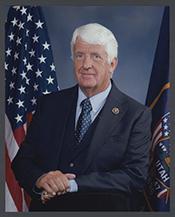 Rep. Rob Bishop (R-UT)
Description
Amendment sought to delay designation of the trail until all environmental analyses and the review required by Public Law 107-338 have been completed by the Secretary of the Interior.
Text
Offered
This amendment's own text couldn't be picked out of its Congressional Record passage, so the passage is shown in full.
NEW ENGLAND NATIONAL SCENIC TRAIL DESIGNATION ACT
The SPEAKER pro tempore. Pursuant to House Resolution 940 and rule
XVIII, the Chair declares the House in the Committee of the Whole House
on the state of the Union for the consideration of the bill, H.R. 1528.
{time} 1649
In the Committee of the Whole
Accordingly, the House resolved itself into the Committee of the
Whole House on the state of the Union for the consideration of the bill
(H.R. 1528) to amend the National Trails System Act to designate the
New England National Scenic Trail, and for other purposes, with Mr.
Lynch in the chair.
The Clerk read the title of the bill.
The CHAIRMAN. Pursuant to the rule, the bill is considered read the
first time.
The gentleman from Arizona (Mr. Grijalva) and the gentleman from Utah
(Mr. Bishop) each will control 30 minutes.
The Chair recognizes the gentleman from Arizona.
Mr. GRIJALVA. Mr. Chairman, I yield myself such time as I may
consume.
H.R. 1528 amends the National Trails System Act to designate most of
an existing trail system in Massachusetts and Connecticut as the New
England National Scenic Trail. In 2002, Congress directed the National
Park Service to study this trail for potential addition to the National
Trails System. The draft study, completed in 2006, supports designation
of the trail, with some changes to the route to address landowner
concerns. The administration has testified that no major changes in the
study are expected, and expressed support for the measure in testimony
before the Natural Resources Committee.
The trail runs 220 miles through the heart of Connecticut and
Massachusetts, past some of the most spectacular vistas and landscapes
in New England. The trail offers some of the world's best opportunities
to view volcanic and glacial geology, including fossil and dinosaur
footprints. The proposed trail also fulfills another requirement of the
National Trails System Act by being close to population centers. This
trail has over 2 million people that live within 10 miles of the route,
and this accessibility makes the trail a wonderful recreational
opportunity.
The route of the trail crosses land owned by State and local
governments and by private landowners. No Federal land is involved.
Local trails associations have obtained permission from landowners
allowing existing trails to cross their lands. If a landowner requests
that the association close the trail on his or her property, the
association honors that request. The NPS study identified no need for
direct Federal trail ownership or direct Federal trail management.
If H.R. 1528 is enacted, the role of the National Park Service in
implementing the designation would be to provide technical and
financial assistance to
[[Page H523]]
the existing trail partners, including State, tribal, regional and
local agencies, the Appalachian Mountain Club, and the Connecticut
Forest and Park Association. H.R. 1528 is cosponsored by Members
representing all the affected districts in Connecticut and
Massachusetts, and enjoys energetic support from the affected local
communities.
Mr. Chairman, this is a good bill, and I want to commend my colleague
from Massachusetts (Mr. Olver) for his commitment and leadership on
this matter. We support the passage of H.R. 1528, and urge its adoption
by the House today.
Mr. Chairman, I reserve the balance of my time.
Mr. BISHOP of Utah. Mr. Chairman, I yield myself such time as I may
consume.
I appreciate the opportunity to be here. I appreciate Mr. Grijalva as
well for joining me here on this particular bill.
There are three types of trail bills that the National Park Service
has: historic, recreational, and scenic. This happens to be the last of
those; a scenic trail. We have not done one of those since 1983. It
would seem that after 25 years, one of the things we ought to be able
to do is at least do it the right way.
In the 107th Congress, a study was mandated on this particular trail
and was not to go forward until the study was completed, the
environmental review was completed. The study has not yet been
completed. It is close to it, but not, which is, once again, one of the
reasons we will be talking in a few minutes about an amendment to say
this should go into place once regular order has taken place, the study
has been completed, and then, appropriate to our rules to move forward
at that particular time.
This particular trail has been, since 1931, done on a volunteer,
local operation. People there have automatically authorized the use of
their land, private property, for trails. It has been that way for over
70 years, has functioned well, and it should be one of those things of
which we are extremely proud in this country, that people can actually
come together and work together on a local area to do something that is
good, without the heavy hand of the Federal Government helping them
along the way. We have had 70 years of experience with that.
Now, one of the things I'd like to talk about, because I am an old
history teacher, is simply one of the things we need to do as a
Congress and as a people is to learn the lessons of history. We
obviously know the hackneyed cliche that if we don't learn those
lessons, we will repeat them. Or, as P.J. O'Rourke did a much better
corollary, he who did not learn the lessons of history probably didn't
do well in English or remedial math as well.
This Congress ought to do well in all of those, and one of those is
the potential of those lessons of history. It is from those of us in
the West who have had a sad experience dealing with Federal issues on
Federal land issues. So our good friends in the East have not had that
experience yet.
The State of Massachusetts has a grand total of 1.8 percent of its
State owned by the Federal Government. The State of Connecticut has a
whopping .4 percent of its State owned by the Federal Government. Very
little interface with the Federal Government, which may be one of the
reasons why Mr. Young of Alaska or Mr. Heller of Nevada, who stand up
with concerns, should be taken into consideration, because 90 percent
of their State is owned by the Federal Government, or Mr. Flake of
Arizona, with half of his State, over half controlled by the Federal
Government, or 70 percent of my State is controlled by the Federal
Government. And we have had, by sad experience, seen where well-meaning
and well-intentioned efforts on behalf of the Federal Government have
led to some negative and unfortunate situations.
I want to tell you one story in an issue that is different than a
trail setting. I want to talk about Gene, an old farmer, third-
generation farmer, growing sugar beets, which, by definition, is a root
crop and cannot grow in wetlands. Gene decided he would rent part of
his sugar beet land for alfalfa, and to make sure that the water, which
was going from an irrigation pipe from the creek to his land, would get
to the high point, he allowed it to pool in the lower point.
One day, one of the Federal regulators, given authority under a very
vague Federal law, came there and said that land is obviously a
wetland. Actually, what he simply said is that the Great Salt Lake is
part of our interstate commerce system, Logan Creek is part of it going
into the Great Salt Lake. Therefore, the irrigation pipe is part of the
navigable waterways of the United States, and the water is a wetland.
It didn't matter that Gene was able to get the Soil and Conservation
Corps in there to prove the land was not conducive to wetlands; didn't
matter that once he stopped the irrigation pipe, the water went away.
In fact, that same regulator from the Federal Government threatened to
throw him in jail if he actually stopped that water from going into the
navigable rivers, i.e., irrigation pipes of the United States.
The end result is that this old gentleman, who in his entire
experience in working with the Federal Government I never heard him
utter one swear word, although I did on many occasions, had his entire
heritage regulated and controlled by, not taken, because that means the
Federal Government would have had to pay him for it, instead, they
regulated and controlled it. They told him what he could or could not
do. They took away not only his heritage, but took away his pension.
They also took away his pension and legacy for his children, and, yes,
I am mad about that.
When this Congress passed the Clean Water Act, which has to be a
wonderful act; no one would be opposed to the Clean Water Act, we did
not intend to take Gene and ruin his life. But because the language was
vague, we allowed government entities to interpret it their own way,
and, in fact, we harmed that old gentleman. It's not what we intended
to do. No one wanted to do it, but, nonetheless, that citizen was
harmed.
We have already talked in the rule debate over one citizen who wanted
out of this trail system, and by the fact she had enough money and time
and determination, she was allowed to be exempt from that. Whether that
is isolated or indicative of a greater situation is what we must be
very careful of; otherwise, our good intentions will actually harm and
hurt individuals, which is not what we should be doing.
We did have testimony coming in of other people who were in this same
situation in this same area. The government should not be in the
business of harming people. We should be in the business of protecting
the little guy so that his home, his farm, his legacy is neither harmed
by anything that we will do. Too many irregularities with government
land have happened in the past to say that we can do anything less than
making sure that our language in these types of bills is specific and
direct as to what we intend to be the net product. If we say we want to
save somebody's property, we don't want to take it, it must be specific
and direct and say that; otherwise, like we had with the Clean Water
Act, people can interpret it in a different way, and American citizens
get harmed.
Mr. Chairman, under the pronouncement, the point that was made by Mr.
Grijalva at the very beginning of his motion, I would like to submit
letters into the Record indicative of individuals who have those same
problems dealing with the Federal Government. It wasn't intended for
them to be harmed, but they have been harmed and they have been
harassed in like situations.
{time} 1700
We have proposed several amendments which in all sincerity if adopted
would make us happy with this bill, and we could support it in every
sense of the word.
One of the issues deals with the concept of hunting and gun rights.
Long in the 75-year-plus history of this trail, there has been a
cooperative effort to make sure that those rights were not infringed
and that local ordinance and local concerns would be the dominant
factor. We want to make sure that that is very clear in this bill. It
is the intent of the sponsor, but we insist that the verbiage has to be
specific to make sure that that is never put into any
[[Page H524]]
question or doubt by some future Congress, some future regulator, some
future judge.
We will have an amendment also to be presented to do exactly that, to
make sure that it is very clear that is our intent, that local law will
take precedence.
We have said before that we are concerned about a potential eminent
domain loophole within this bill. We are concerned about that, and at
some time we will want to address that as we go through with this
particular debate.
April 14, 2007.
Re H.R. 1528.
Chairman Nick Rahall,
Ranking Member Don Young,
House Committee on Natural Resources.
Chairmen Rahall and Ranking Member Young: My name is
Katherine (Kitty) Breen and I am writing to testify in
opposition to H.R. 1528, the New England Trail Bill.
My family owned Saddleback Mountain and Ski Area in
Rangeley Maine. The Appalachian Trail traversed over
Saddleback Mountain and bisected the mountain's ski terrain.
The negotiation between my family and the NPS over what could
have been a simple land donation exceeded 20 years and had a
serious, long-term detrimental affect on my family, the ski
area and the surrounding community. Eventually, after
millions of dollars lost, countless hours of time from our
highest ranking state and federal public officials, strained
professional careers of an entire ``at risk'' community, and
negative health and financial repercussions for my family
members, the Saddleback Issue was resolved. For now.
I speak to you as someone who has been NPS classified as a
``willing'' seller. In reality, we were bullied, pressured,
intimidated, threatened, ignored, played with and forced. In
the end, we escaped, we are still alive, financially solvent,
and able to be grateful to those who helped us. Most land
owners who deal with the NPS administrators are not as
fortunate. For this reason, I feel a moral responsibility to
speak out.
I have previously submitted testimony on July 26, 2005
describing many of the legal details and strategies devised
by the NPS to take more land than was legally allowed or
intended by Congress. Let me just say here, that during the
entire 23-year conflict, which began in 1978 and ended in
2001, my family was acting honorably and in good faith,
trying to donate the required land to secure a permanent
passageway for the Appalachian Trail. Many offers were put in
writing, countless face to face negotiations were held (many
which were observed or even facilitated by Senators Snowe and
Collins and their staff), thousands of citizens wrote letters
and a unanimous resolution passed by the state Senate urged
acceptance of our donation offers. And yet, inexplicably, the
NPS not only refused to accept or seriously consider our
offers but in an increasingly intimidating manner, proceeded
to bully and emotionally threaten us for more.
I am opposed to this Bill because in our experience, the
authority you think you are granting the NPS, will not be
what they will implement. They will find ways to interpret
that authority in ways unforseen by Congress, to achieve
goals Congress may even be explicitly forbidding. In our
specific case, even when we were able to point out
inconsistent and incorrect intrepretations of power, even
when a sitting U.S. Senator commanded them to behave, it
became clear that no one had the oversight or authority to
stop them. Based on our experience and those of others with
whom we have spoken along the Trail, they can and will
interpret this bill and its authority inappropriately to
bully landowners.
I am writing this letter because we are not typical
landowners. On reflection, we were fortunate to have a
constellation of resources, political capital, expertise,
moral determination and luck that others would not be likely
to have. My family had another business which financed us.
Our long-standing relationship with a community which
supported us and wanted us to succeed enabled us to undertake
a grass roots campaign involving thousands of supporters. We
were lucky that all of the Maine Congressional Delegation
were honest, hardworking, reputable public servants who would
listen to us, provide neutral environments conducive to
resolution, observe injustices, and ultimately take action
that achieved resolution. Ultimately, our problem was
resolved by Secretary Babbitt himself, who worked with ex-
Senator Mitchell and Senators Snowe and Collins and
Congressmen Baldacci and Allen. Our case was resolved on the
day Clinton left office.
In sum, we had not only luck, but tremendous resources and
political pressure on our side. We cannot imagine any other
single land owner having the financial resources,
determination, intellectual capacity, political capital or
emotional/physical health to fight the NPS administrators who
use unjust tactics to achieve unintended program goals.
Following are a few examples of what we consider unjust
tactics: we experienced repeated attacks on our integrity,
often by radio in our home town. My family has a deep and
broad commitment to public service, so these attacks hurt.
While our longstanding reputation protected us from these
attacks, it was nonetheless hurtful and continues to be so.
Nothing has been unaffected: my career, my husband's career,
my family's reputation.
They also conducted biased ``scientific'' studies and
publicly vilified us regarding financial viability in order
to justify our existence. With limited resources, we were
placed in a position where we had to defend ourselves and
refute their studies instead of being able to spend what time
and resources we did have growing the business. We were shut
out from public opportunities to set the record straight
despite requests from a sitting U.S. Senator to allow us to
do so.
The negative campaign conducted trashing Saddleback's
business viability continued to have repercussions long after
the settlement. When my father retired, it was very hard for
us to convince future owners of the mountain's viability.
There were stacks of inaccurate NPS studies showing otherwise
and we had to disprove everything. Additionally, despite
verbal agreements that the NPS would not come back for more
land once we had left, the NPS refused to put such a
statement in writing.
In our experience, the NPS uses the Appalachian Trail
Conference (ATC) to do the work they are legally prevented
from doing. The two work in inappropriate partnership in this
regard. In all negotiation sessions, the ATC presented
scenarios on behalf of the NPS, and were presented to us as
representing the NPS. But agreements forged with the ATC were
then retracted by the NPS. In this way they were able to
squeeze more concessions out of us.
Showing up to negotiation sessions with no decision making
authority was another common tactic and any level playing
field requirements we requested were turned against us. For
example, they refused to negotiate at all if we required
transcripts of the negotiations and agreed upon outcomes. And
after refusing multiple invitations for negotiation during
the nine months of my pregnancy, they sent a letter to my
office a week after my son was born threatening eminent
domain if I didn't meet to negotiate immediately. Only a few
weeks later a Maine newspaper headline screamed that
negotiations were off due to my baby's ``colic''. You can
imagine how a first time mother who had left her chosen
career and worked tirelessly in good faith throughout her
pregnancy would feel.
Today, six years after resolution, we are still recovering
from the personal toll the conflict took on us. I am just now
starting to feel like the anger I developed as a result of
the Saddleback/NPS experience is starting to leave me, and
that I can begin to talk about it without negative
repercussions. Even so, I try not to talk about it or think
about it and I work to shield my 76 year old father from it.
My husband and I are grateful the sense of betrayal and anger
has finally left our house.
The general public does not want to believe that NPS
administrators are the bullies they have shown themselves to
be. But they are and as our elected officials you need to
know that. Based on conversations with other land owners, I
believe that a majority of land owners who have had to
negotiate with the NPS have similarly devastating experiences
to share.
It is hard to come forward. We still have land at
Saddleback, and fear that they will retaliate. Other people
will feel the same way. It is not in my family's best
interest to write this letter, I did not want to write this
letter, but I feel a moral responsibility to my country to do
so.
My family and the Western Region of Maine had the benefit
of an amazing constellation of resources and good luck. I can
not imagine such luck striking twice or that most land owners
would be able to withstand the indecent tactics employed by
the current NPS administration. Nor can I envision a way that
you can regulate against them once you have empowered them.
While I can support the creation of a multistate trail
system, I cannot in any way support NPS or ATC involvement in
such a cause. Please create the Trails under the State
regulators and under the guidance of state citizens with
access to State Government. Please join me in opposing NE
trail Bill H.R. 1528.
Thank you,
Kitty Breen,
Former Executive Vice President and Chief Negotiator for
Saddleback Mountain.
____
Christ the Redeemer
Catholic church,
Sterling, VA, May 18, 2007.
Hon. Don Young,
Hon. Ron Bishop,
Subcommittee on National Parks, Forests, and Public Lands,
House of Representatives, Washington, DC.
Dear Sirs: Thank you for the opportunity to express my
concerns regarding H.R. 1528, which permits the Secretary of
the Interior to administer the New England National Scenic
Trail consistent with the plan developed by the National Park
Service.
My concerns grow from my experience with the National Park
Service's administration of the Appalachian Trail while I was
Minister General of the Franciscan Friars of the Atonement
when the National Park Service attempted to seize 118 acres
of the Friar's property through eminent domain.
Background
Graymoor, Garrison, New York has been the headquarters of
the Franciscan Friars of the Atonement since 1899. The 420
acres provides housing for friars, a homeless shelter--
[[Page H525]]
St. Christopher's Inn (operating since 1909), worship, a
retreat ministry and a variety of other ministries and
programs including providing hospitality to Appalachian Trail
hikers. In the course of a year several thousand persons come
to Graymoor for shelter, spiritual renewal, to enjoy the
natural beauty, to worship or for pastoral counseling. On a
typical weekend there may be 300 to 400 visitors or several
thousand. From the beginning the Friars have always welcomed
visitors and those seeking assistance.
First Threat of Eminent Domain
The Friars permitted the Trail to cross the eastern portion
of the property at Graymoor in 1923 on a handshake agreement.
Beginning in 1980 the National Park Service requested the
trail be moved to the western portion of Graymoor, which
directly borders the area in which most of the previously
mentioned ministries and activities take place. For that
reason, the friars resisted and preferred the Trail remain in
its original location, The National Park Service threatened
eminent domain. In 1984 the Friars reluctantly agreed to
grant an easement for 58 acres and the trail was moved
from the open and natural eastern side of Graymoor to the
more built-up and busy western side.
Second Threat of Eminent Domain
During 1980's the Friars began to undertake needed and
necessary upgrading and repairs of infrastructure. This was
needed to continue St. Christopher's Inn, to accommodate
pilgrims and retreatants, and for St. Paul's Friary in which
the friars lived. The first project was the installation of a
sewage treatment plant and sewer system, Due to the fact that
Graymoor is located on a mountain, it was necessary to
install a sewage treatment pump. To house that pump, a shed
was built, about the size of a shed you would purchase for
your lawnmower and garden tools. One corner of that shed
(maybe 15 square feet at most) infringed upon the easement.
It was in this time period that the National Park Service
informed the friars that it wanted to expand the easement
from 58 acres to 118 acres in order to protect the
environment on both sides of the Appalachian Trail. The
reasoning was its mission had expanded from maintaining the
Trail to protecting its immediate environment and to protect
any further infringement by the friars as happened with the
pump shed.
As Minister General of the Friars I was opposed to this
expanded easement because our land on the western portion of
Graymoor is the area in which friars live, employees' work,
and ministries and programs take place. We considered the
land to be holy and to be used for the service of God, the
Roman Catholic Church, and the thousands who came for
whatever reason. It was my responsibility to make every
effort to ensure that we would have the needed resources for
future growth and use. To expand the easement could all too
easily hamper our ministries or future development. One
example is that the proposed new easement would have bordered
our sewage treatment plant, thus making any future upgrades
almost impossible. As an aside, since that time the new St.
Christopher's Inn and the new infirmary for the Franciscan
Sisters of the Atonement have been hooked up to the sewage
treatment plant--my concerns weren't just theoretical. Part
of the area, if confiscated by the National Park Service, was
also used for parking. We offered the National Park Service
the opportunity to switch back the Trail to the original
setting, still undeveloped, so that not only the Trail could
be maintained but that there would a natural environment for
it. The National Park Service refused this option and
threatened to proceed with eminent domain.
It was only with the active intervention of Sen. Charles
Schumer and the assistance of Representative Sue Kelly was
this issue resolved to the satisfaction of the Friars and the
National Park Service.
One of the surprising things I learned during our
negotiations with the National Park Service was the fact the
agreement for an easement could not contain any provision in
which the U.S, government would agree not to further use
eminent domain. This certainly leaves open the possibility of
more disagreement in the future if the National Park Service
expands its mission regarding the Trail or switches its
location once again.
Even though H.R. 1528 states, ``The United States shall not
acquire for the trail any land or interest in land without
the consent of the owner'', the plan mandated by this bill
does permit that. Also, efforts are being made to the states
to claim the land by eminent domain before it would come
under management of the Secretary of the Interior.
I urge the Subcommittee on National Parks, Forests, and
Public Land not to endorse this bill.
Thank you.
Sincerely,
Rev. Arthur M. Johnson, S.A.
Mr. Chairman, I reserve the balance of my time.
Mr. GRIJALVA. Mr. Chairman, I appreciate the comments that the
gentleman from Utah, the ranking member of the subcommittee, made.
There is a point of consistency, too. As we talked about the effects, I
thought we were talking about a trail bill, not a farm bill, but the
effects of the Federal Government on private land.
I would suggest that part of the consistency would be to quit
incentivizing extraction of mining claims and mining rights on private
property, that that would be consistent. It would be consistent also to
not have eminent domain and condemnation with regard to road
construction of Federal roads and energy corridors. I think that kind
of points out the fact that we are talking two different things here.
We are talking about a trail that has already been through the process
and the study and that merits our support today.
Mr. Chairman, I yield 5 minutes to the gentleman from Connecticut
(Mr. Murphy).
Mr. MURPHY of Connecticut. Mr. Chairman, I thank Chairman Grijalva,
and thank you also to Chairman Rahall and my good friend Mr. Olver from
Massachusetts for their hard work and diligence in bringing this bill
to the House floor. The process by which it comes to us started long
before I arrived here.
Mr. Chairman, in this digital age, our computers, our cell phones,
our BlackBerrys, our PDAs, they have all collapsed vast distances that
for so long have defined our lives. Continents can now be bridged in
seconds with just the touch of a button, and the miles of fiber optic
cable running beneath our feet and the satellites orbiting miles above
our heads have helped make our modern world seem much smaller and much
more compact. The idea of sending a physical letter through the mail
now seems charmingly outdated in an age where communication is measured
at the speed of light.
But in our wholesale embrace of this breathtaking new age of
technology, we sometimes have lost sight of the enduring power of the
natural world. Back in the outdoors, one is once again reminded of the
sheer immensity and the beauty of the world around us. Getting away
from our cars, getting away from our desks and laptops, thousands of
New England residents every day take to the parks, to the trails, and
to our reserves to reconnect with the natural world that thrives
quietly all around us.
I rise today in strong support of H.R. 1528, the New England Scenic
Trail Designation Act, because it will give thousands of more
Americans, many of whom reside in the Fifth District of Connecticut,
access to one of the most beautiful natural resources throughout the
Northeast.
The Metacomet-Monadnock-Mattabesett Trail, or the MMM Trail, runs
some 220 miles from the southern border of New Hampshire all the way
down to the Long Island Sound, from Royalston, Massachusetts, to
Guilford, Connecticut, cutting across the Farmington Valley towns and
the towns of New Britain and Meriden in the Fifth Congressional
District of Connecticut.
Now, this isn't some secluded, inaccessible trail. This gem runs
right through the heart of some of this district's most populous areas.
More than 2 million people live within 10 miles of the MMM Trail,
making it uniquely accessible as a recreational opportunity for hikers,
for joggers, for picnickers, and for everyone who loves the outdoors.
With this bill's passage, the MMM Trail will become only the ninth
scenic trail designated in the 40-year history of the national trail
system, joining the likes of the Appalachian Trail and the Continental
Divide Trail throughout the country as these national scenic recognized
trails.
Until now, the MMM Trail has been maintained through the generosity
of private donors, through natural preservation groups and landowners
who have allowed people to pass through the trail of their own accord.
With Federal recognition, the trail will have access to grants and to
resources that will help with its maintenance, with its preservation,
and with public awareness.
The hundreds of thousands of Connecticut and Massachusetts residents
who have enjoyed the MMM Trail over the past half century will be
joined by scores of new visitors coming to enjoy its breathtaking
vistas, its distinctive flora and fauna, and its rich history. And
those who have enjoyed the MMM Trail in the past will now be assured
that the trail will be protected for future generations, while ensuring
that the trail is actively maintained and cared for for all.
Perhaps the most important backers of this trail are the thousands of
nature lovers who have hiked and enjoyed the MMM Trail for decades.
Just today,
[[Page H526]]
Adam Moore, the director of the Connecticut Forest and Park
Association, wrote me. He said: ``It's thrilling to me to think that
this beautiful trail that I once hiked with my father could now become
a scenic trail. I recall dangling my legs off the rocks of Mt. Pisgah
in Durham while my father pointed out the gold building in Hartford
some miles away gleaming in the distance. It is so inspiring to think
that this trail in my home community could merit national status and
recognition and that people will be able to enjoy it for years to
come.''
Mr. Chairman, I would like to submit at the conclusion of my remarks
several such testimonials for the Record.
Mr. Chairman, as chairman of the Congressional Land Conservation
Caucus and a representative of the thousands of Connecticut residents
who lie along the MMM Trail, who have enjoyed it for years and will
enjoy it for years to come, I hope that the House will join me in
recognizing and protecting this beloved trail for future generations. I
urge my colleagues to vote in favor of H.R. 1528 and join me in the
near future for a hike through the beautiful hills of New England.
Simsbury Land Trust,
Simsbury, CT, January 21, 2008.
Representative Christopher Murphy,
Cannon House Office Building,
Washington, DC
Dear Representative Murphy: We want to thank you for your
time and comments January 12 at the Avon Community Center. It
is easy to start thinking of our local challenges in a vacuum
and it is useful to have an opportunity like your visit
provided to sit down with others and to look at the bigger
picture. We also appreciate your offer to help should we
think your office could be of assistance in working with
federal programs. I actually plan to send some ideas and a
request this winter.
In the meantime, we wanted to get this thanks to you and
also to respond to your comments regarding the New England
Scenic Trail Designation Act and recognition of the MMM
Trail. We could not agree more with you that this is vitally
important. As you know, the MMM Trail runs through Simsbury
as well as other Farmington Valley towns. It is the most
heavily used trail in this town as well as in neighboring
towns. It is easily accessible to the Greater Hartford area,
it has spectacular views of both the Farmington River Valley
to the west and the Connecticut Valley to the east and it is
rugged enough to be both physically and intellectually
challenging.
Over many years the State of Connecticut, towns and land
trusts along the trail have acquired large sections of the
ridge over which the trail runs. However, there are still
important sections that all of us continue to work on. We
know well from experience along this trail as well as others
that trails are under continual pressure as development along
the hillsides crowds out this historical use. This trail is a
regional and national treasure that gets heavy public use by
local residents and visitors alike. National scenic
designation will be a valuable tool and will be a great help
in assisting regional efforts to maintain this resource for
years to come.
Thanks again for your recent visit.
Sincerely,
Richard A. Davis,
President.
____
January 28, 2008.
Congressman Christopher S. Murphy,
Cannon House Office Building,
Washington, DC.
Dear Congressman Murphy: On behalf of the Connecticut
Forest & Park Association, I am writing to express our strong
support for H.R. 1528, the New England National Scenic Trail
Designation Act. This bill would designate the Metacomet and
Mattabesett Trails in Connecticut, and the Metacomet-
Monadnock Trail in Massachusetts, as the New England National
Scenic Trail. We strongly support this legislation as it
would greatly enhance the opportunities for the stewardship
of these trails while leaving the fundamental, voluntary
nature of this trail system intact.
The Connecticut Forest & Park Association established the
Metacomet and Mattabesett Trails in Connecticut in 1931, and
our volunteers have maintained them as open-to-the-public
hiking trails ever since. The Association would still
maintain these trails in Connecticut if designation occurs.
With funding and assistance that could come from National
Scenic Trail designation, we would be better able to work
closely with landowners and towns, post signs, construct
trailhead kiosks and parking areas and improve the condition
of the trail for owners and for the walking public.
Furthermore, we believe that National Scenic Trail
designation would enhance the prospects for willing seller
land conservation along the trails.
I further note that the primary goal of the National Trails
System Act states that ``trails be established primarily . .
. near the urban areas of the nation.'' With two million
people living within ten miles of this trail, the proposed
New England National Scenic Trail certainly meets this goal,
perhaps better than any other National Scenic Trail.
Thank you very much for your support of the New England
National Scenic Trail Designation Act.
Sincerely,
Adam R. Moore,
Executive Director.
____
State of Connecticut,
Executive Chambers,
Hartford, CT, January 29, 2008.
Congressman Christopher Murphy,
Cannon House Office Building,
Washington, DC.
Dear Congressman Murphy: I am writing to express my support
for the New England National Scenic Trail Designation Act.
Amending the National Trail System Act to designate the
Monadnock, Metacomet and Mattabesett (MMM) Trail System as
the New England National Scenic Trail, will generate the
necessary increased levels of attention and resources to
ensure the long-term viability of the MMM Trail System. I
believe that this designation is an important step in
preserving the unique character and quality of life that we
enjoy in our states.
The 825 mile MMM trail system forms a backbone supporting
our state's ecological, historic, scenic and economic
resources. More than two million people live within ten miles
of the trail system. As development continues to change our
landscape, unprotected portions of the MMM Trail System
continually experience increasing pressures. The Connecticut
Forest & Park Association established the Metacomet and
Mattabesett Trails in Connecticut in 1931, and through the
hard work of volunteers and the good will of private
landowners, these trails have remained open to the public but
are greatly at risk. The legislation will help to protect
this regional treasure for generations to come.
I am confident that the MMM Feasibility Study's goals we
identified in collaboration with the Massachusetts Department
of Conservation and Recreation can be brought to fruition.
Thank you for your continued leadership on this issue.
Sincerely,
M. Jodi Rell,
Governor.
____
Dear Sirs: The Avon Land Trust strongly supports H.R. 1528,
the New England Scenic Trail Designation Act, because open
space preservation is an increasingly important issue in
Connecticut and scenic trail designation conserves open space
and promotes the use of that space. Hiking is a low cost, low
key recreation that gets the public, especially families,
outside to see nature firsthand.
As more land is developed in Connecticut, habitat is
reduced but trail systems protect wildlife corridors crucial
to many species. This particular trail system is located on
ridge line, which helps preserve the appearance of these
highly visible geological features in the Farmington Valley.
Regards,
Robert Breckinridge,
President, Avon Land Trust.
Mr. BISHOP of Utah. Mr. Chairman, I yield such time as he may consume
to the ranking member of the Natural Resources Committee, the gentleman
from Alaska (Mr. Young).
(Mr. YOUNG of Alaska asked and was given permission to revise and
extend his remarks.)
Mr. YOUNG of Alaska. Mr. Chairman, first let me thank the ranking
member of the subcommittee for his excellent presentation on this
legislation, and, yes, the chairman, too. There is just a matter of a
difference of opinion.
Again, the majority on that side is more interested in creating
recreation and amusement opportunities than creating jobs and
affordable energy. It is ironic to me that one of the States, in fact
both of the States, named in this bill, none of their Representatives
or their Senators have ever voted for any energy development, not one
time. And consequently, they are paying, their constituents, a
tremendous price for energy they are consuming.
Just last week, the Boston Globe published a story that said:
``Massachusetts manufacturers pay the highest electricity prices in the
Continental United States,'' thus discouraging industry coming into the
State. In fact, it is leaving.
A 200-year-old paper mill in Lee, Massachusetts, was shut down
because of high energy costs, a loss of 160 jobs. Now, some of these
workers may get an opportunity to be retrained to cut brush on the
trail we are trying to set aside today. Of course, that pays the
minimum wage.
It is ironic to me that this was all caused by a lack of action in
this Congress. New England needs energy; and if I can remind this body,
and good morning, Mr. and Mrs. America, that is our number one problem
in this country today, is energy. That side of the aisle, not only the
side of the aisle in the House but also in that other body, now because
of you, we are importing--
[[Page H527]]
Announcement by the Chairman
The CHAIRMAN. The gentleman will please direct his remarks to the
Chair.
Mr. YOUNG of Alaska. In what line? What did I say wrong?
The CHAIRMAN. While speaking in the second person. The gentleman
pointed to the other side.
Mr. YOUNG of Alaska. I will point to you next time.
We are importing 12 million barrels a day from our enemies, thanks to
you; 12 million barrels a day, at $100 a barrel. Mr. and Mrs. America,
remember, $1.2 billion a day we are sending overseas because of the
majority not supporting energy development. That is $438 billion a year
that we are sending overseas, to not our friends, but to our enemies,
the Chavezes, and to the Iraqis, the Kuwaitis, Saudi Arabia, and, yes,
a little bit to Russia, because we don't have the courage to develop
our oil and our fossil fuels in this country, thanks to the majority.
And we just voted on a stimulus bill today. Big deal. If you are
taking that up, $438 billion a year, we are imposing a $1,460 tax on
every man, woman, and child in America every year because the majority
will not support energy legislation. Oh, you are going to support a
trail today, taking taxpayer dollars again for recreation, but you will
not support energy in this country. And this Congress, especially the
majority side, has never, ever supported energy production in this
country of any type, nuclear, even wind power, and certainly not fossil
fuels.
That is what is wrong with this Nation today. We are bleeding the
economy from our bodies to support overseas countries for fossil fuels
which we have on our shores, on our shores and off our shores. We are
disallowed from developing the Rocky Mountains. We are disallowed from
drilling off the coast of California. We are disallowed from even
drilling off the coast of Alaska. And, of course, the majority will
never support opening ANWR, which has 39 billion barrels available for
America.
And for those out there, my colleagues, every time you fill your gas
tanks, it doesn't hurt you too bad. But Mr. and Mrs. America as they go
to work are being taxed by you. The stimulus package, everybody might
get $1,000. But remember, everybody is going to be taxed this year
$1,460, every man, woman, and child in America, because this Congress
on the majority side doesn't have the courage, the courage nor the
wisdom, to develop necessary energy in this country which we have.
I ask you, when are you going to wake up? When is this body, and even
the Presidential election that is going forth today, I don't hear
anybody talking about developing energy sources. I hear about
conservation and light bulbs made in China and filled with mercury.
Wait until you try to dispose of those, Mr. and Mrs. America, and see
what happens. I say shame on us.
This bill today is a trail that people say they need and they want.
But I suggest, respectfully, if you don't address the energy bill, you
will never be able to have anybody walk on it. You might as well make
your highways into trails, because you won't be able to run your
trains, your planes, your automobiles, or your ships.
And that is the economy of this country. That is the economy of this
country. If you can't move product to and from, if you don't have the
energy within your factories to produce those products and hire the
people, you don't have an economy. You don't have an economy. You don't
have an America. You don't have freedom. You don't have the Nation of
the United States of America.
We were made great because we had a source of energy. We were made
great because we had hydro and we had fossil fuels, the coal that drove
our steel mills and produced the greatest war machine to stop World War
II in history. We used our coal because we needed it. We had it and we
did it. Not today. You can't do it.
So, as I say, Mr. Chairman, this Congress has a tremendous
responsibility and you are not living up to it. You passed an energy
bill that produced nothing but hot air. Nothing. Conservation, yes, we
are all for that. But it had no production in that bill of any source
of energy. And yet we say we passed an energy bill.
It will come back. It will haunt you. And some day down the line your
grandchildren and all those around you and their grandchildren will
say, what was Congress thinking about? The greatest Nation in the
world, the greatest Nation in the world became a third-class country.
The greatest Nation in the world, because we didn't produce our energy.
We didn't provide for the future generations.
And for those that don't agree with me, thank God these words are
going down. And some day along those lines they will say, you know, the
gentleman from Alaska had a point that they should have listened to,
but they did not. It is too bad they didn't, because we are where we
are today, not the democracy that they were then and not the greatest
Nation in the world, in fact a third-class country.
Mr. GRIJALVA. Mr. Chairman, I yield 3 minutes to the gentleman from
Connecticut (Mr. Courtney), a cosponsor of this legislation.
{time} 1715
Mr. COURTNEY. Mr. Chairman, I want to start by first of all thanking
Chairman Grijalva who during this 110th Congress has shown that he is a
true friend of the State of Connecticut with his advocacy on the 8-Mile
River bill and now for the MMM Scenic Trail bill.
I also want to recognize Congressman Olver for his hard work on this
issue, and Congressman Murphy and the other cosponsors of this
legislation.
People are extremely excited who live in the area that will be
affected by this trail. Again, I think it will be a wonderful step
forward for New England. And as Chris said, reconnecting with its
terrific natural beauty and natural heritage.
Four of the towns which this trail goes through touch Connecticut's
Second District. Suffield, Durham, Haddam and Madison, at various
points on the map that Congressman Murphy presented, are part of the
national scenic trail.
This is a system, to sort of get back to the bill before us today and
maybe away from some of the global issues which were just discussed, it
was a system created in 1968. Twenty-three trails have been given
designation by Congress during the last 40 years in a very nonintrusive
way with no damage done to people's property rights, but in a way that
is a partnership relationship between the Federal Government and local
landowners and communities.
It is my understanding that the Governor of the State of Connecticut,
Governor Rell, a Republican, is supporting a letter in support of the
legislation. I think that is indicative of the feeling of the
communities that are touched by it, certainly in the State of
Connecticut, and particularly by the private, nonprofit Connecticut
Forest and Park Association, which Mr. Bishop gave great praise to, and
they deserve it for the work that they have done over the many years.
But I think it is important that when we talk about the work that
they did, they are vigorous advocates and supporters of this
legislation because they see it as consistent with the mission that
they have carried out for 75 years, to keep the trail accessible to
families, to individuals from all over the world. They deserve, I
think, the biggest credit for their support for this legislation over
the last few years.
Finally, I want to say in response to the prior speaker, the Members
of the U.S. Senate from the State of Connecticut did support production
of new sources of energy in the energy bill which was sent to the
Senate. Production tax credits for geothermal wind and solar were paid
for by taking away tax breaks for oil companies. Unfortunately, the
opposition party in the Senate stripped those critical, important,
necessary changes that our country is yearning for. We in the Northeast
are as committed as any part of the country in terms of the need to
transform our energy system so we will have a thriving economy that
will be there for our children and our grandchildren.
Mr. BISHOP of Utah. Mr. Chairman, I would like to talk about one
other potential problem with this particular bill. It is not really a
problem, but it is a concern that needs to be addressed in some
particular way.
We have talked a great deal over the past year about the concept of
PAYGO.
[[Page H528]]
This bill does not have a PAYGO concern; the committee said it did not
because it does not specifically appropriate money. However, it does
authorize the use of money, and in the bottom line from what people
would be saying at the kitchen table, it costs money.
This bill will actually cost $2 million. Not a huge sum, kind of a
rounding error in our government, but it is still $2 million. The money
is not having to be offset under PAYGO earmarking accounting rules.
However, it is still money that has to be spent, and it has to come
from somewhere else.
Where it will come from is the Parks Department budget which will
then take it from other projects. It is one of the spinoff effects
every time we add a new measure that the Parks Department has to
administer, has to pay for and has to run. That is one of the concepts
that we have.
I mention that simply because we have crying needs in the Parks
Department today. I would like to mention specifically this building.
It is not in my district; it is Mr. Matheson's district in my State.
But it is a brilliant building at Dinosaur National Monument. I went
there with my kids. I have been there before several times with other
kids. It is a wonderful opportunity for people to see bones exposed in
the mountainside itself. It is a great learning experience with one
problem: it is condemned. And we don't have the money in the parks
system to fund it, to fix it.
This is one of those issues here. It is only $2 million for this
trail. It is only a little more administrative responsibility and a
little bit more land. But the problem we have is it comes from
somewhere. It comes from these types of problems, these types of issues
and determinations that need to be made.
Even though it doesn't have to be offset by PAYGO rules, it has to be
funded somewhere and that is going to come out from other needs that
are in the Park Service that will continue to be minimized as we expand
the assets that this government has and we expand the programs that the
Parks Department actually has to run.
Mr. Chairman, I reserve the balance of my time.
Mr. GRIJALVA. Mr. Chairman, I yield 3 minutes to the gentlewoman from
Connecticut (Ms. DeLauro).
Ms. DeLAURO. Mr. Chairman, I am delighted to rise in support of H.R.
1528, the New England Scenic Trail Designation Act, which would
designate portions of the Metacomet-Monadnock-Mattabesett, or the MMM
Trail System, as a national scenic trail.
I commend Representative Olver for his leadership on this issue, and
I thank him for bringing the entire region together to make this
happen.
This is a simple commitment to act as responsible stewards of our
natural resources. We have an obligation to our communities and to
generations that follow to preserve our Nation's scenic beauty,
wildlife, and outdoor recreation.
Now we have the opportunity to make good on that great promise, every
step of the way along the 190-mile MMM trail system as it winds through
39 communities in central Connecticut and Massachusetts.
The trail route, which has been in existence for over half a century,
hosts numerous scenic features and historic sites. But more than that,
this unique trail passes through some of the most densely populated
parts of the country, 2 million people live within 10 miles of the
trail, and offers users exceptional recreational opportunity near urban
areas.
That is why this legislation is so critical. By protecting against
increasing pressures from residential subdivision growth, national
scenic trail designation will provide an opportunity for long-term
viability.
It will offer residents safe, healthy recreation options free of
smog, congestion, and stress. In an age when we are constantly trying
to combat sprawl in our communities, we need to recognize that these
kinds of projects are a real investment in our communities and in
community spirit alike. I urge a ``yes'' vote.
Mr. BISHOP of Utah. Mr. Chairman, I reserve the balance of my time.
Mr. GRIJALVA. Mr. Chairman, at this time I would like to yield to the
sponsor of this legislation, the gentleman from Massachusetts (Mr.
Olver) such time as he may consume.
Mr. OLVER. Mr. Chairman, I am not quite sure how long my voice will
hold out, so I will probably be fairly short.
I just want to commend the chairman of the full committee, Chairman
Rahall, and the chairman of the subcommittee, Chairman Grijalva, and
thank them for all of their great work in bringing this bill to the
floor.
The New England Scenic Trail Designation Act is a product of almost a
decade of cooperation between the Massachusetts delegation and the
Connecticut delegation, and both delegations have changed over that
period of time, the National Park Service, the Appalachian Mountain
Club, the Connecticut Forest and Park Association and a lot of local
communities and individuals.
The bill designates major portions of an older, voluntary Metacomet-
Monadnock-Mattabesett trail system as a national scenic trail. Now, I
have hiked every mile of the old voluntary system through
Massachusetts; and while some segments are very well protected, other
sections have suffered serious encroachment. National scenic trail
designation will provide an opportunity for long-term preservation for
future generations.
Currently, the MMM trail system is administered by local nonprofit
organizations: the Connecticut Forest and Park Association in
Connecticut and the Appalachian Mountain Club through its Berkshire
Chapter in Massachusetts. The Connecticut Forest and Park Association
in fact is a private nonprofit organization which contracts with the
State of Connecticut to run the trail systems in all of their public
parks, so it is a very reputable organization which has been there for
a long time and has a huge number of volunteers who work on it, and it
works closely with the State of Connecticut. I want to recognize and
thank the many volunteers and staff of these organizations who have
worked diligently to help develop this initiative. Because of their
effort, every Member through whose district this trail system passes
supports this legislation.
In the case of Massachusetts, the Appalachian Mountain Club has over
time been sort of a sponsor for the trail within Massachusetts, the old
voluntary trail, not only this trail but other trails within
Massachusetts. In Massachusetts, the land passes through at least four
substantial State parks or State forests so that much of the land is
already publicly owned by the State of Massachusetts, but there are
connections between those publicly owned pieces of land and there are
visitor centers and park facilities and so on at a rather convenient
distance for hiking purposes, for day hikes or overnight camp-type
hikes along the way.
Now, I understand that some Members have expressed concerns that this
bill will infringe upon landowner rights and allow the National Park
Service to seize lands through eminent domain. Well, the Federal
Government does not own any land anywhere in the area that the trail is
intended to go, following the old voluntary trail, and then some
additional territory that has to be worked out by the Connecticut
Forest and Parks Association in order to reach the Long Island Sound.
There is no expectation of there being any Federal land there. It was
never intended there would be federally owned land. Whatever protection
of the land would be held by the Park Association or on behalf of the
State of Connecticut. And in Massachusetts, the same thing is basically
true.
No one wants to establish Federal ownership of a corridor. In
recognition of that, in the legislation we added the language: ``The
United States shall not acquire for the trail any land or interest in
land without the consent of the owner.''
Yet the argument keeps coming back that that doesn't protect people.
Well, maybe the language of the motion to recommit will satisfy that. I
think it is completely redundant with what is already there and
certainly in total keeping with the intent not to have any Federal
ownership of land in that area.
The blueprint for the management of the trail specifically states
that all existing landowner uses and rights, including hunting,
fishing, timber management and other recreational activities, will
continue to be at the discretion of the landowners.
[[Page H529]]
Throughout the process, protection of private property has been of
the utmost concern, and I believe we can accommodate the concerns of
all landowners and continue to provide a scenic, protected path for
public use as the New England National Scenic Trail. There is wide
support for this designation. I would submit for the Record a March 25,
2007, Boston Globe editorial and a letter of support from the
Massachusetts Secretary of the Executive Office of Energy and
Environmental Affairs, Ian Bowles.
[From the Boston Globe, March 25, 2007]
From Monadnock to the Sound
Home to some of the most spectacular sections of the
Appalachian Trail, New England could gain a new interstate
hiking trail that is closer to the region's population
centers. U.S. Representative John Olver of Amherst filed a
bill this month to create a New England National Scenic Trail
that could one day stretch from Mount Monadnock in New
Hampshire to the Long Island Sound at Guilford, CT.
For 190 miles of the 220-mile distance, the trail would
roughly follow the route through the Connecticut River Valley
of the existing Monadnock, Metacomet, and Mattabesett trail
system in Massachusetts and Connecticut. The principal
addition would be a 14-mile spur from the southern end of the
Mattabesett in Connecticut to the shoreline in Guilford.
The state of New Hampshire chose not to join Connecticut,
Massachusetts, and the U.S. Department of the Interior in the
feasibility study for the new trail, but Olver's bill would
encourage Interior to work with New Hampshire and private and
public organizations in that state to include the stretch
from Royalton, Mass., to Monadnock's 3,165-foot summit in the
national scenic trail. Nationwide, there are already eight
such trails, including the Appalachian and the Pacific Crest.
Within 10 miles of the new trail live 2 million people.
Many already use--and do maintenance work on--the existing
stretches. At a time when young people, in particular, need
more recreational opportunities to ward off the health
problems of obesity, the national scenic trail designation
should increase the path's popularity. It should also help
protect it from development pressures. Much of the trail is
on state forest or park lands near the river valley's farms,
forests, tobacco barns, and towns.
Monadnock itself has 40 miles of maintained foot trails and
is considered to be the second-most-frequently hiked summit
in the world, after Japan's Mount Fuji. Three of the
Massachusetts peaks on the new trail include Mount Grace,
Mount Holyoke, and Mount Tom. The new trail includes a wide
range of natural habitats and is close to more than 50
registered village historic districts. Hikers could pass over
volcanic, sedimentary, and glacial rock and observe fossils
and dinosaur footprints.
The goal of planners is that the scenic trail will have a
single trail blazing system, but with few through hikers,
since overnight camping would be permitted in only a limited
number of locations. Of course, decades ago planners of the
Appalachian Trail did not envision through hikers for its
2,175-mile length, either. Congress should designate the path
as a new national scenic trail and let the walking public
decide how best to use it.
____
The Commonwealth of Massachusetts, Executive Office of
Energy and Environmental Affairs,
Boston, MA, January 28, 2008.
Hon. Raul Grijalva,
Chairman, Subcommittee on Natural Parks, Forests, and Public
Lands, Committee on Natural Resources, Washington, DC.
Hon. Rob Bishop
Ranking Member, Subcommittee on Natural Parks, Forests, and
Public Lands, Committee on Natural Resources, Washington,
DC.
Dear Chairman Grijalva and Ranking Member Bishop: On behalf
of the Commonwealth of Massachusetts, I write to ask for your
support of H.R. 1528, the New England Scenic Trail
Designation Act, which would designate the Metacomet
Monadnock Mattabesett (MMM) Trail System as a National Scenic
Trail.
Under H.R. 1528, the newly established New England National
Scenic Trail would extend approximately 220 miles, from
northern Massachusetts through Connecticut, incorporating
most of the MMM Trail System and hosting an array of classic
New England scenic landscapes and historic sites. In
Massachusetts, the MMM Trail is one of our most significant
and threatened long-distance trails and greenways, linking
and connecting vital state parks and other public lands and
landscapes.''
By designating the MMM Trail System a National Scenic
Trail, the National Park Service would provide important
leadership and support to the public and private landowners
who host the trail and the dedicated volunteers who sustain
it. Importantly, the bill represents the culmination of years
of outreach and discussion with local landowners and other
interested parties, with all owners afforded the opportunity
to have the trail rerouted at their request.
In designating the MMM Trail a National Scenic Trail,
Congress would be providing a significant boost to local
efforts to further the trail's long-term viability, and a
great service to the hundreds taking advantage of this
wonderful resource. I urge your support for this important
effort.
Sincerely,
Ian Bowles.
{time} 1730
It's my hope that H.R. 1528 will establish permanent protection for
this unique and majestic land and ensure that future generations will
be able to enjoy a great national treasure.
Mr. BISHOP of Utah. Mr. Chairman, I yield 2\1/2\ minutes to the
gentleman from Connecticut (Mr. Shays), one of the cosponsors of the
bill. Hopefully by the end of this day we can accept some amendments
that would make all of us happy with this particular bill.
Mr. SHAYS. Mr. Chairman, I rise candidly as the only Republican in
all of New England to support H.R. 1528, the New England Scenic Trail
Designation Act, and thank Congressman Olver for bringing this
legislation to the floor.
H.R. 1528 would designate portions of the existing Metacomet-
Monadnock-Mattabesett Trail System for a national and scenic trail. For
over 50 years the States of Massachusetts and my home State of
Connecticut have partnered with the Appalachian Mountain Club and the
Connecticut Forest and Park Association to manage these beautiful
trails and footpaths. Volunteers and private landowners have enjoyed
these lands and maintained them. This legislation would not change that
relationship.
This bill also protects private landowners by prohibiting the
National Park Service from taking any land by eminent domain. The park
service has no authority on local zoning issues that might affect
national scenic trails.
H.R. 1528 provides the resources and knowledge of the National Park
Service and the National Scenic Trail System for the long-term upkeep
of this important trail and extends Federal recognition to trails that
have existed for over half a century.
My colleagues in the West often criticize those of us from the East
for wanting to increase public lands at the expense of private
ownership. This does not do that.
In Connecticut, more than 2 million people live within 10 miles of
the trail system. Among the pressures of industrialization that we see
in the East, H.R. 1528 is an opportunity to protect this precious
resource for future generations and protect it for all of those in this
country, not just those nearby.
I ask my colleagues to support protection of this regional treasure,
and I urge a ``yes'' vote on H.R. 1528.
Mr. GRIJALVA. Mr. Chairman, at this time I yield 2 minutes to the
distinguished gentleman from Connecticut (Mr. Larson).
(Mr. LARSON of Connecticut asked and was given permission to revise
and extend his remarks.)
Mr. LARSON of Connecticut. Mr. Chairman, I thank the gentleman from
Arizona for his leadership, and I rise in strong support of this
legislation.
But I especially want to commend Congressman Olver for his dedication
and hard work. I think most people in this Chamber recognize John Olver
as somewhat of an academician and someone who certainly knows the
workings of the Appropriations Committee, but few probably know that
he's an avid hiker. And next to Henry David Thoreau, from
Massachusetts, probably is as close and akin to nature as anyone in the
United States Congress. And so this is something that he has worked on
a long period of time, at least since I've been in the United States
Congress, and I want to commend him for his hard work, and especially
commend Chris Murphy from Connecticut as well for his work in this
district.
I'm proud to say that this trail runs all the way through from
Massachusetts to the Sound, and the Governor of the State of
Connecticut has fully endorsed this matter, and it impacts the
communities in my district of East Granby, Bloomfield, West Hartford,
Southington, Berlin, Middleton. More than 2 million people, as you've
heard other members come to the floor and enumerate, are going to be
fortunate enough to share the values that we derive from going out and
hiking and
[[Page H530]]
being able to be part of this unbelievable MMM Trail that will be
provided for our constituents and citizens. So I stand in strong
support of this bill and thank Mr. Olver again, and again, kudos to
Chris Murphy for his hard work making sure that this came to the floor.
Mr. BISHOP of Utah. Mr. Chairman, I wish to address one last element
of this particular bill. As I've said, it is my hope that with some of
the amendments that can be passed or added, some modification, this can
be a very, very good bipartisan bill.
There is one concern I have that I want to specifically address, and
it's been talked around the edges by everyone, but it is the concept of
eminent domain. I have said before, in the original remarks, that
oftentimes as a government we do things not intending to actually harm
people, but that's the net result. And unless we are crystal clear on
the language that what we intend to do is what will happen, that
sometimes, down the road, tends to be the net result, and I want to try
to avoid this in this particular trail situation.
The National Park Service is unique in that it does have condemnation
power. This is an amendment to the National Trails System Act. The
condemnation power within that act is not modified in any way. The
language is there. It stays. It's not terminated. It's not finished in
some particular way.
It is the intent, I assume, and I believe of the sponsor of this
legislation, that condemnation would not be used on any of the private
lands within this trails system. I think he's very sincere and
legitimate in that. That is our effort as well. But the text of the
bill, the amendment to the total act, is not crystal clear as to that
point.
What they have tried to do in the text of this bill is say that land,
if it's going to be taken over by the park service, would have to come
from willing sellers. That is an effort to try and stop the Federal
Government from using the condemnation power to take over land.
The problem is, though, is the definition of ``willing seller''
sometimes gets murky as time goes on, and what is specifically not
allowed in the bill, or not solved, not clearly stated in the bill is
what I call the loophole. It's that even though the Federal Government
would have to buy from only willing sellers, State and local
governments would not. State and local governments could condemn the
property, and then they could become the willing seller. And as the act
encourages the National Park Service to accept or acquire property,
that is a way around the concept of what we're talking about. And I
don't think that's what the sponsor intended. I'm not trying to put
words in his mouth. Clearly, by the testimony in front of the
committee, I don't think that's what he intended. I don't think that's
what the committee intended to see happen. I know that is what we fear,
and I know we do not want that to be the concept taking place. What we
need is very succinct and crystal clear language that said that no land
will be accepted by the Federal Government if any of it was taken by
the concept of eminent domain. So whether the Federal Government tries
to use eminent domain or whether the State and local government uses
eminent domain and then the State becomes the willing seller to give it
to the Federal Government, that will not be a way our citizens will be
treated in this trails system. That language is important to me. I
think it's important to our side. That is what I talked about in the
protection of the little guy who may not even know this is going to be
imposed upon him. In this post-Kelo decision world, those kinds of
concepts become important. If this issue was to be solved, it would be
one of the things that I think would solve any other kind of
acrimonious debate that would go forward. A couple of issues. This is
one of the key ones. It's one of the important ones. And I bring that
up because I know the language was put in there to prohibit the Federal
Government from using eminent domain, but there is still a loophole, so
the Federal Government could end up with land that had been condemned
by the second party, which would be the State and the local
governments. We should be very crystal clear that we do not wish to do
that.
One of the amendments proposed to the Rules Committee said
specifically that no land would be taken that had been acquired through
eminent domain. That's one of our concepts. That's one of the
principles. That's one, I think, of the elements that I think is
significant.
Mr. Chairman, I yield back the balance of my time.
Mr. GRIJALVA. Mr. Chairman, it's a good piece of legislation, well
crafted, well worked. Many of the doomsday scenarios we've heard about
condemnation have no relationship to this legislation. I would urge its
adoption.
Mr. RAHALL. Mr. Chairman, I rise today in strong support of H.R.
1528, introduced by our friend and colleague, Representative John
Olver.
This is a straightforward bill which would enhance the protection and
interpretation of a network of trails that have been in existence for
more than 50 years. This trail system is extremely popular and is
managed and maintained by an enthusiastic army of volunteers.
The route that would be added to the National Trails System carries
hikers through the heart of Massachusetts and Connecticut, past scenic
vistas, unique geological formations, dinosaur footprints, and rare
plants and animals. The trail provides recreation and relaxation for
visitors from near and far, and valued open space for the many
communities along the way.
H.R. 1528 has strong, bipartisan support and is important not only to
the people of Massachusetts and Connecticut but also to visitors from
around the world wishing to experience the beauty of New England on
foot.
Given the popularity of the existing trail and the support for a
federal designation, it is surprising that anyone would oppose H.R.
1528. In our view, such opposition is based on a misunderstanding of
this legislation.
In the first place, the bill is based on a National Park Service
study that found no need--let me repeat--no need, for direct Federal
trail ownership or direct Federal trail management. The trail will be
managed by state and local groups under cooperative agreements with the
National Park Service.
Further, the bill itself expressly states, and I quote: ``The United
States shall not acquire for the trail any land or interest in land
without the consent of the owner.''
It is perfectly clear that this bill does not threaten property
rights. In fact, the trails groups who have managed this trail network
for half a century or more have gone out of their way to avoid those
conflicts. There is no Federal land involved, and no Federal
acquisition anticipated.
I strongly support this bill, and I want to take this opportunity to
thank the bill's sponsor, Representative Olver, for his hard work on
the legislation, as well as his nine cosponsors from Connecticut and
Massachusetts.
In the end, this is about providing Federal recognition and support
to local, non-profit, volunteer organizations who want nothing more
than to help people take an enjoyable walk through the woods. I urge my
colleagues to support H.R. 1528.
Mr. MARKEY. Mr. Chairman, I rise today in strong support of H.R.
1528, the New England National Scenic Trail Designation Act. This
important legislation would amend the National Trails System Act of
1968 to designate a 220- mile long National Scenic Trail through
Massachusetts and Connecticut. Designation as a National Scenic Trail
will allow this important regional trail system to be supported,
maintained, and protected at the highest possible level.
The bulk of this new trail would be comprised of the existing
Metacomet-Monadnock-Mattabesett trail system--a 190-mile trail route
through 39 communities in Massachusetts and Connecticut. This important
regional recreation system has been in existence for more than fifty
years and winds its way from the border of Massachusetts and New
Hampshire through western Massachusetts and into Connecticut.
Designating this trail system as a National Scenic Trail will ensure
that future generations of New Englanders will be able to fully enjoy
the tremendous beauty of these trails and take advantage of their many
recreational opportunities. Right now, more than 2 million people live
within 10 miles of the Metacomet-Monadnock-Mattabesett trail system. As
a result, this designation will not only allow millions of people to
have access to the trail system but also ensure that it will be
properly preserved from the threats and pressures of development and
encroachment.
H.R. 1528 requires that the Secretary of the Interior administer the
trail consistent with the recommendations of the National Scenic Trail
Feasibility Study and Environmental Assessment that was conducted by
the Department of the Interior. The legislation also ensures that no
land can be incorporated into the trail system without the consent of
the landowner, and I am pleased that the Administration has testified
in support of this important legislation.
[[Page H531]]
This National Scenic Trail designation would provide for increased
cooperation between communities, citizens and the Department of
Interior to conserve these special routes and expand the recreational
opportunities of this New England treasure. I urge passage of the bill.
Mr. LARSON of Connecticut. Mr. Chairman, as a cosponsor of the New
England Scenic Trail Designation Act, I rise in strong support of this
very important bill.
Connecticut is proud to be home to part of the Metacomet-Monadnock-
Mattabesett Trail System, a beautiful nature trail that runs 190 miles
from Massachusetts through Connecticut to the Long Island Sound. First
established in 1931, the 700-mile long Blue-Blazed trail network in
Connecticut join the Metacomet-Monadnock trail system in Massachusetts,
a trail laid in the late 1950s. The trail is a vital part of the
natural beauty and recreational activity of the First Congressional
District of Connecticut, as well as the other parts of the state and
neighboring Massachusetts. This distinctive trail passes through one of
the most densely populated parts of the country--2 million people live
within 10 miles of the trail.
In 2001, the Connecticut Department of Environmental Protection
designated the Metacomet Ridge System--part of the trail system--as an
official state greenway. The ridge system contains a ``spine'' of
traprock ridges, providing a habitat for various types of plants and
animals. These living things that call the ridge home and add to its
beauty are not protected from residential development pressures, and
while seventeen towns in Connecticut have signed a compact to work
towards protecting the ridge system the trail merits Federal
protection.
In December of 2002, the President signed the Metacomet-Monadnock-
Mattabesett Trail Study Act into law, which directed the National Park
Service to study the trail to determine if the Metacomet-Monadnock-
Mattabesett Trail should be included in the National Trail System. In
April of 2006, the study recommended its inclusion. This legislation
before us today urges the implementation of the study's
recommendations, while protecting land owners. The bill protects the
trail system against encroachment by residential growth, but prohibits
the government from seizing private land through eminent domain.
Mr. Chairman, designation of the New England Scenic Trail would be an
important step towards preserving the 190-mile long trail and its
natural and recreational value for years to come. I urge my colleagues
to join me in ensuring the environmental preservation of the Metacomet-
Monadnock-Mattabesett Trail by supporting the underlying bill.
Mr. GRIJALVA. Mr. Chairman, I yield back the balance of my time.
The CHAIRMAN. All time for general debate has expired.
Pursuant to the rule, the amendment in the nature of a substitute
printed in the bill shall be considered as an original bill for the
purpose of the amendment under the 5-minute rule and shall be
considered read.
The text of the committee amendment is as follows:
H.R. 1528
Be it enacted by the Senate and House of Representatives of
the United States of America in Congress assembled,
SECTION 1. SHORT TITLE.
This Act may be cited as the ``New England National Scenic
Trail Designation Act''.
SEC. 2. AUTHORIZATION AND ADMINISTRATION.
Section 5(a) of the National Trails System Act (16 U.S.C.
1244(a)) is amended by adding at the end the following:
``(__) New england national scenic trail.--The New England
National Scenic Trail, a continuous trail extending
approximately 220 miles from the border of New Hampshire in
the town of Royalston, Massachusetts to Long Island Sound in
the town of Guilford, Connecticut, as generally depicted on
the map titled `New England National Scenic Trail Proposed
Route', numbered T06-80,000, and dated October 2007. The map
shall be on file and available for public inspection in the
appropriate offices of the National Park Service. The
Secretary of the Interior, in cooperation with Federal,
State, tribal, regional, and local agencies, the Appalachian
Mountain Club, the Connecticut Forest and Park Association,
and other organizations, shall administer the trail
consistent with the recommendations of the draft report
titled the `Metacomet Monadnock Mattabesset Trail System
National Scenic Trail Feasibility Study and Environmental
Assessment', prepared by the National Park Service, and dated
Spring 2006. The United States shall not acquire for the
trail any land or interest in land without the consent of the
owner.''.
SEC. 3. MANAGEMENT.
The Secretary of the Interior (hereafter in this Act
referred to as the ``Secretary'') shall use the Trail
Management Blueprint described in the draft report titled the
``Metacomet Monadnock Mattabesett Trail System National
Scenic Trail Feasibility Study and Environmental
Assessment'', prepared by the National Park Service, and
dated Spring 2006, as the framework for management and
administration of the New England National Scenic Trail.
Additional or more detailed plans for administration,
management, protection, access, maintenance, or development
of the trail may be developed consistent with the Trail
Management Blueprint, and as approved by the Secretary.
SEC. 4. COOPERATIVE AGREEMENTS.
The Secretary is authorized to enter into cooperative
agreements with the Commonwealth of Massachusetts (and its
political subdivisions), the State of Connecticut (and its
political subdivisions), the Appalachian Mountain Club, the
Connecticut Forest and Park Association, and other regional,
local, and private organizations deemed necessary and
desirable to accomplish cooperative trail administrative,
management, and protection objectives consistent with the
Trail Management Blueprint. An agreement under this section
may include provisions for limited financial assistance to
encourage participation in the planning, acquisition,
protection, operation, development, or maintenance of the
trail.
SEC. 5. ADDITIONAL TRAIL SEGMENTS.
Pursuant to section 6 of the National Trails System Act,
the Secretary is encouraged to work with the State of New
Hampshire and appropriate local and private organizations to
include that portion of the Metacomet-Monadnock Trail in New
Hampshire (which lies between Royalston, Massachusetts and
Jaffrey, New Hampshire) as a component of the New England
National Scenic Trail. Inclusion of this segment, as well as
other potential side or connecting trails, is contingent upon
written application to the Secretary by appropriate State and
local jurisdictions and a finding by the Secretary that trail
management and administration is consistent with the Trail
Management Blueprint.
The CHAIRMAN. No amendment to the committee amendment is in order
except those printed in House Report 110-519. Each amendment may be
offered only in the order printed in the report; by a Member designated
in the report; shall be considered read; shall be debatable for the
time specified in the report, equally divided and controlled by the
proponent and an opponent of the amendment; shall not be subject to an
amendment; and shall not be subject to a demand for division of the
question.
Amendment No. 1 Offered by Mr. Bishop of Utah
The CHAIRMAN. It is now in order to consider amendment No. 1 printed
in House Report 110-519.
Mr. BISHOP of Utah. Mr. Chairman, I offer an amendment.
The CHAIRMAN. The Clerk will designate the amendment.
The text of the amendment is as follows:
Amendment No. 1 offered by Mr. Bishop of Utah:
At the end of the bill, add the following new section:
SEC. 6. EFFECTIVE DATE.
This Act shall be effective on the date that the Secretary
issues a final National Scenic Trail Feasibility Study and
Environmental Assessment for the New England National Scenic
Trail.
The CHAIRMAN. Pursuant to House Resolution 940, the gentleman from
Utah (Mr. Bishop) and a Member opposed each will control 5 minutes.
The Chair recognizes the gentleman from Utah.
Mr. BISHOP of Utah. Mr. Chairman, I have every intention of saving
the committee some time on this particular amendment. It is, I think,
very straightforward.
In the 107th Congress a bill was passed that said there would be a
study, a feasibility study based on this project. The gentleman from
Massachusetts was the author of that piece of legislation.
Bottom line is the feasibility study has yet to be completed, period.
This is simply a concept of regular order. What this says is that this
trail will not be slowed down, but it will be enacted once we have gone
through the process outlined before, regular order, and the feasibility
study is finalized and presented. Then the trail would actually be
enacted. It's an effort to try and maintain the standards and the
process that we have established before.
With that, actually, Mr. Chairman, I will yield back the balance of
my time.
Mr. GRIJALVA. Mr. Chairman, I rise in opposition to the amendment.
The CHAIRMAN. The gentleman from Arizona is recognized for 5 minutes.
Mr. GRIJALVA. Mr. Chairman, this draft report that I'm holding is
entitled The National Scenic Trail Feasibility Study and Environmental
Assessment.
Like many products of the Federal Government, it's lengthy and
complicated. But let's be perfectly clear. We're not waiting for a
separate environmental assessment. It's all done and it's all in here.
[[Page H532]]
Even though it's labeled a draft report, the National Park Service
doesn't do drafts like a high school assignment does drafts. This is a
75-page bound document, eight full color fold-out maps. It draws on
more than 90 sources, from books on dinosaur footprints to books on the
pioneers who first set foot on those trails, from scholarly histories
of the ancient Earth to histories of the small communities along the
trail. This study is done.
In reality, the process of changing the study from a draft into a
final report is a bureaucratic one; it is not a substantive one, which
makes this amendment dilatory, at best, and not a substantive one.
The draft study was completed in August of 2006. It has been under
review at the Department of the Interior for 17 months. The National
Park Service tells us that it needs approximately one dozen signatures
from various Interior officials in order to be considered final. That's
all we're waiting for.
In effect, therefore, the amendment could have us abdicate our
authority and responsibility to designate trails and pass that
authority over to the Secretary, so that whenever he and the various
Deputy Assistant Secretaries at Interior get around to signing off on
the study, then the trail would be designated. Such an abdication would
not lead to a better study; it would just lead to delay.
It might be different, Mr. Chairman, if my good friend from Utah
could point out something that is lacking in this study, if he wanted
to wait because he felt the analysis of the affected environment on
pages 61 and 62 were not entirely complete, or if he was contending
that the book The Indian Tribes of North America by John R. Swanton and
the Smithsonian Institution Press should not have been relied on in
this study.
That is not the case, Mr. Chairman. The work of the study is done.
The administration came before the National Parks, Forest and Public
Lands Subcommittee in May and testified they do not anticipate any
substantive changes to this document and that they support the
designation.
Congress has, in this study, more than sufficient documentation to
establish this trail. There is no reason to delay this designation.
Only if you simply oppose the trail, then that would be the reason for
delay.
Mr. Chairman, it's not the role of the Secretary of the Interior to
designate trail. It's the role of this Congress, and we should get on
with it. I urge a ``no'' vote on this amendment.
{time} 1745
Mr. Chairman, I yield back my time.
The CHAIRMAN. The question is on the amendment offered by the
gentleman from Utah (Mr. Bishop).
The amendment was rejected.
Amendment No. 2 Offered by Mr. Bishop of Utah
The CHAIRMAN. It is now in order to consider amendment No. 2 printed
in House Report 110-519.
Mr. BISHOP of Utah. Mr. Chairman, I offer an amendment.
The CHAIRMAN. The Clerk will designate the amendment.
The text of the amendment is as follows:
Amendment No. 2 offered by Mr. Bishop of Utah:
Page 3, line 6, insert ``(a) In General.--'' before ``The
Secretary''.
Page 3, after line 17, insert the following:
(b) Application of Certain State and Local Laws.--
Notwithstanding subsection (a), all designated and future
designated lands within the New England National Scenic
Trail, including all Federal lands, shall be exclusively
governed by relevant State and local laws regarding hunting,
fishing, and the possession or use of a weapon (including
concealed weapons), trap, or net.
The CHAIRMAN. Pursuant to House Resolution 940, the gentleman from
Utah (Mr. Bishop) and a Member opposed each will control 5 minutes.
The Chair recognizes the gentleman from Utah.
Mr. BISHOP of Utah. Mr. Chairman, this particular amendment is one of
the key concerns that we do have with this bill, that if it were solved
would go a long way to satisfying our concerns with this particular
bill.
It is one of the unique concepts that a power has been given to the
National Park Service that is not given to the Bureau of Land
Management or to the National Forest Service to regulate gun laws and
hunting laws within their jurisdiction, even if it violates something
that the local government in that jurisdiction would like to imply,
something that happens to be different.
This trail, as we said, has been around for over 70 years, very
efficiently and very effectively on private and state lands. And the
argument that we made is that there is no reason that you should deny
Park Service authority to curtail these activities because they're not
going to get these activities or they're not going to get control of
the land.
The problem is that there is a unique history on this trail of
voluntary cooperation. That is not necessarily the same thing that
takes place once the Federal Government takes ownership or the Federal
Government takes administrative control of this particular trail.
The Park Service does have the authority to change the rules of local
government. This is the language that's given in the bill. It is not
modified by this particular act. Even though the intent may not be as
we have heard to have the Federal Government take over property in this
land, it is the intent of the management plan that is there.
If you look at the management plan, it talks about a blueprint for
recommendations to utilize restrictive zoning, height restrictions,
land acquisition easements, et cetera, et cetera, going through all
sorts of other concepts.
This simply means this: this legislation authorizes and encourages
the Federal Government, the Park Service, to gain land in the future in
this trail system. Once the Park Service has gained control of that
land, then Park Service rules and regulations which limit and restrict
hunting rights and gun rights would take precedence over it.
There is also a unique concern that none of us really know the answer
to. If the National Park Service is the administrator of these lands,
do they actually have the ability of imposing the rules and regulations
on these lands, whether they own it or not, which is something that
today we may know the answer, but you cannot predict what will happen
in the future with some legislator, some judge, some administrator
somewhere along the line; and as I said very early in a concept of this
particular bill, often times the Federal Government does things, and we
don't intend to hurt people but we end up hurting people.
What this amendment clearly says is that along this trail we will
protect what has historically been done for the last 70 years. But
whether the Federal Government, the Park Service, in particular, has
administrative control or whether they access and acquire land in the
future, that local ordinances will take precedence, that local
ordinance on hunting rights, on gun rights, on fishing rights, will be
what will take precedence in this particular situation.
This to us is important. We want it to be crystal clear. But what I
think everyone intends in this trail is in reality what happens both
now and in the future.
Mr. Chairman, I reserve the balance of my time.
Mr. GRIJALVA. Mr. Chairman, I rise in opposition to the amendment.
The CHAIRMAN. The gentleman from Arizona is recognized for 5 minutes.
Mr. GRIJALVA. Mr. Chairman, let me just say that this amendment is
completely unnecessary. The trail crosses State land that is State-
owned, local, and the property of willing private landowners. That's
all. State and local hunting and fishing laws clearly govern all of
these lands.
What's more, this amendment refers to ``all designated and future
designated land within the New England National Scenic Trail, including
all Federal lands.''
Mr. Chairman, once again, there are no Federal lands involved here.
So in addition to being unnecessary, the amendment is drafted and
applies to land that does not exist.
Secondly, we are perplexed as to why we would single out State and
local laws on hunting and fishing and the possession or use of a
weapon, trap, or net. Why would we state that these laws, which, as I
have already said, obviously apply to the lands along the trail, why
would we state that these laws apply but not mention other equally
applicable State and local laws.
[[Page H533]]
The amendment could legitimately cause someone to wonder, because we
mention only these activities, are other State and local laws somehow
rendered inactive by this bill?
A Federal trail designation does not preempt State and local laws.
But this amendment might make some believe that it does.
This amendment is not intended to solve what I believe is a real
problem. It's, rather, an attempt to inject a made-up issue into a
simple, straightforward trail designation. In the end, this amendment
really only confuses the issue.
Having said that, however, if the language makes Mr. Bishop
comfortable enough to support this legislation, we are willing to
consider it. We do not believe that it is needed or really even
helpful. It will burden the bill, despite its redundancy, only
slightly; and in the spirit of bipartisanship, we accept Mr. Bishop's
language.
Mr. Chairman, I yield back the balance of my time.
Mr. BISHOP of Utah. Mr. Chairman, I yield back the balance of my
time.
The CHAIRMAN. The question is on the amendment offered by the
gentleman from Utah (Mr. Bishop).
The amendment was agreed to.
The CHAIRMAN. The question is on the committee amendment in the
nature of a substitute, as amended.
The committee amendment in the nature of a substitute, as amended,
was agreed to.
The CHAIRMAN. Under the rule, the Committee rises.
Accordingly, the Committee rose; and the Speaker pro tempore (Ms.
Loretta Sanchez) having assumed the chair, Mr. Lynch, Chairman of the
Committee of the Whole House on the State of the Union, reported that
that Committee, having had under consideration the bill (H.R. 1528) to
amend the National Trails System Act to designate the New England
National Scenic Trail, and for other purposes, pursuant to House
Resolution 940, he reported the bill back to the House with an
amendment adopted by the Committee of the Whole.
The SPEAKER pro tempore. Under the rule, the previous question is
ordered.
Is a separate vote demanded on any amendment to the amendment
reported from the Committee of the Whole? If not, the question is on
the amendment.
The amendment was agreed to.
The SPEAKER pro tempore. The question is on the engrossment and third
reading of the bill.
The bill was ordered to be engrossed and read a third time, and was
read the third time.
Motion to Recommit Offered by Mr. Bishop of Utah
Mr. BISHOP of Utah. Madam Speaker, I offer a motion to recommit.
The SPEAKER pro tempore. Is the gentleman opposed to the bill?
Mr. BISHOP of Utah. Unfortunately, without this, yes.
The SPEAKER pro tempore. The Clerk will report the motion to
recommit.
The Clerk read as follows:
Mr. Bishop of Utah moves to recommit the bill H.R. 1528 to
the Committee on Natural Resources with instructions to
report the same back to the House forthwith with the
following amendment:
Page 3, line 4, strike ``owner.'' and insert ``owner. The
Secretary may not use eminent domain to acquire land for the
trail and may not accept any land that was acquired through
the use of eminent domain for inclusion in the trail.''.
The SPEAKER pro tempore. The gentleman from Utah is recognized for 5
minutes.
Mr. BISHOP of Utah. Madam Speaker, as we said at the very beginning
of the discussion of this entire bill, there are some amendments that
are made in an effort to slow down a bill or stop it from coming to
passage. This is not one of those. That is why you will notice very
carefully the verbiage here is ``forthwith.'' We want to try and fix
the bill so it can go on with its process, not send it back to
committee.
What I have in front of me here is the poster of the language that
you find in the Trail Act itself. What we are debating is not the Trail
Act. It's simply an amendment to the Trail Act, and in the act itself
it says the appropriate Secretary may utilize condemnation to acquire
private property without the consent of the owner.
That is the language about which we object. It would be nice if at
some time we could actually go in and attack this language and perhaps
solve the problem once and for all forever. But as the time is right
now, this condemnation power is still in the act. It's still in the
bill. It's still in the act. It is still out there as a potential and a
possibility. We do not believe that the sponsor ever intended this to
be the way of things.
But the bottom line is the National Park Service still has the
ability of condemning. The Federal Government still has the ability of
condemning. As we said before, the committee, the sponsor, tried to
solve that problem by saying land will only be taken from a willing
seller. That may deal, hopefully, with the Federal Government aspect,
but the Federal Government has to take the land from a willing dealer,
but it also leaves a loophole for some other entity to do condemnation
powers. The State or local government could still condemn property, and
then they would become the willing seller who could offer this land to
the Federal Government.
Please remember, the Federal Government is empowered in this act and
bill to acquire property. They are encouraged to acquire property
coming from a willing seller. I don't have a problem with that, if the
willing seller is truly a willing seller.
And so the motion to recommit tries to cover every potential in the
future, with once again the concept being that you want to make sure
that individuals will always be protected in every circumstance in the
future, many of which we cannot predict. It would be nice if everyone
was simply wonderful and courteous, but that's not the way the real
world is. We have to make predictions and plans for the future to
protect individuals.
This bill says the Federal Government may not acquire land from
anything other than a willing seller, but it also says they cannot
accept land that has been condemned, regardless of whether it comes
from a willing seller. It prohibits State and local governments from
doing an end-run from the purpose of this act and protects private
property.
We told you before that one person was able to come here and say I
don't want my property part of this bill because she had the financial
resources and the time to come down here to Washington to lobby. She's
exempt. That's right, it's fair. It's the right thing to do. The
committee should be commended for that.
The question is, are there others in like circumstances? And in the
committee testimony there are. What we just put in by unanimous
consent, there are, and that is the concern. Our concern has to be for
the little guy whose home, whose property, whose heritage, whose farm
may be put in danger by an overzealous local government that uses
condemnation power to try and expand the scope of this particular
trail.
{time} 1800
It is possible. And the language should be crystal clear that that
may not be what we do. That may not be our concept.
If only one individual is harmed by this act because we do not close
every potential loophole, that is one individual too many. Our goal
should be, and must be, to ensure that wherever a possibility of a
loophole exists, we will close that loophole, and that we will make
sure that every potential to save somebody's property will be there,
and that no opportunity to do a laundering of land and make an end run
around the purposes and goals of this bill will be there.
The language in the motion to commit is crystal clear, that no land
may be taken by any level of government for any reason to be used in
this trail. In our post-Kelo world, it is important that we make sure
that every word in this bill make sense; it is clear, it is precise, it
is our goal, it is our purpose. That's what this does. It solves this
problem. And it solves it in a way that makes this a very, very good
bill. Without it, it's a huge loophole that could be used to harm
people in the future. We can never do that.
Madam Speaker, whatever time I don't have, I yield back.
Mr. GRIJALVA. Madam Speaker, I rise in opposition to the motion to
recommit.
The SPEAKER pro tempore. The gentleman from Arizona is recognized for
5 minutes.
[[Page H534]]
Mr. GRIJALVA. Madam Speaker, we accepted a motion on hunting and
fishing that was consistent with State laws because that seemed to be
the most pressing issue in the discussion and debate over this
legislation. Now we have a motion to recommit that tries to solve a
problem already dealt with which is easily and simply dealt with with
the underlying legislation.
The bill specifically prohibits condemnation, so there is no
legitimate concern regarding private property rights. There is no
legitimate reason to say the same thing over and over again. But now
we're in a whole other realm. We're in a conspiracy theory, Federal
bogeyman kind of discussion where proponents of the bill say, Well,
sure, you have stopped Federal condemnation, but what about our
doomsday scenario where the Feds and a State or a locality team up in
some secret plan to have the State condemn the land and then give it to
the Feds. We better stop that scenario as well.
The point of the matter is that this motion is about usurping local
control and, indeed, giving it to the Federal Government. I want to say
enough is enough. At what point have we gone far enough to deal with
any legitimate problem?
Supporters of this amendment and the motion see condemnation under
every rock and around every corner, and there could never be enough
language in this bill or any other bill to satisfy them.
Even worse, proponents of this language know full well that neither
this motion nor anything else we do here in Congress can stop States
from exercising their condemnation authority. Here we have a motion
that is both completely unnecessary and completely ineffective. There
is no condemnation under this bill. Proponents of this motion need to
move on.
I urge defeat of the motion to recommit.
Madam Speaker, I yield to the gentleman from Massachusetts (Mr.
Olver).
Mr. OLVER. I thank the gentleman for yielding.
I guess I thought that the problem was that the devil was the Federal
Government here and that we wanted to make certain that there was no
way for them to issue eminent domain, and the language of this bill, in
relation to this trail, is quite clear on that point. In fact, it would
appear that now we're trying to solve a problem which isn't there,
which just is an order of magnitude somewhere farther away in concept,
that somehow the local communities or the State is going to issue
eminent domain and then pass the land to the Federal Government in some
sort of manner. That really surprises me as there is nothing in the
intent of this anywhere along the way to do such a thing.
I think we have solved the problem as much as it needs to be solved
with the language which is in the bill, that there can be no Federal
acquisition of land here. Nobody wants Federal acquisition of land.
There might well be community acquisition of a corridor somewhere along
the way over time, but there is to be no Federal ownership of any of
that land.
I hope the matter will be opposed and we will not adopt this
amendment. This is finding a solution where there is no problem.
Mr. GRIJALVA. Madam Speaker, I urge a ``no'' vote on the motion to
recommit.
Madam Speaker, I yield back the balance of my time.
The SPEAKER pro tempore. Without objection, the previous question is
ordered on the motion to recommit.
There was no objection.
The SPEAKER pro tempore. The question is on the motion to recommit.
The question was taken; and the Speaker pro tempore announced that
the noes appeared to have it.
Mr. BISHOP of Utah. Madam Speaker, I object to the vote on the ground
that a quorum is not present and make the point of order that a quorum
is not present.
The SPEAKER pro tempore. Evidently a quorum is not present.
The Sergeant at Arms will notify absent Members.
Pursuant to clause 9 of rule XX, the Chair will reduce to 5 minutes
the minimum time for any electronic vote on the question of passage.
The vote was taken by electronic device, and there were--yeas 183,
nays 205, not voting 42, as follows:
[Roll No. 27]
YEAS--183
Aderholt
Akin
Alexander
Altmire
Arcuri
Bachmann
Bachus
Barrett (SC)
Barrow
Bartlett (MD)
Barton (TX)
Berkley
Biggert
Bilbray
Bilirakis
Bishop (UT)
Blackburn
Blunt
Boehner
Bonner
Bono Mack
Boozman
Boustany
Brady (TX)
Broun (GA)
Brown (SC)
Brown-Waite, Ginny
Buchanan
Burgess
Burton (IN)
Buyer
Camp (MI)
Campbell (CA)
Cannon
Cantor
Capito
Carney
Castle
Chabot
Coble
Cole (OK)
Conaway
Crenshaw
Cubin
Culberson
Davis (KY)
Davis, David
Dent
Doolittle
Drake
Dreier
Duncan
Ehlers
Emerson
English (PA)
Ferguson
Flake
Forbes
Fossella
Foxx
Franks (AZ)
Frelinghuysen
Gallegly
Garrett (NJ)
Gerlach
Gingrey
Gohmert
Goode
Goodlatte
Granger
Graves
Green, Gene
Hall (NY)
Hall (TX)
Hayes
Heller
Hensarling
Herger
Herseth Sandlin
Hobson
Hoekstra
Hulshof
Hunter
Inglis (SC)
Issa
Johnson (IL)
Johnson, Sam
Jones (NC)
Jordan
King (IA)
King (NY)
Kingston
Kirk
Kline (MN)
Knollenberg
Kuhl (NY)
LaHood
Lamborn
Lampson
Latham
Latta
Lewis (CA)
Linder
LoBiondo
Lucas
Lungren, Daniel E.
Mack
Manzullo
Marshall
McCarthy (CA)
McCaul (TX)
McCotter
McHenry
McHugh
McIntyre
McKeon
McMorris Rodgers
Mica
Miller (FL)
Miller (MI)
Moran (KS)
Murphy, Tim
Musgrave
Myrick
Neugebauer
Nunes
Paul
Pearce
Pence
Peterson (PA)
Petri
Pickering
Pitts
Platts
Poe
Porter
Price (GA)
Ramstad
Regula
Rehberg
Reichert
Renzi
Reynolds
Rogers (AL)
Rogers (KY)
Rogers (MI)
Rohrabacher
Ros-Lehtinen
Roskam
Royce
Ryan (WI)
Sali
Schmidt
Sensenbrenner
Sessions
Shadegg
Shays
Shimkus
Shuster
Smith (NE)
Smith (NJ)
Smith (TX)
Souder
Stearns
Sullivan
Tancredo
Terry
Thornberry
Tiahrt
Turner
Upton
Walberg
Walden (OR)
Walsh (NY)
Wamp
Weldon (FL)
Weller
Whitfield (KY)
Wilson (SC)
Wittman (VA)
Wolf
Young (AK)
Young (FL)
NAYS--205
Abercrombie
Ackerman
Allen
Baca
Baird
Baldwin
Bean
Becerra
Berman
Bishop (GA)
Bishop (NY)
Blumenauer
Boren
Boswell
Boyd (FL)
Boyda (KS)
Brady (PA)
Braley (IA)
Brown, Corrine
Butterfield
Capps
Capuano
Cardoza
Carnahan
Castor
Chandler
Clarke
Clay
Cleaver
Clyburn
Cohen
Conyers
Cooper
Costa
Costello
Courtney
Cramer
Crowley
Cuellar
Cummings
Davis (AL)
Davis (CA)
Davis (IL)
Davis, Lincoln
DeGette
Delahunt
DeLauro
Dicks
Dingell
Doggett
Donnelly
Edwards
Ellison
Ellsworth
Emanuel
Engel
Eshoo
Etheridge
Farr
Fattah
Frank (MA)
Giffords
Gillibrand
Gonzalez
Gordon
Green, Al
Grijalva
Gutierrez
Hare
Harman
Higgins
Hill
Hinchey
Hinojosa
Hirono
Hodes
Holden
Holt
Honda
Hooley
Hoyer
Inslee
Israel
Jackson (IL)
Jackson-Lee (TX)
Jefferson
Johnson (GA)
Johnson, E. B.
Kagen
Kanjorski
Kaptur
Kennedy
Kildee
Kilpatrick
Kind
Klein (FL)
Kucinich
Langevin
Larsen (WA)
Larson (CT)
Lee
Levin
Lewis (GA)
Loebsack
Lofgren, Zoe
Lowey
Lynch
Mahoney (FL)
Maloney (NY)
Markey
Matheson
Matsui
McCarthy (NY)
McDermott
McGovern
McNerney
McNulty
Meek (FL)
Meeks (NY)
Melancon
Michaud
Miller (NC)
Miller, George
Mitchell
Mollohan
Moore (KS)
Moore (WI)
Moran (VA)
Murphy (CT)
Murphy, Patrick
Murtha
Nadler
Napolitano
Neal (MA)
Oberstar
Obey
Olver
Ortiz
Pallone
Pascrell
Pastor
Payne
Perlmutter
Peterson (MN)
Pomeroy
Price (NC)
Rahall
Rangel
Reyes
Richardson
Rodriguez
Ross
Rothman
Roybal-Allard
Ruppersberger
Rush
Ryan (OH)
Salazar
Sanchez, Linda T.
Sanchez, Loretta
Sarbanes
Schakowsky
Schiff
Schwartz
Scott (GA)
Scott (VA)
Serrano
Sestak
Shea-Porter
Sherman
Shuler
Sires
Skelton
Smith (WA)
Snyder
Solis
Space
Spratt
Stark
Stupak
Sutton
Tanner
Tauscher
Taylor
Thompson (CA)
Thompson (MS)
Tierney
Towns
Tsongas
Udall (NM)
Van Hollen
Velazquez
Visclosky
Walz (MN)
Waters
Watson
Watt
Waxman
Weiner
Welch (VT)
Wexler
Wilson (OH)
Woolsey
Wu
Yarmuth
NOT VOTING--42
Andrews
Baker
Berry
Boucher
Calvert
Carter
Davis, Tom
Deal (GA)
DeFazio
Diaz-Balart, L.
Diaz-Balart, M.
Doyle
Everett
Fallin
Feeney
Filner
Fortenberry
Gilchrest
Hastings (FL)
Hastings (WA)
Jones (OH)
[[Page H535]]
Keller
Lantos
LaTourette
Lewis (KY)
Lipinski
Marchant
McCollum (MN)
McCrery
Miller, Gary
Pryce (OH)
Putnam
Radanovich
Saxton
Simpson
Slaughter
Tiberi
Udall (CO)
Wasserman Schultz
Westmoreland
Wilson (NM)
Wynn
{time} 1829
Ms. HOOLEY, Ms. MOORE of Wisconsin, and Messrs. JACKSON of Illinois,
MICHAUD, MAHONEY of Florida, BRALEY of Iowa, KENNEDY, MEEK of Florida,
CARDOZA and OBERSTAR changed their vote from ``yea'' to ``nay.''
Messrs. MILLER of Florida, MORAN of Kansas, ALTMIRE and WALSH of New
York changed their vote from ``nay'' to ``yea.''
So the motion to recommit was rejected.
The result of the vote was announced as above recorded.
Stated against:
Mr. FILNER. Madam Speaker, on rollcall No. 27, I was away due to a
family emergency. Had I been present, I would have voted ``nay.''
Ms. SLAUGHTER. Madam Speaker, on rollcall No. 27, had I been present,
I would have voted ``nay.''
The SPEAKER pro tempore. The question is on the passage of the bill.
The question was taken; and the Speaker pro tempore announced that
the ayes appeared to have it.
Recorded Vote
Mr. GRIJALVA. Madam Speaker, I demand a recorded vote.
A recorded vote was ordered.
The SPEAKER pro tempore. This will be a 5-minute vote.
The vote was taken by electronic device, and there were--ayes 261,
noes 122, not voting 47, as follows:
[Roll No. 28]
AYES--261
Abercrombie
Ackerman
Allen
Altmire
Arcuri
Baca
Bachus
Baird
Baldwin
Barrow
Bean
Becerra
Berkley
Berman
Bishop (GA)
Bishop (NY)
Blumenauer
Blunt
Boozman
Boren
Boswell
Boucher
Boyd (FL)
Brady (PA)
Brady (TX)
Braley (IA)
Brown, Corrine
Buchanan
Butterfield
Capps
Capuano
Carnahan
Carney
Castle
Castor
Chandler
Clarke
Clay
Cleaver
Clyburn
Cohen
Conyers
Cooper
Costa
Costello
Courtney
Cramer
Crowley
Cuellar
Cummings
Davis (AL)
Davis (CA)
Davis (IL)
Davis, Lincoln
DeGette
Delahunt
DeLauro
Dent
Dicks
Dingell
Doggett
Donnelly
Edwards
Ehlers
Ellison
Ellsworth
Emanuel
Engel
English (PA)
Eshoo
Etheridge
Farr
Fattah
Ferguson
Frank (MA)
Frelinghuysen
Gallegly
Gerlach
Giffords
Gonzalez
Gordon
Granger
Green, Al
Green, Gene
Grijalva
Gutierrez
Hall (NY)
Hare
Harman
Herseth Sandlin
Higgins
Hill
Hinchey
Hinojosa
Hirono
Hobson
Hodes
Holden
Holt
Honda
Hooley
Hoyer
Inglis (SC)
Inslee
Israel
Jackson (IL)
Jackson-Lee (TX)
Jefferson
Johnson (GA)
Johnson (IL)
Johnson, E. B.
Kagen
Kanjorski
Kaptur
Kennedy
Kildee
Kilpatrick
Kind
King (NY)
Kirk
Klein (FL)
Knollenberg
Kucinich
LaHood
Lampson
Langevin
Larsen (WA)
Larson (CT)
Latham
Lee
Levin
Lewis (GA)
LoBiondo
Loebsack
Lofgren, Zoe
Lowey
Lucas
Lynch
Mahoney (FL)
Maloney (NY)
Markey
Marshall
Matheson
Matsui
McCarthy (NY)
McDermott
McGovern
McIntyre
McNerney
McNulty
Meek (FL)
Meeks (NY)
Melancon
Michaud
Miller (MI)
Miller (NC)
Miller, George
Mitchell
Mollohan
Moore (KS)
Moore (WI)
Moran (VA)
Murphy (CT)
Murphy, Patrick
Murphy, Tim
Murtha
Nadler
Napolitano
Neal (MA)
Oberstar
Obey
Olver
Ortiz
Pallone
Pascrell
Pastor
Payne
Perlmutter
Peterson (MN)
Peterson (PA)
Pickering
Pitts
Platts
Pomeroy
Price (NC)
Rahall
Ramstad
Rangel
Regula
Reichert
Reyes
Richardson
Rogers (MI)
Ross
Rothman
Roybal-Allard
Ruppersberger
Rush
Ryan (OH)
Salazar
Sanchez, Linda T.
Sanchez, Loretta
Sarbanes
Schakowsky
Schiff
Schmidt
Schwartz
Scott (GA)
Scott (VA)
Serrano
Sessions
Shays
Shea-Porter
Sherman
Shuler
Sires
Skelton
Slaughter
Smith (NJ)
Smith (TX)
Smith (WA)
Snyder
Solis
Space
Spratt
Stark
Stupak
Sutton
Tanner
Tauscher
Taylor
Terry
Thompson (CA)
Thompson (MS)
Tiahrt
Tierney
Towns
Tsongas
Turner
Udall (NM)
Upton
Van Hollen
Velazquez
Visclosky
Walsh (NY)
Walz (MN)
Waters
Watson
Watt
Waxman
Weiner
Welch (VT)
Weller
Wexler
Whitfield (KY)
Wilson (OH)
Wittman (VA)
Wolf
Woolsey
Wu
Yarmuth
NOES--122
Aderholt
Akin
Alexander
Bachmann
Barrett (SC)
Bartlett (MD)
Barton (TX)
Biggert
Bilbray
Bilirakis
Bishop (UT)
Blackburn
Boehner
Bonner
Bono Mack
Boustany
Broun (GA)
Brown (SC)
Brown-Waite, Ginny
Burgess
Burton (IN)
Buyer
Camp (MI)
Campbell (CA)
Cannon
Cantor
Capito
Chabot
Coble
Cole (OK)
Conaway
Crenshaw
Cubin
Culberson
Davis (KY)
Davis, David
Doolittle
Drake
Dreier
Duncan
Emerson
Flake
Forbes
Fossella
Foxx
Franks (AZ)
Garrett (NJ)
Gingrey
Gohmert
Goode
Goodlatte
Graves
Hall (TX)
Hayes
Heller
Hensarling
Herger
Hoekstra
Hulshof
Hunter
Issa
Johnson, Sam
Jones (NC)
Jordan
King (IA)
Kingston
Kline (MN)
Kuhl (NY)
Lamborn
Latta
Lewis (CA)
Linder
Lungren, Daniel E.
Mack
Manzullo
McCarthy (CA)
McCaul (TX)
McCotter
McHenry
McHugh
McKeon
McMorris Rodgers
Mica
Miller (FL)
Moran (KS)
Musgrave
Myrick
Neugebauer
Nunes
Paul
Pearce
Pence
Petri
Poe
Porter
Price (GA)
Rehberg
Renzi
Reynolds
Rogers (AL)
Rogers (KY)
Rohrabacher
Roskam
Royce
Ryan (WI)
Sali
Sensenbrenner
Shadegg
Shimkus
Shuster
Smith (NE)
Souder
Stearns
Sullivan
Tancredo
Thornberry
Walberg
Walden (OR)
Wamp
Wilson (SC)
Young (AK)
Young (FL)
NOT VOTING--47
Andrews
Baker
Berry
Boyda (KS)
Calvert
Cardoza
Carter
Davis, Tom
Deal (GA)
DeFazio
Diaz-Balart, L.
Diaz-Balart, M.
Doyle
Everett
Fallin
Feeney
Filner
Fortenberry
Gilchrest
Gillibrand
Hastings (FL)
Hastings (WA)
Jones (OH)
Keller
Lantos
LaTourette
Lewis (KY)
Lipinski
Marchant
McCollum (MN)
McCrery
Miller, Gary
Pryce (OH)
Putnam
Radanovich
Rodriguez
Ros-Lehtinen
Saxton
Sestak
Simpson
Tiberi
Udall (CO)
Wasserman Schultz
Weldon (FL)
Westmoreland
Wilson (NM)
Wynn
{time} 1837
Mr. RAMSTAD changed his vote from ``no'' to ``aye.''
So the bill was passed.
The result of the vote was announced as above recorded.
A motion to reconsider was laid on the table.
Stated for:
Mr. FILNER. Madam Speaker, on rollcall No. 28, I was away due to a
family emergency. Had I been present, I would have voted ``aye.''
Mr. RODRIGUEZ. Madam Speaker, because I was unavoidably detained, I
was unable to cast a vote on rollcall 28. Had I been present, I would
have voted ``aye'' on Final Passage of H.R. 1528.
____________________Legislative Activity
Stay on top of the latest movement without scrolling through every action
Amendment failed in Committee of the Whole
January 29, 2008 • 5:44 PM
View full timeline
Amendment failed in Committee of the Whole
January 29, 2008 • 5:44 PM
House amendment offered
January 29, 2008
House amendment not agreed to: On agreeing to the Bishop (UT) amendment (A001) Failed by voice vote.
January 29, 2008 • 5:44 PM
House amendment offered/reported by : Amendment (A001) offered by Mr. Bishop (UT).(consideration: CR H531-532; text: CR H531)
January 29, 2008 • 5:40 PM
Amendment (A001) offered by Mr. Bishop (UT). (consideration: CR H531-532; text: CR H531)
January 29, 2008 • 5:40 PM
On agreeing to the Bishop (UT) amendment (A001) Failed by voice vote.
January 29, 2008 • 5:44 PM