To establish an international registered traveler program.
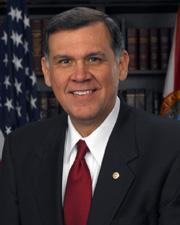 Sen. Mel Martinez (R-FL)
Legislative Activity
Stay on top of the latest movement without scrolling through every action
Senate amendment proposed (on the floor): Amendment SA 2404 proposed by Senator Murray for Senator Martinez to Amendment SA 2383.(consideration: CR S10086-10089, S10103-10104)
July 26, 2007
View full timeline
Senate amendment proposed (on the floor): Amendment SA 2404 proposed by Senator Murray for Senator Martinez to Amendment SA 2383.(consideration: CR S10086-10089, S10103-10104)
July 26, 2007
Senate amendment agreed to: Amendment SA 2404 as modified agreed to in Senate by Voice Vote.(text as modified: CR S10103-10104)
July 26, 2007
Amendment SA 2404 proposed by Senator Murray for Senator Martinez to Amendment SA 2383. (consideration: CR S10086-10089, S10103-10104) To establish an international registered traveler program.
July 26, 2007
Amendment SA 2404 as modified agreed to in Senate by Voice Vote. (text as modified: CR S10103-10104)
July 26, 2007
Senate amendment submitted
July 25, 2007
Text
Submitted
TEXT OF AMENDMENTS
SA 2402. Mr. REID (for Mr. Levin (for himself, Mr. Akaka, Mr. McCain,
Mr. Warner, Mrs. Murray, Mr. Graham, Mr. Kennedy, Mr. Sessions, Mr.
Rockefeller, Ms. Collins, Mr. Byrd, Mr. Chambliss, Mr. Obama, Mrs.
Dole, Mr. Lieberman, Mr. Cornyn, Mr. Sanders, Mr. Thune, Mr. Reed, Mr.
Martinez, Mr. Brown, Mr. Nelson of Florida, Mr. Tester, Mr. Nelson of
Nebraska, Mr. Bayh, Mrs. Clinton, Mr. Pryor, Mr. Webb, Mrs. McCaskill,
Mr. Durbin, Ms. Stabenow, Ms. Mikulski, Mr. Cardin, Mr. Biden, Mr.
Bingaman, Mr. Harkin, Mr. Bond, Mr. Isakson, Mr. Salazar, Ms.
Klobuchar, Mr. Whitehouse, Mr. Lott, Mr. Dodd, Mrs. Hutchison, Mr.
Coleman, Mr. Inhofe, Ms. Landrieu, Mr. Specter, Mr. Menendez, Mr.
Hagel, Mr. Schumer, and Mr. Dorgan)) submitted an amendment intended to
be proposed by Mr. Reid to the bill H.R. 1538, to amend title 10,
United States Code, to improve the management of medical care,
personnel actions, and quality of life issues for members of the Armed
Forces who are receiving medical care in an outpatient status, and for
other purposes; as follows:
SECTION 1. SHORT TITLE; TABLE OF CONTENTS.
(a) Short Title.--This Act may be cited as the ``Dignified
Treatment of Wounded Warriors Act''.
(b) Table of Contents.--The table of contents for this Act
is as follows:
Sec. 1. Short title; table of contents.
TITLE I--WOUNDED WARRIOR MATTERS
Sec. 101. General definitions.
Subtitle A--Policy on Care, Management, and Transition of
Servicemembers With Serious Injuries or Illnesses
Sec. 111. Comprehensive policy on care, management, and transition of
members of the Armed Forces with serious injuries or
illnesses.
Sec. 112. Consideration of needs of women members of the Armed Forces
and veterans.
Subtitle B--Health Care
PART I--Enhanced Availability of Care for Servicemembers
Sec. 121. Medical care and other benefits for members and former
members of the Armed Forces with severe injuries or
illnesses.
Sec. 122. Reimbursement of certain former members of the uniformed
services with service-connected disabilities for travel
for follow-on specialty care and related services.
PART II--CARE AND SERVICES FOR DEPENDENTS
Sec. 126. Medical care and services and support services for families
of members of the Armed Forces recovering from serious
injuries or illnesses.
Sec. 127. Extended benefits under TRICARE for primary caregivers of
members of the uniformed services who incur a serious
injury or illness on active duty.
PART III--TRAUMATIC BRAIN INJURY AND POST-TRAUMATIC STRESS DISORDER
Sec. 131. Comprehensive plans on prevention, diagnosis, mitigation, and
treatment of traumatic brain injury and post-traumatic
stress disorder in members of the Armed Forces.
Sec. 132. Improvement of medical tracking system for members of the
Armed Forces deployed overseas.
Sec. 133. Centers of excellence in the prevention, diagnosis,
mitigation, treatment, and rehabilitation of traumatic
brain injury and post-traumatic stress disorder.
Sec. 134. Review of mental health services and treatment for female
members of the Armed Forces and veterans.
Sec. 135. Funding for improved diagnosis, treatment, and rehabilitation
of members of the Armed Forces with traumatic brain
injury or post-traumatic stress disorder.
Sec. 136. Reports.
PART IV--OTHER MATTERS
Sec. 141. Joint electronic health record for the Department of Defense
and Department of Veterans Affairs.
Sec. 142. Enhanced personnel authorities for the Department of Defense
for health care professionals for care and treatment of
wounded and injured members of the Armed Forces.
Sec. 143. Personnel shortages in the mental health workforce of the
Department of Defense, including personnel in the mental
health workforce.
Subtitle C--Disability Matters
PART I--DISABILITY EVALUATIONS
Sec. 151. Utilization of veterans' presumption of sound condition in
establishing eligibility of members of the Armed Forces
for retirement for disability.
Sec. 152. Requirements and limitations on Department of Defense
determinations of disability with respect to members of
the Armed Forces.
Sec. 153. Review of separation of members of the Armed Forces separated
from service with a disability rating of 20 percent
disabled or less.
Sec. 154. Pilot programs on revised and improved disability evaluation
system for members of the Armed Forces.
Sec. 155. Reports on Army action plan in response to deficiencies in
the Army physical disability evaluation system.
PART II--OTHER DISABILITY MATTERS
Sec. 161. Enhancement of disability severance pay for members of the
Armed Forces.
Sec. 162. Traumatic Servicemembers' Group Life Insurance.
Sec. 163. Electronic transfer from the Department of Defense to the
Department of Veterans Affairs of documents supporting
eligibility for benefits.
Sec. 164. Assessments of temporary disability retired list.
Subtitle D--Improvement of Facilities Housing Patients
Sec. 171. Standards for military medical treatment facilities,
specialty medical care facilities, and military quarters
housing patients.
Sec. 172. Reports on Army action plan in response to deficiencies
identified at Walter Reed Army Medical Center.
Sec. 173. Construction of facilities required for the closure of Walter
Reed Army Medical Center, District of Columbia.
Subtitle E--Outreach and Related Information on Benefits
Sec. 181. Handbook for members of the Armed Forces on compensation and
benefits available for serious injuries and illnesses.
[[Page S9930]]
Subtitle F--Other Matters
Sec. 191. Study on physical and mental health and other readjustment
needs of members and former members of the Armed Forces
who deployed in Operation Iraqi Freedom and Operation
Enduring Freedom and their families.
TITLE II--VETERANS MATTERS
Sec. 201. Sense of Congress on Department of Veterans Affairs efforts
in the rehabilitation and reintegration of veterans with
traumatic brain injury.
Sec. 202. Individual rehabilitation and community reintegration plans
for veterans and others with traumatic brain injury.
Sec. 203. Use of non-Department of Veterans Affairs facilities for
implementation of rehabilitation and community
reintegration plans for traumatic brain injury.
Sec. 204. Research, education, and clinical care program on severe
traumatic brain injury.
Sec. 205. Pilot program on assisted living services for veterans with
traumatic brain injury.
Sec. 206. Research on traumatic brain injury.
Sec. 207. Age-appropriate nursing home care.
Sec. 208. Extension of period of eligibility for health care for combat
service in the Persian Gulf war or future hostilities.
Sec. 209. Mental health: service-connection status and evaluations for
certain veterans.
Sec. 210. Modification of requirements for furnishing outpatient dental
services to veterans with a service-connected dental
condition or disability.
Sec. 211. Demonstration program on preventing veterans at-risk of
homelessness from becoming homeless.
Sec. 212. Clarification of purpose of the outreach services program of
the Department of Veterans Affairs.
TITLE I--WOUNDED WARRIOR MATTERS
SEC. 101. GENERAL DEFINITIONS.
In this title:
(1) The term ``appropriate committees of Congress'' means--
(A) the Committees on Armed Services and Veterans' Affairs
of the Senate; and
(B) the Committees on Armed Services and Veterans' Affairs
of the House of Representatives.
(2) The term ``covered member of the Armed Forces'' means a
member of the Armed Forces, including a member of the
National Guard or a Reserve, who is undergoing medical
treatment, recuperation, or therapy, is otherwise in medical
hold or medical holdover status, or is otherwise on the
temporary disability retired list for a serious injury or
illness.
(3) The term ``family member'', with respect to a member of
the Armed Forces or a veteran, has the meaning given that
term in section 411h(b) of title 37, United States Code.
(4) The term ``medical hold or medical holdover status''
means--
(A) the status of a member of the Armed Forces, including a
member of the National Guard or Reserve, assigned or attached
to a military hospital for medical care; and
(B) the status of a member of a reserve component of the
Armed Forces who is separated, whether pre-deployment or
post-deployment, from the member's unit while in need of
health care based on a medical condition identified while the
member is on active duty in the Armed Forces.
(5) The term ``serious injury or illness'', in the case of
a member of the Armed Forces, means an injury or illness
incurred by the member in line of duty on active duty in the
Armed Forces that may render the member medically unfit to
perform the duties of the member's office, grade, rank, or
rating.
(6) The term ``TRICARE program'' has the meaning given that
term in section 1072(7) of title 10, United States Code.
Subtitle A--Policy on Care, Management, and Transition of
Servicemembers With Serious Injuries or Illnesses
SEC. 111. COMPREHENSIVE POLICY ON CARE, MANAGEMENT, AND
TRANSITION OF MEMBERS OF THE ARMED FORCES WITH
SERIOUS INJURIES OR ILLNESSES.
(a) Comprehensive Policy Required.--
(1) In general.--Not later than January 1, 2008, the
Secretary of Defense and the Secretary of Veterans Affairs
shall, to the extent feasible, jointly develop and implement
a comprehensive policy on the care and management of members
of the Armed Forces who are undergoing medical treatment,
recuperation, or therapy, are otherwise in medical hold or
medical holdover status, or are otherwise on the temporary
disability retired list for a serious injury or illness
(hereafter in this section referred to as a ``covered
servicemembers'').
(2) Scope of policy.--The policy shall cover each of the
following:
(A) The care and management of covered servicemembers while
in medical hold or medical holdover status or on the
temporary disability retired list.
(B) The medical evaluation and disability evaluation of
covered servicemembers.
(C) The return of covered servicemembers to active duty
when appropriate.
(D) The transition of covered servicemembers from receipt
of care and services through the Department of Defense to
receipt of care and services through the Department of
Veterans Affairs.
(3) Consultation.--The Secretary of Defense and the
Secretary of Veterans Affairs shall develop the policy in
consultation with the heads of other appropriate departments
and agencies of the Federal Government and with appropriate
non-governmental organizations having an expertise in matters
relating to the policy.
(4) Update.--The Secretary of Defense and the Secretary of
Veterans Affairs shall jointly update the policy on a
periodic basis, but not less often than annually, in order to
incorporate in the policy, as appropriate, the results of the
reviews under subsections (b) and (c) and the best practices
identified through pilot programs under section 154.
(b) Review of Current Policies and Procedures.--
(1) Review required.--In developing the policy required by
this section, the Secretary of Defense and the Secretary of
Veterans Affairs shall, to the extent necessary, jointly and
separately conduct a review of all policies and procedures of
the Department of Defense and the Department of Veterans
Affairs that apply to, or shall be covered by, the policy.
(2) Purpose.--The purpose of the review shall be to
identify the most effective and patient-oriented approaches
to care and management of covered servicemembers for purposes
of--
(A) incorporating such approaches into the policy; and
(B) extending such approaches, where applicable, to care
and management of other injured or ill members of the Armed
Forces and veterans.
(3) Elements.--In conducting the review, the Secretary of
Defense and the Secretary of Veterans Affairs shall--
(A) identify among the policies and procedures described in
paragraph (1) best practices in approaches to the care and
management described in that paragraph;
(B) identify among such policies and procedures existing
and potential shortfalls in such care and management
(including care and management of covered servicemembers on
the temporary disability retired list), and determine means
of addressing any shortfalls so identified;
(C) determine potential modifications of such policies and
procedures in order to ensure consistency and uniformity
among the military departments and the regions of the
Department of Veterans Affairs in their application and
discharge; and
(D) develop recommendations for legislative and
administrative action necessary to implement the results of
the review.
(4) Deadline for completion.--The review shall be completed
not later than 90 days after the date of the enactment of
this Act.
(c) Consideration of Findings, Recommendations, and
Practices.--In developing the policy required by this
section, the Secretary of Defense and the Secretary of
Veterans Affairs shall take into account the following:
(1) The findings and recommendations of applicable studies,
reviews, reports, and evaluations that address matters
relating to the policy, including, but not limited, to the
following:
(A) The Independent Review Group on Rehabilitative Care and
Administrative Processes at Walter Reed Army Medical Center
and National Naval Medical Center appointed by the Secretary
of Defense.
(B) The Secretary of Veterans Affairs Task Force on
Returning Global War on Terror Heroes appointed by the
President.
(C) The President's Commission on Care for America's
Returning Wounded Warriors.
(D) The Veterans' Disability Benefits Commission
established by title XV of the National Defense Authorization
Act for Fiscal Year 2004 (Public Law 108-136; 117 Stat. 1676;
38 U.S.C. 1101 note).
(E) The President's Commission on Veterans' Pensions, of
1956, chaired by General Omar N. Bradley.
(F) The Report of the Congressional Commission on
Servicemembers and Veterans Transition Assistance, of 1999,
chaired by Anthony J. Principi.
(G) The President's Task Force to Improve Health Care
Delivery for Our Nation's Veterans, of March 2003.
(2) The experience and best practices of the Department of
Defense and the military departments on matters relating to
the policy.
(3) The experience and best practices of the Department of
Veterans Affairs on matters relating to the policy.
(4) Such other matters as the Secretary of Defense and the
Secretary of Veterans Affairs consider appropriate.
(d) Particular Elements of Policy.--The policy required by
this section shall provide, in particular, the following:
(1) Responsibility for covered servicemembers in medical
hold or medical holdover status or on temporary disability
retired list.--Mechanisms to ensure responsibility for
covered servicemembers in medical hold or medical holdover
status or on the temporary disability retired list, including
the following:
(A) Uniform standards for access of covered servicemembers
to non-urgent health care services from the Department of
Defense or other providers under the TRICARE program, with
such access to be--
[[Page S9931]]
(i) for follow-up care, within 2 days of request of care;
(ii) for specialty care, within 3 days of request of care;
(iii) for diagnostic referrals and studies, within 5 days
of request; and
(iv) for surgery based on a physician's determination of
medical necessity, within 14 days of request.
(B) Requirements for the assignment of adequate numbers of
personnel for the purpose of responsibility for and
administration of covered servicemembers in medical hold or
medical holdover status or on the temporary disability
retired list.
(C) Requirements for the assignment of adequate numbers of
medical personnel and non-medical personnel to roles and
responsibilities for caring for and administering covered
servicemembers in medical hold or medical holdover status or
on the temporary disability retired list, and a description
of the roles and responsibilities of personnel so assigned.
(D) Guidelines for the location of care for covered
servicemembers in medical hold or medical holdover status or
on the temporary disability retired list, which guidelines
shall address the assignment of such servicemembers to care
and residential facilities closest to their duty station or
home of record or the location of their designated caregiver
at the earliest possible time.
(E) Criteria for work and duty assignments of covered
servicemembers in medical hold or medical holdover status or
on the temporary disability retired list, including a
prohibition on the assignment of duty to a servicemember
which is incompatible with the servicemember's medical
condition.
(F) Guidelines for the provision of care and counseling for
eligible family members of covered servicemembers in medical
hold or medical holdover status or on the temporary
disability retired list.
(G) Requirements for case management of covered
servicemembers in medical hold or medical holdover status or
on the temporary disability retired list, including
qualifications for personnel providing such case management.
(H) Requirements for uniform quality of care and
administration for all covered servicemembers in medical hold
or medical holdover status or on the temporary disability
retired list, whether members of the regular components of
the Armed Forces or members of the reserve components of the
Armed Forces.
(I) Standards for the conditions and accessibility of
residential facilities for covered servicemembers in medical
hold or medical holdover status or on the temporary
disability retired list who are in outpatient status, and for
their immediate family members.
(J) Requirements on the provision of transportation and
subsistence for covered servicemembers in medical hold or
medical holdover status or on the temporary disability
retired list, whether in inpatient status or outpatient
status, to facilitate obtaining needed medical care and
services.
(K) Requirements on the provision of educational and
vocational training and rehabilitation opportunities for
covered servicemembers in medical hold or medical holdover
status or on the temporary disability retired list.
(L) Procedures for tracking and informing covered
servicemembers in medical hold or medical holdover status or
on the temporary disability retired list about medical
evaluation board and physical disability evaluation board
processing.
(M) Requirements for integrated case management of covered
servicemembers in medical hold or medical holdover status or
on the temporary disability retired list during their
transition from care and treatment through the Department of
Defense to care and treatment through the Department of
Veterans Affairs.
(N) Requirements and standards for advising and training,
as appropriate, family members with respect to care for
covered servicemembers in medical hold or medical holdover
status or on the temporary disability retired list with
serious medical conditions, particularly traumatic brain
injury (TBI), burns, and post-traumatic stress disorder
(PTSD).
(O) Requirements for periodic reassessments of covered
servicemembers, and limits on the length of time such
servicemembers may be retained in medical hold or medical
holdover status or on the temporary disability retired list.
(P) Requirements to inform covered servicemembers and their
family members of their rights and responsibilities while in
medical hold or medical holdover status or on the temporary
disability retired list.
(Q) The requirement to establish a Department of Defense-
wide Ombudsman Office within the Office of the Secretary of
Defense to provide oversight of the ombudsman offices in the
military departments and policy guidance to such offices with
respect to providing assistance to, and answering questions
from, covered servicemembers and their families.
(2) Medical evaluation and physical disability evaluation
for covered servicemembers.--
(A) Medical evaluations.--Processes, procedures, and
standards for medical evaluations of covered servicemembers,
including the following:
(i) Processes for medical evaluations of covered
servicemembers that are--
(I) applicable uniformly throughout the military
departments; and
(II) applicable uniformly with respect to such
servicemembers who are members of the regular components of
the Armed Forces and such servicemembers who are members of
the National Guard and Reserve.
(ii) Standard criteria and definitions for determining the
achievement for covered servicemembers of the maximum medical
benefit from treatment and rehabilitation.
(iii) Standard timelines for each of the following:
(I) Determinations of fitness for duty of covered
servicemembers.
(II) Specialty consultations for covered servicemembers.
(III) Preparation of medical documents for covered
servicemembers.
(IV) Appeals by covered servicemembers of medical
evaluation determinations, including determinations of
fitness for duty.
(iv) Uniform standards for qualifications and training of
medical evaluation board personnel, including physicians,
case workers, and physical disability evaluation board
liaison officers, in conducting medical evaluations of
covered servicemembers.
(v) Standards for the maximum number of medical evaluation
cases of covered servicemembers that are pending before a
medical evaluation board at any one time, and requirements
for the establishment of additional medical evaluation boards
in the event such number is exceeded.
(vi) Uniform standards for information for covered
servicemembers, and their families, on the medical evaluation
board process and the rights and responsibilities of such
servicemembers under that process, including a standard
handbook on such information.
(B) Physical disability evaluations.--Processes,
procedures, and standards for physical disability evaluations
of covered servicemembers, including the following:
(i) A non-adversarial process of the Department of Defense
and the Department of Veterans Affairs for disability
determinations of covered servicemembers.
(ii) To the extent feasible, procedures to eliminate
unacceptable discrepancies among disability ratings assigned
by the military departments and the Department of Veterans
Affairs, particularly in the disability evaluation of covered
servicemembers, which procedures shall be subject to the
following requirements and limitations:
(I) Such procedures shall apply uniformly with respect to
covered servicemembers who are members of the regular
components of the Armed Forces and covered servicemembers who
are members of the National Guard and Reserve.
(II) Under such procedures, each Secretary of a military
department shall, to the extent feasible, utilize the
standard schedule for rating disabilities in use by the
Department of Veterans Affairs, including any applicable
interpretation of such schedule by the United States Court of
Appeals for Veterans Claims, in making any determination of
disability of a covered servicemember.
(iii) Standard timelines for appeals of determinations of
disability of covered servicemembers, including timelines for
presentation, consideration, and disposition of appeals.
(iv) Uniform standards for qualifications and training of
physical disability evaluation board personnel in conducting
physical disability evaluations of covered servicemembers.
(v) Standards for the maximum number of physical disability
evaluation cases of covered servicemembers that are pending
before a physical disability evaluation board at any one
time, and requirements for the establishment of additional
physical disability evaluation boards in the event such
number is exceeded.
(vi) Procedures for the provision of legal counsel to
covered servicemembers while undergoing evaluation by a
physical disability evaluation board.
(vii) Uniform standards on the roles and responsibilities
of case managers, servicemember advocates, and judge
advocates assigned to covered servicemembers undergoing
evaluation by a physical disability board, and uniform
standards on the maximum number of cases involving such
servicemembers that are to be assigned to such managers and
advocates.
(C) Return of covered servicemembers to active duty.--
Standards for determinations by the military departments on
the return of covered servicemembers to active duty in the
Armed Forces.
(D) Transition of covered servicemembers from dod to va.--
Processes, procedures, and standards for the transition of
covered servicemembers from care and treatment by the
Department of Defense to care and treatment by the Department
of Veterans Affairs before, during, and after separation from
the Armed Forces, including the following:
(i) A uniform, patient-focused policy to ensure that the
transition occurs without gaps in medical care and the
quality of medical care, benefits, and services.
(ii) Procedures for the identification and tracking of
covered servicemembers during the transition, and for the
coordination of care and treatment of such servicemembers
during the transition, including a system of cooperative case
management of such servicemembers by the Department of
Defense and the Department of Veterans Affairs during the
transition.
[[Page S9932]]
(iii) Procedures for the notification of Department of
Veterans Affairs liaison personnel of the commencement by
covered servicemembers of the medical evaluation process and
the physical disability evaluation process.
(iv) Procedures and timelines for the enrollment of covered
servicemembers in applicable enrollment or application
systems of the Department of Veterans with respect to health
care, disability, education, vocational rehabilitation, or
other benefits.
(v) Procedures to ensure the access of covered
servicemembers during the transition to vocational,
educational, and rehabilitation benefits available through
the Department of Veterans Affairs.
(vi) Standards for the optimal location of Department of
Defense and Department of Veterans Affairs liaison and case
management personnel at military medical treatment
facilities, medical centers, and other medical facilities of
the Department of Defense.
(vii) Standards and procedures for integrated medical care
and management for covered servicemembers during the
transition, including procedures for the assignment of
medical personnel of the Department of Veterans Affairs to
Department of Defense facilities to participate in the needs
assessments of such servicemembers before, during, and after
their separation from military service.
(viii) Standards for the preparation of detailed plans for
the transition of covered servicemembers from care and
treatment by the Department of Defense to care and treatment
by the Department of Veterans Affairs, which plans shall be
based on standardized elements with respect to care and
treatment requirements and other applicable requirements.
(E) Other matters.--The following additional matters with
respect to covered servicemembers:
(i) Access by the Department of Veterans Affairs to the
military health records of covered servicemembers who are
receiving care and treatment, or are anticipating receipt of
care and treatment, in Department of Veterans Affairs health
care facilities.
(ii) Requirements for utilizing, in appropriate cases, a
single physical examination that meets requirements of both
the Department of Defense and the Department of Veterans
Affairs for covered servicemembers who are being retired,
separated, or released from military service.
(iii) Surveys and other mechanisms to measure patient and
family satisfaction with the provision by the Department of
Defense and the Department of Veterans Affairs of care and
services for covered servicemembers, and to facilitate
appropriate oversight by supervisory personnel of the
provision of such care and services.
(3) Report on reduction in disability ratings by the
department of defense.--The Secretary of Defense shall submit
a report to the Committees on Armed Services of the Senate
and House of Representatives on the number of instances in
which a disability rating assigned to a member of the Armed
Forces by an informal physical evaluation board of the
Department of Defense was reduced upon appeal, and the
reasons for such reduction. Such report shall cover the
period beginning October 7, 2001, and ending September 30,
2006, and shall be submitted to the appropriate committees of
Congress by February 1, 2008.
(e) Reports.--
(1) Report on policy.--Upon the development of the policy
required by this section but not later than January 1, 2008,
the Secretary of Defense and the Secretary of Veterans
Affairs shall jointly submit to the appropriate committees of
Congress a report on the policy, including a comprehensive
and detailed description of the policy and of the manner in
which the policy addresses the findings and recommendations
of the reviews under subsections (b) and (c).
(2) Reports on update.--Upon updating the policy under
subsection (a)(4), the Secretary of Defense and the Secretary
of Veterans Affairs shall jointly submit to the appropriate
committees of Congress a report on the update of the policy,
including a comprehensive and detailed description of such
update and of the reasons for such update.
(f) Comptroller General Assessment of Implementation.--Not
later than six months after the date of the enactment of this
Act and every year thereafter, the Comptroller General of the
United States shall submit to the appropriate committees of
Congress a report setting forth the assessment of the
Comptroller General of the progress of the Secretary of
Defense and the Secretary of Veterans Affairs in developing
and implementing the policy required by this section.
SEC. 112. CONSIDERATION OF NEEDS OF WOMEN MEMBERS OF THE
ARMED FORCES AND VETERANS.
(a) In General.--In developing and implementing the policy
required by section 111, and in otherwise carrying out any
other provision of this title or any amendment made by this
title, the Secretary of Defense and the Secretary of Veterans
Affairs shall take into account and fully address any unique
specific needs of women members of the Armed Forces and women
veterans under such policy or other provision.
(b) Reports.--In submitting any report required by this
title or an amendment made by this title, the Secretary of
Defense and the Secretary of Veterans Affairs shall, to the
extent applicable, include a description of the manner in
which the matters covered by such report address the unique
specific needs of women members of the Armed Forces and women
veterans.
Subtitle B--Health Care
PART I--ENHANCED AVAILABILITY OF CARE FOR SERVICEMEMBERS
SEC. 121. MEDICAL CARE AND OTHER BENEFITS FOR MEMBERS AND
FORMER MEMBERS OF THE ARMED FORCES WITH SEVERE
INJURIES OR ILLNESSES.
(a) Medical and Dental Care for Members and Former
Members.--
(1) In general.--Effective as of the date of the enactment
of this Act and subject to regulations prescribed by the
Secretary of Defense, any covered member of the Armed Forces,
and any former member of the Armed Forces, with a severe
injury or illness is entitled to medical and dental care in
any facility of the uniformed services under section 1074(a)
of title 10, United States Code, or through any civilian
health care provider authorized by the Secretary to provide
health and mental health services to members of the uniformed
services, including traumatic brain injury (TBI) and post-
traumatic stress disorder (PTSD), as if such member or former
member were a member of the uniformed services described in
paragraph (2) of such section who is entitled to medical and
dental care under such section.
(2) Period of authorized care.--(A) Except as provided in
subparagraph (B), a member or former member described in
paragraph (1) is entitled to care under that paragraph--
(i) in the case of a member or former member whose severe
injury or illness concerned is incurred or aggravated during
the period beginning on October 7, 2001, and ending on the
date of the enactment of this Act, during the three-year
period beginning on the date of the enactment of this Act,
except that no compensation is payable by reason of this
subsection for any period before the date of the enactment of
this Act; or
(ii) in the case of a member or former member whose severe
injury or illness concerned is incurred or aggravated on or
after the date of the enactment of this Act, during the
three-year period beginning on the date on which such injury
or illness is so incurred or aggravated.
(B) The period of care authorized for a member or former
member under this paragraph may be extended by the Secretary
concerned for an additional period of up to two years if the
Secretary concerned determines that such extension is
necessary to assure the maximum feasible recovery and
rehabilitation of the member or former member. Any such
determination shall be made on a case-by-case basis.
(3) Integrated care management.--The Secretary of Defense
shall provide for a program of integrated care management in
the provision of care and services under this subsection,
which management shall be provided by appropriate medical and
case management personnel of the Department of Defense and
the Department of Veterans Affairs (as approved by the
Secretary of Veterans Affairs) and with appropriate support
from the Department of Defense regional health care support
contractors.
(4) Waiver of limitations to maximize care.--The Secretary
of Defense may, in providing medical and dental care to a
member or former member under this subsection during the
period referred to in paragraph (2), waive any limitation
otherwise applicable under chapter 55 of title 10, United
States Code, to the provision of such care to the member or
former member if the Secretary considers the waiver
appropriate to assure the maximum feasible recovery and
rehabilitation of the member or former member.
(5) Construction with eligibility for veterans benefits.--
Nothing in this subsection shall be construed to reduce,
alter, or otherwise affect the eligibility or entitlement of
a member or former member of the Armed Forces to any health
care, disability, or other benefits to which the member of
former member would otherwise be eligible or entitled as a
veteran under the laws administered by the Secretary of
Veterans Affairs.
(6) Sunset.--The Secretary of Defense may not provide
medical or dental care to a member or former member of the
Armed Forces under this subsection after December 31, 2012,
if the Secretary has not provided medical or dental care to
the member or former member under this subsection before that
date.
(b) Rehabilitation and Vocational Benefits.--
(1) In general.--Effective as of the date of the enactment
of this Act, a member of the Armed Forces with a severe
injury or illness is entitled to such benefits (including
rehabilitation and vocational benefits, but not including
compensation) from the Secretary of Veterans Affairs to
facilitate the recovery and rehabilitation of such member as
the Secretary otherwise provides to members of the Armed
Forces receiving medical care in medical facilities of the
Department of Veterans Affairs facilities in order to
facilitate the recovery and rehabilitation of such members.
(2) Limitations.--The provisions of paragraphs (2) through
(6) of subsection (a) shall apply to the provision of
benefits under this subsection as if the benefits provided
under this subsection were provided under subsection (a).
(3) Reimbursement.--The Secretary of Defense shall
reimburse the Secretary of Veterans Affairs for the cost of
any benefits provided under this subsection in accordance
[[Page S9933]]
with applicable mechanisms for the reimbursement of the
Secretary of Veterans Affairs for the provision of medical
care to members of the Armed Forces.
(c) Recovery of Certain Expenses of Medical Care and
Related Travel.--
(1) In general.--Commencing not later than 60 days after
the date of the enactment of this Act, the Secretary of the
military department concerned may reimburse covered members
of the Armed Forces, and former members of the Armed Forces,
with a severe injury or illness for covered expenses incurred
by such members or former members, or their family members,
in connection with the receipt by such members or former
members of medical care that is required for such injury or
illness.
(2) Covered expenses.--Expenses for which reimbursement may
be made under paragraph (1) include the following:
(A) Expenses for health care services for which coverage
would be provided under section 1074(c) of title 10, United
States Code, for members of the uniformed services on active
duty.
(B) Expenses of travel of a non-medical attendant who
accompanies a member or former member of the Armed Forces for
required medical care that is not available to such member or
former member locally, if such attendant is appointed for
that purpose by a competent medical authority (as determined
under regulations prescribed by the Secretary of Defense for
purposes of this subsection).
(C) Such other expenses for medical care as the Secretary
may prescribe for purposes of this subsection.
(3) Amount of reimbursement.--The amount of reimbursement
under paragraph (1) for expenses covered by paragraph (2)
shall be determined in accordance with regulations prescribed
by the Secretary of Defense for purposes of this subsection.
(d) Severe Injury or Illness Defined.--In this section, the
term ``severe injury or illness'' means any serious injury or
illness that is assigned a disability rating of 30 percent or
higher under the schedule for rating disabilities in use by
the Department of Defense.
SEC. 122. REIMBURSEMENT OF CERTAIN FORMER MEMBERS OF THE
UNIFORMED SERVICES WITH SERVICE-CONNECTED
DISABILITIES FOR TRAVEL FOR FOLLOW-ON SPECIALTY
CARE AND RELATED SERVICES.
(a) Travel.--Section 1074i of title 10, United States Code,
is amended--
(1) by redesignating subsection (b) as subsection (c); and
(2) by inserting after subsection (a) the following new
subsection (b):
``(b) Follow-on Specialty Care and Related Services.--In
any case in which a former member of a uniformed service who
incurred a disability while on active duty in a combat zone
or during performance of duty in combat related operations
(as designated by the Secretary of Defense), and is entitled
to retired or retainer pay, or equivalent pay, requires
follow-on specialty care, services, or supplies related to
such disability at a specific military treatment facility
more than 100 miles from the location in which the former
member resides, the Secretary shall provide reimbursement for
reasonable travel expenses comparable to those provided under
subsection (a) for the former member, and when accompaniment
by an adult is determined by competent medical authority to
be necessary, for a spouse, parent, or guardian of the former
member, or another member of the former member's family who
is at least 21 years of age.''.
(b) Effective Date.--The amendments made by subsection (a)
shall take effect January 1, 2008, and shall apply with
respect to travel that occurs on or after that date.
PART II--CARE AND SERVICES FOR DEPENDENTS
SEC. 126. MEDICAL CARE AND SERVICES AND SUPPORT SERVICES FOR
FAMILIES OF MEMBERS OF THE ARMED FORCES
RECOVERING FROM SERIOUS INJURIES OR ILLNESSES.
(a) Medical Care.--
(1) In general.--A family member of a covered member of the
Armed Forces who is not otherwise eligible for medical care
at a military medical treatment facility or at medical
facilities of the Department of Veterans Affairs shall be
eligible for such care at such facilities, on a space-
available basis, if the family member is--
(A) on invitational orders while caring for the covered
member of the Armed Forces;
(B) a non-medical attendee caring for the covered member of
the Armed Forces; or
(C) receiving per diem payments from the Department of
Defense while caring for the covered member of the Armed
Forces.
(2) Specification of family members.--Notwithstanding
section 101(3), the Secretary of Defense and the Secretary of
Veterans Affairs shall jointly prescribe in regulations the
family members of covered members of the Armed Forces who
shall be considered to be a family member of a covered member
of the Armed Forces for purposes of paragraph (1).
(3) Specification of care.--(A) The Secretary of Defense
shall prescribe in regulations the medical care and
counseling that shall be available to family members under
paragraph (1) at military medical treatment facilities.
(B) The Secretary of Veterans Affairs shall prescribe in
regulations the medical care and counseling that shall be
available to family members under paragraph (1) at medical
facilities of the Department of Veterans Affairs.
(4) Recovery of costs.--The United States may recover the
costs of the provision of medical care and counseling under
paragraph (1) as follows (as applicable):
(A) From third-party payers, in the same manner as the
United States may collect costs of the charges of health care
provided to covered beneficiaries from third-party payers
under section 1095 of title 10, United States Code.
(B) As if such care and counseling was provided under the
authority of section 1784 of title 38, United States Code.
(b) Job Placement Services.--A family member who is on
invitational orders or is a non-medical attendee while caring
for a covered member of the Armed Forces for more than 45
days during a one-year period shall be eligible for job
placement services otherwise offered by the Department of
Defense.
(c) Report on Need for Additional Services.--Not later than
90 days after the date of the enactment of this Act, the
Secretary of Defense shall submit to the congressional
defense committees a report setting forth the assessment of
the Secretary of the need for additional employment services,
and of the need for employment protection, of family members
described in subsection (b) who are placed on leave from
employment or otherwise displaced from employment while
caring for a covered member of the Armed Forces as described
in that subsection.
SEC. 127. EXTENDED BENEFITS UNDER TRICARE FOR PRIMARY
CAREGIVERS OF MEMBERS OF THE UNIFORMED SERVICES
WHO INCUR A SERIOUS INJURY OR ILLNESS ON ACTIVE
DUTY.
(a) In General.--Section 1079(d) of title 10, United States
Code, is amended--
(1) by redesignating paragraphs (2) and (3) as paragraphs
(3) and (4), respectively; and
(2) by inserting after paragraph (1) the following new
paragraph (2):
``(2)(A) Subject to such terms, conditions, and exceptions
as the Secretary of Defense considers appropriate, the
program of extended benefits for eligible dependents under
this subsection shall include extended benefits for the
primary caregivers of members of the uniformed services who
incur a serious injury or illness on active duty.
``(B) The Secretary of Defense shall prescribe in
regulations the individuals who shall be treated as the
primary caregivers of a member of the uniformed services for
purposes of this paragraph.
``(C) For purposes of this section, a serious injury or
illness, with respect to a member of the uniformed services,
is an injury or illness that may render the member medically
unfit to perform the duties of the member's office, grade,
rank, or rating and that renders a member of the uniformed
services dependant upon a caregiver.''.
(b) Effective Date.--The amendments made by subsection (a)
shall take effect on January 1, 2008.
PART III--TRAUMATIC BRAIN INJURY AND POST-TRAUMATIC STRESS DISORDER
SEC. 131. COMPREHENSIVE PLANS ON PREVENTION, DIAGNOSIS,
MITIGATION, AND TREATMENT OF TRAUMATIC BRAIN
INJURY AND POST-TRAUMATIC STRESS DISORDER IN
MEMBERS OF THE ARMED FORCES.
(a) Plans Required.--Not later than 180 days after the date
of the enactment of this Act, the Secretary of Defense shall,
in consultation with the Secretary of Veterans Affairs,
submit to the congressional defense committees one or more
comprehensive plans for programs and activities of the
Department of Defense to prevent, diagnose, mitigate, treat,
and otherwise respond to traumatic brain injury (TBI) and
post-traumatic stress disorder (PTSD) in members of the Armed
Forces.
(b) Elements.--Each plan submitted under subsection (a)
shall include comprehensive proposals of the Department on
the following:
(1) The designation by the Secretary of Defense of a lead
agent or executive agent for the Department to coordinate
development and implementation of the plan.
(2) The improvement of personnel protective equipment for
members of the Armed Forces in order to prevent traumatic
brain injury.
(3) The improvement of methods and mechanisms for the
detection and treatment of traumatic brain injury and post-
traumatic stress disorder in members of the Armed Forces in
the field.
(4) The requirements for research on traumatic brain injury
and post-traumatic stress disorder, including (in particular)
research on pharmacological approaches to treatment for
traumatic brain injury or post-traumatic stress disorder, as
applicable, and the allocation of priorities among such
research.
(5) The development, adoption, and deployment of diagnostic
criteria for the detection and evaluation of the range of
traumatic brain injury and post-traumatic stress disorder in
members of the Armed Forces, which criteria shall be employed
uniformly across the military departments in all applicable
circumstances, including provision of clinical care and
assessment of future deployability of members of the Armed
Forces.
(6) The development and deployment of effective means of
assessing traumatic brain injury and post-traumatic stress
disorder in members of the Armed Forces, including a
[[Page S9934]]
system of pre-deployment and post-deployment screenings of
cognitive ability in members for the detection of cognitive
impairment, as required by the amendments made by section
132.
(7) The development and deployment of effective means of
managing and monitoring members of the Armed Forces with
traumatic brain injury or post-traumatic stress disorder in
the receipt of care for traumatic brain injury or post-
traumatic stress disorder, as applicable, including the
monitoring and assessment of treatment and outcomes.
(8) The development and deployment of an education and
awareness training initiative designed to reduce the negative
stigma associated with traumatic brain injury, post-traumatic
stress disorder, and mental health treatment.
(9) The provision of education and outreach to families of
members of the Armed Forces with traumatic brain injury or
post-traumatic stress disorder on a range of matters relating
to traumatic brain injury or post-traumatic stress disorder,
as applicable, including detection, mitigation, and
treatment.
(10) The assessment of the current capabilities of the
Department for the prevention, diagnosis, mitigation,
treatment, and rehabilitation of traumatic brain injury and
post-traumatic stress disorder in members of the Armed
Forces.
(11) The identification of gaps in current capabilities of
the Department for the prevention, diagnosis, mitigation,
treatment, and rehabilitation of traumatic brain injury and
post-traumatic stress disorder in members of the Armed
Forces.
(12) The identification of the resources required for the
Department in fiscal years 2009 thru 2013 to address the gaps
in capabilities identified under paragraph (11).
(13) The development of joint planning among the Department
of Defense, the military departments, and the Department of
Veterans Affairs for the prevention, diagnosis, mitigation,
treatment, and rehabilitation of traumatic brain injury and
post-traumatic stress disorder in members of the Armed
Forces, including planning for the seamless transition of
such members from care through the Department of Defense care
through the Department of Veterans Affairs.
(14) A requirement that exposure to a blast or blasts be
recorded in the records of members of the Armed Forces.
(15) The development of clinical practice guidelines for
the diagnosis and treatment of blast injuries in members of
the Armed Forces, including, but not limited to, traumatic
brain injury.
(16) A program under which each member of the Armed Forces
who incurs a traumatic brain injury or post-traumatic stress
disorder during service in the Armed Forces--
(A) is enrolled in the program; and
(B) receives, under the program, treatment and
rehabilitation meeting a standard of care such that each
individual who is a member of the Armed Forces who qualifies
for care under the program shall--
(i) be provided the highest quality of care possible based
on the medical judgment of qualified medical professionals in
facilities that most appropriately meet the specific needs of
the individual; and
(ii) be rehabilitated to the fullest extent possible using
the most up-to-date medical technology, medical
rehabilitation practices, and medical expertise available.
(17) A requirement that if a member of the Armed Forces
participating in a program established in accordance with
paragraph (16) believes that care provided to such
participant does not meet the standard of care specified in
subparagraph (B) of such paragraph, the Secretary of Defense
shall, upon request of the participant, provide to such
participant a referral to another Department of Defense or
Department of Veterans Affairs provider of medical or
rehabilitative care for a second opinion regarding the care
that would meet the standard of care specified in such
subparagraph.
(18) The provision of information by the Secretary of
Defense to members of the Armed Forces with traumatic brain
injury or post-traumatic stress disorder and their families
about their rights with respect to the following:
(A) The receipt of medical and mental health care from the
Department of Defense and the Department of Veterans Affairs.
(B) The options available to such members for treatment of
traumatic brain injury and post-traumatic stress disorder.
(C) The options available to such members for
rehabilitation.
(D) The options available to such members for a referral to
a public or private provider of medical or rehabilitative
care.
(E) The right to administrative review of any decision with
respect to the provision of care by the Department of Defense
for such members.
(c) Coordination in Development.--Each plan submitted under
subsection (a) shall be developed in coordination with the
Secretary of the Army (who was designated by the Secretary of
Defense as executive agent for the prevention, mitigation,
and treatment of blast injuries under section 256 of the
National Defense Authorization Act for Fiscal Year 2006
(Public Law 109-163; 119 Stat. 3181; 10 U.S.C. 1071 note)).
(d) Additional Activities.--In carrying out programs and
activities for the prevention, diagnosis, mitigation, and
treatment of traumatic brain injury and post-traumatic stress
disorder in members of the Armed Forces, the Secretary of
Defense shall--
(1) examine the results of the recently completed Phase 2
study, funded by the National Institutes of Health, on the
use of progesterone for acute traumatic brain injury;
(2) determine if Department of Defense funding for a Phase
3 clinical trial on the use of progesterone for acute
traumatic brain injury, or for further research regarding the
use of progesterone or its metabolites for treatment of
traumatic brain injury, is warranted; and
(3) provide for the collaboration of the Department of
Defense, as appropriate, in clinical trials and research on
pharmacological approaches to treatment for traumatic brain
injury and post-traumatic stress disorder that is conducted
by other departments and agencies of the Federal Government.
SEC. 132. IMPROVEMENT OF MEDICAL TRACKING SYSTEM FOR MEMBERS
OF THE ARMED FORCES DEPLOYED OVERSEAS.
(a) Protocol for Assessment of Cognitive Functioning.--
(1) Protocol required.--Subsection (b) of section 1074f of
title 10, United States Code, is amended--
(A) in paragraph (2), by adding at the end the following
new subparagraph:
``(C) An assessment of post-traumatic stress disorder.'';
and
(B) by adding at the end the following new paragraph:
``(3)(A) The Secretary shall establish for purposes of
subparagraphs (B) and (C) of paragraph (2) a protocol for the
predeployment assessment and documentation of the cognitive
(including memory) functioning of a member who is deployed
outside the United States in order to facilitate the
assessment of the postdeployment cognitive (including memory)
functioning of the member.
``(B) The protocol under subparagraph (A) shall include
appropriate mechanisms to permit the differential diagnosis
of traumatic brain injury in members returning from
deployment in a combat zone.''.
(2) Pilot projects.--(A) In developing the protocol
required by paragraph (3) of section 1074f(b) of title 10,
United States Code (as amended by paragraph (1) of this
subsection), for purposes of assessments for traumatic brain
injury, the Secretary of Defense shall conduct up to three
pilot projects to evaluate various mechanisms for use in the
protocol for such purposes. One of the mechanisms to be so
evaluated shall be a computer-based assessment tool.
(B) Not later than 60 days after the completion of the
pilot projects conducted under this paragraph, the Secretary
shall submit to the appropriate committees of Congress a
report on the pilot projects. The report shall include--
(i) a description of the pilot projects so conducted;
(ii) an assessment of the results of each such pilot
project; and
(iii) a description of any mechanisms evaluated under each
such pilot project that will incorporated into the protocol.
(C) Not later than 180 days after completion of the pilot
projects conducted under this paragraph, the Secretary shall
establish a mechanism for implementing any mechanism
evaluated under such a pilot project that is selected for
incorporation in the protocol.
(D) There is hereby authorized to be appropriated to the
Department of Defense, $3,000,000 for the pilot projects
authorized by this paragraph. Of the amount so authorized to
be appropriated, not more than $1,000,000 shall be available
for any particular pilot project.
(b) Quality Assurance.--Subsection (d)(2) of section 1074f
of title 10, United States Code, is amended by adding at the
end the following new subparagraph:
``(F) The diagnosis and treatment of traumatic brain injury
and post-traumatic stress disorder.''.
(c) Standards for Deployment.--Subsection (f) of such
section is amended--
(1) in the subsection heading, by striking ``Mental
Health''; and
(2) in paragraph (2)(B), by striking ``or'' and inserting
``, traumatic brain injury, or''.
SEC. 133. CENTERS OF EXCELLENCE IN THE PREVENTION, DIAGNOSIS,
MITIGATION, TREATMENT, AND REHABILITATION OF
TRAUMATIC BRAIN INJURY AND POST-TRAUMATIC
STRESS DISORDER.
(a) Center of Excellence on Traumatic Brain Injury.--
Chapter 55 of title 10, United States Code, is amended by
inserting after section 1105 the following new section:
``Sec. 1105a. Center of Excellence in Prevention, Diagnosis,
Mitigation, Treatment, and Rehabilitation of Traumatic
Brain Injury
``(a) In General.--The Secretary of Defense shall establish
within the Department of Defense a center of excellence in
the prevention, diagnosis, mitigation, treatment, and
rehabilitation of traumatic brain injury (TBI), including
mild, moderate, and severe traumatic brain injury, to carry
out the responsibilities specified in subsection (c). The
center shall be known as a `Center of Excellence in
Prevention, Diagnosis, Mitigation, Treatment, and
Rehabilitation of Traumatic Brain Injury'.
``(b) Partnerships.--The Secretary shall ensure that the
Center collaborates to the maximum extent practicable with
the Department of Veterans Affairs, institutions of higher
education, and other appropriate public and private entities
(including international entities) to carry out the
responsibilities specified in subsection (c).
[[Page S9935]]
``(c) Responsibilities.--The Center shall have
responsibilities as follows:
``(1) To direct and oversee, based on expert research, the
development and implementation of a long-term, comprehensive
plan and strategy for the Department of Defense for the
prevention, diagnosis, mitigation, treatment, and
rehabilitation of traumatic brain injury.
``(2) To provide for the development, testing, and
dissemination within the Department of best practices for the
treatment of traumatic brain injury.
``(3) To provide guidance for the mental health system of
the Department in determining the mental health and
neurological health personnel required to provide quality
mental health care for members of the armed forces with
traumatic brain injury.
``(4) To establish, implement, and oversee a comprehensive
program to train mental health and neurological health
professionals of the Department in the treatment of traumatic
brain injury.
``(5) To facilitate advancements in the study of the short-
term and long-term psychological effects of traumatic brain
injury.
``(6) To disseminate within the military medical treatment
facilities of the Department best practices for training
mental health professionals, including neurological health
professionals, with respect to traumatic brain injury.
``(7) To conduct basic science and translational research
on traumatic brain injury for the purposes of understanding
the etiology of traumatic brain injury and developing
preventive interventions and new treatments.
``(8) To develop outreach strategies and treatments for
families of members of the armed forces with traumatic brain
injury in order to mitigate the negative impacts of traumatic
brain injury on such family members and to support the
recovery of such members from traumatic brain injury.
``(9) To conduct research on the unique mental health needs
of women members of the armed forces with traumatic brain
injury and develop treatments to meet any needs identified
through such research.
``(10) To conduct research on the unique mental health
needs of ethnic minority members of the armed forces with
traumatic brain injury and develop treatments to meet any
needs identified through such research.
``(11) To conduct research on the mental health needs of
families of members of the armed forces with traumatic brain
injury and develop treatments to meet any needs identified
through such research.
``(12) To conduct longitudinal studies (using imaging
technology and other proven research methods) on members of
the armed forces with traumatic brain injury to identify
early signs of Alzheimer's disease, Parkinson's disease, or
other manifestations of neurodegeneration in such members,
which studies should be conducted in coordination with the
studies authorized by section 721 of the John Warner National
Defense Authorization Act for Fiscal Year 2007 (Public Law
109-364; 120 Stat. 2294) and other studies of the Department
of Defense and the Department of Veterans Affairs that
address the connection between exposure to combat and the
development of Alzheimer's disease, Parkinson's disease, and
other neurodegenerative disorders.
``(13) To develop and oversee a long-term plan to increase
the number of mental health and neurological health
professionals within the Department in order to facilitate
the meeting by the Department of the needs of members of the
armed forces with traumatic brain injury until their
transition to care and treatment from the Department of
Veterans Affairs.
``(14) To develop a program on comprehensive pain
management, including management of acute and chronic pain,
to utilize current and develop new treatments for pain, and
to identify and disseminate best practices on pain
management.
``(15) Such other responsibilities as the Secretary shall
specify.''.
(b) Center of Excellence on Post-Traumatic Stress
Disorder.--Chapter 55 of such title is further amended by
inserting after section 1105a, as added by subsection (a),
the following new section:
``Sec. 1105b. Center of Excellence in Prevention, Diagnosis,
Mitigation, Treatment, and Rehabilitation of Post-Traumatic
Stress Disorder
``(a) In General.--The Secretary of Defense shall establish
within the Department of Defense a center of excellence in
the prevention, diagnosis, mitigation, treatment, and
rehabilitation of post-traumatic stress disorder (PTSD),
including mild, moderate, and severe post-traumatic stress
disorder, to carry out the responsibilities specified in
subsection (c). The center shall be known as a `Center of
Excellence in Prevention, Diagnosis, Mitigation, Treatment,
and Rehabilitation of Post-Traumatic Stress Disorder'.
``(b) Partnerships.--The Secretary shall ensure that the
Center collaborates to the maximum extent practicable with
the National Center for Post-Traumatic Stress Disorder of the
Department of Veterans Affairs, institutions of higher
education, and other appropriate public and private entities
(including international entities) to carry out the
responsibilities specified in subsection (c).
``(c) Responsibilities.--The Center shall have
responsibilities as follows:
``(1) To direct and oversee, based on expert research, the
development and implementation of a long-term, comprehensive
plan and strategy for the Department of Defense for the
prevention, diagnosis, mitigation, treatment, and
rehabilitation of post-traumatic stress disorder.
``(2) To provide for the development, testing, and
dissemination within the Department of best practices for the
treatment of post-traumatic stress disorder.
``(3) To provide guidance for the mental health system of
the Department in determining the mental health and
neurological health personnel required to provide quality
mental health care for members of the armed forces with post-
traumatic stress disorder.
``(4) To establish, implement, and oversee a comprehensive
program to train mental health and neurological health
professionals of the Department in the treatment of post-
traumatic stress disorder.
``(5) To facilitate advancements in the study of the short-
term and long-term psychological effects of post-traumatic
stress disorder.
``(6) To disseminate within the military medical treatment
facilities of the Department best practices for training
mental health professionals, including neurological health
professionals, with respect to post-traumatic stress
disorder.
``(7) To conduct basic science and translational research
on post-traumatic stress disorder for the purposes of
understanding the etiology of post-traumatic stress disorder
and developing preventive interventions and new treatments.
``(8) To develop outreach strategies and treatments for
families of members of the armed forces with post-traumatic
stress disorder in order to mitigate the negative impacts of
traumatic brain injury on such family members and to support
the recovery of such members from post-traumatic stress
disorder.
``(9) To conduct research on the unique mental health needs
of women members of the armed forces, including victims of
sexual assault, with post-traumatic stress disorder and
develop treatments to meet any needs identified through such
research.
``(10) To conduct research on the unique mental health
needs of ethnic minority members of the armed forces with
post-traumatic stress disorder and develop treatments to meet
any needs identified through such research.
``(11) To conduct research on the mental health needs of
families of members of the armed forces with post-traumatic
stress disorder and develop treatments to meet any needs
identified through such research.
``(12) To develop and oversee a long-term plan to increase
the number of mental health and neurological health
professionals within the Department in order to facilitate
the meeting by the Department of the needs of members of the
armed forces with post-traumatic stress disorder until their
transition to care and treatment from the Department of
Veterans Affairs.
``(13) To develop a program on comprehensive pain
management, including management of acute and chronic pain,
to utilize current and develop new treatments for pain, and
to identify and disseminate best practices on pain
management.
``(14) Such other responsibilities as the Secretary shall
specify.''.
(c) Clerical Amendment.--The table of sections at the
beginning of chapter 55 of such title is amended by inserting
after the item relating to section 1105 the following new
items:
``1105a. Center of Excellence in Prevention, Diagnosis, Mitigation,
Treatment, and Rehabilitation of Traumatic Brain Injury.
``1105b. Center of Excellence in Prevention, Diagnosis, Mitigation,
Treatment, and Rehabilitation of Post-Traumatic Stress
Disorder.''.
(d) Report on Establishment.--Not later than 180 days after
the date of the enactment of this Act, the Secretary of
Defense shall submit to Congress a report on the
establishment of the Center of Excellence in Prevention,
Diagnosis, Mitigation, Treatment, and Rehabilitation of
Traumatic Brain Injury required by section 1105a of title 10,
United States Code (as added by subsection (a)), and the
establishment of the Center of Excellence in Prevention,
Diagnosis, Mitigation, Treatment, and Rehabilitation of Post-
Traumatic Stress Disorder required by section 1105b of title
10, United States Code (as added by subsection (b)). The
report shall, for each such Center--
(1) describe in detail the activities and proposed
activities of such Center; and
(2) assess the progress of such Center in discharging the
responsibilities of such Center.
(e) Authorization of Appropriations.--There is hereby
authorized to be appropriated for fiscal year 2008 for the
Department of Defense for Defense Health Program,
$10,000,000, of which--
(1) $5,000,000 shall be available for the Center of
Excellence in Prevention, Diagnosis, Mitigation, Treatment,
and Rehabilitation of Traumatic Brain Injury required by
section 1105a of title 10, United States Code; and
(2) $5,000,000 shall be available for the Center of
Excellence in Prevention, Diagnosis, Mitigation, Treatment,
and Rehabilitation of Post-Traumatic Stress Disorder required
by section 1105b of title 10, United States Code.
[[Page S9936]]
SEC. 134. REVIEW OF MENTAL HEALTH SERVICES AND TREATMENT FOR
FEMALE MEMBERS OF THE ARMED FORCES AND
VETERANS.
(a) Comprehensive Review.--The Secretary of Defense and the
Secretary of Veterans Affairs shall jointly conduct a
comprehensive review of--
(1) the need for mental health treatment and services for
female members of the Armed Forces and veterans; and
(2) the efficacy and adequacy of existing mental health
treatment programs and services for female members of the
Armed Forces and veterans.
(b) Elements.--The review required by subsection (a) shall
include, but not be limited to, an assessment of the
following:
(1) The need for mental health outreach, prevention, and
treatment services specifically for female members of the
Armed Forces and veterans.
(2) The access to and efficacy of existing mental health
outreach, prevention, and treatment services and programs
(including substance abuse programs) for female veterans who
served in a combat zone.
(3) The access to and efficacy of services and treatment
for female members of the Armed Forces and veterans who
experience post-traumatic stress disorder (PTSD).
(4) The availability of services and treatment for female
members of the Armed Forces and veterans who experienced
sexual assault or abuse.
(5) The access to and need for treatment facilities
focusing on the mental health care needs of female members of
the Armed Forces and veterans.
(6) The need for further clinical research on the unique
needs of female veterans who served in a combat zone.
(c) Report.--Not later than 90 days after the date of the
enactment of this Act, the Secretary of Defense and the
Secretary of Veterans Affairs shall jointly submit to the
appropriate committees of Congress a report on the review
required by subsection (a).
(d) Policy Required.--Not later than 120 days after the
date of the enactment of this Act, the Secretary of Defense
and the Secretary of Veterans Affairs shall jointly develop a
comprehensive policy to address the treatment and care needs
of female members of the Armed Forces and veterans who
experience mental health problems and conditions, including
post-traumatic stress disorder. The policy shall take into
account and reflect the results of the review required by
subsection (a).
SEC. 135. FUNDING FOR IMPROVED DIAGNOSIS, TREATMENT, AND
REHABILITATION OF MEMBERS OF THE ARMED FORCES
WITH TRAUMATIC BRAIN INJURY OR POST-TRAUMATIC
STRESS DISORDER.
(a) Authorization of Appropriations.--
(1) In general.--Funds are hereby authorized to be
appropriated for fiscal year 2008 for the Department of
Defense for Defense Health Program in the amount of
$50,000,000, with such amount to be available for activities
as follows:
(A) Activities relating to the improved diagnosis,
treatment, and rehabilitation of members of the Armed Forces
with traumatic brain injury (TBI).
(B) Activities relating to the improved diagnosis,
treatment, and rehabilitation of members of the Armed Forces
with post-traumatic stress disorder (PTSD).
(2) Availability of amount.--Of the amount authorized to be
appropriated by paragraph (1), $17,000,000 shall be available
for the Defense and Veterans Brain Injury Center of the
Department of Defense.
(b) Supplement Not Supplant.--The amount authorized to be
appropriated by subsection (a) for Defense Health Program is
in addition to any other amounts authorized to be
appropriated by this Act for Defense Health Program.
SEC. 136. REPORTS.
(a) Reports on Implementation of Certain Requirements.--Not
later than 90 days after the date of the enactment of this
Act, the Secretary of Defense shall submit to the
congressional defense committees a report describing the
progress in implementing the requirements as follows:
(1) The requirements of section 721 of the John Warner
National Defense Authorization Act for Fiscal Year 2007
(Public Law 109-364; 120 Stat. 2294), relating to a
longitudinal study on traumatic brain injury incurred by
members of the Armed Forces in Operation Iraqi Freedom and
Operation Enduring Freedom.
(2) The requirements arising from the amendments made by
section 738 of the John Warner National Defense Authorization
Act for Fiscal Year 2007 (120 Stat. 2303), relating to
enhanced mental health screening and services for members of
the Armed Forces.
(3) The requirements of section 741 of the John Warner
National Defense Authorization Act for Fiscal Year 2007 (120
Stat. 2304), relating to pilot projects on early diagnosis
and treatment of post-traumatic stress disorder and other
mental health conditions.
(b) Annual Reports on Expenditures for Activities on Tbi
and Ptsd.--
(1) Reports required.--Not later than March 1, 2008, and
each year thereafter through 2013, the Secretary of Defense
shall submit to the congressional defense committees a report
setting forth the amounts expended by the Department of
Defense during the preceding calendar year on activities
described in paragraph (2), including the amount allocated
during such calendar year to the Defense and Veterans Brain
Injury Center of the Department.
(2) Covered activities.--The activities described in this
paragraph are activities as follows:
(A) Activities relating to the improved diagnosis,
treatment, and rehabilitation of members of the Armed Forces
with traumatic brain injury (TBI).
(B) Activities relating to the improved diagnosis,
treatment, and rehabilitation of members of the Armed Forces
with post-traumatic stress disorder (PTSD).
(3) Elements.--Each report under paragraph (1) shall
include--
(A) a description of the amounts expended as described in
that paragraph, including a description of the activities for
which expended;
(B) a description and assessment of the outcome of such
activities;
(C) a statement of priorities of the Department in
activities relating to the prevention, diagnosis, research,
treatment, and rehabilitation of traumatic brain injury in
members of the Armed Forces during the year in which such
report is submitted and in future calendar years;
(D) a statement of priorities of the Department in
activities relating to the prevention, diagnosis, research,
treatment, and rehabilitation of post-traumatic stress
disorder in members of the Armed Forces during the year in
which such report is submitted and in future calendar years;
and
(E) an assessment of the progress made toward achieving the
priorities stated in subparagraphs (C) and (D) in the report
under paragraph (1) in the previous year, and a description
of any actions planned during the year in which such report
is submitted to achieve any unfulfilled priorities during
such year.
PART IV--OTHER MATTERS
SEC. 141. JOINT ELECTRONIC HEALTH RECORD FOR THE DEPARTMENT
OF DEFENSE AND DEPARTMENT OF VETERANS AFFAIRS.
(a) In General.--The Secretary of Defense and the Secretary
of Veterans Affairs shall jointly--
(1) develop and implement a joint electronic health record
for use by the Department of Defense and the Department of
Veterans Affairs; and
(2) accelerate the exchange of health care information
between the Department of Defense and the Department of
Veterans Affairs in order to support the delivery of health
care by both Departments.
(b) Department of Defense-Department of Veterans Affairs
Interagency Program Office for a Joint Electronic Health
Record.--
(1) In general.--There is hereby established a joint
element of the Department of Defense and the Department of
Veterans Affairs to be known as the ``Department of Defense-
Department of Veterans Affairs Interagency Program Office for
a Joint Electronic Health Record'' (in this section referred
to as the ``Office'').
(2) Purposes.--The purposes of the Office shall be as
follows:
(A) To act as a single point of accountability for the
Department of Defense and the Department of Veterans Affairs
in the rapid development, test, and implementation of a joint
electronic health record for use by the Department of Defense
and the Department of Veterans Affairs.
(B) To accelerate the exchange of health care information
between Department of Defense and the Department of Veterans
Affairs in order to support the delivery of health care by
both Departments.
(c) Leadership.--
(1) Director.--The Director of the Department of Defense-
Department of Veterans Affairs Interagency Program Office for
a Joint Electronic Health Record shall be the head of the
Office.
(2) Deputy director.--The Deputy Director of the Department
of Defense-Department of Veterans Affairs Interagency Program
Office for a Joint Electronic Health Record shall be the
deputy head of the office and shall assist the Director in
carrying out the duties of the Director.
(3) Appointments.--(A) The Director shall be appointed by
the Secretary of Defense, with the concurrence of the
Secretary of Veterans Affairs, from among employees of the
Department of Defense and the Department of Veterans Affairs
in the Senior Executive Service who are qualified to direct
the development and acquisition of major information
technology capabilities.
(B) The Deputy Director shall be appointed by the Secretary
of Veterans Affairs, with the concurrence of the Secretary of
Defense, from among employees of the Department of Defense
and the Department of Veterans Affairs in the Senior
Executive Service who are qualified to direct the development
and acquisition of major information technology capabilities.
(4) Additional guidance.--In addition to the direction,
supervision, and control provided by the Secretary of Defense
and the Secretary of Veterans Affairs, the Office shall also
receive guidance from the Department of Veterans Affairs-
Department of Defense Joint Executive Committee under section
320 of title 38, United States Code, in the discharge of the
functions of the Office under this section.
(5) Testimony.--Upon request by any of the appropriate
committees of Congress, the Director and the Deputy Director
shall testify
[[Page S9937]]
before such committee regarding the discharge of the
functions of the Office under this section.
(d) Function.--The function of the Office shall be to
develop and prepare for deployment, by not later than
September 30, 2010, a joint electronic health record to be
utilized by both the Department of Defense and the Department
of Veterans Affairs in the provision of medical care and
treatment to members of the Armed Forces and veterans, which
health record shall comply with applicable interoperability
standards, implementation specifications, and certification
criteria (including for the reporting of quality measures) of
the Federal Government.
(e) Schedules and Benchmarks.--Not later than 30 days after
the date of the enactment of this Act, the Secretary of
Defense and the Secretary of Veterans Affairs shall jointly
establish a schedule and benchmarks for the discharge by the
Office of its function under this section, including each of
the following:
(1) A schedule for the establishment of the Office.
(2) A schedule and deadline for the establishment of the
requirements for the joint electronic health record described
in subsection (d), including coordination with the Office of
the National Coordinator for Health Information Technology in
the development of a nationwide interoperable health
information technology infrastructure.
(3) A schedule and associated deadlines for any acquisition
and testing required in the development and deployment of the
joint electronic health record.
(4) A schedule and associated deadlines and requirements
for the deployment of the joint electronic health record.
(5) Proposed funding for the Office for each of fiscal
years 2009 through 2013 for the discharge of its function.
(f) Pilot Projects.--
(1) Authority.--In order to assist the Office in the
discharge of its function under this section, the Secretary
of Defense and the Secretary of Veterans Affairs may, acting
jointly, carry out one or more pilot projects to assess the
feasability and advisability of various technological
approaches to the achievement of the joint electronic health
record described in subsection (d).
(2) Treatment as single health care system.--For purposes
of each pilot project carried out under this subsection, the
health care system of the Department of Defense and the
health care system of the Department of Veterans Affairs
shall be treated as a single health care system for purposes
of the regulations promulgated under section 264(c) of the
Health Insurance Portability and Accountability Act of 1996
(42 U.S.C. 1320d-2 note).
(g) Staff and Other Resources.--
(1) In general.--The Secretary of Defense and the Secretary
of Veterans Affairs shall assign to the Office such personnel
and other resources of the Department of Defense and the
Department of Veterans Affairs as are required for the
discharge of its function under this section.
(2) Additional services.--Subject to the approval of the
Secretary of Defense and the Secretary of Veterans Affairs,
the Director may utilize the services of private individuals
and entities as consultants to the Office in the discharge of
its function under this section. Amounts available to the
Office shall be available for payment for such services.
(h) Annual Reports.--
(1) In general.--Not later than January 1, 2009, and each
year thereafter through 2014, the Director shall submit to
the Secretary of Defense and the Secretary of Veterans
Affairs, and to the appropriate committees of Congress, a
report on the activities of the Office during the preceding
calendar year. Each report shall include, for the year
covered by such report, the following:
(A) A detailed description of the activities of the Office,
including a detailed description of the amounts expended and
the purposes for which expended.
(B) An assessment of the progress made by the Department of
Defense and the Department of Veterans Affairs in the
development and implementation of the joint electronic health
record described in subsection (d).
(2) Availability to public.--The Secretary of Defense and
the Secretary of Veterans Affairs shall make available to the
public each report submitted under paragraph (1), including
by posting such report on the Internet website of the
Department of Defense and the Department of Veterans Affairs,
respectively, that is available to the public.
(i) Comptroller General Assessment of Implementation.--Not
later than six months after the date of the enactment of this
Act and every six months thereafter until the completion of
the implementation of the joint electronic health record
described in subsection (d), the Comptroller General of the
United States shall submit to the appropriate committees of
Congress a report setting forth the assessment of the
Comptroller General of the progress of the Department of
Defense and the Department of Veterans Affairs in developing
and implementing the joint electronic health record.
(j) Funding.--
(1) In general.--The Secretary of Defense and the Secretary
of Veterans Affairs shall each contribute equally to the
costs of the Office in fiscal year 2008 and fiscal years
thereafter. The amount so contributed by each Secretary in
fiscal year 2008 shall be up to $10,000,000.
(2) Source of funds.--(A) Amounts contributed by the
Secretary of Defense under paragraph (1) shall be derived
from amounts authorized to be appropriated for the Department
of Defense for the Defense Health Program and available for
program management and technology resources.
(B) Amounts contributed by the Secretary of Veterans
Affairs under paragraph (1) shall be derived from amounts
authorized to be appropriated for the Department of Veterans
Affairs for Medical Care and available for program management
and technology resources.
(k) Joint Electronic Health Record Defined.--In this
section, the term ``joint electronic health record'' means a
single system that includes patient information across the
continuum of medical care, including inpatient care,
outpatient care, pharmacy care, patient safety, and
rehabilitative care.
SEC. 142. ENHANCED PERSONNEL AUTHORITIES FOR THE DEPARTMENT
OF DEFENSE FOR HEALTH CARE PROFESSIONALS FOR
CARE AND TREATMENT OF WOUNDED AND INJURED
MEMBERS OF THE ARMED FORCES.
(a) In General.--Section 1599c of title 10, United States
Code, is amended to read as follows:
``Sec. 1599c. Health care professionals: enhanced appointment
and compensation authority for personnel for care and
treatment of wounded and injured members of the armed
forces
``(a) In General.--The Secretary of Defense may, in the
discretion of the Secretary, exercise any authority for the
appointment and pay of health care personnel under chapter 74
of title 38 for purposes of the recruitment, employment, and
retention of civilian health care professionals for the
Department of Defense if the Secretary determines that the
exercise of such authority is necessary in order to provide
or enhance the capacity of the Department to provide care and
treatment for members of the armed forces who are wounded or
injured on active duty in the armed forces and to support the
ongoing patient care and medical readiness, education, and
training requirements of the Department of Defense.
``(b) Recruitment of Personnel.--(1) The Secretaries of the
military departments shall each develop and implement a
strategy to disseminate among appropriate personnel of the
military departments authorities and best practices for the
recruitment of medical and health professionals, including
the authorities under subsection (a).
``(2) Each strategy under paragraph (1) shall--
``(A) assess current recruitment policies, procedures, and
practices of the military department concerned to assure that
such strategy facilitates the implementation of efficiencies
which reduce the time required to fill vacant positions for
medical and health professionals; and
``(B) clearly identify processes and actions that will be
used to inform and educate military and civilian personnel
responsible for the recruitment of medical and health
professionals.''.
(b) Clerical Amendment.--The table of sections at the
beginning of chapter 81 of such title is amended by striking
the item relating to section 1599c and inserting the
following new item:
``1599c. Health care professionals: enhanced appointment and
compensation authority for personnel for care and
treatment of wounded and injured members of the armed
forces.''.
(c) Reports on Strategies on Recruitment of Medical and
Health Professionals.--Not later than six months after the
date of the enactment of this Act, each Secretary of a
military department shall submit to the congressional defense
committees a report setting forth the strategy developed by
such Secretary under section 1599c(b) of title 10, United
States Code, as added by subsection (a).
SEC. 143. PERSONNEL SHORTAGES IN THE MENTAL HEALTH WORKFORCE
OF THE DEPARTMENT OF DEFENSE, INCLUDING
PERSONNEL IN THE MENTAL HEALTH WORKFORCE.
(a) Recommendations on Means of Addressing Shortages.--
(1) Report.--Not later than 45 days after the date of the
enactment of this Act, the Secretary of Defense shall submit
to the Committees on Armed Services of the Senate and the
House of Representatives a report setting forth the
recommendations of the Secretary for such legislative or
administrative actions as the Secretary considers appropriate
to address shortages in health care professionals within the
Department of Defense, including personnel in the mental
health workforce.
(2) Elements.--The report required by paragraph (1) shall
address the following:
(A) Enhancements or improvements of financial incentives
for health care professionals, including personnel in the
mental health workforce, of the Department of Defense in
order to enhance the recruitment and retention of such
personnel, including recruitment, accession, or retention
bonuses and scholarship, tuition, and other financial
assistance.
(B) Modifications of service obligations of health care
professionals, including personnel in the mental health
workforce.
(C) Such other matters as the Secretary considers
appropriate.
(b) Recruitment.--Commencing not later than 180 days after
the date of the enactment of this Act, the Secretary of
Defense shall
[[Page S9938]]
implement programs to recruit qualified individuals in health
care fields (including mental health) to serve in the Armed
Forces as health care and mental health personnel of the
Armed Forces.
Subtitle C--Disability Matters
PART I--DISABILITY EVALUATIONS
SEC. 151. UTILIZATION OF VETERANS' PRESUMPTION OF SOUND
CONDITION IN ESTABLISHING ELIGIBILITY OF
MEMBERS OF THE ARMED FORCES FOR RETIREMENT FOR
DISABILITY.
(a) Retirement of Regulars and Members on Active Duty for
More Than 30 Days.--Clause (i) of section 1201(b)(3)(B) of
title 10, United States Code, is amended to read as follows:
``(i) the member has six months or more of active military
service and the disability was not noted at the time of the
member's entrance on active duty (unless compelling evidence
or medical judgment is such to warrant a finding that the
disability existed before the member's entrance on active
duty);''.
(b) Separation of Regulars and Members on Active Duty for
More Than 30 Days.--Section 1203(b)(4)(B) of such title is
amended by striking ``and the member has at least eight years
of service computed under section 1208 of this title'' and
inserting ``, the member has six months or more of active
military service, and the disability was not noted at the
time of the member's entrance on active duty (unless evidence
or medical judgment is such to warrant a finding that the
disability existed before the member's entrance on active
duty)''.
SEC. 152. REQUIREMENTS AND LIMITATIONS ON DEPARTMENT OF
DEFENSE DETERMINATIONS OF DISABILITY WITH
RESPECT TO MEMBERS OF THE ARMED FORCES.
(a) In General.--Chapter 61 of title 10, United States
Code, is amended by inserting after section 1216 the
following new section:
``Sec. 1216a. Determinations of disability: requirements and
limitations on determinations
``(a) Utilization of VA Schedule for Rating Disabilities in
Determinations of Disability.--(1) In making a determination
of disability of a member of the armed forces for purposes of
this chapter, the Secretary concerned--
``(A) shall, to the extent feasible, utilize the schedule
for rating disabilities in use by the Department of Veterans
Affairs, including any applicable interpretation of the
schedule by the United States Court of Appeals for Veterans
Claims; and
``(B) except as provided in paragraph (2), may not deviate
from the schedule or any such interpretation of the schedule.
``(2) In making a determination described in paragraph (1),
the Secretary concerned may utilize in lieu of the schedule
described in that paragraph such criteria as the Secretary of
Defense and the Secretary of Veterans Affairs may jointly
prescribe for purposes of this subsection if the utilization
of such criteria will result in a determination of a greater
percentage of disability than would be otherwise determined
through the utilization of the schedule.
``(b) Consideration of All Medical Conditions.--In making a
determination of the rating of disability of a member of the
armed forces for purposes of this chapter, the Secretary
concerned shall take into account all medical conditions,
whether individually or collectively, that render the member
unfit to perform the duties of the member's office, grade,
rank, or rating.''.
(b) Clerical Amendment.--The table of sections at the
beginning of chapter 61 of such title is amended by inserting
after the item relating to section 1216 the following new
item:
``1216a. Determinations of disability: requirements and limitations on
determinations.''.
SEC. 153. REVIEW OF SEPARATION OF MEMBERS OF THE ARMED FORCES
SEPARATED FROM SERVICE WITH A DISABILITY RATING
OF 20 PERCENT DISABLED OR LESS.
(a) Board Required.--
(1) In general.--Chapter 79 of title 10, United States
Code, is amended by inserting after section 1554 adding the
following new section:
``Sec. 1554a. Review of separation with disability rating of
20 percent disabled or less
``(a) In General.--(1) The Secretary of Defense shall
establish within the Office of the Secretary of Defense a
board of review to review the disability determinations of
covered individuals by Physical Evaluation Boards. The board
shall be known as the `Physical Disability Board of Review'.
``(2) The Board shall consist of not less than three
members appointed by the Secretary.
``(b) Covered Individuals.--For purposes of this section,
covered individuals are members and former members of the
armed forces who, during the period beginning on September
11, 2001, and ending on December 31, 2009--
``(1) are separated from the armed forces due to unfitness
for duty due to a medical condition with a disability rating
of 20 percent disabled or less; and
``(2) are found to be not eligible for retirement.
``(c) Review.--(1) Upon its own motion, or upon the request
of a covered individual, or a surviving spouse, next of kin,
or legal representative of a covered individual, the Board
shall review the findings and decisions of the Physical
Evaluation Board with respect to such covered individual.
``(2) The review by the Board under paragraph (1) shall be
based on the records of the armed force concerned and such
other evidence as may be presented to the Board. A witness
may present evidence to the Board by affidavit or by any
other means considered acceptable by the Secretary of
Defense.
``(d) Authorized Recommendations.--The Board may, as a
result of its findings under a review under subsection (c),
recommend to the Secretary concerned the following (as
applicable) with respect to a covered individual:
``(1) No recharacterization of the separation of such
individual or modification of the disability rating
previously assigned such individual.
``(2) The recharacterization of the separation of such
individual to retirement for disability.
``(3) The modification of the disability rating previously
assigned such individual by the Physical Evaluation Board
concerned, which modified disability rating may not be a
reduction of the disability rating previously assigned such
individual by that Physical Evaluation Board.
``(4) The issuance of a new disability rating for such
individual.
``(e) Correction of Military Records.--(1) The Secretary
concerned may correct the military records of a covered
individual in accordance with a recommendation made by the
Board under subsection (d). Any such correction may be made
effective as of the effective date of the action taken on the
report of the Physical Evaluation Board to which such
recommendation relates.
``(2) In the case of a member previously separated pursuant
to the findings and decision of a Physical Evaluation Board
together with a lump-sum or other payment of back pay and
allowances at separation, the amount of pay or other monetary
benefits to which such member would be entitled based on the
member's military record as corrected shall be reduced to
take into account receipt of such lump-sum or other payment
in such manner as the Secretary of Defense considers
appropriate.
``(3) If the Board makes a recommendation not to correct
the military records of a covered individual, the action
taken on the report of the Physical Evaluation Board to which
such recommendation relates shall be treated as final as of
the date of such action.
``(f) Regulations.--(1) This section shall be carried out
in accordance with regulations prescribed by the Secretary of
Defense.
``(2) The regulations under paragraph (1) shall specify
reasonable deadlines for the performance of reviews required
by this section.
``(3) The regulations under paragraph (1) shall specify the
effect of a determination or pending determination of a
Physical Evaluation Board on considerations by boards for
correction of military records under section 1552 of this
title.''.
(2) Clerical amendment.--The table of sections at the
beginning of chapter 79 of such title is amended by inserting
after the item relating to section 1554 the following new
item:
``1554a. Review of separation with disability rating of 20 percent
disabled or less.''.
(b) Implementation.--The Secretary of Defense shall
establish the board of review required by section 1554a of
title 10, United States Code (as added by subsection (a)),
and prescribe the regulations required by such section, not
later than 90 days after the date of the enactment of this
Act.
SEC. 154. PILOT PROGRAMS ON REVISED AND IMPROVED DISABILITY
EVALUATION SYSTEM FOR MEMBERS OF THE ARMED
FORCES.
(a) Pilot Programs.--
(1) In general.--The Secretary of Defense shall, in
consultation with the Secretary of Veterans Affairs, carry
out pilot programs with respect to the disability evaluation
system of the Department of Defense for the purpose set forth
in subsection (d).
(2) Required pilot programs.--In carrying out this section,
the Secretary of Defense shall carry out the pilot programs
described in paragraphs (1) through (3) of subsection (c).
Each such pilot program shall be implemented not later than
90 days after the date of the enactment of this Act.
(3) Authorized pilot programs.--In carrying out this
section, the Secretary of Defense may carry out such other
pilot programs as the Secretary of Defense, in consultation
with the Secretary of Veterans Affairs, considers
appropriate.
(b) Disability Evaluation System of the Department of
Defense.--For purposes of this section, the disability
evaluation system of the Department of Defense is the system
of the Department for the evaluation of the disabilities of
members of the Armed Forces who are being separated or
retired from the Armed Forces for disability under chapter 61
of title 10, United States Code.
(c) Scope of Pilot Programs.--
(1) Disability determinations by dod utilizing va assigned
disability rating.--Under one of the pilot programs under
subsection (a), for purposes of making a determination of
disability of a member of the Armed Forces under section
1201(b) of title 10, United States Code, for the retirement,
separation, or placement of the member on the temporary
disability retired list under chapter 61 of such title, upon
a determination by the Secretary of the military department
concerned that the member is unfit to
[[Page S9939]]
perform the duties of the member's office, grade, rank, or
rating because of a physical disability as described in
section 1201(a) of such title--
(A) the Secretary of Veterans Affairs shall--
(i) conduct an evaluation of the member for physical
disability; and
(ii) assign the member a rating of disability in accordance
with the schedule for rating disabilities utilized by the
Secretary of Veterans Affairs based on all medical conditions
(whether individually or collectively) that render the member
unfit for duty; and
(B) the Secretary of the military department concerned
shall make the determination of disability regarding the
member utilizing the rating of disability assigned under
subparagraph (A)(ii).
(2) Disability determinations utilizing joint dod/va
assigned disability rating.--Under one of the pilot programs
under subsection (a), in making a determination of disability
of a member of the Armed Forces under section 1201(b) of
title 10, United States Code, for the retirement, separation,
or placement of the member on the temporary disability
retired list under chapter 61 of such title, the Secretary of
the military department concerned shall, upon determining
that the member is unfit to perform the duties of the
member's office, grade, rank, or rating because of a physical
disability as described in section 1201(a) of such title--
(A) provide for the joint evaluation of the member for
disability by the Secretary of the military department
concerned and the Secretary of Veterans Affairs, including
the assignment of a rating of disability for the member in
accordance with the schedule for rating disabilities utilized
by the Secretary of Veterans Affairs based on all medical
conditions (whether individually or collectively) that render
the member unfit for duty; and
(B) make the determination of disability regarding the
member utilizing the rating of disability assigned under
subparagraph (A).
(3) Electronic clearing house.--Under one of the pilot
programs, the Secretary of Defense shall establish and
operate a single Internet website for the disability
evaluation system of the Department of Defense that enables
participating members of the Armed Forces to fully utilize
such system through the Internet, with such Internet website
to include the following:
(A) The availability of any forms required for the
utilization of the disability evaluation system by members of
the Armed Forces under the system.
(B) Secure mechanisms for the submission of such forms by
members of the Armed Forces under the system, and for the
tracking of the acceptance and review of any forms so
submitted.
(C) Secure mechanisms for advising members of the Armed
Forces under the system of any additional information, forms,
or other items that are required for the acceptance and
review of any forms so submitted.
(D) The continuous availability of assistance to members of
the Armed Forces under the system (including assistance
through the caseworkers assigned to such members of the Armed
Forces) in submitting and tracking such forms, including
assistance in obtaining information, forms, or other items
described by subparagraph (C).
(E) Secure mechanisms to request and receive personnel
files or other personnel records of members of the Armed
Forces under the system that are required for submission
under the disability evaluation system, including the
capability to track requests for such files or records and to
determine the status of such requests and of responses to
such requests.
(4) Other pilot programs.--Under any pilot program carried
out by the Secretary of Defense under subsection (a)(3), the
Secretary shall provide for the development, evaluation, and
identification of such practices and procedures under the
disability evaluation system of the Department of Defense as
the Secretary considers appropriate for purpose set forth in
subsection (d).
(d) Purpose.--The purpose of each pilot program under
subsection (a) shall be--
(1) to provide for the development, evaluation, and
identification of revised and improved practices and
procedures under the disability evaluation system of the
Department of Defense in order to--
(A) reduce the processing time under the disability
evaluation system of members of the Armed Forces who are
likely to be retired or separated for disability, and who
have not requested continuation on active duty, including, in
particular, members who are severely wounded;
(B) identify and implement or seek the modification of
statutory or administrative policies and requirements
applicable to the disability evaluation system that--
(i) are unnecessary or contrary to applicable best
practices of civilian employers and civilian healthcare
systems; or
(ii) otherwise result in hardship, arbitrary, or
inconsistent outcomes for members of the Armed Forces, or
unwarranted inefficiencies and delays;
(C) eliminate material variations in policies,
interpretations, and overall performance standards among the
military departments under the disability evaluation system;
and
(D) determine whether it enhances the capability of the
Department of Veterans Affairs to receive and determine
claims from members of the Armed Forces for compensation,
pension, hospitalization, or other veterans benefits; and
(2) in conjunction with the findings and recommendations of
applicable Presidential and Department of Defense study
groups, to provide for the eventual development of revised
and improved practices and procedures for the disability
evaluation system in order to achieve the objectives set
forth in paragraph (1).
(e) Utilization of Results in Updates of Comprehensive
Policy on Care, Management, and Transition of Covered
Servicemembers.--The Secretary of Defense and the Secretary
of Veterans Affairs shall jointly incorporate responses to
any findings and recommendations arising under the pilot
programs required by subsection (a) in updating the
comprehensive policy on the care and management of covered
servicemembers under section 111.
(f) Construction With Other Authorities.--
(1) In general.--Subject to paragraph (2), in carrying out
a pilot program under subsection (a)--
(A) the rules and regulations of the Department of Defense
and the Department of Veterans Affairs relating to methods of
determining fitness or unfitness for duty and disability
ratings for members of the Armed Forces shall apply to the
pilot program only to the extent provided in the report on
the pilot program under subsection (h)(1); and
(B) the Secretary of Defense and the Secretary of Veterans
Affairs may waive any provision of title 10, 37, or 38,
United States Code, relating to methods of determining
fitness or unfitness for duty and disability ratings for
members of the Armed Forces if the Secretaries determine in
writing that the application of such provision would be
inconsistent with the purpose of the pilot program.
(2) Limitation.--Nothing in paragraph (1) shall be
construed to authorize the waiver of any provision of section
1216a of title 10, United States Code, as added by section
152 of this Act.
(g) Duration.--Each pilot program under subsection (a)
shall be completed not later than one year after the date of
the commencement of such pilot program under that subsection.
(h) Reports.--
(1) Initial report.--Not later than 90 days after the date
of the enactment of this Act, the Secretary of Defense shall
submit to the appropriate committees of Congress a report on
the pilot programs under subsection (a). The report shall
include--
(A) a description of the scope and objectives of each pilot
program;
(B) a description of the methodology to be used under such
pilot program to ensure rapid identification under such pilot
program of revised or improved practices under the disability
evaluation system of the Department of Defense in order to
achieve the objectives set forth in subsection (d)(1); and
(C) a statement of any provision described in subsection
(f)(1)(B) that shall not apply to the pilot program by reason
of a waiver under that subsection.
(2) Interim report.--Not later than 150 days after the date
of the submittal of the report required by paragraph (1), the
Secretary shall submit to the appropriate committees of
Congress a report describing the current status of such pilot
program.
(3) Final report.--Not later than 90 days after the
completion of all the pilot programs described in paragraphs
(1) through (3) of subsection (c), the Secretary shall submit
to the appropriate committees of Congress a report setting
forth a final evaluation and assessment of such pilot
programs. The report shall include such recommendations for
legislative or administrative action as the Secretary
considers appropriate in light of such pilot programs.
SEC. 155. REPORTS ON ARMY ACTION PLAN IN RESPONSE TO
DEFICIENCIES IN THE ARMY PHYSICAL DISABILITY
EVALUATION SYSTEM.
(a) Reports Required.--Not later than 30 days after the
date of the enactment of this Act, and every 120 days
thereafter until March 1, 2009, the Secretary of Defense
shall submit to the congressional defense committees a report
on the implementation of corrective measures by the
Department of Defense with respect to the Physical Disability
Evaluation System (PDES) in response to the following:
(1) The report of the Inspector General of the Army on that
system of March 6, 2007.
(2) The report of the Independent Review Group on
Rehabilitation Care and Administrative Processes at Walter
Reed Army Medical Center and National Naval Medical Center.
(3) The report of the Department of Veterans Affairs Task
Force on Returning Global War on Terror Heroes.
(b) Elements of Report.--Each report under subsection (a)
shall include current information on the following:
(1) The total number of cases, and the number of cases
involving combat disabled servicemembers, pending resolution
before the Medical and Physical Disability Evaluation Boards
of the Army, including information on the number of members
of the Army who have been in a medical hold or holdover
status for more than each of 100, 200, and 300 days.
(2) The status of the implementation of modifications to
disability evaluation processes of the Department of Defense
in response to the following:
(A) The report of the Inspector General on such processes
dated March 6, 2007.
[[Page S9940]]
(B) The report of the Independent Review Group on
Rehabilitation Care and Administrative Processes at Walter
Reed Army Medical Center and National Naval Medical Center.
(C) The report of the Department of Veterans Affairs Task
Force on Returning Global War on Terror Heroes.
(c) Posting on Internet.--Not later than 24 hours after
submitting a report under subsection (a), the Secretary shall
post such report on the Internet website of the Department of
Defense that is available to the public.
PART II--OTHER DISABILITY MATTERS
SEC. 161. ENHANCEMENT OF DISABILITY SEVERANCE PAY FOR MEMBERS
OF THE ARMED FORCES.
(a) In General.--Section 1212 of title 10, United States
Code, is amended--
(1) in subsection (a)(1), by striking ``his years of
service, but not more than 12, computed under section 1208 of
this title'' in the matter preceding subparagraph (A) and
inserting ``the member's years of service computed under
section 1208 of this title (subject to the minimum and
maximum years of service provided for in subsection (c))'';
(2) by redesignating subsection (c) as subsection (d); and
(3) by inserting after subsection (b) the following new
subsection (c):
``(c)(1) The minimum years of service of a member for
purposes of subsection (a)(1) shall be as follows:
``(A) Six years in the case of a member separated from the
armed forces for a disability incurred in line of duty in a
combat zone (as designated by the Secretary of Defense for
purposes of this subsection) or incurred during the
performance of duty in combat-related operations as
designated by the Secretary of Defense.
``(B) Three years in the case of any other member.
``(2) The maximum years of service of a member for purposes
of subsection (a)(1) shall be 19 years.''.
(b) No Deduction From Compensation of Severance Pay for
Disabilities Incurred in Combat Zones.--Subsection (d) of
such section, as redesignated by subsection (a)(2) of this
section, is further amended--
(1) by inserting ``(1)'' after ``(d)'';
(2) by striking the second sentence; and
(3) by adding at the end the following new paragraphs:
``(2) No deduction may be made under paragraph (1) in the
case of disability severance pay received by a member for a
disability incurred in line of duty in a combat zone or
incurred during performance of duty in combat-related
operations as designated by the Secretary of Defense.
``(3) No deduction may be made under paragraph (1) from any
death compensation to which a member's dependents become
entitled after the member's death.''.
(c) Effective Date.--The amendments made by this section
shall take effect on the date of the enactment of this Act,
and shall apply with respect to members of the Armed Forces
separated from the Armed Forces under chapter 61 of title 10,
United States Code, on or after that date.
SEC. 162. TRAUMATIC SERVICEMEMBERS' GROUP LIFE INSURANCE.
(a) Designation of Fiduciary for Members With Lost Mental
Capacity or Extended Loss of Consciousness.--The Secretary of
Defense shall, in consultation with the Secretary of Veterans
Affairs, develop a form for the designation of a recipient
for the funds distributed under section 1980A of title 38,
United States Code, as the fiduciary of a member of the Armed
Forces in cases where the member is medically incapacitated
(as determined by the Secretary of Defense in consultation
with the Secretary of Veterans Affairs) or experiencing an
extended loss of consciousness.
(b) Elements.--The form under subsection (a) shall require
that a member may elect that--
(1) an individual designated by the member be the recipient
as the fiduciary of the member; or
(2) a court of proper jurisdiction determine the recipient
as the fiduciary of the member for purposes of this
subsection.
(c) Completion and Update.--The form under subsection (a)
shall be completed by an individual at the time of entry into
the Armed Forces and updated periodically thereafter.
SEC. 163. ELECTRONIC TRANSFER FROM THE DEPARTMENT OF DEFENSE
TO THE DEPARTMENT OF VETERANS AFFAIRS OF
DOCUMENTS SUPPORTING ELIGIBILITY FOR BENEFITS.
The Secretary of Defense and the Secretary of Veterans
Affairs shall jointly develop and implement a mechanism to
provide for the electronic transfer from the Department of
Defense to the Department of Veterans Affairs of any
Department of Defense documents (including Department of
Defense form DD-214) necessary to establish or support the
eligibility of a member of the Armed Forces for benefits
under the laws administered by the Secretary of Veterans
Affairs at the time of the retirement, separation, or release
of the member from the Armed Forces.
SEC. 164. ASSESSMENTS OF TEMPORARY DISABILITY RETIRED LIST.
Not later than 180 days after the date of the enactment of
this Act, the Secretary of Defense and the Comptroller
General of the United States shall each submit to the
congressional defense committees a report assessing the
continuing utility of the temporary disability retired list
in satisfying the purposes for which the temporary disability
retired list was established. Each report shall include such
recommendations for the modification or improvement of the
temporary disability retired list as the Secretary or the
Comptroller General, as applicable, considers appropriate in
light of the assessment in such report.
Subtitle D--Improvement of Facilities Housing Patients
SEC. 171. STANDARDS FOR MILITARY MEDICAL TREATMENT
FACILITIES, SPECIALTY MEDICAL CARE FACILITIES,
AND MILITARY QUARTERS HOUSING PATIENTS.
(a) Establishment of Standards.--The Secretary of Defense
shall establish for the military facilities referred to in
subsection (b) standards with respect to the matters set
forth in subsection (c). The standards shall, to the maximum
extent practicable--
(1) be uniform and consistent across such facilities; and
(2) be uniform and consistent across the Department of
Defense and the military departments.
(b) Covered Military Facilities.--The military facilities
referred to in this subsection are the military facilities of
the Department of Defense and the military departments as
follows:
(1) Military medical treatment facilities.
(2) Specialty medical care facilities.
(3) Military quarters or leased housing for patients.
(c) Scope of Standards.--The standards required by
subsection (a) shall include the following:
(1) Generally accepted standards for the accreditation of
medical facilities, or for facilities used to quarter
individuals that may require medical supervision, as
applicable, in the United States.
(2) To the extent not inconsistent with the standards
described in paragraph (1), minimally acceptable conditions
for the following:
(A) Appearance and maintenance of facilities generally,
including the structure and roofs of facilities.
(B) Size, appearance, and maintenance of rooms housing or
utilized by patients, including furniture and amenities in
such rooms.
(C) Operation and maintenance of primary and back-up
facility utility systems and other systems required for
patient care, including electrical systems, plumbing systems,
heating, ventilation, and air conditioning systems,
communications systems, fire protection systems, energy
management systems, and other systems required for patient
care.
(D) Compliance with Federal Government standards for
hospital facilities and operations.
(E) Compliance of facilities, rooms, and grounds, to the
maximum extent practicable, with the Americans with
Disabilities Act of 1990 (42 U.S.C. 12101 et seq.).
(F) Such other matters relating to the appearance, size,
operation, and maintenance of facilities and rooms as the
Secretary considers appropriate.
(d) Compliance With Standards.--
(1) Deadline.--In establishing standards under subsection
(a), the Secretary shall specify a deadline for compliance
with such standards by each facility referred to in
subsection (b). The deadline shall be at the earliest date
practicable after the date of the enactment of this Act, and
shall, to the maximum extent practicable, be uniform across
the facilities referred to in subsection (b).
(2) Investment.--In carrying out this section, the
Secretary shall also establish guidelines for investment to
be utilized by the Department of Defense and the military
departments in determining the allocation of financial
resources to facilities referred to in subsection (b) in
order to meet the deadline specified under paragraph (1).
(e) Report.--
(1) In general.--Not later than December 30, 2007, the
Secretary shall submit to the congressional defense
committees a report on the actions taken to carry out this
section.
(2) Elements.--The report under paragraph (1) shall include
the following:
(A) The standards established under subsection (a).
(B) An assessment of the appearance, condition, and
maintenance of each facility referred to in subsection (a),
including--
(i) an assessment of the compliance of such facility with
the standards established under subsection (a); and
(ii) a description of any deficiency or noncompliance in
each facility with the standards.
(C) A description of the investment to be allocated to
address each deficiency or noncompliance identified under
subparagraph (B)(ii).
SEC. 172. REPORTS ON ARMY ACTION PLAN IN RESPONSE TO
DEFICIENCIES IDENTIFIED AT WALTER REED ARMY
MEDICAL CENTER.
(a) Reports Required.--Not later than 30 days after the
date of the enactment of this Act, and every 120 days
thereafter until March 1, 2009, the Secretary of Defense
shall submit to the congressional defense committees a report
on the implementation of the action plan of the Army to
correct deficiencies identified in the condition of
facilities, and in the administration of outpatients in
medical hold or medical holdover status, at Walter Reed Army
Medical Center
[[Page S9941]]
(WRAMC) and at other applicable Army installations at which
covered members of the Armed Forces are assigned.
(b) Elements of Report.--Each report under subsection (a)
shall include current information on the following:
(1) The number of inpatients at Walter Reed Army Medical
Center, and the number of outpatients on medical hold or in a
medical holdover status at Walter Reed Army Medical Center,
as a result of serious injuries or illnesses.
(2) A description of the lodging facilities and other forms
of housing at Walter Reed Army Medical Center, and at each
other Army facility, to which are assigned personnel in
medical hold or medical holdover status as a result of
serious injuries or illnesses, including--
(A) an assessment of the conditions of such facilities and
housing; and
(B) a description of any plans to correct inadequacies in
such conditions.
(3) The status, estimated completion date, and estimated
cost of any proposed or ongoing actions to correct any
inadequacies in conditions as described under paragraph (2).
(4) The number of case managers, platoon sergeants, patient
advocates, and physical evaluation board liaison officers
stationed at Walter Reed Army Medical Center, and at each
other Army facility, to which are assigned personnel in
medical hold or medical holdover status as a result of
serious injuries or illnesses, and the ratio of case workers
and platoon sergeants to outpatients for whom they are
responsible at each such facility.
(5) The number of telephone calls received during the
preceding 60 days on the Wounded Soldier and Family hotline
(as established on March 19, 2007), a summary of the
complaints or communications received through such calls, and
a description of the actions taken in response to such calls.
(6) A summary of the activities, findings, and
recommendations of the Army tiger team of medical and
installation professionals who visited the major medical
treatment facilities and community-based health care
organizations of the Army pursuant to March 2007 orders, and
a description of the status of corrective actions being taken
with to address deficiencies noted by that team.
(7) The status of the ombudsman programs at Walter Reed
Army Medical Center and at other major Army installations to
which are assigned personnel in medical hold or medical
holdover status as a result of serious injuries or illnesses.
(c) Posting on Internet.--Not later than 24 hours after
submitting a report under subsection (a), the Secretary shall
post such report on the Internet website of the Department of
Defense that is available to the public.
SEC. 173. CONSTRUCTION OF FACILITIES REQUIRED FOR THE CLOSURE
OF WALTER REED ARMY MEDICAL CENTER, DISTRICT OF
COLUMBIA.
(a) Assessment of Acceleration of Construction of
Facilities.--The Secretary of Defense shall carry out an
assessment of the feasibility (including the cost-
effectiveness) of accelerating the construction and
completion of any new facilities required to facilitate the
closure of Walter Reed Army Medical Center, District of
Columbia, as required as a result of the 2005 round of
defense base closure and realignment under the Defense Base
Closure and Realignment Act of 1990 (part A of title XXIX of
Public Law 101-510; U.S.C. 2687 note).
(b) Development and Implementation of Plan for Construction
of Facilities.--
(1) In general.--The Secretary shall develop and carry out
a plan for the construction and completion of any new
facilities required to facilitate the closure of Walter Reed
Army Medical Center as required as described in subsection
(a). If the Secretary determines as a result of the
assessment under subsection (a) that accelerating the
construction and completion of such facilities is feasible,
the plan shall provide for the accelerated construction and
completion of such facilities in a manner consistent with
that determination.
(2) Submittal of plan.--The Secretary shall submit to the
congressional defense committees the plan required by
paragraph (1) not later than September 30, 2007.
(c) Certifications.--Not later than September 30, 2007, the
Secretary shall submit to the congressional defense
committees a certification of each of the following:
(1) That a transition plan has been developed, and
resources have been committed, to ensure that patient care
services, medical operations, and facilities are sustained at
the highest possible level at Walter Reed Army Medical Center
until facilities to replace Walter Reed Army Medical Center
are staffed and ready to assume at least the same level of
care previously provided at Walter Reed Army Medical Center.
(2) That the closure of Walter Reed Army Medical Center
will not result in a net loss of capacity in the major
military medical centers in the National Capitol Region in
terms of total bed capacity or staffed bed capacity.
(3) That the capacity and types of medical hold and out-
patient lodging facilities currently operating at Walter Reed
Army Medical Center will be available at the facilities to
replace Walter Reed Army Medical Center by the date of the
closure of Walter Reed Army Medical Center.
(4) That adequate funds have been provided to complete
fully all facilities identified in the Base Realignment and
Closure Business Plan for Walter Reed Army Medical Center
submitted to the congressional defense committees as part of
the budget justification materials submitted to Congress
together with the budget of the President for fiscal year
2008 as contemplated in that business plan.
(d) Environmental Laws.--Nothing in this section shall
require the Secretary or any designated representative to
waive or ignore responsibilities and actions required by the
National Environmental Policy Act of 1969 (42 U.S.C. 4321 et
seq.) or the regulations implementing such Act.
Subtitle E--Outreach and Related Information on Benefits
SEC. 181. HANDBOOK FOR MEMBERS OF THE ARMED FORCES ON
COMPENSATION AND BENEFITS AVAILABLE FOR SERIOUS
INJURIES AND ILLNESSES.
(a) Information on Available Compensation and Benefits.--
The Secretary of Defense shall, in consultation with the
Secretary of Veterans Affairs, the Secretary of Health and
Human Services, and the Commissioner of Social Security,
develop and maintain in handbook and electronic form a
comprehensive description of the compensation and other
benefits to which a member of the Armed Forces, and the
family of such member, would be entitled upon the member's
separation or retirement from the Armed Forces as a result of
a serious injury or illness. The handbook shall set forth the
range of such compensation and benefits based on grade,
length of service, degree of disability at separation or
retirement, and such other factors affecting such
compensation and benefits as the Secretary of Defense
considers appropriate.
(b) Update.--The Secretary of Defense shall update the
comprehensive description required by subsection (a),
including the handbook and electronic form of the
description, on a periodic basis, but not less often than
annually.
(c) Provision to Members.--The Secretary of the military
department concerned shall provide the descriptive handbook
under subsection (a) to each member of the Armed Forces
described in that subsection as soon as practicable following
the injury or illness qualifying the member for coverage
under that subsection.
(d) Provision to Representatives.--If a member is
incapacitated or otherwise unable to receive the descriptive
handbook to be provided under subsection (a), the handbook
shall be provided to the next of kin or a legal
representative of the member (as determined in accordance
with regulations prescribed by the Secretary of the military
department concerned for purposes of this section).
Subtitle F--Other Matters
SEC. 191. STUDY ON PHYSICAL AND MENTAL HEALTH AND OTHER
READJUSTMENT NEEDS OF MEMBERS AND FORMER
MEMBERS OF THE ARMED FORCES WHO DEPLOYED IN
OPERATION IRAQI FREEDOM AND OPERATION ENDURING
FREEDOM AND THEIR FAMILIES.
(a) Study Required.--The Secretary of Defense shall, in
consultation with the Secretary of Veterans Affairs, enter
into an agreement with the National Academy of Sciences for a
study on the physical and mental health and other
readjustment needs of members and former members of the Armed
Forces who deployed in Operation Iraqi Freedom or Operation
Enduring Freedom and their families as a result of such
deployment.
(b) Phases.--The study required under subsection (a) shall
consist of two phases:
(1) A preliminary phase, to be completed not later than 180
days after the date of the enactment of this Act--
(A) to identify preliminary findings on the physical and
mental health and other readjustment needs described in
subsection (a) and on gaps in care for the members, former
members, and families described in that subsection; and
(B) to determine the parameters of the second phase of the
study under paragraph (2).
(2) A second phase, to be completed not later than three
years after the date of the enactment of this Act, to carry
out a comprehensive assessment, in accordance with the
parameters identified under the preliminary report required
by paragraph (1), of the physical and mental health and other
readjustment needs of members and former members of the Armed
Forces who deployed in Operation Iraqi Freedom or Operation
Enduring Freedom and their families as a result of such
deployment, including, at a minimum--
(A) an assessment of the psychological, social, and
economic impacts of such deployment on such members and
former members and their families;
(B) an assessment of the particular impacts of multiple
deployments in Operation Iraqi Freedom or Operation Enduring
Freedom on such members and former members and their
families;
(C) an assessment of the full scope of the neurological,
psychiatric, and psychological effects of traumatic brain
injury (TBI) on members and former members of the Armed
Forces, including the effects of such effects on the family
members of such members and former members, and an assessment
of the efficacy of current treatment approaches for traumatic
brain injury in the United States and the efficacy of
screenings and treatment approaches for traumatic brain
injury within the Department of Defense and the Department of
Veterans Affairs;
(D) an assessment of the effects of undiagnosed injuries
such as post-traumatic
[[Page S9942]]
stress disorder (PTSD) and traumatic brain injury, an
estimate of the long-term costs associated with such
injuries, and an assessment of the efficacy of screenings and
treatment approaches for post-traumatic stress disorder and
other mental health conditions within the Department of
Defense and Department of Veterans Affairs;
(E) an assessment of the particular needs and concerns of
female members of the Armed Forces and female veterans;
(F) an assessment of the particular needs and concerns of
children of members of the Armed Forces, taking into account
differing age groups, impacts on development and education,
and the mental and emotional well being of children;
(G) an assessment of the particular needs and concerns of
minority members of the Armed Forces and minority veterans;
(H) an assessment of the particular educational and
vocational needs of such members and former members and their
families, and an assessment of the efficacy of existing
educational and vocational programs to address such needs;
(I) an assessment of the impacts on communities with high
populations of military families, including military housing
communities and townships with deployed members of the
National Guard and Reserve, of deployments associated with
Operation Iraqi Freedom and Operation Enduring Freedom, and
an assessment of the efficacy of programs that address
community outreach and education concerning military
deployments of community residents;
(J) an assessment of the impacts of increasing numbers of
older and married members of the Armed Forces on readjustment
requirements;
(K) the development, based on such assessments, of
recommendations for programs, treatments, or policy remedies
targeted at preventing, minimizing or addressing the impacts,
gaps and needs identified; and
(L) the development, based on such assessments, of
recommendations for additional research on such needs.
(c) Populations To Be Studied.--The study required under
subsection (a) shall consider the readjustment needs of each
population of individuals as follows:
(1) Members of the regular components of the Armed Forces
who are returning, or have returned, to the United States
from deployment in Operation Iraqi Freedom or Operation
Enduring Freedom.
(2) Members of the National Guard and Reserve who are
returning, or have returned, to the United States from
deployment in Operation Iraqi Freedom or Operation Enduring
Freedom.
(3) Veterans of Operation Iraqi Freedom or Operation
Enduring Freedom.
(4) Family members of the members and veterans described in
paragraphs (1) through (3).
(d) Access to Information.--The National Academy of
Sciences shall have access to such personnel, information,
records, and systems of the Department of Defense and the
Department of Veterans Affairs as the National Academy of
Sciences requires in order to carry out the study required
under subsection (a).
(e) Privacy of Information.--The National Academy of
Sciences shall maintain any personally identifiable
information accessed by the Academy in carrying out the study
required under subsection (a) in accordance with all
applicable laws, protections, and best practices regarding
the privacy of such information, and may not permit access to
such information by any persons or entities not engaged in
work under the study.
(f) Reports by National Academy of Sciences.--Upon the
completion of each phase of the study required under
subsection (a), the National Academy of Sciences shall submit
to the Secretary of Defense and the Secretary of Veterans
Affairs a report on such phase of the study.
(g) DoD and VA Response to NAS Reports.--
(1) Preliminary response.--Not later than 45 days after the
receipt of a report under subsection (f) on each phase of the
study required under subsection (a), the Secretary of Defense
and the Secretary of Veterans Affairs shall jointly develop a
preliminary joint Department of Defense-Department of
Veterans Affairs plan to address the findings and
recommendations of the National Academy of Sciences contained
in such report. The preliminary plan shall provide
preliminary proposals on the matters set forth in paragraph
(3).
(2) Final response.--Not later than 90 days after the
receipt of a report under subsection (f) on each phase of the
study required under subsection (a), the Secretary of Defense
and the Secretary of Veterans Affairs shall jointly develop a
final joint Department of Defense-Department of Veterans
Affairs plan to address the findings and recommendations of
the National Academy of Sciences contained in such report.
The final plan shall provide final proposals on the matters
set forth in paragraph (3).
(3) Covered matters.--The matters set forth in this
paragraph with respect to a phase of the study required under
subsection (a) are as follows:
(A) Modifications of policy or practice within the
Department of Defense and the Department of Veterans Affairs
that are necessary to address gaps in care or services as
identified by the National Academy of Sciences under such
phase of the study.
(B) Modifications of policy or practice within the
Department of Defense and the Department of Veterans Affairs
that are necessary to address recommendations made by the
National Academy of Sciences under such phase of the study.
(C) An estimate of the costs of implementing the
modifications set forth under subparagraphs (A) and (B), set
forth by fiscal year for at least the first five fiscal years
beginning after the date of the plan concerned.
(4) Reports on responses.--The Secretary of Defense and the
Secretary of Veterans Affairs shall jointly submit to
Congress a report setting forth each joint plan developed
under paragraphs (1) and (2).
(5) Public availability of responses.--The Secretary of
Defense and the Secretary of Veterans Affairs shall each make
available to the public each report submitted to Congress
under paragraph (4), including by posting an electronic copy
of such report on the Internet website of the Department of
Defense or the Department of Veterans Affairs, as applicable,
that is available to the public.
(6) GAO audit.--Not later than 45 days after the submittal
to Congress of the report under paragraph (4) on the final
joint Department of Defense-Department of Veterans Affairs
plan under paragraph (2), the Comptroller General of the
United States shall submit to Congress a report assessing the
contents of such report under paragraph (4). The report of
the Comptroller General under this paragraph shall include--
(A) an assessment of the adequacy and sufficiency of the
final joint Department of Defense-Department of Veterans
Affairs plan in addressing the findings and recommendations
of the National Academy of Sciences as a result of the study
required under subsection (a);
(B) an assessment of the feasibility and advisability of
the modifications of policy and practice proposed in the
final joint Department of Defense-Department of Veterans
Affairs plan;
(C) an assessment of the sufficiency and accuracy of the
cost estimates in the final joint Department of Defense-
Department of Veterans Affairs plan; and
(D) the comments, if any, of the National Academy of
Sciences on the final joint Department of Defense-Department
of Veterans Affairs plan.
(h) Authorization of Appropriations.--There is hereby
authorized to be appropriated to the Department of Defense
such sums as may be necessary to carry out this section.
TITLE II--VETERANS MATTERS
SEC. 201. SENSE OF CONGRESS ON DEPARTMENT OF VETERANS AFFAIRS
EFFORTS IN THE REHABILITATION AND REINTEGRATION
OF VETERANS WITH TRAUMATIC BRAIN INJURY.
It is the sense of Congress that--
(1) the Department of Veterans Affairs is a leader in the
field of traumatic brain injury care and coordination of such
care;
(2) the Department of Veterans Affairs should have the
capacity and expertise to provide veterans who have a
traumatic brain injury with patient-centered health care,
rehabilitation, and community integration services that are
comparable to or exceed similar care and services available
to persons with such injuries in the academic and private
sector;
(3) rehabilitation for veterans who have a traumatic brain
injury should be individualized, comprehensive, and
interdisciplinary with the goals of optimizing the
independence of such veterans and reintegrating them into
their communities;
(4) family support is integral to the rehabilitation and
community reintegration of veterans who have sustained a
traumatic brain injury, and the Department should provide the
families of such veterans with education and support;
(5) the Department of Defense and Department of Veterans
Affairs have made efforts to provide a smooth transition of
medical care and rehabilitative services to individuals as
they transition from the health care system of the Department
of Defense to that of the Department of Veterans Affairs, but
more can be done to assist veterans and their families in the
continuum of the rehabilitation, recovery, and reintegration
of wounded or injured veterans into their communities;
(6) in planning for rehabilitation and community
reintegration of veterans who have a traumatic brain injury,
it is necessary for the Department of Veterans Affairs to
provide a system for life-long case management for such
veterans; and
(7) in such system for life-long case management, it is
necessary to conduct outreach and to tailor specialized
traumatic brain injury case management and outreach for the
unique needs of veterans with traumatic brain injury who
reside in urban and non-urban settings.
SEC. 202. INDIVIDUAL REHABILITATION AND COMMUNITY
REINTEGRATION PLANS FOR VETERANS AND OTHERS
WITH TRAUMATIC BRAIN INJURY.
(a) In General.--Subchapter II of chapter 17 of title 38,
United States Code, is amended by inserting after section
1710B the following new section:
``Sec. 1710C. Traumatic brain injury: plans for
rehabilitation and reintegration into the community
``(a) Plan Required.--The Secretary shall, for each veteran
or member of the Armed Forces who receives inpatient or
outpatient
[[Page S9943]]
rehabilitation care from the Department for a traumatic brain
injury--
``(1) develop an individualized plan for the rehabilitation
and reintegration of such individual into the community; and
``(2) provide such plan in writing to such individual
before such individual is discharged from inpatient care,
following transition from active duty to the Department for
outpatient care, or as soon as practicable following
diagnosis.
``(b) Contents of Plan.--Each plan developed under
subsection (a) shall include, for the individual covered by
such plan, the following:
``(1) Rehabilitation objectives for improving the physical,
cognitive, and vocational functioning of such individual with
the goal of maximizing the independence and reintegration of
such individual into the community.
``(2) Access, as warranted, to all appropriate
rehabilitative components of the traumatic brain injury
continuum of care.
``(3) A description of specific rehabilitative treatments
and other services to achieve the objectives described in
paragraph (1), which description shall set forth the type,
frequency, duration, and location of such treatments and
services.
``(4) The name of the case manager designated in accordance
with subsection (d) to be responsible for the implementation
of such plan.
``(5) Dates on which the effectiveness of the plan will be
reviewed in accordance with subsection (f).
``(c) Comprehensive Assessment.--
``(1) In general.--Each plan developed under subsection (a)
shall be based upon a comprehensive assessment, developed in
accordance with paragraph (2), of--
``(A) the physical, cognitive, vocational, and
neuropsychological and social impairments of such individual;
and
``(B) the family education and family support needs of such
individual after discharge from inpatient care.
``(2) Formation.--The comprehensive assessment required
under paragraph (1) with respect to an individual is a
comprehensive assessment of the matters set forth in that
paragraph by a team, composed by the Secretary for purposes
of the assessment from among, but not limited to, individuals
with expertise in traumatic brain injury, including the
following:
``(A) A neurologist.
``(B) A rehabilitation physician.
``(C) A social worker.
``(D) A neuropsychologist.
``(E) A physical therapist.
``(F) A vocational rehabilitation specialist.
``(G) An occupational therapist.
``(H) A speech language pathologist.
``(I) A rehabilitation nurse.
``(J) An educational therapist.
``(K) An audiologist.
``(L) A blind rehabilitation specialist.
``(M) A recreational therapist.
``(N) A low vision optometrist.
``(O) An orthotist or prostetist.
``(P) An assistive technologist or rehabilitation engineer.
``(Q) An otolaryngology physician.
``(R) A dietician.
``(S) An opthamologist.
``(T) A psychiatrist.
``(d) Case Manager.--(1) The Secretary shall designate a
case manager for each individual described in subsection (a)
to be responsible for the implementation of the plan, and
coordination of such care, required by such subsection for
such individual.
``(2) The Secretary shall ensure that such case manager has
specific expertise in the care required by the individual to
whom such case manager is designated, regardless of whether
such case manager obtains such expertise through experience,
education, or training.
``(e) Participation and Collaboration in Development of
Plans.--(1) The Secretary shall involve each individual
described in subsection (a), and the family or legal guardian
of such individual, in the development of the plan for such
individual under that subsection to the maximum extent
practicable.
``(2) The Secretary shall collaborate in the development of
a plan for an individual under subsection (a) with a State
protection and advocacy system if--
``(A) the individual covered by such plan requests such
collaboration; or
``(B) in the case such individual is incapacitated, the
family or guardian of such individual requests such
collaboration.
``(3) In the case of a plan required by subsection (a) for
a member of the Armed Forces who is on active duty, the
Secretary shall collaborate with the Secretary of Defense in
the development of such plan.
``(4) In developing vocational rehabilitation objectives
required under subsection (b)(1) and in conducting the
assessment required under subsection (c), the Secretary shall
act through the Under Secretary for Health in coordination
with the Vocational Rehabilitation and Employment Service of
the Department of Veterans Affairs.
``(f) Evaluation.--
``(1) Periodic review by secretary.--The Secretary shall
periodically review the effectiveness of each plan developed
under subsection (a). The Secretary shall refine each such
plan as the Secretary considers appropriate in light of such
review.
``(2) Request for review by veterans.--In addition to the
periodic review required by paragraph (1), the Secretary
shall conduct a review of the plan of a veteran under
paragraph (1) at the request of such veteran, or in the case
that such veteran is incapacitated, at the request of the
guardian or the designee of such veteran.
``(g) State Designated Protection and Advocacy System
Defined.--In this section, the term `State protection and
advocacy system' means a system established in a State under
subtitle C of the Developmental Disabilities Assistance and
Bill of Rights Act of 2000 (42 U.S.C. 15041 et seq.) to
protect and advocate for the rights of persons with
development disabilities.''.
(b) Clerical Amendment.--The table of sections at the
beginning of chapter 17 of such title is amended by inserting
after the item relating to section 1710B the following new
item:
``1710C. Traumatic brain injury: plans for rehabilitation and
reintegration into the community.''.
SEC. 203. USE OF NON-DEPARTMENT OF VETERANS AFFAIRS
FACILITIES FOR IMPLEMENTATION OF REHABILITATION
AND COMMUNITY REINTEGRATION PLANS FOR TRAUMATIC
BRAIN INJURY.
(a) In General.--Subchapter II of chapter 17 of title 38,
United States Code, is amended by inserting after section
1710C, as added by section 202 of this Act, the following new
section:
``Sec. 1710D. Traumatic brain injury: use of non-Department
facilities for rehabilitation
``(a) In General.--Subject to section 1710(a)(4) of this
title and subsection (b) of this section, the Secretary shall
provide rehabilitative treatment or services to implement a
plan developed under section 1710C of this title at a non-
Department facility with which the Secretary has entered into
an agreement for such purpose, to an individual--
``(1) who is described in section 1710C(a) of this title;
and
``(2)(A) to whom the Secretary is unable to provide such
treatment or services at the frequency or for the duration
prescribed in such plan; or
``(B) for whom the Secretary determines that it is optimal
with respect to the recovery and rehabilitation of such
individual .
``(b) Standards.--The Secretary may not provide treatment
or services as described in subsection (a) at a non-
Department facility under such subsection unless such
facility maintains standards for the provision of such
treatment or services established by an independent, peer-
reviewed organization that accredits specialized
rehabilitation programs for adults with traumatic brain
injury.
``(c) Authorities of State Protection and Advocacy
Systems.--With respect to the provision of rehabilitative
treatment or services described in subsection (a) in a non-
Department facility, a State designated protection and
advocacy system established under subtitle C of the
Developmental Disabilities Assistance and Bill of Rights Act
of 2000 (42 U.S.C. 15041 et seq.) shall have the authorities
described under such subtitle.''.
(b) Clerical Amendment.--The table of sections at the
beginning of chapter 17 of such title is amended by inserting
after the item relating to section 1710C, as added by section
202 of this Act, the following new item:
``1710D. Traumatic brain injury: use of non-Department facilities for
rehabilitation.''.
(c) Conforming Amendment.--Section 1710(a)(4) of such title
is amended by inserting ``the requirement in section 1710D of
this title that the Secretary provide certain rehabilitative
treatment or services,'' after ``extended care services,''.
SEC. 204. RESEARCH, EDUCATION, AND CLINICAL CARE PROGRAM ON
SEVERE TRAUMATIC BRAIN INJURY.
(a) Program Required.--Subchapter II of chapter 73 of title
38, United States Code, is amended by inserting after section
7330 the following new section:
``Sec. 7330A. Severe traumatic brain injury research,
education, and clinical care program
``(a) Program Required.--The Secretary shall establish a
program on research, education, and clinical care to provide
intensive neuro-rehabilitation to veterans with a severe
traumatic brain injury, including veterans in a minimally
conscious state who would otherwise receive only long-term
residential care.
``(b) Collaboration Required.--The Secretary shall
establish the program required by subsection (a) in
collaboration with the Defense and Veterans Brain Injury
Center and other relevant programs of the Federal Government
(including other Centers of Excellence).
``(c) Education Required.--As part of the program required
by subsection (a), the Secretary shall, in collaboration with
the Defense and Veterans Brain Injury Center and any other
relevant programs of the Federal Government (including other
Centers of Excellence), conduct educational programs on
recognizing and diagnosing mild and moderate cases of
traumatic brain injury.
``(d) Authorization of Appropriations.--There is authorized
to be appropriated to the Secretary for each of fiscal years
2008 through 2012, $10,000,000 to carry out the program
required by subsection (a).''.
(b) Clerical Amendment.--The table of sections at the
beginning of chapter 73 is amended by inserting after the
item relating to section 7330 the following new item:
``7330A. Severe traumatic brain injury research, education, and
clinical care program.''.
[[Page S9944]]
(c) Report.--Not later than 18 months after the date of the
enactment of this Act, the Secretary of Veterans Affairs
shall submit to Congress a report on the research to be
conducted under the program required by section 7330A of
title 38, United States Code, as added by subsection (a).
SEC. 205. PILOT PROGRAM ON ASSISTED LIVING SERVICES FOR
VETERANS WITH TRAUMATIC BRAIN INJURY.
(a) Pilot Program.--Not later than 90 days after the date
of the enactment of this Act, the Secretary of Veterans
Affairs shall, in collaboration with the Defense and Veterans
Brain Injury Center, carry out a pilot program to assess the
effectiveness of providing assisted living services to
eligible veterans to enhance the rehabilitation, quality of
life, and community integration of such veterans.
(b) Duration of Program.--The pilot program shall be
carried out during the five-year period beginning on the date
of the commencement of the pilot program.
(c) Program Locations.--
(1) In general.--The pilot program shall be carried out at
locations selected by the Secretary for purposes of the pilot
program. Of the locations so selected--
(A) at least one shall be in each health care region of the
Veterans Health Administration that contains a polytrauma
center of the Department of Veterans Affairs; and
(B) any other locations shall be in areas that contain high
concentrations of veterans with traumatic brain injury, as
determined by the Secretary.
(2) Special consideration for veterans in rural areas.--
Special consideration shall be given to provide veterans in
rural areas with an opportunity to participate in the pilot
program.
(d) Provision of Assisted Living Services.--
(1) Agreements.--In carrying out the pilot program, the
Secretary may enter into agreements for the provision of
assisted living services on behalf of eligible veterans with
a provider participating under a State plan or waiver under
title XIX of such Act (42 U.S.C. 1396 et seq.).
(2) Standards.--The Secretary may not place, transfer, or
admit a veteran to any facility for assisted living services
under this program unless the Secretary determines that the
facility meets such standards as the Secretary may prescribe
for purposes of the pilot program. Such standards shall, to
the extent practicable, be consistent with the standards of
Federal, State, and local agencies charged with the
responsibility of licensing or otherwise regulating or
inspecting such facilities.
(e) Continuation of Case Management and Rehabilitation
Services.--In carrying the pilot program under subsection
(a), the Secretary shall continue to provide each veteran who
is receiving assisted living services under the pilot program
with rehabilitative services and shall designate Department
health-care employees to furnish case management services for
veterans participating in the pilot program.
(f) Report.--
(1) In general.--Not later than 60 days after the
completion of the pilot program, the Secretary shall submit
to the congressional veterans affairs committees a report on
the pilot program.
(2) Contents.--The report required by paragraph (1) shall
include the following:
(A) A description of the pilot program.
(B) An assessment of the utility of the activities under
the pilot program in enhancing the rehabilitation, quality of
life, and community reintegration of veterans with traumatic
brain injury.
(C) Such recommendations as the Secretary considers
appropriate regarding the extension or expansion of the pilot
program.
(g) Definitions.--In this section:
(1) The term ``assisted living services'' means services of
a facility in providing room, board, and personal care for
and supervision of residents for their health, safety, and
welfare.
(2) The term ``case management services'' includes the
coordination and facilitation of all services furnished to a
veteran by the Department of Veterans Affairs, either
directly or through contract, including assessment of needs,
planning, referral (including referral for services to be
furnished by the Department, either directly or through a
contract, or by an entity other than the Department),
monitoring, reassessment, and followup.
(3) The term ``congressional veterans affairs committees''
means--
(A) the Committee on Veterans' Affairs of the Senate; and
(B) the Committee on Veterans' Affairs of the House of
Representatives.
(4) The term ``eligible veteran'' means a veteran who--
(A) is enrolled in the Department of Veterans Affairs
health care system;
(B) has received treatment for traumatic brain injury from
the Department of Veterans Affairs;
(C) is unable to manage routine activities of daily living
without supervision and assistance; and
(D) could reasonably be expected to receive ongoing
services after the end of the pilot program under this
section under another government program or through other
means.
(h) Authorization of Appropriations.--There is authorized
to be appropriated to the Secretary of Veterans Affairs to
carry out this section, $8,000,000 for each of fiscal years
2008 through 2013.
SEC. 206. RESEARCH ON TRAUMATIC BRAIN INJURY.
(a) Inclusion of Research on Traumatic Brain Injury Under
Ongoing Research Programs.--The Secretary of Veterans Affairs
shall, in carrying out research programs and activities under
the provisions of law referred to in subsection (b), ensure
that such programs and activities include research on the
sequelae of mild to severe forms of traumatic brain injury,
including--
(1) research on visually-related neurological conditions;
(2) research on seizure disorders;
(3) research on means of improving the diagnosis,
rehabilitative treatment, and prevention of such sequelae;
(4) research to determine the most effective cognitive and
physical therapies for the sequelae of traumatic brain
injury; and
(5) research on dual diagnosis of post-traumatic stress
disorder and traumatic brain injury.
(b) Research Authorities.--The provisions of law referred
to in this subsection are the following:
(1) Section 3119 of title 38, United States Code, relating
to rehabilitation research and special projects.
(2) Section 7303 of such title, relating to research
programs of the Veterans Health Administration.
(3) Section 7327 of such title, relating to research,
education, and clinical activities on complex multi-trauma
associated with combat injuries.
(c) Collaboration.--In carrying out the research required
by subsection (a), the Secretary shall collaborate with
facilities that--
(1) conduct research on rehabilitation for individuals with
traumatic brain injury; and
(2) receive grants for such research from the National
Institute on Disability and Rehabilitation Research of the
Department of Education.
(d) Report.--Not later than 90 days after the date of the
enactment of this Act, the Secretary shall submit to the
Committee on Veterans' Affairs of the Senate and the
Committee on Veterans' Affairs of the House of
Representatives a report describing in comprehensive detail
the research to be carried out pursuant to subsection (a).
SEC. 207. AGE-APPROPRIATE NURSING HOME CARE.
(a) Finding.--Congress finds that young veterans who are
injured or disabled through military service and require
long-term care should have access to age-appropriate nursing
home care.
(b) Requirement To Provide Age-Appropriate Nursing Home
Care.--Section 1710A of title 38, United States Code, is
amended--
(1) by redesignating subsection (c) as subsection (d); and
(2) by inserting after subsection (b) the following new
subsection (c):
``(c) The Secretary shall ensure that nursing home care
provided under subsection (a) is provided in an age-
appropriate manner.''.
SEC. 208. EXTENSION OF PERIOD OF ELIGIBILITY FOR HEALTH CARE
FOR COMBAT SERVICE IN THE PERSIAN GULF WAR OR
FUTURE HOSTILITIES.
Section 1710(e)(3)(C) of title 38, United States Code, is
amended by striking ``2 years'' and inserting ``5 years''.
SEC. 209. MENTAL HEALTH: SERVICE-CONNECTION STATUS AND
EVALUATIONS FOR CERTAIN VETERANS.
(a) Presumption of Service-Connection of Mental Illness for
Certain Veterans.--Section 1702 of title 38, United States
Code, is amended--
(1) by striking ``psychosis'' and inserting ``mental
illness''; and
(2) in the heading, by striking ``psychosis'' and inserting
``mental illness''.
(b) Provision of Mental Health Evaluations for Certain
Veterans.--Upon the request of a veteran described in section
1710(e)(3)(C) of title 38, United States Code, the Secretary
shall provide to such veteran a preliminary mental health
evaluation as soon as practicable, but not later than 30 days
after such request.
SEC. 210. MODIFICATION OF REQUIREMENTS FOR FURNISHING
OUTPATIENT DENTAL SERVICES TO VETERANS WITH A
SERVICE-CONNECTED DENTAL CONDITION OR
DISABILITY.
Section 1712(a)(1)(B)(iv) of title 38, United States Code,
is amended by striking ``90-day'' and inserting ``180-day''.
SEC. 211. DEMONSTRATION PROGRAM ON PREVENTING VETERANS AT-
RISK OF HOMELESSNESS FROM BECOMING HOMELESS.
(a) Demonstration Program.--The Secretary of Veterans
Affairs shall carry out a demonstration program for the
purpose of--
(1) identifying members of the Armed Forces on active duty
who are at risk of becoming homeless after they are
discharged or released from active duty; and
(2) providing referral, counseling, and supportive
services, as appropriate, to help prevent such members, upon
becoming veterans, from becoming homeless.
(b) Program Locations.--The Secretary shall carry out the
demonstration program in at least three locations.
(c) Identification Criteria.--In developing and
implementing the criteria to identify members of the Armed
Forces, who upon becoming veterans, are at-risk of becoming
homeless, the Secretary of Veterans Affairs shall consult
with the Secretary of Defense and such other officials and
experts as the Secretary considers appropriate.
(d) Contracts.--The Secretary of Veterans Affairs may enter
into contracts to provide the referral, counseling, and
supportive services required under the demonstration program
with entities or organizations that
[[Page S9945]]
meet such requirements as the Secretary may establish.
(e) Sunset.--The authority of the Secretary under
subsection (a) shall expire on September 30, 2011.
(f) Authorization of Appropriations.--There are authorized
to be appropriated $2,000,000 for the purpose of carrying out
the provisions of this section.
SEC. 212. CLARIFICATION OF PURPOSE OF THE OUTREACH SERVICES
PROGRAM OF THE DEPARTMENT OF VETERANS AFFAIRS.
(a) Clarification of Inclusion of Members of the National
Guard and Reserve in Program.--Subsection (a)(1) of section
6301 of title 38, United States Code, is amended by inserting
``, or from the National Guard or Reserve,'' after ``active
military, naval, or air service''.
(b) Definition of Outreach.--Subsection (b) of such section
is amended--
(1) by redesignating paragraphs (1) and (2) as paragraphs
(2) and (3), respectively; and
(2) by inserting before paragraph (2) the following new
paragraph (1):
``(1) the term `outreach' means the act or process of
reaching out in a systematic manner to proactively provide
information, services, and benefits counseling to veterans,
and to the spouses, children, and parents of veterans who may
be eligible to receive benefits under the laws administered
by the Secretary, to ensure that such individuals are fully
informed about, and assisted in applying for, any benefits
and programs under such laws;''.
TITLE III
SEC. . FISCAL YEAR 2008 INCREASE IN MILITARY BASIC PAY.
(a) Waiver of Section 1009 Adjustment.--The adjustment to
become effective during fiscal year 2008 required by section
1009 of title 37, United States Code, in the rates of monthly
basic pay authorized members of the uniformed services shall
not be made.
(b) Increase in Basic Pay.--Effective on January 1, 2008,
the rates of monthly basic pay for members of the uniformed
services are increased by 3.5 percent.
______
SA 2403. Mr. CASEY (for himself and Mr. Specter) submitted an
amendment intended to be proposed to amendment SA 2383 proposed by Mr.
Byrd (for himself and Mr. Cochran) to the bill H.R. 2638, making
appropriations for the Department of Homeland Security for the fiscal
year ending September 30, 2008, and for other purposes; which was
ordered to lie on the table; as follows:
On page 39, lines 18 and 19, insert after ``executed'' the
following: ``: Provided further, That, notwithstanding any
other provision of law, funds awarded through grants under
subparagraph (F) and available for transit security may be
available for expenditure for a period of 4 years''.
______
SA 2404. Mr. MARTINEZ (for himself and Ms. Collins) submitted an
amendment intended to be proposed by him to the bill H.R. 2638, making
appropriations for the Department of Homeland Security for the fiscal
year ending September 30, 2008, and for other purposes; which was
ordered to lie on the table; as follows:
At the appropriate place, insert the following:
SEC. ____. INTERNATIONAL REGISTERED TRAVELER PROGRAM.
Section 7208(k)(3) of the Intelligence Reform and Terrorism
Prevention Act of 2004 (8 U.S.C. 1365b(k)(3)) is amended to
read as follows:
``(3) International registered traveler program.--
``(A) In general.--The Secretary of Homeland Security shall
establish an international registered traveler program that
incorporates available technologies, such as biometrics and
e-passports, and security threat assessments to expedite the
screening and processing of international travelers,
including United States Citizens and residents, who enter and
exit the United States. The program shall be coordinated with
the US-VISIT program, other pre-screening initiatives, and
the Visa Waiver Program within the Department of Homeland
Security.
``(B) Fees.--The Secretary may impose a fee for the program
established under subparagraph (A) and may modify such fee
from time to time. The fee may not exceed the aggregate costs
associated with the program and shall be credited to the
Department of Homeland Security for purposes of carrying out
the program. Amounts so credited shall remain available until
expended.
``(C) Rulemaking.--Within 180 days after the date of
enactment of this paragraph, the Secretary shall initiate a
rulemaking to establish the program, criteria for
participation, and the fee for the program.
``(D) Implementation.--Not later than 1 year after the date
of enactment of this paragraph, the Secretary shall establish
a phased-implementation of a biometric-based international
registered traveler program in conjunction with the US-VISIT
entry and exit system, other pre-screening initiatives, and
the Visa Waiver Program within the Department of Homeland
Security at United States airports with the highest volume of
international travelers.
``(E) Participation.--The Secretary shall ensure that the
international registered traveler program includes as many
participants as practicable by--
``(i) establishing a reasonable cost of enrollment;
``(ii) making program enrollment convenient and easily
accessible; and
``(iii) providing applicants with clear and consistent
eligibility guidelines.
``(F) Technologies.--The Secretary shall coordinate with
the Secretary of State to define a schedule for their
respective departments for the deployment of appropriate
technologies to begin capturing applicable and sufficient
biometrics from visa applicants and individuals seeking
admission to the United States, if such visa applicant or
individual has not previously provided such information, at
each consular location and port of entry. The Secretary of
Homeland Security shall also coordinate with the Secretary of
State regarding the feasibility of allowing visa applicants
or individuals to enroll in the International Registered
Traveler program at consular offices.''.
______
SA 2405. Mr. ALEXANDER (for himself, Ms. Collins, Mr. Voinovich, and
Mr. Warner) submitted an amendment intended to be proposed to amendment
SA 2383 proposed by Mr. Byrd (for himself and Mr. Cochran) to the bill
H.R. 2638, making appropriations for the Department of Homeland
Security for the fiscal year ending September 30, 2008, and for other
purposes; as follows:
On page 40, after line 24, insert the following:
REAL ID GRANTS TO STATES
Sec. __. (a) For grants to States pursuant to section
204(a) of the REAL ID Act of 2005 (division B of Public Law
109-13; 119 Stat. 302), $300,000,000 to remain available
until expended.
(b) All discretionary amounts made available under this
Act, other than the amount appropriated under subsection (a),
shall be reduced a total of $300,000,000, on a pro rata
basis.
(c) Not later than 15 days after the date of the enactment
of this Act, the Director of the Office of Management and
Budget shall report to the Committee on Appropriations of the
Senate and the Committee on Appropriations of the House of
Representatives on the accounts subject to pro rata
reductions pursuant to subsection (b) and the amount to be
reduced in each account.
______
SA 2406. Mr. BAUCUS (for himself, Mr. Sununu, Mr. Leahy, Mr. Tester,
and Mr. Akaka) submitted an amendment intended to be proposed to
amendment SA 2383 proposed by Mr. Byrd (for himself and Mr. Cochran) to
the bill H.R. 2638, making appropriations for the Department of
Homeland Security for the fiscal year ending September 30, 2008, and
for other purposes; which was ordered to lie on the table; as follows:
On page 69, after line 24, add the following:
Sec. 536. None of the funds made available in this Act may
be used for planning, testing, piloting, or developing a
national identification card.
______
SA 2407. Mr. LIEBERMAN (for himself and Ms. Collins) submitted an
amendment intended to be proposed to amendment SA 2383 proposed by Mr.
Byrd (for himself and Mr. Cochran) to the bill H.R. 2638, making
appropriations for the Department of Homeland Security for the fiscal
year ending September 30, 2008, and for other purposes; which was
ordered to lie on the table; as follows:
On page 35, line 20, strike ``$3,030,500,000'' and insert
``$3,130,500,000''.
On page 39, line 21, strike the colon, insert a period and
add the following:
(4) $100,000,000 for grants under the Interoperable
Emergency Communications Grants Program established under
title XVIII of the Homeland Security Act of 2002; Provided,
That the amounts appropriated to the Department of Homeland
Security for discretionary spending in this Act shall be
reduced on a pro rata basis by the percentage necessary to
reduce the overall amount of such spending by $100,000,000.
______
SA 2408. Mr. LIEBERMAN (for himself, Ms. Collins, and Mr. Carper)
submitted an amendment intended to be proposed to amendment SA 2383
proposed by Mr. Byrd (for himself and Mr. Cochran) to the bill H.R.
2638, making appropriations for the Department of Homeland Security for
the fiscal year ending September 30, 2008, and for other purposes;
which was ordered to lie on the table; as follows:
On page 69, after line 24, insert the following:
Sec. 536. (a) The amount appropriated by title III for
necessary expenses for the United States Fire Administration
is increased by $1,000,000 of which not to exceed $1,000,000
shall be available to develop a web-based version of the
National Fire Incident Reporting System that will ensure that
fire-related data can be submitted and accessed by fire
departments in real time.
(b) The amount appropriated by title I under the heading
``analysis and operations'' is increased by $250,000, of
which not
[[Page S9946]]
to exceed $250,000 shall be used to pay salaries and expenses
associated with maintaining rotating State and local fire
service representation in the National Operations Center.
(c) The total amount appropriated by title II under the
heading ``transportation security administration'' to provide
for civil aviation security services pursuant to the Aviation
and Transportation Security Act is reduced by $1,250,000 of
which $1,250,000 shall be from the amount appropriated for
screening operations: Provided, That the total amount of such
reductions shall be from the amounts available for privatized
screening airports.
______
SA 2409. Mr. LIEBERMAN submitted an amendment intended to be proposed
by him to the bill H.R. 2638, making appropriations for the Department
of Homeland Security for the fiscal year ending September 30, 2008, and
for other purposes; which was ordered to lie on the table; as follows:
At the appropriate place, insert the following:
TITLE __--ASYLUM AND DETENTION SAFEGUARDS
SEC. __01. SHORT TITLE.
This title may be cited as the ``Secure and Safe Detention
and Asylum Act''.
SEC. __02. DEFINITIONS.
In this title:
(1) Credible fear of persecution.--The term ``credible fear
of persecution'' has the meaning given that term in section
235(b)(1)(B)(v) of the Immigration and Nationality Act (8
U.S.C. 1225(b)(1)(B)(v)).
(2) Detainee.--The term ``detainee'' means an alien in the
custody of the Department of Homeland Security who is held in
a detention facility.
(3) Detention facility.--The term ``detention facility''
means any Federal facility in which an alien detained pending
the outcome of a removal proceeding, or an alien detained
pending the execution of a final order of removal, is
detained for more than 72 hours, or any other facility in
which such detention services are provided to the Federal
Government by contract, and does not include detention at any
port of entry in the United States.
(4) Reasonable fear of persecution or torture.--The term
``reasonable fear of persecution or torture'' has the meaning
given that term in section 208.31 of title 8, Code of Federal
Regulations.
(5) Standard.--The term ``standard'' means any policy,
procedure, or other requirement.
SEC. __03. RECORDING EXPEDITED REMOVAL INTERVIEWS.
(a) In General.--The Secretary shall establish quality
assurance procedures and take steps to effectively ensure
that questions by employees of the Department exercising
expedited removal authority under section 235(b) of the
Immigration and Nationality Act (8 U.S.C. 1225(b)) are asked
in a standard manner, and that both these questions and the
answers provided in response to them are recorded in a
uniform fashion.
(b) Factors Relating to Sworn Statements.--Where
practicable, as determined by the Secretary, in the
Secretary's discretion, any sworn or signed written statement
taken of an alien as part of the record of a proceeding under
section 235(b)(1)(A) of the Immigration and Nationality Act
(8 U.S.C. 1225(b)(1)(A)) shall be accompanied by a recording
of the interview which served as the basis for that sworn
statement.
(c) Exemption Authority.--
(1) In general.--Subsection (b) shall not apply to
interviews that occur at facilities, locations, or areas
exempted by the Secretary pursuant to this subsection.
(2) Exemption.--The Secretary or the Secretary's designee
may exempt any facility, location, or area from the
requirements of this section based on a determination by the
Secretary or the Secretary's designee that compliance with
subsection (b) at that facility would impair operations or
impose undue burdens or costs.
(3) Report.--The Secretary or the Secretary's designee
shall report annually to Congress on the facilities that have
been exempted pursuant to this subsection.
(d) Interpreters.--The Secretary shall ensure that a
competent interpreter, not affiliated with the government of
the country from which the alien may claim asylum, is used
when the interviewing officer does not speak a language
understood by the alien and there is no other Federal, State,
or local government employee available who is able to
interpret effectively, accurately, and impartially.
(e) Recordings in Immigration Proceedings.--Recordings of
interviews of aliens subject to expedited removal shall be
included in the record of proceeding and may be considered as
evidence in any further proceedings involving the alien.
(f) No Private Right of Action.--Nothing in this section
shall be construed to create any right, benefit, trust, or
responsibility, whether substantive or procedural,
enforceable in law or equity by a party against the United
States, its departments, agencies, instrumentalities,
entities, officers, employees, or agents, or any person, nor
does this section create any right of review in any
administrative, judicial, or other proceeding.
SEC. __04. OPTIONS REGARDING DETENTION DECISIONS.
Section 236 of the Immigration and Nationality Act (8
U.S.C. 1226) is amended--
(1) in subsection (a)--
(A) in the matter preceding paragraph (1)--
(i) in the first sentence by striking ``Attorney General''
and inserting ``Secretary of Homeland Security''; and
(ii) in the second sentence by striking ``Attorney
General'' and inserting ``Secretary'';
(B) in paragraph (2)--
(i) in subparagraph (A)--
(I) by striking ``Attorney General'' and inserting
``Secretary''; and
(II) by striking ``or'' at the end;
(ii) in subparagraph (B), by striking ``but'' at the end;
and
(iii) by inserting after subparagraph (B) the following:
``(C) the alien's own recognizance; or
``(D) a secure alternatives program as provided for in this
section; but'';
(2) in subsection (b), by striking ``Attorney General'' and
inserting ``Secretary'';
(3) in subsection (c)--
(A) by striking ``Attorney General'' and inserting
``Secretary'' each place it appears; and
(B) in paragraph (2), by inserting ``or for humanitarian
reasons,'' after ``such an investigation,''; and
(4) in subsection (d)--
(A) in paragraph (1), by striking ``Attorney General'' and
inserting ``Secretary'';
(B) in paragraph (1), in subparagraphs (A) and (B), by
striking ``Service'' each place it appears and inserting
``Department of Homeland Security''; and
(C) in paragraph (3), by striking ``Service'' and inserting
``Secretary of Homeland Security''.
SEC. __05. REPORT TO CONGRESS ON PAROLE PROCEDURES AND
STANDARDIZATION OF PAROLE PROCEDURES.
(a) In General.--The Attorney General and the Secretary of
Homeland Security shall jointly conduct a review and report
to the appropriate Committees of the Senate and the House of
Representatives within 180 days of the date of enactment of
this Act regarding the effectiveness of parole and custody
determination procedures applicable to aliens who have
established a credible fear of persecution and are awaiting a
final determination regarding their asylum claim by the
immigration courts. The report shall include the following:
(1) An analysis of the rate at which release from detention
(including release on parole) is granted to aliens who have
established a credible fear of persecution and are awaiting a
final determination regarding their asylum claim by the
immigration courts throughout the United States, and any
disparity that exists between locations or geographical
areas, including explanation of the reasons for this
disparity and what actions are being taken to have consistent
and uniform application of the standards for granting parole.
(2) An analysis of the effect of the procedures and
policies applied with respect to parole and custody
determinations both by the Attorney General and the Secretary
on the alien's pursuit of their asylum claim before an
immigration court.
(3) An analysis of the effect of the procedures and
policies applied with respect to parole and custody
determinations both by the Attorney General and the Secretary
on the alien's physical and psychological well-being.
(4) An analysis of the effectiveness of the procedures and
policies applied with respect to parole and custody
determinations both by the Attorney General and the Secretary
in securing the alien's presence at the immigration court
proceedings.
(b) Recommendations.--The report shall include
recommendations with respect to whether the existing parole
and custody determination procedures applicable to aliens who
have established a credible fear of persecution and are
awaiting a final determination regarding their asylum claim
by the immigration courts should be modified in order to
ensure a more consistent application of these procedures in a
way that both respects the interests of aliens pursuing valid
claims of asylum and ensures the presence of the aliens at
the immigration court proceedings.
SEC. __06. LEGAL ORIENTATION PROGRAM.
(a) In General.--The Attorney General, in consultation with
the Secretary of Homeland Security, shall ensure that all
detained aliens in immigration and asylum proceedings receive
legal orientation through a program administered and
implemented by the Executive Office for Immigration Review of
the Department of Justice.
(b) Content of Program.--The legal orientation program
developed pursuant to this section shall be based on the
Legal Orientation Program carried out by the Executive Office
for Immigration Review on the date of the enactment of this
Act.
(c) Expansion of Legal Assistance.--The Secretary shall
ensure the expansion through the United States Citizenship
and Immigration Service of public-private partnerships that
facilitate pro bono counseling and legal assistance for
aliens awaiting a credible fear of persecution interview or
an interview related to a reasonable fear of persecution or
torture determination under section 241(b)(3).
SEC. __07. CONDITIONS OF DETENTION.
(a) In General.--The Secretary shall ensure that standards
governing conditions and procedures at detention facilities
are fully implemented and enforced, and that all detention
facilities comply with the standards.
(b) Procedures and Standards.--The Secretary shall
promulgate new standards, or modify existing detention
standards, to comply with the following policies and
procedures:
[[Page S9947]]
(1) Fair and humane treatment.--Procedures to prevent
detainees from being subject to degrading or inhumane
treatment such as physical abuse, sexual abuse or harassment,
or arbitrary punishment.
(2) Limitations on solitary confinement.--Procedures
limiting the use of solitary confinement, shackling, and
strip searches of detainees to situations where the use of
such techniques is necessitated by security interests, the
safety of officers and other detainees, or other
extraordinary circumstances.
(3) Investigation of grievances.--Procedures for the prompt
and effective investigation of grievances raised by
detainees.
(4) Access to telephones.--Procedures permitting detainees
sufficient access to telephones, and the ability to contact,
free of charge, legal representatives, the immigration
courts, the Board of Immigration Appeals, and the Federal
courts through confidential toll-free numbers.
(5) Location of facilities.--Location of detention
facilities, to the extent practicable, near sources of free
or low-cost legal representation with expertise in asylum or
immigration law.
(6) Procedures governing transfers of detainees.--
Procedures governing the transfer of a detainee that take
into account--
(A) the detainee's access to legal representatives; and
(B) the proximity of the facility to the venue of the
asylum or removal proceeding.
(7) Quality of medical care.--
(A) In general.--Essential medical care provided promptly
at no cost to the detainee, including dental care, eye care,
mental health care, and where appropriate, individual and
group counseling, medical dietary needs, and other medically
necessary specialized care. Medical facilities in all
detention facilities used by the Department maintain current
accreditation by the National Commission on Correctional
Health Care (NCCHC). Requirements that each medical facility
that is not accredited by the Joint Commission on the
Accreditation of Health Care Organizations (JCAHO) will seek
to obtain such accreditation. Maintenance of complete medical
records for every detainee which shall be made available upon
request to a detainee, his legal representative, or other
authorized individuals.
(B) Exception.--A detention facility that is not operated
by the Department of Homeland Security or by a private
contractor on behalf of the Department of Homeland Security
shall not be required to maintain current accreditation by
the NCCHC or to seek accreditation by the JCAHO.
(8) Translation capabilities.--The employment of detention
facility staff that, to the extent practicable, are qualified
in the languages represented in the population of detainees
at a detention facility, and the provision of alternative
translation services when necessary.
(9) Recreational programs and activities.--Frequent access
to indoor and outdoor recreational programs and activities.
(c) Special Standards for Noncriminal Detainees.--The
Secretary shall promulgate new standards, or modifications to
existing standards, that--
(1) recognize the distinctions between persons with
criminal convictions or a history of violent behavior and all
other detainees; and
(2) ensure that procedures and conditions of detention are
appropriate for a noncriminal, nonviolent population.
(d) Special Standards for Specific Populations.--The
Secretary shall promulgate new standards, or modifications to
existing standards, that--
(1) recognize the unique needs of--
(A) victims of persecution, torture, trafficking, and
domestic violence;
(B) families with children;
(C) detainees who do not speak English; and
(D) detainees with special religious, cultural, or
spiritual considerations; and
(2) ensure that procedures and conditions of detention are
appropriate for the populations described in paragraph (1).
(e) Training of Personnel.--
(1) In general.--The Secretary shall ensure that personnel
in detention facilities are given specialized training to
better understand and work with the population of detainees
held at the facilities where such personnel work. The
training should address the unique needs of--
(A) aliens who have established credible fear of
persecution;
(B) victims of torture or other trauma and victims of
persecution, trafficking, and domestic violence; and
(C) families with children, detainees who do not speak
English, and detainees with special religious, cultural, or
spiritual considerations.
(2) Specialized training.--The training required by this
subsection shall be designed to better enable personnel to
work with detainees from different countries, and detainees
who cannot speak English. The training shall emphasize that
many detainees have no criminal records and are being held
for civil violations.
(f) No Private Right of Action.--Nothing in this section
shall be construed to create any right, benefit, trust, or
responsibility, whether substantive or procedural,
enforceable in law or equity by a party against the United
States, its departments, agencies, instrumentalities,
entities, officers, employees, or agents, or any person, nor
does this section create any right of review in any
administrative, judicial, or other proceeding.
SEC. __08. OFFICE OF DETENTION OVERSIGHT.
(a) Establishment of the Office.--
(1) In general.--There shall be established within the
Department an Office of Detention Oversight (in this section
referred to as the ``Office'').
(2) Head of the office.--There shall be at the head of the
Office an Administrator. At the discretion of the Secretary,
the Administrator of the Office shall be appointed by, and
shall report to, either the Secretary or the Assistant
Secretary of Homeland Security for United States Immigration
and Customs Enforcement. The Office shall be independent of
the Office of Detention and Removal Operations, but shall be
subject to the supervision and direction of the Secretary or
Assistant Secretary.
(3) Schedule.--The Office shall be established and the
Administrator of the Office appointed not later than 6 months
after the date of the enactment of this Act.
(b) Responsibilities of the Office.--
(1) Inspections of detention centers.--The Administrator of
the Office shall--
(A) undertake regular and, where appropriate, unannounced
inspections of all detention facilities;
(B) develop a procedure for any detainee or the detainee's
representative to file a confidential written complaint
directly with the Office; and
(C) report to the Secretary and to the Assistant Secretary
all findings of a detention facility's noncompliance with
detention standards.
(2) Investigations.--The Administrator of the Office
shall--
(A) initiate investigations, as appropriate, into
allegations of systemic problems at detention facilities or
incidents that constitute serious violations of detention
standards;
(B) conduct any review or audit relating to detention as
directed by the Secretary or the Assistant Secretary;
(C) report to the Secretary and the Assistant Secretary the
results of all investigations, reviews, or audits; and
(D) refer matters, where appropriate, for further action
to--
(i) the Department of Justice;
(ii) the Office of the Inspector General of the Department;
(iii) the Office of Civil Rights and Civil Liberties of the
Department; or
(iv) any other relevant office or agency.
(3) Report to congress.--
(A) In general.--The Administrator of the Office shall
submit to the Secretary, the Assistant Secretary, the
Committee on the Judiciary and the Committee on Homeland
Security and Governmental Affairs of the Senate, and the
Committee on the Judiciary and the Committee on Homeland
Security of the House of Representatives an annual report on
the Administrator's findings on detention conditions and the
results of the completed investigations carried out by the
Administrator.
(B) Contents of report.--Each report required by
subparagraph (A) shall include--
(i) a description of--
(I) each detention facility found to be in noncompliance
with the standards for detention required by this title; and
(II) the actions taken by the Department to remedy any
findings of noncompliance or other identified problems; and
(ii) information regarding whether such actions were
successful and resulted in compliance with detention
standards.
(c) Cooperation With Other Offices and Agencies.--Whenever
appropriate, the Administrator of the Office shall cooperate
and coordinate its activities with--
(1) the Office of the Inspector General of the Department;
(2) the Office of Civil Rights and Civil Liberties of the
Department;
(3) the Privacy Officer of the Department;
(4) the Department of Justice; or
(5) any other relevant office or agency.
SEC. __09. SECURE ALTERNATIVES PROGRAM.
(a) Establishment of Program.--The Secretary shall
establish a secure alternatives program under which an alien
who has been detained may be released under enhanced
supervision to prevent the alien from absconding and to
ensure that the alien makes appearances related to such
detention.
(b) Program Requirements.--
(1) Nationwide implementation.--The Secretary shall
facilitate the development of the secure alternatives program
on a nationwide basis, as a continuation of existing pilot
programs such as the Intensive Supervision Appearance Program
developed by the Department.
(2) Utilization of alternatives.--In facilitating the
development of the secure alternatives program, the Secretary
shall have discretion to utilize a continuum of alternatives
to a supervision of the alien, including placement of the
alien with an individual or organizational sponsor, or in a
supervised group home.
(3) Aliens eligible for secure alternatives program.--
(A) In general.--Aliens who would otherwise be subject to
detention based on a consideration of the release criteria in
section 236(b)(2), or who are released pursuant to section
236(c)(2), shall be considered for the secure alternatives
program.
(B) Design of programs.--In developing the secure
alternatives program, the Secretary shall take into account
the extent to which the program includes only those
alternatives to detention that reasonably and reliably
ensure--
[[Page S9948]]
(i) the alien's continued presence at all future
immigration proceedings;
(ii) the alien's compliance with any future order or
removal; and
(iii) the public safety or national security.
(C) Continued evaluation.--The Secretary shall evaluate
regularly the effectiveness of the program, including the
effectiveness of the particular alternatives to detention
used under the program, and make such modifications as the
Secretary deems necessary to improve the program's
effectiveness or to deter abuse.
(4) Contracts and other considerations.--The Secretary may
enter into contracts with qualified nongovernmental entities
to implement the secure alternatives program and, in
designing such program, shall consult with relevant experts
and consider programs that have proven successful in the
past.
SEC. __10. LESS RESTRICTIVE DETENTION FACILITIES.
(a) Construction.--To the extent practicable, the Secretary
shall facilitate the construction or use of secure but less
restrictive detention facilities for the purpose of long-term
detention where detainees are held longer than 72 hours.
(b) Criteria.--In pursuing the development of detention
facilities pursuant to this section, the Secretary shall--
(1) consider the design, operation, and conditions of
existing secure but less restrictive detention facilities;
and
(2) to the extent practicable, construct or use detention
facilities where--
(A) movement within and between indoor and outdoor areas of
the facility is subject to minimal restrictions;
(B) detainees have ready access to social, psychological,
and medical services;
(C) detainees with special needs, including those who have
experienced trauma or torture, have ready access to services
and treatment addressing their needs;
(D) detainees have frequent access to programs and
recreation;
(E) detainees are permitted contact visits with legal
representatives and family members; and
(F) special facilities are provided to families with
children.
(c) Facilities for Families With Children.--In any case in
which release or secure alternatives programs are not a
practicable option, the Secretary shall, to the extent
practicable, ensure that special detention facilities for the
purposes of long-term detention where detainees are held
longer than 72 hours are specifically designed to house
parents with their minor children, including ensuring that--
(1) procedures and conditions of detention are appropriate
for families with minor children; and
(2) living and sleeping quarters for children under 14
years of age are not physically separated from at least 1 of
the child's parents.
(d) Placement in Nonpunitive Facilities.--Among the factors
to be considered with respect to placing a detainee in a less
restrictive facility is whether the detainee is--
(1) part of a family with minor children;
(2) a victim of persecution, torture, trafficking, or
domestic violence; or
(3) a nonviolent, noncriminal detainee.
(e) Procedures and Standards.--Where necessary, the
Secretary shall promulgate new standards, or modify existing
detention standards, to promote the development of less
restrictive detention facilities.
(f) No Private Right of Action.--Nothing in this section
shall be construed to create any right, benefit, trust, or
responsibility, whether substantive or procedural,
enforceable in law or equity by a party against the United
States, its departments, agencies, instrumentalities,
entities, officers, employees, or agents, or any person, nor
does this section create any right of review in any
administrative, judicial, or other proceeding.
SEC. __11. AUTHORIZATION OF APPROPRIATIONS; EFFECTIVE DATE.
(a) Authorization of Appropriations.--There are authorized
to be appropriated such sums as are necessary to carry out
this title.
(b) Effective Date.--This title and the amendments made by
this title shall take effect on the date that is 180 days
after the date of the enactment of this Act.
______
SA 2410. Mr. KERRY (for himself and Mr. Kennedy) submitted an
amendment intended to be proposed to amendment SA 2383 proposed by Mr.
Byrd (for himself and Mr. Cochran) to the bill H.R. 2638, making
appropriations for the Department of Homeland Security for the fiscal
year ending September 30, 2008, and for other purposes; which was
ordered to lie on the table; as follows:
At the appropriate place, insert the following:
SEC. __. IG REPORT ON RISK-BASED GRANT PROGRAM.
Not later than 180 days after the date of enactment, of
this Act, the Inspector General of the Department of Homeland
Security shall submit a report to the appropriate
congressional committees (as defined in section 2(2) of the
Homeland Security Act of 2002 (6 U.S.C. 101(2))) which
assesses the criteria the Department uses in its grant
programs to determine the risk of an applicant to a terrorist
attack and whether it is following Congressional directive
related to the distribution of funds based on risk. The
report shall include--
(1) an analysis of the Department's policy of ranking
states, cities, and other grantees by tiered groups;
(2) an analysis of whether the grantees within those tiers
are at a similar level of risk;
(3) examples of how the Department applied its risk
methodologies to individual locations;
(4) recommendations to improve the Department's grant
programs; and
(5) any other information the Inspector General finds
relevant.
______
SA 2411. Mr. LIEBERMAN submitted an amendment intended to be proposed
to amendment SA 2383 proposed by Mr. Byrd (for himself and Mr. Cochran)
to the bill H.R. 2638, making appropriations for the Department of
Homeland Security for the fiscal year ending September 30, 2008, and
for other purposes; which was ordered to lie on the table; as follows:
On page 37, line 7, insert ``, whether or not located in
high-threat, high-density urban areas,'' after ``code)''.
______
SA 2412. Mr. GRAHAM (for himself, Mr. Gregg, Mr. Sessions, Mr. Kyl,
Mr. Cornyn, Mr. McConnell, Mr. Domenici, Mr. McCain, Mr. Sununu, Mr.
Martinez, Mr. Coleman, and Mr. Specter) proposed an amendment to
amendment SA 2383 proposed by Mr. Byrd (for himself and Mr. Cochran) to
the bill H.R. 2638, making appropriations for the Department of
Homeland Security for the fiscal year ending September 30, 2008, and
for other purposes; as follows:
At the end, add the following:
DIVISION B--BORDER SECURITY
TITLE X--BORDER SECURITY REQUIREMENTS
SEC. 1001. SHORT TITLE.
This division may be cited as the ``Border Security First
Act of 2007''.
SEC. 1002. BORDER SECURITY REQUIREMENTS.
(a) Requirements.--Not later than 2 years after the date of
the enactment of this Act, the President shall ensure that
the following are carried out:
(1) Operational control of the international border with
mexico.--The Secretary of Homeland Security shall establish
and demonstrate operational control of 100 percent of the
international land border between the United States and
Mexico, including the ability to monitor such border through
available methods and technology.
(2) Staff enhancements for border patrol.--The United
States Customs and Border Protection Border Patrol shall
hire, train, and report for duty 23,000 full-time agents.
(3) Strong border barriers.--The United States Customs and
Border Protection Border Patrol shall--
(A) install along the international land border between the
United States and Mexico at least--
(i) 300 miles of vehicle barriers;
(ii) 700 linear miles of fencing as required by the Secure
Fence Act of 2006 (Public Law 109-367), as amended by this
Act; and
(iii) 105 ground-based radar and camera towers; and
(B) deploy for use along the international land border
between the United States and Mexico 4 unmanned aerial
vehicles, and the supporting systems for such vehicles.
(4) Catch and return.--The Secretary of Homeland Security
shall detain all removable aliens apprehended crossing the
international land border between the United States and
Mexico in violation of Federal or State law, except as
specifically mandated by Federal or State law or humanitarian
circumstances, and United States Immigration and Customs
Enforcement shall have the resources to maintain this
practice, including the resources necessary to detain up to
45,000 aliens per day on an annual basis.
(b) Presidential Progress Report.--
(1) In general.--Not later than 90 days after the date of
enactment of this Act, and every 90 days thereafter until the
requirements under subsection (a) are met, the President
shall submit a report to Congress detailing the progress made
in funding, meeting, or otherwise satisfying each of the
requirements described under paragraphs (1) through (4) of
subsection (a), including detailing any contractual
agreements reached to carry out such measures.
(2) Progress not sufficient.--If the President determines
that sufficient progress is not being made, the President
shall include in the report required under paragraph (1)
specific funding recommendations, authorization needed, or
other actions that are or should be undertaken by the
Secretary of Homeland Security.
SEC. 1003. APPROPRIATIONS FOR BORDER SECURITY.
There is hereby appropriated $3,000,000,000 to satisfy the
requirements set out in section 1002(a) and, if any amount
remains after satisfying such requirements, to achieve and
maintain operational control over the international land and
maritime borders of the United States and for employment
eligibility verification improvements. These amounts are
designated as an emergency requirement pursuant to section
204 of S. Con. Res. 21 (110th Congress).
[[Page S9949]]
TITLE XI--BORDER CONTROL ENHANCEMENTS
Subtitle A--Assets for Controlling United States Borders
SEC. 1101. ENFORCEMENT PERSONNEL.
(a) Additional Personnel.--
(1) U.S. customs and border protection officers.--In each
of the fiscal years 2008 through 2012, the Secretary shall,
subject to the availability of appropriations, increase by
not less than 500 the number of positions for full-time
active duty CBP officers and provide appropriate training,
equipment, and support to such additional CBP officers.
(2) Investigative personnel.--
(A) Immigration and customs enforcement investigators.--
Section 5203 of the Intelligence Reform and Terrorism
Prevention Act of 2004 (Public Law 108-458; 118 Stat. 3734)
is amended by striking ``800'' and inserting ``1000''.
(B) Additional personnel.--In addition to the positions
authorized under section 5203 of the Intelligence Reform and
Terrorism Prevention Act of 2004, as amended by subparagraph
(A), during each of the fiscal years 2008 through 2012, the
Secretary shall, subject to the availability of
appropriations, increase by not less than 200 the number of
positions for personnel within the Department assigned to
investigate alien smuggling.
(3) Deputy united states marshals.--In each of the fiscal
years 2008 through 2012, the Attorney General shall, subject
to the availability of appropriations, increase by not less
than 50 the number of positions for full-time active duty
Deputy United States Marshals that assist in matters related
to immigration.
(4) Recruitment of former military personnel.--
(A) In general.--The Commissioner of United States Customs
and Border Protection, in conjunction with the Secretary of
Defense or a designee of the Secretary of Defense, shall
establish a program to actively recruit members of the Army,
Navy, Air Force, Marine Corps, and Coast Guard who have
elected to separate from active duty.
(B) Report.--Not later than 180 days after the date of the
enactment of this Act, the Commissioner shall submit a report
on the implementation of the recruitment program established
pursuant to subparagraph (A) to the Committee on the
Judiciary of the Senate and the Committee on the Judiciary of
the House of Representatives.
(b) Authorization of Appropriations.--
(1) U.S. customs and border protection officers.--There are
authorized to be appropriated to the Secretary such sums as
may be necessary for each of the fiscal years 2008 through
2012 to carry out paragraph (1) of subsection (a).
(2) Deputy united states marshals.--There are authorized to
be appropriated to the Attorney General such sums as may be
necessary for each of the fiscal years 2008 through 2012 to
carry out subsection (a)(3).
(3) Border patrol agents.--Section 5202 of the Intelligence
Reform and Terrorism Prevention Act of 2004 (118 Stat. 3734)
is amended to read as follows:
``SEC. 5202. INCREASE IN FULL-TIME BORDER PATROL AGENTS.
``(a) Annual Increases.--The Secretary of Homeland Security
shall increase the number of positions for full-time active
duty border patrol agents within the Department of Homeland
Security (above the number of such positions for which funds
were appropriated for the preceding fiscal year), by not less
than--
``(1) 2,000 in fiscal year 2007;
``(2) 2,400 in fiscal year 2008;
``(3) 2,400 in fiscal year 2009;
``(4) 2,400 in fiscal year 2010;
``(5) 2,400 in fiscal year 2011; and
``(6) 2,400 in fiscal year 2012.
``(b) Northern Border.--In each of the fiscal years 2008
through 2012, in addition to the border patrol agents
assigned along the northern border of the United States
during the previous fiscal year, the Secretary shall assign a
number of border patrol agents equal to not less than 20
percent of the net increase in border patrol agents during
each such fiscal year.
``(c) Authorization of Appropriations.--There are
authorized to be appropriated such sums as may be necessary
for each of fiscal years 2008 through 2012 to carry out this
section.''.
(c) Shadow Wolves Apprehension and Tracking.--
(1) Purpose.--The purpose of this subsection is to
authorize the Secretary, acting through the Assistant
Secretary of Immigration and Customs Enforcement (referred to
in this subsection as the ``Secretary''), to establish new
units of Customs Patrol Officers (commonly known as ``Shadow
Wolves'') during the 5-year period beginning on the date of
enactment of this Act.
(2) Establishment of new units.--
(A) In general.--During the 5-year period beginning on the
date of enactment of this Act, the Secretary is authorized to
establish within United States Immigration and Customs
Enforcement up to 5 additional units of Customs Patrol
Officers in accordance with this subsection, as appropriate.
(B) Membership.--Each new unit established pursuant to
subparagraph (A) shall consist of up to 15 Customs Patrol
Officers.
(3) Duties.--The additional Immigration and Customs
Enforcement units established pursuant to paragraph (2)(A)
shall operate on Indian reservations (as defined in section 3
of the Indian Financing Act of 1974 (25 U.S.C. 1452)) located
on or near (as determined by the Secretary) an international
border with Canada or Mexico, and such other Federal land as
the Secretary determines to be appropriate, by--
(A) investigating and preventing the entry of terrorists,
other unlawful aliens, instruments of terrorism, narcotics,
and other contraband into the United States; and
(B) carrying out such other duties as the Secretary
determines to be necessary.
(4) Authorization of appropriations.--There are authorized
to be appropriated to carry out this subsection such sums as
are necessary for each of fiscal years 2008 through 2013.
SEC. 1102. TECHNOLOGICAL ASSETS.
(a) Acquisition.--Subject to the availability of
appropriations for such purpose, the Secretary shall procure
additional unmanned aerial vehicles, cameras, poles, sensors,
and other technologies necessary to achieve operational
control of the borders of the United States.
(b) Increased Availability of Equipment.--The Secretary and
the Secretary of Defense shall develop and implement a plan
to use authorities provided to the Secretary of Defense under
chapter 18 of title 10, United States Code, to increase the
availability and use of Department of Defense equipment,
including unmanned aerial vehicles, tethered aerostat radars,
and other surveillance equipment, to assist the Secretary in
carrying out surveillance activities conducted at or near the
international land borders of the United States to prevent
illegal immigration.
(c) Authorization of Appropriations.--There are authorized
to be appropriated to the Secretary such sums as may be
necessary for each of the fiscal years 2008 through 2012 to
carry out subsection (a).
SEC. 1103. INFRASTRUCTURE.
Section 102 of the Illegal Immigration Reform and Immigrant
Responsibility Act of 1996 (8 U.S.C. 1103 note) is amended--
(1) in subsection (a), by striking ``Attorney General, in
consultation with the Commissioner of Immigration and
Naturalization,'' and inserting ``Secretary of Homeland
Security''; and
(2) in subsection (b)--
(A) by redesignating paragraphs (1), (2), (3), and (4) as
paragraphs (2), (3), (4), and (5), respectively;
(B) by inserting before paragraph (2), as redesignated, the
following:
``(1) Fencing near san diego, california.--In carrying out
subsection (a), the Secretary shall provide for the
construction along the 14 miles of the international land
border of the United States, starting at the Pacific Ocean
and extending eastward, of second and third fences, in
addition to the existing reinforced fence, and for roads
between the fences.''.
(C) in paragraph (2), as redesignated--
(i) in the header, by striking ``Security features'' and
inserting ``Additional fencing along southwest border''; and
(ii) by striking subparagraphs (A) through (C) and
inserting the following:
``(A) Reinforced fencing.--In carrying out subsection (a),
the Secretary of Homeland Security shall construct reinforced
fencing along not less than 700 miles of the southwest border
where fencing would be most practical and effective and
provide for the installation of additional physical barriers,
roads, lighting, cameras, and sensors to gain operational
control of the southwest border.
``(B) Priority areas.--In carrying out this section, the
Secretary of Homeland Security shall--
``(i) identify the 370 miles along the southwest border
where fencing would be most practical and effective in
deterring smugglers and aliens attempting to gain illegal
entry into the United States; and
``(ii) not later than December 31, 2008, complete
construction of reinforced fencing along the 370 miles
identified under clause (i).
``(C) Consultation.--
``(i) In general.--In carrying out this section, the
Secretary of Homeland Security shall consult with the
Secretary of the Interior, the Secretary of Agriculture,
States, local governments, Indian tribes, and property owners
in the United States to minimize the impact on the
environment, culture, commerce, and quality of life for the
communities and residents located near the sites at which
such fencing is to be constructed.
``(ii) Savings provision.--Nothing in this subparagraph may
be construed to--
``(I) create any right of action for a State, local
government, or other person or entity affected by this
subsection; or
``(II) affect the eminent domain laws of the United States
or of any State.
``(D) Limitation on requirements.--Notwithstanding
subparagraph (A), nothing in this paragraph shall require the
Secretary of Homeland Security to install fencing, physical
barriers, roads, lighting, cameras, and sensors in a
particular location along an international border of the
United States, if the Secretary determines that the use or
placement of such resources is not the most appropriate means
to achieve and maintain operational control over the
international border at such location.''; and
(D) in paragraph (5), as redesignated, by striking ``to
carry out this subsection not to exceed $12,000,000'' and
inserting ``such sums as may be necessary to carry out this
subsection''.
[[Page S9950]]
SEC. 1104. PORTS OF ENTRY.
Section 102 of the Illegal Immigration Reform and Immigrant
Responsibility Act of 1996, Division C of Public Law 104-208,
is amended by the addition, at the end of that section, of
the following new subsection:
``(e) Construction and Improvements.--The Secretary is
authorized to--
``(1) construct additional ports of entry along the
international land borders of the United States, at locations
to be determined by the Secretary; and
``(2) make necessary improvements to the ports of entry.''.
SEC. 1105. INCREASED BORDER PATROL TRAINING CAPACITY.
(a) In General.--If the Secretary of Homeland Security, in
his discretion, determines that existing capacity is
insufficient to meet Border Patrol training needs, Secretary
of Homeland Security shall acquire sufficient training staff
and training facilities to increase the capacity of the
Department of Homeland Security to train 2,400 new, full-
time, active duty Border Patrol agents per year for fiscal
years 2008 through 2012.
(b) Authorization of Appropriations.--There are authorized
to be appropriated such amounts as may be necessary for each
of the fiscal years 2008 through 2012 to carry out this
section.
SEC. 1106. INCREASED IMMIGRATION AND CUSTOMS ENFORCEMENT
PERSONNEL.
(a) Removal Personnel.--During each of the fiscal years
2008 through 2012, the Secretary of Homeland Security shall
increase by not less than 1,000 each year the number of
positions for full-time active duty forensic auditors,
intelligence officers, and investigators in United States
Immigration and Customs Enforcement to carry out the removal
of aliens who are not admissible to or are subject to removal
from the United States, or have overstayed their nonimmigrant
visas.
(b) Investigation Personnel.--During each of the fiscal
years 2008 through 2012, the Secretary of Homeland Security
shall increase by not less than 1,000 each year the number of
positions for full-time investigators in United States
Immigration and Customs Enforcement to investigate
immigration fraud and enforce workplace violations.
(c) Authorization of Appropriations.--There are authorized
to be appropriated such amounts as may be necessary for each
of the fiscal years 2008 through 2012 to carry out this
section.
Subtitle B--Other Border Security Initiatives
SEC. 1107. BIOMETRIC ENTRY-EXIT SYSTEM.
(a) Collection of Biometric Data From Aliens Entering and
Departing the United States.--Section 215 (8 U.S.C. 1185) is
amended--
(1) by redesignating subsection (c) as subsection (g);
(2) by moving subsection (g), as redesignated by paragraph
(1), to the end; and
(3) by inserting after subsection (b) the following:
``(c) The Secretary is authorized to require aliens
entering and departing the United States to provide biometric
data and other information relating to their immigration
status.''.
(b) Inspection of Applicants for Admission.--Section 235(d)
(8 U.S.C. 1225 (d)) is amended by adding at the end the
following:
``(5) Authority to collect biometric data.--In conducting
inspections under subsections (a) and (b), immigration
officers are authorized to collect biometric data from--
``(A) any applicant for admission or any alien who is
paroled under section 212(d)(5), seeking to or permitted to
land temporarily as an alien crewman, or seeking to or
permitted transit through the United States; or
``(B) any lawful permanent resident who is entering the
United States and who is not regarded as seeking admission
pursuant to section 101(a)(13)(C).''.
(c) Collection of Biometric Data From Alien Crewmen.--
Section 252 (8 U.S.C. 1282) is amended by adding at the end
the following:
``(d) An immigration officer is authorized to collect
biometric data from an alien crewman seeking permission to
land temporarily in the United States.''.
(d) Grounds of Inadmissibility.--Section 212 (8 U.S.C.
1182) is amended--
(1) in subsection (a)(7), by adding at the end the
following:
``(C) Withholders of biometric data.--Any alien who fails
or has failed to comply with a lawful request for biometric
data under section 215(c), 235(d), or 252(d) is
inadmissible.''; and
(2) in subsection (d), by inserting after paragraph (1) the
following:
``(2) The Secretary may waive the application of subsection
(a)(7)(C) for an individual alien or class of aliens.''.
(e) Implementation.--Section 7208 of the 9/11 Commission
Implementation Act of 2004 (8 U.S.C. 1365b) is amended--
(1) in subsection (c), by adding at the end the following:
``(3) Implementation.--In fully implementing the automated
biometric entry and exit data system under this section, the
Secretary is not required to comply with the requirements of
chapter 5 of title 5, United States Code (commonly referred
to as the Administrative Procedure Act) or any other law
relating to rulemaking, information collection, or
publication in the Federal Register.''; and
(2) in subsection (l)--
(A) by striking ``There are authorized'' and inserting the
following:
``(1) In general.--There are authorized''; and
(B) by adding at the end the following:
``(2) Implementation at all land border ports of entry.--
There are authorized to be appropriated such sums as may be
necessary for each of fiscal years 2008 and 2009 to implement
the automated biometric entry and exit data system at all
land border ports of entry.''.
SEC. 1108. UNLAWFUL FLIGHT FROM IMMIGRATION OR CUSTOMS
CONTROLS.
Section 758 of title 18, United States Code, is amended to
read as follows:
``SEC. 758. UNLAWFUL FLIGHT FROM IMMIGRATION OR CUSTOMS
CONTROLS.
``(a) Evading a Checkpoint.--Any person who, while
operating a motor vehicle or vessel, knowingly flees or
evades a checkpoint operated by the Department of Homeland
Security or any other Federal law enforcement agency, and
then knowingly or recklessly disregards or disobeys the
lawful command of any law enforcement agent, shall be fined
under this title, imprisoned not more than 5 years, or both.
``(b) Failure to Stop.--Any person who, while operating a
motor vehicle, aircraft, or vessel, knowingly, or recklessly
disregards or disobeys the lawful command of an officer of
the Department of Homeland Security engaged in the
enforcement of the immigration, customs, or maritime laws, or
the lawful command of any law enforcement agent assisting
such officer, shall be fined under this title, imprisoned not
more than 2 years, or both.
``(c) Alternative Penalties.--Notwithstanding the penalties
provided in subsection (a) or (b), any person who violates
such subsection shall--
``(1) be fined under this title, imprisoned not more than
10 years, or both, if the violation involved the operation of
a motor vehicle, aircraft, or vessel--
``(A) in excess of the applicable or posted speed limit;
``(B) in excess of the rated capacity of the motor vehicle,
aircraft, or vessel; or
``(C) in an otherwise dangerous or reckless manner;
``(2) be fined under this title, imprisoned not more than
20 years, or both, if the violation created a substantial and
foreseeable risk of serious bodily injury or death to any
person;
``(3) be fined under this title, imprisoned not more than
30 years, or both, if the violation caused serious bodily
injury to any person; or
``(4) be fined under this title, imprisoned for any term of
years or life, or both, if the violation resulted in the
death of any person.
``(d) Attempt and Conspiracy.--Any person who attempts or
conspires to commit any offense under this section shall be
punished in the same manner as a person who completes the
offense.
``(e) Forfeiture.--Any property, real or personal,
constituting or traceable to the gross proceeds of the
offense and any property, real or personal, used or intended
to be used to commit or facilitate the commission of the
offense shall be subject to forfeiture.
``(f) Forfeiture Procedures.--Seizures and forfeitures
under this section shall be governed by the provisions of
chapter 46 of this title, relating to civil forfeitures,
including section 981(d) of such title, except that such
duties as are imposed upon the Secretary of the Treasury
under the customs laws described in that section shall be
performed by such officers, agents, and other persons as may
be designated for that purpose by the Secretary of Homeland
Security or the Attorney General. Nothing in this section
shall limit the authority of the Secretary to seize and
forfeit motor vehicles, aircraft, or vessels under the
Customs laws or any other laws of the United States.
``(g) Definitions.--For purposes of this section--
``(1) The term `checkpoint' includes, but is not limited
to, any customs or immigration inspection at a port of entry.
``(2) The term `lawful command' includes, but is not
limited to, a command to stop, decrease speed, alter course,
or land, whether communicated orally, visually, by means of
lights or sirens, or by radio, telephone, or other wire
communication.
``(3) The term `law enforcement agent' means any Federal,
State, local or tribal official authorized to enforce
criminal law, and, when conveying a command covered under
subsection (b) of this section, an air traffic controller.
``(4) The term `motor vehicle' means any motorized or self-
propelled means of terrestrial transportation.
``(5) The term `serious bodily injury' has the meaning
given in section 2119(2) of this title.''.
SEC. 1109. SEIZURE OF CONVEYANCE WITH CONCEALED COMPARTMENT:
EXPANDING THE DEFINITION OF CONVEYANCES WITH
HIDDEN COMPARTMENTS SUBJECT TO FORFEITURE.
(a) In General.--Section 1703 of title 19, United States
Code is amended:
(1) by amending the title of such section to read as
follows:
``SEC. 1703. SEIZURE AND FORFEITURE OF VESSELS, VEHICLES,
OTHER CONVEYANCES, AND INSTRUMENTS OF
INTERNATIONAL TRAFFIC.'';
(2) by amending the title of subsection (a) to read as
follows:
``(a) Vessels, Vehicles, Other Conveyances, and Instruments
of International Traffic Subject to Seizure and Forfeiture.--
'';
[[Page S9951]]
(3) by amending the title of subsection (b) to read as
follows:
``(b) Vessels, Vehicles, Other Conveyances, and Instruments
of International Traffic Defined.--'';
(4) by inserting ``, vehicle, other conveyance, or
instrument of international traffic'' after the word
``vessel'' everywhere it appears in the text of subsections
(a) and (b); and
(5) by amending subsection (c) to read as follows:
``(c) Acts Constituting Prima Facie Evidence of Vessel,
Vehicle, or Other Conveyance or Instrument of International
Traffic Engaged in Smuggling.--For the purposes of this
section, prima facie evidence that a conveyance is being, or
has been, or is attempted to be employed in smuggling or to
defraud the revenue of the United States shall be--
``(1) in the case of a vessel, the fact that a vessel has
become subject to pursuit as provided in section 1581 of this
title, or is a hovering vessel, or that a vessel fails, at
any place within the customs waters of the United States or
within a customs-enforcement area, to display light as
required by law; and
``(2) in the case of a vehicle, other conveyance, or
instrument of international traffic, the fact that a vehicle,
other conveyance, or instrument of international traffic has
any compartment or equipment that is built or fitted out for
smuggling.''.
(b) Clerical Amendment.--The table of sections for Chapter
5 in title 19, United States Code, is amended by striking the
items relating to section 1703 and inserting in lieu thereof
the following:
``Sec. 1703. Seizure and forfeiture of vessels, vehicles, other
conveyances and instruments of international traffic.''.
Subtitle C--Other Measures
SEC. 1110. DEATHS AT UNITED STATES-MEXICO BORDER.
(a) Collection of Statistics.--The Commissioner of the
Bureau of Customs and Border Protection shall collect
statistics relating to deaths occurring at the border between
the United States and Mexico, including--
(1) the causes of the deaths; and
(2) the total number of deaths.
(b) Report.--Not later than 1 year after the date of
enactment of this Act, and annually thereafter, the
Commissioner of the Bureau of Customs and Border Protection
shall submit to the Secretary a report that--
(1) analyzes trends with respect to the statistics
collected under subsection (a) during the preceding year; and
(2) recommends actions to reduce the deaths described in
subsection (a).
SEC. 1111. BORDER SECURITY ON CERTAIN FEDERAL LAND.
(a) Definitions.--In this section:
(1) Protected land.--The term ``protected land'' means land
under the jurisdiction of the Secretary concerned.
(2) Secretary concerned.--The term ``Secretary concerned''
means--
(A) with respect to land under the jurisdiction of the
Secretary of Agriculture, the Secretary of Agriculture; and
(B) with respect to land under the jurisdiction of the
Secretary of the Interior, the Secretary of the Interior.
(b) Support for Border Security Needs.--
(1) In general.--To gain operational control over the
international land borders of the United States and to
prevent the entry of terrorists, unlawful aliens, narcotics,
and other contraband into the United States, the Secretary,
in cooperation with the Secretary concerned, shall provide--
(A) increased United States Customs and Border Protection
personnel to secure protected land along the international
land borders of the United States;
(B) Federal land resource training for United States
Customs and Border Protection agents dedicated to protected
land; and
(C) Unmanned Aerial Vehicles, aerial assets, Remote Video
Surveillance camera systems, and sensors on protected land
that is directly adjacent to the international land border of
the United States.
(2) Coordination.--In providing training for Customs and
Border Protection agents under paragraph (1)(B), the
Secretary shall coordinate with the Secretary concerned to
ensure that the training is appropriate to the mission of the
National Park Service, the United States Fish and Wildlife
Service, the Forest Service, or the relevant agency of the
Department of the Interior or the Department of Agriculture
to minimize the adverse impact on natural and cultural
resources from border protection activities.
(c) Analysis of Damage to Protected Lands.--The Secretary
and Secretaries concerned shall develop an analysis of damage
to protected lands relating to illegal border activity,
including the cost of equipment, training, recurring
maintenance, construction of facilities, restoration of
natural and cultural resources, recapitalization of
facilities, and operations.
(d) Recommendations.--The Secretary shall--
(1) develop joint recommendations with the National Park
Service, the United States Fish and Wildlife Service, and the
Forest Service for an appropriate cost recovery mechanism
relating to items identified in subsection (c); and
(2) not later than 1 year from the date of enactment,
submit to the appropriate congressional committees (as
defined in section 2 of the Homeland Security Act of 2002 (6
U.S.C. 101)), including the Subcommittee on National Parks of
the Senate and the Subcommittee on National Parks,
Recreation, and Public Lands of the House of Representatives,
the recommendations developed under paragraph (1).
(e) Border Protection Strategy.--The Secretary, the
Secretary of the Interior, and the Secretary of Agriculture
shall jointly develop a border protection strategy that
supports the border security needs of the United States in
the manner that best protects the homeland, including--
(1) units of the National Park System;
(2) National Forest System land;
(3) land under the jurisdiction of the United States Fish
and Wildlife Service; and
(4) other relevant land under the jurisdiction of the
Department of the Interior or the Department of Agriculture.
SEC. 1112. SECURE COMMUNICATION.
The Secretary shall, as expeditiously as practicable,
develop and implement a plan to improve the use of satellite
communications and other technologies to ensure clear and
secure 2-way communication capabilities--
(1) among all Border Patrol agents conducting operations
between ports of entry;
(2) between Border Patrol agents and their respective
Border Patrol stations; and
(3) between all appropriate border security agencies of the
Department and State, local, and tribal law enforcement
agencies.
SEC. 1113. UNMANNED AIRCRAFT SYSTEMS.
(a) Unmanned Aircraft and Associated Infrastructure.--The
Secretary shall acquire and maintain unmanned aircraft
systems for use on the border, including related equipment
such as--
(1) additional sensors;
(2) critical spares;
(3) satellite command and control; and
(4) other necessary equipment for operational support.
(b) Authorization of Appropriations.--
(1) In general.--There are authorized to be appropriated to
the Secretary to carry out subsection (a)--
(A) $178,400,000 for fiscal year 2008; and
(B) $276,000,000 for fiscal year 2009.
(2) Availability of funds.--Amounts appropriated pursuant
to paragraph (1) shall remain available until expended.
SEC. 1114. SURVEILLANCE TECHNOLOGIES PROGRAMS.
(a) Aerial Surveillance Program.--
(1) In general.--In conjunction with the border
surveillance plan developed under section 5201 of the
Intelligence Reform and Terrorism Prevention Act of 2004
(Public Law 108-458; 8 U.S.C. 1701 note), the Secretary, not
later than 90 days after the date of enactment of this Act,
shall develop and implement a program to fully integrate and
utilize aerial surveillance technologies, including unmanned
aerial vehicles, to enhance the security of the international
border between the United States and Canada and the
international border between the United States and Mexico.
The goal of the program shall be to ensure continuous
monitoring of each mile of each such border.
(2) Assessment and consultation requirements.--In
developing the program under this subsection, the Secretary
shall--
(A) consider current and proposed aerial surveillance
technologies;
(B) assess the feasibility and advisability of utilizing
such technologies to address border threats, including an
assessment of the technologies considered best suited to
address respective threats;
(C) consult with the Secretary of Defense regarding any
technologies or equipment which the Secretary may deploy
along an international border of the United States; and
(D) consult with the Administrator of the Federal Aviation
Administration regarding safety, airspace coordination and
regulation, and any other issues necessary for implementation
of the program.
(3) Additional requirements.--The program developed under
this subsection shall include the use of a variety of aerial
surveillance technologies in a variety of topographies and
areas, including populated and unpopulated areas located on
or near an international border of the United States, in
order to evaluate, for a range of circumstances--
(A) the significance of previous experiences with such
technologies in border security or critical infrastructure
protection;
(B) the cost and effectiveness of various technologies for
border security, including varying levels of technical
complexity; and
(C) liability, safety, and privacy concerns relating to the
utilization of such technologies for border security.
(4) Continued use of aerial surveillance technologies.--The
Secretary may continue the operation of aerial surveillance
technologies while assessing the effectiveness of the
utilization of such technologies.
(5) Report to congress.--Not later than 180 days after
implementing the program under this subsection, the Secretary
shall submit a report to Congress regarding the program
developed under this subsection. The Secretary shall include
in the report a description of the program together with such
recommendations as the Secretary finds appropriate for
enhancing the program.
(6) Authorization of appropriations.--There are authorized
to be appropriated such sums as may be necessary to carry out
this subsection.
(b) Integrated and Automated Surveillance Program.--
[[Page S9952]]
(1) Requirement for program.--Subject to the availability
of appropriations, the Secretary shall establish a program to
procure additional unmanned aerial vehicles, cameras, poles,
sensors, satellites, radar coverage, and other technologies
necessary to achieve operational control of the international
borders of the United States and to establish a security
perimeter known as a ``virtual fence'' along such
international borders to provide a barrier to illegal
immigration. Such program shall be known as the Integrated
and Automated Surveillance Program.
(2) Program components.--The Secretary shall ensure, to the
maximum extent feasible, the Integrated and Automated
Surveillance Program is carried out in a manner that--
(A) the technologies utilized in the Program are integrated
and function cohesively in an automated fashion, including
the integration of motion sensor alerts and cameras, whereby
a sensor alert automatically activates a corresponding camera
to pan and tilt in the direction of the triggered sensor;
(B) cameras utilized in the Program do not have to be
manually operated;
(C) such camera views and positions are not fixed;
(D) surveillance video taken by such cameras can be viewed
at multiple designated communications centers;
(E) a standard process is used to collect, catalog, and
report intrusion and response data collected under the
Program;
(F) future remote surveillance technology investments and
upgrades for the Program can be integrated with existing
systems;
(G) performance measures are developed and applied that can
evaluate whether the Program is providing desired results and
increasing response effectiveness in monitoring and detecting
illegal intrusions along the international borders of the
United States;
(H) plans are developed under the Program to streamline
site selection, site validation, and environmental assessment
processes to minimize delays of installing surveillance
technology infrastructure;
(I) standards are developed under the Program to expand the
shared use of existing private and governmental structures to
install remote surveillance technology infrastructure where
possible; and
(J) standards are developed under the Program to identify
and deploy the use of nonpermanent or mobile surveillance
platforms that will increase the Secretary's mobility and
ability to identify illegal border intrusions.
(3) Report to congress.--Not later than 1 year after the
initial implementation of the Integrated and Automated
Surveillance Program, the Secretary shall submit to Congress
a report regarding the Program. The Secretary shall include
in the report a description of the Program together with any
recommendation that the Secretary finds appropriate for
enhancing the program.
(4) Evaluation of contractors.--
(A) Requirement for standards.--The Secretary shall develop
appropriate standards to evaluate the performance of any
contractor providing goods or services to carry out the
Integrated and Automated Surveillance Program.
(B) Review by the inspector general.--The Inspector General
of the Department shall timely review each new contract
related to the Program that has a value of more than
$5,000,000, to determine whether such contract fully complies
with applicable cost requirements, performance objectives,
program milestones, and schedules. The Inspector General
shall report the findings of such review to the Secretary in
a timely manner. Not later than 30 days after the date the
Secretary receives a report of findings from the Inspector
General, the Secretary shall submit to the Committee on
Homeland Security and Governmental Affairs of the Senate and
the Committee on Homeland Security of the House of
Representatives, a report of such findings and a description
of any the steps that the Secretary has taken or plans to
take in response to such findings.
(5) Authorization of appropriations.--There are authorized
to be appropriated such sums as may be necessary to carry out
this subsection.
SEC. 1115. SURVEILLANCE PLAN.
(a) Requirement for Plan.--The Secretary shall develop a
comprehensive plan for the systematic surveillance of the
international land and maritime borders of the United States.
(b) Content.--The plan required by subsection (a) shall
include the following:
(1) An assessment of existing technologies employed on the
international land and maritime borders of the United States.
(2) A description of the compatibility of new surveillance
technologies with surveillance technologies in use by the
Secretary on the date of the enactment of this Act.
(3) A description of how the Commissioner of the United
States Customs and Border Protection of the Department is
working, or is expected to work, with the Under Secretary for
Science and Technology of the Department to identify and test
surveillance technology.
(4) A description of the specific surveillance technology
to be deployed.
(5) Identification of any obstacles that may impede such
deployment.
(6) A detailed estimate of all costs associated with such
deployment and with continued maintenance of such
technologies.
(7) A description of how the Secretary is working with the
Administrator of the Federal Aviation Administration on
safety and airspace control issues associated with the use of
unmanned aerial vehicles.
(c) Submission to Congress.--Not later than 6 months after
the date of the enactment of this Act, the Secretary shall
submit to Congress the plan required by this section.
SEC. 1116. NATIONAL STRATEGY FOR BORDER SECURITY.
(a) Requirement for Strategy.--The Secretary, in
consultation with the heads of other appropriate Federal
agencies, shall develop a National Strategy for Border
Security that describes actions to be carried out to achieve
operational control over all ports of entry into the United
States and the international land and maritime borders of the
United States.
(b) Content.--The National Strategy for Border Security
shall include the following:
(1) The implementation schedule for the comprehensive plan
for systematic surveillance described in section 1115.
(2) An assessment of the threat posed by terrorists and
terrorist groups that may try to infiltrate the United States
at locations along the international land and maritime
borders of the United States.
(3) A risk assessment for all United States ports of entry
and all portions of the international land and maritime
borders of the United States that includes a description of
activities being undertaken--
(A) to prevent the entry of terrorists, other unlawful
aliens, instruments of terrorism, narcotics, and other
contraband into the United States; and
(B) to protect critical infrastructure at or near such
ports of entry or borders.
(4) An assessment of the legal requirements that prevent
achieving and maintaining operational control over the entire
international land and maritime borders of the United States.
(5) An assessment of the most appropriate, practical, and
cost-effective means of defending the international land and
maritime borders of the United States against threats to
security and illegal transit, including intelligence
capacities, technology, equipment, personnel, and training
needed to address security vulnerabilities.
(6) An assessment of staffing needs for all border security
functions, taking into account threat and vulnerability
information pertaining to the borders and the impact of new
security programs, policies, and technologies.
(7) A description of the border security roles and missions
of Federal, State, regional, local, and tribal authorities,
and recommendations regarding actions the Secretary can carry
out to improve coordination with such authorities to enable
border security and enforcement activities to be carried out
in a more efficient and effective manner.
(8) An assessment of existing efforts and technologies used
for border security and the effect of the use of such efforts
and technologies on civil rights, personal property rights,
privacy rights, and civil liberties, including an assessment
of efforts to take into account asylum seekers, trafficking
victims, unaccompanied minor aliens, and other vulnerable
populations.
(9) A prioritized list of research and development
objectives to enhance the security of the international land
and maritime borders of the United States.
(10) A description of ways to ensure that the free flow of
travel and commerce is not diminished by efforts, activities,
and programs aimed at securing the international land and
maritime borders of the United States.
(11) An assessment of additional detention facilities and
beds that are needed to detain unlawful aliens apprehended at
United States ports of entry or along the international land
borders of the United States.
(12) A description of the performance metrics to be used to
ensure accountability by the bureaus of the Department in
implementing such Strategy.
(13) A schedule for the implementation of the security
measures described in such Strategy, including a
prioritization of security measures, realistic deadlines for
addressing the security and enforcement needs, an estimate of
the resources needed to carry out such measures, and a
description of how such resources should be allocated.
(c) Consultation.--In developing the National Strategy for
Border Security, the Secretary shall consult with
representatives of--
(1) State, local, and tribal authorities with
responsibility for locations along the international land and
maritime borders of the United States; and
(2) appropriate private sector entities, nongovernmental
organizations, and affected communities that have expertise
in areas related to border security.
(d) Coordination.--The National Strategy for Border
Security shall be consistent with the National Strategy for
Maritime Security developed pursuant to Homeland Security
Presidential Directive 13, dated December 21, 2004.
(e) Submission to Congress.--
(1) Strategy.--Not later than 1 year after the date of the
enactment of this Act, the Secretary shall submit to Congress
the National Strategy for Border Security.
(2) Updates.--The Secretary shall submit to Congress any
update of such Strategy that the Secretary determines is
necessary, not
[[Page S9953]]
later than 30 days after such update is developed.
(f) Immediate Action.--Nothing in this section or section
1107 may be construed to relieve the Secretary of the
responsibility to take all actions necessary and appropriate
to achieve and maintain operational control over the entire
international land and maritime borders of the United States.
SEC. 1117. BORDER PATROL TRAINING CAPACITY REVIEW.
(a) In General.--The Comptroller General of the United
States shall conduct a review of the basic training provided
to Border Patrol agents by the Secretary to ensure that such
training is provided as efficiently and cost-effectively as
possible.
(b) Components of Review.--The review under subsection (a)
shall include the following components:
(1) An evaluation of the length and content of the basic
training curriculum provided to new Border Patrol agents by
the Federal Law Enforcement Training Center, including a
description of how such curriculum has changed since
September 11, 2001, and an evaluation of language and
cultural diversity training programs provided within such
curriculum.
(2) A review and a detailed breakdown of the costs incurred
by the Bureau of Customs and Border Protection and the
Federal Law Enforcement Training Center to train 1 new Border
Patrol agent.
(3) A comparison, based on the review and breakdown under
paragraph (2), of the costs, effectiveness, scope, and
quality, including geographic characteristics, with other
similar training programs provided by State and local
agencies, nonprofit organizations, universities, and the
private sector.
(4) An evaluation of whether utilizing comparable non-
Federal training programs, proficiency testing, and long-
distance learning programs may affect--
(A) the cost-effectiveness of increasing the number of
Border Patrol agents trained per year;
(B) the per agent costs of basic training; and
(C) the scope and quality of basic training needed to
fulfill the mission and duties of a Border Patrol agent.
SEC. 1118. BIOMETRIC DATA ENHANCEMENTS.
Not later than October 1, 2008, the Secretary shall--
(1) in consultation with the Attorney General, enhance
connectivity between the Automated Biometric Fingerprint
Identification System (IDENT) of the Department and the
Integrated Automated Fingerprint Identification System
(IAFIS) of the Federal Bureau of Investigation to ensure more
expeditious data searches; and
(2) in consultation with the Secretary of State, collect
all fingerprints from each alien required to provide
fingerprints during the alien's initial enrollment in the
integrated entry and exit data system described in section
110 of the Illegal Immigration Reform and Immigrant
Responsibility Act of 1996 (8 U.S.C. 1365a).
SEC. 1119. US-VISIT SYSTEM.
Not later than 6 months after the date of the enactment of
this Act, the Secretary, in consultation with the heads of
other appropriate Federal agencies, shall submit to Congress
a schedule for--
(1) equipping all land border ports of entry of the United
States with the U.S.-Visitor and Immigrant Status Indicator
Technology (US-VISIT) system implemented under section 110 of
the Illegal Immigration Reform and Immigrant Responsibility
Act of 1996 (8 U.S.C. 1365a);
(2) developing and deploying at such ports of entry the
exit component of the US-VISIT system; and
(3) making interoperable all immigration screening systems
operated by the Secretary.
SEC. 1120. DOCUMENT FRAUD DETECTION.
(a) Training.--Subject to the availability of
appropriations, the Secretary shall provide all United States
Customs and Border Protection officers with training in
identifying and detecting fraudulent travel documents. Such
training shall be developed in consultation with the head of
the Forensic Document Laboratory of the United States
Immigration and Customs Enforcement.
(b) Forensic Document Laboratory.--The Secretary shall
provide all United States Customs and Border Protection
officers with access to the Forensic Document Laboratory.
(c) Assessment.--
(1) Requirement for assessment.--The Inspector General of
the Department shall conduct an independent assessment of the
accuracy and reliability of the Forensic Document Laboratory.
(2) Report to congress.--Not later than 6 months after the
date of the enactment of this Act, the Inspector General
shall submit to Congress the findings of the assessment
required by paragraph (1).
(d) Authorization of Appropriations.--There are authorized
to be appropriated to the Secretary such sums as may be
necessary for each of fiscal years 2008 through 2012 to carry
out this section.
SEC. 1121. BORDER RELIEF GRANT PROGRAM.
(a) Grants Authorized.--
(1) In general.--The Secretary is authorized to award
grants, subject to the availability of appropriations, to an
eligible law enforcement agency to provide assistance to such
agency to address--
(A) criminal activity that occurs in the jurisdiction of
such agency by virtue of such agency's proximity to the
United States border; and
(B) the impact of any lack of security along the United
States border.
(2) Duration.--Grants may be awarded under this subsection
during fiscal years 2008 through 2012.
(3) Competitive basis.--The Secretary shall award grants
under this subsection on a competitive basis, except that the
Secretary shall give priority to applications from any
eligible law enforcement agency serving a community--
(A) with a population of less than 50,000; and
(B) located no more than 100 miles from a United States
border with--
(i) Canada; or
(ii) Mexico.
(b) Use of Funds.--Grants awarded pursuant to subsection
(a) may only be used to provide additional resources for an
eligible law enforcement agency to address criminal activity
occurring along any such border, including--
(1) to obtain equipment;
(2) to hire additional personnel;
(3) to upgrade and maintain law enforcement technology;
(4) to cover operational costs, including overtime and
transportation costs; and
(5) such other resources as are available to assist that
agency.
(c) Application.--
(1) In general.--Each eligible law enforcement agency
seeking a grant under this section shall submit an
application to the Secretary at such time, in such manner,
and accompanied by such information as the Secretary may
reasonably require.
(2) Contents.--Each application submitted pursuant to
paragraph (1) shall--
(A) describe the activities for which assistance under this
section is sought; and
(B) provide such additional assurances as the Secretary
determines to be essential to ensure compliance with the
requirements of this section.
(d) Definitions.--For the purposes of this section:
(1) Eligible law enforcement agency.--The term ``eligible
law enforcement agency'' means a tribal, State, or local law
enforcement agency--
(A) located in a county no more than 100 miles from a
United States border with--
(i) Canada; or
(ii) Mexico; or
(B) located in a county more than 100 miles from any such
border, but where such county has been certified by the
Secretary as a High Impact Area.
(2) High impact area.--The term ``High Impact Area'' means
any county designated by the Secretary as such, taking into
consideration--
(A) whether local law enforcement agencies in that county
have the resources to protect the lives, property, safety, or
welfare of the residents of that county;
(B) the relationship between any lack of security along the
United States border and the rise, if any, of criminal
activity in that county; and
(C) any other unique challenges that local law enforcement
face due to a lack of security along the United States
border.
(e) Authorization of Appropriations.--
(1) In general.--There are authorized to be appropriated
$100,000,000 for each of fiscal years 2008 through 2012 to
carry out the provisions of this section.
(2) Division of authorized funds.--Of the amounts
authorized under paragraph (1)--
(A) \2/3\ shall be set aside for eligible law enforcement
agencies located in the 6 States with the largest number of
undocumented alien apprehensions; and
(B) \1/3\ shall be set aside for areas designated as a High
Impact Area under subsection (d).
(f) Supplement Not Supplant.--Amounts appropriated for
grants under this section shall be used to supplement and not
supplant other State and local public funds obligated for the
purposes provided under this title.
SEC. 1122. PORT OF ENTRY INFRASTRUCTURE ASSESSMENT STUDY.
(a) Requirement To Update.--Not later than January 31 of
each year, the Administrator of General Services, in
consultation with United States Customs and Border
Protection, shall update the Port of Entry Infrastructure
Assessment Study prepared by United States Customs and Border
Protection in accordance with the matter relating to the
ports of entry infrastructure assessment that is set out in
the joint explanatory statement in the conference report
accompanying H.R. 2490 of the 106th Congress, 1st session
(House of Representatives Rep. No. 106-319, on page 67) and
submit such updated study to Congress.
(b) Consultation.--In preparing the updated studies
required in subsection (a), the Administrator of General
Services shall consult with the Director of the Office of
Management and Budget, the Secretary, and the Commissioner.
(c) Content.--Each updated study required in subsection (a)
shall--
(1) identify port of entry infrastructure and technology
improvement projects that would enhance border security and
facilitate the flow of legitimate commerce if implemented;
(2) include the projects identified in the National Land
Border Security Plan required by section 3422; and
(3) prioritize the projects described in paragraphs (1) and
(2) based on the ability of a project to--
[[Page S9954]]
(A) fulfill immediate security requirements; and
(B) facilitate trade across the borders of the United
States.
(d) Project Implementation.--The Commissioner shall
implement the infrastructure and technology improvement
projects described in subsection (c) in the order of priority
assigned to each project under subsection (c)(3).
(e) Divergence From Priorities.--The Commissioner may
diverge from the priority order if the Commissioner
determines that significantly changed circumstances, such as
immediate security needs or changes in infrastructure in
Mexico or Canada, compellingly alter the need for a project
in the United States.
SEC. 1123. NATIONAL LAND BORDER SECURITY PLAN.
(a) In General.--Not later than 1 year after the date of
the enactment of this Act, and annually thereafter, the
Secretary, after consultation with representatives of
Federal, State, and local law enforcement agencies and
private entities that are involved in international trade
across the northern border or the southern border, shall
submit a National Land Border Security Plan to Congress.
(b) Vulnerability Assessment.--
(1) In general.--The plan required in subsection (a) shall
include a vulnerability assessment of each port of entry
located on the northern border or the southern border.
(2) Port security coordinators.--The Secretary may
establish 1 or more port security coordinators at each port
of entry located on the northern border or the southern
border--
(A) to assist in conducting a vulnerability assessment at
such port; and
(B) to provide other assistance with the preparation of the
plan required in subsection (a).
SEC. 1124. PORT OF ENTRY TECHNOLOGY DEMONSTRATION PROGRAM.
(a) Establishment.--The Secretary shall carry out a
technology demonstration program to--
(1) test and evaluate new port of entry technologies;
(2) refine port of entry technologies and operational
concepts; and
(3) train personnel under realistic conditions.
(b) Technology and Facilities.--
(1) Technology testing.--Under the technology demonstration
program, the Secretary shall test technologies that enhance
port of entry operations, including operations related to--
(A) inspections;
(B) communications;
(C) port tracking;
(D) identification of persons and cargo;
(E) sensory devices;
(F) personal detection;
(G) decision support; and
(H) the detection and identification of weapons of mass
destruction.
(2) Development of facilities.--At a demonstration site
selected pursuant to subsection (c)(2), the Secretary shall
develop facilities to provide appropriate training to law
enforcement personnel who have responsibility for border
security, including--
(A) cross-training among agencies;
(B) advanced law enforcement training; and
(C) equipment orientation.
(c) Demonstration Sites.--
(1) Number.--The Secretary shall carry out the
demonstration program at not less than 3 sites and not more
than 5 sites.
(2) Selection criteria.--To ensure that at least 1 of the
facilities selected as a port of entry demonstration site for
the demonstration program has the most up-to-date design,
contains sufficient space to conduct the demonstration
program, has a traffic volume low enough to easily
incorporate new technologies without interrupting normal
processing activity, and can efficiently carry out
demonstration and port of entry operations, at least 1 port
of entry selected as a demonstration site shall--
(A) have been established not more than 15 years before the
date of the enactment of this Act;
(B) consist of not less than 65 acres, with the possibility
of expansion to not less than 25 adjacent acres; and
(C) have serviced an average of not more than 50,000
vehicles per month during the 1-year period ending on the
date of the enactment of this Act.
(d) Relationship With Other Agencies.--The Secretary shall
permit personnel from an appropriate Federal or State agency
to utilize a demonstration site described in subsection (c)
to test technologies that enhance port of entry operations,
including technologies described in subparagraphs (A) through
(H) of subsection (b)(1).
(e) Report.--
(1) Requirement.--Not later than 1 year after the date of
the enactment of this Act, and annually thereafter, the
Secretary shall submit to Congress a report on the activities
carried out at each demonstration site under the technology
demonstration program established under this section.
(2) Content.--The report submitted under paragraph (1)
shall include an assessment by the Secretary of the
feasibility of incorporating any demonstrated technology for
use throughout the United States Customs and Border
Protection.
SEC. 1125. COMBATING HUMAN SMUGGLING.
(a) Requirement for Plan.--The Secretary shall develop and
implement a plan to improve coordination between the United
States Immigration and Customs Enforcement and the United
States Customs and Border Protection of the Department and
any other Federal, State, local, or tribal authorities, as
determined appropriate by the Secretary, to improve
coordination efforts to combat human smuggling.
(b) Content.--In developing the plan required by subsection
(a), the Secretary shall consider--
(1) the interoperability of databases utilized to prevent
human smuggling;
(2) adequate and effective personnel training;
(3) methods and programs to effectively target networks
that engage in such smuggling;
(4) effective utilization of--
(A) visas for victims of trafficking and other crimes; and
(B) investigatory techniques, equipment, and procedures
that prevent, detect, and prosecute international money
laundering and other operations that are utilized in
smuggling;
(5) joint measures, with the Secretary of State, to enhance
intelligence sharing and cooperation with foreign governments
whose citizens are preyed on by human smugglers; and
(6) other measures that the Secretary considers appropriate
to combating human smuggling.
(c) Report.--Not later than 1 year after implementing the
plan described in subsection (a), the Secretary shall submit
to Congress a report on such plan, including any
recommendations for legislative action to improve efforts to
combating human smuggling.
(d) Savings Provision.--Nothing in this section may be
construed to provide additional authority to any State or
local entity to enforce Federal immigration laws.
SEC. 1126. INCREASE OF FEDERAL DETENTION SPACE AND THE
UTILIZATION OF FACILITIES IDENTIFIED FOR
CLOSURES AS A RESULT OF THE DEFENSE BASE
CLOSURE REALIGNMENT ACT OF 1990.
(a) Construction or Acquisition of Detention Facilities.--
The Secretary shall construct or acquire, in addition to
existing facilities for the detention of aliens, at least 20
detention facilities in the United States that have the
capacity to detain a combined total of not less than 20,000
individuals at any time for aliens detained pending removal
or a decision on removal of such aliens from the United
States subject to available appropriations.
(b) Construction of or Acquisition of Detention
Facilities.--
(1) Requirement to construct or acquire.--The Secretary
shall construct or acquire additional detention facilities in
the United States to accommodate the detention beds required
by section 5204(a) of the Intelligence Reform and Terrorism
Protection Act of 2004, as amended by subsection (a), subject
to available appropriations.
(2) Use of alternate detention facilities.--Subject to the
availability of appropriations, the Secretary shall fully
utilize all possible options to cost effectively increase
available detention capacities, and shall utilize detention
facilities that are owned and operated by the Federal
Government if the use of such facilities is cost effective.
(3) Use of installations under base closure laws.--In
acquiring additional detention facilities under this
subsection, the Secretary shall consider the transfer of
appropriate portions of military installations approved for
closure or realignment under the Defense Base Closure and
Realignment Act of 1990 (part A of title XXIX of Public Law
101-510; 10 U.S.C. 2687 note) for use in accordance with
subsection (a).
(4) Determination of location.--The location of any
detention facility constructed or acquired in accordance with
this subsection shall be determined, with the concurrence of
the Secretary, by the senior officer responsible for
Detention and Removal Operations in the Department. The
detention facilities shall be located so as to enable the
officers and employees of the Department to increase to the
maximum extent practicable the annual rate and level of
removals of illegal aliens from the United States.
(c) Annual Report to Congress.--Not later than 1 year after
the date of the enactment of this Act, and annually
thereafter, in consultation with the heads of other
appropriate Federal agencies, the Secretary shall submit to
Congress an assessment of the additional detention facilities
and bed space needed to detain unlawful aliens apprehended at
the United States ports of entry or along the international
land borders of the United States.
(d) Technical and Conforming Amendment.--Section 241(g)(1)
(8 U.S.C. 1231(g)(1)) is amended by striking ``may expend''
and inserting ``shall expend''.
(e) Authorization of Appropriations.--There are authorized
to be appropriated such sums as may be necessary to carry out
this section.
SEC. 1127. UNITED STATES-MEXICO BORDER ENFORCEMENT REVIEW
COMMISSION.
(a) Establishment of Commission.--
(1) In general.--There is established an independent
commission to be known as the United States-Mexico Border
Enforcement Review Commission (referred to in this section as
the ``Commission'').
(2) Purposes.--The purposes of the Commission are--
[[Page S9955]]
(A) to study the overall enforcement strategies, programs,
and policies of Federal agencies along the United States-
Mexico border; and
(B) to make recommendations to the President and Congress
with respect to such strategies, programs, and policies.
(3) Membership.--The Commission shall be composed of 17
voting members, who shall be appointed as follows:
(A) The Governors of the States of California, New Mexico,
Arizona, and Texas shall each appoint 4 voting members of
whom--
(i) 1 shall be a local elected official from the State's
border region;
(ii) 1 shall be a local law enforcement official from the
State's border region; and
(iii) 2 shall be from the State's communities of academia,
religious leaders, civic leaders, or community leaders.
(B) 2 nonvoting members, of whom--
(i) 1 shall be appointed by the Secretary;
(ii) 1 shall be appointed by the Attorney General; and
(iii) 1 shall be appointed by the Secretary of State.
(4) Qualifications.--
(A) In general.--Members of the Commission shall be--
(i) individuals with expertise in migration, border
enforcement and protection, civil and human rights, community
relations, cross-border trade, and commerce or other
pertinent qualifications or experience; and
(ii) representative of a broad cross section of
perspectives from the region along the international border
between the United States and Mexico;
(B) Political affiliation.--Not more than 2 members of the
Commission appointed by each Governor under paragraph (3)(A)
may be members of the same political party.
(C) Nongovernmental appointees.--An individual appointed as
a voting member to the Commission may not be an officer or
employee of the Federal Government.
(5) Deadline for appointment.--All members of the
Commission shall be appointed not later than 6 months after
the enactment of this Act. If any member of the Commission
described in paragraph (3)(A) is not appointed by such date,
the Commission shall carry out its duties under this section
without the participation of such member.
(6) Term of service.--The term of office for members shall
be for life of the Commission.
(7) Vacancies.--Any vacancy in the Commission shall not
affect its powers, but shall be filled in the same manner in
which the original appointment was made.
(8) Meetings.--
(A) Initial meeting.--The Commission shall meet and begin
the operations of the Commission as soon as practicable.
(B) Subsequent meetings.--After its initial meeting, the
Commission shall meet upon the call of the chairman or a
majority of its members.
(9) Quorum.--Nine members of the Commission shall
constitute a quorum.
(10) Chair and vice chair.--The voting members of the
Commission shall elect a Chairman and Vice Chairman from
among its members. The term of office shall be for the life
of the Commission.
(b) Duties.--The Commission shall review, examine, and make
recommendations regarding border enforcement policies,
strategies, and programs, including recommendations
regarding--
(1) the protection of human and civil rights of community
residents and migrants along the international border between
the United States and Mexico;
(2) the adequacy and effectiveness of human and civil
rights training of enforcement personnel on such border;
(3) the adequacy of the complaint process within the
agencies and programs of the Department that are employed
when an individual files a grievance;
(4) the effect of the operations, technology, and
enforcement infrastructure along such border on the--
(A) environment;
(B) cross-border traffic and commerce; and
(C) the quality of life of border communities;
(5) local law enforcement involvement in the enforcement of
Federal immigration law; and
(6) any other matters regarding border enforcement
policies, strategies, and programs the Commission determines
appropriate.
(c) Information and Assistance From Federal Agencies.--
(1) Information from federal agencies.--The Commission may
seek directly from any department or agency of the United
States such information, including suggestions, estimates,
and statistics, as allowed by law and as the Commission
considers necessary to carry out the provisions of this
section. Upon request of the Commission, the head of such
department or agency shall furnish such information to the
Commission.
(2) Assistance from federal agencies.--The Administrator of
General Services shall, on a reimbursable basis, provide the
Commission with administrative support and other services for
the performance of the Commission's functions. The
departments and agencies of the United States may provide the
Commission with such services, funds, facilities, staff, and
other support services as they determine advisable and as
authorized by law.
(d) Compensation.--
(1) In general.--Members of the Commission shall serve
without pay.
(2) Reimbursement of expenses.--All members of the
Commission shall be reimbursed for reasonable travel expenses
and subsistence, and other reasonable and necessary expenses
incurred by them in the performance of their duties.
(e) Report.--Not later than 2 years after the date of the
first meeting called pursuant to (a)(8)(A), the Commission
shall submit a report to the President and Congress that
contains--
(1) findings with respect to the duties of the Commission;
(2) recommendations regarding border enforcement policies,
strategies, and programs;
(3) suggestions for the implementation of the Commission's
recommendations; and
(4) a recommendation as to whether the Commission should
continue to exist after the date of termination described in
subsection (g), and if so, a description of the purposes and
duties recommended to be carried out by the Commission after
such date.
(f) Authorization of Appropriations.--There are authorized
to be appropriated such sums as may be necessary to carry out
this section.
(g) Sunset.--Unless the Commission is reauthorized by
Congress, the Commission shall terminate on the date that is
90 days after the date the Commission submits the report
described in subsection (e).
SEC. 1128. OPERATION JUMP START.
(a) Additional Amount for Operation and Maintenance,
Defense-Wide Activities.--The amount authorized to be
appropriated for operation and maintenance for Defense-wide
activities is hereby increased by $400,000,000, for the
Department of Defense.
(b) Availability of Amount.--
(1) In general.--Of the amount authorized to be
appropriated for operation and maintenance for Defense-wide
activities, as increased by subsection (a), $400,000,000
shall be available for Operation Jump Start in order to
maintain a significant durational force of the National Guard
on the southern land border of the United States to assist
the United States Border Patrol in gaining operational
control of that border.
(2) Supplement not supplant.--The amount available under
paragraph (1) for the purpose specified in that paragraph is
in addition to any other amounts available in this Act for
that purpose.
TITLE XII--ENFORCEMENT ENHANCEMENTS
SEC. 1201. INFORMATION SHARING BETWEEN FEDERAL AND LOCAL LAW
ENFORCEMENT OFFICERS.
Subsection (b) of section 642 of the Illegal Immigration
Reform and Immigrant Responsibility Act of 1996 (8 U.S.C.
1373) is amended by adding at the end the following new
paragraph:
``(4) Acquiring such information, if the person seeking
such information has probable cause to believe that the
individual is not lawfully present in the United States.''.
SEC. 1202. DETENTION AND REMOVAL OF ALIENS ORDERED REMOVED.
(a) Amendments.--Section 241(a) of the Immigration and
Nationality Act (8 U.S.C. 1231(a)) is amended--
(1) by striking ``Attorney General'' the first place it
appears, except for the first reference in subsection
(a)(4)(B)(i), and inserting ``Secretary of Homeland
Security'';
(2) by striking ``Attorney General'' any other place it
appears and inserting ``Secretary'';
(3) in paragraph (1)--
(A) in subparagraph (B), by amending clause (ii) to read as
follows:
``(ii) If a court, the Board of Immigration Appeals, or an
immigration judge orders a stay of the removal of the alien,
the expiration date of the stay of removal.'';
(B) by amending subparagraph (C) to read as follows:
``(C) Extension of period.--The removal period shall be
extended beyond a period of 90 days and the alien may remain
in detention during such extended period if the alien fails
or refuses to--
``(i) make all reasonable efforts to comply with the
removal order; or
``(ii) fully cooperate with the Secretary's efforts to
establish the alien's identity and carry out the removal
order, including failing to make timely application in good
faith for travel or other documents necessary to the alien's
departure, or conspiring or acting to prevent the alien's
removal.''; and
(C) by adding at the end the following:
``(D) Tolling of period.--If, at the time described in
subparagraph (B), the alien is not in the custody of the
Secretary under the authority of this Act, the removal period
shall not begin until the alien is taken into such custody.
If the Secretary lawfully transfers custody of the alien
during the removal period to another Federal agency or to a
State or local government agency in connection with the
official duties of such agency, the removal period shall be
tolled, and shall recommence on the date on which the alien
is returned to the custody of the Secretary.'';
(4) in paragraph (2), by adding at the end the following:
``If a court, the Board of Immigration Appeals, or an
immigration judge orders a stay of removal of an alien who is
subject to an administrative final order of removal, the
Secretary, in the exercise of discretion, may detain the
alien during the pendency of such stay of removal.'';
(5) in paragraph (3), by amending subparagraph (D) to read
as follows:
``(D) to obey reasonable restrictions on the alien's
conduct or activities, or to perform
[[Page S9956]]
affirmative acts, that the Secretary prescribes for the
alien--
``(i) to prevent the alien from absconding;
``(ii) for the protection of the community; or
``(iii) for other purposes related to the enforcement of
the immigration laws.'';
(6) in paragraph (6), by striking ``removal period and, if
released,'' and inserting ``removal period, in the discretion
of the Secretary, without any limitations other than those
specified in this section, until the alien is removed. If an
alien is released, the alien'';
(7) by redesignating paragraph (7) as paragraph (10); and
(8) by inserting after paragraph (6) the following:
``(7) Parole.--If an alien detained pursuant to paragraph
(6) is an applicant for admission, the Secretary of Homeland
Security, in the Secretary's discretion, may parole the alien
under section 212(d)(5) and may provide, notwithstanding
section 212(d)(5), that the alien shall not be returned to
custody unless either the alien violates the conditions of
the alien's parole or the alien's removal becomes reasonably
foreseeable, provided that in no circumstance shall such
alien be considered admitted.
``(8) Additional rules for detention or release of
aliens.--The following procedures shall apply to an alien
detained under this section:
``(A) Detention review process for aliens who have effected
an entry and fully cooperate with removal.--The Secretary of
Homeland Security shall establish an administrative review
process to determine whether an alien described in
subparagraph (B) should be detained or released after the
removal period in accordance with this paragraph.
``(B) Alien described.--An alien is described in this
subparagraph if the alien--
``(i) has effected an entry into the United States;
``(ii) has made all reasonable efforts to comply with the
alien's removal order;
``(iii) has cooperated fully with the Secretary's efforts
to establish the alien's identity and to carry out the
removal order, including making timely application in good
faith for travel or other documents necessary for the alien's
departure; and
``(iv) has not conspired or acted to prevent removal.
``(C) Evidence.--In making a determination under
subparagraph (A), the Secretary--
``(i) shall consider any evidence submitted by the alien;
and
``(ii) may consider any other evidence, including--
``(I) any information or assistance provided by the
Department of State or other Federal agency; and
``(II) any other information available to the Secretary
pertaining to the ability to remove the alien.
``(D) Authority to detain for 90 days beyond removal
period.--The Secretary, in the exercise of the Secretary's
discretion and without any limitations other than those
specified in this section, may detain an alien for 90 days
beyond the removal period (including any extension of the
removal period under paragraph (1)(C)).
``(E) Authority to detain for additional period.--The
Secretary, in the exercise of the Secretary's discretion and
without any limitations other than those specified in this
section, may detain an alien beyond the 90-day period
authorized under subparagraph (D) until the alien is removed,
if the Secretary--
``(i) determines that there is a significant likelihood
that the alien will be removed in the reasonably foreseeable
future; or
``(ii) certifies in writing--
``(I) in consultation with the Secretary of Health and
Human Services, that the alien has a highly contagious
disease that poses a threat to public safety;
``(II) after receipt of a written recommendation from the
Secretary of State, that the release of the alien would
likely have serious adverse foreign policy consequences for
the United States;
``(III) based on information available to the Secretary
(including classified, sensitive, or national security
information, and regardless of the grounds upon which the
alien was ordered removed), that there is reason to believe
that the release of the alien would threaten the national
security of the United States;
``(IV) that--
``(aa) the release of the alien would threaten the safety
of the community or any person, and conditions of release
cannot reasonably be expected to ensure the safety of the
community or any person; and
``(bb) the alien--
``(AA) has been convicted of 1 or more aggravated felonies
(as defined in section 101(a)(43)(A)), or of 1 or more
attempts or conspiracies to commit any such aggravated
felonies for an aggregate term of imprisonment of at least 5
years; or
``(BB) has committed a crime of violence (as defined in
section 16 of title 18, United States Code, but not including
a purely political offense) and, because of a mental
condition or personality disorder and behavior associated
with that condition or disorder, is likely to engage in acts
of violence in the future; or
``(V) that--
``(aa) the release of the alien would threaten the safety
of the community or any person, notwithstanding conditions of
release designed to ensure the safety of the community or any
person; and
``(bb) the alien has been convicted of 1 or more aggravated
felonies (as defined in section 101(a)(43)) for which the
alien was sentenced to an aggregate term of imprisonment of
not less than 1 year.
``(F) Attorney general review.--If the Secretary authorizes
an extension of detention under subparagraph (E), the alien
may seek review of that determination before the Attorney
General. If the Attorney General concludes that the alien
should be released, then the Secretary shall release the
alien pursuant to subparagraph (I). The Attorney General, in
consultation with the Secretary, shall promulgate regulations
governing review under this paragraph.
``(G) Administrative review process.--The Secretary,
without any limitations other than those specified in this
section, may detain an alien pending a determination under
subparagraph (E)(ii), if the Secretary has initiated the
administrative review process identified in subparagraph (A)
not later than 30 days after the expiration of the removal
period (including any extension of the removal period under
paragraph (1)(C)).
``(H) Renewal and delegation of certification.--
``(i) Renewal.--The Secretary may renew a certification
under subparagraph (E)(ii) every 6 months, without
limitation, after providing the alien with an opportunity to
request reconsideration of the certification and to submit
documents or other evidence in support of that request. If
the Secretary does not renew such certification, the
Secretary shall release the alien, pursuant to subparagraph
(I). If the Secretary authorizes an extension of detention
under paragraph (E), the alien may seek review of that
determination before the Attorney General. If the Attorney
General concludes that the alien should be released, then the
Secretary shall release the alien pursuant to subparagraph
(I).
``(ii) Delegation.--Notwithstanding any other provision of
law, the Secretary may not delegate the authority to make or
renew a certification described in subclause (II), (III), or
(V) of subparagraph (E)(ii) below the level of the Assistant
Secretary for Immigration and Customs Enforcement.
``(iii) Hearing.--The Secretary may request that the
Attorney General, or a designee of the Attorney General,
provide for a hearing to make the determination described in
subparagraph (E)(ii)(IV)(bb)(BB).
``(I) Release on conditions.--If it is determined that an
alien should be released from detention, the Secretary may,
in the Secretary's discretion, impose conditions on release
in accordance with the regulations prescribed pursuant to
paragraph (3).
``(J) Redetention.--The Secretary, without any limitations
other than those specified in this section, may detain any
alien subject to a final removal order who has previously
been released from custody if--
``(i) the alien fails to comply with the conditions of
release;
``(ii) the alien fails to continue to satisfy the
conditions described in subparagraph (B); or
``(iii) upon reconsideration, the Secretary determines that
the alien can be detained under subparagraph (E).
``(K) Applicability.--This paragraph and paragraphs (6) and
(7) shall apply to any alien returned to custody under
subparagraph (I) as if the removal period terminated on the
day of the redetention.
``(L) Detention review process for aliens who have effected
an entry and fail to cooperate with removal.--The Secretary
shall detain an alien until the alien makes all reasonable
efforts to comply with a removal order and to cooperate fully
with the Secretary's efforts, if the alien--
``(i) has effected an entry into the United States; and
``(ii)(I) and the alien faces a significant likelihood that
the alien will be removed in the reasonably foreseeable
future, or would have been removed if the alien had not--
``(aa) failed or refused to make all reasonable efforts to
comply with a removal order;
``(bb) failed or refused to fully cooperate with the
Secretary's efforts to establish the alien's identity and
carry out the removal order, including the failure to make
timely application in good faith for travel or other
documents necessary to the alien's departure; or
``(cc) conspired or acted to prevent removal; or
``(II) the Secretary makes a certification as specified in
subparagraph (E), or the renewal of a certification specified
in subparagraph (H).
``(M) Detention review process for aliens who have not
effected an entry.--Except as otherwise provided in this
subparagraph, the Secretary shall follow the guidelines
established in section 241.4 of title 8, Code of Federal
Regulations, when detaining aliens who have not effected an
entry. The Secretary may decide to apply the review process
outlined in this paragraph.
``(9) Judicial review.--Judicial review of any action or
decision made pursuant to paragraph (6), (7), or (8) shall be
available exclusively in a habeas corpus proceeding brought
in a United States district court and only if the alien has
exhausted all administrative remedies (statutory and
nonstatutory) available to the alien as of right.''.
(b) Effective Date.--The amendments made by subsection
(a)--
(1) shall take effect on the date of the enactment of this
Act; and
(2) shall apply to--
[[Page S9957]]
(A) any alien subject to a final administrative removal,
deportation, or exclusion order that was issued before, on,
or after the date of the enactment of this Act, unless --
(i) that order was issued and the alien was subsequently
released or paroled before the enactment of this Act and
(ii) the alien has complied with and remains in compliance
with the terms and conditions of that release or parole; and
(B) any act or condition occurring or existing before, on,
or after the date of the enactment of this Act.
(c) Detention of Aliens During Removal Proceedings.--
(1) Detention of inadmissible arriving aliens.--Section 235
of the Immigration and Nationality Act (8 U.S.C. 1225) is
amended by adding at the end the following:
``(e) Length of Detention.--
``(1) In general.--An alien may be detained under this
section, without limitation, until the alien is subject to an
administratively final order of removal.
``(2) Effect on other detention.--The length of a detention
under this section shall not affect the validity of any
detention under section 241.
``(f) Judicial Review.--Without regard to the place of
confinement, judicial review of any action or decision made
pursuant to subsection (e) shall be available exclusively in
a habeas corpus proceeding instituted in the United States
District Court for the District of Columbia if the alien has
exhausted all administrative remedies available to the alien
as of right.''.
(2) Detention of apprehended aliens.--Section 236 of such
Act (8 U.S.C. 1226) is amended--
(A) by redesignating subsection (e) as subsection (f);
(B) by inserting after subsection (d) the following:
``(e) Length of Detention.--
``(1) In general.--An alien may be detained under this
section, without limitation, until the alien is subject to an
administratively final order of removal.
``(2) Effect on other detention.--The length of a detention
under this section shall not affect the validity of any
detention under section 241.''; and
(C) in subsection (f), as redesignated by subparagraph (A),
by adding at the end the following: ``Without regard to the
place of confinement, judicial review of any action or
decision made pursuant to subsection (f) shall be available
exclusively in a habeas corpus proceeding instituted in the
United States District Court for the District of Columbia if
the alien has exhausted all administrative remedies available
to the alien as of right.''.
(d) Severability.--If any provision of this section, any
amendment made by this section, or the application of any
such provision or amendment to any person or circumstance is
held to be invalid for any reason, the remainder of this
section, the amendments made by this section, and the
application of the provisions and amendments made by this
section to any other person or circumstance shall not be
affected by such holding.
SEC. 1203. DETENTION PENDING DEPORTATION OF ALIENS WHO
OVERSTAY.
Section 236 of the Immigration and Nationality Act (8
U.S.C. 1226) is amended--
(1) by redesignating subsection (e) as subsection (f); and
(2) by inserting after subsection (d) the following:
``(e) Detention of Aliens Who Exceed the Alien's Period of
Authorized Admission.--
``(1) Custody.--An alien shall be arrested and detained by
the Secretary of Homeland Security pending a decision on
whether the alien is to be removed from the United States if
the alien knowingly, or with reason to know exceeded, for
willfully exceeding, by 60 days or more, the period of the
alien's authorized admission or parole into the United
States.
``(2) Reason to know.--An alien shall be deemed to have
reason to know that they exceeded the period of authorized
admission if their passport is stamped with the expected
departure date, or if the code section under which the visa
they applied for contains a length of time for which the visa
can be issued.
``(3) Waiver.--The Secretary of Homeland Security may waive
the application of paragraph (1) if the Secretary determines
that the alien exceeded the alien's period of authorized
admission or parole as a result of exceptional circumstances
beyond the control of the alien or the Secretary determines a
waiver is necessary for humanitarian purposes.''.
SEC. 1204. ILLEGAL REENTRY.
Section 276 of the Immigration and Nationality Act (8
U.S.C. 1326) is amended by striking subsections (a) through
(c) and inserting the following:
``(a) Reentry After Removal.--An alien who has been denied
admission, excluded, deported, or removed, or who has
departed the United States while an order of exclusion,
deportation, or removal is outstanding, and subsequently
enters, attempts to enter, crosses the border to, attempts to
cross the border to, or is at any time found in the United
States, shall be fined under title 18, United States Code,
and imprisoned not less than 60 days and not more than 2
years.
``(b) Reentry of Criminal Offenders.--Notwithstanding the
penalty provided in subsection (a), if an alien described in
that subsection--
``(1) was convicted for 3 or more misdemeanors or a felony
before such removal or departure, the alien shall be fined
under title 18, United States Code, and imprisoned not less
than 1 year and not more than 10 years;
``(2) was convicted for a felony before such removal or
departure for which the alien was sentenced to a term of
imprisonment of not less than 30 months, the alien shall be
fined under such title, and imprisoned not less than 2 years
and not more than 15 years;
``(3) was convicted for a felony before such removal or
departure for which the alien was sentenced to a term of
imprisonment of not less than 60 months, the alien shall be
fined under such title, and imprisoned not less than 4 years
and not more than 20 years;
``(4) was convicted for 3 felonies before such removal or
departure, the alien shall be fined under such title, and
imprisoned not less than 4 years and not more than 20 years;
or
``(5) was convicted, before such removal or departure, for
murder, rape, kidnapping, or a felony offense described in
chapter 77 (relating to peonage and slavery) or 113B
(relating to terrorism) of such title, the alien shall be
fined under such title, and imprisoned not less than 5 years
and not more than 20 years.
``(c) Reentry After Repeated Removal.--Any alien who has
been denied admission, excluded, deported, or removed 3 or
more times and thereafter enters, attempts to enter, crosses
the border to, attempts to cross the border to, or is at any
time found in the United States, shall be fined under title
18, United States Code, and imprisoned not less than 2 years
and not more than 10 years.''.
SEC. 1205. AGGRAVATED FELONY.
(a) Definition of Aggravated Felony.--Section 101(a)(43) of
the Immigration and Nationality Act (8 U.S.C. 1101(a)(43)) is
amended--
(1) by striking ``The term `aggravated felony' means--''
and inserting ``Notwithstanding any other provision of law,
the term `aggravated felony' applies to an offense described
in this paragraph, whether in violation of Federal or State
law, and to such an offense in violation of the law of a
foreign country for which the term of imprisonment was
completed within the previous 15 years, even if the length of
the term of imprisonment for the offense is based on
recidivism or other enhancements, and regardless of whether
the conviction was entered before, on, or after September 30,
1996, and means--'';
(2) in subparagraph (A), by striking ``murder, rape, or
sexual abuse of a minor;'' and inserting ``murder, rape, or
sexual abuse of a minor, whether or not the minority of the
victim is established by evidence contained in the record of
conviction or by evidence extrinsic to the record of
conviction;'';
(3) in subparagraph (N), by striking ``paragraph (1)(A) or
(2) of'';
(4) in subparagraph (O), by striking ``section 275(a) or
276 committed by an alien who was previously deported on the
basis of a conviction for an offense described in another
subparagraph of this paragraph'' and inserting ``section 275
or 276 for which the term of imprisonment is at least 1
year'';
(5) by striking the undesignated matter following
subparagraph (U);
(6) in subparagraph (E)--
(A) in clause (ii), by inserting ``, (c),'' after
``924(b)'' and by striking ``or'' at the end; and
(B) by adding at the end the following new clauses:
``(iv) section 2250 of title 18, United States Code
(relating to failure to register as a sex offender); or
``(v) section 521(d) of title 18, United States Code
(relating to penalties for offenses committed by criminal
street gangs);''; and
(7) by amending subparagraph (F) to read as follows:
``(F) either--
``(i) a crime of violence (as defined in section 16 of
title 18, United States Code, but not including a purely
political offense); or
``(ii) a third conviction for driving while intoxicated
(including a third conviction for driving while under the
influence or impaired by alcohol or drugs), without regard to
whether the conviction is classified as a misdemeanor or
felony under State law, for which the term of imprisonment is
at least 1 year;''.
(b) Effective Date.--The amendments made by this section
shall--
(1) take effect on the date of the enactment of this Act;
and
(2) apply to any act that occurred before, on, or after
such date of enactment.
SEC. 1206. INADMISSIBILITY AND DEPORTABILITY OF GANG MEMBERS
AND OTHER CRIMINALS.
(a) Definition of Criminal Gang.--Section 101(a) of the
Immigration and Nationality Act (8 U.S.C. 1101(a)) is amended
by inserting after paragraph (51) the following:
``(52)(A) The term `criminal gang' means an ongoing group,
club, organization, or association of 5 or more persons--
``(i) that has, as 1 of its primary purposes, the
commission of 1 or more of the criminal offenses described in
subparagraph (B); and
``(ii) the members of which engage, or have engaged within
the past 5 years, in a continuing series of offenses
described in subparagraph (B).
``(B) Offenses described in this subparagraph, whether in
violation of Federal or State law or in violation of the law
of a foreign country, regardless of whether charged, and
regardless of whether the conduct occurred before, on, or
after the date of the enactment of this paragraph, are--
[[Page S9958]]
``(i) a felony drug offense (as defined in section 102 of
the Controlled Substances Act (21 U.S.C. 802));
``(ii) a felony offense involving firearms or explosives,
including a violation of section 924(c), 924(h), or 931 of
title 18 (relating to purchase, ownership, or possession of
body armor by violent felons);
``(iii) an offense under section 274 (relating to bringing
in and harboring certain aliens), section 277 (relating to
aiding or assisting certain aliens to enter the United
States), or section 278 (relating to the importation of an
alien for immoral purpose);
``(iv) a felony crime of violence as defined in section 16
of title 18, United States Code;
``(v) a crime involving obstruction of justice; tampering
with or retaliating against a witness, victim, or informant;
or burglary;
``(vi) any conduct punishable under sections 1028 and 1029
of title 18, United States Code (relating to fraud and
related activity in connection with identification documents
or access devices), sections 1581 through 1594 of such title
(relating to peonage, slavery and trafficking in persons),
section 1952 of such title (relating to interstate and
foreign travel or transportation in aid of racketeering
enterprises), section 1956 of such title (relating to the
laundering of monetary instruments), section 1957 of such
title (relating to engaging in monetary transactions in
property derived from specified unlawful activity), or
sections 2312 through 2315 of such title (relating to
interstate transportation of stolen motor vehicles or stolen
property); and
``(vii) a conspiracy to commit an offense described in
clause (i) through (vi).''.
(b) Inadmissibility.--Section 212(a)(2) of the Immigration
and Nationality Act (8 U.S.C. 1182(a)(2)) is amended--
(1) by redesignating subparagraph (F) as subparagraph (J);
and
(2) by inserting after subparagraph (E) the following:
``(F) Aliens associated with criminal gangs.--Any alien who
a consular officer, the Attorney General, or the Secretary of
Homeland Security knows or has reason to believe participated
in a criminal gang, knowing or having reason to know that
such participation promoted, furthered, aided, or supported
the illegal activity of the gang, is inadmissible.''.
(c) Deportability.--Section 237(a)(2) of the Immigration
and Nationality Act (8 U.S.C. 1227(a)(2)) is amended by
adding at the end the following:
``(F) Aliens associated with criminal gangs.--Any alien, in
or admitted to the United States, who at any time has
participated in a criminal gang, knowing or having reason to
know that such participation promoted, furthered, aided, or
supported the illegal activity of the gang is deportable.''.
(d) Temporary Protected Status.--Section 244 of the
Immigration and Nationality Act (8 U.S.C. 1254a) is amended--
(1) by striking ``, Attorney General'' each place it
appears and inserting ``Secretary of Homeland Security'';
(2) in subsection (c)(2)(B)--
(A) in clause (i), by striking ``or'' and inserting a
semicolon;
(B) in clause (ii), by striking the period at the end and
inserting ``or''; and
(C) by adding at the end the following:
``(iii) the alien participates in, or at any time after
admission has participated in, knowing or having reason to
know that such participation promoted, furthered, aided, or
supported the illegal activity of the gang, the activities of
a criminal gang.''; and
(3) in subsection (d)--
(A) in paragraph (2)--
(i) by striking ``Subject to paragraph (3), such'' and
inserting ``Such''; and
(ii) by striking ``(under paragraph (3))'';
(B) by striking paragraph (3); and
(C) by redesignating paragraph (4) as paragraph (3); and
(D) in paragraph (3), as redesignated, by adding at the end
the following: ``The Secretary of Homeland Security may
detain an alien provided temporary protected status under
this section whenever appropriate under any other
provision.''.
(e) Precluding Admissibility of Aliens Convicted of Serious
Criminal Offenses and Domestic Violence, Stalking, Child
Abuse and Violation of Protection Orders.--Section 212 of the
Immigration and Nationality Act (8 U.S.C. 1182) is amended--
(1) in subsection (a)(2), by adding at the end the
following:
``(J) Certain firearm offenses.--Any alien who at any time
has been convicted under any law of, or who admits having
committed or admits committing acts which constitute the
essential elements of, purchasing, selling, offering for
sale, exchanging, using, owning, possessing, or carrying, or
of attempting or conspiring to purchase, sell, offer to sale,
exchange, use, own, possess, or carry, any weapon, part, or
accessory, which is a firearm or destructive device (as
defined in section 921(a) of title 18, United States Code) in
violation of any law is inadmissible.
``(K) Crimes of domestic violence, stalking, or violation
of protective orders; crimes against children.--
``(i) Domestic violence, stalking, and child abuse.--Any
alien who has been convicted of a crime of domestic violence,
a crime of stalking, or a crime of child abuse, child
neglect, or child abandonment, provided the alien served at
least 1 year's imprisonment for the crime or provided the
alien was convicted of or admitted to acts constituting more
than 1 such crime, not arising out of a single scheme of
criminal misconduct, is inadmissible. In this clause, the
term `crime of domestic violence' means any crime of violence
(as defined in section 16 of title 18, United States Code)
against a person committed by a current or former spouse of
the person, by an individual with whom the person shares a
child in common, by an individual who is cohabiting with or
has cohabited with the person as a spouse, by an individual
similarly situated to a spouse of the person under the
domestic or family violence laws of the jurisdiction where
the offense occurs, or by any other individual against a
person who is protected from that individual's acts under the
domestic or family violence laws of the United States or any
State, Indian tribal government, or unit of local or foreign
government.
``(ii) Violators of protection orders.--Any alien who at
any time is enjoined under a protection order issued by a
court and whom the court determines has engaged in conduct
that constitutes criminal contempt of the portion of a
protection order that involves protection against credible
threats of violence, repeated harassment, or bodily injury to
the person or persons for whom the protection order was
issued, is inadmissible. In this clause, the term `protection
order' means any injunction issued for the purpose of
preventing violent or threatening acts of domestic violence,
including temporary or final orders issued by civil or
criminal courts (other than support or child custody orders
or provisions) whether obtained by filing an independent
action or as an independent order in another proceeding.
``(iii) Applicability.--This subparagraph shall not apply
to an alien who has been battered or subjected to extreme
cruelty and who is not and was not the primary perpetrator of
violence in the relationship, upon a determination by the
Attorney General or the Secretary of Homeland Security that--
``(I) the alien was acting in self-defense;
``(II) the alien was found to have violated a protection
order intended to protect the alien; or
``(III) the alien committed, was arrested for, was
convicted of, or pled guilty to committing a crime that did
not result in serious bodily injury.
``(L) Aggravated felons.--Any alien who has been convicted
of an aggravated felony at any time is inadmissible.''.
(2) in subsection (h)--
(A) by striking ``The Attorney General may, in his
discretion, waive the application of subparagraphs (A)(i)(I),
(B), (D), and (E) of subsection (a)(2)'' and inserting ``The
Attorney General or the Secretary of Homeland Security may
waive the application of subparagraphs (A)(i)(I), (B), (D),
(E), and (K) of subsection (a)(2)''; and
(B) by inserting ``or Secretary of Homeland Security''
after ``the Attorney General'' each place it appears.
(f) Effective Date.--The amendments made by this section
shall apply to--
(1) any act that occurred before, on, or after the date of
enactment; and
(2) to all aliens who are required to establish
admissibility on or after the date of enactment of this
section, and in all removal, deportation, or exclusion
proceedings that are filed, pending, or reopened, on or after
such date.
SEC. 1207. IMMIGRATION INJUNCTION REFORM.
(a) Appropriate Remedies for Immigration Legislation.--
(1) Requirements for an order granting prospective relief
against the government.--
(A) In general.--If a court determines that prospective
relief should be ordered against the Government in any civil
action pertaining to the administration or enforcement of the
immigration laws of the United States, the court shall--
(i) limit the relief to the minimum necessary to correct
the violation of law;
(ii) adopt the least intrusive means to correct the
violation of law;
(iii) minimize, to the greatest extent practicable, the
adverse impact on national security, border security,
immigration administration and enforcement, and public
safety, and
(iv) provide for the expiration of the relief on a specific
date, which is not later than the earliest date necessary for
the Government to remedy the violation.
(B) Written explanation.--The requirements described in
subparagraph (A) shall be discussed and explained in writing
in the order granting prospective relief and must be
sufficiently detailed to allow review by another court.
(C) Expiration of preliminary injunctive relief.--
Preliminary injunctive relief shall automatically expire on
the date that is 90 days after the date on which such relief
is entered, unless the court--
(i) makes the findings required under subparagraph (A) for
the entry of permanent prospective relief; and
(ii) makes the order final before expiration of such 90-day
period.
(D) Requirements for order denying motion.--This paragraph
shall apply to any order denying the Government's motion to
vacate, modify, dissolve or otherwise terminate an order
granting prospective relief in any civil action pertaining to
the administration or enforcement of the immigration laws of
the United States.
(2) Procedure for motion affecting order granting
prospective relief against the government.--
[[Page S9959]]
(A) In general.--A court shall promptly rule on the
Government's motion to vacate, modify, dissolve or otherwise
terminate an order granting prospective relief in any civil
action pertaining to the administration or enforcement of the
immigration laws of the United States.
(B) Automatic stays.--
(i) In general.--The Government's motion to vacate, modify,
dissolve, or otherwise terminate an order granting
prospective relief made in any civil action pertaining to the
administration or enforcement of the immigration laws of the
United States shall automatically, and without further order
of the court, stay the order granting prospective relief on
the date that is 15 days after the date on which such motion
is filed unless the court previously has granted or denied
the Government's motion.
(ii) Duration of automatic stay.--An automatic stay under
clause (i) shall continue until the court enters an order
granting or denying the Government's motion.
(iii) Postponement.--The court, for good cause, may
postpone an automatic stay under clause (i) for not longer
than 15 days.
(iv) Orders blocking automatic stays.--Any order staying,
suspending, delaying, or otherwise barring the effective date
of the automatic stay described in clause (i), other than an
order to postpone the effective date of the automatic stay
for not longer than 15 days under clause (iii), shall be--
(I) treated as an order refusing to vacate, modify,
dissolve or otherwise terminate an injunction; and
(II) immediately appealable under section 1292(a)(1) of
title 28, United States Code.
(3) Settlements.--
(A) Consent decrees.--In any civil action pertaining to the
administration or enforcement of the immigration laws of the
United States, the court may not enter, approve, or continue
a consent decree that does not comply with paragraph (1).
(B) Private settlement agreements.--Nothing in this
subsection shall preclude parties from entering into a
private settlement agreement that does not comply with
paragraph (1) if the terms of that agreement are not subject
to court enforcement other than reinstatement of the civil
proceedings that the agreement settled.
(4) Expedited proceedings.--It shall be the duty of every
court to advance on the docket and to expedite the
disposition of any civil action or motion considered under
this subsection.
(5) Definitions.--In this subsection:
(A) Consent decree.--The term ``consent decree''--
(i) means any relief entered by the court that is based in
whole or in part on the consent or acquiescence of the
parties; and
(ii) does not include private settlements.
(B) Good cause.--The term ``good cause'' does not include
discovery or congestion of the court's calendar.
(C) Government.--The term ``Government'' means the United
States, any Federal department or agency, or any Federal
agent or official acting within the scope of official duties.
(D) Permanent relief.--The term ``permanent relief'' means
relief issued in connection with a final decision of a court.
(E) Private settlement agreement.--The term ``private
settlement agreement'' means an agreement entered into among
the parties that is not subject to judicial enforcement other
than the reinstatement of the civil action that the agreement
settled.
(F) Prospective relief.--The term ``prospective relief''
means temporary, preliminary, or permanent relief other than
compensatory monetary damages.
(b) Effective Date.--
(1) In general.--This section shall apply with respect to
all orders granting prospective relief in any civil action
pertaining to the administration or enforcement of the
immigration laws of the United States, whether such relief
was ordered before, on, or after the date of the enactment of
this Act.
(2) Pending motions.--Every motion to vacate, modify,
dissolve or otherwise terminate an order granting prospective
relief in any such action, which motion is pending on the
date of the enactment of this Act, shall be treated as if it
had been filed on such date of enactment.
(3) Automatic stay for pending motions.--
(A) In general.--An automatic stay with respect to the
prospective relief that is the subject of a motion described
in paragraph (2) shall take effect without further order of
the court on the date which is 10 days after the date of the
enactment of this Act if the motion--
(i) was pending for 45 days as of the date of the enactment
of this Act; and
(ii) is still pending on the date which is 10 days after
such date of enactment.
(B) Duration of automatic stay.--An automatic stay that
takes effect under subparagraph (A) shall continue until the
court enters an order granting or denying the Government's
motion under subsection (a)(2). There shall be no further
postponement of the automatic stay with respect to any such
pending motion under subsection (a)(2)(B). Any order,
staying, suspending, delaying or otherwise barring the
effective date of this automatic stay with respect to pending
motions described in paragraph (2) shall be an order blocking
an automatic stay subject to immediate appeal under
subsection (a)(2)(B)(iv).
SEC. 1208. DEFINITION OF GOOD MORAL CHARACTER.
(a) In General.--Section 101(f) of the Immigration and
Nationality Act (8 U.S.C. 1101(f)) is amended--
(1) by inserting after paragraph (1) the following:
``(2) an alien described in section 212(a)(3) or 237(a)(4),
as determined by the Secretary of Homeland Security or
Attorney General, based upon any relevant information or
evidence, including classified, sensitive, or national
security information;'';
(2) in paragraph (8), by striking ``(as defined in
subsection (a)(43))'' and inserting ``regardless of whether
the crime was classified as an aggravated felony under
subsection (a)(43) at the time of conviction, unless the
Secretary of Homeland Security or Attorney General, in his
discretion, determine that this paragraph shall not apply to
a person who completed the term of imprisonment or sentence
(whichever is later) more than 10 years prior to the date of
application''; and
(3) in the undesignated matter following paragraph (9), by
striking ``a finding that for other reasons such person is or
was not a person of good moral character.'' and inserting ``a
discretionary finding for other reasons that such a person is
or was not of good moral character. In determining an
applicant's moral character, the Secretary of Homeland
Security and the Attorney General may take into consideration
the applicant's conduct and acts at any time and are not
limited solely to the period during which good moral
character is required.''.
(b) Effective Date.--The amendments made by this section
shall take effect on the date of the enactment of this Act
and shall apply to--
(1) any act that occurred before, on or after such date of
enactment; and
(2) any application for naturalization or any other benefit
or relief, or any other case or matter under the immigration
laws, pending on or filed after such date of enactment.
SEC. 1209. LAW ENFORCEMENT AUTHORITY OF STATES AND POLITICAL
SUBDIVISIONS TO DETAIN AND TRANSFER TO FEDERAL
CUSTODY.
(a) In General.--Title II of the Immigration and
Nationality Act (8 U.S.C. 1151 et. seq.) is amended by adding
after section 240C the following new section:
``SEC. 240D. LAW ENFORCEMENT AUTHORITY OF STATES AND
POLITICAL SUBDIVISIONS TO DETAIN AND TRANSFER
TO FEDERAL CUSTODY.
``(a) In General.--If the head of a law enforcement entity
of a State (or, if appropriate, a political subdivision of
the State) exercising authority with respect to the
apprehension or arrest of an alien submits a request to the
Secretary of Homeland Security that the alien be taken into
Federal custody, the Secretary of Homeland Security--
``(1) shall--
``(A) deem the request to include the inquiry to verify
immigration status described in section 642(c) of the Illegal
Immigration Reform and Immigrant Responsibility Act of 1996
(8 U.S.C. 1373(c)), and expeditiously inform the requesting
entity whether such individual is an alien lawfully admitted
to the United States or is otherwise lawfully present in the
United States or is removable; and
``(B) if the individual is an alien who is removable or who
is not lawfully admitted to the United States or otherwise is
not lawfully present in the United States--
``(i) take the illegal alien into the custody of the
Federal Government not later than 72 hours after--
``(I) the conclusion of the State charging process or
dismissal process; or
``(II) the illegal alien is apprehended, if no State
charging or dismissal process is required; or
``(ii) request that the relevant State or local law
enforcement agency temporarily detain or transport the alien
to a location for transfer to Federal custody; and
``(2) shall designate at least 1 Federal, State, or local
prison or jail or a private contracted prison or detention
facility within each State as the central facility for that
State to transfer custody of aliens to the Department of
Homeland Security.
``(b) Reimbursement.--
``(1) In general.--The Secretary of Homeland Security shall
reimburse a State, or a political subdivision of a State, for
expenses, as verified by the Secretary, incurred by the State
or political subdivision in the detention and transportation
of an alien as described in subparagraphs (A) and (B) of
subsection (c)(1).
``(2) Cost computation.--Compensation provided for costs
incurred under subparagraphs (A) and (B) of subsection (c)(1)
shall be--
``(A) the product of--
``(i) the average daily cost of incarceration of a prisoner
in the relevant State, as determined by the chief executive
officer of a State (or, as appropriate, a political
subdivision of the State); multiplied by
``(ii) the number of days that the alien was in the custody
of the State or political subdivision; plus
``(B) the cost of transporting the alien from the point of
apprehension or arrest to the location of detention, and if
the location of detention and of custody transfer are
different, to the custody transfer point; plus
``(C) the cost of uncompensated emergency medical care
provided to a detained alien during the period between the
time of transmittal of the request described in subsection
(c) and the time of transfer into Federal custody.
[[Page S9960]]
``(c) Requirement for Appropriate Security.--The Secretary
of Homeland Security shall ensure that--
``(1) aliens incarcerated in a Federal facility pursuant to
this section are held in facilities which provide an
appropriate level of security; and
``(2) if practicable, aliens detained solely for civil
violations of Federal immigration law are separated within a
facility or facilities.
``(d) Requirement for Schedule.--In carrying out this
section, the Secretary of Homeland Security shall establish a
regular circuit and schedule for the prompt transportation of
apprehended aliens from the custody of those States, and
political subdivisions of States, which routinely submit
requests described in subsection (c), into Federal custody.
``(e) Authority for Contracts.--
``(1) In general.--The Secretary of Homeland Security may
enter into contracts or cooperative agreements with
appropriate State and local law enforcement and detention
agencies to implement this section.
``(2) Determination by secretary.--Prior to entering into a
contract or cooperative agreement with a State or political
subdivision of a State under paragraph (1), the Secretary
shall determine whether the State, or if appropriate, the
political subdivision in which the agencies are located, has
in place any formal or informal policy that violates section
642 of the Illegal Immigration Reform and Immigrant
Responsibility Act of 1996 (8 U.S.C. 1373). The Secretary
shall not allocate any of the funds made available under this
section to any State or political subdivision that has in
place a policy that violates such section.''.
(b) Authorization of Appropriations for the Detention by a
State, or a Political Subdivision of a State, and
Transportation to Federal Custody of Aliens Believed to Not
Be Lawfully Present.--There are authorized to be appropriated
$850,000,000 for fiscal year 2008 and each subsequent fiscal
year to reimburse States, and political divisions of States,
for the up to 72 hour detention and transportation to Federal
custody aliens believed to not be lawfully present in the
United States under the Immigration and Nationality Act (8
U.S.C. 1101 et. seq.).
SEC. 1210. INCARCERATION OF CRIMINAL ALIENS.
(a) Institutional Removal Program.--
(1) Continuation.--The Secretary of Homeland Security shall
continue to operate the Institutional Removal Program
(referred to in this section as the ``Program'') or shall
develop and implement another program to--
(A) identify removable criminal aliens in Federal and State
correctional facilities;
(B) ensure that such aliens are not released into the
community; and
(C) remove such aliens from the United States after the
completion of their sentences.
(2) Expansion.--The Secretary may extend the scope of the
Program to all States.
(b) Authorization of Appropriations.--There are authorized
to be appropriated $300,000,000 for fiscal year 2008 to carry
out the Institutional Removal Program.
SEC. 1211. AUTHORIZATION FOR DETENTION AND TRANSPORTATION
AFTER COMPLETION OF STATE OR LOCAL PRISON
SENTENCE.
(a) Authorization for Detention And Transportation After
Completion of State or Local Prison Sentence.--Law
enforcement officers of a State or political subdivision of a
State may--
(1) hold an illegal alien for a period not to exceed 14
days after the completion of the alien's State prison
sentence to effectuate the transfer of the alien to Federal
custody if the alien is removable or not lawfully present in
the United States;
(2) issue a detainer that would allow aliens who have
served a State prison sentence to be detained by the State
prison until authorized employees of the Bureau of
Immigration and Customs Enforcement can take the alien into
custody; or
(3) transport the alien (including the transportation
across State lines to detention centers) to a location where
transfer to Federal custody can be effectuated.
(b) Authorization of Appropriations.--There are authorized
to be appropriated $500,000,000 per year to reimburse the
expenses incurred by States, or political subdivisions of a
state, in the detention or transportation of criminal aliens
to Federal custody.
SEC. 1212. STRENGTHENING THE DEFINITION OF CONVICTION.
Section 101(a)(48) of the Immigration and Nationality Act
(8 U.S.C. 1101(a)(48)) is amended by adding at the end the
following:
``(C) Any reversal, vacatur, expungement, or modification
of a conviction, sentence, or conviction record that was
granted to ameliorate the consequences of the conviction,
sentence, or conviction record, or was granted for
rehabilitative purposes, or for failure to advise the alien
of the immigration consequences of a guilty plea or a
determination of guilt, shall have no effect on the
immigration consequences resulting from the original
conviction. The alien shall have the burden of demonstrating
that any reversal, vacatur, expungement, or modification was
not granted to ameliorate the consequences of the conviction,
sentence, or conviction record, for rehabilitative purposes,
or for failure to advise the alien of the immigration
consequences of a guilty plea or a determination of guilt.''.
SEC. 1213. PERMITTING STATE AND LOCAL GRANTS FOR 287(G)
TRAINING EXPENSES AND DETENTION AND
TRANSPORTATION EXPENSES.
State and local program grants provided in the amount of
$294,500,000 in this Act for ``training, exercises, technical
assistance, and other programs'' may be used for the initial
payment of, or reimbursement of, state and local expenses
related to the implementation of agreements between the
Department of Homeland Security and state and local
governments in accordance with section 287(g) of the
Immigration and Nationality Act (8 U.S.C. 1357(g)) and for
the initial payment of, or reimbursement of, state and local
expenses related to the costs incurred to detain and
transport criminal aliens after the completion of their state
and local criminal sentences for the purpose of facilitating
transfer to Federal custody.''
SEC. 1214. IMPROVEMENTS TO EMPLOYMENT ELIGIBILITY
VERIFICATION.
(a) In General.--The Secretary of Homeland Security shall
improve the Basic Pilot Program (as described in section
403(a) of division C of title IV of Public Law 104-208) to--
(1) respond to inquiries made by participating employers
through the Internet concerning an individual's identity and
whether the individual is authorized to be employed in the
United States;
(2) electronically confirm the issuance of an employment
authorization or identity document to the individual who is
seeking employment, and to display the photograph that the
issuer placed on such document, so that an employer can
compare the photograph displayed on the document presented by
the individual to the photograph transmitted by the
Department of Homeland Security to verify employment
authorization or identity;
(3) maximize its reliability and ease of use by employers
consistent with insulating and protecting the privacy and
security of the underlying information;
(4) respond accurately to all inquiries made by employers
on whether individuals are authorized to be employed;
(5) maintain appropriate administrative, technical, and
physical safeguards to prevent unauthorized disclosure of
personal information;
(6) allow for auditing use of the system to detect fraud
and identify theft, and to preserve the security of the
information in the Program, including--
(A) the development and use of algorithms to detect
potential identity theft, such as multiple uses of the same
identifying information or documents;
(B) the development and use of algorithms to detect misuse
of the system by employers and employees;
(C) the development of capabilities to detect anomalies in
the use of the Program that may indicate potential fraud or
misuse of the Program; and
(D) auditing documents and information submitted by
potential employees to employers, including authority to
conduct interviews with employers and employees.
(b) Coordination With State Governments.--If use of an
employer verification system is mandated by State or local
law, the Secretary of the Department of Homeland Security, in
consultation with appropriate State and local officials,
shall--
(1) ensure that such state and local programs have
sufficient access to the federal government's Employment
Eligibility Verification (EEV) system and ensure that the EEV
has sufficient capacity to--
(A) register employers of states with employer verification
requirements;
(B) respond to inquiries by employers; and
(C) enter into Memoranda of Understanding with states to
ensure responses to subparagraphs (A) and (B);
(2) develop policies and procedures to ensure protection of
the privacy and security of personally identifiable
information and identifiers contained in the Basic Pilot
Program, including appropriate privacy and security training
for State employees.
(c) Responsibilities of the Social Security
Administration.--For purposes of preventing identity theft,
protecting employees, and reducing burden on employers, the
Commissioner of Social Security, in consultation with the
Secretary of Homeland Security, shall--
(1) review the Social Security Administration databases and
information technology to identify any deficiencies and
discrepancies related to name, birth date, citizenship
status, or to death records of the social security accounts
and social security account holders that are likely to
contribute to fraudulent use of documents, or identity theft,
or to affect the proper functioning of the Basic Pilot
Program;
(2) work to correct any errors identified under subclause
(A); and
(3) work to ensure that a system for identifying and
promptly correcting such deficiencies and discrepancies is
adopted to ensure the accuracy of the Social Security
Administration's databases.
(d) Rulemaking.--The Secretary is authorized, with notice
to the public provided in the Federal Register, to issue
regulations concerning operational and technical aspects of
the Basic Pilot Program and the efficiency, accuracy, and
security of that Program.
(e) Authorization of Appropriations.--There are authorized
to be appropriated $60,000,000 for fiscal year 2008 to carry
out this section.
[[Page S9961]]
SEC. 1215. IMMUNITY FOR REPORTS OF SUSPICIOUS BEHAVIOR AND
RESPONSE.
(a) Immunity for Reports of Suspicious Behavior.--
(1) In general.--Any person who, in good faith and based on
objectively reasonable suspicion, makes, or causes to be
made, a voluntary report of covered activity to an authorized
official shall be immune from civil liability under Federal,
State, and local law for such report.
(2) False reports.--Paragraph (1) shall not apply to any
report that the person knew to be false at the time that
person made that report.
(b) Immunity for Response.--
(1) In general.--Any authorized official who observes, or
receives a report of, covered activity and takes reasonable
action to respond to such activity shall be immune from civil
liability under Federal, State, and local law for such
action.
(2) Savings clause.--Nothing in this subsection shall
affect the ability of any authorized official to assert any
defense, privilege, or immunity that would otherwise be
available, and this subsection shall not be construed as
affecting any such defense, privilege, or immunity.
(c) Attorney Fees and Costs.--Any person or authorized
official found to be immune from civil liability under this
section shall be entitled to recover from the plaintiff all
reasonable costs and attorney fees.
(d) Definitions.--In this section:
(1) Authorized official.--The term ``authorized official''
means--
(A) any employee or agent of a mass transportation system;
(B) any officer, employee, or agent of the Department of
Homeland Security, the Department of Transportation, or the
Department of Justice;
(C) any Federal, State, or local law enforcement officer;
or
(D) any transportation security officer.
(2) Covered activity.--The term ``covered activity'' means
any suspicious transaction, activity, or occurrence that
involves, or is directed against, a mass transportation
system or vehicle or its passengers indicating that an
individual may be engaging, or preparing to engage, in--
(A) a violent act or act dangerous to human life that is a
violation of the criminal laws of the United States or of any
State, or that would be such a violation if committed within
the jurisdiction of the United States or any State; or
(B) an act of terrorism (as that term is defined in section
3077 of title 18, United States Code).
(3) Mass transportation.--The term ``mass
transportation''--
(A) has the meaning given to that term in section
5302(a)(7) of title 49, United States Code; and
(B) includes--
(i) school bus, charter, or intercity bus transportation;
(ii) intercity passenger rail transportation;
(iii) sightseeing transportation;
(iv) a passenger vessel as that term is defined in section
2101(22) of title 46, United States Code;
(v) other regularly scheduled waterborne transportation
service of passengers by vessel of at least 20 gross tons;
and
(vi) air transportation as that term is defined in section
40102 of title 49, United States Code.
(4) Mass transportation system.--The term ``mass
transportation system'' means an entity or entities organized
to provide mass transportation using vehicles, including the
infrastructure used to provide such transportation.
(5) Vehicle.--The term ``vehicle'' has the meaning given to
that term in section 1992(16) of title 18, United States
Code.
(e) Effective Date.--This section shall take effect on
November 20, 2006, and shall apply to all activities and
claims occurring on or after such date.
______
SA 2413. Mr. MARTINEZ submitted an amendment intended to be proposed
to amendment SA 2383 proposed by Mr. Byrd (for himself and Mr. Cochran)
to the bill H.R. 2638, making appropriations for the Department of
Homeland Security for the fiscal year ending September 30, 2008, and
for other purposes; which was ordered to lie on the table; as follows:
On page 35, line 20, strike ``which shall'' and all that
follows through ``3714):'' on line 26 and insert the
following: ``which shall be allocated based solely on an
assessment of risk (as determined by the Secretary of
Homeland Security) as follows:
``(1) $900,000,000 for grants to States, of which
$375,000,000 shall be for law enforcement terrorism
prevention grants:''.
______
SA 2414. Mr. VOINOVICH (for himself, Mr. Akaka, Mr. Levin, Mr.
Carper, and Mrs. McCaskill) submitted an amendment intended to be
proposed to amendment SA 2383 proposed by Mr. Byrd (for himself and Mr.
Cochran) to the bill H.R. 2638, making appropriations for the
Department of Homeland Security for the fiscal year ending September
30, 2008, and for other purposes; which was ordered to lie on the
table; as follows:
On page 69, after line 24, add the following:
SEC. 536. DEPUTY SECRETARY OF HOMELAND SECRETARY FOR
MANAGEMENT.
(a) Establishment and Succession.--Section 103 of the
Homeland Security Act of 2002 (6 U.S.C. 113) is amended--
(1) in subsection (a)--
(A) in the subsection heading, by striking ``Deputy
Secretary'' and inserting ``Deputy Secretaries'';
(B) by striking paragraph (6);
(C) by redesignating paragraphs (2) through (5) as
paragraphs (3) through (6), respectively; and
(D) by striking paragraph (1) and inserting the following:
``(1) A Deputy Secretary of Homeland Security.
``(2) A Deputy Secretary of Homeland Security for
Management.''; and
(2) by adding at the end the following:
``(g) Vacancies.--
``(1) Vacancy in office of secretary.--
``(A) Deputy secretary.--In case of a vacancy in the office
of the Secretary, or of the absence or disability of the
Secretary, the Deputy Secretary of Homeland Security may
exercise all the duties of that office, and for the purpose
of section 3345 of title 5, United States Code, the Deputy
Secretary of Homeland Security is the first assistant to the
Secretary.
``(B) Deputy secretary for management.--When by reason of
absence, disability, or vacancy in office, neither the
Secretary nor the Deputy Secretary of Homeland Security is
available to exercise the duties of the office of the
Secretary, the Deputy Secretary of Homeland Security for
Management shall act as Secretary.
``(2) Vacancy in office of deputy secretary.--In the case
of a vacancy in the office of the Deputy Secretary of
Homeland Security, or of the absence or disability of the
Deputy Secretary of Homeland Security, the Deputy Secretary
of Homeland Security for Management may exercise all the
duties of that office.
``(3) Further order of succession.--The Secretary may
designate such other officers of the Department in further
order of succession to act as Secretary.''.
(b) Responsibilities.--Section 701 of the Homeland Security
Act of 2002 (6 U.S.C. 341) is amended--
(1) in the section heading, by striking ``UNDER SECRETARY''
and inserting ``DEPUTY SECRETARY OF HOMELAND SECURITY'';
(2) in subsection (a)--
(A) by inserting ``The Deputy Secretary of Homeland
Security for Management shall serve as the Chief Management
Officer and principal advisor to the Secretary on matters
related to the management of the Department, including
management integration and transformation in support of
homeland security operations and programs.'' before ``The
Secretary'';
(B) by striking ``Under Secretary for Management'' and
inserting ``Deputy Secretary of Homeland Security for
Management'';
(C) by striking paragraph (7) and inserting the following:
``(7) Strategic planning and annual performance planning
and identification and tracking of performance measures
relating to the responsibilities of the Department.''; and
(D) by striking paragraph (9), and inserting the following:
``(9) The integration and transformation process, to ensure
an efficient and orderly consolidation of functions and
personnel to the Department, including the development of a
management integration strategy for the Department.''; and
(3) in subsection (b)--
(A) in paragraph (1), by striking ``Under Secretary for
Management'' and inserting ``Deputy Secretary of Homeland
Security for Management''; and
(B) in paragraph (2), by striking ``Under Secretary for
Management'' and inserting ``Deputy Secretary of Homeland
Security for Management''.
(c) Appointment, Evaluation, and Reappointment.--Section
701 of the Homeland Security Act of 2002 (6 U.S.C. 341) is
amended by adding at the end the following:
``(c) Appointment, Evaluation, and Reappointment.--The
Deputy Secretary of Homeland Security for Management--
``(1) shall be appointed by the President, by and with the
advice and consent of the Senate, from among persons who
have--
``(A) extensive executive level leadership and management
experience in the public or private sector;
``(B) strong leadership skills;
``(C) a demonstrated ability to manage large and complex
organizations; and
``(D) a proven record in achieving positive operational
results;
``(2) shall--
``(A) serve for a term of 5 years; and
``(B) be subject to removal by the President if the
President--
``(i) finds that the performance of the Deputy Secretary of
Homeland Security for Management is unsatisfactory; and
``(ii) communicates the reasons for removing the Deputy
Secretary of Homeland Security for Management to Congress
before such removal;
``(3) may be reappointed in accordance with paragraph (1),
if the Secretary has made a satisfactory determination under
paragraph (5) for the 3 most recent performance years;
``(4) shall enter into an annual performance agreement with
the Secretary that shall set forth measurable individual and
organizational goals; and
[[Page S9962]]
``(5) shall be subject to an annual performance evaluation
by the Secretary, who shall determine as part of each such
evaluation whether the Deputy Secretary of Homeland Security
for Management has made satisfactory progress toward
achieving the goals set out in the performance agreement
required under paragraph (4).''.
(d) Incumbent.--The individual who serves in the position
of Under Secretary for Management of the Department of
Homeland Security on the date of enactment of this Act--
(1) may perform all the duties of the Deputy Secretary of
Homeland Security for Management at the pleasure of the
President, until a Deputy Secretary of Homeland Security for
Management is appointed in accordance with subsection (c) of
section 701 of the Homeland Security Act of 2002 (6 U.S.C.
341), as added by this Act; and
(2) may be appointed Deputy Secretary of Homeland Security
for Management, if such appointment is otherwise in
accordance with sections 103 and 701 of the Homeland Security
Act of 2002 (6 U.S.C. 113 and 341), as amended by this Act.
(e) References.--References in any other Federal law,
Executive order, rule, regulation, or delegation of
authority, or any document of or relating to the Under
Secretary for Management of the Department of Homeland
Security shall be deemed to refer to the Deputy Secretary of
Homeland Security for Management.
(f) Technical and Conforming Amendments.--
(1) Other reference.--Section 702(a) of the Homeland
Security Act of 2002 (6 U.S.C. 342(a)) is amended by striking
``Under Secretary for Management'' and inserting ``Deputy
Secretary of Homeland Security for Management''.
(2) Table of contents.--The table of contents in section
1(b) of the Homeland Security Act of 2002 (6 U.S.C. 101(b))
is amended by striking the item relating to section 701 and
inserting the following:
``Sec. 701. Deputy Secretary of Homeland Security for Management.''.
(3) Executive schedule.--Section 5313 of title 5, United
States Code, is amended by inserting after the item relating
to the Deputy Secretary of Homeland Security the following:
``Deputy Secretary of Homeland Security for Management.''.
______
SA 2415. Mr. GREGG proposed an amendment to amendment SA 2412
proposed by Mr. Graham (for himself, Mr. Gregg, Mr. Sessions, Mr. Kyl,
Mr. Cornyn, Mr. McConnell, Mr. Domenici, Mr. McCain, Mr. Sununu, Mr.
Martinez, Mr. Coleman, and Mr. Specter) to the amendment SA 2383
proposed by Mr. Byrd (for himself and Mr. Cochran) to the bill H.R.
2638, making appropriations for the Department of Homeland Security for
the fiscal year ending September 30, 2008, and for other purposes; as
follows:
At the end of the amendment, add the following:
This division shall become effective one day after the date
of enactment.
______
SA 2416. Mr. SCHUMER submitted an amendment intended to be proposed
to amendment SA 2383 proposed by Mr. Byrd (for himself and Mr. Cochran)
to the bill H.R. 2638, making appropriations for the Department of
Homeland Security for the fiscal year ending September 30, 2008, and
for other purposes; as follows:
At the appropriate place, insert the following:
SEC. __. INDEPENDENT PASSPORT CARD TECHNOLOGY EVALUATION.
(a) In General.--Before issuing a final rule to implement
the passport card requirements described in section
7209(b)(1) of the Intelligence Reform and Terrorism
Prevention Act of 2004 (8 U.S.C. 1185 note), the Secretary of
State and the Secretary of Homeland Security, using funds
appropriated by this Act, shall jointly conduct an
independent technology evaluation to test any card
technologies appropriate for secure and efficient border
crossing, including not fewer than 2 potential radio
frequency card technologies, in a side by side trial to
determine the most appropriate solution for any passport card
in the land and sea border crossing environment.
(b) Evaluation Criteria.--The criteria to be evaluated in
the evaluation under subsection (a) shall include--
(1) the security of the technology, including its
resistance to tampering and fraud;
(2) the efficiency of the use of the technology under
typical conditions at land and sea ports of entry;
(3) ease of use by card holders;
(4) reliability;
(5) privacy protection for card holders; and
(6) cost.
(c) Selection.--The Secretary of State and the Secretary of
Homeland Security shall jointly select the most appropriate
technology for the passport card based on the performance
observed in the evaluation under subsection (a).
______
SA 2417. Mr. SALAZAR submitted an amendment intended to be proposed
to amendment SA 2383 proposed by Mr. Byrd (for himself and Mr. Cochran)
to the bill H.R. 2638, making appropriations for the Department of
Homeland Security for the fiscal year ending September 30, 2008, and
for other purposes; which was ordered to lie on the table; as follows:
On page 69, after line 24, add the following:
Sec. 536. Additional Assistance for Preparation of Plans.
Subparagraph (L) of section 33(b)(3) of the Federal Fire
Prevention and Control Act of 1974 (15 U.S.C. 2229(b)(3)) is
amended to read as follows:
``(L) To fund fire prevention programs, including the
development and implementation of community wildfire
protection plans (as defined in section 101 of the Healthy
Forests Restoration Act of 2003 (16 U.S.C. 6511)).''.
______
SA 2418. Mr. SALAZAR submitted an amendment intended to be proposed
to amendment SA 2383 proposed by Mr. Byrd (for himself and Mr. Cochran)
to the bill H.R. 2638, making appropriations for the Department of
Homeland Security for the fiscal year ending September 30, 2008, and
for other purposes; as follows:
On page 69, after line 24, add the following:
SEC. 536. REPORT REGARDING MAJOR DISASTERS IN RURAL AND URBAN
AREAS.
(a) Definitions.--In this section--
(1) the term ``Administrator'' means the Administrator of
the Federal Emergency Management Agency;
(2) the term ``major disaster'' has the meaning give that
term in section 102 of the Robert T. Stafford Disaster Relief
and Emergency Assistance Act (42 U.S.C. 5122);
(3) the term ``next appropriate Federal agency'' means the
department or agency of the Federal Government that will be
assisting in the recovery from the effects of a major
disaster in an area after the period during which the Federal
Emergency Management Agency will provide such assistance in
that area; and
(4) the terms ``rural'' and ``rural area'' have the
meanings given those terms in section 343(a) of the
Consolidated Farm and Rural Development Act (7 U.S.C.
1991(a)).
(b) Study.--The Administrator, in conjunction with State
and local governments, shall conduct a study of the
differences between the response to major disasters occurring
in rural and urban areas, including--
(1) identifying the differences in the response mechanisms
available for major disasters occurring in rural and urban
areas;
(2) identifying barriers (including regulations) that limit
the ability of the Administrator to respond to major
disasters occurring in rural areas, as compared with major
disasters occurring in urban areas;
(3) evaluating the need to designate a specific official of
the Federal Emergency Management Agency to act as a
coordinator between the Federal Emergency Management Agency
and the next appropriate Federal agency;
(4) assessing the feasibility of providing partial
reimbursement to individuals who provide assistance, without
compensation, in recovering from the effects of a major
disaster for costs to such individuals relating to such
assistance; and
(5) evaluating ways to improve consultation with State and
local governments to identify and resolve any problems in
coordinating efforts to respond to major disasters occurring
in rural areas.
(c) Report.--Not later than 6 months after the date of
enactment of this Act, the Administrator shall submit to
Congress a report regarding the study conducted under
subsection (b) that--
(1) details the results of that study;
(2) provides a plan to address the differences, if any, in
the response to major disasters occurring in rural and urban
areas; and
(3) incorporates a description of best management practices
to ensure that the Federal Emergency Management Agency
incorporates necessary programmatic and other improvements
identified during the response to a major disaster occurring
in a rural area in responding to subsequent major disasters.
______
SA 2419. Mr. NELSON of Florida submitted an amendment intended to be
proposed to amendment SA 2400 submitted by Mr. Vitter (for himself, Mr.
Nelson of Florida, and Ms. Stabenow) and intended to be proposed to the
amendment SA 2383 proposed by Mr. Byrd (for himself and Mr. Cochran) to
the bill H.R. 2638, making appropriations for the Department of
Homeland Security for the fiscal year ending September 30, 2008, and
for other purposes; which was ordered to lie on the table; as follows:
Beginning on page 1, strike all after ``Sec. 536.'' and
insert the following:
None of the funds made available in this Act for fiscal year
2008 for U.S. Customs and Border Protection may be used to
prevent an individual from importing a prescription drug from
Canada if--
(1) such individual--
(A) is not in the business of importing a prescription drug
(within the meaning of section 801(g) of the Federal Food,
Drug, and Cosmetic Act (21 U.S.C. 381(g)));
(B) imports such drug by transporting it on their person;
and
[[Page S9963]]
(C) while importing such drug, only transports a personal-
use quantity of such drug that does not exceed a 90-day
supply; and
(2) such drug--
(A) complies with sections 501, 502, and 505 of the Federal
Food, Drug, and Cosmetic Act (21 U.S.C. 351, 352, and 355);
and
(B) is not--
(i) a controlled substance, as defined in section 102 of
the Controlled Substances Act (21 U.S.C. 802); or
(ii) a biological product, as defined in section 351 of the
Public Health Service Act (42 U.S.C. 262).
______
SA 2420. Ms. COLLINS (for herself and Mr. Grassley) submitted an
amendment intended to be proposed to amendment SA 2383 proposed by Mr.
Byrd (for himself and Mr. Cochran) to the bill H.R. 2638, making
appropriations for the Department of Homeland Security for the fiscal
year ending September 30, 2008, and for other purposes; which was
ordered to lie on the table; as follows:
On page 46, line 21, strike the period and insert the
following: ``: Provided further, That of the total,
$5,000,000 shall not be available until the Director of the
United States Citizenship and Immigration Services submits to
Congress the fraud risk assessment related to the H-1B
program that was started more than a year ago.''
______
SA 2421. Mr. DOMENICI (for himself and Mr. Dorgan) submitted an
amendment intended to be proposed to amendment SA 2383 proposed by Mr.
Byrd (for himself and Mr. Cochran) to the bill H.R. 2638, making
appropriations for the Department of Homeland Security for the fiscal
year ending September 30, 2008, and for other purposes; which was
ordered to lie on the table; as follows:
On page 69, after line 24, add the following:
TITLE VI--BORDER INFRASTRUCTURE AND TECHNOLOGY MODERNIZATION
SEC. 601. SHORT TITLE.
This title may be cited as the ``Border Infrastructure and
Technology Modernization Act of 2007''.
SEC. 602. DEFINITIONS.
In this title:
(1) Commissioner.--The term ``Commissioner'' means the
Commissioner of United States Customs and Border Protection
of the Department of Homeland Security.
(2) Maquiladora.--The term ``maquiladora'' means an entity
located in Mexico that assembles and produces goods from
imported parts for export to the United States.
(3) Northern border.--The term ``northern border'' means
the international border between the United States and
Canada.
(4) Secretary.--The term ``Secretary'' means the Secretary
of Homeland Security.
(5) Southern border.--The term ``southern border'' means
the international border between the United States and
Mexico.
SEC. 603. HIRING AND TRAINING OF BORDER AND TRANSPORTATION
SECURITY PERSONNEL.
(a) Officers and Agents.--
(1) Increase in officers and agents.--During each of fiscal
years 2008 through 2012, the Secretary shall--
(A) increase the number of full-time agents and associated
support staff in United States Immigration and Customs
Enforcement of the Department of Homeland Security by the
equivalent of at least 100 more than the number of such
employees as of the end of the preceding fiscal year; and
(B) increase the number of full-time officers, agricultural
specialists, and associated support staff in United States
Customs and Border Protection by the equivalent of at least
200 more than the number of such employees as of the end of
the preceding fiscal year.
(2) Waiver of fte limitation.--The Secretary is authorized
to waive any limitation on the number of full-time equivalent
personnel assigned to the Department of Homeland Security to
fulfill the requirements of paragraph (1).
(b) Training.--The Secretary, acting through the Assistant
Secretary for United States Immigration and Customs
Enforcement and the Commissioner, shall provide appropriate
training for agents, officers, agricultural specialists, and
associated support staff of the Department of Homeland
Security on an ongoing basis to utilize new technologies and
to ensure that the proficiency levels of such personnel are
acceptable to protect the borders of the United States.
SEC. 604. PORT OF ENTRY INFRASTRUCTURE ASSESSMENT STUDY.
(a) Requirement To Update.--Not later than January 31 of
each year, the Commissioner, in consultation with the
Administrator of General Services shall--
(1) review--
(A) the Port of Entry Infrastructure Assessment Study
prepared by the United States Customs Service, the
Immigration and Naturalization Service, and the General
Services Administration in accordance with the matter
relating to the ports of entry infrastructure assessment set
forth in the joint explanatory statement on page 67 of
conference report 106-319, accompanying Public Law 106-58;
and
(B) the nationwide strategy to prioritize and address the
infrastructure needs at the land ports of entry prepared by
the Department of Homeland Security and the General Services
Administration in accordance with the committee
recommendations on page 22 of Senate report 108-86,
accompanying Public Law 108-90;
(2) update the assessment of the infrastructure needs of
all United States land ports of entry; and
(3) submit an updated assessment of land port of entry
infrastructure needs to Congress.
(b) Consultation.--In preparing the updated studies
required under subsection (a), the Commissioner and the
Administrator of General Services shall consult with the
Director of the Office of Management and Budget, the
Secretary, and affected State and local agencies on the
northern and southern borders of the United States.
(c) Content.--Each updated study required in subsection (a)
shall--
(1) identify port of entry infrastructure and technology
improvement projects that would enhance border security and
facilitate the flow of legitimate commerce if implemented;
(2) include the projects identified in the National Land
Border Security Plan required by section 605; and
(3) prioritize the projects described in paragraphs (1) and
(2) based on the ability of a project--
(A) to enhance the ability of United States Customs and
Border Protection to achieve its mission and to support
operations;
(B) to fulfill security requirements; and
(C) facilitate trade across the borders of the United
States.
(d) Project Implementation.--The Commissioner, as
appropriate, shall--
(1) implement the infrastructure and technology improvement
projects described in subsection (c) in the order of priority
assigned to each project under subsection (c)(3); or
(2) forward the prioritized list of infrastructure and
technology improvement projects to the Administrator of
General Services for implementation in the order of priority
assigned to each project under subsection (c)(3).
(e) Divergence From Priorities.--The Commissioner may
diverge from the priority order if the Commissioner
determines that significantly changed circumstances,
including immediate security needs, changes in infrastructure
in Mexico or Canada, or similar concerns, compellingly alter
the need for a project in the United States.
SEC. 605. NATIONAL LAND BORDER SECURITY PLAN.
(a) Requirement for Plan.--Not later than January 31 of
each year, the Secretary, acting through the Commissioner,
shall prepare a National Land Border Security Plan and submit
such plan to Congress.
(b) Consultation.--In preparing the plan required under
subsection (a), the Commissioner shall consult with other
appropriate Federal agencies, State, and local law
enforcement agencies, and private entities that are involved
in international trade across the northern or southern
border.
(c) Vulnerability Assessment.--
(1) In general.--The plan required under subsection (a)
shall include a vulnerability assessment of each port of
entry located on the northern border or the southern border.
(2) Port security coordinators.--The Secretary, acting
through the Commissioner, may establish 1 or more port
security coordinators at each port of entry located on the
northern border or the southern border--
(A) to assist in conducting a vulnerability assessment at
such port; and
(B) to provide other assistance with the preparation of the
plan required under subsection (a).
SEC. 606. EXPANSION OF COMMERCE SECURITY PROGRAMS.
(a) Commerce Security Programs.--
(1) In general.--Not later than 180 days after the date of
the enactment of this Act, the Commissioner, in consultation
with the Secretary, shall develop a plan to expand the size
and scope, including personnel needs, of the Customs-Trade
Partnership Against Terrorism program or other voluntary
programs involving government entities and the private sector
to strengthen and improve the overall security of the
international supply chain and security along the northern
and southern border of the United States.
(2) Southern border demonstration program.--Not later than
180 days after the date of the enactment of this Act, the
Commissioner shall establish a demonstration program along
the southern border for the purpose of implementing at least
1 voluntary program involving government entities and the
private sector to strengthen and improve the overall security
of the international supply chain and security along the
international borders of the United States. The program
selected for the demonstration program shall have been
successfully implemented along the northern border as of the
date of the enactment of this Act.
(b) Maquiladora Demonstration Program.--Not later than 180
days after the date of the enactment of this Act, the
Commissioner shall establish a demonstration program to
develop a cooperative trade security system to improve supply
chain security along the southern border.
SEC. 607. PORT OF ENTRY TECHNOLOGY DEMONSTRATION PROGRAM.
(a) Establishment.--The Secretary, acting through the
Commissioner, shall carry out a
[[Page S9964]]
technology demonstration program to test and evaluate new
port of entry technologies, refine port of entry technologies
and operational concepts, and train personnel under realistic
conditions.
(b) Technology and Facilities.--
(1) Technology tested.--Under the demonstration program,
the Commissioner shall test technologies that enhance port of
entry operations, including those related to inspections,
communications, port tracking, identification of persons and
cargo, sensory devices, personal detection, decision support,
and the detection and identification of weapons of mass
destruction.
(2) Facilities developed.--At a demonstration site selected
pursuant to subsection (c)(3), the Commissioner shall develop
facilities to provide appropriate training to law enforcement
personnel who have responsibility for border security,
including cross-training among agencies, advanced law
enforcement training, and equipment orientation.
(c) Demonstration Sites.--
(1) Number.--The Commissioner shall carry out the
demonstration program at not less than 3 sites and not more
than 5 sites.
(2) Location.--Of the sites selected under subsection (c)--
(A) at least 1 shall be located on the northern border of
the United States; and
(B) at least 1 shall be located on the southern border of
the United States.
(3) Selection criteria.--To ensure that at least 1 of the
facilities selected as a port of entry demonstration site for
the demonstration program has the most up-to-date design,
contains sufficient space to conduct the demonstration
program, has a traffic volume low enough to easily
incorporate new technologies without interrupting normal
processing activity, and can efficiently carry out
demonstration and port of entry operations, at least 1 port
of entry selected as a demonstration site shall--
(A) have been established not more than 15 years before the
date of the enactment of this Act;
(B) consist of not less than 65 acres, with the possibility
of expansion onto not less than 25 adjacent acres; and
(C) have serviced an average of not more than 50,000
vehicles per month during the 12 months preceding the date of
the enactment of this Act.
(d) Relationship With Other Agencies.--The Secretary,
acting through the Commissioner, shall permit personnel from
appropriate Federal and State agencies to utilize a
demonstration site described in subsection (c) to test
technologies that enhance port of entry operations, including
those related to inspections, communications, port tracking,
identification of persons and cargo, sensory devices,
personal detection, decision support, and the detection and
identification of weapons of mass destruction.
(e) Report.--
(1) Requirement.--Not later than 1 year after the date of
the enactment of this Act, and annually thereafter, the
Secretary shall submit to Congress a report on the activities
carried out at each demonstration site under the technology
demonstration program established under this section.
(2) Content.--The report shall include an assessment by the
Commissioner of the feasibility of incorporating any
demonstrated technology for use throughout United States
Customs and Border Protection.
SEC. 608. AUTHORIZATION OF APPROPRIATIONS.
(a) In General.--In addition to any funds otherwise
available, there are authorized to be appropriated--
(1) to carry out the provisions of section 603, such sums
as may be necessary for the fiscal years 2008 through 2012;
(2) to carry out the provisions of section 604--
(A) to carry out subsection (a) of such section, such sums
as may be necessary for the fiscal years 2008 through 2012;
and
(B) to carry out subsection (d) of such section--
(i) $100,000,000 for each of the fiscal years 2008 through
2012; and
(ii) such sums as may be necessary in any succeeding fiscal
year;
(3) to carry out the provisions of section 606--
(A) to carry out subsection (a) of such section--
(i) $30,000,000 for fiscal year 2008, of which $5,000,000
shall be made available to fund the demonstration project
established in paragraph (2) of such subsection; and
(ii) such sums as may be necessary for the fiscal years
2009 through 2012; and
(B) to carry out subsection (b) of such section--
(i) $5,000,000 for fiscal year 2008; and
(ii) such sums as may be necessary for the fiscal years
2009 through 2012; and
(4) to carry out the provisions of section 607, provided
that not more than $10,000,000 may be expended for technology
demonstration program activities at any 1 port of entry
demonstration site in any fiscal year--
(A) $50,000,000 for fiscal year 2008; and
(B) such sums as may be necessary for each of the fiscal
years 2009 through 2012.
(b) International Agreements.--Funds authorized to be
appropriated under this title may be used for the
implementation of projects described in the Declaration on
Embracing Technology and Cooperation to Promote the Secure
and Efficient Flow of People and Commerce across our Shared
Border between the United States and Mexico, agreed to March
22, 2002, Monterrey, Mexico (commonly known as the Border
Partnership Action Plan) or the Smart Border Declaration
between the United States and Canada, agreed to December 12,
2001, Ottawa, Canada that are consistent with the provisions
of this title.
______
SA 2422. Mr. DOMENICI submitted an amendment intended to be proposed
by him to the bill H.R. 2638, making appropriations for the Department
of Homeland Security for the fiscal year ending September 30, 2008, and
for other purposes; which was ordered to lie on the table; as follows:
At the appropriate place, insert the following:
SEC. __. STUDY OF RADIO COMMUNICATIONS ALONG THE
INTERNATIONAL BORDERS OF THE UNITED STATES.
(a) In General.--Not later than 180 days after the date of
the enactment of this Act, the Secretary of Homeland Security
shall conduct a study to determine the areas along the
international borders of the United States where Federal and
State law enforcement officers are unable to achieve radio
communication or where radio communication is inadequate.
(b) Development of Plan.--
(1) In general.--Upon the conclusion of the study described
in subsection (a), the Secretary shall develop a plan for
enhancing radio communication capability along the
international borders of the United States.
(2) Contents.--The plan developed under paragraph (1) shall
include--
(A) an estimate of the costs required to implement the
plan; and
(B) a description of the ways in which Federal, State, and
local law enforcement officers could benefit from the
implementation of the plan.
______
SA 2423. Mr. DOMENICI (for himself and Mr. Bingaman) submitted an
amendment intended to be proposed by him to the bill H.R. 2638, making
appropriations for the Department of Homeland Security for the fiscal
year ending September 30, 2008, and for other purposes; which was
ordered to lie on the table; as follows:
At the appropriate place, insert the following:
SEC. __. TRAVEL PRIVILEGES FOR CERTAIN TEMPORARY VISITORS
FROM MEXICO.
(a) Short Title.--This section may be cited as the ``Laser
Visa Extension Act of 2007''.
(b) In General.--Except as provided under subsection (c),
the Secretary of Homeland Security shall permit a national of
Mexico to travel up to 100 miles from the international
border between Mexico and Mexico if such national--
(1) possesses a valid machine-readable biometric border
crossing identification card issued by a consular officer of
the Department of State;
(2) enters New Mexico through a port of entry where such
card is processed using a machine reader;
(3) has successfully completed any background check
required by the Secretary for such travel; and
(4) is admitted into the United States as a nonimmigrant
under section 101(a)(15)(B) of the Immigration and
Nationality Act (8 U.S.C. 1101(a)(15)(B)).
(c) Exception.--On a case-by-case basis, the Secretary of
Homeland Security may limit the travel of a national of
Mexico who meets the requirements of paragraphs (1) through
(4) of subsection (a) to a distance of less than 100 miles
from the international border between Mexico and New Mexico
if the Secretary determines that the national--
(1) was previously admitted into the United States as a
nonimmigrant; and
(2) violated the terms and conditions of the national's
nonimmigrant status.
______
SA 2424. Mr. DOMENICI submitted an amendment intended to be proposed
by him to the bill H.R. 2638, making appropriations for the Department
of Homeland Security for the fiscal year ending September 30, 2008, and
for other purposes; which was ordered to lie on the table; as follows:
At the appropriate place, insert the following:
SEC. __. COOPERATION WITH THE GOVERNMENT OF MEXICO.
(a) Cooperation Regarding Border Security.--The Secretary
of State, in cooperation with the Secretary and
representatives of Federal, State, and local law enforcement
agencies that are involved in border security and immigration
enforcement efforts, shall work with the appropriate
officials from the Government of Mexico to improve
coordination between the United States and Mexico regarding--
(1) improved border security along the international border
between the United States and Mexico;
(2) the reduction of human trafficking and smuggling
between the United States and Mexico;
(3) the reduction of drug trafficking and smuggling between
the United States and Mexico;
(4) the reduction of gang membership in the United States
and Mexico;
(5) the reduction of violence against women in the United
States and Mexico; and
[[Page S9965]]
(6) the reduction of other violence and criminal activity.
(b) Cooperation Regarding Education on Immigration Laws.--
The Secretary of State, in cooperation with other appropriate
Federal officials, shall work with the appropriate officials
from the Government of Mexico to carry out activities to
educate citizens and nationals of Mexico regarding
eligibility for status as a nonimmigrant under Federal law to
ensure that the citizens and nationals are not exploited
while working in the United States.
(c) Cooperation Regarding Circular Migration.--The
Secretary of State, in cooperation with the Secretary of
Labor and other appropriate Federal officials, shall work
with the appropriate officials from the Government of Mexico
to improve coordination between the United States and Mexico
to encourage circular migration, including assisting in the
development of economic opportunities and providing job
training for citizens and nationals in Mexico.
(d) Annual Report.--Not later than 180 days after the date
of the enactment of this Act, and annually thereafter, the
Secretary of State shall submit a report to Congress
describing the actions taken by the United States and Mexico
pursuant to this section.
______
SA 2425. Mrs. McCASKILL submitted an amendment intended to be
proposed to amendment SA 2383 proposed by Mr. Byrd (for himself and Mr.
Cochran) to the bill H.R. 2638, making appropriations for the
Department of Homeland Security for the fiscal year ending September
30, 2008, and for other purposes; as follows:
On page 69, after line 24, add the following:
SEC. 536. REPORTING OF WASTE, FRAUD, AND ABUSE.
Not later than 30 days after the date of enactment of this
Act--
(1) the Secretary of Homeland Security shall establish and
maintain on the homepage of the website of the Department of
Homeland Security, a direct link to the website of the Office
of Inspector General of the Department of Homeland Security;
and
(2) the Inspector General of the Department of Homeland
Security shall establish and maintain on the homepage of the
website of the Office of Inspector General a direct link for
individuals to anonymously report waste, fraud, or abuse.
______
SA 2426. Mr. BIDEN submitted an amendment intended to be proposed to
amendment SA 2383 proposed by Mr. Byrd (for himself and Mr. Cochran) to
the bill H.R. 2638, making appropriations for the Department of
Homeland Security for the fiscal year ending September 30, 2008, and
for other purposes; which was ordered to lie on the table; as follows:
On page 35, line 20, strike ``$3,030,500,000'' and insert
``$3,080,500,000''.
On page 36, line 22, strike ``$1,836,000,000'' and insert
``$1,886,000,000''.
On page 38, line 8, strike ``and''.
On page 38, strike lines 9 and 10 and insert the following:
(J) $15,000,000 shall be for Citizens Corps; and
(K) $50,000,000 shall be used to provide grants, after
consultation with the Administrator of the Environmental
Protection Agency, to any treatment works or public water
system that--
(i) as of the date of enactment of this Act, uses any
chemical, toxin, or other substance that, if transported, or
stored in a sufficient quantity, would have a high likelihood
of causing casualties and economic damage if released or
otherwise targeted by terrorists (referred to in this section
as an ``extremely hazardous material''), including--
(I) any substance included in table 1 or 2 contained in
section 68.130 of title 40, Code of Federal Regulations (or a
successor regulation), published in accordance with section
112(r)(3) of the Clean Air Act (42 U.S.C. 7412(r)(3)); and
(II) any other substances, as determined by the Secretary;
and
(ii) agrees to use funds from the grant to transition to
the use of a technology, product, raw material, or practice,
the use of which, as compared to a currently-used technology,
product, raw material, or practice, reduces or eliminates--
(I) the possibility of release of an extremely hazardous
material; and
(II) the hazards to public health associated with such a
release:
______
SA 2427. Mr. CORNYN submitted an amendment intended to be proposed by
him to the bill H.R. 2638, making appropriations for the Department of
Homeland Security for the fiscal year ending September 30, 2008, and
for other purposes; which was ordered to lie on the table; as follows:
At the appropriate place, insert the following:
SEC. __. LIMITATION ON LANDOWNER'S LIABILITY.
Section 287 of the Immigration and Nationality Act (8
U.S.C. 1357) is amended by adding at the end the following:
``(i) Indemnity for Actions of Law Enforcement Officers.--
``(1) In general.--Notwithstanding any other provision of
law and subject to appropriations, an owner of land located
within 100 miles of the international land border of the
United States may seek reimbursement from the Department of
Homeland Security for any adverse final tort judgment for
negligence (excluding attorneys' fees and costs) authorized
under the Federal or State tort law, arising directly from
such border security activity if--
``(A) such owner has been found negligent by a Federal or
State court in any tort litigation;
``(B) such owner has not already been reimbursed for the
final tort judgment, including outstanding attorney's fees
and costs;
``(C) such owner did not have or does not have sufficient
property insurance to cover the judgment and have had an
insurance claim for such coverage denied; and
``(D) such tort action was brought as a direct result of
activity of law enforcement officers of the Department of
Homeland Security, acting in their official capacity, on the
owner's land.
``(2) Definitions.--In this subsection--
``(A) the term `land' includes roads, water, watercourses,
and private ways, and buildings, structures, machinery and
equipment that is attached to real property; and
``(B) the term `owner' includes the possessor of a fee
interest, a tenant, lessee, occupant, the possessor of any
other interest in land, or any person having a right to grant
permission to use the land.
``(3) Exceptions.--Nothing in this subsection may be
construed to limit landowner liability which would otherwise
exist for--
``(A) willful or malicious failure to guard or warn against
a known dangerous condition, use, structure, or activity
likely to cause harm;
``(B) maintaining an attractive nuisance;
``(C) gross negligence; or
``(D) direct interference with, or hindrance of, any agent
or officer of the Federal Government who is authorized to
enforce the immigration laws of the United States during--
``(i) a patrol of such landowner's land; or
``(ii) any action taken to apprehend or detain any alien
attempting to enter the United States illegally or evade
execution of an arrest warrant for a violation of any
immigration law.
``(4) Savings provision.--Nothing in this subsection may be
construed to affect any right or remedy available pursuant to
the Federal Tort Claims Act.''.
______
SA 2428. Mr. CORNYN submitted an amendment intended to be proposed by
him to the bill H.R. 2638, making appropriations for the Department of
Homeland Security for the fiscal year ending September 30, 2008, and
for other purposes; which was ordered to lie on the table; as follows:
At the appropriate place, insert the following:
SEC. __. EMPLOYMENT-BASED VISAS.
(a) Recapture of Unused Employment-Based Immigrant Visas.--
Section 106(d) of the American Competitiveness in the Twenty-
first Century Act of 2000 (Public Law 106-313; 8 U.S.C. 1153
note) is amended--
(1) in paragraph (1)--
(A) by inserting ``1994, 1996, 1997, 1998,'' after
``available in fiscal year'';
(B) by striking ``or 2004'' and inserting ``2004, or
2006''; and
(C) by striking ``be available'' and all that follows and
inserting the following: ``be available only to--
``(A) employment-based immigrants under paragraphs (1),
(2), and (3) of section 203(b) of the Immigration and
Nationality Act (8 U.S.C. 1153(b));
``(B) the family members accompanying or following to join
such employment-based immigrants under section 203(d) of such
Act; and
``(C) those immigrant workers who had petitions approved
based on Schedule A, Group I under section 656.5 of title 20,
Code of Federal Regulations, as promulgated by the Secretary
of Labor.''; and
(2) in paragraph (2)--
(A) in subparagraph (A), by striking ``1999 through 2004''
and inserting ``1994, 1996 through 1998, 2001 through 2004,
and 2006''; and
(B) in subparagraph (B), by amending clause (ii) to read as
follows:
``(ii) Distribution of visas.--The total number of visas
made available under paragraph (1) from unused visas from
fiscal years 1994, 1996 through 1998, 2001 through 2004, and
2006 shall be distributed as follows:
``(I) The total number of visas made available for
immigrant workers who had petitions approved based on
Schedule A, Group I under section 656.5 of title 20, Code of
Federal Regulations, as promulgated by the Secretary of Labor
shall be 61,000.
``(II) The visas remaining from the total made available
under subclause (I) shall be allocated to employment-based
immigrants with approved petitions under paragraph (1), (2),
or (3) of section 203(b) of the Immigration and Nationality
Act (and their family members accompanying or following to
join).''.
(b) H-1B Visa Availability.--Section 214(g)(1)(A) of the
Immigration and Nationality Act (8 U.S.C. 1184(g)(1)(A)) is
amended--
(1) in clause (vi), by striking ``and'' at the end;
(2) by redesignating clause (vii) as clause (ix); and
(3) by inserting after clause (vi) the following:
[[Page S9966]]
``(vii) 65,000 in each of fiscal years 2004 through 2007;
``(viii) 115,000 in fiscal year 2008; and''.
______
SA 2429. Mr. CORNYN submitted an amendment intended to be proposed by
him to the bill H.R. 2638, making appropriations for the Department of
Homeland Security for the fiscal year ending September 30, 2008, and
for other purposes; which was ordered to lie on the table; as follows:
At the appropriate place, insert the following:
SEC. __. PERIODS OF ADMISSION.
(a) Short Title.--This section may be cited as the ``Secure
Border Crossing Card Entry Act of 2007''.
(b) Periods of Admission.--Section 214(a)(2) of the
Immigration and Nationality Act (8 U.S.C. 1184(a)(2)) is
amended by adding at the end the following:
``(C)(i) Except as provided under clauses (ii) and (iii),
the initial period of admission to the United States of an
alien who possesses a valid machine-readable biometric border
crossing identification card issued by a consular officer,
has successfully completed required background checks, and is
admitted to the United States as a nonimmigrant under section
101(a)(15)(B) at a port of entry at which such card is
processed through a machine reader, shall not be short than
the initial period of admission granted to any other alien
admitted to the United States under section 101(a)(15)(B).
``(ii) The Secretary of Homeland Security may prescribe, by
regulation, the length of the initial period of admission
described in clause (i), which period shall be--
``(I) a minimum of 6 months; or
``(II) the length of time provided for under clause (iii)
``(iii) The Secretary may, on a case-by-case basis, provide
for a period of admission that is shorter or longer than the
initial period described in clause (ii)(I) if the Secretary
finds good cause for such action.
``(iv) An alien who possesses a valid machine-readable
biometric border crossing identification card may not be
admitted to the United States for the period of admission
specified under clause (i) or granted extensions of such
period of admission if--
``(I) the alien previously violated the terms and
conditions of the alien's nonimmigrant status;
``(II) the alien is inadmissible as a nonimmigrant; or
``(III) the alien's border crossing card has not been
processed through a machine reader at the United States port
of entry or land border at which the person seeks admission
to the United States.''.
(c) Rulemaking.--
(1) In general.--Not later than 90 days after the date of
the enactment of this Act, the Secretary of Homeland Security
shall promulgate regulations to carry out the amendment made
by subsection (b).
(2) Waiver of apa.--In promulgating regulations under
paragraph (1), the Secretary may waive any provision of
chapter 5 of title 5, United States Code (commonly known as
the ``Administrative Procedures Act'') or any other law
relating to rulemaking if the Secretary determines that
compliance with such provision would impede the timely
implementation of this Act.
______
SA 2430. Mr. CORNYN submitted an amendment intended to be proposed to
amendment SA 2383 proposed by Mr. Byrd (for himself and Mr. Cochran) to
the bill H.R. 2638, making appropriations for the Department of
Homeland Security for the fiscal year ending September 30, 2008, and
for other purposes; as follows:
At the appropriate place, insert the following:
SEC. ____. PLAN FOR THE CONTROL AND MANAGEMENT OF ARUNDO
DONAX.
(a) Definitions.--In this section:
(1) Arundo donax.--The term ``Arundo donax'' means a tall
perennial reed commonly known as ``Carrizo cane'', ``Spanish
cane'', ``wild cane'', and ``giant cane''.
(2) Plan.--The term ``plan'' means the plan for the control
and management of Arundo donax developed under subsection
(b).
(3) River.--The term ``River'' means the Rio Grande River.
(4) Secretary.--The term ``Secretary'' means the Secretary
of Homeland Security.
(b) Development of Plan.--
(1) In general.--The Secretary shall develop a plan for the
control and management of Arundo donax along the portion of
the River that serves as the international border between the
United States and Mexico.
(2) Components.--In developing the plan, the Secretary
shall address--
(A) information derived by the Secretary of Agriculture and
the Secretary of the Interior from ongoing efforts to
identify the most effective biological, mechanical, and
chemical means of controlling and managing Arundo donax;
(B) past and current efforts to understand--
(i) the ecological damages caused by Arundo donax; and
(ii) the dangers Arundo donax poses to Federal and local
law enforcement;
(C) any international agreements and treaties that need to
be completed to allow for the control and management of
Arundo donax on both sides of the River;
(D) the long-term efforts that the Secretary considers to
be necessary to control and manage Arundo donax, including
the cost estimates for the implementation of the efforts; and
(E) whether a waiver of applicable Federal environmental
laws (including regulations) is necessary.
(3) Consultation.--The Secretary shall develop the plan in
consultation with the Secretary of Agriculture, the Secretary
of the Interior, the Secretary of State, the Chief of
Engineers, and any other Federal and State agencies that have
appropriate expertise regarding the control and management of
Arundo donax.
(c) Report.--Not later than 90 days after the date of
enactment of this Act, the Secretary shall submit the plan
to--
(1) the Committees on the Judiciary of the Senate and the
House of Representatives; and
(2) the Committees on Appropriations of the Senate and the
House of Representatives.
______
SA 2431. Mr. CORNYN submitted an amendment intended to be proposed to
amendment SA 2383 proposed by Mr. Byrd (for himself and Mr. Cochran) to
the bill H.R. 2638, making appropriations for the Department of
Homeland Security for the fiscal year ending Septembr 30, 2008, and for
other purposes; which was ordered to lie on the table; as follows:
On page 69, after line 24, add the following:
SEC. 5__. DHS IMPLEMENTATION PLANS FOR BORDER FENCE
CONSTRUCTION.
Not later than 45 days after the date of enactment of this
Act, the Department of Homeland Security (referred to in this
section as the ``Department'') shall submit to Congress a
report on the construction of physical barriers on the
southwest border of the United States that details the type
of land (such as Federal, State, tribal, or private land) in
which the Department shall seek to acquire interests, via
contract or purchase, to construct a fence along the border
or at any other location determined by the Department to be
necessary to exercise the power of eminent domain and condemn
property for such construction: Provided, That the report
shall include the actual locations of the land (as
demonstrated by geological and topological maps), the
identity and addresses of private landowners who may be
affected by action carried out under this section, and steps
the Department has taken or intends to take to consult with
affected parties, and, if condemnation is required, to
compensate landowners for the property: Provided further,
That the report shall contain detailed timelines for
construction of the fence (including monthly and quarterly
timelines), the environmental assessment of the impact of the
construction, and a description of the ways in which the
Department intends to coordinate the construction with the
Corps of Engineers.
______
SA 2432. Mr. CORNYN submitted an amendment intended to be proposed by
him to the bill H.R. 2638, making appropriations for the Department of
Homeland Security for the fiscal year ending Septembr 30, 2008, and for
other purposes; which was ordered to lie on the table; as follows:
At the end of the amendment, add the following:
Sec. __. Amounts authorized to be appropriated in the
Border Law Enforcement Relief Act of 2007 are increased by
$50,000,000 for each of the fiscal years 2008 through 2012.
______
SA 2433. Mr. BINGAMAN submitted an amendment intended to be proposed
to amendment SA 2383 proposed by Mr. Byrd (for himself and Mr. Cochran)
to the bill H.R. 2638, making appropriations for the Department of
Homeland Security for the fiscal year ending Septembr 30, 2008, and for
other purposes; which was ordered to lie on the table; as follows:
On page 69, after line 24, add the following:
Sec. 536. None of the funds made available in this Act for
U.S. Customs and Border Protection may be used to prevent an
individual from importing a prescription drug from Canada or
Mexico if--
(1) such individual--
(A) is not in the business of importing a prescription drug
(within the meaning of section 801(g) of the Federal Food,
Drug, and Cosmetic Act (21 U.S.C. 381(g)));
(B) imports such drug by transporting it on their person;
and
(C) while importing such drug, only transports a personal-
use quantity of such drug that does not exceed a 90-day
supply; and
(2) such drug--
(A) complies with sections 501, 502, and 505 of the Federal
Food, Drug, and Cosmetic Act (21 U.S.C. 351, 352, and 355);
and
(B) is not--
(i) a controlled substance, as defined in section 102 of
the Controlled Substances Act (21 U.S.C. 802); or
(ii) a biological product, as defined in section 351 of the
Public Health Service Act (42 U.S.C. 262).
______
SA 2434. Mr. BINGAMAN submitted an amendment intended to be proposed
to amendment SA 2400 proposed by Mr.
[[Page S9967]]
Vitter (for himself, Mr. Nelson of Florida, and Ms. Stabenow) and
intended to be proposed to the amendment SA 2383 proposed by Mr. Byrd
(for himself and Mr. Cochran) to the bill H.R. 2638, making
appropriations for the Department of Homeland Security for the fiscal
year ending September 30, 2008, and for other purposes; which was
ordered to lie on the table; as follows:
On page 1, line 5, insert ``or Mexico'' after ``Canada''.
______
SA 2435. Mr. BINGAMAN submitted an amendment intended to be proposed
to amendment SA 2383 proposed by Mr. Byrd (for himself and Mr. Cochran)
to the bill H.R. 2638, making appropriations for the Department of
Homeland Security for the fiscal year ending September 30, 2008, and
for other purposes; which was ordered to lie on the table; as follows:
On page 69, after line 24, insert the following:
SEC. 536. NATIONAL STRATEGY ON CLOSED CIRCUIT TELEVISION
SYSTEMS.
(a) In General.--Not later than 6 months after the date of
the enactment of this Act, the Secretary of Homeland Security
shall--
(1) develop a national strategy for the effective and
appropriate use of closed circuit television to prevent and
respond to acts of terrorism, which shall include--
(A) an assessment of how closed circuit television and
other public surveillance systems can be used most
effectively as part of an overall terrorism preparedness,
prevention, and response program, and its appropriate role in
such a program;
(B) a comprehensive examination of the advantages and
limitations of closed circuit television and, as appropriate,
other public surveillance technologies;
(C) best practices on camera use and data storage;
(D) plans for coordination between the Federal Government
and State and local governments, and the private sector--
(i) in the development and use of closed circuit television
systems; and
(ii) for Federal assistance and support for State and local
utilization of such systems;
(E) plans for pilot programs or other means of determining
the real-world efficacy and limitations of closed circuit
televisions systems;
(F) an assessment of privacy and civil liberties concerns
raised by use of closed circuit television and other public
surveillance systems, and guidelines to address such
concerns; and
(G) an assessment of whether and how closed circuit
television systems and other public surveillance systems are
effectively utilized by other democratic countries in
combating terrorism; and
(2) provide to the Committees on Homeland Security and
Governmental Affairs and the Judiciary of the Senate and the
Committees on Homeland Security and the Judiciary of the
House of Representatives a report that includes--
(A) the strategy required under paragraph (1);
(B) the status and findings of any pilot program involving
closed circuit televisions or other public surveillance
systems conducted by, in coordination with, or with the
assistance of the Department of Homeland Security up to the
time of the report; and
(C) the annual amount of funds used by the Department of
Homeland Security, either directly by the Department or
through grants to State, local, or tribal governments, to
support closed circuit television and the public surveillance
systems of the Department, since fiscal year 2004.
(b) Consultation.--In preparing the strategy and report
required under subsection (a), the Secretary of Homeland
Security shall consult with the Attorney General, the Chief
Privacy Officer of the Department of Homeland Security, and
the Officer for Civil Rights and Civil Liberties of the
Department of Homeland Security.
______
SA 2436. Mrs. FEINSTEIN (for herself and Mr. Hagel) submitted an
amendment intended to be proposed to amendment SA 2383 proposed by Mr.
Byrd (for himself and Mr. Cochran) to the bill H.R. 2638, making
appropriations for the Department of Homeland Security for the fiscal
year ending September 30, 2008, and for other purposes; which was
ordered to lie on the table, as follows:
On page 69, after line 24, add the following:
TITLE VI--PROTECTION OF UNACCOMPANIED ALIEN CHILDREN
SEC. 601. SHORT TITLE.
This title may be cited as the ``Unaccompanied Alien Child
Protection Act of 2007''.
SEC. 602. DEFINITIONS.
(a) In General.--In this title:
(1) Competent.--The term ``competent'', in reference to
counsel, means an attorney, or a representative authorized to
represent unaccompanied alien children in immigration
proceedings or matters, who--
(A) complies with the duties set forth in this title;
(B) is--
(i) properly qualified to handle matters involving
unaccompanied alien children; or
(ii) working under the auspices of a qualified nonprofit
organization that is experienced in handling such matters;
and
(C) if an attorney--
(i) is a member in good standing of the bar of the highest
court of any State, possession, territory, Commonwealth, or
the District of Columbia; and
(ii) is not under any order of any court suspending,
enjoining, restraining, disbarring, or otherwise restricting
the attorney in the practice of law.
(2) Director.--The term ``Director'' means the Director of
the Office.
(3) Office.--The term ``Office'' means the Office of
Refugee Resettlement established by section 411 of the
Immigration and Nationality Act (8 U.S.C. 1521).
(4) Unaccompanied alien child.--The term ``unaccompanied
alien child'' has the meaning given the term in 101(a)(51) of
the Immigration and Nationality Act, as added by subsection
(b).
(5) Voluntary agency.--The term ``voluntary agency'' means
a private, nonprofit voluntary agency with expertise in
meeting the cultural, developmental, or psychological needs
of unaccompanied alien children, as certified by the
Director.
(b) Amendments to the Immigration and Nationality Act.--
Section 101(a) of the Immigration and Nationality Act (8
U.S.C. 1101(a)) is amended by adding at the end the
following:
``(51) The term `unaccompanied alien child' means a child
who--
``(A) has no lawful immigration status in the United
States;
``(B) has not attained 18 years of age; and
``(C) with respect to whom--
``(i) there is no parent or legal guardian in the United
States; or
``(ii) no parent or legal guardian in the United States is
available to provide care and physical custody.
``(52) The term `unaccompanied refugee children' means
persons described in paragraph (42) who--
``(A) have not attained 18 years of age; and
``(B) with respect to whom there are no parents or legal
guardians available to provide care and physical custody.''.
(c) Rule of Construction.--
(1) State courts acting in loco parentis.--A department or
agency of a State, or an individual or entity appointed by a
State court or a juvenile court located in the United States,
acting in loco parentis, shall not be considered a legal
guardian for purposes of section 462 of the Homeland Security
Act of 2002 (6 U.S.C. 279) or this title.
(2) Clarification of the definition of unaccompanied alien
child.--For the purposes of section 462(g)(2) of the Homeland
Security Act of 2002 (6 U.S.C. 279(g)(2)) and this title, a
parent or legal guardian shall not be considered to be
available to provide care and physical custody of an alien
child unless such parent is in the physical presence of, and
able to exercise parental responsibilities over, such child
at the time of such child's apprehension and during the
child's detention.
Subtitle A--Custody, Release, Family Reunification, and Detention
SEC. 611. PROCEDURES WHEN ENCOUNTERING UNACCOMPANIED ALIEN
CHILDREN.
(a) Unaccompanied Children Found Along the United States
Border or at United States Ports of Entry.--
(1) In general.--Subject to paragraph (2), an immigration
officer who finds an unaccompanied alien child described in
paragraph (2) at a land border or port of entry of the United
States and determines that such child is inadmissible under
the Immigration and Nationality Act (8 U.S.C. 1101 et seq.)
shall--
(A) permit such child to withdraw the child's application
for admission pursuant to section 235(a)(4) of the
Immigration and Nationality Act (8 U.S.C. 1225(a)(4)); and
(B) return such child to the child's country of nationality
or country of last habitual residence.
(2) Special rule for contiguous countries.--
(A) In general.--Any child who is a national or habitual
resident of a country, which is contiguous with the United
States and has an agreement in writing with the United States
that provides for the safe return and orderly repatriation of
unaccompanied alien children who are nationals or habitual
residents of such country, shall be treated in accordance
with paragraph (1) if the Secretary determines, on a case-by-
case basis, that--
(i) such child is a national or habitual resident of a
country described in this subparagraph;
(ii) such child does not have a fear of returning to the
child's country of nationality or country of last habitual
residence owing to a fear of persecution;
(iii) the return of such child to the child's country of
nationality or country of last habitual residence would not
endanger the life or safety of such child; and
(iv) the child is able to make an independent decision to
withdraw the child's application for admission due to age or
other lack of capacity.
(B) Right of consultation.--Any child described in
subparagraph (A) shall have the right, and shall be informed
of that right in the child's native language--
(i) to consult with a consular officer from the child's
country of nationality or country of last habitual residence
prior to repatriation; and
(ii) to consult, telephonically, with the Office.
[[Page S9968]]
(3) Rule for apprehensions at the border.--The custody of
unaccompanied alien children not described in paragraph (2)
who are apprehended at the border of the United States or at
a United States port of entry shall be treated in accordance
with subsection (b).
(b) Care and Custody of Unaccompanied Alien Children Found
in the Interior of the United States.--
(1) Establishment of jurisdiction.--
(A) In general.--Except as otherwise provided under
subparagraphs (B) and (C) and subsection (a), the care and
custody of all unaccompanied alien children, including
responsibility for their detention, where appropriate, shall
be under the jurisdiction of the Office.
(B) Exception for children who have committed crimes.--
Notwithstanding subparagraph (A), the Department of Justice
shall retain or assume the custody and care of any
unaccompanied alien who is--
(i) in the custody of the Department of Justice pending
prosecution for a Federal crime other than a violation of the
Immigration and Nationality Act; or
(ii) serving a sentence pursuant to a conviction for a
Federal crime.
(C) Exception for children who threaten national
security.--Notwithstanding subparagraph (A), the Department
shall retain or assume the custody and care of an
unaccompanied alien child if the Secretary has substantial
evidence, based on an individualized determination, that such
child could personally endanger the national security of the
United States.
(2) Notification.--
(A) In general.--Each department or agency of the Federal
Government shall promptly notify the Office upon--
(i) the apprehension of an unaccompanied alien child;
(ii) the discovery that an alien in the custody of such
department or agency is an unaccompanied alien child;
(iii) any claim by an alien in the custody of such
department or agency that such alien is younger than 18 years
of age; or
(iv) any suspicion that an alien in the custody of such
department or agency who has claimed to be at least 18 years
of age is actually younger than 18 years of age.
(B) Special rule.--The Director shall--
(i) make an age determination for an alien described in
clause (iii) or (iv) of subparagraph (A) in accordance with
section 615; and
(ii) take whatever other steps are necessary to determine
whether such alien is eligible for treatment under section
462 of the Homeland Security Act of 2002 (6 U.S.C. 279) or
under this title.
(3) Transfer of unaccompanied alien children.--
(A) Transfer to the office.--Any Federal department or
agency that has an unaccompanied alien child in its custody
shall transfer the custody of such child to the Office--
(i) not later than 72 hours after a determination is made
that such child is an unaccompanied alien, if the child is
not described in subparagraph (B) or (C) of paragraph (1);
(ii) if the custody and care of the child has been retained
or assumed by the Attorney General under paragraph (1)(B) or
by the Department under paragraph (1)(C), following a
determination that the child no longer meets the description
set forth in such subparagraphs; or
(iii) if the child was previously released to an individual
or entity described in section 612(a)(1), upon a
determination by the Director that such individual or entity
is no longer able to care for the child.
(B) Transfer to the department.--The Director shall
transfer the care and custody of an unaccompanied alien child
in the custody of the Office or the Department of Justice to
the Department upon determining that the child is described
in subparagraph (B) or (C) of paragraph (1).
(C) Promptness of transfer.--If a child needs to be
transferred under this paragraph, the sending office shall
make prompt arrangements to transfer such child and the
receiving office shall make prompt arrangements to receive
such child.
(c) Age Determinations.--If the age of an alien is in
question and the resolution of questions about the age of
such alien would affect the alien's eligibility for treatment
under section 462 of the Homeland Security Act of 2002 (6
U.S.C. 279) or this title, a determination of whether or not
such alien meets such age requirements shall be made in
accordance with section 615, unless otherwise specified in
subsection (b)(2)(B).
(d) Access to Alien.--The Secretary and the Attorney
General shall permit the Office to have reasonable access to
aliens in the custody of the Secretary or the Attorney
General to ensure a prompt determination of the age of such
alien, if necessary under subsection (b)(2)(B).
SEC. 612. FAMILY REUNIFICATION FOR UNACCOMPANIED ALIEN
CHILDREN WITH RELATIVES IN THE UNITED STATES.
(a) Placement of Released Children.--
(1) Order of preference.--Subject to the discretion of the
Director under paragraph (4), section 613(a)(2), and section
462(b)(2) of the Homeland Security Act of 2002 (6 U.S.C.
279(b)(2)), an unaccompanied alien child in the custody of
the Office shall be promptly placed with 1 of the following
individuals or entities in the following order of preference:
(A) A parent who seeks to establish custody under paragraph
(3)(A).
(B) A legal guardian who seeks to establish custody under
paragraph (3)(A).
(C) An adult relative.
(D) An individual or entity designated by the parent or
legal guardian that is capable and willing to care for the
well being of the child.
(E) A State-licensed family foster home, small group home,
or juvenile shelter willing to accept custody of the child.
(F) A qualified adult or entity, as determined by the
Director by regulation, seeking custody of the child if the
Director determines that no other likely alternative to long-
term detention exists and family reunification does not
appear to be a reasonable alternative.
(2) Suitability assessment.--
(A) General requirements.--Notwithstanding paragraph (1),
and subject to the requirements of subparagraph (B), an
unaccompanied alien child may not be placed with a person or
entity described in any of subparagraphs (A) through (F) of
paragraph (1) unless the Director provides written
certification that the proposed custodian is capable of
providing for the child's physical and mental well-being,
based on--
(i) with respect to an individual custodian--
(I) verification of such individual's identity and
employment;
(II) a finding that such individual has not engaged in any
activity that would indicate a potential risk to the child,
including the people and activities described in paragraph
(4)(A)(i);
(III) a finding that such individual is not the subject of
an open investigation by a State or local child protective
services authority due to suspected child abuse or neglect;
(IV) verification that such individual has a plan for the
provision of care for the child;
(V) verification of familial relationship of such
individual, if any relationship is claimed; and
(VI) verification of nature and extent of previous
relationship;
(ii) with respect to a custodial entity, verification of
such entity's appropriate licensure by the State, county, or
other applicable unit of government; and
(iii) such other information as the Director determines
appropriate.
(B) Home study.--
(i) In general.--The Director shall place a child with any
custodian described in any of subparagraphs (A) through (F)
of paragraph (1) unless the Director determines that a home
study with respect to such custodian is necessary.
(ii) Special needs children.--A home study shall be
conducted to determine if the custodian can properly meet the
needs of--
(I) a special needs child with a disability (as defined in
section 3 of the Americans with Disabilities Act of 1990 (42
U.S.C. 12102(2)); or
(II) a child who has been the object of physical or mental
injury, sexual abuse, negligent treatment, or maltreatment
under circumstances which indicate that the child's health or
welfare has been harmed or threatened.
(iii) Follow-up services.--The Director shall conduct
follow-up services for at least 90 days on custodians for
whom a home study was conducted under this subparagraph.
(C) Contract authority.--The Director may, by grant or
contract, arrange for some or all of the activities under
this section to be carried out by--
(i) an agency of the State of the child's proposed
residence;
(ii) an agency authorized by such State to conduct such
activities; or
(iii) an appropriate voluntary or nonprofit agency.
(D) Database access.--In conducting suitability
assessments, the Director shall have access to all relevant
information in the appropriate Federal, State, and local law
enforcement and immigration databases.
(3) Right of parent or legal guardian to custody of
unaccompanied alien child.--
(A) Placement with parent or legal guardian.--If an
unaccompanied alien child is placed with any person or entity
other than a parent or legal guardian, and subsequent to that
placement a parent or legal guardian seeks to establish
custody, the Director shall--
(i) assess the suitability of placing the child with the
parent or legal guardian; and
(ii) make a written determination regarding the child's
placement within 30 days.
(B) Rule of construction.--Nothing in this title shall be
construed to--
(i) supersede obligations under any treaty or other
international agreement to which the United States is a
party, including--
(I) the Convention on the Civil Aspects of International
Child Abduction, done at The Hague, October 25, 1980 (TIAS
11670);
(II) the Vienna Declaration and Program of Action, adopted
at Vienna, June 25, 1993; and
(III) the Declaration of the Rights of the Child, adopted
at New York, November 20, 1959; or
(ii) limit any right or remedy under such international
agreement.
(4) Protection from smugglers and traffickers.--
(A) Policies and programs.--
(i) In general.--The Director shall establish policies and
programs to ensure that unaccompanied alien children are
protected from smugglers, traffickers, or other persons
seeking to victimize or otherwise engage such children in
criminal, harmful, or exploitative activity.
(ii) Witness protection programs included.--Programs
established pursuant to
[[Page S9969]]
clause (i) may include witness protection programs.
(B) Criminal investigations and prosecutions.--Any officer
or employee of the Office or of the Department, and any
grantee or contractor of the Office or of the Department, who
suspects any individual of involvement in any activity
described in subparagraph (A) shall report such individual to
Federal or State prosecutors for criminal investigation and
prosecution.
(C) Disciplinary action.--Any officer or employee of the
Office or the Department, and any grantee or contractor of
the Office, who believes that a competent attorney or
representative has been a participant in any activity
described in subparagraph (A), shall report the attorney to
the State bar association of which the attorney is a member,
or to other appropriate disciplinary authorities, for
appropriate disciplinary action, including private or public
admonition or censure, suspension, or disbarment of the
attorney from the practice of law.
(5) Grants and contracts.--The Director may award grants
to, and enter into contracts with, voluntary agencies to
carry out this section or section 462 of the Homeland
Security Act of 2002 (6 U.S.C. 279).
(b) Confidentiality.--
(1) In general.--All information obtained by the Office
relating to the immigration status of a person described in
subparagraphs (A), (B), and (C) of subsection (a)(1) shall
remain confidential and may only be used to determine such
person's qualifications under subsection (a)(1).
(2) Nondisclosure of information.--In consideration of the
needs and privacy of unaccompanied alien children in the
custody of the Office or its agents, and the necessity to
guarantee the confidentiality of such children's information
in order to facilitate their trust and truthfulness with the
Office, its agents, and clinicians, the Office shall maintain
the privacy and confidentiality of all information gathered
in the course of the care, custody, and placement of
unaccompanied alien children, consistent with its role and
responsibilities under the Homeland Security Act to act as
guardian in loco parentis in the best interest of the
unaccompanied alien child, by not disclosing such information
to other government agencies or nonparental third parties.
(c) Required Disclosure.--The Secretary or the Secretary of
Health and Human Services shall provide the information
furnished under this section, and any other information
derived from such furnished information, to--
(1) a duly recognized law enforcement entity in connection
with an investigation or prosecution of an offense described
in paragraph (2) or (3) of section 212(a) of the Immigration
and Nationality Act (8 U.S.C. 1182(a)), when such information
is requested in writing by such entity; or
(2) an official coroner for purposes of affirmatively
identifying a deceased individual (whether or not such
individual is deceased as a result of a crime).
(d) Penalty.--Any person who knowingly uses, publishes, or
permits information to be examined in violation of this
section shall be fined not more than $10,000.
SEC. 613. APPROPRIATE CONDITIONS FOR DETENTION OF
UNACCOMPANIED ALIEN CHILDREN.
(a) Standards for Placement.--
(1) Order of preference.--An unaccompanied alien child who
is not released pursuant to section 612(a)(1) shall be placed
in the least restrictive setting possible in the following
order of preference:
(A) Licensed family foster home.
(B) Small group home.
(C) Juvenile shelter.
(D) Residential treatment center.
(E) Secure detention.
(2) Prohibition of detention in certain facilities.--Except
as provided under paragraph (3), an unaccompanied alien child
shall not be placed in an adult detention facility or a
facility housing delinquent children.
(3) Detention in appropriate facilities.--An unaccompanied
alien child who has exhibited violent or criminal behavior
that endangers others may be detained in conditions
appropriate to such behavior in a facility appropriate for
delinquent children.
(4) State licensure.--A child shall not be placed with an
entity described in section 612(a)(1)(E), unless the entity
is licensed by an appropriate State agency to provide
residential, group, child welfare, or foster care services
for dependent children.
(5) Conditions of detention.--
(A) In general.--The Director and the Secretary shall
promulgate regulations incorporating standards for conditions
of detention in placements described in paragraph (1) that
provide for--
(i) educational services appropriate to the child;
(ii) medical care;
(iii) mental health care, including treatment of trauma,
physical and sexual violence, and abuse;
(iv) access to telephones;
(v) access to legal services;
(vi) access to interpreters;
(vii) supervision by professionals trained in the care of
children, taking into account the special cultural,
linguistic, and experiential needs of children in immigration
proceedings;
(viii) recreational programs and activities;
(ix) spiritual and religious needs; and
(x) dietary needs.
(B) Notification of children.--Regulations promulgated
under subparagraph (A) shall provide that all children in
such placements are notified of such standards orally and in
writing in the child's native language.
(b) Prohibition of Certain Practices.--The Director and the
Secretary shall develop procedures prohibiting the
unreasonable use of--
(1) shackling, handcuffing, or other restraints on
children;
(2) solitary confinement; or
(3) pat or strip searches.
(c) Rule of Construction.--Nothing in this section shall be
construed to supersede procedures favoring release of
children to appropriate adults or entities or placement in
the least secure setting possible, as described in paragraph
23 of the Stipulated Settlement Agreement under Flores v.
Reno.
SEC. 614. REPATRIATED UNACCOMPANIED ALIEN CHILDREN.
(a) Country Conditions.--
(1) Sense of congress.--It is the sense of Congress that,
to the extent consistent with the treaties and other
international agreements to which the United States is a
party, and to the extent practicable, the United States
Government should undertake efforts to ensure that it does
not repatriate children in its custody into settings that
would threaten the life and safety of such children.
(2) Assessment of conditions.--
(A) In general.--The Secretary of State shall include, in
the annual Country Reports on Human Rights Practices, an
assessment of the degree to which each country protects
children from smugglers and traffickers.
(B) Factors for assessment.--The Secretary shall consult
the Country Reports on Human Rights Practices and the
Trafficking in Persons Report in assessing whether to
repatriate an unaccompanied alien child to a particular
country.
(b) Report on Repatriation of Unaccompanied Alien
Children.--
(1) In general.--Not later than 18 months after the date of
the enactment of this Act, and annually thereafter, the
Secretary shall submit a report to the Committee on the
Judiciary of the Senate and the Committee on the Judiciary of
the House of Representatives on efforts to repatriate
unaccompanied alien children.
(2) Contents.--The report submitted under paragraph (1)
shall include--
(A) the number of unaccompanied alien children ordered
removed and the number of such children actually removed from
the United States;
(B) a description of the type of immigration relief sought
and denied to such children;
(C) a statement of the nationalities, ages, and gender of
such children;
(D) a description of the procedures used to effect the
removal of such children from the United States;
(E) a description of steps taken to ensure that such
children were safely and humanely repatriated to their
country of origin; and
(F) any information gathered in assessments of country and
local conditions pursuant to subsection (a)(2).
SEC. 615. ESTABLISHING THE AGE OF AN UNACCOMPANIED ALIEN
CHILD.
(a) Procedures.--
(1) In general.--The Director, in consultation with the
Secretary, shall develop procedures to make a prompt
determination of the age of an alien, which procedures shall
be used--
(A) by the Secretary, with respect to aliens in the custody
of the Department;
(B) by the Director, with respect to aliens in the custody
of the Office; and
(C) by the Attorney General, with respect to aliens in the
custody of the Department of Justice.
(2) Evidence.--The procedures developed under paragraph (1)
shall--
(A) permit the presentation of multiple forms of evidence,
including testimony of the alien, to determine the age of the
unaccompanied alien for purposes of placement, custody,
parole, and detention; and
(B) allow the appeal of a determination to an immigration
judge.
(b) Prohibition on Sole Means of Determining Age.--
Radiographs or the attestation of an alien may not be used as
the sole means of determining age for the purposes of
determining an alien's eligibility for treatment under this
title or section 462 of the Homeland Security Act of 2002 (6
U.S.C. 279).
(c) Rule of Construction.--Nothing in this section may be
construed to place the burden of proof in determining the age
of an alien on the Government.
SEC. 616. EFFECTIVE DATE.
This subtitle shall take effect on the date which is 90
days after the date of the enactment of this Act.
Subtitle B--Access by Unaccompanied Alien Children to Child Advocates
and Counsel
SEC. 621. CHILD ADVOCATES.
(a) Establishment of Child Advocate Program.--
(1) Appointment.--The Director may appoint a child
advocate, who meets the qualifications described in paragraph
(2), for an unaccompanied alien child. The Director is
encouraged, if practicable, to contract with a voluntary
agency for the selection of an individual to be appointed as
a child advocate under this paragraph.
(2) Qualifications of child advocate.--
(A) In general.--A person may not serve as a child advocate
unless such person--
(i) is a child welfare professional or other individual who
has received training in child welfare matters;
[[Page S9970]]
(ii) possesses special training on the nature of problems
encountered by unaccompanied alien children; and
(iii) is not an employee of the Department, the Department
of Justice, or the Department of Health and Human Services.
(B) Independence of child advocate.--
(i) Independence from agencies of government.--The child
advocate shall act independently of any agency of government
in making and reporting findings or making recommendations
with respect to the best interests of the child. No agency
shall terminate, reprimand, de-fund, intimidate, or retaliate
against any person or entity appointed under paragraph (1)
because of the findings and recommendations made by such
person relating to any child.
(ii) Prohibition of conflict of interest.--No person shall
serve as a child advocate for a child if such person is
providing legal services to such child.
(3) Duties.--The child advocate of a child shall--
(A) conduct interviews with the child in a manner that is
appropriate, taking into account the child's age;
(B) investigate the facts and circumstances relevant to the
child's presence in the United States, including facts and
circumstances--
(i) arising in the country of the child's nationality or
last habitual residence; and
(ii) arising subsequent to the child's departure from such
country;
(C) work with counsel to identify the child's eligibility
for relief from removal or voluntary departure by sharing
with counsel relevant information collected under
subparagraph (B);
(D) develop recommendations on issues relative to the
child's custody, detention, release, and repatriation;
(E) take reasonable steps to ensure that--
(i) the best interests of the child are promoted while the
child participates in, or is subject to, proceedings or
matters under the Immigration and Nationality Act (8 U.S.C.
1101 et seq.);
(ii) the child understands the nature of the legal
proceedings or matters and determinations made by the court,
and that all information is conveyed to the child in an age-
appropriate manner;
(F) report factual findings and recommendations consistent
with the child's best interests relating to the custody,
detention, and release of the child during the pendency of
the proceedings or matters, to the Director and the child's
counsel;
(G) in any proceeding involving an alien child in which a
complaint has been filed with any appropriate disciplinary
authority against an attorney or representative for criminal,
unethical, or unprofessional conduct in connection with the
representation of the alien child, provide the immigration
judge with written recommendations or testimony on any
information the child advocate may have regarding the conduct
of the attorney; and
(H) in any proceeding involving an alien child in which the
safety of the child upon repatriation is at issue, and after
the immigration judge has considered and denied all
applications for relief other than voluntary departure,
provide the immigration judge with written recommendations or
testimony on any information the child advocate may have
regarding the child's safety upon repatriation.
(4) Termination of appointment.--The child advocate shall
carry out the duties described in paragraph (3) until the
earliest of the date on which--
(A) those duties are completed;
(B) the child departs from the United States;
(C) the child is granted permanent resident status in the
United States;
(D) the child reaches 18 years of age; or
(E) the child is placed in the custody of a parent or legal
guardian.
(5) Powers.--The child advocate--
(A) shall have reasonable access to the child, including
access while such child is being held in detention or in the
care of a foster family;
(B) shall be permitted to review all records and
information relating to such proceedings that are not deemed
privileged or classified;
(C) may seek independent evaluations of the child;
(D) shall be notified in advance of all hearings or
interviews involving the child that are held in connection
with proceedings or matters under the Immigration and
Nationality Act (8 U.S.C. 1101 et seq.), and shall be given a
reasonable opportunity to be present at such hearings or
interviews;
(E) shall be permitted to accompany and consult with the
child during any hearing or interview involving such child;
and
(F) shall be provided at least 24 hours advance notice of a
transfer of that child to a different placement, absent
compelling and unusual circumstances warranting the transfer
of such child before such notification.
(b) Training.--
(1) In general.--The Director shall provide professional
training for all persons serving as child advocates under
this section.
(2) Training topics.--The training provided under paragraph
(1) shall include training in--
(A) the circumstances and conditions faced by unaccompanied
alien children; and
(B) various immigration benefits for which such alien child
might be eligible.
(c) Pilot Program.--
(1) In general.--Not later than 180 days after the date of
the enactment of this Act, the Director shall establish and
begin to carry out a pilot program to test the implementation
of subsection (a). Any pilot program existing before the date
of the enactment of this Act shall be deemed insufficient to
satisfy the requirements of this subsection.
(2) Purpose.--The purpose of the pilot program established
pursuant to paragraph (1) is to--
(A) study and assess the benefits of providing child
advocates to assist unaccompanied alien children involved in
immigration proceedings or matters;
(B) assess the most efficient and cost-effective means of
implementing the child advocate provisions under this
section; and
(C) assess the feasibility of implementing such provisions
on a nationwide basis for all unaccompanied alien children in
the care of the Office.
(3) Scope of program.--
(A) Selection of site.--The Director shall select 3 sites
at which to operate the pilot program established under
paragraph (1).
(B) Number of children.--Each site selected under
subparagraph (A) should have not less than 25 children held
in immigration custody at any given time, to the greatest
extent possible.
(4) Report to congress.--Not later than 1 year after the
date on which the first pilot program site is established
under paragraph (1), the Director shall submit a report on
the achievement of the purposes described in paragraph (2) to
the Committee on the Judiciary of the Senate and the
Committee on the Judiciary of the House of Representatives.
(5) Authorization of appropriations.--There are authorized
to be appropriated such sums as may be necessary to carry out
this section.
SEC. 622. COUNSEL.
(a) Access to Counsel.--
(1) In general.--The Director shall ensure, to the greatest
extent practicable, that all unaccompanied alien children in
the custody of the Office or the Department, who are not
described in section 611(a)(2), have competent counsel to
represent them in immigration proceedings or matters.
(2) Pro bono representation.--To the greatest extent
practicable, the Director shall--
(A) make every effort to utilize the services of competent
pro bono counsel who agree to provide representation to such
children without charge; and
(B) ensure that placements made under subparagraphs (D),
(E), and (F) of section 612(a)(1) are in cities in which
there is a demonstrated capacity for competent pro bono
representation.
(3) Development of necessary infrastructures and systems.--
The Director shall develop the necessary mechanisms to
identify and recruit entities that are available to provide
legal assistance and representation under this subsection.
(4) Contracting and grant making authority.--
(A) In general.--The Director shall enter into contracts
with, or award grants to, nonprofit agencies with relevant
expertise in the delivery of immigration-related legal
services to children in order to carry out the
responsibilities of this title, including providing legal
orientation, screening cases for referral, recruiting,
training, and overseeing pro bono attorneys.
(B) Subcontracting.--Nonprofit agencies may enter into
subcontracts with, or award grants to, private voluntary
agencies with relevant expertise in the delivery of
immigration-related legal services to children in order to
carry out this subsection.
(C) Considerations regarding grants and contracts.--In
awarding grants and entering into contracts with agencies
under this paragraph, the Director shall take into
consideration the capacity of the agencies in question to
properly administer the services covered by such grants or
contracts without an undue conflict of interest.
(5) Model guidelines on legal representation of children.--
(A) Development of guidelines.--The Director of the
Executive Office for Immigration Review of the Department of
Justice, in consultation with voluntary agencies and national
experts, shall develop model guidelines for the legal
representation of alien children in immigration proceedings.
Such guidelines shall be based on the children's asylum
guidelines, the American Bar Association Model Rules of
Professional Conduct, and other relevant domestic or
international sources.
(B) Purpose of guidelines.--The guidelines developed under
subparagraph (A) shall be designed to help protect each child
from any individual suspected of involvement in any criminal,
harmful, or exploitative activity associated with the
smuggling or trafficking of children, while ensuring the
fairness of the removal proceeding in which the child is
involved.
(C) Implementation.--Not later than 180 days after the date
of the enactment of this Act, the Director of the Executive
Office for Immigration Review shall--
(i) adopt the guidelines developed under subparagraph (A);
and
(ii) submit the guidelines for adoption by national, State,
and local bar associations.
(b) Duties.--Counsel under this section shall--
(1) represent the unaccompanied alien child in all
proceedings and matters relating
[[Page S9971]]
to the immigration status of the child or other actions
involving the Department;
(2) appear in person for all individual merits hearings
before the Executive Office for Immigration Review and
interviews involving the Department; and
(3) owe the same duties of undivided loyalty,
confidentiality, and competent representation to the child as
is due to an adult client.
(c) Access to Child.--
(1) In general.--Counsel under this section shall have
reasonable access to the unaccompanied alien child, including
access while the child is--
(A) held in detention;
(B) in the care of a foster family; or
(C) in any other setting that has been determined by the
Office.
(2) Restriction on transfers.--Absent compelling and
unusual circumstances, a child who is represented by counsel
may not be transferred from the child's placement to another
placement unless advance notice of at least 24 hours is made
to counsel of such transfer.
(d) Notice to Counsel During Immigration Proceedings.--
(1) In general.--Except when otherwise required in an
emergency situation involving the physical safety of the
child, counsel shall be given prompt and adequate notice of
all immigration matters affecting or involving an
unaccompanied alien child, including adjudications,
proceedings, and processing, before such actions are taken.
(2) Opportunity to consult with counsel.--An unaccompanied
alien child in the custody of the Office may not give consent
to any immigration action, including consenting to voluntary
departure, unless first afforded an opportunity to consult
with counsel.
(e) Access to Recommendations of Child Advocate.--Counsel
shall be given an opportunity to review the recommendations
of the child advocate affecting or involving a client who is
an unaccompanied alien child.
(f) Counsel for Unaccompanied Alien Children.--Nothing in
this title may be construed to require the Government of the
United States to pay for counsel to any unaccompanied alien
child.
SEC. 623. EFFECTIVE DATE; APPLICABILITY.
(a) Effective Date.--This subtitle shall take effect on the
date which is 180 days after the date of the enactment of
this Act.
(b) Applicability.--The provisions of this subtitle shall
apply to all unaccompanied alien children in Federal custody
before, on, or after the effective date of this subtitle.
Subtitle C--Strengthening Policies for Permanent Protection of Alien
Children
SEC. 631. SPECIAL IMMIGRANT JUVENILE CLASSIFICATION.
(a) J Classification.--
(1) In general.--Section 101(a)(27)(J) of the Immigration
and Nationality Act (8 U.S.C. 1101(a)(27)(J)) is amended to
read as follows:
``(J) an immigrant, who is 18 years of age or younger on
the date of application for classification as a special
immigrant and present in the United States--
``(i) who, by a court order supported by written findings
of fact, which shall be binding on the Secretary of Homeland
Security for purposes of adjudications under this
subparagraph--
``(I) was declared dependent on a juvenile court located in
the United States or has been legally committed to, or placed
under the custody of, a department or agency of a State, or
an individual or entity appointed by a State or juvenile
court located in the United States; and
``(II) should not be reunified with his or her parents due
to abuse, neglect, abandonment, or a similar basis found
under State law;
``(ii) for whom it has been determined by written findings
of fact in administrative or judicial proceedings that it
would not be in the alien's best interest to be returned to
the alien's or parent's previous country of nationality or
country of last habitual residence; and
``(iii) with respect to a child in Federal custody, for
whom the Office of Refugee Resettlement of the Department of
Health and Human Services has certified to the Director of
U.S. Citizenship and Immigration Services that the
classification of an alien as a special immigrant under this
subparagraph has not been made solely to provide an
immigration benefit to that alien.''.
(2) Rule of construction.--Nothing in section 101(a)(27)(J)
of the Immigration and Nationality Act, as amended by
paragraph (1), shall be construed to grant, to any natural
parent or prior adoptive parent of any alien provided special
immigrant status under such subparagraph, by virtue of such
parentage, any right, privilege, or status under such Act.
(b) Adjustment of Status.--Section 245(h)(2)(A) of the
Immigration and Nationality Act (8 U.S.C. 1255(h)(2)(A)) is
amended to read as follows:
``(A) paragraphs (4), (5)(A), (6)(A), (7)(A), 9(B), and
9(C)(i)(I) of section 212(a) shall not apply; and''.
(c) Eligibility for Assistance.--
(1) In general.--A child who has been certified under
section 101(a)(27)(J) of the Immigration and Nationality Act,
as amended by subsection (a)(1), and who was in the custody
of the Office at the time a dependency order was granted for
such child, shall be eligible for placement and services
under section 412(d) of such Act (8 U.S.C. 1522(d)) until the
earlier of--
(A) the date on which the child reaches the age designated
in section 412(d)(2)(B) of such Act (8 U.S.C. 1522(d)(2)(B));
or
(B) the date on which the child is placed in a permanent
adoptive home.
(2) State reimbursement.--If foster care funds are expended
on behalf of a child who is not described in paragraph (1)
and has been granted relief under section 101(a)(27)(J) of
the Immigration and Nationality Act, the Federal Government
shall reimburse the State in which the child resides for such
expenditures by the State.
(d) Transition Rule.--Notwithstanding any other provision
of law, a child described in section 101(a)(27)(J) of the
Immigration and Nationality Act, as amended by subsection
(a)(1), may not be denied such special immigrant juvenile
classification after the date of the enactment of this Act
based on age if the child--
(1) filed an application for special immigrant juvenile
classification before the date of the enactment of this Act
and was 21 years of age or younger on the date such
application was filed; or
(2) was younger than 21 years of age on the date on which
the child applied for classification as a special immigrant
juvenile and can demonstrate exceptional circumstances
warranting relief.
(e) Rulemaking.--Not later than 90 days after the date of
the enactment of this Act, the Secretary shall promulgate
rules to carry out this section.
(f) Effective Date.--The amendments made by this section
shall apply to all aliens who were in the United States
before, on, or after the date of the enactment of this Act.
SEC. 632. TRAINING FOR OFFICIALS AND CERTAIN PRIVATE PARTIES
WHO COME INTO CONTACT WITH UNACCOMPANIED ALIEN
CHILDREN.
(a) Training of State and Local Officials and Certain
Private Parties.--
(1) In general.--The Secretary of Health and Human
Services, acting jointly with the Secretary, shall provide
appropriate training materials, and upon request, direct
training, to State and county officials, child welfare
specialists, teachers, public counsel, and juvenile judges
who come into contact with unaccompanied alien children.
(2) Curriculum.--The training required under paragraph (1)
shall include education on the processes pertaining to
unaccompanied alien children with pending immigration status
and on the forms of relief potentially available. The
Director shall establish a core curriculum that can be
incorporated into education, training, or orientation modules
or formats that are currently used by these professionals.
(3) Video conferencing.--Direct training requested under
paragraph (1) may be conducted through video conferencing.
(b) Training of Department Personnel.--The Secretary,
acting jointly with the Secretary of Health and Human
Services, shall provide specialized training to all personnel
of the Department who come into contact with unaccompanied
alien children. Training for agents of the Border Patrol and
immigration inspectors shall include specific training on
identifying--
(1) children at the international borders of the United
States or at United States ports of entry who have been
victimized by smugglers or traffickers; and
(2) children for whom asylum or special immigrant relief
may be appropriate, including children described in section
611(a)(2)(A).
SEC. 633. REPORT.
Not later than 1 year after the date of the enactment of
this Act, and annually thereafter, the Secretary of Health
and Human Services shall submit a report to the Committee on
the Judiciary of the Senate and the Committee on the
Judiciary of the House of Representatives that contains, for
the most recently concluded fiscal year--
(1) data related to the implementation of section 462 of
the Homeland Security Act (6 U.S.C. 279);
(2) data regarding the care and placement of children under
this title;
(3) data regarding the provision of child advocate and
counsel services under this title; and
(4) any other information that the Director or the
Secretary of Health and Human Services determines to be
appropriate.
Subtitle D--Children Refugee and Asylum Seekers
SEC. 641. GUIDELINES FOR CHILDREN'S ASYLUM CLAIMS.
(a) Sense of Congress.--Congress--
(1) commends the former Immigration and Naturalization
Service for its ``Guidelines for Children's Asylum Claims'',
issued in December 1998;
(2) encourages and supports the Department to implement
such guidelines to facilitate the handling of children's
affirmative asylum claims;
(3) commends the Executive Office for Immigration Review of
the Department of Justice for its ``Guidelines for
Immigration Court Cases Involving Unaccompanied Alien
Children'', issued in September 2004;
(4) encourages and supports the continued implementation of
such guidelines by the Executive Office for Immigration
Review in its handling of children's asylum claims before
immigration judges; and
(5) understands that the guidelines described in paragraph
(3)--
(A) do not specifically address the issue of asylum claims;
and
(B) address the broader issue of unaccompanied alien
children.
(b) Training.--
[[Page S9972]]
(1) Immigration officers.--The Secretary shall provide
periodic comprehensive training under the ``Guidelines for
Children's Asylum Claims'' to asylum officers and immigration
officers who have contact with children in order to
familiarize and sensitize such officers to the needs of
children asylum seekers.
(2) Immigration judges.--The Director of the Executive
Office for Immigration Review shall--
(A) provide periodic comprehensive training under the
``Guidelines for Immigration Court Cases Involving
Unaccompanied Alien Children'' and the ``Guidelines for
Children's Asylum Claims'' to immigration judges and members
of the Board of Immigration Appeals; and
(B) redistribute the ``Guidelines for Children's Asylum
Claims'' to all immigration courts as part of its training of
immigration judges.
(3) Use of voluntary agencies.--Voluntary agencies shall be
allowed to assist in the training described in this
subsection.
(c) Statistics and Reporting.--
(1) Statistics.--
(A) Department of justice.--The Attorney General shall
compile and maintain statistics on the number of cases in
immigration court involving unaccompanied alien children,
which shall include, with respect to each such child,
information about--
(i) the age;
(ii) the gender;
(iii) the country of nationality;
(iv) representation by counsel;
(v) the relief sought; and
(vi) the outcome of such cases.
(B) Department of homeland security.--The Secretary shall
compile and maintain statistics on the instances of
unaccompanied alien children in the custody of the
Department, which shall include, with respect to each such
child, information about--
(i) the age;
(ii) the gender;
(iii) the country of nationality; and
(iv) the length of detention.
(2) Reports to congress.--Not later than 90 days after the
date of the enactment of this Act, and annually, thereafter,
the Attorney General, in consultation with the Secretary,
Secretary of Health and Human Services, and any other
necessary government official, shall submit a report to the
Committee on the Judiciary of the Senate and the Committee on
the Judiciary House of Representatives on the number of alien
children in Federal custody during the most recently
concluded fiscal year. Information contained in the report,
with respect to such children, shall be categorized by--
(A) age;
(B) gender;
(C) country of nationality;
(D) length of time in custody;
(E) the department or agency with custody; and
(F) treatment as an unaccompanied alien child.
SEC. 642. UNACCOMPANIED REFUGEE CHILDREN.
(a) Identifying Unaccompanied Refugee Children.--Section
207(e) of the Immigration and Nationality Act (8 U.S.C.
1157(e)) is amended--
(1) by redesignating paragraphs (3), (4), (5), (6), and (7)
as paragraphs (4), (5), (6), (7), and (8), respectively; and
(2) by inserting after paragraph (2) the following:
``(3) An analysis of the worldwide situation faced by
unaccompanied refugee children, categorized by region, which
shall include an assessment of--
``(A) the number of unaccompanied refugee children;
``(B) the capacity of the Department of State to identify
such refugees;
``(C) the capacity of the international community to care
for and protect such refugees;
``(D) the capacity of the voluntary agency community to
resettle such refugees in the United States;
``(E) the degree to which the United States plans to
resettle such refugees in the United States in the following
fiscal year; and
``(F) the fate that will befall such unaccompanied refugee
children for whom resettlement in the United States is not
possible.''.
(b) Training on the Needs of Unaccompanied Refugee
Children.--Section 207(f)(2) of the Immigration and
Nationality Act (8 U.S.C. 1157(f)(2)) is amended--
(1) by striking ``and'' after ``countries,''; and
(2) by inserting ``, and instruction on the needs of
unaccompanied refugee children'' before the period at the
end.
SEC. 643. EXCEPTIONS FOR UNACCOMPANIED ALIEN CHILDREN IN
ASYLUM AND REFUGEE-LIKE CIRCUMSTANCES.
(a) Placement in Removal Proceedings.--Any unaccompanied
alien child apprehended by the Department, except for an
unaccompanied alien child subject to exceptions under
paragraph (1)(A) or (2) of section 611(a), shall be placed in
removal proceedings under section 240 of the Immigration and
Nationality Act (8 U.S.C. 1229a).
(b) Exception From Time Limit for Filing Asylum
Application.--Section 208 of the Immigration and Nationality
Act (8 U.S.C. 1158) is amended--
(1) in subsection (a)(2), by adding at the end the
following:
``(E) Applicability.--Subparagraphs (A) and (B) shall not
apply to an unaccompanied alien child.''; and
(2) in subsection (b)(3), by adding at the end the
following:
``(C) Initial jurisdiction.--United States Citizenship and
Immigration Services shall have initial jurisdiction over any
asylum application filed by an unaccompanied alien child.''.
Subtitle E--Amendments to the Homeland Security Act of 2002
SEC. 651. ADDITIONAL RESPONSIBILITIES AND POWERS OF THE
OFFICE OF REFUGEE RESETTLEMENT WITH RESPECT TO
UNACCOMPANIED ALIEN CHILDREN.
(a) Additional Responsibilities of the Director.--Section
462(b)(1) of the Homeland Security Act of 2002 (6 U.S.C.
279(b)(1)) is amended--
(1) in subparagraph (K), by striking ``and'' at the end;
(2) in subparagraph (L), by striking the period at the end
and inserting ``, including regular follow-up visits to such
facilities, placements, and other entities, to assess the
continued suitability of such placements; and''; and
(3) by adding at the end the following:
``(M) ensuring minimum standards of care for all
unaccompanied alien children--
``(i) for whom detention is necessary; and
``(ii) who reside in settings that are alternative to
detention.''.
(b) Additional Authority of the Director.--Section 462(b)
of the Homeland Security Act of 2002 (6 U.S.C. 279(b)) is
amended by adding at the end the following:
``(4) Authority.--In carrying out the duties under
paragraph (3), the Director may--
``(A) contract with service providers to perform the
services described in sections 612, 613, 621, and 622 of the
Unaccompanied Alien Child Protection Act of 2007; and
``(B) compel compliance with the terms and conditions set
forth in section 613 of such Act, by--
``(i) declaring providers to be in breach and seek damages
for noncompliance;
``(ii) terminating the contracts of providers that are not
in compliance with such conditions; or
``(iii) reassigning any unaccompanied alien child to a
similar facility that is in compliance with such section.''.
SEC. 652. TECHNICAL CORRECTIONS.
Section 462(b) of the Homeland Security Act of 2002 (6
U.S.C. 279(b)), as amended by section 651, is further
amended--
(1) in paragraph (3), by striking ``paragraph (1)(G)'' and
inserting ``paragraph (1)''; and
(2) by adding at the end the following:
``(5) Rule of construction.--Nothing in paragraph (2)(B)
may be construed to require that a bond be posted for
unaccompanied alien children who are released to a qualified
sponsor.''.
SEC. 653. EFFECTIVE DATE.
The amendments made by this subtitle shall take effect as
if included in the Homeland Security Act of 2002 (6 U.S.C.
101 et seq.).
Subtitle F--Prison Sexual Abuse Prevention
SEC. 661. SHORT TITLE.
This subtitle may be cited as the ``Prison Sexual Abuse
Prevention Act of 2007''.
SEC. 662. SEXUAL ABUSE.
Sections 2241, 2242, 2243, and 2244 of title 18, United
States Code, are each amended by striking ``the Attorney
General'' each place that term appears and inserting ``the
head of any Federal department or agency''.
Subtitle G--Authorization of Appropriations
SEC. 671. AUTHORIZATION OF APPROPRIATIONS.
(a) In General.--There are authorized to be appropriated to
the Department, the Department of Justice, and the Department
of Health and Human Services, such sums as may be necessary
to carry out--
(1) the provisions of section 462 of the Homeland Security
Act of 2002 (6 U.S.C. 279); and
(2) the provisions of this title.
(b) Availability of Funds.--Amounts appropriated pursuant
to subsection (a) shall remain available until expended.
______
SA 2437. Mrs. FEINSTEIN submitted an amendment intended to be
proposed by her to the bill H.R. 2638, making appropriations for the
Department of Homeland Security for the fiscal year ending September
30, 2008, and for other purposes; which was ordered to lie on the
table; as follows:
At the end, add the following:
TITLE VI--VISA AND PASSPORT SECURITY
SEC. 601. SHORT TITLE.
This title may be cited as the ``Passport and Visa Security
Act of 2007''.
Subtitle A--Reform of Passport Fraud Offenses
SEC. 611. TRAFFICKING IN PASSPORTS.
Section 1541 of title 18, United States Code, is amended to
read as follows:
``Sec. 1541. Trafficking in passports
``(a) Multiple Passports.--Any person who, during any
period of 3 years or less, knowingly--
``(1) and without lawful authority produces, issues, or
transfers 10 or more passports;
``(2) forges, counterfeits, alters, or falsely makes 10 or
more passports;
``(3) secures, possesses, uses, receives, buys, sells, or
distributes 10 or more passports, knowing the passports to be
forged, counterfeited, altered, falsely made, stolen,
procured by fraud, or produced or issued without lawful
authority; or
[[Page S9973]]
``(4) completes, mails, prepares, presents, signs, or
submits 10 or more applications for a United States passport,
knowing the applications to contain any false statement or
representation,
shall be fined under this title, imprisoned not more than 20
years, or both.
``(b) Passport Materials.--Any person who knowingly and
without lawful authority produces, buys, sells, possesses, or
uses any official material (or counterfeit of any official
material) used to make a passport, including any distinctive
paper, seal, hologram, image, text, symbol, stamp, engraving,
or plate, shall be fined under this title, imprisoned not
more than 20 years, or both.''.
SEC. 612. FALSE STATEMENT IN AN APPLICATION FOR A PASSPORT.
Section 1542 of title 18, United States Code, is amended to
read as follows:
``Sec. 1542. False statement in an application for a passport
``(a) In General.--Whoever knowingly makes any false
statement or representation in an application for a United
States passport, or mails, prepares, presents, or signs an
application for a United States passport knowing the
application to contain any false statement or representation,
shall be fined under this title, imprisoned not more than 15
years, or both.
``(b) Venue.--
``(1) In general.--An offense under subsection (a) may be
prosecuted in any district--
``(A) in which the false statement or representation was
made or the application for a United States passport was
prepared or signed; or
``(B) in which or to which the application was mailed or
presented.
``(2) Acts occurring outside the united states.--An offense
under subsection (a) involving an application for a United
States passport prepared and adjudicated outside the United
States may be prosecuted in the district in which the
resultant passport was or would have been produced.
``(c) Savings Clause.--Nothing in this section may be
construed to limit the venue otherwise available under
sections 3237 and 3238 of this title.''.
SEC. 613. FORGERY AND UNLAWFUL PRODUCTION OF A PASSPORT.
Section 1543 of title 18, United States Code, is amended to
read as follows:
``Sec. 1543. Forgery and unlawful production of a passport
``(a) Forgery.--Any person who knowingly--
``(1) forges, counterfeits, alters, or falsely makes any
passport; or
``(2) transfers any passport knowing it to be forged,
counterfeited, altered, falsely made, stolen, or to have been
produced or issued without lawful authority,
shall be fined under this title, imprisoned not more than 15
years, or both.
``(b) Unlawful Production.--Any person who knowingly and
without lawful authority--
``(1) produces, issues, authorizes, or verifies a passport
in violation of the laws, regulations, or rules governing the
issuance of the passport;
``(2) produces, issues, authorizes, or verifies a United
States passport for or to any person knowing or in reckless
disregard of the fact that such person is not entitled to
receive a passport; or
``(3) transfers or furnishes a passport to any person for
use by any person other than the person for whom the passport
was issued or designed,
shall be fined under this title, imprisoned not more than 15
years, or both.''.
SEC. 614. MISUSE OF A PASSPORT.
Section 1544 of title 18, United States Code, is amended to
read as follows:
``Sec. 1544. Misuse of a passport
``Any person who knowingly--
``(1) uses any passport issued or designed for the use of
another;
``(2) uses any passport in violation of the conditions or
restrictions therein contained, or in violation of the laws,
regulations, or rules governing the issuance and use of the
passport;
``(3) secures, possesses, uses, receives, buys, sells, or
distributes any passport knowing it to be forged,
counterfeited, altered, falsely made, procured by fraud, or
produced or issued without lawful authority; or
``(4) violates the terms and conditions of any safe conduct
duly obtained and issued under the authority of the United
States,
shall be fined under this title, imprisoned not more than 15
years, or both.''.
SEC. 615. SCHEMES TO DEFRAUD ALIENS.
Section 1545 of title 18, United States Code, is amended to
read as follows:
``Sec. 1545. Schemes to defraud aliens
``(a) In General.--Any person who knowingly executes a
scheme or artifice, in connection with any matter that is
authorized by or arises under Federal immigration laws or any
matter the offender claims or represents is authorized by or
arises under Federal immigration laws, to--
``(1) defraud any person; or
``(2) obtain or receive money or anything else of value
from any person by means of false or fraudulent pretenses,
representations, promises,
shall be fined under this title, imprisoned not more than 15
years, or both.
``(b) Misrepresentation.--Any person who knowingly and
falsely represents that such person is an attorney or an
accredited representative (as that term is defined in section
1292.1 of title 8, Code of Federal Regulations (or any
successor regulation to such section)) in any matter arising
under Federal immigration laws shall be fined under this
title, imprisoned not more than 15 years, or both.''.
SEC. 616. IMMIGRATION AND VISA FRAUD.
Section 1546 of title 18, United States Code, is amended to
read as follows:
``Sec. 1546. Immigration and visa fraud
``(a) In General.--Any person who knowingly--
``(1) uses any immigration document issued or designed for
the use of another;
``(2) forges, counterfeits, alters, or falsely makes any
immigration document;
``(3) completes, mails, prepares, presents, signs, or
submits any immigration document knowing it to contain any
materially false statement or representation;
``(4) secures, possesses, uses, transfers, receives, buys,
sells, or distributes any immigration document knowing it to
be forged, counterfeited, altered, falsely made, stolen,
procured by fraud, or produced or issued without lawful
authority;
``(5) adopts or uses a false or fictitious name to evade or
to attempt to evade the immigration laws; or
``(6) transfers or furnishes, without lawful authority, an
immigration document to another person for use by a person
other than the person for whom the document was issued or
designed,
shall be fined under this title, imprisoned not more than 15
years, or both.
``(b) Trafficking.--Any person who, during any period of 3
years or less, knowingly--
``(1) and without lawful authority produces, issues, or
transfers 10 or more immigration documents;
``(2) forges, counterfeits, alters, or falsely makes 10 or
more immigration documents;
``(3) secures, possesses, uses, buys, sells, or distributes
10 or more immigration documents, knowing the immigration
documents to be forged, counterfeited, altered, stolen,
falsely made, procured by fraud, or produced or issued
without lawful authority; or
``(4) completes, mails, prepares, presents, signs, or
submits 10 or more immigration documents knowing the
documents to contain any materially false statement or
representation,
shall be fined under this title, imprisoned not more than 20
years, or both.
``(c) Immigration Document Materials.--Any person who
knowingly and without lawful authority produces, buys, sells,
possesses, or uses any official material (or counterfeit of
any official material) used to make immigration documents,
including any distinctive paper, seal, hologram, image, text,
symbol, stamp, engraving, or plate, shall be fined under this
title, imprisoned not more than 20 years, or both.
``(d) Employment Documents.--Whoever uses--
``(1) an identification document, knowing (or having reason
to know) that the document was not issued lawfully for the
use of the possessor;
``(2) an identification document knowing (or having reason
to know) that the document is false; or
``(3) a false attestation,
for the purpose of satisfying a requirement of section
274A(b) of the Immigration and Nationality Act (8 U.S.C.
1324a(b)), shall be fined under this title, imprisoned not
more than 5 years, or both.''.
SEC. 617. ALTERNATIVE IMPRISONMENT MAXIMUM FOR CERTAIN
OFFENSES.
Section 1547 of title 18, United States Code, is amended--
(1) in the matter preceding paragraph (1), by striking
``(other than an offense under section 1545)'';
(2) in paragraph (1), by striking ``15'' and inserting
``20''; and
(3) in paragraph (2), by striking ``20'' and inserting
``25''.
SEC. 618. ATTEMPTS, CONSPIRACIES, JURISDICTION, AND
DEFINITIONS.
Chapter 75 of title 18, United States Code, is amended by
adding after section 1547 the following new sections:
``Sec. 1548. Attempts and conspiracies
``Any person who attempts or conspires to violate any
section of this chapter shall be punished in the same manner
as a person who completed a violation of that section.
``Sec. 1549. Additional jurisdiction
``(a) In General.--Any person who commits an offense under
this chapter within the special maritime and territorial
jurisdiction of the United States shall be punished as
provided under this chapter.
``(b) Extraterritorial Jurisdiction.--Any person who
commits an offense under this chapter outside the United
States shall be punished as provided under this chapter if--
``(1) the offense involves a United States passport or
immigration document (or any document purporting to be such a
document) or any matter, right, or benefit arising under or
authorized by Federal immigration laws;
``(2) the offense is in or affects foreign commerce;
``(3) the offense affects, jeopardizes, or poses a
significant risk to the lawful administration of Federal
immigration laws, or the national security of the United
States;
``(4) the offense is committed to facilitate an act of
international terrorism (as defined in section 2331) or a
drug trafficking crime (as defined in section 929(a)(2)) that
affects or would affect the national security of the United
States;
[[Page S9974]]
``(5) the offender is a national of the United States or an
alien lawfully admitted for permanent residence (as those
terms are defined in section 101(a) of the Immigration and
Nationality Act (8 U.S.C. 1101(a))); or
``(6) the offender is a stateless person whose habitual
residence is in the United States.
``Sec. 1550. Authorized law enforcement activities
``Nothing in this chapter shall prohibit any lawfully
authorized investigative, protective, or intelligence
activity of a law enforcement agency of the United States, a
State, or a political subdivision of a State, or an
intelligence agency of the United States, or any activity
authorized under title V of the Organized Crime Control Act
of 1970 (Public Law 91-452; 84 Stat. 933).
``Sec. 1551. Definitions
``As used in this chapter:
``(1) The term `application for a United States passport'
includes any document, photograph, or other piece of evidence
submitted in support of an application for a United States
passport.
``(2) The term `false statement or representation' includes
a personation or an omission.
``(3) The term `immigration document'--
``(A) means any application, petition, affidavit,
declaration, attestation, form, visa, identification card,
alien registration document, employment authorization
document, border crossing card, certificate, permit, order,
license, stamp, authorization, grant of authority, or other
official document, arising under or authorized by the
immigration laws of the United States; and
``(B) includes any document, photograph, or other piece of
evidence attached to or submitted in support of an
immigration document described in subparagraph (A).
``(4) The term `immigration laws' includes--
``(A) the laws described in section 101(a)(17) of the
Immigration and Nationality Act (8 U.S.C. 1101(a)(17));
``(B) the laws relating to the issuance and use of
passports; and
``(C) the regulations prescribed under the authority of any
law described in subparagraph (A) or (B).
``(5) A person does not exercise `lawful authority' if the
person abuses or improperly exercises lawful authority the
person otherwise holds.
``(6) The term `passport' means--
``(A) a travel document attesting to the identity and
nationality of the bearer that is issued under the authority
of the Secretary of State, a foreign government, or an
international organization; or
``(B) any instrument purporting to be a document described
in subparagraph (A).
``(7) The term `produce' means to make, prepare, assemble,
issue, print, authenticate, or alter.
``(8) The term `to present' means to offer or submit for
official processing, examination, or adjudication. Any such
presentation continues until the official processing,
examination, or adjudication is complete.
``(9) The `use' of a passport or an immigration document
referred to in section 1541(a), 1543(b), 1544, 1546(a), and
1546(b) of this chapter includes--
``(A) any officially authorized use;
``(B) use to travel;
``(C) use to demonstrate identity, residence, nationality,
citizenship, or immigration status;
``(D) use to seek or maintain employment; or
``(E) use in any matter within the jurisdiction of the
Federal government or of a State government.''.
SEC. 619. CLERICAL AMENDMENT.
The table of sections for chapter 75 of title 18, United
States Code, is amended to read as follows:
``Sec.
``1541. Trafficking in passports.
``1542. False statement in an application for a passport.
``1543. Forgery and unlawful production of a passport.
``1544. Misuse of a passport.
``1545. Schemes to defraud aliens.
``1546. Immigration and visa fraud.
``1547. Alternative imprisonment maximum for certain offenses.
``1548. Attempts and conspiracies.
``1549. Additional jurisdiction.
``1550. Authorized law enforcement activities.
``1551. Definitions.''.
Subtitle B--Other Reforms
SEC. 621. DIRECTIVE TO THE UNITED STATES SENTENCING
COMMISSION.
(a) In General.--Pursuant to the authority under section
994 of title 28, United States Code, the United States
Sentencing Commission shall promulgate or amend the
sentencing guidelines, policy statements, and official
commentaries related to passport fraud offenses, including
the offenses described in chapter 75 of title 18, United
States Code, as amended by section 2, to reflect the serious
nature of such offenses.
(b) Report.--Not later than one year after the date of the
enactment of this Act, the United States Sentencing
Commission shall submit to the Committee on the Judiciary of
the Senate and the Committee on the Judiciary of the House of
Representatives a report on the implementation of this
section.
SEC. 622. RELEASE AND DETENTION PRIOR TO DISPOSITION.
(a) Detention.--Section 3142(e) of title 18, United States
Code, is amended to read as follows:
``(e) Detention.--(1) If, after a hearing pursuant to the
provisions of subsection (f) of this section, the judicial
officer finds that no condition or combination of conditions
will reasonably assure the appearance of the person as
required and the safety of any other person and the
community, such judicial officer shall order the detention of
the person before trial.
``(2) In a case described in subsection (f)(1) of this
section, a rebuttable presumption arises that no condition or
combination of conditions will reasonably assure the safety
of any other person and the community if such judicial
officer finds that--
``(A) the person has been convicted of a Federal offense
that is described in subsection (f)(1) of this section, or of
a State or local offense that would have been an offense
described in subsection (f)(1) of this section if a
circumstance giving rise to Federal jurisdiction had existed;
``(B) the offense described in subparagraph (A) of this
paragraph was committed while the person was on release
pending trial for a Federal, State, or local offense; and
``(C) a period of not more than five years has elapsed
since the date of conviction, or the release of the person
from imprisonment, for the offense described in subparagraph
(A) of this paragraph, whichever is later.
``(3) Subject to rebuttal by the person, it shall be
presumed that no condition or combination of conditions will
reasonably assure the appearance of the person as required
and the safety of the community if the judicial officer finds
that there is probable cause to believe that the person
committed an offense for which a maximum term of imprisonment
of ten years or more is prescribed in the Controlled
Substances Act (21 U.S.C. 801 et seq.), the Controlled
Substances Import and Export Act (21 U.S.C. 951 et seq.), or
chapter 705 of title 46, an offense under section 924(c),
956(a), or 2332b of this title, or an offense listed in
section 2332b(g)(5)(B) of this title for which a maximum term
of imprisonment of 10 years or more is prescribed, or an
offense involving a minor victim under section 1201, 1591,
2241, 2242, 2244(a)(1), 2245, 2251, 2251A, 2252(a)(1),
2252(a)(2), 2252(a)(3), 2252A(a)(1), 2252A(a)(2),
2252A(a)(3), 2252A(a)(4), 2260, 2421, 2422, 2423, or 2425 of
this title.
``(4) Subject to rebuttal by the person, it shall be
presumed that no condition or combination of conditions will
reasonably assure the appearance of the person as required if
the judicial officer finds that there is probable cause to
believe that the person--
``(A) is an alien; and
``(B)(i) has no lawful immigration status in the United
States;
``(ii) is the subject of a final order of removal; or
``(iii) has committed a felony offense under chapter 75 of
this title.''.
(b) Factors to Be Considered.--Section 3142(g)(3) of title
18, United States Code, is amended--
(1) in subparagraph (A), by striking ``and'' at the end;
and
(2) by adding at the end the following new subparagraph:
``(C) the person's immigration status; and''.
SEC. 623. PROTECTION FOR LEGITIMATE REFUGEES AND ASYLUM
SEEKERS.
(a) Protection for Legitimate Refugees and Asylum
Seekers.--The Attorney General, in consultation with the
Secretary of Homeland Security, shall develop binding
prosecution guidelines for Federal prosecutors to ensure that
any prosecution of an alien seeking entry into the United
States by fraud is consistent with the United States treaty
obligations under Article 31(1) of the Convention Relating to
the Status of Refugees, done at Geneva July 28, 1951 (as made
applicable by the Protocol Relating to the Status of
Refugees, done at New York January 31, 1967 (19 UST 6223)).
(b) No Private Right of Action.--The guidelines required by
subsection (a), and any internal office procedures adopted
pursuant thereto, are intended solely for the guidance of
attorneys for the United States. This section, such
guidelines, and the process for determining such guidelines
are not intended to, do not, and may not be relied upon to
create any right or benefit, substantive or procedural,
enforceable at law by any party in any administrative, civil,
or criminal matter
SEC. 624. DIPLOMATIC SECURITY SERVICE.
Section 37(a)(1) of the State Department Basic Authorities
Act of 1956 (22 U.S.C. 2709(a)(1)) is amended to read as
follows:
``(1) conduct investigations concerning--
``(A) illegal passport or visa issuance or use;
``(B) identity theft or document fraud affecting or
relating to the programs, functions, and authorities of the
Department of State;
``(C) violations of chapter 77 of title 18, United States
Code; and
``(D) Federal offenses committed within the special
maritime and territorial jurisdiction defined in paragraph
(9) of section 7 of title 18, United States Code;''.
SEC. 625. UNIFORM STATUTE OF LIMITATIONS FOR CERTAIN
IMMIGRATION, PASSPORT, AND NATURALIZATION
OFFENSES.
(a) In General.--Section 3291 of title 18, United States
Code, is amended to read as follows:
``Sec. 3291. Immigration, passport, and naturalization
offenses
``No person shall be prosecuted, tried, or punished for a
violation of any section of
[[Page S9975]]
chapters 69 (relating to nationality and citizenship
offenses) or 75 (relating to passport and visa offenses) of
this title, or for an attempt or conspiracy to violate any
such section, unless the indictment is returned or the
information is filed within ten years after the commission of
the offense.''.
(b) Clerical Amendment.--The table of sections for chapter
213 of title 18, United States Code, is amended by striking
the item relating to section 3291 and inserting the
following:
``3291. Immigration, passport, and naturalization
offenses''.
______
SA 2438. Mrs. CLINTON submitted an amendment intended to be proposed
by her to the bill H.R. 2638, making appropriations for the Department
of Homeland Security for the fiscal year ending September 30, 2008, and
for other purposes; which was ordered to lie on the table; as follows:
At the appropriate place, insert the following:
SEC. __. SHARED BORDER MANAGEMENT.
(a) Study.--The Comptroller General of the United States
shall conduct a study on the Department of Homeland
Security's use of shared border management to secure the
international borders of the United States.
(b) Report.--The Comptroller General shall submit a report
to Congress that describes--
(1) any negotiations, plans, or designs conducted by
officials of the Department of Homeland Security regarding
the practice of shared border management; and
(2) the factors required to be in place for shared border
management to be successful.
______
SA 2439. Mr. NELSON of Florida submitted an amendment intended to be
proposed by him to the bill H.R. 2638, making appropriations for the
Department of Homeland Security for the fiscal year ending September
30, 2008, and for other purposes; which was ordered to lie on the
table; as follows:
At the appropriate place, insert the following:
SEC. __. TRANSPORTATION FACILITY ACCESS CONTROL PROGRAMS.
The Secretary of Homeland Security shall work with
appropriate officials of Florida and of other States to
resolve the differences between the Transportation Worker
Identification Credential program administered by the
Transportation Security Administration and existing State
transportation facility access control programs.
______
SA 2440. Mrs. McCASKILL (for herself, Mr. Obama, and Mr. Pryor)
submitted an amendment intended to be proposed to amendment SA 2383
proposed by Mr. Byrd (for himself and Mr. Cochran) to the bill H.R.
2638, making appropriations for the Department of Homeland Security for
the fiscal year ending September 30, 2008, and for other purposes;
which was ordered to lie on the table; as follows:
On page 5, line 20, before the period, insert the
following: ``: Provided, That the Inspector General shall
investigate decisions made regarding, and the policy of the
Federal Emergency Management Agency relating to, formaldehyde
in trailers in the Gulf Coast region and make recommendations
relating to that investigation, including recommendations on
any disciplinary or other personnel actions and
recommendations regarding any additional training necessary
for employees in the Office of General Counsel of the Federal
Emergency Management Agency to remedy institutionalized
biases that affect disaster victims, the feasability of, and
need for, developing a systematic process by which the
Federal Emergency Management Agency collects, reports, and
responds to occupants of housing supplied by the Federal
Emergency Management Agency (including such housing supplied
through a third party), and whether the Inspector General
should review complaints received by the Federal Emergency
Management Agency to facilitate early detection of problems
and effective mitigation and responsiveness: Provided
further, That the investigation under the previous proviso
shall include any other decision where the Inspector General
determines that the Office of General Counsel of the Federal
Emergency Management Agency prioritized insulating the
Federal Emergency Management Agency from possible legal
liability over public safety''.
On page 35, line 15, before the period, insert the
following: ``: Provided further, That not later than 30 days
after the date of enactment of this Act, the Administrator of
the Federal Emergency Management Agency shall update training
practices for all customer service employees of the Federal
Emergency Management Agency and establish an appropriate
continuing education requirement for employees in the Office
of General Counsel of the Federal Emergency Management Agency
relating to addressing health concerns of disaster victims''.
On page 40, line 24, before the period, insert the
following: ``: Provided further, That not later than 15 days
after the date of enactment of this Act, the Administrator of
the Federal Emergency Management Agency shall submit to the
Committee on Appropriations and the Committee on Homeland
Security and Governmental Affairs of the Senate a report
detailing the actions taken as of that date, and any actions
the Administrator will take, in response to the reports of
possible health impacts due to formaldehyde exposure in
certain trailers provided by the Federal Emergency Management
Agency, which shall include a description of any disciplinary
or other personnel actions taken in response to those
possible health impacts and a detailed policy for responding
to any reports of potential health hazards posed by any
materials provided by the Federal Emergency Management Agency
(including housing, food, water, or other materials):
Provided further, That the Administrator shall provide for
indoor air quality testing and root cause determination,
(including such testing and determination relating to
formaldehyde) of occupied and unoccupied trailers provided by
the Federal Emergency Management Agency, which shall be
reviewed or conducted by a third party with a proven record
of scientifically based environmental and epidemiological
testing: Provided further, That the Administrator shall work
with the heads of other appropriate Federal departments and
agencies (including components of the Department of Homeland
Security), impacted States, and disaster victims to make
available safe alternatives for living conditions based on
the results of the testing and determinations under the
previous proviso: Provided further, That the previous proviso
shall not be construed to limit the authority of the
Administrator to make accommodations for occupants requesting
relocation assistance due to potential health hazards in that
housing prior to receipt of such test results: Provided
further, That the Administrator and the Administrator of
General Services, in conjunction with the heads of other
appropriate Federal departments and agencies, including
components of the Department of Homeland Security, shall
develop a policy for surplus trailers to mitigate the health
impacts for potential occupants''.
______
SA 2441. Mrs. CLINTON submitted an amendment intended to be proposed
to amendment SA 2383 proposed by Mr. Byrd (for himself and Mr. Cochran)
to the bill H.R. 2638, making appropriations for the Department of
Homeland Security for the fiscal year ending September 30, 2008, and
for other purposes; which was ordered to lie on the table; as follows:
On page 69, after line 24, insert the following:
Sec. 536. Notwithstanding any other provision of law, the
Administrator of the Transportation Security Administration
shall continue to prohibit any butane lighters from being
taken into an airport sterile area or onboard an aircraft
until the Administrator provides to the Committee on
Appropriations of the Senate, the Committee on Appropriations
of the House of Representatives, the Committee on Homeland
Security and Governmental Affairs of the Senate, the
Committee on Homeland Security of the House of
Representatives, and the Committee on Commerce, Science, and
Transportation of the Senate, a report identifying all
anticipated security benefits and any possible
vulnerabilities associated with allowing butane lighters into
airport sterile areas and onboard commercial aircraft,
including supporting analysis justifying the conclusions
reached. The Comptroller General of the United States shall
report on its assessment of the report submitted by the
Transportation Security Administration within 180 days of the
date the report is submitted. The Administrator shall not
take action to allow butane lighters into an airport sterile
area or onboard commercial aircraft until at least 60 days
after the Comptroller General submits the Comptroller
General's assessment of the Transportation Security
Administration report.
______
SA 2442. Mr. COBURN (for himself, Mr. DeMINT, and Mr. McCain)
submitted an amendment intended to be proposed by him to the bill H.R.
2638, making appropriations for the Department of Homeland Security for
the fiscal year ending September 30, 2008, and for other purposes;
which was ordered to lie on the table; as follows:
At the appropriate place, insert the following:
Sec. __. (a)(1)(A) None of the funds appropriated or
otherwise made available by this Act may be used to make any
payment in connection with a contract awarded through a
congressional initiative unless the contract is awarded using
competitive procedures in accordance with the requirements of
section 303 of the Federal Property and Administrative
Services Act of 1949 (41 U.S.C. 253), section 2304 of title
10, United States Code, and the Federal Acquisition
Regulation.
(B) Except as provided in paragraph (3), none of the funds
appropriated or otherwise made available by this Act may be
used to make any payment in connection with a contract
awarded through a congressional initiative unless more than
one bid is received for such contract.
(2) Notwithstanding any other provision of this Act, none
of the funds appropriated or otherwise made available by this
Act may be awarded by grant or cooperative agreement through
a congressional initiative unless the process used to award
such grant or cooperative agreement uses competitive
procedures
[[Page S9976]]
to select the grantee or award recipient. Except as provided
in paragraph (3), no such grant may be awarded unless
applications for such grant or cooperative agreement are
received from two or more applicants that are not from the
same organization and do not share any financial, fiduciary,
or other organizational relationship.
(3)(A) If the Secretary of Homeland Security does not
receive more than one bid for a contract under paragraph
(1)(B) or does not receive more than one application from
unaffiliated applicants for a grant or cooperative agreement
under paragraph (2), the Secretary may waive such bid or
application requirement if the Secretary determines that the
contract, grant, or cooperative agreement is essential to the
mission of the Department of Homeland Security.
(b)(1) Not later than December 31, 2008, the Secretary of
Homeland Security shall submit to Congress a report on
congressional initiatives for which amounts were appropriated
during fiscal year 2008.
(2) The report submitted under paragraph (1) shall include
with respect to each contract and grant awarded through a
congressional initiative--
(A) the name of the recipient of the funds awarded through
such contract or grant;
(B) the reason or reasons such recipient was selected for
such contract or grant; and
(C) the number of entities that competed for such contract
or grant.
(3) The report submitted under paragraph (1) shall be made
publicly available through the Internet website of the
Department of Homeland Security.
(c) In this section:
(1) The term ``congressional initiative'' means a provision
of law or a directive contained within a committee report or
joint statement of managers of an appropriations Act that
specifies--
(A) the identity of a person or entity selected to carry
out a project, including a defense system, for which funds
are appropriated or otherwise made available by that
provision of law or directive and that was not requested by
the President in a budget submitted to Congress; and
(B) the amount of the funds appropriated or otherwise made
available for such project.
(2) The term ``executive agency'' has the meaning given
such term in section 4 of the Office of Federal Procurement
Policy Act (41 U.S.C. 403).
______
SA 2443. Mr. KYL submitted an amendment intended to be proposed by
him to the bill H.R. 2638, making appropriations for the Department of
Homeland Security for the fiscal year ending September 30, 2008, and
for other purposes; which was ordered to lie on the table; as follows:
At the appropriate place, insert the following:
SEC. __. IMPROVEMENTS TO THE EMPLOYMENT ELIGIBILITY
VERIFICATION BASIC PILOT PROGRAM.
(1) In general.--The Secretary of Homeland Security shall
improve the basic pilot program described in section 403(a)
of the Illegal Immigration Reform and Immigrant
Responsibility Act of 1996 (8 U.S.C. 1324a note) to--
(A) respond to inquiries made by participating employers
through the Internet to help confirm an individual's identity
and determine whether the individual is authorized to be
employed in the United States;
(B) electronically confirm the issuance of an employment
authorization or identity document to the individual who is
seeking employment, and to display the photograph that the
issuer placed on such document to allow an employer to verify
employment authorization or identity by comparing the
photograph displayed on the document presented by the
individual to the photograph transmitted by the Department of
Homeland Security;
(C) maximize the reliability and ease of use of the basic
pilot program by employers, while insulating and protecting
the privacy and security of the underlying information;
(D) respond accurately to all inquiries made by employers
on whether individuals are authorized to be employed in the
United States;
(E) maintain appropriate administrative, technical, and
physical safeguards to prevent unauthorized disclosure of
personal information; and
(F) allow for auditing the use of the system to detect
fraud and identify theft, and to preserve the security of the
information collected through the basic pilot program,
including--
(i) the development and use of algorithms to detect
potential identity theft, such as multiple uses of the same
identifying information or documents;
(ii) the development and use of algorithms to detect misuse
of the system by employers and employees;
(iii) the development of capabilities to detect anomalies
in the use of the basic pilot program that may indicate
potential fraud or misuse of the program; and
(iv) auditing documents and information submitted by
potential employees to employers, including authority to
conduct interviews with employers and employees.
(2) Coordination with state governments.--If use of an
employer verification system is mandated by State or local
law, the Secretary of Homeland Security, in consultation with
appropriate State and local officials, shall--
(A) ensure that State and local programs have sufficient
access to the Federal Government's Employment Eligibility
Verification System and ensure that such system has
sufficient capacity to--
(i) register employers in States with employer verification
requirements;
(ii) respond to inquiries by employers; and
(iii) enter into memoranda of understanding with States to
ensure responses to clauses (i) and (ii); and
(B) permit State law enforcement authorities to access data
maintained by the basic pilot program through a written or
electronic inquiry to the Chief Privacy Officer of the
Department of Homeland Security; and
(C) develop policies and procedures to ensure protection of
the privacy and security of personally identifiable
information and identifiers contained in the basic pilot
program, including appropriate privacy and security training
for State employees.
(3) Responsibilities of the social security
administration.--In order to prevent identity theft, protect
employees, and reduce the burden on employers, the
Commissioner of Social Security, in consultation with the
Secretary of Homeland Security, shall--
(A) review the Social Security Administration databases and
information technology to identify any deficiencies and
discrepancies related to name, birth date, citizenship
status, or death records of the social security accounts and
social security account holders that are likely to contribute
to fraudulent use of documents, identity theft, or affect the
proper functioning of the basic pilot program;
(B) work to correct any errors identified under
subparagraph (A); and
(C) work to ensure that a system for identifying and
promptly correcting such deficiencies and discrepancies is
adopted to ensure the accuracy of the Social Security
Administration's databases.
(4) Rulemaking.--The Secretary is authorized, with notice
to the public provided in the Federal Register, to issue
regulations concerning operational and technical aspects of
the basic pilot program and the efficiency, accuracy, and
security of such program.
(5) Authorization of appropriations.--There is authorized
to be appropriated $60,000,000 for fiscal year 2008 for the
expansion and base operations of the Employment Eligibility
Verification Basic Pilot Program.
______
SA 2444. Mr. GRASSLEY (for himself and Mr. Inhofe) submitted an
amendment intended to be proposed to amendment SA 2383 proposed by Mr.
Byrd (for himself and Mr. Cochran) to the bill H.R. 2638, making
appropriations for the Department of Homeland Security for the fiscal
year ending September 30, 2008, and for other purposes; as follows:
On page 69, after line 24, insert the following:
Sec. 536. None of the funds made available under this Act
may be expended until the Secretary of Homeland Security
certifies to Congress that all new hires by the Department of
Homeland Security are verified through the basic pilot
program authorized under section 401 of the Illegal
Immigration Reform and Immigrant Responsibility Act of 1996
(8 U.S.C. 1324a note).
Sec. 537. None of the funds made available under this Act
may be available to enter into a contract with a person,
employer, or other entity that does not participate in the
basic pilot program authorized under section 401 of the
Illegal Immigration Reform and Immigrant Responsibility Act
of 1996 (8 U.S.C. 1324a note).
______
SA 2445. Mr. GRAHAM submitted an amendment intended to be proposed by
him to the bill H.R. 2638, making appropriations for the Department of
Homeland Security for the fiscal year ending September 30, 2008, and
for other purposes; which was ordered to lie on the table as follows:
At the end, add the following:
Sec. 536. (a) Report on Interagency Operational Centers for
Port Security.--Not later than 180 days after the date of the
enactment of this Act, the Commandant of the Coast Guard
shall submit to Congress a report on the implementation and
use of interagency operational centers for port security
under section 70107A of title 46, United States Code.
(b) Elements.--The report required by subsection shall
include the following:
(1) A detailed description of the progress made in
transitioning Project Seahawk in Charleston, South Carolina,
from the Department of Justice to the Coast Guard, including
all projects and equipment associated with that project.
(2) A detailed description of that actions being taken to
assure the integrity of Project Seahawk and ensure there is
no loss in cooperation between the agencies specified in
section 70107A(b)(3) of title 46, United State Code.
(3) A detailed description and explanation of any changes
in Project Seahawk as of the date of the report, including
any changes in Federal, State, or local staffing of that
project.
______
SA 2446. Mr. BIDEN submitted an amendment intended to be proposed to
amendment SA 2383 proposed by Mr.
[[Page S9977]]
Byrd (for himself and Mr. Cochran) to the bill H.R. 2638, making
appropriations for the Department of Homeland Security for the fiscal
year ending September 30, 2008, and for other purposes; as follows:
On page 35, line 20, strike ``$3,030,500,000'' and insert
``$3,080,500,000''.
On page 36, line 22, strike ``$1,836,000,000'' and insert
``$1,886,000,000''.
On page 37, line 20, strike ``$400,000,000'' and insert
``$450,000,000''.
On page 37, line 24, insert ``, of which $50,000,000 shall
be available for Amtrak security upgrades, including
infrastructure protection, securing tunnels and stations,
hiring and training Amtrak police officers, deploying
additional canine units, operating and capital costs
associated with security awareness, preparedness, and
response, and other activities that enhance the security of
Amtrak infrastructure, employees, and passengers'' before the
semicolon at the end.
______
SA 2447. Mr. SCHUMER (for himself, Mr. Lautenberg, Mrs. Clinton, and
Mr. Menendez) submitted an amendment intended to be proposed to
amendment SA 2383 proposed by Mr. Byrd (for himself and Mr. Cochran) to
the bill H.R. 2638, making appropriations for the Department of
Homeland Security for the fiscal year ending September 30, 2008, and
for other purposes; as follows:
On page 49, line 22, strike the period at the end and all
that follows through ``2010:'' on page 50, line 2, and insert
the following: ``, of which $10,000,000 shall be available to
support the implementation of the Securing the Cities
initiative at the level requested in the President's budget.
``systems acquisition
``For expenses for the Domestic Nuclear Detection Office
acquisition and deployment of radiological detection systems
in accordance with the global nuclear detection architecture,
$182,000,000, to remain available until September 30, 2010,
of which $30,000,000 shall be available to support the
implementation of the Securing the Cities initiative at the
level requested in the President's budget:''.
______
SA 2448. Mr. SCHUMER (for himself and Mrs. Hutchison) submitted an
amendment intended to be proposed to amendment SA 2383 proposed by Mr.
Byrd (for himself and Mr. Cochran) to the bill H.R. 2638, making
appropriations for the Department of Homeland Security for the fiscal
year ending September 30, 2008, and for other purposes; as follows:
On page 69, after line 24, add the following:
SEC. 536. INCREASING THE DOMESTIC SUPPLY OF NURSES AND
PHYSICAL THERAPISTS THROUGH THE RECAPTURE OF
UNUSED EMPLOYMENT-BASED IMMIGRANT VISAS.
Section 106(d) of the American Competitiveness in the
Twenty-first Century Act of 2000 (Public Law 106-313; 8
U.S.C. 1153 note) is amended--
(1) in paragraph (1)--
(A) by inserting ``1996, 1997,'' after ``available in
fiscal year''; and
(B) by inserting ``group I,'' after ``schedule A,'';
(2) in paragraph (2)(A), by inserting ``1996, 1997, and''
after ``available in fiscal years''; and
(3) by adding at the end the following:
``(4) Petitions.--The Secretary of Homeland Security shall
provide a process for reviewing and acting upon petitions
with respect to immigrants described in schedule A not later
than 30 days after the date on which a completed petition has
been filed.''.
______
SA 2449. Mrs. DOLE submitted an amendment intended to be proposed to
amendment SA 2383 proposed by Mr. Byrd (for himself and Mr. Cochran) to
the bill H.R. 2638, making appropriations for the Department of
Homeland Security for the fiscal year ending September 30, 2008, and
for other purposes; as follows:
On page 39, line 21, insert ``, of which not less than
$75,000,000 shall be used for training, exercises, and
technical assistance consistent with section 287(g) of the
Immigration and Nationality Act (8 U.S.C. 1357(g))'' before
the semicolon at the end.
______
SA 2450. Ms. COLLINS (for herself, Mr. Lieberman, Mr. Carper, and Mr.
Sanders) submitted an amendment intended to be proposed to amendment SA
2383 proposed by Mr. Byrd (for himself and Mr. Cochran) to the bill
H.R. 2638, making appropriations for the Department of Homeland
Security for the fiscal year ending September 30, 2008, and for other
purposes; which was ordered to lie on the table; as follows:
On page 69, after line 24, add the following:
Sec. 536. The Administrator of the United States Fire
Administration may obligate and expend any unobligated funds
made available in fiscal year 2006 to the United States Fire
Administration to perform deferred annual maintenance at the
National Emergency Training Center in Emmitsburg, Maryland.
______
SA 2451. Mr. SESSIONS submitted an amendment intended to be proposed
by him to the bill H.R. 2638, making appropriations for the Department
of Homeland Security for the fiscal year ending September 30, 2008, and
for other purposes; which was ordered to lie on the table; as follows:
At the appropriate place, insert the following:
SEC. _. GAO STUDY OF COST OF FENCING ON THE SOUTHERN BORDER.
(a) Inquiry and Report Required.--The Comptroller of the
United States shall conduct a study examining--
(1) the total amount of money that has been expended, as of
June 20, 2007, to construct 90 miles of fencing on the
southern border of the United States;
(2) the average cost per mile of the 90 miles of fencing on
the southern border as of June 20, 2007;
(3) the average cost per mile of the 370 miles of fencing
that the Department of Homeland Security is required to have
completed on the southern border by December 31, 2008, which
shall include $1,187,000,000 appropriated in fiscal year 2007
for ``border security fencing, technology, and
infrastructure'' and the $1,000,000,000 appropriated under
this Act under the heading ``Border Security Fencing,
Infrastructure, and Technology'';
(4) the total cost and average cost per mile to construct
the 700 linear miles (854 topographical miles) of fencing on
the southern border required to be constructed under section
102(b) of the Illegal Immigration Reform and Immigrant
Responsibility Act of 1996, as amended by section 3 of the
Secure Fence Act of 2006 (Public Law 109-367);
(5) the total cost and average cost per mile to construct
the fencing described in paragraph (4) if the double layer
fencing requirement were eliminated; and
(6) the number of miles of single layer fencing, if fencing
were not accompanied by additional technology and
infrastructure such as cameras, sensors, and roads, which
could be built with the $1,187,000,000 appropriated in fiscal
year 2007 for ``border security fencing, technology, and
infrastructure'' and the $1,000,000,000 appropriated under
this Act under the heading ``Border Security Fencing,
Infrastructure, and Technology''.
(b) Submission of Report.--Not later than 1 year after the
date of the enactment of this Act, the Comptroller General
shall submit a report on the results of the study conducted
pursuant to subsection (a) to--
(1) the Committee on Appropriations of the Senate;
(2) the Committee on the Judiciary of the Senate;
(3) the Committee on Appropriations of the House of
Representatives; and
(4) the Committee on the Judiciary of the House of
Representatives.
______
SA 2452. Mr. SESSIONS submitted an amendment intended to be proposed
to amendment SA 2383 proposed by Mr. Byrd (for himself and Mr. Cochran)
to the bill H.R. 2638, making appropriations for the Department of
Homeland Security for the fiscal year ending September 30, 2008, and
for other purposes; which was ordered to lie on the table; as follows:
On page 10, line 26, strike ``$1,000,000,000, to remain
available until expended: Provided ,'' and insert
``$2,480,800,000, to remain available until expended, of
which $1,548,800,00 shall be designated as an emergency
requirement pursuant to section 204 of S. Con. Res. 21 (110th
Congress) and shall be used for the construction of
topographic mile 371 through linear mile 700 of the miles of
fence required by section 102(b) of the Illegal Immigration
Reform and Immigrant Responsibility Act of 1996, as amended
by section 3 of the Secure Fence Act of 2006; Provided,''.
______
SA 2453. Mr. SESSIONS submitted an amendment intended to be proposed
to amendment SA 2383 proposed by Mr. Byrd (for himself and Mr. Cochran)
to the bill H.R. 2638, making appropriations for the Department of
Homeland Security for the fiscal year ending September 30, 2008, and
for other purposes; which was ordered to lie on the table; as follows:
On page 10, line 26, strike ``$1,000,000,000, to remain
available until expended: Provided,'' and insert
``$2,480,800,000, to remain available until expended:
Provided, that not less than $1,548,800,000 shall be used for
the construction of topographic mile 371 through linear mile
700 of the miles of fence required by section 102(b) of the
Illegal Immigration Reform and Immigrant Responsibility Act
of 1996, as amended by section 3 of the Secure Fence Act of
2006 (Public Law 109-367); Provided further,''.
At the appropriate place, insert the following:
SEC. __. OFFSETTING LANGUAGE.
All discretionary amounts made available under this Act,
other than the amounts appropriated under the subheadings
related to funding of customs and border patrol salaries and
expenses, immigration and customs enforcement salaries and
expenses, United States Coast Guard salaries and expenses,
United States Visitor and Immigrant Status Indicator
Technology project, disaster relief,
[[Page S9978]]
flood map modernization fund, national flood insurance fund,
national flood mitigation fund, national predisaster
mitigation fund, emergency food and shelter, and Federal law
enforcement training center salaries and expenses, shall be
reduced on a pro rata basis by $1,548,800,000.
______
SA 2454. Mr. SESSIONS submitted an amendment intended to be proposed
to amendment SA 2383 proposed by Mr. Byrd (for himself and Mr. Cochran)
to the bill H.R. 2638, making appropriations for the Department of
Homeland Security for the fiscal year ending September 30, 2008, and
for other purposes; which was ordered to lie on the table; as follows:
On page 40, line 24, insert ``Provided further, That grants
provided under paragraph (3) may be used for State and local
expenses relating to the implementation of agreements between
the Department of Homeland Security and State and local
governments in accordance with section 287(g) of the
Immigration and Nationality Act (8 U.S.C. 1357(g)).'' before
the period at the end.
______
SA 2455. Mr. SESSIONS (for himself and Mr. Inhofe) submitted an
amendment intended to be proposed to amendment SA 2383 proposed by Mr.
Byrd (for himself and Mr. Cochran) to the bill H.R. 2638, making
appropriations for the Department of Homeland Security for the fiscal
year ending September 30, 2008, and for other purposes; which was
ordered to lie on the table; as follows:
On page 69, after line 24, add the following:
SEC. 536. FEDERAL AFFIRMATION OF IMMIGRATION LAW ENFORCEMENT
BY STATES AND POLITICAL SUBDIVISIONS OF STATES.
(a) Authority.--Law enforcement personnel of a State, or a
political subdivision of a State, have the inherent authority
of a sovereign entity to investigate, apprehend, arrest,
detain, or transfer to Federal custody (including the
transportation across State lines to detention centers) an
alien who is unlawfully present or removable for the purpose
of assisting in the enforcement of the immigration laws of
the United States, including laws related to visa overstay,
in the normal course of carrying out the law enforcement
duties of such personnel. This State authority has never been
displaced or preempted by Federal law. This State authority
to detain or arrest shall not last longer than 72 hours
unless the Secretary of Homeland Security requests that the
State, or political subdivision of the State, continue to
detain or arrest the alien to facilitate transfer to Federal
custody. This State authority shall terminate if the State,
or political subdivision of the State, is directed by the
Secretary of Homeland Security to release the alien.
(b) Construction.--Nothing in this subsection may be
construed to require law enforcement personnel of a State or
a political subdivision to assist in the enforcement of the
immigration laws of the United States.
SEC. 537. LISTING OF IMMIGRATION VIOLATORS IN THE NATIONAL
CRIME INFORMATION CENTER DATABASE.
(a) Provision of Information to the National Crime
Information Center.--
(1) In general.--Except as provided under paragraph (3)(C),
not later than 180 days after the date of the enactment of
this Act, the Secretary shall provide to the head of the
National Crime Information Center of the Department of
Justice, and the head of the National Crime Information
Center shall input into the National Crime Information Center
Database, the information that the Secretary has or maintains
related to any alien--
(A) against whom a final order of removal has been issued;
(B) who enters into a voluntary departure agreement, or is
granted voluntary departure by an immigration judge, whose
period for departure has expired under subsection (a)(3) of
section 240B of the Immigration and Nationality Act (8 U.S.C.
1229c), subsection (b)(2) of such section 240B, or who has
violated a condition of a voluntary departure agreement under
such section 240B;
(C) whom a Federal immigration officer has confirmed to be
unlawfully present in the United States or removable from the
United States; or
(D) whose visa has been revoked.
(2) Removal of information.--The head of the National Crime
Information Center shall promptly remove any information
provided by the Secretary under paragraph (1) related to an
alien who is lawfully admitted to enter or lawfully permitted
to remain in the United States.
(3) Procedure for removal of erroneous information.--
(A) In general.--The Secretary, in consultation with the
head of the National Crime Information Center, shall develop
and implement a procedure by which an alien may petition the
Secretary or head of the National Crime Information Center,
as appropriate, to remove any erroneous information provided
by the Secretary under paragraph (1) related to such alien.
(B) Effect of failure to receive notice.--Under procedures
developed under subparagraph (A), failure by the alien to
receive notice of a violation of the immigration laws shall
not constitute cause for removing information provided by the
Secretary under paragraph (1) related to such alien, unless
such information is erroneous.
(C) Interim provision of information.--Notwithstanding the
180-day period set forth in paragraph (1), the Secretary may
not provide the information required under paragraph (1)
until the procedures required under this paragraph have been
developed and implemented.
(b) Inclusion of Information in the National Crime
Information Center Database.--Section 534(a) of title 28,
United States Code, is amended--
(1) in paragraph (3), by striking ``and'' at the end;
(2) by redesignating paragraph (4) as paragraph (5); and
(3) by inserting after paragraph (3) the following:
``(4) acquire, collect, classify, and preserve records of
violations of the immigration laws of the United States;
and''.
______
SA 2456. Mr. SESSIONS submitted an amendment intended to be proposed
to amendment SA 2383 proposed by Mr. Byrd (for himself and Mr. Cochran)
to the bill H.R. 2638, making appropriations for the Department of
Homeland Security for the fiscal year ending September 30, 2008, and
for other purposes; which was ordered to lie on the table; as follows:
On page 6, line 12, strike ``$6,601,058,000;'' and insert
``$7,001,058,000, of which $400,000,000 shall remain
available until expended or until operational control of the
border is achieved in accordance with the Secure Fence Act of
2006 (Public Law 109-367) for Operation Jump Start in order
to maintain a significant durational force of the National
Guard on the southern land border of the United States to
assist the United States Border Patrol in gaining operational
control of that border;''.
On page 69, after line 24, add the following:
SEC. 536. TEMPORARY NATIONAL GUARD SUPPORT FOR SECURING THE
SOUTHERN LAND BORDER OF THE UNITED STATES.
(a) Authority to Provide Assistance.--Until operational
control of the border is achieved in accordance with the
Secure Fence Act of 2006 (Public Law 109-367), the Governor
of a State, upon the approval of the Secretary of Defense,
shall order any units or personnel of the National Guard of
such State--
(1) to perform annual training duty under section 502(a) of
title 32, United States Code, to carry out in any State along
the southern land border of the United States the activities
authorized under subsection (b), for the purpose of securing
such border; and
(2) to perform duties under section 502(f) of title 32,
United States Code, to provide command, control, and
continuity of support for units or personnel performing
annual training duty under paragraph (1).
(b) Authorized Activities.--The activities authorized under
this subsection are any of the following:
(1) Ground reconnaissance activities.
(2) Airborne reconnaissance activities.
(3) Logistical support.
(4) Provision of translation services and training.
(5) Administrative support services.
(6) Technical training services.
(7) Emergency medical assistance and services.
(8) Communications services.
(9) Rescue of aliens in peril.
(10) Construction of roadways, patrol roads, fences,
barriers, and other facilities to secure the southern land
border of the United States.
(11) Ground and air transportation.
(12) Identification, interrogation, search, seizure, and
detention of any alien entering or attempting to enter the
United States in violation of any law or regulation regarding
the admission, exclusion, expulsion, or removal of aliens,
until the alien can be transferred into the custody of a
border patrol agent or a customs and border protection
officer.
(c) Cooperative Agreements.--Units and personnel of the
National Guard of a State may perform activities in another
State under subsection (a) only pursuant to the terms of an
emergency management assistance compact or other cooperative
arrangement entered into between Governors of such States for
purposes of this section, and only with the approval of the
Secretary of Defense.
(d) Coordination of Assistance.--The Secretary of Homeland
Security shall, in consultation with the Secretary of Defense
and the Governors of the States concerned, coordinate the
performance of activities under this section by units and
personnel of the National Guard.
(e) Annual Training.--Annual training duty performed by
members of the National Guard under subsection (a) shall be
appropriate for the units and individual members concerned,
taking into account the types of units and military
occupational specialties of individual members performing
such duty. Individual periods of training duty shall not be
limited to 3 weeks per year.
(f) Rules of Engagement.--The Secretary of Homeland
Security shall, in consultation with the Secretary of Defense
and the Governors of the States concerned, coordinate the
rules of engagement to be followed by units and personnel of
the National Guard
[[Page S9979]]
tasked with authorized activities described in subsection
(b)(12). The rules of engagement for the National Guard shall
be equivalent to the rules of engagement for Border Patrol
agents.
(g) Use of Force.--Nondeadly force may be used by National
Guard members stationed at the southern border in the
identification, interrogation, search, seizure, and detention
of any alien in accordance with subsection (b)(12).
(h) Definitions.--In this section:
(1) Governor of a state.--The term ``Governor of a State''
means, in the case of the District of Columbia, the
Commanding General of the National Guard of the District of
Columbia.
(2) Nondeadly force.--The term ``nondeadly force'' means
physical force or restraint that could not reasonably be
expected to result in, or be capable of, causing death or
serious bodily injury.
(3) State.--The term ``State'' means each of the several
States, the District of Columbia, the Commonwealth of Puerto
Rico, Guam, and the Virgin Islands.
(4) State along the southern boarder of the united
states.--The term ``State along the southern border of the
United States'' means each of the following:
(A) The State of Arizona.
(B) The State of California.
(C) The State of New Mexico.
(D) The State of Texas.
(i) Duration of Authority.--This section shall be effective
until operational control of the border is achieved in
accordance with the Secure Fence Act of 2006 (Public Law 109-
367).
______
SA 2457. Mr. SESSIONS submitted an amendment intended to be proposed
to amendment SA 2383 proposed by Mr. Byrd (for himself and Mr. Cochran)
to the bill H.R. 2638, making appropriations for the Department of
Homeland Security for the fiscal year ending September 30, 2008, and
for other purposes; which was ordered to lie on the table; as follows:
On page 6, line 12, strike ``$6,601,058,000;'' and insert
``$7,001,058,000, of which $400,000,000 shall remain
available until expended or until operational control of the
border is achieved in accordance with the Secure Fence Act of
2006 (Public Law 109-367) for Operation Jump Start in order
to maintain a significant durational force of the National
Guard on the southern land border of the United States to
assist the United States Border Patrol in gaining operational
control of that border;''.
On page 69, after line 24, add the following:
SEC. 536. TEMPORARY NATIONAL GUARD SUPPORT FOR SECURING THE
SOUTHERN LAND BORDER OF THE UNITED STATES.
(a) Authority to Provide Assistance.--Until operational
control of the border is achieved in accordance with the
Secure Fence Act of 2006 (Public Law 109-367), the Governor
of a State, upon the approval of the Secretary of Defense,
may order any units or personnel of the National Guard of
such State--
(1) to perform annual training duty under section 502(a) of
title 32, United States Code, to carry out in any State along
the southern land border of the United States the activities
authorized under subsection (b), for the purpose of securing
such border; and
(2) to perform duties under section 502(f) of title 32,
United States Code, to provide command, control, and
continuity of support for units or personnel performing
annual training duty under paragraph (1).
(b) Authorized Activities.--The activities authorized under
this subsection are any of the following:
(1) Ground reconnaissance activities.
(2) Airborne reconnaissance activities.
(3) Logistical support.
(4) Provision of translation services and training.
(5) Administrative support services.
(6) Technical training services.
(7) Emergency medical assistance and services.
(8) Communications services.
(9) Rescue of aliens in peril.
(10) Construction of roadways, patrol roads, fences,
barriers, and other facilities to secure the southern land
border of the United States.
(11) Ground and air transportation.
(12) Identification, interrogation, search, seizure, and
detention of any alien entering or attempting to enter the
United States in violation of any law or regulation regarding
the admission, exclusion, expulsion, or removal of aliens,
until the alien can be transferred into the custody of a
border patrol agent or a customs and border protection
officer.
(c) Cooperative Agreements.--Units and personnel of the
National Guard of a State may perform activities in another
State under subsection (a) only pursuant to the terms of an
emergency management assistance compact or other cooperative
arrangement entered into between Governors of such States for
purposes of this section, and only with the approval of the
Secretary of Defense.
(d) Coordination of Assistance.--The Secretary of Homeland
Security shall, in consultation with the Secretary of Defense
and the Governors of the States concerned, coordinate the
performance of activities under this section by units and
personnel of the National Guard.
(e) Annual Training.--Annual training duty performed by
members of the National Guard under subsection (a) shall be
appropriate for the units and individual members concerned,
taking into account the types of units and military
occupational specialties of individual members performing
such duty. Individual periods of training duty shall not be
limited to 3 weeks per year.
(f) Rules of Engagement.--The Secretary of Homeland
Security shall, in consultation with the Secretary of Defense
and the Governors of the States concerned, coordinate the
rules of engagement to be followed by units and personnel of
the National Guard tasked with authorized activities
described in subsection (b)(12). The rules of engagement for
the National Guard shall be equivalent to the rules of
engagement for Border Patrol agents.
(g) Use of Force.--Nondeadly force may be used by National
Guard members stationed at the southern border in the
identification, interrogation, search, seizure, and detention
of any alien in accordance with subsection (b)(12).
(h) Definitions.--In this section:
(1) Governor of a state.--The term ``Governor of a State''
means, in the case of the District of Columbia, the
Commanding General of the National Guard of the District of
Columbia.
(2) Nondeadly force.--The term ``nondeadly force'' means
physical force or restraint that could not reasonably be
expected to result in, or be capable of, causing death or
serious bodily injury.
(3) State.--The term ``State'' means each of the several
States, the District of Columbia, the Commonwealth of Puerto
Rico, Guam, and the Virgin Islands.
(4) State along the southern boarder of the united
states.--The term ``State along the southern border of the
United States'' means each of the following:
(A) The State of Arizona.
(B) The State of California.
(C) The State of New Mexico.
(D) The State of Texas.
(i) Duration of Authority.--This section shall be effective
until operational control of the border is achieved in
accordance with the Secure Fence Act of 2006 (Public Law 109-
367).
______
SA 2458. Mr. SESSIONS submitted an amendment intended to be proposed
by him to the bill H.R. 2638, making appropriations for the Department
of Homeland Security for the fiscal year ending September 30, 2008, and
for other purposes; which was ordered to lie on the table; as follows:
At the appropriate place, insert the following:
SEC. __. CRIMINAL ALIEN PROGRAM PILOT PROJECT.
(a) In General.--The Secretary shall use funds appropriated
for the Criminal Alien Program of United States Immigration
and Customs Enforcement to implement a pilot project to
evaluate technology that can--
(1) effectively analyze information on jail and prison
populations; and
(2) automatically identify incarcerated illegal aliens in a
timely manner before their release from detention.
(b) Minimum Requirements.--The pilot project implemented
under subsection (a) shall involve not fewer than 2 States
and shall provide for the daily collection of data from not
fewer than 15 jails or prisons.
(c) Report.--Not later than July 1, 2008, the Secretary
shall submit a report to the Committee on Appropriations of
the Senate and the Committee on Appropriations of the House
of Representatives that describes--
(1) the status of the pilot project implemented under
subsection (a);
(2) the impact of the pilot project on illegal alien
management; and
(3) the Secretary's plans to integrate the technology
evaluated under the pilot project into future enforcement
budgets and operating procedures.
SEC. __. INCARCERATION OF CRIMINAL ALIENS.
(a) Institutional Removal Program.--
(1) Continuation.--The Secretary shall continue to operate
the Institutional Removal Program (referred to in this
section as the ``Program'') or shall develop and implement
another program to--
(A) identify removable criminal aliens in Federal and State
correctional facilities;
(B) ensure that such aliens are not released into the
community; and
(C) remove such aliens from the United States after the
completion of their sentences.
(2) Expansion.--The Secretary may extend the scope of the
Program to all States.
(b) Authorization for Detention After Completion of State
or Local Prison Sentence.--Law enforcement officers of a
State or political subdivision of a State may--
(1) hold an illegal alien for a period not to exceed 14
days after the completion of the alien's State prison
sentence to effectuate the transfer of the alien to Federal
custody if the alien is removable or not lawfully present in
the United States; or
(2) issue a detainer that would allow aliens who have
served a State prison sentence to be detained by the State
prison until authorized employees of United States
Immigration and Customs Enforcement can take the alien into
custody.
(c) Technology Usage.--Technology, such as
videoconferencing, shall be used to the
[[Page S9980]]
maximum extent practicable to make the Program available in
remote locations. Mobile access to Federal databases of
aliens, such as IDENT, and live scan technology shall be used
to the maximum extent practicable to make these resources
available to State and local law enforcement agencies in
remote locations.
(d) Report to Congress.--Not later than 6 months after the
date of the enactment of this Act, and annually thereafter,
the Secretary shall submit a report to Congress on the
participation of States in the Program and in any other
program authorized under subsection (a).
(e) Authorization of Appropriations.--There are authorized
to be appropriated $30,000,000 for fiscal year 2008 to carry
out the Institutional Removal Program.
SEC. __. STRENGTHENING DEFINITION OF CONVICTION.
Section 101(a)(48) of the Immigration and Nationality Act
(8 U.S.C. 1101(a)(48)) is amended by adding at the end the
following:
``(C) Any reversal, vacatur, expungement, or modification
of a conviction, sentence, or conviction record that was
granted to ameliorate the consequences of the conviction,
sentence, or conviction record, or was granted for
rehabilitative purposes, or for failure to advise the alien
of the immigration consequences of a guilty plea or a
determination of guilt, shall have no effect on the
immigration consequences resulting from the original
conviction. The alien shall have the burden of demonstrating
that any reversal, vacatur, expungement, or modification was
not granted to ameliorate the consequences of the conviction,
sentence, or conviction record, for rehabilitative purposes,
or for failure to advise the alien of the immigration
consequences of a guilty plea or a determination of guilt.''.
______
SA 2459. Mr. SESSIONS submitted an amendment intended to be proposed
by him to the bill H.R. 2638, making appropriations for the Department
of Homeland Security for the fiscal year ending September 30, 2008, and
for other purposes; which was ordered to lie on the table; as follows:
At the appropriate place, insert the following:
SEC. __. EXPANSION OF ZERO TOLERANCE POLICY TO PROSECUTE ALL
ILLEGAL ALIENS WHO ILLEGALLY ENTER THE UNITED
STATES ALONG THE SOUTHERN LAND BORDER IN THE
TUCSON, ARIZONA OR SAN DIEGO, CALIFORNIA
SECTOR.
(a) In General.--The Secretary of the Homeland Security
shall work with the United States Attorney offices assigned
to the judicial district located in the Tucson, Arizona and
San Diego, California sectors along the southern land border
of the United States to implement a zero tolerance policy of
prosecuting all undocumented aliens attempting to enter the
United States along the southern land border in violation of
section 275 of the Immigration and Nationality Act (8 U.S.C.
1325). This policy was successfully implemented in the Del
Rio, Texas sector in a program known as Operation Streamline.
(b) Requirement.--Until the zero tolerance program
described in subsection (a) is fully implemented, the
Secretary of Homeland Security shall refer all undocumented
aliens who are apprehended while attempting to enter the
United States in the Tucson, Arizona or San Diego, California
sector along the southern land border in violation of section
275 of such Act to the United States Attorneys offices
assigned to the judicial district located in such sectors.
Such offices shall provide a formal acceptance or declination
for prosecution of such undocumented aliens.
______
SA 2460. Mr. SESSIONS submitted an amendment intended to be proposed
by him to the bill H.R. 2638, making appropriations for the Department
of Homeland Security for the fiscal year ending September 30, 2008, and
for other purposes; which was ordered to lie on the table; as follows:
At the appropriate place, insert the following:
SEC. __. GAO STUDY OF EFFECT OF AFFIDAVIT OF SUPPORT ON
MEANS-TESTED PUBLIC BENEFITS.
(a) Inquiry and Report Required.--The Comptroller General
of the United States shall conduct a study examining--
(1) the number of immigrants with a sponsor who submitted
an Affidavit of Support (I-864) on the immigrant's behalf to
the Department of Homeland Security or the former Immigration
and Naturalization Service;
(2) the number of immigrants described in paragraph (1) who
received Federal means-tested public benefits (except those
public benefits specified in section 403(c) of the Personal
Responsibility and Work Opportunity Reconciliation Act of
1996 (8 U.S.C. 1613(c))) when the sponsor was obligated to
support the immigrant and the total dollar value of such
benefits;
(3) the number of immigrants described in paragraph (1) who
received State means-tested public benefits (except those
public benefits specified in such section 403(c)) when the
sponsor was obligated to support the immigrant and the total
dollar value of such benefits;
(4) the number of immigrants described in paragraph (1) who
received local means-tested public benefits (except those
public benefits specified in such section 403(c)) when the
sponsor was obligated to support the immigrant and the total
dollar value of such benefits;
(5) the efforts taken by Federal, State, and local agencies
that provided means-tested public benefits described in
paragraph (2), (3), or (4) to immigrants to determine whether
such immigrants were covered by a sponsor's obligation as
contracted in an Affidavit of Support; and
(6) the efforts taken by the Federal, State, and local
agencies described in paragraph (5) to obtain repayment from
the sponsors who were obligated to reimburse such agencies
for the benefits described in paragraph (2), (3), or (4)
received by sponsored immigrants.
(b) Submission of Report.--Not later than 1 year after the
date of the enactment of this Act, the Comptroller General
shall submit a report containing the results of the study
conducted pursuant to subsection (a) to--
(1) the Committee on Appropriations of the Senate;
(2) the Committee on the Judiciary of the Senate;
(3) the Committee on Appropriations of the House of
Representatives; and
(4) the Committee on the Judiciary of the House of
Representatives.
______
SA 2461. Mr. SCHUMER submitted an amendment intended to be proposed
to amendment SA 2383 proposed by Mr. Byrd (for himself and Mr. Cochran)
to the bill H.R. 2638, making appropriations for the Department of
Homeland Security for the fiscal year ending September 30, 2008, and
for other purposes; as follows:
On page 2, line 11, strike ``$100,000,000'' and insert
``$94,000,000''.
On page 18, line 2, strike ``$5,039,559,000'' and insert
``$5,045,559,000''.
On page 18, line 10, strike ``$964,445,000'' and insert
``$970,445,000''.
On page 18, line 20, strike ``$2,329,334,000'' and insert
``$2,335,344,000''.
______
SA 2462. Mrs. DOLE submitted an amendment intended to be proposed to
amendment SA 2383 proposed by Mr. Byrd (for himself and Mr. Cochran) to
the bill H.R. 2638, making appropriations for the Department of
Homeland Security for the fiscal year ending September 30, 2008, and
for other purposes; as follows:
On page 16, line 1, strike ``may'' and insert ``shall''.
______
SA 2463. Mr. KERRY (for himself and Ms. Snowe) submitted an amendment
intended to be proposed to amendment SA 2383 proposed by Mr. Byrd (for
himself and Mr. Cochran) to the bill H.R. 2638, making appropriations
for the Department of Homeland Security for the fiscal year ending
September 30, 2008, and for other purposes; which was ordered to lie on
the table; as follows:
At the appropriate place, insert the following:
SEC. ------. TSA ACQUISITION MANAGEMENT POLICY.
(a) In General.--Section 114 of title 49, United States
Code, is amended by striking subsection (o) and redesignating
subsections (p) through (t) as subsections (o) through (s),
respectively.
(b) Effective Date.--The amendment made by subsection (a)
shall take effect 180 days after the date of enactment of
this Act.
______
SA 2464. Mr. OBAMA submitted an amendment intended to be proposed to
amendment SA 2383 proposed by Mr. Byrd (for himself and Mr. Cochran) to
the bill H.R. 2638, making appropriations for the Department of
Homeland Security for the fiscal year ending September 30, 2008, and
for other purposes; which was ordered to lie on the table; as follows:
On page 54, line 25, insert after ``in advance'' the
following: ``, and the Secretary posts on the Department's
website whether the grant or contract recipient has been the
subject of any civil, criminal, or administrative proceedings
initiated or concluded by the Federal Government or any State
government during the most recent five-year period''.
______
SA 2465. Mr. DODD (for himself, Ms. Collins, and Mr. Bayh) submitted
an amendment intended to be proposed to amendment SA 2383 proposed by
Mr. Byrd (for himself and Mr. Cochran) to the bill H.R. 2638, making
appropriations for the Department of Homeland Security for the fiscal
year ending September 30, 2008, and for other purposes; which was
ordered to lie on the table; as follows:
On page 69, after line 24, insert the following:
Sec. 536. (a) The amount appropriated by title III for
necessary expenses for programs authorized by the Federal
Fire Prevention and Control Act of 1974 under the heading
``firefighter assistance grants'' is hereby
[[Page S9981]]
increased by $5,000,000 for necessary expenses to carry out
the programs authorized under section 34 of that Act (15
U.S.C. 2229a).
(b) The amount appropriated by title III under the heading
``infrastructure protection and information security'' is
hereby reduced by $2,000,000.
(c) The amount appropriated by title I under the heading
``analysis and operations'' is hereby reduced by $3,000,000.
______
SA 2466. Mrs. HUTCHISON (for herself, Mr. Bingaman, Mr. Domenici,
Mrs. Feinstein, Mr. Cornyn, and Mrs. Boxer) submitted an amendment
intended to be proposed by her to the bill H.R. 2638, making
appropriations for the Department of Homeland Security for the fiscal
year ending September 30, 2008, and for other purposes; which was
ordered to lie on the table; as follows:
At the appropriate place, insert the following:
SEC. __. IMPROVEMENT OF BARRIERS AT BORDER.
Section 102 of the Illegal Immigration Reform and Immigrant
Responsibility Act of 1996 (8 U.S.C. 1103 note) is amended--
(1) in subsection (a), by striking ``Attorney General, in
consultation with the Commissioner of Immigration and
Naturalization,'' and inserting ``Secretary of Homeland
Security''; and
(2) in subsection (b)--
(A) in the subsection heading, by striking ``in the Border
Area'' and inserting ``Along the Border'';
(B) by redesignating paragraphs (1), (2), (3), and (4) as
paragraphs (2), (3), (4), and (5), respectively;
(C) in paragraph (2), as redesignated--
(i) in the paragraph heading, by striking ``Security
features'' and inserting ``Additional fencing along southwest
border''; and
(ii) by striking subparagraphs (A) through (C) and
inserting the following:
``(A) Reinforced fencing.--In carrying out subsection (a),
the Secretary of Homeland Security shall construct reinforced
fencing along not less than 700 miles of the southwest border
where fencing would be most practical and effective and
provide for the installation of additional physical barriers,
roads, lighting, cameras, and sensors to gain operational
control of the southwest border.
``(B) Priority areas.--In carrying out this section, the
Secretary of Homeland Security shall--
``(i) identify the 370 miles along the southwest border
where fencing would be most practical and effective in
deterring smugglers and aliens attempting to gain illegal
entry into the United States; and
``(ii) not later than December 31, 2008, complete
construction of reinforced fencing along the 370 miles
identified under clause (i).
``(C) Consultation.--
``(i) In general.--In carrying out this section, the
Secretary of Homeland Security shall consult with the
Secretary of Interior, the Secretary of Agriculture, States,
local governments, Indian tribes, and property owners in the
United States to minimize the impact on the environment,
culture, commerce, and quality of life for the communities
and residents located near the sites at which such fencing is
to be constructed.
``(ii) Savings provision.--Nothing in this subparagraph may
be construed to--
``(I) create any right of action for a State, local
government, or other person or entity affected by this
subsection; or
``(II) affect the eminent domain laws of the United States
or of any State.
``(D) Limitation on requirements.--Notwithstanding
subparagraph (A), nothing in this paragraph shall require the
Secretary of Homeland Security to install fencing, physical
barriers, roads, lighting, cameras, and sensors in a
particular location along an international border of the
United States, if the Secretary determines that the use or
placement of such resources is not the most appropriate means
to achieve and maintain operational control over the
international border at such location.''; and
(D) in paragraph (5), as redesignated, by striking ``to
carry out this subsection not to exceed $12,000,000'' and
inserting ``such sums as may be necessary to carry out this
subsection''.
______
SA 2467. Mr. COBURN (for himself and Mr. Obama) submitted an
amendment intended to be proposed to amendment SA 2383 proposed by Mr.
Byrd (for himself and Mr. Cochran) to the bill H.R. 2638, making
appropriations for the Department of Homeland Security for the fiscal
year ending September 30, 2008, and for other purposes; which was
ordered to lie on the table; as follows:
On page 69, after line 24, add the following:
SEC. 536. DATA RELATING TO DECLARATIONS OF A MAJOR DISASTER.
(a) In General.--Notwithstanding any other provision of
law, except as provided in subsection (b), and not later than
30 days after the date that the President determines whether
to declare a major disaster because of an event, the
Administrator shall submit to the Committee on Homeland
Security and Governmental Affairs of the Senate and the
Committee on Homeland Security of the House of
Representatives, and publish on the website of the Federal
Emergency Management Agency, a report regarding that
decision, which shall include all data used to determine
whether--
(1) to declare a major disaster; or
(2) a State will be eligible for assistance under title IV
of the Robert T. Stafford Disaster Relief and Emergency
Assistance Act (42 U.S.C. 5170 et seq.).
(b) Exception.--The Administrator may redact from a report
under subsection (a) any data that the Administrator
determines would compromise national security.
(c) Definitions.--In this section--
(1) the term ``Administrator'' means the Administrator of
the Federal Emergency Management Agency; and
(2) the term ``major disaster'' has the meaning given that
term in section 102 of the Robert T. Stafford Disaster Relief
and Emergency Assistance Act (42 U.S.C. 5122).
______
SA 2468. Ms. LANDRIEU proposed an amendment to amendment SA 2383
proposed by Mr. Byrd (for himself and Mr. Cochran) to the bill H.R.
2638, making appropriations for the Department of Homeland Security for
the fiscal year ending September 30, 2008, and for other purposes; as
follows:
At the end, add the following:
Sec. 536. (a) Policy of the United States.--It shall be the
policy of the United States Government that the foremost
objective of the United States in the Global War on Terror
and in protecting the United States Homeland is to capture or
kill Osama bin Laden, Ayman al-Zawahiri, and other members of
al Qaeda and to destroy the al Qaeda network.
(b) Funding.--
(1) Additional amount for counterterrorist operations.--
There is hereby appropriated for the Central Intelligence
Agency, $25,000,000.
(2) Emergency requiremen6t.--The amount appropriated by
paragraph (1) is hereby designated as an emergency
requirement pursuant to section 204 of S.Con.Res.21 (110th
Congress).
______
SA 2469. Mr. COCHRAN (for himself and Mr. Lott) submitted an
amendment intended to be proposed to amendment SA 2383 proposed by Mr.
Byrd (for himself and Mr. Cochran) to the bill H.R. 2638, making
appropriations for the Department of Homeland Security for the fiscal
year ending September 30, 2008, and for other purposes; which was
ordered to lie on the table; as follows:
On page 64, between lines 6 and 7, insert the following:
(d) Notwithstanding section 404 of the Robert T. Stafford
Disaster Relief and Emergency Assistance Act (42 U.S.C.
5170c), projects relating to Hurricanes Katrina and Rita for
which the non-Federal share of assistance under that section
is funded by amounts appropriated to the Community
Development Fund under chapter 9 of title I of division B of
the Department of Defense, Emergency Supplemental
Appropriations to Address Hurricanes in the Gulf of Mexico,
and Pandemic Influenza Act, 2006 (Public Law 109-148; 119
Stat. 2779) or chapter 9 of title II of the Emergency
Supplemental Appropriations Act for Defense, the Global War
on Terror, and Hurricane Recovery, 2006 (Public Law 109-234;
120 Stat. 472) shall not be subject to any precertification
requirements.
______
SA 2470. Mr. STEVENS submitted an amendment intended to be proposed
to amendment SA 2383 proposed by Mr. Byrd (for himself and Mr. Cochran)
to the bill H.R. 2638, making appropriations for the Department of
Homeland Security for the fiscal year ending September 30, 2008, and
for other purposes; which was ordered to lie on the table; as follows:
On page 7, line 7, insert after ``operations;'' the
following: of which $20,000,000 shall be utilized to develop
and implement a Model Ports of Entry program at the 20 United
States international airports with the greatest average
annual number of arriving foreign visitors to provide a more
efficient and welcoming international arrival process in
order to facilitate and promote business and leisure travel
to the United States, while also improving security;''
______
SA 2471. Mr. STEVENS submitted an amendment intended to be proposed
to amendment SA 2383 proposed by Mr. Byrd (for himself and Mr. Cochran)
to the bill H.R. 2638, making appropriations for the Department of
Homeland Security for the fiscal year ending September 30, 2008, and
for other purposes; which was ordered to lie on the table; as follows:
On page 7, line 7, insert after ``operations;'' the
following: ``of which such sums shall hire and deploy 200
additional CBP officers at domestic airports receiving
significant numbers of international passengers to alleviate
wait times at such airports;''
______
SA 2472. Mrs. CLINTON submitted an amendment intended to be proposed
to amendment SA 2383 proposed by Mr.
[[Page S9982]]
Byrd (for himself and Mr. Cochran) to the bill H.R. 2638, making
appropriations for the Department of Homeland Security for the fiscal
year ending September 30, 2008, and for other purposes; which was
ordered to lie on the table; as follows:
On page 69, after line 24, insert the following:
Sec. 536. None of funds made available in this or any
other Act for fiscal year 2008 may be used to enforce section
4025(1) of Public Law 108-458 until the Assistant Secretary
(Transportation Security Administration) submits to the
Committee on Appropriations of the Senate, the Committee on
Appropriations of the House of Representatives, the Committee
on Homeland Security and Governmental Affairs of the Senate,
the Committee on Homeland Security of the House of
Representatives, and the Committee on Commerce, Science, and
Transportation of the Senate, a report identifying all
anticipated security benefits and any possible
vulnerabilities associated with allowing butane lighters into
airport sterile areas and onboard commercial aircraft,
including analysis in support of the conclusions reached. The
Comptroller General of the United States shall report on the
Comptroller General's assessment of the report submitted by
the Transportation Security Administration to the Committees
within 180 days of its submission. The Assistant Secretary
(Transportation Security Administration) shall not take any
action to allow butane lighters into airport sterile areas or
onboard commercial aircraft until at least 60 days after the
Comptroller General submits the Comptroller General's
assessment of the Transportation Security Administration
report.
______
SA 2473. Mr. OBAMA (for himself, Mr. Coburn, and Mr. Casey) submitted
an amendment intended to be proposed to amendment SA 2383 proposed by
Mr. Byrd (for himself and Mr. Cochran) to the bill H.R. 2638, making
appropriations for the Department of Homeland Security for the fiscal
year ending September 30, 2008, and for other purposes; which was
ordered to lie on the table; as follows:
On page 69, after line 24, insert the following:
Sec. 536. None of the funds appropriated or otherwise made
available by this Act may be used to enter into a contract in
an amount greater than $2 million or to award a grant in
excess of such amount unless the prospective contractor or
grantee certifies in writing to the agency awarding the
contract or grant that the contractor or grantee owes no past
due Federal tax liability or that the contractor or grantee
has entered into an installment agreement or other plan
approved by the Internal Revenue Service to repay any
outstanding past due Federal tax liability. For purposes of
the preceding sentence, the certification requirement of part
52.209-5 of the Federal Acquisition Regulation shall also
include a requirement for a certification by a prospective
contractor of whether, within the three-year period preceding
the offer for the contract, the prospective contractor--
(1) has or has not been convicted of or had a civil
judgment or other judicial determination rendered against the
contractor for violating any tax law or failing to pay any
tax;
(2) has or has not been notified of any delinquent taxes
for which the liability remains unsatisfied; or
(3) has or has not received a notice of a tax lien filed
against the contractor for which the liability remains
unsatisfied or for which the lien has not been released.
______
SA 2474. Mrs. CLINTON (for herself, Mr. Kennedy, Mr. Schumer, Mr.
Lautenberg, Mr. Akaka, Mr. Lieberman, Mr. Kerry, Ms. Collins, Ms.
Mikulski, Mr. Cardin, and Mr. Menendez) submitted an amendment intended
to be proposed to amendment SA 2383 proposed by Mr. Byrd (for himself
and Mr. Cochran) to the bill H.R. 2638, making appropriations for the
Department of Homeland Security for the fiscal year ending September
30, 2008, and for other purposes; which was ordered to lie on the
table; as follows:
On page 17, line 6, before the period, insert the
following: ``: Provided further, the Secretary of Homeland
Security shall ensure that the workforce of the Federal
Protective Service includes not fewer than 1,200 Commanders,
Police Officers, Inspectors, and Special Agents engaged on a
daily basis in protecting Federal buildings (under this
heading referred to as `in-service'): Provided further, That
the Secretary of Homeland Security and the Director of the
Office of Management and Budget shall adjust fees as
necessary to ensure full funding of not fewer than 1,200 in-
service Commanders, Police Officers, Inspectors, and Special
Agents at the Federal Protective Service''.
______
SA 2475. Mr. STEVENS submitted an amendment intended to be proposed
to amendment SA 2383 proposed by Mr. Byrd (for himself and Mr. Cochran)
to the bill H.R. 2638, making appropriations for the Department of
Homeland Security for the fiscal year ending September 30, 2008, and
for other purposes; which was ordered to lie on the table; as follows:
On page 7, line 7, insert after ``operations;'' the
following: ``of which $20,000,000 shall be utilized to
develop and implement a Model Ports of Entry program at the
20 United States international airports that have the highest
number of foreign visitors arriving annually as determined
pursuant to the most recent data collected by the United
States Customs and Border Protection available on the date of
enactment of this Act, to provide a more efficient and
welcoming international arrival process in order to
facilitate and promote business and leisure travel to the
United States, while also improving security;''
______
SA 2476. Mr. COCHRAN (for Mr. Grassley) proposed an amendment to
amendment SA 2383 proposed by Mr. Byrd (for himself and Mr. Cochran) to
the bill H.R. 2638, making appropriations for the Department of
Homeland Security for the fiscal year ending September 30, 2008, and
for other purposes; as follows:
On page 69, after line 24, add the following:
SEC. 536. CHEMICAL FACILITY ANTITERRORISM STANDARDS.
(a) In General.--Except as provided in subsection (b), none
of the funds in this Act may be used to enforce the interim
final regulations relating to stored quantities of propane
issued under section 550(a) of the Department of Homeland
Security Appropriations Act, 2007 (6 U.S.C. 121 note),
including the regulations relating to stored quantities of
propane in an amount more than 7,500 pounds under Appendix A
to part 27 of title 6, Code of Federal Regulations, until the
Secretary of Homeland Security amends such regulations to
provide an exemption for agricultural producers, rural
homesteads, and small business concerns (as that term is
defined in section 3 of the Small Business Act (15 U.S.C.
632)) that store propane in an amount more than 7,500 pounds
and not more than 100,800 pounds.
(b) Exceptions.--
(1) Immediate or imminent threat.--Subsection (a) shall not
apply if the Secretary of Homeland Security submits a report
to Congress outlining an immediate or imminent threat against
such stored quantities of propane in rural locations.
(2) Quantity.--Subsection (a) shall not apply to any action
by the Secretary of Homeland Security to enforce the interim
final regulations described in that subsection relating to
stored quantities of propane, if the stored quantity of
propane is more than 100,800 pounds.
(c) Rule of Construction.--Except with respect to stored
quantities of propane, nothing in this section may be
construed to limit the application of the interim final
regulations issued under section 550(a) of the Department of
Homeland Security Appropriations Act, 2007 (6 U.S.C. 121
note).
____________________