To amend the Internal Revenue Code of 1986 to create a Disease Prevention and Treatment Research Trust Fund.
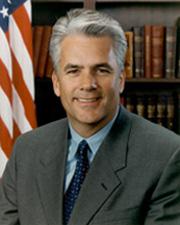 Sen. John Ensign (R-NV)
Legislative Activity
Stay on top of the latest movement without scrolling through every action
Senate amendment not agreed to: Amendment SA 2538 not agreed to in Senate by Yea-Nay Vote. 26 - 58. Record Vote Number: 287.
August 1, 2007
View full timeline
Senate amendment not agreed to: Amendment SA 2538 not agreed to in Senate by Yea-Nay Vote. 26 - 58. Record Vote Number: 287.
August 1, 2007
Roll call votes on amendments in Senate: Amendment SA 2538 not agreed to in Senate by Yea-Nay Vote. 26 - 58. Record Vote Number: 287.
August 1, 2007
Considered by Senate. (consideration: CR S10537, S10537-10540)
August 1, 2007
Amendment SA 2538 not agreed to in Senate by Yea-Nay Vote. 26 - 58. Record Vote Number: 287.
August 1, 2007
Senate amendment submitted
July 31, 2007
Senate amendment proposed (on the floor): Amendment SA 2538 proposed by Senator Grassley for Senator Ensign to Amendment SA 2530.(consideration: CR S10357-10358; text: CR S10357-10358)
July 31, 2007
Amendment SA 2538 proposed by Senator Grassley for Senator Ensign to Amendment SA 2530. (consideration: CR S10357-10358; text: CR S10357-10358) To amend the Internal Revenue Code of 1986 to create a Disease Prevention and Treatment Research Trust Fund.
July 31, 2007
Votes
1 roll call on this amendment
Text
Proposed
SMALL BUSINESS TAX RELIEF ACT OF 2007--Continued

The PRESIDING OFFICER. The Senator from Montana.
Mr. BAUCUS. Mr. President, I think we are awaiting the arrival of
Senator Grassley. While he is getting ready, I could not be more
pleased to have a better partner than Senator Grassley. He and I worked
very closely together, and he and I and Senators Hatch and Rockefeller
worked very hard to put this current legislation together. I thank the
Senator from Iowa for his dedication and public service. He does a good
job.
The PRESIDING OFFICER. The Senator from Iowa.
Mr. GRASSLEY. I appreciate those kind remarks. I obviously have
commented many times on this floor in the last 6 years about the close
working relationship I have had with him and his efforts, because most
everything that came out of our committee in the last 6 or 7 years has
been bipartisan.
As we all know, nothing gets through the Senate that is not
bipartisan, and so you might as well start at the committee level if
you are going to get anything done. I think we have gotten a lot done.
I thank the Senator for his kind comments.
Obviously everybody knows we are just beginning, yesterday and today
and probably this week, and hopefully completing work this week, on the
State Children's Health Insurance Program. So we are going to
continually refer to the acronym known as SCHIP.
This, as I said yesterday, is a product back from 1997, now
sunsetting 10 years later, by a Republican-led Congress. It is a very
targeted program, because too often some people giving speeches on the
floor of this body want to leave the impression, or maybe they think it
actually is, an entitlement program. This is not an entitlement
program. An entitlement program is when a program goes on forever, and
if you qualify, there is automatic access to the program, and
withdrawal from the Federal Treasury. This program is not an
entitlement program because it is based upon a specific amount of money
appropriated for the program. That money has got to be divided up among
all of the States and among all of the participants. So it is not an
entitlement.
I think you are going to hear a lot of debate this week that people
want you to think this is an entitlement. This program, targeted as it
is, is designed to provide affordable health coverage for low-income
children in working families. These families make too much to qualify
for Medicaid, which is one of those entitlement programs--and
legitimately an entitlement program--but these are families who earn
too much to qualify for Medicaid but struggle to afford private
insurance.
It is important that we reauthorize this very important program
targeted for children. The Finance Committee's bill proposes a
reasonable approach for reauthorizing SCHIP that is the product of
months of bipartisan work in the committee. I emphasize the word
``bipartisan.'' As I have said so often, this Finance bill is a
compromise. I think it is the best of what is possible. Clearly folks
on the left wanted to do more, and if you did what they wanted to do,
you would have a Democratic bill. My colleagues on the right wanted to
do less, and if you did and even go in a different direction, if you
did what they wanted to do, you would have a Republican-only bill. So
one way or the other, you have got 51 to 49, and nothing is going to
get done. You have got to have bipartisanship, because it takes 60
votes around here to shut off debate, to go to finality.
Neither side got what they wanted. I would suggest to you this is the
essence of compromise. This compromise bill maintains the focus on low-
income, uninsured children and adds coverage for an additional 3.2
million low-income children, children who could presently qualify but
not enough money is available or States were not doing their job of
outreach to bring these people in.
I have heard some harping from different quarters about the role
Senator Hatch and I have played in developing

[[Page S10354]]

this important piece of legislation. Some on my side, meaning the
Republican side, have suggested our efforts at finding compromise have
been inconsistent with advancing the Senate Republican agenda. For a
person like me who has been chairman of a committee for the last 6
years, getting a lot of Republican programs through, I take exception
to someone who says I am not concerned about Republican principles and
getting a Republican program, so I want to put this harping in context.
I wish to remind the critics that we would not have made tax relief law
if we had not found a way to compromise with Democrats who shared some
of our tax reduction goals. The bipartisan tax relief plans of 2001,
2003, 2004, and 2006 could not have passed the Senate on Republican
votes only.
During the 4\1/2\ years of my chairmanship, we were able to enact
almost $2 trillion in broad-based tax relief that was not tax relief as
an end in itself but was meant to stimulate the economy, and did
stimulate the economy to a point where we have had $750 billion more
coming into the Federal Treasury than anticipated as a result, as
Chairman Greenspan said, of these tax bills expanding the economy and
producing 8.2 million new jobs in recent years.
None of that would have happened if Republicans were working by
ourselves, just by ourselves. It took bipartisanship to get that done.
So while the temptation is always there for some Members on both sides
of the aisle to not engage the other side, rarely if ever will that
policy result in sustaining itself.
When it comes to the Republican agenda here, I have not heard any
Republicans say to me in the 5 months we have been talking about
reauthorizing SCHIP that we should not provide coverage to low-income
children. I have not heard anyone say we should not reauthorize this
specific bill. Quite to the contrary.

First, the President himself made a commitment to covering more
children. I wish to refer to the Republican National Committee in New
York City in 2004, and President Bush was very firm in making a point
on covering children. Let me tell you what he said.

America's children must also have a healthy start in life.
In a new term [meaning when he was reelected] we will lead an
aggressive effort to enroll millions of poor children who are
eligible but not signed up for the Government's health
insurance program. We will not allow a lack of attention or
information to stand between these children and the health
care that they need.

That was back in New York City, early September, 2004. Three months
later the President is reelected, with a mandate. It seems to me the
President was very clear in his conviction then. Let me repeat his
words because I think they are important. He said he would lead an
aggressive effort to enroll millions of poor children in Government
health insurance programs.
President Bush, this is your friend Chuck Grassley, helping you keep
the promise you made in New York City, and helping you keep your
mandate that you had as a result of the last election. But somewhere
the priorities of this administration seem to have shifted. The
Congressional Budget Office reports that the proposal for SCHIP
included in the President's fiscal year 2008 budget would result in the
loss of coverage, not an increase of coverage as the administration had
been advocating for in the year 2004; and that loss of coverage would
add up to 1.4 million children and pregnant women.
Secretary of Health and Human Services Mike Leavitt has also
supported expanding SCHIP. Secretary Leavitt is the President's Cabinet
member for health care. When Secretary Leavitt was Governor of Utah, he
favored expanding SCHIP during a public media availability on SCHIP
following a meeting with the President.
Here is what he, now Secretary Leavitt, but then Governor, had to say
about that meeting:

There was a discussion on children's health care. A lot of
celebration among governors and the President on the
successes that we have had in implementing the Children's
Health Insurance Program. Over the course of the last couple
of years, it has been a very successful partnership. And we
discussed [I assume that ``we'' means the President and the
Governors] ways in which that could be expanded.

That is Michael Leavitt.
Also there was a Governor Glendenning at that time representing the
Democratic Governors, holding a roundtable with the President.
Now, however, Secretary Leavitt wrote the Finance Committee to say
that the President would veto the Finance Committee's SCHIP bill. But
even in that letter, he does not call for ending SCHIP. He does not
suggest we should not cover kids through SCHIP, not at all. Here is
what he said about SCHIP:

The President and I are committed to reauthorizing a
program that has made a significant difference in the health
of lower-income children. Through 10 years of experience and
bipartisan support the State Children's Health Insurance
Program serves as a valuable safety net for children and
families who do not have the means to purchase affordable
health care. We are committed to its continuation.

I appreciate this support in the past for expanding SCHIP from both
the President and Secretary Leavitt. Now, however, some around here say
we should not update the SCHIP program regardless of what the President
said in the past in New York City, regardless of what Secretary Leavitt
said. These people are basically saying the program is fine as it is
right now. They want a simple continuation of the current program and
current funding.
I will soon say what is wrong with that. But the current program does
not work, and the current levels of funding will not do the job
everybody says they want to do. Under current law, the current program
is authorized to spend $25 billion over the next 5 years. That is if
this program were not sunsetting, just continuing on as is. That is
what we call a baseline amount. But the Congressional Budget Office
says the $25 billion baseline amount will not fully fund the program.
CBO says that without more funding, 800,000 kids would lose coverage.
To the chagrin of many Republican Senators and even some Democratic
Senators, the administration in the last 6 years--in fact, in one case
in Wisconsin, in the last 3 months--has allowed adults to get covered
under a program for children. That is not what we intended with the
Children's Health Insurance Program. SCHIP is for kids, not for adults.
There is no letter ``A'' in the acronym ``SCHIP.'' A simple extension
of current law, however, means that adults, about whom everybody is
complaining for being on a program only for children, would stay on the
program. A simple extension would also mean more adults would be added.
Of course, the reason for that is that States will continue in the
future to ask for waivers and, be those waivers granted, they would be
free to get approval for more childless adults and parents to be on a
program that was not intended for anything but children. Covering
adults drains scarce resources away from what we consider a priority--
children's coverage first.
We may end up having to pass a short-term extension of the current
law for a few months before work is finished on this reauthorization. I
hope not, but that is a possibility. This is something we have to live
with while Congress finishes work on a final version of the
reauthorization. If that happens, so be it. But hopefully we can avoid
a long-term extension of current law.
The SCHIP formula funding in current law doesn't work either. It
actually gives less money to States that get their kids covered. That
doesn't make sense. An extension of current law won't fix the formula.
The current formula also penalizes small rural States. That is
because uninsured kids are not counted accurately in small rural
States. That has resulted in funding shortfalls in those States. An
extension of current law means this inaccurate funding formula would
continue. That means more shortfalls for these States.
Another problem with current law is that there isn't enough funding.
Under a straight extension of current law, there are going to be
additional State shortfalls. We dealt with that earlier this year. I
believe 14, 15, 16 States had shortfalls. The Congressional Budget
Office says those shortfalls would cause 800,000 kids to lose coverage.
When Congress has faced these shortfalls in the past, what have we
done? We just handed out more money to the States. Congress did that on
three separate occasions. So that would keep those 800,000 kids from
losing coverage, but this wouldn't fix any of the other

[[Page S10355]]

problems. In fact, it would perpetuate the problems about which
everybody is complaining--the funding coverage of adults, No. 1; and
No. 2, a fundamentally flawed formula that our legislation takes care
of.
That is why an extension of current law won't work. More adults?
Think of all the Senators who have been complaining to me because there
is no ``A'' in ``SCHIP.'' It wasn't meant to cover adults. It just
leaves things as they are--more adults. We have a broken funding
formula. We have some States coming up short. So you have to
appropriate more money. And most importantly, you have 800,000 kids
losing coverage. So what other options are there?
Well, there is the President's proposal. I am not here to bad-mouth
the President's proposal or any of my colleagues on this side of the
aisle who are working on proposals. I am not going to, obviously, bad-
mouth anything Senator Wyden is doing in the same respect on the
Democratic side of the aisle. These policies are good. But I am going
to tell the President: Now is not the time.
Going back to the President's program on SCHIP, the President's plan
is in his budget. It proposes a $4.8 billion increase in SCHIP, but it
does not work either. What many have overlooked is that the President's
plan assumes a massive redistribution of about $4 billion in SCHIP
funds that States have in reserve. So the President assumes States will
willingly relinquish all of those SCHIP reserves. It assumes the
Secretary will redistribute those funds to States that currently have
SCHIP shortfalls. As someone who was worried about State SCHIP
shortfalls before, worrying about SCHIP shortfalls was cool, I tell my
colleagues: That dog won't hunt. It is robbing Peter to pay Paul. There
is no way a proposal that sucks $4 billion out of State coffers will
ever fly around this Senate.
That is not all. Under the President's plan, 1.4 million children and
pregnant women would be cut off of the program between now and 2012;
1.4 million would lose coverage, to emphasize. That is the end result
of the President's plan: Rob Peter to pay Paul; 1.4 million children
losing coverage.
Then we are going to hear about a more comprehensive plan. This is
the one I was referring to when I referred to Senator Wyden and when I
was referring to the President having a proposal and some well-meaning
people on my side of the aisle. Most of the news is from either Senator
Wyden or from Republican colleagues of mine, a well-meaning approach, a
proposal to use the Tax Code to cover many millions of uninsured
children and adults through private health insurance. Again, I don't
disagree with that policy, but now is not the time for it.
I said during Finance Committee consideration of this bill that I
would have liked the debate about SCHIP to focus on a larger effort to
address the millions of Americans who are uninsured. I think we are
missing an opportunity by only focusing this debate on SCHIP
reauthorization. Too many Americans don't have health insurance, and we
need to address rising health care costs. That approach will help that
as well. I agree that we should be doing more, and I want to see
Congress consider proposals to reform the tax treatment of health care
to increase coverage for tens of millions of the 46 million people who
don't have insurance today. But in terms of this bill and the whole
issue of SCHIP reauthorization, that is not realistic.
I continue to be disappointed by the fact that there isn't bipartisan
support for trying to do more as part of SCHIP. I urged the
administration months ago to get bipartisan support--I emphasize
bipartisan support because that is the only way we get things done in
the Senate--if they want the President's initiative to be successful. I
never saw any effort beyond maybe talking to Senator Wyden. It just
didn't happen. I looked far and wide. I can't find a single Democratic
Senator who will support a tax reform alternative to the SCHIP bill.
Even though it won't happen with this bill, we still need to work for a
broader package to address the more fundamental problems of rising
health costs and the uninsured.
Until then, I see SCHIP as a stopgap measure--5 years in duration, 5
years to do something bigger. The $35 billion we are investing in
children's health coverage over the next 5 years is a drop in the
bucket. When I say $35 billion is a drop in the bucket, somebody will
say: You have been in Washington too long. Let me explain. That is one-
quarter of 1 percent of the $14 trillion that will be spent on health
care in this entire country, public and private expenditures, between
now and the end of this authorization, 2012. Economists generally agree
that if a condition cannot persist, then it won't persist. The current
spending on health care cannot persist.

Members on both sides of the aisle have worked on proposals to
address the broader issues of the uninsured and health reform overall.
I have already referred to Senator Wyden as a leader among Democrats on
this issue. He has Senator Bennett of Utah as a Republican working with
him. They have been championing a more comprehensive approach to cover
the uninsured. Many Republican Senators want to make changes in the Tax
Code to help cover tens of millions of Americans of all ages instead of
the few million kids whom we do with this legislation. I am looking
forward to a fruitful debate on this issue of health reform and the
uninsured through the Senate Finance Committee but not until we
complete action on this bill. SCHIP must be passed.
Turning back to the Finance Committee bill, meaning the SCHIP bill
before us, I am rather surprised at the overheated rhetoric that has
emerged from both sides of the aisle. It has really been pretty
unbelievable. On one side, I hear that nothing less than $50 billion
will do the job, and if that number is not reached, children are at
risk of dying. On the other side, I hear maintaining coverage for kids
currently on this program and covering about half the kids eligible for
Medicaid or SCHIP represents a slippery slope that leads us to the
Government takeover of the entire health care system. Both sides need
to call time-out to cool down, stop the hysteria, and take a look at
what we actually have before the Senate in this Finance Committee
compromise.
In 1997, SCHIP was conceived as a capped block grant program, not an
entitlement. That was very important to Republicans. It is our model
for how a safety net should work. It is not an open-ended entitlement.
The Finance Committee bill maintains the block grant. It does not
create an entitlement. I warn my colleagues, they are going to hear
this too much, and they are going to hear me wake them up that this is
not an entitlement. I believe they know better, but we know the game
that is played around here.
In 1997, SCHIP was intended to encourage public-private partnerships.
The Finance bill improves and strengthens private coverage options. In
1997, SCHIP gave States the tools they needed to control costs. These
tools included allowing waiting lists, adding reasonable cost sharing,
and limiting enrollment. The Finance bill maintains the flexibility
which was in that 1997 act.
In 1997, SCHIP gave States the flexibility to address geographical
differences in health care costs. States determine eligibility for
benefits and tailor the benefits to their needs. The Finance bill
affirms the States' role in managing this program.
SCHIP is also a humble program when compared to Medicaid. Medicaid is
the bigger and more expansive entitlement program. Medicaid is a
program for low-income individuals, pregnant women, and families. The
bill before us today represents a modest update of the SCHIP program
created by the 1997 act.
So what does the bill before the Senate actually accomplish? The bill
before the Senate extends the program and fixes problems with current
law, first, by extending the program that would otherwise expire
September 30, doing away with the sunset or extending the sunset 5
years; No. 2, eliminating shortfalls that have plagued the program; No.
3, eliminating enhanced match for coverage of parents and childless
adults--in other words, saving money so you spend more on kids; and No.
4, preserving the original SCHIP mission, coverage of low-income
children.
The bill before the Senate continues and focuses coverage on low-
income children by doing the following: No. 1,

[[Page S10356]]

it provides additional resources targeted toward covering low-income
children. No. 2, it extends coverage for the 6.6 million children
currently enrolled in SCHIP. I want to emphasize, 91 percent of these
families have incomes below 200 percent of poverty. No. 3, it covers an
additional 2.7 million children already eligible for Medicaid or SCHIP
under current law. No. 4, it provides coverage for an additional
600,000 uninsured low-income children.

The Finance Committee bill provides targeted incentives to precisely
and, more importantly, efficiently cover the lowest income children. It
does this by doing two things: one, by providing precisely targeted
incentives that use an incentive fund to encourage enrollment of the
lowest income children--in other words, go after those with the most
need--and, two, by encouraging States to increase outreach and
enrollment.
The Director of the Congressional Budget Office, Dr. Peter Orszag,
characterized the incentive fund ``as efficient as you can possibly get
per new dollar spent.''
The Finance Committee bipartisan bill also removes childless adults
and limits payments for parents. It eliminates coverage under SCHIP for
childless adults within 2 years. Those are the people who are already
on the program. It eliminates the enhanced match for parents covered
under SCHIP. It prohibits new State waivers to expand coverage for
parents.
Now, again, I wish to emphasize this point. It does away with State
waivers. You get back to every complaint I hear about this bill. You do
not hear complaints about covering kids under 200 percent of poverty
from Republicans or Democrats. But you hear an awful lot from both
Republicans and Democrats about covering adults because there is no
letter ``A'' in the acronym SCHIP, and those adults are covered because
the law allows waivers. So this bill does away with waivers, so you do
not get the adults on the program the way they have gotten there in the
past.
Next, it reduces spending on adults by $1.1 billion.
Finally, the Finance Committee bill spends less than the $50 billion
authorized in the budget. Now, once again, let me emphasize, there are
people around here who say $5 billion in addition to what we are
spending now is enough. Then, you have people who say only $50 billion
more than what we are spending now is enough. Somewhere in the middle
is where you end with compromise.
Now, for Republicans who are irritated because I am here with a
bipartisan compromise, along with 16 other members of the Finance
Committee--17 to 4 this bill was voted out--we are $15 billion under
what a lot of people in this body would like to spend. I think for some
people maybe $50 billion would not have been enough.
Continuing SCHIP with static enrollment would cost $14 billion over 5
years over the baseline anyway. At $35 billion, the SCHIP
Reauthorization Act will cost $15 billion less than what was included
in our budget. This additional funding goes toward coverage of lowest
income children.
This bill does not include everything on everybody's wish list. I
worked hard for a responsible, bipartisan agreement because I wish to
see this bill pass. I think we have done a good job. But I also wish to
make one more point very clear. My support for this legislation, in the
end, will depend upon the outcome of the floor debate and the
conference. I am not going to be able to support a bill that changes
significantly from what we have in this proposal.
I appreciate very much the leadership Chairman Baucus has provided. I
thank him and Senator Rockefeller for what they did to reach a
bipartisan agreement.
I also extend my sincere thanks to Senator Hatch for the hours and
hours he has put into this effort. Senator Hatch was the main
Republican sponsor of the bill that created the SCHIP program 10 years
ago. His commitment to the ideals and fundamentals of the program is
steadfast, and the program is better for it.
I also have to say I am disappointed by the way the Democratic
leadership is handling the process of bringing this bill up for
consideration on the floor. It does not bode well for the outcome of
the bill. In the Senate, process matters as much as policy, and this
process has not been managed in a bipartisan or responsible manner.
However, the Finance Committee SCHIP bill is still one I can support.
It is a compromise. It is based upon reality. This bill is for kids.
So I will end with an analogy from a child's bedtime story. This bill
is not too big, it is not too small. It is not too hard, it is not too
soft. It is not too hot, it is not too cold. It is just right.
Mr. President, I yield the floor.
The PRESIDING OFFICER. The Senator from Oregon.
Mr. WYDEN. Mr. President, since the Senator from Iowa has been
talking about the efforts of Senator Bennett and I and how it relates
to the children's health program, I wish to take a few minutes to
discuss that relationship.
First, I think Senator Baucus, Senator Rockefeller, Senator Grassley,
and Senator Hatch--through the hours and hours of effort they have put
into making the children's health proposal ready for floor action--have
done a great service. They have done a great service, first and
foremost, to the country's kids.
It seems to me every single Member of the Senate can say today we
cannot afford, in a country as good and strong and rich as ours, to
have so many kids go to bed at night without decent health care. As a
result of the bipartisan work of four Members of the Senate--two
Democrats and two Republicans--we have laid the foundation to take
steps immediately to help youngsters who are falling between the
cracks.
I have long felt the challenge with respect to health care today is
twofold. First, you act immediately to help those who are the most
vulnerable in our society. That is, in fact, what four members of the
Senate Finance Committee have helped the Senate to promote today.
Second, we ought to be taking steps on a broader basis to fix health
care in our country.
We are spending enough money on health care today. We are not
spending it in the right places. We are spending enough money today on
American health care to be able to go out and hire a doctor for every
seven families in the United States. That doctor would do nothing
except take care of seven families. Pay the doctor $200,000 a year, and
my guess is, the distinguished Presiding Officer would probably have
physicians in the State of Delaware come to him and say, ``Where do you
go to get your seven families?'' because they would all like to be
practicing physicians again. So we are spending enough money on health
care today. We are not spending it in the right places.

At a time when our population is growing so rapidly, when costs are
skyrocketing out of control, we need to fix American health care. But
in order to get to the broader health reform effort--an effort that is
bipartisan, with Senator Bennett joining me in the first bipartisan
health reform bill in 13 years--you have to take steps to meet the
needs of youngsters today.
The Senate has already said that on multiple occasions. We said it
first by passing the children's health program, and now, through the
reauthorization effort, we say kids will come first. We also said it,
in fact, through the budget resolution, where there was an effort to
look at the relationship between broader health reform and care for
kids, and the Senate, again, said children will come first.
So I am very hopeful. I believe consideration of the children's
health program is, essentially, the opening bell of round one in the
fight to fix health care. If we can tackle the issue of children's
health in a bipartisan way--the way the Senate Finance Committee has
done--it ought to be possible, even in this session of Congress, to
move on to broader health reform.
Now, I am very hopeful the Administration will join in this
bipartisan effort. We have all read about discussions about a possible
veto message. I am very hopeful the Administration will join
discussions in the Senate, join discussions in the other body, and help
us to move quickly on the issue of children's health.
If we do that, it ought to be possible, as the distinguished Senator
from Iowa has indicated, to move on to something the Administration
feels strongly about, where I happen to think, by and large, they are
correct. The Federal tax

[[Page S10357]]

rules, as it relates to health care, are a mess. Essentially, they
reward inefficiency. They disproportionately favor the most affluent.
If you are a ``high flier'' in our country, you can go out and get
every manner of deluxe kind of health service and write it off on your
taxes; but if you are a hard-working woman in Delaware or Oregon or
around the country and your company does not have a health plan, you
get virtually nothing.
So I come to the floor today to say what Democratic economists have
said, what Republican economists have said, what the administration
officials have said: There ought to be an effort to fix the Tax Code as
it relates to health care, and I and Senator Bennett and others want
to; and we want to fix it in this session of the Congress. But to get
at that issue you are going to, first, have to meet the needs of
children.
I was asked today what the implications of the children's health
program are for bipartisanship. I think if this body can pick up on the
bipartisan work of the Senate Finance Committee, there are
extraordinary opportunities for broader health reform in this session
of Congress. I do not think the country wants to wait 3 or 4 or 5 more
years to fix American health care.
I have heard the discussion about how there is a Presidential
campaign coming up, and let's wait another 2, 3, 4 years to talk about
a more comprehensive effort to fix American health care. I do not think
any of us got sent here to tell businesses that are trying to compete
in tough global markets, to tell those who cannot afford the
skyrocketing premiums: Well, we are not going to work on broader health
care reform for another 3 or 4 years. I think they want to hear how we
are going to deal, in a bipartisan way, with the premier domestic issue
of our time. Senators Baucus and Grassley and Hatch and Rockefeller
have given us an initial dose of bipartisanship, an initial dose of
bipartisanship in an area the country cares about, and cares about
strongly, and that is meeting the needs of our children. But in the
spirit that Senate Finance Committee quartet has worked, I and Senator
Bennett and others would like to pick up on that kind of bipartisan
theme and move aggressively to looking at the health care system as a
whole and taking steps to transform it.
I will say, I am struck again by how every single day it seems to me
opportunities for bipartisanship on health care abound. I was very
pleased that the nominee to head CMS, the agency that deals with
Medicare and Medicaid, reacted very positively to our ideas on
preventive health care. The fact is, in this country, we really don't
have health care at all. We have sick care. We wait until somebody is
flat on their back in a hospital--and the Medicare Program shows this
clearly by paying those bills under Part A of Medicare. Part B of
Medicare, on the other hand, the outpatient part of Medicare, pays
virtually nothing for prevention, virtually nothing to keep people
well.

We have known about the value of prevention for quite some time. The
distinguished Senator from Iowa, Mr. Harkin, has been talking about the
value of health care prevention for years and years. What I and Senator
Bennett have proposed for the first time under Federal law is that
Medicare would be given the legal authority to go out and lower
premiums for seniors who reduce their blood pressure and reduce their
cholesterol and take the kind of preventive steps that everyone
understands makes sense and helps to prolong an individual's good
health and also saves money for the Medicare Program. We were very
pleased that the nominee to head the agency that deals with Medicare
and Medicaid was supportive of those changes and indicated he wanted to
work, if confirmed, in a bipartisan way.
So the fact is, there are great opportunities for bipartisanship on
health care in this Congress if we can get past this initial effort at
addressing American health care. The Senate has indicated, through the
initial authorization of the children's health program and through the
budget resolution, that this is the program with which it wants to
begin the debate on health care.
In the discussions in the Finance Committee, I followed very closely
all of the different alternatives. It was a big bipartisan lift to get
a 17-to-4 vote in the Senate Finance Committee. A lot of colleagues
wanted to spend more. A lot of colleagues thought the program ought to
be available to other groups of citizens. Some felt there wasn't much
of a role for Government at all and that even the existing children's
health program was too expansive. But the committee came together on a
17-to-4 basis.
I see the distinguished Senator from Iowa has returned. If we can
pass this legislation with the kind of bipartisan support that was
initially demonstrated in the Senate Finance Committee, I think it is
very possible, in spite of all of the popular wisdom to the contrary,
this Senate can achieve broader health care reform in this session of
Congress. I see one poll after another which indicates that health care
is the premier domestic issue of our time; that it is the most
important issue to our citizens--in many polls by something like a 2-
to-1 margin. So I think in addressing this issue today--health care for
children--the Senate can lay a bipartisan foundation for broader
reforms.
I think Senator Bennett and I have provided some direction for the
Senate to go from here, but we would be the first to acknowledge there
are many Senators with ideas on these issues, and many of them are
good. I have already indicated I think the Administration has a valid
point with respect to these tax rules on health care. The distinguished
chairman of the Finance Committee is back, and he and I have listened
to one economist after another testify before the Finance Committee--
Democrats and Republicans--talking about how the Tax Code on health
care makes no sense and largely comes out of the 1940s.
So we have Senators of both political parties who would like to work
on broader health care reform, but first we have to pass this
legislation. I hope we will pass it with a resounding bipartisan
majority vote so that we could truly lay the foundation for significant
and comprehensive health reform to be considered by this body.
I yield the floor.

Amendment No. 2538 to Amendment No. 2530

Mr. GRASSLEY. Madam President, for Senator Ensign, I send an
amendment to the desk and ask for its consideration.
The PRESIDING OFFICER (Mrs. McCaskill). The clerk will report.
The bill clerk read as follows:

The Senator from Iowa [Mr. Grassley], for Mr. Ensign,
proposes an amendment numbered 2538 to amendment No. 2530.

Mr. GRASSLEY. Madam President, I ask unanimous consent that the
reading of the amendment be dispensed with.
The PRESIDING OFFICER. Without objection, it is so ordered.
The amendment is as follows:

(Purpose: To amend the Internal Revenue Code of 1986 to create a
Disease Prevention and Treatment Research Trust Fund)

At the appropriate place, insert the following:

SEC. _. DISEASE PREVENTION AND TREATMENT RESEARCH TRUST FUND.

(a) In General.--Subchapter A of chapter 98 of the Internal
Revenue Code of 1986 (relating to establishment of trust
funds) is amended by adding at the end the following new
section:

``SEC. 9511. DISEASE PREVENTION AND TREATMENT RESEARCH TRUST
FUND.

``(a) Creation of Trust Fund.--There is established in the
Treasury of the United States a trust fund to be known as the
`Disease Prevention and Treatment Research Trust Fund',
consisting of such amounts as may be appropriated or credited
to the Disease Prevention and Treatment Research Trust Fund.
``(b) Transfer to Disease Prevention and Treatment Research
Trust Fund of Amounts Equivalent to Certain Taxes.--There are
hereby appropriated to the Disease Prevention and Treatment
Research Trust Fund amounts equivalent to the taxes received
in the Treasury attributable to the amendments made by
section 701 of the Children's Health Insurance Program
Reauthorization Act of 2007.
``(c) Expenditures From Trust Fund.--
``(1) In general.--Amounts in the Disease Prevention and
Treatment Research Trust Fund shall be available, as provided
by appropriation Acts, for the purposes of funding the
disease prevention and treatment research activities of the
National Institutes of Health. Amounts appropriated from the
Disease Prevention and Treatment Research Trust Fund shall be
in addition to any other funds provided by appropriation Acts
for the National Institutes of Health.
``(2) Disease prevention and treatment research
activities.--Disease prevention

[[Page S10358]]

and treatment research activities shall include activities
relating to:
``(A) Cancer.--Disease prevention and treatment research in
this category shall include activities relating to pediatric,
lung, breast, ovarian, uterine, prostate, colon, rectal,
oral, skin, bone, kidney, liver, stomach, bladder, thyroid,
pancreatic, brain and nervous system, and blood-related
cancers, including leukemia and lymphoma. Priority in this
category shall be given to disease prevention and treatment
research into pediatric cancers.
``(B) Respiratory diseases.--Disease prevention and
treatment research in this category shall include activities
relating to chronic obstructive pulmonary disease,
tuberculosis, bronchitis, asthma, and emphysema.
``(C) Cardiovascular diseases.--Disease prevention and
treatment research in this category shall include activities
relating to peripheral arterial disease, heart disease, valve
disease, stroke, and hypertension.
``(D) Other diseases, conditions, and disorders.--Disease
prevention and treatment research in this category shall
include activities relating to autism, diabetes (including
type I diabetes, also known as juvenile diabetes, and type II
diabetes), muscular dystrophy, Alzheimer's disease,
Parkinson's disease, multiple sclerosis, amyotrophic lateral
sclerosis, cerebral palsy, cystic fibrosis, spinal muscular
atrophy, osteoporosis, human immunodeficiency virus (HIV) and
acquired immunodeficiency syndrome (AIDS), depression and
other mental health disorders, infertility, arthritis,
anaphylaxis, lymphedema, psoriasis, eczema, lupus, cleft lip
and palate, fibromyalgia, chronic fatigue and immune
dysfunction syndrome, alopecia areata, and sepsis.''.
(b) Clerical Amendment.--The table of sections for
subchapter A of chapter 98 of the Internal Revenue Code of
1986 is amended by adding at the end the following new item:

``Sec. 9511. Disease Prevention and Treatment Research Trust Fund.''.

Mr. GRASSLEY. Madam President, I yield the floor.
Mr. BAUCUS. Madam President, the Senator from Kentucky, Mr. Bunning,
is going to be offering an amendment. So I ask unanimous consent that
the pending amendment be temporarily laid aside so the Senator from
Kentucky can offer his amendment.
The PRESIDING OFFICER. Without objection, it is so ordered.
Mr. BAUCUS. I also ask unanimous consent that Senator Salazar be
allowed to speak following Senator Bunning.
The PRESIDING OFFICER. Without objection, it is so ordered.
The Senator from Kentucky is recognized.

Amendment No. 2547 to Amendment No. 2530

Mr. BUNNING. Madam President, I have an amendment at the desk.
The PRESIDING OFFICER. The clerk will report.
The bill clerk read as follows:

The Senator from Kentucky [Mr. Bunning] proposes an
amendment numbered 2547 to amendment No. 2530.

Mr. BUNNING. I ask unanimous consent that the reading of the
amendment be dispensed with.
The PRESIDING OFFICER. Without objection, it is so ordered.
The amendment is as follows:

(Purpose: To eliminate the exception for certain States to cover
children under SCHIP whose income exceeds 300 percent of the Federal
poverty level)

Beginning on page 79, strike line 21 and all that follows
through page 81, line 6, and insert the following:
(a) FMAP Applied to Expenditures.--Section 2105(c) (42
U.S.C. 1397ee(c)) is amended by adding at the end the
following new paragraph:
``(8) Limitation on matching rate for expenditures for
child health assistance provided to children whose effective
family income exceeds 300 percent of the poverty line.--For
fiscal years beginning with fiscal year 2008, the Federal
medical assistance percentage (as determined under section
1905(b) without regard to clause (4) of such section) shall
be substituted for the enhanced FMAP under subsection (a)(1)
with respect to any expenditures for providing child health
assistance or health benefits coverage for a targeted low-
income child whose effective family income would exceed 300
percent of the poverty line but for the application of a
general exclusion of a block of income that is not determined
by type of expense or type of income.''.
(b) Conforming Amendment.--Section 2105(a)(1) ( 42 U.S.C.
1397dd(a)(1)) is amended, in the matter preceding
subparagraph (A), by inserting ``or subsection (c)(8)'' after
``subparagraph (B)''.
(c) Application of Savings to Grants for Outreach and
Enrollment.--
(1) In general.--Notwithstanding the dollar amount
specified in section 2113(g) of the Social Security Act, as
added by section 201(a), the dollar amount specified in such
section shall be increased by the amount appropriated under
paragraph (2).
(2) Appropriation.--Out of any funds in the Treasury not
otherwise appropriated, there is appropriated such amount as
the Secretary determines is equal to the amount of additional
Federal expenditures for the period of fiscal years 2008
through 2012 that would have been made if the enhanced FMAP
(as defined in section 2105(b) of the Social Security Act)
applied to expenditures for providing child health assistance
to targeted low-income children residing in a State that, on
the date of enactment of the Children's Health Insurance
Program Reauthorization Act of 2007, has an approved State
plan amendment or waiver to provide, or has enacted a State
law to submit a State plan amendment to provide, expenditures
described in section 2105(c)(8) of such Act (as added by
subsection (a)). The preceding sentence constitutes budget
authority in advance of appropriations Act and represents the
obligation of the Federal Government to provide for the
payment of such amount to States awarded grants under section
2113 of the Social Security Act.

Mr. BUNNING. Madam President, I offer this amendment to the SCHIP
bill. This is the same amendment I offered during the Finance
Committee's consideration of this legislation.
I have heard a lot of talk about how the Baucus bill puts the focus
for SCHIP back on low-income children--so much talk, in fact, that one
would hardly know that the Baucus bill allows certain States to provide
families making up to $70,000 or $80,000 a year in income with
Government-run health care.
Let's start from the beginning. The way the SCHIP and Medicaid
Program work is States get Federal matching dollars to help fund their
programs. The SCHIP match from the Federal Government is higher than a
State's Medicaid match. This means for my State, the Federal
Government's match for Medicaid is about 70 percent, while the State
pays the remaining 30 percent. For SCHIP, the Federal match is 80
percent, while the State match makes up the remaining 20 percent.
SCHIP was intended to help States provide health care coverage to
children and families whose incomes were below 200 percent of the
Federal poverty line. These families were likely working but making too
much money to qualify for Medicaid and couldn't afford private health
insurance. I would like to note that 200 percent of the Federal poverty
level is about $41,000 a year in income for a family of four.
The Baucus bill allows States to expand their SCHIP programs and
receive the higher SCHIP matching rate for families with incomes up to
300 percent of the poverty level, or almost $62,000 for a family of
four. Personally, I think that in and of itself is too high, especially
when the national median income in this country was about $46,000 a
year in 2005. In the Baucus bill, States that choose to go above 300
percent of poverty would receive their Medicare matching rate for those
families which, remember, is the lower reimbursement rate.
However, the Baucus bill thinks families in New Jersey and New York
deserve special treatment under SCHIP. The bill provides an exemption
for States that have already gone above or are currently trying to go
above 300 percent of poverty for SCHIP coverage. New Jersey already
provides coverage for families up to 350 percent of poverty. New York
is working to get approval to extend coverage up to 400 percent of
poverty. I want to make sure everyone understands, 400 percent of
poverty is $82,600 a year for a family of four; 350 percent of poverty
is $72,275 per year. Are we really going to be providing Government
health care for families making $70,000 to $80,000 a year?
My amendment is fairly simple. It strikes the exemption the Baucus
bill has given to just New York and New Jersey so they have to play by
the same rules as every other State. If these two States want to
provide health care coverage to families above 300 percent of the
poverty level, they can do so--they just cannot get a higher SCHIP
matching rate. They would get their Medicaid matching rate. That at
least leaves the playing field level.
There will be obviously some small savings from this if my amendment
passes. My amendment would take these savings and provide additional
money to outreach and enrollment grants.
Some people will try to say it is more expensive to live in these two
States than it is in other States, and that is probably true in certain
areas. However, SCHIP is a Federal program, and all States should play
by the same

[[Page S10359]]

rules. Also, these two States can still cover these higher income
families if they choose. They just have to get the lower Medicaid
matching rate to do so.
If New York and New Jersey feel so strongly about letting families
making $70,000 or $80,000 a year have Government health care, then the
States should be willing to pay a little more from their own tax
revenue. The last time I checked, money doesn't grow on trees around
here--or at least it very rarely does. The Baucus bill is requiring
people in other States such as Kentucky, New Mexico, Florida, and Maine
to pay more so New York and New Jersey can cover families at these
higher income levels. To me, that is grossly unfair.
Some people may also try to argue that New York is only thinking
about going to 400 percent of the poverty level, and they would have to
get a waiver or a plan approved by the Department of Health and Human
Services for this increase. OK. So then why give them this special
protection in the Baucus bill? Why create special rules for New York
when they haven't even gotten approval yet? To me, it is outrageous
that a program designed for lower income kids is being expanded to
include families at 350 percent or 400 percent of the poverty level.
That is too high, and it is unfair to ask people in other States to pay
for these types of expenses.
So with my amendment, you have two options: more money for outreach
and enrollment efforts and requiring all States to play by the same
rules or covering kids and families most of us probably don't consider
low income--those making up to $72,000 or $82,000 a year for a family
of four.
Madam President, I reserve the remainder of my time, and I ask for
the yeas and nays on my amendment when it is appropriate.
The PRESIDING OFFICER. Is there a sufficient second? There is a
sufficient second.
Mr. BUNNING. Madam President, I yield the floor.
The PRESIDING OFFICER. The Senator from Montana is recognized.
Mr. BAUCUS. Madam President, the Senator from Colorado is to be
recognized next. I say to my friend from Kentucky, I think the Senators
from the two States that will be directly affected by the amendment
will be coming to the floor to speak in opposition. When they do, those
Senators will be recognized. In the meantime, I urge the Chair to
recognize the Senator from Colorado.
The PRESIDING OFFICER. The Senator from Colorado is recognized.
Mr. SALAZAR. Madam President, I rise to support the effort we have on
the floor to address a national health care imperative, which is
providing health insurance to 10 million young people in our country
today.
For me, when I come to this Senate every day and speak on behalf of
the millions of people in my State of Colorado and around the country,
I think about the biggest issues we are faced with, the biggest
challenges of our time, the imperatives of the 21st century, and there
are three in my mind.
First is the questions we face in terms of foreign affairs and how we
protect America and homeland security. We will have other occasions
where we will deal with the fundamental issue of protecting America and
making sure our homeland is secure. We took significant steps last week
in that direction when we adopted the 9/11 Commission recommendations.
The second issue is how we move forward and embrace a clean energy
economy for the 21st century. With the committees that have reported
legislation, including the Energy Committee, which adopted bipartisan
legislation here, we took a step forward with that international
imperative.
The third issue that I think is an imperative of the 21st century is
how we take the health care crisis we have--a system which is not
working for the people today--and fix it. Today and this week is an
opportunity for us, the Senate, to take a very major step toward making
sure we are moving toward addressing the complex issue of health care
and providing health care insurance to the 10 million children of
America who, without this program, would wake up after September
without the health insurance that provides them with an opportunity to
live a healthy American life. So this legislation is very important for
us to move through this body.
I say also at the outset that we would not be here today had it not
been for the bipartisan efforts of Senators Baucus and Grassley, in the
leadership in the Finance Committee, joined by Senators Rockefeller and
Hatch. The four of them moved this legislation forward today in the
framework that gives us the great possibility of receiving an
overwhelming bipartisan vote as we move this legislation out of the
Senate.
By all measures, we know our health care system is in crisis. We have
47 million Americans without health insurance today, and 9 million of
them are kids. In Colorado, 20 percent of our population--1 in 5, or
780,000--lacks health coverage; 180,000 of those people in my State of
Colorado are children.
These are middle class citizens who are getting squeezed by the
ballooning costs of health care. Two-thirds of Americans and 70 percent
of Coloradans without health insurance work full time. They play by the
rules, but still find coverage out of reach.
For those who are able to afford health insurance, the picture is
also grim. Health insurance premiums for family coverage have risen by
over 70 percent since 2000. An employer-sponsored family coverage plan
now costs nearly $10,000 a year. This is a huge chunk of a working
family's income.
Our health care system is in dire need of triage. We must start with
those who are most vulnerable, our children, and see to it that they
have the health care coverage they deserve.
Covering our kids, providing them preventive care from doctors and
nurses, ensuring that they grow up healthy and strong--this has been
the focus of our health care work over the last several months in the
Senate Finance Committee. This week we bring the bill to the floor with
the hope that we will pass it swiftly and with broad, bipartisan
support, so that we can give 10 million more kids the opportunity they
deserve to live up to their potential.
The reason we focus our first reforms of the health care system on
our children is simple: every American child deserves the opportunities
that come from a healthy start in life.
The fact that 9 million of our kids--180,000 in Colorado--have no
coverage is simply unacceptable. It is a massive liability not just for
the health of our kids, but for their education and for our future
economic security.
The impacts of a lack of health coverage are clear: uninsured
children are 6 times more likely to have unmet medical needs; uninsured
children are two and a half times more likely to have unmet dental
needs; one-third of all uninsured children go without any medical care
for an entire year; uninsured children are less likely to do well in
school due to absences from unmet health needs; and uninsured children
are more likely to seek care from hospital emergency rooms, which are
often the provider of last resort, the most costly venue for care, and
the least equipped to provide the type of preventive and comprehensive
follow-up care children need.
As sobering as these statistics are, the stories of families and
health care providers are even more compelling. Earlier this year, at
Senator Baucus' suggestion, I traveled to Greeley, Fort Morgan, Fort
Collins, Steamboat, Silverthorne, Grand Junction, Durango, Alamosa,
Pueblo, Colorado Springs, and Denver to meet with health care
providers, State officials, children's advocacy groups and families
interested in the reauthorization of the Children's Health Plan.
I heard harrowing tales about delayed health care that caused
children's health to worsen. One school nurse told me of a boy who
injured his leg during a school football game. Because his family could
not afford to take him to a doctor, they applied ice to his leg and
prayed it would get better.
Unfortunately, the boy's leg, which was fractured, grew progressively
worse, swelling to two times its normal size. The school nurse told me
of the pain and anguish the child endured because his parents could not
afford an expensive doctor's visit.
I heard countless other stories of colds that turned into pneumonia,
of ear aches that developed into ear infections, and of other illnesses
that grew

[[Page S10360]]

worse because parents could not afford to seek medical care for their
kids. These families eventually had to take their kids to the emergency
room for treatment, the most expensive venue for care, and one which
typically doesn't provide the type of preventative or comprehensive
follow-up care that our kids need.
For millions of children and their families, for our hospitals,
clinics and health care providers who can no longer shoulder the burden
of uncompensated care, the time has come to provide health insurance to
children in need.
I am proud of the work that we have done on this bill in the Finance
Committee. It will cover 10 million uninsured children. It is a huge
step toward providing coverage for every uninsured child in America,
and we have done it with overwhelming bipartisan support in committee.
Unfortunately, the President seems to have a different perspective.
He has already issued a veto threat. I believe he is wrong. For the
sake of our children we must reauthorize the Children's Health
Insurance Program, and we ask the President to help get it done. CHIP
has become a critical resource to us in Colorado and nationwide,
providing health care coverage to children who would otherwise go
uninsured.
I believe that it is our moral and economic obligation in Washington
to invest in our children's healthcare, as our investment today, will
pay off tomorrow. The President should embrace this proposal for
children across the country, and I strongly urge the President to help
us get it done.
I want to take a moment to talk about what the bill does, because the
veto threat implies a deep misunderstanding about its benefits.
On the broadest scale, the bill before us provides insurance coverage
to 3.3 million children who are currently uninsured, while maintaining
coverage for all 6.6 million low-income children currently enrolled in
the Children's Health Insurance Program.
The bill includes significant incentives for States to enroll more
children onto CHIP, particularly children in rural communities where
geographic distances and the lack of health infrastructure create
barriers to enrollment. Twenty percent of all low-income children live
in rural areas, and a significant percentage of them are uninsured. We
can do better.
The CHIP reauthorization also allows States to cover pregnant women.
Children who are born healthy have a far greater chance of a healthy
life. Healthy children save Medicaid and CHIP significant resources in
reduced health care costs. It is sensible that they can receive this
coverage under our program.
The bill also provides grants to States to improve dental benefits
and helps improve coverage for mental health. In order to receive the
Federal match, States that offer mental health services will be
required to provide coverage on par with medical and surgical benefits
under CHIP. Finally, the bill reduces bureaucratic hurdles and improves
the program's efficiency by setting quality standards, by allowing
States to verify citizenship through the Social Security
Administration, and by establishing a pilot program to allow States to
implement express lane enrollment.
These are only a few of the key provisions in a bill that
dramatically increases coverage for uninsured children across America.
I look forward to a lively week of debate on this bill with the hope
that we can further strengthen the package.
Finally, I want to briefly talk about an amendment that I intend to
offer, which will help States create and expand home visitation
programs. In a home visitation program a nurse, social workers,
volunteer, or other professional works with families in their homes to
provide prenatal care, parenting education, social support, and links
with public and private community services. Home visitation programs
have existed in the United States since the 19th century and have a
long and solid track record in improving children's health.
My amendment is straightforward. It would create a $100 million grant
program to fund cost-effective home visitation programs. It would also
require a study of the cost-effectiveness of adding home visitation
programs to coverage under CHIP.
From my experience with these programs in Colorado, I think we will
find that expanded investment in home visitation programs is a logical
step toward improving children's health care.
Nurse Family Partnership, one of our home visitation programs in
Colorado, is a great example. It operates in 150 sites in 22 States,
providing 20,000 low-income pregnant women with help from trained
registered nurses. These nurses work closely with the families to
increase access to prenatal care, foster child health and development
and promote parental economic self-sufficiency.
The statistics prove the success of the program. Nurse Family
Partnership has been shown to reduce child abuse and neglect by 48
percent; reduce child arrests by 59 percent; reduce arrests of the
mother by 61 percent; reduce criminal convictions for the mother by 72
percent; increase father presence in household by 42 percent; reduce
subsequent pregnancies by 32 percent; reduce language delays in 21-
month-old children by 50 percent; and reduce behavioral/intellectual
problems of children at age 6 by 67 percent.
A report recently released by the Brookings Institute praised Nurse
Family Partnership as one of the most effective returns on investment
in the healthy development of the next generation.
Our amendment builds on the great promise that home visitation
programs offer and strengthens CHIP's investment in the healthy
development of our children. I urge my colleagues to support our
amendment when we offer it.
I want to again thank Chairman Baucus, Ranking Member Grassley, and
Senators Rockefeller and Hatch for their bipartisan leadership on this
bill. This is a giant step forward in our Nation's steady march toward
providing every child in America the chance to chase their dreams.
Mr. President, I yield the floor.
Mr. BAUCUS. Madam President, the amendments are starting to come
before the Senate and that is good. The other news is that all Senators
who have lined up to speak at certain specified times are going to have
to be very accommodating to other Senators and squeeze down the amount
of time they want to speak. Perhaps they can consult with the floor
staff to see when they might be able to speak.
I now ask unanimous consent that the Senator from Oregon, Senator
Smith, be recognized to speak next and, immediately following him, that
the Senator from Pennsylvania, Mr. Casey, be recognized to speak. I
urge both Senators to limit their remarks as much as possible. Please
try to use a little more brevity so we can get to the next speakers.
Senator Menendez is also here and he wishes to speak on the amendment
offered by the Senator from Kentucky.
I yield the floor.
The PRESIDING OFFICER. Is there objection?
Without objection, it is so ordered.
Mr. CASEY. Madam President, parliamentary inquiry: When the Senator
said ``limit the time,'' I am not sure what the Senator meant by that.
Mr. BAUCUS. Well, I have a list of Senators who wish to speak. I have
times next to the Senators as to when they are going to speak. I also
have time allocated on how much time they think they are going to
speak. I am asking all Senators to basically speak for fewer minutes so
that all Senators can speak at their allotted times.
Mr. CASEY. My colleague from Montana has been generous with his time
and has shown great leadership. I want to make sure I have the time I
want on this, so I will wait. I will play it by ear, depending on my
colleague from Oregon.
Mr. BAUCUS. Thank you very much.
The PRESIDING OFFICER. The Senator from Oregon.
Mr. SMITH. Madam President, I wish to assure the manager of the bill
that I will be as brief as I can on this big issue.
All of us who are parents know that the health of a child is
critically important in ensuring they have the opportunity to reach
their full potential. Yet today in America there are approximately 6
million children who are eligible for either Medicaid or SCHIP who are
going without health care nevertheless. In Oregon alone, there are

[[Page S10361]]

approximately 60,000 kids eligible for assistance who are not getting
the help they need. Therefore, the debate before us is about whether we
as a country will invest in our young people by providing access to
health coverage or whether we will leave these children without the
essential building blocks of health care upon which they can build
successful lives.
I believe in the promise that SCHIP represented in 1997. It was one
of the first bills I worked on, with an amendment in the Budget
Committee. I urge my colleagues to support the bill the Finance
Committee has now produced which sees this whole promise of CHIP one
step closer to fulfillment. This bill will allow States to cover an
additional 3.3 million children, and in Oregon that would allow an
additional 100,000 children to receive health care coverage.
When thinking about our response to the children, I often like to
quote one of our Nation's health care leaders, the former Surgeon
General, Dr. C. Everett Koop, who said:

Life affords no greater responsibility, no greater
privilege than the raising of the next generation.

The reauthorization of the Children's Health Insurance Program
fulfills the Government's responsibility to take care of our Nation's
children. It also lives up to the expectations of the American public--
we the people--who want Congress to pass this bill and extend health
care coverage to America's underprivileged children.
This bill is also a testament to a bipartisan legacy of the Finance
Committee. It contains less money and benefits than some desire, while
more than others have indicated they will support. Yet when you look at
the actual policy, I believe you will find that it deserves the full
support of the Senate.
My colleagues and the American public should know that this bill is
not, as some have claimed, an expansion, and it is not the
federalization of health care. In fact, it simply takes a step, a
reasonable step, toward achieving the original objective, the original
vision for SCHIP. It will provide adequate funding and make some
programmatic enhancements to help an additional 3.3 million children
currently eligible to enroll in the program. I wish to emphasize that
these children are currently eligible. This just makes the program
available to them.
This package which many of us have worked to craft does not create a
new Government-run health care system. In fact, 48 States, including my
State of Oregon, utilize private health insurers to deliver the SCHIP
benefit package. Like Medicare Part D, it is a highly successful
melding of Government and private sector care.
I also believe it important to note that SCHIP is an efficient and
cost-effective health care program. Its overhead ranges from about 5
percent, compared to the commercial market, which is over 10 percent.
Perhaps most importantly, this bill returns the focus of the State
Children's Health Insurance Program to children.
Many on both sides of the political aisle were amazed and
disappointed to learn that the administration has allowed States to
extend coverage under SCHIP to adults. This proposal puts the brakes on
that practice and says: Enough is enough. Upon enactment of the bill,
the administration no longer will be able to extend waivers to States
to cover any adult. Further, by the end of 2009, those States which
currently cover childless adults will be required to move those people
into Medicaid, and any parent currently covered will be moved into a
separate block grant starting in 2010. This represents a bipartisan
agreement.
For those of us who have battled over the years to ensure mental
health parity, I am pleased to report that the committee accepted an
amendment from me and Senator Kerry, and this bill now delivers a
victory to those who advocate for mental health parity. It requires
States that offer access to mental health care to provide coverage that
is on par with coverage for physical illnesses. As a parent whose child
battled a mental illness, I know how important it is for our young
people to have timely access to mental health care treatments.
Each year in the United States, 30,000 people die by suicide. That is
more deaths than by drunk driving and homicides combined. Yet, with
proper treatment, these deaths are preventable. Our Nation and our
Government simply cannot continue to ignore this problem. That is why
this amendment was included, so that we will now begin to reverse this
Federal discrimination as it relates to mental health care. I believe
that by ensuring equity among mental and physical illnesses, this bill
takes the first step toward eliminating the discrimination against
persons with mental illnesses that has existed in our Federal and State
health care programs for generations. It is an important first step and
fulfills the promise of SCHIP for all children, including those
children with a mental illness.
For those who believe SCHIP will erode health care coverage through
employers, do not believe it. This bill takes a significant step toward
offering access to privately delivered options and helps small
businesses gain access to affordable health care coverage for all of
their employees.
I authored a provision that allows States to create an employer
purchasing pool under the premium assistance section of SCHIP. My
provision will allow small businesses with less than 250 employees to
buy health insurance coverage through a State-sponsored employer
purchasing pool. Employers that participate will have access to a
choice of privately delivered, quality health insurance products for
all of their employees and will receive reimbursement for those
employees or their children who are eligible for SCHIP. It is a win-win
arrangement that I hope will lead to more extensive coverage among
employees and small- and medium-sized businesses.
Finally, this package rightly utilizes the 61-cent increase in the
tobacco products excise tax, which I proposed during the Senate's
budget debate, to pay for the cost of reauthorizing SCHIP. Increasing
the cost of tobacco products not only puts real dollars on the table to
pay for SCHIP, but over time it will lower the cost of tobacco-related
illnesses for all Federal and State health care programs and will deter
young people from smoking.

Why is this important? My State of Oregon was the first in the Nation
in 1987 to begin tracking the number of deaths that were related to the
use of tobacco. In 2005, the most recent year for which data is
available, there were a total of nearly 7,000 deaths in Oregon due to
tobacco. This means that tobacco contributed to 22 percent of all
deaths in the State of Oregon. In fact, from 1996 to 2005, tobacco use
has consistently contributed to more than one-fifth of all Oregon
deaths, ranging from 21 percent to 23 percent of the total deaths per
year.
Officials in my State explain to me that to determine the death rate
in the State, they often look at it in terms of the number of deaths
per 100,000 Oregonians. In 2005, the death rate due to tobacco was
about 13 times the rate of death from the following causes: alcohol-
induced deaths, drug-induced deaths, motor vehicle accidents, and
deaths from an infection or parasitic disease. What is more, the State
estimates that an additional 800 deaths were attributable to secondhand
smoke in 2005. That means in 1 year, 7,721 Oregonians needlessly died
because of the use of tobacco.
So for those who question raising the rate of the Federal tobacco
excise tax, I say: Look at these numbers. Look at the 7,000 deaths from
tobacco in the State of Oregon in 2005 alone and understand that this
Federal rate increase could dramatically lower the death rate from
tobacco. That is why this bill rightly includes a 61-cent increase in
the excise tax.
In closing, Chairman Baucus and Ranking Member Grassley have a long
working tradition of tackling challenging issues and developing
bipartisan solutions. The development of the Children's Health
Improvement Program Reauthorization Act of 2007 is no different. Many
hurdles were encountered, and many are yet to come, but if the Senate
can follow the example set by Chairman Baucus and Ranking Member
Grassley, I am confident we will see SCHIP reauthorized by the end of
September. Therefore, I urge my colleagues to support this bill.
I thank the Chair for the time, and I yield the floor.
Mr. BAUCUS. Madam President, Senator Casey has been seeking
recognition, and I assured him earlier today that he would be able to
speak at about this time.

[[Page S10362]]

I ask unanimous consent that Senator Casey be able to speak and that
following Senator Casey, the Senator from Colorado, Mr. Allard, be
recognized to offer an amendment.
The PRESIDING OFFICER. Without objection, it is so ordered.
The Senator from Pennsylvania is recognized.
Mr. CASEY. Madam President, I thank the Chair, and I thank Chairman
Baucus for his leadership and for the way he has conducted the debate
on this bill.
I wish to make a couple of points that probably haven't been made
yet--some have, in different ways--and the first thing I wish to say is
that this bill, overall, provides what a lot of Americans expect us to
provide in a bill such as this: It lowers the rates of uninsured
children in America, just as the original Children's Health Insurance
Program did some 10 years ago now; it strengthens the program by
increasing and targeting funding for our children; and it also gives
States the tools they need to do the outreach that is required to get
our children enrolled and to do that in a way that spends money wisely.
One of the things that has been missed in this debate is that this is
really about all of America. This isn't simply about one State or one
community. One of the population sectors that I think has been ignored
often in this discussion by some people who have talked about this is
rural children. You can see on this chart to my right what children's
health insurance--this program--means to rural children.
Rural children are far less likely to have access to employer-based
health care plans because most of these families that have had to
struggle are not getting jobs that offer affordable health insurance.
That number has gone far too high in terms of the number of rural
families that have lost jobs or are seeking jobs with health insurance.
Secondly, rural children are difficult to enroll in children's health
insurance even when they are clearly eligible. Outreach and enrollment
efforts are critically important to those communities. That is why the
features of this bill that deal with outreach--television advertising
and other kinds of advertising--are critically important.
The second point about children who live in rural communities across
America--and I have to say in Pennsylvania we have literally millions
of Pennsylvanians who live in communities that are defined
demographically as rural--is that they are more likely to be poor.
Nearly half of rural children live in low-income families at or below
200 percent of the poverty level. So you are talking about a doubling
of the number, just a little more than $40,000 of family income.
Additionally, rural children increasingly rely upon children's health
insurance, this program. In rural America, more than one-third of all
children--one-third of all rural children--rely upon the Children's
Health Insurance Program or Medicaid.
Another point on benefits, if we can go to the next chart. There has
been a lot of talk about what this program means and how much it costs.
It is interesting to debate that, but let us get back to what this
program means to families. It means immunizations, routine checkups,
prescription drugs, dental care, maternity care, mental health
benefits, and down the list. You can see what this means to the life of
a family and to the health of a nation. I think it bears repeating just
how important those benefits are.
In the next chart, we focus on an example from Pennsylvania. There
has been a lot of talk on this floor already, some of it inaccurate
talk, so let's get back to the facts. This is what the children's
health insurance income levels mean in Pennsylvania. What we are
talking about here is $41,300 of income and below, under 200 percent of
the FPL, the federal poverty level. Care is free for those families,
and the average premium is, of course, zero. But the next category,
$41,301 to $61,950, above 200 percent of poverty, up to 300 percent,
care is provided at a low cost but a cost nonetheless. They pay a
premium--a range of a premium.
Finally, looking at the higher income groups and some people, it is
very misleading. For those with incomes of $61,951 and above, at that
income level care is provided at cost, and the average premium is $150.
We should stop misleading people, talking about wealthier families
making $80,500. Others will discuss this later. We have already had a
lot of misleading--and I hope it is not deliberate, but there has been
misleading rhetoric on the Senate floor already about those families.
Just for the record, not only are there no families at $80,000 in the
Children's Health Insurance Program, there are only about 3,000 kids
enrolled in the health care program today out of 6.6 million who have a
family income of 300 percent of poverty or more. Let's speak the truth
and adhere to the facts instead of what we have heard already:
misleading statements on this floor about these income levels.
One more point about minority children in America. We have heard a
lot about what this means and whether it is working. We have lots of
proof already that minority children have already been helped. Since
the inception of this program 10 years ago, the percent of uninsured
Hispanic children has decreased by nearly one-third; for African-
American children by almost one-half. So don't tell us this is not
working. Some people on the other side have made that point. This is
working for rural kids, and it is working for minority children all
across the country, not to mention what I have seen in Pennsylvania.
This will be our last chart. We have heard a lot about what this
means for the broad spectrum of America. Here is the fact again: 78
percent of the kids covered by the Children's Health Insurance Program
are from working families. I think that is an important point to make
when we talk about who is helped by this program.
If we want to go the way the President has taken us and cut off kids
from children's health insurance--1.4 million kids will lose their
coverage under the President's plan--here is what happens when a child
doesn't get dental care. We heard this story a couple of months ago. It
bears repeating again--12-year-old Deamonte Driver, from Prince
George's County here in Maryland, died because he didn't have coverage
for a routine $80 dental procedure for his infected tooth. Without that
simple treatment, the infection spread to Deamonte Driver's brain and
killed him.
Let's put aside some of the mythology about what we have heard from
some people--not everyone but some people in this Chamber--about what
this means. If that child had received an $80 dental procedure he might
be alive today. But, of course, we hear political rhetoric in here to
back up the President. I think it is important to remember why we are
here.
I have two more points to make, to keep within my time. John Dilulio,
Jr., a distinguished Ph.D., worked for President Bush to lead his
faith-based initiatives in the early part of the administration. He
wrote an op-ed in the Philadelphia Inquirer a few months ago.
I ask unanimous consent it be printed in the Record.
There being no objection, the material was ordered to be printed in
the Record, as follows:

[From the Philadelphia Inquirer]

Bush's Stand on Insurance Plan Contradicts Words of Compassion

(By John J. Dilulio Jr.)

Eight years ago this week, on July 22, 1999, George W. Bush
delivered his first presidential campaign speech, titled
``The Duty of Hope.'' Speaking in Indianapolis, he rejected
as ``destructive'' the idea that ``if only government would
get out of the way, all our problems would be solved.''
Rather, ``from North Central Philadelphia to South Central
Los Angeles,'' government ``must act in the common good, and
that good is not common until it is shared by those in
need.'' There are ``some things the government should be
doing, like Medicaid for poor children.''
I helped draft the speech and served in 2001 as an adviser
to Bush. He has made good on some compassion pledges. For
instance, he has increased funding for public schools that
serve low-income children. His $150 million program for
mentoring 100,000 children of prisoners has made progress. In
May, he pledged an additional $30 billion in U.S. aid to
combat the global HIV/AIDS epidemic and save Africa's
affected children.
On the other hand, poverty rates have risen in many cities.
In 2005, Washington fiddled while New Orleans flooded, and
the White House has vacillated in its support for the
region's recovery and rebuilding process. Most urban
religious nonprofit organizations that provide social
services in low-income communities still get no public
support

[[Page S10363]]

whatsoever. Several recent administration positions on social
policy contradict the compassion vision Bush articulated in
1999.
In May, Bush rejected a bipartisan House bill that
increased funding for Head Start, a program that benefits
millions of low-income preschoolers. His spokesmen claimed
the bill was bad because it did not include a provision
giving faith-based preschool programs an absolute right to
discriminate on religious grounds in hiring.
That reason reverses a principle Bush proclaimed in his
1999 speech: ``We will keep a commitment to pluralism, not
discriminating for or against Methodists or Mormons or
Muslims, or good people of no faith at all.'' As many studies
show, most urban faith-based nonprofits that serve their own
needy neighbors do not discriminate against beneficiaries,
volunteers or staff on religious grounds. These inner-city
churches and grass roots groups would love to expand Head
Start in their communities.
Last week, Bush threatened to veto a bipartisan Senate plan
that would add $35 billion over five years to the State
Children's Health Insurance Program (SCHIP). The decade-old
program insures children in families that are not poor enough
to qualify for Medicaid but are too poor to afford private
insurance. The extra $7 billion a year offered by the Senate
would cover a few million more children. New money for the
purpose would come from raising the federal excise tax on
cigarettes.
Several former Bush advisers have urged the White House to
accept some such SCHIP plan. So have many governors in both
parties and Republican leaders in the Senate. In 2003, Bush
supported a Medicare bill that increased government spending
on prescription drugs for elderly middle-income citizens by
hundreds of billions of dollars. But he has pledged only $1
billion a year more for low-income children's health
insurance. His spokesmen say doing any more for the
``government-subsidized program'' would encourage families to
drop private insurance.
But the health-insurance market has already priced out
working-poor families by the millions. With a growing
population of low-income children, $1 billion a year more
would be insufficient even to maintain current per capita
child coverage levels. Some speculate that SCHIP is now
hostage to negotiations over the president's broader plan to
expand health coverage via tax cuts and credits. But his plan
has no chance in this Congress; besides, treating health
insurance for needy children as a political bargaining chip
would be wrong.
Bush should return to Indianapolis. There, SCHIP covers
children in families with incomes as high as three times the
federal poverty line The Republican governor who signed that
program into law is Mitch Daniels, Bush's first budget office
director. For compassion's sake, the president should
compromise on SCHIP--say, $5 billion a year more--and work to
leave no child uninsured.

Mr. CASEY. I will not read it, but I want to highlight some of what
he said. He talked about the President and what has been happening with
this debate on children's health insurance. He made this point in the
second to the last paragraph:

Treating health insurance for needy children as a political
bargaining chip--

And he's referring to the President's other health care ideas----

would be wrong.

He talks about the fact that Mitch Daniels, who worked in a
Republican administration--he is the Governor now, Governor of Indiana,
also a great supporter of this program. Mr. Dilulio concludes this way.
He says:

For compassion's sake, the President should compromise on
SCHIP . . .

And allow this to move forward.
I have to say, some of what we heard in the last couple of days has
been misleading. In the end it is about this: It is about whether we
are going to be fair to families across America, not whether the Senate
likes a program or doesn't like it. This is about whether we are going
to be fair to families.
Anyone who has had the experience of being a parent knows when their
child is born, that parent, whoever they are, falls in love again. My
wife and I have four daughters, and we know that feeling. So many
others here do as well. As a parent, you always want to love your
children and protect them. When a child is injured or gets sick, the
first instinct of any parent, but especially a mother, is to hug that
child, to dry their tears, and to soothe their pain immediately--not
months later, not days later, but immediately. Of course if it is more
serious you want to get them to a doctor or a hospital.
But for millions of parents--that is why this bill is so important to
get done--for millions of parents that hug that they give their son or
daughter, that warm embrace and the comfort that a hug can bring to a
child--that will often be all that they have at the end of the road
because their son or daughter has no health insurance, like the
millions of children we have talked about in the last couple of days.
If that child cries in the dark of night from pain or if they endure
the slow ache of disease or sickness, the mother cannot bring the full
measure of her love to that child. In essence, the mother is rendered
powerless because of that. Just think of what that does to a mother and
to a family.
When we have debates on this floor about this bill, none of it
matters--none of the debate in the last couple of days will have
mattered if it does not result in a total commitment to the children of
America. Unfortunately, if the President gets his way, we will have
failed that basic test about a full commitment to our children.
I will conclude with one line. When my father served as Governor of
Pennsylvania, it was one of the first States to have a children's
health insurance program. He knew the benefits of it. His test for
every public official in every difficult fight was very simple, but it
is a very tough test: What did you do when you had the power?
This Senate has the power this week to tell the President that he is
wrong about children's health insurance, but more important to tell
America that we have made a full commitment to the children of America.
If we pass that test we will have done our job. If this body does not,
it will have failed that test when we had the power to positively
impact millions of children, to have exercised that power on behalf of
that child, his or her family, and all of America.
I yield the floor.
The PRESIDING OFFICER. The Senator from Montana.
Mr. BAUCUS. Madam President, I ask unanimous consent that following
the remarks of Senator Allard, during which he will offer an amendment,
then the Senator from New Jersey, Mr. Menendez, be recognized;
following Senator Menendez, Senator Lott be recognized; and following
Senator Lott, Senator Obama.
The PRESIDING OFFICER. Without objection, it is so ordered.
The Senator from Colorado is recognized.

Amendment No. 2536 to Amendment No. 2530

Mr. ALLARD. Madam President, I ask the pending amendment be set
aside, and we call up Allard amendment No. 2536.
The PRESIDING OFFICER. Without objection, it is so ordered. The clerk
will report.
The legislative clerk read as follows:

The Senator from Colorado [Mr. Allard] proposes an
amendment numbered 2536 to amendment No. 2530.

Mr. ALLARD. I ask unanimous consent the reading of the amendment be
dispensed with.
The PRESIDING OFFICER. Without objection, it is so ordered.
The amendment is as follows:

(Purpose: To standardize the determination of income for purposes of
eligibility for SCHIP)

At the end of title I, add the following:

SEC. __. STANDARDIZATION OF DETERMINATION OF FAMILY INCOME.

(a) Eligibility Based on Gross Income.--
(1) In general.--Section 2110 (42 U.S.C. 1397jj) is amended
by adding at the end the following new subsection:
``(d) Standardization of Determination of Family Income.--A
State shall determine family income for purposes of
determining income eligibility for child health assistance or
other health benefits coverage under the State child health
plan (or under a waiver of such plan under section 1115)
solely on the basis of the gross income (as defined by the
Secretary) of the family.''.
(2) Prohibition on waiver of requirements.--Section 2107(f)
(42 U.S.C. 1397gg(f)), as amended by section 106(a)(2)(A), is
amended by adding at the end the following new paragraph:
``(3) The Secretary may not approve a waiver, experimental,
pilot, or demonstration project with respect to a State after
the date of enactment of the Children's Health Insurance
Program Reauthorization Act of 2007 that would waive or
modify the requirements of section 2110(d) (relating to
determining income eligibility on the basis of gross income)
and regulations promulgated to carry out such
requirements.''.
(b) Regulations.--Not later than 90 days after the date of
enactment of this Act, the Secretary shall promulgate interim
final regulations defining gross income for purposes of
section 2110(d) of the Social Security Act, as added by
subsection (a)(1).
(c) Application to Current Enrollees.--The interim final
regulations promulgated under subsection (b) shall not be
used to determine the income eligibility of any individual
enrolled in a State child health plan under title XXI of the
Social Security Act on

[[Page S10364]]

the date of enactment of this Act before the date on which
such eligibility of the individual is required to be
redetermined under the plan as in effect on such date. In the
case of any individual enrolled in such plan on such date
who, solely as a result of the application of subsection (d)
of section 2110 of the Social Security Act (as added by
subsection (a)(1))) and the regulations promulgated under
subsection (b), is determined to be ineligible for child
health assistance under the State child health plan, a State
may elect, subject to substitution of the Federal medical
assistance percentage for the enhanced FMAP under section
2105(a)(1) of the Social Security Act, to continue to provide
the individual with such assistance for so long as the
individual otherwise would be eligible for such assistance
and the individual's family income, if determined under the
income and resource standards and methodologies applicable
under the State child health plan on September 30, 2007,
would not exceed the income eligibility level applicable to
the individual under the State child health plan.

Mr. ALLARD. Madam President, today I come to the floor to offer an
amendment for the purpose of upholding the original intent of the State
Children's Health Insurance Program, which is commonly known as SCHIP.
In 1997, a Republican-led Congress passed SCHIP to help States provide
health coverage to low-income children. Current law defines a targeted
low-income child as one who is under the age of 19 years, uninsured,
and who would not have been eligible for Medicaid in 1997.
States may set the upper income eligibility level at 200 percent of
the Federal poverty level or 50 percentage points above the State's
Medicaid income level. But that is not what is happening today.
In my State of Colorado, we had a health care summit meeting early on
in the year. It was very popular, well attended by representatives of
health providers all over the State of Colorado. They had this to say:
We think the SCHIP program is successful, and we think it ought to
provide care to needy children, those who are uninsured. They further
stated that there needs to be some equity among the various States and
the money they get for SCHIP.
Today, anywhere between 12 and 15 States have income thresholds above
200 percent of the Federal poverty level or 50 percent above the
State's Medicare income level, which was provided for in the original
legislation. So we have 12 or 15 States that have figured out how to
get around that provision. States such as California, Maryland,
Massachusetts, New York, New Jersey, Pennsylvania, and Vermont use
income disregards to expand their income thresholds beyond the intent
of the SCHIP program.
As of July 2006, just a year ago, New Jersey topped the list at 350
percent of the Federal poverty level, at $72,275 for a family of four,
I am told.
In fiscal year 2005, nearly half of all children in the United States
were covered by Medicaid or SCHIP. SCHIP was never intended to cover
all 77 million children in the United States. It was never intended to
make all children, regardless of income, dependent on Government for
access to health insurance.
In April, New York passed its budget which expanded SCHIP to 400
percent of the Federal poverty level or $82,600 for a family of four.
By disregarding specific types of incomes, States can ignore earnings
between 200 percent of Federal poverty level and their upper limit, as
if that income did not even exist. States should not be disregarding
large portions of income to avoid SCHIP eligibility levels. Rather than
returning SCHIP to its true intent, the pending legislation makes a
deliberate choice to drive up eligibility levels.
My amendment brings the language back to the original intent of
SCHIP. My amendment would require that a family's gross income be used
to determine eligibility for SCHIP, and that the Secretary of Health
and Human Services would determine new regulations for eligibility for
SCHIP by establishing what is referred to as ``gross income'' and
having that defined at a certain level.
States would still have the opportunity to cover any child who was
determined to be ineligible for SCHIP based on the changes made by this
amendment. They would remain eligible for the program, but the State
would be reimbursed according to the Federal medical assistance
percentage rate rather than the enhanced Federal medical assistance
percentage rate.
So I ask my fellow Senators to support me and fellow Republicans in
supporting the SCHIP reauthorization. My amendment tracks current law
that upholds SCHIP's original intent, and that is for low-income
children. Supporting this alternative is a step toward renewing our
commitment to America's most vulnerable population; that is, our
children.
I will yield the floor.
Mr. LOTT. Madam President, if the distinguished Senator would
withhold so I could just address a couple of questions to him on his
amendment? The amendment would say that the States have to take into
consideration the gross income of the family, not including certain so-
called income disregards.
That is the way we talk in Washington, but to the average man and
woman, what are we talking about? Are we saying, even though we think
they may have other sources of income--I don't know what that might be,
and I was going to ask you, are you talking about rental income? Are
you talking about some part-time income? I wonder, what types of things
are used by these various States to reduce the gross level of income so
they can get under this, whatever it is, 350 percent of poverty or--400
percent of poverty is the newest application, I understand, from New
York. Do you have any information on that?
Mr. ALLARD. I thank the Senator from Mississippi for his question.
Here is what my amendment does. It directs the Secretary of Health and
Human Services to establish rules and regulations to set a uniform
gross income among the States. He has 90 days, once the bill becomes
law, to do that. This will give the States further opportunity to give
their input to the Secretary, and it gives him some flexibility to
listen to what their concerns are, but says then these States all have
to operate under the same rules.
Some States, for example, when they looked at total gross income,
have not included income benefits from other programs. Some States
have. So this amounted to a considerable amount of discrepancy,
particularly in high-income States where the benefits are running much
higher.
So we see some States that are getting a much higher rate of benefit
through SCHIP than perhaps the more responsible States, such as your
State of Mississippi, my State of Colorado, for example.
So this is an important amendment to bring some integrity to the
program.
Mr. LOTT. I thank the Senator for his explanation and for his
amendment because it is clear that through these waivers or through
moves by various States, without questioning their motives, they have
been able to develop a system which is very unequal among the States.
I found, for instance, the reimbursement rate to the States--by the
States--as required by the States for Medicaid, for instance, varies
greatly from as low as 50 percent to as high as 80 percent. That is not
fair, and we need to do something about it. I thank the Senator for
yielding.
Mr. ALLARD. I thank the Senator from Mississippi for his question.
I yield the floor.
The PRESIDING OFFICER. The Senator from New Jersey.
Mr. MENENDEZ. Madam President, I rise in strong opposition to, first,
the Bunning amendment, which is the one I particularly wish to talk
about because it is a direct attack on children in New Jersey. I did
not think I would come to the Senate and see such a refined focus on
the children of anyone's State. But that is what the Bunning amendment
does.
I am sure I could draft amendments that would hone in on the
interests of any given State, but I do not think that is where we want
to go as a Congress, as a Senate. I do not think that is particularly
good public policy. So right now I am fuming.
Let me start off by saying I thought this was one country. One
country. There are a lot of things I have voted for in the Senate and
in my 15 years in the Congress, in the other body before I came here,
that clearly did not specifically benefit my State, from crop disaster,
to ethanol, I cannot get an E-85 pump in New Jersey; a whole host of
things for farmers and the list goes on and on.

[[Page S10365]]

I looked at it, I always looked at it as one country. Sometimes in
the allocation of resources there are certain needs that get taken care
of in one part of the country, where in another part there are
different needs. Those amendments are an attack directly upon that
notion that this is one country.
I also think it is very easy to talk about income but never talk
about costs, as if living in one part of the country automatically
means that those costs are the same in another part of the country.
Well, they are not. We recognize that in a variety of laws in which we
give differentials to a whole host of different elements, from Federal
employees to differentials for the military to a whole host of people
based upon where they are stationed, because we recognize that, in
fact, there are different costs of living in this country.
So it is interesting to talk about income but not talk about costs.
You know what I am for? Let's make sure anyone in the Senate--I am sure
everybody here makes in excess of 350 percent of the Federal poverty
level. Let's eliminate health care for all of those that you ultimately
get by virtue of the taxpayers' dollars.
Do you deserve health care more than children who happen to fall into
that category? These are the children of working families. They are not
poor, as in not working, because if they were, they would get Medicaid.
But they are the children of those individuals who are working, and
work at some of the toughest jobs, and yet make an income that does not
allow them to purchase health insurance and their job does not seem to
offer health insurance.
There is a great universe of Americans whom we are trying to cover
under the Children's Health Insurance Program. I agree. What is the
goal? The goal is to cover children, children who do not have coverage
otherwise. Well, this is exactly what we seek to do.
Now, you know, in New Jersey, we do cover 126,000 children. And, yes,
we cover children up to 350 percent of the Federal poverty level. That
means there are 3,000 New Jersey children who happen to fall in this
category who are in the direct aim of the Bunning amendment, 3,000
children who today get health care who would be knocked out by virtue
of the Bunning amendment, and there may be one or two other States that
focus on children as well.
My question is: Why are you targeting these children? What did they
do to you? What did they do to you? You know, the difference is, maybe
if I lived in Kentucky, I could afford to get health care based upon
the incomes, but first of all, we have heard a lot of numbers bantered
around here, some of which are clearly not true.
Three hundred fifty percent of the Federal poverty level is $60,095
for a family of three. So it is not $82,000, as some suggest, for
starters. In fact, there is no child in this country, no child in this
country covered up to that dollar amount--in the entire country. That
is a scare tactic. It is shameful. We need to cover children up to 350
percent because New Jersey families face higher living costs.
They get less of their return on the Federal dollar, so again we
cannot have a policy that doesn't take all of that into account. But
let my lay it out for you. At the top of New Jersey's current
eligibility level, a family might make somewhere around this $4,428.
Well, when you deduct housing costs in New Jersey, when you deduct
food costs, when you deduct transportation to get to work, and I think
a byproduct is that we want to, in our values, make sure we value the
welfare of these children we are talking about and their health care,
we also want to value work. One of the things these parents are doing
is they are working. Now, they could not be working and be on welfare
and ultimately be eligible for Medicaid. But we want to value work as
well. They are working.
So they have to get to work. They have child care costs. Here is what
the Department of Insurance in New Jersey says is the cost monthly--
monthly--for family care in New Jersey, for family health insurance:
$2,065. Now, this does not have utility costs, this does not have
clothing, this does not have any emergency expenses for the family.
This is no buffer. No buffer. What is the consequence of that to this
family if they were trying to have health insurance? They would be in
the red each month by $1,200, which means that they simply will not
have health insurance, they simply will not have health insurance, and
these kids would not have health insurance.
Now, that is the goal of the program, to provide health insurance for
children who are not so poor that they would get it under Medicaid,
but, in fact, are in a set of circumstances where because their parents
work, and not getting insurance at work, they find themselves in that
category for which there is no coverage and no money to be covered by
virtue of their family income.
So it simply does not do it. It simply does not do it. It is basic
math. That is why New Jersey enrolls children up to 350 percent of the
Federal poverty level, because if you live in New Jersey with that
income, without this coverage, children would not have health
insurance. Purchasing a private plan--no matter the tax incentives, I
have heard some of the tax incentives that are being offered. There is
some suggestion of a $5,000 tax credit. Great. Well, that is 2\1/2\
months of health care coverage in New Jersey.
What do we do for the rest of the time? Do we roll the dice? Are we
supposed to hope for the other 10 months they do not get sick, they do
not get preventative care? That is what our public policy is all about?
That is what our values are as a Senate, as a country? I do not think
so.
Now, the fact of the matter is, I urge my colleagues to think about
this, because in New Jersey, you need to have $43,060 to purchase the
same goods in Kentucky for $32,669. That is about $11,000 more to do
the same thing as if you are living in Kentucky.
Now, the realty is, that is why one-size-fits-all does not work. I
have heard many times on the debates here: States know best, let's have
flexibility.
Well, this is a perfect example of how that flexibility has given us
the wherewithal to cover children. I must say, I wish to warn my
colleagues that supporting the Bunning amendment is about dumping
children off the Child Health Insurance Program. It is the beginning of
a slippery slope. So now we begin to eradicate those who are at 350
percent, we take them off; so then somebody comes up with another
amendment, let's do 300 percent, let's eliminate that; then let's bring
someone else who brings in 275 percent, and then the list goes on and
on.
Before you know it, instead of having a program that covers more
children in our country, we have less children covered. Less children
covered in our country. I believe that, in fact, what we want to do is
quite different. That is why I respect what the Senate Finance
Committee did on a bipartisan basis. They looked at all the issues, all
the costs, they looked at the goal of achieving, insuring more children
in our country, keeping those who are in the 6.6 million, adding
another 3.2 to 3.4 million, trying to reach the goal of insuring all
our kids and doing it within a fiscal context that would allow it to
happen. That is what this is about. That is what this is supposed to be
about.
So I hope my colleagues do not join on the slippery slope that begins
to cut back and cut back and cut back, that takes children off health
care coverage because it would set a precedent that I think none of us
would want to do at the end of the day, not only on children's health
but on other issues that may be critical to our States.
I think this is about a set of values in the Senate. What are our
values? We hear so much about children are our future. Yet our values
speak to, if we pass this amendment, cutting children off health care,
even though clearly there is a far greater cost to living in a State
such as New Jersey than there is to living in a State such as Kentucky.
Now, there are a lot of things that go on in the Senate on different
issues that clearly there is an appeal because of the nature of the
unique challenges that States face. Well, we face a unique challenge.
We want to make sure our children who are already on--by the way, these
are children who already have coverage, who will lose coverage as a
result of the Bunning amendment.
I am simply baffled. I thought we were about family values here. I

[[Page S10366]]

thought we were about protecting children. I thought we were about
increasing opportunity for children to ultimately be covered. I thought
we were about enhancing the quality of life and protecting life.
Obviously, it is the lives of children whom we are talking about, whom
we put at risk by knocking off their coverage.
So I find it embarrassing that some in Washington, some in the very
Senate who have about the best health care coverage in the world can
come and offer amendments that they cannot live under, that they could
not live under if, in fact, they had to.
What Member of the Senate does not make more than 350 percent of the
Federal poverty level? Do you not deserve to have the Government
subsidizing your health care? You should be out then. Let's have the
amendment make that happen too before you take 3,000 kids off the Child
Health Insurance Program. It is just incredible in my mind.
So I urge my colleagues, when the time comes, and I hope there will
be a timeframe when that amendment is to be pursued because I will be
vigorous in pursuing it on the floor, that we do not head down the
slope of pitting one part of our Nation against another, pitting the
realities of the difficulties of living in one part of our Nation
versus the other, pitting children in one part of the Nation versus the
other, pitting the very essence of preserving children and their health
against some simple formula number that ultimately Members of this body
could not live under themselves.
I think if it is good enough for us, it is good enough for these
children. I would not want to see a vote that ultimately undermines the
ability of thousands of children who presently get health care under
this program to be eliminated. That would be a dark day in the Senate's
history.
I yield the floor.
The PRESIDING OFFICER. The Senator from Montana.
Mr. BAUCUS. Madam President, notwithstanding an earlier agreement, I
ask unanimous consent that Senator Obama be recognized to speak next
and, following Senator Obama, Senator Lott be recognized.
The PRESIDING OFFICER. Without objection, it is so ordered.
The Senator from Illinois.
Mr. OBAMA. Madam President, let me begin by thanking the Senator from
Mississippi for allowing me to speak first. I appreciate his courtesy.
I also congratulate the Senator from New Jersey for his outstanding
statement, sentiments which I fully share.
I will be brief.
As I have traveled across the country during these past several
months, there are few issues that show a greater disconnect between
what the American people want and the way Washington works than health
care. Every single year people put it at the very top of the list of
their concerns. Every year more people lose their insurance or watch
their premiums skyrocket or open up medical bills they can't pay. Yet
whenever the issue actually comes up in Washington, they watch health
care debates play out that are filled with half truths and scare
tactics. They see insurance companies run ads telling folks they will
lose their doctor or wait forever if universal health care is passed.
They watch the industry spend billions on lobbyists who use undue
influence to block much needed reform. At the end of the day, nothing
gets done, and we move on to fight about something else.
To most Americans, we seem completely disconnected from the reality
they are living every single day, especially when we have a President
who has actually said, and I quote:

I mean, people have access to health care in America. After
all, you just go to an emergency room.

That is what passes for universal health care in the greatest,
wealthiest country on earth--overcrowded, understaffed emergency rooms
that raise everyone's premiums and cost taxpayers more money. It is
shameful. What is even more shameful is that 9 million of the Americans
who are forced to wait in emergency rooms when they get sick, who have
no health insurance at all, are children--children who did not choose
where they were born or how much money their parents have, children
whose development depends on the care and nourishment they receive in
those early years, children whom any parent anywhere should want to
protect at any cost.
We can shade the truth and pretend there are only 1 million
uninsured, as the President says. We can make excuses for this neglect,
we can start getting into an ideological argument, or we can just
ignore the problem altogether. But as long as there are 9 million
children in the United States with no health insurance, it is a
betrayal of the ideals we hold as Americans. It is not who we are, and
today is our chance to prove it.
We know CHIP works. Because of CHIP, 6 million children who would
otherwise be uninsured have health care today. Because of CHIP,
millions of children are protected when their parents lose their health
care. Because of CHIP, individual States such as my home State of
Illinois are building on its success to expand health coverage even
further. And because of CHIP, millions of children with asthma,
traumatic injuries, and mental health conditions are able to see a
doctor and get the treatment they need.
Even though the uninsured rate among low-income children fell by more
than one-third in the years after CHIP was enacted, the trend reversed
2 years ago. Since then, we have seen growing numbers of uninsured
children. That is why I am always puzzled when we start getting into
these debates that are ideologically driven about whether Government
should provide coverage. If market-based solutions provided affordable
coverage options for these children, then it wouldn't be necessary for
the Government to help provide coverage, because these children
wouldn't be uninsured. The reason they are uninsured is because their
parents can't afford private coverage.
Uninsured children are twice as likely as insured children to miss
out on much needed medical care, including doctor visits and checkups.
One-quarter of uninsured children don't get any medical care at all.
Those who do get lower quality care. Even with the same illness and
conditions, whether it is an ear infection or appendicitis, studies
have found that uninsured children get different treatment and often
suffer more as a result. One study even found that uninsured children
who are admitted to a hospital with injuries are twice as likely to die
as children who are admitted with health insurance.
To put this problem in the larger context, we know that when a child
gets sick and can't get treated or receives inadequate treatment, he
misses more days of school. When he misses more days of school, he
begins to do worse relative to his peers. That can have long-term
consequences on his chances in life. That is not something I want for
either of my two young daughters or for any American child. This body
should not want it for any child either.
Let's get serious and solve this problem. Let's reauthorize CHIP.
Let's make sure that the 6 million children who are now covered through
the program continue to be covered. Let's extend coverage to an
additional 3.2 million uninsured children.
We also know the question of children's health care is tied to the
larger question of universal care in this country. Because we know that
when we cover parents, we also cover children. That is something we
have seen in Illinois. When I was a State senator, I was able to help
extend health care coverage to an additional 150,000 parents and their
children. So if we are serious about covering every child, at some
point we are going to have to cover every parent as well.
The American people have been waiting for us to act on health care
for far too long. Starting by covering more children should not be a
difficult issue to agree on. I urge every Senator to vote for this
bill. I know the President has threatened to use his veto, which he has
so sparingly used, to deny health insurance to America's children. I
urge my colleagues to stand and fight that veto every which way we can.
There is not a single person here who, if their child were sick and
they couldn't afford health insurance, wouldn't be begging the
Government to give them some help. We wouldn't be having these
arguments. Let's show some empathy for the families out there, many of
whom are working every single day, sometimes working

[[Page S10367]]

two jobs and still don't have health insurance. Let's make sure they
have what every parent wants, which is some assurance that if their
child gets ill, they are going to receive the kind of care they
deserve.

Let's cover our children and remind the American people who we are
and why they sent us here in the first place.
I yield the floor and suggest the absence of a quorum.
The PRESIDING OFFICER. The clerk will call the roll.
The assistant legislative clerk proceeded to call the roll.
Mr. LOTT. I ask unanimous consent that the order for the quorum call
be rescinded.
The PRESIDING OFFICER. Without objection, it is so ordered.
Mr. LOTT. Madam President, we were alternating back and forth on both
sides, but the Senator from Illinois had a need to go forward. I agreed
that he would go first and then I would follow.
Let me say on the bill we have here, again, it is very easy to get up
and talk about children and the need to help children. That affects us
all. I am a parent. I am a grandparent. There is nothing that excites
me more in the world than going to see my four little grandchildren. I
can't stand the thought of children anywhere, regardless of income
level, not getting the kind of health care they need. That is why I
voted for SCHIP in 1997. I remember Senator Kennedy was in the debate.
Senator Phil Gramm of Texas had a little different point of view.
Senator Hatch was involved. We came to a conclusion. We got a good
program to help children who did not have health care. I thought we had
done a good thing.
The problem here is, we are exploding the program in terms of costs,
tax increases, or cuts in the House. They are not doing the tobacco tax
increase. They are cutting Medicare Advantage which affects people at
the other end of the age schedule, people who need Medicare Advantage
to get health care in rural areas in States such as mine.
There is a balance here. Why can't we agree on a reasonable increase
to make sure we continue to cover children who would not be covered
otherwise. Also what is happening here is a steady march toward higher
and higher and higher income level children. You heard Senator Allard
talk about the fact, now we are up in the range of $73,000 income for a
family of four. The ultimate goal is for all children to be covered by
``Mother Washington,'' Washington bureaucracy health care. Why should
any family have to worry, regardless of income, or any State have to
worry about children being covered of all ages, forever, for
everything, including dental care?
I agree, dental needs can be as damaging healthwise as any other
illness. I am connected to a family of dentists, dental hygienists, and
dental technicians. But the question is, how much can the Government
pay for? Why can't we keep some limits? Why do we want to force people
off of private insurance? We are going to have children now covered by
private insurance going into SCHIP or Medicaid. Why are we trying to
force everybody on to SCHIP?
This chart shows what is happening. When we started this program in
1997, the next year, 1998, the children enrollment in Medicaid and
SCHIP, the children's health program, was 27 percent covered by
Medicaid, 1 percent was covered by the Children's Health Insurance
Program, and 72 percent by other programs including private insurance.
By 2005, it had grown to 37 percent covered by Medicaid, 8 percent by
the CHIP program, and 55 percent other. With this bill, the underlying
bill going into effect the way it is now, it will jump to 71 percent of
all children will be covered by Medicaid and SCHIP, and only 29 percent
other. You see the steady march toward every child being covered by
this particular program.
The problem with this bill can be described with A, B, C. Not only
have you had the steady march of higher and higher income level
children being covered, adults are being covered. Where is the ``A'' in
SCHIP? Again, it is a creeping thing. First, gee whiz, yes, it is
supposed to be for children, but pregnant mothers should be covered and
what about parents of children. There are some other adults that maybe
need some extra consideration, too. So it is not only higher and higher
income children, it is adults and more adults and even more adults. So
the first appropriate problem is adults, A.
B, we are talking billions here. The underlying program is $25
billion. The Finance Committee adds 35 at a minimum on top of that. And
in the outyears it expands tremendously, up to, I think in the year
2012, the number is maybe 37 billion in that single year. Remember, if
we pass the Finance Committee bill, that 60 billion--25 plus 35, it
will be 60 billion--the House is going to pass a bill at what, 80, 90,
100 billion, paid for by taking money away from Medicare beneficiaries
and we go to conference, if we go to conference. What will happen? What
always happens, you split the difference. We are at 60; they are at 90.
How about 75, $75 billion? How is that going to be paid for? It is
going to be paid for by cutting benefits for the elderly and/or raising
taxes for all kinds of people.
We can fix this, though. It gets back to the A, B, C. Keep to the
core mission, children who are low-income families. We need to get back
to that. We have some good amendments pending. We should pass the
Bunning amendment which would eliminate the high income eligibility
above 300 percent, the Allard amendment which would stop the income
disregards which drives the income level up steadily, and I understand
that Senator Gregg will have one that will strike the adult coverage.
We can fix this. We could get together on a bill that would be
bipartisan and would help the children who do need it, the ones we
started out to help before we got the bright idea we will cover
everybody by the Children's Health Insurance Program.
I yield the floor.
The PRESIDING OFFICER. The Senator from Massachusetts.
Mr. KENNEDY. Madam President, I was wondering if the Senator would
yield for a question.
Mr. LOTT. Madam President, I am glad to yield.
Mr. KENNEDY. Madam President, I see the Senator from Wyoming. I want
to address the Senate for a minute, but I want to inquire of the good
Senator from Mississippi if I could engage him in a question or two.
I listened with great interest to the Senator from Mississippi
talking about the cost of this program and the paying of this program.
Does the Senator agree with me that every Member of the Senate has a
health insurance program that is funded and financed 72 percent by the
Federal taxpayer? Does the Senator agree with me on that?
Mr. LOTT. Madam President, we do have a program that has input from
the Treasury, yes.
Mr. KENNEDY. Well, the input is 72 percent for every Member in our
health insurance program. Every Member's program, Republican and
Democrat, is paid for by the American taxpayer, No. 1. Secondly----
Mr. LOTT. Well, if I can respond, I have a solution. Let's cut that.
Maybe we are not entitled to that.
Mr. KENNEDY. If the Senator wants to offer that amendment, fine. I
hear him talk about children, but I do not hear him talk about that.
Secondly, would the Senator not agree with me that Members of the
Senate have access to Bethesda Naval Hospital and Walter Reed Hospital
and virtually free care at those places, which the children of America
do not have? Would the Senator not agree with me that we are treating
Members of Congress one way and the children another way?
Mr. LOTT. Well, now, Madam President, I might say, the Senator has
been here much longer than I have, and I presume he would know the
origin of how these programs were created and voted for or against
them. But I want to correct something he said right at the beginning. I
have not advocated cutting children. I advocate covering the children
who are now covered and making sure we cover the children we have
committed to. What I am opposed to is the ever increasing income level
and number of children and adults.
What about adults who are being covered by this program? If it is
going to be ``ACHIP,'' adults-children health insurance program, that
is one thing. But I would like to keep the focus on covering the
children who really need it and would not be able to get it perhaps
through a private insurance program or in Medicaid.

[[Page S10368]]

But if the Senator wants to propose we cut the Senator's benefits, I
will be glad to join him in that.
Mr. KENNEDY. I am for having a universal----
Mr. LOTT. Everything we are doing to ourselves, we might as well do
that too. That would be fine with me. If we could control the growth of
this program, I would be more than glad to help pay for it.
Mr. KENNEDY. If the Senator will yield for one more question. He was
talking about coverage. We have 9 million children who are not covered.
All of our children are covered. We have $160,000 in income, and every
one of our children is covered. Why is the Senator so concerned about
trying to cover the remaining children who are not covered in this
country? Under this program, we cover 4 million more. All of our
children are covered. We have $160,000 in income.
Mr. LOTT. I am perfectly delighted to do that. Of course, my children
are grown, and they are not covered at all by this, but I would be
glad, to control that, to do anything the Senator wants to do to the
Senate. I suspect it richly deserves it.
And another thing, what I am saying is, one State is only covering
children up to 200 percent, other States now have 350 percent, or even
one of them is now wanting 400 percent of poverty for children and
adults.
All I am saying is, stick with the program we intended. Let's not
turn this into just a Washington bureaucratic health-run program. That
is what this is all about. This is about moving us toward a system we
could not get any other way, where the Government will pay for and
control everything in terms of health coverage in America. I do not
believe the American people want it.
I worry about my children and grandchildren in this respect. What
kind of burden are we putting on their backs in terms of what they will
have to pay for in the future? Does nobody ever think about that
anymore? Every program is growing exponentially; every one of them. So
I worry about my grandchildren having to pay for all the things we are
coming up with here.
I yield the floor.
The PRESIDING OFFICER. The Senator from Montana.
Mr. BAUCUS. Madam President, the Senate has been very gracious in
working out times. Two Democratic Senators spoke, and Senator Lott had
the floor. So I ask consent now that the Senator from Wyoming, Mr.
Barrasso, be able to speak--that would be two Republicans in a row--and
following him, if he wishes, that Senator Kennedy be recognized to give
a statement on the bill for about 15 minutes. I thank the Senator.
So I ask consent that Senator Barrasso be recognized, and following
Senator Barrasso that Senator Kennedy be recognized.
The PRESIDING OFFICER. The Senator from Wyoming.
Mr. BARRASSO. Thank you, Madam President.
Today, I rise to speak about health care for children. We are talking
about the SCHIP program, and I come to the floor with great interest
because the ``S'' in SCHIP stands for State, and the ``C'' stands for
children.
For the last 5 years, I spent time in the Wyoming Legislature on the
Labor, Health, and Social Services Committee, where we worked closely
on the issue of children's health, and specifically worked closely with
SCHIP.
I have been a fan and a supporter of children's health, and
specifically of SCHIP. In Wyoming, SCHIP has been a very successful
program. In Wyoming, right now, there are over 5,000 young people who
are in this program. Madam President, 5,642 was our count in July. We
call the program Kid Care. That is because kids can be born with club
feet. Kids can fall at the playground. Kids can have problems with
measles or mumps.
Nationwide, this very successful program has covered over 6 million
children. It is a good program. Some folks confuse SCHIP with Medicaid.
They are very different. Medicaid is designed for people below the
poverty level. SCHIP is for people above the poverty level, but in that
income range of up to 200 percent of the Federal poverty level. For us,
that is an income of about $40,000 a year for a family of four.
In Wyoming, if you talk to anyone in the legislature, from both
parties, they will tell you this program has been cost effective. It is
not an entitlement. It is done through a combined partnership with Blue
Cross-Blue Shield, a public-private partnership. It covers the people
in Wyoming who are intended to be covered.
Many Government programs do not work well or produce results. Yet
SCHIP very successfully achieved what it set out to do about 10 years
ago when the program began. We have significantly reduced the number of
uninsured children in America. It has worked. That is why I want to be
clear from the outset, as we go into this debate, I am 100 percent
committed to reauthorizing this very important safety net program for
kids. I strongly supported the program as a State senator. I will
continue to do so in my capacity as a U.S. Senator.
Madam President, 5,642 Wyoming children depend on SCHIP right now to
stay healthy. There are additional young people in our State who are
eligible for SCHIP but who are not yet enrolled. So I want to do more
in terms of outreach, working on outreach and enrollment efforts to
find these people, to target these low-income children, and get them
enrolled in the program.
I want to support and enhance public-private collaborations to make
sure we are doing the most cost-effective, efficient, and quality
health care possible for these young people, but mostly I want to make
sure this Senate and this Congress produces a reasonable, commonsense
piece of legislation that we can send to the President and that he will
sign.
I have concerns with the bill that is in front of us. This bill, this
piece of legislation, reported out of the Finance Committee, takes a
successful spending program and uses it as a vehicle to create a new
entitlement. The bill that I look at today covers high-income people,
covers people who already have insurance, and covers adults. To me,
this bill should be all about children.
Well, let's look at those three concerns.
High-income people: This bill allows families at 400 percent of the
poverty level to be covered. In New York State, that is an income of
$82,600 a year. In New Jersey, 350 percent of the poverty level is an
income of over $72,000 a year. At home in Wyoming, we play by the
rules. It is 200 percent of the poverty level. That is what we need.
That is what works.
Are there kids in New York and New Jersey who need to be covered? Of
course. There are kids everywhere who need to be covered. But why the
different rules for different States? And why so many high-income
people as part of the program?
So that is No. 1.
No. 2, people who already have health insurance: When you start to
cover children in families above that 200 percent of the poverty level,
many of those children are in families where they already have
insurance. Madam President, 77 percent of the children in families
between 200 and 300 percent of the poverty level have private health
insurance. When you go above that, above the 300 percent level, between
300 and 400 percent of the Federal poverty level, 89 percent of those
children are in families where they have private health insurance.
When you do the math and look at the numbers, people in those
categories will be financially compelled to take their children off of
the private, usually employer-sponsored health care plans, and put them
on the taxpayer-supported plans.
The Congressional Budget Office looked at this, and they think, with
this plan, 2.1 million people will move from private coverage to
Government dependency, if this legislation is enacted.
This is supposed to be a program to help children, children who do
not have health insurance. It seems as if some in this body may be
trying to use this plan to nationalize health insurance.
The third thing I see that is a concern with this plan is in some
places it covers adults, not just children. It covers the parents of
children. Nowhere--nowhere--in the word ``SCHIP'' is there the letter
``A'' for adults. The ``C'' stands for children.
This country does need to have a serious debate on health care, and
it should not be on the backs of these children covered under SCHIP. In
the future, we need to debate health care

[[Page S10369]]

in America, how we pay for health care, how we encourage people to
better care for themselves, to take more responsibility for their own
health, what incentives we can have for people to stay well, how
insurance is used in this Nation. Should it be deductible for all,
instead of just in businesses and not by individuals? Should there be
tax credits? Is there a way we can set up small business health plans
to help people who need insurance?
I find that people are very thoughtful when it comes to how they
spend their own money. So often, in the medical world, very few people
spend the same kind of time making those financial decisions as they do
when they are spending money out of their own pocket, when it is a
third-party payer who is doing the spending.
In the future, we need to have a debate and discussion about how we
handle medical errors in this country: No. 1, how to prevent them from
ever happening; and, No. 2, how to deal with the fact that when they
occur, we want to make sure people are taken care of quickly, and that
anything that goes to them goes more to the injured party than it does
to the system.
We need to find ways to lower the significant cost in America of
defensive medicine.
These are all very serious issues. They all deserve a serious
national debate, and that day will come. But the bill today wrongly
attempts to massively expand a successful program under excessive
spending for many people who do not need it, and it avoids a debate we
need to have on health care in America.
With that, I yield the floor.
The PRESIDING OFFICER. The Senator from Massachusetts.
Mr. KENNEDY. Madam President, I believe I have 15 minutes. Am I
correct?
The PRESIDING OFFICER. The Senator is not limited.
Mr. KENNEDY. Well, Madam President, I think the floor manager
intended to yield me 15 minutes, for which I am very grateful.
The PRESIDING OFFICER. The Senator from Montana.
Mr. BAUCUS. Madam President, I ask my friend, how long does he wish
to speak, 15, 20 minutes?
Mr. KENNEDY. Fifteen minutes.
I see the Senator from Connecticut on the floor. I know we had
accommodated the Senator from Illinois a short while ago. I do not mind
accommodating him. I see, then, the Senator from Kentucky on the floor.
Could I ask my friend from Kentucky, if we do not exceed 15 minutes,
would he mind if I yielded a few minutes to the Senator from
Connecticut? We basically are going from one side to the other.
Mr. BUNNING. To the Senator from Connecticut? That would be perfectly
all right, just so long as I get the time that was allotted to me.
Mr. KENNEDY. Madam President, if it is agreeable with the floor
manager, I would take 11 minutes and yield the Senator 4 minutes, if
that is OK. Would the Chair remind me when I have used 10 minutes and I
have 1 minute left?
The PRESIDING OFFICER. The Senator will be notified.
Mr. KENNEDY. Madam President, many of the best ideas in public policy
are the simplest.
The Children's Health Insurance Program is based on one simple and
powerful idea--that all children deserve a healthy start in life, and
that no parents should have to worry about whether they can afford to
take their child to the doctor when the child is sick. CHIP can make
the difference between a child starting life burdened with disease, or
a child who is healthy and ready to learn and grow.
This need not be a partisan issue. My good friend Senator Hatch and I
worked together in 1997 to create this program that was our shared
vision for a healthier future for American children. This year we have
once again worked together to find common ground on covering the
children who deserve decent, quality health care.
In Massachusetts in the 1990s we agreed that health care coverage for
children is a necessity and that action needed to be taken. In 1993,
the Massachusetts Legislature passed the Children's Medical Security
Plan, which guaranteed quality health care to children in families
ineligible for Medicaid and unable to afford health insurance.
A year later, Massachusetts expanded eligibility for Medicaid and
financed the expansion through a tobacco tax--the same approach we used
successfully a few years later for CHIP and he same approach that is
proposed in the bill before us now.
Rhode Island followed and other States took similar action and helped
create a nationwide demand for action by Congress to address the unmet
needs of vast numbers of children for good health care.
In 1997, Congress acted on that call, and the result was CHIP.
Senator Hatch and I worked together then--as we have this year--to
focus on guaranteeing health care to children who need it. Now, in
every State in America and in Puerto Rico, CHIP covers the services
that give children a healthier start in life--well child care,
vaccinations, doctor visits, emergency services, and many others.
We know that CHIP works. Children across America depend on it for
their health care, but there are still too many children that are left
uninsured.
In its first year 1997, CHIP enrolled nearly a million children, and
enrollment has grown ever since. An average of 4 million are now
covered each month, and 6 million are enrolled each year. In every
State in America and in Puerto Rico, CHIP covers the services that give
children a healthier start in life--well child care, vaccinations,
doctor visits, emergency services, and many others.
As a result, in the past decade, the percentage of uninsured children
has dropped from almost 23 percent in 1997 to 14 percent today. That
reduction is significant, but it is obviously far from enough.
Children on CHIP are more likely to have a regular source of care
than uninsured children. Ninety-seven percent of CHIP children can see
a doctor regularly compared to only 62 percent of uninsured children.
What does this mean for these children? It means that their overall
quality of life is improved because they can get the care they need
when they need it. Their parents are more confident that they can get
the health care they need, they are more likely to have a real doctor
and a real place to obtain care, and their parents don't delay seeking
care when their child needs it. Children on CHIP also have
significantly more access to preventive care.
Studies also show that CHIP helps to improve children's school
performance. After just 1 year on CHIP, children pay better attention
in class and are more likely to keep up with all school activities.
When children are receiving the health care they need, they do better
academically, emotionally, physically and socially. CHIP helps create
children who will be better prepared to contribute to America.
CHIP has perhaps had the greatest impact on minority communities.
Sadly, we still have persistent racial and ethnic health disparities in
America. African Americans have a lower life expectancy than Whites.
Many Americans want to believe such disparities don't exist, but
ignoring them only contributes more to the widening gap between the
haves and have-nots. Minority children are much more likely to suffer
from asthma, diabetes, HIV/AIDS and other diseases than their White
counterparts.
Minorities are more likely to be uninsured than Whites. More than
half of all children who receive public health insurance belong to a
racial and ethnic minority group. The good news is that since the
beginning of CHIP, the number of uninsured Latino children has
decreased by nearly one-third and the number of uninsured African-
American children has decreased by almost half.
Having CHIP works for minority children. CHIP all but eliminates the
distressing racial and ethnic health disparities for the minority
children who disproportionately depend on it for their coverage.
Minority children are more likely to have their health care needs met.
In other word, they can see the doctor when they need to, go to the
hospital and get the medicines they need, just like other children,
when they are on CHIP.
They are also more likely to have a real doctor--not just sporadic
visits to the emergency room--when they are covered by CHIP.
For specific diseases like asthma, children on CHIP have much better
outcomes than when they were uninsured.
CHIP's success is even more impressive and important when we realize

[[Page S10370]]

that more and more adults are losing their own insurance coverage,
because employers reduce it or drop it entirely.
That is why organizations representing children, or the health care
professionals who serve them, agree that preserving and strengthening
CHIP is essential to children's health. The American Academy of
Pediatrics, First Focus, the American Medical Association, the National
Association of Children's Hospitals and countless other organizations
dedicated to children all strongly support CHIP.
A statement by the American Academy of Pediatrics puts it this way:

Ennrollment in SCHIP is associated with improved access,
continuity, and quality of care, and a reduction in racial/
ethnic disparities. As pediatricians, we see what happens
when children don't receive necessary health care services
such as immunizations and well-child visits. Their overall
health suffers and expensive emergency room visits increase.

Today, we are here to dedicate ourselves to carrying on the job begun
by Congress 10 years ago, and to make sure that the lifeline of CHIP is
strengthened and extended to many more children.
Millions of children now eligible for CHIP or Medicaid are not
enrolled in these programs. Of the 9 million uninsured children, over
two-thirds--more than 6 million--are already eligible for Medicaid or
CHIP. These programs are there to help them, but these children are not
receiving that help either because their parents don't know about the
programs, or because of needless barriers to enrollment.
Think about that number--9 million children in the wealthiest and
most powerful nation on Earth. Nine million children whose only family
doctor is the hospital emergency room. Nine million children at risk of
blighted lives and early death because of illnesses that could easily
be treated if they have a regular source of medical care.
Nine million uninsured children in America isn't just wrong--it is
outrageous, and we need to change it as soon as possible.
We know where the Bush administration stands. The President's
proposal for CHIP doesn't provide what is needed to cover children who
are eligible but unenrolled. In fact, the President's proposal is $8
billion less than what is needed simply to keep children now enrolled
in CHIP from losing their current coverage--$8 billion short. To make
matters worse, the President has threatened to veto the Senate bill
which does the job that needs to be done if we are serious about
guaranteeing decent health care to children of working families across
America.
We cannot rely on the administration to do what is needed. We in
Congress have to step up to the plate and renew our commitment to CHIP.
The Senate bill is a genuine bipartisan compromise.
It provides coverage to 4 million children who would otherwise be
uninsured.
It adjusts the financing structure of CHIP so that States that are
covering their children aren't forced to scramble for additional funds
from year to year and so that Congress doesn't have to pass a new band-
aid every year to stop the persistent bleeding under the current
program.
Importantly, this bill will not allow States to keep their CHIP funds
if they aren't doing something to actually cover children.
Equally important, this bill allows each State to cover children at
income levels that make sense for their State.
The bill also supports quality improvement and better outreach and
enrollment efforts for the program. It is a scandal that 6 million
children today who are eligible for the program are not enrolled in it.
In sum, this bill moves us forward together, Republicans and
Democrats alike, to guarantee the children of America the health care
they need and deserve.
Our priority should be not merely to hold on to the gains of the
past, but to see that all children have an access to decent coverage.
Families with greater means should pay a fair share of the coverage.
But every parent in America should have the opportunity to meet the
health care needs of their children.
In Massachusetts, I met a woman named Dedre Lewis. Her daughter
Alexsiana developed an eye disease that if left untreated would make
her go blind. Because of our State CHIP program, Masshealth, Dedre is
able to get the medicine and doctors visits need to prevent Alexsiana's
blindness. Dedre said this:

If I miss a single appointment, I know she could lose her
eyesight. If I can't buy her medication, I know she could
lose her eyesight. If I didn't have Masshealth, my daughter
would be blind.

This is the impact CHIP has on families across America.
Let me say that quality health for children isn't just an interesting
option or a nice idea. It is not just something we wish we could do. It
is an obligation. It is something we have to do. And it is something we
can do today. I look forward to working with my colleagues to make sure
this very important legislation is enacted.
I want to pick up on a theme I mentioned just a few minutes ago, and
I stand to be corrected. I would say there is not a single Member of
the Senate who doesn't take, effectively, the Federal employees
insurance program, and in our situation, the Federal Government pays
for 72 percent of it. We have one Member, and I admire him--I have just
learned of his name, and I will not mention it here; I will ask whether
I can include it as part of the Record rather than embarrass him--but
it is a noble act on his part when he said that until we get universal
coverage, he wasn't going to take this.
But the idea that all Americans ought to understand now is what we
are standing for--and I again commend the Senator from Montana and the
Senator from Iowa and my friend, Senator Hatch, when we worked together
years ago, and Senator Rockefeller on this program--is a rather simple
and fundamental concept, and that is this: Every child in America ought
to have a healthy start.
Here in the Senate, we are about expressing priorities. Those of us
on this side of the aisle and a group on the other side--a small group
on the other side, a courageous group on the other side--have stated
that same concept, that every child in America should have a healthy
start, No. 1; and No. 2, that every parent in America should be
relieved of the anxiety of worrying about whether they have sufficient
resources to be able to make sure their child is going to receive
decent quality health care. Those are revolutionary thoughts, are they
not? Those are surprising concepts; isn't that right?
Evidently, our friends on the other side of the aisle get all worked
up about those two concepts--that all children in this country should
have a healthy start and that mothers and fathers should be relieved of
the anxiety that when their child has an earache or their child has a
soar throat or their child has a headache, they have to wonder whether
their child is 150 dollars or 175 dollars sick because that is what it
costs to take them to the emergency room. So they wait overnight. They
let the child get a little sicker. They have a sleepless night. They
worry. They hope and they pray that their child gets better. Well, we
in this body say that America can do better.
I listened to my friend--and he is my friend--from Mississippi
talking about the cost of this program: $60 billion over 5 years. That
is what we are spending in 5 months in Iraq--5 months in Iraq. What
would the American people rather have--coverage for their children or a
continued conflict in Iraq where we are losing the blood of our young
men and women? This is the issue. Let's not complicate it. Let's not
make it difficult. Let's not make it unreasonable. That is what this is
about.
Sure, we have listened to the arguments: Oh, someone is going to have
to pay for it. Yes, it is going to be those who are smoking. What is
the result of increasing the tobacco tax? What is the direct result?
Tobacco--cigarettes--when used as advertised increases deaths in
America. Among whom? Among children. Every day, 2,800 children become
addicted. Every year, 500,000 people die because of the use of tobacco.
So what happens if we raise the tax 61 cents on cigarettes? You know
what happens. Children stop smoking. Oh, they do? Yes, they do. Who
says so? Who says so? Just look at the history of what has happened
when we have increased the tax on cigarettes.
So I commend those on the Finance Committee for finding a revenue
measure that will ensure--not that all children will stop smoking and
end it but

[[Page S10371]]

that this will be a major disincentive for young people to smoke. On
the other hand, it gives children a healthy start and relieves the
anxiety for parents.
So this is a measure which speaks for action. It speaks for justice.
It speaks for fairness. It speaks for our values. I, for one, strongly
believe in the concept of comprehensive health care, and we will have
that debate at another place and at another time.
I know my children were covered. They are grown now, as others have
been here, but I know when they needed health care, they were able to
receive it. I remember very clearly that when my child lost his leg to
cancer, we saw families in that chamber who were absolutely driven into
poverty because they couldn't afford the same kind of health care we
had.
This is a statement that we in the Senate find children to be a
priority and find their parents to be a priority and find it to be in
the interest of children to increase the tobacco tax.
This legislation makes a great deal of sense, and I again commend the
sponsors for it.
Whatever time remains I yield to my friend and colleague from
Connecticut.
The PRESIDING OFFICER. Without objection, it is so ordered.
The Senator from Connecticut is recognized.
Mr. DODD. Madam President, I wish to begin my comments by thanking
our colleague from Massachusetts once again for giving heart to an
argument that sometimes gets lost in statistics and numbers.
As all of us know, every one of us has watched either fellow Members
or others--our staffs or constituents--who have gone through the
dreaded situation of watching a child in need of health care. We know
how fortunate we are to be Members of Congress, as we receive a
tremendous amount of support for health care services. The fact that we
are living in a day and age in the 21st century when so many of our
children, growing numbers in our society, are without any kind of
health care coverage at all. It is shameful, to put it mildly. I
commend the distinguished Senator from Montana, the chair of the
Finance Committee, and once again the Senator from Massachusetts for
his tremendous support of this effort.
I wish to offer an amendment at the appropriate time. As many of my
colleagues know, over a period of 7 years, three Presidents, and two
Presidential vetoes, I worked toward passage of the Family Medical
Leave Act. It finally became law in 1993. Today, more than 50 million
Americans have been able to take advantage of the protections of that
law. It is related to the subject matter of the bill at hand, a little
bit off center, but it's about caring for our families.
Last week, Senator Dole along with Donna Shalala and others, offered
recommendations from the President's Commission on Care for America's
Returning Wounded Warriors. They urged Congress to draft legislation to
allow up to 6 months of family and medical leave for family members of
troops who have sustained combat-related injuries and meet the other
eligibility requirements of the law. We believe this is a worthwhile
proposal, so I introduced the Support for Injured Servicemembers Act
last week with several of my colleagues.
I am very grateful to Senator Dole, a former colleague of ours, and
the entire Commission for their thoughtful work on this crucial issue.
For 20 years, we have worked on legislation to extend family and
medical leave to families in this country. So I hope that at the
appropriate time, my amendment on this matter will be considered and
unanimously adopted. There may be an argument on germaneness, but we
can't wait to help the men and women who are injured in service to our
country. I can't think of a more appropriate step for us to take than
to allow these veterans who are recovering from their wounds to have a
loved one with them during that period of recovery.
I wanted to lay out for my colleagues the value of this amendment,
how valuable the protections of family and medical leave have been for
families. In fact, we have introduced legislation to provide paid
family and medical leave. I won't be offering that at this juncture,
but now offer an extended unpaid leave program. My amendment would
simply extend the period of job protection for up to six months for
those who care for our returning heroes as they recover from their
injuries. The reasons are obvious.
In the Wounded Warriors Commission survey, 33 percent of Active-Duty
and 22 percent of Reserve components and 37 percent of retired/
separated servicemembers report that family members or close friends
relocated for extended periods of time to be with them while they were
in the hospital. Twenty-one percent of Active-Duty, 15 percent of
Reserve components, and 24 percent of retired/separated servicemembers
say friends or family gave up a job to be with them or act as their
caregiver.
It seems to me they shouldn't have to give up a job in order to be
with a recuperating servicemember coming back from Iraq or Afghanistan.
The Commission's findings indicate the critical role that family and
friends play in the recovery of our wounded servicemembers. Currently
FMLA provides for 3 months of job-protected unpaid leave to a spouse,
parent or child acting as a caregiver for a person with a serious
illness. The report indicates that many servicemembers rely on other
family members or friends to care for them. My amendment allows these
other caregivers--siblings, cousins, friends or significant others to
take leave for up to six months, when our returning heroes need them
the most, without fear of losing their jobs. My amendment goes beyond
some other proposals in other ways as well. It covers caregivers
staying with the recovering servicemember in a military hospital as
well as those providing care at home. This proposal would apply to all
individuals currently covered by FMLA, including federal civil
servants, who might find themselves caring for a wounded warrior.
My amendment only addresses servicemembers with combat-related
injuries. This is a narrow universe of individuals who experience
extraordinary circumstances. Taking care of our soldiers, sailors,
airman and Marines returning from Iraq and Afghanistan was the point of
the Commission and the Wounded Warriors Act that we recently passed. I
can't think of anything more important that we could do this week
before August break than to pass a proposal that would provide these
service men and women the opportunity to have a loved one with them as
they recover.
I send my amendment to the desk. I thank my colleague from
Massachusetts for his tireless work, the Senator from Montana, of
course, and the Senator from Iowa, who have worked hard on children's
issues, and ask them to consider this amendment at the appropriate
time.
I yield the floor.
The PRESIDING OFFICER. The Senator from Kentucky is recognized.
Mr. BUNNING. Madam President, I would like to talk about the State
Children's Health Insurance Program, also known as SCHIP.
A few weeks ago, the Finance Committee passed the Baucus bill to
reauthorize this program. I did not support this bill in committee and
I will not be supporting it on the floor. Today, I would like to take a
few minutes to explain my concerns with the Baucus bill. I would also
like to talk about the SCHIP reauthorization bill I will be supporting
this week and have helped to craft over the past couple of months--the
Kids First Act.
This bill is a good piece of legislation that reauthorizes this
important program in a fiscally sound way and keeps the focus of the
program on what it was originally for, which is low-income children.
I have significant concerns with the budget gimmicks used, the SCHIP
provisions, and the tax increases in the Baucus bill. The budget
gimmick used to fund the Baucus bill is irresponsible, jeopardizes
coverage under the program, and basically guarantees another tax
increase 5 years from now. Under the bill, SCHIP spending in 2012
reaches $16 billion; however, the very next year, spending drops to
$3.5 billion. While this strategy helps the drafters hide an additional
$40 billion in spending, does any Member of the Senate really think
that SCHIP spending in 2013 will be $3.5 billion? That is below the
current spending level of $5 billion a year. Does any Member really
think we will kick millions of kids off

[[Page S10372]]

this program in 2013 to accommodate this lowered spending? Of course,
the answer is no. That means Congress will have to come up with a
significant amount of money to pay for the increased spending, which
will likely mean reaching into the wallets of hard-working Americans
again.
I also believe SCHIP should be a program for low-income children.
When Congress created the program in 1997, it was intended for children
without health insurance who lived in families making less than 200
percent of the Federal poverty limit. For 2007, 200 percent of poverty
is about $41,000 in income for a family of four.
Not many people realize adults are now covered under SCHIP. Most
people rightly think this is a program only for children since it is
the State Children's Health Insurance Program. That is its name. Over
the years, the Department of Health and Human Services has approved
expansions to the program to allow States to cover these adults. These
expansions should not have been approved in the first place, and it is
Congress's responsibility in the reauthorization to rein in these
abuses.
While the Baucus bill at least ends coverage for childless adults
currently on SCHIP, it still allows other adults--specifically,
parents--to stay on the program in certain States, and any State that
currently covers parents can keep adding new parents to their programs.
The Kids First Act, which I am supporting, responsibly reauthorizes
the SCHIP program and keeps the focus on low-income children. This bill
reauthorizes the program for 5 years at a cost of about $39 billion.
This would still be a significant but responsible increase over
spending in the first 10 years of the program.
The bill would require States that want to cover children and
pregnant women above 200 percent of the poverty level, or $41,000 for a
family of four, to pay more from their State coffers than they do now
to do so.
The bill also takes steps to limit the number of adults on the SCHIP
program. While we would not require States to remove any adults
currently on the program from their rolls, we would reimburse States at
a lower amount for the childless adults and parents they currently have
on their programs.
Also, States could not add any new childless adults or parents to
their SCHIP rolls. If they want to cover these individuals, then they
need to do it under their State Medicaid programs.
The Kids First Act also stops the Department of Health and Human
Services from approving any more waivers or demonstration projects for
States that want to cover parents or childless adults.
The Kids First Act is a good proposal that I hope will get full
consideration on the Senate floor. It keeps SCHIP focused on low-income
children, curtails States' ability to add new parents or childless
adults to the program, and makes sense from a fiscal standpoint.
Unfortunately, the Baucus bill falls short on these key points.
Also, the tobacco tax in the Baucus bill is fundamentally unfair to
my State and the surrounding States. I want to show you a chart I have
here, which shows the 50 States. This illustrates the real problem. It
is compiled from data drawn from a CDC database on tobacco consumption
and projections by Families USA concerning SCHIP spending. You will see
here that there are big winners in this program, and they are in dark
green on the chart. You can see Texas, California, Arizona, New Mexico,
New York, and California, which is $2.564 billion. New York is $1.684
billion. It shows Kentucky, Tennessee, South Carolina, North Carolina,
Virginia, Ohio, Indiana, Missouri, Iowa, Wisconsin, and particularly
Florida; it shows those States as dead net losers--$703 million in
Florida; $602 million in Kentucky; $517 million in Indiana; $536
million in North Carolina, and so on. It also shows States that are
neutral, such as Oregon, Idaho, Nebraska, and some other States that
are kind of in the middle, such as West Virginia, Georgia, Alabama,
Mississippi, and so on. You can see from the chart that we pick big
winners and big losers, some neutral and some lower losers, not big
such as the ones in dark brown. It is very important that you realize
that is a completely unfair reason and method of funding SCHIP.
The problem with the tax is that the money comes from low-income
smokers in my State and all of the dark brown States on this chart, and
it is going to pay for an extravagant expansion of SCHIP in California,
New York, Texas, and the States depicted in green.
This bill will also, without any doubt, add an enormous boost to
black-market tobacco smuggling and counterfeiting. The plan would be a
tremendous gift to organized crime and the black-market kingpins, who
will profit handsomely from it in future years. There is plenty of past
evidence of this. In 2002, for example, New York City increased its
tobacco tax from 8 cents per pack to $1.50 per pack. The city's revenue
estimators predicted an additional $107 million in revenue. Do you know
what they got? It brought in $43 million. What is more, the tax
increase on cigarettes cost the State over $600 million in tax revenue
due to lower sales at convenience stores throughout New York State. An
economist found that most of the reduction was due to smuggling, cross
border sales, Internet sales, and sales on Indian reservations.
Even supporters of this bill acknowledge that the higher tax will
have an impact on demand. It will reduce legal consumption of
cigarettes. It is not likely to reduce total consumption, as the
supporters of the bill say it will, because it will also increase
smuggling. But legal consumption is what matters to the United States
because that is the only part that is taxed.
The revenue estimate provided by the Joint Committee on Taxation
shows this. Revenue is projected to decline by $700 million per year by
the last year of the estimating window. That is right. Understand this
now. Revenue is expected to go down over time as the number of legal
sales of tobacco products declines.
Whatever its other problems, the tobacco tax is a poor foundation for
SCHIP. We are matching a declining source of revenue with a growing
Federal problem. This does not make any fiscal sense.
If we were honest and we truly wanted to fully fund SCHIP spending
with a tobacco tax, the Federal Government would have to encourage
people to smoke.
That is what this next chart shows: additional smokers. The Federal
Government would need an additional 22.4 million smokers by the year
2017. Of course, I don't support such an effort, but this highlights
the budget gap, as you can see, from 2010 up to 2017. The revenue for
this program is going to have to come from more tax increases down the
road.
We all say we oppose regressive taxes, but what we are considering
today is a highly regressive tax. In fact, this tax is among the most
regressive type of tax we could consider.
In my State of Kentucky, the impact on low-income taxpayers will be
compounded. It will hit low-income Kentuckians, Kentucky tobacco
farmers, and every citizen in the Commonwealth of Kentucky. Although
there has been a dramatic decrease in the amount of tobacco farmers in
my State due to the tobacco buyout, tobacco continues to play an
important role in Kentucky's agricultural landscape. Tobacco barns and
small plots of tobacco still dot the Kentucky landscape. Cash receipts
for tobacco are projected to contribute between $300 million and $350
million to Kentucky's economy this year.
An increase in the excise tax on tobacco will drive down demand for
consumption, which will result in less tobacco being purchased from
Kentucky tobacco farmers by manufacturers--both cigarette and non-
cigarette. It will likely force the specialty growers in my State--
Kentucky burley leaf and Kentucky-Wisconsin leaf--completely out of
business. These are small family farms in rural Kentucky that rely on
these revenues for their crops. The money they get from the tobacco
pays for their mortgages, puts their kids through school, and allows
them to keep farming.
The CBO has estimated that the SCHIP proposal will result in a 5 to 6
percent reduction in demand for tobacco during its first year in
existence. This will likely cause a $5.4 million reduction in payments
to rural farmers

[[Page S10373]]

in my State under the master settlement agreement we signed a few years
ago.
Some people will say there is nothing wrong with all of this because
it will force some people to quit smoking and we are using the money to
help poor children. But who gets credit for this supposed act of
charity? This plan would take money from one group of poor people and
give it to another.
I urge my colleagues to oppose the Baucus SCHIP bill and support the
Kids First Act.
I yield the floor.
The PRESIDING OFFICER. The Senator from Montana is recognized.
Mr. BAUCUS. Madam President, I have two requests. First, I ask
unanimous consent that at 5:20 today, the Senate vote in relation to
the Allard amendment No. 2536, with the time from 5:15 to 5:20 p.m.
equally divided between Senator Allard and myself or our designees;
that no second degree amendments be in order to the amendment prior to
the vote.
The PRESIDING OFFICER. Is there objection?
Without objection, it is so ordered.
Mr. BAUCUS. Madam President, I also ask unanimous consent that
following the vote on the Allard amendment, Senator Dorgan then be
recognized.
Mr. BURR. Madam President, can I ask the Senator to change the
unanimous consent request to add myself after Senator Dorgan.
Mr. BAUCUS. Madam President, I so change my request.
The PRESIDING OFFICER. Is there objection?
Without objection, it is so ordered.
The Senator from Colorado is recognized.
Mr. ALLARD. Madam President, what is the pending amendment?
The PRESIDING OFFICER. The Allard amendment.
Mr. ALLARD. Thank you.
Madam President, I plan on going ahead and, if I understand what we
have agreed to, I have 2\1/2\ minutes to speak. I plan on spending a
minute or minute and a half to talk about my amendment, and then I will
yield and wrap it up later. I would appreciate it if the Chair will
alert me when I have spoken for about 1\1/2\ minutes.
Mr. BAUCUS. Madam President, the normal order is that the sponsor of
the amendment speaks first and those opposed second. If we can maintain
that, it would be 2\1/2\ and 2\1/2\.
Mr. ALLARD. That is fine.
Madam President, I rise to encourage my colleagues in the Senate to
vote with me on this important amendment. What we see happening now is
that there is a discrepancy between the calculation of gross income
between the various States. Because of the way the various States are
calculating their gross income, some States are getting more benefit
under SCHIP than others. The State of Colorado, for example, is not one
of those States. There are 12 to 15 States that have made some
adjustments in the way they figure gross income, and that entitles them
to more Federal dollars as far as SCHIP is concerned.
So what my amendment does, if it is adopted, it will direct the
Secretary of Health and Human Services to put in regulations the
definition of gross income. This is going to have a 90-day period in
order to establish this value, and this will then allow the States an
opportunity to come and give their input as to what they think the
calculation of gross income should be. Then, when that rule and
regulation is enacted, all the States are going to be acting under the
same rules so they will all be figuring their gross income in the same
way.
I think this is an important amendment. I think when we are talking
about equity of benefits to the various States, it is extremely
important we make sure they are operating under the same rules. Right
now we have some of the States that disregarded the original intent of
SCHIP and, as a result of that, they are receiving considerably more
benefit as far as SCHIP is concerned than some of the other States.
My hope is my language will be adopted, and then we can move forward
with this program. It has been working. We have to create some equity
among the States.
I yield the floor and reserve the remainder of my time.
The PRESIDING OFFICER (Mr. Salazar). The Senator from Montana.
Mr. BAUCUS. Mr. President, how much time is remaining on both sides?
The PRESIDING OFFICER. The Senator from Colorado has 12 seconds; the
Senator from Montana has 2 minutes 30 seconds.
Mr. BAUCUS. I don't want to belabor the issue, so I will use all my
time.
Mr. President, the hallmark of the CHIP program, the Children's
Health Insurance Program, is block grants, not entitlements. That is
first. Second, it gives the States flexibility. States design their own
program. This is a State Children's Health Insurance Program. Different
States are different. Different States have different needs. Different
States have different costs of living. Different States are different.
Many States find themselves in a situation where a law might restrict
them. If the States did not have flexibility, many people who earn a
little too much might find they cannot get health insurance, and so
they quit their jobs. The goal is to get people to work. People want to
work. The goal is to make sure people have health insurance. People
need health insurance. But in many States, people are just above the
level here, and if they can't find health insurance, they quit their
jobs so they can be in the Children's Health Insurance Program.
I think States should have the right to make some adjustment to keep
people working so they get health insurance. Now, if this amendment
passes, 30 States will be adversely affected. Children in 30 States
will be adversely affected. I don't think we want to do that. States
need flexibility. Many Senators in this body have said many times, we
shouldn't have one size fits all. We need flexibility.
There are very definite Federal limits on how much States can make an
adjustment--that is, not include a certain amount of income--so those
people don't have to quit their jobs and can keep their private health
insurance.
So I would say I understand the basic theory, but we can't let
perfection be the enemy of the good. We cannot. We cannot take away
health insurance coverage from kids in 30 States. I do think the goal
is for people to work. We want people to work. We should not adopt
policies, which this amendment in effect would do, and say: OK, people,
sorry, you can't work. You can't work so you can qualify for children's
health insurance. I think we want people to work in States so they can
get health insurance.
I strongly urge Members to not agree to this amendment. It has
surface appeal but only surface appeal. If you dig down and find out
what is happening in many States, I think Senators will realize this is
not the right thing to do and will oppose the amendment.
Mr. ALLARD. Mr. President, this is a matter of fairness among the
States. Any child determined to be ineligible for SCHIP would remain in
the State program, but the State would be reimbursed according to the
FMAP rate rather than the enhanced EFMAP reimbursement rate.
I think this is an important issue as far as equity among the various
States. I ask Members to join me in voting for this particular
amendment, and I ask for the yeas and nays.
The PRESIDING OFFICER. Is there a sufficient second? There appears to
be a sufficient second.
The question is on agreeing to the amendment.
The clerk will call the roll.
The legislative clerk called the roll.
Mr. DURBIN. I announce that the Senator from Delaware (Mr. Biden) and
the Senator from South Dakota (Mr. Johnson) are necessarily absent.
Mr. LOTT. The following Senators are necessarily absent: the Senator
from Kansas (Mr. Brownback) and the Senator from Arizona (Mr. McCain).
The PRESIDING OFFICER. Are there any other Senators in the Chamber
desiring to vote?
The result was announced--yeas 37, nays 59, as follows:

[Rollcall Vote No. 286 Leg.]

YEAS--37

Alexander
Allard
Barrasso
Bennett
Bunning
Burr
Chambliss
Coburn
Cochran
Corker
Cornyn
Craig
Crapo
DeMint
Dole
Ensign
Enzi
Graham
Gregg
Hagel
Hutchison

[[Page S10374]]

Inhofe
Isakson
Kyl
Lott
Lugar
Martinez
McConnell
Murkowski
Roberts
Sessions
Shelby
Sununu
Thune
Vitter
Voinovich
Warner

NAYS--59

Akaka
Baucus
Bayh
Bingaman
Bond
Boxer
Brown
Byrd
Cantwell
Cardin
Carper
Casey
Clinton
Coleman
Collins
Conrad
Dodd
Domenici
Dorgan
Durbin
Feingold
Feinstein
Grassley
Harkin
Hatch
Inouye
Kennedy
Kerry
Klobuchar
Kohl
Landrieu
Lautenberg
Leahy
Levin
Lieberman
Lincoln
McCaskill
Menendez
Mikulski
Murray
Nelson (FL)
Nelson (NE)
Obama
Pryor
Reed
Reid
Rockefeller
Salazar
Sanders
Schumer
Smith
Snowe
Specter
Stabenow
Stevens
Tester
Webb
Whitehouse
Wyden

NOT VOTING--4

Biden
Brownback
Johnson
McCain
The amendment (No. 2536) was rejected.
The PRESIDING OFFICER. The Senator from Montana.
Mr. BAUCUS. Mr. President, what is the regular order?
The PRESIDING OFFICER. Under the previous order, the Senator from
North Dakota is to be recognized, followed by the Senator from North
Carolina.
The Senator from Montana.
Mr. BAUCUS. Mr. President, I ask unanimous consent that following
those two Senators receiving recognition, Senator McCaskill then be
recognized; that following Senator McCaskill, Senator Gregg be
recognized for an amendment.
The PRESIDING OFFICER. Without objection, it is so ordered.
Mr. BAUCUS. Mr. President, I yield to the Senator from Ohio for a
unanimous consent request.
Mr. BROWN. Mr. President, I ask unanimous consent that amendment 2551
be modified with the changes at the desk, notwithstanding the fact that
the amendment is not pending.
The PRESIDING OFFICER. Without objection, it is so ordered.
The Senator from Montana.
Mr. BAUCUS. Mr. President, I think the regular order is to recognize
the Senator from North Dakota.
The PRESIDING OFFICER. The Senator is correct. The Senator from North
Dakota is recognized.
Mr. DORGAN. Mr. President, first of all, let me thank my colleagues,
Senator Baucus and Senator Grassley, the chairman and ranking member of
the Finance Committee, for bringing to the floor the piece of
legislation called the Children's Health Insurance Program. It is a
very important bill. It will add several million more children to the
health insurance rolls and provide important health insurance for kids
who otherwise would not have it. I believe all of us in this Chamber
would believe that children's health care should not be a function of
how much money their parents may have in their pocketbook or their
checkbook. A sick child needs health care. This legislation moves in
that direction. I am pleased to support it. I thank my colleagues for
the work they have done on it.
I do wish to offer an amendment at this point, and I wish to talk a
bit about a very important issue that also relates to health care.
My amendment deals with the Indian Health Care Improvement Act. It is
true that we will now improve the lives of 3 million children with the
underlying bill. I fully support that and compliment my colleagues for
doing that. It is also true that there are at least 2 million American
Indians in this country living on Indian reservations who are seeing
health rationing virtually every day of their lives. It is unbelievable
that that condition continues to exist.
We have a trust responsibility for those people. The American Indians
are a group of people in our midst with whom we made treaties, we made
agreements, and we have the trust responsibility for Indian health
care. We have not nearly met those responsibilities.
I would observe that we have a responsibility for the health care of
those who are incarcerated in Federal prisons. Guess what. We spend
twice as much per person on health care for Federal prisoners as we do
in meeting our health care responsibility for American Indians on a per
capita basis.

Amendment No. 2534

(Purpose: To revise and extend the Indian Health Care Improvement Act)

Let me say that I have filed amendment No. 2534. Let me call up that
amendment, which is at the desk. I offer this on behalf of myself,
Senator Johnson, Senator Murkowski, Senator Bingaman, and Senator
Stevens.
Mr. BAUCUS. Mr. President, I ask unanimous consent that the pending
amendment be set aside.
The PRESIDING OFFICER. Is there objection?
Mr. GREGG. Mr. President, reserving the right to object, I was
wondering if I could ask the Senator from North Dakota how long he
expects to debate this amendment.
Mr. DORGAN. I intend to speak about 25 minutes.
Mr. GREGG. I thank the Senator.
The PRESIDING OFFICER. Without objection, it is so ordered.
The clerk will report the amendment.
The legislative clerk read as follows:

The Senator from North Dakota [Mr. Dorgan], for himself,
Mr. Johnson, Ms. Murkowski, Mr. Bingaman, and Mr. Stevens,
proposes an amendment numbered 2534.

Mr. DORGAN. Mr. President, I ask unanimous consent that the reading
of the amendment be dispensed with.
The PRESIDING OFFICER. Without objection, it is so ordered.
(The amendment is printed in today's Record under ``Text of
Amendments.'')
Mr. DORGAN. Mr. President, let me describe now, if I might, the issue
of health care for American Indians, which I believe is an urgent
national need. We have a trust responsibility for their health care. We
have a piece of legislation that exists in law called the Indian Health
Care Improvement Act, but it needs to be reauthorized. It has not been
reauthorized for 15 years. It expired 7 years ago. We need to do this.
Year after year after year, this Congress postpones it. We have passed
legislation out of the committee; it does not get to the floor; it does
not get done.
Let me show my colleagues a picture of a young 14-year-old girl. This
precious child--her name is Avis Littlewind. Her relatives gave me
permission to use her picture. Avis is dead. Avis committed suicide. I
want to tell you the story about Avis because I went to talk to the
school officials, the tribal officials, the mental health officials,
and those who were in the extended family.
This 14-year-old girl took her own life. It probably should not have
been a surprise to anyone because for 90 days this little girl lay in
bed in a fetal position, missed school. Something was very wrong. This
little girl had a sister who, 2 years previous, had committed suicide.
This little girl had a father who took his own life. This little
girl had another parent who was a very serious drug abuser. She laid in
bed 90 days before she took her life.

Now, one might ask the question: Why does this 14-year-old girl just
fall through the cracks? She thinks she is in a situation that is
hopeless. She feels helpless and she takes her own life. But this
little girl had a full life in front of her.
You know something? On that Indian reservation where Avis Littlewind
lived, there were no mental health treatment facilities for someone to
take this young lady, this young girl. One might ask and certainly
should ask: Why is it in this country that mental health treatment is
not available to a young child like this? Why is it that the person
responsible for trying to give this young lady some help did not even
have a car or any transportation? Even if you could find a mental
health professional to treat this person, there is no transportation to
get the person to treatment. Why is it that for 90 days this young lady
lay in bed, and nobody from the school, nobody from the area, said: All
right, there must be a big problem here; let's find out what is going
on.
The fact is, this is one precious child who took her life. We have
had clusters of teen suicides on Indian reservations. This is but one
aspect of the Indian Health Care Improvement Act, but it is not just
mental health. The bill covers virtually every aspect of Indian health.
We are told that about 60 percent of Indian health care needs are
met. That means 40 percent of the health care needs are unmet. There is
full-scale health care rationing on Indian reservations. If we were to
debate that on

[[Page S10375]]

the floor of the Senate, people would be appalled. You can't ration
health care. Yet, that is what is happening.
We have a trust responsibility, and yet health care is being rationed
with respect to Native Americans. American Indians die at higher rates
with respect to tuberculosis, 6 times the national average; alcoholism,
5 times the national average; diabetes, 180 percent higher than the
national average. In Alaska, Native communities in Alaska have fewer
than 90 doctors for every 100,000 Alaska Natives. That compares to 229
doctors for every 100,000 Americans. Heart disease, diabetes, blood
pressure, stroke--you name it. The incidence of most diseases affecting
our Native Americans are at much higher rates than for non-Indians.
Cervical cancer for American Indians and Alaska Natives is nearly four
times higher than cervical cancer for other women in this country.
I mentioned before that Federal prisoners, for whom we have a
responsibility for health care, receive twice as much funding per
person on their health care needs than do American Indians for whom we
have a trust responsibility. Stated another way, we spend twice as much
per person on Federal prisoners than we do with respect to American
Indians, and we have a trust responsibility in law to deal with
American Indian health issues.
I want to show a photograph to describe health care rationing. This
is a photograph of Ardel Hill Baker. She has also allowed me to use her
photograph. Ardel Hill Baker was having a heart attack. As she was
having a heart attack, she was taken from the Indian reservation by
ambulance to a hospital. When they offloaded her from the ambulance
onto a gurney to take her in the hospital, this woman, at the emergency
room entrance, having a heart attack, had a piece of paper taped to her
thigh. The hospital dutifully looked at that piece of paper. The piece
of paper that was taped to her thigh said that the Indian Health
Service contract health care is not an entitlement program, meaning
there are no funds to pay for this service because it is not a life-or-
limb medical condition.
Let me say that again. Someone is having a heart attack. When they
are brought to the hospital, they have a big piece of paper taped to
their leg. It says to the hospital: By the way, if you admit this
person, you are on your own because our contract health care money is
gone. In fact, this is the piece of paper which was taped to the leg of
an Indian patient coming into a hospital, having a heart attack. What
would anybody in this Chamber think if this were taped to the leg of
their spouse or their son or their daughter? They are having a heart
attack, but the hospital is told: You know what, we do not have any
money for this person; if you admit this person, you are on your own.
Contract health care. It is called health care rationing.
Tribal chairmen tell me that the refrain on their reservation is:
Don't get sick after June because if you get sick after June, there is
no money in contract health care. By the way, you can get a little help
still, but it has to be life or limb. You must be threatened with the
loss of a limb or the loss of your life; if not, tough luck.
We would be outraged, outraged, every single one of us, if this were
our relative. But it was not. It was Ardel Hill Baker. She survived,
but there are plenty who do not.
This is Lida Bearstail. Lida Bearstail had a serious problem with her
leg. The bones in her knee were rubbing against each other; cartilage
was worn away. She was in great pain, in great discomfort.
The normal treatment for perhaps someone in this Chamber or perhaps
for a relative of someone in this Chamber would be to get a knee
replacement, but in Lida Bearstail's case, Lida Bearstail was not given
the option of getting a knee replacement.
Despite the great pain, it was not determined to be priority one,
life or limb. She wasn't going to lose her limb or her life. She could
just live with the pain. So because it wasn't priority one, life or
limb, this woman whose bones were rubbing together in the knee in
unbelievable pain was told: There is no health care available for you.
We have hearings to talk about all these issues. A doctor comes to
our hearing and says: I had a patient come to me with a very serious
problem with a knee. It was a ligament problem, very serious, very
painful. That patient went to the Indian Health Service and they said:
Wrap that knee in cabbage leaves for 4 days and you will be OK.
It is pretty unbelievable. Yet we can't get a bill on the floor of
the Senate to deal with Indian health care. That is unbelievable. We
have a responsibility to pass this legislation. I passed it out of the
Indian Affairs Committee. Now we need to move it through the Senate and
then the House so we can say to these people who need health care--the
first Americans, Native Americans that this country understands its
obligation, understands its trust responsibility, and we are going to
do what we need to do to pass the legislation.
It is almost unbelievable that with all the priorities we discuss, we
can't somehow make this a priority. In my State, we have some wonderful
Indian tribes. The Three Affiliated Tribes is a wonderful tribe. It
includes the Mandan, the Hidatsa, and the Arikara Nations. If you get
sick on that reservation in Twin Buttes, ND, your nearest health
facility is a little old building with a couple of tiny examination
rooms. If you are lucky enough to get sick on one of the right days
when a nurse is there and one of the few days when a doctor might be
there, you might do OK. But this is a 1-million acre reservation. It is
a big place. We had testimony from law enforcement the other day on
that reservation. The first you would expect to be able to get someone
to come to deal with a law enforcement call, no matter how serious,
would be about an hour and a quarter to an hour and a half. So call
while a crime is being committed and, perhaps an hour and a quarter
later, if you are lucky, someone from law enforcement will show up. You
might understand then that if you need a prescription or if you have a
health care emergency, the dilemma Indians face on reservations.
A mother who has a feverish child who needs an antibiotic, or a
diabetic who needs insulin--who don't have ready access to health care
facilities, in circumstances such as that, we must find ways to meet
these health care needs.
There are some who say--and I agree--we need substantial change. My
colleague from Oklahoma is here. He talked about the prospect of
saying: All right, let's have dramatic change. I am perfectly willing
to work on dramatic change, to say that if we have a trust
responsibility for someone for health care, let's let them show up at a
hospital someplace and let's pay the bill so they can go to the
providers who have the capability. We have the responsibility to do
that. The problem is, we can't get a bill such as that through this
Senate. I have offered time and again on the floor to add funding. The
last time I tried to add $1 billion. It went down on a partisan vote.
You can't get money added in this Senate to meet the responsibility we
ought to meet with respect to Indian health care.
We have worked in a bipartisan way on this legislation in the Indian
Affairs Committee. The vice chairman of the committee, Senator
Murkowski of Alaska, is a cosponsor as well. The Indian Health Care
Improvement Act is legislation that begins to answer and advance the
interests of providing health care to American Indians and meeting our
trust responsibility to do so. We would authorize additional tools to
deal with the issue of teen suicide on Indian reservations.
I began by talking about Avis Littlewind, but I could have talked
about many others. I have had several hearings on this subject. The
bill also includes new provisions to address lack of health care
services. We have begun trying to find a different construct of
convenient care for American Indians on reservations. It includes
several Medicaid provisions that are in the jurisdiction of the Finance
Committee. The Finance Committee is going to be holding a markup. We
will talk with the chairman and ranking member about including this
bill in that markup.
My point today is very simple. I understand the need to provide
additional health care opportunities for 3 million American children is
very important. It is no more important than providing the health care
we promised we would provide to 2 million American Indians who live on
reservations for whom we

[[Page S10376]]

have trust responsibilities. We have broken far too many promises to
American Indians. We have done it for far too many decades. It is time
for this Congress and the country to keep its word and meet its
promise. We don't have a choice, and it is not going to break the bank
to do that.
I encourage all my colleagues, go to the Indian reservations. See for
yourself. See a dentist practicing in an old trailer house for 5,000
patients, operating out of an old trailer. Go see that. Then ask
yourself: Is this the kind of health care we promised? Are we
delivering what we promised? The answer is a resounding no.
I understand in this Chamber there are priorities. With respect to
the priorities all of us have, we all have different things we are
passionate about. We have now on the floor a health care bill. This
legislation is important. The reason I offer this amendment is, when we
talk about health care, I think we have a responsibility to address
Indian health as well. If we can, we need to, either tonight or
tomorrow, get a commitment on dates to mark up and bring to the floor
of the Senate the Indian Health Care Improvement Act, which is 7 years
overdue and 15 years since it was last reauthorized. If we can get that
commitment, I will know we are going to get this through the Senate.
That is the goal.

I am going to visit with Senator Baucus. Let me also make the point,
Senator Baucus has been a very strong supporter of Indian issues. I
have been happy to work with him. The Indian Health Care Improvement
Act was sent to the Indian Affairs Committee. We have moved this out of
committee. I think we have written it in a way that substantially
improves Indian health care. Now it waits, as it waited last year, the
year before and the year before that and the year before that. Every
single year it is the same thing. I am flat out tired of it. I will not
let it happen this time. One way or another, this needs to get done by
this Senate because this Senate has a responsibility to do it. We have
not met this responsibility for too many years. This year I insist we
do so. The fact is, kids are dying. Elders are dying because the health
care doesn't exist that we had previously promised. We have a
responsibility to do something about it.
I say to the chairman of the committee, I will visit with Senator
Reid, and I know Senator Baucus is a strong supporter of Indian issues.
I hope if I can get a commitment that we can get from the Finance
Committee a markup--and I know the Senator wants to do that--if I can
then get a commitment from Senator Reid to bring this to the floor, I
don't intend to interrupt the children's health insurance bill, but if
I can't get that commitment, I fully intend to interrupt this bill as
long as I can interrupt it because it is that important.
To my colleague from Montana, let me say thank you for allowing me to
at least at this moment offer this amendment, and let me ask my
colleague if I can get some hope that the two of us, working with
others, can move together to get this through the Senate in a
reasonable time. I am going to ask the same of the majority leader, who
I know also is very supportive of Indian issues and very much wants to
get this done.
The PRESIDING OFFICER (Mr. Menendez). The Senator from Montana.
Mr. BAUCUS. Mr. President, I commend the Senator from North Dakota.
If our colleagues could see the conditions of health care on the
reservations of this country, they would be appalled, absolutely
appalled. It is as bad as a Third World country. It is disgusting the
low quality of health care on the reservations. The Senator from North
Dakota earlier mentioned the life-and-limb provision. Basically, the
Indian Health Service does not take people unless it is for life and
limb, unless you have lost a limb or your life is in jeopardy, nothing
less. That is not entirely true because it depends upon the allocation
of the various Indian Health Service hospitals around the country. But
very quickly, those hospitals get to the point where they are at the
life-and-limb threshold. They have used up what few paltry dollars they
have. So on the Blackfeet Reservation of Montana, someone is ill, a
child is ill. If they have reached that reservation and reached the
life-and-limb limit--which happens, I am told, midway through the
year--that is it. They don't get any health care. It is an absolute
outrage.
We all know the health conditions on Indian reservations are much
worse. Statistics show it is much worse than the national average.
About 27 percent of Indian kids don't have any health insurance
whatsoever. I might also say the tuberculosis rate on the Indian
reservations is about 7\1/2\ times that of the general population. The
same is true of the suicide rate and so on. I say to my good friend
from North Dakota, absolutely, I am committed. We passed this bill out
of committee. It passed last year. It passed by unanimous vote in
committee. I am very committed to having a markup. Indeed, I think we
scheduled September 12 to get this out of committee so we can find a
way to get this bill enacted this year. I share the conviction. We have
to find a way to get this done this year. It is an outrage, a total
outrage in the United States of America to let these conditions
continue. Frankly, this legislation is only the beginning to bring the
level totally all the way up to what it should be.
I thank the Senator for offering this amendment tonight. I am
committed to find a way to get this enacted into law this year.
Mr. DORGAN. Mr. President, let me say thank you. If we can get a
markup in the Senate Finance Committee on September 12, that allows the
bill to move to the floor of the Senate. I am going to talk to Senator
Reid, who I know is a strong supporter of Indian issues and feels very
strongly about this. If I can get a commitment, I know he wants to
provide that commitment to get to the floor of the Senate, then I will
seek to withdraw the amendment from this bill. But I do want to visit,
and perhaps in the morning on the floor, with Senator Reid on that
subject.
I wished to make two more points, and then I know my colleague from
North Carolina seeks recognition.
This chart shows the expenditures per capita relative to other
Federal health expenditure benchmarks. This deals with Indians versus
all others--Indians get far less. Here is the expenditure per capita
for Medicare, the Veterans' Administration, Medicaid, Federal
prisoners, the Federal Employees Health benefits. Here is Indian Health
Service. It is unbelievable to me how much less it is. In many ways,
all of this is intertwined--social services, health care, law
enforcement, housing, education, it is all intertwined. What got me
interested and involved in Indian issues--and I am privileged to serve
as chairman of the Indian Affairs Committee and feel a deep
responsibility to force us to do the right thing--what got me involved
one day was a young girl named Tamara.
Tamara was a young 3-year-old American Indian girl who was put in a
foster home. But the person who was handling the social services cases
was handling 150 cases, so they did not bother to check the home this
little girl was going to be put into. It was not long before, at a
drunken party, that little girl had her nose broken, her arm broken,
and her hair pulled out at the roots. It will scar that little girl for
life. I met her. I met her granddad. I talked to the social worker. I
fixed that social worker problem by getting additional workers in, so
that it does not happen again.
The fact is that should never happen. These incidences should not
happen. We do not have the resources to do what is necessary, to do
what needs to be done. Nowhere is that more true than in health care.
Health care is not a luxury. When there is a sick kid someplace, or a
sick elder, when somebody has a health problem, we have a
responsibility to find a way to help.
For those who might listen to this and say that Indian health care is
not our responsibility, oh, yes, it is. We signed treaties. We made
promises, and we broke them every chance we got. Maybe in the year 2007
we can begin keeping a promise or two. These are promises we have a
responsibility to keep. It is our trust responsibility.
There is a lot to do in health care, but there is nothing more
important than meeting our obligation to provide health care for Native
Americans because we made that agreement with them, and we need to keep
that agreement.

[[Page S10377]]

Mr. President, I yield the floor.
The PRESIDING OFFICER. The Senator from North Carolina.
Mr. BURR. Mr. President, I rise to speak on the SCHIP bill. I have an
amendment to the SCHIP bill, but I do not intend to call it up at this
time. I wish to speak on SCHIP, as well as on my amendment.
I also take this opportunity to ask unanimous consent to add Senator
Dole as a cosponsor to the amendment.
The PRESIDING OFFICER. Is there objection?
Without objection, it is so ordered.
Mr. BURR. Mr. President, I think it is safe to say that health care
is probably one of the most important things this body can debate. I
think you have to look at our overall health care system today to
understand why it is so important. It is because we have the best
health care delivery system in the world, bar none.
We have seen other countries try to develop a system that fit within
a budget framework that, over time, as the dollars got tight,
constricted the level of care delivered, creating waiting lines for
individuals who had certain health conditions. But the United States
has always been considered the innovative health care delivery system
of the world. It was accessible for most, regardless of region. I think
it is safe to say for a long period of time it was very affordable. But
that has all changed.
The U.S. system still provides a level of security if, in fact, you
are insured. If you are not insured, I am not sure the sense of
security--just knowing there is a hospital or doctors--necessarily
provides you with a tremendous amount of security.
With every day that continues on, the level of choice that exists
within the United States health care system begins to get less and
less. Most of us have been here for the debates of the creation of HMOs
and PPOs, and all the products that employers, insurers, and
individuals desperately try to create to address this rising cost of
health care, while maintaining some degree of benefit for the
individual and for their family. But over time, we have continued to
see changes to those products, to where there is very little difference
between the products now except for what we call them. Clearly, that
has eliminated many of the choices.
What has happened to the U.S. system, over a very slow period of
time, maybe the last two decades? Over 50 percent of the American
people are now on a Government health care plan. It is no longer
private-sector driven. We are here with this big question mark about
why market conditions do not affect the cost of health care or the cost
of premiums or that they do not create choice. In fact, over half of
the American people are now in a Government-run system, one that
mirrors more what others in the country have tried, only to find out
that unless you have an unlimited pool of money, they do not work.
Well, what do Government systems eventually create? They create a
system that has less doctors, less nurses, less hospitals, which means
less care for those in the country.
I know the ranking member represents a State that is considered to be
rural. North Carolina is a State considered to be rural. If you have a
contraction of doctors, if you have a contraction of specialists, if
you have less nurses in the pool, it means there is not enough to go
around all the facilities. There are many regional areas of my State
today where we cannot find OB/GYNs to deliver babies.
Now, sure, I can look at a pregnant woman and say: Within a 30 or 45-
mile radius, you will be able to get delivery care. But try to explain
to a mother, when her water breaks and she goes into labor, that the
person who is going to deliver that baby is 45 miles away. In fact, the
prenatal care, for that individual who needs it, is now 45 miles away
because that is where her OB/GYN is, and we are not going to be able to
get the level of prenatal care in rural America that we want.
What has the Government controlling more of health care produced?
Less choices, fewer providers, and less services, and especially for
those limited amounts of services that are preventive.
Let me state from the beginning of this debate, I am for
reauthorizing the SCHIP bill. I will support the substitute that
Senator McConnell will offer which provides $38.9 billion over 5 years,
which is an increase of $13.9 billion.
I also was in the House, on the Energy and Commerce Committee, in
1997, when we enacted the first SCHIP bill, which was a $40 billion
Federal commitment over 10 years to those children at 200 percent of
poverty or less. Many States expanded that SCHIP program to cover
parents of SCHIP kids and childless adults.
The McConnell reauthorization protects the original SCHIP program by
making sure that low-income children are the focus of our effort.
Now, I will say, North Carolina has one of the best SCHIP programs in
the United States. I am pleased that Senator McConnell's
reauthorization will give North Carolina the additional funds it needs
to continue serving low-income children. But I am, sadly, here today to
tell you I am not for expanding the rolls of SCHIP. The Finance
Committee bill adds more than $30 billion to the current SCHIP base
budget--$25 billion--to, roughly, cover 3.3 million additional
children.

Now, CBO scored what the State and Federal Government spending will
be per child. Let me put that up for everybody: $3,930 per child. Yet,
today, the average private health care plan in the private sector is
$1,130. My question is, if we are going to spend $3,900 per child in a
Government plan, but we can insure them fully in the private sector
today for $1,130, where is the choice? As a colleague of ours in the
House used to say: Beam me up, Scotty. Something is wrong here. This
seems like a no-brainer. This is not an investment that one can make on
the part of American taxpayers and feel good about.
In 1997, we spent $40 billion. It was an honorable goal. Quite
frankly, the program has been very popular. The Baucus reauthorization
plan, though, would spend $60 billion over the next 5 years.
Now, people will talk about budget gimmicks. I am not here to talk
about that. I think they are here. I think it hides millions of dollars
that I think are extra spending--and maybe they are going to insure
this 3.3 million, and $3,900 per child is incorrect, or maybe there are
more people who are going to be covered, and many of them outside of
the ranks of low-income children--but there is no question the Baucus-
Grassley bill expands SCHIP so much that I feel children who need it
the most will get lost in a new, larger Government-run program.
As a matter of fact, if SCHIP works as well as I think it does, why
would we change it? I think some would tell us we are not here changing
the SCHIP program. But I would only point to section 606 of the
Grassley-Baucus bill, where they remove the word ``State'' from the
name of SCHIP. See, SCHIP is the State Children's Health Insurance
Program. It was always designed as us being an enhanced share for the
States, and the States running the program. Now, SCHIP is going to be
called the Children's Health Insurance Program. It sounds like a big,
one-size-fits-all Government program to me.
The solution to our health care crisis is not to put every child in
America in a Government program. Today, one out of every two children
in America is in a Government program. They are either enrolled in
Medicaid or SCHIP.
The Baucus plan puts more children into Government health care. A
recent CBO analysis concluded that for every 1 million additional
children covered under SCHIP, an estimated 250,000 to 500,000 will be
switched from private insurance to the new public SCHIP coverage.
Now, let me say that again. CBO estimates--this is not me--CBO
estimates that for every 1 million new kids we put into SCHIP,
somewhere between 250,000 to 500,000 will switch from their parents'
insurance to the new Government plan.
Now, that is 3.3 million kids, which means 1.65 million could be
switched from private insurance to Government insurance, at 3,900 and
some dollars, estimated by CBO. Again, where is the sanity and the
obligation and fiduciary responsibility we have to the taxpayers? Why
in the world would we create an avenue for people to go off their
family's plan and come on a Government plan, where we are committed, as
CBO said, to spend $3,900, roughly, per child?
Now, before people think we are all insane--they know I am now--what

[[Page S10378]]

should we be discussing? I believe we should be discussing how do we
reform the health care system? I do not think I would find much
opposition except on how we do that because there are 45 million
uninsured Americans today. If they are sitting at home listening to
this debate about covering 3 million low-income children, or wherever
they are on the income scale, for a person sitting at home, who is an
adult today, they are saying: What about me? What about the fact that I
do not have insurance?
If they have no job, and they have no income, we know they are on
Medicaid. If they have a job, and they do not qualify financially for
Medicaid, then where do they go? Well, there are 45 million of them out
there somewhere who are in this classification. Some of them are kids
and some of them are adults. Every time they access health care, and
they cannot pay for it, an incredibly predictable thing happens: The
cost that is unrecovered is shifted to everybody else in the system.
In North Carolina, there are 1.3 million who are uninsured. Seventeen
percent of the North Carolina population is uninsured, and 16 percent
of the American population is uninsured. Yet our debate is limited to
3.3 million children.
It is not about how we insure America. It is not about the rising
cost of health care. It is not about the fact that health care premiums
have, in fact, doubled in the country since the year 2000. If compared
with the growth of inflation since 2000--at 18 percent--and the growth
of wages--at 20 percent--health insurance premiums for family coverage
have increased 73 percent over the last 5 years. Health care costs are
rising three times the rate of inflation, and with no corresponding
rise in quality.

Now, there is the red flag. We have seen a 73-percent increase in the
premium. If you could turn to something tangible in the system to say
that quality has gotten that much better, then one could maybe
rationalize this increase. But the fact is, there has been no
corresponding rise in quality. As a matter of fact, today there are no
health care plans that are focused primarily on wellness and
prevention.
I remember when we tried to get mammographies and PSAs covered in
Medicare, and we tried to get an array of preventive health care, it
was the hardest thing I have ever worked on in health care to try to
get added to a system. I guess it is because Medicare beneficiaries are
old to start with, and why would we do anything preventive. Yet if we
look at the research that goes on every day, and that we pay for, we
find the earlier we can detect cancer, the earlier we can detect
diabetes, the more we can monitor disease management, the better the
outcome is but, more importantly, from a taxpayer's standpoint, the
less it costs the system.
We know that happens in the Government system. We don't implement
wellness and prevention like we should. If we did, we would require it
in Medicaid. But we have an opportunity--as we talk about redesigning
the American health care system, we have an opportunity to build
wellness and prevention as the main piece of this broken system.
Today we have a system that only triggers when you get sick. It
doesn't trigger when you want to stay well. It triggers when you get
sick. But if you look at companies that have said: There is no way I
will ever be competitive if, in fact, the health care system doesn't
change in America--they made a decision that they are going to go
outside of the insurance products that are available today, and they
are going to do things that are creative out of the box. And they are
self-insured and they have gone out and partnered with somebody to
administer their plan. What do you find? It is Dell Computers, which
now has about 4 years of experience with disease management and how to
bring down the overall costs of health care for their employees--not
just corporately but for their individual costs to their employees--all
the way to Safeway, that has a model that I know every Member on the
Hill has probably been briefed on--what Safeway is doing, which is
giving people control of their care but, more importantly, stressing to
them that prevention and wellness is something for which they will
actually receive an incentive.
People without access to employer-sponsored coverage are severely
disadvantaged under the current system. I know both of the Senators who
are in charge of the tax committee probably would agree that we have
inequities. Ninety-one percent of workers in large firms have health
insurance. Sixty-six percent of workers in small firms--10 employees or
less--have health insurance. Twenty-nine percent of the uninsured work
in small business. The percentage of employers offering coverage has
dropped 8 percent since the year 2000.
Whoa. Global economy. That is what has happened since 2000. There is
a global economy where it doesn't matter where you manufacture. All
that matters is where are your customers. Most U.S. businesses have
changed from a model that was predominantly for domestic consumption to
a model today where 60 or 70 percent of their business is
international, and 30 or 40 percent of it is domestic--in the United
States. We ought to look at some of the decisions they have made and
wonder: why didn't we have this challenge before this point with those
employers, looking at their business model and saying: How can I
continue to pay a health care cost that rises in double-digit ways each
year with inflation and remain competitive with my global competition
which doesn't have that cost?
Well, I am going to put the Senate on notice: This is happening at an
alarming rate. If U.S. businesses determine that they are not
competitive in the marketplace they are selling to, which is global,
and health care cost is the No. 1 issue that makes them noncompetitive,
in the absence of us reforming the system and creating a way for them
to provide health care--not that seeks double-digit inflation every
year but begins a downward pressure on the cost of health care--I will
assure you they have two choices: they eliminate the benefit or they
leave the country, and both of them are devastating to the United
States.
If we don't reform health care, what happens? Health care becomes
unaffordable for people. U.S. businesses become uncompetitive.
Government will have its normal reaction. It will ratchet down the
reimbursements that we pay through Medicare and Medicaid and the effect
of that is that private insurance sees that as an opportunity to
ratchet down the provider reimbursements. Doctors and nurses get paid
less. More people go on Government health care. Doctors and nurses will
become Government employees. Hospitals will become Government property.
Insurance companies will become paper pushers. We must all agree that
the outcome has to be better for us.

By the way, taxes will rise too. I am not sure whether it is
individual or corporate, but let me assure my colleagues, though some
believe that health care is free, somebody pays for it. Look at the
systems around the world where the government is in control of their
health care, and the beneficiaries may think it is free, but one of the
problems--one of the reasons they are ratcheting back the scope of
coverage they have is the fact that as the government runs out of money
and can't find ways to raise revenues, they have a choice. They can tax
individuals, they can tax corporations, or they can reduce benefits.
When you look at the prevailing tax rate they have now, you understand
why their only choice is to cut benefits. The likelihood is that we
will be faced with the same thing as socialized medicine is just around
the corner, and I think time is actually running out.
The current tax structure for health care benefits exists for
employer-focused plans. Employers get a tax deduction for the amount of
the health care benefit provided for their employees, but the deduction
unfortunately doesn't exist for individuals who shop in the
marketplace. We spend 50 percent more of our GDP--16 percent--on health
care than the next three spenders--Germany, Japan, and France--but we
aren't any healthier. It is time we begin to focus on how our system
becomes more efficient, healthier, and more affordable.
One out of every four dollars in health care spent in this country
does nothing to help patients. It is actually wasted on defensive
medicine, unnecessary paperwork, and outright fraud. When you put
individuals in charge of

[[Page S10379]]

their health care--not just constructing it or negotiating it, but
responsible for whether the system is efficient and effective--you
would be amazed at how you wring out that 25 percent, that one out of
four. The source of the problem is runaway health care costs which is
caused by a lack of choice and a lack of government control.
Now, let me assure you that in Sweden today, heart patients wait 25
weeks to be seen. In England today, Heritage said cancer patients
sometimes wait a year between their diagnosis and their chemotherapy
treatment. Canada's Supreme Court Justice, Beverly McLachlin, said it
best in a 2005 ruling:

Access to a waiting list is not access to health care.

We have a roadmap as to where we are going, and we have an
opportunity to change that today.
What happens if the Senate, if the Congress of the United States,
becomes the visionary body that it needs to be and the reform body that
it has to be if, in fact, you want to protect the delivery system in
this country? Americans have to have three things: They have to have
choice, they have to have ownership, and they have to have control.
They have to have the ability to construct their insurance policies to
meet their age, their income, and their health condition. Health care
needs to be portable, just like a 401(k).
When you give an individual ownership of a 401(k), they are no longer
strapped to an employer about their pension or retirement; they have
the ability to take that money with them to the next job. Well, we have
reached the point now that health care should be the same thing. It
should be ownership, and we should have the ability to take that health
care from employer to employer where we are not locked in, and for the
first time Americans would have the freedom to make decisions about
their future and about the future of their families.
Innovation works. We all know it. A year ago, a 46-inch plasma TV
cost as much as $11,000, but today you can buy the same TV for $2,839.
In 1908, Henry Ford made a car for $850. Eight years later, Henry Ford
produced the same car for $360.
Innovation also works in health care--don't fool yourself. Between
1999 and 2004, the cost of LASIK surgery, which is set by the market
forces and outside the current system, went down 20 percent while
health care expenditures per person increased by more than 44 percent.
LASIK surgery is this new surgery that individuals have on their eyes.
If they have a certain condition, they can have LASIK and throw their
glasses away. A controversial thing, and innovation brought it. It went
through and FDA approved it. The cost was very high to begin with, and
as more people have sought LASIK surgery, the price has come down and
down and down and down and down. I am sure Dr. Coburn will talk more
about it as we go through this debate.
Duke University set up a program to manage congestive heart failure.
Half of all of the congestive heart failure patients typically have a
5-year life expectancy, and costs are a total of $22.5 billion for
congestive heart failure annually in the United States. Duke developed
a program that integrated the care to develop best practice models for
congestive heart failure patients. The approach resulted in better
patient outcomes, increased patient compliance with their doctor's
recommendations and, most importantly, a 32-percent drop in the cost
per patient of treating congestive heart failure. Innovation allows
incredible things to happen but only when we have a marketplace that
rewards innovation.
I said when I stood up I had an amendment that I didn't intend to
call up, and I am not going to call it up. That amendment is the Every
American Insured Health Act. I want to just briefly talk about it.
Hopefully, this accomplishes everything I have spent the last 20
minutes talking about. It provides the resources for every American not
on a government plan to access the coverage they need. Let me say that
again. It provides the resources for all the uninsured in America to
negotiate the coverage they need in the private marketplace.
No. 2, it eliminates cost shifting. It eliminates that bill we get
through our premium costs or through the cost of a service delivered
that we can't figure out who used it, but somebody didn't pay because
they weren't insured and it got shifted to everybody else. We eliminate
that by providing the resources for every American to negotiate
coverage. We estimate that it may be $200 billion a year that we
eliminate in cost shifting.
Now, how do we accomplish it? Because one might say: I know how
expensive SCHIP expansion for 3.3 million children is going to be. Can
we afford what it is going to cost us to insure everybody who is
uninsured in America? Well, here is what we do. We address the tax
inequity. Through that we treat those who get insurance provided by an
employer the same way we do individuals. Then we turn around to every
American who is not on a government plan and we do this: We give them a
refundable, advanced, flat tax credit. For an individual, it is $2,160
a year. If it is a family, it is $5,400 a year.
Now, if, in fact, you had tax consequences from this new equality in
treating individuals and employer plans the same, the likelihood is
that if your health benefit from your employer doesn't exceed $15,000
from the employer on a family plan, then $5,400 is more than enough to
cover the tax consequences.
If, in fact, you are an individual who is uninsured and you get a
refundable tax credit on an annual basis of $2,160, then you can go out
and negotiate in the private sector for health care coverage that on
average today is between $1,500 and $1,700 nationally for an individual
plan and about $4,500 to $4,600 for a family plan. You could insure
yourself as an individual or as a family, and you could do that all
within the confines of the refundable tax credit we have allowed.
Now, people have questioned whether there is a little bit of a shift
in wealth. Yes, there is. We are taking people who have rich health
care plans, more health care than they need, plans that are priced
because there are no out-of-pocket costs--there are a lot of things
that we know we need to do from the standpoint of making sure Americans
know they have skin in the game every time they go to the doctor's
office for the facts of utilization--and we are shifting it down to
where we give people refundable tax credits that are barely over the
Medicaid qualifications, and we are going to give them a soup-to-nuts
plan--$2,160 for an individual or $5,400 for a family annually, a
refundable tax credit that is only good for health care.
When they sign up with an insurer, the money will go directly from
the U.S. Government to the insurer. If money is left over, it would
automatically transfer over into a health savings account for that
individual to use for other health care benefits, whether it be for
copayments, deductibles, whatever the structure of the plan is, and
they are allowed to design a plan that meets their age, their income,
and their health conditions.
We give States incentives to make sure that in every marketplace
there is an affordable plan. It is absolutely crucial that you begin to
have insurance reform at the same time you are creating a marketplace
that is driven by individuals.
Our goals are to give Americans the resources and the right to
purchase health care in the private marketplace, to end the tax
discrimination, to encourage individuals to take control, to eliminate
the current cost shift, so that every American's health care begins to
come down because of this new benefit, and to ensure the accessibility
and affordability of high-quality health care.
By the way, this plan I have just described that did this for the
first time--insured everybody who is uninsured, provided annually a
$2,160 refundable tax credit for individuals and $5,400 for a family--I
still didn't tell you how much it costs. I am like the guy on the
infomercials who waits until the end to spring on you how great of a
bargain it is.
Well, this is budget neutral. It doesn't cost the American taxpayer
one new dollar. That doesn't take into account that there may be $200
billion worth of cost-shifting going on in the system. We get no
scoring for the fact that we could potentially drive $200 billion of
costs out of the health care for everyone else in the system by making
sure everybody is insured. We get absolutely no credit for being able
to put

[[Page S10380]]

together plans that promote prevention and wellness, that begin to
drive down utilization and make Americans healthier, that begin to
create data for us so we know exactly what the right reimbursements are
for doctors, nurses, hospitals, and community health centers. We pull
that out of the sky today, and they complain. And they should because
there is no relation to that in reality.
This, by creating a real marketplace, real competition from the
insurer all the way through to the service delivered will begin to
build the database of information we need to know what reimbursements
the marketplace says are fair to the people who provide it. Then they
can make a decision. I believe we will find that every doctor, nurse,
hospital, and community health center will receive this in a warm way
because now they believe that this is a system which will evaluate what
they deliver and what cost they are reimbursed for.
Mr. President, I am sure the chairman of the committee and the
ranking member would have preferred to have this solely focused on
SCHIP tonight. I know that. I think it is also rational to understand
that when you are talking about expanding the rolls of Government
insurance coverage to 3.3 million kids, somebody ought to stand up and
ask: What about the other 45 million Americans? If, in fact, Members
find there is value to the reform for the entire system, then why would
we put the 3.3 million kids in a program that CBO already told us would
cost $3,930 per child, which we can buy in the private marketplace for
$1,130 worth of coverage today? Why don't we integrate them into the
last system, which is reform our health care system.
Let's bring equity to the tax side and provide every American who is
uninsured with the resources they need to go out and negotiate their
coverage, whether they are individuals or families. Let's give the
health care delivery system the confidence of knowing we are willing to
create a market. This is not an unusual thing for us. We did it with
Part D Medicare. The chairman of the committee was very instrumental in
its passage. Today, 1 year after enactment of Part D Medicare, we
created transparency and competition on what was one of the most price-
sensitive areas: prescription drugs. What has the net result been?
Premiums reduced 28 percent the first year, and drugs were reduced 33
percent. It was because we created competition and transparency. We
made people show their prices and made sure there were multiple plans
that people could choose from. The net result of that is exactly what
we are trying to mirror here, but do it in a way that treats health
care in its entirety. You cannot do that without prevention and
wellness being the main pieces of it.
I thank the chairman for the fact that he listened. I appreciate
that. I plan to be on the floor probably several times this week. I
will try to do it when it doesn't interrupt the SCHIP debate. I think
it is an important time to begin to educate our Members, to begin to
educate America about the need for health care reform and how health
care reform can actually enhance the future of the very special
delivery system we have in this country.
I yield the floor.
Mr. BAUCUS. Mr. President, many Senators are waiting very patiently
this evening. I see the Senator from Missouri, who has been extremely
patient. We have done our best to protect Senators' places in line.
Many Senators want to come to the floor and speak on this bill.
I ask unanimous consent that the following Senators be recognized in
this order after Senator McCaskill and Senator Gregg: Senators
Whitehouse, Coburn, Brown, Corker, Durbin, Martinez, Klobuchar, Dole,
and Tester.
The PRESIDING OFFICER. Is there objection?
Without objection, it is so ordered.
The Senator from Missouri is recognized.
Mrs. McCASKILL. Mr. President, I don't know that anybody could argue
that the Children's Health Insurance Program hasn't been a success. Of
course it has been a success. Frankly, successes have not come easily
in the area of health care availability in this country over the last
decade. So we have to protect it, we have to make sure it continues,
and we need to make sure we expand it to as many children as possible.
I think this strong piece of bipartisanship we are debating today, in
fact, does those things. The interesting thing is, I think back to a
debate in this Chamber that occurred in November of 2003. In November
of 2003, there was a piece of legislation concerning prescription
drugs. Now, children's health insurance and prescription drugs are both
noble and good causes to the Senate--to try to lower the cost of
prescription drugs, to try to provide more insurance for children. What
are the differences between the two debates? It is really interesting
to look, because that is when that ugly head of politics begins to rear
and people begin to see that sometimes, unfortunately, in this building
it is about politics instead of public policy. Both goals of public
policy, prescription drugs with lower costs and children's health
insurance--everybody has to be for those goals. But how you get there
and what complaints you have on the way is where politics come in.
Medicare Part D was a $400 billion program. Interestingly enough, it
was passed in November of 2003 as we were approaching a Presidential
election and a cycle of election. Interestingly enough, the President
was running for reelection. Not a whisper of a veto threat was heard
even though it was $400 billion that had no way to be paid for. There
was no cigarette tax in Medicare Part D. It was guaranteeing a profit
to the pharmaceutical industry. In fact, it went so far as to make sure
you could not negotiate for lower prices--a bold thing, for a country
where the free market is supposed to be something we relish.
Negotiating for lower prices? That is pretty all-American. But, oh, no,
we made sure there was no negotiation for lower prices on the part of
the Government in Medicare Part D. There was no mechanism to pay for
it.
Yet I hear Senators today speaking against this bill with righteous
indignation, saying: Well, the tobacco tax in here is not going to be
enough. The vast majority of the Republican party voted for Medicare
Part D. I will note that the Senator who will follow me on the floor
was one of the brave souls who voted no, and I am willing to bet it was
because he was trying to be responsible relating to the budget. Most of
his colleagues didn't agree with him, and certainly the President of
the United States didn't agree. Not only did he sign the bill, he
signed it with relish and he campaigned on it, even though the way the
program is going to be implemented was not going to hit home for
seniors for years in advance.
I think we can all be proud that there are some savings with Medicare
Part D. We have to be honest that the Government is paying a price for
it, just like we are going to pay a price for enhancing and protecting
the Children's Health Insurance Program in this country. Other than
Medicare Part D, we have not lifted a pinky finger in the area of
health care during this administration.
Most Americans are now scared. They are scared about getting care for
their children, getting care for their parents, and they are scared
about whether they are going to be able to afford health care, knowing
that any minute their employer may drop their coverage. The expansion
of this program has more to do with the unavailability of health care
from an employer than it has to do with some effort on the part of the
Government to insure every person.
This is a public-private effort that has been a success. It is a
block grant, not an entitlement. It allows the States flexibility. It
is everything a Government program should be. It is getting to a very
important need. There are so many reasons to be for this bill. I will
not take the time tonight to go into them all because my colleagues
will and they have today. I listened for a couple of hours when I was
sitting in the chair. I am sure this will go on tomorrow with many
people talking about important things.
I want to mention one part of the bill that I think is very
important, which has not been talked about--mental health parity. We
have spent a lot of time talking about our children being at risk for
drugs and alcohol. We have talked a lot about how we have to teach them
the dangers of drugs and alcohol. Truth be known, one of the biggest
failures in our health care system

[[Page S10381]]

in this country is the complete unavailability of mental health
services for children.
Right now, in America, if you have health insurance and you know
people and you are educated, it is difficult to find a mental health
professional that specializes in children. If you are a poor working
family and your child has gotten involved with drugs or alcohol and you
want to get them mental health assistance, a treatment program, forget
about it. It is literally almost impossible to access programs that can
help adolescents and teens get off drugs and alcohol if they turn down
that path at a young age.
This will allow those programs to get the parity they need in the
States. Speaking from experience, in terms of watching the expensive
price tag on what happens to these young people if they get addicted to
drugs or alcohol at a young age, the costs to the Government are huge
because of what it means down the line in terms of wasted productivity,
criminal conduct, the prison systems, and other health care costs down
the line.
There are very few kids who are addicted to drugs and alcohol who can
get help when they are young, and a vast majority of them who do not
end up charging us a heftier pricetag down the line, in terms of
Government programs and assistance.
This is a very wise investment of the public dollar, to get not only
the physical health care but the mental health care to the children of
this country who desperately need it. We have talked about dental care
and emergency rooms and broken arms, but I think it is time we realized
we are abandoning our children when it comes to important mental health
care services. This bill will go a long way toward fixing it.
I hope my friends on the other side of the aisle will not be
situationally worried about the budget. When this was a program that
was passed in 2003, $400 billion with no offsets, no way to pay for it,
they lined up to vote for it, and the President signed it gleefully. It
will be a bitter pill for America's children to swallow if, in a
responsible way, we move forward to protect this program and this
President decides to veto it. But if he does, he should know there are
many of us here who will stand and fight with all the might we can
muster on behalf of the kids of this country who deserve a chance at
health care, deserve a chance for peace of mind for their parents.
The PRESIDING OFFICER. The Senator from New Hampshire.
Mr. GREGG. Mr. President, first, I appreciate the acknowledgment of
the Senator from Missouri of my views on the Part D proposal. She is
correct, I did not vote for that proposal because it was not paid for.
I don't think one expensive program deserves another expensive program,
especially when the second expensive program is backed with very poor
policy.
What I wish to talk about tonight is the policy. The issue, of
course, should be how we get more children insured and how we get fewer
people uninsured in this country. There are a variety of ways to do
that. I have had a number of proposals of my own in this arena.
However, it is not a good idea to approach this issue of how we get
more children insured by suggesting that the best way to do it is to
take a lot of kids off private insurance and move them on to public
insurance or to, under the nomenclature of protecting children, which
is, of course, very popular--and we have had lots of pictures on this
floor already of children who have gone through very serious health
concerns who need to have the support of the health community, of using
children and pictures of children and anecdotal stories about children
for the purposes of using a Federal program which is entitled
children--to cover adults, some adults who, in fact, do not even have
children. There are a lot of serious policy problems with this
initiative.
The irony, of course, is this initiative is not about insuring more
children, although that is a stated goal. The purpose of this
initiative is to essentially take another large step down the road
toward Federal control and delivery of health care in this country,
universal health care, as it is popularly referred to. That is not me
phrasing that. The chairman of the Finance Committee, who is always
very forthright, always very honest about what he is doing around here,
said exactly that: SCHIP is a major step on the road to a universal,
one-payer, Federal health care system. There are a lot of folks on the
other side of the aisle who especially believe that should be the
proper way to insure people in this country or take care of health care
needs in this country, and I respect that viewpoint.
However, I do not think it accomplishes what the goal is, which is to
deliver high-quality health care to the most people in this country, to
make health care affordable to most people in this country, and to give
people in this country the opportunity to get good health care. What it
does is what was described earlier in one of the starkest and most
effective attacks on universal health care I have heard on this floor,
when the Senator from North Dakota essentially explained the Indian
health care program and what a disaster it is.
What is the Indian health care program? The Indian health care
program is single-payer Federal health care. He was talking about kids
not being able to see dentists, kids not being able to get broken arms
fixed, kids put in serious situations and adults in equally serious
situations and no resources, no capability to take care of these people
who are having serious health care problems. Interestingly enough, he
used the word which is most often associated with those studies which
have looked at universal health care or federally mandated health care
or single-payer health care. He used the word ``rationing.'' He said
rationing was occurring on the Indian reservations. He is right. He is
right because that is what happens when you go to a single-payer system
and the Federal Government becomes the payer. That is what they have in
England, they have rationing. If you have certain situations, if you
have a hip replacement, you are going to be rationed, depending on your
age. If you have cancer and you are under a certain age, you are going
to get hit with rationing. If you have to have some sort of invasive
procedure which is optional, you are going to get hit with rationing.
The same thing happens in Canada. Why do you think Canadians come to
America for health care? In New Hampshire, we see it fairly regularly,
Canadians coming over the border to get their health care at Boston, at
one of the many extraordinary medical facilities in Boston or at
Dartmouth-Hitchcock, one of the best, most extraordinary facilities in
New England, in the country quite obviously. Why? Because there is
quality there, because things are being done there that are not being
done in Canada, and you can get served. You don't have to wait in lines
2, 3, 4, 5 years for some sort of elective surgery, or if you have to
have something done that is a major, complicated issue, you don't have
to worry that the people doing it maybe do not have the expertise you
need because the Government hasn't paid for the science behind the
necessary research to produce that service.
This SCHIP fight is as much a debate about whether we are going to
move to a single-payer system with the Federal Government taking
complete control over health care as it is about how we pick up
coverage of children in this country who don't have coverage.
Coverage for children in this country is affordable. We can do it
without going to a single-payer system. We don't need to take 2.2
million kids off one system and put them on the SCHIP system. We don't
need to take, I believe it is 1.7 million kids off private insurance
and put them on public insurance.

The total amount of children who are going to be covered by this $35
billion in new program over the next 5 years--do you know how much? Mr.
President, 4.5 million children. But of that number, 2.2 million
already have coverage. So actually there are only 2.3 million children
you are picking up, and it is costing you $35 billion to do that. That
works out to something akin to $3,200 per child.
You can go on the Internet today and buy an insurance policy for a
child for about $1,300. So in the classic way that the Federal
Government works, we are going to spend twice as much of your tax
dollars to pay for insurance for children, and we are going to take
people who are already covered and move them from having the private
sector bear the cost of that coverage over to

[[Page S10382]]

the public sector so the public sector bears the cost of that coverage.
Does that make sense? Is that common sense? Is that a good use of
resources? Of course, it isn't.
The practical effect is also that under this proposal, the program is
not paid for. In the second 5 years, in order to avoid the pay-go
discipline which is allegedly on the other side of the aisle, the Holy
Grail that is supposed to be followed in every instance--of course,
they have waived it now nine times on domestic spending they like--they
take the cost of this program and project that in year 6 of this
program, a program which will have been built up to $16 billion in
spending annually will suddenly drop back to $3.5 billion in spending.
Now that doesn't pass the smell test. That is the laugh test. That is
absurd on its face. No Federal program ever disappears around here, and
you don't take one that supposedly is benefiting children and cut it by
almost $12.35 billion. That is not going to happen, but that is the
assumption that is made in this bill in order to avoid having to pay
for this bill.
So this big white area, which is all the area that isn't covered of
the projected costs--and this is actually a conservative number, by the
way, this projected cost, that represents $40 billion, $40 billion that
is unpaid for--is a cost we pass on to our children, by the way.
Ironically, we say we are going to insure our children by paying
twice as much as it costs to insure them and by taking a bunch of kids
off private insurance and move them to the public sector, and then at
the same time we are going to create a $40 billion debt which our
children will have to pay for. I am not sure our children are getting
all that good a deal, to be very honest with you, in this exercise.
Plus, the ultimate goal of the exercise--I believe the ultimate goal
has been stated by the chairman of the committee--the ultimate goal is
to move toward a universal, single-payer system, where the Federal
Government pays for health care. Here is the goal: You have all these
folks on Medicare on one end, the elderly folks--that is me. I
shouldn't call them too elderly--and then you have all these people on
SCHIP, taken off private sector and being put in the public sector,
such as this bill does, you have compressed the number of people
available in the private insurance market, you are going to crowd out
the private market. That is the game plan, crowd out the private market
so you end up with a single-payer plan.
As I have already gone through, single-payer plans make very little
sense from a standpoint of quality and rationing. I don't think this
country will be very comfortable with a single-payer plan, any more
comfortable than, for example, the Indian population appears to be on
the Indian reservations, as was explained to us by the Senator from
North Dakota, who was describing a single-payer plan, otherwise known
as Indian health care.
So within this proposal, not only does it have this $40 billion gap
in funds in spending, which it doesn't pay for in order to avoid the
pay-go rule, not only does it take a bunch of kids who already have
private insurance and move them to the public side, 1.7 million kids,
and then end up paying twice as much to insure them as it is probably
costing the private sector and sticking themselves with that bill
because they don't pay for the program in the outyears, not only does
it do all that, which is terrible policy, but it compounds this by
taking a program which is supposed to insure children and using it to
insure adults.
Both the predecessor program, State Children's Health Insurance
Program, and the present program as proposed under this legislation,
Children's Health Insurance Program, do not say anything in their title
about insuring adults. They are supposed to be insuring children. That
is the idea. But some of our States, in a very creative exercise, have
decided to expand this program to insure adults. That makes some people
in this body quite happy because it fulfills this exercise of moving
toward universal health care. You can use the SCHIP program or the CHIP
program, which is supposed to be for children, to pick up adults, and
then we will even narrow further the population of people who would be
available for private sector insurance and, thus, move even more
aggressively toward public, single-payer insurance, public single-payer
plans, universal health care, rationing, reduction in quality. It makes
no sense that this should be allowed to continue.

Now, actually, the committee knows this. In fact, they sort of
tacitly recognized it, because they put in place language which
attempts to partially phase out this coverage of adults. They say over
3 years these waivers will end that cover adults, but adults will be
insured, instead of at the rate of Medicaid, which is what the States
have a right to reimbursement for when they insure adults who qualify,
they will get some new blended rate that is higher than Medicaid but
less than what you pay for children. So in a tacit way the committee
has sort of acknowledged that they shouldn't be insuring adults with a
program called Children's Health Insurance.
The only adults who could possibly and appropriately--and I have no
problem with this--be covered under that would be pregnant women.
Obviously, there is a clear issue of insuring a child if a woman is
pregnant. She has a child. She is with child and, therefore, clearly
that coverage is reasonable. But adults are supposed to be covered, if
they qualify for Federal coverage, under Medicaid, not under the
children's health insurance system.
So the amendment I am offering essentially completes the thought of
the committee on this point by saying: No, we are not going to
reimburse States. This isn't about insuring so much as about what the
reimbursement rate is to the State--what sort of windfall a State gets
when they move adults on to the SCHIP program.
There are a lot of State Governors who have figured out, I can get
more money for my State, which I can use to help me balance my budget,
if I put more adults under SCHIP because my reimbursement rate from the
Federal Government is significantly higher. So that is why this
happens.
Well, it is not right. It is gaming the Federal system to do that.
Waivers shouldn't be granted to allow that to happen, and this
administration bears many of the problems when it comes to that. They
do not come to this issue with clean hands, that is for sure, because
they have given a lot of these waivers. But the committee at least
recognized this was not good policy and has tried to mute it a little
bit so that States, when they do game this, will only be able to game
it for another 3 years and then reduce it to about half of what gaming
goes on in the outyears.
But there shouldn't be any of this. There is no reason to give States
a breathing spell here on this issue. There is no reason to encourage
States to put more adults into the system in the interim or to put more
adults in the system in the future because you are reimbursing at a
higher rate than Medicaid reimburses at. No reason at all. There is no
good policy reason. The States have certainly had a good run of money
coming in to them that they didn't deserve, because the Children's
Health Insurance Program was not supposed to insure adults, it was
supposed to insure children. So we are not doing them a disservice and
we are not treating them unfairly by saying: All right, that policy
ends. The SCHIP program, the new CHIP program, will be for children,
not for adults.
So my amendment essentially does this. It says: Adults will not be
covered under this program at the SCHIP rate. They can still be covered
under the Medicaid rate but not under the SCHIP rate, which seems to be
a very reasonable approach to a program entitled children's health
insurance.

Amendment No. 2587 to Amendment No. 2530

Mr. President, I send an amendment to the desk, and I ask unanimous
consent that the pending amendment be set aside and my amendment be
reported.
The PRESIDING OFFICER. Without objection, it is so ordered. The clerk
will report.
The legislative clerk read as follows:

The Senator from New Hampshire [Mr. Gregg] proposes an
amendment numbered 2587.

Mr. GREGG. Mr. President, I ask unanimous consent that further
reading of the amendment be waived.
The PRESIDING OFFICER. Without objection, it is so ordered.
The amendment is as follows:

[[Page S10383]]

(Purpose: To limit the matching rate for coverage other than for low-
income children or pregnant women covered through a waiver and to
prohibit any new waivers for coverage of adults other than pregnant
women)

Beginning on page 42, strike line 4 and all that follows
through page 66, line 25, and insert the following:

SEC. 106. LIMITATIONS ON MATCHING RATES FOR POPULATIONS OTHER
THAN LOW-INCOME CHILDREN OR PREGNANT WOMEN
COVERED THROUGH A SECTION 1115 WAIVER.

(a) Limitation on Payments.--Section 2105(c) of the Social
Security Act (42 U.S.C. 1397ee(c)) is amended by adding at
the end the following new paragraph:
``(8) Limitations on matching rate for populations other
than targeted low-income children or pregnant women covered
through a section 1115 waiver.--For child health assistance
or health benefits coverage furnished in any fiscal year
beginning with fiscal year 2008:
``(A) FMAP applied to payments only for nonpregnant
childless adults and parents and caretaker relatives enrolled
under a section 1115 waiver on the date of enactment of the
state children's health insurance program reauthorization of
2007.--The Federal medical assistance percentage (as
determined under section 1905(b) without regard to clause (4)
of such section) shall be substituted for the enhanced FMAP
under subsection (a)(1) with respect to payments for child
health assistance or health benefits coverage provided under
the State child health plan for any of the following:
``(i) Parents or caretaker relatives enrolled under a
waiver on the date of enactment of the state children's
health insurance program reauthorization of 2007.--A
nonpregnant parent or a nonpregnant caretaker relative of a
targeted low-income child who is enrolled in the State child
health plan under a waiver, experimental, pilot, or
demonstration project on the date of enactment of the
Children's Health Insurance Program Reauthorization Act of
2007 and whose family income does not exceed the income
eligibility applied under such waiver with respect to that
population on such date.
``(ii) Nonpregnant childless adults enrolled under a waiver
on such date.--A nonpregnant childless adult enrolled in the
State child health plan under a waiver, experimental, pilot,
or demonstration project described in section 6102(c)(3) of
the Deficit Reduction Act of 2005 (42 U.S.C. 1397gg note) on
the date of enactment of the Children's Health Insurance
Program Reauthorization Act of 2007 and whose family income
does not exceed the income eligibility applied under such
waiver with respect to that population on such date.
``(iii) No replacement enrollees.--Nothing in clauses (i)
or (ii) shall be construed as authorizing a State to provide
child health assistance or health benefits coverage under a
waiver described in either such clause to a nonpregnant
parent or a nonpregnant caretaker relative of a targeted low-
income child, or a nonpregnant childless adult, who is not
enrolled under the waiver on the date of enactment of the
Children's Health Insurance Program Reauthorization Act of
2007.
``(B) No federal payment for any new nonpregnant adult
enrollees or for such enrollees who no longer satisfy income
eligibility requirements.--Payment shall not be made under
this section for child health assistance or other health
benefits coverage provided under the State child health plan
or under a waiver under section 1115 for any of the
following:
``(i) Parents or caretaker relatives under a section 1115
waiver approved after the date of enactment of the state
children's health insurance program reauthorization of
2007.--A nonpregnant parent or a nonpregnant caretaker
relative of a targeted low-income child under a waiver,
experimental, pilot, or demonstration project that is
approved on or after the date of enactment of the Children's
Health Insurance Program Reauthorization Act of 2007.
``(ii) Parents, caretaker relatives, and nonpregnant
childless adults whose family income exceeds the income
eligibility level specified under a section 1115 waiver
approved prior to the state children's health insurance
program reauthorization of 2007.--Any nonpregnant parent or a
nonpregnant caretaker relative of a targeted low-income child
whose family income exceeds the income eligibility level
referred to in subparagraph (B)(i), and any nonpregnant
childless adult whose family income exceeds the income
eligibility level referred to in subparagraph (B)(ii).
``(iii) Nonpregnant childless adults, parents, or caretaker
relatives not enrolled under a section 1115 waiver on the
date of enactment of the state children's health insurance
program reauthorization of 2007.--Any nonpregnant parent or a
nonpregnant caretaker relative of a targeted low-income child
who is not enrolled in the State child health plan under a
section 1115 waiver, experimental, pilot, or demonstration
project referred to in subparagraph (B)(i) on the date of
enactment of the Children's Health Insurance Program
Reauthorization Act of 2007, and any nonpregnant childless
adult who is not enrolled in the State child health plan
under a section 1115 waiver, experimental, pilot, or
demonstration project referred to in subparagraph (B)(ii)(I)
on such date.
``(C) Definition of caretaker relative.--In this
subparagraph, the term `caretaker relative' has the meaning
given that term for purposes of carrying out section 1931.
``(D) Rule of construction.--Nothing in this paragraph
shall be construed as implying that payments for coverage of
populations for which the Federal medical assistance
percentage (as so determined) is to be substituted for the
enhanced FMAP under subsection (a)(1) in accordance with this
paragraph are to be made from funds other than the allotments
determined for a State under section 2104.''.
(b) Conforming Amendment.--Section 2105(a)(1) ( 42 U.S.C.
1397dd(a)(1)) is amended, in the matter preceding
subparagraph (A), by inserting ``or subsection (c)(8)'' after
``subparagraph (B)''.
(c) Nonapplication of Certain References.--Subsections (e),
(i), (j), and (k) of section 2104 (42 U.S.C. 1397dd), as
added by this Act, shall be applied without regard to any
reference to section 2111.

SEC. 107. PROHIBITION ON NEW SECTION 1115 WAIVERS FOR
COVERAGE OF ADULTS OTHER THAN PREGNANT WOMEN.

(a) In General.--Section 2107(f) (42 U.S.C. 1397gg(f)) is
amended--
(1) by striking ``, the Secretary'' and inserting ``:
``(1) The Secretary''; and
(2) by adding at the end the following new paragraphs:
``(2) The Secretary may not approve, extend, renew, or
amend a waiver, experimental, pilot, or demonstration project
with respect to a State after the date of enactment of the
Children's Health Insurance Program Reauthorization Act of
2007 that would allow funds made available under this title
to be used to provide child health assistance or other health
benefits coverage for any other adult other than a pregnant
woman whose family income does not exceed the income
eligibility level specified for a targeted low-income child
in that State under a waiver or project approved as of such
date.
``(3) The Secretary may not approve, extend, renew, or
amend a waiver, experimental, pilot, or demonstration project
with respect to a State after the date of enactment of the
Children's Health Insurance Program Reauthorization Act of
2007 that would waive or modify the requirements of section
2105(c)(8).''.
(b) Clarification of Authority for Coverage of Pregnant
Women.--Section 2106 (42 U.S.C. 1397ff) is amended by adding
at the end the following new subsection:
``(f) No Authority to Cover Pregnant Women Through State
Plan.--For purposes of this title, a State may provide
assistance to a pregnant woman under the State child health
plan only--
``(1) by virtue of a waiver under section 1115; or
``(2) through the application of sections 457.10,
457.350(b)(2), 457.622(c)(5), and 457.626(a)(3) of title 42,
Code of Federal Regulations (as in effect on the date of
enactment of the Children's Health Insurance Program
Reauthorization Act of 2007.''.
(c) Assurance of Notice to Affected Enrollees.--The
Secretary of Health and Human Services shall establish
procedures to ensure that States provide adequate public
notice for parents, caretaker relatives, and nonpregnant
childless adults whose eligibility for child health
assistance or health benefits coverage under a waiver under
section 1115 of the Social Security Act will be terminated as
a result of the amendments made by subsection (a), and that
States otherwise adhere to regulations of the Secretary
relating to procedures for terminating waivers under section
1115 of the Social Security Act.

Mr. President, I yield the floor and I suggest the absence of a
quorum.
The PRESIDING OFFICER. The clerk will call the roll.
The legislative clerk proceeded to call the roll.
Mr. DURBIN. Mr. President, I ask unanimous consent that the order for
the quorum call be rescinded.
The PRESIDING OFFICER. Without objection, it is so ordered.
Mr. DURBIN. Mr. President, I ask unanimous consent to be allowed to
take the time already allocated to the Senator from Rhode Island, Mr.
Whitehouse.
The PRESIDING OFFICER. Without objection, it is so ordered.
The Senator from Illinois.
Mr. DURBIN. Mr. President, what an interesting debate this has been.
If you want to know how Congress is likely to react to the fact that we
have 47 million uninsured Americans and millions more with health
insurance that is almost worthless, if you want to know what Congress
is likely to say about the plight of families who struggle each year
with premiums rising and coverage falling, you should listen to this
debate. Because my friends on the Republican side of the aisle--not all
of them, but a number of them--want to argue for the proposition that
we ought to be careful we don't insure too many people in America.
It is an easy thing for a Member of the Senate to argue. We are some
of the luckiest people in America. We are covered by the Federal
Employees

[[Page S10384]]

Health Benefit Program. That may be the sweetest deal in terms of
health insurance anyone can dream of. It covers 8 million Federal
employees, including Congressmen, Senators, and their families, and it
allows us--if you can believe it, those watching this debate across
America--it allows us once each year to decide if we want to change
companies. If we don't like the way we were treated last year, if a
particular company didn't cover something important to our family, we
can say: That is it, we are buying a new product. It is like shopping
for a car and we are in the driver's seat because we have options.
In my State of Illinois, my wife and I can choose from nine different
health insurance plans. If we want to get more coverage, we can have
more taken out of my check; less coverage, a lower amount. Our choice.
Real consumers. Boy, there aren't very many Americans who can say that,
are there? How few Americans can stand up and say: If I don't like my
health insurance company, I will buy another. But we can do it. The
Senators coming to the floor today arguing against children's health
insurance being extended to too many people have that luxury. They are
part of the Federal Employees Health Benefit Program.
Most of us here in the Senate bring our life experience to the floor.
In this bill, there are two life experiences I have been through that
come to mind. The first relates to the way we pay for children's health
insurance, and that is with the tobacco tax. Well, tobacco has been a
big issue in my congressional career. It was 20 years ago that I
decided to introduce a bill to ban smoking on airplanes. It was
considered a radical idea, that we would have no smoking on airplanes.
Back in those days, they split the plane up, smoking and nonsmoking,
and argued if you sat in the nonsmoking section that you were
protected. Everybody knew better, but nobody questioned it. So I
introduced a bill to take smoking off airplanes. My interest in that
went beyond the fact that I was a frequent flyer, as most Members of
Congress are. It even went beyond the fact that I had read the
statistics about secondhand smoke and the damage it had caused to so
many innocent people. It went to a personal life experience. My father
smoked two packs of Camels a day. He was an addicted smoker for as long
as I knew him, and I didn't know him very long. When I was 14, he died.
He was 53 years old, and he died of lung cancer. I stood by his bed and
watched as he took his last breath on November 13, 1959, at noon. I
didn't swear then and there that I would get even with tobacco
companies. But looking back, and as a young boy, I never got it out of
my mind that that product, that tobacco product, had taken his life and
taken him from me.
I remembered it whenever I would fight the tobacco companies, and I
have quite a few times. I would think about all the other young people,
men and women across America whose lives had been touched by tobacco
disease.
My dad started smoking when he was a kid--most people do. So how do
we stop kids from making that terrible choice in their lives? There is
a simple way--raise the cost of the product. The more expensive a pack
of cigarettes is, the less likely a younger child will start smoking
and the less likely they will be addicted. That is simple economics. We
have proven that over and over again.
We have these charts here that show U.S. cigarette prices versus
consumption. As the price goes up, the consumption goes down. It is
that basic. So we pay for this bill for children's health insurance
across America by imposing a higher tax on tobacco products and
cigarettes. It is no surprise that my Senate colleagues from tobacco-
producing States don't like the idea at all. For years, they have come
to the floor of the House and Senate and argued against tobacco taxes
for a variety of different reasons, but they can't argue against this
reality. The higher the cost, the lower the consumption. Certainly
among children it is even more dramatic.
So for many who have come to argue against our approach to expanding
children's health insurance, saying it is not fiscally responsible, it
is as responsible as you can ask for. We are going to pay for it, and
we pay for it with a tax on a product that claims over half a million
American lives each year. Tobacco is still the No. 1 preventable cause
of death and disease in America. Sparing a child from addiction to
tobacco is sparing them the 1-in-3 likelihood that they will die from
that addiction.

The second life experience that brings me to this issue goes back to
my time in law school here in Washington at Georgetown Law Center. My
wife and I were married after my first year in law school, and a baby
came along rather quickly. Our daughter was born at the end of my
second year, and I didn't have health insurance. I was a law student.
We were happy to have our little girl, but a little surprised and
unprepared. So we had to save up the money to pay for her delivery.
Luckily, in those days, it wasn't as expensive as today, but for a law
student it was still a lot of money. My wife worked during the
pregnancy, I tried to save a few dollars, and we had enough money to
pay the obstetrician and pay the hospital for my daughter's delivery
while I was still in law school. But something happened 30 days after
that which made a big difference. My daughter was diagnosed with a
serious illness. Still, we had no health insurance. I found out what it
was like to be the parent of a child and to have no health insurance.
It was a humbling experience. I used to leave law school and drive over
to Children's Hospital here in Washington, DC, pick up my wife and
baby, drive over there and sit in the clinic. The clinic was, I guess,
the place for those of us who didn't have health insurance, and we
would wait our turns. There were a lot of people in that clinic, and it
meant waiting a long time. I was glad to wait, because I wanted some
doctor, some competent physician, to come see my daughter.
Well, we usually ended up with a resident who took the history, which
we gave over and over and over again. But that is the price you pay
when you don't have a regular doctor and a regular appointment. So the
chart of my daughter's background grew and grew, and I sat there with
my wife time after time waiting for a doctor to examine my baby. It
wasn't a reassuring feeling for a father, because you want to believe
that the doctor who is going to be there for your baby is the best. If
you don't have health insurance, you may be tossing the dice. I learned
what it was like. It was a humbling experience. I have never forgotten
it, and I never will.
We are talking about children across America now who have no health
insurance. Of the 47 million who are uninsured in America, about 9
million are children. We decided about 10 years ago to create a special
program to provide uninsured kids with healthcare coverage. It worked.
It worked very well. Over 6 million kids across America today have
health insurance because of this program, and it is a program that
people like because Governors and others can work to make it fit into
their State, to fit their needs. There are Government guidelines, but
there is flexibility through waivers that are offered. So a lot of
States are trying different ways to bring more children in and cover
more uninsured people. I think that is a good thing. I hope that
whoever the next President of the United States may be--and we all have
our favorites in this Chamber--whoever it may be, they will start their
administration by saying they are going to challenge America to
eliminate the uninsured over a specific period of time. And wouldn't
they start with the kids?
The bill that came out of the Finance Committee is a bipartisan bill.
I want to salute not only Senator Baucus of Montana, the chairman, but
Senator Grassley of Iowa, the ranking minority member, and others,
Senator Hatch of Utah, Senator Rockefeller of West Virginia, and
Senator Snowe of Maine, who have all made a real bipartisan effort.
What we are trying to do is to take this bill and reauthorize this
Children's Health Insurance Program so that we cover even more
children. In fact, we have the opportunity to add another 3.2 million
to the 6.6 currently covered. That is almost 10 million kids who will
have health insurance, if we are successful. It will still leave almost
6 million uninsured. That is still too many, as far as I am
concerned. But we are moving forward. We are dealing with political
realities and budget realities and doing the best we can under these
circumstances.

[[Page S10385]]

But Senator McConnell, the Republican leader, is going to come to the
floor and suggest spending dramatically less money on this program. The
net result of it is that Senator McConnell and others are going to
argue let's not increase the number of uninsured kids covered by this
program. At the end of the day it is going to mean that just about 9
million kids in America will be uninsured instead of the 6 million that
will remain if we pass this proposal. Senator McConnell has made a
calculation that he is willing to leave millions of uninsured kids
behind.
He doesn't like the tobacco tax. Being from Kentucky, I am not
surprised. But for many of us it is a small price to pay, increasing
the cost of tobacco products so that kids have more health insurance.
The important thing about this debate is it is a precursor of a much
bigger debate that is to come over whether America is going to get
serious about the shortcomings when it comes to health insurance.
I know there are a lot of people with a lot of different theories. I
see my friend from Oklahoma, a medical doctor. He and I have talked
about this. He has a much different view about this issue than I do. I
hope his approach, if it is ever tested, works. But I believe this
approach will work because what we are doing is taking those who have
been unfortunate enough not to have health insurance and giving them a
chance for coverage.
We know the poorest kids in America are eligible for Medicaid, a
program that we share with the States all across the Nation. We know
that the kids from wealthier families usually have health insurance
through some worker in the household. But what about the kids caught in
the middle? What about the kids where the parents do go to work but
don't make enough money? What about the kids from families who, because
of an existing medical condition or some other complication, can't
afford health insurance, can't buy health insurance? That is what this
program is all about.
There has been a lot of criticism of this program--I have heard it on
the Senate floor today repeatedly--that it just covers too many
children. We really ought to cut back on the number of kids covered.
That really betrays an approach to this issue which I think we will
hear more of. There are some people who, for a variety of reasons,
philosophical and economic, would leave a lot of kids and a lot of
uninsured Americans behind and say: That's life.
I don't accept that. I don't think that should be life in America. We
live in a much better nation than that. Our values are stronger than
that. We exalt family in America. We say that is the strength of our
Nation. How can you exalt families and say that you want to make them
stronger and not provide one of the basics in life--health insurance?
I know what it is like sitting in that waiting room, worrying about
my own daughter's care, with no health insurance. I try to think of
millions of other families who face that every single day. We were
lucky. We got through it. My daughter is 39 years old now and has her
own family. We were blessed in many ways.
But it was a tough experience I wouldn't wish on anybody. Those who
vote against this proposal are wishing it on millions of Americans. In
fact, they know millions of Americans will continue to have no health
insurance and they accept it.
There is a young teenager in Naperville, IL, I am honored to
represent. His name is Michael, and he is 17 years old. When he was in
the fourth grade, he was friends with a young boy named Joey. He used
to talk about Joey as his friend with the megawatt smile. They shared
lunch together and kept their secrets safe for one another. But,
unfortunately, Joey complained a lot about just not feeling right. He
missed a lot of school. He was tired, his knees hurt, he bruised
easily.
It came as a shock one day when Michael was told that Joey had been
diagnosed with acute lymphocytic leukemia, a devastating, life-
threatening disease. Then they learned another piece of alarming news:
Joey's dad, who was a house painter, was self-employed and like
millions of other self-employed Americans, was uninsured.
In the 4 years that followed, Joey with leukemia, would come to
school when he could. He lost his hair with the treatment he received.
He was frail, and he wore his Cubs cap to cover his bald head.
Sometimes he only stayed for a couple of hours, but all the kids
remember they were good hours. They were happy to see him.
Then, on January 8, 2003, the school counselor came in and told
Michael and his class that Joey was not going to return. That is not an
unusual story in America--but it should be.
What does this say about America, that 9 million children do not have
the most basic health protection in our country? We are so proud of so
many achievements that we have registered in the course of our history.
We are so proud of the opportunities in our country. But how would we
explain to future generations that we would just walk away from those
kids and this opportunity to provide them with coverage? If Senator
McConnell's alternative prevails, we will walk away from 9 million
uninsured children. If the committee proposal prevails, we at least
will take care of about 3.2 million of those kids. I wish we would take
care of more.
We also know that if kids don't receive basic health care, a lot of
simple things can become complicated; a lot of things that can be
treated successfully will be ignored and unfortunately become worse. As
Michael puts it, how many Joeys could be saved if only affordable
health insurance was available to all children?
What do Americans think about this general concept of helping States
cover more uninsured children? In a country that is sharply divided
along political lines on so many issues, this is one that is
overwhelmingly popular. Ninety-one percent of the American people get
it. They think this is the right thing to do, to cover more children.
Eighty-four percent specifically support covering all uninsured
children with the Children's Health Insurance Program. It is hard to
believe that number exists, when you hear some of the speeches against
this program from the other side of the aisle. With this program we
have reduced the number of uninsured children in America by a third.

States have worked to design programs that work best for them. My
State is one of them. Illinois now provides coverage to over 130,000
parents under CHIP, and because of the increased outreach and
enrollment, 250,000 more parents than it did prior to receiving a
waiver from our Government to offer that coverage.
You say to yourself, if this is a children's program, why are you
covering parents? They found the vast majority of parents had no health
insurance or couldn't afford the health insurance they had, and by
offering them insurance, it brought their children into coverage as
well. Some will say it is not what the program is about; it is the
children's health insurance program. But for these people, they
consider it somehow a violation of trust that we would expand the
program to bring in uninsured parents. To me, it is striving to reach a
national goal, where every American, regardless of their economic
situation, has health insurance. That is something I support and most
Americans support, and something this program tries to achieve.
We give the States such as New Jersey and Illinois and many others
the option to cover more parents. What is striking is, during the same
time period that the state covered these parents, Illinois has added
more than 360,00 children to Medicaid and CHIP coverage, so this
program has worked. It has become an outreach program to let parents
know they have an option. They may qualify for Medicaid. They may
qualify for the Children's Health Insurance Program. It is a 38-percent
increase in the number of kids covered by health insurance in my State.
Is that working, a 38-percent increase? I think, frankly, the figures
are obvious.
Just last week, Illinois State officials hosted delegations from
around the country, briefing them on how our program works and maybe
exchanging some ideas on how to make it better in their States and ours
as well. Illinois was telling other states how to do it because
Illinois has a successful model.
This is not a perfect piece of legislation. I wish it were larger. I
would spend more than $35 billion. I would raise the tobacco taxes
higher, if necessary. I would find other ways to offset the cost
because I think we should be striving for full coverage of all
uninsured children in America. What a

[[Page S10386]]

great day that would be. What a celebration it would be for us to be
able to say, on a bipartisan basis, Republicans and Democrats have
reached that goal.
This bill doesn't quite reach the goal. But let's celebrate what it
does. It moves us forward. It preserves a program which would expire on
September 30, and it expands it. With these new funds and an accurate
formula, combined with the incentive bonuses proposed, Illinois could
cover as many as 123,400 children who are uninsured today over the next
5 years. That is a dramatic expansion. It is one which I would be happy
to vote for and will vote for.
The Finance Committee bill increases eligibility levels for children
covered under this Children's Health Insurance Program to 300 percent
of Federal poverty. Some people on the floor have talked about 300
percent of Federal poverty level as a higher income. Do you know what
it means to have a family of four and be at 300 percent of poverty? It
means an income of $62,000 a year. That is a little over $1,000 a week.
That is maybe a little more than $5,000 a month. It is hard to imagine
people are living in the lap of luxury, after they pay their taxes and
their basic expenses, paying for the higher price of gasoline and
utility bills, paying for whatever it takes to have a safe and sound
place to live in.
I think most of us who are blessed with a lot more income should
reflect on a family of four struggling with $62,000 a year. I don't
think there are many vacations or trips to the movies with that kind of
income. For the State of Illinois, this change in eligibility level
would bring in an additional $26.5 million to cover thousands of
additional kids, which is certainly a positive step forward.
I can tell you that Senator McConnell, who is offering a Republican
alternative--as I mentioned earlier, is not offering an alternative
embraced by all Republicans. Many support the bipartisan bill that came
out of the committee and see it as strengthening a successful
bipartisan program. Senator McConnell sees it as a slippery slope to
universal coverage.
The Republican leader yesterday invoked all the right words when he
described his Republican alternative: low-income children, fiscally
responsible, providing a safety net. He criticized the bill from the
committee as a ``dramatic departure from current SCHIP law.''
What he failed to mention is his alternative is the dramatic
departure. It includes a bare reauthorization of the program and adds
in small business health plans and health savings account reform.
Incidentally, the health savings account is the refuge for all of my
friends on the Republican side of the aisle. When they can't think of
anything to say about covering more people with health insurance, they
come in with these health savings accounts--an idea once waltzed out by
Speaker Gingrich that has gone around the track many times and has not
shown the success that they promised.
Here it is again--no surprise. The Republican proposal by Senator
McConnell would likely cause hundreds of thousands of people to lose
coverage.
I am encouraged that the reauthorization bill before us has sparked a
national conversation, not only about the kids who are uninsured but
others as well. My counterparts on the other side of the aisle have not
always been open to that conversation, but that is not what is before
us. The bill we are considering will reauthorize the Children's Health
Insurance Program before it expires on September 30.
This is not the time or vehicle to try to add all kinds of health
care proposals, but that day should come. This is the time to take care
of our nation's children and we will pay for it as we go. As I said
earlier, this new tobacco tax is a smart thing from a health point of
view. In a poll conducted by the Campaign for Tobacco Free Kids, two-
thirds, 67 percent, of those interviewed favored such a tax increase.
Only 28 percent opposed it. Moreover nearly half, 49 percent, strongly
favored it. Only 20 percent strongly opposed it. It is the right thing
to do. We know what tobacco does to the health of America. Discouraging
its use is a move in the right direction.
This is an historic debate, one that is long overdue. We know health
care is the most important issue to Americans next to the war in Iraq,
and very rarely if ever do we seriously address it. We know the
business community is begging us to move forward and expand health
insurance coverage in this country to help them find a way to move to
universal coverage which will not be at the expense of competitiveness.
We know that working families, those in labor unions and those who are
not, all understand the cost of health insurance and its value to every
family, and we know from our own personal experiences and the people we
meet in our States that this is long overdue. It is about time we
opened up this discussion.
I am heartened by the work of the Finance Committee. The fact they
brought this bill to us with strong bipartisan support on the floor of
the Senate is an indication that there is some promise to this debate.
I thank my colleagues who worked so hard on the committee to bring this
bill forward. I hope we can build on it, cover more uninsured children,
and move to the day that every single American, regardless of their
income, has basic health insurance coverage so that every American has
peace of mind when it comes to their health and the health of their
family, so that no American, whether a law student or someone who has a
low-income job, has to wait and pray that there will be good
professional health care for their children.
I yield the floor.
The PRESIDING OFFICER (Mr. Brown). The junior Senator from Oklahoma
is recognized.
Mr. COBURN. Mr. President, I am going to spend a little bit of time
first discussing health care in America. I have a little bit of
experience, having practiced for 24 years. The children the majority
whip talked about, I delivered 4,000 of them. I cared for well over a
third of those through their infancy and into childhood.
Let's be clear about what this debate is. There is no difference. I
agree with Senator Durbin. I want every person in this country to have
health insurance. Actually, every problem that Senator Durbin mentioned
could be solved by equalizing the tax treatment under the Tax Code so
that everybody is treated the same under the Tax Code in this country.
Let's talk about where we are in health care in America today, then
let's talk about what the possible solutions are.
What we have today is the best health care in the world. It is very
expensive, there is no question about it. Eighty percent of all of the
innovation in health care in the world comes out of our health care
system. We have survival rates on prostate cancer, breast cancer, and
colon cancer that far exceed anywhere else in the world. Our treatments
for coronary artery disease are better than anywhere else in the world.
If you have a heart attack in this country, you are more likely to live
5 years than anywhere else in the world. But we have a system that is
designed to treat chronic disease instead of designed to prevent
disease.
I know that the President this evening is supportive of prevention in
terms of how do we change the focus in this country. You see, what we
have coming to us is a storm. It is not going to be a storm that
affects myself or the Senator from Ohio; it is going to affect our kids
and our grandchildren. Here is what the storm is. If you are born
today, born today, you are born owing $500,000 for the health care of
everybody who was born before you under Medicare. Think of that. Listen
to me--$500,000 is the cost we are laying on the next generation for
the health care system we have under Medicare. That is not talking
about Medicaid, that is not about SCHIP, that is about Medicare only.
If you are born today, that is what you are going to bear over and
above what our present tax rate is. That is called stealing opportunity
from the next generation.
We also have a health care system under which 7 percent of the costs
of health care comes about from tests that are ordered for you that you
do not need. There is no reason you need them, but the tests get
ordered because your doctor needs them or your hospital needs them. It
is a full $170 billion a year we spend on tests that nobody needs
except the doctors to protect themselves in the case of ``what if.''
And this body refuses to look at tort

[[Page S10387]]

changes that will make us order tests based on what you need rather
than on the threat of a malpractice suit.
So we have liability costs, we have unfunded costs from Medicare, we
do not have prevention. We spend tens of billions of dollars a year on
disease prevention in this country, $7.1 billion at the NIH, $8.4
billion at the CDC, and then billions more that we can't quantify
across many Federal agencies where you cannot measure that we did
anything on prevention.
The average American does not know that at age 50, they should have a
colonoscopy; they do not know that at age 35, they should have a
mammogram; they do not know that if they have a family history of
breast cancer, they should have that mammogram sooner; they do not know
that every month, they should be doing a self breast exam; they do not
know the symptoms of prostate disease in older men; they do not know
what they need to know about prevention. We are totally inept in the
programs we have today to communicate that to America.
So that is where we find ourselves today--the best health care system
in the world, with the most innovation, but also 50 percent more
expensive than anywhere else in the world.
Now, when you match up those two statistics I talked about, in terms
of greater life expectancy, in terms of all of the cancers, in terms of
heart disease, against the cost, what is the difference in all the
countries that have universal, single-payor, government-run,
bureaucratic-controlled health care? They let you die. That is the
difference. If you need a knee replacement, like the Senator from North
Dakota talked about, you do not get it because there is no money. Let's
talk about some statistics. Average waiting time in Sweden: 25 months
for heart surgery. How many people do you think live 25 months? How
about an average of 10 months before the onset of chemotherapy for
breast cancer in England. The reason their costs are down is because
they are not caring for people at the end of life.
We can get all of that back if we emphasize prevention. Prevention.
For every dollar we spend on prevention in this country, we are going
to get 100 back. Yet we do not have effective prevention programs. So
what is this debate really about?
There is not anybody in this Chamber who does not want to see kids
have great access to health care, preventative or otherwise. There is
not anybody in this Chamber who wants anybody not to have available
health care. What is the real debate? Well, there are actually three.
The first debate is: Do we want the Government that cannot get you a
passport, that cannot control the border, that cannot take care of the
problems associated with a hurricane when we have a major emergency, do
you want them running your health care? A government that is failing so
many fronts because the bureaucracy is so big, the oversight is so poor
from this body, the oversight is so poor, we do not do our jobs. We can
find lots of ways to spend new money, but we cannot spend the effort to
find out if money we are spending is working. The oversight is so poor
that we have ineffective programs all over the place.
There is a columnist by the name of P.J. O'Rourke. He said, if you
think health care is expensive now, wait until it is free. And there is
a lot of truth to that. When it becomes free, it is going to be
tremendously expensive.
So the debate is not about whether we should cover children and
whether children ought to have great health care. They should. We have
the resources to do it. What the debate is about is whether we are
going to put into the hands of an incompetent government in many other
areas your health care. And this is the first step in moving it all in
that direction.
Now, the Senator from Illinois talked about the young child with
acute lymphoblastic leukemia. We have moved to where we have about an
80-percent cure rate with that right now. We did not do that through
the Government; we did that through the private sector. But he also
noted that he did get this care. He did get chemotherapy. He did get
it. So the other point that needs to be made about--the system we have
now is shifting a quarter of a trillion dollars a year into a system
because we are absorbing costs rather than giving individuals their
care based on freedom.

The second point is, if we do this expansion of SCHIP, are we getting
good value for what we are paying? There is a chart I want to put up
that shows--these are CBO numbers. The reference to the private care
comes from data about the individual health insurance market. The
$1,532 comes from average of a $500 deductible added to the average
premium for a private children's policy: $1,032. One in three will pay
a $1,500 deductible, two will pay no deductible. So for $1,532, you can
buy private coverage, but with this bill we are talking about spending
$3,950 for government care for the same thing. That expense will be
charged to your children and your grandchildren. I think it is probably
not a great deal, not great value, for us to do it this way.
The other thing the Senator from Illinois recognized is that he
wanted everybody to have insurance. All he has to do is cosponsor the
Burr-Corker bill because that gives everybody in this country, if you
are an individual, a $2,160 tax credit, refundable flat tax credit. If
you are a family, it gives a $5,400 refundable tax credit.
Now, what does that mean? If you are earning $61,950, a bureaucrat is
going to decide what your health care is and who your doctor is going
to be and whether or not you have care versus you deciding. It is about
freedom to choose.
So the Senator from Illinois can have every one of the desires he
listed and meet every one of the goals by us equalizing the benefit
under the Tax Code for all of us. That means it does not matter if you
are rich or poor; you get the same treatment under the Tax Code. In
other words, we are going to guarantee 100 percent universal access for
everybody in this country, and it is not going to cost a penny.
The other thing this debate is about is, Do we really want to have a
debate in this country on health care? If we do, let's have a total
debate.
Mr. President, so this debate is about whether we get value, this
debate is about whether we really are going to fix health care, and
finally, this debate is about the dishonesty in this bill about how it
is paid for. And what we are doing--you saw Senator Gregg with the
chart out here. We are going to assume that in year 6, the cost of this
is $3.5 billion, but the new program is 12. There has never been a
program that is going to go down from that. So rather than violate
their own rules, they cut it down and said it does not exist at the
same level for the second 5 years of this authorization. That is
exactly what America has come to expect of us--being intellectually
dishonest with them about the true costs of programs.
So, as Senator Gregg said, the debate really is about the starting of
the debate, about what we are going to do in health care. We have good
health care. We have 43.6 million Americans who do not have it. This
bill purports to put 3.3 million of them on SCHIP. The only problem
with that is 1.1 million of them have insurance now, so there is a
double cost. So we got back to the $3,900, which is what the American
taxpayer, one way or the other, is going to pay for $1,532 worth of
care. How does that make sense? It makes sense only if you are moving
in a direction to have the Government run it all.
So if you want the personal freedom to be able to choose what your
health care should be and you want the Government to equalize the tax
basis under which we all receive care so that everybody gets the same
benefit--not the wealthy, one, and the poor, a different one; the
difference is $2,700 if you are well off and $102 if you are not--that
is how the Tax Code discriminates against you now. What we do and what
we suggest is everybody gets the same treatment. And what happens is,
under this bill, CBO scores that it will add maybe 3.3 million kids.
Under the Burr-Corker, we add 24 million people in coverage over the
first 10 years of that program, according to JCT.
So if this is about covering all of the children and about covering
those who do not have health care, we ought to be addressing it in a
totally different way. We ought to be saying we want a universal flat
tax credit that is refundable to everyone in this country so they can
all have access.

[[Page S10388]]

Senator Wyden has proposed that on the other side with some minor
differences in what we are suggesting through the Burr-Corker bill. But
the fact is, you cannot have it both ways. Which way is better? Do you
want the freedom to choose or do you want an organization that right
now has proven to be terribly incompetent?
Some statistics about the incompetence: the doctor shortage in this
country 15 years from now is going to be 200,000 doctors. Why is that?
Why are the best and brightest not going into medicine today?
Why is that? It is the same reason that you see all the European
single-payer systems moving toward what we have, as we try to move
toward them. We are going in exactly the opposite direction. The reason
is, by the time you finish 12 years of college and graduate and
postgraduate and post-postgraduate education, you can't earn enough
under Medicare or Medicaid to even repay your loans. So what is
happening is, our best and brightest, instead of going into medicine,
are going into other areas where they can be remunerated for their
investment in education. This drives us further that away.
What is the statistic behind it? Fifty percent of the doctors don't
see Medicare or Medicaid patients now. If you move to a new city and
you are on Medicare, good luck on finding a new Medicare doctor. Why?
Because the reimbursement is about 50 percent of what they can earn
seeing somebody who is not on Medicare. So we will have a shrinking
number of doctors, a government-run program that is going to control
cost by saying, as the Senator from North Dakota said: Here is the
amount of money. Guess what. We are not paying for it. It is going to
get rationed. That is exactly what is going to happen to us.
Consequently, we are going to take the best health care system in the
world, with all its defects, and we are going to turn it on its ear. We
are going to take the system that develops 80 percent of all new
innovations in health care and run it away.
Example: M.D. Anderson Clinic spends more on research in health care
than all of Canada. Think about that. One private outfit in this
country spends more than the whole nation of Canada on health research.
Why? Because we have a system that rewards innovation. We are going to
kill that system. We are going to destroy it. The question is not
whether children ought to be covered. Sure, they should. But so should
their parents and everybody else but not in a way that destroys the
system. The system will work if we create access for everyone. The
system will work without raising a tax dollar to anybody. We will give
everyone free choice to have what is best for them.
The numbers don't lie. If you doubt what I am saying about this being
a step toward national health care, here is what they say. Question: Is
this the first step toward a government-run, bureaucratic-controlled
single-payer health care system? Senate Finance Committee: Absolutely
not.
Now let's hear what the chairman said:

We're the only country in the industrialized world that
does not have universal coverage. I think the Children's
Health Insurance Program is another step to move toward
universal coverage.

AKA government-run health care in this country. So the system that
gives us great innovation, that creates 80 percent of the new drugs,
new techniques, new technologies, we are going to poke our finger in
its eye because of what it has done.
We heard the Senator from Illinois say all the big businesses want to
solve this. They have made commitments to health care. They now want to
dump on the American public rather than on their shareholders. General
Motors, Ford, Chrysler, they want us to pay for it. They had an
obligation for it. They took plenty of bonuses when the profits were
good. Now they want you as taxpayers to pay for it. That is why all the
Governors want the SCHIP program, because it is going to expand their
ability to solve their other budget problems. But what we are charged
with is doing what is best for the country in the long run. I will
promise you, a government-run, bureaucratic-controlled health care
system is not the best thing for this country. And that is what we will
get. What we to have do is go back and use a little common sense and
look at what is happening.
In my State of Oklahoma, we have 117,000 kids on SCHIP. Oklahoma
chose to make it a Medicaid expansion. The problem is, Medicaid doesn't
pay enough so kids can't get access in Oklahoma under the rates which
they pay. So have we given children access? We have a SCHIP program.
Can they get care on a timely basis, can they get the same thing
somebody through a private insurance firm can get? No. Is that the kind
of care we want? I want everybody to have the same access. I don't want
a Medicaid stamp on anybody's forehead. I want them to be treated
equally under the Tax Code so they have exactly the same opportunity
for access to care that the richest or the best union member or the
best business offers. We can do that, but we can't do it by going in
this direction.
We heard from the majority whip that we don't like kids. I don't care
how much tobacco is taxed. The problem is their numbers are foolish,
because we know as we raise the tax, the amount of volume goes down or
it goes to the black market or it goes through Indian tribes who don't
pay the Federal excise tax even though they owe it.
So what we know is the way we are going to fund this isn't going to
work, but we are going to be on the hook anyhow. Except it is not us on
the hook. It is your kids. The very kids we are going to insure, we are
going to come back and say: By the way, you have to pay for your
insurance through increased tax rates.
We should be very careful about what we are doing. I care dearly
about children. I have four grandchildren, 10 and under. I look at
them, and I see all the kids I have delivered through the last 20-some
years. I see all the kids I have cared for, diagnosed major diseases
on, treated broken bones, taken their appendix out. I look at all
those, and not once were they ever turned down. The vast majority of
physicians don't turn somebody down in need, but we are coming to a
screeching halt. No longer can we continue to cut the incentive to have
people going into the medical field. Take 200,000 doctors and see what
would happen if, in fact, we had them there in the future.

The biggest problem facing hospitals today, they can't find a nurse.
Why? Because the reimbursement rates are so low we can't incentivize
enough people to go into nursing because they can't pay the costs to do
it and the hours are terrible. You work four 12-hour shifts. You are
off for 3 days, and you come back and work four 12-hour shifts. It is
not a great life. So the people in medicine today, the vast majority,
care deeply about kids, but they also care deeply about having some
rest, having access to a normal life outside of that. My nurse added it
up. During my 20 years, my average time in practicing medicine was over
80 hours a week. That is not uncommon in this country. It is not
uncommon for doctors to spend 80 hours a week taking care of folks. But
we are going to be short 200,000 because we are going to see less
dedication because there is not the financial reward for people to
invest that much time and their assets to get the education they need.
Let's talk about who is going to get on the system and who is not.
Under the old system with this expansion, we are going to add 4.1
million kids. But we are going to take 2.1 million off private
insurance. So in Oklahoma, I don't know what the exact numbers will be,
but we are going to take kids off private insurance and then put them
on a Medicaid system they can't get access to. We will feel good. We
gave them insurance. We give them coverage, but they don't have access.
Unless you are getting seen, it is not access.
Also under the new system, the newly eligible, they will add 600,000
kids, but there is a 1-for-1 trade. We will take 600,000 off private
insurance. So tell me what we are doing? We are shrinking the pie so
that the cost for everybody in private insurance is going to go up.
That is what is going to happen. We are going to move it over to a
government-run system that doesn't reimburse at a rate to give you
access. Why would we do that? Why would we pay 2.5 times what it costs
to get it in the private sector?
There are a lot of changes that need to happen in health care. We
need to complete transparency as far as price

[[Page S10389]]

and quality so you as a consumer can make a decision. I am for that. We
need true insurance market reform so that instead of big health
insurance companies taking 40 percent of the premium dollars you pay
and keeping it through administration of profits, we actually put it
into health care.
We need a change in the insurance industry, where a bureaucrat
sitting at a computer, either at Medicaid, Medicare or an insurance
firm, isn't denying your care because they have never put their hands
on you to say you need this or not.
What we are talking about is giving individuals the freedom to handle
their own health care, the freedom to choose, the security to know that
through this tax credit, everyone will have access in this country, no
matter who you are, no matter what you make. You are equal footing with
everybody else.
When the majority whip comes out and says that is what he wants, my
challenge to him is, sign on to the Burr-Corker bill. That is exactly
what it does. It gives equal access to everyone. Instead of an
additional 130,000 kids in Illinois, he will have all the kids covered.
Instead of the adults who are not covered in Illinois, he will have
them all covered. He would not raise taxes on a soul. Will it shift
some? Sure.
The question is, are our kids worth it? That is the question that has
been raised by the Finance Committee and Senator Durbin and those who
have spoken. I say they are. But if you go back to the numbers, which
is $3,950, and you apply that and you take the 4.2 million children, we
could cover all of the uninsured children if we did it at the cost of
the private sector right now. If we said we will take the same amount
of money we are going to spend under the SCHIP program and we will buy
them all a private policy, we can cover every kid who is not covered
today because we spend 2.5 times more doing a government program than
the same thing you can do on your own in the private sector. Why
wouldn't we do that?
We wouldn't do that because this is the first step in moving toward
universal, government-run, bureaucratic-controlled health care.
One other point I wish to make. We have a Medicaid program today. We
have a SCHIP program today. There are 680,000 kids right now who are
not covered who are eligible for those programs. Tell me how effective
we are at covering those 680,000 kids. They are eligible, but we don't
have them? That is because of the failure of the Government bureaucracy
to fully get a benefit out to those who are deserving of the benefit.
So what do we do? We are going to go in the opposite direction.
The other important point is, what SCHIP does is separate you from
your family. If you make $60,900 in this country--that is higher than
the average family income in 21 of our States--your child is going to
be eligible for SCHIP. So your child is going to go on SCHIP. They will
have a different insurance plan than you. They will have different
doctors. There is not going to be a family doctor who cares for the
whole family. The child will have one, and the parents will have a
different one. We will separate them and divide them. We are going to
totally separate them. Then guess what is going to happen. Parents are
saying: I could put my kid on SCHIP, and I will get a decline in my
premium. But it would not decline because we would not have done any
insurance market reform. We will not have created a competitive market
where they have to bid for your care. We will not have done what we
need to do to fix health care.

So I welcome this debate. This is a debate we ought to have in this
country. Health care is important, and it is one of the things that is
limiting our competition. But the reason it is limiting competition is
because we aren't investing in prevention and nearly $1 out of every $3
spent in health care does not go toward helping anybody get well. The
reason it is that way is because we have the Government in the middle
of the market. We are about to make that worse.
What we do know in this country is markets work. Individuals in this
country figure out how to buy a car that is good for them. They figure
out how to buy auto insurance. They figure out how to buy homeowners
insurance. But we assume if we give everybody a level playing field,
they are not capable. How arrogant of us. Markets work.
What we will see is this $250 billion--this quarter of a trillion
dollars in transfer payments, cost shifting--go completely out. The
$250 billion will drop everybody's insurance cost in this country by
$1,000 per person. So not only will we insure everybody who is not
insured, we will lower their cost of insurance by $1,000, by
eliminating the cost shifting, and we are paying for that already. So
we will have great benefits if, in fact, we move to a true competitive
market.
The last thing I will say is, if we do a tax credit--a flat tax
credit, a refundable tax credit--it keeps families together. It keeps
mama and papa and brothers and sisters going to the same clinic, with
the same doctors, with constancy of care, knowledge of their history,
knowledge that is important in terms of giving great care.
I look forward to this debate. I plan on being on the floor. I plan
on asking questions. The fact is, this is the issue this country is
dealing with both in terms of how hard it is to get health care in this
country and how expensive it is. There are two ways of solving it. One
says the Government is going to run it and the bureaucrats are going to
control it and we are going to control the costs by rationing the care.
The other way says we are going to let vibrant markets create
transparent information and competition that lowers the cost and
increases the quality for everybody. On the way, we are not going to be
inefficient in the way we spend money, spending $3,950 for $1,500 worth
of product. That is what we typically do up here. There is no reason we
should do that again.

____________________