S.Amdt. 2571Senate110th Congress (2007-2009)2nd degree
To establish an incentive program for State health access innovations.
Sponsored by 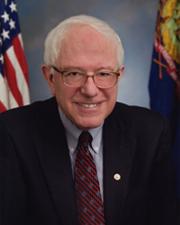 Sen. Bernard Sanders (I-VT)
Submitted July 31, 2007
Legislative Activity
Stay on top of the latest movement without scrolling through every action
Floor
Latest Action
Senate amendment proposed (on the floor): Amendment SA 2571 proposed by Senator Sanders to Amendment SA 2530.(consideration: CR S10720-10723; text: CR S10720)
August 2, 2007
View full timeline
Floor
Senate amendment proposed (on the floor): Amendment SA 2571 proposed by Senator Sanders to Amendment SA 2530.(consideration: CR S10720-10723; text: CR S10720)
August 2, 2007
Floor
Amendment SA 2571 proposed by Senator Sanders to Amendment SA 2530. (consideration: CR S10720-10723; text: CR S10720) To establish an incentive program for State health access innovations.
August 2, 2007
Floor
Proposed amendment SA 2571 withdrawn in Senate.
August 2, 2007
Floor
Senate amendment submitted
July 31, 2007
Text
Proposed
SMALL BUSINESS TAX RELIEF ACT OF 2007

The PRESIDING OFFICER. Under the previous order, the Senate will
resume consideration of H.R. 976, which the clerk will report by title.
The assistant legislative clerk read as follows:

A bill (H.R. 976) to amend the Internal Revenue Code of
1986 to provide tax relief for small businesses, and for
other purposes.

Pending:

Baucus amendment No. 2530, in the nature of a substitute.
Dorgan amendment No. 2534 (to amendment No. 2530), to
revise and extend the Indian Health Care Improvement Act.
McConnell/Specter amendment No. 2599 (to amendment No.
2530), to express the sense of the Senate that Judge Leslie
Southwick should receive a vote by the full Senate.
Thune amendment No. 2579 (to amendment No. 2530), to
exclude individuals with alternative minimum tax liability
from eligibility from SCHIP coverage.
Grassley (for Ensign) amendment No. 2541 (to amendment No.
2530), to prohibit a State from providing child health
assistance or health benefits coverage to individuals whose
family income exceeds 200 percent of the Federal Poverty
Level unless the State demonstrates that it has enrolled 95
percent of the targeted low-income children who reside in the
State.
Grassley (for Ensign) amendment No. 2540 (to amendment No.
2530), to prohibit a State from using SCHIP funds to provide
coverage for nonpregnant adults until the State first
demonstrates that it has adequately covered targeted low-
income children who reside in the State.
Grassley (for Graham) amendment No. 2558 (to amendment No.
2530), to sunset the increase in the tax on tobacco products
on September 30, 2012.
Grassley (for Kyl) amendment No. 2537 (to amendment No.
2530), to minimize the erosion of private health coverage.
Grassley (for Kyl) amendment No. 2562 (to amendment No.
2530), to amend the Internal Revenue Code of 1986 to extend
and modify the 15-year straight-line cost recovery for
qualified leasehold improvements and qualified restaurant
improvements and to provide a 15-year straight-line cost
recovery for certain improvements to retail space.
Baucus (for Specter) amendment No. 2557 (to amendment No.
2530), to amend the Internal Revenue Code of 1986 to reset
the rate of tax under the alternative minimum tax at 24
percent.
Webb amendment No. 2618 (to amendment No. 2530), to
eliminate the deferral of taxation on certain income of
United States shareholders attributable to controlled foreign
corporations.

The PRESIDING OFFICER. The time until 1:40 will be equally divided
between the Senator from Montana, Mr. Baucus, and the Senator from
Iowa, Mr. Grassley.
The Senator from Pennsylvania.

Amendment No. 2557

Mr. SPECTER. Madam President, I have consulted with both of the
managers about bringing up amendment No. 2557. I consulted with Senator
Grassley, who advised that we would be going back on the bill at 12:45,
but the distinguished Senator from West Virginia had extended his time.
But I have been waiting here now for more than an hour. It would be my
hope we could proceed with the consideration of this amendment. I am
advised the managers want to see the amendment.
I am advised, Madam President, that the Democrats are fine with my
calling it up. I just want to be sure--
Mr. SANDERS. Madam President, my understanding is that the Senator
from Pennsylvania is correct. He can proceed.
Mr. SPECTER. In that event, Madam President, I ask unanimous consent
that the pending amendment be set aside so we may consider amendment
No. 2557.
The PRESIDING OFFICER. The amendment has already been offered.
Mr. SPECTER. Yes. Fine.
This amendment would eliminate the 1993 alternative minimum tax rate
increase, a remedial step which I suggest to my colleagues is long
overdue. The alternative minimum tax was created in 1969 in response to
a small number of high-income individuals who had paid little or no
Federal income taxes.
Today, because of a lack of indexing for inflation, and the higher
AMT tax rates relative to the regular income tax system, we have a
parallel tax system which has grown far beyond its intended result.
If there is no legislative action, the number of taxpayers subject to
the alternative minimum tax will rise sharply from approximately 3.5
million filers in 2006 to some 23 million in 2007.
This issue has been before the Senate four times this year already.
It will hit taxpayers in the moderate range excessively hard. The
alternative minimum tax was increased in 1993 from 24 percent to 26
percent for taxable income under $175,000, and from 24 to 28 percent
for taxable income in excess of $175,000.
There has been some question as to what is the offset and there is no
offset, and none should be looked for where you have a tax which
essentially was not expected to be imposed. There was no anticipation,
no intention that this alternative minimum tax was going to produce
additional revenue. So when the tax law is corrected so the additional
taxes will not be imposed because of bracket creep--and this is
designed to avoid that, and to redirect the alternative minimum tax to
its original intent--that is exactly what tax fairness requires.
Madam President, I ask unanimous consent that the full text of my
statement be printed in the Record.
There being no objection, the material was ordered to be printed in
the Record, as follows:

Statement of Senator Arlen Specter

Specter Amendment #2557

Mr. President, I have sought recognition to discuss an
amendment to H.R. 976, the Small Business Tax Relief bill.
H.R. 976 will serve as a vehicle for legislation to
reauthorize the State Children's Health Insurance Program
(SCHIP) in the Senate. My amendment is identical to
legislation (S. 734) I offered on March 1, 2007, to bring the
Alternative Minimum Tax (AMT) back ``in line'' with the
regular individual income tax by reducing its rate back to 24
percent. The 1993 AMT rate increase has contributed greatly
to the problem of unintended taxpayers seeing increased tax
liability.
The AMT is a flawed income tax system and there are many
arguments for full repeal. It is important to keep in mind
that the first version of the AMT was created in 1969 in
response to a small number of high-income individuals who had
paid little or no federal income taxes. Today, between a lack
of indexing for inflation and higher AMT tax rates relative
to the regular income tax system, we have a tax system which
has grown far beyond its intended result. Absent legislative
action, the number of taxpayers subject to AMT liability will
rise sharply from 3.5 million filers in 2006 to 23 million in
2007. According to the Congressional Research Service (CRS),
874,000 taxpayers in Pennsylvania will pay the AMT in 2007 if
no action is taken.
The Senate has had ample opportunity to address AMT in
2007. The Senate has already rejected four efforts to provide
taxpayers with meaningful relief from the AMT in this first
session of the 110th Congress. However, all attempts have
been rejected: on July 20, 2007, I voted in support of a Kyl
amendment to the Education Reconciliation Bill, which would
have fully repealed the AMT; on March 23, 2007, I voted in
support of a Lott amendment to the Budget Resolution, which
would have allowed for repeal the 1993 AMT rate increase; on
March 23, 2007, I voted in support of a Grassley Amendment to
the Budget Resolution, which would have allowed a full repeal
of the AMT; and On March 23, 2007, I voted in support of a
Sessions Amendment to the Budget Resolution, which would have
allowed families to deduct personal exemptions when
calculating their AMT liability.
This onerous tax is slapped on average American families
largely because the AMT is not indexed for inflation (while
the regular income tax is indexed) and taxpayers are
``pushed'' into the AMT through so-called ``bracket creep.''
Temporary increases in the AMT exemption amounts expired at
the end of 2006. The Economic Growth and Tax Relief
Reconciliation Act of2001 increased the AMT exemption amount
effective for tax years between 2001 and 2004; the Working
Families Tax Relief Act of 2004 extended the previous
increase in the AMT exemption amounts through 2005; and the
Tax Increase Prevention and Reconciliation Act of 2005
increased the AMT exemption amount for 2006.
In addition to the well-known issue of the need to index
the AMT exemption amount for inflation, the AMT tax rate
relative to the regular income tax must also be addressed to
keep additional taxpayers who were never intended to pay the
AMT from being subject to its burdensome grasp. In 1993,
President Clinton and a Democrat-controlled Congress imposed
a significant tax hike on Americans through the regular
income tax. At the same time, the AMT tax rate was also
increased from 24 percent to 26 percent for taxable income
under $175,000 and from 24 percent to 28 percent for taxable
income that exceeds $175,000. These changes are now slamming
the middle-class and have only been made worse by the tax
relief enacted in 2001 and 2003. Ironically, by reducing
regular income tax liabilities without substantially changing
the AMT, many new taxpayers were pushed into these higher AMT

[[Page S10720]]

tax rates created in 1993. However, the problem is not the
2001/2003 tax relief, it was the 1993 tax increase.
According to revenue estimates calculated by the Joint
Committee on Taxation, repeal of the 1993 AMT rate increase
would cost $425 billion over the 2007-2017 period. In tax
year 2007, 7.6 million filers would be removed from the AMT
if the '93 AMT rate is repealed; and 13.2 million filers will
be spared in 2017.
Millions of taxpayers have been sucked into AMT liability
as a result of the 1993 AMT rate increase, and it would be
the wrong approach to ``fix'' the AMT by increasing taxes yet
again. In addition, some may argue that this amendment is
fiscally irresponsible because the lost revenue is not fully
offset. However, it is highly questionable to justify raising
taxes elsewhere to account for lost revenue that was never
intended to be collected.
The AMT is a flawed income tax system and there are many
arguments for full repeal. At the very least, we should take
steps to undo past mistakes, most notably the 1993 AMT rate
increase. In what will likely be the final attempt to address
AMT before we head home to speak with our constituents during
the August recess, I implore my colleagues to cast an aye
vote for my amendment. Twenty-three million Americans are
counting on it.
I ask consent to enter into the record several articles
published in the Wall Street Journal advocating for a repeal
of the 1993 AMT rate increase. This legislation is supported
by Americans for Tax Reform and by the National Taxpayers
Union. I ask consent to enter into the record letters of
support from Americans for Tax Reform (ATR) and the National
Taxpayer Union (NTU).

Mr. SPECTER. It is a pretty simple, open-and-shut matter, and it does
not take a whole lot of time to explain. I know the managers are not on
the floor, but I did want to have the amendment considered, setting
aside the other amendments, so we could engage in argument and be
prepared to debate it further.
Unless the Senator from Vermont indicates--with a hand gesture, a
timeout, no argument at this time--I will be available to return to the
floor when the managers consider it appropriate. But I wanted to get
this on the record.
Before departing, might I add my words of congratulations and
admiration for the distinguished Senator from West Virginia. I hadn't
planned to listen to his extended speech, but I wanted to be here at
the moment it concluded, because sometimes when you are not here, half
a dozen Senators precede you.

Amendment No. 2627 to Amendment No. 2530

(Purpose: To ensure that children and pregnant women whose family
income exceeds 200 percent of the poverty line and who have access to
employer-sponsored coverage receive premium assistance)

Madam President, I have been asked to ask unanimous consent to
temporarily set aside the pending amendment and call up amendment No.
2627 for Senator Coburn.
The PRESIDING OFFICER. Without objection, it is so ordered.
The clerk will report.
The bill clerk read as follows:

The Senator from Pennsylvania [Mr. Specter], for Mr. Coburn
and Mr. DeMint, proposes an amendment numbered 2627 to
amendment No. 2530.

Mr. SPECTER. Madam President, I ask unanimous consent that the
reading of the amendment be dispensed with.
The PRESIDING OFFICER. Without objection, it is so ordered.
(The amendment is printed in today's Record under ``Text of
Amendments.'')
The PRESIDING OFFICER. Who yields time?
The Senator from Vermont is recognized.

Amendment No. 2600 to Amendment No. 2530

Mr. SANDERS. Madam President, I ask unanimous consent to set aside
the pending amendment and call up amendment No. 2600, that the
amendment be considered as read, and that it be set aside.
The PRESIDING OFFICER. Without objection, it is so ordered.
The clerk will report.
The bill clerk read as follows:

The Senator from Vermont [Mr. Sanders] proposes an
amendment numbered 2600 to amendment No. 2530.

The amendment is as follows:

amendment no. 2600

(Purpose: To amend title XXI of the Social Security Act to limit the
use of funds for States that receive the enhanced portion of the CHIP
matching rate for Medicaid coverage of certain children)

On page 83, strike line 2 and insert the following:
level.
``(C) Use of funds.--Payments under this paragraph may only
be used to provide health care coverage or to expand health
care access or infrastructure, including, but not limited to,
the provision of school-based health services, dental care,
mental health services, Federally-qualified health center
services, and educational debt forgiveness for health care
practitioners in fields experiencing local shortages.''.

Amendment No. 2571 to Amendment No. 2530

Mr. SANDERS. Madam President, I ask unanimous consent that the
pending amendment be set aside to call up Sanders amendment No. 2571,
that the amendment be considered as read, and that it be set aside.
The PRESIDING OFFICER. Without objection, it is so ordered.
The clerk will report.
The bill clerk read as follows:

The Senator from Vermont [Mr. Sanders] proposes an
amendment 2571 to amendment No. 2530.

The amendment is as follows:

amendment no. 2571

(Purpose: To establish an incentive program for State health access
innovations)

At the end of title I, insert the following:

SEC. __. INCENTIVE PROGRAM FOR STATE HEALTH ACCESS
INNOVATIONS.

Section 2104, as amended by section 108, is amended by
adding at the end the following new subsection:
``(l) Incentive Program for State Health Access
Innovations.--
``(1) Establishment of state health access innovations
incentive pool.--
``(A) In general.--There is hereby established in the
Treasury of the United States a fund which shall be known as
the `CHIP State Health Access Innovations Pool' (in this
subsection referred to as the `SHAI Pool''). Amounts in the
SHAI Pool are authorized to be appropriated for payments
under this subsection and shall remain available until
expended.
``(B) Transfer of funds.--Notwithstanding subsection
(j)(1)(B)(i), from the amount appropriated for fiscal year
2008 under such subsection, $250,000,000 of such amount is
hereby transferred to the SHAI Pool and made available for
expenditure from such pool for the period of fiscal years
2008 through 2012.
``(2) Award of grants.--
``(A) In general.--The Secretary shall award grants to
eligible States from amounts in the SHAI Pool in accordance
with this subsection.
``(B) Eligible state.--For purposes of this subsection, an
eligible State is a State--
``(i) for which the percentage of low-income children
without health insurance (as determined by the Secretary on
the basis of the most recent data available) is less than 10
percent; and
``(ii) that submits an application for a grant from the
SHAI Pool for the purpose of carrying out programs and
activities that are designed to expand access to health
providers and health services for low-income children who are
eligible for medical assistance under the State plan under
title XIX (or a waiver of such plan) or child health
assistance under the State child health plan under this
title.
``(3) Requirements.--
``(A) Priority in awarding of grants.--In awarding grants
under this subsection, the Secretary shall give preference to
grant applications that--
``(i) propose innovative approaches to increasing the
availability of health care providers and services;
``(ii) create longer-term improvements in health care
infrastructure;
``(iii) have potential application in other States;
``(iv) seek to remedy shortages of health care providers;
or
``(v) result in the direct provision of health services.
``(B) Prohibitions.--The Secretary shall not--
``(i) award a grant to carry out programs or activities
which the Secretary determines would substitute for services
or funds provided by a State or the Federal Government; or
``(ii) disapprove any grant application on the basis that
programs or activities to be conducted with funds provided
under the grant would be provided through or by an entity
that otherwise receives Federal or State funding, such as a
Federally-qualified health center.
``(C) Term, amount, and number of grants per eligible
states.--
``(i) Term.--A grant awarded under this subsection may be
renewed each year for a period of up to 5 years, but in no
case later than fiscal year 2012.
``(ii) Amount.--No grant awarded under this subsection may
exceed $2,000,000 for any fiscal year.
``(iii) No limit on number of grants per state.--Nothing in
this subsection shall be construed as limiting the number of
grants that an eligible State may be awarded under this
subsection.
``(D) Annual aggregate limit.--The aggregate amount of all
grants awarded from the SHAI pool shall not exceed--
``(i) $50,000,000 in fiscal year 2008;
``(ii) $100,000,000 in fiscal year 2009;
``(iii) $150,000,000 in fiscal year 2010;
``(iv) $200,000,000 in fiscal year 2011; and
``(v) $250,000,000 in fiscal year 2012.''.

[[Page S10721]]

Mr. SANDERS. Madam President, as my colleagues know, this
legislation, the SCHIP legislation, includes a $3 billion incentive
pool, and the purpose of this pool is to provide States with the
funding they need to do outreach efforts in order to attract children
into the program. The reality is, however, a number of States today
have already enrolled 90 percent of their kids into the SCHIP program,
and with the passage of this bill, more States will soon be at that
level.
Further, we want to provide strong incentives for States below the
90-percent enrollment to reach that level.
This amendment, in order to incentivize States to reach that level of
90 percent, would allow States to apply for multiple grants of up to $2
million each when they achieve an enrollment rate of greater than 90
percent of children below 200 percent of poverty. These grants would
help assure the children we enroll in SCHIP have a place to go to
receive medical care and to find the personnel they need to provide
that care. These grants would come from a pool of money--the State
Health Access Innovations Pool--of $250 million, about 8 percent of the
$3 billion incentive pool. This money will be used to find innovative
approaches to increasing the availability of health and providers and
services and would result in the direct provision of health services.
The reason for this initiative is pretty clear. In Vermont and in
many other parts of this country, one can, in fact, have health
insurance and yet find it quite difficult to buy or to find providers
of that service. So what we are saying is let us make sure that when
our kids do have health insurance, there will be doctors, there will be
dentists, and there will be other health care providers. This is a good
amendment, and I certainly hope it will be supported.
The other amendment I have offered, amendment No. 2600, is a simple
amendment to Section 111 of the Children's Health Insurance Program
reauthorization. Section 111, as my colleagues know, applies to certain
qualifying States that expanded their Medicaid Program to cover kids
prior to the enactment of CHIP in 1997. I wish to commend the Finance
Committee for working language into the current bill that will no
longer penalize these ``early expansion States'' and will allow States
to cover children between 133 percent and 300 percent of the Federal
poverty level to be covered under the CHIP program.
My amendment simply states that payments to States to cover these
children who were previously covered under Medicaid be used solely to
fund health care-related activities. Specifically, the language states
that payments may only be used to provide coverage or to expand access
for health care infrastructure, including but not limited to the
provision of school-based health services, dental care, mental health
services, federally qualified health centers, and educational debt
forgiveness for health care practitioners in fields experiencing local
shortages.
This amendment is a simple provision that will specify that States
benefiting from an increased match must use these funds for health care
and will allow States to address coverage issues as well as the crucial
area of expanding access to services, something that particularly
affects rural and inner city communities. I urge support for this
amendment.
Madam President, I suggest the absence of a quorum.
The PRESIDING OFFICER. The clerk will call the roll.
The bill clerk proceeded to call the roll.
The PRESIDING OFFICER. The Senator from Iowa is recognized.
Mr. GRASSLEY. I ask unanimous consent that the order for the quorum
call be rescinded.
The PRESIDING OFFICER. Without objection, it is so ordered.

Drug Company Payments to Physicians

Mr. GRASSLEY. Madam President, I would like to take a few minutes
today to discuss an important issue that affects all Americans who take
prescription drugs. Specifically, I am going to speak about the need
for greater transparency in the payment that doctors who bill Medicare
and Medicaid receive from drug companies.
Over the past few years, it became apparent during my inquiries into
the Food and Drug Administration that drug companies pay physicians for
a variety of different reasons. Indeed, some of our leading
physicians--doctors who have significant influence in their medical
fields--receive tens of thousands of dollars every year from drug
companies. For some, these payments can make up a considerable amount
of their annual income.
The payments can take the form of honoraria for speaking engagements,
payments to sit on advisory panels, and funding for research. Further,
drug companies spend about $1 billion a year to fund educational
courses that doctors are required to take every year called Continuing
Medical Education, or CME.
In April, the Finance Committee staff prepared a report on
pharmaceutical companies' support of Continuing Medical Education. This
report found that some educational courses supported by drug companies
have become veiled forms of advertising that encourage off-label use of
drugs.
Let's review how this works. Right now, it is possible for a doctor
to attend a CME--continuing medical education--course sponsored by a
drug company. That same company can make payments to doctors who will
teach the course, and the doctor who teaches the course can discuss the
findings of research paid for by the company. Now, that may sound like
a conflict and unethical, but that is how it happens. The whole field
is connected by a tangled web of drug company money.
To try and understand this a little better, I have been exploring the
money doctors get from drug companies, especially the doctors who work
as academic researchers. Most universities require their academic
researchers to report outside income. I have sent letters to a handful
of universities to understand how well such a reporting system actually
works. I haven't received all the information yet, but I can comment on
some of the things I have already found.
Most universities require professors to report outside income that
may create a conflict of interest with their research. This means that
if a doctor at a university is receiving money from a company either
for research, speaking fees or to sit on an advisory panel, then they
have to report that income. But there appears to be a couple of
problems, and let's say a couple of problems with the whole system, as
I found out.
The only person who knows if the reported income is accurate and
complete is the doctor who is receiving the money. The university
doesn't necessarily police its own people to make sure they are
reporting everything they are supposed to report. It seems that some of
these academics are getting so much money coming in from so many
different companies they need an accountant to be sure everything is
reported accurately.
Second, these disclosures are usually kept secret. So if there is a
doctor getting thousands of dollars from a drug company, payments that
might be affecting his or her objectivity, the only people outside the
pharmaceutical industry who will probably ever know about this are the
people at that very university, if they are even keeping track of it,
and we don't know that they are keeping track of it. But most Americans
never get a fair chance to see this information.
To give one example, I sent a letter to the University of Cincinnati
asking about how much money the drug companies have been paying one of
their psychiatrists, Dr. Melissa DelBello. Back in May, The New York
Times reported on the research done by Dr. DelBello to see if
adolescents could be treated for bipolar disorder with a powerful drug
called Seroquel, which is manufactured by Astra Zeneca. The study was
funded by Astra Zeneca and showed that Seroquel was a good choice for
treating bipolar disorder in children. Dr. DelBello's study was later
cited by a prominent panel of experts who concluded that drugs such as
Seroquel should be a first-line treatment for children with bipolar
disorder.
Here is where it gets interesting. After Dr. DelBello released her
study, Astra Zeneca began hiring her to give several sponsored talks.
Another doctor told The New York Times he was persuaded to start
prescribing drugs

[[Page S10722]]

such as Seroquel after listening to Dr. DelBello. But when the reporter
from the New York Times asked Dr. DelBello how much money she got from
Astra Zeneca, she told the paper: ``Trust me. I don't make much.''
Well, I decided to find out how much, and I went directly to the
University of Cincinnati who, by the way, has been extremely
cooperative, helpful, and responsive. Soon I figured out just how much
``not that much'' money is. Dr. DelBello's study, which helped put
Seroquel on the map, was published in 2002. That next year, she got
more money than she has ever received from the pharmaceutical
companies--at least that is what the documents that I have say.
In 2003, Astra Zeneca alone paid her a little over $100,000 for
lectures, consulting fees, travel expenses, and service on advisory
boards. In 2004, Astra Zeneca paid her over $80,000 for the same
services.
Now I am not saying this money was a payoff or suggesting there is
something inherently bad with accepting drug company money, but let me
tell you what Dr. Steven E. Hyman, provost, Harvard University and
former Director of the National Institute of Mental Health, said.
He said these payments could encourage psychiatrists to use drugs in
ways that endanger patients' physical health. Specifically, he said of
doctors:

We don't connect the wires in our own lives about how money
is affecting our profession and putting our patients at risk.

I think this is a rather interesting assessment by Dr. Hyman.
But let me continue. Just last March, several leading physicians
released a study on pharmaceutical company payments to physicians. They
published this study in the Journal of the American Medical
Association, one of the most prestigious journals in medicine. I would
like to quote what they concluded about the need to provide public
disclosure of these payments to doctors:
Full disclosure would better allow the public to appreciate the
relationship between industry and the health profession.
And so, for the sake of transparency and accountability, shouldn't
the American public know who their doctor is taking money from? After
all, anybody can go on the Internet and see who is funding the
campaigns for federally elected officials. Because doctors are expected
to look out for the health and well-being of their patients, shouldn't
we hold doctors to similar standards?
In fact, some of this is already occurring. Minnesota requires drug
companies to report any payments they give to doctors in that State. I
think that is a good thing. Apparently, so do the citizens of
Minnesota.
I think what we really need is a national program that will require
all drug companies to report when they make payments to doctors. I
don't think it would be all that hard for those companies to do. After
all, companies have to make sure they know where every penny is going.
So it should not be that hard to report some of it to the Federal
Government and to the American people. Besides, they are already doing
it in Minnesota.
In closing, I plan to continue my inquiry into drug company payments
to doctors. In addition, I look forward to working with my colleagues
in the Senate, as well as members of the pharmaceutical industry, to
establish a national reporting system.
I yield the floor.
The PRESIDING OFFICER (Mr. Salazar). The Senator from Maryland is
recognized.
Mr. CARDIN. Mr. President, I ask unanimous consent to be recognized
for 7 minutes, and if the Chair would notify me when I have used 6
minutes.
The PRESIDING OFFICER. The Chair will do so. Without objection, it is
so ordered.
Mr. CARDIN. Mr. President, I take this opportunity to speak in favor
of the Children's Health Insurance Program and its reauthorization,
which is the legislation that is before us. We hear the numbers that 6
million children benefit from the program today--over 6 million--and
this will provide for an additional 3 million children.
I want my colleagues to know that each one of these people are
people, they are families, and they are affected by what we do here
today. I take this time to acquaint my colleagues to Deamonte Driver.
He was a 12-year-old who didn't live far from here--6 miles from here--
in Prince Georges County, MD. He had a tooth problem. His mother tried
to get him help. He had no insurance, and he fell through the cracks.
He had a brother, Dashawn Driver, who had six decaying teeth. They
tried to get help for him. The mother thought the older brother was in
worse shape than Deamonte. He started having headaches and was rushed
to the emergency room. They found out his problem--he could not get to
a dentist--was an abscessed tooth.
Before this, a social worker made 20 phone calls in an effort to try
to get dental care for the Driver family, without success. They could
not find a dentist willing to treat someone without insurance or in the
Medicaid system. Deamonte ended up needing emergency surgery, which
cost $250,000, and he ended up losing his life because the system did
not provide care for a 12-year-old.
Mr. President, we can certainly do better than that. Dr. Koop, a
former Surgeon General of the United States, said, ``There is no health
care without oral health.'' Medical research has shown the linkage
between plaque and heart disease. We know now that gum disease can be a
signal of diabetes or a liver ailment or a hormone imbalance. We have
to do better than we are doing today.
Dental disease is the most common childhood ailment in the United
States to date. One out of five children between the ages of 2 to 4
will have some form of decaying teeth. By the time they reach 15, three
out of five will have tooth decay.
There is an imbalance as far as the racial effects. Racial minorities
are much more likely to sustain untreated tooth decay. Forty percent of
African-American children have untreated tooth decay.
I thank my colleague, Senator Bingaman, for his leadership on these
issues and for introducing legislation and moving forward to try to
provide better oral health care for children. I thank Senator Snowe for
her leadership. I thank Senator Baucus and Senator Grassley for
including initiatives in the legislation that is before us that will
help the States meet this challenge--the $200 million included in the
bill. That will have a major impact to try to help American families.
We have an important opportunity before us in the legislation that we
are considering to help our children, not only to continue the benefits
for 6.6 million children but so that we can add another 3 million out
of the 9 million who currently have no health insurance.

We have to do more, but this is our opportunity today, and we have to
take advantage of it. Our health care system is in crisis.
Earlier this week, I introduced the Universal Health Coverage Act,
which would require everybody in this country to have health insurance.
I think it is essential that we address the major problems in our
country of so many people being without health insurance. We should
start with the children, and we can do that with the legislation that
is before us.
Why is that important? Well, we know that children who are enrolled
in the Children's Health Insurance Program or have insurance are much
more likely to get primary health care. They won't use the emergency
rooms as much. If you don't have insurance, you have no choice but to
go to the emergency room. We have improved health care outcomes if the
child has health insurance. We know they are much more likely to have
immunization and primary health care.
I want to comment that--again, talking about families and
individuals--the Finance Committee held a hearing on the Children's
Health Insurance Program. The Bedford family from my city of Baltimore
came down here and testified.
Mrs. Bedford said:

We no longer have to decide whether a child is really sick
enough to warrant a doctor's visit.

The Bedford family enrolled in the Children's Health Insurance
Program in Maryland. The program is working. Without this legislation,
we will have to reimpose freezes on enrollments and people will lose
coverage. It happened

[[Page S10723]]

in my State. This is a bipartisan bill, and I compliment my colleagues
for bringing forward a bill that we can get enacted into law.
In Maryland, we started a program on July 1, 1998. About 38,000
children were enrolled at first, and we are up to 101,000 children
enrolled today. Maryland will get an increase in this bill from $67
million to $189 million. We will be able to enroll 42,000 more children
in the State of Maryland. It is an important program.
I also compliment the committee for including outreach so that we can
reach families who don't know how to enroll, or whether they are
qualified to enroll, so we can get more families and children enrolled
in the children's health care program.
Mr. President, I urge my colleagues to take advantage of the
opportunity that we currently have before us. This is an opportunity in
which we can make major progress in dealing with those children in our
community who will either lose their coverage because we take no
action, and those who currently have no insurance whom we can get
enrolled in this program. It is a valuable program. We have an
opportunity to move forward. So I urge my colleagues to support the
fine effort of the Senate Finance Committee in bringing forward this
legislation.
With that, I yield the floor.
The PRESIDING OFFICER. The Senator from Missouri is recognized.

Ethics and Lobbying Reform

Mrs. McCASKILL. Mr. President, I rise today to say I am proud, very
proud. I came to Washington hoping that we could make a difference in
terms of the way business is done here. And I will be honest, I had
some moments of doubt over the last 6 months. There were times that I
wandered around the floor of the Senate, and even among my own party
and the other party, and I heard kind of a murmuring of discontent over
the ethics reform that we passed back in January. I got nervous that we
weren't serious about it, that we really weren't going to push the kind
of cleansing of things that we have done in the legislation before us
on which we are about to vote.
This isn't hard, what we are doing. We are trying to live like
everybody else in America. Most Americans don't have a corporation they
can call for a ride on a jet plane. Most Americans don't have somebody
who wants to pay for a fancy trip. Most Americans really don't have the
ability to decide that one group in their State gets money when others
don't. But we did here. That was wrong.
That is why I am so proud of this legislation. Is it perfect? No. I
will wait--probably in vain--for that piece of legislation that we pass
that is perfect. But because of our process, because of the glorious
nature of a democracy, it is always a matter of give and take, always a
matter of finding compromise to find that piece of legislation that can
get enough votes so that we can send it to the President's desk. That
is what this process was.
Now, I have some friends--and, frankly, some people I agree with--on
the other side of the aisle who are unhappy with some of the provisions
in this bill. They are willing to look at the bundling provisions, the
ban on travel and gifts, and the ban on corporate jets. They are
willing to overlook the revolving door reforms--reforms in terms of
sneaking provisions into conference bills without them ever being in
either piece of legislation in the House and Senate, and focus in on
just the inadequacies of the earmark reform.
Well, would I have liked it to be a 67-vote point of order rather
than a 60-vote point of order? Yes, I would have. Would I have wished
for a system maybe that was even more transparent? Yes. But this is
major reform. I will tell you that there are a few Senators who do not
participate in the earmarking process, and I am not here to pat them or
myself on the back for the fact that we do not do that.
I will say I think it is interesting that the phrase ``the fox in the
henhouse'' was used as to the provisions in this bill. You know, there
is a saying, ``all hat and no cattle.'' Well, I think that maybe this
is the time to use the phrase ``all foxes and no hens,'' because if you
step back from this issue of earmark reform, it is not complicated. It
is pretty easy. As one of the cartoons said, ``We have met the enemy
and it is us.''
All we have to do to achieve the transparency that we need is for
every Senator to put every earmark request that they are making on
their Web site. I will say it again. All we have to do is have every
Senator put every earmark request they are making on their own Web
site. And then it won't be hard to make sure that the chairman of the
committee or the majority floor leader have, in fact, certified all of
the earmarks. I am a little offended that there is some assumption that
these chairmen and the majority leader would go out of their way to not
tell the public there is a congressionally directed expenditure in the
bill and will try to hide it. They are going to be caught if they do
that. It is going to become public.
Then you will have the kind of accountability that really works
around here. So I was disappointed when I heard that one of the Members
of the other Chamber said he thought he could put earmarks in this
conference report because we needed to vet it. It is not our job to vet
them. It is not the Parliamentarian's job. They don't have the staff to
do this. That is the job of the people of the United States because,
guess what. It is their money.
This is a strong ethics bill. Even though I was a cosponsor along
with the Senators who spoke against this on the earmark reform, I want
to say this goes a long way in the right direction. It is a great
effort. I am proud of Senator Reid, Senator Feinstein, Senator
Feingold, Senator Obama, and all of the other Senators who worked on
this bill, and many on the Republican side have as well. I think we are
going to pass it by a big number today. It is a moment we should all be
proud of, an accomplishment we should herald, and we should remember
that if we are worried about foxes, we ought to check in our own closet
for that fox outfit before we start pointing the finger at anybody.
I yield back the remainder of my time.

____________________