To provide for the use of funds in any grant under the Homeland Security Grant Program for personnel costs, and for other purposes.
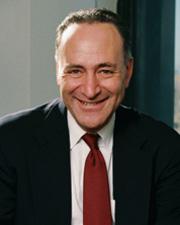 Sen. Charles E. Schumer (D-NY)
Legislative Activity
Stay on top of the latest movement without scrolling through every action
Senate amendment agreed to: Amendment SA 337 as modified agreed to in Senate by Unanimous Consent.(text as modified: CR S3030)
March 13, 2007
View full timeline
Senate amendment agreed to: Amendment SA 337 as modified agreed to in Senate by Unanimous Consent.(text as modified: CR S3030)
March 13, 2007
Considered by Senate. (consideration: CR S3019)
March 13, 2007
Considered by Senate. (consideration: CR S3029-3033)
March 13, 2007
Amendment SA 337 as modified agreed to in Senate by Unanimous Consent. (text as modified: CR S3030)
March 13, 2007
Considered by Senate. (consideration: CR S2956, S2966)
March 9, 2007
Considered by Senate. (consideration: CR S2857)
March 8, 2007
Considered by Senate. (consideration: CR S2744)
March 7, 2007
Considered by Senate. (consideration: CR S2653)
March 6, 2007
Senate amendment submitted
March 5, 2007
Senate amendment proposed (on the floor): Amendment SA 337 proposed by Senator Schumer to Amendment SA 275.(consideration: CR S2581; text: CR S2581)
March 5, 2007
Amendment SA 337 proposed by Senator Schumer to Amendment SA 275. (consideration: CR S2581; text: CR S2581) To provide for the use of funds in any grant under the Homeland Security Grant Program for personnel costs, and for other purposes.
March 5, 2007
Text
Proposed
IMPROVING AMERICA'S SECURITY ACT OF 2007

The PRESIDING OFFICER. Under the previous order, the Senate will
resume consideration of S. 4, which the clerk will report.
The legislative clerk read as follows:

A bill (S. 4) to make the United States more secure by
implementing unfinished recommendations of the 9/11
Commission to fight the war on terror more effectively, to
improve homeland security, and for other purposes.

Pending:

Reid amendment No. 275, in the nature of a substitute.
Sununu amendment No. 291 (to amendment No. 275), to ensure
that the emergency communications and interoperability
communications grant program does not exclude Internet
Protocol-based interoperable solutions.
Salazar-Lieberman modified amendment No. 290 (to amendment
No. 275), to require a quadrennial homeland security review.
DeMint amendment No. 314 (to amendment No. 275), to strike
the provision that revises the personnel management practices
of the Transportation Security Administration.
Lieberman amendment No. 315 (to amendment No. 275), to
provide appeal rights and employee engagement mechanisms for
passenger and property screeners.
McCaskill amendment No. 316 (to amendment No. 315), to
provide appeal rights and employee engagement mechanisms for
passenger and property screeners.
Dorgan-Conrad amendment No. 313 (to amendment No. 275), to
require a report to Congress on the hunt for Osama bin Laden,
Ayman al-Zawahiri, and the leadership of al Qaida.
Landrieu amendment No. 321 (to amendment No. 275), to
require the Secretary of Homeland Security to include levees
in the list of critical infrastructure sectors.
Landrieu amendment No. 296 (to amendment No. 275), to
permit the cancellation of certain loans under the Robert T.
Stafford Disaster Relief and Emergency Assistance Act.
Landrieu amendment No. 295 (to amendment No. 275), to
provide adequate funding for local governments harmed by
Hurricane Katrina of 2005 or Hurricane Rita of 2005.
Allard amendment No. 272 (to amendment No. 275), to prevent
the fraudulent use of Social Security account numbers by
allowing the sharing of Social Security data among agencies
of the United States for identity theft prevention and
immigration enforcement purposes.
McConnell (for Sessions) amendment No. 305 (to amendment
No. 275), to clarify the voluntary inherent authority of
States to assist in the enforcement of the immigration laws
of the United States and to require the Secretary of Homeland
Security to provide information related to aliens found to
have violated certain immigration laws to the National Crime
Information Center.
McConnell (for Cornyn) amendment No. 310 (to amendment No.
275), to strengthen the Federal Government's ability to
detain dangerous criminal aliens, including murderers,
rapists, and child molesters, until they can be removed from
the United States.
McConnell (for Cornyn) amendment No. 311 (to amendment No.
275), to provide for immigration injunction reform.
McConnell (for Cornyn) amendment No. 312 (to amendment No.
275), to prohibit the recruitment of persons to participate
in terrorism.
McConnell (for Kyl) amendment No. 317 (to amendment No.
275), to prohibit the rewarding of suicide bombings and allow
adequate punishments for terrorist murders, kidnappings, and
sexual assaults.
McConnell (for Kyl) amendment No. 318 (to amendment No.
275), to protect classified information.
McConnell (for Kyl) amendment No. 319 (to amendment No.
275), to provide for relief from (a)(3)(B) immigration bars
from the Hmong and other groups who do not pose a threat to
the United States, to designate the Taliban as a terrorist
organization for immigration purposes.
McConnell (for Kyl) amendment No. 320 (to amendment No.
275), to improve the Classified Information Procedures Act.
McConnell (for Grassley) amendment No. 300 (to amendment
No. 275), to clarify the revocation of an alien's visa or
other documentation is not subject to judicial review.
McConnell (for Grassley) amendment No. 309 (to amendment
No. 275), to improve the prohibitions on money laundering.
Thune amendment No. 308 (to amendment No. 275), to expand
and improve the Proliferation Security Initiative while
protecting the national security interests of the United
States.
Cardin amendment No. 326 (to amendment No. 275), to provide
for a study of modification of area of jurisdiction of Office
of National Capital Region Coordination.
Cardin amendment No. 327 (to amendment No. 275), to reform
mutual aid agreements for the National Capital Region.
Cardin amendment No. 328 (to amendment No. 275), to require
Amtrak contracts and leases involving the State of Maryland
to be governed by the laws of the District of Columbia.
Mr. LIEBERMAN. Mr. President, we return now to S. 4, Improving
America's Security Act. This is the legislation that emerged from the
Homeland Security Committee in response to the appeals of the members
of the 9/11 Commission, and others, to finish the job we began with the
previous 9/11 legislation we adopted. We made some progress last week
in the first two days of consideration of the bill. We will have a vote
sometime tomorrow on the motion to strike the provision of the bill
that would give equal rights to transportation security officers at the
TSA. We will begin debate sometime this afternoon on alternative
proposals to those presented in S. 4 for distributing homeland security
grant funds. We have important matters to debate and vote on in the
next few days.
I know Senator Reid and, I hope, Senator McConnell want to finish
this bill--that is, to bring it to passage--by the end of this week. I
remind colleagues that S. 4 was reported out of the Homeland Security
Committee on a strong nonpartisan vote, 16 to 0, with one member
abstaining.
I thought, as we return to the consideration of S. 4, I might go back
to a hearing our committee held on January 9 to consider this
legislation, particularly to draw from the testimony of three of the
witnesses before the committee that day, three women who lost loved
ones on September 11, 2001. This is a way, before we get into the
details of the bill, to remind ourselves why this legislation is before
us and what it is all about. Those three women who testified before our
committee on that day, shortly after the 110th session of Congress
convened, were Mary Fetchet, Carol Ashley, and Carie Lemack.
These three women, as many Members know because we have come to know
them, have worked tirelessly in the last five and a half years to take
their grief, their loss, and bring it into the public square, to the
Congress, to the place where laws are made, to do everything in their
power to ensure that the tragic losses they suffered on that day would
not have to be suffered by any other American in the future.
Their work produced the 9/11 Commission itself. It was a tough battle
to actually create the 9/11 Commission. People were defensive. They
didn't want it to be done by an independent commission. They wondered
why it was necessary. But with the help of these women, we won that
battle. Then when the Commission reported in 2004, we worked very hard
with their help to adopt most of the recommendations of the Commission
by the end of that year. This included the creation of the Director of
National Intelligence to coordinate all of our intelligence, so we can
now connect the dots to stop a terrorist act before it occurs; and the
National Counterterrorism Center, which is now up and running and doing
the same.
The statements of Mary Fetchet, Carol Ashley, and Carie Lemack at our
Committee's hearing explain the importance of the legislation, S. 4,
that is now before the Senate, and particularly the responsibility we
in Congress have to continue the unfinished work of implementing the
recommendations of the 9/11 Commission and of fixing the inadequate
implementation of some of those recommendations or other gaps we have
discovered since in our homeland security.
I want to talk about these three brave, patriotic women one by one,
describe briefly who they are, and then quote from their testimony.
Mary Fetchet lost her son Brad, age 24, in Tower 2 of the World Trade
Center on September 11. She is the founding director of the group
called Voices of September 11th. At our hearing on January 9, Mary
testified as follows:

I have made a personal commitment to advocate for the full
implementation of the 9/11 Commission recommendations driven
by the ``wake-up'' call when my son was senselessly murdered
by terrorists on 9/11. It is my personal belief that almost
six years later our country remains vulnerable, and although
some progress has been made, much work remains ahead. We
collectively--the administration, Congress, government
agencies and interested individuals--have a

[[Page S2574]]

moral obligation and responsibility to work together to
ensure our government is taking the necessary steps to make
our country safer.

``A moral obligation and responsibility,'' as we debate the details
of this legislation and consider the parliamentary tactics related to
it this week on the floor of the Senate, that is, after all, what binds
all of us together, certainly across party lines, in this body and
around America--``a moral obligation and responsibility.'' Those were
the words of Mary Fetchet.
Carol Ashley lost her daughter Janice, age 25, in Tower 1 of the
World Trade Center on September 11, 2001. Carol has served on the
Family Steering Committee for the 9/11 Independent Commission, which
worked to help pass the Intelligence Reform and Terrorism Prevention
Act of 2004. At our January committee hearing, Carol Ashley also
discussed the importance of the legislation the Senate is considering
today. I quote again:

Along with other members of the Family Steering Committee,
I worked for passage of intelligence reform legislation in
2004 based on the recommendations of the 9/11 Commission. Our
goal was to make our nation as secure as possible to reduce
the chances that any other American families would lose a
loved one to terrorism. Unfortunately, that bill did not
fully implement the 9/11 Commission recommendations. Some
that were included were not as strong as they should have
been. The result is that more than five years after 9/11,
there are still gaps in our security.

I continue to quote from Carol Ashley, mother of Janice, age 25, who
was killed by the terrorists on 9/11 in the World Trade Center:

Tightening our security and upgrading preparedness is
urgent. Although five years have passed with no terrorist
attack on our soil, there is no way to know when, where or
how the terrorists will strike again. To fulfill its foremost
obligation to protect the American people, Congress must
ensure through legislation and oversight that comprehensive
security safeguards are in place; and if the terrorists
succeed in breaching our security, that our federal, state
and local agencies are fully trained, equipped and prepared
to respond cohesively.

What we do here today is ``urgent,'' to use Carol's word. In the last
week, there have been reports that al-Qaida and the Taliban are gaining
strength in the lawless regions of Afghanistan and Pakistan,
establishing training bases once again, planning to attack the United
States again. We know we face growing threats from citizens living in
countries that are our allies, as we saw last August when British
officials disrupted a plot to blow up airliners on their way from the
United Kingdom to the United States.
For these reasons and others, our task today is, in Carol Ashley's
word, ``urgent.'' I hope we can--I am confident we will--overcome
whatever divides us and work together to pass this legislation that
will fulfill the powerful and relevant mandate of the 9/11 Commission.
Finally, of these three women whose voices we should hear as we go
through this debate this week, Carie Lemack's mother, Judy Larocque,
was a passenger on American Airlines Flight 11 on September 11, 2001,
which crashed into the World Trade Center. Like Mary and Carol, Carie
has worked tirelessly in support of efforts to improve America's
ability to prevent and respond to acts of terrorism. She is a cofounder
of the group known as Families of September 11. At our hearing in
January, Carie also discussed the importance of fully implementing the
recommendations of the 9/11 Commission report. I now quote from Carie
Lemack at our hearing:

The 9/11 Commission made 41 recommendations. Roughly half
of these recommendations have already been implemented,
thanks in no small part to the efforts of this committee. The
fall of 2004 was an extraordinary time. Many of us were
inspired by your willingness to spend weeks and months making
sure the Commission's recommendations did not fall on deaf
ears. The passage of the 2004 Intelligence Reform and
Terrorism Prevention Act was an historic moment, of which we
can all be proud.
So much to be proud of, and yet so much more to do. More
than five years after 9/11, the terrorist threat has
inevitably grown a little more distant. Some experts are now
telling us that it isn't as serious as we had thought. If al
Qaeda is such a threat, why haven't we been attacked again?
To answer that question, just ask the people of London, or
Madrid, or Bali, or the other places where the terrorists
have struck since 9/11.
Then Carie Lemack said to our committee:

The United States has not been attacked again. But we will
be.
Thanks to the work of so many dedicated public servants we
are safer than we were. But in the words of 9/11 Commission
Chairman Thomas Kean, we are still not as safe as we need to
be.

Carie said:

On the morning of September 11, 2001, my mother, Judy
Larocque, left home to go on a business trip. She woke up
early that day, at 5:30 a.m., in order to make her 8 o'clock
flight to the West Coast. Oddly enough, even though I am not
a morning person, I was up even before her that day, serving
as a coxswain for the MIT graduate school crew team. As I
glided on the Charles River that morning, I realized I could
have called Mom before my 6 a.m. practice, just for a kick,
since it was not often we were both up so early. But I
didn't, thinking she might be running late (a trait she
passed down to me and my sister) and knowing it would be
easier to talk later in the day, once her cross-country
flight landed.
I never did get to talk to Mom that morning, though I left
many messages on her cell phone. To this day, I still find
myself looking at my caller ID whenever the phone rings,
waiting for it to say ``Mom's cell,'' waiting for the call
from her that I never got that gorgeous fall morning.
I often think about what I would tell Mom if she called. I
dream about it all the time. She was founder and CEO of a
company, so I sometimes think I might tell her about founding
the non-profit organization Families of September 11, which
represents more than 2,500 individuals who chose to join our
group and support the terrorism prevention work we do. I
might tell her about the opportunities I have had in the past
five years that she could never have predicted, like
testifying before this esteemed committee today.
But the most important thing I could possibly tell her is
that I love her, and that I am doing everything in my power
to make sure what happened to her never happens again. That
would come as no surprise to Mom. She brought my sister and
me up to fix wrongs and make them rights.

Carie Lemack concluded, before our committee:

Today I am asking you to fix a small number of important
wrongs, and make them right. Some of the important
recommendations of the 9/11 Commission report have still not
been implemented. I raise them not in the spirit of placing
blame or making accusations, but rather in the hope that
together we can own up to gaps, failures and mistakes in the
past, so that we are not condemned to repeat them in the
future.

End of a very deeply personal, compelling quote. It moved everybody
in the room that day, as it moves me to read those words on the floor
here today.
So much more to do, my colleagues. As Carie Lemack said, ``so much
more to do.'' That is why we are here: to work together, and continue
to improve upon the critical tasks that we have left undone and
unfinished. That is our responsibility to Mary, Carol, Carie, and the
tens of thousands of other Americans and citizens of nearly every
nation on this globe who lost loved ones on September 11. We must work
hard and never grow complacent as we face these challenges, in the same
way that the generations who fought in World War II and the Cold War
never grew complacent in the face of the threats to their freedom as
Americans from fascism and communism.
That is what we are debating today. That is the significance of S. 4,
the Improving America's Security Act of 2007. That is why I thank my
colleagues for their attention, for their dedication to getting this
right, and for the debates and votes we will conduct in the days ahead,
leading, I am confident, by the end of this week, to the passage of
this critically important legislation.
Mr. President, I yield the floor and suggest the absence of a quorum.
The PRESIDING OFFICER. The clerk will call the roll.
The legislative clerk proceeded to call the roll.
Mrs. FEINSTEIN. Mr. President, I ask unanimous consent that the order
for the quorum call be rescinded.
The PRESIDING OFFICER. Without objection, it is so ordered.

Amendment No. 335 to Amendment No. 275

(Purpose: To improve the allocation of grants through the
Department of Homeland Security, and for other purposes)

Mrs. FEINSTEIN. Mr. President, I call up amendment No. 335, please.
The PRESIDING OFFICER. Without objection, the pending amendment is
set aside. The clerk will report.
The legislative clerk read as follows:

The Senator from California [Mrs. FEINSTEIN] proposes an
amendment numbered 335.

Mrs. FEINSTEIN. I thank the Chair.
(The amendment is printed in today's Record under ``Text of
Amendments.'')

[[Page S2575]]

Mrs. FEINSTEIN. Mr. President, I rise today to offer an amendment
which ensures that critical homeland security resources are allocated
predominantly on the basis of risk, threat, and vulnerability. I am
pleased to be joined by my colleague from Texas, Senator John Cornyn,
as well as Senators Lautenberg, Hutchison, Boxer, Schumer, Clinton,
Obama, Menendez, Kerry, Coburn, and Casey. I understand that Senator
Coburn and at least three of the other cosponsors will be coming to the
floor, and I certainly welcome them. Our amendment provides an
alternative that is consistent with the recommendations of the 9/11
Commission.
Let me refresh the Members' view of the 9/11 Commission. This is the
recommendation:

Homeland security assistance should be based strictly--

Strictly is underlined--

on an assessment of risks and vulnerabilities.

And:

Federal homeland security assistance should not remain a
program for general revenue sharing.

Now, I know that is difficult for smaller States, but I also know
this is a bill that is aimed to comply with the recommendations of this
Commission. So I hope it will be given some attention.
The amendment we are offering today would allocate homeland security
grant funds based on risk and threat analysis. This covers most grants
for interoperable communications, seaport and airport security, as well
as the State Homeland Security Grant Program, the Law Enforcement
Terrorist Prevention Program, the Urban Area Security Initiative, and
the Citizen Corps Program. We accomplish this by reducing the State
minimum formula. Currently, each State receives .75 percent of the
State terrorism preparedness grant money appropriated to the Department
of Homeland Security. Now, what does this mean? This means that nearly
40 percent of the grant funds must be allocated regardless of risk
analysis. This amendment will reduce that State minimum to .25 percent;
in other words, from .75 to .25. Lowering this minimum ensures that
only 12.5 percent of the grant funds are set aside for all States,
regardless. Even if they have no threat, they can get that amount of
money.
Also, 87.5 percent would be allocated based purely on risk and threat
assessment. This would give the Department of Homeland Security the
flexibility necessary to put money where it is most needed. This means
that more dollars will go to the places that face serious threats and
where dollars can do the most good and, as I say, it is consistent with
the 9/11 Commission.
So what does that mean in real dollar terms? Last year roughly $912
million in grant funds were distributed to homeland security-related
planning, equipment, training, and law enforcement support needs
related to terrorism prevention. It broke down like this: Only 60
percent of the money, or $547 million, was allocated based on risk.
Forty percent, or $365 million, went to satisfy the guaranteed minimum
for all States--exactly what the 9/11 Commission said we should not do.
If the Feinstein-Cornyn amendment were in place, an additional $426
million would have been distributed strictly on risk, threat, and
vulnerability. That would have brought the total to $791 million--
nearly 90 percent of the funds. I believe this would have been the
right thing to do. Instead, the places where the most funding is
required are being shortchanged. Let me give my colleagues an example.
Last year the breakdown of funds distributed through the State
Homeland Security Grant Program and the Law Enforcement Terrorist
Prevention Program meant that some States with relatively low risk were
receiving more funds per person than States with higher risk. We have
all heard this. Now my State, California's share of this grant funding
amounted to $2.50 per person. Texas, another large State, received
$2.25 per person. Yet Wyoming received $14.75 per person. California is
the most populous State in the Union. We have about 37 million
residents. We have the Nation's largest ports, iconic bridges, towering
skyscrapers, enormous infrastructure, and the busiest border crossing
in the world. Texas, with 23.5 million residents, has great cities,
towering skyscrapers, vital industries, and a vast international
border. Wyoming--I don't want to pick on Wyoming. Love it. But as a
State it is like a national park. Wyoming, with 515,000 residents, is a
largely rural State.
As a member of the Intelligence Committee, I pay close attention to
the classified intelligence on terrorist threats. Regrettably, for
those living in States with higher threat profiles, there is reason for
concern. Major cities such as Los Angeles have been an elusive al-Qaida
target for years. A public example outlining the severity of this post-
9/11 threat was acknowledged by President Bush in his State of the
Union Address earlier this year. The President said:

We stopped an al-Qaida plot to fly a hijacked airplane into
the tallest building on the West Coast.

This is the tallest building on the west coast. It is the Library
Tower Building--it has a new name now--the old Library Tower Building
in Los Angeles, the tallest office building west of the Mississippi. It
is home to more than 3,000 people during a typical workday.
Al-Qaida and its allies do not attack based on an obscure formula to
spend money evenly. They attack by prominence, number of people they
can kill, and the psychological value of taking out America's great
landmarks. Homeland security money must correlate with this threat and
risk; otherwise, it is quite simply wasted. This is the reality of the
world in which we live. We can never predict when or where the next
major attack may occur, but we can apply tough-minded discipline to use
our finite financial resources effectively.
Allocating our critical resources effectively is built on a three-
pronged approach: One, risks of potential terrorist attacks must be
accurately assessed; two, the vulnerability of critical infrastructure
and potential targets must be measured; and, three, resources must be
distributed based on these assessments.
The Department of Homeland Security was created to accomplish these
goals. This amendment provides the flexibility and resources for the
professionals to do so.
Let me make no secret. I would prefer to allocate 100 percent of
homeland security grants based on risk and threat and believe that
eliminating mandatory outlays to States is good public policy. It is
safe public policy. But I understand the realities of the Senate. So
this amendment is a compromise which makes us all safer and benefits in
some way all 50 States.
There are some who say that small States would be put at a
disadvantage by this amendment. This is simply not true. Thirty-five
States--70 percent of the Nation--would actually receive increased
grant money for terrorism preparedness under this amendment. States as
diverse as Connecticut, South Carolina, and Colorado will benefit.
Risk-based funding will bring more Federal dollars to smaller States
with high-threat profiles.
Here are 35 States that benefit from risk-based appropriations, and
you can see them on the chart. They are in the green: California,
Washington, Idaho, Nevada, Arizona, Colorado, North Dakota, Nebraska,
Kansas, Oklahoma, Texas, Iowa, Missouri, Louisiana, Wisconsin,
Illinois, Michigan, Indiana, Ohio, Kentucky, Alabama, Georgia, Florida,
South Carolina, North Carolina, Virginia, West Virginia, Kentucky,
Ohio, Pennsylvania, New York, Vermont, Massachusetts, Connecticut, New
Jersey, Delaware, and Maryland.
This bill does not impact the primary all-hazards grant programs,
such as the emergency management performance grants and the Assistance
to Firefighters Program. In fact, under current law, nearly 40 percent
of these funds are set aside for small State all-hazards preparedness.
This adds up to at least $7 million per State based upon the
authorization for emergency management performance grants in the
underlying bill.
There are those who will also make the argument that recipients of
homeland security grant funds are not held accountable, as money is
often wasted. Our amendment increases the efficiency of Federal dollars
by ensuring that these critical funds actually go toward programs and
efforts that prevent

[[Page S2576]]

acts of terror. It requires entities receiving these funds to undergo
periodic audits conducted by the Department, and it mandates that the
appropriate performance standards are met.
Finally, the amendment ensures that States quickly distribute Federal
dollars to localities where they are needed and not hold them back.
Four years ago, the President signed Homeland Security Presidential
Directive 8, requiring the Department of Homeland Security to allocate
grant money ``based on national priorities.'' Four years later, despite
this Presidential directive, this remains unmet, an elusive target.
The 9/11 Commission report makes clear that there are imbalances. It
offers sensible advice. We should take that advice. In our amendment,
we have tried to do that. Among the Commission's observations and
conclusions, ``Homeland security assistance should be based strictly on
assessment of risk and vulnerability and, finally, Congress should not
use this money as pork barrel.'' I could not agree more. In a free-for-
all over money, it is understandable that Representatives will work to
protect the interests of their home States or districts. But this issue
is too important, they say, for ``politics as usual'' to prevail.
Well, I think the 9/11 Commission got it right. The national
interests must trump geographical interests when it comes to national
security. I thank Senators Lieberman and Collins for their dedication
and leadership. I am encouraged that their approach has been modified.
I clearly would like to modify it more. That is what this amendment is
all about. They have acknowledged that funds should be allocated more
along the lines of risk and threat.
Nevertheless, their proposal to set aside 25 percent of funds for all
States, I believe, in the world we live in, with the intelligence that
crosses my desk, indicates it is too high an amount.
This amendment offers a reasonable alternative that takes a
significant step toward improving our Nation's homeland security. So I
thank my cosponsors. I see that one is on the floor. I would like to
yield, if I may, to the Senator from Texas, Senator Kay Bailey
Hutchison.
The PRESIDING OFFICER. The Senator from Texas is recognized.
Mrs. HUTCHISON. Mr. President, I appreciate so much the leadership of
the Senator from California. We have talked about this many times, ever
since 9/11, the Department of Homeland Security being created by
Congress and requested by the President. But the fact is, I think the
distinguished Senator from California has laid out the case very well.
We have certain areas that, with our intelligence and with the
activities that have been uncovered, we know are high-risk areas.
It is in the interest of all Americans, of every State, that we allow
the Department of Homeland Security, with its intelligence grid, to
determine where the needs are greatest from a risk perspective. That is
exactly what the Feinstein amendment does. I am very pleased to be a
cosponsor with my colleague from Texas, Senator Cornyn; Senator
Feinstein; Senator Boxer. Many States that have the problems that we
see are understanding of the need for this amendment.
I will give you one example. Texas is, as Senator Feinstein said, the
second largest State in population, the second largest State in area as
well. We are second behind Alaska in area and second behind California
in population. But more important than that is we have many areas that
could be terrorist targets. In particular, I point out the ports, and
the Port of Houston especially. Texas has 29 ports. Four of these are
among the 10 busiest in the Nation. The Port of Houston is one of the
most important ports in the world. It ranks first in the United States
in foreign waterborne tonnage, second in total tonnage. It is the sixth
largest in the world. It is also home to one of the biggest
petrochemical complexes in the world. It is also part of our Nation's
U.S. Strategic Petroleum Reserve, the world's largest oil stockpile.
Due to the volume of hazardous materials, a terrorist attack in the
Port of Houston would be an enormous disaster. An attack in the Port of
Houston could disrupt our Nation's energy supply, delivering a blow to
our economy at a time when we cannot afford such a disruption. It has
been estimated that as much as 18 percent of our Nation's refined
petroleum products come through the Port of Houston chemical complex.
We saw what happened after Katrina and Rita came ashore in 2005,
where America's energy coast was heavily damaged. Imagine the impact to
the economy if 18 percent of our refining capacity was disrupted. It
would be a huge economic and financial and, of course, human loss.
The amendment I am cosponsoring with Senator Feinstein would require
that Federal homeland security funds be allocated to States according
to a risk-based assessment. Of course, that is the way these funds
should be allocated. It would cover the major first responder grant
program administered by the Homeland Security Department. It is only by
doing this that all of our country and the people of our country will
be the most safe. It is also consistent with the 9/11 Commission's
recommendations to distribute homeland security assistance based upon
threat and vulnerability assessment.
This amendment is aligned with the Department of Homeland Security's
goals for the increased allocation of grant funding based on protecting
national priorities. I hope that all of our colleagues will see that
protecting our Nation's highest priority areas will be in the interest
of every American, rather than getting into the State-by-State
squabbles, when, frankly, the big States usually lose because there are
fewer big State votes in the Senate than small States. So if we go to
the parochial interests of people from their States wanting more
security grants, it is going to be hard to do the right thing.
I submit to my colleagues that we should be looking at where the
terrorists might strike and hurt all of our citizens, and that should
be the basis upon which these risk-based grants would be awarded to the
States.
I thank my colleague from California for taking this initiative
because it is so important for our country that this amendment be
passed.
The PRESIDING OFFICER. The Senator from California is recognized.
Mrs. FEINSTEIN. Mr. President, I thank the distinguished Senator from
Texas for her support on this. I think we are both alike in that we say
wherever there is threat and risk and vulnerability, that is where the
money should go. If it is the State of Texas, that is fine with me. If
it is the State of California, that is fine. If it is New York,
Florida, Connecticut or Maine--wherever the threat and risk is--that is
where the money should go. It is clear to me that the big States have
felt very aggrieved. Big States with big landmarks, big ports, big oil
and petroleum reserves and that kind of thing, feel definitely that
they don't get the money they need to provide the protection they need.
To that end, on March 5, I received and Senator Cornyn received a
letter signed by Governor Schwarzenegger of California, Governor
Spitzer of New York, Governor Crist of Florida, and Governor Perry of
Texas.
I ask unanimous consent that this letter be printed in the Record.
There being no objection, the material was ordered to be printed in
the Record, as follows:

March 5, 2007.
Hon. Dianne Feinstein,
Hon. John Cornyn,
U.S. Senate,
Washington, DC.
Dear Senator Feinstein and Senator Cornyn: We are writing
to thank you for your leadership in working to assure that
Department of Homeland Security (DHS) counterterrorism grant
programs recognize the homeland security needs of the United
States. Any effective strategy to secure our nation must
apply risk-based analyses to manage the threat from
terrorism. We believe that the Homeland Security FORWARD
Funding Act of 2007 will provide much needed changes to these
programs by better recognizing the risks and vulnerabilities
faced by larger states such as California, New York, Florida,
and Texas.
We support the efforts of your bill to build a coordinated
and comprehensive system to maximize the use of federal
resources and to provide clear lines of authority and
communication. Your bill will further the efforts of DHS,
cities, counties and state agencies as they continue to work
together to detect, deter and respond to terrorism.
Specifically, we appreciate the following provisions of the
bill:
Follows the 9/11 Commission Report recommendation to better
allocate federal resources based on vulnerabilities;

[[Page S2577]]

Analyzes risks, threats, vulnerability, and consequences
related to potential terrorist attacks; current programs do
not give full consideration to our states' urban population
centers, numerous critical infrastructure assets, hundreds of
miles ofcoastland, maritime ports, and large international
borders;
Reduces the ``small state'' minimum from 0.75% to 0.25%,
providing each state a baseline award while allocating an
increased level of funds based on risk; the current base +
per capita method allocates a disproportionate share of funds
to states with small populations;
Continues the Law Enforcement Terrorism Prevention Program
and exempts the program from the base percentage, allocating
all funds based on risk;
Maintains the Emergency Management Performance Grant
program as a separate program focused on capacity building
for all-hazards preparedness, response, recovery and
mitigation;
Continues the central role of states, building on existing
systems that effectively coordinate planning efforts and
ensure accountability;
Allows for limited regional applications from previously-
designated UASI cities or other urban areas with at least a
population of at least 500,000;
Retains the central role of states as the administrative
agent for the grants to ensure regional applications are
consistent with statewide plans; and
Recognizes the importance of national standards for
evaluating the ``essential capabilities'' needed by state and
local governments to respond to threats.
Your continued support for improving the nation's ability
to detect and deter and coordinate responses to terrorist
events is appreciated.
Sincerely,
Arnold Schwarzenegger.
Charlie Crist.
Eliot Spitzer.
Rick Perry.

Mrs. FEINSTEIN. Mr. President, I yield the floor.
Mr. LIEBERMAN. Mr. President, I suggest the absence of a quorum.
The PRESIDING OFFICER. The clerk will call the roll.
The legislative clerk proceeded to call the roll.
Mrs. FEINSTEIN. Mr. President, I ask unanimous consent that the order
for the quorum call be rescinded.
The PRESIDING OFFICER. Without objection, it is so ordered.
Mrs. FEINSTEIN. Mr. President, I ask for the yeas and nays on the
amendment.
The PRESIDING OFFICER. Is there a sufficient second?
There is a sufficient second.
The yeas and nays were ordered.
Mrs. FEINSTEIN. Mr. President, I suggest the absence of a quorum.
The PRESIDING OFFICER. The clerk will call the roll.
The legislative clerk proceeded to call the roll.
Ms. COLLINS. Mr. President, I ask unanimous consent that the order
for the quorum call be rescinded.
The PRESIDING OFFICER. Without objection, it is so ordered.
Ms. COLLINS. Mr. President, I rise in opposition to the amendment
offered by my friend from California and my friend from Texas.
Let me first start by telling my colleagues that this is virtually
identical to the same proposal the Senate voted on last July during
consideration of the Homeland Security appropriations bill. In fact,
the Senate has repeatedly voted on this formula issue throughout the
past few years. The Senate has also repeatedly rejected the approach
put forth by my colleagues from California and Texas. The last time
this amendment was voted on, it was defeated by a vote of 36 to 64.
This map says it all. The amendment offered by the Senator from
California would cut homeland security grant dollars for 34 States and
the District of Columbia. I emphasize that because I think by any
reasonable analysis, the District of Columbia is a high-risk area. I am
not stressing the District of Columbia just because the Presiding
Officer is from Virginia but, rather, because it is an area that has
been the subject of a terrorist attack.
What the Feinstein-Cornyn amendment would do is reallocate the
funding to turn it over to 16 States that already receive 60 percent of
the funding. I think we have a basic philosophical disagreement in
discussing how the homeland security money should be allocated. I
certainly agree that risk should be a factor, but I also believe--and
the testimony before our Homeland Security Committee confirms--that all
States need to receive a predictable, reasonable base allocation of
homeland security funding. States need that predictable multiyear
funding in order to fund complex multiyear projects, such as creating
interoperable communications networks or first responder training
programs. Risk-based funding, even if it is distributed properly, is
important, but it is likely to fluctuate dramatically from year to
year.
Furthermore, the minimums in this amendment are simply too low. Under
this amendment, each State would only be assured of $2.28 million under
the authorized levels for the Homeland Security Grant Program. That is
just about half of the proposed Homeland Security Grant Program minimum
in S. 4. I encourage Senators to talk to the first responders in their
States--the police officers, the firefighters, the emergency managers--
to find out what gaps in homeland security would be left unfilled if
they faced such a reduction.
As one can see from this chart, there would be a substantial
reduction under all of the homeland security programs. Let's take the
interoperability program. We know States have not made nearly the
progress that needs to be made in having compatible communications
equipment. That was certainly one of the lessons from 9/11, where so
many first responders lost their lives because they simply could not
talk to one another. When the Homeland Security Committee did its in-
depth investigation into the failed response to Hurricane Katrina, we
found exactly the same kinds of interoperability problems. In fact, we
found there were parishes within Louisiana where, within the same
parish or county, the firefighters could not talk to the police
officers, who in turn could not talk to the emergency medical
personnel.
The only way to ensure a base level of security and preparedness in
each and every State is to require that there be a reasonable minimum
amount of homeland security grant funding awarded to each State.
The National Governors Association has said it well. The NGA has
written to me that:

To effectively protect our States and territories from
potential terrorist events, all sectors of government must be
part of an integrated plan to prevent, detect, and respond to
and recover from a terrorist act. For the plan to work, it is
essential that it be funded through a predictable and
sustainable mechanism both during its development and in its
implementation.

It is important to note that the law requires States to develop 3-
year homeland security plans, and we are requiring any homeland
security funding be used to accomplish those plans and to meet minimum
levels of preparedness.
I am surprised that many who are offering this amendment, which would
give the Department even more latitude than it has now, are the same
people who are expressing outrage at the way the Department used its
authority last year to allocate the funding. I note that I joined in
that outrage. As I told Secretary Chertoff at a hearing before our
Homeland Security Committee, I would not have guessed he could have
made both the State of Maine and New York City equally unhappy in how
he allocated homeland security funds, but he managed to do just that.
The Department is moving away from the methodology it used last year
to allocate funding based on risk. New York Senators were very eloquent
in describing the risk analysis DHS had used. For example, my
colleague, Senator Schumer, said:

The way that the Department of Homeland Security has given
out high-threat funding defies logic, and it is dangerous.

That was typical of the comments that were made.
I agree with my colleagues, and that is why we were so careful to
come up with a different approach and one that includes strong
accountability measures to address concerns, that requires the
Department of Homeland Security to provide Congress with its risk
allocation methodology in advance, and that also provides a
predictable, stable level of funding which will allow States to meet
their diverse needs.
One of the important parts of the funding formula the Senator from
Connecticut and I have labored so hard to put forth is providing
assistance to law enforcement to try to detect and prevent attacks from
happening in the first place.
I must remind my colleagues that the leader of the attacks on our
country on 9/11 started his journey of death

[[Page S2578]]

and destruction not from a large urban area but from Portland, ME. Just
think if we could have detected that plot and arrested Mohamed Atta in
Portland, ME, before he launched his attack.
Risk is not an easy calculation. We saw that last year when the
Department brought forth its very flawed methodology that made so many
of us unhappy. But, unfortunately, we are seeing that approach used
again by the Feinstein-Cornyn amendment because that flawed methodology
which the sponsors of this amendment have embraced results in cuts to
the District of Columbia--clearly a high-risk jurisdiction--and yet it
would reduce funding for the District of Columbia. I think it
jeopardizes the funding for 34 States--34 States, many of them border
States that have obvious vulnerabilities, many of them coastal States
that have obvious vulnerabilities. Then there is Kansas, with the
threat of agraterrorism, about which I know the distinguished Senator
from Kansas has been very concerned. Think of an attack on our food
supply. That is much more likely to occur in a rural area. Think of an
attack on a nuclear powerplant in a rural area.
The point is, we have a lot of critical infrastructure in this
country that is located outside our large urban centers. So we have to
avoid embracing a flawed methodology, and we have to recognize that
every State has risks and vulnerabilities and every State needs to
achieve minimal levels of preparedness, and we clearly are not there
yet.
I hope we will, once again, turn down the well-intentioned but
misguided amendment offered by the Senators from California and Texas.
I believe it would really cause problems for our country as we try to
strengthen our homeland security.
I end this segment of my comments by noting a report by the RAND
Corporation that was prepared for the National Memorial Institute for
the Prevention of Terrorism in Oklahoma City, another place where there
was a terrorist attack that would not generally be considered a high-
risk area. It says:

Homeland security experts and first responders have
cautioned against an overemphasis on improving the
preparedness of large cities to the exclusion of small
communities or rural areas, and it recognizes that much of
the Nation's infrastructure and potential high-value targets
are located in rural areas.

I thank the Chair.
The PRESIDING OFFICER (Mr. Durbin). The Senator from Kansas.
Mr. ROBERTS. Mr. President, I associate myself with the remarks of
the distinguished Senator from Maine, who does such an outstanding job,
along with the distinguished chairman of the Homeland Security
Committee. I, too, rise in strong opposition to the amendment that is
proposed by Senator Feinstein. Senator Collins pretty well summed it
up, and my remarks might be somewhat repetitive, and I think they need
to be.
I know the Senator from California, no doubt, has the best of
intentions. She has been an excellent member of the Intelligence
Committee, when I had the privilege of being the chairman of that
committee. She is working simply to increase the grant funding--which
on the surface of it makes some sense--to high-population areas. I just
don't think that reducing funding for the majority of our States and
our great Nation, as the distinguished Senator has pointed out with her
chart, is a viable way to protect against terrorism.
If we as a country are going to be adequately prepared for another
terrorist attack, we must not forget that we are vulnerable on all
fronts. The States that would be negatively impacted by this proposal
contain some of our Nation's most valuable assets.
If we are going to reduce funds to States such as Kansas, this
amendment tosses aside the risk to agriculture, as the Senator has
pointed out, agraterrorism, although we don't use that term anymore
because it used to scare a lot of people. We just call it ``food
security,'' and it is a big-ticket item. Basically, that is the ability
of our Nation's intelligence community, 19 different agencies, to
protect our Nation's food supply, not to mention the oil and petroleum
facilities that provide invaluable energy in this time of need to many
Federal buildings and places of national significance that are
scattered throughout our great Nation.

So we cannot let ourselves believe if we only protect large cities
and high-population States, we will be safe from the devious and the
calculating minds of those who wish to do us harm. You only need to
look at the Oklahoma City tragedy to understand this. Rather, preparing
for what we expect in the densely populated area is a sure-fire way to
be shocked and horrified should the unthinkable happen again.
This legislation has been considered before. It was defeated soundly.
To add it now as an amendment disregards the hard work many have done
to negotiate a funding formula that most benefits our entire economy
and our entire country. We cannot afford to compromise the security of
an entire Nation for the benefit of a few areas. It is not where the
people are, it is where the terrorists will attack and how and when.
Let me say when I was the chairman of the Emerging Threats
Subcommittee on the Armed Services Committee, I went to a secret city
in Russia--there are approximately 11 of them--and they let us into a
few because we had the Nunn-Lugar program that paid the scientists the
Russians used to have making various armaments and bioweapons and
viruses and all sorts of things. It certainly gives you pause to think
about the fact that when Ronald Reagan called the former Soviet Union
the ``evil empire,'' he was correct, if you looked at the stockpile of
this weaponry. We were granted access to this research center, which is
located outside of Moscow, about 60 miles. It is called Obninsk. We
went in and saw what was being manufactured. I can assure you when they
opened up the refrigerator doors, we stepped back a little bit.
I will not go into everything in terms of what was being manufactured
there, some of which is classified, but we thought under the Nunn-Lugar
program the best thing we could do was to provide security. Yet how
easy would it be for a terrorist group or somebody within the organized
mafia of Russia today to latch on to any part of this stockpile, of
which there are a great many, and transfer that to the United States
and attack our food supply?
We have had exercises. I have taken part in exercises. There was an
exercise in regard to hoof and mouth disease. What happened was we got
into a situation where the infestation period was 6 days, and we got
past that, and then utter chaos developed. We lost in the process a
large number of our livestock herd, all of our export stock, and when
people finally figured out their food doesn't come from grocery stores,
there was panic in our cities. We basically endangered our food supply
not only for 1 year but for several years running.
This is a very real threat. I can tell you as a former chairman of
the Intelligence Committee, we worked very hard to get the intelligence
community to first assess this and then to assess it in terms of a
priority risk and a threat. That is exactly what we have done. This
amendment does great harm to that effort and to adequate funding for
all States and to assess the threats that certainly face all Americans.
I am very hopeful we will oppose this amendment.
Let's repeat what we have done in the past and safeguard all
Americans as opposed to the individual, or the individual many, if that
is the proper way to put it.
Mr. President, I yield the floor.
Mr. LIEBERMAN. Mr. President, what a pleasure to see you as the
occupant of the Chair.
The PRESIDING OFFICER. It is a pleasure to have the Senator address
the Senate.
Mr. LIEBERMAN. Mr. President, I first thank the Senator from Kansas
for his very compelling statement in which he speaks not so much on
behalf of Kansas as based on his experience as the immediate past chair
of the Intelligence Committee. He speaks to the threat of agro-
terrorism. We ought to start talking about it in that way again because
it makes it so real.
Like so many of the vulnerabilities we have in this terrorist age,
where we have to worry about things we could not have imagined before,
these are things we have to now both imagine and defend against. That
is part of the

[[Page S2579]]

capacity that will be preserved in the funding formula that is fair and
balanced found in the underlying bill, S. 4.
I rise to oppose the Feinstein amendment. Senator Feinstein's
amendment is actually one of three that will be introduced to change
the funding formula for homeland security and natural disasters
security that is in this underlying bill. Senator Obama has one which
he will introduce tomorrow, Senator Feinstein has introduced this
today, both of which would reduce the minimum first aid share. Senator
Obama's would reduce the guaranteed funding share for 32 of the States
in the country as compared to S. 4, the bill under consideration; and
Senator Feinstein's would actually reduce the funding, as the chart
Senator Collins held up indicates, for 34 of the States of our Union.
Senator Leahy of Vermont will introduce an amendment that will increase
the minimum per State to .75 percent of the total.
In some sense, with two amendments trying to cut back the minimum per
State and one intending to increase it, I hope that it suggests that
Senator Collins and I and our committee have found a reasonable middle
ground that gives most of the money to the States based on risk but
recognizes that the risk to homeland security is national and not
confined to the larger cities or the most prominent targets, as Senator
Collins and Senator Roberts have made clear. We know, tragically from
terrorist acts across the world, that terrorists have struck
discotheques, schools in smaller town areas, and obviously metros and
subways in other areas.

Our proposal gives out most of the money based both on risk and a
minimum per State so they can deal with their own local
vulnerabilities. The members of the committee chose, I believe in our
good judgment in this case, to establish the Homeland Security
Department as an all-hazards protection department, not just protection
against the terrorism we fear after 9/11, which we have, as I said
earlier, a moral responsibility to protect the American people from. At
the same time, because there is overlap, we can enable the States and
localities and the Federal Government to protect their citizens against
the impact and harm caused by natural disasters.
In that sense, the funding formula in the underlying bill, S. 4, not
only embraces and implements the lessons learned from 9/11 but also the
lessons learned from Hurricane Katrina. It accurately reflects the
world we live in today, a world where we know we have to protect the
American people from acts of humans while also being able to respond to
acts of nature.
The second point I want to make is that these fights over funding
formulas--and this is what we are in now--are well-intentioned, they
are spirited, and they are important, but we must not be distracted
from the larger point here, if I may say so respectfully, which is that
it is not only who gets how much of the pie that is important, but
equally important, perhaps ultimately more important, is the question
of: How big is the pie? How much money is our country, our Federal
Government, prepared to invest in protecting the security of the
American people from another terrorist attack or from a natural
disaster?
I am very proud that this bill, S. 4, authorizes significant
additional funds for homeland security grants and related grants,
restoring, in the case of homeland security grants, overall funding to
the fiscal year 2004 level of $3.1 billion for each of the next 3
years. The fact is, shockingly, if we stop to think about it, that the
administration has recommended cuts in homeland security grant funding
since 2004.
The threat has not gone down. We know, in fact, of publicly reported
intelligence that al-Qaida and the Taliban are again amassing in the
area of the mountains between Pakistan and Afghanistan, that training
camps are being established there again, and that people are coming to
train not just to fight in Afghanistan but with the heightened
probability that they will plan terrorist attacks against the rest of
the world, including American targets. Nonetheless, the funding for
these homeland security grants has gone down over the last 3 years.
What is our goal? It is not a lavish or radical one in terms of
funding. This bill proposes to take us back to the level at which we
were funding one category of grants, homeland security grants, to where
it was in fiscal year 2004, $3.1 billion, and to continue that at that
same level for the next 3 years. If we do that, this legislation will
send a strong signal that this trend of cutting homeland security
funding is over. It will send a message that we are not disarming our
first responders, or squeezing them as they attempt to protect us and
prevent terrorist attacks.
This increase in funding will also send another message. Just as we
support our troops fighting in the war on terrorism throughout the
world, we need to adequately support our troops, I would call them, our
first responders, our firefighters, our police, and our emergency
response personnel. We need to support those who are on the front lines
fighting for us, protecting us when disaster strikes right here at home
in the United States.
While we go on with this debate on these three amendments that seek
to alter the funding formula in the underlying bill, S. 4, I hope we
will all keep in mind that this legislation authorizes, and if
adequately funded by our colleagues on the Appropriations Committee, a
significant expansion in the size of America's homeland security grant
funding pie.
I also will talk briefly about the specific programs this legislation
will authorize that the three amendments, Senator Feinstein's, Senator
Obama's, and Senator Leahy's, would alter, two cutting and one adding
to our allocation to each State in the country. Two of the four funding
programs dealt with in this underlying bill are devoted specifically to
dealing with the risk of terrorism, to improving the capacity of State
and local responders to do exactly that.
Two others are also designed to address all hazards; in some sense to
maximize what we get for our investment. When I say ``all hazards,'' I
am speaking of natural disasters. As we saw in Katrina, that can cause
as much or, in some cases, more damage to our country and our people
than a terrorist attack.
Let me go first to risk-based funding for urban areas, one of the
four programs. S. 4 authorizes in law the Urban Area Security
Initiative, known in the field as UASI, to assist high-risk urban areas
in preventing, preparing for, and responding to acts of terrorism. All
UASI funds would be given to the urban area based on risk--totally
based on risk--from a terrorist attack and the effectiveness of the
proposed uses in addressing that risk. There is no minimum funding per
state or locality. It is totally up to the Department of Homeland
Security's assessment of risk.
The 100 largest metropolitan areas in the United States would be
eligible to apply for funding. I am pleased to say here, too, we
increased the funding; $1.279 billion would be authorized for UASI for
each of the next three years, which is significantly more than the $770
million provided this year or the $800 million proposed in the
administration's fiscal year 2008 budget.
The second risk-based funding for states, the other program designed
specifically to help state and local officials cope with the risk of
terrorism, is the State Homeland Security Grant Program. S. 4
authorizes this program to be funded at $913 million for each of the
next three years to assist state, local and tribal governments in
preventing, preparing for, and responding to acts of terrorism. This is
a significant increase over the $550 million that would go to this
State Homeland Security Grant Program this year, not to mention the
$250 million cut of the $300 million of the President's proposed budget
in this program for fiscal year 2008. Most important--and I think it is
very significant with all that will be said about the formulas--as we
calculated under the approach of S. 4, an estimated 95 percent of these
so-called SHSGP funds, State Homeland Security Grant Program funds,
would be given out based on risk to the state from a terrorist attack,
and on effectiveness of the proposed uses in addressing that risk.
While each state would be assured of receiving a minimum of .45
percent of the overall funds of this program, the Department will
calculate distributions based on risk first and then only make any
adjustments necessary to bring all the states up to the guaranteed
minimum.

[[Page S2580]]

As we apply the formula of risk allocation that the Department
applied this year, we come to the conclusion that 95 percent of these
funds would actually be distributed based on risk.
The third program: All-Hazards Emergency Management Funding. This is
a reorganized, refocused, and greatly increased program that will have
tremendous effect in protecting the American people from all hazards,
man-made and natural. S. 4 authorizes what we call the Emergency
Management Performance Grants Program, EMPG, to assist states in
preparing for and responding to all hazards, including natural
disasters, other manmade disasters, and terrorism. The legislation
significantly increases the authorization amount for this critically
important program from about $200 million to $913 million for each of
the next three years. That is obviously a significant increase, four
and a half times what it is now. Each state would receive a base amount
of .75 percent of the overall funds, with the remaining funds
distributed in proportion to a state's population, which continues the
current allocation practice. This program, as I have said, is an all-
hazards program. Every state in the country is vulnerable or subject to
be the target of some kind of hazard, whether it is terrorism or a
natural disaster that is different depending on which part of the
country you are in, which is a hurricane, a tornado--as we have seen
occur last week with devastating effect on our fellow Americans,
earthquake--of which we have seen too many taking precious lives and
destroying property all across our country. I speak of these natural
disasters. These are risks that all States face so we think it
appropriate to ensure that each State receives .75 percent of the
overall funding.
Finally, the fourth program is Dedicated Grants for Communications
Interoperability. In our committee, Senator Collins and I worked very
hard on this, and I must say we are very proud to establish this grant
program. It is dedicated to improving communications operability and
interoperability at local, regional, state and federal levels. We have
been through this on the floor before. We saw both on 9/11 and in
Hurricane Katrina, when first responders cannot talk to one another
because they have different radio systems or they can't talk at all
because the systems have broken down, response to the disaster is
greatly compromised and lives are lost. That is exactly what we are
aiming to prevent with this.
Incidentally, this is a problem that is not new with 9/11 or with
Hurricane Katrina. The truth is, it has gone on unsolved for years,
even though we had evidence of it from 1982, when Air Florida crashed
in Washington, to the 1995 attack on the Alfred E. Murrah Federal
Building in Oklahoma City, to the 1999 shootings at Columbine High
School near Little, Colorado. In each of those cases, there were
communication breakdowns, not as well known as those on 9/11, that
compromised the response and compromised the safety of our fellow
Americans. This is a national problem. It affects all states. That is
why we propose that each state would receive a minimum of .75 percent
of the total funds. This legislation authorizes a total of $3.3 billion
spread out over five years for this communications interoperability
grant program.
I wish to stress here about this and about the Homeland Security
Grant Programs, that we are mindful of the few cases--but too often
cited by critics--in which local governments have used grant money
under these programs in ways that do not, to any of us, seem like they
relate. In the case of interoperability communications, we state very
clearly in the bill that to qualify for these programs you have to make
a proposal that is not just something the local law enforcement chief
thinks would be a nice thing to have, it has to be consistent with a
state's emergency communications plan in the National Emergency
Communications Plan. Otherwise, states are simply not going to receive
funding.

The same is true in the Homeland Security Grant Fund Program. One of
the bases of the judgments of the use of the funds is clearly stated:
``The effectiveness of the proposed use in addressing that risk.''
In the few cases where sadly, infuriatingly, Homeland Security grant
money has been spent on things that don't seem at all to be related to
homeland security, in the language under S. 4, we are going to stop
that from happening and guarantee that this money is spent in a way
that will increase the American people's sense of security from
terrorists and natural disasters.
I believe these four programs together, if enacted and properly
funded, will make our country much safer. They will provide the men and
women on the front lines here at home with the essential tools they
need to protect the American people and save lives. They will make sure
that funds targeted for building terrorism-specific capability go out
overwhelmingly to those states and urban areas that our intelligence
and our common sense tells us are most at risk from terrorist attack.
But they will also provide funds that are adequate in the post-
9/11, post-Katrina world, to make sure that all states can prepare for
and be ready to respond to disasters.
This is going to be an important debate. I look forward to
participating in it.
The PRESIDING OFFICER. The Senator from New York.
Mr. SCHUMER. Mr. President, I ask to set aside the pending amendment.
The PRESIDING OFFICER. Without objection, it is so ordered.

Amendment No. 336 to Amendment No. 275

Mr. SCHUMER. Mr. President, I rise to offer two amendments to the 9/
11 Commission recommendations bill. After I have an opportunity to
address these amendments, I ask they be set aside so we may proceed
with further proceedings on the bill.
I hope we can reach agreement, I say to my friend from Connecticut. I
hope we can reach agreement on these amendments, as they are critical
to making sure our homeland security dollars are spent wisely in the
way that will do the most to protect our Nation.
Nearly 6 years since the tragedy of September 11, Congress finally
has the opportunity to implement the recommendations of the 9/11
Commission. The 9/11 Commission has done a tremendous job providing our
Nation with the tools to make our Nation safer and now is the time for
Congress to act and to get it right.
I thank Senators Lieberman and Collins for their hard work and
dedication to this bill and thank my colleague from New York, Senator
Clinton, for joining me on these two important amendments.
We are here today to talk about one of the most important pieces of
the 9/11 Commission's recommendations, funding the Homeland Security
Grant Program, administered under the Department of Homeland Security.
Unfortunately, DHS has not always approached the allocation of vital
homeland security dollars the way the 9/11 Commission intended. The 9/
11 Commission intended that homeland security funds, including the
high-threat Urban Area Security Initiative, UASI, and the State
Homeland Security Grant Program, SHSGP, be allocated based on risk. In
fiscal year 2006, the most high-risk and high-threat cities in the
Nation, New York City and Washington DC, two cities which suffered
tremendously from the horror of the 9/11 terrorist attacks, received a
40-percent cut in high-threat UASI funding from DHS. Using a peer
review process, DHS made funding decisions based on including popcorn
factories and petting zoos, while cities such as New York were forced
to cut key security initiatives such as staff patrols on the Brooklyn
Bridge and NYPD inspection of backpacks within the New York City subway
system.
DHS relied on an untested system of peer review in 2006 to allocate
high-threat security funding, and it failed miserably. A 40-percent cut
in high-threat funds for our highest risk cities is unacceptable and
exactly the opposite of what the 9/11 Commission recommended. Despite
the firestorm of criticism that the Homeland Security Department faced
for its UASI allocation of funding in 2006, DHS decided once again to
use the peer review process when allocating high-threat funding in
2007. That makes one doubt the thinking that is going on in DHS, not
only on this issue.
So I ask amendment No. 336 be called up.
The PRESIDING OFFICER. The clerk will report the amendment.
The assistant legislative clerk read as follows:

[[Page S2581]]

The Senator from New York [Mr. Schumer], for himself and Mrs.
Clinton, proposes an amendment numbered 336 to amendment No. 275.
Mr. SCHUMER. I ask unanimous consent the reading of the amendment be
dispensed with.
The PRESIDING OFFICER. Without objection, it is so ordered.
The amendment is as follows:

(Purpose: To prohibit the use of the peer review process in determining
the allocation of funds among metropolitan areas applying for grants
under the Urban Area Security Initiative)

On page 64, between lines 2 and 3, insert the following:
``(e) Prohibition of Peer Review Process.--The peer review
process may not be used in determining the allocation of
funds among metropolitan areas applying for grants under this
section.

Mr. SCHUMER. This amendment will bar DHS from using the peer review
process when making allocations for high-threat UASI funding. Our most
targeted cities should not be subject to the arbitrary whims of an
untested bureaucratic process that clearly does not have the best
interests of our high-risk cities as its No. 1 priority.
DHS was wrong about the effectiveness of the peer review process, and
it has also been off the mark on the amount of homeland security funds
that can be used to cover personnel and overtime.
This bill makes clear that different cities under very different
levels of risk have very different security needs. We should not be
punishing cities such as New York that must rely on personnel to make
our cities safer.
One example is our bridges because they have been targeted. The
Brooklyn Bridge near my home, which I take back and forth all the time,
has two police officers at each end 24 hours a day, 7 days a week. That
is 20 police officers. If one looks at policeman hours, four times
five, five shifts is what it takes to cover 24/7. That kind of funding
is essential to the safety of New York, yet it is limited by the
process. Our amendment would change that.

Amendment No. 337 to Amendment No. 275

I ask unanimous consent that my amendment be set aside so that I may
call up amendment No. 337.
The PRESIDING OFFICER. Without objection, it is so ordered.
The clerk will report.
The assistant legislative clerk read as follows:

The Senator from New York [Mr. Schumer] proposes amendment
numbered 337 to amendment No. 275.

Mr. SCHUMER. I ask unanimous consent that reading of the amendment be
dispensed with.
The PRESIDING OFFICER. Without objection, it is so ordered.
The amendment is as follows:

(Purpose: To provide for the use of funds in any grant under the
Homeland Security Grant Program for personnel costs, and for other
purposes)

On page 59, between lines 9 and 10, insert the following:
``(f) Use of Grant Funds for Personnel Costs.--The
Secretary may not provide for any limitation on the
percentage or amount of any grant awarded under the Homeland
Security Grant Program which may be used for personnel costs,
including overtime or backfill costs.
On page 86, strike lines 6 through 20.

Mr. SCHUMER. This amendment also addresses a critical shortfall in
previous allocations for homeland security funding: the payment of
overtime for first responders such as police officers. High-threat
cities such as New York can't rely on equipment and technology alone to
get the job done. New York City, with its vast population and national
landmarks, needs trained, expert personnel guarding its tunnels,
bridges, and landmarks to keep New Yorkers and the huge amount of
visitors it has every year safe.
Having trained security personnel available at all times to protect
our citizens is not an issue unique to New York City. In this difficult
budget climate, cities across the country are faced with hard choices
when it comes to keeping our citizens safe from terrorists. The
Department of Homeland Security should allow our cities and States the
ability to fund the activities necessary to protect our citizens.
The potential for terror is not limited to 8-to-5 shifts. We need to
give our cities and States the resources they need to do their job. If
they should choose to use overtime in funding in their UASI allocation,
they should be allowed to do it.

Amendment No. 335

I also would like to take a moment to talk about Senator Feinstein's
amendment that I am cosponsoring along with several of my colleagues.
The Feinstein amendment will lower the minimum grant for the State
Homeland Security Grant Program to .25, lower than the .45 proposed in
the Senate version of the bill. The amendment will also lower the
minimum for interoperable communications to .25, down from .75 in the
bill. While I appreciate the committee raising the amount of funding
for SHSGP funds to $913 million, well above the amount included in the
President's 2008 budget, the formula minimums included in the Senate
bill provided less funding for New York.
New York is not alone. Other States, such as California and Texas,
will also face cuts in funding unless we lower the minimum in the
Senate bill. We can't allow our larger cities and most vulnerable
targets to be left relatively unprepared for a major attack relative to
other cities because they are not given the Federal resources they
deserve.
Some in the Senate will make the argument that States across the
country have needs that must be addressed, and we need to be prepared
in all communities. While I understand their concern, the Senate has
recognized that need by authorizing the emergency management
performance grants in the same amount as the SHSGP grants and by
providing EMPG grants with a .75 minimum to address all-hazard needs
across the country.
In addition to EMPG grants, the Senate has also provided a minimum
amount of funding for interoperability communications grants, something
the city of New York has spent millions on since 9/11 so the rest of
the country might implement this valuable technology.
Now is the time for the Senate to do the right thing. While I applaud
the overall work of Senators Lieberman and Collins on this important
bill, one area we have strayed is in the area of grant funding. I know
they come from smaller States. Obviously, they are defending their
States. But if we are allocating money on the basis of need, on the
basis of where the greatest threat of terrorism is, the funding formula
here does not really do the job.
The 9/11 Commission, for instance, neither from a smaller State or
bigger State perspective and looking at things objectively, recommends
that funding be allocated on risk alone. The minimums allocated in this
bill do not do that. One need look only as far as the tragedy of 9/11
to answer the question of why funding for the most targeted cities is
the most important.
I urge my colleagues to support the Feinstein amendment. We have the
opportunity to fix the past mistakes at DHS and ensure that the
appropriate amount of funding is distributed in a way that will benefit
all and ensure that highest risk areas are adequately protected. Now is
that time.
I look forward to working with the committee on these important
amendments to the way the bill addresses the grant program. I know the
committee shares my commitment to ensuring our first responders and all
critical homeland security needs have the funding needed to protect our
citizens. The committee has done important work to authorize for the
first time funding for the grant programs. I look forward to working
with Senators Lieberman and Collins on this issue.
I yield the floor.
The PRESIDING OFFICER. Who seeks recognition?
The Senator from Pennsylvania is recognized.
Mr. CASEY. Mr. President, I rise in support of the Feinstein-Cornyn
amendment. I am proud to serve as a cosponsor. As my colleagues know,
we have spent the past week debating legislation to once and for all
fully implement the recommendations of the bipartisan 9/11 Commission
delivered in July 2004. This bill before us, along with its counterpart
already passed in the House, would largely do just that by making it
more difficult for terrorists to gain access into our country by
enhancing information sharing in our intelligence community and
homeland security apparatus so that we can truly connect the dots in
future plots against our Nation, and by providing genuine

[[Page S2582]]

incentives to the private sector to do their part in order to
strengthen their preparedness to prevent and respond to acts of
terrorism.
The bill would also provide much needed funding to enhance the
security of our rail and transit systems, including Amtrak's northeast
corridor, a rail system that carries tens of thousands of passengers
every day along the east coast, including my home State of
Pennsylvania, and which remains unacceptably vulnerable to terrorist
attack.
However, we must be honest. The bill does not fully implement every
recommendation of the 9/11 Commission. Chapter 12 in the Commission's
final report addresses the difficult challenge of allocating limited
funds across the Nation to address an array of homeland security
vulnerabilities and gaps. The report recognizes that we as a nation
cannot protect every vulnerable port, every vulnerable icon, and every
vulnerable spot where Americans congregate every day. A universal
approach would turn our Nation into an armed fortress, too restrictive
of the liberties we cherish and love as Americans. That would be a
victory for the terrorists.

Let me quote directly from the bipartisan Commission report which
lays out in plain and clear language why it is so important that we
allocate homeland security dollars on the basis of risk:

Homeland security assistance should be based strictly on an
assessment of risks and vulnerabilities. Now, in 2004,
Washington, D.C., and New York are certainly at the top of
any such list. We understand the contention that every state
and city needs to have some minimum infrastructure for
emergency response. But federal homeland security assistance
should not remain a program for general revenue sharing. It
should supplement state and local resources based on the
risks and vulnerabilities that merit additional support.
Congress should not use this money as a pork barrel.

So says the 9/11 Commission Report. The Commission calls for a strict
prioritization of national needs based upon a strict risk-based
assessment. Those potential targets that are most attractive to
terrorist groups, that contain the most deep-seated vulnerabilities to
an attack, and that, if successfully attacked, would produce the most
drastic consequences in terms of lives lost, people injured, and
economic damage should be given priority in terms of allocating our
limited homeland security dollars.
This definition of risk, which successfully incorporates the three
variables of threat, vulnerability, and consequence, has been
recommended by countless academic experts and is now incorporated into
the Department of Homeland Security's framework for assessing how to
rank various targets in our Nation in terms of their likelihood for a
future attack. Unfortunately, the Congress has not kept pace with the
recommendation of the 9/11 Commission, and the bill before us this week
still does not get it right, even though it purports to fully implement
the recommendations of the 9/11 Commission.
This bill, while superb in almost every other respect, would still
retain the misguided approach first established by the PATRIOT Act that
would mandate that each State receive a minimum of .75 percent of
overall funding for most of the homeland security grant programs,
including the State Homeland Security Grant Program, the Law
Enforcement Terrorist Prevention Program, and the Citizen Corps
Program. In other words, 38 percent of the funding dollars for our
major homeland security grant initiatives is allocated on an arbitrary
basis, wholly unrelated to risk. Thirty-eight percent of these funding
dollars is distributed in such a fashion that every State receives the
exact same share, with equal dollars flowing to large States such as
Pennsylvania and New York, as well as much smaller States.
This makes no sense. Every State is not equally at risk from the
threat of terrorism and is thus eligible for equal dollar amounts. I
recognize that the remaining 62 percent of funds under these homeland
security grants are now based on risk, but it is wrong and harmful to
deny almost half of all funds to those areas that are at greatest risk.
That is why I am so pleased to cosponsor the Feinstein amendment
which would reduce those per-State minimums from .75 percent of overall
grant funding to .25 percent. In other words, instead of 62 percent of
funding allocated on the basis of risk, 87 percent of all grant funds
would be allocated on a risk basis.
Is that a perfect solution? No, it is not. In a perfect world, 100
percent of funds in every homeland security program would be allocated
on the basis of risk, and State-by-State minimums would become a
historic relic. But I understand political realities, and I recognize
this amendment by itself will face a real challenge in achieving
passage. The Feinstein-Cornyn amendment, by replicating a provision in
the 9/11 bill that passed the House in January, nevertheless would
significantly improve the quality of our homeland security funding by
requiring a greater share of it be allocated on the basis of risk.
This issue is often unfairly characterized as a large State versus
small State battle. Those States with large populations would
supposedly automatically benefit under any funding formula that is
based to a greater degree on risk while small States would lose or so
the argument goes. That would be true only if we use population levels
as a proxy for risk, which this amendment does not do.
Instead, the Feinstein amendment defines risk as a function of
threat, vulnerability, and consequence. So a small State with several
targets that are uniquely at risk due to a combination of these three
variables would profit from this amendment just as a State as large as
New York or New Jersey or Pennsylvania.
This amendment, to the greatest extent possible, takes individual
States out of the formula. It focuses on where and what our Nation's
targets of terrorism are and where the greatest risks lie and focuses
our homeland security dollars on those targets. Those who hail from
small States should not reflexively oppose this amendment. The fact
remains, their States can benefit--small States can benefit--from
greater funding under this new formula.

Will there be losers under this new formula? Sure. Of course. Those
States with a minimum level of potential targets at great risk would
receive potentially less funding. But I am confident the people of
those States will recognize the enormity of the stakes involved: how to
best protect our Nation in a long struggle against terrorism. I have
faith the American people will put aside parochial concerns in favor of
those strategies that protect all of us.
I hail from a State that sits at the higher end of the range of
vulnerability to attacks of terrorism. Under the Urban Areas Security
Initiative, or UASI, two urban regions in Pennsylvania have been
consistently designated as high risk in this program since its
inception in fiscal year 2003: Philadelphia and Pittsburgh.
Philadelphia is home to such historic sites as Independence Hall and
the Liberty Bell. It is also a major hub for Amtrak's Northeast
corridor, a vital transportation artery that links Washington to Boston
and points further beyond. We have seen what the terrorists have done
in Madrid and London and other places. If they seek to export their
tactics to our Nation, the Northeast corridor, including Philadelphia's
30th Street Station, would be a prime target.
Also, the city of Pittsburgh includes world-class universities, major
sports stadiums, and other icons of national significance.
There is a reason why both cities have been included in the 15 most
at-risk urban regions in the United States and are eligible for grants
under the UASI program. The UASI program is the only homeland security
program that operates fully--fully--on the basis of risk. For that
reason, it is the most effective program, as it allocates dollars
without regard to State by State minimums or political guidelines.
Future terrorist acts endanger the people of Pennsylvania, and I will
continue to stand up for them to assure our homeland security programs
are appropriately focused on the threats where they are. I understand
no State or its representative Members want to lose out on additional
Federal dollars. But I would once again quote from the 9/11 Commission
report which has served as the inspiration behind our entire debate on
this important bill. In concluding that risk-based funding is the only
way for our Nation to apportion homeland security dollars, the
Commission declared that:

[[Page S2583]]

In a free-for-all over money, it is understandable that
representatives will work to protect the interests of their
home states or districts. But this issue is too important for
politics as usual to prevail.

``Too important for politics as usual to prevail.'' After the horrors
of 9/11, we cannot ignore the significance of that call to duty.
I strongly urge my colleagues to vote in support of the Feinstein-
Cornyn amendment so we can ensure our precious homeland security
resources are allocated in a fair and efficient manner.
I yield the floor.
The PRESIDING OFFICER (Ms. Klobuchar). The junior Senator from New
Jersey.
Mr. MENENDEZ. Madam President, I rise in strong support of the
Feinstein-Cornyn amendment. I am proud to be a cosponsor of this
effort. This amendment would enact one of the key recommendations of
the 9/11 Commission that has gone ignored time and time again by the
Congress, and that is ensuring homeland security funding is based on
risk.
We have heard a lot during the course of the debate on this bill.
Often we have had references to the 9/11 Commission when it was
propitious, when it served to support the argument someone was making
at a given time. Then, at other times, it has been forgotten. I have
been one of those who believes we should have all of the 9/11
recommendations implemented. So I do not pick and choose.
I am certainly tonight wanting to make sure we recognize as a body
what the Commission said. It was not ambivalent. The Commission was not
ambivalent about its recommendation. The Commission said, in its
report, very clearly:

Homeland security assistance should be based strictly on an
assessment of risks and vulnerabilities.

`` . . . strictly on an assessment of risks and vulnerabilities.''
``Strictly''--not mostly, not partially, but based strictly on the
risks our States and communities face. Yet, 2\1/2\ years after the
release of the 9/11 Commission report, homeland security funding
continues to be based on a formula that allocates nearly 40 percent of
funding with no regard--no regard--to risk or vulnerability.
What else did the Commission say:
We understand the contention that every State and city
needs to have some minimum infrastructure for emergency
response. But Federal homeland security assistance should not
remain a program for general revenue sharing. It should
supplement State and local resources based on the risks or
vulnerabilities that merit additional support.
Congress should not use this money as pork barrel.

It is past time to correct these flawed formulas.
I know many believe that, in fact, everyone should have some of these
moneys. Actually, this amendment does that. This amendment recognizes
that. It does not encompass the full essence of the Commission's
report. It recognizes that. So, ultimately, I would say to our friends,
notwithstanding that, there are times when we have legislation on this
floor that benefits some States greater than others, but we look at it
as we are from one country. There are times in which there is a lot
more money for flood protection, and those of us who do not receive
that type of money say: We understand that. That is the nature of the
challenges of those fellow States in our Nation. In the agriculture
bill there will be a lot of money going to other States that certainly
will not be coming to States such as New Jersey, but we understand
that. We are one nation.
Today, I hope the Members of the Senate will come to understand in
this issue, as well, we are one nation and the greatest risks--the
greatest risks--flow to those who have the greatest challenges. If we
had unlimited money, I would be the first to say we could use it all as
part of revenue sharing to make sure the allocation for each State
would be such that they could decide to use it to meet their homeland
security objectives. But we do not. If there is one part of all of the
largess of the Federal Government that I think has to be based on the
question of necessity, has to be based on the question of risk, it
clearly is in homeland security funding.
Now, I believe, as do many of my colleagues who support this
amendment, we should follow the recommendation of the 9/11 Commission
in its entirety and base 100 percent of the homeland security funding
on risk. But this amendment recognizes the need to compromise. We
recognize every State should be prepared for and be able to respond to
terrorism. Under this amendment, each State would receive a base
amount. The difference is, we ensure the vast majority of the funds
will be based on risk. In fact, under this amendment, 99 percent of all
of the funds would be allocated based on risk.
Senators Lieberman and Collins clearly recognize we should be basing
funding more on risk. In this bill they have clearly worked to reduce
the base amount for States, moving us toward a more risk-based
approach. I sincerely appreciate their efforts to make more funding
allocated on risk, and I certainly commend them for taking a very
important step forward in the right direction. But that formula is
still a detriment to States facing the most risk.
Under the bill's language, money would be diverted from States with
the highest risk to States that do not even have enough risk to receive
the minimum base amount. What does that mean? It means after the
calculation is done, there will be some States with a risk equation
that will not rise to the level of receiving even the minimum base
amount. Yet, under the bill, even though their risk calculation is not
as great, they will receive the minimum base amount. This would cause
States such as New Jersey to lose a full 6 percent of the funding they
should receive based on risk. That means under the formula in this
bill, New Jersey could lose three-quarters of a million dollars because
that money would be redistributed to States with relatively low risk.
Like many other States represented by the supporters of this
amendment, New Jersey has a wide range of targets. More than a dozen
sites in the State are on the FBI's National Critical Infrastructure
List. The 2-mile stretch between Port Newark, Port Elizabeth and Newark
International Airport has been deemed the ``most dangerous two miles in
the United States when it comes to terrorism.'' The port of New York
and New Jersey, which largely resides in New Jersey, is the largest
container port on the east coast, the third largest in the country.
Not only does our State face significant threats because of its
critical infrastructure, but some of the most densely populated
communities are in close proximity to these targets. In South Kearny,
for instance, 12 million people live in close proximity to a chlorine
chemical plant. Close to 19 million people live in the New Jersey-New
York metro area who could be affected by an attack on such a plant. The
loss of life due to an attack at one of New Jersey's most vulnerable
targets would not only devastate New Jersey but the region and the
Nation.
We have to be realistic about where the greatest threats lie. Our
Nation has many targets. No one would argue we should not aim to
protect each of them. But we cannot pretend every community in the
country faces the same risks and the same threats of terrorist attack.
The fact is, terrorists want to strike where they can inflict
the greatest damage. That is why our major urban areas are consistently
at the top of the threat list.

We cannot afford to shortchange our most at-risk targets because of
revenue sharing. Each State should receive its fair share based on its
risks--no more, no less. That is what this amendment is all about.
Ultimately, I see our colleagues, who are the prime sponsors of this
amendment, put out a statement that 70 percent of the States receive
additional funding under this risk-based approach--70 percent of the
States. So we, in fact, move closer and closer to the right policy
determination that the 9/11 Commission called for, unequivocally, and,
at the same time, by doing the right thing, 70 percent of the States
get more money.
The 9/11 Commission has repeatedly called on Congress to implement
this key provision, and it has urged Congress not to make homeland
security funds into pork barrel. The 9/11 families pleaded with this
body to end the senseless formulas that leave our most at-risk targets
vulnerable. Countless homeland security experts have called to end the
minimum amounts to States and move to a true risk-based system.

[[Page S2584]]

I hope my colleagues this one time will put aside their adherence to
a formula that is not in the security interests of our nation as a
whole--as a whole--and will now allocate funding in a way that will
protect not just my State or other States similarly situated but will
truly work to protect the Nation as a whole.
When we had those attacks on that fateful day on September 11, yes,
most of the lives lost were from New York and New Jersey, as well as
other States, but the consequences to the Nation were much greater--
much greater.
So I hope again, where the greatest threats lie, where the greatest
risks lie, where we have seen time after time where the terrorists have
chosen to try to focus their attacks, we understand this is one element
of our domestic policy where we cannot afford simply to have revenue
sharing. I have taken agricultural votes on behalf of our friends,
understanding that a lot of that money is not coming to New Jersey. I
have done the same thing with flood protection and done it on so many
other issues because we are one Nation. This is one in which we are
under one Nation as well, and it is one in which risk has to drive our
funding. I hope that when 70 percent of other States receive additional
support under this amendment, we will find a majority vote on its
behalf and move us pretty close to what the 9/11 Commission called for.

Madam President, I yield the floor.
The PRESIDING OFFICER. The Senator from New Jersey is recognized.
Mr. LAUTENBERG. Madam President, I first wish to say that my
colleague delivered a message that was clear and specific. It was a
very valuable reminder of what we are discussing today, including his
commentary about the fact that we are as a nation looking at the
problem we see in front of us now.
On September 11, 2001, 700 of our fellow New Jerseyans never came
home. One of my daughter's closest friends with whom she worked on Wall
Street perished, and her husband searched for more than 2 weeks. After
the obvious was apparent--that she was gone--refusing to believe it, he
went from hospital to hospital, wherever one was within any reasonable
distance, hoping against hope that maybe his wife would be alive and
the mother of his three children would be there to encourage them on in
their lives.
The stories about all kinds of friends and all kinds of neighbors are
endless. In the area we are talking about in New Jersey that was
directly hit, who didn't know someone or who didn't know someone who
knew someone--even though we are a densely populated State, still, in
all, the names touched so many lives and so many people. We saw the
smoke rise and debris fall on that fateful day. It was just across the
river from us and from where I live and I think close to where my
colleague lives. When one looks at the skyline of New York now, there
is an empty space where these proud buildings stood. I was a
commissioner for the Port Authority of New York and New Jersey and
thusly had offices in the Trade Center building. I remember seeing
people come to work in the morning, over 50,000 people in just a few
buildings--more than the population of many cities in our country. It
was devastating.
We shouldn't forget that attack brought aviation to a standstill,
that it had an effect felt way beyond New York and New Jersey and
highlighted the fact that you can't just take areas, important areas
around the country, and say: Well, that is kind of a local situation.
It is not true. It is not true. As Senator Menendez pointed out, when
it comes to other needs of other States, it has to be understood that
when they are in peril, they are entitled to get as much help from the
Federal Government as they can.
So why are we protesting at this time? This discussion has taken
place over the last couple of years. Now we are seeing another attempt
to reduce the maximum amount of funding available to those places which
are most at risk.
I support most of the legislation before us now. I am concerned with
the one part of this bill that does not follow the 9/11 Commission
recommendations, the one that is being reviewed right now.
Recommendation 25 of the 9/11 Commission Report said that homeland
security grants should be distributed based solely on risk. This bill
doesn't go sufficiently far enough to a full risk-based approach.
Secretary Chertoff, whom we have seen here at many hearings, confirmed
that. We looked at what he said. He said we should look not at the
question of political jurisdiction but at where the consequences would
be catastrophic, where the vulnerabilities would be, where the threats
are. Clear statements. Despite that, this legislation directs the
Department of Homeland Security to give a minimum amount of money to
every State regardless of the risks or threats it faces.
When I served on the Homeland Security Committee--and I commend the
former chairman and the current chairman for a lot of the work that was
done there--we had a disagreement, and I tried in a committee hearing
to move the committee at least to endorse the fact that these funds
should be distributed solely on a risk basis. I was the only one who
voted aye for it out of I think 16 people in attendance.
So at some point, I don't know why the call doesn't go out that says:
Look, do this on a sensible basis. Do this on an as-needed basis. Give
the opportunity to the places most at risk to protect themselves. It is
more than good policy; it just makes common sense. Our military doesn't
move troops evenly around the globe. You place your resources
strategically. Why should homeland security be different? If you want
to protect the most people in our country from risk, why not do that?
We do that constantly in all kinds of projects, whether they be flood
projects or otherwise in places that are prone to natural disasters. It
makes sense that we spend more on homeland security in America's at-
risk areas.
Senator Feinstein and Senator Cornyn and I and others have an
amendment to give at-risk States the money they need to protect their
residents and their communities and sensitive places where an attack
could severely damage the national viability.
We have seen something recently that highlights the situation in New
Jersey where chlorine is manufactured and stored in large quantities,
and we learned from the change in the tactics now in Iraq that chlorine
is being used as a brandnew weapon there. The use of chlorine was
devastating. It killed a few people but made many more deathly ill,
requiring hospitalization and severe treatment to try to protect their
lives.

We are talking about the most dangerous 2 miles in the country as
certified by the FBI. Why not take advantage of the fact that we would
be protecting not only the well-being of people in the surrounding
area, but we would protect the functioning of our society. So we ought
to move closer to the 9/11 Commission's recommendation that homeland
security be distributed on risk and threat and cut the minimum amount
of money that will be distributed to each State.
Secondly, it will result in more homeland security for 35 States that
are more at risk. We are not just talking about New Jersey and New
York; they are most prominent because we felt it and we have lost
friends and neighbors as a result of that attack. But that was not the
first time. It was the second time the World Trade Center was attacked.
How many times must it happen before somebody who is leaning on one
side or the other says: You know what, we don't want those people to be
harmed further or that area to be damaged further. And the invitation
is certainly there to do just that.
We must consider the large States such as Ohio. If something happens
in some of the Western States, the way the winds blow in our country,
they will deliver toxic emissions all the way across the country--
Georgia, for instance, and Nevada, Maryland, and Massachusetts. The
array is impressive because it deals primarily with the largest
population centers in the country and the money that could be brought
to protect these centers should not just be dealt out on a traditional
pork-like basis. We still haven't reached 100 percent risk-based
funding. This amendment, however, is an improvement over current law,
an improvement over the bill before us today.
I would like to be able to report to the 9/11 Commission that we as a
Senate did more than simply debate the

[[Page S2585]]

Commission's findings. We ought to be able to tell them we voted to
give more resources to the people, cities, and States that need more
protection. They worked very hard to hammer out the Commission report,
and I believe it is fair to say that the Feinstein-Cornyn-Lautenberg
amendment will do just that. I encourage my colleagues to support it.
Madam President, I yield the floor.
The PRESIDING OFFICER. The Senator from Maine is recognized.

Amendment No. 342 to Amendment No. 275

Ms. COLLINS. Madam President, I ask unanimous consent that the
pending amendment be set aside, and I send an amendment to the desk.
The PRESIDING OFFICER. Without objection, it is so ordered.
The clerk will report.
The bill clerk read as follows:

The Senator from Maine [Ms. Collins], for herself, Mr.
Stevens, Mr. Voinovich, and Mr. Warner, proposes an amendment
numbered 342 to amendment No. 275.

Ms. COLLINS. Madam President, I ask unanimous consent that the
reading of the amendment be dispensed with.
The PRESIDING OFFICER. Without objection, it is so ordered.
The amendment is as follows:

amendment no. 342

(Purpose: To provide certain employment rights and an employee
engagement mechanism for passenger and property screeners, and for
other purposes)

Strike section 803 (relating to Transportation Security
Administration personnel management) and insert the
following:

SEC. 803. EMPLOYEE RIGHTS AND ENGAGEMENT MECHANISM FOR
PASSENGER AND PROPERTY SCREENERS.

(a) Appeal Rights; Engagement Mechanism for Workplace
Issues; Pay for Performance; Union Membership.--
(1) In general.--Section 111(d) of the Aviation and
Transportation Security Act (49 U.S.C. 44935 note) is
amended--
(A) by striking ``Notwithstanding'' and inserting the
following:
``(1) In general.--Except as provided in section 883 of the
Homeland Security Act of 2002 (6 U.S.C. 463) and paragraphs
(2) through (5), notwithstanding''; and
(B) by adding at the end the following:
``(2) Right to appeal adverse action.--An individual
employed or appointed to carry out the screening functions of
the Administrator under section 44901 of title 49, United
States Code, may submit an appeal of an adverse action
covered by section 7512 of title 5, United States Code, and
finalized after the date of the enactment of Improving
America's Security Act of 2007, to the Merit Systems
Protection Board and may seek judicial review of any
resulting orders or decisions of the Merit Systems Protection
Board.
``(3) Employee engagement mechanism for addressing
workplace issues.--At every airport at which the
Transportation Security Administration screens passengers and
property under section 44901 of title 49, United States Code,
the Administrator shall provide a collaborative, integrated
employee engagement mechanism to address workplace issues.
``(4) Pay for performance.--The Administrator shall
establish a system to ensure that an individual described in
paragraph (2) is compensated at a level that reflects the
performance of such individual rather than the seniority of
such individual.
``(5) Construction.--Nothing in this section shall be
construed to prohibit an individual described in paragraph
(2) from joining a labor organization.''.
(2) Conforming amendments.--Section 111(d)(1) of such Act,
as redesignated by paragraph (1)(A), is amended--
(A) by striking ``Under Secretary of Transportation for
Security'' and inserting ``Administrator of the
Transportation Security Administration''; and
(B) by striking ``Under Secretary'' each place it appears
and inserting ``Administrator''.
(b) Whistleblower Protections.--Section 883 of the Homeland
Security Act of 2002 (6 U.S.C. 463) is amended, in the matter
preceding paragraph (1), by inserting ``, or section 111(d)
of the Aviation and Transportation Security Act (49 U.S.C.
44935 note),'' after ``this Act''.
(c) Reports.--Not later than 1 year after the date of the
enactment of this Act, the Administrator of the
Transportation Security Administration and the Comptroller
General of the United States shall each submit an independent
report to Congress that contains an assessment of employment
matters at the Transportation Security Administration,
including the implementation of this section.

Ms. COLLINS. Madam President, because I know the Senator from South
Carolina is waiting to speak, I will not go into any detail about this
amendment, but I did want to file it so that my colleagues have a
chance to look it over, overnight.
This amendment is an attempt to reach a middle ground on the issue of
rights for TSA employees. It provides that TSA employees may join a
union; may have a pay-for-performance system; will have the right to
appeal to the Merit Systems Protection Board any adverse employment
actions, such as demotions or firings, so they would have the same
rights in that regard as other Federal employees; and it would give
them explicit protections under the Whistleblowers Protection Act. It
also calls for a review in 1 year's time of the personnel system to see
if further changes are needed, and it asks GAG to evaluate the system.
This amendment is cosponsored by Senator Stevens, Senator Voinovich,
and Senator Warner at this point.
Again, this is an attempt to find a middle ground on the TSA issue.
The TSA employees do a terrific job working very hard to protect us. I
believe the current law does not afford them the kind of workplace
protections they deserve. Yet we want to preserve the flexibility of
the TSA to be able to move people, to deploy them, to respond to
imminent threats, new intelligence, or any sort of emergency situation.
I believe this amendment would achieve that goal.
I will be talking about the amendment in more depth tomorrow.
Madam President, I yield the floor, and I ask that the Senator from
South Carolina be recognized.
The PRESIDING OFFICER. Is there objection? Without objection, it is
so ordered. The Senator from South Carolina is recognized.

Amendment No. 316

Mr. DeMINT. Madam President, I know Senator Collins wants to put
security first in this bill, and I am looking forward to seeing her
compromise amendment, but I am standing today to speak on the ongoing
efforts by my Democratic colleagues to force the Transportation
Security Administration--these are the folks who guard our airports
today--to collectively bargain with labor unions on the decisions they
make.
The Senator from Missouri, Senator McCaskill, is offering an
amendment that I consider very dangerous. I wish to make sure my
colleagues understand all that is at stake.
First, this debate is about one thing and one thing only: whether
Congress believes that our airport security agency--what we refer to as
TSA--should have to negotiate with unions before it can carry out
decisions that will save American lives. That is what this debate is
about. The McCaskill amendment will change current law to force our
airport security agency to negotiate with unions. The DeMint amendment
will protect current law, which makes security TSA's top priority.
The security implications of this policy are becoming clear, and that
is why there is an effort by my Democratic colleagues to cloud the
issue. Rather than admitting that collective bargaining is a labor
union initiative, not a 9/11 Commission recommendation, my Democratic
colleagues are now trying to paint it as proworker and prosecurity.
This is extremely disappointing because the truth is that the McCaskill
amendment is prounion and it weakens security.
When you boil it down, the McCaskill amendment will force airport
security workers or the airport security agency, TSA, to bargain with
labor unions before they make security decisions. Let me say that
again. The Transportation Security Agency will have to bargain with
labor unions before they make security decisions.
This is an earmark for big labor that comes at the expense of
homeland security. I wish to go through the arguments offered by the
other side and make sure everybody understands why they are misguided.
First, my colleagues say their collective bargaining amendment will
prevent TSA screeners from going on strike and bargaining for higher
pay. But the truth is that screeners could not strike anyway because
the law prohibits Federal employees from striking. In addition,
prohibiting bargaining for pay is also meaningless, since the
Department of Homeland Security pay system does not allow bargaining
now. So on this point, the other side is simply trying to cloud the
issue and mask their union earmark with meaningless rhetoric.
Second, my colleagues say their collective bargaining amendment will
create new workforce protections for security screeners. But the truth
is, these

[[Page S2586]]

benefits already exist. Workers already have whistleblower protection
through a memorandum of understanding with the Office of Special
Counsel. Workers already have protection against discrimination through
the alternative resolution of conflict program. Workers already have
due process protections against disciplinary actions that are more
efficient than the protections offered to other Federal employees.
Madam President, again, we are talking about the collective
bargaining amendment. I was pointing out the protections that current
TSA workers have. They have whistleblower protection, protection
against discrimination, and they already have due process protections
against disciplinary action that is more efficient than the protections
offered by Federal workers.
Security screeners already have the right to appeal adverse actions
to TSA's Disciplinary Review Board, which provides due process
equivalent to that available to other Federal employees.
Workers already enjoy access to the Rehabilitation Act, except where
Congress has specified that security job functions require certain
aptitudes and physical abilities.
So all of these proworker provisions are redundant and meaningless in
any amendment to current law. They are only being offered to mask the
true goal of the amendment, which is to force TSA to bargain with
unions on their security decisions.
The other side also likes to say there are high attrition rates at
TSA and that collective bargaining would stabilize the workforce. I am
afraid this is also false. Before 9/11, when airport security was under
collective bargaining, attrition rates were as high as 400 percent at
some airports. Now the voluntary attrition rate for full-time employees
is down to 12.6 percent, and it is falling. This is not only
significantly lower than pre-9/11 levels, but it is also lower than the
attrition rates for the private sector as a whole and lower than the
Federal Government as a whole. So my colleagues must understand that
these are good jobs, attrition is low and falling, and attrition is not
a valid reason to create collective bargaining.
It is also important that my colleagues understand how the collective
bargaining amendment will weaken our homeland security, which is the
priority of the 9/11 Commission bill.
First, the amendment creates a security trigger that will allow TSA
to turn collective bargain on and off. This acknowledges that
collective bargaining weakens security. I wish to repeat so my
colleagues understand my Democratic colleagues agree that collective
bargaining reduces security, and they feel obligated to offer a way to
bypass it.
But this so-called trigger for emergencies only makes the problem of
collective bargaining worse. The language defining emergencies and
newly imminent threats is so vague it will take an army of lawyers to
determine whether each circumstance meets the definition. This will
hurt our security and force TSA to be reactive and slow in its efforts
to prevent future attacks.
If my colleagues need proof that there will be wide disagreement as
to when the security trigger can be used, they only need to hear the
comments made by the sponsor of this amendment. When I asked if the
current ongoing global war on terror would be considered an emergency
under the amendment, the Senator from Missouri said it would not. If
TSA cannot use the war on terror as a reason to protect Americans from
al-Qaida and other terrorists on a daily basis, under what circumstance
can it use this flexibility?
This underscores the issue that lies at the heart of this debate. On
one side, there are those who believe we should always be on alert and
that we must treat every person and every bag going through our
airports as a potential threat. On the other side, there are those who
believe we are not under constant threat and we can simply turn on and
off our ability to prevent future attacks. That is the real
disagreement because we all seem to agree collective bargaining weakens
security.

In addition to allowing our security to be switched on and off by
unions, the McCaskill amendment creates all the same problems as full-
blown collective bargaining.
First, it still forces TSA to sign huge collective bargaining
contracts, such as Customs and Border Patrol have now, and it could
mean hundreds of separate contracts at airports across the country.
Instead of streamlining security, it will create complex guidelines
that make it harder to share and shift resources between airports as
threats emerge.
Second, it still forces TSA to set up a huge new bureaucracy for
collective bargaining, putting new layers of redtape ahead of security
and redirecting resources away from security and toward labor
management. This new bureaucracy will cost TSA at least $160 million
over the next year, forcing it to take 3,500 screeners off security
checkpoints and doubling the wait time for passengers.
Third, it still forces TSA to terminate its pay-for-performance
system that currently rewards screeners for their proficiency rather
than their seniority. This will only reduce TSA's ability to maintain a
qualified workforce.
Fourth, it still forces TSA to share sensitive security information
with unions, compromising air travel security. The amendment claims to
protect ``properly classified'' information, but it doesn't address
other types of sensitive information, such as the emergency plans for
our airports.
This brings me back to my original point. This debate is about
collective bargaining and whether it makes us more or less secure. All
the talk about worker benefits and workplace protections and security
triggers is meant to cloud the issue and prevent Senators from being
accountable for their votes. This collective bargaining proposal has
nothing to do with preventing another 9/11. In fact, it could increase
the chance of another such attack, and my colleagues should consider
that before they vote.
There are only two reasons to vote for the McCaskill amendment:
either political payback or out of political fear. I hope my colleagues
will not act on either. Democrats should not pay back unions at the
expense of our security, and we should not be afraid to stand up
against union bosses so we can keep America safe.
I urge my colleagues to oppose the McCaskill amendment.
It will not only weaken our security, it will also kill this bill.
The President will veto it and the Senate will sustain his veto. So
that leaves the other side of the aisle with a clear choice. They can
either have a political showdown with the President over an earmark for
labor unions or they can take this provision out of the bill and make
some progress on our security agenda.
The DeMint amendment protects American security. The McCaskill
amendment protects unions.
I yield the floor.
The PRESIDING OFFICER. The majority leader is recognized.

____________________