An amendment numbered 5 printed in House Report 111-304 to require the Roadmap Committee to provide recommendations to strengthen the use of research and development strategies in making domestic industry more competitive and to assist the commercialization of solar technologies.
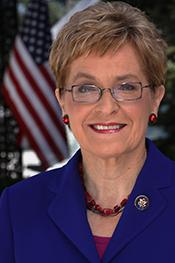 Rep. Marcy Kaptur (D-OH)
Description
Amendment requires the Roadmap Committee to provide recommendations to strengthen the use of research and development strategies in making domestic industry more competitive and to assist the commercialization of solar technologies.
Legislative Activity
Stay on top of the latest movement without scrolling through every action
House amendment offered
October 22, 2009
View full timeline
House amendment offered
October 22, 2009
Roll call votes on amendments in House
October 22, 2009 • 3:34 PM
House amendment agreed to: On agreeing to the Kaptur amendment (A005) Agreed to by recorded vote: 395 - 24 (Roll no. 802).
October 22, 2009 • 3:34 PM
Amendment agreed to Committee of the Whole
October 22, 2009 • 3:34 PM
House amendment offered/reported by : Amendment (A005) offered by Ms. Kaptur.(consideration: CR H11609-11612, H11617-11618; text: CR H11609)
October 22, 2009 • 1:22 PM
Amendment (A005) offered by Ms. Kaptur. (consideration: CR H11609-11612, H11617-11618; text: CR H11609)
October 22, 2009 • 1:22 PM
On agreeing to the Kaptur amendment (A005) Agreed to by recorded vote: 395 - 24 (Roll no. 802).
October 22, 2009 • 3:34 PM
Votes
1 roll call on this amendment
Text
Offered
SOLAR TECHNOLOGY ROADMAP ACT

The SPEAKER pro tempore. Pursuant to House Resolution 846 and rule
XVIII, the Chair declares the House in the Committee of the Whole House
on the state of the Union for the consideration of the bill, H.R. 3585.

{time}  1219

In the Committee of the Whole

Accordingly, the House resolved itself into the Committee of the
Whole House on the State of the Union for the consideration of the bill
(H.R. 3585) to guide and provide for United States research,
development, and demonstration of solar energy technologies, and for
other purposes, with Mr. Sablan in the chair.
The Clerk read the title of the bill.
The CHAIR. Pursuant to the rule, the bill is considered read for the
first time.
The gentleman from Tennessee (Mr. Gordon) and the gentleman from
Texas (Mr. Hall) each will control 30 minutes.
The Chair recognizes the gentleman from Tennessee.
Mr. GORDON of Tennessee. Mr. Chairman, I yield myself such time as I
may consume.
I am pleased that we're considering H.R. 3585, the Solar Technology
Roadmap Act sponsored by Science and Technology Subcommittee Chair
Gabrielle Giffords. This bipartisan bill has a number of cosponsors
including myself, subcommittee Chair Brian Baird, and Dan Lipinski, as
well as committee members Michael McCaul and Roscoe Bartlett.
I assume solar power is not the first name that comes to your mind
when you think of the State of Tennessee; but over the last few years
we have really seen firsthand the major potential that solar energy has
to create new jobs across the country and reduce our dependency on
foreign oil in the process.
Recently, two major producers of special materials used in solar
panels have chosen Clarksville and Cleveland, Tennessee, as sites for
their next large factories, each with over $1 billion investment
creating hundreds of jobs, plus many more jobs in larger investment
with the supply chain, as well as universities now setting up courses
in management for the solar panel industries. And this is happening all
across the State and communities all across our Nation. And that's why
we need a national plan, and that's why we are discussing this
important bill today.
H.R. 3585 establishes a comprehensive road mapping process for solar
technology research, development, and demonstration activities
conducted by the Federal Government in partnership with industry. The
Secretary of Energy is also directed to award grants to carry out these
programs by merit-based review specifically to provide awards to
industry-led consortia research, development, and demonstration in
solar manufacturing.
The road map provision in the bill is molded on the successful
National Technology Roadmap for Semiconductors, which has been
instrumental in helping semiconductor technology advance rapidly over
the past two decades.
H.R. 3585 incorporates recommendations of the witnesses who appeared
at the Science and Technology Committee, as well as input from a
variety of academic, government, and industry experts. Science and
Technology Committee staff closely consulted with the minority in the
development of this bill. We accepted several minority amendments, and
the vast majority of items in our manager's amendment in committee were
also suggested or requested by the minority. The bill was voted out of
committee on a bipartisan voice vote.
H.R. 3585 has been officially endorsed by the U.S. Chamber of
Commerce, the National Association of Manufacturers, the Solar Energy
Industries Association, British Petroleum, IBM, Intel, and National
Semiconductor.
I look forward to voting for several good amendments today and
strongly urge my colleagues here to support a bill that will help our
country take back the leadership position in this fast-growing industry
and put our best minds to work to meet our future energy needs.
Once again, I want to commend Ms. Giffords, Mr. McCaul on their
leadership on this issue. I would also like to take a moment to
recognize staff who worked on this bill: Adam Rosenberg, Wyatt King,
and Elaine Ulrich on the majority side; and Elizabeth Chapel and Tara
Rothschild on the minority side. Without the hard work of the staff on
both sides of the aisle, producing good bills like this one would not
be possible.
Mr. Chairman, I reserve the balance of my time.
Mr. HALL of Texas. Mr. Speaker, I rise today, of course, to speak on
H.R. 3585, the Solar Technology Roadmap Act.
I would first like to thank the sponsor of the bill, Representative
Giffords, and also Chairman Gordon, for working with our side of the
aisle to address concerns and incorporating suggestions to the extent
that you were able to. While we didn't come to an agreement on
everything, we came to an agreement on a lot of things. But I do feel
that we were given the opportunity to state our case and make our
arguments. Unfortunately, the areas in which we were not able to reach
an agreement remain of concern.

[[Page H11597]]

Let me start by saying that as a conference, we're supportive of
solar energy, and we have so voted--most of the people on my side of
the aisle. We certainly see the great potential it has to be a
contributor of energy to our constituents. However, as already stated,
there's some lingering concerns in the bill before us today.
First, the bill authorizes $2.25 billion over 5 years. This is not an
insignificant amount, especially in our current financial climate. The
question was raised during consideration of the bill in committee
whether or not investment tax credits for solar energy, long-term
incentives to develop renewable energy in general or an easing of
burdensome regulations would be a better way to encourage the
development and use of solar energy.
Solar energy has been on the forefront for over 30 years, and it
still only makes up 1 percent of the 7 percent of the renewable energy
consumed in the United States according to the Energy Information
Administration.
This authorization, coupled with the requirement that the Secretary
of Energy allocate at least 75 percent of funding to those solar
research, development, and demonstration projects directed under the
road map, leaves little flexibility for innovations that may be viable
and yet not included as part of the road map.
Second, the bill directs, not requests, it directs the Secretary to
spend at least 30 percent in 2012 and culminating with at least 75
percent in 2015. It could be as much as 100 percent on the research,
development, and demonstration set forth by the road map committee.
Moreover, at least one-third of the committee must be made up of
industry members who are explicitly exempted from the Federal Advisory
Committee Act. And this act, as you know, was intended to require an
open and transparent process. While I support the Department of Energy,
the university, and industry collaboration in the area of solar
research, development, and demonstration, the optics of this
examination are that you now have a committee, half of whose membership
could be industry, telling the Department of Energy where to direct
taxpayer money into R&D that could benefit their own companies while
not having to answer to anyone or defend their recommendation to the
entity that was set up to oversee and to require open and transparent
processes.
While I appreciate the inclusion at our suggestion of language
dealing with potential conflicts of interests in regard to the road map
committee membership, more transparency needs to be incorporated.
During the full committee markup, Republicans attempted to address
concerns through amendments that would have reduced the authorization,
given the Secretary of DOE some discretion as to how much funding
should go to the road map recommendations.

{time}  1230

We had some suggestions to sunset the road map committee in 2015.
While these amendments were all voted down, I remain hopeful that these
issues can be addressed as we move forward.
I would like to point out that the Department of Energy shares some
of these same concerns with this bill, and it made the Science and
Technology Committee aware of those concerns earlier this week. In
particular, they expressed concerns with using the road map committee
to direct DOE activities; the requirement of a percentage of funds to
be used to support activities identified by the committee; the Federal
Advisory Committee Act exemption for the committee; and potential
conflicts of interest with the members of the committee.
I support research and development into solar energy technologies,
but believe me, this bill has a lot of room for improvement.
With that, I reserve the balance of my time.
Mr. GORDON of Tennessee. Mr. Chairman, I yield such time as she may
consume to the passionate solar advocate and primary author of this
bill, the gentlewoman from Arizona (Ms. Giffords).
Ms. GIFFORDS. First of all, I would like to thank Chairman Gordon,
also Ranking Member Hall, members of the committee, and our staff for
helping to move this very important bill forward.
Mr. Chairman, the United States has some of the best solar resources
of any industrialized country in the world--enough power, in fact, to
power the entire country several times over.
These resources aren't unique or limited to the American Southwest.
It turns out that our friends up north in the State of Alaska have
about the same amount of solar resource energy as has the country of
Germany. Yet, in 2006, Germany installed about seven times more solar
power than we did here in the United States. Major companies in Europe
and in China have been very aggressive over the last several years in
building up their manufacturing capacities and in competing
internationally to meet demand.
If our policies and innovation models for solar energy don't change,
the United States is simply going to transition from importing foreign
oil to importing foreign panels.
This country actually invented the first photovoltaic technologies,
and we still have some of the smartest, most talented people in the
world working to improve the efficiency and cost-effectiveness of solar
cells today; but in order to use our precious research dollars as
effectively as possible, these people--these patriots--need a serious
road map. That's why I am so pleased to offer this bill today.
After many substantive discussions with a wide range of industry and
academic leaders, as well as with the Department of Energy, I believe
there is a lot that the solar industry can learn from the experience of
our national semiconductor industry.
Twenty years ago, the United States was in danger of losing its
semiconductor industry to Japan. In response, the industry created the
technology road map for semiconductors. The focus of this initiative
was to develop a road map to guide research and development efforts
across the entire industry. By increasing communications between the
diverse members of the supply chain, our American semiconductor
industry was able to develop standards and to avoid the duplication of
research efforts. These organized coordination efforts gave rise to the
U.S. semiconductor giants like Intel and AMD, and the U.S. currently
continues to lead the world in semiconductor development.
Today's solar researchers in the United States find themselves in a
very similar situation. To maintain a competitive advantage, they must
come together to meet their common, precompetitive goals, whether in
simulation activities, in developing new materials, in energy storage,
in power, in grid management or even in weather forecasting.
This bill would require the Department of Energy to engage diverse
stakeholders in the solar community and to work across programs to
create a comprehensive plan, a road map, to guide funding for the
research needed to make the U.S. the global leader for solar
innovation. The road map would be required to identify short-, medium-
and long-term goals, and it would make recommendations on how to
channel R&D resources to meet these goals. The bill would make the
Department of Energy more responsive to our solar industry's needs, and
it would encourage the needed collaboration and communication across
technologies with well-vetted strategies.
I would like to thank my colleagues on both sides of the aisle for
their contributions that have made this bill a better bill. In fact,
about 25 of the 28 changes in our manager's amendment in the Science
Committee were suggested or requested by the minority. I also look
forward to supporting several good amendments offered by my colleagues
today. Another sign of the time and effort put together by so many were
the endorsements. Chairman Gordon talked about that.
I would like to remind members that the National Association of
Manufacturers, the United States Chamber of Commerce, SEIA--the Solar
Energy Industries Association--IBM, Intel, BP, and National
Semiconductor are all behind this piece of legislation.
Mr. Chairman, the United States has an opportunity to be the leading
developer and exporter of clean solar technologies in the coming years
and decades. This bipartisan bill is designed to advance that goal, and
I strongly urge my colleagues on both sides of the aisle to support it.

[[Page H11598]]

Mr. HALL of Texas. Mr. Chairman, I yield 3 minutes to the gentleman
from Texas (Mr. McCaul), who is a cosponsor of the bill.
Mr. McCAUL. I thank the ranking member.
Let me thank the author of the bill, Ms. Giffords, for her great
leadership on what I consider to be one of the most important issues.
That's energy independence.
Mr. Chairman, I am proud to rise in support of this bill. I was proud
to be a cosponsor of this bill.
One thing is certain: the sun always rises, and it is important for
us as a Nation to harness that energy. This is landmark legislation
that, in my view, will make the United States a true leader in solar
technology and in energy independence.
What I particularly like about the bill is the collaboration between
the academic, the environment, the universities, the Department of
Education, and the private sector. I, personally, like the fact that
the private sector is involved in this rather than just some bureaucrat
behind closed doors in Washington, D.C., who is making those decisions.
I recently met with the Stanford Research Institute, and I looked at
their photovoltaic technology. The University of Texas at Austin, in my
district, is also involved with the manufacturing of these
photovoltaics, along with countless high-tech companies, like Applied
Materials and many others.
There is a lot of support for this bill in my district, and I think
it's important to note that this bill has the support of the U.S.
Chamber of Commerce, the National Association of Manufacturers, IBM,
BP, Intel, and National Semiconductor. The Chamber recently urged us to
vote for this, and said that the increased research, development and
demonstration of solar technology is crucial to America's energy
security needs.
We talk a lot about energy independence around here, but today, we
really have something tangible that we can do about it, and that is to
support this legislation.
As a former counterterrorism prosecutor, it disturbs me that we
export $700 billion from this country to countries overseas which don't
have our best interests at heart. We need to change our energy policy,
and this is a critical piece to that. This is a great step forward for
this Nation towards achieving that goal of energy independence.
My district really represents the broad spectrum of the differences--
on the one hand, the Houston suburbs with oil and gas and, on the other
hand, Austin, Texas, which is a green technology center. It's my view
that we need all of this energy. We need to make more of this energy
here in the United States, which will, in turn, create more energy for
Americans and which will create more American jobs. In my view, we can
have a hybrid energy policy, if you will. We can go green, and at the
same time, we can drill.
So, again, I think this bill is an important step forward towards
that path to energy independence. Solar energy, in my view, is one of
the best potentials for alternative energies out there, and it can be
placed on rooftops, and transmission is not as much of an issue. We are
on the cutting edge with a huge breakthrough in this country where we
can harness the sun's energy and can provide the energy that this
country desperately needs.
Mr. GORDON of Tennessee. Mr. Chairman, first, let me thank Mr. McCaul
for his significant contribution to this and, more importantly, really,
for the constructive role he has played on our committee.
I yield 2 minutes to the gentleman from Rhode Island (Mr. Langevin).
(Mr. LANGEVIN asked and was given permission to revise and extend his
remarks.)
Mr. LANGEVIN. I thank the gentleman for yielding and for his
outstanding leadership on solar technology issues.
Mr. Chairman, I also, of course, want to rise in strong support of
H.R. 3585, the Solar Technology Roadmap Act.
I particularly would like to acknowledge Congresswoman Giffords for
her leadership on this important issue and for her work to advance our
Nation's efforts to become a world leader in solar technology.
Clearly, this is an essential step as we work to transition our
Nation off of our dependence on foreign oil and as we work harder to
try to protect our environment.
Beyond all of this, though, my home State of Rhode Island recently
reported an outstanding unemployment rate of 13 percent. Congress' top
priority right now must also be creating an environment where new jobs
are developed and where new industries can flourish. The Solar
Technology Roadmap Act does just that by establishing a committee of
government and industry officials to set short- and long-term goals for
the industry as well as by providing guidance to expedite the process
of improving solar technologies right here at home.
This bill is the right road map at the right time. It is visionary,
and I urge my colleagues to vote ``yes'' on this important bill.
Mr. HALL of Texas. Mr. Chairman, I yield 3 minutes to the gentleman
from Maryland (Mr. Bartlett).
Mr. BARTLETT. Mr. Chairman, I recommend a ``yes'' vote for this good,
bipartisan solar technology road map.
I want to thank my Democrat and Republican colleagues for their
collaboration that improved H.R. 3585 with amendments in subcommittee,
in full committee, as well as in the manager's amendment and in other
amendments to follow on the floor. This bill ensures that solar energy
technologies will contribute to the strengthening of our country's
economy, environment and national security.
H.R. 3585 improves DOE policies by requiring the merit-based,
competitive allocation of Federal funds. The solar road map committee
will neither recommend nor select recipients of grant awards. The new
solar technology road map committee will provide the DOE with advice
from our national labs, universities, industry, and entrepreneurs on
technological paths to accelerate the cost-effective implementation of
solar power.
I am a fiscal conservative as well as a scientist and engineer. I
have studied and used solar energy for more than 40 years. This bill
will not spend too much money. Our country has fallen way behind. The
GAO has documented that the funding level in this bill only begins to
reverse 20 years of underinvestment by the Federal Government in the
research and development of solar power--a domestic alternative and a
renewable source of energy.
This bill will strengthen the ability of U.S. companies to regain
America's world leadership in solar technology and exports. The bill
expands the number of large demonstration projects over 30 megawatts,
and it makes them technology neutral. The bill will reduce known
vulnerabilities of our grid to natural disasters or to terrorist
attacks by requiring demonstration projects to ``promote overall
electric infrastructure reliability and sustainability should grid
functions be disrupted or damaged.''
This bill will also maximize benefits to society and to taxpayers
from these demonstration projects by encouraging DOE to consult with
DHS, DOD and other agencies to locate demonstration projects at
facilities that ensure sustainable energy for the continuous operations
of vital government missions and functions.
Vote ``yes'' for H.R. 3585, the Solar Technology Roadmap. Using our
sun to power American homes and businesses is a good bipartisan issue.
Mr. GORDON of Tennessee. Mr. Chairman, I yield 2 minutes to my friend
from New Jersey, Mr. Pascrell.
Mr. PASCRELL. Thank you, Mr. Gordon.
Mr. Chairman, I rise today in strong support of this bipartisan H.R.
3585, the Solar Technology Roadmap.
I want to thank Chairman Gordon and Congresswoman Giffords for their
tireless work in shepherding this legislation to the floor.
In the 111th Congress, the House of Representatives has taken many
important steps towards weaning our country off foreign oil and toward
reducing the dangerous carbon emissions that create global warming.
This bill would authorize $2 billion to new research partnerships and
demonstration projects for solar energy technologies.
Yet, Mr. Chairman, while the United States has some of the best solar
resources of any industrialized nation in

[[Page H11599]]

the world and while America is currently a leader in solar technology
development, other countries like Spain, Germany and China are devoting
much more effort and attention to this field, putting the U.S. and its
competitiveness within this industry in jeopardy. This is an important
part of our country's clean energy future, and this legislation, which
will spur the development of this renewable and efficient technology,
is an important step in the right direction.
In my home State of New Jersey, our Governor has embarked on an
ambitious and forward-looking energy strategy, and solar development is
a top priority. It may surprise many of my colleagues to know that New
Jersey is second only to California in the number of solar
installations and capacity, and it is first in terms of the amount of
solar installed per square mile.
Using innovative financing strategies, combined with a strong
renewable portfolio standard, New Jersey recently reached the milestone
of 100 megawatts of solar capacity generated from more than 4,300 solar
projects Statewide.

{time}  1245

Considering that 7 years ago our State only had six installations,
this achievement is especially impressive.
Great Falls of Paterson, New Jersey, my hometown, was once the source
of power that helped build this Nation into an industrial power. Today,
new solar panels are being installed at the Great Falls hydroelectric
plant to make that building more energy efficient. New Jersey and its
Governor have shown their commitment to solar energy development and
reducing greenhouse gas admissions.
I applaud the sponsors.
Mr. HALL of Texas. Mr. Chairman, I have no more speakers at this
time.
I reserve the balance of my time.
May I ask how much time we have under general debate and how many
speakers Mr. Gordon has.
The Acting CHAIR (Mr. Weiner). The gentleman from Texas has 21\1/2\
minutes remaining, and the gentleman from Tennessee has 19 minutes
remaining.
Mr. GORDON of Tennessee. Mr. Hall, if the gentleman would yield, to
answer your question, I have about six different speakers at about 2
minutes for most of them.
Mr. HALL of Texas. Thank you.
Mr. GORDON of Tennessee. Mr. Chairman, I yield 3 minutes to an
outstanding member of our committee from Michigan, Mr. Peters.
Mr. PETERS. Mr. Chairman, Michigan may not be considered an
especially sunny State, and probably it does not immediately come to
people's minds when we talk about the potential for solar energy in
this country; however, my home State is currently a leader in the
domestic manufacturing of solar cells. We are home to great companies
like United Solar Ovonic, which support over 1,000 jobs in my area
through two production facilities in Auburn Hills and global R&D
headquarters in Troy. High-tech jobs like these are the source of hope
in my State and provide workers an opportunity to apply their skills in
a new industry and enter the workforce of the 21st century.
Federal partnership is critical to effectively develop new, renewable
energies, and these investments are key to restoring jobs lost in
recent years. For this reason, I am pleased to see that the bill
recognizes the impact Federal investment in emerging industries can
have in depressed areas and ask the Secretary to consider States that
have been hit hardest by the recession and which are experiencing high
unemployment rates when providing awards under this program.
We have a tremendous opportunity to revitalize our domestic
manufacturing base by strengthening the domestic solar industry. While
States like Michigan and many others certainly have the existing
infrastructure and workforce to manufacture more solar technologies,
the United States continues to lag behind China, Japan, and Europe in
this field. We must commit at the Federal level to increase our
domestic production, and I am pleased to see that the manager's
amendment adopts language I worked on in the Science Committee that
supports domestic solar manufacturing and assures that the R&D and
manufacturing taking place under this bill will be carried out here in
the United States.
I applaud the committee's commitment to bolstering the U.S. solar
industry and the development of this road map. I would like to thank
the bill's author, Representative Giffords, Chairman Gordon, and
Ranking Member Hall of the Science and Technology Committee for working
with me on this bill, and I urge its full passage here today.
Mr. HALL of Texas. Mr. Chairman, I continue to reserve the balance of
my time.
Mr. GORDON of Tennessee. Mr. Chairman, I yield myself such time as I
may consume.
We have a number of other Members who wanted to speak on this bill,
because it is a good bill and they participated, but I do not see them
at this time. I don't think it would be respectful to the minority to
hold them up with just a filibuster by me.
I yield to the gentleman to see whether he has anyone else who would
like to speak.
Mr. HALL of Texas. I would yield to the chairman my time if he needs
it. I may be more friendly to this bill than he thinks I am.
I yield back the balance of my time.
Mr. HARE. Mr. Chair, I rise today to voice my strong support for H.R.
3585, the Solar Technology Roadmap Act. I thank my friend and colleague
from Arizona, Representative Giffords, for being a leader on this issue
and authoring this important piece of legislation, which moves our
nation further down the path toward energy independence.
Our country faces very serious challenges, and I believe that we need
serious, common-sense responses to each of them. With increasing
domestic energy costs and a continued reliance on foreign sources of
energy, the challenge is clear. My hope is that with the passage of the
Solar Technology Roadmap Act our response will be just as clear.
This important legislation creates a unique program within the
Department of Energy where stakeholders from the government, academia,
the science fields, manufacturing and business leaders and many others
can come together and work to help us realize the incredible potential
of solar energy. This diverse group will study, conduct programs of
scientific research and development, assess results and provide
recommendations for how this nation can best move forward in utilizing
solar energy. Because of this program's enormous potential, I strongly
support the bill's creation of a ``blue ribbon'' panel to evaluate
solar technologies and believe that their findings and actions
undertaken as a result of their work will be beneficial for everyone
from the average American to our friends at NASA.
This bill authorizes $2.25 billion and lays the framework to
encourage unprecedented innovation in solar activities. Other countries
like Germany and Spain, along with emerging economic powerhouses China
and India, have already taken the lead in utilizing solar capabilities
to their maximum extent. Their governments decided long ago to make the
crucial investments in solar technologies. It is absolutely critical
that this legislation is enacted so that we can once more be the leader
of the pack in the sciences, innovation and alternative energy
solutions.
I was disappointed to see that any reference in the bill to investing
in solar technology for the purpose of combating climate change did not
receive bipartisan support during markup in the Science and Technology
Committee. On the contrary, I believe solar technology does, in fact,
play a significant role in America's effort to lessen climate change,
which is why I submitted an amendment to the overall legislation, which
unfortunately was not accepted by the Rules Committee. My amendment
would have added to the purposes of the Solar Technology Roadmap
program to include suggestions on how solar technologies can better
assist the U.S. in minimizing effects on climate change. Whether or not
my colleagues believe in the legitimacy of man-made climate change, my
amendment would have directed the solar panel to inform us all what
exactly about solar works, what doesn't work, and how we could have
improved its efficiency in minimizing our carbon footprint.
Another amendment that I had wished to offer to this bill, but was
not accepted by the Rules Committee for floor consideration was one
that would have directed the Secretary of Energy to provide special
consideration, in the awarding of grant funding in the bill, to
colleges and universities, community colleges and vocational schools
already offering clean energy or green jobs training, certificates, or
degrees. Several institutions of higher learning within my District
would have benefited greatly from this amendment and I regret that the
House will not have an opportunity to consider it. I respectfully ask
that the House allow me to submit a letter of support into the
Congressional Record from Black Hawk College in

[[Page H11600]]

support of both of my amendments that were rejected by the Rules
Committee.
I am proud to have had the opportunity to join my colleagues, led by
my friend, Mr. Hinchey of New York to introduce an amendment to this
bill that would require that the Secretary of Energy ensure that the
membership of the blue-ribbon panel be from diverse regions of the
country, and that the solar demonstration projects awarded should not
be concentrated in a single region. I was happy to learn that the
distinguished Chairman of the House Committee on Science and
Technology, Mr. Gordon, agreed with us and moved to include our
proposal in the Manager's amendment. The Solar Technology Roadmap
Committee's main objective is to study how using solar energy can
improve the lives of all Americans, strengthen our commercial sector
and help protect our environment. I believe this amendment makes a
great bill even better, which is why I urge all of my colleagues to
vote in favor of the Gordon amendment.
As we all know, the beauty of solar energy is that it can be captured
and put to work in every region of our country. The power of the sun
can be harnessed not only in states like Arizona and California, but
also in places like my home state of Illinois. Many Illinoisans are
putting solar technologies to work for them, one of whom I'm proud to
say is my constituents, Michael Smith of Springfield, Illinois. Mr.
Smith has lived utility-free for over a decade and is proof positive of
the benefits that are possible through solar energy. By investing
responsibly in solar energy research and development, this Congress can
move more Americans in the direction that Mr. Smith took long ago.
With jobs still being lost all across our nation, the Congress can
and must begin focusing on the next generation of innovation. Similar
to the ``dot-corn'' era, it is inevitable that a ``green revolution''
is upon us and the U.S. must not be left behind. The time to invest in
alternative and renewable energy solutions, like solar technologies, is
now. This institution knows full well that solar power is abundant,
does not create greenhouse gases and has the potential to power our
lives for years to come. For these obvious reasons, I strongly believe
we can not afford inaction any longer.
Again, I applaud the efforts of Representative Giffords in leading
the charge on this bill, which passed out of committee with strong
bipartisan support and ask my friends on both sides of the aisle to
join me in voting for the passage of the Solar Technology Roadmap Act.

Office of the President,

Black Hawk College,

Moline, IL, October 20, 2009.
Hon. Phil Hare,
House of Representatives, Cannon HOB, Washington, DC.
Dear Congressman Hare: I am writing in support of your
Amendments #1 and #2 relating to the Solar Technology Roadmap
Act H.R. 3585 and to thank you for introducing these most
important amendments.
Recently we restructured the Engineering Technology Program
at Black Hawk College, Quad-Cities Campus. We believe this
program is important to many businesses and industries in our
service district. We now offer the following majors in the
Engineering Technology Program: 1. Electrical; 2. Mechanical;
3. Manufacturing Processes; and 4. Sustainable Energy.
Item #4 represents a new option in the Engineering
Technology Program area, a Sustainable Energy Certificate
(first in Illinois). Students take the first-year common core
curriculum and complete their work with Sustainable I and II
(covers beginning and advanced topics in many areas of
sustainable energy: solar, biomass, wind, photovoltaic) and
complete with an industry-specific internship. Looking to the
future, we believe this will be a very important program.
Your amendments--if adopted and eventually signed into law--
could provide much needed support to our Sustainable Energy
Program.
Please continue to actively support these amendments. They
are critically important to the future of our country. Again,
many thanks and best wishes.
Sincerely,
R. Gene Gardner, Ph.D.,
Interim President.
Mr. MARKEY of Massachusetts. Mr. Chair, I rise in strong support of
H.R. 3585, the Solar Technology Roadmap Act. The solar energy that
strikes the earth in a single hour is enough to power the world's
energy needs for a year. This bill will help America develop the
technology to harness that massive solar energy potential. I commend
Representative Giffords for sponsoring this legislation and Chairman
Gordon for his leadership in moving it forward.
The market for solar photovoltaics is growing 40 percent annually.
This scaling up of production, combined with developments in the
technology, has led to a rapid reduction in the cost of solar energy.
While the cost of building conventional power plants has, in many
cases, doubled over the last decade, the cost of solar has fallen
nearly 30 percent. Many people within the industry now believe solar
photovoltaics could be competitive with conventionally-generated
electricity from the grid by 2015.
Solar photovoltaic technology was born and developed in the United
States. Our publicly-funded national laboratories and our universities
such as MIT advanced this technology for decades until the private
sector more recently adopted it and began manufacturing solar
photovoltaics on a large scale. Unfortunately, we've recently watched
this All-American technology become commercialized in Japan, Germany,
and China. Today, only two of the world's ten largest solar companies
are based in the United States. This means most of the new jobs and
intellectual property in this rapidly growing field are accumulating
overseas as well. The bill before us today would double down on our
solar research program and ensure that solar technology can be
developed here with an eye toward private-sector adoption and market
deployment.
But to fully reestablish American leadership in this and other
rapidly growing clean energy industries and allow the United States to
lead in the creation of a clean energy economy, we must also enact into
law the American Clean Energy and Security Act, which was passed by the
House in June. This legislation, which I authored with Chairman Waxman,
would put the incentives in place to stimulate demand for solar and
other renewable technologies here at home while unleashing American
entrepreneurs to transform the entire energy sector into America's next
high-tech, innovation industry.
Ms. HARMAN. Mr. Chair, I rise today in strong support of H.R. 3585,
the Solar Technology Roadmap Act. Advancing solar technology is vital
to our Nation's energy security, reducing greenhouse gas emissions, and
establishing the United States as a leader in green technology. This
bill will create a structured plan for pursuing solar research,
development and demonstration, and will foster new public-private
partnerships to make clean, renewable energy more affordable and
accessible for all Americans.
Solar power can help reduce greenhouse gas emissions and mitigate the
effects of climate change. My home State of California is ahead of the
curve: 67 percent of the United States total solar generation is in
California.
The Fortunato family in Hermosa Beach, a city I represent, is
retrofitting their home to be the city's first ``net zero'' home and to
power all their electricity needs through renewables--mostly through
the use of solar panels for electricity and solar hot water for
heating.
In fact, throughout California's 36th Congressional District, my
constituents are turning to solar energy as they continue the region's
tradition of environmental leadership. Large installations at Harbor
City College in Wilmington, BT telecommunications in El Segundo, and
the Port of Los Angeles are setting the standard for solar excellence
in the South Bay. At BT, flexible solar panels provide shade in the
outdoor parking lot--something that could be widely copied. My family
installed solar panels on our roof in Venice, California, over 8 years
ago.
I worked for President Jimmy Carter, who in 1979 mandated that by the
year 2000, 20 percent of power generated in the United States should
come from the Sun. Three decades later, we're still far from that
visionary goal. Solar power accounts for just 1.2 percent of the U.S.
mix. We can--and must--do far better.
Mr. VAN HOLLEN. Mr. Chair, I rise in strong support of the Solar
Technology Roadmap Act of 2009, and I commend my colleague
Congresswoman Gabrielle Giffords for bringing it to the floor today.
The Solar Technology Roadmap Act of 2009 will focus and accelerate
the Department of Energy's ongoing solar technology research,
development and demonstration activities by creating a Solar Technology
Roadmap patterned after the highly successful National Technology
Roadmap for Semiconductors to guide the Nation's near-term, mid-term
and long-range solar technology policy goals. The Solar Technology
Roadmap will be developed by a Solar Technology Roadmap Committee
appointed by the Secretary of Energy and comprised of at least 11
members, one third of whom will come from the solar industry. This
bipartisan and forward-looking legislation has been endorsed by the
Solar Energy Industries Association, the National Association of
Manufacturers, IBM, Intel, and National Semiconductor and will optimize
the role that solar technology will play in America's clean energy
future.
I urge my colleagues' support.
Ms. JACKSON-LEE of Texas. Mr. Chair, I rise today in support of H.R.
3585, the Solar Technology Roadmap Act, a bill that establishes a
comprehensive roadmapping process for solar technology research,
development, and demonstration activities conducted by the federal
government in partnership with the private sector.
As the Member of Congress representing Texas' 18th Congressional
District in Houston, solar technology is near and dear to me and my
constituents. My state is facing an unemployment rate of around 7.5%,
the highest it

[[Page H11601]]

has been in the past 16 years. While this is 2% less than the national
average, Texas has not seen unemployment this high since 1993. In one
month alone, Texas lost 40,600 jobs.
As an energy capital of the world, it is critical for Houston to be
at the forefront in the quest for clean, renewable energy. In addition
to having energy companies as constituents, I have spent a career
working in the energy sector, representing big and large oil companies
alike. Further while Houston is home to some of the largest petroleum
companies in the world, our city is also the headquarters for leading
solar and wind power firms.
While energy reform making its way through Congress offers
significant opportunities for Houston, it also comes with a number of
challenges, particularly for our city's longstanding petroleum
community. Namely, petroleum companies stand to be significantly and
adversely impacted as the nation shifts from petroleum fuels to
alternative energy.
Mr. Chair, I believe that America should have a diversity of energy
sources, which include fossil fuels along side of wind, solar, and
hydropower sources. As such, I am working diligently with our senate
delegation to ensure that the current energy bill is improved to ensure
that the petroleum sector remains as a valuable component of our
nation's ``seamless'' energy policy.
In the interim, I offered two amendments to this bill designed to
assist Houston and the rest of Texas. Specifically, one of my
amendments would have supported the installation of solar panels and
other solar technology systems at hospitals, universities, and public
safety facilities.
* * * with solar panels, and by providing special consideration for
grantees in Texas and other states that have a great potential for
solar resources that have been adversely impacted by the nation's shift
from fossil based fuels to solar power.
For this reason, I proposed two amendments. My first amendment
focuses on Section 105b(3)(I). This provision focuses on a provision in
the bill that authorizes DOE to conduct at least 10 photovoltaic
demonstration projects ranging from one to three megawatts in size and
three to five solar projects greater than 30 megawatts in size. The
bill also requires DOE to study the performance of photovoltaic
installations and identify opportunities to improve the energy
productivity of these systems. In addition, DOE must establish a
program of RD&D related to the reuse, recycling, and safe disposal of
photovoltaic devices.
My amendment would have specifically designated hospitals,
universities, and public safety facilities as potential selectees as
infrastructure reliability projects. With this proposal, we would have
had a chance to outfit hospitals with the latest in solar technology to
create alternative power generation resources. These would prevent
power disruptions that could threaten the lives of patients in
hospitals in particular.
This idea was inspired by the fact that many of the places in our
community that provide health care services to the sick are located in
buildings that are themselves sick. As we expand health care to
millions of Americans, I hope to work with my colleagues to ensure that
health care is dispensed in healthy buildings that employ the latest in
solar and other green building designs.
Universities could also benefit from these grants in a manner that
would ensure that our institutions of higher learning could also
continue operating in the event of power outages. Finally, jails,
police stations, and other public safety facilities could also
specifically benefit by serving as demonstration projects. Mr.
Chairman, can I get your commitment to continue working with me to
ensure that this proposal is incorporated as the bill proceeds in the
legislative process.
Mr. Chair, my second amendment would have provided special
consideration to Texas and other states with high potential for solar
energy production to help businesses affected by the nation's shift
from fossil fuel based energy resources to solar and other renewable
energy when making awards under the bill. This language would be
inserted into Section 101 D. Under my amendment, the new language would
have read: ``As a criteria for providing awards under this Act, the
Secretary shall consider areas with high unemployment as well as
grantees in Texas and other states with high potential for solar energy
production to help businesses affected by the nation's shift from
fossil fuel based energy resources to solar and other renewable
energy.''
Mr. Chair, given the potential for Houston and the rest of Texas to
be benefitted or harmed by our shift to solar technology, can I get
your commitment to incorporate this idea, at least in the conference
report.
Again, I want to thank you for the opportunity to speak on behalf of
the bill and urge all my colleagues to vote for this legislation to
ensure building a comprehensive road for solar technology research,
development, and demonstration activities. Thank you Madam Speaker. I
yield back the remainder of my time.
Mr. LEVIN. Mr. Chair, I rise in strong support of the bill before the
House, the Solar Technology Roadmap Act.
The solar industry is one of the fastest growing energy industries in
the United States. Solar companies, including United Solar Ovonic in
Michigan, have been making cutting-edge advancements in both solar
technology and manufacturing. The solar industry is already creating
jobs in Michigan and across the country, and this energy resource has
the potential to create thousands more jobs if we make the right
investments.
You can't begin a journey without knowing where you're going. If we
want to expand solar energy and renewable energy jobs here in the
United States, then we need to have a plan to guide solar energy
research, development and demonstration. This legislation directs the
Department of Energy to assemble a group of experts from industry,
academia, and government labs to create a roadmap of
short-, medium-, and long-term goals to guide and accelerate the
development and deployment of solar energy in America.
A plan will only get us so far. In order for solar technology to
reach its full potential, the federal government has to create a
partnership with private industry, just as it has in other energy
areas. In a word, working with the private sector, we need to invest
wisely in this technology using the guidance provided by the research
roadmap. The legislation calls for the Department of Energy to invest
$2 billion on research, development and deployment of solar energy
technologies over the next five years. It will be important for
Congress to follow through and actually provide the funds to allow this
to happen.
I urge my colleagues to join me in voting for the Solar Technology
Roadmap Act.
Mr. KIND. Mr. Chair, I rise today in support of H.R. 3585, the Solar
Technology Roadmap Act. This bill establishes an important energy tax
title that will create the high-paying green jobs our economy needs,
while simultaneously taking strong actions to help in our longer-term
fight to combat global warming.
Even with rapid growth in solar and wind installations, most clean
technologies installed in the U.S. continue to be manufactured
overseas. In the case of solar, the U.S. is steadily falling behind the
rest of the world in manufacturing capacity, dropping from 22 percent
in 2002 to a mere 7 percent in 2007. Similarly, European firms now
account for more than 85 percent of the global wind component market,
and the U.S. has only a modest share of global manufacturing of other
clean technologies, ranging from fuel cells to advanced batteries. We
cannot continue down this path.
We are a nation of leaders and we need to start leading. We must
cultivate a new mindset where sustainable technology and a clean
manufacturing base are at the forefront. Initiatives like the Solar
Technology Roadmap, which level the manufacturing playing field and
incentivize investment, are what we need. This tax credit will create
new manufacturing jobs--a need that cannot be understated given that
the U.S. shed more than 1 million manufacturing jobs in the past 12
months. Correspondingly, the credit will increase the tax base and
improve our trade balance. These are key components to our nation's
economic recovery and long-term economic growth. Other nations are
making these investments and, to remain globally competitive, we need
to do the same.
I am pleased at the length to which this bill goes to create green
jobs and urge my colleagues to support this measure.
Mr. HOLT. Mr. Chair, I rise today in support of H.R. 3585, the Solar
Technology Roadmap Act.
The United States is currently the world's leader in solar power
technologies. However, countries like China, Germany, and Spain are
making major investments in this field, unless we increase our
investment in research, development and demonstration, RD&D, into new
solar technologies our global competitiveness will be at risk.
The Solar Technology Roadmap Act would provide this much needed
funding and create a comprehensive program to strengthen and coordinate
the development and improvement of our Nation's solar energy
technologies. The bill creates a Solar Energy Roadmap Committee
comprised of representatives from industry, academia, and government
researchers responsible for developing a long-term roadmap to guide
solar energy research. The Roadmap Committee would identify the RD&D
activities needed to improve the performance and reliability of solar
technologies, decrease cost, and reduce water use. This research plan
would guide the awarding of funds for solar energy RD&D by the
Department of Energy and would help commercialize new solar
technologies and create new public-private partnerships to make this
clean, renewable energy source more affordable and accessible for all
Americans.
Unfortunately, the House Committee on Rules did not make in order two
amendments

[[Page H11602]]

that I offered. One of my amendments would have allowed the Secretary
of Energy to use a portion of the $2 billion authorized for solar
energy to study the factors affecting whether consumers choose to adopt
and use solar power. Unless we understand these factors it will be
difficult to understand how best to encourage the widespread
utilization of solar energy. I also offered an amendment that would
have required small businesses to be given preference when distributing
the RD&D authorized in this act. I am sorry that these amendments were
not debated today.
My home State of New Jersey has made a strong investment into the
deployment of solar energy. Through its Renewable Energy Incentive
Program, REIP, New Jersey has encouraged the installation of over 4,300
solar electricity systems in our State's businesses, homes, and public
institutions. We have more solar installations per mile than any other
State in the Union, and are the second largest solar market in the
country. Our solar companies, including several located within my
congressional district, are conducting innovative RD&D into cutting
edge solar technologies and our solar installers, dealers, and project
developers have created hundreds of clean energy jobs. Supporting an
increased Federal investment into RD&D would help to continue this
effort. I urge my colleagues to support this legislation.
Mr. COHEN. Mr. Chair, I rise in support of this amendment.
I would first like to commend Representative Giffords and the Science
and Technology Committee for proposing this great piece of legislation.
I would also like to thank Representatives Titus and Teague for their
work on this very important amendment.
The economic competitiveness and security of the United States depend
upon our ability to develop clean, affordable alternatives to oil. But
this will not be cheap and it will not be easy, so I commend this
legislation's promise for significant investment in the research and
development of solar technology. Solar technology holds tremendous
promise and has the potential to put the United States on a path to
energy independence and significantly reduce greenhouse gas emissions.
For in just 1 hour, enough sunlight hits the Earth's surface to supply
the entire world's energy demands for 1 full year.
With significant investment in the research, development, and
implementation of solar technology, we will be well on our way to
energy independence. However, one obstacle to solar technology exists
that is currently not being discussed--the immense water usage of many
leading solar technologies. Currently, plans exist for solar plants
that consume 705 million gallons of water a year and are located in the
heart of desert regions which receive scant rainfall and have little
groundwater reserves.
As the American population continues to grow and water demands
continue to rise with our population, our water supply will be in even
shorter supply. Thus, we cannot afford to use hundreds of millions of
gallons of water a year to operate and maintain one solar site. It is
imperative that we invest in research and development of solar
technologies that are water efficient.
While our Nation needs clean, affordable energy, we cannot produce it
at the expense of our future water supplies. For these reasons, I
strongly urge the passage of our amendment to the Solar Technology
Roadmap Act.
Mr. HASTINGS of Washington. Mr. Chair, we must get serious about
producing more American-made energy in order to prevent skyrocketing
energy and gas prices in the future, grow our economy and protect our
national security. There is widespread and bipartisan agreement that we
must move toward a cleaner, cheaper, more diverse energy system. That
means expanding solar, wind, hydrogen fuel cell, biomass and other new
energy sources, more hydropower, more nuclear plants, and tapping into
our nation's oil and gas reserves.
My district in Central Washington state is home to massive hydropower
dams, the only nuclear power plant in the region, the Pacific Northwest
National Lab which is conducting world-class energy research, wind
farms, and solar.
There is no question that solar power has a key role to plan in our
energy future. The federal government should encourage and incentivize
all types of solar power production and research. We must make tax
credits for solar permanent and we must open up new opportunities for
solar on our federal lands.
It is with regret, today, that I cannot vote for H.R. 3585. I have
long-supported solar energy--but it need not require an expansion of
the federal government and $2.25 billion dollars at a time when
Congress is already spending more than ever and our nation is facing
historic levels of debt. In addition to the cost of this legislation, I
am concerned that it does not provide a level playing field for all
types of solar technologies. The federal government should not be in
the business of picking winners and losers.
I am a cosponsor and a supporter of H.R. 2846. This bill represents
an all-of-the-above energy bill. Under the bill, a portion of federal
government's revenue from offshore drilling would be used to provide
funding for renewable energy programs such as solar, biomass,
hydropower, clean coal, wind and others. In fact, over $8 billion would
be directed to renewables in the first 10 years at zero cost to
taxpayers.
As we move forward, I am committed to finding new opportunities to
encourage all solar technologies whether it is through research
support, federal land options, tax incentives and other means.
Mr. INSLEE. Mr. Chair, I thank Representative Giffords, the House
Leadership and the Chairman for working to pass H.R. 3585 today, which
a legislative priority for the Sustainable Energy and Environment
Coalition. H.R. 3585, Solar Technology Roadmap Act will strengthen the
American solar technology industry through a coordinated research and
development program and public-private partnerships.
The Solar Technology Roadmap Act will give even cloudy states like
Washington a roadmap to solar technology deployment. The bill will help
to ensure that federal funding for solar energy research is prioritized
to commercialize new solar technologies to make this clean, renewable
energy source more affordable and accessible for all Americans.
Harnessing the power of the sun is an economic opportunity for
America, with the potential to help create tens of thousands of clean
energy jobs in neighborhoods across the country.
The U.S. has some of the best solar resources of any industrialized
nation in the world. Yet while America is currently a leader in solar
technology development, other countries like Spain, Germany and China
are devoting much more effort and attention to this field, putting U.S.
competitiveness in this industry in jeopardy. This bill will strengthen
America's solar industry and I urge its passage.
Unfortunately, due to a matter in Washington, I will be absent for
the vote on final passage of this important bill. Had I been present, I
would have voted ``yes''.
Mr. GORDON of Tennessee. Mr. Chairman, I yield back the balance of my
time.
The Acting CHAIR. All time for general debate has expired.
Pursuant to the rule, the amendment in the nature of a substitute
printed in the bill shall be considered as an original bill for the
purpose of amendment under the 5-minute rule and shall be considered
read.
The text of the committee amendment is as follows:

H.R. 3585

Be it enacted by the Senate and House of Representatives of
the United States of America in Congress assembled,

SECTION 1. SHORT TITLE.

This Act may be cited as the ``Solar Technology Roadmap
Act''.

SEC. 2. DEFINITIONS.

In this Act:
(1) Secretary.--The term ``Secretary'' means the Secretary
of Energy.
(2) Solar technology.--The term ``solar technology''
means--
(A) photovoltaic technologies, including technologies
utilizing--
(i) crystalline silicon;
(ii) cadmium telluride;
(iii) semiconductor materials containing copper, indium,
and selenium;
(iv) thin film silicon;
(v) gallium arsenide alloy and multijunctions;
(vi) dye-sensitized and organic solar cell technologies;
(vii) concentrating photovoltaics; and
(viii) other photovoltaic methods identified by the
Secretary;
(B) solar thermal electric technology, including linear
concentrator systems, dish/engine systems, and power tower
systems;
(C) solar thermal water heating technology;
(D) solar heating and air conditioning technologies;
(E) passive solar design in architecture, including both
heating and lighting applications; and
(F) related or enabling technologies, including thin films,
semiconducting materials, transparent conductors, optics, and
technologies that increase durability or decrease cost or
weight.

TITLE I--SOLAR TECHNOLOGY RESEARCH, DEVELOPMENT, AND DEMONSTRATION

SEC. 101. PROGRAM.

(a) In General.--The Secretary shall conduct a program of
research, development, and demonstration for solar
technology, including--
(1) photovoltaics;
(2) solar hot water and solar space heating and cooling;
(3) concentrating solar power;
(4) lighting systems that integrate sunlight and electrical
lighting in complement to each other in common lighting
fixtures for the purpose of improving energy efficiency;
(5) manufacturability of low cost, high-quality solar
energy systems;
(6) development of solar technology products that can be
easily integrated into new and existing buildings; and

[[Page H11603]]

(7) other areas as the Secretary considers appropriate.
(b) Awards.--The Secretary shall provide awards under this
section to promote a diversity of research, development, and
demonstration activities for solar technology on a merit-
reviewed, competitive basis to--
(1) academic institutions, national laboratories, Federal
research agencies, State research agencies, nonprofit
research organizations, industrial entities, or consortia
thereof for research, development, and demonstration
activities; and
(2) industry-led consortia for research, development, and
demonstration of advanced techniques for manufacturing a
variety of solar energy products.
(c) Sense of Congress.--It is the sense of Congress that at
least 75 percent of funding for solar technology research,
development, and demonstration activities conducted by the
Department of Energy after fiscal year 2014 support a
diversity of activities identified by and recommended under
the Solar Technology Roadmap as described in section 102.
(d) Special Consideration.--As a criteria for providing
awards under this Act, the Secretary shall consider areas
with high unemployment.
(e) Competitiveness.--In carrying out section 105, the
Department of Energy shall strongly consider projects
utilizing solar technologies manufactured in the United
States.

SEC. 102. SOLAR TECHNOLOGY ROADMAP.

(a) In General.--Not later than 18 months after the date of
enactment of this Act, the Solar Technology Roadmap Committee
established under section 103 shall develop and transmit to
the Secretary of Energy and the Congress a Solar Technology
Roadmap that--
(1) presents the best current estimate of the near-term (up
to 2 years), mid-term (up to 7 years), and long-term (up to
15 years) research, development, and demonstration needs in
solar technology; and
(2) provides guidance to the solar technology research,
development, and demonstration activities supported by the
Federal Government for the purposes of meeting national
priorities in energy security, United States competitiveness,
mitigation of adverse environmental impacts, and energy
diversification.
(b) Contents.--The Solar Technology Roadmap shall--
(1) identify research, development, and demonstration needs
for a diversity of solar technologies to address--
(A) the key solar energy production challenges of
intermittency, transience, storage, and scaling, including
determining--
(i) which solar-related technological solutions are
appropriate for various applications, locations, and seasons;
(ii) how to store excess solar energy in batteries,
supercapacitors, compressed air, flywheels, hydrogen,
synthetic fuels, thermal storage, or superconductors, or
through other means;
(iii) how and when to integrate solar energy into the
electricity grid effectively, including--

(I) the integration of solar technologies with a Smart
Grid;
(II) electrical power smoothing;
(III) microgrid integration;
(IV) solar resource forecasting;
(V) long distance transmission options, including direct
current and superconducting transmission; and
(VI) ways to address arbitrage over minutes, hours, days,
weeks, and seasons with respect to the full range of project
scales; and

(iv) how best to integrate solar technologies into
buildings;
(B) modeling and simulation;
(C) the design, materials, and manufacture of solar
technologies, as well as related factory sciences;
(D) the development of standards;
(E) the need for demonstration facilities;
(F) optimized packaging methods;
(G) environmental, safety, and health concerns including
reuse, recycling, hazardous materials disposal, and
photovoltaic waste issues; and
(H) other areas identified by the Secretary;
(2) identify opportunities for coordination with partner
industries such as those for semiconductors, lighting, energy
storage, Smart Grid, and wind that can benefit from similar
advances;
(3) establish research, development, and demonstration
goals with recommended timeframes with respect to solar
technologies for--
(A) improving performance;
(B) decreasing cost of electricity generated;
(C) improving reliability; and
(D) decreasing potential negative environmental impacts and
maximizing the environmental benefits of solar technologies;
(4) include recommendations, as appropriate, to guide solar
technology research, development, and demonstration
activities; and
(5) outline the various technologies and practices
considered by the Committee and the benefits and shortcomings
of each, as appropriate.
(c) Revisions and Updates.--
(1) Revisions.--Once every 3 years after completion of the
first Solar Technology Roadmap under this Act, the Solar
Technology Roadmap Committee shall conduct a comprehensive
review and revision of the Solar Technology Roadmap.
(2) Updates.--The Solar Technology Roadmap Committee shall
update the Solar Technology Roadmap annually as necessary.

SEC. 103. SOLAR TECHNOLOGY ROADMAP COMMITTEE.

(a) Establishment.--Not later than 4 months after the date
of enactment of this Act, the Secretary shall establish, and
provide support for as necessary, a Solar Technology Roadmap
Committee.
(b) Membership.--
(1) In general.--The Solar Technology Roadmap Committee
shall consist of at least 11 members. Each member shall be
appointed by the Secretary from among subject matter experts
representing--
(A) different sectors of the domestic solar technology
industry, including manufacturers and equipment suppliers;
(B) national laboratories;
(C) academia;
(D) relevant Federal agencies;
(E) relevant State and local government entities;
(F) private research institutions; and
(G) other entities or organizations, as appropriate.
(2) Terms.--
(A) In general.--Except as provided in subparagraph (B),
the term of a member of the Solar Technology Roadmap
Committee shall be 3 years.
(B) Original terms.--Of the members appointed originally to
the Solar Technology Roadmap Committee, approximately \1/3\
shall be appointed for a 2-year term, approximately \1/3\
shall be appointed for a 3-year term, and approximately \1/3\
shall be appointed for a 4-year term.
(3) Limit on terms.--A member of the Solar Technology
Roadmap Committee may serve more than 1 term, except that
such member may not serve a subsequent term unless 2 years
have elapsed since the end of a previous term.
(4) Industry participation.--At least \1/3\ and not more
than \1/2\ of the members of the Solar Technology Roadmap
Committee shall be individuals described in paragraph (1)(A).
(5) Chair.--The Secretary shall select a Chair from among
the members of the Committee. The Chair shall not be an
employee of the Federal Government.
(6) Conflicts of interest.--The Secretary, in appointing
members to the Committee, shall make every effort to ensure
that--
(A) no individual appointed to serve on the Committee has a
conflict of interest that is relevant to the functions to be
performed, unless such conflict is promptly and publicly
disclosed and the Secretary determines that a waiver is
appropriate;
(B) the Committee membership is fairly balanced as
determined by the Secretary to be appropriate for the
functions to be performed; and
(C) the final report of the Committee will be the result of
the Committee's independent judgment.

The Secretary shall require that individuals that are
appointed or intended to be to appointed to serve on the
Committee inform the Department of Energy of any individual's
conflicts of interest that are relevant to the functions to
be performed.
(c) Expert Advice.--In developing the Solar Technology
Roadmap, the Solar Technology Roadmap Committee may establish
subcommittees, working groups comprised of experts outside
the membership of the Solar Technology Roadmap Committee, and
other means of gathering expert advice on--
(1) particular solar technologies or technological
challenges;
(2) crosscutting issues or activities relating to more than
1 particular solar technology or technological challenge; or
(3) any other area the Solar Technology Roadmap Committee
considers appropriate.
(d) Compensation and Expenses.--A member of the Solar
Technology Roadmap Committee shall not be compensated for
service on the Committee, but may be allowed travel expenses,
including per diem in lieu of subsistence, in accordance with
subchapter I of chapter 57 of title 5, United States Code.
(e) Federal Advisory Committee Act.--The Federal Advisory
Committee Act (5 U.S.C. App.) shall not apply to the Solar
Technology Roadmap Committee.

SEC. 104. INTERAGENCY COORDINATION.

The Director of the Office of Science and Technology Policy
shall review and coordinate Federal interagency activities
identified in and related to the Solar Technology Roadmap as
appropriate.

SEC. 105. SOLAR TECHNOLOGY DEMONSTRATION PROJECTS.

(a) Establishment of Program.--The Secretary shall
establish a program to provide grants for demonstration
projects to support the development of solar energy
production, consistent with the Solar Technology Roadmap as
available.
(b) Implementation.--In carrying out the demonstration
program under this section, to the extent practicable, the
Secretary shall--
(1) include at least 10 photovoltaic technology projects
that generate between 1 and 3 megawatts;
(2) include at least 3 but not more than 5 solar technology
projects that generate greater than 30 megawatts; and
(3) make awards for projects that--
(A) are located and can be replicated at a wide range of
sites;
(B) are located and can be replicated in a variety of
regions and climates;
(C) demonstrate technologies that address intermittency,
transience, storage challenges, and independent operational
capability;
(D) facilitate identification of optimum techniques among
competing alternatives;
(E) include business commercialization plans that have the
potential for production of equipment at high volumes;
(F) improve United States competitiveness and lead to
development of manufacturing technology;
(G) demonstrate positive environmental performance through
life-cycle analysis;
(H) provide the greatest potential to reduce energy costs
for consumers;
(I) promote overall electric infrastructure reliability and
sustainability should grid functions be disrupted or damaged;
and

[[Page H11604]]

(J) satisfy other criteria that the Secretary considers
necessary to carry out the program.
(c) Grant Awards.--Funding provided under this section may
be used, to the extent that funding is not otherwise
available through other Federal programs or power purchase
agreements, for--
(1) a necessary and appropriate site engineering study;
(2) a detailed economic assessment of site-specific
conditions;
(3) appropriate feasibility studies to determine whether
the demonstration can be replicated;
(4) installation of equipment, service, and support;
(5) operation for a minimum of 3 years and monitoring for
the duration of the demonstration; and
(6) validation of technical, economic, and environmental
assumptions and documentation of lessons learned.
(d) Grant Selection.--Not later than 90 days after the date
of enactment of this Act and annually thereafter, the
Secretary shall conduct a national solicitation for
applications for grants under this section. Grant recipients
shall be selected on a merit-reviewed, competitive basis. The
Secretary shall give preference to proposals that address
multiple elements described in subsection (b).
(e) Limitations.--Funding shall not be provided under this
section for more than 50 percent of the costs of the project
for which assistance is provided. Not more than a total of
$300,000,000 shall be provided under this section for the
period encompassing fiscal years 2011 through 2015.

SEC. 106. PHOTOVOLTAIC PERFORMANCE STUDY.

(a) In General.--Not later than one year after the date of
enactment of this Act, the Secretary shall transmit to the
Congress and the Solar Technology Roadmap Committee the
results of a study that analyzes the performance of
photovoltaic installations in the United States. The study
shall assess the current performance of photovoltaic
installations and identify opportunities to improve the
energy productivity of these systems. Such study shall
include--
(1) identification of the average energy productivity of
current commercial and residential installations;
(2) assessment of areas where energy productivity is
reduced, including wire loss, module mismatch, shading, dust,
and other factors;
(3) identification of technology development and technical
standards that improve energy productivity;
(4) analysis of the potential cost savings and energy
productivity gains to the Federal, State, and local
governments, utilities, private enterprise, and consumers
available through the adoption, installation, and use of
high-performance photovoltaic technologies and practices; and
(5) an overview of current government incentives at the
Federal, State, and local levels that encourage the adoption
of highly efficient photovoltaic systems and practices.
(b) Public Input.--The Secretary shall ensure that
interested stakeholders, including affected industry
stakeholders and energy efficiency advocates, have a
meaningful opportunity to provide comments, data, and other
information on the scope, contents, and conclusions of the
study. All forums for the Department to receive this input
from interested stakeholders shall be announced in the
Federal Register.

SEC. 107. SOLAR ENERGY PROGRAM REAUTHORIZATION.

(a) In General.--There are authorized to be appropriated to
the Secretary to carry out section 101(a)--
(1) $350,000,000 for fiscal year 2011;
(2) $400,000,000 for fiscal year 2012;
(3) $450,000,000 for fiscal year 2013;
(4) $500,000,000 for fiscal year 2014; and
(5) $550,000,000 for fiscal year 2015.
(b) Roadmap Identified Activities.--The Secretary shall
dedicate a percentage of funding received pursuant to
subsection (a) for research, development, and demonstration
activities identified by and recommended under the Solar
Technology Roadmap in the following percentages:
(1) For fiscal year 2012, at least 30 percent.
(2) For fiscal year 2013, at least 45 percent.
(3) For fiscal year 2014, at least 60 percent.
(4) For fiscal year 2015, at least 75 percent.
(c) Solar Technology Roadmap.--The Secretary may use up to
$2,000,000 of the funds appropriated pursuant to subsection
(a) for each fiscal year to support the establishment and
maintenance of the Solar Technology Roadmap.
(d) Extension of Authorizations.--Of funds authorized by
subsection (a), there are authorized to be appropriated to
the Secretary to carry out--
(1) section 602 of the Energy Independence and Security Act
of 2007 (42 U.S.C. 17171) $12,000,000 for each of the fiscal
years 2013 through 2015;
(2) section 604 of the Energy Independence and Security Act
of 2007 (42 U.S.C. 17172) $10,000,000 for each of the fiscal
years 2013 through 2015;
(3) section 605 of the Energy Independence and Security Act
of 2007 (42 U.S.C. 17173) $3,500,000 for each of the fiscal
years 2013 through 2015; and
(4) section 606 of the Energy Independence and Security Act
of 2007 (42 U.S.C. 17174) $2,500,000 for each of the fiscal
years 2013 through 2015.

SEC. 108. EXISTING PROGRAMS.

Except as otherwise specified in this Act, this Act shall
supersede any duplicative solar research, development, and
demonstration programs within the Department of Energy.

SEC. 109. REPEALS.

The following are hereby repealed:
(1) The Solar Energy Research, Development, and
Demonstration Act of 1974 (42 U.S.C. 5551 et seq.), except
for section 10.
(2) The Solar Photovoltaic Energy Research, Development,
and Demonstration Act of 1978 (42 U.S.C. 5581 et seq.).
(3) Section 4(a)(2) and (3) of the Renewable Energy and
Energy Efficiency Technology Competitiveness Act of 1989 (42
U.S.C. 12003(a)(2) and (3)).

TITLE II--PHOTOVOLTAIC RECYCLING

SEC. 201. PHOTOVOLTAIC DEVICE RECYCLING RESEARCH,
DEVELOPMENT, AND DEMONSTRATION.

(a) Definition.--In this section, the term ``photovoltaic
device'' includes photovoltaic cells and the electronic and
electrical components of such devices.
(b) In General.--In order to address the issues described
in section 102(b)(1)(G), the Secretary shall award multiyear
grants for research, development, and demonstration
activities to create innovative and practical approaches to
increase reuse and recycling of photovoltaic devices and,
through such activities, to contribute to the professional
development of scientists, engineers, and technicians in the
fields of photovoltaic and electronic device manufacturing,
design, refurbishing, and recycling. The activities supported
under this section shall address--
(1) technology to increase the efficiency of photovoltaic
device recycling and maximize the recovery of valuable raw
materials for use in new products while minimizing the life-
cycle environmental impacts such as greenhouse gas emissions
and water usage;
(2) expanded uses for materials from recycled photovoltaic
devices;
(3) development and demonstration of environmentally
responsible alternatives to the use of hazardous materials in
photovoltaic devices and the production of such devices;
(4) development of methods to separate and remove hazardous
materials from photovoltaic devices and to recycle or dispose
of those materials in a safe manner;
(5) product design and construction to facilitate
disassembly and recycling of photovoltaic devices;
(6) tools and methods to aid in assessing the environmental
impacts of the production of photovoltaic devices and
photovoltaic device recycling and disposal;
(7) product design and construction and other tools and
techniques to extend the life cycle of photovoltaic devices,
including methods to promote their safe reuse;
(8) strategies to increase consumer acceptance and practice
of recycling of photovoltaic devices; and
(9) processes to reduce the costs and environmental impact
of disposal of toxic materials used in photovoltaic devices.
(c) Merit Review.--Grants shall be awarded under this
section on a merit-reviewed, competitive basis.
(d) Applications.--Each application shall include a
description of--
(1) the project that will be undertaken and the
contributions of each participating entity;
(2) the applicability of the project to increasing reuse
and recycling of photovoltaic devices with the least
environmental impacts as measured by life-cycle analyses, and
the potential for incorporating the research results into
industry practice; and
(3) how the project will promote collaboration among
scientists and engineers from different disciplines, such as
electrical engineering, materials science, and social
science.
(e) Dissemination of Results.--The results of activities
supported under this section shall be made publicly available
through--
(1) development of best practices or training materials for
use in the photovoltaics manufacturing, design, refurbishing,
or recycling industries;
(2) dissemination at industry conferences;
(3) coordination with information dissemination programs
relating to recycling of electronic devices in general;
(4) demonstration projects; and
(5) educational materials for the public produced in
conjunction with State and local governments or nonprofit
research organizations on the problems and solutions related
to reuse and recycling of photovoltaic devices.
(f) Photovoltaic Materials Physical Property Database.--
(1) In general.--The Secretary shall establish a
comprehensive physical property database of materials for use
in photovoltaic devices. This database shall include--
(A) identification of materials used in photovoltaic
devices;
(B) a list of commercially available amounts of these
materials;
(C) amounts of these materials projected to be available
through mining or recycling of photovoltaic and other
electronic devices; and
(D) a list of other significant uses for each of these
materials.
(2) Priorities.--The Secretary, working with private
industry, shall develop a plan to establish priorities and
requirements for the database under this subsection,
including the protection of proprietary information, trade
secrets, and other confidential business information.
(3) Coordination.--The Secretary shall coordinate with the
Director of the National Institute of Standards and
Technology and the Administrator of the Environmental
Protection Agency to facilitate the incorporation of the
database under this subsection with any existing database for
electronic manufacturing and recycling.

The Acting CHAIR. No amendment to the committee amendment is in order
except those printed in House Report 111-304. Each amendment may be

[[Page H11605]]

offered only in the order printed in the report, by a Member designated
in the report, shall be considered read, shall be debatable for the
time specified in the report equally divided and controlled by the
proponent and an opponent, shall not be subject to amendment, and shall
not be subject to a demand for division of the question.

Amendment No. 1 Offered by Mr. Gordon of Tennessee

The Acting CHAIR. It is now in order to consider amendment No. 1
printed in House Report 111-304.
Mr. GORDON of Tennessee. Mr. Chairman, I have an amendment at the
desk.
The Acting CHAIR. The Clerk will designate the amendment.
The text of the amendment is as follows:

Amendment No. 1 offered by Mr. Gordon of Tennessee:
Page 4, line 21, amend paragraph (1) to read as follows:
(1) photovoltaics and related electronic components,
including inverters, charge controllers, and energy monitors;
Page 5, line 16, insert ``Federally-Funded Research and
Development Centers,'' after ``national laboratories,''.
Page 6, lines 9 through 12, amend subsection (e) to read as
follows:
(e) Limitation.--The Department of Energy shall provide
awards to projects for research, development, and
demonstration of solar technologies and solar manufacturing
in the United States.
Page 8, line 9, strike ``and''.
Page 8, line 11, insert ``and'' after the semicolon.
Page 8, after line 11, insert the following new clause:
(v) the technologies used to condition solar energy,
including inverters, DC/DC converters, and battery chargers;
Page 8, line 21, strike ``; and'' and insert a semicolon.
Page 8, line 22, redesignate subparagraph (H) as
subparagraph (I).
Page 8, after line 21, insert the following new
subparagraph:
(H) ways to reduce regional disparity in the use of solar
technologies; and
Page 9, line 8, strike ``and''.
Page 9, line 11, strike the semicolon and insert ``; and''.
Page 9, after line 11, insert the following new
subparagraph:
(E) improving the cost effectiveness and quality control of
domestic manufacturing of implements and devices used in the
production of solar energy;
Page 9, lines 12 and 15, redesignate paragraphs (4) and (5)
as paragraphs (5) and (6), respectively.
Page 9, after line 11, insert the following new paragraph:
(4) identify best practices for Department of Energy
national laboratories in their collaborations with
institutions of higher education and private industry to more
efficiently and effectively bring new solar technologies to
the marketplace;
Page 10, after line 3, insert the following new subsection:
(d) Consultation.--The Solar Roadmap Committee shall
consult with the Department of the Interior, the National
Park Service, the Department of Defense, and the General
Services Administration on the potential for solar
demonstration projects on Federal lands.
Page 10, line 15, insert ``, solar applications
developers,'' after ``including manufacturers''.
Page 12, after line 21, insert the following new paragraph:
(7) Geographic distribution.--The Secretary shall consider
individuals that represent diverse geographic regions of the
United States for membership of the Committee.
Page 13, line 3, insert ``, applications,'' after ``solar
technologies''.
Page 13, line 16, redesignate subsection (e) as subsection
(f).
Page 13, after line 15, insert the following new
subsection:
(e) Limitation.--The Committee shall provide guidance on
technological goals and activities but, consistent with
requirements for the selection of recipients of funding on a
merit-reviewed, competitive basis under section 101(b), shall
not recommend or select specific recipients of funds.
Page 14, lines 17 and 18, amend subparagraph (A) to read as
follows:
(A) are located in geographically dispersed regions of the
country and are not concentrated in any single geographical
region of country;
Page 15, line 10, insert ``, as well as promote
accessibility and community implementation of demonstrated
technologies,'' after ``energy costs''.
Page 16, lines 3 and 4, amend paragraph (5) to read as
follows:
(5) operation for a minimum of 3 years, using a monitoring
methodology approved by Secretary; and
Page 16, after line 19, insert the following new
subsection:
(f) Organic Photovoltaic Cell Technologies.--At least 1
demonstration project awarded under this section during
fiscal year 2011 shall be for the demonstration of organic
photovoltaic cell technologies.
Page 17, line 17, strike ``; and'' and insert a semicolon.
Page 17, line 21, strike the period and insert ``; and''.
Page 17, after line 21, insert the following new paragraph:
(6) assessment of current financing models available to
consumers used to offset high upfront costs by accounting for
the long term economic benefits of solar energy.
Page 18, line 5, and page 19, lines 18 and 22, redesignate
sections 107 through 109 as sections 108 through 110,
respectively.
Page 18, after line 4, insert the following new section:

SEC. 107. REPORT.

Not later than 180 days after the date of enactment of this
Act, the Secretary shall commence a study evaluating
potential applications of micro power stations using solar
power technology in underserved communities lacking in basic
electric or traditional power infrastructure, and make
recommendations to Congress for increasing access to and
implementation of solar energy technology in such underserved
communities.
Page 20, after line 9, insert the following new section:

SEC. 111. SOLAR TECHNOLOGY EQUIPMENT THEFT.

(a) Pilot Program.--Not later than 1 year after the date of
enactment of this Act, the Secretary of Energy shall
establish a pilot program to make grants for projects to
protect against solar technology equipment theft, including
projects for mapping of large-scale solar projects and
equipment serial number registries.
(b) Report to Congress.--Not later than 1 year after the
establishment of the pilot program under subsection (a), the
Secretary of Energy shall transmit to the Congress a report
on the effectiveness of projects supported under this
section, which shall include recommendations for the
continuation or alteration of the program under this section
or any other appropriate Federal legislation.

The Acting CHAIR. Pursuant to House Resolution 846, the gentleman
from Tennessee (Mr. Gordon) and a Member opposed each will control 15
minutes.
The Chair recognizes the gentleman from Tennessee.
Mr. GORDON of Tennessee. Mr. Chairman, I yield myself such time as I
may consume.
This amendment includes a number of good ideas from my colleagues who
today were not fortunate enough to be on our committee, so I am happy
to support them all, and I appreciate their contribution to making this
a better bill.
The amendment also incorporates important clarifying language that
the our staff worked out with our committee colleagues and partner, Dr.
Bartlett, to ensure that the road map committee only has the power to
provide guidance on technological goals and activities and cannot
recommend or select specific recipients of funds. This amendment
provides further protection against any conflicts of interest on the
road map committee, and I strongly urge my colleagues to support it.
I reserve the balance of my time.
Mr. HALL of Texas. Mr. Chairman, I rise to claim time in opposition
to the amendment, although I am not necessarily opposed to all of them.
The Acting CHAIR. Without objection, the gentleman from Texas is
recognized for 5 minutes.
There was no objection.
Mr. HALL of Texas. Mr. Chairman, the manager's amendment includes 14
separate amendments that were submitted to the Rules Committee. I am
supportive of a number of the provisions, including those that promote
solar demonstration projects on Federal lands and those that promote
geographic diversity for members of the solar road map committee. Most
of these amendments make minor changes, and I don't oppose those. I
have some questions with a few of the provisions, which I hope the
chairman might be able to speak to.
Mr. Hastings' amendment would fund community implementation of solar
technologies, which I am not sure is an appropriate use of funds in the
bill. Mr. Polis' amendment seems to be the attempt to study financial
incentives available to convince people to use solar energy, but I am
uncertain what he really seeks to accomplish.
Can the chairman shed some light on the need for this language and
whether this is an appropriate use of funds in the bill?
Finally, Mr. Thompson's amendment that would use funding in the bill
for demonstration projects to protect against solar technology
equipment theft, I am concerned about the cost of this project and
whether or not this is

[[Page H11606]]

an appropriate research and development project for the bill, it is a
research and development project, and how big of a problem is this and
what types of products are being stolen.
Mr. Chairman, I reserve the balance of my time.
Mr. GORDON of Tennessee. Mr. Chairman, I yield to the gentlewoman
from San Diego, Mrs. Davis, for as much time as she may consume.
Mrs. DAVIS of California. I thank my colleague for yielding the time.
Mr. Chairman, I rise today in strong support of H.R. 3585, the Solar
Technology Roadmap Act. I think that it is so important.
I am very proud of my community of San Diego because we are known, as
everyone is aware, of our perennial sunshine. I also wanted to assure
our colleagues that we are not just basking in those rays; in fact, we
are putting them to work. San Diego has been working to put that sun to
use for some time.
Our city ranks first among California cities for use of solar energy
according to a recent report by the Environment California Research &
Policy Center. Our city's solar friendly policies, such as our quicker
permitting for buildings that use solar power and a pilot program to
offer homeowners incentives for solar installations, has made us really
a bellwether for clean energy operations.
The other very, very critical issue that I want to applaud is our
military and our Navy, because the Navy Region Southwest has taken
great advantage of this wonderful resource that we have in our sun by
investing in solar panels throughout San Diego bases, saving both
energy and taxpayer dollars. There are a number of parking lots that
are shielded by solar panels, a number of the buildings that have been
transferred over the years. So this kind of sustainability of many of
our military installations and buildings in San Diego is critically
important for us. It makes a huge difference.
I certainly hope that other cities can take a look at what we have
been able to accomplish and that San Diego's leadership can serve as a
road map for other cities. As we guarantee our country's leadership for
providing a road map for financial and structural investments in the
research and development of solar energy, we can continue to move
forward with the kind of momentum that is really critical, and that is
what this bill is providing.
The public-private partnerships that will result from this bill will
help make solar energy more affordable and accessible for all
Americans. I see in my own neighborhood the changes that are occurring,
pilot projects, solar projects in front of homes throughout the
community. That sends a very powerful message to people.
I am thrilled to be a cosponsor of this legislation, and I encourage
my colleagues on both sides of the aisle to support H.R. 3585.
Mr. HALL of Texas. Mr. Chairman, I continue to reserve my time.
Mr. GORDON of Tennessee. Mr. Chairman, I yield myself such time as I
may consume.
Ranking Member Hall, to respond to your question, the manager's
amendment was a compilation of a variety of amendments that had been
presented to the Rules Committee. In an effort to expedite the process
here today, there was no mention of opposition to these. The minority
staff had access to these amendments at the same time that we had them.
We heard no opposition, so we tried to batch them together so that the
process could move forward more expeditiously.
Mr. Chairman, I reserve the balance of my time.
Mr. HALL of Texas. Mr. Chairman, I yield back the balance of my time.
Mr. MITCHELL. Mr. Chair, I rise in support of the Manager's Amendment
to the Solar Technology Roadmap Act, H.R. 3585.
We're lucky in Arizona to enjoy over 300 days of sunshine. We have a
real opportunity to brighten our state's future by investing in solar
energy research and technology.
As solar technology advances, I believe that Arizona will be a leader
in clean, alternative energy production. Refocusing our energy
production on alternative sources such as solar is critical for our
national security and the environment.
Moreover, investing in solar energy is vital to Arizona's economy.
With the help of solar tax credits, Abengoa Solar and Arizona Public
Service are developing the world's largest solar energy plant outside
of Gila Bend. The Solana solar generating station will create 1,500 to
2,000 jobs and provide clean, emission-free energy for 70,000 homes.
Solana is expected to ultimately spur $1 billion in economic
development.
H.R. 3585, the Solar Technology Roadmap Act, is critical in order to
spur further research and development of solar technology. This
legislation would establish a Solar Technology Roadmap Committee tasked
with creating a Solar Technology Roadmap to evaluate near-term, mid-
term, and long-term research, development, and demonstration needs in
solar technology. This Committee would include stakeholders in the
solar industry to provide insights on the deployment of this
technology.
I would like to thank Chairman Gordon for working with me to ensure
that the Solar Technology Roadmap would also address an important
obstacle blocking the advancement of solar technology today--namely
that this technology is expensive.
I offered an amendment to H.R. 3585 to ensure that the Solar
Technology Roadmap includes research and development goals for
improving the cost-effectiveness of domestic manufacturing of
implements and devices used in the production of solar energy.
The Chairman graciously agreed to include my amendment in the
manager's amendment.
If we are serious about making large-scale solar energy production a
reality, it is critical that we focus our research efforts on ensuring
that solar technology is affordable and competitive with other sources
of energy.
I would also like to take a moment to thank Congresswoman Giffords
for her hard work on this bill.
I urge my colleagues to support the manager's amendment as well as
the underlying legislation.
Mr. GORDON of Tennessee. Mr. Chairman, I yield back the balance of my
time.
The Acting CHAIR. The question is on the amendment offered by the
gentleman from Tennessee (Mr. Gordon).
The amendment was agreed to.

Amendment No. 2 Offered by Mr. Broun of Georgia

The Acting CHAIR. It is now in order to consider amendment No. 2
printed in House Report 111-304.
Mr. BROUN of Georgia. Mr. Chairman, I have an amendment at the desk.
The Acting CHAIR. The Clerk will designate the amendment.
The text of the amendment is as follows:

Amendment No. 2 offered by Mr. Broun of Georgia:
Page 18, lines 7 through 12, strike ``section 101(a)'' and
all that follows through ``2015'' and insert ``section 101(a)
$250,000,000 for each of the fiscal years 2011 through
2013''.

The Acting CHAIR. Pursuant to House Resolution 846, the gentleman
from Georgia (Mr. Broun) and a Member opposed each will control 5
minutes.
The Chair recognizes the gentleman from Georgia.
(Mr. BROUN of Georgia asked and was given permission to revise and
extend his remarks.)
Mr. BROUN of Georgia. Mr. Chairman, I yield myself as much time as I
may consume.
Energy independence and innovation are essential to America's
national as well as economic security. Current rising energy costs only
reinforce this critical need. Last summer's record-breaking prices of
fuel exposed the consequences of the failure to have a comprehensive
national energy strategy, one that makes America energy independent.
Many believe the debate is oil and gas versus wind, solar, and
renewable sources of energy. That assumption is absolutely false. We
need all of the sources of fuel that we know about, both current and
any possible ones that we can develop in the future.
Today's bill focuses on one of those sources of very much needed
energy, solar energy. The technological advances in solar-generated
energy are growing every day. Specifically, during committee markup,
our friend and colleague, Dr. Ehlers, shared with us an ingenious new
technology that may only be a year away from the market, a solar
shingle.
These new shingles, which are being developed by the private sector,
will be able to produce more than enough energy to power almost any
modern home. I hope they get on the market very quickly. These shingles
have dual purposes--the protection of the home on the roof and
providing a clean energy source to the home. Further, the costs to the
consumer would eventually be comparable to regular wood

[[Page H11607]]

shingles. This is the marketplace at its best.
Despite my strong support of these innovative and cleaner
technologies, this Congress must recognize a simple fact: We do not
have enough money to do all the programs that we would all like to do.

{time}  1300

In order to balance the noble goals of this legislation with the
overwhelming pressures placed on the budget, I offer this amendment
which would freeze the amount of money authorized in this bill to $250
million a year for 3 years.
In this fiscal year's Energy and Water appropriations bill, $225
million was appropriated for solar energy programs. This is in addition
to the $117 million that was appropriated in the so-called stimulus--I
call it the ``nonstimulus'' bill--earlier this year.
This is more than Congress can and should be doing for solar and
other renewable resources, reduce and streamline regulatory burden in
developing and building green technologies, actions which would not
expand or increase our debt.
I urge my colleagues to support this commonsense, economically
responsible amendment and reduce the burden of adding to the debt which
will be passed along to our children and grandchildren.
Mr. Chairman, we have to stop the outrageous spending that this
Congress is doing, and my amendment will help to do that.
I reserve the balance of my time.
Mr. GORDON of Tennessee. Mr. Chairman, I rise to claim time in
opposition to the amendment.
The Acting CHAIR. The gentleman is recognized for 5 minutes.
Mr. GORDON of Tennessee. I yield the gentlewoman from Arizona 3
minutes.
Ms. GIFFORDS. Mr. Chairman, I would like to respond to some of the
concerns that are addressed in Mr. Broun's amendment.
Mr. Broun's amendment would freeze the authorization level for solar
R&D at $250 million per year, the same level last authorized for fiscal
year 2009 in the Energy Policy Act of 2005. And note that at this
funding level, it would almost be completely impossible to carry out
the tasks of the robust demonstration program in this bill, in addition
to the critical research that is required through the road map
committee.
But I frankly believe that the best justification for the proposed
authorizations in this bill comes from taking a look backward in time
at the historical levels of investment in energy R&D in this country.
Mr. Chairman, between 1978 and fiscal year 2007, the United States
Government spent $30 billion on R&D for nuclear energy alone. We spent
another $24 billion on fossil fuel research. During that same time,
however, we spent less than $6.5 billion on solar energy. And more than
half of that research was performed prior to 1985.
Now, maybe some people thing these disparities are appropriate. Maybe
they think that solar does not merit the same levels of investment
because it is not able to provide as much energy as those technologies.
However, looking at the research and where we are with the technology
today, that is simply false.
Our solar resources are absolutely vast in scale, and they are
capable of making a significant contribution to our energy needs. Using
technology available today, solar power could meet the electricity
demands of the entire United States on a square piece of land 100 by
100 miles, or 10,000 square acres. That is just one-quarter of the land
currently covered by artificial lakes behind hydroelectric dams, which
provide less than 7 percent of our Nation's electricity.
Scott Stephens, an engineer with the Solar Energy Technology Program
at the Department of Energy, recently stated publicly that with the
right incentives, solar power has the potential to provide 20 percent
of America's electricity needs by 2030. That's equal to the amount of
power currently provided by nuclear power plants. Yet to date, we have
spent just one-tenth the resources developing solar technologies than
we have spent in developing nuclear power. In the last 30 years, we
have spent four times more money developing coal technology than solar,
and burning coal is a technology that was developed 150 years ago.
At the end of the term covered by my bill, it would authorize $550
million to solar R&D. At the peak of the energy crisis in the 1970s, we
spent $3 billion a year on nuclear power development and $1.8 billion
on fossil fuels, using 2007 dollars.
Let me be clear. I fully support having strong research programs in
other types of energy, whether it's nuclear or coal and a variety of
other important energy options. The funding levels in this bill just
recognize and help us properly take advantage of the enormous solar
resources that we have in the United States.
The Acting CHAIR. The time of the gentlewoman has expired.
Mr. GORDON of Tennessee. I yield the gentlewoman 1 additional minute.
Ms. GIFFORDS. To properly take advantage of the enormous solar
resources we have in the United States, and the potential to accelerate
new clean energy for our economy, it is time for our investment to
match the scale of opportunity. In fiscal year 2011, the Solar
Technology Roadmap would authorize $350 million, which is only about 6
percent of today's energy R&D budget.
Mr. BROUN of Georgia. Mr. Chairman, I yield 2 minutes to my good
friend, Mr. Hall from Texas.
Mr. HALL of Texas. Mr. Chairman, I rise in support of the amendment.
Mr. Chairman, Dr. Broun's amendment is a fiscally conservative
amendment that makes financial sense when our country is carrying a
$1.4 trillion debt. Instead of authorizing a total of $2.25 billion,
Dr. Broun's amendment would authorize $750 million, keeping the
authorization level more in line with the incremental increases the
solar program has been appropriated over the past several years, not to
mention the $117.6 million that the program has already received in the
stimulus bill. This could be the amendment that would make the bill
more acceptable.
Mr. GORDON of Tennessee. Mr. Chairman, I yield myself such time as I
may consume.
Dr. Broun is a valued member of our committee and has well deserved
credentials for looking after the taxpayers' dollars. But I really
think in this case it is being penny wise and pound foolish.
In the short time that I have, I want to make one quick point. The
United States invented the technology for the solar industry now. Yet
China is the largest manufacturer, exporter and deployer of solar in
the world right now. The United States simply cannot compete with them
in terms of wages. We do not want to work for $2 or $3 an hour. We do
not want to have our kids to do that. So we have to be ahead of them in
technology.
For that reason, we are going to have to invest in that technology so
that we can make our solar panels and our solar industry be such that
we are not only manufacturing it, but we are also putting forth the
best technology. That is why this investment is important. That is why
this is an investment in our future and our kids.
And with that, Mr. Chairman, I yield back the balance of my time.
Mr. BROUN of Georgia. Mr. Chairman, if the philosophy is that
government has to supply all the money for all the research and
development in this country, particularly for energy resources or
anything else, then it makes sense to pour more and more money into
this kind of development, but we are stealing our grandchildren's
future. They are going to live at a lower standard.
Mr. Chairman, we just simply have to stop the spending and control
what we are doing. We cannot spend ourselves into economic prosperity.
It's going to cost jobs in this country. We are going to go into an
economic slump and a downturn if we don't stop spending money here in
Congress.
So my amendment will certainly continue to fund solar energy, which
we desperately need; but the private sector, Mr. Chairman, can do that
also. Government is not the only source of funds. The private sector is
already developing things, as I stated in my opening statement for
these shingles.
We have to stop robbing our grandchildren's future.
And with that, Mr. Chairman, I urge all Members on both sides to
support my amendment. It's a commonsense, fiscally responsible
amendment.

[[Page H11608]]

I yield back the balance of my time.
The Acting CHAIR. The question is on the amendment offered by the
gentleman from Georgia (Mr. Broun).
The question was taken; and the Acting Chair announced that the noes
appeared to have it.
Mr. BROUN of Georgia. Mr. Chairman, I demand a recorded vote.
The Acting CHAIR. Pursuant to clause 6 of rule XVIII, further
proceedings on the amendment offered by the gentleman from Georgia will
be postponed.

Amendment No. 3 Offered by Mr. Hastings of Florida

The Acting CHAIR. It is now in order to consider amendment No. 3
printed in House Report 111-304.
Mr. HASTINGS of Florida. Mr. Chairman, I have an amendment at the
desk.
The Acting CHAIR. The Clerk will designate the amendment.
The text of the amendment is as follows:

Amendment No. 3 offered by Mr. Hastings of Florida:
Page 10, line 22, strike ``and''.
Page 10, line 23, redesignate subparagraph (G) as
subparagraph (H).
Page 10, after line 22, insert the following new
subparagraph:
(G) minority-serving institutions; and

The Acting CHAIR. Pursuant to House Resolution 846, the gentleman
from Florida (Mr. Hastings) and a Member opposed each will control 5
minutes.
The Chair recognizes the gentleman from Florida.
Mr. HASTINGS of Florida. Mr. Chairman, I rise today to offer this
amendment to H.R. 3585, the Solar Technology Roadmap Act, to guarantee
minority-serving institutions are represented in the solar technology
road map committee.
Mr. Chairman, I'm a bit melancholy because I'm here with two
colleagues that I cut my eye teeth in Congress with from the Science
Committee, Mr. Gordon, the now-Chair, and the ranking member, Mr. Hall.
And it seems that 19 years kind of like went real fast. Somewhere along
the way, I had hair then, Mr. Gordon's hair was black, and Mr. Hall's
hair was white; but he had more of it at that time. But it's a
pleasure, and it's refreshing to see the comity that existed when I
came here 19 years ago continuing on this committee. And I applaud them
in that regard for bringing significant bipartisan legislation to the
floor.
As a Member representing the sunshine State of Florida, I feel that
we must seize the opportunity to research and develop solar technology.
Solar power is an innate source that can provide much advancement in
the world of energy and technology. It is critical to ensure that
members appointed to the solar technology road map committee are a
diverse group of Americans who will carry out the mission of this act.
I believe that minority-serving institutions have a history of
technical expertise, where many are actually land grant institutions,
thus they have significant extension efforts which translate research
into applied resources for the communities they serve.
My law school alma mater and the alma mater of Representative Corrine
Brown and Representative Kendrick Meek, Florida Agricultural and
Mechanical University in Tallahassee, Florida, has been a land grant
institution educating African Americans and other Americans since 1890.
The university offers an extensive catalog of degree programs with a
strong and efficient research division. FAMU's research division has
been involved in cutting-edge research that has led to numerous
technological and scientific advancements.
Mr. Chairman, essentially, this amendment reminds the Secretary of
Energy, responsible for implementing the solar technology road map
resulting from this legislation, to incorporate diverse expertise.
Involving institutions such as FAMU will ensure a full spectrum of
voices contribute to determining the best course for seizing the
enormous potential of solar technology.
I ask my colleagues for their support of this amendment, and I deeply
thank Congresswoman Giffords for offering the underlying legislation.
I reserve the balance of my time.
Mr. HALL of Texas. Mr. Chairman, I rise to claim time in opposition
to the amendment, although I am not opposed to it.
The Acting CHAIR. Without objection, the gentleman is recognized for
5 minutes.
There was no objection.
Mr. HALL of Texas. Mr. Chairman, this amendment seeks to ensure
minority institutions are represented on the solar technology road map
committee established in this bill. I certainly have no objections to
this amendment.
I reserve the balance of my time.
Mr. HASTINGS of Florida. Mr. Chairman, how much time do I have
remaining?
The Acting CHAIR. The gentleman has 90 seconds remaining.
Mr. HASTINGS of Florida. Then I am pleased at this time to yield 90
seconds to my friend, Mr. Cuellar.
Mr. CUELLAR. Mr. Chairman, I rise again to support the Solar
Technology Roadmap Act and of course Mr. Hastings and the work that he
has done. I had offered an amendment that got included to authorize the
Secretary of Energy to study micropower solar power technology used in
underserved communities that lack basic electric and traditional
powers.
I think my friends from Texas are familiar with the colonias. They
understand that this is important to provide power to those areas that
have literally no electricity. And this particular bill and this
particular amendment will go a long way to make sure that these
communities are provided the support they need.

{time}  1315

What this calls for is for the Secretary to provide a study to take
the resources that we have, especially in south Texas, the sunlight,
and put it to work to power these communities.
We have worked together to work and put some micro power stations to
use in areas like Webb County in south Texas, and I believe that by
getting these recommendations to be sent to Congress for increasing
assets to solar energy and to help address the problems that exist in
those low-income communities, this will go a long way. We can harness
this 21st century technology to bring these areas out of 19th century
conditions.
Mr. Chairman, I want to thank you very much, and also Ms. Giffords,
and our ranking member.
I urge Members to vote for the Hastings amendment, and of course for
this bill.
Mr. Chairman, I rise today to encourage my colleagues to support the
manager's amendment to the Solar Technology Roadmap Act.
I authored an amendment, included in this manager's amendment, to
authorize the Secretary of Energy to study micro power solar power
technology use in underserved communities that lack basic electric or
traditional power infrastructure.
I thank the distinguished Chairman Ms. Giffords for including my
amendment in the manager's amendment. This important amendment will go
a long way towards helping communities along the southern border.
In my home state of Texas, many of these communities are called
colonias.
They are commonly found on the United States/Mexico border, in
underdeveloped areas across the state, and also in areas of New Mexico,
Arizona, and California.
These communities exist with conditions typically found only in
developing nations--no plumbing, no roads, and no power.
Texas has both the largest number of colonias and the largest colonia
population.
According to the State of Texas, about 400,000 Texans live in
colonias.
The development of Texas colonias dates back to least the 1950s, when
developers created unincorporated subdivisions using agriculturally
worthless land or land that lay in floodplains or in other rural
properties.
They divided the land into small lots, put in little or no
infrastructure, and then sold them to low-income individuals seeking
affordable housing.
This study will hopefully take a resource that is vast in South
Texas, sunlight, and put it to work to serve and power these
communities.
I have worked in the past to put these micro power stations to use in
Webb County, to provide small, isolated communities with power, and
this amendment builds on that to hopefully expand power to so many more
families of South Texas.
The manager's amendment includes my plan to direct the Secretary of
Energy to present to Congress recommendations for increasing access to
solar energy and to help address the problems that exist in these low
income communities.
We can harness this 21st century technology to bring these areas out
of 19th century conditions.

[[Page H11609]]

Mr. Chairman, I applaud your leadership on this important Manager's
amendment, and I urge all my colleagues to vote ``yes.''
Mr. HALL of Texas. Mr. Chairman, I yield back the balance of my time.
The Acting CHAIR. The question is on the amendment offered by the
gentleman from Florida (Mr. Hastings).
The amendment was agreed to.

Amendment No. 4 Offered by Mr. Cardoza

The Acting CHAIR. It is now in order to consider amendment No. 4
printed in House Report 111-304.
Mr. CARDOZA. Mr. Chairman, I have an amendment at the desk.
The Acting CHAIR. The Clerk will designate the amendment.
The text of the amendment is as follows:

Amendment No. 4 offered by Mr. Cardoza:
Page 4, lines 1 through 3, amend subparagraph (B) to read
as follows:
(B) solar thermal power technology, including linear
concentrator systems, dish/engine systems, power tower
systems, and other means;
Page 14, line 15, strike ``and''.
Page 14, line 16, redesignate paragraph (3) as paragraph
(4).
Page 14, after line 15, insert the following new paragraph:
(3) include at least 2 solar thermal technology projects,
with thermal storage, that generate between 1 and 3 megawatts
continuously for a 24-hour period from energy provided
entirely by the sun; and

The Acting CHAIR. Pursuant to House Resolution 846, the gentleman
from California (Mr. Cardoza) and a Member opposed each will control 5
minutes.
The Chair recognizes the gentleman from California.
Mr. CARDOZA. Mr. Chairman, I rise today in support of my amendment, a
measure that expands the type of technologies that the Department of
Energy should consider when planning for future solar.
The Central Valley in California is home to many solar technology
companies and to the University of California at Merced, a leader in
solar research. However, my constituents tell me that they are unable
to take advantage of several of the Department of Energy grant
application processes because the Department has a very narrow view of
the future of solar.
As someone with solar panels on my home in my hometown of Atwater, I
understand the tremendous benefit that solar power will have on our
country and economy, and I want to ensure that our current planning is
done correctly. Instead of limiting the potential of solar power, we
should be expanding that potential and letting the full imagination of
American ingenuity take charge.
My amendment is very simple: it expands the type of technologies that
the Department of Energy should consider when planning solar technology
road maps, and it directs the Department to focus resources on
different types of solar technology.
Specifically, my amendment expands the definition of solar technology
to include solar thermal power technology and not just electronic
photovoltaic technology. This would facilitate the funding of solar
projects and replace all types of polluting technologies, including
diesel.
Secondly, my amendment directs the Department of Energy's
demonstration program to include solar thermal projects that operate
using solar power only. Some solar plants are built with gas-fired
plants next door to them to generate power when the sun is not
available. If we as a country are going to wean ourselves away from
dirty energy, then we must develop technologies that eliminate the use
of pollutants completely and stop settling for hybrids. I know we can
do better than this. And this amendment instructs the Department of
Energy to look harder and wider at these technologies.
I urge the passage of my amendment, and I reserve the balance of my
time.
Mr. HALL of Texas. Mr. Chairman, I rise to claim time in opposition
to the amendment although I am not opposed to it.
The Acting CHAIR. Without objection, the gentleman is recognized for
5 minutes.
There was no objection.
Mr. HALL of Texas. Mr. Chairman, this amendment would simply expand
the types of technology the Energy Secretary can consider from solar
thermal electric technology to solar thermal power technology and
require the Secretary to include at least two solar thermal technology
projects with thermal storage in the demonstration project funded under
the bill. I see no problem with that, and I have no objection to the
amendment.
Mr. Chairman, I reserve the balance of my time.
Mr. CARDOZA. Mr. Chairman, I want to thank my colleague and my
friend, the gentleman from Texas, for his support of this amendment.
I would like to yield such time as she may consume to the gentlewoman
from the District of Columbia (Ms. Norton).
Ms. NORTON. I want to thank my colleague from California for this
expansion, and my colleague on the other side for supporting his
amendment.
I come to the floor because, in my own work as chairman of a
subcommittee that engages in construction of courthouses and of Federal
buildings throughout the United States, we have been trying to make the
United States lead by example. The cost of all of this, I say to my
colleague, will go down tremendously if the Federal Government is in
this big time.
Your attention to thermal technology with regard to solar is very
important. Just this morning, I went to speak to the International
Brotherhood of Electrical Workers who are deeply engaged in this work
in military institutions and the defense industries. Already we read
that 30,000 jobs have come out of the stimulus just reported last week.
And what is important about the stimulus is that every bit of
construction is built around energy conservation; will not put on a
roof, will not do an HVAC system, will not upgrade any part of a
building unless at the center is energy conservation, because the
taxpayers pay for this energy in leasing even. We do bulk leasing,
which means we pay for the heat; we pay for the air conditioning. So to
the extent that the gentleman is making us expand the horizons, he does
the Nation a great service.
The Chinese are way ahead of us in research. They have trumped us
even in manufacturing. This rushes us to manufacturing and moves the
Nation ahead so that we regain our leadership on technology, a
leadership, I regret to say, that we have already lost in solar, but
this bill and the gentleman's amendment helps us to quickly catch up.
I thank the gentleman for yielding.
Mr. HALL of Texas. Mr. Chairman, I yield back the balance of my time.
Mr. CARDOZA. Mr. Chairman, I yield back the balance of my time.
The Acting CHAIR. The question is on the amendment offered by the
gentleman from California (Mr. Cardoza).
The amendment was agreed to.

Amendment No. 5 Offered by Ms. Kaptur

The Acting CHAIR. It is now in order to consider amendment No. 5
printed in House Report 111-304.
Ms. KAPTUR. Mr. Chairman, I rise to offer an amendment as designated
amendment No. 5 in House Resolution 846.
The Acting CHAIR. The Clerk will designate the amendment.
The text of the amendment is as follows:

Amendment No. 5 offered by Ms. Kaptur:
Page 9, line 14, strike ``and''.
Page 9, line 15, redesignate paragraph (5) as paragraph
(7).
Page 9, after line 14, insert the following new paragraphs:
(5) provide recommendations on the necessary steps required
to strengthen the link between solar technology research and
the commercialization of those technologies into full scale
manufacturing, including the retooling and reworking of the
Nation's existing technological and manufacturing base, as
well as coordinating the national strategy in regions where
solar technology clusters currently exist;
(6) provide recommendations to Federal agencies on
corresponding strategies to accelerate domestic
commercialization of newly developed solar technologies; and

The Acting CHAIR. Pursuant to House Resolution 846, the gentlewoman
from Ohio (Ms. Kaptur) and a Member opposed each will control 5
minutes.
The Chair recognizes the gentlewoman from Ohio.
Ms. KAPTUR. Mr. Chairman, first let me thank the distinguished
gentlewoman from Arizona, Congresswoman Giffords, for her leadership in
developing this legislation, and the Democratic and Republican
leadership of the Science and Technology Committee, Chairman Bart
Gordon of Tennessee and Ranking Member Mr. Ralph Hall of Texas.

[[Page H11610]]

Truly, for my region, which is one of the three leading solar centers
in the hemisphere, Toledo, Ohio, and an area enduring great economic
transition, solar energy is so much a part of our future.
My amendment is very straightforward. It directs the committee
charged with outlining the needs of the solar industry to consider the
outcomes for domestic solar manufacturing and commercialization in the
United States. The amendment also asks the committee to consider the
policies of other Federal agencies for encouraging solar
commercialization.
We know that while the United States has long been the leader in
research and development of solar technologies--and let me hold one of
them up, one of the newest solar inventions from my region which is
actually going to be on all our roofs someday. It doesn't have glass in
it, but it's seven layers, and it is part of the future of solar
building technologies in this country. Our children and grandchildren
will come to know it very well.
We have had a lot of creative geniuses out there developing solar
patents and new technologies, but our country seems to have lost the
lead in solar deployment and manufacturing. With dramatic advances in
Germany, Spain, and China, our country needs a unified strategy for
developing a competitive domestic solar industry.
For the last 100 years, our community, which has been known as the
glass center of the world, has been devoting our best minds to the
exploration of traditional energy resources. We are now converting and
building on what we've known in the past to something new and
innovative.
Regressive research and development practices and our reliance as a
country on foreign oil helped precipitate our economic decline and
strategic vulnerability. I have always believed that our dependence on
imported petroleum is America's chief strategic vulnerability. In fact,
in 2006 alone, $270 billion, or one-third of the total $836 billion
U.S. trade deficit, resulted from imported petroleum. That's right,
one-third of our trade imbalance is the result of imported oil and our
oil addiction.
The economic, political and environmental future of our country lies
in our ability to transition our economy from traditional energy
sources and to ensure we produce and manufacture the clean power
sources here at home. That, coupled with conservation and our building
technologies, can make tremendous strides.
Between 1943 and 1999, the nuclear industry of our country received
over $145 billion in Federal subsidies. But the solar industry, by
contrast, which is our future, only got about $4.4 billion for solar
energy development; that's less than 3 percent of what was received by
the nuclear industry. If we are going to invest the billions needed in
solar, and which we have no choice but doing, there needs to be a road
map that guides our policies and promotes not just research and
development, but leads to the creation of a domestic industry without
outsourcing. We should be exporting, not outsourcing.
We must ensure that Federal policy takes these technologies from the
drawing board to the manufacturing line as we've done in so many other
industries; otherwise, we will find that offshoring will occur as it
has in other industries and that global trade practices will allow
foreign imported solar production here, and our domestic manufacturers
will not be able to keep pace.
As my colleagues join me on the floor and wonder why an amendment
like this is necessary, let me provide you with an example from my
hometown of Toledo; and as I mentioned, it is now one of the leading
three solar centers in the hemisphere. Toledo, Ohio is a city in
transition. Throughout the 20th century we were known as the glass
capital of the world. With the world's glass giants--Libby-Owens-Ford,
Owens-Illinois, Owens-Corning and Libby--all headquartered in our
district, the city provided reliable transportation, cheap natural gas,
and silicate and limestone building materials. As the glass industry
advanced, the titans of glass spun off glass technologies into some of
the early solar technologies that local talent created. In fact, the
hottest stock on Wall Street in the last couple of years has been First
Solar that is headquartered in our district. It was spun off from
research at our University of Toledo hand in hand with our glass
industry leaders.
Leaders coming from the glass and automotive industry in our region,
such as Dr. Harold McMaster and Norman Nitschke, who were the founders
of First Solar, and other entrepreneurs--Norm Johnson, Xunming Deng and
his wife, Liwein Xu, Al Campaan--all of these wonderful Americans are
helping to build our future in places like Toledo.
The Acting CHAIR. The time of the gentlewoman from Ohio has expired.
Mr. HALL of Texas. Mr. Chairman, I rise to claim time in opposition
to the amendment although I am not opposed to it.
The Acting CHAIR. Without objection, the gentleman is recognized for
5 minutes.
There was no objection.
Mr. HALL of Texas. I yield the gentlelady 1 additional minute.
Ms. KAPTUR. These private sector researchers at the University of
Toledo have continued investing in these designs and have birthed new
solar companies that will be the Fortune 500 of the next generation.
Companies like Xunlight, Innovative Greenfields, Solar Fields, Calyxo,
Willard & Kelsey--these were born because of an innovative incubation
strategy that helped our researchers make the leap from science to
manufacturing.
Mr. Chairman, the base bill and this amendment provide the direction
to transform our solar industry and breathe life into our idle
industrial economy to produce the advanced energy products of tomorrow
and to restore America's energy independence.
I again compliment the gentlelady from Arizona for her leadership,
and I thank both Chairman Gordon and Ranking Member Hall so very much
for their time today.
I urge a ``yes'' vote on the amendment and the base bill.

[From the Wall Street Journal, Dec. 18, 2007]

Toledo Finds the Energy To Reinvent Itself

(By Jim Carlton)

Toledo, Ohio.--This city became famous in the last century
for being one of North America's leading glass centers. The
industry has been in decline since the 1980s, but Toledo
hopes to be known for its glass again. This time, though, the
glass is being coated with thin layers of chemicals to
produce ecofriendly ``solar cells.''
Toledo is among several old-line industrial cities trying
to reinvent themselves--sometimes based on their older
industries--to cash in on the demand for alternative energy.
In 2006, solar start-up United Solar Inc. said it would open
thin-film factories in Auburn Hills and Greenville, two
Michigan towns hit hard by the automotive decline. And last
year, a wind-generation plant began construction on the
grounds of a shuttered Bethlehem Steel plant in Lackawanna,
N.Y.
Industry officials say older industrial cities offer the
clean-tech industry some advantages, including less community
opposition to new plants. ``The good thing about the Rust
Belt is they want factories there,'' says Ron Kenedi, vice
president of Sharp Corp.'s Solar Energy Solutions Group,
which is based in Huntington Beach, Calif.
Recently, Norm Johnston, a former executive at Toledo glass
companies, showed how Solar Fields LLC, a start-up he runs,
was leveraging the old glass industry. Walking to the back of
a 22,000-square-foot former machine shop in the nearby suburb
of Perrysburg, he patted the blue metal casing on a 100-foot-
long production line, which his company has designed to coat
sheets of glass heated to more than 1,100 degrees with
chemicals to make solar cells.
``I started in glass, and now I'm back in glass,'' says Mr.
Johnston, whose start-up has recently been acquired by German
solar-panel maker Q-Cells AG.
There is similar activity at several other sites in this
metropolitan area of 600,000. Companies from Phoenix-based
First Solar Inc. to Xunlight Corp. are opening factories in
and around Toledo to create electricity-producing ``thin-
film'' solar panels on glass and other materials. While not
rated as efficient as the more prevalent silicon-based solar
cells, thin film has taken off in the last year because of
soaring demand for alternative energy and a world-wide
silicon shortage. It is also cheaper to make than silicon
cells.
In addition to First Solar, which in 1999 built a factory
in Perrysburg that now employs about 600, the University of
Toledo is receiving state grants to expand its solar research
and incubate thin-film spinoffs. So far, the university has
incubated four solar start-ups, including Solar Fields,
Xunlight, Innovative Thin Films Ltd. and Advanced Distributed
Generation LLC. Toledo's Regional Growth Partnership, a
nonprofit economic development group, is also using state
grants to help fund solar and other alternative energy start-
ups.

[[Page H11611]]

``I think alternative energy is one of the major hopes for
northwest Ohio,'' says John Szuch, chairman of Fifth Third
Bank of Northwestern Ohio.
In Toledo, the repercussions of the new solar activity are
already being felt. Pilkington North America Inc., a Toledo-
based unit of Japan's Nippon Sheet Glass Co., has become a
major supplier to First Solar, offsetting some of the
business it lost in the traditional glass industry.
Pilkington officials estimate thin-film sales have grown to
about 10% of revenue for its American building products
division, prompting the company to beef up a research
division that had been undergoing cuts. ``It's the biggest
thing going for us right now in terms of glass,'' says Todd
Huffman, vice president of strategic planning for Pilkington.
But clean tech isn't necessarily a panacea. Only about
5,000 solar jobs have been created in the last five years in
Toledo. Meanwhile, the number of manufacturing jobs lost
since the 1980s is in the tens of thousands.
Cities like Toledo may also have trouble competing with
domestic clean-tech hot spots like Silicon Valley, which are
in closer proximity to venture capital sources. In addition,
Toledo is competing against cheaper overseas locales. First
Solar, for instance, is building four manufacturing plants in
Malaysia. Company officials say the Perrysburg plant remains
``critical'' to the firm's future success.
Still, Toledo has come a long way. Stricken by
manufacturing declines in the automotive and other big glass-
consuming sectors, the city has been in an economic malaise
for much of two decades. Its population loss in the 1990s was
one of the fastest in the U.S.
Toledo acquired its Glass City moniker because of a long
history of innovation in all aspects of the glass business.
Owens-Illinois, Owens Corning, Glasstech and Tempglass have
extensive ties here. As the traditional glass industry
slowed, executives explored other uses for the material.
In 1989, local inventor and glass entrepreneur Harold
McMaster invested some of his millions to launch one of the
city's first solar start-ups. ``He knew that sooner or later
we would have to come up with a clean source of energy,''
says Alan McMaster, son of the now-deceased Mr. McMaster, an
icon in the industry. Mr. McMaster's company, Glasstech
Solar, became Solar Cells Inc., with research facilities at
the University of Toledo and in a nearby city. In 1999, Solar
Cells was acquired by a private-equity firm and became First
Solar.
At the time, there was little demand in the thin-film
industry. In 2002, British oil giant BP PLC pulled the plug
on two thin-film plants it had had in the works for more than
10 years, amid issues including technical problems, according
to a January report by the Department of Energy's National
Renewable Energy Laboratory.
But rising energy costs and other events--including the
blackout in the Northeast in August 2003--brought thin-film
and other alternative energies back into favor. ``We said,
`There's a business opportunity here if we had solar',''
recalls Solar Fields's Mr. Johnston. The university boosted
its emphasis on thin-film research in 2001, and this year it
shared in an $18.6 million state grant to fund the solar
industry.
The school is now using the money to beef up solar research
in its McMaster Hall, where some labs have been packed with
equipment like a magnetron gun, which is used to spray thin-
film chemicals on glass and other surfaces.
Civic leaders in Toledo now say they have the ingredients
in place to turn solar into a thriving industry. In a seafood
restaurant overlooking the Maumee River one recent evening,
business and academic leaders discussed the city's rising
solar industry and traced back its roots. ``How in the hell
would we be in this business in the first place if it weren't
for glass?'' asked Harlan Reichle, a local real-estate
executive.
____

Toledo's Makeover: Glass City to Solar Valley

(By Chris Bury)

In Toledo, once the glass-making capital of the country,
most of the city's output over the years has gone into making
everything from windshields to windows for cars and
buildings.
But as the auto and construction industries have declined,
so too, has Toledo's manufacturing sector.
For Glen Eason, a manufacturing worker, supplying the auto
industry meant waiting for the ax to fall.
``I've been scared to death for the past 10 years, to tell
you the truth,'' said Eason, a Toledo native and 30-year auto
supply industry veteran.
Marty Vick, 58, also spent 30 years working at an auto
supplier, making seats and dashboards, only to see his job
disappear. His company laid off 117 people in January.
``I never thought I'd see the day that GM, Ford and
Chrysler would be at the brink of bankruptcy,'' Vick said.
That has left entire cities, including Toledo, on the
brink. With its smokestack industries dying out, Toledo saw
the writing on the wall and did something about it.

Watch the story tonight on ``World News'' at 6:30 p.m.

To secure its future, Toledo, once known as the Glass City,
embraced its past; Toledo is where glass was first mass-
produced for bottles, buildings, and cars. Now, the city is
turning those skills--and that tradition--to the sun.
New solar energy-related businesses are taking hold in what
city officials and local executives hope will become Ohio's
``solar valley.''
``We didn't envision there would be some bailout of Toledo,
so we had to do it ourselves,'' said Norm Johnston, CEO of
Solar Fields, a solar startup company. ``We want to move from
being the `rust belt' to being the `renewable energy belt.'
''
Solar Fields is on the forefront of the fast-growing
``green industry,'' supplying panels that help power a
National Guard base. It is one of dozens of new companies in
Toledo that now make rivers of glass into solar cells, panels
and coatings.
``Our goal is to create jobs. What we like and what our
favorite color is--is green. But it's the green of cash that
gives you good jobs,'' Johnston said.

Town Has Brighter Mission With Solar Power

In Ohio's ``solar valley,'' 10,000 new jobs have taken
root. Companies, like Xunlight, founded by researchers at the
University of Toledo, are growing fast, working with experts
to manufacture solar products and hiring new employees to
become ``green collar'' workers.
``Last year, we grew 300 percent--from 20 employees to 80
employees today,'' said Xunming Deng, a physics professor-
turned CEO of Xunlight Corp.
Executives hired from rust-belt companies, who are
accustomed to downsizing, have a brighter mission in the
solar business.
``In the last position, it was about how do we get rid of
people,'' said Matt Longthorne, vice president of Xunlight.
``And in this position, it's how do we hire people and get
bigger.''
Many of Xunlight's workers once made auto parts: everything
from windshields to vinyl seats. Now they turn out thin,
flexible solar modules that power homes and businesses.
What Vick gave up in hourly wages working for an auto
supplier, he's gained in a brighter future--working in the
solar industry, he has more job security than ever before.
``This is really high tech, cutting edge for me,'' Vick
said. ``It's really, really challenging and I like it.''
Eason, who has also gone to a job in green technology, is
enthusiastic, seeing his native Toledo switching gears.
``Just to be part of something that's growing and something
that's good for the planet and good for the people,'' Eason
said. ``Solar is going to be so immense. Solar is the new
oil.''
Toledo is bailing itself out from the faded glory of the
Glass City to the shiny promise of the Solar Valley.
``You have all this wonderful energy that the sun is
sending to us for free and we're devising ways to capture it
and put it to use,'' Eason said. ``In this area, we're in the
forefront and everybody else is going to have to catch up
with us.''
____

[From the Economist, Aug. 13, 2009]

Greening the Rustbelt

Xunlight Corporation, a small manufacturer of solar panels,
sits on a quiet street in Toledo. It has a professor as its
president, about 100 employees on its payroll--and a lot of
bigwig visitors. In October 2008 Sarah Palin, then the
Republican vice-presidential candidate, used Xunlight as the
setting for a speech on energy policy. Other guests have
included Ohio's governor, two senators and a congresswoman.
And no wonder: the firm provided evidence to support a
seductive hope, that the green economy can help to revive the
suffering rustbelt.
As the battle over a cap-and-trade bill continues in
Congress, the industrial Midwest finds itself playing an
awkward role. The climate bill offers two big opportunities,
to reduce global warming and boost the green economy in the
process. And nowhere are green jobs more loudly promoted than
in the rustbelt. On August 5th Barack Obama and Joe Biden,
his vice-president, travelled to Indiana and Michigan, two
ailing swing states, to announce new grants to develop
electric cars. But hopes for those new green jobs are matched
by fears that traditional ones will be lost. With the Senate
due to debate a cap-and-trade bill next month, the rustbelt
and its politicians are at the heart of the battle.
The industrial Midwest has long been in need of a
renaissance. Its factories have been losing jobs for decades,
since long before the recession hit. Michigan, home to
America's biggest carmakers, had a 15.2% unemployment rate in
June, compared with a national average of 9.5%.
Green investment presents new hope. The University of
Massachusetts, Amherst, and the Centre for American Progress,
a think-tank, estimated in June that the federal stimulus
package and a climate bill would spur about $150 billion in
spending on clean energy each year for the next decade. That
spending, in turn, would create an estimated 2.5m jobs, from
academic researchers to factory workers making wind turbines.
``This is an opportunity for American ingenuity to renew the
manufacturing base,'' argues Phyllis Cuttino of the
Environment Group at the Pew Charitable Trusts.
There are already signs of activity. The Great Lakes Wind
Network, based in Ohio, helps local firms sell goods to the
wind business. Toledo remains one of the best examples of a
town moving from the old economy

[[Page H11612]]

to a newer one. It has been a hub for the glass manufacturing
since the 19th century. Thanks to innovations in solar
technology at the University of Toledo, it is now home to a
cluster of firms such as Xunlight. State grants continue to
help the university hatch companies. The Regional Growth
Partnership, a local business group, provides venture
capital.
In Michigan despair has bred particularly bold action. In
the past five years Jennifer Granholm, the Democratic
governor, has dangled more than $1 billion to attract
alternative-energy firms, with about $700m in tax credits to
develop electric-car batteries. Impressively, Michigan had
the third-highest number of clean-tech patents from 1999 to
2008, behind only California and New York, reckons Pew. That
number may rise. Last year Michigan passed a requirement for
power companies to boost efficiency, along with an order that
renewable sources account for 10% of the state's electricity
by 2015. Investments from the federal stimulus will help too.
In the share-out on August 5th, Michigan won more grants for
electric cars than any other state.
Nevertheless, the clean-energy economy remains small.
Though green jobs are increasing in number, they accounted
for only 0.6% of jobs in Ohio in 2007, according to Pew. The
shares in Michigan and Indiana were even smaller, at 0.4% and
0.5% respectively. Manufacturing, for all its troubles, is a
behemoth in comparison, accounting for 14% of employment in
Ohio, 15% in Michigan and 18% in Indiana in 2007. And it is a
dirty giant, dependent on cheap coal. The Midwest emits an
outsize share of carbon, according to a report from the
Chicago Council on Global Affairs. Indiana is one of the
worst offenders, spewing out 4% of America's carbon emissions
in 2007 though it is home to only 2% of its population.
The fear is that a cap-and-trade bill may expand a
promising new sector but devastate a struggling, larger one.
Mitch Daniels, the Republican governor of Indiana, has worked
hard to maintain his state's manufacturing base. A price on
carbon, he argues, would threaten it.
The version of cap-and-trade passed in June by the House
was meant to appease such critics. It includes help for
manufacturers eager to retool for new industries. Allowances
would be given away, not auctioned. And at the urging of a
congressman from Michigan, the bill would, from 2020, tax
imports from countries that do not restrict emissions. But
some Democrats are still wary. Three of Indiana's five House
Democrats voted against the bill.
Now a tough battle looms in the Senate. A new report from
the Energy Information Administration (EIA) forecasts that
the House bill would depress industrial shipments by 1%
between 2012 and 2030 (see chart). But that assumes a quick
expansion of nuclear plants, which is unlikely. In the EIA's
worst-case scenario, shipments would drop 3.2%. ``They're
huxtering,'' huffs George Voinovich, Ohio's Republican
senator, of the green enthusiasts. He wants more support for
nuclear power and fears the House bill will transfer wealth
from the heartland. On August 6th, ten of Mr Voinovich's
Democratic colleagues, including six from the Midwest, wrote
to Mr Obama fretting that a bill would cripple manufacturing
industry.
But in Toledo Xunlight's president, Xunming Deng, looks
forward to a cap-and-trade bill. ``Of course there is a cost,
but this is an investment for our economy, for our future,''
he says. There remains a danger, however, that compromise
will produce a clunker of a bill--one that does little to
slow climate change, little to revive the old economy and
little to boost a new one. Much now depends on a handful of
the states in the heartland.

Mr. HALL of Texas. Mr. Chairman, although I am not opposed to the
amendment, I do have some concerns about this amendment.
While I agree with its intent to help commercialize the technologies
that come around as a result of solar technology research, I am
concerned that we may not want to spend research dollars retooling and
refurbishing manufacturing facilities, some of which may be represented
on the Solar Roadmap Committee. That's my problem with it.

{time}  1330

Mr. Chairman, I yield back the balance of my time.
The Acting CHAIR. The question is on the amendment offered by the
gentlewoman from Ohio (Ms. Kaptur).
The question was taken; and the Acting Chair announced that the ayes
appeared to have it.
Mr. GORDON of Tennessee. Mr. Chairman, I demand a recorded vote.
The Acting CHAIR. Pursuant to clause 6 of rule XVIII, further
proceedings on the amendment offered by the gentlewoman from Ohio will
be postponed.

Amendment No. 6 Offered by Mr. Marshall

The Acting CHAIR. It is now in order to consider amendment No. 6
printed in House Report 111-304.
Mr. MARSHALL. I have an amendment at the desk.
The Acting CHAIR. The Clerk will designate the amendment.
The text of the amendment is as follows:

Amendment No. 6 offered by Mr. Marshall:
Page 14, line 15, strike ``and''.
Page 15, line 15, strike the period and insert ``; and''.
Page 15, after line 15, insert the following new paragraph:
(4) evaluate the potential to establish large photovoltaic
facilities that produce at least 100 gigawatts, including an
evaluation of the electrical grid, current, voltage, and
energy storage requirements associated with large
photovoltaic facilities.

The Acting CHAIR. Pursuant to House Resolution 846, the gentleman
from Georgia (Mr. Marshall) and a Member opposed each will control 5
minutes.
The Chair recognizes the gentleman from Georgia.
Mr. MARSHALL. Mr. Chairman, the bill includes authorization for $300
million to the Energy Department for programs that will establish
demonstration grants for solar technology projects. What my amendment
does is include a requirement that the Department use some of this
money to evaluate the potential benefits of very large solar projects.
The amendment is prompted by a January 2008 article that appeared in
Scientific American, part of their Big Ideas series. Folks out there
who want to read the article, I think you could probably just Google
``Solar Grand Plan,'' Scientific American, January 2008, and you would
see an excellent discussion by three scientists of the possibility that
we could create in the Southwest a 3,000-gigawatt facility that
delivers solar power to the Nation. It would produce enough solar power
by 2050, according to these scientists, to meet 69 percent of our
electricity needs and 35 percent of our overall energy needs.
The idea is that some 30,000 acres, or square miles, I am not sure
which, but a large hunk of land in the Southwest would be covered by
solar facilities. The energy would be collected during the day,
distributed nationwide on an improved grid, a lot of that grid would
probably be direct current, stored during the day underground in high
pressure underground caverns, with the pressure released overnight in
order to provide the power overnight.
One of the beauties of the suggestion is that it feeds back into the
existing distribution facilities that we have, so we would not have to
change, if we were using DC transmission, to DC power, but instead
would continue using AC power in our existing facilities.
I don't know whether something like this will work, but if these
scientists are right, the costs seem quite reasonable for the reward
that we would realize. The energy is completely clean, it essentially
frees us from dependence upon foreign sources of energy, and
consequently meets both the security need and environmental need at the
exact same time.
Big ideas like this require study and evaluation before they are put
together in some sort of implementation project, and consequently we
only contemplate in the amendment that there will be an evaluation of
this kind of concept as opposed to actual demonstration projects.
The $300 million that has been given to the Energy Department for
these demonstration projects, no doubt they are going to be smaller
projects, much smaller projects, than something as large as this. What
we contemplate is that there be an evaluation of whether or not a 100-
gigawatt solar facility makes sense and should be supported somehow by
the Federal Government.
The authors of this Scientific American article printed in January of
2008 estimated that the Federal investment to accomplish what in
essence would free us altogether from foreign sources of energy, the
estimate of the Federal investment over a 20-year period of time, would
be $450 billion. Spread over a 20-year period of time, a $450 billion
investment that would actually give us energy independence and an awful
lot of clean energy seems to me to be something that we ought to be
evaluating, and that is why I suggested the amendment.
With that, I request the adoption of my amendment.
I reserve the balance of my time.
Mr. HALL of Texas. Mr. Chairman, I rise to claim time in opposition
to the

[[Page H11613]]

amendment, although I am not opposed to it.
The Acting CHAIR. Without objection, the gentleman is recognized for
5 minutes.
There was no objection.
Mr. HALL of Texas. Mr. Chairman, this amendment would require the
Secretary to evaluate the potential to establish large solar facilities
and evaluate the electrical grid, current, voltage, and energy storage
requirements associated with large solar facilities, which I think this
is a good time for.
We have no objection to this.
I yield back the balance of my time.
Mr. MARSHALL. Mr. Chairman, I thank the gentleman from Texas. It
could well be that some of these facilities wind up in your State. I
have spent a fair amount of time in your great State, and I have
observed many of the times that I have been there that you have a lot
of land available that could be put to good use for this kind of
purpose.
Another thing in this article that these scientists point out is that
once a solar facility like this is created, it requires a lot less
continuing maintenance and care, unlike a lot of our other facilities
that create power, and consequently it is just a win-win, and perhaps
it will wind up being a win-win for Texas.
I yield whatever time I have left to the chairman.
Mr. GORDON of Tennessee. Thank you, Mr. Marshall. I want to let you
know that the author of the study that you put forth testified before
our committee. It was made part of the record. And you are absolutely
right, the sun doesn't shine 24 hours a day, so we need to also find
ways to be able to have the storage. I think it is a two-fer with this
proposal, and we gladly accept your amendment.
The Acting CHAIR. The time of the gentleman has expired.
The question is on the amendment offered by the gentleman from
Georgia (Mr. Marshall).
The amendment was agreed to.

Amendment No. 7 Offered by Mr. Klein of Florida

The Acting CHAIR. It is now in order to consider amendment No. 7
printed in House Report 111-304.
Mr. KLEIN of Florida. Mr. Chairman, I have an amendment at the desk.
The Acting CHAIR. The Clerk will designate the amendment.
The text of the amendment is as follows:

Amendment No. 7 offered by Mr. Klein of Florida:
Page 5, line 9, strike ``and''.
Page 5, line 10, redesignate paragraph (7) as paragraph
(8).
Page 5, after line 9, insert the following new paragraph:
(7) development of storage technologies that can be used to
increase the usefulness and value of solar technologies; and

The Acting CHAIR. Pursuant to House Resolution 846, the gentleman
from Florida (Mr. Klein) and a Member opposed each will control 5
minutes.
The gentleman from Florida is recognized.
Mr. KLEIN of Florida. Mr. Chairman, I would like to start by thanking
Congresswoman Giffords for introducing the Solar Technology Roadmap Act
and Chairman Gordon for his leadership on bringing this important bill
to the floor.
As a cosponsor of this legislation, I believe it makes a timely
investment in clean energy technology that will stimulate economic
growth and create jobs nationwide. My amendment would clarify that
research activities on the development of solar energy storage
technologies are eligible for funding in this bill.
Solar energy technology has significant potential to supply cheap,
clean and renewable energy to American families and businesses.
However, one of the major challenges with solar energy is that it can
only be produced during daylight hours. That is obvious. Thus, it is
only available at certain times, which may not necessarily correspond
to the times it is most needed by the electric grid, when electricity
is the most expensive, during peak hours, and the least efficient fuels
are likely to be used.
To use a metaphor, the distribution of solar electricity to date is
like trying to distribute water from rain without having reservoirs to
catch and hold the water.
In my home State of Florida, we are known as the Sunshine State, and
for good reason. Businesses in Florida have invested over $1 billion in
solar technology over the past 3 years, building the largest
photovoltaic solar plant in North America and installing more solar
power than almost every other State in the country. But without cost-
effective storage technology, we cannot build upon this investment, not
only in Florida but throughout the country, to eventually rely more
heavily on solar power for our States' and our country's energy needs.
There are emerging storage technologies, including batteries, thermal
storage and others, that can take solar energy when it is produced,
store it, and then provide electricity to the grid at opportune times.
These technologies have the power to make solar power more reliable,
more cost-efficient, and more widely used as an alternative to fossil
fuels for our energy needs. They also have the potential to create
thousands of new jobs right here in the United States as we develop
technologies, manufacture products, and sell them all over the world.
Storage technology may also have a substantial impact on the way we
purchase energy to power our homes and businesses, regardless of the
energy source. With more advanced and more affordable storage
technology, we may one day be able to purchase energy from utility
companies during off-peak hours, when energy costs are low, and store
the energy for when we need it. This would allow utility companies to
run more efficiently by reducing demand during peak hours and utilize
their plants in the middle of the night when demand is low, thus
helping businesses and consumers purchase the energy at the lowest
energy cost.
The development of solar energy technology will be critical to
establishing solar power as a primary source of electricity in the
United States and significantly altering the future of our energy
infrastructure. Alternative renewable sources of energy, like solar,
that can be generated right here in the United States will make
household and business energy bills cheaper, improve our environment,
and reduce our dependence on foreign oil, if we develop the technology
to make it more efficient and cost-effective.
This amendment will emphasize the importance of devoting Federal
research dollars in this bill to further advancing storage technology
that will propel storage technology to the next level.
Mr. Chairman, I reserve the balance of my time.
Mr. HALL of Texas. Mr. Chairman, I rise to claim time in opposition
to the amendment, although I am not opposed to it.
The Acting CHAIR. Without objection, the gentleman is recognized for
5 minutes.
There was no objection.
Mr. HALL of Texas. Mr. Chairman, this amendment would simply include
research on solar energy storage technology as eligible for funding
under the research and development program established in the bill.
I have no objection to this amendment.
I yield back my time.
Mr. KLEIN of Florida. Mr. Chairman, again, I would just yield myself
such time as I may consume for purposes of closing.
The legislation under consideration today, as I said, presents an
incredibly exciting opportunity for Florida and all the States in our
Union to propel this technology forward and one day establish our
country as a global leader in clean, renewable energy technology
relating to solar power. I am confident that the Solar Technology
Roadmap Act will substantially advance solar technology in the United
States, reduce its cost, and help America transition to a clean energy
economy.
I urge adoption.
I yield the balance of my time to the gentleman from Tennessee.
Mr. GORDON of Tennessee. As my friend knows, even in Florida the sun
doesn't shine 24 hours a day, so to make the most use of solar
technology, storage is very important. I think there will be a
combination there. That storage benefit, the technology, will also be
used for wind power and other types of renewables.
So I think you have an excellent amendment. It makes a good bill even
better, and I appreciate your addition to this bill.

[[Page H11614]]

Mr. KLEIN of Florida. I thank the chairman, and yield back the
balance of my time.
The Acting CHAIR. The question is on the amendment offered by the
gentleman from Florida (Mr. Klein).
The question was taken; and the Acting Chair announced that the ayes
appeared to have it.
Mr. KLEIN of Florida. Mr. Chairman, I demand a recorded vote.
The Acting CHAIR. Pursuant to clause 6 of rule XVIII, further
proceedings on the amendment offered by the gentleman from Florida will
be postponed.

Amendment No. 8 Offered by Ms. Titus

The Acting CHAIR. It is now in order to consider amendment No. 8
printed in House Report 111-304.
Ms. TITUS. Mr. Chairman, I have an amendment at the desk.
The Acting CHAIR. The Clerk will designate the amendment.
The text of the amendment is as follows:

Amendment No. 8 offered by Ms. Titus:
Page 5, line 9, strike ``and''.
Page 5, line 10, redesignate paragraph (7) as paragraph
(8).
Page 5, after line 9, insert the following new paragraph:
(7) development of solar technology products that are water
efficient; and
Page 8, line 21, strike ``and''.
Page 8, line 22, redesignate subparagraph (H) as
subparagraph (I).
Page 8, after line 21, insert the following new
subparagraph:
(H) the development of solar technology products that are
water efficient; and

The Acting CHAIR. Pursuant to the rule, the gentlewoman from Nevada
(Ms. Titus) and a Member opposed each will control 5 minutes.
The Chair recognizes the gentlewoman from Nevada.
Ms. TITUS. Mr. Chairman, I thank Chairman Gordon and Ms. Giffords for
your leadership on the important issue of energy research, development
and deployment in the area of renewables.
My amendment, offered with Mr. Teague of New Mexico and Mr. Cohen of
Tennessee, simply requires that the solar energy research, development
and demonstration program and the solar technology road map that are
authorized in this bill include an emphasis on the development of solar
technology that is water-efficient.
We know that some of the sunniest States in the country, like my
State of Nevada, are also among the driest. So while I strongly believe
we must make significant investments to expand solar energy development
across the Southwest, I also believe that we must ensure that
investments are made in research and development of new solar
technologies that use less water.
This point was brought out rather dramatically in a recent New York
Times article entitled ``Alternative Energy Projects Stumble on a Need
for Water.'' In fact, depending on the technology, some solar plants
can use more than 1 billion gallons of water a year for cooling.
It was quoted in the article, ``When push comes to shove, water could
become the real throttle on renewable energy.'' This was a statement
made by Michael E. Webber, an assistant professor at the University of
Texas in Austin, who studies the relationship between energy and water.

{time}  1345

Now, to date, this conflict between energy and water has occurred
mostly in the Southwest, where there are dozens of multibillion dollar
solar power plants that are planned for thousands of acres in the
desert.
While most forms of energy production include some kind of water,
water's availability is especially limited in the sunny areas that are
otherwise well suited for solar farms. So as we can see, this could
possibly lead to a new-age version of a western water war. Long have we
heard the saying in the West that whiskey is for drinking and water is
worth fighting over. We don't want to see that happen again.
And furthermore, as we see more solar development spread across the
country, it's likely that the water efficiency of solar technology will
become a key concern, not just in the Southwest, but in areas that
haven't historically dealt with water issues up until this point.
Investing in research that, as we develop solar technologies, are water
efficient is a win-win for the environment. We will use less fossil
fuel and less water.
At the same time we do this, we have the potential to remove a major
obstacle to the speedy siting of utility scale renewable energy
projects. Those are occurring in States like mine where water concerns
can slow the permitting process dramatically.
Investments in the development of solar technology products that are
water efficient will save water, they will save energy, and they will
ultimately bring down the cost of these products so that we can move
more quickly to a clean energy economy.
So I thank you again, Mr. Chairman, and I reserve the balance of my
time.
Mr. HALL of Texas. Mr. Chairman, I rise to claim time in opposition
to the amendment, although I am not opposed to it.
The Acting CHAIR. Without objection, the gentleman from Texas is
recognized for 5 minutes.
There was no objection.
Mr. HALL of Texas. Mr. Chairman, I have no objection to this
amendment. It's a good amendment, as solar energy can be a large user
of water, and we're looking at ways to reduce the use of water in all
forms of energy production. I think it's a very good amendment.
I yield back the balance of my time.
Ms. TITUS. Mr. Chairman, as Daniel Kammen, who is the Director of the
Renewable and Appropriate Energy Lab at the University of California at
Berkeley, stated, ``As intensive renewable energy development spreads,
water issues will follow.'' That's why I believe this amendment is an
important addition.
I want to thank Mr. Teague and Mr. Cohen for helping me with the
amendment.
At this time, I will yield to the chairman, Mr. Gordon.
Mr. GORDON of Tennessee. I thank the gentlelady from Nevada.
Certainly, as we have had various hearings in the Science and
Technology Committee, we've determined very easily that there is a
nexus between water and energy. In most cases, it takes water to make
energy and it takes energy to move water, and certainly in the area of
large plants with solar thermal, there is a lot of use of water in that
regard. To make those plants more efficient will help us to conserve
water and help us with that nexus.
And again, I thank the gentlelady for this good amendment to this
good bill.
Ms. TITUS. I yield back the balance of my time.
The Acting CHAIR. The question is on the amendment offered by the
gentlewoman from Nevada (Ms. Titus).
The question was taken; and the Acting Chair announced that the ayes
appeared to have it.
Ms. TITUS. Mr. Chairman, I demand a recorded vote.
The Acting CHAIR. Pursuant to clause 6 of rule XVIII, further
proceedings on the amendment offered by the gentlewoman from Nevada
will be postponed.

Amendment No. 9 Offered by Mr. Heinrich

The Acting CHAIR. It is now in order to consider amendment No. 9
printed in House Report 111-304.
Mr. HEINRICH. Mr. Chairman, I have an amendment at the desk.
The Acting CHAIR. The Clerk will designate the amendment.
The text of the amendment is as follows:

Amendment No. 9 offered by Mr. Heinrich:
Page 9, line 18, redesignate subsection (c) as subsection
(d).
Page 9, after line 17, insert the following new subsection:
(c) Public Input.--The Committee shall release a draft
Roadmap to the public at least one month prior to publication
in order to receive input from the public.

The Acting CHAIR. Pursuant to House Resolution 846, the gentleman
from New Mexico (Mr. Heinrich) and a Member opposed each will control 5
minutes.
The Chair recognizes the gentleman from New Mexico.
Mr. HEINRICH. Mr. Chairman, I rise today as a proud cosponsor of the
Solar Technology Roadmap Act of 2010, and I want to especially thank my
colleague from Arizona (Ms. Giffords) for introducing and championing
this important legislation.
As a member of the Sustainable Energy and Environment Coalition, I'm
particularly proud to support this coalition priority. My home State of
New Mexico averages more than 300 days of

[[Page H11615]]

sunshine each year and is second in the Nation for solar energy
potential, so I have a great appreciation for the positive impact that
this bill will have.
In New Mexico, even in the midst of this difficult recession, we are
adding jobs in the solar energy sector. Many New Mexicans, myself
included, power their homes using solar energy, and Sandia National
Labs is a world leader in developing new solar technologies, such as
Stirling engines and multijunction solar cells.
The amendment I'm offering today would require the act's solar
technology road map committee to release a draft road map at least 1
month prior to publication in order to ensure that the public has the
opportunity to provide their input. Our government works best when the
American public is included in the decisionmaking process. This
amendment will ensure that the road map reflects the wisdom and
experiences of individuals and businesses that already work in this
quickly growing industry.
In order for our country to reach its potential in growing the clean
energy economy, the Federal Government must invest wisely in research
and development. Incorporating public comments will ensure that the
solar road map is an efficient, effective blueprint for meeting our
full potential in utilizing solar energy.
Mr. Chair, I reserve the balance of my time.
Mr. HALL of Texas. Mr. Chairman, I rise to claim time in opposition
to the amendment, although I am not opposed to it.
The Acting CHAIR. Without objection, the gentleman is recognized for
5 minutes.
There was no objection.
Mr. HALL of Texas. Mr. Chairman, in light of the exemption from the
Federal Advisory Committee Act in this bill for the road map committee,
I think it's a good idea to make the draft road map available to the
public for input. This will help shed additional light on the decisions
of the road map committee. I would support the amendment.
I reserve the balance of my time.
Mr. HEINRICH. I would urge my colleagues' support.
I once again want to thank Chairman Gordon and Representative
Giffords for their leadership on this very important issue.
I reserve the balance of my time.
Mr. HALL of Texas. Mr. Chairman, I have no further requests for time,
and I yield back the balance of my time.
Mr. HEINRICH. Mr. Chairman, I yield back the balance of my time.
The Acting CHAIR. The question is on the amendment offered by the
gentleman from New Mexico (Mr. Heinrich).
The question was taken; and the Acting Chair announced that the ayes
appeared to have it.
Mr. HEINRICH. Mr. Chairman, I demand a recorded vote.
The Acting CHAIR. Pursuant to clause 6 of rule XVIII, further
proceedings on the amendment offered by the gentleman from New Mexico
will be postponed.

Amendment No. 10 Offered by Mr. Himes

The Acting CHAIR. It is now in order to consider amendment No. 10
printed in House Report 111-304.
Mr. HIMES. Mr. Chair, I have an amendment at the desk.
The Acting CHAIR. The Clerk will designate the amendment.
The text of the amendment is as follows:

Amendment No. 10 offered by Mr. Himes:
Page 4, line 24, insert ``, including both solar thermal
and concentrating solar photovoltaic technologies'' after
``solar power''.

The Acting CHAIR. Pursuant to House Resolution 846, the gentleman
from Connecticut (Mr. Himes) and a Member opposed each will control 5
minutes.
The gentleman from Connecticut is recognized.
Mr. HIMES. Mr. Chair, I yield myself such time as I may consume.
I'd like to begin by thanking Chairman Gordon for his excellent work
on this very, very important bill guiding us towards where this country
needs to be in energy in the coming years and generations.
I rise today to offer an amendment which I think is about a topic at
the forefront of everybody's minds right now, which is jobs, jobs, and
jobs. This bill is about the creation of good, high-paying jobs for
American workers and, in the process, restoring our competitiveness in
one of the most important industries of the next century.
Mr. Chair, every new solar panel system we install in this country
creates new business for roofers, for electricians, for engineers, and
for construction workers. But I'm most excited about what solar power
can do for America's manufacturing.
I refuse to believe that America's days as a world leader in
manufacturing are over. An industry report by Duke University found
that by 2016, only 7 years from now, solar manufacturing could replace
500,000 jobs that have been lost, say, in the auto industry; 500,000
jobs, the manufacturing sector of the 21st century, if we make the
right investments now.
Back when very few of us were talking about solar power, the U.S. was
quietly leading the world in the production of solar technology. Well,
through the 1990s, no country on Earth invested more in solar than we
did. So how is it that here in 2009, only 5 percent, 5 percent of the
world's solar panels are made in America? There's a one-word answer to
that question, and that word is ``investment.''
Look at China. Through their Golden Sun program, the Chinese
Ministries of Finance, Science and Technology and the National Energy
Administration are subsidizing half of the construction and connection
costs for on-grid solar power plants and 70 percent of the cost of off-
grid installations from now until 2011. And American companies are
following these investments.
First Solar, of Tempe, Arizona, recently signed an agreement to build
a 2-gigawatt plant, 2 gigawatts, one of the largest solar plants in the
world, in Ordos City in Inner Mongolia. Now, I have nothing against
Mongolia, but I, for one, would prefer to see those jobs in Bridgeport
or Stamford or any of the other American cities that saw their
manufacturing sectors decimated in the last 50 years.
I'm especially excited about this bill because solar power is
creating jobs right now in my district. Opel, Inc., of Shelton,
Connecticut, is making and installing some of the most advanced solar
technology anywhere on the market, and technology that is the subject
of my amendment today.
Concentrated photovoltaic or CPV systems employ lenses and tracking
systems to focus sunlight into a small beam concentrated on a
photovoltaic surface. This relatively new technology is already showing
dramatic potential. In May 2008, IBM demonstrated a prototype CPV using
computer chip cooling techniques to improve an energy density of 2,300
suns.
As we accelerate our efforts to raise the efficiency and lower the
cost of solar power, it is worth pointing out that CPV systems provide
greater power production--20 to 40 percent more kilowatt hours--with
lower costs and less land usage than any solar technology science has
yet produced.
CPV technologies are an ideal source of scalable, utility-grade solar
electric power production that will move solar energy faster toward
grid parity costs. My amendment merely clarifies that these leading-
edge technologies will be included among those funded as part of the
solar road map.
The global race to a clean energy economy is on, Mr. Chair, and
millions of new jobs are on the line. We may have fallen behind a bit,
but this is our chance to catch up.
I thank Mr. Gordon for his committee's excellent work, urge my
colleagues to support this amendment, and reserve the balance of my
time.
Mr. HALL of Texas. Mr. Chairman, I rise to claim time in opposition
to the amendment, although I am not opposed to it.
The Acting CHAIR. Without objection, the gentleman is recognized for
5 minutes.
There was no objection.
Mr. HALL. Mr. Chairman, this amendment would simply clarify that
solar thermal technologies and concentrating solar technologies will be
included within the scope of the research and development program
authorized by the bill. I have no objection to it.
I yield back the balance of my time.
Mr. HIMES. I would like to thank the gentleman from Texas (Mr. Hall)
for his support.
I yield back the balance of my time.

[[Page H11616]]

The Acting CHAIR. The question is on the amendment offered by the
gentleman from Connecticut (Mr. Himes).
The question was taken; and the Acting Chair announced that the ayes
appeared to have it.
Mr. HIMES. Mr. Chairman, I demand a recorded vote.
The Acting CHAIR. Pursuant to clause 6 of rule XVIII, further
proceedings on the amendment offered by the gentleman from Connecticut
will be postponed.

Amendment No. 11 Offered by Mr. Murphy of New York

The Acting CHAIR. It is now in order to consider amendment No. 11
printed in House Report 111-304.
Mr. MURPHY of New York. Mr. Chair, I have an amendment at the desk.
The Acting CHAIR. The Clerk will designate the amendment.
The text of the amendment is as follows:

Amendment No. 11 offered by Mr. Murphy of New York:
Page 13, lines 10 and 16, redesignate subsections (d) and
(e) as subsections (e) and (f), respectively.
Page 13, after line 9, insert the following new subsection:
(d) Reporting.--Not later than 1 year after the date of
enactment of this Act, and annually thereafter, the Committee
shall submit a report to the Secretary and the Congress on
its activities over the prior 12-month period.

The Acting CHAIR. Pursuant to House Resolution 846, the gentleman
from New York (Mr. Murphy) and a Member opposed each will control 5
minutes.
The Chair recognizes the gentleman from New York.
Mr. MURPHY of New York. Mr. Chairman, I yield myself as much time as
I may consume.
I rise today to offer a simple amendment that would require the solar
technology road map committee to submit an annual report to the
Secretary of Energy and to this Congress on its activities over the
prior 12-month period.
For far too long, our Nation has operated without a comprehensive
energy strategy. As a result, we spent $475 billion importing foreign
oil last year. That's more than our entire trade deficit. This is a
crisis that we must address, and our working families and small
businesses feel that every day as they see rising energy costs. And
while I believe a successful energy strategy will require investments
in a broad range of domestic energy sources--wind, solar, hydro, and
nuclear--today's legislation is a critical step in the development of a
strategy to more effectively develop and utilize solar technology and
to move our Nation closer to energy independence.

{time}  1400

I applaud Congresswoman Giffords, Chairman Gordon, Ranking Member
Hall for their hard work on this important issue.
Today's legislation creates a solar technology road map committee
that will be charged with creating a road map to present the best
estimate of the near-term, mid-term, and long-term research and
development needs in the solar technology world, as well as provide
guidance for solar technology research, development, and demonstration
activities supported by our regular Federal Government.
This is a critical path for us, and it's one we've been working on in
New York with our own efforts for many years, and one that I'm familiar
with. Our efforts at NYSERDA in New York really helped a lot of small
businesses in the solar community and in other energy technologies,
businesses that I worked with when I was an investor helping those
small businesses grow. And as we heard Congressman Himes say a minute
ago, this is the future of manufacturing in America, and this road map
will be a critical element to moving us in the right direction.
Specifically, this bill requires that 30 percent of the DOE solar
research and demonstration funding is awarded based on the
recommendations of the committee in 2012, and that will rise to 75
percent in 2015.
My amendment simply requires that the committee report back their
activities to the Department of Energy and to this Congress so that we
can better evaluate the growing potential of solar technology and how
we're doing in terms of implementing that road map. I think that that
kind of accountability is exactly what's been missing from our Federal
Government for far too long, and this is the kind of information that
we need as a Congress to hold people accountable for the spending of
the Federal dollars that we're going to put there.
We're making important investment decisions, but we also need to hold
everyone who is involved accountable for making sure that those
decisions are moving us forward on the road map and are aimed in the
right direction. This strategy will help us do that. My report will
allow us to hold everyone who is involved accountable for doing it and
being successful. That's critical to the American taxpayers whose money
is being invested here.
With that, I would like to say thanks again to Chairman Gordon for
his hard work and to Ranking Member Hall.
I reserve the balance of my time.
Mr. HALL of Texas. Mr. Chairman, I rise to claim time in opposition
to the amendment although I am not opposed to it.
The Acting CHAIR. Without objection, the gentleman is recognized for
5 minutes.
There was no objection.
Mr. HALL of Texas. Mr. Chairman, the amendment by this young man from
New York would require the solar technology road map committee to
submit an annual report to the Secretary of Energy and to the Congress
of its activities over the prior 12-month period. I think he has a good
amendment. I think this is a good-government amendment, and I support
it.
I reserve the balance of my time.
Mr. MURPHY of New York. I appreciate the support from Ranking Member
Hall.
I would just close by saying it is incredibly important that we watch
every taxpayer dollar in these tough times. And we're making important
investments here. They're going to have an economic impact; they're
going to create jobs in our communities. But we need to be responsible.
This report will lead to that kind of accountability and
responsibility.
I yield back the balance of my time.
Mr. HALL of Texas. Mr. Chairman, in closing, I would like to make it
perfectly clear that I support the use of solar energy and would like
to see it become a larger player in supplying the energy needs of our
country and of the world. I also want to make it perfectly clear I
support further research and development to help solar energy achieve
this goal.
I also respect the author, Ms. Giffords, to the extent that I was the
lone Republican to attend her field hearing in Arizona.
However, I still have some reservations about certain provisions of
the bill, mainly in the cost and some of the restrictions that it
places on the Department of Energy and the Secretary. For those who
choose to vote against the bill, such a vote is not a vote against R&D
into solar technologies. It's simply a vote against the way this bill
wants to dictate how solar R&D should be done at the DOE.
With that said, I do plan to vote for the bill because I am so
convinced of the value of even the slightest additional breakthrough
solar energy-wise, and my observations of the very sincere and
determined effort by the bill's author cause me to want to remain
involved and hopefully continue to work with my colleagues to address
our concern as the bill continues through the legislative process.
With that, I yield back the balance of my time.
The Acting CHAIR. The question is on the amendment offered by the
gentleman from New York (Mr. Murphy).
The amendment was agreed to.
Mr. GORDON of Tennessee. Mr. Chairman, I move that the Committee do
now rise.
The motion was agreed to.
Accordingly, the Committee rose; and the Speaker pro tempore (Mr.
Murphy of New York) having assumed the chair, Mr. Weiner, Acting Chair
of the Committee of the Whole House on the state of the Union, reported
that that Committee, having had under consideration the bill (H.R.
3585) to guide and provide for United States research, development, and
demonstration of solar energy technologies, and for other purposes, had
come to no resolution thereon.

[[Page H11617]]

____________________