Of a perfecting nature.
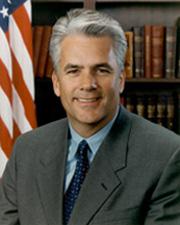 Sen. John Ensign (R-NV)
Legislative Activity
Stay on top of the latest movement without scrolling through every action
Senate amendment submitted
May 5, 2009
View full timeline
Senate amendment submitted
May 5, 2009
Senate amendment proposed (on the floor): Amendment SA 1043 proposed by Senator Ensign to Amendment SA 1038.(consideration: CR S5100-5101, S5109-5110; text: CR S5100-5101)
May 5, 2009
Senate amendment agreed to: Amendment SA 1043 as modified agreed to in Senate by Yea-Nay Vote. 96 - 0. Record Vote Number: 180.(text as modified: CR S5109)
May 5, 2009
Roll call votes on amendments in Senate: Amendment SA 1043 as modified agreed to in Senate by Yea-Nay Vote. 96 - 0. Record Vote Number: 180.(text as modified: CR S5109)
May 5, 2009
Amendment SA 1043 proposed by Senator Ensign to Amendment SA 1038. (consideration: CR S5100-5101, S5109-5110; text: CR S5100-5101) Of a perfecting nature.
May 5, 2009
Amendment SA 1043 as modified agreed to in Senate by Yea-Nay Vote. 96 - 0. Record Vote Number: 180. (text as modified: CR S5109)
May 5, 2009
Votes
1 roll call on this amendment
Text
Proposed
HELPING FAMILIES SAVE THEIR HOMES ACT OF 2009--Continued

Amendment No. 1030

The ACTING PRESIDENT pro tempore. Under the previous order, there is
now 2 minutes of debate equally divided on amendment No. 1030 offered
by the Senator from South Dakota, Mr. Thune.
Who yields the time? The Senator from South Dakota.
Mr. THUNE. Mr. President, very briefly, to summarize, what my
amendment does is reduce TARP authority by any amount of principal
returned by a financial institution to the Treasury Department. This
amendment, as I said before, is necessary because until the December
31, 2009, expiration date, and possibly longer if the Secretary is
granted an extension without this legislation, Treasury can continue to
use TARP funds, including those repaid, in any manner they see fit.
These are taxpayers' dollars. They should not become a discretionary
slush fund. These are dollars that, when they are repaid to the
Treasury by the financial institutions, ought to be used to reduce the
amount of TARP funding authority that is available.
As of May 1, the new administration has accumulated $580 billion of
new debt. That is about $5.5 billion new debt per day. I understand we
should not be tying Treasury's hands when we are still in the midst of
a financial crisis, but Congress has the responsibility to decide how
the tax money is spent, not the administration. If more money is needed
in the financial sector, then Treasury needs to present a plan to the
Congress and let those of us elected by the taxpayers decide whether
additional tax dollars should be placed at risk or spent.
That is what the amendment would do. I urge my colleagues to adopt
it.
I ask for the yeas and nays.
The ACTING PRESIDENT pro tempore. Is there a sufficient second?
There is a sufficient second.
The yeas and nays were ordered.
The ACTING PRESIDENT pro tempore. The Senator from Connecticut.
Mr. DODD. Mr. President, I want to take 1 minute. Let me say to my
colleagues, all of us would like to see the TARP money come back and we
recapture all of it. The danger in all this right now, with the stress
test coming out on Thursday, is to be utilizing the TARP money rather
than having to appropriate more money, it seems to me, to utilize TARP
money to buy toxic assets and make the capital investments is what we
want to do. The last thing we want to do is come back here and vote for
additional money. Here is a moment when it is critically important that
we take advantage of the resources to continue the program, so that we
buy the assets, invest the capital necessary to get us out of this
mess. At the very moment we want to be doing that, we will be back here
voting. I do not need to tell my colleagues, if we need new TARP money,
how difficult that would be. To avoid going down that road, utilizing
the money that has come back from these interests that have gotten
their money makes a lot more sense to me, I respectfully say to my
friend from South Dakota.
This amendment could not come at a worse time. We are going to need
the capital for institutions that need help. They need help. I am not
interested in them. I am interested in their ability to provide credit
to homeowners, small businesses, and student loans. The credit system
is frozen. We need to unfreeze it. If you deny the ability to invest
these TARP dollars into buying assets and providing capital, it seems
to me you slow down or set back that process considerably.
For those reasons, I urge my colleagues to vote against the
amendment. I thank my colleague for the intention behind it.
Have the yeas and nays been ordered?
The ACTING PRESIDENT pro tempore. The yeas and nays have been
ordered.
The question is on agreeing to amendment No. 1030. The clerk will
call the roll.
The legislative clerk called the roll.
Mr. DURBIN. I announce that the Senator from Montana (Mr. Baucus),
the Senator from South Dakota (Mr. Johnson), the Senator from
Massachusetts (Mr. Kennedy) and the Senator from West Virginia (Mr.
Rockefeller) are necessarily absent.
The ACTING PRESIDENT pro tempore. Are there any other Senators in the
Chamber desiring to vote?
The result was announced--yeas 47, nays 48, as follows:

[Rollcall Vote No. 179 Leg.]

YEAS--47

Alexander
Barrasso
Bennett
Bond
Brownback
Bunning
Burr
Cantwell
Chambliss
Coburn
Cochran
Collins
Corker
Cornyn
Crapo
DeMint
Dorgan
Ensign
Enzi
Feingold
Feinstein
Graham
Grassley
Gregg
Hatch
Hutchison
Inhofe
Isakson
Johanns
Kyl
Lincoln
Martinez
McCain
McConnell
Murkowski
Nelson (NE)
Pryor
Risch
Roberts
Sessions
Shelby
Snowe
Tester
Thune
Vitter
Voinovich
Wicker

NAYS--48

Akaka
Bayh
Begich
Bennet
Bingaman
Boxer
Brown
Burris
Byrd
Cardin
Carper
Casey
Conrad
Dodd
Durbin
Gillibrand
Hagan
Harkin
Inouye
Kaufman
Kerry
Klobuchar
Kohl
Landrieu
Lautenberg
Leahy
Levin
Lieberman
Lugar
McCaskill
Menendez
Merkley
Mikulski
Murray
Nelson (FL)
Reed
Reid
Sanders
Schumer
Shaheen
Specter
Stabenow
Udall (CO)
Udall (NM)
Warner
Webb
Whitehouse
Wyden

NOT VOTING--4

Baucus
Johnson
Kennedy
Rockefeller
The amendment (No. 1030) was rejected.
Mr. DODD. I move to reconsider the vote and to lay that motion on the
table.
The motion to lay on the table was agreed to.

[[Page S5098]]

The ACTING PRESIDENT pro tempore. The Senator from Connecticut.
Mr. DODD. Mr. President, we are waiting for someone to come with an
amendment. In the meantime, I suggest the absence of a quorum.
The ACTING PRESIDENT pro tempore. The clerk will call the roll.
The legislative clerk proceeded to call the roll.
Mr. BOND. Mr. President, I ask unanimous consent that the order for
the quorum call be rescinded.
The ACTING PRESIDENT pro tempore. Without objection, it is so
ordered.
Mr. BOND. I ask to be permitted to speak as in morning business for
up to 6 minutes.
Mrs. BOXER. Reserving the right to object, and I will not object, if
the Senator could amend that to say Senator Boxer will be called on to
talk about a couple of amendments following his remarks, I would really
appreciate it.
Mr. BOND. Mr. President, it will be an honor to ask that Senator
Boxer, the chair of the EPW Committee on which I am proud to serve, be
recognized after my remarks are completed.
The ACTING PRESIDENT pro tempore. Without objection, it is so
ordered.
Mrs. BOXER. I thank the Senator.

Guantanamo Bay

Mr. BOND. Mr. President, keeping the American people safe is the
Government's highest priority. Keeping our Nation safe should not be a
political issue; it is an American one. That is why I was disappointed
when the White House made an early national security decision based on
politics and not what is in the best interests of keeping Americans
safe. I am talking about the President's plan to close the terrorist
detention center at Guantanamo Bay without a backup plan.
I have been sounding the alarm over this rash decision since the
President announced it in January. But it is not just my side of the
aisle, the Republicans, who are questioning the President's decision to
close Guantanamo with no plan on how to handle the detainees, the
terrorists housed there. Yesterday, Democratic House Appropriations
Committee chairman David Obey said, ``So far as we can tell there is no
concrete program.'' That is my point exactly.
This is a classic example of ``ready, fire, aim.'' That is a strategy
we cannot afford. I prefer aiming before shooting, which is why I keep
calling on the President to tell the American people how his plan to
close Guantanamo without any plans right now to deal with the detainees
will make our Nation safer.
The President needs to honor his pledge of transparency and provide
the American people with answers to these questions. How the President
answers these questions is even more important now that some of the
terrorists could be coming soon to a neighborhood near you. That is
right. Some of the terrorist-trained detainees could be coming to
American communities.
Last week the Obama administration admitted as much. Defense
Secretary Gates testified before our Senate Appropriations Defense
Subcommittee that as many as 100 Guantanamo detainees could be coming
to the United States. Whether these terrorists are coming to a prison
in nearby Kansas or a halfway house in a city in Missouri or any other
State, I can tell you this: Americans do not want terrorists in their
neighborhoods.
That is why, when we put it to a vote, the Senate voted 94 to 3
against importing detainees to American soil, even if that meant
deporting them to a maximum security prison.
Americans also do not want these terrorists sent back to the
battlefield to kill our troops. We know the terrorists detained at
Guantanamo have gone back to fight even the ones who were supposed to
be less dangerous, less likely to do so. The Pentagon has confirmed
that at least 18 detainees who were released have gone back to the
fight, and 43 more are suspected of doing the same.
There are no easy solutions. So instead of meeting an arbitrary
deadline to close Guantanamo Bay, I sincerely hope the White House will
reconsider. I hope the President will realize that closing Guantanamo
Bay without having a plan to deal with the terrorists currently there
and future terrorists captured on the battlefield is not in our
Nation's best interest. Closing Guantanamo with no plan, no plan, is
one campaign promise that cannot hold up to national security
priorities.
I yield the floor.
I suggest the absence of a quorum.
The PRESIDING OFFICER (Mr. Udall of Colorado.) The clerk will call
the roll.
The legislative clerk proceeded to call the roll.
Mrs. BOXER. Mr. President, I ask unanimous consent that the order for
the quorum call be rescinded.
The PRESIDING OFFICER. Without objection, it is so ordered.

Amendment No. 1035

Mrs. BOXER. Mr. President, I will be offering two amendments, one of
which is going to be second-degreed by Senator Ensign, a friendly
amendment we have worked with him on. So we will have a vote on that
amendment.
Then the final vote on the other Boxer amendment can be a voice vote
without problem. But these are two amendments that are very important
to the financial security of the country. One deals with the toxic
asset purchase program, the other one deals with making sure our people
can actually renegotiate their mortgages if they are in trouble. I will
start with that one first.
It seems like common sense if you have a mortgage on your home, you
ought to know who holds the mortgage. But in today's real estate
market, where the original lender often sells the loan to another
entity, you can lose track and not know who actually owns your
mortgage. So we are doing a very simple amendment--and I thank Senator
Dodd and staff, because they have worked so closely with us to draw
this up in a good way. It is very easy: When your mortgage is sold or
transferred, the homeowner must be informed who owns that mortgage.
This is the way it used to be years ago. I remember many times
receiving those notices but suddenly it stopped happening.
I want to give you the example of James and Mary Meyers, who took out
a high-rate home loan with Argent Mortgage in 2004. Because the loan
violated the truth-in-lending laws, they later attempted to exercise
their Federal rights to cancel the loan. But the servicer, who happened
to be Countrywide at the time, refused to identify who owned the loan.
So by the time the Meyers discovered that the current noteholder was
Deutsche Bank, the deadline for canceling the loan had passed. The
court dismissed the Meyers' claim, even though it found that there were
grounds, legitimately, for the Meyers to cancel the loan.
So this kind of hide-and-seek situation has real-life ramifications.
It certainly does with the President's plan now that says, if someone
has a mortgage that is under water, they can renegotiate, they have a
chance. But if they do not know who holds the mortgage, it is a hollow
kind of plan. We know that current law does require homeowners be
informed when the servicer of their loan has changed. That is in the
law. And Federal law does require that the servicer tell the homeowner
the identify of the person holding their mortgage.
But servicers routinely ignore requests from homeowners for
information on the noteholder. So this is pretty simple. Simply put, it
is worth saying, if someone new is holding your mortgage, the servicer
has 30 days to inform you as to who that person is.
While servicers are required to disclose this information, there are
no penalties in the law for noncompliance and no remedies for a
homeowner faced with a recalcitrant servicer.
The law has also failed to protect homeowners because there is no
specific requirement that servicers identify the agent or party with
the authority to act on behalf of the note holder.
The Boxer amendment provides borrowers with the basic right to know
who owns their loan by requiring that any time a mortgage loan is sold
or transferred, the new note owner shall notify the borrower within 30
days of the following: the identity, address, and telephone number of
the new creditor: the date of transfer; how to reach an agent or party
with the authority to act on behalf of the new creditor; the location
of the place where the transfer is recorded; and any other relevant
information regarding the new creditor.

[[Page S5099]]

To be clear, the amendment does not require borrowers to receive a
notification every time a mortgage backed security with a slice of
their mortgage changes hands. Those are transactions between investors
and do not involve a change in ownership of the physical note.
This amendment only provides transparency and gives borrowers an
additional tool to fight illegitimate foreclosures or to negotiate loan
modifications that would keep them in their homes.
I do not understand why we have to have a vote on this. I know
Senator Dodd has signed off on this. It is a very important amendment.
I will read into the Record a list of those supporting this. It is a
whole list of consumer groups. I want to list who has endorsed this
amendment: the National Consumer Law Center, the National Association
of Consumer Advocates, Consumer Action, the Consumer Federation of
America, Consumers Union, the National Association of Neighborhoods,
the National Council of La Raza, and the National Fair Housing
Alliance.
This is a very narrowly targeted amendment with little cost to the
industry. But the benefit to homeowners and communities would be
absolutely enormous. So it is a simple amendment, common sense. I hope
we will have an overwhelming vote for it.
I want to make my statement at this time, and however the chairman
wants to dispose of the amendment, if it is accepted by voice, that is
fine with me. But if we have to do to a rollcall because we cannot
clear it, I ask that we have a rollcall vote.

Amendment No. 1038

The second amendment I will be offering is one that Senator Ensign
will be offering a second-degree amendment to. It is a very friendly
second-degree amendment. Again, I thank the Banking staff on both sides
of the aisle for working with us--Senator Dodd, in particular--to make
this a very good amendment.
What we are basically saying is, as we go into a new program which is
the Public-Private Investment Program, which basically says that when
we take toxic assets off the books of the banks, we want the private
sector to come in and give a value to those assets, we do not want the
Government doing it.
The private sector plays a very important role. What Senator Ensign
and I believe is very important, and Chairman Dodd has agreed, is to
make sure it is a very clean process, and there is not a process for
collusion between the parties, and no chance to defraud, frankly, the
taxpayers.
How could that happen? Hypothetically, you can have a bank that is
trying to unload a toxic asset. They want the most they can get for it.
They can go to a private party and say: Hey, between us, bid a little
bit more for this toxic asset, we will give you a kickback later. They
could not call it that. We will take care of you later. That is clearly
a no-no. You cannot do that.
Under the Boxer-Ensign language, that would not be allowed. The
Treasury would put forward regulations to make sure it is not allowed.
We would give the TARP inspector general $15 million to perform audits
of selected recipients so we can make sure we are following up with
audits and making sure there is no collusion.
We would guarantee there is access to financial data from the Public-
Private Investment fund that is necessary to perform these audits, and
we would require regulations that are very clear, so that--listen to
this--the private sector cannot use money they have borrowed from other
Federal programs to pump into the system.
They might be able to use some loans, but we do not want 100 percent
of that money being recycled again. In other words, they could take a
loan from the Government, then they go buy an asset, and all of the
money being used in the program is Government money.
The Boxer-Ensign amendment, which is endorsed by Senator Dodd, and I
believe Senator Shelby, I believe has been signed off by both. If I
misspeak, I am sure I will be told that. It is a very ``good
government'' amendment.
It essentially says as we begin to buy these toxic assets from the
banks, we are going to make sure there is no collusion, no fraud, no
conflict of interest. We are going to give the inspector general the
ability to get the information he or she needs to go in, perform an
audit, and keep this program clean.
The last thing taxpayers want is another scandal that revolves around
these banks and all of the things they did before. So this is an
important amendment.
At this time, I think I have explained both of my amendments. I await
hearing from the chairman as to a time to come back and speak for
perhaps a minute to generally summarize both of them.
Again, my deepest thanks to Senator Dodd. He has worked so hard.
Without his help, we could not be at this point on both these important
amendments.
The PRESIDING OFFICER. The Senator from Connecticut.
Mr. DODD. Let me first thank our colleague from California for her
leadership on this issue. They are very commonsense, straightforward
proposals that we think can improve the legislation.
And it is almost, in a way--I was thinking, as my colleague and
friend was talking, it is almost sad that we have to have an amendment
such as this. You would almost think that there has got to be some law
someplace that would say what she is suggesting by her amendment would
be covered.
In a way it is a tragic commentary on the times we are in, the idea
where we have to say that, by the way, collusion is not permissible. I
did not think it was anyway. But her amendment makes it certain in this
legislation that that is the case.
I am not sure the of order, but the first comments my colleague gave
regarding information about their mortgages, again this is pretty
straightforward.
I see Senator Ensign is on the floor, and I will be brief, because I
want him to be able to offer his amendment so we can move forward.
But the idea that you can find out who owns the mortgage is pretty
straightforward. Those of us with a little gray hair on our head--and
my colleague from California has none, I want the Record to show.
Mrs. BOXER. It turned blond.
Mr. DODD. I do remember when I bought my first home, an old 1710
center chimney cape house in Connecticut. I went down to the Old Stone
Bank and got a mortgage. I could go down every day for as long as that
mortgage was around and look at it, see it, and pick it up if I wanted
to and hold it and do whatever I wanted to do with that mortgage.
Today, of course, because the world has changed, people buy a home--
and, of course, put aside the issue of predatory lending and subprime
mortgages and the rest--and that mortgage, within 8 to 10 weeks, on
average, is sold off. It is securitized, as they call it. This is true
of a lot of debt. It is student loans, it is credit cards, it is all
kind of debt that gets securitized.
By the way, that is not a bad thing, because that provides liquidity,
that provides assets for people so more people can afford to buy homes.
But the Senator from California has pointed out that you ought to
know who that is. That seems to me a logical request. If that mortgage
has been sold off, who owns it? So if a borrower wants to be able to do
something with it, you ought not to have to go through and hire a
private investigatory agency to find out who holds your mortgage.
So while we respect the idea that securitization can actually be
beneficial to the community at large, if it deprives that owner of the
mortgage the opportunity to determine who is the holder of that
mortgage, obviously then we have lost something in the process. The
Senator from California has proposed a very worthwhile amendment.
The New York Times story of April 24, 2009, notes:

Advocates wanting to engage lenders ``face a challenge even
finding someone with whom to begin the conversation,''
according to a report by NeighborWorks America. . . .

That is exactly what the Senator from California addresses with her
amendment. With whom do you begin the conversation? The conversation
ought to be with the person who is holding that instrument.
I endorse her amendment and urge my colleagues to do so as well.
Regarding the second amendment, the other amendment offered by
Senator Boxer deals with the collusion

[[Page S5100]]

issue. I briefly addressed that previously by saying, in a way, I was
almost sad to hear her offering the amendment. I was under the
impression that was against the law anyway. The idea we are offering an
amendment to further corroborate that collusion in these matters ought
to be against the law. If it is not, it ought to be.
I commend the Senator from California and her colleague from Nevada
for offering the amendment, along with Senators Pryor and Snowe. This
amendment is clearly a step in the right direction from where we were
last week. I do want to say the administration has some concerns. My
colleagues know that. They have talked about them. I have listened to
them.
I am not suggesting their concerns are illegitimate, but I believe
the value of the amendment trumps their concerns. I think we have done
enough to continue to move forward, and it is the right step to be
taking. This is an important effort. I support the Ensign second-degree
amendment to the Ensign-Boxer amendment however that amendment is
described.
With that, I yield the floor.

Amendment No. 1038 to Amendment No. 1018

The PRESIDING OFFICER. The Senator from California.
Mrs. BOXER. Mr. President, my understanding is we are ready to go on
the Ensign second-degree amendment. So is it not appropriate for me to
send the Boxer amendment to the desk at this time?
Mr. DODD. Certainly.
Mrs. BOXER. I call up my amendment.
The PRESIDING OFFICER. Is there objection to setting aside the
pending amendment?
Without objection, it is so ordered.
The clerk will report.
The assistant legislative clerk read as follows:

The Senator from California [Mrs. Boxer] proposes an
amendment numbered 1038 to amendment No. 1018.

Mrs. BOXER. I ask unanimous consent that reading of the amendment be
dispensed with.
The PRESIDING OFFICER. Without objection, it is so ordered.
The amendment is as follows:

(Purpose: To provide for oversight of a Public-Private Investment
Program, and to authorize monies for the Special Inspector General for
the Troubled Asset Relief Program to audit and investigate recipients
for non-recourse Federal loans under the Public Private Investment
Program and the Term Asset Loan Facility)

At the appropriate place, insert the following:

SEC. __. PUBLIC-PRIVATE INVESTMENT PROGRAM; ADDITIONAL
APPROPRIATIONS FOR THE SPECIAL INSPECTOR
GENERAL FOR THE TROUBLED ASSET RELIEF PROGRAM.

(a) Public-Private Investment Program.--
(1) In general.--Any program established by the Federal
Government to create a public-private investment fund shall--
(A) in consultation with the Special Inspector General of
the Trouble Asset Relief Program, impose strict conflict of
interest rules on managers of public-private investment funds
that specifically describe the extent, if any, to which such
managers may conduct transactions involving public-private
investment funds that affect the value of assets--
(i) that are not part of such public-private investment
funds; and
(ii) in which managers or significant investors in such
funds have a direct or indirect financial interest;
(B) require each public-private investment fund to make a
quarterly report to the Secretary of the Treasury that
discloses the 10 largest positions of such fund;
(C) require each manager of a public-private investment
fund to report to the Secretary of the Treasury any holding
or transaction by such manager or a client of such manager in
the same type of asset that is held by the public-private
investment fund;
(D) allow the Special Inspector General of the Troubled
Asset Relief Program, access to all books and records of a
public-private investment fund, including all records of
financial transactions in machine readable form;
(E) require each manager of a public-private investment
fund to retain all books, documents, and records relating to
such public-private investment fund, including electronic
messages;
(F) require each manager of a public-private investment
fund to acknowledge a fiduciary duty to both the public and
private investors in such fund;
(G) require each manager of a public-private investment
fund to develop a robust ethics policy that includes methods
to ensure compliance with such policy;
(H) require investor screening procedures for public-
private investment funds that include ``know your customer''
requirements at least as rigorous as those of a commercial
bank or retail brokerage operation; and
(I) require each manager of a public-private investment
fund to identify for the Secretary of the Treasury each
investor whose interest in the fund totals at least 10
percent, in the aggregate;
(2) Report.--Not later than 45 days after the date of the
establishment of a program described in paragraph (1), the
Special Inspector General of the Troubled Asset Relief
Program shall submit to Congress a report on the
implementation of this section.
(b) Additional Appropriations for the Special Inspector
General of the Troubled Asset Relief Program.--
(1) In general.--Of amounts made available under section
115(a) of the Emergency Economic Stabilization Act of 2008
(Public Law 110-343), $15,000,000 shall be made available to
the Special Inspector General of the Troubled Asset Relief
Program (in this section referred to as the ``Special
Inspector General''), which shall be in addition to amounts
otherwise made available to the Special Inspector General.
(2) Priorities.--In utilizing funds made available under
this section, the Special Inspector General shall prioritize
the performance of audits or investigations of recipients of
non-recourse Federal loans made under the Public Private
Investment Program established by the Secretary of the
Treasury or the Term Asset Loan Facility established by the
Board of Governors of the Federal Reserve System (including
any successor thereto or any other similar program
established by the Secretary or the Board), to the extent
that such priority is consistent with other aspects of the
mission of the Special Inspector General. Such audits or
investigations shall determine the existence of any collusion
between the loan recipient and the seller or originator of
the asset used as loan collateral, or any other conflict of
interest that may have led the loan recipient to deliberately
overstate the value of the asset used as loan collateral.
(c) Definition.--In this section, the term ``public-private
investment fund'' means a financial vehicle that is--
(1) established by the Federal Government to purchase pools
of loans, securities, or assets from a financial institution
described in section 101(a)(1) of the Emergency Economic
Stabilization Act of 2008 (12 U.S.C. 5211(a)(1)); and
(2) funded by a combination of cash or equity from private
investors and funds provided by the Secretary of the
Treasury, the Federal Deposit Insurance Corporation, or the
Board of Governors of the Federal Reserve System.

Amendment No. 1043 to Amendment No. 1038

The PRESIDING OFFICER. The Senator from Nevada.
Mr. ENSIGN. Mr. President, I call up the Ensign second-degree
amendment, No. 1043, at the desk.
The PRESIDING OFFICER. The clerk will report.
The assistant legislative clerk read as follows:

The Senator from Nevada [Mr. Ensign], for himself, Mr.
Pryor, Mrs. Boxer, and Ms. Snowe, proposes an amendment
numbered 1043 to amendment No. 1038.

Mr. ENSIGN. I ask unanimous consent that reading of the amendment be
dispensed with.
The PRESIDING OFFICER. Without objection, it is so ordered.
The amendment is as follows:

(Purpose: To make perfecting changes)

On page 1, strike line 6 and all that follows through page
6 line 5, and insert the following:
(a) Short Title.--This section may be cited as the
``Public-Private Investment Program Improvement and Oversight
Act of 2009''.
(b) Public-Private Investment Program.--
(1) In general.--Any program established by the Federal
Government to create a public-private investment fund shall--
(A) in consultation with the Special Inspector General of
the Trouble Asset Relief Program (in this section referred to
as the ``Special Inspector General''), impose strict conflict
of interest rules on managers of public-private investment
funds to ensure that securities bought by the funds are
purchased in arms-length transactions, that fiduciary duties
to public and private investors in the fund are not violated,
and that there is full disclosure of relevant facts and
financial interests (which conflict of interest rules shall
be implemented by the manager of a public-private investment
fund prior to such fund receiving Federal Government
financing);
(B) require each public-private investment fund to make a
quarterly report to the Secretary of the Treasury (in this
section referred to as the ``Secretary'') that discloses the
10 largest positions of such fund (which reports shall be
publicly disclosed at such time as the Secretary of the
Treasury determines that such disclosure will not harm the
ongoing business operations of the fund);
(C) allow the Special Inspector General access to all books
and records of a public-private investment fund, including
all records of financial transactions in machine readable
form, and the confidentiality of all such information shall
be maintained by the Special Inspector General;
(D) require each manager of a public-private investment
fund to retain all books,

[[Page S5101]]

documents, and records relating to such public-private
investment fund, including electronic messages;
(E) require each manager of a public-private investment
fund to acknowledge, in writing, a fiduciary duty to both the
public and private investors in such fund;
(F) require each manager of a public-private investment
fund to develop a robust ethics policy that includes methods
to ensure compliance with such policy;
(G) require strict investor screening procedures for
public-private investment funds; and
(H) require each manager of a public-private investment
fund to identify for the Secretary each investor that,
individually or together with its affiliates, directly or
indirectly holds equity interests in the fund acquired as a
result of--
(i) any investment by such investor or any of its
affiliates in a vehicle formed for the purpose of directly or
indirectly investing in the fund; or
(ii) any other investment decision by such investor or any
of its affiliates to directly or indirectly invest in the
fund that, in the aggregate, equal at least 10 percent of the
equity interests in such fund.
(2) Interaction between public-private investment funds and
the term-asset backed securities loan facility.--The
Secretary shall consult with the Special Inspector General
and shall issue regulations governing the interaction of the
Public-Private Investment Program, the Term-Asset Backed
Securities Loan Facility, and other similar public-private
investment programs. Such regulations shall address concerns
regarding the potential for excessive leverage that could
result from interactions between such programs.
(3) Report.--Not later than 60 days after the date of the
establishment of a program described in paragraph (1), the
Special Inspector General shall submit a report to Congress
on the implementation of this section.
(c) Additional Appropriations for the Special Inspector
General.--
(1) In general.--Of amounts made available under section
115(a) of the Emergency Economic Stabilization Act of 2008
(Public Law 110-343), $15,000,000 shall be made available to
the Special Inspector General, which shall be in addition to
amounts otherwise made available to the Special Inspector
General.
(2) Priorities.--In utilizing funds made available under
this section, the Special Inspector General shall prioritize
the performance of audits or investigations of recipients of
non-recourse Federal loans made under the Public Private
Investment Program established by the Secretary of the
Treasury or the Term Asset Loan Facility established by the
Board of Governors of the Federal Reserve System (including
any successor thereto or any other similar program
established by the Secretary or the Board), to the extent
that such priority is consistent with other aspects of the
mission of the Special Inspector General. Such audits or
investigations shall determine the existence of any collusion
between the loan recipient and the seller or originator of
the asset used as loan collateral, or any other conflict of
interest that may have led the loan recipient to deliberately
overstate the value of the asset used as loan collateral.
(d) Rule of Construction.--Notwithstanding any other
provision of law, nothing in this section shall be construed
to apply to any activity of the Federal Deposit Insurance
Corporation in connection with insured depository
institutions, as described in section 13(c)(2)(B) of the
Federal Deposit Insurance Act.
(e) Definition.--In this section, the term ``public-private
investment fund'' means a financial vehicle that is--
(1) established by the Federal Government to purchase pools
of loans, securities, or assets from a financial institution
described in section 101(a)(1) of the Emergency Economic
Stabilization Act of 2008 (12 U.S.C. 5211(a)(1)); and
(2) funded by a combination of cash or equity from private
investors and funds provided by the Secretary of the Treasury
or the Federal Deposit Insurance Corporation.
(f) Offset of Costs of Program Changes.--Notwithstanding
the amendment made by section 202(b) of this Act, paragraph
(3) of section 115(a) of the Emergency Economic Stabilization
Act of 2008 (12 U.S.C. 5225) is amended by inserting ``, as
such amount is reduced by $2,331,000,000,'' after
``$700,000,000,000''.

Mr. ENSIGN. I rise to talk about the Ensign-Boxer-Pryor-Snowe
amendment. The four of us have worked on this amendment. It is a
second-degree amendment, but it is a friendly second-degree amendment
to the Boxer amendment. I commend all four offices and our staffs that
did superwork over the last several days to come up with the language.
It is not compromising language; it is strengthening language. This is
great bipartisan work to increase the oversight of this program known
as the Public-Private Investment Program or as some call it, PPIP.
The special inspector general of TARP has stated that PPIP is
``inherently vulnerable to fraud, waste, and abuse.'' Our amendment
would go a long way to protect taxpayers from such fraud, waste, and
abuse.
Most of my colleagues would agree Congress gave far too long of a
leash to the Treasury when it created TARP. I know few people who
believe the program has been completely successful so far. The PPIP
would represent the most ambitious and complex undertaking yet for TARP
and by far the riskiest use of TARP funds to date. Let's not make the
same mistakes with PPIP that we have made with the rest of the TARP
fund so far.
Our amendment would establish key oversight, transparency, and
conflict-of-interest safeguards before the program begins, not after.
Our amendment will impose strict conflict of interest rules to prevent
PPIP fund managers from inappropriately using the program to benefit
themselves or their clients. It will require these rules be in place
before any Government funds can be used in the new program. The
amendment requires rigorous investor screening procedures and robust
ethics policies for the Public-Private Investment Program funds. It
will require Treasury to issue regulations governing how the program
and the Federal Reserve's TALF Program can interact to avoid excessive
and dangerous over-leveraging.
Lastly, our amendment calls for significant and improved oversight
and transparency of PPIP. The amendment also preserves the language
from the underlying Boxer-Snowe amendment that provides the special
inspector general of TARP with an additional $15 million to conduct
audits and investigations of this new program.
The American people are demanding more accountability and
transparency from their Government. President Obama campaigned over and
over on change and promised to lead the most open administration ever.
Let's send a message to the country that we are backing up that
rhetoric with action. Let's shine sunlight on the TARP's newest program
from its inception, not once mistakes have been made. Let's put the
safeguards in place from the start of PPIP to protect against fraud and
waste rather than waiting until after abuses occur.
I urge my colleagues to vote in support of the Ensign-Pryor-Boxer-
Snowe amendment.
I ask for the yeas and nays.
The PRESIDING OFFICER. Is there a sufficient second?
There appears to be a sufficient second.
The yeas and nays were ordered.
Mr. ENSIGN. I yield the floor.
Mr. DODD. I suggest the absence of a quorum.
The clerk will call the roll.
The assistant legislative clerk proceeded to call the roll.
Mr. DeMINT. Mr. President, I ask unanimous consent that the order for
the quorum call be rescinded.
The PRESIDING OFFICER (Mr. Kaufman). Without objection, it is so
ordered.

Amendment No. 1026 to Amendment No. 1018

Mr. DeMINT. Mr. President, I ask unanimous consent to set aside the
pending amendment and bring up DeMint amendment No. 1026.
The PRESIDING OFFICER. Without objection, it is so ordered. The clerk
will report.
The bill clerk read as follows:

The Senator from South Carolina [Mr. DeMint] proposes an
amendment numbered 1026 to amendment No. 1018.

Mr. DeMINT. Mr. President, I ask unanimous consent that the reading
of the amendment be dispensed with.
The PRESIDING OFFICER. Without objection, it is so ordered.
The amendment is as follows:

(Purpose: To prohibit the use of Troubled Asset Relief Program funds
for the purchase of common stock, and for other purposes)

At the appropriate place, insert the following:

SEC. __. LIMITATION ON USE OF TARP FUNDS.

Notwithstanding any other provision of law, on and after
April 22, 2009, no funds made available to carry out the
Troubled Asset Relief Program may be used for the acquisition
of ownership of the common stock of any financial institution
assisted under title I of the Emergency Economic
Stabilization Act of 2008, either directly or through a
conversion of preferred stock or future direct capital
purchases.

Mr. DeMINT. Mr. President, I would like to take a few moments to
explain this amendment. I appreciate the chairman allowing me to offer
this amendment. It relates to what we call

[[Page S5102]]

TARP funds or troubled asset funds we passed last year.
If I can take my colleagues through a little bit of history on how
this happened, at the end of last year, the President and the Secretary
of the Treasury came to us and explained a very dire crisis, not only
in the United States but the world, that the whole financial system was
on the verge of collapse, and if we did not pass this $700 billion
Troubled Asset Recovery Program, it was very likely we would have
financial chaos and even depression in the United States and around the
world.
It was a pretty stunning presentation. It curiously lacked a lot of
facts. There were no PowerPoint slides or statistics or graphs. It was
more: Trust us, we know this is going to happen. We need to pass this
immediately.
What they were going to do with the funds--and Secretary Paulson was
very specific--was they were going to take this money and buy troubled
assets in financial organizations that were too big to fail, that if
they failed, it would cause severe problems all around the world. We
were being told that unless we pass this money and use it immediately--
and they were talking within 24 to 48 hours--to buy troubled assets,
the financial system in this country so many depended on would
collapse.
At this point, after hearing a number of stories, we started this
time last year mailing out checks, mortgage bailouts, all kinds of
spending programs. None of it worked. None of it had been done exactly
like they said it would. I did not trust the whole process. This was a
Republican President. I voted against it, but many of my colleagues
voted to pass the troubled asset funds to buy toxic assets, troubled
assets in this country and around the world.
It passed, and the President signed it. Not one of these troubled
assets has been purchased. Not one. A funny thing happened. The world
financial system did not collapse. The people who told us it would
either did not have the facts or they were not telling us the truth.
What they did with the money was loan some to the banks. Some of the
banks had to have it immediately, apparently, or they would fail. They
were too big to fail. We had to have the money.
What our Government did was go to a whole lot of other banks that
were doing OK and say: You have to take this too. If you don't take it,
then it will be harder for these other banks to take it. We need to
have this money spread around. They did not buy the toxic assets. They
loaned it to banks and put a lot of pressure on other banks to take it.
As soon as they did, we got more and more involved with their business,
regulators on the banks' backs. Some of the banks want to give it back.
Guess what. We won't let them unless they pass some kind of test.
The Government has moved closer and closer--it kind of reminds me of
the children's story, ``The Gingerbread Man.'' It is was one of my
favorite stories growing up. If you remember, an older couple did not
have any children. The husband was out working in the garden. The wife
was making some gingerbread. She had a little left over and made a
gingerbread man and put him in the oven. An hour or so later, she heard
some rattling in the oven, opened it, and out jumped a gingerbread man.
The gingerbread man ran around. She couldn't catch it. It ran out of
the house. The husband tried to catch him. All they heard from the
gingerbread man was: Run, run, run as fast as you can, you can't catch
me, I am the gingerbread man.
Long story. The gingerbread man ran through the whole community. The
townspeople were chasing him. The horses and the mules and everyone
were chasing the gingerbread man, who kept saying: Run, run, as fast as
you can, you can't catch me, I am the gingerbread man.
The gingerbread man came to a wide river and not accustomed to
swimming--gingerbread probably doesn't hold up real well in a river--he
was stuck with all the town running behind him. Then appeared a fox
that offered to give him a ride across the river. The gingerbread man
was real suspicious. He knew that fox would probably eat him. The fox
said: Don't worry, you can sit way back on my back on my tail way away
from my mouth. No trouble, not to worry. Gingerbread man didn't have a
lot of choice. He jumped right on his back.
As the fox got out farther and farther in the river, he sank a little
deeper and deeper. Gingerbread man howled and jumped up a little closer
on his neck. Out a little farther, the fox went down a little bit
deeper. Gingerbread man jumped right up on his head. As he got close to
the other side, he started sinking his head down and gingerbread man
jumped right up on his nose, and as soon as he did, slap, gingerbread
man was in the mouth and gone.
Gingerbread man is a lot like our free market system, free enterprise
system, and what our whole free market system is in America--fast,
dynamic, made our country exceptional and prosperous. Our banking
system is the same way. Some of the greatest people in our communities
are running banks.
With this TARP program, what we did is similar to a fox. We invited
our whole financial system to jump on the back of the Federal
Government. What they told us they were going to do they did not do,
and each time the Government took another step, a different step, like
the gingerbread man and the fox, the gingerbread man jumped closer and
closer to the mouth.
What our whole free market system is doing now is sitting on the nose
of the fox, the Federal Government, which keeps taking us deeper and
deeper into this river. The Federal Government did not buy toxic
assets. They kind of pushed loans out into the market. They said they
had to do that.
Now we see where they are, telling us this does not look good on the
books of banks for it to be a loan. So we are going to just change the
balance sheet from a loan to an asset. We are going to turn these loans
into common stock, equity, which will make the Federal Government
owners in the banks, voting owners.
Folks, there is kind of a sacred line in this country we had not
crossed. There is a separation between what the Government does and
what the private sector does, and this Government does not own private
companies. But just like this fox, we have been led into this thing
with misinformation--I hope that is all it is and not outright
deception--but we are at the point where the Government is now telling
us they are going to own a lot of these banks. They will not let them
give it back. They are going to convert it to ownership. All these
private companies out there are going to be owned, in part, by the
Federal Government.
What we are hearing from investors--Chairman Bernanke said it at
lunch today--is when they are trying to get people to invest in
financial institutions, what they are finding is a strange thing. The
private investors, smart investors, do not want to get in bed with the
Federal Government because they do not know what we are going to do.
They have every reason not to know what we are going to do because we
have yet to do what we said we were going to do with this $700 billion,
which will ultimately be over $1 trillion, with which we are now
playing in the private stock market.
As we pass this bill that is supposed to protect homeowners, I am
offering an amendment. It is an amendment that would force this
Government to do at least part or keep it from going further than it
already has into the private sector. It would prohibit the Government
from converting these loans, which are sometimes referred to as
preferred stock now. It is not voting. It would prohibit them from
converting this to common stock, to ownership, to equity in these
banks.
It should not surprise anyone. We were told this would not happen in
the first place. We were told the money was going to buy these toxic
assets. This amendment would at least put up a firewall that says: You
cannot go any further, fox; you cannot take over private enterprise in
America.
A lot of my colleagues are going to give a lot of excuses why they
cannot vote for this amendment, but I hope America is looking in at
this and remembering that it was not this Government that made this
country great, that made us exceptional and prosperous and good, that
put us on the top of the world in a lot of ways, the envy of the world.
It was not this Government. It was a limited government. It was free
markets and free people.

This Government now has pushed and pushed and intervened in the
private market to the point where it is not

[[Page S5103]]

working. We wonder why people are not investing and why the markets are
erratic. Because no one knows what the Federal Government is going to
do once it starts playing in the stock market in this country, once it
starts arbitrarily converting loans that were for a crisis to own our
banks, to own our private companies.
They took the TARP money and made loans to General Motors. What are
they going to do with that? They are going to convert it to common
stock so this Federal Government owns General Motors.
That is not America. That is not free markets. That is not free
enterprise. That is not what we signed up for, and we shouldn't allow
it.
This amendment is pretty simple: Government, you cannot go any
further. Enough is enough. You cannot convert these loans to common
stock. We are going to have a firewall between where you are now and
where you want to go.
Folks, we cannot let them go any further. We have lost the line
between Government and the private sector. The Government is not set up
to manage things and control things. Everything we try to do, we mess
up. What we are here for is to develop a framework of law and
predictable regulations so free markets and free people can operate. We
are not set up to manage auto companies.
I was in a meeting this morning talking about how we were going to
manage General Motors and Chrysler. I have been in a lot of boardrooms
because I have done a lot of strategic planning for private companies
in my lifetime. It is so obvious, we do not have the capability to
manage a dynamic, complex, global marketplace. That is central
planning. That is what Karl Marx thought we could do. But every time it
has been tried in the history of the world, it has failed because there
is no way a legislative body and a large national government such as
this can manage the private sector.

What happens, though, is we get involved, we make things worse, and
then we say we need more government to solve the problem. We are doing
that now with AIG, the largest insurance company in the country. We
have gotten in, we own most of the stock, mismanagement is rampant, and
we are talking about we need more government, we need more money.
Folks, it doesn't work.
I would encourage my colleagues to consider what I think we are
hearing from all across America: Enough is enough. We can't do this
under the guise of one crisis after another. Let's stop this rampage of
the Federal Government into our private lives, the free markets, the
whole concept of America. Please support this amendment that would stop
the conversion of loans--TARP money--into common stock. It is a simple
concept. We shouldn't be able to excuse our way around this one.
I thank the Chair, I yield back, and I suggest the absence of a
quorum.
The PRESIDING OFFICER. The clerk will call the roll.
The bill clerk proceeded to call the roll.
Mr. BARRASSO. Mr. President, I ask unanimous consent that the order
for the quorum call be rescinded.
The PRESIDING OFFICER. Without objection, it is so ordered.

Climate Change

Mr. BARRASSO. Mr. President, a recent Wall Street Journal op-ed
highlighted a dangerous game that is being played right now by this
administration and by the Environmental Protection Agency, and it is a
game that is being played with the American public about which I have
great concerns. The piece in the Wall Street Journal was entitled
``Reckless Endangerment: The Obama EPA plays 'Dirty Harry' on cap and
trade.'' The article refers to the Russian roulette style of
negotiating that is going on right now by cap and tax advocates who
want to pass the President's energy tax in this Congress.
The administration and the majority of the leadership in the House
and the Senate have created a regulatory ticking timebomb. It is called
the Environmental Protection Agency's endangerment finding. Well, they
want to use this ticking timebomb as a threat to get the President's
energy tax passed. They are putting this regulatory timebomb on the
kitchen table of Americans all across the country. The message to
Americans: Your tax money or your livelihood. This is not an idle
threat. If allowed to proceed, the irresponsible use of the Clean Air
Act will require the EPA to regulate any building, any structure, any
facility, any installation that emits above a certain amount of carbon
dioxide. The result would be thousands of lost jobs, with no
environmental benefit to be seen from it. Hospitals, schools, farms,
commercial buildings, and nursing homes will be required to obtain
preconstruction permits for their activities.
Further, when you talk to the legal scholars, they will tell you that
the statutory language is mandatory and does not leave any room for the
EPA to exercise discretion or to create any exceptions. That is the
problem. The only jobs this option will create are in law firms, as the
litigation bonanza begins. EPA is going to be sued by environmental
groups wanting to eliminate exempted sectors. The EPA will also be sued
by industries that are not exempted. How is the EPA going to respond to
all these legal challenges? I asked EPA Administrator Jackson. She says
she can target what she taxes. She claims she is only going to target
cars and trucks. Well, that really is setting a precedent of choosing
winners and losers. We don't know what standards will be applied to
make those decisions. We do not know what role politics will play in
the decisions. Jackson's statement also ignores the regulatory cascade
that the endangerment finding in the motor vehicle emission standards
will trigger. Litigators and courts will drive much of this job-killing
regulation.
We now have a nominee to head up the EPA's Air Office--Mrs. Regina
McCarthy. We have an Administrator of the EPA and a climate and energy
czar who is supposed to coordinate climate change policy for the
administration. Well, Carol Browner, the climate and energy czar, has
not been confirmed by Congress--not by this Congress--at all. We do not
know who is developing this roadmap for how to hijack the Clean Air Act
to regulate climate change. What jobs and what industries will be kept?
What industries will be penalized? Who will be held accountable for
making the decisions? The American people--the people at home in
Wyoming whom I talk to--are demanding answers to these questions.
The economic consequences will be devastating. By the EPA's own
estimate, the typical preconstruction permit in 2007 cost each
applicant $125,000. And how much time do they have to put into this
work? Well, on average, 866 hours just to fill out the paperwork. If
you are a small business, a farm, or a private nursing home, you have
no background in this area. It takes a lot of time and effort, so you
need to hire lawyers and you need to hire experts. That costs thousands
of dollars that are nowhere in your budget. You are taking time out of
the day to figure out all this redtape. While you are spending that
time and that money, you are not running your business.
This is going to create such a fog of uncertainty--uncertainty with
investors, uncertainty with small businesses. It is going to make it
that much harder for small businesses to borrow money, to get a
business loan. Nobody is going to know how much this is going to cost
their business. If you take a look at our economic situation, with
lending in this country having slowed down significantly, this is
hardly the right move now for our country and for our economy.
According to the U.S. Chamber of Commerce, there are 1.2 million
schools, hospitals, nursing homes, farms, small businesses, and other
commercial entities that are not currently covered under these
preconstruction permits, and they are going to be vulnerable to the new
controls, to new monitoring, to new paperwork, and to new litigation.
If even 1 percent of these 1.2 million have to get preconstruction
permits, well, that would mean 12,000 new preconstruction permits this
year. By the EPA's own analysis, if permitting is increased by just
2,000 to 3,000, that would impose what they call significant new costs
and an administrative burden on permitting authorities. How much of a
burden? How much cost? Those permitting authorities are the EPA and the
43 States that participate in the program.

[[Page S5104]]

The EPA said that the burden ``could overwhelm permitting
authorities.''
The net result of all of this is going to be thousands of jobs lost.
According to the Heritage Foundation, the job losses are estimated to
reach 800,000. Well, if Carol Browner, Administrator Jackson, or Mrs.
McCarthy cannot tell us how they will protect American jobs from court
challenges, if they can't tell us by what legal authority--legal
authority--they can pick the winners and losers, if they cannot provide
economic certainty to lenders and small businesses, if they do not know
how they will process all the thousands of new preconstruction permits,
then they should take this option--this option they have proposed, this
option that kills jobs--and they should take it off the table.
I have tried to get answers to these questions from the nominee who
will most directly oversee this process--Mrs. McCarthy. I placed a hold
on her nomination because these are questions that still need to be
answered. I am committed to working with her in a constructive way to
get answers to the questions because I believe we do need to chart a
new course, a course that makes America's energy as clean as we can, as
fast as we can, without hurting small businesses and without raising
energy prices on American families.
We should start by not taking any clean energy source off the table.
That means fossil fuels fitting with new carbon capture technology.
That means exploring for oil and natural gas in an environmentally
friendly way, using new technologies. That means promoting carbon-
neutral nuclear energy. That means funding renewable energies--wind and
solar, geothermal, and hydropower. We need it all. An all-of-the-above
energy approach is the key to solving our energy problem for this
Nation. I look forward to working with my colleagues on both sides of
the aisle to achieve this goal for America.
Mr. President, I yield floor.
The PRESIDING OFFICER. The Senator from California.
Mrs. BOXER. Mr. President, I was listening to what my colleague,
Senator Barrasso, said about the Environmental Protection Agency, and I
know it is a little bit off the work Senator Dodd is doing, but I hope
he won't mind if I take about 3 minutes to respond.
I think what is so interesting is that under the Bush administration,
the Environmental Protection Agency drafted the endangerment finding.
They found that pollution in the form of greenhouse gas emissions--this
is the Bush administration--was absolutely an endangerment to the
American people. That is the Bush administration.
You may say: Gee, why didn't I hear about that? I will tell you why.
The EPA sent that endangerment finding, that proposed endangerment
finding, over to the White House, and it was labeled, as you get your
e-mails, ``proposed endangerment finding.'' There was advice
immediately from the lawyers over at the Bush White House not to open
the endangerment finding--not to read it, not to look at it, not to
consider it, not to open it because, they said, once it was open, it
was in the public domain and the public would learn that, indeed,
climate change is an endangerment to the people of this country. We are
talking about extreme weather events. We are talking about organisms
that do not live in cold waters, but when the waters get warm, they
carry disease to our kids. We saw a case in Arizona where that
happened: organisms that never lived in these rivers and streams are
now living there. Heat stroke. And that is not to mention the issue of
the rising waters, that is not to mention the national security issues,
and that is not to mention the fact that the way out of this economic
mess is to say: We are going to look at this challenge and we are going
to respond to it in a way that will create clean jobs, in a way that
will lead us out of this morass and lead us to economic prosperity.
Anyone who has read Thomas Friedman's book ``Hot, Flat, and Crowded''
knows that the country that gets on top of this issue of clean energy
and clean energy jobs will lead the world. So for my colleague to get
up and say: I am holding up the Obama nominees--that is the party of
no. That is the party of no, no, no. They want to keep this information
from the American people.
Then they talk about lawsuits and the rest. Well, the fact is that
the old EPA was sued repeatedly by community groups and environmental
groups because they weren't following the law, and every single time,
they lost. So the Supreme Court comes down on the side of cleaning up
pollution. I am not afraid of lawsuits because the fact is, the people
will win the lawsuits.
My message to the EPA is very simple. It is very different from
Senator Barrasso, who is holding up qualified nominees--Republicans.
They are Republicans they are holding up whom President Obama wants to
put into his circle of advisers on the environment. This one particular
woman I believe served, Senator Dodd, your State for Republican
Governor Rell, and they are holding her up. They are holding her up.
Why? Because they want to continue being the party of no. No, don't
open up the endangerment finding; no, don't trust the people with the
information; no, don't think about making polluters pay; no, we are not
going to go to clean energy and clean jobs and all the prosperity that
will come forward with that. It is a sad day.
My friend and I, John Barrasso and I, are very good friends. We like
each other. We work together when we can. But on this one he will admit
and I will admit we do not share a common view. My view is that science
should dictate what we do on the health front and the revival of this
economy should dictate what we invest in here, so we invest in these
high technologies and we create good, clean jobs. I am very sad to hear
that my friend will be holding up, and saying no, to some good people.
I understand his point of view. He has every right to do it. But I
hope we will file a cloture motion and I hope we will be able to say to
the party of no: Please, there was an election. President Obama won. He
deserves to have the people in place that he thinks will give him good
advice. If you do not like the advice, then legislate against it. But
don't hold up good people.
They are doing it every day. The party of no, no, no, no. The
American people want us to work together for their benefit and the
benefit of their children and their grandchildren. My message to the
EPA is do not be bullied into not doing your job. The endangerment
finding you have made provisionally is very close to the same
endangerment finding the scientists made under George W. Bush. The
difference is, this administration is not going to hide it from the
American people. We are going to look at it and we are going to figure
out a way to respond to it in such a manner that jobs will be created,
exports will be created, technologies will come to the fore. To the
party of no, I say look inside yourself. The days of the old energy are
coming to an end. They are too polluting, they are too costly, they are
subject to the whims of foreign dictators.
I remember when George W. Bush went over and kissed the Saudi
prince--I was a little surprised at that--begging, begging Saudi
Arabia: Oh, please, please, let us have more oil. And the price went up
and up and up. Frankly, it was not until the Democrats here demanded
that there be some remedy for price fixing--it was not until then that
the prices started going down, because there was manipulation. We know
that.
I am disappointed that Senator Barrasso, an important member of the
Environment Committee--this is the Environment Committee he is from. It
is not the polluting committee. Let's get on with our work. Let's do
what is right for the health of the American people. Let's do what is
right for the workers in America. Let's develop the technologies. Let's
not stand up here, hold decent people up, don't let them get a vote,
stop them because you are a little angry that, yes, you did lose the
election; and yes, times are changing; and yes, you have to recognize
that Lisa Jackson is not Stephen Johnson--who came from a pesticide
background, for God's sake.
One thing I found as I look at this administration that I admire--and
I do not agree with every single thing they do or say--but I have to
say this, they are putting people in place who care about the issue
they are supposed to care about. You remember what happened over there
with, ``Brownie, you

[[Page S5105]]

are doing a great job at FEMA,'' and we had Hurricane Katrina. Brownie
had come from the Arabian horses industry. That was his expertise.
Stephen Johnson, EPA, came from a pesticide background. That was his
background to head up the Environmental Protection Agency.
Then you had others. You had Spencer Abraham, a nice man. He voted to
eliminate the Department of Energy when he was a Senator, and he got to
be put in charge of--you got it--the Department of Energy.
I have a great committee I am privileged to chair, but I am
distressed that we have to file cloture and stop a filibuster on
perfectly well-qualified people, some of whom are Republicans, who are
being stopped here by my friend. It is discouraging. But I am
optimistic and I know we will get these important nominees through,
even though we have to take the time to fight a filibuster and file
cloture and get 60 votes. I am convinced we can do it--in closing--
because the American people do not want us to be the party of no, no,
no. They want us to be the Senate that is going to bring about positive
change for the American people.
I say to Senator Dodd, thank you for your indulgence here.
The PRESIDING OFFICER. The Senator from Connecticut is recognized.

Amendment No. 1026

Mr. DODD. Mr. President, I am going to respond, if I may, to our
colleague from South Carolina, Senator DeMint, who offered an
amendment, No. 1026, a few minutes ago. Senator Barrasso and Senator
Boxer were talking about the Environment Committee and the work that
goes on there a little bit, and I digressed a little bit when that
subject matter came up, but I want to bring it back to his amendment
which we will vote on, I hope, in a few minutes--maybe a couple of
amendments. I notify my colleagues we will try to get at least two
votes together so we don't bring people over for just one vote, if we
can do that.
The amendment of the Senator from South Carolina, as I think I
understand it--but correct me here--would prohibit the Federal
Government from either purchasing or converting preferred stock to
common stock. This is not a mandate as in present law, it is the option
of converting preferred to common stock.
Why is that an important issue? My colleague from South Carolina went
on at some length to talk about the overriding issue, going back to
last fall, as to whether there should be any program at all of the so-
called Emergency Economic Stabilization Act that provided the resources
to try to get our financial system on its feet again. That was a very
significant debate. Seventy-five of our colleagues in this Chamber,
Democrats and Republicans, agreed with President Bush at the time.
Candidate Obama and our colleague John McCain, as well as many others,
on a bipartisan basis, called for the support of that effort. They
accepted the notion as we were told by the chairman of the Federal
Reserve Board, Mr. Bernanke, along with the Secretary of the Treasury
and others across the political spectrum, that acting at that point was
critically important if we were going to stabilize this economy and try
to get it back on its feet.
History will probably write for many decades to come about that
decisionmaking process, of the wisdom of it or the lack thereof. I am
confident as I stand here today that, while certainly not a well-
managed program for a good many weeks, the absence of doing anything,
just doing nothing at the time, I think would have created a far bigger
problem, a far more serious problem, probably a problem it would be
almost difficult to imagine how it would be overcome had that action
not been taken. That in no way minimizes how the program was managed,
for those who raised serious issues, and still is the subject of
significant debate here.
My friend from South Carolina says the Treasury Department should not
be allowed to convert preferred stock to common stock. Why is that an
important issue in the context of what we are talking about?
First, understanding what preferred stock is, and common stock--
preferred stock is almost a debt obligation on which dividends are
paid. The whole point is the value of it is in the dividend. With
common stock, of course, the value changes based on how well the
company is doing. If the company is doing well, the common stock goes
up. If they are not doing well, the common stock goes down, unlike
preferred shares. So in terms of what is real capital, what is real
capital is common stock. Preferred shares are not seen as being real
capital.
I gather we have had today, as the Presiding Officer knows we have
every Tuesday, the respective two parties gather in our respective
rooms to have lunch to talk about the issues of the day. I am told by
several of my friends on the Republican side that Chairman Bernanke was
the guest at the Republican Conference lunch today and answered
questions from our Republican colleagues. I gather one of the questions
was--and certainly it was a question he received from us when we met,
either alone or together--why aren't banks lending more? We put all
this capital up. Why aren't they putting more money out the door to
small business and others to help our economy get moving?
I gather Chairman Bernanke expressed the same frustration, that the
regulators are being overly restrictive, in some ways threatening these
lending institutions, not doing enough to encourage them that they
ought to step up and get that capital out, get that credit moving
again.
My colleagues on the Republican side heard from the Chairman of the
Federal Reserve today and raised a very good question, raised by one of
my colleagues--I don't know which one it was who raised the issue--but
a very good question: Why aren't the banks lending more?
It seems to me if we accept the DeMint amendment we are going to make
the answer even more difficult because what our lending institutions
need is obviously capital--whether private capital or otherwise, they
need capital. This is not a requirement under existing law that is
mandating converting preferred to common, but at a time when we want
lending institutions to get more capital, allowing the Treasury to make
that conversion where and if they see it as appropriate exactly
addresses the question that was raised at the luncheon today: Why
aren't banks lending more? Why aren't they providing that kind of
assistance to small businesses and others?

This is not about the Government taking over these entities. I don't
know of anyone who supports that idea. We are taking positions in these
companies far larger than most of us would like, and I hope and I
believe it to be the case that as soon as the moment is appropriate we
are going to be selling this off and getting out of it as fast as we
can. My colleague from South Carolina is correct--I think all of us
agree with him--it is not the business of Government to become bank
managers or to run automobile companies or to run commercial
enterprises. This country has not grown and prospered and done as well
as it has in two-and-a-quarter centuries because Government has run
these entities. Quite the opposite.
But at a critical time such as this, when our economy is facing the
worst crisis since the Great Depression, in almost 100 years, taking
positions, getting capital moving on these legacy assets or toxic
assets is absolutely essential if we are going to get back on track
again.
I am not suggesting that every idea we have had is one that is
working. But the idea of saying in this case you have no right, I am
going to prohibit you, absolutely mandate that the Treasury Department
cannot convert any preferred shares to any common shares, seems to me
the kind of overreaching, in a way, in a moment such as that, that my
colleague from South Carolina is arguing against and I agree with him.
We should not be restricting, in a sense, the ability of people to have
the flexibility to respond to a situation and allow this situation to
improve.
There is a second reason. We are talking about TARP moneys here. What
are TARP moneys? TARP money is taxpayer money. That is the American
taxpayers' money. That is what TARP money is. We want to get back this
money. We have been told these are loans. We hope they are, that we are
actually going to get money back.
You don't get money back necessarily with preferred shares. You get
it back with common shares. In any

[[Page S5106]]

case, if we are looking to see the Government realize any gain on the
sale of its common shares after the economy recovers, as we all hope
and believe it will, the Government's upside potential is far greater
with common shares than it would be under an amendment offered by the
Senator from South Carolina where we would not be allowed to convert
preferred to common.
I want to make it clear I am not necessarily advocating this be the
case, but I don't want to so restrict the Treasury from making those
moves to adversely affect the taxpayer when we could have a far greater
benefit if in fact there are common shares coming back in. If that
company or entity improves its value, the taxpayer is the clear
beneficiary of that if in fact we are holding common shares.
Not allowing the Treasury to make that conversion could directly have
an adverse reaction for the American taxpayer who is expecting some
return on this--not to mention, of course, the ability to get capital
into these entities which is essential if lending is going to occur.
We can go back and debate September and October and I presume history
will debate that. But we made that decision and these resources are
being far better managed today than they were in the first 60 days or
so of that program. Today, to restrict this Department, this Treasury
from making these kinds of decisions would be a major blow at the very
hour we are going to maybe need this capital in order to get these
entities back on their feet.
Why is that important? It has little or nothing to do with the
entities themselves. If that were the only argument, I would not be
standing here and making it. It is not about the institutions we are
getting the capital to, it is about the facilities, the businesses that
require capital in order for credit to flow. So we spend a lot of time
talking about the capital that goes into these larger institutions. The
only reason we talk about it is because the financial system requires
that if credit is going to move to small businesses, to homeowners and
the like, when that small business shows up at their bank and says:
Look, I have a great idea of expanding. I think the economy is
improving. I would like to get a loan. I would like some credit. I have
some people I need to hire. I have some inventory I need to purchase. I
have some improvements to expand my space, and the bank says: I am
sorry, we cannot. No capital. Well, if we adopt the DeMint amendment,
that will be one of the reasons the answer is no because we absolutely
prohibited the Treasury Department of our country from converting,
where they think it is wise to do so, preferred shares to common
shares. Not because we are requiring it but because we have the
flexibility to do it.

When the American taxpayer wants to get a greater return on the
investment we have made to get these institutions back on their feet
again, and all we were allowed to hold was preferred shares paying a
dividend instead of the common shares that could be the upside benefit
to the American taxpayer, we would have to look back on this amendment
and say: That is the reason we are not doing better than we ought to be
doing.
That is really the argument I would give to my colleagues about why I
think the DeMint amendment is an unwise move at this juncture. Again,
it is more ideological. If you, in a sense, believe we should not be
doing anything at all, let the market work its way through all of
this--and there is a school of thought that embraces that. I happen to
believe that is a dangerous policy to follow, in my view. I think many
who looked at this issue from across the spectrum would agree. So that
is the alternative. That is why I hope this amendment would be rejected
when the time comes for a vote.
I yield the floor.
The PRESIDING OFFICER. The Senator from Rhode Island is recognized.

Amendment No. 1040 to Amendment No. 1018

(Purpose: To amend the McKinney-Vento Homeless Assistance Act to
reauthorize the Act, and for other purposes)

Mr. REED. First, let me commend Chairman Dodd for his leadership on
this very important legislation that is going to address one of the
most significant issues facing America today; that is, restoring the
value in our homes, but also giving people the hope that they can stay
in their homes and helping those people who are displaced from their
homes to find adequate, suitable housing.
I hope to be able to offer an amendment which would address the issue
of homelessness in the United States.
Mr. President, I ask unanimous consent to call up amendment No. 1040
to S. 836 and ask that it be made pending.
The PRESIDING OFFICER. Is there objection to setting aside the
pending amendment? Without objection, it is so ordered.
The clerk will report.
The legislative clerk read as follows:

The Senator from Rhode Island [Mr. Reed], for himself, and
Mr. Bond, proposes an amendment numbered 1040 to amendment
No. 1018.

(The amendment is printed in today's Record under ``Text of
Amendments.'')
Mr. REED. This legislation is cosponsored by Senator Kit Bond,
Senator Boxer, Senator Collins, Senator Durbin, Senator Kerry, Senator
Lautenberg, Senator Levin, Senator Lieberman, Senator Schumer, and
Senator Whitehouse. It embodies legislation I introduced earlier this
year, along with Senator Kit Bond, the Saving the Homeless Emergency
Assistance and Rapid Transition to Housing Act, known in short as the
HEARTH Act.
I want to particularly commend Senator Bond for his support, help,
and leadership in this effort. He has been an advocate for sensible
housing programs, not only on the floor of the Senate but particularly
in his duties as a member of the Appropriations Committee and as the
Ranking Member of the Subcommittee on Transportation and Housing and
Urban Development.
He has been a great leader in advocating for the sensible, sound, and
efficient use of taxpayers' resources to help people to find affordable
housing. I thank him very much for his assistance, along with all of
the other cosponsors.
This legislation is endorsed by the National Alliance to End
Homelessness, U.S. Conference of Mayors, the League of Cities, NACo,
Habitat for Humanity International, National Association of Local
Housing Finance Agencies, LISC, Enterprise, National Low Income Housing
Coalition, Corporation for Supportive Housing, the National Equity
Fund, NAMI, the Housing Assistance Council and the National Community
Development Association. It enjoys widspread support.
According to the Homelessness Research Institute at the National
Alliance to End Homelessness, 2.5 to 3.5 million Americans experience
homelessness each year. On any one night, approximately 672,000 men,
women, and children are without homes.
While strides have been made to reduce homelessness over the last
couple of years, the current economic decline has halted such progress.
Today I saw a front page article with a photograph in USA Today of a
tent city going up. This is a phenenoman we thought was an artifact of
history. Too often people are using any means to shield themselves from
the elements.
Organizations such as Amos House, a shelter in my home State of Rhode
Island, are seeing an increased demand for their services, while at the
same time they are facing budget cuts and the economic downturn has
curbed charitable donations.
I don't need to tell anybody in this Chamber how urgent this crisis
is.
Across the country, we have already seen tent cities forming;
shelters turning away people in need; and most major cities reporting
double-digit increases in the numbers of families experiencing
homelessness.
There is a tendency to view homelessness as something that happens to
a few adults, men and women. But too many children are without homes.
As foreclosure and unemployment rates continue to rise, more families
are being pushed out of their homes. Not everyone ends up on the
streets. Some are able to move in with friends or family members, but
they can not afford a home of their own and they can not find a job to
get back on their feet.
America has not seen this level of displacement since the Great
Depression and we simply cannot afford to ignore this problem.
That is why I am offering the Homeless Emergency Assistance and Rapid

[[Page S5107]]

Transition to Housing, HEARTH, Act of 2009 as an amendment to the
Helping Families Save Their Homes Act.
The Banking Committee, of which I am a member, has worked long and
hard on this legislation, which I believe has resulted in a very strong
piece of legislation.
This amendment invests $2.2 billion for targeted homelessness
assistance grant programs and provides local communities with greater
flexibility to spend money on preventing homelessness.
While strides have been made to reduce homelessness over the last
couple of years, the current economic decline has halted that progress
and threatens to overwhelm it.
As a result of the recession, 1.5 million additional Americans
nationwide are likely to experience homelessness over the next 2 years
according to estimates by the National Alliance to End Homelessness. In
Rhode Island, the latest numbers show homelessness is up 43 percent
since February of 2008. And the number of shelter residents who cited
foreclosure as their reason for becoming homeless tripled in the last 8
months.
This means more trauma for children and adults, more dislocation from
schools and communities, and more of a drain on local community
services.
In addition to the $2.2 billion for HUD homeless assistance programs,
the HEARTH Act would also provide up to $440 million to be used to
serve people who are not homeless yet, but are at risk of homelessness.
That, I think, is in accord with the spirit of the legislation Senator
Dodd proposed; to prevent people from losing their homes.
It would allow cities and towns to serve people who are about to be
evicted, live in severely overcrowded housing, or otherwise live in an
unstable situation that puts them at risk of homelessness. The money
could be used to make utility payments, security deposits, and provide
short- and medium-term rental assistance.
The HEARTH Act would increase the emphasis on performance by
measuring applicants' progress at reducing homelessness and providing
incentives for proven solutions like rapid re-housing for families and
permanent supportive housing for chronically homeless people.
This is a measure not only to provide resources but also to insist
upon accountability.
Today, more families than ever are living on the edge, but the
national safety net is not as big or as durable as it used to be.
This bipartisan legislation combines federal dollars with new
incentives to help local communities assist families on the brink of
becoming homeless. It is a wise investment of federal resources that
will save taxpayers money in the long run by preventing homelessness,
promoting the development of permanent supportive housing, and
optimizing self-sufficiency.
Finally, I wanted to briefly talk about the definition of
homelessness.
The HEARTH Act expands the HUD definition of homelessness, which
determines eligibility for much of the homeless assistance funding, to
include people who will lose their housing in 14 days; any family or
individual fleeing or attempting to flee domestic violence, or other
dangerous or life threatening situations; and families with children
and unaccompanied youth who have experienced a long term period without
living independently, have experienced persistent housing instability,
and can be expected to continue in such status for an extended period
due to a number of enumerated factors, such as a disability.
It also allows grantees to use up to an additional 10 percent of
competitive funds to serve families defined as homeless under the
Education Department homeless definition, but not so defined under the
HUD definition. For areas with low levels of homelessness, up to 100
percent of funds may be used for such purposes.
The HEARTH Act also provides communities with greater flexibility in
using funds to prevent and end homelessness. Whether it is the new
Emergency Solutions Grant or the new Rural Housing Stability Assistance
Program, that would grant rural communities greater discretion in
addressing the needs of homeless people or those in the worst housing
situations in their communities, this bill allows people to help people
who are not technically homeless, and keep them from becoming so.
I recognize there have been tensions on the definition issue. All of
us want to be sure that we are providing services to homeless children
and families, and those at risk of homelessness.
Our amendment does not change the definition of homelessness in the
No Child Left Behind Act for education programs that serve homeless
children, nor does it seek in any way to hinder or limit these
services.
In fact, our amendment strives to reach an appropriate balance to
make sure that there are HUD funds available to help these families.
I hope that my colleagues can join Senator Bond and me, and support
this important amendment.
The PRESIDING OFFICER. The Senator from Connecticut.
Mr. DODD. Mr. President, I am very pleased to work with our colleague
from Rhode Island on this matter and strongly urge the support of this
amendment as well. This is a good bill. We have an underlying bill that
is a better bill because of what Senator Reed and Senator Bond have
added to it. This is a value added to the issue.
It is one that our colleague from Rhode Island has been involved in
for virtually the entire time he has been in the Senate, and cared
about. His earlier partner, Senator Allard of Colorado, worked with him
on the issue. Senator Allard retired from the Senate, so Senator Reed
reached out to Senator Bond, who has a strong interest in housing
issues, and became his partner, along with others. I am proud to call
myself one of those partners, as chairman of the Banking Committee.
As we move forward, I know in my own State of Connecticut, we have
had a 13-percent increase in homeless families in the last year and a
half--that is really beginning in 2007 before this issue of
foreclosures exploded in our communities. So I think those numbers are
up beyond that.
The number of homeless children and families is now increasing. The
fastest growing part of the population that is homeless is children in
our country, and this is no longer just that person we see on a street
corner who is struggling in their lives. Shelters are jam-packed. You
can only stay so long. I know many of my colleagues have visited these
facilities and seen families who, only weeks before, owned a home or
had a place to live, are out of that situation and now are part of a
growing number of people. So the timeliness of this legislation could
not be more important. We are talking about trying to stop
foreclosures.
What an important corollary to that to make sure we are
simultaneously providing--Lord forbid people fall into that situation--
an opportunity to have decent shelter.
So I thank my colleague from Rhode Island for his leadership. I
applaud those of his cosponsors. This amendment would consolidate
existing HUD McKinney-Vento homeless assistance programs and make
several improvements to cost effectively end homelessness.
I have to take note because I mentioned McKinney-Vento. Both
individuals are great friends of mine.
Stu McKinney was a Congressman from Connecticut for many years and
took on the issue of homelessness. He passed away many years ago. He
had a wonderful family. His son John is one of the Republican leaders
in the Connecticut State legislature. His wife Lucy is a wonderful
friend. Stu McKinney was a remarkable human being.
Of course, Bruce Vento was a great champion. I served with him in the
House as well. McKinney-Vento, we throw these names around, but know
that McKinney and Vento were two wonderful Members of Congress who
cared deeply about what happened to people who fall on hard times.
We can add the name Reed to that group as well. I compliment my
friend and urge adoption of his amendment.
The PRESIDING OFFICER. The Senator from Rhode Island.
Mr. REED. Mr. President, I thank the chairman for his kind words and
support. I do also recognize Senator Wayne Allard of Colorado. Wayne
and I worked together on this legislation for a number of years. In
fact, we sort of rotated between subcommittee chairman of the Housing
Subcommittee. Consistently and in a very bipartisan

[[Page S5108]]

fashion, we worked together. We have been joined by Senator Bond whose
leadership on the Appropriations Committee is remarkable when it comes
to housing issues. We benefited immensely by the contributions of
Senators Allard and Bond. I did not have the fortune of knowing Stuart
McKinney. I knew him only by reputation. He was known as a sterling man
who worked hard when the issue of homelessness was not as central to
our consciousness as it is today.
Bruce Vento was extraordinarily decent. These two gentlemen sort of
pointed the way. Now we have to take up the task and move it forward
and further. I think we can with this legislation.
I thank the chairman for his support and urge all colleagues to join
us in support of the amendment.
I suggest the absence of quorum.
The PRESIDING OFFICER. The clerk will call the roll.
The legislative clerk proceeded to call the roll.
Mr. REID. I ask unanimous consent that the order for the quorum call
be rescinded.
The PRESIDING OFFICER. Without objection, it is so ordered.
Mr. REID. Mr. President, we understand how busy everyone is, but we
have to finish this bill tonight. We have people who have amendments
they say they want to have a vote on. If they want to debate the issue,
they will have to do it soon. We have two votes coming up. I have
suggested to the manager of the bill that if people don't come over and
there are amendments pending, he move to table them. If they don't want
to bring the matters before the Senate, then we will move to third
reading. We will finish this tonight. It is not fair for people to
stand around waiting for all these great ideas to not come forward. If
people want to have their amendments debated and voted on, they better
do it pretty soon. We have two votes scheduled forthwith. After that, I
hope the people who have amendments will come and speak to the manager
of the bill and say: Here is how much time I would like or at least
give some indication, just don't ignore us because we will not be
ignoring them.
We have to move on. We have many things to do. After we finish this
week, we have 2 weeks until the Memorial Day recess. I have mentioned
there are certain days we will not have votes, but during the recess,
we will not have votes. We have things we have to finish. We have to
finish the procurement, credit cards, the supplemental, and this bill
and some nominations. I hope everyone will cooperate with the managers
of the bill. This is extremely important legislation. The longer we
delay in passing it, the more harm it will do to communities all over
America.
The PRESIDING OFFICER. The Senator from Connecticut.
Mr. DODD. Mr. President, I believe this request has been agreed to by
both the majority and minority.
I ask unanimous consent that there now be 2 minutes prior to a vote
in relation to the Ensign second-degree amendment No. 1043 to the Boxer
amendment No. 1038; that prior to the vote, the Ensign amendment be
modified with the changes at the desk; that upon the use or yielding
back of the time, the Senate proceed to vote in relation to the Ensign
amendment, as modified; that if the Ensign amendment is not agreed to,
then the Senate vote in relation to the Boxer amendment; provided
further that if the Ensign amendment is agreed to, the Boxer amendment,
as amended, be agreed to and the motion to reconsider be laid upon the
table; that there then be 2 minutes of debate prior to a vote in
relation to the DeMint amendment No. 1026, with the time equally
divided and controlled between Senators Dodd and DeMint or their
designees; that after the first vote in this sequence, the second vote
be 10 minutes in duration.
The PRESIDING OFFICER. Is there objection?
Mrs. BOXER. Reserving the right to object, I wished to respond to
Senator Reid and ask a question to the chairman. I have another
amendment that has to do with simply letting a homeowner know when his
mortgage has been sold. We have objection on the other side. I wished
to make it clear to everyone, I am willing to take that on a voice vote
and not have to go through a recorded vote. I wished to make that
comment. I hope Senator Shelby and his side will allow us to move
forward on that.
The PRESIDING OFFICER. Is there objection to the Senator's request?
Without objection, it is so ordered.

farm loan restructuring

Mr. FEINGOLD. Mr. President, the Treasury Department has committed to
provide almost $250 billion in financial assistance to banks and
financial institutions as part of TARP, which has become more commonly
known as the bank bailout. Based on 2007 figures, 40 percent of all
small farm loans come from banks and financial institutions that
received more than $1 billion each under TARP. Those loans represent a
third of the monetary value of commercial farm credit in these types of
loans. So it is clear that a sizable portion of farm loans have been
provided by entities that received significant TARP funding.
The Treasury Department's Making Home Affordable program that was
detailed on March 4 requires TARP recipients that provide home loans to
take steps to avoid unnecessary foreclosures. The idea behind the
program is that institutions that benefit from taxpayer funds should,
in turn, be required to help home owners as much as possible, by making
foreclosure the last resort when loan modification is not a viable
alternative. This plan does not apply to farm loans, even though most
family farmers and ranchers reside on their farms, and their homes are
commonly listed as security on their farm loans. So a foreclosure on a
farm loan is also commonly a foreclosure on a home.
Like many other businesses, farmers and ranchers are struggling due
to the ongoing economic troubles. The prices they receive have dropped
by as much as 50 percent since last year. At the same time, input
prices for many farmers remain relatively high. This squeeze from both
sides has impacted dairy farmers in Wisconsin and across the country
especially hard but is a growing concern in other segments of
agriculture as well. Even when national prices have held up, in some
localized areas the closure of animal processing facilities has
virtually eliminated the market for some farmers' production. These
factors beyond their control have meant it is increasingly difficult
for many farmers to keep up with their payments, including farm loans.
Given that TARP has injected almost $250 billion to support the
financial stability of lenders, it seems reasonable to expect them to
offer restructuring as an alternative to foreclosure for farm loans--
just as they are required to do already for home loans and similar to
the existing requirements for the farm credit system and direct Federal
farm loans.
While Senator Gillibrand and I believe our amendment to extend
requirements to provide loan restructuring as an alternative to
foreclosure for farm loans is a sensible approach, we are willing to
review the issue further and work with Chairman Dodd on the issue. I
appreciate the chairman's willingness to accept an alternative
amendment we crafted to require a special report by the TARP
Congressional Oversight Panel on farm loan restructuring. This report
will analyze the current loan modification policies used by TARP
recipients and examine the alternatives that could be used for a farm
loan. Additionally, Chairman Dodd has agreed to work with Senator
Gillibrand and me to pull together a meeting of USDA and Treasury
officials to hear from farm groups and farmer advocates to explain the
growing need and how the existing restructuring program works currently
under USDA direct loans and the farm credit system.
Mr. DODD. I appreciate the Senator from Wisconsin raising this issue
and I will be pleased to work with him to arrange such a meeting, and
to ensure that the Treasury Department looks into the concerns raised
in the Senator's amendment.
Mr. FEINGOLD. I appreciate the chairman's support and assistance. I
just want to note that this is an issue where instead of running from
crisis to crisis, we have a chance to be a little proactive and get
ahead of what could become a serious crisis in farm country if
conditions do not improve. That is why there was such extensive support
for my initial amendment from across the spectrum of agriculture-
related organizations including the American

[[Page S5109]]

Farm Bureau Federation, Dairy Farmers of America, Midwest Dairy
Coalition, National Farmers Union, National Family Farm Coalition,
National Milk Producers Federation, National Sustainable Agriculture
Coalition, Rural Advancement Foundation International--RAFI-USA--and
almost 60 others. I will continue working to ensure that their concerns
about farm loans are addressed.

Amendment No. 1032, as Modified

Mr. DODD. On behalf of Senator Feingold, I call up amendment No. 1032
and ask that the amendment be modified with the changes at the desk;
that upon modification, the amendment be agreed to and the motion to
reconsider be laid upon the table.
The PRESIDING OFFICER. Without objection, it is so ordered.
The amendment (No. 1032), as modified, was agreed to, as follows:

(Purpose: To require the Congressional Oversight Panel to submit a
special report on farm loan restructuring)

At the end, add the following:

TITLE __--FARM LOAN RESTRUCTURING

SEC. _01. CONGRESSIONAL OVERSIGHT PANEL SPECIAL REPORT.

Section 125(b) of the Emergency Economic Stabilization Act
of 2008 (12 U.S.C. 5233(b)) is amended by adding at the end
the following:
``(3) Special report on farm loan restructuring.--Not later
than 60 days after the date of enactment of this paragraph,
the Oversight Panel shall submit a special report on farm
loan restructuring that--
``(A) analyzes the state of the commercial farm credit
markets and the use of loan restructuring as an alternative
to foreclosure by recipients of financial assistance under
the Troubled Asset Relief Program; and
``(B) includes an examination of and recommendation on the
different methods for farm loan restructuring that could be
used as part of a foreclosure mitigation program for farm
loans made by recipients of financial assistance under the
Troubled Asset Relief Program, including any programs for
direct loan restructuring or modification carried out by the
Farm Service Agency of the Department of Agriculture, the
farm credit system, and the Making Home Affordable Program of
the Department of the Treasury.''.

Amendment No. 1043, as Modified

The PRESIDING OFFICER. Under the previous order, the Ensign amendment
No. 1043 is modified by the changes at the desk.
The amendment (No. 1043), as modified, is as follows:

On page 1, strike line 6 and all that follows through page
6 line 5, and insert the following:
(a) Short Title.--This section may be cited as the
``Public-Private Investment Program Improvement and Oversight
Act of 2009''.
(b) Public-Private Investment Program.--
(1) In general.--Any program established by the Federal
Government to create a public-private investment fund shall--
(A) in consultation with the Special Inspector General of
the Trouble Asset Relief Program (in this section referred to
as the ``Special Inspector General''), impose strict conflict
of interest rules on managers of public-private investment
funds to ensure that securities bought by the funds are
purchased in arms-length transactions, that fiduciary duties
to public and private investors in the fund are not violated,
and that there is full disclosure of relevant facts and
financial interests (which conflict of interest rules shall
be implemented by the manager of a public-private investment
fund prior to such fund receiving Federal Government
financing);
(B) require each public-private investment fund to make a
quarterly report to the Secretary of the Treasury (in this
section referred to as the ``Secretary'') that discloses the
10 largest positions of such fund (which reports shall be
publicly disclosed at such time as the Secretary of the
Treasury determines that such disclosure will not harm the
ongoing business operations of the fund);
(C) allow the Special Inspector General access to all books
and records of a public-private investment fund, including
all records of financial transactions in machine readable
form, and the confidentiality of all such information shall
be maintained by the Special Inspector General;
(D) require each manager of a public-private investment
fund to retain all books, documents, and records relating to
such public-private investment fund, including electronic
messages;
(E) require each manager of a public-private investment
fund to acknowledge, in writing, a fiduciary duty to both the
public and private investors in such fund;
(F) require each manager of a public-private investment
fund to develop a robust ethics policy that includes methods
to ensure compliance with such policy;
(G) require strict investor screening procedures for
public-private investment funds; and
(H) require each manager of a public-private investment
fund to identify for the Secretary each investor that,
individually or together with its affiliates, directly or
indirectly holds equity interests in the fund acquired as a
result of--
(i) any investment by such investor or any of its
affiliates in a vehicle formed for the purpose of directly or
indirectly investing in the fund; or
(ii) any other investment decision by such investor or any
of its affiliates to directly or indirectly invest in the
fund that, in the aggregate, equal at least 10 percent of the
equity interests in such fund.
(2) Interaction between public-private investment funds and
the term-asset backed securities loan facility.--The
Secretary shall consult with the Special Inspector General
and shall issue regulations governing the interaction of the
Public-Private Investment Program, the Term-Asset Backed
Securities Loan Facility, and other similar public-private
investment programs. Such regulations shall address concerns
regarding the potential for excessive leverage that could
result from interactions between such programs.
(3) Report.--Not later than 60 days after the date of the
establishment of a program described in paragraph (1), the
Special Inspector General shall submit a report to Congress
on the implementation of this section.
(c) Additional Appropriations for the Special Inspector
General.--
(1) In general.--Of amounts made available under section
115(a) of the Emergency Economic Stabilization Act of 2008
(Public Law 110-343), $15,000,000 shall be made available to
the Special Inspector General, which shall be in addition to
amounts otherwise made available to the Special Inspector
General.
(2) Priorities.--In utilizing funds made available under
this section, the Special Inspector General shall prioritize
the performance of audits or investigations of recipients of
non-recourse Federal loans made under the Public Private
Investment Program established by the Secretary of the
Treasury or the Term Asset Loan Facility established by the
Board of Governors of the Federal Reserve System (including
any successor thereto or any other similar program
established by the Secretary or the Board), to the extent
that such priority is consistent with other aspects of the
mission of the Special Inspector General. Such audits or
investigations shall determine the existence of any collusion
between the loan recipient and the seller or originator of
the asset used as loan collateral, or any other conflict of
interest that may have led the loan recipient to deliberately
overstate the value of the asset used as loan collateral.
(d) Rule of Construction.--Notwithstanding any other
provision of law, nothing in this section shall be construed
to apply to any activity of the Federal Deposit Insurance
Corporation in connection with insured depository
institutions, as described in section 13(c)(2)(B) of the
Federal Deposit Insurance Act.
(e) Definition.--In this section, the term ``public-private
investment fund'' means a financial vehicle that is--
(1) established by the Federal Government to purchase pools
of loans, securities, or assets from a financial institution
described in section 101(a)(1) of the Emergency Economic
Stabilization Act of 2008 (12 U.S.C. 5211(a)(1)); and
(2) funded by a combination of cash or equity from private
investors and funds provided by the Secretary of the Treasury
or funds appropriated under the Emergency Economic
Stabilization Act of 2008.
(f) Offset of Costs of Program Changes.--Notwithstanding
the amendment made by section 202(b) of this Act, paragraph
(3) of section 115(a) of the Emergency Economic Stabilization
Act of 2008 (12 U.S.C. 5225) is amended by inserting ``, as
such amount is reduced by $2,331,000,000,'' after
``$700,000,000,000''.

The PRESIDING OFFICER. The Senator from California.
Mrs. BOXER. Mr. President, there is now 2 minutes equally divided on
the Ensign amendment; is that correct?
The PRESIDING OFFICER. The Senator is correct.
Mrs. BOXER. Mr. President, I am here to say this is a very friendly
amendment to the underlying Boxer amendment. I hope everyone will
support it. I am very proud of the work we did in a bipartisan way. I
thank our staffs for doing this. It is a very significant amendment.
What we are saying is, as we begin this new program, this Public-
Private Partnership to buy toxic assets from the banks, Senator Ensign
and I wish to make sure there is no collusion in the dealing, that
there is no conflict of interest as this goes by. We wish to make sure
the inspector general has the funding required to audit this program in
a timely fashion. I am very pleased we have had this bipartisan coming
together because we were a little bit far apart. But we worked hard for
actually a couple weeks on this.
I urge everyone to vote for the Ensign-Pryor-Boxer second-degree
amendment, and then we will move for adoption of the Boxer amendment,
as amended.

[[Page S5110]]

I yield back the time. I do not see Senator Ensign here, but I know
he believes very strongly in this second-degree amendment.
The PRESIDING OFFICER. The time of the Senator has expired.
Mrs. BOXER. I ask for the yeas and nays.
The PRESIDING OFFICER. They are already ordered.
Who yields time in opposition?
If there is no further debate on the Ensign amendment, the question
is agreeing to amendment No. 1043, as modified.
The yeas and nays have been ordered. The clerk will call the roll.
The assistant legislative clerk called the roll.
Mr. DURBIN. I announce that the Senator from South Dakota (Mr.
Johnson), the Senator from Massachusetts (Mr. Kennedy), and the Senator
from West Virginia (Mr. Rockefeller) are necessarily absent.
The PRESIDING OFFICER. Are there any other Senators in the Chamber
desiring to vote?
The result was announced--yeas 96, nays 0, as follows:

[Rollcall Vote No. 180 Leg.]

YEAS--96

Akaka
Alexander
Barrasso
Baucus
Bayh
Begich
Bennet
Bennett
Bingaman
Bond
Boxer
Brown
Brownback
Bunning
Burr
Burris
Byrd
Cantwell
Cardin
Carper
Casey
Chambliss
Coburn
Cochran
Collins
Conrad
Corker
Cornyn
Crapo
DeMint
Dodd
Dorgan
Durbin
Ensign
Enzi
Feingold
Feinstein
Gillibrand
Graham
Grassley
Gregg
Hagan
Harkin
Hatch
Hutchison
Inhofe
Inouye
Isakson
Johanns
Kaufman
Kerry
Klobuchar
Kohl
Kyl
Landrieu
Lautenberg
Leahy
Levin
Lieberman
Lincoln
Lugar
Martinez
McCain
McCaskill
McConnell
Menendez
Merkley
Mikulski
Murkowski
Murray
Nelson (NE)
Nelson (FL)
Pryor
Reed
Reid
Risch
Roberts
Sanders
Schumer
Sessions
Shaheen
Shelby
Snowe
Specter
Stabenow
Tester
Thune
Udall (CO)
Udall (NM)
Vitter
Voinovich
Warner
Webb
Whitehouse
Wicker
Wyden

NOT VOTING--3

Johnson
Kennedy
Rockefeller
The amendment (No. 1043), as modified, was agreed to.
Mr. DODD. Mr. President, I move to reconsider the vote, and I move to
lay that motion on the table.

Amendment No. 1038

The PRESIDING OFFICER. Under the previous order, amendment No. 1038,
as amended, is agreed to, and the motion to reconsider is considered
made and laid upon the table.

Amendment No. 1026

Under the previous order, there will now be 2 minutes of debate,
equally divided, prior to a vote in relation to amendment No. 1026,
offered by the Senator from South Carolina.
Who yields time?
The Senator from South Carolina is recognized.
Mr. DeMINT. Mr. President, if I could have my colleagues' attention,
the next amendment is one that would prohibit the Federal Government
from converting TARP loans to common equity. Millions of Americans are
telling us that enough is enough. We were told that the TARP money
would be used one way, and it hasn't been used that way. It has been
used for loans. We cannot let it go further to let these loans convert
to common stock.
I urge my colleagues to support at least some firewall between what
the Federal Government does and the private sector. We didn't approve
TARP funds so the Government could become common equity shareholders in
banks across the country. Let's let them give this back when they are
capitalized, but let's not get the Government in the business of owning
banks.
My amendment would prohibit the conversion of these loans to common
equity. I encourage my colleagues to support it.
The PRESIDING OFFICER. The Senator from Connecticut is recognized.
Mr. DODD. Mr. President, briefly, let me thank my colleague from
South Carolina. The reason I oppose this amendment is because we ought
to have the flexibility. It is not a mandate. Today, the Treasury has
the right to be able to convert preferred shares to common shares.
There is a reason for that. The markets react in terms of real capital
to common shares, not preferred shares. Preferred shares are a form of
debt. If you are trying to get capital into lending institutions, which
is critical to be able to provide loans, you need to have capital.
Common shares allow you to make that determination.
Secondly, on the upside for taxpayers, and TARP money coming back,
there is a greater likelihood we will benefit if we have common shares.
I am not advocating that kind of conversion, but you ought to have the
flexibility to move from preferred to common. You may want to bifurcate
that in some of these tranches. The Senator's amendment would prohibit
that in any case. I think that is the wrong move to make.
I oppose the amendment and urge my colleagues to vote against it.
The PRESIDING OFFICER. All time has expired. The question is on
agreeing to amendment No. 1026.
Mr. DeMINT. Mr. President, I ask for the yeas and nays.
The PRESIDING OFFICER. Is there a sufficient second? There is a
sufficient second.
The clerk will call the roll.
The assistant legislative clerk called the roll.
Mr. DURBIN. I announce that the Senator from Indiana (Mr. Bayh), the
Senator from South Dakota (Mr. Johnson), the Senator from Massachusetts
(Mr. Kennedy), and the Senator from West Virginia (Mr. Rockefeller),
are necessarily absent.
The result was announced--yeas 36, nays 59, as follows:

[Rollcall Vote No. 181 Leg.]

YEAS--36

Alexander
Barrasso
Bond
Brownback
Bunning
Burr
Chambliss
Coburn
Cochran
Collins
Cornyn
Crapo
DeMint
Ensign
Enzi
Graham
Grassley
Gregg
Hutchison
Inhofe
Isakson
Johanns
Kyl
Lugar
McCain
McConnell
Murkowski
Risch
Roberts
Sessions
Shelby
Snowe
Thune
Vitter
Voinovich
Wicker

NAYS--59

Akaka
Baucus
Begich
Bennet
Bennett
Bingaman
Boxer
Brown
Burris
Byrd
Cantwell
Cardin
Carper
Casey
Conrad
Corker
Dodd
Dorgan
Durbin
Feingold
Feinstein
Gillibrand
Hagan
Harkin
Hatch
Inouye
Kaufman
Kerry
Klobuchar
Kohl
Landrieu
Lautenberg
Leahy
Levin
Lieberman
Lincoln
Martinez
McCaskill
Menendez
Merkley
Mikulski
Murray
Nelson (NE)
Nelson (FL)
Pryor
Reed
Reid
Sanders
Schumer
Shaheen
Specter
Stabenow
Tester
Udall (CO)
Udall (NM)
Warner
Webb
Whitehouse
Wyden

NOT VOTING--4

Bayh
Johnson
Kennedy
Rockefeller
The amendment (No. 1026) was rejected.
Mr. DODD. Mr. President, I move to reconsider the vote, and I move to
lay that motion on the table.
The motion to lay on the table was agreed to.
The PRESIDING OFFICER. The Senator from Massachusetts.

Amendment No. 1036

Mr. KERRY. Mr. President, I call up amendment No. 1036, with a
possible modification, and ask for its immediate consideration.
The PRESIDING OFFICER. The amendment is pending and, without
objection, it is the pending amendment.
Mr. KERRY. I thank the Chair.
Mr. President, I am offering this amendment to address the needs of
renters in properties that have been foreclosed. This amendment is
cosponsored by Majority Leader Reid, Senate Banking Committee Chairman
Dodd, and Senators Kennedy, Boxer, Gillibrand, and Merkley.
Congress has already taken extraordinary measures to help troubled
borrowers in communities where they have abandoned foreclosed
properties, but Congress has done very little to help renters who have
been paying their rent regularly on time but, unfortunately, they have
landlords who are losing their property to foreclosure. So these
renters are absolutely blameless victims in the foreclosure catastrophe
that has hit the country.
It is estimated that as many as one in every six mortgages in America
is going to be lost to foreclosure in the

[[Page S5111]]

next 4 years. In Massachusetts, more than 12,000 homeowners lost their
homes to foreclosure last year, an increase of 62 percent in just 1
year. About 3,300 of those foreclosures involved homes with two or
three units, and most of those homes had tenants who were evicted.
These renters often have absolutely no idea that their home is about
to be foreclosed. Depending on the State they live in, they may be
evicted with absolutely no notice. Obviously, this could be
particularly difficult for low-income renters who don't have the
resources to relocate or even to do so very quickly.
Under this amendment, tenants in any federally related mortgage loan
or any dwelling or residential real property with a lease have a right
to remain in the unit until the end of the existing lease. If a new
purchaser intends to use the property as a primary residence, then the
lease may be terminated, but the tenant has to receive 90 days' notice
to vacate.
So what we believe is that this provides an appropriate level of
protection. It doesn't take away the right of someone who takes over
the home in foreclosure to be able to then transition that property or
it decides if that person is going to keep the property as a rental
property, the person who already has a legitimate lease has a right to
be able to stay.
The provisions of this amendment would sunset. I wish to make that
clear. This sunset is based on the notion that this is to deal with the
current crisis, and it would sunset on December 31, 2012. Furthermore,
it states specifically that none of the provisions here would affect
any State and local law that provides a longer time period or other
additional protections to renters. So there is nothing here that
reduces the protection renters get.
Let me give my colleagues a couple graphic examples. A landlord
should not be allowed to come in, change the locks, and force out
tenants who were there completely legitimately, with an expectation
that they were coming home to their same old home. A recent story in
the Boston Globe shows how devastating and, frankly, absurd this can be
at times.
A Dorchester, MA, man returned to the home he had been renting for
the past 4 years. He found that the locks had been changed and a
foreclosure notice had been placed on the door. With a neighbor's help,
he managed to crawl through a second-floor window to get into the
apartment. When the police arrived, he had to beg them not to be
arrested. Fortunately, he was not but only because he was able to show
proof he rented the apartment. Then for the next 4 months, he had to
battle with the bank that then owned the building, enduring no heat, no
electricity, and no water while he went through that 4-month process.
This is disgraceful. Unfortunately, it is not an isolated incident.
In early January, a 45-year-old former factory worker from China came
home to her third-floor walkup in east Boston to find a crew of moving
men removing all of her furniture. She thought she was being robbed.
She didn't speak English. She pleaded with them in Chinese to stop. She
ended up on the street with all of her possessions until a city clerk
noticed that the eviction paperwork, which the renter had never
received, had expired. A judge issued an order that allowed her to move
back. But for how long and under what circumstances?
These kinds of incidents show how completely vulnerable renters are
to this foreclosure cycle we are witnessing. It is well documented how
foreclosure is already overpowering countless numbers of homeowners who
are unable to pay their mortgages, but foreclosure is also causing a
rampage of sudden evictions of renters. My amendment would stop that
rampage and help unsuspecting renters from falling victim to
foreclosure in which they played absolutely no part.
I thank the Senate Banking Committee chairman, Senator Dodd, for his
support of this amendment. It will very plainly help families stay in
their homes. It is a way of preventing an already grave situation being
turned into one that is even more egregious and more insulting. I think
Senator Dodd understands this. No one has worked harder than he has to
fight against the level of foreclosures that are taking place.
I appreciate his leadership and his support for the families across
the Nation who are facing this kind of foreclosure problem.
I yield the floor.
The PRESIDING OFFICER (Mrs. Shaheen). The Senator from Pennsylvania.

Amendment No. 1033 to amendment No. 1018

Mr. CASEY. Madam President, I call up amendment No. 1033.
The PRESIDING OFFICER. Without objection, the clerk will report.
The bill clerk read as follows:

The Senator from Pennsylvania [Mr. Casey], for himself and
Mr. Leahy and Mr. Specter and Mrs. Gillibrand, proposes an
amendment numbered 1033 to amendment No. 1018.

Mr. CASEY. Madam President, I ask unanimous consent that the reading
of the amendment be dispensed with.
The PRESIDING OFFICER. Without objection, it is so ordered.
The amendment is as follows:

(Purpose: To enhance State and local neighborhood stabilization efforts
by providing foreclosure prevention assistance to families threatened
with foreclosure and permitting Statewide funding competition in
minimum allocation States)

At the end of title I of the amendment, add the following:

SEC. 105. NEIGHBORHOOD STABILIZATION PROGRAM REFINEMENTS.

(a) In General.--Section 2301 of the Foreclosure Prevention
Act of 2008 (42 U.S.C. 5301 note) is amended--
(1) in subsection (b), by adding at the end the following:
``(5) Distribution of funds in certain states; competition
for funds.--Each State that receives the minimum allocation
of amounts pursuant to the requirement under section 2302
shall be permitted to use such amounts to address statewide
concerns, provided that such amounts are made available for
an eligible use described under paragraphs (3) and (4) of
subsection (c).''; and
(2) in subsection (c), by adding at the end the following:
``(4) Foreclosure prevention and mitigation.--
``(A) In general.--Each State and unit of general local
government that receives an allocation of any covered
amounts, as such amounts are distributed pursuant to section
2302, may use up to 10 percent of such amounts for
foreclosure prevention programs, activities, and services,
foreclosure mitigation programs, activities, and services, or
both, as such programs, activities, and services are defined
by the Secretary.
``(B) Definition of covered amounts.--For purposes of this
paragraph, the term `covered amount' means any amounts
appropriated--
``(i) under this section as in effect on the date of
enactment of this section; and
``(ii) under the heading `Community Development Fund' of
title XII of division A of the American Recovery and
Reinvestment Act of 2009 (Public Law 111-5; 123 Stat.
217).''.
(b) Retroactive Effective Date.--The amendment made by
subsection (a) shall take effect as if enacted on the date of
enactment of the Foreclosure Prevention Act of 2008 (Public
Law 110-289).

Mr. CASEY. Madam President, this amendment deals with the
Neighborhood Stabilization Program, a very important part of our
strategy to fight the battle against foreclosure throughout the
country. So many States have had a terrible time with record numbers of
foreclosures. The State I am from, the State of Pennsylvania,
fortunately has not had as big a problem as some States, but we still
have a major challenge on our hands.
The good news is we have strategies to deal with it and we have a lot
of locally grown, so to speak, strategies in big cities such as
Philadelphia and smaller communities where people at the local level
are dealing with it on the front end and the back end.
On the front end, that means having strategies in place for
counseling and other ways to prevent people from getting into a problem
of foreclosure.
This amendment is very simple. What it says is that dollars allocated
under this program, some of those dollars should be allowed to be used
for foreclosure prevention, as well as mitigation. Basically, what we
are asking for in this amendment and what it would do is allow up to 10
percent of the funding under the Neighborhood Stabilization Program to
be used for foreclosure prevention programs, activities, and services,
and then, secondly, in another category, foreclosure mitigation
programs, activities, and services.
I believe it is critically important to give local officials and
people running programs at the local level the discretion--a very
limited amount of discretion but some discretion--on how they spend
those dollars. We hear a lot of discussion in this Chamber all the time

[[Page S5112]]

about empowering people at the local level. This is one way to do it.
They know how to fight this battle. They have strategies in place to
prevent people from falling into foreclosure, but also how to mitigate
it if foreclosure comes about.
That is what this amendment is all about. I ask my colleagues to
support it. It is the right thing to do for a lot of local communities.
It is also the right thing to do for people who are expert at dealing
with foreclosure prevention, as well as mitigation.
I yield the floor.
The PRESIDING OFFICER. The Senator from Oklahoma.
Mr. COBURN. Madam President, I ask unanimous consent that the Reed
amendment be the pending amendment.
The PRESIDING OFFICER. Without objection, it is so ordered.

Amendment No. 1042 to Amendment No. 1040

(Purpose: To establish a pilot program for the expedited disposal of
Federal real property)

Mr. COBURN. Madam President, I call up my amendment to the Reed
amendment.
The PRESIDING OFFICER. The clerk will report.
The bill clerk read as follows:

The Senator from Oklahoma [Mr. Coburn] proposes an
amendment numbered 1042 to amendment No. 1040.

Mr. COBURN. Madam President, I ask unanimous consent that the reading
of the amendment be dispensed with.
The PRESIDING OFFICER. Without objection, it is so ordered.
(The amendment is printed in today's Record under ``Text of
Amendments.'')

Amendment No. 1036

Mr. COBURN. Madam President, I am going to spend a minute talking
about the Kerry amendment. I am sitting over here listening to him.
There is no question he is right on what should happen in terms of
notifications on evictions. But we are about to make the same mistake
we make all the time. That is a State issue. State laws apply, and we
are going to pull that in and make it a Federal issue. Anybody who has
any connection with Federal insurance, FHA, anything else, we are now
going to start writing the laws on contract law in my State, in his
State, and every other State. That is exactly how we got into the
trouble we are in today.
I hope the American people will look at how we got where we are. We
got where we are because we are putting our nose into States' business.
We think we have a nexus, no matter what the problem is, we ought to be
solving it, which means why have State legislatures anymore? Why have
Governors? Why not solve all the problems?

Amendment No. 1042

Now to the amendment at hand. You cannot help but be discouraged
about the Congress. We have all these grand ideas and new programs to
expand the size and scope of the Federal Government, but we never want
to pull it back in when it is not effective and when it is not working.
So what do we do? We create a new program or we renew a new
authorization, not looking at the facts, not looking at the downside
consequences of it. What we do is just reauthorize it with a good goal
in mind.
Helping homeless people is great for us to do. The McKinney-Vento Act
in the past has made a great contribution to 250 homeless shelters in
this country. But nobody pays attention to the fact that we spent $300
million and went through 30,000 properties to fund 250 homeless
shelters.
The other thing that is not recognized is that we have all these
pieces of property we cannot get rid of. It is actually 69,850
properties that the Federal Government owns that it is not using. Some
of them need to be razed, but they are costing us billions every year
to maintain because we have a bureaucracy that we cannot get through to
sell the property.
We have $89 billion of cash sitting there right now--right now, $89
billion. That is conservative appraisal values today on properties. We
could put that money into the Federal Treasury. That is $89 billion we
would not borrow against our grandchildren if, in fact, we had a
commonsense, cogent way to dispose of excess Federal properties.
All this amendment does is say let's create a pilot program for 5
years. Let's offset anything 100,000 square feet or less. Anything
bigger let's go around it. We are not going to have 100,000-square-foot
homeless shelters. And let's incentivize the agencies to get rid of
their property by leaving 20 percent of the money they would get from
selling those properties in the agency.
The GAO says one of our biggest at-risk programs is our real property
management. Peter Orszag testified in his hearings on confirmation that
it is a giant problem. So now we come up with an amendment that is
common sense. It is a pilot project. All it does is say let's test it
on a limited number of properties for 5 years and see if we can't move
some of this property, can't lower the cost of Government for the
American people, and let's do it in a way that is smart.
We have over 10,000 properties that need to be razed, need to be torn
down, that we are expending tons of money to guard or protect or to
maintain in a small fashion that is absolutely wasteful. Yet this body
does not want to do that. It does not want to approach a commonsense
program.
This does not do anything to homeless people. This does not take any
opportunities away from them. There is a very set guideline in here on
how they get to perform against the properties under the pilot project.
But we are going to claim--because the homeless groups that support
McKinney-Vento are not happy with it, we are going to claim we cannot
do anything. So we are not going to accept this amendment. They are
going to raise a point of order because it costs $20 million. But when
CBO scored it, they did not count any of the funds coming from the
properties.
It is a net gain of billions, and we are going to get a point of
order. Why? Because we would rather satisfy completely an interest
group than do what is best for the country as a whole. We would rather
spend more money than save money. We would rather look good in one area
than protect the future in the long term.
One cannot read this amendment and not say it doesn't make common
sense for us to be doing it. It is absolute common sense. What the
American people know, better than we do, is there is not much of that
up here; otherwise, we would have solved this problem 4 years ago when
I started offering amendments on it. But we don't want to do it. We
don't want to take on the established, connected lobbyists and interest
groups that say: No, we don't want that to happen.
We had an offer from the House to do five properties over 5 years.
That was the offer from the House--5 out of 69,000 properties--69,000
pieces of property the Federal Government has that it wants to get rid
of and we cannot do it because we are afraid we might miss one
opportunity to put a piece of property in the hands of good people who
want to do the right thing for those less fortunate.
Yet we sit here and we deny common sense. If we sold $89 billion
worth of properties, compound that interest over what we are borrowing
right now over the next 5 years. Think about how that could offset some
of our difficulties today. If we just did half of it, what would
happen? The first thing the American people would say is, Hey, they are
starting to get it. They are starting to understand what we are going
through, making priorities.
The risk of missing an opportunity for a homeless shelter versus
getting rid of a high-risk problem that this Federal Government has--
not denying but maybe missing one opportunity as small compared to how
it is going to impact the future homeless people in this country, who
are going to be our grandkids who will never be able to afford to buy a
home because we are strangling them with debt.
It will be fine to challenge this on a point of order. I will make a
motion to waive the point of order. We can have a vote in the Senate
about whether we are going to take commonsense actions that actually
help our kids and our grandkids at the same time we are helping the
homeless or we are going to say: No, we are not going to do anything
new. We are not going to do common sense. We are not going to apply
what the ordinary man would do with their own money. We are just going
to reject it.
The fact that this is not even considered to be accepted in this bill
is a

[[Page S5113]]

statement about this body that is unbelievable. There is no legitimate
complaint with this pilot program. The only complaint is, those who
lobby on the other side do not want it or the only complaint is they
are afraid we will not get everything we want if you do that.
This Nation needs to learn right now; if we are going to get out of
these problems, we are all going to have to sacrifice something.
Everybody is going to have to sacrifice. That means we can't have
everything we want. So the very idea that we won't address this issue
at this time on housing, when we have a big, large, overburdening
problem with real property in the Federal Government, says: What are we
thinking about? Why does this not fit within the bounds of what we are
supposed to be doing right now? Who are we going to hurt if we create a
pilot program to get rid of properties over 100,000 square feet? How
much money are we going to save just on maintenance every year? It has
to be seen in the light of the whole picture, not just in the light of
the homeless. If we fail to do that, we fail to think about the long-
term benefits that will come from having common sense in real property
reform. We ought to be doing this. We ought to be helping the next two
generations.

I am reminded that I did 27 townhall meetings while we were on break.
And I will never forget, this guy came up to me and said: I don't care
what you do to me, quit hurting my children. Quit hurting my children.
Not accepting this amendment hurts everybody's kids. It is money we
could save if we wanted to, but we won't because we don't have the
backbone or the courage to do what is the best right thing for the
country right now. I have no doubt we will do the politically expedient
thing. We won't work on real property. We won't solve this big issue
that costs us billions every year just in maintenance costs. We will do
the easy thing.
I will have more to say about this as it is challenged on the point
of order, and also before the vote, but I hope my colleagues start
becoming partisan for our kids, partisan for our children. We can help
the homeless and help our kids too. We can help the homeless and create
a better future for our kids, but we can't if we won't take a risk. So
my challenge to my colleagues is to at least look at the amendment and
say: If it was my money, what would I be doing? And the fact is, if it
was your money, you wouldn't be sitting on $89 billion worth of
property that is costing us billions every year to maintain, that we
are not using, and that we can't get through the process to get rid of.
With that, I yield the floor.
The PRESIDING OFFICER. The Senator from Rhode Island.
Mr. REED. Madam President, Senator Coburn has been working very
diligently over the last several years to deal with the issue of
property disposition. We have established over many decades now certain
priorities to access Federal properties, and included in those are very
low-priority agencies that provide shelter for homeless people. Prior
to these, in my recollection of the distribution of the properties, is
the right of State and local governments to buy property at a
discounted price.
Madam President, as Governor, you have probably considered this
option many times. It is my understanding that this underlying bill
would exempt a number of the properties from the Federal Property Act
provisions that would allow, in fact, State and local governments to
access these properties at prices that are reasonable, particularly
now, given the budget pressures of local governments. But, in addition,
this 5-year pilot program would encompass the largest and potentially
most valuable properties that are held in surplus by the United States.
It is far from a pilot program. What our colleagues in the House are
talking about is a true pilot program--a limited number of properties
to validate and really legitimize the approach Senator Coburn and
others are suggesting. I know the Senator has been working very
diligently and sincerely with colleagues on both sides of the aisle,
but this represents a version, an early version, I believe, that, at
least in terms of discussion with others, has been changed somewhat.
One point I wish to make with respect to the underlying amendment
that is important is that we are not attempting to deal with the issue
of property distribution, which cuts across the entire spectrum of
Federal properties--practically every agency in the Federal Government.
That encompasses not only the rights--very limited rights--of homeless
groups to acquire property but fundamentally the rights of State and
local communities to acquire this property. In fact, for many State and
local communities, this program is a major source of economic
development.
Again looking at the Chair, who was the Governor of the State of New
Hampshire, Pease Air Force Base was surplus property which is now a
dynamic economic development tool. My guess, again, was that it was
obtained by the State, probably using at least in part some of these
powers. All of that would be altered in this pilot program that would
give, in fact, public lands managers wide discretion to dispose of
properties. Again, it is a pilot program, but it is so long term. Five
years is not exactly a short-term, let's do an experiment, evaluate it,
and see what can be done.
Our legislation, the underlying amendment, is the result of many
years of bipartisan effort to deal with the issue of homelessness, not
the distribution or disposition of public property. I think it would
represent an extraordinary improvement in the current system. It is
more efficient, it consolidates applications, it gives flexibility to
local communities, and it deals with the problem that I think is
equally compelling for the children of today. There are thousands of
children who don't have a home. We have to be cognizant of the future.
We have to take prudent steps--and I wish, looking back over the last 8
years, some of my colleagues on this side would have been much more
prudent in their fiscal policies that took a surplus in 2001 and turned
it into a huge deficit in 2008, 2009. So the ability to look ahead is
not exclusive to one side of the aisle. But the legislation I have
proposed, along with Senator Bond, represents a reauthorization of
McKinney-Vento, which will give the States and localities better tools
to deal with the current crisis of countless families who are without
homes.
My concern is not only with the breadth of this amendment, with its
focus on one part of a much more complicated puzzle, but also the fact
that I think it could seriously jeopardize the passage of what is
important legislation--the McKinney-Vento reauthorization.
I do believe, because of the Senator's efforts, because of his
sincere and energetic and consistent advocacy of this, that this issue
is resonating on both sides--both with our colleagues in the House and
here in the Senate. I would be extraordinarily disappointed if we were
to miss a great opportunity to fundamentally reform the program.
We worked with the Senator last Congress. We had bipartisan support,
led by Senator Allard. We had, in fact, the clear endorsement of
President Bush and the Housing and Urban Development Department under
the Bush administration for our homelessness proposal, but it failed
because this legislation, the Reed amendment, was embroiled in this
controversy of property disposition which spans every agency of the
Federal Government. It is not just HUD, it is the Department of
Defense, the Department of Agriculture, the Department of the Interior.
I think if we are going to do something this comprehensive, let's not
single out the homelessness initiative as sort of the wedge or the
fulcrum or the lever. Let's step back, work collectively,
collaboratively, and pass legislation that will apply across the board
and will do so in a principled and practical way. There is no
opposition to that.
I would also note, as the Senator alluded to, that at an appropriate
moment there will be a point of order raised on the legislation. But I
would hope that, again, we could move through this proposed second
degree, pass the underlying amendment, and not forget but in fact
redouble our efforts to approach this in a comprehensive way. I know
many colleagues--not only Senator Coburn but Senator Carper--are
sincerely and enthusiastically interested in having reform of the way
we dispose of property.
I am certainly also in a position to say personally that I think if
we do

[[Page S5114]]

this, we have to take into consideration the equities of all the
parties. This is not just about homeless groups that get grants, this
is about State and local governments, this is about the way we have
established over many years the disposition of Federal property. Can it
be improved? Yes, it can. Should we improve it? Yes, we should. But I
think to essentially target the homeless population as sort of the
lever for this change is the wrong approach. So I would, at the
appropriate moment, either myself or the manager, raise a point of
order.
With that, I yield the floor.
Madam President, I do have another amendment which I would like to
call up, but I see the Senator from Oklahoma is here, and he should
have an opportunity to speak.
The PRESIDING OFFICER. The Senator from Oklahoma.
Mr. COBURN. I appreciate Senator Reed's understanding of our effort,
but the question arises: We have 69,850 properties. This isn't a big
pilot. It only allows 750 properties to be disposed of. Think about
that--750. It is barely over 1 percent. It is going to be $800 million
to $1 billion, and we are going to block everything--a pilot--because
it is too big, too expansive--750 properties out of 69,850. We don't
think we ought to attach that now?
We put in extra provisions to make sure the homeless can have these,
but most of them aren't good for anything. In fact, most of them will
probably be razed. But the fact is, to say we can't do it--we have been
saying we can't do it for 4\1/2\ years. Can't do it. Can't do it. When
can we do it? And 750 properties to look at over a 5-year period is
just 150 properties a year. How small does it need to be for us to have
a pilot--out of 750, 150 properties a year? A total of 69,850. One
hundred fifty, and we can't do that? And because we can't do that, that
becomes a symbol for the rest of our failures. We can't sell 750
properties and protect the homeless while we do it and lower some of
the burden of the excess real property this Government has. If we can't
do that on this bill, a small number of properties, I am wondering what
we can do.
It confounds me. It doesn't fit with any sort of common sense. It
doesn't fit with any reason. It doesn't fit with any long-term view of
how do we get out of the mess we are in. What it fits with is that we
don't want to do it because it is hard. We don't want to do it because
somebody might yell, somebody might scream. But how do we do the best
right thing--not the best thing, the best right thing--for the country?
I can tell you that letting another year go by when we have 73,000
properties and $98 billion worth of money and $8 billion a year to
maintain it isn't the best right thing.
I am used to standing up and losing, but I am not going to stop
putting forward ideas that we shouldn't be rejecting, that make a
difference in the outcome for the future of this country. This doesn't
have a liberal or conservative slant to it. It is just plain old, good
old Oklahoma common sense, good old Connecticut common sense, good old
Rhode Island common sense. The fact we would reject it says that our
motives have to be somewhat suspect on the reasons we would reject it
at this time, especially when we are in the trouble we are in.
It is so discouraging to go home and hear people say, why are you
doing what you are doing? Why aren't we fixing this? Why aren't we
making the small steps that create a big step that create a yard that
create a mile that secures the future?
It is amazing to me that you can have a real objection to this
amendment--not 150 properties a year. That isn't going to impact
anybody except our kids in the long term, and it is going to impact
them positively. But we are going to have a parochial reason why we
might not do it? I think that is what I might have heard implied. A
parochial protection? We are going to die of parochialism. It is going
to kill us. Eighty-plus billion dollars sitting there and we could take
and lower the impact of this tremendous downturn and make a difference.
Yet we are going to say no.
As they say in Oklahoma--go figure.
Mr. DODD. Will my colleague yield?
Mr. COBURN. I am happy to yield.
Mr. DODD. I understand what my colleague from Rhode Island is talking
about, but I must say our colleague from Oklahoma is making a lot of
sense. He often does so. Who has jurisdiction over this? Does it depend
upon the Federal property, where it is located? Which of the
committees?
Mr. COBURN. Homeland Security.
Mr. DODD. People say debates here don't have an effect on anybody. I
will make a commitment to you as chairman of the Banking Committee, I
will work with you on this.
Mr. COBURN. I appreciate the Senator's offer.
Mr. DODD. I am intrigued by what the Senator is saying. I suspect a
lot of other people don't disagree with what he is driving at here. We
need to pull some people together to see if we might get something
done.
At this late hour of the night I might not be listening to this
debate were I not chairing the committee and managing the bill on the
floor, but my colleague from Oklahoma I think has raised a very
valuable point and it is worthy of our consideration and I would like
to sit with him and see if I can't help.
Mr. COBURN. I am happy to take the Senator up on that offer as soon
as I lose my amendment.
I yield the floor.
The PRESIDING OFFICER. The Senator from Connecticut.
Mr. DODD. I want to give my colleague from Rhode Island a chance to
be heard but--let him offer his amendment.
Mr. REED. Madam President, there will be an amendment that I propose
that will help qualify the status of warrants that are currently held
by the Department of Treasury with respect to TARP. It will give the
Secretary of the Treasury discretion to dispose of those warrants when
he feels it is appropriate. Right now, under language that was adopted
in the context of our debates over the recent amendments to TARP, there
is a mandatory requirement for the Secretary to surrender or dispose of
the warrants if the TARP funds are returned by a financial institution.
I believe the Secretary should have the discretion to hold these
warrants if he thinks it is in the best interests of the taxpayers. The
whole point of the warrants, and a point I insisted upon in the
original legislation for the TARP bill last September, indeed a point
that I found to resonate with many of our colleagues on the Republican
side--Spencer Bachus, the ranking Republican on the House Financial
Affairs Committee cited this specifically as one of the reasons why the
TARP program could be supported--and that is, in addition to our
investment in preferred stock which pays dividends, the Government
would also have the right to obtain warrants; that would be the right
to acquire stock in the future.
Interestingly enough, at the time we were debating the TARP bill,
Warren Buffett, who was a very sophisticated and is a very
sophisticated investor, made a preferred stock investment in a large
financial institution and also received warrants. So this is typically
how many of these deals are done.
At this juncture the institutions receiving TARP funds have the right
at any time to pay it back. That is an issue that has been settled. It
is the policy of the United States. But I believe the Secretary of the
Treasury should have the discretion, because these are separate
instruments, to hold those warrants, to maximize, if he can, the market
price that he will receive on behalf of the taxpayers.
This, again, is an issue that was very critical to many of us in the
initial adoption of the TARP legislation. We are not mandating that the
Secretary of the Treasury surrender the warrants, nor are we mandating
that he keep them. It will be discretionary. He and his colleagues
have, and I believe must exercise, the judgment when it is an
appropriate time to surrender these warrants or to take other actions
under the contracts under which they were issued, to ensure value for
taxpayers.
We have made very significant investments in the financial system
through the TARP program. The premise, again, was that not only would
the direct investment be repaid, but taxpayers would benefit from the
recovery of these institutions. We are seeing that recovery now. We
have a ways to go but we are seeing some encouraging signs. I believe,
again, that having assumed risks, taxpayers should benefit from the
rewards of a revived

[[Page S5115]]

financial institution and in that case we are simply making this
discretionary with the Secretary of the Treasury so that he can judge
whether and when the appropriate time is to surrender the warrants, to
receive fair market price for the warrants, and to ultimately help
benefit the taxpayers who have put up the money to deal with a huge
financial crisis.
At the appropriate time I believe there will be a consent to move
forward on this amendment. I hope it would be supported and adopted,
but I wanted to make that point at this juncture.
The PRESIDING OFFICER. The Senator from Connecticut is recognized.
Mr. DODD. Madam President, I rise and offer my support for the
amendment of the Senator from Rhode Island that repeals the requirement
for the Secretary of the Treasury to liquidate warrants under repayment
of obligations under the Troubled Asset Relief Program. The Senator
from Rhode Island I think has laid out the rationale for this, but the
point is under existing law it was rather restrictive and required a
specific action without consideration of what the values may be. What
the Senator is suggesting is moving from a ``shall'' requirement to a
``may'' gives flexibility, which is exactly what we have been arguing
for today in a number of these amendments, giving flexibility dealing
with preferred and common shares--flexibility. Some of the other
amendments earlier reflect on this flexibility, which is critical.
These warrants change over time. It doesn't suggest by holding back
you will necessarily get a better value. It doesn't mean by releasing
them earlier you will do better. It is obviously a judgment call and
you want to give people the opportunity to make the judgment calls. The
beneficiary of all of this ultimately will be the American taxpayer and
that is ultimately what we are trying to achieve.
I think my colleague has once again offered a very wise and
worthwhile amendment to this bill. It strengthens it, in my view. I
thank him for it. I don't know if there is any objection to this at
all.
The PRESIDING OFFICER. The Senator from Rhode Island is recognized.
Mr. REED. Madam President, I believe they are working on an
appropriate consent to adopt it.
Mr. DODD. As soon as that happens, we will move this along and see if
we can't get this agreed to.

Amendment No. 1036

I want to mention a few words about the amendment offered by Senator
Kerry from Massachusetts and Senator Gillibrand from New York and
Senator Reid from Nevada, if I may.
This is a very good amendment. My hope is my colleagues will support
it. We offered an amendment on earlier legislation dealing with rental
properties that were affected under the Government-sponsored
enterprise. Under that legislation, we prohibited those properties from
evicting tenants who were current in their rental obligations when a
property was foreclosed or purchased by a new buyer, the thought being,
if a tenant is current in their obligations, they should not be evicted
unless they are on a month to month, in which case at the end of the
month the landlord would have that right. But if there are leases of
longer duration, these tenants ought to be respected under the
contracts they have.
I can say in my own State of Connecticut, we do not have a great
supply of affordable rental stock. This is not unique in my State. I
think this is true in most States. As you are watching more and more
foreclosures occurring and as people lose their homes, the demand for
rental stock is increasing. The cost of it is prohibitive. In the State
of Connecticut--I believe these numbers are correct--I think you need
an hourly income of close to $21 an hour to afford the average two-
bedroom apartment. Obviously that could fluctuate to some degree, but
that gives you some idea of the cost, and that is close to three
minimum wage jobs, in effect, in a day to pick up that kind of income.
It is important that we do what we can to protect people in this
situation. That is exactly what Senator Kerry does, in that the measure
requires at least 90-days' notice for all renters in federally related
housing, but would honor the full term of any existing lease unless a
new owner will occupy the home. The amendment also amends the housing
voucher statute to preserve section 8 contracts at foreclosure. These
provisions would be in effect during the foreclosure crisis, sunsetting
at the end of December 2012.
This is a very worthwhile proposal. We are protecting an awful lot of
good people out there. Frankly, I am somewhat perplexed that there are
those who object to this. It seems to me it would be in the interests
of a new owner to want to keep people in paying rents, current in those
obligations, rather than evicting them and beginning another process
unless they are looking for some extremely--higher rents coming in. But
it seems to me, given the amount of people out of work, given the
declining value of properties, you are probably acquiring these
properties at a lot less cost than the previous owner may have had
which means the rents you would have to secure wouldn't have to be as
expensive to maintain it.
At the very hour people are worrying about where they are going to
live--we just heard a discussion by Senator Reed about homeless
families. The largest increase in homeless families is children in our
country.
Again, imagine that family tonight--10,000 tonight, as there were
last night, as there will be tomorrow night and every night--who has
discovered they are in such default their home is on the auction block
or has been lost. That is a pretty compelling moment to know you have
lost your home. It further compounds that problem by not knowing where
you are going to live, where you are going to take your family--showing
up tonight and looking at your children and suggesting you are going to
move, going to have to find a different place to live.
What Senator Kerry is saying here, at least for tenants who are in
good standing on their properties, they should not be affected because
the property ended up in foreclosure through whatever rationale that
may have happened to the landlord. It seems to me, putting people out
on the street is not what we ought to be doing at a time such as this.
Whatever your views are about whether these programs are working as
effectively as they should, I think all of us agree the innocent who
are being confronted with these decisions should not be left in a more
precarious position than they are already in, and that is exactly what
would happen in the absence of the Kerry amendment, the Kerry-
Gillibrand-Reid amendment.
Once again the majority leader, Senator Reid, has taken a strong
position on these matters and is making a difference, as he has, by
allowing these matters to come up and being as supportive as he has of
the various efforts we are making here to complete this work.
I thank Senator Kerry of Massachusetts, his colleagues Senator Reid
of Nevada and Senator Gillibrand of New York, for offering this idea.
It is one deserving of our support and will make a real difference.
People have asked whether this bill is going to make a real
difference for real people. This amendment makes a real difference for
real people, and is exactly what we ought to be doing. These were not
the people who caused the problems they are in. These are the victims
of what is occurring. If we care about what is happening to them, this
is a wonderful way to say we understand it, we are stepping up and
making a difference in their lives.
With that, I yield the floor.
Ms. SNOWE. Madam President, I rise in strong support of the Boxer-
Snowe amendment, which would be modified by an Ensign-Pryor-Boxer-Snowe
second-degree perfecting amendment, to provide for additional oversight
of the Public-Private Investment Program--PPIP--which the Treasury
Department has established to help remove toxic securities from bank
balance sheets and restore the flow of credit.
With up to $100 billion of Troubled Asset Relief Program--TARP--
dollars at stake for PPIP alone, it is critical that we take every step
at our disposal to safeguard taxpayer dollars. To that end, I am
pleased to have collaborated with Senators Ensign and Pryor to modify
the amendment Senator Boxer and I initially offered. I hope that the
Senate will now approve our consensus language overwhelmingly.
One common feature of PPIP, which will work in conjunction with the

[[Page S5116]]

Term Asset-Backed Loan Securities Loan Facility--TALF--that Treasury
has established to get small business and consumer credit flowing once
again, is that both programs match dollars put forth by private
investors with money from TARP, the Federal Reserve, and Federal
Deposit Insurance Corporation. One concern that has been raised by
private observers and the Special Inspector General for TARP Neil
Barofsky in his April 21 report to Congress is the potential for fraud.
Indeed, Mr. Barofsky's assessment could not be clearer, as he wrote,
``Many aspects of PPIP could make it inherently vulnerable to fraud,
waste, and abuse.''
Unfortunately, the potential for fraud appears widespread. For
example, as private funds with access to taxpayer dollars will be
created to purchase and manage toxic assets under PPIP, conflicts of
interest between what is best for the fund manager and the taxpayer
could easily arise. In cases in which a fund already owns or manages
the same types of assets it is proposing to purchase on behalf of
taxpayers, that could give it the incentive to overpay. The reason is
that it could make more money if the price of the assets it already
owned were bid up. At the same time, the taxpayer will have overpaid
for assets and forfeited an investment fee to the fund managers.
To ensure that taxpayers are not bilked, the original Boxer-Snowe
amendment had two objectives. First and foremost, it would require
Treasury to work with Special Inspector General for TARP Barofsky to
write stringent conflict of interest rules. Second, it would provide
Mr. Barofsky's office an additional $15 million to audit transactions
under PPIP to ensure taxpayers do not get fleeced. As I mentioned, that
Senator Boxer and I were able to work with Senators Ensign and Pryor to
strengthen the taxpayer protections contained in our initial amendment.
The result is a consensus amendment that will ensure PPIP is subject to
strict safeguards that will still allow it to get underway and begin to
clear toxic assets from bank balance sheets, thereby, spurring the flow
of credit.
Turning to specifics, our consensus amendment will require the
Treasury Department to impose strict conflict of interest rules on
managers of public-private investment funds to ensure that securities
bought by the funds are purchased in arms-length transactions, that
fiduciary duties to public and private investors in the fund are not
violated, and that there is full disclosure of relevant facts and
financial interests.
Second, each public-private investment fund would be required to
disclose quarterly to the Secretary of the Treasury the value of the 10
largest positions of each fund manager.
Third, each manager of a public/private investment fund would be
obliged to acknowledge a fiduciary duty to both the public and private
investors in such a fund, as well as develop a robust ethics policy and
methods to ensure compliance.
Fourth, our amendment would mandate that Special Inspector General
Barofsky would have access to all books and records of a public-private
investment fund, as well as each fund manager to retain all relevant
books, documents, and records to facilitate investigations.
Last but not least, our amendment would add critical legislation
proposed by Senators Ensign and Pryor that would require the Secretary
of the Treasury to work with Special Inspector General Barofsky to
issue regulations governing the interaction of PPIP with the Term-Asset
Backed Securities Loan Facility to address concerns regarding the
potential for excessive leverage that could result from interactions
between the programs. The issue here, is that although both programs
would match private funds with public dollars, the government's stake
is generally several times higher. For example, in the case of PPIP
alone, private funds may only have to put up $7 for each $100 invested.
Given that it is always easier to play with other people's money than
your own, I am pleased that this language has been added to the
underlying Boxer-Snowe amendment.
I ask my colleagues to support this commonsense amendment that would
safeguard taxpayer funds on both the front end by mandating critically
necessary conflict of interest rules on PPIP and on the back end as
well by providing Inspector General Barofsky with additional resources
to investigate those who would seek to enrich themselves at taxpayer
expense.

Amendment No. 1039, as Modified

Mr. DODD. Madam President, I am going to make a series of unanimous
consent requests dealing with modifications.
On behalf of Senator Reed of Rhode Island, I call up his amendment
No. 1039 and ask that the amendment be modified with the changes at the
desk.
The PRESIDING OFFICER. The clerk will report.
The legislative clerk read as follows:

The Senator from Connecticut [Mr. Dodd], for Mr. Reed,
proposes an amendment numbered 1039, as modified.

The PRESIDING OFFICER. Without objection, the amendment is modified.
The amendment, as modified, is as follows:

In lieu of the matter proposed to be inserted, insert the
following:

SEC. 126. REMOVAL OF REQUIREMENT TO LIQUIDATE WARRANTS UNDER
THE TARP.

Section 111(g) of the Emergency Economic Stabilization Act
of 2008 (12 U.S.C. 5221(g)) is amended by striking ``shall
liquidate warrants associated with such assistance at the
current market price'' and inserting ``, at the market price,
may liquidate warrants associated with such assistance''.

Amendments Nos. 1020 and 1021, as Modified

Mr. DODD. On behalf of Senator Grassley, I ask unanimous consent that
his amendments Nos. 1020 and 1021 be modified with the changes at the
desk.
The PRESIDING OFFICER. Without objection, it is so ordered.
The amendments, as modified, are as follows:

amendment no. 1020

At the end of the bill, add the following:

TITLE V--ENHANCED OVERSIGHT OF THE TROUBLED ASSET RELIEF PROGRAM

SEC. 501. ENHANCED OVERSIGHT OF THE TROUBLED ASSET RELIEF
PROGRAM.

Section 116 of the Emergency Economic Stabilization Act of
2008 (12 U.S.C. 5226) is amended--
(1) in subsection (a)(1)(A)--
(A) in clause (iii), by striking ``and'' at the end;
(B) in clause (iv), by striking the period at the end and
inserting ``; and''; and
(C) by adding at the end the following:
``(v) public accountability for the exercise of such
authority, including with respect to actions taken by those
entities participating in programs established under this
Act.''; and
(2) in subsection (a)(2)--
(A) by redesignating subparagraph (C) as subparagraph (F);
and
(B) by striking subparagraphs (A) and (B) and inserting the
following:
``(A) Definition.--In this paragraph, the term
`governmental unit' has the meaning given under section
101(27) of title 11, United States Code, and does not include
any insured depository institution as defined under section 3
of the Federal Deposit Insurance Act (12 U.S.C. 8113).
``(B) GAO presence.--The Secretary shall provide the
Comptroller General with appropriate space and facilities in
the Department of the Treasury as necessary to facilitate
oversight of the TARP until the termination date established
in section 5230 of this title.
``(C) Access to records.--
``(i) In general.--Notwithstanding any other provision of
law, and for purposes of reviewing the performance of the
TARP, the Comptroller General shall have access, upon
request, to any information, data, schedules, books,
accounts, financial records, reports, files, electronic
communications, or other papers, things, or property
belonging to or in use by the TARP, any entity established by
the Secretary under this Act, any entity that is established
by a Federal reserve bank and receives funding from the TARP,
or any entity (other than a governmental unit) participating
in a program established under the authority of this Act, and
to the officers, employees, directors, independent public
accountants, financial advisors and any and all other agents
and representatives thereof, at such time as the Comptroller
General may request.
``(ii) Verification.--The Comptroller General shall be
afforded full facilities for verifying transactions with the
balances or securities held by, among others, depositories,
fiscal agents, and custodians.
``(iii) Copies.--The Comptroller General may make and
retain copies of such books, accounts, and other records as
the Comptroller General determines appropriate.
``(D) Agreement by entities.--Each contract, term sheet, or
other agreement between the Secretary or the TARP (or any
TARP vehicle, officer, director, employee, independent public
accountant, financial advisor, or other TARP agent or
representative) and an entity (other than a governmental
unit) participating in a program established under this Act
shall provide for access by the Comptroller General in
accordance with this section.

[[Page S5117]]

``(E) Restriction on public disclosure.--
``(i) In general.--The Comptroller General may not publicly
disclose proprietary or trade secret information obtained
under this section.
``(ii) Exception for congressional committees.--This
subparagraph does not limit disclosures to congressional
committees or members thereof having jurisdiction over a
private or public entity referred to under subparagraph (C).
``(iii) Rule of construction.--Nothing in this section
shall be construed to alter or amend the prohibitions against
the disclosure of trade secrets or other information
prohibited by section 1905 of title 18, United States Code,
section 714(c) of title 31, United States Code, or other
applicable provisions of law.''.

amendment No. 1021

At the appropriate place insert the following:

TITLE __--COMPTROLLER GENERAL ADDITIONAL AUDIT AUTHORITIES

SEC. ___. COMPTROLLER GENERAL ADDITIONAL AUDIT AUTHORITIES.

(a) Board of Governors of the Federal Reserve System.--
Section 714 of title 31, United States Code, is amended--
(1) in subsection (a), by striking ``Federal Reserve
Board,'' and inserting ``Board of Governors of the Federal
Reserve System (in this section referred to as the
`Board'),''; and
(2) in subsection (b)--
(A) in the matter preceding paragraph (1), by striking
``Federal Reserve Board,'' and inserting ``Board''; and
(B) in paragraph (4), by striking ``of Governors''.
(b) Confidential Information.--Section 714(c) of title 31,
United States Code, is amended by striking paragraph (3) and
inserting the following:
``(3) Except as provided under paragraph (4), an officer or
employee of the Government Accountability Office may not
disclose to any person outside the Government Accountability
Office information obtained in audits or examinations
conducted under subsection (e) and maintained as confidential
by the Board or the Federal reserve banks.
``(4) This subsection shall not--
``(A) authorize an officer or employee of an agency to
withhold information from any committee or subcommittee of
jurisdiction of Congress, or any member of such committee or
subcommittee; or
``(B) limit any disclosure by the Government Accountability
Office to any committee or subcommittee of jurisdiction of
Congress, or any member of such committee or subcommittee.''.
(c) Access to Records.--Section 714(d) of title 31, United
States Code, is amended--
(1) in paragraph (1), by inserting ``The Comptroller
General shall have access to the officers, employees,
contractors, and other agents and representatives of an
agency and any entity established by an agency at any
reasonable time as the Comptroller General may request. The
Comptroller General may make and retain copies of such books,
accounts, and other records as the Comptroller General
determines appropriate.'' after the first sentence;
(2) in paragraph (2), by inserting ``, copies of any
record,'' after ``records''; and
(3) by adding at the end the following:
``(3)(A) For purposes of conducting audits and examinations
under subsection (e), the Comptroller General shall have
access, upon request, to any information, data, schedules,
books, accounts, financial records, reports, files,
electronic communications, or other papers, things or
property belonging to or in use by--
``(i) any entity established by any action taken by the
Board described under subsection (e);
``(ii) any entity receiving assistance from any action
taken by the Board described under subsection (e), to the
extent that the access and request relates to that
assistance; and
``(iii) the officers, directors, employees, independent
public accountants, financial advisors and any and all
representatives of any entity described under clause (i) or
(ii) to the extent that the access and request relates to
that assistance;
``(B) The Comptroller General shall have access as provided
under subparagraph (A) at such time as the Comptroller
General may request.
``(C) Each contract, term sheet, or other agreement between
the Board or any Federal reserve bank (or any entity
established by the Board or any Federal reserve bank) and an
entity receiving assistance from any action taken by the
Board described under subsection (e) shall provide for access
by the Comptroller General in accordance with this
paragraph.''.
(d) Audits of Certain Actions of the Board of Governors of
the Federal Reserve System.--Section 714 of title 31, United
States Code, is amended by adding at the end the following:
``(e) Notwithstanding subsection (b), the Comptroller
General may conduct audits, including onsite examinations
when the Comptroller General determines such audits and
examinations are appropriate, of any action taken by the
Board under--
``(1) the third undesignated paragraph of section 13 of the
Federal Reserve Act (12 U.S.C. 343) with respect to a single
and specific partnership or corporation.

Amendment No. 1035 to Amendment No. 1018

Mr. DODD. On behalf of Senator Boxer, I call up amendment No. 1035.
The PRESIDING OFFICER. The clerk will report.
The legislative clerk read as follows:

The Senator from Connecticut [Mr. Dodd], for Mrs. Boxer,
proposes an amendment numbered 1035 to amendment No. 1018.

Mr. DODD. I ask unanimous consent that the reading of the amendment
be dispensed with.
The PRESIDING OFFICER. Without objection, it is so ordered.
The amendment is as follows:

(Purpose: To require notice to consumers when a mortgage loan has been
sold, transferred, or assigned to a third party)

At the appropriate place, insert the following:

SEC. __. NOTIFICATION OF SALE OR TRANSFER OF MORTGAGE LOANS.

(a) In General.--Section 131 of the Truth in Lending Act
(15 U.S.C. 1641) is amended by adding at the end the
following:
``(g) Notice of New Creditor.--
``(1) In general.--In addition to other disclosures
required by this title, not later than 30 days after the date
on which a mortgage loan is sold or otherwise transferred or
assigned to a third party, the creditor that is the new owner
or assignee of the debt shall notify the borrower in writing
of such transfer, including--
``(A) the identity, address, telephone number of the new
creditor;
``(B) the date of transfer;
``(C) how to reach an agent or party having authority to
act on behalf of the new creditor;
``(D) the location of the place where transfer of ownership
of the debt is recorded; and
``(E) any other relevant information regarding the new
creditor.
``(2) Definition.--As used in this subsection, the term
`mortgage loan' means any consumer credit transaction that is
secured by the principal dwelling of a consumer.''.
(b) Private Right of Action.--Section 130(a) of the Truth
in Lending Act (15 U.S.C. 1640(a)) is amended by inserting
``subsection (f) or (g) of section 131,'' after ``section
125,''.

Amendment No. 1031, as Modified, to Amendment No. 1018

Mr. DODD. On behalf of Senator Schumer, I call up amendment No. 1031
and ask unanimous consent that the amendment be modified with the
changes at the desk.
The PRESIDING OFFICER. The clerk will report.
The legislative clerk read as follows:

The Senator from Connecticut [Mr. Dodd], for Mr. Schumer,
proposes an amendment numbered 1031, as modified, to
amendment No. 1018.

The PRESIDING OFFICER. Without objection, the amendment is so
modified.
The amendment, as modified, is as follows:

(Purpose: To establish a multifamily mortgage resolution program)

At the end of title I of the amendment, add the following:

SEC. 105. MULTIFAMILY MORTGAGE RESOLUTION PROGRAM.

Title I of the Emergency Economic Stabilization Act of 2008
(12 U.S.C. 5211 et seq.) is amended by adding at the end the
following:

``SEC. 137. MULTIFAMILY MORTGAGE RESOLUTION PROGRAM.

``(a) Establishment.--The Secretary of the Treasury, in
consultation with the Secretary of Housing and Urban
Development, shall develop a program to stabilize multifamily
properties which are delinquent, at risk of default or
disinvestment, or in foreclosure. The Secretary may use any
existing authority to carry out the program.
``(b) Focus of Program.--The program developed under this
section shall be used to ensure the protection of current and
future tenants of at risk multifamily properties by--
``(1) creating sustainable financing of such properties
that is based on--
``(A) the current rental income generated by such
properties; and
``(B) the preservation of adequate operating reserves;
``(2) maintaining the level of Federal, State, and city
subsidies in effect as of the date of enactment of this
section; and
``(3) facilitating the transfer, when necessary, of such
properties to new owners, provided that the Secretary of the
Treasury determines such new owner to be responsible.
``(c) Coordination.--The Secretary of the Treasury shall in
carrying out the program developed under this section
coordinate with the Secretary of Housing and Urban
Development, the Federal Deposit Insurance Corporation, the
Board of Governors of the Federal Reserve System, the Federal
Housing Finance Agency, and any other Federal Government
agency that the Secretary considers appropriate.
``(d) Definition.--For purposes of this section, the term
`multifamily properties' means a residential structure that
consists of 5 or more dwelling units.''.

Amendment No. 1036, as Modified

Mr. DODD. On behalf of Senator Kerry, I ask unanimous consent that
his amendment be modified with the changes at the desk.

[[Page S5118]]

The PRESIDING OFFICER. Without objection, it is so ordered.
The amendment, as modified, is as follows:

At the end of the amendment, add the following:

TITLE V--PROTECTING TENANTS AT FORECLOSURE ACT

SEC. 501. SHORT TITLE.

This title may be cited as the ``Protecting Tenants at
Foreclosure Act of 2009''.

SEC. 502. EFFECT OF FORECLOSURE ON PREEXISTING TENANCY.

(a) In General.--In the case of any foreclosure on a
federally-related mortgage loan or on any dwelling or
residential real property after the date of enactment of this
title, any immediate successor in interest in such property
pursuant to the foreclosure shall assume such interest
subject to--
(1) the provision, by such successor in interest of a
notice to vacate to any bona fide tenant at least 90 days
before the effective date of such notice; and
(2) the rights of any bona fide tenant, as of the date of
such notice of foreclosure--
(A) under any bona fide lease entered into before the
notice of foreclosure to occupy the premises until the end of
the remaining term of the lease, except that a successor in
interest may terminate a lease effective on the date of sale
of the unit to a purchaser who will occupy the unit as a
primary residence, subject to the receipt by the tenant of
the 90 day notice under paragraph (1); or
(B) without a lease or with a lease terminable at will
under State law, subject to the receipt by the tenant of the
90 day notice under subsection (1),

except that nothing under this section shall affect the
requirements for termination of any Federal- or State-
subsidized tenancy or of any State or local law that provides
longer time periods or other additional protections for
tenants.
(b) Bona Fide Lease or Tenancy.--For purposes of this
section, a lease or tenancy shall be considered bona fide
only if--
(1) the mortgagor under the contract is not the tenant;
(2) the lease or tenancy was the result of an arms-length
transaction; or
(3) the lease or tenancy requires the receipt of rent that
is not substantially less than fair market rent for the
property.
(c) Definition.--For purposes of this section, the term
``federally-related mortgage loan'' has the same meaning as
in section 3 of the Real Estate Settlement Procedures Act of
1974 (12 U.S.C. 2602).

SEC. 503. EFFECT OF FORECLOSURE ON SECTION 8 TENANCIES.

Section 8(o)(7) of the United States Housing Act of 1937
(42 U.S.C. 1437f(o)(7)) is amended--
(1) by inserting before the semicolon in subparagraph (C)
the following: ``and in the case of an owner who is an
immediate successor in interest pursuant to foreclosure
during the initial term of the lease vacating the property
prior to sale shall not constitute other good cause, except
that the owner may terminate the tenancy effective on the
date of transfer of the unit to the owner if the owner--
``(i) will occupy the unit as a primary residence; and
``(ii) has provided the tenant a notice to vacate at least
90 days before the effective date of such notice.''; and
(2) by inserting at the end of subparagraph (F) the
following: ``In the case of any foreclosure on any federally-
related mortgage loan (as that term is defined in section 3
of the Real Estate Settlement Procedures Act of 1974 (12
U.S.C. 2602)) or on any residential real property in which a
recipient of assistance under this subsection resides, the
immediate successor in interest in such property pursuant to
the foreclosure shall assume such interest subject to the
lease between the prior owner and the tenant and to the
housing assistance payments contract between the prior owner
and the public housing agency for the occupied unit, except
that this provision and the provisions related to foreclosure
in subparagraph (C) shall not shall not affect any State or
local law that provides longer time periods or other
additional protections for tenants.''.

SEC. 504. SUNSET.

This title, and any amendments made by this title are
repealed, and the requirements under this title shall
terminate, on December 31, 2012.

Mr. DODD. Madam President, I suggest the absence of a quorum.
The PRESIDING OFFICER. The clerk will call the roll.
The legislative clerk proceeded to call the roll.
Mr. GRASSLEY. Madam President, I ask unanimous consent that the order
for the quorum call be rescinded.
The PRESIDING OFFICER. Without objection, it is so ordered.

Amendment No. 1021

Mr. GRASSLEY. Madam President, I rise to speak on an amendment I have
offered, 1021. It will have Democratic and Republican cosponsors. This
substitute amendment gives the Government Accountability Office
authority to audit the Federal Reserve.
However, this version limits the Government Accountability Office's
new authority to matters involving the Federal Reserve's participation
in the TARP or its emergency action under section 13(3) authority.
This is a much narrower version of the original amendment. It is
intended to address the Federal Reserve's concern that its core
monetary policy functions remain independent of the Government
Accountability Office scrutiny.
For over 90 years, the Fed has conducted monetary policy through a
combination of open-market operations and changes in banking reserve
requirements. On rare occasions, the Fed has invoked its authority
under section 13(3) to take extraordinary action to address what they
would decide was a very short-term crisis. While these actions are
intended to be temporary, they can have a lasting impact on specific
institutions and on the long-term credibility of the Fed.
The Fed has created a number of facilities that are making
nonrecourse loans or buying and selling assets through a subsidiary of
the Fed. These transactions involve undisclosed counterparties. Without
adequate oversight, no one will ever know the terms or conditions of
these transactions: Who received what from the Fed and what did the Fed
receive in return? How much did each of those entities profit and how
much did the taxpayers lose?
This amendment is simply about accountability, not monetary policy,
because I do not want to interfere in Fed monetary policy. But I do
think that when we are helping out businesses, the way we are,
sometimes through appropriations from Congress, sometimes through
facilities and powers of the Fed, we are talking about taxpayers'
money.
If you think the Fed does not have anything to do with taxpayers'
money, remember that last year they returned, I think it was, $38
billion to the Federal Treasury--I know it was in the mid-30s that it
returned to the Federal Treasury in year-end operations.
They are not going to be able to do that this year, but that $38
billion goes into the general fund to be used, like money being
fungible. It is not seen by the taxpayers any differently from the
income tax or the payroll taxes that are paid. There is an interest in
protecting the taxpayers' money. It is not an interest in doing
anything with the independence of the Fed, it is just a matter of
knowing who is getting helped, what is being helped, are they
profiting, how much are they profiting, and the extent to which the
taxpayers are being protected, the instruments the Fed takes in as
collateral. These are things that it is good to know. We need to know.
We need to know them. Why? Because there are a lot of facilities,
institutions, companies being helped that would be belly up--well, I
guess you would say they are belly up or they would not need the help--
but belly up and they exist because of either Congress appropriating
money or because of the Fed intervening.
All good reasons maybe but they operate. So, in my judgment, the
public's business ought to be public. Oh, there are some exceptions,
such as intelligence information, national security, some privacy. But
everything else ought to be public. That is what this amendment is all
about. It is all about making sure money is handled responsibly.
The Fed is only supposed to lend money against good collateral. Their
authority to conduct monetary policy must not be allowed to degenerate
into a taxpayer-funded bailout for those who engage in reckless
lending.
I hope people who are going to be voting on this amendment tomorrow
will consider what we are trying to do. We are trying to do everything
this President said in his campaign--the President has not spoken on
this issue, but I am speaking in a general way about what the President
said in his campaign--that he wanted more transparency in Government,
he wanted more accountability in Government.
For the most part, the President, through various things, maybe not
completed yet, has tried to deliver on that promise--putting TARP
expenditures on the Internet, for instance, so anybody in the United
States can know, maybe not today but eventually, where every penny
went--because it is the taxpayers' money. This Government belongs to
the American people.

[[Page S5119]]

What this Government does that affects the pocketbooks of Americans
ought to be made public.
This amendment is not something to try to destroy anything. It is not
something trying to get involved in that which affects the monetary
policy of the Fed. We are just trying to get information out and make
sure people are accountable. We have to have this information to know
that. It doesn't hurt one iota to make sure the public has access to
this information. I hope Members will support amendment No. 1021
tomorrow.
There is another amendment which, it is my understanding, the
managers will accept. But 1021 we will have to have a vote on. I have
given my reasons. I may take a minute in the morning to expand on that
and remind Senators, but I hope we can move forward and get this agreed
to.
I yield the floor.
The PRESIDING OFFICER (Mr. Udall of Colorado). The Senator from
Connecticut.
Mr. DODD. Mr. President, I commend my friend from Iowa. He has been a
consistent advocate over the years for transparency and accountability.
I am pleased to work with him on these amendments. I am fairly
confident the committee will accept these amendments as part of the
underlying bill. It strengthens what we are trying to achieve. I regret
we couldn't arrange to do that this evening while the Senator was here,
but there are other powers that my colleague and I are well aware of
that need to make sure they pour over everything before we go forward.
I thank him for his counsel and his advice and this recommendation.
Mr. GRASSLEY. I thank the Senator.
Mr. DODD. I yield the floor.
The PRESIDING OFFICER. The Senator from Vermont.

Credit Card Industry

Mr. SANDERS. Mr. President, I wanted to take a couple minutes to talk
about an issue that will be on the Senate floor next week, and that is
the outrageous way that the credit card industry is treating millions
and millions of Americans. Last week, 2 weeks ago, I sent an e-mail out
to my mailing list, which is about 135,000 people, and I said: Tell me
how credit card companies are treating you. Within a few days, we had
1,000 responses, many from Vermont but, in fact, from all over the
country.
Essentially, what people were saying, as they described the treatment
they are receiving at the hands of these credit card companies: We are
disgusted that at the same time we as taxpayers are bailing out Wall
Street and these large financial institutions, at the same exact time
as the big banks are receiving zero interest loans from the Fed, the
response of the credit card companies and the banks is to double or
triple the interest rates we are paying on our credit cards.
The stories that came in were heartbreaking, appalling, and they
spoke to the greed and the callousness of many of these financial
institutions. We put a couple dozen of these responses into a little
booklet called ``Enough is Enough, How Credit Card Companies Are
Abusing Americans, Letters from Vermont and the Nation.'' They are
available on my Web site at sanders.senate.gov.
What I want to do for the moment is read some of the comments we
received from Vermont and around the country and also invite any viewer
who has a problem to correspond with us and we will read them right
here in the Senate. I think it is time that some of my colleagues in
the Senate understood what is going on in the real world.
Yes, I do understand that the financial interests have put $5 billion
into lobbying and campaign contributions over the last 10 years. And,
yes, I do understand that despite the fact that they have pushed this
country, through their greed and recklessness, into a recession, they
still have enormous power on Capitol Hill. But maybe it is time that we
started listening to the American people rather than the lobbyists from
the large banks.
I will read a few of the comments, excerpts from some of the
responses we received from all over the country. This is from Donna
from New Jersey:

I want to know why consumers are not protected in any way
from these predatory lenders who were bailed out with my
taxpayer dollars and then turn around and raise my interest
rate from 7 percent to 27 percent because of ``difficult
economic times'' for the credit industry. This is outrageous!
I have not missed a payment and my credit rating is in the
high 800's. How can they keep getting away with this?

Well, that is a good question. How can they keep getting away with
this? And they continue to get away with it.
This is from James in Highgate Center, VT:

I once had Bank of America charge me 27.99 percent interest
when I had only a $53 balance on one of their cards. I of
course paid it in full, then closed out the card to avoid
doing business with those crooks!

The next one is from Los Angeles, CA, from Jennifer:

I have personally had three separate credit cards raise the
APR to 29.99 percent--when I have paid my bills on time
(Citicard, Chase and [Bank of America]). Then just last
billing cycle, another card I am in perfect standing with
doubled my APR--no apparent reason (Chase).

Well, I think Jennifer raises a good question. What are we doing
about it? How can companies get away with doubling or tripling the
interest rates on people who have always paid their bills on time?
This is from Sheila in Wilder, VT:

I am tired of being the one who has to pay! The executives
of these credit card companies mess up and the little people
pay. The government messes up and the little people pay. Now
my oldest child is going off to college and I can't even get
financial help except for loans. Yes, more interest! So now I
have to pay more interest on my credit cards. When will I get
help?

Well, Sheila, I guess you will have to contribute a whole lot of
money into the political system because apparently Congress is not
listening to you.
Susan and John in Sea Cliff, NY:

Capital, Chase, and Bank of America all doubled and tripled
their rates despite a lifelong perfect payment record, with
no excuse (we phoned them) except that they could. This is
nothing but breach of promise and a flat-out theft. A good
reason for severe, retroactive rollbacks or simple seizure of
banks. . . .

Theft? Not bad.
Anne from Brattleboro, VT:

I live in a small town in Vermont. I feel that the credit
card companies need to have a ceiling on interest rates and
fees they are stealing from us. We pay for the bail out and
we pay the interest increases. They must think we are stupid.

And on and on it goes. This is just a couple of dozen. We received
1,000. There are millions of people out there who are sick and tired of
being ripped off.
What is the solution? I think the House has made some progress. I
guess the Senate committee is making some progress. Ultimately, what we
have to do is call a spade a spade and say that when you are charging
people 25, 30 percent in interest rates, that is usury. That is
outrageous. It should be illegal in America.
As many people know, for a number of years individual States had
usury rates. They said loans could not be made out above whatever the
rate may be, depending on the State. Then what happened in 1978, the
Supreme Court made a decision in the Marquette case which basically
said if a credit card company did business in a State without any usury
rates, other States could not stop them from charging any interest
rates whatsoever. That is, in fact, what has happened.
I have introduced legislation and will bring up an amendment when we
debate the credit card issue. I hope we can get some support in the
Senate to pass a national usury law. The rate we have decided upon is
15 percent, with some exceptions. The reason we chose that as the
ceiling is that is exactly what credit unions have been existing under
for 30 years. A lot of people don't know that. But a credit union
cannot charge 25, 30 percent interest rates. It is illegal for them to
do that by law. So I think if we have a regulatory ethic with credit
unions that has been working quite well for the last 30 years--credit
unions are not marching into Washington for bailouts--I think we can
apply it to the private sector as well.
What we are proposing is a cap on interest rates of 15 percent; under
exceptional circumstances, which is currently the case for credit
unions, another 3 percent. That would be it.
I think that is sensible legislation. Whether we can get much support
here and take on the banking interests, I don't know. But I think it is
what the American people want. I certainly hope we can pass legislation
like that.
I yield the floor and suggest the absence of a quorum.

[[Page S5120]]

The PRESIDING OFFICER. The clerk will call the roll.
The assistant legislative clerk proceeded to call the roll.
Mr. DODD. Mr. President, I ask unanimous consent that the order for
the quorum call be rescinded.
The PRESIDING OFFICER. Without objection, it is so ordered.
Mr. DODD. Mr. President, I ask unanimous consent that no further
amendments be in order to S. 896, and that on Wednesday, May 6,
following a period of morning business, the Senate resume consideration
of S. 896, and proceed to vote in the order listed on the pending
amendments, with no amendment in order to any amendment listed; that
prior to each vote, there be 2 minutes of debate equally divided and
controlled in the usual form; that after the first vote, any succeeding
votes be limited to 10 minutes each: Senator Reed of Rhode Island No.
1039, as modified; Boxer No. 1035; Casey No. 1033; Grassley No. 1020,
as modified; Coburn second degree No. 1042; Reed of Rhode Island No.
1040, as amended, if amended; Kerry No. 1036, as modified; Schumer No.
1031, as modified; Grassley No. 1021, as modified; provided further,
that upon disposition of the listed amendments, the substitute
amendment, as amended, be agreed to and the motion to reconsider be
laid upon the table; the bill be read a third time, and the Senate then
proceed to vote on passage of the bill.
The PRESIDING OFFICER. Is there objection?
Without objection, it is so ordered.

____________________