To eliminate the appropriation for the Over-the-Road Bus Security Assistance, as recommended by the Administration.
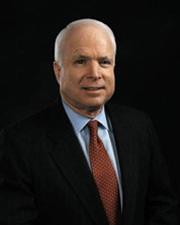 Sen. John McCain (R-AZ)
Legislative Activity
Stay on top of the latest movement without scrolling through every action
Senate amendment submitted
July 7, 2009
View full timeline
Senate amendment submitted
July 7, 2009
Roll call votes on amendments in Senate: Amendment SA 1400 not agreed to in Senate by Yea-Nay Vote. 47 - 51. Record Vote Number: 218.
July 7, 2009
Senate amendment not agreed to: Amendment SA 1400 not agreed to in Senate by Yea-Nay Vote. 47 - 51. Record Vote Number: 218.
July 7, 2009
Senate amendment proposed (on the floor): Amendment SA 1400 proposed by Senator McCain to Amendment SA 1373.(consideration: CR S7172-7174, S7178-7179; text: CR S7172)
July 7, 2009
Amendment SA 1400 proposed by Senator McCain to Amendment SA 1373. (consideration: CR S7172-7174, S7178-7179; text: CR S7172) To eliminate the appropriation for the Over-the-Road Bus Security Assistance, as recommended by the Administration.
July 7, 2009
Amendment SA 1400 not agreed to in Senate by Yea-Nay Vote. 47 - 51. Record Vote Number: 218.
July 7, 2009
Votes
1 roll call on this amendment
Text
Proposed
DEPARTMENT OF HOMELAND SECURITY APPROPRIATIONS ACT, 2010--Continued

Amendment No. 1371

Mr. SCHUMER. Mr. President, I rise in opposition to Senator Sessions'
amendment to the Department of Homeland Security appropriations bill.
The Sessions amendment would make E-Verify permanent and would
immediately mandate all Federal contractors and subcontractors to use
E-Verify.
First of all, obviously, legislating on and delaying a critical
appropriations bill, which is necessary for us to pass quickly to
secure our borders, ports of entry, and our interior points of
vulnerability, is a delay we do not need. But, secondly, and more
importantly, despite claims that this amendment only seeks to
reauthorize E-Verify for 3 years, which I do not oppose, the actual
language of the amendment of my distinguished colleague would make E-
Verify permanent and mandatory.
There would be nothing wrong with that if the system actually worked,
but it does not. The distinguished Senator from Alabama and I agree
upon one of the main seven principles for immigration reform which I
issued 2 weeks ago; namely, that an employer verification system with
tough enforcement and auditing is necessary to significantly diminish
the job magnet that attracts illegal aliens to the United States. The
bottom line is that they mainly come for jobs, and until they are tough
on employers, wave after wave is not going to stop.

As we speak, even under the E-Verify system, any individual who
steals a Social Security number--and that is easy these days--and has
access to a credible fake ID can get a job in the United States. What
is more, nothing about E-Verify stops a U.S. citizen from ``loaning
their identity'' to their friends and family to get a job. In either of
these cases--an illegal immigrant stealing a Social Security number and
getting a fake ID done or some citizen, an employer or whatever, giving
a Social Security card to the person--it doesn't do the job because
that illegal immigrant can enter into the system. Once they are in the
system, they stay in it, never to be removed. So E-Verify, frankly--and
I know many in the immigrant community object to it because it only
affects immigrants. But there is also another objection, and that is
that it is just not tough enough, it is not strong enough. If we are
going to make a system permanent, it really ought to work.

[[Page S7169]]

The current E-Verify system creates havoc for both employers and
employees. No one has any certainty. Employers who accept all credible
documents in good faith are not guaranteed they will never be targeted
by ICE for turning a blind eye toward illegal immigrants in their
workplace, and employers who question suspicious documents face
potential lawsuits from U.S. citizen employees who can claim they were
wrongly profiled as illegal immigrants.
There is only one way to really get a system that will stop illegal
immigration and stop employers from hiring, and that is by creating a
biometric-based Federal employment verification system that will give
both employers and employees the peace of mind that employment
relationships are both lawful and proper. It will also give the
American people the same peace of mind. This system will be our most
important asset in dramatically reducing the number of illegal aliens
who are able to live and work in the United States.
There are many proposals for practical and effective biometric-based
employment verification systems, and the immigration subcommittee,
which I chair, will be vetting each proposal during our upcoming
hearing on July 22. The distinguished Senator from Alabama, my friend,
is a member of the immigration subcommittee. I invite him to engage in
this critical process for our country during the hearing and ask all of
the questions he would like to the distinguished panel of expert
witnesses who will be appearing. We are not seeking to delay. I am
eager to enact comprehensive reform with a strong, tough employer
verification system.
An amendment making the flawed E-Verify system permanent and
mandatory will only create more problems than it solves. Once we go
down the road of making this flawed system permanent and mandatory,
without fixing what is wrong with the program, we will waste
substantial amounts of taxpayer money and we will make life more
difficult, rather than simpler, for employers who wish to do the right
thing, and for employees.
The time is coming for comprehensive immigration reform. The
legislation will create the best employment verification system
possible that will be a product of deliberation and consensus and will
be informed by the world's foremost experts on this issue. It will be
tougher, tighter, and more effective than E-Verify. I believe we can
get that done this year.
Let's not do something hasty and counterproductive just to say we are
doing something, and, just as important, let's not do it as an
amendment to an appropriations bill. I urge my colleagues to vote
against this amendment, and let's get to work on crafting an employer
verification system that really works, prevents identity fraud, and
actually curtails the illegal immigration job magnet.
I yield the floor and suggest the absence of a quorum.
The ACTING PRESIDENT pro tempore. The clerk will call the roll.
The assistant bill clerk proceeded to call the roll.
Mr. THUNE. Mr. President, I ask unanimous consent that the order for
the quorum call be rescinded.
The ACTING PRESIDENT pro tempore. Without objection, it is so
ordered.
Mr. THUNE. Mr. President, I ask unanimous consent to speak as in
morning business.
The ACTING PRESIDENT pro tempore. Without objection, it is so
ordered.

Cap and Trade

Mr. THUNE. Mr. President, like many of my colleagues, last week, over
the Fourth of July break, I spent much of the week traveling in my
State of South Dakota. Many of my colleagues were in their individual
States and probably heard a lot from their constituents about what they
perceive to be the challenges facing our country's economy. First and
foremost is jobs and the economy.
I think there is a real concern--and rightly so--about in which
direction the economy is headed and what are the things Congress ought
to properly be focused on, and I think that discussion is always
informed by the American people by commonsense realizations. One
realization is that you cannot spend money you don't have. That is
something I think the American people get very clearly, largely because
that is their reality. They cannot spend money they don't have. They
have to live within a budget. The same is true with many small
businesses. The second realization is that when you borrow money,
someday you have to pay it back. You cannot continue to borrow
endlessly and rack up more and more debt. At some point, there is an
end to that. Certainly, that is true for family budgets and small
business budgets. The only place it is evidently not true is in
Washington, DC, where we continue to borrow and spend and put massive
amounts of borrowing and debt upon future generations. Even most State
governments--mine included--have balanced budget amendments that
require them in any given year to make sure the revenues they take in
match up with expenses. If they don't do that in South Dakota, the
legislature has to stay until the budget is balanced. So most
Americans, as they observe what is happening in Washington these days,
are increasingly concerned by the massive amounts of spending and
borrowing and, frankly, the taxes they perceive to be in their future
as well.
One of the things that is clear to me in doing parades and public
events over the Fourth of July break is how much people picked up on
the debate about the cap-and-trade bill, which is a national energy tax
on the American people. It passed in the House a little over a week
ago--before the break--by a seven-vote margin. There was big pressure
to move it very quickly and jam it through the process. It was over
1,200 pages long. One amendment was 300 pages long. There weren't many
Members of the House--before the bill passed--who had an opportunity to
review it and study it closely to determine what the ramifications will
be on their constituents if the bill passed. Yet it did. It was a very
close vote. At some point, it will be considered by the Senate.
The one thing we know, at a minimum, is that we can debate about how
much or how big the cost of that bill will be, but we do know it is
going to impose significant increases in costs on the American public
for power, whether it is electricity, fuel, natural gas, or home
heating oil--the things the American people depend upon every single
day for their very existence. They are going to see the cost of those
things go up if this cap-and-trade bill passes. We have seen different
estimates by different organizations. The most recent one was done by
the CBO, which concluded that it will have a $700 billion impact. I
think that if you reduced it to a per-family cost, it ends up being
several hundred dollars a year in increased rates that they are going
to pay. I argue that it will be much higher for people in the Midwest,
where I come from, because of the way we derive our power. Most of it
comes from coal-fired power. It is true that we get a good amount in
South Dakota and other States around us get even more from those
sources. There will be additional costs imposed upon the people in the
Midwest, where the people on the west or east coasts may not see their
costs go up as much. This will disproportionately impact people in the
heartland, but everybody's electricity costs and fuel costs are going
up if this passes.
The American people are asking: OK, if you are going to put a massive
new tax on us with a new energy tax, what kinds of benefits do we
derive? I think there is increasing concern and questions being raised
about whether the environmental benefit that would be derived as a
result of this massive new tax on energy in this country would be in
any way close to the cost that would be associated with it. I think
most Americans have concluded that it will not. Most of the data bears
that out. Other countries in the world are not going to participate in
this system, and America will be unilaterally implementing this regime,
if passed, and the Americans will pay the costs for little benefit.
There are many ways you can get reduction in carbon emissions, and we
are all looking for ways to reduce pollutants in the atmosphere. You
can give incentives and drive investment in certain directions, and we
could make more use of nuclear power, which is clean, green energy--
something we do very little of relative to our counterparts in other
parts of the world.

[[Page S7170]]

France gets 80 percent of its power from nuclear energy. There is no
reason why the United States could not turn to that clean, green energy
source, as well as renewable energy sources that we have an abundance
of in my part of the country, such as wind energy. If you put in
incentives and drive investment in that direction, you can achieve the
same ends without putting the big cap, top-down government mandate on
the American economy at an enormous cost to the American consumers.

Health Care

That is the issue, I would say, probably as much as anything else I
have heard people talk about, but not far behind it was this notion
that the government is now going to take over one-sixth of our economy
because of the legislation that is moving through the Congress right
now that would ``reform'' our health care system.
It is, I guess, no surprise to most Americans that we spend a lot on
health care. Most of us would like to see us spend less on health care.
Many of us think we can do that, that we can get costs under control,
that we can do it through reforms that preserve what is good about the
American health care system, that doesn't copy what is happening in
other places around the world, Europe being an example, where care is
rationed, where people don't have access to the types of therapies and
treatments because the government decides what procedures are going to
be covered, which procedures are cost-effective.
Those are decisions made by government. In this country, those are
decisions made by patients and doctors, by physicians, by health care
providers and those they serve. We believe that is a basic relationship
we ought to preserve when we talk about reforming our health care
system.
But most Americans are very concerned that the government may take
over one-sixth of the American economy and run it, imposing the
government in the place of, as I said before, what has typically been a
relationship between physicians and patients.
What I would argue is that whether it is the issue of new energy
taxes on the American consumer, whether it is the issue of the
government taking over the health care system in this country at a
minimum cost of $1 trillion--there was a CBO Congressional Budget
Office report that came out recently that said the new plan the
Democrats are unveiling may only be $600 billion, but it also doesn't
include many of the most costly parts of the plan that we expect the
Democrats to put on the floor of the Senate at some point in the not
too distant future.
I will simply say again that based on the feedback I got from people
across this country and people across South Dakota in particular over
the break, the government takeover of health care in this country is
something with which they are very uncomfortable, and they don't want
to pay trillions of dollars in new taxes to make that possible.
If you talk about the amount of spending that is going on, the amount
of borrowing we are doing from future generations, I think most
Americans come back to those two basic principles I mentioned earlier,
what I call our sort of commonsense conclusions that the American
people come to. One is, you cannot spend money you do not have, and
they see Washington doing that every single day; that when you borrow
money, at some point you have to pay it back. And there is borrowing
going on here right now like there is no tomorrow.
The health care entitlement program, if passed, would be a minimum of
$1 trillion in new spending and would either have to be financed by tax
increases, by revenue raisers the economy is going to pay for at a time
we can least afford it, or by borrowing at a time when we are running
over the next decade at least on average $1 trillion a year in
deficits.
We cannot continue on this path. It is unsustainable. I believe the
American people are coming to that realization. I hope the Senate will
put the brakes on this energy tax, will put the brakes on this massive
rush to take over one-sixth of our economy by taking over the health
care system in this country.
I believe as the American people start to weigh in to this debate
those of us in Washington who are in positions to make some of these
policies and shape some of these policies will be getting an earful,
and I hope so because we need to put the brakes on this massive
takeover of the health care system, and we need to put the brakes on
this cap and trade, this energy tax imposed on the American people, if
it is passed in the Senate as it was a week ago in the House of
Representatives.
I hope we can stop those things. I hope at least we can bring some
sense to the debate about health care that does reform our system, that
does get costs under control, that does not allow the government to get
in the way of making decisions that rightfully ought to be made by
patients and their doctors.
I yield the floor and yield back the remainder of my time.
The ACTING PRESIDENT pro tempore. The Senator from South Carolina.
Mr. DeMINT. Mr. President, I thank my colleague, Senator Thune, for
pointing out, again, the disastrous course we are on as a nation with
the level of spending, borrowing, and debt we are creating and the
amount of government intrusion into so many areas of our economy that
have alarmed so many Americans. I appreciate the Senator bringing up
that issue today.

Amendment No. 1399 to Amendment No. 1373

I rise today to express my grave concerns about the administration's
response to the situation in Honduras. There are few absolutes in the
arena of diplomacy and international affairs. As circumstances and
regimes change, so do our interests and allegiances. But one principle
that should stand as a bedrock constant is this: a friend of freedom is
a friend of America. Our commitment to freedom is not confined to a
culture or a continent. It is absolute and universal.
It was this principle, hardwired into our DNA, that President Obama
appeared to violate during his 8 days of silence while innocent
democratic demonstrators were tortured and murdered in the streets of
Tehran by Iran's tyrannical regime.
Thankfully, the President finally changed his rhetoric and offered
some support to the people of Iran risking their lives for their
freedom. But he stopped short of any criticism or action that might be
construed as ``meddling,'' in his words, in the domestic affairs of a
sovereign nation.
But in the last week, the President has reversed course, meddling up
to his ears in the domestic affairs of another sovereign nation,
Honduras. Depressingly, the President has once again sided with an
illegitimate and anti-American autocrat over democracy, the rule of
law, and an oppressed people who only want to be free.
The facts on the ground in Honduras are neither disputed nor
confusing, but they have been largely ignored by an international media
distracted by the death of a celebrity.
Let me read these facts into the record.
Honduras is a constitutional republic and a longtime ally of the
United States. It is one of the poorest nations in the Western
Hemisphere, especially since it was ravaged by the direct hit of
Hurricane Mitch in 1998.
In 2005, Hondurans elected as their President Manuel Zelaya, a left
of center but seemingly moderate candidate from the Liberal Party.
Given Latin America's troubling history of military coups and self-
appointed Presidents for life, the Honduran Constitution strictly
limits Presidents to one term.
So seriously do Hondurans take their Presidential term limits that in
Latin America, the phrase--and I will butcher this Spanish, but I want
to give it a try--``continuar en el poder.'' It means to continue in
power. It carries with it a dark connotation to the region for everyone
living there.
For a President to overthrow the Constitution and violate term limits
is violating the constitutional form of government. So seriously that
article 238 of the Honduran Constitution says any President who even
proposes an extension of his tenure in office ``shall immediately
cease performing the functions of his post.'' So it is a de facto
resignation of office in Honduras for a President to attempt to do what
their President did.

Zelaya's 2005 campaign was supported by Hugo Chavez, the Marxist
Venezuelan dictator bent on amassing

[[Page S7171]]

power in the Western Hemisphere at the expense of what he calls ``the
North American empire.'' That is us.
Zelaya quickly aligned his government with Chavez's and joined anti-
American socialists, such as the Castro brothers in Cuba and Daniel
Ortega in Nicaragua, in Chavez's economic cartel.
With Zelaya's term coming to an end early next year, Chavez convinced
him to do as he has done in Venezuela: to force a constitutional
amendment extending his Presidential term. This would be in direct
violation of what their Constitution says.
Earlier this year, Zelaya called for a referendum to initiate a
constitutional convention. In the ensuing litigation, the Honduran
courts ruled the referendum was unconstitutional and illegal, as the
Honduran Constitution explicitly gives only its Congress the power to
call such a vote.
Zelaya forged ahead, calling his referendum a ``nonbinding survey.''
This, too, the supreme court found unconstitutional.
Zelaya then ordered the head of the Honduran military, General
Vasquez, to conduct the election anyway. Vasquez expressed concerns
about the vote's legality, so Zelaya fired him.
The supreme court ordered Zelaya to reinstate Vasquez, and Zelaya
refused. The supreme court ordered the military to seize the referendum
ballots to prevent Zelaya from going ahead with the illegal vote.
Zelaya then personally led an armed mob to steal back the ballots,
which, it should be noted, were suspiciously printed in Venezuela.
Zelaya ordered his government to set up 15,000 polling places to
conduct the referendum for June 28.
On Friday, June 26, the Attorney General of Honduras, Luis Rubi,
filed a complaint before the Honduran Supreme Court petitioning for an
arrest warrant for President Zelaya. The court issued the warrant
unanimously and, according to the Constitution, ordered the Honduran
military to execute it.
Early in the morning of Sunday, June 28, the day of the vote, the
military arrested President Zelaya at his home. They put him on a plane
to Costa Rica, as Honduras has no prison capable of withstanding a mob
riot of the sort they feared Chavez and Ortega might whip up. So they
did it for his safety.
That same day, the Honduran Congress, controlled by his Liberal
Party--his own party--voted 125 to 3 to replace Zelaya with their
speaker, Roberto Micheletti, as a member of the Liberal Party. This
transfer of power was strictly in keeping with Honduras's
constitutional line of succession as the Vice President had recently
resigned.
The regularly scheduled general elections remain set for this
November, and interim President Micheletti is not a candidate. The
previously nominated candidates from the two major parties remain on
the campaign trail, and both candidates and parties overwhelmingly
approved the ouster of Zelaya.
At every step in the process, the legitimate democratic government
strictly adhered to the Honduran Constitution and civilian leadership
of the military remained intact. The military did not execute a coup.
It thwarted the coup plotted by Hugo Chavez and implemented by Manuel
Zelaya.
Honduras's democratic institutions are operating today, and its
government functions are secure. The only aggrieved party in this
process is Mr. Chavez, whose brazen attempts to corrupt Honduran
democracy was thwarted by what has now been nicknamed ``the little
country that could.''
The people of Honduras stood up to Hugo Chavez, Daniel Ortega, the
Castro brothers, and they stood up for freedom and the rule of law. For
their courage, President Obama has condemned them. He has called the
constitutional ouster of President Zelaya not legal, claiming an
expertise in Honduran law over and above that of a unanimous Honduran
Supreme Court and a nearly unanimous Honduran Congress.
Secretary of State Clinton lazily joined the international media in
calling the removal of President Zelaya ``a coup,'' a term fraught with
dark memories of military juntas and banana republic. Of course, this
is the same administration that insists on calling the recent fraud in
Iran an election.
The Obama administration joined Chavez's preposterous Soviet-style
propaganda resolution in the Organization of American States condemning
Honduran democracy. Hondurans I have spoken with--I have spoken with a
number of folks who have missionary groups there, medical groups. I
have talked to Miguel Estrada who was born and raised in Honduras and
is now a constitutional expert in this country. This morning I talked
to former Honduran President Ricardo Maduro. They are all totally
befuddled at the strange response they are getting from the supposedly
free world, including our own administration. Why are we siding with
Hugo Chavez?
This morning in Russia, President Obama reiterated his support for
Zelaya, the would-be dictator, as the rightful President of Honduras.
According to ABC News, he said:

America supports now the restoration of the democratically
elected President of Honduras, even though he has strongly
opposed American policies.

Continuing with the quote from President Obama:

We do so not because we agree with him. We do so because we
respect the universal principle that people should choose
their own leaders, whether they are leaders we agree with or
not.

The President appears to think his support for Zelaya is based on
some principles of self-determination. He speaks as if opposition to
Zelaya is based on partisan political differences. Zelaya was not
ousted by political enemies; he was ousted by a government controlled
by his own party. He was ousted by a unanimous supreme court operating
in accordance with the Honduran Constitution and in conjunction with
the nation's attorney general and Supreme Electoral Tribunal. These
folks followed the rule of law.
The Honduran people have chosen their own leaders. Those leaders--in
a constitutional, bipartisan, and nearly unanimous process--removed
Manuel Zelaya from office. The Honduran people have upheld our
President's so-called universal principle. The people seeking to
undermine that principle are Hugo Chavez, the Castro brothers, Daniel
Ortega, Mel Zelaya, and--unbelievably--the Obama administration.
This is not about politics. This is about the rule of law, freedom,
and democracy, all of which are being defended by the Hondurans right
now against their enemies--of which we appear to be one. Why are we not
standing with them? Blood was shed in Iran while we stood idly by.
Zelaya's return to Honduras on a Venezuelan jet and with the moral
authority of the United States will almost certainly lead to more
bloodshed. What are we doing on the side of tyrants and sworn enemies
of freedom; going as far, on their behalf, to threaten economic
sanctions against one of our poorest and bravest allies?
Secretary of State Clinton is reportedly planning a meeting with Mr.
Zelaya in Washington this week. I implore her to reconsider that
meeting. Elevating an impeached and disgraced autocrat is more than an
insult to Honduran democracy, it is a green light to other would-be
Chavezes around Latin America. It is a signal to the enemies of
democracy and freedom that the United States no longer stands as a
beacon of liberty. It is a signal that the rule of law is now passe in
Latin America and that Hugo Chavez and his corrupt and brutal idealogy
has free rein to meddle wherever he pleases in the Western Hemisphere.
What do we stand for, if not for freedom, democracy, and the rule of
law? Where is the spine of the administration to stand up to anti-
American and antidemocratic thugs in our own back yard? Where is the
intellectual clarity to see the facts on the ground as they are? Manuel
Zelaya is a criminal, a constitutionally removed former President of a
proud and noble country. To my knowledge, no administration official
has refuted or even grappled with the facts regarding Zelaya's
attempted coup.
Given those still undisputed and documented facts, on what basis does
the administration demand Zelaya's reinstatement? His removal from
office was no more a coup than was Gerald Ford's ascendance to the Oval
Office or the election to the Senate of our newest colleague, Al
Franken. It is bad enough that the President's ad hoc and highly
personalized foreign policy seems to be less about supporting the

[[Page S7172]]

rule of law than it is about supporting particular rulers. But the last
4 weeks suggest that the President cannot even be counted upon to
support our legitimate allies.
What happened in Honduras last week was not a tragedy, it was a
triumph of democratic courage and the unyielding determination of a
free people to stand up to despotism. The tragedy has been the failure
of the West and of our own government in Washington to stand up for
justice and freedom in Latin America.
It is not too late. I have written to Secretary Clinton, and there is
growing congressional support for the legitimate government in
Honduras. Everywhere I go someone comes up to me and tells me to stand
up for freedom in Honduras. There is still time to look at the facts,
even to visit Honduras itself. Call down there, talk to the people,
even Americans in the Peace Corps or on missionary work, and ask them
if they are living under an oppressive military junta. They will laugh
and tell you they are living under an independent and vibrant
democracy, with a representative government led by people they elected.
They will tell you about the free and open debate in the ongoing
Presidential campaign and whom they are supporting in the November
elections.
There is still time to correct our position and support our true
allies. And because we can, we should. We must. Because today--and I
will try my Spanish again--``un amigo de libertad es un amigo de
Honduras''--a friend of freedom is a friend of Honduras.
Mr. President, before I yield, I ask unanimous consent to set aside
the pending amendment and call up the DeMint amendment.
The PRESIDING OFFICER (Mr. Udall of Colorado). Is there objection?
Hearing no objection, it is so ordered. The clerk will report.
The assistant legislative clerk read as follows:

The Senator from South Carolina [Mr. DeMint] proposes an
amendment numbered 1399 to amendment No. 1373.

Mr. DeMINT. I ask unanimous consent to dispense with the reading of
the amendment.
The PRESIDING OFFICER. Without objection, it is so ordered.
The amendment is as follows:

(Purpose: To require the completion of at least 700 miles of reinforced
fencing along the southwest border by December 31, 2010)

At the appropriate place, insert the following:

SEC. __. BORDER FENCE COMPLETION.

(a) Minimum Requirements.--Section 102(b)(1) of the Illegal
Immigration Reform and Immigrant Responsibility Act of 1996
(8 U.S.C. 1103 note) is amended--
(1) in subparagraph (A), by adding at the end the
following: ``Fencing that does not effectively restrain
pedestrian traffic (such as vehicle barriers and virtual
fencing) may not be used to meet the 700-mile fence
requirement under this subparagraph.'';
(2) in subparagraph (B)--
(A) in clause (i), by striking ``and'' at the end;
(B) in clause (ii), by striking the period at the end and
inserting ``; and''; and
(C) by adding at the end the following:
``(iii) not later than December 31, 2010, complete the
construction of all the reinforced fencing and the
installation of the related equipment described in
subparagraph (A).''; and
(3) in subparagraph (C), by adding at the end the
following:
``(iii) Funding not contingent on consultation.--Amounts
appropriated to carry out this paragraph may not be impounded
or otherwise withheld for failure to fully comply with the
consultation requirement under clause (i).''.
(b) Report.--Not later than September 30, 2009, the
Secretary of Homeland Security shall submit a report to
Congress that describes--
(1) the progress made in completing the reinforced fencing
required under section 102(b)(1) of the Illegal Immigration
Reform and Immigrant Responsibility Act of 1996 (8 U.S.C.
1103 note), as amended by this Act; and
(2) the plans for completing such fencing before December
31, 2010.

Mr. DeMINT. Mr. President, I will speak to the amendment later. I see
a colleague wanting to speak and so I will yield the floor.
The PRESIDING OFFICER. The Senator from Arizona is recognized.
Mr. McCAIN. Mr. President, what is the pending business?
The PRESIDING OFFICER. The DeMint amendment No. 1399.
Mr. McCAIN. And the underlying legislation is the Department of
Homeland Security appropriations bill?
The PRESIDING OFFICER. The Senator is correct.

Amendment No. 1400 to Amendment No. 1373

Mr. McCAIN. Mr. President, I ask unanimous consent to set aside the
pending amendment and to call up amendment No. 1400.
The PRESIDING OFFICER. Without objection, it is so ordered. The clerk
will report.
The assistant legislative clerk read as follows:

The Senator from Arizona [Mr. McCain] proposes an amendment
numbered 1400 to amendment No. 1373.

Mr. McCAIN. Mr. President, I ask unanimous consent that further
reading of the amendment be dispensed with.
The PRESIDING OFFICER. Without objection, it is so ordered.
The amendment is as follows:

(Purpose: To eliminate the appropriation for the Over-the-Road Bus
Security Assistance, as recommended by the Administration)

On page 31, line 19, strike all through page 32, line 3,
and insert the following:
(6) $350,000,000 shall be for Public Transportation
Security Assistance and Railroad Security Assistance under
sections 1406 and 1513 of the Implementing Recommendations of
the 9/11 Commission Act of 2007 (Public Law 110-53; 6 U.S.C.
1135 and 1163), of which not less than $25,000,000 shall be
for Amtrak security.

Mr. McCAIN. Mr. President, the Department of Homeland Security
appropriations bill before us today spends $44.3 billion. It is $207.5
million--or 7 percent more than last year's appropriation and nearly
$97 million more than the budget request. An increase of this size is
remarkable. I need to remind my colleagues that Americans are hurting,
they are losing their jobs and their homes at record rates, and here we
are, business as usual, as was made very clear in the vote on the
amendment that was defeated concerning a museum in Nebraska on another
appropriations bill--a bill that was supposed to be for funding
legislative business of the Congress. On this bill again, it is
business as usual. The level of spending is wrong, and there are
numerous unrequested, unauthorized earmarks which were added at the
direction of members of the Appropriations Committee and the Senate.
Maybe we ought to take a look at them. This is the Department of
Homeland Security appropriations bill, I would remind my colleagues,
but we threw in $4 million for the Fort Madison Bridge in Fort Madison,
WI. As always, there are earmarks and geographic locations delineated
in the bill for these pork-barrel projects. There is $39.7 million for
the Advanced Training Center in West Virginia and $3.6 million for the
Coast Guard Operations Systems Center in West Virginia. That is a good
place for Coast Guard operations, to say the least.
I wish to point out that none of these earmarks were authorized. None
of them had a hearing. None of them were requested. In fact, three of
them I will read about were included in the President's budget request
in a report from the Office of Management and Budget entitled
``Terminations, Reductions, and Savings: Budget of the U.S. Government,
Fiscal Year 2010,'' which was submitted by the Office of Management and
Budget. In other words, the administration requested that these
specific appropriations not be spent because of the fact they either
are not needed or are outright wasteful spending of the taxpayers'
dollars.
Continuing with the list of earmarks in this bill, we have another
$16.8 million for the Coast Guard Station in Cleveland Harbor, OH, to
demolish the existing facility and construct a new multipurpose
building.
I wish to emphasize to my colleagues that these may be worthy
projects. They may be. Generally, they aren't, but they may be. But
there has been no hearing, there is no request on the part of the
administration, there is no request from anybody except for the
representative of that State.
Continuing: $4 million for the National Infrastructure Simulation and
Analysis Center; $102 million for the National Domestic Preparedness
Consortium--and that contains six earmarks: The National Energetic
Materials Research and Testing Center in New Mexico, $23 million;
National Center for Biomedical Research and Training at Louisiana State
University, $23 million; National Emergency Response and Rescue
Training Center at Texas

[[Page S7173]]

A&M University, $23 million; National Exercise, Test, and Training
Center in Nevada, $23 million; Transportation Technology Center in
Pueblo, CO, $5 million; and, of course, we never want to forget the
Natural Disaster Preparedness Training Center at the University of
Hawaii, $5 million.
There is $3 million for the Distributed Environment for Critical
Infrastructure Decision-making Exercises. We need $3 million for the
infrastructure decision-making exercises. Money is also set aside for
the Cyber Security Consortium, which is a group of schools, including
Miami University of Ohio, Utah State University, University of Nevada
at Reno, and Potomac Institute for Policy Studies.
A certain thread may become apparent throughout this conversation and
that is that States which are generally getting most of this money
happen to have representatives in the Senate on the Appropriations
Committee.
There is $2 million for the Cincinnati Urban Area Partnership; $20.8
million for the Southeast Region Research Initiative; $300,000 for the
City of Hackensack Emergency Operations Center. Emergency operations
centers are very popular in this bill. But there was no competition for
these emergency operation centers. They may be worthwhile, they may
not. We will never know because they are earmarked by the Members and
they range from $1 million to $20 million to $247,000. We have New
Jersey, New Jersey, New Jersey; Washington State; Providence, RI; north
Louisiana; Little Rock; Vermont; Columbus, OH; city of Ames; and the
city of Mount Vernon.
There is $900,000 for the City of Whitefish Emergency Operations
Center in Montana. And because we wouldn't want to leave them out,
there is $1 million for the City of Chicago Emergency Operations
Center.
None of these projects were requested by the administration or
authorized or competitively bid in any way. No hearing was held to
judge whether these were national priorities worthy of scarce
taxpayers' dollars. They are in this bill for one reason and one reason
only: because of the selective prerogatives of a few Members of the
Senate. Sadly, these Members choose to serve their own interests over
those of the American taxpayers.
I have filed, and intend to offer, amendments to strike each and
every one of these earmarks. Enough is enough. The American people are
tired of this process, and they are tired of watching their hard-earned
money go down the drain. I intend to fight every single unnecessary,
unrequested, unauthorized earmark in every appropriations bill.
In addition to the earmarks I covered, this bill includes millions of
dollars for programs that the administration has sought to cut due to
the program's ineffectiveness or lack of necessity. The amendment I
propose has as an example: The Over-the-road Bus Security Program. The
administration proposed in its 2010 budget to eliminate the Over-the-
Road Bus Security Program since the awards are not based on risk, as
recommended by the 9/11 Commission, and has not been assessed as
effective. Specifically, the Office of Management and Budget stated:

Recently, the funding (for this program) has gone to
private sector entities for business investments in GPS-type
tracking systems that they could be making without Federal
funding. For now, this program should be eliminated in favor
of funding initiatives aimed at mitigated verified transit
threats.

Again, in the Office of Management and Budget submission the
administration says:

The Government Accountability Office has recommended that
TSA conduct an in-depth risk analysis of the commercial
vehicle sector before more funding is allocated.
For now, this program should be eliminated in favor of
funding initiatives aimed at mitigating verified transit
threats. Funding for the intercity bus industry should be
included in the larger Public Rail/Transit Security Grant
program and prioritized against all transit-related security
investments.

But it is not. Here, on the one hand, we have the President announce
with great fanfare a group of reductions and terminations and savings
that the administration is going to make and is strongly urging be
done. Here we have on the bill an earmark that, indeed, funds these
very same programs the administration wants eliminated.
There is another one, and that is the U.S. Coast Guard Loran-C.
Loran-C sounds like a pretty good program, but the fact is, this $35
million, by the way, is a federally funded radio navigation system for
civil marine use in coastal areas. I will quote from the Office of
Management and Budget:

The Nation no longer needs this system because federally
supported civilian Global Positioning System--GPS--has
replaced it with superior capabilities. As a result, Loran-C,
including recent limited technological enhancements, serves
only the remaining small group of long-time users. It no
longer serves any governmental function and is not capable as
a backup for GPS.

So we are going to spend $35 million on GPS that is useless. It is
useless for Loran-C. Why? Why would we want to do that? Why would we
want to spend that kind of money? It is amazing.
Then there is the emergency operation centers, of course, some $20
million for operation centers in Ohio, Illinois, Indiana, New Jersey--
et cetera. These, of course, are obviously the result of earmarks.
Again, the Office of Management and Budget says the administration is
proposing to eliminate the Emergency Operations Center Grant Program in
the 2010 budget because the program's award allocations are not based
on risk assessment.
Oh, really. Also:

. . . other Department of Homeland Security grant programs
can provide funding for the same purpose more effectively.

It goes on to talk about how the grant program was established:

. . . by supporting flexible, sustainable, secure and
interoperable EOCs, with a focus on addressing identified
deficiencies and needs. . . . The EOC Grant Program uses
award criteria that are not risk-based, and the
administration supports a risk-based approach to homeland
security grant awards.

I wonder how many of these would be awarded if they were risk based
and how many of them are awarded because of the influence of members of
the Appropriations Committee.

In addition, in 2009, EOC construction and renovation was
approved as an allowable expense under the Emergency
Management Performance Grant Program, thus providing a more
effective funding mechanism through which potential grantees
prioritize expenditures on EOCs against other emergency
management initiatives.

In other words, we are spending these millions of dollars--$20
million I guess it is--in an unnecessary fashion that has nothing to do
with risk but has everything to do with influence.
It is business as usual in our Nation's Capitol. We just came off a
recess. A lot of us spent time, as I did, traveling around our States.
People in my State are hurting. People in my State are wondering
whether they are going to be able to keep their jobs or get a job;
whether they will be able to afford health care; whether they are going
to be able to educate their children. They are having to tighten their
belts in ways that certainly no one has ever had to do before in their
lifetime.
So what do we do here? Business as usual: $97-some-million of
unnecessary and unwanted pork. Last year, Congress appropriated many
millions of dollars. This, once again, is $97 million more than the
budget request, and much of that is obviously unnecessary and unneeded
and in some cases even unwanted.
On behalf of the citizens of my State who are having to tighten their
belts, who are undergoing unprecedented difficulties and hard times
while we are on this spending spree and accumulating trillions of
dollars of debt--we are committing generational theft, laying it on our
children and grandchildren. I intend to fight for their tax dollars,
and I intend to fight until this egregious practice of porkbarrel
earmarked spending, which has bred corruption, is brought to a halt.
I ask for the yeas and nays on this amendment.
The PRESIDING OFFICER. Is there a sufficient second? There is a
sufficient second.
The yeas and nays were ordered.
Mr. McCAIN. Mr. President, before I yield the floor I would like to
include in the Record at this time a list of the various bus companies
and the States in which they operate. I ask unanimous consent they be
printed in the Record at this time.
There being no objection, the material was ordered to be printed in
the Record, as follows:

FY 2009 INTERCITY BUS SECURITY GRANT PROGRAM FINAL ALLOCATIONS
------------------------------------------------------------------------
State                     Entity name          Amount
------------------------------------------------------------------------
Tier I

MA................................  Peter Pan Bus Lines,        $258,749
Inc. (PPBL).

[[Page S7174]]

NJ................................  Academy Express,           1,348,460
LLC..
Coach USA Inc.......         444,075
TX................................  CUSA, LLC...........         699,641
Greyhound Lines,           3,675,223
Inc..

Tier II

AR................................  Little Rock Tours...          50,815
CA................................  SF Navigatour Inc.            99,691
dba Super
Sightseeing.
Silver State Coach..           8,497
CT................................  DATTCO..............         115,743
FL................................  Escot Bus Lines,              67,377
Inc..
GA................................  HTA Enterprises dba          103,275
Swept Away Coach
and Tours.
Pendergrass Charters          43,921
IA................................  Burlington Stage             132,675
Lines.
Windstar Lines, Inc.          50,803
IL................................  O'Hare Wisconsin               8,497
Limousine dba
Prairie Trailways.
Vandalia Bus Lines..          17,563
IN................................  Bloomington Shuttle           57,286
Service, Inc..
Free Enterprise               34,029
System/Royal, LLC.
Star of America dba           49,324
Star of Indiana.
The Free Enterprise           34,029
System.
KS................................  Village Charters dba          84,683
Village Tours &
Travel.
LA................................  American                       8,497
International
Travel dba
Dixieland Tours and
Cruises.
Calco Travel, Inc...          42,601
Hotard Coaches, Inc.          85,664
Louisiana Coaches              8,497
Inc..
MA................................  CAVALIER COACH                 8,497
TRAILWAYS.
Crystal Transport,           108,625
Inc..
MD................................  BK Charter, Inc.....          63,339
ME................................  NorthEast Charter              8,497
and Tour Co., Inc..
MN................................  Jefferson Partners           224,069
LP.
MO................................  Heartland Motor                8,497
Coach,Inc..
MS................................  Cline Tours Inc.....         139,627
MT................................  Rimrock Stages Inc..           8,497
NC................................  T.R.Y., Inc. dba              93,564
Young
Transportation.
NE................................  Busco, Inc. dba              137,156
Arrow Stage Lines.
NJ................................  A-1 Limousine, Inc..         131,430
Lakeland Bus Lines,          191,800
Inc..
Rossmeyer & Weber,            56,154
Inc. dba Raritan
Valley.
Safety Bus Service,           34,029
Inc. dba Safety Bus.
Stout's Charter              363,001
Service, Inc..
NY................................  Brown Coach, Inc....          84,405
Excellent Bus                 17,563
Service, Inc..
Leprechaun Lines,             63,183
Inc..
Monroe Bus Company,          157,069
Inc..
Monsey New Square            265,051
Trails Corp..
Paradise Travel,               7,956
Inc..
Private One of New           200,262
York LLC.
Upstate Transit of            46,611
Saratoga, LLC.
West Point Trailways           7,956
OH................................  Croswell Bus Line            274,093
dba Croswell VIP
Motorcoach Services.
OK................................  Passenger                     49,324
Transportation
Specialist, Inc.
dba Red Carpet
Charters.
PA................................  Carl R. Bieber......         111,607
Frank Martz Coach             16,313
Company, Inc..
Fullington Auto Bus          187,001
Co..
Krapf Coaches, Inc..          64,172
MGR Travel, Ltd. dba          58,946
Elite Coach.
Myers Coach Lines              8,497
Inc..
Red Lion Bus Company          40,192
Trans-Bridge Lines,          237,600
Inc..
RI................................  Flagship Trailways..           8,497
SC................................  Cross Country Tours.           8,497
Lancaster Tours,             135,966
Inc..
TN................................  Anchor Tours, Inc.           112,653
dba Anchor Bus
Charters.
TX................................  Gotta Go Express               8,497
Trailways.
Sierra Stage                   8,497
Coaches, Inc..
VA................................  Abbott Bus Lines,              8,497
Inc..
DC Trails, Inc......         180,800
WA................................  Discovery Tours LLC.          43,141
WI................................  Kobussen Buses LTD..           8,497
Lamers Bus Lines,             85,260
Inc..
Riteway Bus Service,          45,000
Inc..
-------------------------------------
Total.........................  ....................      11,658,000
------------------------------------------------------------------------

The PRESIDING OFFICER. The Senator from Florida is recognized.
Mr. MARTINEZ. Mr. President, I ask unanimous consent I be permitted
to speak as in morning business for a period of about 10 minutes.
The PRESIDING OFFICER. Without objection, it is so ordered.
Mr. MARTINEZ. Mr. President, let me begin by thanking my dear friend
from the State of Arizona for once again reminding us of this egregious
practice of earmark spending that continues to not only grow but
continues to be a dark mark on our record as Members of the Congress.
I think, as he rightly pointed out, at a time of serious economic
distress in places such as Arizona--and I certainly could say as well
in Florida--it is a bit out of sync for us to continue the spending as
usual just for the mere fact that there is a member of the
Appropriations Committee who can, in fact, command something be done
only because it would benefit a narrow interest in their State, within
their district, and which, in fact, may not be requested and which may
not be needed.

Honduras

Mr. MARTINEZ. Mr. President, I rise, though, to speak about the
events in Honduras. The events that are taking place in Honduras right
now are the unfortunate result of the silence of both the United States
and the inter-American community to the assault on Honduras' democratic
institutions.
It is difficult for Hondurans and other democrats within the region
to understand the full significance of President Zelaya's expulsion
from Honduras. Up until this point, there has not been any significant
voice in the opposition to the dismantling of democratic institutions
and free societies in Venezuela, Bolivia--and as Honduras was going
down the path, you might also add Nicaragua to that, to name only a few
of the most visible cases.
It is also hard to explain why there was this silence in the face of
President Zelaya's earlier unconstitutional actions, especially the
event that appeared to precipitate his ousting: the storming of a
military base to seize and distribute ballots for a referendum that
previously had been declared unconstitutional by the Honduran Supreme
Court.
A fundamental tenet of democracy is the separation of powers. You
have a President in the executive branch and then you have the judicial
branch of government, a coequal and separate branch, and that branch
told the President the referendum he was seeking to have to extend his
rule beyond the constitutional term was illegal, it should not be done.
He was undeterred and he was completely unrepentant as he sought to
continue his plan to have a referendum, even though the Congress, even
though the judiciary had already told him that was in contravention of
the Constitution of their country.
Where was the region's outrage over Hugo Chavez's support for Mr.
Zelaya's unconstitutional actions in Honduras? Mr. Chavez supported Mr.
Zelaya because they are kindred spirits, because Mr. Chavez had already
been able to usurp every institution of democracy within his country of
Venezuela and now rules as an autocrat. He wanted to have the same
playbook applied in Honduras as he coached and shepherded to do some of
the same things in Bolivia and to some degree in Nicaragua as well--and
Nicaragua coming along.
The Honduran people decided this was not going to happen in their
country, and the people in the Honduran Congress and in the Honduran
Supreme Court decided it was not going to happen on their watch. But
the region's silence toward the assault on democracy in Honduras
followed a pattern of acquiescence of Chavez's dismantling of
democratic institutions and civil liberties in Venezuela.
For instance, the OAS has said absolutely nothing about Chavez's
closing of independent media, his manipulation of elections, his
erosion of independent branches of government, and his usurping of the
authority of local elected officials. Leaders like Chavez, Ortega, and
Zelaya have cloaked themselves in the language of democracy when it was
convenient for them. Yet their actions ignored it when it did not
further their personal ambitions.
This situation was compounded by the actions of the United States,
including work behind the scenes to keep the Honduran Congress and
Supreme Court from using the clearly legal means of Presidential
impeachment. Some of us have wondered why wasn't he impeached? Why
didn't the Congress go ahead and impeach President Zelaya? Our Embassy
in Tegucigalpa counseled that the Hondurans should not use the tools of
impeachment.
Having stood on sidelines while Mr. Zelaya overstepped his nation's
Constitution, the United States and the inter-American community only
speak now. Protecting a sitting President, regardless of his illegal
acts, sets a dangerous precedent. Instead, U.S. policy should be
focused on only supporting efforts that uphold the integrity of
constitutional order and democratic institutions.
In fairness to the Obama administration, this distorted policy is not
new. Through advice from the State Department, former President George
W. Bush was talked out of having the United States stand visibly with
democratic advocates in Latin America. The advice was based on the
belief that by not making the United States an issue, this would allow
the region to stand up for democratic activists. Unfortunately, no
country or leader did so, and most significant of all, the leader of
the OAS has sat idly by, year after year, as democracy after democracy
was dismantled, one piece at a time, one election at a time, one
institution at a time, saying absolutely nothing.
The OAS has a responsibility to condemn and sanction Presidential
abuses, not just abuses against Presidents. Because of the OAS failure
to uphold the checks and balances within democracies, it has become an
enabler of authoritarian leaders throughout the region. The result of
this has been a signal of acceptance to antidemocratic actions and
abandonment of those fighting for democracy in Venezuela, Bolivia,
Nicaragua, Ecuador, and elsewhere.
This silence was compounded by the recent repudiation of the
application of the Inter-American Democratic Charter to the Cuban
dictatorship. Ironically, it was in Honduras, with Mr. Zelaya taking a
leading role, where the OAS General Assembly decided against any clear
democratic standards for Cuba retaking its seat in that organization.

[[Page S7175]]

So here is what occurred: The OAS, filled with a desire to
reincorporate Cuba into the family of nations, completely ignored that
for 50 years Cuba has been a military dictatorship without even the
vestiges of a free and fair election, and they invited Cuba to be
readmitted without setting up a standard by which they would have to
live.
President Zelaya, with his partner Hugo Chavez, was leading the
charge in saying Cuba should be welcomed back and there should be no
conditions, no conditions of democratic rule like the ones he is now
relying upon to try to get his Presidency back.
It is Mr. Zelaya now seeking the very protection of the Democratic
Charter of the OAS which he thinks applies to him but which he felt was
unimportant to apply the rights and opportunities to the Cuban people
to try to claim the democratic future for themselves.
The crisis in Honduras stems from the failure of its leaders to live
within constitutional boundaries and from the earlier silence of the
United States and the international community regarding the abuse of
power by the Honduran executive. Tragically, the United States and the
OAS have put Honduras and the region in a position where democracy is
the loser once again.
The return of Mr. Zelaya will signal the approval of his
unconstitutional acts. If he is not allowed to return, then the
unacceptable behavior of forcibly exiling a leader elected by the
people would be given tacit approval. This is what happens when
principles are sacrificed for a policy that can only be described as
the appeasement of authoritarians.
In the current crisis, neither the United States nor other countries
in the region or the international community should be taking sides in
a constitutional dispute but, rather, encouraging a resolution through
dialog among Hondurans. To this end, efforts should be focused on
helping Hondurans form a reconciliation government that would include
representatives not associated with either the Zelaya administration or
the current interim government.
The objective should be to keep Hondurans on track to hold currently
scheduled Presidential elections in November, with the inauguration of
a new President in January as mandated in the Honduran Constitution.
The newly elected President, with an electoral mandate, then can decide
whether and how to deal with Mr. Zelaya and those involved in his
ouster.
As the Senate takes up President Obama's nominees for key State
Department positions in Latin America, it is time to question the
acceptance by the United States and the inter-American community of the
sustained dismantling of democratic institutions in free societies by
Presidents seeking to consolidate personal power at any cost. This is
the larger challenge in Latin America, and Honduras is only the latest
symptom. The United States must no longer remain silent when democratic
institutions are undermined. Any disruption of the constitutional order
is unacceptable, regardless of who commits it.
It would be well for us to remember that as we look forward to what
may come next, the Presidential succession ought to be honored,
however, institutions of democracy ought to also be equally honored.
Secretary of State Clinton met today at 1 o'clock with deposed
President Zelaya. It appears she is seeking to align the United States
with the mediation that is about to be undertaken by President Oscar
Arias, a Nobel Prize-winning, well-regarded man from Costa Rica, and
that President Arias might take this opportunity to see how we can
bring this process back together again.
It seems to me that the elections in Honduras ought to take place as
scheduled and a new democratically elected government ought to go
forward. The real question is, Will Mr. Zelaya be allowed to return to
the office of President? It seems to be fairly unanimous that all
Honduran institutions oppose such an outcome. They do not want Mr.
Zelaya back. They have seen the dark movie of what life can be like in
a Cuba-type situation. They have seen the dark movie of what life can
be like in a Cuba-type situation. They have seen the erosion of
democracy with the complete erosion of freedoms, so much made a dear
part of what we in this country believe in that has taken place in
Venezuela. They have seen the continued erosion of democratic values in
Nicaragua and they do not want to see it happen in their country, and
one cannot blame them. It would only be fitting that they should find
comfort by those of us in this country who not only value democracy for
us but believe it should be shared by others around the world no matter
their circumstances.
It isn't good enough to be elected democratically but then rule as a
dictator and in the process of being an elected President, then move to
erode all of the institutions of democracy--the courts, the congresses,
even the military as an institution; they ought to be respected. Their
independence ought to be valued. The playbook of Mr. Chavez, which is
to dismantle the military leadership and bring in cronies of his, the
efforts to then discredit the courts and bring in judges that he would
also approve--this has been the playbook by which Chavez has operated
and one that Mr. Zelaya was attempting to put into play.
So let's hope President Arias from Costa Rica will be able to lead a
mediation effort that will bring together all of the disparate groups
so that there can be a free and fair election and there can be a
resolution to this crisis of democracy. But let this also be a wake-up
call to the rest of us who have sat silently by as this erosion of
democracy takes place one country at a time in Latin America. We ought
to say: Enough is enough. Let's stand for the rule of law, let's stand
for democracy, not only on election day but each and every day
thereafter as we seek leaders who not only are elected democratically
but govern democratically.
I yield the floor.
The PRESIDING OFFICER. The Senator from Arizona.
Mr. KYL. Mr. President, I wish to compliment my colleague from
Florida for a very thorough explanation of what has been, to many
Americans, a very confusing situation and also his support for the most
recent call for a mediation and discussion among the various parties so
that this whole matter can be brought to a successful conclusion
without armed force or other inappropriate action. I, too, hope that
can produce the right kind of result. But I think the point--if I
could, while the Senator is still here, make this point strongly, as he
did--you have to stand up for what is right. And we all know an
election does not a democracy make. You can elect a government which
then begins to govern undemocratically.
Unfortunately, some of the governments in the southern part of our
hemisphere have started all right with the elections and then ended in
a very bad way. We certainly did not want that to happen to our friends
in Honduras. And, in fact, the people of Honduras did not want that
either. They are people who stood by us when we were trying to support
the forces of freedom who were fighting in Nicaragua, and there were
some sacrifices on the part of the Hondurans to do that. It is a
country that has had very friendly relations with the United States
over the years, and it is important for us to stand up for our friends.
For that, I compliment my colleague from Florida, and I again add my
voice to his saying we hope these discussions the Secretary of State
has now called for can produce an appropriate resolution to this issue
without any kind of bloodshed.
Mr. MARTINEZ. I thank the Senator from Arizona for his kind comments.
But it also brings up one more point. Honduras has been by our side.
There is no more important country, in terms of military relations in
Central America, than Honduras, where we have a presence of our
military, where we work together in partnership to try to stem the flow
of drugs and narcotics into our country, and where we conduct not only
training missions but other important training missions with the
Honduran military, where we are very involved in providing aid and
assistance.
I think it would be well for us to hold back any declaration that a
coup has taken place that would then trigger other events. This is not
your traditional military coup where a military group decides to set up
a junta. These are military people who, while maybe they acted a little
too strongly, the

[[Page S7176]]

fact is, they did not seek power for themselves but they established a
congressional order. So it is important.
Mr. KYL. Mr. President, that is precisely the way I see it as well. I
hope that helps to clarify for the American people what is really going
on there and that we can support our friends in Honduras and that
relationship which has existed all these years can continue to be the
productive one it has been.
The PRESIDING OFFICER. The Senator from Maryland.
Mr. CARDIN. Mr. President, I ask unanimous consent that I be able to
speak as in morning business.
The PRESIDING OFFICER. Without objection, it is so ordered.

Helsinki Commission

Mr. CARDIN. Mr. President, I take this time as the Chairman of the
U.S. Helsinki Commission, for which I had the opportunity to lead a
delegation of 13 members representing the United States at the 18th
Annual Parliamentary Assembly of the Organization for Security and
Cooperation in Europe. We attended meetings in Europe, along with
representatives, parliamentarians from 56 countries representing
Europe, central Asia, Canada, and the United States.
We first decided to stop in Bosnia, and we did that because I am sure
my colleagues recall the bloody conflict that erupted in the former
Yugoslavia, in Bosnia, in which communities were dislocated and people
were killed because of their ethnic background.
We found in Bosnia, because of outside interference, the three ethnic
communities that had coexisted for many years were drawn into a
conflict. The United States, in the Dayton Accords, took the leadership
in trying to figure out a way in which we could get the ethnic
communities to live together in peace. As a result of the Dayton
Accords, there was this government established for Bosnia which is a
bit unusual. There are three Presidents, one representing the orthodox
community, the Serbs, one representing the ethnic Bosnians, and one
representing the ethnic Croats. And this government brought an end to
the open violence.
But we knew in recent weeks and months there had been problems in
Bosnia. So we traveled to Sarajevo to talk to all of the ethnic
community leaders to see what was happening. And I must tell you, there
has been progress in that region, particularly with the neighboring
countries that are now progressing, some of which are our strong allies
in NATO, and we have seen progress to integration in Europe. So we can
take pride in what we have been able to achieve in that region of
Europe in the Balkans.
But Bosnia needs our attention. I am pleased we were there. I think
it is clear to each member of our delegation that if Bosnia is going to
be able to continue its integration into Europe--we hope that will
occur--if Bosnia is going to be able to move on a path toward NATO
membership, it needs to have constitutional reform so it has a
functioning federal government protecting the rights of the three
entities. But it needs to have a government that can function, and
during our trip I think we delivered that message. We were there
shortly after Vice President Biden was there.
We then traveled to Vilnius, where the annual meeting was taking
place. But we took the opportunity to visit Minsk in Belarus. We did
that because Belarus is a repressive state in which the President, Mr.
Lukashenko, rules with an iron fist. The political opposition is denied
the normal opportunities of a government.
We went there because we wanted to have an opportunity to advance the
OSCE principles. The Helsinki Commission, which is our arm in
implementing the OSCE, is known for advancing human rights, it is known
for advancing economic cooperation, it is known for advancing security
issues. And we went to Belarus because we wanted that country, which is
a member of OSCE, to live up to its OSCE commitments, to allow its
people basic human rights, the right of a free press, the right to
express their views, the right to challenge their government
peacefully, the right to organize the religions of their choice, and
the right for economic reform, which is being denied to the people of
Belarus. We met with President Lukashenko, and we met with the leaders
of the different factions, of the activists.
We also carried a humanitarian request. There was an American, Mr.
Zeltser, Emanual Zeltser, who was imprisoned in Belarus. We do not know
why he was imprisoned. There were secret indictments and a secret
trial. The United States was not permitted to monitor the trial. He was
sentenced to 3 years. He has a very serious medical condition. It is
believed he could not survive if he remained in Belarusian prisons. So
we carried a humanitarian request that he be released. Mr. Lukashenko
had the power to do that, and we were very pleased that our
humanitarian request was granted. During our meetings, the President
told us he would honor our request that he be released immediately, and
Mr. Zeltser was released later that afternoon, and he is now back in
safe care. So we appreciated that effort, and we hope that represents a
change in the direction of Belarus.
We made it clear that if the Belarusian Government made concrete
steps toward the OSCE-type reforms on human rights, on economics, and
other issues, then it would be a signal to the international community
that we would bring Belarus more into the family of nations.
This Congress passed the Democracy Act, which imposed sanctions
against Belarus because of their repressive regime. I hope our trip,
which was the highest delegation to visit Belarus in over a decade,
will be the first step to seeing change in that country and a better
relationship between Belarus and other countries in Europe and the
United States.
The main reason for our visit was to go to Vilnius, Lithuania, to
participate in the Parliamentary Assembly. One member of our delegation
visited Latvia in order to advance relations. At the Parliamentary
Assembly, I was pleased that Congressman Robert Aderholt was elected
vice chairman of the Third Committee, which is human rights. There are
only three committees in the OSCE: for human rights, economics, and
security. An American, Congressman Aderholt, will be vice chairman of
the Human Rights Committee. I was elected vice president. That follows
in the footsteps of Congressman Alcee Hastings, former President of the
Parliamentary Assembly.
The United States proposed three resolutions in addition to the
normal work. All three were adopted--one on maternal mortality, one on
Afghanistan encouraging the Obama administration's policies in
Afghanistan, and one on Internet freedom. All three of these
resolutions were adopted by the Parliamentary Assembly.
We also recommended 26 amendments to the core resolutions. All 26
amendments were adopted. I wish to cover some quickly because I think
they are important to U.S. policy and we now have the support of the
OSCE, of the European and central Asian communities in advancing these
goals.
One was to seek Pakistan's interest in becoming an OSCE partner. They
are not eligible for membership because it is central Asia, Europe, and
North America. But we have partners in cooperation that work with us.
We have Mediterranean partners, including Israel and Jordan and Egypt.
We have Asian partners that belong, including Afghanistan. We think it
would be helpful if Pakistan sought membership as a partner in
cooperation within OSCE. By way of example, OSCE has a mission in
Afghanistan that deals with border security. They know how to do nation
building, how to help countries. We think that could be useful in
dealing with U.S. policies against terrorists in Afghanistan and
Pakistan if both had an arrangement with the Organization for Security
and Cooperation in Europe. That amendment was approved by the
Parliamentary Assembly.
We offered another amendment dealing with combating anti-Semitism.
The U.S. Helsinki Commission has been a leader in developing strategies
to deal with the rise of anti-Semitism. We have made a lot of progress.
We continued to make progress at this meeting in dealing with the rise
of anti-Semitism.
There were amendments offered dealing with water issues, energy,
climate change, and preserving cultural heritage sites. We had a very
active delegation, and we advanced many causes that were important to
the United States.

[[Page S7177]]

We had bilateral meetings. We met with our counterparts from Russia
to try to improve the dialog between Russia and the United States. This
was a day or two before the meeting of our Presidents in Moscow. I
think it is in keeping with the Obama strategy of trying to have a more
effective dialog between the United States and Russia. We have
differences, but we need to understand each other's positions to try to
bring about the type of change that would be in the interests of both
countries. We underscored those points during our bilateral meetings
with the Russian parliamentarians.
We also met with the parliamentarians from Georgia. We were very
disappointed that the OSCE mission in Georgia was terminated as a
result of Russia's veto of the continuation of that mission. That
mission deals with conflict prevention. It is there to keep peace in
Georgia, where we know there is still the potential for conflict to
erupt at any moment. We had a chance to meet with the Georgia
parliamentarians to go over those issues.
We met with the parliamentarians from Lithuania. The last time I was
in Lithuania was February 1991, when the Soviet tanks were in
Lithuania, where they had taken over the TV towers. We returned to the
TV towers. We were there in 1991 and saw the tragedy that the Soviets
had committed in that country. We also went to the parliament building,
where it was barricaded in 1991 because of Soviet tanks. Now we were
able to enter a free country, a close ally of the United States, a
member of NATO. It was a proud moment to return to that site and see
what has happened. The United States has a proud record of always
recognizing the independence of Lithuania and never recognizing the
Soviet takeover of that independent country. We had a chance to meet
with the President. We had a chance to meet with the parliamentarians,
and we met with the Prime Minister. We mentioned an issue that is still
pending that needs to be resolved; that is, property restitution issues
and community property issues dating back to the Nazi occupation. We
urged the Lithuanian Parliament to promptly pass an appropriate law so
that the payments can be made to the appropriate victims as quickly as
possible since many of the families are dying out and it is important
that this issue be handled as quickly as possible. I hope Lithuania
will follow through on those recommendations.
We had a very busy agenda. I am very proud of the work of each member
of our delegation. We advanced the interests of the United States. We
will be following through on the different discussions we had to make
sure progress continues in each of these areas. It was an honor to
represent the Senate with the Helsinki Commission. We will keep
Senators informed on the progress we are making.
I yield the floor and suggest the absence of a quorum.
The PRESIDING OFFICER (Mr. Kaufman). The clerk will call the roll.
The bill clerk proceeded to call the roll.
Mr. GREGG. Mr. President, I ask unanimous consent that the order for
the quorum call be rescinded.
The PRESIDING OFFICER. Without objection, it is so ordered.
Mr. REID. Mr. President, I ask unanimous consent that at 4:45 p.m.
today, there be 2 minutes of debate prior to a vote in relation to
McCain amendment No. 1400, with the time equally divided and controlled
between Senator McCain and the majority leader or their designees;
further, that on Wednesday, July 8, when the Senate resumes
consideration of H.R. 2892, there be 5 minutes for debate prior to a
vote in relation to the Sessions amendment No. 1371, with the time
equally divided and controlled between Senator Schumer and Senator
Sessions or their designees; that upon disposition of the Sessions
amendment No. 1371, the Senate resume consideration of DeMint amendment
No. 1300, with 2 minutes of debate prior to a vote in relation thereto,
with the time equally divided between Senator Murray and Senator DeMint
or their designees; that no amendment be in order to any of the
amendments covered in this agreement prior to a vote in relation to
these amendments.
The PRESIDING OFFICER. Without objection, it is so ordered.
Mr. REID. Mr. President, let me quickly say, before I turn it over to
my friend from New Hampshire, we have been in many quorum calls today,
with plenty of opportunities to offer amendments. We have to move
forward on this bill. When we finish this bill, we have 10 other
appropriations bills to do. We have to move forward on this bill.
People cannot complain that they have not had opportunity to offer
amendments when they don't offer them.

Debt explosion

Mr. GREGG. Mr. President, I rise to speak on a couple of items. The
two things I wish to speak about are, first, this rumbling we are
starting to hear about having a third stimulus package. Some people say
it is a second. It is a third stimulus package. We did a tax stimulus
package about $140 billion and the $700-plus billion stimulus package
earlier this year. It is incomprehensible to me that we would want to
have another stimulus package unpaid for and add that to the debt.
We are facing a massive explosion of debt in this country. The best
thing we can do to get this economy going would be to show the world
and the American people we are serious about doing something about our
debt.
To roll out another stimulus package in the face of that type of a
situation that would be unpaid for is a huge mistake, whether it is a
tax cut or whether it is spending. I cannot understand why we are even
thinking about it.
When we look at the stimulus package which was just passed a few
months ago, that hasn't even spent out. Only 15 percent of that is
going to be spent this year, and another 37 percent of it will be spent
next year. That means we still have 50 percent of the spending of that
$700-plus billion bill to occur in 2011 and beyond. So if the purpose
of a new stimulus package is to try to bring up the slack in the
economy as we move into 2010 and on to 2011, we do not need it because
we already have a stimulus package that is coming down the road, if you
accept that as being useful--I don't happen to--but it is clearly
counterproductive if it is simply going to add to and increase the debt
of this Nation and the debt that is passed on to our children.
The debt of this country is increasing to astronomical proportions.
We are looking at deficits of 4 to 5 percent of GDP for the next 10
years. We are looking at a debt that goes to 80 percent of GDP. The new
stimulus would aggravate both those numbers dramatically.
To quote my colleague from North Dakota, the chairman of the Budget
Committee, the debt is the threat. If we continue to pass through this
Congress spending which is not offset, which is not paid for, in the
name of stimulus or anything else, we are simply aggravating this
extraordinarily difficult situation, which is the massive explosion of
Federal debt. It is not fair to our children. More importantly, it is
not correct, and it is not good policy.
Nothing would energize this economy more than to have the world look
at America and recognize that we are going to do something substantive
about reducing our debt and our deficits. People around the world and
in our Nation would have confidence in our government again. But if we
continue to talk about rolling out another stimulus upon the stimulus
we already have--the first stimulus and the second stimulus--rolling
out a third stimulus, which will be unpaid for and expensive, that is
not sound fiscal policy.
Since the debt is the issue, let me turn to the second point I wish
to make. The TARP, which has received a lot of negative press over the
last few months, has accomplished its purpose in large degree. The
reason the TARP was passed was to stabilize the financial industry
during a period when it looked like we were going to have a cataclysmic
implosion of the financial industry. We were on the verge of a
catastrophic event, where basically our whole financial industry would
have melted down, bringing down with it Main Street and people's
ability to get loans, people's ability to send their kids to school,
people's ability to buy a house, to meet a payroll, run a small
business. All that would have been at risk if the financial
institutions of this country had been allowed to implode, which is
exactly where we were back in September and October when the TARP was
passed.
With those TARP dollars, those financial institutions are stabilized,
and

[[Page S7178]]

they were stabilized by purchasing what is known as preferred stock in
them.
As part of the TARP, it was made very clear that the $700 billion
that was going to be spent to stabilize the financial institutions, or
potentially spent--not all of it was spent--that those dollars, when
they came back--and we expected them to come back because it was an
investment; it was not spending like a stimulus package where we
essentially put money out the door and it never comes back; we were
buying assets, the preferred stock of these banks. When those moneys
came back to the Treasury, it was understood that those moneys would be
used to reduce the deficit and the debt. That was the understanding
that was written in the bill. The moneys from TARP, as they came back
in, would be used to reduce the debt.
We are now seeing the first group come in. Mr. President, $70 billion
has come back to the Treasury as a result of four or five major banks
paying off the TARP moneys through repurchasing their preferred stock.
Interestingly enough, the taxpayers made some money here. We made about
$4.5 billion on that investment--a pretty good deal over 4 months to
make $4.5 billion. That money is also coming to the Treasury. Those
dollars should be used to reduce the debt. That is what the whole idea
was: Buy assets, stabilize the financial industries, as the assets come
back, pay down the debt that was run up in order to purchase those
assets.
Unfortunately, some of my colleagues in the other body have suggested
that we now start spending this money as it comes in on what happens to
be, I am sure, very worthwhile initiatives which they want to pursue in
the area of housing, in the case of one proposal. That would be the
totally wrong thing to do. These dollars have to be used to reduce the
debt, and by using them to reduce the debt, once again we will make it
clear to Americans and to the international community that we are going
to act in a fiscally prudent way, and we will have a very positive
impact on how much it costs us as a nation to borrow on the value of
our dollars and on the amount of outstanding debt which we face as a
nation, which is extraordinary, as I mentioned earlier.
It is totally inappropriate to spend this money on something other
than what the proposal originally was, which was to spend it to
stabilize the financial institutions and then take the money we
received--in this case, with interest--and use it to pay down the debt.
The administration understands this, and I respect the fact they made
it very clear in a letter to me from Secretary Geithner--I ask
unanimous consent to have printed in the Record the letter from
Secretary Geithner.
There being no objection, the material was ordered to be printed in
the Record, as follows:

Department of the Treasury,

Washington, DC, June 30, 2009.
Hon. Judd Gregg,
U.S. Senate,
Washington, DC.
Dear Senator Gregg: Thank you for our recent conversation
on June 11. In addition to our discussion on deficit
reduction and the repayment of Emergency Economic
Stabilization Act (EESA) funds, I also wanted to formally
respond to your letter of April 23.
As you know, banks are indeed permitted to repay Treasury's
investments through the Capital Purchase Program (CPP).
Repaid funds will be deposited into the general fund for the
purpose of deficit reduction, as required by EESA. This
reduction in the total amount of outstanding assets frees up
headroom under EESA's $700 billion cap, providing additional
flexibility to Treasury in its efforts to stabilize the
economy and build the foundation for long-term economic
growth.
To date, 32 banks have repaid Treasury's investment for a
total of approximately $70.1 billion, including $68.3 billion
received on June 17, 2009, from ten of the largest banks that
participated in the stress test. With these repayments, we
have $127 billion remaining to support EESA's objectives.
Another important item to note is that to date the United
States Government's general fund has received $5.2 billion in
dividends.
These repayments and dividends are an encouraging sign of
financial repair, but we still have work to do in order to
mend our economy. We believe that it is critical that
Treasury maintain the full flexibility provided by EESA to
strengthen our financial system, promote the flow of credit,
and permit a rapid response to unforeseen economic threats.
As you know, I share your concerns about the fiscal
situation. I look forward to working with you to bring down
the deficit once we are confident that the economy is back on
track and we have successfully addressed the challenges to
our financial system.
Sincerely,
Timothy F. Geithner,
Secretary of the Treasury.

Mr. GREGG. Mr. President, Secretary Geithner has made it very clear
that they understand this money should go to reduce the debt. They
would like to hold it sort of at the desk for a few months to make sure
they are not going to need it for another event of maybe severe fiscal
strain. But it is pretty obvious we are past that time and they
probably are not going to need it. So this money is coming back to the
Treasury and will only be used to reduce the debt unless we, as a
Congress, change the law.
I wished to come to the floor and say it would be a real failure of
fiscal stewardship for us to use these dollars for anything other than
what their purpose was, which was to reduce the debt.
I yield the floor and suggest the absence of a quorum.
The PRESIDING OFFICER. The clerk will call the roll.
The legislative clerk proceeded to call the roll.
Mrs. BOXER. Mr. President, I ask unanimous consent that the order for
the quorum call be rescinded.
The PRESIDING OFFICER. Without objection, it is so ordered.
Mrs. BOXER. Mr. President, I yield back any remaining time.
The PRESIDING OFFICER. Without objection, it is so ordered.
The question is on agreeing to McCain amendment No. 1400. The yeas
and nays were previously ordered. The clerk will call the roll.
The legislative clerk called the roll.
Mr. DURBIN. I announce that the Senator from West Virginia (Mr. Byrd)
and the Senator from Massachusetts (Mr. Kennedy) are necessarily
absent.
The PRESIDING OFFICER. Are there any other Senators in the Chamber
desiring to vote?
The result was announced--yeas 47, nays 51, as follows:

[Rollcall Vote No. 218 Leg.]

YEAS--47

Barrasso
Bayh
Bennet
Bennett
Bond
Brownback
Bunning
Burr
Chambliss
Coburn
Collins
Conrad
Corker
Cornyn
Crapo
DeMint
Ensign
Enzi
Feingold
Graham
Grassley
Hatch
Hutchison
Inhofe
Isakson
Johanns
Kyl
Lincoln
Lugar
Martinez
McCain
McCaskill
McConnell
Murkowski
Nelson (FL)
Risch
Roberts
Sessions
Shaheen
Snowe
Thune
Udall (CO)
Udall (NM)
Vitter
Warner
Webb
Wicker

NAYS--51

Akaka
Alexander
Baucus
Begich
Bingaman
Boxer
Brown
Burris
Cantwell
Cardin
Carper
Casey
Cochran
Dodd
Dorgan
Durbin
Feinstein
Franken
Gillibrand
Gregg
Hagan
Harkin
Inouye
Johnson
Kaufman
Kerry
Klobuchar
Kohl
Landrieu
Lautenberg
Leahy
Levin
Lieberman
Menendez
Merkley
Mikulski
Murray
Nelson (NE)
Pryor
Reed
Reid
Rockefeller
Sanders
Schumer
Shelby
Specter
Stabenow
Tester
Voinovich
Whitehouse
Wyden

NOT VOTING--2

Byrd
Kennedy

The amendment (No. 1400) was rejected.

The PRESIDING OFFICER. The Senator from Arizona is recognized.
Mr. McCAIN. Mr. President, the Senate just voted against the
President of the United States--I think we should know that--and his
recommendation. The President, on May 7 of this year, as part of his
budget submission, recommended terminating or reducing 121 Federal
programs, which was estimated to save the taxpayers $41 billion over
the next decade. One of the programs the President hopes to see
terminated is the Intercity Bus Security Grant Program.
What the Senate did was to tell the President of the United States:
No, we are sorry, this is a vital program, the Intercity Bus Security
Grant Program. I am sure the folks in Maryland at Cavalier Coach
Trailways that got $8,000 and Crystal Transport, Inc., that got
$108,000--there is one in here that is a limousine service that got
several thousand dollars, the Rimrock Stages got only $8,000. But
Busco, Inc., doing business as Arrow Stage Lines, they

[[Page S7179]]

got $137,000 in Nebraska. Maybe they will take people to visit the
library that just got $200,000, those from outside of Omaha.
What we are talking about is that we cannot even eliminate a program,
with a decent number of Democratic votes, about which the President
told the American people: We will reduce spending, we will cut
spending, don't worry; here are the 121 Federal programs. There are two
more that are coming, my friends, that you will be able to vote against
the President on because there are two more on his list that are
included in this appropriations bill.
Anybody in the United States who thinks we got the message that it is
time to tighten our belts, including especially members of the
Appropriations Committee on both sides of the aisle, they are sadly
mistaken.
They are sadly mistaken. We are going to vote on all 27. We are going
to be on record, and the American people are going to hear about it.
They are going to figure it out. It is business as usual. The
porkbarrel spending continues even to the point where we cannot even
eliminate a program the President of the United States said we would
eliminate. There are 60 votes over there. We could not get 51.
I yield the floor.
The PRESIDING OFFICER. The Senator from Wisconsin is recognized.

Amendment No. 1402 to Amendment No. 1373

Mr. FEINGOLD. Mr. President, I ask unanimous consent that the pending
amendment be set aside.
The PRESIDING OFFICER. Without objection, it is so ordered.
Mr. FEINGOLD. I rise to call up amendment No. 1402 to the bill.
The PRESIDING OFFICER. The clerk will report.
The assistant legislative clerk read as follows:

The Senator from Wisconsin [Mr. Feingold] proposes an
amendment numbered 1402 to amendment No. 1373.

Mr. FEINGOLD. Mr. President, I ask unanimous consent that the reading
of the amendment be dispensed with.
The PRESIDING OFFICER. Without objection, it is so ordered.
The amendment is as follows:

(Purpose: To require grants for Emergency Operations Centers and
financial assistance for the predisaster mitigation program to be
awarded without regard to earmarks)

On page 32, strike line 19 and all that follows through
page 33, line 22, and insert the following:

Assistance Act (42 U.S.C. 5196c), which shall be awarded on a
competitive basis: Provided, That the Administrator of the
Federal Emergency Management Agency shall award financial
assistance using amounts made available under the heading
``national predisaster mitigation fund'' under the heading
``Federal Emergency Management Agency'' under this title--
(A) in accordance with section 203 of the Robert T.
Stafford Disaster Relief and Emergency Assistance Act (42
U.S.C. 5133); and
(B) without regard to any congressionally directed spending
item (as defined in rule XLIV of the Standing Rules of the
Senate) or any congressional earmark (as defined in rule XXI
of the Rules of the House of Representatives) in a committee
report or joint explanatory statement relating to this Act.

Mr. FEINGOLD. This amendment would prohibit the earmarking of two
critically important homeland security grants: the Emergency Operations
Centers and the Pre-Disaster Mitigation Program.
The Emergency Operations Centers, or EOC program, is intended to
improve emergency management and preparedness capabilities, and it
funds, among other things, construction of State and local EOCs. These
centers are a vital part of the comprehensive national emergency
management plan.
The Pre-Disaster Mitigation Program is intended to implement hazard
reduction measures before disasters strike. Eligible projects can
include, for example, preparing mitigation plans, or retrofitting
public buildings against hurricane-force winds, and constructing so-
called ``safe rooms'' in tornado-prone areas.
While we may not all agree on the appropriateness of earmarking in
general, I certainly hope we can agree certain things should not be
earmarked, including FEMA grant programs such as those that protect
Americans from terrorist attacks and natural disasters.
Obviously, these funds should be awarded by an impartial entity that
is expert in matters of emergency operations and disaster mitigation.
It is FEMA that actually possesses these qualities; Members of Congress
do not. Indeed, FEMA has informed me that many past earmarks would not
have even qualified for the Pre-Disaster Mitigation Program under the
established guidelines. The result is that low-priority projects get
funded and high-risk areas do not have adequate resources they need so
people in those areas can truly be protected from natural disasters. I
think these funds are too important to be passed out based on political
dealings.
The Association of State Floodplain Managers supports this amendment
and notes that a key element of the Pre-Disaster Mitigation Program is
the encouragement of hazard mitigation planning. According to the
Association:

Congressional earmarks, unfortunately, undercut the local
planning process when it became evident that process could be
short-circuited by getting a Congressional earmark.

This year, the House has earmarked all of its Emergency Operations
Centers funds in its Homeland Security appropriations bill. The Senate
has earmarked nearly half of its funds. The earmarks in the Senate are
directed to 10 States. That means 40 States will have to compete for
the remaining half of these funds.
If my amendment fails, 10 States get half and the other 40 States
only get half combined. Many of these earmarks have historically gone
to small communities while at the same time many State operations
centers in major cities still need assistance. So my amendment would
strike the earmarks in the text of the Senate bill so that FEMA can
decide which projects are homeland security priorities and Federal
responsibilities.
With regard to the Pre-Disaster Mitigation funds, the House report
has earmarked one-fourth of the funds, and the Senate has so far not
earmarked any of them. However, last year both the House and the Senate
earmarked roughly 27 percent of the funds in conference. So my
amendment directs FEMA to disregard any such earmarks in the
explanatory statement of managers. As the majority of us will not be
members of the conference committee, I urge my colleagues to consider
whether it is in the best interests of your State to permit the
earmarking of these critical homeland security funds outside of the
regular legislative process.
The chairman and the ranking member of the Homeland Security and
Governmental Affairs Committee introduced legislation last year to
mandate that Pre-Disaster Mitigation funds be awarded competitively. I,
of course, commend both of them for their leadership on this issue.
Given that a percentage of these funds are guaranteed for every State
in light of the fact that all States are at risk of natural disasters,
there is even less reason for these funds to be earmarked.
President Obama has stated that he would like these funds to be
awarded on the basis of risk. Federal law lays out the criteria for the
competitive awarding of these grants and focuses on the need to fund
those projects that will mitigate the most high-risk areas.
Therefore, I think this amendment is consistent with the President's
request that we focus on those communities that are in most need of
assistance. I urge my colleagues to support this amendment.
I ask unanimous consent that Senator McCain be added as a cosponsor.
The PRESIDING OFFICER. Without objection, it is so ordered.
Mr. FEINGOLD. Not only will the amendment restore objectivity to two
homeland security grant programs, it will also help ensure important
decisions about Federal spending are actually made on the merits not on
the basis of political backroom deals.
I yield the floor, and I suggest the absence of a quorum.
The PRESIDING OFFICER. The clerk will call the roll.
The assistant legislative clerk proceeded to call the roll.
Mr. BROWN. Mr. President, I ask unanimous consent that the order for
the quorum call be rescinded.
The PRESIDING OFFICER. Without objection, it is so ordered.
Mr. BROWN. I ask unanimous consent to speak as in morning business.
The PRESIDING OFFICER. Without objection, it is so ordered.

[[Page S7180]]

Generic Biologics

Mr. BROWN. Mr. President, I thank my colleague from Ohio, Senator
Voinovich, for allowing me to go first. I appreciate his public service
as he concludes his Senate career in the next year and a half.
This week Congress is debating whether to broaden access to
affordable generic drugs for millions of Americans. Let me explain how
access to generic drugs--and generic drugs for pharmaceuticals--so-
called chemical drugs are called generics, just to make this clear, for
live--what are called biologics they are called follow-on biologics.
But either is the same concept.
Let me explain how the access to generic, or follow-on biologics,
would benefit millions of Americans who cannot afford the crushing drug
costs they face, whether prescription drugs or biologics.
Sergio from Rocky River, a suburb west of Cleveland, wrote about how
he and his family lost their health insurance last year and are heavily
buried with debt. His young son has type 1 diabetes, a terrible disease
that an increasing number of young people have. His wife has severe
asthma, and Sergio had quadruple heart bypass surgery, along with
surgeries to repair a hernia and treatment for back and knee injuries,
all within the last 3 years. Sergio and his family have cut back on the
medications they were taking and stopped going to the doctor because
they can't afford the $35,000 in outstanding medical bills, much of it
in prescription drug costs. Sergio writes that his family walks on
eggshells each day hoping they don't get sick and slide further into
debt.
For far too long, Americans like Sergio have struggled with the
exorbitant cost of prescription drugs. For far too long, soaring drug
costs have meant seniors were forced to choose between eating and
taking medicine. I have heard these stories for more than a decade,
most acutely when I traveled with seniors from Ohio to Canada to buy
affordable prescription drugs. I was a Member of the House in those
days in the late 1990s. It was curious that an elected Federal official
in one country would rent a bus and take 30 to 40 seniors 3 hours from
Lorraine up through Toledo, OH, into Detroit, then into Windsor,
Ontario, from one country to another to buy prescription drugs. Of
course, I did that because these people were hurting. They didn't have
decent health care and couldn't get low-cost prescription drugs. So
they went to Canada where the prices were much, much cheaper, one-half
to one-third the cost, the same drug, same manufacturer, same
packaging, same dosage, but costing one-half or one-third as much.
As we move forward on health care reform, we have the opportunity to
make affordable generic drugs more accessible to seniors and to the
Nation's middle class. Health care reform must broaden access to
generic alternatives to the most expensive kinds of prescription drugs
known as biologics. Biologics are different from the chemical
pharmaceuticals we are most used to that sell in much larger numbers
than the biologics based on living ingredients that are more expensive
and--much more expensive to produce, originally, with the research but
also much more expensive for the person taking the biologics. Failing
to come up with generic alternatives to these most expensive kinds of
prescription drugs is not just bad policy, it is irresponsible on our
part.
Countless Americans simply cannot afford these expensive brand-name
drugs. These drugs provide promise and hope to those suffering from
devastating diseases and chronic illness: cancer, Parkinson's,
diabetes, Alzheimer's, MS. For example, annual treatment for breast
cancer in the 1990s was with a drug called Taxol which cost an
exorbitant amount of money--$4,000 a year. Today, annual treatment for
some cancers--in this case, breast cancer--is with the biologic drug
Herceptin, which costs $48,000 a year or $4,000 a month. Annual
treatment for rheumatoid arthritis with Remicade costs approximately
$20,000 a year, almost $2,000 a month. These drugs are simply too
expensive for many people to afford.
Liz from Brecksville is a director of a breast cancer advocacy group
in northern Ohio and wrote to me that many of her members and clients
face impossible financial barriers after being diagnosed with breast
cancer and needing treatment. Liz works with breast cancer patients who
face excessive copays and deductibles for prescription drugs, often
with 10-year preexisting condition restrictions. That is why we must
provide broader access to generic drugs to help lower prescription drug
costs for millions of Americans.
This isn't a debate about policy between biologics and follow-on
biologics and prescription drugs and generics. That is interesting for
the textbooks and the economists. This is about the lives of people who
simply cannot afford $4,000 a month for a cancer drug, $1,500 a month
for a drug if they are dealing with rheumatoid arthritis.
Ensuring a pathway for generic drugs and breaking the monopoly
pharmaceutical companies have on brand-name drugs can make prescription
drugs affordable for Americans who need them. By setting a reasonable
period of exclusivity for many brand-name drugs, we will speed up the
generic approval process and speed up cost savings for families in
Toledo, Lima, Canton, Youngstown, and Cincinnati, OH.
It is estimated that biologics, those drugs that increasingly are
used to help treat cancer and Parkinson's and diabetes and Alzheimer's
and MS, will make up 50 percent of the pharmaceutical market by 2020.
These are becoming more and more common. Yet there is not even a
process to establish generic drug alternatives. Therefore, there is no
price competition and the price for these biologics goes up and up and
up. The prices go up and up and up, yet there is no competition and
they can keep charging outrageous prices. These prescriptions cost
anywhere from $10,000 a year, almost a $1,000 a month; sometimes they
cost as much as $200,000 a year, which is $16,000 or $17,000 a month.
We are not saying the prescription drug companies don't deserve a
chance to recoup the $1.2 billion they spend on research and
development. This chart is 1 year of sales with no competition from
generics. It often means multiple billions of dollars in revenue. This
was compiled by the AARP. The drug Enbrel for rheumatoid arthritis--
average cost to develop a new biotech product, $1.2 billion; annual
total U.S. sales for top-selling biologic drug, $14.8 billion. Look at
another pretty common drug, Remicade, for rheumatoid arthritis. In this
case, this company spends a little more than $1.2 billion to develop
this product; $13 billion in sales. We can go down the list: Epogen for
anemia, Procrit for anemia, Rituxan for rheumatoid arthritis, Humira
for rheumatoid arthritis, Avastin, Herceptin, Aranesp for anemia,
Neulasta for neutropenia. On biologic after biologic, the average cost
not just to develop this biologic, the average cost to the company as a
whole for its successful biologics and its unsuccessful biologics, for
the amount of research they are putting forward averaging $1.2 billion,
look at their sales: 14.8, 13, almost 15, almost 14, almost 12, almost
7, 8 billion, 5.5 billion, 11, almost 12 billion. These are costs for
which consumers are paying $2,000 a month, $3,000 a month. They simply
can barely afford it in many cases and can't afford it at all in other
cases. These are costs that employers have to pay, that taxpayers have
to pay if they are in Medicaid.
It is pretty clear these are huge profits these companies are making.
And I want more innovation. You bet I want to see these companies
succeed. But they don't need to make these kinds of profits at the
expense of taxpayers and small businesses that are paying the freight
and larger businesses that are less competitive because they have to
pay such high costs for health care. That makes it harder for GM to
compete with Toyota and compete with overseas auto manufacturers, one
after another after another.
Sales in 2008 for the average biologic, not just the blockbusters,
totaled over $666 million. That means it takes less than 2 years for
the average brand-name biologic to recoup the R&D cost. Why are some of
my colleagues advocating for a 12-year monopoly period? They want to
give these companies that are recovering this kind of money this
quickly each year, this kind of money with the kinds of sales they have
had, they want to give them 12 years to recoup this $1.5 billion. Many
of them recoup it in the first year, let

[[Page S7181]]

alone the second, third, fourth, and fifth. Again, I want to have a
healthy profit, but I don't want to see price gouging aimed at small
businesses and large companies that are less competitive as a result,
aimed at seniors and others who suffer from these diseases. Why a 12-
year monopoly period? Twelve years sounds good. If the industry gets 12
years, they will laugh all the way to the bank. They will be exultant
if they get 12 years.
The President says 12 years is too long. The President thinks it
should be 7. The Federal Trade Commission says it is too long. The
Federal Trade Commission thinks giving them 12 years will actually
reduce innovation because the drug companies won't even try to compete
with themselves and come up with new drugs. Nearly everyone--insurance
companies, patients groups, consumer groups, and the AARP--has said
this is too long. All kinds of organized labor unions, because of their
members, say it is too long. Most insurance companies say it is too
long. Patient groups, groups that advocate for people with diabetes,
with heart disease, groups that advocate for people with arthritis and
MS and other deadly and crippling diseases--all say 12 years is too
long. Everyone says 12 years is too long except two groups: the drug
companies and some House Members and Senators.
It is clear this is a fight between pharmaceutical companies looking
to make lucrative profits and patients in need of prescription drugs.
I read yesterday in the Washington Post how the pharmaceutical
industry is spending well over $1 million every single day trying to
influence the outcome of health care reform legislation. Over $1
million a day spent to prevent generic drugs--affordable medicine--from
making their way to seniors in Zanesville and Bolero and Youngstown and
Van Wert and Piqua and all over my State, from making their way to
people in middle-class families, to patients who can't afford brand-
name drugs. We can't let special interests or political maneuvering
delay making affordable prescription drugs more available to millions
of Americans.
We are on the cusp of fundamental reform of our health care system.
Let's not blow it. Let's not pass this giveaway of billions and
billions of taxpayer dollars, individual dollars out of people's
pockets, dollars raided from small businesses and large corporations
alike.
We should not let that stand in the way. We are on the cusp of
meaningful, fundamental reform. We must ensure access to generic drugs
that will reduce costs, that will improve quality of care for millions,
that will mean more innovation and more miracle drugs. This is part of
our historical moment. We need to do it right.
I yield the floor.
The PRESIDING OFFICER. The Senator from Ohio.
Mr. VOINOVICH. I ask unanimous consent to speak as in morning
business.
The PRESIDING OFFICER. Without objection, it is so ordered.
Mr. VOINOVICH. Mr. President, it is time for Congress to join forces
and unite in a bipartisan way to help the President deal with the
unbelievable challenges he has domestically and internationally. One
easy way to help our Nation is by passing our appropriations bills by
September 30. Our getting it done this year is urgent because of the
state of our economy and the impact Federal spending has on that
economy. Our reliance on continuing resolutions to fund the Federal
Government continues to plague Congress and has a cascading effect on
government agencies and the citizens they serve.
In recent decades, it has become common for appropriations bills to
be enacted after the start of the fiscal year, during the last quarter
of the calendar year, or even in the next session of Congress, as was
the case this year. Repeatedly managing by continuing resolution is
inefficient. It results in wasteful spending, disruption and chaos in
the operations of Federal programs, and dramatic productivity
slowdowns. This is not a good record for either party and is an
irresponsible approach to managing our limited resources. It has to
stop.
Last year, because the Senate did not do its job, agencies were
rushed to spend their budgets before the end of the fiscal year and
used overtime to ensure requests were processed before midnight on
September 30, making it ripe for overspending as agencies stockpiled to
try to meet future needs. This also means fewer dollars being returned
to the Treasury to help reduce our growing budget deficit.
We need to get back to basics to solve it. This is one problem the
Congress can solve, and we need to do it this year. Congress may hold
the power of the purse, but we undermine our credibility by starving
good managers and agencies of necessary resources and by turning a
blind eye to failing programs. This is about more than allocating
funds. It is about good management and good public policy. I can assure
you, as a county commissioner, mayor, and Governor, if the
appropriations were not done on time we would have been run out of town
for not doing our job.

Inaction causes chaos in the operations of our Federal Government.
Continuing resolutions do exactly what their name implies: they
continue funding at prior year levels, without regard to whether
changes in funding are necessary or appropriate. As a result, agency
program managers are now in the untenable position of having to manage
on the prior year's budget, which often results in a loss of
productivity and a waste of taxpayer dollars. Imagine if these same
program managers could spend their time instead on our current economic
situation, ensuring that the stimulus funds are being spent wisely and
appropriately.
Programs which cannot justify the level of funding they used to have,
and ought to be cut, will continue to get the level of funding they
were getting. Likewise, programs for which increased need has been
demonstrated, and which therefore should get increased funding, will
continue to be funded at the prior year's level, leaving the increased
need unaddressed.
Since 1990, the Government Accountability Office has issued its
biennial high-risk report, which examines the challenges faced by
Federal programs and operations and recommends ways to improve their
performance and accountability. Many of the programs on the GAO high-
risk list are dysfunctional and fail to deliver the intended services
to the taxpayer. In other instances, the Federal Government is wasting
taxpayer dollars that could be better used for higher priority programs
or cutting the deficit.
Imagine if we were able to dedicate 1 week--or even 1 day--per month
as a body debating solutions to the challenges identified by GAO
instead of debating whether and when to proceed on appropriations bills
or throwing together a continuing resolution to ensure we avoid the
embarrassment of a government shutdown.
This is not a case of benign neglect. We have become overly reliant
on past practice and refuse to make the end-to-end budget process a
priority. Continuing appropriations acts have become commonplace and,
unfortunately, fully integrated into the process. The end result is
funding uncertainty--not because the money is not there but because
Congress cannot join in a bipartisan manner and hammer out an agreement
on how money should be spent. No business would manage its affairs in
this manner, and neither should the Federal Government. As I said, the
Federal Government is the only level of government that gets away with
it.
I think few in the Senate recognize the adverse impact continuing
resolutions have on agencies where budgets rely heavily on personnel.
Hiring freezes, cuts in training budgets have lasting effects. It is
irresponsible for us not to provide appropriations on time to those we
have asked to provide services to the American people and give them
gigantic excuses to not perform.
Our inaction also has an impact on program management. Federal public
servants spend countless hours preparing detailed budget justifications
for our review. We reward their hard work by asking them to spend their
time figuring out how to manage under last year's budget. Imagine if
these people could spend their time managing programs instead of
figuring out how to operate under a continuing resolution, including
completion of reprogramming requests.
Managing by continuing resolution has the effect of delaying
construction,

[[Page S7182]]

reducing overall efficiency, wasting time and paper resources, and
disallowing any new starts in procurement. Fortune 100 companies do not
walk away from difficult budget choices by taking a pass to the next
fiscal year. Neither does Main Street USA. Regardless of whether you
subscribe to the belief that CRs save money, this is no way to run an
organization. It is part of our obligation to the American people to
ensure our scarce resources are given to projects that produce results.
I want to share a few examples of the true impact of continuing
resolutions, taken from a memo prepared by the Congressional Research
Service and hearings before the Committee on Homeland Security and
Governmental Affairs.
Let's take the Department of Education. The Impact Aid Program is an
elementary and secondary education program that does not receive
forward funding or advance appropriations and, therefore, is more
easily affected by an interim continuing resolution. Payments for
children with disabilities are delayed when the Department of Education
is operating under a continuing resolution.
USAID: The delay of funding of the President's Malaria Initiative,
which was enacted in order to reduce deaths due to malaria by 50
percent, lasted until February 15, 2007, 5 months or 138 days into
fiscal year 2007. Doing the math, this delay in funding relates to the
loss of, say, 198,000 lives unnecessarily. In other words, by delaying
it, the money was not there. We did not get the job done, and this
resulted in the deaths of individuals.
NASA: On June 8, 2009, the Federal Times reported the following from
NASA Administrator Michael Griffin:

Any time Congress passes a continuing resolution that holds
agencies to their current spending levels at a time when the
economy is experiencing inflation translates into a budget
cut. And so we will be cutting the budget at NASA and the
only question is how much. . . . And then the second
question, after how much is decided, is will the continuing
resolution be broadly applied and left to the discretion of
agency heads to implement or will special programs be
targeted to be either favored or disfavored.

FEMA: In fiscal year 2008, the Emergency Food and Shelter Program,
which ``provides emergency food and shelter to needy individuals,'' did
not receive funds under the CR. Thus, the program did not have funds
available for communities and their respective homeless provider
agencies during what many view as critical winter months until February
26, 2008, or 149 days into fiscal year 2008.
The judiciary: The judiciary has had to resort to hiring freezes or
furloughing employees under continuing resolutions. In fiscal year
2004, the judiciary reduced 1,350 positions, with probation and
pretrial services receiving significant cuts.
HUD: During fiscal year--I am just giving you examples that have been
pointed out by CRS. During fiscal year 2004, the Department of Housing
and Urban Development had to temporarily suspend the General Insurance
and Special Risk Insurance Fund of the Federal Housing Administration
because the continuing resolution did not provide a sufficient credit
subsidy to continue with the programs. During the suspension, HUD was
unable to meet the needs of the borrowers who would ordinarily be
served by the respective programs, which created uncertainty among the
lenders and potential borrowers. Mr. President, I think most of us have
seen what happens when we have uncertainty in our mortgage system.
The Treasury Department: Continuing resolutions in fiscal year 2007
and fiscal year 2008 limited and delayed the IRS's ability to implement
improvements in the taxpayer service. Also, these continuing
resolutions prevented the agency from making job offers to highly
qualified candidates until enactment of a full year's appropriation.
Just jerk them around.
Research and development: Most research and development programs
continue to receive funding at the prior year's level when operating
under a continuing resolution. However, this funding mechanism can only
support existing R&D priorities rather than shifting to new ones
because only existing programs retain funding. New and emerging
technologies must be funded in real time.
The Social Security Administration: Operating under a continuing
resolution for fiscal year 2010 will hamper efforts to reduce backlogs
in the agency's disability program, which would result in decreased
efficiency. Also, in previous years continuing resolutions caused the
agency to implement a hiring freeze that contributed to service
delivery problems. While Commissioner Astrue has gone to great lengths
to send additional resources, for example, to my home State, Ohio still
has people waiting more than 500 days for a decision on their Social
Security disability claim.
I was very critical of SSA. I started looking back on the continuing
resolutions that were passed. It was a chaotic situation. They were not
able to keep the people they had. They were not able to hire more
people, and we have a 500-day wait now. I am sure the Presiding Officer
gets the same complaints from his people that they cannot get their
disability appeals heard.
DHS: In testimony before the House Homeland Security Subcommittee on
Management, the Department of Homeland Security's Deputy Procurement
Officer, Richard Gunderson, spoke to the impact continuing resolutions
have on the key homeland security programs. Gunderson testified:

A CR would stop those programs in their tracks and we would
not be able to grow the way that everybody is saying that we
need to grow.

Mr. President, there are a lot more examples of what I am talking
about. I think this has to be the year we do our job. The Senator from
Nevada, our leader, and the Senator from Kentucky, our minority leader,
have both publicly stated that we need to do our job on time. As I
mentioned earlier, the need for it is more urgent than ever before.
If I were the President of the United States today, I would probably
look at what the Congress is doing, and I think I would say: One of the
greatest gifts you can give me, one of the greatest gifts you can give
our country, is to do your work on time so we do not have this chaotic
situation we have had for so many years.
None of our hands are clean. None of our hands are clean. I have been
here when we have deliberately not passed appropriations with the idea
that maybe our guy is going to get elected President or we are going to
get the majority in the Senate or the Congress and so then we can tweak
it the way we want to because a majority is no longer in the majority.
This game has been played for too long around here, and it is about
time we recognized it and did something about it.
Mr. President, I suggest the absence of a quorum.
The PRESIDING OFFICER. The clerk will call the roll.
The bill clerk proceeded to call the roll.
Mrs. MURRAY. Madam President, I ask unanimous consent that the order
for the quorum call be rescinded.
The PRESIDING OFFICER (Mrs. Shaheen). Without objection, it is so
ordered.

____________________